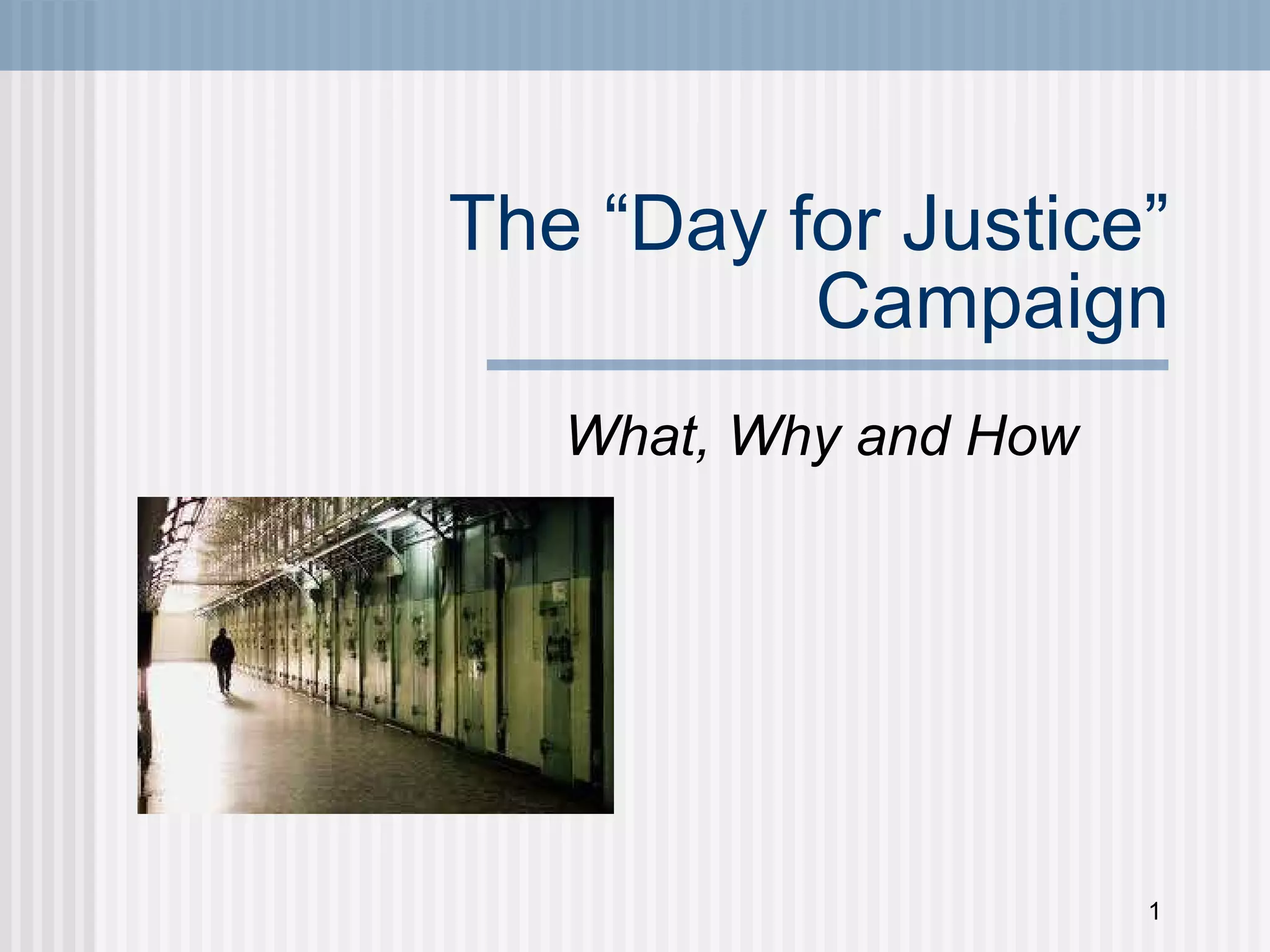
The  “ Day for Justice ”  Campaign What, Why and How
What is the  “ Day for Justice ”  Campaign? The Day for Justice campaign is for organizations and individuals affiliated with faith-based, criminal or juvenile justice reform, and/or civil rights organizations to  raise awareness  and provide a first-hand  learning experience  for  Members of Congress and/or their staff  about what the criminal and juvenile justice systems are like  on the ground  in the United States.
What is the  “ Day for Justice ”  Campaign? Day for Justice activities will include  inviting   Members of Congress and/or their staff  to do  site visits  to criminal and juvenile justice facilities or programs in or serving the member ’ s district. Any day  during which such an event takes place will be considered a “Day for Justice” event.
Why is the Day for Justice  campaign important? The purpose of Day for Justice events is to  increase the first-hand knowledge  of policymakers of what the criminal and juvenile justice systems are like, and to  encourage them to help reform  the these systems nationwide. Specific messages for district visits will depend on the  the member of Congress invited  and the  local criminal and/or juvenile justice issues and needs  that should be addressed.
Why must we act NOW?  Legislators and their staff  will be in their local districts and potentially available to visit  a criminal or juvenile justice facility or program during recess periods during the Fall of 2011. Day for Justice activities would help build support for the  National Criminal Justice Commission Act , as well as other pending legislation and policy issues key to reform.
Why must we act NOW? Additionally, Congress is working on  FY12 funding  for criminal justice and juvenile justice programs, and such visits could help them understand  the need to fund a range of programs related to these systems , including diversion, treatment, pre-release, and reentry programs.
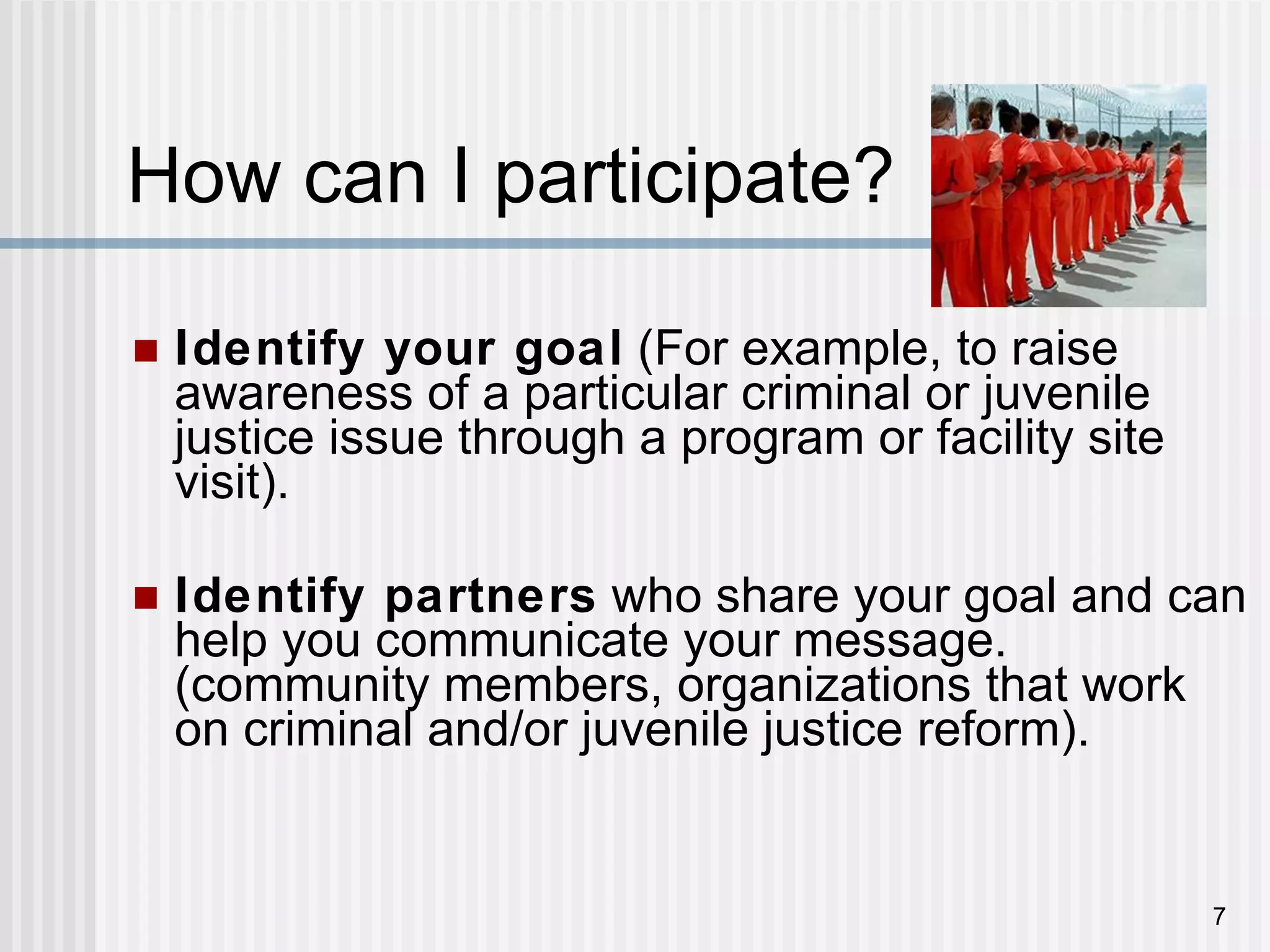
How can I participate?  Identify your goal  (For example, to raise awareness of a particular criminal or juvenile justice issue through a program or facility site visit). Identify partners  who share your goal and can help you communicate your message. (community members, organizations that work on criminal and/or juvenile justice reform).
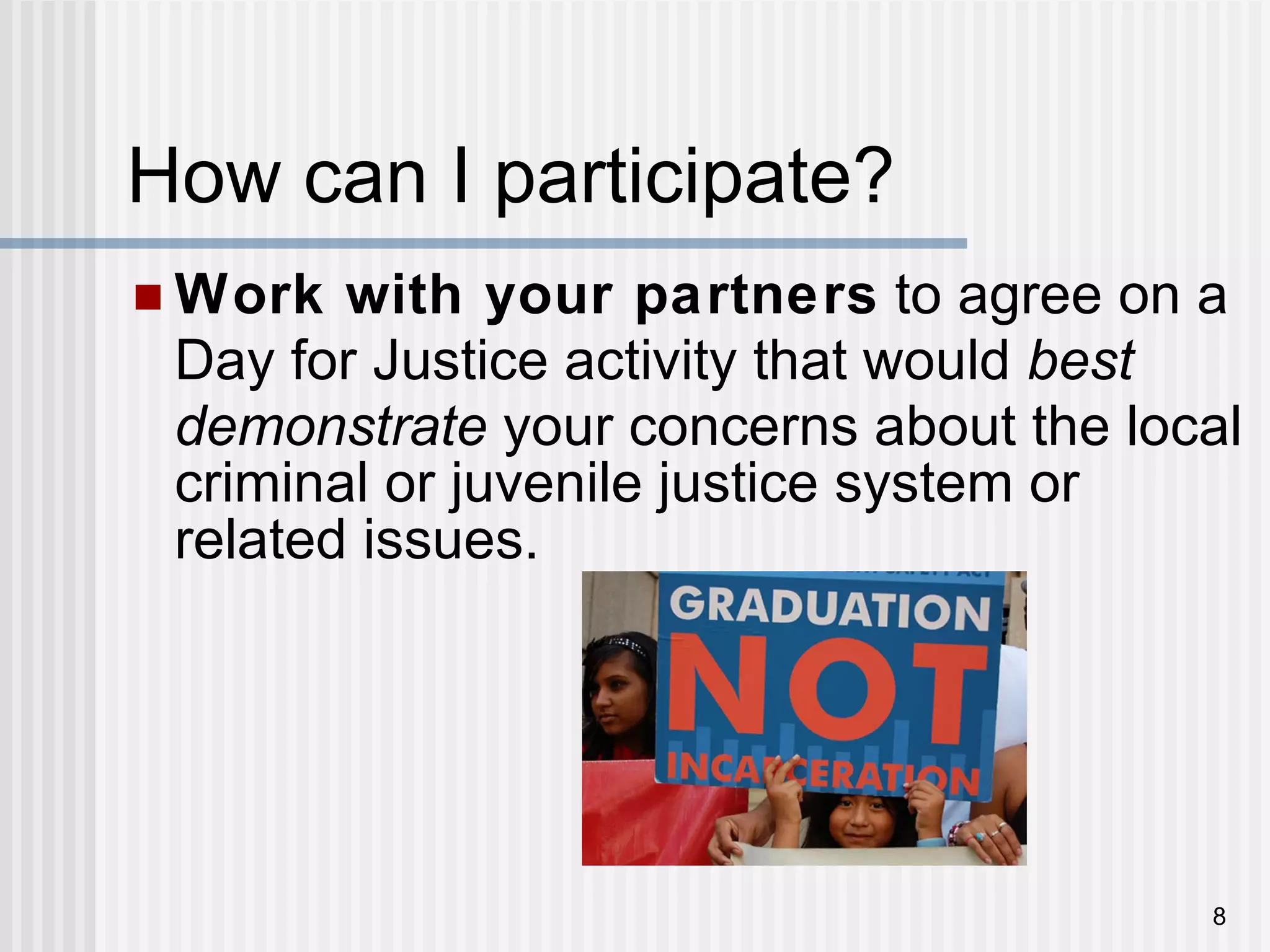
How can I participate? Work with your partners  to agree on a Day for Justice activity that would  best demonstrate  your concerns about the local criminal or juvenile justice system or related issues.
How can I develop/create a Day for Justice site visit? First steps: Identify  the criminal or juvenile justice facility or other program (diversion, pre-release, reentry, etc.). Identify the type of event  you would like to have (such as activity with residents or program participants, or a facility tour). Identify additional   local leaders  to attend, present, and help coordinate the event. Choose   date and time  for event. Contact the local program or facility  to introduce the event idea and gain approval of the event.
How do I invite a member of Congress and/or their staff to participate? Fax and email a formal invitation  to the Representative ’ s scheduler (template and contact resources to be provided). State in the invitation  why  you are inviting your member of Congress and/or their staff to participate in a Day of Justice event in their district.  State what the visit will entail and how it relates to the member’s Congressional district.
How do I invite a member of Congress and/or their staff to participate? If you do  NOT  receive a response to your invitation,  follow up by calling  the scheduler for the member of Congress.
Tips on how to set up a site visit 3-4 weeks prior Confirm   with the member of Congress  that they will attend.  Identify any materials  that may be needed for the event and begin to prepare them (fact sheets, background materials for the member of Congress and/or their staff about the visit.) Contact the program or facility  to ask for any additional specific instructions, including dress code and security issues.
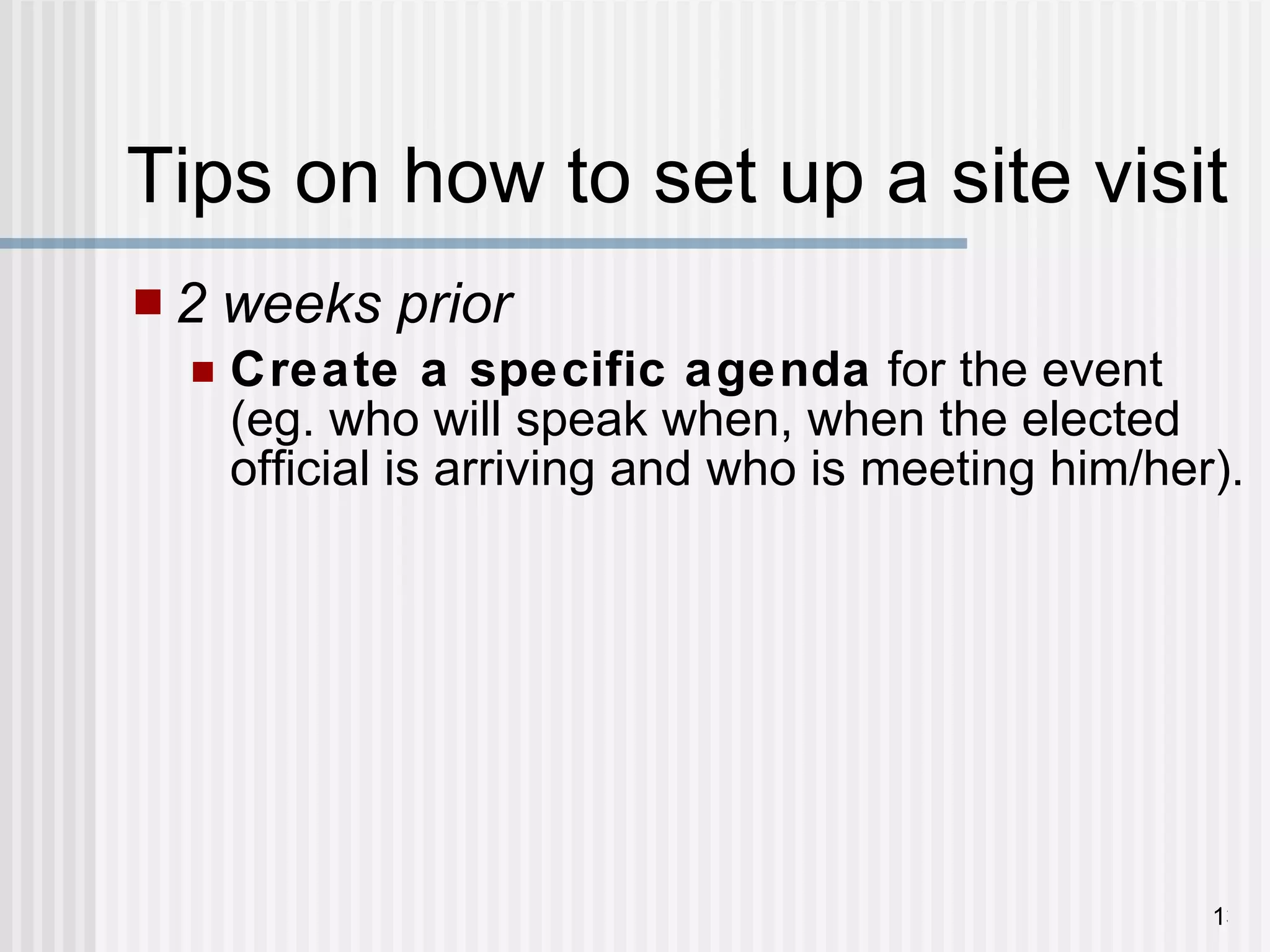
Tips on how to set up a site visit 2 weeks prior   Create a specific agenda  for the event (eg. who will speak when, when the elected official is arriving and who is meeting him/her).
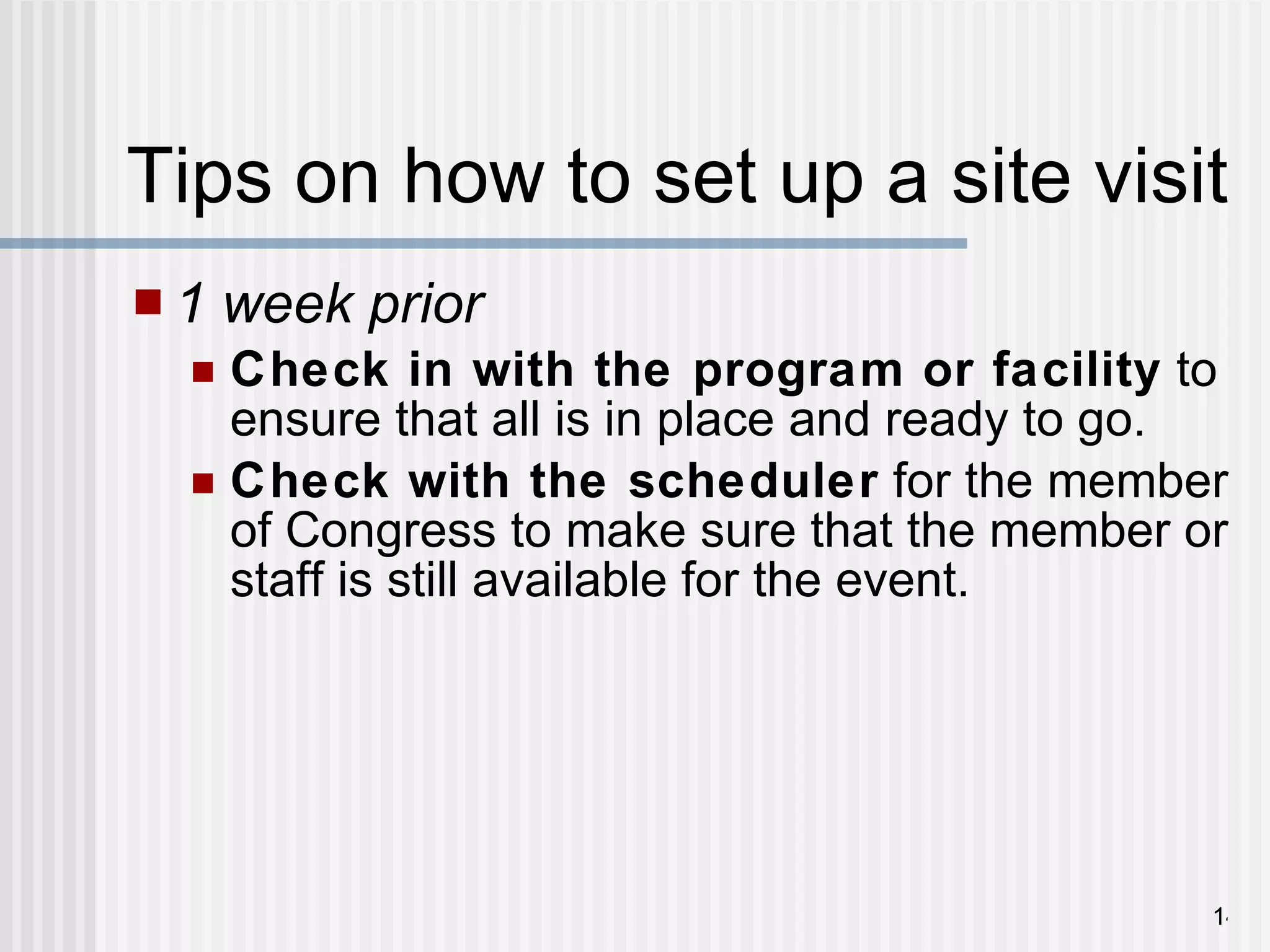
Tips on how to set up a site visit  1 week prior   Check in with the program or facility  to ensure that all is in place and ready to go. Check with the scheduler  for the member of Congress to make sure that the member or staff is still available for the event.
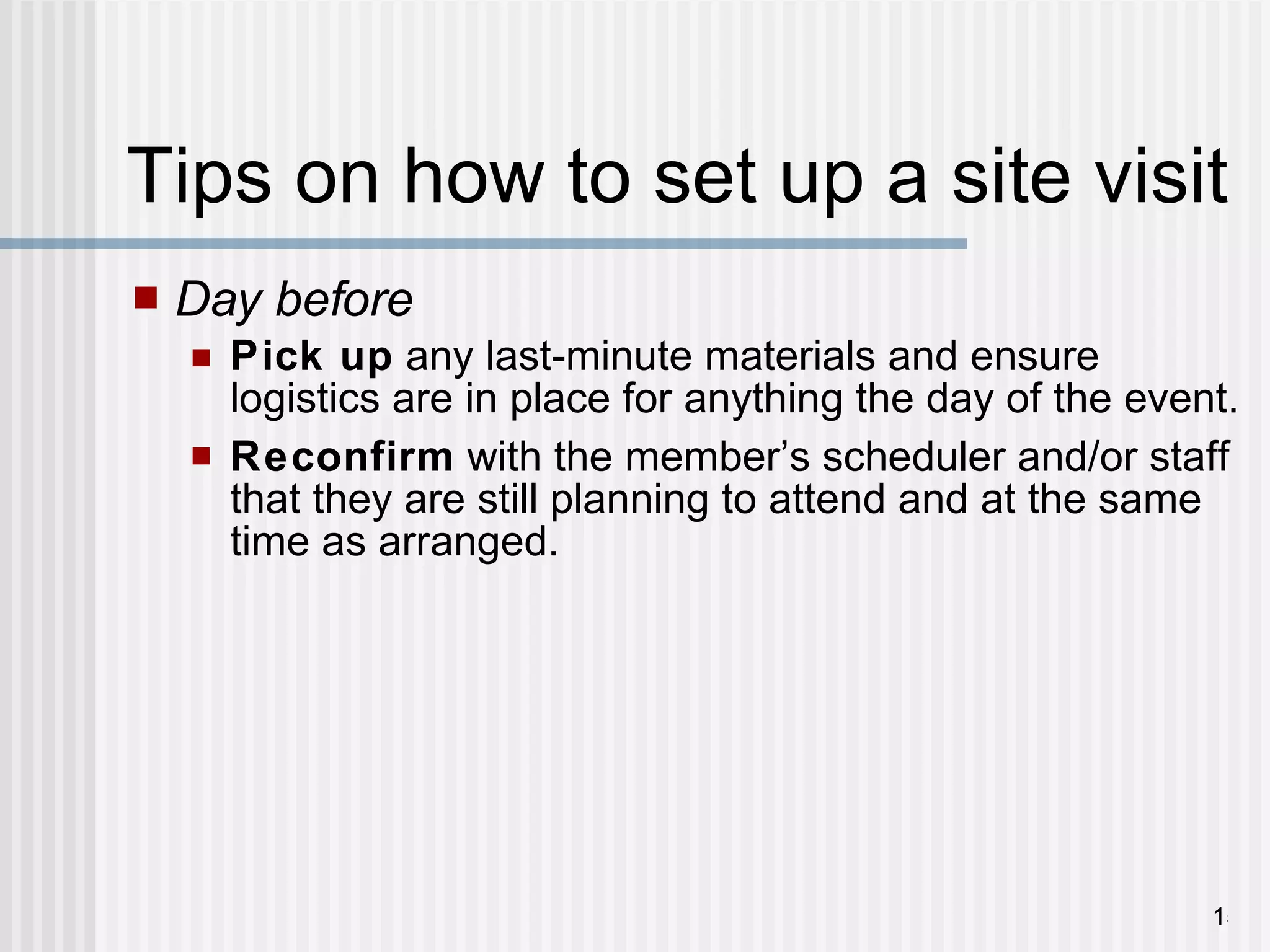
Tips on how to set up a site visit  Day before Pick up  any last-minute materials and ensure logistics are in place for anything the day of the event. Reconfirm  with the member ’ s scheduler and/or staff that they are still planning to attend and at the same time as arranged.
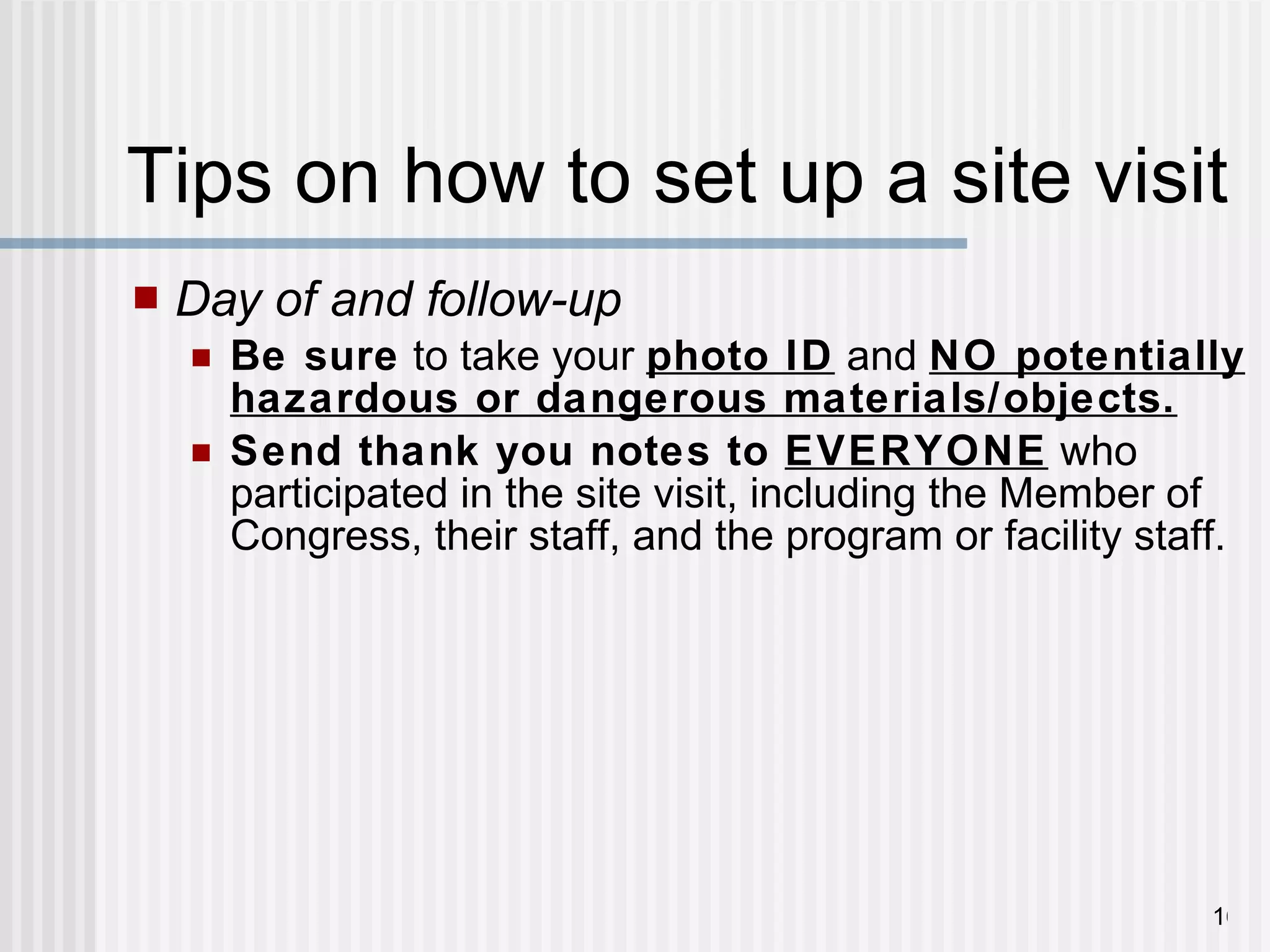
Tips on how to set up a site visit Day of and follow-up Be sure  to take your  photo ID  and  NO potentially hazardous or dangerous materials/objects. Send thank you notes to  EVERYONE  who participated in the site visit, including the Member of Congress, their staff, and the program or facility staff.
How should I interact with the targeted legislators/staff Before  the meeting or site visit, do  background research  about the legislator/staff. Make sure to  introduce yourself ; if possible,  identify yourself as a constituent  of a legislator ’ s district, as a person who  does business  in the district, or who  serves constituents  from the district.
How should I interact with the targeted legislators/staff Thank  the target legislator/staff for their time at the  beginning  and  end  of the event. Listen  to the legislator/staff as well as ask them questions;  take note  of their questions/concerns.
Media Outreach Opportunity to build  relationship  with local media around this issue Be  creative ,  specific ,  unique Early on , ask your member of Congress, to issue a statement or press release following the visit Weekday = easier for media coverage
Helpful resources House of Representatives contacts:  https://forms.house.gov/wyr/welcome.shtml Senate contacts:  http://www.senate.gov/general/contact_information/senators_cfm.cfm Achieving effective site visits:  http://www.endhomelessness.org/content/article/detail/3710
Thank you to those who contributed time and/or materials to this webinar Campaign for Youth Justice National Alliance to End Homelessness Mennonite Central Committee The United Methodist Church Jenny Collier and Katrina Neubauer
For Questions, Info or Support If you need additional support to organize a Day for Justice visit, please contact: Jenny Collier , Criminal and Juvenile Justice Policy Consultant,  [email_address] Laura Markle Downton , Criminal Justice Grassroots Coordinator, United Methodist Church,  [email_address]

Day for justice webinar final_october 2011

  • 1.
    The “Day for Justice ” Campaign What, Why and How
  • 2.
    What is the “ Day for Justice ” Campaign? The Day for Justice campaign is for organizations and individuals affiliated with faith-based, criminal or juvenile justice reform, and/or civil rights organizations to raise awareness and provide a first-hand learning experience for Members of Congress and/or their staff about what the criminal and juvenile justice systems are like on the ground in the United States.
  • 3.
    What is the “ Day for Justice ” Campaign? Day for Justice activities will include inviting Members of Congress and/or their staff to do site visits to criminal and juvenile justice facilities or programs in or serving the member ’ s district. Any day during which such an event takes place will be considered a “Day for Justice” event.
  • 4.
    Why is theDay for Justice campaign important? The purpose of Day for Justice events is to increase the first-hand knowledge of policymakers of what the criminal and juvenile justice systems are like, and to encourage them to help reform the these systems nationwide. Specific messages for district visits will depend on the the member of Congress invited and the local criminal and/or juvenile justice issues and needs that should be addressed.
  • 5.
    Why must weact NOW? Legislators and their staff will be in their local districts and potentially available to visit a criminal or juvenile justice facility or program during recess periods during the Fall of 2011. Day for Justice activities would help build support for the National Criminal Justice Commission Act , as well as other pending legislation and policy issues key to reform.
  • 6.
    Why must weact NOW? Additionally, Congress is working on FY12 funding for criminal justice and juvenile justice programs, and such visits could help them understand the need to fund a range of programs related to these systems , including diversion, treatment, pre-release, and reentry programs.
  • 7.
    How can Iparticipate? Identify your goal (For example, to raise awareness of a particular criminal or juvenile justice issue through a program or facility site visit). Identify partners who share your goal and can help you communicate your message. (community members, organizations that work on criminal and/or juvenile justice reform).
  • 8.
    How can Iparticipate? Work with your partners to agree on a Day for Justice activity that would best demonstrate your concerns about the local criminal or juvenile justice system or related issues.
  • 9.
    How can Idevelop/create a Day for Justice site visit? First steps: Identify the criminal or juvenile justice facility or other program (diversion, pre-release, reentry, etc.). Identify the type of event you would like to have (such as activity with residents or program participants, or a facility tour). Identify additional local leaders to attend, present, and help coordinate the event. Choose date and time for event. Contact the local program or facility to introduce the event idea and gain approval of the event.
  • 10.
    How do Iinvite a member of Congress and/or their staff to participate? Fax and email a formal invitation to the Representative ’ s scheduler (template and contact resources to be provided). State in the invitation why you are inviting your member of Congress and/or their staff to participate in a Day of Justice event in their district. State what the visit will entail and how it relates to the member’s Congressional district.
  • 11.
    How do Iinvite a member of Congress and/or their staff to participate? If you do NOT receive a response to your invitation, follow up by calling the scheduler for the member of Congress.
  • 12.
    Tips on howto set up a site visit 3-4 weeks prior Confirm with the member of Congress that they will attend. Identify any materials that may be needed for the event and begin to prepare them (fact sheets, background materials for the member of Congress and/or their staff about the visit.) Contact the program or facility to ask for any additional specific instructions, including dress code and security issues.
  • 13.
    Tips on howto set up a site visit 2 weeks prior Create a specific agenda for the event (eg. who will speak when, when the elected official is arriving and who is meeting him/her).
  • 14.
    Tips on howto set up a site visit 1 week prior Check in with the program or facility to ensure that all is in place and ready to go. Check with the scheduler for the member of Congress to make sure that the member or staff is still available for the event.
  • 15.
    Tips on howto set up a site visit Day before Pick up any last-minute materials and ensure logistics are in place for anything the day of the event. Reconfirm with the member ’ s scheduler and/or staff that they are still planning to attend and at the same time as arranged.
  • 16.
    Tips on howto set up a site visit Day of and follow-up Be sure to take your photo ID and NO potentially hazardous or dangerous materials/objects. Send thank you notes to EVERYONE who participated in the site visit, including the Member of Congress, their staff, and the program or facility staff.
  • 17.
    How should Iinteract with the targeted legislators/staff Before the meeting or site visit, do background research about the legislator/staff. Make sure to introduce yourself ; if possible, identify yourself as a constituent of a legislator ’ s district, as a person who does business in the district, or who serves constituents from the district.
  • 18.
    How should Iinteract with the targeted legislators/staff Thank the target legislator/staff for their time at the beginning and end of the event. Listen to the legislator/staff as well as ask them questions; take note of their questions/concerns.
  • 19.
    Media Outreach Opportunityto build relationship with local media around this issue Be creative , specific , unique Early on , ask your member of Congress, to issue a statement or press release following the visit Weekday = easier for media coverage
  • 20.
    Helpful resources Houseof Representatives contacts: https://forms.house.gov/wyr/welcome.shtml Senate contacts: http://www.senate.gov/general/contact_information/senators_cfm.cfm Achieving effective site visits: http://www.endhomelessness.org/content/article/detail/3710
  • 21.
    Thank you tothose who contributed time and/or materials to this webinar Campaign for Youth Justice National Alliance to End Homelessness Mennonite Central Committee The United Methodist Church Jenny Collier and Katrina Neubauer
  • 22.
    For Questions, Infoor Support If you need additional support to organize a Day for Justice visit, please contact: Jenny Collier , Criminal and Juvenile Justice Policy Consultant, [email_address] Laura Markle Downton , Criminal Justice Grassroots Coordinator, United Methodist Church, [email_address]