AIM: Bar and Line Graphs


                      Do Now


                               1
Key Questions

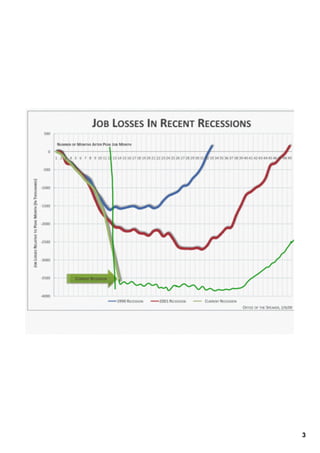
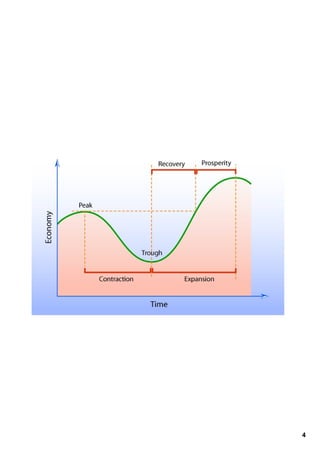
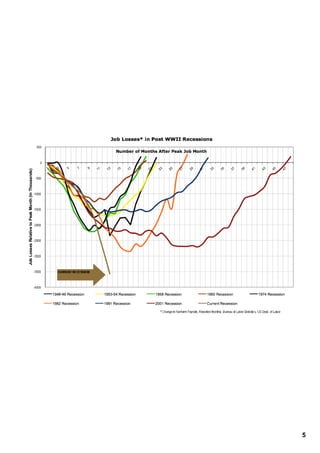
1.) What data is the graph displaying?


2.) What conclusions can we make from
the graph?


                                         2
3
4
5
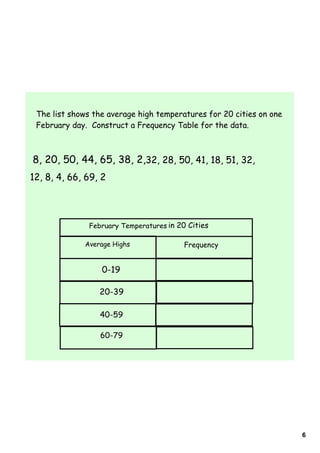
The list shows the average high temperatures for 20 cities on one
 February day. Construct a Frequency Table for the data.


8, 20, 50, 44, 65, 38, 2,32, 28, 50, 41, 18, 51, 32,
12, 8, 4, 66, 69, 2


               February Temperatures in 20 Cities

             Average Highs                Frequency


                  0-19

                 20-39

                  40-59

                  60-79


                                                                     6
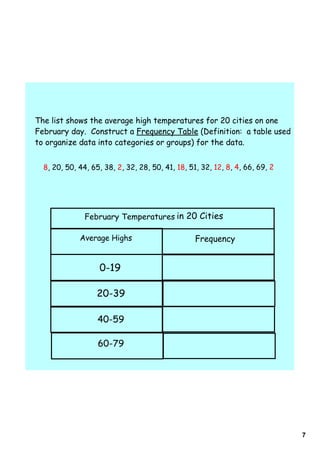
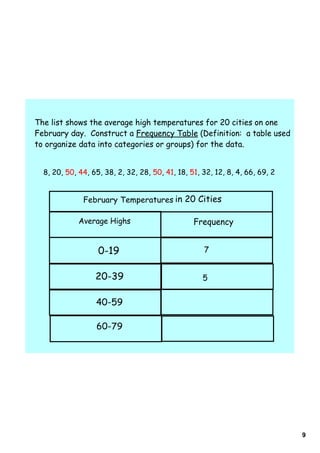
The list shows the average high temperatures for 20 cities on one
February day. Construct a Frequency Table (Definition: a table used
to organize data into categories or groups) for the data.


  8, 20, 50, 44, 65, 38, 2, 32, 28, 50, 41, 18, 51, 32, 12, 8, 4, 66, 69, 2


               February Temperatures in 20 Cities

             Average Highs                        Frequency


                   0-19

                  20-39

                   40-59

                   60-79


                                                                              7
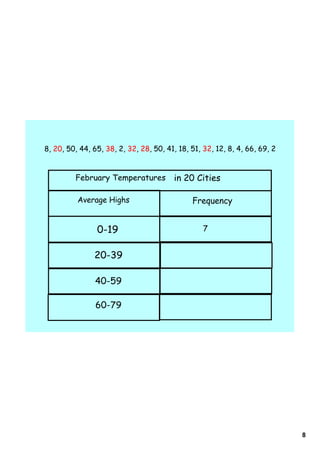
8, 20, 50, 44, 65, 38, 2, 32, 28, 50, 41, 18, 51, 32, 12, 8, 4, 66, 69, 2


         February Temperatures          in 20 Cities

          Average Highs                       Frequency


                0-19                              7


               20-39

               40-59

                60-79


                                                                            8
The list shows the average high temperatures for 20 cities on one
February day. Construct a Frequency Table (Definition: a table used
to organize data into categories or groups) for the data.


  8, 20, 50, 44, 65, 38, 2, 32, 28, 50, 41, 18, 51, 32, 12, 8, 4, 66, 69, 2


              February Temperatures in 20 Cities

             Average Highs                       Frequency


                   0-19                             7


                  20-39                             5


                  40-59

                  60-79


                                                                              9
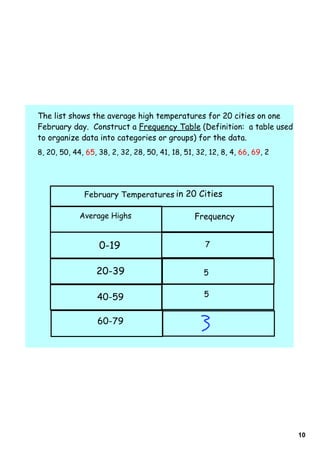
The list shows the average high temperatures for 20 cities on one
February day. Construct a Frequency Table (Definition: a table used
to organize data into categories or groups) for the data.
8, 20, 50, 44, 65, 38, 2, 32, 28, 50, 41, 18, 51, 32, 12, 8, 4, 66, 69, 2


              February Temperatures in 20 Cities

             Average Highs                       Frequency


                   0-19                             7


                  20-39                             5


                  40-59                             5


                  60-79


                                                                            10
Anticipatory Set
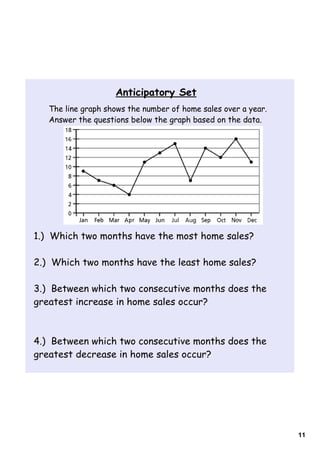
   The line graph shows the number of home sales over a year.
   Answer the questions below the graph based on the data.


1.) Which two months have the most home sales?

2.) Which two months have the least home sales?

3.) Between which two consecutive months does the
greatest increase in home sales occur?


4.) Between which two consecutive months does the
greatest decrease in home sales occur?


                                                                11
Anticipatory Set
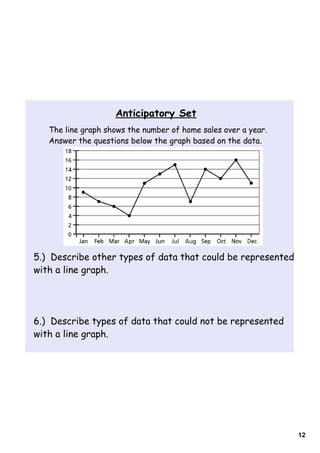
   The line graph shows the number of home sales over a year.
   Answer the questions below the graph based on the data.


5.) Describe other types of data that could be represented
with a line graph.


6.) Describe types of data that could not be represented
with a line graph.


                                                                12
Interpreting Line and Bar Graphs


          Grade: «grade»
         Subject: Math
           Date: «date»


                                   13
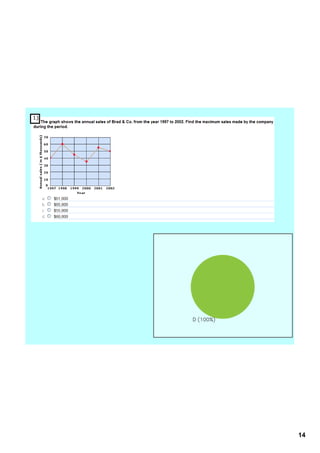
1.)
  1  

        A  

        B  

        C  

        D  


              14
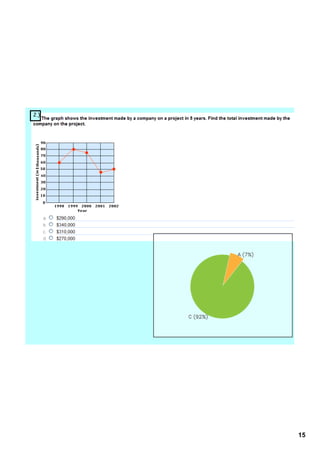
2.)

 2  

       A  

       B  

       C  

       D  


             15
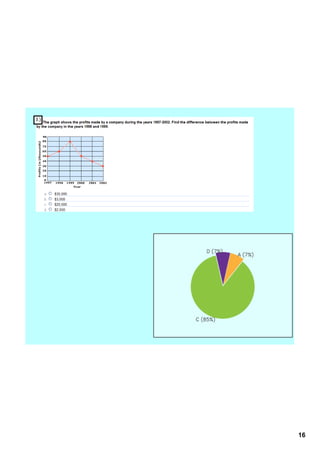
3.)
3  

      A  

      B  

      C  

      D  


            16
4  
4.)


      A  

      B  

      C  

      D  


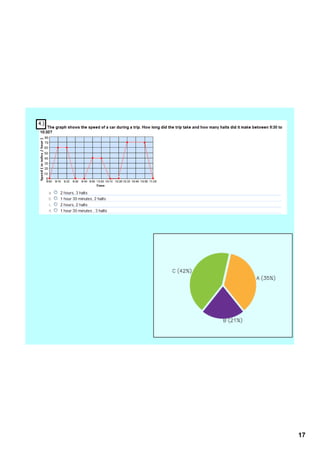
            17
5.)
5  

      A  

      B  

      C  

      D  


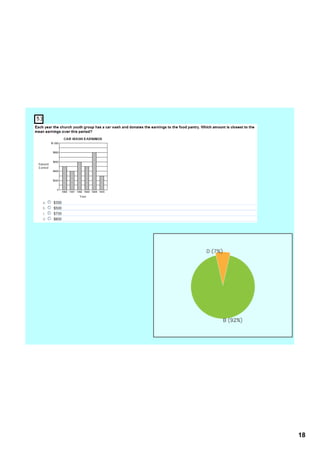
            18
6.)
6  

      A  

      B  

      C  

      D  


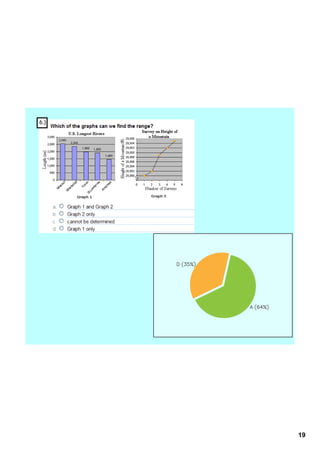
            19
7.)
7  

      A  

      B  

      C  

      D  


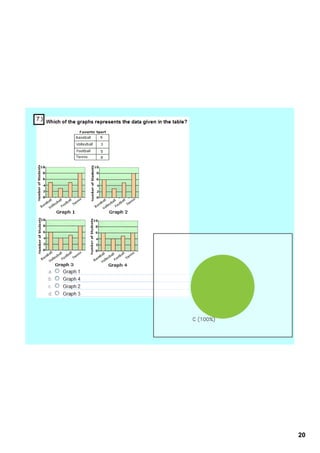
            20
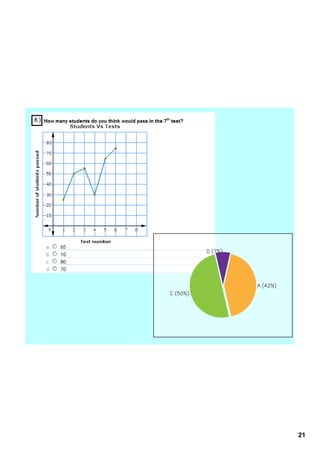
8.)
 8  

       A  

       B  

       C  

       D  


             21
22

Day 5 read line bar

  • 1.
    AIM: Bar andLine Graphs Do Now 1
  • 2.
    Key Questions 1.) Whatdata is the graph displaying? 2.) What conclusions can we make from the graph? 2
  • 3.
  • 4.
  • 5.
  • 6.
    The list showsthe average high temperatures for 20 cities on one February day. Construct a Frequency Table for the data. 8, 20, 50, 44, 65, 38, 2,32, 28, 50, 41, 18, 51, 32, 12, 8, 4, 66, 69, 2 February Temperatures in 20 Cities Average Highs Frequency 0-19 20-39 40-59 60-79 6
  • 7.
    The list showsthe average high temperatures for 20 cities on one February day. Construct a Frequency Table (Definition: a table used to organize data into categories or groups) for the data. 8, 20, 50, 44, 65, 38, 2, 32, 28, 50, 41, 18, 51, 32, 12, 8, 4, 66, 69, 2 February Temperatures in 20 Cities Average Highs Frequency 0-19 20-39 40-59 60-79 7
  • 8.
    8, 20, 50,44, 65, 38, 2, 32, 28, 50, 41, 18, 51, 32, 12, 8, 4, 66, 69, 2 February Temperatures in 20 Cities Average Highs Frequency 0-19 7 20-39 40-59 60-79 8
  • 9.
    The list showsthe average high temperatures for 20 cities on one February day. Construct a Frequency Table (Definition: a table used to organize data into categories or groups) for the data. 8, 20, 50, 44, 65, 38, 2, 32, 28, 50, 41, 18, 51, 32, 12, 8, 4, 66, 69, 2 February Temperatures in 20 Cities Average Highs Frequency 0-19 7 20-39 5 40-59 60-79 9
  • 10.
    The list showsthe average high temperatures for 20 cities on one February day. Construct a Frequency Table (Definition: a table used to organize data into categories or groups) for the data. 8, 20, 50, 44, 65, 38, 2, 32, 28, 50, 41, 18, 51, 32, 12, 8, 4, 66, 69, 2 February Temperatures in 20 Cities Average Highs Frequency 0-19 7 20-39 5 40-59 5 60-79 10
  • 11.
    Anticipatory Set The line graph shows the number of home sales over a year. Answer the questions below the graph based on the data. 1.) Which two months have the most home sales? 2.) Which two months have the least home sales? 3.) Between which two consecutive months does the greatest increase in home sales occur? 4.) Between which two consecutive months does the greatest decrease in home sales occur? 11
  • 12.
    Anticipatory Set The line graph shows the number of home sales over a year. Answer the questions below the graph based on the data. 5.) Describe other types of data that could be represented with a line graph. 6.) Describe types of data that could not be represented with a line graph. 12
  • 13.
    Interpreting Line and Bar Graphs Grade: «grade» Subject: Math Date: «date» 13
  • 14.
    1.) 1  A   B   C   D   14
  • 15.
    2.) 2   A   B   C   D   15
  • 16.
    3.) 3   A   B   C   D   16
  • 17.
    4   4.) A   B   C   D   17
  • 18.
    5.) 5   A   B   C   D   18
  • 19.
    6.) 6   A   B   C   D   19
  • 20.
    7.) 7   A   B   C   D   20
  • 21.
    8.) 8   A   B   C   D   21
  • 22.