Disjoint Union Types Enumeratioin Types Natural Number Type Finite Sequences Id-type
Introduction to Dependent Type Semantics:
More dependent types
Daisuke Bekki1,2 Koji Mineshima1,2
1Ochanomizu University / 2CREST, Japan Science and Technology Agency
version: August 18, 2016
ESSLLI 2016 course, Bolzano, Italy, August 15-19, 2016.
1 / 41
Disjoint Union Types Enumeratioin Types Natural Number Type Finite Sequences Id-type
Disjoint Union Types for Disjunction
2 / 41
Disjoint Union Types Enumeratioin Types Natural Number Type Finite Sequences Id-type
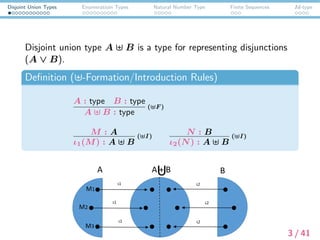
Disjoint union type A B is a type for representing disjunctions
(A ∨ B).
Definition ( -Formation/Introduction Rules)
A : type B : type
A B : type
( F)
M : A
ι1(M) : A B
( I )
N : B
ι2(N) : A B
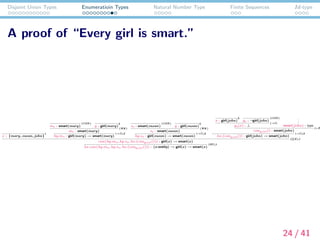
( I )
3 / 41
Disjoint Union Types Enumeratioin Types Natural Number Type Finite Sequences Id-type
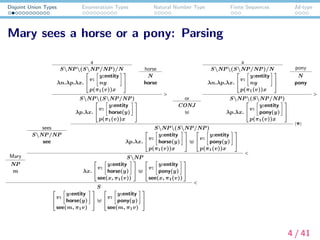
Mary sees a horse or a pony: Parsing
Mary
NP
m
sees
SNP/NP
see
a
SNP(SNP/NP)/N
λn.λp.λx.

 v:
y:entity
ny
p(π1(v))x


horse
N
horse
SNP(SNP/NP)
λp.λx.

 v:
y:entity
horse(y)
p(π1(v))x


>
or
CONJ
a
SNP(SNP/NP)/N
λn.λp.λx.

 v:
y:entity
ny
p(π1(v))x


pony
N
pony
SNP(SNP/NP)
λp.λx.

 v:
y:entity
pony(y)
p(π1(v))x


>
SNP(SNP/NP)
λp.λx.

 v:
y:entity
horse(y)
p(π1(v))x



 v:
y:entity
pony(y)
p(π1(v))x


Φ
SNP
λx.

 v:
y:entity
horse(y)
see(x, π1(v))



 v:
y:entity
pony(y)
see(x, π1(v))


<
S
 v:
y:entity
horse(y)
see(m, π1v)



 v:
y:entity
pony(y)
see(m, π1v)


<
4 / 41
Disjoint Union Types Enumeratioin Types Natural Number Type Finite Sequences Id-type
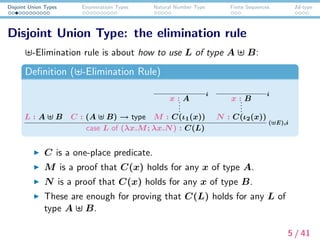
Disjoint Union Type: the elimination rule
-Elimination rule is about how to use L of type A B:
Definition ( -Elimination Rule)
L : A B C : (A B) → type
x : A....
M : C(ι1(x))
i
x : B....
N : C(ι2(x))
i
case L of (λx.M; λx.N) : C(L)
( E),i
C is a one-place predicate.
M is a proof that C(x) holds for any x of type A.
N is a proof that C(x) holds for any x of type B.
These are enough for proving that C(L) holds for any L of
type A B.
5 / 41
Disjoint Union Types Enumeratioin Types Natural Number Type Finite Sequences Id-type
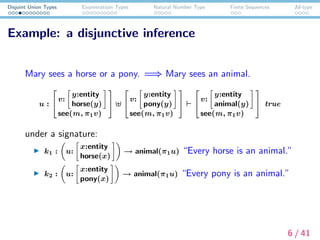
Example: a disjunctive inference
Mary sees a horse or a pony. =
⇐
Mary sees an animal.
u :

 v:
y:entity
horse(y)
see(m, π1v)



 v:
y:entity
pony(y)
see(m, π1v)



 v:
y:entity
animal(y)
see(m, π1v)

 true
under a signature:
k1 : u:
x:entity
horse(x)
→ animal(π1u) “Every horse is an animal.”
k2 : u:
x:entity
pony(x)
→ animal(π1u) “Every pony is an animal.”
6 / 41
Disjoint Union Types Enumeratioin Types Natural Number Type Finite Sequences Id-type
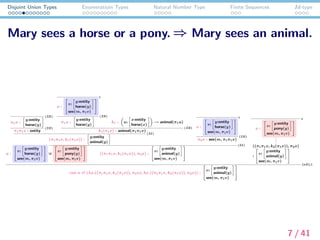
Mary sees a horse or a pony.
⇐
Mary sees an animal.
u :

 v:
y:entity
horse(y)
see(m, π1v)



 v:
y:entity
pony(y)
see(m, π1v)


π1x :
y:entity
horse(y)
(ΣE)
π1π1x : entity
(ΣE)
x :

 v:
y:entity
horse(y)
see(m, π1v)


1
π1x :
y:entity
horse(y)
(ΣE)
k1 : u:
x:entity
horse(x)
→ animal(π1u)
k1(π1x) : animal(π1π1x)
(ΣE)
(π1π1x, k1(π1x)) :
y:entity
animal(y)
(ΣI )
x :

 v:
y:entity
horse(y)
see(m, π1v)


1
π2x : see(m, π1π1x)
(ΣE)
((π1π1x, k1(π1x)), π2x) :

 v:
y:entity
animal(y)
see(m, π1v)


(ΣI )
x :

 v:
y:entity
pony(y)
see(m, π1v)


....
((π1π1x, k2(π1x)), π2x)
:

 v:
y:entity
animal(y)
see(m, π1v)


1
case u of (λx.((π1π1x, k1(π1x)), π2x); λx.((π1π1x, k2(π1x)), π2x)) :

 v:
y:entity
animal(y)
see(m, π1v)


( E),1
7 / 41
Disjoint Union Types Enumeratioin Types Natural Number Type Finite Sequences Id-type
Disjunctive antecedents
Elbourne (2011):
(1) If Mary1 sees [[a horse] or [a pony]]2, she1 waves to it2.
Dynamic semantics does not have a straightforward solution
for it.
A solution via dependent types: Ranta (1994)
8 / 41
Disjoint Union Types Enumeratioin Types Natural Number Type Finite Sequences Id-type
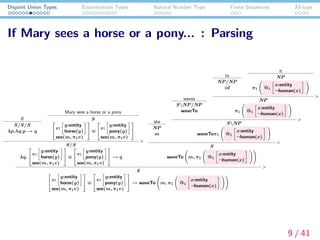
If Mary sees a horse or a pony... : Parsing
If
S/S/S
λp.λq.p → q
Mary sees a horse or a pony
S
 v:
y:entity
horse(y)
see(m, π1v)



 v:
y:entity
pony(y)
see(m, π1v)


S/S
λq.

 v:
y:entity
horse(y)
see(m, π1v)



 v:
y:entity
pony(y)
see(m, π1v)

 → q
>
she
NP
m
waves
SNP/NP
waveTo
to
NP/NP
id
it
NP
π1 @1
x:entity
¬human(x)
NP
π1 @1
x:entity
¬human(x)
>
SNP
waveToπ1 @1
x:entity
¬human(x)
>
S
waveTo m, π1 @1
x:entity
¬human(x)
<
S
 v:
y:entity
horse(y)
see(m, π1v)



 v:
y:entity
pony(y)
see(m, π1v)

 → waveTo m, π1 @1
x:entity
¬human(x)
>
9 / 41
Disjoint Union Types Enumeratioin Types Natural Number Type Finite Sequences Id-type
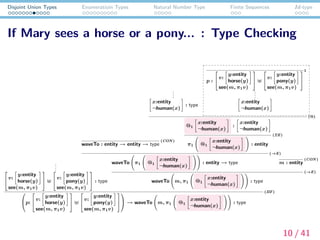
If Mary sees a horse or a pony... : Type Checking
....
 v:
y:entity
horse(y)
see(m, π1v)



 v:
y:entity
pony(y)
see(m, π1v)

 : type
waveTo : entity → entity → type
(CON )
....
x:entity
¬human(x)
: type
p :

 v:
y:entity
horse(y)
see(m, π1v)



 v:
y:entity
pony(y)
see(m, π1v)


....
x:entity
¬human(x)
1
@1
x:entity
¬human(x)
:
x:entity
¬human(x)
(@)
π1 @1
x:entity
¬human(x)
: entity
(ΣE)
waveTo π1 @1
x:entity
¬human(x)
: entity → type
(→E)
m : entity
(CON )
waveTo m, π1 @1
x:entity
¬human(x)
: type
(→E)

p:

 v:
y:entity
horse(y)
see(m, π1v)



 v:
y:entity
pony(y)
see(m, π1v)



 → waveTo m, π1 @1
x:entity
¬human(x)
: type
(ΠF)
10 / 41
Disjoint Union Types Enumeratioin Types Natural Number Type Finite Sequences Id-type
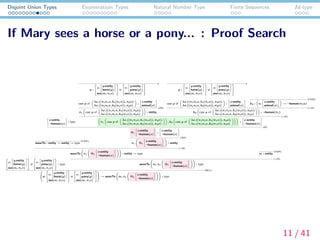
If Mary sees a horse or a pony... : Proof Search
....
 v:
y:entity
horse(y)
see(m, π1v)



 v:
y:entity
pony(y)
see(m, π1v)

 : type
waveTo : entity → entity → type
(CON )
....
x:entity
¬human(x)
: type
p :

 v:
y:entity
horse(y)
see(m, π1v)



 v:
y:entity
pony(y)
see(m, π1v)


....
case p of
λx.((π1π1x, k1(π1x)), π2x);
λx.((π1π1x, k2(π1x)), π2x)
:
x:entity
animal(x)
1
π1 case p of
λx.((π1π1x, k1(π1x)), π2x);
λx.((π1π1x, k2(π1x)), π2x)
: entity
(ΣE)
p :

 v:
y:entity
horse(y)
see(m, π1v)



 v:
y:entity
pony(y)
see(m, π1v)


....
case p of
λx.((π1π1x, k1(π1x)), π2x);
λx.((π1π1x, k2(π1x)), π2x)
:
x:entity
animal(x)
1
k3 : u:
x:entity
animal(x)
→ ¬human(π1u)
(CON )
k3 case p of
λx.((π1π1x, k1(π1x)), π2x);
λx.((π1π1x, k2(π1x)), π2x)
: ¬human(π1)
(→E)
π1 case p of
λx.((π1π1x, k1(π1x)), π2x);
λx.((π1π1x, k2(π1x)), π2x)
, k3 case p of
λx.((π1π1x, k1(π1x)), π2x);
λx.((π1π1x, k2(π1x)), π2x)
:
x:entity
¬human(x)
(→E)
@1
x:entity
¬human(x)
:
x:entity
¬human(x)
(@)
π1 @1
x:entity
¬human(x)
: entity
(ΣE)
waveTo π1 @1
x:entity
¬human(x)
: entity → type
(→E)
m : entity
(CON )
waveTo m, π1 @1
x:entity
¬human(x)
: type
(→E)

p:

 v:
y:entity
horse(y)
see(m, π1v)



 v:
y:entity
pony(y)
see(m, π1v)



 → waveTo m, π1 @1
x:entity
¬human(x)
: type
(ΠI ),1
11 / 41
Disjoint Union Types Enumeratioin Types Natural Number Type Finite Sequences Id-type
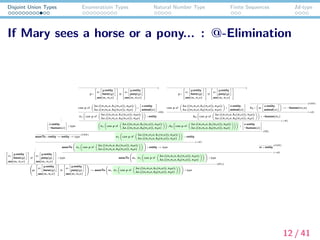
If Mary sees a horse or a pony... : @-Elimination
....
 v:
y:entity
horse(y)
see(m, π1v)



 v:
y:entity
pony(y)
see(m, π1v)

 : type
waveTo : entity → entity → type
(CON )
....
x:entity
¬human(x)
: type
p :

 v:
y:entity
horse(y)
see(m, π1v)



 v:
y:entity
pony(y)
see(m, π1v)


....
case p of
λx.((π1π1x, k1(π1x)), π2x);
λx.((π1π1x, k2(π1x)), π2x)
:
x:entity
animal(x)
1
π1 case p of
λx.((π1π1x, k1(π1x)), π2x);
λx.((π1π1x, k2(π1x)), π2x)
: entity
(ΣE)
p :

 v:
y:entity
horse(y)
see(m, π1v)



 v:
y:entity
pony(y)
see(m, π1v)


....
case p of
λx.((π1π1x, k1(π1x)), π2x);
λx.((π1π1x, k2(π1x)), π2x)
:
x:entity
animal(x)
1
k3 : u:
x:entity
animal(x)
→ ¬human(π1u)
(CON )
k3 case p of
λx.((π1π1x, k1(π1x)), π2x);
λx.((π1π1x, k2(π1x)), π2x)
: ¬human(π1)
(→E)
π1 case p of
λx.((π1π1x, k1(π1x)), π2x);
λx.((π1π1x, k2(π1x)), π2x)
, k3 case p of
λx.((π1π1x, k1(π1x)), π2x);
λx.((π1π1x, k2(π1x)), π2x)
:
x:entity
¬human(x)
(→E)
π1 case p of
λx.((π1π1x, k1(π1x)), π2x);
λx.((π1π1x, k2(π1x)), π2x)
: entity
(ΣE)
waveTo π1 case p of
λx.((π1π1x, k1(π1x)), π2x);
λx.((π1π1x, k2(π1x)), π2x)
: entity → type
(→E)
m : entity
(CON )
waveTo m, π1 case p of
λx.((π1π1x, k1(π1x)), π2x);
λx.((π1π1x, k2(π1x)), π2x)
: type
(→E)

p:

 v:
y:entity
horse(y)
see(m, π1v)



 v:
y:entity
pony(y)
see(m, π1v)



 → waveTo m, π1 case p of
λx.((π1π1x, k1(π1x)), π2x);
λx.((π1π1x, k2(π1x)), π2x)
: type
(ΠI ),1
12 / 41
Disjoint Union Types Enumeratioin Types Natural Number Type Finite Sequences Id-type
Inaccessibility again
(1) If Mary1 sees [[a horse] or [a pony]], she1 waves to it2.
(2) * If Mary1 sees [[a horse] or [nothing]], she1 waves to it2.
(3) * If Mary1 sees [[nothing] or [a horse]], she1 waves to it2.
(4) If Mary1 sees [[a horse] or [nothing]], she1 is unhappy.
13 / 41
Disjoint Union Types Enumeratioin Types Natural Number Type Finite Sequences Id-type
Summary: Disjoint union type and disjunction
Disjunctive constructions are represented by using disjoint
union types.
Disjunctive antecedents have been problematic to dynamic
semantics, while disjoint union types give it a proper analysis,
which implies that anaphora binding is not an issue of variable
binding but an issue of proof construction.
14 / 41
Disjoint Union Types Enumeratioin Types Natural Number Type Finite Sequences Id-type
Enumeration Type
15 / 41
Disjoint Union Types Enumeratioin Types Natural Number Type Finite Sequences Id-type
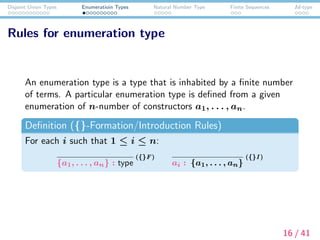
Rules for enumeration type
An enumeration type is a type that is inhabited by a finite number
of terms. A particular enumeration type is defined from a given
enumeration of n-number of constructors a1, . . . , an.
Definition ({}-Formation/Introduction Rules)
For each i such that 1 ≤ i ≤ n:
{a1, . . . , an} : type
({}F)
ai : {a1, . . . , an}
({}I )
16 / 41
Disjoint Union Types Enumeratioin Types Natural Number Type Finite Sequences Id-type
Rules for enumeration type
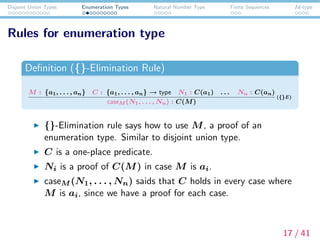
Definition ({}-Elimination Rule)
M : {a1, . . . , an} C : {a1, . . . , an} → type N1 : C(a1) . . . Nn : C(an)
caseM (N1, . . . , Nn) : C(M)
({}E)
{}-Elimination rule says how to use M, a proof of an
enumeration type. Similar to disjoint union type.
C is a one-place predicate.
Ni is a proof of C(M) in case M is ai.
caseM (N1, . . . , Nn) saids that C holds in every case where
M is ai, since we have a proof for each case.
17 / 41
Disjoint Union Types Enumeratioin Types Natural Number Type Finite Sequences Id-type
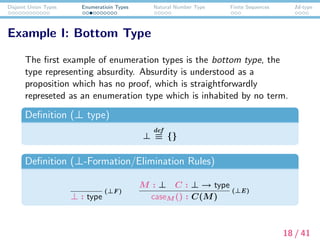
Example I: Bottom Type
The first example of enumeration types is the bottom type, the
type representing absurdity. Absurdity is understood as a
proposition which has no proof, which is straightforwardly
represeted as an enumeration type which is inhabited by no term.
Definition (⊥ type)
⊥
def
≡ {}
Definition (⊥-Formation/Elimination Rules)
⊥ : type
(⊥F)
M : ⊥ C : ⊥ → type
caseM () : C(M)
(⊥E)
18 / 41
Disjoint Union Types Enumeratioin Types Natural Number Type Finite Sequences Id-type
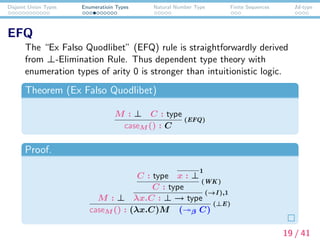
EFQ
The “Ex Falso Quodlibet” (EFQ) rule is straightforwardly derived
from ⊥-Elimination Rule. Thus dependent type theory with
enumeration types of arity 0 is stronger than intuitionistic logic.
Theorem (Ex Falso Quodlibet)
M : ⊥ C : type
caseM () : C
(EFQ)
Proof.
M : ⊥
C : type x : ⊥
1
C : type
(WK)
λx.C : ⊥ → type
(→I ),1
caseM () : (λx.C)M ( β C)
(⊥E)
19 / 41
Disjoint Union Types Enumeratioin Types Natural Number Type Finite Sequences Id-type
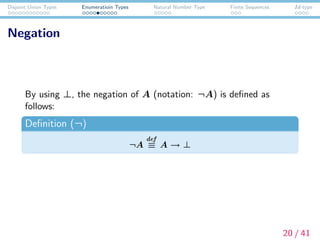
Negation
By using ⊥, the negation of A (notation: ¬A) is defined as
follows:
Definition (¬)
¬A
def
≡ A → ⊥
20 / 41
Disjoint Union Types Enumeratioin Types Natural Number Type Finite Sequences Id-type
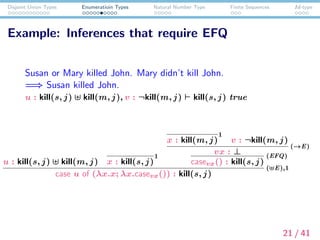
Example: Inferences that require EFQ
Susan or Mary killed John. Mary didn’t kill John.
=
⇐
Susan killed John.
u : kill(s, j ) kill(m, j ), v : ¬kill(m, j ) kill(s, j ) true
u : kill(s, j ) kill(m, j ) x : kill(s, j )
1
x : kill(m, j )
1
v : ¬kill(m, j )
vx : ⊥
(→E)
casevx() : kill(s, j )
(EFQ)
case u of (λx.x; λx.casevx()) : kill(s, j )
( E),1
21 / 41
Disjoint Union Types Enumeratioin Types Natural Number Type Finite Sequences Id-type
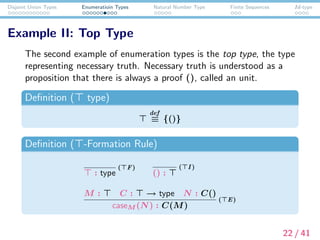
Example II: Top Type
The second example of enumeration types is the top type, the type
representing necessary truth. Necessary truth is understood as a
proposition that there is always a proof (), called an unit.
Definition ( type)
def
≡ {()}
Definition ( -Formation Rule)
: type
( F)
() :
( I )
M : C : → type N : C()
caseM (N) : C(M)
( E)
22 / 41
Disjoint Union Types Enumeratioin Types Natural Number Type Finite Sequences Id-type
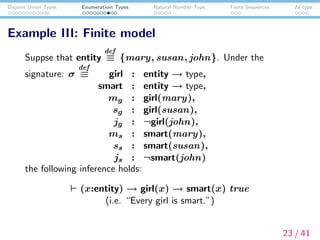
Example III: Finite model
Suppse that entity
def
≡ {mary, susan, john}. Under the
signature: σ
def
≡ girl : entity → type,
smart : entity → type,
mg : girl(mary),
sg : girl(susan),
jg : ¬girl(john),
ms : smart(mary),
ss : smart(susan),
js : ¬smart(john)
the following inference holds:
(x:entity) → girl(x) → smart(x) true
(i.e. “Every girl is smart.”)
23 / 41
Disjoint Union Types Enumeratioin Types Natural Number Type Finite Sequences Id-type
A proof of “Every girl is smart.”
x : {mary, susan, john}
1
ms : smart(mary)
(CON )
y : girl(mary)
2
ms : smart(mary)
(WK)
λy.ms : girl(mary) → smart(mary)
(→I ),2
ss : smart(susan)
(CON )
y : girl(susan)
2
ss : smart(susan)
(WK)
λy.ss : girl(susan) → smart(susan)
(→I ),2
x : girl(john)
3
gs : ¬girl(john)
(CON )
gs(x) : ⊥
(→I )
....
smart(john) : type
casegs(x)() : smart(john)
(⊥E
λx.(casegs(x)()) : girl(john) → smart(john)
(→I ),3
case(λy.ms, λy.ss, λx.(casegs(x)())) : girl(x) → smart(x)
({}E),1
λx.case(λy.ms, λy.ss, λx.(casegs(x)())) : (x:entity) → girl(x) → smart(x)
(ΠI ),1
24 / 41
Disjoint Union Types Enumeratioin Types Natural Number Type Finite Sequences Id-type
Summary
⊥ and are instances of enumeration types.
Generally, ∃ and ¬∀ propositions can be verified by a single
witness, while ∀ and ¬∃ propositions can be verified only
analytically, if they quantify over possibly infinite domain.
In model-theoretic semantics, even ∀ and ¬∃ propositions can
be shown to be true under some finite model, while it is not
the case in proof-theoretic semantics without enumeration
types.
entity defined in terms of enumeration types behaves as finite
models, enables us to mimic model-theoretic semantics.
25 / 41
Disjoint Union Types Enumeratioin Types Natural Number Type Finite Sequences Id-type
Natural Number Type
26 / 41
Disjoint Union Types Enumeratioin Types Natural Number Type Finite Sequences Id-type
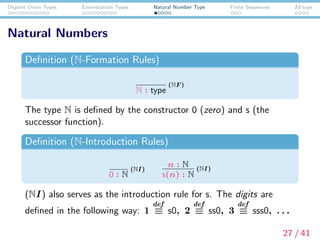
Natural Numbers
Definition (N-Formation Rules)
N : type
(NF)
The type N is defined by the constructor 0 (zero) and s (the
successor function).
Definition (N-Introduction Rules)
0 : N
(NI )
n : N
s(n) : N
(NI )
(NI ) also serves as the introduction rule for s. The digits are
defined in the following way: 1
def
≡ s0, 2
def
≡ ss0, 3
def
≡ sss0, . . .
27 / 41
Disjoint Union Types Enumeratioin Types Natural Number Type Finite Sequences Id-type
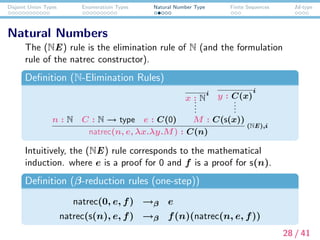
Natural Numbers
The (NE) rule is the elimination rule of N (and the formulation
rule of the natrec constructor).
Definition (N-Elimination Rules)
n : N C : N → type e : C(0)
x : N....
i
y : C(x)
....
i
M : C(s(x))
natrec(n, e, λx.λy.M) : C(n)
(NE),i
Intuitively, the (NE) rule corresponds to the mathematical
induction. where e is a proof for 0 and f is a proof for s(n).
Definition (β-reduction rules (one-step))
natrec(0, e, f) →β e
natrec(s(n), e, f) →β f(n)(natrec(n, e, f))
28 / 41
Disjoint Union Types Enumeratioin Types Natural Number Type Finite Sequences Id-type
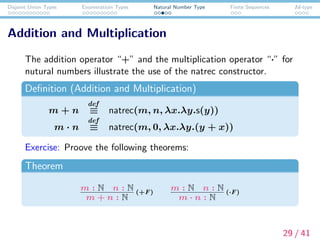
Addition and Multiplication
The addition operator “+” and the multiplication operator “·” for
nutural numbers illustrate the use of the natrec constructor.
Definition (Addition and Multiplication)
m + n
def
≡ natrec(m, n, λx.λy.s(y))
m · n
def
≡ natrec(m, 0, λx.λy.(y + x))
Exercise: Proove the following theorems:
Theorem
m : N n : N
m + n : N
(+F)
m : N n : N
m · n : N
(·F)
29 / 41
Disjoint Union Types Enumeratioin Types Natural Number Type Finite Sequences Id-type
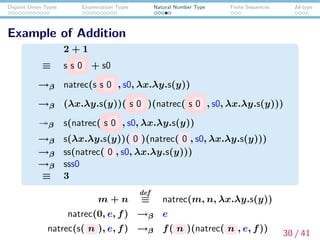
Example of Addition
2 + 1
≡ s s 0 + s0
→β natrec(s s 0 , s0, λx.λy.s(y))
→β (λx.λy.s(y))( s 0 )(natrec( s 0 , s0, λx.λy.s(y)))
β s(natrec( s 0 , s0, λx.λy.s(y))
→β s(λx.λy.s(y))( 0 )(natrec( 0 , s0, λx.λy.s(y)))
→β ss(natrec( 0 , s0, λx.λy.s(y)))
→β sss0
≡ 3
m + n
def
≡ natrec(m, n, λx.λy.s(y))
natrec(0, e, f) →β e
natrec(s( n ), e, f) →β f( n )(natrec( n , e, f)) 30 / 41
Disjoint Union Types Enumeratioin Types Natural Number Type Finite Sequences Id-type
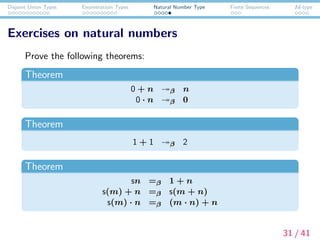
Exercises on natural numbers
Prove the following theorems:
Theorem
0 + n β n
0 · n β 0
Theorem
1 + 1 β 2
Theorem
sn =β 1 + n
s(m) + n =β s(m + n)
s(m) · n =β (m · n) + n
31 / 41
Disjoint Union Types Enumeratioin Types Natural Number Type Finite Sequences Id-type
Finite Sequences
32 / 41
Disjoint Union Types Enumeratioin Types Natural Number Type Finite Sequences Id-type
Finite Sequences
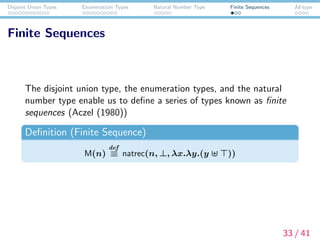
The disjoint union type, the enumeration types, and the natural
number type enable us to define a series of types known as finite
sequences (Aczel (1980))
Definition (Finite Sequence)
M(n)
def
≡ natrec(n, ⊥, λx.λy.(y ))
33 / 41
Disjoint Union Types Enumeratioin Types Natural Number Type Finite Sequences Id-type
Finite Sequences
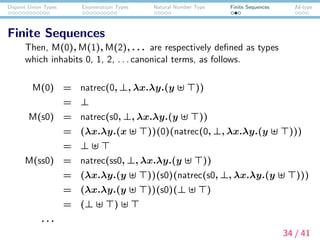
Then, M(0), M(1), M(2), . . . are respectively defined as types
which inhabits 0, 1, 2, . . . canonical terms, as follows.
M(0) = natrec(0, ⊥, λx.λy.(y ))
= ⊥
M(s0) = natrec(s0, ⊥, λx.λy.(y ))
= (λx.λy.(x ))(0)(natrec(0, ⊥, λx.λy.(y )))
= ⊥
M(ss0) = natrec(ss0, ⊥, λx.λy.(y ))
= (λx.λy.(y ))(s0)(natrec(s0, ⊥, λx.λy.(y )))
= (λx.λy.(y ))(s0)(⊥ )
= (⊥ )
. . .
34 / 41
Disjoint Union Types Enumeratioin Types Natural Number Type Finite Sequences Id-type
Finite Sequences
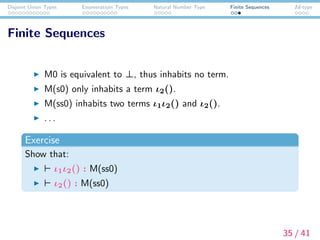
M0 is equivalent to ⊥, thus inhabits no term.
M(s0) only inhabits a term ι2().
M(ss0) inhabits two terms ι1ι2() and ι2().
. . .
Exercise
Show that:
ι1ι2() : M(ss0)
ι2() : M(ss0)
35 / 41
Disjoint Union Types Enumeratioin Types Natural Number Type Finite Sequences Id-type
Intensional Equality type
36 / 41
Disjoint Union Types Enumeratioin Types Natural Number Type Finite Sequences Id-type
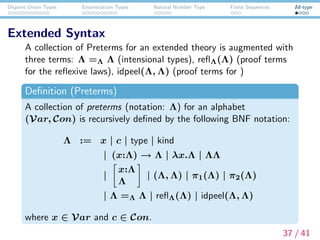
Extended Syntax
A collection of Preterms for an extended theory is augmented with
three terms: Λ =Λ Λ (intensional types), reflΛ(Λ) (proof terms
for the reflexive laws), idpeel(Λ, Λ) (proof terms for )
Definition (Preterms)
A collection of preterms (notation: Λ) for an alphabet
(Var, Con) is recursively defined by the following BNF notation:
Λ := x | c | type | kind
| (x:Λ) → Λ | λx.Λ | ΛΛ
|
x:Λ
Λ
| (Λ, Λ) | π1(Λ) | π2(Λ)
| Λ =Λ Λ | reflΛ(Λ) | idpeel(Λ, Λ)
where x ∈ Var and c ∈ Con.
37 / 41
Disjoint Union Types Enumeratioin Types Natural Number Type Finite Sequences Id-type
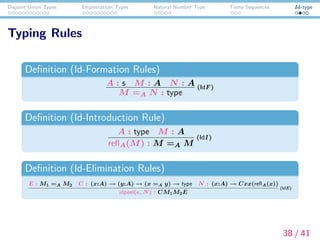
Typing Rules
Definition (Id-Formation Rules)
A : s M : A N : A
M =A N : type
(IdF)
Definition (Id-Introduction Rule)
A : type M : A
reflA(M) : M =A M
(IdI )
Definition (Id-Elimination Rules)
E : M1 =A M2 C : (x:A) → (y:A) → (x =A y) → type N : (x:A) → Cxx(reflA(x))
idpeel(e, N) : CM1M2E
(IdE)
38 / 41
Disjoint Union Types Enumeratioin Types Natural Number Type Finite Sequences Id-type
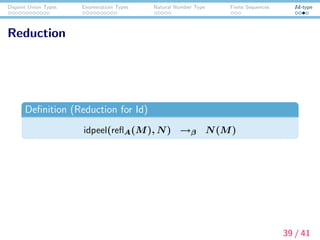
Reduction
Definition (Reduction for Id)
idpeel(reflA(M), N) →β N(M)
39 / 41
Disjoint Union Types Enumeratioin Types Natural Number Type Finite Sequences Id-type
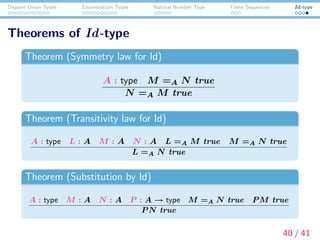
Theorems of Id-type
Theorem (Symmetry law for Id)
A : type M =A N true
N =A M true
Theorem (Transitivity law for Id)
A : type L : A M : A N : A L =A M true M =A N true
L =A N true
Theorem (Substitution by Id)
A : type M : A N : A P : A → type M =A N true P M true
P N true
40 / 41
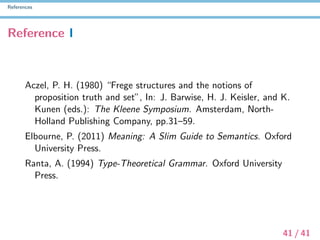
References
Reference I
Aczel, P. H. (1980) “Frege structures and the notions of
proposition truth and set”, In: J. Barwise, H. J. Keisler, and K.
Kunen (eds.): The Kleene Symposium. Amsterdam, North-
Holland Publishing Company, pp.31–59.
Elbourne, P. (2011) Meaning: A Slim Guide to Semantics. Oxford
University Press.
Ranta, A. (1994) Type-Theoretical Grammar. Oxford University
Press.
41 / 41

ESSLLI2016 DTS Lecture Day 4-2: More Dependent Types

  • 1.
    Disjoint Union TypesEnumeratioin Types Natural Number Type Finite Sequences Id-type Introduction to Dependent Type Semantics: More dependent types Daisuke Bekki1,2 Koji Mineshima1,2 1Ochanomizu University / 2CREST, Japan Science and Technology Agency version: August 18, 2016 ESSLLI 2016 course, Bolzano, Italy, August 15-19, 2016. 1 / 41
  • 2.
    Disjoint Union TypesEnumeratioin Types Natural Number Type Finite Sequences Id-type Disjoint Union Types for Disjunction 2 / 41
  • 3.
    Disjoint Union TypesEnumeratioin Types Natural Number Type Finite Sequences Id-type Disjoint union type A B is a type for representing disjunctions (A ∨ B). Definition ( -Formation/Introduction Rules) A : type B : type A B : type ( F) M : A ι1(M) : A B ( I ) N : B ι2(N) : A B ( I ) 3 / 41
  • 4.
    Disjoint Union TypesEnumeratioin Types Natural Number Type Finite Sequences Id-type Mary sees a horse or a pony: Parsing Mary NP m sees SNP/NP see a SNP(SNP/NP)/N λn.λp.λx.   v: y:entity ny p(π1(v))x   horse N horse SNP(SNP/NP) λp.λx.   v: y:entity horse(y) p(π1(v))x   > or CONJ a SNP(SNP/NP)/N λn.λp.λx.   v: y:entity ny p(π1(v))x   pony N pony SNP(SNP/NP) λp.λx.   v: y:entity pony(y) p(π1(v))x   > SNP(SNP/NP) λp.λx.   v: y:entity horse(y) p(π1(v))x     v: y:entity pony(y) p(π1(v))x   Φ SNP λx.   v: y:entity horse(y) see(x, π1(v))     v: y:entity pony(y) see(x, π1(v))   < S  v: y:entity horse(y) see(m, π1v)     v: y:entity pony(y) see(m, π1v)   < 4 / 41
  • 5.
    Disjoint Union TypesEnumeratioin Types Natural Number Type Finite Sequences Id-type Disjoint Union Type: the elimination rule -Elimination rule is about how to use L of type A B: Definition ( -Elimination Rule) L : A B C : (A B) → type x : A.... M : C(ι1(x)) i x : B.... N : C(ι2(x)) i case L of (λx.M; λx.N) : C(L) ( E),i C is a one-place predicate. M is a proof that C(x) holds for any x of type A. N is a proof that C(x) holds for any x of type B. These are enough for proving that C(L) holds for any L of type A B. 5 / 41
  • 6.
    Disjoint Union TypesEnumeratioin Types Natural Number Type Finite Sequences Id-type Example: a disjunctive inference Mary sees a horse or a pony. = ⇐ Mary sees an animal. u :   v: y:entity horse(y) see(m, π1v)     v: y:entity pony(y) see(m, π1v)     v: y:entity animal(y) see(m, π1v)   true under a signature: k1 : u: x:entity horse(x) → animal(π1u) “Every horse is an animal.” k2 : u: x:entity pony(x) → animal(π1u) “Every pony is an animal.” 6 / 41
  • 7.
    Disjoint Union TypesEnumeratioin Types Natural Number Type Finite Sequences Id-type Mary sees a horse or a pony. ⇐ Mary sees an animal. u :   v: y:entity horse(y) see(m, π1v)     v: y:entity pony(y) see(m, π1v)   π1x : y:entity horse(y) (ΣE) π1π1x : entity (ΣE) x :   v: y:entity horse(y) see(m, π1v)   1 π1x : y:entity horse(y) (ΣE) k1 : u: x:entity horse(x) → animal(π1u) k1(π1x) : animal(π1π1x) (ΣE) (π1π1x, k1(π1x)) : y:entity animal(y) (ΣI ) x :   v: y:entity horse(y) see(m, π1v)   1 π2x : see(m, π1π1x) (ΣE) ((π1π1x, k1(π1x)), π2x) :   v: y:entity animal(y) see(m, π1v)   (ΣI ) x :   v: y:entity pony(y) see(m, π1v)   .... ((π1π1x, k2(π1x)), π2x) :   v: y:entity animal(y) see(m, π1v)   1 case u of (λx.((π1π1x, k1(π1x)), π2x); λx.((π1π1x, k2(π1x)), π2x)) :   v: y:entity animal(y) see(m, π1v)   ( E),1 7 / 41
  • 8.
    Disjoint Union TypesEnumeratioin Types Natural Number Type Finite Sequences Id-type Disjunctive antecedents Elbourne (2011): (1) If Mary1 sees [[a horse] or [a pony]]2, she1 waves to it2. Dynamic semantics does not have a straightforward solution for it. A solution via dependent types: Ranta (1994) 8 / 41
  • 9.
    Disjoint Union TypesEnumeratioin Types Natural Number Type Finite Sequences Id-type If Mary sees a horse or a pony... : Parsing If S/S/S λp.λq.p → q Mary sees a horse or a pony S  v: y:entity horse(y) see(m, π1v)     v: y:entity pony(y) see(m, π1v)   S/S λq.   v: y:entity horse(y) see(m, π1v)     v: y:entity pony(y) see(m, π1v)   → q > she NP m waves SNP/NP waveTo to NP/NP id it NP π1 @1 x:entity ¬human(x) NP π1 @1 x:entity ¬human(x) > SNP waveToπ1 @1 x:entity ¬human(x) > S waveTo m, π1 @1 x:entity ¬human(x) < S  v: y:entity horse(y) see(m, π1v)     v: y:entity pony(y) see(m, π1v)   → waveTo m, π1 @1 x:entity ¬human(x) > 9 / 41
  • 10.
    Disjoint Union TypesEnumeratioin Types Natural Number Type Finite Sequences Id-type If Mary sees a horse or a pony... : Type Checking ....  v: y:entity horse(y) see(m, π1v)     v: y:entity pony(y) see(m, π1v)   : type waveTo : entity → entity → type (CON ) .... x:entity ¬human(x) : type p :   v: y:entity horse(y) see(m, π1v)     v: y:entity pony(y) see(m, π1v)   .... x:entity ¬human(x) 1 @1 x:entity ¬human(x) : x:entity ¬human(x) (@) π1 @1 x:entity ¬human(x) : entity (ΣE) waveTo π1 @1 x:entity ¬human(x) : entity → type (→E) m : entity (CON ) waveTo m, π1 @1 x:entity ¬human(x) : type (→E)  p:   v: y:entity horse(y) see(m, π1v)     v: y:entity pony(y) see(m, π1v)     → waveTo m, π1 @1 x:entity ¬human(x) : type (ΠF) 10 / 41
  • 11.
    Disjoint Union TypesEnumeratioin Types Natural Number Type Finite Sequences Id-type If Mary sees a horse or a pony... : Proof Search ....  v: y:entity horse(y) see(m, π1v)     v: y:entity pony(y) see(m, π1v)   : type waveTo : entity → entity → type (CON ) .... x:entity ¬human(x) : type p :   v: y:entity horse(y) see(m, π1v)     v: y:entity pony(y) see(m, π1v)   .... case p of λx.((π1π1x, k1(π1x)), π2x); λx.((π1π1x, k2(π1x)), π2x) : x:entity animal(x) 1 π1 case p of λx.((π1π1x, k1(π1x)), π2x); λx.((π1π1x, k2(π1x)), π2x) : entity (ΣE) p :   v: y:entity horse(y) see(m, π1v)     v: y:entity pony(y) see(m, π1v)   .... case p of λx.((π1π1x, k1(π1x)), π2x); λx.((π1π1x, k2(π1x)), π2x) : x:entity animal(x) 1 k3 : u: x:entity animal(x) → ¬human(π1u) (CON ) k3 case p of λx.((π1π1x, k1(π1x)), π2x); λx.((π1π1x, k2(π1x)), π2x) : ¬human(π1) (→E) π1 case p of λx.((π1π1x, k1(π1x)), π2x); λx.((π1π1x, k2(π1x)), π2x) , k3 case p of λx.((π1π1x, k1(π1x)), π2x); λx.((π1π1x, k2(π1x)), π2x) : x:entity ¬human(x) (→E) @1 x:entity ¬human(x) : x:entity ¬human(x) (@) π1 @1 x:entity ¬human(x) : entity (ΣE) waveTo π1 @1 x:entity ¬human(x) : entity → type (→E) m : entity (CON ) waveTo m, π1 @1 x:entity ¬human(x) : type (→E)  p:   v: y:entity horse(y) see(m, π1v)     v: y:entity pony(y) see(m, π1v)     → waveTo m, π1 @1 x:entity ¬human(x) : type (ΠI ),1 11 / 41
  • 12.
    Disjoint Union TypesEnumeratioin Types Natural Number Type Finite Sequences Id-type If Mary sees a horse or a pony... : @-Elimination ....  v: y:entity horse(y) see(m, π1v)     v: y:entity pony(y) see(m, π1v)   : type waveTo : entity → entity → type (CON ) .... x:entity ¬human(x) : type p :   v: y:entity horse(y) see(m, π1v)     v: y:entity pony(y) see(m, π1v)   .... case p of λx.((π1π1x, k1(π1x)), π2x); λx.((π1π1x, k2(π1x)), π2x) : x:entity animal(x) 1 π1 case p of λx.((π1π1x, k1(π1x)), π2x); λx.((π1π1x, k2(π1x)), π2x) : entity (ΣE) p :   v: y:entity horse(y) see(m, π1v)     v: y:entity pony(y) see(m, π1v)   .... case p of λx.((π1π1x, k1(π1x)), π2x); λx.((π1π1x, k2(π1x)), π2x) : x:entity animal(x) 1 k3 : u: x:entity animal(x) → ¬human(π1u) (CON ) k3 case p of λx.((π1π1x, k1(π1x)), π2x); λx.((π1π1x, k2(π1x)), π2x) : ¬human(π1) (→E) π1 case p of λx.((π1π1x, k1(π1x)), π2x); λx.((π1π1x, k2(π1x)), π2x) , k3 case p of λx.((π1π1x, k1(π1x)), π2x); λx.((π1π1x, k2(π1x)), π2x) : x:entity ¬human(x) (→E) π1 case p of λx.((π1π1x, k1(π1x)), π2x); λx.((π1π1x, k2(π1x)), π2x) : entity (ΣE) waveTo π1 case p of λx.((π1π1x, k1(π1x)), π2x); λx.((π1π1x, k2(π1x)), π2x) : entity → type (→E) m : entity (CON ) waveTo m, π1 case p of λx.((π1π1x, k1(π1x)), π2x); λx.((π1π1x, k2(π1x)), π2x) : type (→E)  p:   v: y:entity horse(y) see(m, π1v)     v: y:entity pony(y) see(m, π1v)     → waveTo m, π1 case p of λx.((π1π1x, k1(π1x)), π2x); λx.((π1π1x, k2(π1x)), π2x) : type (ΠI ),1 12 / 41
  • 13.
    Disjoint Union TypesEnumeratioin Types Natural Number Type Finite Sequences Id-type Inaccessibility again (1) If Mary1 sees [[a horse] or [a pony]], she1 waves to it2. (2) * If Mary1 sees [[a horse] or [nothing]], she1 waves to it2. (3) * If Mary1 sees [[nothing] or [a horse]], she1 waves to it2. (4) If Mary1 sees [[a horse] or [nothing]], she1 is unhappy. 13 / 41
  • 14.
    Disjoint Union TypesEnumeratioin Types Natural Number Type Finite Sequences Id-type Summary: Disjoint union type and disjunction Disjunctive constructions are represented by using disjoint union types. Disjunctive antecedents have been problematic to dynamic semantics, while disjoint union types give it a proper analysis, which implies that anaphora binding is not an issue of variable binding but an issue of proof construction. 14 / 41
  • 15.
    Disjoint Union TypesEnumeratioin Types Natural Number Type Finite Sequences Id-type Enumeration Type 15 / 41
  • 16.
    Disjoint Union TypesEnumeratioin Types Natural Number Type Finite Sequences Id-type Rules for enumeration type An enumeration type is a type that is inhabited by a finite number of terms. A particular enumeration type is defined from a given enumeration of n-number of constructors a1, . . . , an. Definition ({}-Formation/Introduction Rules) For each i such that 1 ≤ i ≤ n: {a1, . . . , an} : type ({}F) ai : {a1, . . . , an} ({}I ) 16 / 41
  • 17.
    Disjoint Union TypesEnumeratioin Types Natural Number Type Finite Sequences Id-type Rules for enumeration type Definition ({}-Elimination Rule) M : {a1, . . . , an} C : {a1, . . . , an} → type N1 : C(a1) . . . Nn : C(an) caseM (N1, . . . , Nn) : C(M) ({}E) {}-Elimination rule says how to use M, a proof of an enumeration type. Similar to disjoint union type. C is a one-place predicate. Ni is a proof of C(M) in case M is ai. caseM (N1, . . . , Nn) saids that C holds in every case where M is ai, since we have a proof for each case. 17 / 41
  • 18.
    Disjoint Union TypesEnumeratioin Types Natural Number Type Finite Sequences Id-type Example I: Bottom Type The first example of enumeration types is the bottom type, the type representing absurdity. Absurdity is understood as a proposition which has no proof, which is straightforwardly represeted as an enumeration type which is inhabited by no term. Definition (⊥ type) ⊥ def ≡ {} Definition (⊥-Formation/Elimination Rules) ⊥ : type (⊥F) M : ⊥ C : ⊥ → type caseM () : C(M) (⊥E) 18 / 41
  • 19.
    Disjoint Union TypesEnumeratioin Types Natural Number Type Finite Sequences Id-type EFQ The “Ex Falso Quodlibet” (EFQ) rule is straightforwardly derived from ⊥-Elimination Rule. Thus dependent type theory with enumeration types of arity 0 is stronger than intuitionistic logic. Theorem (Ex Falso Quodlibet) M : ⊥ C : type caseM () : C (EFQ) Proof. M : ⊥ C : type x : ⊥ 1 C : type (WK) λx.C : ⊥ → type (→I ),1 caseM () : (λx.C)M ( β C) (⊥E) 19 / 41
  • 20.
    Disjoint Union TypesEnumeratioin Types Natural Number Type Finite Sequences Id-type Negation By using ⊥, the negation of A (notation: ¬A) is defined as follows: Definition (¬) ¬A def ≡ A → ⊥ 20 / 41
  • 21.
    Disjoint Union TypesEnumeratioin Types Natural Number Type Finite Sequences Id-type Example: Inferences that require EFQ Susan or Mary killed John. Mary didn’t kill John. = ⇐ Susan killed John. u : kill(s, j ) kill(m, j ), v : ¬kill(m, j ) kill(s, j ) true u : kill(s, j ) kill(m, j ) x : kill(s, j ) 1 x : kill(m, j ) 1 v : ¬kill(m, j ) vx : ⊥ (→E) casevx() : kill(s, j ) (EFQ) case u of (λx.x; λx.casevx()) : kill(s, j ) ( E),1 21 / 41
  • 22.
    Disjoint Union TypesEnumeratioin Types Natural Number Type Finite Sequences Id-type Example II: Top Type The second example of enumeration types is the top type, the type representing necessary truth. Necessary truth is understood as a proposition that there is always a proof (), called an unit. Definition ( type) def ≡ {()} Definition ( -Formation Rule) : type ( F) () : ( I ) M : C : → type N : C() caseM (N) : C(M) ( E) 22 / 41
  • 23.
    Disjoint Union TypesEnumeratioin Types Natural Number Type Finite Sequences Id-type Example III: Finite model Suppse that entity def ≡ {mary, susan, john}. Under the signature: σ def ≡ girl : entity → type, smart : entity → type, mg : girl(mary), sg : girl(susan), jg : ¬girl(john), ms : smart(mary), ss : smart(susan), js : ¬smart(john) the following inference holds: (x:entity) → girl(x) → smart(x) true (i.e. “Every girl is smart.”) 23 / 41
  • 24.
    Disjoint Union TypesEnumeratioin Types Natural Number Type Finite Sequences Id-type A proof of “Every girl is smart.” x : {mary, susan, john} 1 ms : smart(mary) (CON ) y : girl(mary) 2 ms : smart(mary) (WK) λy.ms : girl(mary) → smart(mary) (→I ),2 ss : smart(susan) (CON ) y : girl(susan) 2 ss : smart(susan) (WK) λy.ss : girl(susan) → smart(susan) (→I ),2 x : girl(john) 3 gs : ¬girl(john) (CON ) gs(x) : ⊥ (→I ) .... smart(john) : type casegs(x)() : smart(john) (⊥E λx.(casegs(x)()) : girl(john) → smart(john) (→I ),3 case(λy.ms, λy.ss, λx.(casegs(x)())) : girl(x) → smart(x) ({}E),1 λx.case(λy.ms, λy.ss, λx.(casegs(x)())) : (x:entity) → girl(x) → smart(x) (ΠI ),1 24 / 41
  • 25.
    Disjoint Union TypesEnumeratioin Types Natural Number Type Finite Sequences Id-type Summary ⊥ and are instances of enumeration types. Generally, ∃ and ¬∀ propositions can be verified by a single witness, while ∀ and ¬∃ propositions can be verified only analytically, if they quantify over possibly infinite domain. In model-theoretic semantics, even ∀ and ¬∃ propositions can be shown to be true under some finite model, while it is not the case in proof-theoretic semantics without enumeration types. entity defined in terms of enumeration types behaves as finite models, enables us to mimic model-theoretic semantics. 25 / 41
  • 26.
    Disjoint Union TypesEnumeratioin Types Natural Number Type Finite Sequences Id-type Natural Number Type 26 / 41
  • 27.
    Disjoint Union TypesEnumeratioin Types Natural Number Type Finite Sequences Id-type Natural Numbers Definition (N-Formation Rules) N : type (NF) The type N is defined by the constructor 0 (zero) and s (the successor function). Definition (N-Introduction Rules) 0 : N (NI ) n : N s(n) : N (NI ) (NI ) also serves as the introduction rule for s. The digits are defined in the following way: 1 def ≡ s0, 2 def ≡ ss0, 3 def ≡ sss0, . . . 27 / 41
  • 28.
    Disjoint Union TypesEnumeratioin Types Natural Number Type Finite Sequences Id-type Natural Numbers The (NE) rule is the elimination rule of N (and the formulation rule of the natrec constructor). Definition (N-Elimination Rules) n : N C : N → type e : C(0) x : N.... i y : C(x) .... i M : C(s(x)) natrec(n, e, λx.λy.M) : C(n) (NE),i Intuitively, the (NE) rule corresponds to the mathematical induction. where e is a proof for 0 and f is a proof for s(n). Definition (β-reduction rules (one-step)) natrec(0, e, f) →β e natrec(s(n), e, f) →β f(n)(natrec(n, e, f)) 28 / 41
  • 29.
    Disjoint Union TypesEnumeratioin Types Natural Number Type Finite Sequences Id-type Addition and Multiplication The addition operator “+” and the multiplication operator “·” for nutural numbers illustrate the use of the natrec constructor. Definition (Addition and Multiplication) m + n def ≡ natrec(m, n, λx.λy.s(y)) m · n def ≡ natrec(m, 0, λx.λy.(y + x)) Exercise: Proove the following theorems: Theorem m : N n : N m + n : N (+F) m : N n : N m · n : N (·F) 29 / 41
  • 30.
    Disjoint Union TypesEnumeratioin Types Natural Number Type Finite Sequences Id-type Example of Addition 2 + 1 ≡ s s 0 + s0 →β natrec(s s 0 , s0, λx.λy.s(y)) →β (λx.λy.s(y))( s 0 )(natrec( s 0 , s0, λx.λy.s(y))) β s(natrec( s 0 , s0, λx.λy.s(y)) →β s(λx.λy.s(y))( 0 )(natrec( 0 , s0, λx.λy.s(y))) →β ss(natrec( 0 , s0, λx.λy.s(y))) →β sss0 ≡ 3 m + n def ≡ natrec(m, n, λx.λy.s(y)) natrec(0, e, f) →β e natrec(s( n ), e, f) →β f( n )(natrec( n , e, f)) 30 / 41
  • 31.
    Disjoint Union TypesEnumeratioin Types Natural Number Type Finite Sequences Id-type Exercises on natural numbers Prove the following theorems: Theorem 0 + n β n 0 · n β 0 Theorem 1 + 1 β 2 Theorem sn =β 1 + n s(m) + n =β s(m + n) s(m) · n =β (m · n) + n 31 / 41
  • 32.
    Disjoint Union TypesEnumeratioin Types Natural Number Type Finite Sequences Id-type Finite Sequences 32 / 41
  • 33.
    Disjoint Union TypesEnumeratioin Types Natural Number Type Finite Sequences Id-type Finite Sequences The disjoint union type, the enumeration types, and the natural number type enable us to define a series of types known as finite sequences (Aczel (1980)) Definition (Finite Sequence) M(n) def ≡ natrec(n, ⊥, λx.λy.(y )) 33 / 41
  • 34.
    Disjoint Union TypesEnumeratioin Types Natural Number Type Finite Sequences Id-type Finite Sequences Then, M(0), M(1), M(2), . . . are respectively defined as types which inhabits 0, 1, 2, . . . canonical terms, as follows. M(0) = natrec(0, ⊥, λx.λy.(y )) = ⊥ M(s0) = natrec(s0, ⊥, λx.λy.(y )) = (λx.λy.(x ))(0)(natrec(0, ⊥, λx.λy.(y ))) = ⊥ M(ss0) = natrec(ss0, ⊥, λx.λy.(y )) = (λx.λy.(y ))(s0)(natrec(s0, ⊥, λx.λy.(y ))) = (λx.λy.(y ))(s0)(⊥ ) = (⊥ ) . . . 34 / 41
  • 35.
    Disjoint Union TypesEnumeratioin Types Natural Number Type Finite Sequences Id-type Finite Sequences M0 is equivalent to ⊥, thus inhabits no term. M(s0) only inhabits a term ι2(). M(ss0) inhabits two terms ι1ι2() and ι2(). . . . Exercise Show that: ι1ι2() : M(ss0) ι2() : M(ss0) 35 / 41
  • 36.
    Disjoint Union TypesEnumeratioin Types Natural Number Type Finite Sequences Id-type Intensional Equality type 36 / 41
  • 37.
    Disjoint Union TypesEnumeratioin Types Natural Number Type Finite Sequences Id-type Extended Syntax A collection of Preterms for an extended theory is augmented with three terms: Λ =Λ Λ (intensional types), reflΛ(Λ) (proof terms for the reflexive laws), idpeel(Λ, Λ) (proof terms for ) Definition (Preterms) A collection of preterms (notation: Λ) for an alphabet (Var, Con) is recursively defined by the following BNF notation: Λ := x | c | type | kind | (x:Λ) → Λ | λx.Λ | ΛΛ | x:Λ Λ | (Λ, Λ) | π1(Λ) | π2(Λ) | Λ =Λ Λ | reflΛ(Λ) | idpeel(Λ, Λ) where x ∈ Var and c ∈ Con. 37 / 41
  • 38.
    Disjoint Union TypesEnumeratioin Types Natural Number Type Finite Sequences Id-type Typing Rules Definition (Id-Formation Rules) A : s M : A N : A M =A N : type (IdF) Definition (Id-Introduction Rule) A : type M : A reflA(M) : M =A M (IdI ) Definition (Id-Elimination Rules) E : M1 =A M2 C : (x:A) → (y:A) → (x =A y) → type N : (x:A) → Cxx(reflA(x)) idpeel(e, N) : CM1M2E (IdE) 38 / 41
  • 39.
    Disjoint Union TypesEnumeratioin Types Natural Number Type Finite Sequences Id-type Reduction Definition (Reduction for Id) idpeel(reflA(M), N) →β N(M) 39 / 41
  • 40.
    Disjoint Union TypesEnumeratioin Types Natural Number Type Finite Sequences Id-type Theorems of Id-type Theorem (Symmetry law for Id) A : type M =A N true N =A M true Theorem (Transitivity law for Id) A : type L : A M : A N : A L =A M true M =A N true L =A N true Theorem (Substitution by Id) A : type M : A N : A P : A → type M =A N true P M true P N true 40 / 41
  • 41.
    References Reference I Aczel, P.H. (1980) “Frege structures and the notions of proposition truth and set”, In: J. Barwise, H. J. Keisler, and K. Kunen (eds.): The Kleene Symposium. Amsterdam, North- Holland Publishing Company, pp.31–59. Elbourne, P. (2011) Meaning: A Slim Guide to Semantics. Oxford University Press. Ranta, A. (1994) Type-Theoretical Grammar. Oxford University Press. 41 / 41