RCTQ
We are what we repeatedly do.
Excellence then, is not an act,
but a habit.
- Aristotle
RCTQ
RPMS ANNOTATIONS
RCTQ
What are Annotations?
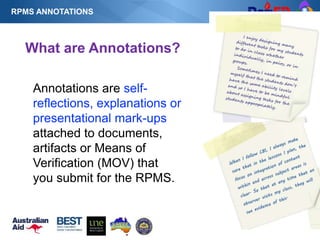
Annotations are self-
reflections, explanations or
presentational mark-ups
attached to documents,
artifacts or Means of
Verification (MOV) that
you submit for the RPMS.
RPMS ANNOTATIONS
RCTQ
What are Annotations?
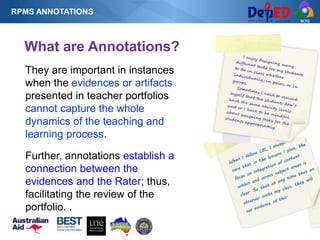
They are important in instances
when the evidences or artifacts
presented in teacher portfolios
cannot capture the whole
dynamics of the teaching and
learning process.
Further, annotations establish a
connection between the
evidences and the Rater; thus,
facilitating the review of the
portfolio. .
RPMS ANNOTATIONS
RCTQ
What is the importance of Annotations?
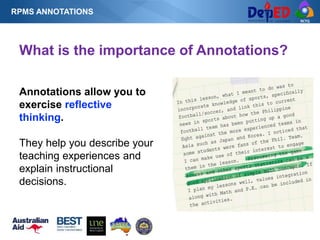
Annotations allow you to
exercise reflective
thinking.
They help you describe your
teaching experiences and
explain instructional
decisions.
RPMS ANNOTATIONS
RCTQ
What is the importance of Annotations?
Annotations are important because they:
• Make your evidences speak on your behalf;
• Highlight your professional strengths in teaching;
• Help you reflect on your teaching practices that pave
the way for professional advancement;
• Describe your intentions, goals and purposes towards
career growth;
• Present and explain credentials required by the Rater
for ranking and promotion; and
• Make it easier for the Rater to rate your performance.
RPMS ANNOTATIONS
RCTQ
What do you Annotate?
When writing annotations, you need to present evidence of
good practice in the various Key Result Areas.
RPMS ANNOTATIONS
The following are possibilities for annotations:
• Documents/artifacts that show your creativity and
resourcefulness in teaching;
• Evidences that may fully satisfy the requirements of the
performance indicators but do not clearly demonstrate
their link to the indicators themselves; and
• Classroom context that explains your teaching practice
and the realities you face in the
classroom/school/community context.
RCTQ
Guide in writing annotations for a
particular MOV in the Portfolio
Step 1. Describe the Means of Verification (MOV) that
you want to annotate.
The following questions may help you describe the MOV
that you want to annotate:
a. What is my MOV about?
b. How does my MOV meet the KRA’s objectives?
RPMS ANNOTATIONS
RCTQ
Guide in writing annotations for a
particular MOV in the Portfolio
Step 2. Reflect on your MOV.
These questions may guide your reflection:
a. How does my MOV meet the objective?
b. What do I wish to highlight in my MOV in relation to the
objective?
c. What classroom contexts explain my practices as
reflected in my MOV?
RPMS ANNOTATIONS
RCTQ
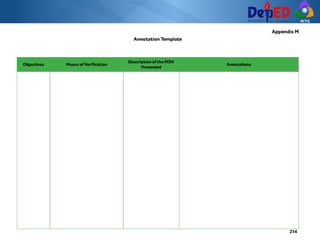
Objectives Means of Verification
Description of the MOV
Presented
Annotations
1. Applied
knowledge of
content within
and across
curriculum
teaching areas.
 Classroom observation tool
(COT) rating sheet and/or
inter-observer agreement
form about knowledge of
content within and across
curriculum teaching areas
 Lesson plans/modified DLLs
developed highlighting
integration of content
knowledge within and
across subject areas
 Instructional materials
highlighting mastery of
content and its integration in
other subject areas
 Performance tasks/test
material(s) highlighting
integration of content
knowledge within and
across subject areas
 Others (Please specify and
provide annotations)
The MOV presented was
a lesson plan that
showed integration of
knowledge and content in
Physical Education
In this lesson, I incorporated
knowledge of sports,
specifically football/soccer to
my Math lesson. To get
students interested, I drew
attention to the sports news
about how the Philippine
team had been putting up a
good fight against more
experienced teams in Asia,
such as Japan and Korea.
To apply Math concepts, I
led the class in discussing
the game scores and other
sports statistics. My
students were engaged. I
was able to deliver my
lesson in Math with an
interesting focus on sports.
/
RCTQ
Activity 2
Instructions:
1. In small groups, choose an MOV to be
annotated for KRA 1 Objective 1.
2. Write annotations for the MOV using the
Annotation Template.
RPMS ANNOTATIONS
RCTQ

Day 2 _ Module5 Annotations.final_june12,2018.pptx

  • 1.
    RCTQ We are whatwe repeatedly do. Excellence then, is not an act, but a habit. - Aristotle
  • 2.
  • 3.
    RCTQ What are Annotations? Annotationsare self- reflections, explanations or presentational mark-ups attached to documents, artifacts or Means of Verification (MOV) that you submit for the RPMS. RPMS ANNOTATIONS
  • 4.
    RCTQ What are Annotations? Theyare important in instances when the evidences or artifacts presented in teacher portfolios cannot capture the whole dynamics of the teaching and learning process. Further, annotations establish a connection between the evidences and the Rater; thus, facilitating the review of the portfolio. . RPMS ANNOTATIONS
  • 5.
    RCTQ What is theimportance of Annotations? Annotations allow you to exercise reflective thinking. They help you describe your teaching experiences and explain instructional decisions. RPMS ANNOTATIONS
  • 6.
    RCTQ What is theimportance of Annotations? Annotations are important because they: • Make your evidences speak on your behalf; • Highlight your professional strengths in teaching; • Help you reflect on your teaching practices that pave the way for professional advancement; • Describe your intentions, goals and purposes towards career growth; • Present and explain credentials required by the Rater for ranking and promotion; and • Make it easier for the Rater to rate your performance. RPMS ANNOTATIONS
  • 7.
    RCTQ What do youAnnotate? When writing annotations, you need to present evidence of good practice in the various Key Result Areas. RPMS ANNOTATIONS The following are possibilities for annotations: • Documents/artifacts that show your creativity and resourcefulness in teaching; • Evidences that may fully satisfy the requirements of the performance indicators but do not clearly demonstrate their link to the indicators themselves; and • Classroom context that explains your teaching practice and the realities you face in the classroom/school/community context.
  • 8.
    RCTQ Guide in writingannotations for a particular MOV in the Portfolio Step 1. Describe the Means of Verification (MOV) that you want to annotate. The following questions may help you describe the MOV that you want to annotate: a. What is my MOV about? b. How does my MOV meet the KRA’s objectives? RPMS ANNOTATIONS
  • 9.
    RCTQ Guide in writingannotations for a particular MOV in the Portfolio Step 2. Reflect on your MOV. These questions may guide your reflection: a. How does my MOV meet the objective? b. What do I wish to highlight in my MOV in relation to the objective? c. What classroom contexts explain my practices as reflected in my MOV? RPMS ANNOTATIONS
  • 10.
    RCTQ Objectives Means ofVerification Description of the MOV Presented Annotations 1. Applied knowledge of content within and across curriculum teaching areas.  Classroom observation tool (COT) rating sheet and/or inter-observer agreement form about knowledge of content within and across curriculum teaching areas  Lesson plans/modified DLLs developed highlighting integration of content knowledge within and across subject areas  Instructional materials highlighting mastery of content and its integration in other subject areas  Performance tasks/test material(s) highlighting integration of content knowledge within and across subject areas  Others (Please specify and provide annotations) The MOV presented was a lesson plan that showed integration of knowledge and content in Physical Education In this lesson, I incorporated knowledge of sports, specifically football/soccer to my Math lesson. To get students interested, I drew attention to the sports news about how the Philippine team had been putting up a good fight against more experienced teams in Asia, such as Japan and Korea. To apply Math concepts, I led the class in discussing the game scores and other sports statistics. My students were engaged. I was able to deliver my lesson in Math with an interesting focus on sports. /
  • 11.
    RCTQ Activity 2 Instructions: 1. Insmall groups, choose an MOV to be annotated for KRA 1 Objective 1. 2. Write annotations for the MOV using the Annotation Template. RPMS ANNOTATIONS
  • 12.

Editor's Notes

  • #3 Objectives: At the end of the activity, the participants should be able to: -Understand Annotation and its importance -Prepare and write Annotations
  • #4 A teacher’s path towards personal growth and professional development involves reflection and learning in order to improve practice. One way of doing this is to become more actively engaged in the process of careful introspection and critical evaluation of your teaching practice. An essential step towards becoming a more reflective practitioner is through writing annotations in your professional development portfolios.
  • #5 A teacher’s path towards personal growth and professional development involves reflection and learning in order to improve practice. One way of doing this is to become more actively engaged in the process of careful introspection and critical evaluation of your teaching practice. An essential step towards becoming a more reflective practitioner is through writing annotations in your professional development portfolios.
  • #9  These questions may guide your reflection: What documents showcase my creativity and resourcefulness? What evidences address the requirements of the performance indicators? What classroom contexts explain my practices?
  • #10  These questions may guide your reflection: What documents showcase my creativity and resourcefulness? What evidences address the requirements of the performance indicators? What classroom contexts explain my practices?
  • #12 Application: After the discussion, Activity 2: In small groups, identify specific scenarios or illustration of practices and MOV for these scenarios. Then write annotations for the MOV using the Annotation Template. Ask them to present their outputs afterwards.