RCTQ
SESSION 2
INTRODUCTION TO RPMS TOOLS
RCTQ
RCTQ
Objective:
This session aims to introduce to the
participants the RPMS tools for teachers.
RCTQ
Activity 1 (5 mins)
Instructions:
• In a blank sheet of
paper, draw a big circle.
• With eyes closed, draw
the parts of your face.
RCTQ
1.Were you able to put the parts of your face in
the right place? Why? Why not?
RCTQ
2. If given the chance to draw the parts of your
face again, how will you do it? Explain.
RCTQ
3. How will you compare this activity to our
current practice in assessing the quality of our
teachers’ performance?
RCTQ
4. If you have your way, how will you improve our
practice in assessing the quality of our
teachers’ performance?
RCTQ
5. What are your initial thoughts on the RPMS
tools for teachers?
RCTQ
are RPMS tools?
RCTQ
RPMS Tools pertain to the two (2)
different teacher performance assessment
instruments:
1. RPMS Tool for Teacher I-III
(Proficient Teachers); and
2. RPMS Tool for Master Teacher I-IV
(Highly Proficient Teachers)
RCTQ
Each tool has the following parts:
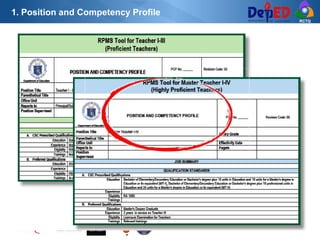
1. Position and Competency Profile
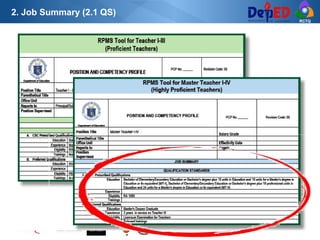
2. Job Summary which includes
2.1 Qualification Standards
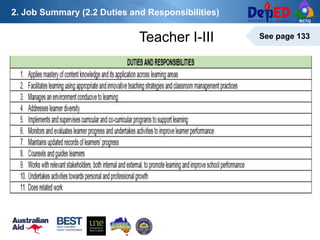
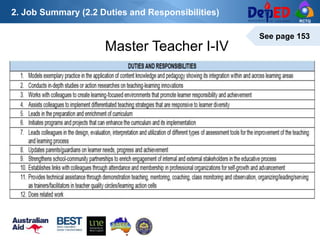
2.2 Duties and responsibilities
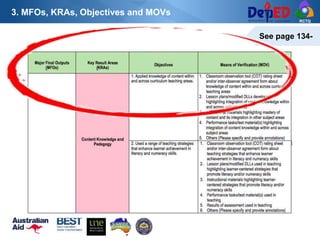
3. MFOs, KRAs, Objectives, MOV
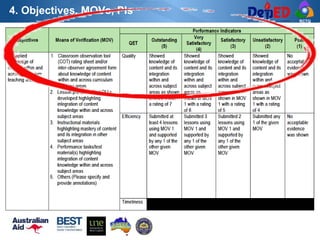
4. Objectives, MOV, PIs
RCTQ
1. Position and Competency Profile
RCTQ
2. Job Summary (2.1 QS)
RCTQ
See page 133
2. Job Summary (2.2 Duties and Responsibilities)
Teacher I-III
RCTQ
See page 153
2. Job Summary (2.2 Duties and Responsibilities)
Master Teacher I-IV
RCTQ
See page 134-
3. MFOs, KRAs, Objectives and MOVs
RCTQ
4. Objectives, MOVs, PIs
RCTQ
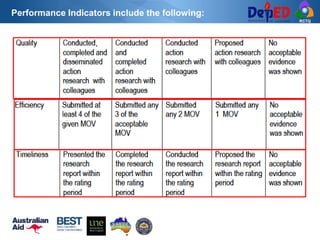
Performance Indicators include the following:
RCTQ
RPMS TOOLS
is there a need for RPMS Tools?
RCTQ
It serves as a
BLUE PRINT
for teachers
to guide them
in accomplishing
their job.
***Photo credits: from Google Photos
RCTQ
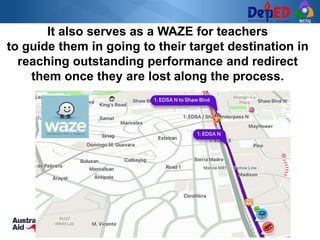
It also serves as a WAZE for teachers
to guide them in going to their target destination in
reaching outstanding performance and redirect
them once they are lost along the process.
RCTQ
RPMS TOOLS
uses the RPMS Tools?
RCTQ
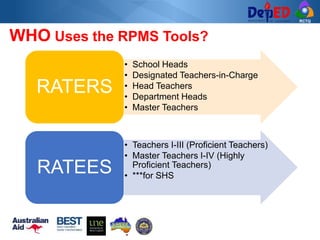
WHO Uses the RPMS Tools?
• School Heads
• Designated Teachers-in-Charge
• Head Teachers
• Department Heads
• Master Teachers
RATERS
• Teachers I-III (Proficient Teachers)
• Master Teachers I-IV (Highly
Proficient Teachers)
• ***for SHS
RATEES
RCTQ
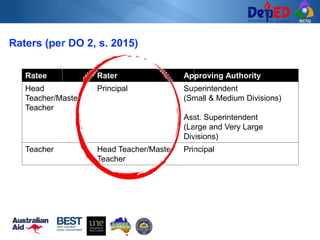
Raters (per DO 2, s. 2015)
Ratee Rater Approving Authority
Head
Teacher/Master
Teacher
Principal Superintendent
(Small & Medium Divisions)
Asst. Superintendent
(Large and Very Large
Divisions)
Teacher Head Teacher/Master
Teacher
Principal
RCTQ
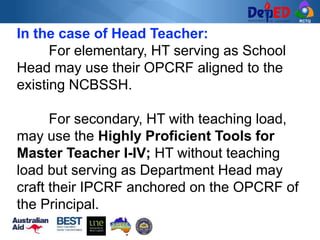
In the case of Head Teacher:
For elementary, HT serving as School
Head may use their OPCRF aligned to the
existing NCBSSH.
For secondary, HT with teaching load,
may use the Highly Proficient Tools for
Master Teacher I-IV; HT without teaching
load but serving as Department Head may
craft their IPCRF anchored on the OPCRF of
the Principal.
RCTQ
Walkthrough on the
RPMS Tools for Teachers
RCTQ
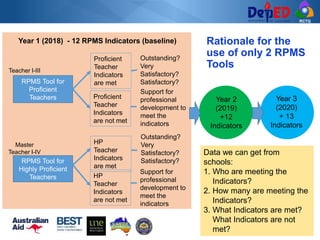
Teacher I-III
RPMS Tool for
Proficient
Teachers
Proficient
Teacher
Indicators
are met
Proficient
Teacher
Indicators
are not met
Outstanding?
Very
Satisfactory?
Satisfactory?
Support for
professional
development to
meet the
indicators
Master
Teacher I-IV
RPMS Tool for
Highly Proficient
Teachers
HP
Teacher
Indicators
are met
HP
Teacher
Indicators
are not met
Outstanding?
Very
Satisfactory?
Satisfactory?
Support for
professional
development to
meet the
indicators
Year 2
(2019)
+12
Indicators
Year 1 (2018) - 12 RPMS Indicators (baseline)
Year 3
(2020)
+ 13
Indicators
Data we can get from
schools:
1. Who are meeting the
Indicators?
2. How many are meeting the
Indicators?
3. What Indicators are met?
What Indicators are not
met?
Rationale for the
use of only 2 RPMS
Tools
RCTQ
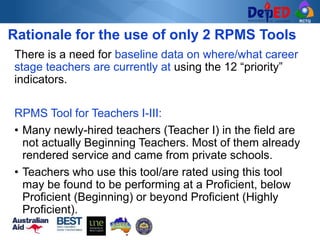
There is a need for baseline data on where/what career
stage teachers are currently at using the 12 “priority”
indicators.
RPMS Tool for Teachers I-III:
• Many newly-hired teachers (Teacher I) in the field are
not actually Beginning Teachers. Most of them already
rendered service and came from private schools.
• Teachers who use this tool/are rated using this tool
may be found to be performing at a Proficient, below
Proficient (Beginning) or beyond Proficient (Highly
Proficient).
Rationale for the use of only 2 RPMS Tools
RCTQ
RPMS Tool for Master Teachers I-IV:
• There’s a possibility that Master Teachers are not
performing at the Highly Proficient Teacher career
stage.
• Teachers who use this tool/are rated using this tool
may be found to be performing at a Highly
Proficient, below Highly Proficient (Proficient) or
beyond Highly Proficient (Distinguished).
RCTQ
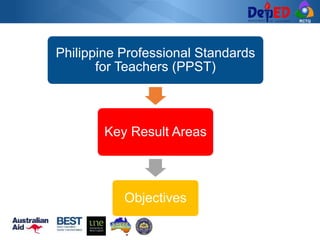
Philippine Professional Standards
for Teachers (PPST)
Key Result Areas
Objectives
RCTQ
Activity 2
Instructions:
• Arrange the strips of papers that contain
texts/words taken from the RPMS tools (e.g. KRA
1, Performance Indicators, Qualification
Standards, Means of Verification), to which RPMS
tools they belong.
RCTQ
1. Were you able to place all texts in the correct
column?
2. What made you accomplish the task?
3. Has your perspective about RPMS tools
changed? Explain your answer.
RCTQ
RPMS TOOLS
RCTQ

Day1_Module1_RPMS_Tools.final_may23,2018.pptx

  • 1.
  • 2.
    RCTQ Objective: This session aimsto introduce to the participants the RPMS tools for teachers.
  • 3.
    RCTQ Activity 1 (5mins) Instructions: • In a blank sheet of paper, draw a big circle. • With eyes closed, draw the parts of your face.
  • 4.
    RCTQ 1.Were you ableto put the parts of your face in the right place? Why? Why not?
  • 5.
    RCTQ 2. If giventhe chance to draw the parts of your face again, how will you do it? Explain.
  • 6.
    RCTQ 3. How willyou compare this activity to our current practice in assessing the quality of our teachers’ performance?
  • 7.
    RCTQ 4. If youhave your way, how will you improve our practice in assessing the quality of our teachers’ performance?
  • 8.
    RCTQ 5. What areyour initial thoughts on the RPMS tools for teachers?
  • 9.
  • 10.
    RCTQ RPMS Tools pertainto the two (2) different teacher performance assessment instruments: 1. RPMS Tool for Teacher I-III (Proficient Teachers); and 2. RPMS Tool for Master Teacher I-IV (Highly Proficient Teachers)
  • 11.
    RCTQ Each tool hasthe following parts: 1. Position and Competency Profile 2. Job Summary which includes 2.1 Qualification Standards 2.2 Duties and responsibilities 3. MFOs, KRAs, Objectives, MOV 4. Objectives, MOV, PIs
  • 12.
    RCTQ 1. Position andCompetency Profile
  • 13.
  • 14.
    RCTQ See page 133 2.Job Summary (2.2 Duties and Responsibilities) Teacher I-III
  • 15.
    RCTQ See page 153 2.Job Summary (2.2 Duties and Responsibilities) Master Teacher I-IV
  • 16.
    RCTQ See page 134- 3.MFOs, KRAs, Objectives and MOVs
  • 17.
  • 18.
  • 19.
    RCTQ RPMS TOOLS is therea need for RPMS Tools?
  • 20.
    RCTQ It serves asa BLUE PRINT for teachers to guide them in accomplishing their job. ***Photo credits: from Google Photos
  • 21.
    RCTQ It also servesas a WAZE for teachers to guide them in going to their target destination in reaching outstanding performance and redirect them once they are lost along the process.
  • 22.
  • 23.
    RCTQ WHO Uses theRPMS Tools? • School Heads • Designated Teachers-in-Charge • Head Teachers • Department Heads • Master Teachers RATERS • Teachers I-III (Proficient Teachers) • Master Teachers I-IV (Highly Proficient Teachers) • ***for SHS RATEES
  • 24.
    RCTQ Raters (per DO2, s. 2015) Ratee Rater Approving Authority Head Teacher/Master Teacher Principal Superintendent (Small & Medium Divisions) Asst. Superintendent (Large and Very Large Divisions) Teacher Head Teacher/Master Teacher Principal
  • 25.
    RCTQ In the caseof Head Teacher: For elementary, HT serving as School Head may use their OPCRF aligned to the existing NCBSSH. For secondary, HT with teaching load, may use the Highly Proficient Tools for Master Teacher I-IV; HT without teaching load but serving as Department Head may craft their IPCRF anchored on the OPCRF of the Principal.
  • 26.
    RCTQ Walkthrough on the RPMSTools for Teachers
  • 27.
    RCTQ Teacher I-III RPMS Toolfor Proficient Teachers Proficient Teacher Indicators are met Proficient Teacher Indicators are not met Outstanding? Very Satisfactory? Satisfactory? Support for professional development to meet the indicators Master Teacher I-IV RPMS Tool for Highly Proficient Teachers HP Teacher Indicators are met HP Teacher Indicators are not met Outstanding? Very Satisfactory? Satisfactory? Support for professional development to meet the indicators Year 2 (2019) +12 Indicators Year 1 (2018) - 12 RPMS Indicators (baseline) Year 3 (2020) + 13 Indicators Data we can get from schools: 1. Who are meeting the Indicators? 2. How many are meeting the Indicators? 3. What Indicators are met? What Indicators are not met? Rationale for the use of only 2 RPMS Tools
  • 28.
    RCTQ There is aneed for baseline data on where/what career stage teachers are currently at using the 12 “priority” indicators. RPMS Tool for Teachers I-III: • Many newly-hired teachers (Teacher I) in the field are not actually Beginning Teachers. Most of them already rendered service and came from private schools. • Teachers who use this tool/are rated using this tool may be found to be performing at a Proficient, below Proficient (Beginning) or beyond Proficient (Highly Proficient). Rationale for the use of only 2 RPMS Tools
  • 29.
    RCTQ RPMS Tool forMaster Teachers I-IV: • There’s a possibility that Master Teachers are not performing at the Highly Proficient Teacher career stage. • Teachers who use this tool/are rated using this tool may be found to be performing at a Highly Proficient, below Highly Proficient (Proficient) or beyond Highly Proficient (Distinguished).
  • 30.
    RCTQ Philippine Professional Standards forTeachers (PPST) Key Result Areas Objectives
  • 31.
    RCTQ Activity 2 Instructions: • Arrangethe strips of papers that contain texts/words taken from the RPMS tools (e.g. KRA 1, Performance Indicators, Qualification Standards, Means of Verification), to which RPMS tools they belong.
  • 32.
    RCTQ 1. Were youable to place all texts in the correct column? 2. What made you accomplish the task? 3. Has your perspective about RPMS tools changed? Explain your answer.
  • 33.
  • 34.

Editor's Notes

  • #2 Discussion: Break the participants into small groups. Request each group to assign a lead discussant. The group will discuss the topics listed below. Topics: Who uses RPMS tools? What are RPMS tools? What are the parts of the RPMS Tools?
  • #5 After the activity, ask the participants the processing questions. USE METACARDS FOR NO. 5
  • #6 After the activity, ask the participants the processing questions. USE METACARDS FOR NO. 5
  • #7 After the activity, ask the participants the processing questions. USE METACARDS FOR NO. 5
  • #8 After the activity, ask the participants the processing questions. USE METACARDS FOR NO. 5
  • #9 After the activity, ask the participants the processing questions. USE METACARDS FOR NO. 5
  • #12 PCP, QS, Duties&Responsibilities –page 5 for Proficient, page 6 Highly Proficient
  • #19 The performance indicators need not have all three (3) categories. Some performance may only be rated on quality and efficiency, some on quality and timeliness and others on efficiency only. Figure 1.9 illustrates how the performance measures are embedded in the performance indicators of the RPMS Tools.  If and when the participants ask the participants ask how to compute for the COT rating for Quality, See Figure 29, Chapter 3: Portfolio Assessment
  • #21 Performance Indicators his part provides the exact quantification of objectives, which shall serve as the assessment tool that gauges whether performance is positive or negative (DO No. 2 s. 2015). In the RPMS Tools, the performance indicators provide descriptions of quality and quantity given five performance levels: 5-Outstanding, 4-Very Satisfactory, 3-Satisfactory, 2-Unsatisfactory, and 1-Poor. Embedded in the performance indicators are elements of quality, efficiency and timeliness. Means of Verification (MOV). The MOV column gives Ratees and Raters examples of documents that can prove the teachers’ attainment of objectives. They have been judiciously selected to show evidence of attainment of objectives. Teachers gather, select, organize and annotate MOV to help Raters in assessing teacher performance. Also, MOV include classroom observation tool (COT); lesson plans/modified daily lesson logs; instructional materials; formative and summative assessment tools; compilations of student outputs; and others
  • #25 POSSSIBLE ISSUES TO BE ANSWERED IF NEEDED For ALS teachers, the Rater will be: EPS II of ALS CID Chief, in the absence of the EPS II other personnel delegated by CID Chief For clustered school Ratee: Teacher Rater: TIC (SO by SDS) Approving Authority: Cluster Principal
  • #26 NOTE: Remember PPST is for TEACHERS not for Educational Leaders such as School Heads, same goes with RPMS Tools.
  • #28 For year 1 (2018): There is a need for baseline data on where/what career stage teachers are currently at using the 12 “priority” indicators. During the first year of implementation, the 2 tools will determine whether indicators are met or not met. Those In the year 2 of implementation, another 12 indicators of the PPST will be used in the RPMS. The remaining 13 PPST indicators will be used the RPMS in the Year 3.
  • #31 PPST is the basis KRAs represent the Domains of PPST Objectives represent the Indicators of the PPST NOTE THE PAGE OF EACH KRA AND OBJECTIVE FOR CLEARER WALKTHROUGH.
  • #32 Give the participants strips of papers that contain texts taken from the different parts of the RPMS Tools (e.g. Qualification Standards, Duties and Responsibilities, Means of Verification, among others). Ask them to group the strips of papers as to which RPMS Tool they belong.
  • #33 After the activity, ask the participants the processing questions.