Solving Problems
using Venn
Diagrams
Mathematics 7
Lesson 1
Enhancement Camp
Lesson Component 1 (Lesson Short Review)
Time: 7 minutes
Questions
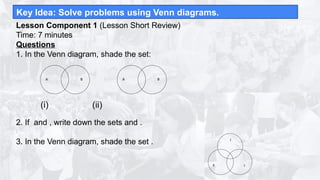
1. In the Venn diagram, shade the set:
(i) (ii)
2. If and , write down the sets and .
3. In the Venn diagram, shade the set .
Key Idea: Solve problems using Venn diagrams.
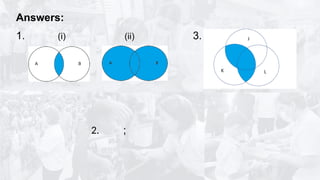
Answers:
1. (i) (ii) 3.
2. ;
Lesson Component 2
(Lesson Purpose/Intention)
Time: 3 minutes
Goal:
Find solutions to real-world
problems.
Lesson Component 3 (Lesson Language Practice)
Time: 5 minutes
Let’s do this!
Fill in the blanks.
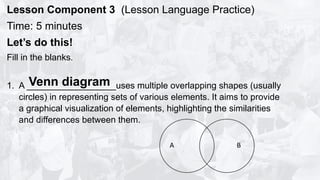
1. A __________________uses multiple overlapping shapes (usually
circles) in representing sets of various elements. It aims to provide
a graphical visualization of elements, highlighting the similarities
and differences between them.
Venn diagram
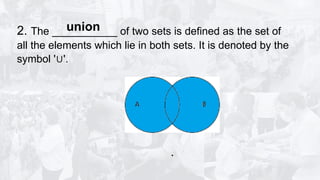
2. The ___________ of two sets is defined as the set of
all the elements which lie in both sets. It is denoted by the
symbol ' '.
∪
.
union
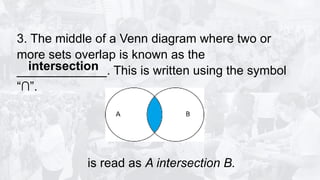
3. The middle of a Venn diagram where two or
more sets overlap is known as the
_____________. This is written using the symbol
“∩”.
is read as A intersection B.
intersection
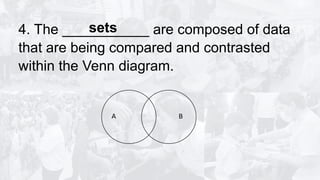
4. The ___________ are composed of data
that are being compared and contrasted
within the Venn diagram.
sets
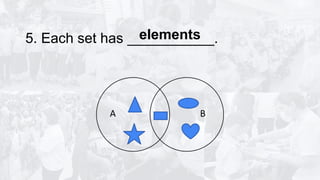
5. Each set has ___________.
elements
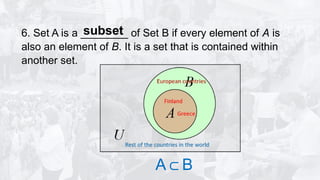
6. Set A is a ________ of Set B if every element of A is
also an element of B. It is a set that is contained within
another set.
subset
A B
⊂
.
Lesson Component 4 (Lesson Activity)
Part 4A (5 minutes)
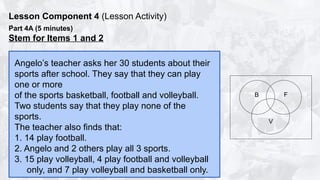
Stem for Items 1 and 2
F
B F
V
Angelo’s teacher asks her 30 students about their
sports after school. They say that they can play
one or more
of the sports basketball, football and volleyball.
Two students say that they play none of the
sports.
The teacher also finds that:
1. 14 play football.
2. Angelo and 2 others play all 3 sports.
3. 15 play volleyball, 4 play football and volleyball
only, and 7 play volleyball and basketball only.
.
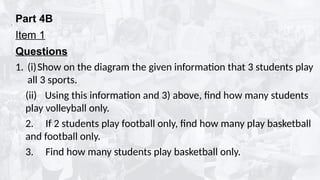
Part 4B
Item 1
Questions
1. (i)Show on the diagram the given information that 3 students play
all 3 sports.
(ii) Using this information and 3) above, find how many students
play volleyball only.
2. If 2 students play football only, find how many play basketball
and football only.
3. Find how many students play basketball only.
.
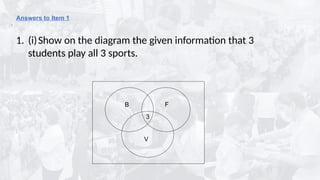
Answers to Item 1
3
F
B F
V
1. (i)Show on the diagram the given information that 3
students play all 3 sports.
.
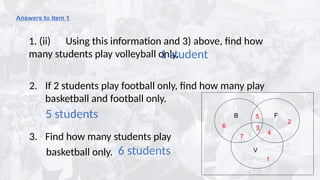
Answers to Item 1
1. (ii) Using this information and 3) above, find how
many students play volleyball only.
2. If 2 students play football only, find how many play
basketball and football only.
F
B F
V
3
5
6
7
2
4
1
3. Find how many students play
basketball only.
1 student
5 students
6 students
.
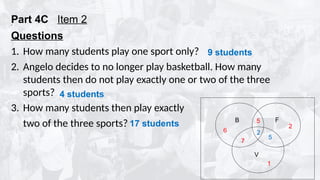
Part 4C Item 2
Questions
1. How many students play one sport only?
2. Angelo decides to no longer play basketball. How many
students then do not play exactly one or two of the three
sports?
3. How many students then play exactly
two of the three sports?
9 students
4 students
F
B F
V
2
5
6
7
2
5
1
17 students
.
Lesson Component 5
(Lesson Conclusion – Reflection/Metacognition on Student Goals)
Time: 5 minutes
o What do you think were the key mathematical concepts addressed in this
lesson?
o Would you rate your level of understanding of the material covered in this
lesson as high, moderate, or low?
o Has the lesson helped you to gain further insight into aspects of the material
covered that represent strengths or represent weaknesses?
o What would you describe as the main barriers, if any, to your ongoing progress
and achievement in relation to the topic area addressed in this lesson?
o What do you think would best assist your ongoing progress and achievement in
relation to the topic area?

Day 1- Lesson 1 Solving Problems using Venn Diagram

  • 1.
  • 2.
    Lesson Component 1(Lesson Short Review) Time: 7 minutes Questions 1. In the Venn diagram, shade the set: (i) (ii) 2. If and , write down the sets and . 3. In the Venn diagram, shade the set . Key Idea: Solve problems using Venn diagrams.
  • 3.
  • 4.
    Lesson Component 2 (LessonPurpose/Intention) Time: 3 minutes Goal: Find solutions to real-world problems.
  • 5.
    Lesson Component 3(Lesson Language Practice) Time: 5 minutes Let’s do this! Fill in the blanks. 1. A __________________uses multiple overlapping shapes (usually circles) in representing sets of various elements. It aims to provide a graphical visualization of elements, highlighting the similarities and differences between them. Venn diagram
  • 6.
    2. The ___________of two sets is defined as the set of all the elements which lie in both sets. It is denoted by the symbol ' '. ∪ . union
  • 7.
    3. The middleof a Venn diagram where two or more sets overlap is known as the _____________. This is written using the symbol “∩”. is read as A intersection B. intersection
  • 8.
    4. The ___________are composed of data that are being compared and contrasted within the Venn diagram. sets
  • 9.
    5. Each sethas ___________. elements
  • 10.
    6. Set Ais a ________ of Set B if every element of A is also an element of B. It is a set that is contained within another set. subset A B ⊂
  • 11.
    . Lesson Component 4(Lesson Activity) Part 4A (5 minutes) Stem for Items 1 and 2 F B F V Angelo’s teacher asks her 30 students about their sports after school. They say that they can play one or more of the sports basketball, football and volleyball. Two students say that they play none of the sports. The teacher also finds that: 1. 14 play football. 2. Angelo and 2 others play all 3 sports. 3. 15 play volleyball, 4 play football and volleyball only, and 7 play volleyball and basketball only.
  • 12.
    . Part 4B Item 1 Questions 1.(i)Show on the diagram the given information that 3 students play all 3 sports. (ii) Using this information and 3) above, find how many students play volleyball only. 2. If 2 students play football only, find how many play basketball and football only. 3. Find how many students play basketball only.
  • 13.
    . Answers to Item1 3 F B F V 1. (i)Show on the diagram the given information that 3 students play all 3 sports.
  • 14.
    . Answers to Item1 1. (ii) Using this information and 3) above, find how many students play volleyball only. 2. If 2 students play football only, find how many play basketball and football only. F B F V 3 5 6 7 2 4 1 3. Find how many students play basketball only. 1 student 5 students 6 students
  • 15.
    . Part 4C Item2 Questions 1. How many students play one sport only? 2. Angelo decides to no longer play basketball. How many students then do not play exactly one or two of the three sports? 3. How many students then play exactly two of the three sports? 9 students 4 students F B F V 2 5 6 7 2 5 1 17 students
  • 16.
    . Lesson Component 5 (LessonConclusion – Reflection/Metacognition on Student Goals) Time: 5 minutes o What do you think were the key mathematical concepts addressed in this lesson? o Would you rate your level of understanding of the material covered in this lesson as high, moderate, or low? o Has the lesson helped you to gain further insight into aspects of the material covered that represent strengths or represent weaknesses? o What would you describe as the main barriers, if any, to your ongoing progress and achievement in relation to the topic area addressed in this lesson? o What do you think would best assist your ongoing progress and achievement in relation to the topic area?

Editor's Notes

  • #4 Teacher states: We can use what we have learnt about representing sets in Venn diagrams to help us find solutions to real-world problems. Today we will employ Venn diagrams in finding solutions to some problems.
  • #11 The teacher models fluent reading of the stem first. Then let the learners read, study and understand the stem.
  • #12 This involves a set of questions associated with the stem. Learners need to refer to the stem as they prepare to answer the set of questions. They write down responses or attempts at each question. Remember it is OK for learners to make errors. This provides important information to teachers on the learning needs of the learners. When the learners are finished, or sufficient time has been allocated, learners provide answers to the questions. Time should be used to have learner discussion, explanation, reasoning, etc. about the answers.
  • #15 Component 4C offers a new start for learners regardless of how they performed in Component 4B. The structure is very similar to Component 4B, i.e., undertaking a new set of questions related to the same stem. In addition, it allows a refresh for learner brain processing as a new starting point. It also allows the class to become centred around all learners starting a new activity.
  • #16 The teacher facilitates student reflection and discussion, that addresses such questions. Component 5 is designed to offer a learner-focused wrap-up to the main intentions of the lesson. The focus for Component 5 is on the whole lesson. In particular, the focus is about helping learners reflect on their progress, achievement (or partial achievement) of goals (lesson intention) and their performance and understanding during the lesson. It builds on comments from Component 2 about teacher expectations. There is the chance here to confirm learner progress during the lesson. Component 5 has a high metacognitive aspect for learners – learners thinking about their own thinking – which can be further enhanced by teacher modelling. A teacher may use a diagram or picture to facilitate a discussion about Component 4 as a catalyst to stimulate learner discussion and reflection.