SETS:
MORE THAN JUST CIRCLES !
A REAL WORLD STUDY OF FOOTBALL,BASKETBALL,AND CRICKET
PREFERENCES AT FLUORESCENT SECONDARY SCHOOL
MATHEMATICS
PRESENTATION
Shrisha sapkota
Saskriti pyakurel
Manaswi timisina
Mayuri Shah
Aakanshya Gurung
Adrina shrestha
Neelam Nepal
Members:
Iโ€™d like to sincerely thank our subject teacher, Mr.
Anand Sapkota Sir for giving us this ample
opportunity to work together, collect data, and
engage in real world learning. This experience
helped us not only to connect theory to practical
even strengthen our teamwork skills. We truly
appreciate the chance to learn beyond books and
collaborate effectively.
Grateful for a valuable learning experience in
Fluorescent secondary school
To prepare for our presentation, the first important step was collecting data. Some
team members went to classes 10, 8, and 7, making sure we got the best information.
During the survey, we questions, and students were requested to stand up while
responding. At first, some were shy, but soon everyone got involved. Supportive
teachers CR, VCR helped make the process smooth, and their encouragement made
a huge difference.
Overall, it was a great experience not just about collecting data but also about seeing
how engaged and excited everyone was.
BACK STORY OR THE SURVEY
EXPERIENCE
key points or main content
Definition of Sets โ€“ Basic concept and meaning of sets.
Types of Sets โ€“ Finite, infinite, empty, universal, subset, and more.
Venn Diagram of Sets
Operations on Sets โ€“ Union, intersection, complement, and
difference.
Survey Questions & Analysis โ€“ from collected data, and
observations.
Conclusion of the presentation
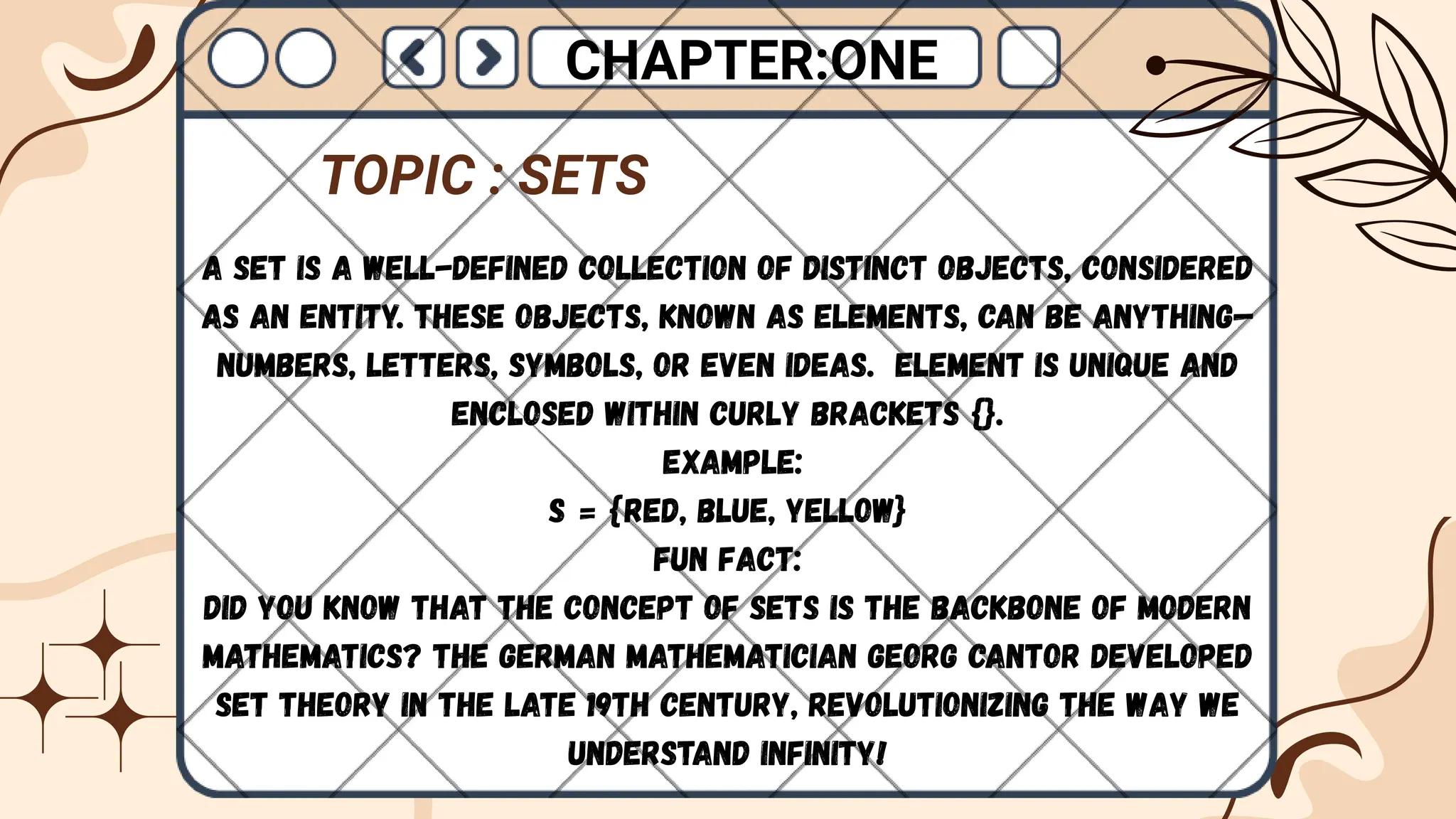
A set is a well-defined collection of distinct objects, considered
as an entity. These objects, known as elements, can be anythingโ€”
numbers, letters, symbols, or even ideas. Element is unique and
enclosed within curly brackets {}.
Example:
S = {Red, Blue, Yellow}
Fun Fact:
Did you know that the concept of sets is the backbone of modern
mathematics? The German mathematician Georg Cantor developed
set theory in the late 19th century, revolutionizing the way we
understand infinity!
CHAPTER:ONE
TOPIC : SETS
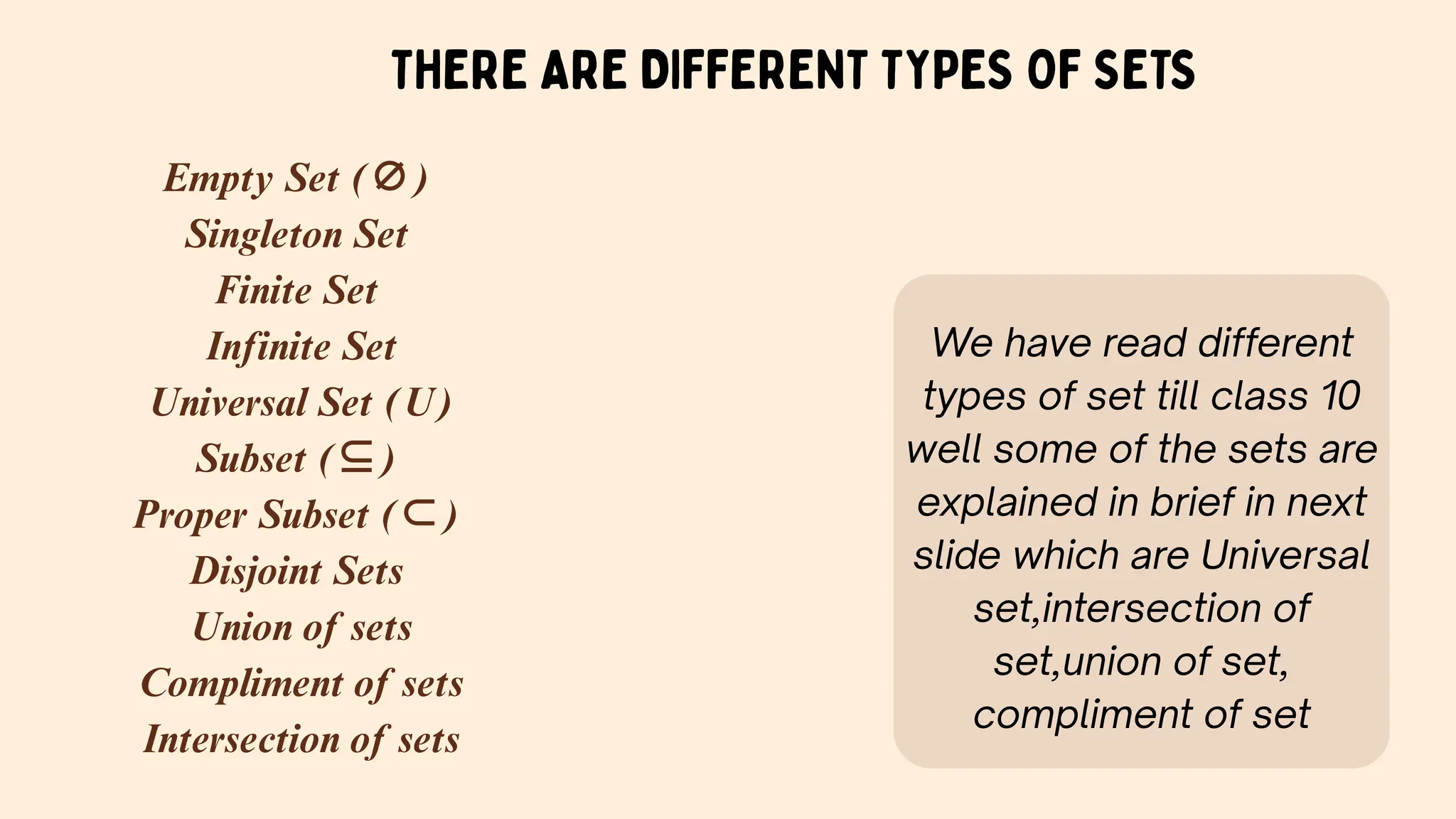
THERE ARE DIFFERENT TYPES OF SETS
Empty Set (โˆ…)
Singleton Set
Finite Set
Infinite Set
Universal Set (U)
Subset (โІ)
Proper Subset (โŠ‚)
Disjoint Sets
Union of sets
Compliment of sets
Intersection of sets
We have read different
types of set till class 10
well some of the sets are
explained in brief in next
slide which are Universal
set,intersection of
set,union of set,
compliment of set
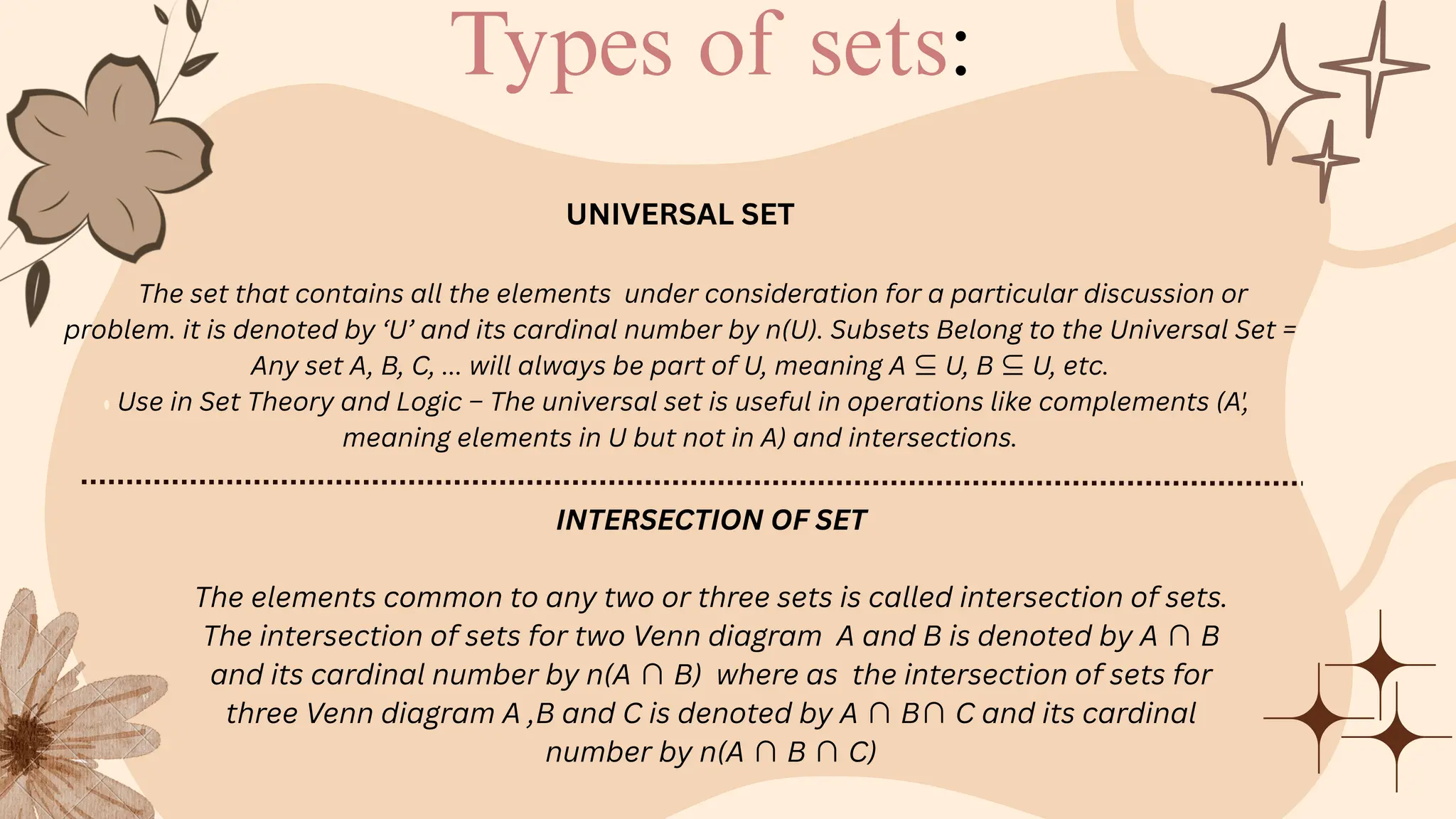
Types of sets:
INTERSECTION OF SET
The elements common to any two or three sets is called intersection of sets.
The intersection of sets for two Venn diagram A and B is denoted by A โˆฉB
and its cardinal number by n(A โˆฉB) where as the intersection of sets for
three Venn diagram A ,B and C is denoted by A โˆฉBโˆฉC and its cardinal
number by n(A โˆฉB โˆฉC)
UNIVERSAL SET
The set that contains all the elements under consideration for a particular discussion or
problem. it is denoted by โ€˜Uโ€™ and its cardinal number by n(U). Subsets Belong to the Universal Set =
Any set A, B, C, ... will always be part of U, meaning A โІU, B โІU, etc.
Use in Set Theory and Logic โ€“ The universal set is useful in operations like complements (A',
meaning elements in U but not in A) and intersections.
The union of sets is simply the combination of all elements from the
given sets, ensuring no duplicates. In a two-set Venn diagram, the
union of Set A and Set B (written as A โˆชB) includes everything inside
either circle, including the overlapping middle part. This means we
gather all elements belonging to either Set A or Set B.
Expanding this to a three-set Venn diagram, the union of Set A, B, and
C (written as A โˆชB โˆชC) covers all elements appearing in any of the
three sets. Visually, the union represents everything inside any of the
circles, ensuring all members are included at least once. Itโ€™s like
combining multiple groups where everyone gets counted, whether
they belong to one, two, or all three sets. If there is no element in the
compliment of the union of sets then n(U) is same as n (A U BUC) OR
n(A U B) .
UNION OF SETS
The elements which belongs to the universal sets but don't belong to
AUB OR AUBUC are the elements of the set (AUB) OR (AUBUC) .
Itโ€™s number of elements are denoted by n (AUB) OR n(AUBUC). The
following terms are used to represent the compliment of union.
None, neither, no body, neither A nor B nor C OR neither A nor B nor
both.... etc.
COMPLEMENT OF UNION SETS
A Venn diagram is a widely used diagram style that
shows the logical relation between sets, popularized
by John Venn (1834โ€“1923) in the 1880s. The diagrams are
used to teach elementary set theory, and to
illustrate simple set relationships in probability
, logic, statistics, . There are two
types of Venn diagrams which are widely used. They are
two Venn diagram and three Venn diagram.
VENN DIAGRAM
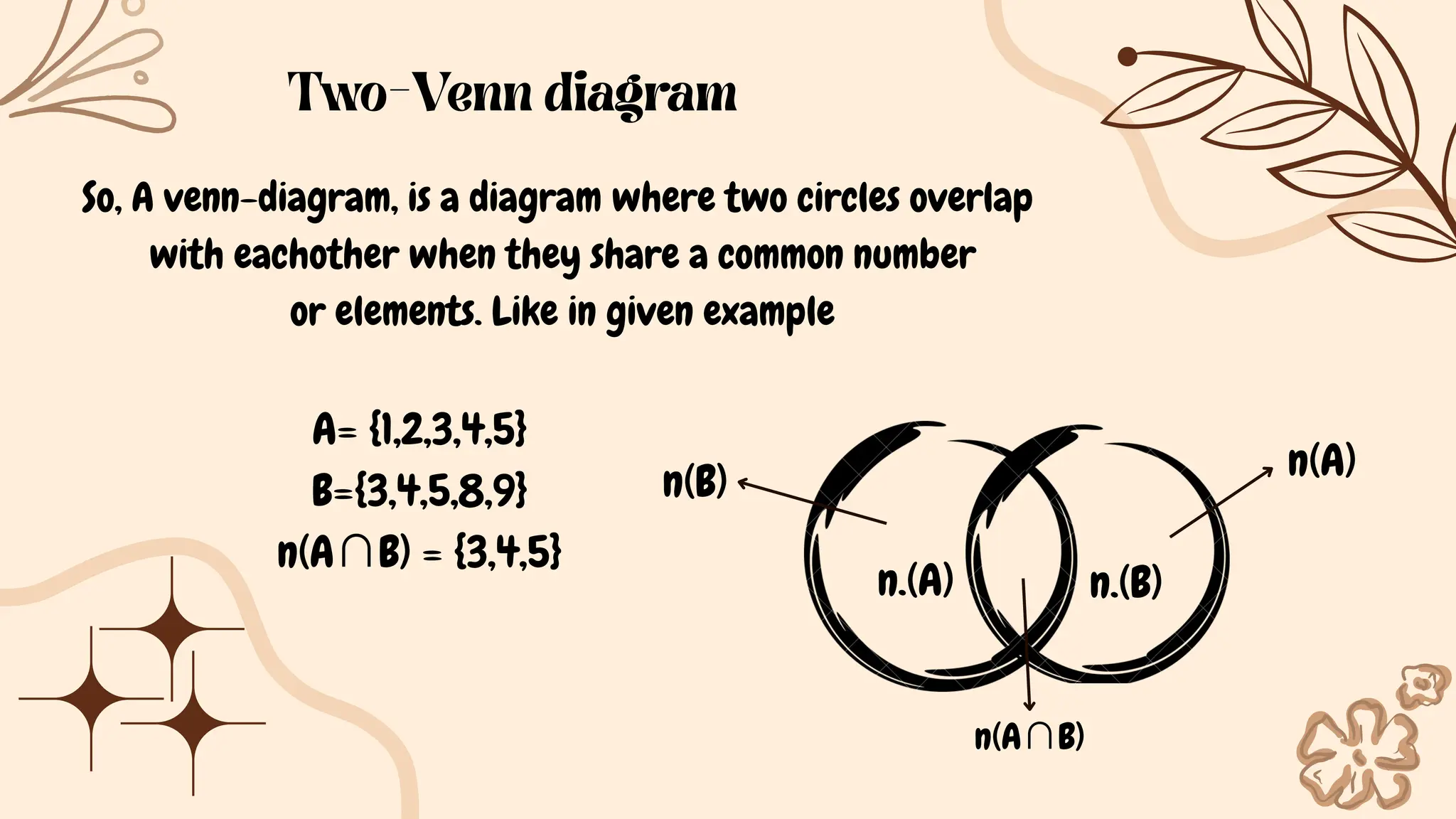
Two-Venn diagram
So, A venn-diagram, is a diagram where two circles overlap
with eachother when they share a common number
or elements. Like in given example
A= {1,2,3,4,5}
B={3,4,5,8,9}
n(AโˆฉB) = {3,4,5}
n.(A) n.(B)
n(AโˆฉB)
n(A)
n(B)
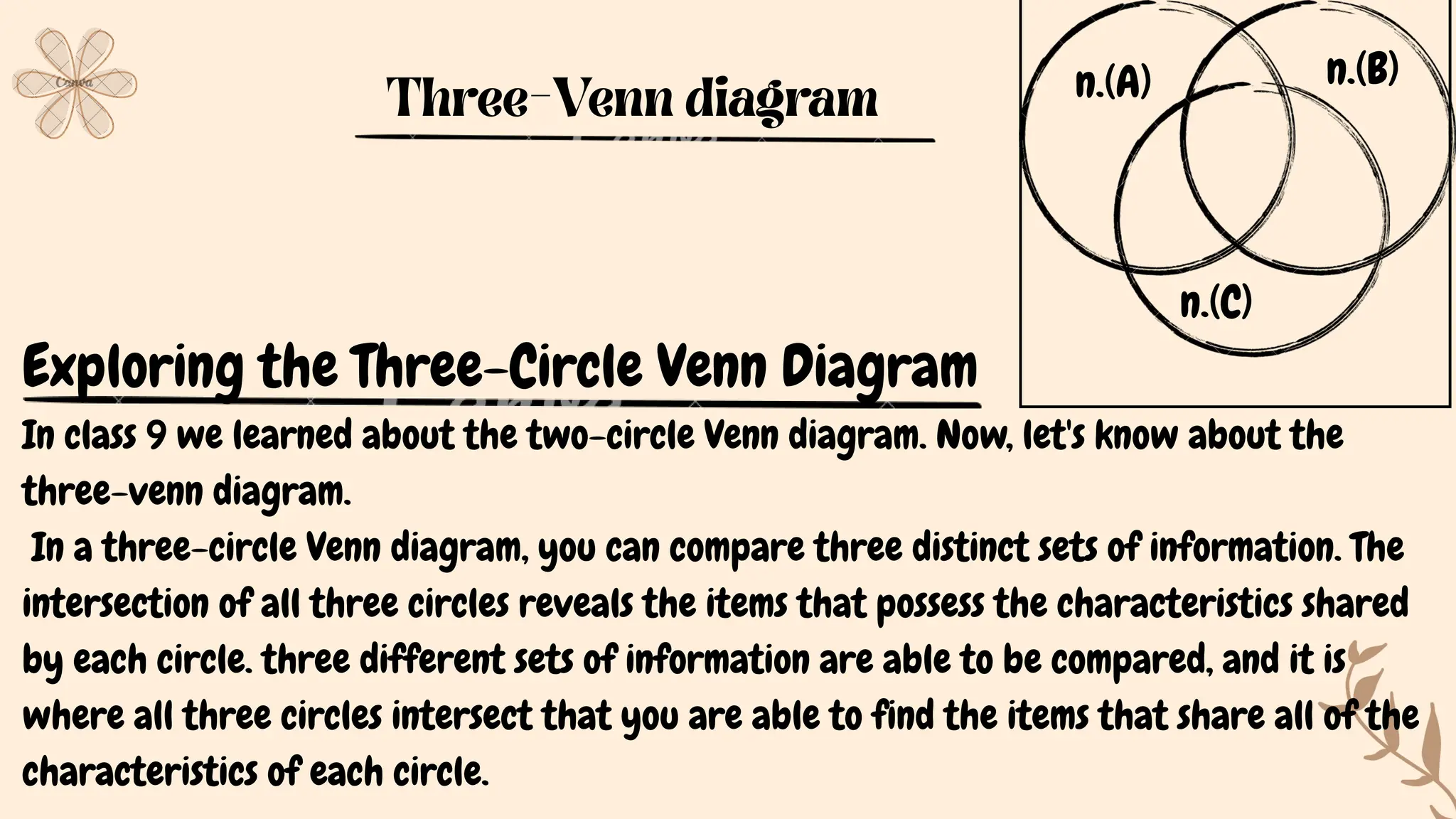
Exploring the Three-Circle Venn Diagram
In class 9 we learned about the two-circle Venn diagram. Now, let's know about the
three-venn diagram.
In a three-circle Venn diagram, you can compare three distinct sets of information. The
intersection of all three circles reveals the items that possess the characteristics shared
by each circle. three different sets of information are able to be compared, and it is
where all three circles intersect that you are able to find the items that share all of the
characteristics of each circle.
Three-Venn diagram n.(A) n.(B)
n.(C)
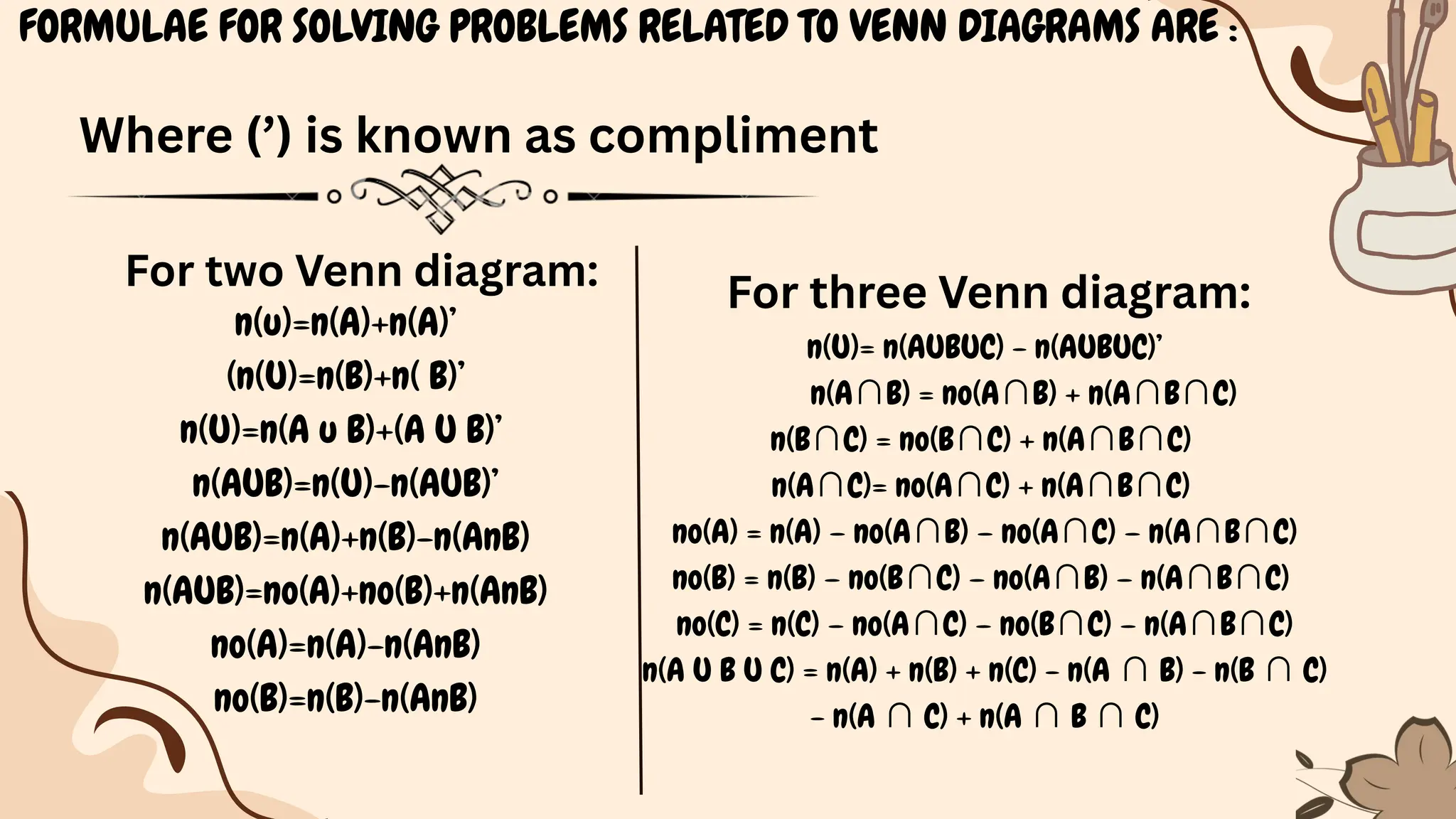
n(u)=n(A)+n(A)โ€™
(n(U)=n(B)+n( B)โ€™
n(U)=n(A u B)+(A U B)โ€™
n(AUB)=n(U)-n(AUB)โ€™
n(AUB)=n(A)+n(B)-n(AnB)
n(AUB)=no(A)+no(B)+n(AnB)
no(A)=n(A)-n(AnB)
no(B)=n(B)-n(AnB)
For two Venn diagram:
For three Venn diagram:
FORMULAE FOR SOLVING PROBLEMS RELATED TO VENN DIAGRAMS ARE :
n(U)= n(AUBUC) - n(AUBUC)โ€™
n(AโˆฉB) = no(AโˆฉB) + n(AโˆฉBโˆฉC)
n(BโˆฉC) = no(BโˆฉC) + n(AโˆฉBโˆฉC)
n(AโˆฉC)= no(AโˆฉC) + n(AโˆฉBโˆฉC)
no(A) = n(A) โ€“ no(AโˆฉB) โ€“ no(AโˆฉC) โ€“ n(AโˆฉBโˆฉC)
no(B) = n(B) โ€“ no(BโˆฉC) โ€“ no(AโˆฉB) โ€“ n(AโˆฉBโˆฉC)
no(C) = n(C) โ€“ no(AโˆฉC) โ€“ no(BโˆฉC) โ€“ n(AโˆฉBโˆฉC)
n(A U B U C) = n(A) + n(B) + n(C) - n(A โˆฉB) - n(B โˆฉC)
- n(A โˆฉC) + n(A โˆฉB โˆฉC)
Where (โ€™) is known as compliment
QUESTIONS AND THERE SOLUTIONS RELATED TO THE
SURVEY!
what are the data set collected from each class?
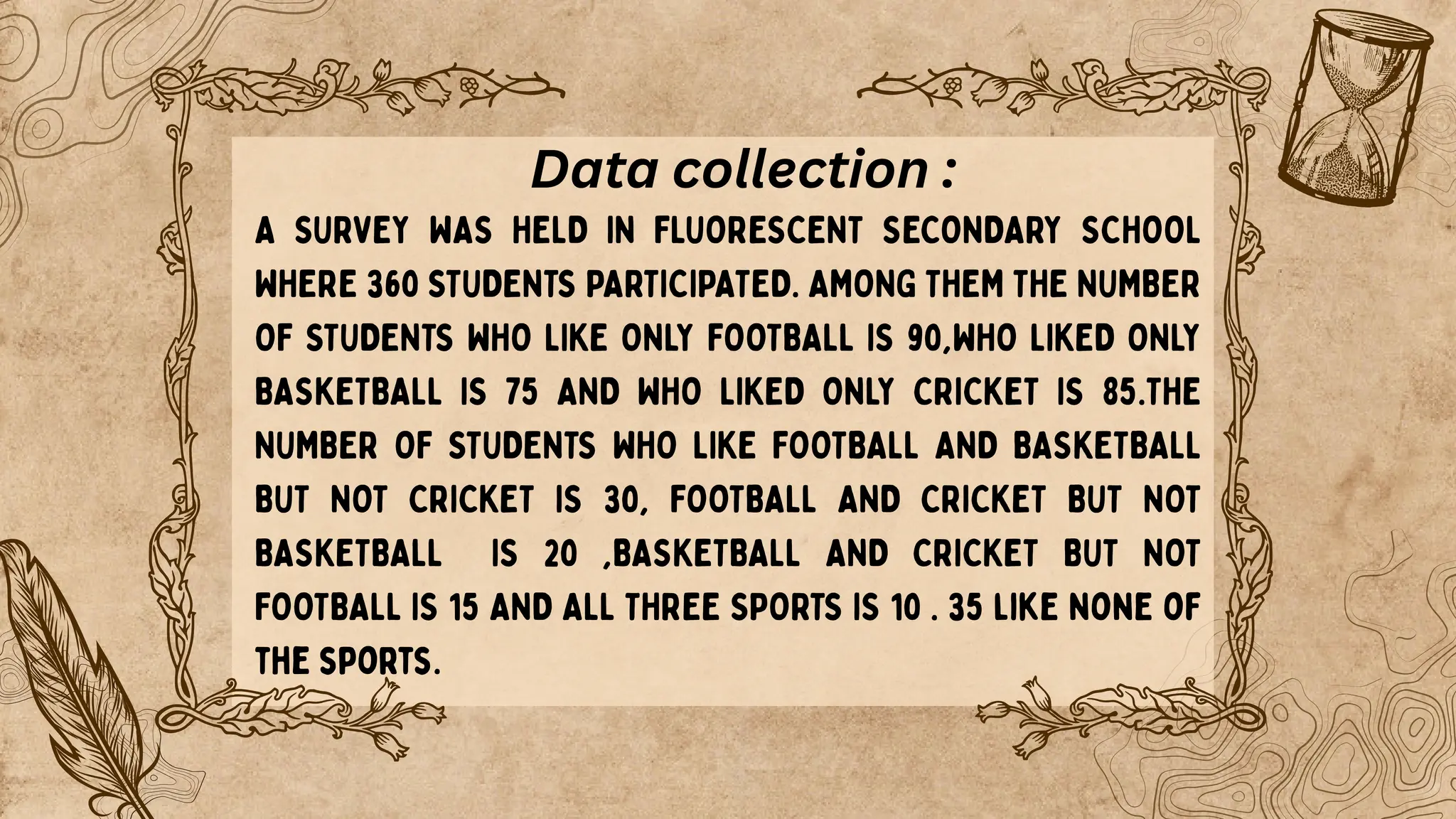
A SURVEY WAS HELD IN FLUORESCENT SECONDARY SCHOOL
WHERE 360 STUDENTS PARTICIPATED. AMONG THEM THE NUMBER
OF STUDENTS WHO LIKE ONLY FOOTBALL IS 90,WHO LIKED ONLY
BASKETBALL IS 75 AND WHO LIKED ONLY CRICKET IS 85.THE
NUMBER OF STUDENTS WHO LIKE FOOTBALL AND BASKETBALL
BUT NOT CRICKET IS 30, FOOTBALL AND CRICKET BUT NOT
BASKETBALL IS 20 ,BASKETBALL AND CRICKET BUT NOT
FOOTBALL IS 15 AND ALL THREE SPORTS IS 10 . 35 like none of
the sports.
Data collection :
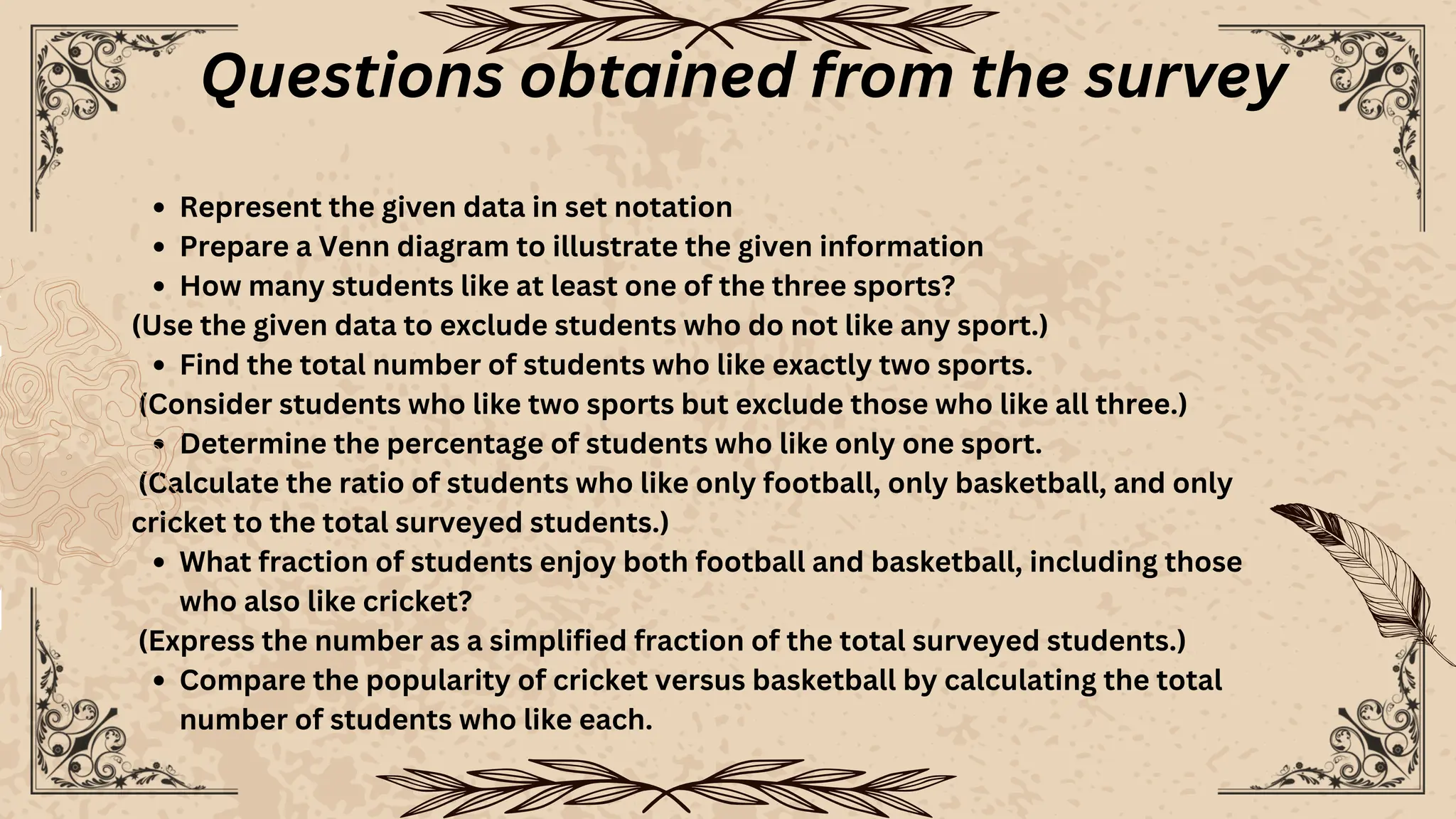
Represent the given data in set notation
Prepare a Venn diagram to illustrate the given information
How many students like at least one of the three sports?
(Use the given data to exclude students who do not like any sport.)
Find the total number of students who like exactly two sports.
(Consider students who like two sports but exclude those who like all three.)
Determine the percentage of students who like only one sport.
(Calculate the ratio of students who like only football, only basketball, and only
cricket to the total surveyed students.)
What fraction of students enjoy both football and basketball, including those
who also like cricket?
(Express the number as a simplified fraction of the total surveyed students.)
Compare the popularity of cricket versus basketball by calculating the total
number of students who like each.
Questions obtained from the survey
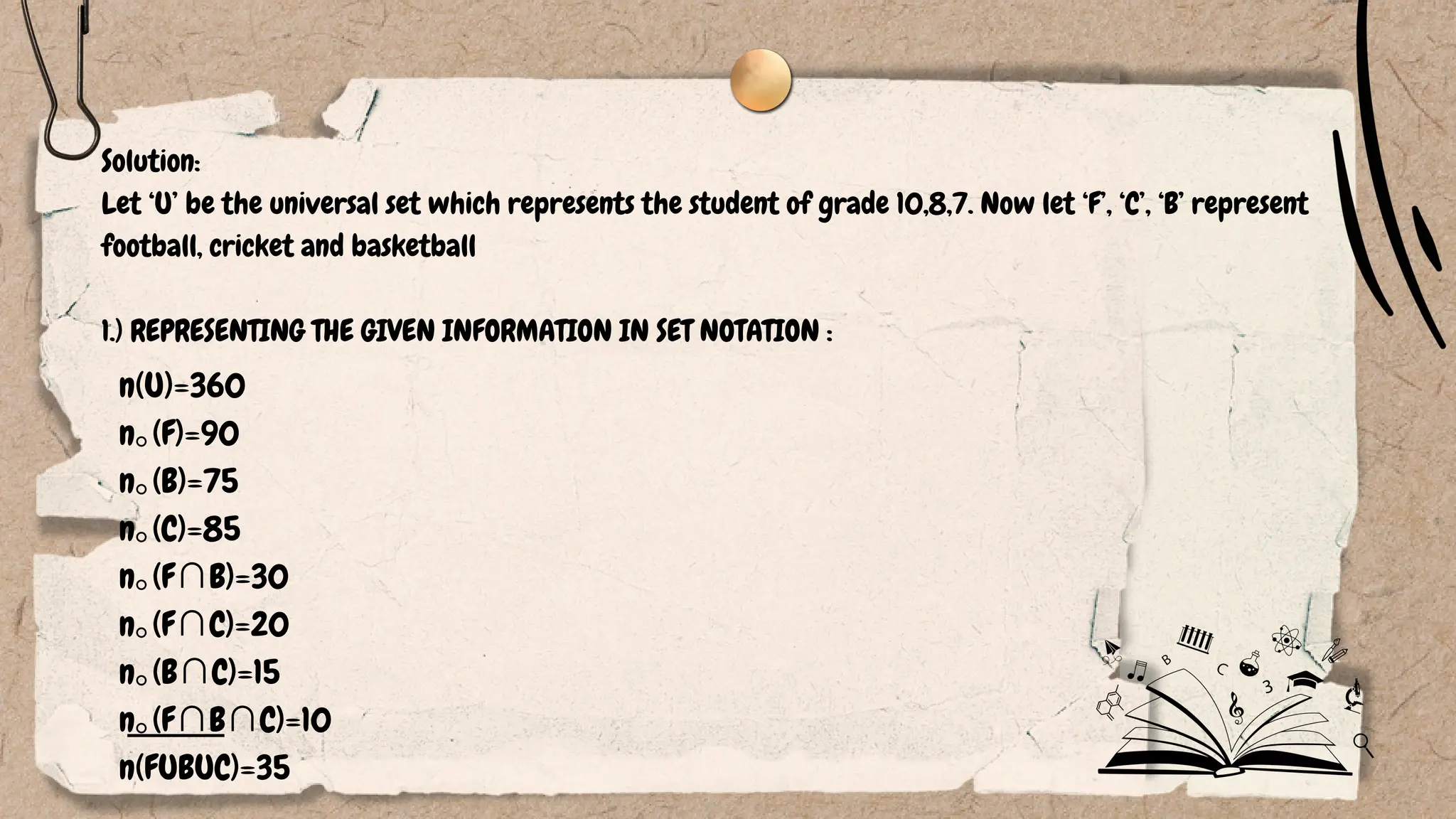
n(U)=360
nโ 
๏ฝก(F)=90
nโ 
๏ฝก(B)=75
nโ 
๏ฝก(C)=85
nโ 
๏ฝก(FโˆฉB)=30
nโ 
๏ฝก(FโˆฉC)=20
nโ 
๏ฝก(BโˆฉC)=15
nโ 
๏ฝก(FโˆฉBโˆฉC)=10
n(FUBUC)=35
Solution:
Let โ€˜Uโ€™ be the universal set which represents the student of grade 10,8,7. Now let โ€˜Fโ€™, โ€˜Cโ€™, โ€˜Bโ€™ represent
football, cricket and basketball
1.) REPRESENTING THE GIVEN INFORMATION IN SET NOTATION :
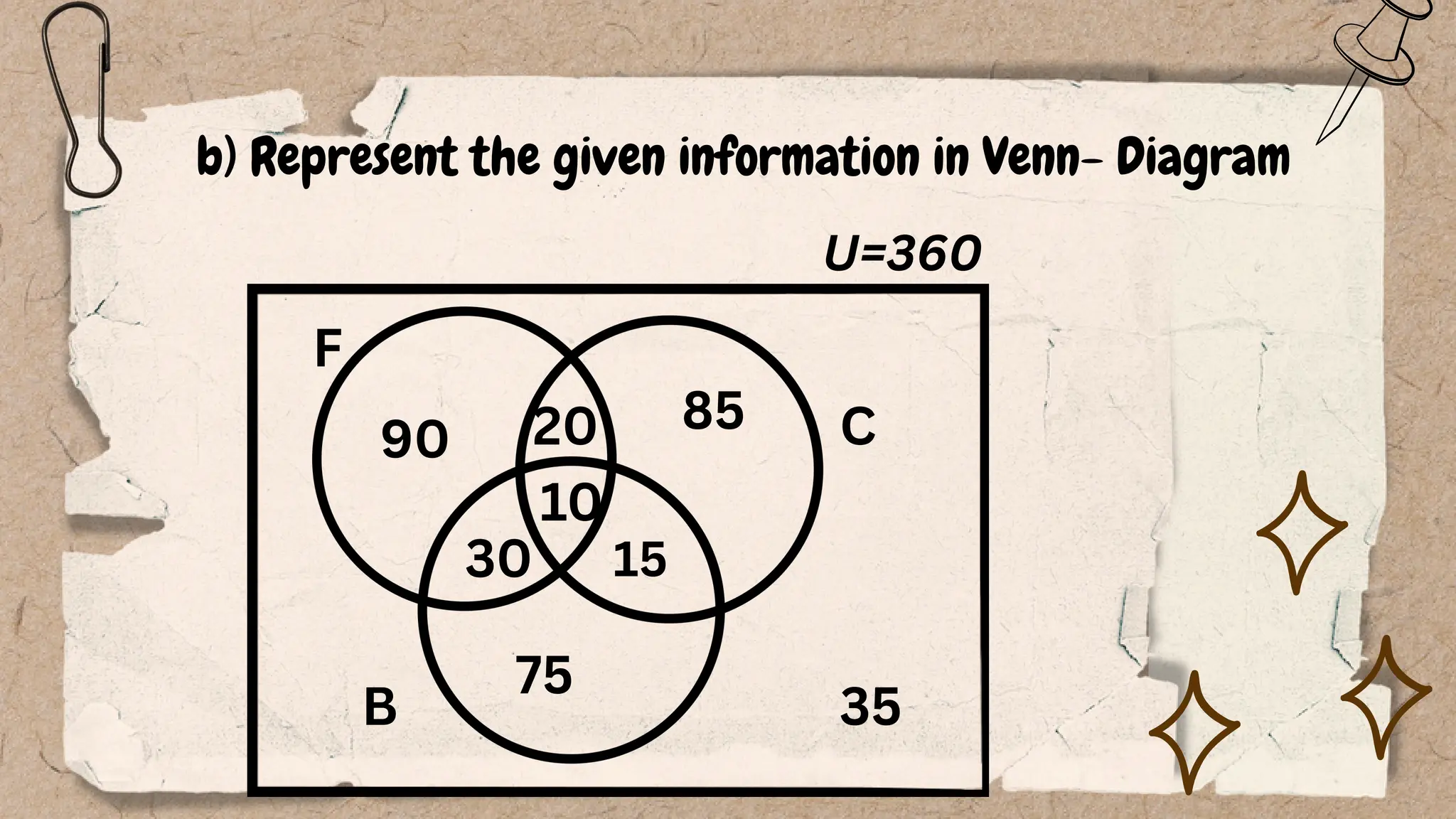
U=360
F
B
C
90
75
85
15
30
20
10
35
b) Represent the given information in Venn- Diagram
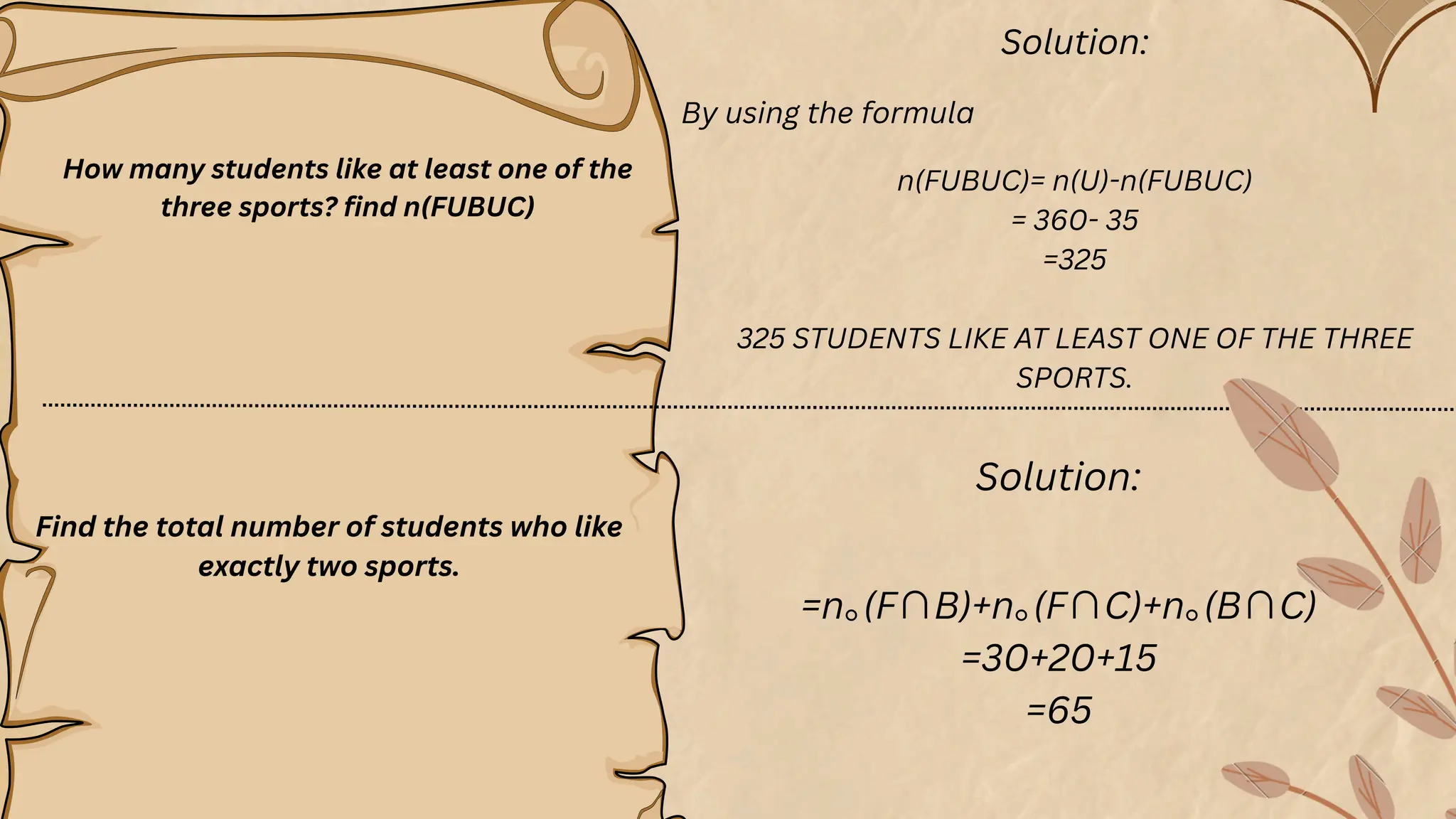
How many students like at least one of the
three sports? find n(FUBUC)
Solution:
By using the formula
n(FUBUC)= n(U)-n(FUBUC)
= 360- 35
=325
325 STUDENTS LIKE AT LEAST ONE OF THE THREE
SPORTS.
Solution:
=nโ 
๏ฝก(FโˆฉB)+nโ 
๏ฝก(FโˆฉC)+nโ 
๏ฝก(BโˆฉC)
=30+20+15
=65
Find the total number of students who like
exactly two sports.
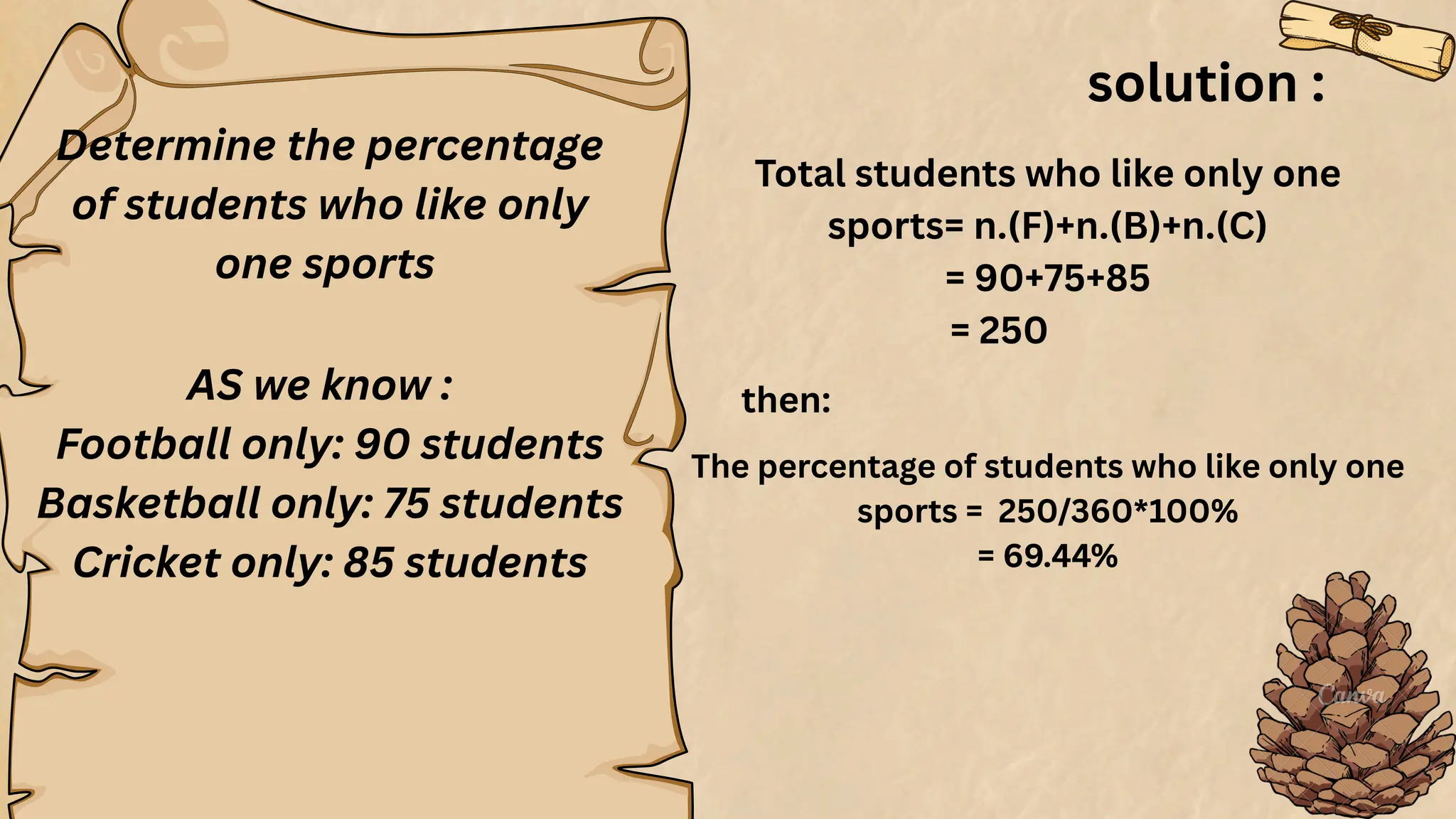
Determine the percentage
of students who like only
one sports
AS we know :
Football only: 90 students
Basketball only: 75 students
Cricket only: 85 students
solution :
Total students who like only one
sports= n.(F)+n.(B)+n.(C)
= 90+75+85
= 250
then:
The percentage of students who like only one
sports = 250/360*100%
= 69.44%
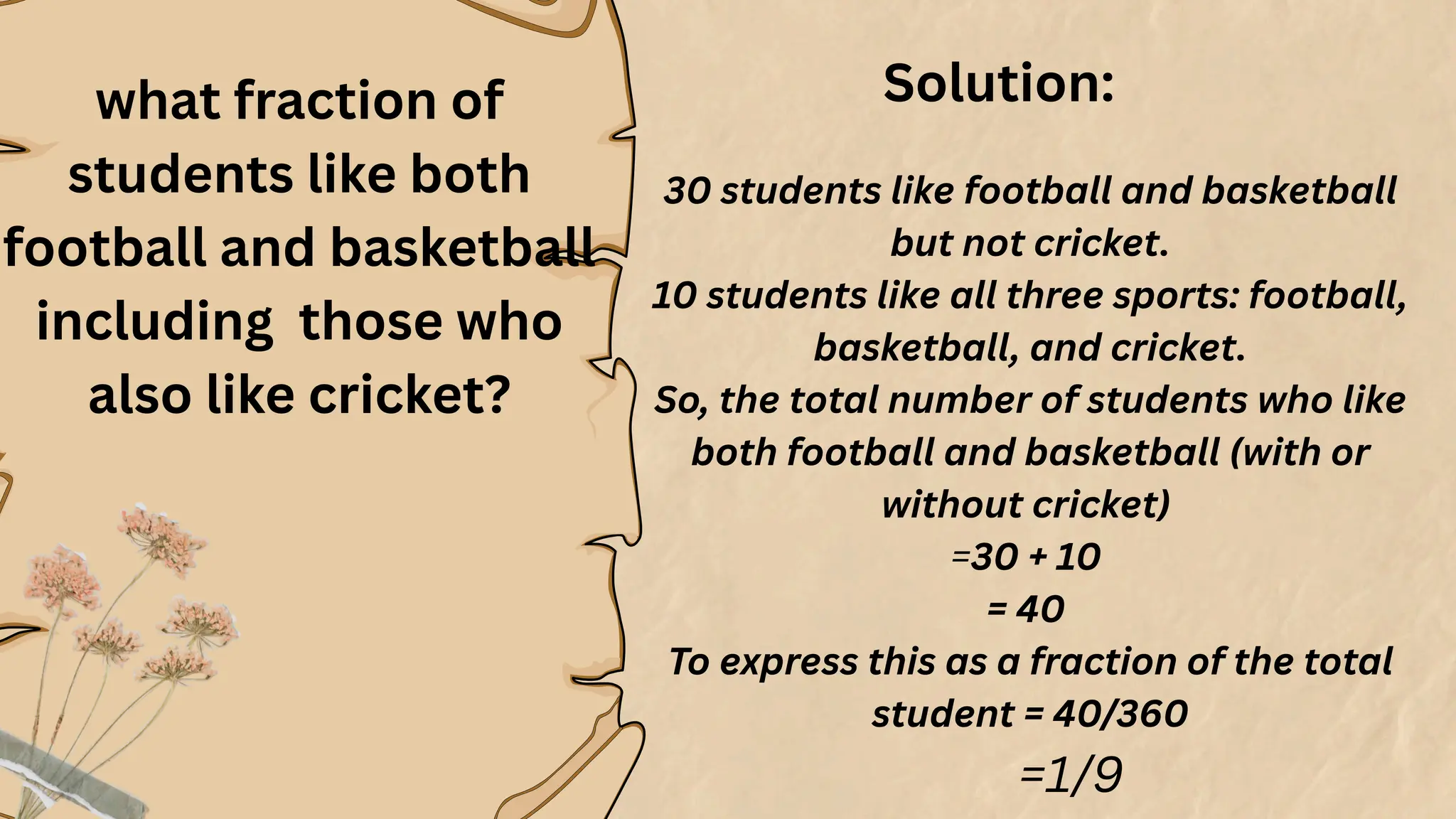
what fraction of
students like both
football and basketball
including those who
also like cricket?
30 students like football and basketball
but not cricket.
10 students like all three sports: football,
basketball, and cricket.
So, the total number of students who like
both football and basketball (with or
without cricket)
=30 + 10
= 40
To express this as a fraction of the total
student = 40/360
=1/9
Solution:
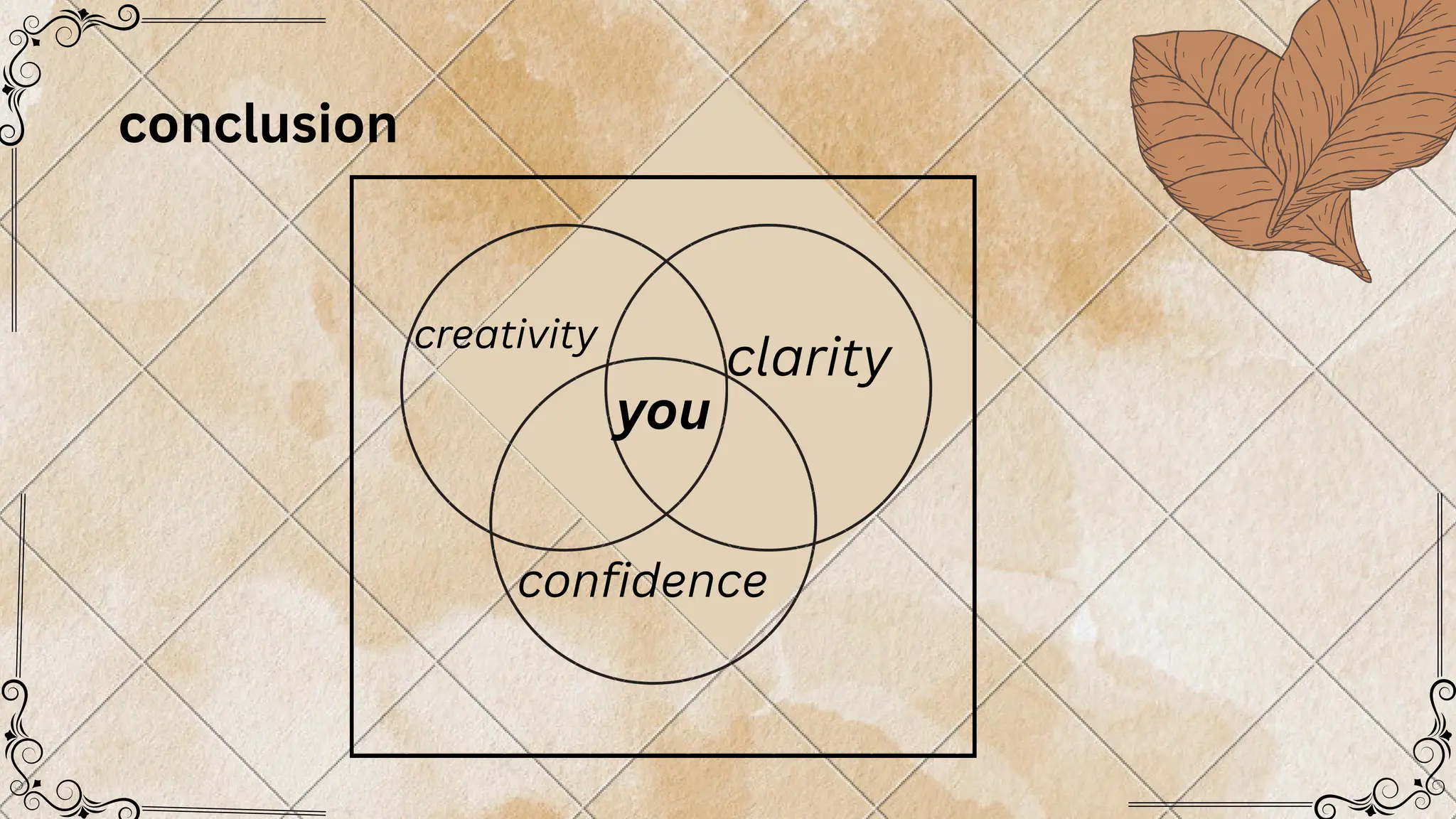
conclusion
clarity
creativity
confidence
you
Mathematics is not about numbers,
equations, computations, or
algorithms: it is about understanding."
โ€” William Paul Thurston
THANKYOU !

CHAPTER one :" SET " (he didn't give us full mark )

  • 1.
    SETS: MORE THAN JUSTCIRCLES ! A REAL WORLD STUDY OF FOOTBALL,BASKETBALL,AND CRICKET PREFERENCES AT FLUORESCENT SECONDARY SCHOOL MATHEMATICS PRESENTATION Shrisha sapkota Saskriti pyakurel Manaswi timisina Mayuri Shah Aakanshya Gurung Adrina shrestha Neelam Nepal Members:
  • 2.
    Iโ€™d like tosincerely thank our subject teacher, Mr. Anand Sapkota Sir for giving us this ample opportunity to work together, collect data, and engage in real world learning. This experience helped us not only to connect theory to practical even strengthen our teamwork skills. We truly appreciate the chance to learn beyond books and collaborate effectively. Grateful for a valuable learning experience in Fluorescent secondary school
  • 3.
    To prepare forour presentation, the first important step was collecting data. Some team members went to classes 10, 8, and 7, making sure we got the best information. During the survey, we questions, and students were requested to stand up while responding. At first, some were shy, but soon everyone got involved. Supportive teachers CR, VCR helped make the process smooth, and their encouragement made a huge difference. Overall, it was a great experience not just about collecting data but also about seeing how engaged and excited everyone was. BACK STORY OR THE SURVEY EXPERIENCE
  • 4.
    key points ormain content Definition of Sets โ€“ Basic concept and meaning of sets. Types of Sets โ€“ Finite, infinite, empty, universal, subset, and more. Venn Diagram of Sets Operations on Sets โ€“ Union, intersection, complement, and difference. Survey Questions & Analysis โ€“ from collected data, and observations. Conclusion of the presentation
  • 5.
    A set isa well-defined collection of distinct objects, considered as an entity. These objects, known as elements, can be anythingโ€” numbers, letters, symbols, or even ideas. Element is unique and enclosed within curly brackets {}. Example: S = {Red, Blue, Yellow} Fun Fact: Did you know that the concept of sets is the backbone of modern mathematics? The German mathematician Georg Cantor developed set theory in the late 19th century, revolutionizing the way we understand infinity! CHAPTER:ONE TOPIC : SETS
  • 6.
    THERE ARE DIFFERENTTYPES OF SETS Empty Set (โˆ…) Singleton Set Finite Set Infinite Set Universal Set (U) Subset (โІ) Proper Subset (โŠ‚) Disjoint Sets Union of sets Compliment of sets Intersection of sets We have read different types of set till class 10 well some of the sets are explained in brief in next slide which are Universal set,intersection of set,union of set, compliment of set
  • 7.
    Types of sets: INTERSECTIONOF SET The elements common to any two or three sets is called intersection of sets. The intersection of sets for two Venn diagram A and B is denoted by A โˆฉB and its cardinal number by n(A โˆฉB) where as the intersection of sets for three Venn diagram A ,B and C is denoted by A โˆฉBโˆฉC and its cardinal number by n(A โˆฉB โˆฉC) UNIVERSAL SET The set that contains all the elements under consideration for a particular discussion or problem. it is denoted by โ€˜Uโ€™ and its cardinal number by n(U). Subsets Belong to the Universal Set = Any set A, B, C, ... will always be part of U, meaning A โІU, B โІU, etc. Use in Set Theory and Logic โ€“ The universal set is useful in operations like complements (A', meaning elements in U but not in A) and intersections.
  • 8.
    The union ofsets is simply the combination of all elements from the given sets, ensuring no duplicates. In a two-set Venn diagram, the union of Set A and Set B (written as A โˆชB) includes everything inside either circle, including the overlapping middle part. This means we gather all elements belonging to either Set A or Set B. Expanding this to a three-set Venn diagram, the union of Set A, B, and C (written as A โˆชB โˆชC) covers all elements appearing in any of the three sets. Visually, the union represents everything inside any of the circles, ensuring all members are included at least once. Itโ€™s like combining multiple groups where everyone gets counted, whether they belong to one, two, or all three sets. If there is no element in the compliment of the union of sets then n(U) is same as n (A U BUC) OR n(A U B) . UNION OF SETS
  • 9.
    The elements whichbelongs to the universal sets but don't belong to AUB OR AUBUC are the elements of the set (AUB) OR (AUBUC) . Itโ€™s number of elements are denoted by n (AUB) OR n(AUBUC). The following terms are used to represent the compliment of union. None, neither, no body, neither A nor B nor C OR neither A nor B nor both.... etc. COMPLEMENT OF UNION SETS
  • 10.
    A Venn diagramis a widely used diagram style that shows the logical relation between sets, popularized by John Venn (1834โ€“1923) in the 1880s. The diagrams are used to teach elementary set theory, and to illustrate simple set relationships in probability , logic, statistics, . There are two types of Venn diagrams which are widely used. They are two Venn diagram and three Venn diagram. VENN DIAGRAM
  • 11.
    Two-Venn diagram So, Avenn-diagram, is a diagram where two circles overlap with eachother when they share a common number or elements. Like in given example A= {1,2,3,4,5} B={3,4,5,8,9} n(AโˆฉB) = {3,4,5} n.(A) n.(B) n(AโˆฉB) n(A) n(B)
  • 12.
    Exploring the Three-CircleVenn Diagram In class 9 we learned about the two-circle Venn diagram. Now, let's know about the three-venn diagram. In a three-circle Venn diagram, you can compare three distinct sets of information. The intersection of all three circles reveals the items that possess the characteristics shared by each circle. three different sets of information are able to be compared, and it is where all three circles intersect that you are able to find the items that share all of the characteristics of each circle. Three-Venn diagram n.(A) n.(B) n.(C)
  • 13.
    n(u)=n(A)+n(A)โ€™ (n(U)=n(B)+n( B)โ€™ n(U)=n(A uB)+(A U B)โ€™ n(AUB)=n(U)-n(AUB)โ€™ n(AUB)=n(A)+n(B)-n(AnB) n(AUB)=no(A)+no(B)+n(AnB) no(A)=n(A)-n(AnB) no(B)=n(B)-n(AnB) For two Venn diagram: For three Venn diagram: FORMULAE FOR SOLVING PROBLEMS RELATED TO VENN DIAGRAMS ARE : n(U)= n(AUBUC) - n(AUBUC)โ€™ n(AโˆฉB) = no(AโˆฉB) + n(AโˆฉBโˆฉC) n(BโˆฉC) = no(BโˆฉC) + n(AโˆฉBโˆฉC) n(AโˆฉC)= no(AโˆฉC) + n(AโˆฉBโˆฉC) no(A) = n(A) โ€“ no(AโˆฉB) โ€“ no(AโˆฉC) โ€“ n(AโˆฉBโˆฉC) no(B) = n(B) โ€“ no(BโˆฉC) โ€“ no(AโˆฉB) โ€“ n(AโˆฉBโˆฉC) no(C) = n(C) โ€“ no(AโˆฉC) โ€“ no(BโˆฉC) โ€“ n(AโˆฉBโˆฉC) n(A U B U C) = n(A) + n(B) + n(C) - n(A โˆฉB) - n(B โˆฉC) - n(A โˆฉC) + n(A โˆฉB โˆฉC) Where (โ€™) is known as compliment
  • 14.
    QUESTIONS AND THERESOLUTIONS RELATED TO THE SURVEY! what are the data set collected from each class?
  • 15.
    A SURVEY WASHELD IN FLUORESCENT SECONDARY SCHOOL WHERE 360 STUDENTS PARTICIPATED. AMONG THEM THE NUMBER OF STUDENTS WHO LIKE ONLY FOOTBALL IS 90,WHO LIKED ONLY BASKETBALL IS 75 AND WHO LIKED ONLY CRICKET IS 85.THE NUMBER OF STUDENTS WHO LIKE FOOTBALL AND BASKETBALL BUT NOT CRICKET IS 30, FOOTBALL AND CRICKET BUT NOT BASKETBALL IS 20 ,BASKETBALL AND CRICKET BUT NOT FOOTBALL IS 15 AND ALL THREE SPORTS IS 10 . 35 like none of the sports. Data collection :
  • 16.
    Represent the givendata in set notation Prepare a Venn diagram to illustrate the given information How many students like at least one of the three sports? (Use the given data to exclude students who do not like any sport.) Find the total number of students who like exactly two sports. (Consider students who like two sports but exclude those who like all three.) Determine the percentage of students who like only one sport. (Calculate the ratio of students who like only football, only basketball, and only cricket to the total surveyed students.) What fraction of students enjoy both football and basketball, including those who also like cricket? (Express the number as a simplified fraction of the total surveyed students.) Compare the popularity of cricket versus basketball by calculating the total number of students who like each. Questions obtained from the survey
  • 17.
    n(U)=360 nโ  ๏ฝก(F)=90 nโ  ๏ฝก(B)=75 nโ  ๏ฝก(C)=85 nโ  ๏ฝก(FโˆฉB)=30 nโ  ๏ฝก(FโˆฉC)=20 nโ  ๏ฝก(BโˆฉC)=15 nโ  ๏ฝก(FโˆฉBโˆฉC)=10 n(FUBUC)=35 Solution: Let โ€˜Uโ€™ bethe universal set which represents the student of grade 10,8,7. Now let โ€˜Fโ€™, โ€˜Cโ€™, โ€˜Bโ€™ represent football, cricket and basketball 1.) REPRESENTING THE GIVEN INFORMATION IN SET NOTATION :
  • 18.
    U=360 F B C 90 75 85 15 30 20 10 35 b) Represent thegiven information in Venn- Diagram
  • 19.
    How many studentslike at least one of the three sports? find n(FUBUC) Solution: By using the formula n(FUBUC)= n(U)-n(FUBUC) = 360- 35 =325 325 STUDENTS LIKE AT LEAST ONE OF THE THREE SPORTS. Solution: =nโ  ๏ฝก(FโˆฉB)+nโ  ๏ฝก(FโˆฉC)+nโ  ๏ฝก(BโˆฉC) =30+20+15 =65 Find the total number of students who like exactly two sports.
  • 20.
    Determine the percentage ofstudents who like only one sports AS we know : Football only: 90 students Basketball only: 75 students Cricket only: 85 students solution : Total students who like only one sports= n.(F)+n.(B)+n.(C) = 90+75+85 = 250 then: The percentage of students who like only one sports = 250/360*100% = 69.44%
  • 21.
    what fraction of studentslike both football and basketball including those who also like cricket? 30 students like football and basketball but not cricket. 10 students like all three sports: football, basketball, and cricket. So, the total number of students who like both football and basketball (with or without cricket) =30 + 10 = 40 To express this as a fraction of the total student = 40/360 =1/9 Solution:
  • 22.
  • 23.
    Mathematics is notabout numbers, equations, computations, or algorithms: it is about understanding." โ€” William Paul Thurston THANKYOU !