Classroom Survey: WhatWe Like
Materials: bond paper or printed worksheets, markers/pens
Activity Overview:
1.Scenario:
• Ask students: “Let’s say we survey our class to find out
who likes Math, Science, and English.”
• Collect mock or real data (e.g., 6 students like Math, 8 like
Science, 5 like English, with overlaps).
4.
2.Task:
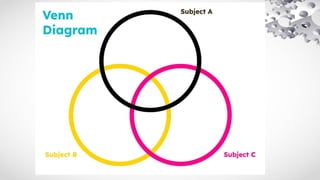
• In groups,students create a 3-circle Venn diagram
based on the data.
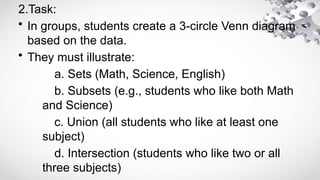
• They must illustrate:
a. Sets (Math, Science, English)
b. Subsets (e.g., students who like both Math
and Science)
c. Union (all students who like at least one
subject)
d. Intersection (students who like two or all
three subjects)
6.
3.CER Prompt (writtenoutput or short oral
presentation):
• Claim: What does your Venn diagram show
about the class’s preferences?
• Evidence: Use numbers from your diagram to
support your claim.
• Reasoning: Explain how the union,
intersection, and subsets help you understand
the data better.
7.
Objectives
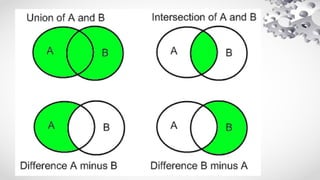
1.Describe and definethe union of sets, intersection
of sets and difference of two sets through Venn
diagrams
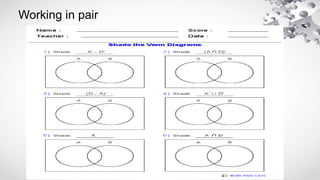
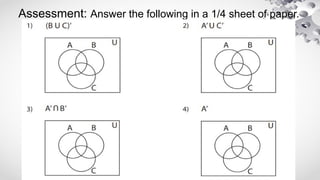
2.Perform the union of sets, intersection of sets and
difference of two sets using Venn diagrams
3.Display patience and teamwork during group
activity.
4.Orderliness and clarity in presenting solutions.
8.
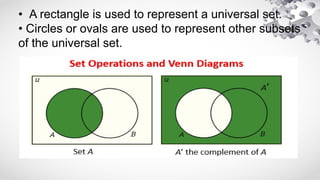
• A rectangleis used to represent a universal set.
• Circles or ovals are used to represent other subsets
of the universal set.
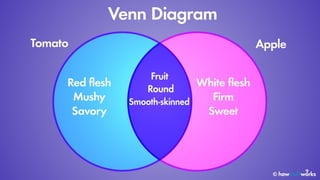
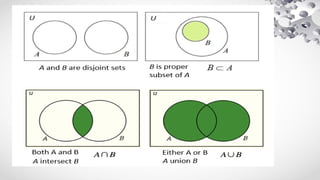
• Venn diagramsare very useful in
illustrating sets and their relationships
with each other. Set operations could are
also best illustrated using Venn diagrams.
With full understanding of the concept
behind sets, subsets, and set operations,
students could easily illustrate even very
complex set operations.
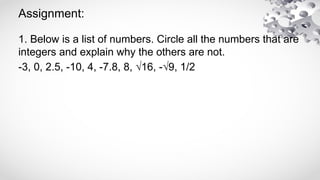
Assignment:
1. Below isa list of numbers. Circle all the numbers that are
integers and explain why the others are not.
-3, 0, 2.5, -10, 4, -7.8, 8, √16, -√9, 1/2
15.
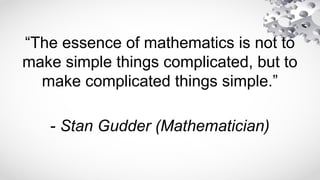
“The essence ofmathematics is not to
make simple things complicated, but to
make complicated things simple.”
- Stan Gudder (Mathematician)



![[DSC Europe 25] Milos Belcevic - Product Professional's Journey to Full-Stack...](https://cdn.slidesharecdn.com/ss_thumbnails/1zovd6fgsycdg4wvgvls-milos-belcevic-product-professionals-journey-to-full-stack-product-developer-260123083019-d993120d-thumbnail.jpg?width=640&height=640&fit=bounds)

![[DSC Europe 25] Ekaterina Bubenko - Behind the Curtain: How Data Roles Collab...](https://cdn.slidesharecdn.com/ss_thumbnails/anmv6x8dstqbbzchoklr-ekaterina-bubenko-behind-the-curtain-how-data-roles-collaborate-in-the-ai-era-a-260123083019-4b252ec7-thumbnail.jpg?width=640&height=640&fit=bounds)


