Biodiversity – why bother?
The benefits of going ‘multi-functional’
Avoiding ‘Bad Biodiversity’
Getting more bang for your biodiversity
buck
Where biodiversity fits in ‘sustainable
intensification’
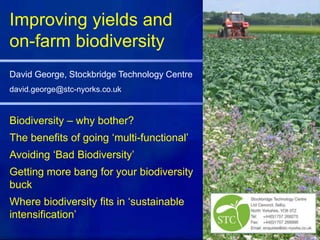
Improving yields and
on-farm biodiversity
David George, Stockbridge Technology Centre
david.george@stc-nyorks.co.uk
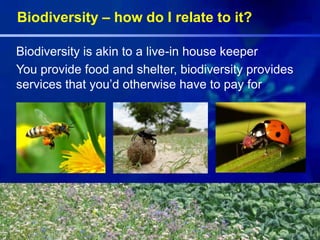
Biodiversity – how do I relate to it?
Biodiversity is akin to a live-in house keeper
You provide food and shelter, biodiversity provides
services that you’d otherwise have to pay for
But how good a job does it do?
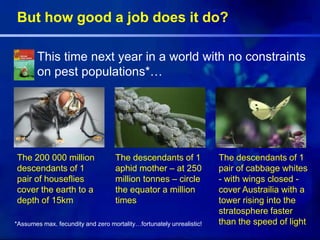
This time next year in a world with no constraints
on pest populations*…
The 200 000 million
descendants of 1
pair of houseflies
cover the earth to a
depth of 15km
The descendants of 1
aphid mother – at 250
million tonnes – circle
the equator a million
times
The descendants of 1
pair of cabbage whites
- with wings closed -
cover Austrailia with a
tower rising into the
stratosphere faster
than the speed of light*Assumes max. fecundity and zero mortality…fortunately unrealistic!
So if I stick in a flower strip for my EFA /
NELMs, my pests will be controlled?
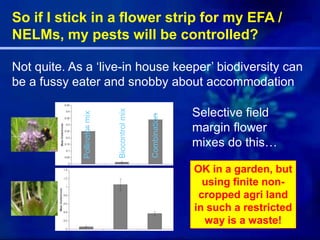
Pollinatormix
Biocontrolmix
Combination
Selective field
margin flower
mixes do this…
OK in a garden, but
using finite non-
cropped agri land
in such a restricted
way is a waste!
Not quite. As a ‘live-in house keeper’ biodiversity can
be a fussy eater and snobby about accommodation
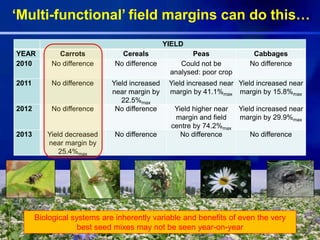
‘Multi-functional’ field margins can do this…
YIELD
YEAR Carrots Cereals Peas Cabbages
2010 No difference No difference Could not be
analysed: poor crop
No difference
2011 No difference Yield increased
near margin by
22.5%max
Yield increased near
margin by 41.1%max
Yield increased near
margin by 15.8%max
2012 No difference No difference Yield higher near
margin and field
centre by 74.2%max
Yield increased near
margin by 29.9%max
2013 Yield decreased
near margin by
25.4%max
No difference No difference No difference
Biological systems are inherently variable and benefits of even the very
best seed mixes may not be seen year-on-year
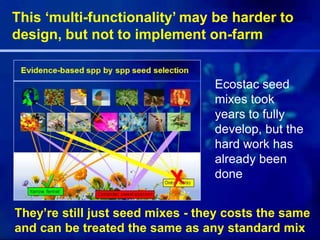
This ‘multi-functionality’ may be harder to
design, but not to implement on-farm
Ecostac seed
mixes took
years to fully
develop, but the
hard work has
already been
done
They’re still just seed mixes - they costs the same
and can be treated the same as any standard mix
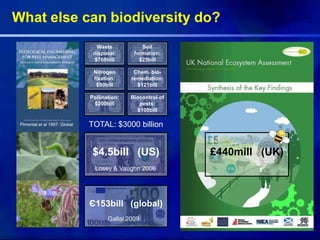
Є153bill (global)
$4.5bill (US)
Waste
disposal:
$760bill
Soil
formation:
$25bill
Nitrogen
fixation:
$90bill
Chem. bio-
remediation:
$121bill
Pollination:
$200bill
Biocontrol of
pests:
$100bill
£440mill (UK)
Losey & Vaughn 2006
Gallai 2009
Pimental et al 1997: Global TOTAL: $3000 billion
What else can biodiversity do?
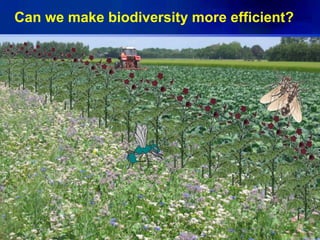
Can we make biodiversity more efficient?
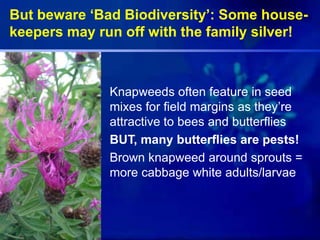
But beware ‘Bad Biodiversity’: Some house-
keepers may run off with the family silver!
• Knapweeds often feature in seed
mixes for field margins as they’re
attractive to bees and butterflies
• BUT, many butterflies are pests!
• Brown knapweed around sprouts =
more cabbage white adults/larvae
•
How do I get more bang for my biodiversity
buck?
Be ‘multi-functional’ in your approach to ‘CAP
greening’ and environmental stewardship and you
could get ‘paid’ twice – once by the EU and again by
an in-kind contribution to production from biodiversity
Approach non-crop areas as you would crop fields -
plan, maintain and manage them to ensure optimum
biodiversity ‘yields’ whilst avoiding ‘losses’
Consider other on-farm activities and how they can
add value: Biodiversity alone is unlikely to
achieve ‘sustainable intensification’, but it can’t
be achieved without it
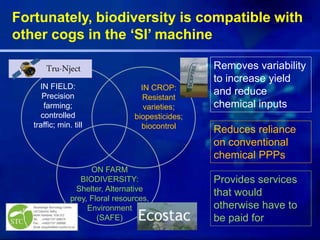
Fortunately, biodiversity is compatible with
other cogs in the ‘SI’ machine
IN FIELD:
Precision
farming;
controlled
traffic; min. till
IN CROP:
Resistant
varieties;
biopesticides;
biocontrol
ON FARM
BIODIVERSITY:
Shelter, Alternative
prey, Floral resources,
Environment
(SAFE)
Removes variability
to increase yield
and reduce
chemical inputs
Reduces reliance
on conventional
chemical PPPs
Provides services
that would
otherwise have to
be paid for
Tru-Nject
“Producing enough food for the
world’s population in 2050 will
be easy. But doing it at an
acceptable cost to the planet will
depend on research into
everything from high-tech seeds
to low-tech farming practices.”
Nature 466: 531-532
Combining high-tech and low-tech is the
key to the ‘SI’ lock
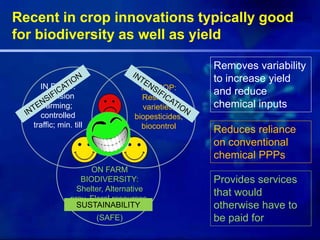
Recent in crop innovations typically good
for biodiversity as well as yield
IN FIELD:
Precision
farming;
controlled
traffic; min. till
IN CROP:
Resistant
varieties;
biopesticides;
biocontrol
ON FARM
BIODIVERSITY:
Shelter, Alternative
prey, Floral resources,
Environment
(SAFE)
Removes variability
to increase yield
and reduce
chemical inputs
Reduces reliance
on conventional
chemical PPPs
Provides services
that would
otherwise have to
be paid for
SUSTAINABILITY
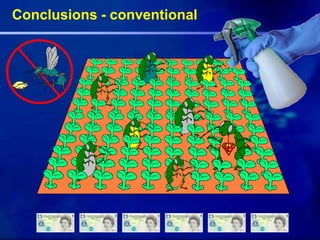
Conclusions - conventional
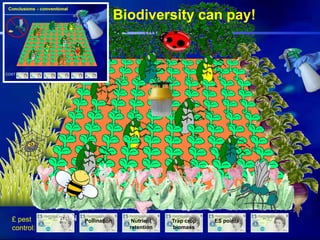
Conclusions – Biodiversity can pay!
Pollination Nutrient
retention
Trap crop
biomass
ES points£ pest
control:
COST
GAIN

David George of STC - Profiting from Sustainability Feedback Session April 2015

  • 1.
    Biodiversity – whybother? The benefits of going ‘multi-functional’ Avoiding ‘Bad Biodiversity’ Getting more bang for your biodiversity buck Where biodiversity fits in ‘sustainable intensification’ Improving yields and on-farm biodiversity David George, Stockbridge Technology Centre david.george@stc-nyorks.co.uk
  • 2.
    Biodiversity – howdo I relate to it? Biodiversity is akin to a live-in house keeper You provide food and shelter, biodiversity provides services that you’d otherwise have to pay for
  • 3.
    But how gooda job does it do? This time next year in a world with no constraints on pest populations*… The 200 000 million descendants of 1 pair of houseflies cover the earth to a depth of 15km The descendants of 1 aphid mother – at 250 million tonnes – circle the equator a million times The descendants of 1 pair of cabbage whites - with wings closed - cover Austrailia with a tower rising into the stratosphere faster than the speed of light*Assumes max. fecundity and zero mortality…fortunately unrealistic!
  • 4.
    So if Istick in a flower strip for my EFA / NELMs, my pests will be controlled? Pollinatormix Biocontrolmix Combination Selective field margin flower mixes do this… OK in a garden, but using finite non- cropped agri land in such a restricted way is a waste! Not quite. As a ‘live-in house keeper’ biodiversity can be a fussy eater and snobby about accommodation
  • 5.
    ‘Multi-functional’ field marginscan do this… YIELD YEAR Carrots Cereals Peas Cabbages 2010 No difference No difference Could not be analysed: poor crop No difference 2011 No difference Yield increased near margin by 22.5%max Yield increased near margin by 41.1%max Yield increased near margin by 15.8%max 2012 No difference No difference Yield higher near margin and field centre by 74.2%max Yield increased near margin by 29.9%max 2013 Yield decreased near margin by 25.4%max No difference No difference No difference Biological systems are inherently variable and benefits of even the very best seed mixes may not be seen year-on-year
  • 6.
    This ‘multi-functionality’ maybe harder to design, but not to implement on-farm Ecostac seed mixes took years to fully develop, but the hard work has already been done They’re still just seed mixes - they costs the same and can be treated the same as any standard mix
  • 7.
    Є153bill (global) $4.5bill (US) Waste disposal: $760bill Soil formation: $25bill Nitrogen fixation: $90bill Chem.bio- remediation: $121bill Pollination: $200bill Biocontrol of pests: $100bill £440mill (UK) Losey & Vaughn 2006 Gallai 2009 Pimental et al 1997: Global TOTAL: $3000 billion What else can biodiversity do?
  • 8.
    Can we makebiodiversity more efficient?
  • 9.
    But beware ‘BadBiodiversity’: Some house- keepers may run off with the family silver! • Knapweeds often feature in seed mixes for field margins as they’re attractive to bees and butterflies • BUT, many butterflies are pests! • Brown knapweed around sprouts = more cabbage white adults/larvae •
  • 10.
    How do Iget more bang for my biodiversity buck? Be ‘multi-functional’ in your approach to ‘CAP greening’ and environmental stewardship and you could get ‘paid’ twice – once by the EU and again by an in-kind contribution to production from biodiversity Approach non-crop areas as you would crop fields - plan, maintain and manage them to ensure optimum biodiversity ‘yields’ whilst avoiding ‘losses’ Consider other on-farm activities and how they can add value: Biodiversity alone is unlikely to achieve ‘sustainable intensification’, but it can’t be achieved without it
  • 11.
    Fortunately, biodiversity iscompatible with other cogs in the ‘SI’ machine IN FIELD: Precision farming; controlled traffic; min. till IN CROP: Resistant varieties; biopesticides; biocontrol ON FARM BIODIVERSITY: Shelter, Alternative prey, Floral resources, Environment (SAFE) Removes variability to increase yield and reduce chemical inputs Reduces reliance on conventional chemical PPPs Provides services that would otherwise have to be paid for Tru-Nject
  • 12.
    “Producing enough foodfor the world’s population in 2050 will be easy. But doing it at an acceptable cost to the planet will depend on research into everything from high-tech seeds to low-tech farming practices.” Nature 466: 531-532 Combining high-tech and low-tech is the key to the ‘SI’ lock
  • 13.
    Recent in cropinnovations typically good for biodiversity as well as yield IN FIELD: Precision farming; controlled traffic; min. till IN CROP: Resistant varieties; biopesticides; biocontrol ON FARM BIODIVERSITY: Shelter, Alternative prey, Floral resources, Environment (SAFE) Removes variability to increase yield and reduce chemical inputs Reduces reliance on conventional chemical PPPs Provides services that would otherwise have to be paid for SUSTAINABILITY
  • 14.
  • 15.
    Conclusions – Biodiversitycan pay! Pollination Nutrient retention Trap crop biomass ES points£ pest control: COST GAIN