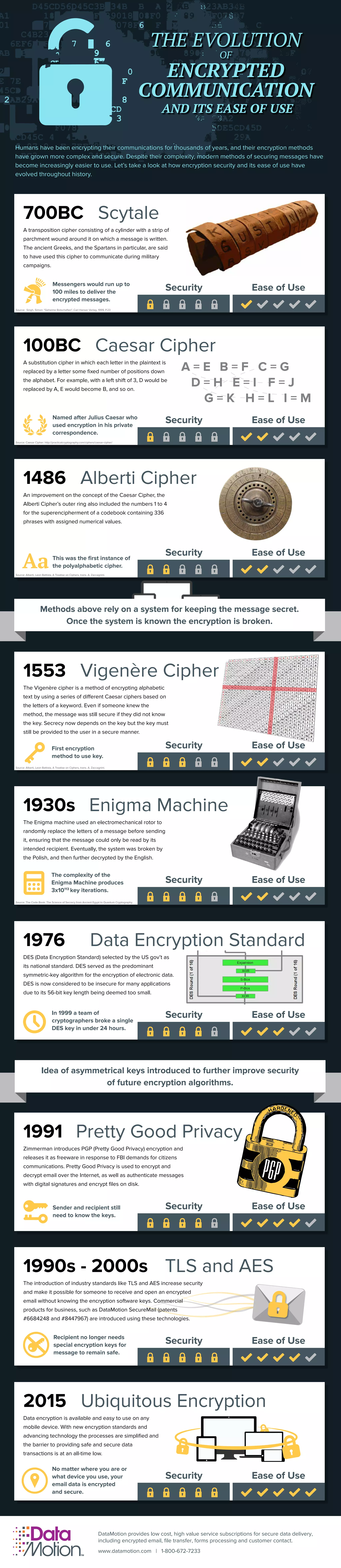
Security Ease of Use
Pretty Good Privacy1991
Zimmerman introduces PGP (Pretty Good Privacy) encryption and
releases it as freeware in response to FBI demands for citizens
communications. Pretty Good Privacy is used to encrypt and
decrypt email over the Internet, as well as authenticate messages
with digital signatures and encrypt files on disk.
THE EVOLUTION
OF
ENCRYPTED
COMMUNICATION
AND ITS EASE OF USE
Humans have been encrypting their communications for thousands of years, and their encryption methods
have grown more complex and secure. Despite their complexity, modern methods of securing messages have
become increasingly easier to use. Let’s take a look at how encryption security and its ease of use have
evolved throughout history.
Security Ease of Use
Scytale700BC
A transposition cipher consisting of a cylinder with a strip of
parchment wound around it on which a message is written.
The ancient Greeks, and the Spartans in particular, are said
to have used this cipher to communicate during military
campaigns.
Security Ease of Use
Caesar Cipher100BC
A substitution cipher in which each letter in the plaintext is
replaced by a letter some fixed number of positions down
the alphabet. For example, with a left shift of 3, D would be
replaced by A, E would become B, and so on.
Security Ease of Use
Alberti Cipher1486
An improvement on the concept of the Caesar Cipher, the
Alberti Cipher’s outer ring also included the numbers 1 to 4
for the superencipherment of a codebook containing 336
phrases with assigned numerical values.
A = E B = F C = G
D = H E = I F = J
G = K H = L I = M
Methods above rely on a system for keeping the message secret.
Once the system is known the encryption is broken.
Security Ease of Use
Vigenère Cipher1553
The Vigenère cipher is a method of encrypting alphabetic
text by using a series of different Caesar ciphers based on
the letters of a keyword. Even if someone knew the
method, the message was still secure if they did not know
the key. Secrecy now depends on the key but the key must
still be provided to the user in a secure manner.
First encryption
method to use key.
Security Ease of Use
Enigma Machine1930s
The Enigma machine used an electromechanical rotor to
randomly replace the letters of a message before sending
it, ensuring that the message could only be read by its
intended recipient. Eventually, the system was broken by
the Polish, and then further decrypted by the English.
Security Ease of Use
Data Encryption Standard1976
DES (Data Encryption Standard) selected by the US gov’t as
its national standard. DES served as the predominant
symmetric-key algorithm for the encryption of electronic data.
DES is now considered to be insecure for many applications
due to its 56-bit key length being deemed too small.
The complexity of the
Enigma Machine produces
3x10113
key iterations.
Messengers would run up to
100 miles to deliver the
encrypted messages.
Named after Julius Caesar who
used encryption in his private
correspondence.
Aa This was the first instance of
the polyalphabetic cipher.
In 1999 a team of
cryptographers broke a single
DES key in under 24 hours.
Idea of asymmetrical keys introduced to further improve security
of future encryption algorithms.
Sender and recipient still
need to know the keys.
Security Ease of Use
TLS and AES1990s - 2000s
The introduction of industry standards like TLS and AES increase security
and make it possible for someone to receive and open an encrypted
email without knowing the encryption software keys. Commercial
products for business, such as DataMotion SecureMail (patents
#6684248 and #8447967) are introduced using these technologies.
Source: Singh, Simon: "Geheime Botschaften", Carl Hanser Verlag, 1999, P.23
Source: Caesar Cipher: http://practicalcryptography.com/ciphers/caesar-cipher/
Source: Alberti, Leon Battista, A Treatise on Ciphers, trans. A. Zaccagnini.
Security Ease of Use
Ubiquitous Encryption2015
Data encryption is available and easy to use on any
mobile device. With new encryption standards and
advancing technology the processes are simplified and
the barrier to providing safe and secure data
transactions is at an all-time low.
Recipient no longer needs
special encryption keys for
message to remain safe.
Source: Alberti, Leon Battista, A Treatise on Ciphers, trans. A. Zaccagnini.
Source: The Code Book: The Science of Secrecy from Ancient Egypt to Quantum Cryptography.
No matter where you are or
what device you use, your
email data is encrypted
and secure.
DataMotion provides low cost, high value service subscriptions for secure data delivery,
including encrypted email, file transfer, forms processing and customer contact.
www.datamotion.com | 1-800-672-7233

DataMotion-IG1-TheEvolutionofEncryption

  • 1.
    Security Ease ofUse Pretty Good Privacy1991 Zimmerman introduces PGP (Pretty Good Privacy) encryption and releases it as freeware in response to FBI demands for citizens communications. Pretty Good Privacy is used to encrypt and decrypt email over the Internet, as well as authenticate messages with digital signatures and encrypt files on disk. THE EVOLUTION OF ENCRYPTED COMMUNICATION AND ITS EASE OF USE Humans have been encrypting their communications for thousands of years, and their encryption methods have grown more complex and secure. Despite their complexity, modern methods of securing messages have become increasingly easier to use. Let’s take a look at how encryption security and its ease of use have evolved throughout history. Security Ease of Use Scytale700BC A transposition cipher consisting of a cylinder with a strip of parchment wound around it on which a message is written. The ancient Greeks, and the Spartans in particular, are said to have used this cipher to communicate during military campaigns. Security Ease of Use Caesar Cipher100BC A substitution cipher in which each letter in the plaintext is replaced by a letter some fixed number of positions down the alphabet. For example, with a left shift of 3, D would be replaced by A, E would become B, and so on. Security Ease of Use Alberti Cipher1486 An improvement on the concept of the Caesar Cipher, the Alberti Cipher’s outer ring also included the numbers 1 to 4 for the superencipherment of a codebook containing 336 phrases with assigned numerical values. A = E B = F C = G D = H E = I F = J G = K H = L I = M Methods above rely on a system for keeping the message secret. Once the system is known the encryption is broken. Security Ease of Use Vigenère Cipher1553 The Vigenère cipher is a method of encrypting alphabetic text by using a series of different Caesar ciphers based on the letters of a keyword. Even if someone knew the method, the message was still secure if they did not know the key. Secrecy now depends on the key but the key must still be provided to the user in a secure manner. First encryption method to use key. Security Ease of Use Enigma Machine1930s The Enigma machine used an electromechanical rotor to randomly replace the letters of a message before sending it, ensuring that the message could only be read by its intended recipient. Eventually, the system was broken by the Polish, and then further decrypted by the English. Security Ease of Use Data Encryption Standard1976 DES (Data Encryption Standard) selected by the US gov’t as its national standard. DES served as the predominant symmetric-key algorithm for the encryption of electronic data. DES is now considered to be insecure for many applications due to its 56-bit key length being deemed too small. The complexity of the Enigma Machine produces 3x10113 key iterations. Messengers would run up to 100 miles to deliver the encrypted messages. Named after Julius Caesar who used encryption in his private correspondence. Aa This was the first instance of the polyalphabetic cipher. In 1999 a team of cryptographers broke a single DES key in under 24 hours. Idea of asymmetrical keys introduced to further improve security of future encryption algorithms. Sender and recipient still need to know the keys. Security Ease of Use TLS and AES1990s - 2000s The introduction of industry standards like TLS and AES increase security and make it possible for someone to receive and open an encrypted email without knowing the encryption software keys. Commercial products for business, such as DataMotion SecureMail (patents #6684248 and #8447967) are introduced using these technologies. Source: Singh, Simon: "Geheime Botschaften", Carl Hanser Verlag, 1999, P.23 Source: Caesar Cipher: http://practicalcryptography.com/ciphers/caesar-cipher/ Source: Alberti, Leon Battista, A Treatise on Ciphers, trans. A. Zaccagnini. Security Ease of Use Ubiquitous Encryption2015 Data encryption is available and easy to use on any mobile device. With new encryption standards and advancing technology the processes are simplified and the barrier to providing safe and secure data transactions is at an all-time low. Recipient no longer needs special encryption keys for message to remain safe. Source: Alberti, Leon Battista, A Treatise on Ciphers, trans. A. Zaccagnini. Source: The Code Book: The Science of Secrecy from Ancient Egypt to Quantum Cryptography. No matter where you are or what device you use, your email data is encrypted and secure. DataMotion provides low cost, high value service subscriptions for secure data delivery, including encrypted email, file transfer, forms processing and customer contact. www.datamotion.com | 1-800-672-7233