CONTENTS
o   Introduction
o   Need of Cryptography
o   Types of Attacks
o   Techniques of Cryptography
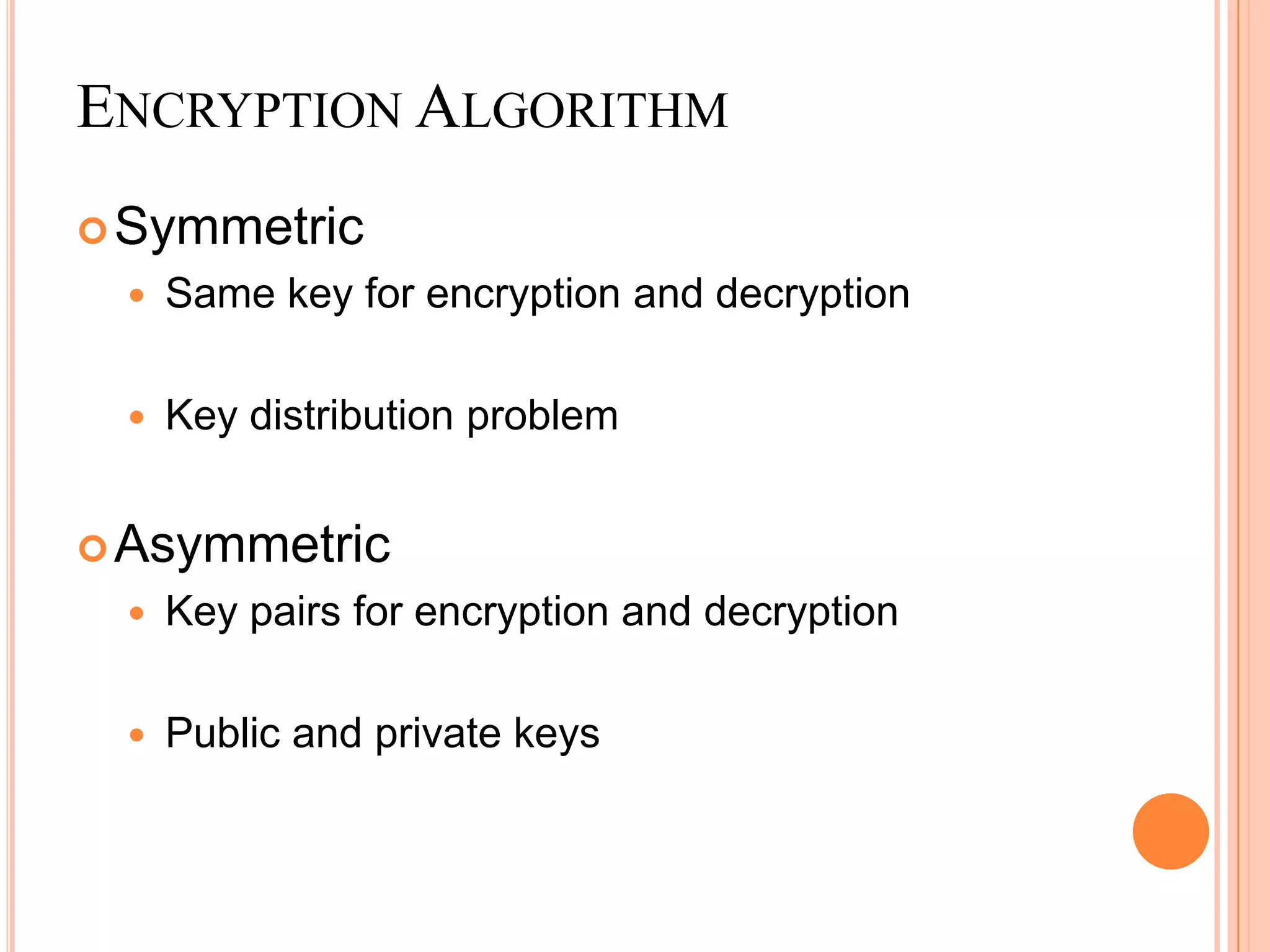
o   Encryption Algorithm
    •   Symmetric
    •   Asymmetric
o   Digital Signature
o   Conclusion
INTRODUCTION
 What   is Cryptography?
     “Hidden Writing”

     Mainly used to protect Information.


 Goal   of Cryptography

     Ensure security of communication over insecure
      medium

     Communicate even with possibility of adversary
NEED OF ENCRYPTION
 Confidentiality

 Integrity

 Authentication

 Nonrepudiation

 Access  Control
 Availability
TYPES OF ATTACKS
   A General View

   A Technical View

   A Practical Side of Attacks

   Programs that Attack
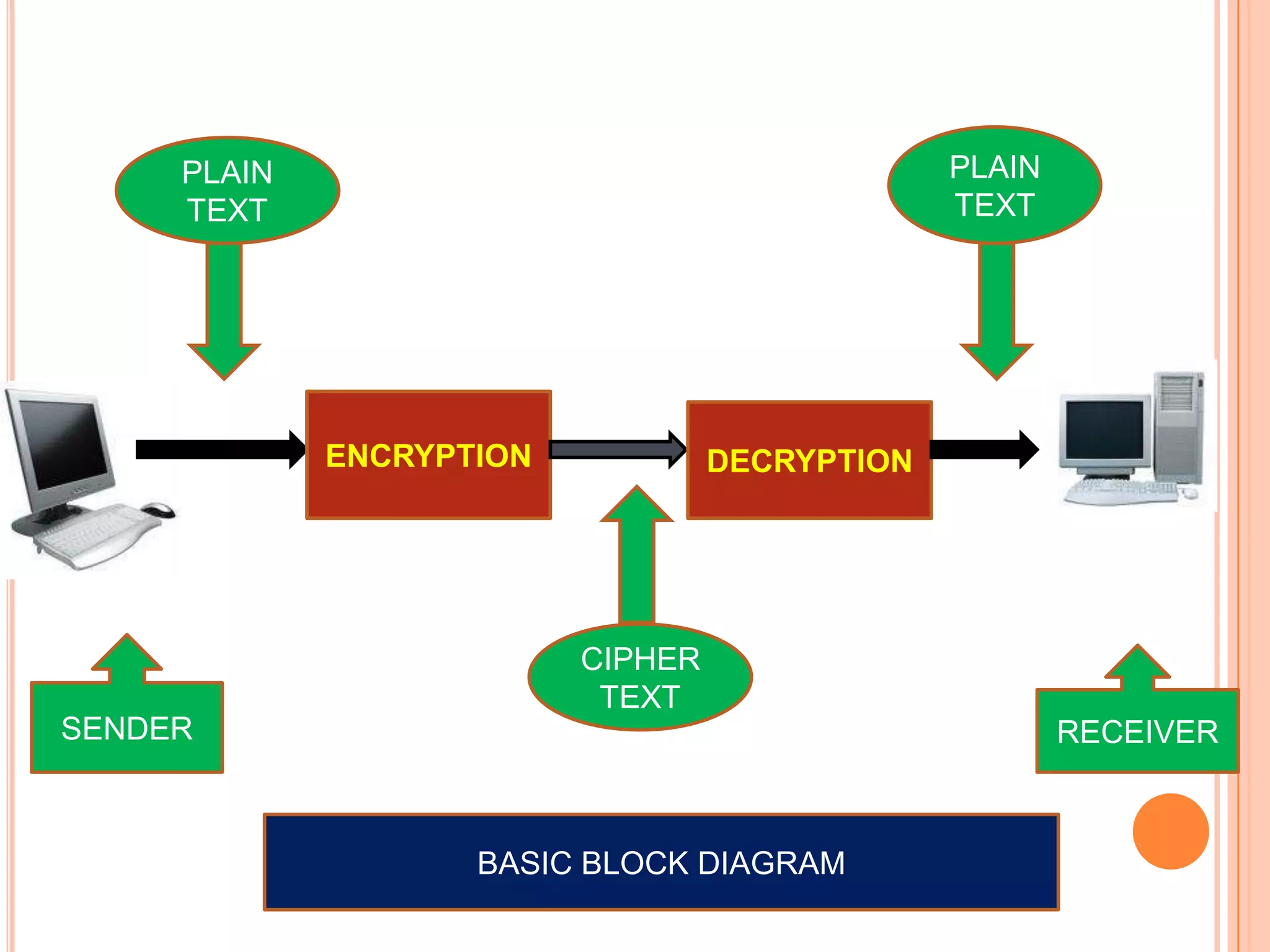
PLAIN                                      PLAIN
     TEXT                                       TEXT


             ENCRYPTION            DECRYPTION


                          CIPHER
                           TEXT
SENDER                                                  RECEIVER


                    BASIC BLOCK DIAGRAM
BASIC TERMINOLOGIES
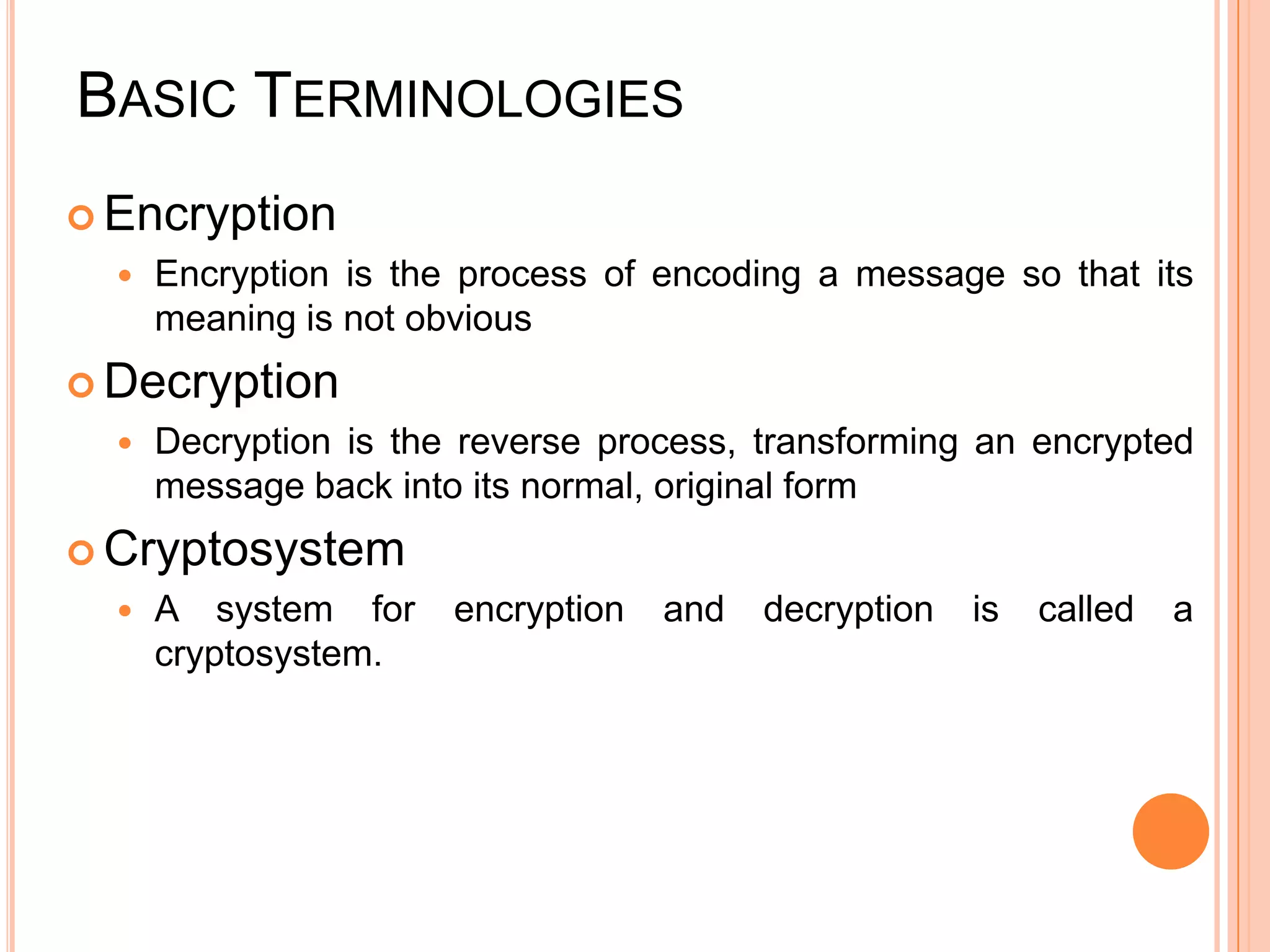
 Encryption
     Encryption is the process of encoding a message so that its
      meaning is not obvious
 Decryption
     Decryption is the reverse process, transforming an encrypted
      message back into its normal, original form
 Cryptosystem
     A system for     encryption   and   decryption   is   called   a
      cryptosystem.
BASIC TERMINOLOGIES
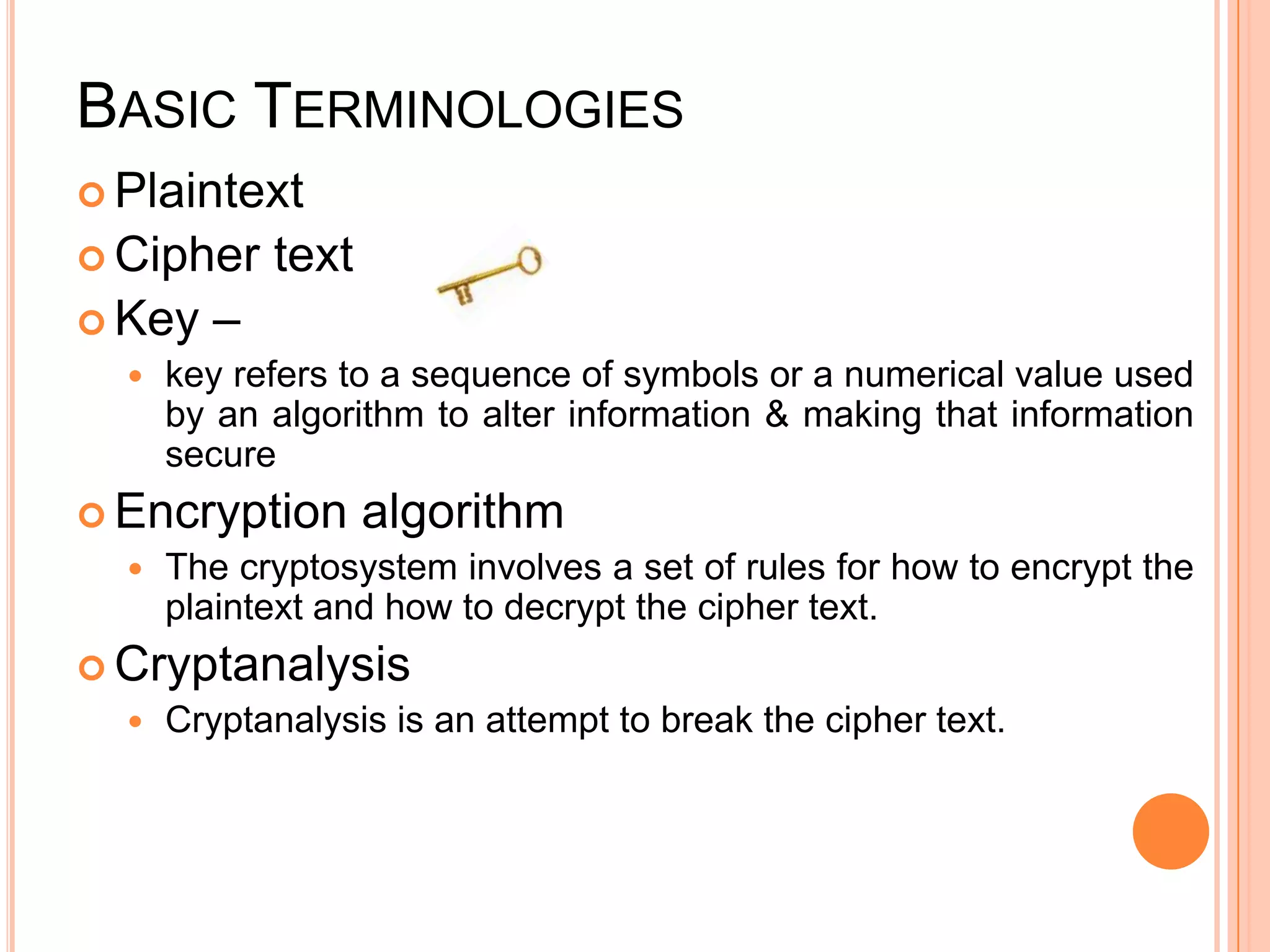
 Plaintext
 Cipher     text
 Key    –
     key refers to a sequence of symbols or a numerical value used
      by an algorithm to alter information & making that information
      secure
 Encryption        algorithm
     The cryptosystem involves a set of rules for how to encrypt the
      plaintext and how to decrypt the cipher text.
 Cryptanalysis
     Cryptanalysis is an attempt to break the cipher text.
TECHNIQUES OF CRYPTOGRAPHY
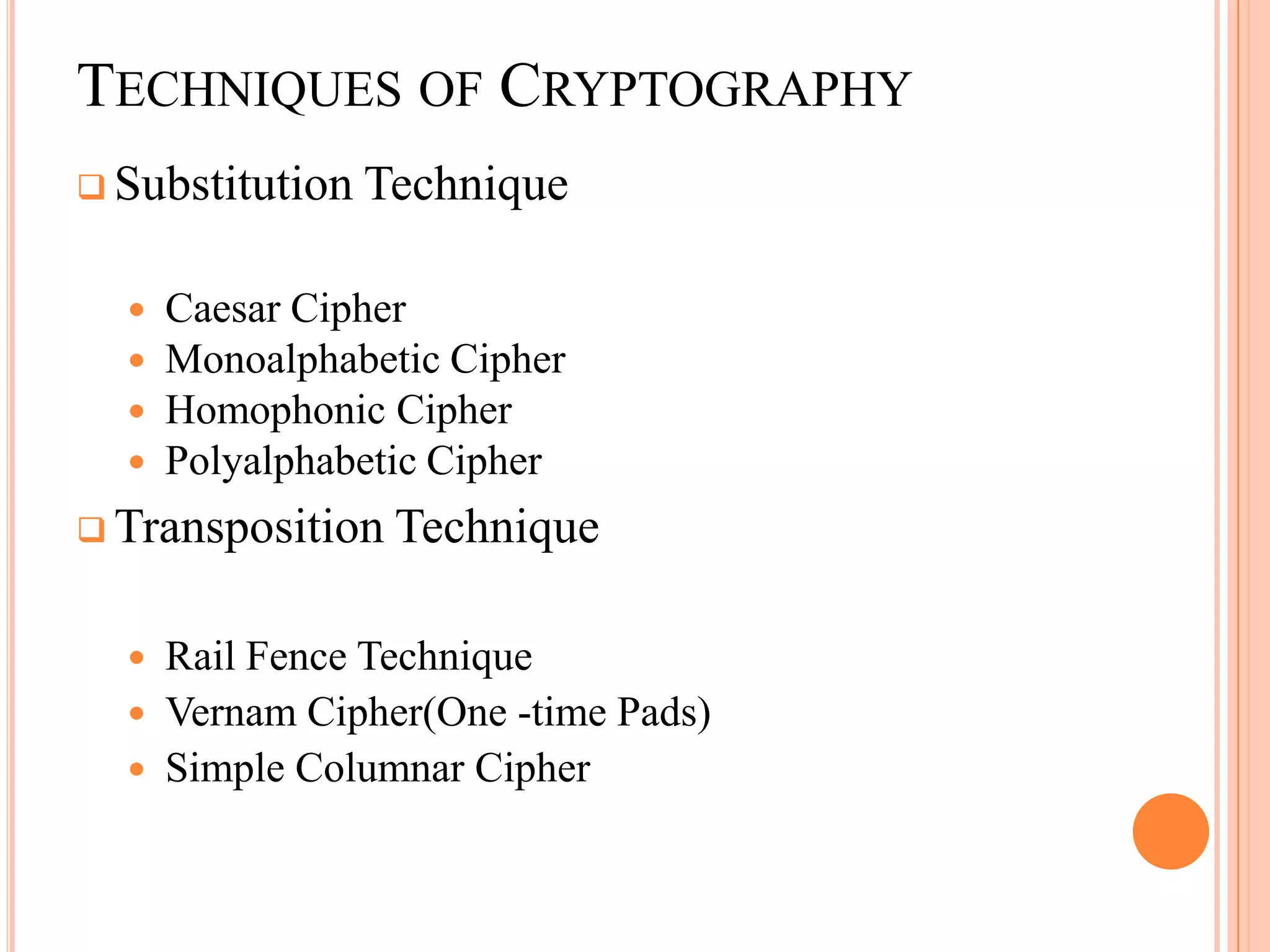
 Substitution   Technique

     Caesar Cipher
     Monoalphabetic Cipher
     Homophonic Cipher
     Polyalphabetic Cipher
 Transposition   Technique

     Rail Fence Technique
     Vernam Cipher(One -time Pads)
     Simple Columnar Cipher
ENCRYPTION ALGORITHM
 Symmetric
    Same key for encryption and decryption

    Key distribution problem


 Asymmetric
    Key pairs for encryption and decryption

    Public and private keys
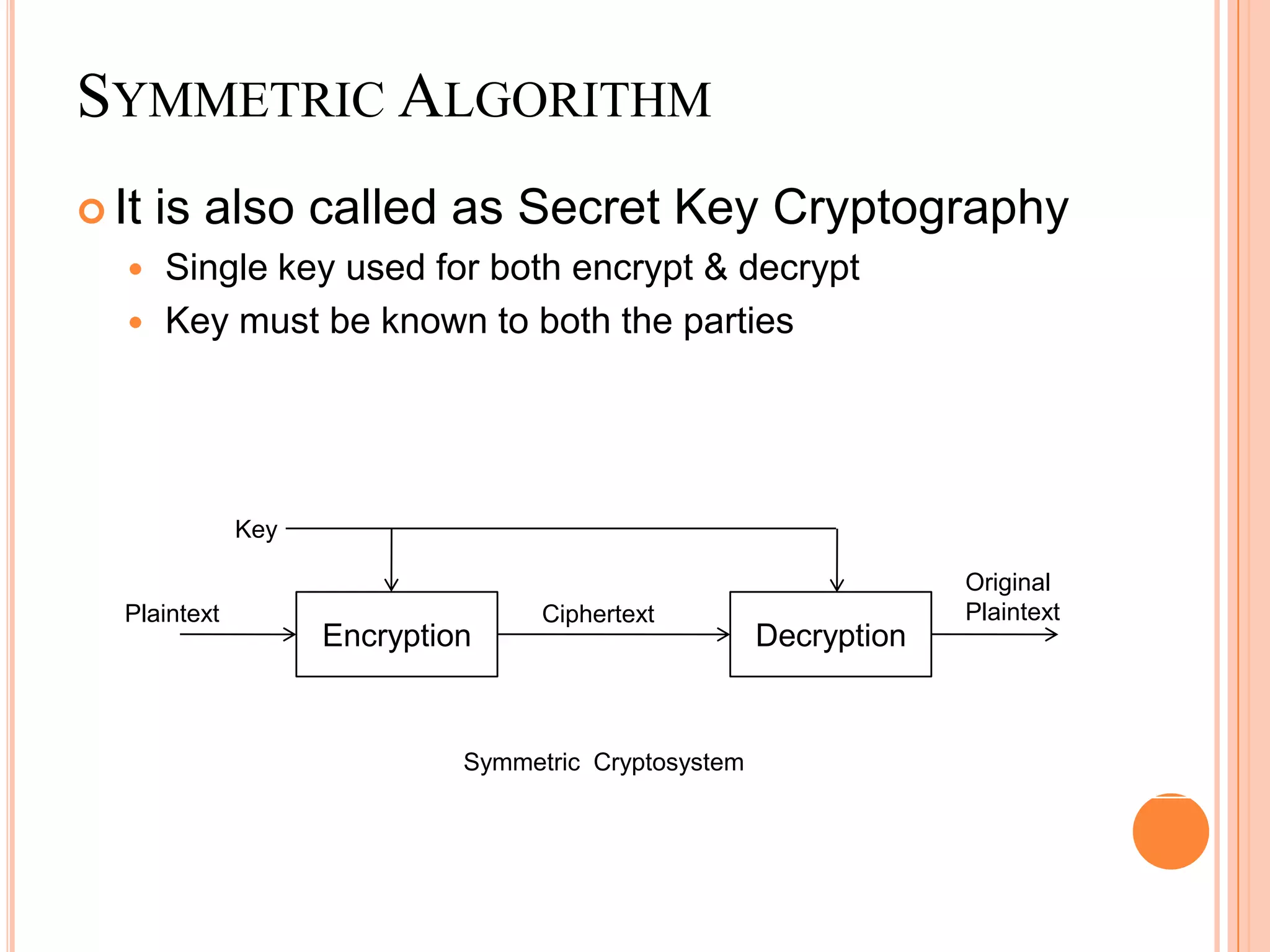
SYMMETRIC ALGORITHM
 It   is also called as Secret Key Cryptography
    Single key used for both encrypt & decrypt
    Key must be known to both the parties


              Key

                                                                   Original
  Plaintext                        Ciphertext                      Plaintext
                    Encryption                        Decryption


                             Symmetric Cryptosystem
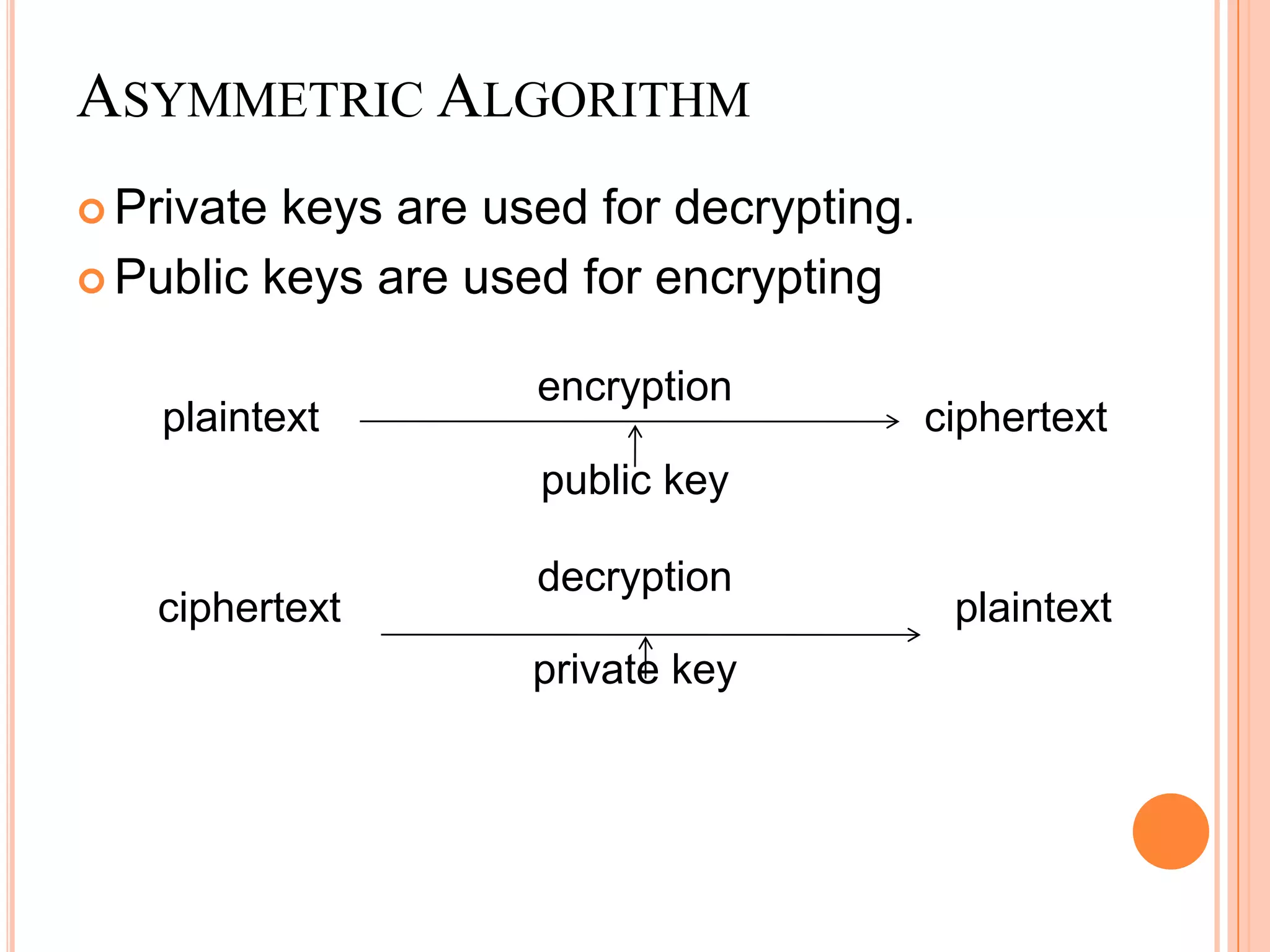
ASYMMETRIC ALGORITHM
 Private keys are used for decrypting.
 Public keys are used for encrypting


                     encryption
    plaintext                             ciphertext
                     public key

                     decryption
   ciphertext                              plaintext
                     private key
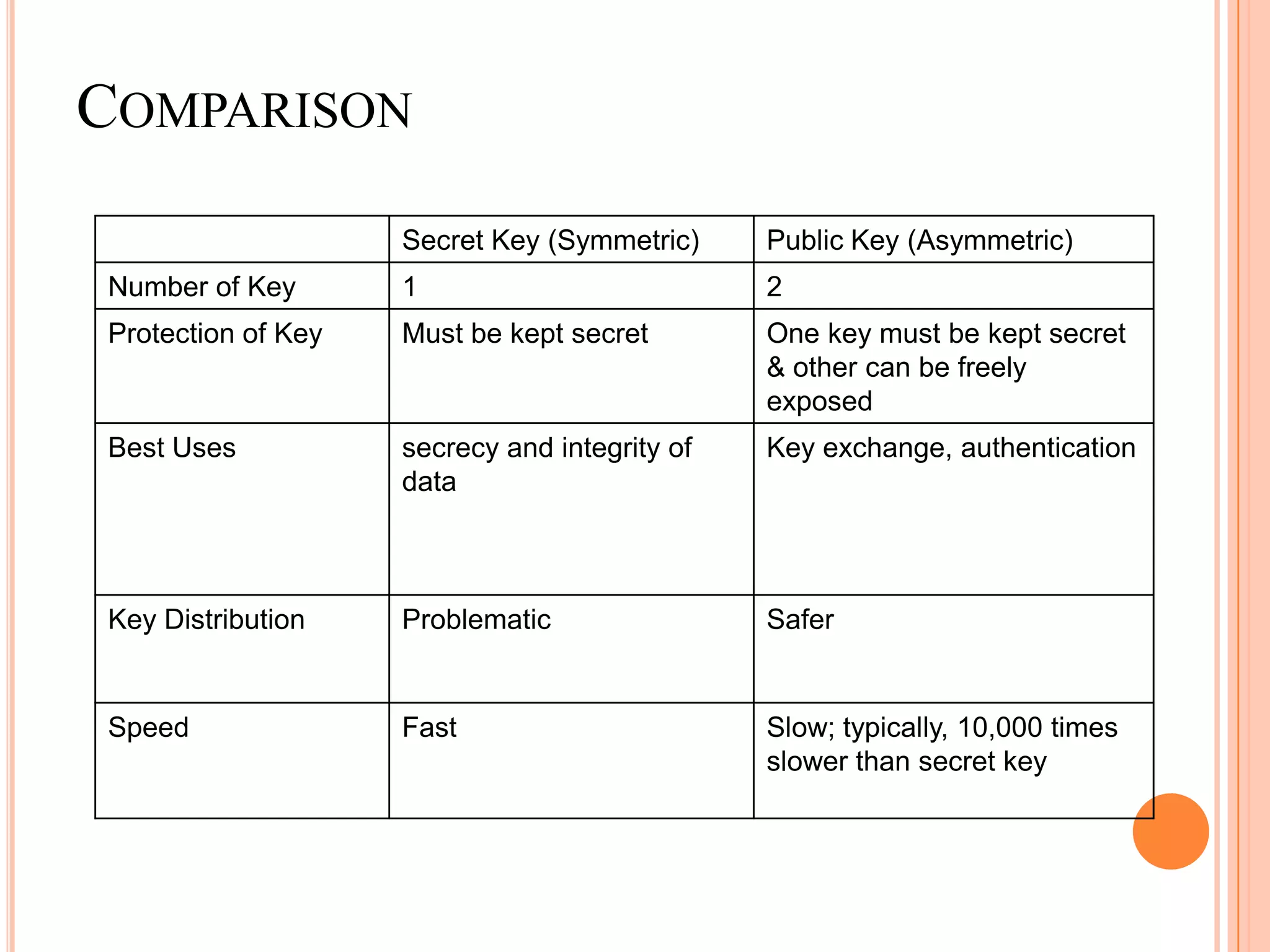
COMPARISON
                    Secret Key (Symmetric)     Public Key (Asymmetric)
Number of Key       1                          2
Protection of Key   Must be kept secret        One key must be kept secret
                                               & other can be freely
                                               exposed
Best Uses           secrecy and integrity of   Key exchange, authentication
                    data


Key Distribution    Problematic                Safer


Speed               Fast                       Slow; typically, 10,000 times
                                               slower than secret key
SYMMETRIC ALGORITHM

 Data   Encryption Standard (DES):
  56 bits key


 Advance       Encryption Standard (AES):
 128, 192 or 256 bits key


 International
             Data Encryption
 Algorithm(IDEA):
 128 bits key
DATA ENCRYPTION STANDARD
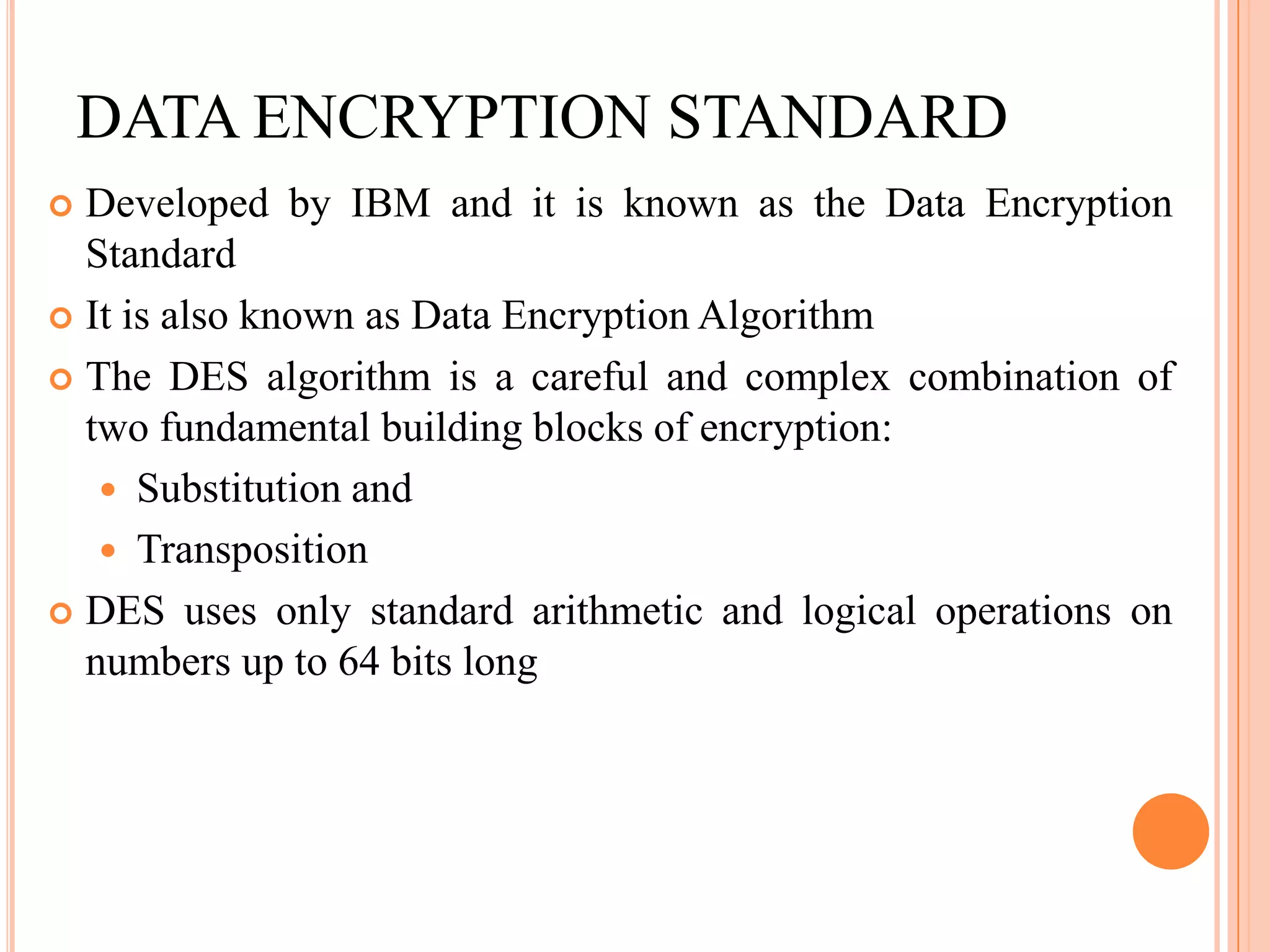
 Developed by IBM and it is known as the Data Encryption
  Standard
 It is also known as Data Encryption Algorithm

 The DES algorithm is a careful and complex combination of
  two fundamental building blocks of encryption:
    Substitution and
    Transposition
 DES uses only standard arithmetic and logical operations on
  numbers up to 64 bits long
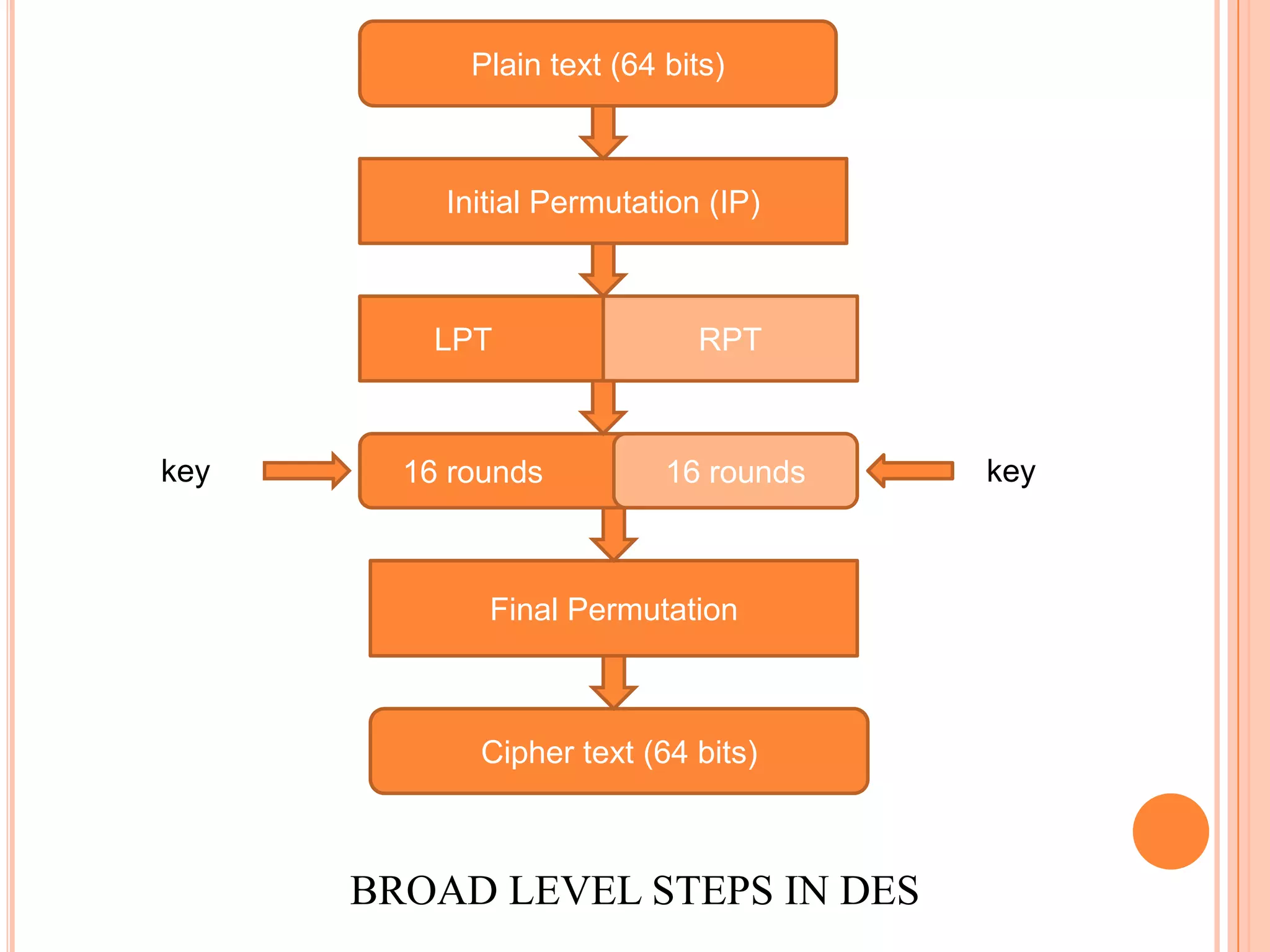
Plain text (64 bits)


          Initial Permutation (IP)


          LPT                RPT


key     16 rounds          16 rounds   key


             Final Permutation


             Cipher text (64 bits)


      BROAD LEVEL STEPS IN DES
DATA ENCRYPTION STANDARD
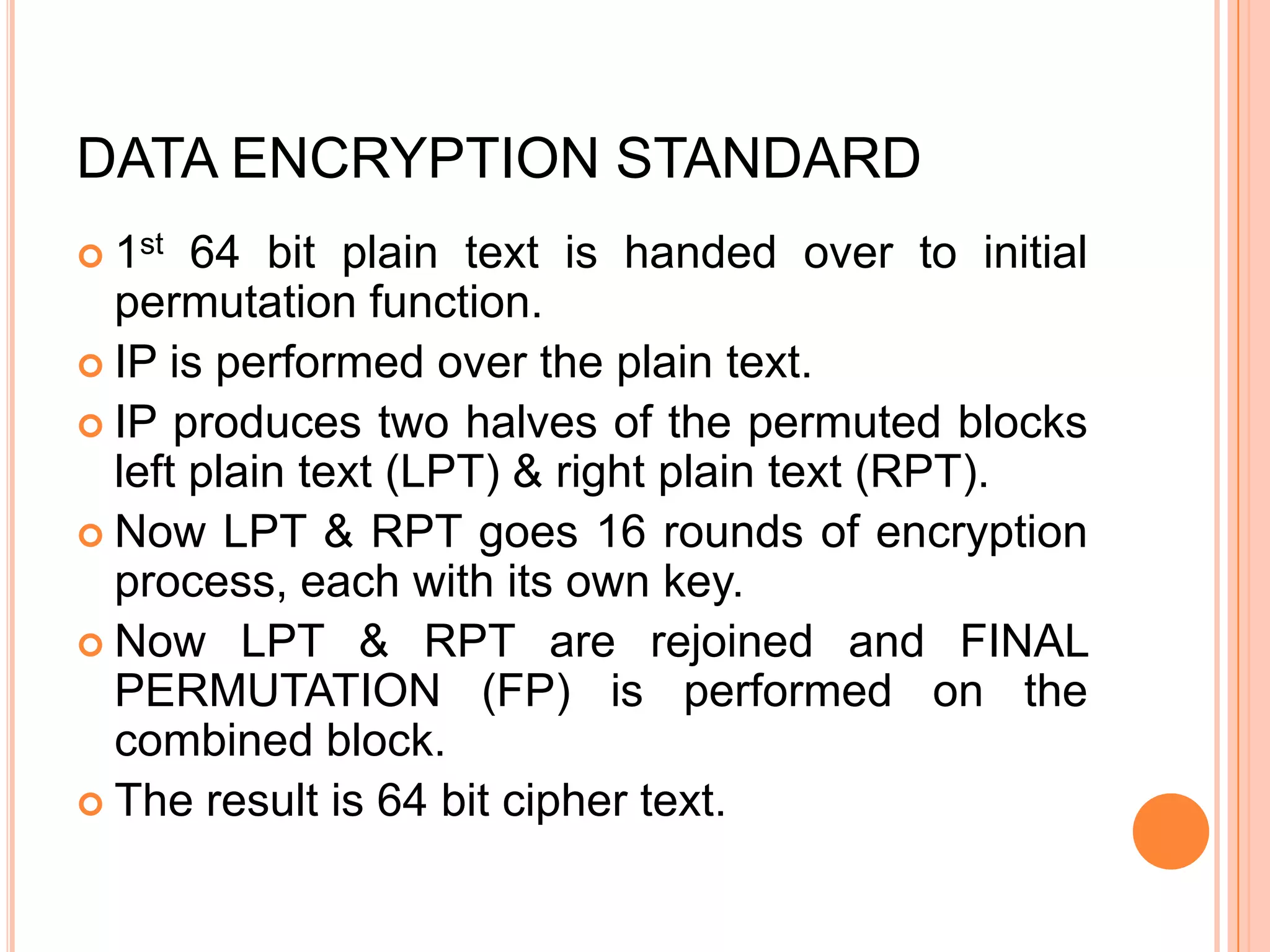
 1st  64 bit plain text is handed over to initial
  permutation function.
 IP is performed over the plain text.
 IP produces two halves of the permuted blocks
  left plain text (LPT) & right plain text (RPT).
 Now LPT & RPT goes 16 rounds of encryption
  process, each with its own key.
 Now LPT & RPT are rejoined and FINAL
  PERMUTATION (FP) is performed on the
  combined block.
 The result is 64 bit cipher text.
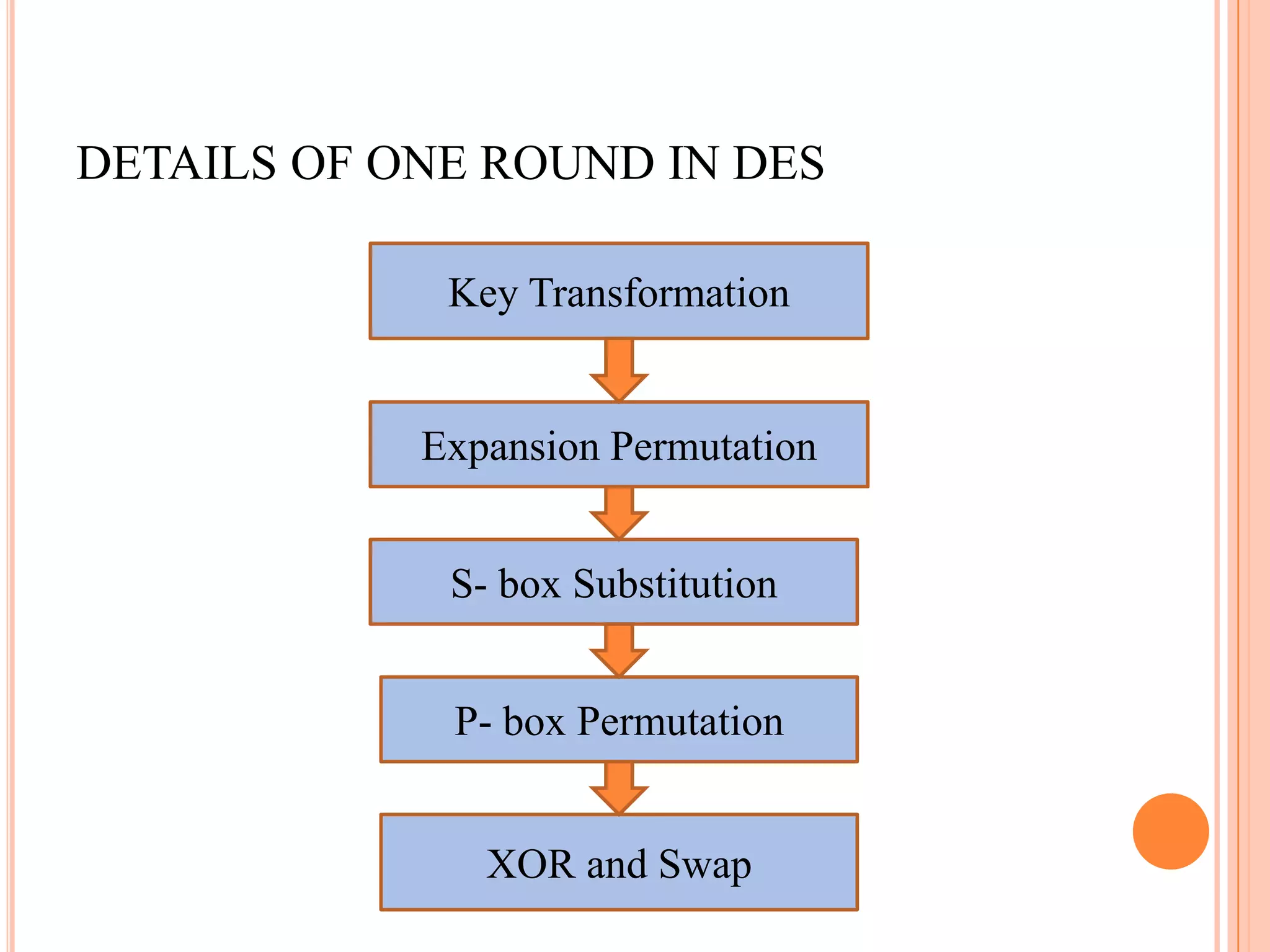
DETAILS OF ONE ROUND IN DES

             Key Transformation


            Expansion Permutation


             S- box Substitution


             P- box Permutation


               XOR and Swap
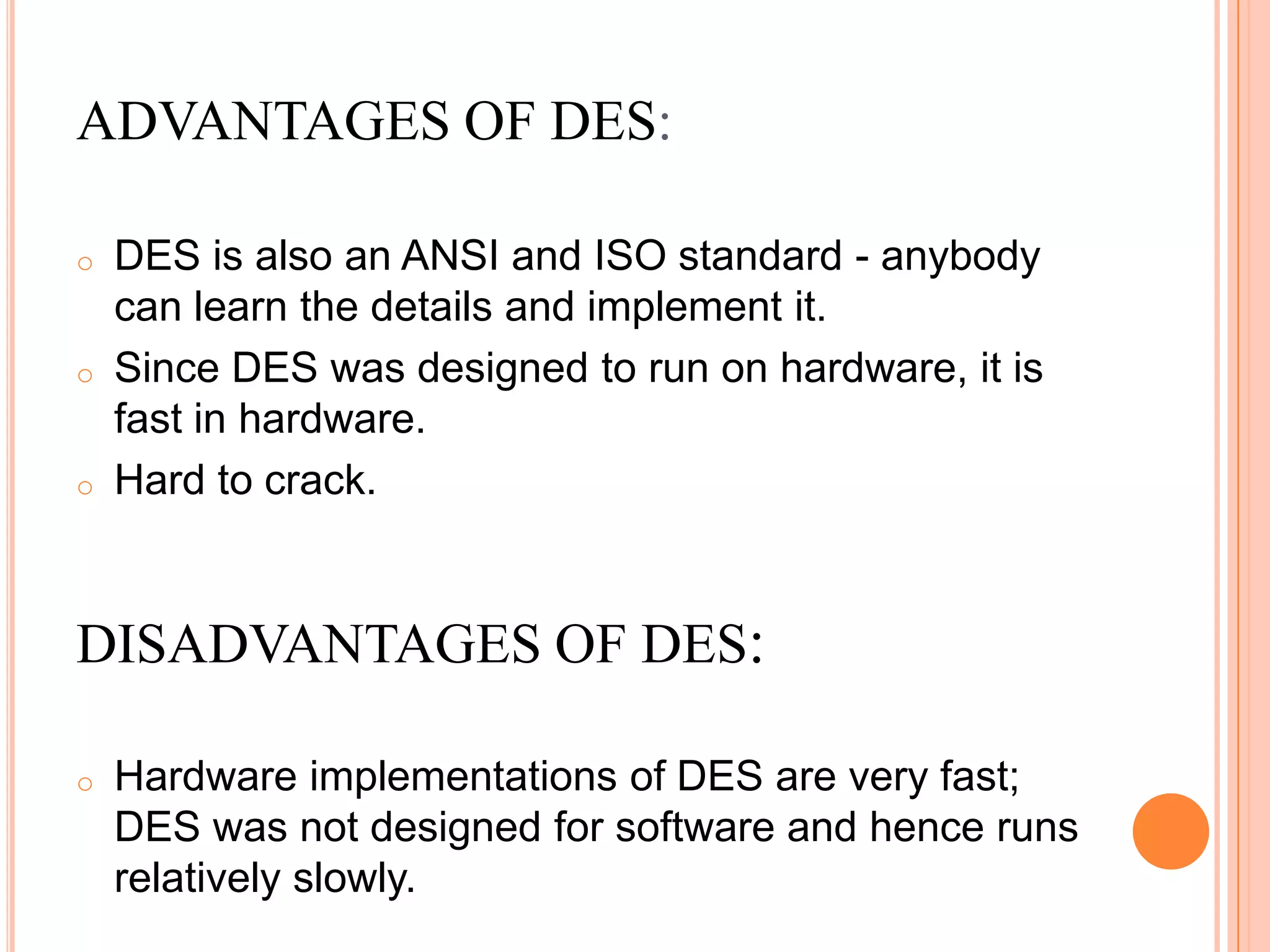
ADVANTAGES OF DES:

o   DES is also an ANSI and ISO standard - anybody
    can learn the details and implement it.
o   Since DES was designed to run on hardware, it is
    fast in hardware.
o   Hard to crack.


DISADVANTAGES OF DES:

o   Hardware implementations of DES are very fast;
    DES was not designed for software and hence runs
    relatively slowly.
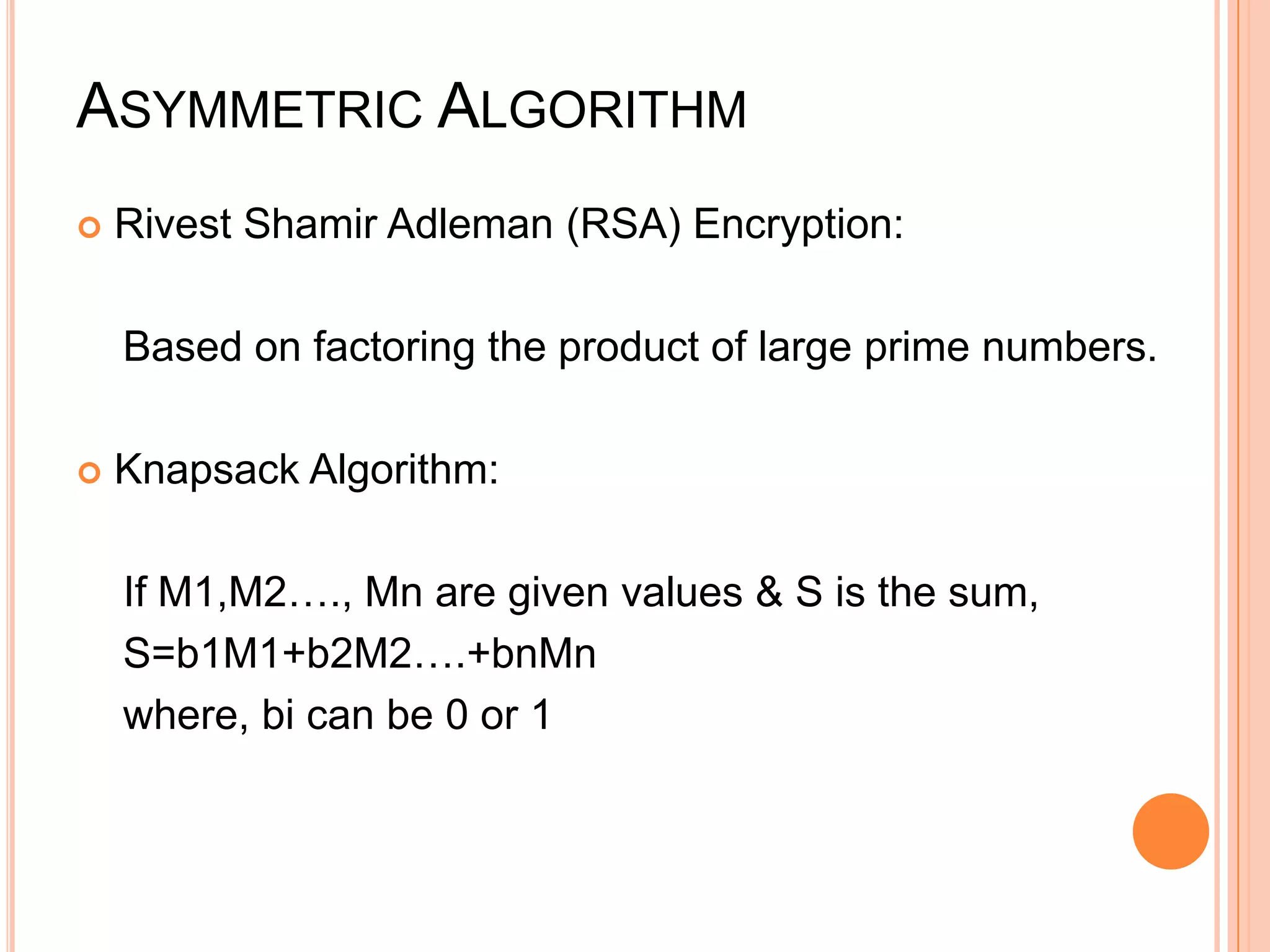
ASYMMETRIC ALGORITHM
   Rivest Shamir Adleman (RSA) Encryption:

    Based on factoring the product of large prime numbers.

   Knapsack Algorithm:

    If M1,M2…., Mn are given values & S is the sum,
    S=b1M1+b2M2….+bnMn
    where, bi can be 0 or 1
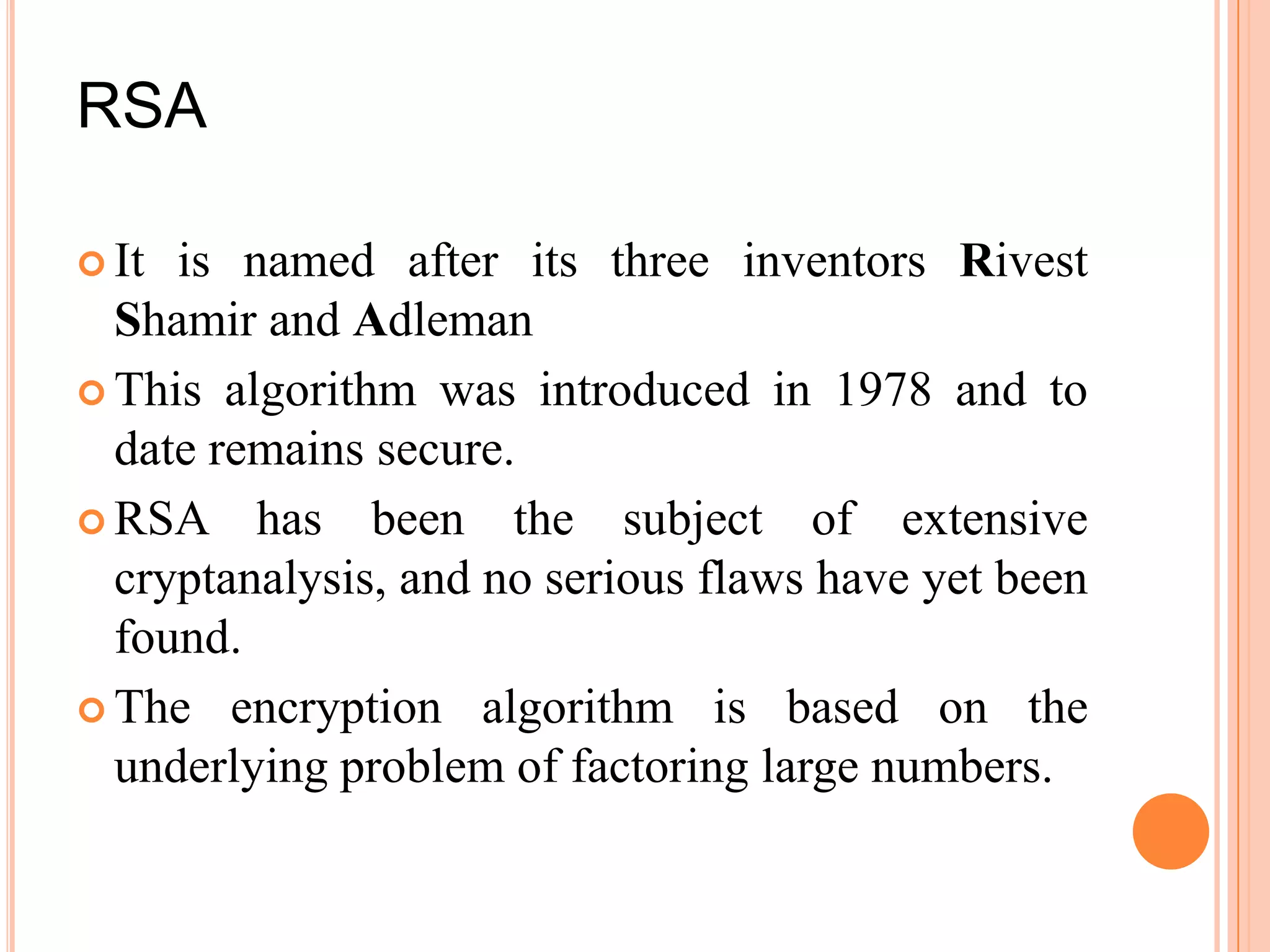
RSA

 It is named after its three inventors Rivest
  Shamir and Adleman
 This algorithm was introduced in 1978 and to
  date remains secure.
 RSA has been the subject of extensive
  cryptanalysis, and no serious flaws have yet been
  found.
 The encryption algorithm is based on the
  underlying problem of factoring large numbers.
RSA

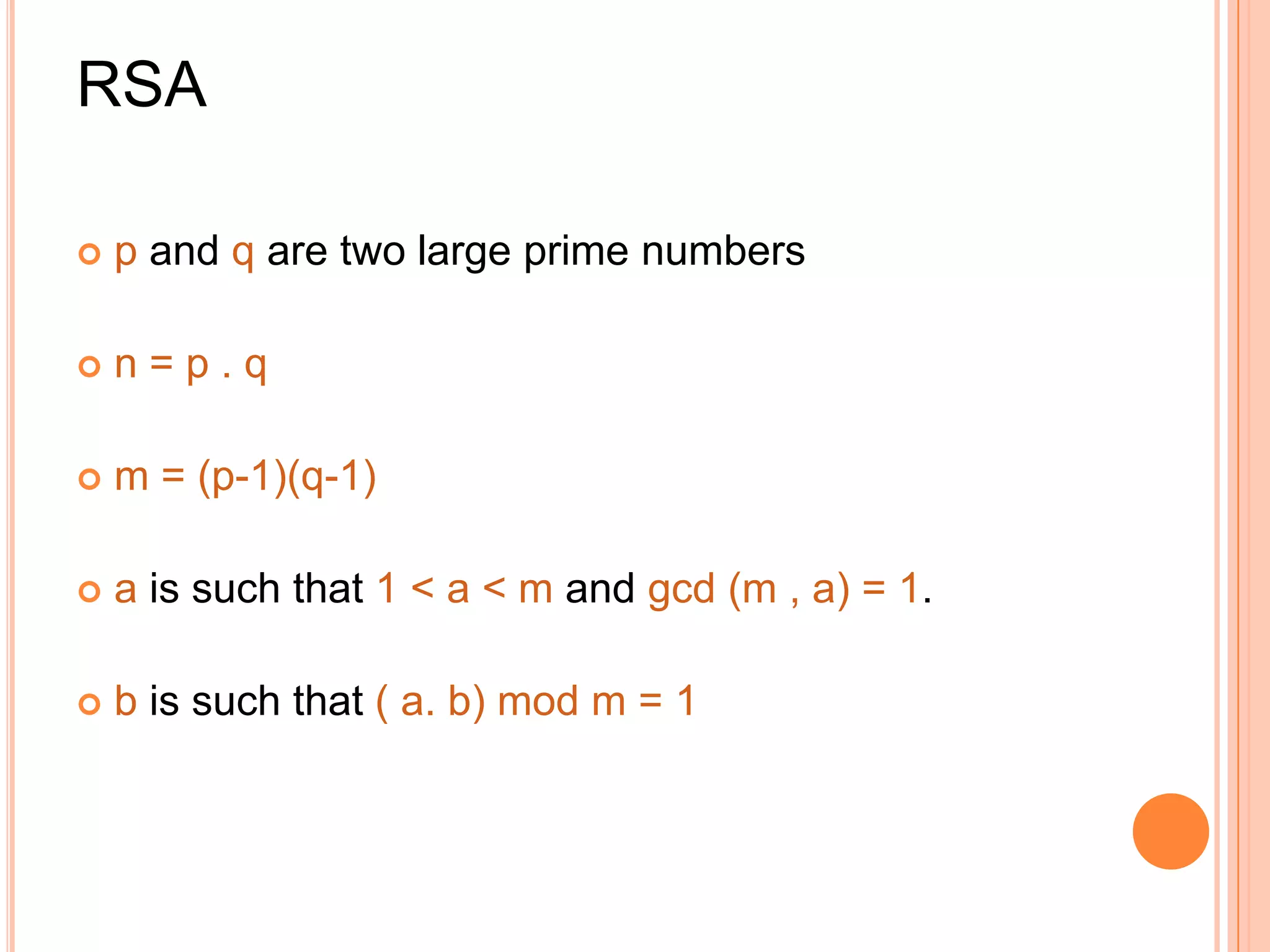
   p and q are two large prime numbers

   n=p.q

   m = (p-1)(q-1)

   a is such that 1 < a < m and gcd (m , a) = 1.

   b is such that ( a. b) mod m = 1
RSA ENCRYPTION & DECRYPTION

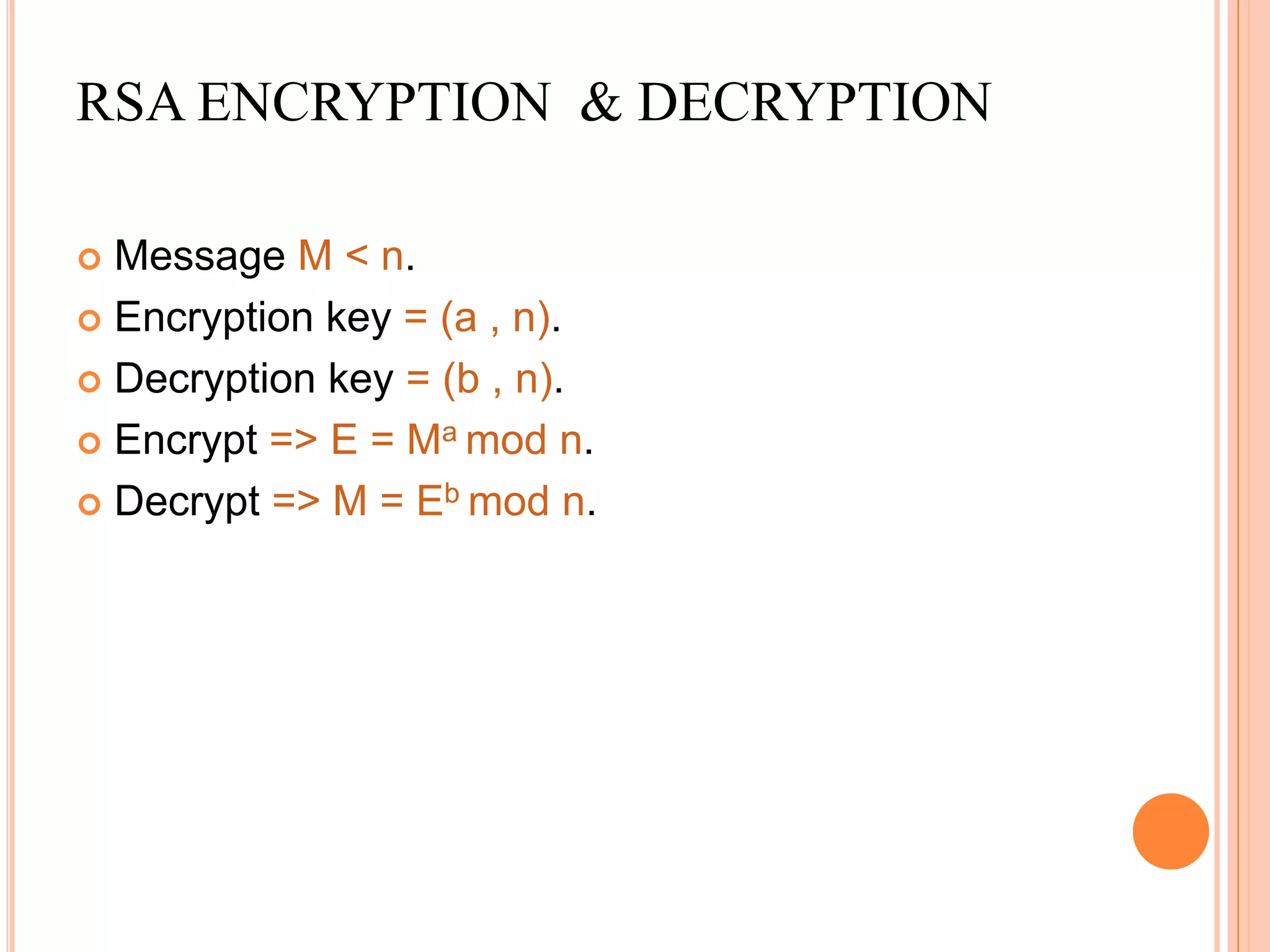
 Message M < n.
 Encryption key = (a , n).

 Decryption key = (b , n).

 Encrypt => E = Ma mod n.

 Decrypt => M = Eb mod n.
 Advantage


     Individuals can post their public key on their Web
      site.
     The number of the keys is only twice of the
      number of user.

 Disadvantage


     It is slower than symmetric algorithms.
     The cipher text may be larger than plain text.
DIGITAL SIGNATURE
    When an author signs a document, it cannot
     be changed.

    When you send a document
     electronically, you can also sign it.

    Digital signature can be done in two ways:

        You can sign the whole document

        You can sign a digest of the document
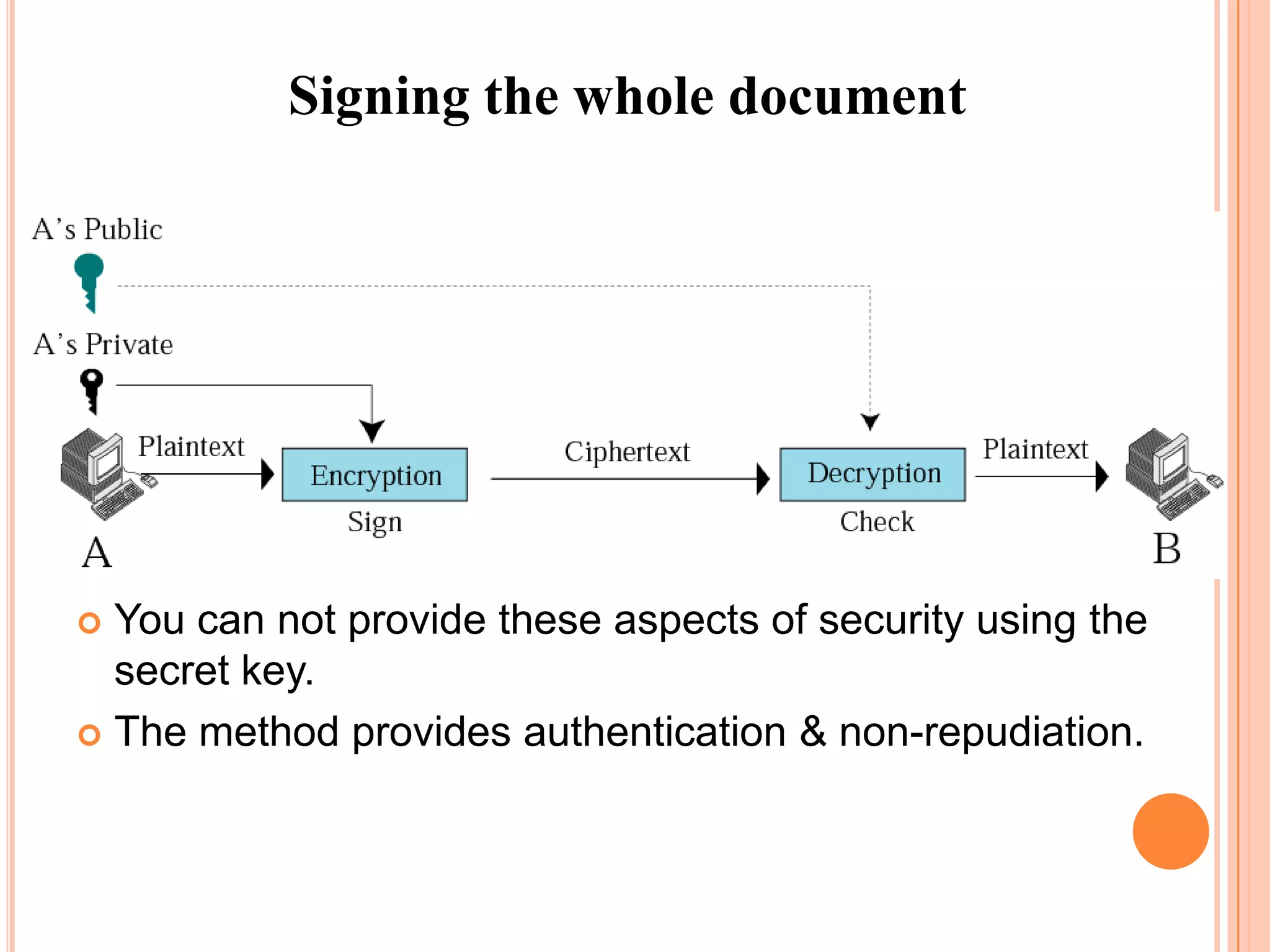
Signing the whole document


 You can not provide these aspects of security using the
  secret key.
 The method provides authentication & non-repudiation.
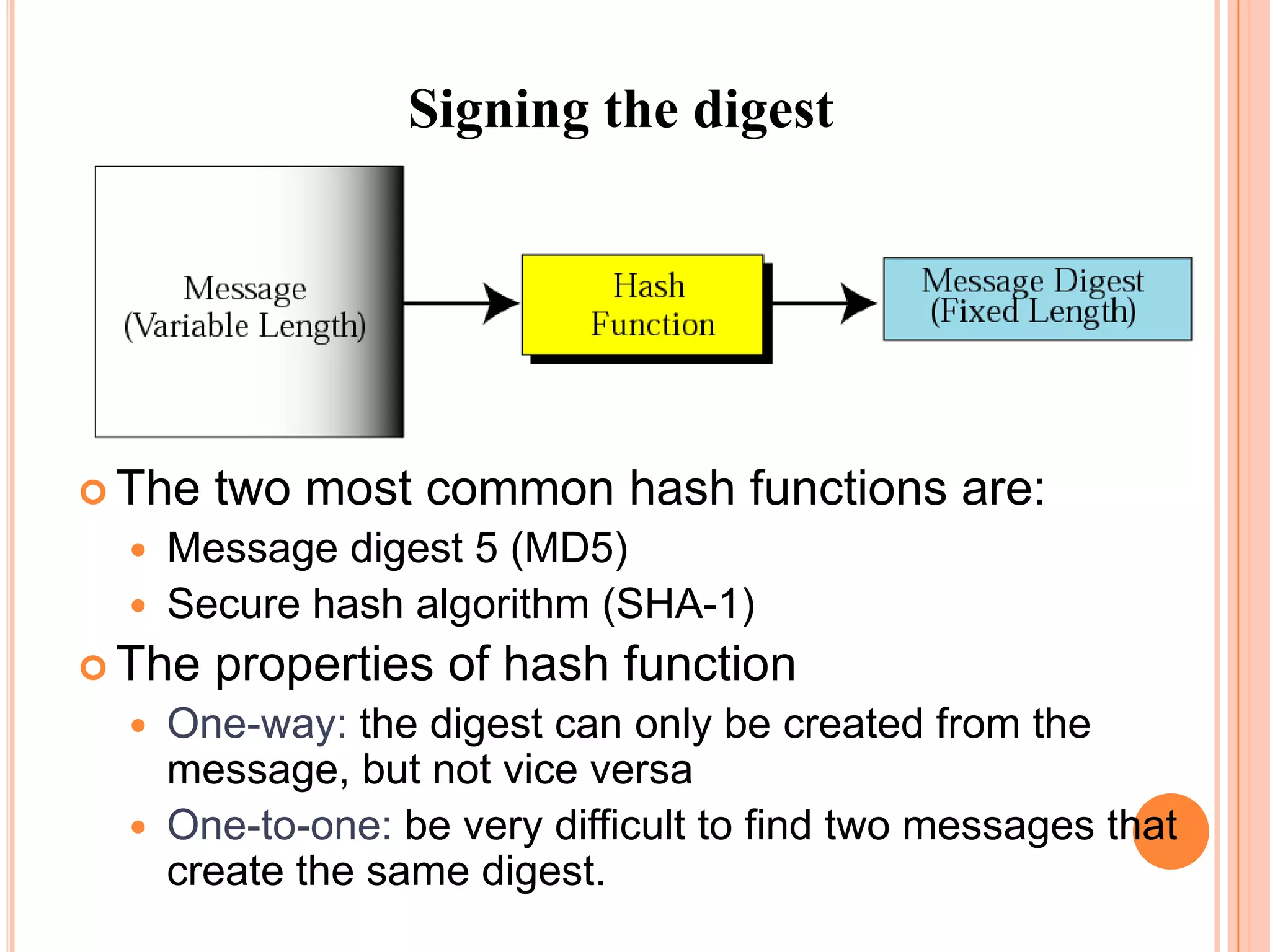
Signing the digest


 The   two most common hash functions are:
     Message digest 5 (MD5)
     Secure hash algorithm (SHA-1)
 The   properties of hash function
     One-way: the digest can only be created from the
      message, but not vice versa
     One-to-one: be very difficult to find two messages that
      create the same digest.
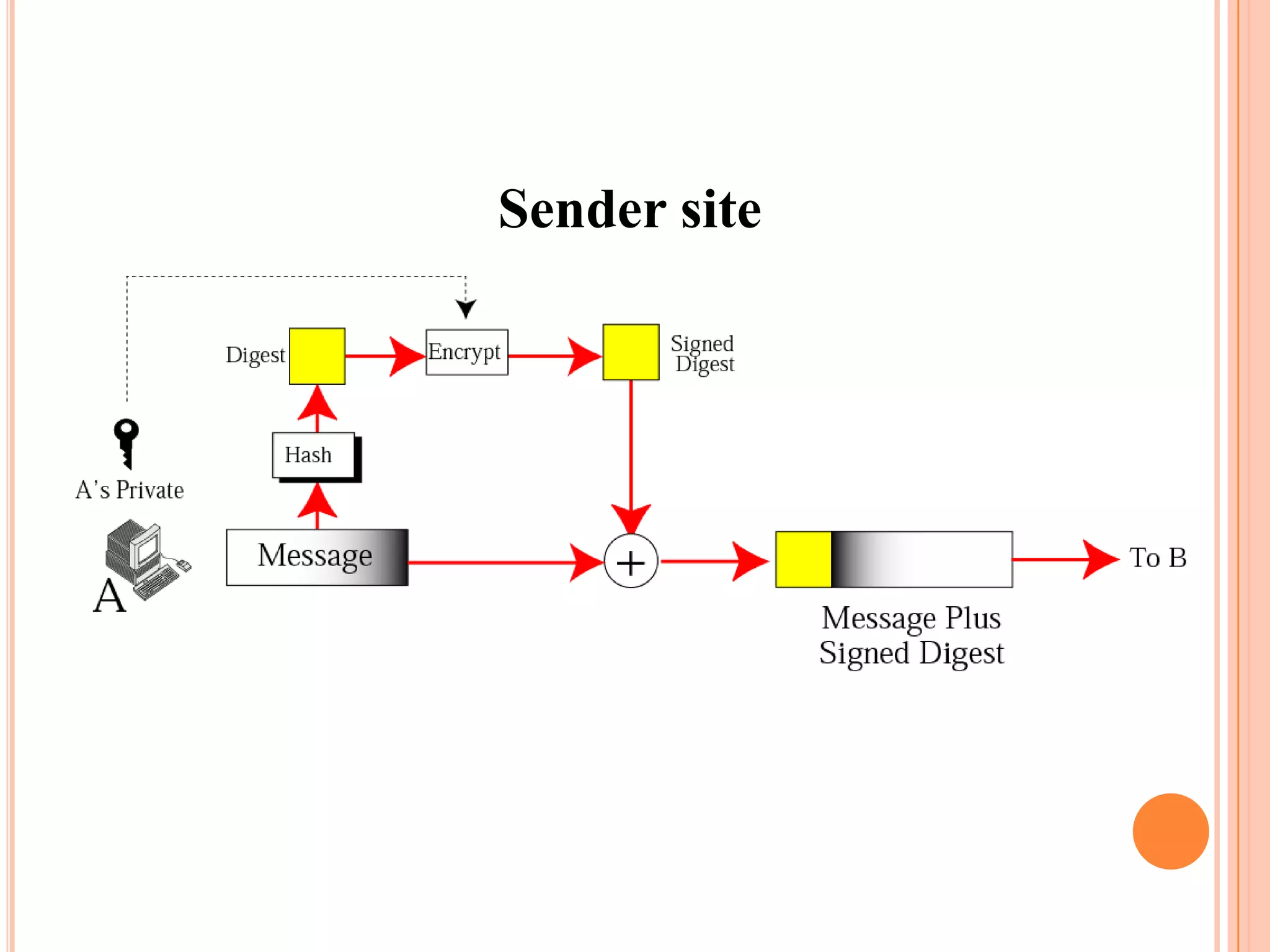
Sender site
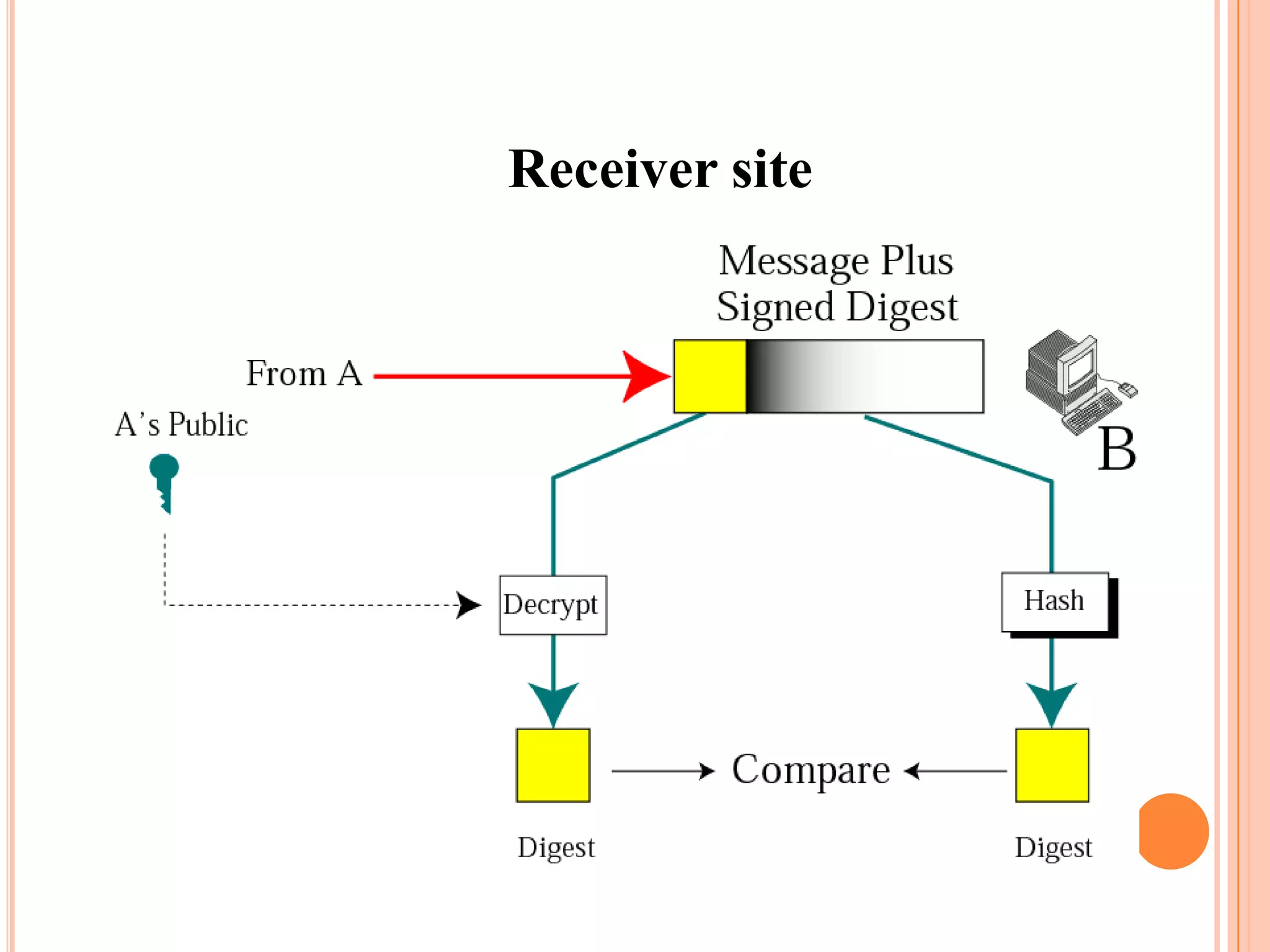
Receiver site
APPLICATIONS OF ENCRYPTION
   Cryptographic Hash Function

   Digital Signature

   Certificate

   Secure electronic transactions

   Office equipment
CONCLUSION
 RSA finds its strongest application when parties
  who have no prior relationship want to share
  sensitive data with each other.
 Thus , even though slower as compared to
  symmetric algorithms it is & will be widely used as it
  can be used in digital signature for long haul
  transmission.
Cryptography

Cryptography

  • 1.
    CONTENTS o Introduction o Need of Cryptography o Types of Attacks o Techniques of Cryptography o Encryption Algorithm • Symmetric • Asymmetric o Digital Signature o Conclusion
  • 2.
    INTRODUCTION  What is Cryptography?  “Hidden Writing”  Mainly used to protect Information.  Goal of Cryptography  Ensure security of communication over insecure medium  Communicate even with possibility of adversary
  • 3.
    NEED OF ENCRYPTION Confidentiality  Integrity  Authentication  Nonrepudiation  Access Control  Availability
  • 4.
    TYPES OF ATTACKS  A General View  A Technical View  A Practical Side of Attacks  Programs that Attack
  • 5.
    PLAIN PLAIN TEXT TEXT ENCRYPTION DECRYPTION CIPHER TEXT SENDER RECEIVER BASIC BLOCK DIAGRAM
  • 6.
    BASIC TERMINOLOGIES  Encryption  Encryption is the process of encoding a message so that its meaning is not obvious  Decryption  Decryption is the reverse process, transforming an encrypted message back into its normal, original form  Cryptosystem  A system for encryption and decryption is called a cryptosystem.
  • 7.
    BASIC TERMINOLOGIES  Plaintext Cipher text  Key –  key refers to a sequence of symbols or a numerical value used by an algorithm to alter information & making that information secure  Encryption algorithm  The cryptosystem involves a set of rules for how to encrypt the plaintext and how to decrypt the cipher text.  Cryptanalysis  Cryptanalysis is an attempt to break the cipher text.
  • 8.
    TECHNIQUES OF CRYPTOGRAPHY Substitution Technique  Caesar Cipher  Monoalphabetic Cipher  Homophonic Cipher  Polyalphabetic Cipher  Transposition Technique  Rail Fence Technique  Vernam Cipher(One -time Pads)  Simple Columnar Cipher
  • 9.
    ENCRYPTION ALGORITHM  Symmetric  Same key for encryption and decryption  Key distribution problem  Asymmetric  Key pairs for encryption and decryption  Public and private keys
  • 10.
    SYMMETRIC ALGORITHM  It is also called as Secret Key Cryptography  Single key used for both encrypt & decrypt  Key must be known to both the parties Key Original Plaintext Ciphertext Plaintext Encryption Decryption Symmetric Cryptosystem
  • 11.
    ASYMMETRIC ALGORITHM  Privatekeys are used for decrypting.  Public keys are used for encrypting encryption plaintext ciphertext public key decryption ciphertext plaintext private key
  • 12.
    COMPARISON Secret Key (Symmetric) Public Key (Asymmetric) Number of Key 1 2 Protection of Key Must be kept secret One key must be kept secret & other can be freely exposed Best Uses secrecy and integrity of Key exchange, authentication data Key Distribution Problematic Safer Speed Fast Slow; typically, 10,000 times slower than secret key
  • 13.
    SYMMETRIC ALGORITHM  Data Encryption Standard (DES): 56 bits key  Advance Encryption Standard (AES): 128, 192 or 256 bits key  International Data Encryption Algorithm(IDEA): 128 bits key
  • 14.
    DATA ENCRYPTION STANDARD Developed by IBM and it is known as the Data Encryption Standard  It is also known as Data Encryption Algorithm  The DES algorithm is a careful and complex combination of two fundamental building blocks of encryption:  Substitution and  Transposition  DES uses only standard arithmetic and logical operations on numbers up to 64 bits long
  • 15.
    Plain text (64bits) Initial Permutation (IP) LPT RPT key 16 rounds 16 rounds key Final Permutation Cipher text (64 bits) BROAD LEVEL STEPS IN DES
  • 16.
    DATA ENCRYPTION STANDARD 1st 64 bit plain text is handed over to initial permutation function.  IP is performed over the plain text.  IP produces two halves of the permuted blocks left plain text (LPT) & right plain text (RPT).  Now LPT & RPT goes 16 rounds of encryption process, each with its own key.  Now LPT & RPT are rejoined and FINAL PERMUTATION (FP) is performed on the combined block.  The result is 64 bit cipher text.
  • 17.
    DETAILS OF ONEROUND IN DES Key Transformation Expansion Permutation S- box Substitution P- box Permutation XOR and Swap
  • 18.
    ADVANTAGES OF DES: o DES is also an ANSI and ISO standard - anybody can learn the details and implement it. o Since DES was designed to run on hardware, it is fast in hardware. o Hard to crack. DISADVANTAGES OF DES: o Hardware implementations of DES are very fast; DES was not designed for software and hence runs relatively slowly.
  • 19.
    ASYMMETRIC ALGORITHM  Rivest Shamir Adleman (RSA) Encryption: Based on factoring the product of large prime numbers.  Knapsack Algorithm: If M1,M2…., Mn are given values & S is the sum, S=b1M1+b2M2….+bnMn where, bi can be 0 or 1
  • 20.
    RSA  It isnamed after its three inventors Rivest Shamir and Adleman  This algorithm was introduced in 1978 and to date remains secure.  RSA has been the subject of extensive cryptanalysis, and no serious flaws have yet been found.  The encryption algorithm is based on the underlying problem of factoring large numbers.
  • 21.
    RSA  p and q are two large prime numbers  n=p.q  m = (p-1)(q-1)  a is such that 1 < a < m and gcd (m , a) = 1.  b is such that ( a. b) mod m = 1
  • 22.
    RSA ENCRYPTION &DECRYPTION  Message M < n.  Encryption key = (a , n).  Decryption key = (b , n).  Encrypt => E = Ma mod n.  Decrypt => M = Eb mod n.
  • 23.
     Advantage  Individuals can post their public key on their Web site.  The number of the keys is only twice of the number of user.  Disadvantage  It is slower than symmetric algorithms.  The cipher text may be larger than plain text.
  • 24.
    DIGITAL SIGNATURE  When an author signs a document, it cannot be changed.  When you send a document electronically, you can also sign it.  Digital signature can be done in two ways:  You can sign the whole document  You can sign a digest of the document
  • 25.
    Signing the wholedocument  You can not provide these aspects of security using the secret key.  The method provides authentication & non-repudiation.
  • 26.
    Signing the digest The two most common hash functions are:  Message digest 5 (MD5)  Secure hash algorithm (SHA-1)  The properties of hash function  One-way: the digest can only be created from the message, but not vice versa  One-to-one: be very difficult to find two messages that create the same digest.
  • 27.
  • 28.
  • 29.
    APPLICATIONS OF ENCRYPTION  Cryptographic Hash Function  Digital Signature  Certificate  Secure electronic transactions  Office equipment
  • 30.
    CONCLUSION  RSA findsits strongest application when parties who have no prior relationship want to share sensitive data with each other.  Thus , even though slower as compared to symmetric algorithms it is & will be widely used as it can be used in digital signature for long haul transmission.