DATABASE SUPPORT:
ENSURING OPTIMAL
PERFORMANCE AND
RELIABILITY
BY IKEEN TECHNOLOGIES
IMPORTANCE OF
DATABASES:
• Databases are an integral part of modern organizations, serving as a central
repository for storing and managing vast amounts of data.
• They provide a structured framework that allows data to be organized, categorized,
and accessed efficiently.
• By leveraging databases , organizations can effectively store various types of
information, including customer data, sales records, product inventory, and
employee details.
• The ability to store and retrieve data quickly and accurately is essential for making
informed business decisions and gaining valuable insights into various aspects of the
organization's operations.
 Relational Databases: Relational databases store data in structured tables with predefined relationships. They use
SQL (Structured Query Language) for data manipulation and retrieval.
 NoSQL Databases: NoSQL databases are non-relational and are designed to handle unstructured or semi-structured
data. They offer flexible schemas, scalability, and high performance.
 Columnar Databases: Columnar databases store data in columns rather than rows, optimizing data retrieval and
analysis.
 Document Databases: Document databases store data in flexible, JSON-like documents.
 Graph Databases: Graph databases focus on relationships between entities and store data in nodes and edges..
 Time-Series Databases: Time-series databases specialize in handling data with timestamps, such as sensor data,
financial data, or log data.
 Spatial Databases: Spatial databases store and process spatial or geographic data, such as maps, coordinates, and
geographic information systems (GIS) data.
TYPES OF DATABASES:
CHALLENGES IN DATABASE
MANAGEMENT:
Some Of The Common Challenges Faced In DATABASE MANAGEMENT:
 Data Security
 Data Integrity
 Scalability
 Performance Optimization
 Backup and Recovery
 Data Governance and Compliance
 Database Monitoring and Maintenance
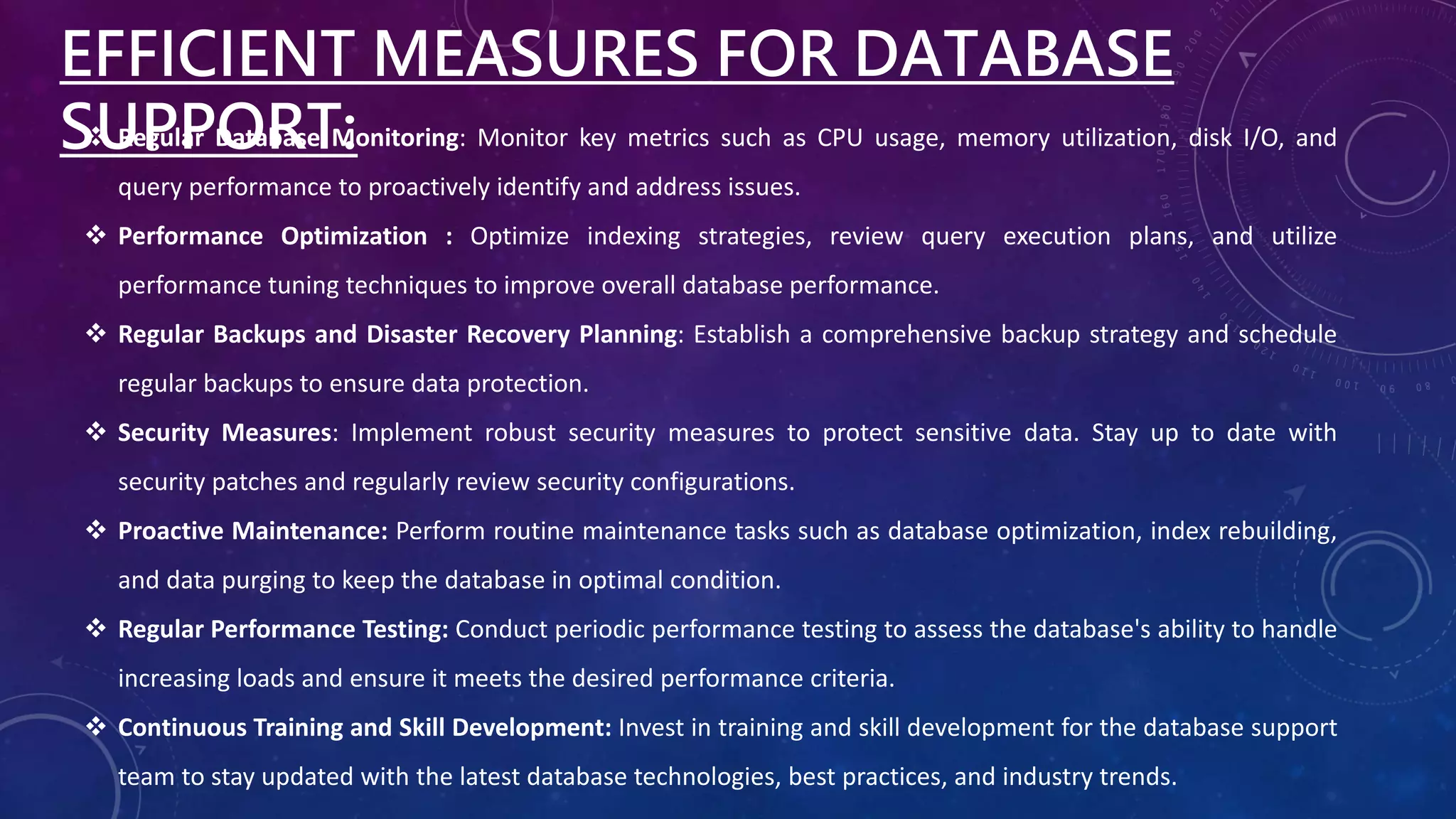
 Regular Database Monitoring: Monitor key metrics such as CPU usage, memory utilization, disk I/O, and
query performance to proactively identify and address issues.
 Performance Optimization : Optimize indexing strategies, review query execution plans, and utilize
performance tuning techniques to improve overall database performance.
 Regular Backups and Disaster Recovery Planning: Establish a comprehensive backup strategy and schedule
regular backups to ensure data protection.
 Security Measures: Implement robust security measures to protect sensitive data. Stay up to date with
security patches and regularly review security configurations.
 Proactive Maintenance: Perform routine maintenance tasks such as database optimization, index rebuilding,
and data purging to keep the database in optimal condition.
 Regular Performance Testing: Conduct periodic performance testing to assess the database's ability to handle
increasing loads and ensure it meets the desired performance criteria.
 Continuous Training and Skill Development: Invest in training and skill development for the database support
team to stay updated with the latest database technologies, best practices, and industry trends.
EFFICIENT MEASURES FOR DATABASE
SUPPORT:
THANK YOU
FOR MORE INFORMATION
VISIT US AT WWW.IKEENTECHNOLOGIES.IN

Database Support.pptx

  • 1.
    DATABASE SUPPORT: ENSURING OPTIMAL PERFORMANCEAND RELIABILITY BY IKEEN TECHNOLOGIES
  • 2.
    IMPORTANCE OF DATABASES: • Databasesare an integral part of modern organizations, serving as a central repository for storing and managing vast amounts of data. • They provide a structured framework that allows data to be organized, categorized, and accessed efficiently. • By leveraging databases , organizations can effectively store various types of information, including customer data, sales records, product inventory, and employee details. • The ability to store and retrieve data quickly and accurately is essential for making informed business decisions and gaining valuable insights into various aspects of the organization's operations.
  • 3.
     Relational Databases:Relational databases store data in structured tables with predefined relationships. They use SQL (Structured Query Language) for data manipulation and retrieval.  NoSQL Databases: NoSQL databases are non-relational and are designed to handle unstructured or semi-structured data. They offer flexible schemas, scalability, and high performance.  Columnar Databases: Columnar databases store data in columns rather than rows, optimizing data retrieval and analysis.  Document Databases: Document databases store data in flexible, JSON-like documents.  Graph Databases: Graph databases focus on relationships between entities and store data in nodes and edges..  Time-Series Databases: Time-series databases specialize in handling data with timestamps, such as sensor data, financial data, or log data.  Spatial Databases: Spatial databases store and process spatial or geographic data, such as maps, coordinates, and geographic information systems (GIS) data. TYPES OF DATABASES:
  • 4.
    CHALLENGES IN DATABASE MANAGEMENT: SomeOf The Common Challenges Faced In DATABASE MANAGEMENT:  Data Security  Data Integrity  Scalability  Performance Optimization  Backup and Recovery  Data Governance and Compliance  Database Monitoring and Maintenance
  • 5.
     Regular DatabaseMonitoring: Monitor key metrics such as CPU usage, memory utilization, disk I/O, and query performance to proactively identify and address issues.  Performance Optimization : Optimize indexing strategies, review query execution plans, and utilize performance tuning techniques to improve overall database performance.  Regular Backups and Disaster Recovery Planning: Establish a comprehensive backup strategy and schedule regular backups to ensure data protection.  Security Measures: Implement robust security measures to protect sensitive data. Stay up to date with security patches and regularly review security configurations.  Proactive Maintenance: Perform routine maintenance tasks such as database optimization, index rebuilding, and data purging to keep the database in optimal condition.  Regular Performance Testing: Conduct periodic performance testing to assess the database's ability to handle increasing loads and ensure it meets the desired performance criteria.  Continuous Training and Skill Development: Invest in training and skill development for the database support team to stay updated with the latest database technologies, best practices, and industry trends. EFFICIENT MEASURES FOR DATABASE SUPPORT:
  • 6.
    THANK YOU FOR MOREINFORMATION VISIT US AT WWW.IKEENTECHNOLOGIES.IN