Enterprise systems
Outlines
• 1. The Enterprise overview
• 2. Java as a Tool for Enterprise Development
• 3. The Database
• 4. Database Programming
1: The
Enterprise
In the field of computer science, enterprise
computing refers to the development and deployment of
software systems that are critical to the operations of large
organizations
These systems are designed to handle complex business
processes, support a high number of users, and integrate
with various other systems
Enterprise applications differ from regular applications in
terms of their complexity and requirements
Security measures need to be implemented to protect
against potential threats like data breaches or unauthorized
access
1: The
Enterprise
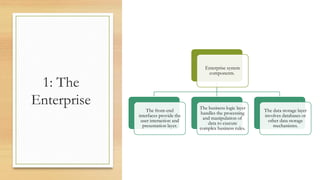
Enterprise system
components.
The front-end
interfaces provide the
user interaction and
presentation layer.
The business logic layer
handles the processing
and manipulation of
data to execute
complex business rules.
The data storage layer
involves databases or
other data storage
mechanisms.
2: Java as a
Tool for
Enterprise
Development
Java is a widely used programming language in
enterprise development due to its extensive set
of features and capabilities
Java's object-oriented programming paradigm
allows developers to model complex systems
using objects, classes, and inheritance
The Java language provides a rich set of libraries
and frameworks that facilitate various aspects of
enterprise development, such as database
connectivity, web services, and messaging
3: The
Database
Databases are a fundamental component
of enterprise systems as they provide a
structured and efficient way to store and
manage large volumes of data
In an enterprise context, the most
commonly used type of database is the
relational database, which organizes data
into tables with rows and columns
Relational databases are based on the
relational model, which establishes
relationships between tables using keys
4: Database
Programming
The integration of Java and databases
is facilitated by the Java Database
Connectivity API
JDBC provides a standardized set of
classes and interfaces that enable Java
applications to interact with databases
JDBC provides mechanisms to control
transactions and handle transactional
failures

Database Programming with JDBC Section 1.pdf

  • 1.
  • 2.
    Outlines • 1. TheEnterprise overview • 2. Java as a Tool for Enterprise Development • 3. The Database • 4. Database Programming
  • 3.
    1: The Enterprise In thefield of computer science, enterprise computing refers to the development and deployment of software systems that are critical to the operations of large organizations These systems are designed to handle complex business processes, support a high number of users, and integrate with various other systems Enterprise applications differ from regular applications in terms of their complexity and requirements Security measures need to be implemented to protect against potential threats like data breaches or unauthorized access
  • 4.
    1: The Enterprise Enterprise system components. Thefront-end interfaces provide the user interaction and presentation layer. The business logic layer handles the processing and manipulation of data to execute complex business rules. The data storage layer involves databases or other data storage mechanisms.
  • 5.
    2: Java asa Tool for Enterprise Development Java is a widely used programming language in enterprise development due to its extensive set of features and capabilities Java's object-oriented programming paradigm allows developers to model complex systems using objects, classes, and inheritance The Java language provides a rich set of libraries and frameworks that facilitate various aspects of enterprise development, such as database connectivity, web services, and messaging
  • 6.
    3: The Database Databases area fundamental component of enterprise systems as they provide a structured and efficient way to store and manage large volumes of data In an enterprise context, the most commonly used type of database is the relational database, which organizes data into tables with rows and columns Relational databases are based on the relational model, which establishes relationships between tables using keys
  • 7.
    4: Database Programming The integrationof Java and databases is facilitated by the Java Database Connectivity API JDBC provides a standardized set of classes and interfaces that enable Java applications to interact with databases JDBC provides mechanisms to control transactions and handle transactional failures