Download free for 30 days
Sign in
Upload
Language (EN)
Support
Business
Mobile
Social Media
Marketing
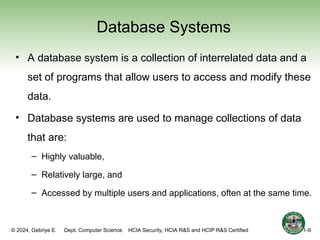
Technology
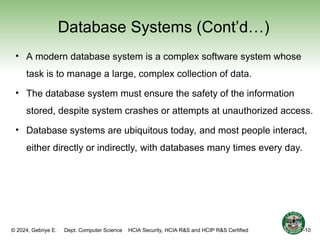
Art & Photos
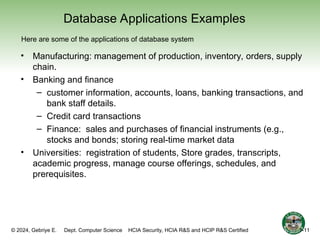
Career
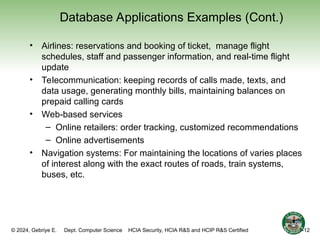
Design
Education
Presentations & Public Speaking
Government & Nonprofit
Healthcare
Internet
Law
Leadership & Management
Automotive
Engineering
Software
Recruiting & HR
Retail
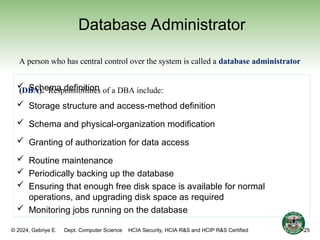
Sales
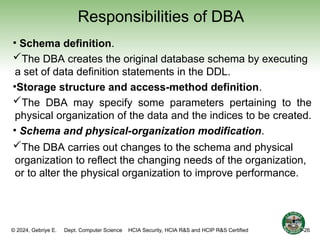
Services
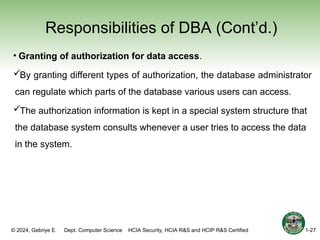
Science
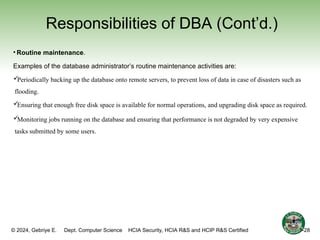
Small Business & Entrepreneurship
Food
Environment
Economy & Finance
Data & Analytics
Investor Relations
Sports
Spiritual
News & Politics
Travel
Self Improvement
Real Estate
Entertainment & Humor
Health & Medicine
Devices & Hardware
Lifestyle
Change Language
Language
English
Español
Português
Français
Deutsche
Cancel
Save
EN
Uploaded by
StrickerMan
PPT, PDF
24 views
Database Management System Lecture SlideCh-1.ppt
Database Management System Ch-1.ppt
Technology
◦
Read more
0
Save
Share
Embed
Embed presentation
Download
Download to read offline
1
/ 29
2
/ 29
3
/ 29
4
/ 29
5
/ 29
6
/ 29
7
/ 29
8
/ 29
9
/ 29
10
/ 29
11
/ 29
12
/ 29
13
/ 29
14
/ 29
15
/ 29
16
/ 29
17
/ 29
18
/ 29
19
/ 29
20
/ 29
21
/ 29
22
/ 29
23
/ 29
24
/ 29
25
/ 29
26
/ 29
27
/ 29
28
/ 29
29
/ 29
More Related Content
PPT
Database Management System Lecture SlideCh-2.ppt
by
StrickerMan
PPTX
Database Management system : UNit I Helping to understand basics of dbms oper...
by
SanthanalakshmiSelva2
PDF
PHP/MySQL First Session Material
by
National IT Professionals Association of Afghanistan
PPT
BILAL_DBMS_UNIT-1.ppt Module 1 vardhaman R22
by
MohammadBilal41787
PPTX
DBMS_Unit_1.pptx
by
Amit Vyas
PDF
DATABASE MANAGEMENT SYSTEMS.pdf
by
NikitaKumari71
PDF
DATABASE MANAGEMENT SYSTEMS university course materials useful for students ...
by
SakkaravarthiS1
PPTX
Database part1-
by
Taymoor Nazmy
Database Management System Lecture SlideCh-2.ppt
by
StrickerMan
Database Management system : UNit I Helping to understand basics of dbms oper...
by
SanthanalakshmiSelva2
PHP/MySQL First Session Material
by
National IT Professionals Association of Afghanistan
BILAL_DBMS_UNIT-1.ppt Module 1 vardhaman R22
by
MohammadBilal41787
DBMS_Unit_1.pptx
by
Amit Vyas
DATABASE MANAGEMENT SYSTEMS.pdf
by
NikitaKumari71
DATABASE MANAGEMENT SYSTEMS university course materials useful for students ...
by
SakkaravarthiS1
Database part1-
by
Taymoor Nazmy
Similar to Database Management System Lecture SlideCh-1.ppt
PDF
Database & Database Users
by
M.Zalmai Rahmani
PDF
Introduction to DBMS and Basic Terminology
by
JakheteSumitraIT
PPTX
Module1.pptxrjkeieuekwkwoowkemehehehrjrjrj
by
kuldeep2405050
PPTX
Basic Database managment system introduction
by
SheebaS25
PDF
Lecture 1 database management system .pdf
by
samerelking3
PDF
INTRODUCTION TO Database Management System (DBMS)
by
Prof Ansari
PPTX
Fundamentals of DBMS
by
Ahmed478619
PPTX
DBMS: Week 01 - Introduction to Databases
by
RashidFaridChishti
PPT
Database Management System Processing.ppt
by
HajarMeseehYaseen
PPTX
Basic of Database Management System(DBMS)
by
anjanasharma77573
PPTX
INTRODUCTION TO DATABASE MANAGEMENT SYSTEM.pptx
by
harinipradeep15
PPT
DBMS an Example
by
Dr. C.V. Suresh Babu
PPT
Cdocumentsandsettingsuser1desktop2 dbmsexamples-091012013049-phpapp01
by
Raza Baloch
PPTX
MADHU.pptx
by
SaiKanna14
PDF
Database :Introduction to Database System
by
ZakriyaMalik2
PDF
UNIT machine learning unit 1,algorithm pdf
by
OmarFarooque9
PPTX
PURPOSE OF DATABASE SYSTEM IN DATABASE MANGENMENT SYSTEM
by
pr6660270
PPTX
DATA BASE MANAGEMENT AND RELATIONAL DATA
by
gomathisankariv2
PPT
INTRODUCTION TO RDBMS
by
Vidhya Balan
PPTX
Database Design can be defined as a set of procedures or collection of tasks ...
by
jeevamahalakshmi
Database & Database Users
by
M.Zalmai Rahmani
Introduction to DBMS and Basic Terminology
by
JakheteSumitraIT
Module1.pptxrjkeieuekwkwoowkemehehehrjrjrj
by
kuldeep2405050
Basic Database managment system introduction
by
SheebaS25
Lecture 1 database management system .pdf
by
samerelking3
INTRODUCTION TO Database Management System (DBMS)
by
Prof Ansari
Fundamentals of DBMS
by
Ahmed478619
DBMS: Week 01 - Introduction to Databases
by
RashidFaridChishti
Database Management System Processing.ppt
by
HajarMeseehYaseen
Basic of Database Management System(DBMS)
by
anjanasharma77573
INTRODUCTION TO DATABASE MANAGEMENT SYSTEM.pptx
by
harinipradeep15
DBMS an Example
by
Dr. C.V. Suresh Babu
Cdocumentsandsettingsuser1desktop2 dbmsexamples-091012013049-phpapp01
by
Raza Baloch
MADHU.pptx
by
SaiKanna14
Database :Introduction to Database System
by
ZakriyaMalik2
UNIT machine learning unit 1,algorithm pdf
by
OmarFarooque9
PURPOSE OF DATABASE SYSTEM IN DATABASE MANGENMENT SYSTEM
by
pr6660270
DATA BASE MANAGEMENT AND RELATIONAL DATA
by
gomathisankariv2
INTRODUCTION TO RDBMS
by
Vidhya Balan
Database Design can be defined as a set of procedures or collection of tasks ...
by
jeevamahalakshmi
Recently uploaded
PDF
20260212 Security-JAWS activity results for 2025 and activity goals for 2026
by
Typhon 666
PDF
GDG Cloud Southlake #49: Pradeep R Kumar: Implications of Agentic AI for Iden...
by
James Anderson
PDF
AI TOOLS FOR PRODUCTIVITY IN MODERN TIMES.pdf
by
Santunu
PDF
Reality Drift: Why Systems Keep Working After Meaning Drops Out
by
Reality Drift Archive | A. Jacobs
PDF
Odoo Implementation Checklist: A Strategic ERP Blueprint for Business-Ready D...
by
BANIBRO IT SOLUTION
PPTX
Real-Time KPI Dashboard Playbook: What to Track Live and What Not To
by
victorworkvebo
PDF
Logical Optimal Actions – Towards Knowledge-based Reinforcement Learning with...
by
Michiaki Tatsubori
PDF
apidays Paris 2025 | API Layer7 Security: Real-World Use Cases (BBVA & Nexi)
by
apidays
PDF
apidays New York 2025 | AI in Application Security
by
apidays
PDF
Escape from the Forbidden Zone: Smuggling green and inclusive tech past the g...
by
BookNet Canada
PPTX
Introducing VisualSim 2610 The Next Leap in System Level Modeling
by
Deepak Shankar
PDF
Agent Factory -AIOUG Multicloud - Feb 2026
by
Sandesh Rao
PDF
Constraint Collapse and Fidelity Decay in Scaled Language Models
by
Semantic Fidelity Lab
PDF
UiPath Modern Automation Playbook -Session 2
by
suhanisingh58689
PDF
TrustArc Webinar - From Trends to Action: Fitting AI Governance into Privacy Ops
by
TrustArc
PDF
Empower your IT team with cloud-based PC management using Dell Management Por...
by
Principled Technologies
PDF
AI Vector Search Best Practices Multicloud Feb 2026
by
Sandesh Rao
PDF
Bringing AI into R&D, Taking a Human-Centric Approach / Haim Yadid
by
Haim Yadid
PPTX
The Transformative Technology in Contemporary Businesses
by
greyaudrina
PDF
Effortless Distributed Systems with Aspire.pdf
by
Particular Software
20260212 Security-JAWS activity results for 2025 and activity goals for 2026
by
Typhon 666
GDG Cloud Southlake #49: Pradeep R Kumar: Implications of Agentic AI for Iden...
by
James Anderson
AI TOOLS FOR PRODUCTIVITY IN MODERN TIMES.pdf
by
Santunu
Reality Drift: Why Systems Keep Working After Meaning Drops Out
by
Reality Drift Archive | A. Jacobs
Odoo Implementation Checklist: A Strategic ERP Blueprint for Business-Ready D...
by
BANIBRO IT SOLUTION
Real-Time KPI Dashboard Playbook: What to Track Live and What Not To
by
victorworkvebo
Logical Optimal Actions – Towards Knowledge-based Reinforcement Learning with...
by
Michiaki Tatsubori
apidays Paris 2025 | API Layer7 Security: Real-World Use Cases (BBVA & Nexi)
by
apidays
apidays New York 2025 | AI in Application Security
by
apidays
Escape from the Forbidden Zone: Smuggling green and inclusive tech past the g...
by
BookNet Canada
Introducing VisualSim 2610 The Next Leap in System Level Modeling
by
Deepak Shankar
Agent Factory -AIOUG Multicloud - Feb 2026
by
Sandesh Rao
Constraint Collapse and Fidelity Decay in Scaled Language Models
by
Semantic Fidelity Lab
UiPath Modern Automation Playbook -Session 2
by
suhanisingh58689
TrustArc Webinar - From Trends to Action: Fitting AI Governance into Privacy Ops
by
TrustArc
Empower your IT team with cloud-based PC management using Dell Management Por...
by
Principled Technologies
AI Vector Search Best Practices Multicloud Feb 2026
by
Sandesh Rao
Bringing AI into R&D, Taking a Human-Centric Approach / Haim Yadid
by
Haim Yadid
The Transformative Technology in Contemporary Businesses
by
greyaudrina
Effortless Distributed Systems with Aspire.pdf
by
Particular Software
Database Management System Lecture SlideCh-1.ppt
1.
Chapter 1: Introduction
to Database Systems Fundamentals of Database Systems (CoSc2041) Prepared by: Gebriye Embafresu Computer Science Department gebriye14@gmail.com Oct 01, 2024
2.
© 2024, Gebriye
E. Dept. Computer Science HCIA Security, HCIA R&S and HCIP R&S Certified Outline • Define what is – Data, – Database – Database Management System, – and Database system • Database System Applications • Purpose of Database Systems • Database system and file based approach • Database users and Administrators 6-2
3.
© 2024, Gebriye
E. Dept. Computer Science HCIA Security, HCIA R&S and HCIP R&S Certified What is Data? • The term data refers to known raw facts about things like people, places, events and concepts. • The word raw indicates that the facts have not yet been processed to reveal their meaning. • Data is any fact that can be recorded (or) stored into a computer hard disk. • there are various forms of data, like video, audio image, graphics, text document, • Data is raw , unprocessed fact. 6-3
4.
© 2024, Gebriye
E. Dept. Computer Science HCIA Security, HCIA R&S and HCIP R&S Certified Information and Knowledge • Information is the processed data presented in a form suitable for human interpretation. • Information is the result of processing raw data to reveal its meaning. • Knowledge: – The body of information and facts about a specific subject. – Knowledge implies familiarity, awareness, and understanding of information as it applies to an environment. – A key characteristic is that new knowledge can be derived from old knowledge. 6-4
5.
© 2024, Gebriye
E. Dept. Computer Science HCIA Security, HCIA R&S and HCIP R&S Certified Database • A database is an organized collection of interrelated data, generally stored and accessed electronically from a computer system. • It contains information relevant to an enterprise. E.g.: Online Banking System, University website, • Management of data involves both defining structures for storage of information and providing mechanisms for the manipulation of information. • The database is an important assets for many organizations. • Database touch all aspects of our lives. 1-5
6.
© 2024, Gebriye
E. Dept. Computer Science HCIA Security, HCIA R&S and HCIP R&S Certified Database (Cont.) • The database is an integrated collection of facts about an organization. • Organization can be a University or a department in a University , Insurance companies, Manufacturing companies, Banks, Airlines, Telecommunications, Governmental and Non- governmental Organizations, Research institutions ,etc. • The database is used as a central data source for other applications 1-6
7.
© 2024, Gebriye
E. Dept. Computer Science HCIA Security, HCIA R&S and HCIP R&S Certified Database Management System • Database Management System is a program or software which is used to define, construct, manipulate, share and retrieve the data in the database. • A database management system (DBMS) is a collection of usually complex pieces of software that allows a user to define, create, manipulate and protect and manage access to a database. • The primary goal of a DBMS is to provide a way to store and retrieve database information that is both convenient and efficient. 1-7
8.
© 2024, Gebriye
E. Dept. Computer Science HCIA Security, HCIA R&S and HCIP R&S Certified Database Management System Functionalities: •Define: Specifying the data type, structure, and constraints for the data to be stored. •Construct: Process of storing data on some storage medium. •Manipulate: Querying the database to retrieve specific data, updating database and generating reports. •Share: Allows multiple users and programs to access the database concurrently. 1-8
9.
© 2024, Gebriye
E. Dept. Computer Science HCIA Security, HCIA R&S and HCIP R&S Certified Database Systems • A database system is a collection of interrelated data and a set of programs that allow users to access and modify these data. • Database systems are used to manage collections of data that are: – Highly valuable, – Relatively large, and – Accessed by multiple users and applications, often at the same time. 1-9
10.
© 2024, Gebriye
E. Dept. Computer Science HCIA Security, HCIA R&S and HCIP R&S Certified Database Systems (Cont’d…) • A modern database system is a complex software system whose task is to manage a large, complex collection of data. • The database system must ensure the safety of the information stored, despite system crashes or attempts at unauthorized access. • Database systems are ubiquitous today, and most people interact, either directly or indirectly, with databases many times every day. 1-10
11.
© 2024, Gebriye
E. Dept. Computer Science HCIA Security, HCIA R&S and HCIP R&S Certified Database Applications Examples • Manufacturing: management of production, inventory, orders, supply chain. • Banking and finance – customer information, accounts, loans, banking transactions, and bank staff details. – Credit card transactions – Finance: sales and purchases of financial instruments (e.g., stocks and bonds; storing real-time market data • Universities: registration of students, Store grades, transcripts, academic progress, manage course offerings, schedules, and prerequisites. Here are some of the applications of database system 1-11
12.
© 2024, Gebriye
E. Dept. Computer Science HCIA Security, HCIA R&S and HCIP R&S Certified Database Applications Examples (Cont.) • Airlines: reservations and booking of ticket, manage flight schedules, staff and passenger information, and real-time flight update • Telecommunication: keeping records of calls made, texts, and data usage, generating monthly bills, maintaining balances on prepaid calling cards • Web-based services – Online retailers: order tracking, customized recommendations – Online advertisements • Navigation systems: For maintaining the locations of varies places of interest along with the exact routes of roads, train systems, buses, etc. 1-12
13.
© 2024, Gebriye
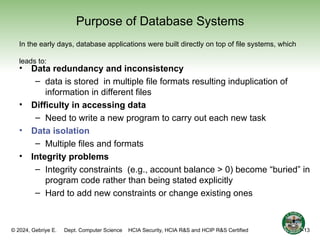
E. Dept. Computer Science HCIA Security, HCIA R&S and HCIP R&S Certified Purpose of Database Systems • Data redundancy and inconsistency – data is stored in multiple file formats resulting induplication of information in different files • Difficulty in accessing data – Need to write a new program to carry out each new task • Data isolation – Multiple files and formats • Integrity problems – Integrity constraints (e.g., account balance > 0) become “buried” in program code rather than being stated explicitly – Hard to add new constraints or change existing ones In the early days, database applications were built directly on top of file systems, which leads to: 13 1-13
14.
© 2024, Gebriye
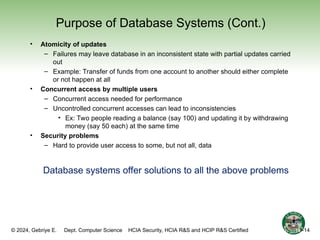
E. Dept. Computer Science HCIA Security, HCIA R&S and HCIP R&S Certified Purpose of Database Systems (Cont.) • Atomicity of updates – Failures may leave database in an inconsistent state with partial updates carried out – Example: Transfer of funds from one account to another should either complete or not happen at all • Concurrent access by multiple users – Concurrent access needed for performance – Uncontrolled concurrent accesses can lead to inconsistencies • Ex: Two people reading a balance (say 100) and updating it by withdrawing money (say 50 each) at the same time • Security problems – Hard to provide user access to some, but not all, data Database systems offer solutions to all the above problems 14 1-14
15.
© 2024, Gebriye
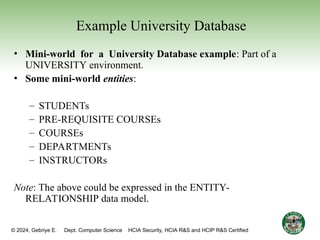
E. Dept. Computer Science HCIA Security, HCIA R&S and HCIP R&S Certified Example University Database • Mini-world for a University Database example: Part of a UNIVERSITY environment. • Some mini-world entities: – STUDENTs – PRE-REQUISITE COURSEs – COURSEs – DEPARTMENTs – INSTRUCTORs Note: The above could be expressed in the ENTITY- RELATIONSHIP data model. 15
16.
© 2024, Gebriye
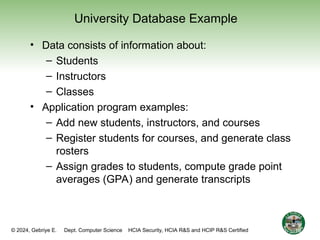
E. Dept. Computer Science HCIA Security, HCIA R&S and HCIP R&S Certified University Database Example • Data consists of information about: – Students – Instructors – Classes • Application program examples: – Add new students, instructors, and courses – Register students for courses, and generate class rosters – Assign grades to students, compute grade point averages (GPA) and generate transcripts 16
17.
© 2024, Gebriye
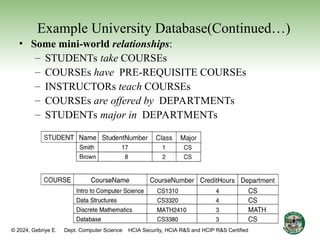
E. Dept. Computer Science HCIA Security, HCIA R&S and HCIP R&S Certified Example University Database(Continued…) • Some mini-world relationships: – STUDENTs take COURSEs – COURSEs have PRE-REQUISITE COURSEs – INSTRUCTORs teach COURSEs – COURSEs are offered by DEPARTMENTs – STUDENTs major in DEPARTMENTs 17
18.
© 2024, Gebriye
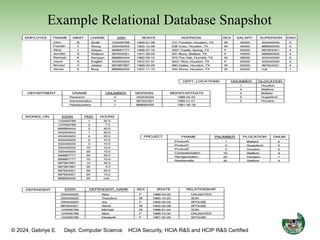
E. Dept. Computer Science HCIA Security, HCIA R&S and HCIP R&S Certified Example Relational Database Snapshot 18
19.
© 2024, Gebriye
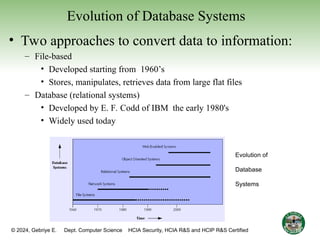
E. Dept. Computer Science HCIA Security, HCIA R&S and HCIP R&S Certified 19 Evolution of Database Systems • Two approaches to convert data to information: – File-based • Developed starting from 1960’s • Stores, manipulates, retrieves data from large flat files – Database (relational systems) • Developed by E. F. Codd of IBM the early 1980's • Widely used today Evolution of Database Systems
20.
© 2024, Gebriye
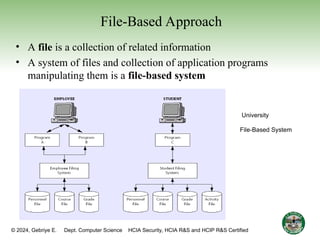
E. Dept. Computer Science HCIA Security, HCIA R&S and HCIP R&S Certified 20 File-Based Approach • A file is a collection of related information • A system of files and collection of application programs manipulating them is a file-based system University File-Based System
21.
© 2024, Gebriye
E. Dept. Computer Science HCIA Security, HCIA R&S and HCIP R&S Certified 21 Limitations of File-Based Approach • Much efforts for ad hoc query answering: – What is the average grade for Mr.Negacy’s student? – List the activities for all students enrolled in CoSc2041. – Which personnel are students as well as staff? • Other limitations: – Duplication of data – Data dependency – Slow development, high maintenance and fixed queries
22.
© 2024, Gebriye
E. Dept. Computer Science HCIA Security, HCIA R&S and HCIP R&S Certified Database Users and Administrators • A primary goal of a database system is to retrieve information from and store new information in the database. • People who work with a database can be categorized as – database users or • Naïve users • Application programmers • Sophisticated users – database administrators. 1-22
23.
© 2024, Gebriye
E. Dept. Computer Science HCIA Security, HCIA R&S and HCIP R&S Certified database users • Naive users are unsophisticated users who interact with the system by using predefined user interfaces, such as web or mobile applications. • The typical user interface for naive users is a forms interface, where the user can fill in appropriate fields of the form. • Naive users may also view read reports generated from the database. 1-23
24.
© 2024, Gebriye
E. Dept. Computer Science HCIA Security, HCIA R&S and HCIP R&S Certified database users • Application programmers are computer professionals who write application programs. Application programmers can choose from many tools to develop user interfaces. • Sophisticated users interact with the system without writing programs. Instead, they form their requests either using a database query language or by using tools such as data analysis software. • Analysts who submit queries to explore data in the database fall in this category. 1-24
25.
© 2024, Gebriye
E. Dept. Computer Science HCIA Security, HCIA R&S and HCIP R&S Certified Database Administrator Schema definition Storage structure and access-method definition Schema and physical-organization modification Granting of authorization for data access Routine maintenance Periodically backing up the database Ensuring that enough free disk space is available for normal operations, and upgrading disk space as required Monitoring jobs running on the database A person who has central control over the system is called a database administrator (DBA). Responsibilities of a DBA include: 1-25
26.
© 2024, Gebriye
E. Dept. Computer Science HCIA Security, HCIA R&S and HCIP R&S Certified Responsibilities of DBA • Schema definition. The DBA creates the original database schema by executing a set of data definition statements in the DDL. •Storage structure and access-method definition. The DBA may specify some parameters pertaining to the physical organization of the data and the indices to be created. • Schema and physical-organization modification. The DBA carries out changes to the schema and physical organization to reflect the changing needs of the organization, or to alter the physical organization to improve performance. 1-26
27.
© 2024, Gebriye
E. Dept. Computer Science HCIA Security, HCIA R&S and HCIP R&S Certified Responsibilities of DBA (Cont’d.) • Granting of authorization for data access. By granting different types of authorization, the database administrator can regulate which parts of the database various users can access. The authorization information is kept in a special system structure that the database system consults whenever a user tries to access the data in the system. 1-27
28.
© 2024, Gebriye
E. Dept. Computer Science HCIA Security, HCIA R&S and HCIP R&S Certified Responsibilities of DBA (Cont’d.) • Routine maintenance. Examples of the database administrator’s routine maintenance activities are: Periodically backing up the database onto remote servers, to prevent loss of data in case of disasters such as flooding. Ensuring that enough free disk space is available for normal operations, and upgrading disk space as required. Monitoring jobs running on the database and ensuring that performance is not degraded by very expensive tasks submitted by some users. 1-28
29.
© 2024, Gebriye
E. Dept. Computer Science HCIA Security, HCIA R&S and HCIP R&S Certified Fundamentals of Database Systems End of Chapter Two !!! Have a nice day!! Never Stop Learning! 1-29
Download