Data Mining A Tutorial Based Primer 1st Edition Roiger Test Bank
Data Mining A Tutorial Based Primer 1st Edition Roiger Test Bank
Data Mining A Tutorial Based Primer 1st Edition Roiger Test Bank
Data Mining A Tutorial Based Primer 1st Edition Roiger Test Bank
Data Mining A Tutorial Based Primer 1st Edition Roiger Test Bank
1.
Visit https://testbankdeal.com todownload the full version and
explore more testbank or solution manual
Data Mining A Tutorial Based Primer 1st Edition
Roiger Test Bank
_____ Click the link below to download _____
https://testbankdeal.com/product/data-mining-a-
tutorial-based-primer-1st-edition-roiger-test-bank/
Explore and download more testbank at testbankdeal.com
2.
Here are somesuggested products you might be interested in.
Click the link to download
Data Mining A Tutorial Based Primer 1st Edition Roiger
Solutions Manual
https://testbankdeal.com/product/data-mining-a-tutorial-based-
primer-1st-edition-roiger-solutions-manual/
Introduction to Data Mining 2nd Edition Tan Solutions
Manual
https://testbankdeal.com/product/introduction-to-data-mining-2nd-
edition-tan-solutions-manual/
Data Mining Concepts and Techniques 3rd Edition Han
Solutions Manual
https://testbankdeal.com/product/data-mining-concepts-and-
techniques-3rd-edition-han-solutions-manual/
QuickBooks Online Plus A Complete Course 2017 2nd Edition
Horne Solutions Manual
https://testbankdeal.com/product/quickbooks-online-plus-a-complete-
course-2017-2nd-edition-horne-solutions-manual/
3.
Principles of Microeconomics11th Edition Case Test Bank
https://testbankdeal.com/product/principles-of-microeconomics-11th-
edition-case-test-bank/
Accounting 27th Edition Warren Test Bank
https://testbankdeal.com/product/accounting-27th-edition-warren-test-
bank/
Understanding the American Promise Volume 1 A History to
1877 3rd Edition Roark Test Bank
https://testbankdeal.com/product/understanding-the-american-promise-
volume-1-a-history-to-1877-3rd-edition-roark-test-bank/
Income Tax Fundamentals 2017 35th Edition Whittenburg
Solutions Manual
https://testbankdeal.com/product/income-tax-fundamentals-2017-35th-
edition-whittenburg-solutions-manual/
HTML5 and CSS Complete 7th Edition Woods Test Bank
https://testbankdeal.com/product/html5-and-css-complete-7th-edition-
woods-test-bank/
4.
Cultural Anthropology CanadianCanadian 4th Edition
Haviland Solutions Manual
https://testbankdeal.com/product/cultural-anthropology-canadian-
canadian-4th-edition-haviland-solutions-manual/
10. What suggestionscan you make for the prevention of existing delays in the
administration of justice?
Topics for Debate
1. The power of the Supreme Court to declare laws unconstitutional should be
taken away.
2. Trial by jury should be abolished in civil cases.
3. The loser in a law suit should not be compelled to pay all the winner’s costs,
including his lawyer’s fees.
7.
1. The landand its
resources.
The source of
America’s
greatness:
2. The initiative and
industry of its
people.
CHAPTER XVII
NATURAL RESOURCES AND CONSERVATION
The purpose of this chapter is to show what nature has done for the United
States, and to explain the relation between national prosperity and natural
resources.
The Things that Make a Nation Great.—
Three things have contributed greatly to the
upbuilding of the American nation. The first is
the wide extent, the richness, and the varied character of American
territory. The United States is not only a vast country, surpassed in
area by very few other countries of the world, but it possesses great
natural advantages. It contains, as will be seen
presently, extensive regions which are well-
suited for almost every form of human activity, including agriculture
in all its branches, manufacture, mining, forestry, transportation, and
trade. It is abundantly provided with natural harbors and waterways.
In soil and climate there is great variety. No other country of the
world can produce so many different things under such favorable
conditions.
But it is not enough that a country shall have
natural resources. It must have a people with
initiative and industry to develop them. The
American people have spent three centuries at the task of making
the land yield its increase and they have much to show for it.
Originally, for the most part, of Anglo-Saxon stock, the population
has been enriched by the addition of immigrants from every country
of the old world. This mingling of many races into one people has
given the nation vigor and versatility. It has helped to develop among
8.
3. The national
deals.
Importanceof the
soil.
The land of the
country is privately
owned.
the American people that alert and progressive spirit which is one of
their most valued characteristics; it has also given strength to
democratic ideals.
The enduring greatness of a nation does not
depend, however, upon its material
achievements alone. It cannot be measured by figures of population
and wealth. What a nation contributes to the progress and
permanence of civilization depends not only upon its economic
prosperity but in an even greater degree upon its spiritual and
intellectual strength. This vast land, so richly endowed by nature and
with its riches so fully utilized by man, has won and can retain its
foremost place among the nations of the world by promoting justice
and contentment among its people, upholding the reign of law,
diffusing education among all, and holding true to the ideals of
democratic government.
The Land.—Soil is the fundamental resource
of any country. Its fertility determines, in large
measure, the size of the population that can be supported. It is
probable that more than thirty per cent of the American people are
today engaged in earning their living from the soil; at any rate the
whole population is in one way or another dependent upon it. From
the soil comes almost our entire food supply.
Outside the original thirteen states practically
the entire area of the country has been at some
period in the hands of the national government
as part of the public domain.[154]
By far the greater part of it, however,
has been sold or granted into private ownership. In the course of this
disposal many corporations and individuals managed to obtain large
tracts of land for very little outlay, because careful attention was not
always given to the administration of the land laws; nevertheless the
policy of selling land cheaply and giving it free to settlers helped to
build up the great Western territories. Out of a public domain which
at one time or another included nearly two-thirds of the entire United
States only six hundred million acres now remain in the federal
government’s hands. Most of this is desert, mountain land, or land
that is otherwise unfit for cultivation.
9.
Some examples of
wastedwealth.
The Need of Conservation.—So long as land remained plentiful
and natural resources seemed to be abundant, very little thought
was given to the possibility that some day both of these things would
become scarce. The land in some parts of the country was
exhausted by wasteful methods of cultivation and then abandoned.
There are thousands of abandoned farms in the
New England states. Coal, iron, and copper
were mined in ways that permitted enormous wastage. Through
negligence much of our forest wealth was destroyed by fire. By the
beginning of the twentieth century it began to dawn upon the people
that the natural resources of the country were rapidly melting away,
that practically all the good land was gone, while the natural
resources in the way of coal and timber were being so wastefully
used that they would both be exhausted within relatively few
decades unless something were done to conserve them. Accordingly
a movement for the conservation of natural resources was started
and since 1900 it has made considerable progress both in securing
the passage of laws and in the education of the public to the urgency
of the situation.
SCIENCE REVEALING THE TREASURES
OF THE EARTH
By Edwin A. Abbey
From a mural painting in the Pennsylvania State
Capitol at Harrisburg.
In this picture the artist portrays an open coal mine
into which several mine-workers are descending. They
are stalwart, young, artless pioneers, eager for
discovery. They impart dramatic energy and realism to
the picture.
Science is pointing the way. She is accompanied by
Fortune, the latter blindfolded and tiptoeing on her
wheel. Grasping Fortune’s right hand is Abundance,
with an overflowing cornucopia, or horn of plenty, on
10.
1. Retention.
1. Retention.
Conservation
meansthree things:
her shoulder. These mythological figures lend the
picture its symbolism.
The artist portrays a great truth. Human labor, wisely
guided by science, has found fortune and abundance
in the mines and quarries of the earth.
SCIENCE REVEALING THE TREASURES OF THE EARTH.
By Edwin A. Abbey
Copyright by Edwin A. Abbey. From a Copley Print, copyright
by Curtis & Cameron, Boston. Reproduced by permission.]
What Conservation Means.—Conservation
means three things: First,
that public lands still in the
hands of the nation and the states shall not be thoughtlessly turned
over to private corporations and individuals for their own profit, but
shall be administered so far as practicable by the public authorities
for the benefit of the whole country; second, that
such portions of our timber, coal, oil, and mineral
11.
3. Replacement.
Other minerals.
Thepresent coal
situation.
Coal and iron.
The earlier practice.
resources as have already passed into private hands shall be so
regulated by law as to prevent their wasteful exploitation; and third,
that the government shall do its best to
encourage the replacement of such natural
resources as can be replaced (for example, by the reforesting of land
and the restocking of lakes with fish).
The Mines.—No country can ever become
great in industry unless it has ready access to
minerals, especially iron and coal. It was the possession of iron and
coal in great quantities that served to make England during the
nineteenth century the industrial leader of Europe. Various regions of
the United States possess these great stores of mineral wealth and
have made good use of them. There is one great difference between
mineral resources and other natural resources, namely, that when
minerals are once taken from the earth there is no way of renewing
them. Soil can be replenished, and forests regrown; but minerals
form an endowment which, when once drawn from the bowels of the
earth, can never be replaced. Hence the urgent need for a policy of
conserving these important sources of national wealth. Coal and
iron, while they are the natural resources upon which the growth of
industry mainly depends, are not the only forms of wealth drawn
from below the surface of the ground in this country. In the mining of
silver and gold the United States is one of the
foremost among the various producing
countries. Copper, lead, oil, zinc, aluminum, quicksilver, and other
natural materials are also taken from the earth in large quantities
each year.
The Conservation of Coal, Oil, and
Minerals.—Until about fifty years ago, land
containing coal or other mineral resources was sold and granted by
the government like any other lands. The individual or corporation
became the owner of whatever wealth might happen to lie beneath
the surface. In this way an enormous amount of wealth was
practically given away. It was not until a few years ago that the
government decided to reserve for itself all coal and minerals which
might be discovered in lands given to settlers.
But this action came too late, for most of the
12.
Conservation of oil.
Thewastage of our
forest wealth.
coal-bearing lands had already passed into private ownership. By its
failure to take due thought for the morrow the government had sold,
for a few dollars per acre, what might have been a source of
enormous revenue. If the practice of reserving the right to all coal,
oil, and minerals in granted lands had been adopted in 1810 instead
of in 1910 the value of these rights today would be greater than the
entire national debt.
A large and steady supply of coal is of the utmost value to
industry; in fact modern industry depends upon it. Yet when coal is
once taken out and burned it cannot be replaced; there is only so
much of it in the country and when that is gone there will be no more.
It took nature many millions of years to produce the coal that is there
now. At the present rate of increase in yearly consumption all the
coal that is known to exist in the United States will be gone in about
one hundred and fifty years. Some saving can be made by the use of
oil and water power. Some economies in mining and in the use of
coal are also possible. But these will hardly avail to prevent the
ultimate exhaustion of the supply. At best we can only set that day a
bit further off.
Speaking of oil, the amount of crude
petroleum or fuel oil now actually known to be
available in the United States will be exhausted in less than fifty
years if the present rate of consumption is maintained. There is
every likelihood that this rate of consumption will be increased owing
to the greater use of gasoline and kerosene for motor power. Large
quantities of oil, however, are, available in Mexico. Within recent
years it has been hoped that, with the progress of mechanical
appliances, it will be practicable to obtain oil from shale rock.
The Forests.—When the first European
settlers came to America, the colonists
depended heavily upon the forests. From the woods they obtained
timber for their houses and barns, wood for fuel and, by hunting, a
considerable part of their food supply. In all stages of civilization men
have depended upon the forests to satisfy many of their diversified
wants. Nowadays steel has taken the place of timber in the
construction of buildings and ships; coal and oil have largely
replaced wood as fuel; the days when men subsisted by hunting are
13.
The Timber and
StoneAct, 1878.
Forest reserves.
The earlier practice.
Forest policy of the
states.
past; and mankind is no longer so heavily dependent upon the
forests as in the olden days. Yet the forests of America are still a
great source of wealth even though the timber resources have been
heavily drawn upon during the past hundred years. This is one of the
natural resources which has been wastefully used and it is only in
recent years that attention has been given to conserving what is left
of it. The forests are needed, not only as a source of timber supply,
but in order to preserve the fertility of the soil and to retain in it the
moisture which is otherwise evaporated or run off.
The Conservation of Timber.—In the days
when so much of the land was covered with
timber the chief concern was to get it out of the way so that the
ground could be used for agriculture. No one seemed to realize that
the day would ever come when forest land would be more valuable
than corn land. Before 1878 the national government sold off many
million acres of valuable forest land at low prices to individuals and
corporations and they, in turn, used it in whatever ways would yield
the largest profit to themselves. By the Timber
and Stone Act of 1878, however, it was provided
that only a limited area of government land containing timber or
stone could be sold to any one person or corporation and then only
at a higher price than agricultural land. But even this did not prove a
sufficient measure of waste-prevention, and in 1891 Congress
adopted the policy of withdrawing large areas of government forest
land from the market altogether. These tracts
were set aside as national forest reservations
and today there are about one hundred and fifty million acres set
apart to ensure the country’s future supply of timber. The national
government is also permitted to buy from private owners forest lands
in the watersheds of navigable streams in order to protect the natural
flow in such waterways. The administration of all the forest
reservations is in the hands of the United States Forest Service,
which forms part of the Department of Agriculture.
The area of timber land owned by the states,
by corporations, and by individuals is very much
greater than that contained in the national reservations. It is here,
moreover, that the greatest amount of waste is taking place. Forest
14.
Water power.
Harbors, lakes,and
waterways.
fires, most of which are due to carelessness, burn up enormous
quantities of timber every year. The states which still possess
considerable forest resources, such as New York, Minnesota, and
California, are also adopting the policy of creating reservations and
everywhere more effective measures are being taken to prevent
destruction by forest fires. These measures include the maintenance
of fire patrols, the construction of fire-breaks on the ridges of hills,
the clearing out of underbrush, and the stricter supervision of
camping parties.
Timber, fortunately, is a natural resource which can be replaced.
Lands which have been cut-over can be reforested and used to
supply timber for future generations. Large trees take a long time to
mature, however, and the lands which are being planted with
seedlings today will not be yielding material for the sawmill until the
middle of the twentieth century has faded into the past. Both the
national and state governments are now reforesting on a large scale.
To some extent private corporations and individuals have followed
their lead.
Other Natural Resources.—All the nation’s
wealth does not come, however, from the fields,
the mines, and the forests. In fisheries America leads the entire
world. The harbors and the waterways of the country are as
important to commerce as the soil is to agriculture. No other country
is better provided with natural harbors, lakes, and navigable rivers
than the United States. All the largest cities are located upon them,
and were it not for the waterways, we would not have the great
cities. Run over in your mind the ten or fifteen largest cities of the
United States and see if you can name any that are not situated on
one of the oceans, the Great Lakes, the great navigable rivers, or on
the Gulf of Mexico. It is not a mere accident that none of the great
industrial centers are without facilities for trade by water. Geography,
not man, determines for the most part the situation of all great
industrial communities. Water power is another natural heritage.
From the giant Niagara to the smallest cataract,
thousands of these water powers have been
harnessed and made to function as the servant of man, running
factories and generating electricity. Water power does the work of
15.
The energy ofman
cannot replace the
bounty of nature.
How geography
determines a
nation’s progress.
Natural resources
and national power.
coal.[155]
Its presence has often determined the location of large
industries.
Geography and the Future.—From what has
been said in the last four sections it will thus be
seen that natural resources are a great factor in
determining the progress and prosperity of a nation. No amount of
intelligence and industry on the part of the
people will ensure rapid economic progress if
they occupy a country which lacks a fertile soil,
is devoid of minerals, possesses no forests or fisheries, and is
deficient in natural harbors and waterways. Man can do much, but
his powers are limited without the aid of nature. Animals and plants
can be carried from one part of the world to another and made to
thrive in their new environment; but mineral resources were laid
down many millions of years ago in certain definite places and there
they have stayed. A country which has no mineral resources cannot
create them by the genius or industry of its people. On the other
hand, if great natural resources are at hand, progress becomes
merely a question of applying human intelligence and industry to
these resources. The rise of the American nation to its present
position, therefore, is not surprising, although it has taken a relatively
short period of time. It is the joint result of nature’s bounty and man’s
efficiency. To which of these we owe the larger share of the nation’s
progress no one can say. If the country had lacked either, it could not
have progressed in any such measure during the past three hundred
years.
The same things have been true of other
countries. England, during the greater part of the
nineteenth century, was the leading industrial country of the world.
This was unquestionably due not only to the enterprise of
Englishmen but to the great natural resources of the country in coal
and iron. When Germany defeated France in 1870 she took away
from the French certain territories which were rich in minerals. With
the aid of these materials Germany in the course of fifty years was
able to become a great industrial power. Now, as the result of the
World War, the French have recovered these territories and we may
look for a marked revival in the industries of France. During the
16.
How geography will
influencethe future
progress of
America.
peace negotiations more importance was attached to small areas of
coal and mineral lands than to whole provinces of agricultural land.
As the mineral resources of older countries become exhausted it is
altogether likely that industrial supremacy will pass with them. New
countries, which today have unexplored possibilities in coal and iron,
will then have their turn in industrial prominence. Who knows where
the balance of industrial power will be lodged a hundred years
hence. China, for aught we know, may be the chief manufacturing
country of the world in the twenty-first century. If we knew exactly
how long the natural resources of Europe and America will hold out,
and if we knew also just how much mineral wealth there is in the Far
East, we could predict these things with reasonable certainty.
Certain it is, at any rate, that the past history
of America has been determined, in no small
degree, by geographical conditions. The same
factors are likely to influence the future. The
country is becoming less agricultural, less dependent upon the soil.
As it becomes more industrial our dependence upon its other natural
resources, upon coal, iron, oil, copper, timber, and water power must
necessarily increase. The commerce of the country keeps on
growing, and with this growth the reliance of the nation upon its
harbors and waterways will inevitably become greater. As population
expands there will be a heavier demand upon the food supply and
the time will doubtless come when the United States will have no
food for export. Indeed the day may arrive when agricultural products
will have to be imported from outside. All this points to the need for
emphasis upon conservation. It means that we should avoid all
wastage of natural resources. The fertility of the soil should be
preserved by scientific methods of agriculture. The mineral wealth of
the country should be utilized in such a way as to give the greatest
advantage over the longest period of time. We must reforest our
unused lands. Harbors and waterways should be developed to aid
commerce. If these things are done, America can face the future with
confidence.
General References
17.
Gregory, Keller, andBishop, Physical and Commercial Geography of the
United States, pp. 252-350;
A. P. Brigham, Geographic Influences in American History, especially pp. 70-
104;
E. C. Semple, Influences of Geographic Environment, pp. 51-71;
O. W. Price, The Land We Live In, pp. 99-138;
N. S. Shaler, Man and the Earth, pp. 1-19;
C. R. Van Hise, The Conservation of Natural Resources in the United States,
especially pp. 263-306;
T. N. Carver, Sociology and Social Progress, pp. 174-270 (The Influence
Exerted by Physical Laws over the Organization of Society and the Character of
Individuals, by T. H. Buckle); Ibid., Principles of National Economy, pp. 3-14; 123-
152;
C. A. Beard, American Government and Politics, pp. 405-416; Ibid., Readings in
American Government and Politics, pp. 368-374;
P. S. Reinsch, Readings in American Federal Government, pp. 538-589;
M. H. Gregory, Checking the Waste, pp. 42-85;
Isaac Lippincott, Economic Development of the United States, pp. 149-182.
Isaiah Bowman, The New World: Problems in Political Geography (see index).
Group Problems
1. The civilization of the future as determined by the exhaustion and
development of natural resources. When European and American resources in
coal, oil, and iron give out, what substitutes can be used and to what extent? What
countries have the resources to enable them to forge ahead when that time
comes? Show the connection between industrial progress and each type of natural
wealth. Consider whether there is any way in which a country may keep its
industrial supremacy despite the exhaustion of natural wealth. References:
Encyclopedia Britannica; Statesman’s Year Book; Gregory, Keller, and Bishop,
Physical and Commercial Geography, especially pp. 252-350; 384-394; C. R. Van
Hise, The Conservation of Natural Resources in the United States, especially pp.
359-379; H. T. Buckle, History of Civilization in England, Vol. I (1868 edition), pp.
39-151; Isaiah Bowman, The New World, passim.
2. Conservation and its apostles, especially President Roosevelt.
References: H. R. Burch, American Economic Life, pp. 101-108; C. R. Van Hise,
The Conservation of Natural Resources in the United Stales, pp. 1-14; 359-379;
Ely, Hess, Leith, and Carver, Foundations of National Prosperity, pp. 19-20;
Gifford Pinchot, The Fight for Conservation, pp. 40-70; Theodore Roosevelt,
Autobiography, pp. 408-436.
3. The coal industry: its past, present, and future. References: W. J.
Nicolls, The Story of American Coal; Peter Roberts, The Anthracite Coal
Industry, pp. 3-16; 212-227; Ely, Hess, Leith, and Carver, The Foundations of
National Prosperity, pp. 191-209.
18.
Short Studies
1. Therelation of human progress to geographic conditions. Gregory,
Keller, and Bishop, Physical and Commercial Geography, pp. 126-179; T. H.
Buckle, History of Civilization, I, pp. 174-270.
2. What are the fundamental factors in national prosperity? T. N. Carver,
Principles of National Economy, pp. 3-15; Isaac Lippincott, Economic
Development of the United States, pp. 14-34.
3. American forest reservations. H. D. Boerker, Our National Forests, pp.
170-232; O. W. Price, The Land We Live In, pp. 65-98; Ernest Bruncken, North
American Forests and Forestry (1900), pp. 161-182; U. S. Department of
Agriculture, Forest Service, Circulars.
4. The oil situation. David White, in the Annals of the American Academy of
Political and Social Science (May, 1920); C. R. Van Hise, The Conservation of
Natural Resources in the United States, pp. 47-61.
5. The growth of the iron and steel industry. H. N. Casson, The Romance of
Steel, pp. 1-26; 72-100; J. R. Smith, The Story of Iron and Steel, pp. 108-126;
Andrew Carnegie, Autobiography, pp. 130-197.
6. The conservation of water power. C. R. Van Hise, Conservation of Natural
Resources in the United States, pp. 144-161.
7. The conservation of iron and copper. Ely, Hess, Leith, and Carver,
Foundations of National Prosperity, pp. 210-231.
8. The settlement and use of the national domain. Albert Shaw, Political
Problems of American Development, pp. 87-115.
9. The homestead system. C. R. Van Hise, Conservation of Natural Resources
in the United States, pp. 279-287; G. M. Stephenson, The Political History of the
Public Lands, pp. 190-245.
10. The reclamation of desert and swamp lands. H. R. Burch, American
Economic Life, pp. 93-99.
Questions
1. Mark on an outline map the chief geographical divisions of the United States.
State the chief characteristics of each.
2. Locate on the map the chief agricultural areas, the chief mining districts, the
chief industrial centers, and the chief harbors of the United States.
3. Why do the great railroads of the United States run east and west rather than
north and south?
4. Do you approve of granting free lands to bona fide settlers? Under what
restrictions?
5. Mark on the map the location of (a) the principal coal areas; (b) the principal
oil-bearing areas; (c) the national forests.
6. Show what natural resources are utilized in the building of a house, from
cellar to garret, and tell what section of the United States is the largest center of
19.
production for (a)oak timber; (b) glass; (c) steel beams; (d) electric wire; (e) sewer
pipe.
7. Name the harbors of the United States in the order of their (a) natural
advantages; (b) commercial importance.
8. Compare the general geographical advantages of North and South America.
To what extent has the difference in the relative economic progress of the two
continents been due to geographical differences?
9. Which do you regard as the more urgent need at the present day: the
conservation of timber or of coal or of oil? Give your reasons.
10. Compare the relative geographical advantages of the following cities:
Pittsburgh, Detroit, Atlanta, San Francisco, Baltimore.
Topics for Debate
1. The United States should adopt a rental system for all public lands on which
there are mineral resources or water powers.
2. The United States should insist upon free access to foreign natural resources
(for example, in Mexico).
20.
The crops inearlier
days.
1. Mixed farming.
CHAPTER XVIII
THE AGRICULTURAL INTERESTS
The purpose of this chapter is to show the large part which agriculture plays
in the life of the country and to discuss briefly some of the problems of
agriculture today.
Importance of American Agriculture.—Agriculture has always
been the most important single industry in the United States. It was
at one time practically the sole occupation of the
people; even today it directly or indirectly
engages the attention of more than half the adult male workers of the
country. In colonial days the chief task of the people was to raise a
food supply sufficient for themselves. Corn was their principal crop,
the colonists having learned from the Indians the methods of
cultivating it. Corn had the advantage of being well suited to the soil
and climate; besides it grows well even in partially cleared land. But
in colonial days and even for a time after the Revolution the country
did not produce much grain beyond its own needs. The production of
large quantities for export came with the opening up of the great
agricultural areas of the West.
Types of Agricultural Activity.—American
agriculture has developed, during the past three
hundred years, in five or six different directions. The earliest settlers
in the northern colonies devoted themselves to general or mixed
farming, in other words to the raising of grain, hay, and cattle on the
same tract of land. This was because the environment and needs of
the northern region alike favored this method. Mixed farming has
continued to be the mainstay of agriculture east of the Alleghenies;
in some measure it has spread to other parts of the country as well.
21.
2. Staple or
plantationfarming.
3. Cereal growing.
A second type of agriculture, almost from the
very outset, made progress in the South. This
involved the raising of certain staple products, such as rice, tobacco,
sugar, and cotton on large plantations. The soil, climate, and general
environment of the southern colonies all lent themselves to this type
of agriculture and it eventually spread itself over the whole region.
Cotton in time out-stripped the other staples and became king of the
whole South. This was largely because the invention of the cotton
gin, an appliance for removing the seeds from the fibre, greatly
reduced the cost of preparing cotton for the market. The scarcity of
free labor to work these great plantations led to the importation of
negro slaves and the institution of slavery had a profound effect
upon the subsequent course of American history. Since the
emancipation of the negroes, the plantation system has remained
although many of the larger tracts have been broken up into small
holdings.
The opening of the Middle West and
Mississippi Valley brought in a third form of
agricultural activity, namely, the production of cereals (such as corn,
wheat, oats, rye, and barley) on great tracts of prairie land. This form
of agricultural production received a great impetus from the invention
of labor-saving machinery, notably the power-reaper. The region of
extensive cereal production today includes the Middle West, the
Northwest, and the Mississippi Valley, making the richest grain-
growing area in the world.
22.
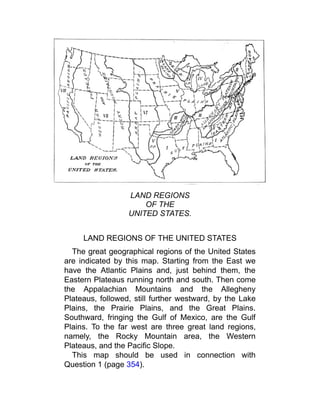
LAND REGIONS
OF THE
UNITEDSTATES.
LAND REGIONS OF THE UNITED STATES
The great geographical regions of the United States
are indicated by this map. Starting from the East we
have the Atlantic Plains and, just behind them, the
Eastern Plateaus running north and south. Then come
the Appalachian Mountains and the Allegheny
Plateaus, followed, still further westward, by the Lake
Plains, the Prairie Plains, and the Great Plains.
Southward, fringing the Gulf of Mexico, are the Gulf
Plains. To the far west are three great land regions,
namely, the Rocky Mountain area, the Western
Plateaus, and the Pacific Slope.
This map should be used in connection with
Question 1 (page 354).
23.
4. Cattle raising.
Miscellaneous
activities.
Sizeof the various
crops.
As the frontier rolled westward to the foothills
of the Rocky Mountains a fourth type of
agriculture—using the term in its wider sense—began to make rapid
strides. This was the stock-raising industry, the production of horned
cattle and sheep on large tracts of grazing land or ranches. This
branch of agricultural activity has made its greatest progress in the
Middle Southwest and upon the upland states just east of the
Rockies (Montana, Wyoming, etc.). Cattle are raised on the ranches,
then shipped to the corn belt where they are fattened before being
sent to the abattoirs at St. Louis and Chicago.[156]
Other branches of agriculture which have
developed largely within the past half century
are dairying, market gardening, and fruit growing. These activities
are not confined to any one section of the country but to a
considerable extent are carried on everywhere. Dairying and market
gardening have made most progress within convenient distance of
the large cities, although improved transportation facilities in the way
of air-cooled and refrigerator cars now permit the shipment of dairy
and garden produce over long distances.
From all this it can be seen that when one speaks of the interests
of agriculture a great many different things are included. The
agriculture of the United States is diversified to an extent that is
found in no other country.
The Value of American Agricultural
Products.—The largest cereal crop produced in
the United states is corn; the total in some years runs as high as
three billion bushels. This is more than twice the amount of corn
grown in all the rest of the world. Oats come next, with about one
and one-half billion bushels in the best years, and wheat third, with a
round billion or thereabouts. Cotton is the largest staple crop, with an
annual yield of from ten to fifteen billion bales, each bale containing
five hundred pounds. Of this nearly half is exported. More than
twelve million cattle are received each year at the great abattoirs,
besides an equal number of sheep and twice as many hogs.
The value of this enormous agricultural production, if stated in
dollars and cents, would be misleading because prices change from
24.
How the war
stimulated
Americanfood
production.
An example of
increasing returns.
year to year; the fluctuations are often considerable within a very
short period of time.[157]
But in any case the contribution which
agriculture makes to the yearly income of the nation is enormous.
Upon it the national prosperity depends in a very great measure.
American Agriculture and the War.—
American agriculture had a very important part
in winning the World War. As this great struggle
progressed the task of providing food for the
Allied armies and for the civilian populations became month by
month more difficult. Men were drawn off the farms of Europe to fight
and the fields went uncultivated; practically the whole of Belgium and
a considerable part of France were in the hands of the enemy; no
supplies could be drawn from remote parts of the world such as
Australia, South America, or the Far East because the available
ships were needed to carry troops and munitions; so the American
farmer had to speed up production in order to save the situation.
When America entered the war the Allies had practically reached the
end of their resources in foodstuffs; their populations were living
under a rigid system of food rationing. Under the stimulation of this
great emergency American agriculture rose to the occasion and the
increased production of foodstuffs, together with the savings which
were made through the observance of “wheatless” and “meatless”
days enabled the United States not only to maintain an army of two
million soldiers in France but to contribute largely to the food
supplies of the Allied armies and civilian populations as well. The
supply trains which fed the American army in France (and never on a
single day did they fail to reach the front), started from Kansas City
and Chicago, not from Brest or Havre. The American farmer was the
great factor in this service of supply.
A Peculiarity of Agricultural Production—
The Law of Diminishing Returns.—There is
one fundamental feature in which agriculture differs from industry. In
industry, as a rule, the more labor and capital you apply the greater
the amount of the produce. Many industries, indeed, are so
constituted that by applying additional capital and labor you obtain
more than proportionate returns. Take the book-binding industry, for
example. A small shop, employing three men, might bind and stamp
25.
An illustration of
decreasingreturns.
two hundred books per day at a cost of twenty cents per book. But a
large establishment, employing a hundred workers with modern
machinery can easily put through many thousand books at half the
cost per volume. A manufacturer, if he is wise, finds out what
branches of his business are most profitable. Then he applies more
capital and labor in that direction so as to increase his earnings, and
devotes less attention to the things which cannot be made so
profitably. This is known as production under the law of increasing
returns.
But in agriculture the situation is quite different. Any farmer or
ranchman will tell you, if you ask him, that some of his land is better
than the rest and yields him greater profit for the capital and labor
applied to it. But if you thereupon suggest to him that he should
devote all his attention to this particular piece of land, and neglect
the rest, he would think very poorly of your intelligence. And rightly
so, for if he applied more labor and capital to his
best land, he would not be sure of getting a
crop-increase in proportion; on the contrary, he would be quite safe
in saying that, after a certain point, his extra labor and capital would
bring him less than proportionate returns. An investment of ten
dollars per acre may result in a crop of fifteen bushels per acre. It is
very doubtful whether by applying twenty dollars worth of capital and
labor to the land this yield could be doubled and it is quite certain
that it could not be trebled by spending thirty dollars per acre on the
land. In other words, agriculture is carried on, for the most part,
under the law of diminishing returns, which may be briefly defined by
saying that, “if at any given time, the amount of labor and capital
applied to agricultural land is increased beyond a certain point, the
increased investment will yield less than proportionate returns”. If
this were not the case, no one would ever cultivate the poorer lands.
We would raise our entire crops from the most fertile tracts. The
point at which the returns will begin to diminish can never be exactly
fixed, for improvements in the methods of agriculture may place it
further ahead. These improved methods also bring into cultivation
lands which otherwise would not be utilized.
Another Peculiarity of Agriculture—Limitations on Division of
Labor.—In one other fundamental feature there is a difference
26.
Welcome to ourwebsite – the ideal destination for book lovers and
knowledge seekers. With a mission to inspire endlessly, we offer a
vast collection of books, ranging from classic literary works to
specialized publications, self-development books, and children's
literature. Each book is a new journey of discovery, expanding
knowledge and enriching the soul of the reade
Our website is not just a platform for buying books, but a bridge
connecting readers to the timeless values of culture and wisdom. With
an elegant, user-friendly interface and an intelligent search system,
we are committed to providing a quick and convenient shopping
experience. Additionally, our special promotions and home delivery
services ensure that you save time and fully enjoy the joy of reading.
Let us accompany you on the journey of exploring knowledge and
personal growth!
testbankdeal.com





![3. The national
deals.
Importance of the
soil.
The land of the
country is privately
owned.
the American people that alert and progressive spirit which is one of
their most valued characteristics; it has also given strength to
democratic ideals.
The enduring greatness of a nation does not
depend, however, upon its material
achievements alone. It cannot be measured by figures of population
and wealth. What a nation contributes to the progress and
permanence of civilization depends not only upon its economic
prosperity but in an even greater degree upon its spiritual and
intellectual strength. This vast land, so richly endowed by nature and
with its riches so fully utilized by man, has won and can retain its
foremost place among the nations of the world by promoting justice
and contentment among its people, upholding the reign of law,
diffusing education among all, and holding true to the ideals of
democratic government.
The Land.—Soil is the fundamental resource
of any country. Its fertility determines, in large
measure, the size of the population that can be supported. It is
probable that more than thirty per cent of the American people are
today engaged in earning their living from the soil; at any rate the
whole population is in one way or another dependent upon it. From
the soil comes almost our entire food supply.
Outside the original thirteen states practically
the entire area of the country has been at some
period in the hands of the national government
as part of the public domain.[154]
By far the greater part of it, however,
has been sold or granted into private ownership. In the course of this
disposal many corporations and individuals managed to obtain large
tracts of land for very little outlay, because careful attention was not
always given to the administration of the land laws; nevertheless the
policy of selling land cheaply and giving it free to settlers helped to
build up the great Western territories. Out of a public domain which
at one time or another included nearly two-thirds of the entire United
States only six hundred million acres now remain in the federal
government’s hands. Most of this is desert, mountain land, or land
that is otherwise unfit for cultivation.](https://image.slidesharecdn.com/8937-250225055424-24c98bdd/85/Data-Mining-A-Tutorial-Based-Primer-1st-Edition-Roiger-Test-Bank-8-320.jpg)
![1. Retention.
1. Retention.
Conservation
means three things:
her shoulder. These mythological figures lend the
picture its symbolism.
The artist portrays a great truth. Human labor, wisely
guided by science, has found fortune and abundance
in the mines and quarries of the earth.
SCIENCE REVEALING THE TREASURES OF THE EARTH.
By Edwin A. Abbey
Copyright by Edwin A. Abbey. From a Copley Print, copyright
by Curtis & Cameron, Boston. Reproduced by permission.]
What Conservation Means.—Conservation
means three things: First,
that public lands still in the
hands of the nation and the states shall not be thoughtlessly turned
over to private corporations and individuals for their own profit, but
shall be administered so far as practicable by the public authorities
for the benefit of the whole country; second, that
such portions of our timber, coal, oil, and mineral](https://image.slidesharecdn.com/8937-250225055424-24c98bdd/85/Data-Mining-A-Tutorial-Based-Primer-1st-Edition-Roiger-Test-Bank-10-320.jpg)
![The energy of man
cannot replace the
bounty of nature.
How geography
determines a
nation’s progress.
Natural resources
and national power.
coal.[155]
Its presence has often determined the location of large
industries.
Geography and the Future.—From what has
been said in the last four sections it will thus be
seen that natural resources are a great factor in
determining the progress and prosperity of a nation. No amount of
intelligence and industry on the part of the
people will ensure rapid economic progress if
they occupy a country which lacks a fertile soil,
is devoid of minerals, possesses no forests or fisheries, and is
deficient in natural harbors and waterways. Man can do much, but
his powers are limited without the aid of nature. Animals and plants
can be carried from one part of the world to another and made to
thrive in their new environment; but mineral resources were laid
down many millions of years ago in certain definite places and there
they have stayed. A country which has no mineral resources cannot
create them by the genius or industry of its people. On the other
hand, if great natural resources are at hand, progress becomes
merely a question of applying human intelligence and industry to
these resources. The rise of the American nation to its present
position, therefore, is not surprising, although it has taken a relatively
short period of time. It is the joint result of nature’s bounty and man’s
efficiency. To which of these we owe the larger share of the nation’s
progress no one can say. If the country had lacked either, it could not
have progressed in any such measure during the past three hundred
years.
The same things have been true of other
countries. England, during the greater part of the
nineteenth century, was the leading industrial country of the world.
This was unquestionably due not only to the enterprise of
Englishmen but to the great natural resources of the country in coal
and iron. When Germany defeated France in 1870 she took away
from the French certain territories which were rich in minerals. With
the aid of these materials Germany in the course of fifty years was
able to become a great industrial power. Now, as the result of the
World War, the French have recovered these territories and we may
look for a marked revival in the industries of France. During the](https://image.slidesharecdn.com/8937-250225055424-24c98bdd/85/Data-Mining-A-Tutorial-Based-Primer-1st-Edition-Roiger-Test-Bank-15-320.jpg)
![4. Cattle raising.
Miscellaneous
activities.
Size of the various
crops.
As the frontier rolled westward to the foothills
of the Rocky Mountains a fourth type of
agriculture—using the term in its wider sense—began to make rapid
strides. This was the stock-raising industry, the production of horned
cattle and sheep on large tracts of grazing land or ranches. This
branch of agricultural activity has made its greatest progress in the
Middle Southwest and upon the upland states just east of the
Rockies (Montana, Wyoming, etc.). Cattle are raised on the ranches,
then shipped to the corn belt where they are fattened before being
sent to the abattoirs at St. Louis and Chicago.[156]
Other branches of agriculture which have
developed largely within the past half century
are dairying, market gardening, and fruit growing. These activities
are not confined to any one section of the country but to a
considerable extent are carried on everywhere. Dairying and market
gardening have made most progress within convenient distance of
the large cities, although improved transportation facilities in the way
of air-cooled and refrigerator cars now permit the shipment of dairy
and garden produce over long distances.
From all this it can be seen that when one speaks of the interests
of agriculture a great many different things are included. The
agriculture of the United States is diversified to an extent that is
found in no other country.
The Value of American Agricultural
Products.—The largest cereal crop produced in
the United states is corn; the total in some years runs as high as
three billion bushels. This is more than twice the amount of corn
grown in all the rest of the world. Oats come next, with about one
and one-half billion bushels in the best years, and wheat third, with a
round billion or thereabouts. Cotton is the largest staple crop, with an
annual yield of from ten to fifteen billion bales, each bale containing
five hundred pounds. Of this nearly half is exported. More than
twelve million cattle are received each year at the great abattoirs,
besides an equal number of sheep and twice as many hogs.
The value of this enormous agricultural production, if stated in
dollars and cents, would be misleading because prices change from](https://image.slidesharecdn.com/8937-250225055424-24c98bdd/85/Data-Mining-A-Tutorial-Based-Primer-1st-Edition-Roiger-Test-Bank-23-320.jpg)
![How the war
stimulated
American food
production.
An example of
increasing returns.
year to year; the fluctuations are often considerable within a very
short period of time.[157]
But in any case the contribution which
agriculture makes to the yearly income of the nation is enormous.
Upon it the national prosperity depends in a very great measure.
American Agriculture and the War.—
American agriculture had a very important part
in winning the World War. As this great struggle
progressed the task of providing food for the
Allied armies and for the civilian populations became month by
month more difficult. Men were drawn off the farms of Europe to fight
and the fields went uncultivated; practically the whole of Belgium and
a considerable part of France were in the hands of the enemy; no
supplies could be drawn from remote parts of the world such as
Australia, South America, or the Far East because the available
ships were needed to carry troops and munitions; so the American
farmer had to speed up production in order to save the situation.
When America entered the war the Allies had practically reached the
end of their resources in foodstuffs; their populations were living
under a rigid system of food rationing. Under the stimulation of this
great emergency American agriculture rose to the occasion and the
increased production of foodstuffs, together with the savings which
were made through the observance of “wheatless” and “meatless”
days enabled the United States not only to maintain an army of two
million soldiers in France but to contribute largely to the food
supplies of the Allied armies and civilian populations as well. The
supply trains which fed the American army in France (and never on a
single day did they fail to reach the front), started from Kansas City
and Chicago, not from Brest or Havre. The American farmer was the
great factor in this service of supply.
A Peculiarity of Agricultural Production—
The Law of Diminishing Returns.—There is
one fundamental feature in which agriculture differs from industry. In
industry, as a rule, the more labor and capital you apply the greater
the amount of the produce. Many industries, indeed, are so
constituted that by applying additional capital and labor you obtain
more than proportionate returns. Take the book-binding industry, for
example. A small shop, employing three men, might bind and stamp](https://image.slidesharecdn.com/8937-250225055424-24c98bdd/85/Data-Mining-A-Tutorial-Based-Primer-1st-Edition-Roiger-Test-Bank-24-320.jpg)