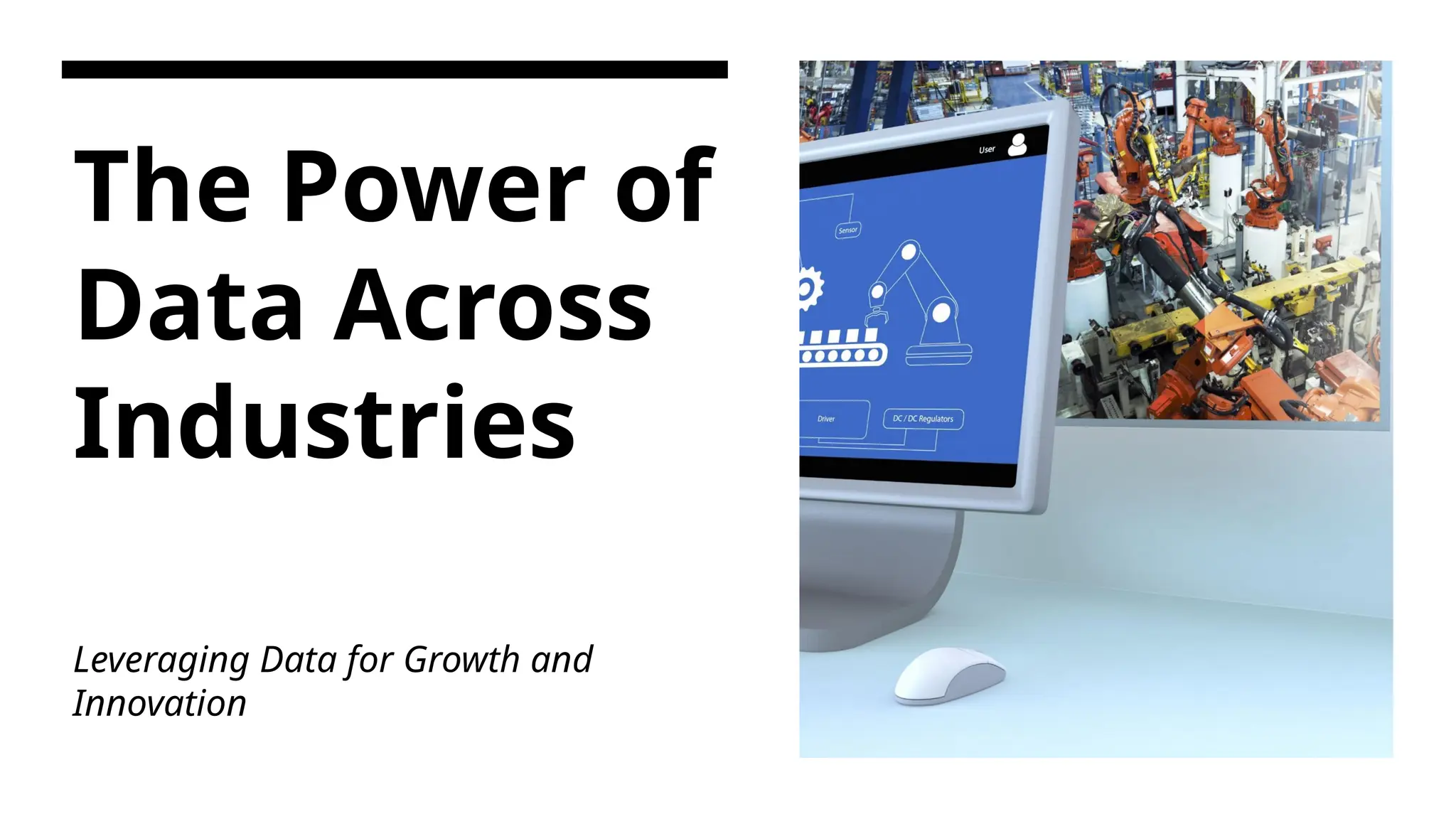
The Power of
Data Across
Industries
Leveraging Data for Growth and
Innovation
Presentation
Overview
Healthcare Industry
Electronic health records and predictive analytics are revolutionizing the
way we diagnose and treat illnesses, improving patient outcomes and
reducing healthcare costs.
Finance and Banking
Fraud detection and machine learning algorithms are used to secure
transactions and analyze financial markets, improving security and
increasing efficiency.
Retail Industry
Inventory management and personalized marketing campaigns are
changing the way we shop, improving customer experience and
increasing sales.
Revolutionizing
Healthcare
Electronic Health Records
Electronic health records (EHRs) have revolutionized
the healthcare industry by providing medical
professionals with instant access to patient
information, resulting in more accurate diagnoses
and better patient outcomes.
Predictive Analytics
With the help of predictive analytics, medical
professionals can not only diagnose and treat
illnesses more accurately but also determine which
patients are at greater risk of developing certain
conditions and take steps to prevent them.
Electronic Health Records
Electronic health
records provide
instant access to
patient data, allowing
healthcare providers
to make more
informed decisions
and deliver more
coordinated and
efficient care. They
also reduce the risk of
medical errors and
improve patient
safety.
Predictive Analytics in Healthcare
Predictive analytics in
healthcare utilizes
machine learning
algorithms to analyze
patient data and
identify disease
patterns. This allows
medical professionals
to intervene early and
prevent illnesses from
worsening.
Driving Finance and
Banking Industry
Data-driven Business Models
The finance and banking industry is leveraging data to create new
business models that are more efficient, secure, and customer-centric.
The use of machine learning algorithms and fraud detection techniques
is reshaping the industry.
Digital Banking and Finance
Digital banking and finance are transforming the way people manage
their money and access financial services. The rise of mobile banking,
online payments, and digital wallets is making the industry more
accessible and convenient for consumers.
Fraud Detection
in Banking
Machine learning algorithms are used by banks to
analyze transactions and detect potential fraudulent
activities. These algorithms are designed to protect
customers and prevent financial losses for the bank
by identifying suspicious transactions and quickly
flagging them for further investigation.
Machine Learning
Algorithms in Financial
Market Analysis
Predicting Financial Markets
Machine learning algorithms are used to predict the
behavior of financial markets, allowing banks and
financial institutions to make more informed
investment decisions and minimize risk.
Risk Management
Machine learning algorithms are also used to
manage risk in financial markets by identifying
potential risks and opportunities in real-time,
allowing banks and financial institutions to take
proactive measures to mitigate risks and maximize
returns.
Transforming the
Retail Industry
Personalized Experiences
Retailers are using customer data to personalize the
shopping experience, by offering tailored
recommendations and promotions which enhance
customer satisfaction and increase sales.
Optimized Business Operations
Using data analytics, retailers can optimize their
business operations, including inventory
management and supply chain performance, which
results in a more efficient and profitable business.
Inventory Management
Inventory
management uses
data analytics and
forecasting
techniques to
optimize supply chain
management, reduce
waste, and ensure
that retailers have the
right products in
stock at the right
time.
Personalized
Marketing Campaigns
Customer Data
Personalized marketing campaigns use customer data, such as
purchase history, browsing behavior and demographic information, to
deliver targeted and relevant messages to customers.
Increased Customer Engagement and Loyalty
Personalized marketing campaigns increase customer engagement and
loyalty by providing relevant and personalized messages, leading to
higher customer satisfaction and retention rates.
Higher Sales and Revenue
Personalized marketing campaigns lead to higher sales and revenue by
creating a more engaging and personalized customer experience that
drives conversions.
Conclusion
Data has revolutionized the way we do business
across different industries. Its applications include
electronic health records, predictive analytics, fraud
detection, machine learning algorithms, inventory
management, and personalized marketing
campaigns. These tools have transformed traditional
business models and enabled us to deliver better
outcomes for our customers and clients.

DATA IS EVERYWHERE jibinoioononoo ono.pptx

  • 1.
    The Power of DataAcross Industries Leveraging Data for Growth and Innovation
  • 2.
    Presentation Overview Healthcare Industry Electronic healthrecords and predictive analytics are revolutionizing the way we diagnose and treat illnesses, improving patient outcomes and reducing healthcare costs. Finance and Banking Fraud detection and machine learning algorithms are used to secure transactions and analyze financial markets, improving security and increasing efficiency. Retail Industry Inventory management and personalized marketing campaigns are changing the way we shop, improving customer experience and increasing sales.
  • 3.
    Revolutionizing Healthcare Electronic Health Records Electronichealth records (EHRs) have revolutionized the healthcare industry by providing medical professionals with instant access to patient information, resulting in more accurate diagnoses and better patient outcomes. Predictive Analytics With the help of predictive analytics, medical professionals can not only diagnose and treat illnesses more accurately but also determine which patients are at greater risk of developing certain conditions and take steps to prevent them.
  • 4.
    Electronic Health Records Electronichealth records provide instant access to patient data, allowing healthcare providers to make more informed decisions and deliver more coordinated and efficient care. They also reduce the risk of medical errors and improve patient safety.
  • 5.
    Predictive Analytics inHealthcare Predictive analytics in healthcare utilizes machine learning algorithms to analyze patient data and identify disease patterns. This allows medical professionals to intervene early and prevent illnesses from worsening.
  • 6.
    Driving Finance and BankingIndustry Data-driven Business Models The finance and banking industry is leveraging data to create new business models that are more efficient, secure, and customer-centric. The use of machine learning algorithms and fraud detection techniques is reshaping the industry. Digital Banking and Finance Digital banking and finance are transforming the way people manage their money and access financial services. The rise of mobile banking, online payments, and digital wallets is making the industry more accessible and convenient for consumers.
  • 7.
    Fraud Detection in Banking Machinelearning algorithms are used by banks to analyze transactions and detect potential fraudulent activities. These algorithms are designed to protect customers and prevent financial losses for the bank by identifying suspicious transactions and quickly flagging them for further investigation.
  • 8.
    Machine Learning Algorithms inFinancial Market Analysis Predicting Financial Markets Machine learning algorithms are used to predict the behavior of financial markets, allowing banks and financial institutions to make more informed investment decisions and minimize risk. Risk Management Machine learning algorithms are also used to manage risk in financial markets by identifying potential risks and opportunities in real-time, allowing banks and financial institutions to take proactive measures to mitigate risks and maximize returns.
  • 9.
    Transforming the Retail Industry PersonalizedExperiences Retailers are using customer data to personalize the shopping experience, by offering tailored recommendations and promotions which enhance customer satisfaction and increase sales. Optimized Business Operations Using data analytics, retailers can optimize their business operations, including inventory management and supply chain performance, which results in a more efficient and profitable business.
  • 10.
    Inventory Management Inventory management uses dataanalytics and forecasting techniques to optimize supply chain management, reduce waste, and ensure that retailers have the right products in stock at the right time.
  • 11.
    Personalized Marketing Campaigns Customer Data Personalizedmarketing campaigns use customer data, such as purchase history, browsing behavior and demographic information, to deliver targeted and relevant messages to customers. Increased Customer Engagement and Loyalty Personalized marketing campaigns increase customer engagement and loyalty by providing relevant and personalized messages, leading to higher customer satisfaction and retention rates. Higher Sales and Revenue Personalized marketing campaigns lead to higher sales and revenue by creating a more engaging and personalized customer experience that drives conversions.
  • 12.
    Conclusion Data has revolutionizedthe way we do business across different industries. Its applications include electronic health records, predictive analytics, fraud detection, machine learning algorithms, inventory management, and personalized marketing campaigns. These tools have transformed traditional business models and enabled us to deliver better outcomes for our customers and clients.

Editor's Notes

  • #1 AI-generated content may be incorrect. --- In this presentation, we will explore how data is being used to drive innovation and growth across different industries. We will showcase examples of how healthcare, finance, and retail industries are leveraging data to improve patient outcomes, optimize business operations, and enhance customer experience.
  • #2 We will start by delving into the healthcare industry, exploring how electronic health records and predictive analytics are revolutionizing the way we diagnose and treat illnesses. Then, we will dive into the finance and banking industry, discovering how fraud detection and machine learning algorithms are used to secure transactions and analyze financial markets. Finally, we will explore the retail industry, uncovering how inventory management and personalized marketing campaigns are changing the way we shop.
  • #3 The healthcare industry is a prime example of how data is being used to improve patient outcomes. With the advent of electronic health records and predictive analytics, medical professionals are able to diagnose and treat illnesses with greater accuracy and precision.
  • #4 Electronic health records are a digital version of a patient's medical history. They allow healthcare providers to have instant access to patient data, from lab results to medication history. This leads to more coordinated and efficient care.
  • #5 Predictive analytics uses machine learning algorithms to analyze patient data and predict disease patterns. This allows medical professionals to intervene early and prevent illnesses from worsening.
  • #6 The finance and banking industry is another example of how data is being used to transform traditional business models. With the rise of fraud detection and machine learning algorithms, the industry is becoming more secure and efficient.
  • #7 Fraud detection uses machine learning algorithms to analyze transactions and detect potential fraudulent activities. This protects customers and prevents financial losses for the bank.
  • #8 Machine learning algorithms are used to predict the behavior of financial markets. This allows banks and financial institutions to make more informed investment decisions and minimize risk.
  • #9 The retail industry is using data to provide personalized experiences to customers and optimize business operations. With inventory management and personalized marketing campaigns, retailers are able to stay competitive and meet the changing demands of consumers.
  • #10 Inventory management uses data to forecast demand and optimize supply chain management. This reduces waste and ensures that retailers have the right products in stock at the right time.
  • #11 Personalized marketing campaigns use customer data to deliver targeted and relevant messages. This increases customer engagement and loyalty, leading to higher sales and revenue.
  • #12 Data is revolutionizing the way we do business across different industries. With the power of electronic health records, predictive analytics, fraud detection, machine learning algorithms, inventory management and personalized marketing campaigns, we can transform traditional business models and deliver better outcomes for our customers and clients.