Database Concepts
 Four types of Database concepts are,
1. Hierarchical Database
2. Network Database
3. Object Oriented Model
4. Relational Database
 Problem with both hierarchical & network
database – complicated – inflexible database.
 Database can be prepared, edited & maintained
separately.
Database Concepts
1. Hierarchical Database:
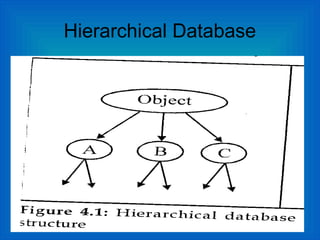
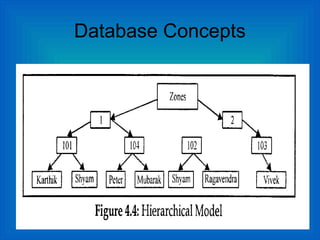
 Organize data at different levels – contain one to one
relationship.
 For Ex. in (Fig.4.1): A is a parent & A1 & B1 are child.
Parent has got child. But there is no relationship
between A & B also A1 & B1. Quadtree is a type of
hierarchical type.
 Searching fast – updating easy in hierarchical
database.
 Disadvantage – linkage – only vertically but not
horizontally & diagonally.
Hierarchical Database
Database Concepts
Database Concepts
2. Network Database:
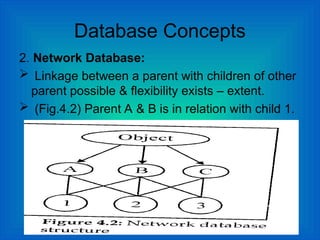
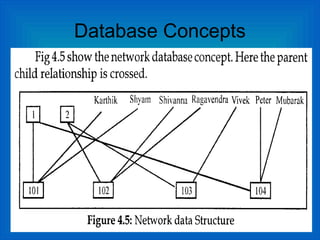
 Linkage between a parent with children of other
parent possible & flexibility exists – extent.
 (Fig.4.2) Parent A & B is in relation with child 1.
Database Concepts
Database Concepts
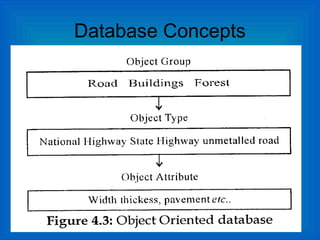
3. Object Oriented Model:
 Functions – model spatial & non-spatial
relationships – geographic objects – attributes.
 Encapsulated unit – characterized by attributes
– a set of orientations & rules.
 Object Oriented Model – Characterized by
generic properties – abstraction – adhoc queries
 Objects, classes & super classes are abstracted
well
 Object Orientation model exists but not – fullest
capability – GIS analysis.
Database Concepts
Database Concepts
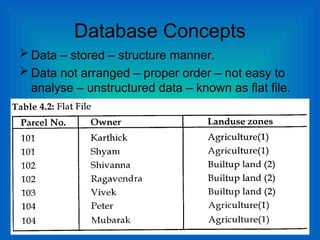
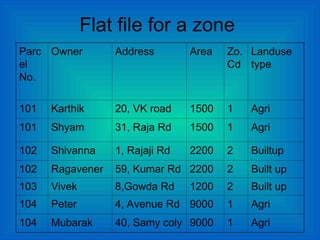
 Data – stored – structure manner.
 Data not arranged – proper order – not easy to
analyse – unstructured data – known as flat file.
Database Concepts
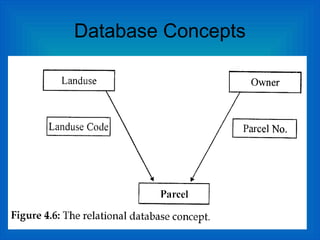
4. Relational Database Concepts:
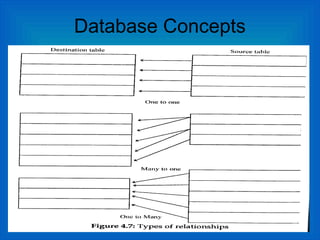
Three types of relationship exists are,
a) One to one
b) One to many
c) Many to one
 Source table – is first table – which data –
exported to other table – called destination table.
 One to one relationship – one record –
destination table – related with one record in
source table.
Database Concepts
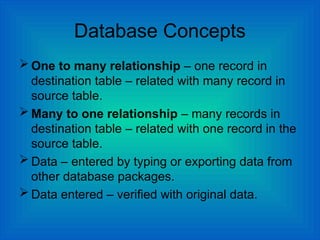
 One to many relationship – one record in
destination table – related with many record in
source table.
 Many to one relationship – many records in
destination table – related with one record in the
source table.
 Data – entered by typing or exporting data from
other database packages.
 Data entered – verified with original data.
Database Concepts
Database Concepts
Flat file for a zone
Parc
el
No.
Owner Address Area Zo.
Cd
Landuse
type
101 Karthik 20, VK road 1500 1 Agri
101 Shyam 31, Raja Rd 1500 1 Agri
102 Shivanna 1, Rajaji Rd 2200 2 Builtup
102 Ragavener 59, Kumar Rd 2200 2 Built up
103 Vivek 8,Gowda Rd 1200 2 Built up
104 Peter 4, Avenue Rd 9000 1 Agri
104 Mubarak 40, Samy coly 9000 1 Agri

data - base - concept _ Remote Sensing & GIS.ppt

  • 1.
    Database Concepts  Fourtypes of Database concepts are, 1. Hierarchical Database 2. Network Database 3. Object Oriented Model 4. Relational Database  Problem with both hierarchical & network database – complicated – inflexible database.  Database can be prepared, edited & maintained separately.
  • 2.
    Database Concepts 1. HierarchicalDatabase:  Organize data at different levels – contain one to one relationship.  For Ex. in (Fig.4.1): A is a parent & A1 & B1 are child. Parent has got child. But there is no relationship between A & B also A1 & B1. Quadtree is a type of hierarchical type.  Searching fast – updating easy in hierarchical database.  Disadvantage – linkage – only vertically but not horizontally & diagonally.
  • 3.
  • 4.
  • 5.
    Database Concepts 2. NetworkDatabase:  Linkage between a parent with children of other parent possible & flexibility exists – extent.  (Fig.4.2) Parent A & B is in relation with child 1.
  • 6.
  • 7.
    Database Concepts 3. ObjectOriented Model:  Functions – model spatial & non-spatial relationships – geographic objects – attributes.  Encapsulated unit – characterized by attributes – a set of orientations & rules.  Object Oriented Model – Characterized by generic properties – abstraction – adhoc queries  Objects, classes & super classes are abstracted well  Object Orientation model exists but not – fullest capability – GIS analysis.
  • 8.
  • 9.
    Database Concepts  Data– stored – structure manner.  Data not arranged – proper order – not easy to analyse – unstructured data – known as flat file.
  • 10.
    Database Concepts 4. RelationalDatabase Concepts: Three types of relationship exists are, a) One to one b) One to many c) Many to one  Source table – is first table – which data – exported to other table – called destination table.  One to one relationship – one record – destination table – related with one record in source table.
  • 11.
    Database Concepts  Oneto many relationship – one record in destination table – related with many record in source table.  Many to one relationship – many records in destination table – related with one record in the source table.  Data – entered by typing or exporting data from other database packages.  Data entered – verified with original data.
  • 12.
  • 13.
  • 14.
    Flat file fora zone Parc el No. Owner Address Area Zo. Cd Landuse type 101 Karthik 20, VK road 1500 1 Agri 101 Shyam 31, Raja Rd 1500 1 Agri 102 Shivanna 1, Rajaji Rd 2200 2 Builtup 102 Ragavener 59, Kumar Rd 2200 2 Built up 103 Vivek 8,Gowda Rd 1200 2 Built up 104 Peter 4, Avenue Rd 9000 1 Agri 104 Mubarak 40, Samy coly 9000 1 Agri