Faculty Name:Namrata
Sharma/Arjun S. Parihar
Year/Branch:3rd/CSE
Subject Code:CS-503(A)
Subject Name:Data Analytics
 Four V’s of Big Data
 Drivers of Big Data
 Introduction to Big Data Analytics
 Big Data Analytics Application
Learning Objectives
• In this session you will learn about:
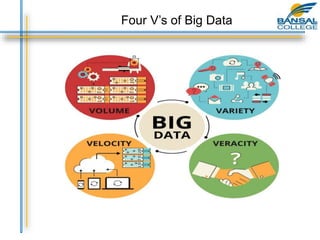
Four V’s of Big Data
Volume
-Size of data plays a very crucial role
- In determining value out of data
- Business data is enormous
- Volume is one characteristic which needs to be
considered
- While dealing with Big Data.
Four V’s of Big Data
Variety
-Heterogeneous sources and the nature of data.
-Both structured and unstructured.
-During earlier days, spreadsheets and databases were
the only sources of data .
-Nowadays, data in the form of emails, photos, videos,
monitoring devices, PDFs, audio, etc.
-Data poses certain issues for storage, mining and
analyzing data.
Four V’s of Big Data
Velocity
-The term 'velocity' refers to the speed of generation of
data.
-How fast the data is generated and processed to meet the
demands, determines real potential in the data.
-Big Data Velocity deals with the speed at which data flows
in from sources
-Like business processes, application logs, networks, and
social media sites, sensors, Mobile devices, etc.
-The flow of data is massive and continuous.
Four V’s of Big Data
Veracity
-Veracity refers to an uncertainty of data available
-Harder for the companies to react quickly and make
appropriate solutions.
-Accuracy is the major issue.
-Need strategy to organise data in porper format.
-Avoid mixing to related and unrelated data .
-To make right decisions, the data must be clean, consistent
and consolidated.
Four V’s of Big Data
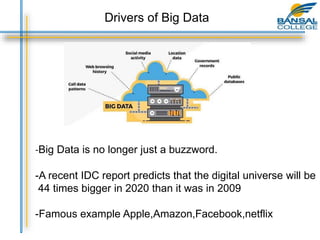
-Big Data is no longer just a buzzword.
-A recent IDC report predicts that the digital universe will be
44 times bigger in 2020 than it was in 2009
-Famous example Apple,Amazon,Facebook,netflix
Drivers of Big Data
Drivers of Big Data
Six main business drivers can be identified:
-The digitization of society;
-The plummeting of technology costs;
-Connectivity through cloud computing;
-Increased knowledge about data science;
-Social media applications;
-Internet-of-Things (IoT).
Introduction to Big Data Analytics
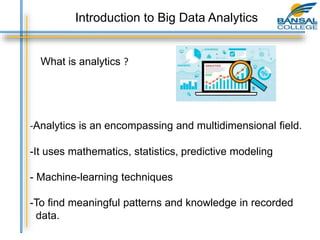
What is analytics ?
-Analytics is an encompassing and multidimensional field.
-It uses mathematics, statistics, predictive modeling
- Machine-learning techniques
-To find meaningful patterns and knowledge in recorded
data.
Introduction to Big Data Analytics
What is big data analytics?
- Process of collecting, organizing and analyzing a large
amount of data
-To uncover hidden pattern, correlation and other
meaningful insights.
- Helps an organization to understand the information
contained in their data
- Use it to provide new opportunities to improve their business
-In turn leads to more efficient operations, higher profits and
happier customers.
Introduction to Big Data Analytics
- What actually happened?
- How or why did it happen?
- What’s happening now?
- What is likely to happen next?
Answer the following types of questions:
Introduction to Big Data Analytics
Key Technologies behind Big data Analytics
-Hadoop-Open source framework
-Data Mining-discover patterns
-Text Mining-NLP,ML
-Predictive Analytics-Predict future outcome
Introduction to Big Data Analytics
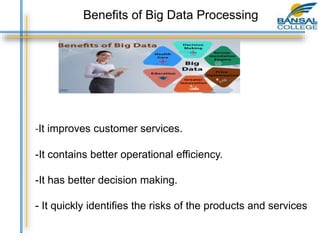
-It improves customer services.
-It contains better operational efficiency.
-It has better decision making.
- It quickly identifies the risks of the products and services
Benefits of Big Data Processing
Benefits of Big Data
Example of e-commerce industry:
-Collect information about the items searched by the
customer.
-Information regarding their preferences.
-Information about the popularity of the products and
many other data.
Introduction to Big Data Analytics
Benefits of Big Data
-Organizations derive some patterns and provide the
best customer service like displaying the popular
products that are being sold.
-Show the products that are related to the products that a
customer bought.
-Provide secure money transitions and identify if there
are any fraudulent transactions being made.
-Forecast the demand for the products and many more.
Introduction to Big Data Analytics
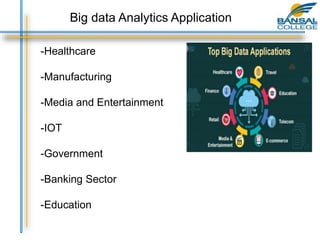
Big data Analytics Application
-Healthcare
-Manufacturing
-Media and Entertainment
-IOT
-Government
-Banking Sector
-Education
Quick Review
-Characteristics of big data are four v’s
-Drivers of Big Data are digitization of Society, plummeting
of technology costs, Connectivity through cloud computing,
Increased knowledge about data science, Social media
applications, Internet-of-Things (IoT).
-Big data analytics is the process of collecting,organizing
and analyzing large amount of information to uncover
information contained in data
-The primary goal of big data applications is to help
companies to make more business by analyzing large data
Thank You

data analytics lecture2.pptx

  • 2.
    Faculty Name:Namrata Sharma/Arjun S.Parihar Year/Branch:3rd/CSE Subject Code:CS-503(A) Subject Name:Data Analytics
  • 3.
     Four V’sof Big Data  Drivers of Big Data  Introduction to Big Data Analytics  Big Data Analytics Application Learning Objectives • In this session you will learn about:
  • 4.
    Four V’s ofBig Data
  • 5.
    Volume -Size of dataplays a very crucial role - In determining value out of data - Business data is enormous - Volume is one characteristic which needs to be considered - While dealing with Big Data. Four V’s of Big Data
  • 6.
    Variety -Heterogeneous sources andthe nature of data. -Both structured and unstructured. -During earlier days, spreadsheets and databases were the only sources of data . -Nowadays, data in the form of emails, photos, videos, monitoring devices, PDFs, audio, etc. -Data poses certain issues for storage, mining and analyzing data. Four V’s of Big Data
  • 7.
    Velocity -The term 'velocity'refers to the speed of generation of data. -How fast the data is generated and processed to meet the demands, determines real potential in the data. -Big Data Velocity deals with the speed at which data flows in from sources -Like business processes, application logs, networks, and social media sites, sensors, Mobile devices, etc. -The flow of data is massive and continuous. Four V’s of Big Data
  • 8.
    Veracity -Veracity refers toan uncertainty of data available -Harder for the companies to react quickly and make appropriate solutions. -Accuracy is the major issue. -Need strategy to organise data in porper format. -Avoid mixing to related and unrelated data . -To make right decisions, the data must be clean, consistent and consolidated. Four V’s of Big Data
  • 9.
    -Big Data isno longer just a buzzword. -A recent IDC report predicts that the digital universe will be 44 times bigger in 2020 than it was in 2009 -Famous example Apple,Amazon,Facebook,netflix Drivers of Big Data
  • 10.
    Drivers of BigData Six main business drivers can be identified: -The digitization of society; -The plummeting of technology costs; -Connectivity through cloud computing; -Increased knowledge about data science; -Social media applications; -Internet-of-Things (IoT).
  • 11.
    Introduction to BigData Analytics
  • 12.
    What is analytics? -Analytics is an encompassing and multidimensional field. -It uses mathematics, statistics, predictive modeling - Machine-learning techniques -To find meaningful patterns and knowledge in recorded data. Introduction to Big Data Analytics
  • 13.
    What is bigdata analytics? - Process of collecting, organizing and analyzing a large amount of data -To uncover hidden pattern, correlation and other meaningful insights. - Helps an organization to understand the information contained in their data - Use it to provide new opportunities to improve their business -In turn leads to more efficient operations, higher profits and happier customers. Introduction to Big Data Analytics
  • 14.
    - What actuallyhappened? - How or why did it happen? - What’s happening now? - What is likely to happen next? Answer the following types of questions: Introduction to Big Data Analytics
  • 15.
    Key Technologies behindBig data Analytics -Hadoop-Open source framework -Data Mining-discover patterns -Text Mining-NLP,ML -Predictive Analytics-Predict future outcome Introduction to Big Data Analytics
  • 16.
    -It improves customerservices. -It contains better operational efficiency. -It has better decision making. - It quickly identifies the risks of the products and services Benefits of Big Data Processing
  • 17.
    Benefits of BigData Example of e-commerce industry: -Collect information about the items searched by the customer. -Information regarding their preferences. -Information about the popularity of the products and many other data. Introduction to Big Data Analytics
  • 18.
    Benefits of BigData -Organizations derive some patterns and provide the best customer service like displaying the popular products that are being sold. -Show the products that are related to the products that a customer bought. -Provide secure money transitions and identify if there are any fraudulent transactions being made. -Forecast the demand for the products and many more. Introduction to Big Data Analytics
  • 19.
    Big data AnalyticsApplication -Healthcare -Manufacturing -Media and Entertainment -IOT -Government -Banking Sector -Education
  • 20.
    Quick Review -Characteristics ofbig data are four v’s -Drivers of Big Data are digitization of Society, plummeting of technology costs, Connectivity through cloud computing, Increased knowledge about data science, Social media applications, Internet-of-Things (IoT). -Big data analytics is the process of collecting,organizing and analyzing large amount of information to uncover information contained in data -The primary goal of big data applications is to help companies to make more business by analyzing large data
  • 21.