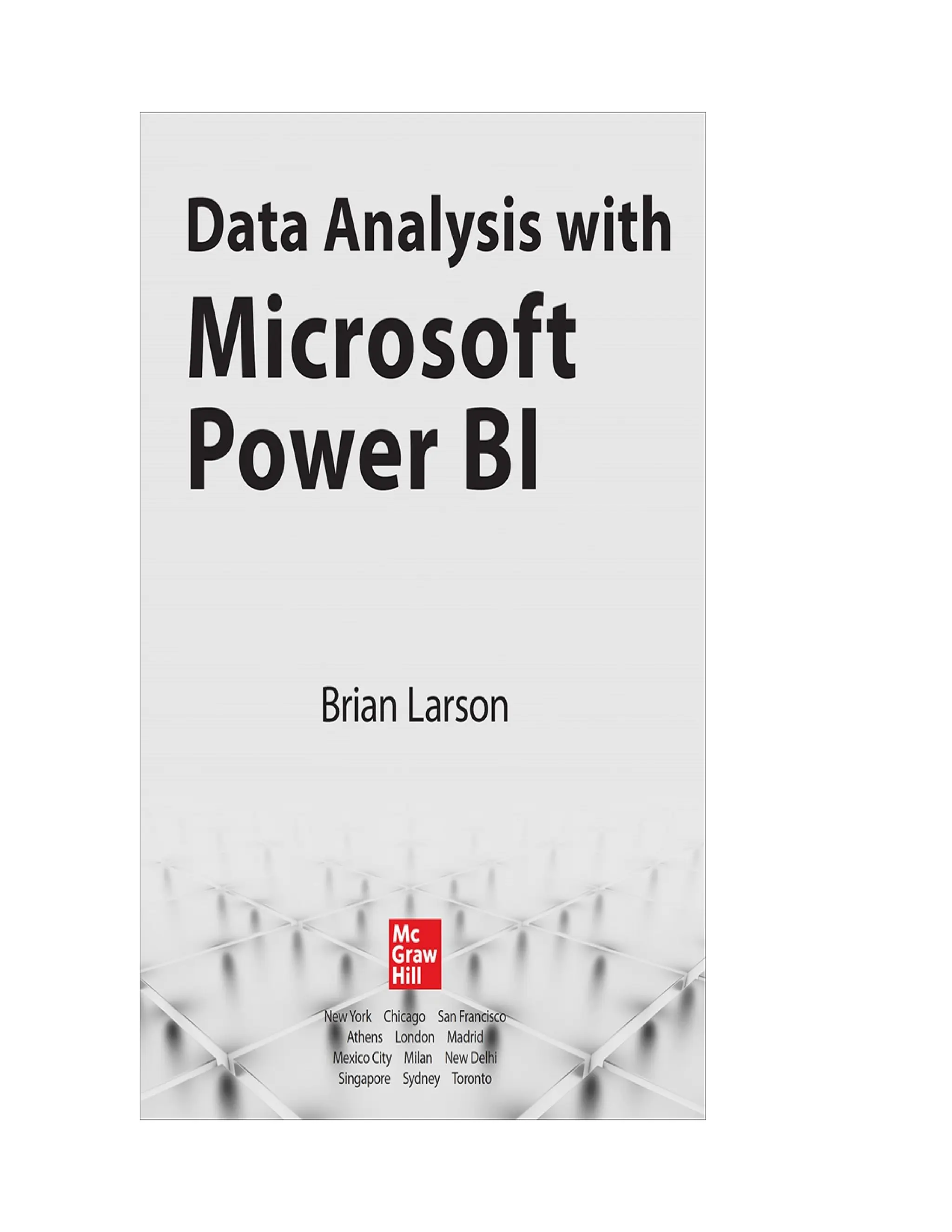
Data Analysis with Microsoft Power Bi - eBook
PDF download
https://ebooksecure.com/download/data-analysis-with-microsoft-
power-bi-ebook-pdf/
Download full version ebook from https://ebooksecure.com
We believe these products will be a great fit for you. Click
the link to download now, or visit ebooksecure.com
to discover even more!
Microsoft Power BI Quick Start Guide (eBook PDF)
http://ebooksecure.com/product/microsoft-power-bi-quick-start-
guide-ebook-pdf/
Pro DAX with Power BI (eBook PDF)
http://ebooksecure.com/product/pro-dax-with-power-bi-ebook-pdf/
(eBook PDF) Financial Analysis with Microsoft Excel
2016 8th
http://ebooksecure.com/product/ebook-pdf-financial-analysis-with-
microsoft-excel-2016-8th/
(eBook PDF) Financial Analysis with Microsoft Excel 9th
Edition
http://ebooksecure.com/product/ebook-pdf-financial-analysis-with-
microsoft-excel-9th-edition/
(eBook PDF) Qualitative Data Analysis with ATLAS.ti 3rd
Edition
http://ebooksecure.com/product/ebook-pdf-qualitative-data-
analysis-with-atlas-ti-3rd-edition/
Financial Analysis with Microsoft Excel 8th Edition
Timothy R. Mayes - eBook PDF
https://ebooksecure.com/download/financial-analysis-with-
microsoft-excel-ebook-pdf/
(eBook PDF) Statistics: Unlocking the Power of Data
http://ebooksecure.com/product/ebook-pdf-statistics-unlocking-
the-power-of-data/
Statistics: Unlocking the Power of Data, 2nd Edition
(eBook PDF)
http://ebooksecure.com/product/statistics-unlocking-the-power-of-
data-2nd-edition-ebook-pdf/
(eBook PDF) Statistics: Unlocking the Power of Data,
2nd Edition
http://ebooksecure.com/product/ebook-pdf-statistics-unlocking-
the-power-of-data-2nd-edition/
Contents
1. Cover
2. Title Page
3. Copyright Page
4. Dedication
5. Contents at a Glance
6. Contents
7. Acknowledgments
8. Part I Understanding Business Intelligence and Power BI
1. Chapter 1 How to Use This Book
1. The Tool Chest Called Power BI
1. The BI Process
2. Power BI Parts and Pieces
2. The Right Tool(s) for the Job
1. Consuming Power BI Reports
2. Power BI as a Data Visualization Tool
3. Power BI as a Modeling Tool
4. Power BI as a Data Warehouse/Data Mart
3. Where to Find What You Need
1. Obtaining Power BI Desktop Software
2. Sample Code and Supporting Materials
3. Information on Power BI New Features and
Enhancements
4. How to Succeed at Self-Service Analytics
2. Chapter 2 Successful Self-Service Analytics
1. What Is Business Intelligence?
1. Defining KPIs
2. Is Your Organization Ready for BI?
1. Desire
2. Realistic Expectations
3. Ongoing Care and Feeding
4. Well-Defined KPIs
5. Actionable KPIs
6. Reliable Sources of Data
3. Implementation: Best Practices
1. Take an Iterative Implementation Approach
2. Utilize a Data Warehouse/Data Mart
3. Cleanse and Validate During Data Gathering
4. Create User-Friendly Data Models
5. Publish Latency
6. Provide Training and Support
7. Use the Right Tool for the Job
8. Establish Standards and Limits
4. Successfully Using Power BI
9. Part II Interacting with Power BI
1. Chapter 3 Power BI Architecture
1. The Power BI Architecture
1. Power BI Desktop
2. The Power BI Service
3. The Power BI Report Server
4. The Power BI Mobile App
2. Power BI Desktop Optimizations
3. Power BI Updates
4. Microsoft On-premises Data Gateway
5. What Does the Data Have to Say?
2. Chapter 4 Using Power BI Visualizations
1. Power BI Desktop
1. Obtaining What You Need
2. Opening the Report/Preparing the Environment
2. Interacting with a Power BI Report
1. Working with a Single Report Item
2. Interacting with Multiple Report Items
3. Changing the Data with Slicers and Filters
1. Slicers
2. Filters
4. Navigating Power BI Reports
1. Drill Down and Drillthrough
2. Buttons
3. Bookmarks
4. Additional Data Interactions
5. A Cloudy Forecast
3. Chapter 5 Using the Power BI Service (PowerBI.com)
1. PowerBI.com
1. The Organization of PowerBI.com
2. Connecting to PowerBI.com
3. The Navigation Pane
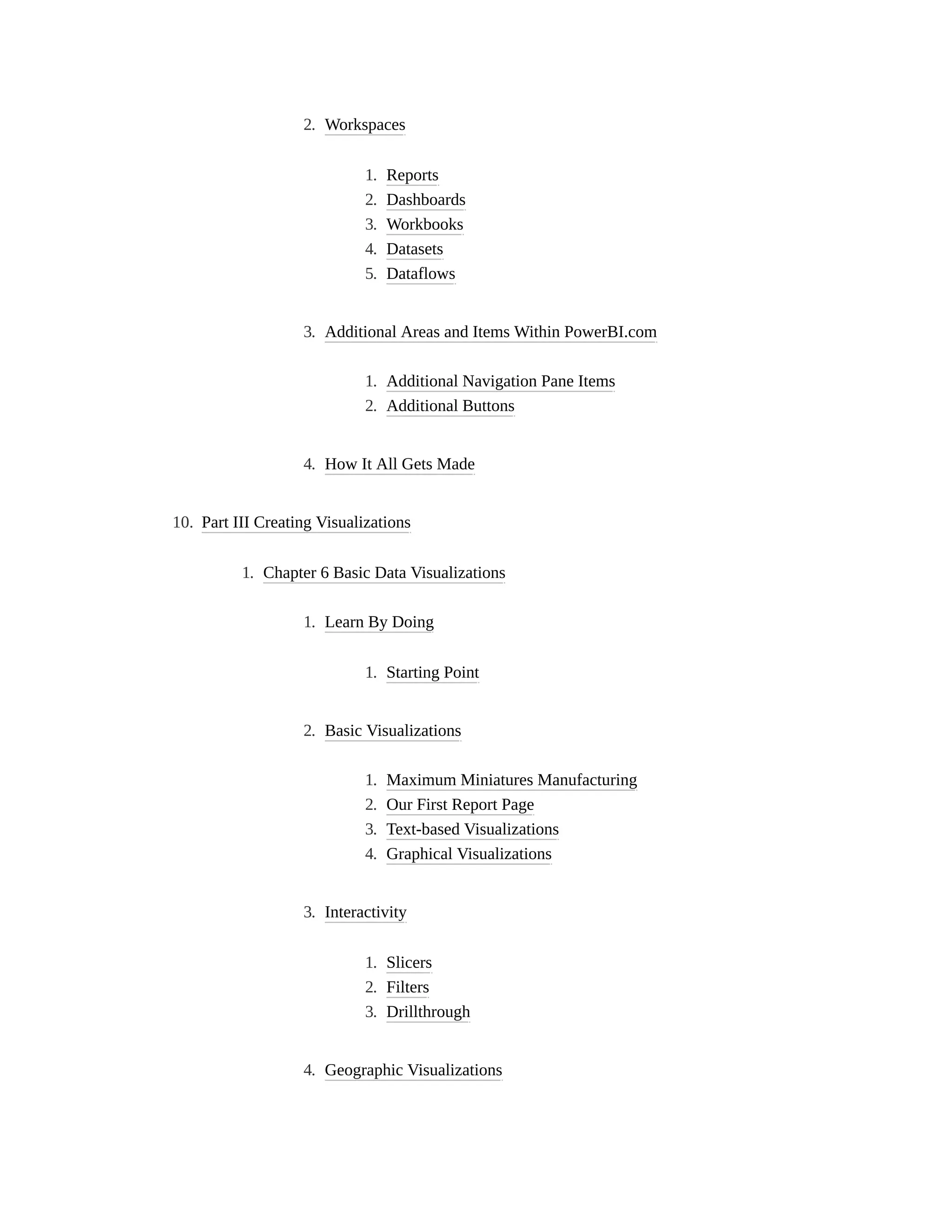
2. Workspaces
1. Reports
2. Dashboards
3. Workbooks
4. Datasets
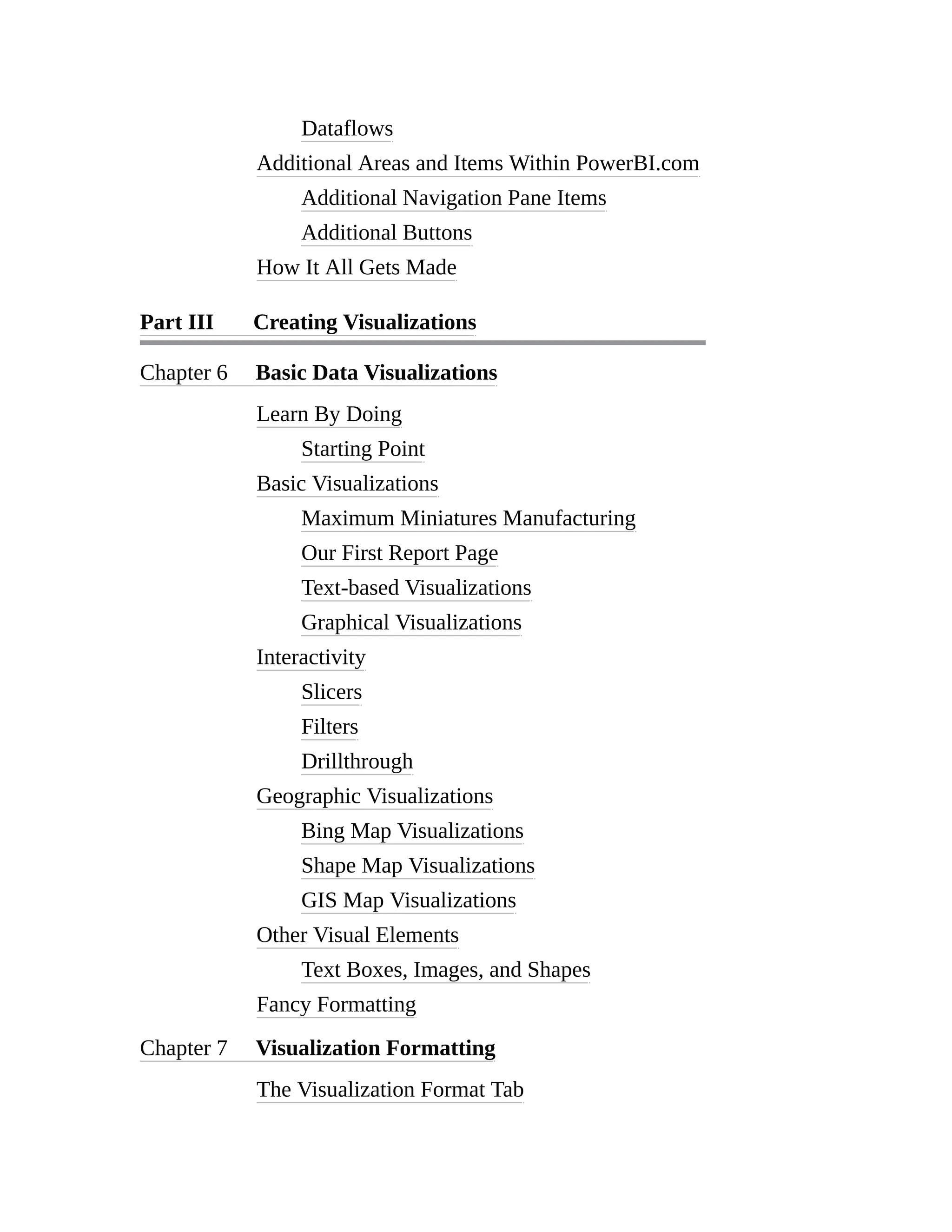
5. Dataflows
3. Additional Areas and Items Within PowerBI.com
1. Additional Navigation Pane Items
2. Additional Buttons
4. How It All Gets Made
10. Part III Creating Visualizations
1. Chapter 6 Basic Data Visualizations
1. Learn By Doing
1. Starting Point
2. Basic Visualizations
1. Maximum Miniatures Manufacturing
2. Our First Report Page
3. Text-based Visualizations
4. Graphical Visualizations
3. Interactivity
1. Slicers
2. Filters
3. Drillthrough
4. Geographic Visualizations
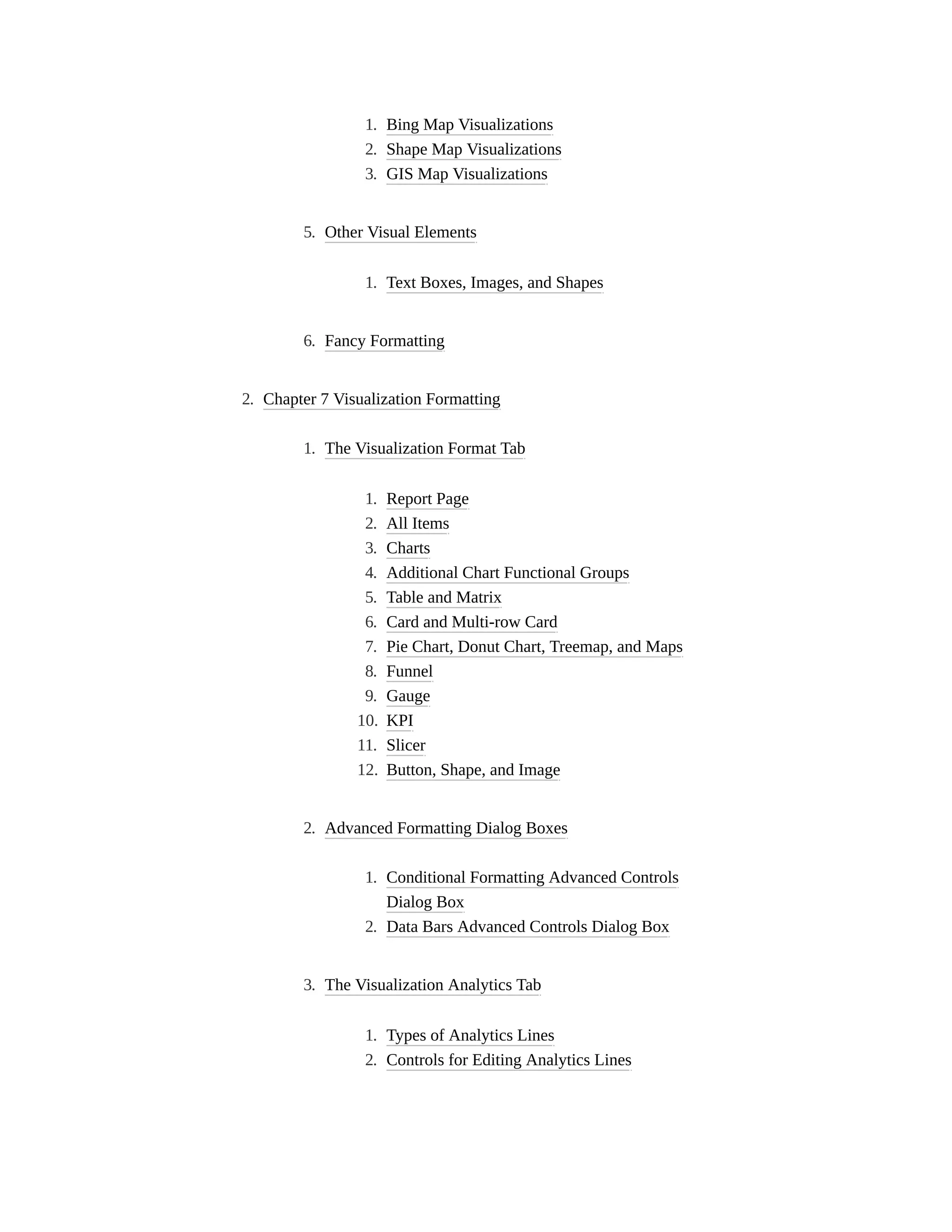
1. Bing Map Visualizations
2. Shape Map Visualizations
3. GIS Map Visualizations
5. Other Visual Elements
1. Text Boxes, Images, and Shapes
6. Fancy Formatting
2. Chapter 7 Visualization Formatting
1. The Visualization Format Tab
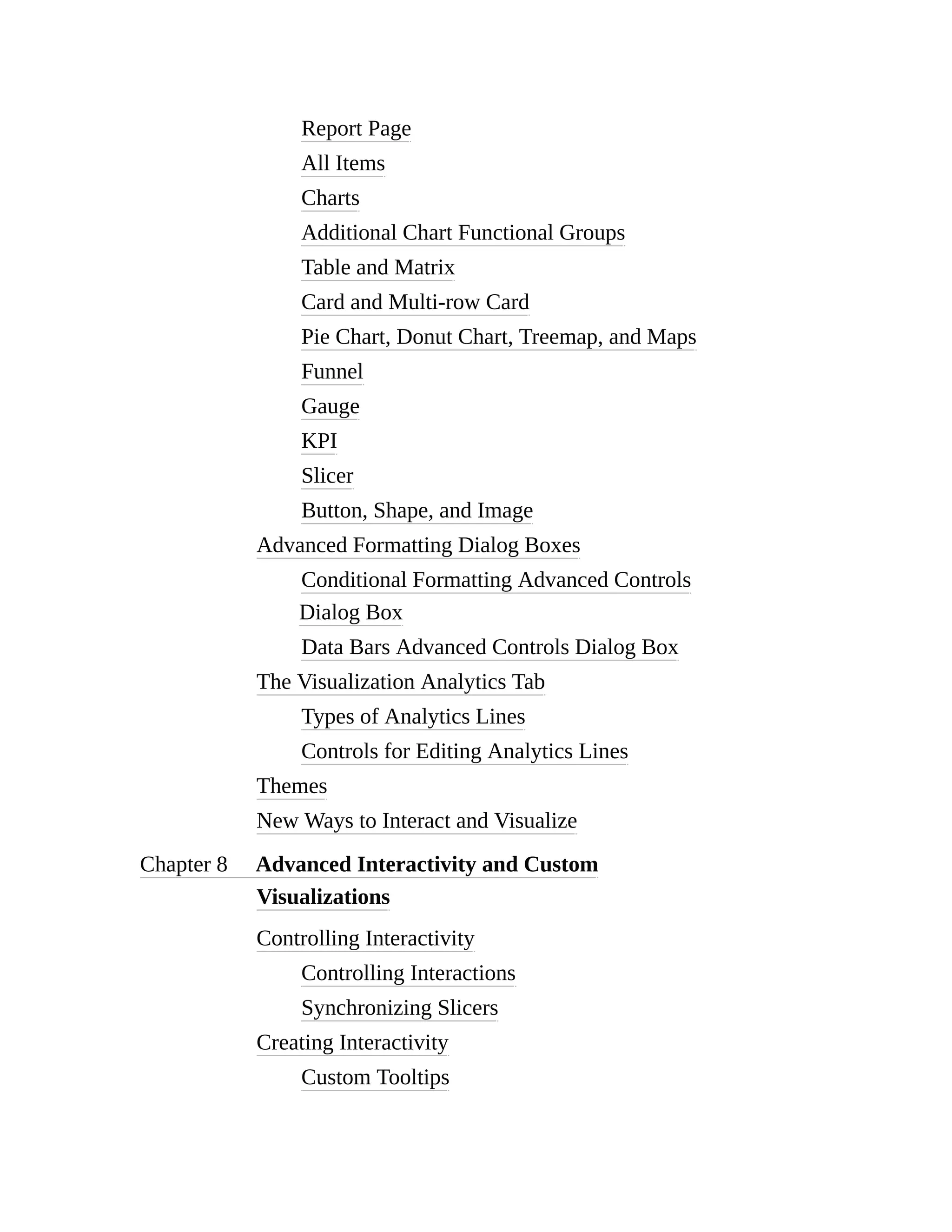
1. Report Page
2. All Items
3. Charts
4. Additional Chart Functional Groups
5. Table and Matrix
6. Card and Multi-row Card
7. Pie Chart, Donut Chart, Treemap, and Maps
8. Funnel
9. Gauge
10. KPI
11. Slicer
12. Button, Shape, and Image
2. Advanced Formatting Dialog Boxes
1. Conditional Formatting Advanced Controls
Dialog Box
2. Data Bars Advanced Controls Dialog Box
3. The Visualization Analytics Tab
1. Types of Analytics Lines
2. Controls for Editing Analytics Lines
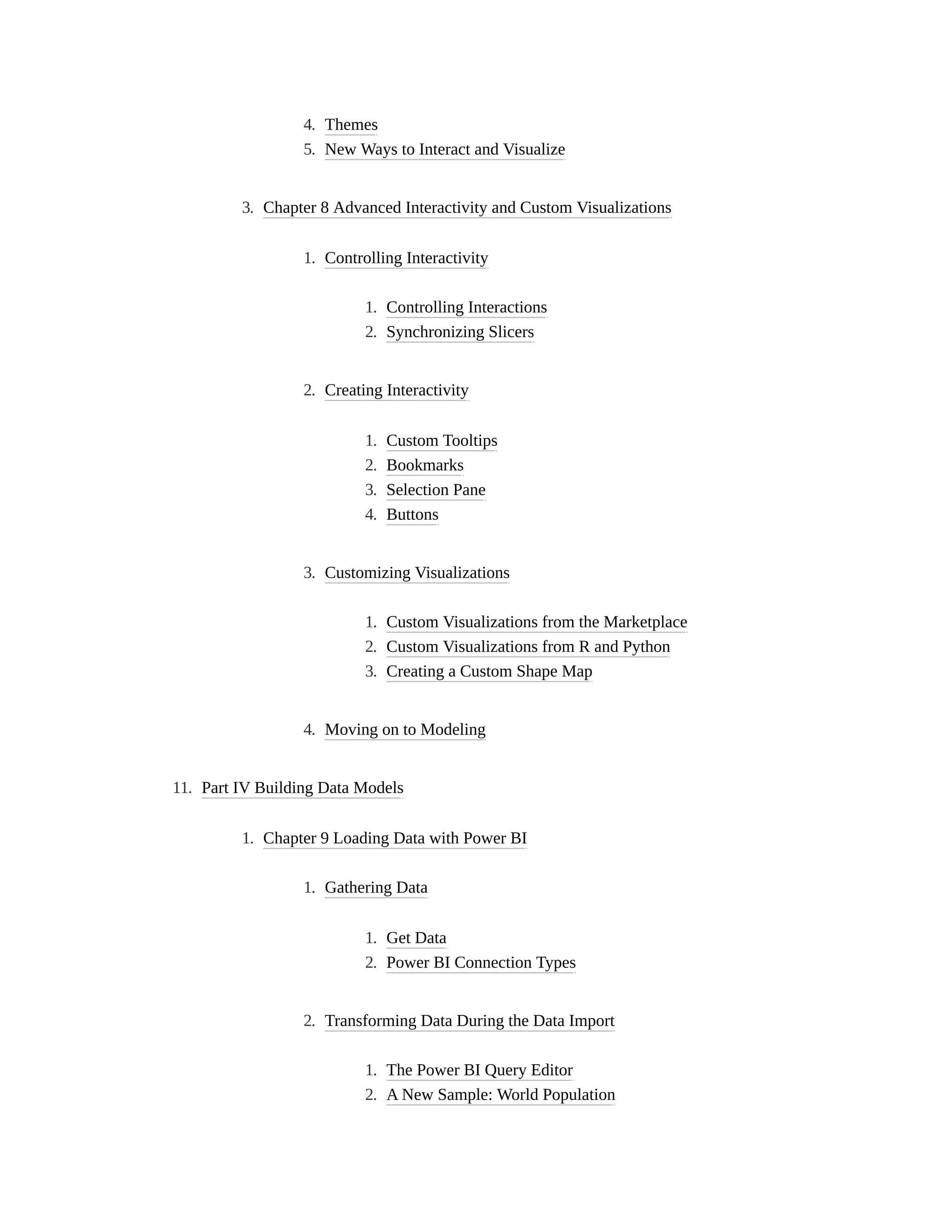
4. Themes
5. New Ways to Interact and Visualize
3. Chapter 8 Advanced Interactivity and Custom Visualizations
1. Controlling Interactivity
1. Controlling Interactions
2. Synchronizing Slicers
2. Creating Interactivity
1. Custom Tooltips
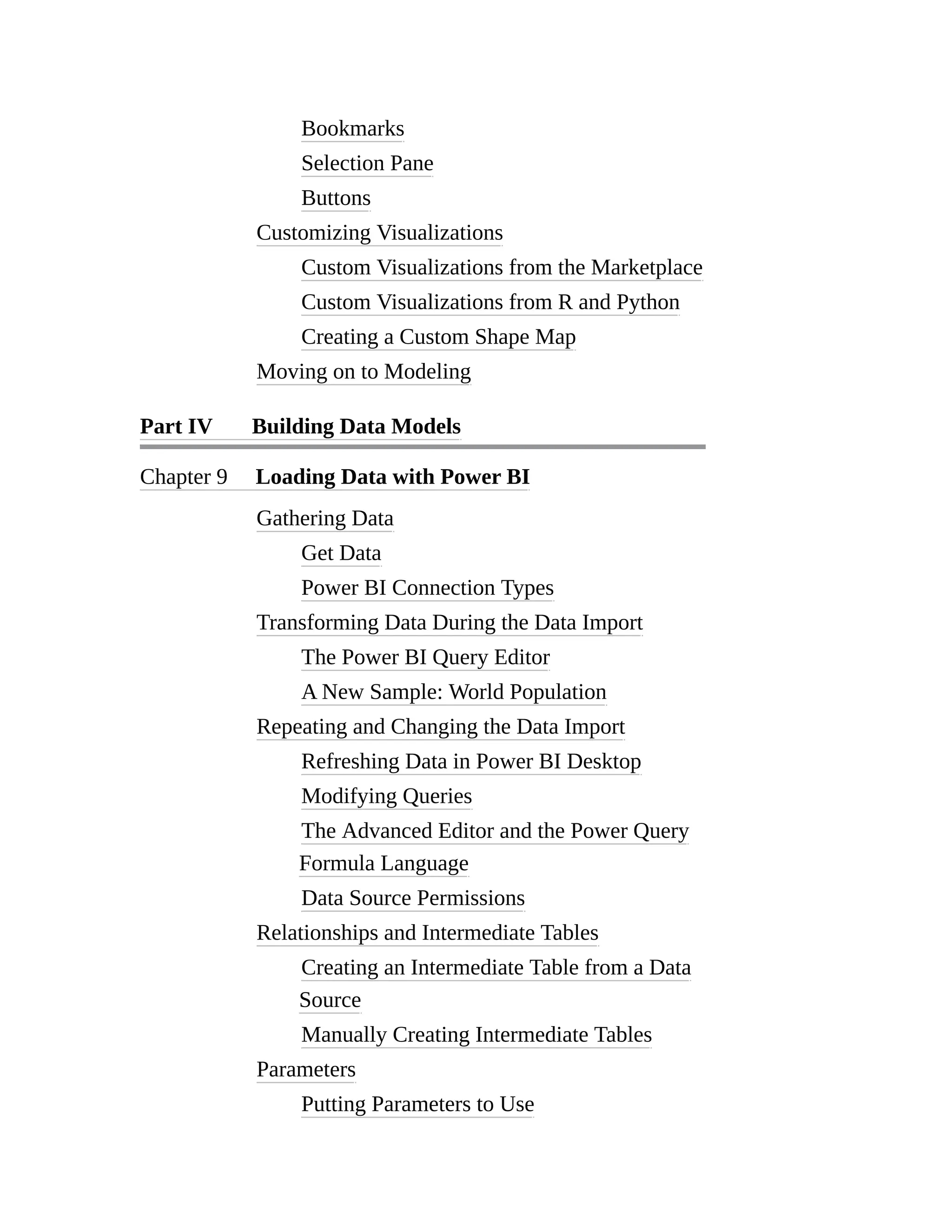
2. Bookmarks
3. Selection Pane
4. Buttons
3. Customizing Visualizations
1. Custom Visualizations from the Marketplace
2. Custom Visualizations from R and Python
3. Creating a Custom Shape Map
4. Moving on to Modeling
11. Part IV Building Data Models
1. Chapter 9 Loading Data with Power BI
1. Gathering Data
1. Get Data
2. Power BI Connection Types
2. Transforming Data During the Data Import
1. The Power BI Query Editor
2. A New Sample: World Population
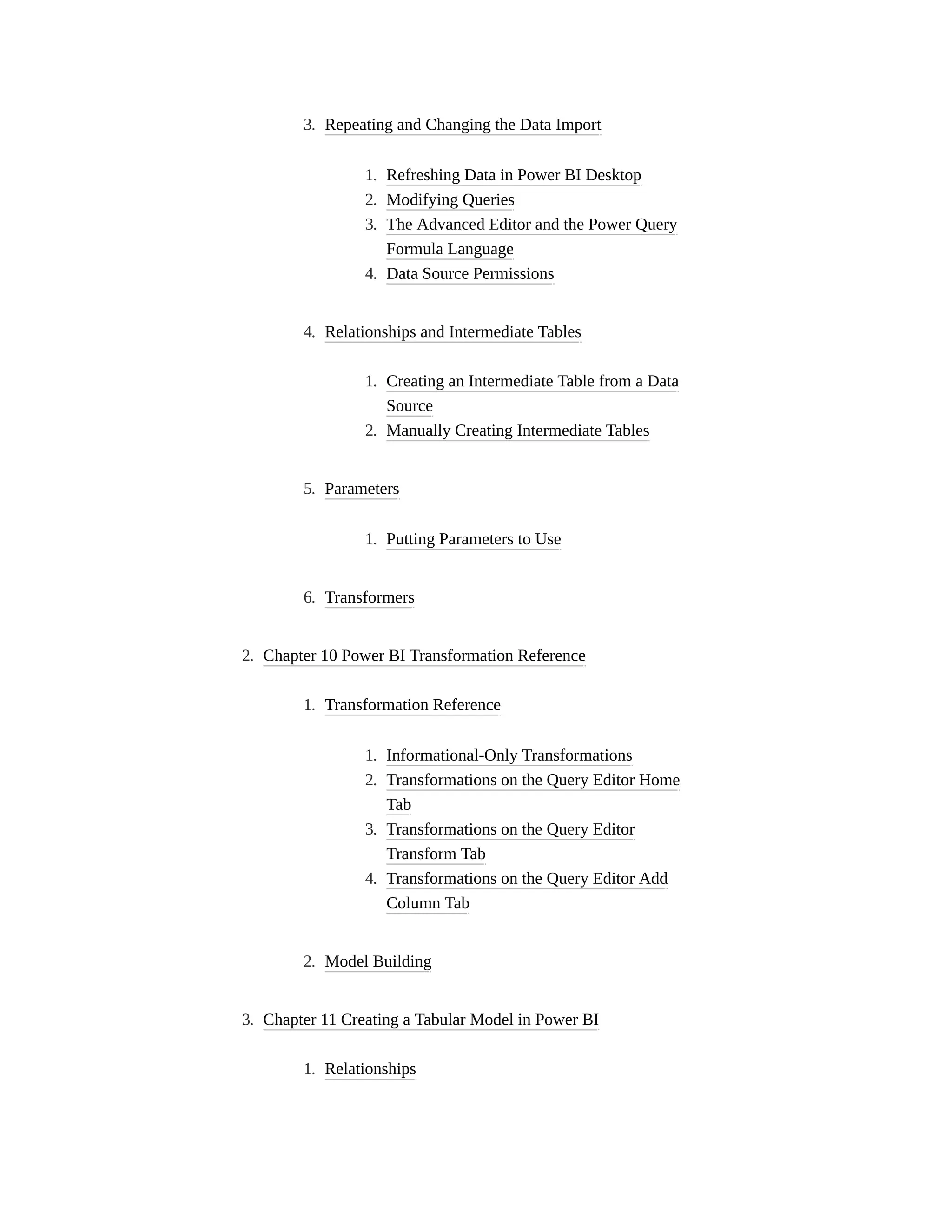
3. Repeating and Changing the Data Import
1. Refreshing Data in Power BI Desktop
2. Modifying Queries
3. The Advanced Editor and the Power Query
Formula Language
4. Data Source Permissions
4. Relationships and Intermediate Tables
1. Creating an Intermediate Table from a Data
Source
2. Manually Creating Intermediate Tables
5. Parameters
1. Putting Parameters to Use
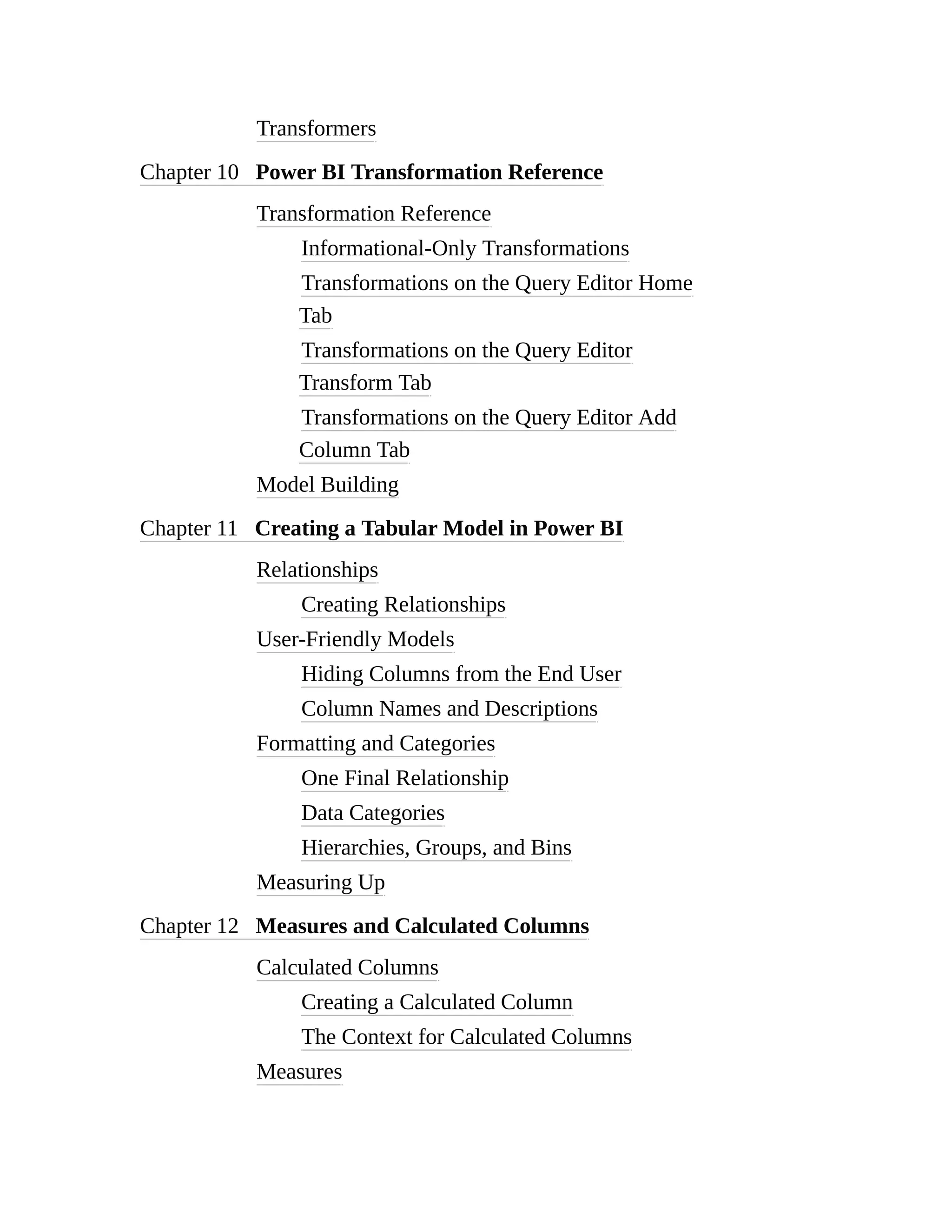
6. Transformers
2. Chapter 10 Power BI Transformation Reference
1. Transformation Reference
1. Informational-Only Transformations
2. Transformations on the Query Editor Home
Tab
3. Transformations on the Query Editor
Transform Tab
4. Transformations on the Query Editor Add
Column Tab
2. Model Building
3. Chapter 11 Creating a Tabular Model in Power BI
1. Relationships
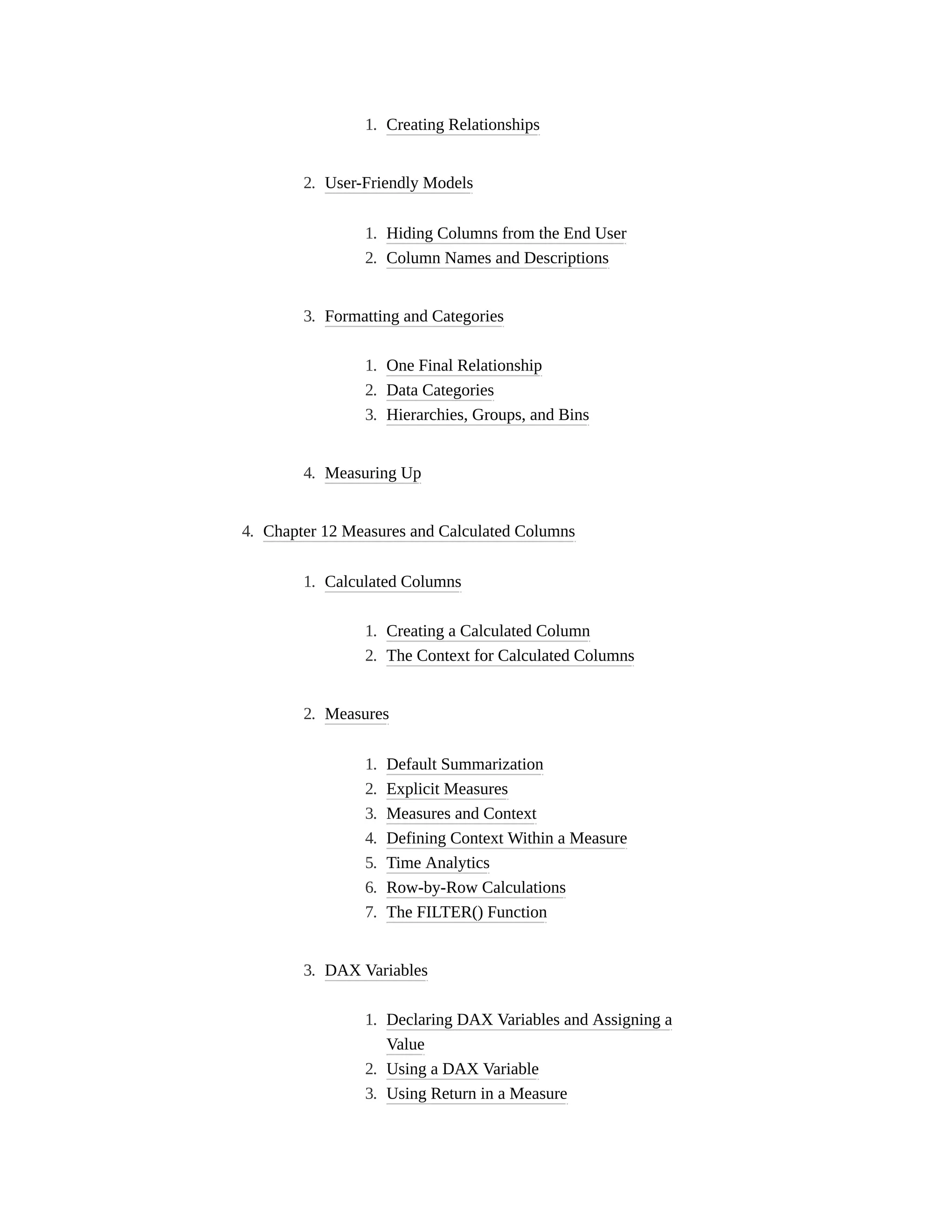
1. Creating Relationships
2. User-Friendly Models
1. Hiding Columns from the End User
2. Column Names and Descriptions
3. Formatting and Categories
1. One Final Relationship
2. Data Categories
3. Hierarchies, Groups, and Bins
4. Measuring Up
4. Chapter 12 Measures and Calculated Columns
1. Calculated Columns
1. Creating a Calculated Column
2. The Context for Calculated Columns
2. Measures
1. Default Summarization
2. Explicit Measures
3. Measures and Context
4. Defining Context Within a Measure
5. Time Analytics
6. Row-by-Row Calculations
7. The FILTER() Function
3. DAX Variables
1. Declaring DAX Variables and Assigning a
Value
2. Using a DAX Variable
3. Using Return in a Measure
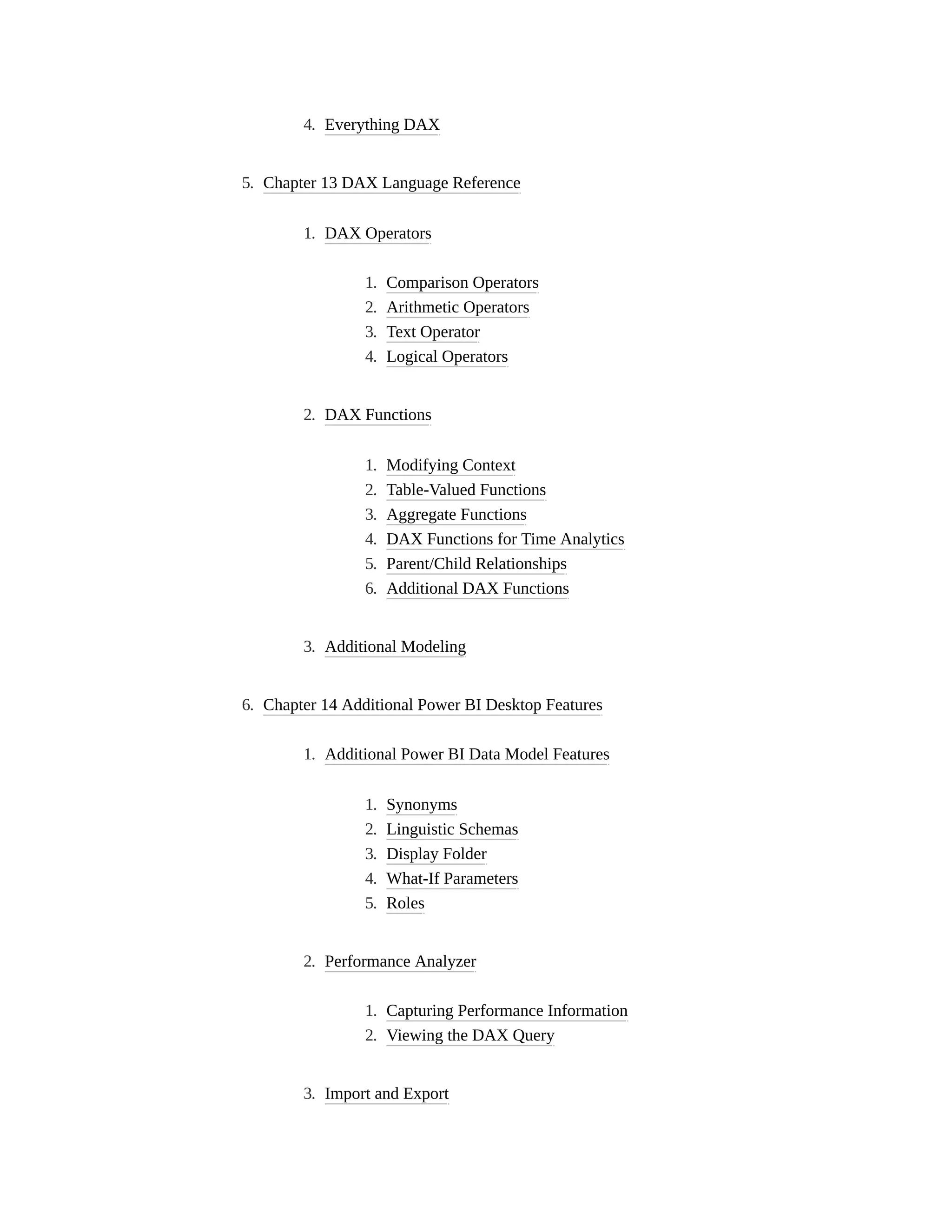
4. Everything DAX
5. Chapter 13 DAX Language Reference
1. DAX Operators
1. Comparison Operators
2. Arithmetic Operators
3. Text Operator
4. Logical Operators
2. DAX Functions
1. Modifying Context
2. Table-Valued Functions
3. Aggregate Functions
4. DAX Functions for Time Analytics
5. Parent/Child Relationships
6. Additional DAX Functions
3. Additional Modeling
6. Chapter 14 Additional Power BI Desktop Features
1. Additional Power BI Data Model Features
1. Synonyms
2. Linguistic Schemas
3. Display Folder
4. What-If Parameters
5. Roles
2. Performance Analyzer
1. Capturing Performance Information
2. Viewing the DAX Query
3. Import and Export
1. Excel Workbook Content
2. Power BI Templates
4. Spreading the Word
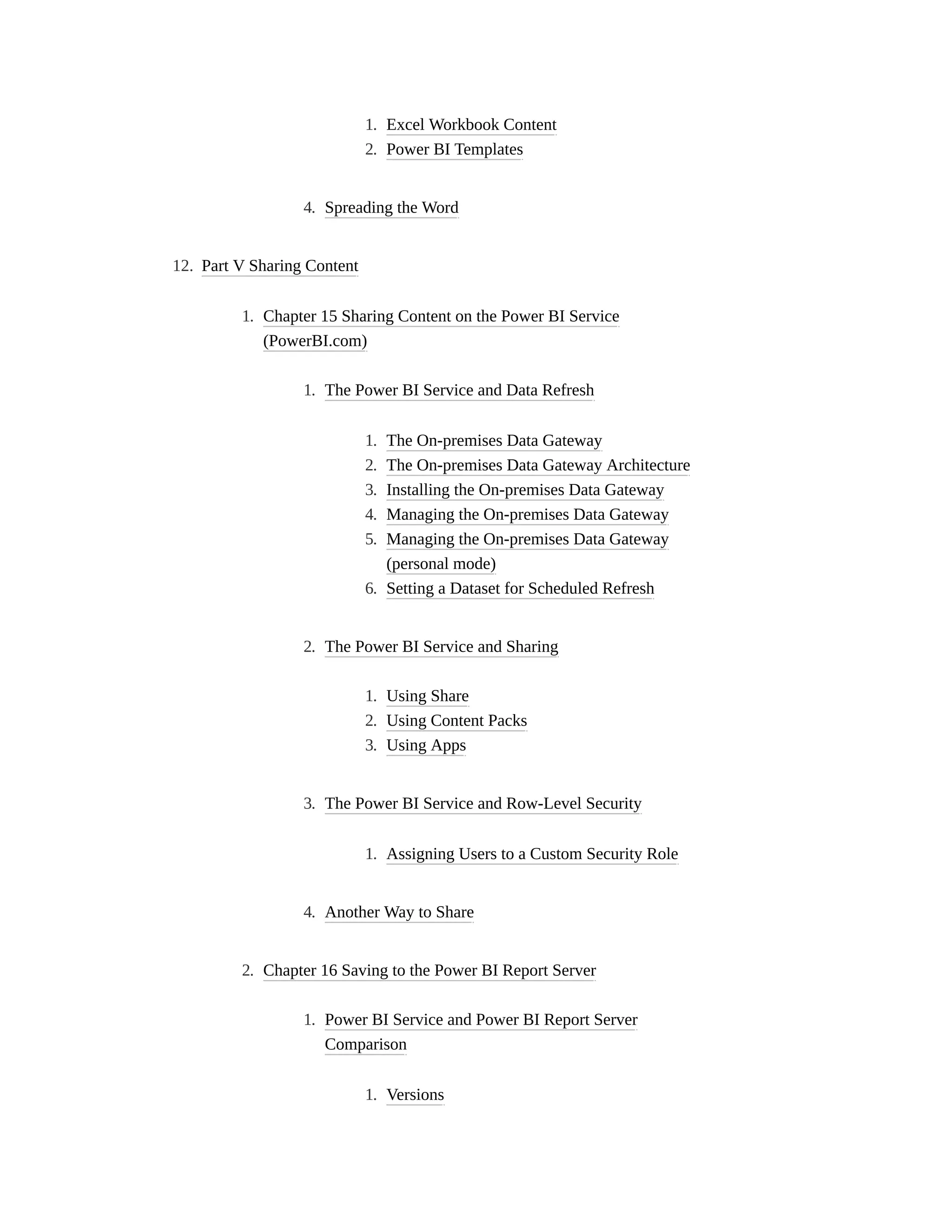
12. Part V Sharing Content
1. Chapter 15 Sharing Content on the Power BI Service
(PowerBI.com)
1. The Power BI Service and Data Refresh
1. The On-premises Data Gateway
2. The On-premises Data Gateway Architecture
3. Installing the On-premises Data Gateway
4. Managing the On-premises Data Gateway
5. Managing the On-premises Data Gateway
(personal mode)
6. Setting a Dataset for Scheduled Refresh
2. The Power BI Service and Sharing
1. Using Share
2. Using Content Packs
3. Using Apps
3. The Power BI Service and Row-Level Security
1. Assigning Users to a Custom Security Role
4. Another Way to Share
2. Chapter 16 Saving to the Power BI Report Server
1. Power BI Service and Power BI Report Server
Comparison
1. Versions
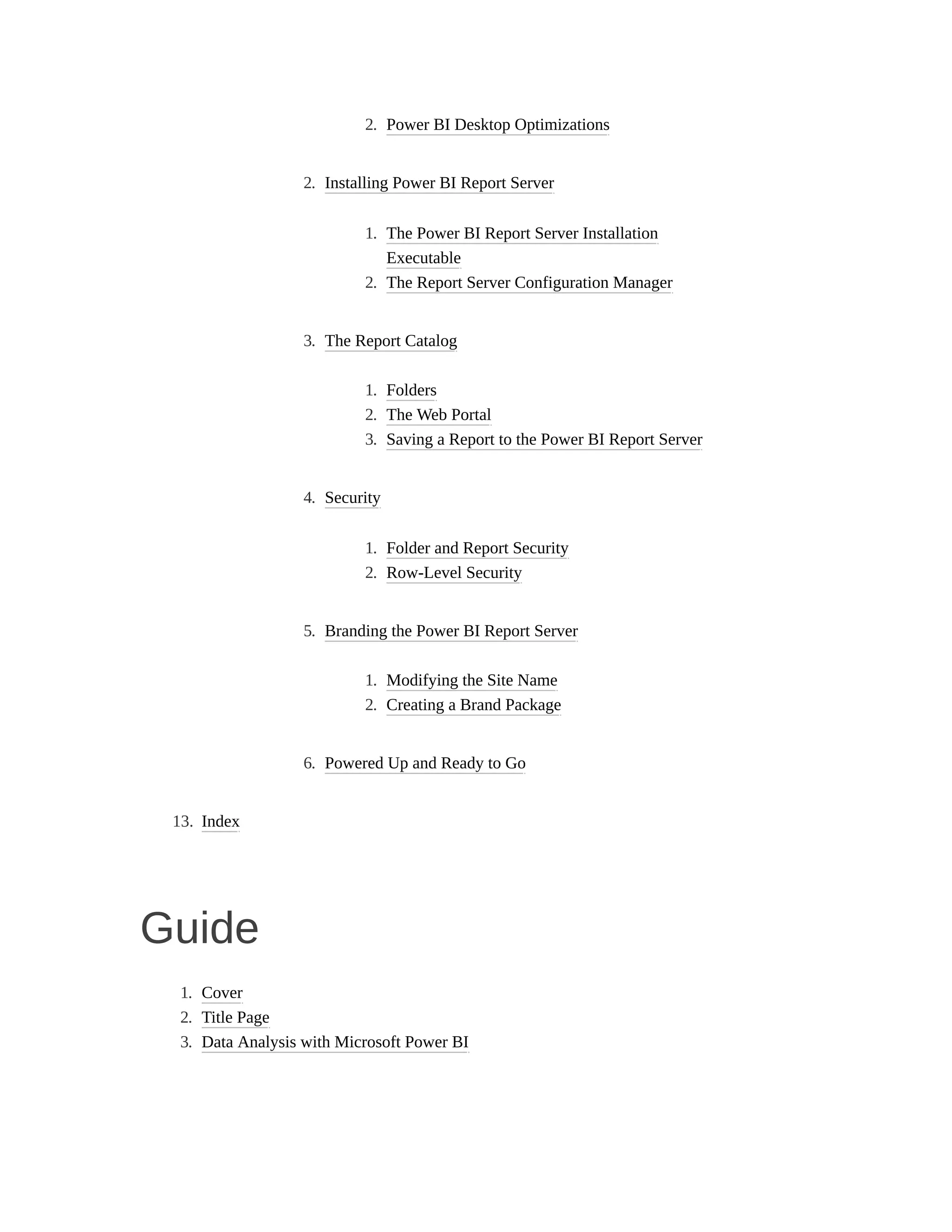
2. Power BI Desktop Optimizations
2. Installing Power BI Report Server
1. The Power BI Report Server Installation
Executable
2. The Report Server Configuration Manager
3. The Report Catalog
1. Folders
2. The Web Portal
3. Saving a Report to the Power BI Report Server
4. Security
1. Folder and Report Security
2. Row-Level Security
5. Branding the Power BI Report Server
1. Modifying the Site Name
2. Creating a Brand Package
6. Powered Up and Ready to Go
13. Index
Guide
1. Cover
2. Title Page
3. Data Analysis with Microsoft Power BI
Page List
1. i
2. ii
3. iii
4. iv
5. v
6. vi
7. vii
8. viii
9. ix
10. x
11. xi
12. xii
13. xiii
14. xiv
15. xv
16. xvi
17. 1
18. 2
19. 3
20. 4
21. 5
22. 6
23. 7
24. 8
25. 9
26. 10
27. 11
28. 12
29. 13
30. 14
31. 15
32. 16
33. 17
34. 18
35. 19
36. 20
37. 21
38. 22
39. 23
40. 24
41. 25
42. 26
43. 27
44. 28
45. 29
46. 30
47. 31
48. 32
49. 33
50. 34
51. 35
52. 36
53. 37
54. 38
55. 39
56. 40
57. 41
58. 42
59. 43
60. 44
61. 45
62. 46
63. 47
64. 48
65. 49
66. 50
67. 51
68. 52
69. 53
70. 54
71. 55
72. 56
73. 57
74. 58
75. 59
76. 60
77. 61
78. 62
79. 63
80. 64
81. 65
82. 66
83. 67
84. 68
85. 69
86. 70
87. 71
88. 72
89. 73
90. 74
91. 75
92. 76
93. 77
94. 78
95. 79
96. 80
97. 81
98. 82
99. 83
100. 84
101. 85
102. 86
103. 87
104. 88
105. 89
106. 90
107. 91
108. 92
109. 93
110. 94
111. 95
112. 96
113. 97
114. 98
115. 99
116. 100
117. 101
118. 102
119. 103
120. 104
121. 105
122. 106
123. 107
124. 108
125. 109
126. 110
127. 111
128. 112
129. 113
130. 114
131. 115
132. 116
133. 117
134. 118
135. 119
136. 120
137. 121
138. 122
139. 123
140. 124
141. 125
142. 126
143. 127
144. 128
145. 129
146. 130
147. 131
148. 132
149. 133
150. 134
151. 135
152. 136
153. 137
154. 138
155. 139
156. 140
157. 141
158. 142
159. 143
160. 144
161. 145
162. 146
163. 147
164. 148
165. 149
166. 150
167. 151
168. 152
169. 153
170. 154
171. 155
172. 156
173. 157
174. 158
175. 159
176. 160
177. 161
178. 162
179. 163
180. 164
181. 165
182. 166
183. 167
184. 168
185. 169
186. 170
187. 171
188. 172
189. 173
190. 174
191. 175
192. 176
193. 177
194. 178
195. 179
196. 180
197. 181
198. 182
199. 183
200. 184
201. 185
202. 186
203. 187
204. 188
205. 189
206. 190
207. 191
208. 192
209. 193
210. 194
211. 195
212. 196
213. 197
214. 198
215. 199
216. 200
217. 201
218. 202
219. 203
220. 204
221. 205
222. 206
223. 207
224. 208
225. 209
226. 210
227. 211
228. 212
229. 213
230. 214
231. 215
232. 216
233. 217
234. 218
235. 219
236. 220
237. 221
238. 222
239. 223
240. 224
241. 225
242. 226
243. 227
244. 228
245. 229
246. 230
247. 231
248. 232
249. 233
250. 234
251. 235
252. 236
253. 237
254. 238
255. 239
256. 240
257. 241
258. 242
259. 243
260. 244
261. 245
262. 246
263. 247
264. 248
265. 249
266. 250
267. 251
268. 252
269. 253
270. 254
271. 255
272. 256
273. 257
274. 258
275. 259
276. 260
277. 261
278. 262
279. 263
280. 264
281. 265
282. 266
283. 267
284. 268
285. 269
286. 270
287. 271
288. 272
289. 273
290. 274
291. 275
292. 276
293. 277
294. 278
295. 279
296. 280
297. 281
298. 282
299. 283
300. 284
301. 285
302. 286
303. 287
304. 288
305. 289
306. 290
307. 291
308. 292
309. 293
310. 294
311. 295
312. 296
313. 297
314. 298
315. 299
316. 300
317. 301
318. 302
319. 303
320. 304
321. 305
322. 306
323. 307
324. 308
325. 309
326. 310
327. 311
328. 312
329. 313
330. 314
331. 315
332. 316
333. 317
334. 318
335. 319
336. 320
337. 321
338. 322
339. 323
340. 324
341. 325
342. 326
343. 327
344. 328
345. 329
346. 330
347. 331
348. 332
349. 333
350. 334
351. 335
352. 336
353. 337
354. 338
355. 339
356. 340
357. 341
358. 342
359. 343
360. 344
361. 345
362. 346
363. 347
364. 348
365. 349
366. 350
367. 351
368. 352
369. 353
370. 354
371. 355
372. 356
373. 357
374. 358
375. 359
376. 360
377. 361
378. 362
379. 363
380. 364
381. 365
382. 366
383. 367
384. 368
385. 369
386. 370
387. 371
388. 372
389. 373
390. 374
391. 375
392. 376
393. 377
394. 378
395. 379
396. 380
397. 381
398. 382
399. 383
400. 384
401. 385
402. 386
403. 387
404. 388
405. 389
406. 390
407. 391
408. 392
409. 393
410. 394
411. 395
412. 396
413. 397
414. 398
415. 399
416. 400
417. 401
418. 402
419. 403
420. 404
421. 405
422. 406
423. 407
424. 408
425. 409
426. 410
427. 411
428. 412
429. 413
430. 414
431. 415
432. 416
433. 417
434. 418
435. 419
436. 420
437. 421
438. 422
439. 423
440. 424
441. 425
442. 426
443. 427
444. 428
445. 429
446. 430
447. 431
448. 432
449. 433
450. 434
451. 435
452. 436
453. 437
454. 438
455. 439
456. 440
457. 441
458. 442
459. 443
460. 444
461. 445
462. 446
463. 447
464. 448
465. 449
466. 450
467. 451
468. 452
469. 453
470. 454
471. 455
472. 456
473. 457
474. 458
475. 459
476. 460
477. 461
478. 462
479. 463
480. 464
481. 465
482. 466
483. 467
484. 468
485. 469
486. 470
487. 471
488. 472
489. 473
490. 474
491. 475
492. 476
493. 477
494. 478
495. 479
496. 480
497. 481
498. 482
499. 483
500. 484
501. 485
502. 486
503. 487
504. 488
505. 489
506. 490
507. 491
508. 492
509. 493
510. 494
511. 495
512. 496
513. 497
514. 498
515. 499
516. 500
517. 501
518. 502
519. 503
520. 504
521. 505
522. 506
523. 507
524. 508
525. 509
526. 510
527. 511
528. 512
529. 513
530. 514
531. 515
532. 516
533. 517
534. 518
535. 519
536. 520
537. 521
538. 522
539. 523
540. 524
541. 525
542. 526
543. 527
544. 528
Copyright © 2020 by McGraw-Hill Education. All rights
reserved. Except as permitted under the United States
Copyright Act of 1976, no part of this publication may be
reproduced or distributed in any form or by any means, or
stored in a database or retrieval system, without the prior
written permission of the publisher.
ISBN: 978-1-26-045862-6
MHID: 1-26-045862-8
The material in this eBook also appears in the print version of
this title: ISBN: 978-1-26-045861-9, MHID: 1-26-045861-X.
eBook conversion by codeMantra
Version 1.0
All trademarks are trademarks of their respective owners.
Rather than put a trademark symbol after every occurrence of
a trademarked name, we use names in an editorial fashion
only, and to the benefit of the trademark owner, with no
intention of infringement of the trademark. Where such
designations appear in this book, they have been printed with
initial caps.
McGraw-Hill Education eBooks are available at special
quantity discounts to use as premiums and sales promotions or
for use in corporate training programs. To contact a
representative, please visit the Contact Us page at
www.mhprofessional.com.
Information has been obtained by McGraw-Hill Education
from sources believed to be reliable. However, because of the
possibility of human or mechanical error by our sources,
McGraw-Hill Education, or others, McGraw-Hill Education
does not guarantee the accuracy, adequacy, or completeness of
any information and is not responsible for any errors or
omissions or the results obtained from the use of such
information.
TERMS OF USE
This is a copyrighted work and McGraw-Hill Education and
its licensors reserve all rights in and to the work. Use of this
work is subject to these terms. Except as permitted under the
Copyright Act of 1976 and the right to store and retrieve one
copy of the work, you may not decompile, disassemble,
reverse engineer, reproduce, modify, create derivative works
based upon, transmit, distribute, disseminate, sell, publish or
sublicense the work or any part of it without McGraw-Hill
Education’s prior consent. You may use the work for your own
noncommercial and personal use; any other use of the work is
strictly prohibited. Your right to use the work may be
terminated if you fail to comply with these terms.
THE WORK IS PROVIDED “AS IS.” McGRAW-HILL
EDUCATION AND ITS LICENSORS MAKE NO
GUARANTEES OR WARRANTIES AS TO THE
ACCURACY, ADEQUACY OR COMPLETENESS OF OR
RESULTS TO BE OBTAINED FROM USING THE WORK,
INCLUDING ANY INFORMATION THAT CAN BE
ACCESSED THROUGH THE WORK VIA HYPERLINK
OR OTHERWISE, AND EXPRESSLY DISCLAIM ANY
WARRANTY, EXPRESS OR IMPLIED, INCLUDING BUT
NOT LIMITED TO IMPLIED WARRANTIES OF
MERCHANTABILITY OR FITNESS FOR A PARTICULAR
PURPOSE. McGraw-Hill Education and its licensors do not
warrant or guarantee that the functions contained in the work
will meet your requirements or that its operation will be
uninterrupted or error free. Neither McGraw-Hill Education
nor its licensors shall be liable to you or anyone else for any
inaccuracy, error or omission, regardless of cause, in the work
or for any damages resulting therefrom. McGraw-Hill
Education has no responsibility for the content of any
information accessed through the work. Under no
circumstances shall McGraw-Hill Education and/or its
licensors be liable for any indirect, incidental, special,
punitive, consequential or similar damages that result from the
use of or inability to use the work, even if any of them has
been advised of the possibility of such damages. This
limitation of liability shall apply to any claim or cause
whatsoever whether such claim or cause arises in contract, tort
or otherwise.
This book is dedicated to my father-in-law, Len Martin. I had
the great fortune to have in-laws who were also good friends.
Len taught me many lessons on home improvement and was
always ready to share his experience running a small business.
A combat pilot in WWII, Air Force Reservist, and recreational
pilot, he “slipped the surly bonds of earth” one last time on
July 9, 2019.
ABOUT THE AUTHOR
Brian Larson has focused his writing and consulting career
around Microsoft reporting and analytics tools. That
association began for Brian as a consulting member of the
original Microsoft SQL Server Reporting Services
development team. In that role, he contributed to the original
code base of Reporting Services. Brian is currently a partner
and chief creative officer for Superior Consulting Services in
Minneapolis, Minnesota.
Brian has presented at national conferences and events,
including the PASS Community Summit and the Microsoft
Business Intelligence Conference, and has provided training
and mentoring across the country. In addition to this book,
Brian is the author of Microsoft SQL Server 2016 Reporting
Services, Fifth Edition and Delivering Business Intelligence
with Microsoft SQL Server 2016, Fourth Edition, and he is co-
author of Visualizing Data with Microsoft Power View, all
from McGraw-Hill Education.
Brian is a Phi Beta Kappa graduate of Luther College in
Decorah, Iowa, with degrees in physics and computer science.
He has 34 years of experience in the computer industry and 30
years of experience as a consultant creating custom database
solutions. Brian is a Microsoft Certified Solutions Expert
(MCSE) in Data Management and Analytics.
Brian and his wife, Pam, have been married for 34 years.
Pam will tell you that their first date took place at the campus
computer center. If that doesn’t qualify someone to write a
technology book, then Brian doesn’t know what does. Brian
and Pam have two children, Jessica and Corey.
About the Technical Editor
Dan Corley is a business intelligence architect with a strong
passion for and expertise in the Microsoft data platform and
business analytics technologies. He has worked in business
intelligence for 20 years, architecting, managing, and
developing business intelligence solutions in a variety of
industries. Dan lives with his wife and eight children in
Lakeville, Minnesota.
Contents at a Glance
Part I Understanding Business Intelligence and Power
BI
Chapter 1 How to Use This Book
Chapter 2 Successful Self-Service Analytics
Part II Interacting with Power BI
Chapter 3 Power BI Architecture
Chapter 4 Using Power BI Visualizations
Chapter 5 Using the Power BI Service (PowerBI.com)
Part III Creating Visualizations
Chapter 6 Basic Data Visualizations
Chapter 7 Visualization Formatting
Chapter 8 Advanced Interactivity and Custom
Visualizations
Part IV Building Data Models
Chapter 9 Loading Data with Power BI
Chapter 10 Power BI Transformation Reference
Chapter 11 Creating a Tabular Model in Power BI
Chapter 12 Measures and Calculated Columns
Chapter 13 DAX Language Reference
Chapter 14 Additional Power BI Desktop Features
Part V Sharing Content
Chapter 15 Sharing Content on the Power BI Service
(PowerBI.com)
Chapter 16 Saving to the Power BI Report Server
Index
Contents
Acknowledgments
Part I Understanding Business Intelligence and Power
BI
Chapter 1 How to Use This Book
The Tool Chest Called Power BI
The BI Process
Power BI Parts and Pieces
The Right Tool(s) for the Job
Consuming Power BI Reports
Power BI as a Data Visualization Tool
Power BI as a Modeling Tool
Power BI as a Data Warehouse/Data Mart
Where to Find What You Need
Obtaining Power BI Desktop Software
Sample Code and Supporting Materials
Information on Power BI New Features and
Enhancements
How to Succeed at Self-Service Analytics
Chapter 2 Successful Self-Service Analytics
What Is Business Intelligence?
Defining KPIs
Is Your Organization Ready for BI?
Desire
Realistic Expectations
Ongoing Care and Feeding
Well-Defined KPIs
Actionable KPIs
Reliable Sources of Data
Implementation: Best Practices
Take an Iterative Implementation Approach
Utilize a Data Warehouse/Data Mart
Cleanse and Validate During Data Gathering
Create User-Friendly Data Models
Publish Latency
Provide Training and Support
Use the Right Tool for the Job
Establish Standards and Limits
Successfully Using Power BI
Part II Interacting with Power BI
Chapter 3 Power BI Architecture
The Power BI Architecture
Power BI Desktop
The Power BI Service
The Power BI Report Server
The Power BI Mobile App
Power BI Desktop Optimizations
Power BI Updates
Microsoft On-premises Data Gateway
What Does the Data Have to Say?
Chapter 4 Using Power BI Visualizations
Power BI Desktop
Obtaining What You Need
Opening the Report/Preparing the
Environment
Interacting with a Power BI Report
Working with a Single Report Item
Interacting with Multiple Report Items
Changing the Data with Slicers and Filters
Slicers
Filters
Navigating Power BI Reports
Drill Down and Drillthrough
Buttons
Bookmarks
Additional Data Interactions
A Cloudy Forecast
Chapter 5 Using the Power BI Service (PowerBI.com)
PowerBI.com
The Organization of PowerBI.com
Connecting to PowerBI.com
The Navigation Pane
Workspaces
Reports
Dashboards
Workbooks
Datasets
Dataflows
Additional Areas and Items Within PowerBI.com
Additional Navigation Pane Items
Additional Buttons
How It All Gets Made
Part III Creating Visualizations
Chapter 6 Basic Data Visualizations
Learn By Doing
Starting Point
Basic Visualizations
Maximum Miniatures Manufacturing
Our First Report Page
Text-based Visualizations
Graphical Visualizations
Interactivity
Slicers
Filters
Drillthrough
Geographic Visualizations
Bing Map Visualizations
Shape Map Visualizations
GIS Map Visualizations
Other Visual Elements
Text Boxes, Images, and Shapes
Fancy Formatting
Chapter 7 Visualization Formatting
The Visualization Format Tab
Report Page
All Items
Charts
Additional Chart Functional Groups
Table and Matrix
Card and Multi-row Card
Pie Chart, Donut Chart, Treemap, and Maps
Funnel
Gauge
KPI
Slicer
Button, Shape, and Image
Advanced Formatting Dialog Boxes
Conditional Formatting Advanced Controls
Dialog Box
Data Bars Advanced Controls Dialog Box
The Visualization Analytics Tab
Types of Analytics Lines
Controls for Editing Analytics Lines
Themes
New Ways to Interact and Visualize
Chapter 8 Advanced Interactivity and Custom
Visualizations
Controlling Interactivity
Controlling Interactions
Synchronizing Slicers
Creating Interactivity
Custom Tooltips
Bookmarks
Selection Pane
Buttons
Customizing Visualizations
Custom Visualizations from the Marketplace
Custom Visualizations from R and Python
Creating a Custom Shape Map
Moving on to Modeling
Part IV Building Data Models
Chapter 9 Loading Data with Power BI
Gathering Data
Get Data
Power BI Connection Types
Transforming Data During the Data Import
The Power BI Query Editor
A New Sample: World Population
Repeating and Changing the Data Import
Refreshing Data in Power BI Desktop
Modifying Queries
The Advanced Editor and the Power Query
Formula Language
Data Source Permissions
Relationships and Intermediate Tables
Creating an Intermediate Table from a Data
Source
Manually Creating Intermediate Tables
Parameters
Putting Parameters to Use
Transformers
Chapter 10 Power BI Transformation Reference
Transformation Reference
Informational-Only Transformations
Transformations on the Query Editor Home
Tab
Transformations on the Query Editor
Transform Tab
Transformations on the Query Editor Add
Column Tab
Model Building
Chapter 11 Creating a Tabular Model in Power BI
Relationships
Creating Relationships
User-Friendly Models
Hiding Columns from the End User
Column Names and Descriptions
Formatting and Categories
One Final Relationship
Data Categories
Hierarchies, Groups, and Bins
Measuring Up
Chapter 12 Measures and Calculated Columns
Calculated Columns
Creating a Calculated Column
The Context for Calculated Columns
Measures
Default Summarization
Explicit Measures
Measures and Context
Defining Context Within a Measure
Time Analytics
Row-by-Row Calculations
The FILTER() Function
DAX Variables
Declaring DAX Variables and Assigning a
Value
Using a DAX Variable
Using Return in a Measure
Everything DAX
Chapter 13 DAX Language Reference
DAX Operators
Comparison Operators
Arithmetic Operators
Text Operator
Logical Operators
DAX Functions
Modifying Context
Table-Valued Functions
Aggregate Functions
DAX Functions for Time Analytics
Parent/Child Relationships
Additional DAX Functions
Additional Modeling
Chapter 14 Additional Power BI Desktop Features
Additional Power BI Data Model Features
Synonyms
Linguistic Schemas
Display Folder
What-If Parameters
Roles
Performance Analyzer
Capturing Performance Information
Viewing the DAX Query
Import and Export
Excel Workbook Content
Power BI Templates
Spreading the Word
Part V Sharing Content
Chapter 15 Sharing Content on the Power BI Service
(PowerBI.com)
The Power BI Service and Data Refresh
The On-premises Data Gateway
Architecture
Installing the On-premises Data Gateway
Managing the On-premises Data Gateway
(personal mode)
Setting a Dataset for Scheduled Refresh
The Power BI Service and Sharing
Using Share
Using Content Packs
Another Random Scribd Document
with Unrelated Content
THE GREAT MATCH-BOX MYSTERY
PART ONE
I wonder—has any one ever made a psychoanalytical study of the
habits of the Match-box family?
By Match-box family I mean the yellow and black, self-sufficient
variety that arrive from the grocer in packages of a dozen and are at
once torn apart and distributed (like kittens or missionaries) to every
point of the compass.
Each box has its own special territory, and there it should stand,
ready to the last match for any sudden emergency, such as the re-
animation of the just-gone-out pipe, or the finding of the eyeglasses
in the dark that their owner may be able to read the time on his
radium-faced wrist-watch, or a thousand and one things.
There are indeed a thousand and one good and sufficient reasons
(apart from its being its plain duty) why a match-box should always
be on the job, and like the thousand and one cures for rheumatism
not one of them (unless it be a horse-chestnut in the pocket) can be
relied upon to work.
I sometimes think “a thousand and one” must be an unlucky
number.
The greater the need of its services the less likely is the match-
box to be in that particular place where any number of witnesses will
testify upon oath they had seen it only a moment before.
What is the strikeology of it? Have match-boxes that perverted
sense of humor that finds expression in practical jokes? No, it is
nothing like that. Would that it were! It is something less easy to
explain. It is something sinister—something rather frightening.
. . . .
I am a devout reader of detective stories and with much study of
their methods have come to regard myself as something of a sleuth,
in a purely theoretic way of course; nevertheless I have always
hoped some day to put my theories to the test, and here was the
chance. I would find out where the match-boxes go, I would follow
their trail to the bitter end, even if it led to the door of the White
House itself!
. . . .
First I made a careful blue-print plan of the flat in which I (and the
match-boxes) live, marking plainly in red ink all the doors, windows,
fire-escapes (fire-escapes are most important); dumbwaiters,
closets, trapdoors (there weren’t any but I put them in to make it
more professional); then—but why go into all the thousand and—
there’s that unlucky number again—the thousand and two minute
and uninteresting details? You would only skip them and turn to the
last paragraph to end the horrible suspense and learn at once what I
discovered. * * *
PART TWO
Synopsis of Previous Chapter. Having observed that
Match-boxes, placed in every room of the house,
invariably disappear in a few hours, the narrator
resolves to solve the mystery even though the trail
should lead straight to the White House in Washington.
Accordingly he makes a plan of all the rooms, closets,
etc., and searches every possible hiding-place, but no
trace of the Match-boxes is found.
What can have become of them! I have searched every corner of
every room in the house—Stay! There is one room I have overlooked
—the Haunted Room in the West Corridor, haunted by the ghosts of
dead cigarettes, unfinished poems and murdered ideas. It is my
study (or studio, as the occasion may be). With trembling hand on
the porcelain door-knob, I pause to recall the secret combination.
In vain I rack my brain to remember the secret combination of my
study door. Then suddenly it flashes upon me that long ago I wrote
it down in the address book I carried in my pocket.
There are twelve pockets in the suit I am wearing. Fearfully I go
through the twelve pockets and many are the lost treasures and
forgotten-to-mail letters I find, but no Address Book! Wait! there is
still another pocket! One I never use—the thirteenth pocket!
With the deliberation of despair I empty the Thirteenth Pocket of
its contents—a broken cigarette, two amalgamated postage stamps,
a device for cleaning pipe bowls, some box-checks for The Famous
Mrs. Fair, four rubber bands, a fragment of an Erie time-table and—
the Address Book!
On the last page of the Address Book is the Combination, written
in a pale Greek cipher, but still legible, grasping the porcelain door-
knob firmly between my thumb and four fingers I scan the cipher
eagerly. De-coded, it reads as follows—Twist knob to the right as far
as possible and push door.
. . . .
With heart beating like a typewriter I obeyed the directions to the
letter, and to my intense relief the door yielded and in another
moment I was in the room!
And there, scattered over the surface of my desk like surprised
conspirators, feigning ignorance of one another’s presence, were
twelve yellow Match-boxes!
How they mastered the combination of the door and got into the
room, I shall not attempt to explain. I am only an amateur
Detective.
All I know is that Match-boxes, though they be scattered to the
ends of the house (or World), always get together in some one
place.
Perhaps it is for safety, they get together.
I have always wondered why they are called Safety Matches.
Perhaps that is the reason!
I
ARE CATS PEOPLE?
f a fool be sometimes an angel unawares, may not a foolish query
be a momentous question in disguise? For example, the old
riddle: “Why is a hen?” which is thought by many people to be the
silliest question ever asked, is in reality the most profound. It is the
riddle of existence. It has an answer, to be sure, but though all the
wisest men and women in the world and Mr. H. G. Wells have tried
to guess it, the riddle “Why is a hen?” has never been answered and
never will be. So, too, the question: “Are Cats People?” seemingly so
trivial, may be, under certain conditions, a question of vital
importance.
Suppose, now, a rich man dies, leaving all his money to his eldest
son, with the proviso that a certain portion of it shall be spent in the
maintenance of his household as it then existed, all its members to
remain under his roof, and receive the same comfort, attention, or
remuneration they had received in his (the testator’s) lifetime. Then
suppose the son, on coming into his money, and being a hater of
cats, made haste to rid himself of a feline pet that had lived in the
family from early kittenhood, and had been an especial favorite of
his father’s.
Thereupon, the second son, being a lover of cats and no hater of
money, sues for possession of the estate on the ground that his
brother has failed to carry out the provisions of his father’s will, in
refusing to maintain the household cat.
The decision of the case depends entirely on the social status of
the cat.
Shall the cat be considered as a member of the household? What
constitutes a household anyway?
The definition of “Household” in the Standard Dictionary is as
follows: “A number of persons living under the same roof.”
If cats are people, then the cat in question is a person and a
member of the household, and for failing to maintain her and
provide her with the comfort and attention to which she has been
used, the eldest son loses his inheritance. Having demonstrated that
the question “Are Cats People?” is anything but a trivial one, I now
propose a court of inquiry, to settle once for all and forever, the
social status of felis domesticus.
And I propose for the office of judge of that court—myself!
In seconding the proposal and appointing myself judge of the
court, I have been careful to follow political precedent by taking no
account whatever of any qualifications I may or may not have for
the office.
For witnesses, I summon (from wherever they may be) two great
shades, to wit: King Solomon, the wisest man of his day, and Noah
Webster, the wordiest.
And I say to Mr. Webster, “Mr. Webster, what are the common
terms used to designate a domestic feline whose Christian name
chances to be unknown to the speaker?” and Mr. Webster answers
without a moment’s hesitation:
“Cat, puss, pussy and pussy-cat.”
“And what is the grammatical definition of the above terms?”
“They are called nouns.”
“And what, Mr. Webster, is the accepted definition of a noun?”
“A noun is the name of a person, place or thing.”
“Kindly define the word ‘place’.”
“A particular locality.”
“And ‘thing’.”
“An inanimate object.”
“That will do, Mr. Webster.”
So, according to Mr. Noah Webster, the entity for which the noun
cat stands, must, if not a person, be a locality or an inanimate
object!
A cat is surely not a locality, and as for being an inanimate object,
her chance of avoiding such a condition is nine times better even
than a king’s.
Then a cat must be a person.
Suppose we consult King Solomon.
In the Book of Proverbs, Chapter XXX, verse 26, Solomon says:
“The coneys are but a feeble folk, yet they make their houses in the
rocks.”
A coney is a kind of rabbit; folk, according to Mr. Webster, only
another word for people.
That settles it! If the rabbits are people, cats are people.
Long lives to the cat!
I
MLLE. FAUTEUIL
t is harder for a table or chair to behave naturally on the stage
than for a camel to be free and easy in a needle’s eye, or for Mr.
Rockefeller to get into Heaven (or Hell?) with the money.
What can be more pathetic than the spectacle of a helpless young
chair or table or settee starting on a stage career shining with gilt
varnish and high ambition to reflect in art’s mirror the drawing-room
manners of the furniture of real life.
Mlle. Fauteuil (that is her stage name, in private life she is just
plain Sofa) is fresh, charming and of the best manufacture. She
appears nightly in a Broadway theater, yet she has attracted no
attention. She has received no press notices.
Certainly this is from no lack of charm on her part. Her legs are
delightful. In the contemplation of their gilded curves, one scarcely
notices that she has no arms or that her back is slightly curved, and
her upholstery, a brocade of the season before last.
In a hushed papièr-mâché voice the property man told me the
story of Mlle. Fauteuil’s persecution—how, at the first rehearsal with
scenery, she occupied a perfectly proper position between the center
table and the bay window, how the Leading Lady insisted on her
being moved as she obstructed that superior person’s path when,
after writing the letter, she crosses to the window to see if her
Husband is in the garden.
Mlle. Fauteuil was then transferred to a station between the table
and the fire-place. This was all right, until the scene between the
Husband and Wife, when the Husband walks back and forth (quickly
up stage and slowly down stage), between the table and the fire-
place.
This time it was not a case of politely requesting the intervention
of the stage-manager.
. . . .
Poor mangled Fauteuil! When she was picked up from the
orchestra pit where he had thrown her it was found that two of her
rungs were fractured and her left castor was broken clean off at the
ankle.
After half a day in the hospital without either anesthetics, flowers
or press notices, she reappeared on the left side of the stage,
between the center table and the safe. Here she was conspicuous
and happy until it was found that the Erring Son in his voyage from
the window to the safe, was compelled to take a difficult step to one
side to avoid the fauteuil.
Bandied from right to left, up stage and down stage, at last Mlle.
Fauteuil landed in her present obscure position, to the right of the
stairway pillar, where, though miserably obscure, she interferes with
nobody’s stage business.
In the interior set as now played there is only one chair with a
speaking part—this is, the Jacobean chair on which the leading man
leans when talking to the ingénue. In the first act, it faces left so
that he may show his favorite profile. In the second act, the chair is
reversed in order that the audience may enjoy his more popular and
extensively photographed left profile.
The moral of this story is that the furniture on the stage must
never appear more intelligent than the actors.
O
MONEY AND FIREFLIES
h, yes, Money talks. We all know that, and a very noisy talker it
is and very harsh and metallic is its accent. But sometimes
money talks in a whisper, so low that it can hardly be heard.
Then is the time it should be watched, even if spies and
dictaphones must be set upon it. The money whose eloquence, we
are told, wished the shackles of Prohibition on this land of the free,
talked with such a “still small voice” that everybody (except you and
me, dear Reader) mistook it for the voice of conscience.
Speaking of money perhaps you don’t know it, but it is
nevertheless true, that the light given off by one of the many species
of Firefly is the most efficient light known, being produced at about
one four-hundredth part of the cost of the energy which is expended
in the candle flame. That is what William J. Hammer says in his book
on Radium, giving as his authority Professor S. P. Langley and F. W.
Very.
And Sir Oliver Lodge says if the secret of the Firefly were known, a
boy turning a crank could furnish sufficient energy to light an entire
electric circuit.
But to the Casual Observer there is only one variety of Firefly.…
Like Wordsworth’s primrose:
The Firefly with fitful glim
Is just a Lightning Bug to him
And it is nothing more.
In reality there are almost as many different kinds of Firefly in the
United States alone as there are varieties of the great American
Pickle.
The late Professor Hagen of Harvard College, it is said, when
enjoying the beauties of Nature one night in the company of the
Casual Observer, was aroused from an apparent reverie by the
question “Have you noticed the Fireflies, Professor?”
“Yes,” replied Professor Hagen, “I have already counted thirteen
distinct species.”
Another quite different story is told of a well-known English
actress—Cecilia Loftus, if you insist on knowing her name. It was her
first visit to America and Miss Loftus was sitting with another Casual
Observer on the piazza of a country house whose grounds were
separated from the road by a belt of trees.
“Do you see the Fireflies?” said the Casual Observer, pointing
toward the road.
“Fireflies!” exclaimed Cecilia, “why, I thought they were hansom-
cab lights!”
I
CONCERNING THE TROUSER-
CREASE
t may perchance be questioned how long Britannia shall continue
to rule the waves, but that she will ever cease to rule the fashions
(the male fashions, I mean) is beyond the dreams of the boldest
tailor or the maddest hatter.
Nevertheless, every rule has its exception and the Rule of Fashion
is no exception to the rule that rules that every rule has its
exception.
Every once in a while, since the invention of trousers, one or
another English King has ruled that the human trouser-crease shall
crown the Eastern and Western slope instead of the Northern and
Southern exposure of the trouser-leg.
The law has never been considered by Parliament, for even the
most radical House of Commons would balk at legislation so
subversive of individual freedom, but by word of mouth, by courier,
by post, by cable, by wireless, by airplane the edict has passed
through all the nations and all the tribes to the trousermost ends of
the earth.
And with what result?
With no result whatever. As far as it has been possible to push
inquiry, it is safe to say that no trouserian biped bearing the mark of
a lateral crease has been met with in any quarter of the Globe, or,
for that matter, ever will be.
Strange, is it not, that the Tailors (proverbially the most
complacent, not to say timid, of men) should, without any plan or
program or fuss or demonstration of any sort, unite as one man—or
rather one tailor—and refuse to obey the unlimited monarch of the
male fashions of the civilized world. What is the explanation?
There are two explanations. One is Commercialism.
There is no profit to be made out of a change in the geography of
a trouser-crease. It is purely a matter of self-determination on the
part of the inhabitant of the trousers.
If there were no more financial profit to be gained by the
remaking of the creases in the map of Europe than is to be got out
of changing the trouser-crease, there would be no call for a League
of Nations.
Should some inventive tailor (inventive tailor!) devise a crease that
could be woven into the very being of the Trouser, then it would be a
very different matter. The slightest variation in the location of the
crease would cause an upheaval in the (I’m tired of the word
Trouser)—in the “Pant” market that would mean millions of dollars to
the trade.
As it is there is no money in it.
The other explanation is that the story of King Edward or King
George creasing the Royal Pants in any but the usual place is made
out of whole cloth.
But let us suppose for a moment (just for the fun of the thing)
that in some possible scheme or caprice of creation there were such
a thing as an inventive tailor.
And the inventive tailor invented a permanent trouser-crease and
planted it on the Eastern and Western frontiers of the trouser-legs.
What would be the probable effect of the innovation on the
trouser-bearing species of the human race?
In that process of advancing alternate trouser-legs we call
locomotion do we not consciously, or unconsciously, follow in the
direction indicated by the point of the crease?
What then would happen if the crease were transferred from the
front to the sides?
The Crab alone of all living creatures exhibits in its legs a
formation that corresponds to the human trouser-crease.
This ridge-like formation or crease occurs in the side of the Crab’s
legs, not in the front as in the human species!
And the slogan of the Crab (as everyone knows) is, “First make
sure you’re right and then go sideways.”
Shall we too go sideways?
Charlie Chaplin is the only human creature whose feet go East and
West as his face travels North and his trouser-creases are so
complicated it would be difficult to classify them.
Perhaps they hold the secret of his centrifugal orientation, his
inexplicable fascination.
Who knows!
W
AN OLD-FASHIONED HEAVEN
e have to thank an Anglican clergyman, the Rev. G. Vale Owen,
for the latest description of the Future Life of our species.
Impelled by a “gentle, steady but accumulative force” this good man
became the unwilling amanuensis of the spirit of his mother and
“other friends” and has written a description of the houses, trees,
bridges, gardens and people of the other world and their
occupations that could scarcely be improved upon by the most
imaginative motion-picture photographer, or mechanic or scrub-
woman or whoever it may be that writes the scenarios.
We of this world are still, after many thousand years of waiting,
eager for the faintest ray of light that may be thrown on the actual
conditions of what we call “the world to come,” or as the Spiritists
love to say, “behind the veil,” but for the tawdry imaginings of the
Reverend Mr. Owen the “Veil” serves only as an opaque screen upon
whose surface they flicker grotesquely like the disorderly apparitions
of a cinema projection.
As a Seer this reverend gentleman, without for a moment
questioning his sincerity, is a failure; his narrative, is childish in its
crudity and tedious as a dream told at the breakfast table.
One thing, however, is interesting, and that is to trace as we do,
through the transcendental claptrap of “rainbow brides” and white-
winged angels and the pseudo-scientific jargon of “planes,”
“vibrations,” “spheres,” and “fourth dimension,” the—shall I say
humanizing—influence of the cinema.
For the first time we learn that there are bath tubs in the Heavenly
Mansions—Bathtubs! With hot and cold water, and Dr. Owen does
not stop at bathtubs; he assures us there are also—don’t faint—
water nymphs! Can’t you see all Israel clamoring for the picture
rights!
Imagine the angelic shade of St. Anthony or Mr. Spurgeon coming
unexpectedly upon a school of water nymphs!
And how is this for a motion-picture “fade out”?
“As we knelt the whole summit of the hill seemed to become
transparent—we saw right through it and a part of the regions below
was brought out with distinctness. The scene we saw was a dry and
barren plain in semi-darkness and standing, leaning against a rock,
was a man of large stature.”
I strongly suspect that the Reverend Mr. Vale Owen is, like myself
(to my shame confess it), a motion-picture fan!
T
ANOTHER LOST ART
hese are mournful days for the Polite Arts. One by one they are
passing away—the Art of Conversation, the Art of Paying Calls,
the Art of Letter Writing.
The Art of Conversation is no longer even a subject for
conversation. No one so much as remembers of what it died. Did it
languish and fade away into an Eternal Pause as such a dignified
gentleman of the old school as the Art of Conversation would be
expected to do—or was it murdered?
The mystery surrounding the death of the Art of Conversation has
never been properly cleared up. Some think it died of heart failure
induced by the killing modern pace. Others say it starved to death.
Others again, that it was done to death by the chewing-gum trust.
For my part, I believe the Art of Conversation talked itself to death.
It died of obesity—it grew and grew and grew until, when all the
world talked there was nobody left to listen. Then it burst.
No such mystery hangs about the death of the Art of Paying Calls.
Here it was a case of plain every-day murder—and what is more, the
murderer still lives. Millions of electric volts are pumped into him
every day, but he still lives—the more electricity we give him the
livelier he grows. He is the Telephone, and the Telephone is the
murderer of the Art of Calling.
Poor old Art of Calling! We shake our heads and murmur
perfunctory regrets—“good old chap,” and all that sort of thing, but
really in our heart of hearts, let me whisper it very low—we don’t
really miss him very much; to tell the truth, we are rather, that is to
say, quite glad he is dead. If anyone of us had had the courage of
his conviction he would have killed him long ago. To speak plainly,
the Art of Calling was a pestiferous tyrant—and he only got what he
deserved.
“I
MR. CHESTERTON AND THE
SOLILOQUY
often talk to myself,” says Mr. G. K. Chesterton, speaking in
defense of the stage soliloquy. “If a man does not talk to
himself it is because he is not worth talking to.”
The deduction is obvious, but it is based upon false premises. If
Mr. Chesterton is worth talking to, it is certainly not because he talks
to himself. It is impossible to imagine a more foolish waste of energy
than that expended in talking to one’s self. The man who talks to
himself is twice damned (as a fool). First, for wasting speech on an
auditor who knows in advance every word he will utter. Second, for
listening to a speaker whose every word he can foretell before it is
uttered.
Mr. Chesterton’s argument, failing as it does to prove that he is
worth talking to, is still less happy as a defense of the stage
soliloquy.
A character in a play talks to himself not, as Mr. Chesterton would
have us believe, because he is worth talking to, but to enlighten the
audience on points which the inexpert playwright has otherwise
failed to make plain.
The stage soliloquy is only permissible as an indication of the
character of one who talks to himself in real life. For instance, if I
wished to dramatize G. K. Chesterton, since he often talks to himself,
I should have him soliloquize upon the stage. I might make it a
double part with two Mr. Chestertons dressed as the two Dromios.
As a stage device the soliloquy is only a confession of weakness on
the part of the playwright, and has been justly sentenced to death.
Its only hope for a reprieve is to retain (at great expense) an ex-
president or an eminent K. C. who might argue that since the “fourth
wall” of a stage interior is removed in order that the audience may
view the actions of the players, it is therefore permissible to remove
the “fourth wall” of the players’ heads so that the audience may view
the action of their brains.
And the ex-president or the eminent K. C. would probably “get
away with it.”
W
BUNK
hen Alexander the Great cut with his sword the Gordian Knot,
which had baffled all his efforts to untie with honest fingers, it
goes without saying that his impudent performance received the
applause of the onlookers.
As he stood there, his heavy sword still swaying from the impetus
of the stroke and exclaimed with a challenging glare at those before
him (and belike an apprehensive glance over his shoulder), “Did I or
did I not untie that knot?”—whatever might—nay, must have been
the unspoken comment that passed from eye to eye, the answer
shouted in unison, was without a shadow of a doubt the Phrygian
equivalent of “You sure did!”
For the Great God Bunk (whose worshipers are born at the rate of
one a minute) is as old as the world itself; and since we have it on
good authority that the world is a stage, even though we do not
suspect him of a hand in its making, we know the old rogue assisted
at the first dress rehearsal famous for all time for the smallness of
the cast and the inexpensiveness of the costuming.
King Gordius, whose genius contrived the unpickable knot, is now
comfortably forgotten, while Alexander who destroyed what he could
not understand, still enjoys uneasy immortality; for what is
immortality at best but the suspended sentence of Oblivion?
And the knot? The hempen hieroglyph that was never solved.
When oblivion has overtaken Alexander and even the name of
Gordius is forgotten, the world, which is surprisingly young for its
age, will still babble wonderingly of the knot that never was and
never will be untied.
Another high priest of the Great God Bunk was Christopher
Columbus, and on how frail a foundation rests his immortal fame—
nothing more than the fragile, calcareous container, (and fractured
at that) of an unborn domestic fowl.
Unquestionably the fame of Columbus rests upon his impudent
pretense of balancing an egg by crushing it violently upon the table.
To be sure, Columbus also discovered America, but in that he was
only one of a multitude. At that moment in the world’s history the
discovering of America was, like golf, something between a sport
and an obsession, everybody was discovering America. So common
was it, that only a few of the discoverers are remembered by name,
and had it not been for his famous egg-balancing fraud the name of
Christopher Columbus would surely be among the forgotten ones.
To balance an egg on its apex—though not impossible, is a tedious
and dispiriting task; and even if Columbus had accomplished it
honestly without fracturing the shell, so far from adding to his
laurels he might have lost them altogether. Queen Isabella would
never have had the patience to sit through so long and boresome a
performance, and when the Queen leaves, you know the
performance is over.
Indeed, it is quite thinkable that it was the dread of just such an
ending to his audience and the resultant stage fright reacting upon
an excitable sea-faring nature that caused Columbus to break the
egg.
The question now asks itself: Has Christopher Columbus, posing
as a clever impostor when in reality only a stage-frightened bungler,
obtained his fame under false pretenses? In unmasking his
clandestine honesty do we but prove him the greater fraud? Bunk
only knows!
Queen Dido of Carthage, on the other hand, came by her
dishonesty quite honestly—she inherited it from her royal father’s
sister Jezebel.
Yes, Jezebel, the patron sinner of half a world of womankind, was
Queen Dido’s aunt. Good or bad, what was her Aunt Jezebel’s was
also Dido’s by right of inheritance. And none of all the prophets of
the Great God Bunk was greater than this prophetess.
Did she not for certain moneys receive the title to so much land as
might be compassed by the bigness of a bull’s hide.
She did.
Did she not then carve said bull’s hide into fine strips and
therewith enclose enough real estate for the foundation of the city of
Carthage?
She did.
I
THE COST OF A PYRAMID
f you were suddenly asked, by way of a mental test, what
particular thing or person was most closely associated in your
mind with the word strong, you would probably say a giant or an ox
unless you had been listening to a sermon whose text was the
sixteenth chapter of Judges, thirtieth verse, in which case you would
be more likely to say Samson, but the typical example of physical
strength, would hardly be an Onion.
And yet the Onion, although, like the proverbial Prophet, it may be
without honor among its fellow vegetables, is regarded by at least
one human outsider as the giant and ox and Samson combined of
the vegetable world.
Whatever your gastronomic leanings may be, let you not be
tempted to think lightly of the Onion.
Though its name be unhallowed when it appears in vulgar consort
with Tripe, and its reek abhorrent in the habitations of the lowly,
though it be viewed with contempt as a poor relation by its kinsman
the lily, the Onion has a glorious past; it has a record of achievement
that is second to none; it was, as I shall presently show, chiefly due
to the strength of Onions that at least one of the great Egyptian
Pyramids owed its existence. Even Samson might envy the record of
the Onion!
. . . .
When I tell you that the Pyramids of Egypt, at any rate one of
them, was built by sheer vegetable strength, you may not believe
me, but perhaps you may believe the historian Herodotus.
Herodotus found engraved on one of the Pyramids a complete
record of the exact number of onions, radishes and leeks supplied
and consumed by the workmen who piled its monstrous stones one
upon the other.[1]
And how were the Pyramids erected? By some forgotten
mechanical farce? No.
According to the late Cope Whitehouse, Engineer and
Egyptologist, the Pyramids were built from the apex downward over
the conical hills that abound in the locality, the interior of the hill
being afterwards dug away to form chambers and galleries. All of
which was accomplished by the unaided physical power of human
muscles and sinews.
And whence came this power?
It was derived mainly from the vegetable energy of Onions, leeks
and radishes transmuted by the chemistry of digestion and
assimilation to the muscles and sinews of the slaves employed in
building the Pyramid.
Furthermore, Herodotus tells us that with the engraved record of
the onions, leeks and radishes consumed by the slaves, was also the
computation of their cost which amounted to 1,600 talents of silver,
this being the total cost of the vegetable fuel for operating the
human machinery employed in the construction of the Pyramid.
And now let me ask you—what it is, this thing we call Scent, this
mysterious emanation which is the Love Message of the Rose, the
Call of the Sea, the Strength of the Onion?
You don’t know? Neither do I, no more does anybody.
Of all the five recording faculties which we human creatures share
with other animals, the sense of Smell is the most elusive, the most
penetrating. It apprises us of impending peril when all our other
wires of sensation are “busy” or “out of order” and incapable of
giving us warning. It has the mysterious power of reproducing
through the “flash back” we call memory the forgotten records of all
of the other four sense-films, and yet the scientists who can tell us
all about light waves and sound waves, and even make pictures of
them, have very little to say about the movement of the invisible
bodies whose impact upon our consciousness produces the
sensation of smell.
The terrific scent-energy hurled forth from the seemingly
inexhaustible storage battery of an Onion or a Tuberose is more of a
mystery to our men of science than is the composition of the
crooked light waves from the planet Mars or the height of the flames
of the Corona, measured in a solar eclipse.
Even Dr. Einstein, to whom the movements of the heavenly bodies
are as simple as is a game of baseball to the average intellect,
cannot tell us whether the scent-atoms hurled from the Onion rush
forth in an impeccable tangent or are pitched in a hyperbolic curve.
[1] Herod.: 11, 125.
T
WALTZING MICE AND DANCING
MEN
“On some men the Gods bestow Fortitude,
On others a disposition for Dancing.”
hus the poet Hesiod, three thousand years ago, scored with
vitriolic antithesis the Dancing man of his day⸺
And of all the days, for like the poor (and no less deplorable) the
Dancing man is always with us.
The gods had much to answer for in the days of Hesiod, and man
had much to put up with. Anything, good or evil, that befell him,
from the measles to melancholia—from fortitude to dancing—was a
gift of the gods, wished on him as a token of their high esteem, or
otherwise. All man had to do was to accept the gift, and, if it
chanced to be boils, as in the case of Job, he might be thankful it
was nothing worse.
Today we view a gift of the gods with distrust. Before giving
thanks we inspect it in the light of Science. We examine it (as a gift
horse) in the mouth. If it is a good gift, such as patience, or an
aptitude for cooking, we nurture and encourage it; if it is an
undesirable gift, like the measles, we eradicate it, or give it to
someone else as quickly as possible.
Without knowing it, Hesiod uttered a scientific truth.
That Fortitude and a Disposition to Dance are gifts of the gods is
just as true physiologically as it is poetically speaking.
The Dancing man dances, the man of Fortitude faces a cannon—
or a musical comedy—because he is built that way. In other words,
his behavior is due to certain pathological structural conditions which
are inherited.
The behavior of the man of Fortitude is due to the poverty of
cerebral tissue in that part of the brain whose function it is to
stimulate the activity known as imagination. That is to say, he faces
the cannon without the least concern, because he can not imagine
what it will be like to have a cannon explode right in his face.
What then are the pathological conditions in the brain of the
Dancing man that cause him to dance? Unfortunately for the cause
of Science, the brain of the true Dancing man is almost as rare a
commodity as Radium. In the United States alone there is scarcely
more than a fraction of an ounce of this elusive gray tissue. To
procure even the minute quantity necessary for experimental
purposes would require the sacrifice of thousands of Dancing men.
This in these days of Antivivisection Hysteria, is out of the question.
Luckily for Science, there exists in the animal Kingdom another
creature afflicted with the same peculiar tendency to perpetual
rotation as the Dancing man.
It is but one alliterative step from the Dancing man to the Dancing
mouse.
The restlessness and almost incessant movement in circles and
the peculiar excitability of the Dancing mouse is attributed by
Rawitz, the famous physiologist, to the lack of certain senses which
compels the animal to strive through varied movements to use to
the greatest advantage those senses which it does possess.
Comparative physiologists have discovered that the ability of
animals to regulate the position of the body with respect to external
objects is dependent in a large measure upon the groups of sense
organs which collectively are called the ear.
To quote Rawitz again:
The waltzing mouse has only one normal canal and that is the
anterior vertical. The horizontal and posterior vertical canals are
crippled and frequently they are grown together.
Panse, on the other hand, expresses his belief that there are
unusual structural conditions in the brain, perhaps in the cerebellum,
to which are due the dance movements.
When the doctors disagree what are we going to do about it?
For my part I am willing to leave it to Cicero—
“Nemo fere saltat sobrius, nisi forte insanit.”
T
THE HOBGOBLIN
here is a Hobgoblin that stalks in the path of the athletic young
writers of the day and frightens them almost out of their wits.
The Hobgoblin is the third person singular, past tense, of the verb
“Say,” and his name is said.
The Hobgoblin said does not stalk alone; with him stalk his sisters
and his cousins and his aunts, indeed, all the said family except old
Gran’ma quoth. Old Gran’ma quoth, who is much too old to stalk,
stays at home and dreams of the good old days when she was a
verb of fashion, honored and courted by all the greatest writers of
the day.
And when her grandchildren come home in the evening and tell
how they frightened the athletic young writers almost out of their
wits, she nearly bursts her old-fashioned stays, laughing at the
drollery of it. “Egad!” she cries. “An’ I were an hundred years
younger, I’d like nought better than to take a hand myself, and lay
my stick about their backs, the young whippersnappers!”
And I for one, would like to see her do it.
How the said family ever became professional Hobgoblins, I can
not say. All I know is that, once a hardworking and highly respected
family, suddenly they found themselves shunned. There was nothing
left for them but to become hobgoblins. Now their only pleasure in life
is to see what funny antics they can make the athletic young writers
perform in trying to escape from them.
And funny they certainly are.
Here are a few specimens from some of our leading “best sellers”:
“To think I have fallen to that!” grated Gilstar with clenched teeth.
“I get rather a good price,” Gilstar dared.
“I’ll give you twenty-five dollars,” he offered wildly.
“What are your terms?” he clucked.
But why bother about “best sellers,” when you can make almost as
funny ones at home? Here is a home-brewed one:
“Where are you going to, my pretty maid?”
“I’m going to the Doctor’s, to ask his aid,
I caught a cold when I slept in the loft,”
“Sir,” she coughed,
“Sir,” she coughed,
“I’m going to the Doctor’s sir,” she coughed.
“May I go with you, my pretty maid?”
“Oh, yes, indeed, if you’re not afraid
Of catching my cold, I shall be pleased,”
“Sir,” she sneezed,
“Sir,” she sneezed,
“Oh, yes, if you please, kind sir,” she sneezed.
“Of catching your cold I have no fear,
For I’ll take no chances, my pretty dear!”
At this the maiden was sorely ruffled,
“Sir?” she snuffled,
“What do you mean, kind sir,” she snuffled.
“I mean I won’t kiss you, my pretty maid!”
“Nobody asked you, my smart young Blade!”
In her pocket-handkerchief, large and new,
“Sir!” she blew,
“Sir!” she blew,
“Nobody asked you, sir!” she blew.
O
THE VOICE OF THE PUSSY-WILLOW
n the first of May I took a day off and used the telephone. It is
best to take a day off if you want to get a number these times,
and the number asked for was Spring one, nine, two, two—yes,
Spring, Nineteen Twenty-Two. “There’s no such number,” said
Central; “what you want is Winter 1921.” I assured her that was the
last number in the world I desired, and after a wait of an hour or so
she gave me Blizzard 1888 on a busy wire, comparing notes with
Winter 1920, and I began to despair of ever getting my number.
I rang off and waited. I am a patient person, I waited a whole
hour to allow the wire to cool off. Then I called again and this time I
was rewarded by hearing at the other end of the wire a faint far-off,
fuzzy, mewing sound.
It was the voice of the Pussy-Willow!
It was Lawrence Sterne, wasn’t it? who wrote, “God tempers the
wind to the shorn lamb,” and it is quite a happy thought that the
gentle airs that succeed the blustering winds of March, are a
Providential concession to the tender nurslings of the April fields.
But the Pussy-Willow comes in February and early March and it
would be asking too much to expect Providence to temper the
wholesome and necessary rigors of these months for the sake of the
venturesome kittens of the Willow bough.
Who but Providence (or Mr. Hoover) could ever have thought of
the happy expedient of providing each and every Pussy-Willow, not
only in the United States but also in England, France, Belgium and
even Germany, with a warm fur overcoat!
And I verily believe that if the Pussy-Willows were lodged on the
cold wet ground instead of perched on the high and dry branches,
Welcome to Our Bookstore - The Ultimate Destination for Book Lovers
Are you passionate about testbank and eager to explore new worlds of
knowledge? At our website, we offer a vast collection of books that
cater to every interest and age group. From classic literature to
specialized publications, self-help books, and children’s stories, we
have it all! Each book is a gateway to new adventures, helping you
expand your knowledge and nourish your soul
Experience Convenient and Enjoyable Book Shopping Our website is more
than just an online bookstore—it’s a bridge connecting readers to the
timeless values of culture and wisdom. With a sleek and user-friendly
interface and a smart search system, you can find your favorite books
quickly and easily. Enjoy special promotions, fast home delivery, and
a seamless shopping experience that saves you time and enhances your
love for reading.
Let us accompany you on the journey of exploring knowledge and
personal growth!
ebooksecure.com


Data Analysis with Microsoft Power Bi - eBook PDF

  • 1.
    Data Analysis withMicrosoft Power Bi - eBook PDF download https://ebooksecure.com/download/data-analysis-with-microsoft- power-bi-ebook-pdf/ Download full version ebook from https://ebooksecure.com
  • 2.
    We believe theseproducts will be a great fit for you. Click the link to download now, or visit ebooksecure.com to discover even more! Microsoft Power BI Quick Start Guide (eBook PDF) http://ebooksecure.com/product/microsoft-power-bi-quick-start- guide-ebook-pdf/ Pro DAX with Power BI (eBook PDF) http://ebooksecure.com/product/pro-dax-with-power-bi-ebook-pdf/ (eBook PDF) Financial Analysis with Microsoft Excel 2016 8th http://ebooksecure.com/product/ebook-pdf-financial-analysis-with- microsoft-excel-2016-8th/ (eBook PDF) Financial Analysis with Microsoft Excel 9th Edition http://ebooksecure.com/product/ebook-pdf-financial-analysis-with- microsoft-excel-9th-edition/

  • 3.
    (eBook PDF) QualitativeData Analysis with ATLAS.ti 3rd Edition http://ebooksecure.com/product/ebook-pdf-qualitative-data- analysis-with-atlas-ti-3rd-edition/ Financial Analysis with Microsoft Excel 8th Edition Timothy R. Mayes - eBook PDF https://ebooksecure.com/download/financial-analysis-with- microsoft-excel-ebook-pdf/ (eBook PDF) Statistics: Unlocking the Power of Data http://ebooksecure.com/product/ebook-pdf-statistics-unlocking- the-power-of-data/ Statistics: Unlocking the Power of Data, 2nd Edition (eBook PDF) http://ebooksecure.com/product/statistics-unlocking-the-power-of- data-2nd-edition-ebook-pdf/ (eBook PDF) Statistics: Unlocking the Power of Data, 2nd Edition http://ebooksecure.com/product/ebook-pdf-statistics-unlocking- the-power-of-data-2nd-edition/
  • 5.
    Contents 1. Cover 2. TitlePage 3. Copyright Page 4. Dedication 5. Contents at a Glance 6. Contents 7. Acknowledgments 8. Part I Understanding Business Intelligence and Power BI 1. Chapter 1 How to Use This Book 1. The Tool Chest Called Power BI 1. The BI Process 2. Power BI Parts and Pieces 2. The Right Tool(s) for the Job 1. Consuming Power BI Reports 2. Power BI as a Data Visualization Tool 3. Power BI as a Modeling Tool 4. Power BI as a Data Warehouse/Data Mart 3. Where to Find What You Need 1. Obtaining Power BI Desktop Software 2. Sample Code and Supporting Materials 3. Information on Power BI New Features and Enhancements 4. How to Succeed at Self-Service Analytics
  • 6.
    2. Chapter 2Successful Self-Service Analytics 1. What Is Business Intelligence? 1. Defining KPIs 2. Is Your Organization Ready for BI? 1. Desire 2. Realistic Expectations 3. Ongoing Care and Feeding 4. Well-Defined KPIs 5. Actionable KPIs 6. Reliable Sources of Data 3. Implementation: Best Practices 1. Take an Iterative Implementation Approach 2. Utilize a Data Warehouse/Data Mart 3. Cleanse and Validate During Data Gathering 4. Create User-Friendly Data Models 5. Publish Latency 6. Provide Training and Support 7. Use the Right Tool for the Job 8. Establish Standards and Limits 4. Successfully Using Power BI 9. Part II Interacting with Power BI 1. Chapter 3 Power BI Architecture 1. The Power BI Architecture 1. Power BI Desktop 2. The Power BI Service 3. The Power BI Report Server 4. The Power BI Mobile App
  • 7.
    2. Power BIDesktop Optimizations 3. Power BI Updates 4. Microsoft On-premises Data Gateway 5. What Does the Data Have to Say? 2. Chapter 4 Using Power BI Visualizations 1. Power BI Desktop 1. Obtaining What You Need 2. Opening the Report/Preparing the Environment 2. Interacting with a Power BI Report 1. Working with a Single Report Item 2. Interacting with Multiple Report Items 3. Changing the Data with Slicers and Filters 1. Slicers 2. Filters 4. Navigating Power BI Reports 1. Drill Down and Drillthrough 2. Buttons 3. Bookmarks 4. Additional Data Interactions 5. A Cloudy Forecast 3. Chapter 5 Using the Power BI Service (PowerBI.com) 1. PowerBI.com 1. The Organization of PowerBI.com 2. Connecting to PowerBI.com 3. The Navigation Pane

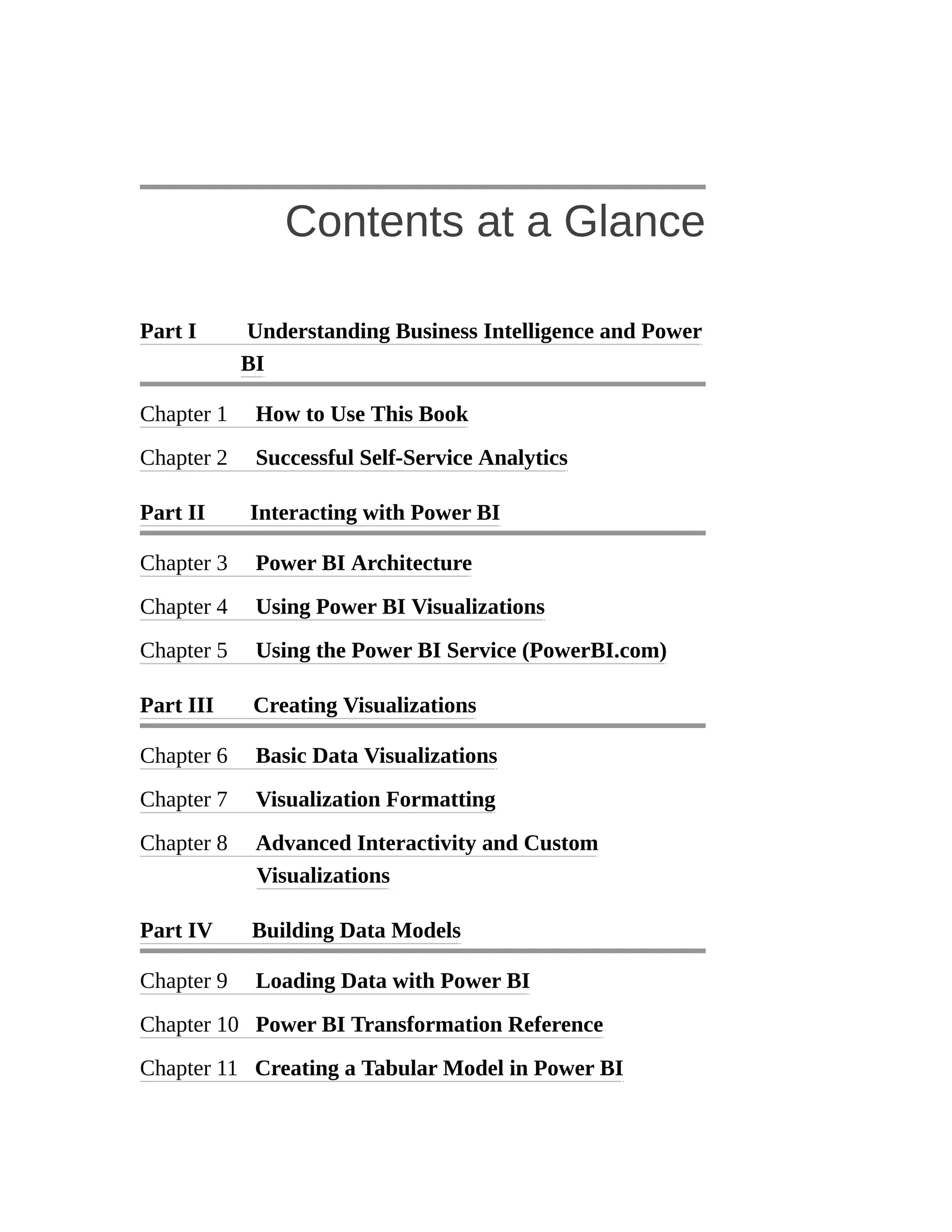
  • 8.
    2. Workspaces 1. Reports 2.Dashboards 3. Workbooks 4. Datasets 5. Dataflows 3. Additional Areas and Items Within PowerBI.com 1. Additional Navigation Pane Items 2. Additional Buttons 4. How It All Gets Made 10. Part III Creating Visualizations 1. Chapter 6 Basic Data Visualizations 1. Learn By Doing 1. Starting Point 2. Basic Visualizations 1. Maximum Miniatures Manufacturing 2. Our First Report Page 3. Text-based Visualizations 4. Graphical Visualizations 3. Interactivity 1. Slicers 2. Filters 3. Drillthrough 4. Geographic Visualizations
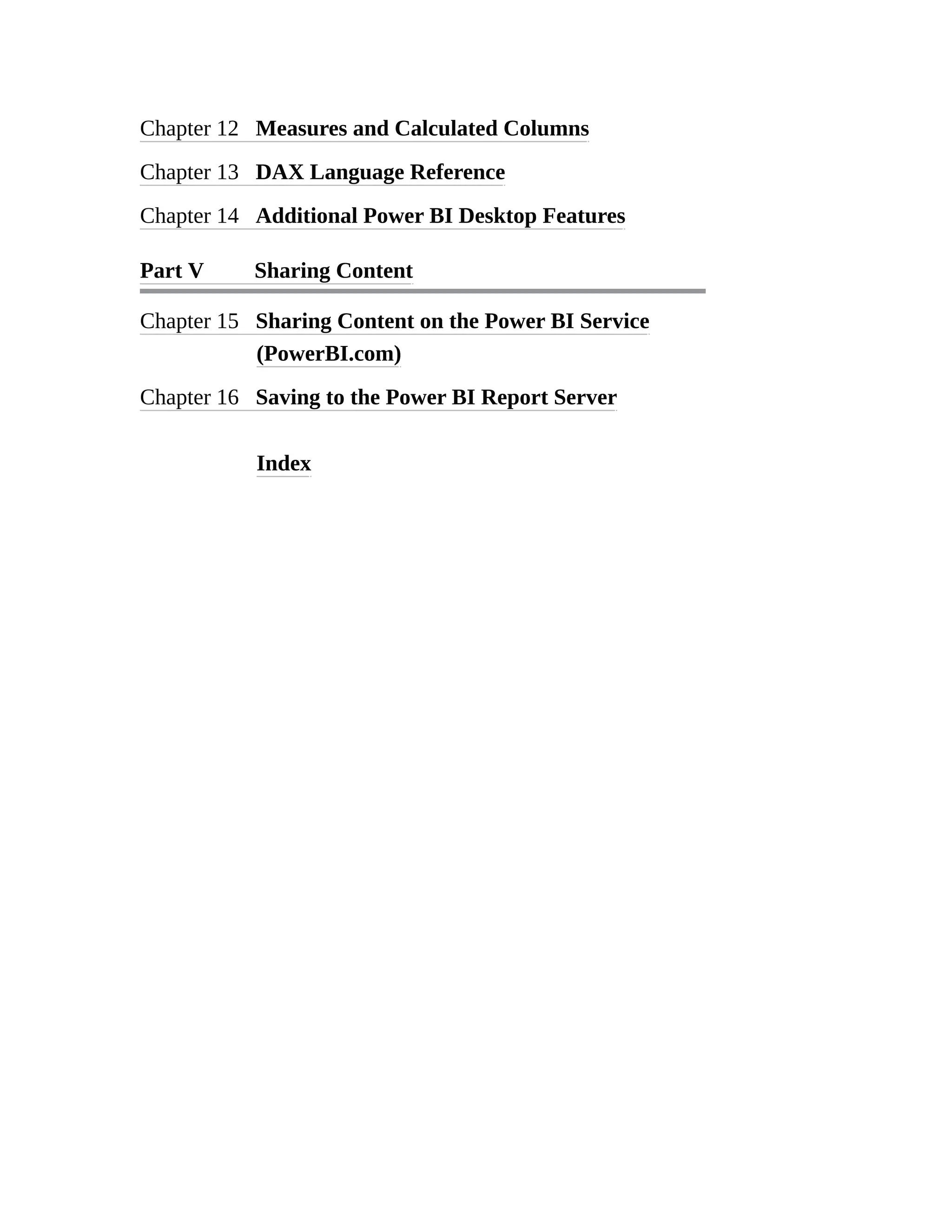
  • 9.
    1. Bing MapVisualizations 2. Shape Map Visualizations 3. GIS Map Visualizations 5. Other Visual Elements 1. Text Boxes, Images, and Shapes 6. Fancy Formatting 2. Chapter 7 Visualization Formatting 1. The Visualization Format Tab 1. Report Page 2. All Items 3. Charts 4. Additional Chart Functional Groups 5. Table and Matrix 6. Card and Multi-row Card 7. Pie Chart, Donut Chart, Treemap, and Maps 8. Funnel 9. Gauge 10. KPI 11. Slicer 12. Button, Shape, and Image 2. Advanced Formatting Dialog Boxes 1. Conditional Formatting Advanced Controls Dialog Box 2. Data Bars Advanced Controls Dialog Box 3. The Visualization Analytics Tab 1. Types of Analytics Lines 2. Controls for Editing Analytics Lines
  • 10.
    4. Themes 5. NewWays to Interact and Visualize 3. Chapter 8 Advanced Interactivity and Custom Visualizations 1. Controlling Interactivity 1. Controlling Interactions 2. Synchronizing Slicers 2. Creating Interactivity 1. Custom Tooltips 2. Bookmarks 3. Selection Pane 4. Buttons 3. Customizing Visualizations 1. Custom Visualizations from the Marketplace 2. Custom Visualizations from R and Python 3. Creating a Custom Shape Map 4. Moving on to Modeling 11. Part IV Building Data Models 1. Chapter 9 Loading Data with Power BI 1. Gathering Data 1. Get Data 2. Power BI Connection Types 2. Transforming Data During the Data Import 1. The Power BI Query Editor 2. A New Sample: World Population
  • 11.
    3. Repeating andChanging the Data Import 1. Refreshing Data in Power BI Desktop 2. Modifying Queries 3. The Advanced Editor and the Power Query Formula Language 4. Data Source Permissions 4. Relationships and Intermediate Tables 1. Creating an Intermediate Table from a Data Source 2. Manually Creating Intermediate Tables 5. Parameters 1. Putting Parameters to Use 6. Transformers 2. Chapter 10 Power BI Transformation Reference 1. Transformation Reference 1. Informational-Only Transformations 2. Transformations on the Query Editor Home Tab 3. Transformations on the Query Editor Transform Tab 4. Transformations on the Query Editor Add Column Tab 2. Model Building 3. Chapter 11 Creating a Tabular Model in Power BI 1. Relationships
  • 12.
    1. Creating Relationships 2.User-Friendly Models 1. Hiding Columns from the End User 2. Column Names and Descriptions 3. Formatting and Categories 1. One Final Relationship 2. Data Categories 3. Hierarchies, Groups, and Bins 4. Measuring Up 4. Chapter 12 Measures and Calculated Columns 1. Calculated Columns 1. Creating a Calculated Column 2. The Context for Calculated Columns 2. Measures 1. Default Summarization 2. Explicit Measures 3. Measures and Context 4. Defining Context Within a Measure 5. Time Analytics 6. Row-by-Row Calculations 7. The FILTER() Function 3. DAX Variables 1. Declaring DAX Variables and Assigning a Value 2. Using a DAX Variable 3. Using Return in a Measure
  • 13.
    4. Everything DAX 5.Chapter 13 DAX Language Reference 1. DAX Operators 1. Comparison Operators 2. Arithmetic Operators 3. Text Operator 4. Logical Operators 2. DAX Functions 1. Modifying Context 2. Table-Valued Functions 3. Aggregate Functions 4. DAX Functions for Time Analytics 5. Parent/Child Relationships 6. Additional DAX Functions 3. Additional Modeling 6. Chapter 14 Additional Power BI Desktop Features 1. Additional Power BI Data Model Features 1. Synonyms 2. Linguistic Schemas 3. Display Folder 4. What-If Parameters 5. Roles 2. Performance Analyzer 1. Capturing Performance Information 2. Viewing the DAX Query 3. Import and Export
  • 14.
    1. Excel WorkbookContent 2. Power BI Templates 4. Spreading the Word 12. Part V Sharing Content 1. Chapter 15 Sharing Content on the Power BI Service (PowerBI.com) 1. The Power BI Service and Data Refresh 1. The On-premises Data Gateway 2. The On-premises Data Gateway Architecture 3. Installing the On-premises Data Gateway 4. Managing the On-premises Data Gateway 5. Managing the On-premises Data Gateway (personal mode) 6. Setting a Dataset for Scheduled Refresh 2. The Power BI Service and Sharing 1. Using Share 2. Using Content Packs 3. Using Apps 3. The Power BI Service and Row-Level Security 1. Assigning Users to a Custom Security Role 4. Another Way to Share 2. Chapter 16 Saving to the Power BI Report Server 1. Power BI Service and Power BI Report Server Comparison 1. Versions
  • 15.
    2. Power BIDesktop Optimizations 2. Installing Power BI Report Server 1. The Power BI Report Server Installation Executable 2. The Report Server Configuration Manager 3. The Report Catalog 1. Folders 2. The Web Portal 3. Saving a Report to the Power BI Report Server 4. Security 1. Folder and Report Security 2. Row-Level Security 5. Branding the Power BI Report Server 1. Modifying the Site Name 2. Creating a Brand Package 6. Powered Up and Ready to Go 13. Index Guide 1. Cover 2. Title Page 3. Data Analysis with Microsoft Power BI
  • 16.
    Page List 1. i 2.ii 3. iii 4. iv 5. v 6. vi 7. vii 8. viii 9. ix 10. x 11. xi 12. xii 13. xiii 14. xiv 15. xv 16. xvi 17. 1 18. 2 19. 3 20. 4 21. 5 22. 6 23. 7 24. 8 25. 9 26. 10 27. 11 28. 12 29. 13 30. 14 31. 15 32. 16 33. 17 34. 18 35. 19 36. 20 37. 21
  • 17.
    38. 22 39. 23 40.24 41. 25 42. 26 43. 27 44. 28 45. 29 46. 30 47. 31 48. 32 49. 33 50. 34 51. 35 52. 36 53. 37 54. 38 55. 39 56. 40 57. 41 58. 42 59. 43 60. 44 61. 45 62. 46 63. 47 64. 48 65. 49 66. 50 67. 51 68. 52 69. 53 70. 54 71. 55 72. 56 73. 57 74. 58 75. 59 76. 60 77. 61
  • 18.
    78. 62 79. 63 80.64 81. 65 82. 66 83. 67 84. 68 85. 69 86. 70 87. 71 88. 72 89. 73 90. 74 91. 75 92. 76 93. 77 94. 78 95. 79 96. 80 97. 81 98. 82 99. 83 100. 84 101. 85 102. 86 103. 87 104. 88 105. 89 106. 90 107. 91 108. 92 109. 93 110. 94 111. 95 112. 96 113. 97 114. 98 115. 99 116. 100 117. 101
  • 19.
    118. 102 119. 103 120.104 121. 105 122. 106 123. 107 124. 108 125. 109 126. 110 127. 111 128. 112 129. 113 130. 114 131. 115 132. 116 133. 117 134. 118 135. 119 136. 120 137. 121 138. 122 139. 123 140. 124 141. 125 142. 126 143. 127 144. 128 145. 129 146. 130 147. 131 148. 132 149. 133 150. 134 151. 135 152. 136 153. 137 154. 138 155. 139 156. 140 157. 141
  • 20.
    158. 142 159. 143 160.144 161. 145 162. 146 163. 147 164. 148 165. 149 166. 150 167. 151 168. 152 169. 153 170. 154 171. 155 172. 156 173. 157 174. 158 175. 159 176. 160 177. 161 178. 162 179. 163 180. 164 181. 165 182. 166 183. 167 184. 168 185. 169 186. 170 187. 171 188. 172 189. 173 190. 174 191. 175 192. 176 193. 177 194. 178 195. 179 196. 180 197. 181
  • 21.
    198. 182 199. 183 200.184 201. 185 202. 186 203. 187 204. 188 205. 189 206. 190 207. 191 208. 192 209. 193 210. 194 211. 195 212. 196 213. 197 214. 198 215. 199 216. 200 217. 201 218. 202 219. 203 220. 204 221. 205 222. 206 223. 207 224. 208 225. 209 226. 210 227. 211 228. 212 229. 213 230. 214 231. 215 232. 216 233. 217 234. 218 235. 219 236. 220 237. 221
  • 22.
    238. 222 239. 223 240.224 241. 225 242. 226 243. 227 244. 228 245. 229 246. 230 247. 231 248. 232 249. 233 250. 234 251. 235 252. 236 253. 237 254. 238 255. 239 256. 240 257. 241 258. 242 259. 243 260. 244 261. 245 262. 246 263. 247 264. 248 265. 249 266. 250 267. 251 268. 252 269. 253 270. 254 271. 255 272. 256 273. 257 274. 258 275. 259 276. 260 277. 261
  • 23.
    278. 262 279. 263 280.264 281. 265 282. 266 283. 267 284. 268 285. 269 286. 270 287. 271 288. 272 289. 273 290. 274 291. 275 292. 276 293. 277 294. 278 295. 279 296. 280 297. 281 298. 282 299. 283 300. 284 301. 285 302. 286 303. 287 304. 288 305. 289 306. 290 307. 291 308. 292 309. 293 310. 294 311. 295 312. 296 313. 297 314. 298 315. 299 316. 300 317. 301
  • 24.
    318. 302 319. 303 320.304 321. 305 322. 306 323. 307 324. 308 325. 309 326. 310 327. 311 328. 312 329. 313 330. 314 331. 315 332. 316 333. 317 334. 318 335. 319 336. 320 337. 321 338. 322 339. 323 340. 324 341. 325 342. 326 343. 327 344. 328 345. 329 346. 330 347. 331 348. 332 349. 333 350. 334 351. 335 352. 336 353. 337 354. 338 355. 339 356. 340 357. 341
  • 25.
    358. 342 359. 343 360.344 361. 345 362. 346 363. 347 364. 348 365. 349 366. 350 367. 351 368. 352 369. 353 370. 354 371. 355 372. 356 373. 357 374. 358 375. 359 376. 360 377. 361 378. 362 379. 363 380. 364 381. 365 382. 366 383. 367 384. 368 385. 369 386. 370 387. 371 388. 372 389. 373 390. 374 391. 375 392. 376 393. 377 394. 378 395. 379 396. 380 397. 381
  • 26.
    398. 382 399. 383 400.384 401. 385 402. 386 403. 387 404. 388 405. 389 406. 390 407. 391 408. 392 409. 393 410. 394 411. 395 412. 396 413. 397 414. 398 415. 399 416. 400 417. 401 418. 402 419. 403 420. 404 421. 405 422. 406 423. 407 424. 408 425. 409 426. 410 427. 411 428. 412 429. 413 430. 414 431. 415 432. 416 433. 417 434. 418 435. 419 436. 420 437. 421
  • 27.
    438. 422 439. 423 440.424 441. 425 442. 426 443. 427 444. 428 445. 429 446. 430 447. 431 448. 432 449. 433 450. 434 451. 435 452. 436 453. 437 454. 438 455. 439 456. 440 457. 441 458. 442 459. 443 460. 444 461. 445 462. 446 463. 447 464. 448 465. 449 466. 450 467. 451 468. 452 469. 453 470. 454 471. 455 472. 456 473. 457 474. 458 475. 459 476. 460 477. 461
  • 28.
    478. 462 479. 463 480.464 481. 465 482. 466 483. 467 484. 468 485. 469 486. 470 487. 471 488. 472 489. 473 490. 474 491. 475 492. 476 493. 477 494. 478 495. 479 496. 480 497. 481 498. 482 499. 483 500. 484 501. 485 502. 486 503. 487 504. 488 505. 489 506. 490 507. 491 508. 492 509. 493 510. 494 511. 495 512. 496 513. 497 514. 498 515. 499 516. 500 517. 501
  • 29.
    518. 502 519. 503 520.504 521. 505 522. 506 523. 507 524. 508 525. 509 526. 510 527. 511 528. 512 529. 513 530. 514 531. 515 532. 516 533. 517 534. 518 535. 519 536. 520 537. 521 538. 522 539. 523 540. 524 541. 525 542. 526 543. 527 544. 528
  • 32.
    Copyright © 2020by McGraw-Hill Education. All rights reserved. Except as permitted under the United States Copyright Act of 1976, no part of this publication may be reproduced or distributed in any form or by any means, or stored in a database or retrieval system, without the prior written permission of the publisher. ISBN: 978-1-26-045862-6 MHID: 1-26-045862-8 The material in this eBook also appears in the print version of this title: ISBN: 978-1-26-045861-9, MHID: 1-26-045861-X. eBook conversion by codeMantra Version 1.0 All trademarks are trademarks of their respective owners. Rather than put a trademark symbol after every occurrence of a trademarked name, we use names in an editorial fashion only, and to the benefit of the trademark owner, with no intention of infringement of the trademark. Where such designations appear in this book, they have been printed with initial caps. McGraw-Hill Education eBooks are available at special quantity discounts to use as premiums and sales promotions or for use in corporate training programs. To contact a representative, please visit the Contact Us page at www.mhprofessional.com. Information has been obtained by McGraw-Hill Education
  • 33.
    from sources believedto be reliable. However, because of the possibility of human or mechanical error by our sources, McGraw-Hill Education, or others, McGraw-Hill Education does not guarantee the accuracy, adequacy, or completeness of any information and is not responsible for any errors or omissions or the results obtained from the use of such information. TERMS OF USE This is a copyrighted work and McGraw-Hill Education and its licensors reserve all rights in and to the work. Use of this work is subject to these terms. Except as permitted under the Copyright Act of 1976 and the right to store and retrieve one copy of the work, you may not decompile, disassemble, reverse engineer, reproduce, modify, create derivative works based upon, transmit, distribute, disseminate, sell, publish or sublicense the work or any part of it without McGraw-Hill Education’s prior consent. You may use the work for your own noncommercial and personal use; any other use of the work is strictly prohibited. Your right to use the work may be terminated if you fail to comply with these terms. THE WORK IS PROVIDED “AS IS.” McGRAW-HILL EDUCATION AND ITS LICENSORS MAKE NO GUARANTEES OR WARRANTIES AS TO THE ACCURACY, ADEQUACY OR COMPLETENESS OF OR RESULTS TO BE OBTAINED FROM USING THE WORK, INCLUDING ANY INFORMATION THAT CAN BE ACCESSED THROUGH THE WORK VIA HYPERLINK OR OTHERWISE, AND EXPRESSLY DISCLAIM ANY
  • 34.
    WARRANTY, EXPRESS ORIMPLIED, INCLUDING BUT NOT LIMITED TO IMPLIED WARRANTIES OF MERCHANTABILITY OR FITNESS FOR A PARTICULAR PURPOSE. McGraw-Hill Education and its licensors do not warrant or guarantee that the functions contained in the work will meet your requirements or that its operation will be uninterrupted or error free. Neither McGraw-Hill Education nor its licensors shall be liable to you or anyone else for any inaccuracy, error or omission, regardless of cause, in the work or for any damages resulting therefrom. McGraw-Hill Education has no responsibility for the content of any information accessed through the work. Under no circumstances shall McGraw-Hill Education and/or its licensors be liable for any indirect, incidental, special, punitive, consequential or similar damages that result from the use of or inability to use the work, even if any of them has been advised of the possibility of such damages. This limitation of liability shall apply to any claim or cause whatsoever whether such claim or cause arises in contract, tort or otherwise.
  • 35.
    This book isdedicated to my father-in-law, Len Martin. I had the great fortune to have in-laws who were also good friends. Len taught me many lessons on home improvement and was always ready to share his experience running a small business. A combat pilot in WWII, Air Force Reservist, and recreational pilot, he “slipped the surly bonds of earth” one last time on July 9, 2019.
  • 36.
    ABOUT THE AUTHOR BrianLarson has focused his writing and consulting career around Microsoft reporting and analytics tools. That association began for Brian as a consulting member of the original Microsoft SQL Server Reporting Services development team. In that role, he contributed to the original code base of Reporting Services. Brian is currently a partner and chief creative officer for Superior Consulting Services in Minneapolis, Minnesota. Brian has presented at national conferences and events, including the PASS Community Summit and the Microsoft Business Intelligence Conference, and has provided training and mentoring across the country. In addition to this book, Brian is the author of Microsoft SQL Server 2016 Reporting Services, Fifth Edition and Delivering Business Intelligence with Microsoft SQL Server 2016, Fourth Edition, and he is co- author of Visualizing Data with Microsoft Power View, all from McGraw-Hill Education. Brian is a Phi Beta Kappa graduate of Luther College in Decorah, Iowa, with degrees in physics and computer science. He has 34 years of experience in the computer industry and 30 years of experience as a consultant creating custom database solutions. Brian is a Microsoft Certified Solutions Expert (MCSE) in Data Management and Analytics. Brian and his wife, Pam, have been married for 34 years. Pam will tell you that their first date took place at the campus computer center. If that doesn’t qualify someone to write a technology book, then Brian doesn’t know what does. Brian
  • 37.
    and Pam havetwo children, Jessica and Corey. About the Technical Editor Dan Corley is a business intelligence architect with a strong passion for and expertise in the Microsoft data platform and business analytics technologies. He has worked in business intelligence for 20 years, architecting, managing, and developing business intelligence solutions in a variety of industries. Dan lives with his wife and eight children in Lakeville, Minnesota.
  • 38.
    Contents at aGlance Part I Understanding Business Intelligence and Power BI Chapter 1 How to Use This Book Chapter 2 Successful Self-Service Analytics Part II Interacting with Power BI Chapter 3 Power BI Architecture Chapter 4 Using Power BI Visualizations Chapter 5 Using the Power BI Service (PowerBI.com) Part III Creating Visualizations Chapter 6 Basic Data Visualizations Chapter 7 Visualization Formatting Chapter 8 Advanced Interactivity and Custom Visualizations Part IV Building Data Models Chapter 9 Loading Data with Power BI Chapter 10 Power BI Transformation Reference Chapter 11 Creating a Tabular Model in Power BI
  • 39.
    Chapter 12 Measuresand Calculated Columns Chapter 13 DAX Language Reference Chapter 14 Additional Power BI Desktop Features Part V Sharing Content Chapter 15 Sharing Content on the Power BI Service (PowerBI.com) Chapter 16 Saving to the Power BI Report Server Index
  • 40.
    Contents Acknowledgments Part I UnderstandingBusiness Intelligence and Power BI Chapter 1 How to Use This Book The Tool Chest Called Power BI The BI Process Power BI Parts and Pieces The Right Tool(s) for the Job Consuming Power BI Reports Power BI as a Data Visualization Tool Power BI as a Modeling Tool Power BI as a Data Warehouse/Data Mart Where to Find What You Need Obtaining Power BI Desktop Software Sample Code and Supporting Materials Information on Power BI New Features and Enhancements How to Succeed at Self-Service Analytics Chapter 2 Successful Self-Service Analytics What Is Business Intelligence? Defining KPIs
  • 41.
    Is Your OrganizationReady for BI? Desire Realistic Expectations Ongoing Care and Feeding Well-Defined KPIs Actionable KPIs Reliable Sources of Data Implementation: Best Practices Take an Iterative Implementation Approach Utilize a Data Warehouse/Data Mart Cleanse and Validate During Data Gathering Create User-Friendly Data Models Publish Latency Provide Training and Support Use the Right Tool for the Job Establish Standards and Limits Successfully Using Power BI Part II Interacting with Power BI Chapter 3 Power BI Architecture The Power BI Architecture Power BI Desktop The Power BI Service The Power BI Report Server The Power BI Mobile App Power BI Desktop Optimizations Power BI Updates Microsoft On-premises Data Gateway
  • 42.
    What Does theData Have to Say? Chapter 4 Using Power BI Visualizations Power BI Desktop Obtaining What You Need Opening the Report/Preparing the Environment Interacting with a Power BI Report Working with a Single Report Item Interacting with Multiple Report Items Changing the Data with Slicers and Filters Slicers Filters Navigating Power BI Reports Drill Down and Drillthrough Buttons Bookmarks Additional Data Interactions A Cloudy Forecast Chapter 5 Using the Power BI Service (PowerBI.com) PowerBI.com The Organization of PowerBI.com Connecting to PowerBI.com The Navigation Pane Workspaces Reports Dashboards Workbooks Datasets
  • 43.
    Dataflows Additional Areas andItems Within PowerBI.com Additional Navigation Pane Items Additional Buttons How It All Gets Made Part III Creating Visualizations Chapter 6 Basic Data Visualizations Learn By Doing Starting Point Basic Visualizations Maximum Miniatures Manufacturing Our First Report Page Text-based Visualizations Graphical Visualizations Interactivity Slicers Filters Drillthrough Geographic Visualizations Bing Map Visualizations Shape Map Visualizations GIS Map Visualizations Other Visual Elements Text Boxes, Images, and Shapes Fancy Formatting Chapter 7 Visualization Formatting The Visualization Format Tab
  • 44.
    Report Page All Items Charts AdditionalChart Functional Groups Table and Matrix Card and Multi-row Card Pie Chart, Donut Chart, Treemap, and Maps Funnel Gauge KPI Slicer Button, Shape, and Image Advanced Formatting Dialog Boxes Conditional Formatting Advanced Controls Dialog Box Data Bars Advanced Controls Dialog Box The Visualization Analytics Tab Types of Analytics Lines Controls for Editing Analytics Lines Themes New Ways to Interact and Visualize Chapter 8 Advanced Interactivity and Custom Visualizations Controlling Interactivity Controlling Interactions Synchronizing Slicers Creating Interactivity Custom Tooltips
  • 45.
    Bookmarks Selection Pane Buttons Customizing Visualizations CustomVisualizations from the Marketplace Custom Visualizations from R and Python Creating a Custom Shape Map Moving on to Modeling Part IV Building Data Models Chapter 9 Loading Data with Power BI Gathering Data Get Data Power BI Connection Types Transforming Data During the Data Import The Power BI Query Editor A New Sample: World Population Repeating and Changing the Data Import Refreshing Data in Power BI Desktop Modifying Queries The Advanced Editor and the Power Query Formula Language Data Source Permissions Relationships and Intermediate Tables Creating an Intermediate Table from a Data Source Manually Creating Intermediate Tables Parameters Putting Parameters to Use
  • 46.
    Transformers Chapter 10 PowerBI Transformation Reference Transformation Reference Informational-Only Transformations Transformations on the Query Editor Home Tab Transformations on the Query Editor Transform Tab Transformations on the Query Editor Add Column Tab Model Building Chapter 11 Creating a Tabular Model in Power BI Relationships Creating Relationships User-Friendly Models Hiding Columns from the End User Column Names and Descriptions Formatting and Categories One Final Relationship Data Categories Hierarchies, Groups, and Bins Measuring Up Chapter 12 Measures and Calculated Columns Calculated Columns Creating a Calculated Column The Context for Calculated Columns Measures
  • 47.
    Default Summarization Explicit Measures Measuresand Context Defining Context Within a Measure Time Analytics Row-by-Row Calculations The FILTER() Function DAX Variables Declaring DAX Variables and Assigning a Value Using a DAX Variable Using Return in a Measure Everything DAX Chapter 13 DAX Language Reference DAX Operators Comparison Operators Arithmetic Operators Text Operator Logical Operators DAX Functions Modifying Context Table-Valued Functions Aggregate Functions DAX Functions for Time Analytics Parent/Child Relationships Additional DAX Functions Additional Modeling Chapter 14 Additional Power BI Desktop Features
  • 48.
    Additional Power BIData Model Features Synonyms Linguistic Schemas Display Folder What-If Parameters Roles Performance Analyzer Capturing Performance Information Viewing the DAX Query Import and Export Excel Workbook Content Power BI Templates Spreading the Word Part V Sharing Content Chapter 15 Sharing Content on the Power BI Service (PowerBI.com) The Power BI Service and Data Refresh The On-premises Data Gateway The On-premises Data Gateway Architecture Installing the On-premises Data Gateway Managing the On-premises Data Gateway Managing the On-premises Data Gateway (personal mode) Setting a Dataset for Scheduled Refresh The Power BI Service and Sharing Using Share Using Content Packs
  • 49.
    Another Random ScribdDocument with Unrelated Content
  • 50.
    THE GREAT MATCH-BOXMYSTERY PART ONE I wonder—has any one ever made a psychoanalytical study of the habits of the Match-box family? By Match-box family I mean the yellow and black, self-sufficient variety that arrive from the grocer in packages of a dozen and are at once torn apart and distributed (like kittens or missionaries) to every point of the compass. Each box has its own special territory, and there it should stand, ready to the last match for any sudden emergency, such as the re- animation of the just-gone-out pipe, or the finding of the eyeglasses in the dark that their owner may be able to read the time on his radium-faced wrist-watch, or a thousand and one things. There are indeed a thousand and one good and sufficient reasons (apart from its being its plain duty) why a match-box should always be on the job, and like the thousand and one cures for rheumatism not one of them (unless it be a horse-chestnut in the pocket) can be relied upon to work. I sometimes think “a thousand and one” must be an unlucky number. The greater the need of its services the less likely is the match- box to be in that particular place where any number of witnesses will testify upon oath they had seen it only a moment before. What is the strikeology of it? Have match-boxes that perverted sense of humor that finds expression in practical jokes? No, it is nothing like that. Would that it were! It is something less easy to explain. It is something sinister—something rather frightening.
  • 51.
    . . .. I am a devout reader of detective stories and with much study of their methods have come to regard myself as something of a sleuth, in a purely theoretic way of course; nevertheless I have always hoped some day to put my theories to the test, and here was the chance. I would find out where the match-boxes go, I would follow their trail to the bitter end, even if it led to the door of the White House itself! . . . . First I made a careful blue-print plan of the flat in which I (and the match-boxes) live, marking plainly in red ink all the doors, windows, fire-escapes (fire-escapes are most important); dumbwaiters, closets, trapdoors (there weren’t any but I put them in to make it more professional); then—but why go into all the thousand and— there’s that unlucky number again—the thousand and two minute and uninteresting details? You would only skip them and turn to the last paragraph to end the horrible suspense and learn at once what I discovered. * * * PART TWO Synopsis of Previous Chapter. Having observed that Match-boxes, placed in every room of the house, invariably disappear in a few hours, the narrator resolves to solve the mystery even though the trail should lead straight to the White House in Washington. Accordingly he makes a plan of all the rooms, closets, etc., and searches every possible hiding-place, but no trace of the Match-boxes is found. What can have become of them! I have searched every corner of every room in the house—Stay! There is one room I have overlooked —the Haunted Room in the West Corridor, haunted by the ghosts of
  • 52.
    dead cigarettes, unfinishedpoems and murdered ideas. It is my study (or studio, as the occasion may be). With trembling hand on the porcelain door-knob, I pause to recall the secret combination. In vain I rack my brain to remember the secret combination of my study door. Then suddenly it flashes upon me that long ago I wrote it down in the address book I carried in my pocket. There are twelve pockets in the suit I am wearing. Fearfully I go through the twelve pockets and many are the lost treasures and forgotten-to-mail letters I find, but no Address Book! Wait! there is still another pocket! One I never use—the thirteenth pocket! With the deliberation of despair I empty the Thirteenth Pocket of its contents—a broken cigarette, two amalgamated postage stamps, a device for cleaning pipe bowls, some box-checks for The Famous Mrs. Fair, four rubber bands, a fragment of an Erie time-table and— the Address Book! On the last page of the Address Book is the Combination, written in a pale Greek cipher, but still legible, grasping the porcelain door- knob firmly between my thumb and four fingers I scan the cipher eagerly. De-coded, it reads as follows—Twist knob to the right as far as possible and push door. . . . . With heart beating like a typewriter I obeyed the directions to the letter, and to my intense relief the door yielded and in another moment I was in the room! And there, scattered over the surface of my desk like surprised conspirators, feigning ignorance of one another’s presence, were twelve yellow Match-boxes! How they mastered the combination of the door and got into the room, I shall not attempt to explain. I am only an amateur Detective. All I know is that Match-boxes, though they be scattered to the ends of the house (or World), always get together in some one
  • 53.
    place. Perhaps it isfor safety, they get together. I have always wondered why they are called Safety Matches. Perhaps that is the reason!
  • 54.
    I ARE CATS PEOPLE? fa fool be sometimes an angel unawares, may not a foolish query be a momentous question in disguise? For example, the old riddle: “Why is a hen?” which is thought by many people to be the silliest question ever asked, is in reality the most profound. It is the riddle of existence. It has an answer, to be sure, but though all the wisest men and women in the world and Mr. H. G. Wells have tried to guess it, the riddle “Why is a hen?” has never been answered and never will be. So, too, the question: “Are Cats People?” seemingly so trivial, may be, under certain conditions, a question of vital importance. Suppose, now, a rich man dies, leaving all his money to his eldest son, with the proviso that a certain portion of it shall be spent in the maintenance of his household as it then existed, all its members to remain under his roof, and receive the same comfort, attention, or remuneration they had received in his (the testator’s) lifetime. Then suppose the son, on coming into his money, and being a hater of cats, made haste to rid himself of a feline pet that had lived in the family from early kittenhood, and had been an especial favorite of his father’s. Thereupon, the second son, being a lover of cats and no hater of money, sues for possession of the estate on the ground that his brother has failed to carry out the provisions of his father’s will, in refusing to maintain the household cat. The decision of the case depends entirely on the social status of the cat. Shall the cat be considered as a member of the household? What constitutes a household anyway?
  • 55.
    The definition of“Household” in the Standard Dictionary is as follows: “A number of persons living under the same roof.” If cats are people, then the cat in question is a person and a member of the household, and for failing to maintain her and provide her with the comfort and attention to which she has been used, the eldest son loses his inheritance. Having demonstrated that the question “Are Cats People?” is anything but a trivial one, I now propose a court of inquiry, to settle once for all and forever, the social status of felis domesticus. And I propose for the office of judge of that court—myself! In seconding the proposal and appointing myself judge of the court, I have been careful to follow political precedent by taking no account whatever of any qualifications I may or may not have for the office. For witnesses, I summon (from wherever they may be) two great shades, to wit: King Solomon, the wisest man of his day, and Noah Webster, the wordiest. And I say to Mr. Webster, “Mr. Webster, what are the common terms used to designate a domestic feline whose Christian name chances to be unknown to the speaker?” and Mr. Webster answers without a moment’s hesitation: “Cat, puss, pussy and pussy-cat.” “And what is the grammatical definition of the above terms?” “They are called nouns.” “And what, Mr. Webster, is the accepted definition of a noun?” “A noun is the name of a person, place or thing.” “Kindly define the word ‘place’.” “A particular locality.” “And ‘thing’.” “An inanimate object.”
  • 56.
    “That will do,Mr. Webster.” So, according to Mr. Noah Webster, the entity for which the noun cat stands, must, if not a person, be a locality or an inanimate object! A cat is surely not a locality, and as for being an inanimate object, her chance of avoiding such a condition is nine times better even than a king’s. Then a cat must be a person. Suppose we consult King Solomon. In the Book of Proverbs, Chapter XXX, verse 26, Solomon says: “The coneys are but a feeble folk, yet they make their houses in the rocks.” A coney is a kind of rabbit; folk, according to Mr. Webster, only another word for people. That settles it! If the rabbits are people, cats are people. Long lives to the cat!
  • 57.
    I MLLE. FAUTEUIL t isharder for a table or chair to behave naturally on the stage than for a camel to be free and easy in a needle’s eye, or for Mr. Rockefeller to get into Heaven (or Hell?) with the money. What can be more pathetic than the spectacle of a helpless young chair or table or settee starting on a stage career shining with gilt varnish and high ambition to reflect in art’s mirror the drawing-room manners of the furniture of real life. Mlle. Fauteuil (that is her stage name, in private life she is just plain Sofa) is fresh, charming and of the best manufacture. She appears nightly in a Broadway theater, yet she has attracted no attention. She has received no press notices. Certainly this is from no lack of charm on her part. Her legs are delightful. In the contemplation of their gilded curves, one scarcely notices that she has no arms or that her back is slightly curved, and her upholstery, a brocade of the season before last. In a hushed papièr-mâché voice the property man told me the story of Mlle. Fauteuil’s persecution—how, at the first rehearsal with scenery, she occupied a perfectly proper position between the center table and the bay window, how the Leading Lady insisted on her being moved as she obstructed that superior person’s path when, after writing the letter, she crosses to the window to see if her Husband is in the garden. Mlle. Fauteuil was then transferred to a station between the table and the fire-place. This was all right, until the scene between the Husband and Wife, when the Husband walks back and forth (quickly up stage and slowly down stage), between the table and the fire- place.
  • 58.
    This time itwas not a case of politely requesting the intervention of the stage-manager. . . . . Poor mangled Fauteuil! When she was picked up from the orchestra pit where he had thrown her it was found that two of her rungs were fractured and her left castor was broken clean off at the ankle. After half a day in the hospital without either anesthetics, flowers or press notices, she reappeared on the left side of the stage, between the center table and the safe. Here she was conspicuous and happy until it was found that the Erring Son in his voyage from the window to the safe, was compelled to take a difficult step to one side to avoid the fauteuil. Bandied from right to left, up stage and down stage, at last Mlle. Fauteuil landed in her present obscure position, to the right of the stairway pillar, where, though miserably obscure, she interferes with nobody’s stage business. In the interior set as now played there is only one chair with a speaking part—this is, the Jacobean chair on which the leading man leans when talking to the ingénue. In the first act, it faces left so that he may show his favorite profile. In the second act, the chair is reversed in order that the audience may enjoy his more popular and extensively photographed left profile. The moral of this story is that the furniture on the stage must never appear more intelligent than the actors.
  • 60.
    O MONEY AND FIREFLIES h,yes, Money talks. We all know that, and a very noisy talker it is and very harsh and metallic is its accent. But sometimes money talks in a whisper, so low that it can hardly be heard. Then is the time it should be watched, even if spies and dictaphones must be set upon it. The money whose eloquence, we are told, wished the shackles of Prohibition on this land of the free, talked with such a “still small voice” that everybody (except you and me, dear Reader) mistook it for the voice of conscience. Speaking of money perhaps you don’t know it, but it is nevertheless true, that the light given off by one of the many species of Firefly is the most efficient light known, being produced at about one four-hundredth part of the cost of the energy which is expended in the candle flame. That is what William J. Hammer says in his book on Radium, giving as his authority Professor S. P. Langley and F. W. Very. And Sir Oliver Lodge says if the secret of the Firefly were known, a boy turning a crank could furnish sufficient energy to light an entire electric circuit. But to the Casual Observer there is only one variety of Firefly.… Like Wordsworth’s primrose: The Firefly with fitful glim Is just a Lightning Bug to him And it is nothing more. In reality there are almost as many different kinds of Firefly in the United States alone as there are varieties of the great American
  • 61.
    Pickle. The late ProfessorHagen of Harvard College, it is said, when enjoying the beauties of Nature one night in the company of the Casual Observer, was aroused from an apparent reverie by the question “Have you noticed the Fireflies, Professor?” “Yes,” replied Professor Hagen, “I have already counted thirteen distinct species.” Another quite different story is told of a well-known English actress—Cecilia Loftus, if you insist on knowing her name. It was her first visit to America and Miss Loftus was sitting with another Casual Observer on the piazza of a country house whose grounds were separated from the road by a belt of trees. “Do you see the Fireflies?” said the Casual Observer, pointing toward the road. “Fireflies!” exclaimed Cecilia, “why, I thought they were hansom- cab lights!”
  • 62.
    I CONCERNING THE TROUSER- CREASE tmay perchance be questioned how long Britannia shall continue to rule the waves, but that she will ever cease to rule the fashions (the male fashions, I mean) is beyond the dreams of the boldest tailor or the maddest hatter. Nevertheless, every rule has its exception and the Rule of Fashion is no exception to the rule that rules that every rule has its exception. Every once in a while, since the invention of trousers, one or another English King has ruled that the human trouser-crease shall crown the Eastern and Western slope instead of the Northern and Southern exposure of the trouser-leg. The law has never been considered by Parliament, for even the most radical House of Commons would balk at legislation so subversive of individual freedom, but by word of mouth, by courier, by post, by cable, by wireless, by airplane the edict has passed through all the nations and all the tribes to the trousermost ends of the earth. And with what result? With no result whatever. As far as it has been possible to push inquiry, it is safe to say that no trouserian biped bearing the mark of a lateral crease has been met with in any quarter of the Globe, or, for that matter, ever will be. Strange, is it not, that the Tailors (proverbially the most complacent, not to say timid, of men) should, without any plan or program or fuss or demonstration of any sort, unite as one man—or
  • 63.
    rather one tailor—andrefuse to obey the unlimited monarch of the male fashions of the civilized world. What is the explanation? There are two explanations. One is Commercialism. There is no profit to be made out of a change in the geography of a trouser-crease. It is purely a matter of self-determination on the part of the inhabitant of the trousers. If there were no more financial profit to be gained by the remaking of the creases in the map of Europe than is to be got out of changing the trouser-crease, there would be no call for a League of Nations. Should some inventive tailor (inventive tailor!) devise a crease that could be woven into the very being of the Trouser, then it would be a very different matter. The slightest variation in the location of the crease would cause an upheaval in the (I’m tired of the word Trouser)—in the “Pant” market that would mean millions of dollars to the trade. As it is there is no money in it. The other explanation is that the story of King Edward or King George creasing the Royal Pants in any but the usual place is made out of whole cloth. But let us suppose for a moment (just for the fun of the thing) that in some possible scheme or caprice of creation there were such a thing as an inventive tailor. And the inventive tailor invented a permanent trouser-crease and planted it on the Eastern and Western frontiers of the trouser-legs. What would be the probable effect of the innovation on the trouser-bearing species of the human race? In that process of advancing alternate trouser-legs we call locomotion do we not consciously, or unconsciously, follow in the direction indicated by the point of the crease?
  • 64.
    What then wouldhappen if the crease were transferred from the front to the sides? The Crab alone of all living creatures exhibits in its legs a formation that corresponds to the human trouser-crease. This ridge-like formation or crease occurs in the side of the Crab’s legs, not in the front as in the human species! And the slogan of the Crab (as everyone knows) is, “First make sure you’re right and then go sideways.” Shall we too go sideways? Charlie Chaplin is the only human creature whose feet go East and West as his face travels North and his trouser-creases are so complicated it would be difficult to classify them. Perhaps they hold the secret of his centrifugal orientation, his inexplicable fascination. Who knows!
  • 65.
    W AN OLD-FASHIONED HEAVEN ehave to thank an Anglican clergyman, the Rev. G. Vale Owen, for the latest description of the Future Life of our species. Impelled by a “gentle, steady but accumulative force” this good man became the unwilling amanuensis of the spirit of his mother and “other friends” and has written a description of the houses, trees, bridges, gardens and people of the other world and their occupations that could scarcely be improved upon by the most imaginative motion-picture photographer, or mechanic or scrub- woman or whoever it may be that writes the scenarios. We of this world are still, after many thousand years of waiting, eager for the faintest ray of light that may be thrown on the actual conditions of what we call “the world to come,” or as the Spiritists love to say, “behind the veil,” but for the tawdry imaginings of the Reverend Mr. Owen the “Veil” serves only as an opaque screen upon whose surface they flicker grotesquely like the disorderly apparitions of a cinema projection. As a Seer this reverend gentleman, without for a moment questioning his sincerity, is a failure; his narrative, is childish in its crudity and tedious as a dream told at the breakfast table. One thing, however, is interesting, and that is to trace as we do, through the transcendental claptrap of “rainbow brides” and white- winged angels and the pseudo-scientific jargon of “planes,” “vibrations,” “spheres,” and “fourth dimension,” the—shall I say humanizing—influence of the cinema. For the first time we learn that there are bath tubs in the Heavenly Mansions—Bathtubs! With hot and cold water, and Dr. Owen does not stop at bathtubs; he assures us there are also—don’t faint—
  • 66.
    water nymphs! Can’tyou see all Israel clamoring for the picture rights! Imagine the angelic shade of St. Anthony or Mr. Spurgeon coming unexpectedly upon a school of water nymphs! And how is this for a motion-picture “fade out”? “As we knelt the whole summit of the hill seemed to become transparent—we saw right through it and a part of the regions below was brought out with distinctness. The scene we saw was a dry and barren plain in semi-darkness and standing, leaning against a rock, was a man of large stature.” I strongly suspect that the Reverend Mr. Vale Owen is, like myself (to my shame confess it), a motion-picture fan!
  • 67.
    T ANOTHER LOST ART heseare mournful days for the Polite Arts. One by one they are passing away—the Art of Conversation, the Art of Paying Calls, the Art of Letter Writing. The Art of Conversation is no longer even a subject for conversation. No one so much as remembers of what it died. Did it languish and fade away into an Eternal Pause as such a dignified gentleman of the old school as the Art of Conversation would be expected to do—or was it murdered? The mystery surrounding the death of the Art of Conversation has never been properly cleared up. Some think it died of heart failure induced by the killing modern pace. Others say it starved to death. Others again, that it was done to death by the chewing-gum trust. For my part, I believe the Art of Conversation talked itself to death. It died of obesity—it grew and grew and grew until, when all the world talked there was nobody left to listen. Then it burst. No such mystery hangs about the death of the Art of Paying Calls. Here it was a case of plain every-day murder—and what is more, the murderer still lives. Millions of electric volts are pumped into him every day, but he still lives—the more electricity we give him the livelier he grows. He is the Telephone, and the Telephone is the murderer of the Art of Calling. Poor old Art of Calling! We shake our heads and murmur perfunctory regrets—“good old chap,” and all that sort of thing, but really in our heart of hearts, let me whisper it very low—we don’t really miss him very much; to tell the truth, we are rather, that is to say, quite glad he is dead. If anyone of us had had the courage of his conviction he would have killed him long ago. To speak plainly,
  • 68.
    the Art ofCalling was a pestiferous tyrant—and he only got what he deserved.
  • 69.
    “I MR. CHESTERTON ANDTHE SOLILOQUY often talk to myself,” says Mr. G. K. Chesterton, speaking in defense of the stage soliloquy. “If a man does not talk to himself it is because he is not worth talking to.” The deduction is obvious, but it is based upon false premises. If Mr. Chesterton is worth talking to, it is certainly not because he talks to himself. It is impossible to imagine a more foolish waste of energy than that expended in talking to one’s self. The man who talks to himself is twice damned (as a fool). First, for wasting speech on an auditor who knows in advance every word he will utter. Second, for listening to a speaker whose every word he can foretell before it is uttered. Mr. Chesterton’s argument, failing as it does to prove that he is worth talking to, is still less happy as a defense of the stage soliloquy. A character in a play talks to himself not, as Mr. Chesterton would have us believe, because he is worth talking to, but to enlighten the audience on points which the inexpert playwright has otherwise failed to make plain. The stage soliloquy is only permissible as an indication of the character of one who talks to himself in real life. For instance, if I wished to dramatize G. K. Chesterton, since he often talks to himself, I should have him soliloquize upon the stage. I might make it a double part with two Mr. Chestertons dressed as the two Dromios. As a stage device the soliloquy is only a confession of weakness on the part of the playwright, and has been justly sentenced to death.
  • 70.
    Its only hopefor a reprieve is to retain (at great expense) an ex- president or an eminent K. C. who might argue that since the “fourth wall” of a stage interior is removed in order that the audience may view the actions of the players, it is therefore permissible to remove the “fourth wall” of the players’ heads so that the audience may view the action of their brains. And the ex-president or the eminent K. C. would probably “get away with it.”
  • 71.
    W BUNK hen Alexander theGreat cut with his sword the Gordian Knot, which had baffled all his efforts to untie with honest fingers, it goes without saying that his impudent performance received the applause of the onlookers. As he stood there, his heavy sword still swaying from the impetus of the stroke and exclaimed with a challenging glare at those before him (and belike an apprehensive glance over his shoulder), “Did I or did I not untie that knot?”—whatever might—nay, must have been the unspoken comment that passed from eye to eye, the answer shouted in unison, was without a shadow of a doubt the Phrygian equivalent of “You sure did!” For the Great God Bunk (whose worshipers are born at the rate of one a minute) is as old as the world itself; and since we have it on good authority that the world is a stage, even though we do not suspect him of a hand in its making, we know the old rogue assisted at the first dress rehearsal famous for all time for the smallness of the cast and the inexpensiveness of the costuming. King Gordius, whose genius contrived the unpickable knot, is now comfortably forgotten, while Alexander who destroyed what he could not understand, still enjoys uneasy immortality; for what is immortality at best but the suspended sentence of Oblivion? And the knot? The hempen hieroglyph that was never solved. When oblivion has overtaken Alexander and even the name of Gordius is forgotten, the world, which is surprisingly young for its age, will still babble wonderingly of the knot that never was and never will be untied. Another high priest of the Great God Bunk was Christopher Columbus, and on how frail a foundation rests his immortal fame—
  • 72.
    nothing more thanthe fragile, calcareous container, (and fractured at that) of an unborn domestic fowl. Unquestionably the fame of Columbus rests upon his impudent pretense of balancing an egg by crushing it violently upon the table. To be sure, Columbus also discovered America, but in that he was only one of a multitude. At that moment in the world’s history the discovering of America was, like golf, something between a sport and an obsession, everybody was discovering America. So common was it, that only a few of the discoverers are remembered by name, and had it not been for his famous egg-balancing fraud the name of Christopher Columbus would surely be among the forgotten ones. To balance an egg on its apex—though not impossible, is a tedious and dispiriting task; and even if Columbus had accomplished it honestly without fracturing the shell, so far from adding to his laurels he might have lost them altogether. Queen Isabella would never have had the patience to sit through so long and boresome a performance, and when the Queen leaves, you know the performance is over. Indeed, it is quite thinkable that it was the dread of just such an ending to his audience and the resultant stage fright reacting upon an excitable sea-faring nature that caused Columbus to break the egg. The question now asks itself: Has Christopher Columbus, posing as a clever impostor when in reality only a stage-frightened bungler, obtained his fame under false pretenses? In unmasking his clandestine honesty do we but prove him the greater fraud? Bunk only knows! Queen Dido of Carthage, on the other hand, came by her dishonesty quite honestly—she inherited it from her royal father’s sister Jezebel. Yes, Jezebel, the patron sinner of half a world of womankind, was Queen Dido’s aunt. Good or bad, what was her Aunt Jezebel’s was
  • 73.
    also Dido’s byright of inheritance. And none of all the prophets of the Great God Bunk was greater than this prophetess. Did she not for certain moneys receive the title to so much land as might be compassed by the bigness of a bull’s hide. She did. Did she not then carve said bull’s hide into fine strips and therewith enclose enough real estate for the foundation of the city of Carthage? She did.
  • 74.
    I THE COST OFA PYRAMID f you were suddenly asked, by way of a mental test, what particular thing or person was most closely associated in your mind with the word strong, you would probably say a giant or an ox unless you had been listening to a sermon whose text was the sixteenth chapter of Judges, thirtieth verse, in which case you would be more likely to say Samson, but the typical example of physical strength, would hardly be an Onion. And yet the Onion, although, like the proverbial Prophet, it may be without honor among its fellow vegetables, is regarded by at least one human outsider as the giant and ox and Samson combined of the vegetable world. Whatever your gastronomic leanings may be, let you not be tempted to think lightly of the Onion. Though its name be unhallowed when it appears in vulgar consort with Tripe, and its reek abhorrent in the habitations of the lowly, though it be viewed with contempt as a poor relation by its kinsman the lily, the Onion has a glorious past; it has a record of achievement that is second to none; it was, as I shall presently show, chiefly due to the strength of Onions that at least one of the great Egyptian Pyramids owed its existence. Even Samson might envy the record of the Onion! . . . . When I tell you that the Pyramids of Egypt, at any rate one of them, was built by sheer vegetable strength, you may not believe me, but perhaps you may believe the historian Herodotus. Herodotus found engraved on one of the Pyramids a complete record of the exact number of onions, radishes and leeks supplied
  • 75.
    and consumed bythe workmen who piled its monstrous stones one upon the other.[1] And how were the Pyramids erected? By some forgotten mechanical farce? No. According to the late Cope Whitehouse, Engineer and Egyptologist, the Pyramids were built from the apex downward over the conical hills that abound in the locality, the interior of the hill being afterwards dug away to form chambers and galleries. All of which was accomplished by the unaided physical power of human muscles and sinews. And whence came this power? It was derived mainly from the vegetable energy of Onions, leeks and radishes transmuted by the chemistry of digestion and assimilation to the muscles and sinews of the slaves employed in building the Pyramid. Furthermore, Herodotus tells us that with the engraved record of the onions, leeks and radishes consumed by the slaves, was also the computation of their cost which amounted to 1,600 talents of silver, this being the total cost of the vegetable fuel for operating the human machinery employed in the construction of the Pyramid. And now let me ask you—what it is, this thing we call Scent, this mysterious emanation which is the Love Message of the Rose, the Call of the Sea, the Strength of the Onion? You don’t know? Neither do I, no more does anybody. Of all the five recording faculties which we human creatures share with other animals, the sense of Smell is the most elusive, the most penetrating. It apprises us of impending peril when all our other wires of sensation are “busy” or “out of order” and incapable of giving us warning. It has the mysterious power of reproducing through the “flash back” we call memory the forgotten records of all of the other four sense-films, and yet the scientists who can tell us all about light waves and sound waves, and even make pictures of
  • 76.
    them, have verylittle to say about the movement of the invisible bodies whose impact upon our consciousness produces the sensation of smell. The terrific scent-energy hurled forth from the seemingly inexhaustible storage battery of an Onion or a Tuberose is more of a mystery to our men of science than is the composition of the crooked light waves from the planet Mars or the height of the flames of the Corona, measured in a solar eclipse. Even Dr. Einstein, to whom the movements of the heavenly bodies are as simple as is a game of baseball to the average intellect, cannot tell us whether the scent-atoms hurled from the Onion rush forth in an impeccable tangent or are pitched in a hyperbolic curve. [1] Herod.: 11, 125.
  • 77.
    T WALTZING MICE ANDDANCING MEN “On some men the Gods bestow Fortitude, On others a disposition for Dancing.” hus the poet Hesiod, three thousand years ago, scored with vitriolic antithesis the Dancing man of his day⸺ And of all the days, for like the poor (and no less deplorable) the Dancing man is always with us. The gods had much to answer for in the days of Hesiod, and man had much to put up with. Anything, good or evil, that befell him, from the measles to melancholia—from fortitude to dancing—was a gift of the gods, wished on him as a token of their high esteem, or otherwise. All man had to do was to accept the gift, and, if it chanced to be boils, as in the case of Job, he might be thankful it was nothing worse. Today we view a gift of the gods with distrust. Before giving thanks we inspect it in the light of Science. We examine it (as a gift horse) in the mouth. If it is a good gift, such as patience, or an aptitude for cooking, we nurture and encourage it; if it is an undesirable gift, like the measles, we eradicate it, or give it to someone else as quickly as possible. Without knowing it, Hesiod uttered a scientific truth. That Fortitude and a Disposition to Dance are gifts of the gods is just as true physiologically as it is poetically speaking.
  • 78.
    The Dancing mandances, the man of Fortitude faces a cannon— or a musical comedy—because he is built that way. In other words, his behavior is due to certain pathological structural conditions which are inherited. The behavior of the man of Fortitude is due to the poverty of cerebral tissue in that part of the brain whose function it is to stimulate the activity known as imagination. That is to say, he faces the cannon without the least concern, because he can not imagine what it will be like to have a cannon explode right in his face. What then are the pathological conditions in the brain of the Dancing man that cause him to dance? Unfortunately for the cause of Science, the brain of the true Dancing man is almost as rare a commodity as Radium. In the United States alone there is scarcely more than a fraction of an ounce of this elusive gray tissue. To procure even the minute quantity necessary for experimental purposes would require the sacrifice of thousands of Dancing men. This in these days of Antivivisection Hysteria, is out of the question. Luckily for Science, there exists in the animal Kingdom another creature afflicted with the same peculiar tendency to perpetual rotation as the Dancing man. It is but one alliterative step from the Dancing man to the Dancing mouse. The restlessness and almost incessant movement in circles and the peculiar excitability of the Dancing mouse is attributed by Rawitz, the famous physiologist, to the lack of certain senses which compels the animal to strive through varied movements to use to the greatest advantage those senses which it does possess. Comparative physiologists have discovered that the ability of animals to regulate the position of the body with respect to external objects is dependent in a large measure upon the groups of sense organs which collectively are called the ear. To quote Rawitz again:
  • 79.
    The waltzing mousehas only one normal canal and that is the anterior vertical. The horizontal and posterior vertical canals are crippled and frequently they are grown together. Panse, on the other hand, expresses his belief that there are unusual structural conditions in the brain, perhaps in the cerebellum, to which are due the dance movements. When the doctors disagree what are we going to do about it? For my part I am willing to leave it to Cicero— “Nemo fere saltat sobrius, nisi forte insanit.”
  • 80.
    T THE HOBGOBLIN here isa Hobgoblin that stalks in the path of the athletic young writers of the day and frightens them almost out of their wits. The Hobgoblin is the third person singular, past tense, of the verb “Say,” and his name is said. The Hobgoblin said does not stalk alone; with him stalk his sisters and his cousins and his aunts, indeed, all the said family except old Gran’ma quoth. Old Gran’ma quoth, who is much too old to stalk, stays at home and dreams of the good old days when she was a verb of fashion, honored and courted by all the greatest writers of the day. And when her grandchildren come home in the evening and tell how they frightened the athletic young writers almost out of their wits, she nearly bursts her old-fashioned stays, laughing at the drollery of it. “Egad!” she cries. “An’ I were an hundred years younger, I’d like nought better than to take a hand myself, and lay my stick about their backs, the young whippersnappers!” And I for one, would like to see her do it. How the said family ever became professional Hobgoblins, I can not say. All I know is that, once a hardworking and highly respected family, suddenly they found themselves shunned. There was nothing left for them but to become hobgoblins. Now their only pleasure in life is to see what funny antics they can make the athletic young writers perform in trying to escape from them. And funny they certainly are. Here are a few specimens from some of our leading “best sellers”: “To think I have fallen to that!” grated Gilstar with clenched teeth.
  • 81.
    “I get rathera good price,” Gilstar dared. “I’ll give you twenty-five dollars,” he offered wildly. “What are your terms?” he clucked. But why bother about “best sellers,” when you can make almost as funny ones at home? Here is a home-brewed one: “Where are you going to, my pretty maid?” “I’m going to the Doctor’s, to ask his aid, I caught a cold when I slept in the loft,” “Sir,” she coughed, “Sir,” she coughed, “I’m going to the Doctor’s sir,” she coughed. “May I go with you, my pretty maid?” “Oh, yes, indeed, if you’re not afraid Of catching my cold, I shall be pleased,” “Sir,” she sneezed, “Sir,” she sneezed, “Oh, yes, if you please, kind sir,” she sneezed. “Of catching your cold I have no fear, For I’ll take no chances, my pretty dear!” At this the maiden was sorely ruffled, “Sir?” she snuffled, “Sir?” she snuffled, “What do you mean, kind sir,” she snuffled. “I mean I won’t kiss you, my pretty maid!” “Nobody asked you, my smart young Blade!” In her pocket-handkerchief, large and new, “Sir!” she blew, “Sir!” she blew, “Nobody asked you, sir!” she blew.
  • 83.
    O THE VOICE OFTHE PUSSY-WILLOW n the first of May I took a day off and used the telephone. It is best to take a day off if you want to get a number these times, and the number asked for was Spring one, nine, two, two—yes, Spring, Nineteen Twenty-Two. “There’s no such number,” said Central; “what you want is Winter 1921.” I assured her that was the last number in the world I desired, and after a wait of an hour or so she gave me Blizzard 1888 on a busy wire, comparing notes with Winter 1920, and I began to despair of ever getting my number. I rang off and waited. I am a patient person, I waited a whole hour to allow the wire to cool off. Then I called again and this time I was rewarded by hearing at the other end of the wire a faint far-off, fuzzy, mewing sound. It was the voice of the Pussy-Willow! It was Lawrence Sterne, wasn’t it? who wrote, “God tempers the wind to the shorn lamb,” and it is quite a happy thought that the gentle airs that succeed the blustering winds of March, are a Providential concession to the tender nurslings of the April fields. But the Pussy-Willow comes in February and early March and it would be asking too much to expect Providence to temper the wholesome and necessary rigors of these months for the sake of the venturesome kittens of the Willow bough. Who but Providence (or Mr. Hoover) could ever have thought of the happy expedient of providing each and every Pussy-Willow, not only in the United States but also in England, France, Belgium and even Germany, with a warm fur overcoat! And I verily believe that if the Pussy-Willows were lodged on the cold wet ground instead of perched on the high and dry branches,
  • 84.
    Welcome to OurBookstore - The Ultimate Destination for Book Lovers Are you passionate about testbank and eager to explore new worlds of knowledge? At our website, we offer a vast collection of books that cater to every interest and age group. From classic literature to specialized publications, self-help books, and children’s stories, we have it all! Each book is a gateway to new adventures, helping you expand your knowledge and nourish your soul Experience Convenient and Enjoyable Book Shopping Our website is more than just an online bookstore—it’s a bridge connecting readers to the timeless values of culture and wisdom. With a sleek and user-friendly interface and a smart search system, you can find your favorite books quickly and easily. Enjoy special promotions, fast home delivery, and a seamless shopping experience that saves you time and enhances your love for reading. Let us accompany you on the journey of exploring knowledge and personal growth! ebooksecure.com