Daryl O’Hare
                                   Instructor
                        Chadron State College


 June 10-15, 2012

Growing Community;
Growing Possibilities
   rSmart and Wiley

   TWSIA judges

   Chadron State College

   Kaleidoscope Project

   Dr. Susan C. Hines

   Family


                            2012 Jasig Sakai Conference   2
English Composition I:

   Taught on-ground in sixteen week sections
    at Chadron State College

   Students bought a textbook that cost
    approximately $75


                                      2012 Jasig Sakai Conference   3
Chadron State College teamed with the
Kaleidoscope Project to develop a new eight-
week English course in a fully online format.


                                     2012 Jasig Sakai Conference   4
English Composition I should be developed:

   collaboratively
   to serve “at risk” students
   to reduce textbook costs by using OER
   in ways that challenge and innovate
   for reuse and adoption by other institutions


                                       2012 Jasig Sakai Conference   5
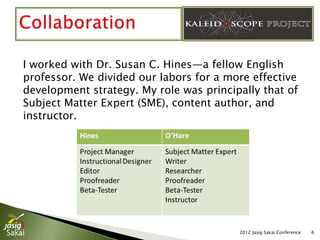
I worked with Dr. Susan C. Hines—a fellow English
professor. We divided our labors for a more effective
development strategy. My role was principally that of
Subject Matter Expert (SME), content author, and
instructor.


                                         2012 Jasig Sakai Conference   6
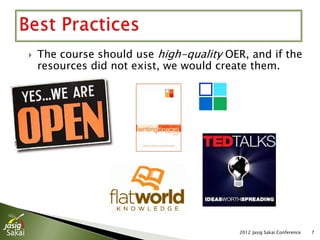
   The course should use high-quality OER, and if the
    resources did not exist, we would create them.


                                          2012 Jasig Sakai Conference   7
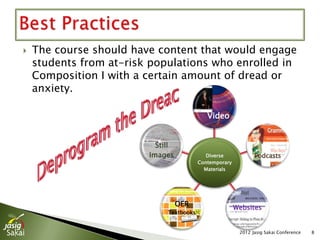
   The course should have content that would engage
    students from at-risk populations who enrolled in
    Composition I with a certain amount of dread or
    anxiety.

                                             Video


                           Still
                         Images              Diverse            Podcasts
                                          Contemporary
                                            Materials


                                   OER
                                                         Websites
                              Textbooks


                                                          2012 Jasig Sakai Conference   8
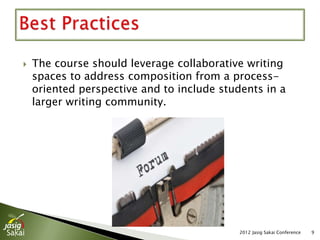
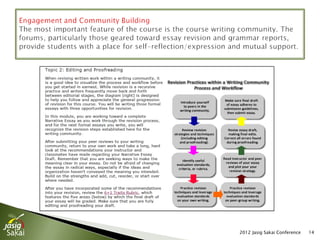
   The course should leverage collaborative writing
    spaces to address composition from a process-
    oriented perspective and to include students in a
    larger writing community.


                                            2012 Jasig Sakai Conference   9
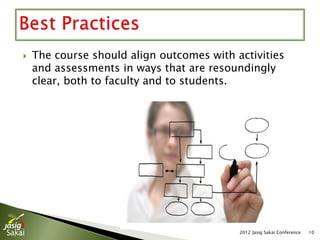
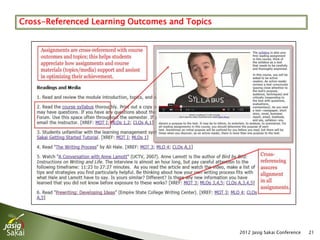
   The course should align outcomes with activities
    and assessments in ways that are resoundingly
    clear, both to faculty and to students.


                                           2012 Jasig Sakai Conference   10
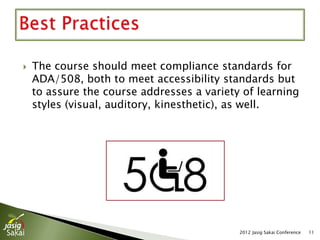
   The course should meet compliance standards for
    ADA/508, both to meet accessibility standards but
    to assure the course addresses a variety of learning
    styles (visual, auditory, kinesthetic), as well.


                                            2012 Jasig Sakai Conference   11
The course should:

   have a modular design, so it is easy to navigate.

   meet or surpass online course design standards,
    such as those advocated by Quality Matters.

   have interoperable features and a clear information
    architecture, so that it can be used by other
    institutions who may operate different LMSs.


                                            2012 Jasig Sakai Conference   12
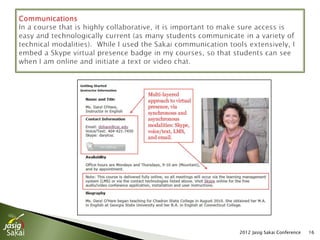
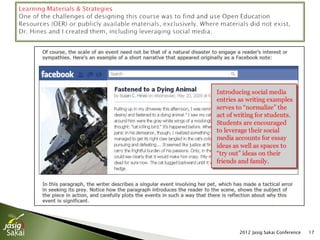
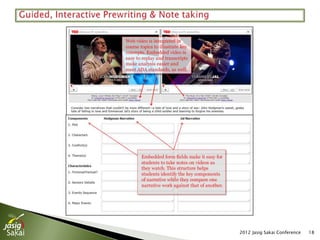
 Student Engagement and
  Community Building
 Communication
 Learning Materials and Strategies
 Learning Outcomes & Assessments
 Learner Support


                          2012 Jasig Sakai Conference   13
2012 Jasig Sakai Conference   14
2012 Jasig Sakai Conference   15
2012 Jasig Sakai Conference   16
2012 Jasig Sakai Conference   17
2012 Jasig Sakai Conference   18
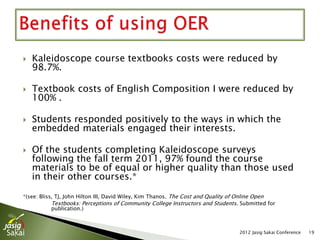
   Kaleidoscope course textbooks costs were reduced by 98.7%.

   Textbook costs of English Composition I were reduced by 100%.

   111 Students took the Kaleidoscope online course (fall 2011-
    Spring 2012); the cost savings were $8,325. Non-Kaleidoscope
    students (286 students) spent approximately $21,450.

   Students responded positively to the ways in which the
    embedded materials engaged their interests.

   Of the students completing Kaleidoscope surveys following the
    fall term 2011, 97% found the course materials to be of equal or
    higher quality than those used in their other courses.*

*(see: Bliss, TJ, John Hilton III, David Wiley, Kim Thanos. The Cost and Quality of Online Open
              Textbooks: Perceptions of Community College Instructors and Students. Submitted for
              publication.)


                                                                                         2012 Jasig Sakai Conference   19
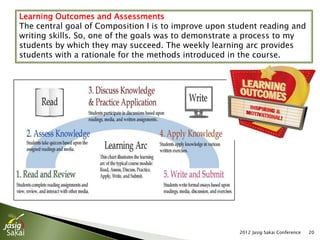
Learning Outcomes and Assessments
The central goal of Composition I is to improve upon student reading and
writing skills. So, one of the goals was to demonstrate a process to my
students by which they may succeed. The weekly learning arc provides
students with a rationale for the methods introduced in the course.


                                                       2012 Jasig Sakai Conference   20
Cross-Referenced Learning Outcomes and Topics


                                                2012 Jasig Sakai Conference   21
Assessments

Each week, students are required to achieve learning outcomes through the
following outcome assessments:

    a series of reading quizzes, delivered in each module. Quizzes were intended
     to reinforce reading knowledge/ability as well as assess reading
     knowledge/ability
    discussions and writing assessments requiring careful textual analysis or
     peer editing
    discussions and writing exercises that require a response to and/or analysis
     of podcasts, screencasts, and/or web video
    discussion forums and w riting exercises geared toward attitudes about
     writing and self-reflection on essays
    writing exercises and essay drafts
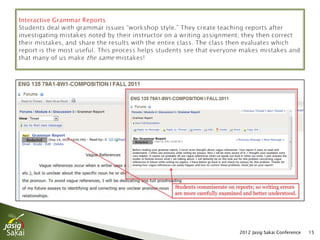
    A series of grammar reports, which include error analyses, research on
     errors, and articulated remedies
    A series of secondary -response discussion assignments that require peer
     feedback on written content
    A series of essays, including narrative, descriptive, reflective, and analytical
     expression—essays from the course are included in a portfolio


                                                                    2012 Jasig Sakai Conference   22
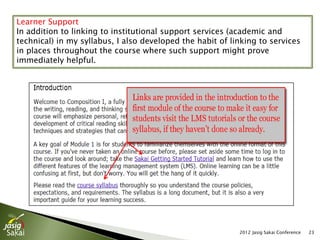
Learner Support
In addition to linking to institutional support services (academic and
technical) in my syllabus, I also developed the habit of linking to services
in places throughout the course where such support might prove
immediately helpful.


                                                           2012 Jasig Sakai Conference   23
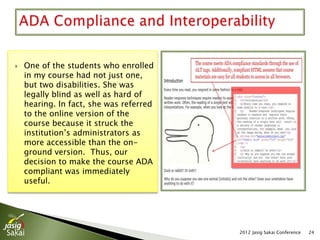
   One of the students who enrolled
    in my course had not just one,
    but two disabilities. She was
    legally blind as well as hard of
    hearing. In fact, she was referred
    to the online version of the
    course because it struck the
    institution’s administrators as
    more accessible than the on-
    ground version. Thus, our
    decision to make the course ADA
    compliant was immediately
    useful.


                                         2012 Jasig Sakai Conference   24
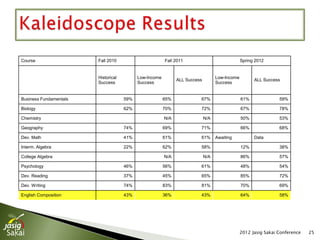
Course                  Fall 2010                       Fall 2011                              Spring 2012


                        Historical         Low-Income                             Low-Income
                                                              ALL Success                            ALL Success
                        Success            Success                                Success


Business Fundamentals                59%                65%             67%                    61%              59%

Biology                              62%                70%             72%                    67%              78%

Chemistry                                               N/A                 N/A                50%              53%

Geography                            74%                69%             71%                    66%              68%

Dev. Math                            41%                61%             61%       Awaiting           Data

Interm. Algebra                      22%                62%             58%                    12%              38%

College Algebra                                         N/A                 N/A                86%              57%

Psychology                           46%                56%             61%                    48%              54%

Dev. Reading                         37%                45%             65%                    85%              72%

Dev. Writing                         74%                83%             81%                    70%              69%

English Composition                  43%                36%             43%                    64%              58%


                                                                                               2012 Jasig Sakai Conference   25
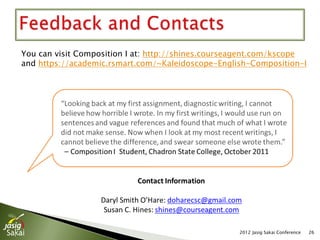
You can visit English Composition I at:
http://shines.courseagent.com/kscope
https://academic.rsmart.com/~Kaleidoscope-English-Composition-I


                                                   2012 Jasig Sakai Conference   26

Daryl O'Hare, 2012 TWSIA Award Presentation, Jasig-Sakai Conference Atlanta, GA

  • 1.
    Daryl O’Hare Instructor Chadron State College June 10-15, 2012 Growing Community; Growing Possibilities
  • 2.
    rSmart and Wiley  TWSIA judges  Chadron State College  Kaleidoscope Project  Dr. Susan C. Hines  Family 2012 Jasig Sakai Conference 2
  • 3.
    English Composition I:  Taught on-ground in sixteen week sections at Chadron State College  Students bought a textbook that cost approximately $75 2012 Jasig Sakai Conference 3
  • 4.
    Chadron State Collegeteamed with the Kaleidoscope Project to develop a new eight- week English course in a fully online format. 2012 Jasig Sakai Conference 4
  • 5.
    English Composition Ishould be developed:  collaboratively  to serve “at risk” students  to reduce textbook costs by using OER  in ways that challenge and innovate  for reuse and adoption by other institutions 2012 Jasig Sakai Conference 5
  • 6.
    I worked withDr. Susan C. Hines—a fellow English professor. We divided our labors for a more effective development strategy. My role was principally that of Subject Matter Expert (SME), content author, and instructor. 2012 Jasig Sakai Conference 6
  • 7.
    The course should use high-quality OER, and if the resources did not exist, we would create them. 2012 Jasig Sakai Conference 7
  • 8.
    The course should have content that would engage students from at-risk populations who enrolled in Composition I with a certain amount of dread or anxiety. Video Still Images Diverse Podcasts Contemporary Materials OER Websites Textbooks 2012 Jasig Sakai Conference 8
  • 9.
    The course should leverage collaborative writing spaces to address composition from a process- oriented perspective and to include students in a larger writing community. 2012 Jasig Sakai Conference 9
  • 10.
    The course should align outcomes with activities and assessments in ways that are resoundingly clear, both to faculty and to students. 2012 Jasig Sakai Conference 10
  • 11.
    The course should meet compliance standards for ADA/508, both to meet accessibility standards but to assure the course addresses a variety of learning styles (visual, auditory, kinesthetic), as well. 2012 Jasig Sakai Conference 11
  • 12.
    The course should:  have a modular design, so it is easy to navigate.  meet or surpass online course design standards, such as those advocated by Quality Matters.  have interoperable features and a clear information architecture, so that it can be used by other institutions who may operate different LMSs. 2012 Jasig Sakai Conference 12
  • 13.
     Student Engagementand Community Building  Communication  Learning Materials and Strategies  Learning Outcomes & Assessments  Learner Support 2012 Jasig Sakai Conference 13
  • 14.
    2012 Jasig SakaiConference 14
  • 15.
    2012 Jasig SakaiConference 15
  • 16.
    2012 Jasig SakaiConference 16
  • 17.
    2012 Jasig SakaiConference 17
  • 18.
    2012 Jasig SakaiConference 18
  • 19.
    Kaleidoscope course textbooks costs were reduced by 98.7%.  Textbook costs of English Composition I were reduced by 100%.  111 Students took the Kaleidoscope online course (fall 2011- Spring 2012); the cost savings were $8,325. Non-Kaleidoscope students (286 students) spent approximately $21,450.  Students responded positively to the ways in which the embedded materials engaged their interests.  Of the students completing Kaleidoscope surveys following the fall term 2011, 97% found the course materials to be of equal or higher quality than those used in their other courses.* *(see: Bliss, TJ, John Hilton III, David Wiley, Kim Thanos. The Cost and Quality of Online Open Textbooks: Perceptions of Community College Instructors and Students. Submitted for publication.) 2012 Jasig Sakai Conference 19
  • 20.
    Learning Outcomes andAssessments The central goal of Composition I is to improve upon student reading and writing skills. So, one of the goals was to demonstrate a process to my students by which they may succeed. The weekly learning arc provides students with a rationale for the methods introduced in the course. 2012 Jasig Sakai Conference 20
  • 21.
    Cross-Referenced Learning Outcomesand Topics 2012 Jasig Sakai Conference 21
  • 22.
    Assessments Each week, studentsare required to achieve learning outcomes through the following outcome assessments:  a series of reading quizzes, delivered in each module. Quizzes were intended to reinforce reading knowledge/ability as well as assess reading knowledge/ability  discussions and writing assessments requiring careful textual analysis or peer editing  discussions and writing exercises that require a response to and/or analysis of podcasts, screencasts, and/or web video  discussion forums and w riting exercises geared toward attitudes about writing and self-reflection on essays  writing exercises and essay drafts  A series of grammar reports, which include error analyses, research on errors, and articulated remedies  A series of secondary -response discussion assignments that require peer feedback on written content  A series of essays, including narrative, descriptive, reflective, and analytical expression—essays from the course are included in a portfolio 2012 Jasig Sakai Conference 22
  • 23.
    Learner Support In additionto linking to institutional support services (academic and technical) in my syllabus, I also developed the habit of linking to services in places throughout the course where such support might prove immediately helpful. 2012 Jasig Sakai Conference 23
  • 24.
    One of the students who enrolled in my course had not just one, but two disabilities. She was legally blind as well as hard of hearing. In fact, she was referred to the online version of the course because it struck the institution’s administrators as more accessible than the on- ground version. Thus, our decision to make the course ADA compliant was immediately useful. 2012 Jasig Sakai Conference 24
  • 25.
    Course Fall 2010 Fall 2011 Spring 2012 Historical Low-Income Low-Income ALL Success ALL Success Success Success Success Business Fundamentals 59% 65% 67% 61% 59% Biology 62% 70% 72% 67% 78% Chemistry N/A N/A 50% 53% Geography 74% 69% 71% 66% 68% Dev. Math 41% 61% 61% Awaiting Data Interm. Algebra 22% 62% 58% 12% 38% College Algebra N/A N/A 86% 57% Psychology 46% 56% 61% 48% 54% Dev. Reading 37% 45% 65% 85% 72% Dev. Writing 74% 83% 81% 70% 69% English Composition 43% 36% 43% 64% 58% 2012 Jasig Sakai Conference 25
  • 26.
    You can visitEnglish Composition I at: http://shines.courseagent.com/kscope https://academic.rsmart.com/~Kaleidoscope-English-Composition-I 2012 Jasig Sakai Conference 26

Editor's Notes

  • #3 Thank you to Sakai, the Award Sponsors,rSmart and Wiley Publishing, the judges, to Chadron State College and the Kaleidoscope Project, Dr. Susan C. Hines, my family who is here with me today.
  • #6 collaboratively; faculty from at least two institutions would work together to design and test the course;to serve “at risk” students; courses would be designed for students who participated in transitional or remedial studies; to reduce textbook costs; Open Education Resources (OER) and/or publicly available materials would be leveraged within the course;in ways that challenge and innovate; online course designs would need to maintain or exceed student success rates;for reuse and adoption by other institutions; the course would feature an open Creative Commons license so that others may adopt its use; additionally, it would be designed in such a way that it could be installed easily in to any learning management system (LMS), including Sakai CLE.
  • #7 collaboratively; faculty from at least two institutions would work together to design and test the course;to serve “at risk” students; courses would be designed for students who participated in transitional or remedial studies; to reduce textbook costs; Open Education Resources (OER) and/or publicly available materials would be leveraged within the course;in ways that challenge and innovate; online course designs would need to maintain or exceed student success rates;for reuse and adoption by other institutions; the course would feature an open Creative Commons license so that others may adopt its use; additionally, it would be designed in such a way that it could be installed easily in to any learning management system (LMS), including Sakai CLE.
  • #8 have high-quality OER, and if the resources did not exist, we would create them. Additionally, the content would have to engage students from at-risk populations who enrolled in Composition I with a certain amount of dread or anxiety. To capture their attention, we made a effort to select from diverse, contemporary materials: textbooks, websites, videos, podcasts, and still images. We agreed the course should leverage collaborative writing spaces in order to address composition from a process-oriented perspective and to include students in a larger writing community.We agreed the course should align outcomes with activities and assessments in ways that are resoundingly clear, both to faculty and to students.We agreed the course should have a modular design, so it is easy to navigate.We agreed the course should meet compliance standards for ADA/508, both to meet accessibility standards but to assure the course addresses a variety of learning styles (visual, auditory, kinesthetic), as well.We agreed the course should meet or surpass online course design standards, such as those advocated by Quality Matters (see: http://www.qmprogram.org).We agreed the course should have interoperable features and a clear information architecture, so that it can be used by other institutions who may operate different LMSs.
  • #9 have high-quality OER, and if the resources did not exist, we would create them. Additionally, the content would have to engage students from at-risk populations who enrolled in Composition I with a certain amount of dread or anxiety. To capture their attention, we made a effort to select from diverse, contemporary materials: textbooks, websites, videos, podcasts, and still images. We agreed the course should leverage collaborative writing spaces in order to address composition from a process-oriented perspective and to include students in a larger writing community.We agreed the course should align outcomes with activities and assessments in ways that are resoundingly clear, both to faculty and to students.We agreed the course should have a modular design, so it is easy to navigate.We agreed the course should meet compliance standards for ADA/508, both to meet accessibility standards but to assure the course addresses a variety of learning styles (visual, auditory, kinesthetic), as well.We agreed the course should meet or surpass online course design standards, such as those advocated by Quality Matters (see: http://www.qmprogram.org).We agreed the course should have interoperable features and a clear information architecture, so that it can be used by other institutions who may operate different LMSs.
  • #10 have high-quality OER, and if the resources did not exist, we would create them. Additionally, the content would have to engage students from at-risk populations who enrolled in Composition I with a certain amount of dread or anxiety. To capture their attention, we made a effort to select from diverse, contemporary materials: textbooks, websites, videos, podcasts, and still images. We agreed the course should leverage collaborative writing spaces in order to address composition from a process-oriented perspective and to include students in a larger writing community.We agreed the course should align outcomes with activities and assessments in ways that are resoundingly clear, both to faculty and to students.We agreed the course should have a modular design, so it is easy to navigate.We agreed the course should meet compliance standards for ADA/508, both to meet accessibility standards but to assure the course addresses a variety of learning styles (visual, auditory, kinesthetic), as well.We agreed the course should meet or surpass online course design standards, such as those advocated by Quality Matters (see: http://www.qmprogram.org).We agreed the course should have interoperable features and a clear information architecture, so that it can be used by other institutions who may operate different LMSs.
  • #11 have high-quality OER, and if the resources did not exist, we would create them. Additionally, the content would have to engage students from at-risk populations who enrolled in Composition I with a certain amount of dread or anxiety. To capture their attention, we made a effort to select from diverse, contemporary materials: textbooks, websites, videos, podcasts, and still images. We agreed the course should leverage collaborative writing spaces in order to address composition from a process-oriented perspective and to include students in a larger writing community.We agreed the course should align outcomes with activities and assessments in ways that are resoundingly clear, both to faculty and to students.We agreed the course should have a modular design, so it is easy to navigate.We agreed the course should meet compliance standards for ADA/508, both to meet accessibility standards but to assure the course addresses a variety of learning styles (visual, auditory, kinesthetic), as well.We agreed the course should meet or surpass online course design standards, such as those advocated by Quality Matters (see: http://www.qmprogram.org).We agreed the course should have interoperable features and a clear information architecture, so that it can be used by other institutions who may operate different LMSs.
  • #12 have high-quality OER, and if the resources did not exist, we would create them. Additionally, the content would have to engage students from at-risk populations who enrolled in Composition I with a certain amount of dread or anxiety. To capture their attention, we made a effort to select from diverse, contemporary materials: textbooks, websites, videos, podcasts, and still images. We agreed the course should leverage collaborative writing spaces in order to address composition from a process-oriented perspective and to include students in a larger writing community.We agreed the course should align outcomes with activities and assessments in ways that are resoundingly clear, both to faculty and to students.We agreed the course should have a modular design, so it is easy to navigate.We agreed the course should meet compliance standards for ADA/508, both to meet accessibility standards but to assure the course addresses a variety of learning styles (visual, auditory, kinesthetic), as well.We agreed the course should meet or surpass online course design standards, such as those advocated by Quality Matters (see: http://www.qmprogram.org).We agreed the course should have interoperable features and a clear information architecture, so that it can be used by other institutions who may operate different LMSs.
  • #13 have high-quality OER, and if the resources did not exist, we would create them. Additionally, the content would have to engage students from at-risk populations who enrolled in Composition I with a certain amount of dread or anxiety. To capture their attention, we made a effort to select from diverse, contemporary materials: textbooks, websites, videos, podcasts, and still images. We agreed the course should leverage collaborative writing spaces in order to address composition from a process-oriented perspective and to include students in a larger writing community.We agreed the course should align outcomes with activities and assessments in ways that are resoundingly clear, both to faculty and to students.We agreed the course should have a modular design, so it is easy to navigate.We agreed the course should meet compliance standards for ADA/508, both to meet accessibility standards but to assure the course addresses a variety of learning styles (visual, auditory, kinesthetic), as well.We agreed the course should meet or surpass online course design standards, such as those advocated by Quality Matters (see: http://www.qmprogram.org).We agreed the course should have interoperable features and a clear information architecture, so that it can be used by other institutions who may operate different LMSs.