No.16-1435
In The
Supreme Court of the United States
____________________________
MINNESOTA VOTERS ALLIANCE, ET AL.,
Petitioners,
v.
JOE MANSKY, ET AL.,
Respondents.
On Petition For A Writ of Certiorari
To The United States Court Of Appeals
For The Eighth Circuit
MOTION FOR LEAVE TO FILE AND
AMICUS CURIAE BRIEF OF THE
CENTER FOR COMPETITIVE POLITICS
IN SUPPORT OF PETITIONERS
ALLEN DICKERSON
Counsel of Record
ZAC MORGAN
CENTER FOR COMPETITIVE
POLITICS
124 S. West St., Ste. 201
Alexandria, VA 22314
adickerson@campaignfreedom.org
(703) 894-6800
July 3, 2017 Counsel for Amicus Curiae
LEGAL PRINTERS LLC, Washington DC ! 202-747-2400 ! legalprinters.com
MOTION FOR LEAVE TO FILE BRIEF AS
AMICUS CURIAE IN SUPPORT OF
PETITIONERS
Pursuant to Rule 37.2(b) of the Rules of this
Court, the Center for Competitive Politics moves for
leave to file the attached amicus curiae brief in
support of the petition for a writ of certiorari to review
the judgment of the United States Court of Appeals
for the Eighth Circuit in the instant matter. All
parties were timely noticed, pursuant to Rule 37.2(a),
of Amicus’s intention to file the attached brief.
Petitioners have filed a blanket consent to the filing
of amicus curiae briefs in this case. Respondent Steve
Simon, Secretary of State for Minnesota has
consented to the filing of this brief, the remaining
Respondents, however, have not consented.
The Petition asks whether it is acceptable for a
government to bar issue speech inside a polling place,
even when the issue speech is unrelated to any
candidate campaign. This question is of critical
interest to Amicus Center for Competitive Politics, a
nonprofit corporation dedicated to the protection and
defense of the political rights ensured by the First
Amendment. Amicus often represents clients in state
and federal courts, including before this Court, on
matters related to the regulation or suppression of
issue speech.
Accordingly, Amicus respectfully requests that
this Court grant its motion for leave to file.
Dated: July 3, 2017
Respectfully submitted,
ALLEN DICKERSON
Counsel of Record
ZAC MORGAN
CENTER FOR COMPETITIVE
POLITICS
124 S. West St., Ste. 201
Alexandria, VA 22314
adickerson@campaignfreedom.org
(703) 894-6800
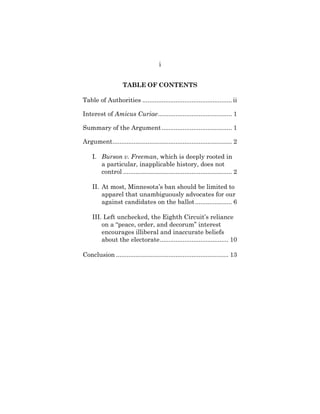
i
TABLE OF CONTENTS
Table of Authorities ................................................... ii
Interest of Amicus Curiae.......................................... 1
Summary of the Argument........................................ 1
Argument.................................................................... 2
I. Burson v. Freeman, which is deeply rooted in
a particular, inapplicable history, does not
control .............................................................. 2
II. At most, Minnesota’s ban should be limited to
apparel that unambiguously advocates for our
against candidates on the ballot..................... 6
III. Left unchecked, the Eighth Circuit’s reliance
on a “peace, order, and decorum” interest
encourages illiberal and inaccurate beliefs
about the electorate....................................... 10
Conclusion ................................................................ 13
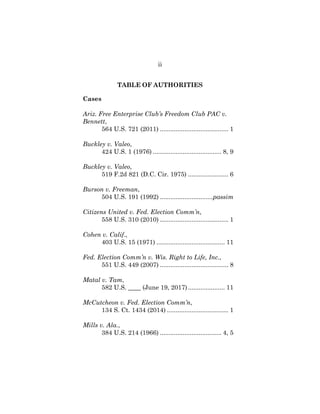
ii
TABLE OF AUTHORITIES
Cases
Ariz. Free Enterprise Club’s Freedom Club PAC v.
Bennett,
564 U.S. 721 (2011) ....................................... 1
Buckley v. Valeo,
424 U.S. 1 (1976) ....................................... 8, 9
Buckley v. Valeo,
519 F.2d 821 (D.C. Cir. 1975) ....................... 6
Burson v. Freeman,
504 U.S. 191 (1992) ..............................passim
Citizens United v. Fed. Election Comm’n,
558 U.S. 310 (2010) ....................................... 1
Cohen v. Calif.,
403 U.S. 15 (1971) ....................................... 11
Fed. Election Comm’n v. Wis. Right to Life, Inc.,
551 U.S. 449 (2007) ....................................... 8
Matal v. Tam,
582 U.S. ____ (June 19, 2017)..................... 11
McCutcheon v. Fed. Election Comm’n,
134 S. Ct. 1434 (2014) ................................... 1
Mills v. Ala.,
384 U.S. 214 (1966) ................................... 4, 5
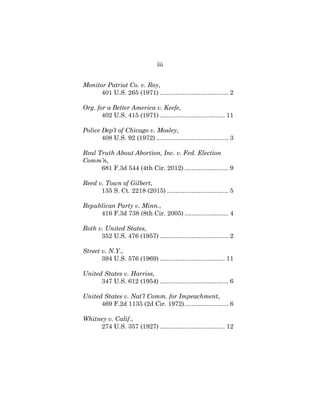
iii
Monitor Patriot Co. v. Roy,
401 U.S. 265 (1971) ....................................... 2
Org. for a Better America v. Keefe,
402 U.S. 415 (1971) ..................................... 11
Police Dep’t of Chicago v. Mosley,
408 U.S. 92 (1972) ......................................... 3
Real Truth About Abortion, Inc. v. Fed. Election
Comm’n,
681 F.3d 544 (4th Cir. 2012) ......................... 9
Reed v. Town of Gilbert,
135 S. Ct. 2218 (2015) ................................... 5
Republican Party v. Minn.,
416 F.3d 738 (8th Cir. 2005) ......................... 4
Roth v. United States,
352 U.S. 476 (1957) ....................................... 2
Street v. N.Y.,
394 U.S. 576 (1969) ..................................... 11
United States v. Harriss,
347 U.S. 612 (1954) ....................................... 6
United States v. Nat’l Comm. for Impeachment,
469 F.2d 1135 (2d Cir. 1972)......................... 6
Whitney v. Calif.,
274 U.S. 357 (1927) ..................................... 12
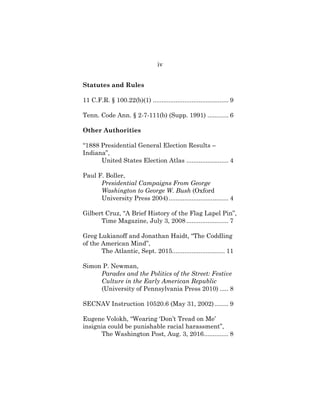
iv
Statutes and Rules
11 C.F.R. § 100.22(b)(1) ........................................... 9
Tenn. Code Ann. § 2-7-111(b) (Supp. 1991) ............ 6
Other Authorities
“1888 Presidential General Election Results –
Indiana”,
United States Election Atlas ........................ 4
Paul F. Boller,
Presidential Campaigns From George
Washington to George W. Bush (Oxford
University Press 2004).................................. 4
Gilbert Cruz, “A Brief History of the Flag Lapel Pin”,
Time Magazine, July 3, 2008........................ 7
Greg Lukianoff and Jonathan Haidt, “The Coddling
of the American Mind”,
The Atlantic, Sept. 2015.............................. 11
Simon P. Newman,
Parades and the Politics of the Street: Festive
Culture in the Early American Republic
(University of Pennsylvania Press 2010) ..... 8
SECNAV Instruction 10520.6 (May 31, 2002)........ 9
Eugene Volokh, “Wearing ‘Don’t Tread on Me’
insignia could be punishable racial harassment”,
The Washington Post, Aug. 3, 2016.............. 8
v
David Wright and Sunlen Miller, “Obama Dropped
Flag Pin In War Statement”,
ABC News, Oct. 4, 2007 ................................ 7
1
INTEREST OF AMICUS CURIAE1
The Center for Competitive Politics is a
nonpartisan, nonprofit organization that works to
protect and defend the First Amendment rights of
speech, assembly, and petition. As part of that
mission, the Center represents individuals and civil
society organizations, pro bono, in cases raising First
Amendment objections to burdensome regulation of
core political activity. In addition, the Center has
participated as amicus curiae in many of this Court’s
most important First Amendment cases, including
McCutcheon v. Federal Election Commission, 134 S.
Ct. 1434 (2014), Arizona Free Enterprise Club’s
Freedom Club PAC v. Bennett, 564 U.S. 721 (2011),
and Citizens United v. Federal Election Commission,
558 U.S. 310 (2010).
SUMMARY OF THE ARGUMENT
In-person voting always has, and hopefully
always will, require citizens with disagreements
about policy and politics to share a communal space
as they wait to cast their ballots. The State of
Minnesota believes that apparel conveying any
“political” idea threatens to destroy this harmony and
cause chaos at the polling place. Consequently, it has
banned such messages, a policy enforced by election
judges.
1 No counsel for a party authored this brief in whole or part, nor
did any person or entity, other than amicus or its counsel,
financially contribute to preparing or submitting this brief. The
parties’ counsel of record received timely notice of the intent to
file the brief under Rule 37.
2
This Court’s precedents regarding security of
the polling place and elections do not command such
an outcome, and other precedents counsel in favor of
a narrow, bright-line rule prohibiting only messages
that expressly advocate for candidates on the ballot.
Otherwise, Americans ought to be able to
briefly tolerate messages they may disagree with,
especially during the defining moment at which
citizens collectively choose their representatives.
Monitor Patriot Co. v. Roy, 401 U.S. 265, 271-272
(1971) (it is “conceded that the First Amendment was
‘fashioned to assure the unfettered interchange of
ideas for the bringing about of political and social
changes desired by the people’”) (quoting Roth v.
United States, 352 U.S. 476, 484 (1957)).
Declining review will only encourage the
illiberal assumption behind Minnesota’s law: that
Americans are incapable of being around those with
whom they disagree. That assumption is unproven,
and cannot survive strict scrutiny. The Petition
should be granted.
ARGUMENT
I. Burson v. Freeman, which is deeply
rooted in a particular, inapplicable
history, does not control.
The Eighth Circuit invoked Burson v. Freeman,
504 U.S. 191 (1992), to supply a governmental
interest served by Minnesota’s speech ban. E.g. Pet.
App D-8 But Burson is a narrow exception to the
general rule, enshrined in the First Amendment, that
“[t]o permit the continued building of our politics and
culture…our people are guaranteed the right to
3
express any thought, free from government
censorship.” Police Dep’t of Chicago v. Mosley, 408
U.S. 92, 95-96 (1972). Burson’s exception was rooted
in a particular history, and cannot bear the weight the
Eighth Circuit would place upon it.
The Burson Court upheld a limited ban on
polling-place electioneering. But that ruling was
based in large part upon late 19th and early 20th
Century decisions to adopt certain measures designed
to protect the franchise, principally the secret ballot
and a curtilage against electioneering in and around
polling places. Burson, 504 U.S. at 206 (“In sum, an
examination of the history of election regulation in
this country reveals a persistent battle against two
evils: voter intimidation and election fraud. After an
unsuccessful experiment with an unofficial ballot
system, all 50 States, together with numerous other
Western democracies, settled on the same
solution…”). The Court chose not to dislodge this
“time-tested consensus.” Burson, 504 U.S. at 206; also
id. at 205 (“The roots of Tennessee’s regulation can be
traced back to two provisions passed during this
period of rapid reform”). But that decision was
primarily driven by the specific history of voter
intimidation and voter fraud conducted by perfidious
“campaign workers” out to win at any cost. Burson,
504 U.S. at 204 (“‘In earlier times our polling places
were frequently, to quote the litany, ‘scenes of battle,
murder, and sudden death,’” but because of an 1888
New York statute, “[t]his also has come to an end…”)
(citation omitted).
Beyond physical mayhem, the Court also
pointed to evidence that the absence of such
arrangements may have actually flipped the outcome
of certain elections. Id. at 201 n.6 (“Evans reports that
4
the bribery of voters in Indiana in 1880 and 1888 was
sufficient to determine the results of the election…”);
see also Paul F. Boller, Presidential Campaigns: From
George Washington to George W. Bush, p. 160 (Oxford
University Press 2004) (noting a popular schoolyard
song that circulated regarding the 1888 Indiana
election, “Steamboat coming ‘round the bend;
Goodbye, old Grover, goodbye[;] Filled up full with
Harrison’s men; Goodbye, old Grover, goodbye!”);
“1888 Presidential General Election Results –
Indiana”, United States Election Atlas, (Benjamin
Harrison defeated President Cleveland in Indiana by
2,348 votes).2
Thus, the Burson Court identified the
historical danger of political campaigns operating “in
and around the polls” and directly upsetting “peace,
order, and decorum,” Mills v. Ala., 384 U.S. 214, 218
(1966), by fighting “[s]ham battles…to keep away
elderly and timid voters of the opposition.” Burson,
504 U.S. at 202. Accordingly, it approved, under strict
scrutiny, the narrow rules established in response to
that crisis. Id. at 200 (“While we readily acknowledge
that a law rarely survives such scrutiny, an
examination of the evolution of election reform, both
in this country and abroad, demonstrates the
necessity of restricted areas in or around polling
places”); Republican Party v. Minn., 416 F.3d 738, 749
(8th Cir. 2005), cert. denied sub nom. Dimick v.
Republican Party, 546 U.S. 1157 (2006) (“The strict
scrutiny test requires the state to show that the law
2 Available at:
http://uselectionatlas.org/RESULTS/state.php?year=1888&fips
=18&f=0&off=0&elect=0
5
that burdens the protected right advances a
compelling state interest...”).3
But even at the time, Justice Stevens, joined by
Justices O’Connor and Souter, questioned the Court’s
reliance upon century-old history in a strict scrutiny
case. Burson, 504 U.S. at 222 (Stevens, J., dissenting)
(“Never have we indicated that tradition was
synonymous with necessity”). That objection has even
greater salience where the facts do not implicate that
history. There is no evidence of anything remotely
similar to America’s 19th Century voter crisis
occurring in Minnesota, nor was Petitioner’s personal
decision to wear a particular shirt analogous to the
organized violence Burson sought to prevent.
The Burson Court’s reasoning does not apply to
the statute challenged here, and its narrow exception
to the general First Amendment prohibition on
speech bans cannot save Minnesota’s overbroad law.
3 The court of appeals below, despite its reliance on Burson, did
not apply strict scrutiny. Pet. App. D-8 Rather, the court
expressly distinguished Burson, on the ground that the polling
place itself is a nonpublic forum. Id. Given the form of speech
being discriminated against here—political speech, the most
central type of expression protected by the Speech Clause of the
First Amendment—strict scrutiny nevertheless ought to apply.
Mills, 384 U.S. at 218 (“Whatever differences may exist about
interpretations of the First Amendment, there is practically
universal agreement that a major purpose of that Amendment
was to protect the free discussion of governmental affairs”); see
also Reed v. Town of Gilbert, 135 S. Ct. 2218 (2015) (striking
down, under strict scrutiny, public sign code applying different
rules to “Political” or “Ideological” signs and “Temporary
Directional Signs”).
6
II. At most, Minnesota’s ban should be
limited to apparel that unambiguously
advocates for or against candidates on
the ballot.
In addition to being properly rooted in a
particular sense of history, the Tennessee ban upheld
in Burson had the virtue of being straightforward and
easily understood. Tennessee banned the display and
distribution of campaign, as opposed to political,
materials, and expressly prohibited “‘solicitation of
votes for or against any person or political party or
position on a question.’” Burson, 504 U.S. at 193-194
(quoting Tenn. Code Ann. § 2-7-111(b) (Supp. 1991)).
Such narrow specificity is vital for a speech
regulation to survive strict scrutiny. See United
States v. Harriss, 347 U.S. 612, 625 (1954) (narrowly
construing the Federal Regulation of Lobbying Act to
shield unpaid persons, because the governmental
interest only extended to “who is being hired, who is
putting up the money, and how much”). Careful
drafting is especially vital for laws that, while
purporting to regulate the act of campaigning, are
“susceptible to a reading necessitating” regulation of
those “whose only connection with the elective process
arises from completely nonpartisan discussion of
issues of public importance.” Buckley v. Valeo, 519
F.2d 821, 870 (D.C. Cir. 1975) (en banc).
This case provides an opportunity for the Court
to reaffirm that vague efforts to regulate mere
“political activity” cannot be reconciled with the First
Amendment. United States v. Nat’l Comm. for
Impeachment, 469 F.2d 1135, 1142 (2d Cir. 1972) (“On
the Government’s thesis every little Audubon Society
chapter would be a ‘political committee,’ for
7
‘environment’ is an issue in one campaign after
another…The dampening effect on [F]irst
[A]mendment rights and the potential for arbitrary
administrative action that would result from such a
situation would be intolerable”).
Here, an individual was threatened with
possible criminal prosecution for wearing a shirt with
a design inspired by the Gadsden flag—a symbol of
the Revolution that gave us the franchise in the first
place. As this case shows, Minnesota’s law contains
no limiting principle on what may or may not be
considered a political message.
Minnesota’s failure to properly tailor its law is
disappointing, but merely reflects the human
tendency to see patterns and read messages into even
the most universal symbols. Indeed, quite recently,
the mere act of wearing an American flag pin was
seen by some as support for the then-current
administration or solidarity with those supportive of
the Iraq war. Gilbert Cruz, “A Brief History of the
Flag Lapel Pin”, Time Magazine, July 3, 2008, (“But
it was Richard Nixon who brought the pin to national
attention…Nixon commanded all of his aides to go
and do likewise. The flag pins were noticed by the
public, and many in Nixon’s supposed ‘silent majority’
began to similarly sport flags on their lapels”);4 David
Wright and Sunlen Miller, “Obama Dropped Flag Pin
In War Statement”, ABC News, Oct. 4, 2007 (“‘You
know, the truth is that right after 9/11, I had a pin,’
[then-Sen. Barack] Obama said. ‘Shortly after 9/11,
4 Available at:
http://content.time.com/time/nation/article/0,8599,1820023,00.h
tml
8
particularly because as we’re talking about the Iraq
War, that became a substitute for I think true
patriotism…’”).5
Similarly, whether a voter’s apparel is “issue
oriented material designed to influence or impact
voting,” Pet. App. I-2, will turn, inherently, on the
opinions of the viewer. Here, the danger of
inconsistent interpretation and enforcement is
compounded by Minnesota’s decision to leave its
intent-and-effect test to the judgment of poll
workers.6 Cf. Fed. Election Comm’n v. Wis. Right to
Life, Inc., 551 U.S. 449, 468 (2007) (“No reasonable
speaker would choose to” act if the “only defense to a
criminal prosecution would be that its motives were
pure. An intent-based standard ‘blankets with
uncertainty whatever may be said,’ and ‘offers no
security for free discussion’”) (quoting Buckley v.
Valeo, 424 U.S. 1, 43 (1976) (per curiam)).
Given such a “standard,” all sorts of non-
electoral speech will be banned—even speech that the
wearer did not intend to carry a partisan message. See
Simon P. Newman, Parades and the Politics of the
Street: Festive Culture in the Early American Republic
p. 163 (University of Pennsylvania Press 2010)
5 Available at: http://abcnews.go.com/Politics/story?id=3690000
6 Even the meaning of a symbol as venerable as the Gadsden flag
can vary from person to person. See Eugene Volokh, “Wearing
‘Don’t Tread on Me’ insignia could be punishable racial
harassment”, The Washington Post, Aug. 3, 2016 (describing
complaint filed with the Equal Employment Opportunity
Commission regarding a co-worker’s display of a Gadsden flag);
available at: https://www.washingtonpost.com/news/volokh-
conspiracy/wp/2016/08/03/wearing-dont-tread-on-me-insignia-
could-be-punishable-racial-harassment.
9
(recounting that the 1790s era Federalist Party
encouraged citizens to wear a black cockade as a show
of solidarity during the Quasi-War, and initially
viewed the positive citizen response “as evidence of a
rise in the popularity of the[ Adams] government,” but
“it seems likely that many citizens adopted the badge
as evidence of their patriotism” during the crisis, as
“[w]ith the end of the Quasi-War, the popularity of the
black cockade faded rapidly…”).7
Thankfully, there is no need for this Court to
either overturn Burson or fashion a new standard out
of thin air. It need merely read “political” to mean
“express advocacy” or its functional equivalent, a
standard that has been readily applied in the
campaign finance context. E.g. Real Truth About
Abortion, Inc. v. Fed. Election Comm’n, 681 F.3d 544,
555 (4th Cir. 2012) (upholding federal express
advocacy requirements). That is, apparel ought only
be prohibited if it “is unmistakable, unambiguous,
and suggestive of only one meaning,” 11 C.F.R. §
100.22(b)(1), and that meaning is “vote for or against
this particular candidate on today’s ballot.”See also
Buckley, 424 U.S. at 44, n.52 (“This construction
would restrict application of [the policy] to
7 Similarly, the use of the Gadsden Flag does not demonstrate
granular political views such as support for a particular
candidate. If it did, what should this Court make of the United
States Navy’s practice of flying a version of that flag in time of
war? SECNAV Instruction 10520.6 (May 31, 2002) (“To provide
for the display of the first navy Jack on board all U.S. Navy ships
during the Global War on Terrorism…a flag consisting of 13
horizontal alternating red and white stripes bearing diagonally
across them a rattlesnake in a moving position with the motto
‘Don’t Tread On Me.’”).
10
communications containing express words of election
or defeat…”).
Not only does this reading of “political” provide
vital clarity, it would limit the government’s ban to
obvious campaigning for and against candidates for
office. This approach both prevents subjective
determinations of symbolic meaning by low-level
state workers and narrows the state’s regulation to
accord with the specific governmental interest
identified in Burson.
III. Left unchecked, the Eighth Circuit’s
reliance on a “peace, order, and
decorum” interest encourages illiberal
and inaccurate beliefs about the
electorate.
Aside from Burson, the Eighth Circuit also
relied on this Court’s concession, in Mills v. Alabama,
that the government has an interest in maintaining
“peace, order, and decorum” on Election Day. Pet.
App. D-8. Certainly, that interest was also on the
mind of the Burson Court, which made numerous
references to the late 19th Century’s voting “system”
where, thanks to thuggish campaign workers, “coats
were torn off the backs of voters, [and] ballots of one
kind…[were] snatched from voters’ hands and others
put in their places, with threats against using any but
the substituted ballots.” Burson, 504 U.S. at 204, n.8.
Nothing similar has been alleged here. The
naked invocation of the peace and order interest,
unaccompanied by any evidence supporting a well-
reasoned fear that the peace will be breached, cannot
satisfy strict scrutiny. There is no reason to believe
that the modern polling place will be transformed into
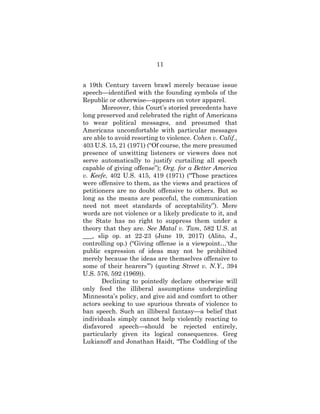
11
a 19th Century tavern brawl merely because issue
speech—identified with the founding symbols of the
Republic or otherwise—appears on voter apparel.
Moreover, this Court’s storied precedents have
long preserved and celebrated the right of Americans
to wear political messages, and presumed that
Americans uncomfortable with particular messages
are able to avoid resorting to violence. Cohen v. Calif.,
403 U.S. 15, 21 (1971) (“Of course, the mere presumed
presence of unwitting listeners or viewers does not
serve automatically to justify curtailing all speech
capable of giving offense”); Org. for a Better America
v. Keefe, 402 U.S. 415, 419 (1971) (“Those practices
were offensive to them, as the views and practices of
petitioners are no doubt offensive to others. But so
long as the means are peaceful, the communication
need not meet standards of acceptability”). Mere
words are not violence or a likely predicate to it, and
the State has no right to suppress them under a
theory that they are. See Matal v. Tam, 582 U.S. at
___, slip op. at 22-23 (June 19, 2017) (Alito, J.,
controlling op.) (“Giving offense is a viewpoint…‘the
public expression of ideas may not be prohibited
merely because the ideas are themselves offensive to
some of their hearers’”) (quoting Street v. N.Y., 394
U.S. 576, 592 (1969)).
Declining to pointedly declare otherwise will
only feed the illiberal assumptions undergirding
Minnesota’s policy, and give aid and comfort to other
actors seeking to use spurious threats of violence to
ban speech. Such an illiberal fantasy—a belief that
individuals simply cannot help violently reacting to
disfavored speech—should be rejected entirely,
particularly given its logical consequences. Greg
Lukianoff and Jonathan Haidt, “The Coddling of the
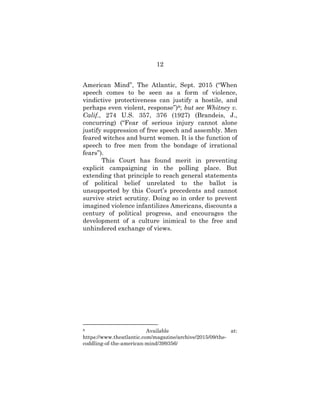
12
American Mind”, The Atlantic, Sept. 2015 (“When
speech comes to be seen as a form of violence,
vindictive protectiveness can justify a hostile, and
perhaps even violent, response”)8; but see Whitney v.
Calif., 274 U.S. 357, 376 (1927) (Brandeis, J.,
concurring) (“Fear of serious injury cannot alone
justify suppression of free speech and assembly. Men
feared witches and burnt women. It is the function of
speech to free men from the bondage of irrational
fears”).
This Court has found merit in preventing
explicit campaigning in the polling place. But
extending that principle to reach general statements
of political belief unrelated to the ballot is
unsupported by this Court’s precedents and cannot
survive strict scrutiny. Doing so in order to prevent
imagined violence infantilizes Americans, discounts a
century of political progress, and encourages the
development of a culture inimical to the free and
unhindered exchange of views.
8 Available at:
https://www.theatlantic.com/magazine/archive/2015/09/the-
coddling-of-the-american-mind/399356/
13
CONCLUSION
For the foregoing reasons, this Court ought to
grant the writ.
Respectfully submitted,
ALLEN DICKERSON
Counsel of Record
ZAC MORGAN
CENTER FOR COMPETITIVE
POLITICS
124 S. West St., Ste. 201
Alexandria, VA 22314
adickerson@campaignfreedom.org
(703) 894-6800
July 3, 2017 Counsel for Amicus Curiae

Darren Chaker Amicus Brief

  • 1.
    No.16-1435 In The Supreme Courtof the United States ____________________________ MINNESOTA VOTERS ALLIANCE, ET AL., Petitioners, v. JOE MANSKY, ET AL., Respondents. On Petition For A Writ of Certiorari To The United States Court Of Appeals For The Eighth Circuit MOTION FOR LEAVE TO FILE AND AMICUS CURIAE BRIEF OF THE CENTER FOR COMPETITIVE POLITICS IN SUPPORT OF PETITIONERS ALLEN DICKERSON Counsel of Record ZAC MORGAN CENTER FOR COMPETITIVE POLITICS 124 S. West St., Ste. 201 Alexandria, VA 22314 adickerson@campaignfreedom.org (703) 894-6800 July 3, 2017 Counsel for Amicus Curiae LEGAL PRINTERS LLC, Washington DC ! 202-747-2400 ! legalprinters.com
  • 2.
    MOTION FOR LEAVETO FILE BRIEF AS AMICUS CURIAE IN SUPPORT OF PETITIONERS Pursuant to Rule 37.2(b) of the Rules of this Court, the Center for Competitive Politics moves for leave to file the attached amicus curiae brief in support of the petition for a writ of certiorari to review the judgment of the United States Court of Appeals for the Eighth Circuit in the instant matter. All parties were timely noticed, pursuant to Rule 37.2(a), of Amicus’s intention to file the attached brief. Petitioners have filed a blanket consent to the filing of amicus curiae briefs in this case. Respondent Steve Simon, Secretary of State for Minnesota has consented to the filing of this brief, the remaining Respondents, however, have not consented. The Petition asks whether it is acceptable for a government to bar issue speech inside a polling place, even when the issue speech is unrelated to any candidate campaign. This question is of critical interest to Amicus Center for Competitive Politics, a nonprofit corporation dedicated to the protection and defense of the political rights ensured by the First Amendment. Amicus often represents clients in state and federal courts, including before this Court, on matters related to the regulation or suppression of issue speech. Accordingly, Amicus respectfully requests that this Court grant its motion for leave to file. Dated: July 3, 2017
  • 3.
    Respectfully submitted, ALLEN DICKERSON Counselof Record ZAC MORGAN CENTER FOR COMPETITIVE POLITICS 124 S. West St., Ste. 201 Alexandria, VA 22314 adickerson@campaignfreedom.org (703) 894-6800
  • 4.
    i TABLE OF CONTENTS Tableof Authorities ................................................... ii Interest of Amicus Curiae.......................................... 1 Summary of the Argument........................................ 1 Argument.................................................................... 2 I. Burson v. Freeman, which is deeply rooted in a particular, inapplicable history, does not control .............................................................. 2 II. At most, Minnesota’s ban should be limited to apparel that unambiguously advocates for our against candidates on the ballot..................... 6 III. Left unchecked, the Eighth Circuit’s reliance on a “peace, order, and decorum” interest encourages illiberal and inaccurate beliefs about the electorate....................................... 10 Conclusion ................................................................ 13
  • 5.
    ii TABLE OF AUTHORITIES Cases Ariz.Free Enterprise Club’s Freedom Club PAC v. Bennett, 564 U.S. 721 (2011) ....................................... 1 Buckley v. Valeo, 424 U.S. 1 (1976) ....................................... 8, 9 Buckley v. Valeo, 519 F.2d 821 (D.C. Cir. 1975) ....................... 6 Burson v. Freeman, 504 U.S. 191 (1992) ..............................passim Citizens United v. Fed. Election Comm’n, 558 U.S. 310 (2010) ....................................... 1 Cohen v. Calif., 403 U.S. 15 (1971) ....................................... 11 Fed. Election Comm’n v. Wis. Right to Life, Inc., 551 U.S. 449 (2007) ....................................... 8 Matal v. Tam, 582 U.S. ____ (June 19, 2017)..................... 11 McCutcheon v. Fed. Election Comm’n, 134 S. Ct. 1434 (2014) ................................... 1 Mills v. Ala., 384 U.S. 214 (1966) ................................... 4, 5
  • 6.
    iii Monitor Patriot Co.v. Roy, 401 U.S. 265 (1971) ....................................... 2 Org. for a Better America v. Keefe, 402 U.S. 415 (1971) ..................................... 11 Police Dep’t of Chicago v. Mosley, 408 U.S. 92 (1972) ......................................... 3 Real Truth About Abortion, Inc. v. Fed. Election Comm’n, 681 F.3d 544 (4th Cir. 2012) ......................... 9 Reed v. Town of Gilbert, 135 S. Ct. 2218 (2015) ................................... 5 Republican Party v. Minn., 416 F.3d 738 (8th Cir. 2005) ......................... 4 Roth v. United States, 352 U.S. 476 (1957) ....................................... 2 Street v. N.Y., 394 U.S. 576 (1969) ..................................... 11 United States v. Harriss, 347 U.S. 612 (1954) ....................................... 6 United States v. Nat’l Comm. for Impeachment, 469 F.2d 1135 (2d Cir. 1972)......................... 6 Whitney v. Calif., 274 U.S. 357 (1927) ..................................... 12
  • 7.
    iv Statutes and Rules 11C.F.R. § 100.22(b)(1) ........................................... 9 Tenn. Code Ann. § 2-7-111(b) (Supp. 1991) ............ 6 Other Authorities “1888 Presidential General Election Results – Indiana”, United States Election Atlas ........................ 4 Paul F. Boller, Presidential Campaigns From George Washington to George W. Bush (Oxford University Press 2004).................................. 4 Gilbert Cruz, “A Brief History of the Flag Lapel Pin”, Time Magazine, July 3, 2008........................ 7 Greg Lukianoff and Jonathan Haidt, “The Coddling of the American Mind”, The Atlantic, Sept. 2015.............................. 11 Simon P. Newman, Parades and the Politics of the Street: Festive Culture in the Early American Republic (University of Pennsylvania Press 2010) ..... 8 SECNAV Instruction 10520.6 (May 31, 2002)........ 9 Eugene Volokh, “Wearing ‘Don’t Tread on Me’ insignia could be punishable racial harassment”, The Washington Post, Aug. 3, 2016.............. 8
  • 8.
    v David Wright andSunlen Miller, “Obama Dropped Flag Pin In War Statement”, ABC News, Oct. 4, 2007 ................................ 7
  • 9.
    1 INTEREST OF AMICUSCURIAE1 The Center for Competitive Politics is a nonpartisan, nonprofit organization that works to protect and defend the First Amendment rights of speech, assembly, and petition. As part of that mission, the Center represents individuals and civil society organizations, pro bono, in cases raising First Amendment objections to burdensome regulation of core political activity. In addition, the Center has participated as amicus curiae in many of this Court’s most important First Amendment cases, including McCutcheon v. Federal Election Commission, 134 S. Ct. 1434 (2014), Arizona Free Enterprise Club’s Freedom Club PAC v. Bennett, 564 U.S. 721 (2011), and Citizens United v. Federal Election Commission, 558 U.S. 310 (2010). SUMMARY OF THE ARGUMENT In-person voting always has, and hopefully always will, require citizens with disagreements about policy and politics to share a communal space as they wait to cast their ballots. The State of Minnesota believes that apparel conveying any “political” idea threatens to destroy this harmony and cause chaos at the polling place. Consequently, it has banned such messages, a policy enforced by election judges. 1 No counsel for a party authored this brief in whole or part, nor did any person or entity, other than amicus or its counsel, financially contribute to preparing or submitting this brief. The parties’ counsel of record received timely notice of the intent to file the brief under Rule 37.
  • 10.
    2 This Court’s precedentsregarding security of the polling place and elections do not command such an outcome, and other precedents counsel in favor of a narrow, bright-line rule prohibiting only messages that expressly advocate for candidates on the ballot. Otherwise, Americans ought to be able to briefly tolerate messages they may disagree with, especially during the defining moment at which citizens collectively choose their representatives. Monitor Patriot Co. v. Roy, 401 U.S. 265, 271-272 (1971) (it is “conceded that the First Amendment was ‘fashioned to assure the unfettered interchange of ideas for the bringing about of political and social changes desired by the people’”) (quoting Roth v. United States, 352 U.S. 476, 484 (1957)). Declining review will only encourage the illiberal assumption behind Minnesota’s law: that Americans are incapable of being around those with whom they disagree. That assumption is unproven, and cannot survive strict scrutiny. The Petition should be granted. ARGUMENT I. Burson v. Freeman, which is deeply rooted in a particular, inapplicable history, does not control. The Eighth Circuit invoked Burson v. Freeman, 504 U.S. 191 (1992), to supply a governmental interest served by Minnesota’s speech ban. E.g. Pet. App D-8 But Burson is a narrow exception to the general rule, enshrined in the First Amendment, that “[t]o permit the continued building of our politics and culture…our people are guaranteed the right to
  • 11.
    3 express any thought,free from government censorship.” Police Dep’t of Chicago v. Mosley, 408 U.S. 92, 95-96 (1972). Burson’s exception was rooted in a particular history, and cannot bear the weight the Eighth Circuit would place upon it. The Burson Court upheld a limited ban on polling-place electioneering. But that ruling was based in large part upon late 19th and early 20th Century decisions to adopt certain measures designed to protect the franchise, principally the secret ballot and a curtilage against electioneering in and around polling places. Burson, 504 U.S. at 206 (“In sum, an examination of the history of election regulation in this country reveals a persistent battle against two evils: voter intimidation and election fraud. After an unsuccessful experiment with an unofficial ballot system, all 50 States, together with numerous other Western democracies, settled on the same solution…”). The Court chose not to dislodge this “time-tested consensus.” Burson, 504 U.S. at 206; also id. at 205 (“The roots of Tennessee’s regulation can be traced back to two provisions passed during this period of rapid reform”). But that decision was primarily driven by the specific history of voter intimidation and voter fraud conducted by perfidious “campaign workers” out to win at any cost. Burson, 504 U.S. at 204 (“‘In earlier times our polling places were frequently, to quote the litany, ‘scenes of battle, murder, and sudden death,’” but because of an 1888 New York statute, “[t]his also has come to an end…”) (citation omitted). Beyond physical mayhem, the Court also pointed to evidence that the absence of such arrangements may have actually flipped the outcome of certain elections. Id. at 201 n.6 (“Evans reports that
  • 12.
    4 the bribery ofvoters in Indiana in 1880 and 1888 was sufficient to determine the results of the election…”); see also Paul F. Boller, Presidential Campaigns: From George Washington to George W. Bush, p. 160 (Oxford University Press 2004) (noting a popular schoolyard song that circulated regarding the 1888 Indiana election, “Steamboat coming ‘round the bend; Goodbye, old Grover, goodbye[;] Filled up full with Harrison’s men; Goodbye, old Grover, goodbye!”); “1888 Presidential General Election Results – Indiana”, United States Election Atlas, (Benjamin Harrison defeated President Cleveland in Indiana by 2,348 votes).2 Thus, the Burson Court identified the historical danger of political campaigns operating “in and around the polls” and directly upsetting “peace, order, and decorum,” Mills v. Ala., 384 U.S. 214, 218 (1966), by fighting “[s]ham battles…to keep away elderly and timid voters of the opposition.” Burson, 504 U.S. at 202. Accordingly, it approved, under strict scrutiny, the narrow rules established in response to that crisis. Id. at 200 (“While we readily acknowledge that a law rarely survives such scrutiny, an examination of the evolution of election reform, both in this country and abroad, demonstrates the necessity of restricted areas in or around polling places”); Republican Party v. Minn., 416 F.3d 738, 749 (8th Cir. 2005), cert. denied sub nom. Dimick v. Republican Party, 546 U.S. 1157 (2006) (“The strict scrutiny test requires the state to show that the law 2 Available at: http://uselectionatlas.org/RESULTS/state.php?year=1888&fips =18&f=0&off=0&elect=0
  • 13.
    5 that burdens theprotected right advances a compelling state interest...”).3 But even at the time, Justice Stevens, joined by Justices O’Connor and Souter, questioned the Court’s reliance upon century-old history in a strict scrutiny case. Burson, 504 U.S. at 222 (Stevens, J., dissenting) (“Never have we indicated that tradition was synonymous with necessity”). That objection has even greater salience where the facts do not implicate that history. There is no evidence of anything remotely similar to America’s 19th Century voter crisis occurring in Minnesota, nor was Petitioner’s personal decision to wear a particular shirt analogous to the organized violence Burson sought to prevent. The Burson Court’s reasoning does not apply to the statute challenged here, and its narrow exception to the general First Amendment prohibition on speech bans cannot save Minnesota’s overbroad law. 3 The court of appeals below, despite its reliance on Burson, did not apply strict scrutiny. Pet. App. D-8 Rather, the court expressly distinguished Burson, on the ground that the polling place itself is a nonpublic forum. Id. Given the form of speech being discriminated against here—political speech, the most central type of expression protected by the Speech Clause of the First Amendment—strict scrutiny nevertheless ought to apply. Mills, 384 U.S. at 218 (“Whatever differences may exist about interpretations of the First Amendment, there is practically universal agreement that a major purpose of that Amendment was to protect the free discussion of governmental affairs”); see also Reed v. Town of Gilbert, 135 S. Ct. 2218 (2015) (striking down, under strict scrutiny, public sign code applying different rules to “Political” or “Ideological” signs and “Temporary Directional Signs”).
  • 14.
    6 II. At most,Minnesota’s ban should be limited to apparel that unambiguously advocates for or against candidates on the ballot. In addition to being properly rooted in a particular sense of history, the Tennessee ban upheld in Burson had the virtue of being straightforward and easily understood. Tennessee banned the display and distribution of campaign, as opposed to political, materials, and expressly prohibited “‘solicitation of votes for or against any person or political party or position on a question.’” Burson, 504 U.S. at 193-194 (quoting Tenn. Code Ann. § 2-7-111(b) (Supp. 1991)). Such narrow specificity is vital for a speech regulation to survive strict scrutiny. See United States v. Harriss, 347 U.S. 612, 625 (1954) (narrowly construing the Federal Regulation of Lobbying Act to shield unpaid persons, because the governmental interest only extended to “who is being hired, who is putting up the money, and how much”). Careful drafting is especially vital for laws that, while purporting to regulate the act of campaigning, are “susceptible to a reading necessitating” regulation of those “whose only connection with the elective process arises from completely nonpartisan discussion of issues of public importance.” Buckley v. Valeo, 519 F.2d 821, 870 (D.C. Cir. 1975) (en banc). This case provides an opportunity for the Court to reaffirm that vague efforts to regulate mere “political activity” cannot be reconciled with the First Amendment. United States v. Nat’l Comm. for Impeachment, 469 F.2d 1135, 1142 (2d Cir. 1972) (“On the Government’s thesis every little Audubon Society chapter would be a ‘political committee,’ for
  • 15.
    7 ‘environment’ is anissue in one campaign after another…The dampening effect on [F]irst [A]mendment rights and the potential for arbitrary administrative action that would result from such a situation would be intolerable”). Here, an individual was threatened with possible criminal prosecution for wearing a shirt with a design inspired by the Gadsden flag—a symbol of the Revolution that gave us the franchise in the first place. As this case shows, Minnesota’s law contains no limiting principle on what may or may not be considered a political message. Minnesota’s failure to properly tailor its law is disappointing, but merely reflects the human tendency to see patterns and read messages into even the most universal symbols. Indeed, quite recently, the mere act of wearing an American flag pin was seen by some as support for the then-current administration or solidarity with those supportive of the Iraq war. Gilbert Cruz, “A Brief History of the Flag Lapel Pin”, Time Magazine, July 3, 2008, (“But it was Richard Nixon who brought the pin to national attention…Nixon commanded all of his aides to go and do likewise. The flag pins were noticed by the public, and many in Nixon’s supposed ‘silent majority’ began to similarly sport flags on their lapels”);4 David Wright and Sunlen Miller, “Obama Dropped Flag Pin In War Statement”, ABC News, Oct. 4, 2007 (“‘You know, the truth is that right after 9/11, I had a pin,’ [then-Sen. Barack] Obama said. ‘Shortly after 9/11, 4 Available at: http://content.time.com/time/nation/article/0,8599,1820023,00.h tml
  • 16.
    8 particularly because aswe’re talking about the Iraq War, that became a substitute for I think true patriotism…’”).5 Similarly, whether a voter’s apparel is “issue oriented material designed to influence or impact voting,” Pet. App. I-2, will turn, inherently, on the opinions of the viewer. Here, the danger of inconsistent interpretation and enforcement is compounded by Minnesota’s decision to leave its intent-and-effect test to the judgment of poll workers.6 Cf. Fed. Election Comm’n v. Wis. Right to Life, Inc., 551 U.S. 449, 468 (2007) (“No reasonable speaker would choose to” act if the “only defense to a criminal prosecution would be that its motives were pure. An intent-based standard ‘blankets with uncertainty whatever may be said,’ and ‘offers no security for free discussion’”) (quoting Buckley v. Valeo, 424 U.S. 1, 43 (1976) (per curiam)). Given such a “standard,” all sorts of non- electoral speech will be banned—even speech that the wearer did not intend to carry a partisan message. See Simon P. Newman, Parades and the Politics of the Street: Festive Culture in the Early American Republic p. 163 (University of Pennsylvania Press 2010) 5 Available at: http://abcnews.go.com/Politics/story?id=3690000 6 Even the meaning of a symbol as venerable as the Gadsden flag can vary from person to person. See Eugene Volokh, “Wearing ‘Don’t Tread on Me’ insignia could be punishable racial harassment”, The Washington Post, Aug. 3, 2016 (describing complaint filed with the Equal Employment Opportunity Commission regarding a co-worker’s display of a Gadsden flag); available at: https://www.washingtonpost.com/news/volokh- conspiracy/wp/2016/08/03/wearing-dont-tread-on-me-insignia- could-be-punishable-racial-harassment.
  • 17.
    9 (recounting that the1790s era Federalist Party encouraged citizens to wear a black cockade as a show of solidarity during the Quasi-War, and initially viewed the positive citizen response “as evidence of a rise in the popularity of the[ Adams] government,” but “it seems likely that many citizens adopted the badge as evidence of their patriotism” during the crisis, as “[w]ith the end of the Quasi-War, the popularity of the black cockade faded rapidly…”).7 Thankfully, there is no need for this Court to either overturn Burson or fashion a new standard out of thin air. It need merely read “political” to mean “express advocacy” or its functional equivalent, a standard that has been readily applied in the campaign finance context. E.g. Real Truth About Abortion, Inc. v. Fed. Election Comm’n, 681 F.3d 544, 555 (4th Cir. 2012) (upholding federal express advocacy requirements). That is, apparel ought only be prohibited if it “is unmistakable, unambiguous, and suggestive of only one meaning,” 11 C.F.R. § 100.22(b)(1), and that meaning is “vote for or against this particular candidate on today’s ballot.”See also Buckley, 424 U.S. at 44, n.52 (“This construction would restrict application of [the policy] to 7 Similarly, the use of the Gadsden Flag does not demonstrate granular political views such as support for a particular candidate. If it did, what should this Court make of the United States Navy’s practice of flying a version of that flag in time of war? SECNAV Instruction 10520.6 (May 31, 2002) (“To provide for the display of the first navy Jack on board all U.S. Navy ships during the Global War on Terrorism…a flag consisting of 13 horizontal alternating red and white stripes bearing diagonally across them a rattlesnake in a moving position with the motto ‘Don’t Tread On Me.’”).
  • 18.
    10 communications containing expresswords of election or defeat…”). Not only does this reading of “political” provide vital clarity, it would limit the government’s ban to obvious campaigning for and against candidates for office. This approach both prevents subjective determinations of symbolic meaning by low-level state workers and narrows the state’s regulation to accord with the specific governmental interest identified in Burson. III. Left unchecked, the Eighth Circuit’s reliance on a “peace, order, and decorum” interest encourages illiberal and inaccurate beliefs about the electorate. Aside from Burson, the Eighth Circuit also relied on this Court’s concession, in Mills v. Alabama, that the government has an interest in maintaining “peace, order, and decorum” on Election Day. Pet. App. D-8. Certainly, that interest was also on the mind of the Burson Court, which made numerous references to the late 19th Century’s voting “system” where, thanks to thuggish campaign workers, “coats were torn off the backs of voters, [and] ballots of one kind…[were] snatched from voters’ hands and others put in their places, with threats against using any but the substituted ballots.” Burson, 504 U.S. at 204, n.8. Nothing similar has been alleged here. The naked invocation of the peace and order interest, unaccompanied by any evidence supporting a well- reasoned fear that the peace will be breached, cannot satisfy strict scrutiny. There is no reason to believe that the modern polling place will be transformed into
  • 19.
    11 a 19th Centurytavern brawl merely because issue speech—identified with the founding symbols of the Republic or otherwise—appears on voter apparel. Moreover, this Court’s storied precedents have long preserved and celebrated the right of Americans to wear political messages, and presumed that Americans uncomfortable with particular messages are able to avoid resorting to violence. Cohen v. Calif., 403 U.S. 15, 21 (1971) (“Of course, the mere presumed presence of unwitting listeners or viewers does not serve automatically to justify curtailing all speech capable of giving offense”); Org. for a Better America v. Keefe, 402 U.S. 415, 419 (1971) (“Those practices were offensive to them, as the views and practices of petitioners are no doubt offensive to others. But so long as the means are peaceful, the communication need not meet standards of acceptability”). Mere words are not violence or a likely predicate to it, and the State has no right to suppress them under a theory that they are. See Matal v. Tam, 582 U.S. at ___, slip op. at 22-23 (June 19, 2017) (Alito, J., controlling op.) (“Giving offense is a viewpoint…‘the public expression of ideas may not be prohibited merely because the ideas are themselves offensive to some of their hearers’”) (quoting Street v. N.Y., 394 U.S. 576, 592 (1969)). Declining to pointedly declare otherwise will only feed the illiberal assumptions undergirding Minnesota’s policy, and give aid and comfort to other actors seeking to use spurious threats of violence to ban speech. Such an illiberal fantasy—a belief that individuals simply cannot help violently reacting to disfavored speech—should be rejected entirely, particularly given its logical consequences. Greg Lukianoff and Jonathan Haidt, “The Coddling of the
  • 20.
    12 American Mind”, TheAtlantic, Sept. 2015 (“When speech comes to be seen as a form of violence, vindictive protectiveness can justify a hostile, and perhaps even violent, response”)8; but see Whitney v. Calif., 274 U.S. 357, 376 (1927) (Brandeis, J., concurring) (“Fear of serious injury cannot alone justify suppression of free speech and assembly. Men feared witches and burnt women. It is the function of speech to free men from the bondage of irrational fears”). This Court has found merit in preventing explicit campaigning in the polling place. But extending that principle to reach general statements of political belief unrelated to the ballot is unsupported by this Court’s precedents and cannot survive strict scrutiny. Doing so in order to prevent imagined violence infantilizes Americans, discounts a century of political progress, and encourages the development of a culture inimical to the free and unhindered exchange of views. 8 Available at: https://www.theatlantic.com/magazine/archive/2015/09/the- coddling-of-the-american-mind/399356/
  • 21.
    13 CONCLUSION For the foregoingreasons, this Court ought to grant the writ. Respectfully submitted, ALLEN DICKERSON Counsel of Record ZAC MORGAN CENTER FOR COMPETITIVE POLITICS 124 S. West St., Ste. 201 Alexandria, VA 22314 adickerson@campaignfreedom.org (703) 894-6800 July 3, 2017 Counsel for Amicus Curiae