Downloaded 11 times
![News
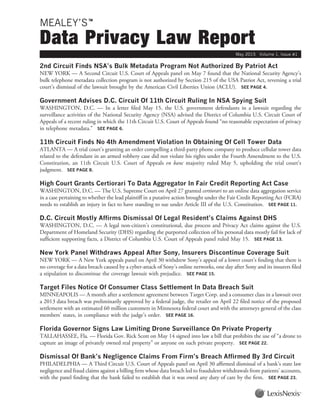
2nd Circuit Finds NSA’s
Bulk Metadata Program
Not Authorized By Patriot Act
NEW YORK — A Second Circuit U.S. Court of
Appeals panel on May 7 found that the National Secur-
ity Agency’s bulk telephone metadata collection pro-
gram is not authorized by Section 215 of the USA
Patriot Act, reversing a trial court’s dismissal of the law-
suit brought by the American Civil Liberties Union
(ACLU) (American Civil Liberties Union, et al. v.
James R. Clapper, et al., No. 14-42, 2nd Cir.; 2015
U.S. App. LEXIS 7531).
(Opinion available. Document #24-150528-029Z.)
Finding ‘‘that the program exceeds the scope of what
Congress has authorized,’’ the panel vacated the U.S.
District Court for the Southern District of New York’s
dismissal. However, the panel affirmed the lower
court’s denial of the ACLU’s request for a preliminary
injunction.
FISC Order
The NSA’s data collection program came to public light
in June 2013 when British newspaper The Guardian
ran a story about a top-secret order served on Verizon
Business Network Services Inc. by the Foreign Intelli-
gence Surveillance Court (FISC). The order, citing the
provisions of the Patriot Act, required Verizon to turn
over to the NSA ‘‘on an ongoing daily basis’’ electronic
copies of ‘‘all call detail records or ‘telephony metadata’’’
detailing communications of Verizon customers, both
‘‘abroad’’ or ‘‘wholly within the United States, including
local telephone calls.’’ The metadata was then aggre-
gated into a repository or data bank that can be queried.
The FISC order included a gag order, forbidding Ver-
izon and its personnel from ‘‘disclos[ing] to any other
person that the FBI or NSA has sought or obtained
tangible things under this Order.’’
Verizon Customers
The ACLU and affiliated agencies (ACLU, collectively)
American Civil Liberties Union Foundation (ACLUF),
New York Civil Liberties Union (NYCLU) and New
York Civil Liberties Union Foundation (NYCLUF)
asserted standing as present and past Verizon custo-
mers. The ACLU sued Director of National Intelli-
gence James R. Clapper in June 2013 in the District
Court. Also named as defendants were the director of
the NSA, secretary of Defense, U.S. attorney general
and the director of the FBI.
The ACLU disputed the FISC order’s assertion that
Section 215 of the USA Patriot Act authorizes the
call tracking. Section 215 requires that business records
sought and obtained by the FBI must be ‘‘‘relevant’ to
an authorized investigation ‘to obtain foreign intelli-
gence information and concerning a United States per-
son or to protect against international terrorism or
clandestine intelligence activities.’ ’’ By ‘‘acquiring the
metadata for every phone call made or received by’’
Verizon customers ‘‘on an ongoing daily basis,’’ the
government has exceeded the authority granted under
Section 215, the ACLU asserted. The ACLU also noted
that there is no procedure in place for it or other Ver-
izon customers to challenge the order in the FISC.
Dismissal Granted
The ACLU sought a declaration that the mass call track-
ing program exceeds the authority granted by Section
215 and, as a result, the Administrative Procedure Act
(APA). It also asked the court for declarations that the
program violates the First and Fourth Amendments.
Additionally, the ACLU sought a permanent injunc-
tion against any such future tracking and an order for
the participating government agencies ‘‘to purge from
their possession all of the call records of [the ACLU’s]
communications in their possession.’’ The ACLU also
moved for a preliminary injunction to halt the NSA’s
activities during the pendency of the present case.
Vol. 1, #1 May 2015 MEALEY’S Data Privacy Law Report
4](https://image.slidesharecdn.com/mealeysdataprivacylawreportmay2015-150527141743-lva1-app6892/85/MEALEY-S-Data-Privacy-Law-Report-Sample-Issue-May-2015-4-320.jpg)
![In December 2013, Judge William H. Pauley III
granted the government’s motion to dismiss. Judge Pau-
ley found that the ACLU’s suit was precluded under the
statutory scheme of the Patriot Act, holding that Section
215 impliedly precludes judicial review. The judge also
held that the NSA’s activities did not violate the Fourth
or First Amendment to the U.S. Constitution. Judge
Pauley denied the ACLU’s injunction motion. He also
said that even if the ACLU’s claims were not precluded,
they would still fail because the organization did not
establish that it is likely to succeed on the merits. The
ACLU appealed to the Second Circuit.
Standing
The panel compared and contrasted the situations sur-
rounding the present case with those in United States v.
U.S. District Court for the Eastern District of Michigan
(Keith) (407 U.S. 297, 320 [1972]). In Keith, the U.S.
‘‘Supreme Court struck down certain warrantless sur-
veillance procedures that the government had argued
were lawful as an exercise of the President’s power to
protect national security,’’ the panel said.
The panel noted that Section 215 permits the director
of the FBI or his designee to apply ‘‘for an order requir-
ing the production of any tangible things . . . for an
investigation to obtain foreign intelligence information
not concerning a United States person or to protect
against international terrorism or clandestine intelli-
gence activities.’’
First, the panel found that the ACLU has standing to
sue as a Verizon customer, asserting an unreasonable
seizure of telephone metadata under the Fourth
Amendment. It is undisputed that the ACLU’s meta-
data has been collected by the NSA, the panel said,
noting the government’s admission of such collection
activities. The government has also admitted, the panel
said, that database queries include a ‘‘search of all of the
material stored . . . to identify records that match the
search term,’’ the panel said, which necessarily includes
a search of the ACLU’s records. The panel also found
that the ACLU has standing to assert a First Amend-
ment challenge based on the ‘‘chilling effect’’ the NSA’s
activities purportedly have on its associational rights
with clients and donors.
Judicial Review
Citing Block v. Cmty. Nutrition Inst. (467 U.S. 340,
349 [1984]), the government argued that Section 215’s
procedure for judicial review before FISA, which is
provided to a Section 215 order recipient, ‘‘evinces
Congressional intent to limit judicial review’’ of the
method. The panel disagreed, finding that the govern-
ment failed to demonstrate ‘‘by clear and convincing or
‘discernible’ evidence that Congress intended to pre-
clude review in these particular circumstances.’’
Section 215’s secrecy measures suggest that Congress
did not anticipate a situation where targets of Section
215 orders would become aware of them as they have
now, thanks to a leak of classified information. Thus,
the panel found no evidence that the APA precludes
judicial review. The panel also found Block to be
distinguishable.
The government also argued that Congress must have
intended to preclude judicial review because otherwise
‘‘a vast number of potential’’ lawsuits could be filed by
any company receiving a Section 215 order, ‘‘severely
disrupt[ing]’’ the government’s ‘‘intelligence gathering
for counter-terrorism efforts.’’ This assumes, however,
that Congress contemplated bulk metadata collection,
the panel said.
The panel found that ‘‘the government relies on bits
and shards of inapplicable statutes, inconclusive legisla-
tive history, and inference from silence in an effort to
find an implied revocation of the APA’s authorization
of challenges to government actions.’’
Relevant Information
The government argued that although most of the col-
lected metadata is not directly relevant to counterterror-
ism, the data as a whole is relevant because the NSA
might find relevant data within the database at some
point. The panel held that ‘‘such an expansive concept
of ‘relevance’ is unprecedented and unwarranted.’’ The
panel found it significant that ‘‘the case law in analogous
contexts’ [did] not involve data acquisition on the scale
of the telephony metadata collection.’’ By contrast, the
panel noted that ‘‘[s]earch warrants and document sub-
poenas typically seek the records of a particular indivi-
dual or corporation . . . and cover particular time
periods,’’ unlike the orders at issue here. Thus, the
panel rejected the government’s comparison to the per-
missive standards for grand jury subpoenas.
Section ‘‘215 does not permit an investigative demand
for any information relevant to fighting the war on
MEALEY’S Data Privacy Law Report Vol. 1, #1 May 2015
5](https://image.slidesharecdn.com/mealeysdataprivacylawreportmay2015-150527141743-lva1-app6892/85/MEALEY-S-Data-Privacy-Law-Report-Sample-Issue-May-2015-5-320.jpg)
![terror, or anything relevant to whatever the government
might want to know,’’ the panel said. ‘‘It permits
demands for documents ‘relevant to an authorized
investigation,’’’ the panel said, stating that ‘‘[t]he gov-
ernment has not attempted to identify to what particu-
lar ‘authorized investigation’ the bulk metadata of
virtually all Americans’ phone calls are relevant.’’ The
government essentially argues that ‘‘there is only one
enormous ‘anti-terrorism’ investigation,’’ the panel said,
which ‘‘essentially reads the ‘authorized investigation’
language out of the statute.’’
‘‘Such expansive development of government reposi-
tories of formerly private records would be an unpre-
cedented contraction of the privacy expectations of all
Americans,’’ the panel said. If such collection is actually
necessary for national security needs, the panel said
‘‘such a momentous decision’’ would likely ‘‘be pre-
ceded by substantial debate, and expressed in unmis-
takable language,’’ which has not occurred here.
Congressional approval of such activities would be
explicit, not implicit, the panel said. ‘‘Congress cannot
reasonably be said to have ratified a program of which
many members of Congress — and all members of the
public — were not aware.’’ Thus, the panel held ‘‘that
the text of § 215 cannot bear the weight the govern-
ment asks us to assign it, and that it does not authorize
the telephone metadata program.’’
Constitutional Claims
Turning to the ACLU’s Fourth Amendment claim
surrounding the NSA’s warrantless seizure of metadata,
the panel noted the government’s argument that the
ACLU has no privacy rights in the phone records. The
panel stated that this ‘‘touches on an issue on which
the Supreme Court’s jurisprudence is in some turmoil.’’
Per Smith v. Maryland (442 U.S. 735, 743-44 [1979]),
the panel said that ‘‘individuals have no ‘legitimate
expectation of privacy in information [they] voluntarily
turned over to third parties.’’’ The ACLU argued that
‘‘modern technology requires revisitation of the under-
pinnings of the third-party records doctrine as applied
to telephone metadata,’’ pointing to United States v.
Jones (132 S.Ct. 945 [2012]) and the ‘‘reasonableness’’
test of Katz v. United States (389 U.S. 347 [1967]).
Having already deemed the metadata program un-
authorized by Section 15, the panel said it does not
need to ‘‘reach these weighty constitutional issues.’’
However, the panel stated that ‘‘[a] congressional judg-
ment as to what is ‘reasonable’ under current circum-
stances would carry weight . . . in assessing whether the
availability of information to telephone companies,
banks, internet service providers, and the like, and the
ability of the government to collect and process
volumes of such data . . . render obsolete the third-
party records doctrine or, conversely, reduce our expec-
tations of privacy and make more intrusive techniques
both expected and necessary to deal with new kinds
of threats.’’
Panel And Counsel
The panel comprised Circuit Judges Robert D. Sack
and Gerard E. Lynch, with U.S. Judge Vernon S. Bro-
derick of the Southern District of New York sitting by
designation.
The ACLU is represented by NYCLUF’s Arthur N.
Bisenberg and Christopher T. Dunn, and the ACLUF’s
Jameel Jaffer, Alex Abdo, Brett M. Kaufman, Patrick C.
Toomey and Catherine Crump, all in New York.
The government is represented by U.S. Attorney Preet
Bharara and Assistant U.S. Attorneys David S. Jones,
John D. Clopper and Emily E. Daughtry of the U. S.
Attorney’s Office for the Southern District of New York
in New York and Assistant Attorney General Stuart F.
Delery and attorneys Douglas N. Letter, H. Thomas
Byron III and Henry C. Whitaker of the U.S. Depart-
ment of Justice Civil Division in Washington, D.C.
(Additional documents available: District Court
ruling. Document #24-140123-012Z. Complaint.
Document #24-130620-042C. FISC order. Docu-
ment #24-130620-043R. Appellant brief. Document
#24-150528-030B. Appellee brief. Document #24-
150528-031B. Appellant reply. Document #24-
150528-032B.) I
Government Advises
D.C. Circuit Of 11th Circuit
Ruling In NSA Spying Suit
WASHINGTON, D.C. — In a letter filed May 15,
the U.S. government defendants in a lawsuit regarding
the surveillance activities of the National Security
Vol. 1, #1 May 2015 MEALEY’S Data Privacy Law Report
6](https://image.slidesharecdn.com/mealeysdataprivacylawreportmay2015-150527141743-lva1-app6892/85/MEALEY-S-Data-Privacy-Law-Report-Sample-Issue-May-2015-6-320.jpg)
![denied the petition. The government then moved to
consolidate the four appeals and cross-appeals in Klay-
man I and Klayman II. The District Court cases were
stayed pending outcome of the present appeal.
Oral arguments were heard Nov. 4.
Additional Authorities
The defendants’ letter was filed by the DOJ, the NSA,
Obama, Alexander and Secretary of State Loretta E.
Lynch, who recently succeeded Holder.
In their letter advising the D.C. Circuit of additional
authorities, the government points to United States v.
Davis (No. 12-12928; 2015 U.S. App. LEXIS 7385
[11th Cir., 2015]), which was decided May 5 (See
related story this issue). The government states that in
Davis, the 11th Circuit ‘‘rejected a [defendant’s] con-
stitutional challenge . . . to a judicial order directing a
telecommunications company to turn over records of
historical cell-site location information to law enforce-
ment officials.’’ The Circuit Court found that ‘‘an indi-
vidual has no constitutionally protected privacy interest
in ‘certain business records owned and maintained by a
third-party business,’ ’’ the government says. Therefore,
the 11th Circuit concluded ‘‘that the defendant [in
Davis] had no reasonable expectation of privacy in
cell-site location information collected and recorded
by his telephone company,’’ the government says.
The defendants also cite the 11th Circuit’s holding that
‘‘even if obtaining cell-site records from telephone com-
panies were a Fourth Amendment ‘search,’ it would be
reasonable’’ and that ‘‘[s]uch records are obtained pur-
suant to judicial supervision and safeguards, much like
judicial subpoenas.’’
Thus, the government states that ‘‘[o]btaining business
records under Section 215 is constitutional for substan-
tially the same reasons articulated by the en banc Ele-
venth Circuit.’’
Klayman, who is pro se, also represents the other plain-
tiffs and the proposed class. The government is repre-
sented by Assistant Attorney General Stuart F. Delery,
U.S. Attorney Ronald C. Machen Jr. and attorneys
Douglas N. Letter, H. Thomas Byron III and Henry
C. Whitaker of the DOJ Civil Division. All are in
Washington.
(Additional documents available: Appellant brief.
Document #24-140717-035B. Cross-appellant brief.
Document #24-140821-033B. Appellant reply. Docu-
ment #24-141218-038B. Cross-appellant reply.
Document #24-141218-039B. December 2013 rul-
ing. Document #24-140123-005Z. Complaint in
Klayman I. Document #24-140220-061C. Com-
plaint in Klayman II. Document #24-140123-007C.
Complaint in Klayman III. Document #24-140220-
009C.) I
11th Circuit Finds No 4th
Amendment Violation In
Obtaining Of Cell Tower Data
ATLANTA — A trial court’s granting an order com-
pelling a third-party phone company to produce cellu-
lar tower data related to the defendant in an armed
robbery case did not violate his rights under the Fourth
Amendment to the U.S. Constitution, an 11th Circuit
U.S. Court of Appeals en banc majority ruled May 5,
upholding the trial court’s judgment (United States of
America v. Quartavious Davis, No. 12-12928, 11th
Cir.; 2015 U.S. App. LEXIS 7385).
(Opinion available. Document #97-150521-024Z.)
A number of the court’s justices offered concurring and
dissenting opinions, largely focused on what the present
ruling might mean in the future of Fourth Amendment
principles related to modern and future technology.
Indictment And Conviction
Quartavious Davis committed seven armed robberies in
South Florida from August to October 2010. He was
indicted by a grand jury in the U.S. District Court for
the Southern District of Florida in February 2011.
During discovery, the government sought to obtain
records from third-party telephone company Metro-
PCS. The records contained historical cell tower
E M A I L T H E E D I T O R
email editor mark rogers at
mark.rogers@lexisnexis.com
Vol. 1, #1 May 2015 MEALEY’S Data Privacy Law Report
8](https://image.slidesharecdn.com/mealeysdataprivacylawreportmay2015-150527141743-lva1-app6892/85/MEALEY-S-Data-Privacy-Law-Report-Sample-Issue-May-2015-8-320.jpg)
![location information that the government wanted to
determine the locations of Davis and his accused co-
conspirators at the times of the robberies and to prove
that Davis took part in the conspiracies. The court
issued an order compelling production of the records,
as authorized by the Stored Communications Act
(SCA). During a jury trial, Davis moved to suppress
the cell tower site data evidence, arguing that it was
obtained by law enforcement officers without a war-
rant. His motion was denied.
Judgment, Affirmance, Rehearing
The jury found Davis guilty of robbery under the
Hobbs Act, conspiracy and knowing possession of a
firearm in furtherance of a crime of violence. In May
2012, Davis was sentenced to a total of 1,941 months’
imprisonment. Davis appealed to the 11th Circuit,
asserting that the court’s order to compel, and its denial
of his motion to suppress, violated his Fourth Amend-
ment rights because there was no warrant and no show-
ing of probable cause.
In June 2014, an 11th Circuit panel affirmed Davis’
convictions but held that the government violated
Davis’ Fourth Amendment rights by obtaining records
from MetroPCS under the SCA. However, the panel
affirmed the convictions based on the good faith excep-
tion to the exclusionary rule.
The government moved for rehearing en banc. The
motion was granted in August, and the panel decision
was vacated. En banc rehearing was held Feb. 24.
SCA Guidelines
The majority noted that the appeal does not concern a
GPS device, physical trespass or real-time or prospec-
tive cell tower location data. Instead the case involves
the narrow issues of ‘‘government access to the existing
and legitimate business records already created and
maintained by a third-party telephone company’’ and
‘‘historical information about which cell tower loca-
tions connected Davis’s cell calls during the 67-day
time frame spanning the seven armed robberies,’’ the
majority said.
The majority noted that the SCA authorizes the gov-
ernment to obtain court orders requiring electronic
communications services ‘‘to disclose a record or other
information pertaining to a subscriber,’’ but not ‘‘the
contents of communications.’’
In its motion for the order to compel, the government
sought information for specific phone numbers in par-
ticular geographic areas during the time the robberies
occurred, the majority said. ‘‘The government sought
clearly-delineated records that were both historical and
tailored to the crimes under investigation,’’ the majority
said, finding that this met the requirements for ‘‘specific
and articulable facts showing that there are reasonable
grounds to believe that the’’ records sought ‘‘are relevant
and material to an ongoing criminal investigation’’
under ‘‘the explicit design of the’’ SCA. The majority
stated that ‘‘[t]he SCA goes above and beyond the con-
stitutional requirements regarding compulsory sub-
poena process.’’
The majority noted ‘‘the SCA’s privacy-protections
provisions,’’ such as the use of a ‘‘neutral and detached
magistrate’’ and the general prohibition against tele-
phone companies from voluntarily disclosing records
to a governmental agency. ‘‘The SCA also provides
remedies and penalties for violations of the Act’s
privacy-protecting provisions,’’ the majority said.
4th Amendment
For Davis to prevail on his Fourth Amendment claim,
the majority said that he must show that application
of the SCA in this cases constituted a ‘‘search’’ under
the Fourth Amendment that was unreasonable. There
was no trespass involved with the subpoenaed re-
cords, the majority said. And applying ‘‘the reasonable-
expectation-of-privacy test’’ of Katz v. United States
(389 U.S. 347, 88 S.Ct. 507 [1967]), the majority
found that Davis had no subjective expectation of priv-
acy in the phone records, citing United States v. Miller
(425 U.S. 435, 437-38 96 S.Ct. 1619, 1621 [1976])
and Smith v. Maryland (442 U.S. 742-46, 99 S.Ct.
2581-83 [1979]).
The majority also took note of the Fifth Circuit U.S.
Court of Appeals’ ruling in In re Application of the
United States for Historical Cell Site Data (724 F.3d
600, 611-15 [5th Cir. 2013]), which held that ‘‘a
court order under [the SCA] compelling production
of business records—showing this same cell tower
location information—does not violate the Fourth
Amendment and no search warrant is required.’’
The Fifth Circuit stressed that ‘‘[t]he telephone com-
pany created the records to memorialize its business
transactions’’ and that the ‘‘records contained no con-
tent of communications.’’
MEALEY’S Data Privacy Law Report Vol. 1, #1 May 2015
9](https://image.slidesharecdn.com/mealeysdataprivacylawreportmay2015-150527141743-lva1-app6892/85/MEALEY-S-Data-Privacy-Law-Report-Sample-Issue-May-2015-9-320.jpg)
![In light of this precedent, the majority concluded that
the government’s SCA court order did not violate the
Fourth Amendment, stating that ‘‘Davis can neither
assert ownership nor possession of the third-party’s
business records he sought to suppress.’’ The majority
also found that ‘‘Davis has no subjective or objective
reasonable expectation of privacy in MetroPCS’s busi-
ness records.’’ The majority held that ‘‘cell users know
that they must transmit signals to cell towers within
range, that the cell tower functions as the equipment
that connects the calls . . . and that cell phone com-
panies make records of cell-tower usage.’’ The major-
ity further stated that the fact that Davis used a
fictitious alias to register his phone ‘‘tends to demon-
strate his understanding that such cell tower informa-
tion is collected by MetroPCS and may be used to
incriminate him.’’
Reasonableness
The majority found that despite Davis’ arguments,
United States v. Jones (565 U.S. __, 132 S.Ct. 945
[2012]) did not compel a different conclusion. Jones
pertained to law enforcement’s use of a GPS device
that was deemed a search and an intrusion of the
defendant’s private property under the Fourth
Amendment. No such search or intrusion occurred
here, the majority held.
Even if obtaining the cell tower records was deemed a
search, the majority stated that ‘‘[t]he Fourth Amend-
ment prohibits unreasonable searches, not warrantless
searches.’’ The phone records ‘‘serve[d] compelling gov-
ernmental interests,’’ the majority said, also noting other
evidence, such as DNA evidence, eyewitness accounts
and surveillance video evidence, that was before the
magistrate who issued the subpoena. ‘‘[A] traditional
balancing of interests amply supports the reasonableness
of the [SCA] order at issue here.’’ Thus, finding no
Fourth Amendment violation, the majority affirmed
the District Court judgment.
Judge Frank M. Hull wrote the majority opinion,
joined by Judges Ed Carnes, Gerald Bard Tjoflat, Stan-
ley Marcus and Julie E. Carnes.
Concurring And Dissenting
Ina concurring opinion,Judge William Pryorstatedthat
‘‘a court order compelling a telephone company to dis-
close cell tower location information would not violate a
cell phone user’s rights under the Fourth Amendment
even in the absence of’’ SCA protections. Citing Smith,
Judge Pryor said that ‘‘the application of the Fourth
Amendment depends on whether the person invoking
its protection can claim a ‘justifiable,’ a ‘reasonable,’ or a
‘legitimate expectation of privacy’ that has been invaded
by government action.’’ Smith also established that ‘‘a
person has no legitimate expectation of privacy in infor-
mation he voluntarily turns over to third parties,’’ the
judge said. Because Davis voluntarily disclosed his loca-
tion via his cell phone use, Judge Pryor said, ‘‘this appeal
is easy.’’
Judge Adalberto Jordan also concurred, joined by
Judge Charles R. Wilson, voicing concern about the
future potential effects of the ruling. ‘‘Although the
Court limits its decision to the world (and technolo-
gy) as we knew it in 2010,’’ Judge Jordan stated that
‘‘[a]s technology advances, location information from
cellphones . . . will undoubtedly become more precise
and easier to obtain.’’ And, the judge said, ‘‘if there is no
expectation of privacy here, I have some concerns about
the government being able to conduct 24/7 electronic
tracking (live or historical) in the years to come without
an appropriate judicial order.’’ In light of this, Judge
Jordan said he ‘‘would decide the Fourth Amendment
question on reasonableness grounds and leave the
broader expectation of privacy issues for another day.’’
In another concurring opinion, Judge Robin S. Rosen-
blum suggested ‘‘that the third-party doctrine, as it
relates to modern technology, warrants additional con-
sideration and discussion.’’ Judge Rosenblum said that
‘‘when, historically, we have a more specific expectation
of privacy in a particular type of information, the more
specific privacy interest must govern the Fourth
Amendment analysis, even though we have exposed
the information at issue to a third party by using tech-
nology to give, receive, obtain, or otherwise use the
protected information.’’ The judge stated that ‘‘our his-
torical expectations of privacy do not change or some-
how weaken simply because we now happen to use
modern technology.’’
Judge Beverly B. Martin dissented, joined by Judge Jill
A. Pryor, objecting to the government’s warrantless
obtaining of 67 days of Davis’ cell site location. Allow-
ing ‘‘such an expansive application of the third-party
doctrine would allow the government warrantless access
not only to where we are at any given time, but also to
whom we send e-mails, our search-engine histories, our
Vol. 1, #1 May 2015 MEALEY’S Data Privacy Law Report
10](https://image.slidesharecdn.com/mealeysdataprivacylawreportmay2015-150527141743-lva1-app6892/85/MEALEY-S-Data-Privacy-Law-Report-Sample-Issue-May-2015-10-320.jpg)
![online dating and shopping records, and by logical
extension, our entire online personas.’’ Citing the prin-
ciples of Coolidge v. New Hampshire (403 U.S. 443,
455, 91 S.Ct. 2022, 2032 [1971]), Judge Martin said
that ‘‘[t]he judiciary must not allow the ubiquity of
technology . . . to erode our constitutional protections.’’
As such, the judge said she ‘‘would hold the Fourth
Amendment requires the government to get a warrant
before accessing 67 days of the near-constant cell site
location data transmitted from Mr. Davis’s phone.’’
Davis is represented by Jacqueline Shapiro of Miami.
The government is represented by U.S. Attorney
Wifredo A. Ferrer, Appellate Division Chief Kathleen
M. Salyer and Assistant U.S. Attorney Amit Agarwal of
the U.S. Attorney’s Office for the Southern District of
Florida in Miami.
(Additional documents available: June 2014 panel
opinion. Document #97-150521-027Z. Appellant
en banc brief. Document #97-150521-028B. Appel-
lee en banc brief. Document #97-150521-029B.
Appellant en banc reply. Document #97-150521-
030B. Amicus curiae brief of American Civil Liber-
ties Union Foundation, et al. Document #97-
150521-031B. National Association of Criminal
Defense Lawyers amicus brief. Document #97-
150521-032B. AT&T Mobility LLC amicus brief.
Document #97-150521-033B. Electronic Frontier
Foundation amicus brief. Document #97-150521-
034B. Reporters Committee for Freedom of the
Press amicus brief. Document #97-150521-035B.
Appellant brief. Document #97-150521-025B.
Appellee brief. Document #97-150521-026B.) I
High Court Grants Certiorari
To Data Aggregator In Fair
Credit Reporting Act Case
WASHINGTON, D.C. — The U.S. Supreme Court
on April 27 granted certiorari to an online data aggrega-
tion service in a case pertaining to whether the lead
plaintiff in a putative action brought under the Fair
Credit Reporting Act (FCRA) needs to establish an
injury in fact to have standing to sue under Article III
of the U.S. Constitution (Spokeo, Inc. v. Thomas
Robins, et al., No. 13-1339, U.S. Sup.; 2015 U.S.
LEXIS 2947).
(Order list available. Document #24-150528-011R.)
The grant of certiorari comes despite the U.S. solicitor
general’s recommendation that the petition be denied.
Fair Credit Reporting Act
Spokeo Inc., which is based in Pasadena, Calif., oper-
ates a search engine at www.spokeo.com that claims to
aggregate individuals’ ‘‘White Page listings, Public
Records and Social Network information to help [its
users] safely find & learn about people.’’ Spokeo aggre-
gates data from various online and offline sources and
publishes it online, including individuals’ contact data,
marital status, age, occupation, economic health and
wealth level. Much of the information is available for
free, but Spokeo reserves the most detailed and personal
information for paid subscribers.
Vienna, Va., resident Thomas Robins filed a class com-
plaint against Spokeo in the U.S. District Court for the
Central District of California in July 2010, claiming
violation of the FCRA. Robins alleged that Spokeo
markets itself to employers, law enforcement agencies
and people performing background checks.
Robins claimed that Spokeo publishes largely inaccu-
rate and false information that can be damaging to
anyone seeking employment. Robins alleged three vio-
lations of the FCRA and sought to represent a class of
similarly situated people in the United States that have
had their information ‘‘compiled and displayed by Spo-
keo’’ since July 2006.
Actual Or Imminent Harm
In a January 2011 ruling, the District Court granted
Spokeo’s motion to dismiss for lack of standing under
Article III. The court found that Robins failed to allege
an injury because he did not allege ‘‘any actual or immi-
nent harm,’’ stating that ‘‘allegations of possible future
injury do not satisfy the [standing] requirements of’’
Article III.
In his amended complaint, Robins again alleged willful
violations of the FCRA. He said Spokeo’s information
about his age, employment, financial condition, educa-
tion, marital status and parental status was incorrect.
Robins said Spokeo’s reporting of him in the ‘‘Top
10%’’ wealth level was detrimental to him while he
was out of work and in search of employment.
MEALEY’S Data Privacy Law Report Vol. 1, #1 May 2015
11](https://image.slidesharecdn.com/mealeysdataprivacylawreportmay2015-150527141743-lva1-app6892/85/MEALEY-S-Data-Privacy-Law-Report-Sample-Issue-May-2015-11-320.jpg)
![Spokeo again moved to dismiss for lack of Article III
standing. This time, the court denied the motion in a
May 2011 ruling, finding that Robins had alleged suf-
ficient injury in Spokeo’s ‘‘marketing of inaccurate con-
sumer reporting information’’ about him and that this
injury was traceable to the alleged FCRA violations.
However,upon reconsideration, the courtin September
2011 again found that Robins failed to plead an injury
in fact and that his injuries were not traceable to any
FCRA violations. Robins appealed.
Concrete, De Facto Injuries
Citing Fulfillment Services Inc. v. United Parcel Service
Inc. (528 F.3d 614, 619 [9th Cir. 2008]), a Ninth
Circuit U.S. Court of Appeals panel in February
2014 said, ‘‘Congress’s creation of a private cause of
action to enforce a statutory provision implies that
Congress intended the enforceable provision to create
a statutory right.’’ The panel held that ‘‘the statutory
cause of action does not require a showing of actual
harm when a plaintiff sues for willful violations.’’ The
panel said, ‘‘The scope of the cause of action determines
the scope of the implied statutory right,’’ so ‘‘a plaintiff
can suffer a violation of the statutory right without
suffering actual damages.’’
The panel said the question is whether violations of the
FCRA’s statutory rights are ‘‘concrete, de facto injuries,’’
per Lujan v. Defenders of Wildlife (504 U.S. 555, 561
[1992]). Applying the standards of Beaudry v. Tele-
Check Services Inc. (579 F.3d 702, 705-07 [6th Cir.
2009]), the panel found that Robins alleged that ‘‘Spo-
keo violated his statutory rights, not just the statutory
rights of other people,’’ making him ‘‘among the
injured.’’ And the panel held that ‘‘the interests pro-
tected by the statutory rights at issue are sufficiently
concrete and particularized that Congress can elevate
them’’ to the status of legally cognizable . . . concrete,
de facto injuries that were previously inadequate in law,’’
under the Lujan standard.
Finding that Robins adequately pleaded the elements of
causation and redressability, the panel held that ‘‘there
is little doubt that [Spokeo’s] alleged violation of a
statutory provision ‘caused’ the violation’’ of the
FCRA’s right. The panel also stated that the act pro-
vides for monetary damages, which fulfills the redressa-
bility requirement. As such, the panel reversed and
remanded the District Court’s ruling.
Certiorari Debated
Spokeo filed a petition for a writ of certiorari in May
2014. Spokeo presented the question of ‘‘[w]hether
Congress may confer Article III standing upon a plain-
tiff who suffers no concrete harm, and who therefore
could not otherwise invoke the jurisdiction of a federal
court, by authorizing a private right of action based on a
bare violation of a federal statute.’’
Opposing the petition, Robins argued that ‘‘that ques-
tion is not presented here’’ because he ‘‘has alleged
concrete and particularized injuries—economic, repu-
tational, and emotional injuries caused by the publica-
tion of false information about him and no one else.’’
Robins contended that such allegations have been suf-
ficient to sustain lawsuits for defamation ‘‘since the
seventeenth century.’’
Robins said that instead of addressing the allegations,
Spokeo and amici curiae supporting it ‘‘raise hypothe-
tical class-action horror stories.’’ Calling their concerns
in this area exaggerated, Robins said ‘‘[d]amages for the
invasion of legal rights have long been a mainstay of our
legal system.’’ Before reaching Spokeo’s presented ques-
tion, Robins said the high court ‘‘would have to con-
front [Spokeo’s] factbound, case-specific causation
argument . . . bel[ying] the assertion that this case
‘cleanly presents’ that question.’’
Our Copyright Policy
Subscribers are encouraged to copy sections of this
report for use in court submissions. You also are
welcome to copy a single article to send to a client
or colleague, and to copy and route our table of
contents.
However, it is a violation of our copyright to copy
substantial portions of this report for any other
reasons without permission. Illegal copying can
seriously undermine subscription-based publications
like ours; moreover, the Copyright Act of 1976
provides for damages for illegal copying.
If you wish to copy and distribute sections of the
report, simply contact MealeyInfo@LexisNexis.com.
Vol. 1, #1 May 2015 MEALEY’S Data Privacy Law Report
12](https://image.slidesharecdn.com/mealeysdataprivacylawreportmay2015-150527141743-lva1-app6892/85/MEALEY-S-Data-Privacy-Law-Report-Sample-Issue-May-2015-12-320.jpg)
![In June, 10 amicus curiae briefs were filed supporting
Spokeo’s petition; none was filed in support of Robins.
On Oct. 6, the Supreme Court invited the solicitor
general to file an amicus brief in the case.
Tangible Harm
In his brief, Solicitor General Donald B. Verrilli Jr.
stated that the FCRA was enacted ‘‘to prevent consu-
mers from being unjustly damaged because of inaccu-
rate or arbitrary information in a credit report’’ and ‘‘to
prevent an undue invasion of the individual’s right of
privacy in the collection and dissemination of credit
information.’’ The act defines a credit reporting agency
as ‘‘a person who, for monetary fees, dues, or on a
cooperative basis, ‘regularly engages . . . in the practice
of assembling or evaluating consumer credit informa-
tion or other information on consumers for purpose of
furnishing consumer reports to third parties.’’’ Under
the FCRA, consumers may bring suit ‘‘against any per-
son who negligently or willfully violates’’ any of the act’s
requirements, the solicitor general said.
The Ninth Circuit correctly found that a consumer
‘‘has Article III standing to sue a website’s operator
under [FCRA] for publishing inaccurate information
about himself,’’ the solicitor general said. Spokeo’s peti-
tion ‘‘virtually ignores the specific statutory elements of
[Robins’] FCRA cause of action and the specific allega-
tions of [his] complaint,’’ he said, but ‘‘instead seeks to
litigate [an] abstract question.’’
Further review of the presented question is not war-
ranted because ‘‘the courts of appeal do not disagree’’
on the matter, the solicitor general said, finding that
Spokeo ‘‘identified no court of appeals decision that has
reached a contrary result with respect to the statutory
claim at issue here.’’ However, if the high court elects to
grant review, the solicitor general recommended refor-
mulation of the question presented to ‘‘[w]hether
[Robins’] complaint identified an Article III injury-in-
fact by alleging that [Spokeo] had willfully violated [the
FCRA] by publishing inaccurate personal information
about [him] in consumer reports . . . without following
reasonable procedures to assure the information’s accu-
racy.’’ This ‘‘would ensure that any merits briefing
appropriately focuses on the specific allegations and
statutory cause of action at issue in this case,’’ he said.
Deepak Gupta, Brian Wolfman and Peter Conti-
Brown of Gupta Beck in Washington and Jay Edelsen,
Rafey S. Balabanian Steven Woodrow, Roger Perlstadt
and Ben Thomassen of Edelson in Chicago represent
Robins. Spokeo is represented by Andrew J. Pincus and
Archis A. Parasharami of Mayer Brown in Washington,
John Nadolenco of Mayer Brown in Los Angeles and
Donald M. Falk of Mayer Brown in Palo Alto, Calif.
(Additional documents available: Petition for certior-
ari. Document #43-140606-021B. Respondent brief.
Document #24-140821-052B. Petitioner reply. Doc-
ument #24-141016-015B. Ninth Circuit Ruling.
Document #24-140220-026Z. January 2011 ruling.
Document#43-110218-006R.May 2011ruling.Doc-
ument #24-140220-028R. September 2011 ruling.
Document #24-140220-029R. Amended complaint.
Document #24-140220-027C. Solicitor general’s
brief. Document #24-150319-057B.) I
D.C. Circuit Mostly Affirms
Dismissal Of Legal Resident’s
Claims Against DHS
WASHINGTON, D.C. — A legal non-citizen’s con-
stitutional, due process and Privacy Act claims against
the U.S. Department of Homeland Security (DHS)
regarding the purported collection of his personal
data mostly fail for lack of sufficient supporting facts,
a District of Columbia U.S. Court of Appeals panel
ruled May 15 (Osama Abdelfattah v. U.S. Department
of Homeland Security, et al., No. 12-5322, D.C. Cir.;
2015 U.S. App. LEXIS 8010).
(Opinion in Section A. Document #97-150521-
067Z.)
Affirming most of a trial court’s dismissal ruling, the
panel found, however, that the plaintiff’s claim under
the Fair Credit Reporting Act (FCRA) was sufficiently
pleaded to survive dismissal, leading it to reverse and
remand on that count alone.
Background Check
Osama Abdelfattah is a Jordanian national who has lived
in the United States since 1996, when he began attend-
ing the University of Bridgeport under a student visa.
Abdelfattah subsequently obtained a work visa, which
was sponsored by his employer after graduation. When
Abdelfattah’s application to renew his employment
MEALEY’S Data Privacy Law Report Vol. 1, #1 May 2015
13](https://image.slidesharecdn.com/mealeysdataprivacylawreportmay2015-150527141743-lva1-app6892/85/MEALEY-S-Data-Privacy-Law-Report-Sample-Issue-May-2015-13-320.jpg)
![authorization was not approved in early 2003, he con-
tacted DHS. Abdelfattah learned that the renewal had
been delayed for an ‘‘unknown’’ period of time because
he was the subject of a security background check.
After continuing to have difficulty obtaining authoriza-
tion and experiencing detainment and searches, Abdel-
fattah learned that a man who was a roommate of his in
1998 was a person of interest in the Sept. 11, 2001,
terrorist attacks. In February 2005, Abdelfattah sued
DHS in the U.S. District Court for the Eastern District
of New York, seeking an order compelling documents
he sought under a Freedom of Information Act request
for documents related to his application to register as a
permanent resident via DHS form I-485.
TECS Database
A month later, Abdelfattah received 337 pages of infor-
mation, revealing that he had been identified as an
‘‘exact match on a terrorism lookout’’ and that he
might be associated with his former roommate. A
record from the TECS (f/k/a Treasury Enforcement
Communication System) database identified Abdelfat-
tah as possibly linked to terrorist activities. The TECS
records included information such as Abdelfattah’s
address, previous addresses, driver’s license number
and credit card information. In September 2007,
Abdelfattah contacted DHS seeking to have these
TECS records expunged. He received no response.
Abdelfattah has filed 15 lawsuits against the federal
government related to what he believes have been
‘‘years of unjustified scrutiny and harassment.’’ In
October 2007, Abdelfattah filed the present suit against
DHS, several DHS divisions and unnamed federal offi-
cials and private citizens (DHS, collectively) in the U.S.
District Court for the District of Columbia. Abdelfat-
tah asserts that DHS received his personal information
in violation of the Privacy Act of 1974, the FCRA and
the Right to Financial Privacy Act (RFPA). Abdelfattah
also alleged that DHS’s creation and maintenance of
the TECS records violates the Fifth Amendment to the
U.S. Constitution. Abdelfattah sought monetary
awards and expungement of the TECS records.
Abdelfattah’s 21 counts also included violations of the
Declaratory Judgment Act, the Gramm Leach Bilely
Act, the Fourth Amendment and the Administrative
Procedure Act. In September 2012, the District
Court granted DHS’s motion to dismiss. The court
found TECS to be exempt from any Privacy Act
requirements. The constitutional claims were dismissed
for failure to state a claim and as duplicative of the
Privacy Act claim. The court found that collection of
the information at issue is not prohibited by the FCRA,
and it held that Abdelfattah failed to plead factual alle-
gations to support his RFPA claim.
Abdelfattah appealed to the D.C. Circuit. The appeals
court denied DHS’s motion for summary affirmance.
The court appointed amicus counsel to represent Abdel-
fattah, who had been pro se till then. Oral argument was
held Dec. 4, 2014.
Expungement Relief Permissible
The panel, which comprised Judges Janice Rogers
Brown, Sri Srinivasan and Stephen F. Williams, stated
that ‘‘[u]nder the Privacy Act, an agency may ‘maintain
in its records only such information about an individual
as is relevant and necessary to accomplish a purpose of
the agency required to be accomplished by statute or by
executive order of the President.’ ’’ The Department of
the Treasury, under the provision, exempted TECS
from certain Privacy Act provisions, the panel noted.
The panel agreed with Abdelfattah that the District
Court erred in finding his constitutional claims to be
barred by the Privacy Act. However, per Chung v.
U.S. Department of Justice (333 F.3d 273, 274
[D.C. Cir. 2003]), the panel said that the act’s ‘‘com-
prehensive remedial scheme’’ prevents Abdelfattah
from pursuing an action against DHS’s collection
and maintenance of his information under Bivens v.
Six Unknown Named Agents of Federal Bureau of
Narcotics (403 U.S. 388 [1971]).
However, the panel found that Chung does not prevent
Abdelfattah from seeking ‘‘the equitable relief of expun-
gement,’’ stating that such relief has been ‘‘repeatedly
recognized’’ related to violations of the Privacy Act and
the Constitution.
Remedy, Not Right
Abdelfattah bases his constitutional claims on his diffi-
culty finding work and in obtaining lawful permanent
resident (LPR) status and a Green Card. The panel
found that DHS ‘‘makes a tepid argument’’ that the
constitutional claims are moot because he is presently
employed and has obtained both LPR status and a
Green Card. The panel said that Abdelfattah’s claims
Vol. 1, #1 May 2015 MEALEY’S Data Privacy Law Report
14](https://image.slidesharecdn.com/mealeysdataprivacylawreportmay2015-150527141743-lva1-app6892/85/MEALEY-S-Data-Privacy-Law-Report-Sample-Issue-May-2015-14-320.jpg)
![are not based merely on past difficulties, but on the
threat that ‘‘use of the TECS records will lead to future
deprivation of his rights.’’
Disagreeing with amicus counsel, the panel said that
Chastain v. Kelley (510 F.2d 1232, 1236 [D.C. Cir.
1975]) ‘‘does not recognize a standalone right to expun-
gement of government records that are inaccurate,
acquired by flawed procedures, or are prejudicial and
do not serve any proper governmental purpose.’’
Instead, the panel said that Chastain established expun-
gement as ‘‘a remedy that may be available to vindicate
statutory or constitutional rights.’’
Due Process
Abdelfattah alleged due process violations based
on his asserted ‘‘right to work’’ and ‘‘right to travel,’’
which he says ‘‘have been stymied.’’ Amicus counsel
argued that Greene v. McElroy (360 U.S. 474, 492
[1959]) established that ‘‘the right to hold specific pri-
vate employment . . . free from governmental interfer-
ence’’ constitutes a right to liberty and property that is
protected by the Fifth Amendment.
The panel found that Abdelfattah did not allege ‘‘facts
suggesting his liberty or property interest in pursuing
his chosen profession has been implicated,’’ noting
Abdelfattah’s continued career as a software engineer.
And although the due process clause of the Fifth
Amendment protects a liberty interest in international
travel, per Califano v. Aznavorian (439 U.S. 170, 176
[1978]), the panel found that Abdelfattah failed to
allege ‘‘that his freedom to travel internationally has
been infringed or adversely affected.’’ The panel
deemed Abdelfattah’s allegations ‘‘too speculative and
intangible to state a claim of deprivation of liberty.’’
The panel said that ‘‘Abdelfattah has gone through an
ordeal that surely has been frustrating, distressing, and
at intervals, infuriating,’’ however, it found that ‘‘the
exasperation engendered by bureaucratic obduracy is
probably not enough’’ to constitute allegations that
‘‘may fairly be said to shock the contemporary con-
science’’ and merit ‘‘a cognizable deprivation of a liberty
or property interest.’’
FCRA And RFPA
The RFPA ‘‘bars financial institutions from ‘provid
[ing] to any Government authority access to . . . the
financial records of any customer’ without complying
with certain procedures,’’ the panel said, citing Stein v.
Bank of America Corp. (540 F.App’x 10, 10 [D.C. Cir.
2013]). Abdelfattah has not identified the source of
alleged disclosure to the government, the panel said, or
even that such source was a financial institution or that
he was a customer of the source. Thus, the panel found
no support for the FCRA claim, affirming its dismissal.
DHS argued that Abdelfattah’s FCRA claim was cor-
rectly dismissed because the purportedly illegally furn-
ished information did not constitute a ‘‘consumer
report’’ under the act. ‘‘because it does not bear on
Abdelfattah’s ‘credit worthiness, credit standing, credit
capacity, character, general reputation, personal char-
acteristics, or mode of living.’ ’’ The panel noted that
Abdelfattah alleged that ‘‘DHS is in possession of his
full and specific credit card number, along with infor-
mation regarding the type and issuer of the card.’’ The
panel said, ‘‘[t]hat Abdelfattah possesses a major credit
card of a specific type and number bears on his mode of
living,’’ per Trans Union Corp. v. FTC (8a F.3d 228,
231 [D.C. Cir. 1996]). Thus, the panel found the
FCRA claim sufficiently pleaded under the act’s first
prong, reversing its dismissal and remanding for further
proceedings.
Abdelfattah, of Kendall Parak, N.J., is pro se and is
represented in part by amicus counsel Erica L. Ross,
David W. DeBruin and Paul N. Smith of Jenner &
Block in Washington. DHS is represented by U.S.
Attorney Ronald C. Machen Jr. and Assistant U.S.
Attorneys Alan Burch and R. Craig Lawrence of the
U.S. Attorney’s Office, Civil Division, in Washington.
(Additional documents available: Complaint. Docu-
ment #97-150521-068C. District Court ruling.
Document #97-150521-069Z. Abdelfattah’s pro se
appellant brief. Document #97-150521-070B. Ami-
cus appellant brief. Document #97-150521-071B.
Appellee brief. Document #97-150521-072B.) I
New York Panel Withdraws
Appeal After Sony, Insurers
Discontinue Coverage Suit
NEW YORK — A New York appeals panel on
April 30 withdrew Sony’s appeal of a lower court’s
finding that there is no coverage for a data breach
MEALEY’S Data Privacy Law Report Vol. 1, #1 May 2015
15](https://image.slidesharecdn.com/mealeysdataprivacylawreportmay2015-150527141743-lva1-app6892/85/MEALEY-S-Data-Privacy-Law-Report-Sample-Issue-May-2015-15-320.jpg)
![complaint. Document #24-150122-030C. Motion
for class certification and preliminary settlement
approval. Document #24-150416-001M. March 19
order. Document #97-150521-002R.) I
Judge Declines To Remand
Data Breach Class Action
Against Blue Cross
LOS ANGELES — Finding that Blue Cross of Cali-
fornia presented plausible evidence to establish federal
jurisdiction over a putative class action related to liabi-
lity from a data breach, a California federal judge in a
May 5 in chambers order denied the plaintiffs’ motion
to remand to state court (Manuel Vasquez, et al. v. Blue
Cross of California, et al., No. 2:15-cv-02055, C.D.
Calif.).
(In chambers order available. Document #97-
150521-046R.)
Data Breach
Tulare County, Calif., residents Manuel Vasquez and
Bethany Noel are, respectively, a past and present cus-
tomer of Blue Cross of California. Sometime between
Dec. 10, 2014, and Feb. 4, 2015, hackers gained access
to the network of Anthem Inc., Blue Cross’ parent
company. Anthem announced the data breach on
Feb. 4.
In February, Vasquez and Noel sued Blue Cross in the
Los Angeles County Superior Court, asserting that the
data breaches exposed their personally identifiable
information (PII), including their Social Security num-
bers, to the hackers, due to Blu‘‘e Cross’ failure to prop-
erly encrypt and secure their information. They alleged
violation of California’s unfair competition law (Cali-
fornia Business and Professions Code Section 17200, or
UCL) and California’s Data Breach Act (California
Civil Code Section 1798.80), as well as invasion of
privacy and negligence. Vasquez and Noel seek to
represent a class of Blue Cross customers in California
whose information was accessed in the data breach.
Removal And Remand
Blue Cross removed the case to the U.S. District Court
for the Central District of California in March. Blue
Cross filed a notice of related cases, listing eight other
cases related to the data breach with similar claims
against it, indicating that they are currently pending
transfer before the Judicial Panel on Multidistrict Liti-
gation (JPMDL).
On April 6, Vasquez and Noel moved to remand the
matter to state court. The plaintiffs argued that their
claims arise under state law, not federal law. They
further contended that they, Blue Cross and any poten-
tial class members are all located in California. Blue
Cross filed a motion to stay the present case pending
the JPMDL’s ruling.
In an April 17 order, Judge Beverly Reid O’Connell
held that the court must determine if it has subject
matter jurisdiction before deciding any other issues.
Both sides were ordered to submit evidence regarding
whether the amount in controversy exceeds the $5 mil-
lion threshold of the Class Action Fairness Act
(CAFA) and whether minimal diversity exists. The
case was subsequently transferred to Judge Michael
W. Fitzgerald, who presided over a May 4 hearing
on the remand motion. A hearing on the stay motion
is scheduled for May 18.
Amount In Controversy
Addressing the minimal diversity factor, Judge Fitzger-
ald stated that ‘‘diversity for CAFA purposes is mea-
sured by class members’ citizenship, rather than by
their residency,’’ per Kanter v. Warner-Lambert Co.
(265 F.3d 853, 857 [9th Cir. 2001]). The judge
noted Blue Cross’ submitted evidence that in 2014,
991 temporary California residents participated in its
‘‘guest member’’ program. The judge found that this
constituted sufficient evidence of minimum diversity.
Because the complaint is silent on the amount in con-
troversy, Judge Fitzgerald stated that Blue Cross needs
to plausibly show that the CAFA $5 million threshold
has been met, per Dart Cherokee Basin Operating
Co. v. Owens (135 S.Ct. 547, 554 [2014]).
Vasquez and Noel argued that the amount in contro-
versy is impossible to determine at this time because the
class is ‘‘so intangible that its value is entirely specula-
tive.’’ In response, Blue Cross said that the proposed
class of current and past members in California is esti-
mated between 3.1 and 13.5 million people. Finding
these estimates amply supported by evidence, Judge
Fitzgerald found that ‘‘[e]ven using the conservative
Vol. 1, #1 May 2015 MEALEY’S Data Privacy Law Report
18](https://image.slidesharecdn.com/mealeysdataprivacylawreportmay2015-150527141743-lva1-app6892/85/MEALEY-S-Data-Privacy-Law-Report-Sample-Issue-May-2015-18-320.jpg)
![3.1 million figure, the jurisdictional minimum would
be satisfied even if each class member only received a
recovery of $1.62.’’ In light of the UCL claim, the judge
said ‘‘it is easy to see how each class member would
claim an amount greater than $1.62.’’ Thus, Judge
Fitzgerald found that the amount in controversy thresh-
old was also met.
Scott C. Glovsky and Ari J. Dybnis of the Law Offices
of Scott Glovsky in Pasadena, Calif., represent Vasquez
and Noel. Blue Cross is represented by Craig A. Hoover
of Hogan Lovells US in Washington, D.C., and
Michael M. Maddigan of Hogan Lovells US in Los
Angeles.
(Additional documents available: Complaint. Docu-
ment #97-150521-047C. Notice of related cases.
Document #97-150521-048B. Motion to remand.
Document #97-150521-049M. Opposition to mo-
tion. Document #97-150521-050B. Reply support-
ing motion. Document #97-150521-051B. Motion
to stay. Document #97-150521-052M.) I
Class Complaint Over EBay
Data Breach Dismissed
For Lack Of Injury
NEW ORLEANS — A man whose personal informa-
tion was accessed in a data breach experienced by eBay
Inc. failed to establish the necessary injury-in-fact from
a possible future identity theft, a Louisiana federal judge
ruled May 4, granting the online marketplace operator’s
motion to dismiss the putative class action (Collin
Green v. eBay Inc., No. 2:14-cv-01688, E.D. La.;
2015 U.S. Dist. LEXIS 58047).
(Order and reasons in Section F. Document #97-
150521-019R.)
Personal Information
In February and March 2014, eBay’s files, which con-
tain personal information of its users, were accessed by
unknown hackers. In May 2014, eBay notified its users
of the data breach and recommended that they change
their respective passwords. The files that were accessed
included information such as users’ names, passwords,
birthdates, email addresses, physical addresses and
phone numbers. There is no indication that records
containing users’ credit card and financial information
were accessed in the data breach.
Louisiana resident Collin Green filed a putative class
action against eBay in July in the U.S. District Court
for the Eastern District of Louisiana. Green alleged that
eBay’s inadequate security and failure to properly secure
its customers’ information exposed millions of people
to identity theft. Green alleged violations of the Stored
Communications Act, Fair Credit Reporting Act and
Gramm-Leach-Bliley Act, as well as state law claims for
negligence breach of contract and violation of privacy
laws. Green sought to represent a nationwide class of
eBay users whose personal information was accessed in
the data breach.
Injury-In-Fact
In September, eBay moved to dismiss under Federal
Rule of Civil Procedure (FRCP) 12(b)(1) for lack of
standing under Article III of the U.S. Constitution and
under FRCP 12(b)(6) for failure to state a claim.
Green does not have Article III standing, eBay argued,
because he ‘‘has failed to allege a cognizable injury-in-
fact’’ but instead ‘‘relies on vague, speculative assertions
of possible future injury.’’ Per Clapper v. Amnesty Inter-
national USA (133 S.Ct. 1138 [2013]), eBay said that
such speculations do ‘‘not constitute injury-in-fact.’’
Green countered that he and the potential class are
subject to the ‘‘statistically certain threat’’ of identity
theft or fraud and that they ‘‘have incurred, or will
incur, costs to mitigate that risk.’’
Certainly Impending
Judge Susie Morgan noted that the issue raised by the
case, and the motion, is ‘‘whether the increased risk of
future identity theft or identity fraud posed by a data
security breach confers Article III standing on indivi-
duals whose information has been compromised by the
data breach but whose information has not yet been
misused.’’
Clapper established that an alleged injury be ‘‘not too
speculative,’’ but that a ‘‘threatened injury must be cer-
tainly impending to constitute injury in fact.’’ Since
Clapper, Judge Morgan stated that the majority of
courts faced with such data breach class actions have
‘‘found that the mere increased risk of identity theft or
identity fraud alone does not constitute a cognizable
MEALEY’S Data Privacy Law Report Vol. 1, #1 May 2015
19](https://image.slidesharecdn.com/mealeysdataprivacylawreportmay2015-150527141743-lva1-app6892/85/MEALEY-S-Data-Privacy-Law-Report-Sample-Issue-May-2015-19-320.jpg)
![injury unless the harm alleged is certainly impending.’’
Further, the judge noted that even when fraudulent
credit card charges are made after a breach, as in
Peters v. St. Joseph Services Corp. (2015 U.S. Dist.
LEXIS 16451 [S.D. Texas 2015]), ‘‘the injury require-
ment still is not satisfied if the plaintiffs were not held
financially responsible for paying such charges.’’
No Actual Misuse
Green alleges that all members of the putative class
‘‘have suffered actual identity theft,’’ Judge Morgan
said, but this is a ‘‘conclusory statement without any
allegations of actual incidents of identity theft that any
class member has suffered, let alone that [Green] him-
self has suffered.’’ Green does not allege that any of his
information has been ‘‘actually misused or that there
has even been an attempt to use it,’’ the judge said, also
finding no allegations that his information ‘‘has been
leveraged in any way.’’
To support his claim of the threat of identity theft
under Article III, Judge Morgan stated that Green’s
pleading needs to ‘‘be concrete, particularized, and
imminent’’ or ‘‘certainly impending.’’ Green has not
pleaded such, the judge said. ‘‘Ultimately, [Green’s]
theory of standing ‘relies on a highly attenuated chain
of possibilities,’’’ Judge Morgan said, concluding that
his complaint fails to satisfy the certainly impending
requirement. As such, Judge Morgan granted the
motion to dismiss for lack of standing and ‘‘for want
of subject-matter jurisdiction.’’
Charles F. Zimmer II and Eric J. O’Bell of O’Bell Law
Firm in Metairie, La., represent Green. Kerry J. Miller,
Joseph N. Mole and Heather A. McArthur of Frilot in
New Orleans and Benjamin Kleine, Matthew D.
Brown and Michael G. Rhodes of Cooley in San Fran-
cisco represent eBay.
(Additional documents available: Complaint. Docu-
ment #97-150521-020C. Motion to dismiss. Docu-
ment #97-150521-021M. Opposition to motion.
Document #97-150521-022B. Reply supporting
motion. Document #97-150521-023B.) I
Ex-Employees’ Suit Over
Sony Data Breach
Referred To Mediation
LOS ANGELES — In response to a joint motion by
the parties in a consolidated class action brought by
former employees of Sony Pictures Entertainment Inc.
related to the company’s recent data breach, a California
federal judge on April 28 submitted the matter to pri-
vate mediation (Michael Corona, et al. v. Sony Pictures
Entertainment Inc., No. 2:14-cv-09600, C.D. Calif.).
(Order available. Document #97-150521-007R.)
Cyberattack
On Nov. 24, 2014, a hacker group calling itself Guar-
dians of Peace (GOP) took control of Sony’s network,
displaying messages and a skeleton image. GOP also
seized control of various Twitter accounts for Sony
movies and warned that it had obtained ‘‘secrets’’
from Sony’s network that it planned to release on the
Internet. Since then, GOP has made well-publicized
LexisNexis and the Knowledge Burst logo are registered
trademarks of Reed Elsevier Properties Inc., used under license.
© 2012, LexisNexis. All rights reserved. OFF02217-0 2012
Mealey’s™ Online
Access additional documents not
found in this report.
Vol. 1, #1 May 2015 MEALEY’S Data Privacy Law Report
20](https://image.slidesharecdn.com/mealeysdataprivacylawreportmay2015-150527141743-lva1-app6892/85/MEALEY-S-Data-Privacy-Law-Report-Sample-Issue-May-2015-20-320.jpg)
![releases of information related to various Sony movies
and celebrities affiliated with the firm.
On Dec. 2, personal identifying information (PII) of
thousands of past and present Sony employees was
made public on the Internet. This PII included employ-
ees’ names, Social Security numbers, birthdates,
addresses, salary information and employment evalua-
tions. Different reports estimate that GOP stole
between 25 gigabytes and 100 terabytes of data in the
breach. The U.S. government has since attributed the
cyberattack to South Korea.
Inexcusable Errors
On Dec. 15, former Sony employees Michael Corona
and Christina Mathis filed a complaint against Sony in
the U.S. District Court for the Southern District of
California. They fault Sony for the ‘‘inexcusable errors’’
of ‘‘fail[ing] to secure its computer systems, servers, and
databases’’ and ‘‘fail[ing] to timely protect confidential
information of its . . . employees from law-breaking
hackers.’’
Over the next three weeks, six similar suits were filed
against Sony in the District Court. An amended con-
solidated complaint was filed March 2.
The plaintiffs say that Sony owed them and other
employees ‘‘a legal duty . . . to maintain reasonable
and adequate security measures to secure, protect,
and safeguard their PII stored on its Network.’’ Sony
breached its duty by not designing and implementing
appropriate firewalls and systems, by not adequately
encrypting data, by losing control of and not timely
regaining control over its network cryptographic keys
and by improperly storing and retaining their PII on its
insecure network. The plaintiffs say Sony ignored warn-
ings about known network weaknesses, choosing ‘‘cost
savings and convenience over sound data security
principles.’’
The plaintiffs assert that they have already had to spend
time and money to protect themselves from identity
theft and other threats related to the breach and state
that they will have to continue to do so.
Class Allegations
The plaintiffs allege negligence, breach of implied con-
tract, violation of California Confidentiality of Medical
Information Act (CCMIA), violation of California’s
unfair competition law (California Business and Profes-
sions Code Section 17200) and violation of California,
Virginia and Colorado statutes related to data and net-
work security.
The plaintiffs seek to represent a class of all former and
current U.S. employees of Sony whose PII was com-
promised in the Nov. 24 breach and any related
breaches. They also seek to certify subclasses of Califor-
nia, Virginia and Colorado Sony employees.
In addition to certification of the class and subclasses,
the plaintiffs seek a finding that ‘‘Sony breached its duty
to safeguard and protect’’ their PII. They seek actual
and statutory damages, restitution and disgorgement.
They also seek an award of costs, attorney fees and
interest.
No Concrete Injury
On March 23, Sony moved for dismissal of the
amended complaint. Sony acknowledges that the
November 2014 cyberattack against it ‘‘was massive
and unprecedented’’ but contends that none of the
employees ‘‘claims to have suffered any concrete injury’’
from it and, thus, none has standing to sue.
Sony argues that the plaintiffs bring no allegations
of actual identity theft, no allegations of fraudulent
charges, and no allegations of misappropriation of
medical information. Instead, Sony states that the
plaintiffs allege a broad range of common-law and
statutory causes of action that are premised on fear
of an increased risk of future harm and expenses
undertake to prevent such harm. However, Sony con-
tends that without ‘‘some concrete and particularized
injury,’’ the plaintiffs have failed ‘‘to establish the type
of harm required to state their claims’’ and support
their lawsuits.
On April 27, the parties jointly filed a motion seeking
approval of the request to submit the case to alternative
dispute resolution (ADR) procedure number three,
which is a private dispute resolution proceeding. Grant-
ing the motion, Judge R. Gary Klausner stated that a
private mediator will be selected based upon the parties’
stipulation or by court order.
Counsel
The plaintiffs are represented by Matthew J. Preusch of
Keller Rohrback in Santa Barbara, Calif.; Lynn Lincoln
MEALEY’S Data Privacy Law Report Vol. 1, #1 May 2015
21](https://image.slidesharecdn.com/mealeysdataprivacylawreportmay2015-150527141743-lva1-app6892/85/MEALEY-S-Data-Privacy-Law-Report-Sample-Issue-May-2015-21-320.jpg)
![Sarko, Gretchen Freeman Cappio and Cari Campen
Laufenberg of Keller Rohrback in Seattle; Daniel C.
Girard, Amanda M. Steiner and Linh G. Vuong of
Girard Gibbs in San Francisco; Michael W. Sobol
and Rose Marie Maliekel of Lieff Cabraser Heimann &
Bernstein in San Francisco; Nicholas Diamond of Lieff
Cabraser in New York, Rau´l Pe´rez of Capstone Law in
Los Angeles; Steven M. Tindall of Rukin Hyland
Doria & Tindall in San Francisco; and John H.
Gomez of Gomez Trial Attorneys in San Diego.
Sony is represented by David C. Marcus and Christo-
pher T. Casamassima of Wilmer Cutler Pickering Hale
and Dorr in Los Angeles, William F. Lee of Wilmer
Cutler in Boston and Noah Levine of Wilmer Cutler in
New York.
(Additional documents available: Amended class com-
plaint. Document #97-150521-008C. ADR request.
Document #97-150521-009M. Dismissal motion.
Document #97-150521-010M. Opposition to mo-
tion. Document #97-150521-011B. Reply support-
ing motion. Document #97-150521-012B.) I
Florida Governor Signs Law
Limiting Drone Surveillance
On Private Property
TALLAHASSEE, Fla. — Florida Gov. Rick Scott on
May 14 signed into law a bill that prohibits the use of ‘‘a
drone to capture an image of privately owned real prop-
erty’’ or anyone on such private property (Senate Bill
0766: Surveillance by a Drone, Fla. Sen.).
(Bill available. Document #97-150521-064L.)
Private Property
Florida Sen. Dorothy L. Hukill filed the bill in February
2015 and introduced it in March. The bill also bears the
short title ‘‘Freedom from Unwarranted Surveillance
Act’’ and is related to ‘‘surveillance by a drone.’’
The law ‘‘prohibit[s] a person, a state agency, or a poli-
tical subdivision from using a drone to’’ capture such
images ‘‘with the intent to conduct surveillance with-
out’’ the written consent of an ‘‘owner, tenant, or occu-
pant’’ of private property ‘‘if a reasonable expectation of
privacy exists.’’
The law states that a target of such drone surveillance
‘‘may initiate a civil action for compensatory damages
or seek injunctive relief’’ against the operator of the
drone ‘‘for the recovery of attorney fees and punitive
damages.’’
Terms Defined
The statute defines a drone as ‘‘a powered, aerial vehi-
cle’’ that: ‘‘[d]oes not carry a human operator,’’ ‘‘[u]ses
aerodynamic forces to provide vehicle lift,’’ ‘‘[c]an fly
autonomously or be piloted remotely,’’ ‘‘[c]an be
expendable or recoverable’’ and ‘‘[c]an carry a lethal or
nonlethal payload.’’
‘‘Image’’ is defined as ‘‘a record of thermal, infrared,
ultraviolet, visible light, or other electromagnetic
waves; sound waves; odors; or other physical phenom-
ena which captures conditions existing on or about real
property or an individual located on that property.’’
The law also specifies that imaging devices can include
any number of cameras, transmitters or digital viewing
devices.
Prohibited Uses
The law prohibits a law enforcement agency from using
‘‘a drone to gather evidence or other information.’’ The
law states that ‘‘a person is presumed to have a reason-
able expectation of privacy . . . if he or she is not obser-
vable by persons located at ground level in a place where
they have a reasonable right to be, regardless of whether
he or she is observable from the air with the use of a
drone.’’
The law carves out exceptions for drone use ‘‘[t]o coun-
ter a high risk of terrorist attack’’ by the U.S. secretary of
Homeland Security if ‘‘credible intelligence indicates
that there is such a risk.’’ Use is also permissible by
law enforcement if an agency ‘‘first obtains a warrant
signed by a judge’’ when there is ‘‘imminent danger to
life’’ or ‘‘to forestall the imminent escape of a suspect or
the destruction of evidence.’’
The statute also states that ‘‘[e]vidence obtained or
collected in violation of this act is not admissible as
evidence in a criminal prosecution in any [Florida]
court of law.’’
The bill passed the Florida Senate on April 28 and was
presented to Scott May 7. The law takes effect July 1. I
Vol. 1, #1 May 2015 MEALEY’S Data Privacy Law Report
22](https://image.slidesharecdn.com/mealeysdataprivacylawreportmay2015-150527141743-lva1-app6892/85/MEALEY-S-Data-Privacy-Law-Report-Sample-Issue-May-2015-22-320.jpg)
![Dismissal Of Bank’s Negligence
Claims From Firm’s Breach
Affirmed By 3rd Circuit
PHILADELPHIA — A Third Circuit U.S. Court of
Appeals panel on April 30 affirmed dismissal of a bank’s
state law negligence and fraud claims against a billing
firm whose data breach led to fraudulent withdrawals
from patients’ accounts, with the panel finding that the
bank failed to establish that it was owed any duty of care
by the firm (Citizens Bank of Pennsylvania v. Reim-
bursement Technologies Inc., et al., No. 14-3320, 3rd
Cir.; 2015 U.S. App. LEXIS 7149).
(Opinion in Section D. Document #97-150521-
013Z.)
Bank Account Withdrawals
Reimbursement Technologies Inc. (RTI), which is
based in Conshohocken, Pa., is a nationwide billing
and financial management company. RTI serves emer-
gency departments and other hospital-based physician
practices, managing, among other things, patient bill-
ing services process, accounts receivable, submission of
claims to third-party payers, such as Medicaid and
Medicare, registration and insurance verification, and
cash collection.
It was discovered that RTI employee Leah Brown
accessed nonpublic financial information of RTI’s
clients’ patients from at least January to September
2010. Brown, and other RTI employees, provided
this information to a third-party ‘‘organized fraud
ring,’’ which illegally withdrew money from the patients’
bank accounts. At least 134 of these patients were
accountholders with Philadelphia-based Citizens Bank
of Pennsylvania. Citizens recredited its customers’
accounts for the illegally withdrawn funds, which the
bank said totaled at least $390,507. The withdrawals
occurred in several states, including Pennsylvania.
Dismissal Granted
In March 2012, Citizens sued RTI and Brown in the
U.S. District Court for the Eastern District of Pennsyl-
vania. After twice amending its complaint, Citizens
alleged violation of the Stored Communications Act
(SCA) by both RTI and Brown. And against just
RTI, Citizens alleged state law claims for negligence,
equitable subrogation, fraud and unjust enrichment.
In June 2014, the District Court granted RTI’s motion
to dismiss for failure to state a claim. The court also
denied Citizens’ motion to file a third amended
complaint.
Citizens appealed to the Third Circuit, arguing that
once the District Court dismissed the SCA claim,
which was the sole basis for federal jurisdiction, the
court should not have considered the state law claims.
Citizens also appealed denial of its motion to amend.
The matter was submitted on the briefs on April 21.
Special Circumstances
The panel, which comprised Judges D. Michael Fisher,
Michael A. Chagares and Robert E. Cowen, stated that
because Citizens failed to previously raise the issue of
the District Court’s supplemental jurisdiction over the
state law claims, it had waived its right to challenge it on
appeal. As such, the panel said that for Citizens to avoid
waiver, it needs to demonstrate the existence of ‘‘special
circumstances,’’ per N.J. Turnpike Authority v. PPG
Industries Inc. (197 F.3d 96, 133 [3rd Cir. 1999]).
The panel stated that although the Third Circuit has
‘‘not precisely defined what special circumstances com-
prises in this context, whatever the term entails, it is
clearly something more than what Citizens would have
been required to show had it first raised the issue in the
District Court.’’ Concluding that Citizens failed ‘‘to
articulate any special circumstances,’’ the panel found
Citizens’ waiver unexcused.
Negligence
Turning to the merits of the state law claims, the panel
said that for Citizens to establish its negligence claim,
the bank had to establish that RTI owed it a duty of care
that it breached, resulting in injury and actual loss or
damage.
The District Court found that ‘‘the mere coincidence
that [Citizens] shares certain customers with RTI is
insufficient to infer that a relationship existed between
it and RTI.’’ The panel found this significant. However,
the panel said that ‘‘the social utility factor weighs in
favor of finding a duty’’ because any social utility from
RTI’s services ‘‘would be seriously undermined by its
inability to safeguard the personal and financial infor-
mation it receives to deliver those services.’’ However,
the panel deemed this factor not particularly significant.
MEALEY’S Data Privacy Law Report Vol. 1, #1 May 2015
23](https://image.slidesharecdn.com/mealeysdataprivacylawreportmay2015-150527141743-lva1-app6892/85/MEALEY-S-Data-Privacy-Law-Report-Sample-Issue-May-2015-23-320.jpg)
![The panel found that Citizens’ harm from the theft of
financial information gained due to the data breach was
foreseeable. ‘‘It is not necessary that RTI foresee the
precise chain of events that would lead to [Citizens’]
injury,’’ the panel said, but ‘‘[i]t is enough that Citizens’
harm falls within a ‘general type of risk’ that accompa-
nies the theft of financial information.’’ Although the
panel found that this weighed in favor of the existence
of a duty on RTI’s part, the other factors did not.
Citizens should have had its own safeguards in place,
the panel said, noting that Citizens admittedly repaid
the fraudulent withdrawals per Uniform Commercial
Code (UCC) guidelines. ‘‘[T]he consequences of
imposing a duty on RTI would effectively excuse the
Bank’s own failure to ensure that withdrawals from its
branches are legitimate.’’ Therefore, the panel found no
duty of care on RTI’s part and, thus, no negligence.
Citizens argued that it had pleaded sufficient facts to
establish a claim for negligence per se based on RTI’s
alleged violation of the Health Insurance Portability
and Accountability Act (HIPAA). The panel disagreed,
finding that ‘‘HIPAA was in no way intended to protect
medical patients’ banks from possible financial fraud.’’
The panel declined to address Citizens’ argument that
RTI violated the Gramm-Leach-Bliley Act of 1999,
which Citizens raised for the first time on appeal.
Dismissal Affirmed
RTI argued that Citizens’ equitable subrogation claim
failed because Citizens ‘‘did not pay a debt on behalf of
its customers.’’ The panel agreed, stating that instead
Citizens recredited customers’ accounts for fraudulent
transactions per its UCC obligations.
To support its fraud claim Citizens argued that RTI
‘‘fraudulently and intentionally misrepresented to [Citi-
zens] that the withdrawals . . . were authorized.’’ How-
ever, the panel noted that these withdrawals were made
by the third-party fraud ring and not by RTI or its
employees.
Citizens’ unjust enrichment claim also fails because of
the bank’s independent obligation to recredit its custo-
mers’ accounts, the panel ruled. ‘‘[A]ny ‘incidental ben-
efit to’’ RTI, in the form of reduced potential liability
exposure, as Citizens alleges, ‘‘is not enough to maintain
an action,’’ the panel said. Thus, the panel affirmed
dismissal of the state law claims.
Robert J. Hannen of Eckert, Seamans, Cherin &
Mellott in Pittsburgh and Ellen D. Bailey of Eckert
Seamans in Philadelphia represent Citizens. RTI is
represented by Peter D. Hardy and Kate A. Kleba of
Post & Schell in Philadelphia.
(Additionaldocuments available: Appellant brief. Docu-
ment #97-150521-014B. Appellee brief. Document
#97-150521-015B. Appellant reply. Document #97-
150521-016B. Complaint. Document #97-150521-
017C. District Court ruling. Document #97-150521-
018Z.) I
Class Action Over Insurer’s
Stolen Laptops Dismissed
For Lack Of Injury
NEWARK, N.J. — In accordance with a previously
issued opinion, a New Jersey federal judge on May 7
granted Horizon Healthcare Services Inc.’s motion to
dismiss a putative class action against it pertaining to
the theft of two unencrypted company computers, with
the judge finding that the plaintiffs failed to plead the
necessary injury to establish standing (In Re Horizon
Healthcare Services Inc. Data Breach Litigation, No.
2:13-cv-07418, D. N.J.).
(Order available. Document #97-150521-053R.)
Theft Notification
In November, two unencrypted laptops were stolen from
the Newark headquarters of Horizon. The laptops
contained information of more than 839,000 Horizon
members, potentially including personally identifiable
information (PII) and protected health information
(PHI). Horizon immediately notified the police and
began an investigation. A month later, Horizon sent a
letterinformingpotentiallyaffectedmembersofthetheft.
In January 2014, two Horizon members, Karen Pekel-
ney and Mark Meisel, sued Horizon in the U.S. District
Court for the District of New Jersey. The plaintiffs
alleged willful and negligent violation of the Fair Credit
Reporting Act. They also alleged common-law claims
for negligence and breach of contract, plus three counts
of violations of the New Jersey Consumer Fraud Act
for misrepresentation or omission, failure to destroy
unneeded records and failure to expediently notify fol-
lowing security breach.
Vol. 1, #1 May 2015 MEALEY’S Data Privacy Law Report
24](https://image.slidesharecdn.com/mealeysdataprivacylawreportmay2015-150527141743-lva1-app6892/85/MEALEY-S-Data-Privacy-Law-Report-Sample-Issue-May-2015-24-320.jpg)
![Class Claims
Pekelney and Meisel sought to represent a nationwide
class of all Horizon members who enrolled in its health
plan before November 2013 and whose PII or PHI
resided on one or both of the stolen laptops. The plain-
tiffs said that the PII included members’ names, dates of
birth, Social Security numbers and addresses and that
the PHI included demographic information, medical
histories, test and laboratory results and insurance
information.
The plaintiffs pointed to Horizon’s privacy policy, in
which they say the health care provider claimed that it
‘‘maintain[s] appropriate administrative, technical and
physical safeguards to reasonably protect [members’]
Private Information.’’ The data breach and Horizon’s
failure to encrypt demonstrated a breach of Horizon’s
own policy, they alleged.
Theyclaimedthata similar incident occurredinJanuary
2008 when a different laptop containing PII for about
300,000 Horizon members was stolen from an employ-
ee’s residence. This theft and data breach led to a gov-
ernmental inquiry.Afterward, Horizon saiditwas inthe
process of encrypting all of the company’s computers
and media devices.
The case was consolidated with a similar class action
filedagainstHorizoninthe DistrictCourt. An amended
consolidated complaint was filed in June 2014. In
August, Horizon moved to dismiss the complaint for
lack of standing.
On March 31, Judge Claire C. Cecchi issued an opi-
nion granting Horizon’s motion.
(Opinion available. Document #97-150521-054Z.)
Economic Injury
In seeking dismissal, Horizon argued that the plaintiffs
had not alleged any injury because they had not claimed
that their personal information was accessed or mis-
used, that they had experienced any unauthorized with-
drawals of funds, that their credit had been impaired or
that their identities had been stolen. Judge Cecchi
found that the plaintiffs’ claims ‘‘rest on generalized
allegations of harm based on’’ economic injury, viola-
tion of common-law and statutory rights and an immi-
nent risk of future harm.
The plaintiffs alleged that they were injured economic-
ally because they ‘‘received less than they bargained for’’
due to Horizon’s failure to protect their data and
encrypt their PII and PHI, citing Resnick v. AvMed
Inc. (693 F.3d 1317 [11th Cir. 2012]). Judge Cecchi
found Resnick to be distinguishable because those
plaintiffs alleged identity theft within one year of a
similar laptop theft. The present plaintiffs have not
alleged any such consequences, the judge said, nor
have they ‘‘allege[d] that they were careful in guarding
their sensitive information,’’ like the Resnick plaintiffs.
Statutory Claims
The plaintiffs alleged that their rights were violated by
Horizon’s actions, which they said is a sufficient injury
to support their common-law and statutory allegations.
Per Doe v. National Board of Medical Examiners (199
F.3d 146, 153 [3rd Cir. 1999]), Judge Cecchi said
‘‘[t]he proper analysis of standing focuses on whether
the plaintiff suffered an actual injury, not on whether a
statute was violated.’’ Thus, the judge again stated that
the plaintiffs’ failure to ‘‘allege any specific harm as a
result of Horizon’s stolen laptops’’ dooms their standing
on the statutory and common-law claims.
Supporting their imminent risk assertion, the plaintiffs
argued that ‘‘identity theft could occur at any moment.’’
Judge Cecchi turned to Reilly v. Ceridian Corp. (664
F.3d 38 [3rd Cir. 2011]), which established that ‘‘an
increased risk of identity theft resulting from a security
breach [is] insufficient to secure standing’’ because such
claims were based ‘‘on speculation.’’ Thus, the judge
found no standing.
One plaintiff, Mitchell Rindner, claimed that the lap-
top thief filed fraudulent tax returns under his and his
wife’s names and attempted to use his credit card.
Because Rindner received a full tax refund and did
not allege any harm from the purported credit card
use, the judge found that Rindner also did not allege
any injury from the laptop theft.
Accompanying her opinion, Judge Cecchi said the rul-
ing would become final and the matter terminated
unless the plaintiffs filed an amended pleading within
30 days. No amended pleading was filed.
Joseph J. DePalma of Lite DePalma Greenberg in New-
ark, Laurence D. King of Kaplan Fox & Kilsheimer in
San Francisco, Philip A. Tortoreti of Wilentz, Gold-
man & Spitzer in Woodbridge, N.J., Ben Barnow and
MEALEY’S Data Privacy Law Report Vol. 1, #1 May 2015
25](https://image.slidesharecdn.com/mealeysdataprivacylawreportmay2015-150527141743-lva1-app6892/85/MEALEY-S-Data-Privacy-Law-Report-Sample-Issue-May-2015-25-320.jpg)
![3rd Circuit: Trial Court
Erred Finding Computer Spying
Class Is Not Ascertainable
PHILADELPHIA — A district court erred when it
found that proposed classes in a putative class action
accusing a retailer of improperly spying on its customers
via spyware were not ascertainable, a Third Circuit U.S.
Court of Appeals panel ruled April 16 (Crystal Byrd,
et al. v. Aaron’s Inc., et al., No. 14-3050, 3rd Cir.; 2015
U.S. App. LEXIS 6190).
(Opinion available. Document #43-150424-003Z.)
Aaron’s Inc. operates company-owned stores and also
oversees independently owned franchise stores that sell
and lease residential and office furniture, consumer
electronics, home appliances and accessories.
On July 30, 2010, Crystal Byrd entered into a lease
agreement to rent a laptop computer from Aspen Way,
an Aaron’s franchisee. Byrd claims that she made full
payments according to the agreement. However, on
Dec. 22, 2010, an agent of Aspen Way came to Byrd’s
home to repossess the laptop on the grounds that the
lease payments had not been made. Byrd claimed that
the agent showed her a screenshot of a poker website
her husband, Brian Byrd, visited as well as a picture
taken of him by the laptop camera while he played. The
Byrds considered that an unauthorized invasion of their
privacy.
Aspen Way obtained the picture and screenshot
through spyware designed by DesignerWare LLC and
named ‘‘PC Rental Agent.’’ The spyware had an
optional function called ‘‘Detective Mode,’’ which
could collect screenshots, key strokes and webcam
images from the computer and its users.
The Byrds alleged that between Nov. 16, 2010, and
Dec. 20, 2010, the spyware secretly accessed their lap-
top 347 times on 11 different days.
Class Complaint
On May 3, 2011, the Byrds filed a class complaint
against Aaron’s, numerous Aaron’s franchisees and
DesignerWare in the U.S. District Court for the Wes-
tern District of Pennsylvania. The complaint alleges
violations of and conspiracy to violate the Electronic
Communications Privacy Act (ECPA), common-law
invasion of privacy and aiding and abetting.
The defendants moved to dismiss. The District Court
dismissed the claims against all Aaron’s franchisees
other than Aspen Way for lack of standing and also
all claims for common-law invasion of privacy, conspi-
racy and aiding and abetting.
In the meantime, the plaintiffs moved for class certifi-
cation. The magistrate judge recommended denying
the plaintiffs’ motion for certification because the pro-
posed classes were not ascertainable. The magistrate
judge concluded that the proposed classes were under-
inclusive because they did ‘‘not encompass all those
individuals whose information [was] surreptitiously
gathered by Aaron’s franchisees.’’ The magistrate
judge also determined that the classes were ‘‘overly
broad’’ because not ‘‘every computer upon which
Detective Mode was activated will state a claim under
the ECPA for the interception of an electronic commu-
nication.’’ The magistrate judge also took issue with the
plaintiffs’ use of the term ‘‘household members’’ in the
class definition, stating that it was not defined. The
plaintiffs had stated the identity of household members
could be taken from ‘‘public records.’’ However, the
magistrate judge, citing Carrera v. Bayer Corp. (727
F.3d 300, 306, 308 [3d Cir. 2013]), reasoned that
‘‘[i]t [was] not enough to propose a method by which
this information may be obtained.’’
The District Court adopted the report and recommen-
dation, and the plaintiffs appealed.
Abuse Of Discretion
The Third Circuit panel reversed, finding that ‘‘the
District Court confused ascertainability with other rele-
vant inquires under [Federal] Rule [of Civil Procedure]
23’’ and abused its discretion.
‘‘First, the District Court abused its discretion by mis-
stating the rule governing ascertainability. Second, the
District Court engrafted an ‘underinclusive’ require-
ment that is foreign to our ascertainability standard.
Third, the District Court made an errant conclusion
of law in finding that an ‘overly broad’ class was not
ascertainable. And fourth, the District Court impro-
perly applied the legal principles from Carrera to the
issue of whether ‘household members’ could be ascer-
tainable,’’ Judge D. Brooks Smith wrote for the panel.
MEALEY’S Data Privacy Law Report Vol. 1, #1 May 2015
27](https://image.slidesharecdn.com/mealeysdataprivacylawreportmay2015-150527141743-lva1-app6892/85/MEALEY-S-Data-Privacy-Law-Report-Sample-Issue-May-2015-27-320.jpg)
![Addressing the first finding, the appellate panel opined
‘‘that the District Court should have applied nothing
more or less than the ascertainability test that has been
consistently laid out by this Court.’’ As for the District
Court’s underinclusive requirement, the appellate panel
explained that ‘‘[i]n the context of ascertainability, we
have only mentioned ‘underinclusivity’ with regard to
whether the records used to establish ascertainability
were sufficient . . . not whether there are injured parties
that could also be included in the class. Requiring a
putative class to include all individuals who may have
been harmed by a particular defendant could also
severely undermine the named class representative’s
ability to present typical claims (Fed. R. Civ. P.
23(a)(3)) and adequately represent the interests of the
class (Fed. R. Civ. P. 23(a)(4)). The ascertainability
standard is neither designed nor intended to force all
potential plaintiffs who may have been harmed in dif-
ferent ways by a particular defendant to be included in
the class in order for the class to be certified.’’
Rejecting the District Court’s finding that the class defi-
nition ‘‘overly broad,’’ the Third Circuit held that the
plaintiffs’ ‘‘proposed classes consisting of ‘owners’ and
‘lessees’ are ascertainable. There are ‘objective records’
that can ‘readily identify’ these class members . . .
because, as explained by the District Court, ‘Aaron’s
own records reveal the computers upon which Detec-
tive Mode was activated, as well as the full identity of
the customer who leased or purchased each of those
computers.’ . . . The District Court’s conclusion to the
contrary was an abuse of discretion.’’
Finally, the Third Circuit explained that ‘‘‘household
members’ of owners or lessees are ascertainable.
Although the government documents cited by the
Byrds do contain slight variations on the definition of
a household member (as noted by Defendants), the
Byrds presented the District Court with various ways
in which ‘household members’ could be defined and
how relevant records could be used to verify the identity
of household members. Because the District Court
summarily adopted the Magistrate Judge’s Report and
Recommendation, and no oral argument was held on
the class-certification motion, we are left to wonder why
the District Court determined that the Byrds’ explana-
tion in their objections to the Report and Recommen-
dation was inadequate.’’
Judge Cheryl Ann Krause joined in the opinion.
Rule 23
Judge Marjorie O. Rendell filed a concurring opinion.
‘‘I agree with the majority that, under our current jur-
isprudence, the class members here are clearly ascertain-
able. Indeed, as Judge Smith points out, ‘Aaron’s own
records reveal the computers upon which Detective
Mode was activated, as well as the full identity of the
customer who leased or purchased each of those com-
puters.’ . . . It is hard to argue otherwise, and I do not.
However, I do suggest that the lengths to which the
majority goes in its attempt to clarify what our require-
ment of ascertainability means, and to explain how this
implicit requirement fits in the class certification calcu-
lus, indicate that the time has come to do away with this
newly created aspect of Rule 23 in the Third Circuit.
Our heightened ascertainability requirement defies
clarification. Additionally, it narrows the availability
of class actions in a way that the drafters of Rule 23
could not have intended,’’ she opined.
Leonard A. Davis and Andrea S. Hirsch of Herman
Gerel in Atlanta; R. Daniel Fleck, Mel C. Orchard
and G. Bryan Ulmer of The Spence Law Firm in Jack-
son, Wyo.; Matthew C. Gaughan, Arnold Levin and
Frederick S. Longer of Levin, Fishbein, Sedran & Ber-
man in Philadelphia; Michelle A. Parfitt and Christo-
pher V. Tisi of Ashcraft & Gerel in Washington, D.C.;
and John H. Robinson of Jamieson & Robinson in
Casper, Wyo., represent the Byrds.
Kristine M. Brown, William H. Jordan, Thomas C.
Pryor and Jason D. Rosenberg of Alston & Bird in
Atlanta; Neal R. Devlin and Richard A. Lanzillo of
Knox, McLaughlin, Gornall & Sennett in Erie, Pa.;
Steven E. Bizar and Landon Y. Jones of Buchanan,
Ingersoll & Rooney in Philadelphia; Mark R. Lane
and Donald J. McCormick of Dell, Moser, Lane &
Loughney in Pittsburgh; Timothy N. Lillwitz and
Todd A. Strother of Bradshaw, Fowler, Proctor & Fair-
grave in Des Moines, Iowa; Michael E. Begley, Michele
L. Braukmann and Ross W. McLinden of Moulton
Bellingham in Billings, Mont.; James A. McGovern
and Anthony J. Williott of Marshall, Dennehey, War-
ner, Coleman & Goggin in Pittsburgh; and Brian M.
Mancos of Burns White in Pittsburgh represent the
appellees.
(Additional documents available: Third amended
complaint. Document #24-140220-020C. Report
Vol. 1, #1 May 2015 MEALEY’S Data Privacy Law Report
28](https://image.slidesharecdn.com/mealeysdataprivacylawreportmay2015-150527141743-lva1-app6892/85/MEALEY-S-Data-Privacy-Law-Report-Sample-Issue-May-2015-28-320.jpg)
![and recommendation. Document #24-140220-019Z.
Order denying certification. Document #97-150521-
065R. Order granting dismissal. Document #97-
150521-066R.) I
Google App Purchasers
Seek Certification Of Privacy,
Unfair Competition Class
SAN JOSE, Calif. — A group Android smartphone
application (app) purchasers moved in California fed-
eral court on May 12 to certify a class in their unfair
competition, privacy and breach of contract claims
against Google Inc. (In re Google, Inc. Privacy Policy
Litigation, No. 5:12-cv-01382, N.D. Calif.).
(Motion for class certification in Section E. Docu-
ment #97-150521-059M.)
Nationwide Class
In March 2012, Google product users filed a nation-
wide class action in the U.S. District Court for the
Northern District of California, claiming that when
the company switched to a single, universal privacy
policy, it altered how it handled users’ personal infor-
mation in violation of previous policies. These changes
violated their privacy rights, the consumers allege.
Specifically, the consumers allege that Google took per-
sonally identifiable information (PII) gathered from
Gmail accounts and used it to personalize Google
search results or to personalize advertisements. Google
also shares the PII with third parties, the consumers
allege. The case was consolidated with related actions
in June 2012. The complaint was dismissed for lack of
standing.
Amended Complaints
The plaintiffs filed a first amended consolidated com-
plaint in March 2013, expanding the bounds of the
alleged class and the explanations of the plaintiffs’
injuries. Google again moved to dismiss. The District
Court in December 2013 found that the plaintiffs
sufficiently pleaded standing but did not plead suffi-
cient facts to support any of their claims. The plain-
tiffs were granted leave to amend. However, the court
warned that any further dismissal would likely be with
prejudice.
The plaintiffs filed a second amended complaint in
January 2014, adding allegations including those con-
cerning Google’s plan titled ‘‘Emerald Sea.’’ Unveiled in
May 2010, Emerald Sea’s objective was ‘‘to reinvent
[Google] as a social-media advertising company.’’ The
plan’s execution involved creating cross-platform dos-
siers of user data that would allow third parties to better
tailor advertisements to specific consumers. The plain-
tiffs alleged that Google disregarded existing privacy
policies in pursuit of ad revenue.
Google again moved to dismiss the case, arguing lack of
standing and failure to plead facts sufficient to sub-
stantiate the claims. In July, Magistrate Judge Paul S.
Grewal granted the motion in part, dismissing all claims
except for the App Disclosure Subclass’ breach of con-
tract claim and the fraudulent prong of the App Dis-
closure Subclass’ claim under California’s unfair
competition law, California Business & Professions
Code Section 17200 (UCL). The App Disclosure Sub-
class consists of all persons and entities in the United
States that acquired an Android-powered device
between Aug. 19, 2004, and the present and down-
loaded at least one Android application through the
Android Market and/or Google Play.
Third Amended Complaint
On Feb. 12, the plaintiffs filed a consolidated third
amended class complaint. They again alleged violation
of the UCL, the California Consumers Legal Remedies
Act, the Federal Wiretap Act and the Stored Commu-
nications Act, as well as breach of contract and intrusion
upon seclusion. The eight lead plaintiffs are Google
users from Ohio, New York, California and New
Jersey.
In March, Google again moved to dismiss, stating that
‘‘[a]fter three years and multiple tries,’’ the ‘‘[p]laintiffs
have finally finished pleading their way out of the case’’
by removing the factual allegations that established any
standing they had under Article III of the U.S. Con-
stitution. A hearing on the dismissal motion was held
April 28.
Economic Injury Alleged
The plaintiffs seek to represent a class of U.S. Android
users who purchased paid apps via Android Market
and/or Google Play Store from February 2009 to May
2014. The plaintiffs assert that during this time ‘‘Google
published on its developer-specific portals . . . the name,
MEALEY’S Data Privacy Law Report Vol. 1, #1 May 2015
29](https://image.slidesharecdn.com/mealeysdataprivacylawreportmay2015-150527141743-lva1-app6892/85/MEALEY-S-Data-Privacy-Law-Report-Sample-Issue-May-2015-29-320.jpg)
![email address, and location data of each individual
Android user that purchased Apps listed for sale by
App developers, including Plaintiffs.’’ App purchasers
‘‘were not provided a mechanism by which to opt-
out’’ of this data sharing, the plaintiffs say.
The plaintiffs state that they suffered economic injury
from Google’s unauthorized disclosure of their infor-
mation. Citing their economics expert Fernando
Torres, the plaintiffs allege that the value of the class
members’ PII is $0.18 per user. Asserting that their
‘‘interests in keeping the disclosed information private
and secure was damaged irretrievably,’’ the plaintiffs
value this purported injury in a range of $19.31 to
$28.26 per class member. The disclosure of their eco-
nomic interests ‘‘to third parties who do not have priv-
acy obligations to’’ them is valued at $6 per class
member, they say, and the battery life and bandwidth
associated with the information is valued at $0.068 per
megabyte on average.
Commonality Requirements
The plaintiffs contend that their proposed class meets
the numerosity, commonality and typicality require-
ments of Federal Rule of Civil Procedure 23(a). The
named plaintiffs assert that they are adequate class rep-
resentatives and that their counsel is able to fairly and
adequately represent the interests of the proposed
class. The plaintiffs also claim that they meet the im-
plied requirement of ascertainability, per McCrary v.
Elations Co. LLC (2014 U.S. Dist. LEXIS 8443
[C.D. Calif. 2014]).
If the court does not certify the class, the plaintiffs state
that, alternatively, the court should employ Rule
23(c)(4) to resolve the question of whether Google’s
conduct violates its contracts with the class members.
Counsel
Mark C. Gardy, James S. Notis and Orin Kurtz of
Gardy & Notis in Englewood Cliffs, N.J.; James J.
Sabella, Diane Zilka and Kyle McGee of Grant &
Eisenhofer in New York; L. Timothy Fisher of Bur-
sor & Fisher in Walnut Creek, Calif.; James E. Cecchi
of Carella, Byrne, Cecchi, Olstein, Brody & Agnello in
Roseland, N.J.; Richard S. Schiffrin of the Law Offices
of Richard S. Schiffrin in West Chester, Pa.; Michael
Schwartz of James Schwartz & Associates in Philadel-
phia; and Martin S. Bakst of the Law Offices of Martin
S. Bakst in Encino, Calif., represent the plaintiffs.
Michael H. Page, Joshua H. Lerner and Sonali D.
Maitra of Durie Tangri in San Francisco represent
Google.
(Additional documents available: Third amended
complaint. Document #24-150319-073C. July 2014
ruling. Document #43-140801-010R. December
2013 ruling. Document #58-131217-004Z. Motion
to dismiss. Document #24-150319-072M. Oppo-
sition to motion. Document #97-150521-060B.
Reply supporting motion. Document #97-150521-
061B.) I
Class Action Lawsuit Accuses
Service Provider Of
Failing To Back Up Data
LOS ANGELES — A California woman on April 24
filed a class action lawsuit in federal court, accusing an
online computer backup service provider of violating
several state laws, including the unfair competition law
(UCL), for failing to back up data as required, causing
consumers to lose their data because they could neither
restore nor retrieve the data in violation of several state
laws (Sherry Orson v. Carbonite Inc., No. 15-3097,
C.D. Calif.).
(Complaint available. Document #58-150520-023C.)
Lost Data
Carbonite Inc., a Delaware corporation, provides
online computer backup service for documents, elec-
tronic mail, music, photos and more to 1.5 million
customers, including 50,000 small business consumers
nationwide. Carbonite offers three lines of products:
personal plans for individual computers and home
offices, pro plans for small businesses and serve plans
for databases and live applications. Carbonite provides
the personal plan for an annual fee starting at $59.99.
After reading Carbonite’s website and relying on the
information provided, Sherry Orson, a California resi-
dent, subscribed to the service in September 2010.
Upon subscribing, Orson installed the software,
which is to operate continually in the background so
customers can access (or restore) their files at any time.
The software automatically seeks out new and changed
files on the customer’s computers so that the customer’s
Vol. 1, #1 May 2015 MEALEY’S Data Privacy Law Report
30](https://image.slidesharecdn.com/mealeysdataprivacylawreportmay2015-150527141743-lva1-app6892/85/MEALEY-S-Data-Privacy-Law-Report-Sample-Issue-May-2015-30-320.jpg)
![data is constantly and automatically backed up. Carbo-
nite induces customers to purchase its services by stat-
ing that ‘‘It’s a fact: computers crash, laptops get stolen
and files get accidentally deleted. But with Carbonite as
your backup plan — and with the ‘Restore’ button at
your disposal, you can be confident knowing you’ll be
back to business,’’ Orson says. In other words, Carbo-
nite ‘‘represents itself as the solution to the significant
problem of losing data,’’ Orson says.
However, in November 2014, Orson says her compu-
ter failed due to a problem with the operating system.
She says she attempted to restore backed-up data using
the Carbonite software, but it became evident that she
would be unable to retrieve the data that Carbonite
represented was backed up.
Orson says she talked to several representatives at Car-
bonite, each of whom confirmed that Carbonite had
lost all of her data and that it had failed to back up the
data on her computer since 2011. As a result, Orson
could neither restore nor retrieve all of her data, which
is now lost.
Violations
Orson filed a class action lawsuit against Carbonite in
the U.S. District Court for the Western District of
California, asserting claims for unjust enrichment, frau-
dulent concealment/equitable estoppel and breach of
contract and violations of the Consumers Legal Reme-
dies Act, the UCL, Business and Professions Code
Section 17200, et seq., and the False Advertising Law.
Orson seeks to represent a class defined as ‘‘All custo-
mers of Defendants within the United States who paid
defendant’s annual fee and were not notified by Defen-
dant that their computers were not being backed up for
a period of time and who lost data as a result of Defen-
dant’s failure to provide functioning back-up services.’’
Orson says the action is properly maintainable as a class
action because the requirements of numerosity, typical-
ity, adequacy, predominance and superiority are met.
Orson is seeking preliminary and permanent injunctive
relief, restitution and attorney fees and costs.
John P. Kirstensen and David L. Weisberg of Kirsten-
sen Weisberg in Los Angeles filed the complaint. I
Intuit Faces Class Suit
Alleging Failure To
Safeguard Customers’ Info
SAN JOSE, Calif. — An Ohio woman and an Ala-
bama woman filed a class complaint in California fed-
eral court on April 20 accusing Intuit Inc. and 100
unnamed Does of failing to protect tax filers’ personal
information from cybercriminals and fraudsters (Chris-
tine Diaz, et al. v. Intuit, Inc., et al., No. 15-1778, N.D.
Calif.).
(Complaint available. Document #43-150501-011C.)
‘‘This action arises from Defendant’s failure, despite its
knowledge of the sudden increase in fraudulent tax
filings and massive data breaches in recent years, to
take commercially reasonable measures to protect iden-
tity theft victims by preventing cybercriminals from
filing fraudulent tax returns in the victims’ names,’’
Christine Diaz and Michelle Fugatt claim in their com-
plaint filed in the U.S. District Court for the Northern
District of California.
‘‘On information and belief, Plaintiffs allege that Tur-
boTax [Intuit’s software] facilitated this third party tax
fraud by failing to take necessary precautions in safe-
guarding its customer’s most personal and sensitive
information. Plaintiffs allege that Defendant’s negligent
mishandling of fraudulent tax filings facilitated the theft
of billions of tax dollars by cybercriminals by allowing
thousands of fraudulent tax returns to be filed through
use of its software. Further, Plaintiffs and the Classes
reasonably expected that TurboTax would implement
the security measures necessary to safeguard its custo-
mers’ most personal and sensitive information from
theft and fraud and implement security measures to
protect third party non-customers from fraudulent
returns being filed in absence of reasonable safety
precautions.’’
Spike In Fraud
Diaz and Fugatt allege that despite a spike in data
breaches, Intuit failed to put stricter cyber security mea-
sures at the beginning of the tax season for 2014. The
plaintiffs claim that Intuit’s ‘‘failure to implement such
measures allowed cybercriminals easier access to custo-
mers’ personal data, which has resulted in an extreme
3,700 percent increase in fraudulent state tax refund
filings during this tax season.’’
MEALEY’S Data Privacy Law Report Vol. 1, #1 May 2015
31](https://image.slidesharecdn.com/mealeysdataprivacylawreportmay2015-150527141743-lva1-app6892/85/MEALEY-S-Data-Privacy-Law-Report-Sample-Issue-May-2015-31-320.jpg)
![An increase in suspicious tax filings forced Intuit to halt
TurboTax’s transmission of state e-filing tax returns for
approximately 24 hours on Feb. 5, 2015.
‘‘Shortly thereafter, Utah tax officials announced that a
total of 19 states had identified potential fraud issues.
Alabama tax officials reported identifying as many as
16,000 suspicious tax returns through TurboTax,
whereas Minnesota tax officials had stopped accepting
individual tax returns transmitted though TurboTax.
Massachusetts and Vermont officials announced that
they had temporarily stopped issuing tax refunds in
order to avoid issuing fraudulent tax refunds and to
ensure that the refunds reached the proper recipient.
Additionally, Utah tax officials announced that all
potentially fraudulent tax returns identified in the
state had been filed through TurboTax,’’ the plaintiffs
allege.
Whistleblower Claims
Not long after the state e-filings were suspended, two
former security employees of Intuit, one of which filed
an official whistle-blower complaint with the Securities
and Exchange Commission, reported that Intuit had
made millions of dollars in knowingly processing state
and federal tax refunds filed by cybercriminals, the
plaintiffs allege.
In addition, the recent surge in fraudulent tax filings has
led to the FBI and the Internal Revenue Service to
investigate the extent of the fraud and how it occurred,
Diaz and Fugatt claim. The Senate Finance Committee
has also launched an investigation. And, in March
2015, Intuit announced that it had received inquiries
from the U.S. Department of Justice and the Federal
Trade Commission regarding the sudden surge in frau-
dulent filings submitted via TurboTax.
2 Classes
The plaintiffs seek to represent two classes. The first is
the fraudulent tax return filing class consisting of ‘‘[a]ll
consumers and businesses in the United States who
were the victim of fraudulent tax returns filed in their
name through TurboTax.’’ The second class is the data
breach victim class consisting of ‘‘[a]ll consumers and
businesses in the United States whose data was pro-
vided to Intuit through TurboTax and, while that
data was being held by Intuit, subsequently accessed
by unauthorized persons.’’
The plaintiffs allege violations of California Business
and Professions Code Section 17200 on behalf of
both classes, violations California’s Customer Records
Act on behalf of the data breach victim class, aiding and
abetting fraud on behalf of both classes, negligent
enablement of third-party imposter fraud on behalf of
the fraudulent tax return filing class, negligence on
behalf of both classes and breach of contract on behalf
of both classes.
Richard D. McCune, David C. Wright and Jae K. Kim
of McCune Wright in Redlands, Calif.; Michael W.
Sobol and Roger Heller of Lieff, Cabraser, Heimann &
Bernstein in San Francisco; John A. Yanchunis and
Rachel Soffin of Morgan & Morgan in Tampa, Fla.;
Steven W. Teppler of Abbott Law Group in Jackson-
ville, Fla.; and Joel R. Rhine of Rhine Law Firm in
Wilmington, N.C., represent the plaintiffs. I
Uber May Subpoena Comcast,
GitHub To Identify Hacker,
Magistrate Rules
SAN FRANCISCO — Rideshare application (app)
operator Uber Technologies Inc. may subpoena an
Internet service provider (ISP) and a third-party website
in its effort to uncover the identity of a John Doe
defendant responsible for a data breach incident, a Cali-
fornia federal magistrate judge ruled April 27, granting
Uber’s discovery motions, as well as a motion to seal
those motions (Uber Technologies Inc. v. John Doe I,
No. 3:15-cv-00908, N.D. Calif.; 2015 U.S. Dist.
LEXIS 54915).
(Order in Section G. Document #97-150521-003R.)
Database Accessed
San Francisco-based Uber offers a smartphone app that
connects drivers and riders in cities all over the world for
private taxi and rideshare services. As part of this, Uber
maintains a database with confidential details on its par-
ticipating drivers. On May 12, 2014, an unknown per-
son, identified only as John Doe I, hacked into Uber’s
system and downloaded its proprietary database files.
On Feb. 27, Uber sued Doe in the U.S. District Court
for the Northern District of California, alleging viola-
tions of the Computer Fraud and Abuse Act (CFAA)
Vol. 1, #1 May 2015 MEALEY’S Data Privacy Law Report
32](https://image.slidesharecdn.com/mealeysdataprivacylawreportmay2015-150527141743-lva1-app6892/85/MEALEY-S-Data-Privacy-Law-Report-Sample-Issue-May-2015-32-320.jpg)
![and California’s Comprehensive Computer Data
Access and Fraud Act (CCDAFA). Uber seeks injunc-
tive relief and damages.
Discovery Motions
On March 16, Magistrate Judge Laurel Beeler granted
Uber’s ex parte motion for expedited discovery, permit-
ting Uber to subpoena GitHub Inc., which operates the
website github.com, in a quest to gain identifying infor-
mation associated with the Internet protocol (IP)
address that Doe used while accessing Uber’s system.
Uber stated that the same IP address user access two
pages at github.com, which is a collaborative website
dedicated to developing open-source software.
On April 8, Uber filed another ex parte discovery
motion, seeking to subpoena ISP Comcast Business
Communications LLC; and on April 13, Uber filed a
second ex parte discovery motion related to GitHub.
Uber moved to seal limited portions of both discovery
motions, asserting that their disclosure ‘‘could help Doe
elude its investigation.’’ Uber additionally asked the
court to clarify the March 16 order as to whether
Uber was permitted to ‘‘share information received in
discovery in this lawsuit’’ with ‘‘third parties such as law
enforcement . . . in connection with [its] claims in this
lawsuit.’’
No Undue Burden
Magistrate Judge Beeler noted that the ‘‘present
motions walk mostly the same ground as [Uber’s]
first motion.’’ Referring to the previous order, the
magistrate reiterated her findings that Doe is a real
person subject to federal jurisdiction, that Uber unsuc-
cessfully tried to identify Doe prior to its discovery
motions, that Uber’s claims against Doe could with-
stand a dismissal motion and that there is a reasonable
likelihood that the proposed subpoenas will lead to
identifying information.
Information produced by GitHub in response to the
first subpoena revealed that the IP address was asso-
ciated with Comcast. As such, in the motion directed
toward Comcast, Uber seeks subscriber information
associated with that IP address, such as the user’s
name, address, telephone number, email address and
payment information. Granting the motion, Magistrate
Judge Beeler stated that production of ‘‘this information
should not unduly prejudice Comcast.’’ And, per Semi-
tool Inc. v. Tokyo Electron Am. Inc. (208 F.R.D. 273,
276 [N.D. Calif. 2002]), the magistrate said that
‘‘Uber’s need for the requested discovery outweighs
whatever small burden the subpoena may impose on
Comcast.’’
Narrowly Tailored Request
In the motion related to GitHub, Uber explained that if
differs from the prior GitHub request. ‘‘The prior
request sought information related to visits to GitHub
webpages over the course of several months’’ and could
include individuals not related to Doe or Doe’s actions.
The instant motion ‘‘is narrowly tailored to seek iden-
tifying information’’ related to the identified IP address
‘‘on the same day that John Doe I used the Address to
access Uber’s database,’’ Uber said, asserting that ‘‘this
information will likely tie an individual directly to the
breach.’’
As in her previous ruling, Magistrate Judge Beeler
found that good cause existed to issue the requested
subpoena. The magistrate agreed with Uber that
there is no need for GitHub to notify Doe about the
subpoena because there is no such ‘‘notice requirement
under the law or GitHub’s Terms of Service’’ (TOS).
The magistrate noted that the TOS stated that
‘‘GitHub may disclose personally identifiable informa-
tion under special circumstances, such as to comply
with subpoenas or when [a user’s] actions violate the’’
TOS. The magistrate found that Doe’s access of
github.com constituted consent to disclosure of such
personal information.
Expectation Of Privacy
Magistrate Judge Beeler agreed with Uber’s position
‘‘that Internet-anonymity cases come in different
shades’’ — from those that ‘‘directly implicate the
First Amendment’’ to those, such as the present case,
involving accused criminal behavior. The magistrate
noted that a ‘‘straightforward hacking and data theft’’
case shares similarities to copyright infringement cases,
in which notice of disclosure to Doe defendants has
been required.
‘‘It has been this court’s standard practice to require
notice to parties whose information will be disclosed
under a lawful subpoena,’’ the magistrate said, ‘‘even
where no law positively requires that.’’ However, deem-
ing Uber’s reasoning to be ‘‘sensible,’’ the magistrate
found no need for notice in the present case because
‘‘Doe’s alleged act was an unauthorized intrusion into a
MEALEY’S Data Privacy Law Report Vol. 1, #1 May 2015
33](https://image.slidesharecdn.com/mealeysdataprivacylawreportmay2015-150527141743-lva1-app6892/85/MEALEY-S-Data-Privacy-Law-Report-Sample-Issue-May-2015-33-320.jpg)
![secure area,’’ which is not ‘‘legitimate under any sce-
nario.’’ The magistrate also noted that Uber seeks ‘‘to
redress crime as to seek recompense through civil reme-
dies’’ under the CFA and CCDAFA, both of which are
criminal statutes.
The magistrate found that, in light of Uber’s stated
intention to share gained information with law enforce-
ment personnel, the lawsuit will benefit society as well
as Uber. Also, the magistrate said that Doe would have
the opportunity later to argue as to whether the lack of
notice was improper. Magistrate Judge Beeler granted
the discovery motions and the motion to seal. She also
clarified that Uber was permitted to share the informa-
tion with third parties for law enforcement purposes.
Uber is represented by Julie E. Schwartz and James G.
Snell of Perkins Coie in Palo Alto, Calif.
(Additional documents available: Complaint. Docu-
ment #24-150319-070C. March 16 ruling. Docu-
ment #24-150319-069R. Discovery motion related
to Comcast. Document #97-150521-004M. Discov-
ery motion related to GitHub. Document #97-
150521-005M. Motion to seal. Document #97-
150521-006M.) I
Virginia Man Sues FTC
For Disclosure Of Data
Security Lawsuit Guidelines
WASHINGTON, D.C. — Noting the Federal Trade
Commission’s increased number of lawsuits and activ-
ity related to data security enforcement in recent years, a
Virginia man who claims to be a blogger and former
government employee filed a complaint in the U.S.
District Court for the District of Columbia on
May 13, seeking to compel the commission to disclose
its guidelines ‘‘for what conduct or omission constitutes
an unfair act or practice’’ related to data security (Philip
Reitinger v. Federal Trade Commission, No. 1:15-cv-
00725, D. D.C.).
(Complaint available. Document #97-150521-062C.)
Unfair Or Deceptive Acts
Philip Reitinger of Falls Church, Va., states that he
writes a cyber and data security-themed blog for the
Federal Times, that he ‘‘has an extensive background
in privacy and security matters’’ and that he has ‘‘served
in government in senior information security’’ roles.
Reitinger says he presently heads ‘‘an information secur-
ity and privacy company.’’
In its lawsuits related to data security, Reitinger says
that the FTC generally ‘‘relies on its authority under
Section 5 of the FTC Act . . . to prohibit ‘unfair or
deceptive acts or practices in or affecting commerce.’ ’’
Because such lawsuits are likely to increase, Reitinger
says ‘‘it is important for the public . . . to understand the
FTC’s expectations for data security practices and the
reasoning for its actions.’’
FOIA Request
In November 2014, Reitinger says he submitted a
Freedom Of Information Act (FOIA) request to the
FTC, seeking documents ‘‘regarding standards, guide-
lines, or criteria for what conduct or omission consti-
tutes an unfair act or practice’’ under the FTC Act,
and ‘‘where that conduct or omission relates to cyber-
security or data security.’’ This includes ‘‘conduct or
omission relating to prevention of, detection of,
response to, mitigation of, or recovery from cyberse-
curity attacks or incidents,’’ Reitinger says; he is also
seeking guidelines as to what actions or omissions by a
company or individual would prompt the FTC to file
a lawsuit.
Reitinger says that he subsequently ‘‘expressed a will-
ingness to narrow his FOIA request to information
regarding FTC’s general policies for data and cyber
security enforcement, not material specific to each
investigation.’’
Request Denied
In a Dec. 24 letter, the FTC denied his FOIA request in
full, stating that the requested records are exempt from
disclosure because they are ‘‘deliberative and predeci-
sional’’ or ‘‘attorney work-product,’’ Reitinger says.
Reitinger appealed in January, asserting that the in-
formation sought ‘‘is releasable under the FOIA and
may not validly be protected by any of the [FOIA’s]
exemptions.’’ Reitinger also told the commission that
‘‘disclosure of appropriate standards and guidelines
would further the public interest by fostering addi-
tional implementation of such guidelines by appropriate
Vol. 1, #1 May 2015 MEALEY’S Data Privacy Law Report
34](https://image.slidesharecdn.com/mealeysdataprivacylawreportmay2015-150527141743-lva1-app6892/85/MEALEY-S-Data-Privacy-Law-Report-Sample-Issue-May-2015-34-320.jpg)
![entities. Absent such standards and guidelines, enti-
ties are left to divine requirements from ad hoc agency
action.’’
The FTC affirmed its denial in February, citing FOIA
exemption 5 because the responsive documents ‘‘consist
entirely of material protected by the deliberative process
privilege’’ and contain no ‘‘reasonably segregable’’ infor-
mation. The FTC also invoked exemption 7(E) because
‘‘the documents are also law enforcement guidelines’’
and, thus, disclosure ‘‘could reasonably be expected to
risk circumvention of the law.’’
Relief Sought
In his complaint, Reitinger alleges violation of the FOIA
‘‘by failing to disclose agency records . . . that must be
disclosed’’ under the act. Reitinger says that the commis-
sion wrongly cited the act’s exemptions ‘‘without ade-
quately describing the documents withheld, without
establishing a factual or legal basis for the application
of these exemptions . . . and without performing a suffi-
cient segregability analysis to justify withholding non-
exempt portions of the records.’’
Reitinger seeks an order requiring the FTC to produce
the ‘‘wrongfully withheld, non-exempt agency records’’
in response to his FOIA request and ‘‘an itemized
indexed inventory’’ of exempt documents. Reitinger
also seeks attorney fees.
Michael J. Baratz and Stewart A. Baker of Steptoe &
Johnson in Washington represent Reitinger. I
9th Circuit Asks California
Supreme Court To Rule
On ZIP Code Requests
SAN FRANCISCO — The Ninth Circuit U.S. Court
of Appeals on May 5 certified a question to the Cali-
fornia Supreme Court regarding whether a store’s pro-
cedure of asking customers who pay with a credit card
for their ZIP codes after the transaction is complete
violates the Song-Beverly Credit Card Act (Tammie
Davis, et al. v. Devanlay Retail Group, Inc., No. 13-
15063, 9th Cir.; 2015 U.S. App. LEXIS 7413).
(Order available. Document #43-150515-006R.)
Tammie Davis shopped in a retail clothing store owned
by Devanlay Retail Group Inc. in Roseville, Calif., on
April 2, 2010. Davis paid for her item with her credit
card. As she was placing her credit card back in her
purse, the cashier asked her for her ZIP code. Davis
did not recall whether she had received her receipt when
the request was made.
Davis filed a putative class action against Devanlay in
the Placer County, Calif., Superior Court. She alleged
the company violated Song-Beverly by requesting
and recording the personal identification informa-
tion (PII) of its customers who pay with credit
cards. Devanlay removed the case to the U.S. District
Court for the Eastern District of California on
June 27, 2011.
On June 5, 2012, Devanlay moved for summary judg-
ment. The District Court granted the motion on
Oct. 17, 2012. The court found that ‘‘[v]iewed objec-
tively, Devanlay’s policy of waiting until the customer
has her receipt in hand conveys that the transaction has
concluded and that providing a zip code is not necessary
to complete the transaction.’’ Davis appealed.
Certified Question
Finding no controlling precedent in the decisions of the
California Supreme Court or the Courts of Appeal and
finding the statute’s language and legislative history
ambiguous, the Ninth Circuit panel decided the Cali-
fornia Supreme Court must be given the opportunity to
resolve the question in the first instance.
As a result, it requested the state’s high court to answer
the following question of state law: ‘‘Does section
1747.08 of the California Civil Code prohibit a retailer
from requesting a customer’s personal identification
information at the point of sale, after a customer has
paid with a credit card and after the cashier has returned
the credit card to the customer, if it would not be
objectively reasonable for the customer to interpret
the request to mean that providing such information
is a condition to payment by credit card?’’
Gene J. Stonebarger and Richard D. Lambert of Stone-
barger Law in Folsom, Calif., and James R. Patterson of
Patterson Law Group in San Diego represent Davis.
Scott R. Hatch and Matthew R. Orr of Call & Jensen
in Newport Beach, Calif., represent Devanlay. I
MEALEY’S Data Privacy Law Report Vol. 1, #1 May 2015
35](https://image.slidesharecdn.com/mealeysdataprivacylawreportmay2015-150527141743-lva1-app6892/85/MEALEY-S-Data-Privacy-Law-Report-Sample-Issue-May-2015-35-320.jpg)
![California Appellate Panel
Upholds Dismissal Of
Song-Beverly Class Suit
LOS ANGELES — The Song-Beverly Credit Card Act
does not apply to a purchase where personal identifying
information (PII) was collected from a customer who
placed a purchase online but elected to pick up the
merchandise in person, a California appellate court
ruled May 4 (Michael Ambers v. Beverages & More,
Inc., No. B257487, Calif. App., 2nd Dist.; 2015 Cal.
App. LEXIS 370).
(Opinion available. Document #43-150515-009Z.)
Michael Ambers filed a class action complaint against
Beverages & More Inc. in the Los Angeles County
Superior Court, alleging that he was required to enter
his PII when he purchased alcohol online from Bev-
erages & More Inc. (BevMo) and elected to pick up his
order at a BevMo store. He alleged that merchants are
prohibited from requesting or requiring and recording
a consumer’s PII by Song-Beverly.
BevMo argued that under Apple Inc. v. Superior Court
(56 Cal.4th 128 [2013]), Song-Beverly Section 1747.
08 did not apply to an online purchase transaction in
which PII is the only means to prevent fraud during
the purchase. BevMo further argued that it had no
other means to prevent fraud in the transaction except
by requesting PII.
The trial court concluded that Section 1747.08 applied
to the online purchase but not the in-store pickup of
merchandise. The court granted Ambers leave to
amend, but advised Ambers that the amended pleading
would have to explain the allegation in his initial com-
plaint that he had ‘‘completed the transaction’’ online.
1st Amended Complaint
Ambers filed a first amended complaint in which he
alleged that BevMo’s online request for his PII violated
Section 1747.08 because that information was ‘‘unne-
cessary to the completion of his store pick up transac-
tion’’ or to prevent fraud because he was required to
show the store employee his photo identification and
credit card before receiving his merchandise. Ambers
further alleged that the transaction was not completed
until he went to the BevMo store, showed the clerk his
photo identification and credit card and physically
received his merchandise.
Ambers argued that the purchase could not have been
completed until he took physical possession of the mer-
chandise. BevMo again demurred, arguing that Ambers
was bound by his prior admission that his purchase
transaction was completed online because he failed to
explain why the previous allegation was erroneous.
BevMo further argued that under the terms and con-
ditions of its website, the parties had agreed that title
to merchandise purchased online transfers to the buy-
er at the time of purchase and not when the buyer
takes physical possession. Finally, BevMo argued that
the transaction was exempt under Section 1747.08,
subdivision (c)(4).
The trial court sustained the demurrer, finding that
Ambers failed to explain why he was not bound by
his previous allegation that the transaction was com-
pleted during the online purchase. The court also took
judicial notice of BevMo’s notice of terms and condi-
tions and ruled that Ambers failed to state a claim
Research with Confidence ... with
Resources from LexisNexis®
LexisNexis and the Knowledge Burst logo are registered trademarks
of Reed Elsevier Properties Inc., used under license.
© 2012 LexisNexis. All rights reserved. OFF01905-0 2012
LexisNexis®
Store
Explore a variety of primary law
and secondary law analytical resources
at the LexisNexis®
Store
Visit today — www.lexisnexis.com/store
Vol. 1, #1 May 2015 MEALEY’S Data Privacy Law Report
36](https://image.slidesharecdn.com/mealeysdataprivacylawreportmay2015-150527141743-lva1-app6892/85/MEALEY-S-Data-Privacy-Law-Report-Sample-Issue-May-2015-36-320.jpg)
![In February, ESPN again moved to dismiss for failure
to state a claim. ESPN argued that disclosure of Eichen-
berger’s anonymous Roku serial number and video his-
tory does not qualify as PII under the VPPA.
Identifying An Individual
Judge Zilly stated that the VPPA prohibits video tape
service providers from knowingly disclosing PII ‘‘con-
cerning any consumer.’’ The act defines PII as ‘‘infor-
mation which identifies a person as having requested or
obtained specific video materials or services from a
video tape service provider.’’
The judge noted that the act provides only a ‘‘minimum,
but not exclusive, definition of’’ PII. Per Pruitt v. Com-
cast Cable Holdings LLC (100 F. App’x 713 [10th Cir.
2004]) and related case law, Judge Zilly stated that PII
‘‘requires information that identifies a specific individual
rather than an anonymous identification number or ID.’’
Pruitt also established that ‘‘disclosure of [an] identifica-
tioncode unique toeachdevice along withthe user’s pay-
per-view history was not’’ PII, the judge said, because
‘‘rather than identifying an individual, the disclosure by
itself provided ‘nothing but a series of numbers.’ ’’
Judge Zilly stated that the term PII, ‘‘by its ordinary
meaning, refers to information that identifies an indi-
vidual and does not extend to anonymous IDs, user-
names, or device numbers.’’ The judge held that this
conclusion was consistent with the VPPA’s legislative
history and rulings from other courts.
Tangible Link
Noting Eichenberger’s attempttoovercomehispleading
shortfall by alleging Adobe’s visitor stitching activities,
Judge Zilly found that ‘‘[t]his allegation also fails to assert
a plausible claim to relief under the VPPA.’’
In re Nickelodeon Consumer Privacy Litigation (No.
12-07829 [D. N.J. July 2014]), a judge found no
VPPA liability based on purported third-party receipt
of an anonymous user ID that might be used to identify
the user. Nickelodeon established that while such infor-
mation may be used to identify a user ‘‘after some effort
on the part of the recipient,’’ the VPPA ‘‘require[s] a
more tangible, immediate link,’’ Judge Zilly said.
Judge Zilly found ‘‘[t]he same fatal flaw’’ in Eichenber-
ger’s complaint, as was found in Nickelodeon and simi-
lar cases. The information shared with Adobe does not
constitute PII and, thus, there was no violation of the
VPPA, the judge ruled. Granting dismissal, Judge Zilly
denied Eichenberger’s motion to amend, stating that
amendment would be futile.
Jay Edelson, Benjamin H. Richman, J. Dominick Larry
and Rafey S. Balabanian of Edelson in Chicago and Cliff
Cantor of the Law Offices of Clifford A. Cantor in Sam-
mamish, Wash., represent Eichenberger. ESPN is repre-
sented by Bryan H. Heckenlively, Jonathan H. Blavin
and Rosemarie T. Ring of Munger Tolles & Olson in
San Francisco, Glenn D. Pomerantz of Munger Tolles in
Los Angeles and Ana-Maria Popp and J. Thomas
Richardson of Cairncross & Hempelmann in Seattle.
(Additional documents available: Second amended
complaint. Document #97-150521-041C. November
ruling. Document #97-150521-042R. Motion to dis-
miss. Document #97-150521-043M. Opposition to
motion. Document #97-150521-044B. Reply sup-
porting motion. Document #97-150521-045B.) I
Vol. 1, #1 May 2015 MEALEY’S Data Privacy Law Report
38](https://image.slidesharecdn.com/mealeysdataprivacylawreportmay2015-150527141743-lva1-app6892/85/MEALEY-S-Data-Privacy-Law-Report-Sample-Issue-May-2015-38-320.jpg)
![Commentary
Auto Insurance Telematics Data Privacy And Ownership
By
Frederick J. Pomerantz
and
Aaron J. Aisen
[Editor’s Note: Frederick J. Pomerantz is a partner in
Goldberg Segalla’s New York City office, where he focuses
his practice on serving the corporate and commercial needs
of highly regulated industries. With 30 years’ experience
representing insurance companies in transactional and
related regulatory matters, he also handles the organization
and licensure of insurers, reinsurers, and related entities,
including producers, risk retention groups, and risk pur-
chasing groups. He is a frequent author and speaker on
insurance regulation and other topics, and has published
articles in major insurance trade publications in the Uni-
ted States, South America, Asia, and Europe. Aaron J.
Aisen is an associate in Goldberg Segalla’s Buffalo, NY
office. His practice is focused on regulatory matters, bank-
ing, global insurance and reinsurance matters, and cyber
risk. He writes, contributes, and blogs on cyber risk and a
variety of financial and other regulatory issues, and has co-
authored papers on cyber risk and cyber insurance for the
prestigious Federation of Defense and Corporate Counsel.
Any commentary or opinions do not reflect the opinions of
Goldberg Segalla or LexisNexis, Mealey’s. Copyright #
2015 by Frederick J. Pomerantz and Aaron J. Aisen.
Responses are welcome.]
Introduction
Data collection is the new normal in the 21st century.
This extends from search engines to social media to
consumer shopping habits. This also includes monitor-
ing driving behavior and auto performance. Insurance
companies can use vehicle driving data1
gathered by
telematics sensors attached to vehicles to rate automobile
insurance policies, while auto dealers can use the same
sensors to gather vehicle diagnostic data which is used by
dealers for use in servicing customers in diagnosing pro-
blems with their vehicles and other related services.
This article analyzes two specific questions relating to
the collection of this data through auto insurance tele-
matics devices installed in vehicles sold by automobile
manufacturers. First, what state and federal laws and
regulations exist at present to protect the drivers’ con-
fidential information transmitted to the dealers and the
service departments through the telematics devices or
otherwise communicated to third parties by automobile
manufacturers? Second, who owns the data gathered
through auto insurance telematics devices installed in
vehicles?
Statutory And Regulatory Environment
As a general rule, the legal environment surrounding the
issue of data privacy and ownership is still relatively new
and very fluid. For example, with respect to the owner-
ship of data sent to dealers, the question is much easierto
answer than the question regarding ownership of tele-
matics data since there is a finite, but evolving (and still
inadequate), body of state insurance and state privacy
laws which define the categories of protected consumer
information. In most instances, the categories of pro-
tected consumer information are defined by the statute.
Few states define the categories of protected consumer
information broadly, but in the context of auto tele-
matics data, the current categories of protected consu-
mer information are inadequate. There is, on the other
hand, an evolving body of interpretations under federal
law and regulation, including but not limited to the
Federal Trade Commission (FTC), which suggest the
existence of remedies by consumers where their informa-
tion is sold to private parties for commercial purposes.
Contrast this to the legislative and regulatory regime
regarding the use of telematics by insurance companies.
MEALEY’S Data Privacy Law Report Vol. 1, #1 May 2015
39](https://image.slidesharecdn.com/mealeysdataprivacylawreportmay2015-150527141743-lva1-app6892/85/MEALEY-S-Data-Privacy-Law-Report-Sample-Issue-May-2015-39-320.jpg)
![Documents
UnitedStatesCourtofAppeals
FORTHEDISTRICTOFCOLUMBIACIRCUIT
ArguedDecember4,2014DecidedMay15,2015
No.12-5322
OSAMAABDELFATTAH,
APPELLANT
v.
UNITEDSTATESDEPARTMENTOFHOMELANDSECURITY,ET
AL.,
APPELLEES
AppealfromtheUnitedStatesDistrictCourt
fortheDistrictofColumbia
(No.1:07-cv-01842)
EricaL.Ross,appointedbythecourt,arguedthecauseas
amicuscuriaeforappellant.Withheronthebriefswere
DavidW.DeBruinandPaulM.Smith,appointedbythecourt.
OsamaAbdelfattah,prose,filedthebriefsonbehalfof
appellant.
AlanBurch,AssistantU.S.Attorney,arguedthecausefor
appellees.WithhimonthebriefwereRonaldC.MachenJr.,
U.S.Attorney,andR.CraigLawrence,AssistantU.S.
Attorney.WynevaJohnson,AssistantU.S.Attorney,entered
anappearance.
2
Before:BROWNandSRINIVASAN,CircuitJudges,and
WILLIAMS,SeniorCircuitJudge.
OpinionfortheCourtfiledbyCircuitJudgeBROWN.
BROWN,CircuitJudge:OsamaAbdelfattahfileda
complaintidentifyingtwenty-onecausesofactionagainstthe
UnitedStatesDepartmentofHomelandSecurity,severalof
itsdivisions,unnamedfederalofficials,andunnamedprivate
individuals.stemfromthe
Gover
informationabouthim.Thedistrictcourtgrantedthefederal
sclaims
someforlackofjurisdictionandsomeforfailuretostatea
claimonwhichreliefmaybegranted.Weaffirmthedistrict
theFairCreditReportingAct.
I
A
mustgrant[the
plaintiff]thebenefitofallinferencesthatcanbederivedfrom
Athertonv.D.C.OfficeofMayor,567F.3d
672,677(D.C.Cir.2009).Thefactssetforthbeloware
compiledfromtheFirstAmendedC
ResponseinOppositiontotheMotiontoDismissorinthe
AlternativeMotiontoAmendtheComplaint,twoaffidavits
filedbyAbdelfattah,andtheexhibitsattachedthereto.We
mayconsidertheaffidavitsandexhibitsinthisappealbecause
theywerefiledbyaproselitigantandwereintendedto
clarifytheallegationsinthecomplaint.Id.(considering
3
affidavitsandexhibitsfiledbyaproselitigantwhen
evaluatingamotiontodismiss);seealsoGreenhillv.
Spellings,482F.3d569,572(D.C.Cir.2007)(consideration
mayprose
Thedistrictcourtconsideredtheaffidavitsandexhibitsunder
similarreasoning,
Sec.,893F.Supp.2d75,76n.2(D.D.C.2012),andneither
thepartiesnorAmicushaveraisedanobjection.
Mr.Abdelfattah,aJordaniannational,haslivedinthe
UnitedStatessince1996,whenhearrivedonastudentvisato
attendtheUniversityofBridgeport.Whileastudent,helived
inasharedapartmentwithseveralroommates.Forasix-
monthperiodinoraround1998,oneofhisroommateswasa
manwholaterbecameapersonofinterestintheinvestigation
oftheSeptember11,2001terroristattacks.Abdelfattahdid
notknowthismanpriortolivingwithhimandhashadno
furthercommunicationswithhim,althoughheisawarethat
themanwasarrestedforfraudanddeported.
Abdelfattah
computerengineeringin1998andacceptedajobwithan
employerwhosponsoredhisworkvisa.InDecember2001,
hesubmittedanI-485applicationtoadjusthisimmigration
statustothatofapermanentresident.HealsosubmittedanI-
765applicationforemploymentauthorization,whichwas
approvedforaone-yearperiodexpiringinJanuary2003.At
somepointin2002,AbdelfattahmovedtoNewJerseyand
againfiledanI-765torenewhisemploymentauthorization.
Whenthisapplicationhadnotbeenapprovedbyearly2003,
hephonedtheUnitedStatesDepartmentofHomeland
Citizenshipand
ABDELFATTAHv.DHSOPINION
A-1
MEALEY’S Data Privacy Law Report Vol. 1, #1 May 2015](https://image.slidesharecdn.com/mealeysdataprivacylawreportmay2015-150527141743-lva1-app6892/85/MEALEY-S-Data-Privacy-Law-Report-Sample-Issue-May-2015-53-320.jpg)
![4
USCIS)VermontServiceCenter.1
Abdelfattahwasinformedthathewasthesubjectofa
e
neededtoprocesshisI-765applicationwastherefore
unknown.FirstAmend.Compl.¶123.Hevisited
immigrationofficesonmultipleseparateoccasionsattempting
withoutsuccesstoobtainaninterimemployment
authorizationdocument.Eachtimeheexperiencedalengthy
wait,andoncehegotintoanargumentwithanimmigration
officerwhothreatenedtocallthepolice.
InSeptember2003,afteravisittoanimmigrationoffice
wherehewasdetainedforabout8hoursbutletgo,id.¶
129,Abdelfattahobtainedaninterimemployment
authorizationvalidforeightmonths.InJanuary2004,
Abdelfattahacceptedasoftwareengineeringjobwitha
companyonLongIsland,NewYork.InFebruary2004,DHS
grantedafour-employment
authorizationbutdidnotsendhimthecorrespondingcard.
inMay2004,thistimeforanothereightmonths.
InJune2004,AbdelfattahmovedtoNewYork,andDHS
approvedhisI-485applicationandinstructedhimtoappearat
animmigrationofficeinNewYorkforGreenCard
processing.OnJuly2,2004,Abdelfattahwenttothe
immigrationofficeandprovideddocumentation,includinghis
noticetoappear,interimemploymentauthorizationdocument,
andpassport,toanimmigrationofficerwhofingerprintedhim
andaskedhimtowait.Whilewaitingwithhiswifeandone-
1
USCISisaunitoftheDepartment.Abdelfattahhasnamedthe
Departmentandseveralofitsdivisionsasdefendants.Wereferto
theDepartmentanditsvariousdivisionscollectivelyand
DHS.
5
year-olddaughterinaroomfullofpeople,Abdelfattahwas
approachedbysiximmigrationofficerswithtwodogs.He
compliedwhenaskedtoaccompanyoneoftheofficerstoa
separateroomwherehewassearched,hiswallet
wereexamined,andhewasquestionedabouthisimmigration
statusandemployment.
TwoFBIagents
arrivedandquestionedAbdelfattahabouthisformer
roommate.Theagentsthenaskedaseriesofquestions
includingwhetherAbdelfattahhadweaponstraining,where
hehadtraveled,ifheprayed,whetherhegavemoneyto
charity,andwhathethoughtaboutAmericans.Finally,the
agentsinquiredabouthiswillingnesstoworkasanFBI
informant.Hegavetheagentsthenamesofandcontact
informationforsomeofhisfamilyandfriends.Afterthe
interviewended,AbdelfattahproceededtotheAlien
Documentation,Identification,andTelecommunications
(ADIT)unitanddemandedthatanimmigrationofficer
stamphispassport.2
Theofficerrefused,statinghis
applicationforpermanentresidentstatushadbeenapproved
bymistake.Theofficerr
kepthisnoticetoappearandinterimemployment
authorizationdocument.
InSeptember2004,DHS
workplaceandhishome,inquiringabouthimateachlocation.
OnSeptember10,2004,AbdelfattahreturnedtotheNew
2
[A]nADITstampmark
ofentryoratan[immigration]...districtoffice;...thisstamp
markservesastemporaryproofoflawfulpermanentresidencein
theUnitedStatesauthorizationforemployment,
suchthatapassportwithanADITstampmarkcanbeusedas
UnitedStates
v.Polar,369F.3d1248,1250n.1(11thCir.2004).
6
YorkimmigrationofficewithhiscounseltorequesttheADIT
passportstamp.AfterAbdelfattahwaitedintheofficeforsix
hours,animmigrationofficerthenmarkedhispassportwitha
stampvalidfor60days.Theofficeradvisedhimthatthe
ADITunitwouldbeinvestigatingthenameshehadusedand
hisformeraddresses.InDecember2004,anFBIagent
contactedAbdelfattahviatelephoneandthreatenedhimwith
deportationifhedidnotagreetoworkasanFBIinformant.
InMay2005,Abdelfattahsoughtanotherstampforhis
passportattheNewYorkimmigrationoffice.Officials
refused.Hefiledsuitagainstthefederalgovernmentinthe
EasternDistrictofNewYorkandreachedasettlementunder
thetermsofwhichAbdelfattahagreedtodropthelawsuitin
exchangeforanADITstampvalidforoneyear.While
AbdelfattahdidnotimmediatelyreceiveaphysicalGreen
Card,hedoesclaimtocurrentlypossessone.Decl.of
Abdelfattah¶2(Mar.18,2012).
Mr.AbdelfattahsubmittedaFreedomofInformationAct
requestforrecordspertainingtohisI-485
application.AfterfilingaFOIAlawsuitintheEastern
DistrictofNewYork,hereceived337pagesofinformationin
March2005.TheFOIAresponseincludedaSignificant
IncidentReportoutliningtheeventsofJuly2,2004.The
terrorism
lookout,Mtn.toAmendCompl.Ex.A,andthataTECS
recordindicatedAbdelfattahmaybeassociatedwithan
individual,whosenameisredacted,whowasarrestedin
December2001fordocumentfraud.
TECS,whichisnolongeranacronymbutoncestoodfor
,
enforcement,inspectionandintelligencerecordsrelevantto
theanti-terrorismandlawenforcementmissionofU.S.
A-2
MEALEY’S Data Privacy Law Report Vol. 1, #1 May 2015](https://image.slidesharecdn.com/mealeysdataprivacylawreportmay2015-150527141743-lva1-app6892/85/MEALEY-S-Data-Privacy-Law-Report-Sample-Issue-May-2015-54-320.jpg)
![10
Thisappealfollowed.Afterreceivingsupplemental
briefing,aspecialpanelofthiscourtdeniedthe
MotionforSummaryAffirmanceandappointedamicusto
representAbdelfattah.Order,
HomelandSecurity,No.12-5322(D.C.Cir.Feb.8,2014).
Thedistrictcourtexercisedjurisdictionoverthiscase
pursuantto28U.S.C.§1331,andwehavejurisdictionto
reviewitsfinalorderunder28U.S.C.§1291.
wantofsubjectmatterjurisdictionunderRule12(b)(1)orfor
denovo.ElPaso
NaturalGasCo.v.UnitedStates,750F.3d863,874(D.C.
Cir.2014)(citingKimv.UnitedStates,632F.3d713,715
(D.C.Cir.2011)).
complaintmustcontainsufficientfactualmatter,acceptedas
Ashcroftv.Iqbal,556U.S.662,678(2009)(quotingBellAtl.
Corp.v.Twombly,550U.S.544,570(2007)).
facialplausibilitywhentheplaintiffpleadsfactualcontent
thatallowsthecourttodrawthereasonableinferencethatthe
Iqbal,556
proseistobeliberally
construed,...andaprosecomplaint,howeverinartfully
pleaded,mustbeheldtolessstringentstandardsthanformal
Ericksonv.Pardus,551U.S.
89,94(2007)(internalquotationmarksomitted).Evenstill,a
prose
Jonesv.Horne,634F.3d588,596(D.C.Cir.2011)(internal
quotationmarksomitted).
11
II
UnderthePrivacyAct,anagencymayininits
recordsonlysuchinformationaboutanindividualasis
relevantandnecessarytoaccomplishapurposeoftheagency
requiredtobeaccomplishedbystatuteorbyexecutiveorder
isrequired
greatestextentpracticabledirectlyfromthesubjectindividual
whentheinformationmayresultinadversedeterminations
aboutivilegesunder
Federalprograms.5U.S.C.§552a(e)(1),(2).Undersome
circumstances,however,
[its]systemsofrecordsfrommanyoftheobligations[the
S,584
F.3d1093,1096(D.C.Cir.2009)(citing5U.S.C.§552a(j)).
Invokingthisprovision,theDepartmentofTreasury
exemptedTECSfromcertainPrivacyActprovisions.See31
C.F.R.§1.36(c)(1)(iv),(2)(exemptingTECSfrom5U.S.C.
§§552a(d)(1)(4),552a(e)(1)(3),(5),552a(g)).Thedistrict
courtfoundTECSisex
requirementsthatMr.Abdelfattahwouldenforceinthissuit,
aswellasthejurisdictionalprovisionthatwouldallowhimto
Abdelfattah,893F.Supp.2dat81.Thedistrict
courtthereforedismissedthePrivacyActclaimsagainstthe
Department,andAbdelfattahdoesnotchallengethis
determinationonappeal.4
4
AbdelfattahalsoraisedPrivacyActclaimsagainstunnamed
privatecorporationsandDHSofficials.Thedistrictcourtproperly
dismissedtheseclaimssuasponte,asthePrivacyActcreatesa
causeofactionagainstonlyfederalgovernmentagenciesandnot
privatecorporationsorindividualofficials.SeeMartinezv.Bureau
ofPrisons,444F.3d620,624(D.C.Cir.2006)(statingnocauseof
actionagainstindividualemployeesexistsunderthePrivacyAct);
12
Abdelfattahdoesargueandweagreethedistrictcourt
erredinholdingthat
collectionandmaintenanceoftheTECSrecordsarebarredby
thePrivacyAct.InChung,thiscourtnotedthePrivacyAct
providedacomprehensiveremedialschemeoneofthe
factorstheSupremeCourthasheldmilitatesagainstacourt-
erectedcourseofactionformoneydamagesandwe
thereforedeclinedtorecognizeaBivenscauseofactionfor
It
followsthatAbdelfattahcannotpursueaBivensactionfor
collectionandmaintenanceofhisinformation.
Further,totheextentheseeksaBivensremedyfromthe
Departmentitself,Bivensclaimsarenotavailableagainst
federalagencies.FDICv.Meyer,510U.S.471,48485
(1994).
Ourprecedentdoesnotforeclose,however,theequitable
reliefofexpungementofgovernmentrecordsforviolationsof
theConstitution.Wehaverepeatedlyrecognizedaplaintiff
mayrequestexpungementofagencyrecordsforboth
violationsofthePrivacyActandtheConstitution.SeeDoev.
U.S.AirForce,812F.2d738,741(D.C.Cir.1987);Smithv.
Nixon,807F.2d197,204(D.C.Cir.1986);Hobsonv.Wilson,
737F.2d1,65(D.C.Cir.1984)(overruledinpartonother
groundsbyLeathermanv.TarrantCnty.Narcotics
Intelligence&CoordinationUnit,507U.S.163(1993)).
Williamsv.ALFAIns.Agency,349F.Appx375,376(11thCir.
2009)(percuriam)(explainingthePrivacyActdoesnotapplyto
individualofficialscannotprevail,andthedistrictcourtcould
dismissthempursuanttoRule12(b)(6)withoutnotice.Rollingsv.
WackenhutServices,Inc.,703F.3d122,127(D.C.Cir.2012)
(quoting,916F.2d725,727
(D.C.Cir.1990)).
A-4
MEALEY’S Data Privacy Law Report Vol. 1, #1 May 2015](https://image.slidesharecdn.com/mealeysdataprivacylawreportmay2015-150527141743-lva1-app6892/85/MEALEY-S-Data-Privacy-Law-Report-Sample-Issue-May-2015-56-320.jpg)
![13
Suchrecognitionisconsistentwithourconclusionin
Spagnolav.Mathis,859F.2d223,229230(D.C.Cir.1988)
(percuriam).Thereweheldtheavailabilityofa
comprehensiveremedialschemeintheCivilServiceReform
ActcounseledagainstextendingaBivenscauseof
actionfordamagestocompensatefederalemployeesandjob
applicantsforconstitutionalclaims.Id.at229.We
neverthelessmadeclearthattheCRSAdidnotpreclude
judicialreviewofsuchconstitutionalclaimsaltogether.Civil
servantsandjoblief
againsttheirsupervisors,andtheagencyitself,invindication
Id.at230.Abdelfattahseeks
equitablereliefforallegedviolationsofthe
Constitution,andspecificPrivacy
Actremediesdoesnotbarhisclaims.
III
A
BecauseAbdel
difficultyfindingworkandobtainingLawfulPermanent
ResidestatusandaGreenCardreflectingthat
status,theGovernmentmakesatepidargumentthathis
constitutionalclaimsaremootbecauseheisworkingasa
softwareengineerandhasobtainedbothLPRstatusanda
GreenCard.AppelleeBr.at10(citingFirstAmend.
Compl.¶39;Decl.ofAbdelfattah¶2(Mar.18,2012).Under
themootnessdoctrinethatderivesfromArticleIIIofthe
Constitutionactual,
Honigv.Doe,484U.S.305,317
o
transpiredthat[ajudicial]decisionwillneitherpresently
-than-speculative
Clarkev.United
14
States,915F.2d699,701(D.C.Cir.1990)(enbanc)(internal
quotationmarksomitted).IfAbdelfattahweresomehow
seekingadeclarationofentitlementtoLPRstatusora
physicalGreenCard,weagreebothclaimswouldbemoot.
However,AbdelfattahrequestsexpungementoftheTECS
recordstoanduseof
thoserecords.Hearguesthethreatremainsthatthe
maintenanceanduseoftheTECSrecordswillleadtofuture
deprivationofhisrights.TheGovernmentarguesAbdelfattah
isnotentitledtotheremedyofexpungementandthathis
allegationsoffutureharmaremerespeculation.Thisisalive
controversy,andourdecisionwillaffecttherespectiverights
oftheparties.See,e.g.,Hedgepathexrel.Hedgepathv.
WashingtonMetro.AreaTransitAuth.,386F.3d1148,1152
52(D.C.Cir.2004)(FourthandFifthAmendmentclaimsnot
mootedbyachangeinpolicywhereplaintiffsought
expungementofarrestrecordasaremedy);Doev.U.S.Air
Force,812F.2d738,74041(D.C.Cir.1987)(claimsnot
mootwhereseizeddocumentswerereturnedbecauseanissue
remainedastowhetherexpungementofcopiesretained
wouldbeanappropriateremedyshouldFourthAmendment
violationbefound).
thereforenotmoot,andwehavejurisdictiontoconsider
whetherhehasstatedaclaimorclaimsuponwhichreliefmay
begranted.
B
AmicusarguesourrulinginChastainv.Kelley
recognizedarighttoexpungementoramendment5
of
governmentrecords
informationcontainedinthemthatis
5
ewillrefertobothexpungementand
amendmentofgovernmentrecords
15
6
510F.2d1232,
1236(D.C.Cir.1975).InChastain,theFBIaccusedoneof
itsspecialagentsof,interalia,misusinghiscredentialswhen,
inanattempttohelpafemalefriend,hedisplayedhisbadge
toandquestionedherneighboraboutastringofobscene
phonecalls.Id.at1234.Theagentwassuspendedwithout
payandnotifiedofhisproposeddismissal.Id.Theagent
suedtheFBIinfederalcourtseekingrestorationtoactive
service,claiming,amongotherthings,hewasnotafforded
dueprocessandthereasonsforhissuspensionandproposed
Id.at1235
36.Whilethecasewaspending,theFBIchangedpositions,
cancellingboththesuspensionandproposeddismissal.Id.at
1235.Accordingly,theGovernmentrequestedthe
claimsbedismissedasmoot.Id.Theagent,however,moved
foranorderrequiringallrecordsrelatedtotheincidenttobe
expunged,whichthedistrictcourtgrantedafterthe
Governmentfailedtotimelyopposethemotion.Id.Inan
untimelyfiling,theGovernmentopposedexpunction,
6
TheGovernmentarguesAbdelfattahwaivedthisargument
raisedherebyAmicusbynotraisingitintheproceedingsbefore
thedistrictcourt.prosepleadingsmustbeliberally
construed.Erickson,551U.S.at94.Hedidclaimbelowthatthe
TECSrecordsshouldbeexpunged,statingtherecordsassociate
himwithterrorism,thatheisbeingadverselyaffectedasaresult,
andthattheDepartmenthasnoneedformaintainingtherecords.
Mtn.toAmendCompl.at2,6(citingChastain,510F.2dat1235).
Thisissufficientforaproselitiganttopreservetheargumentthat
hepossessesalegallycognizablerighttotheexpungementof
prejudicialrecordsthatdonotserveapropergovernmental
purpose.Amicusrefinedtheargument,but
becauseanuntrainedprosepartymaybeunabletoidentifyand
articulatethepotentiallymeritoriousargumentsinhiscasethatwe
Bowiev.
Maddox,642F.3d1122,1135n.6(D.C.Cir.2011).
A-5
MEALEY’S Data Privacy Law Report Vol. 1, #1 May 2015](https://image.slidesharecdn.com/mealeysdataprivacylawreportmay2015-150527141743-lva1-app6892/85/MEALEY-S-Data-Privacy-Law-Report-Sample-Issue-May-2015-57-320.jpg)
![22
implicated.Heisasoftwareengineerandhasmadeno
allegationstosuggestthatanyactiononthepartofDHShas
precludedhimfromworkinginthatfield.Tothecontrary,at
thetimehefiledhisFirstAmendedComplaint,heclaimedto
stillbeworkingasasoftwareengineer.FirstAmend.Compl.
¶39.Abdelfattahallegesthegovernmentinterferedwithhis
righttoworkbyvisitinghisworkplaceandspeakingwithhis
employerandthathecouldhavelosthisjobasaresult.But
evenifhehad,thelonepositionin[the]professionis
insufficienttoimplicateaFifthAmendmentlibertyinterestin
.Kartseva,37F.3d
at1529.Ratheranindividualmustsufferabinding
disqualificationfromworkorbroadpreclusionfromhisorher
chosenfield.Id.at152829.
AbdelfattahfurtherassertsDHSdeprivedhimofhis
righttotravelinternationally.TheDueProcessClauseof
theFifthAmendmentprotectsalibertyinterestin
internationaltravel.See,e.g.,Califanov.Aznavorian,439
U.S.170,176(1978).However,Abdelfattahhasnotalleged
anyfactssuggestingthathisfreedomtotravelinternationally
hasbeeninfringedoradverselyaffected.Hispassporthasnot
beenconfiscated,andhemakesnoclaimofbeingdenied
accesseventemporarilytoanymeansoftransportation
exitingorenteringtheUnitedStates;nordoesheclaimto
havebeensubjectedtoheightenedsearchesorquestioning
whiletraveling.Heisthereforeunliketheplaintiffsinthe
casescitedbyAmicus.SeeShachtmanv.Dulles,225F.2d
938(D.C.Cir.1955)(
applicationforapassport);Mohamedv.Holder,995F.Supp.
2d520(E.D.Va.2014)(plaintifftoldhewasontheNoFly
ListanddeniedboardingonaflighttoUnitedStates);Latifv.
Holder,969F.Supp.2d1293,1296(D.Or.2013)(plaintiffs
notallowedtoboardflightstoorfromtheUnitedStatesor
).InsteadAbdelfattahallegeshe
23
isconcernedthatbecauseoftheTECSrecords,ifheleaves
theUnitedStateshewillnotbepermittedtoreturnorthathe
maybetorturedorkilledbyaforeigngovernment.Hisfears
arelargelybasedonanecdotalevidenceofothersbeing
subjectedtosuchtreatment.FirstAmend.Compl.¶¶199
204;205211.allegationsaretoospeculative
andintangibletostateaclaimofdeprivationofliberty.
Ourdiscussionthusfarhasbeenlimitedtotheliberty
interestsinworkandtravelprotectedundertheFifth
.Abdelfattahseemsto
argue,however,thathisstatusasaLPRcreatesconcomitant
rightstoproperdocumentationofthatstatus.Totheextent
wecanunderstandtheirarguments,AbdelfattahandAmicus
bothseemtosuggestthattheserightsformthebasisofliberty
orpropertyinterestsprotectedbydueprocess.Iftheyare
makingsuchanargument,weareunabletoevaluateit.First,
neitherAbdelfattahnorAmicuscitesthestatutesor
regulationsconferringtheserightsonLPRs.Next,theyfailed
toputforthanyargumentorcitationtoauthoritysupporting
thepropositionthatthestatutoryorregulatoryrightsofLPRs
createFifthAmendmentlibertyorpropertyinterests.Further,
theydidnotdiscusstheparametersoftheseassertedinterests.
Therefore,whetherAbdelfattahhasstatedaclaimonthese
groundsisnotaquestionproperlybeforeus,andwedecline
toreachit.SeeFED.R.APP.P.28(a)(9)(A)(requiringparties
rel
appellatecourts
donotsitasself-directedboardsoflegalinquiryandresearch,
butessentiallyasarbitersoflegalquestionspresentedand
arguedbythepartiesbeforethem.AnnaJacquesHosp.v.
Sebelius,583F.3d1,7(D.C.Cir.2009)(quotingCarducciv.
Regan,714F.2d171,177(D.C.Cir.1983)).
24
D
Abdelfattah,withthehelpofAmicus,argueshehas
statedclaimsofviolationsofhissubstantivedueprocess
Wolffv.
McDonnell,418U.S.53
thefaultliesinadenialoffundamentalproceduralfairness..
.orintheexerciseofpowerwithoutanyreasonable
justificationintheserviceofalegitimategovernmental
Cnty.ofSacramentov.Lewis,523U.S.833,845
Id.at847n.8.
Balancingtheseprinciples,theSupremeCourthasrecognized
aryinthe
constitutionalsense.Id.at846.However,only
Chavezv.
Martinez,538U.S.760,774(2003)(pluralityopinion)
(quotingLewiss
challengetoexecutiveaction,thethresholdquestionis
whetherthebehaviorofthegovernmentalofficerisso
egregious,sooutrageous,thatitmayfairlybesaidtoshock
Lewis,523U.S.at847n.8.
AmicusarguesAbdelfattahstatedasubstantivedue
processclaimthatDHSdeprivedhimofhislibertyinterestsin
workingandintravellinginternationallyinamannerthatwas
orconscienceshocking,intheconstitutional
Id.at849.Buttheseargumentsfailforthesame
reasonastheproceduraldueprocessclaimsdiscussedabove:
Abdelfattahhasnotallegedfactssuggestinghehasbeen
deprivedarbitrarilyorotherwiseofacognizablelibertyor
A-8
MEALEY’S Data Privacy Law Report Vol. 1, #1 May 2015](https://image.slidesharecdn.com/mealeysdataprivacylawreportmay2015-150527141743-lva1-app6892/85/MEALEY-S-Data-Privacy-Law-Report-Sample-Issue-May-2015-60-320.jpg)
![25
propertyinterest.SeeGeorgeWashingtonUniv.v.Dist.of
Columbia,318F.3d203,206(D.C.Cir.2003)(statingthe
veryslightburdensonthegovernmenttojustifyitsactions,it
imposesnoneatallintheabsenceofalibertyorproperty
interest);Yatesv.Dist.ofColumbia,324F.3d724,72526
(D.C.Cir.2003)(askingfirstwhetherplaintiffpossesseda
propertyinterestbeforeevaluatingwhethertheofficial
conducthecomplainedofwasegregious).
Amicusnextargues,alternatively,thatChastaincreatesa
cognizablelibertyinterestintheexpungementofprejudicial
governmentrecordsthatdonotserveaproperpurpose.As
discussedabove,expungementisanequitableremedythat
maybewarrantedtovindicateviolationsofconstitutionalor
statutoryrights.Asthereisnorighttoexpungement,it
followsthereisnolibertyinterestinexpungement.See
Robertsv.UnitedStates,741F.3d152,161(D.C.Cir.2014)
(explainingtoconstituteacognizablelibertyinterest,plaintiff
musthavea
s
argumentisthatAbdelfattahhasstatedasubstantivedue
processclaimsimplybecausehehasallegedDHStreatedhim
agovernmental
actionasarbitraryandcapricious,intheabsenceofa
deprivationoflife,liberty,orproperty,willnotsupporta
Singletonv.Cecil,176F.3d
419,424(8thCir.1999)(enbanc);seealsoNunezv.Cityof
LosAngeles,147F.3d867,87374(9thCir.1998)
[t]hereisnogenerallibertyinterestinbeingfree
fromcapriciousgovernmentaction....Otherwise,asthen-
]saffectedby
governmentaction,hewouldhaveafederalrighttojudicial
Jeffriesv.TurkeyRunConsol.Sch.Dist.,
492F.2d1,4n.8(7thCir.1974));butseeWillowbrookv.
26
Olech,528U.S.562,564(
recogn
intentionallytreateddifferentlyfromotherssimilarlysituated
andthatthereisnorationalbasisforthedifferencein
AbdelfattahallegesDHSviolatedhissubstantivedue
processrightsbydetaininghim.
Amendmentprovidesanexplicittextualsourceof
constitutionalprotectionagainstaparticularsortof
governmentbehavior,thatAmendment,notthemore
generalizednotionofsubstantivedueprocess,mustbethe
Albrightv.Oliver,510U.S.
266,273(1994)(pluralityopinion)(internalquotationmarks
undertheFourthAmendmentandthereforecannotproceed
underthedoctrineofsubstantivedueprocess.Id.
Henextargues
requeststhathebecomeaninformant,threatsofdeportation,
delaysinprocessinghisapplicationsforimmigrationbenefits,
andrefusalstoprovideproperdocumentationconstitute
substantivedueprocessviolations.HeallegesDHSwill
continuetosubjecthimtosimilartreatmentsolongasthe
TECSrecordsremain.ButneitherAbdelfattahnorAmicus
offersanargumentorcitationtoauthoritytoestablishthat
theseallegedactsimplicatealibertyinterestcognizableunder
theDueProcessClause.Cf.Mudricv.AttorneyGeneralof
UnitedStates,469F.3d94,99(3dCir.20
constitutionalinjuryoccurredfromtheINSdelaysinthiscase
because[theplaintiff]simplyhadnodueprocessentitlement
tothewhollydiscretionarybenefitsofwhichheandhis
motherwereallegedlydeprived,muchlessaconstitutional
right);
27
Pittsleyv.Warish
emotionalinjurywhichresultssolelyfromverbalharassment
oridlethreatsisgenerallynotsufficienttoconstitutean
invasionofanidentifiedlibertyinterest.
(abrogatedinpartonothergroundsbyMartinezv.Cui,608
F.3d54,6465(1stCir.2010)).Wethereforedonotevaluate
whetherhehasstatedasubstantivedueprocessclaimbased
onharassment,threatsofdeportation,oradministrativedelays
hehasbeenorwillbesubjectedtobyDHS.SeeFED.R.APP.
P.28(a)(9)(A),AnnaJacquesHosp.,583F.3dat7.
EvenifAbdelfattahhadallegedacognizabledeprivation
ofalibertyorpropertyinterest,aquestionwouldremain:do
hispleadingsstateplausibleallegationsofconductthatmay
fairlybesaidtoshockthecontemporaryconscience?Lewis,
523U.S.at847n.8;cf.Vogrinv.Swartswelder,No.04-5052,
2004WL2905328(D.C.Cir.Apr.5,2004)(percuriam)
(findingatthemotionstodismissstageplaintiffshadnot
Whiletheprecisethresholdforallegingan
executiveactionviolatessubstantivedueprocessrightsis
clear,Am.FedEmps.,AFL-CIO,Local466v.
Nicholson
mereviolationoflawdoesnotgiverisetoadueprocess
;seealsoLewis
ofwhatisconscienceshockingisnocalibratedyardstick,it
(quoting
Johnsonv.Glick,481F.2d1028,1033(2dCir.1973)
(alterationinoriginal))),thebarishigh.Acceptingthefacts
astrue,Abdelfattahhasgonethroughanordealthatsurelyhas
beenfrustrating,distressing,and,atintervals,infuriating,but
theexasperationengenderedbybureaucraticobduracyis
probablynotenough.Whileweneednotanddonotmake
thatdeterminationhere,weremainskeptical.
A-9
MEALEY’S Data Privacy Law Report Vol. 1, #1 May 2015](https://image.slidesharecdn.com/mealeysdataprivacylawreportmay2015-150527141743-lva1-app6892/85/MEALEY-S-Data-Privacy-Law-Report-Sample-Issue-May-2015-61-320.jpg)
![28
IV
AbdelfattahassertsclaimsundertheFairCredit
ReportingActandtheRighttoFinancialPrivacyActagainst
theDepartment,unnamedfederalofficials,andunnamed
corporatedefendants.AbdelfattahlearnedtheDepartmentis
inpossessionofhispreviousaddressesandphonenumbers,
hiscreditcardnumberwhenhereviewedinformationhe
receivedinresponsetoaFOIArequest.Healsoallegesthis
informationwasobtainedwithouthisconsentandnot
pursuanttoacourtorder.Finally,Abdelfattahsaysthatafter
reportFirstAmend.Compl.¶59.
A
bars
financialinstitutionsfromprovid[ing]toanyGovernment
withoutcomplyingwithcertainprocedures.Steinv.Bankof
AmericaCorp.,540F.Appx10,10(D.C.Cir.2013)(per
curiam)(quoting12U.S.C.§3403(a)).Theseprocedures
recordorobtainingavalidsubpoenaorwarrant.12U.S.C.§
3402.
theirrecordshaveaprivaterightofactionagainstthe
governmentalauthoritythatobtainedtherecordsandthe
financialinstitutionthatdisclosedTuckerv.
Waddell,83F.3d688,692(4thCir.1996)(citing12U.S.C.§
3417(a)).However,
thenarrowscopeofentitlementsitcreates.Thusitcarefully
limitsthekindsofcustomerstowhomitapplies...andthe
typesofrecorSECv.JerryT.
29
,467U.S.735,745(1984).UndertheRFPA,
derivedfrom,anyrecordheldbyafinancialinstitution
thefinancial
12U.S.C.§3401(2).
personorauthorizedrepresentativeofthatpersonwho
utilizedorisutilizinganyserviceofafinancialinstitution,or
forwhomafinancialinstitutionisactingorhasactedasa
Id.§3401(5).Fi
bank,savingsbank,cardissuer,...industrial
loancompany,trustcompany,savingsassociation,building
andloan,orhomesteadassociation(includingcooperative
Id.§
3401(1).10
Abdelfattahhasnotallegedfactssufficienttoshowa
.Hehasnot
identifiedthesourceoftheallegeddisclosuretothe
government,andhefailedtoallegethatentityisafinancial
institutionwithinthemeaningoftheAct.Hehasnotalleged
hewasacustomeroftheoffendingentity.Finally,he
allegedoninformationandbeliefthattherecordthatwas
disclosedwashiscreditreportheader.Hedoesnotexplain
howthatrecordpertainstohisrelationshipwiththefinancial
institutionthatmadetheallegeddisclosureorwhyhebelieves
thecreditreportheaderwasdisclosedbyafinancial
institutionasopposedtoacreditreportingagencynot
10
RFPAcontainsanexceptionallowingaccesstofinancialrecords
overnmentauthorityauthorizedtoconductinvestigationsof,
orintelligenceorcounterintelligenceanalysesrelatedto,
internationalterrorismforthepurposeofconductingsuch
).The
Governmentexpresslywaivedrelianceonthisprovisionatoral
argument.OralArg.Tr.at40:210.
30
regulatedbytheRFPA.Evenliberallyconstruing
prosectual
matterthatpermits[us]toinfermorethanthemerepossibility
Jonesv.Horne,634F.3d588,596(D.C.Cir.
2011)(internalquotationmarksomitted).
B
reporting,promoteefficiencyinthebankingsystem,and
SafecoIns.Co.ofAmericav.
Burr,551U.S.47(2007).FCRAregulatesthedissemination
andusesToqualifyasaconsumer
reportunderFCRA,informationmustsatisfytwoelements.
anyinformationbyaconsumerreportingagencybearingona
character,generalreputation,personalcharacteristics,or
modeofliviSecond,the
in
theAct.Id.TheActprohibitsconsumerreportingagencies
erreportunlessitisobtainedforcertain
permissiblepurposesidentifiedinthestatute.Id.§1681b(a),
Id.§
1681a(b).UnderFCRA,agovernmentalagencymayobtain
basicidentifyinginformationaboutaconsumerfromacredit
reportingagency.Id.§1681f.Thisidentifyinginformationis
placesofemployment,orformerplacesofemployment.Id.
Ifagovernmentalagencydesiresmoredetailedinformation,it
A-10
MEALEY’S Data Privacy Law Report Vol. 1, #1 May 2015](https://image.slidesharecdn.com/mealeysdataprivacylawreportmay2015-150527141743-lva1-app6892/85/MEALEY-S-Data-Privacy-Law-Report-Sample-Issue-May-2015-62-320.jpg)
![31
mustgenerallyseekacourtorderorsubpoena.Id.§
1681b(a)(1).11
FCRAprovidesaprivatecauseofaction
complywithitsrequirements.Id.§§1681n;1681o.The
Governmentargues,andthedistrictcourtfound,thatthe
informationAbdelfattahallegeswasillegallyfurnishedtothe
Departmentdoesnotconstituteaconsumerreport
themeaningoftheActbecauseitdoesnotbearon
capacity,character,generalreputation,personal
characteristics,ormodeofliving.
Thedistrictcourtthereforedismissedtheclaims.Abdelfattah,
893F.Supp.2dat8283.Amicusconteststhisholdingonly
inregardstoAbAmicusfirst
requirementsbecausesection1681c(g)requiresthetruncation
ofcreditcardnumberscontainedinreceipts.Thisprovision
isirrelevant,however,asAbdelfattahhasmadenoallegation
thatthedocumentcontaininghiscreditcardnumberisa
receiptforabusinesstransaction
atthepointofthesaleortransaction.15U.S.C.§
1681a(d)(1).
11
FCRAcontainsanexceptionunderwhichaconsumerreporting
agency
informationinac
toconductinvestigationsof,orintelligenceorcounterintelligence
activitiesoranalysisrelatedto,internationalterrorismwhen
presentedwithawrittencertificationbysuchgovernmentagency
thatsuch
provisionbecameeffectiveMarch9,2006.TheGovernment
expresslywaivedrelianceonthiscounterterrorismexceptionto
FCRAatoralargument.OralArg.Tr.at40:210.
32
Amicusnextarguesacreditcardnumber
report.TheGovernmentrespondsthatthedefinitionof
merefactthatanindividualpossessesacreditcard.Thiscase
doesnotcallforustoaddresswhetherinformationmerely
confirmingtheexistenceofacreditcardbearsononeofthe
sevenenumeratedfactorsbecauseAbdelfattahallegedDHSis
inpossessionofhisfullandspecificcreditcardnumber,
alongwithinformationregardingthetypeandissuerofthe
card.ThatAbdelfattahpossessesamajorcreditcardofa
specifictypeandnumberbearsonhismodeofliving.Cf.
TransUnionCorp.v.FTC,81F.3d228,231(D.C.Cir.1996)
(findingthefactthatindividualsestablishedtwotradelines
[their]).Wetherefore
reversethedistrict
and
remandforfurtherproceedings.
V
Thejudgmentofthedistrictcourtshouldbeaffirmedas
toallaspectsexceptthedismissaloftheFCRAclaims.
Soordered.
A-11
MEALEY’S Data Privacy Law Report Vol. 1, #1 May 2015](https://image.slidesharecdn.com/mealeysdataprivacylawreportmay2015-150527141743-lva1-app6892/85/MEALEY-S-Data-Privacy-Law-Report-Sample-Issue-May-2015-63-320.jpg)
![1
2
3
4
5
6
7
8
9
10
11
12
13
14
15
16
17
18
19
20
21
22
23
ORDER-1
UNITEDSTATESDISTRICTCOURT
WESTERNDISTRICTOFWASHINGTON
ATSEATTLE
CHADEICHENBERGER,
individuallyandonbehalfofallothers
similarlysituated,
Plaintiff,
v.
ESPN,INC.,aDelawarecorporation,
Defendant.
C14-463TSZ
ORDER
THISMATTERcomesbeforetheCourtonDefendantsMotiontoDismiss
PlaintiffsSecondAmendedComplaint,docketno.43.Plaintiffclaimsthatdefendant
violatedtheVideoPrivacyProtectionAct(VPPA),whichprohibitsvideotapeservice
providersfromknowinglydisclosingpersonallyidentifiableinformationconcerninga
consumer.Becauseplaintiffhasfailedtoallegethatdefendantdisclosedpersonally
identifiableinformationasrequiredtostateaclaimundertheVPPA,andgranting
plaintiffleavetofileathirdamendedcomplaintwouldbefutile,plaintiffscomplaintis
DISMISSEDwithprejudice.
1
2
3
4
5
6
7
8
9
10
11
12
13
14
15
16
17
18
19
20
21
22
23
ORDER-2
Background
Plaintiffssecondamendedcomplaintmakesthefollowingallegations.
Defendant,ESPN,Inc.,isalargeproducerofsports-relatednewsandentertainment
programming.SeeSecondAmendedComplaint(docketno.40)¶1.Whileitoperateson
anumberofplatforms,includingitsESPNtelevisionchannel,viewerscanalsoaccess
ESPNprogrammingthroughtheWatchESPNChannelfortheRokudigitalmedia-
streamingdevice.Id.Rokuisadevicethatallowsuserstoviewvideosandothercontent
ontheirtelevisionsviatheInternet.Id.¶1n.1.
Plaintiff,ChadEichenberger,downloadedtheWatchESPNChannelforRokuand
beganusingittowatchsports-relatednewsandeventsinearly2013.Id.¶26.1
Accordingtoplaintiff,atnotimedidheconsentthatdefendantcouldshareany
informationwithathirdparty.Id.¶27.Plaintiffalleges,however,thateverytimehe
viewedavideousingtheWatchESPNChannelonhisRokudevice,defendantknowingly
disclosedPersonallyIdentifiableInformation(PII)intheformofhisuniqueRoku
deviceserialnumber,alongwiththevideosheviewedtoathirdparty,AdobeAnalytics.
Id.¶29.
ByMinuteOrderdatedNovember24,2014,docketno.38,theCourtpreviously
rulingthatdisclosureofplaintiffsRoku
deviceserialnumberalonewasnotsufficienttoestablishliabilityundertheVPPA.
Plaintiffssecondamendedcomplaintnowaddstheallegationthatoncethisinformation
1
Accordingtodefendant,however,theWatchESPNChannelwasnotavailablefortheRoku
deviceuntilNovember2013.Def.sMot.Dismiss(docketno.43)at16n.7.
1
2
3
4
5
6
7
8
9
10
11
12
13
14
15
16
17
18
19
20
21
22
23
ORDER-3
wassenttoAdobe,Adobeautomaticallycorrelated[it]withexistinguserinformation
possessedbyAdobe,andthereforeidentifiedEichenbergerashavingwatchedspecific
videomaterial[,]id.,throughatechniqueknownasCross-DeviceVisitor
Identification(orVisitorStitching),id.¶22.Asallegedbyplaintiff,theVisitor
StitchingtechniquemeansAdobelinksaRokusserialnumberandinformation
transmittedwithit(oncereceivedfromtheWatchESPNChannel)withtheRokusowner
andconnectsthenewly-receivedinformationwithexistingdataalreadyinAdobes
profileofthatindividualinformationthatAdobepreviouslycollectedfromother
sources,includingemailaddresses,accountinformation,orFacebookprofile
information,includingphotosandusernames.Id.(internalfootnoteomitted).
Accordingtoplaintiff,[t]hispracticeallowsAdobe(asitandESPNhave
publiclyrepresented)toidentifyspecificconsumersandtrackthemacrossvarious
platformsanddevices,aswellastogeneratethesortsofdetailedinformationonthose
consumersactivitiesincludedinESPNsPerformance_Targeting_Insightsreport.Id.
¶24(internalfootnotesomitted).Ultimately,plaintiffasserts,becauseAdobeassociates
visitorIDs[sic](here,theRokuserialnumber)withthecorrespondinguserinformation
thatitalreadypossesses,WatchESPNsdisclosuresidentifiedEichenberger...toAdobe
ashavingwatchedspecificvideomaterials.Id.¶25.
InFebruary2015,defendantfiledamotiontodismissplaintiffssecondamended
complaint,arguingthatlikeplaintiffsfirstamendedcomplaint,itfailstopleadfacts
whichcouldplausiblyestablishliabilityundertheVPPA,andurgingtheCourttodismiss
plaintiffssecondamendedcomplaintwithprejudice.Mot.Dismiss(docketno.43)at1.
EICHENBERGERv.ESPNORDER
B-1
MEALEY’S Data Privacy Law Report Vol. 1, #1 May 2015](https://image.slidesharecdn.com/mealeysdataprivacylawreportmay2015-150527141743-lva1-app6892/85/MEALEY-S-Data-Privacy-Law-Report-Sample-Issue-May-2015-64-320.jpg)
![1
2
3
4
5
6
7
8
9
10
11
12
13
14
15
16
17
18
19
20
21
22
23
ORDER-4
Discussion
1.StandardofReview
TheFederalRulesofCivilProcedurerequirethatacomplaintcontainashort
andplainstatementoftheclaimshowingthatthepleaderisentitledtorelief,inorderto
givethedefendantfairnoticeofwhatthe...claimisandthegroundsuponwhichit
rests.BellAtl.Corp.v.Twombly,550U.S.544,555(2007)(quotingConleyv.Gibson,
355U.S.41,47(1957)).Tosurviveamotiontodismiss,acomplaintmustcontain
sufficientfactualmatter,acceptedastrue,tostateaclaimtoreliefthatisplausibleonits
face.Ashcroftv.Iqbal,556U.S.662,678(2009)(quotingTwombly,550U.S.at570,
127S.Ct.1955).Acomplaintisplausibleonitsfacewhentheplaintiffpleadsfactual
contentthatallowsthecourttodrawthereasonableinferencethatthedefendantisliable
forthemisconductalleged.Id.
2.VPPAClaim
TheVPPAwasadoptedin19882
afteranewspaperpublishedalistofvideotapes
thathadbeenrentedbyJudgeRobertBorkandhisfamilyduringJudgeBorkscontested
SupremeCourtnomination.Dirkesv.BoroughofRunnemede,936F.Supp.235,238
(D.N.J.1996).RespondingtowhatwasseenasaninvasionintotheBorkfamilys
privacy[,]id.,CongressquicklypassedtheVPPA[t]opreservepersonalprivacywith
respecttotherental,purchaseordeliveryofvideotapesorsimilaraudiovisual
2
VideoPrivacyProtectionActof1988,Pub.L.No.100-618,102Stat.3195(1988).
1
2
3
4
5
6
7
8
9
10
11
12
13
14
15
16
17
18
19
20
21
22
23
ORDER-5
materials[,]S.Rep.No.100599,at2(1988).3
TheVPPAprohibitsvideotapeserviceprovidersfromknowinglydisclosing
personallyidentifiableinformationconcerninganyconsumer[.]18U.S.C.§
2710(b)(1).TheVPPAprovidesthatthetermpersonallyidentifiableinformation
includesinformationwhichidentifiesapersonashavingrequestedorobtainedspecific
videomaterialsorservicesfromavideotapeserviceprovider[.]18U.S.C.§
2710(a)(3).
AnypersonaggrievedbysuchadisclosuremaybringacivilactioninaUnited
Statesdistrictcourt[,]andifsuccessful,[t]hecourtmayaward(A)actualdamages
butnotlessthanliquidateddamagesinanamountof$2,500;(B)punitivedamages;
(C)reasonableattorneysfeesandotherlitigationcostsreasonablyincurred;and(D)such
otherpreliminaryandequitablereliefasthecourtdeterminestobeappropriate.18
U.S.C.§2710(c).
AtissuehereiswhetherplaintiffsassertionsthatdefendantdisclosedhisRoku
deviceserialnumberandarecordofthevideoshewatchedtoAdobe,whichthen
purportedlyusedinformationalreadyinitspossessiontoidentifyplaintiff,sufficiently
allegethatdefendantdisclosedPIIwithinthemeaningoftheVPPA.Defendantargues
thatthedisclosureofplaintiffsanonymousRokudeviceserialnumberandvideohistory
isnotPIIwithinthemeaningoftheVPPA,andasaresultplaintiffhasfailedtoallege
3
TheVPPAwasamendedin2013.VideoPrivacyProtectionActAmendmentsActof2012,
Pub.L.No.112-258,126Stat.2414(2013).Theamendments,whichexpandthestatutes
consumerconsentprovisions,see18U.S.C.§2710(b)(2),arenotatissuehere.
1
2
3
4
5
6
7
8
9
10
11
12
13
14
15
16
17
18
19
20
21
22
23
ORDER-6
factsplausiblygivingrisetorelief.4
AstheCourtpreviouslyheldinitsMinuteOrderdatedNovember24,2014,the
informationallegedlydisclosedisnotPII(i.e.,PlaintiffsRokudeviceserialnumberand
hisviewingrecords)[.]Nov.24,2014,MinuteOrder(docketno.38)at2.This
conclusionisconsistentwiththestatutestext,itslegislativehistory,andthegrowingline
ofcasesthathaveconsideredthisissue.
BecausetheVPPAprovidesonlyaminimum,butnotexclusive,definitionof
personallyidentifiableinformation[,]S.Rep.No.100-599,at1112(1988),theCourt
mustlooktothetermsordinarymeaningtodeterminewhat,abovethestatutorily
providedminimum,itencompasses.Courtsthathaveconsideredthemeaningoftheterm
personallyidentifiableinformationinothercontextshaveheldthatthistermrequires
informationthatidentifiesaspecificindividualratherthanananonymousidentification
numberorID.Forinstance,inPruittv.ComcastCableHoldings,LLC,100F.Appx
713(10thCir.2004),theTenthCircuitconsideredthemeaningofpersonally
identifiableinformationinthecontextofthe1984CableCommunicationsPrivacyAct,
47U.S.C.§551.Pruitt,100F.Appxat716.Facedwithastatutethatalsodidnot
provideanexhaustivedefinitionofthisterm,thecourtconcludedthatthedisclosureofa
identificationcodeuniquetoeachdevicealongwiththeuserspay-per-viewhistorywas
notpersonallyidentifiableinformation.Id.Instead,theTenthCircuitnotedthatrather
4
DefendantalsoarguesthatplaintiffisnotaconsumerasdefinedbytheVPPA.However,
becausetheCourtconcludesthatplaintiffhasnotadequatelypleadedthatdefendantdisclosed
PII,theCourtdoesnotreachthisissue.
B-2
MEALEY’S Data Privacy Law Report Vol. 1, #1 May 2015](https://image.slidesharecdn.com/mealeysdataprivacylawreportmay2015-150527141743-lva1-app6892/85/MEALEY-S-Data-Privacy-Law-Report-Sample-Issue-May-2015-65-320.jpg)
![1
2
3
4
5
6
7
8
9
10
11
12
13
14
15
16
17
18
19
20
21
22
23
ORDER-7
thanidentifyinganindividual,thedisclosurebyitselfprovidednothingbutaseriesof
numbers.Id.
Similarly,inJohnsonv.MicrosoftCorp.,No.C06-0900RAJ,2009WL1794400
(W.D.Wash.June23,2009),thecourtconsideredwhetherthedisclosureofausersIP
addresswaspersonallyidentifiableinformationinthecontextofanenduserlicense
agreement.Id.at*1.Afternotingthattherewasnooperativedefinitionforthistermin
theagreement,thecourtconcludedthattheonlyreasonableinterpretationwasthatfor
informationtobepersonallyidentifiable,itmustidentifyaperson.Id.at*4.
Accordingly,thecourtheld,becauseanIPaddressesonlyidentifiesacomputer,itisnot
personallyidentifiable.Id.Astheseexamplesillustrate,thetermpersonallyidentifiable
information,byitsordinarymeaning,referstoinformationthatindentifiesanindividual
anddoesnotextendtoanonymousIDs,usernames,ordevicenumbers.
TheVPPAslegislativehistoryconfirmsthisunderstanding.AstheSenateReport
thataccompaniedtheVPPAnoted:
Thetermpersonallyidentifiableinformationincludesinformationwhich
identifiesapersonashavingrequestedorobtainedspecificvideomaterials
orservicesfromavideotapeserviceprovider.
...
Thisdefinitionmakesclearthatpersonallyidentifiableinformationis
intendedtobetransaction-oriented.Itisinformationthatidentifiesa
particularpersonashavingengagedinaspecifictransactionwithavideo
tapeserviceprovider.Thebilldoesnotrestrictthedisclosureof
informationotherthanpersonallyidentifiableinformation.
S.Rep.No.100-599,at1112(1988).Thefocusofthisstatute,therefore,isonwhether
thedisclosurebyitselfidentifiesaparticularpersonashavingviewedaspecificvideo.
1
2
3
4
5
6
7
8
9
10
11
12
13
14
15
16
17
18
19
20
21
22
23
ORDER-8
Anincreasingnumberofcourtshavealsoreachedtheconclusionthatpersonally
identifiableinformationasusedbytheVPPA,meansinformationthatitselfidentifiesan
individualanddoesnotincludeotherwiseanonymousidentificationnumbersor
information.InInreNickelodeonConsumerPrivacyLitig.,No.CIV.A.12-07829,2014
WL3012873(D.N.J.July2,2014),thecourtstatedthatthereissimplynothingonthe
faceofthestatuteorinitslegislativehistorytoindicatethatpersonallyidentifiable
informationincludesthetypesofinformationanonymoususerIDs,achildsgender
andage,andinformationaboutthecomputerusedtoaccessViacomswebsites....Id.
at*9;seealsoInreNickelodeonConsumerPrivacyLitig.(NickelodeonII),No.CIV.A.
12-07829,2015WL248334,at*3(D.N.J.Jan.20,2015)(Forreasonsexplained
extensivelyintheJuly2Opinion,nothingonthefaceoftheVPPAoritslegislative
historysuggestthatpersonallyidentifiableinformation(PII)includesinformation
suchasanonymoususerIDs,genderandage,ordataaboutauserscomputer.).InEllis
v.CartoonNetwork,Inc.,No.1:14-CV-484-TWT,2014WL5023535(N.D.Ga.Oct.8,
2014),thecourtheldthatdisclosureoftheplaintiffsAndroidphoneidentification
numberwasnotpersonallyidentifiableinformationundertheVPPA,notingthatthe
VPPArequires...identifyingboththeviewersandtheirvideochoices.Id.at*3.
InreHuluPrivacyLitig.,No.C11-03764LB,2014WL1724344(N.D.Cal.Apr.
28,2014),offersavividexampleofthedistinctionbetweeninformationthatidentifiesan
individualandinformationthatdoesnot.InHulu,thecourtwasaskedtoconsider
severaldifferentdisclosuresmadebyHulutotwodifferentparties,comScoreand
Facebook.Id.at*35.Duringtherelevanttimeperiod,wheneverauserwatcheda
1
2
3
4
5
6
7
8
9
10
11
12
13
14
15
16
17
18
19
20
21
22
23
ORDER-9
videoonhulu.com,HulusentcomScore,amongotherthings,theusersuniqueHuluID
andthenameoftheprogramthathadbeenwatched.Id.at*3.Whilethisinformation
wasanonymous,plaintiffsarguedthatthecodeprovidedbyHulupotentiallyenabled
comScoretolinkthisinformationbacktospecificindividuals.Id.at*4.Hulualsosent
differentinformationtoFacebook.Specifically,whensomeusersclickedonthe
FacebookLikebuttonwhilewatchingaprogramonhulu.com,acodewrittenbyHulu
automaticallycausedtheuserswebbrowsertosendFacebookinformationthatincluded
thetitleoftheprogrambeingwatchedandthepersonsFacebookusername.Id.at*5.
Distinguishingbetweenthesetwodifferentdisclosures,thecourtheldthatthe
informationsenttocomScorewasnotpersonallyidentifiableandgrantedsummary
judgmentinHulusfavor.Id.at*12.Conversely,thecourtdeniedsummaryjudgment
regardingthetransmissiontoFacebookbecausetheyreveal[ed]informationaboutwhat
theHuluuserwatchedandwhotheHuluuserisonFacebook.Id.at*13.WhileHulu
arguedthatdisclosingwhotheFacebookuserwasdidnotequatetoidentifyingan
individual,thecourtconcludedthatdisclosingausersFacebookIDwasmorethana
unique,anonymousidentifier,id.at14,butwasratherakintodisclosingwhothey
were,id.at*15.
Finally,inLocklearv.DowJones&Co.,No.1:14-CV-00744-MHC,2015WL
1730068(N.D.Ga.Jan.23,2015),thecourtconsideredaclaimessentiallyidenticalto
theonepresentedhere.InLocklear,theplaintiffclaimedthatthedefendanthadviolated
theVPPAbecauseithaddisclosedtheplaintiffsRokudeviceserialnumberalongwitha
recordoftheprogramsshehadwatchedondefendantsWallStreetJournalLiveChannel
B-3
MEALEY’S Data Privacy Law Report Vol. 1, #1 May 2015](https://image.slidesharecdn.com/mealeysdataprivacylawreportmay2015-150527141743-lva1-app6892/85/MEALEY-S-Data-Privacy-Law-Report-Sample-Issue-May-2015-66-320.jpg)
![1
2
3
4
5
6
7
8
9
10
11
12
13
14
15
16
17
18
19
20
21
22
23
ORDER-10
forRoku.Id.at*1.Citingtheabove-mentionedcases,thecourtdismissedtheplaintiffs
claim,holdingthatdisclosureoftheplaintiffsRokuserialnumber,withoutmore,does
notconstitutePII[.]Id.at*4.
InlightoftheVPPAstextandlegislativehistory,personallyidentifiable
informationundertheVPPAmeansinformationthatidentifiesaspecificindividualand
isnotmerelyananonymousidentifier.AstheCourtnotedinitspreviousMinuteOrder,
plaintiffsallegationthatdefendantdisclosedhisRokudeviceserialnumberandarecord
ofwhathewatcheddoesnotsufficientlypleadthatdefendantdisclosedPII.
Inanattempttoovercomethisshortfall,plaintiffssecondamendedcomplaint
addstheallegationthatonceAdobereceivedhisRokudeviceserialnumber,ittooksteps
toidentifyhimbycombiningitwithotherinformationalreadyinitspossession.This
allegationalsofailstoassertaplausibleclaimtoreliefundertheVPPA.
Severalcourtshaverejectedthispreciseargument.5
Forinstance,inNickelodeon,
thecourtheldthatthedefendantcouldnotbeheldliableundertheVPPAbasedonthe
allegationthethird-partyrecipientoftheplaintiffsanonymoususerIDmightbeableto
usethatinformationtoidentifytheplaintiff.2014WL3012873,at*11.Rather,asthe
courtexplained,whilethistypeofinformationmightonedayserveasthebasisof
personalidentificationaftersomeeffortonthepartoftherecipient,...thesamecouldbe
saidfornearlyanytypeofpersonalinformation;thisCourtreadstheVPPAtorequirea
5
Plaintiffscounselhasunsuccessfullymadeidenticalargumentsinatleasttwoothercases
thathavebeendismissed:Locklear,2015WL1730068;Ellis,2014WL5023535.
1
2
3
4
5
6
7
8
9
10
11
12
13
14
15
16
17
18
19
20
21
22
23
ORDER-11
moretangible,immediatelink.Id.
ThecourtinEllisreachedthesameconclusion.InEllis,eachtimeauserwatched
avideoondefendantsapplicationforAndroidphones,theapplicationsentarecordof
whatwaswatchedalongwiththeusersAndroidIDtoBango,athirdparty.2014WL
5023535,at*1.InadditiontoarguingthattherandomlygeneratedAndroidIDusedto
identifyuserswasPII,theplaintiffalsocontendedthatevenifitwasnotitselfPII,it
becamePIIwhenBangotookstepstoidentifytheplaintiffusingotherinformationinits
possession.Thecourtrejectedbothofthesepositions.First,thecourtobservedthat
[t]heAndroidIDisarandomlygeneratednumberthatisuniquetoeachuseranddevice.
Itisnot,however,akintoaname.Withoutmore,anAndroidIDdoesnotidentifya
specificperson.Id.at*3(internalfootnotesomitted).Next,thecourtstatedthat[a]s
thePlaintiffadmits,toconnectAndroidIDswithnames,Bangohadtouseinformation
collectedfromavarietyofothersources.Id.(internalfootnoteomitted).However,a
partydoesnotviolatetheVPPAbecausethethirdpartyhadtotakeextrastepsto
connectthedisclosuretoanidentity[.]Id.Accordingly,[f]romtheinformation
disclosedbytheDefendantalone,BangocouldnotidentifythePlaintifforanyother
membersoftheputativeclass[and]Plaintiffhasnotallegedthedisclosureofpersonally
identifiableinformation....Id.
Finally,facedwithessentiallyidenticalfactsandargumentsasplaintiffpresents
here,thecourtinLocklearalsorejectedtheplaintiffsargumentthattheactionsofa
third-partyrecipientcouldconvertanonymousRokudeviceserialnumberinto
PIIuponwhichaVPPAclaimcouldbebased.2015WL1730068,at*6.There,the
1
2
3
4
5
6
7
8
9
10
11
12
13
14
15
16
17
18
19
20
21
22
23
ORDER-12
plaintiffallegedthatmDialog,thethird-partyrecipientoftheplaintiffsRokudevice
serialnumber,wasabletoidentifyherafterusingotherinformationnotprovidedbythe
defendant.Id.This,thecourtnoted,isfataltoPlaintiffscomplaintbecause[j]ust
likeinEllis,InreHuluPrivacyLitigationandInreNickelodeonConsumerPrivacy
Litig.,thirdpartymDialoghadtotakefurthersteps,i.e.,turntosourcesotherthanDow
Jones,tomatchtheRokunumbertoPlaintiff.Id.Asaresult,thecourtheldthat,[t]he
recorddoesnotestablishanycontextorbasisforfindingthatinformationdisclosedby
DowJonestomDialogidentifiesspecificviewers.Locklear,2015WL1730068,at*6.
Accordingly,thecourtdismissedplaintiffscomplaint.Id.
Thesamefatalflawobservedbythecourtsinthesecasesispresenthere.Having
failedtoestablishthatdefendantitselfdisclosedPIIwithinthemeaningoftheVPPA,
plaintiffhasallegedthatAdobeusedinformationgatheredfromothersourcestolink
plaintiffsRokudeviceserialnumberandtherecordofwhatvideoswerewatchedto
plaintiffsidentity.Astheabove-mentionedcasesexplain,however,thisdoesnot
amounttoPIIandisinsufficienttostateaclaimundertheVPPA.Accordingly,plaintiff
hasagainfailedtoallegethatdefendantdisclosedPII.
Whereaplaintiffdoesnotallegethedisclosureofpersonallyidentifiable
informationtoathirdparty,thatplaintiffsclaimmustbedismissed.Ellis,2014WL
5023535,at*3.Whileaplaintiffmaybegivenanopportunitytoamenditscomplaint
whentheCourtdismissesiteitherinwholeorinpart,seeLopezv.Smith,203F.3d1122,
1130(9thCir.2000),leavetoamendmaybedeniedwhereamendmentwouldbefutile,
Gonzalezv.PlannedParenthoodofLosAngeles,759F.3d1112,1116(9thCir.2014).
B-4
MEALEY’S Data Privacy Law Report Vol. 1, #1 May 2015](https://image.slidesharecdn.com/mealeysdataprivacylawreportmay2015-150527141743-lva1-app6892/85/MEALEY-S-Data-Privacy-Law-Report-Sample-Issue-May-2015-67-320.jpg)
![NOTPRECEDENTIAL
UNITEDSTATESCOURTOFAPPEALS
FORTHETHIRDCIRCUIT
_______________
No.14-3320
_______________
CITIZENSBANKOFPENNSYLVANIA,
Appellant
v.
REIMBURSEMENTTECHNOLOGIES,INC.;
LEAHBROWN
________________
OnAppealfromtheUnitedStatesDistrictCourt
fortheEasternDistrictofPennsylvania
(D.C.CivilNo.2-12-cv-01169)
DistrictJudge:Hon.LuisFelipeRestrepo
_______________
SubmittedPursuanttoThirdCircuitLAR34.1(a)
April21,2015
BEFORE:FISHER,CHAGARESandCOWEN,CircuitJudges
(OpinionFiled:April30,2015)
_______________
OPINION*
_______________
______________
*
ThisdispositionisnotanopinionofthefullCourtandpursuanttoI.O.P.5.7doesnot
constitutebindingprecedent.
2
COWEN,CircuitJudge.
-appellant,filedsuitin
allegingaviolationofthefederalStoredCommunicationsAct.Italsoallegedvarious
concludingthatitfailedtostateaclaim,andalsodenieditsmotiontoamendits
complaintforathirdtime.Onappeal,Citizensdoesnotchallengethedismissalofits
federalclaim,andthusallclaimsbeforeusconcernonlyRTI.Itinsteadarguesthat,upon
itsdismissalofthefederalclaim,theDistrictCourtshouldnothaveconsidereditsstate
lawclaims.ItalsoarguesthattheDistrictCourterroneouslydenieditsmotiontoamend
itscomplaint.Forthereasonsdetailedbelow,wewillaffirm.
I.
Becausewewritesolelyfortheparties,wewillonlysetforththefactsnecessaryto
informouranalysis.
RTIisanationwidephysicianbillingandfinancialmanagementcompany,whose
clientsareemergencydepartmentsandotherhospital-basedphysicianpractices.It
receivable,submissionofclaimstoMedicare,Medicaid,andotherthird-partypayors,
registrationandinsuranceverificationandcashcollection.
CitizensallegesthatcertainRTIemployeesandagents,includingBrown,accessed
non-publicfinancialinformationofpati
3
Amongthepatientswhoseinformationwasaccessedwereatleast134individualswho
alsohadbankaccountswithCitizens.
Brownprovidedthisfinancialinformationtoathird-
(Compl.¶14.)Asaresultofthedisclosure,thefraudringillegallywithdrewmoneyfrom
Pennsylvania.Upondiscoveringthefraud,Citizens,incompliancewiththeUniform
-crediteditscustomers'accountsfortheamounts
fraudulentlywithdrawnfromtheiraccountsandofferedadditionalservicestothose
affected.Asaresultofthesefraudulenttransactions,Citizensallegeslossestotalingat
least$390,506.84.
II.
CitizensarguesforthefirsttimeonappealthatupondismissingtheStored
CommunicationsActclaim--thesolebasisforfederaljurisdiction--theDistrictCourt
abuseditsdiscretionbynonethelessrulingontheremainingstatelawclaims.Inthis
regard,itarguesthatjudicialeconomy,convenience,andfairnesstothepartieswarranted
dismissalanditfaultstheDistrictCourtforfailingtoconsiderthesefactors.
BecauseCitizensfailedtoraisetheissueoftheDistric
jurisdictionbelow,ithaswaivedanychallenge.Toavoidwaiver,itmustnow
SeeN.J.Tpke.Auth.v.PPG
Indus.,Inc.siontodetermine
[statelaw]claimsisdiscretionary,andwhereapartyhasfailedtoobjecttothedistrict
CITIZENSBANKv.REIMBURSEMENTTECHNOLOGIESOPINION
D-1
MEALEY’S Data Privacy Law Report Vol. 1, #1 May 2015](https://image.slidesharecdn.com/mealeysdataprivacylawreportmay2015-150527141743-lva1-app6892/85/MEALEY-S-Data-Privacy-Law-Report-Sample-Issue-May-2015-74-320.jpg)
![7
Theremainingfactors,however,militateagainsttheexistenceofaduty.Astothe
fourthfactor,weconcludethattheconsequencesofimposingadutyonRTIdonot
shouldhavehadinplaceitsownsafeguards,sufficienttoensurethatthesubject
withdrawalswerelegitimate.Itconcedesasmuchinitscomplaint,byallegingthatitwas
requiredtore-
transactionspursuanttoitsobligationsunderArticle3oftheUniformCommercialCode.
Section3-401(a),citedbyCitizensinitscomplaint,essentiallyprovidesfornoconsumer
liabilityonaninstrumentforunauthorizedtransactions.SeeU.C.C.§3-401(a).And,as
-allocation
Menichiniv.Grant,995F.2d1224,1232(3dCir.1993).
Id.
rightsandobligationsundertheUCC--questions
farbeyondthescopeofthisappeal--
theopinionthatithadsomedutytodetectandhaltthefraudulentconduct.Giventhat
Citizenswastheinstitutionactuallypresentedwiththefraudulentwithdrawals,andthe
factthatthereisnoallegationthatRTIwasinvolvedinanywaywiththethird-partyfraud
ring,aideditsemployeeinprovidingherthestoleninformation,orknewhowsheplanned
tousethestoleninformation,theconsequencesofimposingadutyonRTIwouldseemto
8
misplacetheresponsibilityontheentityintheworsepositionofactuallypreventingthe
fraudulentconduct.
Regardingthefinalfactor,weconcludethattheDistrictCourtcorrectlyanalyzed
noted,thepublichasaninterestinholdingmedicalinformationcompaniesliabletotheir
aldata.Theremayalsobe
ButthepublichasverylittleoverallinterestinholdingcompanieslikeRTIliabletotheir
financialinstitutions,particularlywhenthoseinstitutionsareunrelatedthirdpartiesthat
clientsseparatebusinessrelationships.Inshort,eveninlightoftheotherfactors
weighinginfavor,thisissimplyaninsufficientrationaleonwhichtobaseadutyofcare.
policyassessmentsuchastheAlthaus[dutyofcare]inquiry,theCourtassignsappropriate
weighttoeachsalientpolicyfactor,dependingontheparticularizednatureoftheasserted
Seeboldv.PrisonHealthServs.,Inc.,57A.3d1232,1249(Pa.
2012).Onbalancehere,thescalestipheavilyagainsttheexistenceofaduty.No
relationshipexistsbetweentheBankandRTI,andthepublicinterestinholding
companieslikeRTIliablefordatabreachestofinancialinstitutionswithwhichithasno
connectionisnegligible.NotwithstandingthattheharmtotheBankwasreasonably
foreseeable,theconsequencesofimposingadutyonRTIwouldeffectivelyexcusethe
9
B.NegligencePerSe
Citizensalsoarguesthatitpledadequatefactstostateaclaimfornegligenceper
of
thestatuterelieduponis,atleastinpart,toprotecttheinterestoftheplaintiff
portabilityandcontinuityofhealthinsurancecoverageinthegroupandindividual
markets,tocombatwaste,fraud,andabuseinhealthinsuranceandhealthcaredelivery,
topromotetheuseofmedicalsavingsaccounts,toimproveaccesstolong-termcare
servicesandcoverage,tosimplifytheadministrationofhealthinsurance,andforother
191,110Stat.1936.ItisclearthatHIPAAwasinnoway
doesnotseriouslyargueotherwise.Moreover,wedeclinetoaddress
thatRTIviolatedtheGramm-Leach-BileyActof1999,whichisnotmentionedanywhere
inthecomplaintandwas,therefore,notsufficientlypled.
EquitableSubrogation
ToestablishaclaimofequitablesubrogationunderPennsylvanialaw,Citizens
mustshow:(1)itpaidadebttoprotectitsowninterests,(2)itdidnotactasavolunteer,
(3)itwasnotprimarilyliableforthedebt,(4)theentiredebthasbeensatisfiedand
D-3
MEALEY’S Data Privacy Law Report Vol. 1, #1 May 2015](https://image.slidesharecdn.com/mealeysdataprivacylawreportmay2015-150527141743-lva1-app6892/85/MEALEY-S-Data-Privacy-Law-Report-Sample-Issue-May-2015-76-320.jpg)
![10
(5)allowingsubrogationwillnotcauseinjusticetotherightsofothers.TudorDev.
Group,Inc.v.U.S.Fid.&Guar.Co.,968F.2d357,361(3dCir.1992).AstheU.S.
compelledtopayadebtwhichoughttohavebeenpaidbyanotherisentitledtoexercise
Am.SuretyCo.ofNew
,314U.S.314,317(1941)(internal
quotationmarksomitted).
AsRTIargues,Citiz
complaintestablishes,itdidnotpayadebtonbehalfofitscustomers.Rather,itre-
pursuanttoitsobligationsundertheUniformCommercialCode.Initsreplybrief,
GiventhatCitizensdidnotpleadthatthepaymentsitmadetoitscustomerswerein
satisfactionofadebtthatoughttohavebeenpaidbyRTI,wewillaffirmtheDistrict
Courtdecisiononthisground.Id.
Fraud
UnderPennsylvanialaw,aprimafaciecaseoffraudconsistsofthefollowing
elements:(1)afalserepresentation,(2)madewithknowledgeofitsfalsityorrecklessness
astowhetheritistrueorfalse,(3)whichisintendedtomakethereceiveract,(4)
justifiablerelianceonthemisrepresentation,and(5)damagestothereceiverasa
proximateresultofthereliance.KutnerBuickInc.v.Am.MotorsCorp.,868F.2d614,
11
620(3dCir.1989)(citingDelahantyv.FirstPa.Bank,N.A.,464A.2d1243,1252(Pa.
Super.Ct.1983)).
-disclosu
fraudulentlyandintentionallymisrepresentedto[it]thatthewithdrawalsfromthe
accountsof[its]customerswereaut
makesplain,thefraudulenttransactionsweremadebyathird-partyfraudring,andnot
RTIoritsemployees.
intentionalnon-d
DuquesneLight
Co.v.WestinghouseElec.Corp.,66F.3d604,612(3dCir.1995)(internalquotation
marks
argument,merepossessionofnon-publicinformationdoesnotgiverisetoafiduciary
duty.See,e.g.,Dirksv.SECal
discloseunder§10(b)[ofthesecuritieslaws]doesnotarisefromthemerepossessionof
nonpublicmarketinformation.Suchadutyarisesratherfromtheexistenceofafiduciary
Courtcorrectlydismissedthisclaimaswell.
12
UnjustEnrichment
TheelementsofunjustenrichmentunderPennsylvanialawhavebeendefinedas
follows:(1)benefitsconferredondefendantbyplaintiff;(2)appreciationofsuchbenefits
bydefendant;and(3)acceptanceandretentionofsuchbenefitsundersuchcircumstances
thatitwouldbeinequitablefordefendanttoretainthebenefitwithoutpaymentofvalue.
,533F.3d162,180(3dCir.2008).
Citizensallegedinitscomplaintthatitsownmitigationeffortsinthewakeofthe
ch,inturn,
significantlyreducedthepotentialliabilityexposureforRTIforclaimsbasedonidentity
forwhichCitizensisentitledtocompensation.(Compl.¶61.)However,inlightof
-
anaction;thenonpaying[bankcustomers]gottAllegheny
Gen.Hosp.v.PhillipMorris,Inc.,228F.3d429,447(3dCir.2000)(allalterations
theperformanceofhisownduty...hasconferredabenefituponanother,isnotthereby
plausibleclaim.
D-4
MEALEY’S Data Privacy Law Report Vol. 1, #1 May 2015](https://image.slidesharecdn.com/mealeysdataprivacylawreportmay2015-150527141743-lva1-app6892/85/MEALEY-S-Data-Privacy-Law-Report-Sample-Issue-May-2015-77-320.jpg)
![13
IV.
CitizensalsoarguesthattheDistrictCourterroneouslydenieditsmotiontoamend
itscomplaint.Wegenerallyreviewthedenialofamotionforleavetoamendapleading
forabuseofdiscretion.InreBurlingtonCoatFactorySec.Litig.,114F.3d1410,1434
dits
FED.R.
CIV.P.15(a)(2).TheDistrictCourtnotedthatamendmentshouldbegivenintheabsence
Fomanv.Davis,371U.S.178,
deficiencyintheoriginal[pleading]oriftheamended[pleading]cannotwithstanda
Jablonskiv.PanAm.WorldAirways,Inc.,863F.2d289,
292(3dCir.1988).Here,CitizenssoughtleaveintheDistrictCourttoamendits
alsotoaddaclaimforsubrogationpursuantto13Pa.Con.Stat.§4407.TheDistrict
Courtdeniedthemotion,assertingthattheamendmentswouldbefutile.
TheDistrictCourtcorrectlynotedthataddingfactsofanadditionalbreachwould
theDistrictCourt
concludedthatitsproposedclaimforsubrogationpursuantto13Pa.Con.Stat.§4407
wouldnotwithstandamotiontodismiss.Section4407providesthat,undercertain
14
organizedfraudringwithdrewmoneyfromitscustome
andcorrectlydeniedthemotion.
Onappeal,CitizensarguesthattheDistrictCourtinappropriatelydeterminedithad
notsufficientlya
thefinancialinformationcouldhavereceivedmonetarygainfromthefraudulent
persontowhomtheitem
See,e.g.,13Pa.Con.Stat.§§3110,1201,respectively.Here,
-the-counterChecking/MoneyMarketwithdrawalslipsand
(Compl.¶15.)Thus,asRTIpointsoutinitsresponsivebrief,
--afactnotpledinthecurrentcomplaint--
theallegeditemsforpurposesofthePennsylvaniastatute.Initsreplybrief,
Citizensdoesnotdisputethisargument,butratherassertsthattheDistrictCourtshould
haveallowedlimiteddiscoveryforpurposesofitsmotiontoamend.Wedisagreeand
V.
Inlightoftheforegoing,thejudgmentoftheDistrictCourtenteredonJune17,
2014,willbeaffirmed.
D-5
MEALEY’S Data Privacy Law Report Vol. 1, #1 May 2015](https://image.slidesharecdn.com/mealeysdataprivacylawreportmay2015-150527141743-lva1-app6892/85/MEALEY-S-Data-Privacy-Law-Report-Sample-Issue-May-2015-78-320.jpg)
![PLAINTIFFS’MEMORANDUMOFLAWINSUPPORTOFMOTIONFORCLASSCERTIFICATION,
APPOINTMENTOFCLASSREPRESENTATIVE,ANDAPPOINTMENTOFCLASSCOUNSEL/
CASENO.12-CV-01382PSG
1
2
3
4
5
6
7
8
9
10
11
12
13
14
15
16
17
18
19
20
21
22
23
24
25
26
27
28
GARDY&NOTIS,LLP
MarkC.Gardy
JamesS.Notis(prohacvice)
OrinKurtz(prohacvice)
560SylvanAvenue
EnglewoodCliffs,NewJersey07632
Tel:201-567-7377
Fax:201-567-7337
GRANT&EISENHOFERP.A.
JamesJ.Sabella(prohacvice)
DianeZilka(prohacvice)
KyleMcGee(prohacvice)
485LexingtonAvenue,29th
Floor
NewYork,NewYork10017
Tel:646-722-8500
Fax:646-722-8501
BURSOR&FISHER,P.A.
L.TimothyFisher(StateBarNo.191626)
1990NorthCaliforniaBoulevard,Suite940
WalnutCreek,California94596
Tel:925-300-4455
Fax:925-407-2700
InterimCo-LeadCounselfortheClassandSubclasses
[Additionalcounsellistedonsignaturepage]
UNITEDSTATESDISTRICTCOURT
NORTHERNDISTRICTOFCALIFORNIA
SANJOSEDIVISION
CASENO.12-CV-01382PSG
INREGOOGLE,INC.PRIVACYPOLICY
LITIGATION
PLAINTIFFS’NOTICEOFMOTION
ANDMOTIONFORCLASS
CERTIFICATION,APPOINTMENTOF
CLASSREPRESENTATIVES,AND
APPOINTMENTOFCLASSCOUNSEL
Date:June9,2015
Time:10:00a.m.
Courtroom:5–4th
Floor
Judge:HonorablePaulSinghGrewal
PLAINTIFFS’MEMORANDUMOFLAWINSUPPORTOFMOTIONFORCLASSCERTIFICATION,
APPOINTMENTOFCLASSREPRESENTATIVE,ANDAPPOINTMENTOFCLASSCOUNSEL/
CASENO.12-CV-01382PSG
1
2
3
4
5
6
7
8
9
10
11
12
13
14
15
16
17
18
19
20
21
22
23
24
25
26
27
28
NOTICEOFMOTION
TOALLPARTIESANDTHEIRATTORNEYSOFRECORD:
PLEASETAKENOTICETHATonJune9,2015at10:00a.m.inCourtroom5oftheabove-
entitledcourt,locatedat280South1stStreet,SanJose,CA95113,PlaintiffsMichaelGoldberg,
RobertDeMars,andScottMcCullough(“Plaintiffs”),bytheircounsel,willmoveandherebymove,
pursuanttoRule23oftheFederalRulesofCivilProcedure,foranorder(1)certifyingthisactionas
aclassactiononbehalfofaclassconsistingofAndroiduserswhopurchasedpaidappsthroughthe
AndroidMarket/GooglePlayStorebetweenFebruary1,2009andMay31,2014(the“Class”)1
;(2)
appointingPlaintiffsasClassRepresentatives;and(3)appointingPlaintiffs’counselasClass
Counsel.PlaintiffsrequestcertificationofthefollowingClass:“Allpersonsandentitiesinthe
UnitedStateswhopurchasedatleastonepaidAndroidapplicationthroughtheAndroidMarket
and/orGooglePlayStorebetweenFebruary1,2009andMay31,2014.”
ThisMotionisbaseduponthisNoticeofMotionandMemorandumofPointsandAuthorities
insupportthereof,theDeclarationofJamesJ.Sabellafiledherewithandotherpleadingsonfilein
thismatter,theargumentsofcounsel,andallothermaterialwhichmayproperlycomebeforethe
CourtatorbeforethehearingonthisMotion.
CIVILRULE7-4(a)(3)STATEMENTOFISSUETOBEDECIDED
WhethertheCourtshouldcertifytheClassdescribedherein,appointPlaintiffsasClass
Representatives,andappointPlaintiffs’CounselasClassCounsel.
Dated:May12,2015
BURSOR&FISHER,P.A.
By:/s/L.TimothyFisher
L.TimothyFisher(StateBarNo.191626)
1990NorthCaliforniaBoulevard,Suite940
WalnutCreek,California94596
Tel:925-300-4455
Fax:925-407-2700
1
ExcludedfromtheClassareallclaimsforwrongfuldeath,survivorshipand/orpersonalinjuryby
Classmembers.AlsoexcludedfromtheClassisGoogle,anyentityinwhichGooglehasa
controllinginterest,anditslegalrepresentativesandsuccessors.
i
PLAINTIFFS’MEMORANDUMOFLAWINSUPPORTOFMOTIONFORCLASSCERTIFICATION,
APPOINTMENTOFCLASSREPRESENTATIVE,ANDAPPOINTMENTOFCLASSCOUNSEL/
CASENO.12-CV-01382PSG
1
2
3
4
5
6
7
8
9
10
11
12
13
14
15
16
17
18
19
20
21
22
23
24
25
26
27
28
TABLEOFCONTENTS
Page
TABLEOFAUTHORITIES..........................................................................................................ii
INTRODUCTION...........................................................................................................................1
FACTUALSUMMARY.................................................................................................................2
I.GOOGLE’SROLEINTHESALEOFAPPS....................................................................2
II.GOOGLEFALSELYPROMISEDTHATITWOULDNOTSHAREUSERS’
PRIVATEINFORMATION................................................................................................3
III.PUBLICATIONOFUSERINFORMATIONOCCURSDURINGTHEPURCHASE
PROCESS............................................................................................................................5
IV.THEMEMBERSOFTHECLASSHAVESUFFEREDECONOMICINJURYASA
RESULTOFGOOGLE’SUNAUTHORIZEDDISCLOSUREOFINFORMATION......7
ARGUMENT...................................................................................................................................8
I.APPLICABLELEGALSTANDARDS..............................................................................8
II.THEREQUIREMENTSOFRULE23(A)AREREADILYMET...................................10
A.THECLASSSATISFIESTHENUMEROSITYREQUIREMENT.......................................10
B.COMMONALITYISSATISFIED..................................................................................10
C.PLAINTIFFS’CLAIMSARETYPICALOFTHECLASS..................................................11
D.PLAINTIFFSAREADEQUATECLASSREPRESENTATIVES..........................................12
1.Plaintiffs’CounselIsAdequate.................................................................12
2.PlaintiffsAreAdequateClassRepresentatives..........................................13
E.THEIMPLIEDREQUIREMENTOFASCERTAINABILITYISSATISFIED..........................13
F.THEREQUIREMENTSOFRULE23(B)ARESATISFIED..............................................14
1.CommonIssuesofLawandFactPredominate..........................................14
2.AClassActionIsSuperior........................................................................17
G.ALTERNATIVELY,THECOURTSHOULDEMPLOYRULE23(C)(4)TORESOLVE
THEQUESTIONWHETHERGOOGLE’SCONDUCTVIOLATESITSCONTRACTS
WITHPLAINTIFFSANDOTHERCLASSMEMBERS....................................................18
CONCLUSION..............................................................................................................................19
INREGOOGLEPRIVACYCLASSCERTMOTION
E-1
MEALEY’S Data Privacy Law Report Vol. 1, #1 May 2015](https://image.slidesharecdn.com/mealeysdataprivacylawreportmay2015-150527141743-lva1-app6892/85/MEALEY-S-Data-Privacy-Law-Report-Sample-Issue-May-2015-79-320.jpg)
![2
PLAINTIFFS’MEMORANDUMOFLAWINSUPPORTOFMOTIONFORCLASSCERTIFICATION,
APPOINTMENTOFCLASSREPRESENTATIVE,ANDAPPOINTMENTOFCLASSCOUNSEL/
CASENO.12-CV-01382PSG
1
2
3
4
5
6
7
8
9
10
11
12
13
14
15
16
17
18
19
20
21
22
23
24
25
26
27
28
interalia,that(a)forthedurationoftheClassPeriod,itcausedthenames,emailaddresses,and
locationinformationofAndroiduserswhopurchasedatleastoneAppthroughtheAndroid
Market/GooglePlayStoretobemadeavailabletotheAppdeveloper(s)responsibleforlistingthe
App(s)purchased,(b)thatpurchasers’informationwasimmediatelymadeavailabletodevelopersas
partoftheApppurchaseprocess,(c)thattheprocessofpurchasinganAppconsumesdevice
resources,includingbatterypowerandbandwidth,thussupportingaclasswidedamagesassessment,
(d)thattheonlyreasonGooglemadeanyuser’spersonaldetailsavailabletoanyAppdeveloper
duringtheClassPeriodisthattheuserpurchasedanApplistedforsalebythatdeveloper,and
(e)thatsuchinformationneednotbeprovidedtoanythirdpartyinordertoprocessthepurchase
transactionortomaintainanyaccount.ThesefactsdonotvaryoneiotafromoneClassmemberto
thenext.
AstheSupremeCourthasheld,aclassmustbe“sufficientlycohesivetowarrant
adjudicationbyrepresentation.”AmchemProducts,Inc.v.Windsor,521U.S.591,623(1997).
Here,thatispreciselythecase–andthensome:theclaimsinthisactionaresusceptibletouniform
proof,andmaybeprovensolelybyreferencetoGoogle’sconduct,andClassmembersmaybeboth
ascertainedandpositivelyidentifiedbyreferencetoGoogle’srecords.Accordingly,Plaintiffs’
motionforclasscertificationshouldbegranted.
FACTUALSUMMARY
I.GOOGLE’SROLEINTHESALEOFAPPS
GoogleallowsthirdpartyAppdevelopers–personsorbusinessesgenerallyunaffiliatedwith
Google–tolistforsaleinitsretailenvironment(knownastheAndroidMarketbetween2009and
2012,andsince2012,thePlayStore)certainsoftwareproductsthatrunonGoogle’sAndroidOS
platform.GoogleprocessespaymentsforAppspurchasedbyusersthroughitsproprietarypayment
platforms(CheckoutandWallet)andextractsafeeof30%ofeachtransactionforitself,withthe
remaindergoingtotheAppdeveloperthatlistedtheAppforsale.Onaverage,over2millionApps
werepurchasedthroughGoogle’sretailplatformsduringtheClassPeriodeachmonth.
3
PLAINTIFFS’MEMORANDUMOFLAWINSUPPORTOFMOTIONFORCLASSCERTIFICATION,
APPOINTMENTOFCLASSREPRESENTATIVE,ANDAPPOINTMENTOFCLASSCOUNSEL/
CASENO.12-CV-01382PSG
1
2
3
4
5
6
7
8
9
10
11
12
13
14
15
16
17
18
19
20
21
22
23
24
25
26
27
28
II.GOOGLEFALSELYPROMISEDTHATITWOULDNOTSHAREUSERS’
PRIVATEINFORMATION
ThroughouttheClassPeriod,GooglefalselypromisedAndroidusers,includingPlaintiffs,
thatitwouldnot“share”theirpersonallyidentifyinginformationwiththirdparties,exceptinthe
followinglimitedcircumstances:(a)“asnecessarytoprocessyourtransactionandmaintainyour
account”;3
(b)“[t]odetect,prevent,orotherwiseaddressfraud,securityortechnicalissues”;4
(c)
“[w]ehaveyourconsent”;5
(d)to“process[]personalinformationon[Google’s]behalf”(onlywith
respectto“subsidiaries,affiliatedcompaniesorothertrustedbusinessesorpersons”);6
(e)as
“reasonablynecessary”tocomplywithlawsorregulations;7
or(f)asotherwiserequiredunderthe
generalGoogleprivacypolicy.8
NoneofthesecircumstancesisremotelyapplicabletothepurchaseofApps,yetGoogle
uniformly,systematically,andarbitrarilysharedtheexactinformationitpromisedtokeepprivate
withAppdeveloperseachtimeaClassmemberpurchasedanApp.PlaintiffGoldbergpurchasedat
leastforty-fiveAppsduringtheClassPeriod,andsohispersonalinformationwassharedbyGoogle
withthirdpartiesonforty-fiveoccasions.9
PlaintiffDeMarspurchasedoneAppduringtheClass
Period,andsohispersonalinformationwassharedbyGooglewiththirdpartiesononeoccasion.10
PlaintiffMcCulloughpurchasedtwoAppsduringtheClassPeriod,andsohispersonalinformation
wassharedbyGooglewiththirdpartiesontwooccasions.11
Clearly,Googlehasnoneedtoshareusers’personallyidentifyinginformationinorderto
3
Ex.A(December9,2009GoogleCheckoutPrivacyPolicy)at2;seealsoEx.B(November16,
2011GoogleWalletPrivacyPolicy)at4;Ex.C(August1,2012GoogleWalletPrivacyNotice)at2.
4
Ex.A(December9,2009GoogleCheckoutPrivacyPolicy)at2;seealsoEx.B(November16,
2011GoogleWalletPrivacyPolicy)at4.
5
Ex.A(December9,2009GoogleCheckoutPrivacyPolicy)at2;seealsoEx.B(November16,
2011GoogleWalletPrivacyPolicy)at4;Ex.D(March1,2012GooglePrivacyPolicy)at5-6.
6
Ex.A(December9,2009GoogleCheckoutPrivacyPolicy)at3;seealsoEx.B(November16,
2011GoogleWalletPrivacyPolicy)at4;Ex.D(March1,2012GooglePrivacyPolicy)at6.
7
Ex.A(December9,2009GoogleCheckoutPrivacyPolicy)at3;seealsoEx.B(November16,
2011GoogleWalletPrivacyPolicy)at4;Ex.D(March1,2012GooglePrivacyPolicy)at6-7.
8
Ex.C(August1,2012GoogleWalletPrivacyNotice)at2.
9
Ex.E(GOLDBERG-0000003).
10
Ex.F(DEMARS-000029).
11
Ex.G(MCCULLOUGH-0000001).
4
PLAINTIFFS’MEMORANDUMOFLAWINSUPPORTOFMOTIONFORCLASSCERTIFICATION,
APPOINTMENTOFCLASSREPRESENTATIVE,ANDAPPOINTMENTOFCLASSCOUNSEL/
CASENO.12-CV-01382PSG
1
2
3
4
5
6
7
8
9
10
11
12
13
14
15
16
17
18
19
20
21
22
23
24
25
26
27
28
processtransactionsormaintainaccounts,asevidencedbyGoogle’sownconduct:Googleceased
providingpurchaserdetails(includingnameandemailaddress)toAppdevelopersinMay2014,12
yetithascontinuedtoprocessApppurchasetransactions,tomaintainuseraccounts,andotherwise
operatenormallysincethattime.
Google’sProductManagerresponsibleforpaymentprocessing,MarkThomas,hasadmitted
thatthesharingofpersonallyidentifyinginformationisnotrequiredto“process”thepurchase
transaction.13
Similarly,afterreviewingalltheevidenceinthiscase,Plaintiffs’expertMatthew
Curtinconcludedthatthispractice“isnotatechnicalrequirementtocompletingapurchase
transactionnorforthedeliveryofcontenttotheuser.”14
Noristheinformationrequiredfor
“accountmaintenance”:although(asMr.Thomastestified)certainAppsmayrequirethecreationof
anaccount,15
Googledidnotlimititspracticeofdisclosingpurchaserdetailstosuchcases.
TheremainingrationalesprovidenosupportforGoogle’spracticeofsharingusers’personal
informationwithAppdevelopers.Ontheirface,thefraud-detection,externaldata-processing,and
legalcompliancerationaleshavenoapplicabilitytothepracticeofdisclosingpersonalinformation
aboutAndroiduserstothirdpartyAppdevelopers.WhetherAppdevelopershaveaccesstothe
namesandemailaddressesofpurchasersoftheirAppsdoesnotfurtherinanywayGoogle’santi-
fraudefforts(as,indeed,theMay2014cessationofthepracticereveals).Further,Appdevelopers
simplydonotprocessdataonGoogle’sbehalf–thatprovisionisclearlydesignedtorefertovendors
usedbyGoogletomanagedata,notAppdevelopers,asthereferenceto“subsidiaries,affiliated
companies,andothertrustedbusinessesorpersons”shows.Finally,thereisnolawrequiring
12
Ex.H(excerptsofdepositiontranscriptofFicusKirkpatrick(“KirkpatrickTr.”)at81:13-19.
13
AsGoogle’switnessMarkThomastestified:
A.Isitnecessarytoprocessthosetransactions[i.e.,Apppurchases]–isthesharing
ofe-mailandnamenecessarytoprocessthosetransactions.No,there[are]
probablyotherwaysofdoingit.
****
Q.Butit’snotnecessarytoprocess[thetransaction].
A.No,there[are]otherwaysofdoingit.
Ex.I(excerptsofdepositiontranscriptofMarkThomas(“ThomasTr.”))at113:13-114:1.
14
Ex.J(expertreportofC.MatthewCurtin)(“CurtinRep.”)at3.
15
ThomasTr.at82:17-19.
E-3
MEALEY’S Data Privacy Law Report Vol. 1, #1 May 2015](https://image.slidesharecdn.com/mealeysdataprivacylawreportmay2015-150527141743-lva1-app6892/85/MEALEY-S-Data-Privacy-Law-Report-Sample-Issue-May-2015-81-320.jpg)
![5
PLAINTIFFS’MEMORANDUMOFLAWINSUPPORTOFMOTIONFORCLASSCERTIFICATION,
APPOINTMENTOFCLASSREPRESENTATIVE,ANDAPPOINTMENTOFCLASSCOUNSEL/
CASENO.12-CV-01382PSG
1
2
3
4
5
6
7
8
9
10
11
12
13
14
15
16
17
18
19
20
21
22
23
24
25
26
27
28
disclosureofpurchasers’personalinformationtoAppdeveloperseachtimeanappispurchased.16
Thatleaves“consent.”Googlehasnotpresentedthroughoutthislitigation,andcannot
present,anyevidenceeventendingtoshowthatAndroidusers,includingPlaintiffs,consentedtothe
disclosureoftheirpersonallyidentifyinginformationtoAppdeveloperseachtimetheypurchasean
App.Forexample,suchuserswerenotaskedtoagreetothisdisclosure,andnopolicyortermof
serviceoperativeduringtheClassPeriodindicated,orevenhinted,thatitwouldoccur.
Accordingly,noprovisionintherelevantcontractspermitsGoogle’ssharing,disclosure,or
publicationtothirdpartyAppdevelopersofAndroidusers’personalinformationeachtimethey
purchaseanappthroughtheAndroidMarket/GooglePlayStore.Googleattemptstoavoidthe
inevitablefindingthatitviolateditsagreementsnottoshareApppurchasers’personalinformation
withthirdpartiessolelyontheimplausiblegroundthatitsconductissomethingshortof“sharing.”
Asshownherein,andasexplainedinPlaintiffs’oppositiontoGoogle’shybridRule12(b)(1)and
Rule56motion(Dkt.No.109)andatoralargumentonGoogle’smotion,thisargumentismeritless
becausethequestionwhetherGoogle’soffensiveprovisionofPlaintiffs’andotherClassmembers’
informationtothirdpartieswithouttheirconsentconstitutesabreachofitsagreementshasnothing
todowithwhetherthethirdpartyAppdevelopersdoanythingwiththeinformationthathasbeen
gratuitouslyandarbitrarilydisclosedtothem.
III.PUBLICATIONOFUSERINFORMATIONOCCURSDURINGTHEPURCHASE
PROCESS
BetweenFebruary1,2009andMay31,2014,Googlepublishedonitsdeveloper-specific
portals(theCheckoutMerchantCenter,operativefromFebruary2009toearly2013,andthePlay
DeveloperConsole,operativefrom2012toMay2014)thename,emailaddress,andlocationdataof
eachindividualAndroiduserthatpurchasedAppslistedforsalebyAppdevelopers,including
Plaintiffs.17
UserswhopurchasedAppsthroughGooglePlay“werenotprovidedamechanismby
16
Withtheexceptionofthe“consent”rationale,theforegoingaddressesallrationalessetforthinthe
generalGooglePrivacyPolicy.SeeEx.D(March1,2012GooglePrivacyPolicy)at5-7.
17
CurtinRep.at3(“Thepurchaseprocessincludespublicationofbuyers’informationtodevelopers.
ThebusinesslogicimplementedbyuserinterfacessuchasGooglePlayDeveloperConsoleand
(Cont’d)
6
PLAINTIFFS’MEMORANDUMOFLAWINSUPPORTOFMOTIONFORCLASSCERTIFICATION,
APPOINTMENTOFCLASSREPRESENTATIVE,ANDAPPOINTMENTOFCLASSCOUNSEL/
CASENO.12-CV-01382PSG
1
2
3
4
5
6
7
8
9
10
11
12
13
14
15
16
17
18
19
20
21
22
23
24
25
26
27
28
whichtoopt-outorotherwisepreventtheirinformationfrombeingmadeavailable”toApp
developers.18
Notably,“99percentormore”oftheAppssoldbyGooglearedevelopedbyoutside
partiesandnotGoogleitself.19
InordertopurchaseanAppthroughtheAndroidMarket/GooglePlayStore,ausermust
haveaGoogleaccount.20
Similarly,topurchaseapaidAppthroughtheGooglePlayStore,auser
musthaveaGoogleWalletaccount;toobtainthataccounttheusermustprovidebillinginformation
suchasacreditcardnumber,abillingaddress,andaname.21
DuringtheClassPeriod,everypurchaseofapaidapplicationthroughtheAndroid
Market/GooglePlayStoreresultedintheimmediatedisclosureto(or“sharing”with)theApp
developerofthepurchaser’sname,emailaddress,andlocation.22
TheprocessofpurchasinganApp
is“anintegratedoperationwithmultiplecomponentsthatworktogethertoform[a]cohesive,
tightly-coupledprocess.”23
Googleadmittedthat,“aspartoftheprocessofmakingthatpurchase,
wecreatearecordofthatpurchase[whichis]availablefortheDeveloperConsoletoread.”24
Specifically,oneoftheAPIcallsormessagestransmittedfromAndroiduserdevicesduringthe
purchaseprocess,“/commitPurchase,”includesuser-anddevice-specificdataandisdirectly
responsibleforthecreationofthatimmediately-disclosedrecord.25
Asan“integratedoperation”that
____________________
GoogleCheckoutMerchantCentercausesauser’sname,emailaddress,andlocationtobepublished
onceapurchaseismadebytheuserinGooglePlay.”);seealsoCTAC¶136.
18
CurtinRep.at4.
19
KirkpatrickTr.at44:24-45:7.
20
KirkpatrickTr.at53:25-54:10.
21
KirkpatrickTr.at56:21-57:10.
22
KirkpatrickTr.at85:8-13;86:12-13.
23
CurtinRep.at5.
24
KirkpatrickTr.at86:23-87:2(emphasisadded).
25
Ex.K(GOOG-00000008-21)atGOOG-00000011(“ThedevicecallstheDFE[DeviceFrontend]
CommitPurchaseAction.TheDFEsendsaDeliveryInfoRequesttotheMixer,whichsendsitviathe
VCAtoIMAS,whichreturnstheAndroidAppDeliveryDataincludingthesecureURLfortheactual
download.InparalleltheDFEsendsaCompletePurchaseRequesttotheBlixer.Thisinsertsan
OrderintoCheckoutandthenwaitsforitsstatustoindicatethatthepurchasehassucceeded(or
failed).ItthensendsaPNR[PurchaseNotificationRequest]viatheVCAtoIMAS,whichupdates
thepurchaserecordintheuserprofile.”);id.atGOOG-00000013(/commitPurchasealso“[c]opies
purchasecontextdata(thedetailsoftheordertobecreated)intoaCompletePurchaseRequestand
sendsittotheBlixer,withskipdeliverysettrue.Thedatasentincludesthe‘riskhasheddevice
(Cont’d)
7
PLAINTIFFS’MEMORANDUMOFLAWINSUPPORTOFMOTIONFORCLASSCERTIFICATION,
APPOINTMENTOFCLASSREPRESENTATIVE,ANDAPPOINTMENTOFCLASSCOUNSEL/
CASENO.12-CV-01382PSG
1
2
3
4
5
6
7
8
9
10
11
12
13
14
15
16
17
18
19
20
21
22
23
24
25
26
27
28
includesexposingthepurchaserecordtodevelopers,thepurchaseprocessconsumes“measuredor
limitedresources”including“[e]lectricpower,”“CPUcycles,”“[m]ainmemory,”and“[n]etwork
capacity”orbandwidth.26
Accordingly,theconsumptionoftheseresourcesisnecessaryfor,andso
causallyrelatedto,theunauthorizeddisclosureofApppurchasers’personalinformationtoapp
developers.PlaintiffsandtheotherClassmembersdidnotauthorizetheuseofanydeviceresources
forthatpurpose.27
IV.THEMEMBERSOFTHECLASSHAVESUFFEREDECONOMICINJURYASA
RESULTOFGOOGLE’SUNAUTHORIZEDDISCLOSUREOFINFORMATION
AlthoughpecuniaryinjuryisnotrequiredtoestablishPlaintiffs’breachofcontractclaim,
Plaintiffs’economicsexpert,FernandoTorres,hasplacedadefinitivevalueontheprivacyanddata
lostbyClassmembersasaresultofGoogle’sdeceptionandbreachofcontract.Thisvaluationdoes
notvaryfromClassmembertoClassmember.
First,accordingtoMr.Torres,fromaneconomicperspective,thecontractsenteredinto
betweenGoogleandtheClassmembersform“onesideofthetwo-sided”Googleplatform:Google
providesservicesthatattractconsumers,andthensellsaccesstotheseconsumerstoadvertisersand
mobileAppdevelopers.Theother“side”ofGoogle’splatformisthesaleoftheusers’
information.28
Mr.Torresopinesthatthe“generalcontext”ofthebargainbetweenGoogleandAndroid
usersisthatGoogleprovidestheplatforminexchangeforaccesstousers’information“underthe
termsoftheprivacyprovisions...namely,thatnopersonallyidentifiableinformationwillbeshared
withorsoldtothirdpartiesexceptin[inapplicable]limitedcircumstances”setoutintheGoogle’s
____________________
info,’anobfuscateddeviceidentifier(e.g.IMEI)sentbythedevice,andinformationaboutany
challengestheuserhaspassed(e.g.,providingtheirGaiapassword).”
26
CurtinRep.at5-6;seealsoCurtinRep.at3(“Theprocessofcompletingapurchaseinthestore
nowbrandedasGooglePlayconsumeslimitedresourceslocaltoorusedbythepurchaser’s
device.”).
27
CTAC¶¶168(“Eachsuchdisclosurerequiredtheconsumptionof[Plaintiffs’]devicebattery
powerbecauseeachsuchdisclosurewastriggeredorinitiatedbyatransmissionfromtheAndroid
deviceusedtopurchasetheapplication,thoughtheyneverconsentedorauthorizedGoogleto
causethosetransmissionsforthepurposeofmakingsuchdisclosures.”)(emphasisadded);169
(same,withrespecttobandwidthconsumption).
28
Ex.L(expertreportofFernandoTorres)(“TorresRep.”)at4.
E-4
MEALEY’S Data Privacy Law Report Vol. 1, #1 May 2015](https://image.slidesharecdn.com/mealeysdataprivacylawreportmay2015-150527141743-lva1-app6892/85/MEALEY-S-Data-Privacy-Law-Report-Sample-Issue-May-2015-82-320.jpg)
![8
PLAINTIFFS’MEMORANDUMOFLAWINSUPPORTOFMOTIONFORCLASSCERTIFICATION,
APPOINTMENTOFCLASSREPRESENTATIVE,ANDAPPOINTMENTOFCLASSCOUNSEL/
CASENO.12-CV-01382PSG
1
2
3
4
5
6
7
8
9
10
11
12
13
14
15
16
17
18
19
20
21
22
23
24
25
26
27
28
useragreements.29
Classmembers’informationhasvaluebecauseusers“valuetheprivacyoftheir
information,[Google]andthe[App]developersvaluetheinformationbecauseitcanbeleveragedto
obtainadvertisingorothertypesofrevenue.”30
AsaresultofGoogle’ssharingofPlaintiffs’and
Classmembers’information,PlaintiffsandtheClassmembershavelosttheopportunitytosellthat
samepersonalinformation,the“monetaryvalueofwhichisatleastasmuchasthevaluethat[the
Appdevelopers]placeontheinformation.”31
Additionally,oncetheClassmembers’informationis
disclosedtothirdpartiessuchasAppdevelopers,andisoutoftheClassmembers’andGoogle’s
control,theincreasedriskoftheftofthatinformationincreases.32
Ultimately,Mr.Torresvaluesthe
Classmembers’informationinfourdistinct,yetcomplimentaryways:
1.ThevalueofPlaintiffs’andtheotherClassmembers’personallyidentifiable
information,includingname,emailandlocationisestimatedat$0.18peruser;
2.Plaintiffs’andtheotherClassmembers’interestsinkeepingthedisclosed
informationprivateandsecurewasdamagedirretrievablyanditsvaluationfor
unauthorizeddisseminationtothirdpartiescanbeestimatedtorangebetween$19.31
to$28.26perClassmember;
3.Plaintiffs’andotherClassmembers’economicinterestshavebeendamagedbytheir
lossofcontrolovertheirowninformation,andthedisclosureofthatinformationto
thirdpartieswhodonothaveprivacyobligationstotheClassMembers,maybe
valuedatnolessthan$6.00perClassmember;and
4.PlaintiffsandotherClassmembershavebeenharmedbytheunauthorizeduseoftheir
batterylifeandbandwidthintheestimatedamountof$0.068perMegabyte,on
average,fortheClassPeriod.33
ARGUMENT
I.APPLICABLELEGALSTANDARDS
ApartyseekingclasscertificationmustsatisfythefourprerequisitesofRule23(a):“(1)
numerosityofplaintiffs;(2)commonquestionsoflaworfactpredominate;(3)thenamedplaintiff’s
claimsanddefensesaretypical;and(4)thenamedplaintiffcanadequatelyprotecttheinterestsofthe
class.”Arnottv.U.S.Citizenship&ImmigrationServs.,290F.R.D.579,583(C.D.Cal.2012)(citing
29
TorresRep.at5(emphasisinoriginal).
30
TorresRep.at6.
31
TorresRep.at6.
32
TorresRep.at6.
33
TorresRep.at14-15.
9
PLAINTIFFS’MEMORANDUMOFLAWINSUPPORTOFMOTIONFORCLASSCERTIFICATION,
APPOINTMENTOFCLASSREPRESENTATIVE,ANDAPPOINTMENTOFCLASSCOUNSEL/
CASENO.12-CV-01382PSG
1
2
3
4
5
6
7
8
9
10
11
12
13
14
15
16
17
18
19
20
21
22
23
24
25
26
27
28
Hanonv.DataproductsCorp.,976F.2d497,508(9thCir.1992))(internalquotationmarksomitted).In
additiontomeetingtherequirementssetforthinRule23(a),theproposedclassmustalsoqualifyunder
Rule23(b)(1),(2),or(3).Zinserv.AccufixResearchInst.,Inc.,253F.3d1180,1186(9thCir.2001).
Here,PlaintiffaskstheCourttocertifyaclassunderRule23(b)(3),whichpermitsclassactionsfor
damageswhere“thecourtfindsthatthequestionsoflaworfactcommontoclassmemberspredominate
overanyquestionsaffectingonlyindividualmembers,andthataclassactionissuperiortoother
availablemethodsforfairlyandefficientlyadjudicatingthecontroversy.”Fed.R.Civ.P.23(b)(3).
Thepartyseekingclasscertificationbearstheburdenofdemonstratingthatithassatisfiedall
fourRule23(a)prerequisitesandthattheirclasslawsuitfallswithinoneofthethreetypesofactions
permittedunderRule23(b).Zinser,253F.3dat1186.Thedistrictcourtmustconductarigorous
analysistodeterminewhetherplaintiffsmettheirburdentopursuetheirclaimsasaclassaction.Id.
Nevertheless,Rule23“grantscourtsnolicensetoengageinfree-rangingmeritsinquiriesatthe
certificationstage.”AmgenInc.v.Conn.Ret.PlansandTrustFunds,133S.Ct.1184,1194-95(2013).
Finally,undertheSupremeCourt’srecentdecisioninComcastv.Behrend,Plaintiffs’“proposed
damagesmodelmust‘measureonlythosedamagesattributableto[theplaintiff's]theory[of
liability].’”Cohenv.Trump,303F.R.D.376,389(S.D.Cal.2014)(citingandquotingComcast
Corp.v.Behrend,133S.Ct.1426,1433,(2013)).Plaintiffs’damages“[c]alculationsneednotbe
exact,”but“mustbeconsistentwith[Plaintiffs’]liabilitycase.”Id.(quotationmarksomitted).
Alternatively,Plaintiffscanseekaliability-onlyclassunderRule23(c)(4),inwhichcasethe
Comcastanalysisisunnecessary.Kamakahiv.Am.Soc'yforReprod.Med.,No.11-cv-01781-JCS,
2015WL510109,at*24(N.D.Cal.Feb.3,2015)(“TheruleofComcastislargelyirrelevantwhere
determinationsonliabilityanddamageshavebeenbifurcatedinaccordancewithRule23(c)(4)and
thedistrictcourthasreservedallissuesconcerningdamagesforindividualdetermination.”)(citation,
quotationmarksandbracketsomitted).
10
PLAINTIFFS’MEMORANDUMOFLAWINSUPPORTOFMOTIONFORCLASSCERTIFICATION,
APPOINTMENTOFCLASSREPRESENTATIVE,ANDAPPOINTMENTOFCLASSCOUNSEL/
CASENO.12-CV-01382PSG
1
2
3
4
5
6
7
8
9
10
11
12
13
14
15
16
17
18
19
20
21
22
23
24
25
26
27
28
II.THEREQUIREMENTSOFRULE23(A)AREREADILYMET
A.THECLASSSATISFIESTHENUMEROSITYREQUIREMENT
Rule23(a)(1)requirestheclasstobe“sonumerousthatjoinderofallmembersisimpracticable.”
Fed.R.Civ.P.23(a)(1).Here,numerositycannotbedisputed:asshownbyGoogle’sinterrogatory
responses,millionsofpaidAppshavebeenpurchasedbyAndroidusersintheUnitedStates.34
SeeRai
v.SantaClaraValleyTransp.Auth.,No.5:12-cv-004344-PSG,2015WL860761,at*5(N.D.Cal.
Feb.24,2015)(Grewal,J.)(Aclassoffortyormoremembers“raisesapresumptionof
impracticabilityofjoinderbasedonnumbersalone.”).
B.COMMONALITYISSATISFIED
Withregardtocommonality,Rule23(a)(2)requiresPlaintiffstodemonstratethat“thereare
questionsoflaworfactcommontotheclass.”Cohen,303F.R.D.at382.“Commonalityrequires
theplaintifftodemonstratethattheclassmembershavesufferedthesameinjury.”Wal-MartStores,
Inc.v.Dukes,131S.Ct.2541,2551(2011)(citationandquotationmarksomitted).The“claims
mustdependuponacommoncontention”thatis“capableofclasswideresolution–whichmeans
thatdeterminationofitstruthorfalsitywillresolveanissuethatiscentraltothevalidityofeachone
oftheclaimsinonestroke.”Id.Allquestionsoffactandlawneednotbecommontosatisfythe
rule.Rodriguezv.Hayes,591F.3d1105,1122(9thCir.2010).“Whatmatterstoclasscertification
is…thecapacityofaclasswideproceedingtogeneratecommonanswersapttodrivetheresolution
ofthelitigation.”Wal-MartStores,131S.Ct.at2551(emphasisinoriginal).
Here,eachPlaintiffandClassmemberagreedtothetermssetforthinvariousform
contracts,includingGoogle’sgeneralprivacypolicy(governingallGoogleproducts),theCheckout
andWalletprivacypoliciesandtermsofservice,andtheotherprivacynoticesidentifiedinthe
CTACandappendedhereto.WhetherGoogle’spracticeofsharingPlaintiffs’andotherClass
members’personallyidentifyinginformationwiththirdpartyAppdeveloperseachtimethey
purchasedAppsduringtheClassPeriodviolatesthetermsoftheseagreementsisacommon
34
SeeEx.M(Google’sResponsesandObjectionstoPlaintiffs’ThirdSetofInterrogatories)at
2-4.
E-5
MEALEY’S Data Privacy Law Report Vol. 1, #1 May 2015](https://image.slidesharecdn.com/mealeysdataprivacylawreportmay2015-150527141743-lva1-app6892/85/MEALEY-S-Data-Privacy-Law-Report-Sample-Issue-May-2015-83-320.jpg)
![11
PLAINTIFFS’MEMORANDUMOFLAWINSUPPORTOFMOTIONFORCLASSCERTIFICATION,
APPOINTMENTOFCLASSREPRESENTATIVE,ANDAPPOINTMENTOFCLASSCOUNSEL/
CASENO.12-CV-01382PSG
1
2
3
4
5
6
7
8
9
10
11
12
13
14
15
16
17
18
19
20
21
22
23
24
25
26
27
28
questionsusceptibletoclasswideproof.Harrisv.comScore,Inc.,292F.R.D.579,585(N.D.Ill.
2013)(“Here,theplaintiffsraiseavarietyofcommonquestionsthatcanberesolvedonaclasswide
basis.Mostobviously,eachClassmemberagreedtoaformcontract.”).Thoseformcontractsall
uniformlypromisedthatGooglewouldonlyshareusers’personalinformationforspecific,
enumerated,limitedreasons.Googlebreachedallofthosecontractsbysharingforthedurationof
theClassPeriodeachPlaintiff’sandeachClassmember’spersonallyidentifyinginformationeach
andeverytimetheypurchasedanAppbetweenFebruary2009andMay2014.Thefactualproofof
thatbreachwillnotvaryfromClassmembertoClassmemberbecauseGoogleutilizedauniform
processforsharingthisinformation(i.e.,bymakingtheClassmemberinformationavailabletothe
relevantAppdevelopersintheCheckoutMerchantCenterbetweenFebruary1,2009andearly2013,
andthePlayDeveloperConsolebetween2012andMay2014).Harris,292F.R.D.at585(“Itis
wellestablishedthatclaimsarisingfrominterpretationsofaformcontractappeartopresentthe
classiccasefortreatmentasaclassaction.”)(citationandquotationmarksomitted).
Stillfurther,theissueofhow,andwhether,Classmembershavebeendamagedasaresultof
Google’suniformpracticemaybeansweredbycommonproof.Asmorefullyexplainedbelowin
thediscussionofpredominance,Plaintiffs’expert,Mr.Torres,hassetforthanobjective,reliable
methodtovaluetheharmtoPlaintiffsandotherClassmembersresultingfromGoogle’s
unauthorizeddisclosureoftheirpersonallyidentifyinginformationtoAppdevelopers.
C.PLAINTIFFS’CLAIMSARETYPICALOFTHECLASS
Rule23(a)(3)requiresthat“theclaimsordefensesoftheclassrepresentatives[be]typicalof
theclaimsordefensesoftheclass.”“Undertherule'spermissivestandards,representativeclaims
aretypicaliftheyarereasonablyco-extensivewiththoseofabsentclassmembers;theyneednotbe
substantiallyidentical.”Brownv.HainCelestialGrp.,Inc.,No.C11-03082LB,2014WL
6483216,at*12(N.D.Cal.Nov.18,2014)(citationandquotationmarksomitted).“Thetestof
typicalityiswhetherothermembershavethesameorsimilarinjury,whethertheactionisbasedon
conductwhichisnotuniquetothenamedplaintiffs,andwhetherotherclassmembershavebeen
injuredbythesamecourseofconduct.”Id.(citationomitted).“Classcertificationisinappropriate
12
PLAINTIFFS’MEMORANDUMOFLAWINSUPPORTOFMOTIONFORCLASSCERTIFICATION,
APPOINTMENTOFCLASSREPRESENTATIVE,ANDAPPOINTMENTOFCLASSCOUNSEL/
CASENO.12-CV-01382PSG
1
2
3
4
5
6
7
8
9
10
11
12
13
14
15
16
17
18
19
20
21
22
23
24
25
26
27
28
whenaputativeclassrepresentativeissubjecttouniquedefenseswhichthreatentobecomethe
focusofthelitigation.”Id.
Here,PlaintiffsandtheClasshavebeeninjuredinidenticalwaysbyanidenticalcourseof
conduct:Googlerepresentedinitsuseragreementsthatitwouldnotsharethepersonalinformation
ofPlaintiffsandotherClassmemberswiththirdparties,withtheexceptionoffiveexpresslystated
circumstances.Despitethispromise,Googlesharedpreciselythatinformationforreasonsotherthan
thosesetforthintheuseragreements,thusviolatingthoseagreements.Google’sactswereidentical
withregardtoPlaintiffsandallmembersoftheClass.Plaintiffsareawareofnouniquedefenses
availabletoGoogle,againstPlaintiffs,whichwouldthreatentobecomethefocusofthelitigation,
andGooglehasthusfarraisednosuchindividualizeddefensesinthecourseofthislitigation.
D.PLAINTIFFSAREADEQUATECLASSREPRESENTATIVES
Rule23(a)(4)requiresPlaintiffstoprovethatthey“willfairlyandadequatelyprotectthe
interestsoftheclass.”“Thisrequirementappliestotheclassrepresentativeandclasscounseland
posestwoquestions:‘(1)dothenamedplaintiffsandtheircounselhaveanyconflictsofinterestwith
otherclassmembers,and(2)willthenamedplaintiffsandtheircounselprosecutetheaction
vigorouslyonbehalfoftheclass?’”Brown,2014WL6483216,at*14(quotingHanlonv.Chrysler
Corp.,150F.3d1011,1020(9thCir.1998)).
1.Plaintiffs’CounselIsAdequate
Toevaluatetheadequacyofcounsel,theCourt“must”consider“(i)theworkcounselhas
doneinidentifyingorinvestigatingpotentialclaimsintheaction;(ii)counsel'sexperiencein
handlingclassactions,othercomplexlitigation,andthetypesofclaimsassertedintheaction;(iii)
counsel'sknowledgeoftheapplicablelaw;and(iv)theresourcesthatcounselwillcommitto
representingtheclass.”Fed.R.Civ.P.23(g)(1)(A).TheCourt“mayconsideranyothermatter
pertinenttocounsel'sabilitytofairlyandadequatelyrepresenttheinterestsoftheclass.”Fed.R.
Civ.P.23(g)(1)(B).
Here,Plaintiffs’counselsatisfiesalloftherequirements:Counselhasinvestedasubstantial
amountoftimeoveracourseofthreeyearstoidentifyandinvestigate,andlitigate,theclaimsinthis
13
PLAINTIFFS’MEMORANDUMOFLAWINSUPPORTOFMOTIONFORCLASSCERTIFICATION,
APPOINTMENTOFCLASSREPRESENTATIVE,ANDAPPOINTMENTOFCLASSCOUNSEL/
CASENO.12-CV-01382PSG
1
2
3
4
5
6
7
8
9
10
11
12
13
14
15
16
17
18
19
20
21
22
23
24
25
26
27
28
action,hastakensubstantialfactualandexpertdiscovery,andhasretainedandworkedcloselywith
competent,knowledgeableexpertconsultants.Counselisexperiencedandknowledgeable
concerningcomplexlitigation,andhastheresourcestocommittoadequatelyandvigorously
advancingtheClass’sinterests,asshownbycounsel’sconductthusfarandbytheresumesof
Plaintiffs’Counsel,whichareattachedasExhibitsN,O,andPtotheSabellaDeclaration.
2.PlaintiffsAreAdequateClassRepresentatives
Astothenamedplaintiffs,Rule23(a)(4)'sadequacyrequirementevaluateswhether“the
namedplaintiff'sclaimandtheclassclaimsaresointerrelatedthattheinterestsoftheclassmembers
willbefairlyandadequatelyprotectedintheirabsence.”Gen.Tel.Co.ofSouthwestv.Falcon,457
U.S.147,158n.13(1982).Theadequacy,commonality,andtypicalityprerequisites“tendto
merge.”Dukes,131S.Ct.at2550–51n.5.
Asshownabove,Plaintiffs’claimsarestrictlyidenticaltothoseoftheotherClassmembers.
DuringtheClassPeriod,eachPlaintiffpurchasedatleastoneAppthroughtheAndroid
Market/GooglePlayStore,andconsequentlyhadhispersonallyidentifyinginformationshared,
withouthisconsentorauthorization,withthirdpartyAppdevelopersbyGoogle.SeeEx.E,F,and
G.PlaintiffshavenoconflictswiththeClass.
E.THEIMPLIEDREQUIREMENTOFASCERTAINABILITYISSATISFIED
Aclassisascertainableifitis“administrativelyfeasibleforthecourttodeterminewhethera
particularindividualisamemberusingobjectivecriteria.”McCraryv.ElationsCo.,LLC,No.13-
00242,2014WL1779243,at*7(C.D.Cal.Jan.13,2014)(internalquotationomitted).
Ascertainabilitydoesnotrequirepositiveidentificationofclassmembers,butonlyaclassdefinition
thatis“sufficientlydefinite...todeterminewhetheraparticularpersonisaclassmember.”Id.The
goldstandardforascertainabilityinconsumerclassactionsisthedefendant’smaintenanceof
recordsreflectinginformationaboutaffectedpersonssufficienttoenableanobjectivedetermination
ofclassmembership.Thisistherarecaseinwhichthedefendantmaintainspreciselysuchrecords.
Theclassdefinitionincludes“allpersonsandentitiesintheUnitedStateswhopurchasedat
leastonepaidAndroidapplicationthroughtheAndroidMarketand/orGooglePlayStorebetween
E-6
MEALEY’S Data Privacy Law Report Vol. 1, #1 May 2015](https://image.slidesharecdn.com/mealeysdataprivacylawreportmay2015-150527141743-lva1-app6892/85/MEALEY-S-Data-Privacy-Law-Report-Sample-Issue-May-2015-84-320.jpg)
![14
PLAINTIFFS’MEMORANDUMOFLAWINSUPPORTOFMOTIONFORCLASSCERTIFICATION,
APPOINTMENTOFCLASSREPRESENTATIVE,ANDAPPOINTMENTOFCLASSCOUNSEL/
CASENO.12-CV-01382PSG
1
2
3
4
5
6
7
8
9
10
11
12
13
14
15
16
17
18
19
20
21
22
23
24
25
26
27
28
February1,2009andMay31,2014.”GooglemaintainsrecordsofallApppurchasesmadeduring
theClassPeriodthroughitsAndroidMarket/PlayStore.35
Indeed,Googleproducedadocument
itemizingPlaintiffGoldberg’sApppurchasesmadeusingtheAndroidMarket/PlayStoreduringthe
ClassPeriod,whichincludesthedateandexacttimethatthepurchasesweremade.36
Thereis
nothingspecialaboutPlaintiffGoldbergorhisClassPeriodApppurchases:Googleobviouslyhas
accesstothecompletepurchasehistoriesofeachandeveryClassmember.Thisfarexceedsthe
requirementsofeventhemostexactingascertainabilitystandard.Accordingly,theimplied
requirementofascertainabilityisamplysatisfied.
F.THEREQUIREMENTSOFRULE23(B)ARESATISFIED
InadditiontotherequirementsofRule23(a),Plaintiffsmustshowthat“[1]questionsoflaw
orfactcommontoclassmemberspredominateoveranyquestionsaffectingonlyindividual
members,and[2]thataclassactionissuperiortootheravailablemethodsforfairlyandefficiently
adjudicatingthecontroversy.”Fed.R.Civ.P.23(b)(3).Here,eachoftheserequirementsismet:the
solefocusofthelitigationwillbeonGoogle’sconduct;thuscommonissuesoflawandfactwill
predominate.Therecanbenoquestionthatasingleclassaction,asbroughthere,issuperiorto
millionsofApppurchasersbringingindividualclaimsagainstGoogle.
1.CommonIssuesofLawandFactPredominate
“TheRule23(b)(3)predominanceinquirytestswhetherproposedclassesaresufficiently
cohesivetowarrantadjudicationbyrepresentation.”Amchem,521U.S.at623.“Thisinquiryis
moresearchingthantheRule23(a)(2)‘commonality’inquiry.”Mortimerv.Baca,No.CV00-
13002DDPSHX,2005WL1457743,at*2(C.D.Cal.May25,2005).“Wherecommonquestions
presentasignificantaspectofthecaseandtheycanberesolvedforallmembersoftheclassina
singleadjudication,thereisclearjustificationforhandlingthedisputeonarepresentativeratherthan
35
See,e.g.,Ex.Mat2-4(identifyingnumberofAppssoldonmonth-by-monthbasisduringClass
PeriodthroughAndroidMarket/PlayStore,andidentifyingnumberofAppspurchasedbyPlaintiffs
duringClassPeriodthroughAndroidMarket/PlayStore),andEx.M,“GoldbergPurchases”
addendum(itemizing,withtimestampdata,eachAppandothermediapurchasedbyPlaintiff
GoldbergduringClassPeriodthroughAndroidMarket/PlayStore).
36
SeeEx.M,“GoldbergPurchases”supplement.
15
PLAINTIFFS’MEMORANDUMOFLAWINSUPPORTOFMOTIONFORCLASSCERTIFICATION,
APPOINTMENTOFCLASSREPRESENTATIVE,ANDAPPOINTMENTOFCLASSCOUNSEL/
CASENO.12-CV-01382PSG
1
2
3
4
5
6
7
8
9
10
11
12
13
14
15
16
17
18
19
20
21
22
23
24
25
26
27
28
onanindividualbasis.”Rai,2015WL860761,at*13.
Consideringwhetherquestionsoflaworfactcommontoclassmemberspredominatebegins,
ofcourse,withtheelementsoftheunderlyingcauseofaction.EricaP.JohnFund,Inc.v.
HalliburtonCo.,131S.Ct.2179,2184(2011)(citationandquotationmarksomitted).Here,
analysisoftheelementsofeachofPlaintiffs’claims—breachofcontractandviolationoftheUCL’s
fraudprong—showsthatcommonquestionsoflawandfactwillpredominateoverindividual
questions.
First,Plaintiffsbringaclaimforbreachofcontract.Theelementsofabreachofcontract
claimarea“contract,plaintiffs'performance(orexcusefornonperformance),defendant'sbreach,
anddamagetoplaintifftherefrom.”Gautierv.Gen.Tel.Co.,234Cal.App.2d302,305,44Cal.
Rptr.404,406(Ct.App.1965).AstheNinthCircuithasrecentlymadeclear,contractdamagesmay
beestablishedwithoutashowingofpecuniaryharm.Robertsonv.Facebook,Inc.,572F.App’x494
(9thCir.2014).Here,therelevantcontractsaretheuseragreements(includingprivacypolicies)
betweenGoogleandthePlaintiffsandotherClassmembers,whichareattachedasExhibitsA,B,C
andDtotheSabellaDeclaration.PlaintiffsandtheClassmembers“performed”underthecontracts
byusingGoogle’sAndroidMarket/PlayStoreretailservicestopurchaseApps.Seeid.Google
breachedthecontractsbysharingPlaintiffs’andotherClassmembers’personalinformationwith
third-partyAppdevelopers,althoughthatsharingwascompletelyunnecessaryandnotjustifiedby
anyofthereasonsstatedinthecontractsthatpurporttopermitGoogletosharetheinformation.
Plaintiffsaddressdamagesbelow.“WhenviewedinlightofRule23,claimsarisingfrom
interpretationsofaformcontractappeartopresenttheclassiccasefortreatmentasaclassaction,
andbreachofcontractcasesareroutinelycertifiedassuch.”Schulkenv.Wash.Mut.Bank,No.09-
cv-02708,2012WL28099,at*13(N.D.Cal.Jan.5,2012)(internalquotationmarksomitted);
accordMenagerieProds.v.Citysearch,No.08-cv-4263,2009WL3770668,at*10(C.D.Cal.Nov.
9,2009)(same);Ewertv.eBay,Inc.,No.07-cv-02198,2010U.S.Dist.LEXIS108838,at*21(N.D.
Cal.Sept.30,2010)(same);seealsoVedachalamv.TataConsultancyServs.,Ltd.,No.06-cv-0963,
2012WL1110004,at*15(N.D.Cal.April2,2012).
16
PLAINTIFFS’MEMORANDUMOFLAWINSUPPORTOFMOTIONFORCLASSCERTIFICATION,
APPOINTMENTOFCLASSREPRESENTATIVE,ANDAPPOINTMENTOFCLASSCOUNSEL/
CASENO.12-CV-01382PSG
1
2
3
4
5
6
7
8
9
10
11
12
13
14
15
16
17
18
19
20
21
22
23
24
25
26
27
28
Plaintiffs’UCLfraudprongclaimrequiresashowingthatGoogle’sconductislikelyto
misleadthepublic,aswellasthatPlaintiffsreliedonthatconductandwereharmedbyit.Inre
Google,Inc.PrivacyPolicyLitig.,No.12-cv-01382,2014WL3707508,at*13(N.D.Cal.July21,
2014).BecauseGoogle’sdisclosureofapppurchaserdetails(name,emailaddress,location)was
donewithoutsecuringtheconsentof,orevennotifying,themillionsofaffectedAndroidApp
purchasers,includingPlaintiffs,andwasdoneinviolationofGoogle’sprivacypoliciesandtermsof
service,asshownabove,itsconductwasextremelylikelytomisleadthepublic–anddid,infact,
misleadthepublic,astheoutcryamongprivacy-sensitiveAppdevelopers(seeCTAC¶__)shows.
Indeed,thesolefocusofPlaintiffs’UCLclaimswillbeGoogle’sconductandnotthestateof
mindofindividualClassmembers.UndertheUCL,“relief...isavailablewithoutindividualized
proofofdeception,relianceandinjury.”InreTobaccoIICases,46Cal.4th298,320(2009);
Stearnsv.TicketmasterCorp.,655F.3d1013,1020(9thCir.2011)(remandingtodistrictcourt
wheredistrictcourtdeniedclasscertificationduetoconcernsaboutreliance).
Finally,damagescanbeshownonaclass-widebasisthrough,amongotherthings,the
objectivestandardsforassessmentofdamagessetoutbyPlaintiffs’expert,Mr.Torres.Hevalues
Plaintiffs’andtheClassmembers’informationinfourseparate,yetcomplimentaryways:
1.ThevalueofPlaintiffs’andtheotherClassmembers’personallyidentifying
information,includingname,emailandlocationisestimatedat$0.18peruser;
2.Plaintiffs’andtheotherClassmembers’interestsinkeepingthedisclosed
informationprivateandsecurewasdamagedirretrievablyanditsvaluationfor
unauthorizeddisseminationtothirdpartiescanbeestimatedtorangebetween$19.31
to$28.26perClassmember;
3.Plaintiffs’andotherClassmembers’economicinterestshavebeendamagedbytheir
lossofcontrolovertheirowninformation,andthedisclosureofthatinformationto
thirdpartieswhodonothaveprivacyobligationstotheClassMembers,maybe
valuedatnolessthan$6.00perClassmember;and
4.PlaintiffsandotherClassmembershavebeenharmedbytheunauthorizeduseoftheir
batterylifeandbandwidthintheestimatedamountof$0.068perMegabyte,on
average,fortheClassPeriod.37
37
TorresRep.at14-15.
E-7
MEALEY’S Data Privacy Law Report Vol. 1, #1 May 2015](https://image.slidesharecdn.com/mealeysdataprivacylawreportmay2015-150527141743-lva1-app6892/85/MEALEY-S-Data-Privacy-Law-Report-Sample-Issue-May-2015-85-320.jpg)
![17
PLAINTIFFS’MEMORANDUMOFLAWINSUPPORTOFMOTIONFORCLASSCERTIFICATION,
APPOINTMENTOFCLASSREPRESENTATIVE,ANDAPPOINTMENTOFCLASSCOUNSEL/
CASENO.12-CV-01382PSG
1
2
3
4
5
6
7
8
9
10
11
12
13
14
15
16
17
18
19
20
21
22
23
24
25
26
27
28
Eachofthesedamagescalculationsarisesdirectlyfromthebreachesofcontractand
deceptiveconductbyGoogle,andthusPlaintiffs’damagesmodel“measure[s]onlythosedamages
attributableto[theplaintiff's]theory[ofliability].”Cohen,303F.R.D.at389(citingandquoting
Comcast,133S.Ct.at1433.)
2.AClassActionIsSuperior
Todeterminewhetheraclassactionissuperiorindividualactions,the“matterspertinent”
underRule23(b)(3)include“(A)theclassmembers'interestsinindividuallycontrollingthe
prosecutionordefenseofseparateactions;(B)theextentandnatureofanylitigationconcerningthe
controversyalreadybegunbyoragainstclassmembers;(C)thedesirabilityorundesirabilityof
concentratingthelitigationoftheclaimsintheparticularforum;and(D)thelikelydifficultiesin
managingaclassaction.”
Here,eachfactorweighsdecidedlyinfavorofclassactiontreatment.Asofthistime,one
similarclassactionhasbeenfiled,butnootherClassmemberhasshowninterestinindividually
controllingaseparateactionforthesmallamountsavailabletoClassmembers.Indeed,given“the
smallsizeofeachclassmember'sclaimsinthissituation,classtreatmentisnotmerelythesuperior,
buttheonlymannerinwhichtoensurefairandefficientadjudicationofthepresentaction.”Dei
Rossiv.WhirlpoolCorp.,No.2:12-CV-00125-TLN,2015WL1932484,at*11(E.D.Cal.Apr.28,
2015).
Concentratingthelitigationinthisforumcreatesmaximumefficiency,andavoidsthespecter
ofmillionsofClassmembersbringingclaimsincourtsthroughouttheStateofCalifornia.Id.(“each
memberoftheclasspursuingaclaimindividuallywouldburdenthejudiciary,whichiscontraryto
thegoalsofefficiencyandjudicialeconomyadvancedbyRule23”).
Finally,Plaintiffsareawareofnodifficultiesinherentinmanagingthisclassaction.Indeed,
“[g]iventhatcommonquestionspredominate...,certificationwillnotgenerateanycomplexities
fromacasemanagementperspective.”Rai,2015WL860761,at*16.
18
PLAINTIFFS’MEMORANDUMOFLAWINSUPPORTOFMOTIONFORCLASSCERTIFICATION,
APPOINTMENTOFCLASSREPRESENTATIVE,ANDAPPOINTMENTOFCLASSCOUNSEL/
CASENO.12-CV-01382PSG
1
2
3
4
5
6
7
8
9
10
11
12
13
14
15
16
17
18
19
20
21
22
23
24
25
26
27
28
G.ALTERNATIVELY,THECOURTSHOULDEMPLOYRULE23(C)(4)TORESOLVETHE
QUESTIONWHETHERGOOGLE’SCONDUCTVIOLATESITSCONTRACTSWITH
PLAINTIFFSANDOTHERCLASSMEMBERS
AlthoughcertificationunderRule23(b)(3)ismerited,intheeventthisCourtfindsthateither
claimfailstosatisfytherequirementsofthatrule,Plaintiffsrequestcertificationofanissueclass
underRule23(c)(4).Whensuchcertificationissought,thereisnoneedtoengageinthe
predominanceinquiryastotheactionasawhole.Instead,theCourtmustsimplybesatisfiedthat
commonissuespredominateastotheissue(s)theplaintiffseekstocertify.Jimenezv.AllstateIns.
Co.,765F.3d1161,1168(9thCir.2014)(findingFifth,Sixth,andSeventhCircuitprecedentonthis
question“compelling”and“consistentwithourcircuitprecedent”)(citingInreDeepwaterHorizon,
739F.3d790,817(5thCir.2014);InreWhirlpoolCorp.Front-LoadingWasherProds.Liab.Litig.,
722F.3d838,860(6thCir.2013);Butlerv.Sears,Roebuck&Co.,727F.3d796,800(7thCir.
2013)).
Here,Plaintiffsseek,inthealternativetotheirrequestforaRule23(b)(3)class,certification
ofaRule23(c)(4)classsothatthecommon,predominantissueofwhetherGoogle’spracticeof
sharingthepersonallyidentifyinginformationofeveryApppurchaser,includingPlaintiffs,with
thirdpartyAppdevelopersviolatesthetermsofitscontractswitheachsuchApppurchaser.
ResolutionofthisquestionisanessentialelementofbothclaimsonwhichPlaintiffsseek
certification.DeterminingwhetherGoogle’sconductviolatesitsagreementswithClassmembersis
aquestionthatcanbeansweredinasinglestrokeandprovenwithclass-wideevidence,asexplained
above.Ananswertothatquestionwouldsignificantlyeasetheburdenonconsumersseekingto
establishGoogle’sultimateliability,makinglaterindividualdamagesactionsagainstGoogle
exponentiallymoreefficient.ThisispreciselythetypeofcommonissueforwhichRule23(c)(4)
wasdesigned.
19
PLAINTIFFS’MEMORANDUMOFLAWINSUPPORTOFMOTIONFORCLASSCERTIFICATION,
APPOINTMENTOFCLASSREPRESENTATIVE,ANDAPPOINTMENTOFCLASSCOUNSEL/
CASENO.12-CV-01382PSG
1
2
3
4
5
6
7
8
9
10
11
12
13
14
15
16
17
18
19
20
21
22
23
24
25
26
27
28
CONCLUSION
Fortheforegoingreasons,Plaintiffs’motionforclasscertificationshouldbegranted.
PlaintiffsshouldbeappointedasClassRepresentativesandPlaintiffs’Counselshouldbeappointed
asClassCounsel.
Dated:May12,2015BURSOR&FISHER,P.A.
By:/s/L.TimothyFisher
L.TimothyFisher(StateBarNo.191626)
1990NorthCaliforniaBoulevard,Suite940
WalnutCreek,California94596
Tel:925-300-4455
Fax:925-407-2700
GARDY&NOTIS,LLP
MarkC.Gardy
JamesS.Notis(prohacvice)
OrinKurtz(prohacvice)
560SylvanAvenue
EnglewoodCliffs,NewJersey07632
Tel:201-567-7377
Fax:201-567-7337
GRANT&EISENHOFERP.A.
JamesJ.Sabella(prohacvice)
DianeZilka(prohacvice)
KyleMcGee(prohacvice)
485LexingtonAvenue,29th
Floor
NewYork,NewYork10017
Tel:646-722-8500
Fax:646-722-8501
InterimCo-LeadCounselfortheClassandSubclasses
CARELLA,BYRNE,CECCHI
OLSTEIN,BRODY&AGNELLO
JamesE.Cecchi
5BeckerFarmRoad
Roseland,NewJersey07068
Tel:973-994-1700
Fax:973-994-1744
LAWOFFICESOF
RICHARDS.SCHIFFRINLLC
RichardS.Schiffrin
P.O.Box2258
WestChester,Pennsylvania19380
Tel:610-203-7154
E-8
MEALEY’S Data Privacy Law Report Vol. 1, #1 May 2015](https://image.slidesharecdn.com/mealeysdataprivacylawreportmay2015-150527141743-lva1-app6892/85/MEALEY-S-Data-Privacy-Law-Report-Sample-Issue-May-2015-86-320.jpg)

![1
UNITEDSTATESDISTRICTCOURT
EASTERNDISTRICTOFLOUISIANA
COLLINGREEN,
Plaintiff
CIVILACTION
VERSUSNO.14-1688
EBAYINC.,
Defendant
SECTION:“E”(4)
ORDERANDREASONS
BeforetheCourtisDefendanteBayInc.’s(“eBay”)MotiontoDismissPlaintiff’s
ClassActionComplaintpursuanttoFederalRulesofCivilProcedure12(b)(1)and
12(b)(6).1Initsmotion,eBayfirstarguestheClassActionComplaintshouldbe
dismissedpursuanttoRule12(b)(1)becausePlaintiffCollinGreen,thesolenamed
Plaintiffinthisaction,hasfailedtoallegeacognizableinjury-in-fact;therefore,helacks
ArticleIIIstandingtopursuethiscaseinfederalcourt.Inthealternative,eBaycontends
theClassActionComplaintshouldbedismissedpursuanttoRule12(b)(6)forfailureto
stateaclaimuponwhichreliefcanbegranted.
Thiscaseraisestheissueofwhethertheincreasedriskoffutureidentitytheftor
identityfraudposedbyadatasecuritybreachconfersArticleIIIstandingonindividuals
whoseinformationhasbeencompromisedbythedatabreachbutwhoseinformation
hasnotyetbeenmisused.Afterconsideringtheparties’briefsandtherelevantcaselaw,
theCourtfindsitselfpositionedwiththemajorityofdistrictcourtsthathaveheldthe
answerisno.BecausePlaintiffhasfailedtoallegeacognizableArticleIIIinjury,the
1R.Doc.20.
Case2:14-cv-01688-SM-KWRDocument38Filed05/04/15Page1of14
2
CourtgrantseBay’smotionanddismissestheClassActionComplaintforlackof
standing.
BACKGROUND
eBayisaglobale-commercewebsitethatenablesitsover120millionactiveusers
tobuyandsellinanonlinemarketplace.2Initsnormalcourseofbusiness,eBay
maintainspersonalinformationofitsusers,including:names,encryptedpasswords,
datesofbirth,emailaddresses,physicaladdresses,andphonenumbers.3InFebruary
andMarch2014,unknownpersonsaccessedeBay’sfilescontainingthisuser
information(the“DataBreach”).4OnMay21,2014,eBaynotifieditsusersoftheData
Breachandrecommendedthatuserschangetheirpasswords.5AlthougheBayalso
collectsotherinformation,includingcreditcardandbankaccountinformation,thereis
noindicationthatanyfinancialinformationwasaccessedorstolenduringtheData
Breach.6
PlaintiffCollinGreenfiledthis10-countconsumerprivacyputativeclassaction
againsteBayonbehalfofhimselfandalleBayusersintheUnitedStateswhosepersonal
informationwasaccessedduringtheDataBreach.7Plaintiffallegesthatasadirectand
proximateresultofeBay’sconduct,“Plaintiffandtheputativeclassmembershave
2R.Doc.1¶3.
3Id.¶4.
4Id.
5Id.¶5.
6Id.¶¶19–20(“AtthistimePlaintiffisunsurehowmuch,ifany,oftheseadditionalhighlydetailed
classesofpersonalinformationwerealsostolenduetoeBay’sfailures.”).Additionally,Plaintiff
incorporatesbyreferenceintohisComplainteBay’sForm8-KfortheperiodendingMay21,2014,R.Doc.
1¶13n.1,whicheBayrequestedthattheCourtconsiderinconjunctionwithitsmotiontodismiss.R.Doc.
23.TheForm8-KincorporatesbyreferenceapressreleaseissuedbyeBayonMay21,2014,whichstates:
“Thecompanysaidithas...noevidenceofanyunauthorizedaccesstofinancialorcreditcard
information,whichisstoredseparatelyinencryptedformats....Thecompanyalsosaidithasno
evidenceofunauthorizedaccessorcompromisestopersonalorfinancialinformationforPayPalusers.
PayPaldataisstoredseparatelyonasecurenetwork,andallPayPalfinancialinformationisencrypted.”
R.Doc.23-6.
7R.Doc.1¶123.
Case2:14-cv-01688-SM-KWRDocument38Filed05/04/15Page2of14
3
sufferedeconomicdamages,”8“actualidentitytheft,aswellas(i)improperdisclosures
oftheirpersonalinformation;(ii)out-of-pocketexpensesincurredtomitigatethe
increasedriskofidentitytheftand/oridentityfraudduetoeBay’sfailures;(iii)thevalue
oftheirtimespentmitigatingidentitytheftand/oridentityfraud,and/ortheincreased
riskofidentitytheftand/oridentityfraud;(iv)anddeprivationofthevalueoftheir
personalinformation.”9TheClassActionComplaintassertsfederalcausesofaction
undertheFederalStoredCommunicationsAct,FairCreditReportingAct,andGramm-
Leach-BlileyActandseveralstatelawcausesofaction,includingnegligence,breachof
contract,andviolationofstateprivacylaws.eBaynowmovestodismisstheClassAction
ComplaintpursuanttoFederalRulesofCivilProcedure12(b)(1)forlackofstandingand
12(b)(6)forfailuretostateaclaim.10
ANALYSIS
ThegravamenofeBay’smotiontodismissisthatPlaintifflacksArticleIII
standingtobringthisactioninbothhisindividualandrepresentativecapacities.eBay
contendstheCourtlackssubject-matterjurisdictionbecausePlaintiff“hasnotalleged
anycognizableinjurywhatsoever,andhethuslacksArticleIIIstanding.”11eBayargues
“Plaintiffdoesnotallegethathehasbeeninjuredbymisuseofthestoleninformation[,]
...thatanyonehasusedhispassword,orthatanyonehaseventriedtocommitidentity
fraudwithhisinformation—letalonethatanyonehasactuallysucceededindoingso—
andthathehastherebysufferedharm.”12Instead,eBayclaims“Plaintiffreliesonvague,
speculativeassertionsofpossiblefutureinjury—thatmaybeatsomepointinthefuture,
8Id.¶55.
9Id.¶61.
10R.Doc.20.
11R.Doc.20-1atp.12.
12Id.
Case2:14-cv-01688-SM-KWRDocument38Filed05/04/15Page3of14
GREENv.EBAYORDERANDREASONS
F-1
MEALEY’S Data Privacy Law Report Vol. 1, #1 May 2015](https://image.slidesharecdn.com/mealeysdataprivacylawreportmay2015-150527141743-lva1-app6892/85/MEALEY-S-Data-Privacy-Law-Report-Sample-Issue-May-2015-88-320.jpg)
![4
hemightbeharmed....Butthespeculativepossibilityoffutureinjurydoesnot
constituteinjury-in-fact.”13eBayassertsthattheSupremeCourtrecentlymadeclearin
Clapperv.AmnestyInternationalUSAthatafutureinjurymustbe“certainly
impending”toestablishinjury-in-fact,and“[b]ecausePlaintiffhasnotallegedspecific
factsconstitutinganinjurythatispresentor‘certainlyimpending,’Plaintifflacks
standingandtheComplaintmustbedismissed.”14Insupport,eBaypointstonumerous
post-Clapperdatabreachcaseswherecourtshaveheldthatneithertheincreasedriskof
identitytheftnorexpensesincurredtomitigatethisspeculativeriskconstituteinjury-in-
factasrequiredforArticleIIIstanding.15
PlaintiffargueseBayhasmisconstruedrecentSupremeCourtcaselawon
standingandcontendstheClassActionComplaintsufficientlyallegesinjury-in-fact
becausePlaintiffandtheputativeclassmembersarenowsubjecttothe“statistically
certainthreat”ofidentitytheftoridentityfraud,andtheyhaveincurred,orwillincur,
coststomitigatethatrisk.16Plaintiffstateshispersonalinformationwasstolen,along
withthatofallofthemembersoftheputativeclass,and“[e]mpiricaldatashowsavast
numberoftheclassmemberswillbesignificantlyharmed.”17AlthoughPlaintiff
concedestheentireclassmaynotsufferinjury,18hearguestheFifthCircuit“has
explained...thatthefactasectionoftheclassmaynotsufferthedamagesallegedis
notsufficienttodestroyArticleIIIstanding;itistheallegationofinjurythatdetermines
atthisphase.”19
13Id.
14Id.(citing133S.Ct.1138(2013)).
15R.Doc.20-1atpp.17–18.Forexamplesofsuchcases,seeinfranote33.
16R.Doc.24.
17Id.atpp.13,15.
18Id.atp.15.
19Id.atp.17.
Case2:14-cv-01688-SM-KWRDocument38Filed05/04/15Page4of14
5
“ArticleIIIoftheUnitedStatesConstitutionlimitsthejurisdictionoffederal
courtstoactual‘Cases’and‘Controversies.’”20“Oneelementofthecase-or-controversy
requirementisthatplaintiffsmustestablishthattheyhavestandingtosue.”21Because
standingisamatterofsubject-matterjurisdiction,amotiontodismissforlackof
standingisproperlybroughtpursuanttoFederalRuleofCivilProcedure12(b)(1).22
Federalcourtsmustdismissanactionif,“atanytime,”itisdeterminedthatsubject-
matterjurisdictionislacking.23Asthepartyinvokingfederaljurisdiction,theplaintiff
constantlybearstheburdenofestablishingthejurisdictionalrequirements,including
standing.24
“ToestablishArticleIIIstanding,aplaintiffmustshow(1)an‘injuryinfact,’(2)
asufficient‘causalconnectionbetweentheinjuryandtheconductcomplainedof,’and
(3)a‘likel[ihood]’thattheinjury‘willberedressedbyafavorabledecision.’”25Thefirst
prongfocusesonwhethertheplaintiffsufferedharm,thesecondfocusesonwho
inflictedthatharm,andthethirdfocusesonwhetherafavorabledecisionwilllikely
20Cranev.Johnson,---F.3d---,No.14-10049,2015WL1566621,at*7(5thCir.Apr.7,2015)(citingU.S.
CONST.,art.III,§2).
21Clapperv.AmnestyInt’lUSA,133S.Ct.1138,1146(2013)(internalquotationmarksandcitation
omitted).
22SeeFED.R.CIV.P.12(b)(1).Amotiontodismissforlackofstandingmaybeeither‘facial’or‘factual.’”
SuperiorMRIServs.,Inc.v.AllianceHealthcareServs.,Inc.,778F.3d502,504(5thCir.2015)(citing
Patersonv.Weinberger,644F.2d521,523(5thCir.1981)).eBaydoesnot“submit[]affidavits,testimony,
orotherevidentiarymatters”tofactuallychallengetheCourt’sjurisdiction;rather,eBayattacksthe
sufficiencyoftheClassActionComplaintonthegroundsthatthepleadedfactsdonotestablishArticleIII
standing.Id.;R.Doc.20.Accordingly,eBay’smotionisafacialattack,andtheCourtmayconsideronly
theallegationsintheClassActionComplaintandanydocumentsreferencedthereinorattachedthereto
whendeterminingwhetherPlaintiff’sjurisdictionalallegationsaresufficient.SeePaterson,644F.2dat
523.
23SeeFED.R.CIV.P.12(h)(3).
24SeeRammingv.UnitedStates,281F.3d158,161(5thCir.2001)(citationsomitted);Crane,2015WL
1566621,at*3.
25SusanB.AnthonyListv.Driehaus,134S.Ct.2334,2341(2014)(alterationinoriginal)(quotingLujan
v.DefendersofWildlife,504U.S.555,560–61(1992)).ThefactthatPlaintiffallegesstatutoryviolations
doesnotaloneestablishstanding.SeeInreBarnes&NoblePinPadLitig.,No.12-8617,2013WL
4759588,at*3(N.D.Ill.Sept.3,2013)(“Evenassumingthestatuteshavebeenviolatedbythedelayor
inadequacyof[Defendant’s]notification,breachofthesestatutesisinsufficienttoestablishstanding
withoutanyactualdamagesduetothebreach.Plaintiffsmustpleadaninjurybeyondastatutoryviolation
tomeetthestandingrequirementofArticleIII.”).
Case2:14-cv-01688-SM-KWRDocument38Filed05/04/15Page5of14
6
alleviatethatharm.26AlthoughallthreeelementsarerequiredforArticleIIIstanding,
theinjury-in-factelementisoftendeterminative.27
Intheclassactioncontext,“namedplaintiffswhorepresentaclassmustallege
andshowthattheypersonallyhavebeeninjured,notthatinjuryhasbeensufferedby
other,unidentifiedmembersoftheclass.”28“[I]fnoneofthenamedplaintiffs
purportingtorepresentaclassestablishestherequisiteofacaseorcontroversywiththe
defendants,nonemayseekreliefonbehalfofhimselforanyothermemberofthe
class.”29
Inthiscase,eBaycontendsGreen,theonlynamedPlaintiff,lacksstanding
becausehehasfailedtoallegeacognizableinjury.Theinjury-in-factelement“helps
ensurethattheplaintiffhasapersonalstakeintheoutcomeofthecontroversy.”30
Recently,theSupremeCourtinClapperv.AmnestyInternationalUSAprovided
guidanceonthestandardforestablishinginjury-in-fact:31
[A]ninjurymustbeconcrete,particularized,andactualorimminent....
Althoughimminenceisconcededlyasomewhatelasticconcept,itcannot
bestretchedbeyonditspurpose,whichistoensurethattheallegedinjury
isnottoospeculativeforArticleIIIpurposes—thattheinjuryiscertainly
impending.Thus,wehaverepeatedlyreiteratedthatthreatenedinjury
mustbecertainlyimpendingtoconstituteinjuryinfact,andthat
allegationsofpossiblefutureinjuryarenotsufficient.32
FollowingClapper,themajorityofcourtsfacedwithdatabreachclassactions
wherecomplaintsallegedpersonalinformationwasaccessedbutwhereactualidentity
26SeeLujan,504U.S.at560–61.
27SeeTollBros.v.Twp.ofReadington,555F.3d131,138(3dCir.2009);Bellowv.U.S.Dep’tofHealth&
HumanServs.,No.10-165,2011WL2470456,at*5(E.D.Tex.Mar.21,2011)reportand
recommendationadopted,No.10-165,2011WL2462205(E.D.Tex.June20,2011).
28Brownv.ProtectiveLifeIns.Co.,353F.3d405,407(5thCir.2003)(internalquotationmarksand
citationomitted).
29O’Sheav.Littleton,414U.S.488,494(1974).
30SusanB.AnthonyList,134S.Ct.at2341(internalquotationmarksandcitationomitted).
31133S.Ct.1138(2013).
32Id.at1147(alterationomitted)(internalquotationmarksandcitationsomitted).
Case2:14-cv-01688-SM-KWRDocument38Filed05/04/15Page6of14
F-2
MEALEY’S Data Privacy Law Report Vol. 1, #1 May 2015](https://image.slidesharecdn.com/mealeysdataprivacylawreportmay2015-150527141743-lva1-app6892/85/MEALEY-S-Data-Privacy-Law-Report-Sample-Issue-May-2015-89-320.jpg)
![7
theftwasnotallegedhaveappliedthis“certainlyimpending”standard;notably,where
plaintiffshaveallegedtheirinjurywastheincreasedriskofidentitytheft,courtshave
dismissedthecomplaintsforlackofArticleIIIstanding.33Thesecourtsfoundthatthe
mereincreasedriskofidentitytheftoridentityfraudalonedoesnotconstitutea
cognizableinjuryunlesstheharmallegediscertainlyimpending.34
Forexample,inStrautinsv.TrustwaveHoldings,Inc.,ahackerinfiltratedthe
SouthCarolinaDepartmentofRevenue,and“approximately3.6millionSocialSecurity
numbers,387,000creditanddebitcardnumbers,andtaxrecordsfor657,000
33See,e.g.,InreHorizonHealthcareServs.,Inc.DataBreachLitig.,No.13-7418,2015WL1472483
(D.N.J.Mar.31,2015)(unpublished);Petersv.St.JosephServs.Corp.,---F.Supp.3d---,No.14-2872,
2015WL589561(S.D.Tex.Feb.11,2015);Stormv.Paytime,Inc.,---F.Supp.3d---,No.14-1138,2015WL
1119724(M.D.Pa.Mar.13,2015);Lewertv.P.F.Chang’sChinaBistro,Inc.,No.14-4787,2014WL
7005097,at*4(N.D.Ill.Dec.10,2014)(unpublished),appealdocketed,No.14-3700(7thCir.Dec.12,
2014);Remijasv.NeimanMarcusGrp.,LLC,No.14-1735,2014WL4627893(N.D.Ill.Sept.16,2014)
(unpublished),appealdocketed,14-3122(7thCir.Sept.26,2014);Galariav.NationwideMut.Ins.Co.,
998F.Supp.2d646(S.D.Ohio2014);Strautinsv.TrustwaveHoldings,Inc.,27F.Supp.3d871(N.D.Ill.
2014);InreBarnes&NoblePinPadLitig.,No.12-8617,2013WL4759588(N.D.Ill.Sept.3,2013).But
seeInreTargetCorp.DataSec.BreachLitig.,---F.Supp.3d---,No.MDL14-2522,2014WL7192478,at
*2(D.Minn.Dec.18,2014)(findingtheplaintiffssufficientlyallegedinjuryinadatabreachcasewithout
citingClapperorthecertainlyimminentstandard).
34Plaintiffcitesthreepost-Clappercasesinvolvingthethreatoffutureidentitytheftoridentityfraud
wherethecourtsfoundstanding:Moyerv.MichaelsStores,Inc.,No.14-561,2014WL3511500,at*5
(N.D.Ill.July14,2014)(unpublished);InreAdobeSys.,Inc.PrivacyLitig.,---F.Supp.3d---,No.13-
5226,2014WL4379916(N.D.Cal.Sept.4,2014);andInreSonyGamingNetworks&CustomerData
Sec.BreachLitig.,996F.Supp.2d942(S.D.Cal.2014).InMoyer,thecourtconcludedthattheSupreme
Court’sdecisioninSusanB.AnthonyListv.Driehaus,amorerecentopiniondiscussingtheinjury-in-fact
requirementforstanding,indicatesClapper’simminencestandardisarigorousstandinganalysistobe
appliedonlyincasesthatinvolvenationalsecurityorconstitutionalissues.2014WL3511500(citing134
S.Ct.2334(2014)).InSusanB.AnthonyList,theSupremeCourtstated:“Anallegationoffutureinjury
maysufficeifthethreatenedinjuryis‘certainlyimpending,’orthereisa‘“substantialrisk”’thattheharm
willoccur.’”134S.Ct.at2341(quotingClapper,133S.Ct.at1147,1150,n.5).Althoughthereare
conflictingreadingsoftheClapperstandardinlightofSusanB.AnthonyList,theunderlyingfactsinthis
caseleadtotheconclusionthatPlaintifflacksstandingundereitherthecertainlyimpendingor
substantialriskstandard.Additionally,allthreecasesPlaintiffpointstoaredistinguishablefromthe
instantcase.Thosecourtsanalyzedthecasesunderpre-Clappercircuitprecedent,findingClapperdid
notoverruletheprecedentbysettingforthanewArticleIIIframework.BothInreSonyandInreAdobe
citetheNinthCircuit’sopinioninKrottnerv.Starbucks,628F.3d1139(9thCir.2010).996F.Supp.2dat
961–62;2014WL4379916,at*6.MoyercitestheSeventhCircuit’sopinioninPisciottav.OldNational
Bancorp,499F.3d629(7thCir.2007).2014WL3511500,at*6.Additionally,allthreecasesinvolved
stolenfinancialinformation,suchascreditordebitcardnumbers,whereasPlaintiffinthiscasehasnot
allegedanyfinancialinformationwasstolen.
Case2:14-cv-01688-SM-KWRDocument38Filed05/04/15Page7of14
8
businesseshadbeenexposed.”35Theplaintifffiledaclassactionclaimingsheandthe
otherclassmembersincurredthefollowinginjuries:
(1)untimelyand/orinadequatenotificationoftheDataBreach;(2)
improperdisclosureof[personalidentifyinginformation];(3)lossof
privacy;(4)out-of-pocketexpensesincurredtomitigatetheincreasedrisk
ofidentitytheftand/oridentityfraudpresseduponthembytheData
Breach;(5)thevalueoftimespentmitigatingidentitytheftand/oridentity
fraudand/ortheincreasedriskofidentitytheftand/oridentityfraud;(6)
deprivationofthevalueof[personalidentifyinginformation];and(7)
violationsofrightsundertheFairCreditReportingAct.36
ThecourtinStrautinsstatedthat“[t]heseclaimsofinjury,however,aretoospeculative
topermitthecomplainttogoforward.”37ThisisbecauseunderClapper,“allegationsof
possiblefutureinjuryarenotsufficienttoestablishstanding....[T]hethreatenedinjury
mustbecertainlyimpending.”38
Evenwhereactualfraudulentcreditcardchargesaremadeafteradatabreach,
courtshaveheldtheinjuryrequirementstillisnotsatisfiediftheplaintiffswerenotheld
financiallyresponsibleforpayingsuchcharges.Forexample,inPetersv.St.Joseph
ServicesCorp.,hackersinfiltratedahealthcareserviceprovider’snetworkandaccessed
personalinformationofpatientsandemployees,includingnames,socialsecurity
numbers,birthdates,addresses,medicalrecords,andbankaccountinformation.39Even
thoughtherewasanattemptedpurchaseontheplaintiff’screditcard,whichwas
declinedbytheplaintiffwhenshereceivedafraudalert,thecourtheldtheplaintiffdid
nothavestanding.40TheCourtfoundtheplaintiff’stheorybasedonacertainly
impendingorsubstantialriskofidentitytheft/fraudwastoospeculativeandattenuated
3527F.Supp.3d871,872(N.D.Ill.2014).
36Id.at875.
37Id.
38Id.(internalquotationmarksandcitationsomitted).
39No.14-2872,2015WL589561(S.D.Tex.Feb.11,2015).
40Id.
Case2:14-cv-01688-SM-KWRDocument38Filed05/04/15Page8of14
9
toconstituteinjury-in-factbecauseshewasunableto“describehow[shewould]be
injuredwithoutbeginningtheexplanationwiththeword‘if.’”41Similarly,thecourtin
Remijasv.NeimanMarcusGroup,LLCfoundthecomplaintdidnotadequatelyallege
standingonthebasisofincreasedriskoffutureidentitytheft.42Despitethefactthat
thousandsofNeimanMarcuscustomershadactualfraudulentchargesontheircredit
cards,thecourtfoundtheplaintiffsfailedtoallegethatanyofthefraudulentcharges
wereunreimbursed,andthecourtwas“notpersuadedthatunauthorizedcreditcard
chargesforwhichnoneoftheplaintiffsarefinanciallyresponsiblequalifyas‘concrete’
injuries.”43
AlthoughPlaintiff’sClassActionComplaintstatesallmembersoftheputative
class“havesufferedactualidentitytheft,”44Plaintiffmakesthisconclusorystatement
withoutanyallegationsofactualincidentsofidentitytheftthatanyclassmemberhas
suffered,letalonethatPlaintiffhimselfhassuffered.Plaintiffdoesnotallegethatanyof
theinformationaccessedwasactuallymisusedorthattherehasevenbeenanattemptto
useit.Plaintiffhasnotallegedthathispasswordwasdecryptedandutilizedorthatany
ofhisotherpersonalinformationhasbeenleveragedinanyway.AsPlaintiff’s
oppositionmakesclear,histrueargumentisthathisinjury-in-factistheincreasedrisk
offutureidentitytheftoridentityfraud—notactualidentitytheftoridentityfraud.45
Thus,forPlaintifftohavestandingunderArticleIII,thethreatofidentitytheftor
41Id.at*5(internalquotationmarksandcitationomitted).Theplaintiffalsoallegedotherinjuriestiedto
thedatabreach.SheallegedthatsomeoneattemptedtoaccessherAmazonaccountbyusingherson’s
name,whichplaintiffclaimedcouldhaveonlybeenobtainedfromthenamesandnext-of-kininformation
sheprovidedtothehealthcareserviceprovider.Id.at*2.Additionally,sheclaimedthedatabreachwas
thereasonshereceiveddailyphonesolicitationsfrommedicalproductsandserviceproviders.Id.She
furthercomplainedheremailaccountandmailingaddresswerecompromised.Id.
42No.14-1735,2014WL4627893,at*3(N.D.Ill.Sept.16,2014).
43Id.
44R.Doc.1¶¶61,77,87,91,120.
45R.Doc.24.
Case2:14-cv-01688-SM-KWRDocument38Filed05/04/15Page9of14
F-3
MEALEY’S Data Privacy Law Report Vol. 1, #1 May 2015](https://image.slidesharecdn.com/mealeysdataprivacylawreportmay2015-150527141743-lva1-app6892/85/MEALEY-S-Data-Privacy-Law-Report-Sample-Issue-May-2015-90-320.jpg)
![10
identityfraudmustbeconcrete,particularized,andimminent—meaningtheharmmust
becertainlyimpending.46
TheCourtfindsPlaintiffhasfailedtoallegeaninjury-in-fact:theallegationsin
theComplaintfailtodemonstrateaconcreteandparticularizedactualorthreatened
injurythatiscertainlyimpending.Inmostdatabreachcases,thecomplaintsallege
sensitiveinformationwasstolen,suchasfinancialinformationorSocialSecurity
numbers.47Insuchcases,courtsnonethelesshavefoundthatthemereriskofidentity
theftisinsufficienttoconferstanding,evenincaseswheretherewereactualattemptsto
usethestoleninformation.48Inthiscase,thereisnoevidencethatanyfinancial
informationorSocialSecuritynumberswereaccessedduringtheDataBreach.
Additionally,thefactthereisnoevidenceofactualorevenattemptedidentitytheftor
identityfraudfurthersupportstheCourt’sfindingthatPlaintiffhasfailedtoshowthe
allegedfutureinjuryiscertainlyimpending.Furthermore,“[i]tiswellsettledthat‘[a]
claimofinjurygenerallyistooconjecturalorhypotheticaltoconferstandingwhenthe
injury’sexistencedependsonthedecisionsofthirdparties,’”49andtheexistenceof
Plaintiff’sallegedinjuryinthiscaserestsonwhetherthirdpartiesdecidetodoanything
withtheinformation.Iftheychoosetodonothing,therewillneverbeaninjury.
46SeeCranev.Johnson,---F.3d---,No.14-10049,2015WL1566621,at*6(5thCir.Apr.7,2015)(citing
Clapperv.AmnestyInt’lUSA,133S.Ct.1138,1147(2013)andSusanB.AnthonyListv.Driehaus,134S.
Ct.2334,2341(2014)).
47See,e.g.,InreHorizonHealthcareServs.,Inc.DataBreachLitig.,No.13-7418,2015WL1472483
(D.N.J.Mar.31,2015)(unpublished);Lewertv.P.F.Chang’sChinaBistro,Inc.,No.14-4787,2014WL
7005097,at*4(N.D.Ill.Dec.10,2014)(unpublished);Strautinsv.TrustwaveHoldings,Inc.,27F.Supp.
3d871,872(N.D.Ill.2014).
48See,e.g.,Petersv.St.JosephServs.Corp.,No.14-2872,2015WL589561(S.D.Tex.Feb.11,2015);
Remijasv.NeimanMarcusGrp.,LLC,No.14-1735,2014WL4627893,at*3(N.D.Ill.Sept.16,2014);In
ReBarnes&NoblePinPadLitigation,2013WL4759588(N.D.Ill.Sept.3,2013).
49Hotzev.Burwell,---F.3d---,No.14-20039,2015WL1881418,at*9(5thCir.Apr.24,2015)(second
alterationinoriginal)(quotingLittlev.KPMGLLP,575F.3d533,540(5thCir.2009)andcitingClapper,
133S.Ct.at1150).
Case2:14-cv-01688-SM-KWRDocument38Filed05/04/15Page10of14
11
Indeed,Plaintiff’sComplaintmakesclearthathedoesnotfaceacertainly
impendingriskoffutureidentitytheftoridentityfraud.Forexample,theComplaint
states:“CriminalswhonowpossessPlaintiffs’[sic]andtheclassmembers’personal
informationmayholdtheinformationforlateruse,orcontinuetosellitbetween
identitythieves.Thus,Plaintiffandtheclassmembersmustbevigilantformanyyears
incheckingforfraudintheirname,andbepreparedtodealwiththesteepcosts
associatedwithidentityfraud.”50Additionally,theComplaintstates:“Studiesindicate
thatindividualswhosepersonalinformationisstolenareapproximately9.5timesmore
likelythanotherpeopletosufferidentityfraud.Moreover,itcantaketimebeforethe
identitythievesusethestoleninformation.”51However,anincreaseintheriskofharm
isirrelevant—thetruequestioniswhethertheharmiscertainlyimpending.52Justasin
Petersv.St.JosephSevicesCorp.,theallegationsinPlaintiff’sClassActionComplaint
makeclearthat“[t]hemisuseoftheaccessedinformationcouldtakeanynumberof
forms,atanypointintime....Itmayevenbeimpossibletodeterminewhetherthe
misusedinformationwasobtainedfromexposurecausedbytheDataBreachorfrom
someothersource.Ultimately,[Plaintiff’s]theoryofstanding‘reliesonahighly
attenuatedchainofpossibilities.’Assuch,itfailstosatisfytherequirementthat
‘threatenedinjurybecertainlyimpendingtoconstituteinjuryinfact.’”53
AlthoughPlaintiffclaims“[t]heonlypurposetostealtheinformation[fromeBay]
istoprofitfromit,”54nothingintheComplaintindicatesthethreatoffutureidentity
theftoridentityfraudiscertainlyimpending.Thepotentialinjuryinthiscaseisfartoo
50R.Doc.1¶¶33–34(emphasisadded).
51Id.¶33.
52SeeInreSci.ApplicationsInt’lCorp.(SAIC)BackupTapeDataTheftLitig.,45F.Supp.3d14,25
(D.D.C.2014).
53No.14-2872,2015WL589561,at*5(S.D.Tex.Feb.11,2015)(quotingClapper,133S.Ct.at1147–48).
54R.Doc.24atp.15.
Case2:14-cv-01688-SM-KWRDocument38Filed05/04/15Page11of14
12
hypotheticalorspeculativetomeetClapper’scertainlyimpendingstandard.55Whether
Plaintiffandotherclassmembersactuallybecomevictimsofidentitytheftdependson
numerousvariables,includingwhethertheirdatawasactuallytakenwhenitwas
accessed,whethercertaininformationwasdecrypted,whetherthedatawasactually
misusedortransferredtoanotherthirdpartyandmisused,andwhetherornotthethird
partysucceededinmisusingtheinformation.ThemerefactthatPlaintiff’sinformation
wasaccessedduringtheDataBreachisinsufficienttoestablishinjury-in-fact.Thus,the
potentialthreatofidentitytheftoridentityfraud,totheextentanyexistsinthiscase,
doesnotconferstandingonPlaintifftopursuethisactioninfederalcourt.56
TheComplaintalsoallegesthatPlaintiffandtheputativeclassmembershave
spent,orwillneedtospend,bothtimeandout-of-pocketexpensestoprotectthemselves
fromidentitytheftoridentityfraudand/ortheincreasedriskofeitheroccurring.57As
theSupremeCourtmadeclearinClapper,mitigationexpensesdonotqualifyasinjury-
in-factwhentheallegedharmisnotimminent.58Therefore,Plaintiff’sallegations
relatingtocostsalreadyincurredorthatmaybeincurredtomonitoragainstfuture
identitytheftoridentityfraudlikewisefailtoconstituteinjury-in-factforstanding
purposes.59
55SeeClapper,133S.Ct.at1148;SusanB.AnthonyListv.Driehaus,134S.Ct.2334,2341(2014)(“An
injurymustbeconcreteandparticularizedandactualorimminent,notconjecturalorhypothetical.”
(internalquotationmarksandcitationomitted)).Totheextentthereisanyrelevantdifferencebetween
the“certainlyimpending”and“substantialrisk”standards,Plaintiffinthiscasehasnotdemonstrated
either.
56BecausetheCourtfindsPlaintiffhasnotsatisfiedtheinjury-in-factelementrequiredforhimtohave
standing,theCourtneednotaddressthetraceabilityorredressabilityelements.
57R.Doc.1¶61.
58SeeClapper,133S.Ct.at1155(statingplaintiffs“cannotmanufacturestandingbyincurringcostsin
anticipationofnon-imminentharm”).
59Additionally,becausetherehavebeennoreportedincidencesofactualidentitytheftoridentityfraudas
aresultoftheDataBreachandsincenofinancialinformationorSocialSecuritynumberswereaccessed
duringtheDataBreach,thereisnoreasontobelievesuchmitigationcostsarenecessary.TheComplaint
alsoalleges“deprivationofthevalueoftheirpersonalinformation.”R.Doc.1¶61,77,87,91,120.Evenif
theCourtweretofindthatpersonalinformationhasaninherentvalueandthedeprivationofsuchvalue
Case2:14-cv-01688-SM-KWRDocument38Filed05/04/15Page12of14
F-4
MEALEY’S Data Privacy Law Report Vol. 1, #1 May 2015](https://image.slidesharecdn.com/mealeysdataprivacylawreportmay2015-150527141743-lva1-app6892/85/MEALEY-S-Data-Privacy-Law-Report-Sample-Issue-May-2015-91-320.jpg)
![ORDER15-908LB
1
2
3
4
5
6
7
8
9
10
11
12
13
14
15
16
17
18
19
20
21
22
23
24
25
26
27
28
UnitedStatesDistrictCourt
NorthernDistrictofCalifornia
UNITEDSTATESDISTRICTCOURT
NORTHERNDISTRICTOFCALIFORNIA
SanFranciscoDivision
UBERTECHNOLOGIES,INC.,
Plaintiff,
v.
JOHNDOEI,
Defendant.
CaseNo.15-cv-00908-LB
ORDERGRANTINGEXPEDITED-
DISCOVERY&RELATEDSEALING
MOTIONS
[Re:ECFNos.16-19]
INTRODUCTION
PlaintiffUberTechnologies,Inc.claimsthatdefendantJohnDoeIbreacheditssecure
database,stoleinformationfromthatdatabase,andsoviolatedthefederalComputerFraudand
AbuseAct,18U.S.C.§1030etseq.,andtheCaliforniaComprehensiveComputerDataAccess
andFraudAct,Cal.PenalCode§502.(Compl.ECFNo.1at2,¶8.)1
Initscontinuedeffortto
identifyDoe,UberseekspermissiontotakeexpediteddiscoveryfromthirdpartiesComcast
BusinessCommunications,LLC(ECFNo.16)andGitHub,Inc.(ECFNo.18).Uberseeksto
discover(amongotherthings)thenames,physicaladdresses,emailaddresses,subscription-
paymentinformation,andMediaAccessControladdressesassociatedwithidentifiedInternet
Protocolesandadomainnamethatwerelikely
1
theECF-generatedpagenumbersatthetopsofthedocuments.
Case3:15-cv-00908-LBDocument20Filed04/27/15Page1of9
ORDER15-908LB
2
1
2
3
4
5
6
7
8
9
10
11
12
13
14
15
16
17
18
19
20
21
22
23
24
25
26
27
28
UnitedStatesDistrictCourt
NorthernDistrictofCalifornia
(ThefullsubpoenasappearatECFNo.16-1at7andECFNo.18-1at7.)Uberalsobringstwo
sealingmotions,onerelatedtoeachdiscoverymotion,tomaintaintheconfidentialityoftheIP
addressesandthedomainnameinthesubpoenasthedisclosureofwhich(accordingtoUber)
couldhelpDoeeludeitsinvestigation.Finally,Uberasksthecourttoclarifyitspreviousorder
(ECFNo.11)toconfirmthatUbermayshareinformationreceivedin
18at7.)Forthereasonsgivenandsubjecttotheconditionssetout
below,thecourtgrantsallfouro
DISCUSSION
fromGitHub.(ECF
No.11.)mostlythesamegroundasitsfirstmotionand,insofaras
theyapply,thecourtincorporatesbyreferencethefactualandlegaldiscussionsinitsprevious
order.Asthecourttherefound,Uberhasshownthat:(1)JohnDoeIisarealpersonwhomaybe
suedinfederalcourt;(2)UberunsuccessfullytriedtoidentifyJohnDoeIbeforefilingthese
motions;(3)itsclaimsagainstJohnDoeIcouldwithstandamotiontodismiss;and(4)thereisa
reasonablelikelihoodthattheproposedsubpoenaswillleadtoinformationidentifyingJohnDoeI.
Thecourtextendsitsearlierfactualdiscussionandlegalanalysisasneededtoaccountfor
Comcast(whowasnotinvolvedintheearliermotion)andforeventsfollowingtheissuanceof
firstsubpoena.
I.ECFNO.16COMCAST
GitHubproducedinformationinresponse.(SnellDecl.ECFNo.
16-1at2,¶3.)
Seeid.at2,¶4;ECFNo.16at3,5.)(Thesame
databaseaccessedtheGitHubpoststowhichUberrefers.(ECFNo.
4-2at1-2,¶¶2-3.))ItislikelythatComcasthassubscriberinformationfortheAddress,aswell
asinformationpotentiallylinkingthesubscribertounauthorizedaccesstoUbersystems.
No.16at5.)IPaddresswillfurther
Case3:15-cv-00908-LBDocument20Filed04/27/15Page2of9
ORDER15-908LB
3
1
2
3
4
5
6
7
8
9
10
11
12
13
14
15
16
17
18
19
20
21
22
23
24
25
26
27
28
UnitedStatesDistrictCourt
NorthernDistrictofCalifornia
Id.at3.)ThesubpoenathatUber
wouldnowserveaccordinglyasksComcasttoproduce:
1.Thename,address,telephonenumber,emailaddress,MediaAccess
Controladdresses,andanyotheridentifyinginformationforeachsubscriberassigned
theInternetProtocoladdress[REDACTED]
untilMay13,2014.
2.Anylogsorotherinformationreg
followingIPaddressesordomainsbetweenMarch11,2014andMay13,2014:(a)
[REDACTED];and(b)[REDACTED].
followingIP
addressesordomainsonMay12,2014onorabout9:47pmPDT:(a)[REDACTED];and
(b)[REDACTED].
4.Thename,address,telephonenumber,emailaddress,MediaAccess
Controladdress,andanyotheridentifyinginformationforanyindividualuseror
thataccessed
https://gist.githubusercontent.com/hhlin/9556255/raw/2a4fae0e6d443b29826096fe04
3409e2c305bb79/insurancefun.py,https://api.github.com/gists/9556255/,and/or
https://gist.github.com/hhlin/9556255onoraboutApril12,2014.
5.TheSubscribcardorbank
accountnumber).
(ECFNo.17-3at1.)
ProducingthisinformationshouldnotundulyprejudiceComcast.Comcastisasophisticated
businessthatislikelyaccustomedtor
Moreprecisely,outweighswhateversmallburdenthe
subpoenamayimposeonComcast.SeeSemitool,Inc.v.TokyoElectronAm.,Inc.,208F.R.D.
273,276(N.D.Cal.2002).
Thecourtfurthermoredeemstherequestedandnowauthorizedsubpoenatobeissued
f47U.S.C.§551(c)(2)(B).Therelevantpartof
thatstatuteprovides:
(c)Disclosureofpersonallyidentifiableinformation
....
Case3:15-cv-00908-LBDocument20Filed04/27/15Page3of9
UBERv.DOESORDER
G-1
MEALEY’S Data Privacy Law Report Vol. 1, #1 May 2015](https://image.slidesharecdn.com/mealeysdataprivacylawreportmay2015-150527141743-lva1-app6892/85/MEALEY-S-Data-Privacy-Law-Report-Sample-Issue-May-2015-93-320.jpg)
![ORDER15-908LB
4
1
2
3
4
5
6
7
8
9
10
11
12
13
14
15
16
17
18
19
20
21
22
23
24
25
26
27
28
UnitedStatesDistrictCourt
NorthernDistrictofCalifornia
(2)Acableoperatormaydisclosesuchinformationifthedisclosureis
....
(B)...madepursuanttoacourtorderauthorizingsuchdisclosure,ifthesubscriber
isnotifiedofsuchorderbythepersontowhomtheorderisdirected.
47U.S.C.§551(c)(2)(B).Thisorderexpresslyauthorizessuchdisclosure.Toensurecompliance
withthisstatute,theconcludingsectionofthisorderprovidesforComcasttonotifyDoeofthe
subpoena.
II.ECFNO.18GITHUB
A.TheSubpoena
UberseekstoserveanewsubpoenaonGitHub.Itexplains:
The
priorrequestsoughtinformationrelatedtovisitstoGitHub
webpagesoverthecourseofseveralmonthsandcouldtherefore
involveindividualswhohavenothingtodowiththeinstantdispute.
Thisrequest,however,isnarrowlytailoredtoseekidentifying
informationfortheindividualwhousedthesameAddressonthe
GitHubwebsiteonthesamedaythatJohnDoeIusedtheAddressto
...[T]hisinformationwilllikelytiean
individualdirectlytothebreach....
Forthereasonsgiveninitsearlierorder(ECFNo.11at3-6),thecourtholdsthatUberhasshown
goodcauseforissuingtherequestedsubpoena.
B.GitHubNeedNotNotifyJohnDoe
Uberalsoasksthat,unlikeitdidwiththelastGitHubsubpoena,thecourtnotdirectUberor
(moreaccurately)GitHubtonotifyDoeofthesubpoena.
;thecourt,too,has
seennolawaffirmativelyrequiring,inthissituation,thatsomeonebenotifiedwhentheir
informationwillbeturnedovertoanadversaryinlitigationpursuanttoalawfulsubpoena.And
ce.AsUberrecounts,theTermsofServicetowhich
JohnDoeI
disclosepersonallyidentifiableinformationunderspecialcircumstances,suchastocomplywith
subpoenasorwhenyouSeeECFNo.18at6.)Uber
Case3:15-cv-00908-LBDocument20Filed04/27/15Page4of9
ORDER15-908LB
5
1
2
3
4
5
6
7
8
9
10
11
12
13
14
15
16
17
18
19
20
21
22
23
24
25
26
27
28
UnitedStatesDistrictCourt
NorthernDistrictofCalifornia
todisclosureofhispersonalinformationinconnectionwithaninvestigationintoillegal
Id.
followingcircumstances:Itisnecessarytoshareinformationinordertoinvestigate,prevent,or
Seeid.)2
ThecasethatUbercitesinthisarea-40,326F.Supp.2d
556(S.D.N.Y.2004)doessuggestthat,
Id.at566.(TheISPin
SonyMusicdidnotifytheDoedefendantsthattheiridentifyinginformationhadbeensubpoenaed.
Id.at559-
ofthatfact.Noticehasitsownvalue.ersonalinformationisbeingdisclosed
maypromptonetotakeperfectlylegitimateactionsinresponse,evenifaprioragreementbarsone
fromobjectingtothedisclosureitself.
UberhaspointedoutthatInternet-anonymitycasescomeindifferentshades.Ononeendof
thespectrum,anonymous-speechcasescandirectlyimplicatetheFirstAmendment.Theseelicit
See
generally,e.g.,InreAnonymousOnlineSpeakers,661F.3d1168,1174-77(9thCir.2011).
Somewhereinthemiddlearecopyright-infringementsuits.See,e.g.,PinkLotusEntm't,LLCv.
Doe,2012WL260441,*2-(E.D.Cal.Jan.23,2012)(discussingNinthCircuitgood-cause
expediteddiscoveryisfrequentlyfoundincasesinvolvingclaimsof
infringement
defendantinsuchacasecanhavelittleornoexpectationthathewillbenotified,tosaynothingof
havingalegalrighttobenotified,ifaninvestigationdiscloseshispersonallyidentifying
2
https://help.github.com/articles/github-privacy-policy/(lastaccessedApr.22,2015).
Case3:15-cv-00908-LBDocument20Filed04/27/15Page5of9
ORDER15-908LB
6
1
2
3
4
5
6
7
8
9
10
11
12
13
14
15
16
17
18
19
20
21
22
23
24
25
26
27
28
UnitedStatesDistrictCourt
NorthernDistrictofCalifornia
information.
Thislineofargumentpromptstwothoughts.Thefirstisthatthissortofcase(callitoneof
straightforwardhackinganddatatheft)sharesmoreincommonwithcopyright-infringementsuits
thanwithtrueFirstAmendment,anonymous-speechcases.3
Infringementsuits,too,involvetheft;
anddefendan
uponlearningthataninvestigator(adversariallitigantorlawenforcement)isabouttolearntheir
identity.NorhasthecourtseenanythingsuggestingthattheevidencethatDoemaypossesshereis
moreephemeralthantheproofthatisnormallyinvolvedininfringementcasesofillegal
downloadingandsharing.YetinfringementdecisionshaverequiredthenoticethatUberasksthe
courttoexcuse.E.g.,DigitalSin,Inc.v.Does1-176,279F.R.D.239,244(S.D.N.Y.2012)
(orderingISPtonotifyDoedefendantofsubpoena);WarnerBros.RecordInc.v.Does1-14,555
gservedwithsubpoenaissuedunder47U.S.C.§551(c)(2)(B)).
Second,evenifnolawaffirmativelyrequiresthatDoebegivennoticeinacaselikethis,
require
noticetopartieswhoseinformationwillbedisclosedunderalawfulsubpoena,evenwherenolaw
positivelyrequiresthat;othercourtsappeartotakethesameapproach.SeeAFHoldings,LLCv.
Doe,2012WL5464577,*4(E.D.Cal.Nov.7,2012);DigitalSin,279F.R.D.at244-45.
courtholdsthat,inthiscase,GitHubneednotnotifyDoeofthesubpoena.Thisdoesnotmeanthat
noticewillbeexcusedineverysimilarcase.Thedecisionhereismotivatedinsignificantpartby
cannothavebeenlegitimateunderanyscenarioandissomewhatdifferentfromcasesthat
involvethedownloadingandsharingofmaterialthat,atleastinprinciple,caninthefirstinstance
begottenlegitimately.Second,Uberseemsmovedequallytoredresscrimeastoseekrecompense
3
-infringementdefendantshave
occasionallyclaimedthattheiractivityisconstitutionallyprotectedspeech.SeeSonyMusic,326
F.Supp.2dat562-65.
Case3:15-cv-00908-LBDocument20Filed04/27/15Page6of9
G-2
MEALEY’S Data Privacy Law Report Vol. 1, #1 May 2015](https://image.slidesharecdn.com/mealeysdataprivacylawreportmay2015-150527141743-lva1-app6892/85/MEALEY-S-Data-Privacy-Law-Report-Sample-Issue-May-2015-94-320.jpg)


In May 2015, the 2nd Circuit Court ruled that the NSA’s bulk metadata collection program is not authorized by the Patriot Act, reversing a lower court's dismissal of the ACLU's lawsuit. The report also covers significant rulings from various courts involving issues of privacy rights, data breaches, and surveillance legislation, including a Florida law limiting drone surveillance and the dismissal of negligence claims against a billing firm related to a data breach. Additionally, the Supreme Court agreed to hear a case regarding the standing of a plaintiff under the Fair Credit Reporting Act.


