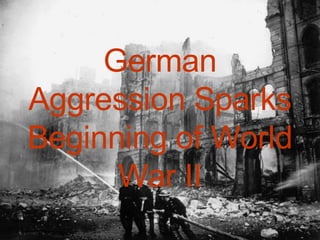
German Aggression Sparks Beginning of World War II
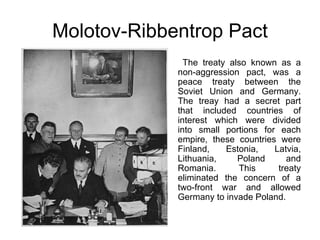
Molotov-Ribbentrop Pact The treaty also known as a non-aggression pact, was a peace treaty between the Soviet Union and Germany. The treay had a secret part that included countries of interest which were divided into small portions for each empire, these countries were Finland, Estonia, Latvia, Lithuania, Poland and Romania. This treaty eliminated the concern of a two-front war and allowed Germany to invade Poland.
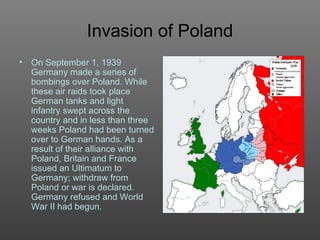
Invasion of Poland On September 1, 1939 Germany made a series of bombings over Poland. While these air raids took place German tanks and light infantry swept across the country and in less than three weeks Poland had been turned over to German hands. As a result of their alliance with Poland, Britain and France issued an Ultimatum to Germany; withdraw from Poland or war is declared. Germany refused and World War II had begun.
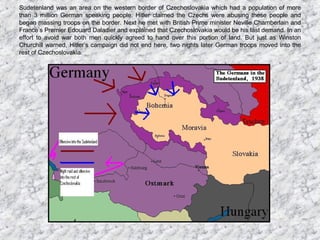
Sudetenland was an area on the western border of Czechoslovakia which had a population of more than 3 million German speaking people. Hitler claimed the Czechs were abusing these people and began massing troops on the border. Next he met with British Prime minister Neville Chamberlain and France’s Premier Edouard Daladier and explained that Czechoslovakia would be his last demand. In an effort to avoid war both men quickly agreed to hand over this portion of land. But just as Winston Churchill warned, Hitler’s campaign did not end here, two nights later German troops moved into the rest of Czechoslovakia.
As the French and British were poised for an attack on the Maginot Line, Hitler drove his tanks through the wooded Ardenne valleys and on to Paris. This offensive trapped more than 400,000 French and British soldiers as they fled to the beaches at Dunkirk. Then these troops went across the channel into Britain. After these events Italy entered the war as an Axis ally and invaded France from the south. Fall of France
During the summer of 1940 the Germans began building a navy on the French coast, while at the same time, Hitler began making bombing runs over London. On August 15 about 2,000 German planes flew over London and every night for the next 2 months London was bombed. On September 15 the British RAF shot down over 150 German planes while losing less than 30 themselves. Battle For Britain
The last six slides show Hitler making his move to gain control of Europe. Every move he made showed that he did not respect other people. He had one goal in his mind: global domination. This goal resulted in thousands of lives lost and in the end nothing was gained.  Hitler disrespects rest of the World
The Holocaust By this time Hitler believed that it was time for racial purification. He declared that Jews were the reason for Germany’s economic problems and for their loss in World War I. Hitler forced hundreds of thousands of Jews into concentration camps where he systematically killed between 11 and 12,000 people everyday. This horrific event had a negative effect on the Jewish community’s dignity because they did not have a chance to fight back and they were unjustly killed. A well as infringing on their personal freedom to be who they were as a people. Instead of taking responsibility and solving the problems in Germany, Hitler threw the blame on the Jews and other minorities and made them pay for things they had not caused.
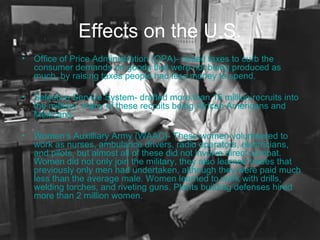
Effects on the U.S. Office of Price Administration (OPA)- raised taxes to curb the consumer demands on goods that were not being produced as much, by raising taxes people had less money to spend. Selective Service System- drafted more than 15 million recruits into the military, many of these recruits being African Americans and Mexicans. Women’s Auxilliary Army (WAAC)- These women volunteered to work as nurses, ambulance drivers, radio operators, electricians, and pilots, but almost all of these did not involve direct combat. Women did not only join the military, they also learned trades that previously only men had undertaken, although they were paid much less than the average male. Women learned to work with drills, welding torches, and riveting guns. Plants building defenses hired more than 2 million women.
All of the problems and conflicts around the world created a stir in Americans. These Americans worked harder, learned new trades, and made sacrifices for their country, both by serving over seas and in their communities.   Rise of Individual Responsibility
The Cold War Almost immediately after the end of World War II another threat to world peace sprang into action, in the form of Joseph Stalin and the Soviet Union. He hoped to impose a communist state, in which the government controlled all property and economic activity. He was also working to take over most, if not all, of Eastern Europe in an effort to balance with U.S. influence in Western Europe. He also wanted to repair the Soviet’s economy by gathering raw materials from these nations especially Germany. He believed these countries owed it to the Soviet Union.
U.S. Sponsored   Resistance Containment- policy to prevent any extension of communist rule into other countries Truman Doctrine- policy of the U.S. to support free people who did not wish to be under control of communist rule Marshall Plan- provided $13 billion of aid to 16 European countries  Berlin Airlift- for 327 days British and American officials dropped 2.3 million tons of food, fuel, and medicine, as well as Christmas presents by plane to the people of West Berlin.
As a result of this resistance Western European nations were flourishing, while most Eastern European voters lost their interest in the communist party because the Soviet Union did not offer beneficial aspects to their countries. These countries also formed a defensive military alliance known as the North Atlantic Treaty Organization (NATO). This alliance pledged military support to any member that was attacked.  Even while the Soviet Union was limiting the personal freedom of each territory and citizen it controlled, the U.S. was working hard to restore this freedom and boost the economies and lifestyles in and throughout Europe.
Changes During the Reagan Presidency Supply-Side economics- Based on the belief that if people paid less taxes they would save more money. Congress lowered taxes by 25%. People would then invest, businesses would produce more, which would lower the price of goods.  Strategic Defense Initiatives- A new missile defense system Downsizing the Federal Government- Social security, Medicare, and veteran’s pensions were not affected, congress slashed budgets by 10% for urban mass transit, food stamps, welfare benefits, job training, Medicaid, and student loans “ Trickle-down theory”- As the prosperity returned to the U.S., profits at the top would move down into the middle class and even into the poor. The first two points were great for the U.S. economically and defense-wise. The government was taking responsibility to fix the economy and make the U.S. safer. Downsizing, while it left some organizations completely unaffected it hurt the organizations helping minorities. The trickle down theory completely failed. As the prosperity returned to the U.S. economy, the richer became richer and the poor became poorer.

Dans History Powerpoint

  • 1.
    German Aggression SparksBeginning of World War II
  • 2.
    Molotov-Ribbentrop Pact Thetreaty also known as a non-aggression pact, was a peace treaty between the Soviet Union and Germany. The treay had a secret part that included countries of interest which were divided into small portions for each empire, these countries were Finland, Estonia, Latvia, Lithuania, Poland and Romania. This treaty eliminated the concern of a two-front war and allowed Germany to invade Poland.
  • 3.
    Invasion of PolandOn September 1, 1939 Germany made a series of bombings over Poland. While these air raids took place German tanks and light infantry swept across the country and in less than three weeks Poland had been turned over to German hands. As a result of their alliance with Poland, Britain and France issued an Ultimatum to Germany; withdraw from Poland or war is declared. Germany refused and World War II had begun.
  • 4.
    Sudetenland was anarea on the western border of Czechoslovakia which had a population of more than 3 million German speaking people. Hitler claimed the Czechs were abusing these people and began massing troops on the border. Next he met with British Prime minister Neville Chamberlain and France’s Premier Edouard Daladier and explained that Czechoslovakia would be his last demand. In an effort to avoid war both men quickly agreed to hand over this portion of land. But just as Winston Churchill warned, Hitler’s campaign did not end here, two nights later German troops moved into the rest of Czechoslovakia.
  • 5.
    As the Frenchand British were poised for an attack on the Maginot Line, Hitler drove his tanks through the wooded Ardenne valleys and on to Paris. This offensive trapped more than 400,000 French and British soldiers as they fled to the beaches at Dunkirk. Then these troops went across the channel into Britain. After these events Italy entered the war as an Axis ally and invaded France from the south. Fall of France
  • 6.
    During the summerof 1940 the Germans began building a navy on the French coast, while at the same time, Hitler began making bombing runs over London. On August 15 about 2,000 German planes flew over London and every night for the next 2 months London was bombed. On September 15 the British RAF shot down over 150 German planes while losing less than 30 themselves. Battle For Britain
  • 7.
    The last sixslides show Hitler making his move to gain control of Europe. Every move he made showed that he did not respect other people. He had one goal in his mind: global domination. This goal resulted in thousands of lives lost and in the end nothing was gained. Hitler disrespects rest of the World
  • 8.
    The Holocaust Bythis time Hitler believed that it was time for racial purification. He declared that Jews were the reason for Germany’s economic problems and for their loss in World War I. Hitler forced hundreds of thousands of Jews into concentration camps where he systematically killed between 11 and 12,000 people everyday. This horrific event had a negative effect on the Jewish community’s dignity because they did not have a chance to fight back and they were unjustly killed. A well as infringing on their personal freedom to be who they were as a people. Instead of taking responsibility and solving the problems in Germany, Hitler threw the blame on the Jews and other minorities and made them pay for things they had not caused.
  • 9.
    Effects on theU.S. Office of Price Administration (OPA)- raised taxes to curb the consumer demands on goods that were not being produced as much, by raising taxes people had less money to spend. Selective Service System- drafted more than 15 million recruits into the military, many of these recruits being African Americans and Mexicans. Women’s Auxilliary Army (WAAC)- These women volunteered to work as nurses, ambulance drivers, radio operators, electricians, and pilots, but almost all of these did not involve direct combat. Women did not only join the military, they also learned trades that previously only men had undertaken, although they were paid much less than the average male. Women learned to work with drills, welding torches, and riveting guns. Plants building defenses hired more than 2 million women.
  • 10.
    All of theproblems and conflicts around the world created a stir in Americans. These Americans worked harder, learned new trades, and made sacrifices for their country, both by serving over seas and in their communities. Rise of Individual Responsibility
  • 11.
    The Cold WarAlmost immediately after the end of World War II another threat to world peace sprang into action, in the form of Joseph Stalin and the Soviet Union. He hoped to impose a communist state, in which the government controlled all property and economic activity. He was also working to take over most, if not all, of Eastern Europe in an effort to balance with U.S. influence in Western Europe. He also wanted to repair the Soviet’s economy by gathering raw materials from these nations especially Germany. He believed these countries owed it to the Soviet Union.
  • 12.
    U.S. Sponsored Resistance Containment- policy to prevent any extension of communist rule into other countries Truman Doctrine- policy of the U.S. to support free people who did not wish to be under control of communist rule Marshall Plan- provided $13 billion of aid to 16 European countries Berlin Airlift- for 327 days British and American officials dropped 2.3 million tons of food, fuel, and medicine, as well as Christmas presents by plane to the people of West Berlin.
  • 13.
    As a resultof this resistance Western European nations were flourishing, while most Eastern European voters lost their interest in the communist party because the Soviet Union did not offer beneficial aspects to their countries. These countries also formed a defensive military alliance known as the North Atlantic Treaty Organization (NATO). This alliance pledged military support to any member that was attacked. Even while the Soviet Union was limiting the personal freedom of each territory and citizen it controlled, the U.S. was working hard to restore this freedom and boost the economies and lifestyles in and throughout Europe.
  • 14.
    Changes During theReagan Presidency Supply-Side economics- Based on the belief that if people paid less taxes they would save more money. Congress lowered taxes by 25%. People would then invest, businesses would produce more, which would lower the price of goods. Strategic Defense Initiatives- A new missile defense system Downsizing the Federal Government- Social security, Medicare, and veteran’s pensions were not affected, congress slashed budgets by 10% for urban mass transit, food stamps, welfare benefits, job training, Medicaid, and student loans “ Trickle-down theory”- As the prosperity returned to the U.S., profits at the top would move down into the middle class and even into the poor. The first two points were great for the U.S. economically and defense-wise. The government was taking responsibility to fix the economy and make the U.S. safer. Downsizing, while it left some organizations completely unaffected it hurt the organizations helping minorities. The trickle down theory completely failed. As the prosperity returned to the U.S. economy, the richer became richer and the poor became poorer.