
Geodata @ The British Museum

     Enriched archaeological records
               Daniel Pett
  dpett@britishmuseum.org / @portableant
               finds.org.uk
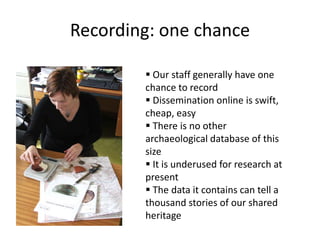
Recording: one chance

         Our staff generally have one
        chance to record
         Dissemination online is swift,
        cheap, easy
         There is no other
        archaeological database of this
        size
         It is underused for research at
        present
         The data it contains can tell a
        thousand stories of our shared
        heritage
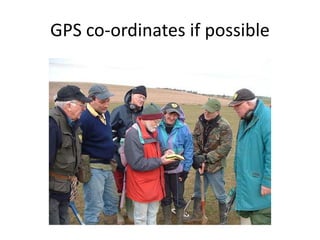
GPS co-ordinates if possible
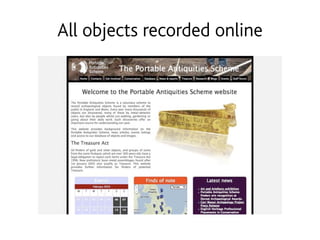
All objects recorded online
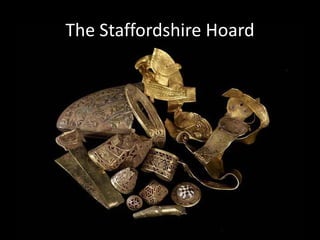
The Staffordshire Hoard
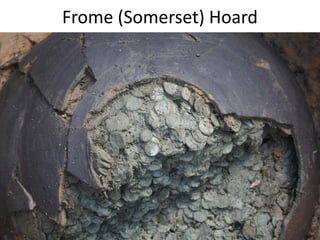
Frome (Somerset) Hoard
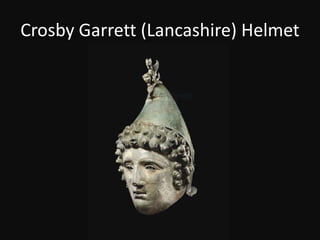
Crosby Garrett (Lancashire) Helmet
Objects referencing place:
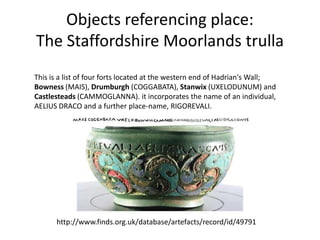
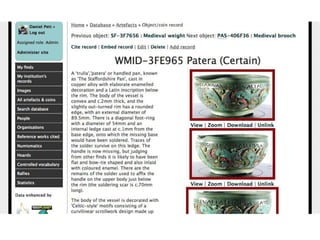
The Staffordshire Moorlands trulla
This is a list of four forts located at the western end of Hadrian's Wall;
Bowness (MAIS), Drumburgh (COGGABATA), Stanwix (UXELODUNUM) and
Castlesteads (CAMMOGLANNA). it incorporates the name of an individual,
AELIUS DRACO and a further place-name, RIGOREVALI.


      http://www.finds.org.uk/database/artefacts/record/id/49791
Why is the spatial data so
        important?
Without provenance:
 A museum cannot acquire an object
 Is it looted?
 Did the landowner give permission?
 Context has been lost, we don’t know the
significance of the location of discovery.
"X" never, ever marks the spot.


                     Indiana Jones: Last Crusade
http://www.flickr.com/photos/steve_hocking/3318676289/in/photostream/
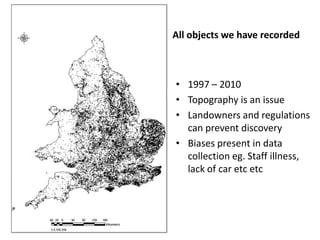
All objects we have recorded


• 1997 – 2010
• Topography is an issue
• Landowners and regulations
  can prevent discovery
• Biases present in data
  collection eg. Staff illness,
  lack of car etc etc
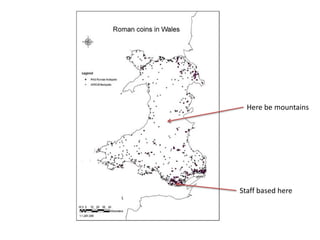
Here be mountains


Staff based here
Using YQL
• Reverse geocode for WOEID for each findspot
  against flickr.places
• Get flickr shapefile if exists for WOEID
• Obtain a co-ordinate for findspots where only
  place is known (lower weight for academic use
  though).
• Obtain elevation via the geonames api (for
  viewshed analysis – surprisingly good!)
• Find objects within bounding boxes
• Query for archaeology images on flickr
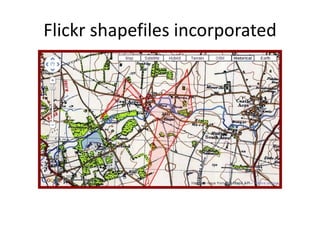
Flickr shapefiles incorporated
Display problems
• Public users can only see find spots at a
  resolution of 1km sq or 4 figure NGR
• Some find spots have to be hidden from public
  view completely – we give a place a
  pseudonym
• Maps make our finders and landowners jumpy
• Zoom level had to be reduced for public users
• WOEID can give away find location
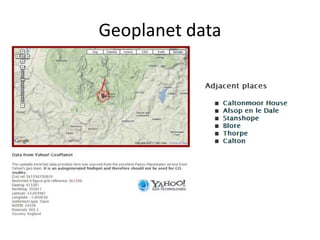
Geoplanet data
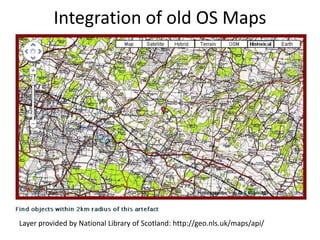
Integration of old OS Maps


Layer provided by National Library of Scotland: http://geo.nls.uk/maps/api/
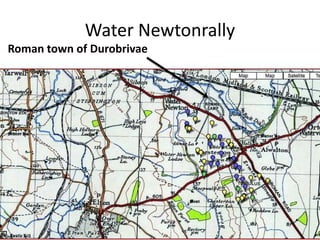
Water Newtonrally
Roman town of Durobrivae
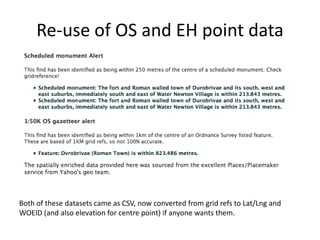
Re-use of OS and EH point data


Both of these datasets came as CSV, now converted from grid refs to Lat/Lng and
WOEID (and also elevation for centre point) if anyone wants them.
What archaeologists would like: A database of
         places – ancient & modern?
• Ancient place names
  – Dates in use
  – Co-ordinates at that time
  – Affiliation (political)
  – Example database – Pleiades, NYU
    http://pleiades.stoa.org/
• Modern place names

Dan Pett - British Museum - Enriched Archaeological Records - Geomob Feb 2011

  • 1.
    Geodata @ TheBritish Museum Enriched archaeological records Daniel Pett dpett@britishmuseum.org / @portableant finds.org.uk
  • 2.
    Recording: one chance  Our staff generally have one chance to record  Dissemination online is swift, cheap, easy  There is no other archaeological database of this size  It is underused for research at present  The data it contains can tell a thousand stories of our shared heritage
  • 3.
  • 4.
  • 5.
  • 6.
  • 7.
  • 8.
    Objects referencing place: TheStaffordshire Moorlands trulla This is a list of four forts located at the western end of Hadrian's Wall; Bowness (MAIS), Drumburgh (COGGABATA), Stanwix (UXELODUNUM) and Castlesteads (CAMMOGLANNA). it incorporates the name of an individual, AELIUS DRACO and a further place-name, RIGOREVALI. http://www.finds.org.uk/database/artefacts/record/id/49791
  • 9.
    Why is thespatial data so important? Without provenance:  A museum cannot acquire an object  Is it looted?  Did the landowner give permission?  Context has been lost, we don’t know the significance of the location of discovery.
  • 10.
    "X" never, evermarks the spot. Indiana Jones: Last Crusade http://www.flickr.com/photos/steve_hocking/3318676289/in/photostream/
  • 11.
    All objects wehave recorded • 1997 – 2010 • Topography is an issue • Landowners and regulations can prevent discovery • Biases present in data collection eg. Staff illness, lack of car etc etc
  • 12.
  • 14.
    Using YQL • Reversegeocode for WOEID for each findspot against flickr.places • Get flickr shapefile if exists for WOEID • Obtain a co-ordinate for findspots where only place is known (lower weight for academic use though). • Obtain elevation via the geonames api (for viewshed analysis – surprisingly good!) • Find objects within bounding boxes • Query for archaeology images on flickr
  • 15.
  • 16.
    Display problems • Publicusers can only see find spots at a resolution of 1km sq or 4 figure NGR • Some find spots have to be hidden from public view completely – we give a place a pseudonym • Maps make our finders and landowners jumpy • Zoom level had to be reduced for public users • WOEID can give away find location
  • 17.
  • 18.
    Integration of oldOS Maps Layer provided by National Library of Scotland: http://geo.nls.uk/maps/api/
  • 19.
  • 20.
    Re-use of OSand EH point data Both of these datasets came as CSV, now converted from grid refs to Lat/Lng and WOEID (and also elevation for centre point) if anyone wants them.
  • 21.
    What archaeologists wouldlike: A database of places – ancient & modern? • Ancient place names – Dates in use – Co-ordinates at that time – Affiliation (political) – Example database – Pleiades, NYU http://pleiades.stoa.org/ • Modern place names