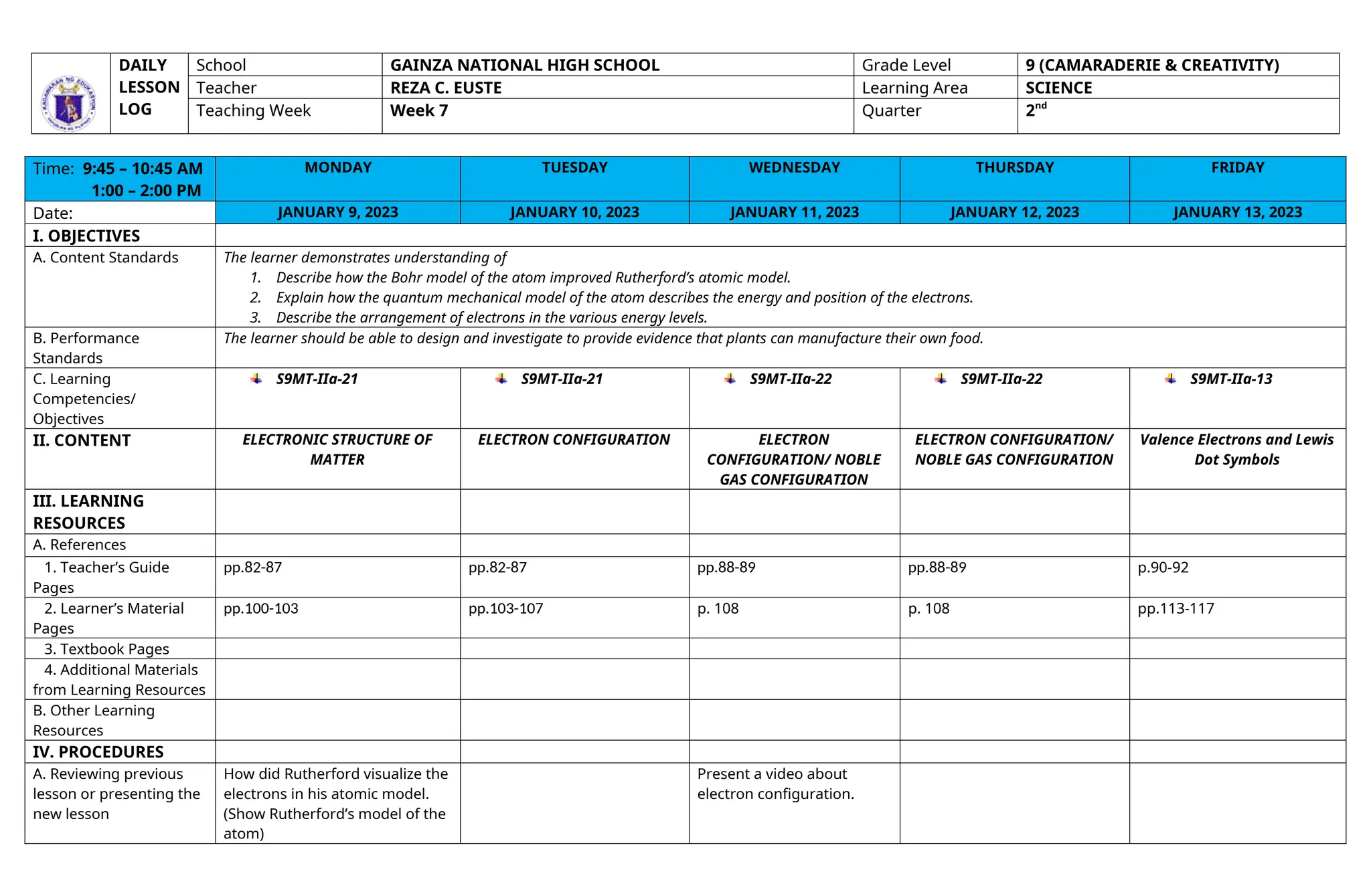
DAILY
LESSON
LOG
School GAINZA NATIONAL HIGH SCHOOL Grade Level 9 (CAMARADERIE & CREATIVITY)
Teacher REZA C. EUSTE Learning Area SCIENCE
Teaching Week Week 7 Quarter 2nd
Time: 9:45 – 10:45 AM
1:00 – 2:00 PM
MONDAY TUESDAY WEDNESDAY THURSDAY FRIDAY
Date: JANUARY 9, 2023 JANUARY 10, 2023 JANUARY 11, 2023 JANUARY 12, 2023 JANUARY 13, 2023
I. OBJECTIVES
A. Content Standards The learner demonstrates understanding of
1. Describe how the Bohr model of the atom improved Rutherford’s atomic model.
2. Explain how the quantum mechanical model of the atom describes the energy and position of the electrons.
3. Describe the arrangement of electrons in the various energy levels.
B. Performance
Standards
The learner should be able to design and investigate to provide evidence that plants can manufacture their own food.
C. Learning
Competencies/
Objectives
S9MT-IIa-21 S9MT-IIa-21 S9MT-IIa-22 S9MT-IIa-22 S9MT-IIa-13
II. CONTENT ELECTRONIC STRUCTURE OF
MATTER
ELECTRON CONFIGURATION ELECTRON
CONFIGURATION/ NOBLE
GAS CONFIGURATION
ELECTRON CONFIGURATION/
NOBLE GAS CONFIGURATION
Valence Electrons and Lewis
Dot Symbols
III. LEARNING
RESOURCES
A. References
1. Teacher’s Guide
Pages
pp.82-87 pp.82-87 pp.88-89 pp.88-89 p.90-92
2. Learner’s Material
Pages
pp.100-103 pp.103-107 p. 108 p. 108 pp.113-117
3. Textbook Pages
4. Additional Materials
from Learning Resources
B. Other Learning
Resources
IV. PROCEDURES
A. Reviewing previous
lesson or presenting the
new lesson
How did Rutherford visualize the
electrons in his atomic model.
(Show Rutherford’s model of the
atom)
Present a video about
electron configuration.
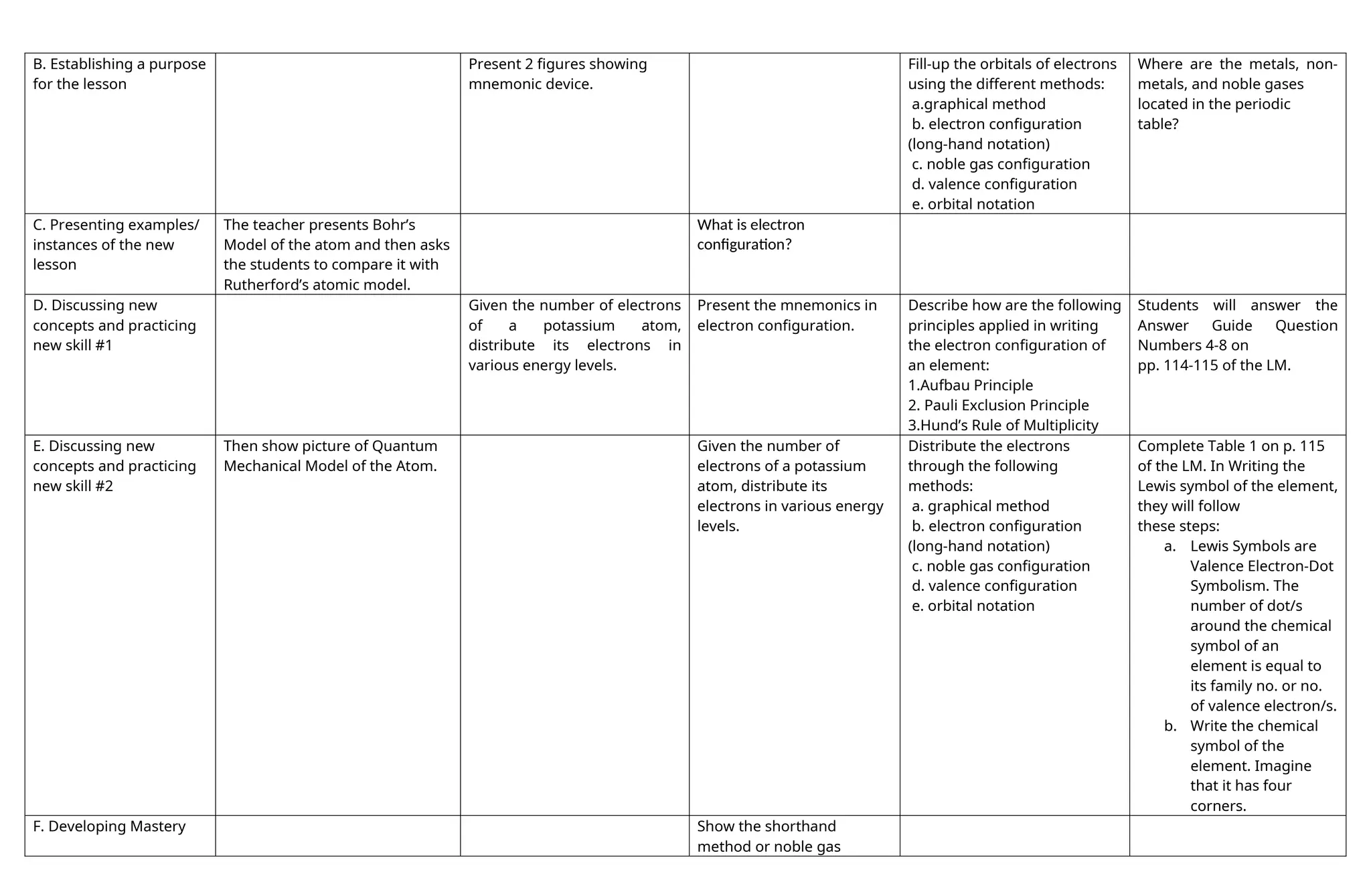
B. Establishing a purpose
for the lesson
Present 2 figures showing
mnemonic device.
Fill-up the orbitals of electrons
using the different methods:
a.graphical method
b. electron configuration
(long-hand notation)
c. noble gas configuration
d. valence configuration
e. orbital notation
Where are the metals, non-
metals, and noble gases
located in the periodic
table?
C. Presenting examples/
instances of the new
lesson
The teacher presents Bohr’s
Model of the atom and then asks
the students to compare it with
Rutherford’s atomic model.
What is electron
configuration?
D. Discussing new
concepts and practicing
new skill #1
Given the number of electrons
of a potassium atom,
distribute its electrons in
various energy levels.
Present the mnemonics in
electron configuration.
Describe how are the following
principles applied in writing
the electron configuration of
an element:
1.Aufbau Principle
2. Pauli Exclusion Principle
3.Hund’s Rule of Multiplicity
Students will answer the
Answer Guide Question
Numbers 4-8 on
pp. 114-115 of the LM.
E. Discussing new
concepts and practicing
new skill #2
Then show picture of Quantum
Mechanical Model of the Atom.
Given the number of
electrons of a potassium
atom, distribute its
electrons in various energy
levels.
Distribute the electrons
through the following
methods:
a. graphical method
b. electron configuration
(long-hand notation)
c. noble gas configuration
d. valence configuration
e. orbital notation
Complete Table 1 on p. 115
of the LM. In Writing the
Lewis symbol of the element,
they will follow
these steps:
a. Lewis Symbols are
Valence Electron-Dot
Symbolism. The
number of dot/s
around the chemical
symbol of an
element is equal to
its family no. or no.
of valence electron/s.
b. Write the chemical
symbol of the
element. Imagine
that it has four
corners.
F. Developing Mastery Show the shorthand
method or noble gas
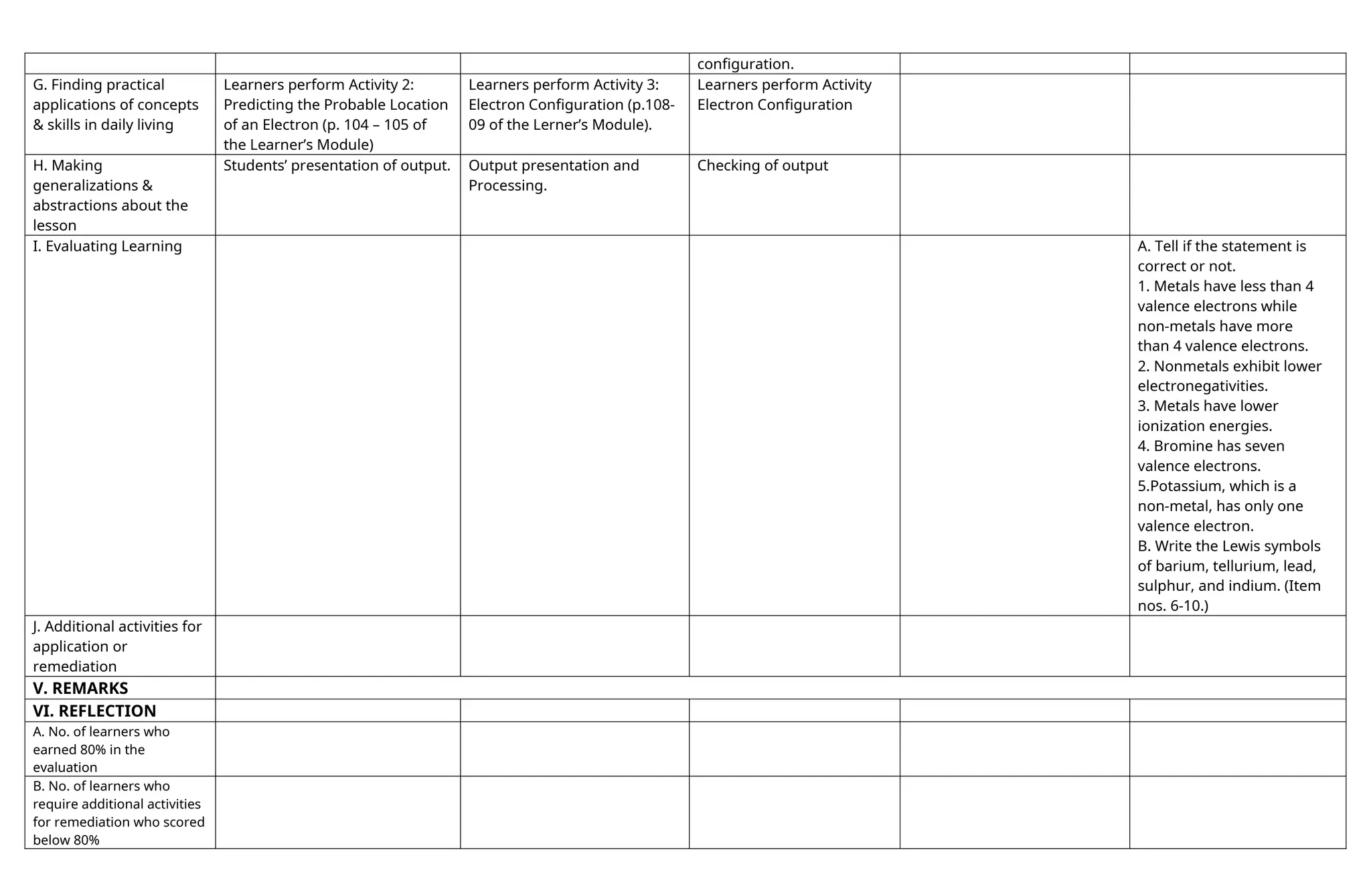
configuration.
G. Finding practical
applications of concepts
& skills in daily living
Learners perform Activity 2:
Predicting the Probable Location
of an Electron (p. 104 – 105 of
the Learner’s Module)
Learners perform Activity 3:
Electron Configuration (p.108-
09 of the Lerner’s Module).
Learners perform Activity
Electron Configuration
H. Making
generalizations &
abstractions about the
lesson
Students’ presentation of output. Output presentation and
Processing.
Checking of output
I. Evaluating Learning A. Tell if the statement is
correct or not.
1. Metals have less than 4
valence electrons while
non-metals have more
than 4 valence electrons.
2. Nonmetals exhibit lower
electronegativities.
3. Metals have lower
ionization energies.
4. Bromine has seven
valence electrons.
5.Potassium, which is a
non-metal, has only one
valence electron.
B. Write the Lewis symbols
of barium, tellurium, lead,
sulphur, and indium. (Item
nos. 6-10.)
J. Additional activities for
application or
remediation
V. REMARKS
VI. REFLECTION
A. No. of learners who
earned 80% in the
evaluation
B. No. of learners who
require additional activities
for remediation who scored
below 80%
C. Did the remedial lesson
work? No. of learners who
caught up with the lesson
D. No. of learners who
continue to require
remediation
E. Which of my teaching
strategies worked well?
Why did these works?
F. What difficulties did I
encounter which my
principal or supervisor can
help me solve?
G. What innovation or
localized materials did I
use/discover which I wish to
share with other teachers?
Prepared by: Checked and Noted by:
REZA C. EUSTE DIANNA A. MAQUILAN
Teacher I Principal I

daily lesson log in science 9 week19 2023.docx

  • 1.
    DAILY LESSON LOG School GAINZA NATIONALHIGH SCHOOL Grade Level 9 (CAMARADERIE & CREATIVITY) Teacher REZA C. EUSTE Learning Area SCIENCE Teaching Week Week 7 Quarter 2nd Time: 9:45 – 10:45 AM 1:00 – 2:00 PM MONDAY TUESDAY WEDNESDAY THURSDAY FRIDAY Date: JANUARY 9, 2023 JANUARY 10, 2023 JANUARY 11, 2023 JANUARY 12, 2023 JANUARY 13, 2023 I. OBJECTIVES A. Content Standards The learner demonstrates understanding of 1. Describe how the Bohr model of the atom improved Rutherford’s atomic model. 2. Explain how the quantum mechanical model of the atom describes the energy and position of the electrons. 3. Describe the arrangement of electrons in the various energy levels. B. Performance Standards The learner should be able to design and investigate to provide evidence that plants can manufacture their own food. C. Learning Competencies/ Objectives S9MT-IIa-21 S9MT-IIa-21 S9MT-IIa-22 S9MT-IIa-22 S9MT-IIa-13 II. CONTENT ELECTRONIC STRUCTURE OF MATTER ELECTRON CONFIGURATION ELECTRON CONFIGURATION/ NOBLE GAS CONFIGURATION ELECTRON CONFIGURATION/ NOBLE GAS CONFIGURATION Valence Electrons and Lewis Dot Symbols III. LEARNING RESOURCES A. References 1. Teacher’s Guide Pages pp.82-87 pp.82-87 pp.88-89 pp.88-89 p.90-92 2. Learner’s Material Pages pp.100-103 pp.103-107 p. 108 p. 108 pp.113-117 3. Textbook Pages 4. Additional Materials from Learning Resources B. Other Learning Resources IV. PROCEDURES A. Reviewing previous lesson or presenting the new lesson How did Rutherford visualize the electrons in his atomic model. (Show Rutherford’s model of the atom) Present a video about electron configuration.
  • 2.
    B. Establishing apurpose for the lesson Present 2 figures showing mnemonic device. Fill-up the orbitals of electrons using the different methods: a.graphical method b. electron configuration (long-hand notation) c. noble gas configuration d. valence configuration e. orbital notation Where are the metals, non- metals, and noble gases located in the periodic table? C. Presenting examples/ instances of the new lesson The teacher presents Bohr’s Model of the atom and then asks the students to compare it with Rutherford’s atomic model. What is electron configuration? D. Discussing new concepts and practicing new skill #1 Given the number of electrons of a potassium atom, distribute its electrons in various energy levels. Present the mnemonics in electron configuration. Describe how are the following principles applied in writing the electron configuration of an element: 1.Aufbau Principle 2. Pauli Exclusion Principle 3.Hund’s Rule of Multiplicity Students will answer the Answer Guide Question Numbers 4-8 on pp. 114-115 of the LM. E. Discussing new concepts and practicing new skill #2 Then show picture of Quantum Mechanical Model of the Atom. Given the number of electrons of a potassium atom, distribute its electrons in various energy levels. Distribute the electrons through the following methods: a. graphical method b. electron configuration (long-hand notation) c. noble gas configuration d. valence configuration e. orbital notation Complete Table 1 on p. 115 of the LM. In Writing the Lewis symbol of the element, they will follow these steps: a. Lewis Symbols are Valence Electron-Dot Symbolism. The number of dot/s around the chemical symbol of an element is equal to its family no. or no. of valence electron/s. b. Write the chemical symbol of the element. Imagine that it has four corners. F. Developing Mastery Show the shorthand method or noble gas
  • 3.
    configuration. G. Finding practical applicationsof concepts & skills in daily living Learners perform Activity 2: Predicting the Probable Location of an Electron (p. 104 – 105 of the Learner’s Module) Learners perform Activity 3: Electron Configuration (p.108- 09 of the Lerner’s Module). Learners perform Activity Electron Configuration H. Making generalizations & abstractions about the lesson Students’ presentation of output. Output presentation and Processing. Checking of output I. Evaluating Learning A. Tell if the statement is correct or not. 1. Metals have less than 4 valence electrons while non-metals have more than 4 valence electrons. 2. Nonmetals exhibit lower electronegativities. 3. Metals have lower ionization energies. 4. Bromine has seven valence electrons. 5.Potassium, which is a non-metal, has only one valence electron. B. Write the Lewis symbols of barium, tellurium, lead, sulphur, and indium. (Item nos. 6-10.) J. Additional activities for application or remediation V. REMARKS VI. REFLECTION A. No. of learners who earned 80% in the evaluation B. No. of learners who require additional activities for remediation who scored below 80%
  • 4.
    C. Did theremedial lesson work? No. of learners who caught up with the lesson D. No. of learners who continue to require remediation E. Which of my teaching strategies worked well? Why did these works? F. What difficulties did I encounter which my principal or supervisor can help me solve? G. What innovation or localized materials did I use/discover which I wish to share with other teachers? Prepared by: Checked and Noted by: REZA C. EUSTE DIANNA A. MAQUILAN Teacher I Principal I