DISCOVER . LEARN . EMPOWER
APEX INSTITUTE OF TECHNOLOGY
DEPARTMENT OF COMPUTER SCIENCE & ENGINEERING
Design and Analysis of Algorithm(23CSH-282)
Faculty: Dr. Abhishek Pandey(E17100)
1
2
DAA: Course Objectives
1. Understand Algorithm Efficiency: Analyze algorithms using asymptotic notations (Big-
O, Ω, Θ) to evaluate time and space complexity.
2. Master Core Design Techniques: Apply design paradigms like Divide and Conquer,
Greedy Methods, and Dynamic Programming to solve computational problems.
3. Leverage Data Structures Effectively: Use appropriate data structures (e.g., graphs,
trees, heaps) to enhance algorithm performance.
4. Solve Real-World Problems: Design and implement algorithms for sorting, searching,
graph traversal, and optimization tasks.
5. Grasp Computational Complexity: Differentiate between complexity classes (P, NP,
NP-complete) and understand problem reducibility.
3
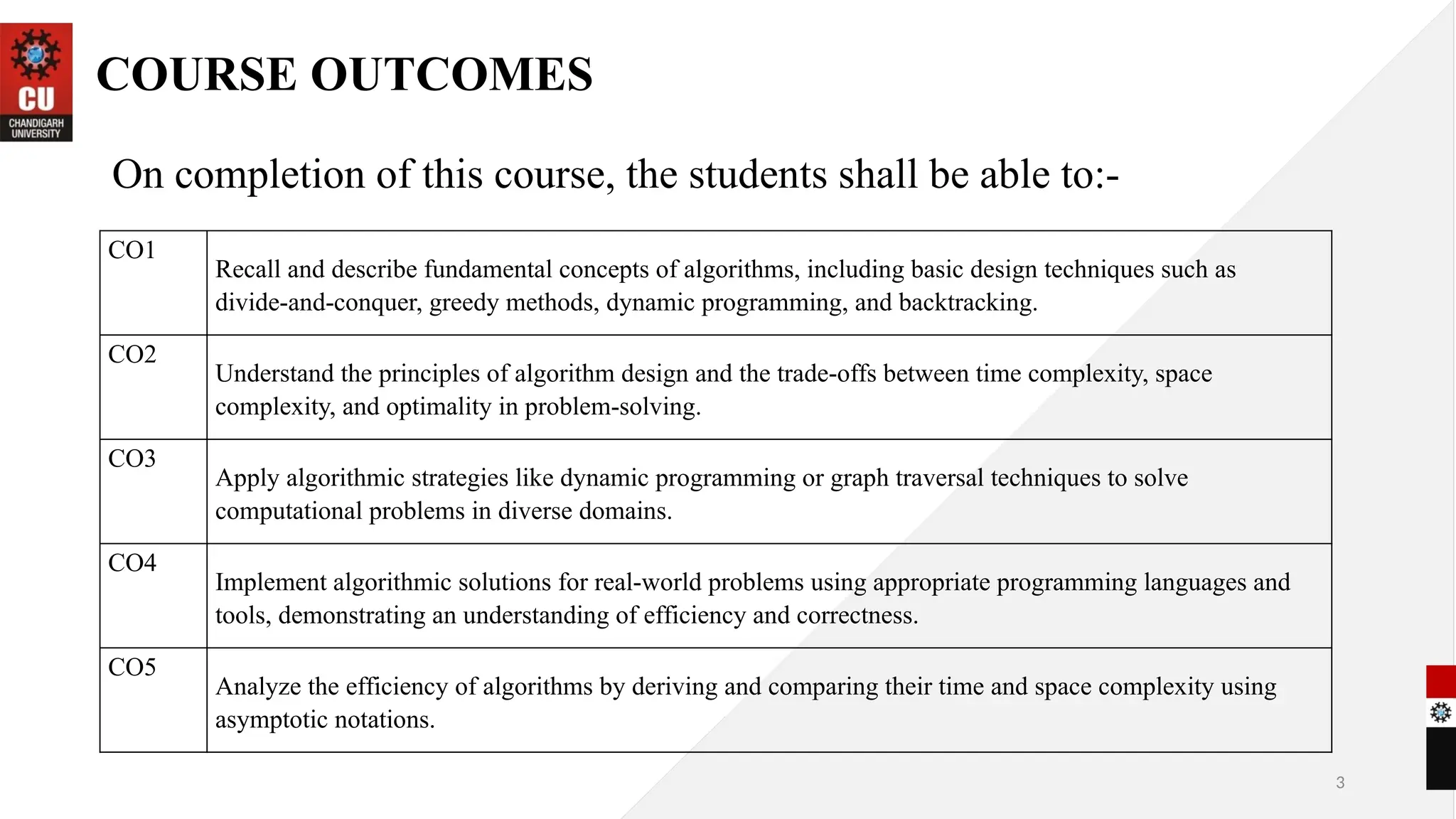
COURSE OUTCOMES
On completion of this course, the students shall be able to:-
CO1
Recall and describe fundamental concepts of algorithms, including basic design techniques such as
divide-and-conquer, greedy methods, dynamic programming, and backtracking.
CO2
Understand the principles of algorithm design and the trade-offs between time complexity, space
complexity, and optimality in problem-solving.
CO3
Apply algorithmic strategies like dynamic programming or graph traversal techniques to solve
computational problems in diverse domains.
CO4
Implement algorithmic solutions for real-world problems using appropriate programming languages and
tools, demonstrating an understanding of efficiency and correctness.
CO5
Analyze the efficiency of algorithms by deriving and comparing their time and space complexity using
asymptotic notations.
4
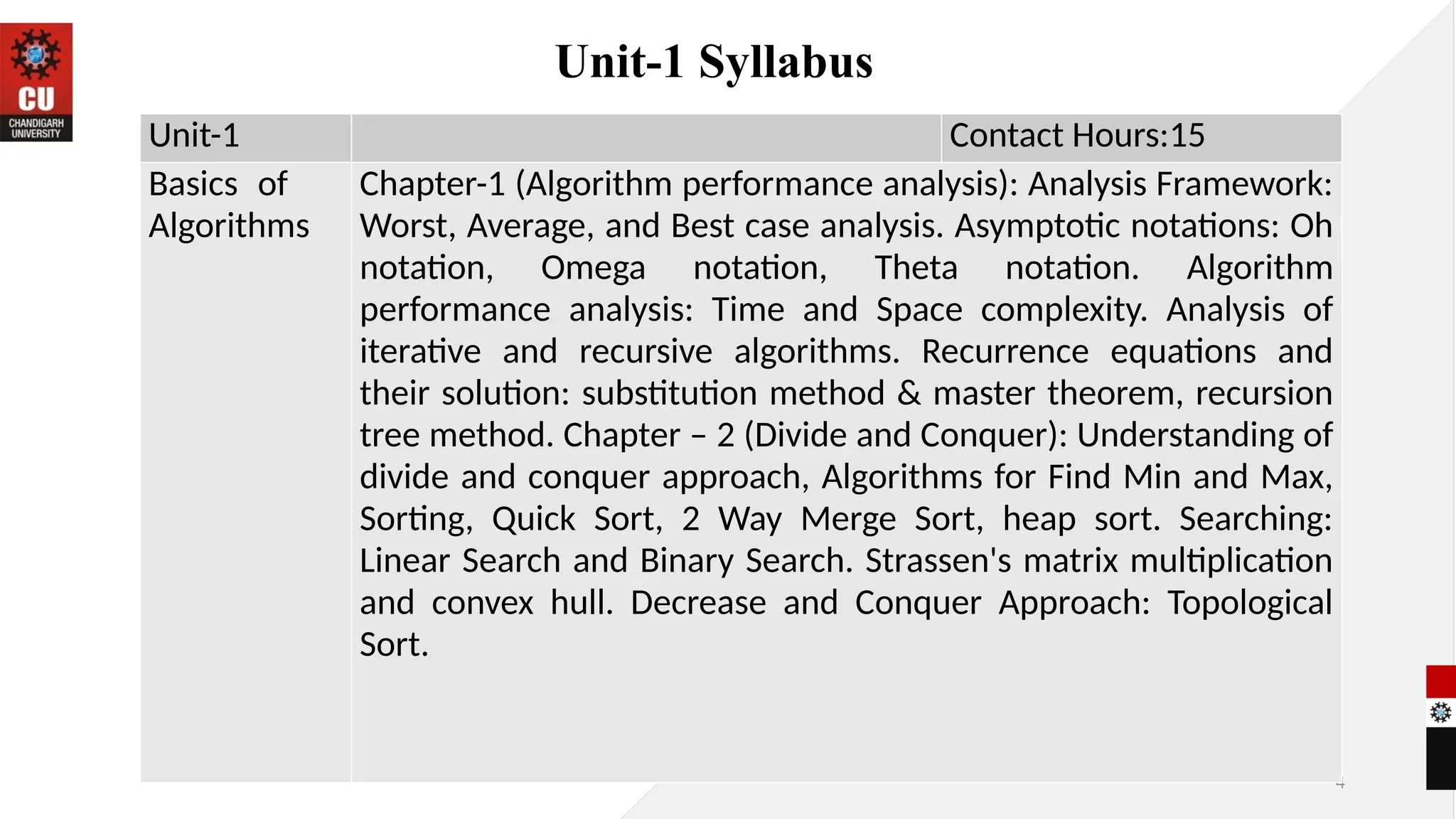
Unit-1 Syllabus
Unit-1 Contact Hours:15
Basics of
Algorithms
Chapter-1 (Algorithm performance analysis): Analysis Framework:
Worst, Average, and Best case analysis. Asymptotic notations: Oh
notation, Omega notation, Theta notation. Algorithm
performance analysis: Time and Space complexity. Analysis of
iterative and recursive algorithms. Recurrence equations and
their solution: substitution method & master theorem, recursion
tree method. Chapter – 2 (Divide and Conquer): Understanding of
divide and conquer approach, Algorithms for Find Min and Max,
Sorting, Quick Sort, 2 Way Merge Sort, heap sort. Searching:
Linear Search and Binary Search. Strassen's matrix multiplication
and convex hull. Decrease and Conquer Approach: Topological
Sort.
5
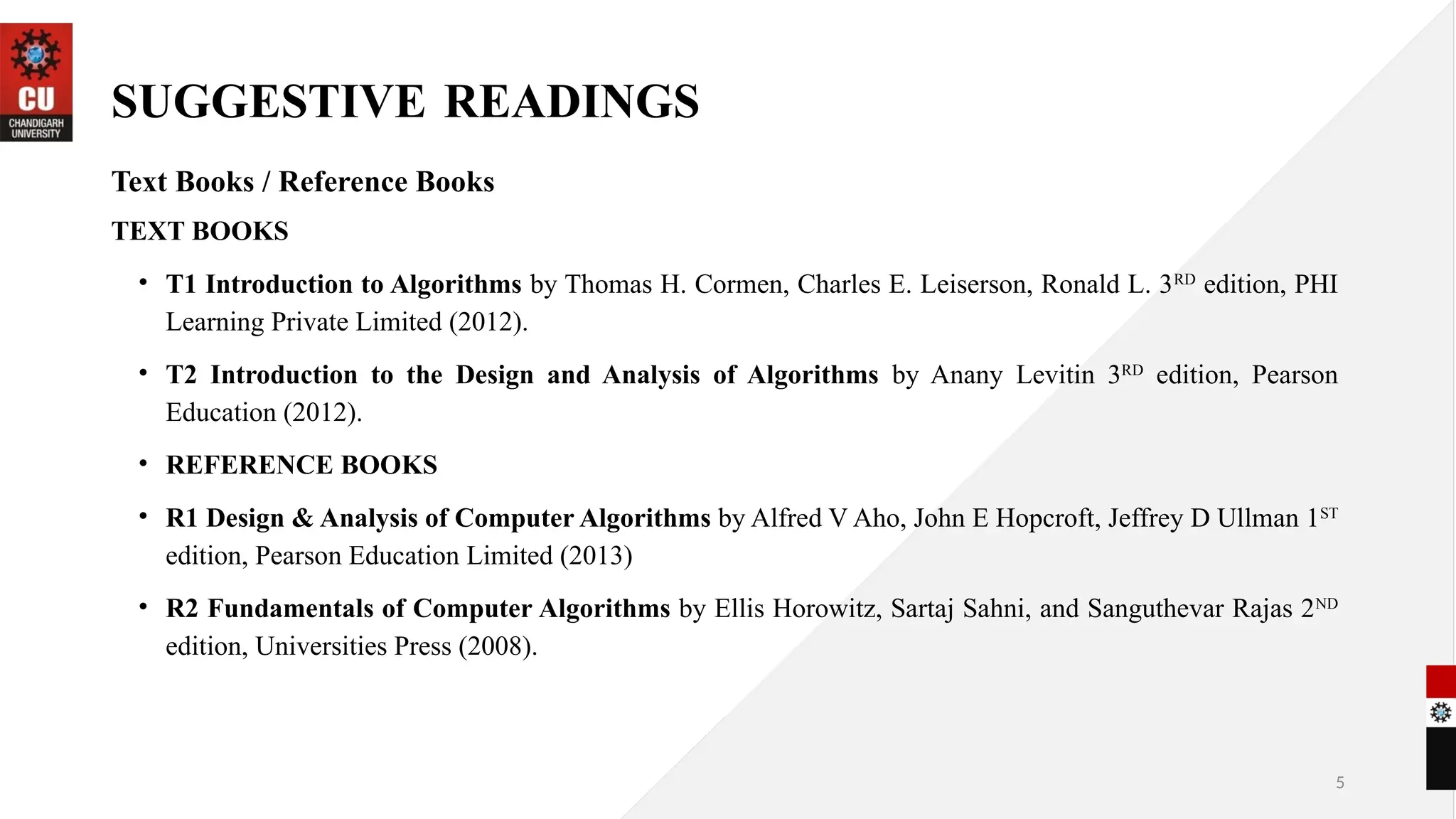
SUGGESTIVE READINGS
Text Books / Reference Books
TEXT BOOKS
• T1 Introduction to Algorithms by Thomas H. Cormen, Charles E. Leiserson, Ronald L. 3RD
edition, PHI
Learning Private Limited (2012).
• T2 Introduction to the Design and Analysis of Algorithms by Anany Levitin 3RD
edition, Pearson
Education (2012).
• REFERENCE BOOKS
• R1 Design & Analysis of Computer Algorithms by Alfred V Aho, John E Hopcroft, Jeffrey D Ullman 1ST
edition, Pearson Education Limited (2013)
• R2 Fundamentals of Computer Algorithms by Ellis Horowitz, Sartaj Sahni, and Sanguthevar Rajas 2ND
edition, Universities Press (2008).
Contents to be Covered
• Asymptotic notations[CO1]:
•Oh notation
•Omega notation
• Theta notation
Asymptotic Notations
O-notation, Ω-notation, and Θ-notation
Introduction to Asymptotic Notations
• Asymptotic notations describe algorithm efficiency for large inputs.
• Common notations:
• 1. Big-O (O)
• 2. Omega (Ω)
• 3. Theta (Θ)
Big-O Notation (O)
• - Describes the upper bound of an algorithm's performance.
• - Represents the worst-case scenario.
• - Defines the maximum time or space required as input grows.
• - Example: O(n²) for nested loops.
Omega Notation (Ω)
• - Describes the lower bound of an algorithm's performance.
• - Represents the best-case scenario.
• - Defines the minimum time or space required as input grows.
• - Example: Ω(n) for a linear search.
Theta Notation (Θ)
• - Describes the exact bound of an algorithm's performance.
• - Combines both upper and lower bounds.
• - Indicates the tight bound for time or space required.
• - Example: Θ(n log n) for merge sort.
Summary
• - Big-O (O): Upper bound, worst-case analysis.
• - Omega (Ω): Lower bound, best-case analysis.
• - Theta (Θ): Exact bound, average-case analysis.
• - These notations help evaluate algorithm efficiency.
References
• Text Books:
• T1 Introduction to Algorithms by Thomas H. Cormen, Charles E. Leiserson, Ronald L. 3RD
edition, PHI
Learning Private Limited (2012).
• T2 Introduction to the Design and Analysis of Algorithms by Anany Levitin 3RD
edition, Pearson
Education (2012).
13
14
Questions
• Define Big O notation and explain its significance in algorithm
analysis.
• What is the difference between Big O and Theta notations? Provide
examples for each.
• Explain Omega notation and its use in describing the performance of
an algorithm.
• Given the function T(n) = 5n^2 + 3n + 10, determine its Big O, Theta,
and Omega notations.
• Why is Big O notation commonly used in practice compared to Theta
and Omega notations?
15
Video and Web Resources
• https://www.programiz.com/dsa/asymptotic-notations
• https://www.geeksforgeeks.org/difference-between-big-oh-big-omeg
a-and-big-theta/
• https://www.youtube.com/watch?v=HCoT_HLCGXY
• https://archive.nptel.ac.in/courses/106/101/106101060/

THANK YOU
For queries
Email:
abhishek.e17100@cumail.in

DAA Lecture2 bvased on the general concepts of DAA

  • 1.
    DISCOVER . LEARN. EMPOWER APEX INSTITUTE OF TECHNOLOGY DEPARTMENT OF COMPUTER SCIENCE & ENGINEERING Design and Analysis of Algorithm(23CSH-282) Faculty: Dr. Abhishek Pandey(E17100) 1
  • 2.
    2 DAA: Course Objectives 1.Understand Algorithm Efficiency: Analyze algorithms using asymptotic notations (Big- O, Ω, Θ) to evaluate time and space complexity. 2. Master Core Design Techniques: Apply design paradigms like Divide and Conquer, Greedy Methods, and Dynamic Programming to solve computational problems. 3. Leverage Data Structures Effectively: Use appropriate data structures (e.g., graphs, trees, heaps) to enhance algorithm performance. 4. Solve Real-World Problems: Design and implement algorithms for sorting, searching, graph traversal, and optimization tasks. 5. Grasp Computational Complexity: Differentiate between complexity classes (P, NP, NP-complete) and understand problem reducibility.
  • 3.
    3 COURSE OUTCOMES On completionof this course, the students shall be able to:- CO1 Recall and describe fundamental concepts of algorithms, including basic design techniques such as divide-and-conquer, greedy methods, dynamic programming, and backtracking. CO2 Understand the principles of algorithm design and the trade-offs between time complexity, space complexity, and optimality in problem-solving. CO3 Apply algorithmic strategies like dynamic programming or graph traversal techniques to solve computational problems in diverse domains. CO4 Implement algorithmic solutions for real-world problems using appropriate programming languages and tools, demonstrating an understanding of efficiency and correctness. CO5 Analyze the efficiency of algorithms by deriving and comparing their time and space complexity using asymptotic notations.
  • 4.
    4 Unit-1 Syllabus Unit-1 ContactHours:15 Basics of Algorithms Chapter-1 (Algorithm performance analysis): Analysis Framework: Worst, Average, and Best case analysis. Asymptotic notations: Oh notation, Omega notation, Theta notation. Algorithm performance analysis: Time and Space complexity. Analysis of iterative and recursive algorithms. Recurrence equations and their solution: substitution method & master theorem, recursion tree method. Chapter – 2 (Divide and Conquer): Understanding of divide and conquer approach, Algorithms for Find Min and Max, Sorting, Quick Sort, 2 Way Merge Sort, heap sort. Searching: Linear Search and Binary Search. Strassen's matrix multiplication and convex hull. Decrease and Conquer Approach: Topological Sort.
  • 5.
    5 SUGGESTIVE READINGS Text Books/ Reference Books TEXT BOOKS • T1 Introduction to Algorithms by Thomas H. Cormen, Charles E. Leiserson, Ronald L. 3RD edition, PHI Learning Private Limited (2012). • T2 Introduction to the Design and Analysis of Algorithms by Anany Levitin 3RD edition, Pearson Education (2012). • REFERENCE BOOKS • R1 Design & Analysis of Computer Algorithms by Alfred V Aho, John E Hopcroft, Jeffrey D Ullman 1ST edition, Pearson Education Limited (2013) • R2 Fundamentals of Computer Algorithms by Ellis Horowitz, Sartaj Sahni, and Sanguthevar Rajas 2ND edition, Universities Press (2008).
  • 6.
    Contents to beCovered • Asymptotic notations[CO1]: •Oh notation •Omega notation • Theta notation
  • 7.
  • 8.
    Introduction to AsymptoticNotations • Asymptotic notations describe algorithm efficiency for large inputs. • Common notations: • 1. Big-O (O) • 2. Omega (Ω) • 3. Theta (Θ)
  • 9.
    Big-O Notation (O) •- Describes the upper bound of an algorithm's performance. • - Represents the worst-case scenario. • - Defines the maximum time or space required as input grows. • - Example: O(n²) for nested loops.
  • 10.
    Omega Notation (Ω) •- Describes the lower bound of an algorithm's performance. • - Represents the best-case scenario. • - Defines the minimum time or space required as input grows. • - Example: Ω(n) for a linear search.
  • 11.
    Theta Notation (Θ) •- Describes the exact bound of an algorithm's performance. • - Combines both upper and lower bounds. • - Indicates the tight bound for time or space required. • - Example: Θ(n log n) for merge sort.
  • 12.
    Summary • - Big-O(O): Upper bound, worst-case analysis. • - Omega (Ω): Lower bound, best-case analysis. • - Theta (Θ): Exact bound, average-case analysis. • - These notations help evaluate algorithm efficiency.
  • 13.
    References • Text Books: •T1 Introduction to Algorithms by Thomas H. Cormen, Charles E. Leiserson, Ronald L. 3RD edition, PHI Learning Private Limited (2012). • T2 Introduction to the Design and Analysis of Algorithms by Anany Levitin 3RD edition, Pearson Education (2012). 13
  • 14.
    14 Questions • Define BigO notation and explain its significance in algorithm analysis. • What is the difference between Big O and Theta notations? Provide examples for each. • Explain Omega notation and its use in describing the performance of an algorithm. • Given the function T(n) = 5n^2 + 3n + 10, determine its Big O, Theta, and Omega notations. • Why is Big O notation commonly used in practice compared to Theta and Omega notations?
  • 15.
    15 Video and WebResources • https://www.programiz.com/dsa/asymptotic-notations • https://www.geeksforgeeks.org/difference-between-big-oh-big-omeg a-and-big-theta/ • https://www.youtube.com/watch?v=HCoT_HLCGXY • https://archive.nptel.ac.in/courses/106/101/106101060/
  • 16.