Deputy Head of Division Lars Høgsbro Østergaard
10-Jun-14 1
Performance and results –
current work
POINT OF DEPARTURE
• General rule in the national budget: Expenditure frames.
• Basis for calculation stated in the budget for each appropriation – often very
general.
• Link in the budget between costs, activities, output and outcome is poor.
• Limited knowledge of cause-effect, high level of complexity, external factors,
political considerations etc.
• Expenditure frames supplemented by performance “contracts” between
department and agencies.
10-Jun-14
2
ONGOING WORK
Working on a few issues :
1. Sound public financial management in order to inform the budgetary process
better – what do things cost?
2. A system of Key Performance Indicators for administrative costs across
government.
3. Performance contracts between departments and agencies version 2.0.
4. Reform of the employment policy – creating better incentives for the
municipalities.
5. Analysis of appropriations for higher education.
10-Jun-14
3
SOUND PUBLIC FINANCIAL MANAGEMENT
Previously: Expenditure management has been too vague, little knowledge of
value for money, budgets only to some extent based on political priorities and
decisions.
With the budget law and expenditure ceilings new focus on timely planning,
detailed budgeting, close monitoring and clear transparent rules of conduct.
• An initial budget for the entire year for each appropriation in the budget has to
be approved before January 1st.
• Every quarter a new prognosis of expenditures and revenues for the
remaining year, differences should be explained and differences categorized.
Experiences so far – better dialogue between MoF and line ministries but still
weak accuracy in prognoses and still not embedded broadly in central gov’t.
Also working with municipalities and regions.
10-Jun-14
4
KEY PERFORMANCE INDICATORS ACROSS
GOVERNMENT
The Agency for Modernisation has launched a database on Key Performance
Indicators across Government. The database is public.
The aim is to improve the internal administration in Government by providing a
forum for benchmarking, learning and development.
Currently KPI’s for:
- Expenditures – precision for prognosis
- Rent per full time equivalent
- Management share per employee (head of division and above)
- Average salary – management and employees
More will be added.
KPI’s show large differences between ministries.
10-Jun-14
5
PERFORMANCE CONTRACTS 2.0
Non-binding “contracts” between agencies and departments been in place for 20
years. “Contracts” can be a powerful tool for achieving results.
Analysis: 1) Too many targets, 2) not sufficiently focused on core targets, 3) not
anchored at the top level 4) not strategic enough and 5) too many targets
focussed on activities rather than results/outcomes.
Contracts have been fulfilling too many functions at the same time.
New non-binding model:
Anchored at top level (director and permanent secretary)
Strategic outlook – medium term objectives
5-10 specific targets for the next year.
1-3 of these focused on internal management issues.
Different kinds of targets for different kinds of activities. Some very suited for
KPI’s – some require more dialogue at the top level.
10-Jun-14
6
EMPLOYMENT REFORM – FOCUS ON RESULTS
The Government has presented a reform of the employment system with a view
to increase employment and to modernise the employment system.
The municipalities run the employment system.
Partly compensated by the central government for their expenditures to income
related subsidies.
However, the compensation differs between different kinds of income related
subsidies. And the compensation is fixed over time.
Accordingly, the municipalities have an incentive to maximise subsidies rather
than supporting each individual in getting closer to employment.
10-Jun-14
7
EMPLOYMENT REFORM – PROPOSAL
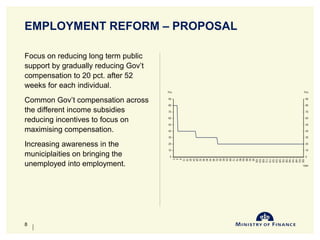
Focus on reducing long term public
support by gradually reducing Gov’t
compensation to 20 pct. after 52
weeks for each individual.
Common Gov’t compensation across
the different income subsidies
reducing incentives to focus on
maximising compensation.
Increasing awareness in the
municiplaities on bringing the
unemployed into employment.
10-Jun-14
8
APPROPRIATIONS FOR HIGHER EDUCATION
Current system: Only Gov’t spending area with performance budgetting.
Each University is paid a fixed sum for each student passing an exam (the
taximeter principle). The appropriation is based on best estimate for expected
results.
The Productivity Commission and the Commission for Quality in Higher
Education has both questioned the current set up as it can lead to higher focus
on quantity rather than quality. New majors in order to attract students and
funding.
The Commission for Quality in Higher Education proposes a lump sum
appropriation for each university supplemented by taximeter funding for marginal
cost based on changes in enrollment.
Marginal costs?
10-Jun-14
9
APPROPRIATIONS FOR HIGHER EDUCATION - 2
MoF and Ministry of Higher Education and research has launched an in-depth
analysis of the cost structure of universities.
The aim of the analysis is to gain comparable information on costs at universities
in Denmark, including a breakdown of all expenditures into specific categories.
The analysis should also identify future possible appropriation mechanisms.
Any new solution should be neutral for public expenditures.
10-Jun-14
10

OECD, 35th Meeting of Senior Budget Officials - Lars Ostergaard - Denmark

  • 1.
    Deputy Head ofDivision Lars Høgsbro Østergaard 10-Jun-14 1 Performance and results – current work
  • 2.
    POINT OF DEPARTURE •General rule in the national budget: Expenditure frames. • Basis for calculation stated in the budget for each appropriation – often very general. • Link in the budget between costs, activities, output and outcome is poor. • Limited knowledge of cause-effect, high level of complexity, external factors, political considerations etc. • Expenditure frames supplemented by performance “contracts” between department and agencies. 10-Jun-14 2
  • 3.
    ONGOING WORK Working ona few issues : 1. Sound public financial management in order to inform the budgetary process better – what do things cost? 2. A system of Key Performance Indicators for administrative costs across government. 3. Performance contracts between departments and agencies version 2.0. 4. Reform of the employment policy – creating better incentives for the municipalities. 5. Analysis of appropriations for higher education. 10-Jun-14 3
  • 4.
    SOUND PUBLIC FINANCIALMANAGEMENT Previously: Expenditure management has been too vague, little knowledge of value for money, budgets only to some extent based on political priorities and decisions. With the budget law and expenditure ceilings new focus on timely planning, detailed budgeting, close monitoring and clear transparent rules of conduct. • An initial budget for the entire year for each appropriation in the budget has to be approved before January 1st. • Every quarter a new prognosis of expenditures and revenues for the remaining year, differences should be explained and differences categorized. Experiences so far – better dialogue between MoF and line ministries but still weak accuracy in prognoses and still not embedded broadly in central gov’t. Also working with municipalities and regions. 10-Jun-14 4
  • 5.
    KEY PERFORMANCE INDICATORSACROSS GOVERNMENT The Agency for Modernisation has launched a database on Key Performance Indicators across Government. The database is public. The aim is to improve the internal administration in Government by providing a forum for benchmarking, learning and development. Currently KPI’s for: - Expenditures – precision for prognosis - Rent per full time equivalent - Management share per employee (head of division and above) - Average salary – management and employees More will be added. KPI’s show large differences between ministries. 10-Jun-14 5
  • 6.
    PERFORMANCE CONTRACTS 2.0 Non-binding“contracts” between agencies and departments been in place for 20 years. “Contracts” can be a powerful tool for achieving results. Analysis: 1) Too many targets, 2) not sufficiently focused on core targets, 3) not anchored at the top level 4) not strategic enough and 5) too many targets focussed on activities rather than results/outcomes. Contracts have been fulfilling too many functions at the same time. New non-binding model: Anchored at top level (director and permanent secretary) Strategic outlook – medium term objectives 5-10 specific targets for the next year. 1-3 of these focused on internal management issues. Different kinds of targets for different kinds of activities. Some very suited for KPI’s – some require more dialogue at the top level. 10-Jun-14 6
  • 7.
    EMPLOYMENT REFORM –FOCUS ON RESULTS The Government has presented a reform of the employment system with a view to increase employment and to modernise the employment system. The municipalities run the employment system. Partly compensated by the central government for their expenditures to income related subsidies. However, the compensation differs between different kinds of income related subsidies. And the compensation is fixed over time. Accordingly, the municipalities have an incentive to maximise subsidies rather than supporting each individual in getting closer to employment. 10-Jun-14 7
  • 8.
    EMPLOYMENT REFORM –PROPOSAL Focus on reducing long term public support by gradually reducing Gov’t compensation to 20 pct. after 52 weeks for each individual. Common Gov’t compensation across the different income subsidies reducing incentives to focus on maximising compensation. Increasing awareness in the municiplaities on bringing the unemployed into employment. 10-Jun-14 8
  • 9.
    APPROPRIATIONS FOR HIGHEREDUCATION Current system: Only Gov’t spending area with performance budgetting. Each University is paid a fixed sum for each student passing an exam (the taximeter principle). The appropriation is based on best estimate for expected results. The Productivity Commission and the Commission for Quality in Higher Education has both questioned the current set up as it can lead to higher focus on quantity rather than quality. New majors in order to attract students and funding. The Commission for Quality in Higher Education proposes a lump sum appropriation for each university supplemented by taximeter funding for marginal cost based on changes in enrollment. Marginal costs? 10-Jun-14 9
  • 10.
    APPROPRIATIONS FOR HIGHEREDUCATION - 2 MoF and Ministry of Higher Education and research has launched an in-depth analysis of the cost structure of universities. The aim of the analysis is to gain comparable information on costs at universities in Denmark, including a breakdown of all expenditures into specific categories. The analysis should also identify future possible appropriation mechanisms. Any new solution should be neutral for public expenditures. 10-Jun-14 10