Evolutionary Thinking
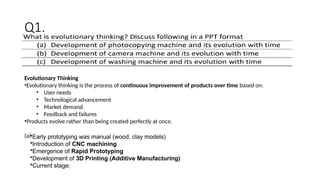
•Evolutionary thinkingis the process of continuous improvement of products over time based on:
• User needs
• Technological advancement
• Market demand
• Feedback and failures
•Products evolve rather than being created perfectly at once.
(a)•Early prototyping was manual (wood, clay models)
•Introduction of CNC machining
•Emergence of Rapid Prototyping
•Development of 3D Printing (Additive Manufacturing)
•Current stage:
Q1.
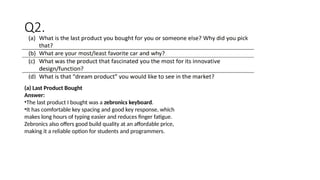
(a) Last ProductBought
Answer:
•The last product I bought was a zebronics keyboard.
•It has comfortable key spacing and good key response, which
makes long hours of typing easier and reduces finger fatigue.
Zebronics also offers good build quality at an affordable price,
making it a reliable option for students and programmers.
Q2.
6.
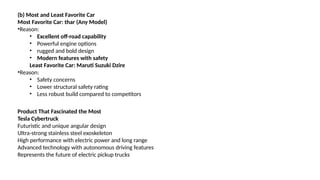
(b) Most andLeast Favorite Car
Most Favorite Car: thar (Any Model)
•Reason:
• Excellent off-road capability
• Powerful engine options
• rugged and bold design
• Modern features with safety
Least Favorite Car: Maruti Suzuki Dzire
•Reason:
• Safety concerns
• Lower structural safety rating
• Less robust build compared to competitors
Product That Fascinated the Most
Tesla Cybertruck
Futuristic and unique angular design
Ultra-strong stainless steel exoskeleton
High performance with electric power and long range
Advanced technology with autonomous driving features
Represents the future of electric pickup trucks
7.
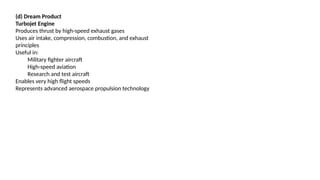
(d) Dream Product
TurbojetEngine
Produces thrust by high-speed exhaust gases
Uses air intake, compression, combustion, and exhaust
principles
Useful in:
Military fighter aircraft
High-speed aviation
Research and test aircraft
Enables very high flight speeds
Represents advanced aerospace propulsion technology
8.
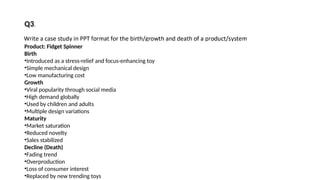
Product: Fidget Spinner
Birth
•Introducedas a stress-relief and focus-enhancing toy
•Simple mechanical design
•Low manufacturing cost
Growth
•Viral popularity through social media
•High demand globally
•Used by children and adults
•Multiple design variations
Maturity
•Market saturation
•Reduced novelty
•Sales stabilized
Decline (Death)
•Fading trend
•Overproduction
•Loss of consumer interest
•Replaced by new trending toys
Q3.
9.
Q4.
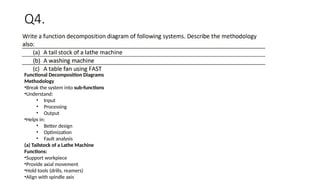
Functional Decomposition Diagrams
Methodology
•Breakthe system into sub-functions
•Understand:
• Input
• Processing
• Output
•Helps in:
• Better design
• Optimization
• Fault analysis
(a) Tailstock of a Lathe Machine
Functions:
•Support workpiece
•Provide axial movement
•Hold tools (drills, reamers)
•Align with spindle axis
10.
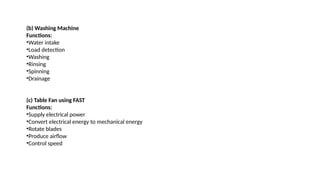
(b) Washing Machine
Functions:
•Waterintake
•Load detection
•Washing
•Rinsing
•Spinning
•Drainage
(c) Table Fan using FAST
Functions:
•Supply electrical power
•Convert electrical energy to mechanical energy
•Rotate blades
•Produce airflow
•Control speed
11.
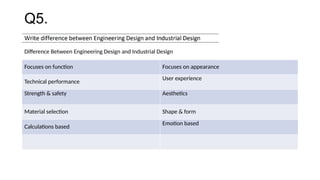
Q5.
Focuses on functionFocuses on appearance
Technical performance
User experience
Strength & safety Aesthetics
Material selection Shape & form
Calculations based
Emotion based
Difference Between Engineering Design and Industrial Design
12.
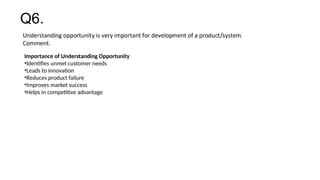
Q6.
Importance of UnderstandingOpportunity
•Identifies unmet customer needs
•Leads to innovation
•Reduces product failure
•Improves market success
•Helps in competitive advantage
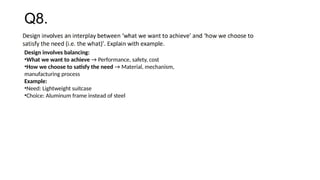
Q8.
Design involves balancing:
•Whatwe want to achieve → Performance, safety, cost
•How we choose to satisfy the need → Material, mechanism,
manufacturing process
Example:
•Need: Lightweight suitcase
•Choice: Aluminum frame instead of steel