Recommended
Cybersecurity
Practices
for Industrial
Control Systems
CYBERSECURITY CONSIDERATIONS
Industrial Control Systems (ICS) are important to supporting US critical infrastructure and
maintaining national security. ICS owners and operators face threats from a variety of
adversaries whose intentions include gathering intelligence and disrupting National Critical
Functions.
As ICS owners and operators adopt new technologies to improve operational efficiencies, they
should be aware of the additional cybersecurity risk of connecting operational technology (OT)
to enterprise information technology (IT) systems and Internet of Things (IoT) devices.
Among the risks, are:
• Expanding ICS cyberattack surface, which may lead to an increase in security events.
• Eliminating ICS network segmentation from traditional business IT systems or internet
devices, resulting in greater access to critical systems.
• Increasing susceptibility to IT commodity malware and ransomware, which can lead to a
potential disruption of physical processes.
PRINCIPLES-LED
DESIGN
If you need to create an ICS architecture that’s
resilient against cyber attacks, then consider the UK
National Cyber Security Centre’s (NCSC), “Secure
Design Principles and Operational Technology”:
https://www.ncsc.gov.uk/collection/cyber-security-
design-principles/examples/study-operational-tech
CISA ASSESSMENTS: FISCAL YEAR 2019 MOST PREVALENT IT AND OT WEAKNESSES AND RISKS
Boundary
Protection
Principle of
Least Functionality
Identification and
Authentication
Physical Access
Control
Account
Management
RISK
Undetected unauthorized
activity in critical systems
RISK
Weaker boundaries between
ICS and enterprise systems
RISK
Increased vectors for malicious
party access to critical systems
RISK
Opportunity for rogue internal
access to be established
RISK
Lack of accountability and
traceability for user actions if
an account is compromised
RISK
Increased difficulty in securing
accounts as personnel leave the
organization, especially sensitive
for users with administrator access
RISK
Increased opportunity for
unapproved system access from
shared or system accounts
RISK
Unauthorized physical access to field
equipment provides increased opportunity to:
• Maliciously modify, delete, or copy device
programs and firmware
• Access the ICS network
• Steal or vandalize cyber assets
• Add rogue devices to capture and
retransmit network traffic
CYBERSECURITY EVENT
IMPACTS
SHORT-TERM IMPACTS
Operational shutdowns
Loss of visibility over production and safety systems
Financial loss due to outages and downtime
Intellectual property theft
Health and personal safety risks
Damage and destruction of property and equipment
Loss of availability
Loss of control
Denial of service
LONG-TERM IMPACTS
Significant unplanned labor, overtime, and idle
equipment costs
Increased or denied insurance
Degraded equipment performance and quality
Fees and lawsuits due to negligence or non-compliance
Loss of customers
Redirection of organizational expenditure toward
recovery efforts
Defend ICS Processes Today
Check, prioritize, test, and implement
ICS security patches.
Backup system data and
configurations.
Identify, minimize, and secure all
network connections to ICS.
Continually monitor and assess the
security of ICS, networks, and inter-
connections.
Disable unnecessary services, ports,
and protocols.
Enable available security features
and implement robust configuration
management practices.
Leverage both application
whitelisting and antivirus software.
Provide ICS cybersecurity training for
all operators and administrators.
Maintain and test an incident
response plan.
Implement a risk-based
defense-in-depth approach to
securing ICS hosts and networks.
For additional information, including advisories, alerts, and
recommendations, please visit CISA’s Industrial Control Systems
website: https://www.cisa.gov/ics
For additional information on Department of Energy (DOE)
cybersecurity initiatives, please visit:
https://www.energy.gov/ceser
PROACTIVELY PROTECT TOMORROW
RISK MANAGEMENT
AND CYBERSECURITY
GOVERNANCE
PHYSICAL SECURITY
ICSNETWORK
ARCHITECTURE
ICS NETWORK
PERIMETER SECURITY
• Identify threats to the organization.
• Maintain ICS asset inventory of all hardware,
software, and supporting infrastructure
technologies.
• Develop cybersecurity policies, procedures, training
and educational materials that apply to
organization’s ICS.
• Develop and practice incident response procedures
that join IT and OT response processes.
• Lock down field electronics and set up alerting
mechanisms for device manipulation such as
power removal, device resets, and cabling
changes.
• Ensure only authorized personnel have access
to controlled spaces that house ICS equipment.
• Use multi-factor authentication, guards, and
barriers to control logical and physical access
to ICS equipment and facilities.
• Utilize segmentation of networks where possible.
• Implement a network topology for ICS that has
multiple layers, with the most critical
communications occurring in the most secure and
reliable layer.
• Use one-way communication diodes to prevent
external access, whenever possible.
• Set up demilitarized zones (DMZ) to create a
physical and logical subnetwork that acts as an
intermediary for connected security devices to
avoid exposure.
• Employ reliable and secure network protocols and
services where feasible.
• Configure firewalls to control traffic between
the ICS network and corporate IT network.
• Utilize IP geo-blocking as appropriate.
• Harden the remote access process to reduce
risk to an acceptable level.
• Use jump servers as a central authorization
location between ICS network security zones.
• Do not allow remote persistent vendor or
employee connection to the control network.
• Catalog and monitor all remote connections to
the network.
HOST SECURITY
SECURITY
MONITORING
SUPPLY CHAIN
MANAGEMENT HUMAN ELEMENT
• Promote a culture of patching and vulnerability
management.
• Test all patches in off-line test environments
before implementation.
• Implement application whitelisting on human
machine interfaces.
• Harden field devices, including tablets and smart
phones.
• Replace out-of-date software and hardware devices.
• Disable unused ports and services on ICS devices after
testing to assure this will not impact ICS operation.
• Implement and test system backups and recovery
processes.
• Configure encryption and security for ICS protocols.
• Measure the baseline of normal operations and
network traffic for ICS.
• Configure Intrusion Detection Systems (IDS) to
create alarms for any ICS network traffic outside
normal operations.
• Track and monitor audit trails on critical areas
of ICS.
• Set up Security Incident and Event Monitoring
(SIEM) to monitor, analyze, and correlate event
logs from across the ICS network to identify
intrusion attempts.
• Adjust ICS procurement process to weigh
cybersecurity heavily as part of the scoring and
evaluation methodology.
• Invest up front in secure ICS products, evaluating
security against current and future threats over the
projected product lifespan.
• Establish contractual agreements for all outsourced
services that ensure: proper incident handling and
reporting, security of interconnections, and remote
access specifications and processes.
• Consider ICS information integrity, security, and
confidentiality when contracting with a cloud
service provider.
• Leverage test labs to test vendor-provided software for
malicious code and defects before implementation.
• Issue policies that outline ICS security rules,
including expected rules of behavior and required
controls.
• Issue procedures that state how personnel
should manage ICS in a secure manner.
• Train IT operators, OT operators, and security
personnel to recognize the indicators of potential
compromise and what steps they should take to
ensure that a cyber investigation succeeds.
• Promote a culture of dialogue and information
exchange between security, IT, and OT personnel.
For more detailed information, please review CISA's publications: https://www.cisa.gov/ics/Recommended-Practices
and DOE's Cybersecurity Capability Maturity Model (C2M2) Program: https://www.energy.gov/ceser/activities/cybersecurity-critical-energy-infrastructure/energy-sector-cybersecurity-0

Cybersecurity Practices for Industrial Control Systems

  • 1.
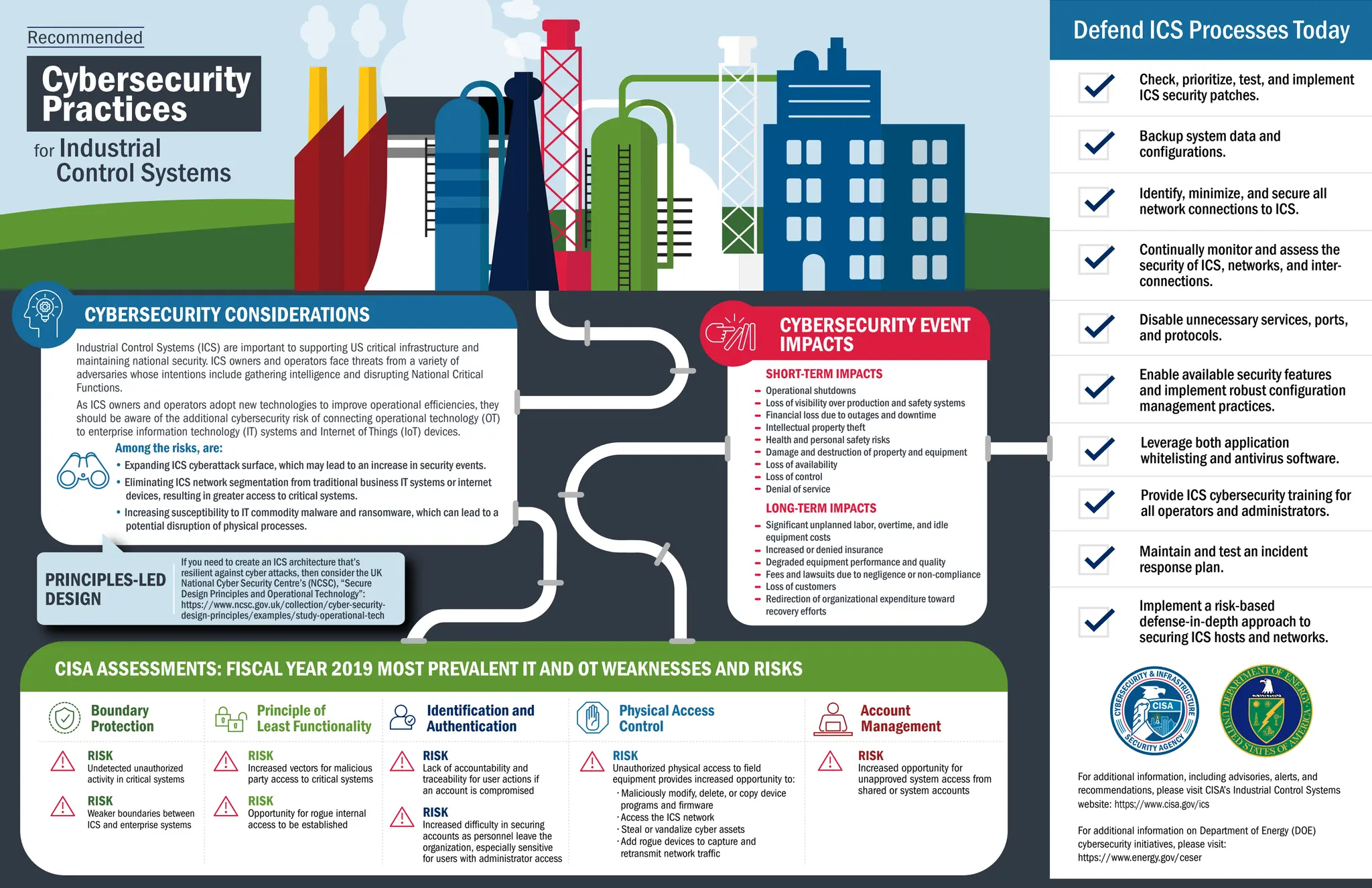
    Recommended Cybersecurity Practices for Industrial Control Systems CYBERSECURITYCONSIDERATIONS Industrial Control Systems (ICS) are important to supporting US critical infrastructure and maintaining national security. ICS owners and operators face threats from a variety of adversaries whose intentions include gathering intelligence and disrupting National Critical Functions. As ICS owners and operators adopt new technologies to improve operational efficiencies, they should be aware of the additional cybersecurity risk of connecting operational technology (OT) to enterprise information technology (IT) systems and Internet of Things (IoT) devices. Among the risks, are: • Expanding ICS cyberattack surface, which may lead to an increase in security events. • Eliminating ICS network segmentation from traditional business IT systems or internet devices, resulting in greater access to critical systems. • Increasing susceptibility to IT commodity malware and ransomware, which can lead to a potential disruption of physical processes. PRINCIPLES-LED DESIGN If you need to create an ICS architecture that’s resilient against cyber attacks, then consider the UK National Cyber Security Centre’s (NCSC), “Secure Design Principles and Operational Technology”: https://www.ncsc.gov.uk/collection/cyber-security- design-principles/examples/study-operational-tech CISA ASSESSMENTS: FISCAL YEAR 2019 MOST PREVALENT IT AND OT WEAKNESSES AND RISKS Boundary Protection Principle of Least Functionality Identification and Authentication Physical Access Control Account Management RISK Undetected unauthorized activity in critical systems RISK Weaker boundaries between ICS and enterprise systems RISK Increased vectors for malicious party access to critical systems RISK Opportunity for rogue internal access to be established RISK Lack of accountability and traceability for user actions if an account is compromised RISK Increased difficulty in securing accounts as personnel leave the organization, especially sensitive for users with administrator access RISK Increased opportunity for unapproved system access from shared or system accounts RISK Unauthorized physical access to field equipment provides increased opportunity to: • Maliciously modify, delete, or copy device programs and firmware • Access the ICS network • Steal or vandalize cyber assets • Add rogue devices to capture and retransmit network traffic CYBERSECURITY EVENT IMPACTS SHORT-TERM IMPACTS Operational shutdowns Loss of visibility over production and safety systems Financial loss due to outages and downtime Intellectual property theft Health and personal safety risks Damage and destruction of property and equipment Loss of availability Loss of control Denial of service LONG-TERM IMPACTS Significant unplanned labor, overtime, and idle equipment costs Increased or denied insurance Degraded equipment performance and quality Fees and lawsuits due to negligence or non-compliance Loss of customers Redirection of organizational expenditure toward recovery efforts Defend ICS Processes Today Check, prioritize, test, and implement ICS security patches. Backup system data and configurations. Identify, minimize, and secure all network connections to ICS. Continually monitor and assess the security of ICS, networks, and inter- connections. Disable unnecessary services, ports, and protocols. Enable available security features and implement robust configuration management practices. Leverage both application whitelisting and antivirus software. Provide ICS cybersecurity training for all operators and administrators. Maintain and test an incident response plan. Implement a risk-based defense-in-depth approach to securing ICS hosts and networks. For additional information, including advisories, alerts, and recommendations, please visit CISA’s Industrial Control Systems website: https://www.cisa.gov/ics For additional information on Department of Energy (DOE) cybersecurity initiatives, please visit: https://www.energy.gov/ceser
  • 2.
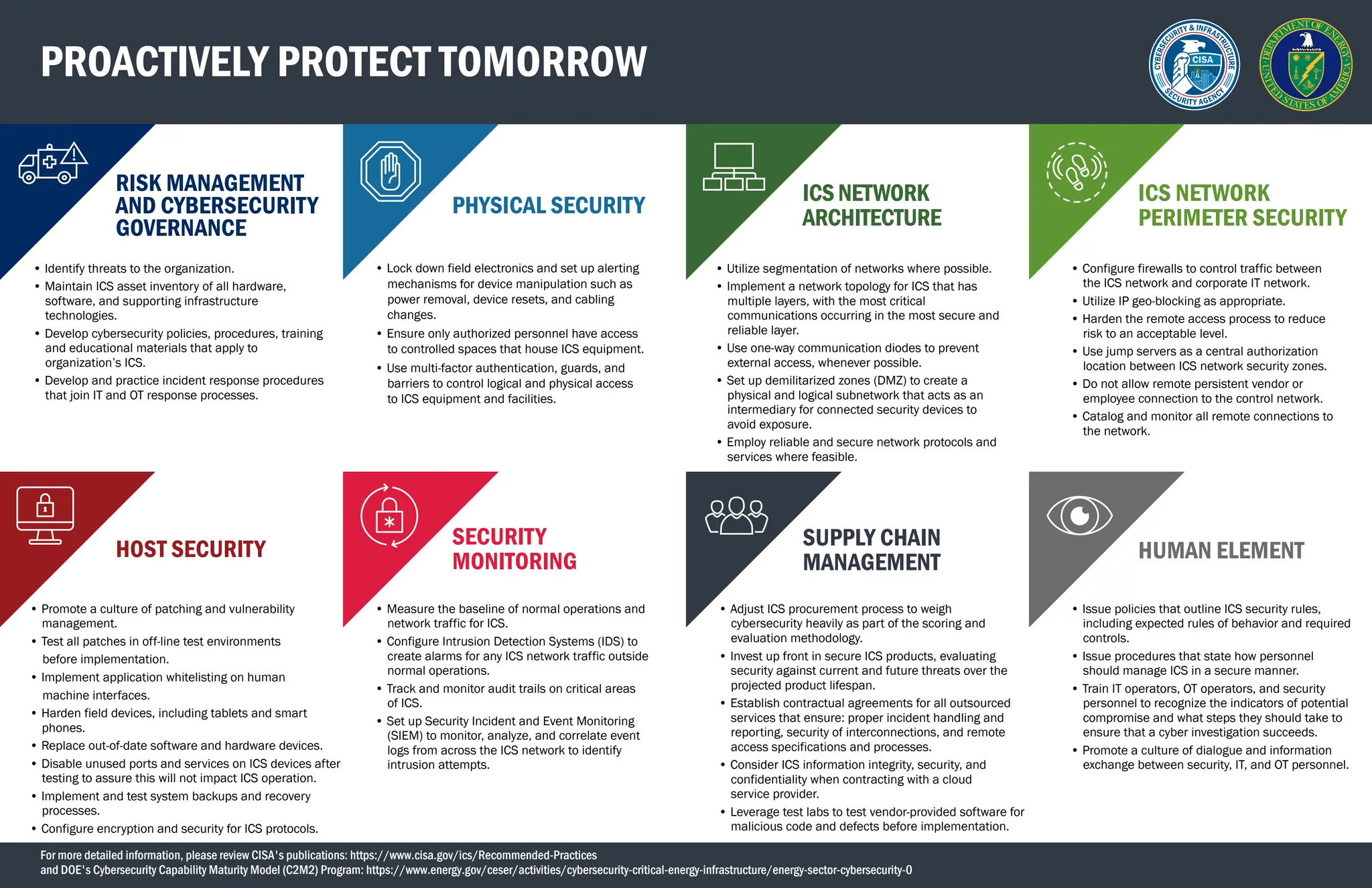
    PROACTIVELY PROTECT TOMORROW RISKMANAGEMENT AND CYBERSECURITY GOVERNANCE PHYSICAL SECURITY ICSNETWORK ARCHITECTURE ICS NETWORK PERIMETER SECURITY • Identify threats to the organization. • Maintain ICS asset inventory of all hardware, software, and supporting infrastructure technologies. • Develop cybersecurity policies, procedures, training and educational materials that apply to organization’s ICS. • Develop and practice incident response procedures that join IT and OT response processes. • Lock down field electronics and set up alerting mechanisms for device manipulation such as power removal, device resets, and cabling changes. • Ensure only authorized personnel have access to controlled spaces that house ICS equipment. • Use multi-factor authentication, guards, and barriers to control logical and physical access to ICS equipment and facilities. • Utilize segmentation of networks where possible. • Implement a network topology for ICS that has multiple layers, with the most critical communications occurring in the most secure and reliable layer. • Use one-way communication diodes to prevent external access, whenever possible. • Set up demilitarized zones (DMZ) to create a physical and logical subnetwork that acts as an intermediary for connected security devices to avoid exposure. • Employ reliable and secure network protocols and services where feasible. • Configure firewalls to control traffic between the ICS network and corporate IT network. • Utilize IP geo-blocking as appropriate. • Harden the remote access process to reduce risk to an acceptable level. • Use jump servers as a central authorization location between ICS network security zones. • Do not allow remote persistent vendor or employee connection to the control network. • Catalog and monitor all remote connections to the network. HOST SECURITY SECURITY MONITORING SUPPLY CHAIN MANAGEMENT HUMAN ELEMENT • Promote a culture of patching and vulnerability management. • Test all patches in off-line test environments before implementation. • Implement application whitelisting on human machine interfaces. • Harden field devices, including tablets and smart phones. • Replace out-of-date software and hardware devices. • Disable unused ports and services on ICS devices after testing to assure this will not impact ICS operation. • Implement and test system backups and recovery processes. • Configure encryption and security for ICS protocols. • Measure the baseline of normal operations and network traffic for ICS. • Configure Intrusion Detection Systems (IDS) to create alarms for any ICS network traffic outside normal operations. • Track and monitor audit trails on critical areas of ICS. • Set up Security Incident and Event Monitoring (SIEM) to monitor, analyze, and correlate event logs from across the ICS network to identify intrusion attempts. • Adjust ICS procurement process to weigh cybersecurity heavily as part of the scoring and evaluation methodology. • Invest up front in secure ICS products, evaluating security against current and future threats over the projected product lifespan. • Establish contractual agreements for all outsourced services that ensure: proper incident handling and reporting, security of interconnections, and remote access specifications and processes. • Consider ICS information integrity, security, and confidentiality when contracting with a cloud service provider. • Leverage test labs to test vendor-provided software for malicious code and defects before implementation. • Issue policies that outline ICS security rules, including expected rules of behavior and required controls. • Issue procedures that state how personnel should manage ICS in a secure manner. • Train IT operators, OT operators, and security personnel to recognize the indicators of potential compromise and what steps they should take to ensure that a cyber investigation succeeds. • Promote a culture of dialogue and information exchange between security, IT, and OT personnel. For more detailed information, please review CISA's publications: https://www.cisa.gov/ics/Recommended-Practices and DOE's Cybersecurity Capability Maturity Model (C2M2) Program: https://www.energy.gov/ceser/activities/cybersecurity-critical-energy-infrastructure/energy-sector-cybersecurity-0