CYBER CRIME
PLAN
 Introduction
 History
 Cyber Threat Evoulation
 Cyber Criminals
 Categories of Cyber Crime
 Typesof Cyber Crime
 Cyber Crimes in Tunisia
 Conclusion
INTRODUCTION
• Internet crime or Cyber Crime is a term used to broadly describe
criminal and illegal activity in which computers or computer networks
are a tool, a target, or a place of criminal activity and include
everything from electronic cracking to denial of service attacks
• It is also used to include traditional crimes in which computers or
networks are used to enable the illicit activity
HISTORY
The first recorded cyber crime took place in the year 1820
The first spam email took place in 1976 when it was sent out over the ARPANT.
The first VIRUS was installed on an Apple computer in 1982
CYBER THREAT EVOULATION
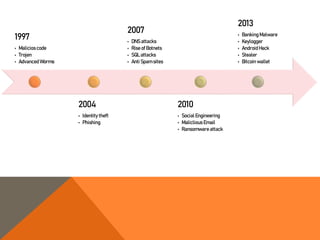
 The Cyber criminal community is evoulved from Morris Worm to the
ransomware and other organized crime That have high payoff and
contiously changingandaffecting brutally nations
1997
• Malicios code
• Trojen
• Advanced Worms
2004
• Identity theft
• Phishing
2007
• DNS attacks
• Rise of Botnets
• SQL attacks
• Anti Spam sites
2010
• Social Engineering
• Maliclious Email
• Ransomware attack
2013
• Banking Malware
• Keylogger
• Android Hack
• Stealer
• Bitcoin wallet
CYBER CRIMINALS
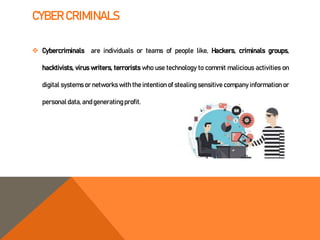
 Cybercriminals are individuals or teams of people like, Hackers, criminals groups,
hacktivists, virus writers, terrorists who use technology to commit malicious activities on
digital systems or networks with the intention of stealing sensitive company information or
personal data, andgeneratingprofit.
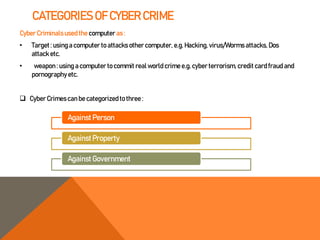
CATEGORIES OF CYBER CRIME
Cyber Criminals used the computer as :
• Target: using a computer to attacks other computer, e.g. Hacking, virus/Worms attacks, Dos
attack etc.
• weapon : using a computer to commit realworld crime e.g. cyber terrorism, credit card fraud and
pornography etc.
 Cyber Crimescan be categorized to three :
Against Person
Against Property
Against Government
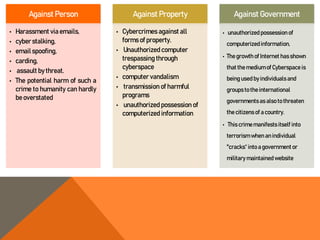
Against Person
• Harassment via emails,
• cyber stalking,
• email spoofing,
• carding,
• assault by threat.
• The potential harm of such a
crime to humanity can hardly
be overstated
Against Property
• Cybercrimes against all
forms of property.
• Unauthorized computer
trespassing through
cyberspace
• computer vandalism
• transmission of harmful
programs
• unauthorized possession of
computerized information
Against Government
• unauthorized possession of
computerized information,
• The growth of Internet has shown
that the medium of Cyberspace is
being used by individuals and
groups to the international
governments as also to threaten
the citizens of a country.
• This crimemanifests itself into
terrorism when an individual
"cracks“ into a government or
military maintained website
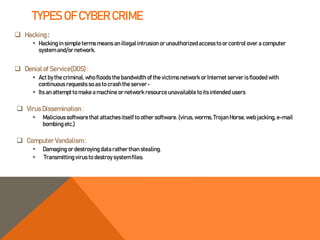
TYPES OF CYBER CRIME
 Hacking :
 Hacking in simple terms means an illegal intrusion or unauthorized access to or control over a computer
system and/or network.
 Denial of Service(DOS) :
 Act by the criminal, who floods the bandwidth of the victims network or Internet serveris flooded with
continuous requests so as to crash the server •
 Its an attempt to makea machine or network resource unavailable to its intended users
 Virus Dissemination :
 Malicious software that attaches itself to other software. (virus, worms, Trojan Horse, web jacking, e-mail
bombing etc.)
 Computer Vandalism:
 Damaging or destroying data rather than stealing.
 Transmitting virus to destroy system files.
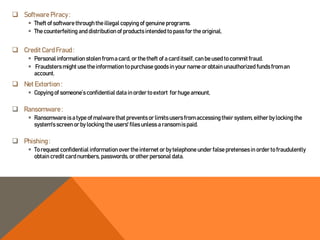
 Software Piracy :
 Theft of software through the illegal copying of genuine programs.
 The counterfeiting and distribution of products intended to pass for the original,
 CreditCard Fraud :
 Personal information stolen from a card, or the theft of a card itself, can be used to commitfraud.
 Fraudsters might use the information to purchase goods in your nameor obtain unauthorized funds from an
account.
 Net Extortion :
 Copying of someone’s confidential data in order to extort for huge amount,
 Ransomware :
 Ransomware is a type of malware that prevents or limits users from accessing their system, either by locking the
system's screen or by locking the users' files unless a ransom is paid.
 Phishing :
 To request confidential information over the internet or by telephone under false pretenses in orderto fraudulently
obtain credit card numbers, passwords, or other personal data.
 ChildPornography :
 The Internet is being highly used by its abusers to reach and abuse children sexually, worldwide. As more
homes have access to internet,
 more children would be using the internet and more are the chances of falling victim to the aggression of
Pedophiles.
 Cyber Terrorism :
 Use of Internet based attacks in terrorist activities.
 Terrorist attacks on the Internet is by distributed denial of service attacks,
 hate websites and hate emails,
 attacks on sensitive computer networks, etc.
 . • Technology savvy terrorists are using 512-bit encryption, which is impossible to decrypt.
CYBER CRIMES IN TUNISIA
 In 2013 a study by the IDC (International Data Corporation), The dangerous world of counterfeit and pirated
software commissioned by Microsoft estimated that 33% of all software in the world was counterfeit and estimated
that on the global scale the phenomenon cost 114 billion dollars.
 In Africa, the twelve countries with the most infected IT infrastructure are: Libya (98%), Zimbabwe (92%),Algeria (84%),
Cameroon (83%), Nigeria (82%), IvoryCoast (81%), Kenya (78%), Senegal (78%), Tunisia (74%),Morocco (66%)and
Mauritius (57%).
 An earlier study by BSA in 2011estimated that the proportion of pirated software in the whole of Africa and the Middle
East was of 58%
 Members of Anonymous, known as Anons, also became famous for launching attacks against government agencies in
the United States, Israel, Senegal, Tunisia, Uganda, etc.
CONCLUSION
Technology is destructive only in the hands of people who do
not realize that they are one and the same process as the
universe.it is highly likely that cyber crime and its hackers
will continue developing and upgrading to stay ahead of the
law.
THANK YOU FOR YOUR ATTENTION

cyber_crime (1).pptx

  • 1.
  • 2.
    PLAN  Introduction  History Cyber Threat Evoulation  Cyber Criminals  Categories of Cyber Crime  Typesof Cyber Crime  Cyber Crimes in Tunisia  Conclusion
  • 3.
    INTRODUCTION • Internet crimeor Cyber Crime is a term used to broadly describe criminal and illegal activity in which computers or computer networks are a tool, a target, or a place of criminal activity and include everything from electronic cracking to denial of service attacks • It is also used to include traditional crimes in which computers or networks are used to enable the illicit activity
  • 4.
    HISTORY The first recordedcyber crime took place in the year 1820 The first spam email took place in 1976 when it was sent out over the ARPANT. The first VIRUS was installed on an Apple computer in 1982
  • 5.
    CYBER THREAT EVOULATION The Cyber criminal community is evoulved from Morris Worm to the ransomware and other organized crime That have high payoff and contiously changingandaffecting brutally nations
  • 6.
    1997 • Malicios code •Trojen • Advanced Worms 2004 • Identity theft • Phishing 2007 • DNS attacks • Rise of Botnets • SQL attacks • Anti Spam sites 2010 • Social Engineering • Maliclious Email • Ransomware attack 2013 • Banking Malware • Keylogger • Android Hack • Stealer • Bitcoin wallet
  • 7.
    CYBER CRIMINALS  Cybercriminalsare individuals or teams of people like, Hackers, criminals groups, hacktivists, virus writers, terrorists who use technology to commit malicious activities on digital systems or networks with the intention of stealing sensitive company information or personal data, andgeneratingprofit.
  • 8.
    CATEGORIES OF CYBERCRIME Cyber Criminals used the computer as : • Target: using a computer to attacks other computer, e.g. Hacking, virus/Worms attacks, Dos attack etc. • weapon : using a computer to commit realworld crime e.g. cyber terrorism, credit card fraud and pornography etc.  Cyber Crimescan be categorized to three : Against Person Against Property Against Government
  • 9.
    Against Person • Harassmentvia emails, • cyber stalking, • email spoofing, • carding, • assault by threat. • The potential harm of such a crime to humanity can hardly be overstated Against Property • Cybercrimes against all forms of property. • Unauthorized computer trespassing through cyberspace • computer vandalism • transmission of harmful programs • unauthorized possession of computerized information Against Government • unauthorized possession of computerized information, • The growth of Internet has shown that the medium of Cyberspace is being used by individuals and groups to the international governments as also to threaten the citizens of a country. • This crimemanifests itself into terrorism when an individual "cracks“ into a government or military maintained website
  • 10.
    TYPES OF CYBERCRIME  Hacking :  Hacking in simple terms means an illegal intrusion or unauthorized access to or control over a computer system and/or network.  Denial of Service(DOS) :  Act by the criminal, who floods the bandwidth of the victims network or Internet serveris flooded with continuous requests so as to crash the server •  Its an attempt to makea machine or network resource unavailable to its intended users  Virus Dissemination :  Malicious software that attaches itself to other software. (virus, worms, Trojan Horse, web jacking, e-mail bombing etc.)  Computer Vandalism:  Damaging or destroying data rather than stealing.  Transmitting virus to destroy system files.
  • 11.
     Software Piracy:  Theft of software through the illegal copying of genuine programs.  The counterfeiting and distribution of products intended to pass for the original,  CreditCard Fraud :  Personal information stolen from a card, or the theft of a card itself, can be used to commitfraud.  Fraudsters might use the information to purchase goods in your nameor obtain unauthorized funds from an account.  Net Extortion :  Copying of someone’s confidential data in order to extort for huge amount,  Ransomware :  Ransomware is a type of malware that prevents or limits users from accessing their system, either by locking the system's screen or by locking the users' files unless a ransom is paid.  Phishing :  To request confidential information over the internet or by telephone under false pretenses in orderto fraudulently obtain credit card numbers, passwords, or other personal data.
  • 12.
     ChildPornography : The Internet is being highly used by its abusers to reach and abuse children sexually, worldwide. As more homes have access to internet,  more children would be using the internet and more are the chances of falling victim to the aggression of Pedophiles.  Cyber Terrorism :  Use of Internet based attacks in terrorist activities.  Terrorist attacks on the Internet is by distributed denial of service attacks,  hate websites and hate emails,  attacks on sensitive computer networks, etc.  . • Technology savvy terrorists are using 512-bit encryption, which is impossible to decrypt.
  • 13.
    CYBER CRIMES INTUNISIA  In 2013 a study by the IDC (International Data Corporation), The dangerous world of counterfeit and pirated software commissioned by Microsoft estimated that 33% of all software in the world was counterfeit and estimated that on the global scale the phenomenon cost 114 billion dollars.  In Africa, the twelve countries with the most infected IT infrastructure are: Libya (98%), Zimbabwe (92%),Algeria (84%), Cameroon (83%), Nigeria (82%), IvoryCoast (81%), Kenya (78%), Senegal (78%), Tunisia (74%),Morocco (66%)and Mauritius (57%).  An earlier study by BSA in 2011estimated that the proportion of pirated software in the whole of Africa and the Middle East was of 58%  Members of Anonymous, known as Anons, also became famous for launching attacks against government agencies in the United States, Israel, Senegal, Tunisia, Uganda, etc.
  • 14.
    CONCLUSION Technology is destructiveonly in the hands of people who do not realize that they are one and the same process as the universe.it is highly likely that cyber crime and its hackers will continue developing and upgrading to stay ahead of the law.
  • 15.
    THANK YOU FORYOUR ATTENTION