PRESENTED BY SOMIL AGARWAL
ROLL NO. – 2023/5029
DIGITAL EMPOWERMENT SECTION-B
WEB OF CYBER
SLAVERY
PRESENTED BY SOMIL AGARWAL
ROLL NO. – 2023/5029
COURSE – B.sc(Hons.) Mathematics
DIGITAL EMPOWERMENT
SECTION B
INTRODUCTION
Cyber slavery refers to the exploitation of individuals through digital means, such
as through forced labour , human trafficking , or other forms of coercion
facilitated by the internet or technology.
This can include online recruitment, manipulation through social media and the
use of digital platforms to control and exploit victims. It’s a disturbing
manifestation of modern slavery, where technology is used as a tool of
oppression and exploitation.
Cyber slavery is emerging as a form of organised crime of unprecedented
severity and scale . Cyber slavery is human trafficking or exploitation in
scamming activities run on the Web.
CASE STUDY ON CYBER SLAVERY
Nandan Sah was living at Behra Sikta in Bihar’s Champaran. He was running a photocopying stand.
One day he got an offer for his dream job of data operator in a foreign country. The salary was very
high and it seemed like a life changer. Sah signed up immediately for a fee of Rs 130000, his Delhi
agent placed him in Cambodia.
Then his life started becoming worse. He was put to work on internet scamming operators with a
team of others trapped like him. Sah could not take the criminal activity so he protested. He was
beaten brutally. He was given electric shocks and left in forests to die. Nearby villagers helped him call
for rescue. Sah was brought back to India. He begged his agent for refund of his fee, his agent took
him to the hospital but he was refused as no one was ready to help without FIR. He came back to his
town and tried to file a complaint but was told that it is out of there jurisdiction. He wrote letters to
PM and MINISTRY OF EXTERNAL AFFAIRS with a pen drive which has all the proofs of his torture and
accounts of others. He also gave two mobile numbers of people both Indians who are stuck in
Cambodia factory but when contacted they refused to tell anything because of fear for there lives.
It is a classic example of cyber slavery.
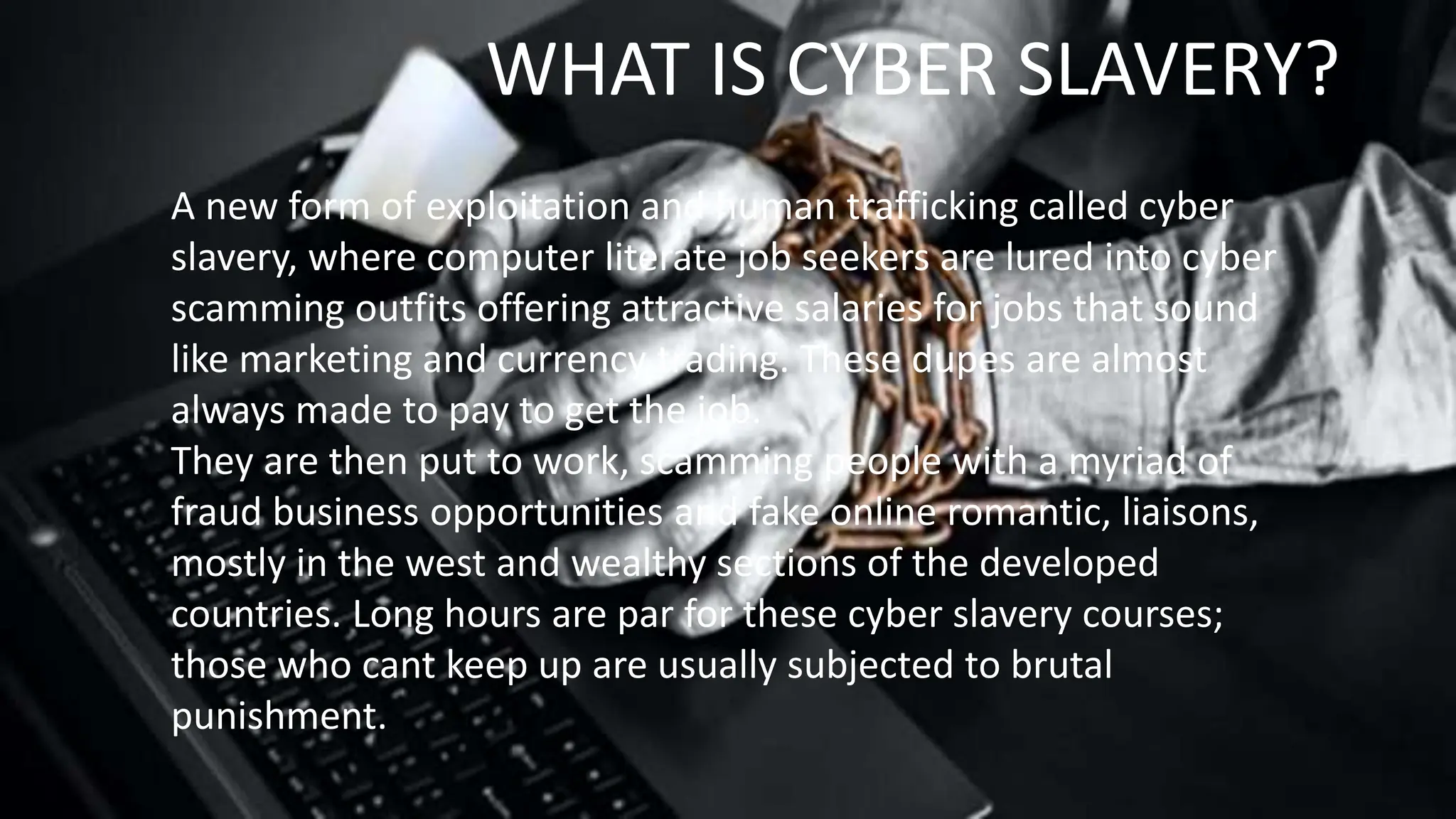
WHAT IS CYBER SLAVERY?
A new form of exploitation and human trafficking called cyber
slavery, where computer literate job seekers are lured into cyber
scamming outfits offering attractive salaries for jobs that sound
like marketing and currency trading. These dupes are almost
always made to pay to get the job.
They are then put to work, scamming people with a myriad of
fraud business opportunities and fake online romantic, liaisons,
mostly in the west and wealthy sections of the developed
countries. Long hours are par for these cyber slavery courses;
those who cant keep up are usually subjected to brutal
punishment.
CYBER HYGIENE
Cyber hygiene, or cybersecurity hygiene, is a set of practices organizations and
individuals perform regularly to maintain the health and security of users, devices,
networks and data.
The goal of cyber hygiene is to keep sensitive data secure and strengthen the
organization's ability to recover if and when a successful attack occurs. The concept
works similarly to personal hygiene. Individuals maintain their health by taking
regular recommended actions, such as flossing to minimize cavities and handwashing
to avoid infection. In the same way, organizations can maintain their health, thereby
preventing data breaches and other security incidents, by following precautionary
cyber hygiene measures.
DO’S OF CYBER SLAVERY
 Awareness:- Recognize the signs of cyber slavery, such as forced
labour , trafficking.
 Support victims:- Offer support and resources to victims of cyber
slavery, including access to shelters, legal assistance, and
rehabilitation services.
 Report Suspicious Activity:- If you suspect someone is being exploited,
report it to the appropriate authorities or anti-trafficking
organizations.
 Stay informed:- Stay updated on developments in the fight against
cyber slavery and support initiatives that promote digital rights and
freedom.
 Check Company Legally:- People should find out that the company is
registered or not from embassy so that they can know offer for job is
genuine or not.
DON’TS OF CYBER SLAVERY
Don’t Ignore Warning Signs.
Don’t Turn a Blind Eye.
Don’t Support Illegal Activities.
Don’t Stay Silent.
Don’t Enable Traffickers.
DO’S OF CYBER HYGIENE
• KEEP SOFTWARE UPDATED.
• USE STRONG, UNIQUE PASSWORDS.
• ENABLE TWO-FACTOR AUTHENTICATION.
• SECURE YOUR NETWORK.
• REGULAR BACKUPS.
• EDUCATE YOUR SELF.
• REVIEW PRIVACY SETTINGS.
• REPORT SUSPICIOUS ACTIVITIES.
DON’TS OF CYBER HYGIENE
• DON’T USE WEAK PASSWORDS.
• DON’T’T CLICK ON SUSPICIOUS LINK.
• DON’T IGNORE SOFTWARE UPDATES.
• DON’T SHARE PERSONAL INFORMATION UNNECESSARILY.
• DON’T DISABLE SECURITY FEATURES.
• DON’T USE UNSECURED Wi-Fi NETWORKS.
• DON’T OVERSHARE ON SOCIAL MEDIA.
• DON’T IGNORE PRIVACY SETTINGS.
• DON’T FALL FOR PHISHING SCAMS.
• DON’T DELAY BACKING UP YOUR DATA
CONCLUSION
In conclusion, practicing good cyber hygiene is essential for
safeguarding our digital lives against threats such as malware,
phishing, and data breaches. By following simple yet effective
measures we can reduce the risk of falling victim to cyber attacks.
Additionally, it’s crucial to recognize the darker side of the digital
world – cyber slavery. Cyber slavery encompassesvarioius forms of
exploitation facilitated by technology. This presentation has shed light
on the scope, challenges and potential solutions to combat cyber
slavery.
Cyber Slavery , digital empowerment.pptx

Cyber Slavery , digital empowerment.pptx

  • 1.
    PRESENTED BY SOMILAGARWAL ROLL NO. – 2023/5029 DIGITAL EMPOWERMENT SECTION-B WEB OF CYBER SLAVERY PRESENTED BY SOMIL AGARWAL ROLL NO. – 2023/5029 COURSE – B.sc(Hons.) Mathematics DIGITAL EMPOWERMENT SECTION B
  • 2.
    INTRODUCTION Cyber slavery refersto the exploitation of individuals through digital means, such as through forced labour , human trafficking , or other forms of coercion facilitated by the internet or technology. This can include online recruitment, manipulation through social media and the use of digital platforms to control and exploit victims. It’s a disturbing manifestation of modern slavery, where technology is used as a tool of oppression and exploitation. Cyber slavery is emerging as a form of organised crime of unprecedented severity and scale . Cyber slavery is human trafficking or exploitation in scamming activities run on the Web.
  • 3.
    CASE STUDY ONCYBER SLAVERY Nandan Sah was living at Behra Sikta in Bihar’s Champaran. He was running a photocopying stand. One day he got an offer for his dream job of data operator in a foreign country. The salary was very high and it seemed like a life changer. Sah signed up immediately for a fee of Rs 130000, his Delhi agent placed him in Cambodia. Then his life started becoming worse. He was put to work on internet scamming operators with a team of others trapped like him. Sah could not take the criminal activity so he protested. He was beaten brutally. He was given electric shocks and left in forests to die. Nearby villagers helped him call for rescue. Sah was brought back to India. He begged his agent for refund of his fee, his agent took him to the hospital but he was refused as no one was ready to help without FIR. He came back to his town and tried to file a complaint but was told that it is out of there jurisdiction. He wrote letters to PM and MINISTRY OF EXTERNAL AFFAIRS with a pen drive which has all the proofs of his torture and accounts of others. He also gave two mobile numbers of people both Indians who are stuck in Cambodia factory but when contacted they refused to tell anything because of fear for there lives. It is a classic example of cyber slavery.
  • 4.
    WHAT IS CYBERSLAVERY? A new form of exploitation and human trafficking called cyber slavery, where computer literate job seekers are lured into cyber scamming outfits offering attractive salaries for jobs that sound like marketing and currency trading. These dupes are almost always made to pay to get the job. They are then put to work, scamming people with a myriad of fraud business opportunities and fake online romantic, liaisons, mostly in the west and wealthy sections of the developed countries. Long hours are par for these cyber slavery courses; those who cant keep up are usually subjected to brutal punishment.
  • 5.
    CYBER HYGIENE Cyber hygiene,or cybersecurity hygiene, is a set of practices organizations and individuals perform regularly to maintain the health and security of users, devices, networks and data. The goal of cyber hygiene is to keep sensitive data secure and strengthen the organization's ability to recover if and when a successful attack occurs. The concept works similarly to personal hygiene. Individuals maintain their health by taking regular recommended actions, such as flossing to minimize cavities and handwashing to avoid infection. In the same way, organizations can maintain their health, thereby preventing data breaches and other security incidents, by following precautionary cyber hygiene measures.
  • 6.
    DO’S OF CYBERSLAVERY  Awareness:- Recognize the signs of cyber slavery, such as forced labour , trafficking.  Support victims:- Offer support and resources to victims of cyber slavery, including access to shelters, legal assistance, and rehabilitation services.  Report Suspicious Activity:- If you suspect someone is being exploited, report it to the appropriate authorities or anti-trafficking organizations.  Stay informed:- Stay updated on developments in the fight against cyber slavery and support initiatives that promote digital rights and freedom.  Check Company Legally:- People should find out that the company is registered or not from embassy so that they can know offer for job is genuine or not.
  • 7.
    DON’TS OF CYBERSLAVERY Don’t Ignore Warning Signs. Don’t Turn a Blind Eye. Don’t Support Illegal Activities. Don’t Stay Silent. Don’t Enable Traffickers.
  • 8.
    DO’S OF CYBERHYGIENE • KEEP SOFTWARE UPDATED. • USE STRONG, UNIQUE PASSWORDS. • ENABLE TWO-FACTOR AUTHENTICATION. • SECURE YOUR NETWORK. • REGULAR BACKUPS. • EDUCATE YOUR SELF. • REVIEW PRIVACY SETTINGS. • REPORT SUSPICIOUS ACTIVITIES.
  • 9.
    DON’TS OF CYBERHYGIENE • DON’T USE WEAK PASSWORDS. • DON’T’T CLICK ON SUSPICIOUS LINK. • DON’T IGNORE SOFTWARE UPDATES. • DON’T SHARE PERSONAL INFORMATION UNNECESSARILY. • DON’T DISABLE SECURITY FEATURES. • DON’T USE UNSECURED Wi-Fi NETWORKS. • DON’T OVERSHARE ON SOCIAL MEDIA. • DON’T IGNORE PRIVACY SETTINGS. • DON’T FALL FOR PHISHING SCAMS. • DON’T DELAY BACKING UP YOUR DATA
  • 10.
    CONCLUSION In conclusion, practicinggood cyber hygiene is essential for safeguarding our digital lives against threats such as malware, phishing, and data breaches. By following simple yet effective measures we can reduce the risk of falling victim to cyber attacks. Additionally, it’s crucial to recognize the darker side of the digital world – cyber slavery. Cyber slavery encompassesvarioius forms of exploitation facilitated by technology. This presentation has shed light on the scope, challenges and potential solutions to combat cyber slavery.