VivoSecurity Inc.,	
  Los	
  Altos,	
  CA.	
  Email:	
  ThomasL@VivoSecurity.com
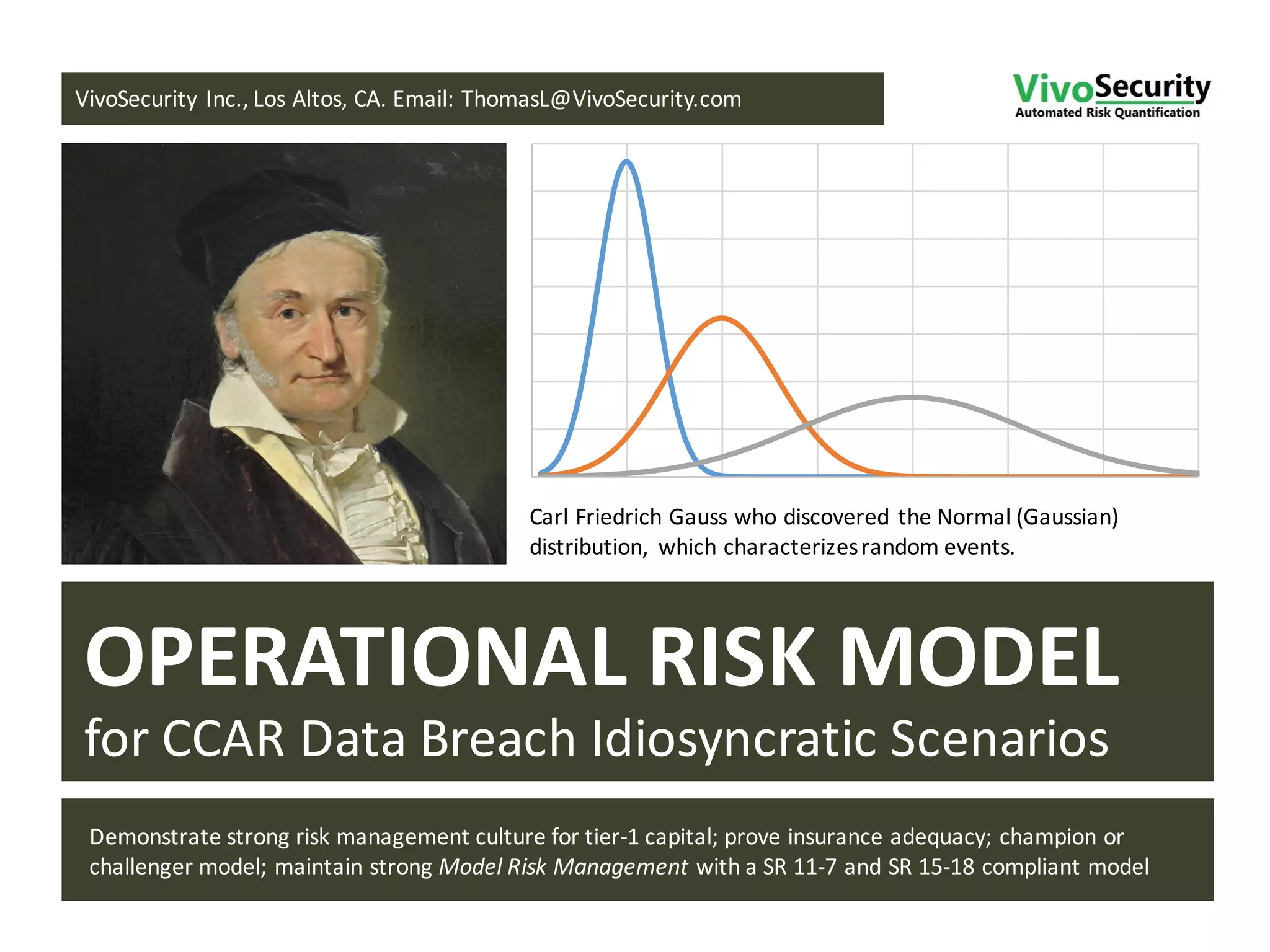
Carl	
  Friedrich	
  Gauss	
  who	
  discovered	
  the	
  Normal	
  (Gaussian)	
  
distribution,	
   which	
  characterizes	
  random	
  events.
OPERATIONAL	
  RISK	
  MODEL
for	
  CCAR	
  Data	
  Breach	
  Idiosyncratic	
  Scenarios
Demonstrate	
  strong	
  risk	
  management	
  culture	
  for	
  tier-­‐1	
  capital;	
  prove	
  insurance	
  adequacy;	
  champion	
  or	
  
challenger	
  model;	
  maintain	
  strong	
  Model	
  Risk	
  Management	
  with	
  a	
  SR	
  11-­‐7	
  and	
  SR	
  15-­‐18	
  compliant	
  model
The	
  Federal	
  Reserve	
  is	
  Focusing	
  on	
  Cybersecurity
Large data breaches are rare, but they do happen and the Federal Reserve is looking
for evidence that a bank has enough capital to withstand the event. But because they
are rare, any single company does not have sufficient data to predict the cost. An
analysis of cross-­‐company data is the only credible way to characterize the risk.
Some banks are demonstrating a strong risk management culture by using statistical
models and VivoSecurity is helping by creating strong SR 11-­‐7 compliant models using
cross-­‐company data. These models have the additional benefit of 1) bringing cyber
risk under the bank's model risk management framework, 2) providing a clearer
understand of what should be transferred with insurance and 3) allowing a bank to
benefit from cost reductions brought about from a mature incident response.
ü Strengthen Idiosyncratic Scenarios for CCAR/DFAST operational risk.
ü Challenge Models for Champion Models
ü Champion Models if no models
ü Justify a stance not to use cyber insurance
ü Demonstrate better management of risks to tier 1 capital
VivoSecurity	
  Inc,	
  1247	
  Russell	
  Ave,	
  Los	
  Altos	
  California;	
   Contact:	
   ThomasL@VivoSecurity.com,	
   (650)	
  919-­‐3050
What	
  is	
  a	
  Cyber-­‐Loss	
  Model?
The Cyber-­‐Loss Model is essentially a complex formula that can explain the
variability in cost of historical data breaches. It was trained upon a large set of
data breaches and tested for accuracy on a randomly selected set of validation
cases. It was developed in the statistical language R using standard statistical
techniques such as linear regression and Bayesian Model Averaging.
The Cyber-­‐Loss Model is deployed in an easy to use Excel Spreadsheet which
requires a small number of variable inputs that have been found to be predictive
of cost. No information is needed about a banks security posture.
What is Model Validation? Federal Reserve has created guidance for model
management (SR11-­‐7 & SR15-­‐18). This guidance assures that models are
developed following sound statistical practices. Many banks have an internal
validation process for establishing compliance for bank models. We can supply all
documentation needed for model validation, including quarterly maintenance,
and we cansupport internal validation efforts.
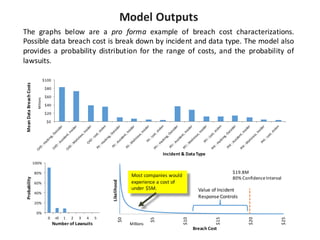
The graphs below are a pro forma example of breach cost characterizations.
Possible data breach cost is break down by incident and data type. The model also
provides a probability distribution for the range of costs, and the probability of
lawsuits.
$0
$20
$40
$60
$80
$100
Mean	
  Data	
  Breach	
  Costs
Millions
Incident	
  &	
  Data	
  Type
0%
20%
40%
60%
80%
100%
0 >0 1 2 3 4 5
Probability
Number	
  of	
  Lawsuits
Model	
  Outputs
$0
$5
$10
$15
$20
$25
Likelihood
Breach	
  Cost
Millions
$19.8M
80%	
  Confidence	
  Interval
Value	
  of	
  Incident	
  
Response	
  Controls	
  
Most	
  companies	
  would	
  
experience	
  a	
  cost	
  of	
  
under	
  $5M.
What	
  Does	
  the	
  Cyber-­‐Loss	
  Model	
  Include?
VivoSecurity	
  Inc,	
  1247	
  Russell	
  Ave,	
  Los	
  Altos	
  California;	
   Contact:	
   ThomasL@VivoSecurity.com,	
   (650)	
  919-­‐3050
Included Detail
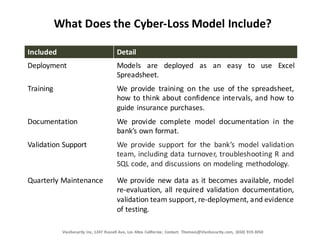
Deployment Models are deployed as an easy to use Excel
Spreadsheet.
Training We provide training on the use of the spreadsheet,
how to think about confidence intervals, and how to
guide insurance purchases.
Documentation We provide complete model documentation in the
bank’s own format.
Validation	
  Support We provide support for the bank’s model validation
team, including data turnover, troubleshooting R and
SQL code, and discussions on modeling methodology.
Quarterly	
  Maintenance We provide new data as it becomes available, model
re-­‐evaluation, all required validation documentation,
validation team support, re-­‐deployment, and evidence
of testing.
Investigation
Notification
Call	
  center
Remediation
o Business	
  Loss
o Damage	
  to	
  personal	
  credit
o Theft	
  of	
  money	
  &	
  goods
o Credit	
  card	
  replacement	
  costs
Business	
  loss;	
  theft	
  of	
  
money	
  &	
  goods
Credit	
  monitoring	
  &	
  
privacy	
  insurance.
Fines &	
  settlements
Public	
  &	
  Other	
  BusinessesBreach	
  Company
Total	
  costs
Mitigate
Transfer	
  
via	
  suits
Costs	
  Covered	
  by	
  the	
  Operational	
  Risk	
  Model	
  
Response	
  CostsDamage	
  costs
Term Meaning
Investigation Cost of investigating what happened in a data breach including data
that was exposed. Costs of updating agencies of investigation progress.
Remediation Cost to preventing future data breach.
Notification Legal costs of notifying federal agencies and states attorney general.
Call	
  Center Cost of hiring or expanding call centers to handle calls from people
affected by data breach.
Business	
  Loss,	
  theft	
  
of	
  money	
  &	
  goods
Loss of business and customers, fraud costs, cost of goods pur chased
with stolen cards
Credit	
  Monitoring	
  &	
  
Privacy	
  Insurance
Cost of providing credit monitoring such as Experian, insurance to
cover personal loss by people affected by the data breach.
Fines	
  &	
  Settlements Government fines, lawsuit awards and settlements, defense costs.
Glossary
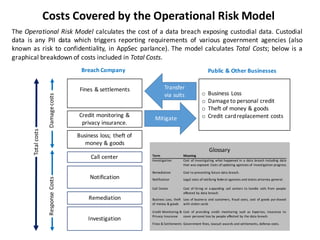
The Operational Risk Model calculates the cost of a data breach exposing custodial data. Custodial
data is any PII data which triggers reporting requirements of various government agencies (also
known as risk to confidentiality, in AppSec parlance). The model calculates Total Costs; below is a
graphical breakdown of costs included in Total Costs.
Evaluation
Bank receives themodel as an Excel spreadsheet and performs initial evaluation using approximate
model inputs. VivoSecurity provides training for how to use the model, how to think about
confidenceintervals and apply results to insurancepurchases.
Model	
  Owner
The owner (sponsor) of the risk model is decided. The owner might be, for example, the CFO or
CRO group. Themodel owner might draft documents to officially sponsor themodel as preparation
for model validation.
Validation	
  Support
Data	
  Owner
VivoSecurity produces SR11-­‐7 compliant validation documentation, following the bank’s format.
VivoSecurity then works with thebank’s validation team to support validateactivities.
Departments are identified that will produce validated numbers that will be entered into the
model. This might include creating and approving SQL to query systems and to generate the
numbers.
Insurance	
  Adequacy
The model owner receives validated numbers from data owners and performs a model based
evaluation ofinsuranceadequacy. Considerations aredocumented and approved.
Adjust	
  Insurance
Insurance coverage can be adjusted and premiums lowered using model based arguments and
historical industry data. Note that neither carriers nor brokers have models as rigorous as ours,
giving thebank an advantage in negotiations.
Document Considerations for insurance adequacy along with validated models and evidence of insuranceare
incorporated into regulator reporting documentation, e.g., FR Y-­‐14A.
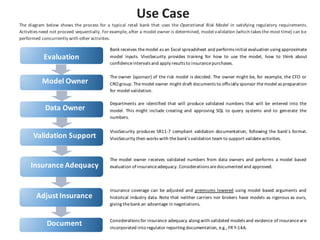
Use	
  Case
The diagram below shows the process for a typical retail bank that uses the Operational Risk Model in satisfying regulatory requirements.
Activities need not proceed sequentially. For example, after a model owner is determined, model validation (which takes the most time) can be
performed concurrently with other activities.
About	
  VivoSecurity
VivoSecurity	
  Inc,	
  1247	
  Russell	
  Ave,	
  Los	
  Altos	
  California;	
   Contact:	
   ThomasL@VivoSecurity.com,	
   (650)	
  919-­‐3050
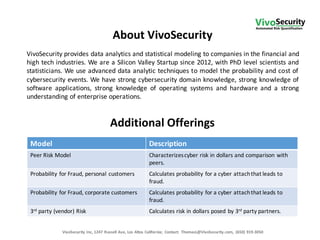
VivoSecurity provides data analytics and statistical modeling to companies in the financial and
high tech industries. We are a Silicon Valley Startup since 2012, with PhD level scientists and
statisticians. We use advanced data analytic techniques to model the probability and cost of
cybersecurity events. We have strong cybersecurity domain knowledge, strong knowledge of
software applications, strong knowledge of operating systems and hardware and a strong
understanding of enterprise operations.
Model Description
Peer	
  Risk	
  Model Characterizes	
  cyber	
  risk	
  in	
  dollars	
  and	
  comparison	
  with	
  
peers.
Probability	
  for	
  Fraud, personal	
  customers Calculates	
  probability	
  for	
  a	
  cyber	
  attach	
  that	
  leads	
  to	
  
fraud.
Probability	
  for	
  Fraud,	
  corporate	
  customers Calculates	
  probability	
  for	
  a	
  cyber	
  attach	
  that	
  leads	
  to	
  
fraud.
3rd party	
  (vendor)	
  Risk Calculates	
  risk	
  in	
  dollars	
  posed	
  by	
  3rd party	
  partners.
Additional	
  Offerings

Cyber Op Risk Model, banks v7p4

  • 1.
    VivoSecurity Inc.,  Los  Altos,  CA.  Email:  ThomasL@VivoSecurity.com Carl  Friedrich  Gauss  who  discovered  the  Normal  (Gaussian)   distribution,   which  characterizes  random  events. OPERATIONAL  RISK  MODEL for  CCAR  Data  Breach  Idiosyncratic  Scenarios Demonstrate  strong  risk  management  culture  for  tier-­‐1  capital;  prove  insurance  adequacy;  champion  or   challenger  model;  maintain  strong  Model  Risk  Management  with  a  SR  11-­‐7  and  SR  15-­‐18  compliant  model
  • 2.
    The  Federal  Reserve  is  Focusing  on  Cybersecurity Large data breaches are rare, but they do happen and the Federal Reserve is looking for evidence that a bank has enough capital to withstand the event. But because they are rare, any single company does not have sufficient data to predict the cost. An analysis of cross-­‐company data is the only credible way to characterize the risk. Some banks are demonstrating a strong risk management culture by using statistical models and VivoSecurity is helping by creating strong SR 11-­‐7 compliant models using cross-­‐company data. These models have the additional benefit of 1) bringing cyber risk under the bank's model risk management framework, 2) providing a clearer understand of what should be transferred with insurance and 3) allowing a bank to benefit from cost reductions brought about from a mature incident response. ü Strengthen Idiosyncratic Scenarios for CCAR/DFAST operational risk. ü Challenge Models for Champion Models ü Champion Models if no models ü Justify a stance not to use cyber insurance ü Demonstrate better management of risks to tier 1 capital
  • 3.
    VivoSecurity  Inc,  1247  Russell  Ave,  Los  Altos  California;   Contact:   ThomasL@VivoSecurity.com,   (650)  919-­‐3050 What  is  a  Cyber-­‐Loss  Model? The Cyber-­‐Loss Model is essentially a complex formula that can explain the variability in cost of historical data breaches. It was trained upon a large set of data breaches and tested for accuracy on a randomly selected set of validation cases. It was developed in the statistical language R using standard statistical techniques such as linear regression and Bayesian Model Averaging. The Cyber-­‐Loss Model is deployed in an easy to use Excel Spreadsheet which requires a small number of variable inputs that have been found to be predictive of cost. No information is needed about a banks security posture. What is Model Validation? Federal Reserve has created guidance for model management (SR11-­‐7 & SR15-­‐18). This guidance assures that models are developed following sound statistical practices. Many banks have an internal validation process for establishing compliance for bank models. We can supply all documentation needed for model validation, including quarterly maintenance, and we cansupport internal validation efforts.
  • 4.
    The graphs beloware a pro forma example of breach cost characterizations. Possible data breach cost is break down by incident and data type. The model also provides a probability distribution for the range of costs, and the probability of lawsuits. $0 $20 $40 $60 $80 $100 Mean  Data  Breach  Costs Millions Incident  &  Data  Type 0% 20% 40% 60% 80% 100% 0 >0 1 2 3 4 5 Probability Number  of  Lawsuits Model  Outputs $0 $5 $10 $15 $20 $25 Likelihood Breach  Cost Millions $19.8M 80%  Confidence  Interval Value  of  Incident   Response  Controls   Most  companies  would   experience  a  cost  of   under  $5M.
  • 5.
    What  Does  the  Cyber-­‐Loss  Model  Include? VivoSecurity  Inc,  1247  Russell  Ave,  Los  Altos  California;   Contact:   ThomasL@VivoSecurity.com,   (650)  919-­‐3050 Included Detail Deployment Models are deployed as an easy to use Excel Spreadsheet. Training We provide training on the use of the spreadsheet, how to think about confidence intervals, and how to guide insurance purchases. Documentation We provide complete model documentation in the bank’s own format. Validation  Support We provide support for the bank’s model validation team, including data turnover, troubleshooting R and SQL code, and discussions on modeling methodology. Quarterly  Maintenance We provide new data as it becomes available, model re-­‐evaluation, all required validation documentation, validation team support, re-­‐deployment, and evidence of testing.
  • 6.
    Investigation Notification Call  center Remediation o Business  Loss o Damage  to  personal  credit o Theft  of  money  &  goods o Credit  card  replacement  costs Business  loss;  theft  of   money  &  goods Credit  monitoring  &   privacy  insurance. Fines &  settlements Public  &  Other  BusinessesBreach  Company Total  costs Mitigate Transfer   via  suits Costs  Covered  by  the  Operational  Risk  Model   Response  CostsDamage  costs Term Meaning Investigation Cost of investigating what happened in a data breach including data that was exposed. Costs of updating agencies of investigation progress. Remediation Cost to preventing future data breach. Notification Legal costs of notifying federal agencies and states attorney general. Call  Center Cost of hiring or expanding call centers to handle calls from people affected by data breach. Business  Loss,  theft   of  money  &  goods Loss of business and customers, fraud costs, cost of goods pur chased with stolen cards Credit  Monitoring  &   Privacy  Insurance Cost of providing credit monitoring such as Experian, insurance to cover personal loss by people affected by the data breach. Fines  &  Settlements Government fines, lawsuit awards and settlements, defense costs. Glossary The Operational Risk Model calculates the cost of a data breach exposing custodial data. Custodial data is any PII data which triggers reporting requirements of various government agencies (also known as risk to confidentiality, in AppSec parlance). The model calculates Total Costs; below is a graphical breakdown of costs included in Total Costs.
  • 7.
    Evaluation Bank receives themodelas an Excel spreadsheet and performs initial evaluation using approximate model inputs. VivoSecurity provides training for how to use the model, how to think about confidenceintervals and apply results to insurancepurchases. Model  Owner The owner (sponsor) of the risk model is decided. The owner might be, for example, the CFO or CRO group. Themodel owner might draft documents to officially sponsor themodel as preparation for model validation. Validation  Support Data  Owner VivoSecurity produces SR11-­‐7 compliant validation documentation, following the bank’s format. VivoSecurity then works with thebank’s validation team to support validateactivities. Departments are identified that will produce validated numbers that will be entered into the model. This might include creating and approving SQL to query systems and to generate the numbers. Insurance  Adequacy The model owner receives validated numbers from data owners and performs a model based evaluation ofinsuranceadequacy. Considerations aredocumented and approved. Adjust  Insurance Insurance coverage can be adjusted and premiums lowered using model based arguments and historical industry data. Note that neither carriers nor brokers have models as rigorous as ours, giving thebank an advantage in negotiations. Document Considerations for insurance adequacy along with validated models and evidence of insuranceare incorporated into regulator reporting documentation, e.g., FR Y-­‐14A. Use  Case The diagram below shows the process for a typical retail bank that uses the Operational Risk Model in satisfying regulatory requirements. Activities need not proceed sequentially. For example, after a model owner is determined, model validation (which takes the most time) can be performed concurrently with other activities.
  • 8.
    About  VivoSecurity VivoSecurity  Inc,  1247  Russell  Ave,  Los  Altos  California;   Contact:   ThomasL@VivoSecurity.com,   (650)  919-­‐3050 VivoSecurity provides data analytics and statistical modeling to companies in the financial and high tech industries. We are a Silicon Valley Startup since 2012, with PhD level scientists and statisticians. We use advanced data analytic techniques to model the probability and cost of cybersecurity events. We have strong cybersecurity domain knowledge, strong knowledge of software applications, strong knowledge of operating systems and hardware and a strong understanding of enterprise operations. Model Description Peer  Risk  Model Characterizes  cyber  risk  in  dollars  and  comparison  with   peers. Probability  for  Fraud, personal  customers Calculates  probability  for  a  cyber  attach  that  leads  to   fraud. Probability  for  Fraud,  corporate  customers Calculates  probability  for  a  cyber  attach  that  leads  to   fraud. 3rd party  (vendor)  Risk Calculates  risk  in  dollars  posed  by  3rd party  partners. Additional  Offerings