Cyber Capabilities
Example
IT 298 / Bohman
January 6th, 2014
Cyber Capabilities – U.S.
Offense
Aggressive espionage through the planting of logic bombs in
foreign countries’ infrastructure in preparation of potential
cyber warfare
Exploitation of system vulnerabilities and ability to create back
doors using cyberweaponry
Pretargeted cyber weapons
Global connectivity maps giving rise to “network situational
awareness,” which shows geographical location, software,
potential malware infections, and exploitations
Defense
The Department of Defense, the Department of Homeland
Security, and the Federal Bureau of Investigation
Task forces and cyber squads specially trained to identify and
combat detected computer and network intrusions
National Strategy to Secure Cyberspace:
http://www.defense.gov/home/features/2010/0410_cybersec/doc
s/cyberspace_strategy%5B1%5D.pdf
(U.S. Department of Justice, 2013)
Cyber Capabilities – China
Offense
Implementation of logic bombs in countries’ systems that have
potential to be a threat in the future, or countries whose
information is worth taking
Asymmetric Warfare – Using obsolete forms of weaponry and
combat against one more advanced
Knowledge syphoning leading to leaps and bounds in
technological prowess
Defense
Information Dominance – The country with the most gathered
information is the country that prevails
Ability to cut off sections of power to forego an entire blackout
to a better extent than the U.S.
Lowered dependence on network systems
(Clarke & Knake, 2012)
Cyber Capabilities – Russia
Offense
Heightened espionage and exploitation abilities that are rarely
exposed
Broad view of information espionage that is integrated in
military tactics
“…intelligence, counterintelligence, deceit, disinformation,
electronic warfare, debilitation of communications, degradation
of navigation support, psychological pressure, degradation of
information systems and propaganda.”
Perfected Distributed Denial of Service attacks and botnets
through test runs
Defense
Integrated military tactics are within the boundaries of Russian
law
Three main security objectives:
Protect strategically important information
Protect against dangerous foreign information
Instill patriotism and values in citizens
Uses youth groups to enact risky actions for added security and
diminished pay
(Smith, 2012)
Cyber Capabilities – Others
“Other nations known to have skilled cyber war units are Israel
and France. U.S. intelligence officials have suggested that
there are twenty to thirty militaries with respectable cyber war
capability, including those of Taiwan, Iran, Australia, South
Korea, India, Pakistan, and several NATO states.”
(Clarke & Knake, 2012)
Cyber Capabilities – Others
Offense
Australia – Developing offensive techniques that could destroy
systems, exploitation of cyber power
(Joye & Kerin, 2013)
North Korea – Training for youth to become professional
hackers, No. 91 Office (for computer hacking), espionage,
DDoS attacks
(Paganini, 2012)
Defense
Australia – Attractive target for attackers, Cyber Security
Operations Centre responds to large threats
(Joye & Kerin, 2013)
North Korea – Lab 110 (technology reconnaissance team)
(Clarke & Knake, 2012)
Who Might Win in a Real Cyberwar?
It is difficult to say who would win in the event of a cyber war,
as victory would depend on numerous factors that are difficult –
if impossible – to predict. A country must display prominent
tactics regarding both the offensive and defensive capabilities,
unless a one-hit offense were enacted at the very beginning.
Armed with the best possible reaction times and defense plans
in a cyber crisis, to allow for recovery and counteraction to take
place, has potential to offer stability in a nation hit by a cyber
attack. In the end, however, it is all a matter of who is left
standing after the damage has been done.
Sources
Berman, I. (2012, April 26). The Iranian Cyber Threat to the
U.S. Homeland. Retrieved from The House Committee on
Homeland Security:
http://homeland.house.gov/sites/homeland.house.gov/files/Testi
mony%20-%20Berman.pdf
Clarke, R. A., & Knake, R. K. (2012). Cyber War. New York:
HarperCollins.
Joye, C., & Kerin, J. (2013, May 6). Australia developing
offensive cyber capabilities. Retrieved from Financial Review:
http://www.afr.com/p/technology/australia_developing_offensiv
e_cyber_fO71ogW8tcmoWGszPZL7tI
Paganini, P. (2012, June 11). Concerns Mount over North
Korean Cyber Warfare Capabilities. Retrieved from Infosec
Island: http://www.infosecisland.com/blogview/21577-
Concerns-Mount-over-North-Korean-Cyber-Warfare-
Capabilities.html
Schneier, B. (2013, June 21). US Offensive Cyberwar Policy.
Retrieved from Schneier on Security:
http://www.schneier.com/blog/archives/2013/06/us_offensive_c
y.html
Smith, D. J. (2012, July). Russian Cyber Operations. Retrieved
from Potomac Institute Cyber Center:
http://www.potomacinstitute.org/attachments/article/1273/Russi
an%20Cyber%20Operations.pdf
U.S. Department of Justice. (2013). FBI — Cyber Crime.
Retrieved from The Federal Bureau of Investigation:
http://www.fbi.gov/about-us/investigate/cyber
Extra
credit
Chem
123
1. Given
the
following
reaction:
Na2S2O3
+
AgBr
NaBr
+
Ag2S2O3
a. How
many
moles
of
Na2S2O3
are
needed
to
react
completely
with
42.7
g
of
AgBr?
b. What
is
the
mass
of
NaBr
that
will
be
produced
from
42.7
g
of
AgBr?
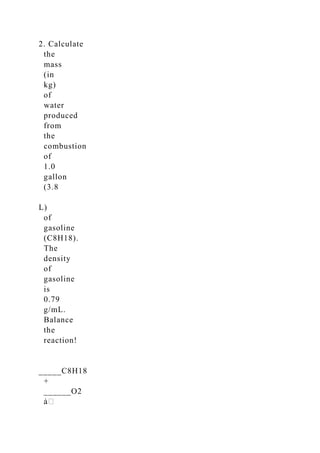
2. Calculate
the
mass
(in
kg)
of
water
produced
from
the
combustion
of
1.0
gallon
(3.8
L)
of
gasoline
(C8H18).
The
density
of
gasoline
is
0.79
g/mL.
Balance
the
reaction!
_____C8H18
+
______O2
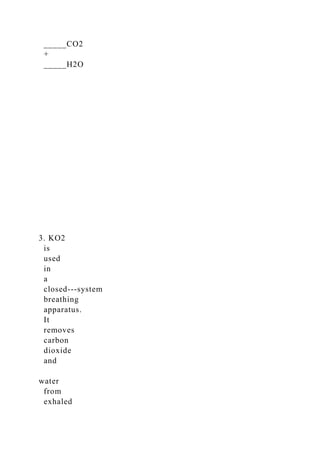
_____CO2
+
_____H2O
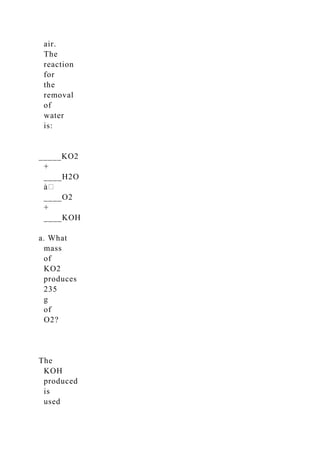
3. KO2
is
used
in
a
closed-­‐system
breathing
apparatus.
It
removes
carbon
dioxide
and
water
from
exhaled
air.
The
reaction
for
the
removal
of
water
is:
_____KO2
+
____H2O
____O2
+
____KOH
a. What
mass
of
KO2
produces
235
g
of
O2?
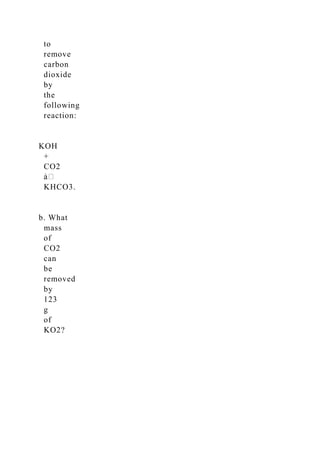
The
KOH
produced
is
used
to
remove
carbon
dioxide
by
the
following
reaction:
KOH
+
CO2
KHCO3.
b. What
mass
of
CO2
can
be
removed
by
123
g
of
KO2?
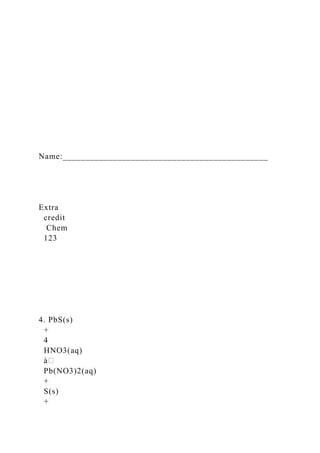
Name:_____________________________________________
Extra
credit
Chem
123
4. PbS(s)
+
4
HNO3(aq)
Pb(NO3)2(aq)
+
S(s)
+
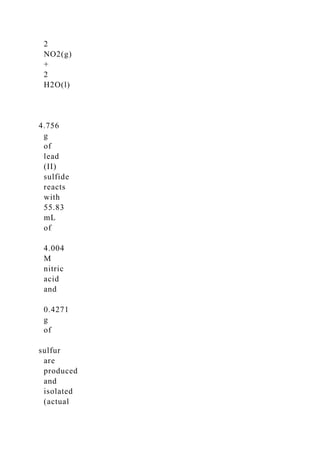
2
NO2(g)
+
2
H2O(l)
4.756
g
of
lead
(II)
sulfide
reacts
with
55.83
mL
of
4.004
M
nitric
acid
and
0.4271
g
of
sulfur
are
produced
and
isolated
(actual
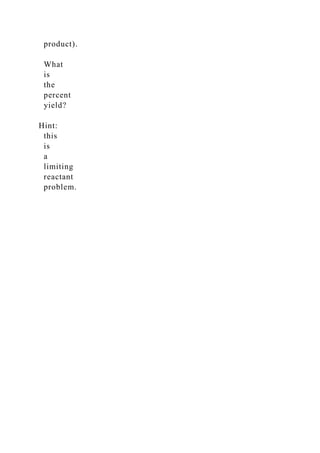
product).
What
is
the
percent
yield?
Hint:
this
is
a
limiting
reactant
problem.
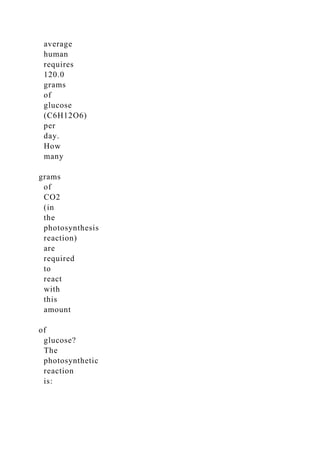
5. The
average
human
requires
120.0
grams
of
glucose
(C6H12O6)
per
day.
How
many
grams
of
CO2
(in
the
photosynthesis
reaction)
are
required
to
react
with
this
amount
of
glucose?
The
photosynthetic
reaction
is:
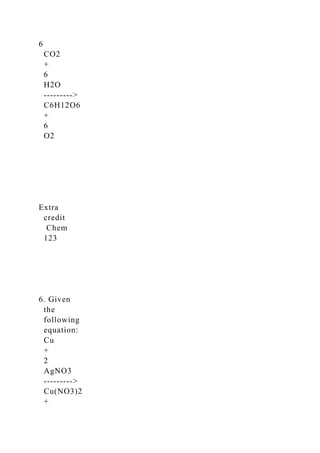
6
CO2
+
6
H2O
-­‐-­‐-­‐>
C6H12O6
+
6
O2
Extra
credit
Chem
123
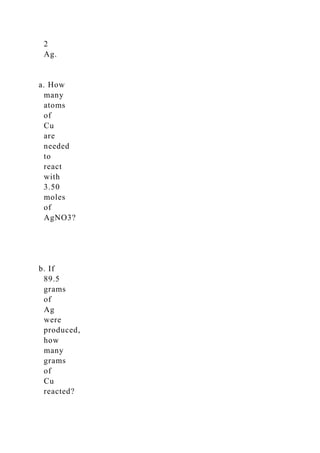
6. Given
the
following
equation:
Cu
+
2
AgNO3
-­‐-­‐-­‐>
Cu(NO3)2
+
2
Ag.
a. How
many
atoms
of
Cu
are
needed
to
react
with
3.50
moles
of
AgNO3?
b. If
89.5
grams
of
Ag
were
produced,
how
many
grams
of
Cu
reacted?
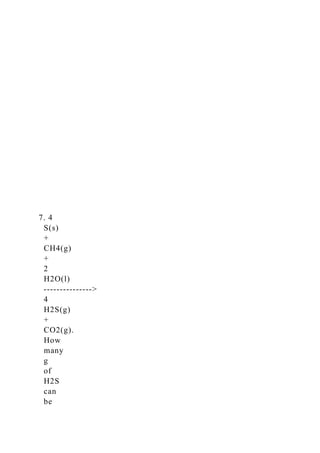
7. 4
S(s)
+
CH4(g)
+
2
H2O(l)
-­‐-­‐-­‐-­‐-­‐>
4
H2S(g)
+
CO2(g).
How
many
g
of
H2S
can
be
made
from
120
µg
of
CH4?
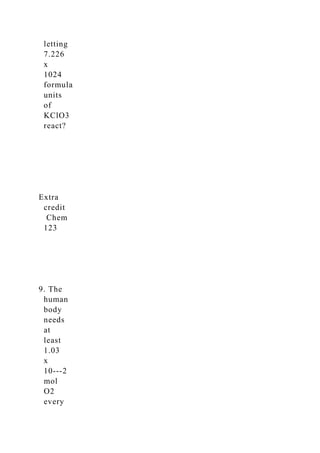
8. Given
the
following
equation:
2
KClO3
-­‐-­‐-­‐>
2
KCl
+
3
O2.
How
many
decigrams
(10dg
=
1
g)
of
O2
can
be
produced
by
letting
7.226
x
1024
formula
units
of
KClO3
react?
Extra
credit
Chem
123
9. The
human
body
needs
at
least
1.03
x
10-­‐2
mol
O2
every
minute.
If
all
of
this
oxygen
is
used
for
the
cellular
respiration
reaction
that
breaks
down
glucose,
how
many
grams
of
glucose
does
the
human
body
consume
each
minute?
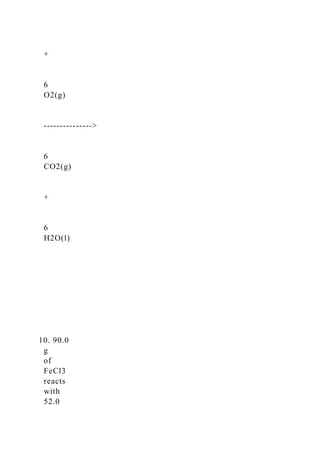
C6H12O6(s)
+
6
O2(g)
-­‐-­‐-­‐-­‐-­‐>
6
CO2(g)
+
6
H2O(l)
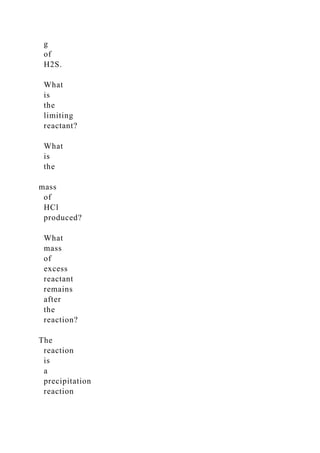
10. 90.0
g
of
FeCl3
reacts
with
52.0
g
of
H2S.
What
is
the
limiting
reactant?
What
is
the
mass
of
HCl
produced?
What
mass
of
excess
reactant
remains
after
the
reaction?
The
reaction
is
a
precipitation
reaction
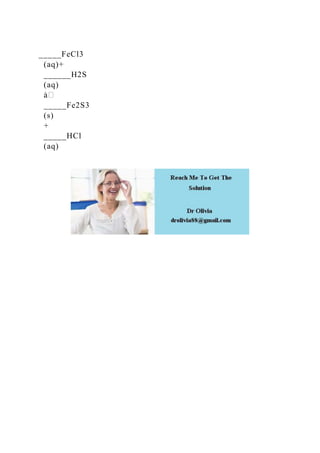
_____FeCl3
(aq)+
______H2S
(aq)
_____Fe2S3
(s)
+
_____HCl
(aq)

Cyber CapabilitiesExampleIT 298 BohmanJanuary 6th, 2014.docx