UNITED STATES
SECURITIES AND EXCHANGE COMMISSION
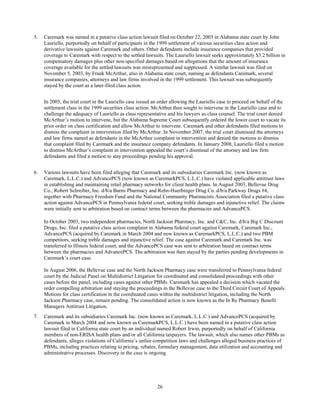
Washington, D.C. 20549
FORM 10-K
⌧ Annual Report Pursuant to Section 13 or 15(d) of the Securities Exchange Act of 1934
For the fiscal year ended December 29, 2007
OR
Transition Report Pursuant to Section 13 or 15(d) of the Securities Exchange Act of 1934
For the transition period from to
Commission file number 001-01011
CVS CAREMARK CORPORATION
(Exact name of Registrant as specified in its charter)
Delaware 050494040
(State or other jurisdiction of
incorporation or organization)
(I.R.S. Employer Identification No.)
One CVS Drive
Woonsocket, Rhode Island
(Address of principal executive offices)
02895
(Zip Code)
(401) 765-1500
(Registrant’s telephone number, including area code)
Securities registered pursuant to Section 12(b) of the Exchange Act:
Common Stock, par value $0.01 per share
Title of each class
New York Stock Exchange
Name of each exchange on which registered
Securities registered pursuant to Section 12(g) of the Exchange Act: None
Indicate by check mark if the registrant is a well-known seasoned issuer, as defined in Rule 405 of the Securities Act.
Yes[X] No[ ]
Indicate by check mark if the registrant is not required to file reports pursuant to Section 13 or Section 15(d) of the Act.
Yes[ ] No[X]
Indicate by check mark whether the registrant (1) has filed all reports required to be filed by Section 13 or 15(d) of the
Securities Exchange Act of 1934 during the preceding 12 months (or for such shorter period that the registrant was
required to file such reports) and (2) has been subject to such filing requirements for the past 90 days. Yes[X] No[ ]
Indicate by check mark if disclosure of delinquent filers pursuant to Item 405 of Regulation S-K is not contained herein,
and will not be contained, to the best of registrant’s knowledge, in definitive proxy or information statements
incorporated by reference in Part III of this Form 10-K or any amendment to this Form 10-K. [X]
Indicate by check mark whether the registrant is a large accelerated filer, an accelerated filer, or a non-accelerated filer,
or a smaller reporting company. See definition of “large accelerated filer,” “accelerated filer” and “smaller reporting
company” in Rule 12b-2 of the Exchange Act.
Large accelerated filer [X] Accelerated filer [ ]
Non-accelerated filer [ ] (Do not check if a smaller reporting company Smaller reporting company [ ]
Indicate by check mark whether the registrant is a shell company (as defined in Rule 12b-2 of the Act). Yes[ ] No [X]
1
The aggregate market value of the registrant’s common stock held by non-affiliates was approximately $53,375,286,000
as of June 29, 2007, based on the closing price of the common stock on the New York Stock Exchange. For purposes of
this calculation, only executive officers and directors are deemed to be the affiliates of the registrant.
As of February 21, 2008, the registrant had 1,431,879,000 shares of common stock issued and outstanding.
DOCUMENTS INCORPORATED BY REFERENCE
Filings made by companies with the Securities and Exchange Commission sometimes “incorporate information by
reference.” This means that the company is referring you to information that was previously filed or is to be filed with
the SEC, and this information is considered to be part of the filing you are reading. The following materials are
incorporated by reference into this Form 10-K:
• Information contained on pages 18 through 68, and pages 70 through 71 of our Annual Report to Stockholders for
the fiscal year ended December 29, 2007 is incorporated by reference in our response to Items 7, 8 and 9 of Part II.
• Information contained in our Proxy Statement for the 2008 Annual Meeting of Stockholders is incorporated by
reference in our response to Items 10 through 14 of Part III.
2
TABLE OF CONTENTS
Part I Page
Item 1: Business........................................................................................................................................... 3
Item 1A: Risk Factors..................................................................................................................................... 19
Item 1B: Unresolved Staff Comments............................................................................................................ 22
Item 2: Properties......................................................................................................................................... 23
Item 3: Legal Proceedings ........................................................................................................................... 25
Item 4: Submission of Matters to a Vote of Security Holders...................................................................... 28
Executive Officers of the Registrant ................................................................................................................. 29
Part II
Item 5: Market for Registrant’s Common Equity, Related Stockholder Matters and Issuer
Purchases of Equity Securities......................................................................................................... 30
Item 6: Selected Financial Data ................................................................................................................... 32
Item 7: Management’s Discussion and Analysis of Financial Condition and Results of Operations........... 32
Item 7A: Quantitative and Qualitative Disclosures About Market Risk......................................................... 33
Item 8: Financial Statements and Supplementary Data................................................................................ 33
Item 9: Changes in and Disagreements with Accountants on Accounting and Financial Disclosure .......... 33
Item 9A: Controls and Procedures.................................................................................................................. 34
Item 9B: Other Information............................................................................................................................ 34
Part III
Item 10: Directors and Executive Officers of the Registrant ......................................................................... 35
Item 11: Executive Compensation ................................................................................................................. 35
Item 12: Security Ownership of Certain Beneficial Owners and Management and
Related Stockholder Matters............................................................................................................ 37
Item 13: Certain Relationships and Related Transactions and Director Independence.................................. 37
Item 14: Principal Accountant Fees and Services.......................................................................................... 37
Part IV
Item 15: Exhibits, Financial Statement Schedules ......................................................................................... 38
Report of Independent Registered Public Accounting Firm.............................................................................. 42
Schedule II – Valuation and Qualifying Accounts ............................................................................................ 44
Signatures ......................................................................................................................................................... 45
3
PART I
Item 1. Business
Overview
CVS Caremark Corporation (“CVS Caremark”, the “Company”, “we” or “us”) is the largest provider of prescriptions
and related healthcare services in the United States. We fill or manage more than one billion prescriptions annually. As a
fully integrated pharmacy services company, we drive value for our customers by effectively managing pharmaceutical
costs and improving healthcare outcomes through our approximately 6,200 CVS/pharmacy® retail stores; our pharmacy
benefit management, mail order and specialty pharmacy division, Caremark Pharmacy Services; our retail-based health
clinic subsidiary, MinuteClinic®; and our online pharmacy, CVS.com®. We currently operate two business segments:
Retail Pharmacy and Pharmacy Services. Our business segments are operating units that offer different products and
services and require distinct technology and marketing strategies.
The Caremark Merger
Effective March 22, 2007, we closed our merger with Caremark Rx, Inc. (“Caremark”). Following the Caremark
Merger, we changed our name to “CVS Caremark Corporation.”
We believe CVS and Caremark are complementary companies and the merger is expected to yield benefits for health
plan sponsors through more effective cost-management solutions and innovative programs and for consumers through
expanded choice, improved access and more personalized services. We also believe we can operate the combined
companies more efficiently than either company could have operated on its own. In that regard, the merger has enabled
us to achieve significant synergies from purchasing scale and operating efficiencies. Purchasing synergies are largely
comprised of purchase discounts and/or rebates obtained from generic and brand name drug manufacturers and cost
efficiencies obtained from our retail pharmacy networks. Operating synergies include decreases in overhead expense,
increases in productivity and efficiencies obtained by eliminating excess capacity, decreases in prescription dispensing
costs and other benefits made possible by combining complementary operations.
Over the longer term, we expect the Caremark Merger will also create significant incremental revenue opportunities.
These opportunities are expected to be derived from a variety of new programs and benefit designs that leverage our
client relationships, our integrated information systems and the personal interaction of our more than 20,000
pharmacists, nurse practitioners and physician assistants with the millions of consumers who shop our stores on a daily
basis. Examples of these programs include new prescription compliance and persistency programs, enhanced disease
management programs, new ExtraCare card programs for plan beneficiaries, increased use of MinuteClinics by plan
beneficiaries and flexible fulfillment options that afford plan beneficiaries the opportunity to pick-up maintenance
medications in-store. While certain of these programs will commence in 2008, many are in their formative stage and
require significant information system enhancements as well as changes in work processes. Accordingly, there can be no
assurance as to the timing of the implementation of, or the amount of incremental revenues associated with, these kinds
of programs.
Retail Pharmacy Segment
As of December 29, 2007, the Retail Pharmacy Segment included 6,245 retail drugstores, of which 6,164 operated a
pharmacy, our online retail website, CVS.com® and our retail healthcare clinics. The retail drugstores are located in 40
states and the District of Columbia operating under the CVS® or CVS/pharmacy® names. We currently operate in 77 of
the top 100 U.S. drugstore markets and hold the number one or number two market share in 58 of these markets.
Overall, we hold the number one or number two market share position in 75% of the markets in which our retail
drugstores operate. CVS/pharmacy stores sell prescription drugs and a wide assortment of general merchandise,
including over-the-counter drugs, beauty products and cosmetics, photo finishing, seasonal merchandise, greeting cards
and convenience foods, which we refer to as “front store” products. Existing stores generally range in size from
approximately 8,000 to 18,000 square feet, although most new stores range in size from approximately 10,000 to 13,000
square feet and typically include a drive-thru pharmacy. During fiscal 2007, we filled approximately 528 million retail
prescriptions, or approximately 17% of the U.S. retail pharmacy market.
4
As of December 29, 2007, we operated 462 retail healthcare clinics in 25 states under the MinuteClinic® name, of
which 437 are located within CVS retail drugstores. The clinics utilize nationally recognized medical protocols to
diagnose and treat minor health conditions and are staffed by board-certified nurse practitioners and physician assistants.
Our Strategy ~ Our goal is to be the easiest pharmacy retailer for customers to use. We believe that ease of use means
convenience for the time-starved customer. As such, our operating strategy is to provide a broad assortment of quality
merchandise at competitive prices using a retail format that emphasizes service, innovation and convenience (easy-to-
access, clean, well-lit and well stocked). One of the keys to our strategy is technology, which allows us to focus on
constantly improving service and exploring ways to provide more personalized product offerings and services. We
believe that continuing to be the first to market with new and unique products and services, using innovative marketing
and adjusting our mix of merchandise to match our customers’ needs and preferences is very important to our ability to
continue to improve customer satisfaction.
Our Products ~ A typical CVS/pharmacy store sells prescription drugs and a wide assortment of high-quality,
nationally advertised brand name and private label merchandise. Front store categories include over-the-counter drugs,
beauty products and cosmetics, film and photo finishing services, seasonal merchandise, greeting cards and convenience
foods. We purchase our merchandise from numerous manufacturers and distributors. We believe that competitive
sources are readily available for substantially all of the products we carry and the loss of any one supplier would not
have a material effect on the business. Consolidated net revenues by major product group are as follows:
Percentage of Net Revenues(1)
2007 2006 2005
Prescription drugs 68% 68% 69%
Over-the-counter and personal care 13 13 10
Beauty/cosmetics 4 4 6
General merchandise and other 15 15 15
100% 100% 100%
(1) Percentages are estimates based on store point-of-sale data.
Pharmacy ~ Pharmacy revenues represented 67.8% of Retail Pharmacy revenues in 2007, compared to 68.4% in 2006,
and 68.6% in 2005. We believe that our pharmacy operations will continue to represent a critical part of our business
due to our ability to attract and retain managed care customers, favorable industry trends (e.g., an aging American
population consuming a greater number of prescription drugs, pharmaceuticals being used more often as the first line of
defense for managing illness) the proliferation of new pharmaceutical products, a new federally funded prescription drug
benefit, which was promulgated on January 1, 2006 as part of the Medicare Prescription Drug Improvement and
Modernization Act of 2003 (“MMA”) and our on going program of purchasing customer lists from independent
pharmacies. We believe our pharmacy business benefits from our investment in both people and technology. Given the
nature of prescriptions, people want their prescriptions filled accurately and ready when promised, by professional
pharmacists using the latest tools and technology. As such, our Pharmacy Service Initiative, which is designed to resolve
potential problems at the point of drop-off that could delay a prescription being filled, has enabled us to improve our
dispensing process resulting in improved customer service ratings. Further evidencing our belief in the importance of
pharmacy service is our continuing investment in technology, such as our Drug Utilization Review system that checks
for harmful interactions between prescription drugs, over-the-counter products, vitamins and herbal remedies; our Rx
Connect system; our touch-tone telephone reorder system, Rapid RefillTM
; and our online business, CVS.com.
Front Store ~ Front store revenues benefited from our strategy to be the first to market with new and unique products
and services, using innovative marketing and adjusting our mix of merchandise to match our customer’s needs and
preferences. For example, we were the first retail pharmacy to market with a digital photo solution throughout our chain,
including being the first to offer printing from digital camera phones, the ability to upload digital photos to CVS.com
and have them available for in store pickup the following day, and the first to offer a one-time-use digital camera. A key
component of our front store strategy is our ExtraCare® card program, which is helping us continue to build our loyal
customer base. In addition, ExtraCare is one of the largest and most successful retail loyalty programs in the United
States. ExtraCare allows us to balance our marketing efforts so we can reward our best customers by providing them
automatic sale prices, customized coupons, ExtraBucksTM
rewards and other benefits. Another component of our front
store strategy is our unique product offerings, which include a full range of high-quality CVS brand products that are
only available through CVS. We currently carry over 2,100 CVS brand and proprietary brand products, which accounted
for approximately 14% of our front store revenues during 2007.
5
Store Development ~ The addition of new stores has played, and will continue to play, a major role in our continued
growth and success. Our store development program focuses on three areas: entering new markets, adding stores within
existing markets and relocating stores to more convenient, freestanding sites. During 2007, we opened 139 new stores,
relocated 136 stores and closed 44 stores. During the last five years, we opened more than 1,300 new and relocated
stores, and acquired more than 1,960 stores. Approximately two thirds of our store base was opened or significantly
remodeled within the last five years. During 2008, we expect to open between 300 and 325 new or relocated stores. We
believe that continuing to grow our store base and locating stores in desirable geographic markets are essential
components to compete effectively in the current managed care environment. As a result, we believe that our store
development program is an integral part of our ability to maintain our leadership position in the retail drugstore industry.
Information Systems ~ We have continued to invest in information systems to enable us to deliver a high level of
customer service while lowering costs and increasing operating efficiency. We were one of the first in the industry to
introduce Drug Utilization Review technology that checks for harmful interactions between prescription drugs, over-the-
counter products, vitamins and herbal remedies. We were also one of the first in the industry to install a chain wide
automatic prescription refill system, CVS Rapid RefillTM
, which enables customers to order prescription refills 24 hours
a day using a touch-tone telephone. In addition, we have installed Rx Connect, which reengineered the way our
pharmacists communicate and fill prescriptions. Further, we have implemented our Assisted Inventory Management
system, which is designed to more effectively link our stores and distribution centers with suppliers to speed the delivery
of merchandise to our stores in a manner that both reduces out-of-stock positions and lowers our investment in
inventory. Most recently we rolled-out Visible Improvement in Profits, Execution and Results, a transaction monitoring
application designed to mitigate inventory losses attributable to process deficiencies or fraudulent behavior by providing
visibility to all transactions processed through our point-of-sale systems. In addition, we operate distribution centers
with fully integrated technology solutions for storage, product retrieval and order picking.
Customers ~ Managed care and other third party plans accounted for 95% of our 2007 pharmacy revenues. Since our
revenues relate to numerous payors, including employers and managed care organizations, the loss of any one payor
should not have a material effect on our business. No single customer accounts for 10% or more of our total revenues.
We also fill prescriptions for many government funded programs, including State Medicaid plans and Medicare Part D
drug plans.
Seasonality ~ The majority of our revenues, particularly pharmacy revenues, are generally not seasonal in nature.
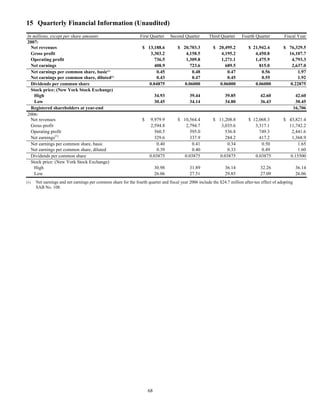
However, front store revenues tend to be higher during the December holiday season. For additional information, we
refer you to the Note “Quarterly Financial Information” on page 68 in our Annual Report to Stockholders for the fiscal
year ended December 29, 2007.
Competition ~ The retail drugstore business is highly competitive. We believe that we compete principally on the basis
of: (i) store location and convenience, (ii) customer service and satisfaction, (iii) product selection and variety and (iv)
price. In each of the markets we serve, we compete with independent and other retail drugstore chains, supermarkets,
convenience stores, pharmacy benefit managers and other mail order prescription providers, discount merchandisers,
membership clubs, health clinics and Internet pharmacies.
6
Pharmacy Services Segment
The Pharmacy Services business provides a full range of prescription benefit management (“PBM”) services including
mail order pharmacy services, specialty pharmacy services, plan design and administration, formulary management and
claims processing. Our customers are primarily employers, insurance companies, unions, government employee groups,
managed care organizations and other sponsors of health benefit plans and individuals throughout the United States. In
addition, through our SilverScript Insurance Company (“SilverScript”) subsidiary, we are a national provider of drug
benefits to eligible beneficiaries under the Federal Government’s Medicare Part D program. Our specialty pharmacies
support individuals that require complex and expensive drug therapies. Our pharmacy services business operates a
national retail pharmacy network with over 60,000 participating pharmacies (including CVS/pharmacy stores). We also
provide health management programs, which include integrated disease management for 27 conditions through our
Accordant® health management offering. The majority of these integrated programs are accredited by the National
Committee for Quality Assurance (the “NCQA”). Currently, the pharmacy services business operates under the
Caremark Pharmacy Services®, PharmaCare Management Services® and PharmaCare Pharmacy® names. As of
December 29, 2007, the Pharmacy Services segment operated 56 retail specialty pharmacy stores, 20 specialty mail
order pharmacies and 9 mail service pharmacies located in 26 states and the District of Columbia. Specialty pharmacy
stores average 2,000 square feet in size and sell prescription drugs and a limited assortment of front store items such as
alternative medications, homeopathic remedies and vitamins.
Our Strategy ~ Our business strategy centers on providing innovative pharmaceutical solutions and quality customer
service in order to enhance clinical outcomes for the participants in our customers’ health benefit plans while assisting
our customers in better managing their overall healthcare costs. We believe that our focus on management of our
customers’ overall healthcare costs, our mail service, specialty pharmaceutical and health management expertise and the
breadth and quality of our product and service offerings (which are expected to be significantly enhanced as a result of
the Caremark Merger) distinguish us from many of our competitors.
Our Services ~ The PBM services we provide for our customers involve the design and administration of programs
aimed at reducing the cost and improving the safety, effectiveness and convenience of prescription drug use.
Plan Design and Administration ~ Our customers sponsor pharmacy benefit plans which facilitate the ability of
eligible participants in these plans to receive medications prescribed by their physicians. We assist our customers in
designing pharmacy benefit plans that minimize the costs to the customer while prioritizing the welfare and safety of the
customer’s participants. We also administer these benefit plans for our customers and assist them in monitoring the
effectiveness of these plans through frequent, informal communications as well as through a formal annual customer
review.
We make recommendations to our customers encouraging them to design benefit plans promoting the use of the lowest
cost, most clinically appropriate drug, including generics when available. We believe that we help our customers control
costs by recommending plans that encourage the use of generic equivalents of brand name drugs when such equivalents
are available. Our customers also have the option, through plan design, to further lower their pharmacy benefit plan
costs by setting different participant payment levels for different products on our drug lists.
Formulary Development ~ We utilize an independent panel of doctors, pharmacists and other medical experts, referred
to as our Pharmacy and Therapeutics Committee, to select drugs that meet the highest standards of safety and efficacy
for inclusion on our drug lists. Our drug lists provide recommended products in numerous drug classes to ensure
participant access to clinically appropriate alternatives under the customer’s pharmacy benefit plan. To improve clinical
outcomes for participants and customers, we conduct ongoing, independent reviews of all drugs, including, but not
limited to, those appearing on the drug list and generic equivalent products, as well as of our clinical programs.
7
Discounted Drug Purchase Arrangements ~ We negotiate with pharmaceutical manufacturers to obtain discounted
acquisition costs for many of the products on our drug lists, and the customers that choose to adopt our drug lists receive
reduced costs from these negotiated discounts. The discounted drug purchase arrangements we negotiate typically
provide for our receiving discounts from established list prices in one, or a combination, of the following forms. These
discounts may take the form of a direct discount at the time of purchase, a discount for prompt payment of invoices or,
when products are indirectly purchased from a manufacturer (e.g., through a wholesaler or retail pharmacy/chain), a
retroactive discount, or rebate. We also receive additional discounts under our wholesale contracts if we exceed
contractually-defined annual purchase volumes. We record these discounts, regardless of their form, as a reduction of
our cost of revenues.
Prescription Management Systems ~ We dispense prescription drugs both directly, through our own pharmacies, and
indirectly, through a network of third party retail pharmacies. All prescriptions, whether they are filled through one of
our mail service pharmacies or through a pharmacy in our retail network, are analyzed, processed and documented by
our proprietary prescription management systems. These systems assist staff and network pharmacists in processing
prescriptions by automating tests for various items, including, but not limited to, plan eligibility, early refills, duplicate
dispensing, appropriateness of dosage, drug interactions or allergies, over-utilization and potential fraud.
Mail Pharmacy Program ~ We currently operate 9 large, automated mail service pharmacies in the continental United
States. Our customers or their physicians submit prescriptions, primarily for maintenance medications, to these
pharmacies via mail, telephone, fax or the Internet. We also operate a network of 20 smaller mail service specialty
pharmacies located throughout the United States and used for delivery of advanced medications to individuals with
chronic or genetic diseases and disorders. Substantially all of the mail service specialty pharmacies have been accredited
by the Joint Commission on Accreditation of Healthcare Organizations (“JCAHO”). Additionally, we operate a United
States Food and Drug Administration (“FDA”) regulated repackaging facility in which we repackage certain drugs into
the most common prescription amounts dispensed from our automated mail service pharmacies. Our staff pharmacists
review mail service prescriptions and refill requests with the assistance of our prescription management systems. This
review may involve communications with the prescribing physician and, with the physician’s approval, can result in
generic substitution, therapeutic interchange or other actions to affect cost or to improve quality of treatment. In these
cases, we inform participants about the changes made to their prescriptions.
CareCenter® Pharmacies ~ We also operate a limited number of CareCenter pharmacies located at client sites, which
provide participants with a convenient alternative for filling their prescriptions.
Retail Pharmacy Program ~ Our retail pharmacy program typically allows customers to fill prescriptions at more than
60,000 pharmacies nationwide (including CVS/pharmacy stores). When a customer fills a prescription in a retail
pharmacy, the network pharmacist sends prescription data electronically to us from the point-of-sale. This data
interfaces with our proprietary prescription management systems, which verify relevant customer data, including
eligibility and participant information, perform drug utilization review to determine clinical appropriateness and safety
and confirm that the pharmacy will receive payment for the prescription.
Quality Assurance ~ We have adopted and implemented clinical quality assurance procedures as well as policies and
procedures to help ensure regulatory compliance under our quality assurance programs. Each new mail service
prescription undergoes a sequence of safety and accuracy checks and is reviewed and verified by a registered pharmacist
before shipment. We also analyze drug-related outcomes to identify opportunities to improve the quality of care.
Health Management Programs ~ Our clinical services utilize advanced protocols and offer customers convenience in
working with healthcare providers and other third parties. Our AccordantCare® health management programs include
integrated disease management, which includes over 20 diseases such as asthma, coronary artery disease, congestive
heart failure, diabetes, hemophilia, rheumatoid arthritis and multiple sclerosis. The majority of these integrated programs
are accredited by the NCQA.
8
Information Systems ~ We currently operate primary information systems platforms to support our PBM services,
which are supplemented by additional information systems to support our pharmacy operations. These information
systems incorporate integrated architecture that centralizes the data generated from filling mail service prescriptions,
adjudicating retail pharmacy claims and fulfilling other customer service contracts.
Customers ~ Our customers are primarily sponsors of health benefit plans (employers, unions, government employee
groups, insurance companies and managed care organizations) and individuals located throughout the United States. We
dispense pharmaceuticals to eligible participants in benefit plans maintained by our customers and utilize our
information systems to perform safety checks, drug interaction screening and generic substitution. In addition, we are a
national provider of drug benefits to eligible beneficiaries under the federal government’s Medicare Part D program. We
generate substantially all of our net revenue from dispensing prescription drugs to eligible participants in benefit plans
maintained by our customers. During the year ended December 29, 2007, we managed over 490 million prescriptions for
individuals from over 4,000 organizations, and our largest customer, the Federal Employees Health Benefits Program,
accounted for approximately 7% of our Pharmacy Services segment net revenue.
In 2005, we were approved by the Centers for Medicare and Medicaid Services (“CMS”) to participate in the drug
benefit added to the Medicare program through Part D (“Medicare Drug Benefit”) of the MMA. We participate in the
administration of the Medicare Drug Benefit through the provision of PBM services to our health plan clients and other
clients that have qualified as Medicare Part D prescription drug plans. Caremark also participates (i) by offering
Medicare Part D pharmacy benefits through its subsidiary, SilverScript, which has been approved by CMS, as a
prescription drug plan under Medicare Part D in all regions of the country, and (ii) by assisting employer, union and
other health plan clients that qualify for the retiree drug subsidy available under Medicare Part D by collecting and
submitting eligibility and/or drug cost data to CMS in order for them to obtain the subsidy. In addition, PharmaCare,
through a joint venture with Universal American Insurance Corp., also participates in the offering of Medicare Part D
pharmacy benefits by affiliated entities of Universal American that have qualified as Medicare Part D prescription drug
plans. In February 2008, the Company and Universal American agreed to dissolve this joint venture at the end of the
2008 plan year and to divide responsibility for providing Medicare Part D services to the affected Universal American
plan members beginning with the 2009 plan year. The terms of this agreement are subject to regulatory approval.
Competition ~ We believe the primary competitive factors in the industry include: (i) the ability to negotiate favorable
discounts from drug manufacturers; (ii) the ability to negotiate favorable discounts from, and access to, retail pharmacy
networks; (iii) responsiveness to customers’ needs; (iv) the ability to identify and apply effective cost management
programs utilizing clinical strategies; (v) the ability to develop and utilize preferred drug lists; (vi) the ability to market
PBM products and services; (vii) the commitment to provide flexible, clinically-oriented services to customers; and
(viii) the quality, scope and costs of products and services offered to customers and their participants. The Pharmacy
Services segment competes with a number of large, national PBM companies, including Medco Health Solutions, Inc.
and Express Scripts, Inc. as well as many smaller local or regional PBMs. We also compete with several large health
insurers/managed care plans (e.g. Wellpoint, Aetna, CIGNA) and retail pharmacies, which have their own PBM
capabilities, as well as with several other national and regional companies which provide services similar to ours.
9
Working Capital Practices
We fund the growth of our business through a combination of cash flow from operations, sale-leaseback transactions,
commercial paper and long-term borrowings. For additional information on our working capital practices, we refer you
to the caption “Liquidity and Capital Resources” on page 28 in our Annual Report to Stockholders for the fiscal year
ended December 29, 2007, which is incorporated by reference herein. The majority of our non-pharmacy revenues are in
cash, while managed care and other third party insurance programs, which typically settle in less than 30 days,
represented approximately 98% of our pharmacy revenues in 2007. Our customer returns are not significant.
Associate Development
As of December 29, 2007, we employed approximately 200,000 associates, which included more than 20,000
pharmacists and more than 1,000 nurse practitioners and physician assistants. In addition, approximately 80,000 were
part-time employees who work less than 30 hours per week. To deliver the highest levels of service to our customers,
we devote considerable time and attention to our people and service standards. We emphasize attracting and training
friendly and helpful associates to work in our stores, clinics and throughout our organization.
Intellectual Property
We have registered or applied to register a variety of trade names, service marks, trademarks and business licenses for
use in our business. We regard our intellectual property as having significant value in both our segments. We are not
aware of any facts that could negatively impact our continuing use of any of our intellectual property.
Government Regulation of Healthcare Matters
Overview ~ As a participant in the healthcare industry, our retail and pharmacy services businesses are subject to
federal and state laws and regulations that govern the purchase, sale and distribution of prescription drugs and related
services, including administration and management of prescription drug benefits. Many of our PBM clients, including
insurers and managed care organizations (“MCOs”), are themselves subject to extensive regulations that affect the
design and implementation of prescription drug benefit plans that they sponsor. The application of complex standards to
the detailed operation of our business creates areas of uncertainty. Moreover, regulation of the healthcare industry
continues to evolve, and there are numerous proposed healthcare laws and regulations at the federal and state levels,
many of which could adversely affect our business if they are enacted. We are unable to predict what additional federal
or state legislation or regulatory initiatives may be enacted in the future relating to our business or the healthcare
industry in general, or what effect any such legislation or regulations might have on us. Any failure or alleged failure to
comply with applicable laws and regulations, or any adverse applications of, or changes in, the laws and regulations
affecting our business, could have a material adverse effect on our operating results and financial condition.
Among the existing federal and state laws and regulations that affect aspects of our business are the following:
Anti-Remuneration Laws ~ Federal law prohibits, among other things, an entity from knowingly and willfully
offering, paying, soliciting or receiving, subject to certain exceptions and “safe harbors,” any remuneration to induce the
referral of individuals or the purchase, lease or order (or the arranging for or recommending of the purchase, lease or
order) of items or services for which payment may be made under Medicare, Medicaid or certain other federal
healthcare programs. A number of states have similar laws, some of which are not limited to services for which
government-funded payment may be made. State laws and exceptions or safe harbors vary and have been infrequently
interpreted by courts or regulatory agencies. Sanctions for violating these federal and state anti-remuneration laws may
include imprisonment, criminal and civil fines, and exclusion from participation in Medicare, Medicaid and other
government-sponsored healthcare programs. The federal anti-remuneration law has been interpreted broadly by some
courts, the Office of Inspector General (the “OIG”) within the United States Department of Health and Human Services
(“HHS”) and administrative bodies. Because of the federal statute’s broad scope, HHS established certain safe harbor
regulations that specify various practices that are protected from criminal or civil liability. Safe harbors exist for certain
discounts offered to purchasers, certain personal services arrangements, certain payments made by vendors to group
purchasing organizations, in certain cases the provision of electronic prescribing technology to physicians, and certain
other transactions and relationships. A practice that does not fall within a safe harbor is not necessarily unlawful but
may be subject to challenge by HHS.
10
In April 2003, the OIG issued a Compliance Program Guidance for Pharmaceutical Manufacturers (the “OIG
Guidance”). In the OIG Guidance, the OIG identifies potential risk areas for pharmaceutical manufacturers and also
discusses a number of traditional relationships between pharmaceutical manufacturers and PBMs, such as discount
payments, service offerings and data sales, and recommends that such relationships be structured wherever possible to
fit within an applicable safe harbor.
The federal anti-remuneration law has been cited as a partial basis, along with state consumer protection laws, for
investigations and multi-state settlements relating to financial incentives provided by drug manufacturers to retail
pharmacies in connection with product conversion programs. Additionally, certain governmental entities have
commenced investigations of companies in the pharmaceutical services industry and have identified issues concerning
development of preferred drug lists, therapeutic substitution programs, pricing of pharmaceutical products and discounts
from prescription drug manufacturers.
Antitrust ~ Numerous lawsuits have been filed throughout the United States under various state and federal antitrust
laws by retail pharmacies against drug manufacturers challenging certain brand drug pricing practices. These suits
allege, in part, that the pharmaceutical manufacturers offered, and we and certain other PBMs knowingly accepted,
rebates and discounts on purchases of brand-name prescription drugs in violation of the federal Robinson-Patman Act
and the federal Sherman Act. The Robinson-Patman Act generally prohibits discriminatory pricing practices. The
Sherman Act generally prohibits contracts and combinations that unreasonably restrain trade or facilitate monopolization
of any part of interstate commerce. An adverse outcome in any of these lawsuits could require defendant drug
manufacturers to provide the same types of discounts on pharmaceuticals to retail pharmacies and buying groups as are
provided to PBMs and managed care entities, to the extent that their respective abilities to influence market share are
comparable. This practice, if generally followed in the industry, could impact the purchase discounts we negotiate for
our business.
In addition, several lawsuits have been filed against us and some of our PBM competitors by certain retail pharmacies
and pharmacy-supported interest groups alleging that PBM practices relating to maintaining retail pharmacy networks
constitute antitrust violations under the Sherman Act. To the extent that we appear to have actual or potential market
power in a relevant market, our business arrangements and practices may be subject to heightened scrutiny from an anti-
competitive perspective and possible challenge by state or federal regulators or private parties. See Item 3, “Legal
Proceedings” for further information.
Comprehensive PBM Regulation ~ Legislation seeking to regulate PBM activities in a comprehensive manner has
been introduced or enacted in a number of states. This legislation varies in scope and often contains provisions that:
(i) impose certain fiduciary duties upon PBMs to customers and plan participants; (ii) require PBMs to remit to
customers or their plan participants certain rebates, discounts and other amounts received by PBMs related to the sale of
drugs; (iii) regulate product substitution and intervention; and/or (iv) impose broad disclosure obligations upon PBMs to
customers and their plan participants. To the extent states or other government entities enact legislation regulating PBMs
that survive legal challenges to their enforceability, such legislation could adversely impact our ability to conduct
business on commercially reasonable terms in locations where the legislation is in effect.
In addition, certain quasi-regulatory organizations, including the National Association of Boards of Pharmacy and the
National Association of Insurance Commissioners (“NAIC”) have issued model regulations or may propose future
regulations concerning PBMs and/or PBM activities, and NCQA, the Utilization Review Accreditation Commission
(“URAC”) or other credentialing organizations may provide voluntary standards regarding PBM activities. In 2007, for
example, URAC finalized PBM accreditation standards for PBMs serving the commercially insured market, and
Caremark has been accredited as a PBM by URAC. URAC has stated that it also intends to develop standards for the
Medicare and health plan markets. While the actions of these quasi-regulatory organizations do not have the force of
law, they may influence states to adopt their requirements or recommendations and influence customer requirements for
PBM services. Moreover, any standards established by these organizations could also impact our health plan customers
and/or the services we provide to them.
In addition to state statutes and regulations, we are also subject to state common laws to the extent applied to PBMs
through judicial interpretation or otherwise. Potential common law claims could involve, for example, breach of
fiduciary duty, constructive fraud, fraud or unjust enrichment. The application of these common laws to PBMs and/or
PBM activities could have an adverse impact on our ability to conduct business on commercially reasonable terms.
11
Consumer Protection Laws ~ The federal government and most states have consumer protection laws that have been
the basis for investigations, lawsuits and multi-state settlements relating to, among other matters, financial incentives
provided by drug manufacturers to pharmacies in connection with therapeutic substitution programs. See Item 3, “Legal
Proceedings” for further information concerning a multi-state consumer protection settlement affecting Caremark.
Corporate Integrity Agreement ~ In September 2005, Caremark’s subsidiary, AdvancePCS (now known as
CaremarkPCS, L.L.C.), entered into a settlement agreement with the federal government relating to certain alleged PBM
business practices, pursuant to which AdvancePCS agreed, among other things, to adhere to certain business practices
pursuant to a consent order and to maintain a compliance program in accordance with a corporate integrity agreement
for a period of five years. Our PBM subsidiaries have agreed, with limited exceptions, to comply with the requirements
of the corporate integrity agreement applicable to AdvancePCS.
The corporate integrity agreement requires that we maintain our current compliance program; complete additional
training requirements; report and return any overpayments received from federal health care programs; notify the OIG of
any new investigations or legal proceedings initiated by a governmental entity involving an allegation of fraud or
criminal conduct against us; engage an independent review organization to perform limited annual audits; and submit
regular compliance reports to the OIG. Failure to meet our obligations under the corporate integrity agreement could
result in stipulated financial penalties. In addition, failure to comply with material terms could lead to exclusion of our
PBM business from participation in federal health care programs.
Customer Audit ~ We are subject to customer audits of our PBM services pursuant to certain provisions in our
customer contracts that grant audit rights. These contract provisions are customary in our PBM contracts, and the audits
are typically conducted by or on behalf of our customers. Because some of our customer contracts are with state or
federal governments, audits of these agreements are often regulated by the federal or state agencies responsible for
administering federal or state benefits programs maintained by our customers, including those which operate
prescription drug plans or Medicare Advantage organizations under the MMA. The audits generally focus on, among
other things, compliance with the applicable terms of our customer contract and applicable legal requirements.
ERISA Regulation ~ The Employee Retirement Income Security Act of 1974, as amended (“ERISA”), provides for
comprehensive federal regulation of certain employee pension and health benefit plans, including self-funded corporate
health plans and certain other plans that contract with us to provide PBM services. In general, we assist plan sponsors in
the administration of the prescription drug portion of their health benefit plans, in accordance with the plan designs
adopted by the plan sponsors. We do not believe that the conduct of our business subjects us to the fiduciary obligations
of ERISA, except when we have specifically contracted with a plan sponsor to accept limited fiduciary responsibility for
the adjudication of initial prescription drug benefit claims and/or the appeals of denied claims under a plan. We and
other PBMs have been named in lawsuits alleging that we act as a fiduciary, as such term is defined by ERISA, with
respect to health benefit plans and that we have breached certain fiduciary obligations under ERISA. See Item 3, “Legal
Proceedings” for further information.
In addition to its fiduciary provisions, ERISA imposes civil and criminal liability on service providers to covered health
plans and certain other persons, if certain forms or excessive amounts of remuneration are paid or received. These
provisions of ERISA are similar, but not identical, to the healthcare anti-remuneration statutes discussed elsewhere in
this Government Regulation section, and they do not contain the statutory and regulatory “safe harbor” exceptions
included in other healthcare statutes. These provisions of ERISA are broadly written, and we cannot be certain of the
extent to which they could be deemed applicable to the conduct of our business.
12
The Department of Labor has recently published proposed regulations that could potentially create disclosure
requirements for service providers to ERISA plans regarding direct and indirect compensation and potential conflicts of
interest. The proposed regulations are broadly written and are subject to public comment. We cannot be certain of the
content of these regulations if and when they are finalized or the extent to which they could be deemed applicable to our
business.
State laws discussed in this Government Regulation section that may be applicable to us or to plan sponsors that are our
customers may be preempted in whole or in part by ERISA. However, the scope of ERISA preemption is uncertain and
is subject to conflicting court rulings.
False Claims and Fraudulent Billing Statutes ~ A range of federal civil and criminal laws target false claims and
fraudulent billing activities. One of the most significant of these laws is the Federal False Claims Act, which prohibits
the submission of a false claim or the making of a false record or statement in order to secure reimbursement from a
government-sponsored program. Some states have passed substantially similar acts. In recent years, federal and state
governments have launched several initiatives aimed at uncovering practices that violate false claims or fraudulent
billing laws. The Federal Deficit Reduction Act of 2005 (“DRA”), for example, requires certain entities that receive or
make annual Medicaid payments over a certain amount to provide their employees and certain contractors and agents
with certain information regarding the federal and state false claims acts, whistleblower protections, and the entity’s
processes for detecting and preventing fraud, waste and abuse. Claims under these laws may be brought either by the
government or by private individuals on behalf of the government through a qui tam or “whistleblower” action, as
discussed in more detail elsewhere in this Government Regulation section.
In addition, federal and state governments have commenced numerous investigations of various pharmaceutical
manufacturers, PBMs, pharmacies and healthcare providers in recent years with respect to false claims, fraudulent
billing and related matters. The federal government has entered into settlement agreements with several companies in
the pharmaceutical services industry following claims by the federal government that such parties violated the Federal
False Claims Act by: (i) improperly marketing and pricing drugs; (ii) overstating the average wholesale prices of
products; (iii) paying illegal remuneration to induce the purchase of drugs; and/or (iv) failing to accurately report “best
price” under the Medicaid program.
FDA Regulation ~ The FDA generally has authority to regulate drug promotional information and materials that are
disseminated by a drug manufacturer or by other persons on behalf of a drug manufacturer. We operate a FDA-regulated
repackaging facility in which we repackage certain drugs into the most common prescription quantities dispensed from
our mail service pharmacies. The FDA also may inspect facilities in connection with procedures implemented to effect
recalls of prescription drugs.
Formulary Regulation ~ A number of states have begun to regulate the administration of prescription drug benefits.
For example, some states have passed laws mandating coverage for off-label uses of drug products where those uses are
recognized in peer-reviewed medical journals or reference compendia. Other states have enacted laws that regulate the
development and use of formularies by insurers, MCOs and other third party payors. These laws have included
requirements on the development, review and update of formularies, the role and composition of pharmacy and
therapeutics committees, the disclosure of formulary information to health plan members, and a process for allowing
members to obtain non-preferred drugs without additional cost-sharing when they are medically necessary and are
determined to be clinically appropriate. Additionally, the NAIC has developed a model law, the “Health Carriers
Prescription Drug Benefit Management Model Act,” that addresses formulary regulation issues for risk-bearing entities
regulated by state insurance commissioners. The MMA also regulates how formularies are developed for, and
administered to, beneficiaries of the Medicare Drug Benefit. To the extent that such legislation would be applicable to
our business, increasing government regulation of formularies could significantly affect our ability to develop and
administer formularies on behalf of our insurer, MCO and other customers.
Health Management Services Regulation ~ We provide customers with clinical services in the form of health
management programs, and we employ nurses and other clinicians, where needed, to develop and implement our health
management programs. All states regulate the practice of medicine and the practice of nursing, and employees engaged
in a professional practice must satisfy applicable state licensing requirements.
Managed Care Reform ~ Proposed legislation has been considered on both the federal and state level, and legislation
has been enacted in several states, aimed primarily at providing additional rights and access to drugs to individuals
13
enrolled in managed care plans. This legislation may impact the design and implementation of prescription drug benefit
plans sponsored by our PBM health plan customers and/or the services we provide to them. Some of these initiatives
would, among other things: (i) require that health plan members have greater access to drugs not included on a plan’s
formulary; (ii) give health plan members the right to sue their health plans for malpractice if they have been denied care;
and/or (iii) mandate the content of the appeals or grievance process when a health plan member is denied coverage. Both
the scope of the managed care reform proposals considered by Congress and state legislatures and reforms enacted by
states to date vary greatly, and the scope of future legislation that may be enacted is uncertain.
Medicare Prescription Drug Benefit ~ The MMA created the Medicare Drug Benefit starting in January 2006.
Medicare beneficiaries entitled to Medicare benefits under Part A or enrolled in Medicare Part B are eligible for the
Medicare Drug Benefit under Medicare Part D. The MMA also created a subsidy available to certain employer, union
and other group plans that provide retiree coverage to Part D eligible individuals that is at least equivalent to Part D
coverage (the “retiree drug subsidy”). Regulations implementing the Medicare Drug Benefit were published beginning
in January 2005 and include, without limitation, requirements relating to developing and administering formularies,
establishing pharmacy networks, processing and adjudicating claims at point of sale and compliance with electronic
prescribing standards. Government rules and regulations, which continue to evolve, impact the funding available for
Medicare programs, PBM contracting arrangements with retail pharmacies, pharmaceutical manufacturers or other
parties related to the Medicare Drug Benefit and other terms and conditions affecting the Medicare Part D services we
provide. For instance, the MMA-mandated risk corridor thresholds and the level of risk-sharing by the federal
government will change in 2008, resulting in Part D sponsors, including SilverScript, assuming an increased level of
drug cost risk. Therefore, to the extent that SilverScript’s actual drug costs are higher or lower than estimated in its bids
for 2008 and subsequent years, the federal government will share a smaller portion of the losses or gains, respectively.
During 2007, CMS promulgated rules and regulations impacting calculation of the retiree drug subsidy of Part D
sponsors. In addition, regulations have been issued or proposed that would impact, beginning in 2009, whether the
differential between the drug price charged to Part D sponsors by a PBM and the drug price paid by the PBM to the
dispensing pharmacy would constitute an administrative cost, rather than a drug cost, to the Part D sponsor for purposes
of calculating reinsurance and risk corridor subsidy payments by the government.
Network Access Legislation ~ A majority of states now have some form of legislation affecting the ability to limit
access to a pharmacy provider network or remove network providers. Certain “any willing provider” legislation may
require us or our customers to admit a non-participating pharmacy if such pharmacy is willing and able to meet the
plan’s price and other applicable terms and conditions for network participation. These laws vary significantly from
state to state in regard to scope, requirements and application. ERISA plans and payors have challenged the application
of such laws on the basis of ERISA preemption. However, the scope of ERISA preemption is uncertain and is subject to
conflicting court rulings. In addition, the MMA contains an “any willing provider” requirement for pharmacy
participation in the Medicare Drug Benefit, and CMS has interpreted this as requiring that a Medicare Part D
prescription drug plan must, for each type of pharmacy in its Part D network, allow participation by any pharmacy that
meets the applicable terms and conditions for participation by that type of pharmacy that the plan has established. To the
extent any state or federal any willing provider laws are determined to apply to us or to certain of our customers or to the
pharmacy networks we manage for our PBM customers, such laws could negatively impact the services and economic
benefits achievable through a limited pharmacy provider network.
Some states also have enacted “due process” legislation that may prohibit the removal of a provider from a pharmacy
network except in compliance with certain procedures. Other state legislation prohibits days’ supply limitations or
copayment differentials between mail service and retail pharmacy providers. In addition, under Medicare Part D, CMS
requires that if a Part D sponsor offers a 90-day supply at mail, it must allow retail pharmacies to also offer a 90-day
supply on the same terms.
Pharmacy Licensure and Regulation ~ We are subject to state and federal statutes and regulations governing the
operation of retail and mail pharmacies, repackaging of drug products, wholesale distribution, dispensing of controlled
substances and medical waste disposal. Federal statutes and regulations govern the labeling, packaging, advertising and
adulteration of prescription drugs and the dispensing of controlled substances. Federal controlled substance laws require
us to register our pharmacies and our repackaging facility with the United States Drug Enforcement Administration and
to comply with security, recordkeeping, inventory control and labeling standards in order to dispense controlled
substances.
We also are subject to certain federal and state laws affecting on-line pharmacies because we dispense prescription
drugs pursuant to refill orders received through our Internet websites, among other methods. Several states have
14
proposed new laws to regulate on-line pharmacies, and federal regulation of on-line pharmacies by the FDA or another
federal agency has also been proposed.
Other statutes and regulations may affect our mail service operations. For example, the Federal Trade Commission
(“FTC”) requires mail service sellers of goods generally to engage in truthful advertising, to stock a reasonable supply
of the products to be sold, to fill mail service orders within thirty days and to provide clients with refunds when
appropriate. In addition, the United States Postal Service has statutory authority to restrict the transmission of drugs and
medicines through the mail.
Our pharmacists are subject to state regulation of the profession of pharmacy and employees engaged in a professional
practice must satisfy applicable state licensing requirements.
Plan Design Legislation ~ Some states have enacted legislation that prohibits a health plan sponsor from implementing
certain restrictive design features, and many states have introduced legislation to regulate various aspects of managed
care plans, including provisions relating to pharmacy benefits. For example, some states have adopted “freedom of
choice” legislation, which provides that: (i) members of a plan may not be required to use network providers but must
instead be provided with benefits even if they choose to use non-network providers or (ii) a plan participant may sue his
or her health plan if care is denied. Various states have enacted, or have considered enacting, legislation regarding plan
design mandates, including legislation that prohibits or restricts therapeutic substitution, requires coverage of all drugs
approved by the FDA or prohibits denial of coverage for non-FDA approved uses. Some states mandate coverage of
certain benefits or conditions. Such legislation does not generally apply to us, but it may apply to certain of our
customers (generally, MCOs and health insurers). Other states have enacted legislation purporting to prohibit health
plans not covered by ERISA from requiring or offering members financial incentives for use of mail service pharmacies.
Legislation imposing plan design mandates may apply to certain of our customers and could have the effect of limiting
the economic benefits achievable through PBM services we provide.
Privacy and Confidentiality Legislation ~ Many of our activities involve the receipt, use and disclosure by us of
confidential health information, including disclosure of the confidential information to a participant’s health benefit
plan, as permitted in accordance with applicable federal and state privacy laws. In addition, we use and disclose de-
identified data for analytical and other purposes. The Health Insurance Portability and Accountability Act of 1996 and
the regulations issued thereunder (collectively “HIPAA”) impose extensive requirements on the way in which health
plans, healthcare providers, healthcare clearinghouses (known as “covered entities”) and their business associates use,
disclose and safeguard protected health information (“PHI”), including requirements to protect the integrity, availability
and confidentiality of electronic PHI. HIPAA gives individuals the right to know how their PHI is used and disclosed,
the right to access, amend and obtain information concerning certain disclosures of PHI. Covered entities, such as
pharmacies and health plans, are required to provide a written Notice of Privacy Practices to individuals that describes
how the entity uses and discloses PHI, and how individuals may exercise their rights with respect to their PHI. For most
uses and disclosures of PHI other than for treatment, payment, healthcare operations or certain public policy purposes,
HIPAA generally requires that covered entities obtain a valid written individual authorization. In most cases, use or
disclosure of PHI must be limited to the minimum necessary to achieve the purpose of the use or disclosure. Criminal
penalties and civil sanctions may be imposed for failing to comply with HIPAA standards.
In addition to HIPAA, most states have enacted health care information confidentiality laws, which limit the disclosure
of confidential medical information. These state laws supersede HIPAA to the extent they are more protective of
individual privacy than is HIPAA.
In addition to establishing privacy and security standards for PHI, HIPAA established national standards for conducting
certain healthcare transactions electronically (known as “standard transactions”), as well as national identifiers for
employers and health care providers. The National Provider Identifier (“NPI”) Rule requires that all health care
providers that conduct standard transactions apply for and obtain an NPI, and that all covered entities use this NPI in
any standard transaction where that health care provider’s identifier is required. This Rule will have a significant
operational
15
impact on our business in that all electronic pharmacy claims will have to reflect the pharmacy’s NPI and, to the extent
the prescriber is a covered entity, the prescriber’s NPI, instead of current identifiers such as the National Council for
Prescription Drug Program numbers. CMS has stated that it will not impose penalties on covered entities through May
2008 if they deploy contingency plans and have made reasonable and diligent efforts to become compliant with the
Rule.
In response to concerns about identity theft, many states have passed security breach notification laws, including laws
requiring notification to consumers of security breaches involving personal information. These laws generally require an
entity conducting business in the state to notify consumers when their personal information has been, or is reasonably
believed to have been, acquired by an unauthorized person. In some cases, the law applies only to unencrypted
computerized information, but in others it applies to personal information in any form. In addition to requiring
notification to the affected individuals without unreasonable delay, many state laws also require notification to
government agencies, such as the state attorney general or consumer protection agencies.
Reimbursement ~ A portion of our net revenue is derived directly from Medicare, Medicaid and other government-
sponsored healthcare programs, and we are therefore subject to, among other laws and regulations, federal and state
anti-remuneration laws, the Stark Law and/or federal and state false claims laws discussed elsewhere in this section.
Sanctions for violating these federal and/or state laws may include, without limitation, criminal and civil penalties and
exclusion from participation in Medicare, Medicaid and other government healthcare programs. Also, we provide
products and services to managed care entities that provide services to beneficiaries of Medicare, Medicaid and other
government-sponsored healthcare programs, as well as employers that qualify for the retiree drug subsidy.
The federal government and numerous state governments have given increased attention to how pharmaceutical
manufacturers develop and report pricing information, which, in turn, is used in setting payments under the Medicare
and Medicaid programs. One element common to most payment formulas, Average Wholesale Price (“AWP”), has
come under criticism for allegedly inaccurately reflecting prices actually charged and paid at the wholesale level. The
calculation and reporting of AWP have been the subject of investigations by federal and state governments and litigation
brought against pharmaceutical manufacturers and data services that report AWP. We are not responsible for
calculations, reports or payments of AWP; however such investigations or lawsuits could impact our business because
many of our customer contracts, pharmaceutical purchase agreements, retail network contracts and other agreements use
AWP as a pricing benchmark. In October 2006, First DataBank (“FDB”), one of two primary sources of AWP price
reporting, announced that it had entered into a settlement agreement relating to its AWP reporting, subject to final court
approval. Under the terms of the proposed settlement agreement, FDB agreed to reduce the reported AWP of certain
drugs by four percent and to discontinue the publishing of AWP at a future time. In May 2007, Medi-Span, the other
primary source of AWP price reporting, entered into a similar settlement agreement, also subject to final court approval.
In January 2008, the court denied approval of the FDB and Medi-Span settlements as proposed, and the outcome of the
pending litigation remains uncertain.
Under the MMA, the Average Sales Price (“ASP”), has replaced AWP as the basis for reimbursing physicians, and
sometimes pharmacies, for outpatient prescription drugs under Medicare Part B. For single source drugs, the payment
will equal 106 percent of the lesser of: (i) the wholesale acquisition cost (“WAC”) of the product; or (ii) the ASP of the
product. ASP is the weighted average of a manufacturer’s sales to all purchasers in a given quarter, after certain pricing
adjustments such as discounts or rebates and excluding sales to certain government and other purchasers.
Further, the federal Medicaid rebate program requires participating drug manufacturers to provide rebates on all drugs
purchased by state Medicaid programs. Manufacturers of brand name products must provide a rebate equivalent to the
greater of: (a) 15.1% of the Average Manufacturer Price (“AMP”) paid by wholesalers for products distributed to the
retail pharmacy class of trade or (b) the difference between AMP and the “best price” available to essentially any
customer other than the Medicaid program, with certain exceptions. Investigations have been commenced by certain
governmental entities that question whether “best price” was properly calculated, reported and paid by the
manufacturers to the Medicaid programs. We are not responsible for calculations, reports or payments of “best price”;
however, these investigations could impact our ability to negotiate rebates from drug manufacturers.
During 2007, CMS issued a final rule implementing provisions under the DRA regarding prescription drugs under the
Medicaid program. Among other things, the rule defines AMP and “best price,” and specifies the items that must be
included and excluded in the calculation of each (“AMP Rule”). Under the AMP Rule, which became effective October
1, 2007, sales to mail pharmacies would be included in the calculation of AMP, but rebates and other discounts
16
negotiated by PBMs in their capacity as PBMs would be excluded. The rule also implements the DRA provision
establishing a new reimbursement formula for generic drugs under Medicaid and establishes federal upper limits
(“FULs”) for generics based on 250 percent of the lowest AMP in a given drug class. Although the AMP Rule is final,
CMS has asked for public comments on the AMP and FUL outlier provisions to assist it in fully considering the issues
and developing policies, so changes to the AMP Rule or its interpretation could occur. In December 2007, the U.S.
District Court for the District of Columbia preliminarily enjoined CMS from implementing the AMP Rule to the extent
such action affects Medicaid reimbursement rates for retail pharmacies and from posting online or disclosing any AMP
data.
Certain state Medicaid programs only allow for reimbursement to pharmacies residing in the state or in a border state.
While we believe that we can service our current Medicaid customers through our existing pharmacies, there can be no
assurance that additional states will not enact in-state dispensing requirements for their Medicaid programs. Some states
have adopted legislation and regulations requiring that a pharmacy participating in the state Medicaid program give the
state the “best price” that the pharmacy makes available to any third party payor. These requirements are sometimes
referred to as “most favored nation pricing” payment systems. Other states have enacted “unitary pricing” legislation,
which mandates that all wholesale purchasers of drugs within the state be given access to the same discounts and
incentives. A number of states have also recently introduced legislation seeking to control drug prices through various
statutory limits, rebates or discounts extending to one or more categories of the state’s population.
Changes in reporting of AWP, or other adjustments that may be made regarding the reimbursement of drug payments by
Medicaid and Medicare, could impact our pricing to customers and other payors and could impact our ability to
negotiate discounts with manufacturers, wholesalers, PBMs or retail pharmacies. In some circumstances, such changes
could also impact the reimbursement that we receive from Medicare or Medicaid programs for drugs covered by such
programs and from MCOs that contract with government health programs to provide prescription drug benefits.
Reimportation ~ The MMA amended the Food, Drug and Cosmetic Act by providing that the FDA should promulgate
rules that would permit pharmacists and wholesalers to import prescription drugs from Canada into the United States
under certain circumstances. However, the promulgation of such rules is subject to a precondition that the FDA certify
to Congress that such re-importation would not pose any additional risk to the public’s health and safety and that it
would result in a significant cost reduction. To date, the FDA has not provided such a certification. In the past, under
certain defined circumstances, the FDA has used its discretion to permit individuals and their physicians to bring into
the U.S. small quantities of drugs for treatment of a patient’s serious condition for which effective treatment is not
available in the U.S. In September 2006, Congress expanded this personal use policy in very specific circumstances to
allow individuals to personally transport from Canada for their personal use a 90-day supply of any prescription drug,
regardless of availability in the U.S. The language does not allow purchases by mail order or via the Internet, and
excludes biologics and controlled substances. The FDA continues to strongly oppose efforts to allow the widespread
importation of drugs from Canada and elsewhere, citing concerns that such activities undermine the FDA’s ability to
oversee the quality and safety of the nation’s drug supply. If the FDA changes its position and permits the broader
importation of drugs from Canada in the future or if new legislation or regulations permit the importation of drugs from
the European Union or other countries in the future, our pharmacy services could be impacted.
Self-Referral Laws ~ The federal law commonly known as the “Stark Law” prohibits a physician from referring
Medicare or Medicaid beneficiaries for “designated health services” (which include, among other things, outpatient
prescription drugs, home health services and durable medical equipment and supplies) to an entity with which the
physician or an immediate family member of the physician has a “financial relationship” and prohibits the entity
receiving a prohibited referral from presenting a claim to Medicare or Medicaid for the designated health service
furnished under the prohibited referral. Possible penalties for violation of the Stark Law include denial of payment,
refund of amounts collected in violation of the statute, civil monetary penalties and Medicare and Medicaid program
exclusion. The Stark Law contains certain statutory and regulatory exceptions for physician referrals and physician
financial relationships, including certain physician consulting arrangements, fair market value purchases by physicians
and the provision of electronic prescribing technology to physicians.
State statutes and regulations also prohibit payments for the referral of individuals by physicians to healthcare providers
with whom the physicians have a financial relationship. Some of these state statutes and regulations apply to services
reimbursed by governmental as well as private payors. Violation of these laws may result in prohibition of payment for
services rendered, loss of pharmacy or healthcare provider licenses, fines and criminal penalties. The laws
17
and exceptions or safe harbors may vary from the federal Stark Law and vary significantly from state to state. The laws are
often vague, and, in many cases, have not been interpreted by courts or regulatory agencies.
State Insurance Laws ~ Fee-for-service prescription drug plans and our PBM service contracts, including those in which we
assume certain risk under performance guaranties or similar arrangements, are generally not subject to insurance regulation by
the states. However, if a PBM offers to provide prescription drug coverage on a capitated basis or otherwise accepts material
financial risk in providing pharmacy benefits, laws and regulations in various states may be applicable. Such laws may require
that the party at risk become licensed as an insurer, establish reserves or otherwise demonstrate financial viability. Laws that
may apply in such cases include insurance laws and laws governing MCOs and limited prepaid health service plans.
Pursuant to the MMA, SilverScript must be licensed as a risk-bearing entity under state laws or have obtained a waiver of the
licensing requirement from CMS. SilverScript received a license in 2006 from the Tennessee Department of Commerce and
Insurance to operate as a health insurance company under the applicable laws and regulations of the State of
Tennessee. SilverScript also has filed expansion applications for licensure as an insurance company in other jurisdictions
where it may seek to do business, and to date SilverScript has received licenses to operate as an insurance company in 41 other
states and the District of Columbia and has maintained waivers of such licensing requirements in all remaining states in
accordance with CMS requirements. As a licensed insurance company, SilverScript is subject to various state insurance
regulations that generally require, among other things, maintenance of capital and surplus requirements, review of certain
material transactions and the filing of various financial and operational reports. If SilverScript is unable either to acquire all
necessary insurance licenses or to maintain waivers of such licensing requirements, there may be a materially adverse impact
on SilverScript’s ability to participate in the Medicare Drug Benefit as a prescription drug plan. Pursuant to the MMA, state
insurance licensing, insurance agent/broker licensure and solvency laws and regulations are generally applicable to
prescription drug plans, but the application of other state laws to the Medicare Drug Benefit are generally preempted by
Medicare Part D to the extent that Medicare Part D regulates the issue.
Some states have laws that prohibit submitting a false claim or making a false record or statement in order to secure
reimbursement from an insurance company. These state laws vary, and violation of them may lead to the imposition of civil or
criminal penalties. Additionally, several states have passed legislation governing the prompt payment of claims that requires,
among other things, that health plans and payors pay claims within certain prescribed time periods or pay specified interest
penalties. These laws vary from state to state in regard to scope, requirements and application, and it is not clear the extent to
which they may apply to our customers or to us. Certain health plans and payors may be exempt from such laws on the basis
of ERISA preemption, but the scope of ERISA preemption is unclear.
State Prescription Drug Assistance Programs ~ Many states have established or modified their drug assistance programs for
the elderly so that they constitute qualified state pharmacy assistance programs (“SPAPs”) that supplement the Medicare Drug
Benefit. Payments by qualified SPAPs on behalf of a Medicare Part D enrollee are treated under Medicare Part D as if they
were made by the enrollees themselves, thereby counting towards the enrollees’ true out-of-pocket costs and helping them
qualify for catastrophic coverage sooner. Prescription drug plans under Medicare Part D are required to coordinate benefits
with SPAPs, including allowing SPAPs to subsidize the Medicare Part D premiums of their members and/or their Medicare
Part D cost sharing. Some qualified SPAPs have also received permission from CMS to auto-assign their enrollees that do not
choose their own Medicare Part D plans into Medicare Part D plans. We have been and continue to be in active discussions
with SPAPs to coordinate benefits with our Medicare Drug Benefit offerings and, where applicable, enrollment by SPAP
members into our prescription drug plan under Medicare Part D.
Telemarketing ~ Certain federal and state laws give the FTC and state attorneys general law enforcement tools to regulate
telemarketing practices. These laws may require disclosures of specific information, prohibit misrepresentations, limit when
consumers may be called, require transmission of Caller ID information, prohibit certain abandoned outbound calls, prohibit
unauthorized billing, set payment restrictions for the sale of certain goods and services and require the retention of specific
business records.
Third Party Administration and Other State Licensure Laws ~ Many states have licensure or registration laws governing
certain types of administrative organizations, such as preferred provider organizations, third party administrators and
companies that provide utilization review services. Several states also have licensure or registration laws governing the
organizations that provide or administer consumer card programs (also known as cash card or discount card programs). The
scope of these laws differs significantly from state to state, and the application of such laws to our activities often is unclear.
18
Whistleblower Statutes ~ Certain federal and state laws, including the Federal False Claims Act, contain provisions
permitting the filing of qui tam or “whistleblower” lawsuits alleging violations of such laws. Whistleblower provisions
allow private individuals to bring lawsuits on behalf of the federal or state government alleging that the defendant has
defrauded the government, and there is generally no minimum evidentiary or legal threshold required for bringing such a
lawsuit. These lawsuits are typically filed under seal with the applicable federal or state enforcement authority, and such
authority is required to review the allegations made and to determine whether it will intervene in the lawsuit and take the
lead in the litigation. If the government intervenes in the lawsuit and prevails, the whistleblower plaintiff filing the initial
complaint may share in any settlement or judgment. If the government does not intervene in the lawsuit, the
whistleblower plaintiff may pursue the action independently. Because a qui tam lawsuit typically is filed under seal
pending a government review of the allegations, the defendant generally may not be aware of the lawsuit until the
government determines whether or not it will intervene or until the lawsuit is otherwise unsealed, a process which may
take years. See Item 3, “Legal Proceedings,” for further information.
We believe that we are in material compliance with existing laws and regulations applicable to our retail and PBM
businesses. We have implemented standard operating procedures, internal controls and a compliance and integrity
program designed to help ensure such compliance, and we monitor legislative and judicial developments that could
impact our business practices in an effort to ensure future compliance.
We can give no assurance, however, that our business, financial condition and results of operations will not be
materially adversely affected, or that we will not be required to materially change our business practices, based on:
(i) future enactment of new healthcare or other laws or regulations; (ii) the interpretation or application of existing laws
or regulations, including the laws and regulations described in this Government Regulation section, as they may relate to
our business or the retail or pharmacy services industry; (iii) pending or future federal or state governmental
investigations of our business or the pharmacy services industry; (iv) institution of government enforcement actions
against us; (v) adverse developments in any pending qui tam lawsuit against us, whether sealed or unsealed, or in any
future qui tam lawsuit that may be filed against us; or (vi) adverse developments in other pending or future legal
proceedings against us or affecting the pharmacy services industry.
19
Available Information
CVS Caremark Corporation is a Delaware corporation. Our corporate office is located at One CVS Drive, Woonsocket,
Rhode Island 02895, telephone (401) 765-1500. Our common stock is listed on the New York Stock Exchange under the
trading symbol “CVS.” General information about CVS Caremark is available through our website at
http://www.cvs.com. Our financial press releases and filings with the Securities and Exchange Commission are available
free of charge on the investor relations portion of our website at http://investor.cvs.com. In addition, the SEC maintains
an internet site that contains reports, proxy and information statements and other information regarding issuers, such as
the Company, that file electronically with the SEC. The address of that website is http://www.sec.gov.
Item 1A. Risk Factors
Our business is subject to various industry, economic, regulatory and other risks and uncertainties. These risks include
those described below and may include additional risks and uncertainties not presently known to us or that we currently
deem to be immaterial.
Inability to realize the cost savings and other benefits of the Caremark Merger.
We may not be able to achieve all of the anticipated operating and cost synergies or long-term strategic benefits of the
Caremark Merger. An inability to realize the full extent of, or any of, the anticipated benefits of the merger could have
an adverse effect on our business, financial position and results of operations, which may affect the value of the shares
of our common stock.
Efforts to reduce reimbursement levels and alter healthcare financing practices could adversely affect our
businesses.
The continued efforts of health maintenance organizations, managed care organizations, other PBM companies,
government entities, and other third party payors to reduce prescription drug costs and pharmacy reimbursement rates
may impact our profitability. In particular, increased utilization of generic pharmaceuticals (which normally yield a
higher gross profit rate than equivalent brand named drugs), has resulted in pressure to decrease reimbursement
payments to retail and mail order pharmacies for generic drugs, causing a reduction in the generic profit rate. In
addition, during the past several years, the U.S. healthcare industry has been subject to an increase in governmental
regulation at both the federal and state levels. Efforts to control healthcare costs, including prescription drug costs, are
underway at the federal and state government levels. Changing political, economic and regulatory influences may affect
healthcare financing and reimbursement practices. If the current healthcare financing and reimbursement system
changes significantly, the combined company’s business, financial position and results of operations could be materially
adversely affected.
On February 8, 2006, the President signed into law the DRA. The DRA seeks to reduce federal spending by altering the
Medicaid reimbursement formula for multi-source (i.e., generic) drugs. According to the Congressional Budget Office,
retail pharmacies are expected to negotiate with individual states for higher dispensing fees to mitigate the adverse effect
of these changes. These changes were expected to begin to take effect in 2007 and to result in reduced Medicaid
reimbursement rates for retail pharmacies. During 2007, CMS issued a final rule implementing the new reimbursement
formula. Subsequent to issuance of this rule, a group of retail pharmacy industry trade groups filed suit in Federal
District Court seeking to enjoin CMS from implementing the rule. On December 14, 2007, the United States District
Court for the District of Columbia preliminarily enjoined CMS from implementing the final rule to the extent such
action affects Medicaid reimbursement rates for retail pharmacies. As a result, implementation has been delayed
indefinitely. Accordingly, the extent of any reductions and the impact on the Company cannot be determined at this
time.
The possibility of customer loss and/or the failure to win new business may adversely affect our business, financial
position and results of operations.
Our PBM business generates net revenues primarily by contracting with clients to provide prescription drugs and related
healthcare services to plan participants. PBM client contracts generally have terms approximating 3 years in duration.
20
Accordingly, approximately one third of a PBM’s customer base typically is subject to renewal each year, and therefore
we face challenges in competing for new business and retaining or renewing business. Although none of our PBM clients
are expected to represent more than 10% of our Company’s consolidated revenues in 2008, our top 10 clients are expected to
represent approximately 33.2% of such revenues in 2008. There can be no assurance that we will be able to win new
business or secure renewal business on terms as favorable to the Company as the present terms. Accordingly, our failure
to renew or win PBM business could adversely affect our business, financial position and results of operations.
Risks related to the frequency and rate of the introduction of new prescription drugs as well as generic alternatives to
brand name prescription products.
The profitability of retail and mail order pharmacy businesses are dependent upon the utilization of prescription drug
products. Utilization trends are affected by the introduction of new and successful prescription pharmaceuticals as well
as lower priced generic alternatives to existing brand name products. Accordingly, a slowdown in the introduction of
new and successful prescription pharmaceuticals and/or generic alternatives (the sale of which normally yield higher
gross profit margins than brand name equivalents) could adversely affect our business, financial position and results of
operations.
Risks of declining gross margins in the PBM industry.
The PBM industry has been experiencing margin pressure as a result of competitive pressures and increased client
demands for lower prices, enhanced service offerings and/or higher service levels. In that regard, our Company
maintains contractual relationships with generic pharmaceutical manufacturers and brand name pharmaceutical
manufacturers that provide for purchase discounts and/or rebates on drugs dispensed by pharmacies in our national retail
network (including CVS/pharmacy stores) and by our mail order pharmacies (all or a portion of which may be passed on
to clients). Manufacturer rebates often depend on a PBM’s ability to meet contractual market share or other
requirements, including in some cases the placement of a manufacturer’s products on the PBM’s formularies.
Competitive pressures in the PBM industry have caused Caremark and other PBMs to share with clients a larger portion
of rebates and/or discounts received from pharmaceutical manufacturers. In addition, changes in existing federal or state
laws or regulations or the adoption of new laws or regulations relating to patent term extensions, purchase discount and
rebate arrangements with pharmaceutical manufacturers, or to formulary management or other PBM services could also
reduce the discounts or rebates we receive. Accordingly, margin pressure in the PBM industry resulting form these
trends could adversely affect our business, financial position and results of operations.
Uncertainty regarding the impact of Medicare Part D may adversely affect our business, financial position and our
results of operations.
Since its inception in 2006, the Medicare Drug Benefit has resulted in increased utilization and decreased pharmacy
gross margin rates as higher margin business, such as cash and state Medicaid customers, migrated to Medicare Part D
coverage. Further, as a result of the Medicare Drug Benefit, our PBM clients could decide to discontinue providing
prescription drug benefits to their Medicare-eligible members. If this occurs, the adverse effects of the Medicare Drug
Benefit may outweigh any opportunities for new business generated by the new benefit. Since the program continues to
evolve, we are not yet able to assess the full impact that Medicare Part D will have on clients’ decisions to continue to
offer a prescription drug benefit to their Medicare-eligible members. In addition, if the cost and complexity of the
Medicare Drug Benefit exceed management’s expectations or prevent effective program implementation or
administration; if the government alters Medicare program requirements or reduces funding because of the higher-than-
anticipated cost to taxpayers of the MMA or for other reasons; if we fail to design and maintain programs that are
attractive to Medicare participants; or if we are not successful in retaining enrollees, or winning contract renewals or
new contracts under the MMA’s competitive bidding process, our Medicare Part D services and the ability to expand
our Medicare Part D services could be materially and adversely affected, and our business, financial position and results
of operations may be adversely affected.
Changes in industry pricing benchmarks could adversely affect our business, financial position and results of
operations.
Contracts in the prescription drug industry, including Caremark’s network contracts and its PBM and specialty client
contracts, generally use certain published benchmarks to establish pricing for prescription drugs. These benchmarks
include AWP, ASP and WAC. Most of our PBM client contracts utilize the AWP standard. Further, most of the
contracts governing the participation of CVS stores in retail pharmacy networks also utilize the AWP standard.
21
Recent events, including the FDB and Medi-Span litigation described in the Government Regulation of Healthcare
Matters section, have raised uncertainties as to whether payors, pharmacy providers, PBMs and others in the
prescription drug industry will continue to utilize AWP as it has previously been calculated or whether other pricing
benchmarks will be adopted for establishing prices within the industry.
Changes in reporting of AWP, or in the basis for calculating reimbursement proposed by the federal government and
certain states, and other legislative or regulatory adjustments that may be made regarding the reimbursement of
payments for drugs by Medicaid and Medicare, could impact our pricing to customers and other payors and could
impact our ability to negotiate discounts with manufacturers, wholesalers, PBMs or retail pharmacies. In some
circumstances, such changes could also impact the reimbursement that we receive from Medicare or Medicaid programs
for drugs covered by such programs and from MCOs that contract with government health programs to provide
prescription drug benefits. In addition, it is possible that payors, pharmacy providers and PBMs will begin to evaluate
other pricing benchmarks as the basis for contracting for prescription drugs and PBM services in the future, and the
effect of this development on the business of the Company cannot be predicted at this time.
The industries in which we operate are extremely competitive and competition could adversely affect our business,
financial position and results of operations.
Each of the retail pharmacy business and the PBM business currently operates in a highly competitive environment. As
a pharmacy retailer, we compete with other drugstore chains, supermarkets, discount retailers, membership clubs,
Internet companies and retail health clinics, as well as other mail order pharmacies and PBMs. In regard, many
pharmacy benefit plans have implemented plan designs that mandate or provide incentives to fill maintenance
medications through mail order pharmacies. To the extent this trend continues, our retail pharmacy business could be
adversely affected (although the effect of this would likely be mitigated by an increase in our own mail order business).
In addition, some of these competitors may offer services and pricing terms that we may not be willing or able to offer.
Competition may also come from other sources in the future. As a result, competition could have an adverse effect on
our business, financial position and results of operations.
Competitors in the PBM industry include large national PBM companies, such as Medco Health Solutions, Inc. and
Express Scripts, Inc., as well as many local or regional PBMs. In addition, there are several large health insurers and
managed care plans (e.g., Wellpoint, Aetna, CIGNA, UnitedHealthcare) and retail pharmacies (e.g., Walgreens, Longs
and Rite Aid) which have their own PBM capabilities as well as several other national and regional companies that
provide some or all of the same services. Some of these competitors may offer services and pricing terms that we, even
if the anticipated benefits of our merger are realized in full, may not be able to offer. In addition, competition may also
come from other sources in the future. As a result, competition could have an adverse effect on our business, financial
position and results of operations.
Existing and new government legislative and regulatory action could adversely affect our business, financial position
and results of operations.
The PBM business and retail drugstore business are subject to numerous federal, state and local laws and regulations.
See “Business – Government Regulation of Healthcare Matters.” Changes in these regulations may require extensive
system and operating changes that may be difficult to implement. Untimely compliance or noncompliance with
applicable laws and regulations could adversely affect the continued operation of our business, including, but not limited
to: imposition of civil or criminal penalties; suspension of payments from government programs; loss of required
government certifications or approvals; loss of authorizations to participate in or exclusion from government
reimbursement programs, such as the Medicare and Medicaid programs; or loss of licensure. The regulations to which
we are subject include, but are not limited to: the laws and regulations described in the Government Regulation of
Healthcare Matters section; accounting standards; tax laws and regulations; laws and regulations relating to the
protection of the environment and health and safety matters, including those governing exposure to, and the
management and disposal of, hazardous substances; and regulations of the FDA, the U.S. Federal Trade Commission,
the Drug Enforcement Administration, and the Consumer Product Safety Commission, as well as state regulatory
authorities, governing the sale, advertisement and promotion of products that we sell. In that regard, our business,
financial position and results of operations could be affected by one or more of the following:
• federal and state laws and regulations governing the purchase, distribution, management, dispensing and
reimbursement of prescription drugs and related services, whether at retail or mail, and applicable licensing
requirements;
• the effect of the expiration of patents covering brand name drugs and the introduction of generic products;
22
• the frequency and rate of approvals by the FDA of new brand named and generic drugs, or of over-the-counter
status for brand name drugs;
• FDA regulation affecting the retail or PBM industry;
• rules and regulations issued pursuant to the HIPAA; and other federal and state laws affecting the use,
disclosure and transmission of health information, such as state security breach laws and state laws limiting the
use and disclosure of prescriber information;
• administration of the Medicare Drug Benefit, including legislative changes and/or CMS rulemaking and
interpretation;
• government regulation of the development, administration, review and updating of formularies and drug lists;
• state laws and regulations establishing or changing prompt payment requirements for payments to retail
pharmacies;
• impact of network access (any willing provider) legislation on ability to manage pharmacy networks;
• managed care reform and plan design legislation;
• insurance licensing and other insurance regulatory requirements applicable to offering a prescription drug plan
in connection with the Medicare Drug Benefit; and
• direct regulation of pharmacies or PBMs by regulatory and quasi-regulatory bodies.
Risks related to litigation and other legal proceedings.
Pharmacy services and retail pharmacy are highly regulated and litigious industries. Our Company is currently subject to
various litigation matters and legal proceedings. Resolution of these matters could have a material adverse effect on our
business and results of operations. As such we refer you to Item 3. “Legal Proceedings” for additional information.
Efforts to reform the U.S. healthcare system may adversely affect our financial performance
Congress periodically considers proposals to reform the U.S. healthcare system. These proposals may increase
government involvement in healthcare and regulation of PBM or pharmacy services, or otherwise change the way the
combined company or its clients do business. Health plan sponsors may react to these proposals and the uncertainty
surrounding them by reducing or delaying purchases of cost control mechanisms and related services that the combined
company would provide. The Company cannot predict what effect, if any, these proposals may have on its retail and
pharmacy services businesses. Other legislative or market-driven changes in the healthcare system that the Company
cannot anticipate could also materially adversely affect the combined company’s consolidated results of operations,
consolidated financial position and/or consolidated cash flow from operations.
The health of the economy in general and in the markets we serve could adversely affect our business and our
financial results.
Our business is affected by the economy in general including changes in consumer purchasing power, preferences
and/or spending patterns. Our ability to attract, hire and retain suitable pharmacists, management, nurse practitioners and
physicians’ assistants as well as establishing effective advertising, marketing and promotional programs is directly
impacted by the economic environment. Further, interest rate fluctuations and changes in capital market conditions may
affect our ability to obtain necessary financing on acceptable terms and/or our ability to secure suitable store locations
under acceptable terms.
The foregoing is not a comprehensive listing and there can be no assurance that we have correctly identified and
appropriately assessed all factors affecting the business. As such, we refer you to the “Management’s Discussion and
Analysis of Financial Condition and Results of Operations,” which includes our “Cautionary Statement Concerning
Forward-Looking Statements” at the end of such section, on pages 18 through 36 of our Annual Report to Stockholders
for the fiscal year ended December 29, 2007, which is incorporated by reference.
Item 1B. Unresolved Staff Comments
No events have occurred which would require disclosure under this Item.
23
Item 2. Properties
We lease most of our stores under long-term leases that vary as to rental amounts, expiration dates, renewal options and
other rental provisions. For additional information on the amount of our rental obligations for our leases, we refer you to
the Note “Leases” on page 55 in our Annual Report to Stockholders for the fiscal year ended December 29, 2007.
As of December 29, 2007, we owned approximately 3.6% of our 6,245 CVS/pharmacy drugstores. Net selling space for
our retail drugstores increased to 56.5 million square feet as of December 29, 2007. Approximately two thirds of our
store base was opened or significantly remodeled within the last five years.
We own 6 distribution centers located in Alabama, California, Rhode Island, South Carolina, Tennessee and Texas and
lease 9 additional facilities located in Arizona, Florida, Indiana, Michigan, New Jersey, Pennsylvania, Texas and
Virginia. The 15 distribution centers total approximately 10.4 million square feet as of December 29, 2007.
As of December 29, 2007, we owned 3 mail service pharmacies located in Alabama, Pennsylvania and Texas and leased
6 additional mail service pharmacies located in Arizona, Florida, Illinois, Pennsylvania and Texas. We leased call
centers located in Arizona, Missouri, Tennessee and Texas. As of December 29, 2007, we also had 20 specialty mail
order pharmacies, of which we owned two, and 56 specialty pharmacy stores, which we leased. The specialty mail order
pharmacies and specialty pharmacy stores are located in 26 states
Our FDA-regulated repackaging facility is located in Gurnee, Illinois.
We own our corporate headquarters building located in Woonsocket, Rhode Island, which contains approximately
605,000 square feet. In addition, we lease large corporate offices in Scottsdale, Arizona; Northbrook, Illinois and Irving,
Texas.
In connection with certain business dispositions completed between 1991 and 1997, we continue to guarantee lease
obligations for approximately 220 former stores. We are indemnified for these guarantee obligations by the respective
purchasers. These guarantees generally remain in effect for the initial lease term and any extension thereof pursuant to a
renewal option provided for in the lease prior to the time of the disposition. For additional information, we refer you to
the Note “Commitments & Contingencies” on page 61 in our Annual Report to Stockholders for the fiscal year ended
December 29, 2007.
Management believes that its owned and leased facilities are suitable and adequate to meet the Company’s anticipated
needs. At the end of the existing lease terms, management believes the leases can be renewed or replaced by alternate
space.
24
Following is a breakdown by state of our retail and specialty pharmacy stores as well as our specialty mail order
pharmacy locations as of December 29, 2007:
Retail Stores
Specialty Pharmacy
Stores
Specialty Mail Order
Pharmacies Total
Alabama 144 1 145
Arizona 121 1 122
California 374 7 1 382
Colorado 1 1
Connecticut 131 131
Delaware 1 1
District of Columbia 50 1 51
Florida 667 4 1 672
Georgia 286 1 287
Hawaii 1 1 2
Iowa 10 10
Illinois 227 1 1 229
Indiana 281 281
Kansas 28 1 1 30
Kentucky 57 57
Louisiana 86 1 87
Maine 16 16
Maryland 169 1 2 172
Massachusetts 319 16 1 336
Michigan 236 1 1 238
Minnesota 29 1 1 31
Mississippi 29 1 30
Missouri 46 1 47
Montana 8 8
Nebraska 4 4
Nevada 62 62
New Hampshire 29 29
New Jersey 253 1 254
New Mexico 2 2
New York 428 4 432
North Carolina 282 1 1 284
North Dakota 6 6
Ohio 310 310
Oklahoma 34 34
Oregon 1 1
Pennsylvania 366 1 2 369
Rhode Island 54 2 56
South Carolina 180 1 181
Tennessee 127 1 1 129
Texas 479 4 3 486
Vermont 2 2
Virginia 240 240
Washington 1 1 2
West Virginia 48 48
Wisconsin 24 24
6,245 56 20 6,321
25
Item 3. Legal Proceedings
1. In 2006, a number of shareholder derivative lawsuits were filed in the Tennessee state court and the Tennessee
federal court against Caremark and various officers and directors of Caremark containing allegations relating to
Caremark’s stock option granting practices. The cases brought in the Tennessee federal court were consolidated
into one action in August 2006, and the consolidated action was voluntarily dismissed without prejudice by the
plaintiffs in March 2007. The cases brought in the Tennessee state court were also consolidated into one action in
September 2006, and the plaintiffs amended their complaint to add CVS and its directors as defendants and to
allege class action claims. A stipulation of settlement was entered into by the parties in July 2007, which provided,
among other things, that (i) the plaintiffs will dismiss the case and release the defendants from claims asserted in
the action, (ii) a temporary restraining order issued by the court in March 2007 will be vacated, (iii) the Company
will agree to maintain for at least four years a number of corporate governance provisions relating to the granting,
exercise and disclosure of stock option awards and (iv) the defendants will not oppose plaintiffs’ petition for an
award of attorneys’ fees and expenses not to exceed $7.5 million. As part of the settlement, the defendants
specifically denied any liability or wrongdoing with respect to all claims alleged in the litigation, including claims
relating to stock option backdating, and stated that they entered into the settlement solely to avoid the distraction,
burden and expense of the pending litigation. The settlement was orally approved by the court, but it remains
subject to final court approval. The settlement is also subject to a pending application for extraordinary appeal filed
by plaintiffs’ counsel relating to the court’s prior rulings concerning the settlement and the award of attorneys’ fees
and expenses.
2. Caremark’s subsidiary Caremark Inc. (now known as Caremark, L.L.C.) is a defendant in a qui tam lawsuit initially
filed by a relator on behalf of various state and federal government agencies in Texas federal court in 1999. The
case was unsealed in May 2005. The case seeks money damages and alleges that Caremark’s processing of
Medicaid and certain other government claims on behalf of its clients violates applicable federal or state false
claims acts and fraud statutes. The U.S. Department of Justice and the States of Texas, Tennessee, Florida,
Arkansas, Louisiana and California intervened in the lawsuit, but Tennessee and Florida withdrew from the lawsuit
in August 2006 and May 2007, respectively. A phased approach to discovery is ongoing. The parties have filed
cross motions for partial summary judgment, argued those motions before the court and final rulings are pending.
In December 2007, the Company received a document subpoena from the Office of Inspector General within the
United States Department of Health and Human Services requesting certain information relating to the processing
of Medicaid claims and claims of certain other government programs on an adjudication platform of AdvancePCS
(acquired by Caremark in March 2004 and now known as CaremarkPCS, L.L.C.). The Company will cooperate
with these requests for information and cannot predict the timing, outcome, or consequence of the review of such
information.
3. Caremark’s subsidiary Caremark Inc. (now known as Caremark, L.L.C.) has been named in a putative class action
lawsuit filed in July 2004, in Tennessee federal court by an individual named Robert Moeckel, purportedly on
behalf of the John Morrell Employee Benefits Plan, which is an employee benefit plan sponsored by a former
Caremark client. The lawsuit, which seeks unspecified damages and injunctive relief, alleges that Caremark acts as
a fiduciary under ERISA and has breached certain alleged fiduciary duties under ERISA. In November 2007, the
court granted Caremark Inc.’s motion for partial summary judgment finding that it is not an ERISA fiduciary under
the applicable PBM agreements and that the plaintiff may not sustain claims for breach of fiduciary duty.
4. In 2004, Caremark received Civil Investigative Demands or similar requests for information relating to certain
PBM business practices of its Caremark Inc. (now known as Caremark, L.L.C.) and AdvancePCS (now known as
CaremarkPCS, L.L.C.) subsidiaries under state consumer protection statutes from 28 states plus the District of
Columbia. On February 14, 2008, Caremark entered into a settlement concluding this investigation. Caremark
agreed to pay $12 million in settlement on behalf of AdvancePCS, $10 million in settlement on behalf of Caremark
Inc., $16.5 million in state investigative costs and up to $2.5 million to reimburse certain medical tests. In addition,
Caremark entered into a consent order requiring it to maintain certain PBM business practices. Caremark has
expressly denied all wrongdoing and entered into the settlement to avoid the uncertainty and expense of the
investigation.
26
5. Caremark was named in a putative class action lawsuit filed on October 22, 2003 in Alabama state court by John
Lauriello, purportedly on behalf of participants in the 1999 settlement of various securities class action and
derivative lawsuits against Caremark and others. Other defendants include insurance companies that provided
coverage to Caremark with respect to the settled lawsuits. The Lauriello lawsuit seeks approximately $3.2 billion in
compensatory damages plus other non-specified damages based on allegations that the amount of insurance
coverage available for the settled lawsuits was misrepresented and suppressed. A similar lawsuit was filed on
November 5, 2003, by Frank McArthur, also in Alabama state court, naming as defendants Caremark, several
insurance companies, attorneys and law firms involved in the 1999 settlement. This lawsuit was subsequently
stayed by the court as a later-filed class action.
In 2005, the trial court in the Lauriello case issued an order allowing the Lauriello case to proceed on behalf of the
settlement class in the 1999 securities class action. McArthur then sought to intervene in the Lauriello case and to
challenge the adequacy of Lauriello as class representative and his lawyers as class counsel. The trial court denied
McArthur’s motion to intervene, but the Alabama Supreme Court subsequently ordered the lower court to vacate its
prior order on class certification and allow McArthur to intervene. Caremark and other defendants filed motions to
dismiss the complaint in intervention filed by McArthur. In November 2007, the trial court dismissed the attorneys
and law firms named as defendants in the McArthur complaint in intervention and denied the motions to dismiss
that complaint filed by Caremark and the insurance company defendants. In January 2008, Lauriello filed a motion
to dismiss McArthur’s complaint in intervention appealed the court’s dismissal of the attorney and law firm
defendants and filed a motion to stay proceedings pending his approval.
6. Various lawsuits have been filed alleging that Caremark and its subsidiaries Caremark Inc. (now known as
Caremark, L.L.C.) and AdvancePCS (now known as CaremarkPCS, L.L.C.) have violated applicable antitrust laws
in establishing and maintaining retail pharmacy networks for client health plans. In August 2003, Bellevue Drug
Co., Robert Schreiber, Inc. d/b/a Burns Pharmacy and Rehn-Huerbinger Drug Co. d/b/a Parkway Drugs #4,
together with Pharmacy Freedom Fund and the National Community Pharmacists Association filed a putative class
action against AdvancePCS in Pennsylvania federal court, seeking treble damages and injunctive relief. The claims
were initially sent to arbitration based on contract terms between the pharmacies and AdvancePCS.
In October 2003, two independent pharmacies, North Jackson Pharmacy, Inc. and C&C, Inc. d/b/a Big C Discount
Drugs, Inc. filed a putative class action complaint in Alabama federal court against Caremark, Caremark Inc.,
AdvancePCS (acquired by Caremark in March 2004 and now known as CaremarkPCS, L.L.C.) and two PBM
competitors, seeking treble damages and injunctive relief. The case against Caremark and Caremark Inc. was
transferred to Illinois federal court, and the AdvancePCS case was sent to arbitration based on contract terms
between the pharmacies and AdvancePCS. The arbitration was then stayed by the parties pending developments in
Caremark’s court case.
In August 2006, the Bellevue case and the North Jackson Pharmacy case were transferred to Pennsylvania federal
court by the Judicial Panel on Multidistrict Litigation for coordinated and consolidated proceedings with other
cases before the panel, including cases against other PBMs. Caremark has appealed a decision which vacated the
order compelling arbitration and staying the proceedings in the Bellevue case to the Third Circuit Court of Appeals.
Motions for class certification in the coordinated cases within the multidistrict litigation, including the North
Jackson Pharmacy case, remain pending. The consolidated action is now known as the In Re Pharmacy Benefit
Managers Antitrust Litigation.
7. Caremark and its subsidiaries Caremark Inc. (now known as Caremark, L.L.C.) and AdvancePCS (acquired by
Caremark in March 2004 and now known as CaremarkPCS, L.L.C.) have been named in a putative class action
lawsuit filed in California state court by an individual named Robert Irwin, purportedly on behalf of California
members of non-ERISA health plans and/or all California taxpayers. The lawsuit, which also names other PBMs as
defendants, alleges violations of California’s unfair competition laws and challenges alleged business practices of
PBMs, including practices relating to pricing, rebates, formulary management, data utilization and accounting and
administrative processes. Discovery in the case is ongoing.
27
8. The Rhode Island Attorney General’s Office, the Rhode Island Ethics Commission, and the United States
Attorney’s Office for the District of Rhode Island have been investigating the business relationships between
certain former members of the Rhode Island General Assembly and various Rhode Island companies, including
Roger Williams Medical Center, Blue Cross & Blue Shield of Rhode Island and CVS. In connection with the
investigation of these business relationships, a former state senator was criminally charged in 2005 by federal and
state authorities and has pled guilty to those charges, and a former state representative was criminally charged in
October 2007 by federal authorities and has pled guilty to those charges. In January 2007, two CVS employees on
administrative leave from the Company were indicted on federal charges relating to their involvement in entering
into a $12,000 per year consulting agreement with the former state senator eight years ago. The indictment alleges
that the two CVS employees concealed the true nature of the Company’s relationship with the former state senator
from other Company officials and others. CVS will continue to cooperate fully in this investigation, the timing and
outcome of which cannot be predicted with certainty at this time.
9. The Company has been named in a putative class action lawsuit filed in California state court by Gabe Tong,
purportedly on behalf of current and former pharmacists working in the Company’s California stores. The lawsuit
alleges that CVS failed to provide pharmacists in the purported class with meal and rest periods or to pay overtime
as required under California law. In October 2007, the Company reached a conditional agreement, which is subject
to approval by the court to resolve this matter. In addition, the Company is party to other employment litigation
arising in the normal course of its business. The Company cannot predict the outcome of any of these employment
litigation matters at this time, but none of these matters are expected to be material to the Company.
10. As previously disclosed, the United States Department of Justice and several state attorneys general are
investigating whether any civil or criminal violations resulted from certain practices engaged in by CVS and others
in the pharmacy industry with regard to dispensing one of two different dosage forms of a generic drug under
circumstances in which some state Medicaid programs at various times reimbursed one dosage form at a different
rate from the other. The Company is in discussions with various governmental agencies involved to resolve this
matter on a civil basis and without any admission or finding of any violation.
11. The Company is also a party to other litigation arising in the normal course of its business, none of which is
expected to be material to the Company. The Company can give no assurance, however, that our operating results
and financial condition will not be materially adversely affected, or that we will not be required to materially
change our business practices, based on: (i) future enactment of new healthcare or other laws or regulations; (ii) the
interpretation or application of existing laws or regulations, as they may relate to our business or the pharmacy
services industry; (iii) pending or future federal or state governmental investigations of our business or the
pharmacy services industry; (iv) institution of government enforcement actions against us; (v) adverse
developments in any pending qui tam lawsuit against us, whether sealed or unsealed, or in any future qui tam
lawsuit that may be filed against us; or (vi) adverse developments in other pending or future legal proceedings
against us or affecting the pharmacy services industry.
28
Item 4. Submission of Matters to a Vote of Security Holders
No matters were submitted to a vote of security holders during the fourth quarter of the fiscal year ended December 29,
2007.
29
Executive Officers of the Registrant
The following sets forth the name, age and biographical information for each of our executive officers as of February
21, 2008. In each case the officer’s term of office extends to the date of the board of directors meeting following the
next annual meeting of stockholders of the Company. Previous positions and responsibilities held by each of the
executive officers over the past five years are indicated below:
Chris W. Bodine, age 52, Executive Vice President of CVS Caremark Corporation and President of CVS Caremark
Health Care Services since January 2007; Executive Vice President–Merchandising and Marketing of CVS Corporation
and CVS Pharmacy, Inc. from February 2002 to January 2007.
V. Michael Ferdinandi, age 57, Senior Vice President of Human Resources and Corporate Communications of CVS
Caremark Corporation and CVS Pharmacy, Inc. since April 2002.
Larry J. Merlo, age 52, Executive Vice President of CVS Caremark Corporation and President of CVS/pharmacy –
Retail since January 2007; Executive Vice President–Stores of CVS Corporation from April 2000 to January 2007; and
Executive Vice President–Stores of CVS Pharmacy, Inc. from March 1998 to January 2007.
Howard A. McLure, age 50, Executive Vice President of CVS Caremark Corporation and President of Caremark
Pharmacy Services. Mr. McLure was Senior Executive Vice President and Chief Operating Officer of Caremark Rx,
Inc. from June 2005 until the closing of the CVS-Caremark merger. Previously, he served as Executive Vice President
and Chief Financial Officer of Caremark from May 2000 until June 2005.
Paula A. Price, age 46, Senior Vice President, Controller and Chief Accounting Officer of CVS Caremark
Corporation and CVS Pharmacy, Inc. since July 2006. Ms. Price was Senior Vice President and Chief Financial
Officer for the Institutional Trust Services division of JPMorgan Chase & Co., a financial services company, from
2003 to 2005, and Managing Director and Head of Corporate Strategy and Business Development from 2002 to 2003.
David B. Rickard, age 61, Executive Vice President, Chief Financial Officer and Chief Administrative Officer of
CVS Caremark Corporation and CVS Pharmacy, Inc. since September 1999; director of Harris Corporation, a
communications and information technology company, and Jones Lang LaSalle Incorporated, a real estate and
investment management services company.
Jonathan C. Roberts, age 51, Senior Vice President and Chief Information Officer of CVS Pharmacy, Inc. since
January 2006; Senior Vice President - Store Operations of CVS Pharmacy, Inc. from August 2002 until December
2005.
Thomas M. Ryan, age 55, Chairman of the Board of CVS Caremark Corporation since November 2007 and,
President and Chief Executive Officer of CVS Caremark Corporation since May 1998; formerly was Chairman of CVS
Corporation from April 1999 until March 2007; director of Bank of America Corporation, a financial services
company, and Yum! Brands, Inc., a quick service restaurant company.
Douglas A. Sgarro, age 48, Executive Vice President and Chief Legal Officer of CVS Caremark Corporation and
CVS Pharmacy, Inc. since March 2004 and President of CVS Realty Co., a real estate development company and a
division of CVS Pharmacy, Inc., since October 1999; Senior Vice President and Chief Legal Officer of CVS
Corporation from April 2000 to March 2004.
30
PART II
Item 5. Market for Registrant’s Common Equity, Related Stockholder Matters and Issuer
Purchases of Equity Securities.
Since October 16, 1996, our common stock has been listed on the New York Stock Exchange under the symbol “CVS.”
The table below sets forth the high and low sales prices of our common stock on the New York Stock Exchange
Composite Tape as reported in The Wall Street Journal and the quarterly cash dividends declared per share of common
stock during the periods indicated.
First Quarter Second Third Quarter Fourth Fiscal Year
2007 High $ 34.93 $ 39.44 $ 39.85 $ 42.60 $ 42.60
Low 30.45 34.14 34.80 36.43 30.45
Cash dividends per common 0.04875 0.06000 0.06000 0.06000 0.22875
2006: High $ 30.98 $ 31.89 $ 36.14 $ 32.26 $ 36.14
Low 26.06 27.51 29.85 27.09 26.06
Cash dividends per common share 0.03875 0.03875 0.03875 0.03875 0.15500
CVS Caremark has paid cash dividends every quarter since becoming a public company. Future dividend payments will
depend on the Company’s earnings, capital requirements, financial condition and other factors considered relevant by
the Board of Directors. As of February 21, 2008, there were approximately 16,779 registered shareholders according to
the records maintained by our transfer agent.
The following table presents the total number of shares purchased during the fourth quarter of 2007, the average price
paid per share, the number of shares that were purchased as part of a publicly announced repurchase program, and the
approximate dollar value of shares that still could have been purchased at the end of the applicable fiscal period,
pursuant to the $5.0 billion repurchase program.
Fiscal Period
Total Number
of Shares
Purchased
Average
Price Paid per
Share
Total Number of Shares
Purchased as Part of
Publicly Announced
Plans or Programs(1)
Approximate Dollar
Value of Shares that
May Yet Be
Purchased Under the
Plans or Programs
September 30, 2007 through October
27, 2007 10,007,419 $ 38.29 10,007,419 $ 2,333,967,842
October 28, 2007 through November
24, 2007 52,682,993 41.67 52,682,993 ⎯
November 25, 2007 through
December 29, 2007 ⎯ ⎯ ⎯ ⎯
(1) On March 28, 2007, the Company commenced a tender offer to purchase up to 150 million shares, or about 10%,
of its outstanding common stock at a price of $35.00 per share. The offer to purchase the shares expired on April
24, 2007 and resulted in approximately 10.3 million shares being tendered. On May 9, 2007, the Company’s Board
of Directors authorized a share repurchase program for up to $5.0 billion of outstanding common stock. On May
13, 2007, the Company entered into a $2.5 billion fixed dollar accelerated share repurchase agreement (the “May
ASR agreement”) with Lehman Brothers, Inc. (“Lehman”). The May ASR agreement contained provisions that
established the minimum and maximum number of shares to be repurchased during the term of the May ASR
agreement. Pursuant to the terms of the May ASR agreement, on May 14, 2007, the Company paid $2.5 billion to
Lehman in exchange for Lehman delivering 45.6 million shares of common stock to the Company. On June 7,
2007, upon establishment of the minimum number of shares to be repurchased, Lehman delivered an additional
16.1 million shares of common stock to the Company. The final settlement under the May ASR program occurred
on October 5, 2007 and resulted in the Company receiving an additional 5.8 million shares of common stock
during the fourth quarter of 2007. The aggregate 67.5 million shares were repurchased at an average price per share
of $37.02 and were placed into the Company’s treasury account upon delivery.
31
On October 8, 2007, the Company commenced an open market repurchase program. The program concluded on
November 2, 2007 and resulted in 5.3 million shares of common stock being repurchased for $211.9 million. The shares
were placed into the Company’s treasury account upon delivery.
On November 6, 2007, the Company entered into a $2.3 billion fixed dollar accelerated share repurchase
agreement (the “November ASR agreement”) with Lehman. The November ASR agreement contained provisions
that established the minimum and maximum number of shares to be repurchased during the term of the November
ASR agreement. Pursuant to the terms of the November ASR agreement, on November 7, 2007, the Company paid
$2.3 billion to Lehman in exchange for Lehman delivering 37.2 million shares of common stock to the Company.
On November 26, 2007, upon establishment of the minimum number of shares to be repurchased, Lehman
delivered an additional 14.4 million shares of common stock to the Company. The aggregate 51.6 million shares of
common stock delivered to the Company by Lehman were placed into the Company’s treasury account. The
Company may receive up to 5.7 million of additional shares of common stock, depending on the market price of
the common stock, as determined under the November ASR agreement, over the term of the November ASR
agreement, which is currently expected to conclude during the first quarter of 2008. The share repurchase program
does not have a prescribed expiration date.
32
Item 6. Selected Financial Data
The selected consolidated financial data of CVS Caremark Corporation as of and for the periods indicated in the five-
year period ended December 29, 2007 have been derived from the consolidated financial statements of CVS Caremark
Corporation. The selected consolidated financial data should be read in conjunction with the consolidated financial
statements and the audit reports of Ernst & Young LLP and KPMG LLP, which are incorporated elsewhere herein.
In millions, except per share amounts
2007
(52 weeks)(1)
2006
(52 weeks)
2005
(52 weeks)
2004
(52 weeks)
2003
(53 weeks)
Statement of operations data:
Net revenues $ 76,329.5 $ 43,821.4 $ 37,006.7 $ 30,594.6 $ 26,588.2
Gross profit 16,107.7 11,742.2 9,694.6 7,915.9 6,803.0
Operating expenses(2)(3)
11,314.4 9,300.6 7,675.1 6,461.2 5,379.4
Operating profit(4)
4,793.3 2,441.6 2,019.5 1,454.7 1,423.6
Interest expense, net 434.6 215.8 110.5 58.3 48.1
Income tax provision(5)
1,721.7 856.9 684.3 477.6 528.2
Net earnings(6)
$ 2,637.0 $ 1,368.9 $ 1,224.7 $ 918.8 $ 847.3
Per common share data:
Net earnings:(6)
Basic $ 1.97 $ 1.65 $ 1.49 $ 1.13 $ 1.06
Diluted 1.92 1.60 1.45 1.10 1.03
Cash dividends per common share $ 0.22875 $ 0.15500 $ 0.14500 $ 0.13250 $ 0.11500
Balance sheet and other data:
Total assets $ 54,721.9 $ 20,574.1 $ 15,246.6 $ 14,513.3 $ 10,543.1
Long-term debt (less current portion) $ 8,349.7 $ 2,870.4 $ 1,594.1 $ 1,925.9 $ 753.1
Total shareholders’ equity $ 31,321.9 $ 9,917.6 $ 8,331.2 $ 6,987.2 $ 6,021.8
Number of stores (at end of period) 6,301 6,205 5,474 5,378 4,182
(1) Effective March 22, 2007, pursuant to the Agreement and Plan of Merger dated as of November 1, 2006, as amended (the “Merger Agreement”),
Caremark Rx, Inc. (“Caremark”) was merged with and into a newly formed subsidiary of CVS Corporation, with the CVS subsidiary, Caremark
Rx, L.L.C., continuing as the surviving entity (the “Caremark Merger”). Following the Caremark Merger, the name of the Company was changed
to “CVS Caremark Corporation.” By virtue of the Caremark Merger, each issued and outstanding share of Caremark common stock, par value
$0.001 per share, of Caremark was converted into the right to receive 1.67 shares of CVS Caremark’s common stock, par value $0.01 per share.
Cash was paid in lieu of fractional shares.
(2) In 2006, the Company adopted the Securities and Exchange Commission (SEC) Staff Accounting Bulletin (“SAB”) No. 108, “Considering the
Effects of Prior Year Misstatements when Qualifying Misstatements in Current Year Financial Statements.” The adoption of this statement
resulted in a $40.2 million pre-tax ($24.7 million after-tax) decrease in operating expenses for 2006.
(3) In 2004, the Company conformed its accounting for operating leases and leasehold improvements to the views expressed by the Office of the
Chief Accountant of the Securities and Exchange Commission to the American Institute of Certified Public Accountants on February 7, 2005. As
a result, the Company recorded a non-cash pre-tax adjustment of $65.9 million ($40.5 million after-tax) to operating expenses, which represents
the cumulative effect of the adjustment for a period of approximately 20 years. Since the effect of this non-cash adjustment was not material to
2004, or any previously reported fiscal year, the cumulative effect was recorded in the fourth quarter of 2004.
(4) Operating profit includes the pre-tax effect of the charge discussed in Note (2) and Note (3) above.
(5) Income tax provision includes the effect of the following: (i) in 2006, a $11.0 million reversal of previously recorded tax reserves through the tax
provision principally based on resolving certain state tax matters; (ii) in 2005, a $52.6 million reversal of previously recorded tax reserves through
the tax provision principally based on resolving certain state tax matters, and (iii) in 2004, a $60.0 million reversal of previously recorded tax
reserves through the tax provision principally based on finalizing certain tax return years and on a 2004 court decision relevant to the industry.
(6) Net earnings and net earnings per common share include the after-tax effect of the charges and gains discussed in Notes (2), (3), (4), and (5)
above.
Item 7. Management’s Discussion and Analysis of Financial Condition and Results of Operations
We refer you to the “Management’s Discussion and Analysis of Financial Condition and Results of Operations,” which
includes our “Cautionary Statement Concerning Forward-Looking Statements” at the end of such section, on pages 35
through 36 of our Annual Report to Stockholders for the fiscal year ended December 29, 2007, which is incorporated by
reference herein.
33
Item 7A. Quantitative and Qualitative Disclosures about Market Risk
As of December 29, 2007, the Company had no derivative financial instruments or derivative commodity instruments in
place and believes that its exposure to market risk associated with other financial instruments, principally interest rate
risk inherent in its debt portfolio, is not material.
Item 8. Financial Statements and Supplementary Data
We refer you to the “Consolidated Statements of Operations,” “Consolidated Balance Sheets,” “Consolidated Statements
of Shareholders’ Equity,” “Consolidated Statements of Cash Flows,” and “Notes to Consolidated Financial Statements,”
on pages 39 through 68, and “Report of Independent Registered Public Accounting Firm” on pages 70 and 71, of our
Annual Report to Stockholders for the fiscal year ended December 29, 2007, which are incorporated by reference
herein.
Item 9. Changes in and Disagreements with Accountants on Accounting and Financial Disclosure
KPMG LLP (“KPMG”) was previously the principal accountants for the Company. On September 26, 2007, KPMG was
dismissed as the Company’s principal accountants.
The decision to change accountants was made by the Audit Committee of the Board of Directors of the Company at a
meeting held on September 25, 2007 and followed the Audit Committee’s review, as part of its corporate governance
practices, of the Company’s independent registered public accounting firm.
During the fifty-two week periods ended December 30, 2006 and December 31, 2005, and the subsequent interim period
through September 26, 2007, there were no: (i) disagreements with KPMG on any matter of accounting principle or
practice, financial statement disclosure, or auditing scope or procedure that, if not resolved to KPMG’s satisfaction,
would have caused it to make reference in connection with their opinion to the subject matter of the disagreement, or
(ii) reportable events as defined in Item 304(a)(1)(v) of Regulation S-K.
The audit reports of KPMG on the Company’s consolidated financial statements as of and for the fifty-two week periods
ended December 30, 2006 and December 31, 2005 did not contain an adverse opinion or disclaimer of opinion, nor were
they qualified or modified as to uncertainty, audit scope, or accounting principles, except as follows: KPMG’s report on
the consolidated financial statements of the Company as of and for the fifty-two week periods ended December 30, 2006
and December 31, 2005 contained a separate paragraph stating that “As discussed in Note 1 to the consolidated financial
statements, CVS Corporation adopted the provisions of Statement of Financial Accounting Standards No. 123 (revised
2004), “Share-Based Payment”, effective January 1, 2006.”
The audit reports of KPMG on management’s assessment of the effectiveness of internal control over financial reporting
and the effectiveness of internal control over financial reporting as of December 30, 2006 and December 31, 2005 did
not contain an adverse opinion or disclaimer of opinion, nor were they modified or qualified as to uncertainty, audit
scope, or accounting principles.
At the same meeting, the Audit Committee determined to engage Ernst & Young LLP (“Ernst & Young”) as the
Company’s independent registered public accounting firm commencing with audit services for the fiscal quarter ending
September 29, 2007.
Ernst & Young served as the independent registered public accounting firm for Caremark Rx, Inc. (“Caremark”) prior to
Caremark’s merger with the Company in March 2007. Other than with respect to Ernst & Young’s role as independent
registered public accounting firm for Caremark in the case of clause (i) below, during the fifty-two week periods ended
December 30, 2006 and December 31, 2005, and the subsequent interim period through September 26, 2007, neither the
Company, nor anyone on its behalf, consulted with Ernst & Young with respect to either (i) the application of
accounting principles to a specified transaction, either completed or proposed, or the type of audit opinion that might be
rendered on the Company’s consolidated financial statements, and no written report or oral advice was provided by
Ernst & Young to the Company that Ernst & Young concluded was an important factor considered by the Company in
reaching a decision as to the accounting, auditing, or financial reporting issue or (ii) any matter that was the subject of
either a disagreement as defined in Item 304(a)(1)(iv) of Regulation S-K or a reportable event as described in
Item 304(a)(1)(v) of Regulation S-K.
34
Item 9A. Controls and Procedures
Evaluation of disclosure controls and procedures: The Company’s Chief Executive Officer and Chief Financial
Officer, after evaluating the effectiveness of the design and operation of the Company’s disclosure controls and
procedures (as defined in Exchange Act Rules 13a-15 (f) and 15d-15(f)) as of December 29, 2007, have concluded that
as of such date the Company’s disclosure controls and procedures were adequate and effective and designed to ensure
that material information relating to the Company and its subsidiaries would be made known to such officers on a timely
basis.
Internal control over financial reporting: We refer you to “Management’s Report on Internal Control Over Financial
Reporting” on page 37 and “Report of Independent Registered Public Accounting Firm” on page 38 of our Annual
Report to Stockholders for the fiscal year ended December 29, 2007, which are incorporated by reference herein, for
Management’s report on the Registrant’s internal control over financial reporting and the Independent Registered Public
Accounting Firm’s report with respect to the effectiveness of internal control over financial reporting.
Changes in internal control over financial reporting: There have been no changes in our internal controls over
financial reporting identified in connection with the evaluation required by paragraph (d) of Rule 13a-15 or Rule 15d-15
that occurred during the fourth quarter ended December 29, 2007 that have materially affected, or are reasonably likely
to materially affect, our internal control over financial reporting.
Item 9B. Other Information
No events have occurred during the fourth quarter that would require disclosure under this item.
35
PART III
Item 10. Directors and Executive Officers of the Registrant
We refer you to our Proxy Statement for the 2008 Annual Meeting of Stockholders under the captions “Committees of
the Board,” “Code of Conduct,” “Director Nominations,” “Audit Committee Report,” “Biographies of our Board
Nominees,” and “Section 16(a) Beneficial Ownership Reporting Compliance,” which are incorporated by reference
herein. Biographical information on our executive officers is contained in Part I of this Annual Report on Form 10-K.
Item 11. Executive Compensation
We refer you to our Proxy Statement for the 2008 Annual Meeting of Stockholders under the captions “Executive
Compensation and Related Matters,” including “Compensation Discussion & Analysis” and “Management Planning and
Development Committee Report,” which are incorporated by reference herein.
Item 12. Security Ownership of Certain Beneficial Owners and Management and Related
Stockholder Matters
We refer you to our Proxy Statement for the 2008 Annual Meeting of Stockholders under the captions “Share
Ownership of Directors and Certain Executive Officers,” and “Share Ownership of Principal Stockholders” which is
incorporated by reference herein, for information concerning security ownership of certain beneficial owners and
management and related stockholder matters.
The following table summarizes information about the Company’s common stock that may be issued upon the exercise
of options, warrants and rights under all of our equity compensation plans as of December 29, 2007.
Shares in thousands
Number of securities to
be issued upon
exercise of outstanding
options, warrants and
rights
Weighted average
exercise price of
outstanding options,
warrants and rights
Number of securities
remaining available for
future issuance under
equity compensation
plans (excluding
securities reflected in
first column)
Equity compensation plans approved by
stockholders(1)
60,022 $23.47 89,107
Equity compensation plans not approved by
stockholders
— — —
Total 60,022 $23.47 89,107
(1) The number of shares available for delivery under the 1997 Incentive Compensation Plan is subject to adjustment by 9.4% of the number
of shares of common stock issued or delivered by the Company during the term of the Plan (excluding any issuance or delivery in
connection with awards, or any other compensation or benefit plan of the Company).
Item 13. Certain Relationships and Related Transactions and Director Independence
We refer you to our Proxy Statement for the 2008 Annual Meeting of Stockholders under the caption “Independence
Determinations for Directors” and “Certain Transactions with Directors and Officers,” which is incorporated by
reference herein.
Item 14. Principal Accountant Fees and Services
We refer you to our Proxy Statement for the 2008 Annual Meeting of Stockholders under the caption “Item 2:
Ratification of Appointment of Independent Registered Public Accounting Firm,” which is incorporated by reference
herein.
36
PART IV
Item 15. Exhibits, Financial Statement Schedules
A. Documents filed as part of this report:
1. Financial Statements:
The following financial statements are incorporated by reference from pages 18 through 68 and pages 70 through 71
of our Annual Report to Stockholders for the fiscal year ended December 29, 2007, as provided in Item 8 hereof:
Consolidated Statements of Operations for the fiscal years ended December 29, 2007,
December 30, 2006 and December 31, 2005..................................................................................................39
Consolidated Balance Sheets as of December 29, 2007 and December 30, 2006..................................................40
Consolidated Statements of Cash Flows for the fiscal years ended December 29, 2007,
December 30, 2006 and December 31, 2005..................................................................................................41
Consolidated Statements of Shareholders’ Equity for the fiscal years ended December 29, 2007,
December 30, 2006 and December 31, 2005.......................................................................................... 42 - 43
Notes to Consolidated Financial Statements..................................................................................................44 – 68
Report of Independent Registered Public Accounting Firm .......................................................................... 70 - 71
2. Financial Statement Schedules
The following financial statement schedule is filed on page 44 of this report: Schedule II — Valuation and
Qualifying Accounts. All other financial statement schedules are omitted because they are not applicable or the
information is included in the financial statements or related notes.
B. Exhibits
Exhibits marked with an asterisk (*) are hereby incorporated by reference to exhibits or appendices previously filed by
the Registrant as indicated in brackets following the description of the exhibit.
Exhibit Description
1.1* Underwriting Agreement dated August 10, 2006 among the Registrant and Lehman Brothers Inc.,
Banc of America Securities LLC, BNY Capital Markets, Inc. and Wachovia Capital Markets,
LLC, as representatives of the Underwriters [incorporated by reference to Exhibit 1.1 to the
Registrant’s Current Report on Form 8-K dated August 10, 2006 (Commission File No. 001-
01011)].
1.2* Underwriting Agreement dated May 22, 2007 among the Registrant and Lehman Brothers Inc.,
Morgan Stanley & Co. Incorporated, Banc of America Securities LLC, BNY Capital Markets,
Inc. and Wachovia Capital Markets, LLC, as representatives of the Underwriters [incorporated by
reference to Exhibit 1.1 to the Registrant’s Current Report on Form 8-K dated May 22, 2007
(Commission File No. 001-01011)].
1.3* Underwriting Agreement dated May 22, 2007 among the Registrant and Lehman Brothers Inc.,
Morgan Stanley & Co. Incorporated, Banc of America Securities LLC, BNY Capital Markets,
Inc. and Wachovia Capital Markets, LLC, as representatives of the Underwriters [incorporated by
reference to Exhibit 1.2 to the Registrant’s Current Report on Form 8-K dated May 22, 2007
(Commission File No. 001-01011)].
2.1*
2.2*
2.3*
Agreement and Plan of Merger dated as of November 1, 2006 among, the Registrant, Caremark
Rx. Inc. and Twain MergerSub Corp. [incorporated by reference to Exhibit 2.1 to the Registrant’s
Registration Statement No. 333-139470 on Form S-4 filed December 19, 2006].
Amendment No. 1 dated as of January 16, 2007 to the Agreement and Plan of Merger dated as of
November 1, 2006 among the Registrant, Caremark Rx, Inc. and Twain Merger Sub Corp.
[incorporated by reference to Exhibit 2.2 to the Registrant’s Registration Statement No. 333-
139470 on Form S-4/A filed January 16, 2007].
Waiver Agreement dated as of January 16, 2007 between the Registrant and Caremark Rx, Inc.
with respect to the Agreement and Plan Merger dates as of November 1, 2006 by and between
Registrant and Caremark Rx, Inc [incorporated by reference to Exhibit 2.3 to the Registrant’s
37
Exhibit Description
Registration Statement No. 333-139470 on Form S-4/A filed January 16, 2007].
2.4* Amendment to Waiver Agreement, dated as of February 13, 2007, between Registrant and
Caremark Rx, Inc. [incorporated by reference to Exhibit 99.2 to the Registrant’s Current Report
on Form 8-K dated February 12, 2007 (Commission File No. 001-01011)].
3.1* Amended and Restated Certificate of Incorporation of the Registrant [incorporated by reference
to Exhibit 3.1 of CVS Corporation’s Annual Report on Form 10-K for the fiscal year ended
December 31, 1996 (Commission File No. 001-01011)].
3.1A* Certificate of Amendment to the Amended and Restated Certificate of Incorporation, effective
May 13, 1998 [incorporated by reference to Exhibit 4.1A to Registrant’s Registration Statement
No. 333-52055 on Form S-3/A dated May 18, 1998].
3.1B* Certificate of Amendment to the Amended and Restated Certificate of Incorporation
[incorporated by reference to Exhibit 3.1 to Registrant’s Current Report on Form 8-K dated
March 22, 2007 (Commission File No. 001-01011)].
3.1C* Certificate of Merger dated May 9, 2007 [incorporated by reference to Exhibit 3.1C to
Registrant’s Quarterly Report on Form 10-Q dated November 1, 2007 (Commission File No. 001-
01011)].
3.2* By-laws of the Registrant, as amended and restated [incorporated by reference to Exhibit 3.2 to
the Registrant’s Current Report on Form 8-K dated February 5, 2008 (Commission File No. 001-
01011)].
4 Pursuant to Regulation S-K, Item 601(b)(4)(iii)(A), no instrument which defines the rights of
holders of long-term debt of the Registrant and its subsidiaries is filed with this report. The
Registrant hereby agrees to furnish a copy of any such instrument to the Securities and Exchange
Commission upon request.
4.1* Specimen common stock certificate [incorporated by reference to Exhibit 4.1 to the Registration
Statement of the Registrant on Form 8-B dated November 4, 1996 (Commission File No. 001-
01011)].
4.2* Senior Indenture dated August 15, 2006 between the Registrant, as issuer, and The Bank of New
York Trust Company, N.A., as trustee, including form of debt security [incorporated by reference
to Exhibit 4.1 to the Registrant’s Current Report on Form 8-K dated August 10, 2006
(Commission File No. 001-01011)].
4.3* Specimen First Supplemental Indenture between Registrant and The Bank of New York Trust
Company, N. A., a national banking association [incorporated by reference to Exhibit 4.1 to the
Registrant’s Current Report on Form 8-K dated May 22, 2007 (Commission File No. 001-
01011)].
4.4* Specimen ECAPSSM
[incorporated by reference to Exhibit 4.2 to the Registrant’s Current Report
on Form 8-K dated May 22, 2007 (Commission File No. 001-01011)].
10.1* Stock Purchase Agreement dated as of October 14, 1995 between The TJX Companies, Inc. and
Melville Corporation, as amended November 17, 1995 [incorporated by reference to Exhibits 2.1
and 2.2 to Melville’s Current Report on Form 8-K dated December 4, 1995 (Commission File No.
001-01011)].
10.2* Stock Purchase Agreement dated as of March 25, 1996 between Melville Corporation and
Consolidated Stores Corporation, as amended May 3, 1996 [incorporated by reference to Exhibits
2.1 and 2.2 to Melville’s Current Report on Form 8-K dated May 5, 1996 (Commission File No.
001-01011)].
10.3* Distribution Agreement dated as of September 24, 1996 among Melville Corporation, Footstar,
Inc. and Footstar Center, Inc. [incorporated by reference to Exhibit 99.1 to Melville’s Current
Report on Form 8-K dated October 28, 1996 (Commission File No. 001-01011)].
10.4* Tax Disaffiliation Agreement dated as of September 24, 1996 among Melville Corporation,
Footstar, Inc. and certain subsidiaries named therein [incorporated by reference to Exhibit 99.2 to
Melville’s Current Report on Form 8-K dated October 28, 1996 (Commission File No. 001-
01011)].
38
10.5* Stockholder Agreement dated as of December 2, 1996 between the Registrant, Nashua Hollis
CVS, Inc. and Linens ‘n Things, Inc. [incorporated by reference to Exhibit 10(i)(6) to the
Registrant’s Annual Report on Form 10-K for the fiscal year ended December 31, 1997
(Commission File No. 001-01011)].
10.6* Tax Disaffiliation Agreement dated as of December 2, 1996 between the Registrant and Linens ‘n
Things, Inc. and certain of their respective affiliates [incorporated by reference to Exhibit 10(i)(7)
to the Registrant’s Annual Report on Form 10-K for the fiscal year ended December 31, 1997
(Commission File No. 001-01011)].
10.7* Note Purchase Agreement dated June 7, 1989 by and among Melville Corporation and
Subsidiaries Employee Stock Ownership Plan, as Issuer, Melville Corporation, as Guarantor, and
the Purchasers listed therein [incorporated by reference to Exhibit 10(i)(9) to the Registrant’s
Annual Report on Form 10-K for the fiscal year ended December 31, 1997 (Commission File No.
001-01011)].
10.8* Supplemental Retirement Plan for Select Senior Management of Melville Corporation I as
amended through July 1995 [incorporated by reference to Exhibit 10(iii)(A)(vii) to Melville’s
Annual Report on Form 10-K for the fiscal year ended December 31, 1995 (Commission File No.
001-01011)].
10.9* Supplemental Retirement Plan for Select Senior Management of Melville Corporation II as
amended through July 1995 [incorporated by reference to Exhibit 10(iii)(A)(viii) to Melville’s
Annual Report on Form 10-K for the fiscal year ended December 31, 1995 (Commission File No.
001-01011)].
10.10 Caremark Rx Inc. Supplemental Executive Retirement Plan.
10.11 Caremark Rx Inc. Special Retirement Plan.
10.12* Income Continuation Policy for Select Senior Executives of Melville Corporation as amended
through May 12, 1988 [incorporated by reference to Exhibit 10 (viii) to Melville’s Annual Report
on Form 10-K for the fiscal year ended December 31, 1994 (Commission File No. 001-01011)].
10.13* CVS Corporation 1996 Directors Stock Plan, as amended and restated November 5, 2002
[incorporated by reference to Exhibit 10.18 to the Registrant’s Annual Report on Form 10-K for
the fiscal year ended December 28, 2002 (Commission File No. 001-01011)].
10.14* Form of Employment Agreements between the Registrant and the Registrant’s executive officers
[incorporated by reference to the Registrant’s Annual Report on Form 10-K/A for the fiscal year
ended December 31, 1996 (Commission File No. 001-01011)].
10.15* Deferred Stock Compensation Plan [incorporated by reference to Exhibit 10(iii)(A)(xi) to the
Registrant’s Annual Report on Form 10-K for the fiscal year ended December 31, 1997
(Commission File No. 001-01011)].
10.16* 1997 Incentive Compensation Plan as amended [incorporated by reference to Exhibit 99.1 of the
Registrant’s Registration Statement No. 333-141481 on Form S-8 filed March 22, 2007].
10.17* 2007 Incentive Plan [incorporated by reference to Exhibit E of the Registrant’s Definitive Proxy
Statement filed April 4, 2007 (Commission File No. 001-01011)].
10.18* Caremark Rx, Inc. 2004 Incentive Stock Plan [incorporated by reference to Exhibit 99.2 of the
Registrant’s Registration Statement No. 333-141481 on Form S-8 filed March 22, 2007].
10.19 Caremark Rx Inc. Deferred Compensation Plan, effective April 1, 2005.
10.20* Deferred Compensation Plan [incorporated by reference to Exhibit 10.1 to the Registrant’s
Quarterly Report on Form 10-Q for the quarter ended June 27, 1998 (Commission File No. 001-
01011)].
10.21* Partnership Equity Program [incorporated by reference to Exhibit 10.2 to the Registrant’s
Quarterly Report on Form 10-Q for the quarter ended June 27, 1998 (Commission File No. 001-
01011)].
39
10.22* Form of Collateral Assignment and Executive Life Insurance Agreement between Registrant and
the Registrant’s executive officers [incorporated by reference to Exhibit 10.11(xv) to the
Registrant’s Annual Report on Form 10-K for the fiscal year ended December 31, 1998
(Commission File No. 001-01011)].
10.23* Description of the Long-Term Performance Share Plan [incorporated by reference to Exhibit
10.27 to the Registrant’s Annual Report on Form 10-K for the fiscal year ended January 1, 2000
(Commission File No. 001-01011)].
10.24* 1999 Employee Stock Purchase Plan [incorporated by reference to Exhibit 99.A of the
Registrant’s Definitive Proxy Statement filed March 4, 1999 (Commission File No. 001-01011)].
10.25* 2007 Employee Stock Purchase Plan [incorporated by reference to Exhibit D of the Registrant’s
Definitive Proxy Statement filed April 4, 2007 (Commission File No. 001-01011)].
10.26* Description of the Executive Retention Program [incorporated by reference to Exhibit 10.1 to the
Registrant’s Quarterly Report on Form 10-Q for the quarterly period ended July 1, 2000
(Commission File No. 001-01011)].
10.27* Five-year Credit Agreement dated as of June 11, 2004 by and among the Registrant, the lenders
party thereto, Bank of America, N.A., Credit Suisse First Boston and Wachovia Securities, Inc.,
as Co-Syndication Agents, ABN Amro Bank N.V. as Documentation Agent, and The Bank of
New York, as Administrative Agent [incorporated by reference to Exhibit 10.3 to the Registrant’s
Current Report on Form 8-K dated July 31, 2004 (Commission File No. 001-01011)].
10.28* Form of Non-Qualified Stock Option Agreements between the Registrant and the selected
employees of the Registrant [incorporated by reference to Exhibit 99.1 to the Registrant’s Current
Report on Form 8-K dated January 5, 2005 (Commission File No. 001-01011)].
10.29* Form of Restricted Stock Unit Agreement between the Registrant and the selected employees of
the Registrant [incorporated by reference to Exhibit 99.2 to the Registrant’s Current Report on
Form 8-K dated January 5, 2005 (Commission File No. 001-01011)].
10.30* Form of Replacement Restricted Stock Unit Agreement between the Registrant and the selected
employees of the Registrant [incorporated by reference to Exhibit 99.3 to the Registrant’s Current
Report on Form 8-K dated January 5, 2005 (Commission File No. 001-01011)].
10.31* Five Year Credit Agreement dated as of June 3, 2005 by and among the Registrant, the lenders
party hereto, Bank of America, N.A., Credit Suisse First Boston, Wachovia Securities, Inc., and
National Association as Co-Syndication Agents, Suntrust Bank as Documentation Agent, and The
Bank of New York, as Administrative Agent [incorporated by reference to Exhibit 10.1 to the
Registrant’s Quarterly Report on Form 10-Q for the quarterly period ended July 2, 2005
(Commission File No. 001-01011)].
10.32* Employment Agreement dated as of December 4, 1996 between the Registrant and the
Registrant’s President and Chief Executive Officer [incorporated by reference to Exhibit 10.1 to
the Registrant’s Quarterly Report on Form 10-Q for the quarterly period ended October 1, 2005
(Commission File No. 001-01011)].
10.33* Retention Agreement dated as of August 5, 2005 between the Registrant and the Registrant’s
President and Chief Executive Officer [incorporated by reference to Exhibit 10.2 to the
Registrant’s Quarterly Report on Form 10-Q for the quarterly period ended October 1, 2005
(Commission File No. 001-01011)].
10.34* Form of Restricted Stock Unit Agreement between the Registrant and the Registrant’s President
and Chief Executive Officer [incorporated by reference to Exhibit 10.3 to the Registrant’s
Quarterly Report on Form 10-Q for the quarterly period ended October 1, 2005 (Commission File
No. 001-01011)].
10.35* Amendment dated as of June 2, 2006 to the Asset Purchase Agreement dated as of January 22,
2006 among CVS, CVS Pharmacy, Albertson’s, SUPERVALU, INC., New Aloha Corporation,
and the Sellers listed on Annex A thereto [incorporated by reference to Exhibit 10.2 to the
Registrant’s Current Report on Form 8-K dated June 2, 2006 (Commission File No. 001-01011)].
10.36* 364-day Credit Agreement dated as of May 12, 2006 by and among the Registrant, the lenders
40
party thereto, Bank of America, N.A. and Wachovia Bank, National Association, as Co-
Syndication Agents, and The Bank of New York, as Administrative Agent [incorporated by
reference to Exhibit 10.3 to the Registrant’s Current Report on Form 8-K dated June 2, 2006
(Commission File No. 001-01011)].
10.37* Five Year Credit Agreement dated as of May 12, 2006 by and among the Registrant, the lenders
party thereto, Bank of America, N.A., Lehman Brothers Inc. and Wachovia Bank, National
Association, as Co-Syndication Agents, Keybank National Association, as Documentation Agent,
and The Bank of New York, as Administrative Agent [incorporated by reference to Exhibit 10.4
to the Registrant’s Current Report on Form 8-K dated June 2, 2006 (Commission File No. 001-
01011)].
10.38* Bridge Credit Agreement dated as of May 24, 2006 by and among the Registrant, the lenders
party thereto and Lehman Commercial Paper Inc., as Administrative Agent [incorporated by
reference to Exhibit 10.5 to the Registrant’s Current Report on Form 8-K dated June 2, 2006
(Commission File No. 001-01011)].
10.39* Employment Agreement dated as of September 1, 1999 between the Registrant and the
Registrant’s Executive Vice President, Chief Financial Officer and Chief Accounting Officer
[incorporated by reference to Exhibit 10.1 to the Registrant’s Current Report on Form 8-K dated
December 21, 2006 (Commission File No. 001-01011)].
10.40* Amendment dated as of December 19, 2006 to the Employment Agreement dated as of
September 1, 1999 between the Registrant and the Registrant’s Executive Vice President, Chief
Financial Officer and Chief Accounting Officer [incorporated by reference to Exhibit 10.1 to the
Registrant’s Current Report on Form 8-K dated December 21, 2006 (Commission File No. 001-
01011)].
10.41* Employment Agreement dated as of December 20, 2001 between Registrant and the Registrant’s
Executive Vice President and President of CVS Health Services [incorporated by reference to
Exhibit 10.39 to the Registrant’s Annual Report on Form 10-K for the fiscal year ended
December 30, 2006 (Commission File No. 001-01011)].
10.42* Amendment dated as of December 20, 2006 to the Employment Agreement dated as of December
20, 2001 between the Registrant and the Registrant’s Executive Vice President and President of
Health Services [incorporated by reference to Exhibit 10.40 to the Registrant’s Annual Report on
Form 10-K for the fiscal year ended December 30, 2006 (Commission File No. 001-01011)].
10.43* Employment Agreement dated as of December 4, 1996 between the Registrant and the
Registrant’s Executive Vice President and President of CVS/pharmacy – Retail [incorporated by
reference to Exhibit 10.41 to the Registrant’s Annual Report on Form 10-K for the fiscal year
ended December 30, 2006 (Commission File No. 001-01011)].
10.44* Amendment dated as of December 20, 2006 to the Employment Agreement dated as of December
4, 1996 between the Registrant and the Registrant’s Executive Vice President and President of
CVS/pharmacy – Retail [incorporated by reference to Exhibit 10.42 to the Registrant’s Annual
Report on Form 10-K for the fiscal year ended December 30, 2006 (Commission File No. 001-
01011)].
10.45* Amendment dated as of December 19, 2006 to the Employment Agreement dated as of December
4, 1998 between the Registrant and the Registrant’s President and Chief Executive Officer
[incorporated by reference to Exhibit 10.43 to the Registrant’s Annual Report on Form 10-K for
the fiscal year ended December 30, 2006 (Commission File No. 001-01011)].
41
10.46* Employment Agreement dated as of October 10, 1997 between the Registrant and the
Registrant’s Executive Vice President – Strategy and Chief Legal Officer [incorporated by
reference to Exhibit 10.44 to the Registrant’s Annual Report on Form 10-K for the fiscal year
ended December 30, 2006 (Commission File No. 001-01011)].
10.47* Amendment dated as of December 20, 2006 to the Employment Agreement dated as of October
10, 1997 between the Registrant and the Registrant’s Executive Vice President – Strategy and
Chief Legal Officer [incorporated by reference to Exhibit 10.45 to the Registrant’s Annual Report
on Form 10-K for the fiscal year ended December 30, 2006 (Commission File No. 001-01011)]
10.48* Five Year Credit Agreement dated as of March 12, 2007 by and among the Registrant, the lenders
party thereto, Lehman Commercial Paper Inc., and Wachovia Bank, National Association, as Co-
Syndication Agents, Morgan Stanley Senior Funding, Inc., as Documentation Agent, and The
Bank of New York, as Administrative Agent [incorporated by reference to Exhibit 10.1 to the
Registrant’s Current Report on Form 8-K dated March 22, 2007 (Commission File No. 001-
01011)].
10.49* 364 Day Credit Agreement, dated as of March 12, 2007 by and among the Registrant, the lenders
party thereto, Lehman Commercial Paper Inc., and Wachovia Bank, National Association, as Co-
Syndication Agents and The Bank of New York, as Administrative Agent [incorporated by
reference to Exhibit 10.2 to the Registrant’s Current Report on Form 8-K dated March 22, 2007
(Commission File No. 001-01011)].
10.50* Bridge Credit Agreement dated as of March 12, 2007 by and among the Registrant, the lenders
party thereto, Lehman Commercial Paper Inc., as Administration Agent, Morgan Stanley Senior
Funding, Inc., as Syndication Agent, The Bank of New York, Bank of America, N.A. and
Wachovia Bank, National Association, as Co-Documentation Agents [incorporated by reference
to Exhibit 10.3 to the Registrant’s Current Report on Form 8-K dated March 22, 2007
(Commission File No. 001-01011)].
10.51* Global Amendment dated as of March 15, 2007, to i) Five Year Credit Agreement dated as of
June 11, 2004, (ii) Five Year Credit Agreement dated as of June 2, 2005, (iii) five Year Credit
Agreement dated as of May 12, 2006, (iv) Five Year Credit Agreement, dated as of march 12,
2007, and (v) 364 Day Credit Agreement, dated as of March 12, 2007 [incorporated by reference
to Exhibit 10.4 to the Registrant’s Current Report on Form 8-K dated March 22, 2007
(Commission File No. 001-01011)].
10.52* Confirmation between Registrant and Lehman Brothers OTC Derivatives Inc. dated May 13,
2007 [incorporated by reference to Exhibit 10.1 to the Registrant’s Current Report on Form 8-K
dated May 13, 2007 (Commission File No. 001-01011)].
10.53* Confirmation between Registrant and Lehman Brothers OTC Derivatives Inc. dated November 6,
2007 [incorporated by reference to Exhibit 10.1 to the Registrant’s Current Report on Form 8-K
dated November 7, 2007 (Commission File No. 001-01011)].
13 Portions of the 2007 Annual Report to Stockholders of CVS Caremark Corporation, which are
specifically designated in this Form 10-K as being incorporated by reference.
21 Subsidiaries of the Registrant.
23.1 Consent of Ernst & Young LLP.
23.2 Consent of KPMG LLP.
31.1 Certification by the Chief Executive Officer pursuant to Section 302 of the Sarbanes-Oxley Act
of 2002.
31.2 Certification by the Chief Financial Officer pursuant to Section 302 of the Sarbanes-Oxley Act of
2002.
32.1 Certification by the Chief Executive Officer pursuant to Section 906 of the Sarbanes-Oxley Act
of 2002.
32.2 Certification by the Chief Financial Officer pursuant to Section 906 of the Sarbanes-Oxley Act of
2002.
42
Report of Independent Registered Public Accounting Firm
The Board of Directors and Shareholders
CVS Caremark Corporation
We have audited the consolidated financial statements of CVS Caremark Corporation as of December 29, 2007, and for the
fifty-two week period then ended, and have issued our report thereon dated February 25, 2008. These consolidated financial
statements and our report thereon are incorporated by reference in the December 29, 2007 Annual Report on Form 10-K of
CVS Caremark Corporation. Our audit also included the financial statement schedule for the fiscal year ended December 29,
2007 listed in Item 15 of this Annual Report (Form 10-K). This schedule is the responsibility of the Company's management.
Our responsibility is to express an opinion based on our audit.
In our opinion, the financial statement schedule referred to above for the fiscal year ended December 29, 2007, when
considered in relation to the basic financial statements taken as a whole, presents fairly in all material respects the information
set forth therein.
/s/ Ernst & Young LLP
Boston, Massachusetts
February 25, 2008
43
Report of Independent Registered Public Accounting Firm
The Board of Directors and Shareholders
CVS Caremark Corporation:
Under date of February 27, 2007 we reported on the consolidated balance sheet of CVS Caremark Corporation and
subsidiaries (formerly CVS Corporation) as of December 30, 2006 and the related consolidated statements of operations,
shareholders’ equity and cash flows for the fifty-two week periods ended December 30, 2006 and December 31, 2005.
Such report includes an explanatory paragraph regarding the Company’s adoption of Statement of Financial Accounting
Standards No. 123 (revised 2004), “Share-Based Payment”, effective January 1, 2006. These consolidated financial
statements and our report thereon are incorporated by reference in the December 29, 2007 Annual Report on Form 10-K
of CVS Caremark Corporation. In connection with our audits of the aforementioned consolidated financial statements,
we also audited the related consolidated financial statement schedule for the fiscal years ended December 30, 2006 and
December 31, 2005 as listed in the accompanying index. This financial statement schedule is the responsibility of the
Company’s management. Our responsibility is to express an opinion on this financial statement schedule based on our
audits.
In our opinion, such financial statement schedule, when considered in relation to the basic consolidated financial
statements taken as a whole, presents fairly, in all material respects, the information set forth therein for the fiscal years
ended December 30, 2006 and December 31, 2005.
/s/ KPMG LLP
KPMG LLP
Providence, Rhode Island
February 27, 2007
44
Schedule II — Valuation and Qualifying Accounts
In millions
Balance at
Beginning of
Year
Additions
Charged to Bad
Debt Expense
Write-offs
Charged to
Allowance
Balance
at
End of Year
Accounts Receivable — Allowance for Doubtful Accounts:
Fiscal Year Ended December 29, 2007 $ 73.4 $ 91.2 $ 56.8 $107.8
Fiscal Year Ended December 30, 2006 53.2 83.8 63.6 73.4
Fiscal Year Ended December 31, 2005 57.3 49.3 53.4 53.2
45
SIGNATURES
Pursuant to the requirements of Section 13 or 15(d) of the Securities Exchange Act of 1934, the Registrant has duly
caused this Annual Report on Form 10-K to be signed on its behalf by the undersigned, thereunto duly authorized.
CVS CAREMARK CORPORATION
Date: February 27, 2008 By: /s/ David B. Rickard
David B. Rickard
Executive Vice President, Chief Financial Officer and
Chief Administrative Officer
Pursuant to the requirements of the Securities Exchange Act of 1934, this report has been signed below by the following
persons on behalf of the registrant and in the capacities and on the dates indicated.
Signature Title(s) Date
/s/ Edwin M. Banks
Edwin M. Banks
Director February 27, 2008
/s/ C. David Brown II
C. David Brown II
Director February 27, 2008
/s/ David. W. Dorman
David W. Dorman
Director February 27, 2008
/s/ Kristen Gibney Williams
Kristen Gibney Williams
Director February 27, 2008
/s/ Marian L. Heard
Marian L. Heard
Director February 27, 2008
/s/ William H. Joyce
William H. Joyce
Director February 27, 2008
/s/ Jean-Pierre Millon
Jean-Pierre Millon
Director February 27, 2008
/s/ Terrence Murray
Terrence Murray
Director February 27, 2008
/s/ C.A. Lance Piccolo
C.A. Lance Piccolo
Director February 27, 2008
/s/ Paula A. Price
Paula A. Price
Senior Vice President – Finance and Controller
(Principal Accounting Officer)
February 27, 2008
/s/ David B. Rickard
David B. Rickard
Executive Vice President, Chief Financial Officer and
Chief Administrative Officer
(Principal Financial Officer)
February 27, 2008
/s/ Sheli Z. Rosenberg
Sheli Z. Rosenberg
Director February 27, 2008
/s/ Thomas M. Ryan
Thomas M. Ryan
Chairman of the Board, President and
Chief Executive Officer (Principal Executive Officer)
February 27, 2008
/s/ Richard J. Swift
Richard J. Swift
Director February 27, 2008
46
Exhibit 21
SUBSIDIARIES OF THE REGISTRANT
As of December 29, 2007, CVS Caremark Corporation had the following significant subsidiaries:
CVS Pharmacy, Inc. (a Rhode Island corporation)(1)
Revco Discount Drug Centers, Inc. (a Michigan corporation)(2)
Hook-SupeRx, L.L.C. (a Delaware limited liability company)
Holiday CVS, L.L.C. (a Florida limited liability company)
Garfield Beach CVS, L.L.C. (a California limited liability company)
CVS Albany, L.L.C. (a New York limited liability company)
Massachusetts CVS Pharmacy, L.L.C. (a Massachusetts limited liability company)
Caremark Rx, L.L.C. (a Delaware limited liability company)(3)
Caremark, L.L.C. (a California limited liability company)
CaremarkPCS Health, L.P. (a Delaware limited partnership)
SilverScript, L.L.C. (a Delaware limited liability company)
SilverScript Insurance Company (a Tennessee corporation)
PharmaCare Management Services, L.L.C. (a Delaware limited liability company)
_________________________
(1) CVS Pharmacy, Inc. is the immediate parent of approximately 1,800 entities that operate drugstores, all of which
drugstores are in the United States and its territories.
(2) Revco Discount Drug Centers, Inc. (a Michigan corporation) is the immediate parent corporation of two
corporations and the indirect parent of one corporation that operate drugstores, all of which drugstores are in the
United States and its territories.
(3) Caremark Rx, L.L.C., the parent of the Registrant’s pharmacy services subsidiaries, is the immediate or indirect
parent of several mail order, specialty mail and retail specialty pharmacy subsidiaries, all of which operate in the
United States and its territories.
47
Exhibit 31.1
Certification Pursuant to Section 302 of the Sarbanes-Oxley Act of 2002
I, Thomas M. Ryan, Chairman of the Board, President and Chief Executive Officer of CVS Caremark Corporation,
certify that:
1. I have reviewed this annual report on Form 10-K of CVS Caremark Corporation;
2. Based on my knowledge, this report does not contain any untrue statement of a material fact or omit to state a
material fact necessary to make the statements made, in light of the circumstances under which such statements
were made, not misleading with respect to the period covered by this report;
3. Based on my knowledge, the financial statements, and other financial information included in this report, fairly
present in all material respects the financial condition, results of operations and cash flows of the registrant as
of, and for, the periods presented in this report;
4. The registrant’s other certifying officer and I are responsible for establishing and maintaining disclosure
controls and procedures (as defined in Exchange Act Rules 13a-15(e) and 15d-15(e)) and internal control over
financial reporting (as defined in Exchange Act Rules 13a-15(f) and 15d-15(f)) for the registrant and have:
(a) Designed such disclosure controls and procedures or caused such disclosure controls and procedures
to be designed under our supervision, to ensure that material information relating to the registrant,
including its consolidated subsidiaries, is made known to us by others within those entities,
particularly during the period in which this report is being prepared;
(b) Designed such internal control over financial reporting, or caused such internal control over financial
reporting to be designed under our supervision, to provide reasonable assurance regarding the
reliability of financial reporting and the preparation of financial statements for external purposes in
accordance with generally accepted accounting principles;
(c) Evaluated the effectiveness of the registrant’s disclosure controls and procedures and presented in this
report our conclusions about the effectiveness of the disclosure controls and procedures, as of the end
of the period covered by this report based on such evaluation; and
(d) Disclosed in this report any change in the registrant’s internal control over financial reporting that
occurred during the registrant’s most recent fiscal quarter that has materially affected, or is reasonably
likely to materially affect, the registrant’s internal control over financial reporting; and
5. The registrant’s other certifying officer and I have disclosed, based on our most recent evaluation of internal
control over financial reporting, to the registrant’s auditors and the audit committee of the registrant’s board of
directors:
(a) All significant deficiencies and material weaknesses in the design or operation of internal control over
financial reporting which are reasonably likely to adversely affect the registrant’s ability to record,
process, summarize and report financial information; and
(b) Any fraud, whether or not material, that involves management or other employees who have a
significant role in the registrant’s internal control over financial reporting.
Date: February 27, 2008 By: /s/ Thomas M. Ryan
Thomas M. Ryan
Chairman of the Board, President
and Chief Executive Officer
48
Exhibit 31.2
Certification Pursuant to Section 302 of the Sarbanes-Oxley Act of 2002
I, David B. Rickard, Executive Vice President, Chief Financial Officer and Chief Administrative Officer of CVS
Caremark Corporation, certify that:
1. I have reviewed this annual report on Form 10-K of CVS Caremark Corporation;
2. Based on my knowledge, this report does not contain any untrue statement of a material fact or omit to state a
material fact necessary to make the statements made, in light of the circumstances under which such statements
were made, not misleading with respect to the period covered by this report;
3. Based on my knowledge, the financial statements, and other financial information included in this report, fairly
present in all material respects the financial condition, results of operations and cash flows of the registrant as
of, and for, the periods presented in this report;
4. The registrant’s other certifying officer and I are responsible for establishing and maintaining disclosure
controls and procedures (as defined in Exchange Act Rules 13a-15(e) and 15d-15(e)) and internal control over
financial reporting (as defined in Exchange Act Rules 13a-15(f) and 15d-15(f)) for the registrant and have:
(a) Designed such disclosure controls and procedures or caused such disclosure controls and procedures
to be designed under our supervision, to ensure that material information relating to the registrant,
including its consolidated subsidiaries, is made known to us by others within those entities,
particularly during the period in which this report is being prepared;
(b) Designed such internal control over financial reporting, or caused such internal control over financial
reporting to be designed under our supervision, to provide reasonable assurance regarding the
reliability of financial reporting and the preparation of financial statements for external purposes in
accordance with generally accepted accounting principles;
(c) Evaluated the effectiveness of the registrant’s disclosure controls and procedures and presented in this
report our conclusions about the effectiveness of the disclosure controls and procedures, as of the end
of the period covered by this report based on such evaluation; and
(d) Disclosed in this report any change in the registrant’s internal control over financial reporting that
occurred during the registrant’s most recent fiscal quarter that has materially affected, or is reasonably
likely to materially affect, the registrant’s internal control over financial reporting; and
5. The registrant’s other certifying officer and I have disclosed, based on our most recent evaluation of internal
control over financial reporting, to the registrant’s auditors and the audit committee of the registrant’s board of
directors:
(a) All significant deficiencies and material weaknesses in the design or operation of internal control over
financial reporting which are reasonably likely to adversely affect the registrant’s ability to record,
process, summarize and report financial information; and
(b) Any fraud, whether or not material, that involves management or other employees who have a
significant role in the registrant’s internal control over financial reporting.
Date: February 27, 2008 By: /s/ David B. Rickard
David B. Rickard
Executive Vice President,
Chief Financial Officer and
Chief Administrative Officer
49
Part II Exhibit 32.1
CERTIFICATION PURSUANT TO 18 U.S.C. SECTION 1350,
AS ADOPTED PURSUANT TO
SECTION 906 OF THE SARBANES-OXLEY ACT OF 2002
The certification set forth below is being submitted in connection with the Annual Report of CVS Caremark Corporation
(the “Company”) on Form 10-K for the period ended December 29, 2007 (the “Report”), for the purpose of complying
with Rule 13(a)-14(b) or Rule 15d-14(b) of the Securities Exchange Act of 1934 (the “Exchange Act”) and Section 1350
of Chapter 63 of Title 18 of the United States Code.
I, Thomas M. Ryan, Chairman of the Board, President and Chief Executive Officer of the Company, certify that, to the
best of my knowledge:
(1) The Report fully complies with the requirements of Section 13(a) or 15(d) of the Exchange Act; and
(2) The information contained in the Report fairly presents, in all material respects, the financial condition and
result of operations of the Company.
February 27, 2008 /s/ Thomas M. Ryan
Thomas M. Ryan
Chairman of the Board, President
and Chief Executive Officer
50
Part II Exhibit 32.2
CERTIFICATION PURSUANT TO 18 U.S.C. SECTION 1350,
AS ADOPTED PURSUANT TO
SECTION 906 OF THE SARBANES-OXLEY ACT OF 2002
The certification set forth below is being submitted in connection with the Annual Report of CVS Caremark Corporation
(the “Company”) on Form 10-K for the period ended December 29, 2007 (the “Report”), for the purpose of complying
with Rule 13(a)-14(b) or Rule 15d-14(b) of the Securities Exchange Act of 1934 (the “Exchange Act”) and Section 1350
of Chapter 63 of Title 18 of the United States Code.
I, David B. Rickard, Executive Vice President, Chief Financial Officer and Chief Administrative Officer of the
Company, certify that, to the best of my knowledge:
(1) The Report fully complies with the requirements of Section 13(a) or 15(d) of the Exchange Act; and
(2) The information contained in the Report fairly presents, in all material respects, the financial condition and
result of operations of the Company.
February 27, 2008 /s/ David B. Rickard
David B. Rickard
Executive Vice President,
Chief Financial Officer and
Chief Administrative Officer
Exhibit 13
The following discussion should be read in conjunction with
our audited consolidated financial statements and our
Cautionary Statement Concerning Forward-Looking
Statements that are presented in this Annual Report.
Overview of Our Business
CVS Caremark is the largest provider of prescriptions and
related healthcare services in the United States. We fill or
manage more than one billion prescriptions annually. As a
fully integrated pharmacy services company, we drive value
for our customers by effectively managing pharmaceutical
costs and improving healthcare outcomes through our
approximately 6,200 CVS/pharmacy® stores; our pharmacy
benefit management, mail order and specialty pharmacy
division, Caremark Pharmacy Services; our retail-based
health clinic subsidiary, MinuteClinic®; and our online
pharmacy, CVS.com®.
Today's healthcare delivery system is rapidly changing.
Healthcare is becoming more consumer-centric as the U.S.
healthcare system strains to manage growing costs and
employers shift more responsibility for managing costs to
employees. In addition, an aging population, increasing
incidence of chronic disease and increasing utilization of the
Medicare drug benefit is fueling demand for prescriptions
and pharmacy services. Further, cost-effective generic drugs
are becoming more widely available and new drug therapies
to treat unmet healthcare needs and reduce hospital stays are
being introduced. Consumers require medication
management programs and better information to help them
get the most out of their healthcare dollars. As a fully
integrated pharmacy services company, we are well
positioned to provide solutions that address these trends and
improve the pharmacy services experience for consumers.
We also strive to improve clinical outcomes, resulting in
better control over healthcare costs for employers and health
plans. In that regard, we offer broader disease management,
health assessment and wellness services to help plan
participants manage and protect against potential health risks
and avoid future health costs.
The Caremark Merger
Effective March 22, 2007, we closed our merger with
Caremark Rx, Inc. (“Caremark”). Following the merger with
Caremark (the “Caremark Merger”), we changed our name to
“CVS Caremark Corporation.”
We believe CVS and Caremark are complementary
companies and the merger is expected to yield benefits for
health plan sponsors through more effective cost-
management solutions and innovative programs and for
consumers through expanded choice, improved access and
more personalized services. We also believe we can operate
the combined companies more efficiently than either
company could have operated on its own. In that regard, the
merger has enabled us to achieve significant synergies from
purchasing scale and operating efficiencies. Purchasing
synergies are largely comprised of purchase discounts and/or
rebates obtained from generic and brand name drug
manufacturers and cost efficiencies obtained from our retail
pharmacy networks. Operating synergies include decreases
in overhead expense, increases in productivity and
efficiencies by eliminating excess capacity, decreases in
prescription dispensing costs and other benefits made
possible by combining complementary operations. During
2007, we achieved approximately $400 million in purchasing
and operating synergies (the vast majority of which were
purchase related). We expect purchasing synergies to
increase substantially as we realize a full year benefit from
the Caremark Merger.
Over the longer term, we expect that the Caremark Merger
will create significant incremental revenue opportunities.
These opportunities are expected to be derived from a variety
of new programs and benefit designs that leverage our client
relationships, our integrated information systems and the
personal interaction of our more than 20,000 pharmacists,
nurse practitioners and physician assistants with the millions
of consumers who shop our stores on a daily basis. Examples
of these programs include new prescription compliance and
persistency programs, enhanced disease management
programs, new ExtraCare card programs for plan
beneficiaries, increased use of MinuteClinics by plan
18
beneficiaries and flexible fulfillment options that afford plan
beneficiaries the opportunity to pick-up maintenance
medications in-store. While certain of these programs will
commence in 2008, many are in their formative stage and
require significant information system enhancements as well
as changes to work processes. Accordingly, there can be no
assurances as to the timing of the implementation of or the
amount of incremental revenue opportunities associated with
these kinds of programs.
Our business is comprised of two operating segments: Retail
Pharmacy and Pharmacy Services.
Overview of Retail Pharmacy Segment
Our retail pharmacy business sells prescription drugs and a
wide assortment of general merchandise, including over-the-
counter drugs, beauty products and cosmetics, photo
finishing, seasonal merchandise, greeting cards and
convenience foods through our CVS/pharmacy retail stores
and online through CVS.com.
CVS/pharmacy is one of the nation's largest retail pharmacy
chains. With more than 40 years of dynamic growth in the
retail pharmacy industry, CVS/pharmacy generates almost
68% of its revenue from the pharmacy business and is
committed to providing superior customer service by being
the easiest pharmacy retailer for customers to use.
CVS/pharmacy fills more than one of every seven retail
prescriptions in America, and one of every five in our own
markets. Our proprietary loyalty card program, ExtraCare,
boasts over 50 million cardholders, making it one of the
largest and most successful retail loyalty programs in the
country.
In addition, we provide healthcare services through our
MinuteClinic® healthcare clinics. The clinics utilize
nationally recognized medical protocols to diagnose and treat
minor health conditions and are staffed by nurse practitioners
and physician assistants. We believe the clinics provide
quality services that are quick, affordable and convenient.
On June 2, 2006, we acquired certain assets and assumed
certain liabilities from Albertson’s, Inc. for $4.0 billion. The
assets acquired and the liabilities assumed included
approximately 700 standalone drugstores and a distribution
center located in La Habra, California (collectively the
“Standalone Drug Business”).
Approximately one-half of the drugstores are located in
southern California. The remaining drugstores are primarily
located in our existing markets in the Midwest and
Southwest.
As of December 29, 2007, our retail pharmacy business
included 6,245 retail drugstores (of which 6,164 operated a
pharmacy) located in 40 states plus the District of Columbia
and operating under the CVS or CVS/pharmacy name, our
online retail website, CVS.com and 462 retail healthcare
clinics operating under the MinuteClinic name (of which 437
are located in CVS/pharmacy stores).
Overview of Pharmacy Services Segment
Our pharmacy services business provides comprehensive
prescription benefit management services to over 2,000
health benefit plans. These services include mail order
pharmacy services, specialty pharmacy services, plan design
and administration, formulary management and claims
processing. Our customers are primarily sponsors of health
benefit plans (employers, unions, government employee
groups, insurance companies and managed care
organizations) and individuals located throughout the United
States. As a pharmacy benefits manager, we manage the
dispensing of pharmaceuticals through our mail order
pharmacies and our national network of 60,000 retail
pharmacies (which include CVS/pharmacy stores) to eligible
participants in benefit plans maintained by our customers and
utilize our information systems to perform safety checks,
drug interaction screening and generic substitution.
Our pharmacy services business also includes our specialty
pharmacy business. Our specialty pharmacies support
individuals that require complex and expensive drug
therapies. Substantially all of our mail service specialty
pharmacies have been accredited by the Joint Commission
on Accreditation of Healthcare Organizations. We also
provide health management programs, which include
integrated disease management for 27 conditions through our
Accordant® health management offering. The majority of
these integrated programs are accredited by the National
Committee for Quality Assurance (the “NCQA”).
19
In addition, our pharmacy services business participates in
the administration of the Medicare Part D drug benefit
through the provision of pharmacy benefit management
(“PBM”) services to health plan clients as well as clients that
have qualified as a Medicare Part D prescription drug plan.
Caremark also participates by offering Medicare Part D
benefits through our SilverScript Insurance Company
(“SiverScript”) subsidiary, which sponsors one of the top 10
Medicare Part D prescription drug plans in the country. In
addition, PharmaCare, through a joint venture with Universal
American Insurance Corp., also participates in the offering of
Medicare Part D pharmacy benefits by affiliated entities of
Universal American.
Our pharmacy services business generates net revenues
primarily by contracting with clients to provide prescription
drugs to plan participants. Prescription drugs are dispensed
by our mail order pharmacies, our specialty pharmacies and
by retail pharmacies in our national network (including
CVS/pharmacy stores). Net revenues are also generated by
providing to clients certain additional services, including
administrative services like claims processing and formulary
management as well as healthcare related services like
disease management.
Our pharmacy services business operates under the Caremark
Pharmacy Services, PharmaCare Management Services and
PharmaCare Pharmacy names. As of December 29, 2007, the
pharmacy services business operated 56 retail specialty
pharmacy stores, 20 specialty mail order pharmacies and 9
mail order pharmacies located in 26 states and the District of
Columbia.
Results of Operations and Industry Analysis
Summary of the Consolidated Financial Results
The Company’s fiscal year is a 52 or 53 week period ending on the Saturday closest to December 31. Fiscal 2007, which ended on
December 29, 2007, fiscal 2006, which ended on December 30, 2006, and fiscal 2005, which ended on December 31, 2005, each
included 52 weeks. Unless otherwise noted, all references to years relate to these fiscal years.
Fiscal Year Ended
In millions, except per common share amounts 2007 2006 2005
Net revenues $ 76,329.5 $ 43,821.4 $ 37,006.7
Gross profit 16,107.7 11,742.2 9,694.6
Total operating expenses 11,314.4 9,300.6 7,675.1
Operating profit 4,793.3 2,441.6 2,019.5
Interest expense, net 434.6 215.8 110.5
Earnings before income tax provision 4,358.7 2,225.8 1,909.0
Income tax provision 1,721.7 856.9 684.3
Net earnings $ 2,637.0 $ 1,368.9 $ 1,224.7
Diluted earnings per common share $ 1.92 $ 1.60 $ 1.45
Net revenues increased $32.5 billion during 2007 primarily
due to (i) the Caremark Merger, which resulted in an increase
in Pharmacy Services revenue of $26.5 billion, and (ii) the
inclusion of a full year of financial results and growth of the
Standalone Drug Business, which resulted in an increase in
Retail Pharmacy revenue of $2.2 billion. Net revenues
increased $6.8 billion during 2006 primarily due to the
acquisition of the Standalone Drug Business.
Gross profit increased $4.4 billion during 2007 due primarily
to the Caremark Merger. We achieved approximately $400
million in purchasing and operating synergies (the vast
majority of which were purchase related) resulting from the
Caremark Merger. In addition, we continued to benefit from
the increased utilization of generic drugs (which normally
yield a higher gross profit rate than equivalent brand name
drugs) in both the Retail Pharmacy and Pharmacy Services
segments. During 2006, gross profit increased $2.0 billion
primarily due to increased utilization of generic drugs in both
the Retail Pharmacy and Pharmacy Services segments.
However, the increased use of generic drugs has resulted in
pressure to decrease reimbursement payments to retail and
mail order pharmacies for generic drugs. We expect this
trend to continue.
20
Operating expenses increased $2.0 billion and $1.6 billion
during 2007 and 2006, respectively. As you review our
performance in this area, we believe you should consider the
following important information:
• Total operating expense increased during 2007 primarily
due to the Caremark Merger, which resulted in
incremental operating expenses, depreciation and
amortization related to the intangible assets acquired
and merger-related integration costs.
• Total operating expenses increased $60.7 million during
2006 due to the adoption of the Statement of Financial
Accounting Standards (“SFAS”) No. 123(R), “Share-
Based Payment.” In addition, total operating expenses
increased during 2006, due to costs incurred to integrate
the Standalone Drug Business.
• During the fourth quarter of 2006, we adopted Staff
Accounting Bulletin No. 108, “Considering the Effects
of Prior Year Misstatements when Quantifying
Misstatements in current Year Financial Statements”
(“SAB 108”). In connection with adopting SAB 108, we
recorded adjustments, which collectively reduced total
operating expenses by $40.2 million (the “SAB 108
Adjustments”). Since the effects of the SAB 108
Adjustments were not material to 2006 or any
previously reported fiscal year, the entire impact was
recorded in the fourth quarter of 2006.
Interest expense, net consisted of the following:
In millions 2007 2006 2005
Interest expense $ 468.3 $ 231.7 $ 117.0
Interest income (33.7) (15.9) (6.5)
Interest expense, net $ 434.6 $ 215.8 $ 110.5
The increase in interest expense during 2007 is due to an
increase in our average debt balance, which resulted
primarily from the borrowings used to fund the special
cash dividend paid to Caremark shareholders and the
accelerated share repurchase program that commenced
subsequent to the Caremark Merger. The increase in
interest expense during 2006 was due to a combination of
higher interest rates and higher average debt balances,
which resulted from borrowings used to fund the
acquisition of the Standalone Drug Business.
Income tax provision. Our effective income tax rate was
39.5% in 2007, 38.5% in 2006 and 35.8% in 2005.
As you review our results in this area, we believe you
should consider the following important information:
• During 2007, our effective income tax rate was
negatively impacted by an increase in interest on income
tax reserves and higher state income taxes principally
due to the Caremark Merger, which resulted in a change
in the allocation of income between states.
• During 2007 and 2006, our effective income tax rate
was negatively impacted by the implementation of
SFAS No. 123(R) “Share-Based Payment”, as the
compensation expense associated with our employee
stock purchase plan is not deductible for income tax
purposes unless, and until, any disqualifying
dispositions occur.
• During the fourth quarters of 2006 and 2005, the
Company recorded reductions of previously recorded
income tax reserves through the income tax provision of
$11.0 million and $52.6 million, respectively.
• For internal comparisons, we find it useful to assess
year-to-year performance by excluding the impact of the
reductions of previously recorded income tax reserves in
2006 and 2005 discussed above. As such, we consider
39.0% and 38.6% to be the comparable effective tax
rates for 2006 and 2005, respectively.
Net earnings increased $1.2 billion or 92.6% to $2.6 billion
(or $1.92 per diluted share) in 2007. This compares to $1.4
billion (or $1.60 per diluted share) in 2006, and $1.2 billion
(or $1.45 per diluted share) in 2005. For internal
comparisons, we find it useful to assess year-to-year
performance by excluding the $40.2 million ($24.7 million
after-tax) impact of the SAB 108 Adjustments and $11.0
million reduction of previously recorded income tax reserves
from 2006. As such, we consider $1.3 billion (or $1.56 per
diluted share) to be our comparable net earnings in 2006. In
addition, we find it useful to remove the $52.6 million
reduction of previously recorded income tax reserves from
2005. As such, we consider $1.2 billion (or $1.39 per diluted
share) to be our comparable net earnings in 2005.
21
Segment Analysis
We evaluate segment performance based on net revenues, gross profit and operating profit before the effect of certain intersegment
activities and charges. Following is a reconciliation of the Company’s business segments to the consolidated financial statements:
In millions
Retail Pharmacy
Segment
Pharmacy Services
Segment (1)
Intersegment
Eliminations (2)
Consolidated
Totals
2007:
Net revenues $ 45,086.5 $ 34,938.4 $ (3,695.4) $ 76,329.5
Gross profit 13,110.6 2,997.1 16,107.7
Operating profit 2,691.3 2,102.0 4,793.3
2006:
Net revenues $ 40,285.6 $ 3,691.3 $ (155.5) $ 43,821.4
Gross profit 11,283.4 458.8 11,742.2
Operating profit 2,123.5 318.1 2,441.6
2005:
Net revenues $ 34,094.6 $ 2,956.7 $ (44.6) $ 37,006.7
Gross profit 9,349.1 345.5 9,694.6
Operating profit 1,797.1 222.4 2,019.5
(1) Net revenues of the Pharmacy Services Segment include approximately $4,618.2 million of Retail Co-payments for 2007.
(2) Intersegment eliminations relate to intersegment revenues that occur when a Pharmacy Services Segment customer uses a Retail Pharmacy Segment store to purchase
covered products. When this occurs, both segments record the revenue on a stand-alone basis.
Retail Pharmacy Segment
The following table summarizes our Retail Pharmacy Segment’s performance for the respective periods:
Fiscal Year Ended
In millions 2007 2006 2005
Net revenues $ 45,086.5 $ 40,285.6 $ 34,094.6
Gross profit 13,110.6 11,283.4 9,349.1
Gross profit % of net revenues 29.1% 28.0% 27.4%
Operating expenses 10,419.3 9,159.9 7,552.0
Operating expenses % of net revenues 23.1% 22.7% 22.2%
Operating profit 2,691.3 2,123.5 1,797.1
Operating profit % of net revenues 6.0% 5.3% 5.3%
Net revenue increase:
Total 11.9% 18.2% 18.7%
Pharmacy 10.9% 17.9% 18.8%
Front Store 14.0% 18.7% 18.4%
Same store revenue increase:(1)
Total 5.3% 8.1% 6.3%
Pharmacy 5.2% 9.0% 6.7%
Front Store 5.3% 6.2% 5.5%
Pharmacy % of net revenues 67.8% 68.4% 68.6%
Third party % of pharmacy revenue 95.3% 94.7% 94.1%
Retail prescriptions filled 527.5 481.7 420.6
(1) Same store revenue increase includes the sales results of the Standalone Drug Business beginning July of fiscal 2007.
22
Net revenues ~ As you review our Retail Pharmacy
Segment’s performance in this area, we believe you should
consider the following important information:
• During 2006, total net revenues were significantly
affected by the acquisition of the Standalone Drug
Business on June 2, 2006. Revenues from the
Standalone Drug Business increased total net revenues
by approximately 4.9% and 8.7% during 2007 and 2006,
respectively.
• During 2005, total net revenues were significantly
affected by the July 31, 2004 acquisition of certain
assets and assumption of certain liabilities from J.C.
Penney Company, Inc. and certain of its subsidiaries,
including Eckerd Corporation (“Eckerd”). This
acquisition included more than 1,200 Eckerd retail
drugstores and Eckerd Health Services, which included
Eckerd’s mail order and pharmacy benefit management
businesses (collectively, the “2004 Acquired
Businesses”). Revenues from the 2004 Acquired
Businesses increased total net revenues by
approximately 11.2% during 2005. Beginning in August
2005, same store sales include the acquired Eckerd
stores, which increased total same store sales by
approximately 110 basis points during 2006.
• Total net revenues from new stores accounted for
approximately 130 basis points of our total net revenue
percentage increase in 2007 and 2006 compared to 160
basis points in 2005.
• Total net revenues continued to benefit from our active
relocation program, which moves existing in-line
shopping center stores to larger, more convenient,
freestanding locations. Historically, we have achieved
significant improvements in customer count and net
revenue when we do this. As such, our relocation
strategy remains an important component of our overall
growth strategy. As of December 29, 2007,
approximately 64% of our existing stores were
freestanding, compared to approximately 61% and 59%
at December 30, 2006 and December 31, 2005,
respectively.
• Pharmacy revenue growth continued to benefit from
new market expansions, increased penetration in
existing markets, the introduction of a prescription drug
benefit under Medicare Part D in 2006, our ability to
attract and retain managed care customers and favorable
industry trends. These trends include an aging American
population; many “baby boomers” are now in their
fifties and sixties and are consuming a greater number
of prescription drugs. In addition, the increased use of
pharmaceuticals as the first line of defense for
individual healthcare also contributed to the growing
demand for pharmacy services. We believe these
favorable industry trends will continue.
• Pharmacy revenue dollars continue to be negatively
impacted in all years by the conversion of brand named
drugs to equivalent generic drugs, which typically have
a lower selling price. In addition, our pharmacy growth
has also been adversely affected by the growth of the
mail order channel, a decline in the number of
significant new brand named drug introductions, higher
consumer co-payments and co-insurance arrangements
and by an increase in the number of over-the-counter
remedies that were historically only available by
prescription. We may choose not to participate in certain
prescription benefit programs that mandate filling
maintenance prescriptions through a mail order service
facility or that implement pharmacy reimbursement
rates that fall below our minimum profitability
standards. In the event we elect to, for any reason,
withdraw from current programs and/or decide not to
participate in future programs, we may not be able to
sustain our current rate of sales growth.
Gross profit, which includes net revenues less the cost of
merchandise sold during the reporting period and the related
purchasing costs, warehousing costs, delivery costs and
actual and estimated inventory losses, as a percentage of net
revenues was 29.1% in 2007. This compares to 28.0% in
2006 and 27.4% in 2005.
As you review our Retail Pharmacy Segment’s performance
in this area, we believe you should consider the following
important information:
• Front store revenues increased as a percentage of total
revenues during 2007. On average our gross profit on
front store revenues is higher than our average gross
profit on pharmacy revenues. Pharmacy revenues as a
percentage of total revenues were 67.8% in 2007,
compared to 68.4% in 2006 and 68.6% in 2005.
• Front store gross profit rate benefited from improved
product mix and benefits from our ExtraCare loyalty
program.
• Our pharmacy gross profit rate benefited from a portion
of the significant purchasing synergies resulting from
the Caremark Merger. We expect the benefit from
purchasing synergies to continue to positively impact
our pharmacy gross profit rate through fiscal 2008.
23
• Our pharmacy gross profit rate continued to benefit
from an increase in generic drug revenues in 2007,
which normally yield a higher gross profit rate than
equivalent brand name drug revenues. However, the
increased use of generic drugs increased the pressure
from third party payors to reduce reimbursement
payments to retail pharmacies for generic drugs, which
reduced the benefit we realized from brand to generic
product conversions. We expect this trend to continue.
• Sales to customers covered by third party insurance
programs have continued to increase and, thus, have
become a larger component of our total pharmacy
business. On average, our gross profit on third party
pharmacy revenues is lower than our gross profit on
cash pharmacy revenues. Third party pharmacy
revenues were 95.3% of pharmacy revenues in 2007,
compared to 94.7% of pharmacy revenues in 2006 and
94.1% of pharmacy revenues in 2005. We expect this
trend to continue.
• The introduction of the Federal Government’s new
Medicare Part D benefit is increasing utilization, but
decreasing pharmacy gross profit rates as higher profit
business (such as cash and state Medicaid customers)
continued to migrate to Part D coverage during 2007.
• On February 8, 2006, the President signed into law the
Deficit Reduction Act of 2005 (the “DRA”). The DRA
seeks to reduce federal spending by altering the
Medicaid reimbursement formula for multi-source (i.e.,
generic) drugs. According to the Congressional Budget
Office, retail pharmacies are expected to negotiate with
individual states for higher dispensing fees to mitigate
the adverse effect of these changes. These changes were
scheduled to begin to take effect during the first quarter
of 2007 and were expected to result in reduced
Medicaid reimbursement rates for retail pharmacies.
During 2007, the Centers for Medicare and Medicaid
Services (“CMS”) issued a final rule purporting to
implement the new reimbursement formula. On
December 14, 2007, the U.S. District Court for the
District of Columbia preliminarily enjoined CMS from
implementing the new rule to the extent such action
affects Medicaid reimbursement rates for retail
pharmacies. As a result, implementation has been
delayed indefinitely. Accordingly, the extent of any
reductions and the impact on the Company cannot be
determined at this time.
• Our pharmacy gross profit rates have been adversely
affected by the efforts of managed care organizations,
pharmacy benefit managers, governmental and other
third party payors to reduce their prescription costs. In
the event this trend continues, we may not be able to
sustain our current rate of revenue growth and gross
profit dollars could be adversely impacted.
Total operating expenses, which include store and
administrative payroll, employee benefits, store and
administrative occupancy costs, selling expenses, advertising
expenses, administrative expenses and depreciation and
amortization expense increased to 23.1% of net revenues in
2007, compared to 22.7% of net revenues in 2006 and 22.2%
of net revenues in 2005.
As you review our Retail Pharmacy Segment’s performance
in this area, we believe you should consider the following
important information:
• Total operating expenses as a percentage of net revenues
continued to be impacted by an increase in the sale of
generic drugs, which typically have a lower selling price
than their brand named equivalents.
• Total operating expenses increased as a percentage of
net revenues during 2007 and 2006, due to increased
store payroll costs, primarily driven by the Standalone
Drug business, which operates at higher costs due to the
geographic locations of the stores.
• Total operating expenses increased $60.7 million during
2006 as a result of the adoption of the SFAS No.
123(R). In addition, total operating expenses increased
due to costs incurred to integrate the Standalone Drug
Business.
• During the fourth quarter of 2006, we adopted SAB No.
108. In connection with adopting SAB 108, we recorded
adjustments, which collectively reduced total operating
expenses by $40.2 million. Since the effects of the SAB
108 Adjustments were not material to 2006 or any
previously reported fiscal year, the entire impact was
recorded in the fourth quarter of 2006.
24
Pharmacy Services Segment
The following table summarizes our Pharmacy Services Segment’s performance for the respective periods:
Fiscal Year Ended
In millions 2007 2006 2005
Net revenues $ 34,938.4 $ 3,691.3 $ 2,956.7
Gross profit 2,997.1 458.8 345.5
Gross profit % of net revenues 8.6% 12.4% 11.7%
Operating expenses 895.1 140.7 123.1
Operating expenses% of net revenues 2.6% 3.8% 4.2%
Operating profit 2,102.0 318.1 222.4
Operating profit % of net revenues 6.0% 8.6% 7.5%
Net revenues:
Mail service $ 13,835.5 $ 2,935.4
Retail network 20,831.3 732.7
Other 271.6 23.2
Comparable Financial Information(1)
Net revenues $ 43,349.0 $ 40,514.0
Gross profit 3,557.6 2,848.8
Gross profit % of net revenues 8.2% 7.0%
Operating expenses 998.4 982.2
Operating expenses % of net revenues 2.3% 2.4%
Operating profit 2,559.2 1,866.6
Operating profit % of net revenues 5.9% 4.6%
Net revenues:
Mail service $ 16,790.7 $ 15,519.4
Retail network 26,218.9 24,668.3
Other 339.4 326.3
Pharmacy claims processed:
Total 607.2 605.9
Mail service 73.9 73.3
Retail network 533.3 532.6
Generic dispensing rate:
Total 60.1% 55.8%
Mail service 48.1% 43.3%
Retail network 61.7% 57.4%
Mail order penetration rate 28.2% 28.0%
(1) The comparable financial information (above) combines the historical Pharmacy Services Segment results of CVS and Caremark assuming
the Caremark Merger occurred at the beginning of each period presented. The historical results of Caremark are based on calendar
quarter/year reporting periods, whereas the historical results of the Pharmacy Services Segment of CVS are based on a 52-week fiscal year
ending on the Saturday nearest to December 31. In each period presented, the comparable results include incremental depreciation and
amortization resulting from the preliminary fixed and intangible assets recorded in connection with the Caremark Merger and exclude
merger-related expenses and integration expenses. The comparable financial information has been provided for illustrative purposes
only and does not purport to be indicative of the actual results that would have been achieved by the combined business segment for
the periods presented or that will be achieved by the combined business segment in the future.
25
During 2007, the Pharmacy Services Segment’s results of
operations were significantly affected by the Caremark
Merger. As such, the primary focus of our Pharmacy
Services Segment discussion is on the comparable financial
information for 2007 and 2006. Prior to the Caremark
Merger, our pharmacy services business did meet the
threshold for separate disclosure and the trends for the
pharmacy services business, which was comprised of our
PharmaCare subsidiary, did not differ materially from the
trends for the consolidated Company. Consequently, we do
not believe that a comparison of the historical financial
results for 2006 as compared to the 2005 historical financial
results provides meaningful information.
Net revenues ~ As you review our Pharmacy Services
Segment’s revenue performance, we believe you should
consider the following important information:
• During 2007, the Caremark Merger significantly
affected net revenues. The addition of Caremark’s
operations effective March 22, 2007 caused net
revenues to increase approximately $29.8 billion during
2007.
• The Pharmacy Services Segment recognizes revenues
for its national retail pharmacy network transactions
based on individual contract terms. In accordance with
Emerging Issues Task Force Issue No. 99-19,
“Reporting Revenue Gross as a Principal versus Net as
an Agent”, (“EITF 99-19”), Caremark’s contracts are
predominantly accounted for using the gross method
whereas, prior to September 2007, PharmaCare’s
contracts were accounted for using the net method.
Effective September 1, 2007, we converted a number of
the PharmaCare retail pharmacy network contracts to
the Caremark contract structure, which resulted in those
contracts being accounted for using the gross method.
As a result, net revenues increased by approximately
$1.0 billion during 2007. Please see Note 1 to the
consolidated financial statements for further information
about the Pharmacy Services Segment’s revenue
recognition policies.
• Changes in mail service and retail network revenue are
primarily impacted by changes in pharmacy claims
processed, drug cost inflation, customer and claims mix,
customer pricing and generic dispensing rates. Increases
in generic dispensing rates have the effect of reducing
total net revenues. Our business model is built around
the alignment of our financial interests
with those of our customers and their participants by
making the use of prescription drugs safer and more
affordable. Our clients and their participants benefit
from the lower cost of generic drugs. Our net revenues
are reduced as generic dispensing rates increase,
however, our gross profit and gross profit margins
generally increase with the corresponding increase in
generic dispensing rates since generic drug revenues
normally yield a higher gross profit rate than equivalent
brand name drug revenues.
• During 2007, on a comparable basis, mail service claims
processed increased to 73.9 million, or 0.9%. Our
average revenue per mail service claim increased by
7.2%. Average revenue per mail service claim was
impacted primarily by claims mix, generic dispensing
rates and drug inflation. Specialty mail service claims,
which have significantly higher average net revenues
per claim, increased our average revenue per mail claim
by 5.0%. In addition, our average revenue per mail
service claims increased 2.2% primarily due to drug cost
inflation offset by an increase in the percentage of
generic drugs dispensed. Mail service generic
dispensing rates increased to 48.1% in 2007, compared
to 43.3% in 2006. The 480 basis point increase in
generic dispensing rate was primarily attributable to
new generic drug introductions during 2007 and 2006 as
well as our continued efforts to encourage plan
participants to utilize generic drugs when available.
During 2007, average revenue per specialty mail service
claim increased 18.1%. The 18.1% increase primarily
related to changes in the mix of specialty drug therapies
we dispensed in 2007 from 2006 and drug cost inflation.
• During 2007, on a comparable basis, retail network
claims processed increased to 533.3 million claims
compared to 532.6 million in 2006. Average revenue per
retail network claim processed increased by 6.2%. The
$1.0 billion change in revenue recognition for
PharmaCare contracts previously discussed and the
impact of the change in revenue recognition from net to
gross for a health plan contract effective in the second
quarter of 2006, increased our average revenue per retail
network claim process by approximately 5.6%. In
addition, our average revenue per retail network claim
processed increased approximately 0.6% primarily due
to drug cost inflation offset by an increase in the
percentage of generic drugs dispensed. Our retail
network generic dispensing rate increased to 61.7%
26
in 2007, compared to 57.4% in 2006. The 430 basis
point increase in generic dispensing rate was
comparable to that in our mail service claims and is
attributable to the same industry dynamics. We
anticipate that our generic dispensing rates will increase
in future periods, however, the magnitude of the
increases will be determined by new generic drug
introductions and our efforts to encourage plan
participants to utilize generic drugs when available.
• During 2007, net revenues benefited from our
participation in the administration of the Medicare Part
D Drug Benefit through the provision of PBM services
to our health plan clients and other clients that have
qualified as a Medicare Part D Prescription Drug Plan
(“PDP”). We also participate (i) by offering Medicare
Part D benefits through our subsidiary, SilverScript,
which has been approved by CMS as a PDP in all
regions of the country and (ii), by assisting employer,
union and other health plan clients that qualify for the
retiree drug subsidy available under Medicare Part D by
collecting and submitting eligibility and/or drug cost
data to CMS for them as required under Part D in order
to obtain the subsidy and (iii) through a joint venture
with Universal American Financial Corp. (“UAFC”),
which sponsors Prescription Pathways, an approved
PDP.
Both SilverScript and Prescription Pathways were in the
top ten PDPs in the country in terms of enrollment
during 2007. Revenues related to SilverScript and our
joint venture with UAFC are comparable between 2007
and 2006. The majority of these revenues are included
in our retail network revenue due to the high level of
retail network utilization within the Medicare Part D
program.
In February 2008, the Company and UAFC agreed to
dissolve this joint venture at the end of the 2008 plan
year and to divide responsibility for providing Medicare
Part D services to the affected Prescription Pathways
plan members beginning with the 2009 plan year. The
terms of this agreement are subject to regulatory
approval.
Gross profit includes net revenues less cost of revenues.
Cost of revenues includes the cost of pharmaceuticals
dispensed, either directly through our mail service and
specialty retail pharmacies or indirectly through our national
retail pharmacy network, shipping and handling costs and the
operating costs of our mail service
pharmacies, customer service operations and related
information technology support. Gross profit as a percentage
of revenues was 8.6% in 2007. This compares to 12.4% in
2006 and 11.7% in 2005.
During 2007, the Caremark Merger significantly affected our
gross profit. As you review our Pharmacy Services
Segment’s performance in this area, we believe you should
consider the following important information:
• As discussed above, our national retail network
contracts are reviewed on an individual basis to
determine if the revenues should be accounted for using
the gross or net method under applicable accounting
rules. Under these rules the majority of Caremark’s
national retail network contracts are accounted for using
the gross method, resulting in increased revenues,
increased cost of revenues and lower gross profit rates.
The conversion of PharmaCare contracts to the
Caremark contract structure, effective September 2007,
also resulted in increased revenues, increased cost of
revenues and lower gross profit margins. The change in
revenue recognition had no impact on the actual gross
profit amount.
• During 2007, on a comparable basis, our gross profit as
a percentage of total net revenues was 8.2%. This
compares to the gross profit as a percentage of total net
revenues of 7.0% in 2006.
• During 2007, on a comparable basis, our gross profit
rate benefited from a portion of the significant
purchasing synergies resulting from the Caremark
Merger. We expect the benefit from purchasing
synergies to continue to positively impact our pharmacy
gross profit rate through fiscal 2008.
• During 2007, on a comparable basis, our gross profit
rate benefited from an increase in our generic dispensing
rates. Total generic dispensing rates increased to 60.1%
in 2007, compared to 55.8% in 2006. As previously
discussed, our net revenues are reduced as generic
dispensing rates increase, however, our gross profit and
gross profit margins generally increase with the
corresponding increase in generic dispensing rates.
However, the increased use of generic drugs is
increasing the pressure from clients to reduce pharmacy
reimbursement payments for generic drugs.
27
We anticipate that our generic dispensing rates will
increase in future periods which benefits our customers,
plan participants and our financial performance.
However, our gross profits are continually impacted by
our ability to profitably retain our existing customers
and win new business, and maintain and enhance our
drug purchase discounts from manufacturers,
wholesalers and retail pharmacies.
• During 2007, on a comparable basis, our gross profit
rate was negatively impacted by the recording of
PharmaCare contracts on a gross basis as previously
discussed. The recording of these revenues on a gross
basis did not impact the actual gross profit amount,
however, it did decrease the gross profit margin.
Total operating expenses, which include selling, general and
administrative expenses (including integration and other
related expenses), depreciation and amortization related to
selling, general and administrative activities and retail
specialty pharmacy store and administrative payroll,
employee benefits and occupancy costs decreased to 2.6% of
net revenues in 2007, compared to 3.8% in 2006 and 4.2% in
2005.
As you review our Pharmacy Services Segment’s
performance in this area, we believe you should consider the
following important information:
• During 2007, the Caremark Merger significantly
affected our operating expenses. Total operating
expenses for 2007 include $81.7 million of merger,
integration and other related expenses and $162.6
million of incremental amortization expense resulting
from the preliminary intangible assets recorded in
connection with the Caremark Merger. Please see Note
2 to the consolidated financial statements for additional
information.
• During 2007, on a comparable basis, total operating
expenses increased 1.6% to $998.4 million or 2.3% of
net revenue, compared to $982.2 million or 2.4% of net
revenue during 2006. 2007 and 2006 comparable results
include incremental depreciation and amortization
resulting from the preliminary fixed and intangible
assets recorded in connection with the Caremark Merger
and exclude merger-related expenses and integration
costs.
Liquidity and Capital Resources
We anticipate that our cash flow from operations,
supplemented by commercial paper and long-term
borrowings will continue to fund the future growth of our
business.
Net cash provided by operating activities increased to $3.2
billion in 2007. This compares to $1.7 billion in 2006 and
$1.6 billion in 2005. The increase in net cash provided by
operations during 2007 primarily resulted from increased
cash receipts from revenues due to the Caremark Merger.
The increase in net cash provided by operations during 2006
primarily resulted from an increase in cash receipts from
revenues.
Net cash used in investing activities decreased to $3.1
billion in 2007. This compares to $4.6 billion in 2006 and
$0.9 billion in 2005. The $3.1 billion of net cash used in
investing activities during 2007 was primarily due to the
Caremark Merger. The increase in net cash used in investing
activities during 2006 was primarily due to the acquisition of
the Standalone Drug Business. Gross capital expenditures
totaled $1.8 billion during 2007, compared to $1.8 billion in
2006 and $1.5 billion in 2005. During 2007, approximately
54.6% of our total capital expenditures were for new store
construction, 21.7% for store expansion and improvements
and 23.7% for technology and other corporate initiatives.
During 2008, we currently plan to invest over $2.0 billion in
gross capital expenditures, which will include spending for
approximately 300-325 new or relocated stores.
We finance a significant portion of our new store
development program through sale-leaseback transactions.
Proceeds from sale-leaseback transactions totaled $601.3
million in 2007. This compares to $1.4 billion in 2006,
which included approximately $800 million in proceeds
associated with the sale and leaseback of properties acquired
as part of the acquisition of the Standalone Drug Business,
and $539.9 million in 2005. Under the transactions, the
properties are sold at net book value and the resulting leases
qualify and are accounted for as operating leases.
28
Following is a summary of our store development activity
for the respective years:
2007 2006 2005
Total stores (beginning of year) 6,205 5,474 5,378
New and acquired stores 140 848 166
Closed stores (44) (117) (70)
Total stores (end of year) 6,301 6,205 5,474
Relocated stores(1)
137 118 131
(1) Relocated stores are not included in new or closed store totals.
Net cash provided by financing activities was $0.4 billion
in 2007, compared to net cash provided by financing
activities of $2.9 billion in 2006 and net cash used in
financing activities of $0.6 billion in 2005. Net cash
provided by financing activities during 2007 was primarily
due to increased long-term borrowings to fund the special
cash dividend paid to Caremark shareholders and was offset,
in part by the repayment of short-term borrowings and the
repurchase of common shares. Net cash provided by
financing activities during 2006 was primarily due to the
financing of the acquisition of the Standalone Drug Business,
including issuance of the 2006 Notes (defined below), during
the third quarter of 2006. This increase was offset, in part, by
the repayment of the $300 million, 5.625% unsecured senior
notes, which matured during the first quarter of 2006. Fiscal
2005 reflected a reduction in short-term borrowings. During
2007, we paid common stock dividends totaling $308.8
million, or $0.22875 per common share.
We believe that our current cash on hand and cash provided
by operations, together with our ability to obtain additional
short-term and long-term financing, will be sufficient to
cover our working capital needs, capital expenditures, debt
service requirements and dividend requirements for at least
the next twelve months and the foreseeable future.
We had $2.1 billion of commercial paper outstanding at a
weighted average interest rate of 5.1% as of December 29,
2007. In connection with our commercial paper program, we
maintain a $675 million, five-year unsecured back-up credit
facility, which expires on June 11, 2009, a $675 million,
five-year unsecured back-up credit facility, which expires on
June 2, 2010, a $1.4 billion, five-year unsecured back-up
credit facility, which expires on May 12, 2011 and a $1.3
billion, five-year unsecured back-up credit facility, which
expires on March 12, 2012. The
credit facilities allow for borrowings at various rates that are
dependent in part on our public debt rating. As of December
29, 2007, we had no outstanding borrowings against the
credit facilities.
In connection with the Caremark Merger, on March 28,
2007, we commenced a tender offer to purchase up to 150
million common shares, or about 10%, of our outstanding
common stock at a price of $35.00 per share. The offer to
purchase shares expired on April 24, 2007 and resulted in
approximately 10.3 million shares being tendered. The
shares were placed into our treasury account.
On May 9, 2007, our Board of Directors authorized a share
repurchase program for up to $5.0 billion of our outstanding
common stock.
On May 13, 2007, we entered into a $2.5 billion fixed dollar
accelerated share repurchase agreement (the “May ASR
agreement”) with Lehman Brothers, Inc. (“Lehman”). The
May ASR agreement contained provisions that established
the minimum and maximum number of shares to be
repurchased during the term of the May ASR agreement.
Pursuant to the terms of the May ASR agreement, on May
14, 2007, we paid $2.5 billion to Lehman in exchange for
Lehman delivering 45.6 million shares of common stock to
us, which were placed into our treasury account upon
delivery. On June 7, 2007, upon establishment of the
minimum number of shares to be repurchased, Lehman
delivered an additional 16.1 million shares of common stock
to us. The final settlement under the May ASR agreement
occurred on October 5, 2007 and resulted in us receiving an
additional 5.8 million shares of common stock during the
fourth quarter of 2007. As of December 29, 2007, the
aggregate 67.5 million shares of common stock received
pursuant to the $2.5 billion May ASR agreement had been
placed into our treasury account.
On October 8, 2007, we commenced an open market
repurchase program. The program concluded on November
2, 2007 and resulted in 5.3 million shares of common stock
being repurchased for $211.9 million. The shares were
placed into our treasury account upon delivery.
On November 6, 2007, we entered into a $2.3 billion fixed
dollar accelerate share repurchase agreement (the
“November ASR agreement”) with Lehman. The November
ASR agreement contained provisions that established the
minimum and maximum number of shares to be repurchased
during the term of the November ASR agreement. Pursuant
to the terms of the November
29
ASR agreement, on November 7, 2007, we paid $2.3 billion
to Lehman in exchange for Lehman delivering 37.2 million
shares of common stock to us, which were placed into our
treasury account upon delivery. On November 26, 2007,
upon establishment of the minimum number of shares to be
repurchased, Lehman delivered an additional 14.4 million
shares of common stock to us. As of December 29, 2007, the
aggregate 51.6 million shares of common stock received
pursuant to the November ASR agreement had been placed
into our treasury account. We may receive up to 5.7 million
additional shares of common stock, depending on the market
price of the common stock, as determined under the ASR
agreement, over the term of the November ASR agreement,
which is currently expected to conclude during the first
quarter of 2008.
Accordingly, the $5.0 billion share repurchase program
authorized by our Board of Directors has been completed
pending the final settlement of the November ASR
agreement discussed previously. We will, however, continue
to evaluate alternatives for optimizing our capital structure
on an ongoing basis.
On May 22, 2007, we issued $1.75 billion of floating rate
senior notes due June 1, 2010, $1.75 billion of 5.75%
unsecured senior notes due June 1, 2017, and $1.0 billion of
6.25% unsecured senior notes due June 1, 2027 (collectively
the “2007 Notes”). Also on May 22, 2007, we entered into an
underwriting agreement with Lehman Brothers, Inc., Morgan
Stanley & Co. Incorporated, Banc of America Securities
LLC, BNY Capital Markets, Inc., and Wachovia Capital
Markets, LLC, as representatives of the underwriters
pursuant to which we agreed to issue and sell $1.0 billion of
Enhanced Capital Advantaged Preferred Securities
(“ECAPS”) due June 1, 2062 to the underwriters. The
ECAPS bear interest at 6.302% per year until June 1, 2012 at
which time they will pay interest based on a floating rate.
The 2007 Notes and the ECAPS pay interest semiannually
and may be redeemed at any time, in whole or in part at a
defined redemption price plus accrued interest. The net
proceeds from the 2007 Notes and ECAPS were used to
repay the bridge credit facility and a portion of the
outstanding commercial paper borrowings.
On August 15, 2006, we issued $800 million of 5.75%
unsecured senior notes due August 15, 2011 and $700
million of 6.125% unsecured senior notes due August 15,
2016 (collectively the “2006 Notes”). The 2006 Notes pay
interest semi-annually and
may be redeemed at any time, in whole or in part at a defined
redemption price plus accrued interest. Net proceeds from
the 2006 Notes were used to repay a portion of the
outstanding commercial paper issued to finance the
Standalone Drug Business. To manage a portion of the risk
associated with potential changes in market interest rates,
during the second quarter of 2006 we entered into forward
starting pay fixed rate swaps (the “Swaps”), with a notional
amount of $750 million. The Swaps settled in conjunction
with the placement of the long-term financing. As of
December 29, 2007 and December 30, 2006, we had no
freestanding derivatives in place.
Our credit facilities, unsecured senior notes and ECAPS
contain customary restrictive financial and operating
covenants. These covenants do not include a requirement for
the acceleration of our debt maturities in the event of a
downgrade in our credit rating. We do not believe the
restrictions contained in these covenants materially affect our
financial or operating flexibility.
As of December 29, 2007, our long-term debt was rated
“Baa2” by Moody’s and “BBB+” by Standard & Poor’s, and
our commercial paper program was rated “P-2” by Moody’s
and “A-2” by Standard & Poor’s. Upon completion of the
Caremark Merger, Standard & Poor’s raised the Company’s
credit watch outlook from negative to stable. On May 21,
2007, Moody’s also raised the Company’s credit watch from
negative to stable. In assessing our credit strength, we
believe that both Moody’s and Standard & Poor’s
considered, among other things, our capital structure and
financial policies as well as our consolidated balance sheet,
our acquisition of the Standalone Drug Business, the
Caremark Merger and other financial information. Although
we currently believe our long-term debt ratings will remain
investment grade, we cannot guarantee the future actions of
Moody’s and/or Standard & Poor’s. Our debt ratings have a
direct impact on our future borrowing costs, access to capital
markets and new store operating lease costs.
Off-Balance Sheet Arrangements
In connection with executing operating leases, we provide a
guarantee of the lease payments. We finance a portion of our
new store development through sale-leaseback transactions,
which involve selling stores to unrelated parties and then
leasing the stores back under leases that qualify and are
accounted for as operating leases. We do not have any
retained or contingent
30
interests in the stores, and we do not provide any guarantees,
other than a guarantee of the lease payments, in connection
with the transactions. In accordance with generally accepted
accounting principles, our operating leases are not reflected
in our consolidated balance sheet.
Between 1991 and 1997, we sold or spun off a number of
subsidiaries, including Bob’s Stores, Linens ’n Things,
Marshalls, Kay-Bee Toys, Wilsons, This End Up and
Footstar. In many cases, when a former subsidiary leased a
store, we provided a guarantee of the store’s lease
obligations. When the subsidiaries were disposed of, the
guarantees remained in place, although each initial purchaser
agreed to indemnify us for any lease obligations we were
required to satisfy. If any of the purchasers were to become
insolvent and failed to make the required payments under a
store lease, we could be required to satisfy these obligations.
Assuming that each respective purchaser became insolvent,
and we were required to assume all of these lease
obligations, we estimate that we could settle the obligations
for approximately $325 million to $375 million as of
December 29, 2007. As of December 29, 2007, we
guaranteed approximately 220 such store leases, with the
maximum remaining lease term extending through 2022.
We currently believe that the ultimate disposition of any of
the lease guarantees will not have a material adverse effect
on our consolidated financial condition, results of operations
or future cash flows.
Following is a summary of our significant contractual obligations as of December 29, 2007:
Payments Due by Period
In millions Total
Within
1 Year
1-3
Years
3-5
Years
After 5
Years
Operating leases $22,090.6 $1,584.5 $3,202.8 $2,918.7 $14,384.6
Long-term debt 8,251.7 45.5 2,402.4 1,802.7 4,001.1
Other long-term liabilities reflected in
our consolidated balance sheet 398.8 77.0 235.4 22.5 63.9
Capital lease obligations 145.1 1.6 4.1 5.5 133.9
$30,886.2 $1,708.6 $5,844.7 $4,749.4 $18,583.5
Critical Accounting Policies
We prepare our consolidated financial statements in
conformity with generally accepted accounting principles,
which require management to make certain estimates and
apply judgment. We base our estimates and judgments on
historical experience, current trends and other factors that
management believes to be important at the time the
consolidated financial statements are prepared. On a regular
basis, we review our accounting policies and how they are
applied and disclosed in our consolidated financial
statements. While we believe the historical experience,
current trends and other factors considered support the
preparation of our consolidated financial statements in
conformity with generally accepted accounting principles,
actual results could differ from our estimates, and such
differences could be material.
Our significant accounting policies are discussed in Note 1 to
our consolidated financial statements. We believe the
following accounting policies include a higher degree of
judgment and/or complexity and, thus, are considered to be
critical accounting
policies. The critical accounting policies discussed below are
applicable to both of our business segments. We have
discussed the development and selection of our critical
accounting policies with the Audit Committee of our Board
of Directors and the Audit Committee has reviewed our
disclosures relating to them.
Goodwill and Intangible Assets
We account for goodwill and intangible assets in accordance
with SFAS No. 141, “Business Combinations,” SFAS No.
142, “Goodwill and Other Intangible Assets” and SFAS No.
144, “Accounting for the Impairment or Disposal of Long-
Lived Assets.”
Identifiable intangible assets consist primarily of trademarks,
customer contracts and relationships, favorable and
unfavorable leases and covenants not to compete. These
intangible assets arise primarily from the allocation of the
purchase price of businesses acquired to identifiable
intangible assets based on their respective fair market values
at the date of acquisition.
31
Amounts assigned to identifiable intangible assets, and their
related useful lives, are derived from established valuation
techniques and management estimates. Goodwill represents
the excess of amounts paid for acquisitions over the fair
market value of the net identifiable assets acquired.
We evaluate the recoverability of certain long-lived assets,
including intangible assets with finite lives, but excluding
goodwill and intangible assets with indefinite lives, which
are tested for impairment using separate tests, whenever
events or changes in circumstances indicate that the carrying
value of an asset may not be recoverable. We group and
evaluate these long-lived assets for impairment at the lowest
level at which individual cash flows can be identified. When
evaluating these long-lived assets for potential impairment,
we first compare the carrying amount of the asset group to
the asset group’s estimated future cash flows (undiscounted
and without interest charges). If the estimated future cash
flows are less than the carrying amount of the asset group, an
impairment loss calculation is prepared. The impairment loss
calculation compares the carrying amount of the asset group
to the asset group’s estimated future cash flows (discounted
and with interest charges). If required, an impairment loss is
recorded for the portion of the asset group’s carrying value
that exceeds the asset group’s estimated future cash flows
(discounted and with interest charges).
Our long-lived asset impairment loss calculation contains
uncertainty since we must use judgment to estimate each
asset group’s future sales, profitability and cash flows. When
preparing these estimates, we consider historical results and
current operating trends and our consolidated sales,
profitability and cash flow results and forecasts.
These estimates can be affected by a number of factors
including, but not limited to, general economic conditions,
efforts of third party organizations to reduce their
prescription drug costs and/or increased member co-
payments, the continued efforts of competitors to gain
market share and consumer spending patterns.
Goodwill and indefinitely-lived intangible assets are subject
to impairment reviews annually, or if changes or events
indicate the carrying value may not be recoverable.
Indefinitely-lived intangible assets are tested by comparing
the estimated fair value of the asset to its carrying value. If
the
carrying value of the asset exceeds its estimated fair value,
an impairment loss is recognized and the asset is written
down to its estimated fair value.
Our indefinitely-lived intangible asset impairment loss
calculation contains uncertainty since we must use judgment
to estimate the fair value based on the assumption that in lieu
of ownership of an intangible asset, the Company would be
willing to pay a royalty in order to utilize the benefits of the
asset. Value is estimated by discounting the hypothetical
royalty payments to their present value over the estimated
economic life of the asset. These estimates can be affected by
a number of factors including, but not limited to, general
economic conditions, availability of market information as
well as the profitability of the Company.
Goodwill is tested on a reporting unit basis using the
expected present value of future cash flows. In accordance
with SFAS 142, goodwill impairment is determined using a
two-step process. The first step of the impairment test is to
identify potential impairment by comparing the reporting
unit’s fair value with its net book value (or carrying amount),
including goodwill. If the fair value of the reporting unit
exceeds its carrying amount, the reporting unit’s goodwill is
not considered to be impaired and the second step of the
impairment test is not performed. If the carrying amount of
the reporting unit’s carrying amount exceeds its fair value,
the second step of the impairment test is performed to
measure the amount of impairment loss, if any. The second
step of the impairment test compares the implied fair value
of the reporting unit’s goodwill with the carrying amount of
the goodwill. If the carrying amount of the reporting unit’s
goodwill exceeds the implied fair value of the goodwill, an
impairment loss is recognized in an amount equal to that
excess.
Our impairment loss calculation contains uncertainty since
we must use judgment to estimate each reporting unit’s
future revenues, profitability and cash flows. When preparing
these estimates, we consider each reporting unit’s historical
results and current operating trends and our consolidated
revenues, profitability and cash flow results and forecasts.
These estimates can be affected by a number of factors
including, but not limited to, general economic conditions,
efforts of third party organizations to reduce their
prescription drug costs and/or increase member co-payments,
the continued efforts of competitors to gain market share and
consumer spending patterns.
33
The carrying value of goodwill and intangible assets covered
by this critical accounting policy was $34.4 billion as of
December 29, 2007. We did not record any impairment
losses related to goodwill or intangible assets during 2007,
2006 or 2005. Although we believe we have sufficient
current and historical information available to us to test for
impairment, it is possible that actual cash flows could differ
from the estimated cash flows used in our impairment tests.
Due to the nature of the uncertainties discussed above, we
cannot determine a reasonably likely change.
We have not made any material changes in the
methodologies utilized to test the carrying values of goodwill
and intangible assets for impairment, during the past three
years.
Closed Store Lease Liability
We account for closed store lease termination costs in
accordance with SFAS No. 146, “Accounting for Costs
Associated with Exit or Disposal Activities,” subsequent to
its adoption in 2003. As such, when a leased store is closed,
we record a liability for the estimated present value of the
remaining obligation under the non-cancelable lease, which
includes future real estate taxes, common area maintenance
and other charges, if applicable. The liability is reduced by
estimated future sublease income.
The initial calculation and subsequent evaluations of our
closed store lease liability contain uncertainty since we must
use judgment to estimate the timing and duration of future
vacancy periods, the amount and timing of future lump sum
settlement payments and the amount and timing of potential
future sublease income. When estimating these potential
termination costs and their related timing, we consider a
number of factors, which include, but are not limited to,
historical settlement experience, the owner of the property,
the location and condition of the property, the terms of the
underlying lease, the specific marketplace demand and
general economic conditions.
Our total closed store lease liability covered by this critical
accounting policy was $441.2 million as of December 29,
2007. This amount is net of $263.0 million of estimated
sublease income that is subject to the uncertainties discussed
above. Although we believe we have sufficient current and
historical information available to us to record reasonable
estimates for sublease income, it is possible that actual
results could differ.
In order to help you assess the risk, if any, associated with
the uncertainties discussed above, a ten percent (10%) pre-
tax change in our estimated sublease income, which we
believe is a reasonably likely change, would increase or
decrease our total closed store lease liability by about $26.3
million as of December 29, 2007.
We have not made any material changes in the reserve
methodology used to record closed store lease reserves
during the past three years.
Self-Insurance Liabilities
We are self-insured for certain losses related to general
liability, workers’ compensation and auto liability, although
we maintain stop loss coverage with third party insurers to
limit our total liability exposure. We are also self-insured for
certain losses related to health and medical liabilities.
The estimate of our self-insurance liability contains
uncertainty since we must use judgment to estimate the
ultimate cost that will be incurred to settle reported claims
and unreported claims for incidents incurred but not reported
as of the balance sheet date. When estimating our self-
insurance liability, we consider a number of factors, which
include, but are not limited to, historical claim experience,
demographic factors, severity factors and valuations
provided by independent third party actuaries. On a quarterly
basis, we review our assumptions with our independent third
party actuaries to determine if our self-insurance liability is
adequate as it relates to our general liability, workers’
compensation and auto liability. Similar reviews are
conducted semi-annually to determine that our self insurance
liability is adequate for our health and medical liability.
Our total self-insurance liability covered by this critical
accounting policy was $328.6 million as of December 29,
2007. Although we believe we have sufficient current and
historical information available to us to record reasonable
estimates for our self-insurance liability, it is possible that
actual results could differ. In order to help you assess the
risk, if any, associated with the uncertainties discussed
above, a ten percent (10%) pre-tax change in our estimate for
our self-insurance liability, which we believe is a reasonably
likely change, would increase or decrease our self-insurance
liability by about $32.9 million as of December 29, 2007.
33
We have not made any material changes in the accounting
methodology used to establish our self-insurance liability
during the past three years.
Inventory
Our inventory is stated at the lower of cost or market on a
first-in, first-out basis using the retail method of accounting
to determine cost of sales and inventory in our stores,
average cost to determine cost of sales and inventory in our
mail service and specialty pharmacies and the cost method of
accounting to determine inventory in our distribution centers.
Under the retail method, inventory is stated at cost, which is
determined by applying a cost-to-retail ratio to the ending
retail value of our inventory. Since the retail value of our
inventory is adjusted on a regular basis to reflect current
market conditions, our carrying value should approximate
the lower of cost or market. In addition, we reduce the value
of our ending inventory for estimated inventory losses that
have occurred during the interim period between physical
inventory counts. Physical inventory counts are taken on a
regular basis in each location (other than in six distribution
centers, which perform a continuous cycle count process to
validate the inventory balance on hand) to ensure that the
amounts reflected in the consolidated financial statements are
properly stated.
The accounting for inventory contains uncertainty since we
must use judgment to estimate the inventory losses that have
occurred during the interim period between physical
inventory counts. When estimating these losses, we consider
a number of factors, which include but are not limited to,
historical physical inventory results on a location-by-location
basis and current physical inventory loss trends.
Our total reserve for estimated inventory losses covered by
this critical accounting policy was $135.1 million as of
December 29, 2007. Although we believe we have sufficient
current and historical information available to us to record
reasonable estimates for estimated inventory losses, it is
possible that actual results could differ. In order to help you
assess the aggregate risk, if any, associated with the
uncertainties discussed above, a ten percent (10%) pre-tax
change in our estimated inventory losses, which we believe
is a reasonably likely change, would increase or decrease our
total reserve for estimated inventory losses by about $13.5
million as of December 29, 2007.
We have not made any material changes in the accounting
methodology used to establish our inventory loss reserves
during the past three years. Although we believe that the
estimates discussed above are reasonable and the related
calculations conform to generally accepted accounting
principles, actual results could differ from our estimates, and
such differences could be material.
Recent Accounting Pronouncements
We adopted Financial Accounting Standards Board
Interpretation (“FIN”) No. 48, “Accounting for Uncertainty
in income Taxes-an interpretation of FASB Statement No.
109” effective December 31, 2006. FIN No. 48 addresses the
uncertainty about how certain income tax positions taken or
expected to be taken on an income tax return should be
reflected in the financial statements before they are finally
resolved. As a result of the implementation, the Company
recognized a decrease to reserves for uncertain income tax
positions of approximately $4.0 million, which was
accounted for as an increase to the December 31, 2006
balance of retained earnings.
We adopted SFAS No. 157, “Fair Value Measurement.”
SFAS No. 157 defines fair value, establishes a framework
for measuring fair value in generally accepted accounting
principles and expands disclosures regarding fair value
measurements. SFAS No. 157 was effective for fiscal years
beginning after November 15, 2007 and interim periods
within those fiscal years. The adoption of this statement did
not have a material impact on our consolidated results of
operations, financial position or cash flows.
In June 2006, the Emerging Issues Task Force of the
Financial Accounting Standards Board (“FASB”) reached a
consensus on EITF Issue No. 06-4, “Accounting for Deferred
Compensation and Postretirement Benefit Aspects of
Endorsement Split-Dollar Life Insurance Arrangements”
(“EITF 06-4”), which requires the application of the
provisions of SFAS No. 106, “Employers’ Accounting for
Postretirement Benefits Other Than Pensions” (“SFAS 106”)
(if, in substance, a postretirement benefit plan exists), or
Accounting Principles Board Opinion No. 12 (if the
arrangement is, in substance, an individual deferred
compensation contract) to endorsement split-dollar life
insurance arrangements. SFAS 106 would require us to
recognize a liability for the discounted value of the future
premium benefits that we
34
will incur through the death of the underlying insureds. EITF
06-4 is currently effective for fiscal years beginning after
December 15, 2007. We are currently evaluating the
potential impact, the adoption of EITF 06-4 may have on our
consolidated results of operations, financial position and cash
flows.
In March 2007, the FASB issued Emerging Issues Task
Force Issue No. 06-10 "Accounting for Collateral
Assignment Split-Dollar Life Insurance Agreements" (“EITF
06-10”). EITF 06-10 provides guidance for determining a
liability for the postretirement benefit obligation as well as
recognition and measurement of the associated asset on the
basis of the terms of the collateral assignment agreement.
EITF 06-10 is effective for fiscal years beginning after
December 15, 2007. We are currently evaluating the
potential impact, the adoption of EITF 06-10 may have on
our consolidated results of operations, financial position and
cash flows.
In December 2007, the FASB issued SFAS No. 141 (revised
2007), “Business Combinations” (“SFAS 141R”), which
replaces FASB Statement No. 141. SFAS 141R establishes
the principles and requirements for how an acquirer
recognizes and measures in its financial statements the
identifiable assets acquired, the liabilities assumed, any non
controlling interest in the acquiree and the goodwill acquired.
The Statement also establishes disclosure requirements
which will enable users to evaluate the nature and financial
effects of business combinations. SFAS 141R is effective for
fiscal years beginning after December 15, 2008. As of
December 29, 2007, the Company has $176.6 million of
unrecognized tax benefits (after considering the federal
benefit of state taxes) related to business combinations that
would be treated as an adjustment to the purchase price
allocation if they were recognized under SFAS No. 141.
Upon adopting SFAS 141R, the remaining balance, if any,
of these unrecognized tax benefits would affect the
Company’s effective income tax rate if they were
recognized. The Company is currently evaluating the other
potential impacts, if any, the adoption of SFAS 141R may
have on its consolidated results of operations, financial
position and cash flows.
Cautionary Statement Concerning Forward-
Looking Statements
The Private Securities Litigation Reform Act of 1995 (the
“Reform Act”) provides a safe harbor for forward-looking
statements made by or on behalf of CVS Caremark
Corporation. The Company and its representatives may, from
time to time, make written or verbal forward-looking
statements, including statements contained in the Company’s
filings with the Securities and Exchange Commission and in
its reports to stockholders. Generally, the inclusion of the
words “believe,” “expect,” “intend,” “estimate,” “project,”
“anticipate,” “will,” “should” and similar expressions
identify statements that constitute forward-looking
statements. All statements addressing operating performance
of CVS Caremark Corporation or any subsidiary, events or
developments that the Company expects or anticipates will
occur in the future, including statements relating to revenue
growth, earnings or earnings per common share growth, free
cash flow, debt ratings, inventory levels, inventory turn and
loss rates, store development, relocations and new market
entries, as well as statements expressing optimism or
pessimism about future operating results or events, are
forward-looking statements within the meaning of the
Reform Act.
The forward-looking statements are and will be based upon
management’s then-current views and assumptions regarding
future events and operating performance, and are applicable
only as of the dates of such statements. The Company
undertakes no obligation to update or revise any forward-
looking statements, whether as a result of new information,
future events, or otherwise.
By their nature, all forward-looking statements involve risks
and uncertainties. Actual results may differ materially from
those contemplated by the forward-looking statements for a
number of reasons, including but not limited to:
• Our ability to realize the incremental revenues,
synergies and other benefits from the Caremark Merger
as expected, and to successfully integrate the Caremark
businesses in accordance with the expected timing;
35
• The continued efforts of health maintenance
organizations, managed care organizations, pharmacy
benefit management companies and other third party
payors to reduce prescription drug costs and pharmacy
reimbursement rates, particularly with respect to generic
pharmaceuticals;
• The possibility of client loss and/or the failure to win
new client business;
• The frequency and rate of introduction of successful
new prescription drugs as well as generic alternatives to
existing brand drugs;
• The effect on our Pharmacy Services business of a
declining margin environment attributable to increased
competition in the pharmacy benefit management
industry and increased client demands for lower prices,
enhanced service offerings and/or higher service levels;
• Risks related to our inability to earn and retain purchase
discounts and/or rebates from pharmaceutical
manufacturers at current levels;
• Risks regarding the impact of the new Medicare
prescription drug benefit on our business;
• Risks related to the change in industry pricing
benchmarks that could adversely affect our financial
performance;
• Increased competition from other drugstore chains,
supermarkets, discount retailers, membership clubs and
Internet companies, as well as changes in consumer
preferences or loyalties;
• Litigation, legislative and regulatory risks associated
with our business or the retail pharmacy business and/or
pharmacy benefit management industry generally;
• The risks relating to changes in laws and regulations,
including changes in accounting standards and taxation
requirements (including tax rate changes, new tax laws
and revised tax law interpretations);
• The risks relating to adverse developments in the
healthcare or pharmaceutical industry generally,
including, but not limited to, developments in any
investigation related to the pharmaceutical industry that
may be conducted by any governmental authority;
• The strength of the economy in general or the markets
we serve, which may impact consumer purchasing
power, preferences and/or spending patterns, our ability
to attract, hire and retain suitable pharmacists,
management, and other employees, our ability to
establish effective advertising, marketing and
promotional programs, our ability to obtain necessary
financing on acceptable terms and our ability to
secure suitable store locations under acceptable
terms; and
• Other risks and uncertainties detailed from time to time
in our filings with the Securities and Exchange
Commission.
The foregoing list is not exhaustive. There can be no
assurance that the Company has correctly identified and
appropriately assessed all factors affecting its business.
Additional risks and uncertainties not presently known to the
Company or that it currently believes to be immaterial also
may adversely impact the Company. Should any risks and
uncertainties develop into actual events, these developments
could have material adverse effects on the Company’s
business, financial condition and results of operations. For
these reasons, you are cautioned not to place undue reliance
on the Company’s forward-looking statements.
36
Management’s Report on Internal Control Over Financial Reporting
We are responsible for establishing and maintaining effective internal control over financial reporting. Our Company’s internal
control over financial reporting includes those policies and procedures that pertain to the Company’s ability to record, process,
summarize and report a system of internal accounting controls and procedures to provide reasonable assurance, at an appropriate
cost/benefit relationship, that the unauthorized acquisition, use or disposition of assets are prevented or timely detected and that
transactions are authorized, recorded and reported properly to permit the preparation of financial statements in accordance with
generally accepted accounting principles (GAAP) and receipt and expenditures are duly authorized. In order to ensure the
Company’s internal control over financial reporting is effective, management regularly assesses such controls and did so most
recently for its financial reporting as of December 29, 2007.
We conduct an evaluation of the effectiveness of our internal controls over financial reporting based on the framework in Internal
Control-Integrated Framework issued by the Committee of Sponsoring Organizations of the Treadway Commission. This evaluation
included review of the documentation, evaluation of the design effectiveness and testing of the operating effectiveness of controls.
Our system of internal control over financial reporting is enhanced by periodic reviews by our internal auditors, written policies and
procedures and a written Code of Conduct adopted by our Company’s Board of Directors, applicable to all employees of our
Company. In addition, we have an internal Disclosure Committee, comprised of management from each functional area within the
Company, which performs a separate review of our disclosure controls and procedures. There are inherent limitations in the
effectiveness of any system of internal controls over financial reporting.
Based on our evaluation, we conclude our Company’s internal control over financial reporting is effective and provides reasonable
assurance that assets are safeguarded and that the financial records are reliable for preparing financial statements as of December
29, 2007.
Ernst & Young LLP, independent registered public accounting firm, is appointed by the Board of Directors and ratified by our
Company’s shareholders. They were engaged to render an opinion regarding the fair presentation of our consolidated financial
statements as well as conducting a review of the system of internal accounting controls. Their accompanying report is based upon
an audit conducted in accordance with the Public Company Accounting Oversight Board (United States).
February 25, 2008
37
Report of Independent Registered Public Accounting Firm
The Board of Directors and Shareholders
CVS Caremark Corporation
We have audited CVS Caremark Corporation’s internal control over financial reporting as of December 29, 2007, based on criteria
established in Internal Control—Integrated Framework issued by the Committee of Sponsoring Organizations of the Treadway
Commission (the COSO criteria). CVS Caremark Corporation’s management is responsible for maintaining effective internal
control over financial reporting, and for its assessment of the effectiveness of internal control over financial reporting included in
the accompanying Management’s Report on Internal Control Over Financial Reporting. Our responsibility is to express an opinion
on the Company’s internal control over financial reporting based on our audit.
We conducted our audit in accordance with the standards of the Public Company Accounting Oversight Board (United States).
Those standards require that we plan and perform the audit to obtain reasonable assurance about whether effective internal control
over financial reporting was maintained in all material respects. Our audit included obtaining an understanding of internal control
over financial reporting, assessing the risk that a material weakness exists, testing and evaluating the design and operating
effectiveness of internal control based on the assessed risk, and performing such other procedures as we considered necessary in the
circumstances. We believe that our audit provides a reasonable basis for our opinion.
A company’s internal control over financial reporting is a process designed to provide reasonable assurance regarding the reliability
of financial reporting and the preparation of financial statements for external purposes in accordance with generally accepted
accounting principles. A company’s internal control over financial reporting includes those policies and procedures that (1) pertain
to the maintenance of records that, in reasonable detail, accurately and fairly reflect the transactions and dispositions of the assets of
the company; (2) provide reasonable assurance that transactions are recorded as necessary to permit preparation of financial
statements in accordance with generally accepted accounting principles, and that receipts and expenditures of the company are
being made only in accordance with authorizations of management and directors of the company; and (3) provide reasonable
assurance regarding prevention or timely detection of unauthorized acquisition, use, or disposition of the company’s assets that
could have a material effect on the financial statements.
Because of its inherent limitations, internal control over financial reporting may not prevent or detect misstatements. Also,
projections of any evaluation of effectiveness to future periods are subject to the risk that controls may become inadequate because
of changes in conditions, or that the degree of compliance with the policies or procedures may deteriorate.
In our opinion, CVS Caremark Corporation maintained, in all material respects, effective internal control over financial reporting as
of December 29, 2007, based on the COSO criteria.
We also have audited, in accordance with the standards of the Public Company Accounting Oversight Board (United States), the
consolidated balance sheet of CVS Caremark Corporation as of December 29, 2007, and the related consolidated statements of
operations, shareholders’ equity and cash flows for the fifty-two week period ended December 29, 2007 and our report dated
February 25, 2008 expressed an unqualified opinion thereon.
/s/ Ernst & Young LLP
Ernst & Young LLP
Boston, Massachusetts
February 25, 2008
38
Consolidated Statements of Operations
Fiscal Year Ended
In millions, except per share amounts
Dec. 29,
2007
(52 weeks)
Dec. 30,
2006
(52 weeks)
Dec. 31,
2005
(52 weeks)
Net revenues $ 76,329.5 $ 43,821.4 $ 37,006.7
Cost of revenues 60,221.8 32,079.2 27,312.1
Gross profit 16,107.7 11,742.2 9,694.6
Total operating expenses 11,314.4 9,300.6 7,675.1
Operating profit 4,793.3 2,441.6 2,019.5
Interest expense, net 434.6 215.8 110.5
Earnings before income tax provision 4,358.7 2,225.8 1,909.0
Income tax provision 1,721.7 856.9 684.3
Net earnings 2,637.0 1,368.9 1,224.7
Preference dividends, net of income tax benefit 14.2 13.9 14.1
Net earnings available to common shareholders $ 2,622.8 $ 1,355.0 $ 1,210.6
Basic earnings per common share:
Net earnings $ 1.97 $ 1.65 $ 1.49
Weighted average common shares outstanding 1,328.2 820.6 811.4
Diluted earnings per common share:
Net earnings $ 1.92 $ 1.60 $ 1.45
Weighted average common shares outstanding 1,371.8 853.2 841.6
Dividends declared per common share $ 0.22875 $ 0.15500 $ 0.14500
See accompanying notes to consolidated financial statements.
39
Consolidated Balance Sheets
In millions, except shares and per share amounts
Dec. 29,
2007
Dec. 30,
2006
Assets:
Cash and cash equivalents $ 1,056.6 $ 530.7
Short-term investments 27.5 ⎯
Accounts receivable, net 4,579.6 2,381.7
Inventories 8,008.2 7,108.9
Deferred income taxes 329.4 274.3
Other current assets 148.1 100.2
Total current assets 14,149.4 10,395.8
Property and equipment, net 5,852.8 5,333.6
Goodwill 23,922.3 3,195.2
Intangible assets, net 10,429.6 1,318.2
Deferred income taxes ⎯ 90.8
Other assets 367.8 240.5
Total assets $ 54,721.9 $ 20,574.1
Liabilities:
Accounts payable $ 3,593.0 $ 2,521.5
Claims and discounts payable 2,484.3 346.3
Accrued expenses 2,556.8 1,950.2
Short-term debt 2,085.0 1,842.7
Current portion of long-term debt 47.2 344.3
Total current liabilities 10,766.3 7,005.0
Long-term debt 8,349.7 2,870.4
Deferred income taxes 3,426.1 ⎯
Other long-term liabilities 857.9 781.1
Commitments and contingencies (Note 11)
Shareholders’ equity:
Preferred stock, $0.01 par value: authorized 120,619 shares; no shares issued or outstanding ⎯ ⎯
Preference stock, series one ESOP convertible, par value $1.00: authorized 50,000,000
shares; issued and outstanding 3,798,000 shares at December 29, 2007 and 3,990,000 shares at
December 30, 2006 203.0 213.3
Common stock, par value $0.01: authorized 3,200,000,000 shares; issued 1,590,139,000
shares at December 29, 2007 and 847,266,000 shares at December 30, 2006 15.9 8.5
Treasury stock, at cost: 153,682,000 shares at December 29, 2007 and 21,529,000
shares at December 30, 2006 (5,620.4) (314.5)
Shares held in trust, 9,224,000 shares at December 29, 2007 (301.3) ⎯
Guaranteed ESOP obligation (44.5) (82.1)
Capital surplus 26,831.9 2,198.4
Retained earnings 10,287.0 7,966.6
Accumulated other comprehensive loss (49.7) (72.6)
Total shareholders’ equity 31,321.9 9,917.6
Total liabilities and shareholders’ equity $ 54,721.9 $ 20,574.1
See accompanying notes to consolidated financial statements.
40
Consolidated Statements of Cash Flows
Fiscal Year Ended
In millions
Dec. 29,
2007
(52 weeks)
Dec. 30,
2006
(52 weeks)
Dec. 31,
2005
(52 weeks)
Cash flows from operating activities:
Cash receipts from revenues $ 61,986.3 $ 43,273.7 $ 36,923.1
Cash paid for inventory (45,772.6) (31,422.1) (26,403.9)
Cash paid to other suppliers and employees (10,768.6) (9,065.3) (8,186.7)
Interest and dividends received 33.6 15.9 6.5
Interest paid (468.2) (228.1) (135.9)
Income taxes paid (1,780.8) (831.7) (591.0)
Net cash provided by operating activities 3,229.7 1,742.4 1,612.1
Cash flows from investing activities:
Additions to property and equipment (1,805.3) (1,768.9) (1,495.4)
Proceeds from sale-leaseback transactions 601.3 1,375.6 539.9
Acquisitions (net of cash acquired) and other investments (1,983.3) (4,224.2) 12.1
Cash outflow from hedging activities ⎯ (5.3) ⎯
Proceeds from sale or disposal of assets 105.6 29.6 31.8
Net cash used in investing activities (3,081.7) (4,593.2) (911.6)
Cash flows from financing activities:
Additions to/ (reductions in) short-term debt 242.3 1,589.3 (632.2)
Additions to long-term debt 6,000.0 1,500.0 16.5
Reductions in long-term debt (821.8) (310.5) (10.5)
Dividends paid (322.4) (140.9) (131.6)
Proceeds from exercise of stock options 552.4 187.6 178.4
Excess tax benefits from stock based compensation 97.8 42.6 ⎯
Repurchase of common stock (5,370.4) ⎯ ⎯
Net cash provided by (used in) financing activities 377.9 2,868.1 (579.4)
Net increase in cash and cash equivalents 525.9 17.3 121.1
Cash and cash equivalents at beginning of year 530.7 513.4 392.3
Cash and cash equivalents at end of year $ 1,056.6 $ 530.7 $ 513.4
Reconciliation of net earnings to net cash provided by operating activities:
Net earnings $ 2,637.0 $ 1,368.9 $ 1,224.7
Adjustments required to reconcile net earnings to net cash
provided by operating activities:
Depreciation and amortization 1,094.6 733.3 589.1
Stock based compensation 78.0 69.9 ⎯
Deferred income taxes and other non-cash items 40.1 98.2 13.5
Change in operating assets and liabilities providing/(requiring) cash, net of
effects from acquisitions:
Accounts receivable, net 279.7 (540.1) (83.1)
Inventories (448.0) (624.1) (265.2)
Other current assets (59.2) (21.4) (13.2)
Other assets (26.4) (17.2) (0.1)
Accounts payable (181.4) 396.7 192.2
Accrued expenses (168.2) 328.9 (43.8)
Other long-term liabilities (16.5) (50.7) (2.0)
Net cash provided by operating activities $ 3,229.7 $ 1,742.4 $ 1,612.1
See accompanying notes to consolidated financial statements.
41
Consolidated Statements of Shareholders’ Equity
Shares Dollars
In millions
Dec. 29,
2007
Dec. 30,
2006
Dec. 31,
2005
Dec. 29,
2007
Dec. 30,
2006
Dec. 31,
2005
Preference stock:
Beginning of year 4.0 4.2 4.3 $ 213.3 $ 222.6 $ 228.4
Conversion to common stock (0.2) (0.2) (0.1) (10.3) (9.3) (5.8)
End of year 3.8 4.0 4.2 203.0 213.3 222.6
Common stock:
Beginning of year 847.3 838.8 828.6 8.5 8.4 8.3
Common stock issued for Caremark Merger 712.7 ⎯ ⎯ 7.1 ⎯ ⎯
Stock options exercised and awards 30.1 8.5 10.2 0.3 0.1 0.1
End of year 1,590.1 847.3 838.8 15.9 8.5 8.4
Treasury stock:
Beginning of year (21.5) (24.5) (26.6) (314.5) (356.5) (385.9)
Purchase of treasury shares (135.0) 0.1 ⎯ (5,378.7) (0.1) (1.7)
Conversion of preference stock 0.9 0.8 0.5 24.7 11.7 7.3
Employee stock purchase plan issuance 1.9 2.1 1.6 48.1 30.4 23.8
End of year (153.7) (21.5) (24.5) (5,620.4) (314.5) (356.5)
Guaranteed ESOP obligation:
Beginning of year (82.1) (114.0) (140.9)
Reduction of guaranteed ESOP obligation 37.6 31.9 26.9
End of year (44.5) (82.1) (114.0)
Shares held in trust:
Beginning of year ⎯ ⎯ ⎯ ⎯ ⎯ ⎯
Shares acquired through Caremark Merger (9.2) ⎯ ⎯ (301.3) ⎯ ⎯
End of year (9.2) (301.3) ⎯ ⎯
Capital surplus:
Beginning of year 2,198.4 1,922.4 1,687.3
Common stock issued for Caremark Merger,
net of issuance costs 23,942.4 ⎯ ⎯
Stock option activity and awards 607.7 235.8 188.8
Tax benefit on stock options and awards 97.8 42.6 47.8
Conversion of preference stock (14.4) (2.4) (1.5)
End of year 26,831.9 2,198.4 1,922.4
42
Consolidated Statements of Shareholders’ Equity
Shares Dollars
In millions
Dec. 29,
2007
Dec. 30,
2006
Dec. 31,
2005
Dec. 29,
2007
Dec. 30,
2006
Dec. 31,
2005
Accumulated other comprehensive loss:
Beginning of year (72.6) (90.3) (55.5)
Recognition of unrealized gain/(loss) on
derivatives, net of income tax 3.4 (0.3) 2.9
Pension liability adjustment 19.5 23.6 (37.7)
Pension liability adjustment to initially apply
SFAS No.158, net of tax benefit ⎯ (5.6) ⎯
End of year (49.7) (72.6) (90.3)
Retained earnings:
Beginning of year 7,966.6 6,738.6 5,645.5
Net earnings 2,637.0 1,368.9 1,224.7
Common stock dividends (308.8) (127.0) (117.5)
Preference stock dividends (14.8) (15.6) (16.2)
Tax benefit on preference stock dividends 1.2 1.7 2.1
Adoption of FIN 48 5.8 ⎯ ⎯
End of year 10,287.0 7,966.6 6,738.6
Total shareholders’ equity $ 31,321.9 $ 9,917.6 $ 8,331.2
Comprehensive income:
Net earnings $ 2,637.0 $ 1,368.9 $ 1,224.7
Recognition of unrealized gain/(loss) on
derivatives, net of income tax 3.4 (0.3) 2.9
Pension liability, net of income
tax 19.5 23.6 (37.7)
Comprehensive income $ 2,659.9 $ 1,392.2 $ 1,189.9
See accompanying notes to consolidated financial statements.
43
1 Significant Accounting Policies
Description of business ~ CVS Caremark Corporation (the
“Company”) operates the largest retail pharmacy business
(based on store count) and one of the largest pharmacy
services businesses in the United States.
The retail pharmacy business sells prescription drugs and a
wide assortment of general merchandise, including over-the-
counter drugs, beauty products and cosmetics, photo
finishing, seasonal merchandise, greeting cards and
convenience foods through its CVS/pharmacy® retail stores
and online through CVS.com®. The Company also provides
healthcare services through its 462 MinuteClinic® healthcare
clinics, 437 of which are located in CVS/pharmacy retail
stores.
The pharmacy services business provides a full range of
pharmacy benefit management services including mail order
pharmacy services, specialty pharmacy services, plan design
and administration, formulary management and claims
processing. Its customers are primarily employers, insurance
companies, unions, government employee groups, managed
care organizations and other sponsors of health benefit plans
and individuals throughout the United States. In addition,
through the Company’s SilverScript insurance subsidiary, it
is a national provider of drug benefits to eligible
beneficiaries under the Federal Government’s Medicare Part
D Program. The Company’s specialty pharmacies support
individuals that require complex and expensive drug
therapies. The pharmacy services business operates a
national retail pharmacy network with over 60,000
participating pharmacies (including CVS/pharmacy stores).
The Company also provides disease management programs
for 27 conditions through our Accordant® disease
management offering. Twenty-one of these programs are
accredited by the National Committee for Quality Assurance.
Currently, the pharmacy services business operates under the
Caremark Pharmacy Services®, PharmaCare Management
Services® and PharmaCare Pharmacy® names.
As of December 29, 2007, the Company operated 6,301
retail and specialty pharmacy stores, 20 specialty mail order
pharmacies, 9 mail service pharmacies and 462 healthcare
clinics in 44 states and the District of Columbia.
Basis of presentation ~ The consolidated financial
statements include the accounts of the Company and its
wholly-owned subsidiaries. All material intercompany
balances and transactions have been eliminated.
Stock Split ~ On May 12, 2005, the Company’s Board of
Directors authorized a two-for-one stock split, which was
effected through the issuance of one additional share of
common stock for each share of common stock outstanding.
These shares were distributed on June 6, 2005 to
shareholders of record as of May 23, 2005. All share and per
share amounts presented herein have been restated to reflect
the effect of the stock split.
Fiscal Year ~ The Company’s fiscal year is a 52 or 53 week
period ending on the Saturday nearest to December 31.
Fiscal 2007, which ended on December 29, 2007, fiscal
2006, which ended on December 30, 2006 and fiscal 2005,
which ended on December 31, 2005, each included 52
weeks. Unless otherwise noted, all references to years relate
to these fiscal years.
Reclassifications ~ Certain reclassifications have been made
to the consolidated financial statements of prior years to
conform to the current year presentation. These
reclassifications include payroll and operating expenses
associated with the fulfillment of scripts in the mail order
facilities and call center facilities within the Company’s
pharmacy services business, which have been reclassified
from operating expenses to cost of revenues.
Use of estimates ~ The preparation of financial statements in
conformity with generally accepted accounting principles
requires management to make estimates and assumptions
that affect the reported amounts in the consolidated financial
statements and accompanying notes. Actual results could
differ from those estimates.
Cash and cash equivalents ~ Cash and cash equivalents
consist of cash and temporary investments with maturities of
three months or less when purchased.
Short-term investments ~ The Company’s short-term
investments consist of auction rate securities with initial
maturities greater than three months when purchased. These
investments, which are classified as available-for-sale, are
carried at historical cost, which approximated fair value at
December 29, 2007.
44
Accounts receivable ~ Accounts receivable are stated net of
an allowance for uncollectible accounts of $141.4 million
and $73.4 million as of December 29, 2007 and December
30, 2006, respectively. The balance primarily includes
amounts due from third party providers (e.g., pharmacy
benefit managers, insurance companies and governmental
agencies) and vendors as well as clients, participants and
manufacturers.
Fair value of financial instruments ~ As of December 29,
2007, the Company’s financial instruments include cash and
cash equivalents, short-term investments, accounts
receivable, accounts payable and short-term debt. Due to the
short-term nature of these instruments, the Company’s
carrying value approximates fair value. The carrying amount
and estimated fair value of long-term debt was $8.2 billion as
of December 29, 2007. The carrying amount and estimated
fair value of long-term debt was $3.1 billion as of December
30, 2006. The fair value of long-term debt was estimated
based on rates currently offered to the Company for debt
with similar terms and maturities. The Company had
outstanding letters of credit, which guaranteed foreign trade
purchases, with a fair value of $5.7 million as of December
29, 2007 and $6.8 million as of December 30, 2006. There
were no outstanding investments in derivative financial
instruments as of December 29, 2007 or December 30, 2006.
Inventories ~ Inventories are stated at the lower of cost or
market on a first-in, first-out basis using the retail method of
accounting to determine cost of sales and inventory in our
retail pharmacy stores, average cost to determine cost of
sales and inventory in our mail service and specialty
pharmacies and the cost method of accounting to determine
inventory in our distribution centers. Independent physical
inventory counts are taken on a regular basis in each store
and distribution center location (other than six distribution
centers, which perform a continuous cycle count process to
validate the inventory balance on hand) to ensure that the
amounts reflected in the accompanying consolidated
financial statements are properly stated. During the interim
period between physical inventory counts, the Company
accrues for anticipated physical inventory losses on a
location-by-location basis based on historical results and
current trends.
Property and equipment ~ Property, equipment and
improvements to leased premises are depreciated using the
straight-line method over the estimated useful lives of the
assets, or when applicable, the term of the lease, whichever is
shorter. Estimated useful lives generally range from 10 to 40
years for buildings, building improvements and leasehold
improvements and 3 to 10 years for fixtures and equipment.
Repair and maintenance costs are charged directly to expense
as incurred. Major renewals or replacements that
substantially extend the useful life of an asset are capitalized
and depreciated.
Following are the components of property and equipment:
In millions
Dec. 29,
2007
Dec. 30,
2006
Land $ 586.4 $ 601.3
Building and
improvements 896.0 801.9
Fixtures and equipment 5,178.1 4,347.4
Leasehold improvements 2,133.2 1,828.5
Capitalized software 243.9 219.1
Capital leases 181.7 229.3
9,219.3 8,027.5
Accumulated depreciation
and amortization (3,366.5) (2,693.9)
$ 5,852.8 $ 5,333.6
The Company capitalizes application development stage
costs for significant internally developed software projects.
These costs are amortized over the estimated useful lives of
the software, which generally range from 3 to 5 years.
Unamortized costs were $74.2 million as of December 29,
2007 and $75.5 million as of December 30, 2006.
Goodwill ~ The Company accounts for goodwill and
intangibles under Statement of Financial Accounting
Standards (“SFAS”) No. 142, “Goodwill and Other
Intangible Assets.” As such, goodwill and other indefinite-
lived assets are not amortized, but are subject to impairment
reviews annually, or more frequently if necessary. See Note
3 for further information on goodwill.
Intangible assets ~ Purchased customer contracts and
relationships are amortized on a straight-line basis over their
estimated useful lives of up to 20 years. Purchased customer
lists are amortized on a straight-line basis over their
estimated useful lives of up to 10 years. Purchased leases are
amortized on a straight-line basis over the remaining life of
the lease. See Note 3 for further information on intangible
assets.
45
Impairment of long-lived assets ~ The Company accounts
for the impairment of long-lived assets in accordance with
SFAS No. 144, “Accounting for Impairment or Disposal of
Long-Lived Assets.” As such, the Company groups and
evaluates fixed and finite-lived intangible assets excluding
goodwill, for impairment at the lowest level at which
individual cash flows can be identified. When evaluating
assets for potential impairment, the Company first compares
the carrying amount of the asset group to the individual
store’s estimated future cash flows (undiscounted and
without interest charges). If the estimated future cash flows
used in this analysis are less than the carrying amount of the
asset group, an impairment loss calculation is prepared. The
impairment loss calculation compares the carrying amount of
the asset group to the asset group’s estimated future cash
flows (discounted and with interest charges). If required, an
impairment loss is recorded for the portion of the asset
group’s carrying value that exceeds the asset group’s
estimated future cash flows (discounted and with interest
charges).
Revenue Recognition:
Retail Pharmacy Segment (the “RPS”) ~ The RPS recognizes
revenue from the sale of merchandise (other than
prescription drugs) at the time the merchandise is purchased
by the retail customer. Revenue from the sale of prescription
drugs is recognized at the time the prescription is filled,
which is or approximates when the retail customer picks up
the prescription. Customer returns are not material. Revenue
generated from the performance of services in the RPS’
healthcare clinics is recognized at the time the services are
performed.
Pharmacy Services Segment (the “PSS”) ~ The PSS sells
prescription drugs directly through its mail service
pharmacies and indirectly through its national retail
pharmacy network. The PSS recognizes revenues from
prescription drugs sold by its mail service pharmacies and
under national retail pharmacy network contracts where the
PSS is the principal using the gross method at the contract
prices negotiated with its customers. Net revenue from the
PSS includes: (i) the portion of the price the customer pays
directly to the PSS, net of any volume-related or other
discounts paid back to the customer (see “Drug Discounts”
below), (ii) the portion of the price paid to the PSS (“Mail
Co-payments”) or a third party pharmacy in the PSS’
national retail pharmacy network (“Retail Co-payments”) by
individuals included
in its customers’ benefit plans and (iii) administrative fees
for national retail pharmacy network contracts where the PSS
is not the principal as discussed below.
SEC Staff Accounting Bulletins No. 101, “Revenue
Recognition in Financial Statements,” and 104, “Revenue
Recognition, corrected copy” (“SAB 101” and “SAB 104,”
respectively) provide the general criteria for the timing
aspect of revenue recognition, including consideration of
whether: (i) persuasive evidence of an arrangement exists,
(ii) delivery has occurred or services have been rendered,
(iii) the seller’s price to the buyer is fixed or determinable
and (iv) collectability is reasonably assured. The Company
has established the following revenue recognition policies
for the PSS in accordance with SAB 101 and SAB 104:
• Revenues generated from prescription drugs sold
by mail service pharmacies are recognized when
the prescription is shipped. At the time of shipment,
the Company has performed substantially all of its
obligations under its customer contracts and does
not experience a significant level of reshipments.
• Revenues generated from prescription drugs sold by
third party pharmacies in the PSS’ national retail
pharmacy network and associated administrative
fees are recognized at the PSS’ point-of-sale, which
is when the claim is adjudicated by the PSS’ on-line
claims processing system.
The PSS determines whether it is the principal or agent for
its national retail pharmacy network transactions using the
indicators set forth in Emerging Issues Task Force (“EITF”)
Issue No. 99-19, “Reporting Revenue Gross as a Principal
versus Net as an Agent” on a contract by contract basis. In
the majority of its contracts, the PSS has determined it is the
principal due to it: (i) being the primary obligor in the
arrangement, (ii) having latitude in establishing the price,
changing the product or performing part of the service,
(iii) having discretion in supplier selection, (iv) having
involvement in the determination of product or service
specifications and (v) having credit risk. The PSS’
obligations under its customer contracts for which revenues
are reported using the gross method are separate and distinct
from its obligations to the third party pharmacies under its
national retail pharmacy network contracts. Pursuant to these
contracts, the PSS is contractually required to pay the third
party pharmacies in its national retail pharmacy network for
products sold, regardless of whether the PSS is paid by its
customers. The
46
PSS’ responsibilities under its customer contracts typically
include validating eligibility and coverage levels,
communicating the prescription price and the co-payments
due to the third party retail pharmacy, identifying possible
adverse drug interactions for the pharmacist to address with
the physician prior to dispensing, suggesting clinically
appropriate generic alternatives where appropriate and
approving the prescription for dispensing. Although the PSS
does not have credit risk with respect to Retail Co-payments,
management believes that all of the other indicators of gross
revenue reporting are present. For contracts under which the
PSS acts as an agent, the PSS records revenues using the net
method.
Drug Discounts ~ The PSS deducts from its revenues any
discounts paid to its customers as required by Emerging Issues
Task Force Issue No. 01-9, “Accounting for Consideration
Given by a Vendor to a Customer (Including a Reseller of the
Vendor’s Products)” (“EITF 01-9”). The PSS pays discounts
to its customers in accordance with the terms of its customer
contracts, which are normally based on a fixed discount per
prescription for specific products dispensed or a percentage of
manufacturer discounts received for specific products
dispensed. The liability for discounts due to the PSS’
customers is included in “Claims and discounts payable” in
the accompanying consolidated balance sheets.
Medicare Part D ~ The PSS began participating in the
Federal Government’s Medicare Part D program as a
Prescription Drug Plan (“PDP”) on January 1, 2006. The
PSS’ net revenues include insurance premiums earned by the
PDP, which are determined based on the PSS’ annual bid
and related contractual arrangements with the Centers for
Medicare and Medicaid Services (“CMS”). The insurance
premiums include a beneficiary premium, which is the
responsibility of the PDP member, but is subsidized by CMS
in the case of low-income members, and a direct subsidy
paid by CMS. These insurance premiums are recognized in
net revenues over the period in which members are entitled
to receive benefits. Premiums collected in advance are
deferred.
In addition to these premiums, the PSS’ net revenues include
co-payments, deductibles and coinsurance (collectively
referred to as member responsibility amounts) related to PDP
members’ prescription claims. CMS subsidizes certain
components of these member responsibility amounts and
pays the PSS an estimated prospective subsidy amount each
month. The prospective subsidy
amounts received from CMS are recorded in “Accrued
expenses” in the accompanying consolidated condensed
balance sheets to the extent that they differ from amounts
earned based on actual claims experience.
The PSS accounts for CMS obligations and member
responsibility amounts using the gross method consistent with
its revenue recognition policies, including the application of
EITF 99-19. Additionally, the PSS includes actual amounts
paid by members of its PDP to the third party pharmacies in
its national retail pharmacy network in the total Retail Co-
payments included in net revenues.
Please see Note 13 for further information on revenues of the
Company’s business segments.
Cost of revenues:
Retail Pharmacy Segment ~ The RPS’ cost of revenues
includes: the cost of merchandise sold during the reporting
period and the related purchasing costs, warehousing and
delivery costs (including depreciation and amortization) and
actual and estimated inventory losses.
Pharmacy Services Segment ~ The PSS’ cost of revenues
includes: (i) the cost of prescription drugs sold during the
reporting period directly through its mail service pharmacies
and indirectly through its national retail pharmacy network,
(ii) shipping and handling costs and (iii) the operating costs
of its mail service pharmacies and customer service
operations and related information technology support costs
(including depreciation and amortization). The cost of
prescription drugs sold component of cost of revenues
includes: (i) the cost of the prescription drugs purchased
from manufacturers or distributors and shipped to
participants in customers’ benefit plans from the PSS’ mail
service pharmacies, net of any volume-related or other
discounts (see “Drug Discounts” above) and (ii) the cost of
prescription drugs sold (including Retail Co-payments)
through the PSS’ national retail pharmacy network under
contracts where it is the principal, net of any volume-related
or other discounts.
Please see Note 13 for further information related to the cost
of revenues of the Company’s business segments.
47
Vendor allowances and purchase discounts:
The Company accounts for vendor allowances and purchase
discounts under the guidance provided by EITF Issue No.
02-16, “Accounting by a Customer (Including a Reseller) for
Certain Consideration Received from a Vendor,” and EITF
Issue No. 03-10, “Application of EITF Issue No. 02-16 by
Resellers to Sales Incentives Offered to Consumers by
Manufacturers.”
Retail Pharmacy Segment ~ Vendor allowances the RPS
receives reduce the carrying cost of inventory and are
recognized in cost of revenues when the related inventory is
sold, unless they are specifically identified as a
reimbursement of incremental costs for promotional
programs and/or other services provided. Funds that are
directly linked to advertising commitments are recognized as
a reduction of advertising expense (included in operating
expenses) when the related advertising commitment is
satisfied. Any such allowances received in excess of the
actual cost incurred also reduce the carrying cost of
inventory. The total value of any upfront payments received
from vendors that are linked to purchase commitments is
initially deferred. The deferred amounts are then amortized
to reduce cost of revenues over the life of the contract based
upon purchase volume. The total value of any upfront
payments received from vendors that are not linked to
purchase commitments is also initially deferred. The deferred
amounts are then amortized to reduce cost of revenues on a
straight-line basis over the life of the related contract. The
total amortization of these upfront payments was not material
to the accompanying consolidated financial statements.
Pharmacy Services Segment ~ The PSS receives purchase
discounts on products purchased. The PSS’ contractual
arrangements with vendors, including manufacturers,
wholesalers and retail pharmacies, normally provide for the
PSS to receive purchase discounts from established list
prices in one, or a combination of, the following forms: (i) a
direct discount at the time of purchase, (ii) a discount for the
prompt payment of invoices or (iii) when products are
purchased indirectly from a manufacturer (e.g., through a
wholesaler or retail pharmacy), a discount (or rebate) paid
subsequent to dispensing. These rebates are recognized when
prescriptions are dispensed and are generally calculated and
billed to manufacturers within 30 days of the end of each
completed quarter. Historically, the effect of adjustments
resulting from the reconciliation of rebates recognized
to the amounts billed and collected has not been material to
the PSS’ results of operations. The PSS accounts for the
effect of any such differences as a change in accounting
estimate in the period the reconciliation is completed. The
PSS also receives additional discounts under its wholesaler
contract if it exceeds contractually defined annual purchase
volumes.
The PSS earns purchase discounts at various points in its
business cycle (e.g., when the product is purchased, when the
vendor is paid or when the product is dispensed) for products
sold through its mail service pharmacies and third party
pharmacies included in its national retail pharmacy network.
In addition, the PSS receives fees from pharmaceutical
manufacturers for administrative services. Purchase
discounts and administrative service fees are recorded as a
reduction of “Cost of revenues” as required by EITF 02-16.
Shares held in trust ~ As a result of the Caremark Merger,
the Company maintains grantor trusts, which held
approximately 9.2 million shares of its common stock at
December 29, 2007. These shares are designated for use
under various employee compensation plans. Since the
Company holds these shares, they are excluded from the
computation of basic and diluted shares outstanding.
Insurance ~ The Company is self-insured for certain losses
related to general liability, workers’ compensation and auto
liability. The Company obtains third party insurance
coverage to limit exposure from these claims. The Company
is also self-insured for certain losses related to health and
medical liabilities. The Company’s self-insurance accruals,
which include reported claims and claims incurred but not
reported, are calculated using standard insurance industry
actuarial assumptions and the Company’s historical claims
experience.
Store opening and closing costs ~ New store opening costs,
other than capital expenditures, are charged directly to
expense when incurred. When the Company closes a store,
the present value of estimated unrecoverable costs, including
the remaining lease obligation less estimated sublease
income and the book value of abandoned property and
equipment, are charged to expense. The long-term portion of
the lease obligations associated with store closings was
$370.0 million and $418.0 million in 2007 and 2006,
respectively.
48
Advertising costs ~ Advertising costs are expensed when the
related advertising takes place. Advertising costs, net of
vendor funding, (included in operating expenses), were
$290.6 million in 2007, $265.3 million in 2006 and $206.6
million in 2005.
Interest expense, net ~ Interest expense was $468.3 million,
$231.7 million and $117.0 million, and interest income was
$33.7 million, $15.9 million and $6.5 million in 2007, 2006
and 2005, respectively. Capitalized interest totaled $23.7
million in 2007, $20.7 million in 2006 and $12.7 million in
2005.
Accumulated other comprehensive loss ~ Accumulated
other comprehensive loss consists of changes in the net
actuarial gains and losses associated with pension and other
post retirement benefit plans, unrealized losses on derivatives
and adjustment to initially apply SFAS No. 158. In
accordance with SFAS No. 158, the amount included in
accumulated other comprehensive income related to the
Company’s pension and post retirement plans was $58.7
million pre-tax ($35.9 million after-tax) as of December 29,
2007 and $87.4 million pre-tax ($55.4 million after-tax) as of
December 30, 2006. The unrealized loss on derivatives
totaled $21.9 million pre-tax ($13.8 million after-tax) and
$27.2 million pre-tax ($17.2 million after-tax) as of
December 29, 2007 and December 30, 2006, respectively.
Stock-based compensation ~ On January 1, 2006, the
Company adopted SFAS No. 123(R), “Share-Based
Payment,” using the modified prospective transition method.
Under this method, compensation expense is recognized for
options granted on or after January 1, 2006 as well as any
unvested options on the date of adoption. As allowed under
the modified prospective transition method, prior period
financial statements have not been restated. Prior to January
1, 2006, the Company accounted for its stock-based
compensation plans under the recognition and measurement
principles of Accounting Principles Board (“APB”) Opinion
No. 25, “Accounting for Stock Issued to Employees,” and
related interpretations. As such, no stock-based employee
compensation costs were reflected in net earnings for options
granted under those plans since they had an exercise price
equal to the fair market value of the underlying common
stock on the date of grant. See Note 8 for further information
on stock-based compensation.
Income taxes ~ The Company provides for federal and state
income taxes currently payable, as well as for those deferred
because of timing differences between reported income and
expenses for financial statement purposes versus tax
purposes. Federal and state tax credits are recorded as a
reduction of income taxes. Deferred tax assets and liabilities
are recognized for the future tax consequences attributable to
differences between the carrying amount of assets and
liabilities for financial reporting purposes and the amounts
used for income tax purposes. Deferred tax assets and
liabilities are measured using the enacted tax rates expected
to apply to taxable income in the years in which those
temporary differences are expected to be recoverable or
settled. The effect of a change in tax rates is recognized as
income or expense in the period of the change. See Note 12
for further information on income taxes.
Earnings per common share ~ Basic earnings per common
share is computed by dividing: (i) net earnings, after
deducting the after-tax Employee Stock Ownership Plan
(“ESOP”) preference dividends, by (ii) the weighted average
number of common shares outstanding during the year (the
“Basic Shares”).
When computing diluted earnings per common share, the
Company assumes that the ESOP preference stock is
converted into common stock and all dilutive stock awards
are exercised. After the assumed ESOP preference stock
conversion, the ESOP Trust would hold common stock
rather than ESOP preference stock and would receive
common stock dividends ($0.22875 per share in 2007,
$0.15500 per share in 2006 and $0.14500 per share in 2005)
rather than ESOP preference stock dividends (currently
$3.90 per share). Since the ESOP Trust uses the dividends it
receives to service its debt, the Company would have to
increase its contribution to the ESOP Trust to compensate it
for the lower dividends. This additional contribution would
reduce the Company’s net earnings, which in turn, would
reduce the amounts that would be accrued under the
Company’s incentive compensation plans.
Diluted earnings per common share is computed by dividing:
(i) net earnings, after accounting for the difference between
the
49
dividends on the ESOP preference stock and common stock
and after making adjustments for the incentive compensation
plans, by (ii) Basic Shares plus the additional shares that
would be issued assuming that all dilutive stock awards are
exercised and the ESOP preference stock is converted into
common stock. Options to purchase 10.7 million, 4.7 million
and 6.9 million shares of common stock were outstanding as
of December 29, 2007, December 30, 2006 and December
31, 2005, respectively, but were not included in the
calculation of diluted earnings per share because the options’
exercise prices were greater than the average market price of
the common shares and, therefore, the effect would be
antidilutive.
New Accounting Pronouncements ~ The Company adopted
Financial Accounting Standards Board Interpretation No. 48,
“Accounting for Uncertainty in income Taxes-an
interpretation of FASB Statement No. 109” (“FIN 48”)
effective December 31, 2006. FIN 48 addresses the
uncertainty about how certain income tax positions taken or
expected to be taken on an income tax return should be
reflected in the financial statements before they are finally
resolved. As a result of the implementation, the Company
recognized a decrease to reserves for uncertain income tax
positions of approximately $4.0 million, which was
accounted for as an increase to the December 31, 2006
balance of retained earnings.
The Company adopted SFAS No. 157, “Fair Value
Measurement.” SFAS No. 157 defines fair value, establishes
a framework for measuring fair value in generally accepted
accounting principles and expands disclosures regarding fair
value measurements. SFAS No. 157 is effective for fiscal
years beginning after November 15, 2007 and interim
periods within those fiscal years. The adoption of this
statement did not have a material impact on its consolidated
results of operations, financial position or cash flows.
In June 2006, the Emerging Issues Task Force of the
Financial Accounting Standards Board (“FASB”) reached a
consensus on EITF Issue No. 06-4, “Accounting for Deferred
Compensation and Postretirement Benefit Aspects of
Endorsement Split-Dollar Life Insurance Arrangements”
(“EITF 06-4”), which requires the application of the
provisions of SFAS No. 106, “Employers’
Accounting for Postretirement Benefits Other Than
Pensions” (“SFAS 106”) (if, in substance, a postretirement
benefit plan exists), or Accounting Principles Board Opinion
No. 12 (if the arrangement is, in substance, an individual
deferred compensation contract) to endorsement split-dollar
life insurance arrangements. SFAS 106 would require the
Company to recognize a liability for the discounted value of
the future benefits that it will incur through the death of the
underlying insured’s. EITF 06-4 is currently effective for
fiscal years beginning after December 15, 2007. The
Company is currently evaluating the potential impact, the
adoption of EITF 06-4 may have on its consolidated results
of operations, financial position and cash flows.
In March 2007, the FASB issued Emerging Issues Task
Force Issue No. 06-10 "Accounting for Collateral
Assignment Split-Dollar Life Insurance Agreements" (EITF
06-10). EITF 06-10 provides guidance for determining a
liability for the postretirement benefit obligation as well as
recognition and measurement of the associated asset on the
basis of the terms of the collateral assignment agreement.
EITF 06-10 is effective for fiscal years beginning after
December 15, 2007. The Company is currently evaluating
the potential impact, the adoption of EITF 06-10 may have
on its consolidated results of operations, financial position
and cash flows.
In December 2007, the FASB issued SFAS No. 141 (revised
2007), “Business Combinations” (“SFAS 141R”), which
replaces FASB Statement No. 141. SFAS 141R establishes
the principles and requirements for how an acquirer
recognizes and measures in its financial statements the
identifiable assets acquired, the liabilities assumed, any non
controlling interest in the acquiree and the goodwill acquired.
The Statement also establishes disclosure requirements
which will enable users to evaluate the nature and financial
effects of business combinations. SFAS 141R is effective for
fiscal years beginning after December 15, 2008. The
Company is currently evaluating the potential impact, if any,
the adoption of SFAS 141R may have on its consolidated
results of operations, financial position and cash flows.
50
2 Business Combinations
Caremark Merger
Effective March 22, 2007, pursuant to the Agreement and
Plan of Merger dated as of November 1, 2006, as amended
(the “Merger Agreement”), Caremark Rx, Inc. (“Caremark”)
was merged with and into a newly formed subsidiary of CVS
Corporation, with the CVS subsidiary continuing as the
surviving entity (the “Caremark Merger”). Following the
merger, the Company changed its name to CVS Caremark
Corporation.
Under the terms of the Merger Agreement, Caremark
shareholders received 1.67 shares of common stock, par
value $0.01 per share, of the Company for each share of
common stock of Caremark, par value $0.001 per share,
issued and outstanding immediately prior to the effective
time of the merger. In addition, Caremark shareholders of
record as of the close of business on the day immediately
preceding the closing date of the merger received a special
cash dividend of $7.50 per share.
The merger was accounted for using the purchase method of
accounting under U.S. Generally Accepted Accounting
Principles. Under the purchase method of accounting, CVS
Corporation is considered the acquirer of Caremark for
accounting purposes and the total purchase price will be
allocated to the assets acquired and liabilities assumed from
Caremark based on their fair values as of March 22, 2007.
Under the purchase method of accounting, the total
consideration was approximately $26.9 billion and includes
amounts related to Caremark common stock ($23.3 billion),
Caremark stock options ($0.6 billion) and the special cash
dividend ($3.2 billion), less shares held in trust ($0.3 billion).
The consideration associated with the common stock and
stock options was based on the average closing price of CVS
common stock for the five trading days ending February 14,
2007, which was $32.67 per share. The results of the
operations of Caremark have been included in the
consolidated statements of operations since March 22, 2007.
Following is a summary of the estimated assets acquired and
liabilities assumed as of March 22, 2007. This estimate is
preliminary and based on information that was available to
management at the time the consolidated financial statements
were prepared. Accordingly, the allocation will change and
the impact of such changes could be material.
Estimated Assets Acquired and Liabilities Assumed
as of March 22, 2007
(In millions)
Cash and cash equivalents $ 1,293.4
Short-term investments 27.5
Accounts receivable 2,472.7
Inventories 442.3
Deferred tax asset 95.4
Other current assets 31.4
Total current assets 4,362.7
Property and equipment 209.7
Goodwill 20,853.0
Intangible assets (1)
9,429.5
Other assets 67.1
Total assets acquired 34,922.0
Accounts payable 960.8
Claims and discounts payable 2,430.1
Accrued expenses (2)
991.6
Total current liabilities 4,382.5
Deferred tax liability 3,595.7
Other long-term liabilities 93.2
Total liabilities 8,071.4
Net assets acquired $ 26,850.6
(1) Intangible assets include customer contracts and relationships
($2.9 billion) with an estimated weighted average life of 14.7
years, proprietary technology ($109.8 million) with an estimated
weighted average life of 3.5 years, favorable leaseholds ($12.7
million) with an estimated weighted average life of 6.2 years,
covenants not to compete ($9.0 million) with an estimated
average life of 2 years and trade names ($6.4 billion), which are
indefinitely lived.
(2) Accrued expenses currently include $49.5 million for estimated
severance, benefits and outplacement costs for approximately
240 Caremark employees that have been or will be terminated.
The amount accrued and the number of employees affected may
continue to increase as exit plans are finalized and
communicated. As of December 29, 2007, $48.1 million of the
liability has been settled with cash payments. The remaining
liability will require future cash payments through 2008.
Accrued expenses also include $1.4 million for the estimated
costs associated with the non-cancelable lease obligation of one
location. As of December 29, 2007, $0.5 million of the liability
has been settled with cash payments. The remaining liability
will require future cash payments through 2008.
51
Standalone Drug Business
On June 2, 2006, CVS acquired certain assets and assumed
certain liabilities from Albertson’s, Inc. (“Albertsons”) for
$4.0 billion. The assets acquired and the liabilities assumed
included approximately 700 standalone drugstores and a
distribution center (collectively the “Standalone Drug
Business”).
In conjunction with the acquisition of the Standalone Drug
Business, during fiscal 2006, the Company recorded a $49.5
million liability for the estimated costs associated with the
non-cancelable lease obligations of 94 acquired stores that
the Company does not intend to operate. As of December 29,
2007, 81 of these locations have been closed and $3.6
million of this liability has been settled with cash payments.
The $47.5 million remaining liability, which includes $3.1
million of interest accretion, will require future cash
payments through 2033, unless settled prior thereto. The
Company believes the remaining liability is adequate to
cover the remaining costs associated with the related
activities.
The following unaudited pro forma combined results of
operations have been provided for illustrative purposes only
and do not purport to be indicative of the actual results that
would have been achieved by the combined companies for
the periods presented or that will be achieved by the
combined companies in the future:
In millions, except per share amounts 2007 2006
Pro forma:(1)(2)(3)(4)
Net revenues $ 83,798.6 $ 78,668.9
Net earnings 2,906.6 2,167.5
Basic earnings per share $ 1.76 $ 1.41
Diluted earnings per share 1.72 1.37
(1) The pro forma combined results of operations assume that the
Caremark Merger and the acquisition of the Standalone Drug
Business occurred at the beginning of each period presented. These
results have been prepared by adjusting the historical results of the
Company to include the historical results of Caremark and the
Standalone Drug Business, incremental interest expense and the
impact of the preliminary purchase price allocation discussed
above. The historical results of Caremark are based on a calendar
period end, whereas the historical results of the Pharmacy Services
Segment of CVS are based on a 52 week fiscal year ending on the
Saturday nearest to December 31.
(2) Inter-company revenues that occur when a Caremark customer
uses a CVS/pharmacy retail store to purchase covered products
were eliminated. These adjustments had no impact on pro forma
net earnings or pro forma earnings per share.
(3)
The pro forma combined results of operations do not include any
cost savings that may result from the combination of the Company
and Caremark or any estimated costs that will be incurred by the
Company to integrate the businesses.
(4) The pro forma combined results of operations for fiscal year ended
December 29, 2007, exclude $80.3 million pre-tax ($48.6 million
after-tax) of stock option expense associated with the accelerated
vesting of certain Caremark stock options, which vested upon
consummation of the merger due to change in control provisions
included in the underlying Caremark stock option plans. The pro
forma combined results for the fiscal year ended December 29,
2007 also exclude $42.9 million pre-tax ($25.9 million after-tax)
related to change in control payments due upon the consummation
of the merger due to change in control provisions in certain
Caremark employment agreements. In addition, the pro forma
combined results of operations for the fiscal year ended December
29, 2007, exclude merger-related costs of $150.1 million pre-tax
($101.7 million after-tax), which primarily consist of investment
banker fees, legal fees, accounting fees and other merger-related
costs incurred by Caremark.
3 Goodwill and Other Intangibles
The Company accounts for goodwill and intangibles under
SFAS No. 142, “Goodwill and Other Intangible Assets.”
Under SFAS No. 142, goodwill and other indefinitely-lived
assets are not amortized, but are subject to annual
impairment reviews, or more frequent reviews if events or
circumstances indicate an impairment may exist.
When evaluating goodwill for potential impairment, the
Company first compares the fair value of the reporting unit,
based on estimated future discounted cash flows, to its
carrying amount. If the estimated fair value of the reporting
unit is less than its carrying amount, an impairment loss
calculation is prepared. The impairment loss calculation
compares the implied fair value of a reporting unit’s
goodwill with the carrying amount of its goodwill. If the
carrying amount of the goodwill exceeds the implied fair
value, an impairment loss is recognized in an amount equal
to the excess. During the third quarter of 2007, the Company
performed its required annual goodwill impairment tests, and
concluded there were no goodwill impairments.
Indefinitely-lived intangible assets are tested by comparing
the estimated fair value of the asset to its carrying value. If
the carrying value of the asset exceeds its estimated fair
value, an impairment loss is recognized and the asset is
written down to its estimated fair value.
52
The carrying amount of goodwill was $23.9 billion and $3.2
billion as of December 29, 2007 and December 30, 2006,
respectively. During 2007, gross goodwill increased
primarily in the Pharmacy Services Segment due to the
Caremark Merger. There was no impairment of goodwill
during 2007.
The carrying amount of indefinitely-lived assets was $6.4
billion as of December 29, 2007. The Company had no
indefinitely-lived assets as of December 30, 2006. The
increase in the Company’s indefinitely-lived assets during
2007 was due to the recognition of trademarks associated
with the Caremark Merger.
Intangible assets with finite useful lives are amortized over
their estimated useful lives. The increase in the gross
carrying amount of the Company’s amortizable intangible
assets during 2007 was primarily due to the Caremark
Merger and adjustments related to the Standalone Drug
Business. The amortization expense for intangible assets
totaled $344.1 million in 2007, $161.2 million in 2006 and
$128.6 million in 2005. The anticipated annual amortization
expense for these intangible assets is $387.2 million in 2008,
$373.8 million in 2009, $361.5 million in 2010, $352.7
million in 2011 and $334.5 million in 2012.
Following is a summary of the Company’s intangible assets as of the respective balance sheet dates:
Dec. 29, 2007 Dec. 30, 2006
In millions
Gross
Carrying
Amount
Accumulated
Amortization
Gross
Carrying
Amount
Accumulated
Amortization
Trademarks (indefinitely-lived) $ 6,398.0 $ ⎯ $ ⎯ $ ⎯
Customer contracts and relationships and Covenants not to compete 4,444.1 (876.9) 1,457.6 (563.4)
Favorable leases and Other 623.0 (158.6) 552.2 (128.2)
$11,465.1 $ (1,035.5) $ 2,009.8 $ (691.6)
4 Share Repurchase Program
In connection with the Caremark Merger, on March 28,
2007, the Company commenced a tender offer to purchase
up to 150 million common shares, or about 10%, of its
outstanding common stock at a price of $35.00 per share.
The tender offer expired on April 24, 2007 and resulted in
approximately 10.3 million shares being tendered. The
shares were placed into the Company’s treasury account.
On May 9, 2007, the Board of Directors of the Company
authorized a share repurchase program for up to $5.0 billion
of the Company’s outstanding common stock.
On May 13, 2007, the Company entered into a $2.5 billion
fixed dollar accelerated share repurchase (the “May ASR”)
agreement with Lehman Brothers, Inc. (“Lehman”). The
May ASR agreement contained provisions that established
the minimum and maximum number of shares to be
repurchased during the term of the May ASR agreement.
Pursuant to the terms of the May ASR agreement, on May
14, 2007, the Company paid $2.5 billion to Lehman in
exchange for
Lehman delivering 45.6 million shares of common stock to
the Company, which were placed into its treasury account
upon delivery. On June 7, 2007, upon establishment of the
minimum number of shares to be repurchased, Lehman
delivered an additional 16.1 million shares of common stock
to the Company. The May ASR program concluded on
October 5, 2007 and resulted in the Company receiving an
additional 5.8 million shares of common stock during the
fourth quarter of 2007. As of December 29, 2007 the
aggregate 67.5 million shares of common stock received
pursuant to the $2.5 billion May ASR agreement had been
placed into the Company’s treasury account.
On October 8, 2007, the Company commenced an open
market repurchase program. The program concluded on
November 2, 2007 and resulted in 5.3 million shares of
common stock being repurchased for $211.9 million. The
shares were placed into the Company’s treasury account
upon delivery.
On November 6, 2007, the Company entered into a $2.3
billion fixed dollar accelerated share repurchase (the
“November ASR”) agreement with Lehman. The November
ASR agreement contained provisions that established the
minimum and maximum
53
number of shares to be repurchased during the term of the
November ASR agreement. Pursuant to the terms of the
November ASR agreement, on November 7, 2007, the
Company paid $2.3 billion to Lehman in exchange for
Lehman delivering 37.2 million shares of common stock to
the Company, which were placed into its treasury account
upon delivery. On November 26, 2007, upon establishment
of the minimum number of shares to be repurchased,
Lehman delivered an additional 14.4 million shares of
common stock to the Company. As of December 29, 2007,
the aggregate 51.6 million shares of common stock, received
pursuant to the $2.3 billion November ASR agreement, had
been placed into the Company’s treasury account. The
Company may receive up to 5.7 million of additional shares
of common stock, depending on the market price of the
common stock, as determined under the November ASR
agreement, over the term of the November ASR agreement,
which is currently expected to conclude during the first
quarter of 2008.
5 Borrowing and Credit Agreements
Following is a summary of the Company’s borrowings as of
the respective balance sheet dates:
In millions
Dec. 29,
2007
Dec. 30,
2006
Commercial paper $ 2,085.0 $ 1,842.7
3.875% senior notes due 2007 ⎯ 300.0
4.0% senior notes due 2009 650.0 650.0
Floating rate notes due 2010 1,750.0 ⎯
5.75% senior notes due 2011 800.0 800.0
4.875% senior notes due 2014 550.0 550.0
6.125% senior notes due 2016 700.0 700.0
5.75% senior notes due 2017 1,750.0 ⎯
6.25% senior notes due 2027 1,000.0 ⎯
8.52% ESOP notes due 2008(1)
44.5 82.1
6.302% Enhanced Capital Advantage
Preferred Securities 1,000.0 ⎯
Mortgage notes payable 7.3 11.7
Capital lease obligations 145.1 120.9
10,481.9 5,057.4
Less:
Short-term debt (2,085.0) (1,842.7)
Current portion of long-term debt (47.2) (344.3)
$ 8,349.7 $ 2,870.4
(1) See Note 8 for further information about the Company’s ESOP Plan.
In connection with its commercial paper program, the
Company maintains a $675 million, five-year unsecured
back-up credit facility, which expires on June 11, 2009, a
$675 million, five-year unsecured back-up credit facility,
which expires on June 2, 2010, a $1.4 billion, five-year
unsecured back-up credit facility, which expires on May 12,
2011 and a $1.3 billion, five-year unsecured back-up credit
facility, which expires on March 12, 2012. The credit
facilities allow for borrowings at various rates depending on
the Company’s public debt ratings and requires the Company
to pay a quarterly facility fee of 0.1%, regardless of usage.
As of December 29, 2007, the Company had no outstanding
borrowings against the credit facilities. The weighted
average interest rate for short-term debt was 5.3% as of
December 29, 2007 and December 30, 2006.
On May 22, 2007, the Company issued $1.75 billion of
floating rate senior notes due June 1, 2010, $1.75 billion of
5.75% unsecured senior notes due June 1, 2017, and $1.0
billion of 6.25% unsecured senior notes due June 1, 2027
(collectively the “2007 Notes”). Also on May 22, 2007, the
Company entered into an underwriting agreement with
Lehman Brothers, Inc., Morgan Stanley & Co. Incorporated,
Banc of America Securities LLC, BNY Capital Markets,
Inc., and Wachovia Capital Markets, LLC, as representatives
of the underwriters pursuant to which the Company agreed to
issue and sell $1.0 billion of Enhanced Capital Advantaged
Preferred Securities (“ECAPS”) due June 1, 2062 to the
underwriters. The ECAPS bear interest at 6.302% per year
until June 1, 2012 at which time they will pay interest based
on a floating rate. The 2007 Notes and ECAPS pay interest
semi-annually and may be redeemed at any time, in whole or
in part at a defined redemption price plus accrued interest.
The net proceeds from the 2007 Notes and ECAPS were
used to repay the bridge credit facility and commercial paper
borrowings.
On August 15, 2006, the Company issued $800 million of
5.75% unsecured senior notes due August 15, 2011 and $700
million of 6.125% unsecured senior notes due August 15,
2016 (collectively the “2006 Notes”). The 2006 Notes pay
interest semi-annually and may be redeemed at any time, in
whole or in part at a defined redemption price plus accrued
interest. Net proceeds from the 2006 Notes were used to
repay a portion of the outstanding commercial paper issued
to finance the acquisition of the Standalone Drug Business.
54
To manage a portion of the risk associated with potential
changes in market interest rates, during the second quarter of
2006 the Company entered into forward starting pay fixed
rate swaps (the “Swaps”), with a notional amount of $750
million. During 2006, the Swaps settled in conjunction with
the placement of the long-term financing, at a loss of $5.3
million. The Company accounts for the above derivatives in
accordance with SFAS No. 133, “Accounting for Derivative
Instruments and Hedging Activities,” as modified by SFAS
No. 138, “Accounting for Derivative Instruments and Certain
Hedging Activities,” which requires the resulting loss to be
recorded in shareholders’ equity as a component of
accumulated other comprehensive loss. This unrealized loss
will be amortized as a component of interest expense over
the life of the related long-term financing. As of December
29, 2007, the Company had no freestanding derivatives in
place.
The credit facilities, unsecured senior notes and ECAPS
contain customary restrictive financial and operating
covenants. The covenants do not materially affect the
Company’s financial or operating flexibility.
The aggregate maturities of long-term debt for each of the
five years subsequent to December 29, 2007 are $47.2
million in 2008, $653.0 million in 2009, $1.8 billion in 2010,
$803.9 million in 2011 and $1.0 billion in 2012.
6 Leases
The Company leases most of its retail and mail locations,
nine of its distribution centers and certain corporate offices
under non-cancelable operating leases, with initial terms of
15 to 25 years and with options that permit renewals for
additional periods. The Company also leases certain
equipment and other assets under non-cancelable operating
leases, with initial terms of 3 to 10 years. Minimum rent is
expensed on a straight-line basis over the term of the lease.
In addition to minimum rental payments, certain leases
require additional payments based on sales volume, as well
as reimbursement for real estate taxes, common area
maintenance and insurance, which are expensed when
incurred.
Following is a summary of the Company’s net rental expense
for operating leases for the respective years:
In millions 2007 2006 2005
Minimum rentals $1,557.0 $ 1,361.2 $ 1,213.2
Contingent rentals 65.1 61.5 63.3
1,622.1 1,422.7 1,276.5
Less: sublease income (21.5) (26.4) (18.8)
$ 1,600.6 $ 1,396.3 $ 1,257.7
Following is a summary of the future minimum lease
payments under capital and operating leases as of December
29, 2007:
In millions
Capital
Leases
Operating
Leases
2008 $ 16.0 $ 1,584.5
2009 16.0 1,548.3
2010 16.1 1,654.5
2011 16.2 1,418.2
2012 16.5 1,500.5
Thereafter 256.5 14,384.6
$ 337.3 $22,090.6
Less: imputed interest (192.2)
Present value of capital lease
obligations $ 145.1 $ 22,090.6
The Company finances a portion of its store development
program through sale-leaseback transactions. The properties
are sold and the resulting leases qualify and are accounted
for as operating leases. The Company does not have any
retained or contingent interests in the stores and does not
provide any guarantees, other than a guarantee of lease
payments, in connection with the sale-leaseback transactions.
Proceeds from sale-leaseback transactions totaled $601.3
million, $1.4 billion, which included approximately $800
million in proceeds associated with the sale and leaseback of
properties acquired as part of the acquisition of the
Standalone Drug Business, and $539.9 million in 2007, 2006
and 2005, respectively. The operating leases that resulted
from these transactions are included in the above table.
55
7 Medicare Part D
The Company offers Medicare Part D benefits through its
wholly owned subsidiary SilverScript Insurance Company
(“SilverScript”) which has been approved by the CMS as a
PDP. SilverScript has contracted with CMS to be the
Company’s PDP and, pursuant to the Medicare Prescription
Drug, Improvement and Modernization Act of 2003
(“MMA”), must be a risk-bearing entity regulated under state
insurance laws or similar statutes.
SilverScript is licensed through the Tennessee Department of
Commerce and Insurance (the “TDCI”)as a domestic
insurance company under the applicable laws and regulations
of the State of Tennessee. Pursuant to these laws and
regulations, SilverScript must file quarterly and annual
reports with the National Association of Insurance
Commissioners (“NAIC”) and the TDCI, must maintain
certain minimum amounts of capital and surplus under a
formula established by the NAIC and must, in certain
circumstances, request and receive the approval of the TDCI
before making dividend payments or other capital
distributions to the Company. The Company does not believe
these limitations on dividends and distributions materially
impact its financial position. SilverScript is licensed as or has
filed expansion applications for licensure as an insurance
company in other jurisdictions where it does or may seek to
do business. Certain of the expansion insurance licensure
applications for states in which SilverScipt currently operates
were pending as of the date of this filing.
The Company has recorded estimates of various assets and
liabilities arising from its participation in the Medicare Part
D program based on information in its claims management
and enrollment systems. Significant estimates arising from
its participation in this program include: (i) estimates of low-
income cost subsidy and reinsurance amounts ultimately
payable to or receivable from CMS based on a detailed
claims reconciliation that will occur in 2008; (ii) estimates of
amounts payable to or receivable from other PDPs for claims
costs incurred as a result of retroactive enrollment changes,
which were communicated by CMS after such claims had
been incurred; and (iii) an estimate of amounts receivable
from or payable to CMS under a risk-sharing feature of the
Medicare Part D program design, referred to as the risk
corridor.
8 Employee Stock Ownership Plan
The Company sponsors a defined contribution Employee
Stock Ownership Plan (the “ESOP”) that covers full-time
employees with at least one year of service.
In 1989, the ESOP Trust issued and sold $357.5 million of
20-year, 8.52% notes due December 31, 2008 (the “ESOP
Notes”). The proceeds from the ESOP Notes were used to
purchase 6.7 million shares of Series One ESOP Convertible
Preference Stock (the “ESOP Preference Stock”) from the
Company. Since the ESOP Notes are guaranteed by the
Company, the outstanding balance is reflected as long-term
debt, and a corresponding guaranteed ESOP obligation is
reflected in shareholders’ equity in the accompanying
consolidated balance sheets.
Each share of ESOP Preference Stock has a guaranteed
minimum liquidation value of $53.45, is convertible into
4.628 shares of common stock and is entitled to receive an
annual dividend of $3.90 per share.
The ESOP Trust uses the dividends received and
contributions from the Company to repay the ESOP Notes.
As the ESOP Notes are repaid, ESOP Preference Stock is
allocated to participants based on (i) the ratio of each year’s
debt service payment to total current and future debt service
payments multiplied by (ii) the number of unallocated shares
of ESOP Preference Stock in the plan.
As of December 29, 2007, 3.8 million shares of ESOP
Preference Stock were outstanding, of which 3.4 million
shares were allocated to participants and the remaining 0.4
million shares were held in the ESOP Trust for future
allocations.
Annual ESOP expense recognized is equal to (i) the interest
incurred on the ESOP Notes plus (ii) the higher of (a) the
principal repayments or (b) the cost of the shares allocated,
less (iii) the dividends paid. Similarly, the guaranteed ESOP
obligation is reduced by the higher of (i) the principal
payments or (ii) the cost of shares allocated.
Following is a summary of the ESOP activity for the
respective years:
In millions 2007 2006 2005
ESOP expense recognized $ 29.8 $ 26.0 $ 22.7
Dividends paid 14.8 15.6 16.2
Cash contributions 29.8 26.0 22.7
Interest payments 7.0 9.7 12.0
ESOP shares allocated 0.4 0.4 0.3
56
9 Pension Plans and Other
Postretirement Benefits
Defined Contribution Plans
The Company sponsors voluntary 401(k) Savings Plans that
cover substantially all employees who meet plan eligibility
requirements. The Company makes matching contributions
consistent with the provisions of the plans. At the
participant’s option, account balances, including the
Company’s matching contribution, can be moved without
restriction among various investment options, including the
Company’s common stock. The Company also maintains a
nonqualified, unfunded Deferred Compensation Plan for
certain key employees. This plan provides participants the
opportunity to defer portions of their compensation and
receive matching contributions that they would have
otherwise received under the 401(k) Savings Plan if not for
certain restrictions and limitations under the Internal
Revenue Code. The Company’s contributions under the
above defined contribution plans totaled $80.6 million in
2007, $63.7 million in 2006 and $64.9 million in 2005. The
Company also sponsors an Employee Stock Ownership Plan.
See Note 8 for further information about this plan.
Other Postretirement Benefits
The Company provides postretirement healthcare and life
insurance benefits to certain retirees who meet eligibility
requirements. The Company’s funding policy is generally to
pay covered expenses as they are incurred. For retiree
medical plan accounting, the Company reviews external data
and its own historical trends for healthcare costs to determine
the healthcare cost trend rates. As of December 31, 2007 the
Company’s postretirement medical plans have an
accumulated postretirement benefit obligation of $18.2
million. Net periodic benefit costs related to these
postretirement medical plans were $0.8 million and $0.3
million for 2007 and 2006, respectively. As of December 31,
2006 the Company’s postretirement medical plans had an
accumulated postretirement benefit obligation of $10.2
million.
Pension Plans
The Company sponsors nine non-contributory defined
benefit pension plans that cover certain full-time employees,
which were frozen in prior periods. These plans are funded
based on actuarial calculations and applicable federal
regulations. As of December 31, 2007, the Company’s
qualified defined benefit plans have a projected benefit
obligation of $517.5 million and plan assets of $420.7
million. As of December 31, 2006, the Company’s
qualified defined benefit plans had a projected benefit
obligation of $419.0 million and plan assets of $313.6
million. Net periodic pension costs related to these qualified
benefit plans were $13.6 million and $17.2 million in 2007
and 2006, respectively.
The discount rate is determined by examining the current
yields observed on the measurement date of fixed-interest,
high quality investments expected to be available during the
period to maturity of the related benefits on a plan by plan
basis. The discount rate for the plans ranged from 5.25% to
6.25% in 2007 and was 6.00% in 2006. The expected long-
term rate of return is determined by using the target
allocation and historical returns for each asset class on a plan
by plan basis. The expected long-term rate of return for all
plans was 8.5% in 2007 and 2006.
The Company uses an investment strategy, which
emphasizes equities in order to produce higher expected
returns, and in the long run, lower expected expense and cash
contribution requirements. The pension plan assets allocation
targets for the Retail Pharmacy Segment are 70% equity and
30% fixed income. The pension plan asset allocation targets
for the Pharmacy Services Segment are 77% equity, 19%
fixed income and 4% cash equivalents. The Retail Pharmacy
Segment’s qualified defined benefit pension plans asset
allocations as of December 31, 2007 were 72% equity, 27%
fixed income and 1% other. The Pharmacy Services
Segment qualified defined benefit pension plans asset
allocations as of December 31, 2007 were 75% equity, 23%
fixed income and 2% other.
The Company utilized a measurement date of December 31
to determine pension and other postretirement benefit
measurements. The Company plans to make a $1.5 million
contribution to the pension plans during the upcoming year.
Pursuant to various labor agreements, the Company is also
required to make contributions to certain union-administered
pension and health and welfare plans that totaled $40.0
million in 2007, $37.6 million in 2006 and $15.4 million in
2005. The Company also has nonqualified supplemental
executive retirement plans in place for certain key
employees.
The Company adopted SFAS No. 158, “Employer’s
Accounting for Defined Benefit Pension and Other
Postretirement Plans-an amendment of FASB Statements
No. 87, 88, 106, and 132(R),”
57
effective December 15, 2006. SFAS No. 158 requires an
employer to recognize in its statement of financial position
an asset for a plan’s overfunded status or a liability for a
plan’s underfunded status, measure a plan’s assets and its
obligations that determine its funded status as of the end of
the employer’s fiscal year, and recognize changes in the
funded status of a defined benefit postretirement plan in the
year in which the changes occur. Those changes are reported
in comprehensive income and in a separate component of
shareholders’ equity. The adoption of this statement did not
have a material impact on the Company’s consolidated
results of operations, financial position or cash flows.
10 Stock Incentive Plans
On January 1, 2006, the Company adopted SFAS No. 123(R),
“Share-Based Payment,” using the modified prospective
transition method. Under this method, compensation expense
is recognized for options granted on or after January 1, 2006
as well as any unvested options on the date of adoption.
Compensation expense for unvested stock options outstanding
at January 1, 2006 is recognized over the requisite service
period based on the grant-date fair value of those options and
awards as previously calculated under the SFAS No. 123(R)
pro forma disclosure requirements. As allowed under the
modified prospective transition method, prior period financial
statements have not been restated. Prior to January 1, 2006,
the Company accounted for its stock-based compensation
plans under the recognition and measurement principles of
Accounting Principles Board (“APB”) Opinion No. 25,
“Accounting for Stock Issued to Employees,” and related
interpretations. As such, no stock based employee
compensation costs were reflected in net earnings for options
granted under those plans since they had an exercise price
equal to the fair market value of the underlying common stock
on the date of grant.
Compensation expense related to stock options, which
includes the 1999 Employee Stock Purchase Plan (“1999
ESPP”) and the 2007 Employee Stock Purchase Plan (“2007
ESPP” and collectively the “ESPP”) totaled $84.5 million for
2007, compared to $60.7 million for 2006. The recognized tax
benefit was $26.9 million and $18.0 million for 2007 and
2006, respectively. Compensation expense related to restricted
stock awards totaled
$12.1 million for 2007, compared to $9.2 million for 2006.
Compensation costs associated with the Company’s share-
based payments are included in selling, general and
administrative expenses.
The following table includes the effect on net earnings and
earnings per share if stock compensation costs had been
determined consistent with the fair value recognition
provisions of SFAS No. 123(R) for 2005:
In millions, except per share amounts 2005
Net earnings, as reported $ 1,224.7
Add: Stock-based employee compensation expense
included in reported net earnings, net of related tax
effects(1)
4.8
Deduct: Total stock-based employee compensation
expense determined under fair value based method
for all awards, net of related tax effects 48.6
Pro forma net earnings $ 1,180.9
Basic EPS: As reported $ 1.49
Pro forma 1.44
Diluted EPS: As reported $ 1.45
Pro forma 1.40
(1) Amounts represent the after-tax compensation costs for restricted
stock grants and expense related to the acceleration of vesting of
stock options on certain terminated employees.
The 1999 ESPP provides for the purchase of up to 14.8
million shares of common stock. As a result of the 1999
ESPP not having sufficient shares available for the program
to continue beyond 2007, the Board of Directors adopted,
and shareholders approved, the 2007 ESPP. Under the 2007
ESPP, eligible employees may purchase common stock at
the end of each six-month offering period, at a purchase price
equal to 85% of the lower of the fair market value on the first
day or the last day of the offering period and provides for the
purchase of up to 15.0 million shares of common stock.
During 2007, 1.9 million shares of common stock were
purchased, under the provisions of the 1999 ESPP, at an
average price of $25.10 per share. As of December 29, 2007,
14.1 million shares of common stock have been issued under
the 1999 ESPP. As of December 29, 2007, no common stock
had been issued under the 2007 ESPP.
The fair value of stock compensation expense associated
with the Company’s ESPP is estimated on the date of grant
(i.e., the beginning of the offering period) using the Black-
Scholes Option Pricing Model and is recorded as a liability,
which is adjusted to reflect the fair value of the award at the
end of each reporting period until settlement date.
58
Following is a summary of the assumptions used to value the ESPP awards for each of the respective periods:
2007 2006 2005
Dividend yield
(1)
0.33% 0.26% 0.26%
Expected volatility
(2)
21.72% 26.00% 16.40%
Risk-free interest rate
(3)
5.01% 5.08% 3.35%
Expected life (in years)(4)
0.5 0.5 0.5
(1) The dividend yield is calculated based on semi-annual dividends paid and the fair market value of the Company’s stock at the period end date.
(2) The expected volatility is based on the historical volatility of the Company’s daily stock market prices over the previous six month period.
(3) The risk-free interest rate is based on the Treasury constant maturity interest rate whose term is consistent with the expected term of ESPP options
(i.e., 6 months).
(4) The expected life is based on the semi-annual purchase period.
The Company’s 1997 Incentive Compensation Plan (the “ICP”) provides for the granting of up to 152.8 million shares of common
stock in the form of stock options and other awards to selected officers, employees and directors of the Company. The ICP allows for
up to 7.2 million restricted shares to be issued. The Company’s restricted awards are considered nonvested share awards as defined
under SFAS 123(R). The restricted awards require no payment from the employee. Compensation cost is recorded based on the
market price on the grant date and is recognized on a straight-line basis over the requisite service period.
The Company granted 5,000 and 427,000 shares of restricted stock with a weighted average per share grant date fair value of $28.71
and $24.80, in 2006 and 2005, respectively. In addition, the Company granted 1,129,000, 673,000 and 812,000 restricted stock units
with a weighted average fair value of $33.75, $29.40 and $26.02 in 2007, 2006 and 2005 respectively. Compensation costs for
restricted shares and units totaled $12.1 million in 2007, $9.2 million in 2006 and $5.9 million in 2005.
In 2007, the Board of Directors adopted and shareholders approved the 2007 Incentive Plan. The terms of the 2007 Incentive Plan
provide for grants of annual incentive and long-term performance awards that may be settled in cash or other property to executive
officers and other officers and employees of the Company or any subsidiary of the Company. No awards were granted from the 2007
Incentive Plan during 2007.
Following is a summary of the restricted share award activity under the ICP as of December 29, 2007:
2007 2006
Shares in thousands Shares
Weighted Average Grant
Date Fair Value Shares
Weighted Average Grant
Date Fair Value
Nonvested at beginning of year 306 $ 22.08 501 $ 20.80
Granted ⎯ ⎯ 5 28.71
Vested (129) 32.75 (197) 18.94
Forfeited (16) 22.00 (3) 24.71
Nonvested at end of year 161 $ 22.40 306 $ 22.08
Following is a summary of the restricted unit award activity under the ICP as of December 29, 2007:
2007 2006
Units in thousands Units
Weighted Average Grant
Date Fair Value Units
Weighted Average Grant
Date Fair Value
Nonvested at beginning of year 2,009 $ 25.22 1,377 $ 23.10
Granted 1,129 33.75 673 29.40
Vested (198) 34.99 (16) 33.80
Forfeited (25) 23.24 (25) 25.22
Nonvested at end of year 2,915 $ 28.23 2,009 $ 25.22
59
All grants under the ICP are awarded at fair market value on
the date of grant. The fair value of stock options is estimated
using the Black-Scholes Option Pricing Model and
compensation expense is recognized on a straight-line basis
over the requisite service period. Options granted prior to 2004
generally become exercisable over a four-year period from the
grant date and expire ten years after the date of grant. Options
granted during and subsequent to fiscal 2004 generally become
exercisable over a three-year period from the grant date and
expire seven years after the date of grant. As of December 29,
2007, there were 73.4 million shares available for future grants
under the ICP.
SFAS No. 123(R) requires that the benefit of tax deductions
in excess of recognized compensation cost be reported as a
financing cash flow, rather than as an operating cash flow as
required under prior guidance. Excess tax benefits of $97.8
million and $42.6 million were included in financing
activities in the accompanying consolidated statement of cash
flow during 2007 and 2006, respectively. Cash received from
stock options exercised, which includes the ESPP, totaled
$552.4 million and $187.6 million during 2007 and 2006,
respectively. The total intrinsic value of options exercised
during 2007 was $642.3 million, compared to $117.8
million and $117.5 million in 2006 and 2005, respectively.
The fair value of options exercised during 2007 was $1.2
billion, compared to $257.1 million and $263.3 million
during 2006 and 2005, respectively.
The fair value of each stock option is estimated using the
Black-Scholes Option Pricing Model based on the following
assumptions at the time of grant:
2007
Dividend yield (1)
0.69%
Expected volatility (2)
23.84%
Risk-free interest rate (3)
4.49%
Expected life (in years)(4)
5.12
Weighted-average grant date fair value $8.29
(1) The dividend yield is based on annual dividends paid and the fair
market value of the Company’s stock at the period end date.
(2) The expected volatility is estimated using the Company’s
historical volatility over a period equal to the expected life of
each option grant after adjustments for infrequent events such as
stock splits.
(3) The risk-free interest rate is selected based on yields from U.S.
Treasury zero-coupon issues with a remaining term equal to the
expected term of the options being valued.
(4) The expected life represents the number of years the options are
expected to be outstanding from grant date based on historical
option holder exercise experience.
As of December 29, 2007, unrecognized compensation
expense related to unvested options totaled $126.0 million,
which the Company expects to be recognized over a
weighted-average period of 1.8 years. After considering
anticipated forfeitures, the Company expects approximately
18.7 million of the unvested options to vest over the requisite
service period.
Following is a summary of the Company’s stock option activity as of December 29, 2007:
Shares in thousands Shares
Weighted Average
Exercise Price
Weighted Average
Remaining Contractual
Term
Aggregate Intrinsic
Value
Outstanding at December 30, 2006 41,617 $ 21.35 ⎯ ⎯
Granted 12,958 34.66 ⎯ ⎯
Issued in Caremark Merger 36,838 16.44 ⎯ ⎯
Exercised (29,868) 16.47 ⎯ ⎯
Forfeited (1,165) 30.49 ⎯ ⎯
Expired (358) 18.39 ⎯ ⎯
Outstanding at December 29, 2007 60,022 $ 23.47 5.00 $ 992,215,995
Exercisable at December 29, 2007 40,492 $ 19.23 4.61 $ 840,981,532
60
11 Commitments & Contingencies
Between 1991 and 1997, the Company sold or spun off a
number of subsidiaries, including Bob’s Stores, Linens ’n
Things, Marshalls, Kay-Bee Toys, Wilsons, This End Up and
Footstar. In many cases, when a former subsidiary leased a
store, the Company provided a guarantee of the store’s lease
obligations. When the subsidiaries were disposed of, the
Company’s guarantees remained in place, although each
initial purchaser has indemnified the Company for any lease
obligations the Company was required to satisfy. If any of the
purchasers or any of the former subsidiaries were to become
insolvent and failed to make the required payments under a
store lease, the Company could be required to satisfy these
obligations. As of December 29, 2007, the Company
guaranteed approximately 220 such store leases, with the
maximum remaining lease term extending through 2022.
Assuming that each respective purchaser became insolvent
and the Company was required to assume all of these lease
obligations, management estimates that the Company could
settle the obligations for approximately $325 to $375 million
as of December 29, 2007.
Management believes the ultimate disposition of any of the
guarantees will not have a material adverse effect on the
Company’s consolidated financial condition, results of
operations or future cash flows.
In 2006, a number of shareholder derivative lawsuits have
been filed in the Tennessee state court and the Tennessee
federal court against Caremark and various officers and
directors of Caremark seeking, among other things, a
declaration that the directors breached their fiduciary duties,
imposition of a constructive trust upon any illegal profits
received by the defendants and punitive and other damages.
The cases brought in the Tennessee federal court were
consolidated into one action in August 2006, and the
consolidated action was voluntarily dismissed without
prejudice by the plaintiffs in March 2007. The cases brought
in the Tennessee state court were also consolidated into one
action, and the plaintiffs amended their complaint to add CVS
and its directors as defendants and to allege class action
claims. A stipulation of settlement was entered into by the
parties on July 5, 2007, which provided, among other things,
that (i) the plaintiffs will dismiss the case and release the
defendants from claims asserted in the action, (ii) a temporary
restraining order
issued by the court in March 2007 will be vacated, (iii)
defendants will agree to maintain for at least four years a
number of corporate governance provisions relating to the
granting, exercise and disclosure of stock option awards and
(iv) the defendants will not oppose plaintiffs’ petition for an
award of attorneys’ fees and expenses not to exceed $7.5
million. As part of the settlement, the defendants specifically
denied any liability or wrongdoing with respect to all claims
alleged in the litigation, including claims relating to stock
option backdating, and acknowledged that they entered into
the settlement solely to avoid the distraction, burden and
expense of the pending litigation. The settlement was orally
approved by the court, but it remains subject to final court
approval. The settlement is also subject to a pending
application for extraordingary appeal filed by plaintiffs’
counsel relating to the court’s prior rulings concerning the
settlement and the award of attorney’s fees and expenses.
Caremark’s subsidiary Caremark, Inc. (now known as
Caremark, L.L.C.) is a defendant in a qui tam lawsuit initially
filed by a relator on behalf of various state and federal
government agencies in Texas federal court in 1999. The case
was unsealed in May 2005. The case seeks money damages
and alleges that Caremark’s processing of Medicaid and
certain other government claims on behalf of its clients
violates applicable federal or state false claims acts and fraud
statutes. The U.S. Department of Justice and the States of
Texas, Tennessee, Florida, Arkansas, Louisiana and
California intervened in the lawsuit, but Tennessee and
Florida withdrew from the lawsuit in August 2006 and May
2007, respectively. A phased approach to discovery is
ongoing. The parties have filed cross motions for partial
summary judgment, argued those motions before the court
and final rulings are pending.
In December 2007, the Company received a document
subpoena from the Office of Inspector General within the
United States Department of Health and Human Services
requesting certain information relating to the processing of
Medicaid claims and claims of certain other government
programs on an adjudication platform of AdvancePCS (now
known as CaremarkPCS, L.L.C.). The Company will
cooperate with these requests for information and cannot
predict the timing, outcome, or consequence of the review of
such information.
61
Caremark’s subsidiary Caremark Inc. (now known as
Caremark, L.L.C.) has been named in a putative class action
lawsuit filed in July 2004, in Tennessee federal court by an
individual named Robert Moeckel, purportedly on behalf of
the John Morrell Employee Benefits Plan, which is an
employee benefit plan sponsored by a former Caremark
client. The lawsuit, which seeks unspecified damages and
injunctive relief, alleges that Caremark acts as a fiduciary
under ERISA and has breached certain alleged fiduciary
duties under ERISA. In November 2007, the court granted
Caremark Inc.'s motion for partial summary judgment finding
that it is not an ERISA fiduciary under the applicable PBM
agreements and that the plaintiff may not sustain claims for
breach of fiduciary duty.
In 2004, Caremark received Civil Investigative Demands or
similar requests for information relating to certain PBM
business practices of its Caremark Inc. (now known as
Caremark, L.L.C.) and AdvancePCS, (now known as
CaremarkPCS, L.L.C.) subsidiaries under state consumer
protection statutes from 28 states plus the District of
Columbia. On February 14, 2008, Caremark entered into a
settlement concluding this investigation. Caremark agreed to
pay $12 million in settlement on behalf of AdvancePCS, $10
million in settlement on behalf of Caremark Inc., $16.5
million in state investigative costs and up to $2.5 million to
reimburse certain medical tests. In addition, Caremark
entered into a consent order requiring it to maintain certain
PBM business practices. Caremark has expressly denied all
wrongdoing and entered into the settlement to avoid the
uncertainty and expense of the investigation.
Caremark was named in a putative class action lawsuit filed
on October 22, 2003 in Alabama state court by John
Lauriello, purportedly on behalf of participants in the 1999
settlement of various securities class action and derivative
lawsuits against Caremark and others. Other defendants
include insurance companies that provided coverage to
Caremark with respect to the settled lawsuits. The Lauriello
lawsuit seeks approximately $3.2 billion in compensatory
damages plus other non-specified damages based on
allegations that the amount of insurance coverage available
for the settled lawsuits was misrepresented and suppressed. A
similar lawsuit was filed on November 5, 2003, by Frank
McArthur, also in Alabama state court, naming as defendants
Caremark, several insurance companies, attorneys and law
firms involved in the 1999 settlement. This lawsuit was
subsequently stayed by the court as a later-filed class action.
In 2005, the trial court in the Lauriello case issued an order
allowing the Lauriello case to proceed on behalf of the
settlement class in the 1999 securities class action. McArthur
then sought to intervene in the Lauriello case and to challenge
the adequacy of Lauriello as class representative and his
lawyers as class counsel. The trial court denied McArthur’s
motion to intervene, but the Alabama Supreme Court
subsequently ordered the lower court to vacate its prior order
on class certification and allow McArthur to intervene.
Caremark and other defendants filed motions to dismiss the
complaint in intervention filed by McArthur. In November
2007, the trial court dismissed the attorneys and law firms
named as defendants in the McArthur complaint in
intervention and denied the motions to dismiss that complaint
filed by Caremark and the insurance company defendants. In
January 2008, Lauriello filed a motion to dismiss McArthur's
complaint in intervention, appealed the court's dismissal of
the attorney and law firm defendants and filed a motion to
stay proceedings pending his appeal.
Various lawsuits have been filed alleging that Caremark and
its subsidiaries Caremark Inc. (now known as Caremark,
L.L.C.) and AdvancePCS (now known as CaremarkPCS,
L.L.C.) have violated applicable antitrust laws in establishing
and maintaining retail pharmacy networks for client health
plans. In August 2003, Bellevue Drug Co., Robert Schreiber,
Inc. d/b/a Burns Pharmacy and Rehn-Huerbinger Drug Co.
d/b/a Parkway Drugs #4, together with Pharmacy Freedom
Fund and the National Community Pharmacists Association
filed a putative class action against AdvancePCS in
Pennsylvania federal court, seeking treble damages and
injunctive relief. The claims were initially sent to arbitration
based on contract terms between the pharmacies and
AdvancePCS.
In October 2003, two independent pharmacies, North Jackson
Pharmacy, Inc. and C&C, Inc. d/b/a Big C Discount Drugs,
Inc. filed a putative class action complaint in Alabama federal
court against Caremark, Caremark Inc. AdvancePCS and two
PBM competitors, seeking treble damages and injunctive
relief. The case against Caremark and Caremark Inc. was
transferred to Illinois federal court, and the AdvancePCS case
was sent to arbitration based on contract terms between the
pharmacies and AdvancePCS. The arbitration was then stayed
by the parties pending developments in Caremark’s court
case.
62
In August 2006, the Bellevue case and the North Jackson
Pharmacy case were transferred to Pennsylvania federal court
by the Judicial Panel on Multidistrict Litigation for
coordinated and consolidated proceedings with other cases
before the panel, including cases against other PBMs.
Caremark has appealed a decision which vacated the order
compelling arbitration and staying the proceedings in the
Bellevue case to the Third Circuit Court of Appeals. Motions
for class certification in the coordinated cases within the
multidistrict litigation, including the North Jackson Pharmacy
case, remain pending. The consolidated action is now known
as the In Re Pharmacy Benefit Managers Antitrust Litigation.
Caremark and its subsidiaries Caremark Inc. (now known as
Caremark, L.L.C.) and AdvancePCS (now known as
CaremarkPCS, L.L.C.) have been named in a putative class
action lawsuit filed in California state court by an individual
named Robert Irwin, purportedly on behalf of California
members of non-ERISA health plans and/or all California
taxpayers. The lawsuit, which also names other PBMs as
defendants, alleges violations of California’s unfair
competition laws and challenges alleged business practices of
PBMs, including practices relating to pricing, rebates,
formulary management, data utilization and accounting and
administrative processes. Discovery in the case is ongoing.
The Rhode Island Attorney General’s Office, the Rhode
Island Ethics Commission, and the United States Attorney’s
Office for the District of Rhode Island have been
investigating the business relationships between certain
former members of the Rhode Island General Assembly and
various Rhode Island companies, including Roger Williams
Medical Center, Blue Cross & Blue Shield of Rhode Island
and CVS. In connection with the investigation of these
business relationships, a former state senator was criminally
charged in 2005 by federal and state authorities and has pled
guilty to those charges, and a former state representative was
criminally charged in October 2007 by federal authorities and
pled guilty to those charges. In January 2007, two CVS
employees on administrative leave from the Company were
indicted on federal charges relating to their involvement in
entering into a $12,000 per year consulting agreement with
the former state senator eight years ago. The indictment
alleges that the two CVS employees concealed the true nature
of the Company’s relationship with the former state senator
from other Company officials and others. CVS will continue
to cooperate fully in this investigation, the timing and
outcome of which cannot be predicted with certainty at this
time.
The Company has been named in a putative class action
lawsuit filed in California state court by Gabe Tong,
purportedly on behalf of current and former pharmacists
working in the Company’s California stores. The lawsuit
alleges that CVS failed to provide pharmacists in the
purported class with meal and rest periods or to pay overtime
as required under California law. In October 2007, the
Company reached a conditional agreement, subject to the
approval by the court, to resolve this matter. In addition, the
Company is party to other employment litigation arising in
the normal course of its business. The Company cannot
predict the outcome of any of these employment litigation
matters at this time, however, none of these matters are
expected to be material to the company.
The United States Department of Justice and several state
attorneys general are investigating whether any civil or
criminal violations resulted from certain practices engaged in
by the CVS and others in the pharmacy industry with regard
to dispensing one of two different dosage forms of a generic
drug under circumstances in which some state Medicaid
programs at various times reimbursed one dosage form at a
different rate from the other. The Company is in discussions
with various governmental agencies involved to resolve this
matter on a civil basis and without any admission or finding
of any violation.
The Company is also a party to other litigation arising in the
normal course of its business, none of which is expected to be
material to the Company. The Company can give no
assurance, however, that our operating results and financial
condition will not be materially adversely affected, or that we
will not be required to materially change our business
practices, based on: (i) future enactment of new healthcare or
other laws or regulations; (ii) the interpretation or application
of existing laws or regulations, as they may relate to our
business or the pharmacy services industry; (iii) pending or
future federal or state governmental investigations of our
business or the pharmacy services industry; (iv) institution of
government enforcement actions against us; (v) adverse
developments in any pending qui tam lawsuit against us,
whether sealed or unsealed, or in any future qui tam lawsuit
that may be filed against us; or (vi) adverse developments in
other pending or future legal proceedings against us or
affecting the pharmacy services industry.
63
12 Income Taxes
The income tax provision consisted of the following for the
respective years:
In millions 2007 2006 2005
Current: Federal $1,250.8 $ 676.6 $ 632.8
State 241.3 127.3 31.7
1,492.1 803.9 664.5
Deferred: Federal 206.0 47.6 17.9
State 23.6 5.4 1.9
229.6 53.0 19.8
Total $1,721.7 $856.9 $ 684.3
Following is a reconciliation of the statutory income tax rate
to the Company’s effective tax rate for the respective years:
2007 2006 2005
Statutory income tax rate 35.0% 35.0% 35.0%
State income taxes, net of
federal tax benefit 4.2 3.9 3.9
Other 0.3 0.1 (0.3)
Federal and net State
reserve release ⎯ (0.5) (2.8)
Effective tax rate 39.5% 38.5 % 35.8 %
Following is a summary of the significant components of the
Company’s deferred tax assets and liabilities as of the
respective balance sheet dates:
In millions
Dec. 29,
2007
Dec. 30,
2006
Deferred tax assets:
Lease and rents $ 276.2 $ 265.8
Inventory 56.7 74.3
Employee benefits 186.0 82.4
Accumulated other
comprehensive items 34.7 41.8
Allowance for bad debt 74.6 36.6
Retirement benefits 6.2 4.0
Other 170.9 68.5
NOL 26.9 26.3
Total deferred tax assets 832.2 599.7
Deferred tax liabilities:
Depreciation and
Amortization (3,928.9) (234.6)
Total deferred tax liabilities (3,928.9) (234.6)
Net deferred tax
(liability)/assets $ (3,096.7) $ 365.1
The Company believes it is more likely than not the deferred
tax assets included in the above table will be realized during
future periods.
During the fourth quarters of 2006 and 2005 an assessment of
tax reserves resulted in the Company recording reductions of
previously recorded tax reserves through the income tax
provision of $11.0 million and $52.6 million, respectively.
The Company adopted FASB Interpretation No. 48,
“Accounting for Uncertainty in Income Taxes-an
interpretation of FASB Statement No. 109” (“FIN 48”), at the
beginning of fiscal year 2007. As a result of the
implementation, the Company reduced its reserves for
uncertain income tax positions by approximately $4.0 million,
which was accounted for as an increase to the December 31,
2006 balance of retained earnings. The income tax reserve
increased during 2007 primarily due to the Caremark Merger.
The following is a summary of our income tax reserve:
In millions 2007
Beginning Balance $ 43.2
Additions based on tax positions related to the
current year 207.5
Additions based on tax positions of prior years 4.5
Reductions for tax positions of prior years (6.7)
Expiration of statute of limitations (2.0)
Settlements (13.1)
Ending Balance $ 233.4
The Company and its subsidiaries are subject to U.S. federal
income tax as well as income tax of multiple state and local
jurisdictions. Substantially all material income tax matters
have been concluded for fiscal years through 1992.
On March 30, 2007, the Internal Revenue Service (the “IRS”)
completed an examination of the consolidated U.S. income
tax returns for AdvancePCS and its subsidiaries for the tax
years ended March 31, 2002, March 31, 2003 and March 24,
2004, the date on which Caremark acquired AdvancePCS. In
July 2007, the IRS completed an examination of the
Company’s consolidated U.S. income tax returns for fiscal
years 2004 and 2005.
During 2007, the IRS commenced an examination of the
consolidated U.S. income tax return of the Company for fiscal
year 2007 pursuant to the Compliance Assurance Process
(“CAP”) program. The CAP program is a voluntary program
under which taxpayers seek to resolve all or most issues with
the IRS prior to the filing of their U.S. income tax returns in
lieu of being audited in the traditional manner.
64
In addition to the CAP examination, the IRS is examining the
Company’s consolidated U.S. income tax return for fiscal
year 2006 and the consolidated U.S. income tax returns of
Caremark for fiscal years 2004 and 2005, which benefit from
net operating loss carry-forwards going back to 1993. The
Company and its subsidiaries are also currently under
examination by various state and local jurisdictions. As of
December 29, 2007, no examination has resulted in any
proposed adjustments that would result in a material change
to the Company’s results of operations, financial condition, or
liquidity.
The Company recognizes interest accrued related to
unrecognized tax benefits and penalties in income tax
expense. During the fiscal year ended December 29, 2007, the
Company recognized interest of approximately $17.8 million.
The Company had approximately $44.3 million accrued for
interest and penalties as of December 29, 2007.
There are no material reserves established at December 29,
2007 for income tax positions for which the ultimate
deductibility is highly certain but for which there is
uncertainty about the timing of such deductibility. If present,
such items would impact deferred tax accounting, not the
annual effective income tax rate, and would accelerate the
payment of cash to the taxing authority to an earlier period.
The total amount of unrecognized tax benefits that, if
recognized, would affect the effective income tax rate is
approximately $26.9 million, after considering the federal
benefit of state income taxes.
We are currently unable to estimate if there will be any
significant changes in the amount of unrecognized tax
benefits over the next twelve months. Pursuant to SFAS No.
141, “Business Combinations,” and EITF No. 93-7,
“Uncertainties Related to Income Taxes in a Purchase
Business Combination” (“EITF 93-7”), any income tax
adjustments made in the Company’s 2008 financial
statements that are related to pre-acquisition tax periods will
result in modifications to the assets acquired and liabilities
assumed in the applicable business combination.
13 Business Segments
The Company currently operates two business segments:
Retail Pharmacy and Pharmacy Services. The operating
segments are businesses of the Company for which
separate financial information is available and for which
operating results are evaluated on a regular basis by
executive management in deciding how to allocate
resources and in assessing performance. The Company’s
business segments offer different products and services
and require distinct technology and marketing strategies.
As of December 29, 2007, the Retail Pharmacy Segment
included 6,245 retail drugstores, the Company’s online retail
website, CVS.com® and its retail healthcare clinics. The retail
drugstores are located in 40 states and the District of
Columbia and operate under the CVS® or CVS/pharmacy®
name. The retail healthcare clinics utilize nationally
recognized medical protocols to diagnose and treat minor
health conditions and are staffed by board-certified nurse
practitioners and physician assistants. The retail healthcare
clinics operate under the MinuteClinic® name and include
462 clinics located in 25 states, 437 of which are located
within the Company’s retail drugstores.
The Pharmacy Services Segment provides a full range of
pharmacy benefit management services to employers,
managed care providers and other organizations. These
services include mail order pharmacy services, specialty
pharmacy services, plan design and administration, formulary
management and claims processing, as well as providing
insurance and reinsurance services in conjunction with
prescription drug benefit plans. The specialty pharmacy
business focuses on supporting individuals that require
complex and expensive drug therapies. Currently, the
Pharmacy Services segment operates under the Caremark
Pharmacy Services®, PharmaCare Management Services®
and PharmaCare Pharmacy® names.
As of December 29, 2007, the Pharmacy Services Segment
included 56 retail specialty drugstores, 20 specialty mail order
pharmacies and 9 mail service pharmacies located in 26 states
and the District of Columbia.
The Company evaluates segment performance based on net
revenues, gross profit and operating profit before the effect of
certain intersegment activities and charges. The accounting
policies of the segments are substantially the same as those
described in Note 1.
65
Following is a reconciliation of the Company’s business segments to the consolidated financial statements:
In millions
Retail Pharmacy
Segment
Pharmacy Services
Segment (1)
Intersegment
Eliminations (2)
Consolidated
Totals
2007:
Net revenues $ 45,086.5 $ 34,938.4 $ (3,695.4) $ 76,329.5
Gross profit 13,110.6 2,997.1 16,107.7
Operating profit 2,691.3 2,102.0 4,793.3
Depreciation and amortization 805.3 289.3 1,094.6
Total assets 19,962.6 35,015.1 (255.8) 54,721.9
Goodwill 2,585.7 21,336.6 23,922.3
Additions to property and
equipment 1,711.2 94.1 1,805.3
2006:
Net revenues $ 40,285.6 $ 3,691.3 $ (155.5) $ 43,821.4
Gross profit 11,283.4 458.8 11,742.2
Operating profit 2,123.5 318.1 2,441.6
Depreciation and amortization 691.9 41.4 733.3
Total assets 19,038.8 1,603.4 (68.1) 20,574.1
Goodwill 2,572.4 622.8 3,195.2
Additions to property and equipment 1,750.5 18.4 1,768.9
2005:
Net revenues $ 34,094.6 $ 2,956.7 $ (44.6) $ 37,006.7
Gross profit 9,349.1 345.5 9,694.6
Operating profit 1,797.1 222.4 2,019.5
Depreciation and amortization 548.5 40.6 589.1
Total assets 13,878.5 1,368.1 15,246.6
Goodwill 1,152.4 637.5 1,789.9
Additions to property and equipment 1,471.3 24.1 1,495.4
(1) Net Revenues of the Pharmacy Services Segment include approximately $4,618.2 million of Retail Co-payments in 2007.
(2) Intersegment eliminations relate to intersegment revenues and accounts receivable that occur when a Pharmacy Services Segment customer uses a Retail Pharmacy Segment
store to purchase covered products. When this occurs, both segments record the revenue on a stand-alone basis.
66
14 Reconciliation of Earnings Per Common Share
Following is a reconciliation of basic and diluted earnings per common share for the respective years:
In millions, except per share amounts 2007 2006 2005
Numerator for earnings per common share calculation:
Net earnings $ 2,637.0 $ 1,368.9 $ 1,224.7
Preference dividends, net of income tax benefit (14.2) (13.9) (14.1)
Net earnings available to common shareholders, basic $ 2,622.8 $ 1,355.0 $ 1,210.6
Net earnings $ 2,637.0 $ 1,368.9 $ 1,224.7
Dilutive earnings adjustment (3.6) (4.2) (4.4)
Net earnings available to common shareholders, diluted $ 2,633.4 $ 1,364.7 $ 1,220.3
Denominator for earnings per common share calculation:
Weighted average common shares, basic 1,328.2 820.6 811.4
Preference stock 18.0 18.8 19.5
Stock options 22.3 11.5 9.9
Restricted stock units 3.3 2.3 0.8
Weighted average common shares, diluted 1,371.8 853.2 841.6
Basic earnings per common share:
Net earnings $ 1.97 $ 1.65 $ 1.49
Diluted earnings per common share:
Net earnings $ 1.92 $ 1.60 $ 1.45
67
15 Quarterly Financial Information (Unaudited)
In millions, except per share amounts First Quarter Second Quarter Third Quarter Fourth Quarter Fiscal Year
2007:
Net revenues $ 13,188.6 $ 20,703.3 $ 20,495.2 $ 21,942.4 $ 76,329.5
Gross profit 3,303.2 4,158.5 4,195.2 4,450.8 16,107.7
Operating profit 736.5 1,309.8 1,271.1 1,475.9 4,793.3
Net earnings 408.9 723.6 689.5 815.0 2,637.0
Net earnings per common share, basic(1)
0.45 0.48 0.47 0.56 1.97
Net earnings per common share, diluted(1)
0.43 0.47 0.45 0.55 1.92
Dividends per common share 0.04875 0.06000 0.06000 0.06000 0.22875
Stock price: (New York Stock Exchange)
High 34.93 39.44 39.85 42.60 42.60
Low 30.45 34.14 34.80 36.43 30.45
Registered shareholders at year-end 16,706
2006:
Net revenues $ 9,979.9 $ 10,564.4 $ 11,208.8 $ 12,068.3 $ 43,821.4
Gross profit 2,594.8 2,794.7 3,035.6 3,317.1 11,742.2
Operating profit 560.5 595.0 536.8 749.3 2,441.6
Net earnings(1)
329.6 337.9 284.2 417.2 1,368.9
Net earnings per common share, basic 0.40 0.41 0.34 0.50 1.65
Net earnings per common share, diluted 0.39 0.40 0.33 0.49 1.60
Dividends per common share 0.03875 0.03875 0.03875 0.03875 0.15500
Stock price: (New York Stock Exchange)
High 30.98 31.89 36.14 32.26 36.14
Low 26.06 27.51 29.85 27.09 26.06
(1) Net earnings and net earnings per common share for the fourth quarter and fiscal year 2006 include the $24.7 million after-tax effect of adopting
SAB No. 108.
68
Five-Year Financial Summary
In millions, except per share amounts
2007
(52 weeks)(1)
2006
(52 weeks)
2005
(52 weeks)
2004
(52 weeks)
2003
(53 weeks)
Statement of operations data:
Net revenues $ 76,329.5 $ 43,821.4 $ 37,006.7 $ 30,594.6 $ 26,588.2
Gross profit 16,107.7 11,742.2 9,694.6 7,915.9 6,803.0
Operating expenses(2)(3)
11,314.4 9,300.6 7,675.1 6,461.2 5,379.4
Operating profit(4)
4,793.3 2,441.6 2,019.5 1,454.7 1,423.6
Interest expense, net 434.6 215.8 110.5 58.3 48.1
Income tax provision(5)
1,721.7 856.9 684.3 477.6 528.2
Net earnings(6)
$ 2,637.0 $ 1,368.9 $ 1,224.7 $ 918.8 $ 847.3
Per common share data:
Net earnings:(6)
Basic $ 1.97 $ 1.65 $ 1.49 $ 1.13 $ 1.06
Diluted 1.92 1.60 1.45 1.10 1.03
Cash dividends per common share 0.22875 0.15500 0.14500 0.13250 0.11500
Balance sheet and other data:
Total assets $ 54,721.9 $ 20,574.1 $ 15,246.6 $ 14,513.3 $ 10,543.1
Long-term debt (less current portion) $ 8,349.7 $ 2,870.4 $ 1,594.1 $ 1,925.9 $ 753.1
Total shareholders’ equity $ 31,321.9 $ 9,917.6 $ 8,331.2 $ 6,987.2 $ 6,021.8
Number of stores (at end of period) 6,301 6,205 5,474 5,378 4,182
(1) Effective March 22, 2007, pursuant to the Agreement and Plan of Merger dated as of November 1, 2006, as amended (the “Merger Agreement”), Caremark
Rx, Inc. (“Caremark”) was merged with and into a newly formed subsidiary of CVS Corporation, with the CVS subsidiary, Caremark Rx, L.L.C.,
continuing as the surviving entity (the “Caremark Merger”). Following the Caremark Merger, the name of the Company was changed to “CVS Caremark
Corporation.” By virtue of the Caremark Merger, each issued and outstanding share of Caremark common stock, par value $0.001 per share, was converted
into the right to receive 1.67 shares of CVS Caremark’s common stock, par value $0.01 per share. Cash was paid in lieu of fractional shares.
(2) In 2006, the Company adopted the Securities and Exchange Commission (SEC) Staff Accounting Bulletin (“SAB”) No. 108, “Considering the Effects of
Prior Year Misstatements when Qualifying Misstatements in Current Year Financial Statements.” The adoption of this statement resulted in a $40.2 million
pre-tax ($24.7 million after-tax) decrease in operating expenses for 2006.
(3) In 2004, the Company conformed its accounting for operating leases and leasehold improvements to the views expressed by the Office of the Chief
Accountant of the Securities and Exchange Commission to the American Institute of Certified Public Accountants on February 7, 2005. As a result, the
Company recorded a non-cash pre-tax adjustment of $65.9 million ($40.5 million after-tax) to operating expenses, which represents the cumulative effect
of the adjustment for a period of approximately 20 years. Since the effect of this non-cash adjustment was not material to 2004, or any previously reported
fiscal year, the cumulative effect was recorded in the fourth quarter of 2004.
(4) Operating profit includes the pre-tax effect of the charge discussed in Note (2) and Note (3) above.
(5) Income tax provision includes the effect of the following: (i) in 2006, a $11.0 million reversal of previously recorded tax reserves through the tax provision
principally based on resolving certain state tax matters, (ii) in 2005, a $52.6 million reversal of previously recorded tax reserves through the tax provision
principally based on resolving certain state tax matters, and (iii) in 2004, a $60.0 million reversal of previously recorded tax reserves through the tax
provision principally based on finalizing certain tax return years and on a 2004 court decision relevant to the industry.
(6) Net earnings and net earnings per common share include the after-tax effect of the charges and gains discussed in Notes (2), (3), (4), and (5) above.
69
Report of Independent Registered Public Accounting Firm
The Board of Directors and Shareholders
CVS Caremark Corporation
We have audited the accompanying consolidated balance sheet of CVS Caremark Corporation as of December 29, 2007, and the
related consolidated statements of operations, shareholders’ equity and cash flows for the fifty-two week period ended December 29,
2007. These consolidated financial statements are the responsibility of the Company's management. Our responsibility is to express
an opinion on these consolidated financial statements based on our audit.
We conducted our audit in accordance with the standards of the Public Company Accounting Oversight Board (United States). Those
standards require that we plan and perform the audit to obtain reasonable assurance about whether the financial statements are free of
material misstatement. An audit includes examining, on a test basis, evidence supporting the amounts and disclosures in the financial
statements. An audit also includes assessing the accounting principles used and significant estimates made by management, as well as
evaluating the overall financial statement presentation. We believe that our audit provides a reasonable basis for our opinion.
In our opinion, the 2007 consolidated financial statements referred to above present fairly, in all material respects, the consolidated
financial position of CVS Caremark Corporation at December 29, 2007, and the consolidated results of its operations and its cash
flows for the fifty-two week period ended December 29, 2007, in conformity with U.S. generally accepted accounting principles.
As discussed in Note 1 to the consolidated financial statements, effective December 31, 2006, CVS Caremark Corporation adopted
Financial Accounting Standards Board (FASB) Interpretation No. 48, Accounting for Uncertainty in Income Taxes- an interpretation
of FASB Statement No.109.
We also have audited, in accordance with the standards of the Public Company Accounting Oversight Board (United States), CVS
Caremark Corporation’s internal control over financial reporting as of December 29, 2007, based on criteria established in Internal
Control-Integrated Framework issued by the Committee of Sponsoring Organizations of the Treadway Commission and our report
dated February 25, 2008 expressed an unqualified opinion thereon.
/s/ Ernst & Young LLP
Boston, Massachusetts
February 25, 2008
70
Report of Independent Registered Public Accounting Firm
The Board of Directors and Shareholders
CVS Caremark Corporation
We have audited the accompanying consolidated balance sheet of CVS Caremark Corporation and subsidiaries (formerly CVS Corporation)
as of December 30, 2006 and the related consolidated statements of operations, shareholders’ equity and cash flows for the fifty-two week
periods ended December 30, 2006, and December 31, 2005. These consolidated financial statements are the responsibility of the Company’s
management. Our responsibility is to express an opinion on these consolidated financial statements based on our audits.
We conducted our audits in accordance with the standards of the Public Company Accounting Oversight Board (United States). Those
standards require that we plan and perform the audit to obtain reasonable assurance about whether the financial statements are free of
material misstatement. An audit includes examining, on a test basis, evidence supporting the amounts and disclosures in the financial
statements. An audit also includes assessing the accounting principles used and significant estimates made by management, as well as
evaluating the overall financial statement presentation. We believe that our audits provide a reasonable basis for our opinion.
In our opinion, the consolidated financial statements referred to above present fairly, in all material respects, the financial position of CVS
Caremark Corporation and subsidiaries as of December 30, 2006 and the results of their operations and their cash flows for the fifty-two
week periods ended December 30, 2006 and December 31, 2005, in conformity with U.S. generally accepted accounting principles.
As discussed in Note 1 to the consolidated financial statements, CVS Caremark Corporation adopted the provisions of Statement of Financial
Accountings Standard No. 123 (revised 2004), “Share-Based Payment,” effective January 1, 2006.
/s/ KPMG LLP
KPMG LLP
Providence, Rhode Island
February 27, 2007
71

CVS Caremark 2007 Form 10-K

  • 1.
    UNITED STATES SECURITIES ANDEXCHANGE COMMISSION Washington, D.C. 20549 FORM 10-K ⌧ Annual Report Pursuant to Section 13 or 15(d) of the Securities Exchange Act of 1934 For the fiscal year ended December 29, 2007 OR Transition Report Pursuant to Section 13 or 15(d) of the Securities Exchange Act of 1934 For the transition period from to Commission file number 001-01011 CVS CAREMARK CORPORATION (Exact name of Registrant as specified in its charter) Delaware 050494040 (State or other jurisdiction of incorporation or organization) (I.R.S. Employer Identification No.) One CVS Drive Woonsocket, Rhode Island (Address of principal executive offices) 02895 (Zip Code) (401) 765-1500 (Registrant’s telephone number, including area code) Securities registered pursuant to Section 12(b) of the Exchange Act: Common Stock, par value $0.01 per share Title of each class New York Stock Exchange Name of each exchange on which registered Securities registered pursuant to Section 12(g) of the Exchange Act: None Indicate by check mark if the registrant is a well-known seasoned issuer, as defined in Rule 405 of the Securities Act. Yes[X] No[ ] Indicate by check mark if the registrant is not required to file reports pursuant to Section 13 or Section 15(d) of the Act. Yes[ ] No[X] Indicate by check mark whether the registrant (1) has filed all reports required to be filed by Section 13 or 15(d) of the Securities Exchange Act of 1934 during the preceding 12 months (or for such shorter period that the registrant was required to file such reports) and (2) has been subject to such filing requirements for the past 90 days. Yes[X] No[ ] Indicate by check mark if disclosure of delinquent filers pursuant to Item 405 of Regulation S-K is not contained herein, and will not be contained, to the best of registrant’s knowledge, in definitive proxy or information statements incorporated by reference in Part III of this Form 10-K or any amendment to this Form 10-K. [X] Indicate by check mark whether the registrant is a large accelerated filer, an accelerated filer, or a non-accelerated filer, or a smaller reporting company. See definition of “large accelerated filer,” “accelerated filer” and “smaller reporting company” in Rule 12b-2 of the Exchange Act. Large accelerated filer [X] Accelerated filer [ ] Non-accelerated filer [ ] (Do not check if a smaller reporting company Smaller reporting company [ ] Indicate by check mark whether the registrant is a shell company (as defined in Rule 12b-2 of the Act). Yes[ ] No [X]
  • 2.
    1 The aggregate marketvalue of the registrant’s common stock held by non-affiliates was approximately $53,375,286,000 as of June 29, 2007, based on the closing price of the common stock on the New York Stock Exchange. For purposes of this calculation, only executive officers and directors are deemed to be the affiliates of the registrant. As of February 21, 2008, the registrant had 1,431,879,000 shares of common stock issued and outstanding. DOCUMENTS INCORPORATED BY REFERENCE Filings made by companies with the Securities and Exchange Commission sometimes “incorporate information by reference.” This means that the company is referring you to information that was previously filed or is to be filed with the SEC, and this information is considered to be part of the filing you are reading. The following materials are incorporated by reference into this Form 10-K: • Information contained on pages 18 through 68, and pages 70 through 71 of our Annual Report to Stockholders for the fiscal year ended December 29, 2007 is incorporated by reference in our response to Items 7, 8 and 9 of Part II. • Information contained in our Proxy Statement for the 2008 Annual Meeting of Stockholders is incorporated by reference in our response to Items 10 through 14 of Part III.
  • 3.
    2 TABLE OF CONTENTS PartI Page Item 1: Business........................................................................................................................................... 3 Item 1A: Risk Factors..................................................................................................................................... 19 Item 1B: Unresolved Staff Comments............................................................................................................ 22 Item 2: Properties......................................................................................................................................... 23 Item 3: Legal Proceedings ........................................................................................................................... 25 Item 4: Submission of Matters to a Vote of Security Holders...................................................................... 28 Executive Officers of the Registrant ................................................................................................................. 29 Part II Item 5: Market for Registrant’s Common Equity, Related Stockholder Matters and Issuer Purchases of Equity Securities......................................................................................................... 30 Item 6: Selected Financial Data ................................................................................................................... 32 Item 7: Management’s Discussion and Analysis of Financial Condition and Results of Operations........... 32 Item 7A: Quantitative and Qualitative Disclosures About Market Risk......................................................... 33 Item 8: Financial Statements and Supplementary Data................................................................................ 33 Item 9: Changes in and Disagreements with Accountants on Accounting and Financial Disclosure .......... 33 Item 9A: Controls and Procedures.................................................................................................................. 34 Item 9B: Other Information............................................................................................................................ 34 Part III Item 10: Directors and Executive Officers of the Registrant ......................................................................... 35 Item 11: Executive Compensation ................................................................................................................. 35 Item 12: Security Ownership of Certain Beneficial Owners and Management and Related Stockholder Matters............................................................................................................ 37 Item 13: Certain Relationships and Related Transactions and Director Independence.................................. 37 Item 14: Principal Accountant Fees and Services.......................................................................................... 37 Part IV Item 15: Exhibits, Financial Statement Schedules ......................................................................................... 38 Report of Independent Registered Public Accounting Firm.............................................................................. 42 Schedule II – Valuation and Qualifying Accounts ............................................................................................ 44 Signatures ......................................................................................................................................................... 45
  • 4.
    3 PART I Item 1.Business Overview CVS Caremark Corporation (“CVS Caremark”, the “Company”, “we” or “us”) is the largest provider of prescriptions and related healthcare services in the United States. We fill or manage more than one billion prescriptions annually. As a fully integrated pharmacy services company, we drive value for our customers by effectively managing pharmaceutical costs and improving healthcare outcomes through our approximately 6,200 CVS/pharmacy® retail stores; our pharmacy benefit management, mail order and specialty pharmacy division, Caremark Pharmacy Services; our retail-based health clinic subsidiary, MinuteClinic®; and our online pharmacy, CVS.com®. We currently operate two business segments: Retail Pharmacy and Pharmacy Services. Our business segments are operating units that offer different products and services and require distinct technology and marketing strategies. The Caremark Merger Effective March 22, 2007, we closed our merger with Caremark Rx, Inc. (“Caremark”). Following the Caremark Merger, we changed our name to “CVS Caremark Corporation.” We believe CVS and Caremark are complementary companies and the merger is expected to yield benefits for health plan sponsors through more effective cost-management solutions and innovative programs and for consumers through expanded choice, improved access and more personalized services. We also believe we can operate the combined companies more efficiently than either company could have operated on its own. In that regard, the merger has enabled us to achieve significant synergies from purchasing scale and operating efficiencies. Purchasing synergies are largely comprised of purchase discounts and/or rebates obtained from generic and brand name drug manufacturers and cost efficiencies obtained from our retail pharmacy networks. Operating synergies include decreases in overhead expense, increases in productivity and efficiencies obtained by eliminating excess capacity, decreases in prescription dispensing costs and other benefits made possible by combining complementary operations. Over the longer term, we expect the Caremark Merger will also create significant incremental revenue opportunities. These opportunities are expected to be derived from a variety of new programs and benefit designs that leverage our client relationships, our integrated information systems and the personal interaction of our more than 20,000 pharmacists, nurse practitioners and physician assistants with the millions of consumers who shop our stores on a daily basis. Examples of these programs include new prescription compliance and persistency programs, enhanced disease management programs, new ExtraCare card programs for plan beneficiaries, increased use of MinuteClinics by plan beneficiaries and flexible fulfillment options that afford plan beneficiaries the opportunity to pick-up maintenance medications in-store. While certain of these programs will commence in 2008, many are in their formative stage and require significant information system enhancements as well as changes in work processes. Accordingly, there can be no assurance as to the timing of the implementation of, or the amount of incremental revenues associated with, these kinds of programs. Retail Pharmacy Segment As of December 29, 2007, the Retail Pharmacy Segment included 6,245 retail drugstores, of which 6,164 operated a pharmacy, our online retail website, CVS.com® and our retail healthcare clinics. The retail drugstores are located in 40 states and the District of Columbia operating under the CVS® or CVS/pharmacy® names. We currently operate in 77 of the top 100 U.S. drugstore markets and hold the number one or number two market share in 58 of these markets. Overall, we hold the number one or number two market share position in 75% of the markets in which our retail drugstores operate. CVS/pharmacy stores sell prescription drugs and a wide assortment of general merchandise, including over-the-counter drugs, beauty products and cosmetics, photo finishing, seasonal merchandise, greeting cards and convenience foods, which we refer to as “front store” products. Existing stores generally range in size from approximately 8,000 to 18,000 square feet, although most new stores range in size from approximately 10,000 to 13,000 square feet and typically include a drive-thru pharmacy. During fiscal 2007, we filled approximately 528 million retail prescriptions, or approximately 17% of the U.S. retail pharmacy market.
  • 5.
    4 As of December29, 2007, we operated 462 retail healthcare clinics in 25 states under the MinuteClinic® name, of which 437 are located within CVS retail drugstores. The clinics utilize nationally recognized medical protocols to diagnose and treat minor health conditions and are staffed by board-certified nurse practitioners and physician assistants. Our Strategy ~ Our goal is to be the easiest pharmacy retailer for customers to use. We believe that ease of use means convenience for the time-starved customer. As such, our operating strategy is to provide a broad assortment of quality merchandise at competitive prices using a retail format that emphasizes service, innovation and convenience (easy-to- access, clean, well-lit and well stocked). One of the keys to our strategy is technology, which allows us to focus on constantly improving service and exploring ways to provide more personalized product offerings and services. We believe that continuing to be the first to market with new and unique products and services, using innovative marketing and adjusting our mix of merchandise to match our customers’ needs and preferences is very important to our ability to continue to improve customer satisfaction. Our Products ~ A typical CVS/pharmacy store sells prescription drugs and a wide assortment of high-quality, nationally advertised brand name and private label merchandise. Front store categories include over-the-counter drugs, beauty products and cosmetics, film and photo finishing services, seasonal merchandise, greeting cards and convenience foods. We purchase our merchandise from numerous manufacturers and distributors. We believe that competitive sources are readily available for substantially all of the products we carry and the loss of any one supplier would not have a material effect on the business. Consolidated net revenues by major product group are as follows: Percentage of Net Revenues(1) 2007 2006 2005 Prescription drugs 68% 68% 69% Over-the-counter and personal care 13 13 10 Beauty/cosmetics 4 4 6 General merchandise and other 15 15 15 100% 100% 100% (1) Percentages are estimates based on store point-of-sale data. Pharmacy ~ Pharmacy revenues represented 67.8% of Retail Pharmacy revenues in 2007, compared to 68.4% in 2006, and 68.6% in 2005. We believe that our pharmacy operations will continue to represent a critical part of our business due to our ability to attract and retain managed care customers, favorable industry trends (e.g., an aging American population consuming a greater number of prescription drugs, pharmaceuticals being used more often as the first line of defense for managing illness) the proliferation of new pharmaceutical products, a new federally funded prescription drug benefit, which was promulgated on January 1, 2006 as part of the Medicare Prescription Drug Improvement and Modernization Act of 2003 (“MMA”) and our on going program of purchasing customer lists from independent pharmacies. We believe our pharmacy business benefits from our investment in both people and technology. Given the nature of prescriptions, people want their prescriptions filled accurately and ready when promised, by professional pharmacists using the latest tools and technology. As such, our Pharmacy Service Initiative, which is designed to resolve potential problems at the point of drop-off that could delay a prescription being filled, has enabled us to improve our dispensing process resulting in improved customer service ratings. Further evidencing our belief in the importance of pharmacy service is our continuing investment in technology, such as our Drug Utilization Review system that checks for harmful interactions between prescription drugs, over-the-counter products, vitamins and herbal remedies; our Rx Connect system; our touch-tone telephone reorder system, Rapid RefillTM ; and our online business, CVS.com. Front Store ~ Front store revenues benefited from our strategy to be the first to market with new and unique products and services, using innovative marketing and adjusting our mix of merchandise to match our customer’s needs and preferences. For example, we were the first retail pharmacy to market with a digital photo solution throughout our chain, including being the first to offer printing from digital camera phones, the ability to upload digital photos to CVS.com and have them available for in store pickup the following day, and the first to offer a one-time-use digital camera. A key component of our front store strategy is our ExtraCare® card program, which is helping us continue to build our loyal customer base. In addition, ExtraCare is one of the largest and most successful retail loyalty programs in the United States. ExtraCare allows us to balance our marketing efforts so we can reward our best customers by providing them automatic sale prices, customized coupons, ExtraBucksTM rewards and other benefits. Another component of our front store strategy is our unique product offerings, which include a full range of high-quality CVS brand products that are only available through CVS. We currently carry over 2,100 CVS brand and proprietary brand products, which accounted for approximately 14% of our front store revenues during 2007.
  • 6.
    5 Store Development ~The addition of new stores has played, and will continue to play, a major role in our continued growth and success. Our store development program focuses on three areas: entering new markets, adding stores within existing markets and relocating stores to more convenient, freestanding sites. During 2007, we opened 139 new stores, relocated 136 stores and closed 44 stores. During the last five years, we opened more than 1,300 new and relocated stores, and acquired more than 1,960 stores. Approximately two thirds of our store base was opened or significantly remodeled within the last five years. During 2008, we expect to open between 300 and 325 new or relocated stores. We believe that continuing to grow our store base and locating stores in desirable geographic markets are essential components to compete effectively in the current managed care environment. As a result, we believe that our store development program is an integral part of our ability to maintain our leadership position in the retail drugstore industry. Information Systems ~ We have continued to invest in information systems to enable us to deliver a high level of customer service while lowering costs and increasing operating efficiency. We were one of the first in the industry to introduce Drug Utilization Review technology that checks for harmful interactions between prescription drugs, over-the- counter products, vitamins and herbal remedies. We were also one of the first in the industry to install a chain wide automatic prescription refill system, CVS Rapid RefillTM , which enables customers to order prescription refills 24 hours a day using a touch-tone telephone. In addition, we have installed Rx Connect, which reengineered the way our pharmacists communicate and fill prescriptions. Further, we have implemented our Assisted Inventory Management system, which is designed to more effectively link our stores and distribution centers with suppliers to speed the delivery of merchandise to our stores in a manner that both reduces out-of-stock positions and lowers our investment in inventory. Most recently we rolled-out Visible Improvement in Profits, Execution and Results, a transaction monitoring application designed to mitigate inventory losses attributable to process deficiencies or fraudulent behavior by providing visibility to all transactions processed through our point-of-sale systems. In addition, we operate distribution centers with fully integrated technology solutions for storage, product retrieval and order picking. Customers ~ Managed care and other third party plans accounted for 95% of our 2007 pharmacy revenues. Since our revenues relate to numerous payors, including employers and managed care organizations, the loss of any one payor should not have a material effect on our business. No single customer accounts for 10% or more of our total revenues. We also fill prescriptions for many government funded programs, including State Medicaid plans and Medicare Part D drug plans. Seasonality ~ The majority of our revenues, particularly pharmacy revenues, are generally not seasonal in nature. However, front store revenues tend to be higher during the December holiday season. For additional information, we refer you to the Note “Quarterly Financial Information” on page 68 in our Annual Report to Stockholders for the fiscal year ended December 29, 2007. Competition ~ The retail drugstore business is highly competitive. We believe that we compete principally on the basis of: (i) store location and convenience, (ii) customer service and satisfaction, (iii) product selection and variety and (iv) price. In each of the markets we serve, we compete with independent and other retail drugstore chains, supermarkets, convenience stores, pharmacy benefit managers and other mail order prescription providers, discount merchandisers, membership clubs, health clinics and Internet pharmacies.
  • 7.
    6 Pharmacy Services Segment ThePharmacy Services business provides a full range of prescription benefit management (“PBM”) services including mail order pharmacy services, specialty pharmacy services, plan design and administration, formulary management and claims processing. Our customers are primarily employers, insurance companies, unions, government employee groups, managed care organizations and other sponsors of health benefit plans and individuals throughout the United States. In addition, through our SilverScript Insurance Company (“SilverScript”) subsidiary, we are a national provider of drug benefits to eligible beneficiaries under the Federal Government’s Medicare Part D program. Our specialty pharmacies support individuals that require complex and expensive drug therapies. Our pharmacy services business operates a national retail pharmacy network with over 60,000 participating pharmacies (including CVS/pharmacy stores). We also provide health management programs, which include integrated disease management for 27 conditions through our Accordant® health management offering. The majority of these integrated programs are accredited by the National Committee for Quality Assurance (the “NCQA”). Currently, the pharmacy services business operates under the Caremark Pharmacy Services®, PharmaCare Management Services® and PharmaCare Pharmacy® names. As of December 29, 2007, the Pharmacy Services segment operated 56 retail specialty pharmacy stores, 20 specialty mail order pharmacies and 9 mail service pharmacies located in 26 states and the District of Columbia. Specialty pharmacy stores average 2,000 square feet in size and sell prescription drugs and a limited assortment of front store items such as alternative medications, homeopathic remedies and vitamins. Our Strategy ~ Our business strategy centers on providing innovative pharmaceutical solutions and quality customer service in order to enhance clinical outcomes for the participants in our customers’ health benefit plans while assisting our customers in better managing their overall healthcare costs. We believe that our focus on management of our customers’ overall healthcare costs, our mail service, specialty pharmaceutical and health management expertise and the breadth and quality of our product and service offerings (which are expected to be significantly enhanced as a result of the Caremark Merger) distinguish us from many of our competitors. Our Services ~ The PBM services we provide for our customers involve the design and administration of programs aimed at reducing the cost and improving the safety, effectiveness and convenience of prescription drug use. Plan Design and Administration ~ Our customers sponsor pharmacy benefit plans which facilitate the ability of eligible participants in these plans to receive medications prescribed by their physicians. We assist our customers in designing pharmacy benefit plans that minimize the costs to the customer while prioritizing the welfare and safety of the customer’s participants. We also administer these benefit plans for our customers and assist them in monitoring the effectiveness of these plans through frequent, informal communications as well as through a formal annual customer review. We make recommendations to our customers encouraging them to design benefit plans promoting the use of the lowest cost, most clinically appropriate drug, including generics when available. We believe that we help our customers control costs by recommending plans that encourage the use of generic equivalents of brand name drugs when such equivalents are available. Our customers also have the option, through plan design, to further lower their pharmacy benefit plan costs by setting different participant payment levels for different products on our drug lists. Formulary Development ~ We utilize an independent panel of doctors, pharmacists and other medical experts, referred to as our Pharmacy and Therapeutics Committee, to select drugs that meet the highest standards of safety and efficacy for inclusion on our drug lists. Our drug lists provide recommended products in numerous drug classes to ensure participant access to clinically appropriate alternatives under the customer’s pharmacy benefit plan. To improve clinical outcomes for participants and customers, we conduct ongoing, independent reviews of all drugs, including, but not limited to, those appearing on the drug list and generic equivalent products, as well as of our clinical programs.
  • 8.
    7 Discounted Drug PurchaseArrangements ~ We negotiate with pharmaceutical manufacturers to obtain discounted acquisition costs for many of the products on our drug lists, and the customers that choose to adopt our drug lists receive reduced costs from these negotiated discounts. The discounted drug purchase arrangements we negotiate typically provide for our receiving discounts from established list prices in one, or a combination, of the following forms. These discounts may take the form of a direct discount at the time of purchase, a discount for prompt payment of invoices or, when products are indirectly purchased from a manufacturer (e.g., through a wholesaler or retail pharmacy/chain), a retroactive discount, or rebate. We also receive additional discounts under our wholesale contracts if we exceed contractually-defined annual purchase volumes. We record these discounts, regardless of their form, as a reduction of our cost of revenues. Prescription Management Systems ~ We dispense prescription drugs both directly, through our own pharmacies, and indirectly, through a network of third party retail pharmacies. All prescriptions, whether they are filled through one of our mail service pharmacies or through a pharmacy in our retail network, are analyzed, processed and documented by our proprietary prescription management systems. These systems assist staff and network pharmacists in processing prescriptions by automating tests for various items, including, but not limited to, plan eligibility, early refills, duplicate dispensing, appropriateness of dosage, drug interactions or allergies, over-utilization and potential fraud. Mail Pharmacy Program ~ We currently operate 9 large, automated mail service pharmacies in the continental United States. Our customers or their physicians submit prescriptions, primarily for maintenance medications, to these pharmacies via mail, telephone, fax or the Internet. We also operate a network of 20 smaller mail service specialty pharmacies located throughout the United States and used for delivery of advanced medications to individuals with chronic or genetic diseases and disorders. Substantially all of the mail service specialty pharmacies have been accredited by the Joint Commission on Accreditation of Healthcare Organizations (“JCAHO”). Additionally, we operate a United States Food and Drug Administration (“FDA”) regulated repackaging facility in which we repackage certain drugs into the most common prescription amounts dispensed from our automated mail service pharmacies. Our staff pharmacists review mail service prescriptions and refill requests with the assistance of our prescription management systems. This review may involve communications with the prescribing physician and, with the physician’s approval, can result in generic substitution, therapeutic interchange or other actions to affect cost or to improve quality of treatment. In these cases, we inform participants about the changes made to their prescriptions. CareCenter® Pharmacies ~ We also operate a limited number of CareCenter pharmacies located at client sites, which provide participants with a convenient alternative for filling their prescriptions. Retail Pharmacy Program ~ Our retail pharmacy program typically allows customers to fill prescriptions at more than 60,000 pharmacies nationwide (including CVS/pharmacy stores). When a customer fills a prescription in a retail pharmacy, the network pharmacist sends prescription data electronically to us from the point-of-sale. This data interfaces with our proprietary prescription management systems, which verify relevant customer data, including eligibility and participant information, perform drug utilization review to determine clinical appropriateness and safety and confirm that the pharmacy will receive payment for the prescription. Quality Assurance ~ We have adopted and implemented clinical quality assurance procedures as well as policies and procedures to help ensure regulatory compliance under our quality assurance programs. Each new mail service prescription undergoes a sequence of safety and accuracy checks and is reviewed and verified by a registered pharmacist before shipment. We also analyze drug-related outcomes to identify opportunities to improve the quality of care. Health Management Programs ~ Our clinical services utilize advanced protocols and offer customers convenience in working with healthcare providers and other third parties. Our AccordantCare® health management programs include integrated disease management, which includes over 20 diseases such as asthma, coronary artery disease, congestive heart failure, diabetes, hemophilia, rheumatoid arthritis and multiple sclerosis. The majority of these integrated programs are accredited by the NCQA.
  • 9.
    8 Information Systems ~We currently operate primary information systems platforms to support our PBM services, which are supplemented by additional information systems to support our pharmacy operations. These information systems incorporate integrated architecture that centralizes the data generated from filling mail service prescriptions, adjudicating retail pharmacy claims and fulfilling other customer service contracts. Customers ~ Our customers are primarily sponsors of health benefit plans (employers, unions, government employee groups, insurance companies and managed care organizations) and individuals located throughout the United States. We dispense pharmaceuticals to eligible participants in benefit plans maintained by our customers and utilize our information systems to perform safety checks, drug interaction screening and generic substitution. In addition, we are a national provider of drug benefits to eligible beneficiaries under the federal government’s Medicare Part D program. We generate substantially all of our net revenue from dispensing prescription drugs to eligible participants in benefit plans maintained by our customers. During the year ended December 29, 2007, we managed over 490 million prescriptions for individuals from over 4,000 organizations, and our largest customer, the Federal Employees Health Benefits Program, accounted for approximately 7% of our Pharmacy Services segment net revenue. In 2005, we were approved by the Centers for Medicare and Medicaid Services (“CMS”) to participate in the drug benefit added to the Medicare program through Part D (“Medicare Drug Benefit”) of the MMA. We participate in the administration of the Medicare Drug Benefit through the provision of PBM services to our health plan clients and other clients that have qualified as Medicare Part D prescription drug plans. Caremark also participates (i) by offering Medicare Part D pharmacy benefits through its subsidiary, SilverScript, which has been approved by CMS, as a prescription drug plan under Medicare Part D in all regions of the country, and (ii) by assisting employer, union and other health plan clients that qualify for the retiree drug subsidy available under Medicare Part D by collecting and submitting eligibility and/or drug cost data to CMS in order for them to obtain the subsidy. In addition, PharmaCare, through a joint venture with Universal American Insurance Corp., also participates in the offering of Medicare Part D pharmacy benefits by affiliated entities of Universal American that have qualified as Medicare Part D prescription drug plans. In February 2008, the Company and Universal American agreed to dissolve this joint venture at the end of the 2008 plan year and to divide responsibility for providing Medicare Part D services to the affected Universal American plan members beginning with the 2009 plan year. The terms of this agreement are subject to regulatory approval. Competition ~ We believe the primary competitive factors in the industry include: (i) the ability to negotiate favorable discounts from drug manufacturers; (ii) the ability to negotiate favorable discounts from, and access to, retail pharmacy networks; (iii) responsiveness to customers’ needs; (iv) the ability to identify and apply effective cost management programs utilizing clinical strategies; (v) the ability to develop and utilize preferred drug lists; (vi) the ability to market PBM products and services; (vii) the commitment to provide flexible, clinically-oriented services to customers; and (viii) the quality, scope and costs of products and services offered to customers and their participants. The Pharmacy Services segment competes with a number of large, national PBM companies, including Medco Health Solutions, Inc. and Express Scripts, Inc. as well as many smaller local or regional PBMs. We also compete with several large health insurers/managed care plans (e.g. Wellpoint, Aetna, CIGNA) and retail pharmacies, which have their own PBM capabilities, as well as with several other national and regional companies which provide services similar to ours.
  • 10.
    9 Working Capital Practices Wefund the growth of our business through a combination of cash flow from operations, sale-leaseback transactions, commercial paper and long-term borrowings. For additional information on our working capital practices, we refer you to the caption “Liquidity and Capital Resources” on page 28 in our Annual Report to Stockholders for the fiscal year ended December 29, 2007, which is incorporated by reference herein. The majority of our non-pharmacy revenues are in cash, while managed care and other third party insurance programs, which typically settle in less than 30 days, represented approximately 98% of our pharmacy revenues in 2007. Our customer returns are not significant. Associate Development As of December 29, 2007, we employed approximately 200,000 associates, which included more than 20,000 pharmacists and more than 1,000 nurse practitioners and physician assistants. In addition, approximately 80,000 were part-time employees who work less than 30 hours per week. To deliver the highest levels of service to our customers, we devote considerable time and attention to our people and service standards. We emphasize attracting and training friendly and helpful associates to work in our stores, clinics and throughout our organization. Intellectual Property We have registered or applied to register a variety of trade names, service marks, trademarks and business licenses for use in our business. We regard our intellectual property as having significant value in both our segments. We are not aware of any facts that could negatively impact our continuing use of any of our intellectual property. Government Regulation of Healthcare Matters Overview ~ As a participant in the healthcare industry, our retail and pharmacy services businesses are subject to federal and state laws and regulations that govern the purchase, sale and distribution of prescription drugs and related services, including administration and management of prescription drug benefits. Many of our PBM clients, including insurers and managed care organizations (“MCOs”), are themselves subject to extensive regulations that affect the design and implementation of prescription drug benefit plans that they sponsor. The application of complex standards to the detailed operation of our business creates areas of uncertainty. Moreover, regulation of the healthcare industry continues to evolve, and there are numerous proposed healthcare laws and regulations at the federal and state levels, many of which could adversely affect our business if they are enacted. We are unable to predict what additional federal or state legislation or regulatory initiatives may be enacted in the future relating to our business or the healthcare industry in general, or what effect any such legislation or regulations might have on us. Any failure or alleged failure to comply with applicable laws and regulations, or any adverse applications of, or changes in, the laws and regulations affecting our business, could have a material adverse effect on our operating results and financial condition. Among the existing federal and state laws and regulations that affect aspects of our business are the following: Anti-Remuneration Laws ~ Federal law prohibits, among other things, an entity from knowingly and willfully offering, paying, soliciting or receiving, subject to certain exceptions and “safe harbors,” any remuneration to induce the referral of individuals or the purchase, lease or order (or the arranging for or recommending of the purchase, lease or order) of items or services for which payment may be made under Medicare, Medicaid or certain other federal healthcare programs. A number of states have similar laws, some of which are not limited to services for which government-funded payment may be made. State laws and exceptions or safe harbors vary and have been infrequently interpreted by courts or regulatory agencies. Sanctions for violating these federal and state anti-remuneration laws may include imprisonment, criminal and civil fines, and exclusion from participation in Medicare, Medicaid and other government-sponsored healthcare programs. The federal anti-remuneration law has been interpreted broadly by some courts, the Office of Inspector General (the “OIG”) within the United States Department of Health and Human Services (“HHS”) and administrative bodies. Because of the federal statute’s broad scope, HHS established certain safe harbor regulations that specify various practices that are protected from criminal or civil liability. Safe harbors exist for certain discounts offered to purchasers, certain personal services arrangements, certain payments made by vendors to group purchasing organizations, in certain cases the provision of electronic prescribing technology to physicians, and certain other transactions and relationships. A practice that does not fall within a safe harbor is not necessarily unlawful but may be subject to challenge by HHS.
  • 11.
    10 In April 2003,the OIG issued a Compliance Program Guidance for Pharmaceutical Manufacturers (the “OIG Guidance”). In the OIG Guidance, the OIG identifies potential risk areas for pharmaceutical manufacturers and also discusses a number of traditional relationships between pharmaceutical manufacturers and PBMs, such as discount payments, service offerings and data sales, and recommends that such relationships be structured wherever possible to fit within an applicable safe harbor. The federal anti-remuneration law has been cited as a partial basis, along with state consumer protection laws, for investigations and multi-state settlements relating to financial incentives provided by drug manufacturers to retail pharmacies in connection with product conversion programs. Additionally, certain governmental entities have commenced investigations of companies in the pharmaceutical services industry and have identified issues concerning development of preferred drug lists, therapeutic substitution programs, pricing of pharmaceutical products and discounts from prescription drug manufacturers. Antitrust ~ Numerous lawsuits have been filed throughout the United States under various state and federal antitrust laws by retail pharmacies against drug manufacturers challenging certain brand drug pricing practices. These suits allege, in part, that the pharmaceutical manufacturers offered, and we and certain other PBMs knowingly accepted, rebates and discounts on purchases of brand-name prescription drugs in violation of the federal Robinson-Patman Act and the federal Sherman Act. The Robinson-Patman Act generally prohibits discriminatory pricing practices. The Sherman Act generally prohibits contracts and combinations that unreasonably restrain trade or facilitate monopolization of any part of interstate commerce. An adverse outcome in any of these lawsuits could require defendant drug manufacturers to provide the same types of discounts on pharmaceuticals to retail pharmacies and buying groups as are provided to PBMs and managed care entities, to the extent that their respective abilities to influence market share are comparable. This practice, if generally followed in the industry, could impact the purchase discounts we negotiate for our business. In addition, several lawsuits have been filed against us and some of our PBM competitors by certain retail pharmacies and pharmacy-supported interest groups alleging that PBM practices relating to maintaining retail pharmacy networks constitute antitrust violations under the Sherman Act. To the extent that we appear to have actual or potential market power in a relevant market, our business arrangements and practices may be subject to heightened scrutiny from an anti- competitive perspective and possible challenge by state or federal regulators or private parties. See Item 3, “Legal Proceedings” for further information. Comprehensive PBM Regulation ~ Legislation seeking to regulate PBM activities in a comprehensive manner has been introduced or enacted in a number of states. This legislation varies in scope and often contains provisions that: (i) impose certain fiduciary duties upon PBMs to customers and plan participants; (ii) require PBMs to remit to customers or their plan participants certain rebates, discounts and other amounts received by PBMs related to the sale of drugs; (iii) regulate product substitution and intervention; and/or (iv) impose broad disclosure obligations upon PBMs to customers and their plan participants. To the extent states or other government entities enact legislation regulating PBMs that survive legal challenges to their enforceability, such legislation could adversely impact our ability to conduct business on commercially reasonable terms in locations where the legislation is in effect. In addition, certain quasi-regulatory organizations, including the National Association of Boards of Pharmacy and the National Association of Insurance Commissioners (“NAIC”) have issued model regulations or may propose future regulations concerning PBMs and/or PBM activities, and NCQA, the Utilization Review Accreditation Commission (“URAC”) or other credentialing organizations may provide voluntary standards regarding PBM activities. In 2007, for example, URAC finalized PBM accreditation standards for PBMs serving the commercially insured market, and Caremark has been accredited as a PBM by URAC. URAC has stated that it also intends to develop standards for the Medicare and health plan markets. While the actions of these quasi-regulatory organizations do not have the force of law, they may influence states to adopt their requirements or recommendations and influence customer requirements for PBM services. Moreover, any standards established by these organizations could also impact our health plan customers and/or the services we provide to them. In addition to state statutes and regulations, we are also subject to state common laws to the extent applied to PBMs through judicial interpretation or otherwise. Potential common law claims could involve, for example, breach of fiduciary duty, constructive fraud, fraud or unjust enrichment. The application of these common laws to PBMs and/or PBM activities could have an adverse impact on our ability to conduct business on commercially reasonable terms.
  • 12.
    11 Consumer Protection Laws~ The federal government and most states have consumer protection laws that have been the basis for investigations, lawsuits and multi-state settlements relating to, among other matters, financial incentives provided by drug manufacturers to pharmacies in connection with therapeutic substitution programs. See Item 3, “Legal Proceedings” for further information concerning a multi-state consumer protection settlement affecting Caremark. Corporate Integrity Agreement ~ In September 2005, Caremark’s subsidiary, AdvancePCS (now known as CaremarkPCS, L.L.C.), entered into a settlement agreement with the federal government relating to certain alleged PBM business practices, pursuant to which AdvancePCS agreed, among other things, to adhere to certain business practices pursuant to a consent order and to maintain a compliance program in accordance with a corporate integrity agreement for a period of five years. Our PBM subsidiaries have agreed, with limited exceptions, to comply with the requirements of the corporate integrity agreement applicable to AdvancePCS. The corporate integrity agreement requires that we maintain our current compliance program; complete additional training requirements; report and return any overpayments received from federal health care programs; notify the OIG of any new investigations or legal proceedings initiated by a governmental entity involving an allegation of fraud or criminal conduct against us; engage an independent review organization to perform limited annual audits; and submit regular compliance reports to the OIG. Failure to meet our obligations under the corporate integrity agreement could result in stipulated financial penalties. In addition, failure to comply with material terms could lead to exclusion of our PBM business from participation in federal health care programs. Customer Audit ~ We are subject to customer audits of our PBM services pursuant to certain provisions in our customer contracts that grant audit rights. These contract provisions are customary in our PBM contracts, and the audits are typically conducted by or on behalf of our customers. Because some of our customer contracts are with state or federal governments, audits of these agreements are often regulated by the federal or state agencies responsible for administering federal or state benefits programs maintained by our customers, including those which operate prescription drug plans or Medicare Advantage organizations under the MMA. The audits generally focus on, among other things, compliance with the applicable terms of our customer contract and applicable legal requirements. ERISA Regulation ~ The Employee Retirement Income Security Act of 1974, as amended (“ERISA”), provides for comprehensive federal regulation of certain employee pension and health benefit plans, including self-funded corporate health plans and certain other plans that contract with us to provide PBM services. In general, we assist plan sponsors in the administration of the prescription drug portion of their health benefit plans, in accordance with the plan designs adopted by the plan sponsors. We do not believe that the conduct of our business subjects us to the fiduciary obligations of ERISA, except when we have specifically contracted with a plan sponsor to accept limited fiduciary responsibility for the adjudication of initial prescription drug benefit claims and/or the appeals of denied claims under a plan. We and other PBMs have been named in lawsuits alleging that we act as a fiduciary, as such term is defined by ERISA, with respect to health benefit plans and that we have breached certain fiduciary obligations under ERISA. See Item 3, “Legal Proceedings” for further information. In addition to its fiduciary provisions, ERISA imposes civil and criminal liability on service providers to covered health plans and certain other persons, if certain forms or excessive amounts of remuneration are paid or received. These provisions of ERISA are similar, but not identical, to the healthcare anti-remuneration statutes discussed elsewhere in this Government Regulation section, and they do not contain the statutory and regulatory “safe harbor” exceptions included in other healthcare statutes. These provisions of ERISA are broadly written, and we cannot be certain of the extent to which they could be deemed applicable to the conduct of our business.
  • 13.
    12 The Department ofLabor has recently published proposed regulations that could potentially create disclosure requirements for service providers to ERISA plans regarding direct and indirect compensation and potential conflicts of interest. The proposed regulations are broadly written and are subject to public comment. We cannot be certain of the content of these regulations if and when they are finalized or the extent to which they could be deemed applicable to our business. State laws discussed in this Government Regulation section that may be applicable to us or to plan sponsors that are our customers may be preempted in whole or in part by ERISA. However, the scope of ERISA preemption is uncertain and is subject to conflicting court rulings. False Claims and Fraudulent Billing Statutes ~ A range of federal civil and criminal laws target false claims and fraudulent billing activities. One of the most significant of these laws is the Federal False Claims Act, which prohibits the submission of a false claim or the making of a false record or statement in order to secure reimbursement from a government-sponsored program. Some states have passed substantially similar acts. In recent years, federal and state governments have launched several initiatives aimed at uncovering practices that violate false claims or fraudulent billing laws. The Federal Deficit Reduction Act of 2005 (“DRA”), for example, requires certain entities that receive or make annual Medicaid payments over a certain amount to provide their employees and certain contractors and agents with certain information regarding the federal and state false claims acts, whistleblower protections, and the entity’s processes for detecting and preventing fraud, waste and abuse. Claims under these laws may be brought either by the government or by private individuals on behalf of the government through a qui tam or “whistleblower” action, as discussed in more detail elsewhere in this Government Regulation section. In addition, federal and state governments have commenced numerous investigations of various pharmaceutical manufacturers, PBMs, pharmacies and healthcare providers in recent years with respect to false claims, fraudulent billing and related matters. The federal government has entered into settlement agreements with several companies in the pharmaceutical services industry following claims by the federal government that such parties violated the Federal False Claims Act by: (i) improperly marketing and pricing drugs; (ii) overstating the average wholesale prices of products; (iii) paying illegal remuneration to induce the purchase of drugs; and/or (iv) failing to accurately report “best price” under the Medicaid program. FDA Regulation ~ The FDA generally has authority to regulate drug promotional information and materials that are disseminated by a drug manufacturer or by other persons on behalf of a drug manufacturer. We operate a FDA-regulated repackaging facility in which we repackage certain drugs into the most common prescription quantities dispensed from our mail service pharmacies. The FDA also may inspect facilities in connection with procedures implemented to effect recalls of prescription drugs. Formulary Regulation ~ A number of states have begun to regulate the administration of prescription drug benefits. For example, some states have passed laws mandating coverage for off-label uses of drug products where those uses are recognized in peer-reviewed medical journals or reference compendia. Other states have enacted laws that regulate the development and use of formularies by insurers, MCOs and other third party payors. These laws have included requirements on the development, review and update of formularies, the role and composition of pharmacy and therapeutics committees, the disclosure of formulary information to health plan members, and a process for allowing members to obtain non-preferred drugs without additional cost-sharing when they are medically necessary and are determined to be clinically appropriate. Additionally, the NAIC has developed a model law, the “Health Carriers Prescription Drug Benefit Management Model Act,” that addresses formulary regulation issues for risk-bearing entities regulated by state insurance commissioners. The MMA also regulates how formularies are developed for, and administered to, beneficiaries of the Medicare Drug Benefit. To the extent that such legislation would be applicable to our business, increasing government regulation of formularies could significantly affect our ability to develop and administer formularies on behalf of our insurer, MCO and other customers. Health Management Services Regulation ~ We provide customers with clinical services in the form of health management programs, and we employ nurses and other clinicians, where needed, to develop and implement our health management programs. All states regulate the practice of medicine and the practice of nursing, and employees engaged in a professional practice must satisfy applicable state licensing requirements. Managed Care Reform ~ Proposed legislation has been considered on both the federal and state level, and legislation has been enacted in several states, aimed primarily at providing additional rights and access to drugs to individuals
  • 14.
    13 enrolled in managedcare plans. This legislation may impact the design and implementation of prescription drug benefit plans sponsored by our PBM health plan customers and/or the services we provide to them. Some of these initiatives would, among other things: (i) require that health plan members have greater access to drugs not included on a plan’s formulary; (ii) give health plan members the right to sue their health plans for malpractice if they have been denied care; and/or (iii) mandate the content of the appeals or grievance process when a health plan member is denied coverage. Both the scope of the managed care reform proposals considered by Congress and state legislatures and reforms enacted by states to date vary greatly, and the scope of future legislation that may be enacted is uncertain. Medicare Prescription Drug Benefit ~ The MMA created the Medicare Drug Benefit starting in January 2006. Medicare beneficiaries entitled to Medicare benefits under Part A or enrolled in Medicare Part B are eligible for the Medicare Drug Benefit under Medicare Part D. The MMA also created a subsidy available to certain employer, union and other group plans that provide retiree coverage to Part D eligible individuals that is at least equivalent to Part D coverage (the “retiree drug subsidy”). Regulations implementing the Medicare Drug Benefit were published beginning in January 2005 and include, without limitation, requirements relating to developing and administering formularies, establishing pharmacy networks, processing and adjudicating claims at point of sale and compliance with electronic prescribing standards. Government rules and regulations, which continue to evolve, impact the funding available for Medicare programs, PBM contracting arrangements with retail pharmacies, pharmaceutical manufacturers or other parties related to the Medicare Drug Benefit and other terms and conditions affecting the Medicare Part D services we provide. For instance, the MMA-mandated risk corridor thresholds and the level of risk-sharing by the federal government will change in 2008, resulting in Part D sponsors, including SilverScript, assuming an increased level of drug cost risk. Therefore, to the extent that SilverScript’s actual drug costs are higher or lower than estimated in its bids for 2008 and subsequent years, the federal government will share a smaller portion of the losses or gains, respectively. During 2007, CMS promulgated rules and regulations impacting calculation of the retiree drug subsidy of Part D sponsors. In addition, regulations have been issued or proposed that would impact, beginning in 2009, whether the differential between the drug price charged to Part D sponsors by a PBM and the drug price paid by the PBM to the dispensing pharmacy would constitute an administrative cost, rather than a drug cost, to the Part D sponsor for purposes of calculating reinsurance and risk corridor subsidy payments by the government. Network Access Legislation ~ A majority of states now have some form of legislation affecting the ability to limit access to a pharmacy provider network or remove network providers. Certain “any willing provider” legislation may require us or our customers to admit a non-participating pharmacy if such pharmacy is willing and able to meet the plan’s price and other applicable terms and conditions for network participation. These laws vary significantly from state to state in regard to scope, requirements and application. ERISA plans and payors have challenged the application of such laws on the basis of ERISA preemption. However, the scope of ERISA preemption is uncertain and is subject to conflicting court rulings. In addition, the MMA contains an “any willing provider” requirement for pharmacy participation in the Medicare Drug Benefit, and CMS has interpreted this as requiring that a Medicare Part D prescription drug plan must, for each type of pharmacy in its Part D network, allow participation by any pharmacy that meets the applicable terms and conditions for participation by that type of pharmacy that the plan has established. To the extent any state or federal any willing provider laws are determined to apply to us or to certain of our customers or to the pharmacy networks we manage for our PBM customers, such laws could negatively impact the services and economic benefits achievable through a limited pharmacy provider network. Some states also have enacted “due process” legislation that may prohibit the removal of a provider from a pharmacy network except in compliance with certain procedures. Other state legislation prohibits days’ supply limitations or copayment differentials between mail service and retail pharmacy providers. In addition, under Medicare Part D, CMS requires that if a Part D sponsor offers a 90-day supply at mail, it must allow retail pharmacies to also offer a 90-day supply on the same terms. Pharmacy Licensure and Regulation ~ We are subject to state and federal statutes and regulations governing the operation of retail and mail pharmacies, repackaging of drug products, wholesale distribution, dispensing of controlled substances and medical waste disposal. Federal statutes and regulations govern the labeling, packaging, advertising and adulteration of prescription drugs and the dispensing of controlled substances. Federal controlled substance laws require us to register our pharmacies and our repackaging facility with the United States Drug Enforcement Administration and to comply with security, recordkeeping, inventory control and labeling standards in order to dispense controlled substances. We also are subject to certain federal and state laws affecting on-line pharmacies because we dispense prescription drugs pursuant to refill orders received through our Internet websites, among other methods. Several states have
  • 15.
    14 proposed new lawsto regulate on-line pharmacies, and federal regulation of on-line pharmacies by the FDA or another federal agency has also been proposed. Other statutes and regulations may affect our mail service operations. For example, the Federal Trade Commission (“FTC”) requires mail service sellers of goods generally to engage in truthful advertising, to stock a reasonable supply of the products to be sold, to fill mail service orders within thirty days and to provide clients with refunds when appropriate. In addition, the United States Postal Service has statutory authority to restrict the transmission of drugs and medicines through the mail. Our pharmacists are subject to state regulation of the profession of pharmacy and employees engaged in a professional practice must satisfy applicable state licensing requirements. Plan Design Legislation ~ Some states have enacted legislation that prohibits a health plan sponsor from implementing certain restrictive design features, and many states have introduced legislation to regulate various aspects of managed care plans, including provisions relating to pharmacy benefits. For example, some states have adopted “freedom of choice” legislation, which provides that: (i) members of a plan may not be required to use network providers but must instead be provided with benefits even if they choose to use non-network providers or (ii) a plan participant may sue his or her health plan if care is denied. Various states have enacted, or have considered enacting, legislation regarding plan design mandates, including legislation that prohibits or restricts therapeutic substitution, requires coverage of all drugs approved by the FDA or prohibits denial of coverage for non-FDA approved uses. Some states mandate coverage of certain benefits or conditions. Such legislation does not generally apply to us, but it may apply to certain of our customers (generally, MCOs and health insurers). Other states have enacted legislation purporting to prohibit health plans not covered by ERISA from requiring or offering members financial incentives for use of mail service pharmacies. Legislation imposing plan design mandates may apply to certain of our customers and could have the effect of limiting the economic benefits achievable through PBM services we provide. Privacy and Confidentiality Legislation ~ Many of our activities involve the receipt, use and disclosure by us of confidential health information, including disclosure of the confidential information to a participant’s health benefit plan, as permitted in accordance with applicable federal and state privacy laws. In addition, we use and disclose de- identified data for analytical and other purposes. The Health Insurance Portability and Accountability Act of 1996 and the regulations issued thereunder (collectively “HIPAA”) impose extensive requirements on the way in which health plans, healthcare providers, healthcare clearinghouses (known as “covered entities”) and their business associates use, disclose and safeguard protected health information (“PHI”), including requirements to protect the integrity, availability and confidentiality of electronic PHI. HIPAA gives individuals the right to know how their PHI is used and disclosed, the right to access, amend and obtain information concerning certain disclosures of PHI. Covered entities, such as pharmacies and health plans, are required to provide a written Notice of Privacy Practices to individuals that describes how the entity uses and discloses PHI, and how individuals may exercise their rights with respect to their PHI. For most uses and disclosures of PHI other than for treatment, payment, healthcare operations or certain public policy purposes, HIPAA generally requires that covered entities obtain a valid written individual authorization. In most cases, use or disclosure of PHI must be limited to the minimum necessary to achieve the purpose of the use or disclosure. Criminal penalties and civil sanctions may be imposed for failing to comply with HIPAA standards. In addition to HIPAA, most states have enacted health care information confidentiality laws, which limit the disclosure of confidential medical information. These state laws supersede HIPAA to the extent they are more protective of individual privacy than is HIPAA. In addition to establishing privacy and security standards for PHI, HIPAA established national standards for conducting certain healthcare transactions electronically (known as “standard transactions”), as well as national identifiers for employers and health care providers. The National Provider Identifier (“NPI”) Rule requires that all health care providers that conduct standard transactions apply for and obtain an NPI, and that all covered entities use this NPI in any standard transaction where that health care provider’s identifier is required. This Rule will have a significant operational
  • 16.
    15 impact on ourbusiness in that all electronic pharmacy claims will have to reflect the pharmacy’s NPI and, to the extent the prescriber is a covered entity, the prescriber’s NPI, instead of current identifiers such as the National Council for Prescription Drug Program numbers. CMS has stated that it will not impose penalties on covered entities through May 2008 if they deploy contingency plans and have made reasonable and diligent efforts to become compliant with the Rule. In response to concerns about identity theft, many states have passed security breach notification laws, including laws requiring notification to consumers of security breaches involving personal information. These laws generally require an entity conducting business in the state to notify consumers when their personal information has been, or is reasonably believed to have been, acquired by an unauthorized person. In some cases, the law applies only to unencrypted computerized information, but in others it applies to personal information in any form. In addition to requiring notification to the affected individuals without unreasonable delay, many state laws also require notification to government agencies, such as the state attorney general or consumer protection agencies. Reimbursement ~ A portion of our net revenue is derived directly from Medicare, Medicaid and other government- sponsored healthcare programs, and we are therefore subject to, among other laws and regulations, federal and state anti-remuneration laws, the Stark Law and/or federal and state false claims laws discussed elsewhere in this section. Sanctions for violating these federal and/or state laws may include, without limitation, criminal and civil penalties and exclusion from participation in Medicare, Medicaid and other government healthcare programs. Also, we provide products and services to managed care entities that provide services to beneficiaries of Medicare, Medicaid and other government-sponsored healthcare programs, as well as employers that qualify for the retiree drug subsidy. The federal government and numerous state governments have given increased attention to how pharmaceutical manufacturers develop and report pricing information, which, in turn, is used in setting payments under the Medicare and Medicaid programs. One element common to most payment formulas, Average Wholesale Price (“AWP”), has come under criticism for allegedly inaccurately reflecting prices actually charged and paid at the wholesale level. The calculation and reporting of AWP have been the subject of investigations by federal and state governments and litigation brought against pharmaceutical manufacturers and data services that report AWP. We are not responsible for calculations, reports or payments of AWP; however such investigations or lawsuits could impact our business because many of our customer contracts, pharmaceutical purchase agreements, retail network contracts and other agreements use AWP as a pricing benchmark. In October 2006, First DataBank (“FDB”), one of two primary sources of AWP price reporting, announced that it had entered into a settlement agreement relating to its AWP reporting, subject to final court approval. Under the terms of the proposed settlement agreement, FDB agreed to reduce the reported AWP of certain drugs by four percent and to discontinue the publishing of AWP at a future time. In May 2007, Medi-Span, the other primary source of AWP price reporting, entered into a similar settlement agreement, also subject to final court approval. In January 2008, the court denied approval of the FDB and Medi-Span settlements as proposed, and the outcome of the pending litigation remains uncertain. Under the MMA, the Average Sales Price (“ASP”), has replaced AWP as the basis for reimbursing physicians, and sometimes pharmacies, for outpatient prescription drugs under Medicare Part B. For single source drugs, the payment will equal 106 percent of the lesser of: (i) the wholesale acquisition cost (“WAC”) of the product; or (ii) the ASP of the product. ASP is the weighted average of a manufacturer’s sales to all purchasers in a given quarter, after certain pricing adjustments such as discounts or rebates and excluding sales to certain government and other purchasers. Further, the federal Medicaid rebate program requires participating drug manufacturers to provide rebates on all drugs purchased by state Medicaid programs. Manufacturers of brand name products must provide a rebate equivalent to the greater of: (a) 15.1% of the Average Manufacturer Price (“AMP”) paid by wholesalers for products distributed to the retail pharmacy class of trade or (b) the difference between AMP and the “best price” available to essentially any customer other than the Medicaid program, with certain exceptions. Investigations have been commenced by certain governmental entities that question whether “best price” was properly calculated, reported and paid by the manufacturers to the Medicaid programs. We are not responsible for calculations, reports or payments of “best price”; however, these investigations could impact our ability to negotiate rebates from drug manufacturers. During 2007, CMS issued a final rule implementing provisions under the DRA regarding prescription drugs under the Medicaid program. Among other things, the rule defines AMP and “best price,” and specifies the items that must be included and excluded in the calculation of each (“AMP Rule”). Under the AMP Rule, which became effective October 1, 2007, sales to mail pharmacies would be included in the calculation of AMP, but rebates and other discounts
  • 17.
    16 negotiated by PBMsin their capacity as PBMs would be excluded. The rule also implements the DRA provision establishing a new reimbursement formula for generic drugs under Medicaid and establishes federal upper limits (“FULs”) for generics based on 250 percent of the lowest AMP in a given drug class. Although the AMP Rule is final, CMS has asked for public comments on the AMP and FUL outlier provisions to assist it in fully considering the issues and developing policies, so changes to the AMP Rule or its interpretation could occur. In December 2007, the U.S. District Court for the District of Columbia preliminarily enjoined CMS from implementing the AMP Rule to the extent such action affects Medicaid reimbursement rates for retail pharmacies and from posting online or disclosing any AMP data. Certain state Medicaid programs only allow for reimbursement to pharmacies residing in the state or in a border state. While we believe that we can service our current Medicaid customers through our existing pharmacies, there can be no assurance that additional states will not enact in-state dispensing requirements for their Medicaid programs. Some states have adopted legislation and regulations requiring that a pharmacy participating in the state Medicaid program give the state the “best price” that the pharmacy makes available to any third party payor. These requirements are sometimes referred to as “most favored nation pricing” payment systems. Other states have enacted “unitary pricing” legislation, which mandates that all wholesale purchasers of drugs within the state be given access to the same discounts and incentives. A number of states have also recently introduced legislation seeking to control drug prices through various statutory limits, rebates or discounts extending to one or more categories of the state’s population. Changes in reporting of AWP, or other adjustments that may be made regarding the reimbursement of drug payments by Medicaid and Medicare, could impact our pricing to customers and other payors and could impact our ability to negotiate discounts with manufacturers, wholesalers, PBMs or retail pharmacies. In some circumstances, such changes could also impact the reimbursement that we receive from Medicare or Medicaid programs for drugs covered by such programs and from MCOs that contract with government health programs to provide prescription drug benefits. Reimportation ~ The MMA amended the Food, Drug and Cosmetic Act by providing that the FDA should promulgate rules that would permit pharmacists and wholesalers to import prescription drugs from Canada into the United States under certain circumstances. However, the promulgation of such rules is subject to a precondition that the FDA certify to Congress that such re-importation would not pose any additional risk to the public’s health and safety and that it would result in a significant cost reduction. To date, the FDA has not provided such a certification. In the past, under certain defined circumstances, the FDA has used its discretion to permit individuals and their physicians to bring into the U.S. small quantities of drugs for treatment of a patient’s serious condition for which effective treatment is not available in the U.S. In September 2006, Congress expanded this personal use policy in very specific circumstances to allow individuals to personally transport from Canada for their personal use a 90-day supply of any prescription drug, regardless of availability in the U.S. The language does not allow purchases by mail order or via the Internet, and excludes biologics and controlled substances. The FDA continues to strongly oppose efforts to allow the widespread importation of drugs from Canada and elsewhere, citing concerns that such activities undermine the FDA’s ability to oversee the quality and safety of the nation’s drug supply. If the FDA changes its position and permits the broader importation of drugs from Canada in the future or if new legislation or regulations permit the importation of drugs from the European Union or other countries in the future, our pharmacy services could be impacted. Self-Referral Laws ~ The federal law commonly known as the “Stark Law” prohibits a physician from referring Medicare or Medicaid beneficiaries for “designated health services” (which include, among other things, outpatient prescription drugs, home health services and durable medical equipment and supplies) to an entity with which the physician or an immediate family member of the physician has a “financial relationship” and prohibits the entity receiving a prohibited referral from presenting a claim to Medicare or Medicaid for the designated health service furnished under the prohibited referral. Possible penalties for violation of the Stark Law include denial of payment, refund of amounts collected in violation of the statute, civil monetary penalties and Medicare and Medicaid program exclusion. The Stark Law contains certain statutory and regulatory exceptions for physician referrals and physician financial relationships, including certain physician consulting arrangements, fair market value purchases by physicians and the provision of electronic prescribing technology to physicians. State statutes and regulations also prohibit payments for the referral of individuals by physicians to healthcare providers with whom the physicians have a financial relationship. Some of these state statutes and regulations apply to services reimbursed by governmental as well as private payors. Violation of these laws may result in prohibition of payment for services rendered, loss of pharmacy or healthcare provider licenses, fines and criminal penalties. The laws
  • 18.
    17 and exceptions orsafe harbors may vary from the federal Stark Law and vary significantly from state to state. The laws are often vague, and, in many cases, have not been interpreted by courts or regulatory agencies. State Insurance Laws ~ Fee-for-service prescription drug plans and our PBM service contracts, including those in which we assume certain risk under performance guaranties or similar arrangements, are generally not subject to insurance regulation by the states. However, if a PBM offers to provide prescription drug coverage on a capitated basis or otherwise accepts material financial risk in providing pharmacy benefits, laws and regulations in various states may be applicable. Such laws may require that the party at risk become licensed as an insurer, establish reserves or otherwise demonstrate financial viability. Laws that may apply in such cases include insurance laws and laws governing MCOs and limited prepaid health service plans. Pursuant to the MMA, SilverScript must be licensed as a risk-bearing entity under state laws or have obtained a waiver of the licensing requirement from CMS. SilverScript received a license in 2006 from the Tennessee Department of Commerce and Insurance to operate as a health insurance company under the applicable laws and regulations of the State of Tennessee. SilverScript also has filed expansion applications for licensure as an insurance company in other jurisdictions where it may seek to do business, and to date SilverScript has received licenses to operate as an insurance company in 41 other states and the District of Columbia and has maintained waivers of such licensing requirements in all remaining states in accordance with CMS requirements. As a licensed insurance company, SilverScript is subject to various state insurance regulations that generally require, among other things, maintenance of capital and surplus requirements, review of certain material transactions and the filing of various financial and operational reports. If SilverScript is unable either to acquire all necessary insurance licenses or to maintain waivers of such licensing requirements, there may be a materially adverse impact on SilverScript’s ability to participate in the Medicare Drug Benefit as a prescription drug plan. Pursuant to the MMA, state insurance licensing, insurance agent/broker licensure and solvency laws and regulations are generally applicable to prescription drug plans, but the application of other state laws to the Medicare Drug Benefit are generally preempted by Medicare Part D to the extent that Medicare Part D regulates the issue. Some states have laws that prohibit submitting a false claim or making a false record or statement in order to secure reimbursement from an insurance company. These state laws vary, and violation of them may lead to the imposition of civil or criminal penalties. Additionally, several states have passed legislation governing the prompt payment of claims that requires, among other things, that health plans and payors pay claims within certain prescribed time periods or pay specified interest penalties. These laws vary from state to state in regard to scope, requirements and application, and it is not clear the extent to which they may apply to our customers or to us. Certain health plans and payors may be exempt from such laws on the basis of ERISA preemption, but the scope of ERISA preemption is unclear. State Prescription Drug Assistance Programs ~ Many states have established or modified their drug assistance programs for the elderly so that they constitute qualified state pharmacy assistance programs (“SPAPs”) that supplement the Medicare Drug Benefit. Payments by qualified SPAPs on behalf of a Medicare Part D enrollee are treated under Medicare Part D as if they were made by the enrollees themselves, thereby counting towards the enrollees’ true out-of-pocket costs and helping them qualify for catastrophic coverage sooner. Prescription drug plans under Medicare Part D are required to coordinate benefits with SPAPs, including allowing SPAPs to subsidize the Medicare Part D premiums of their members and/or their Medicare Part D cost sharing. Some qualified SPAPs have also received permission from CMS to auto-assign their enrollees that do not choose their own Medicare Part D plans into Medicare Part D plans. We have been and continue to be in active discussions with SPAPs to coordinate benefits with our Medicare Drug Benefit offerings and, where applicable, enrollment by SPAP members into our prescription drug plan under Medicare Part D. Telemarketing ~ Certain federal and state laws give the FTC and state attorneys general law enforcement tools to regulate telemarketing practices. These laws may require disclosures of specific information, prohibit misrepresentations, limit when consumers may be called, require transmission of Caller ID information, prohibit certain abandoned outbound calls, prohibit unauthorized billing, set payment restrictions for the sale of certain goods and services and require the retention of specific business records. Third Party Administration and Other State Licensure Laws ~ Many states have licensure or registration laws governing certain types of administrative organizations, such as preferred provider organizations, third party administrators and companies that provide utilization review services. Several states also have licensure or registration laws governing the organizations that provide or administer consumer card programs (also known as cash card or discount card programs). The scope of these laws differs significantly from state to state, and the application of such laws to our activities often is unclear.
  • 19.
    18 Whistleblower Statutes ~Certain federal and state laws, including the Federal False Claims Act, contain provisions permitting the filing of qui tam or “whistleblower” lawsuits alleging violations of such laws. Whistleblower provisions allow private individuals to bring lawsuits on behalf of the federal or state government alleging that the defendant has defrauded the government, and there is generally no minimum evidentiary or legal threshold required for bringing such a lawsuit. These lawsuits are typically filed under seal with the applicable federal or state enforcement authority, and such authority is required to review the allegations made and to determine whether it will intervene in the lawsuit and take the lead in the litigation. If the government intervenes in the lawsuit and prevails, the whistleblower plaintiff filing the initial complaint may share in any settlement or judgment. If the government does not intervene in the lawsuit, the whistleblower plaintiff may pursue the action independently. Because a qui tam lawsuit typically is filed under seal pending a government review of the allegations, the defendant generally may not be aware of the lawsuit until the government determines whether or not it will intervene or until the lawsuit is otherwise unsealed, a process which may take years. See Item 3, “Legal Proceedings,” for further information. We believe that we are in material compliance with existing laws and regulations applicable to our retail and PBM businesses. We have implemented standard operating procedures, internal controls and a compliance and integrity program designed to help ensure such compliance, and we monitor legislative and judicial developments that could impact our business practices in an effort to ensure future compliance. We can give no assurance, however, that our business, financial condition and results of operations will not be materially adversely affected, or that we will not be required to materially change our business practices, based on: (i) future enactment of new healthcare or other laws or regulations; (ii) the interpretation or application of existing laws or regulations, including the laws and regulations described in this Government Regulation section, as they may relate to our business or the retail or pharmacy services industry; (iii) pending or future federal or state governmental investigations of our business or the pharmacy services industry; (iv) institution of government enforcement actions against us; (v) adverse developments in any pending qui tam lawsuit against us, whether sealed or unsealed, or in any future qui tam lawsuit that may be filed against us; or (vi) adverse developments in other pending or future legal proceedings against us or affecting the pharmacy services industry.
  • 20.
    19 Available Information CVS CaremarkCorporation is a Delaware corporation. Our corporate office is located at One CVS Drive, Woonsocket, Rhode Island 02895, telephone (401) 765-1500. Our common stock is listed on the New York Stock Exchange under the trading symbol “CVS.” General information about CVS Caremark is available through our website at http://www.cvs.com. Our financial press releases and filings with the Securities and Exchange Commission are available free of charge on the investor relations portion of our website at http://investor.cvs.com. In addition, the SEC maintains an internet site that contains reports, proxy and information statements and other information regarding issuers, such as the Company, that file electronically with the SEC. The address of that website is http://www.sec.gov. Item 1A. Risk Factors Our business is subject to various industry, economic, regulatory and other risks and uncertainties. These risks include those described below and may include additional risks and uncertainties not presently known to us or that we currently deem to be immaterial. Inability to realize the cost savings and other benefits of the Caremark Merger. We may not be able to achieve all of the anticipated operating and cost synergies or long-term strategic benefits of the Caremark Merger. An inability to realize the full extent of, or any of, the anticipated benefits of the merger could have an adverse effect on our business, financial position and results of operations, which may affect the value of the shares of our common stock. Efforts to reduce reimbursement levels and alter healthcare financing practices could adversely affect our businesses. The continued efforts of health maintenance organizations, managed care organizations, other PBM companies, government entities, and other third party payors to reduce prescription drug costs and pharmacy reimbursement rates may impact our profitability. In particular, increased utilization of generic pharmaceuticals (which normally yield a higher gross profit rate than equivalent brand named drugs), has resulted in pressure to decrease reimbursement payments to retail and mail order pharmacies for generic drugs, causing a reduction in the generic profit rate. In addition, during the past several years, the U.S. healthcare industry has been subject to an increase in governmental regulation at both the federal and state levels. Efforts to control healthcare costs, including prescription drug costs, are underway at the federal and state government levels. Changing political, economic and regulatory influences may affect healthcare financing and reimbursement practices. If the current healthcare financing and reimbursement system changes significantly, the combined company’s business, financial position and results of operations could be materially adversely affected. On February 8, 2006, the President signed into law the DRA. The DRA seeks to reduce federal spending by altering the Medicaid reimbursement formula for multi-source (i.e., generic) drugs. According to the Congressional Budget Office, retail pharmacies are expected to negotiate with individual states for higher dispensing fees to mitigate the adverse effect of these changes. These changes were expected to begin to take effect in 2007 and to result in reduced Medicaid reimbursement rates for retail pharmacies. During 2007, CMS issued a final rule implementing the new reimbursement formula. Subsequent to issuance of this rule, a group of retail pharmacy industry trade groups filed suit in Federal District Court seeking to enjoin CMS from implementing the rule. On December 14, 2007, the United States District Court for the District of Columbia preliminarily enjoined CMS from implementing the final rule to the extent such action affects Medicaid reimbursement rates for retail pharmacies. As a result, implementation has been delayed indefinitely. Accordingly, the extent of any reductions and the impact on the Company cannot be determined at this time. The possibility of customer loss and/or the failure to win new business may adversely affect our business, financial position and results of operations. Our PBM business generates net revenues primarily by contracting with clients to provide prescription drugs and related healthcare services to plan participants. PBM client contracts generally have terms approximating 3 years in duration.
  • 21.
    20 Accordingly, approximately onethird of a PBM’s customer base typically is subject to renewal each year, and therefore we face challenges in competing for new business and retaining or renewing business. Although none of our PBM clients are expected to represent more than 10% of our Company’s consolidated revenues in 2008, our top 10 clients are expected to represent approximately 33.2% of such revenues in 2008. There can be no assurance that we will be able to win new business or secure renewal business on terms as favorable to the Company as the present terms. Accordingly, our failure to renew or win PBM business could adversely affect our business, financial position and results of operations. Risks related to the frequency and rate of the introduction of new prescription drugs as well as generic alternatives to brand name prescription products. The profitability of retail and mail order pharmacy businesses are dependent upon the utilization of prescription drug products. Utilization trends are affected by the introduction of new and successful prescription pharmaceuticals as well as lower priced generic alternatives to existing brand name products. Accordingly, a slowdown in the introduction of new and successful prescription pharmaceuticals and/or generic alternatives (the sale of which normally yield higher gross profit margins than brand name equivalents) could adversely affect our business, financial position and results of operations. Risks of declining gross margins in the PBM industry. The PBM industry has been experiencing margin pressure as a result of competitive pressures and increased client demands for lower prices, enhanced service offerings and/or higher service levels. In that regard, our Company maintains contractual relationships with generic pharmaceutical manufacturers and brand name pharmaceutical manufacturers that provide for purchase discounts and/or rebates on drugs dispensed by pharmacies in our national retail network (including CVS/pharmacy stores) and by our mail order pharmacies (all or a portion of which may be passed on to clients). Manufacturer rebates often depend on a PBM’s ability to meet contractual market share or other requirements, including in some cases the placement of a manufacturer’s products on the PBM’s formularies. Competitive pressures in the PBM industry have caused Caremark and other PBMs to share with clients a larger portion of rebates and/or discounts received from pharmaceutical manufacturers. In addition, changes in existing federal or state laws or regulations or the adoption of new laws or regulations relating to patent term extensions, purchase discount and rebate arrangements with pharmaceutical manufacturers, or to formulary management or other PBM services could also reduce the discounts or rebates we receive. Accordingly, margin pressure in the PBM industry resulting form these trends could adversely affect our business, financial position and results of operations. Uncertainty regarding the impact of Medicare Part D may adversely affect our business, financial position and our results of operations. Since its inception in 2006, the Medicare Drug Benefit has resulted in increased utilization and decreased pharmacy gross margin rates as higher margin business, such as cash and state Medicaid customers, migrated to Medicare Part D coverage. Further, as a result of the Medicare Drug Benefit, our PBM clients could decide to discontinue providing prescription drug benefits to their Medicare-eligible members. If this occurs, the adverse effects of the Medicare Drug Benefit may outweigh any opportunities for new business generated by the new benefit. Since the program continues to evolve, we are not yet able to assess the full impact that Medicare Part D will have on clients’ decisions to continue to offer a prescription drug benefit to their Medicare-eligible members. In addition, if the cost and complexity of the Medicare Drug Benefit exceed management’s expectations or prevent effective program implementation or administration; if the government alters Medicare program requirements or reduces funding because of the higher-than- anticipated cost to taxpayers of the MMA or for other reasons; if we fail to design and maintain programs that are attractive to Medicare participants; or if we are not successful in retaining enrollees, or winning contract renewals or new contracts under the MMA’s competitive bidding process, our Medicare Part D services and the ability to expand our Medicare Part D services could be materially and adversely affected, and our business, financial position and results of operations may be adversely affected. Changes in industry pricing benchmarks could adversely affect our business, financial position and results of operations. Contracts in the prescription drug industry, including Caremark’s network contracts and its PBM and specialty client contracts, generally use certain published benchmarks to establish pricing for prescription drugs. These benchmarks include AWP, ASP and WAC. Most of our PBM client contracts utilize the AWP standard. Further, most of the contracts governing the participation of CVS stores in retail pharmacy networks also utilize the AWP standard.
  • 22.
    21 Recent events, includingthe FDB and Medi-Span litigation described in the Government Regulation of Healthcare Matters section, have raised uncertainties as to whether payors, pharmacy providers, PBMs and others in the prescription drug industry will continue to utilize AWP as it has previously been calculated or whether other pricing benchmarks will be adopted for establishing prices within the industry. Changes in reporting of AWP, or in the basis for calculating reimbursement proposed by the federal government and certain states, and other legislative or regulatory adjustments that may be made regarding the reimbursement of payments for drugs by Medicaid and Medicare, could impact our pricing to customers and other payors and could impact our ability to negotiate discounts with manufacturers, wholesalers, PBMs or retail pharmacies. In some circumstances, such changes could also impact the reimbursement that we receive from Medicare or Medicaid programs for drugs covered by such programs and from MCOs that contract with government health programs to provide prescription drug benefits. In addition, it is possible that payors, pharmacy providers and PBMs will begin to evaluate other pricing benchmarks as the basis for contracting for prescription drugs and PBM services in the future, and the effect of this development on the business of the Company cannot be predicted at this time. The industries in which we operate are extremely competitive and competition could adversely affect our business, financial position and results of operations. Each of the retail pharmacy business and the PBM business currently operates in a highly competitive environment. As a pharmacy retailer, we compete with other drugstore chains, supermarkets, discount retailers, membership clubs, Internet companies and retail health clinics, as well as other mail order pharmacies and PBMs. In regard, many pharmacy benefit plans have implemented plan designs that mandate or provide incentives to fill maintenance medications through mail order pharmacies. To the extent this trend continues, our retail pharmacy business could be adversely affected (although the effect of this would likely be mitigated by an increase in our own mail order business). In addition, some of these competitors may offer services and pricing terms that we may not be willing or able to offer. Competition may also come from other sources in the future. As a result, competition could have an adverse effect on our business, financial position and results of operations. Competitors in the PBM industry include large national PBM companies, such as Medco Health Solutions, Inc. and Express Scripts, Inc., as well as many local or regional PBMs. In addition, there are several large health insurers and managed care plans (e.g., Wellpoint, Aetna, CIGNA, UnitedHealthcare) and retail pharmacies (e.g., Walgreens, Longs and Rite Aid) which have their own PBM capabilities as well as several other national and regional companies that provide some or all of the same services. Some of these competitors may offer services and pricing terms that we, even if the anticipated benefits of our merger are realized in full, may not be able to offer. In addition, competition may also come from other sources in the future. As a result, competition could have an adverse effect on our business, financial position and results of operations. Existing and new government legislative and regulatory action could adversely affect our business, financial position and results of operations. The PBM business and retail drugstore business are subject to numerous federal, state and local laws and regulations. See “Business – Government Regulation of Healthcare Matters.” Changes in these regulations may require extensive system and operating changes that may be difficult to implement. Untimely compliance or noncompliance with applicable laws and regulations could adversely affect the continued operation of our business, including, but not limited to: imposition of civil or criminal penalties; suspension of payments from government programs; loss of required government certifications or approvals; loss of authorizations to participate in or exclusion from government reimbursement programs, such as the Medicare and Medicaid programs; or loss of licensure. The regulations to which we are subject include, but are not limited to: the laws and regulations described in the Government Regulation of Healthcare Matters section; accounting standards; tax laws and regulations; laws and regulations relating to the protection of the environment and health and safety matters, including those governing exposure to, and the management and disposal of, hazardous substances; and regulations of the FDA, the U.S. Federal Trade Commission, the Drug Enforcement Administration, and the Consumer Product Safety Commission, as well as state regulatory authorities, governing the sale, advertisement and promotion of products that we sell. In that regard, our business, financial position and results of operations could be affected by one or more of the following: • federal and state laws and regulations governing the purchase, distribution, management, dispensing and reimbursement of prescription drugs and related services, whether at retail or mail, and applicable licensing requirements; • the effect of the expiration of patents covering brand name drugs and the introduction of generic products;
  • 23.
    22 • the frequencyand rate of approvals by the FDA of new brand named and generic drugs, or of over-the-counter status for brand name drugs; • FDA regulation affecting the retail or PBM industry; • rules and regulations issued pursuant to the HIPAA; and other federal and state laws affecting the use, disclosure and transmission of health information, such as state security breach laws and state laws limiting the use and disclosure of prescriber information; • administration of the Medicare Drug Benefit, including legislative changes and/or CMS rulemaking and interpretation; • government regulation of the development, administration, review and updating of formularies and drug lists; • state laws and regulations establishing or changing prompt payment requirements for payments to retail pharmacies; • impact of network access (any willing provider) legislation on ability to manage pharmacy networks; • managed care reform and plan design legislation; • insurance licensing and other insurance regulatory requirements applicable to offering a prescription drug plan in connection with the Medicare Drug Benefit; and • direct regulation of pharmacies or PBMs by regulatory and quasi-regulatory bodies. Risks related to litigation and other legal proceedings. Pharmacy services and retail pharmacy are highly regulated and litigious industries. Our Company is currently subject to various litigation matters and legal proceedings. Resolution of these matters could have a material adverse effect on our business and results of operations. As such we refer you to Item 3. “Legal Proceedings” for additional information. Efforts to reform the U.S. healthcare system may adversely affect our financial performance Congress periodically considers proposals to reform the U.S. healthcare system. These proposals may increase government involvement in healthcare and regulation of PBM or pharmacy services, or otherwise change the way the combined company or its clients do business. Health plan sponsors may react to these proposals and the uncertainty surrounding them by reducing or delaying purchases of cost control mechanisms and related services that the combined company would provide. The Company cannot predict what effect, if any, these proposals may have on its retail and pharmacy services businesses. Other legislative or market-driven changes in the healthcare system that the Company cannot anticipate could also materially adversely affect the combined company’s consolidated results of operations, consolidated financial position and/or consolidated cash flow from operations. The health of the economy in general and in the markets we serve could adversely affect our business and our financial results. Our business is affected by the economy in general including changes in consumer purchasing power, preferences and/or spending patterns. Our ability to attract, hire and retain suitable pharmacists, management, nurse practitioners and physicians’ assistants as well as establishing effective advertising, marketing and promotional programs is directly impacted by the economic environment. Further, interest rate fluctuations and changes in capital market conditions may affect our ability to obtain necessary financing on acceptable terms and/or our ability to secure suitable store locations under acceptable terms. The foregoing is not a comprehensive listing and there can be no assurance that we have correctly identified and appropriately assessed all factors affecting the business. As such, we refer you to the “Management’s Discussion and Analysis of Financial Condition and Results of Operations,” which includes our “Cautionary Statement Concerning Forward-Looking Statements” at the end of such section, on pages 18 through 36 of our Annual Report to Stockholders for the fiscal year ended December 29, 2007, which is incorporated by reference. Item 1B. Unresolved Staff Comments No events have occurred which would require disclosure under this Item.
  • 24.
    23 Item 2. Properties Welease most of our stores under long-term leases that vary as to rental amounts, expiration dates, renewal options and other rental provisions. For additional information on the amount of our rental obligations for our leases, we refer you to the Note “Leases” on page 55 in our Annual Report to Stockholders for the fiscal year ended December 29, 2007. As of December 29, 2007, we owned approximately 3.6% of our 6,245 CVS/pharmacy drugstores. Net selling space for our retail drugstores increased to 56.5 million square feet as of December 29, 2007. Approximately two thirds of our store base was opened or significantly remodeled within the last five years. We own 6 distribution centers located in Alabama, California, Rhode Island, South Carolina, Tennessee and Texas and lease 9 additional facilities located in Arizona, Florida, Indiana, Michigan, New Jersey, Pennsylvania, Texas and Virginia. The 15 distribution centers total approximately 10.4 million square feet as of December 29, 2007. As of December 29, 2007, we owned 3 mail service pharmacies located in Alabama, Pennsylvania and Texas and leased 6 additional mail service pharmacies located in Arizona, Florida, Illinois, Pennsylvania and Texas. We leased call centers located in Arizona, Missouri, Tennessee and Texas. As of December 29, 2007, we also had 20 specialty mail order pharmacies, of which we owned two, and 56 specialty pharmacy stores, which we leased. The specialty mail order pharmacies and specialty pharmacy stores are located in 26 states Our FDA-regulated repackaging facility is located in Gurnee, Illinois. We own our corporate headquarters building located in Woonsocket, Rhode Island, which contains approximately 605,000 square feet. In addition, we lease large corporate offices in Scottsdale, Arizona; Northbrook, Illinois and Irving, Texas. In connection with certain business dispositions completed between 1991 and 1997, we continue to guarantee lease obligations for approximately 220 former stores. We are indemnified for these guarantee obligations by the respective purchasers. These guarantees generally remain in effect for the initial lease term and any extension thereof pursuant to a renewal option provided for in the lease prior to the time of the disposition. For additional information, we refer you to the Note “Commitments & Contingencies” on page 61 in our Annual Report to Stockholders for the fiscal year ended December 29, 2007. Management believes that its owned and leased facilities are suitable and adequate to meet the Company’s anticipated needs. At the end of the existing lease terms, management believes the leases can be renewed or replaced by alternate space.
  • 25.
    24 Following is abreakdown by state of our retail and specialty pharmacy stores as well as our specialty mail order pharmacy locations as of December 29, 2007: Retail Stores Specialty Pharmacy Stores Specialty Mail Order Pharmacies Total Alabama 144 1 145 Arizona 121 1 122 California 374 7 1 382 Colorado 1 1 Connecticut 131 131 Delaware 1 1 District of Columbia 50 1 51 Florida 667 4 1 672 Georgia 286 1 287 Hawaii 1 1 2 Iowa 10 10 Illinois 227 1 1 229 Indiana 281 281 Kansas 28 1 1 30 Kentucky 57 57 Louisiana 86 1 87 Maine 16 16 Maryland 169 1 2 172 Massachusetts 319 16 1 336 Michigan 236 1 1 238 Minnesota 29 1 1 31 Mississippi 29 1 30 Missouri 46 1 47 Montana 8 8 Nebraska 4 4 Nevada 62 62 New Hampshire 29 29 New Jersey 253 1 254 New Mexico 2 2 New York 428 4 432 North Carolina 282 1 1 284 North Dakota 6 6 Ohio 310 310 Oklahoma 34 34 Oregon 1 1 Pennsylvania 366 1 2 369 Rhode Island 54 2 56 South Carolina 180 1 181 Tennessee 127 1 1 129 Texas 479 4 3 486 Vermont 2 2 Virginia 240 240 Washington 1 1 2 West Virginia 48 48 Wisconsin 24 24 6,245 56 20 6,321
  • 26.
    25 Item 3. LegalProceedings 1. In 2006, a number of shareholder derivative lawsuits were filed in the Tennessee state court and the Tennessee federal court against Caremark and various officers and directors of Caremark containing allegations relating to Caremark’s stock option granting practices. The cases brought in the Tennessee federal court were consolidated into one action in August 2006, and the consolidated action was voluntarily dismissed without prejudice by the plaintiffs in March 2007. The cases brought in the Tennessee state court were also consolidated into one action in September 2006, and the plaintiffs amended their complaint to add CVS and its directors as defendants and to allege class action claims. A stipulation of settlement was entered into by the parties in July 2007, which provided, among other things, that (i) the plaintiffs will dismiss the case and release the defendants from claims asserted in the action, (ii) a temporary restraining order issued by the court in March 2007 will be vacated, (iii) the Company will agree to maintain for at least four years a number of corporate governance provisions relating to the granting, exercise and disclosure of stock option awards and (iv) the defendants will not oppose plaintiffs’ petition for an award of attorneys’ fees and expenses not to exceed $7.5 million. As part of the settlement, the defendants specifically denied any liability or wrongdoing with respect to all claims alleged in the litigation, including claims relating to stock option backdating, and stated that they entered into the settlement solely to avoid the distraction, burden and expense of the pending litigation. The settlement was orally approved by the court, but it remains subject to final court approval. The settlement is also subject to a pending application for extraordinary appeal filed by plaintiffs’ counsel relating to the court’s prior rulings concerning the settlement and the award of attorneys’ fees and expenses. 2. Caremark’s subsidiary Caremark Inc. (now known as Caremark, L.L.C.) is a defendant in a qui tam lawsuit initially filed by a relator on behalf of various state and federal government agencies in Texas federal court in 1999. The case was unsealed in May 2005. The case seeks money damages and alleges that Caremark’s processing of Medicaid and certain other government claims on behalf of its clients violates applicable federal or state false claims acts and fraud statutes. The U.S. Department of Justice and the States of Texas, Tennessee, Florida, Arkansas, Louisiana and California intervened in the lawsuit, but Tennessee and Florida withdrew from the lawsuit in August 2006 and May 2007, respectively. A phased approach to discovery is ongoing. The parties have filed cross motions for partial summary judgment, argued those motions before the court and final rulings are pending. In December 2007, the Company received a document subpoena from the Office of Inspector General within the United States Department of Health and Human Services requesting certain information relating to the processing of Medicaid claims and claims of certain other government programs on an adjudication platform of AdvancePCS (acquired by Caremark in March 2004 and now known as CaremarkPCS, L.L.C.). The Company will cooperate with these requests for information and cannot predict the timing, outcome, or consequence of the review of such information. 3. Caremark’s subsidiary Caremark Inc. (now known as Caremark, L.L.C.) has been named in a putative class action lawsuit filed in July 2004, in Tennessee federal court by an individual named Robert Moeckel, purportedly on behalf of the John Morrell Employee Benefits Plan, which is an employee benefit plan sponsored by a former Caremark client. The lawsuit, which seeks unspecified damages and injunctive relief, alleges that Caremark acts as a fiduciary under ERISA and has breached certain alleged fiduciary duties under ERISA. In November 2007, the court granted Caremark Inc.’s motion for partial summary judgment finding that it is not an ERISA fiduciary under the applicable PBM agreements and that the plaintiff may not sustain claims for breach of fiduciary duty. 4. In 2004, Caremark received Civil Investigative Demands or similar requests for information relating to certain PBM business practices of its Caremark Inc. (now known as Caremark, L.L.C.) and AdvancePCS (now known as CaremarkPCS, L.L.C.) subsidiaries under state consumer protection statutes from 28 states plus the District of Columbia. On February 14, 2008, Caremark entered into a settlement concluding this investigation. Caremark agreed to pay $12 million in settlement on behalf of AdvancePCS, $10 million in settlement on behalf of Caremark Inc., $16.5 million in state investigative costs and up to $2.5 million to reimburse certain medical tests. In addition, Caremark entered into a consent order requiring it to maintain certain PBM business practices. Caremark has expressly denied all wrongdoing and entered into the settlement to avoid the uncertainty and expense of the investigation.
  • 27.
    26 5. Caremark wasnamed in a putative class action lawsuit filed on October 22, 2003 in Alabama state court by John Lauriello, purportedly on behalf of participants in the 1999 settlement of various securities class action and derivative lawsuits against Caremark and others. Other defendants include insurance companies that provided coverage to Caremark with respect to the settled lawsuits. The Lauriello lawsuit seeks approximately $3.2 billion in compensatory damages plus other non-specified damages based on allegations that the amount of insurance coverage available for the settled lawsuits was misrepresented and suppressed. A similar lawsuit was filed on November 5, 2003, by Frank McArthur, also in Alabama state court, naming as defendants Caremark, several insurance companies, attorneys and law firms involved in the 1999 settlement. This lawsuit was subsequently stayed by the court as a later-filed class action. In 2005, the trial court in the Lauriello case issued an order allowing the Lauriello case to proceed on behalf of the settlement class in the 1999 securities class action. McArthur then sought to intervene in the Lauriello case and to challenge the adequacy of Lauriello as class representative and his lawyers as class counsel. The trial court denied McArthur’s motion to intervene, but the Alabama Supreme Court subsequently ordered the lower court to vacate its prior order on class certification and allow McArthur to intervene. Caremark and other defendants filed motions to dismiss the complaint in intervention filed by McArthur. In November 2007, the trial court dismissed the attorneys and law firms named as defendants in the McArthur complaint in intervention and denied the motions to dismiss that complaint filed by Caremark and the insurance company defendants. In January 2008, Lauriello filed a motion to dismiss McArthur’s complaint in intervention appealed the court’s dismissal of the attorney and law firm defendants and filed a motion to stay proceedings pending his approval. 6. Various lawsuits have been filed alleging that Caremark and its subsidiaries Caremark Inc. (now known as Caremark, L.L.C.) and AdvancePCS (now known as CaremarkPCS, L.L.C.) have violated applicable antitrust laws in establishing and maintaining retail pharmacy networks for client health plans. In August 2003, Bellevue Drug Co., Robert Schreiber, Inc. d/b/a Burns Pharmacy and Rehn-Huerbinger Drug Co. d/b/a Parkway Drugs #4, together with Pharmacy Freedom Fund and the National Community Pharmacists Association filed a putative class action against AdvancePCS in Pennsylvania federal court, seeking treble damages and injunctive relief. The claims were initially sent to arbitration based on contract terms between the pharmacies and AdvancePCS. In October 2003, two independent pharmacies, North Jackson Pharmacy, Inc. and C&C, Inc. d/b/a Big C Discount Drugs, Inc. filed a putative class action complaint in Alabama federal court against Caremark, Caremark Inc., AdvancePCS (acquired by Caremark in March 2004 and now known as CaremarkPCS, L.L.C.) and two PBM competitors, seeking treble damages and injunctive relief. The case against Caremark and Caremark Inc. was transferred to Illinois federal court, and the AdvancePCS case was sent to arbitration based on contract terms between the pharmacies and AdvancePCS. The arbitration was then stayed by the parties pending developments in Caremark’s court case. In August 2006, the Bellevue case and the North Jackson Pharmacy case were transferred to Pennsylvania federal court by the Judicial Panel on Multidistrict Litigation for coordinated and consolidated proceedings with other cases before the panel, including cases against other PBMs. Caremark has appealed a decision which vacated the order compelling arbitration and staying the proceedings in the Bellevue case to the Third Circuit Court of Appeals. Motions for class certification in the coordinated cases within the multidistrict litigation, including the North Jackson Pharmacy case, remain pending. The consolidated action is now known as the In Re Pharmacy Benefit Managers Antitrust Litigation. 7. Caremark and its subsidiaries Caremark Inc. (now known as Caremark, L.L.C.) and AdvancePCS (acquired by Caremark in March 2004 and now known as CaremarkPCS, L.L.C.) have been named in a putative class action lawsuit filed in California state court by an individual named Robert Irwin, purportedly on behalf of California members of non-ERISA health plans and/or all California taxpayers. The lawsuit, which also names other PBMs as defendants, alleges violations of California’s unfair competition laws and challenges alleged business practices of PBMs, including practices relating to pricing, rebates, formulary management, data utilization and accounting and administrative processes. Discovery in the case is ongoing.
  • 28.
    27 8. The RhodeIsland Attorney General’s Office, the Rhode Island Ethics Commission, and the United States Attorney’s Office for the District of Rhode Island have been investigating the business relationships between certain former members of the Rhode Island General Assembly and various Rhode Island companies, including Roger Williams Medical Center, Blue Cross & Blue Shield of Rhode Island and CVS. In connection with the investigation of these business relationships, a former state senator was criminally charged in 2005 by federal and state authorities and has pled guilty to those charges, and a former state representative was criminally charged in October 2007 by federal authorities and has pled guilty to those charges. In January 2007, two CVS employees on administrative leave from the Company were indicted on federal charges relating to their involvement in entering into a $12,000 per year consulting agreement with the former state senator eight years ago. The indictment alleges that the two CVS employees concealed the true nature of the Company’s relationship with the former state senator from other Company officials and others. CVS will continue to cooperate fully in this investigation, the timing and outcome of which cannot be predicted with certainty at this time. 9. The Company has been named in a putative class action lawsuit filed in California state court by Gabe Tong, purportedly on behalf of current and former pharmacists working in the Company’s California stores. The lawsuit alleges that CVS failed to provide pharmacists in the purported class with meal and rest periods or to pay overtime as required under California law. In October 2007, the Company reached a conditional agreement, which is subject to approval by the court to resolve this matter. In addition, the Company is party to other employment litigation arising in the normal course of its business. The Company cannot predict the outcome of any of these employment litigation matters at this time, but none of these matters are expected to be material to the Company. 10. As previously disclosed, the United States Department of Justice and several state attorneys general are investigating whether any civil or criminal violations resulted from certain practices engaged in by CVS and others in the pharmacy industry with regard to dispensing one of two different dosage forms of a generic drug under circumstances in which some state Medicaid programs at various times reimbursed one dosage form at a different rate from the other. The Company is in discussions with various governmental agencies involved to resolve this matter on a civil basis and without any admission or finding of any violation. 11. The Company is also a party to other litigation arising in the normal course of its business, none of which is expected to be material to the Company. The Company can give no assurance, however, that our operating results and financial condition will not be materially adversely affected, or that we will not be required to materially change our business practices, based on: (i) future enactment of new healthcare or other laws or regulations; (ii) the interpretation or application of existing laws or regulations, as they may relate to our business or the pharmacy services industry; (iii) pending or future federal or state governmental investigations of our business or the pharmacy services industry; (iv) institution of government enforcement actions against us; (v) adverse developments in any pending qui tam lawsuit against us, whether sealed or unsealed, or in any future qui tam lawsuit that may be filed against us; or (vi) adverse developments in other pending or future legal proceedings against us or affecting the pharmacy services industry.
  • 29.
    28 Item 4. Submissionof Matters to a Vote of Security Holders No matters were submitted to a vote of security holders during the fourth quarter of the fiscal year ended December 29, 2007.
  • 30.
    29 Executive Officers ofthe Registrant Executive Officers of the Registrant The following sets forth the name, age and biographical information for each of our executive officers as of February 21, 2008. In each case the officer’s term of office extends to the date of the board of directors meeting following the next annual meeting of stockholders of the Company. Previous positions and responsibilities held by each of the executive officers over the past five years are indicated below: Chris W. Bodine, age 52, Executive Vice President of CVS Caremark Corporation and President of CVS Caremark Health Care Services since January 2007; Executive Vice President–Merchandising and Marketing of CVS Corporation and CVS Pharmacy, Inc. from February 2002 to January 2007. V. Michael Ferdinandi, age 57, Senior Vice President of Human Resources and Corporate Communications of CVS Caremark Corporation and CVS Pharmacy, Inc. since April 2002. Larry J. Merlo, age 52, Executive Vice President of CVS Caremark Corporation and President of CVS/pharmacy – Retail since January 2007; Executive Vice President–Stores of CVS Corporation from April 2000 to January 2007; and Executive Vice President–Stores of CVS Pharmacy, Inc. from March 1998 to January 2007. Howard A. McLure, age 50, Executive Vice President of CVS Caremark Corporation and President of Caremark Pharmacy Services. Mr. McLure was Senior Executive Vice President and Chief Operating Officer of Caremark Rx, Inc. from June 2005 until the closing of the CVS-Caremark merger. Previously, he served as Executive Vice President and Chief Financial Officer of Caremark from May 2000 until June 2005. Paula A. Price, age 46, Senior Vice President, Controller and Chief Accounting Officer of CVS Caremark Corporation and CVS Pharmacy, Inc. since July 2006. Ms. Price was Senior Vice President and Chief Financial Officer for the Institutional Trust Services division of JPMorgan Chase & Co., a financial services company, from 2003 to 2005, and Managing Director and Head of Corporate Strategy and Business Development from 2002 to 2003. David B. Rickard, age 61, Executive Vice President, Chief Financial Officer and Chief Administrative Officer of CVS Caremark Corporation and CVS Pharmacy, Inc. since September 1999; director of Harris Corporation, a communications and information technology company, and Jones Lang LaSalle Incorporated, a real estate and investment management services company. Jonathan C. Roberts, age 51, Senior Vice President and Chief Information Officer of CVS Pharmacy, Inc. since January 2006; Senior Vice President - Store Operations of CVS Pharmacy, Inc. from August 2002 until December 2005. Thomas M. Ryan, age 55, Chairman of the Board of CVS Caremark Corporation since November 2007 and, President and Chief Executive Officer of CVS Caremark Corporation since May 1998; formerly was Chairman of CVS Corporation from April 1999 until March 2007; director of Bank of America Corporation, a financial services company, and Yum! Brands, Inc., a quick service restaurant company. Douglas A. Sgarro, age 48, Executive Vice President and Chief Legal Officer of CVS Caremark Corporation and CVS Pharmacy, Inc. since March 2004 and President of CVS Realty Co., a real estate development company and a division of CVS Pharmacy, Inc., since October 1999; Senior Vice President and Chief Legal Officer of CVS Corporation from April 2000 to March 2004.
  • 31.
    30 PART II Item 5.Market for Registrant’s Common Equity, Related Stockholder Matters and Issuer Purchases of Equity Securities. Since October 16, 1996, our common stock has been listed on the New York Stock Exchange under the symbol “CVS.” The table below sets forth the high and low sales prices of our common stock on the New York Stock Exchange Composite Tape as reported in The Wall Street Journal and the quarterly cash dividends declared per share of common stock during the periods indicated. First Quarter Second Third Quarter Fourth Fiscal Year 2007 High $ 34.93 $ 39.44 $ 39.85 $ 42.60 $ 42.60 Low 30.45 34.14 34.80 36.43 30.45 Cash dividends per common 0.04875 0.06000 0.06000 0.06000 0.22875 2006: High $ 30.98 $ 31.89 $ 36.14 $ 32.26 $ 36.14 Low 26.06 27.51 29.85 27.09 26.06 Cash dividends per common share 0.03875 0.03875 0.03875 0.03875 0.15500 CVS Caremark has paid cash dividends every quarter since becoming a public company. Future dividend payments will depend on the Company’s earnings, capital requirements, financial condition and other factors considered relevant by the Board of Directors. As of February 21, 2008, there were approximately 16,779 registered shareholders according to the records maintained by our transfer agent. The following table presents the total number of shares purchased during the fourth quarter of 2007, the average price paid per share, the number of shares that were purchased as part of a publicly announced repurchase program, and the approximate dollar value of shares that still could have been purchased at the end of the applicable fiscal period, pursuant to the $5.0 billion repurchase program. Fiscal Period Total Number of Shares Purchased Average Price Paid per Share Total Number of Shares Purchased as Part of Publicly Announced Plans or Programs(1) Approximate Dollar Value of Shares that May Yet Be Purchased Under the Plans or Programs September 30, 2007 through October 27, 2007 10,007,419 $ 38.29 10,007,419 $ 2,333,967,842 October 28, 2007 through November 24, 2007 52,682,993 41.67 52,682,993 ⎯ November 25, 2007 through December 29, 2007 ⎯ ⎯ ⎯ ⎯ (1) On March 28, 2007, the Company commenced a tender offer to purchase up to 150 million shares, or about 10%, of its outstanding common stock at a price of $35.00 per share. The offer to purchase the shares expired on April 24, 2007 and resulted in approximately 10.3 million shares being tendered. On May 9, 2007, the Company’s Board of Directors authorized a share repurchase program for up to $5.0 billion of outstanding common stock. On May 13, 2007, the Company entered into a $2.5 billion fixed dollar accelerated share repurchase agreement (the “May ASR agreement”) with Lehman Brothers, Inc. (“Lehman”). The May ASR agreement contained provisions that established the minimum and maximum number of shares to be repurchased during the term of the May ASR agreement. Pursuant to the terms of the May ASR agreement, on May 14, 2007, the Company paid $2.5 billion to Lehman in exchange for Lehman delivering 45.6 million shares of common stock to the Company. On June 7, 2007, upon establishment of the minimum number of shares to be repurchased, Lehman delivered an additional 16.1 million shares of common stock to the Company. The final settlement under the May ASR program occurred on October 5, 2007 and resulted in the Company receiving an additional 5.8 million shares of common stock during the fourth quarter of 2007. The aggregate 67.5 million shares were repurchased at an average price per share of $37.02 and were placed into the Company’s treasury account upon delivery.
  • 32.
    31 On October 8,2007, the Company commenced an open market repurchase program. The program concluded on November 2, 2007 and resulted in 5.3 million shares of common stock being repurchased for $211.9 million. The shares were placed into the Company’s treasury account upon delivery. On November 6, 2007, the Company entered into a $2.3 billion fixed dollar accelerated share repurchase agreement (the “November ASR agreement”) with Lehman. The November ASR agreement contained provisions that established the minimum and maximum number of shares to be repurchased during the term of the November ASR agreement. Pursuant to the terms of the November ASR agreement, on November 7, 2007, the Company paid $2.3 billion to Lehman in exchange for Lehman delivering 37.2 million shares of common stock to the Company. On November 26, 2007, upon establishment of the minimum number of shares to be repurchased, Lehman delivered an additional 14.4 million shares of common stock to the Company. The aggregate 51.6 million shares of common stock delivered to the Company by Lehman were placed into the Company’s treasury account. The Company may receive up to 5.7 million of additional shares of common stock, depending on the market price of the common stock, as determined under the November ASR agreement, over the term of the November ASR agreement, which is currently expected to conclude during the first quarter of 2008. The share repurchase program does not have a prescribed expiration date.
  • 33.
    32 Item 6. SelectedFinancial Data The selected consolidated financial data of CVS Caremark Corporation as of and for the periods indicated in the five- year period ended December 29, 2007 have been derived from the consolidated financial statements of CVS Caremark Corporation. The selected consolidated financial data should be read in conjunction with the consolidated financial statements and the audit reports of Ernst & Young LLP and KPMG LLP, which are incorporated elsewhere herein. In millions, except per share amounts 2007 (52 weeks)(1) 2006 (52 weeks) 2005 (52 weeks) 2004 (52 weeks) 2003 (53 weeks) Statement of operations data: Net revenues $ 76,329.5 $ 43,821.4 $ 37,006.7 $ 30,594.6 $ 26,588.2 Gross profit 16,107.7 11,742.2 9,694.6 7,915.9 6,803.0 Operating expenses(2)(3) 11,314.4 9,300.6 7,675.1 6,461.2 5,379.4 Operating profit(4) 4,793.3 2,441.6 2,019.5 1,454.7 1,423.6 Interest expense, net 434.6 215.8 110.5 58.3 48.1 Income tax provision(5) 1,721.7 856.9 684.3 477.6 528.2 Net earnings(6) $ 2,637.0 $ 1,368.9 $ 1,224.7 $ 918.8 $ 847.3 Per common share data: Net earnings:(6) Basic $ 1.97 $ 1.65 $ 1.49 $ 1.13 $ 1.06 Diluted 1.92 1.60 1.45 1.10 1.03 Cash dividends per common share $ 0.22875 $ 0.15500 $ 0.14500 $ 0.13250 $ 0.11500 Balance sheet and other data: Total assets $ 54,721.9 $ 20,574.1 $ 15,246.6 $ 14,513.3 $ 10,543.1 Long-term debt (less current portion) $ 8,349.7 $ 2,870.4 $ 1,594.1 $ 1,925.9 $ 753.1 Total shareholders’ equity $ 31,321.9 $ 9,917.6 $ 8,331.2 $ 6,987.2 $ 6,021.8 Number of stores (at end of period) 6,301 6,205 5,474 5,378 4,182 (1) Effective March 22, 2007, pursuant to the Agreement and Plan of Merger dated as of November 1, 2006, as amended (the “Merger Agreement”), Caremark Rx, Inc. (“Caremark”) was merged with and into a newly formed subsidiary of CVS Corporation, with the CVS subsidiary, Caremark Rx, L.L.C., continuing as the surviving entity (the “Caremark Merger”). Following the Caremark Merger, the name of the Company was changed to “CVS Caremark Corporation.” By virtue of the Caremark Merger, each issued and outstanding share of Caremark common stock, par value $0.001 per share, of Caremark was converted into the right to receive 1.67 shares of CVS Caremark’s common stock, par value $0.01 per share. Cash was paid in lieu of fractional shares. (2) In 2006, the Company adopted the Securities and Exchange Commission (SEC) Staff Accounting Bulletin (“SAB”) No. 108, “Considering the Effects of Prior Year Misstatements when Qualifying Misstatements in Current Year Financial Statements.” The adoption of this statement resulted in a $40.2 million pre-tax ($24.7 million after-tax) decrease in operating expenses for 2006. (3) In 2004, the Company conformed its accounting for operating leases and leasehold improvements to the views expressed by the Office of the Chief Accountant of the Securities and Exchange Commission to the American Institute of Certified Public Accountants on February 7, 2005. As a result, the Company recorded a non-cash pre-tax adjustment of $65.9 million ($40.5 million after-tax) to operating expenses, which represents the cumulative effect of the adjustment for a period of approximately 20 years. Since the effect of this non-cash adjustment was not material to 2004, or any previously reported fiscal year, the cumulative effect was recorded in the fourth quarter of 2004. (4) Operating profit includes the pre-tax effect of the charge discussed in Note (2) and Note (3) above. (5) Income tax provision includes the effect of the following: (i) in 2006, a $11.0 million reversal of previously recorded tax reserves through the tax provision principally based on resolving certain state tax matters; (ii) in 2005, a $52.6 million reversal of previously recorded tax reserves through the tax provision principally based on resolving certain state tax matters, and (iii) in 2004, a $60.0 million reversal of previously recorded tax reserves through the tax provision principally based on finalizing certain tax return years and on a 2004 court decision relevant to the industry. (6) Net earnings and net earnings per common share include the after-tax effect of the charges and gains discussed in Notes (2), (3), (4), and (5) above. Item 7. Management’s Discussion and Analysis of Financial Condition and Results of Operations We refer you to the “Management’s Discussion and Analysis of Financial Condition and Results of Operations,” which includes our “Cautionary Statement Concerning Forward-Looking Statements” at the end of such section, on pages 35 through 36 of our Annual Report to Stockholders for the fiscal year ended December 29, 2007, which is incorporated by reference herein.
  • 34.
    33 Item 7A. Quantitativeand Qualitative Disclosures about Market Risk As of December 29, 2007, the Company had no derivative financial instruments or derivative commodity instruments in place and believes that its exposure to market risk associated with other financial instruments, principally interest rate risk inherent in its debt portfolio, is not material. Item 8. Financial Statements and Supplementary Data We refer you to the “Consolidated Statements of Operations,” “Consolidated Balance Sheets,” “Consolidated Statements of Shareholders’ Equity,” “Consolidated Statements of Cash Flows,” and “Notes to Consolidated Financial Statements,” on pages 39 through 68, and “Report of Independent Registered Public Accounting Firm” on pages 70 and 71, of our Annual Report to Stockholders for the fiscal year ended December 29, 2007, which are incorporated by reference herein. Item 9. Changes in and Disagreements with Accountants on Accounting and Financial Disclosure KPMG LLP (“KPMG”) was previously the principal accountants for the Company. On September 26, 2007, KPMG was dismissed as the Company’s principal accountants. The decision to change accountants was made by the Audit Committee of the Board of Directors of the Company at a meeting held on September 25, 2007 and followed the Audit Committee’s review, as part of its corporate governance practices, of the Company’s independent registered public accounting firm. During the fifty-two week periods ended December 30, 2006 and December 31, 2005, and the subsequent interim period through September 26, 2007, there were no: (i) disagreements with KPMG on any matter of accounting principle or practice, financial statement disclosure, or auditing scope or procedure that, if not resolved to KPMG’s satisfaction, would have caused it to make reference in connection with their opinion to the subject matter of the disagreement, or (ii) reportable events as defined in Item 304(a)(1)(v) of Regulation S-K. The audit reports of KPMG on the Company’s consolidated financial statements as of and for the fifty-two week periods ended December 30, 2006 and December 31, 2005 did not contain an adverse opinion or disclaimer of opinion, nor were they qualified or modified as to uncertainty, audit scope, or accounting principles, except as follows: KPMG’s report on the consolidated financial statements of the Company as of and for the fifty-two week periods ended December 30, 2006 and December 31, 2005 contained a separate paragraph stating that “As discussed in Note 1 to the consolidated financial statements, CVS Corporation adopted the provisions of Statement of Financial Accounting Standards No. 123 (revised 2004), “Share-Based Payment”, effective January 1, 2006.” The audit reports of KPMG on management’s assessment of the effectiveness of internal control over financial reporting and the effectiveness of internal control over financial reporting as of December 30, 2006 and December 31, 2005 did not contain an adverse opinion or disclaimer of opinion, nor were they modified or qualified as to uncertainty, audit scope, or accounting principles. At the same meeting, the Audit Committee determined to engage Ernst & Young LLP (“Ernst & Young”) as the Company’s independent registered public accounting firm commencing with audit services for the fiscal quarter ending September 29, 2007. Ernst & Young served as the independent registered public accounting firm for Caremark Rx, Inc. (“Caremark”) prior to Caremark’s merger with the Company in March 2007. Other than with respect to Ernst & Young’s role as independent registered public accounting firm for Caremark in the case of clause (i) below, during the fifty-two week periods ended December 30, 2006 and December 31, 2005, and the subsequent interim period through September 26, 2007, neither the Company, nor anyone on its behalf, consulted with Ernst & Young with respect to either (i) the application of accounting principles to a specified transaction, either completed or proposed, or the type of audit opinion that might be rendered on the Company’s consolidated financial statements, and no written report or oral advice was provided by Ernst & Young to the Company that Ernst & Young concluded was an important factor considered by the Company in reaching a decision as to the accounting, auditing, or financial reporting issue or (ii) any matter that was the subject of either a disagreement as defined in Item 304(a)(1)(iv) of Regulation S-K or a reportable event as described in Item 304(a)(1)(v) of Regulation S-K.
  • 35.
    34 Item 9A. Controlsand Procedures Evaluation of disclosure controls and procedures: The Company’s Chief Executive Officer and Chief Financial Officer, after evaluating the effectiveness of the design and operation of the Company’s disclosure controls and procedures (as defined in Exchange Act Rules 13a-15 (f) and 15d-15(f)) as of December 29, 2007, have concluded that as of such date the Company’s disclosure controls and procedures were adequate and effective and designed to ensure that material information relating to the Company and its subsidiaries would be made known to such officers on a timely basis. Internal control over financial reporting: We refer you to “Management’s Report on Internal Control Over Financial Reporting” on page 37 and “Report of Independent Registered Public Accounting Firm” on page 38 of our Annual Report to Stockholders for the fiscal year ended December 29, 2007, which are incorporated by reference herein, for Management’s report on the Registrant’s internal control over financial reporting and the Independent Registered Public Accounting Firm’s report with respect to the effectiveness of internal control over financial reporting. Changes in internal control over financial reporting: There have been no changes in our internal controls over financial reporting identified in connection with the evaluation required by paragraph (d) of Rule 13a-15 or Rule 15d-15 that occurred during the fourth quarter ended December 29, 2007 that have materially affected, or are reasonably likely to materially affect, our internal control over financial reporting. Item 9B. Other Information No events have occurred during the fourth quarter that would require disclosure under this item.
  • 36.
    35 PART III Item 10.Directors and Executive Officers of the Registrant We refer you to our Proxy Statement for the 2008 Annual Meeting of Stockholders under the captions “Committees of the Board,” “Code of Conduct,” “Director Nominations,” “Audit Committee Report,” “Biographies of our Board Nominees,” and “Section 16(a) Beneficial Ownership Reporting Compliance,” which are incorporated by reference herein. Biographical information on our executive officers is contained in Part I of this Annual Report on Form 10-K. Item 11. Executive Compensation We refer you to our Proxy Statement for the 2008 Annual Meeting of Stockholders under the captions “Executive Compensation and Related Matters,” including “Compensation Discussion & Analysis” and “Management Planning and Development Committee Report,” which are incorporated by reference herein. Item 12. Security Ownership of Certain Beneficial Owners and Management and Related Stockholder Matters We refer you to our Proxy Statement for the 2008 Annual Meeting of Stockholders under the captions “Share Ownership of Directors and Certain Executive Officers,” and “Share Ownership of Principal Stockholders” which is incorporated by reference herein, for information concerning security ownership of certain beneficial owners and management and related stockholder matters. The following table summarizes information about the Company’s common stock that may be issued upon the exercise of options, warrants and rights under all of our equity compensation plans as of December 29, 2007. Shares in thousands Number of securities to be issued upon exercise of outstanding options, warrants and rights Weighted average exercise price of outstanding options, warrants and rights Number of securities remaining available for future issuance under equity compensation plans (excluding securities reflected in first column) Equity compensation plans approved by stockholders(1) 60,022 $23.47 89,107 Equity compensation plans not approved by stockholders — — — Total 60,022 $23.47 89,107 (1) The number of shares available for delivery under the 1997 Incentive Compensation Plan is subject to adjustment by 9.4% of the number of shares of common stock issued or delivered by the Company during the term of the Plan (excluding any issuance or delivery in connection with awards, or any other compensation or benefit plan of the Company). Item 13. Certain Relationships and Related Transactions and Director Independence We refer you to our Proxy Statement for the 2008 Annual Meeting of Stockholders under the caption “Independence Determinations for Directors” and “Certain Transactions with Directors and Officers,” which is incorporated by reference herein. Item 14. Principal Accountant Fees and Services We refer you to our Proxy Statement for the 2008 Annual Meeting of Stockholders under the caption “Item 2: Ratification of Appointment of Independent Registered Public Accounting Firm,” which is incorporated by reference herein.
  • 37.
    36 PART IV Item 15.Exhibits, Financial Statement Schedules A. Documents filed as part of this report: 1. Financial Statements: The following financial statements are incorporated by reference from pages 18 through 68 and pages 70 through 71 of our Annual Report to Stockholders for the fiscal year ended December 29, 2007, as provided in Item 8 hereof: Consolidated Statements of Operations for the fiscal years ended December 29, 2007, December 30, 2006 and December 31, 2005..................................................................................................39 Consolidated Balance Sheets as of December 29, 2007 and December 30, 2006..................................................40 Consolidated Statements of Cash Flows for the fiscal years ended December 29, 2007, December 30, 2006 and December 31, 2005..................................................................................................41 Consolidated Statements of Shareholders’ Equity for the fiscal years ended December 29, 2007, December 30, 2006 and December 31, 2005.......................................................................................... 42 - 43 Notes to Consolidated Financial Statements..................................................................................................44 – 68 Report of Independent Registered Public Accounting Firm .......................................................................... 70 - 71 2. Financial Statement Schedules The following financial statement schedule is filed on page 44 of this report: Schedule II — Valuation and Qualifying Accounts. All other financial statement schedules are omitted because they are not applicable or the information is included in the financial statements or related notes. B. Exhibits Exhibits marked with an asterisk (*) are hereby incorporated by reference to exhibits or appendices previously filed by the Registrant as indicated in brackets following the description of the exhibit. Exhibit Description 1.1* Underwriting Agreement dated August 10, 2006 among the Registrant and Lehman Brothers Inc., Banc of America Securities LLC, BNY Capital Markets, Inc. and Wachovia Capital Markets, LLC, as representatives of the Underwriters [incorporated by reference to Exhibit 1.1 to the Registrant’s Current Report on Form 8-K dated August 10, 2006 (Commission File No. 001- 01011)]. 1.2* Underwriting Agreement dated May 22, 2007 among the Registrant and Lehman Brothers Inc., Morgan Stanley & Co. Incorporated, Banc of America Securities LLC, BNY Capital Markets, Inc. and Wachovia Capital Markets, LLC, as representatives of the Underwriters [incorporated by reference to Exhibit 1.1 to the Registrant’s Current Report on Form 8-K dated May 22, 2007 (Commission File No. 001-01011)]. 1.3* Underwriting Agreement dated May 22, 2007 among the Registrant and Lehman Brothers Inc., Morgan Stanley & Co. Incorporated, Banc of America Securities LLC, BNY Capital Markets, Inc. and Wachovia Capital Markets, LLC, as representatives of the Underwriters [incorporated by reference to Exhibit 1.2 to the Registrant’s Current Report on Form 8-K dated May 22, 2007 (Commission File No. 001-01011)]. 2.1* 2.2* 2.3* Agreement and Plan of Merger dated as of November 1, 2006 among, the Registrant, Caremark Rx. Inc. and Twain MergerSub Corp. [incorporated by reference to Exhibit 2.1 to the Registrant’s Registration Statement No. 333-139470 on Form S-4 filed December 19, 2006]. Amendment No. 1 dated as of January 16, 2007 to the Agreement and Plan of Merger dated as of November 1, 2006 among the Registrant, Caremark Rx, Inc. and Twain Merger Sub Corp. [incorporated by reference to Exhibit 2.2 to the Registrant’s Registration Statement No. 333- 139470 on Form S-4/A filed January 16, 2007]. Waiver Agreement dated as of January 16, 2007 between the Registrant and Caremark Rx, Inc. with respect to the Agreement and Plan Merger dates as of November 1, 2006 by and between Registrant and Caremark Rx, Inc [incorporated by reference to Exhibit 2.3 to the Registrant’s
  • 38.
    37 Exhibit Description Registration StatementNo. 333-139470 on Form S-4/A filed January 16, 2007]. 2.4* Amendment to Waiver Agreement, dated as of February 13, 2007, between Registrant and Caremark Rx, Inc. [incorporated by reference to Exhibit 99.2 to the Registrant’s Current Report on Form 8-K dated February 12, 2007 (Commission File No. 001-01011)]. 3.1* Amended and Restated Certificate of Incorporation of the Registrant [incorporated by reference to Exhibit 3.1 of CVS Corporation’s Annual Report on Form 10-K for the fiscal year ended December 31, 1996 (Commission File No. 001-01011)]. 3.1A* Certificate of Amendment to the Amended and Restated Certificate of Incorporation, effective May 13, 1998 [incorporated by reference to Exhibit 4.1A to Registrant’s Registration Statement No. 333-52055 on Form S-3/A dated May 18, 1998]. 3.1B* Certificate of Amendment to the Amended and Restated Certificate of Incorporation [incorporated by reference to Exhibit 3.1 to Registrant’s Current Report on Form 8-K dated March 22, 2007 (Commission File No. 001-01011)]. 3.1C* Certificate of Merger dated May 9, 2007 [incorporated by reference to Exhibit 3.1C to Registrant’s Quarterly Report on Form 10-Q dated November 1, 2007 (Commission File No. 001- 01011)]. 3.2* By-laws of the Registrant, as amended and restated [incorporated by reference to Exhibit 3.2 to the Registrant’s Current Report on Form 8-K dated February 5, 2008 (Commission File No. 001- 01011)]. 4 Pursuant to Regulation S-K, Item 601(b)(4)(iii)(A), no instrument which defines the rights of holders of long-term debt of the Registrant and its subsidiaries is filed with this report. The Registrant hereby agrees to furnish a copy of any such instrument to the Securities and Exchange Commission upon request. 4.1* Specimen common stock certificate [incorporated by reference to Exhibit 4.1 to the Registration Statement of the Registrant on Form 8-B dated November 4, 1996 (Commission File No. 001- 01011)]. 4.2* Senior Indenture dated August 15, 2006 between the Registrant, as issuer, and The Bank of New York Trust Company, N.A., as trustee, including form of debt security [incorporated by reference to Exhibit 4.1 to the Registrant’s Current Report on Form 8-K dated August 10, 2006 (Commission File No. 001-01011)]. 4.3* Specimen First Supplemental Indenture between Registrant and The Bank of New York Trust Company, N. A., a national banking association [incorporated by reference to Exhibit 4.1 to the Registrant’s Current Report on Form 8-K dated May 22, 2007 (Commission File No. 001- 01011)]. 4.4* Specimen ECAPSSM [incorporated by reference to Exhibit 4.2 to the Registrant’s Current Report on Form 8-K dated May 22, 2007 (Commission File No. 001-01011)]. 10.1* Stock Purchase Agreement dated as of October 14, 1995 between The TJX Companies, Inc. and Melville Corporation, as amended November 17, 1995 [incorporated by reference to Exhibits 2.1 and 2.2 to Melville’s Current Report on Form 8-K dated December 4, 1995 (Commission File No. 001-01011)]. 10.2* Stock Purchase Agreement dated as of March 25, 1996 between Melville Corporation and Consolidated Stores Corporation, as amended May 3, 1996 [incorporated by reference to Exhibits 2.1 and 2.2 to Melville’s Current Report on Form 8-K dated May 5, 1996 (Commission File No. 001-01011)]. 10.3* Distribution Agreement dated as of September 24, 1996 among Melville Corporation, Footstar, Inc. and Footstar Center, Inc. [incorporated by reference to Exhibit 99.1 to Melville’s Current Report on Form 8-K dated October 28, 1996 (Commission File No. 001-01011)]. 10.4* Tax Disaffiliation Agreement dated as of September 24, 1996 among Melville Corporation, Footstar, Inc. and certain subsidiaries named therein [incorporated by reference to Exhibit 99.2 to Melville’s Current Report on Form 8-K dated October 28, 1996 (Commission File No. 001- 01011)].
  • 39.
    38 10.5* Stockholder Agreementdated as of December 2, 1996 between the Registrant, Nashua Hollis CVS, Inc. and Linens ‘n Things, Inc. [incorporated by reference to Exhibit 10(i)(6) to the Registrant’s Annual Report on Form 10-K for the fiscal year ended December 31, 1997 (Commission File No. 001-01011)]. 10.6* Tax Disaffiliation Agreement dated as of December 2, 1996 between the Registrant and Linens ‘n Things, Inc. and certain of their respective affiliates [incorporated by reference to Exhibit 10(i)(7) to the Registrant’s Annual Report on Form 10-K for the fiscal year ended December 31, 1997 (Commission File No. 001-01011)]. 10.7* Note Purchase Agreement dated June 7, 1989 by and among Melville Corporation and Subsidiaries Employee Stock Ownership Plan, as Issuer, Melville Corporation, as Guarantor, and the Purchasers listed therein [incorporated by reference to Exhibit 10(i)(9) to the Registrant’s Annual Report on Form 10-K for the fiscal year ended December 31, 1997 (Commission File No. 001-01011)]. 10.8* Supplemental Retirement Plan for Select Senior Management of Melville Corporation I as amended through July 1995 [incorporated by reference to Exhibit 10(iii)(A)(vii) to Melville’s Annual Report on Form 10-K for the fiscal year ended December 31, 1995 (Commission File No. 001-01011)]. 10.9* Supplemental Retirement Plan for Select Senior Management of Melville Corporation II as amended through July 1995 [incorporated by reference to Exhibit 10(iii)(A)(viii) to Melville’s Annual Report on Form 10-K for the fiscal year ended December 31, 1995 (Commission File No. 001-01011)]. 10.10 Caremark Rx Inc. Supplemental Executive Retirement Plan. 10.11 Caremark Rx Inc. Special Retirement Plan. 10.12* Income Continuation Policy for Select Senior Executives of Melville Corporation as amended through May 12, 1988 [incorporated by reference to Exhibit 10 (viii) to Melville’s Annual Report on Form 10-K for the fiscal year ended December 31, 1994 (Commission File No. 001-01011)]. 10.13* CVS Corporation 1996 Directors Stock Plan, as amended and restated November 5, 2002 [incorporated by reference to Exhibit 10.18 to the Registrant’s Annual Report on Form 10-K for the fiscal year ended December 28, 2002 (Commission File No. 001-01011)]. 10.14* Form of Employment Agreements between the Registrant and the Registrant’s executive officers [incorporated by reference to the Registrant’s Annual Report on Form 10-K/A for the fiscal year ended December 31, 1996 (Commission File No. 001-01011)]. 10.15* Deferred Stock Compensation Plan [incorporated by reference to Exhibit 10(iii)(A)(xi) to the Registrant’s Annual Report on Form 10-K for the fiscal year ended December 31, 1997 (Commission File No. 001-01011)]. 10.16* 1997 Incentive Compensation Plan as amended [incorporated by reference to Exhibit 99.1 of the Registrant’s Registration Statement No. 333-141481 on Form S-8 filed March 22, 2007]. 10.17* 2007 Incentive Plan [incorporated by reference to Exhibit E of the Registrant’s Definitive Proxy Statement filed April 4, 2007 (Commission File No. 001-01011)]. 10.18* Caremark Rx, Inc. 2004 Incentive Stock Plan [incorporated by reference to Exhibit 99.2 of the Registrant’s Registration Statement No. 333-141481 on Form S-8 filed March 22, 2007]. 10.19 Caremark Rx Inc. Deferred Compensation Plan, effective April 1, 2005. 10.20* Deferred Compensation Plan [incorporated by reference to Exhibit 10.1 to the Registrant’s Quarterly Report on Form 10-Q for the quarter ended June 27, 1998 (Commission File No. 001- 01011)]. 10.21* Partnership Equity Program [incorporated by reference to Exhibit 10.2 to the Registrant’s Quarterly Report on Form 10-Q for the quarter ended June 27, 1998 (Commission File No. 001- 01011)].
  • 40.
    39 10.22* Form ofCollateral Assignment and Executive Life Insurance Agreement between Registrant and the Registrant’s executive officers [incorporated by reference to Exhibit 10.11(xv) to the Registrant’s Annual Report on Form 10-K for the fiscal year ended December 31, 1998 (Commission File No. 001-01011)]. 10.23* Description of the Long-Term Performance Share Plan [incorporated by reference to Exhibit 10.27 to the Registrant’s Annual Report on Form 10-K for the fiscal year ended January 1, 2000 (Commission File No. 001-01011)]. 10.24* 1999 Employee Stock Purchase Plan [incorporated by reference to Exhibit 99.A of the Registrant’s Definitive Proxy Statement filed March 4, 1999 (Commission File No. 001-01011)]. 10.25* 2007 Employee Stock Purchase Plan [incorporated by reference to Exhibit D of the Registrant’s Definitive Proxy Statement filed April 4, 2007 (Commission File No. 001-01011)]. 10.26* Description of the Executive Retention Program [incorporated by reference to Exhibit 10.1 to the Registrant’s Quarterly Report on Form 10-Q for the quarterly period ended July 1, 2000 (Commission File No. 001-01011)]. 10.27* Five-year Credit Agreement dated as of June 11, 2004 by and among the Registrant, the lenders party thereto, Bank of America, N.A., Credit Suisse First Boston and Wachovia Securities, Inc., as Co-Syndication Agents, ABN Amro Bank N.V. as Documentation Agent, and The Bank of New York, as Administrative Agent [incorporated by reference to Exhibit 10.3 to the Registrant’s Current Report on Form 8-K dated July 31, 2004 (Commission File No. 001-01011)]. 10.28* Form of Non-Qualified Stock Option Agreements between the Registrant and the selected employees of the Registrant [incorporated by reference to Exhibit 99.1 to the Registrant’s Current Report on Form 8-K dated January 5, 2005 (Commission File No. 001-01011)]. 10.29* Form of Restricted Stock Unit Agreement between the Registrant and the selected employees of the Registrant [incorporated by reference to Exhibit 99.2 to the Registrant’s Current Report on Form 8-K dated January 5, 2005 (Commission File No. 001-01011)]. 10.30* Form of Replacement Restricted Stock Unit Agreement between the Registrant and the selected employees of the Registrant [incorporated by reference to Exhibit 99.3 to the Registrant’s Current Report on Form 8-K dated January 5, 2005 (Commission File No. 001-01011)]. 10.31* Five Year Credit Agreement dated as of June 3, 2005 by and among the Registrant, the lenders party hereto, Bank of America, N.A., Credit Suisse First Boston, Wachovia Securities, Inc., and National Association as Co-Syndication Agents, Suntrust Bank as Documentation Agent, and The Bank of New York, as Administrative Agent [incorporated by reference to Exhibit 10.1 to the Registrant’s Quarterly Report on Form 10-Q for the quarterly period ended July 2, 2005 (Commission File No. 001-01011)]. 10.32* Employment Agreement dated as of December 4, 1996 between the Registrant and the Registrant’s President and Chief Executive Officer [incorporated by reference to Exhibit 10.1 to the Registrant’s Quarterly Report on Form 10-Q for the quarterly period ended October 1, 2005 (Commission File No. 001-01011)]. 10.33* Retention Agreement dated as of August 5, 2005 between the Registrant and the Registrant’s President and Chief Executive Officer [incorporated by reference to Exhibit 10.2 to the Registrant’s Quarterly Report on Form 10-Q for the quarterly period ended October 1, 2005 (Commission File No. 001-01011)]. 10.34* Form of Restricted Stock Unit Agreement between the Registrant and the Registrant’s President and Chief Executive Officer [incorporated by reference to Exhibit 10.3 to the Registrant’s Quarterly Report on Form 10-Q for the quarterly period ended October 1, 2005 (Commission File No. 001-01011)]. 10.35* Amendment dated as of June 2, 2006 to the Asset Purchase Agreement dated as of January 22, 2006 among CVS, CVS Pharmacy, Albertson’s, SUPERVALU, INC., New Aloha Corporation, and the Sellers listed on Annex A thereto [incorporated by reference to Exhibit 10.2 to the Registrant’s Current Report on Form 8-K dated June 2, 2006 (Commission File No. 001-01011)]. 10.36* 364-day Credit Agreement dated as of May 12, 2006 by and among the Registrant, the lenders
  • 41.
    40 party thereto, Bankof America, N.A. and Wachovia Bank, National Association, as Co- Syndication Agents, and The Bank of New York, as Administrative Agent [incorporated by reference to Exhibit 10.3 to the Registrant’s Current Report on Form 8-K dated June 2, 2006 (Commission File No. 001-01011)]. 10.37* Five Year Credit Agreement dated as of May 12, 2006 by and among the Registrant, the lenders party thereto, Bank of America, N.A., Lehman Brothers Inc. and Wachovia Bank, National Association, as Co-Syndication Agents, Keybank National Association, as Documentation Agent, and The Bank of New York, as Administrative Agent [incorporated by reference to Exhibit 10.4 to the Registrant’s Current Report on Form 8-K dated June 2, 2006 (Commission File No. 001- 01011)]. 10.38* Bridge Credit Agreement dated as of May 24, 2006 by and among the Registrant, the lenders party thereto and Lehman Commercial Paper Inc., as Administrative Agent [incorporated by reference to Exhibit 10.5 to the Registrant’s Current Report on Form 8-K dated June 2, 2006 (Commission File No. 001-01011)]. 10.39* Employment Agreement dated as of September 1, 1999 between the Registrant and the Registrant’s Executive Vice President, Chief Financial Officer and Chief Accounting Officer [incorporated by reference to Exhibit 10.1 to the Registrant’s Current Report on Form 8-K dated December 21, 2006 (Commission File No. 001-01011)]. 10.40* Amendment dated as of December 19, 2006 to the Employment Agreement dated as of September 1, 1999 between the Registrant and the Registrant’s Executive Vice President, Chief Financial Officer and Chief Accounting Officer [incorporated by reference to Exhibit 10.1 to the Registrant’s Current Report on Form 8-K dated December 21, 2006 (Commission File No. 001- 01011)]. 10.41* Employment Agreement dated as of December 20, 2001 between Registrant and the Registrant’s Executive Vice President and President of CVS Health Services [incorporated by reference to Exhibit 10.39 to the Registrant’s Annual Report on Form 10-K for the fiscal year ended December 30, 2006 (Commission File No. 001-01011)]. 10.42* Amendment dated as of December 20, 2006 to the Employment Agreement dated as of December 20, 2001 between the Registrant and the Registrant’s Executive Vice President and President of Health Services [incorporated by reference to Exhibit 10.40 to the Registrant’s Annual Report on Form 10-K for the fiscal year ended December 30, 2006 (Commission File No. 001-01011)]. 10.43* Employment Agreement dated as of December 4, 1996 between the Registrant and the Registrant’s Executive Vice President and President of CVS/pharmacy – Retail [incorporated by reference to Exhibit 10.41 to the Registrant’s Annual Report on Form 10-K for the fiscal year ended December 30, 2006 (Commission File No. 001-01011)]. 10.44* Amendment dated as of December 20, 2006 to the Employment Agreement dated as of December 4, 1996 between the Registrant and the Registrant’s Executive Vice President and President of CVS/pharmacy – Retail [incorporated by reference to Exhibit 10.42 to the Registrant’s Annual Report on Form 10-K for the fiscal year ended December 30, 2006 (Commission File No. 001- 01011)]. 10.45* Amendment dated as of December 19, 2006 to the Employment Agreement dated as of December 4, 1998 between the Registrant and the Registrant’s President and Chief Executive Officer [incorporated by reference to Exhibit 10.43 to the Registrant’s Annual Report on Form 10-K for the fiscal year ended December 30, 2006 (Commission File No. 001-01011)].
  • 42.
    41 10.46* Employment Agreementdated as of October 10, 1997 between the Registrant and the Registrant’s Executive Vice President – Strategy and Chief Legal Officer [incorporated by reference to Exhibit 10.44 to the Registrant’s Annual Report on Form 10-K for the fiscal year ended December 30, 2006 (Commission File No. 001-01011)]. 10.47* Amendment dated as of December 20, 2006 to the Employment Agreement dated as of October 10, 1997 between the Registrant and the Registrant’s Executive Vice President – Strategy and Chief Legal Officer [incorporated by reference to Exhibit 10.45 to the Registrant’s Annual Report on Form 10-K for the fiscal year ended December 30, 2006 (Commission File No. 001-01011)] 10.48* Five Year Credit Agreement dated as of March 12, 2007 by and among the Registrant, the lenders party thereto, Lehman Commercial Paper Inc., and Wachovia Bank, National Association, as Co- Syndication Agents, Morgan Stanley Senior Funding, Inc., as Documentation Agent, and The Bank of New York, as Administrative Agent [incorporated by reference to Exhibit 10.1 to the Registrant’s Current Report on Form 8-K dated March 22, 2007 (Commission File No. 001- 01011)]. 10.49* 364 Day Credit Agreement, dated as of March 12, 2007 by and among the Registrant, the lenders party thereto, Lehman Commercial Paper Inc., and Wachovia Bank, National Association, as Co- Syndication Agents and The Bank of New York, as Administrative Agent [incorporated by reference to Exhibit 10.2 to the Registrant’s Current Report on Form 8-K dated March 22, 2007 (Commission File No. 001-01011)]. 10.50* Bridge Credit Agreement dated as of March 12, 2007 by and among the Registrant, the lenders party thereto, Lehman Commercial Paper Inc., as Administration Agent, Morgan Stanley Senior Funding, Inc., as Syndication Agent, The Bank of New York, Bank of America, N.A. and Wachovia Bank, National Association, as Co-Documentation Agents [incorporated by reference to Exhibit 10.3 to the Registrant’s Current Report on Form 8-K dated March 22, 2007 (Commission File No. 001-01011)]. 10.51* Global Amendment dated as of March 15, 2007, to i) Five Year Credit Agreement dated as of June 11, 2004, (ii) Five Year Credit Agreement dated as of June 2, 2005, (iii) five Year Credit Agreement dated as of May 12, 2006, (iv) Five Year Credit Agreement, dated as of march 12, 2007, and (v) 364 Day Credit Agreement, dated as of March 12, 2007 [incorporated by reference to Exhibit 10.4 to the Registrant’s Current Report on Form 8-K dated March 22, 2007 (Commission File No. 001-01011)]. 10.52* Confirmation between Registrant and Lehman Brothers OTC Derivatives Inc. dated May 13, 2007 [incorporated by reference to Exhibit 10.1 to the Registrant’s Current Report on Form 8-K dated May 13, 2007 (Commission File No. 001-01011)]. 10.53* Confirmation between Registrant and Lehman Brothers OTC Derivatives Inc. dated November 6, 2007 [incorporated by reference to Exhibit 10.1 to the Registrant’s Current Report on Form 8-K dated November 7, 2007 (Commission File No. 001-01011)]. 13 Portions of the 2007 Annual Report to Stockholders of CVS Caremark Corporation, which are specifically designated in this Form 10-K as being incorporated by reference. 21 Subsidiaries of the Registrant. 23.1 Consent of Ernst & Young LLP. 23.2 Consent of KPMG LLP. 31.1 Certification by the Chief Executive Officer pursuant to Section 302 of the Sarbanes-Oxley Act of 2002. 31.2 Certification by the Chief Financial Officer pursuant to Section 302 of the Sarbanes-Oxley Act of 2002. 32.1 Certification by the Chief Executive Officer pursuant to Section 906 of the Sarbanes-Oxley Act of 2002. 32.2 Certification by the Chief Financial Officer pursuant to Section 906 of the Sarbanes-Oxley Act of 2002.
  • 43.
    42 Report of IndependentRegistered Public Accounting Firm The Board of Directors and Shareholders CVS Caremark Corporation We have audited the consolidated financial statements of CVS Caremark Corporation as of December 29, 2007, and for the fifty-two week period then ended, and have issued our report thereon dated February 25, 2008. These consolidated financial statements and our report thereon are incorporated by reference in the December 29, 2007 Annual Report on Form 10-K of CVS Caremark Corporation. Our audit also included the financial statement schedule for the fiscal year ended December 29, 2007 listed in Item 15 of this Annual Report (Form 10-K). This schedule is the responsibility of the Company's management. Our responsibility is to express an opinion based on our audit. In our opinion, the financial statement schedule referred to above for the fiscal year ended December 29, 2007, when considered in relation to the basic financial statements taken as a whole, presents fairly in all material respects the information set forth therein. /s/ Ernst & Young LLP Boston, Massachusetts February 25, 2008
  • 44.
    43 Report of IndependentRegistered Public Accounting Firm The Board of Directors and Shareholders CVS Caremark Corporation: Under date of February 27, 2007 we reported on the consolidated balance sheet of CVS Caremark Corporation and subsidiaries (formerly CVS Corporation) as of December 30, 2006 and the related consolidated statements of operations, shareholders’ equity and cash flows for the fifty-two week periods ended December 30, 2006 and December 31, 2005. Such report includes an explanatory paragraph regarding the Company’s adoption of Statement of Financial Accounting Standards No. 123 (revised 2004), “Share-Based Payment”, effective January 1, 2006. These consolidated financial statements and our report thereon are incorporated by reference in the December 29, 2007 Annual Report on Form 10-K of CVS Caremark Corporation. In connection with our audits of the aforementioned consolidated financial statements, we also audited the related consolidated financial statement schedule for the fiscal years ended December 30, 2006 and December 31, 2005 as listed in the accompanying index. This financial statement schedule is the responsibility of the Company’s management. Our responsibility is to express an opinion on this financial statement schedule based on our audits. In our opinion, such financial statement schedule, when considered in relation to the basic consolidated financial statements taken as a whole, presents fairly, in all material respects, the information set forth therein for the fiscal years ended December 30, 2006 and December 31, 2005. /s/ KPMG LLP KPMG LLP Providence, Rhode Island February 27, 2007
  • 45.
    44 Schedule II —Valuation and Qualifying Accounts In millions Balance at Beginning of Year Additions Charged to Bad Debt Expense Write-offs Charged to Allowance Balance at End of Year Accounts Receivable — Allowance for Doubtful Accounts: Fiscal Year Ended December 29, 2007 $ 73.4 $ 91.2 $ 56.8 $107.8 Fiscal Year Ended December 30, 2006 53.2 83.8 63.6 73.4 Fiscal Year Ended December 31, 2005 57.3 49.3 53.4 53.2
  • 46.
    45 SIGNATURES Pursuant to therequirements of Section 13 or 15(d) of the Securities Exchange Act of 1934, the Registrant has duly caused this Annual Report on Form 10-K to be signed on its behalf by the undersigned, thereunto duly authorized. CVS CAREMARK CORPORATION Date: February 27, 2008 By: /s/ David B. Rickard David B. Rickard Executive Vice President, Chief Financial Officer and Chief Administrative Officer Pursuant to the requirements of the Securities Exchange Act of 1934, this report has been signed below by the following persons on behalf of the registrant and in the capacities and on the dates indicated. Signature Title(s) Date /s/ Edwin M. Banks Edwin M. Banks Director February 27, 2008 /s/ C. David Brown II C. David Brown II Director February 27, 2008 /s/ David. W. Dorman David W. Dorman Director February 27, 2008 /s/ Kristen Gibney Williams Kristen Gibney Williams Director February 27, 2008 /s/ Marian L. Heard Marian L. Heard Director February 27, 2008 /s/ William H. Joyce William H. Joyce Director February 27, 2008 /s/ Jean-Pierre Millon Jean-Pierre Millon Director February 27, 2008 /s/ Terrence Murray Terrence Murray Director February 27, 2008 /s/ C.A. Lance Piccolo C.A. Lance Piccolo Director February 27, 2008 /s/ Paula A. Price Paula A. Price Senior Vice President – Finance and Controller (Principal Accounting Officer) February 27, 2008 /s/ David B. Rickard David B. Rickard Executive Vice President, Chief Financial Officer and Chief Administrative Officer (Principal Financial Officer) February 27, 2008 /s/ Sheli Z. Rosenberg Sheli Z. Rosenberg Director February 27, 2008 /s/ Thomas M. Ryan Thomas M. Ryan Chairman of the Board, President and Chief Executive Officer (Principal Executive Officer) February 27, 2008 /s/ Richard J. Swift Richard J. Swift Director February 27, 2008
  • 47.
    46 Exhibit 21 SUBSIDIARIES OFTHE REGISTRANT As of December 29, 2007, CVS Caremark Corporation had the following significant subsidiaries: CVS Pharmacy, Inc. (a Rhode Island corporation)(1) Revco Discount Drug Centers, Inc. (a Michigan corporation)(2) Hook-SupeRx, L.L.C. (a Delaware limited liability company) Holiday CVS, L.L.C. (a Florida limited liability company) Garfield Beach CVS, L.L.C. (a California limited liability company) CVS Albany, L.L.C. (a New York limited liability company) Massachusetts CVS Pharmacy, L.L.C. (a Massachusetts limited liability company) Caremark Rx, L.L.C. (a Delaware limited liability company)(3) Caremark, L.L.C. (a California limited liability company) CaremarkPCS Health, L.P. (a Delaware limited partnership) SilverScript, L.L.C. (a Delaware limited liability company) SilverScript Insurance Company (a Tennessee corporation) PharmaCare Management Services, L.L.C. (a Delaware limited liability company) _________________________ (1) CVS Pharmacy, Inc. is the immediate parent of approximately 1,800 entities that operate drugstores, all of which drugstores are in the United States and its territories. (2) Revco Discount Drug Centers, Inc. (a Michigan corporation) is the immediate parent corporation of two corporations and the indirect parent of one corporation that operate drugstores, all of which drugstores are in the United States and its territories. (3) Caremark Rx, L.L.C., the parent of the Registrant’s pharmacy services subsidiaries, is the immediate or indirect parent of several mail order, specialty mail and retail specialty pharmacy subsidiaries, all of which operate in the United States and its territories.
  • 48.
    47 Exhibit 31.1 Certification Pursuantto Section 302 of the Sarbanes-Oxley Act of 2002 I, Thomas M. Ryan, Chairman of the Board, President and Chief Executive Officer of CVS Caremark Corporation, certify that: 1. I have reviewed this annual report on Form 10-K of CVS Caremark Corporation; 2. Based on my knowledge, this report does not contain any untrue statement of a material fact or omit to state a material fact necessary to make the statements made, in light of the circumstances under which such statements were made, not misleading with respect to the period covered by this report; 3. Based on my knowledge, the financial statements, and other financial information included in this report, fairly present in all material respects the financial condition, results of operations and cash flows of the registrant as of, and for, the periods presented in this report; 4. The registrant’s other certifying officer and I are responsible for establishing and maintaining disclosure controls and procedures (as defined in Exchange Act Rules 13a-15(e) and 15d-15(e)) and internal control over financial reporting (as defined in Exchange Act Rules 13a-15(f) and 15d-15(f)) for the registrant and have: (a) Designed such disclosure controls and procedures or caused such disclosure controls and procedures to be designed under our supervision, to ensure that material information relating to the registrant, including its consolidated subsidiaries, is made known to us by others within those entities, particularly during the period in which this report is being prepared; (b) Designed such internal control over financial reporting, or caused such internal control over financial reporting to be designed under our supervision, to provide reasonable assurance regarding the reliability of financial reporting and the preparation of financial statements for external purposes in accordance with generally accepted accounting principles; (c) Evaluated the effectiveness of the registrant’s disclosure controls and procedures and presented in this report our conclusions about the effectiveness of the disclosure controls and procedures, as of the end of the period covered by this report based on such evaluation; and (d) Disclosed in this report any change in the registrant’s internal control over financial reporting that occurred during the registrant’s most recent fiscal quarter that has materially affected, or is reasonably likely to materially affect, the registrant’s internal control over financial reporting; and 5. The registrant’s other certifying officer and I have disclosed, based on our most recent evaluation of internal control over financial reporting, to the registrant’s auditors and the audit committee of the registrant’s board of directors: (a) All significant deficiencies and material weaknesses in the design or operation of internal control over financial reporting which are reasonably likely to adversely affect the registrant’s ability to record, process, summarize and report financial information; and (b) Any fraud, whether or not material, that involves management or other employees who have a significant role in the registrant’s internal control over financial reporting. Date: February 27, 2008 By: /s/ Thomas M. Ryan Thomas M. Ryan Chairman of the Board, President and Chief Executive Officer
  • 49.
    48 Exhibit 31.2 Certification Pursuantto Section 302 of the Sarbanes-Oxley Act of 2002 I, David B. Rickard, Executive Vice President, Chief Financial Officer and Chief Administrative Officer of CVS Caremark Corporation, certify that: 1. I have reviewed this annual report on Form 10-K of CVS Caremark Corporation; 2. Based on my knowledge, this report does not contain any untrue statement of a material fact or omit to state a material fact necessary to make the statements made, in light of the circumstances under which such statements were made, not misleading with respect to the period covered by this report; 3. Based on my knowledge, the financial statements, and other financial information included in this report, fairly present in all material respects the financial condition, results of operations and cash flows of the registrant as of, and for, the periods presented in this report; 4. The registrant’s other certifying officer and I are responsible for establishing and maintaining disclosure controls and procedures (as defined in Exchange Act Rules 13a-15(e) and 15d-15(e)) and internal control over financial reporting (as defined in Exchange Act Rules 13a-15(f) and 15d-15(f)) for the registrant and have: (a) Designed such disclosure controls and procedures or caused such disclosure controls and procedures to be designed under our supervision, to ensure that material information relating to the registrant, including its consolidated subsidiaries, is made known to us by others within those entities, particularly during the period in which this report is being prepared; (b) Designed such internal control over financial reporting, or caused such internal control over financial reporting to be designed under our supervision, to provide reasonable assurance regarding the reliability of financial reporting and the preparation of financial statements for external purposes in accordance with generally accepted accounting principles; (c) Evaluated the effectiveness of the registrant’s disclosure controls and procedures and presented in this report our conclusions about the effectiveness of the disclosure controls and procedures, as of the end of the period covered by this report based on such evaluation; and (d) Disclosed in this report any change in the registrant’s internal control over financial reporting that occurred during the registrant’s most recent fiscal quarter that has materially affected, or is reasonably likely to materially affect, the registrant’s internal control over financial reporting; and 5. The registrant’s other certifying officer and I have disclosed, based on our most recent evaluation of internal control over financial reporting, to the registrant’s auditors and the audit committee of the registrant’s board of directors: (a) All significant deficiencies and material weaknesses in the design or operation of internal control over financial reporting which are reasonably likely to adversely affect the registrant’s ability to record, process, summarize and report financial information; and (b) Any fraud, whether or not material, that involves management or other employees who have a significant role in the registrant’s internal control over financial reporting. Date: February 27, 2008 By: /s/ David B. Rickard David B. Rickard Executive Vice President, Chief Financial Officer and Chief Administrative Officer
  • 50.
    49 Part II Exhibit32.1 CERTIFICATION PURSUANT TO 18 U.S.C. SECTION 1350, AS ADOPTED PURSUANT TO SECTION 906 OF THE SARBANES-OXLEY ACT OF 2002 The certification set forth below is being submitted in connection with the Annual Report of CVS Caremark Corporation (the “Company”) on Form 10-K for the period ended December 29, 2007 (the “Report”), for the purpose of complying with Rule 13(a)-14(b) or Rule 15d-14(b) of the Securities Exchange Act of 1934 (the “Exchange Act”) and Section 1350 of Chapter 63 of Title 18 of the United States Code. I, Thomas M. Ryan, Chairman of the Board, President and Chief Executive Officer of the Company, certify that, to the best of my knowledge: (1) The Report fully complies with the requirements of Section 13(a) or 15(d) of the Exchange Act; and (2) The information contained in the Report fairly presents, in all material respects, the financial condition and result of operations of the Company. February 27, 2008 /s/ Thomas M. Ryan Thomas M. Ryan Chairman of the Board, President and Chief Executive Officer
  • 51.
    50 Part II Exhibit32.2 CERTIFICATION PURSUANT TO 18 U.S.C. SECTION 1350, AS ADOPTED PURSUANT TO SECTION 906 OF THE SARBANES-OXLEY ACT OF 2002 The certification set forth below is being submitted in connection with the Annual Report of CVS Caremark Corporation (the “Company”) on Form 10-K for the period ended December 29, 2007 (the “Report”), for the purpose of complying with Rule 13(a)-14(b) or Rule 15d-14(b) of the Securities Exchange Act of 1934 (the “Exchange Act”) and Section 1350 of Chapter 63 of Title 18 of the United States Code. I, David B. Rickard, Executive Vice President, Chief Financial Officer and Chief Administrative Officer of the Company, certify that, to the best of my knowledge: (1) The Report fully complies with the requirements of Section 13(a) or 15(d) of the Exchange Act; and (2) The information contained in the Report fairly presents, in all material respects, the financial condition and result of operations of the Company. February 27, 2008 /s/ David B. Rickard David B. Rickard Executive Vice President, Chief Financial Officer and Chief Administrative Officer
  • 52.
  • 53.
    The following discussionshould be read in conjunction with our audited consolidated financial statements and our Cautionary Statement Concerning Forward-Looking Statements that are presented in this Annual Report. Overview of Our Business CVS Caremark is the largest provider of prescriptions and related healthcare services in the United States. We fill or manage more than one billion prescriptions annually. As a fully integrated pharmacy services company, we drive value for our customers by effectively managing pharmaceutical costs and improving healthcare outcomes through our approximately 6,200 CVS/pharmacy® stores; our pharmacy benefit management, mail order and specialty pharmacy division, Caremark Pharmacy Services; our retail-based health clinic subsidiary, MinuteClinic®; and our online pharmacy, CVS.com®. Today's healthcare delivery system is rapidly changing. Healthcare is becoming more consumer-centric as the U.S. healthcare system strains to manage growing costs and employers shift more responsibility for managing costs to employees. In addition, an aging population, increasing incidence of chronic disease and increasing utilization of the Medicare drug benefit is fueling demand for prescriptions and pharmacy services. Further, cost-effective generic drugs are becoming more widely available and new drug therapies to treat unmet healthcare needs and reduce hospital stays are being introduced. Consumers require medication management programs and better information to help them get the most out of their healthcare dollars. As a fully integrated pharmacy services company, we are well positioned to provide solutions that address these trends and improve the pharmacy services experience for consumers. We also strive to improve clinical outcomes, resulting in better control over healthcare costs for employers and health plans. In that regard, we offer broader disease management, health assessment and wellness services to help plan participants manage and protect against potential health risks and avoid future health costs. The Caremark Merger Effective March 22, 2007, we closed our merger with Caremark Rx, Inc. (“Caremark”). Following the merger with Caremark (the “Caremark Merger”), we changed our name to “CVS Caremark Corporation.” We believe CVS and Caremark are complementary companies and the merger is expected to yield benefits for health plan sponsors through more effective cost- management solutions and innovative programs and for consumers through expanded choice, improved access and more personalized services. We also believe we can operate the combined companies more efficiently than either company could have operated on its own. In that regard, the merger has enabled us to achieve significant synergies from purchasing scale and operating efficiencies. Purchasing synergies are largely comprised of purchase discounts and/or rebates obtained from generic and brand name drug manufacturers and cost efficiencies obtained from our retail pharmacy networks. Operating synergies include decreases in overhead expense, increases in productivity and efficiencies by eliminating excess capacity, decreases in prescription dispensing costs and other benefits made possible by combining complementary operations. During 2007, we achieved approximately $400 million in purchasing and operating synergies (the vast majority of which were purchase related). We expect purchasing synergies to increase substantially as we realize a full year benefit from the Caremark Merger. Over the longer term, we expect that the Caremark Merger will create significant incremental revenue opportunities. These opportunities are expected to be derived from a variety of new programs and benefit designs that leverage our client relationships, our integrated information systems and the personal interaction of our more than 20,000 pharmacists, nurse practitioners and physician assistants with the millions of consumers who shop our stores on a daily basis. Examples of these programs include new prescription compliance and persistency programs, enhanced disease management programs, new ExtraCare card programs for plan beneficiaries, increased use of MinuteClinics by plan 18
  • 54.
    beneficiaries and flexiblefulfillment options that afford plan beneficiaries the opportunity to pick-up maintenance medications in-store. While certain of these programs will commence in 2008, many are in their formative stage and require significant information system enhancements as well as changes to work processes. Accordingly, there can be no assurances as to the timing of the implementation of or the amount of incremental revenue opportunities associated with these kinds of programs. Our business is comprised of two operating segments: Retail Pharmacy and Pharmacy Services. Overview of Retail Pharmacy Segment Our retail pharmacy business sells prescription drugs and a wide assortment of general merchandise, including over-the- counter drugs, beauty products and cosmetics, photo finishing, seasonal merchandise, greeting cards and convenience foods through our CVS/pharmacy retail stores and online through CVS.com. CVS/pharmacy is one of the nation's largest retail pharmacy chains. With more than 40 years of dynamic growth in the retail pharmacy industry, CVS/pharmacy generates almost 68% of its revenue from the pharmacy business and is committed to providing superior customer service by being the easiest pharmacy retailer for customers to use. CVS/pharmacy fills more than one of every seven retail prescriptions in America, and one of every five in our own markets. Our proprietary loyalty card program, ExtraCare, boasts over 50 million cardholders, making it one of the largest and most successful retail loyalty programs in the country. In addition, we provide healthcare services through our MinuteClinic® healthcare clinics. The clinics utilize nationally recognized medical protocols to diagnose and treat minor health conditions and are staffed by nurse practitioners and physician assistants. We believe the clinics provide quality services that are quick, affordable and convenient. On June 2, 2006, we acquired certain assets and assumed certain liabilities from Albertson’s, Inc. for $4.0 billion. The assets acquired and the liabilities assumed included approximately 700 standalone drugstores and a distribution center located in La Habra, California (collectively the “Standalone Drug Business”). Approximately one-half of the drugstores are located in southern California. The remaining drugstores are primarily located in our existing markets in the Midwest and Southwest. As of December 29, 2007, our retail pharmacy business included 6,245 retail drugstores (of which 6,164 operated a pharmacy) located in 40 states plus the District of Columbia and operating under the CVS or CVS/pharmacy name, our online retail website, CVS.com and 462 retail healthcare clinics operating under the MinuteClinic name (of which 437 are located in CVS/pharmacy stores). Overview of Pharmacy Services Segment Our pharmacy services business provides comprehensive prescription benefit management services to over 2,000 health benefit plans. These services include mail order pharmacy services, specialty pharmacy services, plan design and administration, formulary management and claims processing. Our customers are primarily sponsors of health benefit plans (employers, unions, government employee groups, insurance companies and managed care organizations) and individuals located throughout the United States. As a pharmacy benefits manager, we manage the dispensing of pharmaceuticals through our mail order pharmacies and our national network of 60,000 retail pharmacies (which include CVS/pharmacy stores) to eligible participants in benefit plans maintained by our customers and utilize our information systems to perform safety checks, drug interaction screening and generic substitution. Our pharmacy services business also includes our specialty pharmacy business. Our specialty pharmacies support individuals that require complex and expensive drug therapies. Substantially all of our mail service specialty pharmacies have been accredited by the Joint Commission on Accreditation of Healthcare Organizations. We also provide health management programs, which include integrated disease management for 27 conditions through our Accordant® health management offering. The majority of these integrated programs are accredited by the National Committee for Quality Assurance (the “NCQA”). 19
  • 55.
    In addition, ourpharmacy services business participates in the administration of the Medicare Part D drug benefit through the provision of pharmacy benefit management (“PBM”) services to health plan clients as well as clients that have qualified as a Medicare Part D prescription drug plan. Caremark also participates by offering Medicare Part D benefits through our SilverScript Insurance Company (“SiverScript”) subsidiary, which sponsors one of the top 10 Medicare Part D prescription drug plans in the country. In addition, PharmaCare, through a joint venture with Universal American Insurance Corp., also participates in the offering of Medicare Part D pharmacy benefits by affiliated entities of Universal American. Our pharmacy services business generates net revenues primarily by contracting with clients to provide prescription drugs to plan participants. Prescription drugs are dispensed by our mail order pharmacies, our specialty pharmacies and by retail pharmacies in our national network (including CVS/pharmacy stores). Net revenues are also generated by providing to clients certain additional services, including administrative services like claims processing and formulary management as well as healthcare related services like disease management. Our pharmacy services business operates under the Caremark Pharmacy Services, PharmaCare Management Services and PharmaCare Pharmacy names. As of December 29, 2007, the pharmacy services business operated 56 retail specialty pharmacy stores, 20 specialty mail order pharmacies and 9 mail order pharmacies located in 26 states and the District of Columbia. Results of Operations and Industry Analysis Summary of the Consolidated Financial Results The Company’s fiscal year is a 52 or 53 week period ending on the Saturday closest to December 31. Fiscal 2007, which ended on December 29, 2007, fiscal 2006, which ended on December 30, 2006, and fiscal 2005, which ended on December 31, 2005, each included 52 weeks. Unless otherwise noted, all references to years relate to these fiscal years. Fiscal Year Ended In millions, except per common share amounts 2007 2006 2005 Net revenues $ 76,329.5 $ 43,821.4 $ 37,006.7 Gross profit 16,107.7 11,742.2 9,694.6 Total operating expenses 11,314.4 9,300.6 7,675.1 Operating profit 4,793.3 2,441.6 2,019.5 Interest expense, net 434.6 215.8 110.5 Earnings before income tax provision 4,358.7 2,225.8 1,909.0 Income tax provision 1,721.7 856.9 684.3 Net earnings $ 2,637.0 $ 1,368.9 $ 1,224.7 Diluted earnings per common share $ 1.92 $ 1.60 $ 1.45 Net revenues increased $32.5 billion during 2007 primarily due to (i) the Caremark Merger, which resulted in an increase in Pharmacy Services revenue of $26.5 billion, and (ii) the inclusion of a full year of financial results and growth of the Standalone Drug Business, which resulted in an increase in Retail Pharmacy revenue of $2.2 billion. Net revenues increased $6.8 billion during 2006 primarily due to the acquisition of the Standalone Drug Business. Gross profit increased $4.4 billion during 2007 due primarily to the Caremark Merger. We achieved approximately $400 million in purchasing and operating synergies (the vast majority of which were purchase related) resulting from the Caremark Merger. In addition, we continued to benefit from the increased utilization of generic drugs (which normally yield a higher gross profit rate than equivalent brand name drugs) in both the Retail Pharmacy and Pharmacy Services segments. During 2006, gross profit increased $2.0 billion primarily due to increased utilization of generic drugs in both the Retail Pharmacy and Pharmacy Services segments. However, the increased use of generic drugs has resulted in pressure to decrease reimbursement payments to retail and mail order pharmacies for generic drugs. We expect this trend to continue. 20
  • 56.
    Operating expenses increased$2.0 billion and $1.6 billion during 2007 and 2006, respectively. As you review our performance in this area, we believe you should consider the following important information: • Total operating expense increased during 2007 primarily due to the Caremark Merger, which resulted in incremental operating expenses, depreciation and amortization related to the intangible assets acquired and merger-related integration costs. • Total operating expenses increased $60.7 million during 2006 due to the adoption of the Statement of Financial Accounting Standards (“SFAS”) No. 123(R), “Share- Based Payment.” In addition, total operating expenses increased during 2006, due to costs incurred to integrate the Standalone Drug Business. • During the fourth quarter of 2006, we adopted Staff Accounting Bulletin No. 108, “Considering the Effects of Prior Year Misstatements when Quantifying Misstatements in current Year Financial Statements” (“SAB 108”). In connection with adopting SAB 108, we recorded adjustments, which collectively reduced total operating expenses by $40.2 million (the “SAB 108 Adjustments”). Since the effects of the SAB 108 Adjustments were not material to 2006 or any previously reported fiscal year, the entire impact was recorded in the fourth quarter of 2006. Interest expense, net consisted of the following: In millions 2007 2006 2005 Interest expense $ 468.3 $ 231.7 $ 117.0 Interest income (33.7) (15.9) (6.5) Interest expense, net $ 434.6 $ 215.8 $ 110.5 The increase in interest expense during 2007 is due to an increase in our average debt balance, which resulted primarily from the borrowings used to fund the special cash dividend paid to Caremark shareholders and the accelerated share repurchase program that commenced subsequent to the Caremark Merger. The increase in interest expense during 2006 was due to a combination of higher interest rates and higher average debt balances, which resulted from borrowings used to fund the acquisition of the Standalone Drug Business. Income tax provision. Our effective income tax rate was 39.5% in 2007, 38.5% in 2006 and 35.8% in 2005. As you review our results in this area, we believe you should consider the following important information: • During 2007, our effective income tax rate was negatively impacted by an increase in interest on income tax reserves and higher state income taxes principally due to the Caremark Merger, which resulted in a change in the allocation of income between states. • During 2007 and 2006, our effective income tax rate was negatively impacted by the implementation of SFAS No. 123(R) “Share-Based Payment”, as the compensation expense associated with our employee stock purchase plan is not deductible for income tax purposes unless, and until, any disqualifying dispositions occur. • During the fourth quarters of 2006 and 2005, the Company recorded reductions of previously recorded income tax reserves through the income tax provision of $11.0 million and $52.6 million, respectively. • For internal comparisons, we find it useful to assess year-to-year performance by excluding the impact of the reductions of previously recorded income tax reserves in 2006 and 2005 discussed above. As such, we consider 39.0% and 38.6% to be the comparable effective tax rates for 2006 and 2005, respectively. Net earnings increased $1.2 billion or 92.6% to $2.6 billion (or $1.92 per diluted share) in 2007. This compares to $1.4 billion (or $1.60 per diluted share) in 2006, and $1.2 billion (or $1.45 per diluted share) in 2005. For internal comparisons, we find it useful to assess year-to-year performance by excluding the $40.2 million ($24.7 million after-tax) impact of the SAB 108 Adjustments and $11.0 million reduction of previously recorded income tax reserves from 2006. As such, we consider $1.3 billion (or $1.56 per diluted share) to be our comparable net earnings in 2006. In addition, we find it useful to remove the $52.6 million reduction of previously recorded income tax reserves from 2005. As such, we consider $1.2 billion (or $1.39 per diluted share) to be our comparable net earnings in 2005. 21
  • 57.
    Segment Analysis We evaluatesegment performance based on net revenues, gross profit and operating profit before the effect of certain intersegment activities and charges. Following is a reconciliation of the Company’s business segments to the consolidated financial statements: In millions Retail Pharmacy Segment Pharmacy Services Segment (1) Intersegment Eliminations (2) Consolidated Totals 2007: Net revenues $ 45,086.5 $ 34,938.4 $ (3,695.4) $ 76,329.5 Gross profit 13,110.6 2,997.1 16,107.7 Operating profit 2,691.3 2,102.0 4,793.3 2006: Net revenues $ 40,285.6 $ 3,691.3 $ (155.5) $ 43,821.4 Gross profit 11,283.4 458.8 11,742.2 Operating profit 2,123.5 318.1 2,441.6 2005: Net revenues $ 34,094.6 $ 2,956.7 $ (44.6) $ 37,006.7 Gross profit 9,349.1 345.5 9,694.6 Operating profit 1,797.1 222.4 2,019.5 (1) Net revenues of the Pharmacy Services Segment include approximately $4,618.2 million of Retail Co-payments for 2007. (2) Intersegment eliminations relate to intersegment revenues that occur when a Pharmacy Services Segment customer uses a Retail Pharmacy Segment store to purchase covered products. When this occurs, both segments record the revenue on a stand-alone basis. Retail Pharmacy Segment The following table summarizes our Retail Pharmacy Segment’s performance for the respective periods: Fiscal Year Ended In millions 2007 2006 2005 Net revenues $ 45,086.5 $ 40,285.6 $ 34,094.6 Gross profit 13,110.6 11,283.4 9,349.1 Gross profit % of net revenues 29.1% 28.0% 27.4% Operating expenses 10,419.3 9,159.9 7,552.0 Operating expenses % of net revenues 23.1% 22.7% 22.2% Operating profit 2,691.3 2,123.5 1,797.1 Operating profit % of net revenues 6.0% 5.3% 5.3% Net revenue increase: Total 11.9% 18.2% 18.7% Pharmacy 10.9% 17.9% 18.8% Front Store 14.0% 18.7% 18.4% Same store revenue increase:(1) Total 5.3% 8.1% 6.3% Pharmacy 5.2% 9.0% 6.7% Front Store 5.3% 6.2% 5.5% Pharmacy % of net revenues 67.8% 68.4% 68.6% Third party % of pharmacy revenue 95.3% 94.7% 94.1% Retail prescriptions filled 527.5 481.7 420.6 (1) Same store revenue increase includes the sales results of the Standalone Drug Business beginning July of fiscal 2007. 22
  • 58.
    Net revenues ~As you review our Retail Pharmacy Segment’s performance in this area, we believe you should consider the following important information: • During 2006, total net revenues were significantly affected by the acquisition of the Standalone Drug Business on June 2, 2006. Revenues from the Standalone Drug Business increased total net revenues by approximately 4.9% and 8.7% during 2007 and 2006, respectively. • During 2005, total net revenues were significantly affected by the July 31, 2004 acquisition of certain assets and assumption of certain liabilities from J.C. Penney Company, Inc. and certain of its subsidiaries, including Eckerd Corporation (“Eckerd”). This acquisition included more than 1,200 Eckerd retail drugstores and Eckerd Health Services, which included Eckerd’s mail order and pharmacy benefit management businesses (collectively, the “2004 Acquired Businesses”). Revenues from the 2004 Acquired Businesses increased total net revenues by approximately 11.2% during 2005. Beginning in August 2005, same store sales include the acquired Eckerd stores, which increased total same store sales by approximately 110 basis points during 2006. • Total net revenues from new stores accounted for approximately 130 basis points of our total net revenue percentage increase in 2007 and 2006 compared to 160 basis points in 2005. • Total net revenues continued to benefit from our active relocation program, which moves existing in-line shopping center stores to larger, more convenient, freestanding locations. Historically, we have achieved significant improvements in customer count and net revenue when we do this. As such, our relocation strategy remains an important component of our overall growth strategy. As of December 29, 2007, approximately 64% of our existing stores were freestanding, compared to approximately 61% and 59% at December 30, 2006 and December 31, 2005, respectively. • Pharmacy revenue growth continued to benefit from new market expansions, increased penetration in existing markets, the introduction of a prescription drug benefit under Medicare Part D in 2006, our ability to attract and retain managed care customers and favorable industry trends. These trends include an aging American population; many “baby boomers” are now in their fifties and sixties and are consuming a greater number of prescription drugs. In addition, the increased use of pharmaceuticals as the first line of defense for individual healthcare also contributed to the growing demand for pharmacy services. We believe these favorable industry trends will continue. • Pharmacy revenue dollars continue to be negatively impacted in all years by the conversion of brand named drugs to equivalent generic drugs, which typically have a lower selling price. In addition, our pharmacy growth has also been adversely affected by the growth of the mail order channel, a decline in the number of significant new brand named drug introductions, higher consumer co-payments and co-insurance arrangements and by an increase in the number of over-the-counter remedies that were historically only available by prescription. We may choose not to participate in certain prescription benefit programs that mandate filling maintenance prescriptions through a mail order service facility or that implement pharmacy reimbursement rates that fall below our minimum profitability standards. In the event we elect to, for any reason, withdraw from current programs and/or decide not to participate in future programs, we may not be able to sustain our current rate of sales growth. Gross profit, which includes net revenues less the cost of merchandise sold during the reporting period and the related purchasing costs, warehousing costs, delivery costs and actual and estimated inventory losses, as a percentage of net revenues was 29.1% in 2007. This compares to 28.0% in 2006 and 27.4% in 2005. As you review our Retail Pharmacy Segment’s performance in this area, we believe you should consider the following important information: • Front store revenues increased as a percentage of total revenues during 2007. On average our gross profit on front store revenues is higher than our average gross profit on pharmacy revenues. Pharmacy revenues as a percentage of total revenues were 67.8% in 2007, compared to 68.4% in 2006 and 68.6% in 2005. • Front store gross profit rate benefited from improved product mix and benefits from our ExtraCare loyalty program. • Our pharmacy gross profit rate benefited from a portion of the significant purchasing synergies resulting from the Caremark Merger. We expect the benefit from purchasing synergies to continue to positively impact our pharmacy gross profit rate through fiscal 2008. 23
  • 59.
    • Our pharmacygross profit rate continued to benefit from an increase in generic drug revenues in 2007, which normally yield a higher gross profit rate than equivalent brand name drug revenues. However, the increased use of generic drugs increased the pressure from third party payors to reduce reimbursement payments to retail pharmacies for generic drugs, which reduced the benefit we realized from brand to generic product conversions. We expect this trend to continue. • Sales to customers covered by third party insurance programs have continued to increase and, thus, have become a larger component of our total pharmacy business. On average, our gross profit on third party pharmacy revenues is lower than our gross profit on cash pharmacy revenues. Third party pharmacy revenues were 95.3% of pharmacy revenues in 2007, compared to 94.7% of pharmacy revenues in 2006 and 94.1% of pharmacy revenues in 2005. We expect this trend to continue. • The introduction of the Federal Government’s new Medicare Part D benefit is increasing utilization, but decreasing pharmacy gross profit rates as higher profit business (such as cash and state Medicaid customers) continued to migrate to Part D coverage during 2007. • On February 8, 2006, the President signed into law the Deficit Reduction Act of 2005 (the “DRA”). The DRA seeks to reduce federal spending by altering the Medicaid reimbursement formula for multi-source (i.e., generic) drugs. According to the Congressional Budget Office, retail pharmacies are expected to negotiate with individual states for higher dispensing fees to mitigate the adverse effect of these changes. These changes were scheduled to begin to take effect during the first quarter of 2007 and were expected to result in reduced Medicaid reimbursement rates for retail pharmacies. During 2007, the Centers for Medicare and Medicaid Services (“CMS”) issued a final rule purporting to implement the new reimbursement formula. On December 14, 2007, the U.S. District Court for the District of Columbia preliminarily enjoined CMS from implementing the new rule to the extent such action affects Medicaid reimbursement rates for retail pharmacies. As a result, implementation has been delayed indefinitely. Accordingly, the extent of any reductions and the impact on the Company cannot be determined at this time. • Our pharmacy gross profit rates have been adversely affected by the efforts of managed care organizations, pharmacy benefit managers, governmental and other third party payors to reduce their prescription costs. In the event this trend continues, we may not be able to sustain our current rate of revenue growth and gross profit dollars could be adversely impacted. Total operating expenses, which include store and administrative payroll, employee benefits, store and administrative occupancy costs, selling expenses, advertising expenses, administrative expenses and depreciation and amortization expense increased to 23.1% of net revenues in 2007, compared to 22.7% of net revenues in 2006 and 22.2% of net revenues in 2005. As you review our Retail Pharmacy Segment’s performance in this area, we believe you should consider the following important information: • Total operating expenses as a percentage of net revenues continued to be impacted by an increase in the sale of generic drugs, which typically have a lower selling price than their brand named equivalents. • Total operating expenses increased as a percentage of net revenues during 2007 and 2006, due to increased store payroll costs, primarily driven by the Standalone Drug business, which operates at higher costs due to the geographic locations of the stores. • Total operating expenses increased $60.7 million during 2006 as a result of the adoption of the SFAS No. 123(R). In addition, total operating expenses increased due to costs incurred to integrate the Standalone Drug Business. • During the fourth quarter of 2006, we adopted SAB No. 108. In connection with adopting SAB 108, we recorded adjustments, which collectively reduced total operating expenses by $40.2 million. Since the effects of the SAB 108 Adjustments were not material to 2006 or any previously reported fiscal year, the entire impact was recorded in the fourth quarter of 2006. 24
  • 60.
    Pharmacy Services Segment Thefollowing table summarizes our Pharmacy Services Segment’s performance for the respective periods: Fiscal Year Ended In millions 2007 2006 2005 Net revenues $ 34,938.4 $ 3,691.3 $ 2,956.7 Gross profit 2,997.1 458.8 345.5 Gross profit % of net revenues 8.6% 12.4% 11.7% Operating expenses 895.1 140.7 123.1 Operating expenses% of net revenues 2.6% 3.8% 4.2% Operating profit 2,102.0 318.1 222.4 Operating profit % of net revenues 6.0% 8.6% 7.5% Net revenues: Mail service $ 13,835.5 $ 2,935.4 Retail network 20,831.3 732.7 Other 271.6 23.2 Comparable Financial Information(1) Net revenues $ 43,349.0 $ 40,514.0 Gross profit 3,557.6 2,848.8 Gross profit % of net revenues 8.2% 7.0% Operating expenses 998.4 982.2 Operating expenses % of net revenues 2.3% 2.4% Operating profit 2,559.2 1,866.6 Operating profit % of net revenues 5.9% 4.6% Net revenues: Mail service $ 16,790.7 $ 15,519.4 Retail network 26,218.9 24,668.3 Other 339.4 326.3 Pharmacy claims processed: Total 607.2 605.9 Mail service 73.9 73.3 Retail network 533.3 532.6 Generic dispensing rate: Total 60.1% 55.8% Mail service 48.1% 43.3% Retail network 61.7% 57.4% Mail order penetration rate 28.2% 28.0% (1) The comparable financial information (above) combines the historical Pharmacy Services Segment results of CVS and Caremark assuming the Caremark Merger occurred at the beginning of each period presented. The historical results of Caremark are based on calendar quarter/year reporting periods, whereas the historical results of the Pharmacy Services Segment of CVS are based on a 52-week fiscal year ending on the Saturday nearest to December 31. In each period presented, the comparable results include incremental depreciation and amortization resulting from the preliminary fixed and intangible assets recorded in connection with the Caremark Merger and exclude merger-related expenses and integration expenses. The comparable financial information has been provided for illustrative purposes only and does not purport to be indicative of the actual results that would have been achieved by the combined business segment for the periods presented or that will be achieved by the combined business segment in the future. 25
  • 61.
    During 2007, thePharmacy Services Segment’s results of operations were significantly affected by the Caremark Merger. As such, the primary focus of our Pharmacy Services Segment discussion is on the comparable financial information for 2007 and 2006. Prior to the Caremark Merger, our pharmacy services business did meet the threshold for separate disclosure and the trends for the pharmacy services business, which was comprised of our PharmaCare subsidiary, did not differ materially from the trends for the consolidated Company. Consequently, we do not believe that a comparison of the historical financial results for 2006 as compared to the 2005 historical financial results provides meaningful information. Net revenues ~ As you review our Pharmacy Services Segment’s revenue performance, we believe you should consider the following important information: • During 2007, the Caremark Merger significantly affected net revenues. The addition of Caremark’s operations effective March 22, 2007 caused net revenues to increase approximately $29.8 billion during 2007. • The Pharmacy Services Segment recognizes revenues for its national retail pharmacy network transactions based on individual contract terms. In accordance with Emerging Issues Task Force Issue No. 99-19, “Reporting Revenue Gross as a Principal versus Net as an Agent”, (“EITF 99-19”), Caremark’s contracts are predominantly accounted for using the gross method whereas, prior to September 2007, PharmaCare’s contracts were accounted for using the net method. Effective September 1, 2007, we converted a number of the PharmaCare retail pharmacy network contracts to the Caremark contract structure, which resulted in those contracts being accounted for using the gross method. As a result, net revenues increased by approximately $1.0 billion during 2007. Please see Note 1 to the consolidated financial statements for further information about the Pharmacy Services Segment’s revenue recognition policies. • Changes in mail service and retail network revenue are primarily impacted by changes in pharmacy claims processed, drug cost inflation, customer and claims mix, customer pricing and generic dispensing rates. Increases in generic dispensing rates have the effect of reducing total net revenues. Our business model is built around the alignment of our financial interests with those of our customers and their participants by making the use of prescription drugs safer and more affordable. Our clients and their participants benefit from the lower cost of generic drugs. Our net revenues are reduced as generic dispensing rates increase, however, our gross profit and gross profit margins generally increase with the corresponding increase in generic dispensing rates since generic drug revenues normally yield a higher gross profit rate than equivalent brand name drug revenues. • During 2007, on a comparable basis, mail service claims processed increased to 73.9 million, or 0.9%. Our average revenue per mail service claim increased by 7.2%. Average revenue per mail service claim was impacted primarily by claims mix, generic dispensing rates and drug inflation. Specialty mail service claims, which have significantly higher average net revenues per claim, increased our average revenue per mail claim by 5.0%. In addition, our average revenue per mail service claims increased 2.2% primarily due to drug cost inflation offset by an increase in the percentage of generic drugs dispensed. Mail service generic dispensing rates increased to 48.1% in 2007, compared to 43.3% in 2006. The 480 basis point increase in generic dispensing rate was primarily attributable to new generic drug introductions during 2007 and 2006 as well as our continued efforts to encourage plan participants to utilize generic drugs when available. During 2007, average revenue per specialty mail service claim increased 18.1%. The 18.1% increase primarily related to changes in the mix of specialty drug therapies we dispensed in 2007 from 2006 and drug cost inflation. • During 2007, on a comparable basis, retail network claims processed increased to 533.3 million claims compared to 532.6 million in 2006. Average revenue per retail network claim processed increased by 6.2%. The $1.0 billion change in revenue recognition for PharmaCare contracts previously discussed and the impact of the change in revenue recognition from net to gross for a health plan contract effective in the second quarter of 2006, increased our average revenue per retail network claim process by approximately 5.6%. In addition, our average revenue per retail network claim processed increased approximately 0.6% primarily due to drug cost inflation offset by an increase in the percentage of generic drugs dispensed. Our retail network generic dispensing rate increased to 61.7% 26
  • 62.
    in 2007, comparedto 57.4% in 2006. The 430 basis point increase in generic dispensing rate was comparable to that in our mail service claims and is attributable to the same industry dynamics. We anticipate that our generic dispensing rates will increase in future periods, however, the magnitude of the increases will be determined by new generic drug introductions and our efforts to encourage plan participants to utilize generic drugs when available. • During 2007, net revenues benefited from our participation in the administration of the Medicare Part D Drug Benefit through the provision of PBM services to our health plan clients and other clients that have qualified as a Medicare Part D Prescription Drug Plan (“PDP”). We also participate (i) by offering Medicare Part D benefits through our subsidiary, SilverScript, which has been approved by CMS as a PDP in all regions of the country and (ii), by assisting employer, union and other health plan clients that qualify for the retiree drug subsidy available under Medicare Part D by collecting and submitting eligibility and/or drug cost data to CMS for them as required under Part D in order to obtain the subsidy and (iii) through a joint venture with Universal American Financial Corp. (“UAFC”), which sponsors Prescription Pathways, an approved PDP. Both SilverScript and Prescription Pathways were in the top ten PDPs in the country in terms of enrollment during 2007. Revenues related to SilverScript and our joint venture with UAFC are comparable between 2007 and 2006. The majority of these revenues are included in our retail network revenue due to the high level of retail network utilization within the Medicare Part D program. In February 2008, the Company and UAFC agreed to dissolve this joint venture at the end of the 2008 plan year and to divide responsibility for providing Medicare Part D services to the affected Prescription Pathways plan members beginning with the 2009 plan year. The terms of this agreement are subject to regulatory approval. Gross profit includes net revenues less cost of revenues. Cost of revenues includes the cost of pharmaceuticals dispensed, either directly through our mail service and specialty retail pharmacies or indirectly through our national retail pharmacy network, shipping and handling costs and the operating costs of our mail service pharmacies, customer service operations and related information technology support. Gross profit as a percentage of revenues was 8.6% in 2007. This compares to 12.4% in 2006 and 11.7% in 2005. During 2007, the Caremark Merger significantly affected our gross profit. As you review our Pharmacy Services Segment’s performance in this area, we believe you should consider the following important information: • As discussed above, our national retail network contracts are reviewed on an individual basis to determine if the revenues should be accounted for using the gross or net method under applicable accounting rules. Under these rules the majority of Caremark’s national retail network contracts are accounted for using the gross method, resulting in increased revenues, increased cost of revenues and lower gross profit rates. The conversion of PharmaCare contracts to the Caremark contract structure, effective September 2007, also resulted in increased revenues, increased cost of revenues and lower gross profit margins. The change in revenue recognition had no impact on the actual gross profit amount. • During 2007, on a comparable basis, our gross profit as a percentage of total net revenues was 8.2%. This compares to the gross profit as a percentage of total net revenues of 7.0% in 2006. • During 2007, on a comparable basis, our gross profit rate benefited from a portion of the significant purchasing synergies resulting from the Caremark Merger. We expect the benefit from purchasing synergies to continue to positively impact our pharmacy gross profit rate through fiscal 2008. • During 2007, on a comparable basis, our gross profit rate benefited from an increase in our generic dispensing rates. Total generic dispensing rates increased to 60.1% in 2007, compared to 55.8% in 2006. As previously discussed, our net revenues are reduced as generic dispensing rates increase, however, our gross profit and gross profit margins generally increase with the corresponding increase in generic dispensing rates. However, the increased use of generic drugs is increasing the pressure from clients to reduce pharmacy reimbursement payments for generic drugs. 27
  • 63.
    We anticipate thatour generic dispensing rates will increase in future periods which benefits our customers, plan participants and our financial performance. However, our gross profits are continually impacted by our ability to profitably retain our existing customers and win new business, and maintain and enhance our drug purchase discounts from manufacturers, wholesalers and retail pharmacies. • During 2007, on a comparable basis, our gross profit rate was negatively impacted by the recording of PharmaCare contracts on a gross basis as previously discussed. The recording of these revenues on a gross basis did not impact the actual gross profit amount, however, it did decrease the gross profit margin. Total operating expenses, which include selling, general and administrative expenses (including integration and other related expenses), depreciation and amortization related to selling, general and administrative activities and retail specialty pharmacy store and administrative payroll, employee benefits and occupancy costs decreased to 2.6% of net revenues in 2007, compared to 3.8% in 2006 and 4.2% in 2005. As you review our Pharmacy Services Segment’s performance in this area, we believe you should consider the following important information: • During 2007, the Caremark Merger significantly affected our operating expenses. Total operating expenses for 2007 include $81.7 million of merger, integration and other related expenses and $162.6 million of incremental amortization expense resulting from the preliminary intangible assets recorded in connection with the Caremark Merger. Please see Note 2 to the consolidated financial statements for additional information. • During 2007, on a comparable basis, total operating expenses increased 1.6% to $998.4 million or 2.3% of net revenue, compared to $982.2 million or 2.4% of net revenue during 2006. 2007 and 2006 comparable results include incremental depreciation and amortization resulting from the preliminary fixed and intangible assets recorded in connection with the Caremark Merger and exclude merger-related expenses and integration costs. Liquidity and Capital Resources We anticipate that our cash flow from operations, supplemented by commercial paper and long-term borrowings will continue to fund the future growth of our business. Net cash provided by operating activities increased to $3.2 billion in 2007. This compares to $1.7 billion in 2006 and $1.6 billion in 2005. The increase in net cash provided by operations during 2007 primarily resulted from increased cash receipts from revenues due to the Caremark Merger. The increase in net cash provided by operations during 2006 primarily resulted from an increase in cash receipts from revenues. Net cash used in investing activities decreased to $3.1 billion in 2007. This compares to $4.6 billion in 2006 and $0.9 billion in 2005. The $3.1 billion of net cash used in investing activities during 2007 was primarily due to the Caremark Merger. The increase in net cash used in investing activities during 2006 was primarily due to the acquisition of the Standalone Drug Business. Gross capital expenditures totaled $1.8 billion during 2007, compared to $1.8 billion in 2006 and $1.5 billion in 2005. During 2007, approximately 54.6% of our total capital expenditures were for new store construction, 21.7% for store expansion and improvements and 23.7% for technology and other corporate initiatives. During 2008, we currently plan to invest over $2.0 billion in gross capital expenditures, which will include spending for approximately 300-325 new or relocated stores. We finance a significant portion of our new store development program through sale-leaseback transactions. Proceeds from sale-leaseback transactions totaled $601.3 million in 2007. This compares to $1.4 billion in 2006, which included approximately $800 million in proceeds associated with the sale and leaseback of properties acquired as part of the acquisition of the Standalone Drug Business, and $539.9 million in 2005. Under the transactions, the properties are sold at net book value and the resulting leases qualify and are accounted for as operating leases. 28
  • 64.
    Following is asummary of our store development activity for the respective years: 2007 2006 2005 Total stores (beginning of year) 6,205 5,474 5,378 New and acquired stores 140 848 166 Closed stores (44) (117) (70) Total stores (end of year) 6,301 6,205 5,474 Relocated stores(1) 137 118 131 (1) Relocated stores are not included in new or closed store totals. Net cash provided by financing activities was $0.4 billion in 2007, compared to net cash provided by financing activities of $2.9 billion in 2006 and net cash used in financing activities of $0.6 billion in 2005. Net cash provided by financing activities during 2007 was primarily due to increased long-term borrowings to fund the special cash dividend paid to Caremark shareholders and was offset, in part by the repayment of short-term borrowings and the repurchase of common shares. Net cash provided by financing activities during 2006 was primarily due to the financing of the acquisition of the Standalone Drug Business, including issuance of the 2006 Notes (defined below), during the third quarter of 2006. This increase was offset, in part, by the repayment of the $300 million, 5.625% unsecured senior notes, which matured during the first quarter of 2006. Fiscal 2005 reflected a reduction in short-term borrowings. During 2007, we paid common stock dividends totaling $308.8 million, or $0.22875 per common share. We believe that our current cash on hand and cash provided by operations, together with our ability to obtain additional short-term and long-term financing, will be sufficient to cover our working capital needs, capital expenditures, debt service requirements and dividend requirements for at least the next twelve months and the foreseeable future. We had $2.1 billion of commercial paper outstanding at a weighted average interest rate of 5.1% as of December 29, 2007. In connection with our commercial paper program, we maintain a $675 million, five-year unsecured back-up credit facility, which expires on June 11, 2009, a $675 million, five-year unsecured back-up credit facility, which expires on June 2, 2010, a $1.4 billion, five-year unsecured back-up credit facility, which expires on May 12, 2011 and a $1.3 billion, five-year unsecured back-up credit facility, which expires on March 12, 2012. The credit facilities allow for borrowings at various rates that are dependent in part on our public debt rating. As of December 29, 2007, we had no outstanding borrowings against the credit facilities. In connection with the Caremark Merger, on March 28, 2007, we commenced a tender offer to purchase up to 150 million common shares, or about 10%, of our outstanding common stock at a price of $35.00 per share. The offer to purchase shares expired on April 24, 2007 and resulted in approximately 10.3 million shares being tendered. The shares were placed into our treasury account. On May 9, 2007, our Board of Directors authorized a share repurchase program for up to $5.0 billion of our outstanding common stock. On May 13, 2007, we entered into a $2.5 billion fixed dollar accelerated share repurchase agreement (the “May ASR agreement”) with Lehman Brothers, Inc. (“Lehman”). The May ASR agreement contained provisions that established the minimum and maximum number of shares to be repurchased during the term of the May ASR agreement. Pursuant to the terms of the May ASR agreement, on May 14, 2007, we paid $2.5 billion to Lehman in exchange for Lehman delivering 45.6 million shares of common stock to us, which were placed into our treasury account upon delivery. On June 7, 2007, upon establishment of the minimum number of shares to be repurchased, Lehman delivered an additional 16.1 million shares of common stock to us. The final settlement under the May ASR agreement occurred on October 5, 2007 and resulted in us receiving an additional 5.8 million shares of common stock during the fourth quarter of 2007. As of December 29, 2007, the aggregate 67.5 million shares of common stock received pursuant to the $2.5 billion May ASR agreement had been placed into our treasury account. On October 8, 2007, we commenced an open market repurchase program. The program concluded on November 2, 2007 and resulted in 5.3 million shares of common stock being repurchased for $211.9 million. The shares were placed into our treasury account upon delivery. On November 6, 2007, we entered into a $2.3 billion fixed dollar accelerate share repurchase agreement (the “November ASR agreement”) with Lehman. The November ASR agreement contained provisions that established the minimum and maximum number of shares to be repurchased during the term of the November ASR agreement. Pursuant to the terms of the November 29
  • 65.
    ASR agreement, onNovember 7, 2007, we paid $2.3 billion to Lehman in exchange for Lehman delivering 37.2 million shares of common stock to us, which were placed into our treasury account upon delivery. On November 26, 2007, upon establishment of the minimum number of shares to be repurchased, Lehman delivered an additional 14.4 million shares of common stock to us. As of December 29, 2007, the aggregate 51.6 million shares of common stock received pursuant to the November ASR agreement had been placed into our treasury account. We may receive up to 5.7 million additional shares of common stock, depending on the market price of the common stock, as determined under the ASR agreement, over the term of the November ASR agreement, which is currently expected to conclude during the first quarter of 2008. Accordingly, the $5.0 billion share repurchase program authorized by our Board of Directors has been completed pending the final settlement of the November ASR agreement discussed previously. We will, however, continue to evaluate alternatives for optimizing our capital structure on an ongoing basis. On May 22, 2007, we issued $1.75 billion of floating rate senior notes due June 1, 2010, $1.75 billion of 5.75% unsecured senior notes due June 1, 2017, and $1.0 billion of 6.25% unsecured senior notes due June 1, 2027 (collectively the “2007 Notes”). Also on May 22, 2007, we entered into an underwriting agreement with Lehman Brothers, Inc., Morgan Stanley & Co. Incorporated, Banc of America Securities LLC, BNY Capital Markets, Inc., and Wachovia Capital Markets, LLC, as representatives of the underwriters pursuant to which we agreed to issue and sell $1.0 billion of Enhanced Capital Advantaged Preferred Securities (“ECAPS”) due June 1, 2062 to the underwriters. The ECAPS bear interest at 6.302% per year until June 1, 2012 at which time they will pay interest based on a floating rate. The 2007 Notes and the ECAPS pay interest semiannually and may be redeemed at any time, in whole or in part at a defined redemption price plus accrued interest. The net proceeds from the 2007 Notes and ECAPS were used to repay the bridge credit facility and a portion of the outstanding commercial paper borrowings. On August 15, 2006, we issued $800 million of 5.75% unsecured senior notes due August 15, 2011 and $700 million of 6.125% unsecured senior notes due August 15, 2016 (collectively the “2006 Notes”). The 2006 Notes pay interest semi-annually and may be redeemed at any time, in whole or in part at a defined redemption price plus accrued interest. Net proceeds from the 2006 Notes were used to repay a portion of the outstanding commercial paper issued to finance the Standalone Drug Business. To manage a portion of the risk associated with potential changes in market interest rates, during the second quarter of 2006 we entered into forward starting pay fixed rate swaps (the “Swaps”), with a notional amount of $750 million. The Swaps settled in conjunction with the placement of the long-term financing. As of December 29, 2007 and December 30, 2006, we had no freestanding derivatives in place. Our credit facilities, unsecured senior notes and ECAPS contain customary restrictive financial and operating covenants. These covenants do not include a requirement for the acceleration of our debt maturities in the event of a downgrade in our credit rating. We do not believe the restrictions contained in these covenants materially affect our financial or operating flexibility. As of December 29, 2007, our long-term debt was rated “Baa2” by Moody’s and “BBB+” by Standard & Poor’s, and our commercial paper program was rated “P-2” by Moody’s and “A-2” by Standard & Poor’s. Upon completion of the Caremark Merger, Standard & Poor’s raised the Company’s credit watch outlook from negative to stable. On May 21, 2007, Moody’s also raised the Company’s credit watch from negative to stable. In assessing our credit strength, we believe that both Moody’s and Standard & Poor’s considered, among other things, our capital structure and financial policies as well as our consolidated balance sheet, our acquisition of the Standalone Drug Business, the Caremark Merger and other financial information. Although we currently believe our long-term debt ratings will remain investment grade, we cannot guarantee the future actions of Moody’s and/or Standard & Poor’s. Our debt ratings have a direct impact on our future borrowing costs, access to capital markets and new store operating lease costs. Off-Balance Sheet Arrangements In connection with executing operating leases, we provide a guarantee of the lease payments. We finance a portion of our new store development through sale-leaseback transactions, which involve selling stores to unrelated parties and then leasing the stores back under leases that qualify and are accounted for as operating leases. We do not have any retained or contingent 30
  • 66.
    interests in thestores, and we do not provide any guarantees, other than a guarantee of the lease payments, in connection with the transactions. In accordance with generally accepted accounting principles, our operating leases are not reflected in our consolidated balance sheet. Between 1991 and 1997, we sold or spun off a number of subsidiaries, including Bob’s Stores, Linens ’n Things, Marshalls, Kay-Bee Toys, Wilsons, This End Up and Footstar. In many cases, when a former subsidiary leased a store, we provided a guarantee of the store’s lease obligations. When the subsidiaries were disposed of, the guarantees remained in place, although each initial purchaser agreed to indemnify us for any lease obligations we were required to satisfy. If any of the purchasers were to become insolvent and failed to make the required payments under a store lease, we could be required to satisfy these obligations. Assuming that each respective purchaser became insolvent, and we were required to assume all of these lease obligations, we estimate that we could settle the obligations for approximately $325 million to $375 million as of December 29, 2007. As of December 29, 2007, we guaranteed approximately 220 such store leases, with the maximum remaining lease term extending through 2022. We currently believe that the ultimate disposition of any of the lease guarantees will not have a material adverse effect on our consolidated financial condition, results of operations or future cash flows. Following is a summary of our significant contractual obligations as of December 29, 2007: Payments Due by Period In millions Total Within 1 Year 1-3 Years 3-5 Years After 5 Years Operating leases $22,090.6 $1,584.5 $3,202.8 $2,918.7 $14,384.6 Long-term debt 8,251.7 45.5 2,402.4 1,802.7 4,001.1 Other long-term liabilities reflected in our consolidated balance sheet 398.8 77.0 235.4 22.5 63.9 Capital lease obligations 145.1 1.6 4.1 5.5 133.9 $30,886.2 $1,708.6 $5,844.7 $4,749.4 $18,583.5 Critical Accounting Policies We prepare our consolidated financial statements in conformity with generally accepted accounting principles, which require management to make certain estimates and apply judgment. We base our estimates and judgments on historical experience, current trends and other factors that management believes to be important at the time the consolidated financial statements are prepared. On a regular basis, we review our accounting policies and how they are applied and disclosed in our consolidated financial statements. While we believe the historical experience, current trends and other factors considered support the preparation of our consolidated financial statements in conformity with generally accepted accounting principles, actual results could differ from our estimates, and such differences could be material. Our significant accounting policies are discussed in Note 1 to our consolidated financial statements. We believe the following accounting policies include a higher degree of judgment and/or complexity and, thus, are considered to be critical accounting policies. The critical accounting policies discussed below are applicable to both of our business segments. We have discussed the development and selection of our critical accounting policies with the Audit Committee of our Board of Directors and the Audit Committee has reviewed our disclosures relating to them. Goodwill and Intangible Assets We account for goodwill and intangible assets in accordance with SFAS No. 141, “Business Combinations,” SFAS No. 142, “Goodwill and Other Intangible Assets” and SFAS No. 144, “Accounting for the Impairment or Disposal of Long- Lived Assets.” Identifiable intangible assets consist primarily of trademarks, customer contracts and relationships, favorable and unfavorable leases and covenants not to compete. These intangible assets arise primarily from the allocation of the purchase price of businesses acquired to identifiable intangible assets based on their respective fair market values at the date of acquisition. 31
  • 67.
    Amounts assigned toidentifiable intangible assets, and their related useful lives, are derived from established valuation techniques and management estimates. Goodwill represents the excess of amounts paid for acquisitions over the fair market value of the net identifiable assets acquired. We evaluate the recoverability of certain long-lived assets, including intangible assets with finite lives, but excluding goodwill and intangible assets with indefinite lives, which are tested for impairment using separate tests, whenever events or changes in circumstances indicate that the carrying value of an asset may not be recoverable. We group and evaluate these long-lived assets for impairment at the lowest level at which individual cash flows can be identified. When evaluating these long-lived assets for potential impairment, we first compare the carrying amount of the asset group to the asset group’s estimated future cash flows (undiscounted and without interest charges). If the estimated future cash flows are less than the carrying amount of the asset group, an impairment loss calculation is prepared. The impairment loss calculation compares the carrying amount of the asset group to the asset group’s estimated future cash flows (discounted and with interest charges). If required, an impairment loss is recorded for the portion of the asset group’s carrying value that exceeds the asset group’s estimated future cash flows (discounted and with interest charges). Our long-lived asset impairment loss calculation contains uncertainty since we must use judgment to estimate each asset group’s future sales, profitability and cash flows. When preparing these estimates, we consider historical results and current operating trends and our consolidated sales, profitability and cash flow results and forecasts. These estimates can be affected by a number of factors including, but not limited to, general economic conditions, efforts of third party organizations to reduce their prescription drug costs and/or increased member co- payments, the continued efforts of competitors to gain market share and consumer spending patterns. Goodwill and indefinitely-lived intangible assets are subject to impairment reviews annually, or if changes or events indicate the carrying value may not be recoverable. Indefinitely-lived intangible assets are tested by comparing the estimated fair value of the asset to its carrying value. If the carrying value of the asset exceeds its estimated fair value, an impairment loss is recognized and the asset is written down to its estimated fair value. Our indefinitely-lived intangible asset impairment loss calculation contains uncertainty since we must use judgment to estimate the fair value based on the assumption that in lieu of ownership of an intangible asset, the Company would be willing to pay a royalty in order to utilize the benefits of the asset. Value is estimated by discounting the hypothetical royalty payments to their present value over the estimated economic life of the asset. These estimates can be affected by a number of factors including, but not limited to, general economic conditions, availability of market information as well as the profitability of the Company. Goodwill is tested on a reporting unit basis using the expected present value of future cash flows. In accordance with SFAS 142, goodwill impairment is determined using a two-step process. The first step of the impairment test is to identify potential impairment by comparing the reporting unit’s fair value with its net book value (or carrying amount), including goodwill. If the fair value of the reporting unit exceeds its carrying amount, the reporting unit’s goodwill is not considered to be impaired and the second step of the impairment test is not performed. If the carrying amount of the reporting unit’s carrying amount exceeds its fair value, the second step of the impairment test is performed to measure the amount of impairment loss, if any. The second step of the impairment test compares the implied fair value of the reporting unit’s goodwill with the carrying amount of the goodwill. If the carrying amount of the reporting unit’s goodwill exceeds the implied fair value of the goodwill, an impairment loss is recognized in an amount equal to that excess. Our impairment loss calculation contains uncertainty since we must use judgment to estimate each reporting unit’s future revenues, profitability and cash flows. When preparing these estimates, we consider each reporting unit’s historical results and current operating trends and our consolidated revenues, profitability and cash flow results and forecasts. These estimates can be affected by a number of factors including, but not limited to, general economic conditions, efforts of third party organizations to reduce their prescription drug costs and/or increase member co-payments, the continued efforts of competitors to gain market share and consumer spending patterns. 33
  • 68.
    The carrying valueof goodwill and intangible assets covered by this critical accounting policy was $34.4 billion as of December 29, 2007. We did not record any impairment losses related to goodwill or intangible assets during 2007, 2006 or 2005. Although we believe we have sufficient current and historical information available to us to test for impairment, it is possible that actual cash flows could differ from the estimated cash flows used in our impairment tests. Due to the nature of the uncertainties discussed above, we cannot determine a reasonably likely change. We have not made any material changes in the methodologies utilized to test the carrying values of goodwill and intangible assets for impairment, during the past three years. Closed Store Lease Liability We account for closed store lease termination costs in accordance with SFAS No. 146, “Accounting for Costs Associated with Exit or Disposal Activities,” subsequent to its adoption in 2003. As such, when a leased store is closed, we record a liability for the estimated present value of the remaining obligation under the non-cancelable lease, which includes future real estate taxes, common area maintenance and other charges, if applicable. The liability is reduced by estimated future sublease income. The initial calculation and subsequent evaluations of our closed store lease liability contain uncertainty since we must use judgment to estimate the timing and duration of future vacancy periods, the amount and timing of future lump sum settlement payments and the amount and timing of potential future sublease income. When estimating these potential termination costs and their related timing, we consider a number of factors, which include, but are not limited to, historical settlement experience, the owner of the property, the location and condition of the property, the terms of the underlying lease, the specific marketplace demand and general economic conditions. Our total closed store lease liability covered by this critical accounting policy was $441.2 million as of December 29, 2007. This amount is net of $263.0 million of estimated sublease income that is subject to the uncertainties discussed above. Although we believe we have sufficient current and historical information available to us to record reasonable estimates for sublease income, it is possible that actual results could differ. In order to help you assess the risk, if any, associated with the uncertainties discussed above, a ten percent (10%) pre- tax change in our estimated sublease income, which we believe is a reasonably likely change, would increase or decrease our total closed store lease liability by about $26.3 million as of December 29, 2007. We have not made any material changes in the reserve methodology used to record closed store lease reserves during the past three years. Self-Insurance Liabilities We are self-insured for certain losses related to general liability, workers’ compensation and auto liability, although we maintain stop loss coverage with third party insurers to limit our total liability exposure. We are also self-insured for certain losses related to health and medical liabilities. The estimate of our self-insurance liability contains uncertainty since we must use judgment to estimate the ultimate cost that will be incurred to settle reported claims and unreported claims for incidents incurred but not reported as of the balance sheet date. When estimating our self- insurance liability, we consider a number of factors, which include, but are not limited to, historical claim experience, demographic factors, severity factors and valuations provided by independent third party actuaries. On a quarterly basis, we review our assumptions with our independent third party actuaries to determine if our self-insurance liability is adequate as it relates to our general liability, workers’ compensation and auto liability. Similar reviews are conducted semi-annually to determine that our self insurance liability is adequate for our health and medical liability. Our total self-insurance liability covered by this critical accounting policy was $328.6 million as of December 29, 2007. Although we believe we have sufficient current and historical information available to us to record reasonable estimates for our self-insurance liability, it is possible that actual results could differ. In order to help you assess the risk, if any, associated with the uncertainties discussed above, a ten percent (10%) pre-tax change in our estimate for our self-insurance liability, which we believe is a reasonably likely change, would increase or decrease our self-insurance liability by about $32.9 million as of December 29, 2007. 33
  • 69.
    We have notmade any material changes in the accounting methodology used to establish our self-insurance liability during the past three years. Inventory Our inventory is stated at the lower of cost or market on a first-in, first-out basis using the retail method of accounting to determine cost of sales and inventory in our stores, average cost to determine cost of sales and inventory in our mail service and specialty pharmacies and the cost method of accounting to determine inventory in our distribution centers. Under the retail method, inventory is stated at cost, which is determined by applying a cost-to-retail ratio to the ending retail value of our inventory. Since the retail value of our inventory is adjusted on a regular basis to reflect current market conditions, our carrying value should approximate the lower of cost or market. In addition, we reduce the value of our ending inventory for estimated inventory losses that have occurred during the interim period between physical inventory counts. Physical inventory counts are taken on a regular basis in each location (other than in six distribution centers, which perform a continuous cycle count process to validate the inventory balance on hand) to ensure that the amounts reflected in the consolidated financial statements are properly stated. The accounting for inventory contains uncertainty since we must use judgment to estimate the inventory losses that have occurred during the interim period between physical inventory counts. When estimating these losses, we consider a number of factors, which include but are not limited to, historical physical inventory results on a location-by-location basis and current physical inventory loss trends. Our total reserve for estimated inventory losses covered by this critical accounting policy was $135.1 million as of December 29, 2007. Although we believe we have sufficient current and historical information available to us to record reasonable estimates for estimated inventory losses, it is possible that actual results could differ. In order to help you assess the aggregate risk, if any, associated with the uncertainties discussed above, a ten percent (10%) pre-tax change in our estimated inventory losses, which we believe is a reasonably likely change, would increase or decrease our total reserve for estimated inventory losses by about $13.5 million as of December 29, 2007. We have not made any material changes in the accounting methodology used to establish our inventory loss reserves during the past three years. Although we believe that the estimates discussed above are reasonable and the related calculations conform to generally accepted accounting principles, actual results could differ from our estimates, and such differences could be material. Recent Accounting Pronouncements We adopted Financial Accounting Standards Board Interpretation (“FIN”) No. 48, “Accounting for Uncertainty in income Taxes-an interpretation of FASB Statement No. 109” effective December 31, 2006. FIN No. 48 addresses the uncertainty about how certain income tax positions taken or expected to be taken on an income tax return should be reflected in the financial statements before they are finally resolved. As a result of the implementation, the Company recognized a decrease to reserves for uncertain income tax positions of approximately $4.0 million, which was accounted for as an increase to the December 31, 2006 balance of retained earnings. We adopted SFAS No. 157, “Fair Value Measurement.” SFAS No. 157 defines fair value, establishes a framework for measuring fair value in generally accepted accounting principles and expands disclosures regarding fair value measurements. SFAS No. 157 was effective for fiscal years beginning after November 15, 2007 and interim periods within those fiscal years. The adoption of this statement did not have a material impact on our consolidated results of operations, financial position or cash flows. In June 2006, the Emerging Issues Task Force of the Financial Accounting Standards Board (“FASB”) reached a consensus on EITF Issue No. 06-4, “Accounting for Deferred Compensation and Postretirement Benefit Aspects of Endorsement Split-Dollar Life Insurance Arrangements” (“EITF 06-4”), which requires the application of the provisions of SFAS No. 106, “Employers’ Accounting for Postretirement Benefits Other Than Pensions” (“SFAS 106”) (if, in substance, a postretirement benefit plan exists), or Accounting Principles Board Opinion No. 12 (if the arrangement is, in substance, an individual deferred compensation contract) to endorsement split-dollar life insurance arrangements. SFAS 106 would require us to recognize a liability for the discounted value of the future premium benefits that we 34
  • 70.
    will incur throughthe death of the underlying insureds. EITF 06-4 is currently effective for fiscal years beginning after December 15, 2007. We are currently evaluating the potential impact, the adoption of EITF 06-4 may have on our consolidated results of operations, financial position and cash flows. In March 2007, the FASB issued Emerging Issues Task Force Issue No. 06-10 "Accounting for Collateral Assignment Split-Dollar Life Insurance Agreements" (“EITF 06-10”). EITF 06-10 provides guidance for determining a liability for the postretirement benefit obligation as well as recognition and measurement of the associated asset on the basis of the terms of the collateral assignment agreement. EITF 06-10 is effective for fiscal years beginning after December 15, 2007. We are currently evaluating the potential impact, the adoption of EITF 06-10 may have on our consolidated results of operations, financial position and cash flows. In December 2007, the FASB issued SFAS No. 141 (revised 2007), “Business Combinations” (“SFAS 141R”), which replaces FASB Statement No. 141. SFAS 141R establishes the principles and requirements for how an acquirer recognizes and measures in its financial statements the identifiable assets acquired, the liabilities assumed, any non controlling interest in the acquiree and the goodwill acquired. The Statement also establishes disclosure requirements which will enable users to evaluate the nature and financial effects of business combinations. SFAS 141R is effective for fiscal years beginning after December 15, 2008. As of December 29, 2007, the Company has $176.6 million of unrecognized tax benefits (after considering the federal benefit of state taxes) related to business combinations that would be treated as an adjustment to the purchase price allocation if they were recognized under SFAS No. 141. Upon adopting SFAS 141R, the remaining balance, if any, of these unrecognized tax benefits would affect the Company’s effective income tax rate if they were recognized. The Company is currently evaluating the other potential impacts, if any, the adoption of SFAS 141R may have on its consolidated results of operations, financial position and cash flows. Cautionary Statement Concerning Forward- Looking Statements The Private Securities Litigation Reform Act of 1995 (the “Reform Act”) provides a safe harbor for forward-looking statements made by or on behalf of CVS Caremark Corporation. The Company and its representatives may, from time to time, make written or verbal forward-looking statements, including statements contained in the Company’s filings with the Securities and Exchange Commission and in its reports to stockholders. Generally, the inclusion of the words “believe,” “expect,” “intend,” “estimate,” “project,” “anticipate,” “will,” “should” and similar expressions identify statements that constitute forward-looking statements. All statements addressing operating performance of CVS Caremark Corporation or any subsidiary, events or developments that the Company expects or anticipates will occur in the future, including statements relating to revenue growth, earnings or earnings per common share growth, free cash flow, debt ratings, inventory levels, inventory turn and loss rates, store development, relocations and new market entries, as well as statements expressing optimism or pessimism about future operating results or events, are forward-looking statements within the meaning of the Reform Act. The forward-looking statements are and will be based upon management’s then-current views and assumptions regarding future events and operating performance, and are applicable only as of the dates of such statements. The Company undertakes no obligation to update or revise any forward- looking statements, whether as a result of new information, future events, or otherwise. By their nature, all forward-looking statements involve risks and uncertainties. Actual results may differ materially from those contemplated by the forward-looking statements for a number of reasons, including but not limited to: • Our ability to realize the incremental revenues, synergies and other benefits from the Caremark Merger as expected, and to successfully integrate the Caremark businesses in accordance with the expected timing; 35
  • 71.
    • The continuedefforts of health maintenance organizations, managed care organizations, pharmacy benefit management companies and other third party payors to reduce prescription drug costs and pharmacy reimbursement rates, particularly with respect to generic pharmaceuticals; • The possibility of client loss and/or the failure to win new client business; • The frequency and rate of introduction of successful new prescription drugs as well as generic alternatives to existing brand drugs; • The effect on our Pharmacy Services business of a declining margin environment attributable to increased competition in the pharmacy benefit management industry and increased client demands for lower prices, enhanced service offerings and/or higher service levels; • Risks related to our inability to earn and retain purchase discounts and/or rebates from pharmaceutical manufacturers at current levels; • Risks regarding the impact of the new Medicare prescription drug benefit on our business; • Risks related to the change in industry pricing benchmarks that could adversely affect our financial performance; • Increased competition from other drugstore chains, supermarkets, discount retailers, membership clubs and Internet companies, as well as changes in consumer preferences or loyalties; • Litigation, legislative and regulatory risks associated with our business or the retail pharmacy business and/or pharmacy benefit management industry generally; • The risks relating to changes in laws and regulations, including changes in accounting standards and taxation requirements (including tax rate changes, new tax laws and revised tax law interpretations); • The risks relating to adverse developments in the healthcare or pharmaceutical industry generally, including, but not limited to, developments in any investigation related to the pharmaceutical industry that may be conducted by any governmental authority; • The strength of the economy in general or the markets we serve, which may impact consumer purchasing power, preferences and/or spending patterns, our ability to attract, hire and retain suitable pharmacists, management, and other employees, our ability to establish effective advertising, marketing and promotional programs, our ability to obtain necessary financing on acceptable terms and our ability to secure suitable store locations under acceptable terms; and • Other risks and uncertainties detailed from time to time in our filings with the Securities and Exchange Commission. The foregoing list is not exhaustive. There can be no assurance that the Company has correctly identified and appropriately assessed all factors affecting its business. Additional risks and uncertainties not presently known to the Company or that it currently believes to be immaterial also may adversely impact the Company. Should any risks and uncertainties develop into actual events, these developments could have material adverse effects on the Company’s business, financial condition and results of operations. For these reasons, you are cautioned not to place undue reliance on the Company’s forward-looking statements. 36
  • 72.
    Management’s Report onInternal Control Over Financial Reporting We are responsible for establishing and maintaining effective internal control over financial reporting. Our Company’s internal control over financial reporting includes those policies and procedures that pertain to the Company’s ability to record, process, summarize and report a system of internal accounting controls and procedures to provide reasonable assurance, at an appropriate cost/benefit relationship, that the unauthorized acquisition, use or disposition of assets are prevented or timely detected and that transactions are authorized, recorded and reported properly to permit the preparation of financial statements in accordance with generally accepted accounting principles (GAAP) and receipt and expenditures are duly authorized. In order to ensure the Company’s internal control over financial reporting is effective, management regularly assesses such controls and did so most recently for its financial reporting as of December 29, 2007. We conduct an evaluation of the effectiveness of our internal controls over financial reporting based on the framework in Internal Control-Integrated Framework issued by the Committee of Sponsoring Organizations of the Treadway Commission. This evaluation included review of the documentation, evaluation of the design effectiveness and testing of the operating effectiveness of controls. Our system of internal control over financial reporting is enhanced by periodic reviews by our internal auditors, written policies and procedures and a written Code of Conduct adopted by our Company’s Board of Directors, applicable to all employees of our Company. In addition, we have an internal Disclosure Committee, comprised of management from each functional area within the Company, which performs a separate review of our disclosure controls and procedures. There are inherent limitations in the effectiveness of any system of internal controls over financial reporting. Based on our evaluation, we conclude our Company’s internal control over financial reporting is effective and provides reasonable assurance that assets are safeguarded and that the financial records are reliable for preparing financial statements as of December 29, 2007. Ernst & Young LLP, independent registered public accounting firm, is appointed by the Board of Directors and ratified by our Company’s shareholders. They were engaged to render an opinion regarding the fair presentation of our consolidated financial statements as well as conducting a review of the system of internal accounting controls. Their accompanying report is based upon an audit conducted in accordance with the Public Company Accounting Oversight Board (United States). February 25, 2008 37
  • 73.
    Report of IndependentRegistered Public Accounting Firm The Board of Directors and Shareholders CVS Caremark Corporation We have audited CVS Caremark Corporation’s internal control over financial reporting as of December 29, 2007, based on criteria established in Internal Control—Integrated Framework issued by the Committee of Sponsoring Organizations of the Treadway Commission (the COSO criteria). CVS Caremark Corporation’s management is responsible for maintaining effective internal control over financial reporting, and for its assessment of the effectiveness of internal control over financial reporting included in the accompanying Management’s Report on Internal Control Over Financial Reporting. Our responsibility is to express an opinion on the Company’s internal control over financial reporting based on our audit. We conducted our audit in accordance with the standards of the Public Company Accounting Oversight Board (United States). Those standards require that we plan and perform the audit to obtain reasonable assurance about whether effective internal control over financial reporting was maintained in all material respects. Our audit included obtaining an understanding of internal control over financial reporting, assessing the risk that a material weakness exists, testing and evaluating the design and operating effectiveness of internal control based on the assessed risk, and performing such other procedures as we considered necessary in the circumstances. We believe that our audit provides a reasonable basis for our opinion. A company’s internal control over financial reporting is a process designed to provide reasonable assurance regarding the reliability of financial reporting and the preparation of financial statements for external purposes in accordance with generally accepted accounting principles. A company’s internal control over financial reporting includes those policies and procedures that (1) pertain to the maintenance of records that, in reasonable detail, accurately and fairly reflect the transactions and dispositions of the assets of the company; (2) provide reasonable assurance that transactions are recorded as necessary to permit preparation of financial statements in accordance with generally accepted accounting principles, and that receipts and expenditures of the company are being made only in accordance with authorizations of management and directors of the company; and (3) provide reasonable assurance regarding prevention or timely detection of unauthorized acquisition, use, or disposition of the company’s assets that could have a material effect on the financial statements. Because of its inherent limitations, internal control over financial reporting may not prevent or detect misstatements. Also, projections of any evaluation of effectiveness to future periods are subject to the risk that controls may become inadequate because of changes in conditions, or that the degree of compliance with the policies or procedures may deteriorate. In our opinion, CVS Caremark Corporation maintained, in all material respects, effective internal control over financial reporting as of December 29, 2007, based on the COSO criteria. We also have audited, in accordance with the standards of the Public Company Accounting Oversight Board (United States), the consolidated balance sheet of CVS Caremark Corporation as of December 29, 2007, and the related consolidated statements of operations, shareholders’ equity and cash flows for the fifty-two week period ended December 29, 2007 and our report dated February 25, 2008 expressed an unqualified opinion thereon. /s/ Ernst & Young LLP Ernst & Young LLP Boston, Massachusetts February 25, 2008 38
  • 74.
    Consolidated Statements ofOperations Fiscal Year Ended In millions, except per share amounts Dec. 29, 2007 (52 weeks) Dec. 30, 2006 (52 weeks) Dec. 31, 2005 (52 weeks) Net revenues $ 76,329.5 $ 43,821.4 $ 37,006.7 Cost of revenues 60,221.8 32,079.2 27,312.1 Gross profit 16,107.7 11,742.2 9,694.6 Total operating expenses 11,314.4 9,300.6 7,675.1 Operating profit 4,793.3 2,441.6 2,019.5 Interest expense, net 434.6 215.8 110.5 Earnings before income tax provision 4,358.7 2,225.8 1,909.0 Income tax provision 1,721.7 856.9 684.3 Net earnings 2,637.0 1,368.9 1,224.7 Preference dividends, net of income tax benefit 14.2 13.9 14.1 Net earnings available to common shareholders $ 2,622.8 $ 1,355.0 $ 1,210.6 Basic earnings per common share: Net earnings $ 1.97 $ 1.65 $ 1.49 Weighted average common shares outstanding 1,328.2 820.6 811.4 Diluted earnings per common share: Net earnings $ 1.92 $ 1.60 $ 1.45 Weighted average common shares outstanding 1,371.8 853.2 841.6 Dividends declared per common share $ 0.22875 $ 0.15500 $ 0.14500 See accompanying notes to consolidated financial statements. 39
  • 75.
    Consolidated Balance Sheets Inmillions, except shares and per share amounts Dec. 29, 2007 Dec. 30, 2006 Assets: Cash and cash equivalents $ 1,056.6 $ 530.7 Short-term investments 27.5 ⎯ Accounts receivable, net 4,579.6 2,381.7 Inventories 8,008.2 7,108.9 Deferred income taxes 329.4 274.3 Other current assets 148.1 100.2 Total current assets 14,149.4 10,395.8 Property and equipment, net 5,852.8 5,333.6 Goodwill 23,922.3 3,195.2 Intangible assets, net 10,429.6 1,318.2 Deferred income taxes ⎯ 90.8 Other assets 367.8 240.5 Total assets $ 54,721.9 $ 20,574.1 Liabilities: Accounts payable $ 3,593.0 $ 2,521.5 Claims and discounts payable 2,484.3 346.3 Accrued expenses 2,556.8 1,950.2 Short-term debt 2,085.0 1,842.7 Current portion of long-term debt 47.2 344.3 Total current liabilities 10,766.3 7,005.0 Long-term debt 8,349.7 2,870.4 Deferred income taxes 3,426.1 ⎯ Other long-term liabilities 857.9 781.1 Commitments and contingencies (Note 11) Shareholders’ equity: Preferred stock, $0.01 par value: authorized 120,619 shares; no shares issued or outstanding ⎯ ⎯ Preference stock, series one ESOP convertible, par value $1.00: authorized 50,000,000 shares; issued and outstanding 3,798,000 shares at December 29, 2007 and 3,990,000 shares at December 30, 2006 203.0 213.3 Common stock, par value $0.01: authorized 3,200,000,000 shares; issued 1,590,139,000 shares at December 29, 2007 and 847,266,000 shares at December 30, 2006 15.9 8.5 Treasury stock, at cost: 153,682,000 shares at December 29, 2007 and 21,529,000 shares at December 30, 2006 (5,620.4) (314.5) Shares held in trust, 9,224,000 shares at December 29, 2007 (301.3) ⎯ Guaranteed ESOP obligation (44.5) (82.1) Capital surplus 26,831.9 2,198.4 Retained earnings 10,287.0 7,966.6 Accumulated other comprehensive loss (49.7) (72.6) Total shareholders’ equity 31,321.9 9,917.6 Total liabilities and shareholders’ equity $ 54,721.9 $ 20,574.1 See accompanying notes to consolidated financial statements. 40
  • 76.
    Consolidated Statements ofCash Flows Fiscal Year Ended In millions Dec. 29, 2007 (52 weeks) Dec. 30, 2006 (52 weeks) Dec. 31, 2005 (52 weeks) Cash flows from operating activities: Cash receipts from revenues $ 61,986.3 $ 43,273.7 $ 36,923.1 Cash paid for inventory (45,772.6) (31,422.1) (26,403.9) Cash paid to other suppliers and employees (10,768.6) (9,065.3) (8,186.7) Interest and dividends received 33.6 15.9 6.5 Interest paid (468.2) (228.1) (135.9) Income taxes paid (1,780.8) (831.7) (591.0) Net cash provided by operating activities 3,229.7 1,742.4 1,612.1 Cash flows from investing activities: Additions to property and equipment (1,805.3) (1,768.9) (1,495.4) Proceeds from sale-leaseback transactions 601.3 1,375.6 539.9 Acquisitions (net of cash acquired) and other investments (1,983.3) (4,224.2) 12.1 Cash outflow from hedging activities ⎯ (5.3) ⎯ Proceeds from sale or disposal of assets 105.6 29.6 31.8 Net cash used in investing activities (3,081.7) (4,593.2) (911.6) Cash flows from financing activities: Additions to/ (reductions in) short-term debt 242.3 1,589.3 (632.2) Additions to long-term debt 6,000.0 1,500.0 16.5 Reductions in long-term debt (821.8) (310.5) (10.5) Dividends paid (322.4) (140.9) (131.6) Proceeds from exercise of stock options 552.4 187.6 178.4 Excess tax benefits from stock based compensation 97.8 42.6 ⎯ Repurchase of common stock (5,370.4) ⎯ ⎯ Net cash provided by (used in) financing activities 377.9 2,868.1 (579.4) Net increase in cash and cash equivalents 525.9 17.3 121.1 Cash and cash equivalents at beginning of year 530.7 513.4 392.3 Cash and cash equivalents at end of year $ 1,056.6 $ 530.7 $ 513.4 Reconciliation of net earnings to net cash provided by operating activities: Net earnings $ 2,637.0 $ 1,368.9 $ 1,224.7 Adjustments required to reconcile net earnings to net cash provided by operating activities: Depreciation and amortization 1,094.6 733.3 589.1 Stock based compensation 78.0 69.9 ⎯ Deferred income taxes and other non-cash items 40.1 98.2 13.5 Change in operating assets and liabilities providing/(requiring) cash, net of effects from acquisitions: Accounts receivable, net 279.7 (540.1) (83.1) Inventories (448.0) (624.1) (265.2) Other current assets (59.2) (21.4) (13.2) Other assets (26.4) (17.2) (0.1) Accounts payable (181.4) 396.7 192.2 Accrued expenses (168.2) 328.9 (43.8) Other long-term liabilities (16.5) (50.7) (2.0) Net cash provided by operating activities $ 3,229.7 $ 1,742.4 $ 1,612.1 See accompanying notes to consolidated financial statements. 41
  • 77.
    Consolidated Statements ofShareholders’ Equity Shares Dollars In millions Dec. 29, 2007 Dec. 30, 2006 Dec. 31, 2005 Dec. 29, 2007 Dec. 30, 2006 Dec. 31, 2005 Preference stock: Beginning of year 4.0 4.2 4.3 $ 213.3 $ 222.6 $ 228.4 Conversion to common stock (0.2) (0.2) (0.1) (10.3) (9.3) (5.8) End of year 3.8 4.0 4.2 203.0 213.3 222.6 Common stock: Beginning of year 847.3 838.8 828.6 8.5 8.4 8.3 Common stock issued for Caremark Merger 712.7 ⎯ ⎯ 7.1 ⎯ ⎯ Stock options exercised and awards 30.1 8.5 10.2 0.3 0.1 0.1 End of year 1,590.1 847.3 838.8 15.9 8.5 8.4 Treasury stock: Beginning of year (21.5) (24.5) (26.6) (314.5) (356.5) (385.9) Purchase of treasury shares (135.0) 0.1 ⎯ (5,378.7) (0.1) (1.7) Conversion of preference stock 0.9 0.8 0.5 24.7 11.7 7.3 Employee stock purchase plan issuance 1.9 2.1 1.6 48.1 30.4 23.8 End of year (153.7) (21.5) (24.5) (5,620.4) (314.5) (356.5) Guaranteed ESOP obligation: Beginning of year (82.1) (114.0) (140.9) Reduction of guaranteed ESOP obligation 37.6 31.9 26.9 End of year (44.5) (82.1) (114.0) Shares held in trust: Beginning of year ⎯ ⎯ ⎯ ⎯ ⎯ ⎯ Shares acquired through Caremark Merger (9.2) ⎯ ⎯ (301.3) ⎯ ⎯ End of year (9.2) (301.3) ⎯ ⎯ Capital surplus: Beginning of year 2,198.4 1,922.4 1,687.3 Common stock issued for Caremark Merger, net of issuance costs 23,942.4 ⎯ ⎯ Stock option activity and awards 607.7 235.8 188.8 Tax benefit on stock options and awards 97.8 42.6 47.8 Conversion of preference stock (14.4) (2.4) (1.5) End of year 26,831.9 2,198.4 1,922.4 42
  • 78.
    Consolidated Statements ofShareholders’ Equity Shares Dollars In millions Dec. 29, 2007 Dec. 30, 2006 Dec. 31, 2005 Dec. 29, 2007 Dec. 30, 2006 Dec. 31, 2005 Accumulated other comprehensive loss: Beginning of year (72.6) (90.3) (55.5) Recognition of unrealized gain/(loss) on derivatives, net of income tax 3.4 (0.3) 2.9 Pension liability adjustment 19.5 23.6 (37.7) Pension liability adjustment to initially apply SFAS No.158, net of tax benefit ⎯ (5.6) ⎯ End of year (49.7) (72.6) (90.3) Retained earnings: Beginning of year 7,966.6 6,738.6 5,645.5 Net earnings 2,637.0 1,368.9 1,224.7 Common stock dividends (308.8) (127.0) (117.5) Preference stock dividends (14.8) (15.6) (16.2) Tax benefit on preference stock dividends 1.2 1.7 2.1 Adoption of FIN 48 5.8 ⎯ ⎯ End of year 10,287.0 7,966.6 6,738.6 Total shareholders’ equity $ 31,321.9 $ 9,917.6 $ 8,331.2 Comprehensive income: Net earnings $ 2,637.0 $ 1,368.9 $ 1,224.7 Recognition of unrealized gain/(loss) on derivatives, net of income tax 3.4 (0.3) 2.9 Pension liability, net of income tax 19.5 23.6 (37.7) Comprehensive income $ 2,659.9 $ 1,392.2 $ 1,189.9 See accompanying notes to consolidated financial statements. 43
  • 79.
    1 Significant AccountingPolicies Description of business ~ CVS Caremark Corporation (the “Company”) operates the largest retail pharmacy business (based on store count) and one of the largest pharmacy services businesses in the United States. The retail pharmacy business sells prescription drugs and a wide assortment of general merchandise, including over-the- counter drugs, beauty products and cosmetics, photo finishing, seasonal merchandise, greeting cards and convenience foods through its CVS/pharmacy® retail stores and online through CVS.com®. The Company also provides healthcare services through its 462 MinuteClinic® healthcare clinics, 437 of which are located in CVS/pharmacy retail stores. The pharmacy services business provides a full range of pharmacy benefit management services including mail order pharmacy services, specialty pharmacy services, plan design and administration, formulary management and claims processing. Its customers are primarily employers, insurance companies, unions, government employee groups, managed care organizations and other sponsors of health benefit plans and individuals throughout the United States. In addition, through the Company’s SilverScript insurance subsidiary, it is a national provider of drug benefits to eligible beneficiaries under the Federal Government’s Medicare Part D Program. The Company’s specialty pharmacies support individuals that require complex and expensive drug therapies. The pharmacy services business operates a national retail pharmacy network with over 60,000 participating pharmacies (including CVS/pharmacy stores). The Company also provides disease management programs for 27 conditions through our Accordant® disease management offering. Twenty-one of these programs are accredited by the National Committee for Quality Assurance. Currently, the pharmacy services business operates under the Caremark Pharmacy Services®, PharmaCare Management Services® and PharmaCare Pharmacy® names. As of December 29, 2007, the Company operated 6,301 retail and specialty pharmacy stores, 20 specialty mail order pharmacies, 9 mail service pharmacies and 462 healthcare clinics in 44 states and the District of Columbia. Basis of presentation ~ The consolidated financial statements include the accounts of the Company and its wholly-owned subsidiaries. All material intercompany balances and transactions have been eliminated. Stock Split ~ On May 12, 2005, the Company’s Board of Directors authorized a two-for-one stock split, which was effected through the issuance of one additional share of common stock for each share of common stock outstanding. These shares were distributed on June 6, 2005 to shareholders of record as of May 23, 2005. All share and per share amounts presented herein have been restated to reflect the effect of the stock split. Fiscal Year ~ The Company’s fiscal year is a 52 or 53 week period ending on the Saturday nearest to December 31. Fiscal 2007, which ended on December 29, 2007, fiscal 2006, which ended on December 30, 2006 and fiscal 2005, which ended on December 31, 2005, each included 52 weeks. Unless otherwise noted, all references to years relate to these fiscal years. Reclassifications ~ Certain reclassifications have been made to the consolidated financial statements of prior years to conform to the current year presentation. These reclassifications include payroll and operating expenses associated with the fulfillment of scripts in the mail order facilities and call center facilities within the Company’s pharmacy services business, which have been reclassified from operating expenses to cost of revenues. Use of estimates ~ The preparation of financial statements in conformity with generally accepted accounting principles requires management to make estimates and assumptions that affect the reported amounts in the consolidated financial statements and accompanying notes. Actual results could differ from those estimates. Cash and cash equivalents ~ Cash and cash equivalents consist of cash and temporary investments with maturities of three months or less when purchased. Short-term investments ~ The Company’s short-term investments consist of auction rate securities with initial maturities greater than three months when purchased. These investments, which are classified as available-for-sale, are carried at historical cost, which approximated fair value at December 29, 2007. 44
  • 80.
    Accounts receivable ~Accounts receivable are stated net of an allowance for uncollectible accounts of $141.4 million and $73.4 million as of December 29, 2007 and December 30, 2006, respectively. The balance primarily includes amounts due from third party providers (e.g., pharmacy benefit managers, insurance companies and governmental agencies) and vendors as well as clients, participants and manufacturers. Fair value of financial instruments ~ As of December 29, 2007, the Company’s financial instruments include cash and cash equivalents, short-term investments, accounts receivable, accounts payable and short-term debt. Due to the short-term nature of these instruments, the Company’s carrying value approximates fair value. The carrying amount and estimated fair value of long-term debt was $8.2 billion as of December 29, 2007. The carrying amount and estimated fair value of long-term debt was $3.1 billion as of December 30, 2006. The fair value of long-term debt was estimated based on rates currently offered to the Company for debt with similar terms and maturities. The Company had outstanding letters of credit, which guaranteed foreign trade purchases, with a fair value of $5.7 million as of December 29, 2007 and $6.8 million as of December 30, 2006. There were no outstanding investments in derivative financial instruments as of December 29, 2007 or December 30, 2006. Inventories ~ Inventories are stated at the lower of cost or market on a first-in, first-out basis using the retail method of accounting to determine cost of sales and inventory in our retail pharmacy stores, average cost to determine cost of sales and inventory in our mail service and specialty pharmacies and the cost method of accounting to determine inventory in our distribution centers. Independent physical inventory counts are taken on a regular basis in each store and distribution center location (other than six distribution centers, which perform a continuous cycle count process to validate the inventory balance on hand) to ensure that the amounts reflected in the accompanying consolidated financial statements are properly stated. During the interim period between physical inventory counts, the Company accrues for anticipated physical inventory losses on a location-by-location basis based on historical results and current trends. Property and equipment ~ Property, equipment and improvements to leased premises are depreciated using the straight-line method over the estimated useful lives of the assets, or when applicable, the term of the lease, whichever is shorter. Estimated useful lives generally range from 10 to 40 years for buildings, building improvements and leasehold improvements and 3 to 10 years for fixtures and equipment. Repair and maintenance costs are charged directly to expense as incurred. Major renewals or replacements that substantially extend the useful life of an asset are capitalized and depreciated. Following are the components of property and equipment: In millions Dec. 29, 2007 Dec. 30, 2006 Land $ 586.4 $ 601.3 Building and improvements 896.0 801.9 Fixtures and equipment 5,178.1 4,347.4 Leasehold improvements 2,133.2 1,828.5 Capitalized software 243.9 219.1 Capital leases 181.7 229.3 9,219.3 8,027.5 Accumulated depreciation and amortization (3,366.5) (2,693.9) $ 5,852.8 $ 5,333.6 The Company capitalizes application development stage costs for significant internally developed software projects. These costs are amortized over the estimated useful lives of the software, which generally range from 3 to 5 years. Unamortized costs were $74.2 million as of December 29, 2007 and $75.5 million as of December 30, 2006. Goodwill ~ The Company accounts for goodwill and intangibles under Statement of Financial Accounting Standards (“SFAS”) No. 142, “Goodwill and Other Intangible Assets.” As such, goodwill and other indefinite- lived assets are not amortized, but are subject to impairment reviews annually, or more frequently if necessary. See Note 3 for further information on goodwill. Intangible assets ~ Purchased customer contracts and relationships are amortized on a straight-line basis over their estimated useful lives of up to 20 years. Purchased customer lists are amortized on a straight-line basis over their estimated useful lives of up to 10 years. Purchased leases are amortized on a straight-line basis over the remaining life of the lease. See Note 3 for further information on intangible assets. 45
  • 81.
    Impairment of long-livedassets ~ The Company accounts for the impairment of long-lived assets in accordance with SFAS No. 144, “Accounting for Impairment or Disposal of Long-Lived Assets.” As such, the Company groups and evaluates fixed and finite-lived intangible assets excluding goodwill, for impairment at the lowest level at which individual cash flows can be identified. When evaluating assets for potential impairment, the Company first compares the carrying amount of the asset group to the individual store’s estimated future cash flows (undiscounted and without interest charges). If the estimated future cash flows used in this analysis are less than the carrying amount of the asset group, an impairment loss calculation is prepared. The impairment loss calculation compares the carrying amount of the asset group to the asset group’s estimated future cash flows (discounted and with interest charges). If required, an impairment loss is recorded for the portion of the asset group’s carrying value that exceeds the asset group’s estimated future cash flows (discounted and with interest charges). Revenue Recognition: Retail Pharmacy Segment (the “RPS”) ~ The RPS recognizes revenue from the sale of merchandise (other than prescription drugs) at the time the merchandise is purchased by the retail customer. Revenue from the sale of prescription drugs is recognized at the time the prescription is filled, which is or approximates when the retail customer picks up the prescription. Customer returns are not material. Revenue generated from the performance of services in the RPS’ healthcare clinics is recognized at the time the services are performed. Pharmacy Services Segment (the “PSS”) ~ The PSS sells prescription drugs directly through its mail service pharmacies and indirectly through its national retail pharmacy network. The PSS recognizes revenues from prescription drugs sold by its mail service pharmacies and under national retail pharmacy network contracts where the PSS is the principal using the gross method at the contract prices negotiated with its customers. Net revenue from the PSS includes: (i) the portion of the price the customer pays directly to the PSS, net of any volume-related or other discounts paid back to the customer (see “Drug Discounts” below), (ii) the portion of the price paid to the PSS (“Mail Co-payments”) or a third party pharmacy in the PSS’ national retail pharmacy network (“Retail Co-payments”) by individuals included in its customers’ benefit plans and (iii) administrative fees for national retail pharmacy network contracts where the PSS is not the principal as discussed below. SEC Staff Accounting Bulletins No. 101, “Revenue Recognition in Financial Statements,” and 104, “Revenue Recognition, corrected copy” (“SAB 101” and “SAB 104,” respectively) provide the general criteria for the timing aspect of revenue recognition, including consideration of whether: (i) persuasive evidence of an arrangement exists, (ii) delivery has occurred or services have been rendered, (iii) the seller’s price to the buyer is fixed or determinable and (iv) collectability is reasonably assured. The Company has established the following revenue recognition policies for the PSS in accordance with SAB 101 and SAB 104: • Revenues generated from prescription drugs sold by mail service pharmacies are recognized when the prescription is shipped. At the time of shipment, the Company has performed substantially all of its obligations under its customer contracts and does not experience a significant level of reshipments. • Revenues generated from prescription drugs sold by third party pharmacies in the PSS’ national retail pharmacy network and associated administrative fees are recognized at the PSS’ point-of-sale, which is when the claim is adjudicated by the PSS’ on-line claims processing system. The PSS determines whether it is the principal or agent for its national retail pharmacy network transactions using the indicators set forth in Emerging Issues Task Force (“EITF”) Issue No. 99-19, “Reporting Revenue Gross as a Principal versus Net as an Agent” on a contract by contract basis. In the majority of its contracts, the PSS has determined it is the principal due to it: (i) being the primary obligor in the arrangement, (ii) having latitude in establishing the price, changing the product or performing part of the service, (iii) having discretion in supplier selection, (iv) having involvement in the determination of product or service specifications and (v) having credit risk. The PSS’ obligations under its customer contracts for which revenues are reported using the gross method are separate and distinct from its obligations to the third party pharmacies under its national retail pharmacy network contracts. Pursuant to these contracts, the PSS is contractually required to pay the third party pharmacies in its national retail pharmacy network for products sold, regardless of whether the PSS is paid by its customers. The 46
  • 82.
    PSS’ responsibilities underits customer contracts typically include validating eligibility and coverage levels, communicating the prescription price and the co-payments due to the third party retail pharmacy, identifying possible adverse drug interactions for the pharmacist to address with the physician prior to dispensing, suggesting clinically appropriate generic alternatives where appropriate and approving the prescription for dispensing. Although the PSS does not have credit risk with respect to Retail Co-payments, management believes that all of the other indicators of gross revenue reporting are present. For contracts under which the PSS acts as an agent, the PSS records revenues using the net method. Drug Discounts ~ The PSS deducts from its revenues any discounts paid to its customers as required by Emerging Issues Task Force Issue No. 01-9, “Accounting for Consideration Given by a Vendor to a Customer (Including a Reseller of the Vendor’s Products)” (“EITF 01-9”). The PSS pays discounts to its customers in accordance with the terms of its customer contracts, which are normally based on a fixed discount per prescription for specific products dispensed or a percentage of manufacturer discounts received for specific products dispensed. The liability for discounts due to the PSS’ customers is included in “Claims and discounts payable” in the accompanying consolidated balance sheets. Medicare Part D ~ The PSS began participating in the Federal Government’s Medicare Part D program as a Prescription Drug Plan (“PDP”) on January 1, 2006. The PSS’ net revenues include insurance premiums earned by the PDP, which are determined based on the PSS’ annual bid and related contractual arrangements with the Centers for Medicare and Medicaid Services (“CMS”). The insurance premiums include a beneficiary premium, which is the responsibility of the PDP member, but is subsidized by CMS in the case of low-income members, and a direct subsidy paid by CMS. These insurance premiums are recognized in net revenues over the period in which members are entitled to receive benefits. Premiums collected in advance are deferred. In addition to these premiums, the PSS’ net revenues include co-payments, deductibles and coinsurance (collectively referred to as member responsibility amounts) related to PDP members’ prescription claims. CMS subsidizes certain components of these member responsibility amounts and pays the PSS an estimated prospective subsidy amount each month. The prospective subsidy amounts received from CMS are recorded in “Accrued expenses” in the accompanying consolidated condensed balance sheets to the extent that they differ from amounts earned based on actual claims experience. The PSS accounts for CMS obligations and member responsibility amounts using the gross method consistent with its revenue recognition policies, including the application of EITF 99-19. Additionally, the PSS includes actual amounts paid by members of its PDP to the third party pharmacies in its national retail pharmacy network in the total Retail Co- payments included in net revenues. Please see Note 13 for further information on revenues of the Company’s business segments. Cost of revenues: Retail Pharmacy Segment ~ The RPS’ cost of revenues includes: the cost of merchandise sold during the reporting period and the related purchasing costs, warehousing and delivery costs (including depreciation and amortization) and actual and estimated inventory losses. Pharmacy Services Segment ~ The PSS’ cost of revenues includes: (i) the cost of prescription drugs sold during the reporting period directly through its mail service pharmacies and indirectly through its national retail pharmacy network, (ii) shipping and handling costs and (iii) the operating costs of its mail service pharmacies and customer service operations and related information technology support costs (including depreciation and amortization). The cost of prescription drugs sold component of cost of revenues includes: (i) the cost of the prescription drugs purchased from manufacturers or distributors and shipped to participants in customers’ benefit plans from the PSS’ mail service pharmacies, net of any volume-related or other discounts (see “Drug Discounts” above) and (ii) the cost of prescription drugs sold (including Retail Co-payments) through the PSS’ national retail pharmacy network under contracts where it is the principal, net of any volume-related or other discounts. Please see Note 13 for further information related to the cost of revenues of the Company’s business segments. 47
  • 83.
    Vendor allowances andpurchase discounts: The Company accounts for vendor allowances and purchase discounts under the guidance provided by EITF Issue No. 02-16, “Accounting by a Customer (Including a Reseller) for Certain Consideration Received from a Vendor,” and EITF Issue No. 03-10, “Application of EITF Issue No. 02-16 by Resellers to Sales Incentives Offered to Consumers by Manufacturers.” Retail Pharmacy Segment ~ Vendor allowances the RPS receives reduce the carrying cost of inventory and are recognized in cost of revenues when the related inventory is sold, unless they are specifically identified as a reimbursement of incremental costs for promotional programs and/or other services provided. Funds that are directly linked to advertising commitments are recognized as a reduction of advertising expense (included in operating expenses) when the related advertising commitment is satisfied. Any such allowances received in excess of the actual cost incurred also reduce the carrying cost of inventory. The total value of any upfront payments received from vendors that are linked to purchase commitments is initially deferred. The deferred amounts are then amortized to reduce cost of revenues over the life of the contract based upon purchase volume. The total value of any upfront payments received from vendors that are not linked to purchase commitments is also initially deferred. The deferred amounts are then amortized to reduce cost of revenues on a straight-line basis over the life of the related contract. The total amortization of these upfront payments was not material to the accompanying consolidated financial statements. Pharmacy Services Segment ~ The PSS receives purchase discounts on products purchased. The PSS’ contractual arrangements with vendors, including manufacturers, wholesalers and retail pharmacies, normally provide for the PSS to receive purchase discounts from established list prices in one, or a combination of, the following forms: (i) a direct discount at the time of purchase, (ii) a discount for the prompt payment of invoices or (iii) when products are purchased indirectly from a manufacturer (e.g., through a wholesaler or retail pharmacy), a discount (or rebate) paid subsequent to dispensing. These rebates are recognized when prescriptions are dispensed and are generally calculated and billed to manufacturers within 30 days of the end of each completed quarter. Historically, the effect of adjustments resulting from the reconciliation of rebates recognized to the amounts billed and collected has not been material to the PSS’ results of operations. The PSS accounts for the effect of any such differences as a change in accounting estimate in the period the reconciliation is completed. The PSS also receives additional discounts under its wholesaler contract if it exceeds contractually defined annual purchase volumes. The PSS earns purchase discounts at various points in its business cycle (e.g., when the product is purchased, when the vendor is paid or when the product is dispensed) for products sold through its mail service pharmacies and third party pharmacies included in its national retail pharmacy network. In addition, the PSS receives fees from pharmaceutical manufacturers for administrative services. Purchase discounts and administrative service fees are recorded as a reduction of “Cost of revenues” as required by EITF 02-16. Shares held in trust ~ As a result of the Caremark Merger, the Company maintains grantor trusts, which held approximately 9.2 million shares of its common stock at December 29, 2007. These shares are designated for use under various employee compensation plans. Since the Company holds these shares, they are excluded from the computation of basic and diluted shares outstanding. Insurance ~ The Company is self-insured for certain losses related to general liability, workers’ compensation and auto liability. The Company obtains third party insurance coverage to limit exposure from these claims. The Company is also self-insured for certain losses related to health and medical liabilities. The Company’s self-insurance accruals, which include reported claims and claims incurred but not reported, are calculated using standard insurance industry actuarial assumptions and the Company’s historical claims experience. Store opening and closing costs ~ New store opening costs, other than capital expenditures, are charged directly to expense when incurred. When the Company closes a store, the present value of estimated unrecoverable costs, including the remaining lease obligation less estimated sublease income and the book value of abandoned property and equipment, are charged to expense. The long-term portion of the lease obligations associated with store closings was $370.0 million and $418.0 million in 2007 and 2006, respectively. 48
  • 84.
    Advertising costs ~Advertising costs are expensed when the related advertising takes place. Advertising costs, net of vendor funding, (included in operating expenses), were $290.6 million in 2007, $265.3 million in 2006 and $206.6 million in 2005. Interest expense, net ~ Interest expense was $468.3 million, $231.7 million and $117.0 million, and interest income was $33.7 million, $15.9 million and $6.5 million in 2007, 2006 and 2005, respectively. Capitalized interest totaled $23.7 million in 2007, $20.7 million in 2006 and $12.7 million in 2005. Accumulated other comprehensive loss ~ Accumulated other comprehensive loss consists of changes in the net actuarial gains and losses associated with pension and other post retirement benefit plans, unrealized losses on derivatives and adjustment to initially apply SFAS No. 158. In accordance with SFAS No. 158, the amount included in accumulated other comprehensive income related to the Company’s pension and post retirement plans was $58.7 million pre-tax ($35.9 million after-tax) as of December 29, 2007 and $87.4 million pre-tax ($55.4 million after-tax) as of December 30, 2006. The unrealized loss on derivatives totaled $21.9 million pre-tax ($13.8 million after-tax) and $27.2 million pre-tax ($17.2 million after-tax) as of December 29, 2007 and December 30, 2006, respectively. Stock-based compensation ~ On January 1, 2006, the Company adopted SFAS No. 123(R), “Share-Based Payment,” using the modified prospective transition method. Under this method, compensation expense is recognized for options granted on or after January 1, 2006 as well as any unvested options on the date of adoption. As allowed under the modified prospective transition method, prior period financial statements have not been restated. Prior to January 1, 2006, the Company accounted for its stock-based compensation plans under the recognition and measurement principles of Accounting Principles Board (“APB”) Opinion No. 25, “Accounting for Stock Issued to Employees,” and related interpretations. As such, no stock-based employee compensation costs were reflected in net earnings for options granted under those plans since they had an exercise price equal to the fair market value of the underlying common stock on the date of grant. See Note 8 for further information on stock-based compensation. Income taxes ~ The Company provides for federal and state income taxes currently payable, as well as for those deferred because of timing differences between reported income and expenses for financial statement purposes versus tax purposes. Federal and state tax credits are recorded as a reduction of income taxes. Deferred tax assets and liabilities are recognized for the future tax consequences attributable to differences between the carrying amount of assets and liabilities for financial reporting purposes and the amounts used for income tax purposes. Deferred tax assets and liabilities are measured using the enacted tax rates expected to apply to taxable income in the years in which those temporary differences are expected to be recoverable or settled. The effect of a change in tax rates is recognized as income or expense in the period of the change. See Note 12 for further information on income taxes. Earnings per common share ~ Basic earnings per common share is computed by dividing: (i) net earnings, after deducting the after-tax Employee Stock Ownership Plan (“ESOP”) preference dividends, by (ii) the weighted average number of common shares outstanding during the year (the “Basic Shares”). When computing diluted earnings per common share, the Company assumes that the ESOP preference stock is converted into common stock and all dilutive stock awards are exercised. After the assumed ESOP preference stock conversion, the ESOP Trust would hold common stock rather than ESOP preference stock and would receive common stock dividends ($0.22875 per share in 2007, $0.15500 per share in 2006 and $0.14500 per share in 2005) rather than ESOP preference stock dividends (currently $3.90 per share). Since the ESOP Trust uses the dividends it receives to service its debt, the Company would have to increase its contribution to the ESOP Trust to compensate it for the lower dividends. This additional contribution would reduce the Company’s net earnings, which in turn, would reduce the amounts that would be accrued under the Company’s incentive compensation plans. Diluted earnings per common share is computed by dividing: (i) net earnings, after accounting for the difference between the 49
  • 85.
    dividends on theESOP preference stock and common stock and after making adjustments for the incentive compensation plans, by (ii) Basic Shares plus the additional shares that would be issued assuming that all dilutive stock awards are exercised and the ESOP preference stock is converted into common stock. Options to purchase 10.7 million, 4.7 million and 6.9 million shares of common stock were outstanding as of December 29, 2007, December 30, 2006 and December 31, 2005, respectively, but were not included in the calculation of diluted earnings per share because the options’ exercise prices were greater than the average market price of the common shares and, therefore, the effect would be antidilutive. New Accounting Pronouncements ~ The Company adopted Financial Accounting Standards Board Interpretation No. 48, “Accounting for Uncertainty in income Taxes-an interpretation of FASB Statement No. 109” (“FIN 48”) effective December 31, 2006. FIN 48 addresses the uncertainty about how certain income tax positions taken or expected to be taken on an income tax return should be reflected in the financial statements before they are finally resolved. As a result of the implementation, the Company recognized a decrease to reserves for uncertain income tax positions of approximately $4.0 million, which was accounted for as an increase to the December 31, 2006 balance of retained earnings. The Company adopted SFAS No. 157, “Fair Value Measurement.” SFAS No. 157 defines fair value, establishes a framework for measuring fair value in generally accepted accounting principles and expands disclosures regarding fair value measurements. SFAS No. 157 is effective for fiscal years beginning after November 15, 2007 and interim periods within those fiscal years. The adoption of this statement did not have a material impact on its consolidated results of operations, financial position or cash flows. In June 2006, the Emerging Issues Task Force of the Financial Accounting Standards Board (“FASB”) reached a consensus on EITF Issue No. 06-4, “Accounting for Deferred Compensation and Postretirement Benefit Aspects of Endorsement Split-Dollar Life Insurance Arrangements” (“EITF 06-4”), which requires the application of the provisions of SFAS No. 106, “Employers’ Accounting for Postretirement Benefits Other Than Pensions” (“SFAS 106”) (if, in substance, a postretirement benefit plan exists), or Accounting Principles Board Opinion No. 12 (if the arrangement is, in substance, an individual deferred compensation contract) to endorsement split-dollar life insurance arrangements. SFAS 106 would require the Company to recognize a liability for the discounted value of the future benefits that it will incur through the death of the underlying insured’s. EITF 06-4 is currently effective for fiscal years beginning after December 15, 2007. The Company is currently evaluating the potential impact, the adoption of EITF 06-4 may have on its consolidated results of operations, financial position and cash flows. In March 2007, the FASB issued Emerging Issues Task Force Issue No. 06-10 "Accounting for Collateral Assignment Split-Dollar Life Insurance Agreements" (EITF 06-10). EITF 06-10 provides guidance for determining a liability for the postretirement benefit obligation as well as recognition and measurement of the associated asset on the basis of the terms of the collateral assignment agreement. EITF 06-10 is effective for fiscal years beginning after December 15, 2007. The Company is currently evaluating the potential impact, the adoption of EITF 06-10 may have on its consolidated results of operations, financial position and cash flows. In December 2007, the FASB issued SFAS No. 141 (revised 2007), “Business Combinations” (“SFAS 141R”), which replaces FASB Statement No. 141. SFAS 141R establishes the principles and requirements for how an acquirer recognizes and measures in its financial statements the identifiable assets acquired, the liabilities assumed, any non controlling interest in the acquiree and the goodwill acquired. The Statement also establishes disclosure requirements which will enable users to evaluate the nature and financial effects of business combinations. SFAS 141R is effective for fiscal years beginning after December 15, 2008. The Company is currently evaluating the potential impact, if any, the adoption of SFAS 141R may have on its consolidated results of operations, financial position and cash flows. 50
  • 86.
    2 Business Combinations CaremarkMerger Effective March 22, 2007, pursuant to the Agreement and Plan of Merger dated as of November 1, 2006, as amended (the “Merger Agreement”), Caremark Rx, Inc. (“Caremark”) was merged with and into a newly formed subsidiary of CVS Corporation, with the CVS subsidiary continuing as the surviving entity (the “Caremark Merger”). Following the merger, the Company changed its name to CVS Caremark Corporation. Under the terms of the Merger Agreement, Caremark shareholders received 1.67 shares of common stock, par value $0.01 per share, of the Company for each share of common stock of Caremark, par value $0.001 per share, issued and outstanding immediately prior to the effective time of the merger. In addition, Caremark shareholders of record as of the close of business on the day immediately preceding the closing date of the merger received a special cash dividend of $7.50 per share. The merger was accounted for using the purchase method of accounting under U.S. Generally Accepted Accounting Principles. Under the purchase method of accounting, CVS Corporation is considered the acquirer of Caremark for accounting purposes and the total purchase price will be allocated to the assets acquired and liabilities assumed from Caremark based on their fair values as of March 22, 2007. Under the purchase method of accounting, the total consideration was approximately $26.9 billion and includes amounts related to Caremark common stock ($23.3 billion), Caremark stock options ($0.6 billion) and the special cash dividend ($3.2 billion), less shares held in trust ($0.3 billion). The consideration associated with the common stock and stock options was based on the average closing price of CVS common stock for the five trading days ending February 14, 2007, which was $32.67 per share. The results of the operations of Caremark have been included in the consolidated statements of operations since March 22, 2007. Following is a summary of the estimated assets acquired and liabilities assumed as of March 22, 2007. This estimate is preliminary and based on information that was available to management at the time the consolidated financial statements were prepared. Accordingly, the allocation will change and the impact of such changes could be material. Estimated Assets Acquired and Liabilities Assumed as of March 22, 2007 (In millions) Cash and cash equivalents $ 1,293.4 Short-term investments 27.5 Accounts receivable 2,472.7 Inventories 442.3 Deferred tax asset 95.4 Other current assets 31.4 Total current assets 4,362.7 Property and equipment 209.7 Goodwill 20,853.0 Intangible assets (1) 9,429.5 Other assets 67.1 Total assets acquired 34,922.0 Accounts payable 960.8 Claims and discounts payable 2,430.1 Accrued expenses (2) 991.6 Total current liabilities 4,382.5 Deferred tax liability 3,595.7 Other long-term liabilities 93.2 Total liabilities 8,071.4 Net assets acquired $ 26,850.6 (1) Intangible assets include customer contracts and relationships ($2.9 billion) with an estimated weighted average life of 14.7 years, proprietary technology ($109.8 million) with an estimated weighted average life of 3.5 years, favorable leaseholds ($12.7 million) with an estimated weighted average life of 6.2 years, covenants not to compete ($9.0 million) with an estimated average life of 2 years and trade names ($6.4 billion), which are indefinitely lived. (2) Accrued expenses currently include $49.5 million for estimated severance, benefits and outplacement costs for approximately 240 Caremark employees that have been or will be terminated. The amount accrued and the number of employees affected may continue to increase as exit plans are finalized and communicated. As of December 29, 2007, $48.1 million of the liability has been settled with cash payments. The remaining liability will require future cash payments through 2008. Accrued expenses also include $1.4 million for the estimated costs associated with the non-cancelable lease obligation of one location. As of December 29, 2007, $0.5 million of the liability has been settled with cash payments. The remaining liability will require future cash payments through 2008. 51
  • 87.
    Standalone Drug Business OnJune 2, 2006, CVS acquired certain assets and assumed certain liabilities from Albertson’s, Inc. (“Albertsons”) for $4.0 billion. The assets acquired and the liabilities assumed included approximately 700 standalone drugstores and a distribution center (collectively the “Standalone Drug Business”). In conjunction with the acquisition of the Standalone Drug Business, during fiscal 2006, the Company recorded a $49.5 million liability for the estimated costs associated with the non-cancelable lease obligations of 94 acquired stores that the Company does not intend to operate. As of December 29, 2007, 81 of these locations have been closed and $3.6 million of this liability has been settled with cash payments. The $47.5 million remaining liability, which includes $3.1 million of interest accretion, will require future cash payments through 2033, unless settled prior thereto. The Company believes the remaining liability is adequate to cover the remaining costs associated with the related activities. The following unaudited pro forma combined results of operations have been provided for illustrative purposes only and do not purport to be indicative of the actual results that would have been achieved by the combined companies for the periods presented or that will be achieved by the combined companies in the future: In millions, except per share amounts 2007 2006 Pro forma:(1)(2)(3)(4) Net revenues $ 83,798.6 $ 78,668.9 Net earnings 2,906.6 2,167.5 Basic earnings per share $ 1.76 $ 1.41 Diluted earnings per share 1.72 1.37 (1) The pro forma combined results of operations assume that the Caremark Merger and the acquisition of the Standalone Drug Business occurred at the beginning of each period presented. These results have been prepared by adjusting the historical results of the Company to include the historical results of Caremark and the Standalone Drug Business, incremental interest expense and the impact of the preliminary purchase price allocation discussed above. The historical results of Caremark are based on a calendar period end, whereas the historical results of the Pharmacy Services Segment of CVS are based on a 52 week fiscal year ending on the Saturday nearest to December 31. (2) Inter-company revenues that occur when a Caremark customer uses a CVS/pharmacy retail store to purchase covered products were eliminated. These adjustments had no impact on pro forma net earnings or pro forma earnings per share. (3) The pro forma combined results of operations do not include any cost savings that may result from the combination of the Company and Caremark or any estimated costs that will be incurred by the Company to integrate the businesses. (4) The pro forma combined results of operations for fiscal year ended December 29, 2007, exclude $80.3 million pre-tax ($48.6 million after-tax) of stock option expense associated with the accelerated vesting of certain Caremark stock options, which vested upon consummation of the merger due to change in control provisions included in the underlying Caremark stock option plans. The pro forma combined results for the fiscal year ended December 29, 2007 also exclude $42.9 million pre-tax ($25.9 million after-tax) related to change in control payments due upon the consummation of the merger due to change in control provisions in certain Caremark employment agreements. In addition, the pro forma combined results of operations for the fiscal year ended December 29, 2007, exclude merger-related costs of $150.1 million pre-tax ($101.7 million after-tax), which primarily consist of investment banker fees, legal fees, accounting fees and other merger-related costs incurred by Caremark. 3 Goodwill and Other Intangibles The Company accounts for goodwill and intangibles under SFAS No. 142, “Goodwill and Other Intangible Assets.” Under SFAS No. 142, goodwill and other indefinitely-lived assets are not amortized, but are subject to annual impairment reviews, or more frequent reviews if events or circumstances indicate an impairment may exist. When evaluating goodwill for potential impairment, the Company first compares the fair value of the reporting unit, based on estimated future discounted cash flows, to its carrying amount. If the estimated fair value of the reporting unit is less than its carrying amount, an impairment loss calculation is prepared. The impairment loss calculation compares the implied fair value of a reporting unit’s goodwill with the carrying amount of its goodwill. If the carrying amount of the goodwill exceeds the implied fair value, an impairment loss is recognized in an amount equal to the excess. During the third quarter of 2007, the Company performed its required annual goodwill impairment tests, and concluded there were no goodwill impairments. Indefinitely-lived intangible assets are tested by comparing the estimated fair value of the asset to its carrying value. If the carrying value of the asset exceeds its estimated fair value, an impairment loss is recognized and the asset is written down to its estimated fair value. 52
  • 88.
    The carrying amountof goodwill was $23.9 billion and $3.2 billion as of December 29, 2007 and December 30, 2006, respectively. During 2007, gross goodwill increased primarily in the Pharmacy Services Segment due to the Caremark Merger. There was no impairment of goodwill during 2007. The carrying amount of indefinitely-lived assets was $6.4 billion as of December 29, 2007. The Company had no indefinitely-lived assets as of December 30, 2006. The increase in the Company’s indefinitely-lived assets during 2007 was due to the recognition of trademarks associated with the Caremark Merger. Intangible assets with finite useful lives are amortized over their estimated useful lives. The increase in the gross carrying amount of the Company’s amortizable intangible assets during 2007 was primarily due to the Caremark Merger and adjustments related to the Standalone Drug Business. The amortization expense for intangible assets totaled $344.1 million in 2007, $161.2 million in 2006 and $128.6 million in 2005. The anticipated annual amortization expense for these intangible assets is $387.2 million in 2008, $373.8 million in 2009, $361.5 million in 2010, $352.7 million in 2011 and $334.5 million in 2012. Following is a summary of the Company’s intangible assets as of the respective balance sheet dates: Dec. 29, 2007 Dec. 30, 2006 In millions Gross Carrying Amount Accumulated Amortization Gross Carrying Amount Accumulated Amortization Trademarks (indefinitely-lived) $ 6,398.0 $ ⎯ $ ⎯ $ ⎯ Customer contracts and relationships and Covenants not to compete 4,444.1 (876.9) 1,457.6 (563.4) Favorable leases and Other 623.0 (158.6) 552.2 (128.2) $11,465.1 $ (1,035.5) $ 2,009.8 $ (691.6) 4 Share Repurchase Program In connection with the Caremark Merger, on March 28, 2007, the Company commenced a tender offer to purchase up to 150 million common shares, or about 10%, of its outstanding common stock at a price of $35.00 per share. The tender offer expired on April 24, 2007 and resulted in approximately 10.3 million shares being tendered. The shares were placed into the Company’s treasury account. On May 9, 2007, the Board of Directors of the Company authorized a share repurchase program for up to $5.0 billion of the Company’s outstanding common stock. On May 13, 2007, the Company entered into a $2.5 billion fixed dollar accelerated share repurchase (the “May ASR”) agreement with Lehman Brothers, Inc. (“Lehman”). The May ASR agreement contained provisions that established the minimum and maximum number of shares to be repurchased during the term of the May ASR agreement. Pursuant to the terms of the May ASR agreement, on May 14, 2007, the Company paid $2.5 billion to Lehman in exchange for Lehman delivering 45.6 million shares of common stock to the Company, which were placed into its treasury account upon delivery. On June 7, 2007, upon establishment of the minimum number of shares to be repurchased, Lehman delivered an additional 16.1 million shares of common stock to the Company. The May ASR program concluded on October 5, 2007 and resulted in the Company receiving an additional 5.8 million shares of common stock during the fourth quarter of 2007. As of December 29, 2007 the aggregate 67.5 million shares of common stock received pursuant to the $2.5 billion May ASR agreement had been placed into the Company’s treasury account. On October 8, 2007, the Company commenced an open market repurchase program. The program concluded on November 2, 2007 and resulted in 5.3 million shares of common stock being repurchased for $211.9 million. The shares were placed into the Company’s treasury account upon delivery. On November 6, 2007, the Company entered into a $2.3 billion fixed dollar accelerated share repurchase (the “November ASR”) agreement with Lehman. The November ASR agreement contained provisions that established the minimum and maximum 53
  • 89.
    number of sharesto be repurchased during the term of the November ASR agreement. Pursuant to the terms of the November ASR agreement, on November 7, 2007, the Company paid $2.3 billion to Lehman in exchange for Lehman delivering 37.2 million shares of common stock to the Company, which were placed into its treasury account upon delivery. On November 26, 2007, upon establishment of the minimum number of shares to be repurchased, Lehman delivered an additional 14.4 million shares of common stock to the Company. As of December 29, 2007, the aggregate 51.6 million shares of common stock, received pursuant to the $2.3 billion November ASR agreement, had been placed into the Company’s treasury account. The Company may receive up to 5.7 million of additional shares of common stock, depending on the market price of the common stock, as determined under the November ASR agreement, over the term of the November ASR agreement, which is currently expected to conclude during the first quarter of 2008. 5 Borrowing and Credit Agreements Following is a summary of the Company’s borrowings as of the respective balance sheet dates: In millions Dec. 29, 2007 Dec. 30, 2006 Commercial paper $ 2,085.0 $ 1,842.7 3.875% senior notes due 2007 ⎯ 300.0 4.0% senior notes due 2009 650.0 650.0 Floating rate notes due 2010 1,750.0 ⎯ 5.75% senior notes due 2011 800.0 800.0 4.875% senior notes due 2014 550.0 550.0 6.125% senior notes due 2016 700.0 700.0 5.75% senior notes due 2017 1,750.0 ⎯ 6.25% senior notes due 2027 1,000.0 ⎯ 8.52% ESOP notes due 2008(1) 44.5 82.1 6.302% Enhanced Capital Advantage Preferred Securities 1,000.0 ⎯ Mortgage notes payable 7.3 11.7 Capital lease obligations 145.1 120.9 10,481.9 5,057.4 Less: Short-term debt (2,085.0) (1,842.7) Current portion of long-term debt (47.2) (344.3) $ 8,349.7 $ 2,870.4 (1) See Note 8 for further information about the Company’s ESOP Plan. In connection with its commercial paper program, the Company maintains a $675 million, five-year unsecured back-up credit facility, which expires on June 11, 2009, a $675 million, five-year unsecured back-up credit facility, which expires on June 2, 2010, a $1.4 billion, five-year unsecured back-up credit facility, which expires on May 12, 2011 and a $1.3 billion, five-year unsecured back-up credit facility, which expires on March 12, 2012. The credit facilities allow for borrowings at various rates depending on the Company’s public debt ratings and requires the Company to pay a quarterly facility fee of 0.1%, regardless of usage. As of December 29, 2007, the Company had no outstanding borrowings against the credit facilities. The weighted average interest rate for short-term debt was 5.3% as of December 29, 2007 and December 30, 2006. On May 22, 2007, the Company issued $1.75 billion of floating rate senior notes due June 1, 2010, $1.75 billion of 5.75% unsecured senior notes due June 1, 2017, and $1.0 billion of 6.25% unsecured senior notes due June 1, 2027 (collectively the “2007 Notes”). Also on May 22, 2007, the Company entered into an underwriting agreement with Lehman Brothers, Inc., Morgan Stanley & Co. Incorporated, Banc of America Securities LLC, BNY Capital Markets, Inc., and Wachovia Capital Markets, LLC, as representatives of the underwriters pursuant to which the Company agreed to issue and sell $1.0 billion of Enhanced Capital Advantaged Preferred Securities (“ECAPS”) due June 1, 2062 to the underwriters. The ECAPS bear interest at 6.302% per year until June 1, 2012 at which time they will pay interest based on a floating rate. The 2007 Notes and ECAPS pay interest semi-annually and may be redeemed at any time, in whole or in part at a defined redemption price plus accrued interest. The net proceeds from the 2007 Notes and ECAPS were used to repay the bridge credit facility and commercial paper borrowings. On August 15, 2006, the Company issued $800 million of 5.75% unsecured senior notes due August 15, 2011 and $700 million of 6.125% unsecured senior notes due August 15, 2016 (collectively the “2006 Notes”). The 2006 Notes pay interest semi-annually and may be redeemed at any time, in whole or in part at a defined redemption price plus accrued interest. Net proceeds from the 2006 Notes were used to repay a portion of the outstanding commercial paper issued to finance the acquisition of the Standalone Drug Business. 54
  • 90.
    To manage aportion of the risk associated with potential changes in market interest rates, during the second quarter of 2006 the Company entered into forward starting pay fixed rate swaps (the “Swaps”), with a notional amount of $750 million. During 2006, the Swaps settled in conjunction with the placement of the long-term financing, at a loss of $5.3 million. The Company accounts for the above derivatives in accordance with SFAS No. 133, “Accounting for Derivative Instruments and Hedging Activities,” as modified by SFAS No. 138, “Accounting for Derivative Instruments and Certain Hedging Activities,” which requires the resulting loss to be recorded in shareholders’ equity as a component of accumulated other comprehensive loss. This unrealized loss will be amortized as a component of interest expense over the life of the related long-term financing. As of December 29, 2007, the Company had no freestanding derivatives in place. The credit facilities, unsecured senior notes and ECAPS contain customary restrictive financial and operating covenants. The covenants do not materially affect the Company’s financial or operating flexibility. The aggregate maturities of long-term debt for each of the five years subsequent to December 29, 2007 are $47.2 million in 2008, $653.0 million in 2009, $1.8 billion in 2010, $803.9 million in 2011 and $1.0 billion in 2012. 6 Leases The Company leases most of its retail and mail locations, nine of its distribution centers and certain corporate offices under non-cancelable operating leases, with initial terms of 15 to 25 years and with options that permit renewals for additional periods. The Company also leases certain equipment and other assets under non-cancelable operating leases, with initial terms of 3 to 10 years. Minimum rent is expensed on a straight-line basis over the term of the lease. In addition to minimum rental payments, certain leases require additional payments based on sales volume, as well as reimbursement for real estate taxes, common area maintenance and insurance, which are expensed when incurred. Following is a summary of the Company’s net rental expense for operating leases for the respective years: In millions 2007 2006 2005 Minimum rentals $1,557.0 $ 1,361.2 $ 1,213.2 Contingent rentals 65.1 61.5 63.3 1,622.1 1,422.7 1,276.5 Less: sublease income (21.5) (26.4) (18.8) $ 1,600.6 $ 1,396.3 $ 1,257.7 Following is a summary of the future minimum lease payments under capital and operating leases as of December 29, 2007: In millions Capital Leases Operating Leases 2008 $ 16.0 $ 1,584.5 2009 16.0 1,548.3 2010 16.1 1,654.5 2011 16.2 1,418.2 2012 16.5 1,500.5 Thereafter 256.5 14,384.6 $ 337.3 $22,090.6 Less: imputed interest (192.2) Present value of capital lease obligations $ 145.1 $ 22,090.6 The Company finances a portion of its store development program through sale-leaseback transactions. The properties are sold and the resulting leases qualify and are accounted for as operating leases. The Company does not have any retained or contingent interests in the stores and does not provide any guarantees, other than a guarantee of lease payments, in connection with the sale-leaseback transactions. Proceeds from sale-leaseback transactions totaled $601.3 million, $1.4 billion, which included approximately $800 million in proceeds associated with the sale and leaseback of properties acquired as part of the acquisition of the Standalone Drug Business, and $539.9 million in 2007, 2006 and 2005, respectively. The operating leases that resulted from these transactions are included in the above table. 55
  • 91.
    7 Medicare PartD The Company offers Medicare Part D benefits through its wholly owned subsidiary SilverScript Insurance Company (“SilverScript”) which has been approved by the CMS as a PDP. SilverScript has contracted with CMS to be the Company’s PDP and, pursuant to the Medicare Prescription Drug, Improvement and Modernization Act of 2003 (“MMA”), must be a risk-bearing entity regulated under state insurance laws or similar statutes. SilverScript is licensed through the Tennessee Department of Commerce and Insurance (the “TDCI”)as a domestic insurance company under the applicable laws and regulations of the State of Tennessee. Pursuant to these laws and regulations, SilverScript must file quarterly and annual reports with the National Association of Insurance Commissioners (“NAIC”) and the TDCI, must maintain certain minimum amounts of capital and surplus under a formula established by the NAIC and must, in certain circumstances, request and receive the approval of the TDCI before making dividend payments or other capital distributions to the Company. The Company does not believe these limitations on dividends and distributions materially impact its financial position. SilverScript is licensed as or has filed expansion applications for licensure as an insurance company in other jurisdictions where it does or may seek to do business. Certain of the expansion insurance licensure applications for states in which SilverScipt currently operates were pending as of the date of this filing. The Company has recorded estimates of various assets and liabilities arising from its participation in the Medicare Part D program based on information in its claims management and enrollment systems. Significant estimates arising from its participation in this program include: (i) estimates of low- income cost subsidy and reinsurance amounts ultimately payable to or receivable from CMS based on a detailed claims reconciliation that will occur in 2008; (ii) estimates of amounts payable to or receivable from other PDPs for claims costs incurred as a result of retroactive enrollment changes, which were communicated by CMS after such claims had been incurred; and (iii) an estimate of amounts receivable from or payable to CMS under a risk-sharing feature of the Medicare Part D program design, referred to as the risk corridor. 8 Employee Stock Ownership Plan The Company sponsors a defined contribution Employee Stock Ownership Plan (the “ESOP”) that covers full-time employees with at least one year of service. In 1989, the ESOP Trust issued and sold $357.5 million of 20-year, 8.52% notes due December 31, 2008 (the “ESOP Notes”). The proceeds from the ESOP Notes were used to purchase 6.7 million shares of Series One ESOP Convertible Preference Stock (the “ESOP Preference Stock”) from the Company. Since the ESOP Notes are guaranteed by the Company, the outstanding balance is reflected as long-term debt, and a corresponding guaranteed ESOP obligation is reflected in shareholders’ equity in the accompanying consolidated balance sheets. Each share of ESOP Preference Stock has a guaranteed minimum liquidation value of $53.45, is convertible into 4.628 shares of common stock and is entitled to receive an annual dividend of $3.90 per share. The ESOP Trust uses the dividends received and contributions from the Company to repay the ESOP Notes. As the ESOP Notes are repaid, ESOP Preference Stock is allocated to participants based on (i) the ratio of each year’s debt service payment to total current and future debt service payments multiplied by (ii) the number of unallocated shares of ESOP Preference Stock in the plan. As of December 29, 2007, 3.8 million shares of ESOP Preference Stock were outstanding, of which 3.4 million shares were allocated to participants and the remaining 0.4 million shares were held in the ESOP Trust for future allocations. Annual ESOP expense recognized is equal to (i) the interest incurred on the ESOP Notes plus (ii) the higher of (a) the principal repayments or (b) the cost of the shares allocated, less (iii) the dividends paid. Similarly, the guaranteed ESOP obligation is reduced by the higher of (i) the principal payments or (ii) the cost of shares allocated. Following is a summary of the ESOP activity for the respective years: In millions 2007 2006 2005 ESOP expense recognized $ 29.8 $ 26.0 $ 22.7 Dividends paid 14.8 15.6 16.2 Cash contributions 29.8 26.0 22.7 Interest payments 7.0 9.7 12.0 ESOP shares allocated 0.4 0.4 0.3 56
  • 92.
    9 Pension Plansand Other Postretirement Benefits Defined Contribution Plans The Company sponsors voluntary 401(k) Savings Plans that cover substantially all employees who meet plan eligibility requirements. The Company makes matching contributions consistent with the provisions of the plans. At the participant’s option, account balances, including the Company’s matching contribution, can be moved without restriction among various investment options, including the Company’s common stock. The Company also maintains a nonqualified, unfunded Deferred Compensation Plan for certain key employees. This plan provides participants the opportunity to defer portions of their compensation and receive matching contributions that they would have otherwise received under the 401(k) Savings Plan if not for certain restrictions and limitations under the Internal Revenue Code. The Company’s contributions under the above defined contribution plans totaled $80.6 million in 2007, $63.7 million in 2006 and $64.9 million in 2005. The Company also sponsors an Employee Stock Ownership Plan. See Note 8 for further information about this plan. Other Postretirement Benefits The Company provides postretirement healthcare and life insurance benefits to certain retirees who meet eligibility requirements. The Company’s funding policy is generally to pay covered expenses as they are incurred. For retiree medical plan accounting, the Company reviews external data and its own historical trends for healthcare costs to determine the healthcare cost trend rates. As of December 31, 2007 the Company’s postretirement medical plans have an accumulated postretirement benefit obligation of $18.2 million. Net periodic benefit costs related to these postretirement medical plans were $0.8 million and $0.3 million for 2007 and 2006, respectively. As of December 31, 2006 the Company’s postretirement medical plans had an accumulated postretirement benefit obligation of $10.2 million. Pension Plans The Company sponsors nine non-contributory defined benefit pension plans that cover certain full-time employees, which were frozen in prior periods. These plans are funded based on actuarial calculations and applicable federal regulations. As of December 31, 2007, the Company’s qualified defined benefit plans have a projected benefit obligation of $517.5 million and plan assets of $420.7 million. As of December 31, 2006, the Company’s qualified defined benefit plans had a projected benefit obligation of $419.0 million and plan assets of $313.6 million. Net periodic pension costs related to these qualified benefit plans were $13.6 million and $17.2 million in 2007 and 2006, respectively. The discount rate is determined by examining the current yields observed on the measurement date of fixed-interest, high quality investments expected to be available during the period to maturity of the related benefits on a plan by plan basis. The discount rate for the plans ranged from 5.25% to 6.25% in 2007 and was 6.00% in 2006. The expected long- term rate of return is determined by using the target allocation and historical returns for each asset class on a plan by plan basis. The expected long-term rate of return for all plans was 8.5% in 2007 and 2006. The Company uses an investment strategy, which emphasizes equities in order to produce higher expected returns, and in the long run, lower expected expense and cash contribution requirements. The pension plan assets allocation targets for the Retail Pharmacy Segment are 70% equity and 30% fixed income. The pension plan asset allocation targets for the Pharmacy Services Segment are 77% equity, 19% fixed income and 4% cash equivalents. The Retail Pharmacy Segment’s qualified defined benefit pension plans asset allocations as of December 31, 2007 were 72% equity, 27% fixed income and 1% other. The Pharmacy Services Segment qualified defined benefit pension plans asset allocations as of December 31, 2007 were 75% equity, 23% fixed income and 2% other. The Company utilized a measurement date of December 31 to determine pension and other postretirement benefit measurements. The Company plans to make a $1.5 million contribution to the pension plans during the upcoming year. Pursuant to various labor agreements, the Company is also required to make contributions to certain union-administered pension and health and welfare plans that totaled $40.0 million in 2007, $37.6 million in 2006 and $15.4 million in 2005. The Company also has nonqualified supplemental executive retirement plans in place for certain key employees. The Company adopted SFAS No. 158, “Employer’s Accounting for Defined Benefit Pension and Other Postretirement Plans-an amendment of FASB Statements No. 87, 88, 106, and 132(R),” 57
  • 93.
    effective December 15,2006. SFAS No. 158 requires an employer to recognize in its statement of financial position an asset for a plan’s overfunded status or a liability for a plan’s underfunded status, measure a plan’s assets and its obligations that determine its funded status as of the end of the employer’s fiscal year, and recognize changes in the funded status of a defined benefit postretirement plan in the year in which the changes occur. Those changes are reported in comprehensive income and in a separate component of shareholders’ equity. The adoption of this statement did not have a material impact on the Company’s consolidated results of operations, financial position or cash flows. 10 Stock Incentive Plans On January 1, 2006, the Company adopted SFAS No. 123(R), “Share-Based Payment,” using the modified prospective transition method. Under this method, compensation expense is recognized for options granted on or after January 1, 2006 as well as any unvested options on the date of adoption. Compensation expense for unvested stock options outstanding at January 1, 2006 is recognized over the requisite service period based on the grant-date fair value of those options and awards as previously calculated under the SFAS No. 123(R) pro forma disclosure requirements. As allowed under the modified prospective transition method, prior period financial statements have not been restated. Prior to January 1, 2006, the Company accounted for its stock-based compensation plans under the recognition and measurement principles of Accounting Principles Board (“APB”) Opinion No. 25, “Accounting for Stock Issued to Employees,” and related interpretations. As such, no stock based employee compensation costs were reflected in net earnings for options granted under those plans since they had an exercise price equal to the fair market value of the underlying common stock on the date of grant. Compensation expense related to stock options, which includes the 1999 Employee Stock Purchase Plan (“1999 ESPP”) and the 2007 Employee Stock Purchase Plan (“2007 ESPP” and collectively the “ESPP”) totaled $84.5 million for 2007, compared to $60.7 million for 2006. The recognized tax benefit was $26.9 million and $18.0 million for 2007 and 2006, respectively. Compensation expense related to restricted stock awards totaled $12.1 million for 2007, compared to $9.2 million for 2006. Compensation costs associated with the Company’s share- based payments are included in selling, general and administrative expenses. The following table includes the effect on net earnings and earnings per share if stock compensation costs had been determined consistent with the fair value recognition provisions of SFAS No. 123(R) for 2005: In millions, except per share amounts 2005 Net earnings, as reported $ 1,224.7 Add: Stock-based employee compensation expense included in reported net earnings, net of related tax effects(1) 4.8 Deduct: Total stock-based employee compensation expense determined under fair value based method for all awards, net of related tax effects 48.6 Pro forma net earnings $ 1,180.9 Basic EPS: As reported $ 1.49 Pro forma 1.44 Diluted EPS: As reported $ 1.45 Pro forma 1.40 (1) Amounts represent the after-tax compensation costs for restricted stock grants and expense related to the acceleration of vesting of stock options on certain terminated employees. The 1999 ESPP provides for the purchase of up to 14.8 million shares of common stock. As a result of the 1999 ESPP not having sufficient shares available for the program to continue beyond 2007, the Board of Directors adopted, and shareholders approved, the 2007 ESPP. Under the 2007 ESPP, eligible employees may purchase common stock at the end of each six-month offering period, at a purchase price equal to 85% of the lower of the fair market value on the first day or the last day of the offering period and provides for the purchase of up to 15.0 million shares of common stock. During 2007, 1.9 million shares of common stock were purchased, under the provisions of the 1999 ESPP, at an average price of $25.10 per share. As of December 29, 2007, 14.1 million shares of common stock have been issued under the 1999 ESPP. As of December 29, 2007, no common stock had been issued under the 2007 ESPP. The fair value of stock compensation expense associated with the Company’s ESPP is estimated on the date of grant (i.e., the beginning of the offering period) using the Black- Scholes Option Pricing Model and is recorded as a liability, which is adjusted to reflect the fair value of the award at the end of each reporting period until settlement date. 58
  • 94.
    Following is asummary of the assumptions used to value the ESPP awards for each of the respective periods: 2007 2006 2005 Dividend yield (1) 0.33% 0.26% 0.26% Expected volatility (2) 21.72% 26.00% 16.40% Risk-free interest rate (3) 5.01% 5.08% 3.35% Expected life (in years)(4) 0.5 0.5 0.5 (1) The dividend yield is calculated based on semi-annual dividends paid and the fair market value of the Company’s stock at the period end date. (2) The expected volatility is based on the historical volatility of the Company’s daily stock market prices over the previous six month period. (3) The risk-free interest rate is based on the Treasury constant maturity interest rate whose term is consistent with the expected term of ESPP options (i.e., 6 months). (4) The expected life is based on the semi-annual purchase period. The Company’s 1997 Incentive Compensation Plan (the “ICP”) provides for the granting of up to 152.8 million shares of common stock in the form of stock options and other awards to selected officers, employees and directors of the Company. The ICP allows for up to 7.2 million restricted shares to be issued. The Company’s restricted awards are considered nonvested share awards as defined under SFAS 123(R). The restricted awards require no payment from the employee. Compensation cost is recorded based on the market price on the grant date and is recognized on a straight-line basis over the requisite service period. The Company granted 5,000 and 427,000 shares of restricted stock with a weighted average per share grant date fair value of $28.71 and $24.80, in 2006 and 2005, respectively. In addition, the Company granted 1,129,000, 673,000 and 812,000 restricted stock units with a weighted average fair value of $33.75, $29.40 and $26.02 in 2007, 2006 and 2005 respectively. Compensation costs for restricted shares and units totaled $12.1 million in 2007, $9.2 million in 2006 and $5.9 million in 2005. In 2007, the Board of Directors adopted and shareholders approved the 2007 Incentive Plan. The terms of the 2007 Incentive Plan provide for grants of annual incentive and long-term performance awards that may be settled in cash or other property to executive officers and other officers and employees of the Company or any subsidiary of the Company. No awards were granted from the 2007 Incentive Plan during 2007. Following is a summary of the restricted share award activity under the ICP as of December 29, 2007: 2007 2006 Shares in thousands Shares Weighted Average Grant Date Fair Value Shares Weighted Average Grant Date Fair Value Nonvested at beginning of year 306 $ 22.08 501 $ 20.80 Granted ⎯ ⎯ 5 28.71 Vested (129) 32.75 (197) 18.94 Forfeited (16) 22.00 (3) 24.71 Nonvested at end of year 161 $ 22.40 306 $ 22.08 Following is a summary of the restricted unit award activity under the ICP as of December 29, 2007: 2007 2006 Units in thousands Units Weighted Average Grant Date Fair Value Units Weighted Average Grant Date Fair Value Nonvested at beginning of year 2,009 $ 25.22 1,377 $ 23.10 Granted 1,129 33.75 673 29.40 Vested (198) 34.99 (16) 33.80 Forfeited (25) 23.24 (25) 25.22 Nonvested at end of year 2,915 $ 28.23 2,009 $ 25.22 59
  • 95.
    All grants underthe ICP are awarded at fair market value on the date of grant. The fair value of stock options is estimated using the Black-Scholes Option Pricing Model and compensation expense is recognized on a straight-line basis over the requisite service period. Options granted prior to 2004 generally become exercisable over a four-year period from the grant date and expire ten years after the date of grant. Options granted during and subsequent to fiscal 2004 generally become exercisable over a three-year period from the grant date and expire seven years after the date of grant. As of December 29, 2007, there were 73.4 million shares available for future grants under the ICP. SFAS No. 123(R) requires that the benefit of tax deductions in excess of recognized compensation cost be reported as a financing cash flow, rather than as an operating cash flow as required under prior guidance. Excess tax benefits of $97.8 million and $42.6 million were included in financing activities in the accompanying consolidated statement of cash flow during 2007 and 2006, respectively. Cash received from stock options exercised, which includes the ESPP, totaled $552.4 million and $187.6 million during 2007 and 2006, respectively. The total intrinsic value of options exercised during 2007 was $642.3 million, compared to $117.8 million and $117.5 million in 2006 and 2005, respectively. The fair value of options exercised during 2007 was $1.2 billion, compared to $257.1 million and $263.3 million during 2006 and 2005, respectively. The fair value of each stock option is estimated using the Black-Scholes Option Pricing Model based on the following assumptions at the time of grant: 2007 Dividend yield (1) 0.69% Expected volatility (2) 23.84% Risk-free interest rate (3) 4.49% Expected life (in years)(4) 5.12 Weighted-average grant date fair value $8.29 (1) The dividend yield is based on annual dividends paid and the fair market value of the Company’s stock at the period end date. (2) The expected volatility is estimated using the Company’s historical volatility over a period equal to the expected life of each option grant after adjustments for infrequent events such as stock splits. (3) The risk-free interest rate is selected based on yields from U.S. Treasury zero-coupon issues with a remaining term equal to the expected term of the options being valued. (4) The expected life represents the number of years the options are expected to be outstanding from grant date based on historical option holder exercise experience. As of December 29, 2007, unrecognized compensation expense related to unvested options totaled $126.0 million, which the Company expects to be recognized over a weighted-average period of 1.8 years. After considering anticipated forfeitures, the Company expects approximately 18.7 million of the unvested options to vest over the requisite service period. Following is a summary of the Company’s stock option activity as of December 29, 2007: Shares in thousands Shares Weighted Average Exercise Price Weighted Average Remaining Contractual Term Aggregate Intrinsic Value Outstanding at December 30, 2006 41,617 $ 21.35 ⎯ ⎯ Granted 12,958 34.66 ⎯ ⎯ Issued in Caremark Merger 36,838 16.44 ⎯ ⎯ Exercised (29,868) 16.47 ⎯ ⎯ Forfeited (1,165) 30.49 ⎯ ⎯ Expired (358) 18.39 ⎯ ⎯ Outstanding at December 29, 2007 60,022 $ 23.47 5.00 $ 992,215,995 Exercisable at December 29, 2007 40,492 $ 19.23 4.61 $ 840,981,532 60
  • 96.
    11 Commitments &Contingencies Between 1991 and 1997, the Company sold or spun off a number of subsidiaries, including Bob’s Stores, Linens ’n Things, Marshalls, Kay-Bee Toys, Wilsons, This End Up and Footstar. In many cases, when a former subsidiary leased a store, the Company provided a guarantee of the store’s lease obligations. When the subsidiaries were disposed of, the Company’s guarantees remained in place, although each initial purchaser has indemnified the Company for any lease obligations the Company was required to satisfy. If any of the purchasers or any of the former subsidiaries were to become insolvent and failed to make the required payments under a store lease, the Company could be required to satisfy these obligations. As of December 29, 2007, the Company guaranteed approximately 220 such store leases, with the maximum remaining lease term extending through 2022. Assuming that each respective purchaser became insolvent and the Company was required to assume all of these lease obligations, management estimates that the Company could settle the obligations for approximately $325 to $375 million as of December 29, 2007. Management believes the ultimate disposition of any of the guarantees will not have a material adverse effect on the Company’s consolidated financial condition, results of operations or future cash flows. In 2006, a number of shareholder derivative lawsuits have been filed in the Tennessee state court and the Tennessee federal court against Caremark and various officers and directors of Caremark seeking, among other things, a declaration that the directors breached their fiduciary duties, imposition of a constructive trust upon any illegal profits received by the defendants and punitive and other damages. The cases brought in the Tennessee federal court were consolidated into one action in August 2006, and the consolidated action was voluntarily dismissed without prejudice by the plaintiffs in March 2007. The cases brought in the Tennessee state court were also consolidated into one action, and the plaintiffs amended their complaint to add CVS and its directors as defendants and to allege class action claims. A stipulation of settlement was entered into by the parties on July 5, 2007, which provided, among other things, that (i) the plaintiffs will dismiss the case and release the defendants from claims asserted in the action, (ii) a temporary restraining order issued by the court in March 2007 will be vacated, (iii) defendants will agree to maintain for at least four years a number of corporate governance provisions relating to the granting, exercise and disclosure of stock option awards and (iv) the defendants will not oppose plaintiffs’ petition for an award of attorneys’ fees and expenses not to exceed $7.5 million. As part of the settlement, the defendants specifically denied any liability or wrongdoing with respect to all claims alleged in the litigation, including claims relating to stock option backdating, and acknowledged that they entered into the settlement solely to avoid the distraction, burden and expense of the pending litigation. The settlement was orally approved by the court, but it remains subject to final court approval. The settlement is also subject to a pending application for extraordingary appeal filed by plaintiffs’ counsel relating to the court’s prior rulings concerning the settlement and the award of attorney’s fees and expenses. Caremark’s subsidiary Caremark, Inc. (now known as Caremark, L.L.C.) is a defendant in a qui tam lawsuit initially filed by a relator on behalf of various state and federal government agencies in Texas federal court in 1999. The case was unsealed in May 2005. The case seeks money damages and alleges that Caremark’s processing of Medicaid and certain other government claims on behalf of its clients violates applicable federal or state false claims acts and fraud statutes. The U.S. Department of Justice and the States of Texas, Tennessee, Florida, Arkansas, Louisiana and California intervened in the lawsuit, but Tennessee and Florida withdrew from the lawsuit in August 2006 and May 2007, respectively. A phased approach to discovery is ongoing. The parties have filed cross motions for partial summary judgment, argued those motions before the court and final rulings are pending. In December 2007, the Company received a document subpoena from the Office of Inspector General within the United States Department of Health and Human Services requesting certain information relating to the processing of Medicaid claims and claims of certain other government programs on an adjudication platform of AdvancePCS (now known as CaremarkPCS, L.L.C.). The Company will cooperate with these requests for information and cannot predict the timing, outcome, or consequence of the review of such information. 61
  • 97.
    Caremark’s subsidiary CaremarkInc. (now known as Caremark, L.L.C.) has been named in a putative class action lawsuit filed in July 2004, in Tennessee federal court by an individual named Robert Moeckel, purportedly on behalf of the John Morrell Employee Benefits Plan, which is an employee benefit plan sponsored by a former Caremark client. The lawsuit, which seeks unspecified damages and injunctive relief, alleges that Caremark acts as a fiduciary under ERISA and has breached certain alleged fiduciary duties under ERISA. In November 2007, the court granted Caremark Inc.'s motion for partial summary judgment finding that it is not an ERISA fiduciary under the applicable PBM agreements and that the plaintiff may not sustain claims for breach of fiduciary duty. In 2004, Caremark received Civil Investigative Demands or similar requests for information relating to certain PBM business practices of its Caremark Inc. (now known as Caremark, L.L.C.) and AdvancePCS, (now known as CaremarkPCS, L.L.C.) subsidiaries under state consumer protection statutes from 28 states plus the District of Columbia. On February 14, 2008, Caremark entered into a settlement concluding this investigation. Caremark agreed to pay $12 million in settlement on behalf of AdvancePCS, $10 million in settlement on behalf of Caremark Inc., $16.5 million in state investigative costs and up to $2.5 million to reimburse certain medical tests. In addition, Caremark entered into a consent order requiring it to maintain certain PBM business practices. Caremark has expressly denied all wrongdoing and entered into the settlement to avoid the uncertainty and expense of the investigation. Caremark was named in a putative class action lawsuit filed on October 22, 2003 in Alabama state court by John Lauriello, purportedly on behalf of participants in the 1999 settlement of various securities class action and derivative lawsuits against Caremark and others. Other defendants include insurance companies that provided coverage to Caremark with respect to the settled lawsuits. The Lauriello lawsuit seeks approximately $3.2 billion in compensatory damages plus other non-specified damages based on allegations that the amount of insurance coverage available for the settled lawsuits was misrepresented and suppressed. A similar lawsuit was filed on November 5, 2003, by Frank McArthur, also in Alabama state court, naming as defendants Caremark, several insurance companies, attorneys and law firms involved in the 1999 settlement. This lawsuit was subsequently stayed by the court as a later-filed class action. In 2005, the trial court in the Lauriello case issued an order allowing the Lauriello case to proceed on behalf of the settlement class in the 1999 securities class action. McArthur then sought to intervene in the Lauriello case and to challenge the adequacy of Lauriello as class representative and his lawyers as class counsel. The trial court denied McArthur’s motion to intervene, but the Alabama Supreme Court subsequently ordered the lower court to vacate its prior order on class certification and allow McArthur to intervene. Caremark and other defendants filed motions to dismiss the complaint in intervention filed by McArthur. In November 2007, the trial court dismissed the attorneys and law firms named as defendants in the McArthur complaint in intervention and denied the motions to dismiss that complaint filed by Caremark and the insurance company defendants. In January 2008, Lauriello filed a motion to dismiss McArthur's complaint in intervention, appealed the court's dismissal of the attorney and law firm defendants and filed a motion to stay proceedings pending his appeal. Various lawsuits have been filed alleging that Caremark and its subsidiaries Caremark Inc. (now known as Caremark, L.L.C.) and AdvancePCS (now known as CaremarkPCS, L.L.C.) have violated applicable antitrust laws in establishing and maintaining retail pharmacy networks for client health plans. In August 2003, Bellevue Drug Co., Robert Schreiber, Inc. d/b/a Burns Pharmacy and Rehn-Huerbinger Drug Co. d/b/a Parkway Drugs #4, together with Pharmacy Freedom Fund and the National Community Pharmacists Association filed a putative class action against AdvancePCS in Pennsylvania federal court, seeking treble damages and injunctive relief. The claims were initially sent to arbitration based on contract terms between the pharmacies and AdvancePCS. In October 2003, two independent pharmacies, North Jackson Pharmacy, Inc. and C&C, Inc. d/b/a Big C Discount Drugs, Inc. filed a putative class action complaint in Alabama federal court against Caremark, Caremark Inc. AdvancePCS and two PBM competitors, seeking treble damages and injunctive relief. The case against Caremark and Caremark Inc. was transferred to Illinois federal court, and the AdvancePCS case was sent to arbitration based on contract terms between the pharmacies and AdvancePCS. The arbitration was then stayed by the parties pending developments in Caremark’s court case. 62
  • 98.
    In August 2006,the Bellevue case and the North Jackson Pharmacy case were transferred to Pennsylvania federal court by the Judicial Panel on Multidistrict Litigation for coordinated and consolidated proceedings with other cases before the panel, including cases against other PBMs. Caremark has appealed a decision which vacated the order compelling arbitration and staying the proceedings in the Bellevue case to the Third Circuit Court of Appeals. Motions for class certification in the coordinated cases within the multidistrict litigation, including the North Jackson Pharmacy case, remain pending. The consolidated action is now known as the In Re Pharmacy Benefit Managers Antitrust Litigation. Caremark and its subsidiaries Caremark Inc. (now known as Caremark, L.L.C.) and AdvancePCS (now known as CaremarkPCS, L.L.C.) have been named in a putative class action lawsuit filed in California state court by an individual named Robert Irwin, purportedly on behalf of California members of non-ERISA health plans and/or all California taxpayers. The lawsuit, which also names other PBMs as defendants, alleges violations of California’s unfair competition laws and challenges alleged business practices of PBMs, including practices relating to pricing, rebates, formulary management, data utilization and accounting and administrative processes. Discovery in the case is ongoing. The Rhode Island Attorney General’s Office, the Rhode Island Ethics Commission, and the United States Attorney’s Office for the District of Rhode Island have been investigating the business relationships between certain former members of the Rhode Island General Assembly and various Rhode Island companies, including Roger Williams Medical Center, Blue Cross & Blue Shield of Rhode Island and CVS. In connection with the investigation of these business relationships, a former state senator was criminally charged in 2005 by federal and state authorities and has pled guilty to those charges, and a former state representative was criminally charged in October 2007 by federal authorities and pled guilty to those charges. In January 2007, two CVS employees on administrative leave from the Company were indicted on federal charges relating to their involvement in entering into a $12,000 per year consulting agreement with the former state senator eight years ago. The indictment alleges that the two CVS employees concealed the true nature of the Company’s relationship with the former state senator from other Company officials and others. CVS will continue to cooperate fully in this investigation, the timing and outcome of which cannot be predicted with certainty at this time. The Company has been named in a putative class action lawsuit filed in California state court by Gabe Tong, purportedly on behalf of current and former pharmacists working in the Company’s California stores. The lawsuit alleges that CVS failed to provide pharmacists in the purported class with meal and rest periods or to pay overtime as required under California law. In October 2007, the Company reached a conditional agreement, subject to the approval by the court, to resolve this matter. In addition, the Company is party to other employment litigation arising in the normal course of its business. The Company cannot predict the outcome of any of these employment litigation matters at this time, however, none of these matters are expected to be material to the company. The United States Department of Justice and several state attorneys general are investigating whether any civil or criminal violations resulted from certain practices engaged in by the CVS and others in the pharmacy industry with regard to dispensing one of two different dosage forms of a generic drug under circumstances in which some state Medicaid programs at various times reimbursed one dosage form at a different rate from the other. The Company is in discussions with various governmental agencies involved to resolve this matter on a civil basis and without any admission or finding of any violation. The Company is also a party to other litigation arising in the normal course of its business, none of which is expected to be material to the Company. The Company can give no assurance, however, that our operating results and financial condition will not be materially adversely affected, or that we will not be required to materially change our business practices, based on: (i) future enactment of new healthcare or other laws or regulations; (ii) the interpretation or application of existing laws or regulations, as they may relate to our business or the pharmacy services industry; (iii) pending or future federal or state governmental investigations of our business or the pharmacy services industry; (iv) institution of government enforcement actions against us; (v) adverse developments in any pending qui tam lawsuit against us, whether sealed or unsealed, or in any future qui tam lawsuit that may be filed against us; or (vi) adverse developments in other pending or future legal proceedings against us or affecting the pharmacy services industry. 63
  • 99.
    12 Income Taxes Theincome tax provision consisted of the following for the respective years: In millions 2007 2006 2005 Current: Federal $1,250.8 $ 676.6 $ 632.8 State 241.3 127.3 31.7 1,492.1 803.9 664.5 Deferred: Federal 206.0 47.6 17.9 State 23.6 5.4 1.9 229.6 53.0 19.8 Total $1,721.7 $856.9 $ 684.3 Following is a reconciliation of the statutory income tax rate to the Company’s effective tax rate for the respective years: 2007 2006 2005 Statutory income tax rate 35.0% 35.0% 35.0% State income taxes, net of federal tax benefit 4.2 3.9 3.9 Other 0.3 0.1 (0.3) Federal and net State reserve release ⎯ (0.5) (2.8) Effective tax rate 39.5% 38.5 % 35.8 % Following is a summary of the significant components of the Company’s deferred tax assets and liabilities as of the respective balance sheet dates: In millions Dec. 29, 2007 Dec. 30, 2006 Deferred tax assets: Lease and rents $ 276.2 $ 265.8 Inventory 56.7 74.3 Employee benefits 186.0 82.4 Accumulated other comprehensive items 34.7 41.8 Allowance for bad debt 74.6 36.6 Retirement benefits 6.2 4.0 Other 170.9 68.5 NOL 26.9 26.3 Total deferred tax assets 832.2 599.7 Deferred tax liabilities: Depreciation and Amortization (3,928.9) (234.6) Total deferred tax liabilities (3,928.9) (234.6) Net deferred tax (liability)/assets $ (3,096.7) $ 365.1 The Company believes it is more likely than not the deferred tax assets included in the above table will be realized during future periods. During the fourth quarters of 2006 and 2005 an assessment of tax reserves resulted in the Company recording reductions of previously recorded tax reserves through the income tax provision of $11.0 million and $52.6 million, respectively. The Company adopted FASB Interpretation No. 48, “Accounting for Uncertainty in Income Taxes-an interpretation of FASB Statement No. 109” (“FIN 48”), at the beginning of fiscal year 2007. As a result of the implementation, the Company reduced its reserves for uncertain income tax positions by approximately $4.0 million, which was accounted for as an increase to the December 31, 2006 balance of retained earnings. The income tax reserve increased during 2007 primarily due to the Caremark Merger. The following is a summary of our income tax reserve: In millions 2007 Beginning Balance $ 43.2 Additions based on tax positions related to the current year 207.5 Additions based on tax positions of prior years 4.5 Reductions for tax positions of prior years (6.7) Expiration of statute of limitations (2.0) Settlements (13.1) Ending Balance $ 233.4 The Company and its subsidiaries are subject to U.S. federal income tax as well as income tax of multiple state and local jurisdictions. Substantially all material income tax matters have been concluded for fiscal years through 1992. On March 30, 2007, the Internal Revenue Service (the “IRS”) completed an examination of the consolidated U.S. income tax returns for AdvancePCS and its subsidiaries for the tax years ended March 31, 2002, March 31, 2003 and March 24, 2004, the date on which Caremark acquired AdvancePCS. In July 2007, the IRS completed an examination of the Company’s consolidated U.S. income tax returns for fiscal years 2004 and 2005. During 2007, the IRS commenced an examination of the consolidated U.S. income tax return of the Company for fiscal year 2007 pursuant to the Compliance Assurance Process (“CAP”) program. The CAP program is a voluntary program under which taxpayers seek to resolve all or most issues with the IRS prior to the filing of their U.S. income tax returns in lieu of being audited in the traditional manner. 64
  • 100.
    In addition tothe CAP examination, the IRS is examining the Company’s consolidated U.S. income tax return for fiscal year 2006 and the consolidated U.S. income tax returns of Caremark for fiscal years 2004 and 2005, which benefit from net operating loss carry-forwards going back to 1993. The Company and its subsidiaries are also currently under examination by various state and local jurisdictions. As of December 29, 2007, no examination has resulted in any proposed adjustments that would result in a material change to the Company’s results of operations, financial condition, or liquidity. The Company recognizes interest accrued related to unrecognized tax benefits and penalties in income tax expense. During the fiscal year ended December 29, 2007, the Company recognized interest of approximately $17.8 million. The Company had approximately $44.3 million accrued for interest and penalties as of December 29, 2007. There are no material reserves established at December 29, 2007 for income tax positions for which the ultimate deductibility is highly certain but for which there is uncertainty about the timing of such deductibility. If present, such items would impact deferred tax accounting, not the annual effective income tax rate, and would accelerate the payment of cash to the taxing authority to an earlier period. The total amount of unrecognized tax benefits that, if recognized, would affect the effective income tax rate is approximately $26.9 million, after considering the federal benefit of state income taxes. We are currently unable to estimate if there will be any significant changes in the amount of unrecognized tax benefits over the next twelve months. Pursuant to SFAS No. 141, “Business Combinations,” and EITF No. 93-7, “Uncertainties Related to Income Taxes in a Purchase Business Combination” (“EITF 93-7”), any income tax adjustments made in the Company’s 2008 financial statements that are related to pre-acquisition tax periods will result in modifications to the assets acquired and liabilities assumed in the applicable business combination. 13 Business Segments The Company currently operates two business segments: Retail Pharmacy and Pharmacy Services. The operating segments are businesses of the Company for which separate financial information is available and for which operating results are evaluated on a regular basis by executive management in deciding how to allocate resources and in assessing performance. The Company’s business segments offer different products and services and require distinct technology and marketing strategies. As of December 29, 2007, the Retail Pharmacy Segment included 6,245 retail drugstores, the Company’s online retail website, CVS.com® and its retail healthcare clinics. The retail drugstores are located in 40 states and the District of Columbia and operate under the CVS® or CVS/pharmacy® name. The retail healthcare clinics utilize nationally recognized medical protocols to diagnose and treat minor health conditions and are staffed by board-certified nurse practitioners and physician assistants. The retail healthcare clinics operate under the MinuteClinic® name and include 462 clinics located in 25 states, 437 of which are located within the Company’s retail drugstores. The Pharmacy Services Segment provides a full range of pharmacy benefit management services to employers, managed care providers and other organizations. These services include mail order pharmacy services, specialty pharmacy services, plan design and administration, formulary management and claims processing, as well as providing insurance and reinsurance services in conjunction with prescription drug benefit plans. The specialty pharmacy business focuses on supporting individuals that require complex and expensive drug therapies. Currently, the Pharmacy Services segment operates under the Caremark Pharmacy Services®, PharmaCare Management Services® and PharmaCare Pharmacy® names. As of December 29, 2007, the Pharmacy Services Segment included 56 retail specialty drugstores, 20 specialty mail order pharmacies and 9 mail service pharmacies located in 26 states and the District of Columbia. The Company evaluates segment performance based on net revenues, gross profit and operating profit before the effect of certain intersegment activities and charges. The accounting policies of the segments are substantially the same as those described in Note 1. 65
  • 101.
    Following is areconciliation of the Company’s business segments to the consolidated financial statements: In millions Retail Pharmacy Segment Pharmacy Services Segment (1) Intersegment Eliminations (2) Consolidated Totals 2007: Net revenues $ 45,086.5 $ 34,938.4 $ (3,695.4) $ 76,329.5 Gross profit 13,110.6 2,997.1 16,107.7 Operating profit 2,691.3 2,102.0 4,793.3 Depreciation and amortization 805.3 289.3 1,094.6 Total assets 19,962.6 35,015.1 (255.8) 54,721.9 Goodwill 2,585.7 21,336.6 23,922.3 Additions to property and equipment 1,711.2 94.1 1,805.3 2006: Net revenues $ 40,285.6 $ 3,691.3 $ (155.5) $ 43,821.4 Gross profit 11,283.4 458.8 11,742.2 Operating profit 2,123.5 318.1 2,441.6 Depreciation and amortization 691.9 41.4 733.3 Total assets 19,038.8 1,603.4 (68.1) 20,574.1 Goodwill 2,572.4 622.8 3,195.2 Additions to property and equipment 1,750.5 18.4 1,768.9 2005: Net revenues $ 34,094.6 $ 2,956.7 $ (44.6) $ 37,006.7 Gross profit 9,349.1 345.5 9,694.6 Operating profit 1,797.1 222.4 2,019.5 Depreciation and amortization 548.5 40.6 589.1 Total assets 13,878.5 1,368.1 15,246.6 Goodwill 1,152.4 637.5 1,789.9 Additions to property and equipment 1,471.3 24.1 1,495.4 (1) Net Revenues of the Pharmacy Services Segment include approximately $4,618.2 million of Retail Co-payments in 2007. (2) Intersegment eliminations relate to intersegment revenues and accounts receivable that occur when a Pharmacy Services Segment customer uses a Retail Pharmacy Segment store to purchase covered products. When this occurs, both segments record the revenue on a stand-alone basis. 66
  • 102.
    14 Reconciliation ofEarnings Per Common Share Following is a reconciliation of basic and diluted earnings per common share for the respective years: In millions, except per share amounts 2007 2006 2005 Numerator for earnings per common share calculation: Net earnings $ 2,637.0 $ 1,368.9 $ 1,224.7 Preference dividends, net of income tax benefit (14.2) (13.9) (14.1) Net earnings available to common shareholders, basic $ 2,622.8 $ 1,355.0 $ 1,210.6 Net earnings $ 2,637.0 $ 1,368.9 $ 1,224.7 Dilutive earnings adjustment (3.6) (4.2) (4.4) Net earnings available to common shareholders, diluted $ 2,633.4 $ 1,364.7 $ 1,220.3 Denominator for earnings per common share calculation: Weighted average common shares, basic 1,328.2 820.6 811.4 Preference stock 18.0 18.8 19.5 Stock options 22.3 11.5 9.9 Restricted stock units 3.3 2.3 0.8 Weighted average common shares, diluted 1,371.8 853.2 841.6 Basic earnings per common share: Net earnings $ 1.97 $ 1.65 $ 1.49 Diluted earnings per common share: Net earnings $ 1.92 $ 1.60 $ 1.45 67
  • 103.
    15 Quarterly FinancialInformation (Unaudited) In millions, except per share amounts First Quarter Second Quarter Third Quarter Fourth Quarter Fiscal Year 2007: Net revenues $ 13,188.6 $ 20,703.3 $ 20,495.2 $ 21,942.4 $ 76,329.5 Gross profit 3,303.2 4,158.5 4,195.2 4,450.8 16,107.7 Operating profit 736.5 1,309.8 1,271.1 1,475.9 4,793.3 Net earnings 408.9 723.6 689.5 815.0 2,637.0 Net earnings per common share, basic(1) 0.45 0.48 0.47 0.56 1.97 Net earnings per common share, diluted(1) 0.43 0.47 0.45 0.55 1.92 Dividends per common share 0.04875 0.06000 0.06000 0.06000 0.22875 Stock price: (New York Stock Exchange) High 34.93 39.44 39.85 42.60 42.60 Low 30.45 34.14 34.80 36.43 30.45 Registered shareholders at year-end 16,706 2006: Net revenues $ 9,979.9 $ 10,564.4 $ 11,208.8 $ 12,068.3 $ 43,821.4 Gross profit 2,594.8 2,794.7 3,035.6 3,317.1 11,742.2 Operating profit 560.5 595.0 536.8 749.3 2,441.6 Net earnings(1) 329.6 337.9 284.2 417.2 1,368.9 Net earnings per common share, basic 0.40 0.41 0.34 0.50 1.65 Net earnings per common share, diluted 0.39 0.40 0.33 0.49 1.60 Dividends per common share 0.03875 0.03875 0.03875 0.03875 0.15500 Stock price: (New York Stock Exchange) High 30.98 31.89 36.14 32.26 36.14 Low 26.06 27.51 29.85 27.09 26.06 (1) Net earnings and net earnings per common share for the fourth quarter and fiscal year 2006 include the $24.7 million after-tax effect of adopting SAB No. 108. 68
  • 104.
    Five-Year Financial Summary Inmillions, except per share amounts 2007 (52 weeks)(1) 2006 (52 weeks) 2005 (52 weeks) 2004 (52 weeks) 2003 (53 weeks) Statement of operations data: Net revenues $ 76,329.5 $ 43,821.4 $ 37,006.7 $ 30,594.6 $ 26,588.2 Gross profit 16,107.7 11,742.2 9,694.6 7,915.9 6,803.0 Operating expenses(2)(3) 11,314.4 9,300.6 7,675.1 6,461.2 5,379.4 Operating profit(4) 4,793.3 2,441.6 2,019.5 1,454.7 1,423.6 Interest expense, net 434.6 215.8 110.5 58.3 48.1 Income tax provision(5) 1,721.7 856.9 684.3 477.6 528.2 Net earnings(6) $ 2,637.0 $ 1,368.9 $ 1,224.7 $ 918.8 $ 847.3 Per common share data: Net earnings:(6) Basic $ 1.97 $ 1.65 $ 1.49 $ 1.13 $ 1.06 Diluted 1.92 1.60 1.45 1.10 1.03 Cash dividends per common share 0.22875 0.15500 0.14500 0.13250 0.11500 Balance sheet and other data: Total assets $ 54,721.9 $ 20,574.1 $ 15,246.6 $ 14,513.3 $ 10,543.1 Long-term debt (less current portion) $ 8,349.7 $ 2,870.4 $ 1,594.1 $ 1,925.9 $ 753.1 Total shareholders’ equity $ 31,321.9 $ 9,917.6 $ 8,331.2 $ 6,987.2 $ 6,021.8 Number of stores (at end of period) 6,301 6,205 5,474 5,378 4,182 (1) Effective March 22, 2007, pursuant to the Agreement and Plan of Merger dated as of November 1, 2006, as amended (the “Merger Agreement”), Caremark Rx, Inc. (“Caremark”) was merged with and into a newly formed subsidiary of CVS Corporation, with the CVS subsidiary, Caremark Rx, L.L.C., continuing as the surviving entity (the “Caremark Merger”). Following the Caremark Merger, the name of the Company was changed to “CVS Caremark Corporation.” By virtue of the Caremark Merger, each issued and outstanding share of Caremark common stock, par value $0.001 per share, was converted into the right to receive 1.67 shares of CVS Caremark’s common stock, par value $0.01 per share. Cash was paid in lieu of fractional shares. (2) In 2006, the Company adopted the Securities and Exchange Commission (SEC) Staff Accounting Bulletin (“SAB”) No. 108, “Considering the Effects of Prior Year Misstatements when Qualifying Misstatements in Current Year Financial Statements.” The adoption of this statement resulted in a $40.2 million pre-tax ($24.7 million after-tax) decrease in operating expenses for 2006. (3) In 2004, the Company conformed its accounting for operating leases and leasehold improvements to the views expressed by the Office of the Chief Accountant of the Securities and Exchange Commission to the American Institute of Certified Public Accountants on February 7, 2005. As a result, the Company recorded a non-cash pre-tax adjustment of $65.9 million ($40.5 million after-tax) to operating expenses, which represents the cumulative effect of the adjustment for a period of approximately 20 years. Since the effect of this non-cash adjustment was not material to 2004, or any previously reported fiscal year, the cumulative effect was recorded in the fourth quarter of 2004. (4) Operating profit includes the pre-tax effect of the charge discussed in Note (2) and Note (3) above. (5) Income tax provision includes the effect of the following: (i) in 2006, a $11.0 million reversal of previously recorded tax reserves through the tax provision principally based on resolving certain state tax matters, (ii) in 2005, a $52.6 million reversal of previously recorded tax reserves through the tax provision principally based on resolving certain state tax matters, and (iii) in 2004, a $60.0 million reversal of previously recorded tax reserves through the tax provision principally based on finalizing certain tax return years and on a 2004 court decision relevant to the industry. (6) Net earnings and net earnings per common share include the after-tax effect of the charges and gains discussed in Notes (2), (3), (4), and (5) above. 69
  • 105.
    Report of IndependentRegistered Public Accounting Firm The Board of Directors and Shareholders CVS Caremark Corporation We have audited the accompanying consolidated balance sheet of CVS Caremark Corporation as of December 29, 2007, and the related consolidated statements of operations, shareholders’ equity and cash flows for the fifty-two week period ended December 29, 2007. These consolidated financial statements are the responsibility of the Company's management. Our responsibility is to express an opinion on these consolidated financial statements based on our audit. We conducted our audit in accordance with the standards of the Public Company Accounting Oversight Board (United States). Those standards require that we plan and perform the audit to obtain reasonable assurance about whether the financial statements are free of material misstatement. An audit includes examining, on a test basis, evidence supporting the amounts and disclosures in the financial statements. An audit also includes assessing the accounting principles used and significant estimates made by management, as well as evaluating the overall financial statement presentation. We believe that our audit provides a reasonable basis for our opinion. In our opinion, the 2007 consolidated financial statements referred to above present fairly, in all material respects, the consolidated financial position of CVS Caremark Corporation at December 29, 2007, and the consolidated results of its operations and its cash flows for the fifty-two week period ended December 29, 2007, in conformity with U.S. generally accepted accounting principles. As discussed in Note 1 to the consolidated financial statements, effective December 31, 2006, CVS Caremark Corporation adopted Financial Accounting Standards Board (FASB) Interpretation No. 48, Accounting for Uncertainty in Income Taxes- an interpretation of FASB Statement No.109. We also have audited, in accordance with the standards of the Public Company Accounting Oversight Board (United States), CVS Caremark Corporation’s internal control over financial reporting as of December 29, 2007, based on criteria established in Internal Control-Integrated Framework issued by the Committee of Sponsoring Organizations of the Treadway Commission and our report dated February 25, 2008 expressed an unqualified opinion thereon. /s/ Ernst & Young LLP Boston, Massachusetts February 25, 2008 70
  • 106.
    Report of IndependentRegistered Public Accounting Firm The Board of Directors and Shareholders CVS Caremark Corporation We have audited the accompanying consolidated balance sheet of CVS Caremark Corporation and subsidiaries (formerly CVS Corporation) as of December 30, 2006 and the related consolidated statements of operations, shareholders’ equity and cash flows for the fifty-two week periods ended December 30, 2006, and December 31, 2005. These consolidated financial statements are the responsibility of the Company’s management. Our responsibility is to express an opinion on these consolidated financial statements based on our audits. We conducted our audits in accordance with the standards of the Public Company Accounting Oversight Board (United States). Those standards require that we plan and perform the audit to obtain reasonable assurance about whether the financial statements are free of material misstatement. An audit includes examining, on a test basis, evidence supporting the amounts and disclosures in the financial statements. An audit also includes assessing the accounting principles used and significant estimates made by management, as well as evaluating the overall financial statement presentation. We believe that our audits provide a reasonable basis for our opinion. In our opinion, the consolidated financial statements referred to above present fairly, in all material respects, the financial position of CVS Caremark Corporation and subsidiaries as of December 30, 2006 and the results of their operations and their cash flows for the fifty-two week periods ended December 30, 2006 and December 31, 2005, in conformity with U.S. generally accepted accounting principles. As discussed in Note 1 to the consolidated financial statements, CVS Caremark Corporation adopted the provisions of Statement of Financial Accountings Standard No. 123 (revised 2004), “Share-Based Payment,” effective January 1, 2006. /s/ KPMG LLP KPMG LLP Providence, Rhode Island February 27, 2007 71