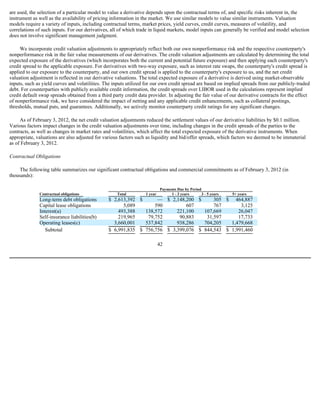
DOLLAR GENERAL CORP


                               FORMReport)
                                        10-K
                                (Annual


Filed 03/22/12 for the Period Ending 02/03/12


  Address          100 MISSION RIDGE
                   GOODLETTSVILLE, TN 37072
Telephone          6158554000
        CIK        0000029534
    Symbol         DG
 SIC Code          5331 - Variety Stores
   Industry        Retail (Specialty)
     Sector        Services
Fiscal Year        02/01


                                     http://www.edgar-online.com
                     © Copyright 2012, EDGAR Online, Inc. All Rights Reserved.
      Distribution and use of this document restricted under EDGAR Online, Inc. Terms of Use.
UNITED STATES
                       SECURITIES AND EXCHANGE COMMISSION
                                                                Washington, D.C. 20549


                                                                 FORM 10-K
                          ANNUAL REPORT PURSUANT TO SECTION 13 OR 15(d) OF THE
                                   SECURITIES EXCHANGE ACT OF 1934

                                                        For the fiscal year ended February 3, 2012

                                                           Commission file number: 001-11421


                                 DOLLAR GENERAL CORPORATION
                                                  (Exact name of registrant as specified in its charter)

                                                    TENNESSEE                           61-0502302
                                            (State or other jurisdiction of          (I.R.S. Employer
                                           incorporation or organization)           Identification No.)

                                                                100 MISSION RIDGE
                                                          GOODLETTSVILLE, TN 37072
                                                    (Address of principal executive offices, zip code)

                                       Registrant's telephone number, including area code: (615) 855-4000

     Securities registered pursuant to Section 12(b) of the Act:

                                  Title of each class                                        Name of the exchange on which registered
                   Common Stock, par value $0.875 per share                                      New York Stock Exchange

     Securities registered pursuant to Section 12(g) of the Act: None

     Indicate by check mark if the registrant is a well-known seasoned issuer, as defined in Rule 405 of the Securities Act. Yes Ă˝             No o

     Indicate by check mark if the registrant is not required to file reports pursuant to Section 13 or 15(d) of the Act. Yes o         No Ă˝

      Indicate by check mark whether the registrant (1) has filed all reports required to be filed by Section 13 or 15(d) of the Securities
Exchange Act of 1934 during the preceding 12 months (or for such shorter period that the registrant was required to file such reports), and
(2) has been subject to such filing requirements for the past 90 days. Yes Ă˝ No o

     Indicate by check mark whether the registrant has submitted electronically and posted on its corporate Web site, if any, every Interactive
Data File required to be submitted and posted pursuant to Rule 405 of Regulation S-T during the preceding 12 months (or for such shorter
period that the registrant was required to submit and post such files). Yes Ă˝ No o

     Indicate by check mark if disclosure of delinquent filers pursuant to Item 405 of Regulation S-K is not contained herein, and will not be
contained, to the best of registrant's knowledge, in definitive proxy or information statements incorporated by reference in Part III of this
Form 10-K or any amendment to this Form 10-K. Ă˝

      Indicate by check mark whether the registrant is a large accelerated filer, an accelerated filer, a non-accelerated filer, or a smaller
reporting company. See the definitions of "large accelerated filer," "accelerated filer" and "smaller reporting company" in Rule 12b-2 of the
Exchange Act.

   Large accelerated filer Ă˝                 Accelerated filer o              Non-accelerated filer o                   Smaller reporting company o
                                                                                   (Do not check if a
                                                                               smaller reporting company)
Indicate by check mark whether the registrant is a shell company (as defined in Rule 12b-2 of the Exchange Act). Yes o         No Ă˝

      The aggregate fair market value of the registrant's common stock outstanding and held by non-affiliates as of July 29, 2011 was
$3.12 billion calculated using the closing market price of our common stock as reported on the NYSE on such date ($31.46). For this purpose,
directors, executive officers and greater than 10% record shareholders are considered the affiliates of the registrant.

     The registrant had 338,091,175 shares of common stock outstanding as of March 16, 2012.

                                            DOCUMENTS INCORPORATED BY REFERENCE

      Certain of the information required in Part III of this Form 10-K is incorporated by reference to the Registrant's definitive proxy statement
to be filed for the Annual Meeting of Shareholders to be held on June 1, 2012.
INTRODUCTION

General

     This report contains references to years 2012, 2011, 2010, 2009, 2008, and 2007, which represent fiscal years ending or ended February 1,
2013, February 3, 2012, January 28, 2011, January 29, 2010, January 30, 2009, and February 1, 2008, respectively. Our fiscal year ends on the
Friday closest to January 31, and each of the years listed will be or were 52-week years, with the exception of 2011 which consisted of
53 weeks. All of the discussion and analysis in this report should be read with, and is qualified in its entirety by, the Consolidated Financial
Statements and related notes.

     Solely for convenience, our trademarks and tradenames may appear in this report without the ® or TM symbol which is not intended to
indicate that we will not assert, to the fullest extent under applicable law, our rights or the right to these trademarks and tradenames.

Cautionary Disclosure Regarding Forward-Looking Statements

     We include "forward-looking statements" within the meaning of the federal securities laws throughout this report, particularly under the
headings "Business," "Management's Discussion and Analysis of Financial Condition and Results of Operations," and "Note 9—Commitments
and Contingencies," among others. You can identify these statements because they are not limited to historical fact or they use words such as
"may," "will," "should," "could," "believe," "anticipate," "project," "plan," "expect," "estimate," "forecast," "goal," "potential," "opportunity,"
"intend," "will likely result," or "will continue" and similar expressions that concern our strategy, plans, intentions or beliefs about future
occurrences or results. For example, all statements relating to our estimated and projected expenditures, cash flows, results of operations,
financial condition and liquidity; our plans, objectives and expectations for future operations, growth or initiatives; or the expected outcome or
effect of pending or threatened litigation or audits are forward-looking statements.

     All forward-looking statements are subject to risks and uncertainties that may change at any time, so our actual results may differ
materially from those that we expected. We derive many of these statements from our operating budgets and forecasts, which are based on
many detailed assumptions that we believe are reasonable. However, it is very difficult to predict the effect of known factors, and we cannot
anticipate all factors that could affect our actual results.

     Important factors that could cause actual results to differ materially from the expectations expressed in our forward-looking statements are
disclosed under "Risk Factors" in Part I, Item 1A and elsewhere in this document (including, without limitation, in conjunction with the
forward-looking statements themselves and under the heading "Critical Accounting Policies and Estimates"). All forward-looking statements
are qualified in their entirety by these and other cautionary statements that we make from time to time in our other SEC filings and public
communications. You should evaluate such statements in the context of these risks and uncertainties. These factors may not contain all of the
factors that are important to you. We cannot assure you that we will realize the results or developments we anticipate or, even if substantially
realized, that they will result in the consequences or affect us in the way we expect. Forward-looking statements are made only as of the date
hereof. We undertake no obligation to publicly update or revise any forward-looking statement as a result of new information, future events or
otherwise, except as otherwise required by law.

                                                                         1
PART I

ITEM 1.    BUSINESS

General

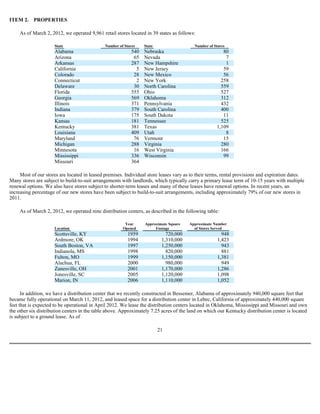
     We are the largest discount retailer in the United States by number of stores, with 9,961 stores located in 39 states as of March 2, 2012,
primarily in the southern, southwestern, midwestern and eastern United States. We offer a broad selection of merchandise, including
consumables, seasonal, home products and apparel. Our merchandise includes high quality national brands from leading manufacturers, as well
as comparable quality private brand selections with prices at substantial discounts to national brands. We offer our merchandise at everyday
low prices (typically $10 or less) through our convenient small-box (approximately 7,200 square feet) locations.

Our History

    J.L. Turner founded our Company in 1939 as J.L. Turner and Son, Wholesale. We were incorporated as a Kentucky corporation under the
name J.L. Turner & Son, Inc. in 1955, when we opened our first Dollar General store. We changed our name to Dollar General Corporation in
1968 and reincorporated in 1998 as a Tennessee corporation. Our common stock was publicly traded from 1968 until July 2007, when we
merged with an entity controlled by investment funds affiliated with Kohlberg Kravis Roberts & Co. L.P., or KKR. In November 2009 our
common stock again became publicly traded. Buck Holdings, L.P., a Delaware limited partnership controlled by KKR, continues to
beneficially own a significant percentage of our outstanding common stock.

Our Business Model

     Our long history of profitable growth is founded on a commitment to a relatively simple business model: providing a broad base of
customers with their basic everyday and household needs, supplemented with a variety of general merchandise items, at everyday low prices in
conveniently located, small-box stores. We continually evaluate the needs and demands of our customers and modify our merchandise
selections and pricing accordingly, while remaining focused on increasing profitability for our shareholders.

    Fiscal year 2011 represented our 22 nd consecutive year of same-store sales growth. This growth, regardless of economic conditions,
suggests that we have a less cyclical model than most retailers and, we believe, is a result of our compelling value and convenience proposition.

    Our attractive store economics, including a relatively low initial investment and simple, low cost operating model, have allowed us to
grow our store base to current levels, and provide us significant opportunities to continue our profitable store growth strategy.

     Compelling Value and Convenience Proposition. Our ability to deliver highly competitive prices on national brand and quality private
brand products in convenient locations and our easy in and out shopping format create a compelling shopping experience that distinguishes us
from other discount, convenience and drugstore retailers. Our slogan, "Save time. Save money. Every day!" summarizes our appeal to
customers. We believe our ability to effectively deliver both value and convenience allows us to succeed in small markets with limited
shopping alternatives, as well as to profitably coexist alongside larger retailers in more competitive markets. Our compelling value and
convenience proposition is evidenced by the following attributes of our business model:

       •       Convenient Locations. Our stores are conveniently located in a variety of rural, suburban and urban communities, currently
               with approximately 70% serving communities with populations of less than 20,000. In more densely populated areas, our small-
               box stores typically serve the closely surrounding neighborhoods. The majority of our customers live within three to five miles,
               or a

                                                                       2
10-minute drive, of our stores. Our close proximity to customers drives customer loyalty and trip frequency and makes us an
               attractive alternative to large discount and other large-box retail and grocery stores which are often located farther away. Our
               low cost economic model enables us to serve many areas with fewer than 1,500 households.

       •       Time-Saving Shopping Experience. We also provide customers with a highly convenient shopping experience. Our stores'
               smaller size allows us to locate parking near the front entrance. Our product offering includes most necessities, such as basic
               packaged and refrigerated food and dairy products, cleaning supplies, paper products, and health and beauty care items, as well
               as greeting cards, party supplies, apparel, housewares, hardware and automotive supplies, among others. Our typical store opens
               at 8:00 a.m. and closes at 9:00 p.m. or 10:00 p.m., seven days per week. Our convenient hours and broad merchandise offering
               allow our customers to fulfill their routine shopping requirements and minimize their need to shop elsewhere.

       •       Everyday Low Prices on Quality Merchandise. Our research indicates that we offer a price advantage over most food and drug
               retailers and that our prices are highly competitive with even the largest discount retailers. Our ability to offer everyday low
               prices on quality merchandise is supported by our low-cost operating structure and our strategy to maintain a limited number of
               stock keeping units ("SKUs") per category, which we believe helps us maintain strong purchasing power. Most items are priced
               below $10, with approximately 25% at $1 or less. We offer quality nationally advertised brands at these everyday low prices in
               addition to offering our own comparable quality private brands at value prices.

     Attractive Store Economics. The traditional Dollar General store size, design and location requires minimal initial capital investment
and low maintenance expenditures. Our typical locations involve a modest, no-frills building, which helps keep our rental and other fixed
overhead costs relatively low. Our leased stores generally deliver positive cash flow in their first year of operations, typically resulting in pay
back of capital in less than two years. Our stringent market analysis, real estate site selection and new store approval processes as well as our
new store marketing programs help us optimize financial returns and minimize the risks of opening unprofitable stores.

     Our lean store staffing model and centralized management of utilities, maintenance and supplies procurement contribute to our relatively
low operating costs and efficient store operations. Recent additions and upgrades to technology in our stores, including high-speed data
transmission, inventory control, workforce management and task management systems are enabling us to manage our store operations even
more effectively.

     Substantial Growth Opportunities. We believe we have the long-term potential in the U.S. to more than double our existing store base
while maintaining strong returns on capital. We have identified significant opportunities to add new stores in both existing and new markets. In
addition, we have opportunities within our existing store base to relocate or remodel to better serve our customers. See "Our Growth Strategy"
for additional details.

Our Growth Strategy

     We believe we have the right strategy and execution capabilities to capitalize on the considerable growth opportunities afforded by our
business model. We believe we continue to have significant opportunities to drive profitable growth through increasing same-store sales,
expanding our operating profit rate and growing our store base.

     Increasing Same-Store Sales. We believe the combination of our necessity-driven product mix and our attractive value proposition,
including a well-balanced merchandising approach, provides a strong basis for increased sales. Our average sales per square foot increased to
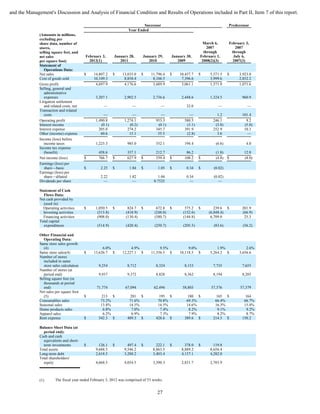
$213 in 2011 (including a $4 contribution from the 53 rd week) from $201 in 2010 and $195 in 2009. We believe we will continue to

                                                                          3
have additional opportunities to increase our store productivity through improved in-stock positions, price optimization, continued
improvements in space utilization, and additional operating and merchandising initiatives, including further expansion of our frozen and
refrigerated food offerings.

     We remodeled or relocated 575 stores in 2011, and we plan to relocate or remodel 550 stores in 2012. Remodels and relocations typically
drive incremental same-store sales growth. A relocation typically results in an improved, more visible and accessible location, and usually
includes increased square footage. We believe we will continue to have opportunities for additional remodels and relocations beyond 2012.

     Expanding Operating Profit Rate. Another key component of our growth strategy is improving our operating profit rate through
enhanced gross profit and expense reduction initiatives. Even though we faced challenges in 2011 resulting from ongoing pressures with regard
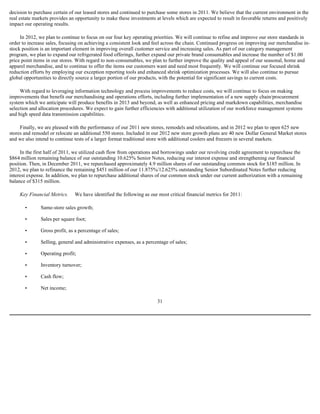
to discretionary spending and significant increases in product costs, we were able to increase our operating profit by 17%, equal to 30 basis
points as a percent of sales, primarily due to our ongoing efforts to reduce selling, general and administrative expenses as a percent of sales.

      We remain committed to an everyday low price ("EDLP") strategy that our customers can depend on. To strengthen our adherence to this
strategy and still protect gross profit, we utilize various pricing and merchandising options, including price optimization strategies, changes to
our product selection, such as alternate national brands and the expansion of our private brands, and modifications to our packaging and
product size. In 2011, the cost of many basic commodities, including cotton, sugar, coffee, groundnuts and resin, as well as transportation fuel,
increased, and many of these increases were passed along to us by our vendors. These cost increases posed a challenge to our continued priority
of improving our gross profit rate in 2011.

     Our private brand program complements our model of offering customers nationally branded consumables merchandise at everyday low
prices. When compared to similar national brands, private or proprietary brand items generally have higher gross profit rates. The addition of
private brands also allows us to better control quality and improve our packaging and shelf presentation over less recognizable "packer" labels.
Over the past few years we have expanded our private brand initiative to our non-consumable offerings, dramatically improving the visual
impact of many of our non-consumables, including housewares, domestics, lawn and garden tools and summer toys.

    In addition, in 2010 and 2011, we increased our offering of items at the $1.00 price point, focusing first on food followed by health and
beauty. Because we believe this program adds incremental sales and gross profit, we plan to further this program in 2012, continuing to
combine some of our $1.00 EDLP items with special purchases.

      Improving our inventory shrinkage has been and continues to be an important component of expanding our gross profit rate. To achieve
this objective we have concentrated our shrink reduction efforts on stores with the highest shrink rates. In addition, we have been successful in
employing exception reporting tools and enhanced shrink optimization processes.

     We also continue to believe we have the potential to directly source a larger portion of our products internationally at significant savings
to current costs. In 2011, we imported approximately $780 million of goods, or 8% of total purchases, at cost.

     We continually look for ways to improve our cost structure and enhance efficiencies throughout the organization. For example, in 2011,
we fully implemented a store workforce management program, and made further progress on reducing costs through our energy management
and centralized procurement systems.

                                                                         4
Growing Our Store Base. Based on a detailed, market-by-market analysis, we believe we have the potential to at least double our
current number of stores through expansion in both existing and new markets. In 2011, we made our initial entrance into Connecticut, New
Hampshire and Nevada (our first new states since 2006) and in 2012 we plan to open approximately 50 stores in California. We have
confidence in our real estate disciplines and in our ability to identify, open and operate successful new stores. As a result, we believe that at
least our present level of new store growth is sustainable for the foreseeable future.

Our Merchandise

     We offer a focused assortment of everyday necessities, which drive frequent customer visits, and key items in a broad range of general
merchandise categories. Our product assortment provides the opportunity for our customers to address most of their basic shopping needs with
one trip. We sell high quality national brands from leading manufacturers such as Procter & Gamble, Kimberly Clark, Unilever, Kellogg's,
General Mills, Nabisco, Coca-Cola and PepsiCo, which are typically found at higher retail prices elsewhere. Additionally, our private brand
consumables offer consumers even greater value with options to purchase value items and national brand equivalent products at substantial
discounts to the national brand.

     Our stores generally offer approximately 10,000 total SKUs per store; however, the number of SKUs in a given store can vary based upon
the store's size, geographic location, merchandising initiatives, seasonality, and other factors. Most of our products are priced at $10 or less,
with approximately 25% at $1 or less. We separate our merchandise into four categories: 1) consumables; 2) seasonal; 3) home products; and
4) apparel.

     Consumables is our largest category and includes paper and cleaning products (such as paper towels, bath tissue, paper dinnerware, trash
and storage bags, laundry and other home cleaning supplies); food, including packaged food and perishables (such as cereals, canned soups and
vegetables, sugar, flour, milk, eggs and bread); beverages and snacks (including candy, cookies, crackers, salty snacks and carbonated
beverages); health and beauty (including over-the-counter medicines and personal care products, such as soap, body wash, shampoo, dental
hygiene and foot care products); and pet (including pet supplies and pet food).

    Seasonal products include decorations, toys, batteries, small electronics, greeting cards, stationery, prepaid cell phones and accessories,
gardening supplies, hardware, automotive and home office supplies.

     Home products includes kitchen supplies, cookware, small appliances, light bulbs, storage containers, frames, candles, craft supplies and
kitchen, bed and bath soft goods.

     Apparel includes casual everyday apparel for infants, toddlers, girls, boys, women and men, as well as socks, underwear, disposable
diapers, shoes and accessories.

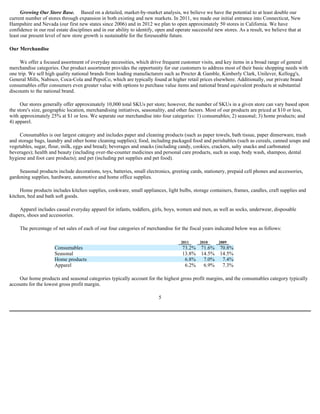
     The percentage of net sales of each of our four categories of merchandise for the fiscal years indicated below was as follows:

                                                                                     2011     2010      2009
                      Consumables                                                    73.2%     71.6%    70.8%
                      Seasonal                                                       13.8%     14.5%    14.5%
                      Home products                                                   6.8%      7.0%     7.4%
                      Apparel                                                         6.2%      6.9%     7.3%

    Our home products and seasonal categories typically account for the highest gross profit margins, and the consumables category typically
accounts for the lowest gross profit margin.

                                                                          5
The Dollar General Store

     The average Dollar General store has approximately 7,200 square feet of selling space and is typically operated by a store manager, an
assistant store manager and three or more sales clerks. Approximately 60% of our stores are in freestanding buildings and 40% are in strip
shopping centers. Most of our customers live within three to five miles, or a 10 minute drive, of our stores. Our traditional store strategy
features low initial capital expenditures, limited maintenance capital, low occupancy and operating costs, and a focused merchandise offering
within a broad range of categories, allowing us to deliver low retail prices while generating strong cash flows and investment returns. In 2011,
the average cost of equipment and fixtures in our traditional leased stores was approximately $180,000. Initial inventory, net of payables,
increases the investment in a new store by approximately $75,000.

      We generally have had good success in locating suitable store sites in the past. Given the size of the communities that we target, we
believe that there is ample opportunity for new store growth in existing and new markets. In addition, the current real estate market has
continued to provide opportunities for us to access higher quality sites at lower rates than in recent years. Also, we believe we have significant
opportunities available for our relocation and remodel programs. We spend approximately $80,000 for equipment and fixtures to remodel a
traditional store and approximately $160,000 to relocate a traditional store. We remodeled or relocated 575 stores in 2011, 504 in 2010 and 450
in 2009.

      At the end of 2011, our total store count included 69 Dollar General Market stores, which, in addition to the merchandise offering of a
traditional Dollar General store, feature an expanded food section, including fresh meat and produce and significantly more frozen and
refrigerated foods. These stores, which average approximately 16,000 square feet of selling space, are an alternative to the typical grocery store
or supermarket, and generally contribute more to sales and operating income than our traditional stores. In 2011, we opened 12 new Dollar
General Markets, including seven as part of our initial entrance into Nevada. We plan to open approximately 40 new Dollar General Markets in
2012, including a significant percentage of our initial stores in California. Our focus is on locating the Dollar General Market stores in areas
that are generally underserved by large grocery chains. We continue to test and adjust the Dollar General Market concept and how we build and
open the stores, as the capital investment for these stores is significantly higher than our traditional stores. In addition to the Market stores, we
are also testing a larger format traditional store with approximately 10,000 square feet of selling space, including an expanded section of
coolers and freezers. Like the Dollar General Market stores, these larger format stores currently require significantly higher capital investment
than our traditional stores and we are working to reduce that difference.

     Our recent store growth is summarized in the following table:

                                                   Stores at                              Net
                                                   Beginning    Stores        Stores     Store     Stores at
                      Year                          of Year     Opened        Closed   Increase   End of Year
                      2009                             8,362        500           34       466         8,828
                      2010                             8,828        600           56       544         9,372
                      2011                             9,372        625           60       565         9,937

Our Customers

    Our customers seek value and convenience. Depending on their financial situation and geographic proximity, customers' reliance on
Dollar General varies from using Dollar General for fill-in shopping, to making periodic trips to stock up on household items, to making
weekly or more frequent trips to meet most essential needs. We believe that our value and convenience proposition attracts customers from a
wide range of income brackets and life stages. In the last year, we have continued to see

                                                                          6
increases in the annual number of shopping trips that our customers make to our stores as well as the amount spent during each trip.

    To attract new and retain existing customers, we continue to focus on product quality and selection, in-stock levels and pricing, targeted
advertising, improved store standards, convenient site locations, and a pleasant overall customer experience.

Our Suppliers

     We purchase merchandise from a wide variety of suppliers and maintain direct buying relationships with many producers of national
brand merchandise, such as Procter & Gamble, Kimberly Clark, Unilever, Kellogg's, General Mills, Nabisco, Coca-Cola and PepsiCo. Despite
our broad offering, we maintain only a limited number of SKUs per category, giving us a pricing advantage in dealing with our suppliers.
Approximately 8% and 7% of our purchases in 2011 were from our largest and second largest suppliers, respectively. Our private brands come
from a diversified supplier base. We directly imported approximately 8% of our purchases at cost (12% of our purchases based on their retail
value) in 2011. Our vendor arrangements generally provide for payment for such merchandise in U.S. dollars.

     We have consistently managed to obtain sufficient quantities of core merchandise and believe that, if one or more of our current sources of
supply became unavailable, we would generally be able to obtain alternative sources without experiencing a substantial disruption of our
business. However, such alternative sources could increase our merchandise costs or reduce the quality of our merchandise, and an inability to
obtain alternative sources could adversely affect our sales.

Distribution, Transportation and Inventory Management

      Our stores are currently supported by ten distribution centers located strategically throughout our geographic footprint, including a new
distribution center in Bessemer, Alabama which began shipping to stores on March 11, 2012. We lease additional temporary warehouse space
as necessary to support our distribution needs. In addition, we have leased a distribution facility in Lebec, California which we expect to be
operational in April 2012. Over the past few years we have made significant investments in facilities, technological improvements and
upgrades, and we continue to improve work processes, all of which increase our efficiency and ability to support our merchandising and
operations initiatives as well as our new store growth. We continually analyze and rebalance the network to ensure that it remains efficient and
provides the service our stores require. See "—Properties" for additional information pertaining to our distribution centers.

      Most of our merchandise flows through our distributions centers and is delivered to our stores by third-party trucking firms, utilizing our
trailers. Our agreements with these trucking firms are based on estimated costs of diesel fuel, with the difference in estimated and current
market fuel costs passed through to us. The costs of diesel fuel are significantly influenced by international, political and economic
circumstances, and were considerably higher throughout 2011 than in 2010. If such increased prices remain in effect, or if further price
increases were to arise for any reason, including fuel supply shortages or unusual price volatility, the resulting higher fuel prices could
materially increase our transportation costs.

     We believe that there remains opportunity to improve our inventory turns. Initiatives in process include operational efforts to optimize
presentation levels, improve in-stock levels and decrease excess quantities shipped to our stores. We continue to focus on SKU optimization in
an attempt to ensure that we can meet customers' demands for our most popular products as well as ensure appropriate product assortment. We
are also in the process of implementing an improved supply chain solution to assist in ordering, monitoring and tracking inventory from
purchase order to receipt to maintain efficient levels of inventory. We turned our inventory approximately 5.3 times over the most recent four
quarters.

                                                                         7
Seasonality

      Our business is seasonal to a certain extent. Generally, our highest sales volume occurs in the fourth quarter, which includes the Christmas
selling season, and the lowest occurs in the first quarter. In addition, our quarterly results can be affected by the timing of certain holidays, the
timing of new store openings and store closings, the amount of sales contributed by new and existing stores, as well as financial transactions
such as debt repurchases, common stock offerings and stock repurchases. We purchase substantial amounts of inventory in the third quarter and
incur higher shipping costs and higher payroll costs in anticipation of the increased sales activity during the fourth quarter. In addition, we
carry merchandise during our fourth quarter that we do not carry during the rest of the year, such as gift sets, holiday decorations, certain
baking items, and a broader assortment of toys and candy.

     The following table reflects the seasonality of net sales, gross profit, and net income by quarter for each of the quarters of our three most
recent fiscal years. The fourth quarter of the year ended February 3, 2012 was comprised of 14 weeks, and each of the other quarters reflected
below were comprised of 13 weeks.

                                                               1 st         2 nd         3 rd         4 th
                      (in millions)                          Quarter       Quarter      Quarter      Quarter
                      Year Ended February 3, 2012
                      Net sales                             $ 3,451.7 $ 3,575.2 $ 3,595.2 $ 4,185.1
                      Gross profit                            1,087.4   1,148.3   1,115.8   1,346.4
                      Net income(a)                             157.0     146.0     171.2     292.5

                      Year Ended January 28, 2011
                      Net sales                             $ 3,111.3 $ 3,214.2 $ 3,223.4 $ 3,486.1
                      Gross profit                              999.8   1,036.0   1,010.7   1,130.2
                      Net income                                136.0     141.2     128.1     222.5

                      Year Ended January 29, 2010
                      Net sales                             $ 2,779.9 $ 2,901.9 $ 2,928.8 $ 3,185.8
                      Gross profit                              855.4     906.0     903.1   1,025.4
                      Net income(b)                              83.0      93.6      75.6      87.2


                      (a)       Includes expenses, net of income taxes, of $35.4 million related to the redemption of long-term obligations in
                                second quarter of 2011.

                      (b)       Includes expenses, net of income taxes, of $82.9 million related to our initial public offering during the fourth
                                quarter of 2009.

Our Competition

      We operate in the basic discount consumer goods market, which is highly competitive with respect to price, store location, merchandise
quality, assortment and presentation, in-stock consistency, and customer service. We compete with discount stores and with many other
retailers, including mass merchandise, grocery, drug, convenience, variety and other specialty stores. These other retail companies operate
stores in many of the areas where we operate, and many of them engage in extensive advertising and marketing efforts. Our direct competitors
include Family Dollar, Dollar Tree, Fred's, 99 Cents Only and various local, independent operators, as well as Walmart, Target, Walgreens,
CVS, and Rite Aid, among others. Certain of our competitors have greater financial, distribution, marketing and other resources than we do.

     We differentiate ourselves from other forms of retailing by offering consistently low prices in a convenient, small-store format. We
believe that our prices are competitive due in part to our low cost operating structure and the relatively limited assortment of products offered.
Historically, we have

                                                                           8
minimized labor by offering fewer price points and a reliance on simple merchandise presentation. Purchasing large volumes of merchandise
within our focused assortment in each merchandise category allows us to keep our average costs low, contributing to our ability to offer
competitive everyday low prices to our customers. See "—Our Business Model" above for further discussion of our competitive situation.

Our Employees

      As of March 2, 2012, we employed approximately 90,000 full-time and part-time employees, including divisional and regional managers,
district managers, store managers, other store personnel and distribution center and administrative personnel. We have increasingly focused on
recruiting, training, motivating and retaining employees, and we believe that the quality, performance and morale of our employees have
increased as a result. We currently are not a party to any collective bargaining agreements.

Our Trademarks

     We own marks that are registered with the United States Patent and Trademark Office and are protected under applicable intellectual
property laws, including without limitation the trademarks Dollar General®, Dollar General Market®, Clover Valley®, DG®, DG
Guarantee®, Smart & Simple®, trueliving®, Sweet Smiles®, Open Trails®, and the Dollar General price point designs, along with variations
and formatives of these trademarks as well as certain other trademarks. Effective as of February 1, 2012 we exercised an option to purchase the
Bobbie Brooks® trademark. We expect to file assignment documents in applicable trademark offices in the coming weeks. We attempt to
obtain registration of our trademarks whenever practicable and to pursue vigorously any infringement of those marks. Our trademark
registrations have various expiration dates; however, assuming that the trademark registrations are properly renewed, they have a perpetual
duration.

     We also hold licenses to use various trademarks owned by third parties, including a license to the Fisher Price brand for certain items of
children's clothing through December 31, 2013, and an exclusive license to the Rexall brand through March 5, 2020.

Available Information

      Our Web site address is www.dollargeneral.com. We file with or furnish to the Securities and Exchange Commission (the "SEC") annual
reports on Form 10-K, quarterly reports on Form 10-Q, current reports on Form 8-K, and amendments to those reports, proxy statements and
annual reports to shareholders, and, from time to time, registration statements and other documents. These documents are available free of
charge to investors on or through the Investor Information portion of our Web site as soon as reasonably practicable after we electronically file
them with or furnish them to the SEC. In addition, the public may read and copy any of the materials we file with the SEC at the SEC's Public
Reference Room at 100 F Street, NE, Washington DC 20549. The public may obtain information on the operation of the Public Reference
Room by calling the SEC at 1-800-SEC-0330. The SEC maintains an internet site that contains reports, proxy and information statements and
other information regarding issuers, such as Dollar General, that file electronically with the SEC. The address of that Web site is
http://www.sec.gov.

                                                                        9
ITEM 1A.      RISK FACTORS

      You should carefully consider the risks described below and the other information contained in this report and other filings that we make
from time to time with the SEC, including our consolidated financial statements and accompanying notes. Any of the following risks could
materially and adversely affect our business, financial condition, results of operations or liquidity. In addition, the risks described below are not
the only risks we face. Our business, financial condition, results of operations or liquidity could also be adversely affected by additional factors
that apply to all companies generally, as well as other risks that are not currently known to us or that we currently view to be immaterial. While
we attempt to mitigate known risks to the extent we believe to be practicable and reasonable, we can provide no assurance, and we make no
representation, that our mitigation efforts will be successful.

     Current economic conditions and other economic factors may adversely affect our financial performance and other aspects of our
business.

     We believe that many of our customers are on fixed or low incomes and generally have limited discretionary spending dollars. A further
slowdown in the economy, or a delayed recovery, or other economic conditions affecting disposable consumer income, such as increased
unemployment or underemployment levels, inflation, increases in fuel or other energy costs and interest rates, lack of available credit,
consumer debt levels, higher tax rates and other changes in tax laws, and further erosion in consumer confidence, may adversely affect our
business by reducing our customers' spending or by causing them to shift their spending to products other than those sold by us or to products
sold by us that are less profitable than other product choices, all of which could result in lower net sales, decreases in inventory turnover,
greater markdowns on inventory, and a reduction in profitability due to lower margins. Many of those factors, as well as commodity rates,
transportation costs (including the costs of diesel fuel), costs of labor, insurance and healthcare, foreign exchange rate fluctuations, lease costs,
measures that create barriers to or increase the costs associated with international trade, changes in other laws and regulations and other
economic factors, also affect our cost of goods sold and our selling, general and administrative expenses, which may adversely affect our sales
or profitability. We have limited or no ability to control many of these factors. Product costs began to escalate in our 2010 fourth quarter as a
result of increases in the costs of certain commodities (including cotton, sugar, coffee, groundnuts, resin), and increasing diesel fuel costs. We
will be diligent in our efforts to keep product costs as low as possible in the face of these increases while still working to optimize gross profit
and meet the needs of our customers.

     In addition, many of the factors discussed above, along with current global economic conditions and uncertainties, the potential for
additional failures or realignments of financial institutions, and the related impact on available credit may affect us and our suppliers and other
business partners, landlords and service providers in an adverse manner including, but not limited to, reducing access to liquid funds or credit,
increasing the cost of credit, limiting our ability to manage interest rate risk, increasing the risk of bankruptcy of our suppliers, landlords or
counterparties to, or other financial institutions involved in, our credit facilities and our derivative and other contracts, increasing the cost of
goods to us, and other adverse consequences which we are unable to fully anticipate or control.

     Our plans depend significantly on initiatives designed to increase sales and improve the efficiencies, costs and effectiveness of our
operations, and failure to achieve or sustain these plans could affect our performance adversely.

      We have initiatives (such as those relating to marketing, merchandising, promotions, sourcing, shrink, private brand, store operations and
real estate) in various stages of testing, evaluation, and implementation, upon which we expect to rely to continue to improve our results of
operations and financial condition and to achieve our financial plans. These initiatives are inherently risky and uncertain, even when tested
successfully, in their application to our business in general. It is possible

                                                                         10
that successful testing can result partially from resources and attention that cannot be duplicated in broader implementation, particularly in light
of the diverse geographic locations of our stores and the fact that our field management is so decentralized. General implementation also may
be negatively affected by other risk factors described herein. Successful systemwide implementation relies on consistency of training, stability
of workforce, ease of execution, and the absence of offsetting factors that can influence results adversely. Failure to achieve successful
implementation of our initiatives or the cost of these initiatives exceeding management's estimates could adversely affect our results of
operations and financial condition.

     In addition, the success of our merchandising initiatives, particularly those with respect to non-consumable merchandise, depends in part
upon our ability to predict consistently and successfully the products our customers will demand and to identify and timely respond to evolving
trends in demographics and consumer preferences, expectations and needs. If we are unable to select products that are attractive to customers,
to obtain such products at costs that allow us to sell them at a profit, or to effectively market such products, our sales, market share and
profitability could be adversely affected. If our merchandising efforts in the non-consumables area are unsuccessful, we could be further
adversely affected by our inability to offset the lower margins associated with our consumables business.

     We face intense competition that could limit our growth opportunities and adversely impact our financial performance.

      The retail business is highly competitive. We operate in the basic discount consumer goods market, which is competitive with respect to
price, store location, merchandise quality, assortment and presentation, in-stock consistency, and customer service. This competitive
environment subjects us to the risk of adverse impact to our financial performance because of the lower prices, and thus the lower margins,
required to maintain our competitive position. Also, companies like ours operating in the basic discount consumer goods market (due to
customer demographics and other factors) may have limited ability to increase prices in response to increased costs without losing competitive
position. This limitation may adversely affect our margins and financial performance. We compete for customers, employees, store sites,
products and services and in other important aspects of our business with many other local, regional and national retailers. We compete with
retailers operating discount, mass merchandise, outlet, warehouse club, grocery, drug, convenience, variety and other specialty stores. Certain
of our competitors have greater financial, distribution, marketing and other resources than we do and may be able to secure better arrangements
with suppliers than we can. These other competitors compete in a variety of other ways, including aggressive promotional activities,
merchandise selection and availability, services offered to customers, location, store hours, in-store amenities and price. If we fail to respond
effectively to competitive pressures and changes in the retail markets, it could adversely affect our financial performance.

      Competition for customers has intensified in recent years as larger competitors have moved into, or increased their presence in, our
geographic markets. In addition, some of our large box competitors are or may be developing small box formats which may produce more
competition. We remain vulnerable to the marketing power and high level of consumer recognition of these larger competitors and to the risk
that these competitors or others could venture into our industry in a significant way. Generally, we expect an increase in competition.

     Our private brands may not achieve or maintain broad market acceptance and increase the risks we face.

     We have substantially increased the number of our private brand items, and the program is a sizable part of our future growth plans. We
believe that our success in gaining and maintaining broad market acceptance of our private brands depends on many factors, including pricing,
our costs, quality and customer perception. We may not achieve or maintain our expected sales for our private brands.

                                                                        11
As a result, our business, financial condition and results of operations could be materially and adversely affected.

     A significant disruption to our distribution network or to the timely receipt of inventory could adversely impact sales or increase our
transportation costs, which would decrease our profits.

      We rely on our distribution and transportation network to provide goods to our stores in a timely and cost-effective manner through
deliveries to our distribution centers from vendors and then from the distribution centers or direct ship vendors to our stores by various means
of transportation, including shipments by sea and truck. Any disruption, unanticipated expense or operational failure related to this process
could affect store operations negatively. For example, unexpected delivery delays or increases in transportation costs (including through
increased fuel costs or a decrease in transportation capacity for overseas shipments) could significantly decrease our ability to make sales and
earn profits. In addition, labor shortages or work stoppages in the transportation industry or long-term disruptions to the national and
international transportation infrastructure that lead to delays or interruptions of deliveries could negatively affect our business.

      We maintain a network of distribution facilities and have plans to build new facilities to support our growth objectives. Delays in opening
distribution centers could adversely affect our future operations by slowing store growth, which may in turn reduce revenue growth. In
addition, distribution-related construction or expansion projects entail risks which could cause delays and cost overruns, such as: shortages of
materials; shortages of skilled labor or work stoppages; unforeseen construction, scheduling, engineering, environmental or geological
problems; weather interference; fires or other casualty losses; and unanticipated cost increases. The completion date and ultimate cost of future
projects could differ significantly from initial expectations due to construction-related or other reasons. We cannot guarantee that any project
will be completed on time or within established budgets.

     Rising fuel costs could materially adversely affect our business.

     Fuel prices have risen considerably and are significantly influenced by international, political and economic circumstances. These
increases pose a challenge to our continued priority of improving our gross profit rate. If such increased prices remain in effect, or if further
price increases were to arise for any reason, including fuel supply shortages or unusual price volatility, the resulting higher fuel prices could
materially increase our transportation costs, adversely affecting our gross profit and results of operations. In addition, competitive pressures in
our industry may have the effect of inhibiting our ability to reflect these increased costs in the prices of our products. We will be diligent in our
efforts to keep product costs as low as possible in the face of these increases while still working to optimize gross profit and meet the needs of
our customers.

     Risks associated with or faced by the domestic and foreign suppliers from whom our products are sourced could adversely affect our
financial performance.

      The products we sell are sourced from a wide variety of domestic and international suppliers. In fact, our largest supplier accounted for
8% of our purchases in 2011, and our next largest supplier accounted for approximately 7% of such purchases. We have not experienced any
difficulty in obtaining sufficient quantities of core merchandise and believe that, if one or more of our current sources of supply became
unavailable, we would generally be able to obtain alternative sources without experiencing a substantial disruption of our business. However,
such alternative sources could increase our merchandise costs and reduce the quality of our merchandise, and an inability to obtain alternative
sources could adversely affect our sales.

      We directly imported approximately 8% of our purchases (measured at cost) in 2011, but many of our domestic vendors directly import
their products or components of their products. Changes to the

                                                                         12
prices and flow of these goods for any reason, such as political and economic instability in the countries in which foreign suppliers are located,
the financial instability of suppliers, suppliers' failure to meet our standards, issues with labor practices of our suppliers or labor problems they
may experience (such as strikes), the availability and cost of raw materials to suppliers, merchandise quality or safety issues, currency
exchange rates, transport availability and cost, inflation, and other factors relating to the suppliers and the countries in which they are located or
from which they import, are beyond our control and could adversely affect our operations and profitability. Because a substantial amount of our
imported merchandise comes from China, a change in the Chinese currency or other policies could negatively impact our merchandise costs. In
addition, the United States' foreign trade policies, tariffs and other impositions on imported goods, trade sanctions imposed on certain countries,
the limitation on the importation of certain types of goods or of goods containing certain materials from other countries and other factors
relating to foreign trade are beyond our control. Disruptions due to labor stoppages, strikes or slowdowns, or other disruptions involving our
vendors or the transportation and handling industries also may negatively affect our ability to receive merchandise and thus may negatively
affect sales. These and other factors affecting our suppliers and our access to products could adversely affect our financial performance. As we
increase our imports of merchandise from foreign vendors, the risks associated with foreign imports will increase.

     Product liability and food safety claims could adversely affect our business, reputation and financial performance.

     Despite our best efforts to ensure the quality and safety of the products we sell, we may be subject to product liability claims from
customers or penalties from government agencies relating to products, including food products that are recalled, defective or otherwise alleged
to be harmful. Such claims may result from tampering by unauthorized third parties, product contamination or spoilage, including the presence
of foreign objects, substances, chemicals, other agents, or residues introduced during the growing, storage, handling and transportation phases.
All of our vendors and their products must comply with applicable product and food safety laws. We generally seek contractual
indemnification and insurance coverage from our suppliers. However, if we do not have adequate contractual indemnification and/or insurance
available, such claims could have a material adverse effect on our business, financial condition and results of operations. Our ability to obtain
indemnification from foreign suppliers may be hindered by the manufacturers' lack of understanding of U.S. product liability or other laws,
which may make it more likely that we be required to respond to claims or complaints from customers as if we were the manufacturer of the
products. Even with adequate insurance and indemnification, such claims could significantly damage our reputation and consumer confidence
in our products. Our litigation expenses could increase as well, which also could have a materially negative impact on our results of operations
even if a product liability claim is unsuccessful or is not fully pursued.

     We are subject to governmental regulations, procedures and requirements. A significant change in, or noncompliance with, these
regulations could have a material adverse effect on our financial performance.

     Our business is subject to numerous federal, state and local laws and regulations. We routinely incur costs in complying with these
regulations. New laws or regulations, particularly those dealing with healthcare reform, product safety, and labor and employment, among
others, or changes in existing laws and regulations, particularly those governing the sale of products, may result in significant added expenses
or may require extensive system and operating changes that may be difficult to implement and/or could materially increase our cost of doing
business. In addition, such changes or new laws may require the write off and disposal of existing product inventory, resulting in significant
adverse financial impact to us. Untimely compliance or noncompliance with applicable regulations or untimely or incomplete execution of a
required product recall can result in the imposition of penalties, including loss of licenses or significant fines or monetary penalties, in addition
to reputational damage.

                                                                         13
Litigation may adversely affect our business, financial condition and results of operations.

      Our business is subject to the risk of litigation by employees, consumers, suppliers, competitors, shareholders, government agencies and
others through private actions, class actions, administrative proceedings, regulatory actions or other litigation. The number of employment-
related class actions filed each year has continued to increase, and recent changes and proposed changes in Federal and state laws may cause
claims to rise even more. The outcome of litigation, particularly class action lawsuits, regulatory actions and intellectual property claims, is
difficult to assess or quantify. Plaintiffs in these types of lawsuits may seek recovery of very large or indeterminate amounts, and the magnitude
of the potential loss relating to these lawsuits may remain unknown for substantial periods of time. In addition, certain of these lawsuits, if
decided adversely to us or settled by us, may result in liability material to our financial statements as a whole or may negatively affect our
operating results if changes to our business operations are required. The cost to defend future litigation may be significant. There also may be
adverse publicity associated with litigation that could negatively affect customer perception of our business, regardless of whether the
allegations are valid or whether we are ultimately found liable. As a result, litigation may adversely affect our business, financial condition and
results of operations. See Note 9 to the consolidated financial statements for further details regarding certain of these pending matters.

         If we cannot open new stores profitably and on schedule, our planned future growth will be impeded, which would adversely affect
sales.

     Our ability to open profitable new stores is a key component of our planned future growth. Our ability to timely open such stores and to
expand into additional market areas depends in part on the following factors: the availability of attractive store locations; the absence of
occupancy delays; the ability to negotiate acceptable lease and development terms; the ability to hire and train new personnel, especially store
managers, in a cost effective manner; the ability to identify customer demand in different geographic areas; general economic conditions; and
the availability of sufficient funds for expansion. Many of these factors affect our ability to successfully relocate stores as well, and many of
them are beyond our control. In addition, tighter lending practices may make financing more challenging for our real estate developers which
could potentially impact the timing of our store openings and build-to-suit program.

     Delays or failures in opening new stores, or achieving lower than expected sales in new stores, or drawing a greater than expected
proportion of sales in new stores away from existing stores, could materially adversely affect our growth and/or profitability. In addition, we
may not anticipate all of the challenges imposed by the expansion of our operations and, as a result, may not meet our targets for opening new
stores, remodeling or relocating stores or expanding profitably.

     Some of our new stores may be located in areas where we have little or no meaningful experience or brand recognition. Those markets
may have different competitive conditions, market conditions, consumer tastes and discretionary spending patterns than our existing markets,
which may cause our new stores to be less successful than stores in our existing markets. In addition, our alternative format stores, such as our
Dollar General Market concept, have significantly higher capital costs than our traditional Dollar General stores, and, as a result, may increase
our financial risk if they do not perform as expected.

     Many of our new stores will be located in areas where we have existing units. Although we have experience in these markets, increasing
the number of locations in these markets may result in inadvertent over-saturation of markets and temporarily or permanently divert customers
and sales from our existing stores, thereby adversely affecting our overall financial performance.

                                                                         14
Natural disasters (whether or not caused by climate change), unusual weather conditions, pandemic outbreaks, terrorist acts, and
global political events could cause permanent or temporary distribution center or store closures, impair our ability to purchase, receive or
replenish inventory, or decrease customer traffic, all of which could result in lost sales and otherwise adversely affect our financial
performance.

     The occurrence of one or more natural disasters, such as hurricanes, fires, floods, and earthquakes (whether or not caused by climate
change), solar flares, unusual weather conditions, pandemic outbreaks, terrorist acts or disruptive global political events, such as civil unrest in
countries in which our suppliers are located, or similar disruptions could adversely affect our operations and financial performance. To the
extent these events result in the closure of one or more of our distribution centers, a significant number of stores, or our corporate headquarters
or impact one or more of our key suppliers, our operations and financial performance could be materially adversely affected through an
inability to make deliveries or provide other support functions to our stores and through lost sales. In addition, these events could result in
increases in fuel (or other energy) prices or a fuel shortage, delays in opening new stores, the temporary lack of an adequate work force in a
market, the temporary or long-term disruption in the supply of products from some domestic and overseas suppliers, the temporary disruption
in the transport of goods from overseas, delay in the delivery of goods to our distribution centers or stores, the temporary reduction in the
availability of products in our stores and disruption of our utility services or to our information systems. These events also can have indirect
consequences such as increases in the costs of insurance if they result in significant loss of property or other insurable damage.

      Material damage or interruptions to our information systems as a result of external factors, staffing shortages and unanticipated
challenges or difficulties in updating our existing technology or developing or implementing new technology could have a material adverse
effect on our business or results of operations.

     We depend on a variety of information technology systems for the efficient functioning of our business. Such systems are subject to
damage or interruption from power outages, computer and telecommunications failures, computer viruses, security breaches and natural
disasters. Damage or interruption to these systems may require a significant investment to fix or replace them, and we may suffer interruptions
in our operations in the interim. Any material interruptions may have a material adverse effect on our business or results of operations.

     We also rely heavily on our information technology staff. Failure to meet these staffing needs may negatively affect our ability to fulfill
our technology initiatives while continuing to provide maintenance on existing systems. We rely on certain vendors to maintain and
periodically upgrade many of these systems so that they can continue to support our business. The software programs supporting many of our
systems were licensed to us by independent software developers. The inability of these developers or us to continue to maintain and upgrade
these information systems and software programs would disrupt or reduce the efficiency of our operations if we were unable to convert to
alternate systems in an efficient and timely manner. In addition, costs and potential problems and interruptions associated with the
implementation of new or upgraded systems and technology or with maintenance or adequate support of existing systems could also disrupt or
reduce the efficiency of our operations.

     Failure to attract and retain qualified employees, particularly field, store and distribution center managers, and to control labor costs,
as well as other labor issues, could adversely affect our financial performance.

     Our future growth and performance depends on our ability to attract, retain and motivate qualified employees, many of whom are in
positions with historically high rates of turnover such as field managers and distribution center managers. Our ability to meet our labor needs,
while controlling our labor costs, is subject to many external factors, including competition for and availability of qualified personnel in a given
market, unemployment levels within those markets, prevailing wage rates,

                                                                         15
minimum wage laws, health and other insurance costs, and changes in employment and labor laws (including changes in the process for our
employees to join a union) or other workplace regulation (including changes in entitlement programs such as health insurance and paid leave
programs). To the extent a significant portion of our employee base unionizes, or attempts to unionize, our labor costs could increase. In
addition, we are evaluating the potential future impact of recently enacted comprehensive healthcare reform legislation, which will likely cause
our healthcare costs to increase. While the significant costs of the healthcare reform legislation will occur after 2013, if at all, due to provisions
of the legislation being phased in over time, changes to our healthcare costs structure could have a significant negative effect on our business.
Our ability to pass along labor costs to our customers is constrained by our low price model.

     Our profitability may be negatively affected by inventory shrinkage.

     We are subject to the risk of inventory loss and theft. We experience significant inventory shrinkage, and we cannot assure you that
incidences of inventory loss and theft will decrease in the future or that the measures we are taking will effectively reduce the problem of
inventory shrinkage. Although some level of inventory shrinkage is an unavoidable cost of doing business, if we were to experience higher
rates of inventory shrinkage or incur increased security costs to combat inventory theft, our financial condition could be affected adversely.

     Our cash flows from operations may be negatively affected if we are not successful in managing our inventory balances.

     Our inventory balance represented approximately 49% of our total assets exclusive of goodwill and other intangible assets as of
February 3, 2012. Efficient inventory management is a key component of our business success and profitability. To be successful, we must
maintain sufficient inventory levels to meet our customers' demands without allowing those levels to increase to such an extent that the costs to
store and hold the goods unduly impacts our financial results. If our buying decisions do not accurately predict customer trends or purchasing
actions, we may have to take unanticipated markdowns to dispose of the excess inventory, which also can adversely impact our financial
results. We continue to focus on ways to reduce these risks, but we cannot assure you that we will be successful in our inventory management.
If we are not successful in managing our inventory balances, our cash flows from operations may be negatively affected.

     Because our business is seasonal to a certain extent, with the highest volume of net sales during the fourth quarter, adverse events
during the fourth quarter could materially affect our financial statements as a whole.

      We generally recognize our highest volume of net sales during the Christmas selling season, which occurs in the fourth quarter of our
fiscal year. In anticipation of this holiday, we purchase substantial amounts of seasonal inventory and hire many temporary employees. An
excess of seasonal merchandise inventory could result if our net sales during the Christmas selling season were to fall below either seasonal
norms or expectations. If our fourth quarter sales results were substantially below expectations, our financial performance and operating results
could be adversely affected by unanticipated markdowns, especially in seasonal merchandise. Lower than anticipated sales in the Christmas
selling season would also negatively affect our ability to absorb the increased seasonal labor costs.

     Our current insurance program may expose us to unexpected costs and negatively affect our financial performance.

     Our insurance coverage reflects deductibles, self-insured retentions, limits of liability and similar provisions that we believe are prudent
based on the dispersion of our operations. However, there are types of losses we may incur but against which we cannot be insured or which we
believe are not

                                                                          16
economically reasonable to insure, such as losses due to acts of war, employee and certain other crime and some natural disasters. If we incur
these losses and they are material, our business could suffer. Certain material events may result in sizable losses for the insurance industry and
adversely impact the availability of adequate insurance coverage or result in excessive premium increases. To offset negative insurance market
trends, we may elect to self-insure, accept higher deductibles or reduce the amount of coverage in response to these market changes. In
addition, we self-insure a significant portion of expected losses under our workers' compensation, automobile liability, general liability and
group health insurance programs. Unanticipated changes in any applicable actuarial assumptions and management estimates underlying our
recorded liabilities for these losses, including expected increases in medical and indemnity costs, could result in materially different expenses
than expected under these programs, which could have a material adverse effect on our financial condition and results of operations. In
addition, we are evaluating the potential future impact of recently enacted comprehensive healthcare reform legislation, which may cause our
healthcare costs to increase. Although we continue to maintain property insurance for catastrophic events at our store support center and
distribution centers, we are effectively self-insured for other property losses. If we experience a greater number of these losses than we
anticipate, our financial performance could be adversely affected.

     If we fail to protect our brand name, competitors may adopt tradenames that dilute the value of our brand name.

     We may be unable or unwilling to strictly enforce our trademarks in each jurisdiction in which we do business. Also, we may not always
be able to successfully enforce our trademarks against competitors, or against challenges by others. Our failure to successfully protect our
trademarks could diminish the value and efficacy of our brand recognition, and could cause customer confusion, which could, in turn, adversely
affect our sales and profitability.

     Our success depends on our executive officers and other key personnel. If we lose key personnel or are unable to hire additional
qualified personnel, our business may be harmed.

     Our future success depends to a significant degree on the skills, experience and efforts of our executive officers and other key personnel.
The loss of the services of any of our executive officers, particularly Richard W. Dreiling, our Chief Executive Officer, could have a material
adverse effect on our operations. Our future success will also depend on our ability to attract and retain qualified personnel and a failure to
attract and retain new qualified personnel could have an adverse effect on our operations. We do not currently maintain key person life
insurance policies with respect to our executive officers or key personnel.

     We face risks related to protection of customers' credit and debit card data and private data relating to us or our customers or
employees.

     In connection with credit card sales, we transmit confidential credit and debit card information. We also have access to, collect or maintain
private or confidential information regarding our customers and employees, as well as our business. We have procedures and technology in
place to safeguard our customers' debit and credit card information, our employees' private data, and our confidential business information.
However, third parties may have the technology or know-how to breach the security of this information, and our security measures and those of
our technology vendors may not effectively prohibit others from obtaining improper access to this information. A security breach of any kind
could expose us to risks of data loss, litigation, government enforcement actions and costly response measures, and could seriously disrupt our
operations. Any resulting negative publicity could significantly harm our reputation which could cause us to lose market share and have an
adverse effect on our financial results.

                                                                        17
While we have reduced our debt levels since 2007, we continue to have substantial debt that will need to be repaid or refinanced at or
prior to applicable maturity dates which could adversely affect our ability to raise additional capital to fund our operations and limit our
ability to pursue our growth strategy or other opportunities or to react to changes in the economy or our industry.

      At February 3, 2012, we had total outstanding debt (including the current portion of long-term obligations) of $2.618 billion, including a
$1.964 billion senior secured term loan facility which matures on July 6, 2014, $450.7 million aggregate principal amount of 11.875% /
12.625% senior subordinated toggle notes due 2017, and borrowings of $184.7 million under our senior secured asset-based revolving credit
facility. We also had an additional $807.9 million available for borrowing under the revolving credit facility, which was scheduled to mature
July 6, 2013, but was amended on March 15, 2012 to increase the maximum borrowing to $1.2 billion and extend the maturity date to July 6,
2014. This level of debt and our ability to repay or refinance this debt prior to maturity could have important negative consequences to our
business, including:

       •       increasing our vulnerability to general economic and industry conditions because our debt payment obligations may limit our
               ability to use our cash to respond to or defend against changes in the industry or the economy;

       •       requiring a substantial portion of our cash flow from operations to be dedicated to the payment of principal and interest on our
               indebtedness, therefore reducing our ability to use our cash flow to fund our operations, capital expenditures and future business
               opportunities or pay dividends;

       •       limiting our ability to pursue our growth strategy;

       •       placing us at a disadvantage compared to our competitors who are less highly leveraged and may be better able to use their cash
               flow to fund competitive responses to changing industry, market or economic conditions;

       •       limiting our ability to obtain additional financing for working capital, capital expenditures, debt service requirements,
               acquisitions and general corporate or other purposes; and

       •       increasing the difficulty of our ability to make payments on our outstanding debt.

     Our variable rate debt exposes us to interest rate risk which could adversely affect our cash flow.

     The borrowings under the term loan facility and the senior secured asset-based revolving credit facility comprise our credit facilities and
bear interest at variable rates. Other debt we incur also could be variable rate debt. If market interest rates increase, variable rate debt will
create higher debt service requirements, which could adversely affect our cash flow. While we have entered and may in the future enter into
agreements limiting our exposure to higher interest rates, any such agreements may not offer complete protection from this risk.

     Our debt agreements contain restrictions that could limit our flexibility in operating our business.

     Our credit facilities and the indentures governing our notes contain various covenants that could limit our ability to engage in specified
types of transactions. These covenants limit our and our restricted subsidiaries' ability to, among other things:

       •       incur additional indebtedness, issue disqualified stock or issue certain preferred stock;

       •       pay dividends and make certain distributions, investments and other restricted payments;

       •       create certain liens or encumbrances;

       •       sell assets;

       •       enter into transactions with our affiliates;

                                                                        18
•       allow payments to us by our restricted subsidiaries;

       •       merge, consolidate, sell or otherwise dispose of all or substantially all of our assets; and

       •       designate our subsidiaries as unrestricted subsidiaries.

     A breach of any of these covenants could result in a default under the agreement governing such indebtedness. Upon our failure to
maintain compliance with these covenants, the lenders could elect to declare all amounts outstanding thereunder to be immediately due and
payable and terminate all commitments to extend further credit thereunder. If the lenders under such indebtedness accelerate the repayment of
borrowings, we cannot assure you that we will have sufficient assets to repay those borrowings, as well as our other indebtedness, including our
outstanding notes. We have pledged a significant portion of our assets as collateral under our credit facilities. If we were unable to repay those
amounts, the lenders under our credit facilities could proceed against the collateral granted to them to secure that indebtedness. Additional
borrowings under the senior secured asset-based revolving credit facility will, if excess availability under that facility is less than a certain
amount, be subject to the satisfaction of a specified financial ratio. Accordingly, our ability to access the full availability under our senior
secured asset-based revolving credit facility may be constrained. Our ability to meet this financial ratio can be affected by events beyond our
control, and we cannot assure you that we will meet this ratio, if applicable, and other covenants.

     New accounting guidance or changes in the interpretation or application of existing accounting guidance could adversely affect our
financial performance.

     The implementation of proposed new accounting standards may require extensive systems, internal process and other changes that could
increase our operating costs, and may also result in changes to our financial statements. In particular, the implementation of expected future
accounting standards related to leases, as currently being contemplated by the convergence project between the Financial Accounting Standards
Board ("FASB") and the International Accounting Standards Board ("IASB"), as well as the possible adoption of international financial
reporting standards by U.S. registrants, could require us to make significant changes to our lease management, fixed asset, and other accounting
systems, and in all likelihood would result in changes to our financial statements.

     U.S. generally accepted accounting principles and related accounting pronouncements, implementation guidelines and interpretations with
regard to a wide range of matters that are relevant to our business involve many subjective assumptions, estimates and judgments by our
management. Changes in these rules or their interpretation or changes in underlying assumptions, estimates or judgments by our management
could significantly change our reported or expected financial performance. The outcome of such changes could include litigation or regulatory
actions which could have an adverse effect on our financial condition and results of operations.

      Kohlberg Kravis Roberts & Co. L.P. ("KKR"), certain affiliates of Goldman, Sachs & Co. (the "GS Investors"), and other equity co-
investors (collectively, the "Investors") have significant influence over us, including in connection with decisions that require the approval
of shareholders, which could limit your ability to influence the outcome of key transactions, including a change of control.

     Through their investment in Buck Holdings, L.P., the Investors hold a significant interest in our outstanding common stock. As a result,
the Investors potentially have the ability to influence the outcome of matters that require a vote of our shareholders, including election of our
Board of Directors and other corporate transactions, regardless of whether others believe that the transaction is in our best interests. In addition,
pursuant to a shareholders' agreement that we entered into with Buck Holdings, L.P., KKR and the GS Investors, KKR has a consent right over
certain significant corporate actions and KKR and the GS Investors have certain rights to appoint directors to our Board and its committees for
so long as Buck Holdings, L.P. continues to hold a specified amount of our common stock.

                                                                          19
The Investors are also in the business of making investments in companies and may from time to time acquire and hold interests in
businesses that compete directly or indirectly with us. The Investors may also pursue acquisition opportunities that are complementary to our
business, and, as a result, those acquisition opportunities may not be available to us. So long as the Investors, or other funds controlled by or
associated with the Investors, continue to indirectly own a significant amount of our outstanding common stock, the Investors will continue to
be able to strongly influence or effectively control our decisions. The concentration of ownership may have the effect of delaying, preventing
or deterring a change of control of our company, could deprive shareholders of an opportunity to receive a premium for their common stock as
part of a sale of our company and might ultimately affect the market price of our common stock.

    If we, the Investors or other significant shareholders sell a large number of shares of our common stock, the market price of our
common stock could decline.

     The market price of our common stock could decline as a result of sales of a large number of shares of common stock in the market or the
perception that such sales could occur. These sales, or the possibility that these sales may occur, also might make it more difficult for us to
issue equity securities in the future at a time and at a price that we deem appropriate. As of February 3, 2012, we had approximately
338.1 million shares of common stock outstanding, of which approximately 46% were freely tradable on the New York Stock Exchange.

     Pursuant to shareholders agreements, we have granted the Investors the right to cause us, in certain instances, at our expense, to file
registration statements under the Securities Act of 1933, as amended, covering resales of our common stock held by them or to piggyback on a
registration statement in certain circumstances. Certain members of management hold similar piggyback registration rights. As of February 3,
2012, these shares collectively represented approximately 54% of our outstanding common stock. To the extent that such registration rights are
exercised, the resulting sale of a substantial number of shares of our common stock into the market could cause the market price of our
common stock to decline. These shares also may be sold pursuant to Rule 144 under the Securities Act, depending on their holding period and
subject to restrictions in the case of shares held by persons deemed to be our affiliates.

ITEM 1B.     UNRESOLVED STAFF COMMENTS

     None.

                                                                       20
ITEM 2.    PROPERTIES

     As of March 2, 2012, we operated 9,961 retail stores located in 39 states as follows:

                     State                    Number of Stores    State                  Number of Stores
                     Alabama                                540   Nebraska                             80
                     Arizona                                 65   Nevada                                7
                     Arkansas                               287   New Hampshire                         1
                     California                               5   New Jersey                           59
                     Colorado                                28   New Mexico                           56
                     Connecticut                              2   New York                            258
                     Delaware                                30   North Carolina                      559
                     Florida                                555   Ohio                                527
                     Georgia                                569   Oklahoma                            312
                     Illinois                               371   Pennsylvania                        432
                     Indiana                                379   South Carolina                      400
                     Iowa                                   175   South Dakota                         11
                     Kansas                                 181   Tennessee                           525
                     Kentucky                               381   Texas                             1,109
                     Louisiana                              409   Utah                                  8
                     Maryland                                76   Vermont                              15
                     Michigan                               288   Virginia                            280
                     Minnesota                               16   West Virginia                       166
                     Mississippi                            336   Wisconsin                            99
                     Missouri                               364

     Most of our stores are located in leased premises. Individual store leases vary as to their terms, rental provisions and expiration dates.
Many stores are subject to build-to-suit arrangements with landlords, which typically carry a primary lease term of 10-15 years with multiple
renewal options. We also have stores subject to shorter-term leases and many of these leases have renewal options. In recent years, an
increasing percentage of our new stores have been subject to build-to-suit arrangements, including approximately 79% of our new stores in
2011.

     As of March 2, 2012, we operated nine distribution centers, as described in the following table:

                                                        Year      Approximate Square   Approximate Number
                     Location                          Opened          Footage           of Stores Served
                     Scottsville, KY                      1959               720,000                   948
                     Ardmore, OK                          1994             1,310,000                 1,423
                     South Boston, VA                     1997             1,250,000                   943
                     Indianola, MS                        1998               820,000                   881
                     Fulton, MO                           1999             1,150,000                 1,381
                     Alachua, FL                          2000               980,000                   949
                     Zanesville, OH                       2001             1,170,000                 1,286
                     Jonesville, SC                       2005             1,120,000                 1,098
                     Marion, IN                           2006             1,110,000                 1,052

      In addition, we have a distribution center that we recently constructed in Bessemer, Alabama of approximately 940,000 square feet that
became fully operational on March 11, 2012, and leased space for a distribution center in Lebec, California of approximately 440,000 square
feet that is expected to be operational in April 2012. We lease the distribution centers located in Oklahoma, Mississippi and Missouri and own
the other six distribution centers in the table above. Approximately 7.25 acres of the land on which our Kentucky distribution center is located
is subject to a ground lease. As of

                                                                          21
February 3, 2012, we leased approximately 530,000 square feet of additional temporary warehouse space to support our distribution needs.

     Our executive offices are located in approximately 302,000 square feet of buildings which we own in Goodlettsville, Tennessee.

ITEM 3.    LEGAL PROCEEDINGS

     The information contained in Note 9 to the consolidated financial statements under the heading "Legal proceedings" contained in Part II,
Item 8 of this report is incorporated herein by this reference.

ITEM 4.    MINE SAFETY DISCLOSURES

     Not applicable.

EXECUTIVE OFFICERS OF THE REGISTRANT

      Information regarding our current executive officers as of March 22, 2012 is set forth below. Each of our executive officers serves at the
discretion of our Board of Directors and is elected annually by the Board to serve until a successor is duly elected. There are no familial
relationships between any of our directors or executive officers.

              Name                Age                                        Position
              Richard W.
                Dreiling          58    Chairman and Chief Executive Officer
              David M. Tehle      55    Executive Vice President and Chief Financial Officer
              Kathleen R.
                Guion             60    Executive Vice President, Strategic Planning and Real Estate
              Gregory A.
                Sparks            51    Executive Vice President, Store Operations
              Todd Vasos          50    Executive Vice President, Division President and Chief Merchandising Officer
              John W.
                Flanigan          60    Executive Vice President, Global Supply Chain
              Susan S.
                Lanigan           49    Executive Vice President and General Counsel
              Robert D.
                Ravener           53    Executive Vice President and Chief People Officer
              Anita C. Elliott    47    Senior Vice President and Controller

      Mr. Dreiling joined Dollar General in January 2008 as Chief Executive Officer and a member of our Board. He was appointed Chairman
of the Board on December 2, 2008. Prior to joining Dollar General, Mr. Dreiling served as Chief Executive Officer, President and a director of
Duane Reade Holdings, Inc. and Duane Reade Inc., the largest drugstore chain in New York City, from November 2005 until January 2008 and
as Chairman of the Board of Duane Reade from March 2007 until January 2008. Prior to that, Mr. Dreiling, beginning in March 2005, served
as Executive Vice President—Chief Operating Officer of Longs Drug Stores Corporation, an operator of a chain of retail drug stores on the
West Coast and Hawaii, after having joined Longs in July 2003 as Executive Vice President and Chief Operations Officer. From 2000 to 2003,
Mr. Dreiling served as Executive Vice President—Marketing, Manufacturing and Distribution at Safeway, Inc., a food and drug retailer. Prior
to that, Mr. Dreiling served from 1998 to 2000 as President of Vons, a Southern California food and drug division of Safeway. He currently
serves as the Vice Chairman of the Retail Industry Leaders Association (RILA). In 2010, he was named "Retailer of the Year" by Mass Market
Retailer. Mr. Dreiling is a director of Lowe's Companies, Inc.

     Mr. Tehle joined Dollar General in June 2004 as Executive Vice President and Chief Financial Officer. He served from 1997 to June
2004 as Executive Vice President and Chief Financial Officer of Haggar Corporation, a manufacturing, marketing and retail corporation. From
1996 to 1997, he was Vice President of Finance for a division of The Stanley Works, one of the world's largest manufacturers of tools, and
from 1993 to 1996, he was Vice President and Chief Financial Officer of Hat Brands, Inc.,

                                                                        22
a hat manufacturer. Earlier in his career, Mr. Tehle served in a variety of financial-related roles at Ryder System, Inc. and Texas Instruments.
Mr. Tehle is a director of Jack in the Box, Inc.

      Ms. Guion joined Dollar General in October 2003 as Executive Vice President, Store Operations. She was named Executive Vice
President, Store Operations and Store Development in February 2005, and was promoted to Executive Vice President, Division President, Store
Operations and Store Development in November 2005. Ms. Guion assumed the role of Executive Vice President of Strategic Planning and Real
Estate in January 2012 after announcing her planned retirement effective July 31, 2012. From 2000 until joining Dollar General, Ms. Guion
served as President and Chief Executive Officer of Duke and Long Distributing Company, a convenience store chain operator and wholesale
distributor of petroleum products. Prior to that time, she served as an operating partner for Devon Partners (1999-2000), where she developed
operating plans and assisted in the identification of acquisition targets in the convenience store industry, and as President and Chief Operating
Officer of E-Z Serve Corporation (1997-1998), an owner/operator of convenience stores, mini-marts and gas marts. From 1987 to 1997,
Ms. Guion served as the Vice President and General Manager of the largest division (Chesapeake Division) of company-owned stores at 7-
Eleven, Inc., a convenience store chain. Other positions held by Ms. Guion during her tenure at 7-Eleven include District Manager, Zone
Manager, Operations Manager, and Division Manager (Midwest Division).

      Mr. Sparks joined Dollar General in March 2012 as Executive Vice President of Store Operations. Prior to joining Dollar General,
Mr. Sparks served as Division President, Seattle Division, for Safeway Inc., a food and drug retailer, a role he had held since 2001. As Division
President of the Seattle Division, Mr. Sparks was responsible for the supervision of approximately 200 stores and approximately 23,000
employees in the northwest region and oversaw real estate, finance and operations of the Seattle Division. Mr. Sparks has 36 years of retail
experience including a 34-year career with Safeway where he held roles of increasing responsibility including merchandising manager (1987),
category manager (1987-1990), divisional director of merchandising, grocery and general merchandise (1990-1997) and divisional vice
president of marketing (1997-2001).

      Mr. Vasos joined Dollar General in December 2008 as Executive Vice President, Division President and Chief Merchandising Officer.
Prior to joining Dollar General, Mr. Vasos served in executive positions with Longs Drug Stores Corporation for 7 years, including Executive
Vice President and Chief Operating Officer (February 2008 through November 2008) and Senior Vice President and Chief Merchandising
Officer (2001-2008), where he was responsible for all pharmacy and front-end marketing, merchandising, procurement, supply chain,
advertising, store development, store layout and space allocation, and the operation of three distribution centers. He also previously served in
leadership positions at Phar-Mor Food and Drug Inc. and Eckerd Drug Corp.

      Mr. Flanigan joined Dollar General as Senior Vice President, Global Supply Chain, in May 2008. He was promoted to Executive Vice
President in March 2010. He has 25 years of management experience in retail logistics. Prior to joining Dollar General, he was group vice
president of logistics and distribution for Longs Drug Stores Corporation from October 2005 to April 2008. In this role, he was responsible for
overseeing warehousing, inbound and outbound transportation and facility maintenance to service over 500 retail outlets. From September
2001 to October 2005 he served as the Vice President of Logistics for Safeway Inc. where he oversaw distribution of food products from
Safeway distribution centers to all retail outlets, inbound traffic and transportation. He also held distribution and logistics leadership positions
at Vons—a Safeway company, Specialized Distribution Management Inc., and Crum & Crum Logistics.

     Ms. Lanigan joined Dollar General in July 2002 as Vice President, General Counsel and Corporate Secretary. She was promoted to
Senior Vice President in October 2003 and to Executive Vice President in March 2005. Prior to joining Dollar General, Ms. Lanigan served as
Senior Vice President, General Counsel and Secretary at Zale Corporation, a specialty retailer of fine jewelry. During her six years

                                                                         23
with Zale, Ms. Lanigan held various positions, including Associate General Counsel. Prior to that, she held legal positions with both Turner
Broadcasting System, Inc. and the law firm of Troutman Sanders LLP.

     Mr. Ravener joined Dollar General as Senior Vice President and Chief People Officer in August 2008. He was promoted to Executive
Vice President in March 2010. Prior to joining Dollar General, he served in human resources executive roles with Starbucks Coffee Company
from September 2005 until August 2008 as the Senior Vice President of U.S. Partner Resources and, prior to that, as the Vice President, Partner
Resources—Eastern Division. As the Senior Vice President of U.S. Partner Resources at Starbucks, Mr. Ravener oversaw all aspects of human
resources activity for more than 10,000 stores. Prior to serving at Starbucks, Mr. Ravener held Vice President of Human Resources roles for
The Home Depot's Store Support Center and a domestic field division from April 2003 to September 2005. Mr. Ravener also served in
executive roles in both human resources and operations at Footstar, Inc. and roles of increasing leadership at PepsiCo.

      Ms. Elliott joined Dollar General as Senior Vice President and Controller in August 2005. Prior to joining Dollar General, she served as
Vice President and Controller of Big Lots, Inc., a closeout retailer, from May 2001 to August 2005. Overseeing a staff of 140 employees at Big
Lots, she was responsible for accounting operations, financial reporting and internal audit. Prior to serving at Big Lots, she served as Vice
President and Controller for Jitney-Jungle Stores of America, Inc., a grocery retailer, from April 1998 to March 2001. At Jitney-Jungle,
Ms. Elliott was responsible for the accounting operations and the internal and external financial reporting functions. Prior to serving at Jitney-
Jungle, she practiced public accounting for 12 years, 6 of which were with Ernst & Young LLP.


                                                                    PART II

ITEM 5. MARKET FOR REGISTRANT'S COMMON EQUITY, RELATED STOCKHOLDER MATTERS AND ISSUER
PURCHASES OF EQUITY SECURITIES

Market Information

      Our common stock is traded on the New York Stock Exchange under the symbol "DG." The high and low sales prices during each quarter
in fiscal 2011 and 2010 were as follows:

                                                                   First     Second      Third     Fourth
                      2011                                        Quarter    Quarter    Quarter    Quarter
                      High                                       $ 33.58 $ 35.09 $ 40.71 $ 43.07
                      Low                                        $ 26.65 $ 31.10 $ 29.84 $ 38.32


                                                                   First     Second      Third     Fourth
                      2010                                        Quarter    Quarter    Quarter    Quarter
                      High                                       $ 29.91 $ 31.41 $ 30.20 $ 33.73
                      Low                                        $ 21.30 $ 26.61 $ 26.64 $ 27.29

   Our stock price at the close of the market on March 16, 2012, was $44.69. There were approximately 1,171 shareholders of record of our
common stock as of March 16, 2012.

Dividends

     We have not declared or paid recurring dividends subsequent to our 2007 merger. We have no current plans to pay any cash dividends on
our common stock and instead may retain earnings, if any, for future operation and expansion, repurchases of our common stock, or debt
repayment. Any decision to declare and pay dividends in the future will be made at the discretion of our Board of Directors and will depend on,
among other things, our results of operations, cash requirements, financial condition, contractual restrictions and other factors that our Board of
Directors may deem relevant. In addition,

                                                                        24
our ability to pay dividends is limited by covenants in our Credit Facilities and in the indenture governing our outstanding 11.875%/12.625%
senior subordinated toggle notes due 2017 (the "Senior Subordinated Notes" or the "Notes"). See "Liquidity and Capital Resources" in the
Management's Discussion and Analysis of Financial Condition and Results of Operations section of this report for a description of restrictions
on our ability to pay dividends.

Issuer Purchases of Equity Securities

     The following table contains information regarding purchases of our common stock made during the quarter ended February 3, 2012 by or
on behalf of Dollar General or any "affiliated purchaser," as defined by Rule 10b-18(a)(3) of the Securities Exchange Act of 1934:

                                                                                                            Approximate
                                                                                 Total Number               Dollar Value
                                                                              of Shares Purchased        of Shares that May
                                               Total Number       Average      as Part of Publicly        Yet Be Purchased
                                                 of Shares       Price Paid   Announced Plans or           Under the Plans
              Period                            Purchased        per Share        Programs(b)              or Programs(b)
              10/29/11 - 11/30/11                    37,460(a)   $   39.90                    —      $       500,000,000
              12/01/11 - 12/31/11                 4,915,637      $   37.64             4,915,637     $       315,000,000
              01/01/12 - 02/03/12                        —       $      —                     —      $       315,000,000
              Total                               4,953,097      $   37.65             4,915,637     $       315,000,000


              (a)      Represents shares repurchased from employees pursuant to the terms of management stockholder's agreements.

              (b)      On November 30, 2011 our Board of Directors approved a share repurchase program of up to $500 million of outstanding
                       shares of our common stock. Under the authorization, purchases may be made in the open market or in privately
                       negotiated transactions from time to time subject to market conditions. This repurchase authorization has no expiration
                       date.

                                                                       25
ITEM 6.    SELECTED FINANCIAL DATA

     The following table sets forth selected consolidated financial information of Dollar General Corporation as of the dates and for the periods
indicated. The selected historical statement of operations data and statement of cash flows data for the fiscal years ended February 3, 2012,
January 28, 2011 and January 29, 2010, and balance sheet data as of February 3, 2012 and January 28, 2011, have been derived from our
historical audited consolidated financial statements included elsewhere in this report. The selected historical statement of operations data and
statement of cash flows data for the fiscal years or periods, as applicable, ended January 30, 2009, February 1, 2008 and July 6, 2007 and
balance sheet data as of January 29, 2010, January 30, 2009 and February 1, 2008 presented in this table have been derived from audited
consolidated financial statements not included in this report.

     We completed a merger with Buck Acquisition Corp. ("BAC") on July 6, 2007, and, as a result, a significant percentage of our
outstanding common stock remains held by a Delaware limited partnership controlled by investment funds affiliated with Kohlberg Kravis
Roberts & Co. L.P. As a result of the merger, the related purchase accounting adjustments, and a new basis of accounting beginning on July 7,
2007, the 2007 financial reporting periods presented below include the Predecessor period of the Company reflecting 22 weeks of operating
results from February 3, 2007 to July 6, 2007 and 30 weeks of operating results for the Successor period, reflecting the merger from July 7,
2007 to February 1, 2008. BAC's results of operations for the period from March 6, 2007 to July 6, 2007 (prior to the merger on July 6, 2007)
are also included in the consolidated financial statements for the 2007 Successor period described above, as a result of certain derivative
financial instruments entered into by BAC prior to the merger. Other than these financial instruments, BAC had no assets, liabilities, or
operations prior to the merger.

     Due to the significance of the merger and related transactions that occurred in 2007, the 2011, 2010, 2009, 2008 and 2007 Successor
financial information is not comparable to that of the 2007 Predecessor period presented in the accompanying table.

     The information set forth below should be read in conjunction with, and is qualified by reference to, the Consolidated Financial
Statements and related notes included in Part II, Item 8 of this report

                                                                       26
and the Management's Discussion and Analysis of Financial Condition and Results of Operations included in Part II, Item 7 of this report.

                                                                            Successor                                         Predecessor
                                                                    Year Ended
              (Amounts in millions,
              excluding per
              share data, number of                                                                            March 6,       February 3,
              stores,                                                                                             2007           2007
              selling square feet, and                                                                          through        through
              net sales                   February 3,      January 28,       January 29,      January 30,     February 1,       July 6,
              per square foot)              2012(1)           2011              2010             2009          2008(2)(3)       2007(3)
              Statement of
                 Operations Data:
              Net sales                   $    14,807.2    $    13,035.0    $    11,796.4     $   10,457.7    $    5,571.5    $    3,923.8
              Cost of goods sold               10,109.3          8,858.4          8,106.5          7,396.6         3,999.6         2,852.2
              Gross profit                      4,697.9          4,176.6          3,689.9          3,061.1         1,571.9         1,071.6
              Selling, general and
                 administrative
                 expenses                       3,207.1          2,902.5           2,736.6         2,448.6         1,324.5           960.9
              Litigation settlement
                 and related costs, net              —                —                —              32.0             —                —
              Transaction and related
                 costs                               —                —                —                —              1.2           101.4
              Operating profit                  1,490.8          1,274.1            953.3            580.5           246.1             9.2
              Interest income                      (0.1)            (0.2)            (0.1)            (3.1)           (3.8)           (5.0)
              Interest expense                    205.0            274.2            345.7            391.9           252.9            10.3
              Other (income) expense               60.6             15.1             55.5             (2.8)            3.6              —
              Income (loss) before
                 income taxes                   1,225.3            985.0            552.1            194.4            (6.6)            4.0
              Income tax expense
                 (benefit)                        458.6            357.1            212.7             86.2            (1.8)           12.0
              Net income (loss)           $       766.7    $       627.9    $       339.4     $      108.2    $       (4.8) $         (8.0)
              Earnings (loss) per
                 share—basic              $        2.25    $        1.84    $         1.05    $       0.34    $      (0.02)
              Earnings (loss) per
                 share—diluted                     2.22             1.82              1.04            0.34           (0.02)
              Dividends per share                    —                —            0.7525               —               —

              Statement of Cash
                Flows Data:
              Net cash provided by
                (used in):
                Operating activities      $     1,050.5 $          824.7 $           672.8 $         575.2 $         239.6 $         201.9
                Investing activities             (513.8)          (418.9)           (248.0)         (152.6)       (6,848.4)          (66.9)
                Financing activities             (908.0)          (130.4)           (580.7)         (144.8)        6,709.0            25.3
              Total capital
                expenditures                     (514.9)          (420.4)           (250.7)         (205.5)          (83.6)          (56.2)

              Other Financial and
                Operating Data:
              Same store sales growth
                (4)                                 6.0%             4.9%             9.5%             9.0%            1.9%            2.6%
              Same store sales(4)         $    13,626.7 $       12,227.1 $       11,356.5 $       10,118.5 $       5,264.2 $       3,656.6
              Number of stores
                included in same
                store sales calculation           9,254            8,712            8,324            8,153           7,735           7,655
              Number of stores (at
                period end)                       9,937            9,372            8,828            8,362           8,194           8,205
              Selling square feet (in
                thousands at period
                end)                             71,774           67,094           62,494           58,803          57,376          57,379
              Net sales per square foot
                (5)                       $         213 $            201 $            195 $            180 $           165 $           164
              Consumables sales                    73.2%            71.6%            70.8%            69.3 %          66.4%           66.7%
              Seasonal sales                       13.8%            14.5%            14.5%            14.6 %          16.3%           15.4%
              Home products sales                    6.8%            7.0%              7.4%             8.2%            9.1%            9.2%
              Apparel sales                          6.2%            6.9%              7.3%             7.9%            8.2%            8.7%
              Rent expense                $       542.3 $          489.3 $          428.6 $          389.6 $         214.5 $         150.2

              Balance Sheet Data (at
                period end):
              Cash and cash
                equivalents and short-
                term investments          $       126.1    $       497.4    $        222.1    $      378.0    $      119.8
              Total assets                      9,688.5          9,546.2           8,863.5         8,889.2         8,656.4
              Long-term debt                    2,618.5          3,288.2           3,403.4         4,137.1         4,282.0
              Total shareholders'
                equity                          4,668.5          4,054.5           3,390.3         2,831.7         2,703.9


              (1)       The fiscal year ended February 3, 2012 was comprised of 53 weeks.


                                                                                     27
Successor                                               Predecessor
                                                                                                                      March 6,           February 3,
                                                                      Year Ended                                        2007                 2007
                                                                                                                      through              through
                                           February 3,       January 28,        January 29,       January 30,        February 1,            July 6,
                                              2012              2011               2010              2009               2008                 2007
              Ratio of earnings to
                fixed charges(1):                    3.8x              3.1x              2.1x               1.4x                   (2)           1.1x


              (1)       For purposes of computing the ratio of earnings to fixed charges, (a) earnings consist of income (loss) before income taxes, plus fixed charges less capitalized
                        expenses related to indebtedness (amortization expense for capitalized interest is not significant) and (b) fixed charges consist of interest expense (whether
                        expensed or capitalized), the amortization of debt issuance costs and discounts related to indebtedness, and the interest portion of rent expense.

              (2)       For the Successor period from March 6, 2007 through February 1, 2008, fixed charges exceeded earnings by $6.6 million.


ITEM 7. MANAGEMENT'S DISCUSSION AND ANALYSIS OF FINANCIAL CONDITION AND RESULTS OF OPERATIONS

      This discussion and analysis should be read with, and is qualified in its entirety by, the Consolidated Financial Statements and the notes
thereto. It also should be read in conjunction with the Cautionary Disclosure Regarding Forward-Looking Statements and the Risk Factors
disclosures set forth in the Introduction and in Item 1A of this report, respectively.

Executive Overview

     We are the largest discount retailer in the United States by number of stores, with 9,961 stores located in 39 states as of March 2, 2012,
primarily in the southern, southwestern, midwestern and eastern United States. We offer a broad selection of merchandise, including
consumable products such as food, paper and cleaning products, health and beauty products and pet supplies, and non-consumable products
such as seasonal merchandise, home decor and domestics, and apparel. Our merchandise includes high quality national brands from leading
manufacturers, as well as comparable quality private brand selections with prices at substantial discounts to national brands. We offer our
customers these national brand and private brand products at everyday low prices (typically $10 or less) in our convenient small-box (small
store) locations.

                                                                                         28
A significant percentage of our outstanding common stock is held by Buck Holdings, L.P., a Delaware limited partnership controlled by
investment funds affiliated with Kohlberg Kravis Roberts & Co. L.P. (collectively, "KKR"). The membership interests of Buck Holdings, L.P.
and Buck Holdings, LLC, the general partner of Buck LP, are held by a private investor group, including affiliates of each of KKR and
Goldman, Sachs & Co. and other equity investors (collectively, the "Investors").

     The customers we serve are value-conscious, and Dollar General has always been intensely focused on helping our customers make the
most of their spending dollars. We believe our convenient store format and broad selection of high quality products at compelling values have
driven our substantial growth and financial success over the years. Like other companies, we have been operating in an environment with
heightened economic challenges and uncertainties. Consumers are facing high rates of unemployment, fluctuating food, gasoline and energy
costs, rising medical costs, and a continued weakness in housing and consumer credit markets, and the timetable and strength of any economic
recovery is uncertain. Nonetheless, as a result of our long-term mission of serving the value-conscious customer, coupled with a vigorous focus
on improving our operating and financial performance, our 2011 and 2010 financial results were strong, and we remain optimistic with regard
to executing our operating priorities in 2012.

     At the beginning of 2008, we defined four operating priorities, which we remain keenly focused on executing. These priorities are:
1) drive productive sales growth, 2) increase our gross margins, 3) leverage process improvements and information technology to reduce costs,
and 4) strengthen and expand Dollar General's culture of serving others.

     Our first priority is driving productive sales growth by increasing shopper frequency and transaction amount and maximizing sales per
square foot. In 2011, sales in same-stores increased by 6.0%, due to increases in traffic and average transaction, and, to a lesser extent, the
impact of inflation. Sales in same-stores were aided by continued enhancements to our category management processes which help us
determine the most productive merchandise offerings for our customers. Specific sales growth initiatives in 2011 included: improvement in
merchandise in-stock levels; the completion of the final phase of raising the shelf height in our stores to 78 inches, which impacted health and
beauty aids; further emphasis on the $1.00 price point; the expansion of the number of coolers in approximately 500 existing stores; and the
impact of 575 remodeled and relocated stores during the year. In addition to same-store sales growth, we opened 625 new stores in 2011. Our
small box stores offer consumable items, including packaged and refrigerated foods, to communities that might not otherwise have convenient
access at value prices. To further expand this opportunity, we opened 12 new Dollar General Market stores in 2011.

     Our second priority is to increase gross profit through effective category management, the expansion of private brand offerings, increased
foreign sourcing, shrink reduction, distribution efficiencies and improvements to our pricing and markdown model, while remaining committed
to our everyday low price strategy. We constantly review our pricing strategy and work diligently to minimize product cost increases as we
focus on providing our customers quality merchandise at great values. In our consumables category, we strive to offer the optimal balance of
the most popular nationally advertised brands and our own private brands, which generally have higher gross profit rates than national brands.
Throughout 2011, we experienced increased product costs, primarily as the result of increases in the costs of certain commodities which were
passed through to us. These increased product costs negatively affected gross profit and resulted in an increased LIFO provision. In addition,
elevated costs of diesel fuel affected our overall merchandise costs in 2011. Our shrink reduction efforts were successful in 2011 and we
believe we have additional opportunities to reduce shrink in our stores.

     Our third priority is leveraging process improvements and information technology to reduce costs. We are committed as an organization to
extract costs that do not affect the customer experience. In 2011, much of our focus was on decreasing our store labor costs while improving
our store standards

                                                                       29
and overall customer experience. We effectively implemented a new workforce management system resulting in significant cost savings as a
percentage of sales. We also further implemented an energy management system in the stores. As part of our efforts to continue to increase
productivity, we installed faster data transmission technology in our stores and believe that going forward, we will have additional
opportunities to leverage this investment and our other information technology resources to create greater efficiencies in our retail store
operations.

     Our fourth priority is to strengthen and expand Dollar General's culture of serving others. For customers this means helping them "Save
time. Save money. Every day!" by providing clean, well-stocked stores with quality products at low prices. For employees, this means creating
an environment that attracts and retains key employees throughout the organization. For the public, this means giving back to our store
communities through our charitable and other efforts. In 2011, we donated approximately $2.4 million through our corporate charitable giving
program. For shareholders, this means meeting their expectations of an efficiently and profitably run organization that operates with
compassion and integrity.

     Our continued focus on these four priorities resulted in improved 2011 financial performance over the prior year as follows. Note that
fiscal 2011 consisted of 53 weeks while fiscal 2010 consisted of 52 weeks. Basis points, as referred to below, are equal to 0.01 percent of total
sales.

       •       Total sales in 2011 (53 weeks) increased 13.6% over 2010. Sales in same-stores increased 6.0%, with increases in both customer
               traffic and average transaction amount. Consumables, most notably food, drove 85% of the total increase in sales. Average sales
               per square foot in 2011 were $213 (including a $4 contribution from the 53 rd week), up from $201 in 2010.

       •       Operating profit increased 17.0% to $1.49 billion, or 10.1% of sales, compared to $1.27 billion, or 9.8% of sales in 2010. The
               improvement in our operating profit rate was attributable to a 61 basis-point reduction of SG&A offset by a 31 basis-point
               contraction of our gross profit rate.

       •       The improvement in SG&A, as a percentage of sales, was due in large part to increased sales (including the 53 rd week) and
               improved utilization of store labor. For other factors, see the detailed discussion that follows.

       •       We are pleased with our ability to manage our gross profit rate in a period of significant commodity cost increases and related
               LIFO charges, high fuel costs and limited discretionary spending by our core customers. Our gross profit rate was also affected
               by numerous factors including a decrease in our mix of non-consumables and higher markdowns.

       •       Interest expense decreased by $69 million in 2011 to $205 million, primarily as the result of lower average outstanding long-
               term obligations. In 2011, we repurchased the remaining balance of our 10.625% senior notes, resulting in a non-operating
               charge of $60 million. Total long-term obligations of $2.62 billion as of February 3, 2012 were $670 million less than in the
               prior year.

       •       We reported net income of $767 million, or $2.22 per diluted share, for fiscal 2011, compared to net income of $628 million, or
               $1.82 per diluted share, for fiscal 2010.

       •       We generated approximately $1.05 billion of cash flows from operating activities in 2011, an increase of over 27 percent
               compared to 2010. Cash flow was primarily utilized to support our capital expenditures, repurchase long-term obligations, and
               repurchase our common stock.

       •       During 2011, we opened 625 new stores, remodeled or relocated 575 stores, and closed 60 stores. Included in these totals are 12
               new and 25 remodeled Dollar General Market stores.

     As discussed in more detail below, in recent years, we have generated significant cash flows from operating activities. We have used a
portion of these cash flows to pay down debt and to invest in new store growth through our traditional leased stores. In the second half of 2010
we made a strategic

                                                                        30
decision to purchase certain of our leased stores and continued to purchase some stores in 2011. We believe that the current environment in the
real estate markets provides an opportunity to make these investments at levels which are expected to result in favorable returns and positively
impact our operating results.

     In 2012, we plan to continue to focus on our four key operating priorities. We will continue to refine and improve our store standards in
order to increase sales, focusing on achieving a consistent look and feel across the chain. Continued progress on improving our merchandise in-
stock position is an important element in improving overall customer service and increasing sales. As part of our category management
program, we plan to expand our refrigerated food offerings, further expand our private brand consumables and increase the number of $1.00
price point items in our stores. With regard to non-consumables, we plan to further improve the quality and appeal of our seasonal, home and
apparel merchandise, and to continue to offer the items our customers want and need most frequently. We will continue our focused shrink
reduction efforts by employing our exception reporting tools and enhanced shrink optimization processes. We will also continue to pursue
global opportunities to directly source a larger portion of our products, with the potential for significant savings to current costs.

     With regard to leveraging information technology and process improvements to reduce costs, we will continue to focus on making
improvements that benefit our merchandising and operations efforts, including further implementation of a new supply chain/procurement
system which we anticipate will produce benefits in 2013 and beyond, as well as enhanced pricing and markdown capabilities, merchandise
selection and allocation procedures. We expect to gain further efficiencies with additional utilization of our workforce management systems
and high speed data transmission capabilities.

     Finally, we are pleased with the performance of our 2011 new stores, remodels and relocations, and in 2012 we plan to open 625 new
stores and remodel or relocate an additional 550 stores. Included in our 2012 new store growth plans are 40 new Dollar General Market stores
and we also intend to continue tests of a larger format traditional store with additional coolers and freezers in several markets.

     In the first half of 2011, we utilized cash flow from operations and borrowings under our revolving credit agreement to repurchase the
$864 million remaining balance of our outstanding 10.625% Senior Notes, reducing our interest expense and strengthening our financial
position. Then, in December 2011, we repurchased approximately 4.9 million shares of our outstanding common stock for $185 million. In
2012, we plan to refinance the remaining $451 million of our 11.875%/12.625% outstanding Senior Subordinated Notes further reducing
interest expense. In addition, we plan to repurchase additional shares of our common stock under our current authorization with a remaining
balance of $315 million.

     Key Financial Metrics.    We have identified the following as our most critical financial metrics for 2011:

       •       Same-store sales growth;

       •       Sales per square foot;

       •       Gross profit, as a percentage of sales;

       •       Selling, general and administrative expenses, as a percentage of sales;

       •       Operating profit;

       •       Inventory turnover;

       •       Cash flow;

       •       Net income;

                                                                       31
•       Earnings per share;

       •       Earnings before interest, income taxes, depreciation and amortization; and

       •       Return on invested capital.

     Readers should refer to the detailed discussion of our operating results below for additional comments on financial performance in the
current year periods as compared with the prior year periods.

Results of Operations

    Accounting Periods. The following text contains references to years 2011, 2010 and 2009, which represent fiscal years ended
February 3, 2012, January 28, 2011 and January 29, 2010, respectively. Our fiscal year ends on the Friday closest to January 31. Fiscal year
2011 was a 53-week accounting period and fiscal years 2010 and 2009 were 52-week accounting periods.

      Seasonality. The nature of our business is seasonal to a certain extent. Primarily because of sales of holiday-related merchandise, sales
in our fourth quarter (November, December and January) have historically been higher than sales achieved in each of the first three quarters of
the fiscal year. Expenses and, to a greater extent, operating profit vary by quarter. Results of a period shorter than a full year may not be
indicative of results expected for the entire year. Furthermore, the seasonal nature of our business may affect comparisons between periods.

                                                                      32
The following table contains results of operations data for fiscal years 2011, 2010 and 2009, and the dollar and percentage variances
among those years.

                                                                                        2011 vs. 2010            2010 vs. 2009
              (amounts in
              millions, except
              per share                                                               Amount        %          Amount        %
              amounts)                2011            2010            2009            Change      Change       Change      Change
              Net sales by
                 category:
              Consumables $          10,833.7 $ 9,332.1 $ 8,356.4 $ 1,501.6                         16.1 % $     975.7       11.7 %
              % of net sales           73.17 %   71.59 %   70.84 %
              Seasonal                2,051.1   1,887.9   1,711.5     163.2                             8.6      176.4       10.3
              % of net sales           13.85 %   14.48 %   14.51 %
              Home
                 products             1,005.2      917.6      869.8      87.6                           9.5       47.9           5.5
              % of net sales             6.79 %     7.04 %     7.37 %
              Apparel                   917.1      897.3      858.8      19.8                           2.2       38.6           4.5
              % of net sales             6.19 %     6.88 %     7.28 %
              Net sales        $     14,807.2 $ 13,035.0 $ 11,796.4 $ 1,772.2                       13.6 % $ 1,238.6         10.5 %
              Cost of goods
                 sold                10,109.3         8,858.4         8,106.5         1,250.8       14.1         751.9           9.3
              % of net sales           68.27 %         67.96 %         68.72 %
              Gross profit            4,697.9         4,176.6         3,689.9           521.4       12.5         486.7       13.2
              % of net sales           31.73 %         32.04 %         31.28 %
              Selling,
                 general and
                 administrative
                 expenses             3,207.1         2,902.5         2,736.6           304.6       10.5         165.9           6.1
              % of net sales           21.66 %         22.27 %         23.20 %
              Operating
                 profit               1,490.8         1,274.1           953.3           216.7       17.0         320.8       33.7
              % of net sales           10.07 %           9.77 %          8.08 %
              Interest
                 income                  (0.1)           (0.2)           (0.1)            0.1      (58.6 )        (0.1 )     52.8
              % of net sales           (0.00 )%        (0.00 )%        (0.00 )%
              Interest
                 expense               205.0            274.2           345.7           (69.2 )    (25.2 )       (71.5 )    (20.7 )
              % of net sales            1.38 %           2.10 %          2.93 %
              Other
                 (income)
                 expense                60.6            15.1            55.5             45.5      301.4         (40.4 )    (72.8 )
              % of net sales            0.41 %          0.12 %          0.47 %
              Income
                 before
                 income
                 taxes                1,225.3           985.0           552.1           240.3       24.4         432.9       78.4
              % of net sales             8.27 %          7.56 %          4.68 %
              Income taxes              458.6           357.1           212.7           101.5       28.4         144.4       67.9
              % of net sales             3.10 %          2.74 %          1.80 %
              Net income       $        766.7 $         627.9 $         339.4 $         138.8       22.1 % $     288.4       85.0 %
              % of net sales             5.18 %          4.82 %          2.88 %
              Diluted
                earnings
                per share        $       2.22     $      1.82     $      1.04     $      0.40       22.0 % $      0.78       75.0 %

     Net Sales. The net sales increase in 2011 reflects a same-store sales increase of 6.0% compared to 2010. Same-stores include stores that
have been open for at least 13 months and remain open at the end of the reporting period. For 2011, there were 9,254 same-stores which
accounted for sales of $13.63 billion. Same-store sales increases are calculated based on the comparable calendar weeks in the prior year.
Accordingly, the same store sales percentage for 2011 discussed above excludes sales from the 53 rd week as there was no comparable week in
2010. Net sales for the 53 rd week of 2011 totaled $289.3 million. The remainder of the increase in sales in 2011 was attributable to new stores,
partially offset by sales from closed stores. The increase in sales reflects increased customer traffic and average transaction amounts, which is
the result of the continued refinement of our merchandise offerings, the

                                                                             33
optimization of our category management processes, further improvement in store standards, and an increase in sales prices resulting primarily
from passing through certain cost increases and increased utilization of square footage in our stores. Increases in sales of consumables outpaced
our non-consumables, with sales of packaged foods, snacks, beverages and perishables, contributing the majority of the increase throughout the
year.

     The net sales increase in 2010 reflects a same-store sales increase of 4.9% compared to 2009. For 2010, there were 8,712 same-stores
which accounted for sales of $12.23 billion. The remainder of the increase in sales in 2010 was attributable to new stores, partially offset by
sales from closed stores. The increase in sales reflects the refinement of our merchandise offerings, improvements in our category management
processes and store standards, and increased utilization of square footage in our stores.

     Of our four major merchandise categories, the consumables category, which generally has a lower gross profit rate than the other three
categories, has grown most significantly over the past several years. Because of the impact of sales mix on gross profit, we continually review
our merchandise mix and strive to adjust it when appropriate. Maintaining an appropriate sales mix is an integral part of achieving our gross
profit and sales goals. Both the number of customer transactions and average transaction amount increased in 2011 and 2010, and we believe
that our stores have benefited to some degree from attracting new customers who are seeking value as a result of the challenging
macroeconomic environment in recent years.

      Gross Profit. The gross profit rate as a percentage of sales was 31.7% in 2011 compared to 32.0% in 2010, a decline of 31 basis points.
Consumables, which generally have lower markups than non-consumables, represented a greater percentage of sales in 2011 than in 2010. Our
purchase costs increased primarily due to increased commodity costs. In addition, we incurred higher markdowns and our transportation costs
were impacted by higher fuel rates in 2011. Our LIFO provision increased to $47.7 million in 2011 compared to $5.3 million in 2010. In 2011,
our mix of home and apparel merchandise decreased as percentage of sales and the gross profit rate within these categories decreased due, in
part, to higher markdowns. Although we saw improvement in the home category in the latter part of 2011, we believe the economic
environment continues to impede our ability to grow sales in discretionary areas such as this. Factors positively affecting gross profit include
the selective price increases noted above as well as lower inventory shrinkage and distribution center costs, as a percentage of sales.

     The gross profit rate as a percentage of sales was 32.0% in 2010 compared to 31.3% in 2009. Factors contributing to the increase in the
2010 gross profit rate include increased markups resulting primarily from higher purchase markups, partially offset by increased markdowns,
as well as our category management efforts and increased sales volumes which have contributed to our ability to reduce purchase costs from
our vendors. Our merchandising team continues to work closely with our vendors to provide quality merchandise at value prices to meet our
customers' demands. In 2010 we recorded a LIFO provision of $5.3 million, reflecting an increase in certain merchandise costs, the most
significant of which occurred in the 2010 fourth quarter, compared to a LIFO benefit of $2.5 million in 2009.

     SG&A Expense. SG&A expense was 21.7% as a percentage of sales in 2011 compared to 22.3% in 2010, an improvement of 61 basis
points reflecting the favorable impact of the 13.6% increase in sales. In addition, retail labor expense increased at a rate lower than our increase
in sales, partially due to the rollout of our workforce management system. A decrease in incentive compensation driven by more aggressive
bonus targets, and various cost reduction efforts affecting rent, benefits, electricity and other power costs, among other expenses, also
contributed to the overall decrease in SG&A as a percentage of sales. Costs that increased at a rate higher than our increase in sales included
those associated with our high speed store data network discussed above, depreciation and amortization expense and fees associated with the
increased use of debit cards. Depreciation and amortization

                                                                         34
increases were primarily due to investments in the store data network and store properties purchased. SG&A in 2011 includes expenses totaling
$13.1 million for payments and accruals related to the settlement and expected settlement of two legal matters. SG&A in 2011 and 2010
includes expenses totaling $11.1 million and $19.7 million, respectively, for expenses (primarily share-based compensation) incurred in
connection with secondary offerings of our common stock.

     SG&A expense was 22.3% as a percentage of sales in 2010 compared to 23.2% in 2009, an improvement of 93 basis points. Decreases in
incentive compensation, the cost of health benefits, consulting fees and severance costs contributed to the overall decrease in SG&A as a
percentage of sales, as did other cost reduction and productivity initiatives. Other costs increasing at a rate lower than our 10.5% increase in
sales include utilities, which reflect lower waste management costs resulting from our recycling efforts, as well as repairs and maintenance. Our
increased sales levels in 2010 also favorably impacted SG&A, as a percentage of sales. Debit card fees increased at a higher rate than the
increase in sales, primarily as a result of increased usage as a percentage of total transactions. As noted above, SG&A in 2010 included
expenses (primarily share-based compensation) totaling $19.7 million, relating to two secondary offerings of our common stock. SG&A in
2009 included expenses totaling $68.3 million, or 58 basis points, including $58.8 million relating to the termination of an advisory agreement
among us, KKR and Goldman, Sachs & Co. and $9.4 million resulting from the acceleration of certain equity based compensation related to
the completion of our initial public offering.

      Interest Expense. The decrease in interest expense in 2011 compared to 2010 was primarily the result of lower average outstanding
long-term obligations and lower average interest rates due to the redemption of our Senior Notes with cash and borrowings under our revolving
credit facility in the first half of 2011 and lower all-in interest rates on our term loan, primarily due to reduced notional amounts on our interest
rate swaps.

     The decrease in interest expense in 2010 compared to 2009 was primarily the result of lower average outstanding long-term obligations
and lower all-in interest rates on our term loan, also primarily due to reduced notional amounts on our interest rate swaps.

     We had outstanding variable-rate debt of $1.63 billion and $0.93 billion as of February 3, 2012 and January 28, 2011, respectively, after
taking into consideration the impact of interest rate swaps. The remainder of our outstanding indebtedness at February 3, 2012 and January 28,
2011 was fixed rate debt.

     See the detailed discussion under "Liquidity and Capital Resources" regarding indebtedness incurred to finance our 2007 merger along
with subsequent repurchases of various long-term obligations and the related effect on interest expense in the periods presented.

     Other (Income) Expense. In 2011, we recorded pretax losses of $60.3 million resulting from repurchases of $864.3 million aggregate
principal amount of our Senior Notes plus accrued and unpaid interest.

    In 2010, we recorded pretax losses of $14.7 million resulting from the repurchase in the open market of $115.0 million aggregate principal
amount of our Senior Notes plus accrued and unpaid interest.

    In 2009, we recorded charges totaling $55.5 million, which primarily represents losses on debt retirement totaling $55.3 million, and
which also includes expenses of $0.6 million related to hedge ineffectiveness on certain of our interest rate swaps.

     Income Taxes.     The effective income tax rates for 2011, 2010, and 2009 were expenses of 37.4%, 36.3%, and 38.5%, respectively.

                                                                         35
The 2011 effective tax rate of 37.4% was greater than the statutory tax rate of 35% due primarily to the inclusion of state income taxes in
the total effective tax rate. The 2011 effective rate was greater than the 2010 rate of 36.3% primarily due to the effective resolution of various
examinations by the taxing authorities in 2010 that did not reoccur, to the same extent, in 2011. These factors resulted in rate increases in 2011,
as compared to 2010, associated with state income taxes and income tax related interest expense. Increases in federal jobs related tax credits,
primarily due to the Hire Act's Retention Credit, reduced the effective rate in 2011 as compared to 2010. The Retention Credit was only
effective for 2011. Other provisions authorizing various federal jobs credits (primarily the Work Opportunity Tax Credit or WOTC) that we
receive have generally expired for employees hired after December 31, 2011. Barring re-enactment of these credits by Congress, the benefit
realized by the company associated with jobs credits in 2012 will be significantly lower than the benefit realized in 2011, thereby increasing the
2012 effective rate. We anticipate that the combined lapse of the Retention Credit and the expiration of the other jobs credits (WOTC) will
increase our 2012 effective rate by approximately 1.0% as compared to the 2011 rate.

     The 2010 effective tax rate of 36.3% was greater than the statutory tax rate of 35%, also due primarily to the inclusion of state income
taxes in the total effective tax rate. The 2010 effective rate was less than the 2009 rate due principally to reductions in state income tax expense,
income tax related interest expense and other expense items. The 2010 effective resolution of various examinations by the taxing authorities,
when combined with unfavorable examination results in 2009, resulted in a decrease in the year-to-year state income tax expense rate. This
decrease in state income tax expense was partially offset by an increase in state income tax expense due to a shift in income to companies
within the group that have a higher effective state income tax rate. In addition, decreases also occurred due to favorable outcomes in 2010
associated with reductions in income tax related interest accruals and income tax related penalty accruals due to favorable income tax
examination results, the completion of a federal income tax examination, and reductions in expense associated with uncertain tax benefit
accruals.

      The 2009 effective tax rate of 38.5% was greater than the statutory tax rate of 35% due primarily to the inclusion of state income taxes in
the total effective tax rate.

Off Balance Sheet Arrangements

     The entities involved in ownership structure underlying the leases for three of our distribution centers meet the accounting definition of a
Variable Interest Entity ("VIE"). One of these distribution centers has been recorded as a financing obligation whereby its property and
equipment are reflected in our consolidated balance sheets. The land and buildings of the other two distribution centers have been recorded as
operating leases. We are not the primary beneficiary of these VIEs and, accordingly, have not included these entities in our consolidated
financial statements. Other than the foregoing, we are not party to any off balance sheet arrangements.

Effects of Inflation

     In 2011, we experienced increased commodity cost pressures mainly related to food, housewares and apparel products which were driven
by increases in cotton, sugar, coffee, groundnut, resin, petroleum and other raw material commodity costs. We believe that our ability to
selectively increase selling prices in response to cost increases partially mitigated the effect of these cost increases on our overall results of
operations. We experienced little or no overall product cost inflation in 2010 and 2009.

                                                                         36
Liquidity and Capital Resources

Current Financial Condition

      During the past three years, we have generated an aggregate of approximately $2.55 billion in cash flows from operating activities. During
that period, we expanded the number of stores we operate by 1,575, or approximately 19%, remodeled or relocated 1,529 stores, or
approximately 15% of stores we operated as of February 3, 2012, and incurred approximately $1.19 billion in capital expenditures. We made
certain strategic decisions which slowed our store growth for a period prior to 2009, but we reaccelerated store growth beginning in 2009 and
currently plan to continue that strategy in 2012 and for the foreseeable future.

      At February 3, 2012, we had total outstanding debt (including the current portion of long-term obligations) of $2.62 billion, which
includes our senior secured asset-based revolving credit facility ("ABL Facility" and, together with the Term Loan Facility, the "Credit
Facilities"), and senior subordinated notes, all of which are described in greater detail below. We had $807.9 million available for borrowing
under the ABL Facility at February 3, 2012. Our liquidity needs are significant, primarily due to our debt service and other obligations. Our
substantial debt could adversely affect our ability to raise additional capital to fund our operations, limit our ability to react to changes in the
economy or our industry or to pursue our growth strategy, expose us to interest rate risk to the extent of our variable rate debt, and increase the
difficulty of our ability to make payments on our outstanding debt securities.

     We believe our cash flow from operations and existing cash balances, combined with availability under the Credit Facilities (described in
greater detail below), will provide sufficient liquidity to fund our current obligations, projected working capital requirements and capital
spending for a period that includes the next twelve months as well as the next several years.

     The ABL Facility was amended and restated on March 15, 2012 as discussed below under "Recent Developments."

Credit Facilities

     Overview. The Credit Facilities consist of the $1.964 billion Term Loan Facility and the ABL Facility which was recently amended to a
maximum of $1.2 billion (of which up to $350.0 million is available for letters of credit), subject to borrowing base availability. The ABL
Facility includes borrowing capacity available for letters of credit and for short-term borrowings referred to as swingline loans.

     Interest Rates and Fees. Borrowings under the Credit Facilities bear interest at a rate equal to an applicable margin plus, at our option,
either (a) LIBOR or (b) a base rate (which is usually equal to the prime rate). The applicable margin for borrowings under the Term Loan
Facility is 2.75% for LIBOR borrowings and 1.75% for base-rate borrowings. The interest rate for borrowings under the Term Loan Facility
was 3.1% (without giving effect to the market rate swaps discussed below) as of February 3, 2012.

     The current interest rate for the amended ABL Facility is described below under "Recent Developments." As of February 3, 2012, the
applicable margin for borrowings under the ABL Facility (except for the last out tranche) was 1.50% for LIBOR borrowings and 0.50% for
base-rate borrowings, the applicable margin for the last out borrowings was 2.25% for LIBOR borrowings and 1.25% for base-rate borrowings
and the commitment fee to the lenders for any unutilized commitments was 0.375% per annum. See Item 7A. "Quantitative and Qualitative
Disclosures About Market Risk" below for a discussion of our use of interest rate swaps to manage our interest rate risk.

                                                                         37
Prepayments. The senior secured credit agreement for the Term Loan Facility requires us to prepay outstanding term loans, subject to
certain exceptions, with:

       •       50% of our annual excess cash flow (as defined in the credit agreement) which will be reduced to 25% and 0% if we achieve and
               maintain a total net leverage ratio of 6.0 to 1.0 and 5.0 to 1.0, respectively;

       •       100% of the net cash proceeds of all non-ordinary course asset sales or other dispositions of property in excess of $25.0 million
               in the aggregate and subject to our right to reinvest the proceeds; and

       •       100% of the net cash proceeds of any incurrence of debt, other than proceeds from debt permitted under the senior secured credit
               agreement.

     The mandatory prepayments discussed above will be applied to the Term Loan Facility as directed by the senior secured credit agreement.
No prepayments have been required under the prepayment provisions listed above. The Term Loan Facility can be prepaid in whole or in part
at any time.

     In addition, the senior secured credit agreement for the ABL Facility requires us to prepay the ABL Facility, subject to certain exceptions,
as follows:

       •       With 100% of the net cash proceeds of all non-ordinary course asset sales or other dispositions of Revolving Facility Collateral
               (as defined below) in excess of $1.0 million in the aggregate and subject to our right to reinvest the proceeds; and

       •       To the extent such extensions of credit exceed the then current borrowing base (as defined in the senior secured credit agreement
               for the ABL Facility).

   The mandatory prepayments discussed above will be applied to the ABL Facility as directed by the senior secured credit agreement for the
ABL Facility. No prepayments have been required under the prepayment provisions listed above.

     An event of default under the senior secured credit agreements will occur upon a change of control as defined in the senior secured credit
agreements governing our Credit Facilities. Upon an event of default, indebtedness under the Credit Facilities may be accelerated, in which
case we will be required to repay all outstanding loans plus accrued and unpaid interest and all other amounts outstanding under the Credit
Facilities.

     Amortization. The original terms of the Term Loan Facility required quarterly payments of principal beginning September 30, 2009. As
a result of voluntary prepayments under the Term Loan Facility, no further quarterly principal installments will be required prior to maturity of
the Term Loan on July 6, 2014. There is no amortization under the ABL Facility.

     Guarantee and Security. All obligations under the Credit Facilities are unconditionally guaranteed by substantially all of our existing
and future domestic subsidiaries (excluding certain immaterial subsidiaries and certain subsidiaries designated by us under our senior secured
credit agreements as "unrestricted subsidiaries"), referred to, collectively, as U.S. Guarantors.

     All obligations and related guarantees under the Term Loan Facility are secured by:

       •       a second-priority security interest in all existing and after-acquired inventory, accounts receivable, and other assets arising from
               such inventory and accounts receivable, of our company and each U.S. Guarantor (the "Revolving Facility Collateral"), subject
               to certain exceptions;

       •       a first-priority security interest in, and mortgages on, substantially all of our and each U.S. Guarantor's tangible and intangible
               assets (other than the Revolving Facility Collateral); and

       •       a first-priority pledge of 100% of the capital stock held by us, or any of our domestic subsidiaries that are directly owned by us
               or one of the U.S. Guarantors and 65% of the voting capital stock of each of our existing and future foreign subsidiaries that are
               directly owned by us or one of the U.S. Guarantors.

                                                                        38
Certain Covenants and Events of Default. The senior secured credit agreements contain a number of covenants that, among other
things, restrict, subject to certain exceptions, our ability to:

       •       incur additional indebtedness;

       •       sell assets;

       •       pay dividends and distributions or repurchase our capital stock;

       •       make investments or acquisitions;

       •       repay or repurchase subordinated indebtedness, including the Senior Subordinated Notes discussed below;

       •       amend material agreements governing our subordinated indebtedness, including the Senior Subordinated Notes discussed below;


       •       change our lines of business.

     The senior secured credit agreements also contain certain customary affirmative covenants and events of default.

     At February 3, 2012, we had the following amounts outstanding under our ABL Facility: borrowings of $184.7 million; standby letters of
credit of $21.7 million; and commercial letters of credit of $16.7 million.

Senior Notes due 2015 and Senior Subordinated Toggle Notes due 2017

      Overview. On April 29, 2011, we repurchased in the open market $25.0 million outstanding aggregate principal amount of our 10.625%
senior notes due 2015 (the "Senior Notes") at a redemption price of 107.0% of the principal amount, plus accrued and unpaid interest, resulting
in a pretax loss of $2.2 million. On July 15, 2011, we redeemed the remaining $839.3 million outstanding aggregate principal amount of the
Senior Notes (which had been scheduled to mature on July 15, 2015) at a redemption price of 105.313% of the principal amount, plus accrued
and unpaid interest, resulting in a pretax loss of $58.1 million. The redemption was effected in accordance with the indenture dated as of July 6,
2007 governing the Senior Notes pursuant to a notice dated May 31, 2011. The pretax losses on these transactions are reflected in Other
(income) expense in our consolidated statement of income for 2011. We funded the redemption price for the Senior Notes with cash on hand
and borrowings under the ABL Facility. The redemption is a significant factor in the reduction of our cash balances at February 3, 2012
compared to the prior year end.

     As of February 3, 2012, we had $450.7 million aggregate principal amount of 11.875%/12.625% senior subordinated toggle notes due
2017 (the "Senior Subordinated Notes") outstanding, which mature on July 15, 2017, pursuant to an indenture dated as of July 6, 2007 (the
"senior subordinated indenture").

      Interest on the Senior Subordinated Notes is payable on January 15 and July 15 of each year. Cash interest on the Senior Subordinated
Notes accrues at a rate of 11.875% per annum. An option to pay interest by increasing the principal amount of the Senior Subordinated Notes
or issuing new Senior Subordinated Notes ("PIK interest") instead of paying cash interest expired in 2011. As a result, all interest on the Senior
Subordinated Notes has been paid or will be payable in cash.

   The Senior Subordinated Notes are fully and unconditionally guaranteed by each of the existing and future direct or indirect wholly owned
domestic subsidiaries that guarantee the obligations under our Credit Facilities.

      We intend to redeem some or all of the Senior Subordinated Notes near the first scheduled call date in July 2012. We may redeem some or
all of the Senior Subordinated Notes at any time at

                                                                        39
redemption prices described or set forth in the senior subordinated indenture. We also may seek, from time to time, to retire some or all of the
Senior Subordinated Notes through cash purchases on the open market, in privately negotiated transactions or otherwise. Such repurchases, if
any, will depend on prevailing market conditions, our liquidity requirements, contractual restrictions and other factors. The amounts involved
may be material.

     Change of Control. Upon the occurrence of a change of control, which is defined in the senior subordinated indenture, each holder of
the Senior Subordinated Notes has the right to require us to repurchase some or all of such holder's Senior Subordinated Notes at a purchase
price in cash equal to 101% of the principal amount thereof, plus accrued and unpaid interest, if any, to the repurchase date.

      Covenants. The senior subordinated indenture contains covenants limiting, among other things, our ability and the ability of our
restricted subsidiaries to (subject to certain exceptions):

       •       incur additional debt, issue disqualified stock or issue certain preferred stock;

       •       pay dividends and or make certain distributions, investments and other restricted payments;

       •       create certain liens or encumbrances;

       •       sell assets;

       •       enter into transactions with our affiliates;

       •       allow payments to us by our restricted subsidiaries;

       •       consolidate, merge, sell or otherwise dispose of all or substantially all of our assets; and

       •       designate our subsidiaries as unrestricted subsidiaries.

     Events of Default. The senior subordinated indenture also provides for events of default which, if any of them occurs, would permit or
require the principal of and accrued interest on the Senior Subordinated Notes to become or to be declared due and payable.

Adjusted EBITDA

      Under the agreements governing the Credit Facilities and the senior subordinated indenture, certain limitations and restrictions could arise
if we are not able to satisfy and remain in compliance with specified financial ratios. Management believes the most significant of such ratios is
the senior secured incurrence test under the Credit Facilities. This test measures the ratio of the senior secured debt to Adjusted EBITDA. This
ratio would need to be no greater than 4.25 to 1 to avoid such limitations and restrictions. As of February 3, 2012, this ratio was 1.1 to 1. Senior
secured debt is defined as our total debt secured by liens or similar encumbrances less cash and cash equivalents. EBITDA is defined as income
(loss) from continuing operations before cumulative effect of change in accounting principles plus interest and other financing costs, net,
provision for income taxes, and depreciation and amortization. Adjusted EBITDA is defined as EBITDA, further adjusted to give effect to
adjustments required in calculating this covenant ratio under our Credit Facilities. EBITDA and Adjusted EBITDA are not presentations made
in accordance with U.S. GAAP, are not measures of financial performance or condition, liquidity or profitability, and should not be considered
as an alternative to (1) net income, operating income or any other performance measures determined in accordance with U.S. GAAP or
(2) operating cash flows determined in accordance with U.S. GAAP. Additionally, EBITDA and Adjusted EBITDA are not intended to be
measures of free cash flow for management's discretionary use, as they do not consider certain cash requirements such as interest payments, tax
payments and debt service requirements and replacements of fixed assets.

     Our presentation of EBITDA and Adjusted EBITDA has limitations as an analytical tool, and should not be considered in isolation or as a
substitute for analysis of our results as reported under

                                                                          40
U.S. GAAP. Because not all companies use identical calculations, these presentations of EBITDA and Adjusted EBITDA may not be
comparable to other similarly titled measures of other companies. We believe that the presentation of EBITDA and Adjusted EBITDA is
appropriate to provide additional information about the calculation of this financial ratio in the Credit Facilities. Adjusted EBITDA is a
material component of this ratio. Specifically, non-compliance with the senior secured indebtedness ratio contained in our Credit Facilities
could prohibit us from making investments, incurring liens, making certain restricted payments and incurring additional secured indebtedness
(other than the additional funding provided for under the senior secured credit agreement and pursuant to specified exceptions).

     The calculation of Adjusted EBITDA under the Credit Facilities is as follows:

                                                                                          Year Ended
                                                                                  February 3,    January 28,
                      (in millions)                                                  2012            2011
                      Net income                                                 $      766.7 $       627.9
                      Add (subtract):
                        Interest income                                                  (0.1)         (0.2)
                        Interest expense                                                205.0         274.1
                        Depreciation and amortization                                   264.1         242.3
                        Income taxes                                                    458.6         357.1
                      EBITDA                                                          1,694.3       1,501.2
                      Adjustments:
                        Loss on debt retirements                                         60.3          14.6
                        Loss on hedging instruments                                       0.4           0.4
                        Advisory and consulting fees to affiliates                         —            0.1
                        Non-cash expense for share-based awards                          15.3          16.0
                        Litigation settlement and related costs, net                     13.1            —
                        Indirect merger-related costs                                     0.9           1.3
                        Other non-cash charges (including LIFO)                          53.3          11.5
                      Total Adjustments                                                 143.3          43.9
                      Adjusted EBITDA                                            $    1,837.6 $     1,545.1

Interest Rate Swaps

      We use interest rate swaps to minimize the risk of adverse changes in interest rates. These swaps are intended to reduce risk by hedging an
underlying economic exposure. Because of high correlation between the derivative financial instrument and the underlying exposure being
hedged, fluctuations in the value of the financial instruments are generally offset by reciprocal changes in the value of the underlying economic
exposure. Our principal interest rate exposure relates to outstanding amounts under our Credit Facilities. At February 3, 2012, we had interest
rate swaps with a total notional amount of approximately $533.3 million. For more information see Item 7A "Quantitative and Qualitative
Disclosures about Market Risk" below.

Fair Value Accounting

     We have classified our interest rate swaps, as further discussed in Item 7A. below, in Level 2 of the fair value hierarchy, as the significant
inputs to the overall valuations are based on market-observable data or information derived from or corroborated by market-observable data,
including market-based inputs to models, model calibration to market-clearing transactions, broker or dealer quotations, or alternative pricing
sources with reasonable levels of price transparency. Where models

                                                                        41
are used, the selection of a particular model to value a derivative depends upon the contractual terms of, and specific risks inherent in, the
instrument as well as the availability of pricing information in the market. We use similar models to value similar instruments. Valuation
models require a variety of inputs, including contractual terms, market prices, yield curves, credit curves, measures of volatility, and
correlations of such inputs. For our derivatives, all of which trade in liquid markets, model inputs can generally be verified and model selection
does not involve significant management judgment.

     We incorporate credit valuation adjustments to appropriately reflect both our own nonperformance risk and the respective counterparty's
nonperformance risk in the fair value measurements of our derivatives. The credit valuation adjustments are calculated by determining the total
expected exposure of the derivatives (which incorporates both the current and potential future exposure) and then applying each counterparty's
credit spread to the applicable exposure. For derivatives with two-way exposure, such as interest rate swaps, the counterparty's credit spread is
applied to our exposure to the counterparty, and our own credit spread is applied to the counterparty's exposure to us, and the net credit
valuation adjustment is reflected in our derivative valuations. The total expected exposure of a derivative is derived using market-observable
inputs, such as yield curves and volatilities. The inputs utilized for our own credit spread are based on implied spreads from our publicly-traded
debt. For counterparties with publicly available credit information, the credit spreads over LIBOR used in the calculations represent implied
credit default swap spreads obtained from a third party credit data provider. In adjusting the fair value of our derivative contracts for the effect
of nonperformance risk, we have considered the impact of netting and any applicable credit enhancements, such as collateral postings,
thresholds, mutual puts, and guarantees. Additionally, we actively monitor counterparty credit ratings for any significant changes.

     As of February 3, 2012, the net credit valuation adjustments reduced the settlement values of our derivative liabilities by $0.1 million.
Various factors impact changes in the credit valuation adjustments over time, including changes in the credit spreads of the parties to the
contracts, as well as changes in market rates and volatilities, which affect the total expected exposure of the derivative instruments. When
appropriate, valuations are also adjusted for various factors such as liquidity and bid/offer spreads, which factors we deemed to be immaterial
as of February 3, 2012.

Contractual Obligations

     The following table summarizes our significant contractual obligations and commercial commitments as of February 3, 2012 (in
thousands):

                                                                            Payments Due by Period
              Contractual obligations                Total         1 year        1 - 3 years       3 - 5 years   5+ years
              Long-term debt obligations        $ 2,613,392 $      — $ 2,148,200 $      305 $ 464,887
              Capital lease obligations               5,089       590         607       767       3,125
              Interest(a)                           493,388   138,572     221,100   107,669      26,047
              Self-insurance liabilities(b)         219,965    79,752      90,883    31,597      17,733
              Operating leases(c)                 3,660,001   537,842     938,286   704,205   1,479,668
                 Subtotal                       $ 6,991,835 $ 756,756 $ 3,399,076 $ 844,543 $ 1,991,460

                                                                            42
Commitments Expiring by Period
              Commercial commitments(d)           Total          1 year        1 - 3 years      3 - 5 years    5+ years
              Letters of credit               $     16,710 $       16,710 $              — $             — $              —
              Purchase obligations(e)              725,202        723,665             1,537              —                —
                Subtotal                      $    741,912 $      740,375 $           1,537 $            — $              —
              Total contractual
                obligations and
                commercial
                commitments (f)               $ 7,733,747 $ 1,497,131 $ 3,400,613 $ 844,543 $ 1,991,460


              (a)     Represents obligations for interest payments on long-term debt and capital lease obligations, and includes projected
                      interest on variable rate long-term debt, using 2011 year end rates. Variable rate long-term debt includes the balance of
                      the senior secured asset-based revolving credit facility of $184.7 million, the balance of our tax increment financing of
                      $14.5 million, and $1.430 billion of the senior secured term loan facility net of the effect of interest rate swaps.

              (b)     We retain a significant portion of the risk for our workers' compensation, employee health insurance, general liability,
                      property loss and automobile insurance. As these obligations do not have scheduled maturities, these amounts represent
                      undiscounted estimates based upon actuarial assumptions. Reserves for workers' compensation and general liability
                      which existed as of the date of our 2007 merger were discounted in order to arrive at estimated fair value. All other
                      amounts are reflected on an undiscounted basis in our consolidated balance sheets.

              (c)     Operating lease obligations are inclusive of amounts included in deferred rent and closed store obligations in our
                      consolidated balance sheets.

              (d)     Commercial commitments include information technology license and support agreements, supplies, fixtures, letters of
                      credit for import merchandise, and other inventory purchase obligations.

              (e)     Purchase obligations include legally binding agreements for software licenses and support, supplies, fixtures, and
                      merchandise purchases (excluding such purchases subject to letters of credit).

              (f)     We have potential payment obligations associated with uncertain tax positions that are not reflected in these totals. We
                      anticipate that approximately $0.3 million of such amounts will be paid in the coming year. We are currently unable to
                      make reasonably reliable estimates of the period of cash settlement with the taxing authorities for our remaining
                      $41.1 million of reserves for uncertain tax positions.

Recent Developments

      On March 15, 2012, the ABL Facility was amended and restated. The maturity date was extended from July 6, 2013 to July 6, 2014 and
the total commitment was increased from $1.031 billion to $1.2 billion (of which up to $350.0 million is available for letters of credit), subject
to borrowing base availability. The ABL Facility includes borrowing capacity available for letters of credit and for short-term borrowings
referred to as swingline loans. The amount available under the ABL Facility (including letters of credit) shall not exceed the borrowing base
which equals the sum of (i) 90% of the net orderly liquidation value of all our eligible inventory and that of each guarantor thereunder and
(ii) 90% of all our accounts receivable and credit/debit card receivables and that of each guarantor thereunder, in each case, subject to
customary reserves and eligibility criteria.

                                                                        43
The initial applicable margin for all borrowings under the ABL Facility is 1.75% for LIBOR borrowings and 0.75% for base-rate
borrowings. We are also required to pay a commitment fee to the lenders under the ABL Facility for any unutilized commitments, initially at a
rate of 0.375% per annum. The applicable margins for borrowings and the commitment fees under the ABL Facility are subject to adjustment
each quarter based on average daily excess availability under the ABL Facility. We also must pay customary letter of credit fees.

     The entire principal amounts (if any) outstanding under the ABL Facility are due and payable in full at maturity, on July 6, 2014, on which
day the commitments thereunder will terminate. All obligations and related guarantees under the ABL Facility are secured by the Revolving
Facility Collateral, subject to certain exceptions.

    In addition, we recently commenced efforts to amend our Term Loan Facility to extend the maturity of a portion of the Term Loan Facility
from 2014 to 2017. There can be no assurance that we will be able to amend the Term Loan Facility on these terms, or at all.

Share Repurchase Program

     On November 30, 2011, our Board of Directors approved a share repurchase program of up to $500 million of outstanding shares of our
common stock. Under the authorization, purchases may be made in the open market or in privately negotiated transactions from time to time
subject to market conditions. This repurchase authorization has no expiration date. As part of this repurchase program, pursuant to a Share
Repurchase Agreement between Dollar General and Buck Holdings L.P., dated December 4, 2011, concurrent with the closing of a secondary
offering in December 2011, Dollar General purchased 4,915,637 shares of Common Stock from Buck Holdings, L.P. for an aggregate purchase
price of $185 million.

Other Considerations

     We have no current plans to pay any cash dividends on our common stock and instead may retain earnings, if any, for future operation and
expansion, common stock repurchases and debt repayment. Any decision to declare and pay dividends in the future will be made at the
discretion of our Board of Directors, subject to certain limitations found in covenants in our Credit Facilities and in the indenture governing the
Senior Subordinated Notes as discussed in more detail above, and will depend on, among other things, our results of operations, cash
requirements, financial condition, contractual restrictions and other factors that our Board of Directors may deem relevant.

     Our inventory balance represented approximately 49% of our total assets exclusive of goodwill and other intangible assets as of
February 3, 2012. Our proficiency in managing our inventory balances can have a significant impact on our cash flows from operations during
a given fiscal year. As a result, efficient inventory management has been and continues to be an area of focus for us.

     As described in Note 9 to the Consolidated Financial Statements, we are involved in a number of legal actions and claims, some of which
could potentially result in material cash payments. Adverse developments in those actions could materially and adversely affect our liquidity.
As discussed in Note 5 to the Consolidated Financial Statements, we also have certain income tax-related contingencies. Future negative
developments could have a material adverse effect on our liquidity.

     In July 2011, Standard & Poor's upgraded our corporate rating to BB+ with a stable outlook, and Moody's raised our corporate rating to
Ba2 with a stable outlook. Our current credit ratings, as well as future rating agency actions, could (i) impact our ability to obtain financings to
finance our operations on satisfactory terms; (ii) affect our financing costs; and (iii) affect our insurance premiums and collateral requirements
necessary for our self-insured programs. There can be no assurance that we will be able to maintain or improve our current credit ratings.

                                                                         44
Cash flows

     Cash flows from operating activities. A significant component of our increase in cash flows from operating activities in 2011 compared
to 2010 was the increase in net income due to increases in sales and gross profit, and lower SG&A expenses as a percentage of sales, as
described in more detail above under "Results of Operations." Significant components of the increase in cash flows from operating activities in
2011 compared to 2010 were related to working capital in general and Accrued expenses and other in particular. Items affecting Accrued
expenses and other include increased accruals for income tax reserves, increased accruals for legal settlements and taxes exclusive of taxes on
income, partially offset by reduced interest accruals. The timing of interest and certain other accruals and the related payments were affected by
the 53 rd week in 2011. Partially offsetting this increase in cash flows were an increase in income taxes paid in 2011 compared to 2010 due to
increased net income and changes in inventory balances, which increased by 14% in 2011 compared to an increase of 16% in 2010. Although
we continue to closely monitor our inventory balances, they often fluctuate from period to period and from year to year based on new store
openings, the timing of purchases, merchandising initiatives and other factors. Inventory levels in the consumables category increased by
$132.3 million, or 13%, in 2011 compared to an increase of $133.9 million, or 16%, in 2010. The seasonal category increased by $27.5 million,
or 7%, in 2011 compared to an increase of $55.2 million, or 18%, in 2010. The home products category increased $24.6 million, or 14%, in
2011 compared to an increase of $25.2 million, or 17%, in 2010. The apparel category increased by $59.4 million, or 24%, in 2011 compared
to an increase of $32.3 million, or 15%, in 2010.

     A significant component of our increase in cash flows from operating activities in 2010 compared to 2009 was the increase in net income
due to increases in sales and gross profit, and lower SG&A expenses as a percentage of sales, as described in more detail above under "Results
of Operations." Partially offsetting this increase in cash flows were changes in inventory balances, which increased by 16% in 2010 compared
to an increase of 7% in 2009. Inventory levels in the consumables category increased by $133.9 million, or 16%, in 2010 compared to an
increase of $111.4 million, or 15%, in 2009. The seasonal category increased by $55.2 million, or 18%, in 2010 compared to an increase of
$25.3 million, or 9%, in 2009. The home products category increased $25.2 million, or 17%, in 2010 compared to a decline of $9.1 million, or
6%, in 2009. The apparel category increased by $32.3 million, or 15%, in 2010 compared to a decline of $22.9 million, or 10%, in 2009. In
addition, increased net income resulted in an increase in income taxes paid in 2010 compared to 2009. Changes in Accrued expenses and other
were affected in part by reductions of income tax reserves and reduced accruals for incentive compensation, partially offset by the timing of
payments related to a litigation settlement in prior years and by lower accruals for interest on long-term debt.

     Cash flows from investing activities. Significant components of property and equipment purchases in 2011 included the following
approximate amounts: $120 million for distribution centers, including our newly built center in Alabama; $114 million for new leased stores;
$80 million for improvements and upgrades to existing stores; $80 million for stores purchased or built by us; $73 million for remodels and
relocations of existing stores; $28 million for systems-related capital projects; and $15 million for transportation-related capital. The timing of
new, remodeled and relocated store openings along with other factors may affect the relationship between such openings and the related
property and equipment purchases in any given period. During 2011, we opened 625 new stores and remodeled or relocated 575 stores.

      Significant components of our property and equipment purchases in 2010 included the following approximate amounts: $156 million for
improvements, upgrades, remodels and relocations of existing stores; $100 million for new leased stores; $91 million for stores purchased or
built by us; $45 million for distribution and transportation-related capital expenditures; and $22 million for information systems upgrades and
technology-related projects. During 2010 we opened 600 new stores and remodeled or relocated 504 stores.

                                                                         45
Significant components of our property and equipment purchases in 2009 included the following approximate amounts: $114 million for
improvements, upgrades, remodels and relocations of existing stores; $69 million for new leased stores; $28 million for distribution and
transportation-related capital expenditures; $24 million for various administrative capital costs; and $11 million for information systems
upgrades and technology-related projects. During 2009 we opened 500 new stores and remodeled or relocated 450 stores.

     Capital expenditures during 2012 are projected to be in the range of $600-$650 million. We anticipate funding 2012 capital requirements
with cash flows from operations, and if necessary, we also have significant availability under our ABL Facility. Approximately 65 percent of
projected capital spending is for investment in store growth and development for approximately 625 new stores and for approximately 550
stores to be remodeled or relocated. Capital expenditures are anticipated for the construction of new stores; costs related to new leased stores
such as leasehold improvements, fixtures and equipment; the purchase of existing stores; and continued investment in our existing store base.
Approximately 15 percent of projected capital spending is for transportation, distribution and special projects; and the remaining 20 percent is
for routine and ongoing capital requirements.

     Included in our 2012 new store growth plans are 40 new Dollar General Market stores, some of which we will introduce in new markets,
including California and Nevada. We also intend to test a larger format traditional store with additional coolers and freezers in several markets.
The Market and larger format traditional stores require higher investments than our traditional stores which can vary depending on numbers of
coolers, square feet, type of construction and layout. Because we are testing several different formats, the costs of rolling out these concepts in
larger quantities, should we decide to do so, are uncertain at the present time. We plan to undertake these expenditures as part of our efforts to
improve our infrastructure and increase our cash generated from operating activities.

     Cash flows from financing activities. On July 15, 2011, we redeemed $839.3 million aggregate principal amount of our outstanding
Senior Notes at total cost of $883.9 million including associated premiums, and on April 29, 2011, we repurchased in the open market
$25.0 million aggregate principal amount of Senior Notes at a total cost of $26.8 million including associated premiums. A portion of the July
2011 redemption of Senior Notes was financed by borrowings under the ABL Facility. Net borrowings under the ABL Facility were
$184.7 million during 2011. In December 2011, we repurchased 4.9 million outstanding shares from our principal shareholder at a total cost of
$185.0 million.

    During 2010, we repurchased $115.0 million outstanding principal amount of our outstanding Senior Notes at a total cost of
$127.5 million including associated premiums. We had no borrowings or repayments under the ABL Facility in 2010.

      In 2009, we had cash inflows from the issuance of equity of $443.8 million primarily due to our initial public offering of 22.7 million
shares of common stock. We used the proceeds from the offering to redeem outstanding Notes with a total principal amount of $400.9 million
at a premium, and used cash generated from operations to repay $336.5 million outstanding principal amount on our Term Loan Facility. We
had no borrowings or repayments under the ABL Facility in 2009. In addition, we paid a dividend and related amounts totaling $239.7 million
using cash generated from operations.

Critical Accounting Policies and Estimates

      The preparation of financial statements in accordance with U.S. GAAP requires management to make estimates and assumptions that
affect reported amounts and related disclosures. In addition to the estimates presented below, there are other items within our financial
statements that require estimation, but are not deemed critical as defined below. We believe these estimates are reasonable and appropriate.
However, if actual experience differs from the assumptions and other considerations used, the resulting changes could have a material effect on
the financial statements taken as a whole.

                                                                        46
Management believes the following policies and estimates are critical because they involve significant judgments, assumptions, and
estimates. Management has discussed the development and selection of the critical accounting estimates with the Audit Committee of our
Board of Directors, and the Audit Committee has reviewed the disclosures presented below relating to those policies and estimates.

      Merchandise Inventories. Merchandise inventories are stated at the lower of cost or market with cost determined using the retail last-in,
first-out ("LIFO") method. Under our retail inventory method ("RIM"), the calculation of gross profit and the resulting valuation of inventories
at cost are computed by applying a calculated cost-to-retail inventory ratio to the retail value of sales at a department level. The RIM is an
averaging method that has been widely used in the retail industry due to its practicality. Also, it is recognized that the use of the RIM will result
in valuing inventories at the lower of cost or market ("LCM") if markdowns are currently taken as a reduction of the retail value of inventories.

     Inherent in the RIM calculation are certain significant management judgments and estimates including, among others, initial markups,
markdowns, and shrinkage, which significantly impact the gross profit calculation as well as the ending inventory valuation at cost. These
significant estimates, coupled with the fact that the RIM is an averaging process, can, under certain circumstances, produce distorted cost
figures. Factors that can lead to distortion in the calculation of the inventory balance include:

       •       applying the RIM to a group of products that is not fairly uniform in terms of its cost and selling price relationship and turnover;


       •       applying the RIM to transactions over a period of time that include different rates of gross profit, such as those relating to
               seasonal merchandise;

       •       inaccurate estimates of inventory shrinkage between the date of the last physical inventory at a store and the financial statement
               date; and

       •       inaccurate estimates of LCM and/or LIFO reserves.

      Factors that reduce potential distortion include the use of historical experience in estimating the shrink provision (see discussion below)
and an annual LIFO analysis whereby all SKUs are considered in the index formulation. An actual valuation of inventory under the LIFO
method is made at the end of each year based on the inventory levels and costs at that time. Accordingly, interim LIFO calculations are based
on management's estimates of expected year-end inventory levels, sales for the year and the expected rate of inflation/deflation for the year and
are thus subject to adjustment in the final year-end LIFO inventory valuation. We also perform interim inventory analysis for determining
obsolete inventory. Our policy is to write down inventory to an LCM value based on various management assumptions including estimated
markdowns and sales required to liquidate such inventory in future periods. Inventory is reviewed on a quarterly basis and adjusted to reflect
write-downs as appropriate.

     Factors such as slower inventory turnover due to changes in competitors' practices, consumer preferences, consumer spending and
unseasonable weather patterns, among other factors, could cause excess inventory requiring greater than estimated markdowns to entice
consumer purchases, resulting in an unfavorable impact on our consolidated financial statements. Sales shortfalls due to the above factors could
cause reduced purchases from vendors and associated vendor allowances that would also result in an unfavorable impact on our consolidated
financial statements.

     We calculate our shrink provision based on actual physical inventory results during the fiscal period and an accrual for estimated shrink
occurring subsequent to a physical inventory through the end of the fiscal reporting period. This accrual is calculated as a percentage of sales at
each retail store, at a department level, and is determined by dividing the book-to-physical inventory adjustments

                                                                         47
recorded during the previous twelve months by the related sales for the same period for each store. To the extent that subsequent physical
inventories yield different results than this estimated accrual, our effective shrink rate for a given reporting period will include the impact of
adjusting the estimated results to the actual results. Although we perform physical inventories in virtually all of our stores on an annual basis,
the same stores do not necessarily get counted in the same reporting periods from year to year, which could impact comparability in a given
reporting period.

     We believe our estimates and assumptions related to merchandise inventories have generally been accurate in recent years and we do not
currently anticipate material changes in these estimates and assumptions.

     Goodwill and Other Intangible Assets. We amortize intangible assets over their estimated useful lives unless such lives are deemed
indefinite. If impairment indicators are noted, amortizable intangible assets are tested for impairment based on projected undiscounted cash
flows, and, if impaired, written down to fair value based on either discounted projected cash flows or appraised values. Future cash flow
projections are based on management's projections. Significant judgments required in this testing process may include projecting future cash
flows, determining appropriate discount rates and other assumptions. Projections are based on management's best estimates given recent
financial performance, market trends, strategic plans and other available information which in recent years have been materially accurate.
Although not currently anticipated, changes in these estimates and assumptions could materially affect the determination of fair value or
impairment. Future indicators of impairment could result in an asset impairment charge.

      Under accounting standards for goodwill and other intangible assets, we are required to test such assets with indefinite lives for
impairment annually, or more frequently if impairment indicators occur. The goodwill impairment test is a two-step process that requires
management to make judgments in determining what assumptions to use in the calculation. The first step of the process consists of estimating
the fair value of our reporting unit based on valuation techniques (including a discounted cash flow model using revenue and profit forecasts)
and comparing that estimated fair value with the recorded carrying value, which includes goodwill. If the estimated fair value is less than the
carrying value, a second step is performed to compute the amount of the impairment, if any, by determining an "implied fair value" of
goodwill. The determination of the implied fair value of goodwill would require us to allocate the estimated fair value of our reporting unit to
its assets and liabilities. Any unallocated fair value represents the implied fair value of goodwill, which would be compared to its
corresponding carrying value.

    The impairment test for indefinite-lived intangible assets consists of a comparison of the fair value of the intangible asset with its carrying
amount. If the carrying amount of an indefinite-lived intangible asset exceeds its fair value, an impairment loss is recognized in an amount
equal to that excess.

    We completed testing on our goodwill and indefinite lived trade name intangible assets during the third quarter of 2011. No indicators of
impairment were evident and no adjustment to these assets was required. We are not currently projecting a decline in cash flows that could be
expected to have an adverse effect such as a violation of debt covenants or future impairment charges.

     Property and Equipment. Property and equipment are recorded at cost. We group our assets into relatively homogeneous classes and
generally provide for depreciation on a straight-line basis over the estimated average useful life of each asset class, except for leasehold
improvements, which are amortized over the lesser of the applicable lease term or the estimated useful life of the asset. Certain store and
warehouse fixtures, when fully depreciated, are removed from the cost and related accumulated depreciation and amortization accounts. The
valuation and classification of these assets and the assignment of depreciable lives involves significant judgments and the use of estimates,
which we believe have been materially accurate in recent years.

                                                                         48
Impairment of Long-lived Assets. We review the carrying value of long-lived assets for impairment at least annually, and whenever
events or changes in circumstances indicate that the carrying value of an asset may not be recoverable. In accordance with accounting standards
for impairment or disposal of long-lived assets, we review for impairment stores open for approximately two years or more for which recent
cash flows from operations are negative. Impairment results when the carrying value of the assets exceeds the estimated undiscounted future
cash flows over the life of the lease. Our estimate of undiscounted future cash flows over the lease term is based upon historical operations of
the stores and estimates of future store profitability which encompasses many factors that are subject to variability and are difficult to predict. If
a long-lived asset is found to be impaired, the amount recognized for impairment is equal to the difference between the carrying value and the
asset's estimated fair value. The fair value is estimated based primarily upon projected future cash flows (discounted at our credit adjusted risk-
free rate) or other reasonable estimates of fair market value in accordance with U.S. GAAP. During 2011, 2010 and 2009 we recorded pre-tax
impairment charges of $1.0 million, $1.7 million and $5.0 million, respectively, for certain store assets that we deemed to be impaired.

     Insurance Liabilities. We retain a significant portion of the risk for our workers' compensation, employee health, property loss,
automobile and general liability. These represent significant costs primarily due to the large employee base and number of stores. Provisions
are made to these liabilities on an undiscounted basis based on actual claim data and estimates of incurred but not reported claims developed
using actuarial methodologies based on historical claim trends, which have been and are anticipated to continue to be materially accurate. If
future claim trends deviate from recent historical patterns, we may be required to record additional expenses or expense reductions, which
could be material to our future financial results.

      Contingent Liabilities—Income Taxes. Income tax reserves are determined using the methodology established by accounting standards
relating to uncertainty in income taxes. These standards require companies to assess each income tax position taken using a two step process. A
determination is first made as to whether it is more likely than not that the position will be sustained, based upon the technical merits, upon
examination by the taxing authorities. If the tax position is expected to meet the more likely than not criteria, the benefit recorded for the tax
position equals the largest amount that is greater than 50% likely to be realized upon ultimate settlement of the respective tax position.
Uncertain tax positions require determinations and estimated liabilities to be made based on provisions of the tax law which may be subject to
change or varying interpretation. If our determinations and estimates prove to be inaccurate, the resulting adjustments could be material to our
future financial results.

     Contingent Liabilities—Legal Matters. We are subject to legal, regulatory and other proceedings and claims. We establish liabilities as
appropriate for these claims and proceedings based upon the probability and estimability of losses and to fairly present, in conjunction with the
disclosures of these matters in our financial statements and SEC filings, management's view of our exposure. We review outstanding claims
and proceedings with external counsel to assess probability and estimates of loss. We re-evaluate these assessments on a quarterly basis or as
new and significant information becomes available to determine whether a liability should be established or if any existing liability should be
adjusted. The actual cost of resolving a claim or proceeding ultimately may be substantially different than the amount of the recorded liability.
In addition, because it is not permissible under U.S. GAAP to establish a litigation liability until the loss is both probable and estimable, in
some cases there may be insufficient time to establish a liability prior to the actual incurrence of the loss (upon verdict and judgment at trial, for
example, or in the case of a quickly negotiated settlement).

     Lease Accounting and Excess Facilities. Many of our stores are subject to build-to-suit arrangements with landlords, which typically
carry a primary lease term of 10-15 years with multiple renewal options. We also have stores subject to shorter-term leases and many of these
leases have

                                                                         49
renewal options. As of February 3, 2012, approximately 26% of our stores had provisions for contingent rentals based upon a percentage of
defined sales volume. We recognize contingent rental expense when the achievement of specified sales targets is considered probable. We
recognize rent expense over the term of the lease. We record minimum rental expense on a straight-line basis over the base, non-cancelable
lease term commencing on the date that we take physical possession of the property from the landlord, which normally includes a period prior
to store opening to make necessary leasehold improvements and install store fixtures. When a lease contains a predetermined fixed escalation
of the minimum rent, we recognize the related rent expense on a straight-line basis and record the difference between the recognized rental
expense and the amounts payable under the lease as deferred rent. Tenant allowances, to the extent received, are recorded as deferred incentive
rent and amortized as a reduction to rent expense over the term of the lease. We reflect as a liability any difference between the calculated
expense and the amounts actually paid. Improvements of leased properties are amortized over the shorter of the life of the applicable lease term
or the estimated useful life of the asset.

      For store closures (excluding those associated with a business combination) where a lease obligation still exists, we record the estimated
future liability associated with the rental obligation on the date the store is closed in accordance with accounting standards for costs associated
with exit or disposal activities. Based on an overall analysis of store performance and expected trends, management periodically evaluates the
need to close underperforming stores. Liabilities are established at the point of closure for the present value of any remaining operating lease
obligations, net of estimated sublease income, and at the communication date for severance and other exit costs. Key assumptions in calculating
the liability include the timeframe expected to terminate lease agreements, estimates related to the sublease potential of closed locations, and
estimation of other related exit costs. Historically, these estimates have not been materially inaccurate; however, if actual timing and potential
termination costs or realization of sublease income differ from our estimates, the resulting liabilities could vary from recorded amounts. These
liabilities are reviewed periodically and adjusted when necessary.

     Share-Based Payments. Our share-based stock option awards are valued on an individual grant basis using the Black-Scholes-Merton
closed form option pricing model. We believe that this model fairly estimates the value of our share-based awards. The application of this
valuation model involves assumptions that are judgmental and highly sensitive in the valuation of stock options, which affects compensation
expense related to these options. These assumptions include an estimate of the fair value of our common stock, the term that the options are
expected to be outstanding, the historical volatility of our stock price, applicable interest rates and the dividend yield of our stock. Other factors
involving judgments that affect the expensing of share-based payments include estimated forfeiture rates of share-based awards. Historically,
these estimates have not been materially inaccurate; however, if our estimates differ materially from actual experience, we may be required to
record additional expense or reductions of expense, which could be material to our future financial results.

     Fair Value Measurements. We measure fair value of assets and liabilities in accordance with applicable accounting standards, which
require that fair values be determined based on the assumptions that market participants would use in pricing the asset or liability. These
standards establish a fair value hierarchy that distinguishes between market participant assumptions based on market data obtained from
sources independent of the reporting entity (observable inputs that are classified within Levels 1 and 2 of the hierarchy) and the reporting
entity's own assumptions about market participant assumptions (unobservable inputs classified within Level 3 of the hierarchy). Therefore,
Level 3 inputs are typically based on an entity's own assumptions, as there is little, if any, related market activity, and thus require the use of
significant judgment and estimates. Currently, we have no assets or liabilities that are valued based solely on Level 3 inputs.

     Our fair value measurements are primarily associated with our derivative financial instruments, intangible assets, property and equipment,
and to a lesser degree our investments. The values of our derivative financial instruments are determined using widely accepted valuation
techniques, including

                                                                          50
discounted cash flow analysis on the expected cash flows of each derivative. This analysis reflects the contractual terms of the derivatives,
including the period to maturity, and uses observable market-based inputs, including interest rate curves. The fair values of interest rate swaps
are determined using the market standard methodology of netting the discounted future fixed cash payments (or receipts) and the discounted
expected variable cash receipts (or payments). The variable cash receipts (or payments) are based on an expectation of future interest rates
(forward curves) derived from observable market interest rate curves. In recent years, these methodologies have produced materially accurate
valuations.

     Derivative Financial Instruments. We account for our derivative instruments in accordance with accounting standards for derivative
instruments (including certain derivative instruments embedded in other contracts) and hedging activities, as amended and interpreted, which
establish accounting and reporting requirements for such instruments and activities. These standards require that every derivative instrument be
recorded in the balance sheet as either an asset or liability measured at its fair value, and that changes in the derivative's fair value be
recognized currently in earnings unless specific hedge accounting criteria are met. See "Fair Value Measurements" above for a discussion of
derivative valuations. Special accounting for qualifying hedges allows a derivative's gains and losses to either offset related results on the
hedged item in the statement of operations or be accumulated in other comprehensive income, and requires that a company formally document,
designate, and assess the effectiveness of transactions that receive hedge accounting. We use derivative instruments to manage our exposure to
changing interest rates, primarily with interest rate swaps.

     In addition to making valuation estimates, we also bear the risk that certain derivative instruments that have been designated as hedges and
currently meet the strict hedge accounting requirements may not qualify in the future as "highly effective," as defined, as well as the risk that
hedged transactions in cash flow hedging relationships may no longer be considered probable to occur. Further, new interpretations and
guidance related to these instruments may be issued in the future, and we cannot predict the possible impact that such guidance may have on
our use of derivative instruments going forward.

ITEM 7A.      QUANTITATIVE AND QUALITATIVE DISCLOSURES ABOUT MARKET RISK

Financial Risk Management

      We are exposed to market risk primarily from adverse changes in interest rates, and to a lesser degree commodity prices. To minimize this
risk, we may periodically use financial instruments, including derivatives. As a matter of policy, we do not buy or sell financial instruments for
speculative or trading purposes and all derivative financial instrument transactions must be authorized and executed pursuant to approval by the
Board of Directors. All financial instrument positions taken by us are intended to be used to reduce risk by hedging an underlying economic
exposure. Because of high correlation between the derivative financial instrument and the underlying exposure being hedged, fluctuations in
the value of the financial instruments are generally offset by reciprocal changes in the value of the underlying economic exposure.

Interest Rate Risk

     We manage our interest rate risk through the strategic use of fixed and variable interest rate debt and, from time to time, derivative
financial instruments. Our principal interest rate exposure relates to outstanding amounts under our Credit Facilities. As of February 3, 2012,
we had variable rate borrowings of $1.964 billion under our Term Loan Facility and $184.7 million under our ABL Facility. The maximum
availability under our ABL Facility was increased to $1.2 billion on March 15, 2012 as described above under "Liquidity and Capital
Resources." In order to mitigate a portion of the variable rate interest exposure under the Credit Facilities, we entered into certain interest rate
swaps which became effective on July 31, 2007. Pursuant to these swaps, we swapped three month LIBOR rates for

                                                                         51
fixed interest rates, resulting in the payment of an all-in fixed rate of 7.68% on an original notional amount of $2.0 billion originally scheduled
to amortize on a quarterly basis until maturity at July 31, 2012.

      In October 2008, a counterparty to one of our 2007 swap agreements defaulted. We terminated this agreement and in November 2008 we
subsequently cash settled the swap. Representatives of the counterparty challenged our calculation of the cash settlement, and this matter was
settled in 2011 as described in "Legal Proceedings" under Note 9 of the footnotes to the consolidated financial statements. As of February 3,
2012, the notional amount under the remaining 2007 swaps is $233.3 million.

      Effective December 31, 2008, we entered into a $475.0 million interest rate swap in order to mitigate an additional portion of the variable
rate interest exposure under the Credit Facilities. This swap is scheduled to mature on January 31, 2013. Under the terms of this agreement we
swapped one month LIBOR rates for fixed interest rates, resulting in the payment of a fixed rate of 5.06% on a notional amount of
$475.0 million through April 2010, $400.0 million from May 2010 through October 2011, and $300.0 million to maturity.

      A change in interest rates on variable rate debt impacts our pre-tax earnings and cash flows; whereas a change in interest rates on fixed
rate debt impacts the economic fair value of debt but not our pre-tax earnings and cash flows. Our interest rate swaps qualify for hedge
accounting as cash flow hedges. Therefore, changes in market fluctuations related to the effective portion of these cash flow hedges do not
impact our pre-tax earnings until the accrued interest is recognized on the derivatives and the associated hedged debt. Based on our variable
rate borrowing levels and interest rate swaps outstanding during 2011 and 2010, the annualized effect of a one percentage point change in
variable interest rates would have resulted in a pretax reduction of our earnings and cash flows of approximately $16.3 million in 2011 and
$9.3 million in 2010.

      The conditions and uncertainties in the global credit markets have increased the credit risk of other counterparties to our swap agreements.
In the event such counterparties fail to perform under our swap agreements and we are unable to enter into new swap agreements on terms
favorable to us, our ability to effectively manage our interest rate risk may be materially impaired. We attempt to manage counterparty credit
risk by periodically evaluating the financial position and creditworthiness of such counterparties, monitoring the amount for which we are at
risk with each counterparty, and where possible, dispersing the risk among multiple counterparties. There can be no assurance that we will
manage or mitigate our counterparty credit risk effectively.

                                                                        52
ITEM 8.    FINANCIAL STATEMENTS AND SUPPLEMENTARY DATA

                                         Report of Independent Registered Public Accounting Firm

The Board of Directors and Shareholders of
Dollar General Corporation

     We have audited the accompanying consolidated balance sheets of Dollar General Corporation and subsidiaries as of February 3, 2012 and
January 28, 2011, and the related consolidated statements of income, shareholders' equity, and cash flows for each of the three years in the
period ended February 3, 2012. These financial statements are the responsibility of the Company's management. Our responsibility is to
express an opinion on these financial statements based on our audits.

     We conducted our audits in accordance with the standards of the Public Company Accounting Oversight Board (United States). Those
standards require that we plan and perform the audit to obtain reasonable assurance about whether the financial statements are free of material
misstatement. An audit includes examining, on a test basis, evidence supporting the amounts and disclosures in the financial statements. An
audit also includes, assessing the accounting principles used and significant estimates made by management, as well as evaluating the overall
financial statement presentation. We believe that our audits provide a reasonable basis for our opinion.

     In our opinion, the financial statements referred to above present fairly, in all material respects, the consolidated financial position of
Dollar General Corporation and subsidiaries at February 3, 2012 and January 28, 2011, and the consolidated results of their operations and their
cash flows for each of the three years in the period ended February 3, 2012, in conformity with U.S. generally accepted accounting principles.

    We also have audited, in accordance with the standards of the Public Company Accounting Oversight Board (United States), Dollar
General Corporation and subsidiaries' internal control over financial reporting as of February 3, 2012, based on criteria established in Internal
Control—Integrated Framework issued by the Committee of Sponsoring Organizations of the Treadway Commission and our report dated
March 22, 2012 expressed an unqualified opinion thereon.

                                                                                    /s/ Ernst & Young LLP

Nashville, Tennessee
March 22, 2012

                                                                        53
DOLLAR GENERAL CORPORATION AND SUBSIDIARIES

                                  CONSOLIDATED BALANCE SHEETS

                                  (In thousands, except per share amounts)

                                                                            February 3,   January 28,
                                                                               2012          2011
ASSETS
Current assets:
  Cash and cash equivalents                                             $   126,126 $ 497,446
  Merchandise inventories                                                 2,009,206   1,765,433
  Prepaid expenses and other current assets                                 139,742     104,946
  Total current assets                                                    2,275,074   2,367,825
Net property and equipment                                                1,794,960   1,524,575
Goodwill                                                                  4,338,589   4,338,589
Other intangible assets, net                                              1,235,954   1,256,922
Other assets, net                                                            43,943      58,311
Total assets                                                            $ 9,688,520 $ 9,546,222
LIABILITIES AND SHAREHOLDERS' EQUITY
Current liabilities:
  Current portion of long-term obligations                              $          590 $     1,157
  Accounts payable                                                           1,064,087     953,641
  Accrued expenses and other                                                   397,075     347,741
  Income taxes payable                                                          44,428      25,980
  Deferred income taxes                                                          3,722      36,854
  Total current liabilities                                                  1,509,902   1,365,373
Long-term obligations                                                        2,617,891   3,287,070
Deferred income taxes                                                          656,996     598,565
Other liabilities                                                              229,149     231,582

Commitments and contingencies

Redeemable common stock                                                           6,087         9,153

Shareholders' equity:
  Preferred stock, 1,000 shares authorized                                            —             —
  Common stock; $0.875 par value, 1,000,000 shares authorized,
     338,089 and 341,507 shares issued and outstanding at February 3,
     2012 and January 28, 2011, respectively                                295,828     298,819
  Additional paid-in capital                                              2,960,940   2,945,024
  Retained earnings                                                       1,416,918     830,932
  Accumulated other comprehensive loss                                       (5,191)    (20,296)
  Total shareholders' equity                                              4,668,495   4,054,479
Total liabilities and shareholders' equity                              $ 9,688,520 $ 9,546,222


              The accompanying notes are an integral part of the consolidated financial statements.

                                                       54
DOLLAR GENERAL CORPORATION AND SUBSIDIARIES

                              CONSOLIDATED STATEMENTS OF INCOME

                                   (In thousands, except per share amounts)

                                                                        For the Year Ended
                                                         February 3,        January 28,      January 29,
                                                            2012                2011            2010
Net sales                                            $ 14,807,188 $ 13,035,000 $ 11,796,380
Cost of goods sold                                     10,109,278    8,858,444    8,106,509
Gross profit                                            4,697,910    4,176,556    3,689,871
Selling, general and administrative expenses            3,207,106    2,902,491    2,736,613
Operating profit                                        1,490,804    1,274,065      953,258
Interest income                                               (91)        (220)        (144)
Interest expense                                          204,991      274,212      345,744
Other (income) expense                                     60,615       15,101       55,542
Income before income taxes                              1,225,289      984,972      552,116
Income tax expense                                        458,604      357,115      212,674
Net income                                           $    766,685 $    627,857 $    339,442
Earnings per share:
  Basic                                              $           2.25 $            1.84 $            1.05
  Diluted                                            $           2.22 $            1.82 $            1.04

Weighted average shares:
 Basic                                                        341,234          341,047           322,778
 Diluted                                                      345,117          344,800           324,836


              The accompanying notes are an integral part of the consolidated financial statements.

                                                         55
DOLLAR GENERAL CORPORATION AND SUBSIDIARIES

                        CONSOLIDATED STATEMENTS OF SHAREHOLDERS' EQUITY

                                     (In thousands except per share amounts)

                                                                           Accumulated
                          Common                Additional                    Other
                           Stock     Common      Paid-in      Retained    Comprehensive
                           Shares     Stock      Capital      Earnings        Loss          Total
Balances,
  January 30, 2009        317,845 $ 278,114 $2,489,647 $ 103,364 $              (39,430) $2,831,695
Comprehensive
  income:
  Net income                   —         —              —      339,442               —     339,442
  Unrealized net
    gain on hedged
    transactions, net
    of income tax
    expense of
    $2,553                     —         —              —            —            5,263       5,263
Comprehensive
  income                                                                                   344,705
Issuance of
  common stock             22,700     19,863      421,299            —               —     441,162
Cash dividends,
  $0.7525 per
  common share,
  and related
  amounts                      —         —              —     (239,731)              —     (239,731)
Share-based
  compensation
  expense                      —         —         15,009            —               —       15,009
Tax benefit from
  stock option
  exercises                    —         —          3,072            —               —        3,072
Issuance of
  common stock
  under stock
  incentive plans             304       266         2,020            —               —        2,286
Other equity
  settlements under
  stock incentive
  plans                      (263)      (230)       (7,670)          —               —       (7,900)
Balances,
  January 29, 2010        340,586 $ 298,013 $2,923,377 $ 203,075 $              (34,167) $3,390,298
Comprehensive
  income:
Net income                     —         —              —      627,857               —     627,857
Unrealized net gain
  on hedged
  transactions, net
  of income tax
  expense of
  $9,406                       —         —              —            —           13,871      13,871
Comprehensive
  income                                                                                   641,728
Share-based
  compensation
  expense                      —         —         12,805            —               —       12,805
Tax benefit from
  stock option
  exercises                    —         —         10,110            —               —       10,110
Issuance of
  common stock
  under stock
  incentive plans              93        82         1,943            —               —        2,025
Exercise of stock
  options                  872        763        (8,399)           —                —        (7,636)
Other equity
  settlements under
  stock incentive
  plans                    (44)        (39)       5,188            —                —         5,149
Balances,
  January 28, 2011    341,507 $ 298,819 $2,945,024 $ 830,932 $                (20,296) $4,054,479
Comprehensive
  income:
Net income                  —           —            —       766,685                —      766,685
Unrealized net gain
  on hedged
  transactions, net
  of income tax
  expense of
  $9,692                    —           —            —             —           15,105        15,105
Comprehensive
  income                                                                                   781,790
Share-based
  compensation
  expense                   —           —        15,250            —                —        15,250
Repurchase of
  common stock
  from principal
  shareholder           (4,916)     (4,301)          —      (180,699)               —      (185,000)
Tax benefit from
  stock option
  exercises                 —           —        27,727            —                —        27,727
Exercise of stock
  options                1,534       1,342      (28,419)           —                —       (27,077)
Other equity
  settlements under
  stock incentive
  plans                    (36)        (32)       1,358            —                —         1,326
Balances,
  February 3, 2012    338,089 $ 295,828 $2,960,940 $1,416,918 $                 (5,191) $4,668,495


              The accompanying notes are an integral part of the consolidated financial statements.

                                                       56
DOLLAR GENERAL CORPORATION AND SUBSIDIARIES

                           CONSOLIDATED STATEMENTS OF CASH FLOWS

                                                (In thousands)

                                                                            For the Year Ended
                                                              February 3,       January 28,    January 29,
                                                                 2012               2011          2010
Cash flows from operating activities:
Net income                                                   $ 766,685 $ 627,857 $ 339,442
Adjustments to reconcile net income to net cash provided
  by operating activities:
  Depreciation and amortization                                   275,408         254,927        256,771
  Deferred income taxes                                            10,232          50,985         14,860
  Tax benefit of stock options                                    (33,102)        (13,905)        (5,390)
  Loss on debt retirement, net                                     60,303          14,576         55,265
  Noncash share-based compensation                                 15,250          15,956         17,295
  Noncash inventory adjustments and asset impairments              48,673           7,607            647
  Other noncash gains and losses                                    5,517           5,942          7,920
  Change in operating assets and liabilities:
    Merchandise inventories                                       (291,492)      (251,809)       (100,248)
    Prepaid expenses and other current assets                      (34,554)       (10,157)         (7,298)
    Accounts payable                                               104,442        123,424         106,049
    Accrued expenses and other liabilities                          71,763        (42,428)        (12,643)
    Income taxes                                                    51,550         42,903           1,153
    Other                                                             (195)        (1,194)         (1,000)
Net cash provided by operating activities                        1,050,480        824,684         672,823
Cash flows from investing activities:
Purchases of property and equipment                              (514,861)       (420,395)       (250,747)
Proceeds from sales of property and equipment                       1,026           1,448           2,701
Net cash used in investing activities                            (513,835)       (418,947)       (248,046)
Cash flows from financing activities:
Issuance of common stock                                            177               631         443,753
Repayments of long-term obligations                            (911,951)         (131,180)       (784,180)
Borrowings under revolving credit facility                    1,157,800                —               —
Repayments of borrowings under revolving credit facility       (973,100)               —               —
Repurchase of common stock from principal shareholder          (185,000)               —               —
Payment of cash dividends and related amounts                        —                 —         (239,731)
Equity settlements with employees, net of taxes paid            (28,993)          (13,723)         (5,928)
Tax benefit of stock options                                     33,102            13,905           5,390
Net cash used in financing activities                          (907,965)         (130,367)       (580,696)
Net increase (decrease) in cash and cash equivalents           (371,320)          275,370        (155,919)
Cash and cash equivalents, beginning of year                    497,446           222,076         377,995
Cash and cash equivalents, end of year                       $ 126,126 $          497,446 $       222,076
Supplemental cash flow information:
Cash paid for:
  Interest                                                   $ 209,351 $ 244,752 $ 328,433
  Income taxes                                                 382,294   314,123   187,983

Supplemental schedule of noncash investing and financing
  activities:
Purchases of property and equipment awaiting processing
  for payment, included in Accounts payable                  $     35,662 $        29,658 $        30,393


              The accompanying notes are an integral part of the consolidated financial statements.

                                                       57
DOLLAR GENERAL CORPORATION AND SUBSIDIARIES

                                       NOTES TO CONSOLIDATED FINANCIAL STATEMENTS

1. Basis of presentation and accounting policies

Basis of presentation

     These notes contain references to the years 2011, 2010 and 2009, which represent fiscal years ended February 3, 2012, January 28, 2011,
and January 29, 2010, respectively. 2011 was a 53-week accounting period while 2010 and 2009 were 52-week accounting periods. The
Company's fiscal year ends on the Friday closest to January 31. The consolidated financial statements include all subsidiaries of the Company,
except for its not-for-profit subsidiary which the Company does not control. Intercompany transactions have been eliminated.

Business description

     The Company sells general merchandise on a retail basis through 9,937 stores (as of February 3, 2012) in 38 states covering most of the
southern, southwestern, midwestern and eastern United States. The Company owns distribution centers ("DCs") in Scottsville, Kentucky; South
Boston, Virginia; Alachua, Florida; Zanesville, Ohio; Jonesville, South Carolina and Marion, Indiana, and leases DCs in Ardmore, Oklahoma;
Fulton, Missouri and Indianola, Mississippi. At February 3, 2012, the Company has a DC under construction in Bessemer, Alabama which it
will own and has leased space for a DC in Lebec, California, neither of which were operational at that date.

    The Company purchases its merchandise from a wide variety of suppliers. Approximately 8% and 7% of the Company's purchases in 2011
were made from the Company's largest and second largest suppliers, respectively.

Cash and cash equivalents

     Cash and cash equivalents include highly liquid investments with insignificant interest rate risk and original maturities of three months or
less when purchased. Such investments primarily consist of money market funds, bank deposits, certificates of deposit (which may include
foreign time deposits), and commercial paper. The carrying amounts of these items are a reasonable estimate of their fair value due to the short
maturity of these investments.

     Payments due from processors for electronic tender transactions classified as cash and cash equivalents totaled approximately
$38.7 million and $26.1 million at February 3, 2012 and January 28, 2011, respectively.

     The Company's cash management system provides for daily investment of available balances and the funding of outstanding checks when
presented for payment. Outstanding but unpresented checks totaling approximately $148.3 million and $153.6 million at February 3, 2012 and
January 28, 2011, respectively, have been included in Accounts payable in the consolidated balance sheets. Upon presentation for payment,
these checks are funded through available cash balances or the Company's credit facilities.

     At February 3, 2012, the Company maintained cash balances to meet a $20 million minimum threshold set by insurance regulators, as
further described below under "Insurance liabilities."

Investments in debt and equity securities

    The Company accounts for investments in debt and marketable equity securities as held-to-maturity, available-for-sale, or trading,
depending on their classification. Debt securities

                                                                       58
DOLLAR GENERAL CORPORATION AND SUBSIDIARIES

                                 NOTES TO CONSOLIDATED FINANCIAL STATEMENTS (Continued)

1. Basis of presentation and accounting policies (Continued)

categorized as held-to-maturity are stated at amortized cost. Debt and equity securities categorized as available-for-sale are stated at fair value,
with any unrealized gains and losses, net of deferred income taxes, reported as a component of Accumulated other comprehensive loss. Trading
securities (primarily mutual funds held pursuant to deferred compensation and supplemental retirement plans, as further discussed below in
Notes 7 and 10) are stated at fair value, with changes in fair value recorded as a component of Selling, general and administrative ("SG&A")
expense. Historical cost information pertaining to these investments in mutual funds by participants in the Company's supplemental retirement
and compensation deferral plans is not readily available to the Company.

      For the years ended February 3, 2012, January 28, 2011 and January 29, 2010, gross realized gains and losses on the sales of available-for-
sale securities were not material. The cost of securities sold is based upon the specific identification method.

Merchandise inventories

     Inventories are stated at the lower of cost or market with cost determined using the retail last-in, first-out ("LIFO") method as this method
results in a better matching of costs and revenues. Under the Company's retail inventory method ("RIM"), the calculation of gross profit and the
resulting valuation of inventories at cost are computed by applying a calculated cost-to-retail inventory ratio to the retail value of sales at a
department level. Costs directly associated with warehousing and distribution are capitalized into inventory. The excess of current cost over
LIFO cost was approximately $100.5 million and $52.8 million at February 3, 2012 and January 28, 2011, respectively. Current cost is
determined using the RIM on a first-in, first-out basis. Under the LIFO inventory method, the impacts of rising or falling market price changes
increase or decrease cost of sales (the LIFO provision or benefit). The Company recorded a LIFO provision of $47.7 million in 2011, a LIFO
provision of $5.3 million in 2010, and a LIFO benefit of $2.5 million in 2009.

      The 2011 LIFO provision was impacted by increased commodity costs related to food, housewares and apparel products which were
driven by increases in cotton, sugar, coffee, groundnut, resin, petroleum and other raw material commodity costs. These product costs were
relatively stable in 2010 and 2009.

Vendor rebates

     The Company accounts for all cash consideration received from vendors in accordance with applicable accounting standards pertaining to
such arrangements. Cash consideration received from a vendor is generally presumed to be a rebate or an allowance and is accounted for as a
reduction of merchandise purchase costs as earned. However, certain specific, incremental and otherwise qualifying SG&A expenses related to
the promotion or sale of vendor products may be offset by cash consideration received from vendors, in accordance with arrangements such as
cooperative advertising, when earned for dollar amounts up to but not exceeding actual incremental costs.

Prepaid expenses and other current assets

     Prepaid expenses and other current assets include prepaid amounts for rent, maintenance, advertising, and insurance, as well as amounts
receivable for insurance related to a litigation settlement discussed in greater detail in Note 9, and certain vendor rebates (primarily those
expected to be collected in cash) and coupons.

                                                                        59
DOLLAR GENERAL CORPORATION AND SUBSIDIARIES

                                  NOTES TO CONSOLIDATED FINANCIAL STATEMENTS (Continued)

1. Basis of presentation and accounting policies (Continued)

Property and equipment

     In 2007, as the result of a merger transaction, the Company's property and equipment was recorded at estimated fair values. Property and
equipment acquired subsequent to the merger has been recorded at cost. The Company's property and equipment is summarized as follows:

                                                                                     February 3,   January 28,
                      (In thousands)                                                    2012          2011
                      Land and land improvements                                 $   204,562 $ 174,439
                      Buildings                                                      622,849     575,305
                      Leasehold improvements                                         213,852     173,836
                      Furniture, fixtures and equipment                            1,500,268   1,235,756
                      Construction in progress                                       139,454      17,933
                                                                                   2,680,985   2,177,269
                      Less accumulated depreciation and amortization                 886,025     652,694
                      Net property and equipment                                 $ 1,794,960 $ 1,524,575

     The Company provides for depreciation and amortization on a straight-line basis over the following estimated useful lives (in years):

                      Land improvements                                                                     20
                      Buildings                                                                        39 - 40
                      Leasehold improvements                                                                (a)
                      Furniture, fixtures and equipment                                                 3 - 10


                      (a)      amortized over the shorter of the life of the applicable lease term or the estimated useful life of the asset

     Depreciation expense related to property and equipment was approximately $243.7 million, $215.7 million and $201.1 million for 2011,
2010 and 2009. Amortization of capital lease assets is included in depreciation expense. Interest on borrowed funds during the construction of
property and equipment is capitalized where applicable. Interest costs of $1.5 million were capitalized in 2011. No interest costs were
capitalized in 2010 or 2009.

Impairment of long-lived assets

      When indicators of impairment are present, the Company evaluates the carrying value of long-lived assets, other than goodwill, in relation
to the operating performance and future cash flows or the appraised values of the underlying assets. In accordance with accounting standards
for long-lived assets, the Company reviews for impairment stores open more than two years for which current cash flows from operations are
negative. Impairment results when the carrying value of the assets exceeds the undiscounted future cash flows over the life of the lease. The
Company's estimate of undiscounted future cash flows over the lease term is based upon historical operations of the stores and estimates of
future store profitability which encompasses many factors that are subject to variability and difficult to predict. If a long-lived asset is found to
be impaired, the amount recognized for impairment is equal to the difference between the carrying value and the asset's estimated fair value.
The fair value is

                                                                          60
DOLLAR GENERAL CORPORATION AND SUBSIDIARIES

                                NOTES TO CONSOLIDATED FINANCIAL STATEMENTS (Continued)

1. Basis of presentation and accounting policies (Continued)

estimated based primarily upon estimated future cash flows (discounted at the Company's credit adjusted risk-free rate) or other reasonable
estimates of fair market value. Assets to be disposed of are adjusted to the fair value less the cost to sell if less than the book value.

     The Company recorded impairment charges included in SG&A expense of approximately $1.0 million in 2011, $1.7 million in 2010 and
$5.0 million in 2009, to reduce the carrying value of certain of its stores' assets. Such action was deemed necessary based on the Company's
evaluation that such amounts would not be recoverable primarily due to insufficient sales or excessive costs resulting in negative current and
projected future cash flows at these locations.

Goodwill and other intangible assets

      The Company amortizes intangible assets over their estimated useful lives unless such lives are deemed indefinite. Amortizable intangible
assets are tested for impairment when indicators of impairment are present, based on undiscounted cash flows, and if impaired, written down to
fair value based on either discounted cash flows or appraised values.

     Goodwill and intangible assets with indefinite lives are tested for impairment annually or more frequently if indicators of impairment are
present and written down to fair value as required. No impairment of intangible assets has been identified during any of the periods presented.

     The goodwill impairment test is a two-step process that requires management to make judgments in determining what assumptions to use
in the calculation. The first step of the process consists of estimating the fair value of the Company's reporting unit based on valuation
techniques (including a discounted cash flow model using revenue and profit forecasts) and comparing that estimated fair value with the
recorded carrying value, which includes goodwill. If the estimated fair value is less than the carrying value, a second step is performed to
compute the amount of the impairment by determining an "implied fair value" of goodwill. The determination of the implied fair value of
goodwill would require the Company to allocate the estimated fair value of its reporting unit to its assets and liabilities. Any unallocated fair
value would represent the implied fair value of goodwill, which would be compared to its corresponding carrying value.

Other assets

     Non-current Other assets consist primarily of qualifying prepaid expenses, debt issuance costs which are amortized over the life of the
related obligations, deferred compensation obligations, and utility and security deposits.

                                                                        61
DOLLAR GENERAL CORPORATION AND SUBSIDIARIES

                                    NOTES TO CONSOLIDATED FINANCIAL STATEMENTS (Continued)

1. Basis of presentation and accounting policies (Continued)

Accrued expenses and other liabilities

     Accrued expenses and other consist of the following:

                                                                                  February 3,   January 28,
                        (In thousands)                                               2012          2011
                        Compensation and benefits                                $  76,989 $ 81,786
                        Insurance                                                   78,235    76,372
                        Taxes (other than taxes on income)                         107,953    74,900
                        Other                                                      133,898   114,683
                                                                                 $ 397,075 $ 347,741

     Other accrued expenses primarily include the current portion of liabilities for legal settlements, freight expense, contingent rent expense,
interest, utilities, derivatives, and common area and other maintenance charges.

Insurance liabilities

      The Company retains a significant portion of risk for its workers' compensation, employee health, general liability, property and
automobile claim exposures. Accordingly, provisions are made for the Company's estimates of such risks. The undiscounted future claim costs
for the workers' compensation, general liability, and health claim risks are derived using actuarial methods. To the extent that subsequent claim
costs vary from those estimates, future results of operations will be affected. Ashley River Insurance Company ("ARIC"), a South Carolina-
based wholly owned captive insurance subsidiary of the Company, charges the operating subsidiary companies premiums to insure the retained
workers' compensation and non-property general liability exposures. Pursuant to South Carolina insurance regulations, ARIC is required to
maintain certain levels of cash and cash equivalents related to its self insured exposures. ARIC currently insures no unrelated third-party risk.

     As a result of a merger transaction, in 2007 the Company recorded its assumed self-insurance reserves at their present value in accordance
with applicable accounting standards, using a discount rate of 5.4%. The balance of the remaining discount was $3.3 million and $4.8 million at
February 3, 2012 and January 28, 2011, respectively. Other than for reserves assumed in a business combination, the Company's policy is to
record self-insurance reserves on an undiscounted basis.

Operating leases and related liabilities

     Rent expense is recognized over the term of the lease. The Company records minimum rental expense on a straight-line basis over the
base, non-cancelable lease term commencing on the date that the Company takes physical possession of the property from the landlord, which
normally includes a period prior to the store opening to make necessary leasehold improvements and install store fixtures. When a lease
contains a predetermined fixed escalation of the minimum rent, the Company recognizes the related rent expense on a straight-line basis and
records the difference between the recognized rental expense and the amounts payable under the lease as deferred rent. Tenant allowances, to
the extent received, are recorded as deferred incentive rent and are amortized as a reduction to rent expense over the term of the lease. Any
difference between the calculated expense and the amounts actually paid are reflected as a liability, with the current portion in Accrued
expenses and other and the

                                                                        62
DOLLAR GENERAL CORPORATION AND SUBSIDIARIES

                                  NOTES TO CONSOLIDATED FINANCIAL STATEMENTS (Continued)

1. Basis of presentation and accounting policies (Continued)

long-term portion in Other liabilities in the consolidated balance sheets, and totaled approximately $31.3 million and $23.2 million at
February 3, 2012 and January 28, 2011, respectively.

     The Company recognizes contingent rental expense when the achievement of specified sales targets are considered probable, in
accordance with applicable accounting standards for contingent rent. The amount expensed but not paid as of February 3, 2012 and January 28,
2011 was approximately $9.4 million and $9.2 million, respectively, and is included in Accrued expenses and other in the consolidated balance
sheets (See Note 9).

     In the normal course of business, based on an overall analysis of store performance and expected trends, management periodically
evaluates the need to close underperforming stores. Generally, for store closures where a lease obligation still exists, the Company records the
estimated future liability associated with the rental obligation on the date the store is closed in accordance with applicable accounting standards
for costs associated with exit or disposal activities. Key assumptions in calculating the liability include the timeframe expected to terminate
lease agreements, estimates related to the sublease potential of closed locations, and estimation of other related exit costs. Liabilities are
reviewed periodically and adjusted when necessary. The current portion of the closed store rent liability is reflected in Accrued expenses and
other and the long-term portion in Other liabilities in the consolidated balance sheets, and totaled approximately $4.9 million and $7.0 million
at February 3, 2012 and January 28, 2011, respectively.

Other liabilities

     Non-current Other liabilities consist of the following:

                                                                                  February 3,    January 28,
                      (In thousands)                                                 2012           2011
                      Compensation and benefits                                  $  17,570 $ 14,531
                      Insurance                                                    137,891   131,912
                      Income tax related reserves                                   41,130    27,255
                      Derivatives (see Note 8)                                          —     34,923
                      Other                                                         32,558    22,961
                                                                                 $ 229,149 $ 231,582

     Amounts reflected as "other" in the table above consist primarily of deferred rent and lease contract termination liabilities for closed
stores.

Fair value accounting

      The Company utilizes accounting standards for fair value, which include the definition of fair value, the framework for measuring fair
value, and disclosures about fair value measurements. Fair value is a market-based measurement, not an entity-specific measurement.
Therefore, a fair value measurement should be determined based on the assumptions that market participants would use in pricing the asset or
liability. As a basis for considering market participant assumptions in fair value measurements, fair value accounting standards establish a fair
value hierarchy that distinguishes between market participant assumptions based on market data obtained from sources independent of the
reporting entity (observable inputs that are classified within Levels 1 and 2 of the hierarchy) and the reporting entity's own assumptions about
market participant assumptions (unobservable inputs classified within Level 3 of the hierarchy).

                                                                        63
DOLLAR GENERAL CORPORATION AND SUBSIDIARIES

                                 NOTES TO CONSOLIDATED FINANCIAL STATEMENTS (Continued)

1. Basis of presentation and accounting policies (Continued)

      Level 1 inputs utilize quoted prices (unadjusted) in active markets for identical assets or liabilities that the Company has the ability to
access. Level 2 inputs are inputs other than quoted prices included in Level 1 that are directly or indirectly observable for the asset or liability.
Level 2 inputs may include quoted prices for similar assets and liabilities in active markets, as well as inputs that are observable for the asset or
liability (other than quoted prices), such as interest rates, foreign exchange rates, and yield curves that are observable at commonly quoted
intervals. Level 3 inputs are unobservable inputs for the asset or liability, which are based on an entity's own assumptions, as there is little, if
any, related market activity. In instances where the determination of the fair value measurement is based on inputs from different levels of the
fair value hierarchy, the level in the fair value hierarchy within which the entire fair value measurement falls is based on the lowest level input
that is significant to the fair value measurement in its entirety. The Company's assessment of the significance of a particular input to the fair
value measurement in its entirety requires judgment and considers factors specific to the asset or liability.

     The valuation of the Company's derivative financial instruments is determined using widely accepted valuation techniques, including
discounted cash flow analysis on the expected cash flows of each derivative. This analysis reflects the contractual terms of the derivatives,
including the period to maturity, and uses observable market-based inputs, including interest rate curves. The fair values of interest rate swaps
are determined using the market standard methodology of netting the discounted future fixed cash payments (or receipts) and the discounted
expected variable cash receipts (or payments). The variable cash receipts (or payments) are based on an expectation of future interest rates
(forward curves) derived from observable market interest rate curves.

     The Company incorporates credit valuation adjustments (CVAs) to appropriately reflect both its own nonperformance risk and the
respective counterparty's nonperformance risk in the fair value measurements. In adjusting the fair value of its derivative contracts for the effect
of nonperformance risk, the Company has considered the impact of netting and any applicable credit enhancements, such as collateral postings,
thresholds, mutual puts, and guarantees.

     The Company has determined that the majority of the inputs used to value its derivatives fall within Level 2 of the fair value hierarchy.
However, the CVAs associated with its derivatives utilize Level 3 inputs, such as estimates of current credit spreads to evaluate the likelihood
of default by itself and its counterparties. As of February 3, 2012, the Company has assessed the significance of the impact of the CVAs on the
overall valuation of its derivative positions and has determined that the CVAs are not significant to the overall valuation of its derivatives.
Based on the Company's review of the CVAs by counterparty portfolio, the Company has determined that the CVAs are not significant to the
overall portfolio valuations, as the CVAs are deemed to be immaterial in terms of basis points and are a very small percentage of the aggregate
notional value. Although some of the CVAs as a percentage of termination value appear to be more significant, primary emphasis was placed
on a review of the CVA in basis points and the percentage of the notional value. As a result, the Company has determined that its derivative
valuations in their entirety are classified in Level 2 of the fair value hierarchy.

Derivative financial instruments

    The Company accounts for derivative financial instruments in accordance with accounting standards for derivative instruments and
hedging activities. All financial instrument positions taken by the Company are intended to be used to reduce risk by hedging an underlying
economic exposure.

                                                                         64
DOLLAR GENERAL CORPORATION AND SUBSIDIARIES

                                 NOTES TO CONSOLIDATED FINANCIAL STATEMENTS (Continued)

1. Basis of presentation and accounting policies (Continued)

      The Company records all derivatives on the balance sheet at fair value. The accounting for changes in the fair value of derivatives depends
on the intended use of the derivative, whether the Company has elected to designate a derivative in a hedging relationship and apply hedge
accounting and whether the hedging relationship has satisfied the criteria necessary to apply hedge accounting. Derivatives designated and
qualifying as a hedge of the exposure to changes in the fair value of an asset, liability, or firm commitment attributable to a particular risk, such
as interest rate risk, are considered fair value hedges. Derivatives designated and qualifying as a hedge of the exposure to variability in
expected future cash flows, or other types of forecasted transactions, are considered cash flow hedges. Derivatives may also be designated as
hedges of the foreign currency exposure of a net investment in a foreign operation. Hedge accounting generally provides for the matching of
the timing of gain or loss recognition on the hedging instrument with the recognition of the changes in the fair value of the hedged asset or
liability that are attributable to the hedged risk in a fair value hedge or the earnings effect of the hedged forecasted transactions in a cash flow
hedge. The Company may enter into derivative contracts that are intended to economically hedge a certain portion of its risk, even though
hedge accounting does not apply or the Company elects not to apply the hedge accounting standards.

      The Company's derivative financial instruments, in the form of interest rate swaps at February 3, 2012, are related to variable interest rate
risk exposures associated with the Company's long-term debt and were entered into in an effort to manage that risk. The counterparties to the
Company's derivative agreements are all major international financial institutions. The Company continually monitors its position and the
credit ratings of its counterparties and does not anticipate nonperformance by the counterparties.

Revenue and gain recognition

      The Company recognizes retail sales in its stores at the time the customer takes possession of merchandise. All sales are net of discounts
and estimated returns and are presented net of taxes assessed by governmental authorities that are imposed concurrent with those sales. The
liability for retail merchandise returns is based on the Company's prior experience. The Company records gain contingencies when realized.

      The Company recognizes gift card sales revenue at the time of redemption. The liability for the gift cards is established for the cash value
at the time of purchase. The liability for outstanding gift cards was approximately $2.9 million and $2.4 million at February 3, 2012 and
January 28, 2011, respectively, and is recorded in Accrued expenses and other liabilities. Through February 3, 2012, the Company has not
recorded any breakage income related to its gift card program.

Advertising costs

     Advertising costs are expensed upon performance, "first showing" or distribution, and are reflected in SG&A expenses net of earned
cooperative advertising amounts provided by vendors which are specific, incremental and otherwise qualifying expenses related to the
promotion or sale of vendor products for dollar amounts up to but not exceeding actual incremental costs. Advertising costs were $50.4 million,
$46.9 million and $41.5 million in 2011, 2010 and 2009, respectively. These costs primarily include promotional circulars, targeted circulars
supporting new stores, television and radio advertising, in-store signage, and costs associated with the sponsorships of certain automobile
racing activities.

                                                                         65
DOLLAR GENERAL CORPORATION AND SUBSIDIARIES

                                 NOTES TO CONSOLIDATED FINANCIAL STATEMENTS (Continued)

1. Basis of presentation and accounting policies (Continued)

Vendor funding for cooperative advertising offset reported expenses by $20.8 million, $14.2 million and $9.0 million in 2011, 2010 and 2009,
respectively.

Share-based payments

     The Company recognizes compensation expense for share-based compensation based on the fair value of the awards on the grant date.
Forfeitures are estimated at the time of valuation and reduce expense ratably over the vesting period. This estimate may be adjusted
periodically based on the extent to which actual forfeitures differ, or are expected to differ, from the prior estimate. The forfeiture rate is the
estimated percentage of options granted that are expected to be forfeited or canceled before becoming fully vested. The Company bases this
estimate on historical experience or estimates of future trends, as applicable. An increase in the forfeiture rate will decrease compensation
expense.

     The fair value of each option grant is separately estimated and amortized into compensation expense on a straight-line basis between the
applicable grant date and each vesting date. The Company has estimated the fair value of all stock option awards as of the grant date by
applying the Black-Scholes-Merton option pricing valuation model. The application of this valuation model involves assumptions that are
judgmental and highly sensitive in the determination of compensation expense.

     The Company calculates compensation expense for nonvested restricted stock and similar awards as the difference between the market
price of the underlying stock on the grant date and the purchase price, if any, and recognizes such amount on a straight-line basis over the
period in which the recipient earns the nonvested restricted stock and similar awards.

Store pre-opening costs

     Pre-opening costs related to new store openings and the related construction periods are expensed as incurred.

Income taxes

     Under the accounting standards for income taxes, the asset and liability method is used for computing the future income tax consequences
of events that have been recognized in the Company's consolidated financial statements or income tax returns. Deferred income tax expense or
benefit is the net change during the year in the Company's deferred income tax assets and liabilities.

     The Company includes income tax related interest and penalties as a component of the provision for income tax expense.

      Income tax reserves are determined using a methodology which requires companies to assess each income tax position taken using a two
step process. A determination is first made as to whether it is more likely than not that the position will be sustained, based upon the technical
merits, upon examination by the taxing authorities. If the tax position is expected to meet the more likely than not criteria, the benefit recorded
for the tax position equals the largest amount that is greater than 50% likely to be realized upon ultimate settlement of the respective tax
position. Uncertain tax positions require determinations and estimated liabilities to be made based on provisions of the tax law which may be
subject to change or varying interpretation. If the Company's determinations and estimates prove to be inaccurate, the resulting adjustments
could be material to the Company's future financial results.

                                                                          66
DOLLAR GENERAL CORPORATION AND SUBSIDIARIES

                                NOTES TO CONSOLIDATED FINANCIAL STATEMENTS (Continued)

1. Basis of presentation and accounting policies (Continued)

Management estimates

     The preparation of financial statements and related disclosures in conformity with accounting principles generally accepted in the United
States requires management to make estimates and assumptions that affect the reported amounts of assets and liabilities and disclosure of
contingent assets and liabilities at the date of the consolidated financial statements and the reported amounts of revenues and expenses during
the reporting periods. Actual results could differ from those estimates.

Accounting standards

     In June 2011, the FASB issued an accounting standards update which revises the manner in which entities present comprehensive income
in their financial statements. The new standard removes the presentation options in current guidance and requires entities to report components
of comprehensive income in either a continuous statement of comprehensive income or separate but consecutive statements. The new standard
does not change the items that must be reported in other comprehensive income. In addition, in December 2011, the FASB issued a related
amendment which defers the requirement to present components of reclassifications of other comprehensive income on the face of the income
statement. For public entities, the amendments are effective for fiscal years, and interim periods within those years, beginning after
December 15, 2011. The Company will adopt this guidance in the first quarter of 2012, and does not expect such adoption to have a material
effect on its consolidated financial statements.

Reclassifications

     Certain reclassifications of the 2010 and 2009 amounts have been made to conform to the 2011 presentation.

2. Common stock transactions

     On November 30, 2011, the Company's Board of Directors authorized a $500 million common stock repurchase program. Under the
program, shares of the Company's common stock may be repurchased from time to time in open market transactions or in privately negotiated
purchases, which could include repurchases from the Company's controlling shareholder, Buck Holdings, L.P. (which is controlled by affiliates
of Kohlberg Kravis Roberts & Co., L.P. ("KKR") and Goldman Sachs & Co), or other related parties if appropriate. The timing and actual
number of shares purchased will depend on a variety of factors, such as price, market conditions and other factors. Repurchases under the
program may be funded from available cash or borrowings under the Company's revolving credit facility. The repurchase authorization has no
expiration date. In connection with the repurchase program, on December 12, 2011, the Company repurchased 4,915,637 shares from Buck
Holdings, L.P. for $185 million.

     On November 18, 2009, the Company completed an initial public offering of common stock. The Company issued 22,700,000 shares in
the offering, and Buck Holdings, L.P. sold an additional 16,515,000 outstanding shares. Net proceeds to the Company from the offering of
$446.0 million were used to redeem outstanding debt, as discussed in more detail in Note 6 below. The Company paid certain fees to KKR and
Goldman, Sachs & Co. in connection with the offering, including fees paid to terminate an advisory agreement with these parties as discussed
in more detail in Note 12 below. The

                                                                       67
DOLLAR GENERAL CORPORATION AND SUBSIDIARIES

                                NOTES TO CONSOLIDATED FINANCIAL STATEMENTS (Continued)

2. Common stock transactions (Continued)

Company also incurred charges for the accelerated vesting of certain share-based awards as discussed in more detail in Note 11 below.

      On September 8, 2009, the Company's Board of Directors declared a special dividend on the Company's outstanding common stock
(including shares of restricted stock) of $0.7525 per share, which was paid on September 11, 2009 to shareholders of record on September 8,
2009. The special dividend was paid with cash generated from operations. Pursuant to the terms of the Company's stock option plans, holders
of stock options received either a pro-rata adjustment to the terms of their share-based awards or a cash payment in substitution for such
adjustment as a result of the dividend. Aggregate payments for the dividend and related share-based amounts totaled approximately
$239.7 million.

3. Goodwill and other intangible assets

     As of February 3, 2012 and January 28, 2011, the balances of the Company's intangible assets were as follows:

                                                                                        As of February 3, 2012
                                                            Remaining                        Accumulated
              (In thousands)                                  Life             Amount       Amortization         Net
              Goodwill                                      Indefinite     $ 4,338,589 $               — $ 4,338,589
              Other intangible assets:
                Leasehold interests                       1 to 11 years    $   122,169 $          85,415 $    36,754
                Trade names and trademarks                  Indefinite       1,199,200                —    1,199,200
                                                                           $ 1,321,369 $          85,415 $ 1,235,954


                                                                                        As of January 28, 2011
                                                            Remaining                        Accumulated
              (In thousands)                                  Life             Amount       Amortization         Net
              Goodwill                                      Indefinite     $ 4,338,589 $               — $ 4,338,589
              Other intangible assets:
                Leasehold interests                       1 to 12 years    $   141,180 $          83,458 $    57,722
                Trade names and trademarks                  Indefinite       1,199,200                —    1,199,200
                                                                           $ 1,340,380 $          83,458 $ 1,256,922

     The Company recorded amortization expense related to amortizable intangible assets for 2011, 2010 and 2009 of $21.0 million,
$27.4 million and $41.3 million, respectively, ($21.0 million, $25.7 million and $37.2 million, respectively, of which is included in rent
expense). Expected future cash flows associated with the Company's intangible assets are not expected to be materially affected by the
Company's intent or ability to renew or extend the arrangements. The Company's goodwill balance is not expected to be deductible for tax
purposes.

     For intangible assets subject to amortization, the estimated aggregate amortization expense for each of the five succeeding fiscal years is
as follows: 2012—$16.9 million, 2013—$11.9 million, 2014—$5.8 million, 2015—$0.9 million and 2016—$0.3 million.

                                                                          68
DOLLAR GENERAL CORPORATION AND SUBSIDIARIES

                                NOTES TO CONSOLIDATED FINANCIAL STATEMENTS (Continued)

4. Earnings per share

    Earnings per share is computed as follows (in thousands except per share data):

                                                                                 2011
                                                                   Net      Weighted Average    Per Share
                                                                 Income          Shares          Amount
                     Basic earnings per share                  $ 766,685              341,234 $      2.25
                     Effect of dilutive share-based awards                              3,883
                     Diluted earnings per share                $ 766,685              345,117 $      2.22


                                                                                 2010
                                                                   Net      Weighted Average    Per Share
                                                                 Income          Shares          Amount
                     Basic earnings per share                  $ 627,857              341,047 $      1.84
                     Effect of dilutive share-based awards                              3,753
                     Diluted earnings per share                $ 627,857              344,800 $      1.82


                                                                                 2009
                                                                   Net      Weighted Average    Per Share
                                                                 Income          Shares          Amount
                     Basic earnings per share                  $ 339,442              322,778 $      1.05
                     Effect of dilutive share-based awards                              2,058
                     Diluted earnings per share                $ 339,442              324,836 $      1.04

     Basic earnings per share was computed by dividing net income by the weighted average number of shares of common stock outstanding
during the year. Diluted earnings per share was determined based on the dilutive effect of share-based awards using the treasury stock method.

     Options to purchase shares of common stock that were outstanding at the end of the respective periods, but were not included in the
computation of diluted earnings per share because the effect of exercising such options would be antidilutive, were zero, 0.4 million and
0.2 million in 2011, 2010 and 2009, respectively.

                                                                      69
DOLLAR GENERAL CORPORATION AND SUBSIDIARIES

                                   NOTES TO CONSOLIDATED FINANCIAL STATEMENTS (Continued)

5. Income taxes

     The provision (benefit) for income taxes consists of the following:

                      (In thousands)                                       2011        2010           2009
                      Current:
                        Federal                                       $ 385,277 $ 273,005 $ 173,027
                        Foreign                                           1,449     1,269     1,465
                        State                                            56,272    28,062    21,002
                                                                        442,998   302,336   195,494
                      Deferred:
                        Federal                                           8,313    42,024    12,412
                        Foreign                                              —         —        (49)
                        State                                             7,293    12,755     4,817
                                                                         15,606    54,779    17,180
                                                                      $ 458,604 $ 357,115 $ 212,674

     A reconciliation between actual income taxes and amounts computed by applying the federal statutory rate to income before income taxes
is summarized as follows:

              (Dollars in thousands)                         2011                    2010                    2009
              U.S. federal statutory rate on
                earnings before income taxes         $ 428,851       35.0% $ 344,740          35.0% $ 193,241       35.0%
              State income taxes, net of federal
                income tax benefit                        42,774      3.5         26,877       2.7       18,375     3.3
              Jobs credits, net of federal income
                taxes                                    (15,153)    (1.2)        (8,845)     (0.9)      (8,590)    (1.6)
              Increase (decrease) in valuation
                allowances                                (2,202)    (0.2)        (1,003)     (0.1)      (1,722)    (0.3)
              Income tax related interest expense
                (benefit), net of federal income
                taxes                                     (121)        —      (5,004)         (0.5)     1,289        0.2
              Nondeductible lawsuit settlement              —          —          —             —        (366)      (0.1)
              Other, net                                 4,455        0.3        350           0.1     10,447        2.0
                                                     $ 458,604       37.4% $ 357,115          36.3% $ 212,674       38.5%

     The 2011 effective tax rate was an expense of 37.4%. This expense was greater than the expected tax rate of 35% due primarily to the
inclusion of state income taxes in the total effective tax rate. The 2011 effective rate was greater than the 2010 rate of 36.3% primarily due to
the effective resolution of various examinations by the taxing authorities in 2010 that did not reoccur, to the same extent, in 2011. These factors
resulted in rate increases in 2011, as compared to 2010, associated with state income taxes and income tax related interest expense. Increases in
federal jobs related tax credits, primarily due to the Hire Act's Retention Credit, reduced the effective rate in 2011 as compared to 2010. The
Retention Credit applies only to 2011. Other provisions authorizing various federal jobs credits that the Company receives have generally
expired for employees hired after December 31, 2011.

     The 2010 effective tax rate was an expense of 36.3%. This expense was greater than the expected tax rate of 35% due primarily to the
inclusion of state income taxes in the total effective tax rate. The 2010 effective rate was less than the 2009 rate of 38.5% due principally to
reductions in state income

                                                                        70
DOLLAR GENERAL CORPORATION AND SUBSIDIARIES

                                  NOTES TO CONSOLIDATED FINANCIAL STATEMENTS (Continued)

5. Income taxes (Continued)

tax expense, income tax related interest expense and other expense items. The 2010 effective resolution of various examinations by the taxing
authorities, when combined with unfavorable examination results in 2009, resulted in a decrease in the year-to-year state income tax expense
rate (net of federal income tax expense) of approximately 1.8%. This decrease in state income tax expense was partially offset by an increase in
state income tax expense due to a shift in income to companies within the group that have a higher effective state income tax rate. In addition,
income tax related interest accruals and income tax related penalty accruals (with the penalty accruals being included in Other, net) were also
reduced due to favorable income tax examination results, thereby resulting in a decrease in income tax related interest expense and a decrease
in Other income tax expense. Additional decreases in Other, net items occurred due to favorable outcomes in 2010 associated with the
completion of a federal income tax examination and reductions in expense associated with uncertain tax benefit accruals.

     The 2009 effective tax rate was an expense of 38.5%. This expense was greater than the expected tax rate of 35% due primarily to the
inclusion of state income taxes in the total effective tax rate.

     Deferred taxes reflect the effects of temporary differences between carrying amounts of assets and liabilities for financial reporting
purposes and the amounts used for income tax purposes. Significant components of the Company's deferred tax assets and liabilities are as
follows:

                                                                                     February 3,   January 28,
                 (In thousands)                                                         2012          2011
                 Deferred tax assets:
                   Deferred compensation expense                                    $     7,851 $       6,653
                   Accrued expenses and other                                             6,735         4,798
                   Accrued rent                                                          11,125         8,581
                   Accrued insurance                                                     70,180        67,634
                   Accrued bonuses                                                       16,686        20,116
                   Interest rate hedges                                                   4,479        13,650
                   Tax benefit of income tax and interest reserves related to
                      uncertain tax positions                                             2,690         2,520
                   Other                                                                 16,010        16,321
                   State tax net operating loss carryforwards, net of federal tax            33         4,697
                   State tax credit carryforwards, net of federal tax                    10,628        12,511
                                                                                        146,417       157,481
                 Less valuation allowances                                               (4,881)       (7,083)
                 Total deferred tax assets                                              141,536       150,398
                 Deferred tax liabilities:
                   Property and equipment                                             (287,447)      (222,757)
                   Inventories                                                         (49,345)       (68,314)
                   Trademarks                                                         (435,611)      (435,543)
                   Amortizable assets                                                  (13,234)       (21,288)
                   Insurance related tax method change                                      —         (14,844)
                   Bonus related tax method change                                     (13,078)       (19,520)
                   Other                                                                (3,539)        (3,551)
                 Total deferred tax liabilities                                       (802,254)      (785,817)
                 Net deferred tax liabilities                                       $ (660,718) $    (635,419)

                                                                       71
DOLLAR GENERAL CORPORATION AND SUBSIDIARIES

                                  NOTES TO CONSOLIDATED FINANCIAL STATEMENTS (Continued)

5. Income taxes (Continued)

     Net deferred tax liabilities are reflected separately on the consolidated balance sheets as current and noncurrent deferred income taxes. The
following table summarizes net deferred tax liabilities as recorded in the consolidated balance sheets:

                                                                                  February 3,    January 28,
                      (In thousands)                                                 2012           2011
                      Current deferred income tax liabilities, net               $   (3,722) $ (36,854)
                      Noncurrent deferred income tax liabilities, net              (656,996)   (598,565)
                      Net deferred tax liabilities                               $ (660,718) $ (635,419)

     The Company has state net operating loss carryforwards as of February 3, 2012 that total approximately $54.3 million which will expire in
2023 through 2031. The Company also has state tax credit carryforwards of approximately $16.4 million that will expire beginning in 2020
through 2025.

     The valuation allowance has been provided for state tax credit carryforwards and federal capital losses. The 2011, 2010, and 2009
decreases of $2.2 million, $1.0 million and $1.7 million, respectively, were recorded as a reduction in income tax expense. Based upon
expected future income, management believes that it is more likely than not that the results of operations will generate sufficient taxable
income to realize the deferred tax assets after giving consideration to the valuation allowance.

     The Internal Revenue Service ("IRS") is examining the Company's federal income tax returns for fiscal years 2006, 2007 and 2008. The
2005 and earlier years are not open for examination. The 2009, 2010, and 2011 fiscal years, while not currently under examination, are subject
to examination at the discretion of the IRS. The Company has various state income tax examinations that are currently in progress. Generally,
the Company's tax years ended in 2008 and forward remain open for examination by the various state taxing authorities.

     As of February 3, 2012, accruals for uncertain tax benefits, interest expense related to income taxes and potential income tax penalties
were $42.0 million, $1.2 million and $0.6 million, respectively, for a total of $43.8 million. Of this amount, $0.3 million and $41.1 million are
reflected in current liabilities as Accrued expenses and other and in noncurrent Other liabilities, respectively, in the consolidated balance sheet
with the remaining $2.4 million reducing deferred tax assets related to net operating loss carry forwards.

     As of January 28, 2011, accruals for uncertain tax benefits, interest expense related to income taxes and potential income tax penalties
were $26.4 million, $1.9 million and $0.5 million, respectively, for a total of $28.8 million. Of this amount, $0.2 million and $27.3 million are
reflected in current liabilities as Accrued expenses and other and in noncurrent Other liabilities, respectively, in the consolidated balance sheet
with the remaining $1.3 million reducing deferred tax assets related to net operating loss carry forwards.

     The Company believes that it is reasonably possible that the reserve for uncertain tax positions may be reduced by approximately
$30.4 million in the coming twelve months principally as a result of the settlement of currently ongoing income tax examinations. The
reasonably possible change of $30.4 million is included in current liabilities in Accrued expenses and other ($0.2 million) and in noncurrent
Other liabilities ($30.2 million) in the consolidated balance sheet as of February 3, 2012. Also, as of February 3, 2012, approximately
$42.0 million of the uncertain tax positions would impact

                                                                         72
DOLLAR GENERAL CORPORATION AND SUBSIDIARIES

                                  NOTES TO CONSOLIDATED FINANCIAL STATEMENTS (Continued)

5. Income taxes (Continued)

the Company's effective income tax rate if the Company were to recognize the tax benefit for these positions.

     The amounts associated with uncertain tax positions included in income tax expense consists of the following:

                      (In thousands)                                             2011           2010        2009
                      Income tax expense (benefit)                           $     97 $ (12,000) $ 11,900
                      Income tax related interest expense (benefit)               968    (5,800)    2,300
                      Income tax related penalty expense (benefit)                 63      (700)      400

     A reconciliation of the uncertain income tax positions from January 30, 2009 through February 3, 2012 is as follows:

                      (In thousands)                                         2011               2010        2009
                      Beginning balance                                 $ 26,429 $              67,636 $ 59,057
                      Increases—tax positions taken in the current
                        year                                                 125       125                 13,701
                      Increases—tax positions taken in prior years        15,840        —                   4,039
                      Decreases—tax positions taken in prior years            —    (36,973)                (1,111)
                      Statute expirations                                   (376)   (1,570)                    —
                      Settlements                                             —     (2,789)                (8,050)
                      Ending balance                                    $ 42,018 $ 26,429 $                67,636

6. Current and long-term obligations

     Current and long-term obligations consist of the following:

                                                                                        February 3,    January 28,
                      (In thousands)                                                       2012           2011
                      Senior secured term loan facility, maturity July 6,
                        2014                                                        $ 1,963,500 $ 1,963,500
                      ABL Facility, maturity July 6, 2013                               184,700          —
                      10 5 / 8 % Senior Notes due July 15, 2015, net of
                        discount of $— and $11,161, respectively                                  —       853,172
                      11 7 / 8 /12 5 / 8 % Senior Subordinated Notes due
                        July 15, 2017                                                   450,697     450,697
                      Capital lease obligations                                           5,089       6,363
                      Tax increment financing due February 1, 2035                       14,495      14,495
                                                                                      2,618,481   3,288,227
                      Less: current portion                                                (590)     (1,157)
                      Long-term portion                                             $ 2,617,891 $ 3,287,070

     As of February 3, 2012 the Company has senior secured credit agreements (the "Credit Facilities") which provide total financing of
$2.995 billion, consisting of $1.964 billion in a senior secured term loan facility ("Term Loan Facility"), and a senior secured asset-based
revolving credit facility ("ABL Facility") of up to $1.031 billion, subject to borrowing base availability.

                                                                        73
DOLLAR GENERAL CORPORATION AND SUBSIDIARIES

                                 NOTES TO CONSOLIDATED FINANCIAL STATEMENTS (Continued)

6. Current and long-term obligations (Continued)

     The amount available under the ABL Facility (including up to $350.0 million for letters of credit) may not exceed the borrowing base
(consisting of specified percentages of eligible inventory and credit card receivables less any applicable availability reserves). The ABL
Facility includes a $930.0 million tranche and a $101.0 million ("last out") tranche. Repayments of the ABL Facility will be applied to the
$101.0 million tranche only after all other tranches have been fully paid down.

       Borrowings under the Credit Facilities bear interest at a rate equal to an applicable margin plus, at the Company's option, either (a) LIBOR
or (b) a base rate (which is usually equal to the prime rate). The applicable margin for borrowings as of February 3, 2012 and January 28, 2011
is (i) under the Term Loan, 2.75% for LIBOR borrowings and 1.75% for base-rate borrowings (ii) under the ABL Facility (except in the last
out tranche described above), 1.50% and 1.25%, respectively, for LIBOR borrowings and 0.50% and 0.25%, respectively, for base-rate
borrowings; and for any last out borrowings, 2.25% for LIBOR borrowings and 1.25% for base-rate borrowings. The applicable margins for
borrowings under the ABL Facility (except in the case of last out borrowings) are subject to adjustment each quarter based on average daily
excess availability under the ABL Facility. The interest rate for borrowings under the Term Loan Facility was 3.1% and 3.0% (without giving
effect to the interest rate swaps discussed in Note 8), as of February 3, 2012 and January 28, 2011, respectively.

      In addition to paying interest on outstanding principal under the Credit Facilities, the Company is required to pay a commitment fee to the
lenders under the ABL Facility for any unutilized commitments. The commitment fee rate is 0.375% per annum. The commitment fee rate will
be reduced (except with regard to the last out tranche) to 0.25% per annum at any time that the unutilized commitments under the ABL Facility
are equal to or less than 50% of the aggregate commitments under the ABL Facility. The Company also must pay customary letter of credit
fees.

     The senior secured credit agreement for the Term Loan Facility requires the Company to prepay outstanding term loans, subject to certain
exceptions, with percentages of excess cash flow, proceeds of non-ordinary course asset sales or dispositions of property, and proceeds of
incurrences of certain debt. In addition, the senior secured credit agreement for the ABL Facility requires the Company to prepay the ABL
Facility, subject to certain exceptions, with proceeds of non-ordinary course asset sales or dispositions of property and any borrowings in
excess of the then current borrowing base. The Term Loan Facility can be prepaid in whole or in part at any time. No prepayments have been
required under the prepayment provisions listed above through February 3, 2012.

     During 2009, the Company made required installment payments and also made a voluntary prepayment on the Term Loan Facility,
resulting in total principal payments of $336.5 million. As a result, no further quarterly principal installments will be required prior to maturity
of the Term Loan Facility. The Company incurred a pretax loss of $4.7 million in 2009 for the write off of debt issuance costs associated with
such prepayment.

     All obligations under the Credit Facilities are unconditionally guaranteed by substantially all of the Company's existing and future
domestic subsidiaries (excluding certain immaterial subsidiaries and certain subsidiaries designated by the Company under the Credit Facilities
as "unrestricted subsidiaries").

                                                                         74
DOLLAR GENERAL CORPORATION AND SUBSIDIARIES

                                  NOTES TO CONSOLIDATED FINANCIAL STATEMENTS (Continued)

6. Current and long-term obligations (Continued)

     All obligations and guarantees of those obligations under the Term Loan Facility are secured by, subject to certain exceptions, a second-
priority security interest in all existing and after-acquired inventory and accounts receivable; a first priority security interest in substantially all
of the Company's and the guarantors' tangible and intangible assets (other than the inventory and accounts receivable collateral); and a first-
priority pledge of the capital stock held by the Company. All obligations under the ABL Facility are secured by all existing and after-acquired
inventory and accounts receivable, subject to certain exceptions.

     The Credit Facilities contain certain covenants, including, among other things, covenants that limit the Company's ability to incur
additional indebtedness, sell assets, incur additional liens, pay dividends, make investments or acquisitions, or repay certain indebtedness.

     For the years ended February 3, 2012, the Company had borrowings of $1.16 billion and repayments of $0.97 billion under the ABL
Facility. For the years ended January 28, 2011 and January 29, 2010, the Company had no borrowings or repayments under the ABL Facility.
As of February 3, 2012 and January 28, 2011, the respective letter of credit amounts related to the ABL Facility included $21.7 million and
$52.7 million of standby letters of credit, and $16.7 million and $19.1 million of commercial letters of credit, and borrowing availability under
the ABL Facility was $807.9 million and $959.3 million, respectively.

     On July 6, 2007, the Company issued $1.175 billion aggregate principal amount of 10.625% senior notes due 2015 (the "Senior Notes")
which were issued net of a discount of $23.2 million, and $725 million aggregate principal amount of 11.875%/12.625% senior subordinated
toggle notes due 2017 (the "Senior Subordinated Notes"). The Senior Notes were scheduled to mature on July 15, 2015 pursuant to an
indenture, dated as of July 6, 2007 (the "senior indenture"), and the Senior Subordinated Notes are scheduled to mature on July 15, 2017,
pursuant to an indenture, dated as of July 6, 2007 (the "senior subordinated indenture"). The Senior Notes and the Senior Subordinated Notes
are collectively referred to herein as the "Notes". The senior indenture and the senior subordinated indenture are collectively referred to herein
as the "indentures."

     In July 2011, the Company redeemed all $839.3 million outstanding aggregate principal amount of the Senior Notes at a redemption price
of 105.313% of the principal amount, plus accrued and unpaid interest. The redemption was effected in accordance with the terms of the senior
indenture. The Company funded the redemption price for the Senior Notes with cash on hand and borrowings under the ABL Facility. In April
2011, the Company repurchased in the open market $25.0 million aggregate principal amount of Senior Notes at a price of 107.0% plus
accrued and unpaid interest. The 2011 redemption and repurchase resulted in pretax losses totaling $60.3 million. Pretax gains and losses
associated with the redemption of the Senior Notes are reflected in Other (income) expense in the consolidated statements of income for the
respective years.

     In May 2010, the Company repurchased in the open market $50.0 million aggregate principal amount of the Senior Notes at a price of
111.0% plus accrued and unpaid interest. In September 2010, the Company repurchased in the open market $65.0 million aggregate principal
amount of the Senior Notes at a price of 110.75% plus accrued and unpaid interest. The 2010 repurchases resulted in pretax losses totaling
$14.7 million.

    In connection with the Company's November 2009 initial public offering, as further discussed in Note 2, the Company repurchased
$195.7 million of the Senior Notes and $205.2 million of the Senior

                                                                           75
DOLLAR GENERAL CORPORATION AND SUBSIDIARIES

                                 NOTES TO CONSOLIDATED FINANCIAL STATEMENTS (Continued)

6. Current and long-term obligations (Continued)

Subordinated Notes at redemption prices of 110.625% and 111.875%, respectively, plus accrued and unpaid interest, resulting in pretax losses
of $24.9 million and $25.7 million, respectively.

    Interest on the Senior Subordinated Notes is payable on January 15 and July 15 of each year. Cash interest on the Senior Subordinated
Notes accrues at a rate of 11.875% per annum. An option to elect to pay interest by increasing the principal amount of the Senior Subordinated
Notes or issuing new Senior Subordinated Notes ("PIK interest") instead of paying cash interest expired in 2011. As a result, all interest on the
Senior Subordinated Notes has been paid or will be payable in cash.

   The Senior Subordinated Notes are fully and unconditionally guaranteed by each of the existing and future direct or indirect wholly owned
domestic subsidiaries that guarantee the obligations under the Company's Credit Facilities.

     The Company may redeem some or all of the Senior Subordinated Notes at any time at redemption prices described or set forth in the
senior subordinated indenture. In addition, the holders of the Senior Subordinated Notes can require the Company to redeem the Senior
Subordinated Notes at 101% of the aggregate principal amount outstanding in the event of certain change in control events.

     The senior subordinated indenture contains certain covenants, including, among other things, covenants that limit the Company's ability to
incur additional indebtedness, create liens, sell assets, enter into transactions with affiliates, or consolidate or dispose of all of its assets.

    Scheduled debt maturities, including capital lease obligations, for the Company's fiscal years listed below are as follows (in thousands):
2012—$590; 2013—$184,992; 2014—$1,963,815; 2015—$454; 2016—$618; thereafter—$468,012.

7. Assets and liabilities measured at fair value

    The following table presents the Company's assets and liabilities measured at fair value on a recurring basis as of February 3, 2012,
aggregated by the level in the fair value hierarchy within which those measurements fall.

                                                 Quoted Prices
                                                   in Active
                                                   Markets       Significant
                                                 for Identical     Other        Significant
                                                  Assets and     Observable    Unobservable     Balance at
                                                  Liabilities      Inputs         Inputs       February 3,
                     (In thousands)                (Level 1)      (Level 2)      (Level 3)        2012
                     Assets:
                       Trading securities
                          (a)                   $        6,781 $          — $            — $         6,781
                     Liabilities:
                       Long-term
                          obligations(b)            2,647,697        19,584              —      2,667,281
                       Derivative financial
                          instruments(c)                    —        10,820              —         10,820
                       Deferred
                          compensation(d)              18,947             —              —         18,947


                     (a)      Reflected at fair value in the consolidated balance sheet as Prepaid expenses and other current assets of $1,377 and
                              Other assets, net of $5,404.

                                                                        76
DOLLAR GENERAL CORPORATION AND SUBSIDIARIES

                                NOTES TO CONSOLIDATED FINANCIAL STATEMENTS (Continued)

7. Assets and liabilities measured at fair value (Continued)

                     (b)     Reflected at book value in the consolidated balance sheet as Current portion of long-term obligations of $590 and
                             Long-term obligations of $2,617,891.

                     (c)     Reflected at fair value in the consolidated balance sheet as Accrued expenses and other current liabilities.

                     (d)     Reflected at fair value in the consolidated balance sheet as Accrued expenses and other current liabilities of
                             $1,377 and non-current Other liabilities of $17,570.

     The carrying amounts reflected in the consolidated balance sheets for cash, cash equivalents, short-term investments, receivables and
payables approximate their respective fair values. The Company does not have any fair value measurements using significant unobservable
inputs (Level 3) as of February 3, 2012.

8. Derivative financial instruments

    The Company enters into certain financial instrument positions, all of which are intended to be used to reduce risk by hedging an
underlying economic exposure.

Risk management objective of using derivatives

     The Company is exposed to certain risks arising from both its business operations and economic conditions. The Company principally
manages its exposures to a wide variety of business and operational risks through management of its core business activities. The Company
manages economic risks, including interest rate, liquidity, and credit risk, primarily by managing the amount, sources, and duration of its debt
funding and the use of derivative financial instruments. Specifically, the Company enters into derivative financial instruments to manage
exposures that arise from business activities that result in the receipt or payment of future known and uncertain cash amounts, the value of
which are determined primarily by interest rates. The Company's derivative financial instruments are used to manage differences in the amount,
timing, and duration of the Company's known or expected cash receipts and its known or expected cash payments principally related to the
Company's borrowings.

     The Company is exposed to certain risks arising from uncertainties of future market values caused by the fluctuation in the prices of
commodities. From time to time the Company may enter into derivative financial instruments to protect against future price changes related to
these commodity prices.

Cash flow hedges of interest rate risk

      The Company's objectives in using interest rate derivatives are to add stability to interest expense and to manage its exposure to interest
rate changes. To accomplish this objective, the Company primarily uses interest rate swaps as part of its interest rate risk management strategy.
Interest rate swaps designated as cash flow hedges involve the receipt of variable-rate amounts from a counterparty in exchange for the
Company making fixed-rate payments over the life of the agreements without exchange of the underlying notional amount.

    The effective portion of changes in the fair value of derivatives designated and that qualify as cash flow hedges is recorded in
Accumulated other comprehensive income (loss) (also referred to as "OCI") and is subsequently reclassified into earnings in the period that the
hedged forecasted transaction

                                                                       77
DOLLAR GENERAL CORPORATION AND SUBSIDIARIES

                                  NOTES TO CONSOLIDATED FINANCIAL STATEMENTS (Continued)

8. Derivative financial instruments (Continued)

affects earnings. These transactions represent the only amounts reflected in Accumulated other comprehensive income (loss) in the
consolidated statements of shareholders' equity. During the years ended February 3, 2012, January 28, 2011 and January 29, 2010, such
derivatives were used to hedge the variable cash flows associated with existing variable-rate debt. The ineffective portion of the change in fair
value of the derivatives is recognized directly in earnings.

     As of February 3, 2012, the Company had three interest rate swaps with a combined notional value of $533.3 million that were designated
as cash flow hedges of interest rate risk. Amounts reported in Accumulated other comprehensive income (loss) related to derivatives will be
reclassified to interest expense as interest payments are made on the Company's variable-rate debt. The Company terminated an interest rate
swap in October 2008 due to the bankruptcy declaration of the counterparty bank. The Company continues to report the net gain or loss related
to the discontinued cash flow hedge in OCI and such net gain or loss is being reclassified into earnings during the original contractual terms of
the swap agreement as the hedged interest payments are expected to occur as forecasted. During the next 52-week period, the Company
estimates that an additional $8.5 million will be reclassified as an increase to interest expense for all of its interest rate swaps.

Non-designated hedges of commodity risk

     Derivatives not designated as hedges are not speculative and are used to manage the Company's exposure to commodity price risk but do
not meet strict hedge accounting requirements. Changes in the fair value of derivatives not designated in hedging relationships are recorded
directly in earnings. As of February 3, 2012, the Company had no such non-designated hedges.

     The table below presents the fair value of the Company's derivative financial instruments as well as their classification on the consolidated
balance sheets as of February 3, 2012 and January 28, 2011:

                                                                                     February 3,   January 28,
                      (in thousands)                                                    2012          2011
                      Derivatives Designated as Hedging Instruments
                        Interest rate swaps classified in current liabilities as
                           Accrued expenses and other                                $   10,820 $             —
                        Interest rate swaps classified in noncurrent liabilities
                           as Other liabilities                                      $        — $      34,923

    The tables below present the pre-tax effect of the Company's derivative financial instruments as reflected in the consolidated statements of
income and shareholders' equity, as applicable:

                      (in thousands)                                          2011         2010        2009
                      Derivatives in Cash Flow Hedging
                        Relationships
                        Loss related to effective portion of
                           derivative recognized in OCI                   $    3,836 $ 19,717 $ 42,324
                        Loss related to effective portion of
                           derivative reclassified from Accumulated
                           OCI to Interest expense                        $ 28,633 $ 42,994 $ 50,140
                        Loss related to ineffective portion of
                           derivative recognized in Other (income)
                           expense                                        $        312 $       526 $      618

                                                                         78
DOLLAR GENERAL CORPORATION AND SUBSIDIARIES

                                NOTES TO CONSOLIDATED FINANCIAL STATEMENTS (Continued)

8. Derivative financial instruments (Continued)

Credit-risk-related contingent features

     The Company has agreements with all of its interest rate swap counterparties that contain a provision providing that the Company could
be declared in default on its derivative obligations if repayment of the underlying indebtedness is accelerated by the lender due to the
Company's default on such indebtedness.

     As of February 3, 2012, the fair value of interest rate swaps in a net liability position, which includes accrued interest but excludes any
adjustment for nonperformance risk related to these agreements, was $11.1 million. If the Company had breached any of these provisions at
February 3, 2012, it could have been required to post full collateral or settle its obligations under the agreements at an estimated termination
value of $11.1 million. As of February 3, 2012, the Company had not breached any of these provisions or posted any collateral related to these
agreements.

9. Commitments and contingencies

Leases

     As of February 3, 2012, the Company was committed under operating lease agreements for most of its retail stores. Many of the
Company's stores are subject to build-to-suit arrangements with landlords which typically carry a primary lease term of 10-15 years with
multiple renewal options. The Company also has stores subject to shorter-term leases and many of these leases have renewal options.
Approximately 26% of the leased stores have provisions for contingent rentals based upon a specified percentage of defined sales volume.

      The land and buildings of the Company's DCs in Fulton, Missouri and Indianola, Mississippi are subject to operating lease agreements and
the leased Ardmore, Oklahoma DC is subject to a financing arrangement. The entities involved in the ownership structure underlying these
leases meet the accounting definition of a Variable Interest Entity ("VIE"). The Company is not the primary beneficiary of these VIEs and,
accordingly, has not included these entities in its consolidated financial statements. Certain leases contain restrictive covenants. As of
February 3, 2012, the Company is not aware of any material violations of such covenants.

     In January 1999, the Company sold its DC located in Ardmore, Oklahoma for cash and concurrent with the sale transaction, the Company
leased the property back for a period of 23 years. The transaction is accounted for as a financing obligation rather than a sale as a result of,
among other things, the lessor's ability to put the property back to the Company under certain circumstances. The property and equipment,
along with the related lease obligation associated with this transaction are recorded in the consolidated balance sheets. In August 2007, the
Company purchased a secured promissory note (the "Ardmore Note") from an unrelated third party with a face value of $34.3 million at the
date of purchase which approximated the remaining financing obligation. The Ardmore Note represents debt issued by the third party entity
from which the Company leases the Ardmore DC and therefore the Company holds the debt instrument pertaining to its lease financing
obligation. Because a legal right of offset exists, the Company is accounting for the Ardmore Note as a reduction of its outstanding financing
obligation in its consolidated balance sheets.

                                                                       79
DOLLAR GENERAL CORPORATION AND SUBSIDIARIES

                                 NOTES TO CONSOLIDATED FINANCIAL STATEMENTS (Continued)

9. Commitments and contingencies (Continued)

    Future minimum payments as of February 3, 2012 for operating leases are as follows:

                     (In thousands)
                     2012                                                                    $   537,842
                     2013                                                                        495,373
                     2014                                                                        442,913
                     2015                                                                        379,693
                     2016                                                                        324,512
                     Thereafter                                                                1,479,668
                     Total minimum payments                                                  $ 3,660,001

     Total minimum payments for capital leases as of February 3, 2012 were $7.4 million, with a present value of $5.1 million at an effective
interest rate of approximately 6.8% at February 3, 2012. The gross amount of property and equipment recorded under capital leases and
financing obligations at February 3, 2012 and at January 28, 2011, was $29.0 million and $31.0 million, respectively. Accumulated
depreciation on property and equipment under capital leases and financing obligations at February 3, 2012 and January 28, 2011, was
$7.3 million and $7.4 million, respectively.

    Rent expense under all operating leases is as follows:

                     (In thousands)                                     2011         2010          2009
                     Minimum rentals(a)                              $ 525,486 $ 471,402 $ 407,379
                     Contingent rentals                                 16,856    17,882    21,248
                                                                     $ 542,342 $ 489,284 $ 428,627


                     (a)      Excludes amortization of leasehold interests of $21.0 million, $25.7 million and $37.2 million included in rent
                              expense for the years ended February 3, 2012, January 28, 2011 and January 29, 2010, respectively.

                                                                       80
DOLLAR GENERAL CORPORATION AND SUBSIDIARIES

                                 NOTES TO CONSOLIDATED FINANCIAL STATEMENTS (Continued)

9. Commitments and contingencies (Continued)

Legal proceedings

     On August 7, 2006, a lawsuit entitled Cynthia Richter, et al. v. Dolgencorp, Inc., et al. was filed in the United States District Court for the
Northern District of Alabama (Case No. 7:06-cv-01537-LSC) ("Richter") in which the plaintiff alleges that she and other current and former
Dollar General store managers were improperly classified as exempt executive employees under the Fair Labor Standards Act ("FLSA") and
seeks to recover overtime pay, liquidated damages, and attorneys' fees and costs. On August 15, 2006, the Richter plaintiff filed a motion in
which she asked the court to certify a nationwide class of current and former store managers. The Company opposed the plaintiff's motion. On
March 23, 2007, the court conditionally certified a nationwide class. On December 2, 2009, notice was mailed to over 28,000 current or former
Dollar General store managers. Approximately 3,950 individuals have opted into the lawsuit, approximately 800 of whom have been dismissed
for various reasons, including failure to cooperate in discovery.

     On January 31, 2012, the court entered an amended scheduling order that governs, among other things, an extended deadline for certain
limited fact discovery (March 9, 2012) and the Company's anticipated decertification motion (April 2, 2012). No deadline currently exists for
potentially dispositive motions, and the Court has not set a trial date.

     The Company believes that its store managers are and have been properly classified as exempt employees under the FLSA and that the
Richter action is not appropriate for collective action treatment. The Company has obtained summary judgment in some, although not all, of its
pending individual or single-plaintiff store manager exemption cases in which it has filed such a motion.

     The Company is vigorously defending the Richter matter. However, at this time, it is not possible to predict whether Richter ultimately
will be permitted to proceed collectively, and no assurances can be given that the Company will be successful in its defense of the action on the
merits or otherwise. Similarly, at this time the Company cannot estimate either the size of any potential class or the value of the claims asserted
in Richter . For these reasons, the Company is unable to estimate any potential loss or range of loss in the matter; however, if the Company is
not successful in its defense efforts, the resolution of Richter could have a material adverse effect on the Company's financial statements as a
whole.

     On May 18, 2006, the Company was served with a lawsuit entitled Tammy Brickey, Becky Norman, Rose Rochow, Sandra Cogswell and
Melinda Sappington v. Dolgencorp, Inc. and Dollar General Corporation (Western District of New York, Case No. 6:06-cv-06084-DGL,
originally filed on February 9, 2006 and amended on May 12, 2006 ("Brickey")). The Brickey plaintiffs sought to proceed collectively under
the FLSA and as a class under New York, Ohio, Maryland and North Carolina wage and hour statutes on behalf of, among others, assistant
store managers who claim to be owed wages (including overtime wages) under those statutes. On February 22, 2011, the court denied the
plaintiffs' class certification motion in its entirety and ordered that the matter proceed only as to the named plaintiffs. On March 22, 2011, the
plaintiffs moved the court for reconsideration of its Order denying their class certification motion. On March 30, 2011, the plaintiffs'
reconsideration motion was denied, and the plaintiffs did not appeal that ruling. The case is proceeding now only as to the named plaintiffs, and
the Company does not expect the outcome to be material to its financial statements as a whole.

                                                                         81
DOLLAR GENERAL CORPORATION AND SUBSIDIARIES

                                 NOTES TO CONSOLIDATED FINANCIAL STATEMENTS (Continued)

9. Commitments and contingencies (Continued)

     On March 7, 2006, a complaint was filed in the United States District Court for the Northern District of Alabama ( Janet Calvert v.
Dolgencorp, Inc. , Case No. 2:06-cv-00465-VEH ("Calvert")), in which the plaintiff, a former store manager, alleged that she was paid less
than male store managers because of her sex, in violation of the Equal Pay Act and Title VII of the Civil Rights Act of 1964, as amended
("Title VII") (now captioned, Wanda Womack, et al. v. Dolgencorp, Inc., Case No. 2:06-cv-00465-VEH). The complaint subsequently was
amended to include additional plaintiffs, who also allege to have been paid less than males because of their sex, and to add allegations that the
Company's compensation practices disparately impact females. Under the amended complaint, plaintiffs seek to proceed collectively under the
Equal Pay Act and as a class under Title VII, and request back wages, injunctive and declaratory relief, liquidated damages, punitive damages
and attorneys' fees and costs.

     On July 9, 2007, the plaintiffs filed a motion in which they asked the court to approve the issuance of notice to a class of current and
former female store managers under the Equal Pay Act. The Company opposed plaintiffs' motion. On November 30, 2007, the court
conditionally certified a nationwide class of females under the Equal Pay Act who worked for Dollar General as store managers between
November 30, 2004 and November 30, 2007. The notice was issued on January 11, 2008, and persons to whom the notice was sent were
required to opt into the suit by March 11, 2008. Approximately 2,100 individuals opted into the lawsuit.

      On April 19, 2010, the plaintiffs moved for class certification relating to their Title VII claims. The Company filed its response to the
certification motion in June 2010. Briefing has closed, and the motion remains pending. The Company's motion to decertify the Equal Pay Act
class was denied as premature. If the case proceeds, the Company expects to file a similar motion in due course.

      The parties agreed to mediate this action, and the court stayed the action pending the results of the mediation. The mediation occurred in
March and April, 2011, and the Company has reached an agreement in principle to settle the matter on behalf of the entire putative class. The
proposed settlement, which still must be approved by the court, provides for both monetary and equitable relief. Under the proposed terms, the
Company will pay $15.5 million into a fund for the class members that will be apportioned and paid out to individual members (less any
additional attorneys' fees or litigation costs approved by the court), upon submission of a valid claim. It will pay an additional $3.25 million for
plaintiffs' legal fees and costs. Of the total $18.75 million anticipated payment, the Company expects to receive reimbursement from its
Employment Practices Liability Insurance ("EPLI") carrier of approximately $15.9 million, which represents the balance remaining of the
$20 million EPLI policy covering the claims. In addition, the Company has agreed to make certain adjustments to its pay setting policies and
procedures for new store managers. If the settlement is approved, the Company expects to implement the new pay policies and practices no
later than April 2012. Documents related to the parties' request for preliminary approval of the proposed settlement were filed on October 28,
2011. A hearing on the proposed settlement has been held and the Company expects the court to approve the settlement soon. Because it
deemed settlement probable and estimable, the Company accrued for the net settlement as well as for certain additional anticipated fees related
thereto during the first quarter of 2011, and concurrently recorded a receivable of approximately $15.9 million from its EPLI carrier.

     At this time, although probable it is not certain that the court will approve the settlement. If it does not, and the case proceeds, it is not
possible at this time to predict whether the court ultimately will permit the action to proceed collectively under the Equal Pay Act or as a class
under Title VII.

                                                                         82
DOLLAR GENERAL CORPORATION AND SUBSIDIARIES

                                NOTES TO CONSOLIDATED FINANCIAL STATEMENTS (Continued)

9. Commitments and contingencies (Continued)

Although the Company intends to vigorously defend the action, no assurances can be given that it would be successful in the defense on the
merits or otherwise. At this stage in the proceedings, the Company cannot estimate either the size of any potential class or the value of the
claims raised in this action if it proceeds. For these reasons, the Company is unable to estimate any potential loss or range of loss in such a
scenario; however, if the Company is not successful in defending this action, its resolution could have a material adverse effect on the
Company's financial statements as a whole.

     On June 16, 2010, a lawsuit entitled Shaleka Gross, et al v. Dollar General Corporation was filed in the United States District Court for
the Southern District of Mississippi (Civil Action No. 3:10CV340WHB-LR) ("Gross") in which three former non-exempt store employees, on
behalf of themselves and certain other non-exempt Dollar General store employees, alleged that they were not paid for all hours worked in
violation of the FLSA. Specifically, plaintiffs alleged that they were not properly paid for certain breaks and sought back wages (including
overtime wages), liquidated damages and attorneys' fees and costs.

     Before the Company was served with the Gross complaint, the plaintiffs dismissed the action and re-filed it in the United States District
Court for the Northern District of Mississippi, now captioned as Cynthia Walker, et al. v. Dollar General Corporation, et al. (Civil Action
No. 4:10-CV119-P-S) ("Walker"). The Walker complaint was filed on September 16, 2010, and although it added approximately eight
additional plaintiffs, it added no substantive allegations beyond those alleged in the Gross complaint. No other individuals opted into the
Walker matter, and the entire matter was resolved for an amount that is immaterial to the Company's financial statements as a whole.

     On May 20, 2011, a lawsuit entitled Winn-Dixie Stores, Inc., et al. v. Dolgencorp, LLC was filed in the United States District Court for the
Southern District of Florida (Case No. 9:11-cv-80601-DMM) ("Winn-Dixie") in which the plaintiffs allege that the sale of food and other items
in approximately 55 of the Company's stores, each of which allegedly is or was at some time co-located in a shopping center with one of
plaintiffs' stores, violates restrictive covenants that plaintiffs contend are binding on the occupants of the shopping centers. Plaintiffs seek
damages and an injunction limiting the sale of food and other items in those stores. Although plaintiffs have not made a demand for any
specific amount of damages at this point in the proceeding, documents prepared and produced by plaintiffs during discovery suggest that
plaintiffs may seek as much as $47 million. The Company intends to vigorously defend the Winn-Dixie matter and views that sum as wholly
without basis and unsupported by the law and the facts currently available. The various leases involved in the matter are unique in their terms
and/or the factual circumstances surrounding them, and, in some cases, the stores named by plaintiffs are not now and have never been co-
located with plaintiffs' stores. The Company has filed a motion challenging the admissibility of plaintiffs' damages expert. Hearings on that
motion were held on January 23 and on February 29, 2012, and no ruling has been made. The case is currently scheduled for trial in May of
2012 and has been consolidated with similar cases against Big Lots and Dollar Tree. However, at this time, no assurances can be given that the
Company will be successful in its defense of the action on the merits or otherwise. Similarly, at this time, because of certain outstanding
threshold issues that have yet to be addressed by the court, the Company is unable to estimate potential losses; however, if the Company is not
successful in defending the Winn-Dixie matter, the outcome could have a material adverse effect on the Company's financial statements as a
whole.

     In October 2008, the Company terminated an interest rate swap as a result of the counterparty's declaration of bankruptcy. This declaration
of bankruptcy constituted a default under the contract

                                                                        83
DOLLAR GENERAL CORPORATION AND SUBSIDIARIES

                                 NOTES TO CONSOLIDATED FINANCIAL STATEMENTS (Continued)

9. Commitments and contingencies (Continued)

governing the swap, giving the Company the right to terminate. The Company subsequently settled the swap in November 2008 for
approximately $7.6 million, including interest accrued to the date of termination. On May 14, 2010, the Company received a demand from the
counterparty for an additional payment of approximately $19 million plus interest, claiming that the valuation used to calculate the $7.6 million
was commercially unreasonable, and seeking to invoke the alternative dispute resolution procedures established by the bankruptcy court. The
Company participated in the alternative dispute resolution procedures as it believed a reasonable settlement would be in the best interest of the
Company to avoid the substantial risk and costs of litigation. In April of 2011, the Company reached a settlement with the counterparty under
which the Company paid an additional $9.85 million in exchange for a full release. The Company accrued the settlement amount along with
additional expected fees and costs related thereto in the first quarter of 2011. The settlement was finalized and the payment was made in May
2011.

     From time to time, the Company is a party to various other legal actions involving claims incidental to the conduct of its business,
including actions by employees, consumers, suppliers, government agencies, or others through private actions, class actions, administrative
proceedings, regulatory actions or other litigation, including without limitation under federal and state employment laws and wage and hour
laws. The Company believes, based upon information currently available, that such other litigation and claims, both individually and in the
aggregate, will be resolved without a material adverse effect on the Company's financial statements as a whole. However, litigation involves an
element of uncertainty. Future developments could cause these actions or claims to have a material adverse effect on the Company's results of
operations, cash flows, or financial position. In addition, certain of these lawsuits, if decided adversely to the Company or settled by the
Company, may result in liability material to the Company's financial position or may negatively affect operating results if changes to the
Company's business operation are required.

10. Benefit plans

     The Dollar General Corporation 401(k) Savings and Retirement Plan, which became effective on January 1, 1998, is a safe harbor defined
contribution plan and is subject to the Employee Retirement and Income Security Act ("ERISA").

     A participant's right to claim a distribution of his or her account balance is dependent on the plan, ERISA guidelines and Internal Revenue
Service regulations. All active participants are fully vested in all contributions to the 401(k) plan. During 2011, 2010 and 2009, the Company
expensed approximately $10.9 million, $9.5 million and $8.4 million, respectively, for matching contributions.

    The Company also has a nonqualified supplemental retirement plan ("SERP") and compensation deferral plan ("CDP"), known as the
Dollar General Corporation CDP/SERP Plan, for a select group of management and other key employees. The Company incurred
compensation expense for these plans of approximately $1.7 million, $1.7 million and $1.9 million in 2011, 2010 and 2009, respectively.

     The CDP/SERP Plan assets are invested in accounts selected by the Company's Compensation Committee or its delegate. These
investments are classified as trading securities and the associated deferred compensation liability is reflected in the consolidated balance sheets
as further discussed in Note 7.

                                                                        84
DOLLAR GENERAL CORPORATION AND SUBSIDIARIES

                                NOTES TO CONSOLIDATED FINANCIAL STATEMENTS (Continued)

11. Share-based payments

     The Company accounts for share-based payments in accordance with applicable accounting standards. Under these standards, the fair
value of each award is separately estimated and amortized into compensation expense over the service period. The fair value of the Company's
stock option grants are estimated on the grant date using the Black-Scholes-Merton valuation model. Forfeitures are estimated at the time of
valuation and reduce expense ratably over the vesting period. The application of this valuation model involves assumptions that are judgmental
and highly sensitive in the determination of compensation expense.

     Prior to a merger transaction in 2007, the Company maintained various share-based compensation programs which included options and
other share-based awards. In connection with the merger transaction, in limited circumstances, certain stock options held by Company
management were exchanged for new options to purchase common stock in the Company (the "Rollover Options"). Subject to certain
adjustments to the number of options and the exercise price, the Rollover Options generally continue under the terms of the equity plan under
which the original options were issued.

     On July 6, 2007, the Company's Board of Directors adopted the 2007 Stock Incentive Plan for Key Employees, which plan was
subsequently amended (as so amended, the "Plan"). The Plan provides for the granting of stock options, stock appreciation rights, and other
stock-based awards or dividend equivalent rights to key employees, directors, consultants or other persons having a service relationship with
the Company, its subsidiaries and certain of its affiliates. The number of shares of Company common stock authorized for grant under the Plan
is 31,142,858. As of February 3, 2012, 19,338,127 of such shares are available for future grants.

     Under the Plan, the Company has granted options that vest solely upon the continued employment of the recipient ("Time Options"),
options that vest upon the achievement of predetermined annual or cumulative financial-based targets ("Performance Options") and other
awards. Time and Performance stock options generally vest ratably on an annual basis over either a four or a five-year period, while other stock
options awards vest over varying time periods.

     Assuming specified financial targets are met, the Performance Options vest as of the Company's fiscal year end, and as a result the initial
and final tranche of each Performance Option grant is prorated based upon the date of grant. In the event the performance target is not achieved
in any given annual performance period, the Performance Options for that period may still subsequently vest, provided that a cumulative
performance target is achieved. Vesting of the Time Options and Performance Options is also subject to acceleration in the event of an earlier
change in control or certain public offerings of the Company's common stock. Each of these options, whether Time Options or Performance
Options, have a contractual term of 10 years and an exercise price equal to the fair value of the underlying common stock on the date of grant.

                                                                      85
DOLLAR GENERAL CORPORATION AND SUBSIDIARIES

                                 NOTES TO CONSOLIDATED FINANCIAL STATEMENTS (Continued)

11. Share-based payments (Continued)

    The weighted average for key assumptions used in determining the fair value of all options granted in the years ended February 3, 2012,
January 28, 2011, and January 29, 2010, and a summary of the methodology applied to develop each assumption, are as follows:

                                                                     February 3,    January 28,    January 29,
                                                                        2012           2011           2010
                      Expected dividend yield                                  0%             0%             0%
                      Expected stock price volatility                       38.7%          39.1%          41.2%
                      Weighted average risk-free interest rate               2.3%           2.8%           2.8%
                      Expected term of options (years)                       6.8            7.0            7.4

     Expected dividend yield—This is an estimate of the expected dividend yield on the Company's stock. The Company is subject to
limitations on the payment of dividends under its Credit Facilities as further discussed in Note 6. An increase in the dividend yield will
decrease compensation expense.

     Expected stock price volatility—This is a measure of the amount by which the price of the Company's common stock has fluctuated or is
expected to fluctuate. For awards issued under the Plan through October 2011, the expected volatilities were based upon the historical
volatilities of a peer group of four companies. Beginning in November 2011, the expected volatilities for awards are based on the historical
volatility of the Company's publicly traded common stock. An increase in the expected volatility will increase compensation expense.

    Weighted average risk-free interest rate—This is the U.S. Treasury rate for the week of the grant having a term approximating the
expected life of the option. An increase in the risk-free interest rate will increase compensation expense.

    Expected term of options—This is the period of time over which the options granted are expected to remain outstanding. Options granted
have a maximum term of 10 years. Due to the relatively limited historical data for grants issued under the Plan, the Company has estimated the
expected term as the mid-point between the vesting date and the contractual term of the option. An increase in the expected term will increase
compensation expense.

      Both the Time Options and the Performance Options are subject to various provisions set forth in a management stockholder's agreement
entered into with each option holder by which the Company may require the employee, upon termination, to sell to the Company any vested
options or shares received upon exercise of the Time Options or Performance Options at amounts that differ based upon the reason for the
termination. In particular, in the event that the employee resigns "without good reason" (as defined in the management stockholder's
agreement), then any options whether or not then exercisable are forfeited and any shares received upon prior exercise of such options are
callable at the Company's option at an amount equal to the lesser of fair value or the amount paid for the shares (i.e., the exercise price). In such
cases, because the employee would not benefit in any share appreciation over the exercise price, for accounting purposes such options are not
considered vested until the expiration of the Company's call option, which is generally five years subsequent to the date of grant. Accordingly,
all references to the vesting provisions or vested status of the options discussed in this note give effect to the vesting pursuant to these
accounting provisions and may differ from descriptions of the vesting status of the Time Options and Performance Options located elsewhere
in this report or the Company's other SEC filings. The Company records expense for Time Options on a straight-line basis over the term of the
management stockholder's agreement.

                                                                         86
DOLLAR GENERAL CORPORATION AND SUBSIDIARIES

                                    NOTES TO CONSOLIDATED FINANCIAL STATEMENTS (Continued)

11. Share-based payments (Continued)

     Each of the Company's management-owned shares, Rollover Options, and vested Time and Performance options include certain
provisions by which the holder of such shares, Rollover Options, or vested Time and Performance options may require the Company to
repurchase such instruments in limited circumstances. Specifically, each such instrument is subject to a put right for a period of 365 days after
termination due to the death or disability of the holder of the instrument that occurs generally within five years from the date of grant. In such
circumstances, the holder of such instruments may require the Company to repurchase any shares at the fair market value of such shares and
any Rollover Options or vested Time and Performance options at a price equal to the intrinsic value of such Rollover or vested Time and
Performance options. Because the Company does not have control over the circumstances in which it may be required to repurchase the
outstanding shares or Rollover Options, such shares and Rollover Options have been classified as Redeemable common stock in the
accompanying consolidated balance sheets as of these dates. The values of these equity instruments are based upon the fair value and intrinsic
value, respectively, of the underlying stock and Rollover Options at the date of issuance. Because redemption of such shares is uncertain, such
shares are not subject to re-measurement until their redemption becomes probable.

     At February 3, 2012, 5,382 Rollover Options were outstanding, all of which were exercisable. The aggregate intrinsic value of these
outstanding Rollover Options was $0.2 million with a weighted average remaining contractual term of 2.2 years, and a weighted average
exercise price of $2.1875.

     A summary of Time Options activity during the period ended February 3, 2012 is as follows:

                                                                                 Average     Remaining
                                                                    Options      Exercise    Contractual      Intrinsic
              (Intrinsic value amounts reflected in thousands)      Issued        Price     Term in Years      Value
              Balance, January 28, 2011                            5,778,131 $ 9.73
              Granted                                                 91,012   29.98
              Exercised                                           (1,427,179)   8.41
              Canceled                                              (183,383)  11.09
              Balance, February 3, 2012                            4,258,581 $ 10.55                  6.3 $ 133,691
              Vested or expected to vest at February 3, 2012       4,159,595 $ 10.36                  6.3 $ 131,357
              Exercisable at February 3, 2012                      2,486,048 $       9.08             6.1 $     81,692

     The weighted average grant date fair value of Time Options granted during 2011, 2010 and 2009 was $13.47, $12.61 and $6.73,
respectively.

                                                                        87
DOLLAR GENERAL CORPORATION AND SUBSIDIARIES

                                    NOTES TO CONSOLIDATED FINANCIAL STATEMENTS (Continued)

11. Share-based payments (Continued)

     A summary of Performance Options activity during the period ended February 3, 2012 is as follows:

                                                                                Average     Remaining
                                                                   Options      Exercise    Contractual     Intrinsic
              (Intrinsic value amounts reflected in thousands)     Issued        Price     Term in Years     Value
              Balance, January 28, 2011                           5,497,024 $ 9.82
              Granted                                                91,012   29.98
              Exercised                                          (1,437,711)   8.36
              Canceled                                             (182,088)  11.13
              Balance, February 3, 2012                           3,968,237 $ 10.75                  6.4 $ 123,780
              Vested or expected to vest at February 3, 2012      3,853,900 $ 10.53                  6.4 $ 121,044
              Exercisable at February 3, 2012                     3,098,603 $       9.42             6.1 $ 100,756

     The weighted average grant date fair value of Performance Options granted was $13.47, $12.61 and $6.73 during 2011, 2010 and 2009,
respectively.

     The Company currently believes that the performance targets related to the unvested Performance Options will be achieved. If such goals
are not met, and there is no change in control or certain public offerings of the Company's common stock which would result in the acceleration
of vesting of the Performance Options, future compensation cost relating to unvested Performance Options will not be recognized.

     As of February 3, 2012, in addition to Time and Performance options, the Company has 211,755 non-qualified stock options outstanding,
a portion of which are held by the Company's non-employee directors.

    At February 3, 2012, the total unrecognized compensation cost related to nonvested stock options was $16.9 million with an expected
weighted average expense recognition period of 2.5 years.

     In October 2007, the Company's Board of Directors adopted an Equity Appreciation Rights Plan, which plan was later amended and
restated (as amended and restated, the "Rights Plan"). The Rights Plan provides for the granting of equity appreciation rights to nonexecutive
managerial employees. No such rights were outstanding at January 28, 2011. During 2011, 818,847 equity appreciation rights were granted,
768,561 of such rights vested, primarily in conjunction with the Company's December 2011 stock offering, 50,286 of such rights were
cancelled and no such rights remain outstanding at February 3, 2012.

      As a result of the Company's initial public offering in November 2009, 508,572 restricted shares vested, at a total fair value equal to
$11.5 million. As of February 3, 2012, a total of 13,024 restricted stock unit awards held by non-employee directors were outstanding, with
total compensation cost related to the nonvested portion of these awards not yet recognized of approximately $0.2 million.

     All nonvested restricted stock and restricted stock unit awards granted in the periods presented had a purchase price of zero. The Company
records compensation expense on a straight-line basis over the restriction period based on the market price of the underlying stock on the date
of grant. The

                                                                       88
DOLLAR GENERAL CORPORATION AND SUBSIDIARIES

                                  NOTES TO CONSOLIDATED FINANCIAL STATEMENTS (Continued)

11. Share-based payments (Continued)

nonvested restricted stock unit awards granted under the plan to non-employee directors generally vest over a three-year period.

    The fair value method of accounting for share-based awards resulted in share-based compensation expense (a component of SG&A
expenses) and a corresponding reduction in net income before income taxes as follows:

                                                           Equity
                                              Stock      Appreciation    Restricted    Restricted
                      (In thousands)         Options       Rights        Stock Units     Stock        Total
                      Year ended
                        February 3,
                        2012
                        Pre-tax            $ 15,121 $          8,731 $          129 $          — $ 23,981
                        Net of tax         $ 9,208 $           5,317 $           79 $          — $ 14,604

                      Year ended
                        January 28,
                        2011
                        Pre-tax            $ 12,722 $         17,366 $            83 $         — $ 30,171
                        Net of tax         $ 7,755 $          10,587 $            51 $         — $ 18,393

                      Year ended
                        January 29,
                        2010
                        Pre-tax            $ 11,686 $          7,237 $          840 $      2,482 $ 22,245
                        Net of tax         $ 7,138 $           4,420 $          513 $      1,516 $ 13,587

12. Related party transactions

      On July 6, 2007, the Company consummated a merger transaction, and as a result, substantially all of the Company's outstanding common
stock became held by an entity controlled by investment funds affiliated with KKR. The aggregate purchase price was funded primarily
through debt financings as described more fully in Note 6 and cash equity contributions from KKR, GS Capital Partners VI Fund, L.P. and
affiliated funds (affiliates of Goldman, Sachs & Co.), and other equity co-investors (collectively, the "Investors").

     Affiliates of certain of the Investors participated as (i) lenders in the Company's Credit Facilities discussed in Note 6; (ii) initial purchasers
of the Company's Notes discussed in Note 6; (iii) counterparties to certain interest rate swaps discussed in Note 8 and (iv) as advisors in the
merger transaction. Affiliates of KKR and Goldman, Sachs & Co. indirectly own a substantial portion of the Company's common stock, and the
Company repurchased a portion of the shares held by these affiliates in December 2011 as discussed in Note 2. Two of KKR's members and a
Managing Director of Goldman, Sachs & Co. serve on the Company's Board of Directors.

    Affiliates of KKR and Goldman, Sachs & Co. (among other entities) may be lenders under the Term Loan Facility discussed in detail in
Note 6. The Company repaid a portion of the principal balance on the Term Loan Facility during 2009 as discussed in Note 6 and
approximately $66.4 million, $53.4 million and $74.8 million of interest on the Term Loan Facility during 2011, 2010 and 2009, respectively.

     Goldman, Sachs & Co. is a counterparty to an amortizing interest rate swap with a notional amount of $116.7 million and $323.3 million
as of February 3, 2012 and January 28, 2011, respectively, entered into in connection with the Term Loan Facility. The Company paid
Goldman, Sachs & Co.

                                                                          89
DOLLAR GENERAL CORPORATION AND SUBSIDIARIES

                                NOTES TO CONSOLIDATED FINANCIAL STATEMENTS (Continued)

12. Related party transactions (Continued)

approximately $13.9 million, $12.9 million and $17.9 million in 2011, 2010 and 2009, respectively, pursuant to the interest rate swap as further
discussed in Note 8.

     The Company entered into a sponsor advisory agreement, dated July 6, 2007, with KKR and Goldman, Sachs & Co. pursuant to which
those entities provided management and advisory services to the Company. Under the terms of the sponsor advisory agreement, among other
things, the Company was obliged to pay annual management fees until its termination upon the completion of the Company's initial public
offering discussed in Note 2. Pursuant to the advisory agreement, the Company paid a fee of $63.6 million to KKR and Goldman, Sachs & Co.
in connection with the offering, which amount included a transaction fee equal to 1%, or $4.8 million, of the gross primary proceeds from the
offering accounted for as a cost of raising equity and a corresponding reduction to Additional paid-in capital; and approximately $58.8 million
in connection with its termination, which is included in SG&A expenses for 2009. Including the transaction and termination fees discussed
above, the total management fees and other expenses incurred for the years ended February 3, 2012, January 28, 2011, and January 29, 2010
totaled zero, $0.2 million and $68.0 million, respectively.

     The Company entered into an underwriting agreement with KKR Capital Markets (an affiliate of KKR), Goldman, Sachs & Co., Citigroup
Global Markets Inc., and several other entities to serve as underwriters in connection with its initial public offering in November 2009. The
Company provided underwriting discounts of approximately $27.4 million pursuant to the underwriting agreement, approximately $6.0 million
of which was provided to each of (a) KKR Capital Markets; (b) Goldman, Sachs & Co.; and (c) Citigroup Global Markets Inc. The Company
paid approximately $3.3 million in expenses related to the initial public offering (excluding underwriting discounts and commissions),
including the offering-related expenses of the selling shareholder which the Company was required to pay under the terms of an existing
registration rights agreement.

     Affiliates of KKR and of Goldman, Sachs & Co. served as underwriters in connection with the secondary offerings of the Company's
common stock held by certain existing shareholders that were completed in December 2011, September 2011, December 2010, and April 2010.
The Company did not sell shares of common stock, receive proceeds from the secondary sales, or pay any underwriting fees in connection with
any of these secondary offerings. Certain members of the Company's management, including certain of our executive officers, exercised
registration rights in connection with such offerings.

                                                                      90
DOLLAR GENERAL CORPORATION AND SUBSIDIARIES

                                 NOTES TO CONSOLIDATED FINANCIAL STATEMENTS (Continued)

13. Segment reporting

     The Company manages its business on the basis of one reportable segment. See Note 1 for a brief description of the Company's business.
As of February 3, 2012, all of the Company's operations were located within the United States with the exception of a Hong Kong subsidiary,
and a liaison office in India, the collective assets and revenues of which are not material. The following net sales data is presented in
accordance with accounting standards related to disclosures about segments of an enterprise.

                     (In thousands)                               2011           2010            2009
                     Classes of similar products:
                       Consumables                            $ 10,833,735 $ 9,332,119 $ 8,356,381
                       Seasonal                                  2,051,098    1,887,917    1,711,471
                       Home products                             1,005,219      917,638      869,772
                       Apparel                                     917,136      897,326      858,756
                          Net sales                           $ 14,807,188 $ 13,035,000 $ 11,796,380

14. Quarterly financial data (unaudited)

     The following is selected unaudited quarterly financial data for the fiscal years ended February 3, 2012 and January 28, 2011. Each
quarterly period listed below was a 13-week accounting period, with the exception of the fourth quarter of 2011, which was a 14-week
accounting period. The sum of the four quarters for any given year may not equal annual totals due to rounding.

                                                     First         Second         Third         Fourth
                     (In thousands)                 Quarter        Quarter       Quarter        Quarter
                     2011:
                     Net sales                  $ 3,451,697 $ 3,575,194 $ 3,595,224 $ 4,185,073
                     Gross profit                 1,087,397   1,148,342   1,115,802   1,346,369
                     Operating profit               321,618     350,029     310,917     508,240
                     Net income                     156,969     146,042     171,164     292,510
                     Basic earnings per
                       share                             0.46            0.43           0.50            0.86
                     Diluted earnings per
                       share                             0.45            0.42           0.50            0.85


                                                     First         Second         Third         Fourth
                     (In thousands)                 Quarter        Quarter       Quarter        Quarter
                     2010:
                     Net sales                  $ 3,111,314 $ 3,214,155 $ 3,223,427 $ 3,486,104
                     Gross profit                   999,756   1,035,979   1,010,668   1,130,153
                     Operating profit               290,723     300,757     274,334     408,251
                     Net income                     135,996     141,195     128,120     222,546
                     Basic earnings per
                       share                             0.40            0.41           0.38            0.65
                     Diluted earnings per
                       share                             0.39            0.41           0.37            0.64

     As discussed in Note 6, in the first quarter of 2011, the Company repurchased $25.0 million principal amount of its outstanding Senior
Notes, resulting in a pretax loss of $2.2 million ($1.3 million net of tax, or less than $0.01 per diluted share) which is recognized as Other
(income) expense.

                                                                         91
DOLLAR GENERAL CORPORATION AND SUBSIDIARIES

                                NOTES TO CONSOLIDATED FINANCIAL STATEMENTS (Continued)

14. Quarterly financial data (unaudited) (Continued)

    As discussed in Note 6, in the second quarter of 2011, the Company repurchased $839.3 million principal amount of its outstanding Senior
Notes, resulting in a pretax loss of $58.1 million ($35.4 million net of tax, or $0.10 per diluted share) which is recognized as Other (income)
expense.

     As discussed in Note 11, in the fourth quarter of 2011 the Company incurred share-based compensation expenses of $8.6 million
($5.3 million net of tax, or $0.02 per diluted share) for the accelerated vesting of certain share-based awards in conjunction with a secondary
offering of the Company's common stock which is included in SG&A expenses.

     As discussed in Note 11, in the first quarter of 2010 the Company incurred share-based compensation expenses of $13.3 million
($8.1 million net of tax, or $0.02 per diluted share) for the accelerated vesting of certain share-based awards in conjunction with a secondary
offering of the Company's common stock which is included in SG&A expenses.

    As discussed in Note 6, in the second quarter of 2010, the Company repurchased $50.0 million principal amount of its outstanding Senior
Notes, resulting in a pretax loss of $6.5 million ($4.0 million net of tax, or $0.01 per diluted share) which is recognized as Other (income)
expense.

    As discussed in Note 6, in the third quarter of 2010, the Company repurchased $65.0 million principal amount of its outstanding Senior
Notes, resulting in a pretax loss of $8.2 million ($5.0 million net of tax, or $0.01 per diluted share) which is recognized as Other (income)
expense.

     As discussed in Note 11, in the fourth quarter of 2010 the Company incurred share-based compensation expenses of $3.8 million
($2.3 million net of tax, or $0.01 per diluted share) for the accelerated vesting of certain share-based awards in conjunction with a secondary
offering of the Company's common stock which is included in SG&A expenses.

15. Subsequent Event

     On March 15, 2012, the ABL Facility discussed in Note 6 was amended and restated. The maturity date was extended from July 6, 2013 to
July 6, 2014 and the total commitment was increased from $1.031 billion to $1.2 billion (of which up to $350.0 million is available for letters
of credit), subject to borrowing base availability. The initial applicable margin for borrowings under the ABL Facility is 1.75% for LIBOR
borrowings and 0.75% for base-rate borrowings. The commitment fee for any unutilized commitments has been initially established at a rate of
0.375% per annum. An affiliate of Goldman, Sachs & Co. is a lender under the amended and restated ABL Facility.

16. Guarantor subsidiaries

   Certain of the Company's subsidiaries (the "Guarantors") have fully and unconditionally guaranteed on a joint and several basis the
Company's obligations under certain outstanding debt obligations. Each of the Guarantors is a direct or indirect wholly-owned subsidiary of the
Company.

                                                                       92
DOLLAR GENERAL CORPORATION AND SUBSIDIARIES

                               NOTES TO CONSOLIDATED FINANCIAL STATEMENTS (Continued)

16. Guarantor subsidiaries (Continued)

The following consolidating schedules present condensed financial information on a combined basis, in thousands.

                                                                    February 3, 2012
                                     DOLLAR
                                     GENERAL         GUARANTOR         OTHER                            CONSOLIDATED
                                   CORPORATION       SUBSIDIARIES   SUBSIDIARIES       ELIMINATIONS        TOTAL
              BALANCE
               SHEET:
              ASSETS
              Current assets:
               Cash and cash
                  equivalents      $        1,844 $       102,627 $        21,655 $              — $         126,126
               Merchandise
                  inventories                  —        2,009,206               —                —          2,009,206
               Deferred income
                  taxes                    10,078              —           21,729           (31,807)               —
               Prepaid expenses
                  and other
                  current assets          551,457       4,685,263           5,768         (5,102,746)        139,742
               Total current
                  assets                  563,379       6,797,096          49,152         (5,134,553)       2,275,074
              Net property and
               equipment                   113,661      1,681,072             227                —          1,794,960
              Goodwill                   4,338,589             —               —                 —          4,338,589
              Other intangible
               assets, net               1,199,200         36,754               —                —          1,235,954
              Deferred income
               taxes                            —              —          49,531       (49,531)                    —
              Other assets, net          6,575,574         13,260        323,736    (6,868,627)                43,943
              Total assets         $    12,790,403 $    8,528,182 $      422,646 $ (12,052,711) $           9,688,520
              LIABILITIES
                AND
                SHAREHOLDERS'
                EQUITY
              Current liabilities:
               Current portion of
                  long-term
                  obligations      $            — $           590 $            — $                — $             590
               Accounts payable          4,654,237      1,451,277          52,362         (5,093,789)       1,064,087
               Accrued expenses
                  and other                79,010         264,575          62,447             (8,957)        397,075
               Income taxes
                  payable                  12,972           5,013          26,443                —            44,428
               Deferred income
                  taxes                        —           35,529               —           (31,807)           3,722
               Total current
                  liabilities            4,746,219      1,756,984        141,252          (5,134,553)       1,509,902
              Long-term
                obligations              2,879,475      3,340,075               —         (3,601,659)       2,617,891
              Deferred income
                taxes                     435,791         270,736             —             (49,531)         656,996
              Other liabilities            54,336          33,156        141,657                 —           229,149
              Redeemable
                common stock                6,087              —                —                —             6,087
              Shareholders'
                equity:
               Preferred stock                 —               —               —                 —                —
               Common stock               295,828          23,855             100           (23,955)         295,828
               Additional paid-
in capital                2,960,940       431,253           19,900       (451,153)    2,960,940
 Retained earnings         1,416,918     2,672,123          119,737     (2,791,860)    1,416,918
 Accumulated
   other
   comprehensive
   loss                       (5,191)          —                —              —          (5,191)
 Total
   shareholders'
   equity                  4,668,495     3,127,231          139,737     (3,266,968)    4,668,495
Total liabilities and
 shareholders'
 equity               $   12,790,403 $   8,528,182 $        422,646 $ (12,052,711) $   9,688,520

                                                       93
DOLLAR GENERAL CORPORATION AND SUBSIDIARIES

                              NOTES TO CONSOLIDATED FINANCIAL STATEMENTS (Continued)

16. Guarantor subsidiaries (Continued)

                                                                   January 28, 2011
                                    DOLLAR
                                    GENERAL         GUARANTOR         OTHER                            CONSOLIDATED
                                  CORPORATION       SUBSIDIARIES   SUBSIDIARIES       ELIMINATIONS        TOTAL
             BALANCE
              SHEET:
             ASSETS
             Current assets:
              Cash and cash
                 equivalents      $      111,545 $       364,404 $        21,497 $              — $         497,446
              Merchandise
                 inventories                  —        1,765,433               —                —          1,765,433
              Income taxes
                 receivable               13,529              —                —           (13,529)              —
              Deferred income
                 taxes                     8,877              —            6,825           (15,702)              —
              Prepaid expenses
                 and other
                 current assets          741,352       3,698,117           4,454         (4,338,977)        104,946
              Total current
                 assets                  875,303       5,827,954          32,776         (4,368,208)       2,367,825
             Net property and
              equipment                   105,155      1,419,133             287                —          1,524,575
             Goodwill                   4,338,589             —               —                 —          4,338,589
             Other intangible
              assets, net               1,199,200         57,722               —                —          1,256,922
             Deferred income
              taxes                            —              —          47,690       (47,690)                    —
             Other assets, net          5,337,522         12,675        304,285    (5,596,171)                58,311
             Total assets         $    11,855,769 $    7,317,484 $      385,038 $ (10,012,069) $           9,546,222
             LIABILITIES
               AND
               SHAREHOLDERS'
               EQUITY
             Current liabilities:
              Current portion of
                 long-term
                 obligations      $            — $         1,157 $            — $                — $          1,157
              Accounts payable          3,691,564      1,541,593          50,824         (4,330,340)        953,641
              Accrued expenses
                 and other                68,398         226,225          61,755             (8,637)        347,741
              Income taxes
                 payable                  11,922          13,246          14,341           (13,529)          25,980
              Deferred income
                 taxes                        —           52,556               —           (15,702)          36,854
              Total current
                 liabilities            3,771,884      1,834,777        126,920          (4,368,208)       1,365,373
             Long-term
               obligations              3,534,447      3,000,877               —         (3,248,254)       3,287,070
             Deferred income
               taxes                     417,874         228,381             —             (47,690)         598,565
             Other liabilities            67,932          27,250        136,400                 —           231,582
             Redeemable
               common stock                9,153              —                —                —             9,153
             Shareholders'
               equity:
              Preferred stock                 —               —               —                 —                —
              Common stock               298,819          23,855             100           (23,955)         298,819
              Additional paid-
in capital                2,945,024       431,253           19,900       (451,153)    2,945,024
 Retained earnings           830,932     1,771,091          101,718     (1,872,809)      830,932
 Accumulated
   other
   comprehensive
   loss                      (20,296)          —                —              —         (20,296)
 Total
   shareholders'
   equity                  4,054,479     2,226,199          121,718     (2,347,917)    4,054,479
Total liabilities and
 shareholders'
 equity               $   11,855,769 $   7,317,484 $        385,038 $ (10,012,069) $   9,546,222

                                                       94
DOLLAR GENERAL CORPORATION AND SUBSIDIARIES

                               NOTES TO CONSOLIDATED FINANCIAL STATEMENTS (Continued)

16. Guarantor subsidiaries (Continued)


                                                        For the year ended February 3, 2012
                                  DOLLAR
                                  GENERAL       GUARANTOR          OTHER                                  CONSOLIDATED
                                CORPORATION     SUBSIDIARIES    SUBSIDIARIES        ELIMINATIONS             TOTAL
             STATEMENTS
                OF
                INCOME:
             Net sales         $     338,903 $ 14,807,188 $              84,940 $             (423,843) $    14,807,188
             Cost of goods
                sold                      —       10,109,278                 —                      —        10,109,278
             Gross profit            338,903       4,697,910             84,940               (423,843)       4,697,910
             Selling, general
                and
                administrative
                expenses             308,094       3,242,276             80,579               (423,843)       3,207,106
             Operating profit         30,809       1,455,634              4,361                     —         1,490,804
             Interest income         (39,526)        (21,954)           (20,924)                82,313              (91)
             Interest expense        246,905          40,362                 37                (82,313)         204,991
             Other (income)
                expense               60,615              —                   —                    —             60,615
             Income (loss)
                before income
                taxes               (237,185)      1,437,226             25,248                    —          1,225,289
             Income tax
                expense
                (benefit)            (84,819)        536,194              7,229                    —            458,604
             Equity in
                subsidiaries'
                earnings, net
                of taxes             919,051              —                  —                (919,051)              —
             Net income        $     766,685 $       901,032 $           18,019 $             (919,051) $       766,685


                                                        For the year ended January 28, 2011
                                  DOLLAR
                                  GENERAL       GUARANTOR          OTHER                                  CONSOLIDATED
                                CORPORATION     SUBSIDIARIES    SUBSIDIARIES        ELIMINATIONS             TOTAL
             STATEMENTS
                OF
                INCOME:
             Net sales         $     311,280 $ 13,035,000 $              84,878 $             (396,158) $    13,035,000
             Cost of goods
                sold                      —        8,858,444                 —                      —         8,858,444
             Gross profit            311,280       4,176,556             84,878               (396,158)       4,176,556
             Selling, general
                and
                administrative
                expenses             283,069       2,948,346             67,234               (396,158)       2,902,491
             Operating profit         28,211       1,228,210             17,644                     —         1,274,065
             Interest income         (44,677)         (7,025)           (19,986)                71,468             (220)
             Interest expense        300,934          44,723                 23                (71,468)         274,212
             Other (income)
                expense               15,101              —                   —                    —             15,101

             Income (loss)
               before income
taxes                  (243,147)   1,190,512         37,607          —        984,972
Income tax
   expense
   (benefit)           (102,448)    447,881          11,682          —        357,115
Equity in
   subsidiaries'
   earnings, net
   of taxes            768,556           —               —      (768,556)          —
Net income         $   627,857 $    742,631 $        25,925 $   (768,556) $   627,857

                                                95
DOLLAR GENERAL CORPORATION AND SUBSIDIARIES

                             NOTES TO CONSOLIDATED FINANCIAL STATEMENTS (Continued)

16. Guarantor subsidiaries (Continued)

                                                        For the year ended January 29, 2010
                                 DOLLAR
                                 GENERAL        GUARANTOR          OTHER                                  CONSOLIDATED
                               CORPORATION      SUBSIDIARIES    SUBSIDIARIES        ELIMINATIONS             TOTAL
             STATEMENTS
                OF
                INCOME:
             Net sales         $    306,036 $ 11,796,380 $               91,265 $             (397,301) $    11,796,380
             Cost of goods
                sold                     —         8,106,509                 —                      —         8,106,509
             Gross profit           306,036        3,689,871             91,265               (397,301)       3,689,871
             Selling, general
                and
                administrative
                expenses            337,224        2,734,793             61,897               (397,301)       2,736,613
             Operating profit
                (loss)              (31,188)         955,078             29,368                     —           953,258
             Interest income        (52,047)         (10,968)           (19,674)                82,545             (144)
             Interest expense       375,280           52,980                 29                (82,545)         345,744
             Other (income)
                expense              55,542               —                   —                    —             55,542
             Income (loss)
                before income
                taxes               (409,963)        913,066             49,013                    —            552,116
             Income tax
                expense
                (benefit)           (149,478)        346,117             16,035                    —            212,674
             Equity in
                subsidiaries'
                earnings, net
                of taxes            599,927               —                  —                (599,927)              —
             Net income        $    339,442 $        566,949 $           32,978 $             (599,927) $       339,442

                                                                   96
DOLLAR GENERAL CORPORATION AND SUBSIDIARIES

                                      NOTES TO CONSOLIDATED FINANCIAL STATEMENTS (Continued)

16. Guarantor subsidiaries (Continued)

                                                                For the year ended February 3, 2012
                                        DOLLAR                                                                  CONSOLIDATED
                                        GENERAL         GUARANTOR            OTHER
                                      CORPORATION       SUBSIDIARIES      SUBSIDIARIES       ELIMINATIONS           TOTAL
             STATEMENTS OF
               CASH FLOWS:
             Cash flows from
               operating
               activities:
             Net income               $     766,685     $     901,032     $       18,019     $        (919,051) $      766,685
             Adjustments to
               reconcile net
               income to net cash
               provided by (used
               in) operating
               activities:
                Depreciation and
                  amortization               31,793           243,485                130                   —           275,408
                Deferred income
                  taxes                        1,649           25,328            (16,745)                  —            10,232
                Tax benefit of
                  stock options              (33,102)              —                  —                    —            (33,102)
                Loss on debt
                  retirement, net            60,303                —                  —                    —            60,303
                Noncash share-
                  based
                  compensation               15,250                —                  —                    —            15,250
                Noncash inventory
                  adjustments and
                  asset
                  impairments                    —             48,673                 —                    —            48,673
                Other noncash
                  gains and losses              653              4,864                —                    —                5,517
                Equity in
                  subsidiaries'
                  earnings, net             (919,051)              —                  —               919,051                 —
                Change in
                  operating assets
                  and liabilities:
                  Merchandise
                    inventories                  —            (291,492)               —                    —           (291,492)
                  Prepaid
                    expenses and
                    other current
                    assets                   (19,361)          (12,671)            (2,522)                 —            (34,554)
                  Accounts
                    payable                  (17,678)         120,607              1,513                   —           104,442
                  Accrued
                    expenses and
                    other
                    liabilities              20,799            45,015              5,949                   —            71,763
                  Income taxes               47,681            (8,233)            12,102                   —            51,550
                  Other                          (3)             (121)               (71)                  —              (195)
             Net cash provided by
               (used in) operating
               activities                    (44,382)        1,076,487            18,375                   —          1,050,480
             Cash flows from
               investing
               activities:
             Purchases of
               property and
               equipment                     (30,403)         (484,388)              (70)                  —           (514,861)
             Proceeds from sales
               of property and
               equipment                         33               993                 —                    —                1,026
             Net cash used in
               investing activities          (30,370)         (483,395)              (70)                  —           (513,835)
             Cash flows from
               financing
               activities:
             Issuance of common
               stock                            177                —                  —                    —                 177
             Repayments of long-
               term obligations             (910,677)           (1,274)               —                    —           (911,951)
             Borrowings under
               revolving credit
               facility                    1,157,800               —                  —                    —          1,157,800
             Repayments of
borrowings under
  revolving credit
  facility                  (973,100)            —                   —          —       (973,100)
Repurchase of
  common stock
  from principal
  shareholder               (185,000)            —                   —          —       (185,000)
Equity settlements
  with employees,
  net of taxes paid          (28,993)            —                   —          —        (28,993)
Tax benefit of stock
  options                    33,102              —                   —          —        33,102
Changes in
  intercompany note
  balances, net             871,742         (853,595)            (18,147)       —            —
Net cash provided by
  (used in) financing
  activities                 (34,949)       (854,869)            (18,147)       —       (907,965)
Net increase
  (decrease) in cash
  and cash
  equivalents               (109,701)       (261,777)               158         —       (371,320)
Cash and cash
  equivalents,
  beginning of year         111,545         364,404              21,497         —       497,446
Cash and cash
  equivalents, end of
  year                  $      1,844    $   102,627     $        21,655     $   —   $   126,126


                                                            97
DOLLAR GENERAL CORPORATION AND SUBSIDIARIES

                                      NOTES TO CONSOLIDATED FINANCIAL STATEMENTS (Continued)

16. Guarantor subsidiaries (Continued)

                                                                For the year ended January 28, 2011
                                        DOLLAR                                                                  CONSOLIDATED
                                        GENERAL         GUARANTOR            OTHER
                                      CORPORATION       SUBSIDIARIES      SUBSIDIARIES       ELIMINATIONS           TOTAL
             STATEMENTS OF
               CASH FLOWS:
             Cash flows from
               operating
               activities:
             Net income               $     627,857     $     742,631     $       25,925     $        (768,556) $      627,857
             Adjustments to
               reconcile net
               income to net cash
               provided by (used
               in) operating
               activities:
                Depreciation and
                  amortization               33,015           221,851                 61                   —           254,927
                Deferred income
                  taxes                      17,817            47,719            (14,551)                  —            50,985
                Tax benefit of
                  stock options              (13,905)              —                  —                    —            (13,905)
                Loss on debt
                  retirement, net            14,576                —                  —                    —            14,576
                Noncash share-
                  based
                  compensation               15,956                —                  —                    —            15,956
                Noncash inventory
                  adjustments and
                  asset
                  impairments                    —               7,607                —                    —                7,607
                Other noncash
                  gains and losses             1,395             4,547                —                    —                5,942
                Equity in
                  subsidiaries'
                  earnings, net             (768,556)              —                  —               768,556                 —
                Change in
                  operating assets
                  and liabilities:
                  Merchandise
                    inventories                  —            (251,809)               —                    —           (251,809)
                  Prepaid
                    expenses and
                    other current
                    assets                    (1,646)           (3,642)            (4,869)                 —            (10,157)
                  Accounts
                    payable                   (5,446)         124,120              4,750                   —           123,424
                  Accrued
                    expenses and
                    other
                    liabilities              (28,442)          (12,410)            (1,576)                 —            (42,428)
                  Income taxes                18,136            14,891              9,876                  —             42,903
                  Other                          816            (2,008)                (2)                 —             (1,194)
             Net cash provided by
               (used in) operating
               activities                    (88,427)         893,497             19,614                   —           824,684
             Cash flows from
               investing
               activities:
             Purchases of
               property and
               equipment                     (22,830)         (397,322)             (243)                  —           (420,395)
             Proceeds from sales
               of property and
               equipment                         —               1,448                —                    —                1,448
             Net cash used in
               investing activities          (22,830)         (395,874)             (243)                  —           (418,947)
             Cash flows from
               financing
               activities:
             Issuance of common
               stock                            631                —                  —                    —                 631
             Repayments of long-
               term obligations             (129,217)           (1,963)               —                    —           (131,180)
             Equity settlements
               with employees,
               net of taxes paid             (13,723)              —                  —                    —            (13,723)
             Tax benefit of stock
options                      13,905            —                   —          —        13,905
Changes in
  intercompany note
  balances, net             253,586       (234,257)            (19,329)       —            —
Net cash provided by
  (used in) financing
  activities                125,182       (236,220)            (19,329)       —       (130,367)
Net increase
  (decrease) in cash
  and cash
  equivalents                13,925       261,403                  42         —       275,370
Cash and cash
  equivalents,
  beginning of year          97,620       103,001              21,455         —       222,076
Cash and cash
  equivalents, end of
  year                  $   111,545   $   364,404     $        21,497     $   —   $   497,446


                                                          98
DOLLAR GENERAL CORPORATION AND SUBSIDIARIES

                                         NOTES TO CONSOLIDATED FINANCIAL STATEMENTS (Continued)

16. Guarantor subsidiaries (Continued)

                                                                     For the year ended January 29, 2010
                                            DOLLAR                                                                   CONSOLIDATED
                                            GENERAL          GUARANTOR            OTHER
                                          CORPORATION        SUBSIDIARIES      SUBSIDIARIES        ELIMINATIONS          TOTAL
             STATEMENTS OF
               CASH FLOWS:
             Cash flows from
               operating activities:
             Net income                   $     339,442      $     566,949     $        32,978     $       (599,927) $      339,442
             Adjustments to
               reconcile net
               income to net cash
               provided by (used
               in) operating
               activities:
                Depreciation and
                  amortization                    36,541           220,048                182                   —           256,771
                Deferred income
                  taxes                          (18,571)           67,317             (33,886)                 —            14,860
                Tax benefit of
                  stock options                   (5,390)               —                  —                    —             (5,390)
                Loss on debt
                  retirement, net                 55,265                —                  —                    —            55,265
                Noncash share-
                  based
                  compensation                    17,295                —                  —                    —            17,295
                Noncash inventory
                  adjustments and
                  asset
                  impairments                         —                647                 —                    —                 647
                Other noncash
                  gains and losses                 3,221              4,699                —                    —                7,920
                Equity in
                  subsidiaries'
                  earnings, net                 (599,927 )              —                  —               599,927                 —
                Change in
                  operating assets
                  and liabilities:
                  Merchandise
                     inventories                      —            (100,248)               —                    —           (100,248)
                  Prepaid expenses
                     and other
                     current assets                2,582            (10,252)              372                   —             (7,298)
                  Accounts
                     payable                      26,535            79,515                  (1 )                —           106,049
                  Accrued
                     expenses and
                     other liabilities           (20,672)            10,494             (2,465)                 —            (12,643)
                  Income taxes                    48,494            (50,112)             2,771                  —              1,153
                  Other                           (3,203)             2,171                 32                  —             (1,000)
             Net cash provided by
               (used in) operating
               activities                       (118,388 )         791,228                 (17)                 —           672,823
             Cash flows from
               investing activities:
             Purchases of property
               and equipment                     (34,647)          (216,032)               (68)                 —           (250,747)
             Proceeds from sales
               of property and
               equipment                              —               2,701                —                    —                2,701
             Net cash used in
               investing activities              (34,647)          (213,331)               (68)                 —           (248,046)
             Cash flows from
               financing activities:
             Issuance of common
               stock                            443,753                 —                  —                    —           443,753
             Repayments of long-
               term obligations                 (782,518 )           (1,662)               —                    —           (784,180)
             Payment of cash
               dividends and
               related amounts                  (239,731 )              —                  —                    —           (239,731)
             Equity settlements
               with employees, net
               of taxes paid                      (5,928)               —                  —                    —             (5,928)
             Tax benefit of stock
               options                             5,390                —                  —                    —                5,390
             Changes in
              intercompany note
balances, net               537,052          (537,638)              586        —            —
Net cash provided by
  (used in) financing
  activities                 (41,982)        (539,300)              586        —       (580,696)
Net increase
  (decrease) in cash
  and cash
  equivalents               (195,017 )        38,597                501        —       (155,919)
Cash and cash
  equivalents,
  beginning of year         292,637           64,404              20,954       —       377,995
Cash and cash
  equivalents, end of
  year                  $     97,620     $   103,001     $        21,455   $   —   $   222,076


                                                             99
ITEM 9.    CHANGES IN AND DISAGREEMENTS WITH ACCOUNTANTS ON ACCOUNTING AND FINANCIAL DISCLOSURE

     Not applicable.

ITEM 9A.     CONTROLS AND PROCEDURES

      (a) Disclosure Controls and Procedures. Under the supervision and with the participation of our management, including our
principal executive officer and principal financial officer, we conducted an evaluation of our disclosure controls and procedures, as such term is
defined under Rule 13a-15(e) or 15d-15(e) promulgated under the Securities Exchange Act of 1934, as amended (the "Exchange Act"). Based
on this evaluation, our principal executive officer and our principal financial officer concluded that our disclosure controls and procedures were
effective as of the end of the period covered by this report.

      (b) Management's Annual Report on Internal Control Over Financial Reporting. Our management prepared and is responsible for the
consolidated financial statements and all related financial information contained in this report. This responsibility includes establishing and
maintaining adequate internal control over financial reporting as defined in Rule 13a-15(f) or 15d-15(f) under the Exchange Act. Our internal
control over financial reporting is designed to provide reasonable assurance regarding the reliability of financial reporting and the preparation
of financial statements for external purposes in accordance with United States generally accepted accounting principles.

     To comply with the requirements of Section 404 of the Sarbanes-Oxley Act of 2002, management designed and implemented a structured
and comprehensive assessment process to evaluate the effectiveness of its internal control over financial reporting. Such assessment was based
on criteria established in Internal Control—Integrated Framework issued by the Committee of Sponsoring Organizations of the Treadway
Commission. Because of its inherent limitations, a system of internal control over financial reporting can provide only reasonable assurance
and may not prevent or detect misstatements. Management regularly monitors our internal control over financial reporting, and actions are
taken to correct any deficiencies as they are identified. Based on its assessment, management has concluded that our internal control over
financial reporting is effective as of February 3, 2012.

      Ernst & Young LLP, the independent registered public accounting firm that audited our consolidated financial statements, has issued an
attestation report on management's assessment of our internal control over financial reporting. Such attestation report is contained below.

                                                                       100
(c)   Attestation Report of Independent Registered Public Accounting Firm.


                                         Report of Independent Registered Public Accounting Firm

The Board of Directors and Shareholders of
Dollar General Corporation

      We have audited Dollar General Corporation and subsidiaries' internal control over financial reporting as of February 3, 2012, based on
criteria established in Internal Control—Integrated Framework issued by the Committee of Sponsoring Organizations of the Treadway
Commission (the COSO criteria). Dollar General Corporation and subsidiaries' management is responsible for maintaining effective internal
control over financial reporting, and for its assessment of the effectiveness of internal control over financial reporting included in the
accompanying Management's Annual Report on Internal Control Over Financial Reporting. Our responsibility is to express an opinion on the
company's internal control over financial reporting based on our audit.

     We conducted our audit in accordance with the standards of the Public Company Accounting Oversight Board (United States). Those
standards require that we plan and perform the audit to obtain reasonable assurance about whether effective internal control over financial
reporting was maintained in all material respects. Our audit included obtaining an understanding of internal control over financial reporting,
assessing the risk that a material weakness exists, testing and evaluating the design and operating effectiveness of internal control based on the
assessed risk, and performing such other procedures as we considered necessary in the circumstances. We believe that our audit provides a
reasonable basis for our opinion.

     A company's internal control over financial reporting is a process designed to provide reasonable assurance regarding the reliability of
financial reporting and the preparation of financial statements for external purposes in accordance with generally accepted accounting
principles. A company's internal control over financial reporting includes those policies and procedures that (1) pertain to the maintenance of
records that, in reasonable detail, accurately and fairly reflect the transactions and dispositions of the assets of the company; (2) provide
reasonable assurance that transactions are recorded as necessary to permit preparation of financial statements in accordance with generally
accepted accounting principles, and that receipts and expenditures of the company are being made only in accordance with authorizations of
management and directors of the company; and (3) provide reasonable assurance regarding prevention or timely detection of unauthorized
acquisition, use or disposition of the company's assets that could have a material effect on the financial statements.

     Because of its inherent limitations, internal control over financial reporting may not prevent or detect misstatements. Also, projections of
any evaluation of effectiveness to future periods are subject to the risk that controls may become inadequate because of changes in conditions,
or that the degree of compliance with the policies or procedures may deteriorate.

     In our opinion, Dollar General Corporation and subsidiaries maintained, in all material respects, effective internal control over financial
reporting as of February 3, 2012, based on the COSO criteria.

     We also have audited, in accordance with the standards of the Public Company Accounting Oversight Board (United States), the
accompanying consolidated balance sheets of Dollar General Corporation and subsidiaries as of February 3, 2012 and January 28, 2011, and
the related consolidated statements of income, shareholders' equity, and cash flows for each of the three years in the period ended February 3,
2012, of Dollar General Corporation and subsidiaries and our report dated March 22, 2012 expressed an unqualified opinion thereon.

                                                           /s/ Ernst & Young LLP

Nashville, Tennessee
March 22, 2012

                                                                       101
(d) Changes in Internal Control Over Financial Reporting. There have been no changes during the quarter ended February 3, 2012 in
our internal control over financial reporting (as defined in Exchange Act Rule 13a-15(f)) that have materially affected, or are reasonably likely
to materially affect, our internal control over financial reporting.

ITEM 9B.     OTHER INFORMATION

     Not applicable.

                                                                      102
PART III

ITEM 10.     DIRECTORS, EXECUTIVE OFFICERS AND CORPORATE GOVERNANCE

      (a) Information Regarding Directors and Executive Officers. The information required by this Item 10 regarding our directors and
director nominees is contained under the captions "Who are the nominees this year," "What are the backgrounds of this year's nominees," "Are
there any familial relationships between any of the nominees," "How are directors identified and nominated," and "What particular experience,
qualifications, attributes or skills led the Board of Directors to conclude that each nominee should serve as a director of Dollar General," all
under the heading "Proposal 1: Election of Directors" in our definitive Proxy Statement to be filed for our Annual Meeting of Shareholders to
be held on June 1, 2012 (the "2012 Proxy Statement"), which information under such captions is incorporated herein by reference. Information
required by this Item 10 regarding our executive officers is contained in Part I of this Form 10-K under the caption "Executive Officers of the
Registrant," which information under such caption is incorporated herein by reference.

      (b) Compliance with Section 16(a) of the Exchange Act. Information required by this Item 10 regarding compliance with Section 16
(a) of the Exchange Act is contained under the caption "Section 16(a) Beneficial Ownership Reporting Compliance" in the 2012 Proxy
Statement, which information under such caption is incorporated herein by reference.

       (c) Code of Business Conduct and Ethics. We have adopted a Code of Business Conduct and Ethics that applies to all of our
employees, officers and Board members. This Code is posted on our Internet website at www.dollargeneral.com. If we choose to no longer post
such Code, we will provide a free copy to any person upon written request to Dollar General Corporation, c/o Investor Relations Department,
100 Mission Ridge, Goodlettsville, TN 37072. We intend to provide any required disclosure of an amendment to or waiver from the Code of
Business Conduct and Ethics that applies to our principal executive officer, principal financial officer, principal accounting officer or
controller, or persons performing similar functions, on our Internet website located at www.dollargeneral.com promptly following the
amendment or waiver. We may elect to disclose any such amendment or waiver in a report on Form 8-K filed with the SEC either in addition to
or in lieu of the website disclosure. The information contained on or connected to our Internet website is not incorporated by reference into this
Form 10-K and should not be considered part of this or any other report that we file with or furnish to the SEC.

     (d) Procedures for Shareholders to Nominate Directors. There have been no material changes to the procedures by which security
holders may recommend nominees to the registrant's Board of Directors.

     (e) Audit Committee Information. Information required by this Item 10 regarding our audit committee and our audit committee
financial expert is contained under the captions "Corporate Governance—Does the Board have standing Audit, Compensation and Nominating
Committees" and "—Does Dollar General have an audit committee financial expert serving on its Audit Committee" in the 2012 Proxy
Statement, which information under such captions is incorporated herein by reference.

ITEM 11.     EXECUTIVE COMPENSATION

     The information required by this Item 11 regarding director and executive officer compensation, the Compensation Committee Report, the
risks arising from our compensation policies and practices for employees, and compensation committee interlocks and insider participation is
contained under the captions "Director Compensation" and "Executive Compensation" in the 2012 Proxy Statement, which information under
such captions is incorporated herein by reference.

                                                                       103
ITEM 12. SECURITY OWNERSHIP OF CERTAIN BENEFICIAL OWNERS AND MANAGEMENT AND RELATED
STOCKHOLDER MATTERS

     (a) Equity Compensation Plan Information. The following table sets forth information about securities authorized for issuance under
our compensation plans (including individual compensation arrangements) as of February 3, 2012:

                                                                                                           Number of
                                                                                                     securities remaining
                                                                                                      available for future
                                                       Number of securities                             issuance under
                                                        to be issued upon      Weighted-average      equity compensation
                                                            exercise of         exercise price of      plans (excluding
                                                       outstanding options,   outstanding options,    securities reflected
                                                       warrants and rights    warrants and rights        in column (a))
              Plan category                                     (a)                    (b)                     (c)
              Equity compensation plans approved
                by security holders(1)                          8,456,979 $                 11.12            19,338,127

              Equity compensation plans not
                approved by security holders                           —                       —                     —
                Total(1)                                        8,456,979 $                 11.12            19,338,127


              (1)     Column (a) consists of shares of common stock issuable upon exercise of outstanding options and upon vesting and
                      payment of restricted stock units under the 2007 Stock Incentive Plan and shares of common stock issuable upon exercise
                      of outstanding options under the 1998 Stock Incentive Plan. Restricted stock units are settled for shares of common stock
                      on a one-for-one basis and have no exercise price. Accordingly, those units have been excluded for purposes of
                      computing the weighted-average exercise price in column (b). Column (c) consists of shares reserved for issuance
                      pursuant to the 2007 Stock Incentive Plan, whether in the form of stock, restricted stock, restricted stock units, or other
                      stock-based awards or upon the exercise of an option or right. Although certain options remain outstanding under the
                      1998 Stock Incentive Plan, no future awards may be granted thereunder.

     (b) Other Information. The information required by this Item 12 regarding security ownership of certain beneficial owners and our
management is contained under the caption "Security Ownership" in the 2012 Proxy Statement, which information under such caption is
incorporated herein by reference.

ITEM 13.    CERTAIN RELATIONSHIPS AND RELATED TRANSACTIONS, AND DIRECTOR INDEPENDENCE

     The information required by this Item 13 regarding certain relationships and related transactions is contained under the caption
"Transactions with Management and Others" in the 2012 Proxy Statement, which information under such caption is incorporated herein by
reference.

    The information required by this Item 13 regarding director independence is contained under the caption "Director Independence" in the
2012 Proxy Statement, which information under such caption is incorporated herein by reference.

ITEM 14.    PRINCIPAL ACCOUNTING FEES AND SERVICES

     The information required by this Item 14 regarding fees we paid to our principal accountant and the pre-approval policies and procedures
established by the Audit Committee of our Board of Directors is contained under the caption "Fees Paid to Auditors" in the 2012 Proxy
Statement, which information under such caption is incorporated herein by reference.

                                                                        104
PART IV

ITEM 15.   EXHIBITS AND FINANCIAL STATEMENT SCHEDULES

             (a)   Report of Independent Registered Public Accounting Firm
                   Consolidated Balance Sheets
                   Consolidated Statements of Income
                   Consolidated Statements of Shareholders' Equity
                   Consolidated Statements of Cash Flows
                   Notes to Consolidated Financial Statements

             (b)   All schedules for which provision is made in the applicable accounting
                   regulations of the SEC are not required under the related instructions, are
                   inapplicable or the information is included in the Consolidated Financial
                   Statements and, therefore, have been omitted.

             (c)   Exhibits: See Exhibit Index immediately following the signature pages
                   hereto, which Exhibit Index is incorporated by reference as if fully set forth
                   herein.

                                                                   105
SIGNATURES

     Pursuant to the requirements of Section 13 or 15(d) of the Securities Exchange Act of 1934, the registrant has duly caused this report to be
signed on its behalf by the undersigned, thereunto duly authorized.

                                                                DOLLAR GENERAL CORPORATION

              Date: March 22, 2012                              By:                 /s/ RICHARD W. DREILING

                                                                                    Richard W. Dreiling,
                                                                             Chairman and Chief Executive Officer

     We, the undersigned directors and officers of the registrant, hereby severally constitute Richard W. Dreiling and David M. Tehle, and each
of them singly, our true and lawful attorneys with full power to them and each of them to sign for us, and in our names in the capacities
indicated below, any and all amendments to this Annual Report on Form 10-K filed with the Securities and Exchange Commission.

     Pursuant to the requirements of the Securities Exchange Act of 1934, this report has been signed below by the following persons on behalf
of the registrant and in the capacities and on the dates indicated.

                                Name                                        Title                           Date


                   /s/ RICHARD W. DREILING
                                                         Chairman & Chief Executive Officer
                                                                                                      March 22, 2012
                                                         (Principal Executive Officer)
                     RICHARD W. DREILING

                       /s/ DAVID M. TEHLE                Executive Vice President & Chief
                                                         Financial Officer (Principal Financial       March 22, 2012
                        DAVID M. TEHLE                   and Accounting Officer)

                        /s/ RAJ AGRAWAL
                                                         Director                                     March 21, 2012
                         RAJ AGRAWAL

                     /s/ WARREN F. BRYANT
                                                         Director                                     March 21, 2012
                      WARREN F. BRYANT

                   /s/ MICHAEL M. CALBERT
                                                         Director                                     March 21, 2012
                     MICHAEL M. CALBERT

                        /s/ ADRIAN JONES
                                                         Director                                     March 21, 2012
                         ADRIAN JONES

                                                                      106
Name                               Title        Date


/s/ WILLIAM C. RHODES, III
                             Director                 March 21, 2012
 WILLIAM C. RHODES, III

  /s/ DAVID B. RICKARD
                             Director                 March 21, 2012
   DAVID B. RICKARD

                                        107
EXHIBIT INDEX

 3.1 Amended and Restated Charter of Dollar General Corporation (incorporated by reference
     to Exhibit 3.1 to Dollar General Corporation's Current Report on Form 8-K dated
     November 18, 2009, filed with the SEC on November 18, 2009 (file no. 001-11421))

 3.2 Amended and Restated Bylaws of Dollar General Corporation (incorporated by reference
     to Exhibit 3.2 to Dollar General Corporation's Current Report on Form 8-K dated
     November 18, 2009, filed with the SEC on November 18, 2009 (file no. 001-11421))

 4.1 Form of Stock Certificate for Common Stock (incorporated by reference to Exhibit 4.1 to
     Dollar General Corporation's Registration Statement on Form S-1 (file no. 333-161464))

 4.2 Shareholders' Agreement of Dollar General Corporation, dated as of November 9, 2009
     (incorporated by reference to Exhibit 4.1 to Dollar General Corporation's Current Report
     on Form 8-K dated November 18, 2009, filed with the SEC on November 18, 2009 (file
     no. 001-11421))

 4.3 Instrument of Resignation, Appointment and Acceptance, effective as of February 25,
     2009, by and among Dollar General Corporation, Wells Fargo Bank, National
     Association, and U.S. Bank National Association (incorporated by reference to Exhibit 99
     to Dollar General Corporation's Current Report on Form 8-K dated February 25, 2009,
     filed with the SEC on February 25, 2009 (file no. 001-11421))

 4.4 Senior Subordinated Indenture, dated July 6, 2007, among Buck Acquisition Corp.,
     Dollar General Corporation, the guarantors named therein and U.S. Bank National
     Association (the successor trustee), as trustee (incorporated by reference to Exhibit 4.9 to
     Dollar General Corporation's Current Report on Form 8-K dated July 6, 2007, filed with
     the SEC on July 12, 2007 (file no. 001-11421))

 4.5 Form of 11.875% / 12.625% Senior Subordinated Toggle Notes due 2017 (included in
     Exhibit 4.4)

 4.6 First Supplemental Indenture to the Senior Subordinated Indenture, dated as of
     September 25, 2007, between DC Financial, LLC, the Guaranteeing Subsidiary, and U.S.
     Bank National Association (the successor trustee), as trustee (incorporated by reference to
     Exhibit 4.16 to Dollar General Corporation's Registration Statement on Form S-4 (file
     no. 333-148320))

 4.7 Second Supplemental Indenture to the Senior Subordinated Indenture, dated as of
     December 31, 2007, between Retail Risk Solutions, LLC, the Guaranteeing Subsidiary,
     and U.S. Bank National Association (the successor trustee), as trustee (incorporated by
     reference to Exhibit 4.33 to Dollar General Corporation's Registration Statement on
     Form S-4 (file no. 333-148320))

 4.8 Third Supplemental Indenture to the Senior Subordinated Indenture, dated as of
     March 23, 2009, between the Guaranteeing Subsidiaries referenced therein and U.S. Bank
     National Association, as trustee (incorporated by reference to Exhibit 4.23 to Dollar
     General Corporation's Registration Statement on Form S-1 (file no. 333-158281))

 4.9 Fourth Supplemental Indenture to the Senior Subordinated Indenture, dated as of
     March 25, 2010, between the Guaranteeing Subsidiaries referenced therein and U.S. Bank
     National Association, as trustee (incorporated by reference to Exhibit 4.25 to Dollar
     General Corporation's Registration Statement on Form S-3 (file no. 333-165799)

                                                 108


4.10 Fifth Supplemental Indenture to the Senior Subordinated Indenture, dated as of
     August 30, 2010, among Retail Property Investments, LLC and U.S. Bank National
     Association, as successor trustee (incorporated by reference to Exhibit 4.56 to Dollar
     General Corporation's Registration Statement on Form S-3 (file no. 333-165799))
4.11 Registration Rights Agreement, dated July 6, 2007, among Buck Acquisition Corp.,
     Dollar General Corporation, the guarantors named therein and the initial purchasers
     named therein (incorporated by reference to Exhibit 4.10 to Dollar General Corporation's
     Current Report on Form 8-K dated July 6, 2007, filed with the SEC on July 12, 2007 (file
     no. 001-11421))

4.12 Registration Rights Agreement, dated July 6, 2007, among Buck Holdings, L.P., Buck
     Holdings, LLC, Dollar General Corporation and Shareholders named therein
     (incorporated by reference to Exhibit 4.18 to Dollar General Corporation's Registration
     Statement on Form S-4 (file no. 333-148320))

4.13 Credit Agreement, dated as of July 6, 2007, among Dollar General Corporation, as
     Borrower, Citicorp North America, Inc., as Administrative Agent, and the other lending
     institutions from time to time party thereto (incorporated by reference to Exhibit 4.2 to
     Dollar General Corporation's Current Report on Form 8-K dated July 6, 2007, filed with
     the SEC on July 12, 2007 (file no. 001-11421))

4.14 Guarantee to the Credit Agreement, dated as of July 6, 2007, among certain domestic
     subsidiaries of Dollar General Corporation, as Guarantors and Citicorp North
     America, Inc., as Collateral Agent (incorporated by reference to Exhibit 4.3 to Dollar
     General Corporation's Current Report on Form 8-K dated July 6, 2007, filed with the SEC
     on July 12, 2007 (file no. 001-11421))

4.15 Supplement No.1, dated as of September 11, 2007, to the Guarantee to the Credit
     Agreement, between DC Financial, LLC, as New Guarantor, and Citicorp North
     America, Inc., as Collateral Agent (incorporated by reference to Exhibit 4.23 to Dollar
     General Corporation's Registration Statement on Form S-4 (file no. 333-148320))

4.16 Supplement No. 2, dated as of December 31, 2007, to the Guarantee to the Credit
     Agreement, between Retail Risk Solutions, LLC, as New Guarantor, and Citicorp North
     America, Inc., as Collateral Agent (incorporated by reference to Exhibit 4.34 to Dollar
     General Corporation's Registration Statement on Form S-4 (file no. 333-148320))

4.17 Supplement No. 3, dated as of March 23, 2009, to the Guarantee to the Credit Agreement,
     between the New Guarantors referenced therein and Citicorp North America, Inc., as
     Collateral Agent (incorporated by reference to Exhibit 4.30 to Dollar General
     Corporation's Registration Statement on Form S-1 (file no. 333-158281))

4.18 Supplement No. 4, dated as of March 25, 2010, to the Guarantee to the Credit Agreement,
     between the New Guarantors referenced therein and Citicorp North America, Inc., as
     Collateral Agent (incorporated by reference to Exhibit 4.33 to Dollar General
     Corporation's Registration Statement on Form S-3 (file no. 333-165799))

4.19 Supplement No. 5 to the Guarantee to the Credit Agreement, dated as of August 30, 2010,
     by and between Retail Property Investments, LLC and Citicorp North America, Inc., as
     Collateral Agent (incorporated by reference to Exhibit 4.57 to Dollar General
     Corporation's Registration Statement on Form S-3 (file no. 333-165799))

                                                109


4.20 Security Agreement, dated as of July 6, 2007, among Dollar General Corporation and
     certain domestic subsidiaries of Dollar General Corporation, as Grantors, and Citicorp
     North America, Inc., as Collateral Agent (incorporated by reference to Exhibit 4.4 to
     Dollar General Corporation's Current Report on Form 8-K dated July 6, 2007, filed with
     the SEC on July 12, 2007 (file no. 001-11421))

4.21 Supplement No.1, dated as of September 11, 2007, to the Security Agreement, between
     DC Financial, LLC, as New Grantor, and Citicorp North America, Inc., as Collateral
     Agent (incorporated by reference to Exhibit 4.25 to Dollar General Corporation's
     Registration Statement on Form S-4 (file no. 333-148320))

4.22 Supplement No. 2, dated as of December 31, 2007, to the Security Agreement, between
Retail Risk Solutions, LLC, as New Grantor, and Citicorp North America, Inc., as
      Collateral Agent (incorporated by reference to Exhibit 4.35 to Dollar General
      Corporation's Registration Statement on Form S-4 (file no. 333-148320))

4.23 Supplement No. 3, dated as of March 23, 2009, to the Security Agreement, between the
     New Grantors referenced therein and Citicorp North America, Inc., as Collateral Agent
     (incorporated by reference to Exhibit 4.34 to Dollar General Corporation's Registration
     Statement on Form S-1 (file no. 333-158281))

4.24 Supplement No. 4, dated as of March 25, 2010, to the Security Agreement, between the
     New Grantors referenced therein and Citicorp North America, Inc., as Collateral Agent
     (incorporated by reference to Exhibit 4.38 to Dollar General Corporation's Registration
     Statement on Form S-3 (file no. 333-165799))

4.25 Supplement No. 5 to the Security Agreement, dated as of August 30, 2010, between
     Retail Property Investments, LLC and Citicorp North America, Inc., as Collateral Agent
     (incorporated by reference to Exhibit 4.58 to Dollar General Corporation's Registration
     Statement on Form S-3 (file no. 333-165799))

4.26 Pledge Agreement, dated as of July 6, 2007, among Dollar General Corporation and
     certain domestic subsidiaries of Dollar General Corporation, as Pledgors, and Citicorp
     North America, Inc., as Collateral Agent (incorporated by reference to Exhibit 4.5 to
     Dollar General Corporation's Current Report on Form 8-K dated July 6, 2007, filed with
     the SEC on July 12, 2007 (file no. 001-11421))

4.27 Supplement No.1, dated as of September 11, 2007, to the Pledge Agreement, between DC
     Financial, LLC, as Additional Pledgor, and Citicorp North America, Inc., as Collateral
     Agent (incorporated by reference to Exhibit 4.27 to Dollar General Corporation's
     Registration Statement on Form S-4 (file no. 333-148320))

4.28 Supplement No. 2, dated as of December 31, 2007, to the Pledge Agreement, between
     Retail Risk Solutions, LLC, as Additional Pledgor, and Citicorp North America, Inc., as
     Collateral Agent (incorporated by reference to Exhibit 4.36 to Dollar General
     Corporation's Registration Statement on Form S-4 (file no. 333-148320))

4.29 Supplement No. 3, dated as of March 23, 2009, to the Pledge Agreement, between the
     Additional Pledgors referenced therein and Citicorp North America, Inc., as Collateral
     Agent (incorporated by reference to Exhibit 4.38 to Dollar General Corporation's
     Registration Statement on Form S-1 (file no. 333-158281))

4.30 Supplement No. 4, dated as of March 25, 2010, to the Pledge Agreement, between the
     Additional Pledgors referenced therein and Citicorp North America, Inc., as Collateral
     Agent (incorporated by reference to Exhibit 4.43 to Dollar General Corporation's
     Registration Statement on Form S-3 (file no. 333-165799))

                                                110


4.31 Supplement No. 5 to the Pledge Agreement, dated as of August 30, 2010, between Retail
     Property Investments, LLC and Citicorp North America, Inc., as Collateral Agent
     (incorporated by reference to Exhibit 4.59 to Dollar General Corporation's Registration
     Statement on Form S-3 (file no. 333-165799))

4.32 ABL Credit Agreement, dated as of July 6, 2007, among Dollar General Corporation, as
     Parent Borrower, certain domestic subsidiaries of Dollar General Corporation, as
     Subsidiary Borrowers, The CIT Group/Business Credit Inc., as ABL Administrative
     Agent, and the other lending institutions from time to time party thereto (incorporated by
     reference to Exhibit 4.6 to Dollar General Corporation's Current Report on Form 8-K
     dated July 6, 2007, filed with the SEC on July 12, 2007 (file no. 001-11421))

4.33 Appointment of Successor Agent and Amendment No. 1 to the ABL Credit Agreement
     entered into as of July 31, 2009, by and among The CIT Group/Business Credit, Inc.,
     Wells Fargo Retail Finance, LLC, Dollar General Corporation and the Subsidiary
     Borrowers and the Lenders signatory thereto (incorporated by reference to Exhibit 99 to
Dollar General Corporation's Current Report on Form 8-K dated July 31, 2009, filed with
      the SEC on August 4, 2009 (file no. 001-11421))

4.34 Guarantee, dated as of September 11, 2007, to the ABL Credit Agreement, between DC
     Financial, LLC and The CIT Group/Business Credit Inc., as ABL Collateral Agent
     (incorporated by reference to Exhibit 4.29 to Dollar General Corporation's Registration
     Statement on Form S-4 (file no. 333-148320))

4.35 Supplement No. 1, dated as of December 31, 2007, to the Guarantee to the ABL Credit
     Agreement, between Retail Risk Solutions, LLC, as New Guarantor, and The CIT
     Group/Business Credit Inc., as ABL Collateral Agent (incorporated by reference to
     Exhibit 4.37 to Dollar General Corporation's Registration Statement on Form S-4 (file
     no. 333-148320))

4.36 Supplement No. 2, dated as of March 23, 2009, to the Guarantee to the ABL Credit
     Agreement, between the New Guarantors referenced therein and The CIT Group/Business
     Credit Inc., as ABL Collateral Agent (incorporated by reference to Exhibit 4.42 to Dollar
     General Corporation's Registration Statement on Form S-1 (file no. 333-158281))

4.37 Supplement No. 3, dated as of March 30, 2010, to the Guarantee to the ABL Credit
     Agreement, between the New Guarantors referenced therein and Wells Fargo Retail
     Finance, LLC, as ABL Collateral Agent (incorporated by reference to Exhibit 4.49 to
     Dollar General Corporation's Registration Statement on Form S-3 (file no. 333-165799))

4.38 Supplement No. 4 to the Guarantee to the ABL Credit Agreement, dated as of August 30,
     2010, between Retail Property Investments, LLC and Wells Fargo Retail Finance, LLC,
     as Collateral Agent (incorporated by reference to Exhibit 4.60 to Dollar General
     Corporation's Registration Statement on Form S-3 (file no. 333-165799))

4.39 ABL Security Agreement, dated as of July 6, 2007, among Dollar General Corporation,
     as Parent Borrower, certain domestic subsidiaries of Dollar General Corporation, as
     Subsidiary Borrowers, collectively the Grantors, and The CIT Group/Business
     Credit Inc., as ABL Collateral Agent (incorporated by reference to Exhibit 4.7 to Dollar
     General Corporation's Current Report on Form 8-K dated July 6, 2007, filed with the SEC
     on July 12, 2007 (file no. 001-11421))

4.40 Supplement No. 1, dated as of September 11, 2007, to the ABL Security Agreement,
     between DC Financial, LLC, as New Grantor, and The CIT Group/Business Credit Inc.,
     as ABL Collateral Agent (incorporated by reference to Exhibit 4.31 to Dollar General
     Corporation's Registration Statement on Form S-4 (file no. 333-148320))

                                               111


4.41 Supplement No. 2, dated as of December 31, 2007, to the ABL Security Agreement,
     between Retail Risk Solutions, LLC, as New Grantor, and The CIT Group/Business
     Credit Inc., as ABL Collateral Agent (incorporated by reference to Exhibit 4.38 to Dollar
     General Corporation's Registration Statement on Form S-4 (file no. 333-148320))

4.42 Supplement No. 3, dated as of March 23, 2009, to the ABL Security Agreement, between
     the New Grantors referenced therein and The CIT Group/Business Credit Inc., as ABL
     Collateral Agent (incorporated by reference to Exhibit 4.46 to Dollar General
     Corporation's Registration Statement on Form S-1 (file no. 333-158281))

4.43 Supplement No. 4, dated as of March 30, 2010, to the ABL Security Agreement, between
     the New Grantors referenced therein and Wells Fargo Retail Finance, LLC, as ABL
     Collateral Agent (incorporated by reference to Exhibit 4.54 to Dollar General
     Corporation's Registration Statement on Form S-3 (file no. 333-165799))

4.44 Supplement No. 5 to the Security Agreement to the ABL Credit Agreement, dated as of
     August 30, 2010, between Retail Property Investments, LLC and Wells Fargo Retail
     Finance, LLC, as Collateral Agent (incorporated by reference to Exhibit 4.61 to Dollar
     General Corporation's Registration Statement on Form S-3 (file no. 333-165799))
10.1 Amended and Restated 2007 Stock Incentive Plan for Key Employees of Dollar General
      Corporation and its affiliates (as approved by shareholders on October 23, 2009)
      ((incorporated by reference to Exhibit 10.1 to Dollar General Corporation's Registration
      Statement on Form S-1 (file no. 333-161464))*

 10.2 Form of Stock Option Agreement between Dollar General Corporation and certain
      officers of Dollar General Corporation granting stock options pursuant to the 2007 Stock
      Incentive Plan (incorporated by reference to Exhibit 10.2 to Dollar General Corporation's
      Registration Statement on Form S-4 (file no. 333-148320))*

 10.3 Form of Option Rollover Agreement between Dollar General Corporation and certain
      officers of Dollar General Corporation (incorporated by reference to Exhibit 10.3 to
      Dollar General Corporation's Registration Statement on Form S-4 (file no. 333-148320))*

 10.4 Form of Stock Option Agreement, adopted on May 24, 2011, for Stock Option Grants to
      Certain Newly Hired and Promoted Employees under the Amended and Restated 2007
      Stock Incentive Plan for Key Employees of Dollar General Corporation and its Affiliates
      (incorporated by reference to Exhibit 10.2 to Dollar General Corporation's Form 10-Q for
      the fiscal quarter ended April 29, 2011, filed with the SEC on June 1, 2011 (file no. 001-
      11421)) *

 10.4 Waiver of Certain Limitations Pertaining to Options Previously Granted under the
      Amended and Restated 2007 Stock Incentive Plan, effective August 26, 2010
      (incorporated by reference to Exhibit 10.2 to Dollar General Corporation's Quarterly
      Report on Form 10-Q for the fiscal quarter ended July 30, 2010, filed with the SEC on
      August 31, 2010 (file no. 001-11421))*

 10.5 Form of Management Stockholder's Agreement among Dollar General Corporation, Buck
      Holdings, L.P. and certain officers of Dollar General Corporation (incorporated by
      reference to Exhibit 10.4 to Dollar General Corporation's Registration Statement on
      Form S-4 (file no. 333-148320))*

                                                 112


 10.6 Amendment to Management Stockholder's Agreement among Dollar General
      Corporation, Buck Holdings, L.P. and key employees of Dollar General Corporation
      (July 2007 grant group) (incorporated by reference to Exhibit 10.2 to Dollar General
      Corporation's Quarterly Report on Form 10-Q for the fiscal quarter ended October 30,
      2009, filed with the SEC on December 12, 2009 (file no. 001-11421))*

 10.7 Amendment to Management Stockholder's Agreement among Dollar General
      Corporation, Buck Holdings, L.P. and key employees of Dollar General Corporation
      (post-July 2007 grant group) (incorporated by reference to Exhibit 10.3 to Dollar General
      Corporation's Quarterly Report on Form 10-Q for the fiscal quarter ended October 30,
      2009, filed with the SEC on December 12, 2009 (file no. 001-11421))*

 10.8 Second Amendment to Management Stockholder's Agreements, effective June 3, 2010
      (incorporated by reference to Exhibit 10.4 to Dollar General Corporation's Quarterly
      Report on Form 10-Q for the fiscal quarter ended April 30, 2010, filed with the SEC on
      June 8, 2010 (file no. 001-11421))*

 10.9 Form of Director Restricted Stock Unit Award Agreement in connection with restricted
      stock unit grants made to outside directors prior to May 24, 2011 pursuant to the
      Company's Amended and Restated 2007 Stock Incentive Plan (incorporated by reference
      to Exhibit 10.15 to Dollar General Corporation's Registration Statement on Form S-1 (file
      no. 333-161464))

10.10 Form of Restricted Stock Unit Award Agreement, adopted on May 24, 2011, for Grants
      to Non-Employee Directors under the Amended and Restated 2007 Stock Incentive Plan
      for Key Employees of Dollar General Corporation and its Affiliates (incorporated by
      reference to Exhibit 10.3 to Dollar General Corporation's Form 10-Q for the fiscal quarter
      ended April 29, 2011, filed with the SEC on June 1, 2011 (file no. 001-11421))
10.11 Form of Director Stock Option Agreement in connection with option grants made to
      outside directors pursuant to the Company's Amended and Restated 2007 Stock Incentive
      Plan (incorporated by reference to Exhibit 10.16 to Dollar General Corporation's
      Registration Statement on Form S-1 (file no. 333-161464))

10.12 1998 Stock Incentive Plan (As Amended and Restated effective as of May 31, 2006)
      (incorporated by reference to Exhibit 99 to Dollar General Corporation's Current Report
      on Form 8-K dated May 31, 2006, filed with the SEC on June 2, 2006 (file no. 001-
      11421))*

10.13 Amendment to Dollar General Corporation 1998 Stock Incentive Plan, effective
      November 28, 2006 (incorporated by reference to Exhibit 10.8 to Dollar General
      Corporation's Annual Report on Form 10-K for the fiscal year ended February 2, 2007,
      filed with the SEC on March 29, 2007 (file no. 001-11421))*

10.14 Amendment to Dollar General Corporation 1998 Stock Incentive Plan, effective
      August 26, 2010 (incorporated by reference to Exhibit 10.1 to Dollar General
      Corporation's Quarterly Report on Form 10-Q for the fiscal quarter ended July 30, 2010,
      filed with the SEC on August 31, 2010 (file no. 001-11421))*

10.15 Form of Stock Option Grant Notice in connection with option grants made pursuant to the
      1998 Stock Incentive Plan (incorporated by reference to Dollar General Corporation's
      Quarterly Report on Form 10-Q for the quarter ended July 29, 2005, filed with the SEC
      on August 25, 2005 (file no. 001-11421))*

10.16 Dollar General Corporation CDP/SERP Plan (as amended and restated effective
      December 31, 2007) (incorporated by reference to Exhibit 10.10 to Dollar General
      Corporation's Registration Statement on Form S-4 (file no. 333-148320))*

                                                113


10.17 First Amendment to the Dollar General Corporation CDP/SERP Plan (as amended and
      restated effective December 31, 2007) (incorporated by reference to Exhibit 10.11 to
      Dollar General Corporation's Registration Statement on Form S-4 (file no. 333-148320))*

10.18 Second Amendment to the Dollar General Corporation CDP/SERP Plan (as amended and
      restated effective December 31, 2007), dated as of June 3, 2008 (incorporated by
      reference to Exhibit 10.6 to Dollar General Corporation's Quarterly Report on Form 10-Q
      for the quarter ended August 1, 2008, filed with the SEC on September 3, 2008 (file
      no. 001-11421))*

10.19 Amended and Restated Dollar General Corporation Annual Incentive Plan (incorporated
      by reference to Exhibit 10.14 to Dollar General Corporation's Registration Statement on
      Form S-1 (file no. 333-161464)) *

10.20 Dollar General Corporation 2011 Teamshare Bonus Program for Named Executive
      Officers (incorporated by reference to Exhibit 10.1 to Dollar General Corporation's
      Quarterly Report on Form 10-Q for the fiscal quarter ended April 29, 2011, filed with the
      SEC on June 1, 2011 (file no. 001-11421))*

10.21 Summary of Dollar General Corporation Life Insurance Program as Applicable to
      Executive Officers (incorporated by reference to Exhibit 10.19 to Dollar General
      Corporation's Annual Report on Form 10-K for the fiscal year ended February 2, 2007,
      filed with the SEC on March 29, 2007) (file no. 001-11421))*

10.22 Dollar General Corporation Domestic Relocation Policy for Officers (incorporated by
      reference to Exhibit 10.21 to Dollar General Corporation's Annual Report on Form 10-K
      for the fiscal year ended January 28, 2011, filed with the SEC on March 22, 2011 (file
      no. 001-11421))*

10.23 Summary of Non-Employee Director Compensation effective February 4, 2012
10.24 Amended and Restated Employment Agreement effective April 23, 2010, by and between
      Dollar General Corporation and Richard Dreiling (incorporated by reference to
      Exhibit 99.1 to Dollar General Corporation's Current Report on Form 8-K dated April 23,
      2010, filed with the SEC on April 27, 2010 (file no. 001-11421))*

10.25 Stock Option Agreement, dated as of January 21, 2008, between Dollar General
      Corporation and Richard Dreiling (incorporated by reference to Exhibit 10.29 to Dollar
      General Corporation's Registration Statement on Form S-4 (file no. 333-148320))*

10.26 Stock Option Agreement dated April 23, 2010, by and between Dollar General
      Corporation and Richard Dreiling (incorporated by reference to Exhibit 99.2 to Dollar
      General Corporation's Current Report on Form 8-K dated April 23, 2010, filed with the
      SEC on April 27, 2010 (file no. 001-11421))*

10.27 Restricted Stock Award Agreement, effective as of January 21, 2008, between Dollar
      General Corporation and Richard Dreiling (incorporated by reference to Exhibit 10.32 to
      Dollar General Corporation's Registration Statement on Form S-4 (file no. 333-148320))*

10.28 Management Stockholder's Agreement, dated as of January 21, 2008, among Dollar
      General Corporation, Buck Holdings, L.P. and Richard Dreiling (incorporated by
      reference to Exhibit 10.30 to Dollar General Corporation's Registration Statement on
      Form S-4 (file no. 333-148320))*

                                                114


10.29 Employment Agreement effective April 1, 2009, by and between Dollar General
      Corporation and David M. Tehle (incorporated by reference to Exhibit 99.1 to Dollar
      General Corporation's Current Report on Form 8-K dated March 30, 2009, filed with the
      SEC on April 3, 2009 (file no. 001-11421))*

10.30 Employment Agreement effective April 1, 2009, by and between Dollar General
      Corporation and Kathleen R. Guion (incorporated by reference to Exhibit 99.2 to Dollar
      General Corporation's Current Report on Form 8-K dated March 30, 2009, filed with the
      SEC on April 3, 2009 (file no. 001-11421))*

10.31 Employment Agreement, effective December 1, 2011, by and between Dollar General
      Corporation and Todd J. Vasos (incorporated by reference to Exhibit 10.2 to Dollar
      General Corporation's Quarterly Report on Form 10-Q for the fiscal quarter ended
      October 28, 2011, filed with the SEC on December 5, 2011 (file no. 001-11421))*

10.32 Stock Option Agreement, dated December 19, 2008, between Dollar General Corporation
      and Todd Vasos (incorporated by reference to Exhibit 10.36 to Dollar General
      Corporation's Annual Report on Form 10-K for the fiscal year ended January 29, 2010,
      filed with the SEC on March 24, 2009 (file no. 001-11421))*

10.33 Management Stockholder's Agreement, dated December 19, 2008, among Dollar General
      Corporation, Buck Holdings, L.P., and Todd Vasos (incorporated by reference to
      Exhibit 10.37 to Dollar General Corporation's Annual Report on Form 10-K for the fiscal
      year ended January 29, 2010, filed with the SEC on March 24, 2009 (file no. 001-11421))
      *

10.34 Employment Agreement, effective March 24, 2010, by and between Dollar General
      Corporation and John Flanigan (incorporated by reference to Exhibit 10.33 to Dollar
      General Corporation's Annual Report on Form 10-K for the fiscal year ended January 28,
      2011, filed with the SEC on March 22, 2011 (file no. 001-11421))*

10.35 Stock Option Agreement, dated as of August 28, 2008, by and between Dollar General
      Corporation and John Flanigan (incorporated by reference to Exhibit 10.34 to Dollar
      General Corporation's Annual Report on Form 10-K for the fiscal year ended January 28,
      2011, filed with the SEC on March 22, 2011 (file no. 001-11421))*

10.36 Stock Option Agreement, dated as of May 28, 2009, by and between Dollar General
      Corporation and John Flanigan (incorporated by reference to Exhibit 10.35 to Dollar
General Corporation's Annual Report on Form 10-K for the fiscal year ended January 28,
       2011, filed with the SEC on March 22, 2011 (file no. 001-11421))*

10.37 Stock Option Agreement, dated as of March 24, 2010, by and between Dollar General
      Corporation and John Flanigan (incorporated by reference to Exhibit 10.36 to Dollar
      General Corporation's Annual Report on Form 10-K for the fiscal year ended January 28,
      2011, filed with the SEC on March 22, 2011 (file no. 001-11421))*

10.38 Subscription Agreement entered into as of March 24, 2010, by and between Dollar
      General Corporation and John Flanigan (incorporated by reference to Exhibit 10.37 to
      Dollar General Corporation's Annual Report on Form 10-K for the fiscal year ended
      January 28, 2011, filed with the SEC on March 22, 2011 (file no. 001-11421))*

10.39 Management Stockholder's Agreement, dated as of August 28, 2008, by and between
      Dollar General Corporation, Buck Holdings, L.P., and John Flanigan (incorporated by
      reference to Exhibit 10.38 to Dollar General Corporation's Annual Report on Form 10-K
      for the fiscal year ended January 28, 2011, filed with the SEC on March 22, 2011 (file
      no. 001-11421))*

                                                115


10.40 Employment Agreement, effective March 24, 2010, by and between Dollar General
      Corporation and Robert Ravener (incorporated by reference to Exhibit 10.39 to Dollar
      General Corporation's Annual Report on Form 10-K for the fiscal year ended January 28,
      2011, filed with the SEC on March 22, 2011 (file no. 001-11421))*

10.41 Stock Option Agreement, dated as of August 28, 2008, by and between Dollar General
      Corporation and Robert Ravener (incorporated by reference to Exhibit 10.40 to Dollar
      General Corporation's Annual Report on Form 10-K for the fiscal year ended January 28,
      2011, filed with the SEC on March 22, 2011 (file no. 001-11421))*

10.42 Stock Option Agreement, dated as of December 19, 2008, by and between Dollar General
      Corporation and Robert Ravener (incorporated by reference to Exhibit 10.41 to Dollar
      General Corporation's Annual Report on Form 10-K for the fiscal year ended January 28,
      2011, filed with the SEC on March 22, 2011 (file no. 001-11421))*

10.43 Stock Option Agreement, dated as of March 24, 2010, by and between Dollar General
      Corporation and Robert Ravener (incorporated by reference to Exhibit 10.42 to Dollar
      General Corporation's Annual Report on Form 10-K for the fiscal year ended January 28,
      2011, filed with the SEC on March 22, 2011 (file no. 001-11421))*

10.44 Subscription Agreement entered into as of December 19, 2008 by and between Dollar
      General Corporation and Robert Ravener (incorporated by reference to Exhibit 10.43 to
      Dollar General Corporation's Annual Report on Form 10-K for the fiscal year ended
      January 28, 2011, filed with the SEC on March 22, 2011 (file no. 001-11421))*

10.45 Management Stockholder's Agreement entered into as of August 28, 2008 among Dollar
      General Corporation, Buck Holdings, L.P., and Robert Ravener (incorporated by
      reference to Exhibit 10.44 to Dollar General Corporation's Annual Report on Form 10-K
      for the fiscal year ended January 28, 2011, filed with the SEC on March 22, 2011 (file
      no. 001-11421))*

10.46 Employment Agreement, effective April 1, 2009, by and between Dollar General
      Corporation and Susan S. Lanigan*

10.47 Retirement Agreement, dated as of July 20, 2011, by and between Kathleen Guion and
      Dollar General Corporation (incorporated by reference to Exhibit 99 to Dollar General
      Corporation's Form 8-K dated July 20, 2011 (file no. 001-11421))*

10.48 Share Repurchase Agreement dated as of December 4, 2011 by and among Buck
      Holdings, L.P. and Dollar General Corporation (incorporated by reference to Exhibit 10.3
      to Dollar General Corporation's Quarterly Report on Form 10-Q for the fiscal quarter
      ended October 28, 2011, filed with the SEC on December 5, 2011 (file no. 001-11421))
10.49 Indemnification Agreement, dated July 6, 2007, among Buck Holdings, L.P., Dollar
      General Corporation, Kohlberg Kravis Roberts & Co L.P., and Goldman, Sachs & Co.
      (incorporated by reference to Exhibit 10.26 to Dollar General Corporation's Registration
      Statement on Form S-4 (file no. 333-148320))

10.50 Indemnification Priority and Information Sharing Agreement, dated as of June 30, 2009,
      among Kohlberg Kravis Roberts & Co. L.P., the funds named therein and Dollar General
      Corporation (incorporated by reference to Exhibit 10.42 to Dollar General Corporation's
      Registration Statement on Form S-1 (file no. 333-161464))

   12 Calculation of Fixed Charge Ratio

   21 List of Subsidiaries of Dollar General Corporation

                                                116
23 Consent of Independent Registered Public Accounting Firm

         24 Powers of Attorney (included as part of the signature pages hereto)

         31 Certifications of CEO and CFO under Exchange Act Rule 13a-14(a)

         32 Certifications of CEO and CFO under 18 U.S.C. 1350

    101.INS XBRL Instance Document

    101.SCH XBRL Taxonomy Extension Schema Document

    101.CAL XBRL Taxonomy Extension Calculation Linkbase Document

    101.LAB XBRL Taxonomy Extension Labels Linkbase Document

    101.PRE XBRL Taxonomy Extension Presentation Linkbase Document

    101.DEF XBRL Taxonomy Extension Definition Linkbase Document


*       Management Contract or Compensatory Plan

                                                      117
Exhibit 10.23

          We do not compensate for Board service any director who also serves as a Dollar General employee. We will reimburse directors for
certain fees and expenses incurred in connection with continuing education seminars and for travel and related expenses related to Dollar
General business.

        Each non-employee director receives quarterly payment of the following cash compensation, as applicable:

        •    $75,000 annual retainer for service as a Board member;
        •    $17,500 annual retainer for service as chairman of the Audit Committee;
        •    $17,500 annual retainer for service as chairman of the Compensation, Nominating and Governance Committee (the “CNG
             Committee”); and
        •    $1,500 for each Board or committee meeting in excess of an aggregate of 12 that a director attends during each fiscal year.

         In addition, in 2011 each non-employee director received an annual equity award under our 2007 Stock Incentive Plan The estimated
value of the award on the grant date, as determined by the CNG Committee’s consultant using economic variables such as the trading price of
our common stock, expected volatility of the stock trading prices of similar companies, and the terms of the awards, was $75,000. Sixty
percent of this value consists of non-qualified stock options to purchase shares of our common stock (“Options”) and 40% consists of restricted
stock units payable in shares of our common stock (“RSUs”). The Options will vest as to 25% of the Option and the RSUs will vest as to 33 1 /
3 % of the award on each of the first four and three anniversaries of the grant date, respectively, in each case subject to the director’s continued
service on our Board. Directors may elect to defer receipt of shares underlying the RSUs.

        We anticipate granting similar equity awards annually to those non-employee directors who are elected or reelected at each applicable
shareholders’ meeting. The value of the award to be granted in 2012 will be $125,000. Any new director appointed after the annual
shareholders’ meeting but before February 1 of a given year will receive a full equity award no later than the first CNG Committee meeting
following the date on which he or she is appointed. Any new director appointed on or after February 1 of a given year but before the next
annual shareholders’ meeting shall not receive a full or pro-rated equity award, but rather shall be eligible to receive the next regularly
scheduled annual award.
Exhibit 10.46

                                                      EMPLOYMENT AGREEMENT

        THIS EMPLOYMENT AGREEMENT (“Agreement”), effective April 1, 2009 (“Effective Date”), is made and entered into by and
between DOLLAR GENERAL CORPORATION (the “Company”), and Susan Lanigan (“Employee”).

                                                            W I T N E S S E T H:

          WHEREAS, Company desires to employ Employee upon the terms and subject to the conditions hereinafter set forth, and Employee
desires to accept such employment;

          NOW, THEREFORE, for and in consideration of the premises, the mutual promises, covenants and agreements contained herein, and
for other good and valuable consideration, the receipt and sufficiency of which are hereby acknowledged, the parties agree as follows:

Employment Terms

        1.       Employment . Subject to the terms and conditions of this Agreement, the Company agrees to employ Employee as
Executive Vice President and General Counsel of Dollar General Corporation.

          2.        Term . The term of this Agreement shall be until the third annual anniversary of the Effective Date (“Term” ) , unless
otherwise terminated pursuant to Sections 7, 8, 9, 10 or 11 hereof. The Term shall be automatically extended after the third annual anniversary
of the Effective Date from month to month, for up to six (6) months, unless the Company gives written notice to Employee at least one month
prior to the expiration of the original or any extended Term that no extension or further extension, as applicable, will occur or unless the
Company replaces this Agreement with a new agreement or, in writing, extends or renews the Term of this Agreement for a period that is
longer than six months from the expiration of the original Term. Unless otherwise noted, all references to the “Term” shall be deemed to refer
to the original Term and any extension or renewal thereof.

         3.       Position, Duties and Administrative Support .

                a.         Position . Employee shall perform the duties of the position noted in Section 1 above and shall perform such other
       duties and responsibilities as Employee’s supervisor or the Company’s CEO may reasonably direct.

                b.        Full-Time Efforts . Employee shall perform and discharge faithfully and diligently such duties and responsibilities
       and shall devote Employee’s full-time efforts to the
business and affairs of Company. Employee agrees to promote the best interests of the Company and to take no action that is likely to
       damage the public image or reputation of the Company, its subsidiaries or its affiliates.

                c.          Administrative Support . Employee shall be provided with office space and administrative support.

                 d.         No Interference With Duties . Employee shall not devote time to other activities which would inhibit or otherwise
       interfere with the proper performance of Employee’s duties and shall not be directly or indirectly concerned or interested in any other
       business occupation, activity or interest other than by reason of holding a non-controlling interest as a shareholder, securities holder or
       debenture holder in a corporation quoted on a nationally recognized exchange (subject to any limitations in the Company’s Code of
       Business Conduct and Ethics). Employee may not serve as a member of a board of directors of a for-profit company, other than the
       Company or any of its subsidiaries or affiliates, without the express approval of the CEO and the Compensation Committee of the
       Board. Under no circumstances may Employee serve on more than one other board of a for-profit company.

         4.       Work Standard . Employee agrees to comply with all terms and conditions set forth in this Agreement, as well as all
applicable Company work policies, procedures and rules. Employee also agrees to comply with all federal, state and local statutes, regulations
and public ordinances governing Employee’s performance hereunder.

        5.           Compensation .

                a.        Base Salary . Subject to the terms and conditions set forth in this Agreement, the Company shall pay Employee,
       and Employee shall accept, an annual base salary (“Base Salary”) of no less than Four Hundred Fifty-Six Thousand Seven Hundred
       Seventeen Dollars ($456,717). The Base Salary shall be paid in accordance with Company’s normal payroll practices (but no less
       frequently than monthly) and may be increased from time to time at the sole discretion of the Company.

               b.         Incentive Bonus . Employee’s incentive compensation for the Term of this Agreement shall be determined under
       the Company’s annual bonus program for officers at Employee’s grade level, as it may be amended from time to time. The actual
       bonus paid pursuant to this Section 5(b), if any, shall be based on criteria established by the Board, its Compensation Committee and/or
       the CEO, as applicable, in accordance with the terms and conditions of the annual bonus program for officers. Any bonus payments due
       hereunder

                                                                         2
shall be payable to the Employee no later than 2 1/2 months after the end of the Company’s taxable year or the calendar year, whichever
       is later, in which Employee is first vested in such bonus payments for purposes of Section 409A of the Internal Revenue Code of 1986,
       as amended (the “Internal Revenue Code”).

                c.         Vacation . Employee shall be entitled to three weeks paid vacation time within the first year of employment. After
       five years of employment, Employee shall be entitled to four weeks paid vacation. Vacation time is granted on the anniversary of
       Employee’s hire date each year. Any available but unused vacation as of the annual anniversary of employment date or at Employee’s
       termination date shall be forfeited.

               d.        Business Expenses . Employee shall be reimbursed for all reasonable business expenses incurred in carrying out the
       work hereunder. Employee shall adhere to the Company’s expense reimbursement policies and procedures. In no event will any such
       reimbursement be made later than the last day of the calendar year following the calendar year in which Employee incurs the
       reimbursable expense.

               e.          Perquisites . Employee shall be entitled to receive such other executive perquisites, fringe and other benefits as are
       provided to officers at the same grade level under any of the Company’s plans and/or programs in effect from time to time.

          6.        Benefits . During the Term, Employee (and, where applicable, Employee’s eligible dependents) shall be eligible to
participate in those various Company welfare benefit plans, practices and policies in place during the Term (including, without limitation,
medical, pharmacy, dental, vision, disability, employee life, accidental death and travel accident insurance plans and other programs, if any) to
the extent allowed under and in accordance with the terms of those plans. In addition, Employee shall be eligible to participate, pursuant to
their terms, in any other benefit plans offered by the Company to similarly-situated officers or other employees from time to time during the
Term (excluding plans applicable solely to certain officers of the Company in accordance with the express terms of such plans). Collectively
the plans and arrangements described in this Section 6, as they may be amended or modified in accordance with their terms, are hereinafter
referred to as the “Benefits Plans.” Notwithstanding the above, Employee understands and acknowledges that Employee is not eligible for
benefits under any other severance plan, program, or policy maintained by the Company, if any exists, and that the only severance benefits
Employee is entitled to are set forth in this Agreement.

                                                                        3
7.        Termination for Cause . This Agreement is not intended to change the at-will nature of Employee’s employment with
Company, and it may be terminated at any time by either party, with or without cause. If this Agreement is terminated by Company for
“Cause” (Termination for Cause) as that term is defined below, it will be without any liability owing to Employee or Employee’s dependents
and beneficiaries under this Agreement, (recognizing, however, that benefits covered by or owed under any other plan or agreement covering
Employee shall be governed by the terms of such plan or agreement). Any one of the following conditions or Employee conduct shall
constitute “Cause”:

                a.         Any act involving fraud or dishonesty, or any material act of misconduct relating to Employee’s performance of his
       or her duties hereunder;

                b.          Any material breach of any SEC or other law or regulation or any Company policy governing trading or dealing
       with stocks, securities, public debt instruments, bonds, or investments and the like or with inappropriate disclosure or “tipping” relating
       to any stock, security, public debt instrument, bond or investment;

                c.         Any material violation of the Company’s Code of Business Conduct and Ethics (or the equivalent code in place at
       the time);

                d.         Other than as required by law, the carrying out of any activity or the making of any public statement which
       prejudices or reduces the good name and standing of Company or any of its affiliates or would bring any one of these into public
       contempt or ridicule;

               e.         Attendance at work in a state of intoxication or being found with any drug or substance possession of which would
       amount to a criminal offense;

                f.         Assault or other act of violence;

              g.         Conviction of or plea of guilty or nolo contendre to any felony whatsoever or any misdemeanor that would preclude
       employment under the Company’s hiring policy; or

                h.         Willful or repeated refusal or failure substantially to perform Employee’s material obligations and duties hereunder
       or those reasonably directed by Employee’s supervisor, the CEO and/or the Board (except in connection with a Disability).

                  A termination for Cause shall be effective when the Company has given Employee written notice of its intention to terminate
for Cause, describing those acts or omissions that are believed to constitute Cause, and has given Employee ten days to respond.

                                                                        4
8.       Termination upon Death . Notwithstanding anything herein to the contrary, this Agreement shall terminate immediately
upon Employee’s death, and the Company shall have no further liability to Employee or Employee’s dependents and beneficiaries under this
Agreement, except for those benefits owed under any other plan or agreement covering Employee which shall be governed by the terms of such
plan or agreement.

         9.         Disability . If a Disability (as defined below) of Employee occurs during the Term, unless otherwise prohibited by law, the
Company may notify Employee of the Company’s intention to terminate Employee’s employment. In that event, employment shall terminate
effective on the termination date provided in such notice of termination (the “Disability Effective Date”), and this Agreement shall terminate
without further liability to Employee, Employee’s dependents and beneficiaries, except for those benefits owed under any other plan or
agreement covering Employee which shall be governed by the terms of such plan or agreement. In this Agreement, “Disability” means:

                a.          A long-term disability, as defined in the Company’s applicable long-term disability plan as then in effect, if any; or

                 b.        Employee’s inability to perform the duties under this Agreement in accordance with the Company’s expectations
       because of a medically determinable physical or mental impairment that (i) can reasonably be expected to result in death or (ii) has
       lasted or can reasonably be expected to last longer than ninety (90) consecutive days. Under this Section 9(b), unless otherwise required
       by law, the existence of a Disability shall be determined by the Company, only upon receipt of a written medical opinion from a
       qualified physician selected by or acceptable to the Company. In this circumstance, to the extent permitted by law, Employee shall, if
       reasonably requested by the Company, submit to a physical examination by that qualified physician. Nothing in this Section 9(b) is
       intended to nor shall it be deemed to broaden or modify the definition of “disability” in the Company’s long-term disability plan.

         10.         Employee’s Termination of Employment .

                 a.         Notwithstanding anything herein to the contrary, Employee may terminate employment and this Agreement at any
       time, for no reason, with thirty (30) days written notice to Company (and in the event that Employee is providing notice of termination
       for Good Reason, Employee must provide such notice within 30 days after the event purported to give rise to Employee’s claim for
       Good Reason first occurs). In such event, Employee shall not be entitled to those payments and benefits listed in Sections 11 or 12
       below unless Employee

                                                                         5
terminates employment for Good Reason, as defined below, or unless Section 11(a)(iii) applies.

          b.         Upon any termination of employment, Employee shall be entitled to any earned but unpaid Base Salary through the
date of termination and such other vested benefits under any other plan or agreement covering Employee which shall be governed by
the terms of such plan or agreement. Notwithstanding anything to the contrary herein, such unpaid Base Salary shall be paid to
Employee as soon as practicable after the effective date of termination in accordance with the Company’s usual payroll practices (not
less frequently than monthly); provided, however, that if payment at such time would result in a prohibited acceleration under
Section 409A of the Internal Revenue Code, then such amount shall be paid at the time the amount would otherwise have been paid
absent such prohibited acceleration.

        c.         Good Reason shall mean any of the following actions taken by the Company:

                         (i)          A reduction by the Company in Employee’s Base Salary or target bonus level;

                         (ii)         The Company shall fail to continue in effect any significant Company-sponsored compensation
                plan or benefit (without replacing it with a similar plan or with a compensation equivalent), unless such action is in
                connection with across-the-board plan changes or terminations similarly affecting at least 95 percent of all officers of
                the Company or 100 percent of officers at the same grade level;

                         (iii)        The Company’s principal executive offices shall be moved to a location outside the middle-
                Tennessee area, or Employee is required (absent mutual agreement) to be based anywhere other than the Company’s
                principal executive offices;

                           (iv)         Without Employee’s written consent, the assignment to Employee by the Company of duties
                inconsistent with, or the significant reduction of the title, powers and functions associated with, Employee’s position,
                title or office as described in Section 3 above, unless such action is the result of a restructuring or realignment of duties
                and responsibilities by the Company, for business reasons, that leaves Employee at the same rate of Base

                                                                 6
Salary, annual target bonus opportunity, and officer level (i.e., Executive Vice President, etc.) and with a similar level
                of responsibility, or unless such action is the result of Employee’s failure to meet pre-established and objective
                performance criteria;

                         (v)          Any material breach by the Company of this Agreement; or

                        (vi)           The failure of any successor (whether direct or indirect, by purchase, merger, assignment,
                consolidation or otherwise) to all or substantially all of the business and/or assets of the Company to assume expressly
                and agree to perform this Agreement in the same manner and to the same extent that the Company would be required to
                perform it if no such succession had taken place.

          Good Reason shall not include Employee’s death, Disability or Termination for Cause or Employee’s termination for any
 reason other than Good Reason as defined above.

         d.         Prior to Employee being entitled to the payments or benefits described in Sections 11 or 12 below, the Company
shall have the opportunity to cure any claimed event of Good Reason within thirty (30) days after receiving written notice from
Employee specifying the same.

 11.      Termination without Cause or by Employee for Good Reason .

        a.        The continuation of Base Salary and other payments and benefits described in Section 11(b) shall be triggered only
upon one or more of the following circumstances:

                         (i)          The Company terminates Employee (as it may do at any time) without Cause; it being understood
                that termination by death or Disability does not constitute termination without Cause;

                         (ii)         Employee terminates for Good Reason;

                         (iii)         The Company fails to offer to renew, extend or replace this Agreement before, at, or within six
                (6) months after, the end of its original three-year Term (or any term provided for in a written renewal or extension of
                the original Term), and Employee resigns from employment with the Company within sixty (60) days after such failure,
                unless such failure is accompanied by a mutually agreeable severance arrangement between the Company and
                Employee or is the result of Employee’s retirement or other termination from the Company

                                                                 7
other than for Good Reason notwithstanding the Company’s offer to renew, extend or replace this Agreement.

        b.          In the event of one of the triggers referenced in Sections 11(a)(i) through (iii) above, then, on the sixtieth (60th) day
after Employee’s termination of employment, but contingent upon the execution and effectiveness of the Release attached hereto and
made a part hereof, and subject to Section 22(n) below, Employee shall be entitled to the following:

                           (i)          Continuation of Employee’s Base Salary as of the date immediately preceding the termination (or,
                 if the termination of employment is for Good Reason due to the reduction of Employee’s Base Salary, then such rate of
                 Base Salary as in effect immediately prior to such reduction) for 24 months, payable in accordance with the Company’s
                 normal payroll cycle and procedures (but not less frequently than monthly) with a lump sum payment on the sixtieth
                 (60th) day after Employee’s termination of employment of the amounts Employee would otherwise have received
                 during the sixty (60) days after Employee’s termination had the payments begun immediately after Employee’s
                 termination of employment. Notwithstanding anything to the contrary in this Agreement, the amount of any payment or
                 entitlement to payment of the aforesaid Base Salary continuation shall be reduced, offset and subject to recovery by the
                 Company in the event and to the extent of any base salary earned by the Employee as a result of subsequent
                 employment during the 24 months after Employee’s termination of employment. In no event shall Employee be
                 obligated to seek other employment or take any other action by way of mitigation of such amounts payable to
                 Employee and, except as provided in the preceding sentence, such amounts shall not be reduced whether or not the
                 Employee obtains other employment.

                          (ii)        A lump sum payment of two times the amount of the average percentage of target bonus paid or
                 to be paid to employees at the same job grade level of Employee (if any) under the annual bonus programs for officers
                 in respect of the Company’s two fiscal years immediately preceding the fiscal year in which the termination date
                 occurs.

                         (iii)       A lump sum payment in an amount equal to two times the annual contribution that would have
                 been made by the Company in respect of

                                                                  8


                 the plan year in which such termination of employment occurs for Employee’s participation in the Company’s medical,
                 pharmacy, dental and vision benefits programs.

                           (iv)       Reasonable outplacement services, as determined and provided by the Company, for one year or
                 until other employment is secured, whichever comes first.

  No such payment or benefit shall be provided to Employee pursuant to this Section 11 if the Release attached hereto is not provided to
  the Company no later than forty-five (45) days after Employee’s termination date; and no payment or benefit hereunder shall be
  provided to Employee prior to the Company’s receipt of the Release and the expiration of the period of revocation provided in the
  Release.

          c.          In the event that there is a material breach by Employee of any continuing obligations under this Agreement or the
Release after termination of employment, any unpaid amounts under this Section 11 shall be forfeited and Company shall retain any
other rights available to it under law or equity. Any payments or reimbursements under this Section 11 shall not be deemed the
continuation of Employee’s employment for any purpose. Except as specifically enumerated in the Release, the Company’s payment
obligations under this Section 11 will not negate or reduce (i) any amounts otherwise due but not yet paid to Employee by the Company,
or (ii) any other amounts payable to Employee outside this Agreement, or (iii) those benefits owed under any other plan or agreement
covering Employee which shall be governed by the terms of such plan or agreement. Subject to any applicable prohibition on
acceleration of payment under Section 409A of the Internal Revenue Code, the Company may, at any time and in its sole discretion,
make a lump-sum payment of all amounts, or all remaining amounts, due to Employee under this Section 11.

 12.       Effect of 280G .

         a.         Subject to Section 22(n) and contingent upon Employee’s timely execution and the effectiveness of the Release
attached hereto and made a part hereof as provided in Section 11 hereof, if any payments and benefits by the Company to or for the
benefit of Employee (whether paid or payable or distributed or distributable pursuant to the terms of this Agreement or otherwise, but
determined without regard to any additional payments required under this Section 12 (a “Payment”) constitute “parachute payments”
within the meaning of Section 280G of the Internal Revenue Code (“Code Section 280G”) so that Employee would

                                                                  9
be subject to the excise tax imposed by Section 4999 of the Internal Revenue Code or any interest or penalties with respect to such tax
(collectively referred to as the “Excise Tax”), then Employee shall be entitled to receive an additional payment (a “Gross-Up Payment”)
in an amount such that, after Employee pays all taxes (including any interest or penalties imposed with respect to such taxes), including,
without limitation, any Excise Tax, income tax or other tax (and any interest and penalties imposed with respect thereto), Employee
retains an amount of the Gross-Up Payment equal to the Excise Tax imposed upon the Payments. Notwithstanding the foregoing, if the
Net After-tax Benefit to Employee resulting from receiving the Gross-Up Payment is less than $50,000 greater than the Net After-tax
Benefit to Employee resulting from having the Payments reduced to the Reduced Amount, then no Gross-Up Payment shall be made
and the Payments shall be reduced to the Reduced Amount. Unless Employee and the Company shall otherwise agree (provided such
agreement does not cause any payment or benefit hereunder which is deferred compensation covered by Section 409A of the Internal
Revenue Code to be in non-compliance with Section 409A of the Internal Revenue Code), in the event the Payments are to be reduced,
the Company shall reduce or eliminate the payments or benefits to Employee by first reducing or eliminating those payments or benefits
which are not payable in cash and then by reducing or eliminating cash payments, in each case in reverse order beginning with
payments or benefits which are to be paid the farthest in time from the date of the “change in ownership or control” (within the meaning
of Code Section 280G) (a “Change in Control”). Any reduction pursuant to the preceding sentence shall take precedence over the
provisions of any other plan, arrangement or agreement governing Employee’s rights and entitlements to any benefits or compensation.
For purposes hereof:

                         (i)           “Net After-tax Benefit” shall mean the Present Value of a Payment net of all taxes (including any
                Excise Tax imposed on Employee) with respect thereto, determined by applying the highest marginal rate(s) applicable
                to an individual for Employee’s taxable year in which the Change in Control occurs.

                         (ii)        “Present Value” shall mean such value determined in accordance with Section 280G(d)(4) of the
                Internal Revenue Code.

                        (iii)         “Reduced Amount” shall be an amount expressed as a Present Value which maximizes the
                aggregate Present Value of Payments without causing any Payment to be subject to excise tax under Section 4999 of
                the

                                                                10
Internal Revenue Code or the deduction limitation of Section 280G of the Internal Revenue Code.

          b.          All determinations required to be made under this Section 12, including whether and when a Gross-Up Payment is
required and the amount of such Gross-Up Payment and the assumptions to be used in arriving at such determination, shall be made by
the tax department of an independent public accounting firm (the “Accounting Firm”) or, at Company’s discretion, by a recognized
compensation consulting firm (such as Hewitt Associates) (the “Consulting Firm”) which shall be engaged by the Company prior to the
time of the first Payment to Employee. The Accounting Firm or Consulting Firm selected shall not be serving as accountant or auditor
for the individual, entity or group effecting the Change in Control. The Accounting Firm or Consulting Firm shall prepare and provide
detailed supporting calculations both to the Company and Employee within fifteen (15) business days of the later of (i) the Accounting
Firm’s or Consulting Firm’s engagement to make the required calculations or (ii) the date the Accounting Firm or Consulting Firm
obtains all information needed to make the required calculation. Any determination by the Accounting Firm or Consulting Firm shall be
binding upon the Company and Employee. All fees and expenses of the Accounting Firm or Consulting Firm shall be borne solely by
the Company.

          c.           Any Gross-Up Payment, as determined pursuant to this Section 12, shall be paid by the Company to Employee
within five (5) days of the receipt of the Accounting Firm’s or Consulting Firm’s determination if the Payment is then required to satisfy
an assessment or other current demand for payment made of Employee by federal or state taxing authorities. Gross-Up Payments due at
a later date shall be paid to Employee no later than fourteen (14) days prior to the date that Employee’s federal or state payment is due.
If required by law, the Company shall treat all or any portion of the Gross-Up Payment as being subject to income tax withholding for
federal or state tax purposes. Amounts determined by the Company to be subject to federal or state tax withholding will not be paid
directly to Employee but shall be timely paid to the respective taxing authority.

          d.          As a result of the uncertainty in the application of Section 4999 of the Internal Revenue Code at the time of the
initial determination by the Accounting Firm or Consulting Firm hereunder, it is possible that Gross-Up Payments which will not have
been made by the Company should have been made (“Underpayment”), consistent with the calculations required to be made hereunder.
In the event that Employee hereafter is required to make a payment of any Excise Tax, the Firm shall determine the amount of the
Underpayment that has occurred

                                                                11
and any such Underpayment shall be promptly paid by the Company (or any successor or assign) to or for the benefit of Employee.
       Conversely, if it is later determined that the actual required Gross-Up Payment was less than the amount paid to Employee, Employee
       shall refund the excess portion to the Company but only to the extent that Employee has not yet paid the excess amount to the taxing
       authorities or is able to obtain a refund from the respective taxing authorities of amounts previously paid. The Company may pursue at
       its own expense the refund on behalf of Employee, and, if requested by the Company, Employee shall reasonably cooperate in such
       refund effort.

                   e.         All Gross-Up Payments to be made under this Section 12 (other than the Underpayment described in Section 12(e))
         must be made no later than the end of the Employee’s taxable year next following the Employee’s taxable year in which the applicable
         related taxes are remitted. Any right to reimbursement incurred due to a tax audit or litigation addressing the existence or amount of a
         tax liability must be made no later than the end of the Employee’s taxable year following the Employee’s taxable year in which the
         taxes that are the subject of the audit or litigation are remitted to the taxing authorities or, where no such taxes are remitted, the end of
         the Employee’s taxable year following the year in which the audit is completed or there is a final and non-appealable settlement or the
         resolution of the litigation.

          13.       Publicity; No Disparaging Statement . Except as otherwise provided in Section 14 hereof, Employee and the Company
covenant and agree that they shall not engage in any communications to persons outside the Company which shall disparage one another or
interfere with their existing or prospective business relationships.

          14.      Confidentiality and Legal Process . Employee agrees to keep the proprietary terms, of this Agreement confidential and to
refrain from disclosing any information concerning this Agreement to any one other than Employee’s immediate family and personal agents or
advisors. Notwithstanding the foregoing, nothing in this Agreement is intended to prohibit Employee or the Company from performing any
duty or obligation that shall arise as a matter of law. Specifically, Employee and the Company shall continue to be under a duty to truthfully
respond to any legal and valid subpoena or other legal process. This Agreement is not intended in any way to proscribe Employee’s or the
Company’s right and ability to provide information to any federal, state or local agency in response or adherence to the lawful exercise of such
agency’s authority.

         15.      Business Protection Provision Definitions .

                                                                         12
a.         Preamble . As a material inducement to the Company to enter into this Agreement, and in recognition of the
valuable experience, knowledge and proprietary information Employee has gained or will gain while employed, Employee agrees to
abide by and adhere to the business protection provisions in Sections 15, 16, 17, 18 and 19 herein.

        b.         Definitions . For purposes of Sections 15, 16, 17, 18, 19 and 20 herein:

                        (i)            “Competitive Position” shall mean any employment, consulting, advisory, directorship, agency,
               promotional or independent contractor arrangement between Employee and (x) any person or Entity engaged wholly or
               in material part in the business in which the Company is engaged (i.e., the discount consumable basic or general
               merchandise retail business), including but not limited to such other similar businesses as Wal-Mart, Sam’s, Target,
               Costco, K-Mart, Big Lots, BJs Wholesale, Walgreen’s, Rite-Aid, CVS, Family Dollar Stores, Fred’s, the 99 Cents
               Stores and Dollar Tree Stores, or (y) any person or Entity then attempting or planning to enter the discount consumable
               basics retail business, whereby Employee is required to perform services on behalf of or for the benefit of such person
               or Entity which are substantially similar to the services Employee provided or directed at any time while employed by
               the Company or any of its affiliates.

                        (ii)         “Confidential Information” shall mean the proprietary or confidential data, information,
               documents or materials (whether oral, written, electronic or otherwise) belonging to or pertaining to the Company,
               other than “Trade Secrets” (as defined below), which is of tangible or intangible value to the Company and the details
               of which are not generally known to the competitors of the Company. Confidential Information shall also include any
               items marked “CONFIDENTIAL” or some similar designation or which are otherwise identified as being confidential.

                        (iii)       “Entity” or “Entities” shall mean any business, individual, partnership, joint venture, agency,
               governmental agency, body or subdivision, association, firm, corporation, limited liability company or other entity of
               any kind.

                        (iv)         “Restricted Period” shall mean two (2) years following Employee’s termination date.

                                                              13
(v)           “Territory” shall include individually and as a total area those states in the United States in which
                 the Company maintains stores at Employee’s termination date or those states in which the Company has specific and
                 demonstrable plans to open stores within six months of Employee’s termination date.

                           (vi)           “Trade Secrets” shall mean information or data of or about the Company, including, but not
                 limited to, technical or non-technical data, formulas, patterns, compilations, programs, devices, methods, techniques,
                 drawings, processes, financial data, financial plans, product plans or lists of actual or potential customers or suppliers
                 that: (A) derives economic value, actual or potential, from not being generally known to, and not being readily
                 ascertainable by proper means by, other persons who can obtain economic value from its disclosure or use; (B) is the
                 subject of efforts that are reasonable under the circumstances to maintain its secrecy; and (C) any other information
                 which is defined as a “trade secret” under applicable law.

                         (vii)         “Work Product” shall mean all tangible work product, property, data, documentation, “know-
                 how,” concepts or plans, inventions, improvements, techniques and processes relating to the Company that were
                 conceived, discovered, created, written, revised or developed by Employee while employed by the Company.

 16.       Nondisclosure: Ownership of Proprietary Property .

          a.            In recognition of the Company’s need to protect its legitimate business interests, Employee hereby covenants and
agrees that, for the Term and thereafter (as described below), Employee shall regard and treat Trade Secrets and Confidential
Information as strictly confidential and wholly-owned by the Company and shall not, for any reason, in any fashion, either directly or
indirectly, use, sell, lend, lease, distribute, license, give, transfer, assign, show, disclose, disseminate, reproduce, copy, misappropriate
or otherwise communicate any Trade Secrets or Confidential Information to any person or Entity for any purpose other than in
accordance with Employee’s duties under this Agreement or as required by applicable law. This provision shall apply to each item
constituting a Trade Secret at all times it remains a “trade secret” under applicable law and shall apply to any Confidential Information,
during employment and for the Restricted Period thereafter.

                                                                  14
b.          Employee shall exercise best efforts to ensure the continued confidentiality of all Trade Secrets and Confidential
       Information and shall immediately notify the Company of any unauthorized disclosure or use of any Trade Secrets or Confidential
       Information of which Employee becomes aware. Employee shall assist the Company, to the extent reasonably requested, in the
       protection or procurement of any intellectual property protection or other rights in any of the Trade Secrets or Confidential Information.

                 c.        All Work Product shall be owned exclusively by the Company. To the greatest extent possible, any Work Product
       shall be deemed to be “work made for hire” (as defined in the Copyright Act, 17 U.S.C.A. § 101 et seq., as amended), and Employee
       hereby unconditionally and irrevocably transfers and assigns to the Company all right, title and interest Employee currently has or may
       have by operation of law or otherwise in or to any Work Product, including, without limitation, all patents, copyrights, trademarks (and
       the goodwill associated therewith), trade secrets, service marks (and the goodwill associated therewith) and other intellectual property
       rights. Employee agrees to execute and deliver to the Company any transfers, assignments, documents or other instruments which the
       Company may deem necessary or appropriate, from time to time, to protect the rights granted herein or to vest complete title and
       ownership of any and all Work Product, and all associated intellectual property and other rights therein, exclusively in the Company.

          17.       Non-Interference with Employees . Through employment and thereafter through the Restricted Period, Employee will not,
either directly or indirectly, alone or in conjunction with any other person or Entity: actively recruit, solicit, attempt to solicit, induce or attempt
to induce any person who is an exempt employee of the Company or any of its subsidiaries or affiliates (or has been within the last 6 months)
to leave or cease such employment for any reason whatsoever;

         18.       Non-Interference with Business Relationships .

                 a.          Employee acknowledges that, in the course of employment, Employee will learn about Company’s business,
       services, materials, programs and products and the manner in which they are developed, marketed, serviced and provided. Employee
       knows and acknowledges that the Company has invested considerable time and money in developing its product sales and real estate
       development programs and relationships, vendor and other service provider relationships and agreements, store layouts and fixtures, and
       marketing techniques and that those things are unique and original. Employee further acknowledges that the Company has a strong
       business reason to keep secret information relating to Company’s

                                                                          15
business concepts, ideas, programs, plans and processes, so as not to aid Company’s competitors. Accordingly, Employee acknowledges
       and agrees that the protection outlined in (b) below is necessary and reasonable.

                 b.           During the Restricted Period, Employee will not, on Employee’s own behalf or on behalf of any other person or
       Entity, solicit, contact, call upon, or communicate with any person or entity or any representative of any person or entity who has a
       business relationship with Company and with whom Employee had contact while employed, if such contact or communication would
       likely interfere with Company’s business relationships or result in an unfair competitive advantage over Company.

        19.       Agreement Not to Work in Competitive Position . Employee covenants and agrees not to accept, obtain or work in a
Competitive Position for a company or entity that operates anywhere within the Territory for the Restricted Period.

         20.         Acknowledgements Regarding Sections 15 — 19.

                  a.         Employee and Company expressly covenant and agree that the scope, territorial, time and other restrictions
       contained in Sections 15 through 19 of this Agreement constitute the most reasonable and equitable restrictions possible to protect the
       business interests of the Company given: (i) the business of the Company; (ii) the competitive nature of the Company’s industry; and
       (iii) that Employee’s skills are such that Employee could easily find alternative, commensurate employment or consulting work in
       Employee’s field which would not violate any of the provisions of this Agreement.

                b.          Employee acknowledges that the compensation and benefits described in Sections 5, 11 and 12 are also in
       consideration of his/her covenants and agreements contained in Sections 15 through 19 hereof and that a breach by Employee of the
       obligations contained in Sections 15 through 19 hereof shall forfeit Employee’s right to such compensation and benefits.

                 c.         Employee acknowledges and agrees that a breach by Employee of the obligations set forth in Sections 15 through
       19 will likely cause Company irreparable injury and that, in such event, the Company shall be entitled to injunctive relief in addition to
       such other and further relief as may be proper.

                d.         The parties agree that if, at any time, a court of competent jurisdiction determines that any of the provisions of
       Section 15 through 19 are unreasonable under

                                                                        16


       Tennessee law as to time or area or both, the Company shall be entitled to enforce this Agreement for such period of time or within such
       area as may be determined reasonable by such court.

        21.       Return of Materials . Upon Employee’s termination, Employee shall return to the Company all written, electronic,
recorded or graphic materials of any kind belonging or relating to the Company or its affiliates, including any originals, copies and abstracts in
Employee’s possession or control.

         22.         General Provisions .

                a.           Amendment . This Agreement may be amended or modified only by a writing signed by both of the parties hereto.

                b.         Binding Agreement . This Agreement shall inure to the benefit of and be binding upon Employee, his/her heirs and
       personal representatives, and the Company and its successors and assigns.

                 c.        Waiver Of Breach; Specific Performance . The waiver of a breach of any provision of this Agreement shall not
       operate or be construed as a waiver of any other breach. Each of the parties to this Agreement will be entitled to enforce this
       Agreement, specifically, to recover damages by reason of any breach of this Agreement, and to exercise all other rights existing in that
       party’s favor. The parties hereto agree and acknowledge that money damages may not be an adequate remedy for any breach of the
       provisions of this Agreement and that any party may apply to any court of law or equity of competent jurisdiction for specific
       performance or injunctive relief to enforce or prevent any violations of the provisions of this Agreement.

                 d.         Unsecured General Creditor . The Company shall neither reserve nor specifically set aside funds for the payment of
       its obligations under this Agreement, and such obligations shall be paid solely from the general assets of the Company.

                 e.       No Effect On Other Arrangements . It is expressly understood and agreed that the payments made in accordance
       with this Agreement are in addition to any other benefits or compensation to which Employee may be entitled or for which Employee
       may be eligible.

                f.        Tax Withholding . There shall be deducted from each payment under this Agreement the amount of any tax
       required by any governmental authority to be withheld and paid over by the Company to such governmental authority for the account of
       Employee.

                                                                        17
g.         Notices .

                         (i)           All notices and all other communications provided for herein shall be in writing and delivered
                personally to the other designated party, or mailed by certified or registered mail, return receipt requested, or delivered
                by a recognized national overnight courier service, or sent by facsimile, as follows:

                  If to Company to:                    Dollar General Corporation
                                                       Attn: General Counsel
                                                       100 Mission Ridge
                                                       Goodlettsville, TN 37072-2171
                                                       Facsimile: (615)855-5180

                  If to Employee to:                   (Last address of Employee
                                                       known to Company unless
                                                       otherwise directed in writing by Employee)

                          (ii)         All notices sent under this Agreement shall be deemed given twenty-four (24) hours after sent by
                facsimile or courier, seventy-two (72) hours after sent by certified or registered mail and when delivered if by personal
                delivery.

                          (iii)        Either party hereto may change the address to which notice is to be sent hereunder by written
                notice to the other party in accordance with the provisions of this Section.

        h.         Governing Law . This Agreement shall be governed by and construed in accordance with the laws of the State of
Tennessee (without giving effect to conflict of laws).

         i. Entire Agreement . This Agreement contains the full and complete understanding of the parties hereto with respect to the
subject matter contained herein and, unless specifically provided herein, this Agreement supersedes and replaces any prior agreement,
either oral or written, which Employee may have with Company that relates generally to the same subject matter.

         j.         Assignment . This Agreement may not be assigned by Employee, and any attempted assignment shall be null and
void and of no force or effect.

        k.         Severability . If any one or more of the terms, provisions, covenants or restrictions of this Agreement shall be
determined by a court of competent jurisdiction to be invalid, void or unenforceable, then the remainder of the terms, provisions,
covenants and

                                                                18
restrictions of this Agreement shall remain in full force and effect, and to that end the provisions hereof shall be deemed severable.

        l.          Section Headings . The Section headings set forth herein are for convenience of reference only and shall not affect
the meaning or interpretation of this Agreement whatsoever.

         m.           Voluntary Agreement . Employee and Company represent and agree that each has reviewed all aspects of this
Agreement, has carefully read and fully understands all provisions of this Agreement, and is voluntarily entering into this Agreement.
Each party represents and agrees that such party has had the opportunity to review any and all aspects of this Agreement with legal, tax
or other adviser(s) of such party’s choice before executing this Agreement.

          n.        Deferred Compensation Omnibus Provision . It is intended that any payment or benefit which is provided pursuant
to or in connection with this Agreement which is considered to be deferred compensation subject to Section 409A of the Internal
Revenue Code shall be paid and provided in a manner, and at such time, including without limitation payment and provision of benefits
only in connection with the occurrence of a permissible payment event contained in Section 409A (e.g. death, disability, separation
from service from the Company and its affiliates as defined for purposes of Section 409A of the Internal Revenue Code), and in such
form, as complies with the applicable requirements of Section 409A of the Internal Revenue Code to avoid the unfavorable tax
consequences provided therein for non-compliance. In connection with effecting such compliance with Section 409A of the Internal
Revenue Code, the following shall apply:

                         (i)           Notwithstanding any other provision of this Agreement, the Company is authorized to amend this
                Agreement, to void or amend any election made by Employee under this Agreement and/or to delay the payment of any
                monies and/or provision of any benefits in such manner as may be determined by it to be necessary or appropriate to
                comply, or to evidence or further evidence required compliance, with Section 409A of the Internal Revenue Code
                (including any transition or grandfather rules thereunder).

                       (ii)          Neither Employee nor the Company shall take any action to accelerate or delay the payment of
                any monies and/or provision of any benefits in any manner which would not be in compliance with Section 409A of the

                                                                19
Internal Revenue Code (including any transition or grandfather rules thereunder).

          (iii)        If Employee is a specified employee for purposes of Section 409A(a)(2)(B)(i) of the Internal
Revenue Code, any payment or provision of benefits in connection with a separation from service payment event (as
determined for purposes of Section 409A of the Internal Revenue Code) shall not be made until six months after
Employee’s separation from service (the “409A Deferral Period”). In the event such payments are otherwise due to be
made in installments or periodically during the 409A Deferral Period, the payments which would otherwise have been
made in the 409A Deferral Period shall be accumulated and paid in a lump sum as soon as the 409A Deferral Period
ends, and the balance of the payments shall be made as otherwise scheduled. In the event benefits are required to be
deferred, any such benefit may be provided during the 409A Deferral Period at Employee’s expense, with Employee
having a right to reimbursement from the Company once the 409A Deferral Period ends, and the balance of the benefits
shall be provided as otherwise scheduled.

          (iv)         If a Change in Control occurs but the Change in Control does not constitute a change in control
within the meaning of Section 409A of the Internal Revenue Code (a “409A Change in Control”), then payment of any
amount or provision of any benefit under this Agreement which is considered to be deferred compensation subject to
Section 409A of the Internal Revenue Code shall be deferred until another permissible payment event contained in
Section 409A of the Internal Revenue Code occurs (e.g., death, disability, separation from service from the Company
and its affiliated companies as defined for purposes of Section 409A of the Internal Revenue Code), including any
deferral of payment or provision of benefits for the 409A Deferral Period as provided above.

          (v)           For purposes of this Agreement, all rights to payments and benefits hereunder shall be treated as
rights to receive a series of separate payments and benefits to the fullest extent allowed by Section 409A of the Internal
Revenue Code.

                                                20
(vi)         For purposes of determining time of (but not entitlement to) payment or provision of deferred
compensation under this Agreement under Section 409A of the Internal Revenue Code in connection with a termination
of employment, termination of employment will be read to mean a “separation from service” within the meaning of
Section 409A of the Internal Revenue Code where it is reasonably anticipated that no further services would be
performed after that date or that the level of bona fide services Employee would perform after that date (whether as an
employee or independent contractor) would permanently decrease to less than 50% of the average level of bona fide
services performed over the immediately preceding thirty-six (36) month period.

           (vii)        For purposes of this Agreement, a key employee for purposes of Section 409A(a)(2)(B)(i) of the
Internal Revenue Code shall be determined on the basis of the applicable 12—month period ending on the specified
employee identification date designated by the Company consistently for purposes of this Agreement and similar
agreements or, if no such designation is made, based on the default rules and regulations under Section 409A(a)(2)(B)
(i) of the Internal Revenue Code.

         (viii)       Notwithstanding any other provision of this Agreement, the Company shall not be liable to
Employee if any payment or benefit which is to be provided pursuant to this Agreement and which is considered
deferred compensation subject to Section 409A of the Internal Revenue Code otherwise fails to comply with, or be
exempt from, the requirements of Section 409A of the Internal Revenue Code.

                                              21
IN WITNESS WHEREOF, the parties hereto have executed, or caused their duly authorized representative to execute this Agreement
to be effective as of the Effective Date.

                                                                        DOLLAR GENERAL CORPORATION

                                                                        By: /s/ Bob Ravener

                                                                        Its:   SVP, Chief People Officer

Date: 3/31/09

                                                                        “EMPLOYEE”

                                                                        /s/ S. Lanigan
                                                                        Susan Lanigan

Date: 3/30/09

                                                                        Witnessed By:

                                                                        /s/ Julie L. Filson

                                                                   22
Addendum to Employment Agreement with

                                                         RELEASE AGREEMENT

     THIS RELEASE (“Release”) is made and entered into by and between                                 (“Employee”) and DOLLAR
GENERAL CORPORATION , and its successor or assigns (“Company”).

        WHEREAS, Employee and Company have agreed that Employee’s employment with Dollar General Corporation shall terminate on
                  ;

        WHEREAS, Employee and the Company have previously entered into that certain Employment Agreement, effective
                    (“Agreement”), in which the form of this Release is incorporated by reference;

         WHEREAS, Employee and Company desire to delineate their respective rights, duties and obligations attendant to such termination
and desire to reach an accord and satisfaction of all claims arising from Employee’s employment, and termination of employment, with
appropriate releases, in accordance with the Agreement;

        WHEREAS, the Company desires to compensate Employee in accordance with the Agreement for service Employee has provided
and/or will provide for the Company;

         NOW, THEREFORE, in consideration of the premises and the agreements of the parties set forth in this Release, and other good and
valuable consideration the receipt and sufficiency of which are hereby acknowledged, the parties hereto, intending to be legally bound, hereby
covenant and agree as follows:

        1.        Claims Released Under This Agreement .

          In exchange for receiving the payments and benefits described in Section 11 and 12 of the Agreement, Employee hereby voluntarily
and irrevocably waives, releases, dismisses with prejudice, and withdraws all claims, complaints, suits or demands of any kind whatsoever
(whether known or unknown) which Employee ever had, may have, or now has against Company and other current or former subsidiaries or
affiliates of the Company and their past, present and future officers, directors, employees, agents, insurers and attorneys (collectively, the
“Releasees”), arising from or relating to (directly or indirectly) Employee’s employment or the termination of employment or other events that
have occurred as of the date of execution of this Agreement, including but not limited to:

                                                                      23
a.        claims for violations of Title VII of the Civil Rights Act of 1964, the Age Discrimination in Employment Act, the
       Fair Labor Standards Act, the Civil Rights Act of 1991, the Americans With Disabilities Act, the Equal Pay Act, the Family and
       Medical Leave Act, 42 U.S.C. § 1981, the Sarbanes Oxley Act of 2002, the National Labor Relations Act, the Labor Management
       Relations Act, Executive Order 11246, Executive Order 11141, the Rehabilitation Act of 1973, or the Employee Retirement Income
       Security Act;

                b.          claims for violations of any other federal or state statute or regulation or local ordinance;

               c.           claims for lost or unpaid wages, compensation, or benefits, defamation, intentional or negligent infliction of
       emotional distress, assault, battery, wrongful or constructive discharge, negligent hiring, retention or supervision, fraud,
       misrepresentation, conversion, tortious interference, breach of contract, or breach of fiduciary duty;

                 d.         claims to benefits under any bonus, severance, workforce reduction, early retirement, outplacement, or any other
       similar type plan sponsored by the Company (except for those benefits owed under any other plan or agreement covering Employee
       which shall be governed by the terms of such plan or agreement); or

                e.          any other claims under state law arising in tort or contract.

         2.          Claims Not Released Under This Agreement .

         In signing this Release, Employee is not releasing any claims that may arise under the terms of this Release or which may arise out of
events occurring after the date Employee executes this Release.

         Employee also is not releasing claims to benefits that Employee is already entitled to receive under any other plan or agreement
covering Employee which shall be governed by the terms of such plan or agreement. However, Employee understands and acknowledges that
nothing herein is intended to or shall be construed to require the Company to institute or continue in effect any particular plan or benefit
sponsored by the Company, and the Company hereby reserves the right to amend or terminate any of its benefit programs at any time in
accordance with the procedures set forth in such plans.

                                                                         24


      Nothing in this Release shall prohibit Employee from engaging in activities required or protected under applicable law or from
communicating, either voluntarily or otherwise, with any governmental agency concerning any potential violation of the law.

          3.       No Assignment of Claim . Employee represents that Employee has not assigned or transferred, or purported to assign or
transfer, any claims or any portion thereof or interest therein to any party prior to the date of this Release.

          4.       Compensation . In accordance with the Agreement, the Company agrees to pay Employee or, if Employee becomes
eligible for payments and benefits under Section 11 and 12 but dies before receipt thereof, Employee’s spouse or estate, as the case may be, the
amounts provided in Section 11 and 12 of the Agreement.

         5.        Publicity; No Disparaging Statement . Except as otherwise provided in Section 14 of the Agreement, Section 2 of this
Release, and as privileged by law, Employee and the Company covenant and agree that they shall not engage in any communications with
persons outside the Company which shall disparage one another or interfere with their existing or prospective business relationships.

         6.         No Admission Of Liability . This Release shall not in any way be construed as an admission by the Company or
Employee of any improper actions or liability whatsoever as to one another, and each specifically disclaims any liability to or improper actions
against the other or any other person.

         7.        Voluntary Execution . Employee warrants, represents and agrees that Employee has been encouraged in writing to seek
advice regarding this Release from an attorney and tax advisor prior to signing it; that this Release represents written notice to do so; that
Employee has been given the opportunity and sufficient time to seek such advice; and that Employee fully understands the meaning and
contents of this Release. Employee further represents and warrants that Employee was not coerced, threatened or otherwise forced to sign this
Release, and that Employee’s signature appearing hereinafter is voluntary and genuine. EMPLOYEE UNDERSTANDS THAT EMPLOYEE
MAY TAKE UP TO TWENTY-ONE (21) DAYS TO CONSIDER WHETHER TO ENTER INTO THIS RELEASE.

     8.     Ability to Revoke Agreement . EMPLOYEE UNDERSTANDS THAT THIS RELEASE MAY BE REVOKED BY
EMPLOYEE BY NOTIFYING THE COMPANY IN WRITING OF SUCH REVOCATION WITHIN SEVEN (7) DAYS OF
EMPLOYEE’S

                                                                         25
EXECUTION OF THIS RELEASE AND THAT THIS RELEASE IS NOT EFFECTIVE UNTIL THE EXPIRATION OF SUCH
SEVEN (7) DAY PERIOD. EMPLOYEE UNDERSTANDS THAT UPON THE EXPIRATION OF SUCH SEVEN (7) DAY PERIOD
THIS RELEASE WILL BE BINDING UPON EMPLOYEE AND EMPLOYEE’S HEIRS, ADMINISTRATORS,
REPRESENTATIVES, EXECUTORS, SUCCESSORS AND ASSIGNS AND WILL BE IRREVOCABLE.

Acknowledged and Agreed To:

                                                     “COMPANY”

                                                     DOLLAR GENERAL CORPORATION

                                                     By:

                                                     Its:

I UNDERSTAND THAT BY SIGNING THIS RELEASE, I AM GIVING UP RIGHTS I MAY HAVE. I UNDERSTAND THAT I DO
NOT HAVE TO SIGN THIS RELEASE.

                                                     “EMPLOYEE”


Date
                                                     WITNESSED BY:


Date

                                                26
Exhibit 12

                                                         Dollar General Corporation
                        Ratio of Earnings to Fixed Charges, Combined Fixed Charges and Preferred Stock Dividends(1)

                                                 Predecessor                                                Successor
                                                 February 3,         March 6,
                                                     2007              2007
                                                   through           through                                     Fiscal Year Ended
                                                    July 6,         February 1,         January 30,        January 29,        January 28,        February 3,
                                                     2007              2008                2009               2010               2011             2012 (2)
Earnings(3):
Income (loss) before income taxes            $            4.0   $           (6.6) $            194.4   $          552.1    $         985.0   $        1,225.3
Fixed Charges, exclusive of capitalized
  interest                                               58.8              320.7               513.7              505.7             471.5               437.7
                                             $           62.8   $          314.1    $          708.1   $        1,057.8    $      1,456.5    $        1,663.0
Fixed Charges(3):
Interest charged to expense                  $           10.3   $          252.9    $          391.9   $          345.7    $         274.2              205.0
Interest factor on rental expense(4)                     48.5               67.8               121.8              160.0              197.3              232.7
                                                         58.8              320.7               513.7              505.7              471.5              437.7
Interest capitalized                                       —                 —                    —                  —                  —                 1.5
                                             $           58.8   $          320.7    $          513.7   $          505.7    $         471.5   $          439.2
Ratio of earnings to fixed charges                       1.1x                                   1.4x               2.1x               3.1x               3.8x
Excess of fixed charges over earnings(5)                        $           (6.6)


(1)       During the periods indicated, we had no outstanding shares of preferred stock. Accordingly, our historical ratio of earnings to fixed
charges, combined fixed charges and preferred stock dividends is the same as our ratio of earnings to fixed charges in all periods.

(2)       The fiscal year ended February 3, 2012 was comprised of 53 weeks.

(3)       For purposes of computing the ratio of earnings to fixed charges, (a) earnings consist of income (loss) before income taxes, plus fixed
charges less capitalized expenses related to indebtedness (amortization expense for capitalized interest is not significant) and (b) fixed charges
consist of interest expense (whether expensed or capitalized), the amortization of debt issuance costs and discounts related to indebtedness, and
the interest portion of rent expense.

(4)       The portion of rent expense representative of interest is based on the present value of the future lease payments discounted at 10%.

(5)       For the period from March 6, 2007 through February 1, 2008, fixed charges exceeded earnings by $6.6 million.
Exhibit 21

                                                  SUBSIDIARIES OF THE REGISTRANT
                                                         (as of March 16, 2012)

                                                                                                          Jurisdiction of
Name of Entity                                                                                      Incorporation/Organization
DC Financial, LLC                                                                                         Tennessee
Dolgencorp, LLC (f/k/a Dolgencorp, Inc.)                                                                  Kentucky
Dolgencorp of New York, Inc.                                                                              Kentucky
Dolgencorp of Texas, Inc.(1)                                                                              Kentucky
Dolgen I, Inc.                                                                                            Tennessee
Dolgen II, Inc.                                                                                           Tennessee
Dolgen III, Inc.                                                                                          Tennessee
Dolgen California, LLC (f/k/a DG Strategic IV, LLC)                                                       Tennessee
Dolgen Midwest, LLC (f/k/a DG Strategic III, LLC)(2)                                                      Tennessee
DG eCommerce, LLC (f/k/a Strategic V, LLC)                                                                Tennessee
DG Strategic I, LLC                                                                                       Tennessee
DG Strategic II, LLC                                                                                      Tennessee
DG Strategic VI, LLC                                                                                      Tennessee
DG Strategic VII, LLC                                                                                     Tennessee
DG Strategic VIII, LLC                                                                                    Tennessee
DG Transportation, Inc.                                                                                   Tennessee
     DG Logistics LLC(3)                                                                                  Tennessee
South Boston Holdings, Inc.                                                                               Delaware
        Sun-Dollar, L.P.(4)                                                                               California
             South Boston FF&E, LLC(5)                                                                    Delaware
DG Promotions, Inc.                                                                                       Tennessee
     DG Retail, LLC(6)                                                                                    Tennessee
Ashley River Insurance Company, Inc.                                                                    South Carolina
DGC Holdings, LLC                                                                                         Delaware
Dollar General Global Sourcing Limited(7)                                                                Hong Kong
Dollar General Literacy Foundation(8)                                                                     Tennessee
Dollar General Partners(9)                                                                                Kentucky
Retail Property Investments, LLC                                                                          Delaware
Retail Risk Solutions, LLC                                                                                Tennessee


(1)   A corporation in which the sole shareholder is DG Strategic I, LLC.
(2)   A limited liability company in which DG Strategic I, LLC is the sole member.
(3)   A limited liability company in which DG Transportation, Inc. is the sole member.
(4)   A limited partnership in which the general partner is South Boston Holdings, Inc. and the limited partner is Dollar General Corporation.
(5)   A limited liability company in which Sun-Dollar, L.P. is the sole member.
(6)   A limited liability company in which DG Promotions, Inc. is the sole member.
(7)   Held 99.9% by Dollar General Corporation and 0.1% by DGC Holdings, LLC.
(8)   A nonprofit, public benefit membership corporation in which Dollar General Corporation is the sole member.
(9)   A general partnership in which the general partners are Dollar General Corporation and DG Promotions, Inc.
Exhibit 23

                                        Consent of Independent Registered Public Accounting Firm

We consent to the incorporation by reference in the following Registration Statements and related prospectuses:

(1) Registration Statement (Form S-3 No. 333-165800) pertaining to the Shelf Registration Statement of Dollar General Corporation and its
Affiliates,

(2) Registration Statement (Form S-3 No. 333-165799) pertaining to the Shelf Registration Statement of Dollar General Corporation and its
Affiliates,

(3) Registration Statement (Form S-8 No. 333-163200) pertaining to the Amended and Restated 2007 Stock Incentive Plan for Key Employees
of Dollar General Corporation and its Affiliates,

(4) Registration Statement (Form S-8 No. 333-151655) pertaining to the 2007 Stock Incentive Plan for Key Employees of Dollar General
Corporation and its Affiliates,

(5) Registration Statement (Form S-8 No. 333-151661) pertaining to the Dollar General Corporation 1998 Stock Incentive Plan,

(6) Registration Statement (Form S-8 No. 333-151049) pertaining to the Dollar General Corporation CDP/SERP Plan, and

(7) Registration Statement (Form S-8 No. 333-151047) pertaining to the Dollar General Corporation 2007 Stock Incentive Plan for Key
Employees of Dollar General Corporation and its Affiliates;

of our reports dated March 22, 2012, with respect to the consolidated financial statements of Dollar General Corporation and the effectiveness
of internal control over financial reporting of Dollar General Corporation included in this Annual Report (Form 10-K) for the year ended
February 3, 2012.


                                                                       /s/ Ernst & Young LLP

Nashville, Tennessee

March 22, 2012
Exhibit 31

                                                                CERTIFICATIONS

I, Richard W. Dreiling, certify that:

    1.      I have reviewed this annual report on Form 10-K of Dollar General Corporation;

    2.      Based on my knowledge, this report does not contain any untrue statement of a material fact or omit to state a material fact
           necessary to make the statements made, in light of the circumstances under which such statements were made, not misleading with
           respect to the period covered by this report;

    3.      Based on my knowledge, the financial statements, and other financial information included in this report, fairly present in all
           material respects the financial condition, results of operations and cash flows of the registrant as of, and for, the periods presented in
           this report;

    4.      The registrant’s other certifying officer(s) and I are responsible for establishing and maintaining disclosure controls and procedures
           (as defined in Exchange Act Rules 13a-15(e) and 15d-15(e)) and internal control over financial reporting (as defined in Exchange
           Act Rules 13a-15(f) and 15d-15(f)) for the registrant and have:

              (a) Designed such disclosure controls and procedures, or caused such disclosure controls and procedures to be designed under
                  our supervision, to ensure that material information relating to the registrant, including its consolidated subsidiaries, is made
                  known to us by others within those entities, particularly during the period in which this report is being prepared;

              (b) Designed such internal control over financial reporting, or caused such internal control over financial reporting to be
                  designed under our supervision, to provide reasonable assurance regarding the reliability of financial reporting and the
                  preparation of financial statements for external purposes in accordance with generally accepted accounting principles;

              (c)    Evaluated the effectiveness of the registrant’s disclosure controls and procedures and presented in this report our conclusions
                    about the effectiveness of the disclosure controls and procedures, as of the end of the period covered by this report based on
                    such evaluation; and

              (d) Disclosed in this report any change in the registrant’s internal control over financial reporting that occurred during the
                  registrant’s most recent fiscal quarter (the registrant’s fourth fiscal quarter in the case of an annual report) that has materially
                  affected, or is reasonably likely to materially affect, the registrant’s internal control over financial reporting; and

    5.      The registrant’s other certifying officer(s) and I have disclosed, based on our most recent evaluation of internal control over
           financial reporting, to the registrant’s auditors and the audit committee of the registrant’s board of directors (or persons performing
           the equivalent functions):

              (a) All significant deficiencies and material weaknesses in the design or operation of internal control over financial reporting
                  which are reasonably likely to adversely affect the registrant’s ability to record, process, summarize and report financial
                  information; and

              (b) Any fraud, whether or not material, that involves management or other employees who have a significant role in the
                  registrant’s internal control over financial reporting.

Date: March 22, 2012                                                         /s/ Richard W. Dreiling
                                                                             Richard W. Dreiling
                                                                             Chief Executive Officer
I, David M. Tehle, certify that:

    1.      I have reviewed this annual report on Form 10-K of Dollar General Corporation;

    2.      Based on my knowledge, this report does not contain any untrue statement of a material fact or omit to state a material fact
           necessary to make the statements made, in light of the circumstances under which such statements were made, not misleading with
           respect to the period covered by this report;

    3.      Based on my knowledge, the financial statements, and other financial information included in this report, fairly present in all
           material respects the financial condition, results of operations and cash flows of the registrant as of, and for, the periods presented in
           this report;

    4.      The registrant’s other certifying officer(s) and I are responsible for establishing and maintaining disclosure controls and procedures
           (as defined in Exchange Act Rules 13a-15(e) and 15d-15(e)) and internal control over financial reporting (as defined in Exchange
           Act Rules 13a-15(f) and 15d-15(f)) for the registrant and have:

              (a) Designed such disclosure controls and procedures, or caused such disclosure controls and procedures to be designed under
                  our supervision, to ensure that material information relating to the registrant, including its consolidated subsidiaries, is made
                  known to us by others within those entities, particularly during the period in which this report is being prepared;

              (b) Designed such internal control over financial reporting, or caused such internal control over financial reporting to be
                  designed under our supervision, to provide reasonable assurance regarding the reliability of financial reporting and the
                  preparation of financial statements for external purposes in accordance with generally accepted accounting principles;

              (c)    Evaluated the effectiveness of the registrant’s disclosure controls and procedures and presented in this report our conclusions
                    about the effectiveness of the disclosure controls and procedures, as of the end of the period covered by this report based on
                    such evaluation; and

              (d) Disclosed in this report any change in the registrant’s internal control over financial reporting that occurred during the
                  registrant’s most recent fiscal quarter (the registrant’s fourth fiscal quarter in the case of an annual report) that has materially
                  affected, or is reasonably likely to materially affect, the registrant’s internal control over financial reporting; and

    5.    The registrant’s other certifying officer(s) and I have disclosed, based on our most recent evaluation of internal control over financial
         reporting, to the registrant’s auditors and the audit committee of the registrant’s board of directors (or persons performing the
         equivalent functions):

              (a) All significant deficiencies and material weaknesses in the design or operation of internal control over financial reporting
                  which are reasonably likely to adversely affect the registrant’s ability to record, process, summarize and report financial
                  information; and

              (b) Any fraud, whether or not material, that involves management or other employees who have a significant role in the
                  registrant’s internal control over financial reporting.

Date: March 22, 2012                                                         /s/ David M. Tehle
                                                                             David M. Tehle
                                                                             Chief Financial Officer
Exhibit 32

                                                           CERTIFICATIONS
                                                     Pursuant to 18 U.S.C. Section 1350

Each of the undersigned hereby certifies that to his knowledge the Annual Report on Form 10-K for the fiscal year ended February 3, 2012 of
Dollar General Corporation (the “Company”) filed with the Securities and Exchange Commission on the date hereof fully complies with the
requirements of section 13(a) or 15(d) of the Securities Exchange Act of 1934 and that the information contained in such report fairly presents,
in all material respects, the financial condition and results of operations of the Company.


                                                                         /s/ Richard W. Dreiling
                                                                         Name: Richard W. Dreiling
                                                                         Title:    Chief Executive Officer
                                                                         Date:     March 22, 2012


                                                                         /s/ David M. Tehle
                                                                         Name: David M. Tehle
                                                                         Title:    Chief Financial Officer
                                                                         Date:     March 22, 2012

Dollar general 10k

  • 1.
    DOLLAR GENERAL CORP FORMReport) 10-K (Annual Filed 03/22/12 for the Period Ending 02/03/12 Address 100 MISSION RIDGE GOODLETTSVILLE, TN 37072 Telephone 6158554000 CIK 0000029534 Symbol DG SIC Code 5331 - Variety Stores Industry Retail (Specialty) Sector Services Fiscal Year 02/01 http://www.edgar-online.com © Copyright 2012, EDGAR Online, Inc. All Rights Reserved. Distribution and use of this document restricted under EDGAR Online, Inc. Terms of Use.
  • 2.
    UNITED STATES SECURITIES AND EXCHANGE COMMISSION Washington, D.C. 20549 FORM 10-K ANNUAL REPORT PURSUANT TO SECTION 13 OR 15(d) OF THE SECURITIES EXCHANGE ACT OF 1934 For the fiscal year ended February 3, 2012 Commission file number: 001-11421 DOLLAR GENERAL CORPORATION (Exact name of registrant as specified in its charter) TENNESSEE 61-0502302 (State or other jurisdiction of (I.R.S. Employer incorporation or organization) Identification No.) 100 MISSION RIDGE GOODLETTSVILLE, TN 37072 (Address of principal executive offices, zip code) Registrant's telephone number, including area code: (615) 855-4000 Securities registered pursuant to Section 12(b) of the Act: Title of each class Name of the exchange on which registered Common Stock, par value $0.875 per share New York Stock Exchange Securities registered pursuant to Section 12(g) of the Act: None Indicate by check mark if the registrant is a well-known seasoned issuer, as defined in Rule 405 of the Securities Act. Yes Ă˝ No o Indicate by check mark if the registrant is not required to file reports pursuant to Section 13 or 15(d) of the Act. Yes o No Ă˝ Indicate by check mark whether the registrant (1) has filed all reports required to be filed by Section 13 or 15(d) of the Securities Exchange Act of 1934 during the preceding 12 months (or for such shorter period that the registrant was required to file such reports), and (2) has been subject to such filing requirements for the past 90 days. Yes Ă˝ No o Indicate by check mark whether the registrant has submitted electronically and posted on its corporate Web site, if any, every Interactive Data File required to be submitted and posted pursuant to Rule 405 of Regulation S-T during the preceding 12 months (or for such shorter period that the registrant was required to submit and post such files). Yes Ă˝ No o Indicate by check mark if disclosure of delinquent filers pursuant to Item 405 of Regulation S-K is not contained herein, and will not be contained, to the best of registrant's knowledge, in definitive proxy or information statements incorporated by reference in Part III of this Form 10-K or any amendment to this Form 10-K. Ă˝ Indicate by check mark whether the registrant is a large accelerated filer, an accelerated filer, a non-accelerated filer, or a smaller reporting company. See the definitions of "large accelerated filer," "accelerated filer" and "smaller reporting company" in Rule 12b-2 of the Exchange Act. Large accelerated filer Ă˝ Accelerated filer o Non-accelerated filer o Smaller reporting company o (Do not check if a smaller reporting company)
  • 3.
    Indicate by checkmark whether the registrant is a shell company (as defined in Rule 12b-2 of the Exchange Act). Yes o No Ă˝ The aggregate fair market value of the registrant's common stock outstanding and held by non-affiliates as of July 29, 2011 was $3.12 billion calculated using the closing market price of our common stock as reported on the NYSE on such date ($31.46). For this purpose, directors, executive officers and greater than 10% record shareholders are considered the affiliates of the registrant. The registrant had 338,091,175 shares of common stock outstanding as of March 16, 2012. DOCUMENTS INCORPORATED BY REFERENCE Certain of the information required in Part III of this Form 10-K is incorporated by reference to the Registrant's definitive proxy statement to be filed for the Annual Meeting of Shareholders to be held on June 1, 2012.
  • 4.
    INTRODUCTION General This report contains references to years 2012, 2011, 2010, 2009, 2008, and 2007, which represent fiscal years ending or ended February 1, 2013, February 3, 2012, January 28, 2011, January 29, 2010, January 30, 2009, and February 1, 2008, respectively. Our fiscal year ends on the Friday closest to January 31, and each of the years listed will be or were 52-week years, with the exception of 2011 which consisted of 53 weeks. All of the discussion and analysis in this report should be read with, and is qualified in its entirety by, the Consolidated Financial Statements and related notes. Solely for convenience, our trademarks and tradenames may appear in this report without the ® or TM symbol which is not intended to indicate that we will not assert, to the fullest extent under applicable law, our rights or the right to these trademarks and tradenames. Cautionary Disclosure Regarding Forward-Looking Statements We include "forward-looking statements" within the meaning of the federal securities laws throughout this report, particularly under the headings "Business," "Management's Discussion and Analysis of Financial Condition and Results of Operations," and "Note 9—Commitments and Contingencies," among others. You can identify these statements because they are not limited to historical fact or they use words such as "may," "will," "should," "could," "believe," "anticipate," "project," "plan," "expect," "estimate," "forecast," "goal," "potential," "opportunity," "intend," "will likely result," or "will continue" and similar expressions that concern our strategy, plans, intentions or beliefs about future occurrences or results. For example, all statements relating to our estimated and projected expenditures, cash flows, results of operations, financial condition and liquidity; our plans, objectives and expectations for future operations, growth or initiatives; or the expected outcome or effect of pending or threatened litigation or audits are forward-looking statements. All forward-looking statements are subject to risks and uncertainties that may change at any time, so our actual results may differ materially from those that we expected. We derive many of these statements from our operating budgets and forecasts, which are based on many detailed assumptions that we believe are reasonable. However, it is very difficult to predict the effect of known factors, and we cannot anticipate all factors that could affect our actual results. Important factors that could cause actual results to differ materially from the expectations expressed in our forward-looking statements are disclosed under "Risk Factors" in Part I, Item 1A and elsewhere in this document (including, without limitation, in conjunction with the forward-looking statements themselves and under the heading "Critical Accounting Policies and Estimates"). All forward-looking statements are qualified in their entirety by these and other cautionary statements that we make from time to time in our other SEC filings and public communications. You should evaluate such statements in the context of these risks and uncertainties. These factors may not contain all of the factors that are important to you. We cannot assure you that we will realize the results or developments we anticipate or, even if substantially realized, that they will result in the consequences or affect us in the way we expect. Forward-looking statements are made only as of the date hereof. We undertake no obligation to publicly update or revise any forward-looking statement as a result of new information, future events or otherwise, except as otherwise required by law. 1
  • 5.
    PART I ITEM 1. BUSINESS General We are the largest discount retailer in the United States by number of stores, with 9,961 stores located in 39 states as of March 2, 2012, primarily in the southern, southwestern, midwestern and eastern United States. We offer a broad selection of merchandise, including consumables, seasonal, home products and apparel. Our merchandise includes high quality national brands from leading manufacturers, as well as comparable quality private brand selections with prices at substantial discounts to national brands. We offer our merchandise at everyday low prices (typically $10 or less) through our convenient small-box (approximately 7,200 square feet) locations. Our History J.L. Turner founded our Company in 1939 as J.L. Turner and Son, Wholesale. We were incorporated as a Kentucky corporation under the name J.L. Turner & Son, Inc. in 1955, when we opened our first Dollar General store. We changed our name to Dollar General Corporation in 1968 and reincorporated in 1998 as a Tennessee corporation. Our common stock was publicly traded from 1968 until July 2007, when we merged with an entity controlled by investment funds affiliated with Kohlberg Kravis Roberts & Co. L.P., or KKR. In November 2009 our common stock again became publicly traded. Buck Holdings, L.P., a Delaware limited partnership controlled by KKR, continues to beneficially own a significant percentage of our outstanding common stock. Our Business Model Our long history of profitable growth is founded on a commitment to a relatively simple business model: providing a broad base of customers with their basic everyday and household needs, supplemented with a variety of general merchandise items, at everyday low prices in conveniently located, small-box stores. We continually evaluate the needs and demands of our customers and modify our merchandise selections and pricing accordingly, while remaining focused on increasing profitability for our shareholders. Fiscal year 2011 represented our 22 nd consecutive year of same-store sales growth. This growth, regardless of economic conditions, suggests that we have a less cyclical model than most retailers and, we believe, is a result of our compelling value and convenience proposition. Our attractive store economics, including a relatively low initial investment and simple, low cost operating model, have allowed us to grow our store base to current levels, and provide us significant opportunities to continue our profitable store growth strategy. Compelling Value and Convenience Proposition. Our ability to deliver highly competitive prices on national brand and quality private brand products in convenient locations and our easy in and out shopping format create a compelling shopping experience that distinguishes us from other discount, convenience and drugstore retailers. Our slogan, "Save time. Save money. Every day!" summarizes our appeal to customers. We believe our ability to effectively deliver both value and convenience allows us to succeed in small markets with limited shopping alternatives, as well as to profitably coexist alongside larger retailers in more competitive markets. Our compelling value and convenience proposition is evidenced by the following attributes of our business model: • Convenient Locations. Our stores are conveniently located in a variety of rural, suburban and urban communities, currently with approximately 70% serving communities with populations of less than 20,000. In more densely populated areas, our small- box stores typically serve the closely surrounding neighborhoods. The majority of our customers live within three to five miles, or a 2
  • 6.
    10-minute drive, ofour stores. Our close proximity to customers drives customer loyalty and trip frequency and makes us an attractive alternative to large discount and other large-box retail and grocery stores which are often located farther away. Our low cost economic model enables us to serve many areas with fewer than 1,500 households. • Time-Saving Shopping Experience. We also provide customers with a highly convenient shopping experience. Our stores' smaller size allows us to locate parking near the front entrance. Our product offering includes most necessities, such as basic packaged and refrigerated food and dairy products, cleaning supplies, paper products, and health and beauty care items, as well as greeting cards, party supplies, apparel, housewares, hardware and automotive supplies, among others. Our typical store opens at 8:00 a.m. and closes at 9:00 p.m. or 10:00 p.m., seven days per week. Our convenient hours and broad merchandise offering allow our customers to fulfill their routine shopping requirements and minimize their need to shop elsewhere. • Everyday Low Prices on Quality Merchandise. Our research indicates that we offer a price advantage over most food and drug retailers and that our prices are highly competitive with even the largest discount retailers. Our ability to offer everyday low prices on quality merchandise is supported by our low-cost operating structure and our strategy to maintain a limited number of stock keeping units ("SKUs") per category, which we believe helps us maintain strong purchasing power. Most items are priced below $10, with approximately 25% at $1 or less. We offer quality nationally advertised brands at these everyday low prices in addition to offering our own comparable quality private brands at value prices. Attractive Store Economics. The traditional Dollar General store size, design and location requires minimal initial capital investment and low maintenance expenditures. Our typical locations involve a modest, no-frills building, which helps keep our rental and other fixed overhead costs relatively low. Our leased stores generally deliver positive cash flow in their first year of operations, typically resulting in pay back of capital in less than two years. Our stringent market analysis, real estate site selection and new store approval processes as well as our new store marketing programs help us optimize financial returns and minimize the risks of opening unprofitable stores. Our lean store staffing model and centralized management of utilities, maintenance and supplies procurement contribute to our relatively low operating costs and efficient store operations. Recent additions and upgrades to technology in our stores, including high-speed data transmission, inventory control, workforce management and task management systems are enabling us to manage our store operations even more effectively. Substantial Growth Opportunities. We believe we have the long-term potential in the U.S. to more than double our existing store base while maintaining strong returns on capital. We have identified significant opportunities to add new stores in both existing and new markets. In addition, we have opportunities within our existing store base to relocate or remodel to better serve our customers. See "Our Growth Strategy" for additional details. Our Growth Strategy We believe we have the right strategy and execution capabilities to capitalize on the considerable growth opportunities afforded by our business model. We believe we continue to have significant opportunities to drive profitable growth through increasing same-store sales, expanding our operating profit rate and growing our store base. Increasing Same-Store Sales. We believe the combination of our necessity-driven product mix and our attractive value proposition, including a well-balanced merchandising approach, provides a strong basis for increased sales. Our average sales per square foot increased to $213 in 2011 (including a $4 contribution from the 53 rd week) from $201 in 2010 and $195 in 2009. We believe we will continue to 3
  • 7.
    have additional opportunitiesto increase our store productivity through improved in-stock positions, price optimization, continued improvements in space utilization, and additional operating and merchandising initiatives, including further expansion of our frozen and refrigerated food offerings. We remodeled or relocated 575 stores in 2011, and we plan to relocate or remodel 550 stores in 2012. Remodels and relocations typically drive incremental same-store sales growth. A relocation typically results in an improved, more visible and accessible location, and usually includes increased square footage. We believe we will continue to have opportunities for additional remodels and relocations beyond 2012. Expanding Operating Profit Rate. Another key component of our growth strategy is improving our operating profit rate through enhanced gross profit and expense reduction initiatives. Even though we faced challenges in 2011 resulting from ongoing pressures with regard to discretionary spending and significant increases in product costs, we were able to increase our operating profit by 17%, equal to 30 basis points as a percent of sales, primarily due to our ongoing efforts to reduce selling, general and administrative expenses as a percent of sales. We remain committed to an everyday low price ("EDLP") strategy that our customers can depend on. To strengthen our adherence to this strategy and still protect gross profit, we utilize various pricing and merchandising options, including price optimization strategies, changes to our product selection, such as alternate national brands and the expansion of our private brands, and modifications to our packaging and product size. In 2011, the cost of many basic commodities, including cotton, sugar, coffee, groundnuts and resin, as well as transportation fuel, increased, and many of these increases were passed along to us by our vendors. These cost increases posed a challenge to our continued priority of improving our gross profit rate in 2011. Our private brand program complements our model of offering customers nationally branded consumables merchandise at everyday low prices. When compared to similar national brands, private or proprietary brand items generally have higher gross profit rates. The addition of private brands also allows us to better control quality and improve our packaging and shelf presentation over less recognizable "packer" labels. Over the past few years we have expanded our private brand initiative to our non-consumable offerings, dramatically improving the visual impact of many of our non-consumables, including housewares, domestics, lawn and garden tools and summer toys. In addition, in 2010 and 2011, we increased our offering of items at the $1.00 price point, focusing first on food followed by health and beauty. Because we believe this program adds incremental sales and gross profit, we plan to further this program in 2012, continuing to combine some of our $1.00 EDLP items with special purchases. Improving our inventory shrinkage has been and continues to be an important component of expanding our gross profit rate. To achieve this objective we have concentrated our shrink reduction efforts on stores with the highest shrink rates. In addition, we have been successful in employing exception reporting tools and enhanced shrink optimization processes. We also continue to believe we have the potential to directly source a larger portion of our products internationally at significant savings to current costs. In 2011, we imported approximately $780 million of goods, or 8% of total purchases, at cost. We continually look for ways to improve our cost structure and enhance efficiencies throughout the organization. For example, in 2011, we fully implemented a store workforce management program, and made further progress on reducing costs through our energy management and centralized procurement systems. 4
  • 8.
    Growing Our StoreBase. Based on a detailed, market-by-market analysis, we believe we have the potential to at least double our current number of stores through expansion in both existing and new markets. In 2011, we made our initial entrance into Connecticut, New Hampshire and Nevada (our first new states since 2006) and in 2012 we plan to open approximately 50 stores in California. We have confidence in our real estate disciplines and in our ability to identify, open and operate successful new stores. As a result, we believe that at least our present level of new store growth is sustainable for the foreseeable future. Our Merchandise We offer a focused assortment of everyday necessities, which drive frequent customer visits, and key items in a broad range of general merchandise categories. Our product assortment provides the opportunity for our customers to address most of their basic shopping needs with one trip. We sell high quality national brands from leading manufacturers such as Procter & Gamble, Kimberly Clark, Unilever, Kellogg's, General Mills, Nabisco, Coca-Cola and PepsiCo, which are typically found at higher retail prices elsewhere. Additionally, our private brand consumables offer consumers even greater value with options to purchase value items and national brand equivalent products at substantial discounts to the national brand. Our stores generally offer approximately 10,000 total SKUs per store; however, the number of SKUs in a given store can vary based upon the store's size, geographic location, merchandising initiatives, seasonality, and other factors. Most of our products are priced at $10 or less, with approximately 25% at $1 or less. We separate our merchandise into four categories: 1) consumables; 2) seasonal; 3) home products; and 4) apparel. Consumables is our largest category and includes paper and cleaning products (such as paper towels, bath tissue, paper dinnerware, trash and storage bags, laundry and other home cleaning supplies); food, including packaged food and perishables (such as cereals, canned soups and vegetables, sugar, flour, milk, eggs and bread); beverages and snacks (including candy, cookies, crackers, salty snacks and carbonated beverages); health and beauty (including over-the-counter medicines and personal care products, such as soap, body wash, shampoo, dental hygiene and foot care products); and pet (including pet supplies and pet food). Seasonal products include decorations, toys, batteries, small electronics, greeting cards, stationery, prepaid cell phones and accessories, gardening supplies, hardware, automotive and home office supplies. Home products includes kitchen supplies, cookware, small appliances, light bulbs, storage containers, frames, candles, craft supplies and kitchen, bed and bath soft goods. Apparel includes casual everyday apparel for infants, toddlers, girls, boys, women and men, as well as socks, underwear, disposable diapers, shoes and accessories. The percentage of net sales of each of our four categories of merchandise for the fiscal years indicated below was as follows: 2011 2010 2009 Consumables 73.2% 71.6% 70.8% Seasonal 13.8% 14.5% 14.5% Home products 6.8% 7.0% 7.4% Apparel 6.2% 6.9% 7.3% Our home products and seasonal categories typically account for the highest gross profit margins, and the consumables category typically accounts for the lowest gross profit margin. 5
  • 9.
    The Dollar GeneralStore The average Dollar General store has approximately 7,200 square feet of selling space and is typically operated by a store manager, an assistant store manager and three or more sales clerks. Approximately 60% of our stores are in freestanding buildings and 40% are in strip shopping centers. Most of our customers live within three to five miles, or a 10 minute drive, of our stores. Our traditional store strategy features low initial capital expenditures, limited maintenance capital, low occupancy and operating costs, and a focused merchandise offering within a broad range of categories, allowing us to deliver low retail prices while generating strong cash flows and investment returns. In 2011, the average cost of equipment and fixtures in our traditional leased stores was approximately $180,000. Initial inventory, net of payables, increases the investment in a new store by approximately $75,000. We generally have had good success in locating suitable store sites in the past. Given the size of the communities that we target, we believe that there is ample opportunity for new store growth in existing and new markets. In addition, the current real estate market has continued to provide opportunities for us to access higher quality sites at lower rates than in recent years. Also, we believe we have significant opportunities available for our relocation and remodel programs. We spend approximately $80,000 for equipment and fixtures to remodel a traditional store and approximately $160,000 to relocate a traditional store. We remodeled or relocated 575 stores in 2011, 504 in 2010 and 450 in 2009. At the end of 2011, our total store count included 69 Dollar General Market stores, which, in addition to the merchandise offering of a traditional Dollar General store, feature an expanded food section, including fresh meat and produce and significantly more frozen and refrigerated foods. These stores, which average approximately 16,000 square feet of selling space, are an alternative to the typical grocery store or supermarket, and generally contribute more to sales and operating income than our traditional stores. In 2011, we opened 12 new Dollar General Markets, including seven as part of our initial entrance into Nevada. We plan to open approximately 40 new Dollar General Markets in 2012, including a significant percentage of our initial stores in California. Our focus is on locating the Dollar General Market stores in areas that are generally underserved by large grocery chains. We continue to test and adjust the Dollar General Market concept and how we build and open the stores, as the capital investment for these stores is significantly higher than our traditional stores. In addition to the Market stores, we are also testing a larger format traditional store with approximately 10,000 square feet of selling space, including an expanded section of coolers and freezers. Like the Dollar General Market stores, these larger format stores currently require significantly higher capital investment than our traditional stores and we are working to reduce that difference. Our recent store growth is summarized in the following table: Stores at Net Beginning Stores Stores Store Stores at Year of Year Opened Closed Increase End of Year 2009 8,362 500 34 466 8,828 2010 8,828 600 56 544 9,372 2011 9,372 625 60 565 9,937 Our Customers Our customers seek value and convenience. Depending on their financial situation and geographic proximity, customers' reliance on Dollar General varies from using Dollar General for fill-in shopping, to making periodic trips to stock up on household items, to making weekly or more frequent trips to meet most essential needs. We believe that our value and convenience proposition attracts customers from a wide range of income brackets and life stages. In the last year, we have continued to see 6
  • 10.
    increases in theannual number of shopping trips that our customers make to our stores as well as the amount spent during each trip. To attract new and retain existing customers, we continue to focus on product quality and selection, in-stock levels and pricing, targeted advertising, improved store standards, convenient site locations, and a pleasant overall customer experience. Our Suppliers We purchase merchandise from a wide variety of suppliers and maintain direct buying relationships with many producers of national brand merchandise, such as Procter & Gamble, Kimberly Clark, Unilever, Kellogg's, General Mills, Nabisco, Coca-Cola and PepsiCo. Despite our broad offering, we maintain only a limited number of SKUs per category, giving us a pricing advantage in dealing with our suppliers. Approximately 8% and 7% of our purchases in 2011 were from our largest and second largest suppliers, respectively. Our private brands come from a diversified supplier base. We directly imported approximately 8% of our purchases at cost (12% of our purchases based on their retail value) in 2011. Our vendor arrangements generally provide for payment for such merchandise in U.S. dollars. We have consistently managed to obtain sufficient quantities of core merchandise and believe that, if one or more of our current sources of supply became unavailable, we would generally be able to obtain alternative sources without experiencing a substantial disruption of our business. However, such alternative sources could increase our merchandise costs or reduce the quality of our merchandise, and an inability to obtain alternative sources could adversely affect our sales. Distribution, Transportation and Inventory Management Our stores are currently supported by ten distribution centers located strategically throughout our geographic footprint, including a new distribution center in Bessemer, Alabama which began shipping to stores on March 11, 2012. We lease additional temporary warehouse space as necessary to support our distribution needs. In addition, we have leased a distribution facility in Lebec, California which we expect to be operational in April 2012. Over the past few years we have made significant investments in facilities, technological improvements and upgrades, and we continue to improve work processes, all of which increase our efficiency and ability to support our merchandising and operations initiatives as well as our new store growth. We continually analyze and rebalance the network to ensure that it remains efficient and provides the service our stores require. See "—Properties" for additional information pertaining to our distribution centers. Most of our merchandise flows through our distributions centers and is delivered to our stores by third-party trucking firms, utilizing our trailers. Our agreements with these trucking firms are based on estimated costs of diesel fuel, with the difference in estimated and current market fuel costs passed through to us. The costs of diesel fuel are significantly influenced by international, political and economic circumstances, and were considerably higher throughout 2011 than in 2010. If such increased prices remain in effect, or if further price increases were to arise for any reason, including fuel supply shortages or unusual price volatility, the resulting higher fuel prices could materially increase our transportation costs. We believe that there remains opportunity to improve our inventory turns. Initiatives in process include operational efforts to optimize presentation levels, improve in-stock levels and decrease excess quantities shipped to our stores. We continue to focus on SKU optimization in an attempt to ensure that we can meet customers' demands for our most popular products as well as ensure appropriate product assortment. We are also in the process of implementing an improved supply chain solution to assist in ordering, monitoring and tracking inventory from purchase order to receipt to maintain efficient levels of inventory. We turned our inventory approximately 5.3 times over the most recent four quarters. 7
  • 11.
    Seasonality Our business is seasonal to a certain extent. Generally, our highest sales volume occurs in the fourth quarter, which includes the Christmas selling season, and the lowest occurs in the first quarter. In addition, our quarterly results can be affected by the timing of certain holidays, the timing of new store openings and store closings, the amount of sales contributed by new and existing stores, as well as financial transactions such as debt repurchases, common stock offerings and stock repurchases. We purchase substantial amounts of inventory in the third quarter and incur higher shipping costs and higher payroll costs in anticipation of the increased sales activity during the fourth quarter. In addition, we carry merchandise during our fourth quarter that we do not carry during the rest of the year, such as gift sets, holiday decorations, certain baking items, and a broader assortment of toys and candy. The following table reflects the seasonality of net sales, gross profit, and net income by quarter for each of the quarters of our three most recent fiscal years. The fourth quarter of the year ended February 3, 2012 was comprised of 14 weeks, and each of the other quarters reflected below were comprised of 13 weeks. 1 st 2 nd 3 rd 4 th (in millions) Quarter Quarter Quarter Quarter Year Ended February 3, 2012 Net sales $ 3,451.7 $ 3,575.2 $ 3,595.2 $ 4,185.1 Gross profit 1,087.4 1,148.3 1,115.8 1,346.4 Net income(a) 157.0 146.0 171.2 292.5 Year Ended January 28, 2011 Net sales $ 3,111.3 $ 3,214.2 $ 3,223.4 $ 3,486.1 Gross profit 999.8 1,036.0 1,010.7 1,130.2 Net income 136.0 141.2 128.1 222.5 Year Ended January 29, 2010 Net sales $ 2,779.9 $ 2,901.9 $ 2,928.8 $ 3,185.8 Gross profit 855.4 906.0 903.1 1,025.4 Net income(b) 83.0 93.6 75.6 87.2 (a) Includes expenses, net of income taxes, of $35.4 million related to the redemption of long-term obligations in second quarter of 2011. (b) Includes expenses, net of income taxes, of $82.9 million related to our initial public offering during the fourth quarter of 2009. Our Competition We operate in the basic discount consumer goods market, which is highly competitive with respect to price, store location, merchandise quality, assortment and presentation, in-stock consistency, and customer service. We compete with discount stores and with many other retailers, including mass merchandise, grocery, drug, convenience, variety and other specialty stores. These other retail companies operate stores in many of the areas where we operate, and many of them engage in extensive advertising and marketing efforts. Our direct competitors include Family Dollar, Dollar Tree, Fred's, 99 Cents Only and various local, independent operators, as well as Walmart, Target, Walgreens, CVS, and Rite Aid, among others. Certain of our competitors have greater financial, distribution, marketing and other resources than we do. We differentiate ourselves from other forms of retailing by offering consistently low prices in a convenient, small-store format. We believe that our prices are competitive due in part to our low cost operating structure and the relatively limited assortment of products offered. Historically, we have 8
  • 12.
    minimized labor byoffering fewer price points and a reliance on simple merchandise presentation. Purchasing large volumes of merchandise within our focused assortment in each merchandise category allows us to keep our average costs low, contributing to our ability to offer competitive everyday low prices to our customers. See "—Our Business Model" above for further discussion of our competitive situation. Our Employees As of March 2, 2012, we employed approximately 90,000 full-time and part-time employees, including divisional and regional managers, district managers, store managers, other store personnel and distribution center and administrative personnel. We have increasingly focused on recruiting, training, motivating and retaining employees, and we believe that the quality, performance and morale of our employees have increased as a result. We currently are not a party to any collective bargaining agreements. Our Trademarks We own marks that are registered with the United States Patent and Trademark Office and are protected under applicable intellectual property laws, including without limitation the trademarks Dollar General®, Dollar General Market®, Clover Valley®, DG®, DG Guarantee®, Smart & Simple®, trueliving®, Sweet Smiles®, Open Trails®, and the Dollar General price point designs, along with variations and formatives of these trademarks as well as certain other trademarks. Effective as of February 1, 2012 we exercised an option to purchase the Bobbie Brooks® trademark. We expect to file assignment documents in applicable trademark offices in the coming weeks. We attempt to obtain registration of our trademarks whenever practicable and to pursue vigorously any infringement of those marks. Our trademark registrations have various expiration dates; however, assuming that the trademark registrations are properly renewed, they have a perpetual duration. We also hold licenses to use various trademarks owned by third parties, including a license to the Fisher Price brand for certain items of children's clothing through December 31, 2013, and an exclusive license to the Rexall brand through March 5, 2020. Available Information Our Web site address is www.dollargeneral.com. We file with or furnish to the Securities and Exchange Commission (the "SEC") annual reports on Form 10-K, quarterly reports on Form 10-Q, current reports on Form 8-K, and amendments to those reports, proxy statements and annual reports to shareholders, and, from time to time, registration statements and other documents. These documents are available free of charge to investors on or through the Investor Information portion of our Web site as soon as reasonably practicable after we electronically file them with or furnish them to the SEC. In addition, the public may read and copy any of the materials we file with the SEC at the SEC's Public Reference Room at 100 F Street, NE, Washington DC 20549. The public may obtain information on the operation of the Public Reference Room by calling the SEC at 1-800-SEC-0330. The SEC maintains an internet site that contains reports, proxy and information statements and other information regarding issuers, such as Dollar General, that file electronically with the SEC. The address of that Web site is http://www.sec.gov. 9
  • 13.
    ITEM 1A. RISK FACTORS You should carefully consider the risks described below and the other information contained in this report and other filings that we make from time to time with the SEC, including our consolidated financial statements and accompanying notes. Any of the following risks could materially and adversely affect our business, financial condition, results of operations or liquidity. In addition, the risks described below are not the only risks we face. Our business, financial condition, results of operations or liquidity could also be adversely affected by additional factors that apply to all companies generally, as well as other risks that are not currently known to us or that we currently view to be immaterial. While we attempt to mitigate known risks to the extent we believe to be practicable and reasonable, we can provide no assurance, and we make no representation, that our mitigation efforts will be successful. Current economic conditions and other economic factors may adversely affect our financial performance and other aspects of our business. We believe that many of our customers are on fixed or low incomes and generally have limited discretionary spending dollars. A further slowdown in the economy, or a delayed recovery, or other economic conditions affecting disposable consumer income, such as increased unemployment or underemployment levels, inflation, increases in fuel or other energy costs and interest rates, lack of available credit, consumer debt levels, higher tax rates and other changes in tax laws, and further erosion in consumer confidence, may adversely affect our business by reducing our customers' spending or by causing them to shift their spending to products other than those sold by us or to products sold by us that are less profitable than other product choices, all of which could result in lower net sales, decreases in inventory turnover, greater markdowns on inventory, and a reduction in profitability due to lower margins. Many of those factors, as well as commodity rates, transportation costs (including the costs of diesel fuel), costs of labor, insurance and healthcare, foreign exchange rate fluctuations, lease costs, measures that create barriers to or increase the costs associated with international trade, changes in other laws and regulations and other economic factors, also affect our cost of goods sold and our selling, general and administrative expenses, which may adversely affect our sales or profitability. We have limited or no ability to control many of these factors. Product costs began to escalate in our 2010 fourth quarter as a result of increases in the costs of certain commodities (including cotton, sugar, coffee, groundnuts, resin), and increasing diesel fuel costs. We will be diligent in our efforts to keep product costs as low as possible in the face of these increases while still working to optimize gross profit and meet the needs of our customers. In addition, many of the factors discussed above, along with current global economic conditions and uncertainties, the potential for additional failures or realignments of financial institutions, and the related impact on available credit may affect us and our suppliers and other business partners, landlords and service providers in an adverse manner including, but not limited to, reducing access to liquid funds or credit, increasing the cost of credit, limiting our ability to manage interest rate risk, increasing the risk of bankruptcy of our suppliers, landlords or counterparties to, or other financial institutions involved in, our credit facilities and our derivative and other contracts, increasing the cost of goods to us, and other adverse consequences which we are unable to fully anticipate or control. Our plans depend significantly on initiatives designed to increase sales and improve the efficiencies, costs and effectiveness of our operations, and failure to achieve or sustain these plans could affect our performance adversely. We have initiatives (such as those relating to marketing, merchandising, promotions, sourcing, shrink, private brand, store operations and real estate) in various stages of testing, evaluation, and implementation, upon which we expect to rely to continue to improve our results of operations and financial condition and to achieve our financial plans. These initiatives are inherently risky and uncertain, even when tested successfully, in their application to our business in general. It is possible 10
  • 14.
    that successful testingcan result partially from resources and attention that cannot be duplicated in broader implementation, particularly in light of the diverse geographic locations of our stores and the fact that our field management is so decentralized. General implementation also may be negatively affected by other risk factors described herein. Successful systemwide implementation relies on consistency of training, stability of workforce, ease of execution, and the absence of offsetting factors that can influence results adversely. Failure to achieve successful implementation of our initiatives or the cost of these initiatives exceeding management's estimates could adversely affect our results of operations and financial condition. In addition, the success of our merchandising initiatives, particularly those with respect to non-consumable merchandise, depends in part upon our ability to predict consistently and successfully the products our customers will demand and to identify and timely respond to evolving trends in demographics and consumer preferences, expectations and needs. If we are unable to select products that are attractive to customers, to obtain such products at costs that allow us to sell them at a profit, or to effectively market such products, our sales, market share and profitability could be adversely affected. If our merchandising efforts in the non-consumables area are unsuccessful, we could be further adversely affected by our inability to offset the lower margins associated with our consumables business. We face intense competition that could limit our growth opportunities and adversely impact our financial performance. The retail business is highly competitive. We operate in the basic discount consumer goods market, which is competitive with respect to price, store location, merchandise quality, assortment and presentation, in-stock consistency, and customer service. This competitive environment subjects us to the risk of adverse impact to our financial performance because of the lower prices, and thus the lower margins, required to maintain our competitive position. Also, companies like ours operating in the basic discount consumer goods market (due to customer demographics and other factors) may have limited ability to increase prices in response to increased costs without losing competitive position. This limitation may adversely affect our margins and financial performance. We compete for customers, employees, store sites, products and services and in other important aspects of our business with many other local, regional and national retailers. We compete with retailers operating discount, mass merchandise, outlet, warehouse club, grocery, drug, convenience, variety and other specialty stores. Certain of our competitors have greater financial, distribution, marketing and other resources than we do and may be able to secure better arrangements with suppliers than we can. These other competitors compete in a variety of other ways, including aggressive promotional activities, merchandise selection and availability, services offered to customers, location, store hours, in-store amenities and price. If we fail to respond effectively to competitive pressures and changes in the retail markets, it could adversely affect our financial performance. Competition for customers has intensified in recent years as larger competitors have moved into, or increased their presence in, our geographic markets. In addition, some of our large box competitors are or may be developing small box formats which may produce more competition. We remain vulnerable to the marketing power and high level of consumer recognition of these larger competitors and to the risk that these competitors or others could venture into our industry in a significant way. Generally, we expect an increase in competition. Our private brands may not achieve or maintain broad market acceptance and increase the risks we face. We have substantially increased the number of our private brand items, and the program is a sizable part of our future growth plans. We believe that our success in gaining and maintaining broad market acceptance of our private brands depends on many factors, including pricing, our costs, quality and customer perception. We may not achieve or maintain our expected sales for our private brands. 11
  • 15.
    As a result,our business, financial condition and results of operations could be materially and adversely affected. A significant disruption to our distribution network or to the timely receipt of inventory could adversely impact sales or increase our transportation costs, which would decrease our profits. We rely on our distribution and transportation network to provide goods to our stores in a timely and cost-effective manner through deliveries to our distribution centers from vendors and then from the distribution centers or direct ship vendors to our stores by various means of transportation, including shipments by sea and truck. Any disruption, unanticipated expense or operational failure related to this process could affect store operations negatively. For example, unexpected delivery delays or increases in transportation costs (including through increased fuel costs or a decrease in transportation capacity for overseas shipments) could significantly decrease our ability to make sales and earn profits. In addition, labor shortages or work stoppages in the transportation industry or long-term disruptions to the national and international transportation infrastructure that lead to delays or interruptions of deliveries could negatively affect our business. We maintain a network of distribution facilities and have plans to build new facilities to support our growth objectives. Delays in opening distribution centers could adversely affect our future operations by slowing store growth, which may in turn reduce revenue growth. In addition, distribution-related construction or expansion projects entail risks which could cause delays and cost overruns, such as: shortages of materials; shortages of skilled labor or work stoppages; unforeseen construction, scheduling, engineering, environmental or geological problems; weather interference; fires or other casualty losses; and unanticipated cost increases. The completion date and ultimate cost of future projects could differ significantly from initial expectations due to construction-related or other reasons. We cannot guarantee that any project will be completed on time or within established budgets. Rising fuel costs could materially adversely affect our business. Fuel prices have risen considerably and are significantly influenced by international, political and economic circumstances. These increases pose a challenge to our continued priority of improving our gross profit rate. If such increased prices remain in effect, or if further price increases were to arise for any reason, including fuel supply shortages or unusual price volatility, the resulting higher fuel prices could materially increase our transportation costs, adversely affecting our gross profit and results of operations. In addition, competitive pressures in our industry may have the effect of inhibiting our ability to reflect these increased costs in the prices of our products. We will be diligent in our efforts to keep product costs as low as possible in the face of these increases while still working to optimize gross profit and meet the needs of our customers. Risks associated with or faced by the domestic and foreign suppliers from whom our products are sourced could adversely affect our financial performance. The products we sell are sourced from a wide variety of domestic and international suppliers. In fact, our largest supplier accounted for 8% of our purchases in 2011, and our next largest supplier accounted for approximately 7% of such purchases. We have not experienced any difficulty in obtaining sufficient quantities of core merchandise and believe that, if one or more of our current sources of supply became unavailable, we would generally be able to obtain alternative sources without experiencing a substantial disruption of our business. However, such alternative sources could increase our merchandise costs and reduce the quality of our merchandise, and an inability to obtain alternative sources could adversely affect our sales. We directly imported approximately 8% of our purchases (measured at cost) in 2011, but many of our domestic vendors directly import their products or components of their products. Changes to the 12
  • 16.
    prices and flowof these goods for any reason, such as political and economic instability in the countries in which foreign suppliers are located, the financial instability of suppliers, suppliers' failure to meet our standards, issues with labor practices of our suppliers or labor problems they may experience (such as strikes), the availability and cost of raw materials to suppliers, merchandise quality or safety issues, currency exchange rates, transport availability and cost, inflation, and other factors relating to the suppliers and the countries in which they are located or from which they import, are beyond our control and could adversely affect our operations and profitability. Because a substantial amount of our imported merchandise comes from China, a change in the Chinese currency or other policies could negatively impact our merchandise costs. In addition, the United States' foreign trade policies, tariffs and other impositions on imported goods, trade sanctions imposed on certain countries, the limitation on the importation of certain types of goods or of goods containing certain materials from other countries and other factors relating to foreign trade are beyond our control. Disruptions due to labor stoppages, strikes or slowdowns, or other disruptions involving our vendors or the transportation and handling industries also may negatively affect our ability to receive merchandise and thus may negatively affect sales. These and other factors affecting our suppliers and our access to products could adversely affect our financial performance. As we increase our imports of merchandise from foreign vendors, the risks associated with foreign imports will increase. Product liability and food safety claims could adversely affect our business, reputation and financial performance. Despite our best efforts to ensure the quality and safety of the products we sell, we may be subject to product liability claims from customers or penalties from government agencies relating to products, including food products that are recalled, defective or otherwise alleged to be harmful. Such claims may result from tampering by unauthorized third parties, product contamination or spoilage, including the presence of foreign objects, substances, chemicals, other agents, or residues introduced during the growing, storage, handling and transportation phases. All of our vendors and their products must comply with applicable product and food safety laws. We generally seek contractual indemnification and insurance coverage from our suppliers. However, if we do not have adequate contractual indemnification and/or insurance available, such claims could have a material adverse effect on our business, financial condition and results of operations. Our ability to obtain indemnification from foreign suppliers may be hindered by the manufacturers' lack of understanding of U.S. product liability or other laws, which may make it more likely that we be required to respond to claims or complaints from customers as if we were the manufacturer of the products. Even with adequate insurance and indemnification, such claims could significantly damage our reputation and consumer confidence in our products. Our litigation expenses could increase as well, which also could have a materially negative impact on our results of operations even if a product liability claim is unsuccessful or is not fully pursued. We are subject to governmental regulations, procedures and requirements. A significant change in, or noncompliance with, these regulations could have a material adverse effect on our financial performance. Our business is subject to numerous federal, state and local laws and regulations. We routinely incur costs in complying with these regulations. New laws or regulations, particularly those dealing with healthcare reform, product safety, and labor and employment, among others, or changes in existing laws and regulations, particularly those governing the sale of products, may result in significant added expenses or may require extensive system and operating changes that may be difficult to implement and/or could materially increase our cost of doing business. In addition, such changes or new laws may require the write off and disposal of existing product inventory, resulting in significant adverse financial impact to us. Untimely compliance or noncompliance with applicable regulations or untimely or incomplete execution of a required product recall can result in the imposition of penalties, including loss of licenses or significant fines or monetary penalties, in addition to reputational damage. 13
  • 17.
    Litigation may adverselyaffect our business, financial condition and results of operations. Our business is subject to the risk of litigation by employees, consumers, suppliers, competitors, shareholders, government agencies and others through private actions, class actions, administrative proceedings, regulatory actions or other litigation. The number of employment- related class actions filed each year has continued to increase, and recent changes and proposed changes in Federal and state laws may cause claims to rise even more. The outcome of litigation, particularly class action lawsuits, regulatory actions and intellectual property claims, is difficult to assess or quantify. Plaintiffs in these types of lawsuits may seek recovery of very large or indeterminate amounts, and the magnitude of the potential loss relating to these lawsuits may remain unknown for substantial periods of time. In addition, certain of these lawsuits, if decided adversely to us or settled by us, may result in liability material to our financial statements as a whole or may negatively affect our operating results if changes to our business operations are required. The cost to defend future litigation may be significant. There also may be adverse publicity associated with litigation that could negatively affect customer perception of our business, regardless of whether the allegations are valid or whether we are ultimately found liable. As a result, litigation may adversely affect our business, financial condition and results of operations. See Note 9 to the consolidated financial statements for further details regarding certain of these pending matters. If we cannot open new stores profitably and on schedule, our planned future growth will be impeded, which would adversely affect sales. Our ability to open profitable new stores is a key component of our planned future growth. Our ability to timely open such stores and to expand into additional market areas depends in part on the following factors: the availability of attractive store locations; the absence of occupancy delays; the ability to negotiate acceptable lease and development terms; the ability to hire and train new personnel, especially store managers, in a cost effective manner; the ability to identify customer demand in different geographic areas; general economic conditions; and the availability of sufficient funds for expansion. Many of these factors affect our ability to successfully relocate stores as well, and many of them are beyond our control. In addition, tighter lending practices may make financing more challenging for our real estate developers which could potentially impact the timing of our store openings and build-to-suit program. Delays or failures in opening new stores, or achieving lower than expected sales in new stores, or drawing a greater than expected proportion of sales in new stores away from existing stores, could materially adversely affect our growth and/or profitability. In addition, we may not anticipate all of the challenges imposed by the expansion of our operations and, as a result, may not meet our targets for opening new stores, remodeling or relocating stores or expanding profitably. Some of our new stores may be located in areas where we have little or no meaningful experience or brand recognition. Those markets may have different competitive conditions, market conditions, consumer tastes and discretionary spending patterns than our existing markets, which may cause our new stores to be less successful than stores in our existing markets. In addition, our alternative format stores, such as our Dollar General Market concept, have significantly higher capital costs than our traditional Dollar General stores, and, as a result, may increase our financial risk if they do not perform as expected. Many of our new stores will be located in areas where we have existing units. Although we have experience in these markets, increasing the number of locations in these markets may result in inadvertent over-saturation of markets and temporarily or permanently divert customers and sales from our existing stores, thereby adversely affecting our overall financial performance. 14
  • 18.
    Natural disasters (whetheror not caused by climate change), unusual weather conditions, pandemic outbreaks, terrorist acts, and global political events could cause permanent or temporary distribution center or store closures, impair our ability to purchase, receive or replenish inventory, or decrease customer traffic, all of which could result in lost sales and otherwise adversely affect our financial performance. The occurrence of one or more natural disasters, such as hurricanes, fires, floods, and earthquakes (whether or not caused by climate change), solar flares, unusual weather conditions, pandemic outbreaks, terrorist acts or disruptive global political events, such as civil unrest in countries in which our suppliers are located, or similar disruptions could adversely affect our operations and financial performance. To the extent these events result in the closure of one or more of our distribution centers, a significant number of stores, or our corporate headquarters or impact one or more of our key suppliers, our operations and financial performance could be materially adversely affected through an inability to make deliveries or provide other support functions to our stores and through lost sales. In addition, these events could result in increases in fuel (or other energy) prices or a fuel shortage, delays in opening new stores, the temporary lack of an adequate work force in a market, the temporary or long-term disruption in the supply of products from some domestic and overseas suppliers, the temporary disruption in the transport of goods from overseas, delay in the delivery of goods to our distribution centers or stores, the temporary reduction in the availability of products in our stores and disruption of our utility services or to our information systems. These events also can have indirect consequences such as increases in the costs of insurance if they result in significant loss of property or other insurable damage. Material damage or interruptions to our information systems as a result of external factors, staffing shortages and unanticipated challenges or difficulties in updating our existing technology or developing or implementing new technology could have a material adverse effect on our business or results of operations. We depend on a variety of information technology systems for the efficient functioning of our business. Such systems are subject to damage or interruption from power outages, computer and telecommunications failures, computer viruses, security breaches and natural disasters. Damage or interruption to these systems may require a significant investment to fix or replace them, and we may suffer interruptions in our operations in the interim. Any material interruptions may have a material adverse effect on our business or results of operations. We also rely heavily on our information technology staff. Failure to meet these staffing needs may negatively affect our ability to fulfill our technology initiatives while continuing to provide maintenance on existing systems. We rely on certain vendors to maintain and periodically upgrade many of these systems so that they can continue to support our business. The software programs supporting many of our systems were licensed to us by independent software developers. The inability of these developers or us to continue to maintain and upgrade these information systems and software programs would disrupt or reduce the efficiency of our operations if we were unable to convert to alternate systems in an efficient and timely manner. In addition, costs and potential problems and interruptions associated with the implementation of new or upgraded systems and technology or with maintenance or adequate support of existing systems could also disrupt or reduce the efficiency of our operations. Failure to attract and retain qualified employees, particularly field, store and distribution center managers, and to control labor costs, as well as other labor issues, could adversely affect our financial performance. Our future growth and performance depends on our ability to attract, retain and motivate qualified employees, many of whom are in positions with historically high rates of turnover such as field managers and distribution center managers. Our ability to meet our labor needs, while controlling our labor costs, is subject to many external factors, including competition for and availability of qualified personnel in a given market, unemployment levels within those markets, prevailing wage rates, 15
  • 19.
    minimum wage laws,health and other insurance costs, and changes in employment and labor laws (including changes in the process for our employees to join a union) or other workplace regulation (including changes in entitlement programs such as health insurance and paid leave programs). To the extent a significant portion of our employee base unionizes, or attempts to unionize, our labor costs could increase. In addition, we are evaluating the potential future impact of recently enacted comprehensive healthcare reform legislation, which will likely cause our healthcare costs to increase. While the significant costs of the healthcare reform legislation will occur after 2013, if at all, due to provisions of the legislation being phased in over time, changes to our healthcare costs structure could have a significant negative effect on our business. Our ability to pass along labor costs to our customers is constrained by our low price model. Our profitability may be negatively affected by inventory shrinkage. We are subject to the risk of inventory loss and theft. We experience significant inventory shrinkage, and we cannot assure you that incidences of inventory loss and theft will decrease in the future or that the measures we are taking will effectively reduce the problem of inventory shrinkage. Although some level of inventory shrinkage is an unavoidable cost of doing business, if we were to experience higher rates of inventory shrinkage or incur increased security costs to combat inventory theft, our financial condition could be affected adversely. Our cash flows from operations may be negatively affected if we are not successful in managing our inventory balances. Our inventory balance represented approximately 49% of our total assets exclusive of goodwill and other intangible assets as of February 3, 2012. Efficient inventory management is a key component of our business success and profitability. To be successful, we must maintain sufficient inventory levels to meet our customers' demands without allowing those levels to increase to such an extent that the costs to store and hold the goods unduly impacts our financial results. If our buying decisions do not accurately predict customer trends or purchasing actions, we may have to take unanticipated markdowns to dispose of the excess inventory, which also can adversely impact our financial results. We continue to focus on ways to reduce these risks, but we cannot assure you that we will be successful in our inventory management. If we are not successful in managing our inventory balances, our cash flows from operations may be negatively affected. Because our business is seasonal to a certain extent, with the highest volume of net sales during the fourth quarter, adverse events during the fourth quarter could materially affect our financial statements as a whole. We generally recognize our highest volume of net sales during the Christmas selling season, which occurs in the fourth quarter of our fiscal year. In anticipation of this holiday, we purchase substantial amounts of seasonal inventory and hire many temporary employees. An excess of seasonal merchandise inventory could result if our net sales during the Christmas selling season were to fall below either seasonal norms or expectations. If our fourth quarter sales results were substantially below expectations, our financial performance and operating results could be adversely affected by unanticipated markdowns, especially in seasonal merchandise. Lower than anticipated sales in the Christmas selling season would also negatively affect our ability to absorb the increased seasonal labor costs. Our current insurance program may expose us to unexpected costs and negatively affect our financial performance. Our insurance coverage reflects deductibles, self-insured retentions, limits of liability and similar provisions that we believe are prudent based on the dispersion of our operations. However, there are types of losses we may incur but against which we cannot be insured or which we believe are not 16
  • 20.
    economically reasonable toinsure, such as losses due to acts of war, employee and certain other crime and some natural disasters. If we incur these losses and they are material, our business could suffer. Certain material events may result in sizable losses for the insurance industry and adversely impact the availability of adequate insurance coverage or result in excessive premium increases. To offset negative insurance market trends, we may elect to self-insure, accept higher deductibles or reduce the amount of coverage in response to these market changes. In addition, we self-insure a significant portion of expected losses under our workers' compensation, automobile liability, general liability and group health insurance programs. Unanticipated changes in any applicable actuarial assumptions and management estimates underlying our recorded liabilities for these losses, including expected increases in medical and indemnity costs, could result in materially different expenses than expected under these programs, which could have a material adverse effect on our financial condition and results of operations. In addition, we are evaluating the potential future impact of recently enacted comprehensive healthcare reform legislation, which may cause our healthcare costs to increase. Although we continue to maintain property insurance for catastrophic events at our store support center and distribution centers, we are effectively self-insured for other property losses. If we experience a greater number of these losses than we anticipate, our financial performance could be adversely affected. If we fail to protect our brand name, competitors may adopt tradenames that dilute the value of our brand name. We may be unable or unwilling to strictly enforce our trademarks in each jurisdiction in which we do business. Also, we may not always be able to successfully enforce our trademarks against competitors, or against challenges by others. Our failure to successfully protect our trademarks could diminish the value and efficacy of our brand recognition, and could cause customer confusion, which could, in turn, adversely affect our sales and profitability. Our success depends on our executive officers and other key personnel. If we lose key personnel or are unable to hire additional qualified personnel, our business may be harmed. Our future success depends to a significant degree on the skills, experience and efforts of our executive officers and other key personnel. The loss of the services of any of our executive officers, particularly Richard W. Dreiling, our Chief Executive Officer, could have a material adverse effect on our operations. Our future success will also depend on our ability to attract and retain qualified personnel and a failure to attract and retain new qualified personnel could have an adverse effect on our operations. We do not currently maintain key person life insurance policies with respect to our executive officers or key personnel. We face risks related to protection of customers' credit and debit card data and private data relating to us or our customers or employees. In connection with credit card sales, we transmit confidential credit and debit card information. We also have access to, collect or maintain private or confidential information regarding our customers and employees, as well as our business. We have procedures and technology in place to safeguard our customers' debit and credit card information, our employees' private data, and our confidential business information. However, third parties may have the technology or know-how to breach the security of this information, and our security measures and those of our technology vendors may not effectively prohibit others from obtaining improper access to this information. A security breach of any kind could expose us to risks of data loss, litigation, government enforcement actions and costly response measures, and could seriously disrupt our operations. Any resulting negative publicity could significantly harm our reputation which could cause us to lose market share and have an adverse effect on our financial results. 17
  • 21.
    While we havereduced our debt levels since 2007, we continue to have substantial debt that will need to be repaid or refinanced at or prior to applicable maturity dates which could adversely affect our ability to raise additional capital to fund our operations and limit our ability to pursue our growth strategy or other opportunities or to react to changes in the economy or our industry. At February 3, 2012, we had total outstanding debt (including the current portion of long-term obligations) of $2.618 billion, including a $1.964 billion senior secured term loan facility which matures on July 6, 2014, $450.7 million aggregate principal amount of 11.875% / 12.625% senior subordinated toggle notes due 2017, and borrowings of $184.7 million under our senior secured asset-based revolving credit facility. We also had an additional $807.9 million available for borrowing under the revolving credit facility, which was scheduled to mature July 6, 2013, but was amended on March 15, 2012 to increase the maximum borrowing to $1.2 billion and extend the maturity date to July 6, 2014. This level of debt and our ability to repay or refinance this debt prior to maturity could have important negative consequences to our business, including: • increasing our vulnerability to general economic and industry conditions because our debt payment obligations may limit our ability to use our cash to respond to or defend against changes in the industry or the economy; • requiring a substantial portion of our cash flow from operations to be dedicated to the payment of principal and interest on our indebtedness, therefore reducing our ability to use our cash flow to fund our operations, capital expenditures and future business opportunities or pay dividends; • limiting our ability to pursue our growth strategy; • placing us at a disadvantage compared to our competitors who are less highly leveraged and may be better able to use their cash flow to fund competitive responses to changing industry, market or economic conditions; • limiting our ability to obtain additional financing for working capital, capital expenditures, debt service requirements, acquisitions and general corporate or other purposes; and • increasing the difficulty of our ability to make payments on our outstanding debt. Our variable rate debt exposes us to interest rate risk which could adversely affect our cash flow. The borrowings under the term loan facility and the senior secured asset-based revolving credit facility comprise our credit facilities and bear interest at variable rates. Other debt we incur also could be variable rate debt. If market interest rates increase, variable rate debt will create higher debt service requirements, which could adversely affect our cash flow. While we have entered and may in the future enter into agreements limiting our exposure to higher interest rates, any such agreements may not offer complete protection from this risk. Our debt agreements contain restrictions that could limit our flexibility in operating our business. Our credit facilities and the indentures governing our notes contain various covenants that could limit our ability to engage in specified types of transactions. These covenants limit our and our restricted subsidiaries' ability to, among other things: • incur additional indebtedness, issue disqualified stock or issue certain preferred stock; • pay dividends and make certain distributions, investments and other restricted payments; • create certain liens or encumbrances; • sell assets; • enter into transactions with our affiliates; 18
  • 22.
    • allow payments to us by our restricted subsidiaries; • merge, consolidate, sell or otherwise dispose of all or substantially all of our assets; and • designate our subsidiaries as unrestricted subsidiaries. A breach of any of these covenants could result in a default under the agreement governing such indebtedness. Upon our failure to maintain compliance with these covenants, the lenders could elect to declare all amounts outstanding thereunder to be immediately due and payable and terminate all commitments to extend further credit thereunder. If the lenders under such indebtedness accelerate the repayment of borrowings, we cannot assure you that we will have sufficient assets to repay those borrowings, as well as our other indebtedness, including our outstanding notes. We have pledged a significant portion of our assets as collateral under our credit facilities. If we were unable to repay those amounts, the lenders under our credit facilities could proceed against the collateral granted to them to secure that indebtedness. Additional borrowings under the senior secured asset-based revolving credit facility will, if excess availability under that facility is less than a certain amount, be subject to the satisfaction of a specified financial ratio. Accordingly, our ability to access the full availability under our senior secured asset-based revolving credit facility may be constrained. Our ability to meet this financial ratio can be affected by events beyond our control, and we cannot assure you that we will meet this ratio, if applicable, and other covenants. New accounting guidance or changes in the interpretation or application of existing accounting guidance could adversely affect our financial performance. The implementation of proposed new accounting standards may require extensive systems, internal process and other changes that could increase our operating costs, and may also result in changes to our financial statements. In particular, the implementation of expected future accounting standards related to leases, as currently being contemplated by the convergence project between the Financial Accounting Standards Board ("FASB") and the International Accounting Standards Board ("IASB"), as well as the possible adoption of international financial reporting standards by U.S. registrants, could require us to make significant changes to our lease management, fixed asset, and other accounting systems, and in all likelihood would result in changes to our financial statements. U.S. generally accepted accounting principles and related accounting pronouncements, implementation guidelines and interpretations with regard to a wide range of matters that are relevant to our business involve many subjective assumptions, estimates and judgments by our management. Changes in these rules or their interpretation or changes in underlying assumptions, estimates or judgments by our management could significantly change our reported or expected financial performance. The outcome of such changes could include litigation or regulatory actions which could have an adverse effect on our financial condition and results of operations. Kohlberg Kravis Roberts & Co. L.P. ("KKR"), certain affiliates of Goldman, Sachs & Co. (the "GS Investors"), and other equity co- investors (collectively, the "Investors") have significant influence over us, including in connection with decisions that require the approval of shareholders, which could limit your ability to influence the outcome of key transactions, including a change of control. Through their investment in Buck Holdings, L.P., the Investors hold a significant interest in our outstanding common stock. As a result, the Investors potentially have the ability to influence the outcome of matters that require a vote of our shareholders, including election of our Board of Directors and other corporate transactions, regardless of whether others believe that the transaction is in our best interests. In addition, pursuant to a shareholders' agreement that we entered into with Buck Holdings, L.P., KKR and the GS Investors, KKR has a consent right over certain significant corporate actions and KKR and the GS Investors have certain rights to appoint directors to our Board and its committees for so long as Buck Holdings, L.P. continues to hold a specified amount of our common stock. 19
  • 23.
    The Investors arealso in the business of making investments in companies and may from time to time acquire and hold interests in businesses that compete directly or indirectly with us. The Investors may also pursue acquisition opportunities that are complementary to our business, and, as a result, those acquisition opportunities may not be available to us. So long as the Investors, or other funds controlled by or associated with the Investors, continue to indirectly own a significant amount of our outstanding common stock, the Investors will continue to be able to strongly influence or effectively control our decisions. The concentration of ownership may have the effect of delaying, preventing or deterring a change of control of our company, could deprive shareholders of an opportunity to receive a premium for their common stock as part of a sale of our company and might ultimately affect the market price of our common stock. If we, the Investors or other significant shareholders sell a large number of shares of our common stock, the market price of our common stock could decline. The market price of our common stock could decline as a result of sales of a large number of shares of common stock in the market or the perception that such sales could occur. These sales, or the possibility that these sales may occur, also might make it more difficult for us to issue equity securities in the future at a time and at a price that we deem appropriate. As of February 3, 2012, we had approximately 338.1 million shares of common stock outstanding, of which approximately 46% were freely tradable on the New York Stock Exchange. Pursuant to shareholders agreements, we have granted the Investors the right to cause us, in certain instances, at our expense, to file registration statements under the Securities Act of 1933, as amended, covering resales of our common stock held by them or to piggyback on a registration statement in certain circumstances. Certain members of management hold similar piggyback registration rights. As of February 3, 2012, these shares collectively represented approximately 54% of our outstanding common stock. To the extent that such registration rights are exercised, the resulting sale of a substantial number of shares of our common stock into the market could cause the market price of our common stock to decline. These shares also may be sold pursuant to Rule 144 under the Securities Act, depending on their holding period and subject to restrictions in the case of shares held by persons deemed to be our affiliates. ITEM 1B. UNRESOLVED STAFF COMMENTS None. 20
  • 24.
    ITEM 2. PROPERTIES As of March 2, 2012, we operated 9,961 retail stores located in 39 states as follows: State Number of Stores State Number of Stores Alabama 540 Nebraska 80 Arizona 65 Nevada 7 Arkansas 287 New Hampshire 1 California 5 New Jersey 59 Colorado 28 New Mexico 56 Connecticut 2 New York 258 Delaware 30 North Carolina 559 Florida 555 Ohio 527 Georgia 569 Oklahoma 312 Illinois 371 Pennsylvania 432 Indiana 379 South Carolina 400 Iowa 175 South Dakota 11 Kansas 181 Tennessee 525 Kentucky 381 Texas 1,109 Louisiana 409 Utah 8 Maryland 76 Vermont 15 Michigan 288 Virginia 280 Minnesota 16 West Virginia 166 Mississippi 336 Wisconsin 99 Missouri 364 Most of our stores are located in leased premises. Individual store leases vary as to their terms, rental provisions and expiration dates. Many stores are subject to build-to-suit arrangements with landlords, which typically carry a primary lease term of 10-15 years with multiple renewal options. We also have stores subject to shorter-term leases and many of these leases have renewal options. In recent years, an increasing percentage of our new stores have been subject to build-to-suit arrangements, including approximately 79% of our new stores in 2011. As of March 2, 2012, we operated nine distribution centers, as described in the following table: Year Approximate Square Approximate Number Location Opened Footage of Stores Served Scottsville, KY 1959 720,000 948 Ardmore, OK 1994 1,310,000 1,423 South Boston, VA 1997 1,250,000 943 Indianola, MS 1998 820,000 881 Fulton, MO 1999 1,150,000 1,381 Alachua, FL 2000 980,000 949 Zanesville, OH 2001 1,170,000 1,286 Jonesville, SC 2005 1,120,000 1,098 Marion, IN 2006 1,110,000 1,052 In addition, we have a distribution center that we recently constructed in Bessemer, Alabama of approximately 940,000 square feet that became fully operational on March 11, 2012, and leased space for a distribution center in Lebec, California of approximately 440,000 square feet that is expected to be operational in April 2012. We lease the distribution centers located in Oklahoma, Mississippi and Missouri and own the other six distribution centers in the table above. Approximately 7.25 acres of the land on which our Kentucky distribution center is located is subject to a ground lease. As of 21
  • 25.
    February 3, 2012,we leased approximately 530,000 square feet of additional temporary warehouse space to support our distribution needs. Our executive offices are located in approximately 302,000 square feet of buildings which we own in Goodlettsville, Tennessee. ITEM 3. LEGAL PROCEEDINGS The information contained in Note 9 to the consolidated financial statements under the heading "Legal proceedings" contained in Part II, Item 8 of this report is incorporated herein by this reference. ITEM 4. MINE SAFETY DISCLOSURES Not applicable. EXECUTIVE OFFICERS OF THE REGISTRANT Information regarding our current executive officers as of March 22, 2012 is set forth below. Each of our executive officers serves at the discretion of our Board of Directors and is elected annually by the Board to serve until a successor is duly elected. There are no familial relationships between any of our directors or executive officers. Name Age Position Richard W. Dreiling 58 Chairman and Chief Executive Officer David M. Tehle 55 Executive Vice President and Chief Financial Officer Kathleen R. Guion 60 Executive Vice President, Strategic Planning and Real Estate Gregory A. Sparks 51 Executive Vice President, Store Operations Todd Vasos 50 Executive Vice President, Division President and Chief Merchandising Officer John W. Flanigan 60 Executive Vice President, Global Supply Chain Susan S. Lanigan 49 Executive Vice President and General Counsel Robert D. Ravener 53 Executive Vice President and Chief People Officer Anita C. Elliott 47 Senior Vice President and Controller Mr. Dreiling joined Dollar General in January 2008 as Chief Executive Officer and a member of our Board. He was appointed Chairman of the Board on December 2, 2008. Prior to joining Dollar General, Mr. Dreiling served as Chief Executive Officer, President and a director of Duane Reade Holdings, Inc. and Duane Reade Inc., the largest drugstore chain in New York City, from November 2005 until January 2008 and as Chairman of the Board of Duane Reade from March 2007 until January 2008. Prior to that, Mr. Dreiling, beginning in March 2005, served as Executive Vice President—Chief Operating Officer of Longs Drug Stores Corporation, an operator of a chain of retail drug stores on the West Coast and Hawaii, after having joined Longs in July 2003 as Executive Vice President and Chief Operations Officer. From 2000 to 2003, Mr. Dreiling served as Executive Vice President—Marketing, Manufacturing and Distribution at Safeway, Inc., a food and drug retailer. Prior to that, Mr. Dreiling served from 1998 to 2000 as President of Vons, a Southern California food and drug division of Safeway. He currently serves as the Vice Chairman of the Retail Industry Leaders Association (RILA). In 2010, he was named "Retailer of the Year" by Mass Market Retailer. Mr. Dreiling is a director of Lowe's Companies, Inc. Mr. Tehle joined Dollar General in June 2004 as Executive Vice President and Chief Financial Officer. He served from 1997 to June 2004 as Executive Vice President and Chief Financial Officer of Haggar Corporation, a manufacturing, marketing and retail corporation. From 1996 to 1997, he was Vice President of Finance for a division of The Stanley Works, one of the world's largest manufacturers of tools, and from 1993 to 1996, he was Vice President and Chief Financial Officer of Hat Brands, Inc., 22
  • 26.
    a hat manufacturer.Earlier in his career, Mr. Tehle served in a variety of financial-related roles at Ryder System, Inc. and Texas Instruments. Mr. Tehle is a director of Jack in the Box, Inc. Ms. Guion joined Dollar General in October 2003 as Executive Vice President, Store Operations. She was named Executive Vice President, Store Operations and Store Development in February 2005, and was promoted to Executive Vice President, Division President, Store Operations and Store Development in November 2005. Ms. Guion assumed the role of Executive Vice President of Strategic Planning and Real Estate in January 2012 after announcing her planned retirement effective July 31, 2012. From 2000 until joining Dollar General, Ms. Guion served as President and Chief Executive Officer of Duke and Long Distributing Company, a convenience store chain operator and wholesale distributor of petroleum products. Prior to that time, she served as an operating partner for Devon Partners (1999-2000), where she developed operating plans and assisted in the identification of acquisition targets in the convenience store industry, and as President and Chief Operating Officer of E-Z Serve Corporation (1997-1998), an owner/operator of convenience stores, mini-marts and gas marts. From 1987 to 1997, Ms. Guion served as the Vice President and General Manager of the largest division (Chesapeake Division) of company-owned stores at 7- Eleven, Inc., a convenience store chain. Other positions held by Ms. Guion during her tenure at 7-Eleven include District Manager, Zone Manager, Operations Manager, and Division Manager (Midwest Division). Mr. Sparks joined Dollar General in March 2012 as Executive Vice President of Store Operations. Prior to joining Dollar General, Mr. Sparks served as Division President, Seattle Division, for Safeway Inc., a food and drug retailer, a role he had held since 2001. As Division President of the Seattle Division, Mr. Sparks was responsible for the supervision of approximately 200 stores and approximately 23,000 employees in the northwest region and oversaw real estate, finance and operations of the Seattle Division. Mr. Sparks has 36 years of retail experience including a 34-year career with Safeway where he held roles of increasing responsibility including merchandising manager (1987), category manager (1987-1990), divisional director of merchandising, grocery and general merchandise (1990-1997) and divisional vice president of marketing (1997-2001). Mr. Vasos joined Dollar General in December 2008 as Executive Vice President, Division President and Chief Merchandising Officer. Prior to joining Dollar General, Mr. Vasos served in executive positions with Longs Drug Stores Corporation for 7 years, including Executive Vice President and Chief Operating Officer (February 2008 through November 2008) and Senior Vice President and Chief Merchandising Officer (2001-2008), where he was responsible for all pharmacy and front-end marketing, merchandising, procurement, supply chain, advertising, store development, store layout and space allocation, and the operation of three distribution centers. He also previously served in leadership positions at Phar-Mor Food and Drug Inc. and Eckerd Drug Corp. Mr. Flanigan joined Dollar General as Senior Vice President, Global Supply Chain, in May 2008. He was promoted to Executive Vice President in March 2010. He has 25 years of management experience in retail logistics. Prior to joining Dollar General, he was group vice president of logistics and distribution for Longs Drug Stores Corporation from October 2005 to April 2008. In this role, he was responsible for overseeing warehousing, inbound and outbound transportation and facility maintenance to service over 500 retail outlets. From September 2001 to October 2005 he served as the Vice President of Logistics for Safeway Inc. where he oversaw distribution of food products from Safeway distribution centers to all retail outlets, inbound traffic and transportation. He also held distribution and logistics leadership positions at Vons—a Safeway company, Specialized Distribution Management Inc., and Crum & Crum Logistics. Ms. Lanigan joined Dollar General in July 2002 as Vice President, General Counsel and Corporate Secretary. She was promoted to Senior Vice President in October 2003 and to Executive Vice President in March 2005. Prior to joining Dollar General, Ms. Lanigan served as Senior Vice President, General Counsel and Secretary at Zale Corporation, a specialty retailer of fine jewelry. During her six years 23
  • 27.
    with Zale, Ms.Lanigan held various positions, including Associate General Counsel. Prior to that, she held legal positions with both Turner Broadcasting System, Inc. and the law firm of Troutman Sanders LLP. Mr. Ravener joined Dollar General as Senior Vice President and Chief People Officer in August 2008. He was promoted to Executive Vice President in March 2010. Prior to joining Dollar General, he served in human resources executive roles with Starbucks Coffee Company from September 2005 until August 2008 as the Senior Vice President of U.S. Partner Resources and, prior to that, as the Vice President, Partner Resources—Eastern Division. As the Senior Vice President of U.S. Partner Resources at Starbucks, Mr. Ravener oversaw all aspects of human resources activity for more than 10,000 stores. Prior to serving at Starbucks, Mr. Ravener held Vice President of Human Resources roles for The Home Depot's Store Support Center and a domestic field division from April 2003 to September 2005. Mr. Ravener also served in executive roles in both human resources and operations at Footstar, Inc. and roles of increasing leadership at PepsiCo. Ms. Elliott joined Dollar General as Senior Vice President and Controller in August 2005. Prior to joining Dollar General, she served as Vice President and Controller of Big Lots, Inc., a closeout retailer, from May 2001 to August 2005. Overseeing a staff of 140 employees at Big Lots, she was responsible for accounting operations, financial reporting and internal audit. Prior to serving at Big Lots, she served as Vice President and Controller for Jitney-Jungle Stores of America, Inc., a grocery retailer, from April 1998 to March 2001. At Jitney-Jungle, Ms. Elliott was responsible for the accounting operations and the internal and external financial reporting functions. Prior to serving at Jitney- Jungle, she practiced public accounting for 12 years, 6 of which were with Ernst & Young LLP. PART II ITEM 5. MARKET FOR REGISTRANT'S COMMON EQUITY, RELATED STOCKHOLDER MATTERS AND ISSUER PURCHASES OF EQUITY SECURITIES Market Information Our common stock is traded on the New York Stock Exchange under the symbol "DG." The high and low sales prices during each quarter in fiscal 2011 and 2010 were as follows: First Second Third Fourth 2011 Quarter Quarter Quarter Quarter High $ 33.58 $ 35.09 $ 40.71 $ 43.07 Low $ 26.65 $ 31.10 $ 29.84 $ 38.32 First Second Third Fourth 2010 Quarter Quarter Quarter Quarter High $ 29.91 $ 31.41 $ 30.20 $ 33.73 Low $ 21.30 $ 26.61 $ 26.64 $ 27.29 Our stock price at the close of the market on March 16, 2012, was $44.69. There were approximately 1,171 shareholders of record of our common stock as of March 16, 2012. Dividends We have not declared or paid recurring dividends subsequent to our 2007 merger. We have no current plans to pay any cash dividends on our common stock and instead may retain earnings, if any, for future operation and expansion, repurchases of our common stock, or debt repayment. Any decision to declare and pay dividends in the future will be made at the discretion of our Board of Directors and will depend on, among other things, our results of operations, cash requirements, financial condition, contractual restrictions and other factors that our Board of Directors may deem relevant. In addition, 24
  • 28.
    our ability topay dividends is limited by covenants in our Credit Facilities and in the indenture governing our outstanding 11.875%/12.625% senior subordinated toggle notes due 2017 (the "Senior Subordinated Notes" or the "Notes"). See "Liquidity and Capital Resources" in the Management's Discussion and Analysis of Financial Condition and Results of Operations section of this report for a description of restrictions on our ability to pay dividends. Issuer Purchases of Equity Securities The following table contains information regarding purchases of our common stock made during the quarter ended February 3, 2012 by or on behalf of Dollar General or any "affiliated purchaser," as defined by Rule 10b-18(a)(3) of the Securities Exchange Act of 1934: Approximate Total Number Dollar Value of Shares Purchased of Shares that May Total Number Average as Part of Publicly Yet Be Purchased of Shares Price Paid Announced Plans or Under the Plans Period Purchased per Share Programs(b) or Programs(b) 10/29/11 - 11/30/11 37,460(a) $ 39.90 — $ 500,000,000 12/01/11 - 12/31/11 4,915,637 $ 37.64 4,915,637 $ 315,000,000 01/01/12 - 02/03/12 — $ — — $ 315,000,000 Total 4,953,097 $ 37.65 4,915,637 $ 315,000,000 (a) Represents shares repurchased from employees pursuant to the terms of management stockholder's agreements. (b) On November 30, 2011 our Board of Directors approved a share repurchase program of up to $500 million of outstanding shares of our common stock. Under the authorization, purchases may be made in the open market or in privately negotiated transactions from time to time subject to market conditions. This repurchase authorization has no expiration date. 25
  • 29.
    ITEM 6. SELECTED FINANCIAL DATA The following table sets forth selected consolidated financial information of Dollar General Corporation as of the dates and for the periods indicated. The selected historical statement of operations data and statement of cash flows data for the fiscal years ended February 3, 2012, January 28, 2011 and January 29, 2010, and balance sheet data as of February 3, 2012 and January 28, 2011, have been derived from our historical audited consolidated financial statements included elsewhere in this report. The selected historical statement of operations data and statement of cash flows data for the fiscal years or periods, as applicable, ended January 30, 2009, February 1, 2008 and July 6, 2007 and balance sheet data as of January 29, 2010, January 30, 2009 and February 1, 2008 presented in this table have been derived from audited consolidated financial statements not included in this report. We completed a merger with Buck Acquisition Corp. ("BAC") on July 6, 2007, and, as a result, a significant percentage of our outstanding common stock remains held by a Delaware limited partnership controlled by investment funds affiliated with Kohlberg Kravis Roberts & Co. L.P. As a result of the merger, the related purchase accounting adjustments, and a new basis of accounting beginning on July 7, 2007, the 2007 financial reporting periods presented below include the Predecessor period of the Company reflecting 22 weeks of operating results from February 3, 2007 to July 6, 2007 and 30 weeks of operating results for the Successor period, reflecting the merger from July 7, 2007 to February 1, 2008. BAC's results of operations for the period from March 6, 2007 to July 6, 2007 (prior to the merger on July 6, 2007) are also included in the consolidated financial statements for the 2007 Successor period described above, as a result of certain derivative financial instruments entered into by BAC prior to the merger. Other than these financial instruments, BAC had no assets, liabilities, or operations prior to the merger. Due to the significance of the merger and related transactions that occurred in 2007, the 2011, 2010, 2009, 2008 and 2007 Successor financial information is not comparable to that of the 2007 Predecessor period presented in the accompanying table. The information set forth below should be read in conjunction with, and is qualified by reference to, the Consolidated Financial Statements and related notes included in Part II, Item 8 of this report 26
  • 30.
    and the Management'sDiscussion and Analysis of Financial Condition and Results of Operations included in Part II, Item 7 of this report. Successor Predecessor Year Ended (Amounts in millions, excluding per share data, number of March 6, February 3, stores, 2007 2007 selling square feet, and through through net sales February 3, January 28, January 29, January 30, February 1, July 6, per square foot) 2012(1) 2011 2010 2009 2008(2)(3) 2007(3) Statement of Operations Data: Net sales $ 14,807.2 $ 13,035.0 $ 11,796.4 $ 10,457.7 $ 5,571.5 $ 3,923.8 Cost of goods sold 10,109.3 8,858.4 8,106.5 7,396.6 3,999.6 2,852.2 Gross profit 4,697.9 4,176.6 3,689.9 3,061.1 1,571.9 1,071.6 Selling, general and administrative expenses 3,207.1 2,902.5 2,736.6 2,448.6 1,324.5 960.9 Litigation settlement and related costs, net — — — 32.0 — — Transaction and related costs — — — — 1.2 101.4 Operating profit 1,490.8 1,274.1 953.3 580.5 246.1 9.2 Interest income (0.1) (0.2) (0.1) (3.1) (3.8) (5.0) Interest expense 205.0 274.2 345.7 391.9 252.9 10.3 Other (income) expense 60.6 15.1 55.5 (2.8) 3.6 — Income (loss) before income taxes 1,225.3 985.0 552.1 194.4 (6.6) 4.0 Income tax expense (benefit) 458.6 357.1 212.7 86.2 (1.8) 12.0 Net income (loss) $ 766.7 $ 627.9 $ 339.4 $ 108.2 $ (4.8) $ (8.0) Earnings (loss) per share—basic $ 2.25 $ 1.84 $ 1.05 $ 0.34 $ (0.02) Earnings (loss) per share—diluted 2.22 1.82 1.04 0.34 (0.02) Dividends per share — — 0.7525 — — Statement of Cash Flows Data: Net cash provided by (used in): Operating activities $ 1,050.5 $ 824.7 $ 672.8 $ 575.2 $ 239.6 $ 201.9 Investing activities (513.8) (418.9) (248.0) (152.6) (6,848.4) (66.9) Financing activities (908.0) (130.4) (580.7) (144.8) 6,709.0 25.3 Total capital expenditures (514.9) (420.4) (250.7) (205.5) (83.6) (56.2) Other Financial and Operating Data: Same store sales growth (4) 6.0% 4.9% 9.5% 9.0% 1.9% 2.6% Same store sales(4) $ 13,626.7 $ 12,227.1 $ 11,356.5 $ 10,118.5 $ 5,264.2 $ 3,656.6 Number of stores included in same store sales calculation 9,254 8,712 8,324 8,153 7,735 7,655 Number of stores (at period end) 9,937 9,372 8,828 8,362 8,194 8,205 Selling square feet (in thousands at period end) 71,774 67,094 62,494 58,803 57,376 57,379 Net sales per square foot (5) $ 213 $ 201 $ 195 $ 180 $ 165 $ 164 Consumables sales 73.2% 71.6% 70.8% 69.3 % 66.4% 66.7% Seasonal sales 13.8% 14.5% 14.5% 14.6 % 16.3% 15.4% Home products sales 6.8% 7.0% 7.4% 8.2% 9.1% 9.2% Apparel sales 6.2% 6.9% 7.3% 7.9% 8.2% 8.7% Rent expense $ 542.3 $ 489.3 $ 428.6 $ 389.6 $ 214.5 $ 150.2 Balance Sheet Data (at period end): Cash and cash equivalents and short- term investments $ 126.1 $ 497.4 $ 222.1 $ 378.0 $ 119.8 Total assets 9,688.5 9,546.2 8,863.5 8,889.2 8,656.4 Long-term debt 2,618.5 3,288.2 3,403.4 4,137.1 4,282.0 Total shareholders' equity 4,668.5 4,054.5 3,390.3 2,831.7 2,703.9 (1) The fiscal year ended February 3, 2012 was comprised of 53 weeks. 27
  • 32.
    Successor Predecessor March 6, February 3, Year Ended 2007 2007 through through February 3, January 28, January 29, January 30, February 1, July 6, 2012 2011 2010 2009 2008 2007 Ratio of earnings to fixed charges(1): 3.8x 3.1x 2.1x 1.4x (2) 1.1x (1) For purposes of computing the ratio of earnings to fixed charges, (a) earnings consist of income (loss) before income taxes, plus fixed charges less capitalized expenses related to indebtedness (amortization expense for capitalized interest is not significant) and (b) fixed charges consist of interest expense (whether expensed or capitalized), the amortization of debt issuance costs and discounts related to indebtedness, and the interest portion of rent expense. (2) For the Successor period from March 6, 2007 through February 1, 2008, fixed charges exceeded earnings by $6.6 million. ITEM 7. MANAGEMENT'S DISCUSSION AND ANALYSIS OF FINANCIAL CONDITION AND RESULTS OF OPERATIONS This discussion and analysis should be read with, and is qualified in its entirety by, the Consolidated Financial Statements and the notes thereto. It also should be read in conjunction with the Cautionary Disclosure Regarding Forward-Looking Statements and the Risk Factors disclosures set forth in the Introduction and in Item 1A of this report, respectively. Executive Overview We are the largest discount retailer in the United States by number of stores, with 9,961 stores located in 39 states as of March 2, 2012, primarily in the southern, southwestern, midwestern and eastern United States. We offer a broad selection of merchandise, including consumable products such as food, paper and cleaning products, health and beauty products and pet supplies, and non-consumable products such as seasonal merchandise, home decor and domestics, and apparel. Our merchandise includes high quality national brands from leading manufacturers, as well as comparable quality private brand selections with prices at substantial discounts to national brands. We offer our customers these national brand and private brand products at everyday low prices (typically $10 or less) in our convenient small-box (small store) locations. 28
  • 33.
    A significant percentageof our outstanding common stock is held by Buck Holdings, L.P., a Delaware limited partnership controlled by investment funds affiliated with Kohlberg Kravis Roberts & Co. L.P. (collectively, "KKR"). The membership interests of Buck Holdings, L.P. and Buck Holdings, LLC, the general partner of Buck LP, are held by a private investor group, including affiliates of each of KKR and Goldman, Sachs & Co. and other equity investors (collectively, the "Investors"). The customers we serve are value-conscious, and Dollar General has always been intensely focused on helping our customers make the most of their spending dollars. We believe our convenient store format and broad selection of high quality products at compelling values have driven our substantial growth and financial success over the years. Like other companies, we have been operating in an environment with heightened economic challenges and uncertainties. Consumers are facing high rates of unemployment, fluctuating food, gasoline and energy costs, rising medical costs, and a continued weakness in housing and consumer credit markets, and the timetable and strength of any economic recovery is uncertain. Nonetheless, as a result of our long-term mission of serving the value-conscious customer, coupled with a vigorous focus on improving our operating and financial performance, our 2011 and 2010 financial results were strong, and we remain optimistic with regard to executing our operating priorities in 2012. At the beginning of 2008, we defined four operating priorities, which we remain keenly focused on executing. These priorities are: 1) drive productive sales growth, 2) increase our gross margins, 3) leverage process improvements and information technology to reduce costs, and 4) strengthen and expand Dollar General's culture of serving others. Our first priority is driving productive sales growth by increasing shopper frequency and transaction amount and maximizing sales per square foot. In 2011, sales in same-stores increased by 6.0%, due to increases in traffic and average transaction, and, to a lesser extent, the impact of inflation. Sales in same-stores were aided by continued enhancements to our category management processes which help us determine the most productive merchandise offerings for our customers. Specific sales growth initiatives in 2011 included: improvement in merchandise in-stock levels; the completion of the final phase of raising the shelf height in our stores to 78 inches, which impacted health and beauty aids; further emphasis on the $1.00 price point; the expansion of the number of coolers in approximately 500 existing stores; and the impact of 575 remodeled and relocated stores during the year. In addition to same-store sales growth, we opened 625 new stores in 2011. Our small box stores offer consumable items, including packaged and refrigerated foods, to communities that might not otherwise have convenient access at value prices. To further expand this opportunity, we opened 12 new Dollar General Market stores in 2011. Our second priority is to increase gross profit through effective category management, the expansion of private brand offerings, increased foreign sourcing, shrink reduction, distribution efficiencies and improvements to our pricing and markdown model, while remaining committed to our everyday low price strategy. We constantly review our pricing strategy and work diligently to minimize product cost increases as we focus on providing our customers quality merchandise at great values. In our consumables category, we strive to offer the optimal balance of the most popular nationally advertised brands and our own private brands, which generally have higher gross profit rates than national brands. Throughout 2011, we experienced increased product costs, primarily as the result of increases in the costs of certain commodities which were passed through to us. These increased product costs negatively affected gross profit and resulted in an increased LIFO provision. In addition, elevated costs of diesel fuel affected our overall merchandise costs in 2011. Our shrink reduction efforts were successful in 2011 and we believe we have additional opportunities to reduce shrink in our stores. Our third priority is leveraging process improvements and information technology to reduce costs. We are committed as an organization to extract costs that do not affect the customer experience. In 2011, much of our focus was on decreasing our store labor costs while improving our store standards 29
  • 34.
    and overall customerexperience. We effectively implemented a new workforce management system resulting in significant cost savings as a percentage of sales. We also further implemented an energy management system in the stores. As part of our efforts to continue to increase productivity, we installed faster data transmission technology in our stores and believe that going forward, we will have additional opportunities to leverage this investment and our other information technology resources to create greater efficiencies in our retail store operations. Our fourth priority is to strengthen and expand Dollar General's culture of serving others. For customers this means helping them "Save time. Save money. Every day!" by providing clean, well-stocked stores with quality products at low prices. For employees, this means creating an environment that attracts and retains key employees throughout the organization. For the public, this means giving back to our store communities through our charitable and other efforts. In 2011, we donated approximately $2.4 million through our corporate charitable giving program. For shareholders, this means meeting their expectations of an efficiently and profitably run organization that operates with compassion and integrity. Our continued focus on these four priorities resulted in improved 2011 financial performance over the prior year as follows. Note that fiscal 2011 consisted of 53 weeks while fiscal 2010 consisted of 52 weeks. Basis points, as referred to below, are equal to 0.01 percent of total sales. • Total sales in 2011 (53 weeks) increased 13.6% over 2010. Sales in same-stores increased 6.0%, with increases in both customer traffic and average transaction amount. Consumables, most notably food, drove 85% of the total increase in sales. Average sales per square foot in 2011 were $213 (including a $4 contribution from the 53 rd week), up from $201 in 2010. • Operating profit increased 17.0% to $1.49 billion, or 10.1% of sales, compared to $1.27 billion, or 9.8% of sales in 2010. The improvement in our operating profit rate was attributable to a 61 basis-point reduction of SG&A offset by a 31 basis-point contraction of our gross profit rate. • The improvement in SG&A, as a percentage of sales, was due in large part to increased sales (including the 53 rd week) and improved utilization of store labor. For other factors, see the detailed discussion that follows. • We are pleased with our ability to manage our gross profit rate in a period of significant commodity cost increases and related LIFO charges, high fuel costs and limited discretionary spending by our core customers. Our gross profit rate was also affected by numerous factors including a decrease in our mix of non-consumables and higher markdowns. • Interest expense decreased by $69 million in 2011 to $205 million, primarily as the result of lower average outstanding long- term obligations. In 2011, we repurchased the remaining balance of our 10.625% senior notes, resulting in a non-operating charge of $60 million. Total long-term obligations of $2.62 billion as of February 3, 2012 were $670 million less than in the prior year. • We reported net income of $767 million, or $2.22 per diluted share, for fiscal 2011, compared to net income of $628 million, or $1.82 per diluted share, for fiscal 2010. • We generated approximately $1.05 billion of cash flows from operating activities in 2011, an increase of over 27 percent compared to 2010. Cash flow was primarily utilized to support our capital expenditures, repurchase long-term obligations, and repurchase our common stock. • During 2011, we opened 625 new stores, remodeled or relocated 575 stores, and closed 60 stores. Included in these totals are 12 new and 25 remodeled Dollar General Market stores. As discussed in more detail below, in recent years, we have generated significant cash flows from operating activities. We have used a portion of these cash flows to pay down debt and to invest in new store growth through our traditional leased stores. In the second half of 2010 we made a strategic 30
  • 35.
    decision to purchasecertain of our leased stores and continued to purchase some stores in 2011. We believe that the current environment in the real estate markets provides an opportunity to make these investments at levels which are expected to result in favorable returns and positively impact our operating results. In 2012, we plan to continue to focus on our four key operating priorities. We will continue to refine and improve our store standards in order to increase sales, focusing on achieving a consistent look and feel across the chain. Continued progress on improving our merchandise in- stock position is an important element in improving overall customer service and increasing sales. As part of our category management program, we plan to expand our refrigerated food offerings, further expand our private brand consumables and increase the number of $1.00 price point items in our stores. With regard to non-consumables, we plan to further improve the quality and appeal of our seasonal, home and apparel merchandise, and to continue to offer the items our customers want and need most frequently. We will continue our focused shrink reduction efforts by employing our exception reporting tools and enhanced shrink optimization processes. We will also continue to pursue global opportunities to directly source a larger portion of our products, with the potential for significant savings to current costs. With regard to leveraging information technology and process improvements to reduce costs, we will continue to focus on making improvements that benefit our merchandising and operations efforts, including further implementation of a new supply chain/procurement system which we anticipate will produce benefits in 2013 and beyond, as well as enhanced pricing and markdown capabilities, merchandise selection and allocation procedures. We expect to gain further efficiencies with additional utilization of our workforce management systems and high speed data transmission capabilities. Finally, we are pleased with the performance of our 2011 new stores, remodels and relocations, and in 2012 we plan to open 625 new stores and remodel or relocate an additional 550 stores. Included in our 2012 new store growth plans are 40 new Dollar General Market stores and we also intend to continue tests of a larger format traditional store with additional coolers and freezers in several markets. In the first half of 2011, we utilized cash flow from operations and borrowings under our revolving credit agreement to repurchase the $864 million remaining balance of our outstanding 10.625% Senior Notes, reducing our interest expense and strengthening our financial position. Then, in December 2011, we repurchased approximately 4.9 million shares of our outstanding common stock for $185 million. In 2012, we plan to refinance the remaining $451 million of our 11.875%/12.625% outstanding Senior Subordinated Notes further reducing interest expense. In addition, we plan to repurchase additional shares of our common stock under our current authorization with a remaining balance of $315 million. Key Financial Metrics. We have identified the following as our most critical financial metrics for 2011: • Same-store sales growth; • Sales per square foot; • Gross profit, as a percentage of sales; • Selling, general and administrative expenses, as a percentage of sales; • Operating profit; • Inventory turnover; • Cash flow; • Net income; 31
  • 36.
    • Earnings per share; • Earnings before interest, income taxes, depreciation and amortization; and • Return on invested capital. Readers should refer to the detailed discussion of our operating results below for additional comments on financial performance in the current year periods as compared with the prior year periods. Results of Operations Accounting Periods. The following text contains references to years 2011, 2010 and 2009, which represent fiscal years ended February 3, 2012, January 28, 2011 and January 29, 2010, respectively. Our fiscal year ends on the Friday closest to January 31. Fiscal year 2011 was a 53-week accounting period and fiscal years 2010 and 2009 were 52-week accounting periods. Seasonality. The nature of our business is seasonal to a certain extent. Primarily because of sales of holiday-related merchandise, sales in our fourth quarter (November, December and January) have historically been higher than sales achieved in each of the first three quarters of the fiscal year. Expenses and, to a greater extent, operating profit vary by quarter. Results of a period shorter than a full year may not be indicative of results expected for the entire year. Furthermore, the seasonal nature of our business may affect comparisons between periods. 32
  • 37.
    The following tablecontains results of operations data for fiscal years 2011, 2010 and 2009, and the dollar and percentage variances among those years. 2011 vs. 2010 2010 vs. 2009 (amounts in millions, except per share Amount % Amount % amounts) 2011 2010 2009 Change Change Change Change Net sales by category: Consumables $ 10,833.7 $ 9,332.1 $ 8,356.4 $ 1,501.6 16.1 % $ 975.7 11.7 % % of net sales 73.17 % 71.59 % 70.84 % Seasonal 2,051.1 1,887.9 1,711.5 163.2 8.6 176.4 10.3 % of net sales 13.85 % 14.48 % 14.51 % Home products 1,005.2 917.6 869.8 87.6 9.5 47.9 5.5 % of net sales 6.79 % 7.04 % 7.37 % Apparel 917.1 897.3 858.8 19.8 2.2 38.6 4.5 % of net sales 6.19 % 6.88 % 7.28 % Net sales $ 14,807.2 $ 13,035.0 $ 11,796.4 $ 1,772.2 13.6 % $ 1,238.6 10.5 % Cost of goods sold 10,109.3 8,858.4 8,106.5 1,250.8 14.1 751.9 9.3 % of net sales 68.27 % 67.96 % 68.72 % Gross profit 4,697.9 4,176.6 3,689.9 521.4 12.5 486.7 13.2 % of net sales 31.73 % 32.04 % 31.28 % Selling, general and administrative expenses 3,207.1 2,902.5 2,736.6 304.6 10.5 165.9 6.1 % of net sales 21.66 % 22.27 % 23.20 % Operating profit 1,490.8 1,274.1 953.3 216.7 17.0 320.8 33.7 % of net sales 10.07 % 9.77 % 8.08 % Interest income (0.1) (0.2) (0.1) 0.1 (58.6 ) (0.1 ) 52.8 % of net sales (0.00 )% (0.00 )% (0.00 )% Interest expense 205.0 274.2 345.7 (69.2 ) (25.2 ) (71.5 ) (20.7 ) % of net sales 1.38 % 2.10 % 2.93 % Other (income) expense 60.6 15.1 55.5 45.5 301.4 (40.4 ) (72.8 ) % of net sales 0.41 % 0.12 % 0.47 % Income before income taxes 1,225.3 985.0 552.1 240.3 24.4 432.9 78.4 % of net sales 8.27 % 7.56 % 4.68 % Income taxes 458.6 357.1 212.7 101.5 28.4 144.4 67.9 % of net sales 3.10 % 2.74 % 1.80 % Net income $ 766.7 $ 627.9 $ 339.4 $ 138.8 22.1 % $ 288.4 85.0 % % of net sales 5.18 % 4.82 % 2.88 % Diluted earnings per share $ 2.22 $ 1.82 $ 1.04 $ 0.40 22.0 % $ 0.78 75.0 % Net Sales. The net sales increase in 2011 reflects a same-store sales increase of 6.0% compared to 2010. Same-stores include stores that have been open for at least 13 months and remain open at the end of the reporting period. For 2011, there were 9,254 same-stores which accounted for sales of $13.63 billion. Same-store sales increases are calculated based on the comparable calendar weeks in the prior year. Accordingly, the same store sales percentage for 2011 discussed above excludes sales from the 53 rd week as there was no comparable week in 2010. Net sales for the 53 rd week of 2011 totaled $289.3 million. The remainder of the increase in sales in 2011 was attributable to new stores, partially offset by sales from closed stores. The increase in sales reflects increased customer traffic and average transaction amounts, which is the result of the continued refinement of our merchandise offerings, the 33
  • 39.
    optimization of ourcategory management processes, further improvement in store standards, and an increase in sales prices resulting primarily from passing through certain cost increases and increased utilization of square footage in our stores. Increases in sales of consumables outpaced our non-consumables, with sales of packaged foods, snacks, beverages and perishables, contributing the majority of the increase throughout the year. The net sales increase in 2010 reflects a same-store sales increase of 4.9% compared to 2009. For 2010, there were 8,712 same-stores which accounted for sales of $12.23 billion. The remainder of the increase in sales in 2010 was attributable to new stores, partially offset by sales from closed stores. The increase in sales reflects the refinement of our merchandise offerings, improvements in our category management processes and store standards, and increased utilization of square footage in our stores. Of our four major merchandise categories, the consumables category, which generally has a lower gross profit rate than the other three categories, has grown most significantly over the past several years. Because of the impact of sales mix on gross profit, we continually review our merchandise mix and strive to adjust it when appropriate. Maintaining an appropriate sales mix is an integral part of achieving our gross profit and sales goals. Both the number of customer transactions and average transaction amount increased in 2011 and 2010, and we believe that our stores have benefited to some degree from attracting new customers who are seeking value as a result of the challenging macroeconomic environment in recent years. Gross Profit. The gross profit rate as a percentage of sales was 31.7% in 2011 compared to 32.0% in 2010, a decline of 31 basis points. Consumables, which generally have lower markups than non-consumables, represented a greater percentage of sales in 2011 than in 2010. Our purchase costs increased primarily due to increased commodity costs. In addition, we incurred higher markdowns and our transportation costs were impacted by higher fuel rates in 2011. Our LIFO provision increased to $47.7 million in 2011 compared to $5.3 million in 2010. In 2011, our mix of home and apparel merchandise decreased as percentage of sales and the gross profit rate within these categories decreased due, in part, to higher markdowns. Although we saw improvement in the home category in the latter part of 2011, we believe the economic environment continues to impede our ability to grow sales in discretionary areas such as this. Factors positively affecting gross profit include the selective price increases noted above as well as lower inventory shrinkage and distribution center costs, as a percentage of sales. The gross profit rate as a percentage of sales was 32.0% in 2010 compared to 31.3% in 2009. Factors contributing to the increase in the 2010 gross profit rate include increased markups resulting primarily from higher purchase markups, partially offset by increased markdowns, as well as our category management efforts and increased sales volumes which have contributed to our ability to reduce purchase costs from our vendors. Our merchandising team continues to work closely with our vendors to provide quality merchandise at value prices to meet our customers' demands. In 2010 we recorded a LIFO provision of $5.3 million, reflecting an increase in certain merchandise costs, the most significant of which occurred in the 2010 fourth quarter, compared to a LIFO benefit of $2.5 million in 2009. SG&A Expense. SG&A expense was 21.7% as a percentage of sales in 2011 compared to 22.3% in 2010, an improvement of 61 basis points reflecting the favorable impact of the 13.6% increase in sales. In addition, retail labor expense increased at a rate lower than our increase in sales, partially due to the rollout of our workforce management system. A decrease in incentive compensation driven by more aggressive bonus targets, and various cost reduction efforts affecting rent, benefits, electricity and other power costs, among other expenses, also contributed to the overall decrease in SG&A as a percentage of sales. Costs that increased at a rate higher than our increase in sales included those associated with our high speed store data network discussed above, depreciation and amortization expense and fees associated with the increased use of debit cards. Depreciation and amortization 34
  • 40.
    increases were primarilydue to investments in the store data network and store properties purchased. SG&A in 2011 includes expenses totaling $13.1 million for payments and accruals related to the settlement and expected settlement of two legal matters. SG&A in 2011 and 2010 includes expenses totaling $11.1 million and $19.7 million, respectively, for expenses (primarily share-based compensation) incurred in connection with secondary offerings of our common stock. SG&A expense was 22.3% as a percentage of sales in 2010 compared to 23.2% in 2009, an improvement of 93 basis points. Decreases in incentive compensation, the cost of health benefits, consulting fees and severance costs contributed to the overall decrease in SG&A as a percentage of sales, as did other cost reduction and productivity initiatives. Other costs increasing at a rate lower than our 10.5% increase in sales include utilities, which reflect lower waste management costs resulting from our recycling efforts, as well as repairs and maintenance. Our increased sales levels in 2010 also favorably impacted SG&A, as a percentage of sales. Debit card fees increased at a higher rate than the increase in sales, primarily as a result of increased usage as a percentage of total transactions. As noted above, SG&A in 2010 included expenses (primarily share-based compensation) totaling $19.7 million, relating to two secondary offerings of our common stock. SG&A in 2009 included expenses totaling $68.3 million, or 58 basis points, including $58.8 million relating to the termination of an advisory agreement among us, KKR and Goldman, Sachs & Co. and $9.4 million resulting from the acceleration of certain equity based compensation related to the completion of our initial public offering. Interest Expense. The decrease in interest expense in 2011 compared to 2010 was primarily the result of lower average outstanding long-term obligations and lower average interest rates due to the redemption of our Senior Notes with cash and borrowings under our revolving credit facility in the first half of 2011 and lower all-in interest rates on our term loan, primarily due to reduced notional amounts on our interest rate swaps. The decrease in interest expense in 2010 compared to 2009 was primarily the result of lower average outstanding long-term obligations and lower all-in interest rates on our term loan, also primarily due to reduced notional amounts on our interest rate swaps. We had outstanding variable-rate debt of $1.63 billion and $0.93 billion as of February 3, 2012 and January 28, 2011, respectively, after taking into consideration the impact of interest rate swaps. The remainder of our outstanding indebtedness at February 3, 2012 and January 28, 2011 was fixed rate debt. See the detailed discussion under "Liquidity and Capital Resources" regarding indebtedness incurred to finance our 2007 merger along with subsequent repurchases of various long-term obligations and the related effect on interest expense in the periods presented. Other (Income) Expense. In 2011, we recorded pretax losses of $60.3 million resulting from repurchases of $864.3 million aggregate principal amount of our Senior Notes plus accrued and unpaid interest. In 2010, we recorded pretax losses of $14.7 million resulting from the repurchase in the open market of $115.0 million aggregate principal amount of our Senior Notes plus accrued and unpaid interest. In 2009, we recorded charges totaling $55.5 million, which primarily represents losses on debt retirement totaling $55.3 million, and which also includes expenses of $0.6 million related to hedge ineffectiveness on certain of our interest rate swaps. Income Taxes. The effective income tax rates for 2011, 2010, and 2009 were expenses of 37.4%, 36.3%, and 38.5%, respectively. 35
  • 41.
    The 2011 effectivetax rate of 37.4% was greater than the statutory tax rate of 35% due primarily to the inclusion of state income taxes in the total effective tax rate. The 2011 effective rate was greater than the 2010 rate of 36.3% primarily due to the effective resolution of various examinations by the taxing authorities in 2010 that did not reoccur, to the same extent, in 2011. These factors resulted in rate increases in 2011, as compared to 2010, associated with state income taxes and income tax related interest expense. Increases in federal jobs related tax credits, primarily due to the Hire Act's Retention Credit, reduced the effective rate in 2011 as compared to 2010. The Retention Credit was only effective for 2011. Other provisions authorizing various federal jobs credits (primarily the Work Opportunity Tax Credit or WOTC) that we receive have generally expired for employees hired after December 31, 2011. Barring re-enactment of these credits by Congress, the benefit realized by the company associated with jobs credits in 2012 will be significantly lower than the benefit realized in 2011, thereby increasing the 2012 effective rate. We anticipate that the combined lapse of the Retention Credit and the expiration of the other jobs credits (WOTC) will increase our 2012 effective rate by approximately 1.0% as compared to the 2011 rate. The 2010 effective tax rate of 36.3% was greater than the statutory tax rate of 35%, also due primarily to the inclusion of state income taxes in the total effective tax rate. The 2010 effective rate was less than the 2009 rate due principally to reductions in state income tax expense, income tax related interest expense and other expense items. The 2010 effective resolution of various examinations by the taxing authorities, when combined with unfavorable examination results in 2009, resulted in a decrease in the year-to-year state income tax expense rate. This decrease in state income tax expense was partially offset by an increase in state income tax expense due to a shift in income to companies within the group that have a higher effective state income tax rate. In addition, decreases also occurred due to favorable outcomes in 2010 associated with reductions in income tax related interest accruals and income tax related penalty accruals due to favorable income tax examination results, the completion of a federal income tax examination, and reductions in expense associated with uncertain tax benefit accruals. The 2009 effective tax rate of 38.5% was greater than the statutory tax rate of 35% due primarily to the inclusion of state income taxes in the total effective tax rate. Off Balance Sheet Arrangements The entities involved in ownership structure underlying the leases for three of our distribution centers meet the accounting definition of a Variable Interest Entity ("VIE"). One of these distribution centers has been recorded as a financing obligation whereby its property and equipment are reflected in our consolidated balance sheets. The land and buildings of the other two distribution centers have been recorded as operating leases. We are not the primary beneficiary of these VIEs and, accordingly, have not included these entities in our consolidated financial statements. Other than the foregoing, we are not party to any off balance sheet arrangements. Effects of Inflation In 2011, we experienced increased commodity cost pressures mainly related to food, housewares and apparel products which were driven by increases in cotton, sugar, coffee, groundnut, resin, petroleum and other raw material commodity costs. We believe that our ability to selectively increase selling prices in response to cost increases partially mitigated the effect of these cost increases on our overall results of operations. We experienced little or no overall product cost inflation in 2010 and 2009. 36
  • 42.
    Liquidity and CapitalResources Current Financial Condition During the past three years, we have generated an aggregate of approximately $2.55 billion in cash flows from operating activities. During that period, we expanded the number of stores we operate by 1,575, or approximately 19%, remodeled or relocated 1,529 stores, or approximately 15% of stores we operated as of February 3, 2012, and incurred approximately $1.19 billion in capital expenditures. We made certain strategic decisions which slowed our store growth for a period prior to 2009, but we reaccelerated store growth beginning in 2009 and currently plan to continue that strategy in 2012 and for the foreseeable future. At February 3, 2012, we had total outstanding debt (including the current portion of long-term obligations) of $2.62 billion, which includes our senior secured asset-based revolving credit facility ("ABL Facility" and, together with the Term Loan Facility, the "Credit Facilities"), and senior subordinated notes, all of which are described in greater detail below. We had $807.9 million available for borrowing under the ABL Facility at February 3, 2012. Our liquidity needs are significant, primarily due to our debt service and other obligations. Our substantial debt could adversely affect our ability to raise additional capital to fund our operations, limit our ability to react to changes in the economy or our industry or to pursue our growth strategy, expose us to interest rate risk to the extent of our variable rate debt, and increase the difficulty of our ability to make payments on our outstanding debt securities. We believe our cash flow from operations and existing cash balances, combined with availability under the Credit Facilities (described in greater detail below), will provide sufficient liquidity to fund our current obligations, projected working capital requirements and capital spending for a period that includes the next twelve months as well as the next several years. The ABL Facility was amended and restated on March 15, 2012 as discussed below under "Recent Developments." Credit Facilities Overview. The Credit Facilities consist of the $1.964 billion Term Loan Facility and the ABL Facility which was recently amended to a maximum of $1.2 billion (of which up to $350.0 million is available for letters of credit), subject to borrowing base availability. The ABL Facility includes borrowing capacity available for letters of credit and for short-term borrowings referred to as swingline loans. Interest Rates and Fees. Borrowings under the Credit Facilities bear interest at a rate equal to an applicable margin plus, at our option, either (a) LIBOR or (b) a base rate (which is usually equal to the prime rate). The applicable margin for borrowings under the Term Loan Facility is 2.75% for LIBOR borrowings and 1.75% for base-rate borrowings. The interest rate for borrowings under the Term Loan Facility was 3.1% (without giving effect to the market rate swaps discussed below) as of February 3, 2012. The current interest rate for the amended ABL Facility is described below under "Recent Developments." As of February 3, 2012, the applicable margin for borrowings under the ABL Facility (except for the last out tranche) was 1.50% for LIBOR borrowings and 0.50% for base-rate borrowings, the applicable margin for the last out borrowings was 2.25% for LIBOR borrowings and 1.25% for base-rate borrowings and the commitment fee to the lenders for any unutilized commitments was 0.375% per annum. See Item 7A. "Quantitative and Qualitative Disclosures About Market Risk" below for a discussion of our use of interest rate swaps to manage our interest rate risk. 37
  • 43.
    Prepayments. The seniorsecured credit agreement for the Term Loan Facility requires us to prepay outstanding term loans, subject to certain exceptions, with: • 50% of our annual excess cash flow (as defined in the credit agreement) which will be reduced to 25% and 0% if we achieve and maintain a total net leverage ratio of 6.0 to 1.0 and 5.0 to 1.0, respectively; • 100% of the net cash proceeds of all non-ordinary course asset sales or other dispositions of property in excess of $25.0 million in the aggregate and subject to our right to reinvest the proceeds; and • 100% of the net cash proceeds of any incurrence of debt, other than proceeds from debt permitted under the senior secured credit agreement. The mandatory prepayments discussed above will be applied to the Term Loan Facility as directed by the senior secured credit agreement. No prepayments have been required under the prepayment provisions listed above. The Term Loan Facility can be prepaid in whole or in part at any time. In addition, the senior secured credit agreement for the ABL Facility requires us to prepay the ABL Facility, subject to certain exceptions, as follows: • With 100% of the net cash proceeds of all non-ordinary course asset sales or other dispositions of Revolving Facility Collateral (as defined below) in excess of $1.0 million in the aggregate and subject to our right to reinvest the proceeds; and • To the extent such extensions of credit exceed the then current borrowing base (as defined in the senior secured credit agreement for the ABL Facility). The mandatory prepayments discussed above will be applied to the ABL Facility as directed by the senior secured credit agreement for the ABL Facility. No prepayments have been required under the prepayment provisions listed above. An event of default under the senior secured credit agreements will occur upon a change of control as defined in the senior secured credit agreements governing our Credit Facilities. Upon an event of default, indebtedness under the Credit Facilities may be accelerated, in which case we will be required to repay all outstanding loans plus accrued and unpaid interest and all other amounts outstanding under the Credit Facilities. Amortization. The original terms of the Term Loan Facility required quarterly payments of principal beginning September 30, 2009. As a result of voluntary prepayments under the Term Loan Facility, no further quarterly principal installments will be required prior to maturity of the Term Loan on July 6, 2014. There is no amortization under the ABL Facility. Guarantee and Security. All obligations under the Credit Facilities are unconditionally guaranteed by substantially all of our existing and future domestic subsidiaries (excluding certain immaterial subsidiaries and certain subsidiaries designated by us under our senior secured credit agreements as "unrestricted subsidiaries"), referred to, collectively, as U.S. Guarantors. All obligations and related guarantees under the Term Loan Facility are secured by: • a second-priority security interest in all existing and after-acquired inventory, accounts receivable, and other assets arising from such inventory and accounts receivable, of our company and each U.S. Guarantor (the "Revolving Facility Collateral"), subject to certain exceptions; • a first-priority security interest in, and mortgages on, substantially all of our and each U.S. Guarantor's tangible and intangible assets (other than the Revolving Facility Collateral); and • a first-priority pledge of 100% of the capital stock held by us, or any of our domestic subsidiaries that are directly owned by us or one of the U.S. Guarantors and 65% of the voting capital stock of each of our existing and future foreign subsidiaries that are directly owned by us or one of the U.S. Guarantors. 38
  • 44.
    Certain Covenants andEvents of Default. The senior secured credit agreements contain a number of covenants that, among other things, restrict, subject to certain exceptions, our ability to: • incur additional indebtedness; • sell assets; • pay dividends and distributions or repurchase our capital stock; • make investments or acquisitions; • repay or repurchase subordinated indebtedness, including the Senior Subordinated Notes discussed below; • amend material agreements governing our subordinated indebtedness, including the Senior Subordinated Notes discussed below; • change our lines of business. The senior secured credit agreements also contain certain customary affirmative covenants and events of default. At February 3, 2012, we had the following amounts outstanding under our ABL Facility: borrowings of $184.7 million; standby letters of credit of $21.7 million; and commercial letters of credit of $16.7 million. Senior Notes due 2015 and Senior Subordinated Toggle Notes due 2017 Overview. On April 29, 2011, we repurchased in the open market $25.0 million outstanding aggregate principal amount of our 10.625% senior notes due 2015 (the "Senior Notes") at a redemption price of 107.0% of the principal amount, plus accrued and unpaid interest, resulting in a pretax loss of $2.2 million. On July 15, 2011, we redeemed the remaining $839.3 million outstanding aggregate principal amount of the Senior Notes (which had been scheduled to mature on July 15, 2015) at a redemption price of 105.313% of the principal amount, plus accrued and unpaid interest, resulting in a pretax loss of $58.1 million. The redemption was effected in accordance with the indenture dated as of July 6, 2007 governing the Senior Notes pursuant to a notice dated May 31, 2011. The pretax losses on these transactions are reflected in Other (income) expense in our consolidated statement of income for 2011. We funded the redemption price for the Senior Notes with cash on hand and borrowings under the ABL Facility. The redemption is a significant factor in the reduction of our cash balances at February 3, 2012 compared to the prior year end. As of February 3, 2012, we had $450.7 million aggregate principal amount of 11.875%/12.625% senior subordinated toggle notes due 2017 (the "Senior Subordinated Notes") outstanding, which mature on July 15, 2017, pursuant to an indenture dated as of July 6, 2007 (the "senior subordinated indenture"). Interest on the Senior Subordinated Notes is payable on January 15 and July 15 of each year. Cash interest on the Senior Subordinated Notes accrues at a rate of 11.875% per annum. An option to pay interest by increasing the principal amount of the Senior Subordinated Notes or issuing new Senior Subordinated Notes ("PIK interest") instead of paying cash interest expired in 2011. As a result, all interest on the Senior Subordinated Notes has been paid or will be payable in cash. The Senior Subordinated Notes are fully and unconditionally guaranteed by each of the existing and future direct or indirect wholly owned domestic subsidiaries that guarantee the obligations under our Credit Facilities. We intend to redeem some or all of the Senior Subordinated Notes near the first scheduled call date in July 2012. We may redeem some or all of the Senior Subordinated Notes at any time at 39
  • 45.
    redemption prices describedor set forth in the senior subordinated indenture. We also may seek, from time to time, to retire some or all of the Senior Subordinated Notes through cash purchases on the open market, in privately negotiated transactions or otherwise. Such repurchases, if any, will depend on prevailing market conditions, our liquidity requirements, contractual restrictions and other factors. The amounts involved may be material. Change of Control. Upon the occurrence of a change of control, which is defined in the senior subordinated indenture, each holder of the Senior Subordinated Notes has the right to require us to repurchase some or all of such holder's Senior Subordinated Notes at a purchase price in cash equal to 101% of the principal amount thereof, plus accrued and unpaid interest, if any, to the repurchase date. Covenants. The senior subordinated indenture contains covenants limiting, among other things, our ability and the ability of our restricted subsidiaries to (subject to certain exceptions): • incur additional debt, issue disqualified stock or issue certain preferred stock; • pay dividends and or make certain distributions, investments and other restricted payments; • create certain liens or encumbrances; • sell assets; • enter into transactions with our affiliates; • allow payments to us by our restricted subsidiaries; • consolidate, merge, sell or otherwise dispose of all or substantially all of our assets; and • designate our subsidiaries as unrestricted subsidiaries. Events of Default. The senior subordinated indenture also provides for events of default which, if any of them occurs, would permit or require the principal of and accrued interest on the Senior Subordinated Notes to become or to be declared due and payable. Adjusted EBITDA Under the agreements governing the Credit Facilities and the senior subordinated indenture, certain limitations and restrictions could arise if we are not able to satisfy and remain in compliance with specified financial ratios. Management believes the most significant of such ratios is the senior secured incurrence test under the Credit Facilities. This test measures the ratio of the senior secured debt to Adjusted EBITDA. This ratio would need to be no greater than 4.25 to 1 to avoid such limitations and restrictions. As of February 3, 2012, this ratio was 1.1 to 1. Senior secured debt is defined as our total debt secured by liens or similar encumbrances less cash and cash equivalents. EBITDA is defined as income (loss) from continuing operations before cumulative effect of change in accounting principles plus interest and other financing costs, net, provision for income taxes, and depreciation and amortization. Adjusted EBITDA is defined as EBITDA, further adjusted to give effect to adjustments required in calculating this covenant ratio under our Credit Facilities. EBITDA and Adjusted EBITDA are not presentations made in accordance with U.S. GAAP, are not measures of financial performance or condition, liquidity or profitability, and should not be considered as an alternative to (1) net income, operating income or any other performance measures determined in accordance with U.S. GAAP or (2) operating cash flows determined in accordance with U.S. GAAP. Additionally, EBITDA and Adjusted EBITDA are not intended to be measures of free cash flow for management's discretionary use, as they do not consider certain cash requirements such as interest payments, tax payments and debt service requirements and replacements of fixed assets. Our presentation of EBITDA and Adjusted EBITDA has limitations as an analytical tool, and should not be considered in isolation or as a substitute for analysis of our results as reported under 40
  • 46.
    U.S. GAAP. Becausenot all companies use identical calculations, these presentations of EBITDA and Adjusted EBITDA may not be comparable to other similarly titled measures of other companies. We believe that the presentation of EBITDA and Adjusted EBITDA is appropriate to provide additional information about the calculation of this financial ratio in the Credit Facilities. Adjusted EBITDA is a material component of this ratio. Specifically, non-compliance with the senior secured indebtedness ratio contained in our Credit Facilities could prohibit us from making investments, incurring liens, making certain restricted payments and incurring additional secured indebtedness (other than the additional funding provided for under the senior secured credit agreement and pursuant to specified exceptions). The calculation of Adjusted EBITDA under the Credit Facilities is as follows: Year Ended February 3, January 28, (in millions) 2012 2011 Net income $ 766.7 $ 627.9 Add (subtract): Interest income (0.1) (0.2) Interest expense 205.0 274.1 Depreciation and amortization 264.1 242.3 Income taxes 458.6 357.1 EBITDA 1,694.3 1,501.2 Adjustments: Loss on debt retirements 60.3 14.6 Loss on hedging instruments 0.4 0.4 Advisory and consulting fees to affiliates — 0.1 Non-cash expense for share-based awards 15.3 16.0 Litigation settlement and related costs, net 13.1 — Indirect merger-related costs 0.9 1.3 Other non-cash charges (including LIFO) 53.3 11.5 Total Adjustments 143.3 43.9 Adjusted EBITDA $ 1,837.6 $ 1,545.1 Interest Rate Swaps We use interest rate swaps to minimize the risk of adverse changes in interest rates. These swaps are intended to reduce risk by hedging an underlying economic exposure. Because of high correlation between the derivative financial instrument and the underlying exposure being hedged, fluctuations in the value of the financial instruments are generally offset by reciprocal changes in the value of the underlying economic exposure. Our principal interest rate exposure relates to outstanding amounts under our Credit Facilities. At February 3, 2012, we had interest rate swaps with a total notional amount of approximately $533.3 million. For more information see Item 7A "Quantitative and Qualitative Disclosures about Market Risk" below. Fair Value Accounting We have classified our interest rate swaps, as further discussed in Item 7A. below, in Level 2 of the fair value hierarchy, as the significant inputs to the overall valuations are based on market-observable data or information derived from or corroborated by market-observable data, including market-based inputs to models, model calibration to market-clearing transactions, broker or dealer quotations, or alternative pricing sources with reasonable levels of price transparency. Where models 41
  • 47.
    are used, theselection of a particular model to value a derivative depends upon the contractual terms of, and specific risks inherent in, the instrument as well as the availability of pricing information in the market. We use similar models to value similar instruments. Valuation models require a variety of inputs, including contractual terms, market prices, yield curves, credit curves, measures of volatility, and correlations of such inputs. For our derivatives, all of which trade in liquid markets, model inputs can generally be verified and model selection does not involve significant management judgment. We incorporate credit valuation adjustments to appropriately reflect both our own nonperformance risk and the respective counterparty's nonperformance risk in the fair value measurements of our derivatives. The credit valuation adjustments are calculated by determining the total expected exposure of the derivatives (which incorporates both the current and potential future exposure) and then applying each counterparty's credit spread to the applicable exposure. For derivatives with two-way exposure, such as interest rate swaps, the counterparty's credit spread is applied to our exposure to the counterparty, and our own credit spread is applied to the counterparty's exposure to us, and the net credit valuation adjustment is reflected in our derivative valuations. The total expected exposure of a derivative is derived using market-observable inputs, such as yield curves and volatilities. The inputs utilized for our own credit spread are based on implied spreads from our publicly-traded debt. For counterparties with publicly available credit information, the credit spreads over LIBOR used in the calculations represent implied credit default swap spreads obtained from a third party credit data provider. In adjusting the fair value of our derivative contracts for the effect of nonperformance risk, we have considered the impact of netting and any applicable credit enhancements, such as collateral postings, thresholds, mutual puts, and guarantees. Additionally, we actively monitor counterparty credit ratings for any significant changes. As of February 3, 2012, the net credit valuation adjustments reduced the settlement values of our derivative liabilities by $0.1 million. Various factors impact changes in the credit valuation adjustments over time, including changes in the credit spreads of the parties to the contracts, as well as changes in market rates and volatilities, which affect the total expected exposure of the derivative instruments. When appropriate, valuations are also adjusted for various factors such as liquidity and bid/offer spreads, which factors we deemed to be immaterial as of February 3, 2012. Contractual Obligations The following table summarizes our significant contractual obligations and commercial commitments as of February 3, 2012 (in thousands): Payments Due by Period Contractual obligations Total 1 year 1 - 3 years 3 - 5 years 5+ years Long-term debt obligations $ 2,613,392 $ — $ 2,148,200 $ 305 $ 464,887 Capital lease obligations 5,089 590 607 767 3,125 Interest(a) 493,388 138,572 221,100 107,669 26,047 Self-insurance liabilities(b) 219,965 79,752 90,883 31,597 17,733 Operating leases(c) 3,660,001 537,842 938,286 704,205 1,479,668 Subtotal $ 6,991,835 $ 756,756 $ 3,399,076 $ 844,543 $ 1,991,460 42
  • 48.
    Commitments Expiring byPeriod Commercial commitments(d) Total 1 year 1 - 3 years 3 - 5 years 5+ years Letters of credit $ 16,710 $ 16,710 $ — $ — $ — Purchase obligations(e) 725,202 723,665 1,537 — — Subtotal $ 741,912 $ 740,375 $ 1,537 $ — $ — Total contractual obligations and commercial commitments (f) $ 7,733,747 $ 1,497,131 $ 3,400,613 $ 844,543 $ 1,991,460 (a) Represents obligations for interest payments on long-term debt and capital lease obligations, and includes projected interest on variable rate long-term debt, using 2011 year end rates. Variable rate long-term debt includes the balance of the senior secured asset-based revolving credit facility of $184.7 million, the balance of our tax increment financing of $14.5 million, and $1.430 billion of the senior secured term loan facility net of the effect of interest rate swaps. (b) We retain a significant portion of the risk for our workers' compensation, employee health insurance, general liability, property loss and automobile insurance. As these obligations do not have scheduled maturities, these amounts represent undiscounted estimates based upon actuarial assumptions. Reserves for workers' compensation and general liability which existed as of the date of our 2007 merger were discounted in order to arrive at estimated fair value. All other amounts are reflected on an undiscounted basis in our consolidated balance sheets. (c) Operating lease obligations are inclusive of amounts included in deferred rent and closed store obligations in our consolidated balance sheets. (d) Commercial commitments include information technology license and support agreements, supplies, fixtures, letters of credit for import merchandise, and other inventory purchase obligations. (e) Purchase obligations include legally binding agreements for software licenses and support, supplies, fixtures, and merchandise purchases (excluding such purchases subject to letters of credit). (f) We have potential payment obligations associated with uncertain tax positions that are not reflected in these totals. We anticipate that approximately $0.3 million of such amounts will be paid in the coming year. We are currently unable to make reasonably reliable estimates of the period of cash settlement with the taxing authorities for our remaining $41.1 million of reserves for uncertain tax positions. Recent Developments On March 15, 2012, the ABL Facility was amended and restated. The maturity date was extended from July 6, 2013 to July 6, 2014 and the total commitment was increased from $1.031 billion to $1.2 billion (of which up to $350.0 million is available for letters of credit), subject to borrowing base availability. The ABL Facility includes borrowing capacity available for letters of credit and for short-term borrowings referred to as swingline loans. The amount available under the ABL Facility (including letters of credit) shall not exceed the borrowing base which equals the sum of (i) 90% of the net orderly liquidation value of all our eligible inventory and that of each guarantor thereunder and (ii) 90% of all our accounts receivable and credit/debit card receivables and that of each guarantor thereunder, in each case, subject to customary reserves and eligibility criteria. 43
  • 49.
    The initial applicablemargin for all borrowings under the ABL Facility is 1.75% for LIBOR borrowings and 0.75% for base-rate borrowings. We are also required to pay a commitment fee to the lenders under the ABL Facility for any unutilized commitments, initially at a rate of 0.375% per annum. The applicable margins for borrowings and the commitment fees under the ABL Facility are subject to adjustment each quarter based on average daily excess availability under the ABL Facility. We also must pay customary letter of credit fees. The entire principal amounts (if any) outstanding under the ABL Facility are due and payable in full at maturity, on July 6, 2014, on which day the commitments thereunder will terminate. All obligations and related guarantees under the ABL Facility are secured by the Revolving Facility Collateral, subject to certain exceptions. In addition, we recently commenced efforts to amend our Term Loan Facility to extend the maturity of a portion of the Term Loan Facility from 2014 to 2017. There can be no assurance that we will be able to amend the Term Loan Facility on these terms, or at all. Share Repurchase Program On November 30, 2011, our Board of Directors approved a share repurchase program of up to $500 million of outstanding shares of our common stock. Under the authorization, purchases may be made in the open market or in privately negotiated transactions from time to time subject to market conditions. This repurchase authorization has no expiration date. As part of this repurchase program, pursuant to a Share Repurchase Agreement between Dollar General and Buck Holdings L.P., dated December 4, 2011, concurrent with the closing of a secondary offering in December 2011, Dollar General purchased 4,915,637 shares of Common Stock from Buck Holdings, L.P. for an aggregate purchase price of $185 million. Other Considerations We have no current plans to pay any cash dividends on our common stock and instead may retain earnings, if any, for future operation and expansion, common stock repurchases and debt repayment. Any decision to declare and pay dividends in the future will be made at the discretion of our Board of Directors, subject to certain limitations found in covenants in our Credit Facilities and in the indenture governing the Senior Subordinated Notes as discussed in more detail above, and will depend on, among other things, our results of operations, cash requirements, financial condition, contractual restrictions and other factors that our Board of Directors may deem relevant. Our inventory balance represented approximately 49% of our total assets exclusive of goodwill and other intangible assets as of February 3, 2012. Our proficiency in managing our inventory balances can have a significant impact on our cash flows from operations during a given fiscal year. As a result, efficient inventory management has been and continues to be an area of focus for us. As described in Note 9 to the Consolidated Financial Statements, we are involved in a number of legal actions and claims, some of which could potentially result in material cash payments. Adverse developments in those actions could materially and adversely affect our liquidity. As discussed in Note 5 to the Consolidated Financial Statements, we also have certain income tax-related contingencies. Future negative developments could have a material adverse effect on our liquidity. In July 2011, Standard & Poor's upgraded our corporate rating to BB+ with a stable outlook, and Moody's raised our corporate rating to Ba2 with a stable outlook. Our current credit ratings, as well as future rating agency actions, could (i) impact our ability to obtain financings to finance our operations on satisfactory terms; (ii) affect our financing costs; and (iii) affect our insurance premiums and collateral requirements necessary for our self-insured programs. There can be no assurance that we will be able to maintain or improve our current credit ratings. 44
  • 50.
    Cash flows Cash flows from operating activities. A significant component of our increase in cash flows from operating activities in 2011 compared to 2010 was the increase in net income due to increases in sales and gross profit, and lower SG&A expenses as a percentage of sales, as described in more detail above under "Results of Operations." Significant components of the increase in cash flows from operating activities in 2011 compared to 2010 were related to working capital in general and Accrued expenses and other in particular. Items affecting Accrued expenses and other include increased accruals for income tax reserves, increased accruals for legal settlements and taxes exclusive of taxes on income, partially offset by reduced interest accruals. The timing of interest and certain other accruals and the related payments were affected by the 53 rd week in 2011. Partially offsetting this increase in cash flows were an increase in income taxes paid in 2011 compared to 2010 due to increased net income and changes in inventory balances, which increased by 14% in 2011 compared to an increase of 16% in 2010. Although we continue to closely monitor our inventory balances, they often fluctuate from period to period and from year to year based on new store openings, the timing of purchases, merchandising initiatives and other factors. Inventory levels in the consumables category increased by $132.3 million, or 13%, in 2011 compared to an increase of $133.9 million, or 16%, in 2010. The seasonal category increased by $27.5 million, or 7%, in 2011 compared to an increase of $55.2 million, or 18%, in 2010. The home products category increased $24.6 million, or 14%, in 2011 compared to an increase of $25.2 million, or 17%, in 2010. The apparel category increased by $59.4 million, or 24%, in 2011 compared to an increase of $32.3 million, or 15%, in 2010. A significant component of our increase in cash flows from operating activities in 2010 compared to 2009 was the increase in net income due to increases in sales and gross profit, and lower SG&A expenses as a percentage of sales, as described in more detail above under "Results of Operations." Partially offsetting this increase in cash flows were changes in inventory balances, which increased by 16% in 2010 compared to an increase of 7% in 2009. Inventory levels in the consumables category increased by $133.9 million, or 16%, in 2010 compared to an increase of $111.4 million, or 15%, in 2009. The seasonal category increased by $55.2 million, or 18%, in 2010 compared to an increase of $25.3 million, or 9%, in 2009. The home products category increased $25.2 million, or 17%, in 2010 compared to a decline of $9.1 million, or 6%, in 2009. The apparel category increased by $32.3 million, or 15%, in 2010 compared to a decline of $22.9 million, or 10%, in 2009. In addition, increased net income resulted in an increase in income taxes paid in 2010 compared to 2009. Changes in Accrued expenses and other were affected in part by reductions of income tax reserves and reduced accruals for incentive compensation, partially offset by the timing of payments related to a litigation settlement in prior years and by lower accruals for interest on long-term debt. Cash flows from investing activities. Significant components of property and equipment purchases in 2011 included the following approximate amounts: $120 million for distribution centers, including our newly built center in Alabama; $114 million for new leased stores; $80 million for improvements and upgrades to existing stores; $80 million for stores purchased or built by us; $73 million for remodels and relocations of existing stores; $28 million for systems-related capital projects; and $15 million for transportation-related capital. The timing of new, remodeled and relocated store openings along with other factors may affect the relationship between such openings and the related property and equipment purchases in any given period. During 2011, we opened 625 new stores and remodeled or relocated 575 stores. Significant components of our property and equipment purchases in 2010 included the following approximate amounts: $156 million for improvements, upgrades, remodels and relocations of existing stores; $100 million for new leased stores; $91 million for stores purchased or built by us; $45 million for distribution and transportation-related capital expenditures; and $22 million for information systems upgrades and technology-related projects. During 2010 we opened 600 new stores and remodeled or relocated 504 stores. 45
  • 51.
    Significant components ofour property and equipment purchases in 2009 included the following approximate amounts: $114 million for improvements, upgrades, remodels and relocations of existing stores; $69 million for new leased stores; $28 million for distribution and transportation-related capital expenditures; $24 million for various administrative capital costs; and $11 million for information systems upgrades and technology-related projects. During 2009 we opened 500 new stores and remodeled or relocated 450 stores. Capital expenditures during 2012 are projected to be in the range of $600-$650 million. We anticipate funding 2012 capital requirements with cash flows from operations, and if necessary, we also have significant availability under our ABL Facility. Approximately 65 percent of projected capital spending is for investment in store growth and development for approximately 625 new stores and for approximately 550 stores to be remodeled or relocated. Capital expenditures are anticipated for the construction of new stores; costs related to new leased stores such as leasehold improvements, fixtures and equipment; the purchase of existing stores; and continued investment in our existing store base. Approximately 15 percent of projected capital spending is for transportation, distribution and special projects; and the remaining 20 percent is for routine and ongoing capital requirements. Included in our 2012 new store growth plans are 40 new Dollar General Market stores, some of which we will introduce in new markets, including California and Nevada. We also intend to test a larger format traditional store with additional coolers and freezers in several markets. The Market and larger format traditional stores require higher investments than our traditional stores which can vary depending on numbers of coolers, square feet, type of construction and layout. Because we are testing several different formats, the costs of rolling out these concepts in larger quantities, should we decide to do so, are uncertain at the present time. We plan to undertake these expenditures as part of our efforts to improve our infrastructure and increase our cash generated from operating activities. Cash flows from financing activities. On July 15, 2011, we redeemed $839.3 million aggregate principal amount of our outstanding Senior Notes at total cost of $883.9 million including associated premiums, and on April 29, 2011, we repurchased in the open market $25.0 million aggregate principal amount of Senior Notes at a total cost of $26.8 million including associated premiums. A portion of the July 2011 redemption of Senior Notes was financed by borrowings under the ABL Facility. Net borrowings under the ABL Facility were $184.7 million during 2011. In December 2011, we repurchased 4.9 million outstanding shares from our principal shareholder at a total cost of $185.0 million. During 2010, we repurchased $115.0 million outstanding principal amount of our outstanding Senior Notes at a total cost of $127.5 million including associated premiums. We had no borrowings or repayments under the ABL Facility in 2010. In 2009, we had cash inflows from the issuance of equity of $443.8 million primarily due to our initial public offering of 22.7 million shares of common stock. We used the proceeds from the offering to redeem outstanding Notes with a total principal amount of $400.9 million at a premium, and used cash generated from operations to repay $336.5 million outstanding principal amount on our Term Loan Facility. We had no borrowings or repayments under the ABL Facility in 2009. In addition, we paid a dividend and related amounts totaling $239.7 million using cash generated from operations. Critical Accounting Policies and Estimates The preparation of financial statements in accordance with U.S. GAAP requires management to make estimates and assumptions that affect reported amounts and related disclosures. In addition to the estimates presented below, there are other items within our financial statements that require estimation, but are not deemed critical as defined below. We believe these estimates are reasonable and appropriate. However, if actual experience differs from the assumptions and other considerations used, the resulting changes could have a material effect on the financial statements taken as a whole. 46
  • 52.
    Management believes thefollowing policies and estimates are critical because they involve significant judgments, assumptions, and estimates. Management has discussed the development and selection of the critical accounting estimates with the Audit Committee of our Board of Directors, and the Audit Committee has reviewed the disclosures presented below relating to those policies and estimates. Merchandise Inventories. Merchandise inventories are stated at the lower of cost or market with cost determined using the retail last-in, first-out ("LIFO") method. Under our retail inventory method ("RIM"), the calculation of gross profit and the resulting valuation of inventories at cost are computed by applying a calculated cost-to-retail inventory ratio to the retail value of sales at a department level. The RIM is an averaging method that has been widely used in the retail industry due to its practicality. Also, it is recognized that the use of the RIM will result in valuing inventories at the lower of cost or market ("LCM") if markdowns are currently taken as a reduction of the retail value of inventories. Inherent in the RIM calculation are certain significant management judgments and estimates including, among others, initial markups, markdowns, and shrinkage, which significantly impact the gross profit calculation as well as the ending inventory valuation at cost. These significant estimates, coupled with the fact that the RIM is an averaging process, can, under certain circumstances, produce distorted cost figures. Factors that can lead to distortion in the calculation of the inventory balance include: • applying the RIM to a group of products that is not fairly uniform in terms of its cost and selling price relationship and turnover; • applying the RIM to transactions over a period of time that include different rates of gross profit, such as those relating to seasonal merchandise; • inaccurate estimates of inventory shrinkage between the date of the last physical inventory at a store and the financial statement date; and • inaccurate estimates of LCM and/or LIFO reserves. Factors that reduce potential distortion include the use of historical experience in estimating the shrink provision (see discussion below) and an annual LIFO analysis whereby all SKUs are considered in the index formulation. An actual valuation of inventory under the LIFO method is made at the end of each year based on the inventory levels and costs at that time. Accordingly, interim LIFO calculations are based on management's estimates of expected year-end inventory levels, sales for the year and the expected rate of inflation/deflation for the year and are thus subject to adjustment in the final year-end LIFO inventory valuation. We also perform interim inventory analysis for determining obsolete inventory. Our policy is to write down inventory to an LCM value based on various management assumptions including estimated markdowns and sales required to liquidate such inventory in future periods. Inventory is reviewed on a quarterly basis and adjusted to reflect write-downs as appropriate. Factors such as slower inventory turnover due to changes in competitors' practices, consumer preferences, consumer spending and unseasonable weather patterns, among other factors, could cause excess inventory requiring greater than estimated markdowns to entice consumer purchases, resulting in an unfavorable impact on our consolidated financial statements. Sales shortfalls due to the above factors could cause reduced purchases from vendors and associated vendor allowances that would also result in an unfavorable impact on our consolidated financial statements. We calculate our shrink provision based on actual physical inventory results during the fiscal period and an accrual for estimated shrink occurring subsequent to a physical inventory through the end of the fiscal reporting period. This accrual is calculated as a percentage of sales at each retail store, at a department level, and is determined by dividing the book-to-physical inventory adjustments 47
  • 53.
    recorded during theprevious twelve months by the related sales for the same period for each store. To the extent that subsequent physical inventories yield different results than this estimated accrual, our effective shrink rate for a given reporting period will include the impact of adjusting the estimated results to the actual results. Although we perform physical inventories in virtually all of our stores on an annual basis, the same stores do not necessarily get counted in the same reporting periods from year to year, which could impact comparability in a given reporting period. We believe our estimates and assumptions related to merchandise inventories have generally been accurate in recent years and we do not currently anticipate material changes in these estimates and assumptions. Goodwill and Other Intangible Assets. We amortize intangible assets over their estimated useful lives unless such lives are deemed indefinite. If impairment indicators are noted, amortizable intangible assets are tested for impairment based on projected undiscounted cash flows, and, if impaired, written down to fair value based on either discounted projected cash flows or appraised values. Future cash flow projections are based on management's projections. Significant judgments required in this testing process may include projecting future cash flows, determining appropriate discount rates and other assumptions. Projections are based on management's best estimates given recent financial performance, market trends, strategic plans and other available information which in recent years have been materially accurate. Although not currently anticipated, changes in these estimates and assumptions could materially affect the determination of fair value or impairment. Future indicators of impairment could result in an asset impairment charge. Under accounting standards for goodwill and other intangible assets, we are required to test such assets with indefinite lives for impairment annually, or more frequently if impairment indicators occur. The goodwill impairment test is a two-step process that requires management to make judgments in determining what assumptions to use in the calculation. The first step of the process consists of estimating the fair value of our reporting unit based on valuation techniques (including a discounted cash flow model using revenue and profit forecasts) and comparing that estimated fair value with the recorded carrying value, which includes goodwill. If the estimated fair value is less than the carrying value, a second step is performed to compute the amount of the impairment, if any, by determining an "implied fair value" of goodwill. The determination of the implied fair value of goodwill would require us to allocate the estimated fair value of our reporting unit to its assets and liabilities. Any unallocated fair value represents the implied fair value of goodwill, which would be compared to its corresponding carrying value. The impairment test for indefinite-lived intangible assets consists of a comparison of the fair value of the intangible asset with its carrying amount. If the carrying amount of an indefinite-lived intangible asset exceeds its fair value, an impairment loss is recognized in an amount equal to that excess. We completed testing on our goodwill and indefinite lived trade name intangible assets during the third quarter of 2011. No indicators of impairment were evident and no adjustment to these assets was required. We are not currently projecting a decline in cash flows that could be expected to have an adverse effect such as a violation of debt covenants or future impairment charges. Property and Equipment. Property and equipment are recorded at cost. We group our assets into relatively homogeneous classes and generally provide for depreciation on a straight-line basis over the estimated average useful life of each asset class, except for leasehold improvements, which are amortized over the lesser of the applicable lease term or the estimated useful life of the asset. Certain store and warehouse fixtures, when fully depreciated, are removed from the cost and related accumulated depreciation and amortization accounts. The valuation and classification of these assets and the assignment of depreciable lives involves significant judgments and the use of estimates, which we believe have been materially accurate in recent years. 48
  • 54.
    Impairment of Long-livedAssets. We review the carrying value of long-lived assets for impairment at least annually, and whenever events or changes in circumstances indicate that the carrying value of an asset may not be recoverable. In accordance with accounting standards for impairment or disposal of long-lived assets, we review for impairment stores open for approximately two years or more for which recent cash flows from operations are negative. Impairment results when the carrying value of the assets exceeds the estimated undiscounted future cash flows over the life of the lease. Our estimate of undiscounted future cash flows over the lease term is based upon historical operations of the stores and estimates of future store profitability which encompasses many factors that are subject to variability and are difficult to predict. If a long-lived asset is found to be impaired, the amount recognized for impairment is equal to the difference between the carrying value and the asset's estimated fair value. The fair value is estimated based primarily upon projected future cash flows (discounted at our credit adjusted risk- free rate) or other reasonable estimates of fair market value in accordance with U.S. GAAP. During 2011, 2010 and 2009 we recorded pre-tax impairment charges of $1.0 million, $1.7 million and $5.0 million, respectively, for certain store assets that we deemed to be impaired. Insurance Liabilities. We retain a significant portion of the risk for our workers' compensation, employee health, property loss, automobile and general liability. These represent significant costs primarily due to the large employee base and number of stores. Provisions are made to these liabilities on an undiscounted basis based on actual claim data and estimates of incurred but not reported claims developed using actuarial methodologies based on historical claim trends, which have been and are anticipated to continue to be materially accurate. If future claim trends deviate from recent historical patterns, we may be required to record additional expenses or expense reductions, which could be material to our future financial results. Contingent Liabilities—Income Taxes. Income tax reserves are determined using the methodology established by accounting standards relating to uncertainty in income taxes. These standards require companies to assess each income tax position taken using a two step process. A determination is first made as to whether it is more likely than not that the position will be sustained, based upon the technical merits, upon examination by the taxing authorities. If the tax position is expected to meet the more likely than not criteria, the benefit recorded for the tax position equals the largest amount that is greater than 50% likely to be realized upon ultimate settlement of the respective tax position. Uncertain tax positions require determinations and estimated liabilities to be made based on provisions of the tax law which may be subject to change or varying interpretation. If our determinations and estimates prove to be inaccurate, the resulting adjustments could be material to our future financial results. Contingent Liabilities—Legal Matters. We are subject to legal, regulatory and other proceedings and claims. We establish liabilities as appropriate for these claims and proceedings based upon the probability and estimability of losses and to fairly present, in conjunction with the disclosures of these matters in our financial statements and SEC filings, management's view of our exposure. We review outstanding claims and proceedings with external counsel to assess probability and estimates of loss. We re-evaluate these assessments on a quarterly basis or as new and significant information becomes available to determine whether a liability should be established or if any existing liability should be adjusted. The actual cost of resolving a claim or proceeding ultimately may be substantially different than the amount of the recorded liability. In addition, because it is not permissible under U.S. GAAP to establish a litigation liability until the loss is both probable and estimable, in some cases there may be insufficient time to establish a liability prior to the actual incurrence of the loss (upon verdict and judgment at trial, for example, or in the case of a quickly negotiated settlement). Lease Accounting and Excess Facilities. Many of our stores are subject to build-to-suit arrangements with landlords, which typically carry a primary lease term of 10-15 years with multiple renewal options. We also have stores subject to shorter-term leases and many of these leases have 49
  • 55.
    renewal options. Asof February 3, 2012, approximately 26% of our stores had provisions for contingent rentals based upon a percentage of defined sales volume. We recognize contingent rental expense when the achievement of specified sales targets is considered probable. We recognize rent expense over the term of the lease. We record minimum rental expense on a straight-line basis over the base, non-cancelable lease term commencing on the date that we take physical possession of the property from the landlord, which normally includes a period prior to store opening to make necessary leasehold improvements and install store fixtures. When a lease contains a predetermined fixed escalation of the minimum rent, we recognize the related rent expense on a straight-line basis and record the difference between the recognized rental expense and the amounts payable under the lease as deferred rent. Tenant allowances, to the extent received, are recorded as deferred incentive rent and amortized as a reduction to rent expense over the term of the lease. We reflect as a liability any difference between the calculated expense and the amounts actually paid. Improvements of leased properties are amortized over the shorter of the life of the applicable lease term or the estimated useful life of the asset. For store closures (excluding those associated with a business combination) where a lease obligation still exists, we record the estimated future liability associated with the rental obligation on the date the store is closed in accordance with accounting standards for costs associated with exit or disposal activities. Based on an overall analysis of store performance and expected trends, management periodically evaluates the need to close underperforming stores. Liabilities are established at the point of closure for the present value of any remaining operating lease obligations, net of estimated sublease income, and at the communication date for severance and other exit costs. Key assumptions in calculating the liability include the timeframe expected to terminate lease agreements, estimates related to the sublease potential of closed locations, and estimation of other related exit costs. Historically, these estimates have not been materially inaccurate; however, if actual timing and potential termination costs or realization of sublease income differ from our estimates, the resulting liabilities could vary from recorded amounts. These liabilities are reviewed periodically and adjusted when necessary. Share-Based Payments. Our share-based stock option awards are valued on an individual grant basis using the Black-Scholes-Merton closed form option pricing model. We believe that this model fairly estimates the value of our share-based awards. The application of this valuation model involves assumptions that are judgmental and highly sensitive in the valuation of stock options, which affects compensation expense related to these options. These assumptions include an estimate of the fair value of our common stock, the term that the options are expected to be outstanding, the historical volatility of our stock price, applicable interest rates and the dividend yield of our stock. Other factors involving judgments that affect the expensing of share-based payments include estimated forfeiture rates of share-based awards. Historically, these estimates have not been materially inaccurate; however, if our estimates differ materially from actual experience, we may be required to record additional expense or reductions of expense, which could be material to our future financial results. Fair Value Measurements. We measure fair value of assets and liabilities in accordance with applicable accounting standards, which require that fair values be determined based on the assumptions that market participants would use in pricing the asset or liability. These standards establish a fair value hierarchy that distinguishes between market participant assumptions based on market data obtained from sources independent of the reporting entity (observable inputs that are classified within Levels 1 and 2 of the hierarchy) and the reporting entity's own assumptions about market participant assumptions (unobservable inputs classified within Level 3 of the hierarchy). Therefore, Level 3 inputs are typically based on an entity's own assumptions, as there is little, if any, related market activity, and thus require the use of significant judgment and estimates. Currently, we have no assets or liabilities that are valued based solely on Level 3 inputs. Our fair value measurements are primarily associated with our derivative financial instruments, intangible assets, property and equipment, and to a lesser degree our investments. The values of our derivative financial instruments are determined using widely accepted valuation techniques, including 50
  • 56.
    discounted cash flowanalysis on the expected cash flows of each derivative. This analysis reflects the contractual terms of the derivatives, including the period to maturity, and uses observable market-based inputs, including interest rate curves. The fair values of interest rate swaps are determined using the market standard methodology of netting the discounted future fixed cash payments (or receipts) and the discounted expected variable cash receipts (or payments). The variable cash receipts (or payments) are based on an expectation of future interest rates (forward curves) derived from observable market interest rate curves. In recent years, these methodologies have produced materially accurate valuations. Derivative Financial Instruments. We account for our derivative instruments in accordance with accounting standards for derivative instruments (including certain derivative instruments embedded in other contracts) and hedging activities, as amended and interpreted, which establish accounting and reporting requirements for such instruments and activities. These standards require that every derivative instrument be recorded in the balance sheet as either an asset or liability measured at its fair value, and that changes in the derivative's fair value be recognized currently in earnings unless specific hedge accounting criteria are met. See "Fair Value Measurements" above for a discussion of derivative valuations. Special accounting for qualifying hedges allows a derivative's gains and losses to either offset related results on the hedged item in the statement of operations or be accumulated in other comprehensive income, and requires that a company formally document, designate, and assess the effectiveness of transactions that receive hedge accounting. We use derivative instruments to manage our exposure to changing interest rates, primarily with interest rate swaps. In addition to making valuation estimates, we also bear the risk that certain derivative instruments that have been designated as hedges and currently meet the strict hedge accounting requirements may not qualify in the future as "highly effective," as defined, as well as the risk that hedged transactions in cash flow hedging relationships may no longer be considered probable to occur. Further, new interpretations and guidance related to these instruments may be issued in the future, and we cannot predict the possible impact that such guidance may have on our use of derivative instruments going forward. ITEM 7A. QUANTITATIVE AND QUALITATIVE DISCLOSURES ABOUT MARKET RISK Financial Risk Management We are exposed to market risk primarily from adverse changes in interest rates, and to a lesser degree commodity prices. To minimize this risk, we may periodically use financial instruments, including derivatives. As a matter of policy, we do not buy or sell financial instruments for speculative or trading purposes and all derivative financial instrument transactions must be authorized and executed pursuant to approval by the Board of Directors. All financial instrument positions taken by us are intended to be used to reduce risk by hedging an underlying economic exposure. Because of high correlation between the derivative financial instrument and the underlying exposure being hedged, fluctuations in the value of the financial instruments are generally offset by reciprocal changes in the value of the underlying economic exposure. Interest Rate Risk We manage our interest rate risk through the strategic use of fixed and variable interest rate debt and, from time to time, derivative financial instruments. Our principal interest rate exposure relates to outstanding amounts under our Credit Facilities. As of February 3, 2012, we had variable rate borrowings of $1.964 billion under our Term Loan Facility and $184.7 million under our ABL Facility. The maximum availability under our ABL Facility was increased to $1.2 billion on March 15, 2012 as described above under "Liquidity and Capital Resources." In order to mitigate a portion of the variable rate interest exposure under the Credit Facilities, we entered into certain interest rate swaps which became effective on July 31, 2007. Pursuant to these swaps, we swapped three month LIBOR rates for 51
  • 57.
    fixed interest rates,resulting in the payment of an all-in fixed rate of 7.68% on an original notional amount of $2.0 billion originally scheduled to amortize on a quarterly basis until maturity at July 31, 2012. In October 2008, a counterparty to one of our 2007 swap agreements defaulted. We terminated this agreement and in November 2008 we subsequently cash settled the swap. Representatives of the counterparty challenged our calculation of the cash settlement, and this matter was settled in 2011 as described in "Legal Proceedings" under Note 9 of the footnotes to the consolidated financial statements. As of February 3, 2012, the notional amount under the remaining 2007 swaps is $233.3 million. Effective December 31, 2008, we entered into a $475.0 million interest rate swap in order to mitigate an additional portion of the variable rate interest exposure under the Credit Facilities. This swap is scheduled to mature on January 31, 2013. Under the terms of this agreement we swapped one month LIBOR rates for fixed interest rates, resulting in the payment of a fixed rate of 5.06% on a notional amount of $475.0 million through April 2010, $400.0 million from May 2010 through October 2011, and $300.0 million to maturity. A change in interest rates on variable rate debt impacts our pre-tax earnings and cash flows; whereas a change in interest rates on fixed rate debt impacts the economic fair value of debt but not our pre-tax earnings and cash flows. Our interest rate swaps qualify for hedge accounting as cash flow hedges. Therefore, changes in market fluctuations related to the effective portion of these cash flow hedges do not impact our pre-tax earnings until the accrued interest is recognized on the derivatives and the associated hedged debt. Based on our variable rate borrowing levels and interest rate swaps outstanding during 2011 and 2010, the annualized effect of a one percentage point change in variable interest rates would have resulted in a pretax reduction of our earnings and cash flows of approximately $16.3 million in 2011 and $9.3 million in 2010. The conditions and uncertainties in the global credit markets have increased the credit risk of other counterparties to our swap agreements. In the event such counterparties fail to perform under our swap agreements and we are unable to enter into new swap agreements on terms favorable to us, our ability to effectively manage our interest rate risk may be materially impaired. We attempt to manage counterparty credit risk by periodically evaluating the financial position and creditworthiness of such counterparties, monitoring the amount for which we are at risk with each counterparty, and where possible, dispersing the risk among multiple counterparties. There can be no assurance that we will manage or mitigate our counterparty credit risk effectively. 52
  • 58.
    ITEM 8. FINANCIAL STATEMENTS AND SUPPLEMENTARY DATA Report of Independent Registered Public Accounting Firm The Board of Directors and Shareholders of Dollar General Corporation We have audited the accompanying consolidated balance sheets of Dollar General Corporation and subsidiaries as of February 3, 2012 and January 28, 2011, and the related consolidated statements of income, shareholders' equity, and cash flows for each of the three years in the period ended February 3, 2012. These financial statements are the responsibility of the Company's management. Our responsibility is to express an opinion on these financial statements based on our audits. We conducted our audits in accordance with the standards of the Public Company Accounting Oversight Board (United States). Those standards require that we plan and perform the audit to obtain reasonable assurance about whether the financial statements are free of material misstatement. An audit includes examining, on a test basis, evidence supporting the amounts and disclosures in the financial statements. An audit also includes, assessing the accounting principles used and significant estimates made by management, as well as evaluating the overall financial statement presentation. We believe that our audits provide a reasonable basis for our opinion. In our opinion, the financial statements referred to above present fairly, in all material respects, the consolidated financial position of Dollar General Corporation and subsidiaries at February 3, 2012 and January 28, 2011, and the consolidated results of their operations and their cash flows for each of the three years in the period ended February 3, 2012, in conformity with U.S. generally accepted accounting principles. We also have audited, in accordance with the standards of the Public Company Accounting Oversight Board (United States), Dollar General Corporation and subsidiaries' internal control over financial reporting as of February 3, 2012, based on criteria established in Internal Control—Integrated Framework issued by the Committee of Sponsoring Organizations of the Treadway Commission and our report dated March 22, 2012 expressed an unqualified opinion thereon. /s/ Ernst & Young LLP Nashville, Tennessee March 22, 2012 53
  • 59.
    DOLLAR GENERAL CORPORATIONAND SUBSIDIARIES CONSOLIDATED BALANCE SHEETS (In thousands, except per share amounts) February 3, January 28, 2012 2011 ASSETS Current assets: Cash and cash equivalents $ 126,126 $ 497,446 Merchandise inventories 2,009,206 1,765,433 Prepaid expenses and other current assets 139,742 104,946 Total current assets 2,275,074 2,367,825 Net property and equipment 1,794,960 1,524,575 Goodwill 4,338,589 4,338,589 Other intangible assets, net 1,235,954 1,256,922 Other assets, net 43,943 58,311 Total assets $ 9,688,520 $ 9,546,222 LIABILITIES AND SHAREHOLDERS' EQUITY Current liabilities: Current portion of long-term obligations $ 590 $ 1,157 Accounts payable 1,064,087 953,641 Accrued expenses and other 397,075 347,741 Income taxes payable 44,428 25,980 Deferred income taxes 3,722 36,854 Total current liabilities 1,509,902 1,365,373 Long-term obligations 2,617,891 3,287,070 Deferred income taxes 656,996 598,565 Other liabilities 229,149 231,582 Commitments and contingencies Redeemable common stock 6,087 9,153 Shareholders' equity: Preferred stock, 1,000 shares authorized — — Common stock; $0.875 par value, 1,000,000 shares authorized, 338,089 and 341,507 shares issued and outstanding at February 3, 2012 and January 28, 2011, respectively 295,828 298,819 Additional paid-in capital 2,960,940 2,945,024 Retained earnings 1,416,918 830,932 Accumulated other comprehensive loss (5,191) (20,296) Total shareholders' equity 4,668,495 4,054,479 Total liabilities and shareholders' equity $ 9,688,520 $ 9,546,222 The accompanying notes are an integral part of the consolidated financial statements. 54
  • 60.
    DOLLAR GENERAL CORPORATIONAND SUBSIDIARIES CONSOLIDATED STATEMENTS OF INCOME (In thousands, except per share amounts) For the Year Ended February 3, January 28, January 29, 2012 2011 2010 Net sales $ 14,807,188 $ 13,035,000 $ 11,796,380 Cost of goods sold 10,109,278 8,858,444 8,106,509 Gross profit 4,697,910 4,176,556 3,689,871 Selling, general and administrative expenses 3,207,106 2,902,491 2,736,613 Operating profit 1,490,804 1,274,065 953,258 Interest income (91) (220) (144) Interest expense 204,991 274,212 345,744 Other (income) expense 60,615 15,101 55,542 Income before income taxes 1,225,289 984,972 552,116 Income tax expense 458,604 357,115 212,674 Net income $ 766,685 $ 627,857 $ 339,442 Earnings per share: Basic $ 2.25 $ 1.84 $ 1.05 Diluted $ 2.22 $ 1.82 $ 1.04 Weighted average shares: Basic 341,234 341,047 322,778 Diluted 345,117 344,800 324,836 The accompanying notes are an integral part of the consolidated financial statements. 55
  • 61.
    DOLLAR GENERAL CORPORATIONAND SUBSIDIARIES CONSOLIDATED STATEMENTS OF SHAREHOLDERS' EQUITY (In thousands except per share amounts) Accumulated Common Additional Other Stock Common Paid-in Retained Comprehensive Shares Stock Capital Earnings Loss Total Balances, January 30, 2009 317,845 $ 278,114 $2,489,647 $ 103,364 $ (39,430) $2,831,695 Comprehensive income: Net income — — — 339,442 — 339,442 Unrealized net gain on hedged transactions, net of income tax expense of $2,553 — — — — 5,263 5,263 Comprehensive income 344,705 Issuance of common stock 22,700 19,863 421,299 — — 441,162 Cash dividends, $0.7525 per common share, and related amounts — — — (239,731) — (239,731) Share-based compensation expense — — 15,009 — — 15,009 Tax benefit from stock option exercises — — 3,072 — — 3,072 Issuance of common stock under stock incentive plans 304 266 2,020 — — 2,286 Other equity settlements under stock incentive plans (263) (230) (7,670) — — (7,900) Balances, January 29, 2010 340,586 $ 298,013 $2,923,377 $ 203,075 $ (34,167) $3,390,298 Comprehensive income: Net income — — — 627,857 — 627,857 Unrealized net gain on hedged transactions, net of income tax expense of $9,406 — — — — 13,871 13,871 Comprehensive income 641,728 Share-based compensation expense — — 12,805 — — 12,805 Tax benefit from stock option exercises — — 10,110 — — 10,110 Issuance of common stock under stock incentive plans 93 82 1,943 — — 2,025
  • 62.
    Exercise of stock options 872 763 (8,399) — — (7,636) Other equity settlements under stock incentive plans (44) (39) 5,188 — — 5,149 Balances, January 28, 2011 341,507 $ 298,819 $2,945,024 $ 830,932 $ (20,296) $4,054,479 Comprehensive income: Net income — — — 766,685 — 766,685 Unrealized net gain on hedged transactions, net of income tax expense of $9,692 — — — — 15,105 15,105 Comprehensive income 781,790 Share-based compensation expense — — 15,250 — — 15,250 Repurchase of common stock from principal shareholder (4,916) (4,301) — (180,699) — (185,000) Tax benefit from stock option exercises — — 27,727 — — 27,727 Exercise of stock options 1,534 1,342 (28,419) — — (27,077) Other equity settlements under stock incentive plans (36) (32) 1,358 — — 1,326 Balances, February 3, 2012 338,089 $ 295,828 $2,960,940 $1,416,918 $ (5,191) $4,668,495 The accompanying notes are an integral part of the consolidated financial statements. 56
  • 63.
    DOLLAR GENERAL CORPORATIONAND SUBSIDIARIES CONSOLIDATED STATEMENTS OF CASH FLOWS (In thousands) For the Year Ended February 3, January 28, January 29, 2012 2011 2010 Cash flows from operating activities: Net income $ 766,685 $ 627,857 $ 339,442 Adjustments to reconcile net income to net cash provided by operating activities: Depreciation and amortization 275,408 254,927 256,771 Deferred income taxes 10,232 50,985 14,860 Tax benefit of stock options (33,102) (13,905) (5,390) Loss on debt retirement, net 60,303 14,576 55,265 Noncash share-based compensation 15,250 15,956 17,295 Noncash inventory adjustments and asset impairments 48,673 7,607 647 Other noncash gains and losses 5,517 5,942 7,920 Change in operating assets and liabilities: Merchandise inventories (291,492) (251,809) (100,248) Prepaid expenses and other current assets (34,554) (10,157) (7,298) Accounts payable 104,442 123,424 106,049 Accrued expenses and other liabilities 71,763 (42,428) (12,643) Income taxes 51,550 42,903 1,153 Other (195) (1,194) (1,000) Net cash provided by operating activities 1,050,480 824,684 672,823 Cash flows from investing activities: Purchases of property and equipment (514,861) (420,395) (250,747) Proceeds from sales of property and equipment 1,026 1,448 2,701 Net cash used in investing activities (513,835) (418,947) (248,046) Cash flows from financing activities: Issuance of common stock 177 631 443,753 Repayments of long-term obligations (911,951) (131,180) (784,180) Borrowings under revolving credit facility 1,157,800 — — Repayments of borrowings under revolving credit facility (973,100) — — Repurchase of common stock from principal shareholder (185,000) — — Payment of cash dividends and related amounts — — (239,731) Equity settlements with employees, net of taxes paid (28,993) (13,723) (5,928) Tax benefit of stock options 33,102 13,905 5,390 Net cash used in financing activities (907,965) (130,367) (580,696) Net increase (decrease) in cash and cash equivalents (371,320) 275,370 (155,919) Cash and cash equivalents, beginning of year 497,446 222,076 377,995 Cash and cash equivalents, end of year $ 126,126 $ 497,446 $ 222,076 Supplemental cash flow information: Cash paid for: Interest $ 209,351 $ 244,752 $ 328,433 Income taxes 382,294 314,123 187,983 Supplemental schedule of noncash investing and financing activities: Purchases of property and equipment awaiting processing for payment, included in Accounts payable $ 35,662 $ 29,658 $ 30,393 The accompanying notes are an integral part of the consolidated financial statements. 57
  • 64.
    DOLLAR GENERAL CORPORATIONAND SUBSIDIARIES NOTES TO CONSOLIDATED FINANCIAL STATEMENTS 1. Basis of presentation and accounting policies Basis of presentation These notes contain references to the years 2011, 2010 and 2009, which represent fiscal years ended February 3, 2012, January 28, 2011, and January 29, 2010, respectively. 2011 was a 53-week accounting period while 2010 and 2009 were 52-week accounting periods. The Company's fiscal year ends on the Friday closest to January 31. The consolidated financial statements include all subsidiaries of the Company, except for its not-for-profit subsidiary which the Company does not control. Intercompany transactions have been eliminated. Business description The Company sells general merchandise on a retail basis through 9,937 stores (as of February 3, 2012) in 38 states covering most of the southern, southwestern, midwestern and eastern United States. The Company owns distribution centers ("DCs") in Scottsville, Kentucky; South Boston, Virginia; Alachua, Florida; Zanesville, Ohio; Jonesville, South Carolina and Marion, Indiana, and leases DCs in Ardmore, Oklahoma; Fulton, Missouri and Indianola, Mississippi. At February 3, 2012, the Company has a DC under construction in Bessemer, Alabama which it will own and has leased space for a DC in Lebec, California, neither of which were operational at that date. The Company purchases its merchandise from a wide variety of suppliers. Approximately 8% and 7% of the Company's purchases in 2011 were made from the Company's largest and second largest suppliers, respectively. Cash and cash equivalents Cash and cash equivalents include highly liquid investments with insignificant interest rate risk and original maturities of three months or less when purchased. Such investments primarily consist of money market funds, bank deposits, certificates of deposit (which may include foreign time deposits), and commercial paper. The carrying amounts of these items are a reasonable estimate of their fair value due to the short maturity of these investments. Payments due from processors for electronic tender transactions classified as cash and cash equivalents totaled approximately $38.7 million and $26.1 million at February 3, 2012 and January 28, 2011, respectively. The Company's cash management system provides for daily investment of available balances and the funding of outstanding checks when presented for payment. Outstanding but unpresented checks totaling approximately $148.3 million and $153.6 million at February 3, 2012 and January 28, 2011, respectively, have been included in Accounts payable in the consolidated balance sheets. Upon presentation for payment, these checks are funded through available cash balances or the Company's credit facilities. At February 3, 2012, the Company maintained cash balances to meet a $20 million minimum threshold set by insurance regulators, as further described below under "Insurance liabilities." Investments in debt and equity securities The Company accounts for investments in debt and marketable equity securities as held-to-maturity, available-for-sale, or trading, depending on their classification. Debt securities 58
  • 65.
    DOLLAR GENERAL CORPORATIONAND SUBSIDIARIES NOTES TO CONSOLIDATED FINANCIAL STATEMENTS (Continued) 1. Basis of presentation and accounting policies (Continued) categorized as held-to-maturity are stated at amortized cost. Debt and equity securities categorized as available-for-sale are stated at fair value, with any unrealized gains and losses, net of deferred income taxes, reported as a component of Accumulated other comprehensive loss. Trading securities (primarily mutual funds held pursuant to deferred compensation and supplemental retirement plans, as further discussed below in Notes 7 and 10) are stated at fair value, with changes in fair value recorded as a component of Selling, general and administrative ("SG&A") expense. Historical cost information pertaining to these investments in mutual funds by participants in the Company's supplemental retirement and compensation deferral plans is not readily available to the Company. For the years ended February 3, 2012, January 28, 2011 and January 29, 2010, gross realized gains and losses on the sales of available-for- sale securities were not material. The cost of securities sold is based upon the specific identification method. Merchandise inventories Inventories are stated at the lower of cost or market with cost determined using the retail last-in, first-out ("LIFO") method as this method results in a better matching of costs and revenues. Under the Company's retail inventory method ("RIM"), the calculation of gross profit and the resulting valuation of inventories at cost are computed by applying a calculated cost-to-retail inventory ratio to the retail value of sales at a department level. Costs directly associated with warehousing and distribution are capitalized into inventory. The excess of current cost over LIFO cost was approximately $100.5 million and $52.8 million at February 3, 2012 and January 28, 2011, respectively. Current cost is determined using the RIM on a first-in, first-out basis. Under the LIFO inventory method, the impacts of rising or falling market price changes increase or decrease cost of sales (the LIFO provision or benefit). The Company recorded a LIFO provision of $47.7 million in 2011, a LIFO provision of $5.3 million in 2010, and a LIFO benefit of $2.5 million in 2009. The 2011 LIFO provision was impacted by increased commodity costs related to food, housewares and apparel products which were driven by increases in cotton, sugar, coffee, groundnut, resin, petroleum and other raw material commodity costs. These product costs were relatively stable in 2010 and 2009. Vendor rebates The Company accounts for all cash consideration received from vendors in accordance with applicable accounting standards pertaining to such arrangements. Cash consideration received from a vendor is generally presumed to be a rebate or an allowance and is accounted for as a reduction of merchandise purchase costs as earned. However, certain specific, incremental and otherwise qualifying SG&A expenses related to the promotion or sale of vendor products may be offset by cash consideration received from vendors, in accordance with arrangements such as cooperative advertising, when earned for dollar amounts up to but not exceeding actual incremental costs. Prepaid expenses and other current assets Prepaid expenses and other current assets include prepaid amounts for rent, maintenance, advertising, and insurance, as well as amounts receivable for insurance related to a litigation settlement discussed in greater detail in Note 9, and certain vendor rebates (primarily those expected to be collected in cash) and coupons. 59
  • 66.
    DOLLAR GENERAL CORPORATIONAND SUBSIDIARIES NOTES TO CONSOLIDATED FINANCIAL STATEMENTS (Continued) 1. Basis of presentation and accounting policies (Continued) Property and equipment In 2007, as the result of a merger transaction, the Company's property and equipment was recorded at estimated fair values. Property and equipment acquired subsequent to the merger has been recorded at cost. The Company's property and equipment is summarized as follows: February 3, January 28, (In thousands) 2012 2011 Land and land improvements $ 204,562 $ 174,439 Buildings 622,849 575,305 Leasehold improvements 213,852 173,836 Furniture, fixtures and equipment 1,500,268 1,235,756 Construction in progress 139,454 17,933 2,680,985 2,177,269 Less accumulated depreciation and amortization 886,025 652,694 Net property and equipment $ 1,794,960 $ 1,524,575 The Company provides for depreciation and amortization on a straight-line basis over the following estimated useful lives (in years): Land improvements 20 Buildings 39 - 40 Leasehold improvements (a) Furniture, fixtures and equipment 3 - 10 (a) amortized over the shorter of the life of the applicable lease term or the estimated useful life of the asset Depreciation expense related to property and equipment was approximately $243.7 million, $215.7 million and $201.1 million for 2011, 2010 and 2009. Amortization of capital lease assets is included in depreciation expense. Interest on borrowed funds during the construction of property and equipment is capitalized where applicable. Interest costs of $1.5 million were capitalized in 2011. No interest costs were capitalized in 2010 or 2009. Impairment of long-lived assets When indicators of impairment are present, the Company evaluates the carrying value of long-lived assets, other than goodwill, in relation to the operating performance and future cash flows or the appraised values of the underlying assets. In accordance with accounting standards for long-lived assets, the Company reviews for impairment stores open more than two years for which current cash flows from operations are negative. Impairment results when the carrying value of the assets exceeds the undiscounted future cash flows over the life of the lease. The Company's estimate of undiscounted future cash flows over the lease term is based upon historical operations of the stores and estimates of future store profitability which encompasses many factors that are subject to variability and difficult to predict. If a long-lived asset is found to be impaired, the amount recognized for impairment is equal to the difference between the carrying value and the asset's estimated fair value. The fair value is 60
  • 67.
    DOLLAR GENERAL CORPORATIONAND SUBSIDIARIES NOTES TO CONSOLIDATED FINANCIAL STATEMENTS (Continued) 1. Basis of presentation and accounting policies (Continued) estimated based primarily upon estimated future cash flows (discounted at the Company's credit adjusted risk-free rate) or other reasonable estimates of fair market value. Assets to be disposed of are adjusted to the fair value less the cost to sell if less than the book value. The Company recorded impairment charges included in SG&A expense of approximately $1.0 million in 2011, $1.7 million in 2010 and $5.0 million in 2009, to reduce the carrying value of certain of its stores' assets. Such action was deemed necessary based on the Company's evaluation that such amounts would not be recoverable primarily due to insufficient sales or excessive costs resulting in negative current and projected future cash flows at these locations. Goodwill and other intangible assets The Company amortizes intangible assets over their estimated useful lives unless such lives are deemed indefinite. Amortizable intangible assets are tested for impairment when indicators of impairment are present, based on undiscounted cash flows, and if impaired, written down to fair value based on either discounted cash flows or appraised values. Goodwill and intangible assets with indefinite lives are tested for impairment annually or more frequently if indicators of impairment are present and written down to fair value as required. No impairment of intangible assets has been identified during any of the periods presented. The goodwill impairment test is a two-step process that requires management to make judgments in determining what assumptions to use in the calculation. The first step of the process consists of estimating the fair value of the Company's reporting unit based on valuation techniques (including a discounted cash flow model using revenue and profit forecasts) and comparing that estimated fair value with the recorded carrying value, which includes goodwill. If the estimated fair value is less than the carrying value, a second step is performed to compute the amount of the impairment by determining an "implied fair value" of goodwill. The determination of the implied fair value of goodwill would require the Company to allocate the estimated fair value of its reporting unit to its assets and liabilities. Any unallocated fair value would represent the implied fair value of goodwill, which would be compared to its corresponding carrying value. Other assets Non-current Other assets consist primarily of qualifying prepaid expenses, debt issuance costs which are amortized over the life of the related obligations, deferred compensation obligations, and utility and security deposits. 61
  • 68.
    DOLLAR GENERAL CORPORATIONAND SUBSIDIARIES NOTES TO CONSOLIDATED FINANCIAL STATEMENTS (Continued) 1. Basis of presentation and accounting policies (Continued) Accrued expenses and other liabilities Accrued expenses and other consist of the following: February 3, January 28, (In thousands) 2012 2011 Compensation and benefits $ 76,989 $ 81,786 Insurance 78,235 76,372 Taxes (other than taxes on income) 107,953 74,900 Other 133,898 114,683 $ 397,075 $ 347,741 Other accrued expenses primarily include the current portion of liabilities for legal settlements, freight expense, contingent rent expense, interest, utilities, derivatives, and common area and other maintenance charges. Insurance liabilities The Company retains a significant portion of risk for its workers' compensation, employee health, general liability, property and automobile claim exposures. Accordingly, provisions are made for the Company's estimates of such risks. The undiscounted future claim costs for the workers' compensation, general liability, and health claim risks are derived using actuarial methods. To the extent that subsequent claim costs vary from those estimates, future results of operations will be affected. Ashley River Insurance Company ("ARIC"), a South Carolina- based wholly owned captive insurance subsidiary of the Company, charges the operating subsidiary companies premiums to insure the retained workers' compensation and non-property general liability exposures. Pursuant to South Carolina insurance regulations, ARIC is required to maintain certain levels of cash and cash equivalents related to its self insured exposures. ARIC currently insures no unrelated third-party risk. As a result of a merger transaction, in 2007 the Company recorded its assumed self-insurance reserves at their present value in accordance with applicable accounting standards, using a discount rate of 5.4%. The balance of the remaining discount was $3.3 million and $4.8 million at February 3, 2012 and January 28, 2011, respectively. Other than for reserves assumed in a business combination, the Company's policy is to record self-insurance reserves on an undiscounted basis. Operating leases and related liabilities Rent expense is recognized over the term of the lease. The Company records minimum rental expense on a straight-line basis over the base, non-cancelable lease term commencing on the date that the Company takes physical possession of the property from the landlord, which normally includes a period prior to the store opening to make necessary leasehold improvements and install store fixtures. When a lease contains a predetermined fixed escalation of the minimum rent, the Company recognizes the related rent expense on a straight-line basis and records the difference between the recognized rental expense and the amounts payable under the lease as deferred rent. Tenant allowances, to the extent received, are recorded as deferred incentive rent and are amortized as a reduction to rent expense over the term of the lease. Any difference between the calculated expense and the amounts actually paid are reflected as a liability, with the current portion in Accrued expenses and other and the 62
  • 69.
    DOLLAR GENERAL CORPORATIONAND SUBSIDIARIES NOTES TO CONSOLIDATED FINANCIAL STATEMENTS (Continued) 1. Basis of presentation and accounting policies (Continued) long-term portion in Other liabilities in the consolidated balance sheets, and totaled approximately $31.3 million and $23.2 million at February 3, 2012 and January 28, 2011, respectively. The Company recognizes contingent rental expense when the achievement of specified sales targets are considered probable, in accordance with applicable accounting standards for contingent rent. The amount expensed but not paid as of February 3, 2012 and January 28, 2011 was approximately $9.4 million and $9.2 million, respectively, and is included in Accrued expenses and other in the consolidated balance sheets (See Note 9). In the normal course of business, based on an overall analysis of store performance and expected trends, management periodically evaluates the need to close underperforming stores. Generally, for store closures where a lease obligation still exists, the Company records the estimated future liability associated with the rental obligation on the date the store is closed in accordance with applicable accounting standards for costs associated with exit or disposal activities. Key assumptions in calculating the liability include the timeframe expected to terminate lease agreements, estimates related to the sublease potential of closed locations, and estimation of other related exit costs. Liabilities are reviewed periodically and adjusted when necessary. The current portion of the closed store rent liability is reflected in Accrued expenses and other and the long-term portion in Other liabilities in the consolidated balance sheets, and totaled approximately $4.9 million and $7.0 million at February 3, 2012 and January 28, 2011, respectively. Other liabilities Non-current Other liabilities consist of the following: February 3, January 28, (In thousands) 2012 2011 Compensation and benefits $ 17,570 $ 14,531 Insurance 137,891 131,912 Income tax related reserves 41,130 27,255 Derivatives (see Note 8) — 34,923 Other 32,558 22,961 $ 229,149 $ 231,582 Amounts reflected as "other" in the table above consist primarily of deferred rent and lease contract termination liabilities for closed stores. Fair value accounting The Company utilizes accounting standards for fair value, which include the definition of fair value, the framework for measuring fair value, and disclosures about fair value measurements. Fair value is a market-based measurement, not an entity-specific measurement. Therefore, a fair value measurement should be determined based on the assumptions that market participants would use in pricing the asset or liability. As a basis for considering market participant assumptions in fair value measurements, fair value accounting standards establish a fair value hierarchy that distinguishes between market participant assumptions based on market data obtained from sources independent of the reporting entity (observable inputs that are classified within Levels 1 and 2 of the hierarchy) and the reporting entity's own assumptions about market participant assumptions (unobservable inputs classified within Level 3 of the hierarchy). 63
  • 70.
    DOLLAR GENERAL CORPORATIONAND SUBSIDIARIES NOTES TO CONSOLIDATED FINANCIAL STATEMENTS (Continued) 1. Basis of presentation and accounting policies (Continued) Level 1 inputs utilize quoted prices (unadjusted) in active markets for identical assets or liabilities that the Company has the ability to access. Level 2 inputs are inputs other than quoted prices included in Level 1 that are directly or indirectly observable for the asset or liability. Level 2 inputs may include quoted prices for similar assets and liabilities in active markets, as well as inputs that are observable for the asset or liability (other than quoted prices), such as interest rates, foreign exchange rates, and yield curves that are observable at commonly quoted intervals. Level 3 inputs are unobservable inputs for the asset or liability, which are based on an entity's own assumptions, as there is little, if any, related market activity. In instances where the determination of the fair value measurement is based on inputs from different levels of the fair value hierarchy, the level in the fair value hierarchy within which the entire fair value measurement falls is based on the lowest level input that is significant to the fair value measurement in its entirety. The Company's assessment of the significance of a particular input to the fair value measurement in its entirety requires judgment and considers factors specific to the asset or liability. The valuation of the Company's derivative financial instruments is determined using widely accepted valuation techniques, including discounted cash flow analysis on the expected cash flows of each derivative. This analysis reflects the contractual terms of the derivatives, including the period to maturity, and uses observable market-based inputs, including interest rate curves. The fair values of interest rate swaps are determined using the market standard methodology of netting the discounted future fixed cash payments (or receipts) and the discounted expected variable cash receipts (or payments). The variable cash receipts (or payments) are based on an expectation of future interest rates (forward curves) derived from observable market interest rate curves. The Company incorporates credit valuation adjustments (CVAs) to appropriately reflect both its own nonperformance risk and the respective counterparty's nonperformance risk in the fair value measurements. In adjusting the fair value of its derivative contracts for the effect of nonperformance risk, the Company has considered the impact of netting and any applicable credit enhancements, such as collateral postings, thresholds, mutual puts, and guarantees. The Company has determined that the majority of the inputs used to value its derivatives fall within Level 2 of the fair value hierarchy. However, the CVAs associated with its derivatives utilize Level 3 inputs, such as estimates of current credit spreads to evaluate the likelihood of default by itself and its counterparties. As of February 3, 2012, the Company has assessed the significance of the impact of the CVAs on the overall valuation of its derivative positions and has determined that the CVAs are not significant to the overall valuation of its derivatives. Based on the Company's review of the CVAs by counterparty portfolio, the Company has determined that the CVAs are not significant to the overall portfolio valuations, as the CVAs are deemed to be immaterial in terms of basis points and are a very small percentage of the aggregate notional value. Although some of the CVAs as a percentage of termination value appear to be more significant, primary emphasis was placed on a review of the CVA in basis points and the percentage of the notional value. As a result, the Company has determined that its derivative valuations in their entirety are classified in Level 2 of the fair value hierarchy. Derivative financial instruments The Company accounts for derivative financial instruments in accordance with accounting standards for derivative instruments and hedging activities. All financial instrument positions taken by the Company are intended to be used to reduce risk by hedging an underlying economic exposure. 64
  • 71.
    DOLLAR GENERAL CORPORATIONAND SUBSIDIARIES NOTES TO CONSOLIDATED FINANCIAL STATEMENTS (Continued) 1. Basis of presentation and accounting policies (Continued) The Company records all derivatives on the balance sheet at fair value. The accounting for changes in the fair value of derivatives depends on the intended use of the derivative, whether the Company has elected to designate a derivative in a hedging relationship and apply hedge accounting and whether the hedging relationship has satisfied the criteria necessary to apply hedge accounting. Derivatives designated and qualifying as a hedge of the exposure to changes in the fair value of an asset, liability, or firm commitment attributable to a particular risk, such as interest rate risk, are considered fair value hedges. Derivatives designated and qualifying as a hedge of the exposure to variability in expected future cash flows, or other types of forecasted transactions, are considered cash flow hedges. Derivatives may also be designated as hedges of the foreign currency exposure of a net investment in a foreign operation. Hedge accounting generally provides for the matching of the timing of gain or loss recognition on the hedging instrument with the recognition of the changes in the fair value of the hedged asset or liability that are attributable to the hedged risk in a fair value hedge or the earnings effect of the hedged forecasted transactions in a cash flow hedge. The Company may enter into derivative contracts that are intended to economically hedge a certain portion of its risk, even though hedge accounting does not apply or the Company elects not to apply the hedge accounting standards. The Company's derivative financial instruments, in the form of interest rate swaps at February 3, 2012, are related to variable interest rate risk exposures associated with the Company's long-term debt and were entered into in an effort to manage that risk. The counterparties to the Company's derivative agreements are all major international financial institutions. The Company continually monitors its position and the credit ratings of its counterparties and does not anticipate nonperformance by the counterparties. Revenue and gain recognition The Company recognizes retail sales in its stores at the time the customer takes possession of merchandise. All sales are net of discounts and estimated returns and are presented net of taxes assessed by governmental authorities that are imposed concurrent with those sales. The liability for retail merchandise returns is based on the Company's prior experience. The Company records gain contingencies when realized. The Company recognizes gift card sales revenue at the time of redemption. The liability for the gift cards is established for the cash value at the time of purchase. The liability for outstanding gift cards was approximately $2.9 million and $2.4 million at February 3, 2012 and January 28, 2011, respectively, and is recorded in Accrued expenses and other liabilities. Through February 3, 2012, the Company has not recorded any breakage income related to its gift card program. Advertising costs Advertising costs are expensed upon performance, "first showing" or distribution, and are reflected in SG&A expenses net of earned cooperative advertising amounts provided by vendors which are specific, incremental and otherwise qualifying expenses related to the promotion or sale of vendor products for dollar amounts up to but not exceeding actual incremental costs. Advertising costs were $50.4 million, $46.9 million and $41.5 million in 2011, 2010 and 2009, respectively. These costs primarily include promotional circulars, targeted circulars supporting new stores, television and radio advertising, in-store signage, and costs associated with the sponsorships of certain automobile racing activities. 65
  • 72.
    DOLLAR GENERAL CORPORATIONAND SUBSIDIARIES NOTES TO CONSOLIDATED FINANCIAL STATEMENTS (Continued) 1. Basis of presentation and accounting policies (Continued) Vendor funding for cooperative advertising offset reported expenses by $20.8 million, $14.2 million and $9.0 million in 2011, 2010 and 2009, respectively. Share-based payments The Company recognizes compensation expense for share-based compensation based on the fair value of the awards on the grant date. Forfeitures are estimated at the time of valuation and reduce expense ratably over the vesting period. This estimate may be adjusted periodically based on the extent to which actual forfeitures differ, or are expected to differ, from the prior estimate. The forfeiture rate is the estimated percentage of options granted that are expected to be forfeited or canceled before becoming fully vested. The Company bases this estimate on historical experience or estimates of future trends, as applicable. An increase in the forfeiture rate will decrease compensation expense. The fair value of each option grant is separately estimated and amortized into compensation expense on a straight-line basis between the applicable grant date and each vesting date. The Company has estimated the fair value of all stock option awards as of the grant date by applying the Black-Scholes-Merton option pricing valuation model. The application of this valuation model involves assumptions that are judgmental and highly sensitive in the determination of compensation expense. The Company calculates compensation expense for nonvested restricted stock and similar awards as the difference between the market price of the underlying stock on the grant date and the purchase price, if any, and recognizes such amount on a straight-line basis over the period in which the recipient earns the nonvested restricted stock and similar awards. Store pre-opening costs Pre-opening costs related to new store openings and the related construction periods are expensed as incurred. Income taxes Under the accounting standards for income taxes, the asset and liability method is used for computing the future income tax consequences of events that have been recognized in the Company's consolidated financial statements or income tax returns. Deferred income tax expense or benefit is the net change during the year in the Company's deferred income tax assets and liabilities. The Company includes income tax related interest and penalties as a component of the provision for income tax expense. Income tax reserves are determined using a methodology which requires companies to assess each income tax position taken using a two step process. A determination is first made as to whether it is more likely than not that the position will be sustained, based upon the technical merits, upon examination by the taxing authorities. If the tax position is expected to meet the more likely than not criteria, the benefit recorded for the tax position equals the largest amount that is greater than 50% likely to be realized upon ultimate settlement of the respective tax position. Uncertain tax positions require determinations and estimated liabilities to be made based on provisions of the tax law which may be subject to change or varying interpretation. If the Company's determinations and estimates prove to be inaccurate, the resulting adjustments could be material to the Company's future financial results. 66
  • 73.
    DOLLAR GENERAL CORPORATIONAND SUBSIDIARIES NOTES TO CONSOLIDATED FINANCIAL STATEMENTS (Continued) 1. Basis of presentation and accounting policies (Continued) Management estimates The preparation of financial statements and related disclosures in conformity with accounting principles generally accepted in the United States requires management to make estimates and assumptions that affect the reported amounts of assets and liabilities and disclosure of contingent assets and liabilities at the date of the consolidated financial statements and the reported amounts of revenues and expenses during the reporting periods. Actual results could differ from those estimates. Accounting standards In June 2011, the FASB issued an accounting standards update which revises the manner in which entities present comprehensive income in their financial statements. The new standard removes the presentation options in current guidance and requires entities to report components of comprehensive income in either a continuous statement of comprehensive income or separate but consecutive statements. The new standard does not change the items that must be reported in other comprehensive income. In addition, in December 2011, the FASB issued a related amendment which defers the requirement to present components of reclassifications of other comprehensive income on the face of the income statement. For public entities, the amendments are effective for fiscal years, and interim periods within those years, beginning after December 15, 2011. The Company will adopt this guidance in the first quarter of 2012, and does not expect such adoption to have a material effect on its consolidated financial statements. Reclassifications Certain reclassifications of the 2010 and 2009 amounts have been made to conform to the 2011 presentation. 2. Common stock transactions On November 30, 2011, the Company's Board of Directors authorized a $500 million common stock repurchase program. Under the program, shares of the Company's common stock may be repurchased from time to time in open market transactions or in privately negotiated purchases, which could include repurchases from the Company's controlling shareholder, Buck Holdings, L.P. (which is controlled by affiliates of Kohlberg Kravis Roberts & Co., L.P. ("KKR") and Goldman Sachs & Co), or other related parties if appropriate. The timing and actual number of shares purchased will depend on a variety of factors, such as price, market conditions and other factors. Repurchases under the program may be funded from available cash or borrowings under the Company's revolving credit facility. The repurchase authorization has no expiration date. In connection with the repurchase program, on December 12, 2011, the Company repurchased 4,915,637 shares from Buck Holdings, L.P. for $185 million. On November 18, 2009, the Company completed an initial public offering of common stock. The Company issued 22,700,000 shares in the offering, and Buck Holdings, L.P. sold an additional 16,515,000 outstanding shares. Net proceeds to the Company from the offering of $446.0 million were used to redeem outstanding debt, as discussed in more detail in Note 6 below. The Company paid certain fees to KKR and Goldman, Sachs & Co. in connection with the offering, including fees paid to terminate an advisory agreement with these parties as discussed in more detail in Note 12 below. The 67
  • 74.
    DOLLAR GENERAL CORPORATIONAND SUBSIDIARIES NOTES TO CONSOLIDATED FINANCIAL STATEMENTS (Continued) 2. Common stock transactions (Continued) Company also incurred charges for the accelerated vesting of certain share-based awards as discussed in more detail in Note 11 below. On September 8, 2009, the Company's Board of Directors declared a special dividend on the Company's outstanding common stock (including shares of restricted stock) of $0.7525 per share, which was paid on September 11, 2009 to shareholders of record on September 8, 2009. The special dividend was paid with cash generated from operations. Pursuant to the terms of the Company's stock option plans, holders of stock options received either a pro-rata adjustment to the terms of their share-based awards or a cash payment in substitution for such adjustment as a result of the dividend. Aggregate payments for the dividend and related share-based amounts totaled approximately $239.7 million. 3. Goodwill and other intangible assets As of February 3, 2012 and January 28, 2011, the balances of the Company's intangible assets were as follows: As of February 3, 2012 Remaining Accumulated (In thousands) Life Amount Amortization Net Goodwill Indefinite $ 4,338,589 $ — $ 4,338,589 Other intangible assets: Leasehold interests 1 to 11 years $ 122,169 $ 85,415 $ 36,754 Trade names and trademarks Indefinite 1,199,200 — 1,199,200 $ 1,321,369 $ 85,415 $ 1,235,954 As of January 28, 2011 Remaining Accumulated (In thousands) Life Amount Amortization Net Goodwill Indefinite $ 4,338,589 $ — $ 4,338,589 Other intangible assets: Leasehold interests 1 to 12 years $ 141,180 $ 83,458 $ 57,722 Trade names and trademarks Indefinite 1,199,200 — 1,199,200 $ 1,340,380 $ 83,458 $ 1,256,922 The Company recorded amortization expense related to amortizable intangible assets for 2011, 2010 and 2009 of $21.0 million, $27.4 million and $41.3 million, respectively, ($21.0 million, $25.7 million and $37.2 million, respectively, of which is included in rent expense). Expected future cash flows associated with the Company's intangible assets are not expected to be materially affected by the Company's intent or ability to renew or extend the arrangements. The Company's goodwill balance is not expected to be deductible for tax purposes. For intangible assets subject to amortization, the estimated aggregate amortization expense for each of the five succeeding fiscal years is as follows: 2012—$16.9 million, 2013—$11.9 million, 2014—$5.8 million, 2015—$0.9 million and 2016—$0.3 million. 68
  • 75.
    DOLLAR GENERAL CORPORATIONAND SUBSIDIARIES NOTES TO CONSOLIDATED FINANCIAL STATEMENTS (Continued) 4. Earnings per share Earnings per share is computed as follows (in thousands except per share data): 2011 Net Weighted Average Per Share Income Shares Amount Basic earnings per share $ 766,685 341,234 $ 2.25 Effect of dilutive share-based awards 3,883 Diluted earnings per share $ 766,685 345,117 $ 2.22 2010 Net Weighted Average Per Share Income Shares Amount Basic earnings per share $ 627,857 341,047 $ 1.84 Effect of dilutive share-based awards 3,753 Diluted earnings per share $ 627,857 344,800 $ 1.82 2009 Net Weighted Average Per Share Income Shares Amount Basic earnings per share $ 339,442 322,778 $ 1.05 Effect of dilutive share-based awards 2,058 Diluted earnings per share $ 339,442 324,836 $ 1.04 Basic earnings per share was computed by dividing net income by the weighted average number of shares of common stock outstanding during the year. Diluted earnings per share was determined based on the dilutive effect of share-based awards using the treasury stock method. Options to purchase shares of common stock that were outstanding at the end of the respective periods, but were not included in the computation of diluted earnings per share because the effect of exercising such options would be antidilutive, were zero, 0.4 million and 0.2 million in 2011, 2010 and 2009, respectively. 69
  • 76.
    DOLLAR GENERAL CORPORATIONAND SUBSIDIARIES NOTES TO CONSOLIDATED FINANCIAL STATEMENTS (Continued) 5. Income taxes The provision (benefit) for income taxes consists of the following: (In thousands) 2011 2010 2009 Current: Federal $ 385,277 $ 273,005 $ 173,027 Foreign 1,449 1,269 1,465 State 56,272 28,062 21,002 442,998 302,336 195,494 Deferred: Federal 8,313 42,024 12,412 Foreign — — (49) State 7,293 12,755 4,817 15,606 54,779 17,180 $ 458,604 $ 357,115 $ 212,674 A reconciliation between actual income taxes and amounts computed by applying the federal statutory rate to income before income taxes is summarized as follows: (Dollars in thousands) 2011 2010 2009 U.S. federal statutory rate on earnings before income taxes $ 428,851 35.0% $ 344,740 35.0% $ 193,241 35.0% State income taxes, net of federal income tax benefit 42,774 3.5 26,877 2.7 18,375 3.3 Jobs credits, net of federal income taxes (15,153) (1.2) (8,845) (0.9) (8,590) (1.6) Increase (decrease) in valuation allowances (2,202) (0.2) (1,003) (0.1) (1,722) (0.3) Income tax related interest expense (benefit), net of federal income taxes (121) — (5,004) (0.5) 1,289 0.2 Nondeductible lawsuit settlement — — — — (366) (0.1) Other, net 4,455 0.3 350 0.1 10,447 2.0 $ 458,604 37.4% $ 357,115 36.3% $ 212,674 38.5% The 2011 effective tax rate was an expense of 37.4%. This expense was greater than the expected tax rate of 35% due primarily to the inclusion of state income taxes in the total effective tax rate. The 2011 effective rate was greater than the 2010 rate of 36.3% primarily due to the effective resolution of various examinations by the taxing authorities in 2010 that did not reoccur, to the same extent, in 2011. These factors resulted in rate increases in 2011, as compared to 2010, associated with state income taxes and income tax related interest expense. Increases in federal jobs related tax credits, primarily due to the Hire Act's Retention Credit, reduced the effective rate in 2011 as compared to 2010. The Retention Credit applies only to 2011. Other provisions authorizing various federal jobs credits that the Company receives have generally expired for employees hired after December 31, 2011. The 2010 effective tax rate was an expense of 36.3%. This expense was greater than the expected tax rate of 35% due primarily to the inclusion of state income taxes in the total effective tax rate. The 2010 effective rate was less than the 2009 rate of 38.5% due principally to reductions in state income 70
  • 77.
    DOLLAR GENERAL CORPORATIONAND SUBSIDIARIES NOTES TO CONSOLIDATED FINANCIAL STATEMENTS (Continued) 5. Income taxes (Continued) tax expense, income tax related interest expense and other expense items. The 2010 effective resolution of various examinations by the taxing authorities, when combined with unfavorable examination results in 2009, resulted in a decrease in the year-to-year state income tax expense rate (net of federal income tax expense) of approximately 1.8%. This decrease in state income tax expense was partially offset by an increase in state income tax expense due to a shift in income to companies within the group that have a higher effective state income tax rate. In addition, income tax related interest accruals and income tax related penalty accruals (with the penalty accruals being included in Other, net) were also reduced due to favorable income tax examination results, thereby resulting in a decrease in income tax related interest expense and a decrease in Other income tax expense. Additional decreases in Other, net items occurred due to favorable outcomes in 2010 associated with the completion of a federal income tax examination and reductions in expense associated with uncertain tax benefit accruals. The 2009 effective tax rate was an expense of 38.5%. This expense was greater than the expected tax rate of 35% due primarily to the inclusion of state income taxes in the total effective tax rate. Deferred taxes reflect the effects of temporary differences between carrying amounts of assets and liabilities for financial reporting purposes and the amounts used for income tax purposes. Significant components of the Company's deferred tax assets and liabilities are as follows: February 3, January 28, (In thousands) 2012 2011 Deferred tax assets: Deferred compensation expense $ 7,851 $ 6,653 Accrued expenses and other 6,735 4,798 Accrued rent 11,125 8,581 Accrued insurance 70,180 67,634 Accrued bonuses 16,686 20,116 Interest rate hedges 4,479 13,650 Tax benefit of income tax and interest reserves related to uncertain tax positions 2,690 2,520 Other 16,010 16,321 State tax net operating loss carryforwards, net of federal tax 33 4,697 State tax credit carryforwards, net of federal tax 10,628 12,511 146,417 157,481 Less valuation allowances (4,881) (7,083) Total deferred tax assets 141,536 150,398 Deferred tax liabilities: Property and equipment (287,447) (222,757) Inventories (49,345) (68,314) Trademarks (435,611) (435,543) Amortizable assets (13,234) (21,288) Insurance related tax method change — (14,844) Bonus related tax method change (13,078) (19,520) Other (3,539) (3,551) Total deferred tax liabilities (802,254) (785,817) Net deferred tax liabilities $ (660,718) $ (635,419) 71
  • 78.
    DOLLAR GENERAL CORPORATIONAND SUBSIDIARIES NOTES TO CONSOLIDATED FINANCIAL STATEMENTS (Continued) 5. Income taxes (Continued) Net deferred tax liabilities are reflected separately on the consolidated balance sheets as current and noncurrent deferred income taxes. The following table summarizes net deferred tax liabilities as recorded in the consolidated balance sheets: February 3, January 28, (In thousands) 2012 2011 Current deferred income tax liabilities, net $ (3,722) $ (36,854) Noncurrent deferred income tax liabilities, net (656,996) (598,565) Net deferred tax liabilities $ (660,718) $ (635,419) The Company has state net operating loss carryforwards as of February 3, 2012 that total approximately $54.3 million which will expire in 2023 through 2031. The Company also has state tax credit carryforwards of approximately $16.4 million that will expire beginning in 2020 through 2025. The valuation allowance has been provided for state tax credit carryforwards and federal capital losses. The 2011, 2010, and 2009 decreases of $2.2 million, $1.0 million and $1.7 million, respectively, were recorded as a reduction in income tax expense. Based upon expected future income, management believes that it is more likely than not that the results of operations will generate sufficient taxable income to realize the deferred tax assets after giving consideration to the valuation allowance. The Internal Revenue Service ("IRS") is examining the Company's federal income tax returns for fiscal years 2006, 2007 and 2008. The 2005 and earlier years are not open for examination. The 2009, 2010, and 2011 fiscal years, while not currently under examination, are subject to examination at the discretion of the IRS. The Company has various state income tax examinations that are currently in progress. Generally, the Company's tax years ended in 2008 and forward remain open for examination by the various state taxing authorities. As of February 3, 2012, accruals for uncertain tax benefits, interest expense related to income taxes and potential income tax penalties were $42.0 million, $1.2 million and $0.6 million, respectively, for a total of $43.8 million. Of this amount, $0.3 million and $41.1 million are reflected in current liabilities as Accrued expenses and other and in noncurrent Other liabilities, respectively, in the consolidated balance sheet with the remaining $2.4 million reducing deferred tax assets related to net operating loss carry forwards. As of January 28, 2011, accruals for uncertain tax benefits, interest expense related to income taxes and potential income tax penalties were $26.4 million, $1.9 million and $0.5 million, respectively, for a total of $28.8 million. Of this amount, $0.2 million and $27.3 million are reflected in current liabilities as Accrued expenses and other and in noncurrent Other liabilities, respectively, in the consolidated balance sheet with the remaining $1.3 million reducing deferred tax assets related to net operating loss carry forwards. The Company believes that it is reasonably possible that the reserve for uncertain tax positions may be reduced by approximately $30.4 million in the coming twelve months principally as a result of the settlement of currently ongoing income tax examinations. The reasonably possible change of $30.4 million is included in current liabilities in Accrued expenses and other ($0.2 million) and in noncurrent Other liabilities ($30.2 million) in the consolidated balance sheet as of February 3, 2012. Also, as of February 3, 2012, approximately $42.0 million of the uncertain tax positions would impact 72
  • 79.
    DOLLAR GENERAL CORPORATIONAND SUBSIDIARIES NOTES TO CONSOLIDATED FINANCIAL STATEMENTS (Continued) 5. Income taxes (Continued) the Company's effective income tax rate if the Company were to recognize the tax benefit for these positions. The amounts associated with uncertain tax positions included in income tax expense consists of the following: (In thousands) 2011 2010 2009 Income tax expense (benefit) $ 97 $ (12,000) $ 11,900 Income tax related interest expense (benefit) 968 (5,800) 2,300 Income tax related penalty expense (benefit) 63 (700) 400 A reconciliation of the uncertain income tax positions from January 30, 2009 through February 3, 2012 is as follows: (In thousands) 2011 2010 2009 Beginning balance $ 26,429 $ 67,636 $ 59,057 Increases—tax positions taken in the current year 125 125 13,701 Increases—tax positions taken in prior years 15,840 — 4,039 Decreases—tax positions taken in prior years — (36,973) (1,111) Statute expirations (376) (1,570) — Settlements — (2,789) (8,050) Ending balance $ 42,018 $ 26,429 $ 67,636 6. Current and long-term obligations Current and long-term obligations consist of the following: February 3, January 28, (In thousands) 2012 2011 Senior secured term loan facility, maturity July 6, 2014 $ 1,963,500 $ 1,963,500 ABL Facility, maturity July 6, 2013 184,700 — 10 5 / 8 % Senior Notes due July 15, 2015, net of discount of $— and $11,161, respectively — 853,172 11 7 / 8 /12 5 / 8 % Senior Subordinated Notes due July 15, 2017 450,697 450,697 Capital lease obligations 5,089 6,363 Tax increment financing due February 1, 2035 14,495 14,495 2,618,481 3,288,227 Less: current portion (590) (1,157) Long-term portion $ 2,617,891 $ 3,287,070 As of February 3, 2012 the Company has senior secured credit agreements (the "Credit Facilities") which provide total financing of $2.995 billion, consisting of $1.964 billion in a senior secured term loan facility ("Term Loan Facility"), and a senior secured asset-based revolving credit facility ("ABL Facility") of up to $1.031 billion, subject to borrowing base availability. 73
  • 80.
    DOLLAR GENERAL CORPORATIONAND SUBSIDIARIES NOTES TO CONSOLIDATED FINANCIAL STATEMENTS (Continued) 6. Current and long-term obligations (Continued) The amount available under the ABL Facility (including up to $350.0 million for letters of credit) may not exceed the borrowing base (consisting of specified percentages of eligible inventory and credit card receivables less any applicable availability reserves). The ABL Facility includes a $930.0 million tranche and a $101.0 million ("last out") tranche. Repayments of the ABL Facility will be applied to the $101.0 million tranche only after all other tranches have been fully paid down. Borrowings under the Credit Facilities bear interest at a rate equal to an applicable margin plus, at the Company's option, either (a) LIBOR or (b) a base rate (which is usually equal to the prime rate). The applicable margin for borrowings as of February 3, 2012 and January 28, 2011 is (i) under the Term Loan, 2.75% for LIBOR borrowings and 1.75% for base-rate borrowings (ii) under the ABL Facility (except in the last out tranche described above), 1.50% and 1.25%, respectively, for LIBOR borrowings and 0.50% and 0.25%, respectively, for base-rate borrowings; and for any last out borrowings, 2.25% for LIBOR borrowings and 1.25% for base-rate borrowings. The applicable margins for borrowings under the ABL Facility (except in the case of last out borrowings) are subject to adjustment each quarter based on average daily excess availability under the ABL Facility. The interest rate for borrowings under the Term Loan Facility was 3.1% and 3.0% (without giving effect to the interest rate swaps discussed in Note 8), as of February 3, 2012 and January 28, 2011, respectively. In addition to paying interest on outstanding principal under the Credit Facilities, the Company is required to pay a commitment fee to the lenders under the ABL Facility for any unutilized commitments. The commitment fee rate is 0.375% per annum. The commitment fee rate will be reduced (except with regard to the last out tranche) to 0.25% per annum at any time that the unutilized commitments under the ABL Facility are equal to or less than 50% of the aggregate commitments under the ABL Facility. The Company also must pay customary letter of credit fees. The senior secured credit agreement for the Term Loan Facility requires the Company to prepay outstanding term loans, subject to certain exceptions, with percentages of excess cash flow, proceeds of non-ordinary course asset sales or dispositions of property, and proceeds of incurrences of certain debt. In addition, the senior secured credit agreement for the ABL Facility requires the Company to prepay the ABL Facility, subject to certain exceptions, with proceeds of non-ordinary course asset sales or dispositions of property and any borrowings in excess of the then current borrowing base. The Term Loan Facility can be prepaid in whole or in part at any time. No prepayments have been required under the prepayment provisions listed above through February 3, 2012. During 2009, the Company made required installment payments and also made a voluntary prepayment on the Term Loan Facility, resulting in total principal payments of $336.5 million. As a result, no further quarterly principal installments will be required prior to maturity of the Term Loan Facility. The Company incurred a pretax loss of $4.7 million in 2009 for the write off of debt issuance costs associated with such prepayment. All obligations under the Credit Facilities are unconditionally guaranteed by substantially all of the Company's existing and future domestic subsidiaries (excluding certain immaterial subsidiaries and certain subsidiaries designated by the Company under the Credit Facilities as "unrestricted subsidiaries"). 74
  • 81.
    DOLLAR GENERAL CORPORATIONAND SUBSIDIARIES NOTES TO CONSOLIDATED FINANCIAL STATEMENTS (Continued) 6. Current and long-term obligations (Continued) All obligations and guarantees of those obligations under the Term Loan Facility are secured by, subject to certain exceptions, a second- priority security interest in all existing and after-acquired inventory and accounts receivable; a first priority security interest in substantially all of the Company's and the guarantors' tangible and intangible assets (other than the inventory and accounts receivable collateral); and a first- priority pledge of the capital stock held by the Company. All obligations under the ABL Facility are secured by all existing and after-acquired inventory and accounts receivable, subject to certain exceptions. The Credit Facilities contain certain covenants, including, among other things, covenants that limit the Company's ability to incur additional indebtedness, sell assets, incur additional liens, pay dividends, make investments or acquisitions, or repay certain indebtedness. For the years ended February 3, 2012, the Company had borrowings of $1.16 billion and repayments of $0.97 billion under the ABL Facility. For the years ended January 28, 2011 and January 29, 2010, the Company had no borrowings or repayments under the ABL Facility. As of February 3, 2012 and January 28, 2011, the respective letter of credit amounts related to the ABL Facility included $21.7 million and $52.7 million of standby letters of credit, and $16.7 million and $19.1 million of commercial letters of credit, and borrowing availability under the ABL Facility was $807.9 million and $959.3 million, respectively. On July 6, 2007, the Company issued $1.175 billion aggregate principal amount of 10.625% senior notes due 2015 (the "Senior Notes") which were issued net of a discount of $23.2 million, and $725 million aggregate principal amount of 11.875%/12.625% senior subordinated toggle notes due 2017 (the "Senior Subordinated Notes"). The Senior Notes were scheduled to mature on July 15, 2015 pursuant to an indenture, dated as of July 6, 2007 (the "senior indenture"), and the Senior Subordinated Notes are scheduled to mature on July 15, 2017, pursuant to an indenture, dated as of July 6, 2007 (the "senior subordinated indenture"). The Senior Notes and the Senior Subordinated Notes are collectively referred to herein as the "Notes". The senior indenture and the senior subordinated indenture are collectively referred to herein as the "indentures." In July 2011, the Company redeemed all $839.3 million outstanding aggregate principal amount of the Senior Notes at a redemption price of 105.313% of the principal amount, plus accrued and unpaid interest. The redemption was effected in accordance with the terms of the senior indenture. The Company funded the redemption price for the Senior Notes with cash on hand and borrowings under the ABL Facility. In April 2011, the Company repurchased in the open market $25.0 million aggregate principal amount of Senior Notes at a price of 107.0% plus accrued and unpaid interest. The 2011 redemption and repurchase resulted in pretax losses totaling $60.3 million. Pretax gains and losses associated with the redemption of the Senior Notes are reflected in Other (income) expense in the consolidated statements of income for the respective years. In May 2010, the Company repurchased in the open market $50.0 million aggregate principal amount of the Senior Notes at a price of 111.0% plus accrued and unpaid interest. In September 2010, the Company repurchased in the open market $65.0 million aggregate principal amount of the Senior Notes at a price of 110.75% plus accrued and unpaid interest. The 2010 repurchases resulted in pretax losses totaling $14.7 million. In connection with the Company's November 2009 initial public offering, as further discussed in Note 2, the Company repurchased $195.7 million of the Senior Notes and $205.2 million of the Senior 75
  • 82.
    DOLLAR GENERAL CORPORATIONAND SUBSIDIARIES NOTES TO CONSOLIDATED FINANCIAL STATEMENTS (Continued) 6. Current and long-term obligations (Continued) Subordinated Notes at redemption prices of 110.625% and 111.875%, respectively, plus accrued and unpaid interest, resulting in pretax losses of $24.9 million and $25.7 million, respectively. Interest on the Senior Subordinated Notes is payable on January 15 and July 15 of each year. Cash interest on the Senior Subordinated Notes accrues at a rate of 11.875% per annum. An option to elect to pay interest by increasing the principal amount of the Senior Subordinated Notes or issuing new Senior Subordinated Notes ("PIK interest") instead of paying cash interest expired in 2011. As a result, all interest on the Senior Subordinated Notes has been paid or will be payable in cash. The Senior Subordinated Notes are fully and unconditionally guaranteed by each of the existing and future direct or indirect wholly owned domestic subsidiaries that guarantee the obligations under the Company's Credit Facilities. The Company may redeem some or all of the Senior Subordinated Notes at any time at redemption prices described or set forth in the senior subordinated indenture. In addition, the holders of the Senior Subordinated Notes can require the Company to redeem the Senior Subordinated Notes at 101% of the aggregate principal amount outstanding in the event of certain change in control events. The senior subordinated indenture contains certain covenants, including, among other things, covenants that limit the Company's ability to incur additional indebtedness, create liens, sell assets, enter into transactions with affiliates, or consolidate or dispose of all of its assets. Scheduled debt maturities, including capital lease obligations, for the Company's fiscal years listed below are as follows (in thousands): 2012—$590; 2013—$184,992; 2014—$1,963,815; 2015—$454; 2016—$618; thereafter—$468,012. 7. Assets and liabilities measured at fair value The following table presents the Company's assets and liabilities measured at fair value on a recurring basis as of February 3, 2012, aggregated by the level in the fair value hierarchy within which those measurements fall. Quoted Prices in Active Markets Significant for Identical Other Significant Assets and Observable Unobservable Balance at Liabilities Inputs Inputs February 3, (In thousands) (Level 1) (Level 2) (Level 3) 2012 Assets: Trading securities (a) $ 6,781 $ — $ — $ 6,781 Liabilities: Long-term obligations(b) 2,647,697 19,584 — 2,667,281 Derivative financial instruments(c) — 10,820 — 10,820 Deferred compensation(d) 18,947 — — 18,947 (a) Reflected at fair value in the consolidated balance sheet as Prepaid expenses and other current assets of $1,377 and Other assets, net of $5,404. 76
  • 83.
    DOLLAR GENERAL CORPORATIONAND SUBSIDIARIES NOTES TO CONSOLIDATED FINANCIAL STATEMENTS (Continued) 7. Assets and liabilities measured at fair value (Continued) (b) Reflected at book value in the consolidated balance sheet as Current portion of long-term obligations of $590 and Long-term obligations of $2,617,891. (c) Reflected at fair value in the consolidated balance sheet as Accrued expenses and other current liabilities. (d) Reflected at fair value in the consolidated balance sheet as Accrued expenses and other current liabilities of $1,377 and non-current Other liabilities of $17,570. The carrying amounts reflected in the consolidated balance sheets for cash, cash equivalents, short-term investments, receivables and payables approximate their respective fair values. The Company does not have any fair value measurements using significant unobservable inputs (Level 3) as of February 3, 2012. 8. Derivative financial instruments The Company enters into certain financial instrument positions, all of which are intended to be used to reduce risk by hedging an underlying economic exposure. Risk management objective of using derivatives The Company is exposed to certain risks arising from both its business operations and economic conditions. The Company principally manages its exposures to a wide variety of business and operational risks through management of its core business activities. The Company manages economic risks, including interest rate, liquidity, and credit risk, primarily by managing the amount, sources, and duration of its debt funding and the use of derivative financial instruments. Specifically, the Company enters into derivative financial instruments to manage exposures that arise from business activities that result in the receipt or payment of future known and uncertain cash amounts, the value of which are determined primarily by interest rates. The Company's derivative financial instruments are used to manage differences in the amount, timing, and duration of the Company's known or expected cash receipts and its known or expected cash payments principally related to the Company's borrowings. The Company is exposed to certain risks arising from uncertainties of future market values caused by the fluctuation in the prices of commodities. From time to time the Company may enter into derivative financial instruments to protect against future price changes related to these commodity prices. Cash flow hedges of interest rate risk The Company's objectives in using interest rate derivatives are to add stability to interest expense and to manage its exposure to interest rate changes. To accomplish this objective, the Company primarily uses interest rate swaps as part of its interest rate risk management strategy. Interest rate swaps designated as cash flow hedges involve the receipt of variable-rate amounts from a counterparty in exchange for the Company making fixed-rate payments over the life of the agreements without exchange of the underlying notional amount. The effective portion of changes in the fair value of derivatives designated and that qualify as cash flow hedges is recorded in Accumulated other comprehensive income (loss) (also referred to as "OCI") and is subsequently reclassified into earnings in the period that the hedged forecasted transaction 77
  • 84.
    DOLLAR GENERAL CORPORATIONAND SUBSIDIARIES NOTES TO CONSOLIDATED FINANCIAL STATEMENTS (Continued) 8. Derivative financial instruments (Continued) affects earnings. These transactions represent the only amounts reflected in Accumulated other comprehensive income (loss) in the consolidated statements of shareholders' equity. During the years ended February 3, 2012, January 28, 2011 and January 29, 2010, such derivatives were used to hedge the variable cash flows associated with existing variable-rate debt. The ineffective portion of the change in fair value of the derivatives is recognized directly in earnings. As of February 3, 2012, the Company had three interest rate swaps with a combined notional value of $533.3 million that were designated as cash flow hedges of interest rate risk. Amounts reported in Accumulated other comprehensive income (loss) related to derivatives will be reclassified to interest expense as interest payments are made on the Company's variable-rate debt. The Company terminated an interest rate swap in October 2008 due to the bankruptcy declaration of the counterparty bank. The Company continues to report the net gain or loss related to the discontinued cash flow hedge in OCI and such net gain or loss is being reclassified into earnings during the original contractual terms of the swap agreement as the hedged interest payments are expected to occur as forecasted. During the next 52-week period, the Company estimates that an additional $8.5 million will be reclassified as an increase to interest expense for all of its interest rate swaps. Non-designated hedges of commodity risk Derivatives not designated as hedges are not speculative and are used to manage the Company's exposure to commodity price risk but do not meet strict hedge accounting requirements. Changes in the fair value of derivatives not designated in hedging relationships are recorded directly in earnings. As of February 3, 2012, the Company had no such non-designated hedges. The table below presents the fair value of the Company's derivative financial instruments as well as their classification on the consolidated balance sheets as of February 3, 2012 and January 28, 2011: February 3, January 28, (in thousands) 2012 2011 Derivatives Designated as Hedging Instruments Interest rate swaps classified in current liabilities as Accrued expenses and other $ 10,820 $ — Interest rate swaps classified in noncurrent liabilities as Other liabilities $ — $ 34,923 The tables below present the pre-tax effect of the Company's derivative financial instruments as reflected in the consolidated statements of income and shareholders' equity, as applicable: (in thousands) 2011 2010 2009 Derivatives in Cash Flow Hedging Relationships Loss related to effective portion of derivative recognized in OCI $ 3,836 $ 19,717 $ 42,324 Loss related to effective portion of derivative reclassified from Accumulated OCI to Interest expense $ 28,633 $ 42,994 $ 50,140 Loss related to ineffective portion of derivative recognized in Other (income) expense $ 312 $ 526 $ 618 78
  • 85.
    DOLLAR GENERAL CORPORATIONAND SUBSIDIARIES NOTES TO CONSOLIDATED FINANCIAL STATEMENTS (Continued) 8. Derivative financial instruments (Continued) Credit-risk-related contingent features The Company has agreements with all of its interest rate swap counterparties that contain a provision providing that the Company could be declared in default on its derivative obligations if repayment of the underlying indebtedness is accelerated by the lender due to the Company's default on such indebtedness. As of February 3, 2012, the fair value of interest rate swaps in a net liability position, which includes accrued interest but excludes any adjustment for nonperformance risk related to these agreements, was $11.1 million. If the Company had breached any of these provisions at February 3, 2012, it could have been required to post full collateral or settle its obligations under the agreements at an estimated termination value of $11.1 million. As of February 3, 2012, the Company had not breached any of these provisions or posted any collateral related to these agreements. 9. Commitments and contingencies Leases As of February 3, 2012, the Company was committed under operating lease agreements for most of its retail stores. Many of the Company's stores are subject to build-to-suit arrangements with landlords which typically carry a primary lease term of 10-15 years with multiple renewal options. The Company also has stores subject to shorter-term leases and many of these leases have renewal options. Approximately 26% of the leased stores have provisions for contingent rentals based upon a specified percentage of defined sales volume. The land and buildings of the Company's DCs in Fulton, Missouri and Indianola, Mississippi are subject to operating lease agreements and the leased Ardmore, Oklahoma DC is subject to a financing arrangement. The entities involved in the ownership structure underlying these leases meet the accounting definition of a Variable Interest Entity ("VIE"). The Company is not the primary beneficiary of these VIEs and, accordingly, has not included these entities in its consolidated financial statements. Certain leases contain restrictive covenants. As of February 3, 2012, the Company is not aware of any material violations of such covenants. In January 1999, the Company sold its DC located in Ardmore, Oklahoma for cash and concurrent with the sale transaction, the Company leased the property back for a period of 23 years. The transaction is accounted for as a financing obligation rather than a sale as a result of, among other things, the lessor's ability to put the property back to the Company under certain circumstances. The property and equipment, along with the related lease obligation associated with this transaction are recorded in the consolidated balance sheets. In August 2007, the Company purchased a secured promissory note (the "Ardmore Note") from an unrelated third party with a face value of $34.3 million at the date of purchase which approximated the remaining financing obligation. The Ardmore Note represents debt issued by the third party entity from which the Company leases the Ardmore DC and therefore the Company holds the debt instrument pertaining to its lease financing obligation. Because a legal right of offset exists, the Company is accounting for the Ardmore Note as a reduction of its outstanding financing obligation in its consolidated balance sheets. 79
  • 86.
    DOLLAR GENERAL CORPORATIONAND SUBSIDIARIES NOTES TO CONSOLIDATED FINANCIAL STATEMENTS (Continued) 9. Commitments and contingencies (Continued) Future minimum payments as of February 3, 2012 for operating leases are as follows: (In thousands) 2012 $ 537,842 2013 495,373 2014 442,913 2015 379,693 2016 324,512 Thereafter 1,479,668 Total minimum payments $ 3,660,001 Total minimum payments for capital leases as of February 3, 2012 were $7.4 million, with a present value of $5.1 million at an effective interest rate of approximately 6.8% at February 3, 2012. The gross amount of property and equipment recorded under capital leases and financing obligations at February 3, 2012 and at January 28, 2011, was $29.0 million and $31.0 million, respectively. Accumulated depreciation on property and equipment under capital leases and financing obligations at February 3, 2012 and January 28, 2011, was $7.3 million and $7.4 million, respectively. Rent expense under all operating leases is as follows: (In thousands) 2011 2010 2009 Minimum rentals(a) $ 525,486 $ 471,402 $ 407,379 Contingent rentals 16,856 17,882 21,248 $ 542,342 $ 489,284 $ 428,627 (a) Excludes amortization of leasehold interests of $21.0 million, $25.7 million and $37.2 million included in rent expense for the years ended February 3, 2012, January 28, 2011 and January 29, 2010, respectively. 80
  • 87.
    DOLLAR GENERAL CORPORATIONAND SUBSIDIARIES NOTES TO CONSOLIDATED FINANCIAL STATEMENTS (Continued) 9. Commitments and contingencies (Continued) Legal proceedings On August 7, 2006, a lawsuit entitled Cynthia Richter, et al. v. Dolgencorp, Inc., et al. was filed in the United States District Court for the Northern District of Alabama (Case No. 7:06-cv-01537-LSC) ("Richter") in which the plaintiff alleges that she and other current and former Dollar General store managers were improperly classified as exempt executive employees under the Fair Labor Standards Act ("FLSA") and seeks to recover overtime pay, liquidated damages, and attorneys' fees and costs. On August 15, 2006, the Richter plaintiff filed a motion in which she asked the court to certify a nationwide class of current and former store managers. The Company opposed the plaintiff's motion. On March 23, 2007, the court conditionally certified a nationwide class. On December 2, 2009, notice was mailed to over 28,000 current or former Dollar General store managers. Approximately 3,950 individuals have opted into the lawsuit, approximately 800 of whom have been dismissed for various reasons, including failure to cooperate in discovery. On January 31, 2012, the court entered an amended scheduling order that governs, among other things, an extended deadline for certain limited fact discovery (March 9, 2012) and the Company's anticipated decertification motion (April 2, 2012). No deadline currently exists for potentially dispositive motions, and the Court has not set a trial date. The Company believes that its store managers are and have been properly classified as exempt employees under the FLSA and that the Richter action is not appropriate for collective action treatment. The Company has obtained summary judgment in some, although not all, of its pending individual or single-plaintiff store manager exemption cases in which it has filed such a motion. The Company is vigorously defending the Richter matter. However, at this time, it is not possible to predict whether Richter ultimately will be permitted to proceed collectively, and no assurances can be given that the Company will be successful in its defense of the action on the merits or otherwise. Similarly, at this time the Company cannot estimate either the size of any potential class or the value of the claims asserted in Richter . For these reasons, the Company is unable to estimate any potential loss or range of loss in the matter; however, if the Company is not successful in its defense efforts, the resolution of Richter could have a material adverse effect on the Company's financial statements as a whole. On May 18, 2006, the Company was served with a lawsuit entitled Tammy Brickey, Becky Norman, Rose Rochow, Sandra Cogswell and Melinda Sappington v. Dolgencorp, Inc. and Dollar General Corporation (Western District of New York, Case No. 6:06-cv-06084-DGL, originally filed on February 9, 2006 and amended on May 12, 2006 ("Brickey")). The Brickey plaintiffs sought to proceed collectively under the FLSA and as a class under New York, Ohio, Maryland and North Carolina wage and hour statutes on behalf of, among others, assistant store managers who claim to be owed wages (including overtime wages) under those statutes. On February 22, 2011, the court denied the plaintiffs' class certification motion in its entirety and ordered that the matter proceed only as to the named plaintiffs. On March 22, 2011, the plaintiffs moved the court for reconsideration of its Order denying their class certification motion. On March 30, 2011, the plaintiffs' reconsideration motion was denied, and the plaintiffs did not appeal that ruling. The case is proceeding now only as to the named plaintiffs, and the Company does not expect the outcome to be material to its financial statements as a whole. 81
  • 88.
    DOLLAR GENERAL CORPORATIONAND SUBSIDIARIES NOTES TO CONSOLIDATED FINANCIAL STATEMENTS (Continued) 9. Commitments and contingencies (Continued) On March 7, 2006, a complaint was filed in the United States District Court for the Northern District of Alabama ( Janet Calvert v. Dolgencorp, Inc. , Case No. 2:06-cv-00465-VEH ("Calvert")), in which the plaintiff, a former store manager, alleged that she was paid less than male store managers because of her sex, in violation of the Equal Pay Act and Title VII of the Civil Rights Act of 1964, as amended ("Title VII") (now captioned, Wanda Womack, et al. v. Dolgencorp, Inc., Case No. 2:06-cv-00465-VEH). The complaint subsequently was amended to include additional plaintiffs, who also allege to have been paid less than males because of their sex, and to add allegations that the Company's compensation practices disparately impact females. Under the amended complaint, plaintiffs seek to proceed collectively under the Equal Pay Act and as a class under Title VII, and request back wages, injunctive and declaratory relief, liquidated damages, punitive damages and attorneys' fees and costs. On July 9, 2007, the plaintiffs filed a motion in which they asked the court to approve the issuance of notice to a class of current and former female store managers under the Equal Pay Act. The Company opposed plaintiffs' motion. On November 30, 2007, the court conditionally certified a nationwide class of females under the Equal Pay Act who worked for Dollar General as store managers between November 30, 2004 and November 30, 2007. The notice was issued on January 11, 2008, and persons to whom the notice was sent were required to opt into the suit by March 11, 2008. Approximately 2,100 individuals opted into the lawsuit. On April 19, 2010, the plaintiffs moved for class certification relating to their Title VII claims. The Company filed its response to the certification motion in June 2010. Briefing has closed, and the motion remains pending. The Company's motion to decertify the Equal Pay Act class was denied as premature. If the case proceeds, the Company expects to file a similar motion in due course. The parties agreed to mediate this action, and the court stayed the action pending the results of the mediation. The mediation occurred in March and April, 2011, and the Company has reached an agreement in principle to settle the matter on behalf of the entire putative class. The proposed settlement, which still must be approved by the court, provides for both monetary and equitable relief. Under the proposed terms, the Company will pay $15.5 million into a fund for the class members that will be apportioned and paid out to individual members (less any additional attorneys' fees or litigation costs approved by the court), upon submission of a valid claim. It will pay an additional $3.25 million for plaintiffs' legal fees and costs. Of the total $18.75 million anticipated payment, the Company expects to receive reimbursement from its Employment Practices Liability Insurance ("EPLI") carrier of approximately $15.9 million, which represents the balance remaining of the $20 million EPLI policy covering the claims. In addition, the Company has agreed to make certain adjustments to its pay setting policies and procedures for new store managers. If the settlement is approved, the Company expects to implement the new pay policies and practices no later than April 2012. Documents related to the parties' request for preliminary approval of the proposed settlement were filed on October 28, 2011. A hearing on the proposed settlement has been held and the Company expects the court to approve the settlement soon. Because it deemed settlement probable and estimable, the Company accrued for the net settlement as well as for certain additional anticipated fees related thereto during the first quarter of 2011, and concurrently recorded a receivable of approximately $15.9 million from its EPLI carrier. At this time, although probable it is not certain that the court will approve the settlement. If it does not, and the case proceeds, it is not possible at this time to predict whether the court ultimately will permit the action to proceed collectively under the Equal Pay Act or as a class under Title VII. 82
  • 89.
    DOLLAR GENERAL CORPORATIONAND SUBSIDIARIES NOTES TO CONSOLIDATED FINANCIAL STATEMENTS (Continued) 9. Commitments and contingencies (Continued) Although the Company intends to vigorously defend the action, no assurances can be given that it would be successful in the defense on the merits or otherwise. At this stage in the proceedings, the Company cannot estimate either the size of any potential class or the value of the claims raised in this action if it proceeds. For these reasons, the Company is unable to estimate any potential loss or range of loss in such a scenario; however, if the Company is not successful in defending this action, its resolution could have a material adverse effect on the Company's financial statements as a whole. On June 16, 2010, a lawsuit entitled Shaleka Gross, et al v. Dollar General Corporation was filed in the United States District Court for the Southern District of Mississippi (Civil Action No. 3:10CV340WHB-LR) ("Gross") in which three former non-exempt store employees, on behalf of themselves and certain other non-exempt Dollar General store employees, alleged that they were not paid for all hours worked in violation of the FLSA. Specifically, plaintiffs alleged that they were not properly paid for certain breaks and sought back wages (including overtime wages), liquidated damages and attorneys' fees and costs. Before the Company was served with the Gross complaint, the plaintiffs dismissed the action and re-filed it in the United States District Court for the Northern District of Mississippi, now captioned as Cynthia Walker, et al. v. Dollar General Corporation, et al. (Civil Action No. 4:10-CV119-P-S) ("Walker"). The Walker complaint was filed on September 16, 2010, and although it added approximately eight additional plaintiffs, it added no substantive allegations beyond those alleged in the Gross complaint. No other individuals opted into the Walker matter, and the entire matter was resolved for an amount that is immaterial to the Company's financial statements as a whole. On May 20, 2011, a lawsuit entitled Winn-Dixie Stores, Inc., et al. v. Dolgencorp, LLC was filed in the United States District Court for the Southern District of Florida (Case No. 9:11-cv-80601-DMM) ("Winn-Dixie") in which the plaintiffs allege that the sale of food and other items in approximately 55 of the Company's stores, each of which allegedly is or was at some time co-located in a shopping center with one of plaintiffs' stores, violates restrictive covenants that plaintiffs contend are binding on the occupants of the shopping centers. Plaintiffs seek damages and an injunction limiting the sale of food and other items in those stores. Although plaintiffs have not made a demand for any specific amount of damages at this point in the proceeding, documents prepared and produced by plaintiffs during discovery suggest that plaintiffs may seek as much as $47 million. The Company intends to vigorously defend the Winn-Dixie matter and views that sum as wholly without basis and unsupported by the law and the facts currently available. The various leases involved in the matter are unique in their terms and/or the factual circumstances surrounding them, and, in some cases, the stores named by plaintiffs are not now and have never been co- located with plaintiffs' stores. The Company has filed a motion challenging the admissibility of plaintiffs' damages expert. Hearings on that motion were held on January 23 and on February 29, 2012, and no ruling has been made. The case is currently scheduled for trial in May of 2012 and has been consolidated with similar cases against Big Lots and Dollar Tree. However, at this time, no assurances can be given that the Company will be successful in its defense of the action on the merits or otherwise. Similarly, at this time, because of certain outstanding threshold issues that have yet to be addressed by the court, the Company is unable to estimate potential losses; however, if the Company is not successful in defending the Winn-Dixie matter, the outcome could have a material adverse effect on the Company's financial statements as a whole. In October 2008, the Company terminated an interest rate swap as a result of the counterparty's declaration of bankruptcy. This declaration of bankruptcy constituted a default under the contract 83
  • 90.
    DOLLAR GENERAL CORPORATIONAND SUBSIDIARIES NOTES TO CONSOLIDATED FINANCIAL STATEMENTS (Continued) 9. Commitments and contingencies (Continued) governing the swap, giving the Company the right to terminate. The Company subsequently settled the swap in November 2008 for approximately $7.6 million, including interest accrued to the date of termination. On May 14, 2010, the Company received a demand from the counterparty for an additional payment of approximately $19 million plus interest, claiming that the valuation used to calculate the $7.6 million was commercially unreasonable, and seeking to invoke the alternative dispute resolution procedures established by the bankruptcy court. The Company participated in the alternative dispute resolution procedures as it believed a reasonable settlement would be in the best interest of the Company to avoid the substantial risk and costs of litigation. In April of 2011, the Company reached a settlement with the counterparty under which the Company paid an additional $9.85 million in exchange for a full release. The Company accrued the settlement amount along with additional expected fees and costs related thereto in the first quarter of 2011. The settlement was finalized and the payment was made in May 2011. From time to time, the Company is a party to various other legal actions involving claims incidental to the conduct of its business, including actions by employees, consumers, suppliers, government agencies, or others through private actions, class actions, administrative proceedings, regulatory actions or other litigation, including without limitation under federal and state employment laws and wage and hour laws. The Company believes, based upon information currently available, that such other litigation and claims, both individually and in the aggregate, will be resolved without a material adverse effect on the Company's financial statements as a whole. However, litigation involves an element of uncertainty. Future developments could cause these actions or claims to have a material adverse effect on the Company's results of operations, cash flows, or financial position. In addition, certain of these lawsuits, if decided adversely to the Company or settled by the Company, may result in liability material to the Company's financial position or may negatively affect operating results if changes to the Company's business operation are required. 10. Benefit plans The Dollar General Corporation 401(k) Savings and Retirement Plan, which became effective on January 1, 1998, is a safe harbor defined contribution plan and is subject to the Employee Retirement and Income Security Act ("ERISA"). A participant's right to claim a distribution of his or her account balance is dependent on the plan, ERISA guidelines and Internal Revenue Service regulations. All active participants are fully vested in all contributions to the 401(k) plan. During 2011, 2010 and 2009, the Company expensed approximately $10.9 million, $9.5 million and $8.4 million, respectively, for matching contributions. The Company also has a nonqualified supplemental retirement plan ("SERP") and compensation deferral plan ("CDP"), known as the Dollar General Corporation CDP/SERP Plan, for a select group of management and other key employees. The Company incurred compensation expense for these plans of approximately $1.7 million, $1.7 million and $1.9 million in 2011, 2010 and 2009, respectively. The CDP/SERP Plan assets are invested in accounts selected by the Company's Compensation Committee or its delegate. These investments are classified as trading securities and the associated deferred compensation liability is reflected in the consolidated balance sheets as further discussed in Note 7. 84
  • 91.
    DOLLAR GENERAL CORPORATIONAND SUBSIDIARIES NOTES TO CONSOLIDATED FINANCIAL STATEMENTS (Continued) 11. Share-based payments The Company accounts for share-based payments in accordance with applicable accounting standards. Under these standards, the fair value of each award is separately estimated and amortized into compensation expense over the service period. The fair value of the Company's stock option grants are estimated on the grant date using the Black-Scholes-Merton valuation model. Forfeitures are estimated at the time of valuation and reduce expense ratably over the vesting period. The application of this valuation model involves assumptions that are judgmental and highly sensitive in the determination of compensation expense. Prior to a merger transaction in 2007, the Company maintained various share-based compensation programs which included options and other share-based awards. In connection with the merger transaction, in limited circumstances, certain stock options held by Company management were exchanged for new options to purchase common stock in the Company (the "Rollover Options"). Subject to certain adjustments to the number of options and the exercise price, the Rollover Options generally continue under the terms of the equity plan under which the original options were issued. On July 6, 2007, the Company's Board of Directors adopted the 2007 Stock Incentive Plan for Key Employees, which plan was subsequently amended (as so amended, the "Plan"). The Plan provides for the granting of stock options, stock appreciation rights, and other stock-based awards or dividend equivalent rights to key employees, directors, consultants or other persons having a service relationship with the Company, its subsidiaries and certain of its affiliates. The number of shares of Company common stock authorized for grant under the Plan is 31,142,858. As of February 3, 2012, 19,338,127 of such shares are available for future grants. Under the Plan, the Company has granted options that vest solely upon the continued employment of the recipient ("Time Options"), options that vest upon the achievement of predetermined annual or cumulative financial-based targets ("Performance Options") and other awards. Time and Performance stock options generally vest ratably on an annual basis over either a four or a five-year period, while other stock options awards vest over varying time periods. Assuming specified financial targets are met, the Performance Options vest as of the Company's fiscal year end, and as a result the initial and final tranche of each Performance Option grant is prorated based upon the date of grant. In the event the performance target is not achieved in any given annual performance period, the Performance Options for that period may still subsequently vest, provided that a cumulative performance target is achieved. Vesting of the Time Options and Performance Options is also subject to acceleration in the event of an earlier change in control or certain public offerings of the Company's common stock. Each of these options, whether Time Options or Performance Options, have a contractual term of 10 years and an exercise price equal to the fair value of the underlying common stock on the date of grant. 85
  • 92.
    DOLLAR GENERAL CORPORATIONAND SUBSIDIARIES NOTES TO CONSOLIDATED FINANCIAL STATEMENTS (Continued) 11. Share-based payments (Continued) The weighted average for key assumptions used in determining the fair value of all options granted in the years ended February 3, 2012, January 28, 2011, and January 29, 2010, and a summary of the methodology applied to develop each assumption, are as follows: February 3, January 28, January 29, 2012 2011 2010 Expected dividend yield 0% 0% 0% Expected stock price volatility 38.7% 39.1% 41.2% Weighted average risk-free interest rate 2.3% 2.8% 2.8% Expected term of options (years) 6.8 7.0 7.4 Expected dividend yield—This is an estimate of the expected dividend yield on the Company's stock. The Company is subject to limitations on the payment of dividends under its Credit Facilities as further discussed in Note 6. An increase in the dividend yield will decrease compensation expense. Expected stock price volatility—This is a measure of the amount by which the price of the Company's common stock has fluctuated or is expected to fluctuate. For awards issued under the Plan through October 2011, the expected volatilities were based upon the historical volatilities of a peer group of four companies. Beginning in November 2011, the expected volatilities for awards are based on the historical volatility of the Company's publicly traded common stock. An increase in the expected volatility will increase compensation expense. Weighted average risk-free interest rate—This is the U.S. Treasury rate for the week of the grant having a term approximating the expected life of the option. An increase in the risk-free interest rate will increase compensation expense. Expected term of options—This is the period of time over which the options granted are expected to remain outstanding. Options granted have a maximum term of 10 years. Due to the relatively limited historical data for grants issued under the Plan, the Company has estimated the expected term as the mid-point between the vesting date and the contractual term of the option. An increase in the expected term will increase compensation expense. Both the Time Options and the Performance Options are subject to various provisions set forth in a management stockholder's agreement entered into with each option holder by which the Company may require the employee, upon termination, to sell to the Company any vested options or shares received upon exercise of the Time Options or Performance Options at amounts that differ based upon the reason for the termination. In particular, in the event that the employee resigns "without good reason" (as defined in the management stockholder's agreement), then any options whether or not then exercisable are forfeited and any shares received upon prior exercise of such options are callable at the Company's option at an amount equal to the lesser of fair value or the amount paid for the shares (i.e., the exercise price). In such cases, because the employee would not benefit in any share appreciation over the exercise price, for accounting purposes such options are not considered vested until the expiration of the Company's call option, which is generally five years subsequent to the date of grant. Accordingly, all references to the vesting provisions or vested status of the options discussed in this note give effect to the vesting pursuant to these accounting provisions and may differ from descriptions of the vesting status of the Time Options and Performance Options located elsewhere in this report or the Company's other SEC filings. The Company records expense for Time Options on a straight-line basis over the term of the management stockholder's agreement. 86
  • 93.
    DOLLAR GENERAL CORPORATIONAND SUBSIDIARIES NOTES TO CONSOLIDATED FINANCIAL STATEMENTS (Continued) 11. Share-based payments (Continued) Each of the Company's management-owned shares, Rollover Options, and vested Time and Performance options include certain provisions by which the holder of such shares, Rollover Options, or vested Time and Performance options may require the Company to repurchase such instruments in limited circumstances. Specifically, each such instrument is subject to a put right for a period of 365 days after termination due to the death or disability of the holder of the instrument that occurs generally within five years from the date of grant. In such circumstances, the holder of such instruments may require the Company to repurchase any shares at the fair market value of such shares and any Rollover Options or vested Time and Performance options at a price equal to the intrinsic value of such Rollover or vested Time and Performance options. Because the Company does not have control over the circumstances in which it may be required to repurchase the outstanding shares or Rollover Options, such shares and Rollover Options have been classified as Redeemable common stock in the accompanying consolidated balance sheets as of these dates. The values of these equity instruments are based upon the fair value and intrinsic value, respectively, of the underlying stock and Rollover Options at the date of issuance. Because redemption of such shares is uncertain, such shares are not subject to re-measurement until their redemption becomes probable. At February 3, 2012, 5,382 Rollover Options were outstanding, all of which were exercisable. The aggregate intrinsic value of these outstanding Rollover Options was $0.2 million with a weighted average remaining contractual term of 2.2 years, and a weighted average exercise price of $2.1875. A summary of Time Options activity during the period ended February 3, 2012 is as follows: Average Remaining Options Exercise Contractual Intrinsic (Intrinsic value amounts reflected in thousands) Issued Price Term in Years Value Balance, January 28, 2011 5,778,131 $ 9.73 Granted 91,012 29.98 Exercised (1,427,179) 8.41 Canceled (183,383) 11.09 Balance, February 3, 2012 4,258,581 $ 10.55 6.3 $ 133,691 Vested or expected to vest at February 3, 2012 4,159,595 $ 10.36 6.3 $ 131,357 Exercisable at February 3, 2012 2,486,048 $ 9.08 6.1 $ 81,692 The weighted average grant date fair value of Time Options granted during 2011, 2010 and 2009 was $13.47, $12.61 and $6.73, respectively. 87
  • 94.
    DOLLAR GENERAL CORPORATIONAND SUBSIDIARIES NOTES TO CONSOLIDATED FINANCIAL STATEMENTS (Continued) 11. Share-based payments (Continued) A summary of Performance Options activity during the period ended February 3, 2012 is as follows: Average Remaining Options Exercise Contractual Intrinsic (Intrinsic value amounts reflected in thousands) Issued Price Term in Years Value Balance, January 28, 2011 5,497,024 $ 9.82 Granted 91,012 29.98 Exercised (1,437,711) 8.36 Canceled (182,088) 11.13 Balance, February 3, 2012 3,968,237 $ 10.75 6.4 $ 123,780 Vested or expected to vest at February 3, 2012 3,853,900 $ 10.53 6.4 $ 121,044 Exercisable at February 3, 2012 3,098,603 $ 9.42 6.1 $ 100,756 The weighted average grant date fair value of Performance Options granted was $13.47, $12.61 and $6.73 during 2011, 2010 and 2009, respectively. The Company currently believes that the performance targets related to the unvested Performance Options will be achieved. If such goals are not met, and there is no change in control or certain public offerings of the Company's common stock which would result in the acceleration of vesting of the Performance Options, future compensation cost relating to unvested Performance Options will not be recognized. As of February 3, 2012, in addition to Time and Performance options, the Company has 211,755 non-qualified stock options outstanding, a portion of which are held by the Company's non-employee directors. At February 3, 2012, the total unrecognized compensation cost related to nonvested stock options was $16.9 million with an expected weighted average expense recognition period of 2.5 years. In October 2007, the Company's Board of Directors adopted an Equity Appreciation Rights Plan, which plan was later amended and restated (as amended and restated, the "Rights Plan"). The Rights Plan provides for the granting of equity appreciation rights to nonexecutive managerial employees. No such rights were outstanding at January 28, 2011. During 2011, 818,847 equity appreciation rights were granted, 768,561 of such rights vested, primarily in conjunction with the Company's December 2011 stock offering, 50,286 of such rights were cancelled and no such rights remain outstanding at February 3, 2012. As a result of the Company's initial public offering in November 2009, 508,572 restricted shares vested, at a total fair value equal to $11.5 million. As of February 3, 2012, a total of 13,024 restricted stock unit awards held by non-employee directors were outstanding, with total compensation cost related to the nonvested portion of these awards not yet recognized of approximately $0.2 million. All nonvested restricted stock and restricted stock unit awards granted in the periods presented had a purchase price of zero. The Company records compensation expense on a straight-line basis over the restriction period based on the market price of the underlying stock on the date of grant. The 88
  • 95.
    DOLLAR GENERAL CORPORATIONAND SUBSIDIARIES NOTES TO CONSOLIDATED FINANCIAL STATEMENTS (Continued) 11. Share-based payments (Continued) nonvested restricted stock unit awards granted under the plan to non-employee directors generally vest over a three-year period. The fair value method of accounting for share-based awards resulted in share-based compensation expense (a component of SG&A expenses) and a corresponding reduction in net income before income taxes as follows: Equity Stock Appreciation Restricted Restricted (In thousands) Options Rights Stock Units Stock Total Year ended February 3, 2012 Pre-tax $ 15,121 $ 8,731 $ 129 $ — $ 23,981 Net of tax $ 9,208 $ 5,317 $ 79 $ — $ 14,604 Year ended January 28, 2011 Pre-tax $ 12,722 $ 17,366 $ 83 $ — $ 30,171 Net of tax $ 7,755 $ 10,587 $ 51 $ — $ 18,393 Year ended January 29, 2010 Pre-tax $ 11,686 $ 7,237 $ 840 $ 2,482 $ 22,245 Net of tax $ 7,138 $ 4,420 $ 513 $ 1,516 $ 13,587 12. Related party transactions On July 6, 2007, the Company consummated a merger transaction, and as a result, substantially all of the Company's outstanding common stock became held by an entity controlled by investment funds affiliated with KKR. The aggregate purchase price was funded primarily through debt financings as described more fully in Note 6 and cash equity contributions from KKR, GS Capital Partners VI Fund, L.P. and affiliated funds (affiliates of Goldman, Sachs & Co.), and other equity co-investors (collectively, the "Investors"). Affiliates of certain of the Investors participated as (i) lenders in the Company's Credit Facilities discussed in Note 6; (ii) initial purchasers of the Company's Notes discussed in Note 6; (iii) counterparties to certain interest rate swaps discussed in Note 8 and (iv) as advisors in the merger transaction. Affiliates of KKR and Goldman, Sachs & Co. indirectly own a substantial portion of the Company's common stock, and the Company repurchased a portion of the shares held by these affiliates in December 2011 as discussed in Note 2. Two of KKR's members and a Managing Director of Goldman, Sachs & Co. serve on the Company's Board of Directors. Affiliates of KKR and Goldman, Sachs & Co. (among other entities) may be lenders under the Term Loan Facility discussed in detail in Note 6. The Company repaid a portion of the principal balance on the Term Loan Facility during 2009 as discussed in Note 6 and approximately $66.4 million, $53.4 million and $74.8 million of interest on the Term Loan Facility during 2011, 2010 and 2009, respectively. Goldman, Sachs & Co. is a counterparty to an amortizing interest rate swap with a notional amount of $116.7 million and $323.3 million as of February 3, 2012 and January 28, 2011, respectively, entered into in connection with the Term Loan Facility. The Company paid Goldman, Sachs & Co. 89
  • 96.
    DOLLAR GENERAL CORPORATIONAND SUBSIDIARIES NOTES TO CONSOLIDATED FINANCIAL STATEMENTS (Continued) 12. Related party transactions (Continued) approximately $13.9 million, $12.9 million and $17.9 million in 2011, 2010 and 2009, respectively, pursuant to the interest rate swap as further discussed in Note 8. The Company entered into a sponsor advisory agreement, dated July 6, 2007, with KKR and Goldman, Sachs & Co. pursuant to which those entities provided management and advisory services to the Company. Under the terms of the sponsor advisory agreement, among other things, the Company was obliged to pay annual management fees until its termination upon the completion of the Company's initial public offering discussed in Note 2. Pursuant to the advisory agreement, the Company paid a fee of $63.6 million to KKR and Goldman, Sachs & Co. in connection with the offering, which amount included a transaction fee equal to 1%, or $4.8 million, of the gross primary proceeds from the offering accounted for as a cost of raising equity and a corresponding reduction to Additional paid-in capital; and approximately $58.8 million in connection with its termination, which is included in SG&A expenses for 2009. Including the transaction and termination fees discussed above, the total management fees and other expenses incurred for the years ended February 3, 2012, January 28, 2011, and January 29, 2010 totaled zero, $0.2 million and $68.0 million, respectively. The Company entered into an underwriting agreement with KKR Capital Markets (an affiliate of KKR), Goldman, Sachs & Co., Citigroup Global Markets Inc., and several other entities to serve as underwriters in connection with its initial public offering in November 2009. The Company provided underwriting discounts of approximately $27.4 million pursuant to the underwriting agreement, approximately $6.0 million of which was provided to each of (a) KKR Capital Markets; (b) Goldman, Sachs & Co.; and (c) Citigroup Global Markets Inc. The Company paid approximately $3.3 million in expenses related to the initial public offering (excluding underwriting discounts and commissions), including the offering-related expenses of the selling shareholder which the Company was required to pay under the terms of an existing registration rights agreement. Affiliates of KKR and of Goldman, Sachs & Co. served as underwriters in connection with the secondary offerings of the Company's common stock held by certain existing shareholders that were completed in December 2011, September 2011, December 2010, and April 2010. The Company did not sell shares of common stock, receive proceeds from the secondary sales, or pay any underwriting fees in connection with any of these secondary offerings. Certain members of the Company's management, including certain of our executive officers, exercised registration rights in connection with such offerings. 90
  • 97.
    DOLLAR GENERAL CORPORATIONAND SUBSIDIARIES NOTES TO CONSOLIDATED FINANCIAL STATEMENTS (Continued) 13. Segment reporting The Company manages its business on the basis of one reportable segment. See Note 1 for a brief description of the Company's business. As of February 3, 2012, all of the Company's operations were located within the United States with the exception of a Hong Kong subsidiary, and a liaison office in India, the collective assets and revenues of which are not material. The following net sales data is presented in accordance with accounting standards related to disclosures about segments of an enterprise. (In thousands) 2011 2010 2009 Classes of similar products: Consumables $ 10,833,735 $ 9,332,119 $ 8,356,381 Seasonal 2,051,098 1,887,917 1,711,471 Home products 1,005,219 917,638 869,772 Apparel 917,136 897,326 858,756 Net sales $ 14,807,188 $ 13,035,000 $ 11,796,380 14. Quarterly financial data (unaudited) The following is selected unaudited quarterly financial data for the fiscal years ended February 3, 2012 and January 28, 2011. Each quarterly period listed below was a 13-week accounting period, with the exception of the fourth quarter of 2011, which was a 14-week accounting period. The sum of the four quarters for any given year may not equal annual totals due to rounding. First Second Third Fourth (In thousands) Quarter Quarter Quarter Quarter 2011: Net sales $ 3,451,697 $ 3,575,194 $ 3,595,224 $ 4,185,073 Gross profit 1,087,397 1,148,342 1,115,802 1,346,369 Operating profit 321,618 350,029 310,917 508,240 Net income 156,969 146,042 171,164 292,510 Basic earnings per share 0.46 0.43 0.50 0.86 Diluted earnings per share 0.45 0.42 0.50 0.85 First Second Third Fourth (In thousands) Quarter Quarter Quarter Quarter 2010: Net sales $ 3,111,314 $ 3,214,155 $ 3,223,427 $ 3,486,104 Gross profit 999,756 1,035,979 1,010,668 1,130,153 Operating profit 290,723 300,757 274,334 408,251 Net income 135,996 141,195 128,120 222,546 Basic earnings per share 0.40 0.41 0.38 0.65 Diluted earnings per share 0.39 0.41 0.37 0.64 As discussed in Note 6, in the first quarter of 2011, the Company repurchased $25.0 million principal amount of its outstanding Senior Notes, resulting in a pretax loss of $2.2 million ($1.3 million net of tax, or less than $0.01 per diluted share) which is recognized as Other (income) expense. 91
  • 98.
    DOLLAR GENERAL CORPORATIONAND SUBSIDIARIES NOTES TO CONSOLIDATED FINANCIAL STATEMENTS (Continued) 14. Quarterly financial data (unaudited) (Continued) As discussed in Note 6, in the second quarter of 2011, the Company repurchased $839.3 million principal amount of its outstanding Senior Notes, resulting in a pretax loss of $58.1 million ($35.4 million net of tax, or $0.10 per diluted share) which is recognized as Other (income) expense. As discussed in Note 11, in the fourth quarter of 2011 the Company incurred share-based compensation expenses of $8.6 million ($5.3 million net of tax, or $0.02 per diluted share) for the accelerated vesting of certain share-based awards in conjunction with a secondary offering of the Company's common stock which is included in SG&A expenses. As discussed in Note 11, in the first quarter of 2010 the Company incurred share-based compensation expenses of $13.3 million ($8.1 million net of tax, or $0.02 per diluted share) for the accelerated vesting of certain share-based awards in conjunction with a secondary offering of the Company's common stock which is included in SG&A expenses. As discussed in Note 6, in the second quarter of 2010, the Company repurchased $50.0 million principal amount of its outstanding Senior Notes, resulting in a pretax loss of $6.5 million ($4.0 million net of tax, or $0.01 per diluted share) which is recognized as Other (income) expense. As discussed in Note 6, in the third quarter of 2010, the Company repurchased $65.0 million principal amount of its outstanding Senior Notes, resulting in a pretax loss of $8.2 million ($5.0 million net of tax, or $0.01 per diluted share) which is recognized as Other (income) expense. As discussed in Note 11, in the fourth quarter of 2010 the Company incurred share-based compensation expenses of $3.8 million ($2.3 million net of tax, or $0.01 per diluted share) for the accelerated vesting of certain share-based awards in conjunction with a secondary offering of the Company's common stock which is included in SG&A expenses. 15. Subsequent Event On March 15, 2012, the ABL Facility discussed in Note 6 was amended and restated. The maturity date was extended from July 6, 2013 to July 6, 2014 and the total commitment was increased from $1.031 billion to $1.2 billion (of which up to $350.0 million is available for letters of credit), subject to borrowing base availability. The initial applicable margin for borrowings under the ABL Facility is 1.75% for LIBOR borrowings and 0.75% for base-rate borrowings. The commitment fee for any unutilized commitments has been initially established at a rate of 0.375% per annum. An affiliate of Goldman, Sachs & Co. is a lender under the amended and restated ABL Facility. 16. Guarantor subsidiaries Certain of the Company's subsidiaries (the "Guarantors") have fully and unconditionally guaranteed on a joint and several basis the Company's obligations under certain outstanding debt obligations. Each of the Guarantors is a direct or indirect wholly-owned subsidiary of the Company. 92
  • 99.
    DOLLAR GENERAL CORPORATIONAND SUBSIDIARIES NOTES TO CONSOLIDATED FINANCIAL STATEMENTS (Continued) 16. Guarantor subsidiaries (Continued) The following consolidating schedules present condensed financial information on a combined basis, in thousands. February 3, 2012 DOLLAR GENERAL GUARANTOR OTHER CONSOLIDATED CORPORATION SUBSIDIARIES SUBSIDIARIES ELIMINATIONS TOTAL BALANCE SHEET: ASSETS Current assets: Cash and cash equivalents $ 1,844 $ 102,627 $ 21,655 $ — $ 126,126 Merchandise inventories — 2,009,206 — — 2,009,206 Deferred income taxes 10,078 — 21,729 (31,807) — Prepaid expenses and other current assets 551,457 4,685,263 5,768 (5,102,746) 139,742 Total current assets 563,379 6,797,096 49,152 (5,134,553) 2,275,074 Net property and equipment 113,661 1,681,072 227 — 1,794,960 Goodwill 4,338,589 — — — 4,338,589 Other intangible assets, net 1,199,200 36,754 — — 1,235,954 Deferred income taxes — — 49,531 (49,531) — Other assets, net 6,575,574 13,260 323,736 (6,868,627) 43,943 Total assets $ 12,790,403 $ 8,528,182 $ 422,646 $ (12,052,711) $ 9,688,520 LIABILITIES AND SHAREHOLDERS' EQUITY Current liabilities: Current portion of long-term obligations $ — $ 590 $ — $ — $ 590 Accounts payable 4,654,237 1,451,277 52,362 (5,093,789) 1,064,087 Accrued expenses and other 79,010 264,575 62,447 (8,957) 397,075 Income taxes payable 12,972 5,013 26,443 — 44,428 Deferred income taxes — 35,529 — (31,807) 3,722 Total current liabilities 4,746,219 1,756,984 141,252 (5,134,553) 1,509,902 Long-term obligations 2,879,475 3,340,075 — (3,601,659) 2,617,891 Deferred income taxes 435,791 270,736 — (49,531) 656,996 Other liabilities 54,336 33,156 141,657 — 229,149 Redeemable common stock 6,087 — — — 6,087 Shareholders' equity: Preferred stock — — — — — Common stock 295,828 23,855 100 (23,955) 295,828 Additional paid-
  • 100.
    in capital 2,960,940 431,253 19,900 (451,153) 2,960,940 Retained earnings 1,416,918 2,672,123 119,737 (2,791,860) 1,416,918 Accumulated other comprehensive loss (5,191) — — — (5,191) Total shareholders' equity 4,668,495 3,127,231 139,737 (3,266,968) 4,668,495 Total liabilities and shareholders' equity $ 12,790,403 $ 8,528,182 $ 422,646 $ (12,052,711) $ 9,688,520 93
  • 101.
    DOLLAR GENERAL CORPORATIONAND SUBSIDIARIES NOTES TO CONSOLIDATED FINANCIAL STATEMENTS (Continued) 16. Guarantor subsidiaries (Continued) January 28, 2011 DOLLAR GENERAL GUARANTOR OTHER CONSOLIDATED CORPORATION SUBSIDIARIES SUBSIDIARIES ELIMINATIONS TOTAL BALANCE SHEET: ASSETS Current assets: Cash and cash equivalents $ 111,545 $ 364,404 $ 21,497 $ — $ 497,446 Merchandise inventories — 1,765,433 — — 1,765,433 Income taxes receivable 13,529 — — (13,529) — Deferred income taxes 8,877 — 6,825 (15,702) — Prepaid expenses and other current assets 741,352 3,698,117 4,454 (4,338,977) 104,946 Total current assets 875,303 5,827,954 32,776 (4,368,208) 2,367,825 Net property and equipment 105,155 1,419,133 287 — 1,524,575 Goodwill 4,338,589 — — — 4,338,589 Other intangible assets, net 1,199,200 57,722 — — 1,256,922 Deferred income taxes — — 47,690 (47,690) — Other assets, net 5,337,522 12,675 304,285 (5,596,171) 58,311 Total assets $ 11,855,769 $ 7,317,484 $ 385,038 $ (10,012,069) $ 9,546,222 LIABILITIES AND SHAREHOLDERS' EQUITY Current liabilities: Current portion of long-term obligations $ — $ 1,157 $ — $ — $ 1,157 Accounts payable 3,691,564 1,541,593 50,824 (4,330,340) 953,641 Accrued expenses and other 68,398 226,225 61,755 (8,637) 347,741 Income taxes payable 11,922 13,246 14,341 (13,529) 25,980 Deferred income taxes — 52,556 — (15,702) 36,854 Total current liabilities 3,771,884 1,834,777 126,920 (4,368,208) 1,365,373 Long-term obligations 3,534,447 3,000,877 — (3,248,254) 3,287,070 Deferred income taxes 417,874 228,381 — (47,690) 598,565 Other liabilities 67,932 27,250 136,400 — 231,582 Redeemable common stock 9,153 — — — 9,153 Shareholders' equity: Preferred stock — — — — — Common stock 298,819 23,855 100 (23,955) 298,819 Additional paid-
  • 102.
    in capital 2,945,024 431,253 19,900 (451,153) 2,945,024 Retained earnings 830,932 1,771,091 101,718 (1,872,809) 830,932 Accumulated other comprehensive loss (20,296) — — — (20,296) Total shareholders' equity 4,054,479 2,226,199 121,718 (2,347,917) 4,054,479 Total liabilities and shareholders' equity $ 11,855,769 $ 7,317,484 $ 385,038 $ (10,012,069) $ 9,546,222 94
  • 103.
    DOLLAR GENERAL CORPORATIONAND SUBSIDIARIES NOTES TO CONSOLIDATED FINANCIAL STATEMENTS (Continued) 16. Guarantor subsidiaries (Continued) For the year ended February 3, 2012 DOLLAR GENERAL GUARANTOR OTHER CONSOLIDATED CORPORATION SUBSIDIARIES SUBSIDIARIES ELIMINATIONS TOTAL STATEMENTS OF INCOME: Net sales $ 338,903 $ 14,807,188 $ 84,940 $ (423,843) $ 14,807,188 Cost of goods sold — 10,109,278 — — 10,109,278 Gross profit 338,903 4,697,910 84,940 (423,843) 4,697,910 Selling, general and administrative expenses 308,094 3,242,276 80,579 (423,843) 3,207,106 Operating profit 30,809 1,455,634 4,361 — 1,490,804 Interest income (39,526) (21,954) (20,924) 82,313 (91) Interest expense 246,905 40,362 37 (82,313) 204,991 Other (income) expense 60,615 — — — 60,615 Income (loss) before income taxes (237,185) 1,437,226 25,248 — 1,225,289 Income tax expense (benefit) (84,819) 536,194 7,229 — 458,604 Equity in subsidiaries' earnings, net of taxes 919,051 — — (919,051) — Net income $ 766,685 $ 901,032 $ 18,019 $ (919,051) $ 766,685 For the year ended January 28, 2011 DOLLAR GENERAL GUARANTOR OTHER CONSOLIDATED CORPORATION SUBSIDIARIES SUBSIDIARIES ELIMINATIONS TOTAL STATEMENTS OF INCOME: Net sales $ 311,280 $ 13,035,000 $ 84,878 $ (396,158) $ 13,035,000 Cost of goods sold — 8,858,444 — — 8,858,444 Gross profit 311,280 4,176,556 84,878 (396,158) 4,176,556 Selling, general and administrative expenses 283,069 2,948,346 67,234 (396,158) 2,902,491 Operating profit 28,211 1,228,210 17,644 — 1,274,065 Interest income (44,677) (7,025) (19,986) 71,468 (220) Interest expense 300,934 44,723 23 (71,468) 274,212 Other (income) expense 15,101 — — — 15,101 Income (loss) before income
  • 104.
    taxes (243,147) 1,190,512 37,607 — 984,972 Income tax expense (benefit) (102,448) 447,881 11,682 — 357,115 Equity in subsidiaries' earnings, net of taxes 768,556 — — (768,556) — Net income $ 627,857 $ 742,631 $ 25,925 $ (768,556) $ 627,857 95
  • 105.
    DOLLAR GENERAL CORPORATIONAND SUBSIDIARIES NOTES TO CONSOLIDATED FINANCIAL STATEMENTS (Continued) 16. Guarantor subsidiaries (Continued) For the year ended January 29, 2010 DOLLAR GENERAL GUARANTOR OTHER CONSOLIDATED CORPORATION SUBSIDIARIES SUBSIDIARIES ELIMINATIONS TOTAL STATEMENTS OF INCOME: Net sales $ 306,036 $ 11,796,380 $ 91,265 $ (397,301) $ 11,796,380 Cost of goods sold — 8,106,509 — — 8,106,509 Gross profit 306,036 3,689,871 91,265 (397,301) 3,689,871 Selling, general and administrative expenses 337,224 2,734,793 61,897 (397,301) 2,736,613 Operating profit (loss) (31,188) 955,078 29,368 — 953,258 Interest income (52,047) (10,968) (19,674) 82,545 (144) Interest expense 375,280 52,980 29 (82,545) 345,744 Other (income) expense 55,542 — — — 55,542 Income (loss) before income taxes (409,963) 913,066 49,013 — 552,116 Income tax expense (benefit) (149,478) 346,117 16,035 — 212,674 Equity in subsidiaries' earnings, net of taxes 599,927 — — (599,927) — Net income $ 339,442 $ 566,949 $ 32,978 $ (599,927) $ 339,442 96
  • 106.
    DOLLAR GENERAL CORPORATIONAND SUBSIDIARIES NOTES TO CONSOLIDATED FINANCIAL STATEMENTS (Continued) 16. Guarantor subsidiaries (Continued) For the year ended February 3, 2012 DOLLAR CONSOLIDATED GENERAL GUARANTOR OTHER CORPORATION SUBSIDIARIES SUBSIDIARIES ELIMINATIONS TOTAL STATEMENTS OF CASH FLOWS: Cash flows from operating activities: Net income $ 766,685 $ 901,032 $ 18,019 $ (919,051) $ 766,685 Adjustments to reconcile net income to net cash provided by (used in) operating activities: Depreciation and amortization 31,793 243,485 130 — 275,408 Deferred income taxes 1,649 25,328 (16,745) — 10,232 Tax benefit of stock options (33,102) — — — (33,102) Loss on debt retirement, net 60,303 — — — 60,303 Noncash share- based compensation 15,250 — — — 15,250 Noncash inventory adjustments and asset impairments — 48,673 — — 48,673 Other noncash gains and losses 653 4,864 — — 5,517 Equity in subsidiaries' earnings, net (919,051) — — 919,051 — Change in operating assets and liabilities: Merchandise inventories — (291,492) — — (291,492) Prepaid expenses and other current assets (19,361) (12,671) (2,522) — (34,554) Accounts payable (17,678) 120,607 1,513 — 104,442 Accrued expenses and other liabilities 20,799 45,015 5,949 — 71,763 Income taxes 47,681 (8,233) 12,102 — 51,550 Other (3) (121) (71) — (195) Net cash provided by (used in) operating activities (44,382) 1,076,487 18,375 — 1,050,480 Cash flows from investing activities: Purchases of property and equipment (30,403) (484,388) (70) — (514,861) Proceeds from sales of property and equipment 33 993 — — 1,026 Net cash used in investing activities (30,370) (483,395) (70) — (513,835) Cash flows from financing activities: Issuance of common stock 177 — — — 177 Repayments of long- term obligations (910,677) (1,274) — — (911,951) Borrowings under revolving credit facility 1,157,800 — — — 1,157,800 Repayments of
  • 107.
    borrowings under revolving credit facility (973,100) — — — (973,100) Repurchase of common stock from principal shareholder (185,000) — — — (185,000) Equity settlements with employees, net of taxes paid (28,993) — — — (28,993) Tax benefit of stock options 33,102 — — — 33,102 Changes in intercompany note balances, net 871,742 (853,595) (18,147) — — Net cash provided by (used in) financing activities (34,949) (854,869) (18,147) — (907,965) Net increase (decrease) in cash and cash equivalents (109,701) (261,777) 158 — (371,320) Cash and cash equivalents, beginning of year 111,545 364,404 21,497 — 497,446 Cash and cash equivalents, end of year $ 1,844 $ 102,627 $ 21,655 $ — $ 126,126 97
  • 108.
    DOLLAR GENERAL CORPORATIONAND SUBSIDIARIES NOTES TO CONSOLIDATED FINANCIAL STATEMENTS (Continued) 16. Guarantor subsidiaries (Continued) For the year ended January 28, 2011 DOLLAR CONSOLIDATED GENERAL GUARANTOR OTHER CORPORATION SUBSIDIARIES SUBSIDIARIES ELIMINATIONS TOTAL STATEMENTS OF CASH FLOWS: Cash flows from operating activities: Net income $ 627,857 $ 742,631 $ 25,925 $ (768,556) $ 627,857 Adjustments to reconcile net income to net cash provided by (used in) operating activities: Depreciation and amortization 33,015 221,851 61 — 254,927 Deferred income taxes 17,817 47,719 (14,551) — 50,985 Tax benefit of stock options (13,905) — — — (13,905) Loss on debt retirement, net 14,576 — — — 14,576 Noncash share- based compensation 15,956 — — — 15,956 Noncash inventory adjustments and asset impairments — 7,607 — — 7,607 Other noncash gains and losses 1,395 4,547 — — 5,942 Equity in subsidiaries' earnings, net (768,556) — — 768,556 — Change in operating assets and liabilities: Merchandise inventories — (251,809) — — (251,809) Prepaid expenses and other current assets (1,646) (3,642) (4,869) — (10,157) Accounts payable (5,446) 124,120 4,750 — 123,424 Accrued expenses and other liabilities (28,442) (12,410) (1,576) — (42,428) Income taxes 18,136 14,891 9,876 — 42,903 Other 816 (2,008) (2) — (1,194) Net cash provided by (used in) operating activities (88,427) 893,497 19,614 — 824,684 Cash flows from investing activities: Purchases of property and equipment (22,830) (397,322) (243) — (420,395) Proceeds from sales of property and equipment — 1,448 — — 1,448 Net cash used in investing activities (22,830) (395,874) (243) — (418,947) Cash flows from financing activities: Issuance of common stock 631 — — — 631 Repayments of long- term obligations (129,217) (1,963) — — (131,180) Equity settlements with employees, net of taxes paid (13,723) — — — (13,723) Tax benefit of stock
  • 109.
    options 13,905 — — — 13,905 Changes in intercompany note balances, net 253,586 (234,257) (19,329) — — Net cash provided by (used in) financing activities 125,182 (236,220) (19,329) — (130,367) Net increase (decrease) in cash and cash equivalents 13,925 261,403 42 — 275,370 Cash and cash equivalents, beginning of year 97,620 103,001 21,455 — 222,076 Cash and cash equivalents, end of year $ 111,545 $ 364,404 $ 21,497 $ — $ 497,446 98
  • 110.
    DOLLAR GENERAL CORPORATIONAND SUBSIDIARIES NOTES TO CONSOLIDATED FINANCIAL STATEMENTS (Continued) 16. Guarantor subsidiaries (Continued) For the year ended January 29, 2010 DOLLAR CONSOLIDATED GENERAL GUARANTOR OTHER CORPORATION SUBSIDIARIES SUBSIDIARIES ELIMINATIONS TOTAL STATEMENTS OF CASH FLOWS: Cash flows from operating activities: Net income $ 339,442 $ 566,949 $ 32,978 $ (599,927) $ 339,442 Adjustments to reconcile net income to net cash provided by (used in) operating activities: Depreciation and amortization 36,541 220,048 182 — 256,771 Deferred income taxes (18,571) 67,317 (33,886) — 14,860 Tax benefit of stock options (5,390) — — — (5,390) Loss on debt retirement, net 55,265 — — — 55,265 Noncash share- based compensation 17,295 — — — 17,295 Noncash inventory adjustments and asset impairments — 647 — — 647 Other noncash gains and losses 3,221 4,699 — — 7,920 Equity in subsidiaries' earnings, net (599,927 ) — — 599,927 — Change in operating assets and liabilities: Merchandise inventories — (100,248) — — (100,248) Prepaid expenses and other current assets 2,582 (10,252) 372 — (7,298) Accounts payable 26,535 79,515 (1 ) — 106,049 Accrued expenses and other liabilities (20,672) 10,494 (2,465) — (12,643) Income taxes 48,494 (50,112) 2,771 — 1,153 Other (3,203) 2,171 32 — (1,000) Net cash provided by (used in) operating activities (118,388 ) 791,228 (17) — 672,823 Cash flows from investing activities: Purchases of property and equipment (34,647) (216,032) (68) — (250,747) Proceeds from sales of property and equipment — 2,701 — — 2,701 Net cash used in investing activities (34,647) (213,331) (68) — (248,046) Cash flows from financing activities: Issuance of common stock 443,753 — — — 443,753 Repayments of long- term obligations (782,518 ) (1,662) — — (784,180) Payment of cash dividends and related amounts (239,731 ) — — — (239,731) Equity settlements with employees, net of taxes paid (5,928) — — — (5,928) Tax benefit of stock options 5,390 — — — 5,390 Changes in intercompany note
  • 111.
    balances, net 537,052 (537,638) 586 — — Net cash provided by (used in) financing activities (41,982) (539,300) 586 — (580,696) Net increase (decrease) in cash and cash equivalents (195,017 ) 38,597 501 — (155,919) Cash and cash equivalents, beginning of year 292,637 64,404 20,954 — 377,995 Cash and cash equivalents, end of year $ 97,620 $ 103,001 $ 21,455 $ — $ 222,076 99
  • 112.
    ITEM 9. CHANGES IN AND DISAGREEMENTS WITH ACCOUNTANTS ON ACCOUNTING AND FINANCIAL DISCLOSURE Not applicable. ITEM 9A. CONTROLS AND PROCEDURES (a) Disclosure Controls and Procedures. Under the supervision and with the participation of our management, including our principal executive officer and principal financial officer, we conducted an evaluation of our disclosure controls and procedures, as such term is defined under Rule 13a-15(e) or 15d-15(e) promulgated under the Securities Exchange Act of 1934, as amended (the "Exchange Act"). Based on this evaluation, our principal executive officer and our principal financial officer concluded that our disclosure controls and procedures were effective as of the end of the period covered by this report. (b) Management's Annual Report on Internal Control Over Financial Reporting. Our management prepared and is responsible for the consolidated financial statements and all related financial information contained in this report. This responsibility includes establishing and maintaining adequate internal control over financial reporting as defined in Rule 13a-15(f) or 15d-15(f) under the Exchange Act. Our internal control over financial reporting is designed to provide reasonable assurance regarding the reliability of financial reporting and the preparation of financial statements for external purposes in accordance with United States generally accepted accounting principles. To comply with the requirements of Section 404 of the Sarbanes-Oxley Act of 2002, management designed and implemented a structured and comprehensive assessment process to evaluate the effectiveness of its internal control over financial reporting. Such assessment was based on criteria established in Internal Control—Integrated Framework issued by the Committee of Sponsoring Organizations of the Treadway Commission. Because of its inherent limitations, a system of internal control over financial reporting can provide only reasonable assurance and may not prevent or detect misstatements. Management regularly monitors our internal control over financial reporting, and actions are taken to correct any deficiencies as they are identified. Based on its assessment, management has concluded that our internal control over financial reporting is effective as of February 3, 2012. Ernst & Young LLP, the independent registered public accounting firm that audited our consolidated financial statements, has issued an attestation report on management's assessment of our internal control over financial reporting. Such attestation report is contained below. 100
  • 113.
    (c) Attestation Report of Independent Registered Public Accounting Firm. Report of Independent Registered Public Accounting Firm The Board of Directors and Shareholders of Dollar General Corporation We have audited Dollar General Corporation and subsidiaries' internal control over financial reporting as of February 3, 2012, based on criteria established in Internal Control—Integrated Framework issued by the Committee of Sponsoring Organizations of the Treadway Commission (the COSO criteria). Dollar General Corporation and subsidiaries' management is responsible for maintaining effective internal control over financial reporting, and for its assessment of the effectiveness of internal control over financial reporting included in the accompanying Management's Annual Report on Internal Control Over Financial Reporting. Our responsibility is to express an opinion on the company's internal control over financial reporting based on our audit. We conducted our audit in accordance with the standards of the Public Company Accounting Oversight Board (United States). Those standards require that we plan and perform the audit to obtain reasonable assurance about whether effective internal control over financial reporting was maintained in all material respects. Our audit included obtaining an understanding of internal control over financial reporting, assessing the risk that a material weakness exists, testing and evaluating the design and operating effectiveness of internal control based on the assessed risk, and performing such other procedures as we considered necessary in the circumstances. We believe that our audit provides a reasonable basis for our opinion. A company's internal control over financial reporting is a process designed to provide reasonable assurance regarding the reliability of financial reporting and the preparation of financial statements for external purposes in accordance with generally accepted accounting principles. A company's internal control over financial reporting includes those policies and procedures that (1) pertain to the maintenance of records that, in reasonable detail, accurately and fairly reflect the transactions and dispositions of the assets of the company; (2) provide reasonable assurance that transactions are recorded as necessary to permit preparation of financial statements in accordance with generally accepted accounting principles, and that receipts and expenditures of the company are being made only in accordance with authorizations of management and directors of the company; and (3) provide reasonable assurance regarding prevention or timely detection of unauthorized acquisition, use or disposition of the company's assets that could have a material effect on the financial statements. Because of its inherent limitations, internal control over financial reporting may not prevent or detect misstatements. Also, projections of any evaluation of effectiveness to future periods are subject to the risk that controls may become inadequate because of changes in conditions, or that the degree of compliance with the policies or procedures may deteriorate. In our opinion, Dollar General Corporation and subsidiaries maintained, in all material respects, effective internal control over financial reporting as of February 3, 2012, based on the COSO criteria. We also have audited, in accordance with the standards of the Public Company Accounting Oversight Board (United States), the accompanying consolidated balance sheets of Dollar General Corporation and subsidiaries as of February 3, 2012 and January 28, 2011, and the related consolidated statements of income, shareholders' equity, and cash flows for each of the three years in the period ended February 3, 2012, of Dollar General Corporation and subsidiaries and our report dated March 22, 2012 expressed an unqualified opinion thereon. /s/ Ernst & Young LLP Nashville, Tennessee March 22, 2012 101
  • 114.
    (d) Changes inInternal Control Over Financial Reporting. There have been no changes during the quarter ended February 3, 2012 in our internal control over financial reporting (as defined in Exchange Act Rule 13a-15(f)) that have materially affected, or are reasonably likely to materially affect, our internal control over financial reporting. ITEM 9B. OTHER INFORMATION Not applicable. 102
  • 115.
    PART III ITEM 10. DIRECTORS, EXECUTIVE OFFICERS AND CORPORATE GOVERNANCE (a) Information Regarding Directors and Executive Officers. The information required by this Item 10 regarding our directors and director nominees is contained under the captions "Who are the nominees this year," "What are the backgrounds of this year's nominees," "Are there any familial relationships between any of the nominees," "How are directors identified and nominated," and "What particular experience, qualifications, attributes or skills led the Board of Directors to conclude that each nominee should serve as a director of Dollar General," all under the heading "Proposal 1: Election of Directors" in our definitive Proxy Statement to be filed for our Annual Meeting of Shareholders to be held on June 1, 2012 (the "2012 Proxy Statement"), which information under such captions is incorporated herein by reference. Information required by this Item 10 regarding our executive officers is contained in Part I of this Form 10-K under the caption "Executive Officers of the Registrant," which information under such caption is incorporated herein by reference. (b) Compliance with Section 16(a) of the Exchange Act. Information required by this Item 10 regarding compliance with Section 16 (a) of the Exchange Act is contained under the caption "Section 16(a) Beneficial Ownership Reporting Compliance" in the 2012 Proxy Statement, which information under such caption is incorporated herein by reference. (c) Code of Business Conduct and Ethics. We have adopted a Code of Business Conduct and Ethics that applies to all of our employees, officers and Board members. This Code is posted on our Internet website at www.dollargeneral.com. If we choose to no longer post such Code, we will provide a free copy to any person upon written request to Dollar General Corporation, c/o Investor Relations Department, 100 Mission Ridge, Goodlettsville, TN 37072. We intend to provide any required disclosure of an amendment to or waiver from the Code of Business Conduct and Ethics that applies to our principal executive officer, principal financial officer, principal accounting officer or controller, or persons performing similar functions, on our Internet website located at www.dollargeneral.com promptly following the amendment or waiver. We may elect to disclose any such amendment or waiver in a report on Form 8-K filed with the SEC either in addition to or in lieu of the website disclosure. The information contained on or connected to our Internet website is not incorporated by reference into this Form 10-K and should not be considered part of this or any other report that we file with or furnish to the SEC. (d) Procedures for Shareholders to Nominate Directors. There have been no material changes to the procedures by which security holders may recommend nominees to the registrant's Board of Directors. (e) Audit Committee Information. Information required by this Item 10 regarding our audit committee and our audit committee financial expert is contained under the captions "Corporate Governance—Does the Board have standing Audit, Compensation and Nominating Committees" and "—Does Dollar General have an audit committee financial expert serving on its Audit Committee" in the 2012 Proxy Statement, which information under such captions is incorporated herein by reference. ITEM 11. EXECUTIVE COMPENSATION The information required by this Item 11 regarding director and executive officer compensation, the Compensation Committee Report, the risks arising from our compensation policies and practices for employees, and compensation committee interlocks and insider participation is contained under the captions "Director Compensation" and "Executive Compensation" in the 2012 Proxy Statement, which information under such captions is incorporated herein by reference. 103
  • 116.
    ITEM 12. SECURITYOWNERSHIP OF CERTAIN BENEFICIAL OWNERS AND MANAGEMENT AND RELATED STOCKHOLDER MATTERS (a) Equity Compensation Plan Information. The following table sets forth information about securities authorized for issuance under our compensation plans (including individual compensation arrangements) as of February 3, 2012: Number of securities remaining available for future Number of securities issuance under to be issued upon Weighted-average equity compensation exercise of exercise price of plans (excluding outstanding options, outstanding options, securities reflected warrants and rights warrants and rights in column (a)) Plan category (a) (b) (c) Equity compensation plans approved by security holders(1) 8,456,979 $ 11.12 19,338,127 Equity compensation plans not approved by security holders — — — Total(1) 8,456,979 $ 11.12 19,338,127 (1) Column (a) consists of shares of common stock issuable upon exercise of outstanding options and upon vesting and payment of restricted stock units under the 2007 Stock Incentive Plan and shares of common stock issuable upon exercise of outstanding options under the 1998 Stock Incentive Plan. Restricted stock units are settled for shares of common stock on a one-for-one basis and have no exercise price. Accordingly, those units have been excluded for purposes of computing the weighted-average exercise price in column (b). Column (c) consists of shares reserved for issuance pursuant to the 2007 Stock Incentive Plan, whether in the form of stock, restricted stock, restricted stock units, or other stock-based awards or upon the exercise of an option or right. Although certain options remain outstanding under the 1998 Stock Incentive Plan, no future awards may be granted thereunder. (b) Other Information. The information required by this Item 12 regarding security ownership of certain beneficial owners and our management is contained under the caption "Security Ownership" in the 2012 Proxy Statement, which information under such caption is incorporated herein by reference. ITEM 13. CERTAIN RELATIONSHIPS AND RELATED TRANSACTIONS, AND DIRECTOR INDEPENDENCE The information required by this Item 13 regarding certain relationships and related transactions is contained under the caption "Transactions with Management and Others" in the 2012 Proxy Statement, which information under such caption is incorporated herein by reference. The information required by this Item 13 regarding director independence is contained under the caption "Director Independence" in the 2012 Proxy Statement, which information under such caption is incorporated herein by reference. ITEM 14. PRINCIPAL ACCOUNTING FEES AND SERVICES The information required by this Item 14 regarding fees we paid to our principal accountant and the pre-approval policies and procedures established by the Audit Committee of our Board of Directors is contained under the caption "Fees Paid to Auditors" in the 2012 Proxy Statement, which information under such caption is incorporated herein by reference. 104
  • 117.
    PART IV ITEM 15. EXHIBITS AND FINANCIAL STATEMENT SCHEDULES (a) Report of Independent Registered Public Accounting Firm Consolidated Balance Sheets Consolidated Statements of Income Consolidated Statements of Shareholders' Equity Consolidated Statements of Cash Flows Notes to Consolidated Financial Statements (b) All schedules for which provision is made in the applicable accounting regulations of the SEC are not required under the related instructions, are inapplicable or the information is included in the Consolidated Financial Statements and, therefore, have been omitted. (c) Exhibits: See Exhibit Index immediately following the signature pages hereto, which Exhibit Index is incorporated by reference as if fully set forth herein. 105
  • 118.
    SIGNATURES Pursuant to the requirements of Section 13 or 15(d) of the Securities Exchange Act of 1934, the registrant has duly caused this report to be signed on its behalf by the undersigned, thereunto duly authorized. DOLLAR GENERAL CORPORATION Date: March 22, 2012 By: /s/ RICHARD W. DREILING Richard W. Dreiling, Chairman and Chief Executive Officer We, the undersigned directors and officers of the registrant, hereby severally constitute Richard W. Dreiling and David M. Tehle, and each of them singly, our true and lawful attorneys with full power to them and each of them to sign for us, and in our names in the capacities indicated below, any and all amendments to this Annual Report on Form 10-K filed with the Securities and Exchange Commission. Pursuant to the requirements of the Securities Exchange Act of 1934, this report has been signed below by the following persons on behalf of the registrant and in the capacities and on the dates indicated. Name Title Date /s/ RICHARD W. DREILING Chairman & Chief Executive Officer March 22, 2012 (Principal Executive Officer) RICHARD W. DREILING /s/ DAVID M. TEHLE Executive Vice President & Chief Financial Officer (Principal Financial March 22, 2012 DAVID M. TEHLE and Accounting Officer) /s/ RAJ AGRAWAL Director March 21, 2012 RAJ AGRAWAL /s/ WARREN F. BRYANT Director March 21, 2012 WARREN F. BRYANT /s/ MICHAEL M. CALBERT Director March 21, 2012 MICHAEL M. CALBERT /s/ ADRIAN JONES Director March 21, 2012 ADRIAN JONES 106
  • 119.
    Name Title Date /s/ WILLIAM C. RHODES, III Director March 21, 2012 WILLIAM C. RHODES, III /s/ DAVID B. RICKARD Director March 21, 2012 DAVID B. RICKARD 107
  • 120.
    EXHIBIT INDEX 3.1Amended and Restated Charter of Dollar General Corporation (incorporated by reference to Exhibit 3.1 to Dollar General Corporation's Current Report on Form 8-K dated November 18, 2009, filed with the SEC on November 18, 2009 (file no. 001-11421)) 3.2 Amended and Restated Bylaws of Dollar General Corporation (incorporated by reference to Exhibit 3.2 to Dollar General Corporation's Current Report on Form 8-K dated November 18, 2009, filed with the SEC on November 18, 2009 (file no. 001-11421)) 4.1 Form of Stock Certificate for Common Stock (incorporated by reference to Exhibit 4.1 to Dollar General Corporation's Registration Statement on Form S-1 (file no. 333-161464)) 4.2 Shareholders' Agreement of Dollar General Corporation, dated as of November 9, 2009 (incorporated by reference to Exhibit 4.1 to Dollar General Corporation's Current Report on Form 8-K dated November 18, 2009, filed with the SEC on November 18, 2009 (file no. 001-11421)) 4.3 Instrument of Resignation, Appointment and Acceptance, effective as of February 25, 2009, by and among Dollar General Corporation, Wells Fargo Bank, National Association, and U.S. Bank National Association (incorporated by reference to Exhibit 99 to Dollar General Corporation's Current Report on Form 8-K dated February 25, 2009, filed with the SEC on February 25, 2009 (file no. 001-11421)) 4.4 Senior Subordinated Indenture, dated July 6, 2007, among Buck Acquisition Corp., Dollar General Corporation, the guarantors named therein and U.S. Bank National Association (the successor trustee), as trustee (incorporated by reference to Exhibit 4.9 to Dollar General Corporation's Current Report on Form 8-K dated July 6, 2007, filed with the SEC on July 12, 2007 (file no. 001-11421)) 4.5 Form of 11.875% / 12.625% Senior Subordinated Toggle Notes due 2017 (included in Exhibit 4.4) 4.6 First Supplemental Indenture to the Senior Subordinated Indenture, dated as of September 25, 2007, between DC Financial, LLC, the Guaranteeing Subsidiary, and U.S. Bank National Association (the successor trustee), as trustee (incorporated by reference to Exhibit 4.16 to Dollar General Corporation's Registration Statement on Form S-4 (file no. 333-148320)) 4.7 Second Supplemental Indenture to the Senior Subordinated Indenture, dated as of December 31, 2007, between Retail Risk Solutions, LLC, the Guaranteeing Subsidiary, and U.S. Bank National Association (the successor trustee), as trustee (incorporated by reference to Exhibit 4.33 to Dollar General Corporation's Registration Statement on Form S-4 (file no. 333-148320)) 4.8 Third Supplemental Indenture to the Senior Subordinated Indenture, dated as of March 23, 2009, between the Guaranteeing Subsidiaries referenced therein and U.S. Bank National Association, as trustee (incorporated by reference to Exhibit 4.23 to Dollar General Corporation's Registration Statement on Form S-1 (file no. 333-158281)) 4.9 Fourth Supplemental Indenture to the Senior Subordinated Indenture, dated as of March 25, 2010, between the Guaranteeing Subsidiaries referenced therein and U.S. Bank National Association, as trustee (incorporated by reference to Exhibit 4.25 to Dollar General Corporation's Registration Statement on Form S-3 (file no. 333-165799) 108 4.10 Fifth Supplemental Indenture to the Senior Subordinated Indenture, dated as of August 30, 2010, among Retail Property Investments, LLC and U.S. Bank National Association, as successor trustee (incorporated by reference to Exhibit 4.56 to Dollar General Corporation's Registration Statement on Form S-3 (file no. 333-165799))
  • 121.
    4.11 Registration RightsAgreement, dated July 6, 2007, among Buck Acquisition Corp., Dollar General Corporation, the guarantors named therein and the initial purchasers named therein (incorporated by reference to Exhibit 4.10 to Dollar General Corporation's Current Report on Form 8-K dated July 6, 2007, filed with the SEC on July 12, 2007 (file no. 001-11421)) 4.12 Registration Rights Agreement, dated July 6, 2007, among Buck Holdings, L.P., Buck Holdings, LLC, Dollar General Corporation and Shareholders named therein (incorporated by reference to Exhibit 4.18 to Dollar General Corporation's Registration Statement on Form S-4 (file no. 333-148320)) 4.13 Credit Agreement, dated as of July 6, 2007, among Dollar General Corporation, as Borrower, Citicorp North America, Inc., as Administrative Agent, and the other lending institutions from time to time party thereto (incorporated by reference to Exhibit 4.2 to Dollar General Corporation's Current Report on Form 8-K dated July 6, 2007, filed with the SEC on July 12, 2007 (file no. 001-11421)) 4.14 Guarantee to the Credit Agreement, dated as of July 6, 2007, among certain domestic subsidiaries of Dollar General Corporation, as Guarantors and Citicorp North America, Inc., as Collateral Agent (incorporated by reference to Exhibit 4.3 to Dollar General Corporation's Current Report on Form 8-K dated July 6, 2007, filed with the SEC on July 12, 2007 (file no. 001-11421)) 4.15 Supplement No.1, dated as of September 11, 2007, to the Guarantee to the Credit Agreement, between DC Financial, LLC, as New Guarantor, and Citicorp North America, Inc., as Collateral Agent (incorporated by reference to Exhibit 4.23 to Dollar General Corporation's Registration Statement on Form S-4 (file no. 333-148320)) 4.16 Supplement No. 2, dated as of December 31, 2007, to the Guarantee to the Credit Agreement, between Retail Risk Solutions, LLC, as New Guarantor, and Citicorp North America, Inc., as Collateral Agent (incorporated by reference to Exhibit 4.34 to Dollar General Corporation's Registration Statement on Form S-4 (file no. 333-148320)) 4.17 Supplement No. 3, dated as of March 23, 2009, to the Guarantee to the Credit Agreement, between the New Guarantors referenced therein and Citicorp North America, Inc., as Collateral Agent (incorporated by reference to Exhibit 4.30 to Dollar General Corporation's Registration Statement on Form S-1 (file no. 333-158281)) 4.18 Supplement No. 4, dated as of March 25, 2010, to the Guarantee to the Credit Agreement, between the New Guarantors referenced therein and Citicorp North America, Inc., as Collateral Agent (incorporated by reference to Exhibit 4.33 to Dollar General Corporation's Registration Statement on Form S-3 (file no. 333-165799)) 4.19 Supplement No. 5 to the Guarantee to the Credit Agreement, dated as of August 30, 2010, by and between Retail Property Investments, LLC and Citicorp North America, Inc., as Collateral Agent (incorporated by reference to Exhibit 4.57 to Dollar General Corporation's Registration Statement on Form S-3 (file no. 333-165799)) 109 4.20 Security Agreement, dated as of July 6, 2007, among Dollar General Corporation and certain domestic subsidiaries of Dollar General Corporation, as Grantors, and Citicorp North America, Inc., as Collateral Agent (incorporated by reference to Exhibit 4.4 to Dollar General Corporation's Current Report on Form 8-K dated July 6, 2007, filed with the SEC on July 12, 2007 (file no. 001-11421)) 4.21 Supplement No.1, dated as of September 11, 2007, to the Security Agreement, between DC Financial, LLC, as New Grantor, and Citicorp North America, Inc., as Collateral Agent (incorporated by reference to Exhibit 4.25 to Dollar General Corporation's Registration Statement on Form S-4 (file no. 333-148320)) 4.22 Supplement No. 2, dated as of December 31, 2007, to the Security Agreement, between
  • 122.
    Retail Risk Solutions,LLC, as New Grantor, and Citicorp North America, Inc., as Collateral Agent (incorporated by reference to Exhibit 4.35 to Dollar General Corporation's Registration Statement on Form S-4 (file no. 333-148320)) 4.23 Supplement No. 3, dated as of March 23, 2009, to the Security Agreement, between the New Grantors referenced therein and Citicorp North America, Inc., as Collateral Agent (incorporated by reference to Exhibit 4.34 to Dollar General Corporation's Registration Statement on Form S-1 (file no. 333-158281)) 4.24 Supplement No. 4, dated as of March 25, 2010, to the Security Agreement, between the New Grantors referenced therein and Citicorp North America, Inc., as Collateral Agent (incorporated by reference to Exhibit 4.38 to Dollar General Corporation's Registration Statement on Form S-3 (file no. 333-165799)) 4.25 Supplement No. 5 to the Security Agreement, dated as of August 30, 2010, between Retail Property Investments, LLC and Citicorp North America, Inc., as Collateral Agent (incorporated by reference to Exhibit 4.58 to Dollar General Corporation's Registration Statement on Form S-3 (file no. 333-165799)) 4.26 Pledge Agreement, dated as of July 6, 2007, among Dollar General Corporation and certain domestic subsidiaries of Dollar General Corporation, as Pledgors, and Citicorp North America, Inc., as Collateral Agent (incorporated by reference to Exhibit 4.5 to Dollar General Corporation's Current Report on Form 8-K dated July 6, 2007, filed with the SEC on July 12, 2007 (file no. 001-11421)) 4.27 Supplement No.1, dated as of September 11, 2007, to the Pledge Agreement, between DC Financial, LLC, as Additional Pledgor, and Citicorp North America, Inc., as Collateral Agent (incorporated by reference to Exhibit 4.27 to Dollar General Corporation's Registration Statement on Form S-4 (file no. 333-148320)) 4.28 Supplement No. 2, dated as of December 31, 2007, to the Pledge Agreement, between Retail Risk Solutions, LLC, as Additional Pledgor, and Citicorp North America, Inc., as Collateral Agent (incorporated by reference to Exhibit 4.36 to Dollar General Corporation's Registration Statement on Form S-4 (file no. 333-148320)) 4.29 Supplement No. 3, dated as of March 23, 2009, to the Pledge Agreement, between the Additional Pledgors referenced therein and Citicorp North America, Inc., as Collateral Agent (incorporated by reference to Exhibit 4.38 to Dollar General Corporation's Registration Statement on Form S-1 (file no. 333-158281)) 4.30 Supplement No. 4, dated as of March 25, 2010, to the Pledge Agreement, between the Additional Pledgors referenced therein and Citicorp North America, Inc., as Collateral Agent (incorporated by reference to Exhibit 4.43 to Dollar General Corporation's Registration Statement on Form S-3 (file no. 333-165799)) 110 4.31 Supplement No. 5 to the Pledge Agreement, dated as of August 30, 2010, between Retail Property Investments, LLC and Citicorp North America, Inc., as Collateral Agent (incorporated by reference to Exhibit 4.59 to Dollar General Corporation's Registration Statement on Form S-3 (file no. 333-165799)) 4.32 ABL Credit Agreement, dated as of July 6, 2007, among Dollar General Corporation, as Parent Borrower, certain domestic subsidiaries of Dollar General Corporation, as Subsidiary Borrowers, The CIT Group/Business Credit Inc., as ABL Administrative Agent, and the other lending institutions from time to time party thereto (incorporated by reference to Exhibit 4.6 to Dollar General Corporation's Current Report on Form 8-K dated July 6, 2007, filed with the SEC on July 12, 2007 (file no. 001-11421)) 4.33 Appointment of Successor Agent and Amendment No. 1 to the ABL Credit Agreement entered into as of July 31, 2009, by and among The CIT Group/Business Credit, Inc., Wells Fargo Retail Finance, LLC, Dollar General Corporation and the Subsidiary Borrowers and the Lenders signatory thereto (incorporated by reference to Exhibit 99 to
  • 123.
    Dollar General Corporation'sCurrent Report on Form 8-K dated July 31, 2009, filed with the SEC on August 4, 2009 (file no. 001-11421)) 4.34 Guarantee, dated as of September 11, 2007, to the ABL Credit Agreement, between DC Financial, LLC and The CIT Group/Business Credit Inc., as ABL Collateral Agent (incorporated by reference to Exhibit 4.29 to Dollar General Corporation's Registration Statement on Form S-4 (file no. 333-148320)) 4.35 Supplement No. 1, dated as of December 31, 2007, to the Guarantee to the ABL Credit Agreement, between Retail Risk Solutions, LLC, as New Guarantor, and The CIT Group/Business Credit Inc., as ABL Collateral Agent (incorporated by reference to Exhibit 4.37 to Dollar General Corporation's Registration Statement on Form S-4 (file no. 333-148320)) 4.36 Supplement No. 2, dated as of March 23, 2009, to the Guarantee to the ABL Credit Agreement, between the New Guarantors referenced therein and The CIT Group/Business Credit Inc., as ABL Collateral Agent (incorporated by reference to Exhibit 4.42 to Dollar General Corporation's Registration Statement on Form S-1 (file no. 333-158281)) 4.37 Supplement No. 3, dated as of March 30, 2010, to the Guarantee to the ABL Credit Agreement, between the New Guarantors referenced therein and Wells Fargo Retail Finance, LLC, as ABL Collateral Agent (incorporated by reference to Exhibit 4.49 to Dollar General Corporation's Registration Statement on Form S-3 (file no. 333-165799)) 4.38 Supplement No. 4 to the Guarantee to the ABL Credit Agreement, dated as of August 30, 2010, between Retail Property Investments, LLC and Wells Fargo Retail Finance, LLC, as Collateral Agent (incorporated by reference to Exhibit 4.60 to Dollar General Corporation's Registration Statement on Form S-3 (file no. 333-165799)) 4.39 ABL Security Agreement, dated as of July 6, 2007, among Dollar General Corporation, as Parent Borrower, certain domestic subsidiaries of Dollar General Corporation, as Subsidiary Borrowers, collectively the Grantors, and The CIT Group/Business Credit Inc., as ABL Collateral Agent (incorporated by reference to Exhibit 4.7 to Dollar General Corporation's Current Report on Form 8-K dated July 6, 2007, filed with the SEC on July 12, 2007 (file no. 001-11421)) 4.40 Supplement No. 1, dated as of September 11, 2007, to the ABL Security Agreement, between DC Financial, LLC, as New Grantor, and The CIT Group/Business Credit Inc., as ABL Collateral Agent (incorporated by reference to Exhibit 4.31 to Dollar General Corporation's Registration Statement on Form S-4 (file no. 333-148320)) 111 4.41 Supplement No. 2, dated as of December 31, 2007, to the ABL Security Agreement, between Retail Risk Solutions, LLC, as New Grantor, and The CIT Group/Business Credit Inc., as ABL Collateral Agent (incorporated by reference to Exhibit 4.38 to Dollar General Corporation's Registration Statement on Form S-4 (file no. 333-148320)) 4.42 Supplement No. 3, dated as of March 23, 2009, to the ABL Security Agreement, between the New Grantors referenced therein and The CIT Group/Business Credit Inc., as ABL Collateral Agent (incorporated by reference to Exhibit 4.46 to Dollar General Corporation's Registration Statement on Form S-1 (file no. 333-158281)) 4.43 Supplement No. 4, dated as of March 30, 2010, to the ABL Security Agreement, between the New Grantors referenced therein and Wells Fargo Retail Finance, LLC, as ABL Collateral Agent (incorporated by reference to Exhibit 4.54 to Dollar General Corporation's Registration Statement on Form S-3 (file no. 333-165799)) 4.44 Supplement No. 5 to the Security Agreement to the ABL Credit Agreement, dated as of August 30, 2010, between Retail Property Investments, LLC and Wells Fargo Retail Finance, LLC, as Collateral Agent (incorporated by reference to Exhibit 4.61 to Dollar General Corporation's Registration Statement on Form S-3 (file no. 333-165799))
  • 124.
    10.1 Amended andRestated 2007 Stock Incentive Plan for Key Employees of Dollar General Corporation and its affiliates (as approved by shareholders on October 23, 2009) ((incorporated by reference to Exhibit 10.1 to Dollar General Corporation's Registration Statement on Form S-1 (file no. 333-161464))* 10.2 Form of Stock Option Agreement between Dollar General Corporation and certain officers of Dollar General Corporation granting stock options pursuant to the 2007 Stock Incentive Plan (incorporated by reference to Exhibit 10.2 to Dollar General Corporation's Registration Statement on Form S-4 (file no. 333-148320))* 10.3 Form of Option Rollover Agreement between Dollar General Corporation and certain officers of Dollar General Corporation (incorporated by reference to Exhibit 10.3 to Dollar General Corporation's Registration Statement on Form S-4 (file no. 333-148320))* 10.4 Form of Stock Option Agreement, adopted on May 24, 2011, for Stock Option Grants to Certain Newly Hired and Promoted Employees under the Amended and Restated 2007 Stock Incentive Plan for Key Employees of Dollar General Corporation and its Affiliates (incorporated by reference to Exhibit 10.2 to Dollar General Corporation's Form 10-Q for the fiscal quarter ended April 29, 2011, filed with the SEC on June 1, 2011 (file no. 001- 11421)) * 10.4 Waiver of Certain Limitations Pertaining to Options Previously Granted under the Amended and Restated 2007 Stock Incentive Plan, effective August 26, 2010 (incorporated by reference to Exhibit 10.2 to Dollar General Corporation's Quarterly Report on Form 10-Q for the fiscal quarter ended July 30, 2010, filed with the SEC on August 31, 2010 (file no. 001-11421))* 10.5 Form of Management Stockholder's Agreement among Dollar General Corporation, Buck Holdings, L.P. and certain officers of Dollar General Corporation (incorporated by reference to Exhibit 10.4 to Dollar General Corporation's Registration Statement on Form S-4 (file no. 333-148320))* 112 10.6 Amendment to Management Stockholder's Agreement among Dollar General Corporation, Buck Holdings, L.P. and key employees of Dollar General Corporation (July 2007 grant group) (incorporated by reference to Exhibit 10.2 to Dollar General Corporation's Quarterly Report on Form 10-Q for the fiscal quarter ended October 30, 2009, filed with the SEC on December 12, 2009 (file no. 001-11421))* 10.7 Amendment to Management Stockholder's Agreement among Dollar General Corporation, Buck Holdings, L.P. and key employees of Dollar General Corporation (post-July 2007 grant group) (incorporated by reference to Exhibit 10.3 to Dollar General Corporation's Quarterly Report on Form 10-Q for the fiscal quarter ended October 30, 2009, filed with the SEC on December 12, 2009 (file no. 001-11421))* 10.8 Second Amendment to Management Stockholder's Agreements, effective June 3, 2010 (incorporated by reference to Exhibit 10.4 to Dollar General Corporation's Quarterly Report on Form 10-Q for the fiscal quarter ended April 30, 2010, filed with the SEC on June 8, 2010 (file no. 001-11421))* 10.9 Form of Director Restricted Stock Unit Award Agreement in connection with restricted stock unit grants made to outside directors prior to May 24, 2011 pursuant to the Company's Amended and Restated 2007 Stock Incentive Plan (incorporated by reference to Exhibit 10.15 to Dollar General Corporation's Registration Statement on Form S-1 (file no. 333-161464)) 10.10 Form of Restricted Stock Unit Award Agreement, adopted on May 24, 2011, for Grants to Non-Employee Directors under the Amended and Restated 2007 Stock Incentive Plan for Key Employees of Dollar General Corporation and its Affiliates (incorporated by reference to Exhibit 10.3 to Dollar General Corporation's Form 10-Q for the fiscal quarter ended April 29, 2011, filed with the SEC on June 1, 2011 (file no. 001-11421))
  • 125.
    10.11 Form ofDirector Stock Option Agreement in connection with option grants made to outside directors pursuant to the Company's Amended and Restated 2007 Stock Incentive Plan (incorporated by reference to Exhibit 10.16 to Dollar General Corporation's Registration Statement on Form S-1 (file no. 333-161464)) 10.12 1998 Stock Incentive Plan (As Amended and Restated effective as of May 31, 2006) (incorporated by reference to Exhibit 99 to Dollar General Corporation's Current Report on Form 8-K dated May 31, 2006, filed with the SEC on June 2, 2006 (file no. 001- 11421))* 10.13 Amendment to Dollar General Corporation 1998 Stock Incentive Plan, effective November 28, 2006 (incorporated by reference to Exhibit 10.8 to Dollar General Corporation's Annual Report on Form 10-K for the fiscal year ended February 2, 2007, filed with the SEC on March 29, 2007 (file no. 001-11421))* 10.14 Amendment to Dollar General Corporation 1998 Stock Incentive Plan, effective August 26, 2010 (incorporated by reference to Exhibit 10.1 to Dollar General Corporation's Quarterly Report on Form 10-Q for the fiscal quarter ended July 30, 2010, filed with the SEC on August 31, 2010 (file no. 001-11421))* 10.15 Form of Stock Option Grant Notice in connection with option grants made pursuant to the 1998 Stock Incentive Plan (incorporated by reference to Dollar General Corporation's Quarterly Report on Form 10-Q for the quarter ended July 29, 2005, filed with the SEC on August 25, 2005 (file no. 001-11421))* 10.16 Dollar General Corporation CDP/SERP Plan (as amended and restated effective December 31, 2007) (incorporated by reference to Exhibit 10.10 to Dollar General Corporation's Registration Statement on Form S-4 (file no. 333-148320))* 113 10.17 First Amendment to the Dollar General Corporation CDP/SERP Plan (as amended and restated effective December 31, 2007) (incorporated by reference to Exhibit 10.11 to Dollar General Corporation's Registration Statement on Form S-4 (file no. 333-148320))* 10.18 Second Amendment to the Dollar General Corporation CDP/SERP Plan (as amended and restated effective December 31, 2007), dated as of June 3, 2008 (incorporated by reference to Exhibit 10.6 to Dollar General Corporation's Quarterly Report on Form 10-Q for the quarter ended August 1, 2008, filed with the SEC on September 3, 2008 (file no. 001-11421))* 10.19 Amended and Restated Dollar General Corporation Annual Incentive Plan (incorporated by reference to Exhibit 10.14 to Dollar General Corporation's Registration Statement on Form S-1 (file no. 333-161464)) * 10.20 Dollar General Corporation 2011 Teamshare Bonus Program for Named Executive Officers (incorporated by reference to Exhibit 10.1 to Dollar General Corporation's Quarterly Report on Form 10-Q for the fiscal quarter ended April 29, 2011, filed with the SEC on June 1, 2011 (file no. 001-11421))* 10.21 Summary of Dollar General Corporation Life Insurance Program as Applicable to Executive Officers (incorporated by reference to Exhibit 10.19 to Dollar General Corporation's Annual Report on Form 10-K for the fiscal year ended February 2, 2007, filed with the SEC on March 29, 2007) (file no. 001-11421))* 10.22 Dollar General Corporation Domestic Relocation Policy for Officers (incorporated by reference to Exhibit 10.21 to Dollar General Corporation's Annual Report on Form 10-K for the fiscal year ended January 28, 2011, filed with the SEC on March 22, 2011 (file no. 001-11421))* 10.23 Summary of Non-Employee Director Compensation effective February 4, 2012
  • 126.
    10.24 Amended andRestated Employment Agreement effective April 23, 2010, by and between Dollar General Corporation and Richard Dreiling (incorporated by reference to Exhibit 99.1 to Dollar General Corporation's Current Report on Form 8-K dated April 23, 2010, filed with the SEC on April 27, 2010 (file no. 001-11421))* 10.25 Stock Option Agreement, dated as of January 21, 2008, between Dollar General Corporation and Richard Dreiling (incorporated by reference to Exhibit 10.29 to Dollar General Corporation's Registration Statement on Form S-4 (file no. 333-148320))* 10.26 Stock Option Agreement dated April 23, 2010, by and between Dollar General Corporation and Richard Dreiling (incorporated by reference to Exhibit 99.2 to Dollar General Corporation's Current Report on Form 8-K dated April 23, 2010, filed with the SEC on April 27, 2010 (file no. 001-11421))* 10.27 Restricted Stock Award Agreement, effective as of January 21, 2008, between Dollar General Corporation and Richard Dreiling (incorporated by reference to Exhibit 10.32 to Dollar General Corporation's Registration Statement on Form S-4 (file no. 333-148320))* 10.28 Management Stockholder's Agreement, dated as of January 21, 2008, among Dollar General Corporation, Buck Holdings, L.P. and Richard Dreiling (incorporated by reference to Exhibit 10.30 to Dollar General Corporation's Registration Statement on Form S-4 (file no. 333-148320))* 114 10.29 Employment Agreement effective April 1, 2009, by and between Dollar General Corporation and David M. Tehle (incorporated by reference to Exhibit 99.1 to Dollar General Corporation's Current Report on Form 8-K dated March 30, 2009, filed with the SEC on April 3, 2009 (file no. 001-11421))* 10.30 Employment Agreement effective April 1, 2009, by and between Dollar General Corporation and Kathleen R. Guion (incorporated by reference to Exhibit 99.2 to Dollar General Corporation's Current Report on Form 8-K dated March 30, 2009, filed with the SEC on April 3, 2009 (file no. 001-11421))* 10.31 Employment Agreement, effective December 1, 2011, by and between Dollar General Corporation and Todd J. Vasos (incorporated by reference to Exhibit 10.2 to Dollar General Corporation's Quarterly Report on Form 10-Q for the fiscal quarter ended October 28, 2011, filed with the SEC on December 5, 2011 (file no. 001-11421))* 10.32 Stock Option Agreement, dated December 19, 2008, between Dollar General Corporation and Todd Vasos (incorporated by reference to Exhibit 10.36 to Dollar General Corporation's Annual Report on Form 10-K for the fiscal year ended January 29, 2010, filed with the SEC on March 24, 2009 (file no. 001-11421))* 10.33 Management Stockholder's Agreement, dated December 19, 2008, among Dollar General Corporation, Buck Holdings, L.P., and Todd Vasos (incorporated by reference to Exhibit 10.37 to Dollar General Corporation's Annual Report on Form 10-K for the fiscal year ended January 29, 2010, filed with the SEC on March 24, 2009 (file no. 001-11421)) * 10.34 Employment Agreement, effective March 24, 2010, by and between Dollar General Corporation and John Flanigan (incorporated by reference to Exhibit 10.33 to Dollar General Corporation's Annual Report on Form 10-K for the fiscal year ended January 28, 2011, filed with the SEC on March 22, 2011 (file no. 001-11421))* 10.35 Stock Option Agreement, dated as of August 28, 2008, by and between Dollar General Corporation and John Flanigan (incorporated by reference to Exhibit 10.34 to Dollar General Corporation's Annual Report on Form 10-K for the fiscal year ended January 28, 2011, filed with the SEC on March 22, 2011 (file no. 001-11421))* 10.36 Stock Option Agreement, dated as of May 28, 2009, by and between Dollar General Corporation and John Flanigan (incorporated by reference to Exhibit 10.35 to Dollar
  • 127.
    General Corporation's AnnualReport on Form 10-K for the fiscal year ended January 28, 2011, filed with the SEC on March 22, 2011 (file no. 001-11421))* 10.37 Stock Option Agreement, dated as of March 24, 2010, by and between Dollar General Corporation and John Flanigan (incorporated by reference to Exhibit 10.36 to Dollar General Corporation's Annual Report on Form 10-K for the fiscal year ended January 28, 2011, filed with the SEC on March 22, 2011 (file no. 001-11421))* 10.38 Subscription Agreement entered into as of March 24, 2010, by and between Dollar General Corporation and John Flanigan (incorporated by reference to Exhibit 10.37 to Dollar General Corporation's Annual Report on Form 10-K for the fiscal year ended January 28, 2011, filed with the SEC on March 22, 2011 (file no. 001-11421))* 10.39 Management Stockholder's Agreement, dated as of August 28, 2008, by and between Dollar General Corporation, Buck Holdings, L.P., and John Flanigan (incorporated by reference to Exhibit 10.38 to Dollar General Corporation's Annual Report on Form 10-K for the fiscal year ended January 28, 2011, filed with the SEC on March 22, 2011 (file no. 001-11421))* 115 10.40 Employment Agreement, effective March 24, 2010, by and between Dollar General Corporation and Robert Ravener (incorporated by reference to Exhibit 10.39 to Dollar General Corporation's Annual Report on Form 10-K for the fiscal year ended January 28, 2011, filed with the SEC on March 22, 2011 (file no. 001-11421))* 10.41 Stock Option Agreement, dated as of August 28, 2008, by and between Dollar General Corporation and Robert Ravener (incorporated by reference to Exhibit 10.40 to Dollar General Corporation's Annual Report on Form 10-K for the fiscal year ended January 28, 2011, filed with the SEC on March 22, 2011 (file no. 001-11421))* 10.42 Stock Option Agreement, dated as of December 19, 2008, by and between Dollar General Corporation and Robert Ravener (incorporated by reference to Exhibit 10.41 to Dollar General Corporation's Annual Report on Form 10-K for the fiscal year ended January 28, 2011, filed with the SEC on March 22, 2011 (file no. 001-11421))* 10.43 Stock Option Agreement, dated as of March 24, 2010, by and between Dollar General Corporation and Robert Ravener (incorporated by reference to Exhibit 10.42 to Dollar General Corporation's Annual Report on Form 10-K for the fiscal year ended January 28, 2011, filed with the SEC on March 22, 2011 (file no. 001-11421))* 10.44 Subscription Agreement entered into as of December 19, 2008 by and between Dollar General Corporation and Robert Ravener (incorporated by reference to Exhibit 10.43 to Dollar General Corporation's Annual Report on Form 10-K for the fiscal year ended January 28, 2011, filed with the SEC on March 22, 2011 (file no. 001-11421))* 10.45 Management Stockholder's Agreement entered into as of August 28, 2008 among Dollar General Corporation, Buck Holdings, L.P., and Robert Ravener (incorporated by reference to Exhibit 10.44 to Dollar General Corporation's Annual Report on Form 10-K for the fiscal year ended January 28, 2011, filed with the SEC on March 22, 2011 (file no. 001-11421))* 10.46 Employment Agreement, effective April 1, 2009, by and between Dollar General Corporation and Susan S. Lanigan* 10.47 Retirement Agreement, dated as of July 20, 2011, by and between Kathleen Guion and Dollar General Corporation (incorporated by reference to Exhibit 99 to Dollar General Corporation's Form 8-K dated July 20, 2011 (file no. 001-11421))* 10.48 Share Repurchase Agreement dated as of December 4, 2011 by and among Buck Holdings, L.P. and Dollar General Corporation (incorporated by reference to Exhibit 10.3 to Dollar General Corporation's Quarterly Report on Form 10-Q for the fiscal quarter ended October 28, 2011, filed with the SEC on December 5, 2011 (file no. 001-11421))
  • 128.
    10.49 Indemnification Agreement,dated July 6, 2007, among Buck Holdings, L.P., Dollar General Corporation, Kohlberg Kravis Roberts & Co L.P., and Goldman, Sachs & Co. (incorporated by reference to Exhibit 10.26 to Dollar General Corporation's Registration Statement on Form S-4 (file no. 333-148320)) 10.50 Indemnification Priority and Information Sharing Agreement, dated as of June 30, 2009, among Kohlberg Kravis Roberts & Co. L.P., the funds named therein and Dollar General Corporation (incorporated by reference to Exhibit 10.42 to Dollar General Corporation's Registration Statement on Form S-1 (file no. 333-161464)) 12 Calculation of Fixed Charge Ratio 21 List of Subsidiaries of Dollar General Corporation 116
  • 129.
    23 Consent ofIndependent Registered Public Accounting Firm 24 Powers of Attorney (included as part of the signature pages hereto) 31 Certifications of CEO and CFO under Exchange Act Rule 13a-14(a) 32 Certifications of CEO and CFO under 18 U.S.C. 1350 101.INS XBRL Instance Document 101.SCH XBRL Taxonomy Extension Schema Document 101.CAL XBRL Taxonomy Extension Calculation Linkbase Document 101.LAB XBRL Taxonomy Extension Labels Linkbase Document 101.PRE XBRL Taxonomy Extension Presentation Linkbase Document 101.DEF XBRL Taxonomy Extension Definition Linkbase Document * Management Contract or Compensatory Plan 117
  • 131.
    Exhibit 10.23 We do not compensate for Board service any director who also serves as a Dollar General employee. We will reimburse directors for certain fees and expenses incurred in connection with continuing education seminars and for travel and related expenses related to Dollar General business. Each non-employee director receives quarterly payment of the following cash compensation, as applicable: • $75,000 annual retainer for service as a Board member; • $17,500 annual retainer for service as chairman of the Audit Committee; • $17,500 annual retainer for service as chairman of the Compensation, Nominating and Governance Committee (the “CNG Committee”); and • $1,500 for each Board or committee meeting in excess of an aggregate of 12 that a director attends during each fiscal year. In addition, in 2011 each non-employee director received an annual equity award under our 2007 Stock Incentive Plan The estimated value of the award on the grant date, as determined by the CNG Committee’s consultant using economic variables such as the trading price of our common stock, expected volatility of the stock trading prices of similar companies, and the terms of the awards, was $75,000. Sixty percent of this value consists of non-qualified stock options to purchase shares of our common stock (“Options”) and 40% consists of restricted stock units payable in shares of our common stock (“RSUs”). The Options will vest as to 25% of the Option and the RSUs will vest as to 33 1 / 3 % of the award on each of the first four and three anniversaries of the grant date, respectively, in each case subject to the director’s continued service on our Board. Directors may elect to defer receipt of shares underlying the RSUs. We anticipate granting similar equity awards annually to those non-employee directors who are elected or reelected at each applicable shareholders’ meeting. The value of the award to be granted in 2012 will be $125,000. Any new director appointed after the annual shareholders’ meeting but before February 1 of a given year will receive a full equity award no later than the first CNG Committee meeting following the date on which he or she is appointed. Any new director appointed on or after February 1 of a given year but before the next annual shareholders’ meeting shall not receive a full or pro-rated equity award, but rather shall be eligible to receive the next regularly scheduled annual award.
  • 132.
    Exhibit 10.46 EMPLOYMENT AGREEMENT THIS EMPLOYMENT AGREEMENT (“Agreement”), effective April 1, 2009 (“Effective Date”), is made and entered into by and between DOLLAR GENERAL CORPORATION (the “Company”), and Susan Lanigan (“Employee”). W I T N E S S E T H: WHEREAS, Company desires to employ Employee upon the terms and subject to the conditions hereinafter set forth, and Employee desires to accept such employment; NOW, THEREFORE, for and in consideration of the premises, the mutual promises, covenants and agreements contained herein, and for other good and valuable consideration, the receipt and sufficiency of which are hereby acknowledged, the parties agree as follows: Employment Terms 1. Employment . Subject to the terms and conditions of this Agreement, the Company agrees to employ Employee as Executive Vice President and General Counsel of Dollar General Corporation. 2. Term . The term of this Agreement shall be until the third annual anniversary of the Effective Date (“Term” ) , unless otherwise terminated pursuant to Sections 7, 8, 9, 10 or 11 hereof. The Term shall be automatically extended after the third annual anniversary of the Effective Date from month to month, for up to six (6) months, unless the Company gives written notice to Employee at least one month prior to the expiration of the original or any extended Term that no extension or further extension, as applicable, will occur or unless the Company replaces this Agreement with a new agreement or, in writing, extends or renews the Term of this Agreement for a period that is longer than six months from the expiration of the original Term. Unless otherwise noted, all references to the “Term” shall be deemed to refer to the original Term and any extension or renewal thereof. 3. Position, Duties and Administrative Support . a. Position . Employee shall perform the duties of the position noted in Section 1 above and shall perform such other duties and responsibilities as Employee’s supervisor or the Company’s CEO may reasonably direct. b. Full-Time Efforts . Employee shall perform and discharge faithfully and diligently such duties and responsibilities and shall devote Employee’s full-time efforts to the
  • 133.
    business and affairsof Company. Employee agrees to promote the best interests of the Company and to take no action that is likely to damage the public image or reputation of the Company, its subsidiaries or its affiliates. c. Administrative Support . Employee shall be provided with office space and administrative support. d. No Interference With Duties . Employee shall not devote time to other activities which would inhibit or otherwise interfere with the proper performance of Employee’s duties and shall not be directly or indirectly concerned or interested in any other business occupation, activity or interest other than by reason of holding a non-controlling interest as a shareholder, securities holder or debenture holder in a corporation quoted on a nationally recognized exchange (subject to any limitations in the Company’s Code of Business Conduct and Ethics). Employee may not serve as a member of a board of directors of a for-profit company, other than the Company or any of its subsidiaries or affiliates, without the express approval of the CEO and the Compensation Committee of the Board. Under no circumstances may Employee serve on more than one other board of a for-profit company. 4. Work Standard . Employee agrees to comply with all terms and conditions set forth in this Agreement, as well as all applicable Company work policies, procedures and rules. Employee also agrees to comply with all federal, state and local statutes, regulations and public ordinances governing Employee’s performance hereunder. 5. Compensation . a. Base Salary . Subject to the terms and conditions set forth in this Agreement, the Company shall pay Employee, and Employee shall accept, an annual base salary (“Base Salary”) of no less than Four Hundred Fifty-Six Thousand Seven Hundred Seventeen Dollars ($456,717). The Base Salary shall be paid in accordance with Company’s normal payroll practices (but no less frequently than monthly) and may be increased from time to time at the sole discretion of the Company. b. Incentive Bonus . Employee’s incentive compensation for the Term of this Agreement shall be determined under the Company’s annual bonus program for officers at Employee’s grade level, as it may be amended from time to time. The actual bonus paid pursuant to this Section 5(b), if any, shall be based on criteria established by the Board, its Compensation Committee and/or the CEO, as applicable, in accordance with the terms and conditions of the annual bonus program for officers. Any bonus payments due hereunder 2
  • 134.
    shall be payableto the Employee no later than 2 1/2 months after the end of the Company’s taxable year or the calendar year, whichever is later, in which Employee is first vested in such bonus payments for purposes of Section 409A of the Internal Revenue Code of 1986, as amended (the “Internal Revenue Code”). c. Vacation . Employee shall be entitled to three weeks paid vacation time within the first year of employment. After five years of employment, Employee shall be entitled to four weeks paid vacation. Vacation time is granted on the anniversary of Employee’s hire date each year. Any available but unused vacation as of the annual anniversary of employment date or at Employee’s termination date shall be forfeited. d. Business Expenses . Employee shall be reimbursed for all reasonable business expenses incurred in carrying out the work hereunder. Employee shall adhere to the Company’s expense reimbursement policies and procedures. In no event will any such reimbursement be made later than the last day of the calendar year following the calendar year in which Employee incurs the reimbursable expense. e. Perquisites . Employee shall be entitled to receive such other executive perquisites, fringe and other benefits as are provided to officers at the same grade level under any of the Company’s plans and/or programs in effect from time to time. 6. Benefits . During the Term, Employee (and, where applicable, Employee’s eligible dependents) shall be eligible to participate in those various Company welfare benefit plans, practices and policies in place during the Term (including, without limitation, medical, pharmacy, dental, vision, disability, employee life, accidental death and travel accident insurance plans and other programs, if any) to the extent allowed under and in accordance with the terms of those plans. In addition, Employee shall be eligible to participate, pursuant to their terms, in any other benefit plans offered by the Company to similarly-situated officers or other employees from time to time during the Term (excluding plans applicable solely to certain officers of the Company in accordance with the express terms of such plans). Collectively the plans and arrangements described in this Section 6, as they may be amended or modified in accordance with their terms, are hereinafter referred to as the “Benefits Plans.” Notwithstanding the above, Employee understands and acknowledges that Employee is not eligible for benefits under any other severance plan, program, or policy maintained by the Company, if any exists, and that the only severance benefits Employee is entitled to are set forth in this Agreement. 3
  • 135.
    7. Termination for Cause . This Agreement is not intended to change the at-will nature of Employee’s employment with Company, and it may be terminated at any time by either party, with or without cause. If this Agreement is terminated by Company for “Cause” (Termination for Cause) as that term is defined below, it will be without any liability owing to Employee or Employee’s dependents and beneficiaries under this Agreement, (recognizing, however, that benefits covered by or owed under any other plan or agreement covering Employee shall be governed by the terms of such plan or agreement). Any one of the following conditions or Employee conduct shall constitute “Cause”: a. Any act involving fraud or dishonesty, or any material act of misconduct relating to Employee’s performance of his or her duties hereunder; b. Any material breach of any SEC or other law or regulation or any Company policy governing trading or dealing with stocks, securities, public debt instruments, bonds, or investments and the like or with inappropriate disclosure or “tipping” relating to any stock, security, public debt instrument, bond or investment; c. Any material violation of the Company’s Code of Business Conduct and Ethics (or the equivalent code in place at the time); d. Other than as required by law, the carrying out of any activity or the making of any public statement which prejudices or reduces the good name and standing of Company or any of its affiliates or would bring any one of these into public contempt or ridicule; e. Attendance at work in a state of intoxication or being found with any drug or substance possession of which would amount to a criminal offense; f. Assault or other act of violence; g. Conviction of or plea of guilty or nolo contendre to any felony whatsoever or any misdemeanor that would preclude employment under the Company’s hiring policy; or h. Willful or repeated refusal or failure substantially to perform Employee’s material obligations and duties hereunder or those reasonably directed by Employee’s supervisor, the CEO and/or the Board (except in connection with a Disability). A termination for Cause shall be effective when the Company has given Employee written notice of its intention to terminate for Cause, describing those acts or omissions that are believed to constitute Cause, and has given Employee ten days to respond. 4
  • 136.
    8. Termination upon Death . Notwithstanding anything herein to the contrary, this Agreement shall terminate immediately upon Employee’s death, and the Company shall have no further liability to Employee or Employee’s dependents and beneficiaries under this Agreement, except for those benefits owed under any other plan or agreement covering Employee which shall be governed by the terms of such plan or agreement. 9. Disability . If a Disability (as defined below) of Employee occurs during the Term, unless otherwise prohibited by law, the Company may notify Employee of the Company’s intention to terminate Employee’s employment. In that event, employment shall terminate effective on the termination date provided in such notice of termination (the “Disability Effective Date”), and this Agreement shall terminate without further liability to Employee, Employee’s dependents and beneficiaries, except for those benefits owed under any other plan or agreement covering Employee which shall be governed by the terms of such plan or agreement. In this Agreement, “Disability” means: a. A long-term disability, as defined in the Company’s applicable long-term disability plan as then in effect, if any; or b. Employee’s inability to perform the duties under this Agreement in accordance with the Company’s expectations because of a medically determinable physical or mental impairment that (i) can reasonably be expected to result in death or (ii) has lasted or can reasonably be expected to last longer than ninety (90) consecutive days. Under this Section 9(b), unless otherwise required by law, the existence of a Disability shall be determined by the Company, only upon receipt of a written medical opinion from a qualified physician selected by or acceptable to the Company. In this circumstance, to the extent permitted by law, Employee shall, if reasonably requested by the Company, submit to a physical examination by that qualified physician. Nothing in this Section 9(b) is intended to nor shall it be deemed to broaden or modify the definition of “disability” in the Company’s long-term disability plan. 10. Employee’s Termination of Employment . a. Notwithstanding anything herein to the contrary, Employee may terminate employment and this Agreement at any time, for no reason, with thirty (30) days written notice to Company (and in the event that Employee is providing notice of termination for Good Reason, Employee must provide such notice within 30 days after the event purported to give rise to Employee’s claim for Good Reason first occurs). In such event, Employee shall not be entitled to those payments and benefits listed in Sections 11 or 12 below unless Employee 5
  • 137.
    terminates employment forGood Reason, as defined below, or unless Section 11(a)(iii) applies. b. Upon any termination of employment, Employee shall be entitled to any earned but unpaid Base Salary through the date of termination and such other vested benefits under any other plan or agreement covering Employee which shall be governed by the terms of such plan or agreement. Notwithstanding anything to the contrary herein, such unpaid Base Salary shall be paid to Employee as soon as practicable after the effective date of termination in accordance with the Company’s usual payroll practices (not less frequently than monthly); provided, however, that if payment at such time would result in a prohibited acceleration under Section 409A of the Internal Revenue Code, then such amount shall be paid at the time the amount would otherwise have been paid absent such prohibited acceleration. c. Good Reason shall mean any of the following actions taken by the Company: (i) A reduction by the Company in Employee’s Base Salary or target bonus level; (ii) The Company shall fail to continue in effect any significant Company-sponsored compensation plan or benefit (without replacing it with a similar plan or with a compensation equivalent), unless such action is in connection with across-the-board plan changes or terminations similarly affecting at least 95 percent of all officers of the Company or 100 percent of officers at the same grade level; (iii) The Company’s principal executive offices shall be moved to a location outside the middle- Tennessee area, or Employee is required (absent mutual agreement) to be based anywhere other than the Company’s principal executive offices; (iv) Without Employee’s written consent, the assignment to Employee by the Company of duties inconsistent with, or the significant reduction of the title, powers and functions associated with, Employee’s position, title or office as described in Section 3 above, unless such action is the result of a restructuring or realignment of duties and responsibilities by the Company, for business reasons, that leaves Employee at the same rate of Base 6
  • 138.
    Salary, annual targetbonus opportunity, and officer level (i.e., Executive Vice President, etc.) and with a similar level of responsibility, or unless such action is the result of Employee’s failure to meet pre-established and objective performance criteria; (v) Any material breach by the Company of this Agreement; or (vi) The failure of any successor (whether direct or indirect, by purchase, merger, assignment, consolidation or otherwise) to all or substantially all of the business and/or assets of the Company to assume expressly and agree to perform this Agreement in the same manner and to the same extent that the Company would be required to perform it if no such succession had taken place. Good Reason shall not include Employee’s death, Disability or Termination for Cause or Employee’s termination for any reason other than Good Reason as defined above. d. Prior to Employee being entitled to the payments or benefits described in Sections 11 or 12 below, the Company shall have the opportunity to cure any claimed event of Good Reason within thirty (30) days after receiving written notice from Employee specifying the same. 11. Termination without Cause or by Employee for Good Reason . a. The continuation of Base Salary and other payments and benefits described in Section 11(b) shall be triggered only upon one or more of the following circumstances: (i) The Company terminates Employee (as it may do at any time) without Cause; it being understood that termination by death or Disability does not constitute termination without Cause; (ii) Employee terminates for Good Reason; (iii) The Company fails to offer to renew, extend or replace this Agreement before, at, or within six (6) months after, the end of its original three-year Term (or any term provided for in a written renewal or extension of the original Term), and Employee resigns from employment with the Company within sixty (60) days after such failure, unless such failure is accompanied by a mutually agreeable severance arrangement between the Company and Employee or is the result of Employee’s retirement or other termination from the Company 7
  • 139.
    other than forGood Reason notwithstanding the Company’s offer to renew, extend or replace this Agreement. b. In the event of one of the triggers referenced in Sections 11(a)(i) through (iii) above, then, on the sixtieth (60th) day after Employee’s termination of employment, but contingent upon the execution and effectiveness of the Release attached hereto and made a part hereof, and subject to Section 22(n) below, Employee shall be entitled to the following: (i) Continuation of Employee’s Base Salary as of the date immediately preceding the termination (or, if the termination of employment is for Good Reason due to the reduction of Employee’s Base Salary, then such rate of Base Salary as in effect immediately prior to such reduction) for 24 months, payable in accordance with the Company’s normal payroll cycle and procedures (but not less frequently than monthly) with a lump sum payment on the sixtieth (60th) day after Employee’s termination of employment of the amounts Employee would otherwise have received during the sixty (60) days after Employee’s termination had the payments begun immediately after Employee’s termination of employment. Notwithstanding anything to the contrary in this Agreement, the amount of any payment or entitlement to payment of the aforesaid Base Salary continuation shall be reduced, offset and subject to recovery by the Company in the event and to the extent of any base salary earned by the Employee as a result of subsequent employment during the 24 months after Employee’s termination of employment. In no event shall Employee be obligated to seek other employment or take any other action by way of mitigation of such amounts payable to Employee and, except as provided in the preceding sentence, such amounts shall not be reduced whether or not the Employee obtains other employment. (ii) A lump sum payment of two times the amount of the average percentage of target bonus paid or to be paid to employees at the same job grade level of Employee (if any) under the annual bonus programs for officers in respect of the Company’s two fiscal years immediately preceding the fiscal year in which the termination date occurs. (iii) A lump sum payment in an amount equal to two times the annual contribution that would have been made by the Company in respect of 8 the plan year in which such termination of employment occurs for Employee’s participation in the Company’s medical, pharmacy, dental and vision benefits programs. (iv) Reasonable outplacement services, as determined and provided by the Company, for one year or until other employment is secured, whichever comes first. No such payment or benefit shall be provided to Employee pursuant to this Section 11 if the Release attached hereto is not provided to the Company no later than forty-five (45) days after Employee’s termination date; and no payment or benefit hereunder shall be provided to Employee prior to the Company’s receipt of the Release and the expiration of the period of revocation provided in the Release. c. In the event that there is a material breach by Employee of any continuing obligations under this Agreement or the Release after termination of employment, any unpaid amounts under this Section 11 shall be forfeited and Company shall retain any other rights available to it under law or equity. Any payments or reimbursements under this Section 11 shall not be deemed the continuation of Employee’s employment for any purpose. Except as specifically enumerated in the Release, the Company’s payment obligations under this Section 11 will not negate or reduce (i) any amounts otherwise due but not yet paid to Employee by the Company, or (ii) any other amounts payable to Employee outside this Agreement, or (iii) those benefits owed under any other plan or agreement covering Employee which shall be governed by the terms of such plan or agreement. Subject to any applicable prohibition on acceleration of payment under Section 409A of the Internal Revenue Code, the Company may, at any time and in its sole discretion, make a lump-sum payment of all amounts, or all remaining amounts, due to Employee under this Section 11. 12. Effect of 280G . a. Subject to Section 22(n) and contingent upon Employee’s timely execution and the effectiveness of the Release attached hereto and made a part hereof as provided in Section 11 hereof, if any payments and benefits by the Company to or for the benefit of Employee (whether paid or payable or distributed or distributable pursuant to the terms of this Agreement or otherwise, but determined without regard to any additional payments required under this Section 12 (a “Payment”) constitute “parachute payments” within the meaning of Section 280G of the Internal Revenue Code (“Code Section 280G”) so that Employee would 9
  • 140.
    be subject tothe excise tax imposed by Section 4999 of the Internal Revenue Code or any interest or penalties with respect to such tax (collectively referred to as the “Excise Tax”), then Employee shall be entitled to receive an additional payment (a “Gross-Up Payment”) in an amount such that, after Employee pays all taxes (including any interest or penalties imposed with respect to such taxes), including, without limitation, any Excise Tax, income tax or other tax (and any interest and penalties imposed with respect thereto), Employee retains an amount of the Gross-Up Payment equal to the Excise Tax imposed upon the Payments. Notwithstanding the foregoing, if the Net After-tax Benefit to Employee resulting from receiving the Gross-Up Payment is less than $50,000 greater than the Net After-tax Benefit to Employee resulting from having the Payments reduced to the Reduced Amount, then no Gross-Up Payment shall be made and the Payments shall be reduced to the Reduced Amount. Unless Employee and the Company shall otherwise agree (provided such agreement does not cause any payment or benefit hereunder which is deferred compensation covered by Section 409A of the Internal Revenue Code to be in non-compliance with Section 409A of the Internal Revenue Code), in the event the Payments are to be reduced, the Company shall reduce or eliminate the payments or benefits to Employee by first reducing or eliminating those payments or benefits which are not payable in cash and then by reducing or eliminating cash payments, in each case in reverse order beginning with payments or benefits which are to be paid the farthest in time from the date of the “change in ownership or control” (within the meaning of Code Section 280G) (a “Change in Control”). Any reduction pursuant to the preceding sentence shall take precedence over the provisions of any other plan, arrangement or agreement governing Employee’s rights and entitlements to any benefits or compensation. For purposes hereof: (i) “Net After-tax Benefit” shall mean the Present Value of a Payment net of all taxes (including any Excise Tax imposed on Employee) with respect thereto, determined by applying the highest marginal rate(s) applicable to an individual for Employee’s taxable year in which the Change in Control occurs. (ii) “Present Value” shall mean such value determined in accordance with Section 280G(d)(4) of the Internal Revenue Code. (iii) “Reduced Amount” shall be an amount expressed as a Present Value which maximizes the aggregate Present Value of Payments without causing any Payment to be subject to excise tax under Section 4999 of the 10
  • 141.
    Internal Revenue Codeor the deduction limitation of Section 280G of the Internal Revenue Code. b. All determinations required to be made under this Section 12, including whether and when a Gross-Up Payment is required and the amount of such Gross-Up Payment and the assumptions to be used in arriving at such determination, shall be made by the tax department of an independent public accounting firm (the “Accounting Firm”) or, at Company’s discretion, by a recognized compensation consulting firm (such as Hewitt Associates) (the “Consulting Firm”) which shall be engaged by the Company prior to the time of the first Payment to Employee. The Accounting Firm or Consulting Firm selected shall not be serving as accountant or auditor for the individual, entity or group effecting the Change in Control. The Accounting Firm or Consulting Firm shall prepare and provide detailed supporting calculations both to the Company and Employee within fifteen (15) business days of the later of (i) the Accounting Firm’s or Consulting Firm’s engagement to make the required calculations or (ii) the date the Accounting Firm or Consulting Firm obtains all information needed to make the required calculation. Any determination by the Accounting Firm or Consulting Firm shall be binding upon the Company and Employee. All fees and expenses of the Accounting Firm or Consulting Firm shall be borne solely by the Company. c. Any Gross-Up Payment, as determined pursuant to this Section 12, shall be paid by the Company to Employee within five (5) days of the receipt of the Accounting Firm’s or Consulting Firm’s determination if the Payment is then required to satisfy an assessment or other current demand for payment made of Employee by federal or state taxing authorities. Gross-Up Payments due at a later date shall be paid to Employee no later than fourteen (14) days prior to the date that Employee’s federal or state payment is due. If required by law, the Company shall treat all or any portion of the Gross-Up Payment as being subject to income tax withholding for federal or state tax purposes. Amounts determined by the Company to be subject to federal or state tax withholding will not be paid directly to Employee but shall be timely paid to the respective taxing authority. d. As a result of the uncertainty in the application of Section 4999 of the Internal Revenue Code at the time of the initial determination by the Accounting Firm or Consulting Firm hereunder, it is possible that Gross-Up Payments which will not have been made by the Company should have been made (“Underpayment”), consistent with the calculations required to be made hereunder. In the event that Employee hereafter is required to make a payment of any Excise Tax, the Firm shall determine the amount of the Underpayment that has occurred 11
  • 142.
    and any suchUnderpayment shall be promptly paid by the Company (or any successor or assign) to or for the benefit of Employee. Conversely, if it is later determined that the actual required Gross-Up Payment was less than the amount paid to Employee, Employee shall refund the excess portion to the Company but only to the extent that Employee has not yet paid the excess amount to the taxing authorities or is able to obtain a refund from the respective taxing authorities of amounts previously paid. The Company may pursue at its own expense the refund on behalf of Employee, and, if requested by the Company, Employee shall reasonably cooperate in such refund effort. e. All Gross-Up Payments to be made under this Section 12 (other than the Underpayment described in Section 12(e)) must be made no later than the end of the Employee’s taxable year next following the Employee’s taxable year in which the applicable related taxes are remitted. Any right to reimbursement incurred due to a tax audit or litigation addressing the existence or amount of a tax liability must be made no later than the end of the Employee’s taxable year following the Employee’s taxable year in which the taxes that are the subject of the audit or litigation are remitted to the taxing authorities or, where no such taxes are remitted, the end of the Employee’s taxable year following the year in which the audit is completed or there is a final and non-appealable settlement or the resolution of the litigation. 13. Publicity; No Disparaging Statement . Except as otherwise provided in Section 14 hereof, Employee and the Company covenant and agree that they shall not engage in any communications to persons outside the Company which shall disparage one another or interfere with their existing or prospective business relationships. 14. Confidentiality and Legal Process . Employee agrees to keep the proprietary terms, of this Agreement confidential and to refrain from disclosing any information concerning this Agreement to any one other than Employee’s immediate family and personal agents or advisors. Notwithstanding the foregoing, nothing in this Agreement is intended to prohibit Employee or the Company from performing any duty or obligation that shall arise as a matter of law. Specifically, Employee and the Company shall continue to be under a duty to truthfully respond to any legal and valid subpoena or other legal process. This Agreement is not intended in any way to proscribe Employee’s or the Company’s right and ability to provide information to any federal, state or local agency in response or adherence to the lawful exercise of such agency’s authority. 15. Business Protection Provision Definitions . 12
  • 143.
    a. Preamble . As a material inducement to the Company to enter into this Agreement, and in recognition of the valuable experience, knowledge and proprietary information Employee has gained or will gain while employed, Employee agrees to abide by and adhere to the business protection provisions in Sections 15, 16, 17, 18 and 19 herein. b. Definitions . For purposes of Sections 15, 16, 17, 18, 19 and 20 herein: (i) “Competitive Position” shall mean any employment, consulting, advisory, directorship, agency, promotional or independent contractor arrangement between Employee and (x) any person or Entity engaged wholly or in material part in the business in which the Company is engaged (i.e., the discount consumable basic or general merchandise retail business), including but not limited to such other similar businesses as Wal-Mart, Sam’s, Target, Costco, K-Mart, Big Lots, BJs Wholesale, Walgreen’s, Rite-Aid, CVS, Family Dollar Stores, Fred’s, the 99 Cents Stores and Dollar Tree Stores, or (y) any person or Entity then attempting or planning to enter the discount consumable basics retail business, whereby Employee is required to perform services on behalf of or for the benefit of such person or Entity which are substantially similar to the services Employee provided or directed at any time while employed by the Company or any of its affiliates. (ii) “Confidential Information” shall mean the proprietary or confidential data, information, documents or materials (whether oral, written, electronic or otherwise) belonging to or pertaining to the Company, other than “Trade Secrets” (as defined below), which is of tangible or intangible value to the Company and the details of which are not generally known to the competitors of the Company. Confidential Information shall also include any items marked “CONFIDENTIAL” or some similar designation or which are otherwise identified as being confidential. (iii) “Entity” or “Entities” shall mean any business, individual, partnership, joint venture, agency, governmental agency, body or subdivision, association, firm, corporation, limited liability company or other entity of any kind. (iv) “Restricted Period” shall mean two (2) years following Employee’s termination date. 13
  • 144.
    (v) “Territory” shall include individually and as a total area those states in the United States in which the Company maintains stores at Employee’s termination date or those states in which the Company has specific and demonstrable plans to open stores within six months of Employee’s termination date. (vi) “Trade Secrets” shall mean information or data of or about the Company, including, but not limited to, technical or non-technical data, formulas, patterns, compilations, programs, devices, methods, techniques, drawings, processes, financial data, financial plans, product plans or lists of actual or potential customers or suppliers that: (A) derives economic value, actual or potential, from not being generally known to, and not being readily ascertainable by proper means by, other persons who can obtain economic value from its disclosure or use; (B) is the subject of efforts that are reasonable under the circumstances to maintain its secrecy; and (C) any other information which is defined as a “trade secret” under applicable law. (vii) “Work Product” shall mean all tangible work product, property, data, documentation, “know- how,” concepts or plans, inventions, improvements, techniques and processes relating to the Company that were conceived, discovered, created, written, revised or developed by Employee while employed by the Company. 16. Nondisclosure: Ownership of Proprietary Property . a. In recognition of the Company’s need to protect its legitimate business interests, Employee hereby covenants and agrees that, for the Term and thereafter (as described below), Employee shall regard and treat Trade Secrets and Confidential Information as strictly confidential and wholly-owned by the Company and shall not, for any reason, in any fashion, either directly or indirectly, use, sell, lend, lease, distribute, license, give, transfer, assign, show, disclose, disseminate, reproduce, copy, misappropriate or otherwise communicate any Trade Secrets or Confidential Information to any person or Entity for any purpose other than in accordance with Employee’s duties under this Agreement or as required by applicable law. This provision shall apply to each item constituting a Trade Secret at all times it remains a “trade secret” under applicable law and shall apply to any Confidential Information, during employment and for the Restricted Period thereafter. 14
  • 145.
    b. Employee shall exercise best efforts to ensure the continued confidentiality of all Trade Secrets and Confidential Information and shall immediately notify the Company of any unauthorized disclosure or use of any Trade Secrets or Confidential Information of which Employee becomes aware. Employee shall assist the Company, to the extent reasonably requested, in the protection or procurement of any intellectual property protection or other rights in any of the Trade Secrets or Confidential Information. c. All Work Product shall be owned exclusively by the Company. To the greatest extent possible, any Work Product shall be deemed to be “work made for hire” (as defined in the Copyright Act, 17 U.S.C.A. § 101 et seq., as amended), and Employee hereby unconditionally and irrevocably transfers and assigns to the Company all right, title and interest Employee currently has or may have by operation of law or otherwise in or to any Work Product, including, without limitation, all patents, copyrights, trademarks (and the goodwill associated therewith), trade secrets, service marks (and the goodwill associated therewith) and other intellectual property rights. Employee agrees to execute and deliver to the Company any transfers, assignments, documents or other instruments which the Company may deem necessary or appropriate, from time to time, to protect the rights granted herein or to vest complete title and ownership of any and all Work Product, and all associated intellectual property and other rights therein, exclusively in the Company. 17. Non-Interference with Employees . Through employment and thereafter through the Restricted Period, Employee will not, either directly or indirectly, alone or in conjunction with any other person or Entity: actively recruit, solicit, attempt to solicit, induce or attempt to induce any person who is an exempt employee of the Company or any of its subsidiaries or affiliates (or has been within the last 6 months) to leave or cease such employment for any reason whatsoever; 18. Non-Interference with Business Relationships . a. Employee acknowledges that, in the course of employment, Employee will learn about Company’s business, services, materials, programs and products and the manner in which they are developed, marketed, serviced and provided. Employee knows and acknowledges that the Company has invested considerable time and money in developing its product sales and real estate development programs and relationships, vendor and other service provider relationships and agreements, store layouts and fixtures, and marketing techniques and that those things are unique and original. Employee further acknowledges that the Company has a strong business reason to keep secret information relating to Company’s 15
  • 146.
    business concepts, ideas,programs, plans and processes, so as not to aid Company’s competitors. Accordingly, Employee acknowledges and agrees that the protection outlined in (b) below is necessary and reasonable. b. During the Restricted Period, Employee will not, on Employee’s own behalf or on behalf of any other person or Entity, solicit, contact, call upon, or communicate with any person or entity or any representative of any person or entity who has a business relationship with Company and with whom Employee had contact while employed, if such contact or communication would likely interfere with Company’s business relationships or result in an unfair competitive advantage over Company. 19. Agreement Not to Work in Competitive Position . Employee covenants and agrees not to accept, obtain or work in a Competitive Position for a company or entity that operates anywhere within the Territory for the Restricted Period. 20. Acknowledgements Regarding Sections 15 — 19. a. Employee and Company expressly covenant and agree that the scope, territorial, time and other restrictions contained in Sections 15 through 19 of this Agreement constitute the most reasonable and equitable restrictions possible to protect the business interests of the Company given: (i) the business of the Company; (ii) the competitive nature of the Company’s industry; and (iii) that Employee’s skills are such that Employee could easily find alternative, commensurate employment or consulting work in Employee’s field which would not violate any of the provisions of this Agreement. b. Employee acknowledges that the compensation and benefits described in Sections 5, 11 and 12 are also in consideration of his/her covenants and agreements contained in Sections 15 through 19 hereof and that a breach by Employee of the obligations contained in Sections 15 through 19 hereof shall forfeit Employee’s right to such compensation and benefits. c. Employee acknowledges and agrees that a breach by Employee of the obligations set forth in Sections 15 through 19 will likely cause Company irreparable injury and that, in such event, the Company shall be entitled to injunctive relief in addition to such other and further relief as may be proper. d. The parties agree that if, at any time, a court of competent jurisdiction determines that any of the provisions of Section 15 through 19 are unreasonable under 16 Tennessee law as to time or area or both, the Company shall be entitled to enforce this Agreement for such period of time or within such area as may be determined reasonable by such court. 21. Return of Materials . Upon Employee’s termination, Employee shall return to the Company all written, electronic, recorded or graphic materials of any kind belonging or relating to the Company or its affiliates, including any originals, copies and abstracts in Employee’s possession or control. 22. General Provisions . a. Amendment . This Agreement may be amended or modified only by a writing signed by both of the parties hereto. b. Binding Agreement . This Agreement shall inure to the benefit of and be binding upon Employee, his/her heirs and personal representatives, and the Company and its successors and assigns. c. Waiver Of Breach; Specific Performance . The waiver of a breach of any provision of this Agreement shall not operate or be construed as a waiver of any other breach. Each of the parties to this Agreement will be entitled to enforce this Agreement, specifically, to recover damages by reason of any breach of this Agreement, and to exercise all other rights existing in that party’s favor. The parties hereto agree and acknowledge that money damages may not be an adequate remedy for any breach of the provisions of this Agreement and that any party may apply to any court of law or equity of competent jurisdiction for specific performance or injunctive relief to enforce or prevent any violations of the provisions of this Agreement. d. Unsecured General Creditor . The Company shall neither reserve nor specifically set aside funds for the payment of its obligations under this Agreement, and such obligations shall be paid solely from the general assets of the Company. e. No Effect On Other Arrangements . It is expressly understood and agreed that the payments made in accordance with this Agreement are in addition to any other benefits or compensation to which Employee may be entitled or for which Employee may be eligible. f. Tax Withholding . There shall be deducted from each payment under this Agreement the amount of any tax required by any governmental authority to be withheld and paid over by the Company to such governmental authority for the account of Employee. 17
  • 148.
    g. Notices . (i) All notices and all other communications provided for herein shall be in writing and delivered personally to the other designated party, or mailed by certified or registered mail, return receipt requested, or delivered by a recognized national overnight courier service, or sent by facsimile, as follows: If to Company to: Dollar General Corporation Attn: General Counsel 100 Mission Ridge Goodlettsville, TN 37072-2171 Facsimile: (615)855-5180 If to Employee to: (Last address of Employee known to Company unless otherwise directed in writing by Employee) (ii) All notices sent under this Agreement shall be deemed given twenty-four (24) hours after sent by facsimile or courier, seventy-two (72) hours after sent by certified or registered mail and when delivered if by personal delivery. (iii) Either party hereto may change the address to which notice is to be sent hereunder by written notice to the other party in accordance with the provisions of this Section. h. Governing Law . This Agreement shall be governed by and construed in accordance with the laws of the State of Tennessee (without giving effect to conflict of laws). i. Entire Agreement . This Agreement contains the full and complete understanding of the parties hereto with respect to the subject matter contained herein and, unless specifically provided herein, this Agreement supersedes and replaces any prior agreement, either oral or written, which Employee may have with Company that relates generally to the same subject matter. j. Assignment . This Agreement may not be assigned by Employee, and any attempted assignment shall be null and void and of no force or effect. k. Severability . If any one or more of the terms, provisions, covenants or restrictions of this Agreement shall be determined by a court of competent jurisdiction to be invalid, void or unenforceable, then the remainder of the terms, provisions, covenants and 18
  • 149.
    restrictions of thisAgreement shall remain in full force and effect, and to that end the provisions hereof shall be deemed severable. l. Section Headings . The Section headings set forth herein are for convenience of reference only and shall not affect the meaning or interpretation of this Agreement whatsoever. m. Voluntary Agreement . Employee and Company represent and agree that each has reviewed all aspects of this Agreement, has carefully read and fully understands all provisions of this Agreement, and is voluntarily entering into this Agreement. Each party represents and agrees that such party has had the opportunity to review any and all aspects of this Agreement with legal, tax or other adviser(s) of such party’s choice before executing this Agreement. n. Deferred Compensation Omnibus Provision . It is intended that any payment or benefit which is provided pursuant to or in connection with this Agreement which is considered to be deferred compensation subject to Section 409A of the Internal Revenue Code shall be paid and provided in a manner, and at such time, including without limitation payment and provision of benefits only in connection with the occurrence of a permissible payment event contained in Section 409A (e.g. death, disability, separation from service from the Company and its affiliates as defined for purposes of Section 409A of the Internal Revenue Code), and in such form, as complies with the applicable requirements of Section 409A of the Internal Revenue Code to avoid the unfavorable tax consequences provided therein for non-compliance. In connection with effecting such compliance with Section 409A of the Internal Revenue Code, the following shall apply: (i) Notwithstanding any other provision of this Agreement, the Company is authorized to amend this Agreement, to void or amend any election made by Employee under this Agreement and/or to delay the payment of any monies and/or provision of any benefits in such manner as may be determined by it to be necessary or appropriate to comply, or to evidence or further evidence required compliance, with Section 409A of the Internal Revenue Code (including any transition or grandfather rules thereunder). (ii) Neither Employee nor the Company shall take any action to accelerate or delay the payment of any monies and/or provision of any benefits in any manner which would not be in compliance with Section 409A of the 19
  • 150.
    Internal Revenue Code(including any transition or grandfather rules thereunder). (iii) If Employee is a specified employee for purposes of Section 409A(a)(2)(B)(i) of the Internal Revenue Code, any payment or provision of benefits in connection with a separation from service payment event (as determined for purposes of Section 409A of the Internal Revenue Code) shall not be made until six months after Employee’s separation from service (the “409A Deferral Period”). In the event such payments are otherwise due to be made in installments or periodically during the 409A Deferral Period, the payments which would otherwise have been made in the 409A Deferral Period shall be accumulated and paid in a lump sum as soon as the 409A Deferral Period ends, and the balance of the payments shall be made as otherwise scheduled. In the event benefits are required to be deferred, any such benefit may be provided during the 409A Deferral Period at Employee’s expense, with Employee having a right to reimbursement from the Company once the 409A Deferral Period ends, and the balance of the benefits shall be provided as otherwise scheduled. (iv) If a Change in Control occurs but the Change in Control does not constitute a change in control within the meaning of Section 409A of the Internal Revenue Code (a “409A Change in Control”), then payment of any amount or provision of any benefit under this Agreement which is considered to be deferred compensation subject to Section 409A of the Internal Revenue Code shall be deferred until another permissible payment event contained in Section 409A of the Internal Revenue Code occurs (e.g., death, disability, separation from service from the Company and its affiliated companies as defined for purposes of Section 409A of the Internal Revenue Code), including any deferral of payment or provision of benefits for the 409A Deferral Period as provided above. (v) For purposes of this Agreement, all rights to payments and benefits hereunder shall be treated as rights to receive a series of separate payments and benefits to the fullest extent allowed by Section 409A of the Internal Revenue Code. 20
  • 151.
    (vi) For purposes of determining time of (but not entitlement to) payment or provision of deferred compensation under this Agreement under Section 409A of the Internal Revenue Code in connection with a termination of employment, termination of employment will be read to mean a “separation from service” within the meaning of Section 409A of the Internal Revenue Code where it is reasonably anticipated that no further services would be performed after that date or that the level of bona fide services Employee would perform after that date (whether as an employee or independent contractor) would permanently decrease to less than 50% of the average level of bona fide services performed over the immediately preceding thirty-six (36) month period. (vii) For purposes of this Agreement, a key employee for purposes of Section 409A(a)(2)(B)(i) of the Internal Revenue Code shall be determined on the basis of the applicable 12—month period ending on the specified employee identification date designated by the Company consistently for purposes of this Agreement and similar agreements or, if no such designation is made, based on the default rules and regulations under Section 409A(a)(2)(B) (i) of the Internal Revenue Code. (viii) Notwithstanding any other provision of this Agreement, the Company shall not be liable to Employee if any payment or benefit which is to be provided pursuant to this Agreement and which is considered deferred compensation subject to Section 409A of the Internal Revenue Code otherwise fails to comply with, or be exempt from, the requirements of Section 409A of the Internal Revenue Code. 21
  • 152.
    IN WITNESS WHEREOF,the parties hereto have executed, or caused their duly authorized representative to execute this Agreement to be effective as of the Effective Date. DOLLAR GENERAL CORPORATION By: /s/ Bob Ravener Its: SVP, Chief People Officer Date: 3/31/09 “EMPLOYEE” /s/ S. Lanigan Susan Lanigan Date: 3/30/09 Witnessed By: /s/ Julie L. Filson 22
  • 153.
    Addendum to EmploymentAgreement with RELEASE AGREEMENT THIS RELEASE (“Release”) is made and entered into by and between (“Employee”) and DOLLAR GENERAL CORPORATION , and its successor or assigns (“Company”). WHEREAS, Employee and Company have agreed that Employee’s employment with Dollar General Corporation shall terminate on ; WHEREAS, Employee and the Company have previously entered into that certain Employment Agreement, effective (“Agreement”), in which the form of this Release is incorporated by reference; WHEREAS, Employee and Company desire to delineate their respective rights, duties and obligations attendant to such termination and desire to reach an accord and satisfaction of all claims arising from Employee’s employment, and termination of employment, with appropriate releases, in accordance with the Agreement; WHEREAS, the Company desires to compensate Employee in accordance with the Agreement for service Employee has provided and/or will provide for the Company; NOW, THEREFORE, in consideration of the premises and the agreements of the parties set forth in this Release, and other good and valuable consideration the receipt and sufficiency of which are hereby acknowledged, the parties hereto, intending to be legally bound, hereby covenant and agree as follows: 1. Claims Released Under This Agreement . In exchange for receiving the payments and benefits described in Section 11 and 12 of the Agreement, Employee hereby voluntarily and irrevocably waives, releases, dismisses with prejudice, and withdraws all claims, complaints, suits or demands of any kind whatsoever (whether known or unknown) which Employee ever had, may have, or now has against Company and other current or former subsidiaries or affiliates of the Company and their past, present and future officers, directors, employees, agents, insurers and attorneys (collectively, the “Releasees”), arising from or relating to (directly or indirectly) Employee’s employment or the termination of employment or other events that have occurred as of the date of execution of this Agreement, including but not limited to: 23
  • 154.
    a. claims for violations of Title VII of the Civil Rights Act of 1964, the Age Discrimination in Employment Act, the Fair Labor Standards Act, the Civil Rights Act of 1991, the Americans With Disabilities Act, the Equal Pay Act, the Family and Medical Leave Act, 42 U.S.C. § 1981, the Sarbanes Oxley Act of 2002, the National Labor Relations Act, the Labor Management Relations Act, Executive Order 11246, Executive Order 11141, the Rehabilitation Act of 1973, or the Employee Retirement Income Security Act; b. claims for violations of any other federal or state statute or regulation or local ordinance; c. claims for lost or unpaid wages, compensation, or benefits, defamation, intentional or negligent infliction of emotional distress, assault, battery, wrongful or constructive discharge, negligent hiring, retention or supervision, fraud, misrepresentation, conversion, tortious interference, breach of contract, or breach of fiduciary duty; d. claims to benefits under any bonus, severance, workforce reduction, early retirement, outplacement, or any other similar type plan sponsored by the Company (except for those benefits owed under any other plan or agreement covering Employee which shall be governed by the terms of such plan or agreement); or e. any other claims under state law arising in tort or contract. 2. Claims Not Released Under This Agreement . In signing this Release, Employee is not releasing any claims that may arise under the terms of this Release or which may arise out of events occurring after the date Employee executes this Release. Employee also is not releasing claims to benefits that Employee is already entitled to receive under any other plan or agreement covering Employee which shall be governed by the terms of such plan or agreement. However, Employee understands and acknowledges that nothing herein is intended to or shall be construed to require the Company to institute or continue in effect any particular plan or benefit sponsored by the Company, and the Company hereby reserves the right to amend or terminate any of its benefit programs at any time in accordance with the procedures set forth in such plans. 24 Nothing in this Release shall prohibit Employee from engaging in activities required or protected under applicable law or from communicating, either voluntarily or otherwise, with any governmental agency concerning any potential violation of the law. 3. No Assignment of Claim . Employee represents that Employee has not assigned or transferred, or purported to assign or transfer, any claims or any portion thereof or interest therein to any party prior to the date of this Release. 4. Compensation . In accordance with the Agreement, the Company agrees to pay Employee or, if Employee becomes eligible for payments and benefits under Section 11 and 12 but dies before receipt thereof, Employee’s spouse or estate, as the case may be, the amounts provided in Section 11 and 12 of the Agreement. 5. Publicity; No Disparaging Statement . Except as otherwise provided in Section 14 of the Agreement, Section 2 of this Release, and as privileged by law, Employee and the Company covenant and agree that they shall not engage in any communications with persons outside the Company which shall disparage one another or interfere with their existing or prospective business relationships. 6. No Admission Of Liability . This Release shall not in any way be construed as an admission by the Company or Employee of any improper actions or liability whatsoever as to one another, and each specifically disclaims any liability to or improper actions against the other or any other person. 7. Voluntary Execution . Employee warrants, represents and agrees that Employee has been encouraged in writing to seek advice regarding this Release from an attorney and tax advisor prior to signing it; that this Release represents written notice to do so; that Employee has been given the opportunity and sufficient time to seek such advice; and that Employee fully understands the meaning and contents of this Release. Employee further represents and warrants that Employee was not coerced, threatened or otherwise forced to sign this Release, and that Employee’s signature appearing hereinafter is voluntary and genuine. EMPLOYEE UNDERSTANDS THAT EMPLOYEE MAY TAKE UP TO TWENTY-ONE (21) DAYS TO CONSIDER WHETHER TO ENTER INTO THIS RELEASE. 8. Ability to Revoke Agreement . EMPLOYEE UNDERSTANDS THAT THIS RELEASE MAY BE REVOKED BY EMPLOYEE BY NOTIFYING THE COMPANY IN WRITING OF SUCH REVOCATION WITHIN SEVEN (7) DAYS OF EMPLOYEE’S 25
  • 155.
    EXECUTION OF THISRELEASE AND THAT THIS RELEASE IS NOT EFFECTIVE UNTIL THE EXPIRATION OF SUCH SEVEN (7) DAY PERIOD. EMPLOYEE UNDERSTANDS THAT UPON THE EXPIRATION OF SUCH SEVEN (7) DAY PERIOD THIS RELEASE WILL BE BINDING UPON EMPLOYEE AND EMPLOYEE’S HEIRS, ADMINISTRATORS, REPRESENTATIVES, EXECUTORS, SUCCESSORS AND ASSIGNS AND WILL BE IRREVOCABLE. Acknowledged and Agreed To: “COMPANY” DOLLAR GENERAL CORPORATION By: Its: I UNDERSTAND THAT BY SIGNING THIS RELEASE, I AM GIVING UP RIGHTS I MAY HAVE. I UNDERSTAND THAT I DO NOT HAVE TO SIGN THIS RELEASE. “EMPLOYEE” Date WITNESSED BY: Date 26
  • 156.
    Exhibit 12 Dollar General Corporation Ratio of Earnings to Fixed Charges, Combined Fixed Charges and Preferred Stock Dividends(1) Predecessor Successor February 3, March 6, 2007 2007 through through Fiscal Year Ended July 6, February 1, January 30, January 29, January 28, February 3, 2007 2008 2009 2010 2011 2012 (2) Earnings(3): Income (loss) before income taxes $ 4.0 $ (6.6) $ 194.4 $ 552.1 $ 985.0 $ 1,225.3 Fixed Charges, exclusive of capitalized interest 58.8 320.7 513.7 505.7 471.5 437.7 $ 62.8 $ 314.1 $ 708.1 $ 1,057.8 $ 1,456.5 $ 1,663.0 Fixed Charges(3): Interest charged to expense $ 10.3 $ 252.9 $ 391.9 $ 345.7 $ 274.2 205.0 Interest factor on rental expense(4) 48.5 67.8 121.8 160.0 197.3 232.7 58.8 320.7 513.7 505.7 471.5 437.7 Interest capitalized — — — — — 1.5 $ 58.8 $ 320.7 $ 513.7 $ 505.7 $ 471.5 $ 439.2 Ratio of earnings to fixed charges 1.1x 1.4x 2.1x 3.1x 3.8x Excess of fixed charges over earnings(5) $ (6.6) (1) During the periods indicated, we had no outstanding shares of preferred stock. Accordingly, our historical ratio of earnings to fixed charges, combined fixed charges and preferred stock dividends is the same as our ratio of earnings to fixed charges in all periods. (2) The fiscal year ended February 3, 2012 was comprised of 53 weeks. (3) For purposes of computing the ratio of earnings to fixed charges, (a) earnings consist of income (loss) before income taxes, plus fixed charges less capitalized expenses related to indebtedness (amortization expense for capitalized interest is not significant) and (b) fixed charges consist of interest expense (whether expensed or capitalized), the amortization of debt issuance costs and discounts related to indebtedness, and the interest portion of rent expense. (4) The portion of rent expense representative of interest is based on the present value of the future lease payments discounted at 10%. (5) For the period from March 6, 2007 through February 1, 2008, fixed charges exceeded earnings by $6.6 million.
  • 157.
    Exhibit 21 SUBSIDIARIES OF THE REGISTRANT (as of March 16, 2012) Jurisdiction of Name of Entity Incorporation/Organization DC Financial, LLC Tennessee Dolgencorp, LLC (f/k/a Dolgencorp, Inc.) Kentucky Dolgencorp of New York, Inc. Kentucky Dolgencorp of Texas, Inc.(1) Kentucky Dolgen I, Inc. Tennessee Dolgen II, Inc. Tennessee Dolgen III, Inc. Tennessee Dolgen California, LLC (f/k/a DG Strategic IV, LLC) Tennessee Dolgen Midwest, LLC (f/k/a DG Strategic III, LLC)(2) Tennessee DG eCommerce, LLC (f/k/a Strategic V, LLC) Tennessee DG Strategic I, LLC Tennessee DG Strategic II, LLC Tennessee DG Strategic VI, LLC Tennessee DG Strategic VII, LLC Tennessee DG Strategic VIII, LLC Tennessee DG Transportation, Inc. Tennessee DG Logistics LLC(3) Tennessee South Boston Holdings, Inc. Delaware Sun-Dollar, L.P.(4) California South Boston FF&E, LLC(5) Delaware DG Promotions, Inc. Tennessee DG Retail, LLC(6) Tennessee Ashley River Insurance Company, Inc. South Carolina DGC Holdings, LLC Delaware Dollar General Global Sourcing Limited(7) Hong Kong Dollar General Literacy Foundation(8) Tennessee Dollar General Partners(9) Kentucky Retail Property Investments, LLC Delaware Retail Risk Solutions, LLC Tennessee (1) A corporation in which the sole shareholder is DG Strategic I, LLC. (2) A limited liability company in which DG Strategic I, LLC is the sole member. (3) A limited liability company in which DG Transportation, Inc. is the sole member. (4) A limited partnership in which the general partner is South Boston Holdings, Inc. and the limited partner is Dollar General Corporation. (5) A limited liability company in which Sun-Dollar, L.P. is the sole member. (6) A limited liability company in which DG Promotions, Inc. is the sole member. (7) Held 99.9% by Dollar General Corporation and 0.1% by DGC Holdings, LLC. (8) A nonprofit, public benefit membership corporation in which Dollar General Corporation is the sole member. (9) A general partnership in which the general partners are Dollar General Corporation and DG Promotions, Inc.
  • 158.
    Exhibit 23 Consent of Independent Registered Public Accounting Firm We consent to the incorporation by reference in the following Registration Statements and related prospectuses: (1) Registration Statement (Form S-3 No. 333-165800) pertaining to the Shelf Registration Statement of Dollar General Corporation and its Affiliates, (2) Registration Statement (Form S-3 No. 333-165799) pertaining to the Shelf Registration Statement of Dollar General Corporation and its Affiliates, (3) Registration Statement (Form S-8 No. 333-163200) pertaining to the Amended and Restated 2007 Stock Incentive Plan for Key Employees of Dollar General Corporation and its Affiliates, (4) Registration Statement (Form S-8 No. 333-151655) pertaining to the 2007 Stock Incentive Plan for Key Employees of Dollar General Corporation and its Affiliates, (5) Registration Statement (Form S-8 No. 333-151661) pertaining to the Dollar General Corporation 1998 Stock Incentive Plan, (6) Registration Statement (Form S-8 No. 333-151049) pertaining to the Dollar General Corporation CDP/SERP Plan, and (7) Registration Statement (Form S-8 No. 333-151047) pertaining to the Dollar General Corporation 2007 Stock Incentive Plan for Key Employees of Dollar General Corporation and its Affiliates; of our reports dated March 22, 2012, with respect to the consolidated financial statements of Dollar General Corporation and the effectiveness of internal control over financial reporting of Dollar General Corporation included in this Annual Report (Form 10-K) for the year ended February 3, 2012. /s/ Ernst & Young LLP Nashville, Tennessee March 22, 2012
  • 159.
    Exhibit 31 CERTIFICATIONS I, Richard W. Dreiling, certify that: 1. I have reviewed this annual report on Form 10-K of Dollar General Corporation; 2. Based on my knowledge, this report does not contain any untrue statement of a material fact or omit to state a material fact necessary to make the statements made, in light of the circumstances under which such statements were made, not misleading with respect to the period covered by this report; 3. Based on my knowledge, the financial statements, and other financial information included in this report, fairly present in all material respects the financial condition, results of operations and cash flows of the registrant as of, and for, the periods presented in this report; 4. The registrant’s other certifying officer(s) and I are responsible for establishing and maintaining disclosure controls and procedures (as defined in Exchange Act Rules 13a-15(e) and 15d-15(e)) and internal control over financial reporting (as defined in Exchange Act Rules 13a-15(f) and 15d-15(f)) for the registrant and have: (a) Designed such disclosure controls and procedures, or caused such disclosure controls and procedures to be designed under our supervision, to ensure that material information relating to the registrant, including its consolidated subsidiaries, is made known to us by others within those entities, particularly during the period in which this report is being prepared; (b) Designed such internal control over financial reporting, or caused such internal control over financial reporting to be designed under our supervision, to provide reasonable assurance regarding the reliability of financial reporting and the preparation of financial statements for external purposes in accordance with generally accepted accounting principles; (c) Evaluated the effectiveness of the registrant’s disclosure controls and procedures and presented in this report our conclusions about the effectiveness of the disclosure controls and procedures, as of the end of the period covered by this report based on such evaluation; and (d) Disclosed in this report any change in the registrant’s internal control over financial reporting that occurred during the registrant’s most recent fiscal quarter (the registrant’s fourth fiscal quarter in the case of an annual report) that has materially affected, or is reasonably likely to materially affect, the registrant’s internal control over financial reporting; and 5. The registrant’s other certifying officer(s) and I have disclosed, based on our most recent evaluation of internal control over financial reporting, to the registrant’s auditors and the audit committee of the registrant’s board of directors (or persons performing the equivalent functions): (a) All significant deficiencies and material weaknesses in the design or operation of internal control over financial reporting which are reasonably likely to adversely affect the registrant’s ability to record, process, summarize and report financial information; and (b) Any fraud, whether or not material, that involves management or other employees who have a significant role in the registrant’s internal control over financial reporting. Date: March 22, 2012 /s/ Richard W. Dreiling Richard W. Dreiling Chief Executive Officer
  • 160.
    I, David M.Tehle, certify that: 1. I have reviewed this annual report on Form 10-K of Dollar General Corporation; 2. Based on my knowledge, this report does not contain any untrue statement of a material fact or omit to state a material fact necessary to make the statements made, in light of the circumstances under which such statements were made, not misleading with respect to the period covered by this report; 3. Based on my knowledge, the financial statements, and other financial information included in this report, fairly present in all material respects the financial condition, results of operations and cash flows of the registrant as of, and for, the periods presented in this report; 4. The registrant’s other certifying officer(s) and I are responsible for establishing and maintaining disclosure controls and procedures (as defined in Exchange Act Rules 13a-15(e) and 15d-15(e)) and internal control over financial reporting (as defined in Exchange Act Rules 13a-15(f) and 15d-15(f)) for the registrant and have: (a) Designed such disclosure controls and procedures, or caused such disclosure controls and procedures to be designed under our supervision, to ensure that material information relating to the registrant, including its consolidated subsidiaries, is made known to us by others within those entities, particularly during the period in which this report is being prepared; (b) Designed such internal control over financial reporting, or caused such internal control over financial reporting to be designed under our supervision, to provide reasonable assurance regarding the reliability of financial reporting and the preparation of financial statements for external purposes in accordance with generally accepted accounting principles; (c) Evaluated the effectiveness of the registrant’s disclosure controls and procedures and presented in this report our conclusions about the effectiveness of the disclosure controls and procedures, as of the end of the period covered by this report based on such evaluation; and (d) Disclosed in this report any change in the registrant’s internal control over financial reporting that occurred during the registrant’s most recent fiscal quarter (the registrant’s fourth fiscal quarter in the case of an annual report) that has materially affected, or is reasonably likely to materially affect, the registrant’s internal control over financial reporting; and 5. The registrant’s other certifying officer(s) and I have disclosed, based on our most recent evaluation of internal control over financial reporting, to the registrant’s auditors and the audit committee of the registrant’s board of directors (or persons performing the equivalent functions): (a) All significant deficiencies and material weaknesses in the design or operation of internal control over financial reporting which are reasonably likely to adversely affect the registrant’s ability to record, process, summarize and report financial information; and (b) Any fraud, whether or not material, that involves management or other employees who have a significant role in the registrant’s internal control over financial reporting. Date: March 22, 2012 /s/ David M. Tehle David M. Tehle Chief Financial Officer
  • 161.
    Exhibit 32 CERTIFICATIONS Pursuant to 18 U.S.C. Section 1350 Each of the undersigned hereby certifies that to his knowledge the Annual Report on Form 10-K for the fiscal year ended February 3, 2012 of Dollar General Corporation (the “Company”) filed with the Securities and Exchange Commission on the date hereof fully complies with the requirements of section 13(a) or 15(d) of the Securities Exchange Act of 1934 and that the information contained in such report fairly presents, in all material respects, the financial condition and results of operations of the Company. /s/ Richard W. Dreiling Name: Richard W. Dreiling Title: Chief Executive Officer Date: March 22, 2012 /s/ David M. Tehle Name: David M. Tehle Title: Chief Financial Officer Date: March 22, 2012