STUDENT OF ELECTRICAL
ENGINEERING
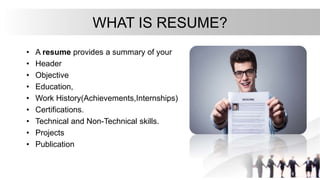
WHAT IS RESUME?
• A resume provides a summary of your
• Header
• Objective
• Education,
• Work History(Achievements,Internships)
• Certifications.
• Technical and Non-Technical skills.
• Projects
• Publication
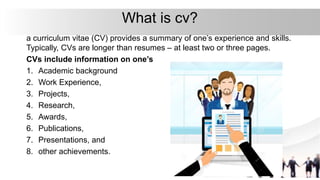
What is cv?
a curriculum vitae (CV) provides a summary of one’s experience and skills.
Typically, CVs are longer than resumes – at least two or three pages.
CVs include information on one’s
1. Academic background
2. Work Experience,
3. Projects,
4. Research,
5. Awards,
6. Publications,
7. Presentations, and
8. other achievements.
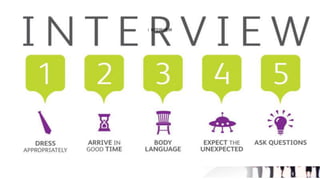
i NTERVIEW
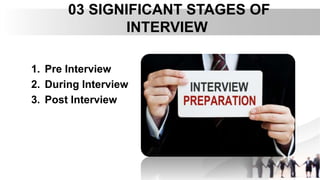
03 SIGNIFICANT STAGES OF
INTERVIEW
1. Pre Interview
2. During Interview
3. Post Interview
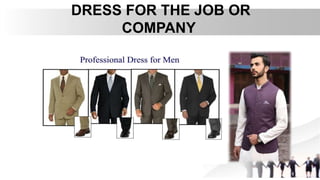
DRESS FOR THE JOB OR
COMPANY
DURING THE INTERVIEW
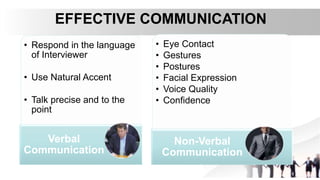
EFFECTIVE COMMUNICATION
• Respond in the language
of Interviewer
• Use Natural Accent
• Talk precise and to the
point
Verbal
Communication
• Eye Contact
• Gestures
• Postures
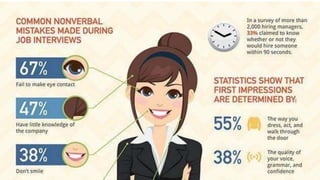
• Facial Expression
• Voice Quality
• Confidence
Non-Verbal
Communication
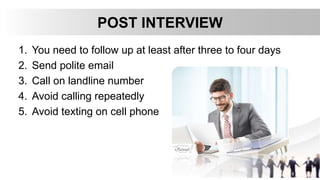
POST INTERVIEW
1. You need to follow up at least after three to four days
2. Send polite email
3. Call on landline number
4. Avoid calling repeatedly
5. Avoid texting on cell phone
Thank You All
STAY CONNECTED
KEEP LEARNING

Cv writing and interview skills

  • 1.
  • 3.
    WHAT IS RESUME? •A resume provides a summary of your • Header • Objective • Education, • Work History(Achievements,Internships) • Certifications. • Technical and Non-Technical skills. • Projects • Publication
  • 4.
    What is cv? acurriculum vitae (CV) provides a summary of one’s experience and skills. Typically, CVs are longer than resumes – at least two or three pages. CVs include information on one’s 1. Academic background 2. Work Experience, 3. Projects, 4. Research, 5. Awards, 6. Publications, 7. Presentations, and 8. other achievements.
  • 7.
  • 9.
    03 SIGNIFICANT STAGESOF INTERVIEW 1. Pre Interview 2. During Interview 3. Post Interview
  • 10.
    DRESS FOR THEJOB OR COMPANY
  • 11.
  • 12.
    EFFECTIVE COMMUNICATION • Respondin the language of Interviewer • Use Natural Accent • Talk precise and to the point Verbal Communication • Eye Contact • Gestures • Postures • Facial Expression • Voice Quality • Confidence Non-Verbal Communication
  • 13.
    POST INTERVIEW 1. Youneed to follow up at least after three to four days 2. Send polite email 3. Call on landline number 4. Avoid calling repeatedly 5. Avoid texting on cell phone
  • 16.
    Thank You All STAYCONNECTED KEEP LEARNING