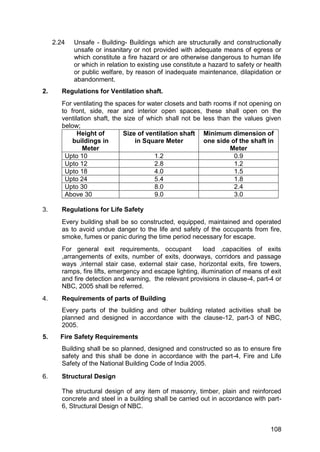
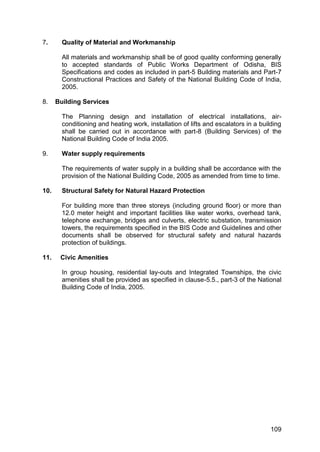
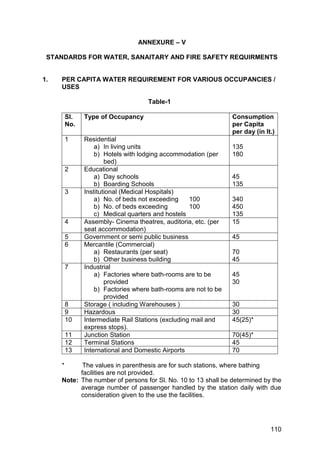
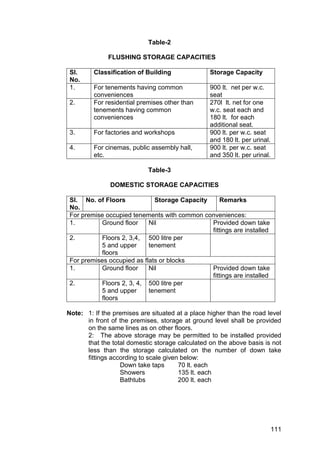
The Odisha G a z e t t e
EXTRAORDINARY
PUBLISHED BY AUTHORITY
4;" &$*$ .877,.2! 354/,:! 45903-06 )! &$%&#2,6712, %(! %+’(
CUTTACK DEVELOPMENT AUTHORITY
Arunodaya Bhawan, Link Road, Cuttack
NOTIFICATION
The 25th September 2012
No. 17229—Whereas the draft Cuttack Development Authority (Planning & Building
Standards) Regulation, 2010, which the Cuttack Development Authority wants to make
was published as required by sub-section (1) of Section 124 and sub-sections (1) & (2) of
Section 125 of the Odisha Development Authorities Act, 1982 (Odisha Act 14 of 1982) in
the Extraordinary Issue No.1163, dated the 26thJuly 2010 of the Odisha Gazette under the
notification of Cuttack Development Authority, No.13194-CDA., dated the 21st May 2010
inviting objections and suggestions from all persons likely to be affected thereby till the
expiry of a period of fifteen days from the date of publication of the said notification in the
Odisha Gazette;
And whereas, the objections and suggestions received in respect of the said draft
have duly been considered by the C.D.A.
Now, therefore, in exercise of the powers conferred by Section 124, read with
clauses (viii) to (xviii) of sub-section (2) thereof, the Cuttack Development Authority with
previous approval of the State Government hereby makes the following regulations,
namely Cuttack Development Authority (Planning & Building Standards) Regulation, 2010.
N. K. MUND
Secretary
1
NOTIFICATION
No.____________ Dt.______________
Whereas the draft Cuttack Development Authority (Planning &
Building Standards) Regulation, 2010, which the Cuttack Development Authority
wants to make was published as required by sub-Section (1) of section 124 and
sub-section (1) & (2) of Section 125 of the Odisha Development Authorities Act,
1982 (Odisha Act 14 of 1982) in the Extraordinary issue No.1163 dated the 26th
July, 2010 of the Odisha Gazette under the notification of Cuttack Development
Authority, No.13194-CDA-dated the 21st
May, 2010 inviting objections and
suggestions from all persons likely to be affected thereby till the expiry f a period of
fifteen days from the date of publication of the said notification in the Odisha
Gazette;
And whereas, the objections and suggestions received in respect of
the said draft have duly been considered by the C.D.A..
Now, therefore, in exercise of the powers conferred by Section 124
read with Clauses (viii) to (xviii) of sub-section (2) thereof, the Cuttack Development
Authority with previous approval of the State Government hereby makes the
following regulations, namely Cuttack Development Authority Planning & Building
Standard Regulation 2010.
2
PART – I
DEFINITIONS
1. (1) These Regulations may be called the Cuttack
Development Authority (Planning and Building
Standards) Regulations, 2010.
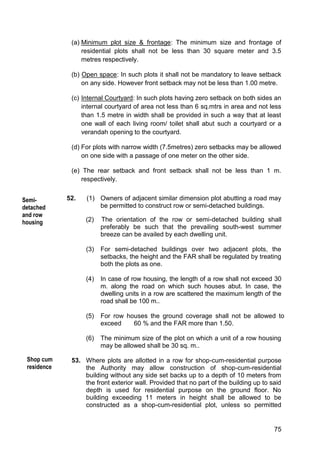
(2) They shall extend to the whole area within the
jurisdiction of the Cuttack Development Authority.
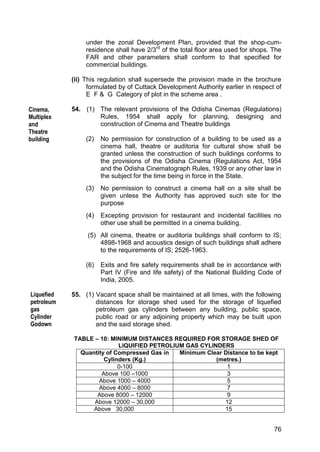
(3) They shall come into force on the date of their
publication in the Odisha Gazette.
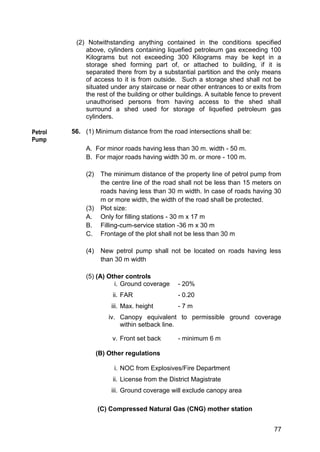
2. (I) In these regulations, unless the context otherwise requires:
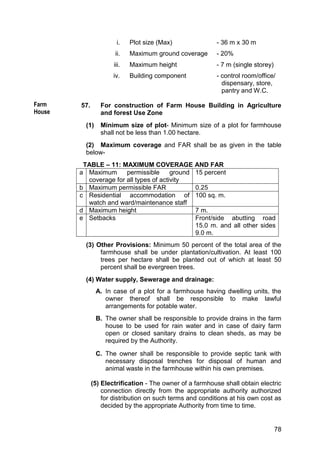
(1) “Act” means the Odisha Development Authorities Act, 1982.(Act
14 of 1982)
(2) “Advertising Sign” means any surface or structure with
characters, letters or illustrations applied there to and displayed
in any manner whatsoever outdoors for the purpose of
advertising or giving information or to attract the public to any
place, person, public performance, article, or merchandise, and
which surface or structure is attached to, forms part of, or is
connected with any building, or is fixed to the ground or to any
pole, screen, fence or hoarding or displayed in space, or in or
over any water body included in the jurisdiction of the Authority.
(3) “Agricultural use” means use of land for the purpose of
agriculture, horticulture, sericulture, animal husbandry, poultry
farming, plant nursery, piggery, dairy farming, vegetable farming
and any activity related to agriculture or milk chilling plant;
(4) “Air-Conditioning” means the process of treating air so as to
control simultaneously its temperature, humidity, cleanliness and
distribution to meet the requirement of conditioned space;
(5) “Air Port Reference Point” means a designated point which is
established in the horizontal plane at or near the geometric
center of the landing area.
(6) “Amenity” means roads, street, open spaces, parks,
recreational grounds, play grounds, gardens, water supply,
electric supply, street lighting, sewerage, drainage, public works
and other utilities, services and conveniences.
Short title,
Extent and
commencement
Definitions
3
(7) “Annexure” means an Annexure appended to these
regulations.
(8) “Apartment or flat” means a dwelling unit in building.
(9) “Apartment building” means a building having four or more
dwelling units.
(10) “Approved” means approved by the Authority.
(11) “Addition/ Alteration” means structural change, such as
addition to the covered area or height or the removal of part of
a building or construction or cutting into or removal of any wall,
partition, column, beam, joist, floor or other support, or a
change to the fixture of equipment of the building.
(12) “Applicant” means the person who has title to a land or
building and includes,
A. an agent or trustee who receives rent on behalf of the
owner;
B. an agent or trustee who receives rent or is entrusted with or
is concerned with any building devoted to religious or
charitable purpose.
C. a receiver, executor or administrator or a manager
appointed by any Court of competent jurisdiction to have
the charge of or to exercise the rights of the owner; and
D. a mortgagee in possession.
(13) “Art Commission” means the Commission constituted under
sub-section (1) of section 88; of the Odisha Development
Authorities Act, 1982 may be expanded as the Odisha
Development Authorities Act, 1982.
(14) “Authority” means the Cuttack Development Authority and
does not include its employees acting individually. The powers
and responsibilities of the Authority under this regulation can
not be delegated, unless specifically provided for in this
regulation, the Act, the rules or unless notified by the
Government;
(15) “Balcony” means a projection to serve as passage or sit out
place including a handrail or balustrade.
(16) “Barsati” means a habitable room, not exceeding 30% of the
covered area on the top floor of the building with toilet &
kitchen unit built contiguously though height not more than 2.5
meters to be permitted in individual residential buildings.
4
(17) “Basement or cellar” means lower storey of a building, below
or partly below the ground level;
(18) “Basti Area” means an area declared as such under a
Development Plan and in the absence of such declaration, any
area comprising old settlements covering such extent of lands
as may be determined by the Authority in consultation with the
concerned Local Body;
(19) “Basti Plot” means a plot having a width ranging between 4.0
m. and 6.3 m., the depth being more than three times the
width, and located in a basti area;
(20) “Builder” means an applicant, land owner, contractor, holder
of power of attorney of the land owner, partnership, trust or
company which has responsibility for construction, leasing,
selling or disposing otherwise of a building for residential and
other purposes and duly registered by the Authority.
(21) “Building” means any structure or erection or part of a
structure or erection which is intended to be used for
residential, commercial, industrial or any other purpose
whether in actual use or not, and in particular.
A. Assembly Building refers to a building or part of a building
where group of people congregate or gather for
amusement, recreation, social, religious, patriotic and
similar purposes and includes theaters, assembly halls,
auditoria, exhibition halls, museum, skating rinks,
gymnasium, dance hall, club rooms recreation piers and
stadium and Kalyan Mandap
B. Commercial Building refers to a building or part of a
building, which is used for transaction of business, keeping
of accounts and records or for similar purposes and
includes Banks and Commercial Offices and Corporate
offices. It shall include mercantile buildings like shops,
stores, market display and sale of merchandise either in
wholesale or retail, or offices, storage or services facilities
incidental to the sale of merchandise and includes Cinema
Halls, Petrol Pumps, Hotels, Restaurants, Clinics,
Pathology Labs, Nursing Homes, Lodge-cum-guest houses
& Dharma Kantas, etc.
C. Form means a Form appended to these regulation.
D. Hazardous Building refers to a building or part of a
building which is used for the storage, handling,
manufacture or processing of highly combustible or
explosive materials or products which are liable to burn with
5
extreme rapidity and/or producing poisonous fumes, or the
storage, handling, manufacturing or processing of which
involves highly corrosive, toxic, obnoxious alkalis, acids or
other liquids, gases or chemicals, producing flame, fumes
and explosion, poisonous irritant or corrosive gasses and
for the storage, handling or processing of any material
producing explosive mixture of dust or which result in the
division of matter into fine particles subject to spontaneous
ignition. This shall include petrol filling stations.
E. Industrial Building refers to a building or part of a building
in which products or materials of all kind and properties are
fabricated, assembled or processed such as assembly
plants, laboratories, power plants, smoke houses,
refineries, gas plants, mills, dairies or factories.
F. Institutional Building refers to a building or part of a
building, which is used for purposes such as Research and
Training Centre, Public/Semi Public offices, Hospitals,
Dispensaries and Health Centers, Schools colleges or day
care purposes for more than eight hours.
G. Residential Building refers to a building in which sleeping
accommodation is provided for normal residential purpose
with or without cooking or dining or both facilities and
includes one or two or multi-family dwelling dormitories,
apartment houses, flats and hostels.
H. Public Utility Building means and includes Post Office,
Police Station, Fire Station, Hospital, Dispensary, and
Telephone Exchange, sub-station, water works, Taxi
Stands, Bus Terminals, etc.
I. Storage Building refers to a building or part of building
used primarily for the storage or sheltering of goods,
storehouses, hangers, terminal depot, grain elevators, barn
or stables.
J. Multi Level Car Parking Building means a building partly
below ground level having two or more basements or above
ground level primarily to be used for parking of cars,
scooters or any other type of light motorized vehicles.
(22) “Building Accessory” means a subordinate building, use of
which is incidental to that of a principal building, on the same
plot such as garage, coal or fuel shed, peons, chowkidars, or
domestic servants quarters, etc;
(23) “Building Height” means the vertical distance measured in
the case of flat roofs, from the average level of the center line
6
of the adjoining street to the highest point of the building
adjacent to the street; and in the case of pitched roofs, up to
the point where the external surface of the outer wall intersects
the finished surface of the sloping roof and in the case of
gables facing the road, the mid-point between the eaves level
and the ridges.
Explanation – If the building does not abut on a street, the
height shall be measured above the average level of the
ground around and contiguous to the building.
(24) “Building line” means the line up to which the plinth of a
building adjoining a street or an extension of a street or on a
future street may lawfully extend and includes the lines
prescribed in any development plan in operation for any area
under the jurisdiction of the Authority or specification indicated
in any Town Planning or Development Scheme, or in these
Regulations.
(25) “Canopy” means cantilevered projection at lintel level over
any entrance.
(26) “Cornice” means a sloping or horizontal structural overhang
usually provided over openings or external walls to provide
protection from sun and rain.
(27) “Chajja/Sun-Shade” means a sloping or horizontal structural
overhang, usually provided for protection from sun and rain or
for architectural considerations at lintel level.
(28) “Chimney” means an upright shaft containing and encasing
one or more flues provided for the conveyance to the outer air
of any product of combustion; resulting from the operation of
any heat producing appliance or equipment employing solid,
liquid or gaseous fuel;
(29) “Combustible materials” means a material, which burns or
adds to a fire when used for combustibility in accordance with
good practice;
(30) “Common Area” means corridors, lobbies, stairs, stairways,
fire escapes, parking area, community space, installation of
common services, guard room, society room provided in an
Apartment building.
(31) “Coverage” means permissibility of construction in ground
floor and other floors including projections exceeding 0.75 mtr,
which are not open to sky.
7
(32) “Conversion” means the change of occupancy to another
occupancy or change in building structure or part thereof
resulting in change of space or use requiring additional
occupancy certificate.
(33) “Corner plot” means a plot at the junctions of and fronting on
two or more intersecting streets. Corner plot means a plot
facing two streets; the frontage would be on the street having
larger width. In cases, where the two streets are of same width,
then the larger side of the plot will decide the frontage. In such
case, the location of a garage (on a corner plot) if provided,
within the open space shall be located diagonally opposite the
point intersection.
(34) “Courtyard” means a space permanently open to sky, with or
without pergola, enclosed fully or partially by buildings and may
be at ground level or any other level within a building;
(35) “Covered Area” means in respect of ground floor, area
covered immediately above the plinth level by the building but
does not include the open space covered by
A. garden, rockery, well and well-structures, rainwater
harvesting structures, plant nursery, water-pool (if
uncovered), platform round a tree, tank, fountain, bench,
chabutara with open top unenclosed on sides by walls,
boundary wall, swing, and area covered by chhajja without
any pillars etc, touching the ground;
B. „Drainage culvert conduit‟, catch-pit, gully pit, inspection
chamber, gutter and the like; and
C. Compound wall, gate, slide/ swing door, canopy, and areas
covered by chajja or similar projections and staircases
which are uncovered and open at least on three sides and
also open to sky.
D. Watchmen booth, pump house, garbage shaft, electric
cabin or substations, and such other utility structure meant
for the services of the building under construction.
(36) “Cul-de-sac” means such means of access having length up
to 150 m. with an additional turning space not less than 81
square meters in area having no dimension less than 9 m.;
(37) “Damp-Proof Course” means course consisting of some
appropriate water proofing material provided to prevent
penetration of dampness.
8
(38) “Detached building” means a building whose walls and roof
are independent of any other building with open spaces on all
sides;
(39) “Development Plan/ Comprehensive Development Plan”
includes any development plan either interim or comprehensive
or zonal plan in operation for the area under the jurisdiction of
the Authority;
(40) “Deviation” means any construction made in departure from
the approved plan by way of alterations or additions,
modifications in the total floor area, coverage, floor area ratio
(FAR), setbacks, height, parking space, provision of public
utilities etc.
(41) “Drain” means a line of pipes including all fittings and
equipment such as manholes, inspection chamber, traps,
gullies and floor traps, used for the drainage of a building or a
number of buildings, or yards appurtenant to the buildings
within the same cartilage and includes open channels used for
conveying surface water;
(42) “Drainage” means the removal of any liquid by a system
constructed for purpose;
(43) “Dwelling Unit/Tenement” means an independent housing
unit with
separate facilities for living, cooking and sanitary
requirements..
(44) “EWS House” means a house or dwelling unit intended for
Economically Weaker Sections with maximum built up area of
32 sq.mtr.
(45) “EWS Plot” means a residential plot intended for Economically
Weaker Sections having maximum plot area of 48 sq.mtr.
(46) “Encroachment” means an act to enter into the possession or
rights either of permanent or temporary nature on a land or
built-up prop
(47) “Existing Use” of a building or structure existing authorized
with the approval of the Authority before the commencement of
these Regulations.
(48) “Enclosed staircase” means a staircase, separated by fire
resistant walls from the rest of the building.
(49) “Existing Building or use” means a building, structure or its
use as sanctioned/ approved/ regularized by the Competent
9
Authority, existing before the commencement of these
Regulations;
(50) “Exit” means a passage, channel or means of egress from
any building, storey or floor area to a street or other open
space of safety;
(51) “External Wall” means an outer wall of a building even though
adjoining to a wall of another building and also means a wall
abutting on an interior open space of a building.
(52) “Farm House” means a plot of land including construction
thereon in the area designated for agricultural use by the
Authority.
(53) “Farm Shed” shall include permanent or temporary structures
erected in the plot used for farmhouse.
(54) “Fire Alarm System” means an arrangement of call joints or
detectors, sounders and other equipments for the transmission
and indication of alarm and sometimes used as signals for
testing of circuits and whenever required for the operation of
auxiliary services. This device may be work automatically or
manually to alert the occupants in the event of fire;
(55) “Fire Lift” means lift specially designed for use by fire service
personnel in the event of fire;
(56) “Fire Proof Door” means a door or shutter fitted to a wall
opening, and constructed and erected with the requirement to
check the transmission of heat and fire for a specified period;
(57) “Fire Resisting Material” means the material, which is
normally used for fire resistance.
(58) “Floor” means the lower surface in a storey on which one
normally walks in a building.
(59) “Floor Area Ratio (FAR)” means the quotient obtained by
dividing the total covered area on all floors with the area of the
plot.
(60) “Footing” means the part of a structure, which is in direct
contact with the ground and transmitting loads to the ground.
(61) “Foundation” means that part of a structure, which is in
direct contact with and meant for transmitting loads to the
ground.
10
(62) “Gallery” means an intermediate floor or platform projecting
from a wall of an auditorium or a hall providing extra floor area,
additional seating accommodation, etc. It shall also include
structures provided for seating in stadium.
(63) “Garage-Private” means a building or a portion thereof
designed for parking of privately owned motor vehicles or any
other vehicles.
(64) “Garage-Public” means a building or a portion thereof
designed or used for repairing, servicing, hiring, selling or
parking of motor driven or any other vehicles.
(65) “Ground Floor” shall mean storey, which has its floor surface
nearest to the ground around the building.
(66) “Group Housing” means building with more than one dwelling
unit, where land is owned jointly the construction is undertaken
jointly by one agency.
(67) “Habitable room” means a room having area of not less than
9.0 sq.mt, width 2.4 m.(min.), height 2.75 m.(min.) occupied or
designed for occupancy by one or more persons for study,
living, sleeping, eating, cooking if it is used as a living room,
but does not include bathrooms, water closet compartments,
laundries, serving and storage pantries, corridors, cellars, attics
and spaces that are not used frequently or during extended
periods;
(68) “ Hazardous material”
A. Means radioactive substances;
B. Material which is highly combustible or explosive and/or
which may produce poisonous fumes explosive
emanations, or storage, handling, processing or
manufacturing of which may involve highly corrosive, toxic,
obnoxious alkalis or acids or other liquids;
C. Other liquids or chemicals producing flame, fumes,
explosive, poisonous, irritant or corrosive gases or which
may produce explosive mixtures of dust or fine particles
capable of spontaneous ignition.
(69) “Hazardous and obnoxious industry” means industry, which
creates nuisance to the surrounding development in the form of
smell, smoke, gas, dust, air pollution, water pollution and other
unhygienic conditions.
11
(70) “Natural hazard prone areas” mean areas likely to have
moderate to high intensity earthquake, or cyclonic storm, or
significant flood flow or inundation, or landslides/mud
flows/avalanches, or one or more of these hazards.
NOTE: Moderate to very high damage risk zones of
earthquakes are shown in Seismic Zones III, IV and V specified
in IS: 1893; moderate to very high damage risk zones of
cyclones are those areas along the sea coast of India prone to
having wind velocities of 39 m/s or more as specified in IS:
875(Part 3;) and flood prone areas in river plains (un-protected
and protected) are indicated in the Flood Atlas of India
prepared by the Central Water Commission, besides, other
areas which can be flooded under conditions of heavy intensity
rains, inundation in depressions, back flow in drains,
inadequate drainage, etc. as identified through local surveys in
the development plan of the area and landslide prone areas as
identified by State Government/Land surveys.
(71) “Heritage Zone” means the area as delineated in
Comprehensive Development Plan.
(72) “Illuminated Exit” Signs means a device for indicating the
means of escape) during normal circumstances and power
failure.
(73) “Jhamp” means a downward vertical or sloping projection
hanging below the balcony to provide protection from direct
sun or rain.
(74) “Katra/ Chawl” means a building so constructed as to be
suitable for living in separate tenements each consisting
a single room, or of two, but not more than two rooms and with
common sanitary arrangements.
(75) “Land use” means the use of the land proposed in the Interim
Development Plan/Comprehensive Development Plan/ Zonal
Development Plan.
(76) “Latrine-connected” means a latrine connected to the
municipal sewer system;
(77) “Layout Plan” means plan-indicating sub-division of land with
provision of road & other infrastructure.
(78) “Latrine-unconnected” means a latrine not connected to the
municipal sewer system; it may be connected to a septic tank
or suitable treatment or disposal system;
12
(79) “Ledge / Tand” means a shelf-like projection supported in any
manner whatsoever, except by means of vertical supports
within a room itself but not having projection wider than 1.0
meter and at a minimum clear height of 2.1 meters from the
floor level;
(80) “LIG House” means a house or dwelling unit intended for low-
income groups with a built up area of maximum 48 sq.mtr.
(81) “LIG Plot” means a residential plot intended for low-income
groups with a plot area of maximum 60 sq.mtr.
(82) “Loft’ means an intermediate floor between two floors or a
residual space in a pitched roof, above normal floor level with a
maximum height of 1.5 meters and which is constructed or
adopted for storage purposes;
(83) “Empanelled Technical Person” means Architect registered
with the Council of Architecture or Civil Engineer/Structural
Engineer/Town Planner/Supervisor licensed/ empanelled/
registered by the Authority.
(84) “Masonry” means an assemblage of masonry units properly
bonded together with mortar;
(85) “Mezzanine Floor” means an intermediate floor between two
floors, above ground level, accessible only from the lower floor;
(86) “Mixed Land Use” means mixed use of the building/premise
consisting of two or more compatible uses of which the
principal use shall not be less than 2/3rd
of total built up area.
(87) “Multi - Storey or High Rise Building” means a building
whose height is 15 meters or more, measured from the
average level of the centre line of the street on which the site
abuts.
(88) “Mumty or Stair Cover” means a structure with a covering
roof over staircase and it‟s landing built to enclose only the
stairs for the purpose of providing protection from weather and
not used for human habitation.
(89) “Mitigation” means measures taken in advance of a disaster
aimed at minimizing or eliminating its impact on society and on
environment including preparedness and prevention.
(90) “Non-Combustible Material” means a material, which does
not burn nor add heat to a fire when tested for combustibility in
accordance with good practice.
13
(91) “Non -Conforming Use of a Building or Land” means the
use of a building or land existing at the time of commencement
of these Regulations and which does not conform to the
Regulations pertaining to the zone in which it is located.
(92) “Occupancy or Use” means the principal occupancy for which
a building or a part of a building is used or intended to be used;
(93) “Open Space” means an area forming an integral part of the
plot, left open to the sky.
(94) “Owner” means a person, group of persons, a company, trust,
Institute, Registered body, State or Central Government and its
departments, undertakings and the like in whose name the
property stands registered in revenue records.
(95) “Parapet” means a low wall or railing built along the edge of a
roof or a floor having a minimum height of 1.0 m
(93) “ Parking Space” means an area enclosed or
unenclosed, covered or open, of sufficient size to park
vehicles, together with a driveway connecting the parking
space with a street or any public area and permitting ingress
and egress of the vehicles;
(94) “Partition” means an interior non-load bearing wall, one storey
or part of a storey in height.
(95) “Performance Security” means a security deposit to be
deposited with the Authority by the Builder/ Developer of an
Apartment Building/ Group Housing/ Commercial Building/Real
Estate Development at the time of approval of Plans. However,
no Performance Security is required for a commercial building
having a covered area of less than 300 sq.mtr.
(96) “Permit” means permission or authorization in writing by the
Authority to carry out the work regulated by these Regulations.
(97) “Plantation” means plantation of plants and trees.
(98) “Plinth” means the portion of a structure between the surface
of the surrounding ground and the surface floor, immediately
above the ground.
(99) “Plinth Area” means the built up area measured at the floor
level of ground floor;
(100) “Porch” means a covered surface supported on pillar or
otherwise for the purpose of pedestrian or vehicular approach
to a building.
14
(101) “Public Utility service’ means drainage, sewerage,
electricity, water supply, solid waste disposal, sanitation, fire
services, roads and any other support or infrastructure and the
like for which a building has to depend on public bodies,
authorities or agencies;
(102) “Ramp” means a passage with gradual slope joining two level
surfaces.
(103) “Real Estate Development” means development undertaken
for sale.
(104) “Registered Architect” means an Architect registered with
the Council of Architecture, who is not in arrears of
subscription and who has not been the debarred by the
Authority.
(105) “Registered Builder/ Developer” means a builder
empanelled/ registered with the Authority.
(106) “Road” means any access viz. highway, street, lane,
pathway, alley, or bridge, whether a thoroughfare or not, over
which the public have right of passage or access or have
passed and had access uninterruptedly for a specified period
and includes all bunds, channels, ditches, storm water drains,
culverts, side tracks, traffic islands, road side trees and
hedges, retaining walls, fences barriers and railings within the
road line.
(107) “Road Width or Width of Road/Street” means the whole
extent of space within the boundaries of a road when applied
to a new road/street as laid down in the city survey or
development plan or prescribed road lines by any act of law
and measured at right angles to the course or intended course
of direction of such road.
(108) “Row Housing” means a row of contiguous houses with only
front, rear and interior open spaces.
(109) “Room Height” means the vertical distance measured from
the finished floor level to the finished ceiling.
(110) “Rule” means the Odisha Development Authorities Rules,
1983.
(111)“Schedule” means a Schedule appended to these
regulations.
(112) “Section” means section of the Act.
15
(113) “Semi-Detached Building” means building detached on
three sides (front, rear and side) with open spaces as
specified under the Regulations.
(114) “Set back” means the distance between the plinth lines of
the building and the boundary of the plot.
(115) “ Setback line” means a line usually parallel to the plot
boundaries and laid down in each case by the Authority
beyond which nothing can be constructed towards the plot
boundaries and shall not apply to slums taken up under an
approved programme of the Government subject to the
specific sanction of the Government, and subject to the
conditions that there will not be more than 25 plots in one
cluster, and the area of each plot in the cluster shall not
exceed 25 sq. m.
(116) “Settlement” means a human settlement, whether urban or
rural in character. It includes habited villages, towns,
townships, cities and the areas notified under the control of
the Authority.
(117) “Site” means a parcel or piece of land enclosed by definite
boundaries.
(118) “Site with Double Frontage’ means a site having frontage on
two streets other than corner plot.
(119) “Service Floor” means floor in hotel or commercial building
above ground floor in case of more than four storied buildings.
(120) “Service Lane” means a lane provided at rear or side of a
plot for service purposes.
(121) “Service Road” means a road/ lane provided at the front,
rear or side of a plot for service purpose.
(122) “Side Depth” means horizontal distance between the front
and rear side boundaries.
(123) “Smoke Stop Door” means a door for preventing or checking
the spread of smoke from one area to another.
(124) “Stilt floor” means a floor supported by pillars with all four
sides open to be used for parking, switch room, generator
room, society room & information room with minimum height
of 2.4 meter & maximum height of 2.7 meter.
16
(125) “Storage Space” means a space where goods of non-
hazardous nature are stored and includes cold storage and
banking safe vaults.
(126) “Store Room” means a room used as storage.
(127) “Spiral Staircase” means a staircase forming continuous
winding curve round a central point or axis provided in a open
space having tread without risers.
(128) “Store” means the space between the surface of any floor
and the surface of the floor next above it, or if there be no floor
above it then the space between any floor and the ceiling next
above it, but shall not include a mezzanine floor;
(129) “Supervisor” means a person having Diploma in
Architectural Assistantship/ Diploma in Civil Engineering/
equivalent qualification.
(130) “Tenements” means room or rooms in the occupation of , or
meant for the occupation of one tenement;
(131) “To abut” means to abut on a road so that any portion of the
building is on the road boundary;
(132) “To erect” a building means:
A. to erect new building on any site whether previously built
upon or not;
B. to re-erect any building of which portions above the
plinth level have been pulled down or destroyed
(133) “Unsafe Building” means buildings which are structurally
and constructional unsafe, or in-sanitary, or do not provide
adequate means of egress, or which constitute fire hazard, or
are otherwise dangerous to human life or property, or which in
relation to existing use constitute a hazard to
safety/health/public welfare by reason of inadequate
maintenance, dilapidation or abandonment.
(134) “Unauthorized Construction’ means the erection or re-
erection, addition or alternation, which is not approved or
sanctioned by the Authority.
(135) “Underground/Overhead Tank” means an underground/
overhead water tank, constructed or placed to store water.
(136) “Verandah” means space with at least one side open to the
outside with the exception of one-meter parapet on the upper
floors to be provided on the open side.
17
(137) “Ventilation’ means the supply of outside air into a building
through window or other openings due to wind out side and
convection effects arising from temperature, or vapour
pressure differences (or both) between inside and outside of
the building.
(138) “Water Closet (W C)”. means a privy with arrangement for
flushing the pan with water but does not include a bathroom;
(139) “Water course” means a natural channel or an artificial
channel formed by draining or diversion of a natural channel
meant for carrying storm and wastewater.
(140) “Window” means an opening to the outside other than a
door, which provides all or part of the required light or
ventilation, or both to an interior space.
(141) “Zoning Regulations” means Regulations or Plans
governing land use in any development plan or forming part of
a development plan in operation;
Words and expressions used in these regulations,
but not defined, shall have the same meaning as
respectively assigned to them in the Act/Rules and the
National Building Code of India, 2005 amended from time
to time.
PART - II
ADMINISTRATION
3. Subject to the provisions of the Act, these regulations shall apply:
(1) to the planning, design and construction of building in case of
erection a building:
(2) to all parts of the building whether removed or not , and in case
of removal of whole or any part of the building;
(3) to the remaining part of the building after demolition and work
involved in demolition in case of demolition of whole or any part
of a building;
Applicability
18
(4) to the whole building whether existing or new building (except
only to that part of the building, which is consistent with these
Regulations) in case of alteration of a building;
(5) to all parts of the building affected by the change in case of
change of occupancy of a building; and
(6) to use of any land or building where sub-division of land is
undertaken or use of land or building is changed.
4. (1) The construction of any building in respect of which permission
has been issued before coming into force of these regulations,
shall, so far as it is not inconsistent with the provisions of these
regulations regarding provision of public utility services, and
construction in heritage zone, continue to be validly made and
the said permission shall be deemed to have been issued
under the corresponding provisions of these regulations.
(2) Where any building has been constructed without an approved
plan or with deviation of an approved plan, the provisions of
these Regulations shall be insisted upon.
5. (1) any person who intends to erect, re-erect or make additions or
alterations in any building or demolish any building shall apply
to the Authority in Form-I (Part-I). Based on this, the Authority
may prescribe separate formats for different categories of
buildings and group housing:
(2) Such application shall be accompanied by the following
documents.
Seven copies of plans either computer prints, plain paper copies or
ammonia prints, duly signed by the persons who have prepared
them and the owner / applicant, showing:
i. Key plan: A key plan drawn to a scale of not less than
1:10,000 shall be submitted along with the application for
development/building permit showing the boundary and
location of the site with respect to neighborhood landmarks.
The minimum dimension of the key plan shall be not less
than 75 mm.
ii. Site plan: The site plan with the application for permit shall
be drawn to a scale of not less than 1:200 for site up to 1000
sq. mtr., 1: 500 for a site up to 1 hectare and 1:1000 for site
more than 1 hectare and shall show;
a. the boundaries of the site and of any contiguous land;
b. the position of the site in relation to neighboring streets;
Deemed
permission
Application
19
c. the name of the streets in which the building is proposed
to be situated, if any along with connectivity to the public
road.
d. all existing buildings standing on, over or under the site
including service lines;
f. the means of access from the street to the building, and to
all other buildings (if any) which the applicant intends to
erect upon his contiguous land referred to in(a);
g. space to be left about the building to secure free
circulation of air, admission of light and access for
scavenging purposes;
h. the width of the street (if any) in front and of the street (if
any) at the side / rear or near the buildings ;
i. the direction of north point relative to the plan of the
building;
j. any physical features, such as well, drains, etc. and
k. such other particular as may be specified by the Authority.
iii. Subdivision/ layout plan: In case of development work, the
notice shall be accompanied by the sub division/layout plan
which shall be drawn on a scale or not less than 1:500
containing the following;
a. scale and north point;
b. Minimum seven copies of plan showing the location of all
proposed and existing roads with their existing
/proposed/prescribed widths within the land/ open space,
public amenities & all other infrastructure superimposed
over the revenue plots.
c. dimensions of the plot along with building lines showing
the setbacks with dimensions within each plot;
d. the location of drains, sewers, public facilities and
services, and electrical lines etc.;
e. table indicating size, area and use of all the plots in the
sub division/layout plan along with revenue plot number,
khata number extent and name of mouza.
20
f. statement indicating the total area of the site, area utilized
under roads, open spaces for parks, playgrounds,
recreation space and development plan reservations,
schools, shopping and other public spaces along with
their percentage with reference to the total area of the site
proposed to be subdivided; and
g. in case of plots which are subdivided in built up areas in
addition to the above, the means of access to the
subdivision from existing streets.
iv. Building Plan and details: The plans of the buildings and
elevations and sections accompanying the notice shall be
drawn to a scale of 1:100. The plans and details shall;
a. include floor plans of all floors together with the covered
area clearly indicating the size and spacing of all framing
members and sizes of rooms and the position of
staircases, ramps and lift wells;
b. show the use or occupancy of all parts of the buildings;
c. show exact location of essential services, for example,
WC, sink, bath and the like;
d. Include at least one elevation from the front showing
height of building and rooms and also the height of
parapet;
e. Include at least one section through the staircase;
f. Include the structural arrangements with appropriate
sections showing type/arrangements of footings,
foundations, basement walls; structural load bearing
walls, columns and beams, and shear walls; and
arrangement/spacing of framing members, floor slabs and
roof slabs with the material used for the same;
g. show all street elevations;
h. give dimension of the projected portions beyond the
permissible building line;
i. include terrace plan indicating the drainage and slope of
the roof; and
j. give indications of the north point relative to the plan.
k. statement and calculation sheets with regard to the plot
area, floor wise details of spaces under various categories
21
like apartments or office spaces, lobby circulation,
staircase, lift, mezzanine , balconies and details of such
area which are to be exempted from calculation of floor
area ratio, and;
v. Building Plan for Multi-storied/special buildings: For all
multistoried buildings which are 15 m. or more in height and
for special buildings like educational, assembly, institutional,
industrial, storage and hazardous and mixed occupancies
with any of the aforesaid occupancies having covered area
more than 500 sq. m.
The following additional information shall be
furnished/indicated in the building plan in addition to the
items given in (iv) as applicable:
a. Access to fire appliances/vehicles with details of vehicular
turning circle and clear motorable access way around the
buildings;
b. Size(width) of main and alternative staircases along with
balcony approach, corridor, ventilated lobby approach;
c. Location and details of lift enclosures;
d. Location and size of fire lift;
e. Smoke stop lobby/door, where provided;
f. Refuse chutes, refuse chamber, service duct, etc;
g. Vehicular parking space;
h. Refuse area, if any;
i. Details of building services- Air-conditioning system with
position of fire dampers, mechanical ventilation system,
electrical services, boilers, gas pipes, etc;
j. Detail of exits including provision of ramps, etc, for
hospitals and special risk buildings/uses;
k. Location of generator, transformer and switch gear room;
l. Smoke exhauster system, if any;
m. Details of fire alarm system network;
22
n. Location of centralized control, connecting all fire alarm
systems built-in–fire protection arrangements and public
address system, etc;
o. Location and dimension of static water storage tank and
pump room along with fire service inlets for mobile pump
and water storage tank;
p. Location and details of fixed fire protection installations,
such as sprinklers, wet risers, hose-reels, drenchers, etc;
and
q. Location and details of first-aid fire fighting equipments/
installations.
r. Longitudinal cross section of the building including size of
footings, basement and super structure framing members
and details of building and room heights and of staircase
vi. Services plans: The services plan shall include all details
of building and plumbing services, and also plans,
elevations and sections of private water supply, sewage
disposal system and rain water harvesting system.
vii. Landscape Plan: The landscape plan shall include the
area to be developed as lawn, garden, plantation etc.
viii. Specifications: Specifications, both general and detailed,
giving type and grade of materials to be used duly signed
by the registered architect, engineer, structural engineer
shall accompany the notice.
(3) Certificates/Clearances:
(i) In case the applicant is a trust, group of persons, partnership
or a company, a registered agreement between the holder of
the right, title and interest and the applicant, valid under the
Transfer of Properties Act, 1982 and Copies of the
Agreement/ Article of Association/ Memorandum/ Bye-laws.
(ii) No Objection Certificate from the Odisha State Housing
Board/ Cuttack Development Authority, for the additional
constructions, in case the house is delivered by the Board /
Authority.
(iii) NOC from State Pollution Control Board for project having
20,000 sq. meters of covered area.
(iv) For all buildings with a height of 15.0 meters and above, NOC
from Fire Service shall be submitted.
23
(v) NOC from Airport Authority of India shall be furnished where
ever applicable.
(vi) In case of building with more than 30 meters height, the
Structural plan and the structural design shall have to be
vetted by any State Resource Centre identified by Odisha
State Disaster Management Authority or any Indian Institute of
Technology/National Institute of Technology/Government
Engineering College or any reputed technical institution
identified by the Cuttack Development Authority.
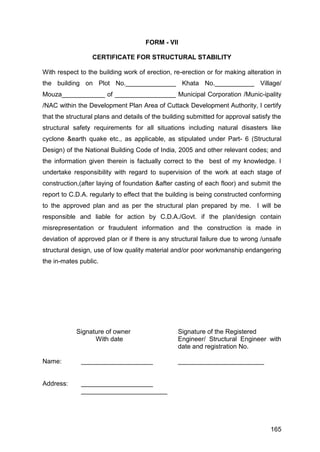
(vii) Structural stability certificate in the prescribed Form-VII signed
by the engineer /structural engineer and the owner jointly shall
be furnished.
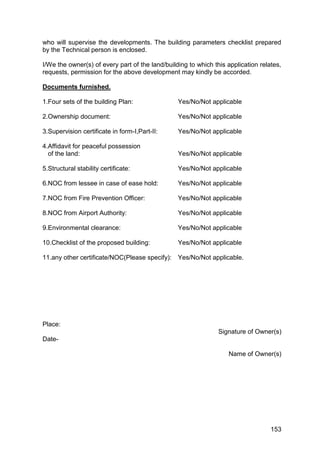
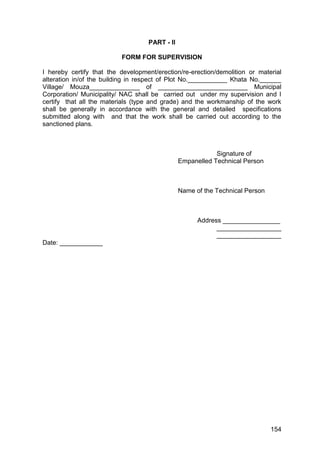
(viii) Supervision certificate in Form-I (part-II) shall be furnished by
the registered architect/ engineer/structural engineer/
supervisor/ town planner undertaking the supervision.
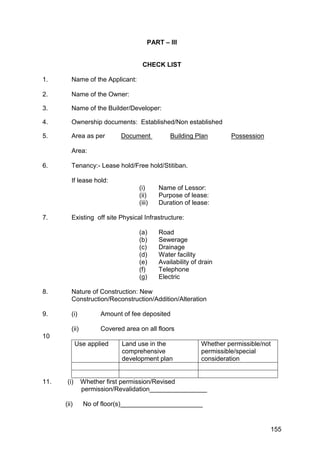
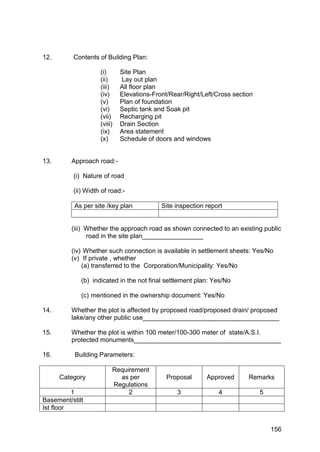
(ix) A check list in Form-I (Part-III) shall be furnished by the
empanelled/registered technical person.
6. The Authority shall levy the following fees:
(1) Every application for permission for building operation or
development shall be accompanied by a Scrutiny fee as
specified in clause 18 of the Odisha Development Authorities
Rules, 1983.
(2) In the event of approval, the applicant shall deposit a sanction
fee as decided by the Authority from time to time.
(3) Fees towards premium FAR as decided by the Authority from
time to time.
(4) Fees for retention of structures for temporary period as decided
by the Authority from time to time.
(5) Fees for change of occupancy as decided by the Authority from
time to time.
(6) Fees for change of land use as decided by the Authority from
time to time.
7. (1) The applicant shall deposit a refundable non interest earning
security deposit at the rate of Rs.100/- (Rupees One hundred)
per sqm. of floor area as fixed by the Authority from time to
time for the following categories of buildings, namely:
Fees
Security
deposit
24
A. Group housing / apartment buildings
B. Commercial buildings having 300 sq.m. or more of floor area.
However the applicant shall have the option of paying security
deposit in the form of Bank Guarantee.
(2) The security deposits shall be refunded within 60 days from the
date on which completion certificate is produced, in case of
building where there is no deviation in construction. If the
construction / development are not as per approved plan, this
deposit shall be adjusted towards compounding fees for
regularization of deviation & in other cases it shall be forfeited.
Forfeited and separate action will be initiated against the
builder / developer as per the provisions of the Act.
(3) The security deposit will be refunded with 2% interest if the
building is constructed / development is carried out as per the
approved plan/ lay out.
8. (1)All the plans shall be prepared and duly signed by a
registered/empanelled technical person (viz., Architect,
Engineer, Structural Engineer, Town Planner, Supervisor) and
Builder who shall indicate their names, addresses, registration
numbers on the body of the plan and in all other relevant
documents. The concerned owner of the land shall also sign
the plans.
(2) All plans, drawings, statements, design details shall bear the
signature of the applicant and shall be duly countersigned by
an empanelled Architect/Technical person. All documents and
plans related to structural designs shall bear the full name and
full signature of a Structural Engineer. Plans and documents
related to sanitary arrangements shall bear the full name and
full signature of a Public Health Engineer/ Municipal Engineer.
Note: 1. The Empanelled Architect who has prepared the plan shall
put the empanelment number/Council Of Architecture
Registration No. and seal on all plans and documents signed
by him and shall also furnish a certificate to the effect that he
shall supervise the construction of the building and shall be
responsible for any deviation from the approved plan except if
the owner/Architect/Technical person intimates that their
agreement has been terminated.
2. The Empanelled Structural Engineer, who has prepared the
structural design, shall put his seal, and address on all the
documents signed by him and shall also furnish a
certificate to the effect that he shall supervise the
Plans
25
structural part of the construction and shall be responsible
for any structural failure except caused by unprecedented
natural calamities in Form-VII and except if the owner
intimates that his services have been terminated.
3. All aspects related to structural design, building surface,
plumbing, electrical installation, sanitary arrangements,
fire protection shall adhere to the specification, standards
and code of practice recommended in the National
Building Code of India, 2005 and any breach thereof shall
be deemed to be a breach of the requirements under
these Regulations
(3) The technical personnel and builder as specified in sub-
regulation (1) & (2) above shall have to be registered/
empanelled with the Authority. Their qualifications and
competence shall be as per Annexure I.
(4) No plans for construction of apartment building, group housing
and commercial building shall be entertained unless the builder
is registered by the Authority in accordance with the competence
as specified in the Annexure I. However for plots less than 500
sq.mtr of area, registration of builder is not mandatory.
(5) When it comes to the notice of the Planning Member, Engineer
Member, any Member of the Authority, or any other person that
a plan signed by technical personnel or builder referred to under
sub-regulation (1), & (2) is in violation of the norms of this
regulation he shall bring this to the notice of the Authority.
(6) The Authority shall issue a notice asking for a show cause within
fifteen days as to why such technical personnel or builder shall
not be disqualified/ black listed. After receipt of the show cause
if any, the matter shall be placed before the Authority for a
decision on such disqualification/ black listing. The decision of
the Authority on disqualification/black listing shall be published in
the notice Board of the Authority and in the Government
Website.
(7) An appeal against an order under sub-clause (6) above shall lie
under section 18 of the Act.
9. (1) No permission shall be required for the works specified in
clause-12.4.1, Part-2 of National Building Code –2005 as
detailed below and under section-15 of the Act.
a) Opening & closing of door, windows or ventilators.
b) Providing inter communication door.
c) Providing partition.
d) Providing sky light
Permission
26
e) Gardening
f) White washing
g) Painting
h) Retiling of reproofing
i) Plastering & patch washing
j) Re-flooring
k) Construction of sunshade around own land
(2) All clarifications with respect to deficiency in the plan,
documents will be sought for from the applicant within
reasonable time.
(3) Once the plan has been scrutinized and objections have been
pointed out, the applicant shall modify the plan to comply with
the objections raised and re-submit it. The Authority shall
scrutinize the re-submitted plan and if there will be further
objections, the plan shall be rejected.
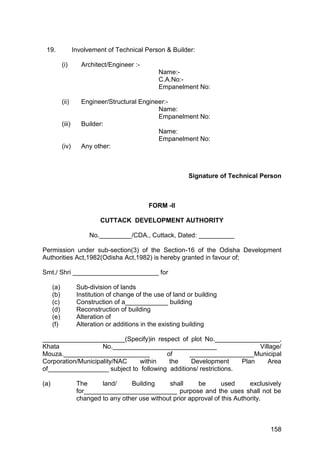
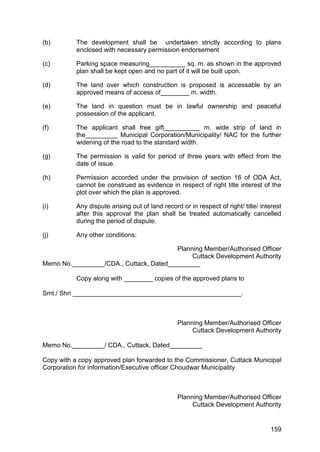
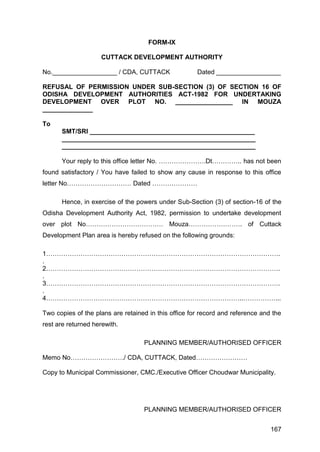
(4) The Authority shall communicate either approval in Form-II or
refusal in Form-IX within 60 days from date of receipt of
application under Regulation-5.
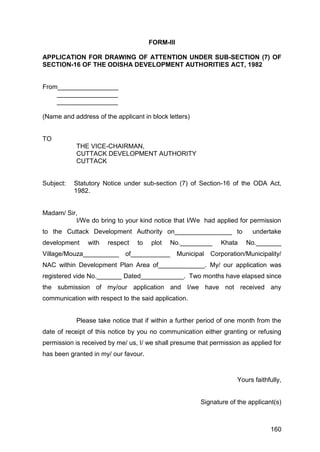
(5) If the Authority, does not communicate its decision either
granting or refusing permission to the applicant within 60 days
from the date of receipt of the application by the Authority, the
applicant shall draw the attention of the Vice-Chairman of the
Authority with regard to his application, by registered post in
Form-III. The Planning Member shall within the fifteen days
from the date of receipt of notice in Form-III place the details of
the case before the Vice-Chairman.
(6) If, within a further period of one month from the date of receipt
of the application drawing such attention as mentioned in sub
regulation (5) above, the Authority does not communicate its
decision, either granting or refusing permission, such
permission shall be deemed to have been granted to the
applicant on the date following the date of expiry of the three
months period.
(7) In case of Apartment Buildings, Group Housing Projects,
Integrated Township Projects and non-residential buildings of
height stilt+3 and above, permission for construction shall be
accorded along with direction to the builder/developer to
develop the on-site and off-site infrastructure like connectivity
of sewerage, drainage, water supply, road etc. to the main
network as per the specification of the concerned public
authorities.
The builder/developer shall produce no objection certificate
from the concerned authorities regarding successful
27
completion of all infrastructures while applying for occupancy
certificate.
After receipt of the NOC from the above authorities, occupancy
certificate shall be given by Cuttack Development Authority.
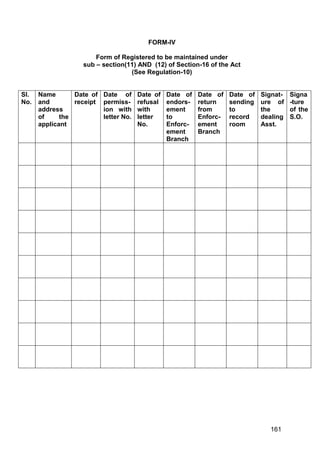
10. A register in Form-IV containing the necessary particulars
including information as to the manner in which the Authority
has dealt with applications for permission shall be maintained.
11. Every permission granted under these regulations shall remain
valid up to three years. However the permission shall have to
be revalidated before the expiry of the above period on
payment of such fee as may be prescribed under rules and
such revalidation shall be valid for three years. However for
further revalidation the approval authority is required.
12. (1) If the Authority finds at any stage that the construction is not
being carried on according to the sanctioned plan or is in
violation of any of the provisions of these regulations, it shall
notify the owner and no further construction shall be allowed
until necessary corrections in the plan are made and the
corrected plan is approved.
(2) If the owner fails to comply with the requirements at any
stage of construction, the Authority may cancel the building
permission issued and shall cause notice of such
cancellation to be pasted upon the said construction. If the
owner is not traceable at the address given in the notice,
pasting of such notice shall be considered as sufficient
notification of cancellation to the owner thereof. No further
work shall be undertaken or permitted upon such
construction until a valid building permission is issued
thereafter.
(3) The notification under sub-regulation (2) shall also be
published in as public notice.
(4) The Authority will also be at liberty to forfeit whole or part of
the security deposit obtained from the builder/ developer
during sanction of the plan.
(5) The above-mentioned procedure shall also be followed in
case of deviation of the layout.
(6) An appeal against an order under sub-regulation (2) & (4)
above shall lie under section 18 of the Act.
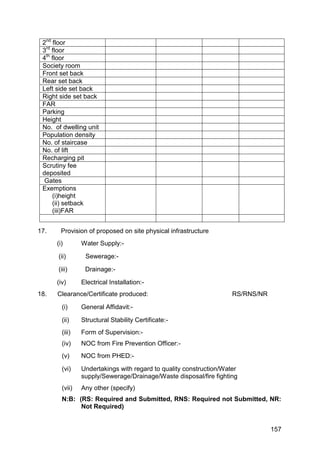
f the Act.
eviation during
Construction
not according
to plan
Maintenance
of Register
Duration of
Permission
28
13. (1) Whereas tests of any material are made to ensure
conformity of the requirements of these regulations, records of the tests
data shall be kept available for inspection during the construction of
building and for such period thereafter as required by the Authority.
(2) The persons to whom a permit is issued during construction shall
keep pasted in a conspicuous place on the property in respect of
which the permit was issued;
A. a copy of the building permit; and
B. a copy of approved drawings and specifications
14. (1) As a matter of course all construction or work for which a permit
is required shall be subject to inspection by the Authority at all
reasonable hours with prior intimation.
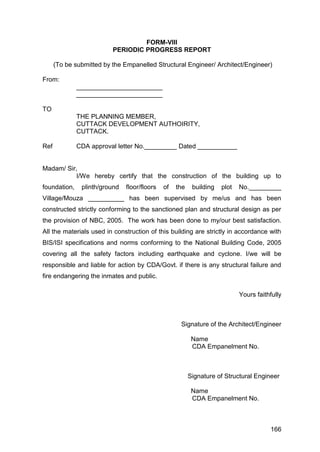
(2) Inspection, where required, shall be made within seven days
following the receipt of notice in Form-V or Form-VIII, after which
period the owner will be free to go ahead with the construction
according to the approved plan. At the first inspection, the
Authority shall determine that the building construction has been
taken up in accordance with approved site plans.
15. (1) The Authority shall permit an empanelled Architect/ Engineer to
residential building and issue of occupancy certificate for 300 sq.
mtrs. The responsibility of compliance with respect to provisions
of these regulations shall rest with registered architect/engineer.
However, the plans shall be required to be submitted to the
Authority for information and record.
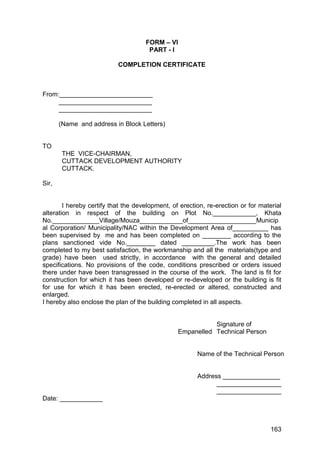
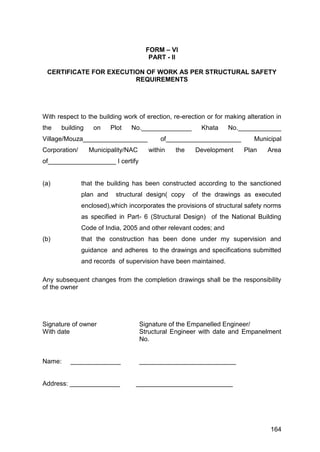
(2) The owner/concerned empanelled architect/engineers/ structural
engi-neer will serve a notice of completion certificate in Form
VI(Part I and Part III) to the Authority that the building has been
completed in all respects as per the approved plan. The said
notice shall be accompanied by the following documents.
(a) Three copies of completed building plans.
(b) A fee of Rs.1,000/-
(c) Record of Rights relating to ownership.
(d) Copy of approved plan and approval letter.
(3) The deviations shall also be brought to the notice of the
Authority (with relevant documents).
(4) The team of officials shall visit the site within 30 days and
occupancy certificate shall be given.
16. (1) The Planning Member with the approval of the Vice Chairman
shall issue a certificate for occupancy, for part of a building
during its construction or whole of the building after construction
Information
at the site of
construction
Completion
of
construction
Inspection
Certificate
for
occupancy
29
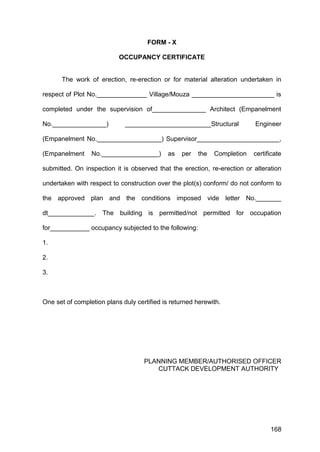
in Form-X or refuse occupancy, as the case may be, within 30
days from the date of inspection.
(2) Such certificate shall be issued only after all utility services for
the entire building are physically provided.
(3) The occupancy certificate shall also state the use/type of
occupancy of the building. However, the applicant may apply for
change of use/occupancy permitted within the purview of the
Development Plan/ Zonal Plan/ Zoning Regulations, where so
required.
(4) In case of multi storied building and other special building like
assembly, institutional, industrial, storage and hazardous and
mixed occupancies with covered area more than 500 sq. mtr.,
after completion of the building and obtaining the occupancy
certificate, periodic inspection shall be made by the Fire
Authority to ensure the fire safety of the building and compliance
with the provision of fire and life safety requirements („Fire and
Life safety‟, Part-4 of NBC). Periodic occupancy renewal
certificate shall be issued by the Authority on the
recommendation of the Fire Prevention Officer, which shall also
include safe keep of fire fighting installations and equipment for
such building.
(5) All occupied buildings and buildings covered under sub-
regulation (4) above shall also be subject to periodic physical
inspection by a team of multi disciplinary professionals of the
Authority. The Authority as may be deemed necessary may
outsource this work. The team shall report compliance of
Regulations, natural lighting, and ventilation, besides structural
and electrical safety. If any short comings/deficiencies or
violations are noticed during inspection, the occupants shall
ensure the compliance of the same within a specified time frame
of six months. If not complied with, the building shall be declared
unsafe. The period of inspection shall be usually three to five
years but in any case not more than five years.
(6) An appeal against the decision of the Authority shall lie under
section 18 of the Act.
17.(1) Where the building plan accompanying the application seeking
permission, requires the clearance of the Art Commission,
Odisha, constituted under section 88, the Authority shall grant
the permission only after the clearance is given by the said
Commission. In all other cases, Architectural Control shall be
regulated according to the provisions of these regulations.
(2) The Authority, on the recommendation of the Art Commission,
may issue public notices, from time to time, prescribing the
architectural norms in different zones.
Art
commission
30
18. (1) No construction or re-construction of any building, within a radius
of 100 meters, or such other higher distance from any
archaeological site, as may be decided by the Archaeological
Survey of India and Odisha State Archaeology Department from
time to time, from the outer boundary of a declared protected
monument shall be permitted.
(2) (i) No construction above 1st
floor and above 7 (seven) meters
shall be allowed beyond a radius of 100 meters and within a
radius of 300 meters of such monuments.
(ii) The construction or reconstruction of any building under sub-
regulation (2) shall not be above 7 (Seven) meters of total
height.
(3) Notwithstanding anything contained in the sub-regulation (1) &
(2) above, construction/re-construction/addition/alteration shall
be allowed on production of clearance from A.S.I./State
Archaeology Department as the case may be.
(4) If a building or premises, not covered under The Ancient
Monument Preservation Act, 1904, or The Ancient Monuments
and Archaeological Sites and Remains Act, 1958, in the opinion
of the Authority, is of historical or architectural interest, and is in
danger of being demolished or altered or likely to be affected in
its character by a development, the Authority shall not grant
permission for construction over any land situated near the said
building or premises. The matter shall be referred to the Art
Commission, whose decision shall be final.
(5) These provisions shall apply mutatis mutandis in respect of
archae-ological sites notified by the Art Commission.
(6) An appeal against the decision under sub-regulation (3) shall lie
under section 18 of the Act.
19. No building exceeding 10 meters height shall be permitted within
200 meters radius from the boundary of the Heritage buildings
and the Authority may decide such other buildings as from time
to time.
20. (1) All unsafe buildings shall be considered to constitute danger to
public safety and shall be restored by repairs or demolished or
dealt with otherwise as directed by the Authority.
(2) The Authority shall examine or cause to be examined every
building reported to be unsafe or damaged and shall make a
written record of such examination.
Construction
near protected
monuments
Construction
near important
buildings
Unsafe
building
31
(3) Whenever the Authority finds any building or portion thereof to
be unsafe, it shall, in accordance with established procedure
for legal notice, give to the owner or occupier of such building
written notices stating the defects thereof. This notice shall
require the owner or the occupier within a stated time either to
complete specified repairs or improvements or to demolish and
remove the building or portion thereof.
(4) The Authority may recording the reasons therefore direct in
writing that the building, which in its opinion is dangerous, or
has no provision for exit in the event of fire, shall be vacated
immediately or within the period specified for the purpose.
(5) If any person does not comply with the orders of vacating a
building, the Authority may with the help of police remove the
person from the building.
(6) In case the owner or occupier fails, neglects or refuses to
comply with the notice to repair or to demolish the said building
or portion thereof, the Authority shall cause the danger to be
removed either by demolition or repair of the building or portion
thereof or otherwise.
(7) In case of emergency, which, in the opinion of the Authority
involves imminent danger to human life or health, the decision
of the Authority shall be final. The Authority shall forthwith or
with such notice as may be possible promptly cause such
building or portion thereof to be rendered safe by
retrofitting/strengthening to the degree of safety or removed.
For this purpose, the Authority may at once enter such
structure or land on which it stands, or abutting land or
structure, with such assistance and at such cost as may be
deemed necessary. The Authority may also get the adjacent
structures vacated and protect the public by appropriate
fencing or such other means as may be necessary.
(8) Costs incurred under sub-regulations (6) & (7) shall be charged
to the owner of the premises involved. Such cost shall be
charged on the premises in respect of which or for the benefit
of which the same have been incurred and shall be
recoverable as provided under law.
21. (1) Before a building is demolished, the owner shall notify all
utilities having service connections within the building, such as
water electricity, gas, sewer and other connections. A permit to
demolish a building shall not be issued until a release is
obtained from the utilities departments stating that their
respective service connections and appurtenant equipment,
Demolition
of building
32
such as meters and regulators have been removed or sealed
and plugged in a safe manner.
(2) The owner shall take all precautionary measures to avoid noise
and dust pollution and shall not create any inconvenience to
the neighboring plot owners.
(3) In case of semidetached building, no objection certificate from
the neighbors shall be obtained.
22. (1) Neither granting of the permit nor the approval of the drawing
and specifications, nor inspections made by the Authority
during erection of the building shall in any way relieve the
owner of such building from full responsibility for carrying out
the work in accordance with the requirements of NBC 2005
and these Regulations.
(2) Every owner/applicant shall:
A. Permit the Authority to enter the building or premises, for
which the permission has been granted at any reasonable
time for purpose of enforcing the regulations;
B. Obtain, where applicable, from the competent Authority
permissions / clearance required in connection with the
proposed work;
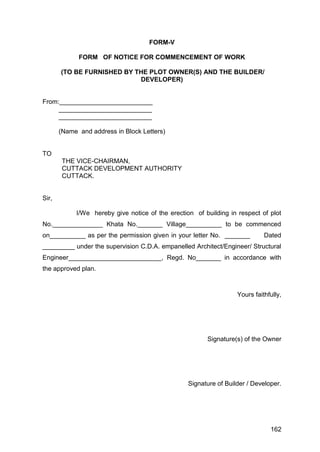
C. Give written notice to the Authority before commencement of
work on building site in Form-V, periodic progress report in
Form-VIII, notice of completion in Form-VI and notice in case
of termination of services of Technical persons engaged by
him and
D. Obtain an Occupancy Certificate from the Authority prior to
occupation of building in full or part.
23. (1) Approval of plans and acceptance of any statement or
document pertaining to such plan shall not exempt the owner
or person or persons under whose supervision the building is
constructed from their responsibilities imposed under these
regulations, or under any other law for the time being in force.
(2) Approval of plan would mean granting of permission to
construct under these regulations only and shall not mean
among other things:
A. the title over the land or building ;
B. easement rights;
C. variation in area from recorded area of a plot or a building;
f the Act.
eviation during
Responsibility
of Authority
Responsibility
and duty of the
owner
33
D. Structural stability;
E. Workmanship and soundness of materials used in the
construction of the buildings
F. Quality of building services and amenities in the construction
of the building,
G. The site/ area liable to flooding as a result of not taking
proper drainage arrangement as per the natural lay of the
land, etc. and
H. Other requirements or licenses or clearances required for the
site / premises or activity under various other laws.
(3) The approval or permission shall not bind or render the
Authority liable in any way with regard to the` matter specified
in sub-regulation (2) (A.) to (H.) above
34
PART - III
ZONING REGULATIONS
24. (1) In the Development Plan area, various use zones viz.
Residential, Retail commercial and Business, Wholesale
Commercial, Industrial, Public and Semi-public, Utility and
Services, Open Space, Transportation, Agricultural and Forest,
Water Bodies, Special Heritage, and Environmentally Sensitive
zones having their zonal boundaries as indicated in the
development plan shall be regulated as per the Table under
Regulation 25. Except as otherwise provided, no structure or
land hereinafter shall be used and no structure shall be
erected, re-erected or altered unless its use is in conformity
with these Regulations.
(2) All places of worship, temples, churches, mosques, burial
and cremation ground etc. as existing prior to enforcement of
these regulations shall be exempted from being treated as non-
conforming uses, provided that continuance of such uses are
not detrimental to the locality as decided by the Authority from
time to time.
(3) All non-conforming uses of land and buildings shall be
discontinued by the owner and the modified uses shall be
made to conform to the land use of the development plan in
force within six months of the regulations coming in force.
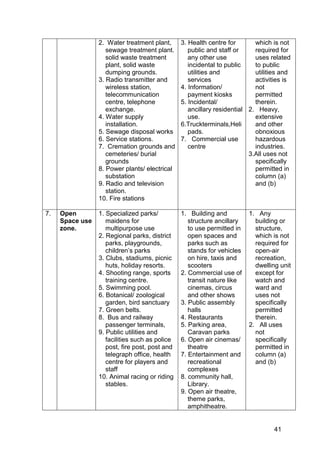
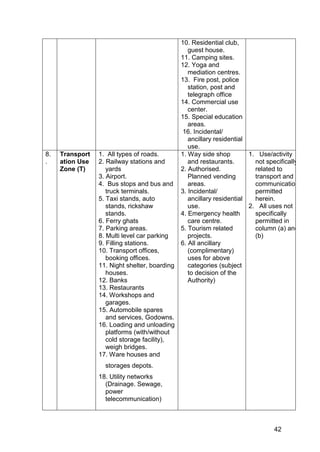
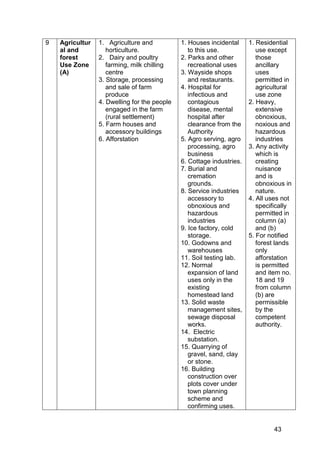
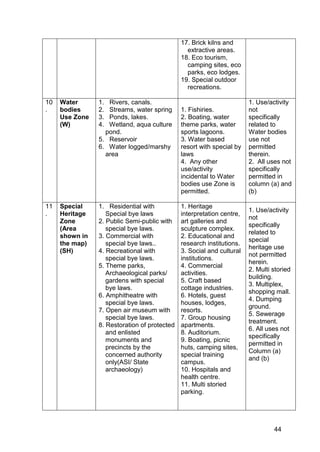
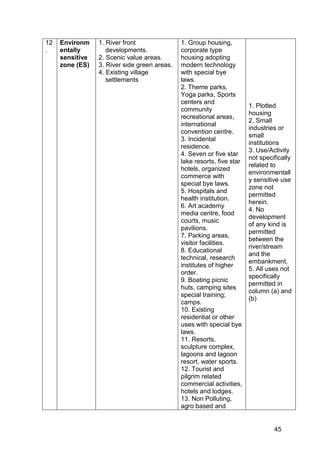
25. (1) Permission for different uses shall be accorded outright for
principal use earmarked in the different zones described in
column-(a) of Table no -1.
(2) Permission for different uses described in column-(b) of the
Table - 1 shall be permitted on special consideration.
(3) The purposes specified in column-(c) of the said Table shall
not be permitted in the areas reserved for particular uses.
(4) Table no.1 mentioned above shall be same as provided in the
Comprehensive Development Plan for Cuttack Development
Plan Area approved by state government.
(5) Residential buildings may be permitted in the open space use
zone if the following conditions are satisfied along with other
conditions of these regulations.
A. the land is a stitiban land and is not a leasehold land;
B. the coverage is not more than 40%;
Zoning
Different use
of land
35
C. the height is not more than 7.0 (seven) meters and at least
20 percent of land is used for plantation;
(6) Mixed land use may be permitted in a particular zone having a
plot size of 4000 Sq. mt and above. However, the main use
shall cover not less than 2/3rd of the total floor area and the
ancillary use shall not exceed 1/3rd of the total area.
(7) In addition to the provision contained in the regulation 18 of the
regulation, following provisions shall be applicable for all
construction in Special Heritage Zone earmarked in CDP.
i) The maximum height of the building shall not be exceeds 15
mtr.
ii) All the proposal for development over an area of more than
500 Sq. Mt. and/or ten meter height shall only be considered on
recommendation of the B.P. Committee with the representation
from the Archeological Survey of India & the Odisha state
archaeology.
(8) For construction of the building in Environmentally Sensitive
Zone, the following provisions shall be applicable.
i) The minimum size of the plot shall be 4000 Sq. mt.
ii) The minimum width of the approach road shall be 12 mt.
iii) The maximum coverage shall not exceed 40%
iv) The proposal for development shall only be considered on
recommendation of the B.P. Committee with the representation
from water resources department, Odisha State Pollution Control
board & Public Health Engineering department in the above
committee.
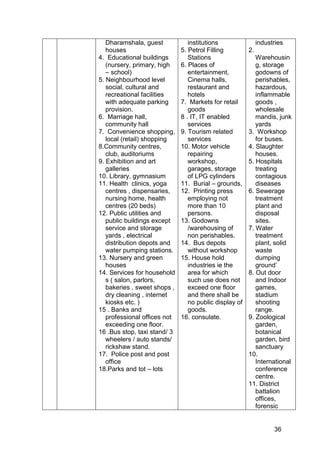
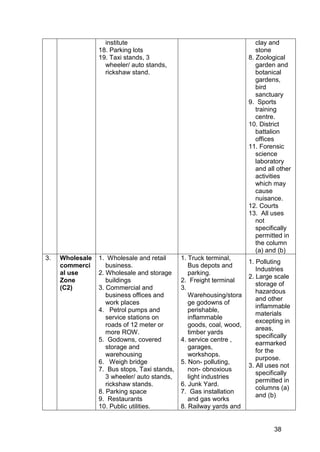
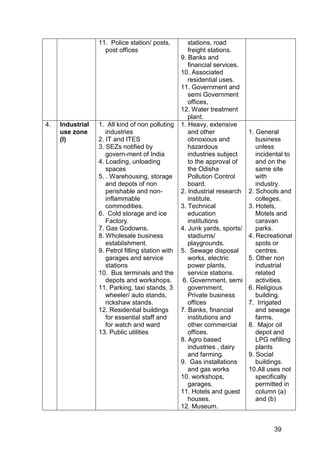
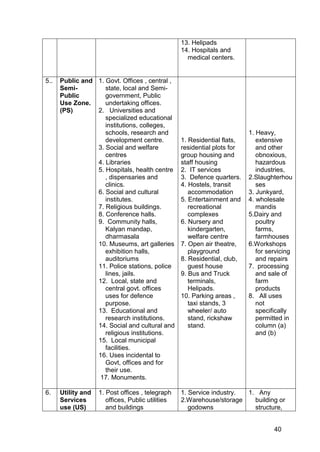
TABLE-1: LAND USES PERMITTED/PROHIBITED IN DIFFERENT USE ZONES
Sl.
No
Use Zone
Uses/Activities
Permitted
Uses/Activities
permissible on
recommendation of
DP & BP Committee
Uses/Activitie
s Prohibited
1 2 3(a) 3(b) 3(c)
1. Residential
Use Zone
(R)
1. Residence , plotted
(detached , semi
detached and row
housing) group housing
, work-cum- residential.
2. Hostel, Boarding and
lodging houses
3. Night shelters,
1. Places of worship
2. Shopping centre
3. Municipal, State
and central
Government
offices
4. Colleges and
research
1. Heavy,
large and
extensive
industry,
noxious,
obnoxious
and
hazardous
36
Dharamshala, guest
houses
4. Educational buildings
(nursery, primary, high
– school)
5. Neighbourhood level
social, cultural and
recreational facilities
with adequate parking
provision.
6. Marriage hall,
community hall
7. Convenience shopping,
local (retail) shopping
8.Community centres,
club, auditoriums
9. Exhibition and art
galleries
10. Library, gymnasium
11. Health clinics, yoga
centres , dispensaries,
nursing home, health
centres (20 beds)
12. Public utilities and
public buildings except
service and storage
yards , electrical
distribution depots and
water pumping stations.
13. Nursery and green
houses
14. Services for household
s ( salon, parlors,
bakeries , sweet shops ,
dry cleaning , internet
kiosks etc. )
15 . Banks and
professional offices not
exceeding one floor.
16 .Bus stop, taxi stand/ 3
wheelers / auto stands/
rickshaw stand.
17. Police post and post
office
18.Parks and tot – lots
institutions
5. Petrol Filling
Stations
6. Places of
entertainment,
Cinema halls,
restaurant and
hotels
7. Markets for retail
goods
8 . IT, IT enabled
services
9. Tourism related
services
10. Motor vehicle
repairing
workshop,
garages, storage
of LPG cylinders
11. Burial – grounds,
12. Printing press
employing not
more than 10
persons.
13. Godowns
/warehousing of
non perishables.
14. Bus depots
without workshop
15. House hold
industries ie the
area for which
such use does not
exceed one floor
and there shall be
no public display of
goods.
16. consulate.
industries
2.
Warehousin
g, storage
godowns of
perishables,
hazardous,
inflammable
goods ,
wholesale
mandis, junk
yards
3. Workshop
for buses.
4. Slaughter
houses.
5. Hospitals
treating
contagious
diseases
6. Sewerage
treatment
plant and
disposal
sites.
7. Water
treatment
plant, solid
waste
dumping
ground‟
8. Out door
and Indoor
games,
stadium
shooting
range.
9. Zoological
garden,
botanical
garden, bird
sanctuary
10.
International
conference
centre.
11. District
battalion
offices,
forensic
37
science
laboratory
12. All uses
not
specifically
permitted in
column (a)
and (b)
2. Retail
Commerci
al and
business
use zone
(C 1)
1. Retail business,
mercantile
2. Commercial centre
3. Banks , financial
services and stock
exchanges
4. Perishable goods
markets.
5. Business and
professional offices.
6. Private institutional
offices and semi
government offices.
7. Shops and shopping
malls.
8. Commercial services
9. Restaurant and hotels.
10. Hostels, boarding
houses, social and
welfare institutions,
guest houses.
11. Convenience and /
neighborhood shopping
centers, local shopping
centers, weekly and
formal markets,
bakeries and
confectionaries
12.. Cinema hall theatres,
banquet halls,
auditoriums
13. Marriage and
community hall, night
shelter
14. clinic and nursing
home.
15. Petrol pumps and
filling station.
16. IT and IT enabled
services
17. Commercial institutes,
Research and training
1. Associated
residential uses.
2. Wholesale
storages yards.
3. Service garage
provided they do
not directly abut
the main road
4. Printing presses
employing not
more than 10
persons.
5. 20 bed hospitals
not treating
contagious
diseases and
mental patients
6. Weigh bridge
7. College,
Polytechnics and
higher technical
institutes
8. Sports complex
and stadium
9. Transient visitor‟s
homes
10. Places of
entertainment ,
recreational uses
and meseums.
11. Convention
centres.
12. Religious places.
13. Public utilities ,
telephone
exchanges
14. Police posts and
post offices.
15. Residential flat.
16. Picnic hut.
1. Polluting
industries.
2. Heavy
extensive
,noxious,
obnoxious,
hazardous
and
extractive
industrial
units.
3. Hospitals/
research
laboratories
treating
contiguous
diseases
personnel
4. Poultry
farms, dairy
farms,
slaughter
houses,
5. Sewerage
treatment
plants and
disposal
sites, solid
waste
treatment
plants and
dumping
ground.
6. Agricultural
uses,
storage of
perishable
and
inflammable
commodities
7. Quarrying of
gravel, sand,
38
institute
18. Parking lots
19. Taxi stands, 3
wheeler/ auto stands,
rickshaw stand.
clay and
stone
8. Zoological
garden and
botanical
gardens,
bird
sanctuary
9. Sports
training
centre.
10. District
battalion
offices
11. Forensic
science
laboratory
and all other
activities
which may
cause
nuisance.
12. Courts
13. All uses
not
specifically
permitted in
the column
(a) and (b)
3. Wholesale
commerci
al use
Zone
(C2)
1. Wholesale and retail
business.
2. Wholesale and storage
buildings
3. Commercial and
business offices and
work places
4. Petrol pumps and
service stations on
roads of 12 meter or
more ROW.
5. Godowns, covered
storage and
warehousing
6. Weigh bridge
7. Bus stops, Taxi stands,
3 wheeler/ auto stands,
rickshaw stands.
8. Parking space
9. Restaurants
10. Public utilities.
1. Truck terminal,
Bus depots and
parking.
2. Freight terminal
3.
Warehousing/stora
ge godowns of
perishable,
inflammable
goods, coal, wood,
timber yards
4. service centre ,
garages,
workshops.
5. Non- polluting,
non- obnoxious
light industries
6. Junk Yard.
7. Gas installation
and gas works
8. Railway yards and
1. Polluting
Industries
2. Large scale
storage of
hazardous
and other
inflammable
materials
excepting in
areas,
specifically
earmarked
for the
purpose.
3. All uses not
specifically
permitted in
columns (a)
and (b)
39
11. Police station/ posts,
post offices
stations, road
freight stations.
9. Banks and
financial services.
10. Associated
residential uses.
11. Government and
semi Government
offices,
12. Water treatment
plant.
4. Industrial
use zone
(I)
1. All kind of non polluting
industries
2. IT and ITES
3. SEZs notified by
govern-ment of India
4. Loading, unloading
spaces
5. . Warehousing, storage
and depots of non
perishable and non-
inflammable
commodities.
6. Cold storage and ice
Factory.
7. Gas Godowns.
8. Wholesale business
establishment.
9. Petrol filling station with
garages and service
stations
10. Bus terminals and the
depots and workshops.
11. Parking, taxi stands, 3
wheeler/ auto stands,
rickshaw stands.
12. Residential buildings
for essential staff and
for watch and ward
13. Public utilities
1. Heavy, extensive
and other
obnoxious and
hazardous
industries subject
to the approval of
the Odisha
Pollution Control
board.
2. Industrial research
institute.
3. Technical
education
institutions
4. Junk yards, sports/
stadiums/
playgrounds.
5. Sewage disposal
works, electric
power plants,
service stations.
6. Government, semi
government,
Private business
offices
7. Banks, financial
institutions and
other commercial
offices.
8. Agro based
industries , dairy
and farming.
9. Gas installations
and gas works
10. workshops,
garages.
11. Hotels and guest
houses.
12. Museum.
1. General
business
unless
incidental to
and on the
same site
with
industry.
2. Schools and
colleges.
3. Hotels,
Motels and
caravan
parks.
4. Recreational
spots or
centres.
5. Other non
industrial
related
activities.
6. Religious
building.
7. Irrigated
and sewage
farms.
8. Major oil
depot and
LPG refilling
plants
9. Social
buildings.
10.All uses not
specifically
permitted in
column (a)
and (b)
40
13. Helipads
14. Hospitals and
medical centers.
5.. Public and
Semi-
Public
Use Zone.
(PS)
1. Govt. Offices , central ,
state, local and Semi-
government, Public
undertaking offices.
2. Universities and
specialized educational
institutions, colleges,
schools, research and
development centre.
3. Social and welfare
centres
4. Libraries
5. Hospitals, health centre
, dispensaries and
clinics.
6. Social and cultural
institutes.
7. Religious buildings.
8. Conference halls.
9. Community halls,
Kalyan mandap,
dharmasala
10. Museums, art galleries
exhibition halls,
auditoriums
11. Police stations, police
lines, jails.
12. Local, state and
central govt. offices
uses for defence
purpose.
13. Educational and
research institutions.
14. Social and cultural and
religious institutions.
15. Local municipal
facilities.
16. Uses incidental to
Govt, offices and for
their use.
17. Monuments.
1. Residential flats,
residential plots for
group housing and
staff housing
2. IT services
3. Defence quarters.
4. Hostels, transit
accommodation
5. Entertainment and
recreational
complexes
6. Nursery and
kindergarten,
welfare centre
7. Open air theatre,
playground
8. Residential, club,
guest house
9. Bus and Truck
terminals,
Helipads.
10. Parking areas ,
taxi stands, 3
wheeler/ auto
stand, rickshaw
stand.
1. Heavy,
extensive
and other
obnoxious,
hazardous
industries,
2.Slaughterhou
ses
3. Junkyard,
4. wholesale
mandis
5.Dairy and
poultry
farms,
farmhouses
6.Workshops
for servicing
and repairs
7. processing
and sale of
farm
products
8. All uses
not
specifically
permitted in
column (a)
and (b)
6. Utility and
Services
use (US)
1. Post offices , telegraph
offices, Public utilities
and buildings
1. Service industry.
2.Warehouse/storage
godowns
1. Any
building or
structure,
41
2. Water treatment plant,
sewage treatment plant.
solid waste treatment
plant, solid waste
dumping grounds.
3. Radio transmitter and
wireless station,
telecommunication
centre, telephone
exchange.
4. Water supply
installation.
5. Sewage disposal works
6. Service stations.
7. Cremation grounds and
cemeteries/ burial
grounds
8. Power plants/ electrical
substation
9. Radio and television
station.
10. Fire stations
3. Health centre for
public and staff or
any other use
incidental to public
utilities and
services
4. Information/
payment kiosks
5. Incidental/
ancillary residential
use.
6.Truckterminals,Heli
pads.
7. Commercial use
centre
which is not
required for
uses related
to public
utilities and
activities is
not
permitted
therein.
2. Heavy,
extensive
and other
obnoxious
hazardous
industries.
3.All uses not
specifically
permitted in
column (a)
and (b)
7. Open
Space use
zone.
1. Specialized parks/
maidens for
multipurpose use
2. Regional parks, district
parks, playgrounds,
children‟s parks
3. Clubs, stadiums, picnic
huts, holiday resorts.
4. Shooting range, sports
training centre.
5. Swimming pool.
6. Botanical/ zoological
garden, bird sanctuary
7. Green belts.
8. Bus and railway
passenger terminals,
9. Public utilities and
facilities such as police
post, fire post, post and
telegraph office, health
centre for players and
staff
10. Animal racing or riding
stables.
1. Building and
structure ancillary
to use permitted in
open spaces and
parks such as
stands for vehicles
on hire, taxis and
scooters
2. Commercial use of
transit nature like
cinemas, circus
and other shows
3. Public assembly
halls
4. Restaurants
5. Parking area,
Caravan parks
6. Open air cinemas/
theatre
7. Entertainment and
recreational
complexes
8. community hall,
Library.
9. Open air theatre,
theme parks,
amphitheatre.
1. Any
building or
structure,
which is not
required for
open-air
recreation,
dwelling unit
except for
watch and
ward and
uses not
specifically
permitted
therein.
2. All uses
not
specifically
permitted in
column (a)
and (b)
42
10. Residential club,
guest house.
11. Camping sites.
12. Yoga and
mediation centres.
13. Fire post, police
station, post and
telegraph office
14. Commercial use
center.
15. Special education
areas.
16. Incidental/
ancillary residential
use.
8.
.
Transport
ation Use
Zone (T)
1. All types of roads.
2. Railway stations and
yards
3. Airport.
4. Bus stops and bus and
truck terminals.
5. Taxi stands, auto
stands, rickshaw
stands.
6. Ferry ghats
7. Parking areas.
8. Multi level car parking
9. Filling stations.
10. Transport offices,
booking offices.
11. Night shelter, boarding
houses.
12. Banks
13. Restaurants
14. Workshops and
garages.
15. Automobile spares
and services, Godowns.
16. Loading and unloading
platforms (with/without
cold storage facility),
weigh bridges.
17. Ware houses and
storages depots.
18. Utility networks
(Drainage. Sewage,
power
telecommunication)
1. Way side shop
and restaurants.
2. Authorised.
Planned vending
areas.
3. Incidental/
ancillary residential
use.
4. Emergency health
care centre.
5. Tourism related
projects.
6. All ancillary
(complimentary)
uses for above
categories (subject
to decision of the
Authority)
1. Use/activity
not specifically
related to
transport and
communication
permitted
herein.
2. All uses not
specifically
permitted in
column (a) and
(b)
43
9 Agricultur
al and
forest
Use Zone
(A)
1. Agriculture and
horticulture.
2. Dairy and poultry
farming, milk chilling
centre
3. Storage, processing
and sale of farm
produce
4. Dwelling for the people
engaged in the farm
(rural settlement)
5. Farm houses and
accessory buildings
6. Afforstation
1. Houses incidental
to this use.
2. Parks and other
recreational uses
3. Wayside shops
and restaurants.
4. Hospital for
infectious and
contagious
disease, mental
hospital after
clearance from the
Authority
5. Agro serving, agro
processing, agro
business
6. Cottage industries.
7. Burial and
cremation
grounds.
8. Service industries
accessory to
obnoxious and
hazardous
industries
9. Ice factory, cold
storage.
10. Godowns and
warehouses
11. Soil testing lab.
12. Normal
expansion of land
uses only in the
existing
homestead land
13. Solid waste
management sites,
sewage disposal
works.
14. Electric
substation.
15. Quarrying of
gravel, sand, clay
or stone.
16. Building
construction over
plots cover under
town planning
scheme and
confirming uses.
1. Residential
use except
those
ancillary
uses
permitted in
agricultural
use zone
2. Heavy,
extensive
obnoxious,
noxious and
hazardous
industries
3. Any activity
which is
creating
nuisance
and is
obnoxious in
nature.
4. All uses not
specifically
permitted in
column (a)
and (b)
5. For notified
forest lands
only
afforstation
is permitted
and item no.
18 and 19
from column
(b) are
permissible
by the
competent
authority.
44
17. Brick kilns and
extractive areas.
18. Eco tourism,
camping sites, eco
parks, eco lodges.
19. Special outdoor
recreations.
10
.
Water
bodies
Use Zone
(W)
1. Rivers, canals.
2. Streams, water spring
3. Ponds, lakes.
4. Wetland, aqua culture
pond.
5. Reservoir
6. Water logged/marshy
area
1. Fishiries.
2. Boating, water
theme parks, water
sports lagoons.
3. Water based
resort with special by
laws
4. Any other
use/activity
incidental to Water
bodies use Zone is
permitted.
1. Use/activity
not
specifically
related to
Water bodies
use not
permitted
therein.
2. All uses not
specifically
permitted in
column (a) and
(b)
11
.
Special
Heritage
Zone
(Area
shown in
the map)
(SH)
1. Residential with
Special bye laws
2. Public Semi-public with
special bye laws.
3. Commercial with
special bye laws..
4. Recreational with
special bye laws.
5. Theme parks,
Archaeological parks/
gardens with special
bye laws.
6. Amphitheatre with
special bye laws.
7. Open air museum with
special bye laws.
8. Restoration of protected
and enlisted
monuments and
precincts by the
concerned authority
only(ASI/ State
archaeology)
1. Heritage
interpretation centre,
art galleries and
sculpture complex.
2. Educational and
research institutions.
3. Social and cultural
institutions.
4. Commercial
activities.
5. Craft based
cottage industries.
6. Hotels, guest
houses, lodges,
resorts.
7. Group housing
apartments.
8. Auditorium.
9. Boating, picnic
huts, camping sites,
special training
campus.
10. Hospitals and
health centre.
11. Multi storied
parking.
1. Use/activity
not
specifically
related to
special
heritage use
not permitted
herein.
2. Multi storied
building.
3. Multiplex,
shopping mall.
4. Dumping
ground.
5. Sewerage
treatment.
6. All uses not
specifically
permitted in
Column (a)
and (b)
45
12
.
Environm
entally
sensitive
zone (ES)
1. River front
developments.
2. Scenic value areas.
3. River side green areas.
4. Existing village
settlements
1. Group housing,
corporate type
housing adopting
modern technology
with special bye
laws.
2. Theme parks,
Yoga parks, Sports
centers and
community
recreational areas,
international
convention centre.
3. Incidental
residence.
4. Seven or five star
lake resorts, five star
hotels, organized
commerce with
special bye laws.
5. Hospitals and
health institution.
6. Art academy
media centre, food
courts, music
pavilions.
7. Parking areas,
visitor facilities.
8. Educational
technical, research
institutes of higher
order.
9. Boating picnic
huts, camping sites
special training;
camps.
10. Existing
residential or other
uses with special bye
laws.
11. Resorts,
sculpture complex,
lagoons and lagoon
resort, water sports.
12. Tourist and
pilgrim related
commercial activities,
hotels and lodges.
13. Non Polluting,
agro based and
1. Plotted
housing
2. Small
industries or
small
institutions
3. Use/Activity
not specifically
related to
environmentall
y sensitive use
zone not
permitted
herein.
4. No
development
of any kind is
permitted
between the
river/stream
and the
embankment.
5. All uses not
specifically
permitted in
column (a) and
(b)
46
processing
industries, storage or
go downs for food
grains.
14. Water treatment
plant, sewage
treatment plant solid
waste treatment plant
solid waste dumping
grounds.
47
PART – IV
GENERAL
26. (1) Without prejudice to any other stipulation in these regulations,
no permission to construct a building on a site shall be granted:
A. in areas of natural waterways or drains, as detailed in the
Development Plan, and drainage plan as modified from time
to time;
B. if the orientation of such building is not in harmony with the
surroundings, as may be decided by the Art Commission;
C. if the use to which the site is proposed to be put does not
conform to the use earmarked in the Development Plan;
D. if the building is to be constructed over or under a municipal
drain, sewerage line, electrical line, water main, any other
government or public land, or public utility services;
E. if the foundation of the external wall along a street is located
at a distance less than 0.5 meters from the edge of the street
or road margin including the drain;
F. if all structure plans are not prepared taking into account the
structural safety from seismic zone point of view.
G. if the plot having kisam as agriculture / jalasaya in ROR.
H. if the building is to be constructed over a land where
construction is prohibited by Authority with approval of
Government.
27. (1) As provided in clause-6.4 of National Building Code-2005 no
verandah, balcony or the like shall be allowed to be erected or
re-erected or any additions or alterations made to a building
within the distances quoted below in accordance with the
Indian Electricity Rules between the building and any overhead
electric supply line;
TABLE –2: MINIMUM DISTANCE FROM THE ELECTRIC LINE
Vertical distance in
meters
Horizontal distance
in meters
Low and medium voltage lines
and service lines
2.5 1.2
High voltage lines up to and
including 11,000 Volt
3.7 1.2
High voltage lines above
11,000 volt and up to and
including 33,000 Volt
3.7 2.0
Extra high voltage line beyond
33,000 Volt
3.7
(Plus 0.3 meters for
every additional 33,000
volts or part thereof)
2.0
(Plus 0.3 meters for
every additional 33,000
volts or part thereof)
Restriction on
permission
Distance
from Electric
lines
48
28. In every building area, at least 10% of the land shall be covered by
plantation, but in case of multi-storied buildings/ Group Housing /
Apartment building/ Industrial/ Assembly/ Educational/ Institutional
buildings, at least 20% of the land shall be covered by plantation.
29. (1) every building/ plot shall abut on a public/ private means of
access like streets /roads of duly formed of width as specified in
clause 4, Part-3 of NBC-2005.
(2) In no case, development of plots shall be permitted unless it is
accessible by a public/private street of width not less than 6
meters.
(3) In case of institutional, administrative, assembly, industrial and
other non-residential and non-commercial activities, the
minimum road width shall be 9 meter.
(4) In case of a private road, which gives access to one or more
buildings, the owner of the said private road shall develop the
road and storm water drain as required by the Local Authority,
and transfer the same by way of gift to the Local Authority or
handed over to the Registered Residents‟ Welfare Association
for maintenance.
(5) The Lower minimum width of the road in the basti area, shall be
decided by the authority. However in the area other than basti
area, the parameters as this regulation are to be followed.
30. The minimum size of plots for different categories of building is given
below:
TABLE – 3: CATEGORY WISE SIZE OF PLOTS
Category Min. road
width (m)
Min. size of plot
in Sq. m.
Kalyan Mandaps 12 1000
Cinema, game centers, Multiplex,
convention centers
12 2000
Social clubs and amenities 9 1000
Multi storey car parking 9 1000
Office buildings 9 300
Primary/Upper Primary school 9 2000
High School, Residential school 9 6000
+2 College / Junior college 9 4000
Degree College 12 6000
Technical educational institution 12 10000
Petrol pumps / Filling stations 12 500
Restaurant 9 500
LPG storages 9 500
Places of congregation 9 500
Public libraries 9 300
Conference hall 12 1000
Community hall 9 500
Nursing homes/polyclinics 9 300
Means of
access
Minimum
size of plots
plot
Plantation
49
Hotel 9 2000
R & D Lab 12 1500
Note: In appropriate cases the Authority may consider revising the
minimum size of plot and the minimum road width on the
recommendations of the Building Permission Committee.
31.(1) The minimum setbacks of buildings permissible in a given
size/plot for residential and commercial building in non high rising
category shall be as follows;
TABLE – 4: PLOT SIZE WISE PERMISSIBLE SET BACKS A OF
BUILDINGS
Plot size (in
Sq. Mts)
Minimum Front setback (in Mts)
Abutting road width
Minimum
setbacks other
sides (in Mts)
Less
than 9
Mts
9 Mts
and
below
12 Mts
12 Mts
and less
than
18 Mts
18 Mts and
less than
30 Mts.
Above
30
Mts.
Rear
side
Other
side
1 2(a) 2(b) 2(c) 2(d) 2(e) 3 4
Less than 100 1.0 1.0 2.0 2.0 3.0 -- --
100 & upto
200
1.5 1.5 2.5 2.5 3.5 1.0 --
Above 200 &
upto 300
1.5 1.5 2.5 2.5 3.5 1.5 1.5
Above 300 &
upto 400
1.5 1.5 2.5 2.5 3.5 1.5 1.5
Above 400 &
upto 500
1.5 2.0 2.5 3.0 3.5 1.5 1.5
Above 500 &
upto 750
1.5 2.0 3.0 3.0 4.0 2.0 2.0
Above 750 1.5 2.0 3.0 4.0 4.0 3.0 2.5
(2) In case of group housing/apartment buildings, the minimum distance
between two buildings will not be less than 1/3rd
of the height of the
taller building. However the minimum width of the internal road shall
be 6 meter. In all other cases, if any, open space between the
buildings is intended to be used for the benefit of more than one
building belonging to the same owner, the width of such open space
between the buildings shall be the one specified for the tallest
building abutting on such open space provided that such open
space shall be not less than three meter.
(3) The setbacks/open spaces for other occupancies shall be as below;
A. Institutional (Educational) buildings – The open spaces around
the building shall not be less than 3 meter for plot up to 1000 sq.
mt. and 6 mt. for plots with area more than 1000 Sq. mt. of size.
Minimum
setbacks
for non-high
rise
buildings
50
B. Assembly buildings – the open space in front shall be not less
than 12 meter and the other open spaces around the building shall
not be less than 6 meter.
C. Commercial & Storage buildings – In case of plots with more
than 500 sq.mtr. area, the open spaces around the building shall
not be less than 4.5m.
D. Industrial buildings - the open spaces around the building shall
not be less than 4.5 m for heights up to 15 meter, with an increase
of 0.25 meter for every increase of 1 meter or fraction thereof in
height.
E. Hazardous occupancies - the open spaces around the building
shall not be less than 6 m.
F. IT, ITES and other Corporate Buildings:- In case of plots up to
750 sqm the minimum set backs around the building shall not be
less than 3 mtr. In case of plots above 750 sq.mtr the minimum set
backs around the building shall not be less than 4.5 mtr.
G. In the case of plots carved out by the Authority in respect of E F &
G Category of plot in the scheme area, the planning parameters
shall be decided by the Authority from time to time.
32. For high-rise/ multi-storied buildings, the open spaces around the
building shall be as given in the Table below;
TABLE-5: PROVISION OF EXTERIOR OPEN SPACES
AROUND THE BUILDINGS
Sl. No. Height of the Building
(in metres)
Exterior open spaces to be left
out on all sides in m. (front rear
and sides in each plot)
1 15 and above & up to 18 6
2 More than 18 & up to 21 7
3 More than 21 & up to 24 8
4 More than 24 & up to 27 9
5 More than 27 & up to 30 10
6 More than 30 & up to 35 11
7 More than 35 & up to 40 12
8 More than 40 & up to 45 13
9 More than 45 & up to 55 14
10 More than 55 16
Note: (i)On sides where no habitable rooms face, a minimum space
of 9.0 m. shall be left for heights above 27.0 m.
Minimum setbacks
for high rise
buildings
51
(ii) In case of multi storied buildings the exterior open space
around a building shall be of hard surface capable of taking
load of fire engine weighting up to 45 tonnes.
33.(1) The Floor Area Ratio (F.A.R) for residential, commercial,
corporate, IT/ITES buildings shall be decided on the basis of
the road width on which the plot/site abuts.
TABLE – 6: (FAR AS PER ROAD WIDTH).
Road width
(in metres)
FAR for
Commercial
/Residential
building.
FAR for /IT
/ITES/Corporate
buildings
Above 1.5 to 3 0.05 ----
Above 3 &
less
than 6
1.00 ---
Above 6 & less
than 9
1.50 ---
9 or more &
less than 12
1.75 ---
12 or more &
less than15
2.00 2.00
15 or more &
less than18
2.25 2.25
18 or more &
less than30
2.50 2.50
30 & above 2.75 2.75
N B Lower minimum width of the road in the basti area/ High density
area within the city and the F A R thereof shall be fixed by the
authority.
(2) In case of group housing, the maximum permissible FAR shall
be 2.75 and maximum permissible ground coverage shall be
40%. However additional FAR equals to the FAR consume for
construction of LIG/EWS units shall be allowed, subject to the
ceiling of 25% of the permissible FAR. The FAR shall be
calculated on the total plot area.
(3) In case of Institutional and Assembly building the maximum
permissible FAR shall be 1.50 for plots up to 1000 sq. m. and
1.75 for plots above 1000 sq. m.
(4) In case of transport related activities such as; railway yards,
railway station, bus stands, bus shelters, transport depot, air
port, special ware housing, cargo terminals etc. the maximum
permissible FAR shall be 1.00.
Floor Area
Ratio
52
(5) In case of Industrial building the maximum FAR shall be 1.00.
(6) In case a part of the plot is acquired / donated for public
purpose like road, drain, etc., the Authority may allow
additional FAR up to 0.25 in the form of TDR (Transferable
Development Right) as per the modality approved by the
Authority.
(7) The Authority may allow premium FAR up to 0.25 on IT/ITES
buildings on payment of fees to be decided by the Authority
from time to time, on roads of width 30 mt. and above. The
Authority may refund the fee proportionate to 0.10 premiums
FAR in case of platinum/ gold certified green buildings.
(8) The benefit of unutilized FAR in respect of Apartment
Buildings/ Group Housing shall be made available to the
society and not to the Builder/ Developer.
(9) Exclusive multistory parking blocks can be provided within the
required setback area without reducing the driveway for the fire
tender to the extent of minimum 6 meters. This will not be
included in the calculation of coverage and FAR.
(10) FAR shall not include
A. Basements or cellars and space under a building
constructed on stilts and used as a parking space, and air
conditioning plant room used as accessory to the principal
use;
B. Electric cabin or substation, watchman booth of maximum
size of 3 sq.m. with minimum width or diameter of 1.732 m.,
pump house, garbage shaft, space required for location of
fire hydrants, electric fittings and water tank, society room of
maximum 12 sq.mtr.
C. Projections and accessories buildings as specifically
exempted from the open space/setback requirement.
D. Staircase room and lift rooms above the topmost storey,
architectural features, and chimneys and elevated tanks of
dimensions as permissible under the NBC; the area of the lift
shaft shall be taken only on one floor
34. (1) The height of the building shall be governed by the limitations
of Floor Area Ratio, open space (setbacks), and the width of
the street facing the plot described as detailed below:
A. The maximum height of a building shall in no case exceed
1.5 times X the width of the road on which the plot abuts +
Height of
a building
53
minimum required front setback. However, higher height on
account of premium FAR may be permitted with the approval
of the Government.
B. If a building abuts on two or more streets of different widths,
the building shall be deemed to face upon the street that has
the greater width and the height of the building shall be
regulated by the width of the street.
(2) Notwithstanding anything contained in sub-regulation (1) the
height restrictions with respect to approach Funnels and
Transitional area of Airport as detailed in Table 7 & 8 shall be
adhered to.
TABLE – 7: HEIGHT RESTRICTION WITH RESPECT TO
APPROACH FUNNELS
Distance from
nearest runway end
(in metres)
Maximum Permissible height above
the elevation of the nearest runway
end
(in metres)
Up to 360 0
Above 360 to 510 6
Above 510 to 660 9
Above 660 to 810 12
Above 810 to 960 15
Above 960 to 1110 18
Above 1110 to 1260 21
Above 1260 to 1410 24
Above 1410 to 1560 27
More than 1560 30
TABLE – 8: HEIGHT RESTRICTION WITH RESPECT TO TRANSITIONAL AREA
Distance of the Inner
Boundary of the
Transitional Area (Outer
Boundary of the Air
Port) [Metres]
Maximum Permissible height
above the elevation of the air
port reference point [metres]
Up to 21 0
Above 21 to 42 3
Above 42 to 63 6
Above 63 to 84 9
Above 84 to 105 12
Above 105 to 126 15
Above 126 to 147 18
54
Above 147 to 168 21
Above 168 to 189 24
Above 189 to 210 27
More than 210 M 30
(3) Notwithstanding anything contained in the Tables under sub-
regulation (1), no Radio Aerial, T.V. Antenna, Cell phone tower
or such similar type of installations exceeding 52 metres in
height shall be erected without prior permission of the
concerned Civil Aviation Authority.
(4) No building structure or installation exceeding the height
indicated in the said Tables shall be permitted unless the
applicant produces a „No-Objection Certificate‟ from the Airport
Authority.
35.(1) In all buildings including Apartment buildings/ Group Housing,
Hotels, Restaurants and Lodges, business buildings,
commercial buildings, Institutional buildings like hospitals,
Educational buildings like schools and colleges, multi-storied
buildings/complexes etc. and all other non-residential activities
provision shall be made for parking spaces as per the following
requirements.
TALBE – 9: MINIMUM OFF STREET PARKING SPACE FOR
DIFFERENT CATEGORIES OF OCCUPANCIES
Sl.
No
.
Category of building/ activity
Minimum Parking area to
be provided as
percentage of total built
up area
(1) (2) (3)
1 Shopping malls, Shopping malls with
Multiplexes/ Cinema hall, Retail
shopping centre, IT / ITES
complexes and hotels.
50
2 Restaurants, Lodges, Other
commercial buildings, Assembly
buildings, Office complexes.
40
3 Residential apartment buildings,
Group Housing, Clinics, Nursing
Homes, Hospitals, Institutional and
Industrial buildings.
30
N:B: Parking to be provided as percentage of total built up
area may be in basement/stilt floor and setback/open spaces
at ground level
Off Street
Parking Space
55
(i)Basement(s)/ stilt used exclusively for parking and
permissible services shall not be counted towards FAR.
Leaving apart the maximum setback space as per the provision
of the regulation.
(ii)The driveway in the basement shall be excluded in
calculation of the parking space.
(2) The parking spaces may be provided in (for all schemes)
A. basements or cellars
B. on stilt floor
C. open parking area
D. exclusive multi level parking or
E. roof top parking in case of commercial/IT/ITES and Corporate
building
F. a combination of any or all of the above
(3) For parking purposes, single basement shall be allowed in
case of plot size of 500 square meter or more, and multiple
basements shall be allowed in case of plot size of 1000 square
meter or more. The roof top parking with car lift shall be
allowed only in case of plinth area/roof area of 2000 square
meter or more. For other than parking purposes, single
basement may be allowed in the plot size of less than 500 Sq.
Mt. also subject to a maximum of 50% of the covered area.
(4) Off-street parking spaces shall be provided with adequate
vehicular access to a street and the area of drives, aisles and
such other provisions required for adequate maneuvering of
vehicles.
(5) If the total off-street parking space required under these
regulations is provided by a group of property owners at a
place for their mutual benefit, such parking spaces may be
construed as meeting the off-street parking requirement,
however, subject to the approval of the Authority. The Authority
may also decide to develop such parking spaces and charge
property owners to bear proportionate cost.
(6) Garage with locking facilities shall be included in the
calculation of floor space for determining the requirement of
parking space, unless this is provided in the basement of a
building or under a building constructed on stilts with no
external walls.
(7) The parking spaces to be provided shall be in addition to the
open spaces (setback) required around a building under these
regulations. However, parking may be provided in the front
56
open space and other side open spaces without reducing the
clear vehicular access way to less than 6.0 meters.
(8) Misuse of the area specified for parking of vehicles for any
other use shall be summarily removed / demolished by the
Authority.
(9) For parking spaces in basements and upper storey of parking
floors, at lease two ramps of minimum 3.6 m width or one ramp
of minimum 5.4 m width and in maximum 1:10 slope shall be
provided. Such ramps may be permitted in the side and rear
setbacks after leaving 6 meter space for movement of fire-
fighting vehicles. Access to these may also be accomplished
through provisions of mechanical lifts.
(10) Up to 10% of cellar may be utilized for utilities and non-
habitation purpose like A/C plant room, Generator room,
Electrical installations, laundry etc.
(11) At least 20% of the parking in-group housing, apartment
buildings shall be earmarked for visitors. The Visitors parking
facility shall be open to all visitors. Visitors Parking can be
allowed in the setback space leaving a minimum of 1 mt. Clear
setback space.
(12) Every building except a residential building having less than
four dwelling units will have parking space earmarked for
ambulance, fire tender and physically challenged persons.
(13) In respect of Apartment Complexes/Building/Block, in sites up
to 750 sq m the parking requirement shall be deemed to be
met if the entire stilt floor is left for parking. A WC/Toilet facility
shall be provided for watch and ward in the stilt floor.
(14) Apart from use of Basement for Services/Parking/Storage, it
may be used for other activities like library, Study Room,
Games Room and Laundry only in case of Residential and
Institutional Buildings.
36. (1) At least one side of all the rooms intended for human
habitation, if such room does not abut on the front or the rear
or the side setbacks, shall abut on an interior open space
whose minimum dimension shall be 3 meters x 3 meters in
cases of buildings up to a height of 12 meters. In cases where
the height of the building is more than 12 meters, the width of
the interior open space shall be increased at the rate of one
meter for every additional 3 (three) meters height. This
provision shall be applicable to all categories of buildings,
Interior
open space
57
namely, residential, group housing, apartment, commercial,
institutional, administrative, assembly.
(2) For ventilating the spaces for water closets and bathrooms
ventilation shafts shall be provided with size as provided under
clause - 8.2.5, part-3 of NBC, 2005.
37. (1) the following appurtenant structures shall not be included in the
height of the building.
A. Roof tanks and their supports (with support height not
exceeding 1 m.)
B. Ventilating, air conditioning, lift rooms and similar service
equipments
C. Stair cover (mumty) not exceeding 3.0 m. in height and
D. Chimneys, parapet walls and architectural features not
exceeding 1.2 m. in height.
E. Height of the ceiling of the upper basement roof not
exceeding 1.5 mtr from the average surrounding ground
level.
38. (1) Every open space provided either in the interior or exterior in
respect of any building shall be kept free from any erection
thereon and shall be open to the sky and no cornice, roof, or
weather shade of more than 0.75 m. in width shall overhang or
project over such open space.
(2) A portico of up to 2.5 m. width and 4.6 m. length with a
minimum height of 2.1 m. from the plinth level may be
permitted within the side setback. A garage is permissible at
the rear end of side open space provided no openings are
located on the side and rear boundary. Access to the top of the
portico/garage should not affect the privacy of the neighboring
plot.
(3) The portico provided as above should not rest on the boundary
wall and should be open to provide through access to the rear.
In case the Portico is not a cantilevered one and supported by
pillars the area shall be included in the FAR.
39. (1) Basements/cellars shall not be permitted in low-lying area and
areas without adequate drainage facilities to ensure drainage
from the basement.
Exemption
in Open
space
Height
exemption of
a building
Basement /
Cellar
58
(2) Construction of basements/cellars may be allowed by the
Authority in accordance with the provisions contained in the
development plan applicable to the concerned area.
(3) The basements/cellars shall only be put to the following uses:
A. Storage of household or other non-combustible materials;
B. Strong room, bank cellars etc;
C. Installation of air-conditioning equipments and other
machines used for service and utilities of building;
D. Parking places.
(4) However basements/cellars may be permitted to be constructed
leaving the prescribed set back/ open space applicable to the
building. Further, in case of apartment/ group
housing/commercial/corporate & IT /ITES buildings, the
basements may be allowed to be constructed under the entire
plot area leaving 3 meter space from the boundary of the
premises subject to the following;
(i) In all such cases the owners have to indemnify the Authority
against any damage caused by her/him/them to the adjacent
property in the format given in Form-XI.
(ii) The portion of the basement projecting out of the building line
shall flush with the ground.
(5) The basements shall be used exclusively for parking/
services/storage.
(6) The basement shall fulfill the following requirements:
A. Every basement shall be in every part at least 2.5 m. in height
from the floor to the soffit of the roof slab or ceiling;
B. Adequate ventilation shall be provided for the basement. The
standard of ventilation shall be the same as required by the
particular occupancy according to regulations. Any deficiency
may be met by providing adequate mechanical ventilation in the
form of blowers, exhaust fans (one exhaust fan for 50 Sq.m. of
basement area), air conditioning system etc;
C. The minimum height of the ceiling of upper basement shall be
1.20 m. and the maximum, 1.5 m. above the average
surrounding ground level;
59
D. Adequate arrangement shall be made, so that surface drainage
does not enter the basement;
E. The walls and floors of the basement shall be water-tight and be
so designed that the effect of the surrounding soil and moisture,
if any, are taken in to account in design and adequate damp
proofing treatment is given;
F. The access to the basement shall be separate from the main
and alternative staircase providing access and exit from higher
floors shall be provided. Where the staircase is continuous in the
case of buildings served by more than one staircase, the same
shall be of enclosed type serving as a fire separation from the
basement floor and higher floor. Open ramps shall be permitted
if they are constructed within the building line subject to provision
of (D) above.
G. The ramp providing access to basement to be used for parking
shall have a gradient not steeper than 1:10 and this shall not
obstruct the clear vehicular and pedestrian movement around
the building including movement of fire tender (6 meter).
40. (1) Lift shall be provided for buildings above 15 m. height and
above.
(2) Lift shall be provided at the rate of one lift for twenty dwelling
units, or part thereof for residential buildings and at the rate of
one lift per one thousand Sq.m. or part thereof of built-up area
(roof area) per floor for non-residential buildings. Built-up area
on ground floor and two upper floors shall be excluded in
computing the above requirement.
(3) Notwithstanding anything contained in these regulations in
case of building with 21 m. or more in height, at least two lifts
shall be provided.
41. Mezzanine floor may be permitted above any floor in all types of
buildings up to an extent of one-third of the actual covered area of
that floor. All Mezzanine floors shall be counted toward FAR
calculation, except the mezzanine floor over the ground floor.
42. (i) The Authority may notify the Heritage Zones in consultation
with the Archaeological Survey of India, State Department of
Archaeology, Cuttack Municipal Corporation.
(ii) Conservation of Heritage Buildings, Heritage Precincts
and Natural features: Conservation of buildings, artifacts,
structures, areas and precincts of historic and /or aesthetic
and/or architectural and /or cultural significance (Heritage
buildings and heritage precincts) and/or natural features of
environmental significance shall be taken up by the Cuttack
Heritage
Zone
Provision
of Lift
Mezzanine
60
Municipal Corporation in accordance with the relevant
provisions in-force and those framed from time to time.
43. Barrier free environment is one, which enables people with disabilities
to move about safely and freely and to use all facilities within the
built environment. The goal of barrier free design is to provide an
environment that supports the independent functioning of individuals
so that they can get into and participate in all activities without
assistance.
This regulation is applicable to all Buildings, recreational areas and
facilities used by public.
(1) Site Planning:
1.1 Level of the roads, access paths and parking areas shall be
described in the plan along with specification of the materials.
1.2 Every Buildings should have one access two main entrance/
exit for persons with disabilities which shall be indicated by
proper signage.
1.3 The approach to the entrance should be level if possible.
Where entrances or exits are not levelled, both stage and
ramps should be provided as some disable persons cannot use the
ramps upon which wheel chair users depend.
1.4 The ramp should have a landing after every 9 metres run and
in front of the lower way. Minimum size of the land shall be
1200mm x 2000 mm.
1.5 The approach should be adequately illuminated after dark.
(2) Access Path/ Walk Way:
2.1 Access path from plot entry and surface parking to building
entrance shall be minimum of 1800 mm. wide having even
surface without any steps.
2.2 Slope, if any, shall not have gradient greater than 5%.
2.3 Kerbs wherever provided should have kerb ramps. Kerbs
should be dropped, to be flush with walk way at a gradient no
greater than 1:10 on both sides of necessary and convenient
crossing points. Width should not be less than 1200 mm. If width
is less than 1200 mm, then slopes of the Flared side shall not
exceed 1:12. Warning strips to be provided on the Kerb side
edge of the slope sop that a person with vision impairment
does not accidently walk on to the road.
Barrier free
access for the
physically
challenged
person
61
2.4 Street furniture, trees, lighting and dustbins should be located
on one side of path ways.
2.5 The surface texture may be changed to indicate the approach
to those items.
(3) Accessible Parking:
3.1 Parking should be within 30 meters of the main entrance of the
building.
3.2 2 accessible parking lots with minimum width of 3600
mmx5000mm should be provided.
3.3 It should have the international signage painted on the ground
and also on a signpost/ board put near it.
3.4 The symbol should belarge enough to be easily visible by
person looking for the accessible parking, recommended
size being 1000mm x 1000mm but not larger than 1500mm x
1500mm. With the preferred colours being white and blue, the
sign painted on the floor should contrast in colour and
luminosity with the floor colour.
3.5 There should be directional signs guiding people to the
accessible parking.
(4) Ground and Floor Surfaces.
4.1 Ground and floor surfaces (along accessible routes and in
accessible rooms and spaces, including floors, walks,
ramps, stairs and curb ramps) should be stable, firm and
slip-resistant.
4.2 Vertical level changes up to 6 mm may not need edge
treatment. Changes in level between 6 mm and 12 mm
should be leveled off with a slope no greater than 1:2.
4.3 If gratings are placed in pathways, they should have spaces no
bigger than a wheelchair‟s wheel (e.g. 12 mm).
4.4 Edges of paths can be clearly defined by using different colors
and textures.
(5) Entrance Doors.
Whatever the type of entrance door, it must be wide enough to
accommodate pedestrian traffic comfortably.
5.1 The recommended minimum clear opening width of an internal
door is 900mm minimum.
5.2 Where doors comprise two leaves (i.e. double doors), each leaf
should be 900mm min. wide, so that persons carrying large
items and wheelchair users do not have to open both
leaves.
5.3 Manual doors should incorporate kick plates 300mm high to
withstand impact of wheelchair footrest (this is especially
important where doors are glazed).
62
5.4 Also be fitted with vision panels at last between 900mm and
1500mmfrom floor level .be color contrasted with the
surrounding wall and should not be heavier than 22N to open
Door hardware should be positioned between 900 – 1200mm
above floor. Lever handles and push type mechanisms are
recommended. When a sliding door is fully open, handles
should be usable from both sides. Where revolving doors or
turnstiles are used, an alternative wheelchair accessible
entrance must also be provided.
5.5 A distance of 400mm should be provided beyond the leading
edge of door to enable a wheelchair user to maneuver
and to reach the handle.
5.6 Thresholds of doorways should no exceed 12mm. Raised
threshold and floor level changes at doorways should be
leveled off (beveled) with a slope on each side of a threshold.
5.7 To ensure maximum clarity for persons with vision impairments,
the entrance should be easily distinguishable from its
surroundings by the effective use of landscaping, signage,
color (preferably yellow/orange), tonal contrast and tactile
surfacing.
5.8 Revolving doors are particularly difficult to negotiate and their
use should be avoided. If fitted, they must be accompanied
by adjacent automatic sliding doors or swing to allow easy
they must be accompanied by adjacent automatic sliding doors
or swing door to allow easy access.
5.9 Glass doors must have a bright, colored motif at eye level.
5.10 Glazed doors and fixed glazed areas should be made visible
by use of a clear, colour and tone contrasted warning or
decorative feature that is effective from both inside and
outside and under any lighting conditions, e.g. a logo of
minimum dimensions 150mm by 150mm (though not
necessarily square), set at eye level.
5.11 Fixed glazed areas should have a supplementary contrasting
kick plate (skirting) across the bottom of the glass panel,
preferably 300mm-400mm in height, to withstand the impact of
wheelchair footrests.
(6) Lobby
6.1 Where both doors open in the same direction, and are manual,
lobby dimensions should measure 1500mm (w) x 2000mm (I).
63
6.2 Where both sets of doors could open into a lobby 9I.e. doors
are mounted on two-way hinges) lobby dimensions should be
increased to 1500mm (w) x 2400mm (I).
(7) Steps & Stairs
7.1 Steps should be uniform with the tread not less than 300 mm
and the risers 150 mm.
7.2 The risers should not be open.
7.3 The steps should have an unobstructed width of at least 1200
mm.
7.4 Have continuous handrails on both sides including the wall (if
any) at two levels : upper at 850mm-900mm and lower at
700mm.
7.5 Warning blocks to be placed 300mm at the beginning and at
the end of all stairs.
7.6 Nosing to be avoided.
7.7 The staircase should be adequately and uniformly illuminated
during day and night (when in use).
7.8 The level of illumination should preferably fall between 150-200
lux.
7.9 Lighting systems in stairwells should be designed to create a
slight contrast between treads and risers, while providing a
uniform overall level of illumination.
7.10 Where the stair direction must change, a series of landings is
recommended.
7.11 Landing should be 1200mm deep, clear of any door swing.
7.12 The rise of a flight between landings must be no more than
1200mm.
7.13 All steps should be fitted with a permanent colour and tone
contrasting at the step edge, extending the full width of the
step, reaching a minimum depth of 50 mm on both tread and
riser.
7.14 If the edges are painted on as a temporary measure, it should
be regularly repainted.
64
7.15 The stair covering and nosing should be slip- resistant, non-
reflective, firmly-fixed and easy to maintain.
7.16 Sofit (underside/open area under the stairs) of the stairs should
be enclosed or protected.
(8) Handrails
8.1 Handrails should be circular in section with a diameter of 40-45
mm.
8.2 At least 45mm clear of the surface to which they are attached.
8.3 Extended by at least 300 mm beyond the head and foot of the
flight in the line of travel and grouted in the ground.
8.4 Handrails/grab bars should be in a color that contrasts sharply
with the surrounding area.
8.5 The handrail should be positioned at two levels – 700 mm and
850 – 900 mm above the pitch-line of a flight of stairs and
must extend horizontally a minimum of 300 mm beyond the
top and bottom steps, returning to the wall or floor or rounded
off, with a positive end that does not project into the route of
travel.
8.6 The handrail should be circular in section, of diameter 40 mm
and formed from materials which provide good grip such as
timber, nylon or powder coating, matt finish metal finishes.
8.7 The handrail should contrast in color (preferably yellow/orange)
with surrounding surfaces and should be supported on
brackets which do not obstruct continuous hand contact with
the handrail.
(9) Ramps
9.1 Ramps should be accompanied by steps for ambulant disabled
persons.
9.2 The gradient should ideally be 1 in 20 and no greater than 1 in
12.
9.3 The steeper the gradient, the shorter the length of ramp
between landings.
9.4 On long ramps, a horizontal resting space should be provided
every 6 metres.
9.5 The required minimum clear unobstructed width of a ramp (i.e.
between handrails) is 1200 mm for ramps up to 3.6 metres
long. For ramps longer than 3.6 meters and up to 9 meters the
minimum width should be 1500 mm. For ramps more that 9
meters long the ramp should be minimally 1800 mm wide.
9.6 Surface materials should be slip-resistant, non-reflective,
firmly-fixed and easily maintained.
9.7 The edge of the ramp should have an edge protection with a
minimum height of 100 mm.
9.8 Landings every 750 mm of vertical rise.
65
9.9 A tapping or lower rail should be positioned so that its bottom
edge is no higher than 200 mm above ground level.
9.10 Handrails on the ramps should be on both sides at two levels :
upper at 850 mm – 900 mm and lower at 700 mm ; both end to
be rounded and grouted ; extend 300 mm beyond top and
bottom of ramp.
(10) Lifts
A carefully designed lift makes a huge contribution to the
accessibility of a multi-storey building for persons with reduced
mobility and disabilities.
13.1 Lift locations should be clearly signposted from the main
pedestrian route and recognizable through design and location.
13.2 The colour and tone of the lift doors should contrast with the
surrounding wall finish to assist in their location. Lift doors with
metallic finishes such a steel grey and silver should be avoided
as they are difficult to identify by persons with low vision.
13.3 The lift lobby shall be of an inside measurement of 1800 mm x
2000 mm or more.
13.4 A clear landing area in front of the lift doors of minimum
dimensions 1500 mm x 1500 mm should be provided.
13.5 By making the landing area distinguishable by floor surface
and contrast, it will aid location and recognition of core
areas. This could comprise a change in floor finish from thin
carpet to vinyl/PVC, or cement/mosaic floor to carpet.
13.6 Changes in floor finish must be flush.
13.7 The floor level/location should be indicated on the wall adjacent
to or just above the call buttons and opposite the lift doors
where possible.
(14) Lift Dimensioris
14.1 Provisions of at least one lift shall be made for the wheel chair
user with the following car dimensions of lift recommended
for passenger lift for 13 persons capacity by Bureau of Indian
Standard.
* Clear internal depth – 1100 mm
* Clear internal width – 2000 mm
* Entrance door width – 900 mm
14.2 Minimum internal dimensions for passenger lifts of 1500 mm x
1500 mm size should be provided. These dimensions will
allow access for one person using a wheelchair allowing
them to turn a full circle, or two persons with push chairs.
14.3 The clear opening width of the doors should be a minimum of
900 mm, but 950 mm or wider is preferable.
(15) Corridors/Passages
15.1 Corridors should be 1800 mm minimum wide to allow two
persons to pass.
66
15.2 The floor should be slip-resistant.
15.3 Corridors should be left unobstructed and features such as fire
extinguishers and AC recessed.
15.4 If necessary, changes of direction should be at 90 degrees,
avoiding curved corridors or oblique angles where possible.
15.5 In long corridors, consideration should be given to the provision
of resting places or support rails.
15.6 Seating should be slightly recessed off the main circulation
route.
15.7 Directional signage should be repeated in long corridors to
prevent disorientation.
(16) Windows
16.1 Windows should be designed to avoid the glare which is a
particular problem for people with impaired sight.
16.2 Large glass areas close to circulation spaces should be
marked a little below eye-level with a coloured band or
frame.
16.3 A window should have an unobstructed viewing zone for
wheelchair users 600 mm – 1450mm.
16.4 Transoms positioned between 900 mm and 1200 mm should
not be incorporated into the design to allow a clear view
through a window from a seated position. Windows should be
easy to open and close.
16.5 Their controls should be placed in the zone 850 to 1200 mm
from the floor (see Fig.35). Lever handles should be used in
preference to knobs.
16.6 Windows should contrast visually with their background for the
benefit of persons with visual impairments.
(17) Washrooms and Toilets
17.1 Accessible public toilets should have the access symbol
displayed outside for wheelchair access.
(18) WC Compartment Dimensions
18.1 The dimensions of a unisex toilet are critical in ensuring
access. The compartment should be at least 1750 mm wide
and 2000 mm long.
(19) Water Closet (WC) Fittings
19.1 A standard WC unit with pan should be fitted 460mm – 480
mm above finished floor level.
19.2 An unobstructed space 900 mm wide should be provided to
one side of the WC for transfer, together with a clear space
1200 mm deep in front of the W/C.
19.3 WC should be centred 500 mm away from the side wall, with
the front edge of the pan 750 mm away from the back wall.
67
19.4 Have a back support.
19.5 L-shape grab bar at the adjacent wall and on the transfer side
swing up grab bars shall be provided.
19.6 The cistern should have a lever flush mechanism, located on
the most accessible side of the cistern, i.e. on the transfer side
and not on the wall side.
19.7 The WC should not incorporate a lid, since this can hinder
transfer.
19.8 The seat should be sturdy, but highly contoured seats are not
recommended.
(20) Accessible Urinal
At least one of the urinals should have grab bars to support
ambulant persons with disabilities (for example, crutch users).
20.1 A stall-type urinal is recommended.
20.2 Urinals shall be stall-type or wall – hung, with an elongated rim
at a maximum of 430 mm above the finish floor.
20.3 Urinal shields (that do not extend beyond the front edge of the
urinal rim) may be provided with735 mm clearance between
them.
20.4 Grab bars to be installed on each side, and in the front, of the
urinal (see Fig.44).
20.5 The front bar is to provide chest support; the sidebars are for
the user to hold on to while standing.
(21) Emergency Egress
21.1 An accessible environment is one which persons can not only
enter and use independently, but also one which they can
leave safely in the event of an emergency.
(22) Emergency Evacuation Strategy
22.1 The basic principle of an emergency egress strategy is to move
persons horizontally to a safe area where, if necessary, they
can await assistance or rescue, before traveling vertically to
reach the final exist level.
22.2 The egress routes will therefore comprise horizontal escape
routes, refuges, stairwells and lifts.
22.3 As well as safe escape routes, ; a fire evacuation strategy
must be in place.
22.4 The management procedures identified in the fire evacuation
strategy will be influenced by the design of the building, its
occupancy and its use.
22.5 There should be procedures to ensure the safe egress of
persons who work in the building who may experience
difficulties in the event of an emergency. This could include
persons with visual or hearing impairments, persons with
learning difficulties and persons with mobility difficulties.
68
22.6 Clear, well illuminated signage indicating escape routes is
essential.
(4) Building requirements:
The specified facilities for the buildings for handicapped
persons shall be as follows:
 Approach at plinth level
 Corridor connecting the entrance/exit
 Stairways
 Lift
 Toilet
 Drinking water
A. Approach at plinth level: Every building must have at least
one entrance accessible to the handicapped and shall be
indicated by proper signage. This entrance shall be
approached through a ramp together with stepped entry.
B. Ramp Approach: Ramp shall be finished with non-slip
material. Minimum width of ramp shall be 1800 mm. with
maximum gradient 1:12, length of ramp shall not exceed 9
meter having 800 mm high handrail on both sides extending
300mm beyond top and bottom of the ramp. Minimum gap from
the adjacent wall to the handrail shall be 50mm.
C. Stepped Approach: For stepped approach width of tread shall
not be less than 300 mm. and maximum riser shall be 150 mm.
Provision of 800 mm. high hand rail on both sides of the
stepped approach similar to the ramp approach shall be made.
D. Exit/Entrance Door: Minimum clear opening of the entrance
door shall be 900mm and it shall not be provided with a step
that obstructs the passage of a wheel chair user. Threshold
shall not be raised more than 12 mm.
E. Entrance Landing: Entrance landing shall be provided
adjacent to ramp with the minimum dimension 1800mmx 2000
mm. The entrance landing that adjoins the top end of a slope
shall be provided with floor materials to attract the attention of
visually impaired persons (limited to coloured floor material
whose colour and brightness is conspicuously different from
that of the surrounding floor material or the material that emits
different sound to guide visually impaired persons hereinafter
referred to as guiding floor material”). Finishes shall have a
non-slip surface with a texture traversable by a wheel chair.
Curbs wherever provided must blend to a common level.
F. Corridor connecting the entrance/exit for the handicapped:
The corridor connecting the entrance/exit for handicapped
leading directly outdoors to a place where information
69
concerning the overall use of the specified building can be
provided to visually impaired persons either by a person or by
signs, shall be provided as follows:
i. Guiding floor materials, shall be provided or devices that
emit sound to guide visually impaired persons.
ii. The minimum width shall be 1250 mm.
iii. In case there is a difference of level, slope ways shall be
provided with a slope of 1:12
iv. Handrails shall be provided for ramps/slope ways at a
height of 800 mm.
(5) Stair ways: One of the stairways near the entrance/exit for the
handicapped shall have the following provisions:
A. The minimum width shall be 1350 mm.
B. Height of the riser shall not be more than 150mm and width
of the tread 300mm. The steps shall not have abrupt (square)
nosing.
C. Maximum number of risers on a flight shall be limited to 12.
D. Hand rails shall be provided on both sides and shall extend
30mm on the top and bottom of each flight of steps.
(6) Lifts: Wherever lift is required as per bye-laws, provision of at
least one lift shall be made for the wheel chair user with the
following cage dimensions of lift recommended for passenger
lift of 13 persons capacity by Bureau of Indian Standards.
Clear internal depth: 1100mm
Clear internal width: 2000mm.
Entrance door width: 900 mm.
A. A handrail not less than 600 mm. long at 1000mm. above
floor level shall be fixed adjacent to the control panel.
B. The lift lobby shall be of an inside measurement of 1800 mm
x 1800 mm or more.
C. The time of an automatically closing door shall be minimum 5
seconds and the closing speed should not exceed 0.25
meter/sec.
D. The interior of the cage shall be provided with a device that
audibly indicates the floor the cage has reached and
indicates that the door of the cage for entrance/exit is either
open or closed.
E. The control panel shall have marking in Braille to help
visually impaired.
(7) Toilets: One special Water Closet. in a set of toilets shall be
provided for the use of handicapped with essential provision of
washbasin near the entrance for the handicapped.
A. The minimum size shall be 1500 x 1750 mm.
70
B. Minimum clear opening of the door shall be 900mm and the
door shall swing out.
C. Suitable arrangement of vertical/horizontal handrails with
50mm clearance from wall shall be made in the toilet.
D. The Water Closet seat shall be 50mm from the floor.
(8) Drinking Water: Suitable provision of drinking water shall be
made for handicapped near the special toilet provided for
them.
(9) Designing for Children: In a building meant for the
predominant use of the children, it is necessary to suitably alter
the height of the handrail and other fittings and fixtures.
44. (1) Provision of rainwater harvesting is mandatory for all plots,
which are more than 300 Sq.m. in area. The dimension of
recharging pits/trenches shall be at least 6 cubic meters for
every 100 Sq. m. of roof area. Percolation Pits shall be filled
with small pebbles or brick jelly or river sand and covered with
perforated concrete slabs. Apart from this, the following
requirements are optional and may be provided depending on
site conditions.
A. Terrace Water Collection: The terrace shall be connected to a
sump or the well through a filtering tank by PVC pipe. A valve
system shall be incorporated to enable the first part of the
rainwater collected to be discharged out or to the soil if it is dirty.
A filtering tank measuring 0.36 Sq. m. can be constructed near
the sump. A perforated slab can divide the tank and one part
should be filled by small pebbles and other by brick jelly. The
bottom portion of the tank should have a slope to avoid
stagnation of water.
B. Open Ground: Where there is open ground, a portion of topsoil
shall be removed and replaced with river sand to allow slow
percolation of rainwater. Any other method proved to be
effective in conservation and harvesting of rainwater may be
adopted in each and every construction taken up.
45. (1) Signs and outdoor display structures shall be governed by the
relevant provisions of the Odisha Municipal Corporation Act/Odisha
Municipal Act.
(2)Within the Cuttack Development Plan area where no specific
guideline for the above structures is framed, the Authority shall
prescribe the guidelines with approval of Government.
46. The standards relating to water and sanitation requirements for
various occupancies and uses, fire protection and fire safety
requirements and guidelines for installation of solar water heating
system shall be referred to as given at Annexure-IV.
Reference to
Standards
Reference to
the standards
Rainwater
harvesting
system
Signs and
outdoor
display
structures
71
PART-V
47. (1) Apartment building shall be permitted on plots more than 500
Sq. mt. but less than 4000 Sq. mt.
(2) In apartment building with joint ownership of land the owner /
developer shall provide floor space for house owner‟s society
Office / assembly at the rate of 1 Sq. m. per flat provided that
the minimum area shall not be less than 12 Sq. m.
(3) One staircase for every 6 dwelling units or fraction there of in a
floor shall be provided.
(4) The minimum width of approach road to the plot shall be 9
meters for non high- rise and 12 meters for high-rise buildings.
(5) In addition to other requirements, the apartments plans are
accompanied with the following.
(i) A. Services and Utilities plan as per standards for water supply
system, drainage and storm water disposal system, sewerage
system, rain water harvesting structures, and for other utilities.
B. Landscape plan including rainwater harvesting / water
recycling details.
C.Parking & internal circulation plan along with Common pool
parking area plan, if any. The above shall be drawn on
suitable scale with relevant details.
(ii) A black topped unhindered public access road of at least 7.5
meter width is to be developed on any one side of the
periphery as per suitability and feasibility for the convenience
of accessibility of other sites and lands located in the interior.
(iii) In case of blocks up to 12 m. heights, access through
pathways of 6 m. width would be allowed. All internal roads
and pathways shall be developed as per standards.
(iv) A minimum of 15% of site area shall be earmarked for
organized open space and be utilized as greenery, tot lot or
soft landscaping, etc. This space may be in one or more
pockets.
(6) Common facilities like shopping centre, community hall or
centre/club etc. are required to be provided in up to 5% of the
built up area and shall be planned and developed in cases
where the units are above 50 in number and not to be part of
the residential blocks.
Apartment
72
(7) For apartment buildings, at least 10% of the covered area
(considered for computation of FAR) will be earmarked for
construction of housing units for EWS/LIG category. The cost
and method of allotment of such houses will be decided by the
Authority.
The developer has the option of developing the EWS/LIG units at
the same site or within a distance of five (05) kilometers from the
main project.
Provided that in case of Apartment projects taken over an area of up
to five (5) acres, the Developer will have the option of contributing
an amount equal to Rupees one hundred (100) per square meter of
the total built up area to a fund named as “Shelter Fund” to be
maintained by the Cuttack Development Authority in lieu of
constructing the EWS/LIG houses. The proceeds of this fund will be
utilized by the Authority for construction of EWS/LIG houses and
slum rehabilitation and development.
Provided that additional FAR equals to the FAR consumed for
construction of EWS/LIG units shall be allowed, subject to the
ceiling of 25% of the permissible FAR.
1) The minimum size of site for group housing shall be 4000
sq.m.
2) In addition to other requirements the group housing schemes
shall be accompanied by
A. A services and Utilities plan as per standards for water supply
system, drainage and storm water disposal system, sewerage
system, rain water harvesting structures, and for other utilities.
B. A landscape plan including rainwater harvesting / water
recycling details.
C. Parking & internal circulation plan along with Common pool
parking area plan, if any. The above shall be drawn on suitable
scale with relevant details.
(3) The minimum width of approach road to the plot shall be 9
meters for non high- rise and 12 meters for high-rise buildings.
(4) Common facilities like shopping centre, community hall or
centre/club etc. are required to be provided in up to 5% of the
built up area and shall be planned and developed in cases
where the units are above 50 in number and not to be part of
the residential blocks.
Group
housing
73
(5) A black topped unhindered public access road of at least 7.5
meter width is to be developed on any one side of the
periphery as per suitability and feasibility for the convenience
of accessibility of other sites and lands located in the interior.
(6) In case of blocks up to 12 m. heights, access through
pathways of 6 m. width would be allowed. All internal roads
and pathways shall be developed as per standards.
(7) Minimum of 15% of site area shall be earmarked for organized
open space and be utilized as greenery, tot lot or soft
landscaping, etc. This space may be in one or more pockets.
Provided that in case of Apartment projects taken over an area of up
to five (5) acres, the Developer will have the option of contributing an
amount equal to Rupees one hundred (100) per square meter of the
total built up area to a fund named as “Shelter Fund” to be maintained
by the Cuttack Development Authority in lieu of constructing the
EWS/LIG houses. The proceeds of this fund will be utilized by the
Authority for construction of EWS/LIG houses and slum rehabilitation
and development.
The developer has the option of developing the EWS/LIG units at the
same site or within a distance of five (05) kilometers from the main
project.
Provided that in case of Apartment projects taken over an area of up
to five (5) acres, the Developer will have the option of contributing an
amount equal to Rupees one hundred (100) per square meter of the
total built up area to a fund named as “Shelter Fund” to be maintained
by the Cuttack Development Authority in lieu of constructing the
EWS/LIG houses. The proceeds of this fund will be utilized by the
Authority for construction of EWS/LIG houses and slum rehabilitation
and development.
Provided that additional FAR equals to the FAR consumed for
construction of EWS/LIG units shall be allowed, subject to the ceiling
of 25% of the permissible FAR.
49. An outhouse with zero rear and one side set back may be permitted
on a plot having an area not less than 150 sq.m.,
Provided that:
(1) The coverage of the outhouse shall not exceed 30 sq.m. and
the height shall not exceed 3 m.;
(2) The built up area of the outhouse and that of the main building
together shall not exceed the permissible FAR for the concerned
plot;
Outhouse
74
(3) The outhouse shall not cover more than one third of the width
and more than one fourth of depth of the plot and shall not abut
any public road;
(4) A minimum 1.5 m. strip of land shall be kept open to the sky
between the main building and the outhouse;
(5) No opening either in the form of windows or doors or
ventilators shall be provided to the adjoining properties;
(6) Outhouses with sloping roof would only be permitted. In no
case permission for outhouses would be granted with
reinforced concrete cement flat roof.
50. (1) Construction proposed over all existing buildings which has
been divided into parts by partition/sale or otherwise may be
permitted (without insisting on front, rear or side setbacks) subject
to fulfillment of following provisions:
a) Proposed coverage of the upper floor shall not exceed 75% of
the plinth area of existing floor for organizing an open terrace
to facilitate light and ventilation to habitable rooms & toilets. In
case of additional construction over the existing building in the
basti area, no setback space at least may be allowed with
submission of N O C from that side neighbor..
b) Separate arrangement shall be made for drainage of the storm
water.
c) Ventilators may be permitted above lintel height on production
of no objection certificate from the owners of the adjacent plot
to which the ventilators abuts. But no window overlooking
others property shall be permitted without obtaining written
consent of the owner of the plot to which the window overlooks.
(2) For constructions on first and subsequent floors on existing floors
in a basti area, constructions with zero setbacks on sides may be
permitted.
(3) Provided that the construction does not lead to closing down of
windows/ ventilators/ skylights of the neighbouring plot which
already exist lawfully.
(4) While according permissions without providing required setbacks,
no-objection certificate from the side neighbour where setback is
not provided may be obtained and reasons for the same may be
recorded in writing.
51. (1) (a) The Basti areas are to be delineated and notified by the Authority.
(2) Requirements of small plots in basti area
Addition/alterat
ion of existing
Building
Requirement
for Basti
Area
75
(a) Minimum plot size & frontage: The minimum size and frontage of
residential plots shall not be less than 30 square meter and 3.5
metres respectively.
(b) Open space: In such plots it shall not be mandatory to leave setback
on any side. However front setback may not be less than 1.00 metre.
(c) Internal Courtyard: In such plots having zero setback on both sides an
internal courtyard of area not less than 6 sq.mtrs in area and not less
than 1.5 metre in width shall be provided in such a way that at least
one wall of each living room/ toilet shall abut such a courtyard or a
verandah opening to the courtyard.
(d) For plots with narrow width (7.5metres) zero setbacks may be allowed
on one side with a passage of one meter on the other side.
(e) The rear setback and front setback shall not be less than 1 m.
respectively.
52. (1) Owners of adjacent similar dimension plot abutting a road may
be permitted to construct row or semi-detached buildings.
(2) The orientation of the row or semi-detached building shall
preferably be such that the prevailing south-west summer
breeze can be availed by each dwelling unit.
(3) For semi-detached buildings over two adjacent plots, the
setbacks, the height and the FAR shall be regulated by treating
both the plots as one.
(4) In case of row housing, the length of a row shall not exceed 30
m. along the road on which such houses abut. In case, the
dwelling units in a row are scattered the maximum length of the
road shall be 100 m..
(5) For row houses the ground coverage shall not be allowed to
exceed 60 % and the FAR more than 1.50.
(6) The minimum size of the plot on which a unit of a row housing
may be allowed shall be 30 sq. m..
53. Where plots are allotted in a row for shop-cum-residential purpose
the Authority may allow construction of shop-cum-residential
building without any side set backs up to a depth of 10 meters from
the front exterior wall. Provided that no part of the building up to said
depth is used for residential purpose on the ground floor. No
building exceeding 11 meters in height shall be allowed to be
constructed as a shop-cum-residential plot, unless so permitted
Semi-
detached
and row
housing
Shop cum
residence
76
under the zonal Development Plan, provided that the shop-cum-
residence shall have 2/3rd
of the total floor area used for shops. The
FAR and other parameters shall conform to that specified for
commercial buildings.
(ii) This regulation shall supersede the provision made in the brochure
formulated by of Cuttack Development Authority earlier in respect of
E F & G Category of plot in the scheme area .
54. (1) The relevant provisions of the Odisha Cinemas (Regulations)
Rules, 1954 shall apply for planning, designing and
construction of Cinema and Theatre buildings
(2) No permission for construction of a building to be used as a
cinema hall, theatre or auditoria for cultural show shall be
granted unless the construction of such buildings conforms to
the provisions of the Odisha Cinema (Regulations Act, 1954
and the Odisha Cinematograph Rules, 1939 or any other law in
the subject for the time being in force in the State.
(3) No permission to construct a cinema hall on a site shall be
given unless the Authority has approved such site for the
purpose
(4) Excepting provision for restaurant and incidental facilities no
other use shall be permitted in a cinema building.
(5) All cinema, theatre or auditoria buildings shall conform to IS;
4898-1968 and acoustics design of such buildings shall adhere
to the requirements of IS; 2526-1963.
(6) Exits and fire safety requirements shall be in accordance with
Part IV (Fire and life safety) of the National Building Code of
India, 2005.
55. (1) Vacant space shall be maintained at all times, with the following
distances for storage shed used for the storage of liquefied
petroleum gas cylinders between any building, public space,
public road or any adjoining property which may be built upon
and the said storage shed.
TABLE – 10: MINIMUM DISTANCES REQUIRED FOR STORAGE SHED OF
LIQUIFIED PETROLIUM GAS CYLINDERS
Quantity of Compressed Gas in
Cylinders (Kg.)
Minimum Clear Distance to be kept
(metres.)
0-100 1
Above 100 –1000 3
Above 1000 – 4000 5
Above 4000 – 8000 7
Above 8000 – 12000 9
Above 12000 – 30,000 12
Above 30,000 15
Cinema,
Multiplex
and
Theatre
building
Liquefied
petroleum
gas
Cylinder
Godown
77
(2) Notwithstanding anything contained in the conditions specified
above, cylinders containing liquefied petroleum gas exceeding 100
Kilograms but not exceeding 300 Kilograms may be kept in a
storage shed forming part of, or attached to building, if it is
separated there from by a substantial partition and the only means
of access to it is from outside. Such a storage shed shall not be
situated under any staircase or near other entrances to or exits from
the rest of the building or other buildings. A suitable fence to prevent
unauthorised persons from having access to the shed shall
surround a shed used for storage of liquefied petroleum gas
cylinders.
56. (1) Minimum distance from the road intersections shall be:
A. For minor roads having less than 30 m. width - 50 m.
B. For major roads having width 30 m. or more - 100 m.
(2) The minimum distance of the property line of petrol pump from
the centre line of the road shall not be less than 15 meters on
roads having less than 30 m width. In case of roads having 30
m or more width, the width of the road shall be protected.
(3) Plot size:
A. Only for filling stations - 30 m x 17 m
B. Filling-cum-service station -36 m x 30 m
C. Frontage of the plot shall not be less than 30 m
(4) New petrol pump shall not be located on roads having less
than 30 m width
(5) (A) Other controls
i. Ground coverage - 20%
ii. FAR - 0.20
iii. Max. height - 7 m
iv. Canopy equivalent to permissible ground coverage
within setback line.
v. Front set back - minimum 6 m
(B) Other regulations
i. NOC from Explosives/Fire Department
ii. License from the District Magistrate
iii. Ground coverage will exclude canopy area
(C) Compressed Natural Gas (CNG) mother station
Petrol
Pump
78
i. Plot size (Max) - 36 m x 30 m
ii. Maximum ground coverage - 20%
iii. Maximum height - 7 m (single storey)
iv. Building component - control room/office/
dispensary, store,
pantry and W.C.
57. For construction of Farm House Building in Agriculture
and forest Use Zone
(1) Minimum size of plot- Minimum size of a plot for farmhouse
shall not be less than 1.00 hectare.
(2) Maximum coverage and FAR shall be as given in the table
below-
TABLE – 11: MAXIMUM COVERAGE AND FAR
a Maximum permissible ground
coverage for all types of activity
15 percent
b Maximum permissible FAR 0.25
c Residential accommodation of
watch and ward/maintenance staff
100 sq. m.
d Maximum height 7 m.
e Setbacks Front/side abutting road
15.0 m. and all other sides
9.0 m.
(3) Other Provisions: Minimum 50 percent of the total area of the
farmhouse shall be under plantation/cultivation. At least 100
trees per hectare shall be planted out of which at least 50
percent shall be evergreen trees.
(4) Water supply, Sewerage and drainage:
A. In case of a plot for a farmhouse having dwelling units, the
owner thereof shall be responsible to make lawful
arrangements for potable water.
B. The owner shall be responsible to provide drains in the farm
house to be used for rain water and in case of dairy farm
open or closed sanitary drains to clean sheds, as may be
required by the Authority.
C. The owner shall be responsible to provide septic tank with
necessary disposal trenches for disposal of human and
animal waste in the farmhouse within his own premises.
(5) Electrification - The owner of a farmhouse shall obtain electric
connection directly from the appropriate authority authorized
for distribution on such terms and conditions at his own cost as
decided by the appropriate Authority from time to time.
Farm
House
79
PART- VI
INTEGRATED TOWNSHIP
58. (1) Integrated Townships with minimum 10 Ha of land having access
from minimum 30 m. R/W road shall be allowed. The road shall have
adequate provision for cycle track, footpath, covered drain, plantation,
street light and under ground utilities.
(2) The integrated Township shall be permitted in Residential / Public and
Semi public use Zone
(3) Permissible land use within the township (%)
A. Residential - 45-50
B. Industrial (Non Polluting) - - 8-10
C. Commercial - 2-3
D. Public and Semi public Zone - 6- 8
E. Recreational - 12-14
(4) Other regulations for approval of Integrated Township
A. At least 10% of the total area shall be reserved for parks and
open space. It shall be developed and maintained by the
developer.
B. At least 5% of the site area shall be reserved for public and
semi-public use and shall be handed over to the Authority free of
cost and the Authority for development either to the developer or
others on lease basis shall allot the same.
C. The FAR shall be calculated on the total area.
D. Road shown in Comprehensive Development Plan shall be
incorporated within the plan and shall be handed over to the
Local Authority free of cost after development.
E. The FAR and coverage shall be 2.75 and 40% respectively.
F. At least 10% of the covered area (considered for calculation of
FAR) will be earmarked for housing for the EWS/LIG category.
The cost and method of allotment of such houses will be decided
by the Authority. However additional FAR equals to the FAR
consumed for construction of EWS/LIG units shall be allowed,
subject to the ceiling of 25% of the permissible FAR.
G. At least one of the major interconnecting roads shall be 18 mtr
R/W and shall be open ended.
Large
Projects
80
PART - VII
MULTI-STOREYED BUILDINGS AND GROUP HOUSING
SCHEMES/APARTMENTS: ADDITIONAL REQUIREMENTS
59. (1) The Authority may restrict construction of multistoreyed
buildings in any area on the basis of objective assessment
of the available infrastructure and planning needs after
obtaining due approval of the Government.
(2) Before commencement of these regulations, where
permission has been granted conditionally, such cases
shall be dealt with under corresponding provisions of these
Regulations without any major change, or removal of
construction, subject to the condition where violation of
Heritage Zone conditions has occurred, this relaxation shall
not apply.
(3) No multi-storied building shall be allowed to be constructed:
A. with approach road less than 12 m. width;
B. on plot the size less than 2000 sq. m., and
60. Permission for construction of multi-storied building shall be
accorded along with direction to the builder/developer to
develop the onsite and off site infrastructure like connectivity of
sewerage, drainage, water supply, road etc. to the main
network as per the specification of the concerned public
authorities.
The builder/developer shall produce no objection certificate
from the above Authorities regarding successful completion of
all infrastructures while applying for occupancy certificate,
bases on which occupancy certificate shall be issued by
Cuttack Development Authority.
61. (1) Every applicant or builder or owner shall submit a notice
regarding his intention to commence the foundation work of the
proposed multi-storied building to the Authority through
authorised technical persons. The said notice shall be
accompanied by the approved plan and shall be in Form-V.
(2) Soon after the receipt of the notice referred to in sub-clause (1)
above, the Authority shall send a team of officers to the
proposed building site and the layout for foundation of the
proposed multi-storied building shall be made in presence of
those officers. The team shall also submit a report to the
Authority to the effect that the layout has been made as per the
approved plan.
Restriction on
construction of
Multi-storied
building
Commencement
of work
81
(3) During or soon after the construction of the foundation work of
the multi-storied building, the Vice-chairman of the Authority or
his representatives or independent Engineer/ Architect
appointed by Authority shall inspect the construction to ensure
that the setbacks, coverage, basement if any, and foundation
standards are done according to the approved plan.
(4) The applicant/builder shall submit periodic progress report after
casting of each floor slab in Form-VIII.
62. (1) For defective constructions, the Authority shall sue the owners,
builders, architects, and the engineers for both civil and
criminal liabilities, besides taking action under these
regulations.
(2) Without prejudice to the provisions of the Act, the actions to be
taken by the Authority shall include stop construction notices,
cancellation of permission, and removal of unauthorized
constructions, which shall be notified.
63. (1) The main entrance to the premises shall not be less than 5
(five) meters in width in order to allow easy access to fire
engine. The gate shall fold back against the compound wall of
the premises, thus leaving the exterior access way, within the
plot, free for the movement of fire service vehicles. If archway
is provided over the main entrances, the height of the archway
shall not be less than 5 (five) meters.
(2) For multi-storied group housing scheme on one plot, the
access way within the premises shall not be less than 7.5
(seven and half) meters in width and between individual
building blocks, there shall be an open un-built space of 6 (six)
meters.
(3) The space set apart for providing access within the premises
shall, in no case, be included in the calculation of requirements
pertaining to parking spaces and other amenities required to be
provided for the building.
(4) Every access way shall be properly drained and lit to the
satisfaction of the Authority. Manhole covers or any other
fittings laid within the right of way of the access way shall be
flushed with the finished surface level of it so as not to obstruct
safe movement of men and vehicles.
(5) Reconstruction or addition or alteration to any multi-storied
building shall not be taken in a manner which shall reduce the
width of the access way to a level below the minimum
prescribed limit under these regulations.
Liability of
defective
construction
Maintenance
82
64. (1) Every multi-storey building meant for human occupation or
assembly shall be provided with exit sufficient to permit safe
escape of the occupants in case of fire or other emergencies.
(2) An exit may be a doorway, corridor, and passageway to an
internal or external staircase or to a verandah or roof or terrace
having access to a street.
(3) Exits shall be so arranged as to provide continuous means of
access to the exterior of a building or exterior open space
leading to a street without passing through any occupied unit.
(4) Exits shall be so located that the travel distance on the floor
shall not exceed twenty meters in case of residential,
educational, institutional and hazardous occupancies and thirty
metres in the case of assembly, business, mercantile, industrial
and storage occupancies. Wherever more than one exit is
required for a floor of a building, exits shall be placed at a
reasonable distance from each other as possible. All the exits
shall be accessible from the entire floor area at all floor levels.
(5) There shall be at least two exits serving every floor and at least
one of them shall lead to a staircase.
(6) The width of every exit shall not be less than one metre and shall
be provided as per the following table.
TABLE–12 :NUMBER OF OCCUPANTS AS PER TYPE OF
OCCUPANCY
Sl.
No. Type of
occupancy
Number of occupants per unit
exit
Stair Case Terrace
(1) (2) (3) (4)
1 Residential 25 75
2 Mixed and other
uses
50 75
Explanation:
A. Lifts and escalators shall not be considered as an exit.
B. „Travel distance‟ means the distance from any point in the floor
area to any exit measured along the path or egress except that
when the floor areas are sub-divided into rooms, used singly or
of rooms and served by suite corridors and passage, the travel
distance may be measured from the corridor entrance of such
rooms or suites to the nearest staircase or verandah having
access to the street.
Exit
83
65. Every multi storied building complex shall have provision for
Information and Communication Technology (ICT) landing point in
the form of a room near the main entrance gate of dimension not
less than 3 m x 4 m. and having 3 m. clear height. The room shall
have two fire proofs doors of 1.2 m. width opening outwards along
with adequate ventilation in the form of windows/ ventilators. Such
room shall not be counted in coverage and FAR calculations.
66.(1) Notwithstanding anything contained in these regulations, the
Authority reserves the right to debar/ black list the builder/
technical person who has deviated from the professional conduct
or has made any fraudulent statement or has
misrepresented/suppressed any material facts in his application/
plan or is involved in construction of the building deviating from the
approved plan/norms of these regulations.
(2) Before taking any action under clause (1) specified above, the
Authority shall issue a notice specifying the reasons thereof asking
for a show-cause within 15 days as to why such builder/technical
person shall not be debarred/black listed. After receipt of the show
cause, if any, the same shall be placed before the Authority for a
decision on debarring/black listing the technical person/builder.
The decision of the Authority in this regard shall be published in
the Notice Board of the Authority and the Govt. website.
(3) An appeal against an order under sub-clause (2) above shall lie
under section 18 of the Act.
67. In addition to the general provisions contained in regulation-16 and
partial modification thereof the following provisions shall be followed
in case of multi storied buildings, apartments and group housing
schemes;
(1) No person shall occupy or allow any other person to occupy any
part of the multi-storied building for any purpose until such
building or any part of it, as the case may be, is granted
occupancy certificate by the Authority.
(2) On receipt of completion certificate in Form-VI (Part-I & Part-II)
the Planning Member with the approval of Vice-Chairman shall
issue a provisional occupancy certificate in Form-X to enable the
builder/land owner to obtain service connections.
The authorities entrusted with the job of providing services like
electricity, water supply and sewerage shall not provide such
services without provisional occupancy certificate by the
Authority. However, temporary service connection may be
provided for construction purpose.
Occupancy
of the
building.
Builders/
Technical
personnel
Penal Action
against
Builders /
Technical
personnel
ICT landing
points
84
(3) The builder shall cause to register an Association of apartment
owners as required under the Odisha Apartment Ownership Act,
1982, before occupancy certificate for 50% or more of the floor
area is given.
(4) The Builder shall submit a copy of the agreement it has entered
into with the apartment owners‟ society. This agreement shall
contain the terms of maintenance of public utilities.
(5) On satisfactory compliance of above & provision of the services
the final occupancy certificate shall be issued by the Planning
Member with approval of the Vice-Chairman.
68. Every applicant/ owner shall submit a notice in Form-VI (Part-I and
Part-II) regarding completion of the construction of multi-storied
building, to the Authority through the registered Architect/Structural
Engineer, who has supervised the construction. The said notice shall
be accompanied with the following documents:
A. Three copies of plan of the completed building.
B. A fee of Rs.10,000/-.
C. Record of Rights (ROR) relating to ownership.
D. Evidence to the effect of all public utility services, and in
particular, sewerage, drainage, water supply, and electricity have
been linked to the main public utility system.
E. No Objection Certificate from Fire Prevention Officer
69.(1) The Authority on receipt of the notice of completion, along with all the
required documents, shall take a decision to either issue or refuse
occupancy certificate in Form-X within 60 days from the date of
receipt of such notice which shall be published in the Notice Board of
the Authority and in the Govt. website.
(2) If the occupancy certificate is not issued by the Authority within sixty
days from the receipt of notice, the owner shall draw the attention of
the Vice-Chairman of the Authority in this regard in the Form-XIII. If
within the further period of two month the authority does not
communicate its decision either granting or refusing occupancy
certificate, such issue of occupancy certificate shall be deemed to
have been granted to the owner on the date following the date of
expiry of said two months.
(3) Where occupancy certificate is refused by the Authority, reasons
recorded thereof shall be communicated to the applicant and the
same shall be published. An appeal against such a decision will lie
under section 18 of the Act. The Appellate Authority shall be
competent to seek the views of, and implead as parties, authorities
Completion
of
construction
Issue of
occupancy
certificate
85
in charge of public utility services, as provided under the Act, under
the Odisha Apartment Ownership Act, 1982, and apartment owners.
Where non-provision of public utilities is likely to affect other
residents, such residents may also be impleaded as parties.
70. (1) Structural Design: The structural design of foundation, masonry,
timber, plain concrete, reinforced concrete, pre-stressed concrete
and structural steel shall be carried out in accordance with Part-VI
structural design, section-1 loads, section-2 foundation, section-3
wood, section-4 masonry, section-5 concrete and section-6 steel of
the National Building Code of India taking into consideration all
relevant Indian Standards prescribed by Bureau of Indian Standards
including the Indian Standard given in IS-Code 1893-1984, 13920-
1993, 4326-1993, 13828-1993, 13827-1993 and 13935-1993 for
structural safety.
(2) Quality of Materials and Workmanship: All material and
workmanship shall be of good quality conforming generally to the
accepted standards of Public Works Department and Indian
standard specification and codes as included in Part-V Building
Materials and Part-VII Construction practices and safety of National
Building Code of India.
(3) Alternative Materials, Methods of Design and Construction and
Tests: The provisions of these regulations are not intended to
prevent the use of any material or method of design or construction
not specifically prescribed by these regulations provided any such
alternative has been approved. The building materials approved by
B.I.S. or any statutory body will form part of the approved building
material and technology as part of the regulations.
(4) The Committee agreed that the structural design of the building upto
15 mt. shall be submitted by the empanelled structural engineer in
Cuttack Development Authority. However for the buildings above 15
mt. the structural stability shall be vetted to Government;
departments entrusted with the work of designing of the buildings. It
is also viewed by the committee that the procedure for empanelment
of engineer/ structural engineer shall be scrutinised thoroughly.
(5) Building Services
A. The Planning design and installation of electrical installations, air
conditioning installation of lifts and escalators can be carried out
in accordance with Part-VIII Building Services, section–2
electrical installation, section–3 air conditioning and heating,
section-5 installation of lifts and escalators of the National
Building Code of India, 2005.
Structural
Safety Design
and other
services
requirements
86
B. The requirements of electric sub-station and the provision of
electric sub-station shall also require approval from the
concerned Authority.
(6) Plumbing Services
The planning, design, construction and installation of water
supply, drainage and sanitation and gas supply system shall be
in accordance with Part-IX, Plumbing Services, section-l water
supply; section-2 drainage and sanitation and section-3 gas
supply of the National Building Code of India 2005.
Part – VIII
DEVELOPMENT AND SUB-DIVISION OF LAND REGULATIONS
71.(1) Applications for subdivision of land for utilizing selling, leasing out or
otherwise disposing it off as referred to in clause(a) of sub-
section(1) of section 16 of the Act shall be made to the Authority in
Form-1.
(2) The applications for subdivision shall be in addition to the
requirements specified in regulation-5(2)(iii) accompanied by-
i. a copy of the title deed of the land in question;
ii. an affidavit with regard to the right, title and interest of land and
such other particulars as the Authority may require;
iii. an authenticated copy of the certificate with regard to the payment
of development charges, if any, under, Chapter-IX of the Act,
provided that submission of such certificate shall not be necessary
if the provisions of Chapter-IX of the Act has not been brought
into force in the area in which the concerned land is located;
iv. an authenticated copy of the receipt towards payment of the
scrutiny fee to the Authority as prescribed under Rule-18;
v. a no-objection certificate ,from the lessor in case the land is not
lease-hold unless the lease deed permits undertaking sub-division as
applied for;
vi. a site plan traced out of revenue village settlement map in
operation indicating therein in red colour the lands to which the
application relates and surrounding plots;
Application
87
vii. an index plan of the site showing adjoining areas within a radius of
150 m. round from the proposed site marking clearly therein the
boundaries of the proposed layout in red colour, existing road,
structures, burial ground and high tension or low-tension power
line passing through the site of the layout plan and the level of the
site;
viii. a detailed plan to a scale not less than 1:100 showing the
proposed layout(sub-division)indicating size of plot width of the
proposed road, open space and amenities provided;
ix. land use analysis indicating the survey plot number, the bye-plot
number, the detailed dimensions of all the plots, the area of each-
plot and the use to which they are proposed to be put;
x. in case of land originally belonging to any religious endowments, a
no-objection certificate from the endowment commissioner or wakf
board as the case may be; and
(3) Where permission for sub-division of land is granted, such
permission shall be communicated to the applicant in Form II within
60 days from the receipt of the application.
(4) Where permission for sub-division of land is refused such refusal
shall be communicated to the applicant in Form IX.
72.(1) Subdivision of land shall normally be permitted for the purpose for
which the concerned land is earmarked in the development plan.
Such subdivision may be for residential, commercial industrial,
institutional or combination of one or more of this purpose or such
other purpose as may be considered conforming to the provisions in
the development plan:provided that in every subdivision plan spaces
for roads, community facilities and public utilities as specified in this
part or such other facilities as the Authority may determine shall be
incorporated.
(2) After a subdivision plan has been approved the Authority shall not
permit construction of a building on any of the plot under section-16
unless the owners have laid down and made street or streets and
provided amenities as approved or transferred the land covered by
roads, open spaces or other public purposes to the concerned local
body.
(3) Subdivision of land for residential purpose in green-belt use zone
shall not be permitted unless such sub-division in the opinion of the
Authority forms a part of the normal expansion of existing human
habitation.
(4) The sub division shall conform to the proposals of the
Comprehensive Development Plan and other development plans.
Use in relation
to
development
plan
88
73. (1) No sub divided plot will be less than 50sq.m. However the Authority
reserves the right to relax in special cases such as EWS housing.
The size of the plot shall be according to the relevant sub-division of
plot size in the zones.
TABLE-16 (A): MINIMUM APPROACH ROAD SHALL BE AS
UNDER
Sl. No. Area for development in ha. Road width in mtr.
01. Up to 1.0 9
02. 1.0 – 4.0 12
03. 4.0 – 10.0 18
04. Above 10.0 30
TABLE-16: MINIMUM ROAD WIDTHS FOR RESIDENTIAL
SUBDIVISION
Sl.No. Length of road in (m) Min. width of road
1 Up to 250 9.0
2 Above 250 up to 500 12.0
3 Above 500 to 1000 15.0
N.B. For EWS housing scheme, the minimum road width may be
relaxed by the Authority.
(2) At least 10% of the plots will be earmarked for of EWS/LIG category.
The cost and method of allotment of such plots will be decided by the
Authority.
Provided that in case of Projects taken over an area decided by the
Authority, the Developer may be given the option to the amount to a
fund named as “Shelter Fund” to be maintained by the Cuttack
Development Authority in lieu of constructing the EWS/LIG houses.
The proceeds of this fund will be utilized by the Authority for
construction of EWS/LIG houses and slum rehabilitation and
development. .
74. Apart from the provision for amenities, open spaces, the area for
residential development shall be up to maximum of 50% of the total
land area.
Size of the
plot and
road width
Area for
development
89
75. Parks and open spaces shall not be less than 10% of the total land area.
This shall be relinquished to the Authority and if required, the Authority
may handover area over for maintenance to the residents‟ welfare
association or owner or developer. If the site is not utilized for which it is
leased out within a prescribed period, it will be resumed back to the
Authority.
76. Civic amenities space shall not be less than 5% of the total area. The
site shall be relinquished to Authority and leased to the residents‟
welfare association or the developer on payment of necessary nominal
fees as prescribed by the Authority from time to time. If the site is not
utilized for which it is leased out within a prescribed period, it will be
resumed back to the Authority.
77.(1) In case of developable area for residential development is less than
60% by providing for Master Plan roads or any other road or due to
statutory reasons, prescribed by the Authority in a layout, the
applicant may be exempted from complying with Civic amenities
reservation.
(2) For layout over 10.0 ha, commercial land uses such as Business
offices, shopping complexes and Retail up to 2-3% may be
permitted, subject to provision of separate access.
(3) For residential development upto 0.30 hectare of land, the
requirement of open space may not be insisted on.
78.(1) the applicant shall deposit a refundable non-earning security deposit
at the rate of Rs.100/- per Sq. m. of plot area for development of
land for a plotted development scheme.
(2) The security deposits shall be refunded within 60 days from the date
on which completion certificate is produced. If the development is
not as per approved plan, this deposit shall be forfeited and the
amount will be transferred to the local authority for development of
the site.
(3) The security deposit will be refunded with 2% interest if the
development is carried out as per the approved plan / lay out.
(4) The applicant may deposit the security fee in the form of Bank
Guarantee.
Parks and
open
spaces
Civic
amenities
Security
deposit for
sub-division
plan
Exemptions
90
PART - IX
COMPOUNDING
79.(1) Any deviation pertaining to unauthorized development shall not be
compounded:
1
A. Where construction has been undertaken on Government land or
land belonging to local body or land not owned by the person
undertaking such development.
B. Where development has been undertaken unauthorizedly within
the prohibited limits of any ancient or archaeological monuments.
C. Where development has been undertaken unauthorizedly over the
area earmarked /approved for parking; reducing the minimum area
of parking requirement.
D. Where road or drain whether public or private, whether
constructed or natural, has been encroached.
(2) Subject to the provisions contained in sub regulation (1), the Authority
shall have the power to determine such other circumstances under
which compounding may be prohibited.
(3) The Authority may, either before or after the institution of the
proceedings under the provisions of the Act compound any offence:
A. Where development has been undertaken without permission, but
within the framework of use restrictions and the provisions of these
regulations applicable to the concerned plot;
B. The Authority may however compound deviations up to 20%
(twenty percent) beyond the permissible norms of these
regulations in respect of front, rear and side setbacks and
coverage. The maximum deviation allowed in FAR will be ten
percent on the permissible FAR, provided the total FAR does not
exceed 3.00 excluding the additional FAR allowed for construction
of EWS/ LIG.
80. Compounding Rates for various categories shall be as follows :
Restriction on
Compounding
Compounding
Rate
91
TABLE – 17: CATEGORY WISE COMPOUNDING RATES
Note: the above rate shall be shall be revised by the Cuttack
Development Authority from time to time with the prior approval of
the Government.
81. At least 50% of the compounding fee collected shall be utilized for slum
rehabilitation and development, development of public utility services
and protection of heritage sites and structures.
82. The Authority may allow retention of any unauthorized structure for
temporary period on deposit of retention fee. The Authority shall decide
the type of structure to be retained, the period of retention and the fees
to be deposited from time to time.
Sl.
No.
Situations
Compounding fee for sq.
metre (in Rs.)
Residential/
Institutional
State Govt./
Central Govt./
Govt. Undertaking
Others
1. Where development has been
undertaken without permission, but
within the frame work of use restrictions
and the provisions of the Regulations
applicable to concerned plot
250 25 400
2. Where development has been
undertaken in deviation to the approved
plan, but within the framework of use,
restrictions and the provisions of norms
and stipulations of these regulations.
100 10 250
3. Constructions up to 10% beyond the
permissible norms of these Regulations
with respect to front, side and rear
setback and/or the deviation in FAR are
within five percent.
1000 100 2000
4. Construction up to 20% beyond the
permissible norms of these Regulations
with respect to front, side and rear
setback and/or the deviation in FAR is
more than five percent or but within ten
percent, provided it does not exceed
3.00exclduing the additional FAR given
for EWS. LIG units.
2000 200 5000
Compounding
amount
Temporary
retention
92
PART – X
SAVINGS / REPEALS AND INTERPRETATION
83. (1) The Cuttack Development Authority (Planning and Building
Standards) Regulations 2001 are hereby repealed.
(2) Notwithstanding such repeal, anything done or any action taken under
the regulations so repealed shall be deemed to have been done or
taken under these regulations;.
84.(1) The Authority may prepare Interim Development Plans (IDP) for newly
included development areas including stitiban/ryoti land within a
reasonable time frame so that development may not be held up in the
name of pendency of Interim Development Plan. Where such IDP has
not been prepared, the general provisions of this Regulation shall
apply without any zonal restrictions.
(2) The Authority shall ensure that resources for land acquisition
and cost of land are mobilized or are likely to be mobilized within the
time frame projected for implementation of such Interim Development
Plans.
85. Where no express provision has been made in respect of any matter
connected with planning and building standards by the Act, the Rules,
the Development Plan, the Town Planning Schemes, or these
Regulations or by any resolution of the Authority, the provisions of the
National Building Code of India, 2005 shall mutatis mutandis be
applicable.
86.(1) As regards qualification, experience and competence of technical
personnel and Builders the references of which are given in
annexure-I may be followed
(2) The extract of the Odisha Development Authorities Act 1982, Odisha
Development Authorities Rules 1983 and relevant provisions of the
National Building Code, which are provided in annexure-II, may be
referred to.
(3) The application for permission under sub section-1 of section 16,
order granting permission under sub-section (3) of Section 16,
drawing attention of the Vice-Chairman under sub section (7) of
section 16, maintenance of registers under sub section (4) of section
16 and (12) of the Act, notice for commencement of work, completion
certificate, certificate for execution of work, certificate for structural
stability, periodical progress report, of the Act, occupancy certificate
Indemnity bond for basement, intimation regarding approval of
residential building plan are provided in form I to XII of these
regulations.
Repeal and
Savings
Interim
Development
Plans
Schedules
and
annexures
Applicabil
ity of
National
Building
Code
93
91. 87. In case of any dispute in interpretation of these regulations, the
decision of the State Government shall be final.
92.
88. The Authority may recommend to the Government for relaxation
/modification of any of the clauses of these Regulations in the
general interest of the public pertaining to projects/schemes
developed by the Government agencies and the decision of the
Government in this regard shall be final.
ANNEXURE-I
QUALIFICATION, EXPERIENCE & COMPETENCE OF TECHNICAL
PERSONNEL AND BUILDER
1. ARCHITECT
A) Qualification & Experience
The minimum–qualification for an Architect shall be Degree in Architecture/
equivalent, registration with the Council of Architecture and not be in arrears
of subscription.
B) Competence
The Architect shall be competent to carry out the work related to the building
permit as given below and shall be entitled to submit:
i) All plans and information connected with the building permit except
engineering services of multistoried/special buildings given in 12.2.5.1
of NBC, 2005.
ii) Certificate of supervision and completion of all buildings pertaining to
architectural aspects.
iii) Preparation of sub-division/layout plans and related information
connected with development permit of area up to 2 hectare.
iv) Certificate of supervision for development of land of area up to 2
hectare.
C) Duties & Responsabilités
i) She/ He shall be responsible for making adequate arrangements to
ensure not only that the work is executed as per the approved plans
Decision of the
Government to
be final
Relaxation
by the Govt.
94
but also in conformity with the stipulations of the National Building
Code, 2005 and the BIS standards for safe and sound construction
non-hazardous, functioning of the services incorporated in the
building and for making adequate provisions for services and
equipment for protection from the fire hazards as per the stipulations
of the National Building Code, 2005 in the buildings and shall obtain
N.O.C. from the Chief Fire Officer or concerned Authority/ before
applying for occupation certificate.
ii) He/She shall, on behalf of the owner, apply for the progress
certificates completion certificates and the occupancy certificates and
obtain the same as required under the regulations.
2. ENGINEER
A) Qualification and Experience
The minimum qualification for an Engineer shall be Degree in Civil
Engineering/ equivalent, registration with the Institution of Engineers,
India and not be in arrears of subscription.
B) Competence
The Licensed Engineers shall be competent to carry out the work
related to the building permit as given below and shall be entitled to
submit:
i) All plans and information connected with building permit.
ii) Structural details and calculations of buildings on plot up to 500
square meters and up to five storey excluding basement/stilt or
below 15 meter in height.
iii)Certificate of supervision and completion for all buildings.
iv) Preparation of all service plans and related information.
v) Issuing certificate of supervision for development of land for all area.
C) Duties & Responsibilities
i) She/ He shall be responsible for making adequate provisions as per
the approved plans but also is inconformity with the stipulations of the
National Building Code 2005 and the BIS standards for safe and
sound construction non-hazardous, functioning of the services
incorporated in the building and for making adequate provisions for
services and equipment for protection from the fire hazards as per the
stipulations of the National Building Code of India in the buildings and
shall obtain N.O.C. from the Chief Fire Officer or concerned Authority/
before applying for occupation certificate.
95
ii) She or He shall, on behalf of the owner, apply for the progress
certificates completion certificates and the occupancy certificates and
obtain the same as required under the regulations.
D) Registration
i) The registration fees if any shall be payable as prescribed by the
Authority from time to time.
ii) If he/she is found negligent in his/her duties and responsibilities. The
Authority may black-list an Engineer in case of serious defaults or
repeated defaults and shall inform the Institution of Engineers, India to
take suitable action against such person. The registration shall be
liable to be revoked temporarily or permanently by the Authority in
such cases of negligence and default.
3. STRUCTURAL ENGINEER
A) Qualification & Experience
The minimum qualifications for a structural engineer shall be degree in Civil
Engineering/ equivalent, registration with the Institution of Engineers, India
and not be in arrears of subscription with minimum 2 years experience in
structural engineering practice.
Note – The 2 years experience shall be relaxed to one year in the case of
Post Graduate degree in Structural Engineering/ higher qualification.
B) Competence
The licensed structural Engineers shall be competent to submit the structural
details and calculations for all buildings and undertake supervision.
In case of buildings having special structural features, as decided by the
Authority, which are within the horizontal areas and vertical limits specified in
chapter A-2.1.1(b), A-2.2.1(b) and A-2.4.1(a) of NBC 2005 they shall be
designed only by structural engineers.
C) Duties and Responsibilities
i) To prepare a report of the structural design.
ii) To prepare detailed structural design and to prescribe the method and
technique of its execution strictly on the basis of the National Building
Code or relevant BIS specifications.
iii) To prepare detailed structural drawings and specifications for
execution indicating thereon, design live loads, safe soil bearing
capacity, specifications of material, assumptions made in design,
special precautions to be taken by contractor to suit the design
assumptions etc. whatever applicable.
96
iv) To supply copies of structural drawings to the site supervisor.
v) To inspect the works at all important stages and certify that the work
being executed is up to the satisfaction of the Architect.
vi) To certify the structural safety and overall structural soundness of the
building to the Architect.
vii) To advise the Owner/Architect/Engineer for arranging for tests and
their reports for soil, building material etc. for his evaluation and
design consideration.
viii) To prepare the revised calculations & drawings in case of any revision
with reference to the earlier submission of drawing and design in a
particular case.
ix) To submit the certificate of structural safety and over all structural
soundness of building to Authority.
x) In case of multistoried buildings and buildings of a special nature as
identified by the Authority from time to time, the Structural
Calculations/ Drawings shall be got vetted by Indian Institute of
Technology/National Institute of Technology / Reputed Government
Engineering College.
D) Registration
i) The registration fees if any shall be payable as prescribed by the
Authority from time to time.
ii) If he/she is found negligent in his/her duties and responsibilities. The
Authority may black-list a Structural Engineer in case of serious
defaults or repeated defaults and shall inform the Institution of
Engineers, India to take suitable action against such person. The
registration shall be liable to be revoked temporarily or permanently
by the Authority in such cases of negligence and default
4. TOWN PLANNER
A) Qualification & Experience
The minimum qualification for a town planner shall be recognized Post
Graduate Degree/ Diploma in Town Planning/ Undergraduate Degree in
Town Planning and registered membership of ITPI and not be in arrears of
subscription.
B) Competence
The licensed town planner shall be entitled to submit:
i) All plans and related information connected with development of land
of all areas including integrated township.
ii) Certificate of supervision for development of land of all areas.
97
C) Duties and Responsibilities
He/Shall be responsible for making adequate arrangements to ensure not
only that the work is executed as per the approved plans but also is
conformity with the stipulations of the National Building Code, 2005 and
the BIS standards for safe and sound construction non-hazardous,
functioning of the services incorporated in the building and for making
adequate provisions for services and equipment for protection from the
fire hazards as per the stipulations of the National Building Code of India
2005.
D) Registration
i) The registration fee if any shall be payable as prescribed by the
Authority from time to time.
ii) The Authority may black list a Town Planner in case of serious
defaults or repeated defaults and shall inform the Institute of Town
planners, India. The registration shall be liable to be revoked
temporarily or permanently by the Authority in such case of
negligence or default.
5. SUPERVISOR
A) Qualification and Experience
The minimum qualifications for a supervisor shall be recognized Diploma in
Civil Engineering or Architectural Assistantship, plus 5 years experience in
building design, construction and supervision.
B) Competence
The licensed supervisor shall be entitled to submit:
i) All plans and related information connected with building permit for
residential buildings on plot up to 100 sq. m. and up to two storey.
ii) Certificate of supervision for buildings as per (i).
C) Duties and Responsibilities
i) To adhere strictly to the architectural and structural drawings/
specifications and written instructions of the structural Engineer and
Architect/ Engineer.
ii) To follow the provisions of NBC, 2005 or BIS specifications as
regards materials, components, quality control and the process of
construction.
98
iii) To bring to the notice of the structural Engineer and
Architect/Engineer/any situation or circumstances which in his opinion
are liable to endanger the safety of structure.
iv) To deposit with the Authority one set of working drawings of the works
executed along with the progress certificates before proceeding to the
next stage of the work.
v) He shall be in charge of site and responsible for supervision of the
work.
vi) He shall ensure that all the works under his charge are carried out in
conformity with the approved drawings and as per the details and
specifications supplied by the Architect/Engineer.
vii) He shall take adequate measures to ensure that no damage is
caused to the work under construction and the adjoining properties.
viii) He shall also ensure that no undue inconvenience is caused in the
course of his work in the people in neighbourhood.
D) Registration
i) The registration fees if any shall be payable as prescribed by the
Authority from time to time.
ii) If he/she is found negligent in his/her duties and responsibilities. The
Authority may blacklist supervisor in case of serious defaults or
repeated defaults. The registration shall be liable to be revoked
temporarily or permanently by the Authority in such cases of
negligence and default
6. GROUP AGENCY
(1) When any Group or Agency comprising of qualified Architect/
Engineer/ Town Planner is practicing, then the qualifications and
experience, competence, duties and responsibilities and
registration will be the combination of individual qualification and
experience, competence, duties & responsibilities and registration
as provided in Schedule 1 to 5.
(2) The Authority may also empanel public undertakings/agencies
engaged in development work for quick execution of
Government./Private projects within its jurisdiction.
7. BUILDER
A) Qualification and experience
i) The person/ firm engaged in construction activities/ building activities
in an urban area having proven merit and experience may be
considered for registration as a builder. He/ She should have at least
five years experience in the line.
99
ii) A person or group of persons having a qualification of Civil
Engineering, Architecture and Town Planning may be registered as
builder.
iii) The Authority may classify the builders into three classes namely,
Class-A, Class-B and Class-C considering their experience, expertise
and annual turnover.
B) Duties and Responsibilities of Builders
i) He/She shall appoint a qualified Architect/ Engineer/ Town Planner to
prepare plans, designs, drawings and specifications for execution of
the works in accordance with the requirements of these regulations.
ii) He shall not cause or allow any deviations from the approved
drawings in the course of the execution of the project and shall bear
responsibility for any irregularity committed in the use and function of
the building or its parts for which the approval has been obtained.
iii) He shall not commence the use of building or shall not give the
possession to occupy the building to any one before obtaining the
occupancy certificate from the Authority.
iv) He shall provide adequate safety measures for structural stability and
protection against fire hazards likely from installation of services like
electrical installation, plumbing, drainage, sanitation, water supply etc.
wherever required under the regulations.
v) He shall explain the construction / design and its intended use as per
approved plan, to the prospective purchaser of the premises under
construction.
C) REGISTRATION
i) The builders shall have to be registered with the Authority on payment
of such fees as decided by the Authority from time to time.
ii) The Authority may debar or black list the builder as referred to in the
Regulations.
100
ANNEXURE-II
EXTRACT FROM ODA ACT, 1982
Definitions:
I. “Agriculture” includes horticulture, poultry farming, the raising of crops,
fruits, vegetables, flowers, grass or trees of any kind breeding of live-
stock including cattle, horses, donkeys, mules, pigs, breeding of fish and
keeping of bees and the use of land or grazing cattle or for and purpose
which is ancillary to the farming of land or for any other agricultural
purpose, but does not include the use of land as a garden which is an
appendage to a building and the expression “agriculture” shall be
construed accordingly;
II. “Amenity” includes roads, water and electric supply, open spaces, parks,
recreational grounds, cultural centers, natural features, playground, street
lighting, drainage, sewerage, city beautification and such other utilities,
services and conveniences as the State Government may determine to
be an amenity, from time to time, for the purpose of this Act.
III. “Area of bad lay-out or obsolete development” means an area consisting
of land which is badly laid out or of obsolete development not conforming
to the planning or the building regulations framed under this Act together
with land contiguous or adjacent thereto and defined as such in the
development plan;
IV. “Authority” means a Development Authority constituted under sub-
section (3) of Section 3 for a development area under this Act.;
V. “Building” includes any structure or erection or part of a structure or
erection which is intended to be used for residential, commercial,
industrial, or other purposes, whether in actual use or not;
VI. “Building operations” includes re-building operations, structural
alterations of or additions to buildings and other operations normally
undertaken in connection with the construction of buildings;
VII. “Chairman” means the Chairman of the Authority;
VIII. “Commerce” means the carrying on of any trade, business or profession,
sale of exchange of goods of any type whatsoever and includes the
running of with a view to making profit, hospitals, nursing homes,
infirmaries or educational institutions, and also includes the running of
sarais, hotels, restaurants and of boarding houses not attached to any
educational institution and the word “commerce” shall be construed
accordingly;
IX. “Commercial use” includes the use of any land or building or any part
thereof for purpose of commerce or for storage of goods, or as an office,
whether attached to any industry or otherwise;
X. “Development” with its grammatical variations means the carrying out or
building, engineering, mining or other operations in, on, over or under
land or the making of any material change, in any building or land or in
the use of any building or land, and includes re-developments and re-
constructions and lay-out and sub-division of any land and “to develop”
shall be construed accordingly.;
101
XI. “Development area” means the area or group of areas declared as
development area under sub-section(1) of Section 3;
XII. “Director” means the person appointed as Director of Town Planning,
Odisha under sub section(1) of Section 3 of Odisha Town Planning and
Improvement Trust Act, Odisha Act 10 of 1957;
XIII. “Engineering Operation” includes the formation or laying out of a street
or means of access to a road or the laying out of means of water-supply,
drainage, electricity, gas or of; other public utility service;
XIV. “Existing land-use” means the predominant purpose for which any land or
building was being used on a specified date;
XV. “Final plot” means a plot reconstituted from an original plot and allotted in
a town planning scheme as a final plot;
XVI. “highway” has the same meaning as in Section 4 of the National
Highways Act 1956 (Act 48 of 1956);
XVII. “Industry” includes the carrying on of any manufacturing process as
defined in the Factories Act,1948(Act 63 of 1948) and the word
“industrial” shall be construed accordingly;
XVIII. “Industrial use” means the use of any land or building or part thereof for
purpose of industry;
XIX. “Land” includes benefit to arise out of land and things attached to the
earth or permanently fastened to anything attached to the earth;
XX. “Local Newspaper” means any newspaper printed and published within
the State of Odisha;
XXI. “Means of access” includes any means of passage whether private or
public for vehicles or for pedestrians and includes any street;
XXII. “National Highway” means any highway declared to be a national
highway under section 2 of the National Highways Act,1956(Act 48 of
1956);
XXIII. “Notification” means a notification published in the Gazettee;
XXIV. “Occupier” includes-
(a) a tenant,
(b) an owner in occupation of, or otherwise using his land,
(c) a rent-free tenant of any land,
(d) a licensee in occupation of any land, and
(e) any person who is liable to the owner for consideration including
damages for the use and occupation of the land;
XXV. “Operational construction” means any construction whether temporary or
permanent, which is necessary for the operation, maintenance
development or execution of any of the following services namely;
(a) railways,
(b) national highways
(c) national waterways,
(d) airways and aerodromes,
(e) posts and telegraphs, telephones, ,broadcasting and other like
forms of communications,
(f) regional grid for electricity,
(g) any other service which the State Government may, if it is of
opinion that the operation, maintenance, development or
execution of such service is essential to the life of the community,
102
by notification declare to be a service for the purpose of this
clause;
Explanation- For the removal of doubts, it is hereby declared
that the construction of-
(i) new residential buildings(other than gate, lodges, quarters, for
limited essential operational staff and the like), roads and drains in
railway colonies, hotels, clubs, institutes and schools, in the case of
railways, and
(ii) a new building, new structure or new installation, or any extension
thereof, in the case of any other service, shall not be deemed to be
operational construction within the meaning of this clause;
XXVI. “Owner” includes a mortgagee in possession, a person who for the
time being, is receiving or is entitled to receive or has received, the
rent or premium or any other consideration for any land whether on
his own account or on account of, or on behalf of or for the benefit of
any other person or who would so receive the rent or premium or any
other consideration or be entitled to receive the rent or premium or
any other consideration if the land were let out to a tenant and
includes the Head of a Government Department, General Manager of
a Railway, the Secretary or other Principal Officer of a vocal authority,
statutory authority or company in respect of properties under their
respective controls;
XXVII. “Private Street” means any street, road, square, court, alley, passage
or riding path, which is not a public street but does not include a
pathway made by the owner or premises on his own land to secure
access to or for the convenient use of such premises;
XXVIII. “Public building” means any building to which the public or any class
or section of the public are granted access or any building, which is
open to the public or any class or section of the public and includes any
building used as a
(i) school or college or a University or other educational
institutions;
(ii) hostel,
(iii) library,
(iv) hospital, nursing home, dispensary, clinic, maternity centre
or any other like institution,
(v) club,
(vi) lodging house,
(vii) court,
(viii) coffee house, boarding house, hotel or eating house,
(b) Ordinarily used by the -
(i) Central or any State Government or any local authority or
anybody, corporate, owned or controlled by the Central or
any State Government, or
103
(ii) Public or any class or section of the public for religious
worship or for religious congregation;
XXIX. “Public open space” means any land, whether enclosed or not, belonging
to the Central or any State Government or any local authority or anybody
corporate owned or controlled by the Central or any State Government
on which there is no building or of which not more than one twentieth part
is covered with buildings and the whole or remainder of which is used for
purpose of recreation or as open space;
XXX. “Public place” means any place or building which is open to the use and
enjoyment of public whether it is actually used or enjoyed by the public or
not, and whether the entry is regulated by any entry fee or not;
XXXI. “Public street” means any street, road, square, court, alley, passage or
riding path over which the public have a right to way, whether a
thoroughfare or not, and includes-
(a) the roadway over any public bridge or causeway,
(b) the footway attached to any such street, public bridge or causeway, and
(c) the drains attached to any such street , public bridge or causeway and
the land, whether covered or not by any pavement, verandah or other
structure, which lies on either side of the roadway up to the boundaries of
the adjacent property whether that property is private property or property
belonging to the Central or any State Government;
XXXII. “Railway” means a railway defined in the Indian Railway Act,1890 (Act 9
of 1890);
XXXIII. “Reconstituted plot” means a plot which is in any way altered by the
making of a town planning scheme;
Explanation- For the purposes of this clause” altered” includes the
alteration of ownership of plot.
XXXIV. “Regulation” means a regulation made under section 124 and includes
zoning and other regulations made as a part of a development plan;
XXXV. “Residence” includes the use for human habitation of any land or building
or part thereof including gardens, grounds, garage, stables and out-
houses, if any, appurtenant to such building and “residential‟ shall be
construed accordingly;
XXXVI. “Rule” means a rule made under this Act by the State Government;
XXXVII. “Slum area” means any predominantly residential area, where the
dwellings which, by reasons of dilapidation, overcrowding, faulty
arrangements or design, lack of ventilation, light or sanitary facilities or
any combination of these factors, are detrimental to safety and health of
the inhabitants or others and which is defined by development plan as a
slum area;
XXXVIII. “ To correct” in relation to any building includes-
104
(a) any material alteration or enlargement of any building,
(b) the conversion by structural alteration of place for human
habitation of any building not originally constructed for human
habitation,
(c) the conversion into more than one place for human habitation of a
building originally constructed as one such place,
(d) the conversion of two or more places of human habitation into a
greater number of such places,
(e) such alterations of a building as affects an alteration of its
drainage or sanitary arrangement or materially affects its security,
(f) the addition or any rooms, buildings, houses or other structures to
any building, and
(g) the construction in a wall adjoining any street or land not belonging
to the owner of the wall, or a door opening on to such street or
land;
XXXIX. “Tribunal” means the Tribunal constituted under section 87;
XL. “Unauthorized occupation” in relation to any premises means the
occupation by any person of the premises belonging to the Authority ,
without any authority, for such occupation and includes the continuance
of this occupation by any person of the premises after the Authority
(whether by way of grant or any other mode of transfer under which he
was allowed to occupy the premises) has expired or has been
determined for any reasons whatsoever;
XLI. “Urban local body” means a Municipal Council or a Notified Area Council
constituted under the Odisha Municipal Act, 1950(Odisha Act 23 of
1950)
XLII. “Valuation Officer” means the Valuation Officer appointed under section
33 of this Act,
XLIII. “Zone” means any one of the divisions into which a development area
may be divided for the purpose of development under this Act;
XLIV. Words and expressions used in this Act but not defined shall have the
same meaning as assigned to them in the Odisha Municipal Act, 1950
(Odisha Act 23 of 1950) as amended from time to time.
105
ANNEXURE-III
EXTRACT FROM ODA RULES 1983
(1) Definitions:
(i) “Act” means the Odisha Development Authorities Act, 1982,
(ii) “Architect Member” means Urban Designer or Architect-member
appointed under clause (f) of sub-section (5) of section-3;
“Board” means the Board of Enquiry appointed under Rule 13;
(iii) “Engineer Member” means the Engineer Member appointed under
clause (C) of sub-section (5) of section 3;
(iv) “Finance Member” means the Finance and Accounts member appointed
under clause (d) of sub-section(5) of section 3;
(v) “Form” means a Form appended to these rules;
(vi) “Gazette” means the Official Gazette of the State of Odisha;
(vii) “Member” means a member of the Authority;
(viii) “Planning Member” means the Town and Regional Planning Member
appointed under clause (e) of sub-section (5) of section 3;
(ix) “Registered Contractor” means a contractor registered under Rule-67;
(x) “Section” means a section of the Act;
(2) Words and expressions used, but not defined in these rules shall have
the same meaning as respectively assigned to them in the Act.
106
ANNEXURE-IV
EXTRACT FROM NATIONAL BUILDING CODE OF
INDIA, 2005
1. Definitions
Accessory use - Any use of the premises subordinate to the principal use
and customarily incidental to the principal use
Alteration - A change from one type of occupancy to another, or a structural
change, such as an addition to the area or height, or the removal of part of a
building, or any change to the structure, such as the construction of cutting
into or removal of any wall, partition, column, beam, joist, floor or other
support, or a change to or closing of any required means of ingress or
egress or a change to the fixtures or equipment.
Approved - Approved by the Authority having jurisdiction
Building Height of - The vertical distance measured, in the case of flat roofs
from the average level of the ground around and contiguous to the building
or as decided by the Authority to the terrace of last livable floor of the
building adjacent to the external walls; and in the case of pitched roofs,
upto the point where the external surface of the outer wall intersects the
finished surface of the sloping roof, and in the case of gables facing the
road, the midpoint between the eaves level and the ridge. Architectural
features serving no other function except that of decoration shall be
excluded for the purpose of measuring heights.
Building line - The line up to which the plinth of a building adjoining a street
or an extension of a street or on a future street may lawfully extend. It
includes the lines prescribed, if any, in any scheme. The building line may
change from time to time as decided by the Authority.
Conversion- The change of occupancy or premises to any occupancy or
use requiring additional occupancy permit.
Drain - A conduit or channel for the carriage or storm water, sewage, waste
water or other water-borne wastes in a building drainage system.
Drainage - The removal of any liquid by a system constructed for the
purpose.
Occupancy or use group - The principal occupancy for which a building or
a part of a building is used or intended to be used; for the purpose of
classification of a building according to occupancy, an occupancy shall be
deemed to include the subsidiary occupancies which are contingent upon it.
Occupier - Occupier includes any person for the time being, paying or liable
to pay rent or any portion of rent of the building in respect of which it is used,
or compensation or premium on account of the occupation of such building
and also a rent free tenant, but does not include a lodger, and the words
„occupy‟ and „occupation‟ do not refer to the lodger. An owner living in or
otherwise using his own building shall be deemed to be the occupier thereof.
Operational construction/Installation- A construction/ installation put up by
Government Departments for operational purposes
Owner - Person or body having a legal interest in land and/or building
thereon. This includes free holders, leaseholders or those holding a sub-
107
lease which both bestows a legal right to occupation and gives rise to
liabilities in respect of safety or building condition.
In case of lease or sub-lease holders, as far as ownership with respect to the
structure is concerned, the structure of a flat or structure on a plot belongs to
the allottee/ lessee till the allotment/lease subsists.
Permit - A permission or authorization in writing by the Authority to carry out
work regulated by the code.
Registered Architect, Engineer, Structural Engineer, Supervisor, Town
Planner, Landscape Architect, Urban Designer - qualified architect, engineer,
structural engineer, supervisor, town planner, landscape architect or urban
designer who has been registered by the Authority or by the body governing
such profession and constituted under a statute, as may be applicable. The
registration requirements of these professionals shall be as given in
Annexure – A.
Notes -
1. Unless specified otherwise, the word „engineer‟ shall mean „civil
engineer‟ or „Architectural Engineer‟
2. The work „licensing/licensed etc, if used by the Authority in the
above context shall be deemed to mean „registration/registered‟ /
empanelment etc.
2.15 Road- See 2.25
2.16 Road line- See 2.27
2.17 Room Height - The vertical distance measured from the finished floor
surface to the finished ceiling surface. Where a finished ceiling is not
provided, the underside of the joists or beams or tie beams shall
determine the upper point of measurement for determining the head
room.
2.18 Sanctioned plan - The set of plans and specifications submitted in
connection with a building or development and duly approved and
sanctioned by the Authority.
2.19 Service road - A road/ lane provided at the rear or side of a plot for
service purposes.
2.20 Set - back line - A line usually parallel to the plot boundaries and laid
down in each case by the Authority, beyond which nothing can be
constructed towards the site boundaries.
2.21 Site (plot) - A parcel (piece) of land enclosed by definite boundaries
2.22 Street level or Grade- The officially established elevation or grade of the
centre line of the street upon which a plot fronts and if there is no
officially established grade, the existing grade of the street at its mid-
point
2.23 Street line - The line defining the side limits of a street
108
2.24 Unsafe - Building- Buildings which are structurally and constructionally
unsafe or insanitary or not provided with adequate means of egress or
which constitute a fire hazard or are otherwise dangerous to human life
or which in relation to existing use constitute a hazard to safety or health
or public welfare, by reason of inadequate maintenance, dilapidation or
abandonment.
2. Regulations for Ventilation shaft.
For ventilating the spaces for water closets and bath rooms if not opening on
to front, side, rear and interior open spaces, these shall open on the
ventilation shaft, the size of which shall not be less than the values given
below;
Height of
buildings in
Meter
Size of ventilation shaft
in Square Meter
Minimum dimension of
one side of the shaft in
Meter
Upto 10 1.2 0.9
Upto 12 2.8 1.2
Upto 18 4.0 1.5
Upto 24 5.4 1.8
Upto 30 8.0 2.4
Above 30 9.0 3.0
3. Regulations for Life Safety
Every building shall be so constructed, equipped, maintained and operated
as to avoid undue danger to the life and safety of the occupants from fire,
smoke, fumes or panic during the time period necessary for escape.
For general exit requirements, occupant load ,capacities of exits
,arrangements of exits, number of exits, doorways, corridors and passage
ways ,internal stair case, external stair case, horizontal exits, fire towers,
ramps, fire lifts, emergency and escape lighting, illumination of means of exit
and fire detection and warning, the relevant provisions in clause-4, part-4 or
NBC, 2005 shall be referred.
4. Requirements of parts of Building
Every parts of the building and other building related activities shall be
planned and designed in accordance with the clause-12, part-3 of NBC,
2005.
5. Fire Safety Requirements
Building shall be so planned, designed and constructed so as to ensure fire
safety and this shall be done in accordance with the part-4, Fire and Life
Safety of the National Building Code of India 2005.
6. Structural Design
The structural design of any item of masonry, timber, plain and reinforced
concrete and steel in a building shall be carried out in accordance with part-
6, Structural Design of NBC.
109
7. Quality of Material and Workmanship
All materials and workmanship shall be of good quality conforming generally
to accepted standards of Public Works Department of Odisha, BIS
Specifications and codes as included in part-5 Building materials and Part-7
Constructional Practices and Safety of the National Building Code of India,
2005.
8. Building Services
The Planning design and installation of electrical installations, air-
conditioning and heating work, installation of lifts and escalators in a building
shall be carried out in accordance with part-8 (Building Services) of the
National Building Code of India 2005.
9. Water supply requirements
The requirements of water supply in a building shall be accordance with the
provision of the National Building Code, 2005 as amended from time to time.
10. Structural Safety for Natural Hazard Protection
For building more than three storeys (including ground floor) or more than
12.0 meter height and important facilities like water works, overhead tank,
telephone exchange, bridges and culverts, electric substation, transmission
towers, the requirements specified in the BIS Code and Guidelines and other
documents shall be observed for structural safety and natural hazards
protection of buildings.
11. Civic Amenities
In group housing, residential lay-outs and Integrated Townships, the civic
amenities shall be provided as specified in clause-5.5., part-3 of the National
Building Code of India, 2005.
110
ANNEXURE – V
STANDARDS FOR WATER, SANAITARY AND FIRE SAFETY REQUIRMENTS
1. PER CAPITA WATER REQUIREMENT FOR VARIOUS OCCUPANCIES /
USES
Table-1
Sl.
No.
Type of Occupancy Consumption
per Capita
per day (in lt.)
1 Residential
a) In living units
b) Hotels with lodging accommodation (per
bed)
135
180
2 Educational
a) Day schools
b) Boarding Schools
45
135
3 Institutional (Medical Hospitals)
a) No. of beds not exceeding 100
b) No. of beds exceeding 100
c) Medical quarters and hostels
340
450
135
4 Assembly- Cinema theatres, auditoria, etc. (per
seat accommodation)
15
5 Government or semi public business 45
6 Mercantile (Commercial)
a) Restaurants (per seat)
b) Other business building
70
45
7 Industrial
a) Factories where bath-rooms are to be
provided
b) Factories where bath-rooms are not to be
provided
45
30
8 Storage ( including Warehouses ) 30
9 Hazardous 30
10 Intermediate Rail Stations (excluding mail and
express stops).
45(25)*
11 Junction Station 70(45)*
12 Terminal Stations 45
13 International and Domestic Airports 70
* The values in parenthesis are for such stations, where bathing
facilities are not provided.
Note: The number of persons for Sl. No. 10 to 13 shall be determined by the
average number of passenger handled by the station daily with due
consideration given to the use the facilities.
111
Table-2
FLUSHING STORAGE CAPACITIES
Sl.
No.
Classification of Building Storage Capacity
1. For tenements having common
conveniences
900 lt. net per w.c.
seat
2. For residential premises other than
tenements having common
conveniences
270l lt. net for one
w.c. seat each and
180 lt. for each
additional seat.
3. For factories and workshops 900 lt. per w.c. seat
and 180 lt. per urinal.
4. For cinemas, public assembly hall,
etc.
900 lt. per w.c. seat
and 350 lt. per urinal.
Table-3
DOMESTIC STORAGE CAPACITIES
Sl.
No.
No. of Floors Storage Capacity Remarks
For premise occupied tenements with common conveniences:
1. Ground floor Nil Provided down take
fittings are installed
2. Floors 2, 3,4,
5 and upper
floors
500 litre per
tenement
For premises occupied as flats or blocks
1. Ground floor Nil Provided down take
fittings are installed
2. Floors 2, 3, 4,
5 and upper
floors
500 litre per
tenement
Note: 1: If the premises are situated at a place higher than the road level
in front of the premises, storage at ground level shall be provided
on the same lines as on other floors.
2: The above storage may be permitted to be installed provided
that the total domestic storage calculated on the above basis is not
less than the storage calculated on the number of down take
fittings according to scale given below:
Down take taps 70 lt. each
Showers 135 lt. each
Bathtubs 200 lt. each
112
2. SANITATION REQUIREMENTS FOR VARIOUS OCCUPANCIES.
Table-4
SHOPS AND COMMERCIAL OFFICES
Sl.
No.
Sanitary Unit / Fittings For Personnel
1. Water closet One for every 25 persons or part
thereof exceeding 15 (including
employees and customers). For
female personnel 1 for every 15
persons or part thereof exceeding
10.
2. Drinking Water Fountain One for every 100 person with a
minimum of one on each floor.
3. Wash Basin One for every 25 persons or part
thereof.
4. Urinals Same as Sl. No. 3 of Table 27
5. Cleaners‟ Sink One per floor minimum, preferably
in or adjacent to sanitary rooms.
Note: Number of customers for the purpose of the above calculation shall
be the average number of persons in the premises for a time interval
of one hour during the peak period. For male-female calculation a
ratio of 1: 1 may be assumed.
Table-5
SANITARY REQUIREMENTS FOR HOTELS
Sl.
No.
Sanitary
Unit
For Residential
staff
For non residential Staff
For male For female
1. Water
Closet
(W.C.)
One per 8
Persons omitting
occupants of the
attached water
closet minimum
of 2 if both sexes
are lodged
1 for 1-15 persons
2 for 16-35 persons
3 for 36-65 persons
4 for 66-100
persons
1 for 1-12 persons
2 for 13-25
persons
3 for 26-40
persons
4 for 41-57
persons
5 for 58-77
persons
6 for 78-100
persons
2. Ablution
Taps
One in each W.C One in each W.C One in each W.C.
3. Urinals Nil Nil upto 6 persons
1for 7-20 persons
2 for 21-45 persons
3 for 40-70 persons
4 for 71-100
Nil
113
persons
4. Wash
Basins
One per 10
persons omitting
each basin
installed in the
room / suite
1 for 15 persons
2 for 16-35 persons
3 for 36-65 persons
4 for 66-100
persons
1 for 1-12
2 for 13-25
3 for 26-40
4 for 41-57
5 for 58-77
6 for 78-100
5. Baths One per 10
persons omitting
occupants of
room with bath in
suite
Nil Nil
6. Slop
Sinks
One per 30 Bed
rooms (one per
floor minimum)
Nil Nil
7. Kitchen
Sink
One in each
Kitchen
One in each
Kitchen
One in each
Kitchen
Table-6
FOR PUBLIC REST ROOMS
Sl.
No.
Sanitary Unit For Male For Female
1. Water Closet One per 100
persons upto 400
persons; for over
400 add at the
rate of one per
250 persons or
part thereof.
Two for 10 persons upto
200 persons; over 200
add at the rate of one
per 100 persons or part
thereof.
2. Ablution Taps One in each W.C. One in each W.C.
3. Urinals One for 50
persons or part
thereof.
Nil, upto 6 persons
1 for 7-20 persons
2 for 21-45 persons
3 for 46-70 persons
4 for 71-100 persons
4. Wash Basins One per W.C.
and urinal
provided
One per W.C.
5. Baths -- --
6. Slop Sinks -- --
7. Kitchen Sink One in each
Kitchen
One in each Kitchen
Note: i) It may be assumed that the two-thirds of the number are males and
one- third females
ii) One water tap with drainage arrangements shall be provided for
every 50 persons or part thereof in the vicinity of water closet and
urinals.
114
Table-7
SANITATION REQUIREMENTS FOR EDUCATIONAL OCCUPANCY
Sl.
No.
Sanitary
Unit
Boarding Institution Other Educational
Institution
For Boys For Girls For Boys For Girls
1. Water
Closet
(W.C.)
One for
every 8
pupils or
part
thereof
One for every
6 pupils or
part thereof
One for 40
pupils or
part thereof
One for every
25 pupils or
part thereof
2. Ablution
Taps
One in
each
W.C.
One in each
W.C.
One in
each W.C.
One in each
W.C.
3. Urinals One per
every 25
pupils or
part
thereof
-- One per
every 20
pupils or
part thereof
--
4. Wash
Basins
One for
every 8
pupils or
part
thereof
One for every
6 pupils or
part thereof
One for
every 40
pupils or
part thereof
One for every
40 pupils or
part thereof
5. Baths One for
every 8
pupils or
part
thereof
One for every
6 pupils or
part thereof
One for 40
pupils or
part thereof
One for every
25 pupils or
part thereof
6. Drinking
Water
Fountains
One for
every 50
pupils or
part
thereof
One for every
50 pupils or
part thereof
One for
every 50
pupils or
part thereof
One for every
50 pupils or
part thereof
7. Cleaners
Sink
One per
Floor
minimum
One per Floor
minimum
One per
Floor
minimum
One per Floor
minimum
115
Table-8
SANITATION REQUIRMENTS FOR NURSERY SCHOOLS
Sl.
No.
Sanitary Unit Requirement
1. Water Closet One for every 15 pupils or part
thereof
2. Ablution Taps One in each W.C.
3. Urinals --
4. Wash Basins One for every 15 pupils or part
thereof
5. Baths One bath sink per 40 pupils
6. Drinking Water Fountains One for every 50 pupils or part
thereof
7. Cleaners Sink --
Note: 1. One water tap with draining arrangements shall be provided for
every 50 persons or part thereof, in the vicinity of water closets
and urinal.
2. For teaching staff, the schedule of sanitary units to be provided
shall be the same as in case of office buildings (Table 27).
Table-9
SANITATION REQUIREMENTS FOR INSTITUTIONAL (MEDICAL)
OCCUPANCY-HOSPITAL
Sl.
No.
Sanitary
Unit
Hospitals With
indoor Patient
Ward
Hospitals With outdoor Patient
Wards
For Males &
females
For Males For Females
1. Water Closet
(W.C.)
One for every 6
beds or part thereof
One for
every 100
persons or
part thereof
Two for every 100
persons or part
thereof
2. Ablution taps One in each W.C. One in each
W.C.
One in each W.C.
3. Wash Basins Two upto 30 bed;
add one for every
additional 30 beds;
or part thereof
One for
every 100
persons or
part thereof
One for every 100
persons or part
thereof.
4. Baths with
Shower
One bath with
shower for every 8
beds or part
thereof.
-- --
5. Bed pan
washing sink
One for each ward - --
116
6. Cleaner‟s
Sinks
One for each ward One per floor
minimum
One per floor
minimum
7. Kitchen
sinks & dish
Washers
(where
Kitchen is
provided)
One for each ward -- --
8. Urinals -- One for
every 50
persons or
part thereof
--
Table-10
SANITATION REQUIREMENTS FOR ADMINISTRATIVE BUILDINGS
Sl.
No.
Sanitary Unit For Males For Females
1. Water Closet (W.C.) One for every 25
persons or part
thereof
One for every 15
persons or part
thereof
2. Ablution Taps One in each W.C. One in each W.C.
3. Wash Basins One for every 25
persons or part
thereof
One for every 25
persons or part
thereof
4. Baths with Shower One on each floor One on each floor
5. Bed pan washing sink -- --
6. Cleaner‟s Sink One per floor
minimum
One per floor
minimum
7. Kitchen sinks & dish
Washers (where
Kitchen is provided)
One for each floor One for each floor
8. Urinals Nil upto 6 persons
1 for 7-20 persons
2 for 21-45 persons
3 for 46-70 persons
4 for 71-100 persons
From 101 to 200
persons add at the
rate of 3%; for over
200 persons add at
the rate of 2.5%.
--
117
Table-11
SANITATION REQUIREMENTS FOR INSTITUTIONAL (MEDICAL)
OCCUPANCY(STAFF QUARTERS AND HOSTELS)
Sl.
No.
Sanitary
Unit
Doctor’s Dormitories Nurses Hostel
For Male Staff For female
staff
1. Water Closet One for 4
persons
One for 4
persons
One for 4 persons
or part thereof
2. Ablution
Taps
One in each
W.C.
One in each
W.C.
One in each W.C.
3. Wash Basins One for every 8
persons or part
thereof
One for every 8
persons or part
thereof
One for every 8
persons or part
thereof
4. Bath (with
shower)
One for every 4
persons or part
thereof
One for every 4
persons or part
thereof
One for every 4
persons or part
thereof
5. Cleaner‟s
Sink
One per floor
minimum
One per floor
minimum
One per floor
minimum
Table-12
SANITATION REQUIREMENTS FOR GOVERNMENT AND PUBLIC
BUSINESS OCCUPANCY AND OFFICES
Sl. No. Sanitary Unit For Male Personnel For female Personnel
1. Water Closet
(W.C.)
One for 25 persons or
part thereof
One for 15 persons or
part thereof
2. Ablution taps One in each W.C. One in each W.C.
3. Urinals Nil upto 6 persons
1 for 7-20 persons
2 for 21-45 persons
3 for 46-70 persons
4 for 71-100 persons
From 101 to 200 add
at the rate of 3%; For
over 200 persons add
at the rate of 2.5%.
--
4. Wash Basins One for every 25
persons or part thereof
One for 15 persons or
part thereof
5. Drinking water
fountains
One for every 100
persons with a
minimum of one on
each floor
--
6. Baths Preferably one on each
floor
Preferably one on each
floor
7. Cleaner‟s Sinks One per floor
minimum; preferably in
--
118
Sl. No. Sanitary Unit For Male Personnel For female Personnel
or adjacent to sanitary
rooms.
Note: One water tap with drainage arrangements shall be provided for every
50 persons or part thereof in the vicinity of water closet and urinals.
Table-13
SANITATION REQUIREMENTS FOR RESIDENCES
Sl.
No.
Sanitary Unit Dwelling with
individual
conveniences
Dwelling without individual
conveniences
1. Bath Room One provided with
water tap
One for every two tenement
2. Water Closet
(W.C.)
One One for every two tenement
3. Sink (or
Nahani) in the
Floor
One --
4. Water Tap One One with drainage arrangement
in each tenement
One in common bath rooms and
common water closet.
Note: Where only one water closet is provided in a dwelling, the bath
and water closet shall be separately accommodated.
Table-14
SANITATION REQUIREMENTS FOR ASSEMBLY OCCUPANCY
BUILDINGS (CINEMA, THEATERS, AUDITORIA. ETC.)
Sl.
No.
Sanitary
Unit
For Public For Staff
Male Female Male Female
1 Water
Closet
One for 100
persons upto 400
persons. For over
400 persons, add
at the rate of 1
per 250 persons
or part thereof
Two per 100
persons upto
200 persons.
For over 200
persons add
at the rate of
1 per 100
persons or
part thereof
One for 15
persons.
Two for 16-35
persons
One for
1-12
persons.
Two for
13-25
persons
2 Ablution
Taps
One in each W.C. One in each
W.C.
One in each
WC
One in
each WC
3 Urinals One for 50
persons or part
_____ Nil upto
6 persons
_____
119
thereof One for 7-20
persons
Two for 21-45
persons
4 Wash
Basins
One for every
200 persons or
part thereof
One for every
200 persons
or part thereof
One for 1-15
persons
Two for 16-35
One for
1-12
persons
Two for
13-25
persons
5 Drinking
Water
Fountain
One per 100 persons or part thereof
Note: i) One water tap with draining arrangements shall be provided for
every 50 persons or part thereof in the vicinity of water closets and
urinals.
ii) It may be assumed that two thirds of the number are males and one
third females.
120
Table-15
SANITATION REQUIREMENTS FOR ASSEMBLY OCCUPANCY
BUILDINGS (ART, GALLERIES, LIBRARIES AND MUSEUMS)
Note: It may be assumed that two thirds of the number are males and one
third females.
Sl.
No.
Sanitary
Unit
For Public For Staff
Male Female Male Female
1 Water
Closet
(W.C.)
One for 200
persons upto
400 persons.
For over 200
persons, add
at the rate of 1
per 250
persons or
part thereof
One per 100
persons upto
200 persons.
For over 200
persons, add
at the rate of 1
per 150
persons or
part thereof
One for 1-
15
persons.
Two for 16-
35 persons
One for 1-12
persons.
Two for 13-
25 persons
2 Ablution
Taps
One in each
W.C.
One in each
W.C.
One in
each W.C
One in each
W.C
3 Urinals One for 50
persons or
part thereof
-- Nil upto
6 persons
One for 7-
20 persons
Two for 21-
45 persons
--
4 Wash
Basins
One for every
200 persons
or part thereof.
For over 400
persons, add
at the rate of 1
per 250
persons or
part thereof.
One for every
200 persons
or part thereof
. For over 200
persons, add
at the rate of 1
per 150
persons or
part thereof
One for 1-
15 persons
Two for 16-
35
One for 1-12
persons
Two for 13-
25 persons
5 Cleaner‟s
Sink
One per floor, minimum
6 Drinking
Water
Fountain
One per 100 persons or part thereof
121
Table-16
SANITATION REQUIREMENTS FOR RESTAURANT
Sl.
No.
Sanitary
Unit
For Public For Staff
Male Female Male Female
1. Water
Closet
(W.C.)
One per 50
seats upto
200 seats.
For over 200
seats, add at
the rate of 1
per 100
seats or part
thereof
One per 50
seats upto
200 seats.
For over 200
seats, add at
the rate of 1
per 100
seats or part
thereof
1 for 15
persons.
2 for 16-35
persons.
3 for 36-65
persons.
4 for 66-100
persons.
1 per 1-12
persons.
2 for 13-25
persons.
3 for 26-40
persons.
4 for 41-57
persons.
5 for 58-77
persons.
6for 78-100.
persons.
2. Ablution
Taps
One in each
W.C.
One in each
W.C.
One in each
W.C.
One in each
W.C.
3. Urinals One for 50
persons or
part thereof
-- Nil upto 6
persons.
1 for 7-20
persons.
2 for 21-45
persons.
3 for 46-70
persons.
4 for 71-100
persons.
--
4. Wash
Basins
One for every water closet
5. Kitchen
Sinks &
Dish
Washer
One per each Kitchen
6. Service
Sink
One in the restaurant
Note: - i) It may be assumed that two thirds of the numbers are males and one-
third females.
ii) One water tap with draining arrangements shall be provided for every
50 persons or part thereof in the vicinity of water closets and urinal.
122
Table-17
SANITATION REQUIREMENTS FOR FACTORIES
Sl.
No.
Sanitary Unit For Male Personnel For female Personnel
1. Water Closet 1 for 15 persons
2 for 16-35 persons
3 for 36-65 persons.
4 for 66-100 persons.
For 101 to 200 persons
add at rate of 3%. From
over 200 persons, add at
the rate of 2.5%.
1 for 1-12 persons
1 for 13-25 persons.
2 for 26-40 persons.
3 for 41-57 persons.
4 for 58-77 persons.
5 for 78-100 persons.
For 101 to 200 persons,
add at the rate of 5%.
From over 200 persons
add at the rate of 4%.
2. Ablution Taps One in each W.C One in each W.C.
3. Urinals Nil upto 6 persons
1 for 7-20 persons
2 for 21-45 persons
3 for 46-70 persons
4 for 71-100 persons
From 101 to 200
persons add at the rate
of 3%; for over 200
persons add at the rate
of 2.5%.
--
4. Washing Taps
with draining
arrangement
One for every 25 persons or part thereof
5. Drinking Water
Fountains
One for every 100 persons with a minimum of one
on each floor
6. Baths
Preferably
Showers
As required for particular trade or occupation
Note: i) For many trades of a dirty or dangerous character, more extensive
provisions are required.
ii) One water tap with draining arrangement shall be provided for
every 50 persons or part thereof in the vicinity of water closet and
urinal
iii) Crèches where provided shall be fitted with water closets (One for 10
persons or part thereof), wash basins (1 for 15 persons or part
thereof) and drinking water tap with drinking arrangement for every 50
persons or part thereof.
123
Table-18
SANITARY REQUIREMENTS FOR LARGE STATIONS AND AIRPORTS
Sl.
No.
Place W.C. for
Males
W.C. for
Females
Urinals for Males
only
1. Junction Stations,
Intermediate
Stations and
Substations
3 for first
1000
persons
and 1 for
subsequen
t 1000
persons or
part
thereof.
4 for first 100
persons and 1
for every
additional
1000 persons
or part thereof.
4 for every 1000
person and 1 for
every additional
1000 persons or
part thereof.
2. Terminal Stations
and Bus
Terminals
4 for first
1000
persons
and 1 for
every
additional
1000
persons or
part
thereof.
5 for every
1000 person
and 1 for
every
additional 200
persons or
part thereof.
6 for every 1000
person and 1 for
every additional
1000 persons or
part thereof.
3. Domestic Airports
Minimum.
For 200 persons
For 400 persons
For 600 persons
For 800 persons
For 1000 persons
2*
5
9
12
16
18
4*
8
15
20
26
29
2*
6
12
16
20
22
4. Internal Airports
For 200 persons
For 600 persons
For 1000 persons
6
12
18
10
20
29
8
16
22
Note: 1. Provision for wash basins, baths including shower stalls, shall
be in accordance with part ix section 2- Drainage and Sanitation
of National Building Code of India.
* At least one Indian style water closet shall be provided
in each toilet. Assume 2/3 males and 1/3 females in any area.
Notes for general guidance for water supply arrangements:
1. For new construction: Provision shall be made for under
ground tank for the storage of water, having capacity at 200
litres. per person with adequate pumping arrangements to
supply water to upper floors. Filtered water connection will
124
be allowed only for use of drinking and bathing needs. For
other purposes i.e. flushing and gardening etc., the individual
shall be required to have own arrangements of tube well
water within the premises. While according sanction to
Layout Plan, the Authority shall make a special mention that
provision for space shall be kept for the construction of
underground reservoir of adequate capacity along with
booster pumping station.
2. Arrangements as given in 1 above shall also be provided in
Group Housing Schemes.
3. The plumbing arrangement in case of new constructions
shall be made in a way that the potable water shall be used
for drinking, cooking & bathing only and for rest of the uses,
provision for ground water can be made with dual piping
system.
4. Low capacity cistern should preferably be provided instead
of normal 12.5 litres capacity.
5. Rain Water Harvesting: Water harvesting through storing of
water runoff including rainwater in all new buildings on plots
of 300 sq m. and above will be mandatory. The plans
submitted to the Authority shall indicate the system of storm
water drainage along with points of collection of rain water in
surface reservoirs or in recharge wells.
6. All building having a minimum discharge of 10,000 litres and
above per day shall incorporate waste water recycling
system. The recycled water should be used for horticultural
purposes.
3. Installation of Solar Assisted Water Heating System in Buildings:
No new building in the following categories in which there is a system of
installation for supplying hot water shall be built unless the system of the
installation is also having an auxiliary solar assisted water heating system:-
 Hospitals and Nursing Home
 Hotels, Lodges, and Guest Houses, Group Housing with the plot area
of 4000 sq m.
 Hostels of Schools, Colleges and Training Centres with more than
100 Students.
 Barracks of armed forces, paramilitary forces and police
 Individual residential buildings having more than 150 sq m. plinth area
 Functional Buildings of Railway Stations and Air Ports like waiting
rooms, retiring rooms, rest rooms, inspection bungalows and catering
units
 Community Centres, Banquet Halls, Barat Ghars, Kalayana Mandaps
and buildings for similar use.
125
A. Definitions
i) “Solar Assisted Water
Heating System
A device to heat water using solar energy as
heat source.
ii) “Auxiliary back up” Electricity operated or fuel fired
boilers/systems to heat water coming out
from solar water heating system to meet
continuous requirement of hot water.
iii) “New Building” Such buildings of above said categories for
which construction plans have been
submitted to the Authority for clearance.
iv) “Existing building” Such buildings, which are licensed to perform
their respective business.
B. Guidelines for Installation of Solar Water Heating System
i. New Buildings: Clearance of plan for the construction of
new buildings of the aforesaid categories shall only be
given if they have a provision in the building design itself for
an insulated pipeline from the rooftop in the building to
various distribution points where hot water is required. The
building must have a provision for continuous water supply
to the solar water heating system. The building should also
have open space on the rooftop, which receives direct sun
light. The load bearing capacity of the roof should at least
be 50 kg. per sq m. All new buildings of above said
categories must complete installation of solar water heating
systems before obtaining necessary license to commence
their business.
ii. Existing Buildings: Installation of Solar Assisted Water
Heating Systems in the existing building shall be made
mandatory at the time of change of use to above said
category provided there is a system or installation for
supplying hot water.
iii. Capacity: The capacity of solar water heating system to be
installed on the building of different categories shall be
decided in consultation with the local body. The
recommended minimum capacity shall not be less than 25 lt.
per day for each bathroom and kitchen subject to the
condition that maximum of 50% of the total roof area is
provided with the system.
iv. Specifications: Installation of Solar Assisted Water Heating
Systems shall conform to BIS specification IS 12933. The
solar collectors used in the system shall have the BIS
certification mark.
v. Auxiliary System: Wherever hot water requirement is
continuous, auxiliary heating arrangement either with electric
elements or oil of adequate capacity may be provided.
126
4. Fire Protection and Fire Safety Requirements
(1) Scope: This part covers the requirements of the fire protection
for the multi-storeyed buildings (high rise buildings) and the
buildings, which are of 15 m. and above in height and low
occupancies of categories such as Assembly, Institutional.,
Educational (more than two storeyed and built-up area exceeds 500
sq. m.)., Business (where plot area exceeds 500 sq. m.), Mercantile
(where aggregate covered area exceeds 750 sq. m.), Hotel,
Hospital, Nursing Homes, Underground Complexes, Industrial
Storage, Meeting/ Banquet Halls, Hazardous Occupancies.
(2) Procedure for Clearance from Fire Service
A.The concerned Authority shall refer the building plans to the
Chief Fire Officer for obtaining clearance in respect of building
identified in clause 8.1 of these 73.1.
B.The Authority shall furnish three sets of complete building
plans along with prescribed fee to the Chief Fire Officer, after
ensuring that the proposals are in line with Master Plan/Zonal
Plan of the area.
C.The plans shall be clearly marked and indicate the complete
fire protection arrangements and the means of access/escape
for the proposed building with suitable legend along with
standard signs and symbols on the drawings. The same shall
be duly signed/certified by a licensed Fire Consultant/Architect.
The information regarding fire safety measures shall be
furnished.
D.The Chief Fire Officer shall examine these plans to ensure that
they are in accordance with the provisions of fire safety and
means of escape as per these bye- laws and shall forward two
sets of plans duly signed for implementation to the building
sanctioning Authority.
E. After completion of fire fighting installations as approved and
duly tested and certified by the licensed Fire Consultant /
Architect, the Owner/ Builder of the building shall approach the
Chief Fire Officer through the concerned Authority for obtaining
clearance from fire safety and means of escape point of view.
The concerned Authority shall ensure that clearance from Chief
Fire Officer has been obtained for the building identified before
granting the completion certificate.
F. On receipt of the above request, the Chief Fire Officer shall
issue the No Objection Certificate from fire safety and means
of escape point of view after satisfying himself that the entire
fire protection measures are implemented and functional as per
approved plans.
G.Any deficiencies observed during the course of inspection shall
be communicated to the Authority for rectification and a copy of
the same shall be forwarded to the concerned building owner/
builder.
127
(3) Renewal of Fire Clearance
On the basis of undertaking given by the Fire Consultant / Architect,
the Chief Fire Officer shall renew the fire clearance in respect of the
following buildings on annual basis:
A. Public entertainment and assembly
B. Hospitals
C. Hotels
D. Under ground shopping complex
E. Such other occupancies as decided by the Authority.
(4) Fee
For augmentation of fire service facilities for effecting rescue/fire
fighting operation in high rise building, fee payable to Chief Fire
Officer by the applicant(s) along with sets of plans for obtaining the
No Objection Certificate shall be as prescribed by the Cuttack
Development Authority.
(5) Fire Consultant
The Architect of the project will be responsible for making provisions
for fire protection and fire fighting measure as provided and for that
he may consult an expert in this field, as in case of other
professionals for structural, sanitary and others.
(6) Terminology
All the technical terms shall have the meaning as defined in National
Building Code of India, 2005, Part-IV, Fire Protection as amended
from time to time but for the terms which are defined otherwise in
these Regulations.
(7) General
The Chief Fire Officer may insist on suitable provisions in the
building from fire safety and means of escape point of view
depending on the occupancy, height or on account of new
developments creating special fire hazard, in addition to the
provision of these building Regulations and part IV (Fire Protection)
of the National Building Code of India, 2005.
(8) Means Of Access
The following provisions of means of access shall be applicable.
A. Provisions of Exterior Open Spaces around the Building
128
i. The set backs of the respective building shall be as per
Master Plan, detailed Layout Plan, general Development
Plan.
ii. In case of multi storeyed buildings the exterior open
space around a building shall be of hard surface capable
of taking load of fire engine weighting upto 45 tonnes.
iii. For multi-storied buildings identified the provision of
exterior open spaces around the buildings shall be as
given in Table.
TABLE-19
PROVISION OF EXTERIOR OPEN SPACES AROUND THE BUILDINGS
Sl. No. Height of the Building
Upto (m.)
Exterior open spaces to be left
out on all sides in m. (front rear
and sides in each plot)
1 10 As per prescribed set backs
2 15 5
3 18 6
4 21 7
5 24 8
6 27 9
7 30 10
8 35 11
9 40 12
10 45 13
11 50 14
12 55 and above 16
Note: On sides where no habitable rooms face, a minimum space of 9.0
m. shall be left for heights above 27.0 m.
(9) Exit Requirement
A. Type of Exits:
i. Exits shall be either horizontal or vertical type. An exit may be
doorway, corridor and passage to an internal staircase or
external staircase, ramp or a verandah and/ or terraces that
have access to the street or to roof of a building. An exit may
also include horizontal exit leading to an adjoining building at
the same level.
ii. Lifts escalators and revolving doors shall not be considered as
exits.
B. Number of Size of Exits:
The requisite number and size of various exits shall be provided,
based on the occupants in each room and floor based on the
129
occupant load, capacity of exits, travel distance and height of
buildings as per one above.
C. Arrangements of Exits:
i. Exits shall be so located so that the travel distance on the
floor shall not exceed 22.50 m. for residential, educational,
institutional and hazardous occupancies and 30.0 m. for
assembly, business, mercantile, industrial and storage
occupancies. Whenever more than one exit is required for a
floor of a building they shall be placed as remote from each
other as possible. All the exits shall be accessible from the
entire floor area at all floor levels.
ii. The travel distance to an exit from the remote point shall not
exceed half the distance as stated above except in the case
of institutional occupancy in which case it shall not exceed
6.0 m.
D. Capacity of Exit:
The capacity of exits (staircase, ramps and doorways)
indicating the number of persons which could be safety
evacuated through a unit exit width of 50 cm shall be as given
below:
TABLE-20
OCCUPANTS PER UNIT EXIT WIDTH
Sl.
No.
Group of Occupancy Number of Occupants
Stairways Ramps Doors
1 Residential 25 50 75
2 Educational 25 50 75
3 Institutional 25 50 75
4 Assembly 40 50 60
5 Business 50 60 75
6 Mercantile 50 60 75
7 Industrial 50 60 75
8 Storage 50 60 75
9 Hazardous 25 30 40
E. Staircase Requirements:
There shall be minimum of two staircases and one of them shall
be enclosed stairway and the other shall be on the external walls
of building and shall open directly to the exterior, interior open
space or to any open place of safety. Single staircase may be
accepted for educational, business or apartment buildings where
floor area does not exceed 300 sq m. and height of the building
does not exceed 24 m. and other requirements of occupant load
,travel distance and width of staircase shall meet the
requirement. The single staircase in such case shall be on the
outer wall of the building.
130
F. Minimum Width Provision for Stairways:
The following minimum width provisions shall be made for each
stairway
i. Residential low rise building 0.9 m.
ii. Other residential building e.g. flats, 1.25m
iii. hostels, group housing, guest houses, etc 1.25 m.
iv. Assembly buildings like Auditorium,
theatres and cinemas 2.0 m.
v. All other buildings including hotels 1.5 m.
vi Institutional building like hospitals 2.0 m.
vii Educational building like School, Colleges. 1.5 m.
G. Minimum Width Provision for Passageway/Corridors:
The following minimum width provisions shall be made for each
passage way/corridor.
i. Residential buildings, dwelling unit type
1.0 m.
ii. Residential buildings, e.g., hostels, etc.
1.25 m.
iii. Assembly buildings like auditorium theatres
and cinemas
2.0 m.
iv. All other buildings including hotels 1.5 m.
v. Hospital, Nursing Homes, etc. 2.4 m.
H. Doorways:
i. Every doorway shall open into an enclosed stairway, a
horizontal exit, on a corridor or passageway providing
continuous and protected means of egress.
ii. No exit doorways shall be less than l m. in width and 1.5 m. in
case of hospital and ward block. Doorways shall not be less
than 2.10 m. in height.
i. Exit doorways shall open outwards, that is away from the room
but shall not obstruct the travel along any exit. No door when
opened shall reduce the required width of stairway or landing to
less than 1m. Overhead or sliding door shall not be installed.
ii. Exit door shall not open immediately upon a flight or stairs. A
landing equal to at least, the width of the door shall be provided
in the stairway at each doorway. Level of landings shall be the
same as that of the floor, which it serves.
iii. Exit doorways shall be open able from the side, which they
serve without the use of a key.
iv. Revolving doors shall not be allowed.
131
I. Stairways:
i. Interior stairs shall be constructed of non-combustible
material throughout.
ii. Interior stairs shall be constructed as a self-contained unit
with at least one side adjacent to an external wall and shall be
completely enclosed.
iii. A staircase shall not be arranged round a lift shaft for
buildings 15.0 m. and above height. The staircase location
shall be to the satisfaction of Chief Fire Officer.
iv. Hollow combustible construction shall not be permitted.
v. The minimum width of treads without nosing shall be 25 cm.
for an internal staircase for residential high-rise buildings. In
the case of other buildings, the minimum tread shall be 30 cm.
The treads shall be constructed and maintained in a manner
to prevent slipping. Winders shall be allowed in residential
buildings provided they are not at the head of a downward
flight.
vi. The maximum height of riser shall be 19 cm. in the case of
residential high rise buildings and 15 cm in the case of other
buildings .These shall be limited to 13 per flight.
vii. Handrails shall be provided with a minimum height of 1m.
from the center of the tread.
viii. The minimum headroom in a passage under the landing of a
staircase and under the staircase shall be 2.10 m.
ix. For building more than 24 m. in height, access to main
staircase shall be through a lobby created by double door of
one hour fire rating. One of the doors will be fixed in the wall
of the staircase and other after the lobby.
x. No living space, store or other fire risk shall open directly into
the staircase or staircases.
xi. External exit door of staircase enclosure at ground level shall
open directly to the open spaces or can be reached without
passing through any door other than a door provided to form a
draught lobby.
xii. The main staircase and fire escape staircase shall be
continuous from ground floor to the terrace level.
xiii. No electrical shafts/AC ducts or gas pipe etc. shall pass
through the staircase. Lift shall not open in staircase landing.
xiv. No combustible material shall be used for decoration/wall
paneling in the staircase.
xv. Beams/columns and other building features shall not reduce
the head room/width of the staircase.
xvi. The exit sign with arrow indicating the way to the escape
route shall be provided at a suitable height from the floor level
on the wall and shall be illuminated by electric light connected
to corridor circuits. All exit way marking sign should be flush
with the wall and so designed that no mechanical damage
shall occur to them due to moving of furniture or other heavy
equipments. Further all landings of floor shall have floor-
indicating boards indicating the number of floor.
132
xvii. The floor indication board shall be placed on the wall
immediately facing the flight of stairs and nearest to the
landing. It shall be of size not less than 0.2 m. x 0.5 m.
xviii. Individual floors shall be prominently indicated on the wall
facing the staircase.
xix. In case of single staircase it shall terminate at the ground floor
level and the access to the basement shall be by a separate
staircase. However, the second staircase may lead to
basement levels provided the same is separated at ground
level either by ventilated lobby with discharge points at two
different ends through enclosures.
J. Fire Escapes or External Stairs:
i. Fire escape shall not be taken into account while calculating
the number of staircases for a building.
ii. All fire escapes shall be directly connected to the ground.
iii. Entrance to the fire escape shall be separate and remote
from internal staircase.
iv. The route to fire escape shall be free of obstructions at all
times except the doorway leading to the fire escape which
shall have the required fire resistance.
v. Fire escape shall be constructed of non-combustible
materials.
vi. Fire escape stairs shall have straight flight not less than 125
cm wide with 25 cm treads and risers not more than 19 cm.
vii. Handrails shall be at a height not less than 1m.
viii. Fire escape staircase in the mercantile, business, assembly,
hotel buildings above 24 m. height shall be a fire tower and
in such a case width of the same shall not be less than the
width of the main staircase. No combustible material shall
be allowed in the fire tower.
K. Spiral Stairs
i. The use of spiral staircase shall be limited to low occupant
load and to a building height 9 m.
ii. A spiral stair shall not be less than 1.5 m in diameter and
shall be designed to give the adequate headroom.
L. Staircase Enclosures
i. The external enclosing walls of the staircase shall be of the
brick or the R.C.C. construction having fire resistance of not
less than two hours. All enclosed staircases shall have
access through self-closing door of one-hour fire resistance.
These shall be single swing doors opening in the direction of
the escape. The door shall be fitted with the check action
door closers.
133
ii. The staircase enclosures on the external wall of the building
shall be ventilated to the atmosphere at each landing.
iii. Permanent vent at the top equal to the 5% of the cross
sectional area of the enclosure and openable sashes at each
floor level with area equal to 1 to 15% of the cross sectional
area of the enclosure on external shall be provided. The
roof of the shaft shall be at least 1 m. above the surrounding
roof. There shall be no glazing or the glass bricks in any
internal closing wall of staircase. If the staircase is in the
core of the building and cannot be ventilated at each landing,
a positive of 5-mm. w.g. by an electrically operated
blower/blowers shall be maintained.
iv. The mechanism for pressurizing the staircase shaft shall be
so installed that the same shall operate automatically on fire
alarm system/sprinkler system and be provided with manual
operation facilities.
M. Ramps
i. Ramps of slope of not more than 1 in 10 may be substituted
for and shall comply with all the applicable requirements of
all required stairways as to enclosure capacity and limiting
dimensions. Larger slopes shall be provided for special uses
but in no case greater than 1 in 8. For all slopes exceeding 1
in 10 and where the use is such as to involve danger of
slipping, the ramp shall be surfaced with approved non-
slipping material.
ii. The minimum width of the ramps in the Hospitals shall be
2.4 m. and in the basement using car parking shall be 6.0 m.
iii. Handrails shall be provided on both sides of the ramp.
iv. Ramp shall lead directly to outside open space at ground
level or courtyards of safe place.
v. For building above 24.0 m. in height, access to ramps from
any floor of the building shall be through smoke fire check
door.
vi. In case of nursing homes, hospitals etc. area exceeding 300
sq m. at each floor one of the exit facility shall be a ramp of
not less than 2.4 m. in width.
(10) Provision of Lifts
A. Provision of the lifts shall be made for all multi-storeyed
building having a height of 15.0 m. and above.
B. All the floors shall be accessible 24 hrs. by the lift. The lift
provided in the buildings shall not be considered as a means
of escape in case of emergency.
C. Grounding switch at ground floor level to enable the fire
service to ground the lift car in case of emergency shall also
be provided.
D. The lift machine room shall be separate and no other
machinery shall be installed in it.
134
i. LIFT ENCLOSURE/ LIFT
General requirements shall be as follows
a. Walls of lift enclosures shall have a fire rating of two
hours. Lift shafts shall have a vent at the top of area
not less than 0.2 sq m.
b. Lift motor room shall be located preferably on top of
the shaft and separated from the shaft by the floor of
the room.
c. Landing door in lift enclosures shall have a fire
resistance of not less than one hour.
d. The number of lifts in one lift bank shall not exceed
four. A wall of two hours fire rating shall separate
individual shafts in a bank.
e. Lift car door shall have a fire resistance rating of 1
hour.
f. For buildings 15.0 m. and above in height, collapsible
gates shall not be permitted for lifts and solid doors
with fire resistance of at least one hour shall be
provided.
g. If the lift shaft and lobby is in the core of the building a
positive pressure between 25 and 30 pa shall be
maintained in the lobby and a possible pressure of 50
pa shall be maintained in the lift shaft. The mechanism
for the pressurization shall act automatically with the
fire alarm/sprinkler system and it shall be possible to
operate this mechanically also.
h. Exit from the lift lobby, if located in the core of the
building, shall be through a self-closing fire smoke
check door of one-hour fire resistance.
i. Lift shall not normally communicate with the basement.
If however, lifts are in communication, the lift lobby of
the basement shall be pressurized as in (g) with self
closing door as in (h).
j. Grounding switch (es), at ground floor level shall be
provided to enable the fire service to ground the lifts.
k. Telephone/talk back communication facilities may be
provided in lift cars for communication system and lifts
shall be connected to the fire control room of the
building.
l. Suitable arrangements such as providing slope in the
floor of the lift lobby shall be made to prevent water
used during fire fighting, etc at any landing from
entering the lift shafts.
m. A sign shall be posted and maintained on every floor at
or near the lift indicating that in case of fire, occupants
shall use the stairs unless instructed otherwise. The
sign shall also contain a plan for each floor showing the
location of the stairways. Floor marking shall be done
at each floor on the wall in front of the lift-landing door.
n. Alternate power supply shall be provided in all the lifts.
135
ii. FIRE LIFT
Following requirements shall apply for a fire lift in addition to
above requirements:
a. To enable fire service personnel to reach the upper floors
with the minimum delay, one or more of the lifts shall be
so designed so as to be available for the exclusive use of
the fireman in an emergency and be directly accessible
to every dwelling/ lettable floor space on each floor.
b. The lift shall have a floor area of not less than 1.4 sq.mt.
It shall have a loading capacity of not less than 545 kg.
(8 persons lift) with automatic closing doors.
c. The electric supply shall be on a separate service from
electric supply mains in a building and the cables run in a
route safe from fire, i.e. within a lift shaft. Lights and fans
in the elevator having wooden paneling or sheet steel
construction shall be operated on 24-volt supply.
d. In case of failure of normal electric supply, it shall
automatically switchover to the alternate supply. For
apartment houses, this changeover of supply could be
done through manually operated changeover switch.
Alternatively, the lift should be so wired that in case of
power failure, it comes down at the ground level and
comes to stand still with door open.
e. The operation of a fire lift shall by a single toggle of two-
button switch situated in a glass-fronted box adjacent to
the lift at the entrance level. When the switch is on
landing; call points will become inoperative and the lift
will be on car control only or on a priority control device.
When the switch is off, the lift will return to normal
working. This lift can be used by the occupants in normal
times.
f. The words 'F1RE LIFT' shall be conspicuously
displayed in fluorescent paint on the lift landing doors at
each floor level.
g. The speed of the fire lift shall be such that it can reach to
the top floor from ground level within one minute.
(11) Basement
As provided in the Regulations.
A. Requirements
i. The access to the basement shall be either from the main
or alternate staircase providing access and exit from higher
floors. Where the staircase is continuous the same shall be
enclosed type serving as a fire separation from the
basement floor and higher floors. Open ramps shall be
136
permitted if they are constructed within the building line
subject to the provision of the (iv).
ii. In case of basement for office, sufficient number of exit
ways and access ways shall be provided with a travel
distance not more than 15.0 m. The travel distance in case
of dead-end shall be 7.5 m.
iii. The basement shall be partitioned and in no case
compartment shall be more than 500 sq m. and less than
50 sq m. area except parking. Each compartment shall
have ventilation standards as laid down in Bye-Laws
separately and independently. The partition shall be made
in consultation with Chief Fire Officer.
iv. The first basement (immediately below ground level) can
be used for services/parking/other permissible services.
Lower basement, if provided, shall exclusively be used for
car parking only.
v. Each basement shall be separately ventilated. Vents with
cross-sectional area (aggregate) not less than 2.5 percent
of the floor area spread evenly round the perimeter of the
basement shall be provided in the form of grills or breakable
starboard lights or pavement lights or by way of shafts.
Alternatively a system of air inlets shall be provided at
basement floor level and smoke outlets at basement ceiling
level. Inlets and extracts may be terminated at ground level
with starboard or pavement lights. Ducts to convey fresh
air to the basement floor level are to be laid. Starboard and
pavement lights should be in positions easily accessible to
the firemen and clearly marked "SMOKE OUTLET" or AIR
INLET" with an indication of area served at or near the
opening.
vi. The staircase of basement shall be of enclosed type having
fire resistance of not less than two hours and shall be
situated at the periphery of the basement to be entered at
ground level only from the open air and in such positions
that smoke from any fire in the basement shall not obstruct
any exit serving the ground and upper stories of the building
and shall communicate with basement through a lobby
provided with fire resisting self closing door of one hour
rating. In case of basement being used as car parking only,
the travel distance shall be 45 m.
vii. In multi-storeyed basements, intake duct may serve all
basements levels, but each basement and basement
compartment shall have separate smoke outlet duct or
ducts. Mechanical extractors for smoke venting system
from lower basement levels shall also be provided. The
system shall be of such design as to operate on actuation
of smoke, heat sensitive detectors/sprinklers, if installed,
and shall have a considerably superior performance
compared to the standard units. It shall also have an
arrangement to start manually.
137
viii. Mechanical extractors shall have an internal locking
arrangement so that extractors shall continue to operate
and supply fans shall stop automatically with the actuation
of fire detectors. Mechanical extractors shall be designed to
permit 30 air changes per hour in case of fire or distress
call. However, for normal operation, only 30 air changes or
any other convenient factor can be maintained.
ix. Mechanical extractors shall have an alternate source of
power supply.
x. Ventilating ducts shall be integrated with the structure and
made out of brick masonry or RCC as far as possible and
when this duct crosses the transformer area of electrical
switchboard, fire dampers shall be provided.
xi. Kitchens working on gas fuel shall not be permitted in
basement/sub-basement.
xii. If cutouts are provided from basement to the upper floors or
to the atmosphere, all side cutout openings in the
basements shall be protected by sprinkler heads at closed
spacing so as to form a water curtain in the event of a fire.
xiii. Dewatering pump shall be provided in all basements.
(12) Provision of Helipad
All high-rise buildings 60 m. and above shall have provision for
a Helipad on the terrace. The same shall be approved by the
Authority.
(13) Service Ducts/Refuge Chute
A. Service duct shall be enclosed by walls and door, if any, of 2
hours fire rating. If ducts are larger than 10 sq m. the floor
should seal them, but suitable opening for the pipes to pass
through shall be provided with the gaps sealed.
B. A vent opening at the top of the service shaft shall be
provided between one-fourth and one-half of the area of the
shaft. Refuge chutes shall have an outlet at least of wall of
non-combustible material with fire resistance of not less than
two hours. They shall not be located within the staircase
enclosure or service shafts or air-conditioning shafts.
Inspection panel and door shall be tight fitting with 1 hour fire
resistance; the chutes should be as far away as possible form
exits.
C. Refuge chutes shall not be provided in staircase walls and
A/C shafts etc.
(14) Electrical Services
Electrical Services shall conform to the following:
138
A. The electric distribution cables/wiring shall be laid in a separate
duct shall be sealed at every floor with non-combustible material
having the same fire resistance as that of the duct. Low and
medium voltage wiring running in shaft and in false ceiling shall
run in separate conduits.
B. Water mains, telephone wires, inter-com lines, gas pipes or any
other service lines shall not be laid in ducts for electric cables.
C. Separate conduits for water pumps, lifts, staircases and corridor
lighting and blowers for pressuring system shall be directly from
the main switch panel and these circuits shall be laid in separate
conduit pipes, so that fire in one circuit will not affect the others.
Master switches controlling essential service circuits shall be
clearly labeled.
D. The inspection panel doors and any other opening in the shaft
shall be provided with airtight fire doors having fire resistance of
not less then 1 hour.
E. Medium and low voltage wiring running in shafts, and within false
ceiling shall run in metal conduits. Any 240 voltage wiring for
lighting or other services, above false ceiling should have 660V
grade insulation. The false ceiling including all fixtures used for its
suspension shall be of non-combustible material.
F. An independent and well-ventilated service room shall be
provided on the ground floor with direct access from outside or
from the corridor for the purpose of termination of electrical supply
from the licenses service and alternative supply cables. The doors
provided for the service room shall have fire resistance of not less
than 1 hour
G. MCB and ELCB shall be provided for electrical circuit.
(15) Staircase And Corridor Lights
The staircase and corridor lighting shall be on separate circuits and
shall be independently connected so that it could be operated by one
switch installation on the ground floor easily accessible to fire fighting
staff at any time irrespective of the position of the individual control of
the light points, if any. It should be of miniature circuit breaker type of
switch so as to avoid replacement of fuse in case of emergency.
A. Staircase and corridor lighting shall also be connected to
alternate source of power supply.
B. Suitable arrangement shall be made by installing double throw
switches to ensure that the lighting installed in the staircase and
the corridor does not get connected to two sources of supply
simultaneously. Double throw switch shall be installed in the
service room for terminating the stand by supply.
C. Emergency lights shall be provided in the staircase and corridor.
(16) A. Air-Conditioning
i. Air- conditioning system should be installed and maintained so
as to minimise the danger of spread of fire, smoke or fumes
139
thereby from one floor of fire area to another or from outside
into any occupied building or structure.
ii. Air -Conditioning systems circulating air to more than one floor
area should be provided with dampers designed to close
automatically in case of fire and thereby prevent spread of fire
or smoke. Such a system should also be provided with
automatic controls to stop fans in case of fire, unless arranged
to remove smoke from a fire, in which case these should be
designed to remain in operation.
iii. Air- conditioning system serving large places of assembly (over
one thousand persons), large departmental stores, or hostels
with over 100 rooms in a single block should be provided with
effective means for preventing circulation of smoke through the
system in the case of fire in air filters or from other sources
drawn into the system even though there is insufficient heat to
actuate heat smoke sensitive devices controlling fans or
dampers. Such means shall consist of approved effective
smoke sensitive controls.
B. Air- Conditioning Should Conform To The Following:
i. Escape routes like staircase, common corridors, lift lobbies;
etc should not be used as return air passage.
ii. The ducting should be constructed of metal in accordance
with BIS 655:1963
iii. Wherever the ducts pass through fire walls or floor, the
opening around the ducts should be sealed with fire resisting
material of same rating as of walls / floors.
iv. Metallic ducts should be used even for the return air instead
of space above the false ceiling.
v. The material used for insulating the duct system (inside or
outside) should be of flame resistant (IS 4355: 1977) and
non- conductor of heat.
vi. Area more than 750 sq m. on individual floor should be
segregated by a firewall and automatic fire dampers for
isolation should be provided.
vii. In case of more than one floor, arrangement by way of
automatic fire dampers for isolating the ducting at every floor
from the floor should be made. Where plenums used for
return air passage, ceiling and its features and air filters of
the air handling units, these should be flame resistant.
Inspection panels should be provided in the main trenching.
No combustible material should be fixed nearer than 15 cm.
to any duct unless such ducting is properly enclosed and
protected with flame resistant material.
viii. In case of buildings more than 24 m. in height, in non-
ventilated lobbies, corridors, smoke extraction shaft should
be provided.
140
C. Fire Dampers
i. These shall be located in air ducts and return air
ducts/passages at the following points:
a. At the fire separation wall.
b. Where ducts/passages enter the central vertical shaft.
c. Where the ducts pass through floors.
d. At the inlet of supply air duct and the return air duct of
each compartment on every floor.
ii. The dampers shall operate automatically and shall
simultaneously switch off the air- handling fans. Manual
operation facilities shall also be provided.
iii. For blowers, where extraction system and dust accumulators
are used, dampers shall be provided.
iv. Fire/smoke dampers (for smoke extraction shafts) for
buildings more than 24 m. in height. For apartment houses in
non-ventilated lobbies /corridor operated by detection system
and manual control sprinkler system. For other buildings on
operation of smoke/ heat detection system and manual
control/sprinkler system.
v. Automatic fire dampers shall be so arranged so as to close by
gravity in the direction of air movement and to remain tightly
closed on operation of a fusible link
(17) Boiler Room
Provisions of boiler and boiler rooms shall conform to Indian Boiler
Act. Further, the following additional aspects may be taken into
account in the location of boiler/ boiler room.
A. The boiler shall not be allowed in sub-basement, but may be
allowed in the basement away from the escape routes.
B. The boilers shall be installed in a fire resisting room of 4 hours
fire resistance rating, and this room shall be situated on the
periphery of the basement. Catch pits shall be provided at the
low level.
C. Entry to this room shall be provided with a composite door of 2
hours fire resistance.
D. The boiler room shall be provided with fresh air inlets and
smoke exhaust directly to the atmosphere.
E. The furnace oil tank for the boiler if located in the adjoining
room shall be separated by fire resisting wall of 4 hours rating.
The entrance to this room shall be provided with double
composite doors. A curb of suitable height shall be provided at
the entrance in order to prevent the flow of oil into boiler room
in case of tank rupture.
F. Foam inlets shall be provided on the external walls of the
building near the ground level to enable the fire services to use
foam in case of fire.
141
(18) Alternate Source Of Electric Supply
A stand by electric generator shall be installed to supply power to
staircase and corridor lighting circuits, lifts detection system, fire
pumps, pressurization fans and bowlers, P.A system, exit sign, smoke
extraction system, in case of failure of normal electric supply. The
generator shall be capable of taking starting current of all the
machines and circuits stated above simultaneously.
If the standby pump is driven by diesel engine, the generator supply
need not be connected to the standby pump. The generator shall be
automatic in operation.
(19) A. Safety Measures In Electric Sub-Station
i. Clear independent approach to the sub-station from outside the
building shall be made available round the clock
ii. The approaches/corridors to the sub-station area shall be kept
clear for movement of men and material at all times.
iii. The sub-station space is required to be provided with proper
internal lighting arrangements.
iv. In addition to natural ventilation proper ventilation to the sub-
station area is to be provided by grill shutters and exhaust fans
at suitable places so as to discharge all smoke from the sub-
station without delay in case of fire so that sub-station
operations can be carried out expeditiously.
v. Cable trenches of 0.6 m. x 0.6 m. dummy floor of 0.6 mt. depth
shall be provided to facilitate laying of cable inside the building
for connecting to the equipment.
vi. Steel shutters of 2.5 m. x 2.5 m with suitable grills shall be
provided for transformers and sub-station room.
vii. The floor of the sub-station should be capable of carrying 10
tons of transformer weight on wheels.
viii. Built up substation space is to be provided free of cost.
ix. Sub-station space should be clear from any water, sewer, air
conditioning, and gas pipe or telephone services. No other
service should pass through the substation space or the cable
trenches.
x. Proper ramp with suitable slope may be provided for loading
and unloading of the equipment and proper approach shall be
provided.
xi. RCC pipes at suitable places as required shall be provided for
the cable entries to the substation space and making suitable
arrangement for non-ingress of water through these pipes.
xii. The substation space is to be provided in the
approved/sanctioned covered area of the building.
xiii. Any other alteration /modification required while erection of the
equipment will be made by the Owner / builder at site as per
requirement.
142
xiv. Adequate arrangement for fixing chain pulley block above the
fixing be available for load of 15 tons.
xv. Provision shall be kept for the sumps so as to accommodate
complete volume of transformer oil, which can spillover in the
event of explosion of the transformer in the basement of the
building. Sufficient arrangement should exist to avoid fire in the
sub-station building from spread of the oil from the sumps.
xvi. Arrangement shall be made for the provision of fire retardent
cables so as to avoid chances of spread of fire in the sub-
station building.
xvii. Sufficient pumping arrangement should exist for pumping the
water out, in case of fire so as to ensure minimum loss to the
switchgear and transformer.
xviii. No combustible material shall be stacked inside the substation
premises or in the vicinity to avoid chances of fire.
xix. It should be made mandatory that the promoters of the multi-
storeyed building should get substation premises inspected
once a year to get their license revalidated for the provision of
electric supply from Electricity Board so that suitable action can
be taken against the Owner / Builder in case of non-
implementation.
xx. The sub-station must not be located below the 1st basement
and above the ground floor.
xxi. The substation space should be totally segregated from the
other areas of the basement by fire resisting wall. The ramp
should have a slope of 1 : 10 with entry from ground level. The
entire Sub-station space including the entrance at ground floor
be handed over to the licensee of electricity free of cost and
rent.
xxii. The sub-station area shall have a clear height of 3.6 m. below
beams. Further the Sub-station area will have level above the
rest of basement level by 0.60 m.
xxiii. It is to be ensured that the Sub-station area is free of seepage /
leakage of water.
xxiv. The licensee of electricity will have the power to disconnect the
supply of the building in case of violation of any of the above
points.
xxv. Electric sub station enclosure must be completely segregated
with 4-hours fire rating wall from remaining part of basement.
xxvi. The Sub-station should be located on periphery /sub basement
and (not above ground floor).
xxvii. Additional exit shall be provided if travel distance from farthest
corner to ramp is more than l5 m.
xxviii. Perfect independent vent system @ 30 air changes per hour
linked with detection as well as automatic high velocity water
spray system shall be provided.
xxix. All the transformers shall be protected with high velocity water
spray system / Nitrogen Injection System Carbon Dioxide total
flooding system in case of oil filled transformer. In addition to
143
this, manual control of auto high velocity spray system for
individual transformers shall be located outside the building at
ground floor.
xxx. Suitable arrangement for pump house, water storage tanks
with main electrical pump and a diesel-operated pump shall be
made if no such arrangement is provided in the building. In
case the water pumping facilities are existing in the building for
sprinkler system, the same should however be utilized for high
velocity water spray system. Alternatively automatic CO2 total
flooding system shall be provided with manual controls outside
the electric sub-station.
xxxi. System shall have facility to give an audio alarm in the
basement as well as at the control room.
xxxii. Fire control room shall be manned round the clock.
xxxiii. The electric sub station shall have electric supply from
alternate source for operation of vent System lighting
arrangements.
xxxiv. Cable trenches shall be filled with sand
xxxv. Party walls shall be provided between two transformers as per
the rules.
xxxvi. Electric control panels shall be segregated.
xxxvii. Exits from basement electric substation shall have self-closing
fire smoke check doors of 2-hours fire rating near entry to
ramp.
xxxviii. All openings to lower basement or to ground floor shall be
sealed properly.
xxxix. Yearly inspection shall be carried out by electrical load
sanctioning Authority.
xl. Ramp to be designed in a manner that in case of fire no smoke
should enter the main building.
xli. Electric substation transformer shall have clearance on all
sides as per BBL/relevant electric rules.
xlii. Other facility shall be as per Building Bye-Laws and relevant
electric rules.
xliii. Rising electrical mains shall consist of metal bus bars suitably
protected from safety point of view.
xliv. Dry transformer shall be preferred.
(20) Fire Protection Requirements
Buildings shall be planned, designed and constructed to ensure fire
safety and this sha1l be done in accordance with Part-IV Fire and Life
Safety of the National Building Code of India, 2005 unless otherwise
specified. In the case of identified buildings the building schemes
shall also be cleared by the Chief Fire Officer.
144
A. First Aid /Fixed Fire Fighting /Fire Detection Systems And
Other Facilities
Provision of fire safety arrangement for different occupancy as
indicated below shall be as per NBC code.
i. Access
ii. Wet Riser
iii. Down Comer
iv. Hose Reel
v. Automatic Sprinkler System
vi. Yard Hydrant
vii. U.G. Tank with Draw off Connection
viii. Terrace Tanks
ix. Fire Pump
x. Terrace Pump
xi. First Aid Fire Fighting Appliances
xii. Auto Detection System
xiii. Manual operated Electrical Fire Alarm System
xiv. P.A System with talk back facility
xv. Emergency Light
xvi. Auto D.G. Set
xvii. Illuminated Exit Sign
xviii. Means of Escape
xix. Compartimentation
xx. MCB /ELCB
xxi. Fire Man Switch in Lift
xxii. Hose Boxes with Delivery Hoses and Branch
xxiii. Pipes Refuge Area
NOTE :
1 Where more than one riser is required because of large floor
area, the quantity of water and pump capacity recommended
should be finalized in consultation with Chief Fire Officer.
2 The above quantities of water shall be exclusively for fire fighting
and shall not be utilized for domestic or other use.
3 A facility to boost up water pressure in the riser directly from the
mobile pump shall be provided in the wet riser, down comer
system with suitable fire service inlets (collecting head) with 2 to 4
numbers of 63 mm inlets for 100-200 mm dia main, with check
valve and a gate valve.
4. Internal diameter of rubber hose for reel shall be minimum 20
mm. A shut off branch with nozzle of 5 mm. size shall be
provided.
5 Fire pumps shall have positive suctions. The pump house shall
be adequately ventilated by using normal/mechanical means. A
clear space of 1.0 m. shall be kept in between the pumps and
enclosure for easy movement /maintenance. Proper testing
facilities and control panel etc. shall be provided.
145
6 Unless otherwise specified in Regulations, the fire fighting
equipments /installation shall conform to relevant BIS
Specifications.
7 In case of mixed occupancy, the fire fighting arrangement shall be
made as per the highest class of occupancy.
8 Requirement of water based first aid fire extinguishers shall be
reduced to half if hose reel is provided in the Building.
(21) Static Water Storage Tank
A. A satisfactory supply of water exclusively for the purpose of fire
fighting shall always be available in the form of underground
static storage tank with specified capacity with arrangements of
replenishment by town's main or alternative source of supply @
1000 liters per minute. The static storage water supply required
for the above mentioned purpose should entirely be accessible
to the fire tenders of the local fire service. Provision of suitable
number of manholes shall be made available for inspection
repairs and insertion of suction hose etc. The covering slab shall
be able to withstand the vehicular load of 45 tonnes in case of
high rise and 22 tonnes in case of low rise buildings. A draw off
connection shall be provided. The slab need not strengthened if
the static tank is not located in mandatory set-back area.
B. To prevent stagnation of water in the static water tank, the
suction tank of the domestic water supply shall be fed only
through an over flow arrangement to maintain the level therein at
the minimum specified capacity.
C. The static water storage tank shall be provided with a fire
brigade collecting branching with 4 Nos. 63mm dia
instantaneous male inlets arranged in a valve box with a suitable
fixed pipe not less than 15 cm dia to discharge water into the
tank. This arrangement is not required where down comer is
provided.
(22) Automatic Sprinklers
Automatic sprinkler system shall be installed in the following
buildings:
A. All buildings of 24 m. and above in height, except group housing
and 45 m. and above in case of apartment /group housing
society building.
B. Hotels below l5 m. in height and above 1000 sq m. built up area
at each floor and or if basement is existing.
C. All hotels, mercantile, and institutional buildings of 15 m. and
above.
D. Mercantile building having basement more than one floor but
below 15 m. (floor area not exceeding 750 sq m.)
E. Underground Shopping Complex.
F. Underground car / scooter parking /enclosed car parking.
G. Basement area 200 sq m. and above.
146
H. Any special hazards where the Chief Fire Officer considers it
necessary.
I. For buildings up to 24 m. in height where automatic sprinkler
system is not mandatory as per these Bye-Laws, if provided with
sprinkler installation following relaxation may be considered.
i. Automatic heat/smoke detection system and M.C.P. need not
be insisted upon.
ii. The number of Fire Extinguisher required shall be reduced by
half.
(23) Fixed Carbon Di-Oxide / Foam / DCO Water Spray
Extinguishing System
Fixed extinguishing installations shall be provided as per the
relevant specifications in the premises where use of above
extinguishing media is considered necessary by the Chief Fire
Officer.
(24) Fire Alarm System
All buildings of 15 m. and above in height shall be equipped with fire
alarm system, and also residential buildings (Dwelling House,
Boarding House and Hostels) above 24 m. height.
A. All residential buildings like dwelling houses (including flats)
boarding houses and hostels shall be equipped with manually
operated electrical fire alarm system with one or more call boxes
located at each floor. The location of the call boxes shall be
decided after taking into consideration their floor area without
having to travel more than 22.5 m.
B. The call boxes shall be of the break glass type without any
moving parts, where the call is transmitted automatically to the
control room without any other action on the part of the person
operating the call boxes.
C. All call boxes shall be wired in a closed circuit to a control panel
in a control room, located as per Bye-Laws so that the floor
number from where the call box is actuated is clearly indicated
on the control panel. The circuit shall also include one or more
batteries with a capacity of 48 hours normal working at full load.
The battery shall be arranged to be a continuously trickle
charged from the electric mains.
D. The call boxes shall be arranged to sound one or more sounders
so as to ensure that all occupants of the floor shall be warned
whenever any call box is actuated.
E. The call boxes shall be so installed that they do not obstruct the
exit ways and yet their location can easily be noticed from either
direction. The base of the call box shall be at a height of 1.5 m.
from the floor level.
F. All buildings other than as indicated above shall, in addition to
the manually operated electrical fire alarm system, be equipped
with an automatic fire alarm system.
147
G. Automatic detection system shall be installed in accordance with
the relevant standard specifications. In buildings where
automatic sprinkler system is provided, the automatic detection
system may not be insisted upon unless decided otherwise by
the Chief Fire Officer.
Note: Several type of fire detectors are available in the market but
the application of each type is limited and has to be carefully
considered in relation to the type of risk and the structural features
of the building where they are to be installed.
(25) Control Room
There shall be a control room on the entrance floor of the building with
communication system (suitable public address system) for all floors
and facilities for receiving the message from different floors. Details of
all floor plans along with the details of fire fighting equipment and
installation shall be maintained in the Control Room. The Control
Room shall also have facility to detect the fire on any floor through
indicator boards connecting fire detection and alarm system on all
floors. The staff in charge of the Control Room shall be responsible
for the maintenance of the various services and fire fighting
equipment and installation. The Control Room shall be manned round
the clock by trained fire fighting staff.
(26) Fire Drills and Fire Orders
The guidelines for fire drill and evacuation etc. for high-rise building
shall be as per Part-IV of National Building Code. All such building
shall prepare the fire orders duly approved by the Chief Fire Officer.
(27) A qualified fire officer and trained staff shall be appointed for
the following buildings.
A. All high rise buildings above 30 m. in height where covered
area of one floor exceeds 1000 sq m. except apartments /
group housing.
B. All hotels, identified under classification three star and above
category by Tourism Department and all hotels above 15 m. in
height with 150 bed capacity or more without star category.
C. All hospital building of 15 m. and above or having number of
beds exceeding 100.
D. Underground shopping complex where covered area exceeds
1000 sq. m.
E. All high hazard industries.
F. Any other risk which Chief Fire Officer considers necessary.
(28) The lightening protection warning light (red) for high-rise
buildings shall be provided in accordance with the relevant standard.
The same shall be checked by electrical department.
148
(29) Material Used For Construction Of Building
A.Combustible/flammable material shall not be used for
partitioning, wall paneling, false ceiling etc. Any material giving
out toxic gases/smoke if involved in the fire shall not be used
for partitioning of a floor or wall paneling or a false ceiling etc.
The surface frames spread of the lining material shall conform
to class-I of the standard specification. The framework of the
entire false ceiling shall be provided with metallic sections and
no wooden framework shall be allowed for paneling/false
ceiling.
B.Construction features/elements of structures shall conform to
National Building Code 2005 and BIS codes
(30) LPG
The use of LPG shall not be permitted in the high-rise building
except residential/hotel/hostel/kitchen/pantry (if any) and shall
be located at the periphery of the building on the ground level.
(31) House Keeping
A high standard of house keeping shall be insisted upon by all
concerned. There must be no laxity in this respect. It must be
borne in mind that fire safety is dependent to a large extent
upon good housekeeping.
A. Good House-Keeping includes the following:-
i. Maintaining the entire premises in neat and clean condition.
ii. Ensuring that rubbish and combustible material are not thrown
about or allowed to accumulate, even in small quantity, in any
portion of the building. Particular attention must be paid to
corners and places hidden from view.
iii. Providing metal receptacles/waste paper basket (of non-
combustible material) at suitable locations for disposal of
waste. Separate receptacles must be provided for disposal of
cotton rags/waste, wherever it is generated, these must under
no circumstances be left lying around in any portion of the
building.
iv. Ensuring that receptacles for waste are emptied at regular
intervals and the waste removed immediately for safe disposal
outside the building.
v. Ensuring that all doors/fixtures are maintained in good repairs,
particular attention must be paid to self-closing fire smoke
check doors and automatic fire/doors/rolling shutters.
vi. Ensuring that self-closing fire/smoke check doors close
properly and that the doors are not wedged open.
vii. Ensuring that the entire structure of the building is maintained
in good repairs.
149
viii. Ensuring that all electrical and mechanical service equipments
are maintained in good working condition at all times.
ix. Ensuring that Cars / Scooters etc. are parked systematically in
neat rows. It is advisable to mark parking lines on the ground
in the parking areas near the building and in the parking area
on ground floor and in basement(s); as applicable, inside the
building. A parking attendant must ensure that vehicles are
parked in an orderly manner and that the vehicles do not
encroach upon the open space surrounding the building.
B. Smoking Restrictions
i. Smoking shall be prohibited throughout the basement(s) and in
all areas where there is a profusion of combustible materials.
Easily readable "NO SMOKING" signs must be conspicuously
posted at locations where they can catch the eye. Each sign
must also include a pictograph. The sign may also be
illuminated.
ii. In all places where smoking is permitted, ashtrays half filled
with water, must be placed on each table/at each other suitable
locations for safe disposal of spent smoking material. The
design of the ashtrays must be such that they cannot easily
topple over. If, for any reason, this is not practicable a
minimum of one metal bucket or other non-combustible
container half filled with water must be provided in each
compartment for disposal of spent smoking materials.
C. Limiting the Occupant Load in Parking and Other Areas of
Basement
Where parking facility is provided in the basement(s) no person
other than the floor-parking attendant may be allowed to enter
and remain in the parking areas except for parking and removal
of Cars/Scooters. Regular offices must not be maintained in the
storage /parking area in the basement(s). The stores / godowns
must be opened for the limited purpose for keeping or removing
stores.
No person other than those on duty may be permitted in the air-
conditioning plant room(s), HL/LT switch room, transformer
compartment, control room pump-house, generator room, stores
and records etc.
(32) Fire Prevention
In addition to the measures recommended above, the following fire
prevention measures must be implemented when the building is in
occupation.
150
i. Storage of flammable substances, such as diesel oil, gasoline,
motor oils, etc must not be allowed anywhere within the
building. The only exception to this rule may be:
a. Storage of diesel oil in a properly installed tank in a fire-
resisting compartment in the generator room;
b. Diesel oil, gasoline, motor oil etc, filled in the vehicle tanks.
ii. Preparation of tea and warming of food must be prohibited
throughout the building.
iii. Where heaters are used during winters, the following
precautions must be taken.
a. All heaters, except convector heaters, must be fitted with
guards.
b. Heaters must not be placed in direct contact with or too
close to any combustible material.
c. Heaters must be kept away from curtains to ensure that
the latter do not blow over the heater accidentally.
d. Heaters must not be left unattended while they are
switched on.
e. Defective heaters must be immediately removed from
service until they have been repaired and tested for
satisfactory performance.
f. Use of heaters must be prohibited in the entire
basement, fire control room and in all weather maker
rooms throughout the building. Also in all places where
there is profusion of combustible flammable materials.
iv. Use of candles or other naked light flame must be forbidden
throughout the building, except in the offices (for sealing letters
only) and kitchen. When candles/ spirit lamps are used for
sealing letters/packets, extreme care must be take to ensure
that paper does not come in direct contact with the naked
flame and the candle/spirit lamp does not topple over
accidentally while still lighted. All candles/spirit lamps kitchen
fires must be extinguished when no longer required.
v. Fluorescent lights must not be directly above the open file
racks in offices/record rooms. Where this is unavoidable, such
lights must be switched on only for as long as they are needed.
vi. Filling up of old furniture and other combustible materials such
as scrap paper, rags, etc. must not be permitted anywhere in
the building. These must be promptly removed from the
building.
vii. More than one portable electrical appliance must not be
connected to any single electrical outlet.
viii Used stencils, ink smeared combustible materials and empty
ink tubes must not be allowed to accumulate in
rooms/compartments where cyclostyling is done. These must
be removed and disposed off regularly.
ix. All shutters/doors of main switch panels and
compartments/shafts for electrical cables must be kept locked.
151
x. Aisles in record rooms and stores must have a clear uniform
width of not less than 1.0 m. Racks must not be placed directly
against the wall/partition.
xi. In record rooms, offices and stores, a clear space of not less
than 30 cm. must be maintained between the top-most stack of
stores/records and the lighting fittings.
xii. A similar clearance, and at (xi) above must be maintained from
fire detectors.
xiii. Fire detectors must not be painted under any circumstances
and must also be kept free from lime/distemper.
xiv. Records must not be piled/dumped on the floor.
xv. Welding or use of blow torch shall not be permitted inside the
building, except when it is done under strict supervision and in
full conformity with the requirements laid down in IS: 3016-
1966 code of practice for fire precautions in welding and cutting
operation.
xvi. Printing ink/oil must not be allowed to remain on the floor, the
floor must be maintained in a clean condition at all times.
(33) Occupancy Restrictions
A. The premises leased to any party shall be used strictly for the
purpose for which they are leased.
B. No dangerous trade/practices (including experimenting with
dangerous chemicals) shall be carried on in the leased
premises;
C. No dangerous goods shall be stored within the leased
premises.
D. The common/public corridor shall be maintained free of
obstructions, and the lessee shall not put up any fixtures that
may obstruct the passage in the corridor and/or shall not keep
any wares, furniture or other articles in the corridor.
E. The penalty for contravention of the condition laid down below
must be immediate termination of lease and removal of all
offending materials.
F. Regular inspection and checks must be carried out at frequent
intervals to ensure compliance with conditions above.
152
FORM - I
PART – I
BUILDING PLAN APPLICATION FORM
Form No.-________________
Authorised Signature
APPLICATION FOR PERMISSION FOR DEVELOPMENT OF BUILDING AND
SUB-DIVISION OF LAND UNDER SECTION-16 OF THE ODISHA
DEVELOPMENT AUTHORITIES ACT, 1982.
From: For Office use only
Name and Address Regd. No.
(in Block letters) Scrutiny Fee
Tel No.___________ Mobile No. __________________
To
THE VICE-CHAIRMAN,
CUTTACK DEVELOPMENT AUTHORITY
CUTTACK
Madam/Sir
I/We hereby apply for permission to undertake development and carry out:-
(a) Construction of__________________storied building.
(b) Re-construction of an existing building
(c) Alteration/addition to the existing building;
(d) Revalidation/renewal of plan for construction of all_________ storied
building;
(e) Sub-division of land
(f) ___________(if any other please specify)
(g) Demolition
(h) ____________(if any other please specify)
In respect of Plot No._______ Khata No._________ Village_________ of________
Municipal Corporation/Municipality/ within the Development Plan Area of Cuttack.
The said land building shall be used for__________________________ purpose.
I/We enclosed herewith the following plans (4 copies in case of privately owned
plots/ 8 copies in case of Govt. leased Govt. plots) and specifications duly signed
by me and Architect/ Engineer/ Supervisor/ Group agency
____________________________bearing Regd. No.________ Licence/
Empanelment No._________ who has/have prepared the plans, designs etc. and
153
who will supervise the developments. The building parameters checklist prepared
by the Technical person is enclosed.
I/We the owner(s) of every part of the land/building to which this application relates,
requests, permission for the above development may kindly be accorded.
Documents furnished.
1.Four sets of the building Plan: Yes/No/Not applicable
2.Ownership document: Yes/No/Not applicable
3.Supervision certificate in form-I,Part-II: Yes/No/Not applicable
4.Affidavit for peaceful possession
of the land: Yes/No/Not applicable
5.Structural stability certificate: Yes/No/Not applicable
6.NOC from lessee in case of ease hold: Yes/No/Not applicable
7.NOC from Fire Prevention Officer: Yes/No/Not applicable
8.NOC from Airport Authority: Yes/No/Not applicable
9.Environmental clearance: Yes/No/Not applicable
10.Checklist of the proposed building: Yes/No/Not applicable
11.any other certificate/NOC(Please specify): Yes/No/Not applicable.
Place:
Signature of Owner(s)
Date-
Name of Owner(s)
154
PART - II
FORM FOR SUPERVISION
I hereby certify that the development/erection/re-erection/demolition or material
alteration in/of the building in respect of Plot No.___________ Khata No.______
Village/ Mouza______________ of _________________________ Municipal
Corporation/ Municipality/ NAC shall be carried out under my supervision and I
certify that all the materials (type and grade) and the workmanship of the work
shall be generally in accordance with the general and detailed specifications
submitted along with and that the work shall be carried out according to the
sanctioned plans.
Signature of
Empanelled Technical Person
Name of the Technical Person
Address ________________
__________________
__________________
Date: ____________
155
PART – III
CHECK LIST
1. Name of the Applicant:
2. Name of the Owner:
3. Name of the Builder/Developer:
4. Ownership documents: Established/Non established
5. Area as per Document Building Plan Possession
Area:
6. Tenancy:- Lease hold/Free hold/Stitiban.
If lease hold:
(i) Name of Lessor:
(ii) Purpose of lease:
(iii) Duration of lease:
7. Existing off site Physical Infrastructure:
(a) Road
(b) Sewerage
(c) Drainage
(d) Water facility
(e) Availability of drain
(f) Telephone
(g) Electric
8. Nature of Construction: New
Construction/Reconstruction/Addition/Alteration
9. (i) Amount of fee deposited
(ii) Covered area on all floors
10
Use applied Land use in the
comprehensive
development plan
Whether permissible/not
permissible/special
consideration
11. (i) Whether first permission/Revised
permission/Revalidation________________
(ii) No of floor(s)_______________________
156
12. Contents of Building Plan:
(i) Site Plan
(ii) Lay out plan
(iii) All floor plan
(iv) Elevations-Front/Rear/Right/Left/Cross section
(v) Plan of foundation
(vi) Septic tank and Soak pit
(vii) Recharging pit
(viii) Drain Section
(ix) Area statement
(x) Schedule of doors and windows
13. Approach road:-
(i) Nature of road
(ii) Width of road:-
As per site /key plan Site inspection report
(iii) Whether the approach road as shown connected to an existing public
road in the site plan_________________
(iv) Whether such connection is available in settlement sheets: Yes/No
(v) If private , whether
(a) transferred to the Corporation/Municipality: Yes/No
(b) indicated in the not final settlement plan: Yes/No
(c) mentioned in the ownership document: Yes/No
14. Whether the plot is affected by proposed road/proposed drain/ proposed
lake/any other public use______________________________________
15. Whether the plot is within 100 meter/100-300 meter of state/A.S.I.
protected monuments_________________________________________
16. Building Parameters:
Category
Requirement
as per
Regulations
Proposal Approved Remarks
1 2 3 4 5
Basement/stilt
Ist floor
157
2nd
floor
3rd
floor
4th
floor
Society room
Front set back
Rear set back
Left side set back
Right side set back
FAR
Parking
Height
No. of dwelling unit
Population density
No. of staircase
No. of lift
Recharging pit
Scrutiny fee
deposited
Gates
Exemptions
(i)height
(ii) setback
(iii)FAR
17. Provision of proposed on site physical infrastructure
(i) Water Supply:-
(ii) Sewerage:-
(iii) Drainage:-
(iv) Electrical Installation:-
18. Clearance/Certificate produced: RS/RNS/NR
(i) General Affidavit:-
(ii) Structural Stability Certificate:-
(iii) Form of Supervision:-
(iv) NOC from Fire Prevention Officer:-
(v) NOC from PHED:-
(vi) Undertakings with regard to quality construction/Water
supply/Sewerage/Drainage/Waste disposal/fire fighting
(vii) Any other (specify)
N:B: (RS: Required and Submitted, RNS: Required not Submitted, NR:
Not Required)
158
19. Involvement of Technical Person & Builder:
(i) Architect/Engineer :-
Name:-
C.A.No:-
Empanelment No:
(ii) Engineer/Structural Engineer:-
Name:
Empanelment No:
(iii) Builder:
Name:
Empanelment No:
(iv) Any other:
Signature of Technical Person
FORM -II
CUTTACK DEVELOPMENT AUTHORITY
No._________/CDA., Cuttack, Dated: __________
Permission under sub-section(3) of the Section-16 of the Odisha Development
Authorities Act,1982(Odisha Act,1982) is hereby granted in favour of;
Smt./ Shri ________________________ for
(a) Sub-division of lands
(b) Institution of change of the use of land or building
(c) Construction of a____________ building
(d) Reconstruction of building
(e) Alteration of
(f) Alteration or additions in the existing building
_______________________(Specify)in respect of plot No.__________________,
Khata No._____________________________ Village/
Mouza.________________________ of __________________Municipal
Corporation/Municipality/NAC within the Development Plan Area
of_________________ subject to following additions/ restrictions.
(a) The land/ Building shall be used exclusively
for__________________________ purpose and the uses shall not be
changed to any other use without prior approval of this Authority.
159
(b) The development shall be undertaken strictly according to plans
enclosed with necessary permission endorsement
(c) Parking space measuring__________ sq. m. as shown in the approved
plan shall be kept open and no part of it will be built upon.
(d) The land over which construction is proposed is accessable by an
approved means of access of________ m. width.
(e) The land in question must be in lawful ownership and peaceful
possession of the applicant.
(f) The applicant shall free gift__________ m. wide strip of land in
the_________ Municipal Corporation/Municipality/ NAC for the further
widening of the road to the standard width.
(g) The permission is valid for period of three years with effect from the
date of issue.
(h) Permission accorded under the provision of section 16 of ODA Act,
cannot be construed as evidence in respect of right title interest of the
plot over which the plan is approved.
(i) Any dispute arising out of land record or in respect of right/ title/ interest
after this approval the plan shall be treated automatically cancelled
during the period of dispute.
(j) Any other conditions:
Planning Member/Authorised Officer
Cuttack Development Authority
Memo No._________/CDA., Cuttack, Dated_________
Copy along with ________ copies of the approved plans to
Smt./ Shri _______________________________________________.
Planning Member/Authorised Officer
Cuttack Development Authority
Memo No._________/ CDA., Cuttack, Dated_________
Copy with a copy approved plan forwarded to the Commissioner, Cuttack Municipal
Corporation for information/Executive officer Choudwar Municipality
Planning Member/Authorised Officer
Cuttack Development Authority
160
FORM-III
APPLICATION FOR DRAWING OF ATTENTION UNDER SUB-SECTION (7) OF
SECTION-16 OF THE ODISHA DEVELOPMENT AUTHORITIES ACT, 1982
From_________________
_________________
_________________
(Name and address of the applicant in block letters)
TO
THE VICE-CHAIRMAN,
CUTTACK DEVELOPMENT AUTHORITY
CUTTACK
Subject: Statutory Notice under sub-section (7) of Section-16 of the ODA Act,
1982.
Madam/ Sir,
I/We do bring to your kind notice that I/We had applied for permission
to the Cuttack Development Authority on________________ to undertake
development with respect to plot No._________ Khata No._______
Village/Mouza__________ of___________ Municipal Corporation/Municipality/
NAC within Development Plan Area of_____________. My/ our application was
registered vide No._______ Dated____________. Two months have elapsed since
the submission of my/our application and I/we have not received any
communication with respect to the said application.
Please take notice that if within a further period of one month from the
date of receipt of this notice by you no communication either granting or refusing
permission is received by me/ us, I/ we shall presume that permission as applied for
has been granted in my/ our favour.
Yours faithfully,
Signature of the applicant(s)
161
FORM-IV
Form of Registered to be maintained under
sub – section(11) AND (12) of Section-16 of the Act
(See Regulation-10)
Sl.
No.
Name
and
address
of the
applicant
Date of
receipt
Date of
permiss-
ion with
letter No.
Date of
refusal
with
letter
No.
Date of
endors-
ement
to
Enforc-
ement
Branch
Date of
return
from
Enforc-
ement
Branch
Date of
sending
to
record
room
Signat-
ure of
the
dealing
Asst.
Signa
-ture
of the
S.O.
162
FORM-V
FORM OF NOTICE FOR COMMENCEMENT OF WORK
(TO BE FURNISHED BY THE PLOT OWNER(S) AND THE BUILDER/
DEVELOPER)
From:__________________________
__________________________
__________________________
(Name and address in Block Letters)
TO
THE VICE-CHAIRMAN,
CUTTACK DEVELOPMENT AUTHORITY
CUTTACK.
Sir,
I/We hereby give notice of the erection of building in respect of plot
No.______________ Khata No._______ Village__________ to be commenced
on__________ as per the permission given in your letter No. _______ Dated
_________ under the supervision C.D.A. empanelled Architect/Engineer/ Structural
Engineer__________________________, Regd. No_______ in accordance with
the approved plan.
Yours faithfully,
Signature(s) of the Owner
Signature of Builder / Developer.
163
FORM – VI
PART - I
COMPLETION CERTIFICATE
From:__________________________
__________________________
__________________________
(Name and address in Block Letters)
TO
THE VICE-CHAIRMAN,
CUTTACK DEVELOPMENT AUTHORITY
CUTTACK.
Sir,
I hereby certify that the development, of erection, re-erection or for material
alteration in respect of the building on Plot No.____________, Khata
No._____________Village/Mouza____________of___________________Municip
al Corporation/ Municipality/NAC within the Development Area of__________ has
been supervised by me and has been completed on ________ according to the
plans sanctioned vide No.________ dated _________.The work has been
completed to my best satisfaction, the workmanship and all the materials(type and
grade) have been used strictly, in accordance with the general and detailed
specifications. No provisions of the code, conditions prescribed or orders issued
there under have been transgressed in the course of the work. The land is fit for
construction for which it has been developed or re-developed or the building is fit
for use for which it has been erected, re-erected or altered, constructed and
enlarged.
I hereby also enclose the plan of the building completed in all aspects.
Signature of
Empanelled Technical Person
Name of the Technical Person
Address ________________
__________________
__________________
Date: ____________
164
FORM – VI
PART - II
CERTIFICATE FOR EXECUTION OF WORK AS PER STRUCTURAL SAFETY
REQUIREMENTS
With respect to the building work of erection, re-erection or for making alteration in
the building on Plot No.______________ Khata No.____________
Village/Mouza__________________ of_____________________ Municipal
Corporation/ Municipality/NAC within the Development Plan Area
of___________________ I certify
(a) that the building has been constructed according to the sanctioned
plan and structural design( copy of the drawings as executed
enclosed),which incorporates the provisions of structural safety norms
as specified in Part- 6 (Structural Design) of the National Building
Code of India, 2005 and other relevant codes; and
(b) that the construction has been done under my supervision and
guidance and adheres to the drawings and specifications submitted
and records of supervision have been maintained.
Any subsequent changes from the completion drawings shall be the responsibility
of the owner
Signature of owner Signature of the Empanelled Engineer/
With date Structural Engineer with date and Empanelment
No.
Name: ______________ ___________________________
Address: ______________ ___________________________
165
FORM - VII
CERTIFICATE FOR STRUCTURAL STABILITY
With respect to the building work of erection, re-erection or for making alteration in
the building on Plot No.______________ Khata No.___________ Village/
Mouza____________ of _________________ Municipal Corporation /Munic-ipality
/NAC within the Development Plan Area of Cuttack Development Authority, I certify
that the structural plans and details of the building submitted for approval satisfy the
structural safety requirements for all situations including natural disasters like
cyclone &earth quake etc., as applicable, as stipulated under Part- 6 (Structural
Design) of the National Building Code of India, 2005 and other relevant codes; and
the information given therein is factually correct to the best of my knowledge. I
undertake responsibility with regard to supervision of the work at each stage of
construction,(after laying of foundation &after casting of each floor) and submit the
report to C.D.A. regularly to effect that the building is being constructed conforming
to the approved plan and as per the structural plan prepared by me. I will be
responsible and liable for action by C.D.A./Govt. if the plan/design contain
misrepresentation or fraudulent information and the construction is made in
deviation of approved plan or if there is any structural failure due to wrong /unsafe
structural design, use of low quality material and/or poor workmanship endangering
the in-mates public.
Signature of owner Signature of the Registered
With date Engineer/ Structural Engineer with
date and registration No.
Name: ____________________ ________________________
Address: ____________________
________________________
166
FORM-VIII
PERIODIC PROGRESS REPORT
(To be submitted by the Empanelled Structural Engineer/ Architect/Engineer)
From:
________________________
________________________
TO
THE PLANNING MEMBER,
CUTTACK DEVELOPMENT AUTHOIRITY,
CUTTACK.
Ref CDA approval letter No._________ Dated ___________
Madam/ Sir,
I/We hereby certify that the construction of the building up to
foundation, plinth/ground floor/floors of the building plot No._________
Village/Mouza __________ has been supervised by me/us and has been
constructed strictly conforming to the sanctioned plan and structural design as per
the provision of NBC, 2005. The work has been done to my/our best satisfaction.
All the materials used in construction of this building are strictly in accordance with
BIS/ISI specifications and norms conforming to the National Building Code, 2005
covering all the safety factors including earthquake and cyclone. I/we will be
responsible and liable for action by CDA/Govt. if there is any structural failure and
fire endangering the inmates and public.
Yours faithfully
Signature of the Architect/Engineer
Name
CDA Empanelment No.
Signature of Structural Engineer
Name
CDA Empanelment No.
167
FORM-IX
CUTTACK DEVELOPMENT AUTHORITY
No.__________________ / CDA, CUTTACK Dated __________________
REFUSAL OF PERMISSION UNDER SUB-SECTION (3) OF SECTION 16 OF
ODISHA DEVELOPMENT AUTHORITIES ACT-1982 FOR UNDERTAKING
DEVELOPMENT OVER PLOT NO. ________________ IN MOUZA
______________
To
SMT/SRI ______________________________________________
______________________________________________________
______________________________________________________
Your reply to this office letter No. ………………….Dt………….. has not been
found satisfactory / You have failed to show any cause in response to this office
letter No………………………… Dated …………………
Hence, in exercise of the powers under Sub-Section (3) of section-16 of the
Odisha Development Authority Act, 1982, permission to undertake development
over plot No……………………………… Mouza……………………. of Cuttack
Development Plan area is hereby refused on the following grounds:
1……………………………………………………………………………………………….
.
2……………………………………………………………………………………………….
.
3……………………………………………………………………………………………….
.
4………………………………………………………………………………..……………...
Two copies of the plans are retained in this office for record and reference and the
rest are returned herewith.
PLANNING MEMBER/AUTHORISED OFFICER
Memo No……………………./ CDA, CUTTACK, Dated……………………
Copy to Municipal Commissioner, CMC./Executive Officer Choudwar Municipality.
PLANNING MEMBER/AUTHORISED OFFICER
168
FORM - X
OCCUPANCY CERTIFICATE
The work of erection, re-erection or for material alteration undertaken in
respect of Plot No.______________ Village/Mouza _______________________ is
completed under the supervision of_______________ Architect (Empanelment
No._______________) ________________________Structural Engineer
(Empanelment No.__________________) Supervisor_______________________,
(Empanelment No.________________) as per the Completion certificate
submitted. On inspection it is observed that the erection, re-erection or alteration
undertaken with respect to construction over the plot(s) conform/ do not conform to
the approved plan and the conditions imposed vide letter No._______
dt_____________. The building is permitted/not permitted for occupation
for___________ occupancy subjected to the following:
1.
2.
3.
One set of completion plans duly certified is returned herewith.
PLANNING MEMBER/AUTHORISED OFFICER
CUTTACK DEVELOPMENT AUTHORITY
169
FORM-XI
INDEMNITY BOND FOR BASEMENT
This Indemnity Bond is executed by Shri/Smt_______________________
son/daughter/wife of Shri/Smt___________________________________ resident
of _________________________in favour of Cuttack Development Authority.
Whereas the executant/s has submitted to the concerned Authority the plans for,
sanction of basement over Plot No.___________ Mouza/Village _____________
under the provisions of the Act and Rules and Building Regulations made there
under:-
And whereas the concerned Authority has agreed to sanction the aforesaid
construction subject to the conditions that the owner shall indemnify the concerned
Authority in the event of any loss or damage being cause to the adjoining building on
account of the construction of the said basement either at the time of digging of its
foundations or in the course of its construction or even thereafter and also against
any claim of any concern thereto.
And whereas the executant has agreed to execute an indemnity bond to the above
affect and also to abide by the terms imposed by the concerned Authority to the
grant of sanction for construction of the basement.
Now this deed witnesses:
1. That in consideration of the sanction of the plans by CDA for
construction of the basement the executant undertakes that he/she
shall at all times keep CDA free from any liability, loss or
damages/flowing from any injury or damage caused to the adjoining
built-up properties or to any person as a consequence of the
construction of at the time of digging of its foundations or during the
course of its construction or at any time thereafter.
2. The owner agreed and undertakes that in the event of any claim being
made by any person or persons against the concerned Authority either
in respect of the sanction granted by the concerned Authority to the
170
owner for the construction of basement or in respect of the construction
or manner of construct ion of the basement by the owner of the
consequences flowing from the said sanction the executant shall be
responsible and liable and not CDA.
3. The executant agrees and undertake to indemnify the concerned
Authority fully in respect of any amount which the concerned Authority
may be required to pay to any person either by way of compensation or
on any other account as a result of any claim or suit or any other
proceedings concerning the sanctioning of the construction of the
basement of the making thereof and also in respect of the costs and
expenses which the concerned Authority may incur on defending any
action.
4. Without prejudice to the above undertaking the executant hereby binds
itself to pay to CDA to the full extent any amount which CDA may be
required to pay to any person in connection with, relating to or
concerning the sanctioning of the basement or the making thereof.
5. The owner agrees and undertakes that this bond shall remain in full
force and effect till the executants faithfully observes/performs the
undertaking herein before contained.
In witness whereof the executants above named has signed this bond on this__________
day of___________ at___________________
Indemnifier
Witness:
(Signatures)_____________________
1. Name_________________________
Full Address____________________
(Signatures)
2. Name_________________________
Full Address____________________
(Signatures)
171
FORM-XII
INTIMATION REGARDING APPROVAL OF RESIDENTIAL BUILDING PLAN BY
TECHNICAL PERSON EMPAANELLED BY THE AUTHORITY IN RESPECT OF
PLOTS NOT EXCEEDING 300 SQM IN SIZE
{See Regulation-9(8)}
From:
To
THE PLANNING MEMBER,
C.D.A., CUTTACK.
Ref:
Sir/Madam,
I Wish to intimate that I have approved the residential building plan of
Sri………………………..(address………………..) in respect of plot No………… Mz-
………….. under the provisions of 9(8) C.D.A. (Planning & Building Standard
Regulation)-2010 The information in respect of the plan and plot is given below.
1. Name of the Owner:-
(i)Present Address: (in Block letters)
Village:-
Po:-
PS:-
Dist:-
(ii)Permanent address: (in Block letters)
Village:-
Po:-
PS:-
Dist:-
2. Name of Mouza:
3. Plot No:
4. Khata No:
5. Kisam of Plot:
6. Area of the plot(in Sqm):
7. No. of floors:
172
8. Approach road:
(a) Width:
(b) Public/Private:
9. Details of lay out approved by the Authority
(i) Letter No. _________, Date of approval:-__________
(ii) Khata No & Plot No:
(iii) Village:
(iv) Municipal Corporation/Municipality/NAC:
(v) Development plan area:
(vi) Name of the applicant/builder/developer:-
10. Details of allotment made by Ravenue Dept./CDA/OSHB
(i) Drawing No:
(ii) Name of Scheme:
(iii) Village:
(iv) Municipal Corporation/Municipalaity/NAC:
(v) Development Plan area:
11 Use:
12. Floor-
13. Covered area (in Sqm.)
Stilt floor:
Ground floor:
First floor:
Second floor:
Other floors:
14. Set backs (in Mt)
Front set back
Rear Set back
Left side set back-
Right side set back
15. Height of the Building:
173
16. Source of water supply:
17. Proposed drainage:
18. F.A.R.
19. Parking space
Yours faithfully,
Name & Designation of the
Registered Architect
/Engineer Empanelment No
Signature of plot
owner/Developer with
present & permanent
address:
174
FORM-XIII
APPLICATION FOR DRAWING OF ATTENTION UNDER REGULATION- 68
From:
___________________
___________________
To
THE VICE-CHAIRMAN
CUTTACK DEVELOPMENT AUTHORITY
CUTTACK.
Subject: Statutory Notice under Regulation-68.
Madam/Sir,
I/We do bring to your kind notice that the Technical person who had
supervised the erection/re-erection of the building had submitted the completion
certificate to the Cuttack Development Authority on_________ with respect to plot
No.______, Khata No.________ village/ Mouza:_________ of _________
Municipal corporation/ Municipality/ NAC within Development Plan area
of___________ for issue of occupancy certificate. Two months have elapsed since
the submission of application and I/We have not received any communication with
respect to the said application. Please take notice that if within a further period of
two months from the date of receipt of this notice by you, no communication either
granting or refusing occupancy certificate is received by me/us, I /We shall presume
that issue of occupancy certificate as applied for has been granted in my/our
favour.
Yours faithfully,
Signature of the applicant(s)
PLANNING MEMBER/AUTHORISED OFFICER
Cuttack Development Authority
Secretary
Cuttack Development Authority
CUTTACK

Cuttack Development Authority - Planning and Building Standards Regulations, 2010.pdf

  • 1.
    The Odisha Ga z e t t e EXTRAORDINARY PUBLISHED BY AUTHORITY 4;" &$*$ .877,.2! 354/,:! 45903-06 )! &$%&#2,6712, %(! %+’( CUTTACK DEVELOPMENT AUTHORITY Arunodaya Bhawan, Link Road, Cuttack NOTIFICATION The 25th September 2012 No. 17229—Whereas the draft Cuttack Development Authority (Planning & Building Standards) Regulation, 2010, which the Cuttack Development Authority wants to make was published as required by sub-section (1) of Section 124 and sub-sections (1) & (2) of Section 125 of the Odisha Development Authorities Act, 1982 (Odisha Act 14 of 1982) in the Extraordinary Issue No.1163, dated the 26thJuly 2010 of the Odisha Gazette under the notification of Cuttack Development Authority, No.13194-CDA., dated the 21st May 2010 inviting objections and suggestions from all persons likely to be affected thereby till the expiry of a period of fifteen days from the date of publication of the said notification in the Odisha Gazette; And whereas, the objections and suggestions received in respect of the said draft have duly been considered by the C.D.A. Now, therefore, in exercise of the powers conferred by Section 124, read with clauses (viii) to (xviii) of sub-section (2) thereof, the Cuttack Development Authority with previous approval of the State Government hereby makes the following regulations, namely Cuttack Development Authority (Planning & Building Standards) Regulation, 2010. N. K. MUND Secretary
  • 2.
    1 NOTIFICATION No.____________ Dt.______________ Whereas thedraft Cuttack Development Authority (Planning & Building Standards) Regulation, 2010, which the Cuttack Development Authority wants to make was published as required by sub-Section (1) of section 124 and sub-section (1) & (2) of Section 125 of the Odisha Development Authorities Act, 1982 (Odisha Act 14 of 1982) in the Extraordinary issue No.1163 dated the 26th July, 2010 of the Odisha Gazette under the notification of Cuttack Development Authority, No.13194-CDA-dated the 21st May, 2010 inviting objections and suggestions from all persons likely to be affected thereby till the expiry f a period of fifteen days from the date of publication of the said notification in the Odisha Gazette; And whereas, the objections and suggestions received in respect of the said draft have duly been considered by the C.D.A.. Now, therefore, in exercise of the powers conferred by Section 124 read with Clauses (viii) to (xviii) of sub-section (2) thereof, the Cuttack Development Authority with previous approval of the State Government hereby makes the following regulations, namely Cuttack Development Authority Planning & Building Standard Regulation 2010.
  • 3.
    2 PART – I DEFINITIONS 1.(1) These Regulations may be called the Cuttack Development Authority (Planning and Building Standards) Regulations, 2010. (2) They shall extend to the whole area within the jurisdiction of the Cuttack Development Authority. (3) They shall come into force on the date of their publication in the Odisha Gazette. 2. (I) In these regulations, unless the context otherwise requires: (1) “Act” means the Odisha Development Authorities Act, 1982.(Act 14 of 1982) (2) “Advertising Sign” means any surface or structure with characters, letters or illustrations applied there to and displayed in any manner whatsoever outdoors for the purpose of advertising or giving information or to attract the public to any place, person, public performance, article, or merchandise, and which surface or structure is attached to, forms part of, or is connected with any building, or is fixed to the ground or to any pole, screen, fence or hoarding or displayed in space, or in or over any water body included in the jurisdiction of the Authority. (3) “Agricultural use” means use of land for the purpose of agriculture, horticulture, sericulture, animal husbandry, poultry farming, plant nursery, piggery, dairy farming, vegetable farming and any activity related to agriculture or milk chilling plant; (4) “Air-Conditioning” means the process of treating air so as to control simultaneously its temperature, humidity, cleanliness and distribution to meet the requirement of conditioned space; (5) “Air Port Reference Point” means a designated point which is established in the horizontal plane at or near the geometric center of the landing area. (6) “Amenity” means roads, street, open spaces, parks, recreational grounds, play grounds, gardens, water supply, electric supply, street lighting, sewerage, drainage, public works and other utilities, services and conveniences. Short title, Extent and commencement Definitions
  • 4.
    3 (7) “Annexure” meansan Annexure appended to these regulations. (8) “Apartment or flat” means a dwelling unit in building. (9) “Apartment building” means a building having four or more dwelling units. (10) “Approved” means approved by the Authority. (11) “Addition/ Alteration” means structural change, such as addition to the covered area or height or the removal of part of a building or construction or cutting into or removal of any wall, partition, column, beam, joist, floor or other support, or a change to the fixture of equipment of the building. (12) “Applicant” means the person who has title to a land or building and includes, A. an agent or trustee who receives rent on behalf of the owner; B. an agent or trustee who receives rent or is entrusted with or is concerned with any building devoted to religious or charitable purpose. C. a receiver, executor or administrator or a manager appointed by any Court of competent jurisdiction to have the charge of or to exercise the rights of the owner; and D. a mortgagee in possession. (13) “Art Commission” means the Commission constituted under sub-section (1) of section 88; of the Odisha Development Authorities Act, 1982 may be expanded as the Odisha Development Authorities Act, 1982. (14) “Authority” means the Cuttack Development Authority and does not include its employees acting individually. The powers and responsibilities of the Authority under this regulation can not be delegated, unless specifically provided for in this regulation, the Act, the rules or unless notified by the Government; (15) “Balcony” means a projection to serve as passage or sit out place including a handrail or balustrade. (16) “Barsati” means a habitable room, not exceeding 30% of the covered area on the top floor of the building with toilet & kitchen unit built contiguously though height not more than 2.5 meters to be permitted in individual residential buildings.
  • 5.
    4 (17) “Basement orcellar” means lower storey of a building, below or partly below the ground level; (18) “Basti Area” means an area declared as such under a Development Plan and in the absence of such declaration, any area comprising old settlements covering such extent of lands as may be determined by the Authority in consultation with the concerned Local Body; (19) “Basti Plot” means a plot having a width ranging between 4.0 m. and 6.3 m., the depth being more than three times the width, and located in a basti area; (20) “Builder” means an applicant, land owner, contractor, holder of power of attorney of the land owner, partnership, trust or company which has responsibility for construction, leasing, selling or disposing otherwise of a building for residential and other purposes and duly registered by the Authority. (21) “Building” means any structure or erection or part of a structure or erection which is intended to be used for residential, commercial, industrial or any other purpose whether in actual use or not, and in particular. A. Assembly Building refers to a building or part of a building where group of people congregate or gather for amusement, recreation, social, religious, patriotic and similar purposes and includes theaters, assembly halls, auditoria, exhibition halls, museum, skating rinks, gymnasium, dance hall, club rooms recreation piers and stadium and Kalyan Mandap B. Commercial Building refers to a building or part of a building, which is used for transaction of business, keeping of accounts and records or for similar purposes and includes Banks and Commercial Offices and Corporate offices. It shall include mercantile buildings like shops, stores, market display and sale of merchandise either in wholesale or retail, or offices, storage or services facilities incidental to the sale of merchandise and includes Cinema Halls, Petrol Pumps, Hotels, Restaurants, Clinics, Pathology Labs, Nursing Homes, Lodge-cum-guest houses & Dharma Kantas, etc. C. Form means a Form appended to these regulation. D. Hazardous Building refers to a building or part of a building which is used for the storage, handling, manufacture or processing of highly combustible or explosive materials or products which are liable to burn with
  • 6.
    5 extreme rapidity and/orproducing poisonous fumes, or the storage, handling, manufacturing or processing of which involves highly corrosive, toxic, obnoxious alkalis, acids or other liquids, gases or chemicals, producing flame, fumes and explosion, poisonous irritant or corrosive gasses and for the storage, handling or processing of any material producing explosive mixture of dust or which result in the division of matter into fine particles subject to spontaneous ignition. This shall include petrol filling stations. E. Industrial Building refers to a building or part of a building in which products or materials of all kind and properties are fabricated, assembled or processed such as assembly plants, laboratories, power plants, smoke houses, refineries, gas plants, mills, dairies or factories. F. Institutional Building refers to a building or part of a building, which is used for purposes such as Research and Training Centre, Public/Semi Public offices, Hospitals, Dispensaries and Health Centers, Schools colleges or day care purposes for more than eight hours. G. Residential Building refers to a building in which sleeping accommodation is provided for normal residential purpose with or without cooking or dining or both facilities and includes one or two or multi-family dwelling dormitories, apartment houses, flats and hostels. H. Public Utility Building means and includes Post Office, Police Station, Fire Station, Hospital, Dispensary, and Telephone Exchange, sub-station, water works, Taxi Stands, Bus Terminals, etc. I. Storage Building refers to a building or part of building used primarily for the storage or sheltering of goods, storehouses, hangers, terminal depot, grain elevators, barn or stables. J. Multi Level Car Parking Building means a building partly below ground level having two or more basements or above ground level primarily to be used for parking of cars, scooters or any other type of light motorized vehicles. (22) “Building Accessory” means a subordinate building, use of which is incidental to that of a principal building, on the same plot such as garage, coal or fuel shed, peons, chowkidars, or domestic servants quarters, etc; (23) “Building Height” means the vertical distance measured in the case of flat roofs, from the average level of the center line
  • 7.
    6 of the adjoiningstreet to the highest point of the building adjacent to the street; and in the case of pitched roofs, up to the point where the external surface of the outer wall intersects the finished surface of the sloping roof and in the case of gables facing the road, the mid-point between the eaves level and the ridges. Explanation – If the building does not abut on a street, the height shall be measured above the average level of the ground around and contiguous to the building. (24) “Building line” means the line up to which the plinth of a building adjoining a street or an extension of a street or on a future street may lawfully extend and includes the lines prescribed in any development plan in operation for any area under the jurisdiction of the Authority or specification indicated in any Town Planning or Development Scheme, or in these Regulations. (25) “Canopy” means cantilevered projection at lintel level over any entrance. (26) “Cornice” means a sloping or horizontal structural overhang usually provided over openings or external walls to provide protection from sun and rain. (27) “Chajja/Sun-Shade” means a sloping or horizontal structural overhang, usually provided for protection from sun and rain or for architectural considerations at lintel level. (28) “Chimney” means an upright shaft containing and encasing one or more flues provided for the conveyance to the outer air of any product of combustion; resulting from the operation of any heat producing appliance or equipment employing solid, liquid or gaseous fuel; (29) “Combustible materials” means a material, which burns or adds to a fire when used for combustibility in accordance with good practice; (30) “Common Area” means corridors, lobbies, stairs, stairways, fire escapes, parking area, community space, installation of common services, guard room, society room provided in an Apartment building. (31) “Coverage” means permissibility of construction in ground floor and other floors including projections exceeding 0.75 mtr, which are not open to sky.
  • 8.
    7 (32) “Conversion” meansthe change of occupancy to another occupancy or change in building structure or part thereof resulting in change of space or use requiring additional occupancy certificate. (33) “Corner plot” means a plot at the junctions of and fronting on two or more intersecting streets. Corner plot means a plot facing two streets; the frontage would be on the street having larger width. In cases, where the two streets are of same width, then the larger side of the plot will decide the frontage. In such case, the location of a garage (on a corner plot) if provided, within the open space shall be located diagonally opposite the point intersection. (34) “Courtyard” means a space permanently open to sky, with or without pergola, enclosed fully or partially by buildings and may be at ground level or any other level within a building; (35) “Covered Area” means in respect of ground floor, area covered immediately above the plinth level by the building but does not include the open space covered by A. garden, rockery, well and well-structures, rainwater harvesting structures, plant nursery, water-pool (if uncovered), platform round a tree, tank, fountain, bench, chabutara with open top unenclosed on sides by walls, boundary wall, swing, and area covered by chhajja without any pillars etc, touching the ground; B. „Drainage culvert conduit‟, catch-pit, gully pit, inspection chamber, gutter and the like; and C. Compound wall, gate, slide/ swing door, canopy, and areas covered by chajja or similar projections and staircases which are uncovered and open at least on three sides and also open to sky. D. Watchmen booth, pump house, garbage shaft, electric cabin or substations, and such other utility structure meant for the services of the building under construction. (36) “Cul-de-sac” means such means of access having length up to 150 m. with an additional turning space not less than 81 square meters in area having no dimension less than 9 m.; (37) “Damp-Proof Course” means course consisting of some appropriate water proofing material provided to prevent penetration of dampness.
  • 9.
    8 (38) “Detached building”means a building whose walls and roof are independent of any other building with open spaces on all sides; (39) “Development Plan/ Comprehensive Development Plan” includes any development plan either interim or comprehensive or zonal plan in operation for the area under the jurisdiction of the Authority; (40) “Deviation” means any construction made in departure from the approved plan by way of alterations or additions, modifications in the total floor area, coverage, floor area ratio (FAR), setbacks, height, parking space, provision of public utilities etc. (41) “Drain” means a line of pipes including all fittings and equipment such as manholes, inspection chamber, traps, gullies and floor traps, used for the drainage of a building or a number of buildings, or yards appurtenant to the buildings within the same cartilage and includes open channels used for conveying surface water; (42) “Drainage” means the removal of any liquid by a system constructed for purpose; (43) “Dwelling Unit/Tenement” means an independent housing unit with separate facilities for living, cooking and sanitary requirements.. (44) “EWS House” means a house or dwelling unit intended for Economically Weaker Sections with maximum built up area of 32 sq.mtr. (45) “EWS Plot” means a residential plot intended for Economically Weaker Sections having maximum plot area of 48 sq.mtr. (46) “Encroachment” means an act to enter into the possession or rights either of permanent or temporary nature on a land or built-up prop (47) “Existing Use” of a building or structure existing authorized with the approval of the Authority before the commencement of these Regulations. (48) “Enclosed staircase” means a staircase, separated by fire resistant walls from the rest of the building. (49) “Existing Building or use” means a building, structure or its use as sanctioned/ approved/ regularized by the Competent
  • 10.
    9 Authority, existing beforethe commencement of these Regulations; (50) “Exit” means a passage, channel or means of egress from any building, storey or floor area to a street or other open space of safety; (51) “External Wall” means an outer wall of a building even though adjoining to a wall of another building and also means a wall abutting on an interior open space of a building. (52) “Farm House” means a plot of land including construction thereon in the area designated for agricultural use by the Authority. (53) “Farm Shed” shall include permanent or temporary structures erected in the plot used for farmhouse. (54) “Fire Alarm System” means an arrangement of call joints or detectors, sounders and other equipments for the transmission and indication of alarm and sometimes used as signals for testing of circuits and whenever required for the operation of auxiliary services. This device may be work automatically or manually to alert the occupants in the event of fire; (55) “Fire Lift” means lift specially designed for use by fire service personnel in the event of fire; (56) “Fire Proof Door” means a door or shutter fitted to a wall opening, and constructed and erected with the requirement to check the transmission of heat and fire for a specified period; (57) “Fire Resisting Material” means the material, which is normally used for fire resistance. (58) “Floor” means the lower surface in a storey on which one normally walks in a building. (59) “Floor Area Ratio (FAR)” means the quotient obtained by dividing the total covered area on all floors with the area of the plot. (60) “Footing” means the part of a structure, which is in direct contact with the ground and transmitting loads to the ground. (61) “Foundation” means that part of a structure, which is in direct contact with and meant for transmitting loads to the ground.
  • 11.
    10 (62) “Gallery” meansan intermediate floor or platform projecting from a wall of an auditorium or a hall providing extra floor area, additional seating accommodation, etc. It shall also include structures provided for seating in stadium. (63) “Garage-Private” means a building or a portion thereof designed for parking of privately owned motor vehicles or any other vehicles. (64) “Garage-Public” means a building or a portion thereof designed or used for repairing, servicing, hiring, selling or parking of motor driven or any other vehicles. (65) “Ground Floor” shall mean storey, which has its floor surface nearest to the ground around the building. (66) “Group Housing” means building with more than one dwelling unit, where land is owned jointly the construction is undertaken jointly by one agency. (67) “Habitable room” means a room having area of not less than 9.0 sq.mt, width 2.4 m.(min.), height 2.75 m.(min.) occupied or designed for occupancy by one or more persons for study, living, sleeping, eating, cooking if it is used as a living room, but does not include bathrooms, water closet compartments, laundries, serving and storage pantries, corridors, cellars, attics and spaces that are not used frequently or during extended periods; (68) “ Hazardous material” A. Means radioactive substances; B. Material which is highly combustible or explosive and/or which may produce poisonous fumes explosive emanations, or storage, handling, processing or manufacturing of which may involve highly corrosive, toxic, obnoxious alkalis or acids or other liquids; C. Other liquids or chemicals producing flame, fumes, explosive, poisonous, irritant or corrosive gases or which may produce explosive mixtures of dust or fine particles capable of spontaneous ignition. (69) “Hazardous and obnoxious industry” means industry, which creates nuisance to the surrounding development in the form of smell, smoke, gas, dust, air pollution, water pollution and other unhygienic conditions.
  • 12.
    11 (70) “Natural hazardprone areas” mean areas likely to have moderate to high intensity earthquake, or cyclonic storm, or significant flood flow or inundation, or landslides/mud flows/avalanches, or one or more of these hazards. NOTE: Moderate to very high damage risk zones of earthquakes are shown in Seismic Zones III, IV and V specified in IS: 1893; moderate to very high damage risk zones of cyclones are those areas along the sea coast of India prone to having wind velocities of 39 m/s or more as specified in IS: 875(Part 3;) and flood prone areas in river plains (un-protected and protected) are indicated in the Flood Atlas of India prepared by the Central Water Commission, besides, other areas which can be flooded under conditions of heavy intensity rains, inundation in depressions, back flow in drains, inadequate drainage, etc. as identified through local surveys in the development plan of the area and landslide prone areas as identified by State Government/Land surveys. (71) “Heritage Zone” means the area as delineated in Comprehensive Development Plan. (72) “Illuminated Exit” Signs means a device for indicating the means of escape) during normal circumstances and power failure. (73) “Jhamp” means a downward vertical or sloping projection hanging below the balcony to provide protection from direct sun or rain. (74) “Katra/ Chawl” means a building so constructed as to be suitable for living in separate tenements each consisting a single room, or of two, but not more than two rooms and with common sanitary arrangements. (75) “Land use” means the use of the land proposed in the Interim Development Plan/Comprehensive Development Plan/ Zonal Development Plan. (76) “Latrine-connected” means a latrine connected to the municipal sewer system; (77) “Layout Plan” means plan-indicating sub-division of land with provision of road & other infrastructure. (78) “Latrine-unconnected” means a latrine not connected to the municipal sewer system; it may be connected to a septic tank or suitable treatment or disposal system;
  • 13.
    12 (79) “Ledge /Tand” means a shelf-like projection supported in any manner whatsoever, except by means of vertical supports within a room itself but not having projection wider than 1.0 meter and at a minimum clear height of 2.1 meters from the floor level; (80) “LIG House” means a house or dwelling unit intended for low- income groups with a built up area of maximum 48 sq.mtr. (81) “LIG Plot” means a residential plot intended for low-income groups with a plot area of maximum 60 sq.mtr. (82) “Loft’ means an intermediate floor between two floors or a residual space in a pitched roof, above normal floor level with a maximum height of 1.5 meters and which is constructed or adopted for storage purposes; (83) “Empanelled Technical Person” means Architect registered with the Council of Architecture or Civil Engineer/Structural Engineer/Town Planner/Supervisor licensed/ empanelled/ registered by the Authority. (84) “Masonry” means an assemblage of masonry units properly bonded together with mortar; (85) “Mezzanine Floor” means an intermediate floor between two floors, above ground level, accessible only from the lower floor; (86) “Mixed Land Use” means mixed use of the building/premise consisting of two or more compatible uses of which the principal use shall not be less than 2/3rd of total built up area. (87) “Multi - Storey or High Rise Building” means a building whose height is 15 meters or more, measured from the average level of the centre line of the street on which the site abuts. (88) “Mumty or Stair Cover” means a structure with a covering roof over staircase and it‟s landing built to enclose only the stairs for the purpose of providing protection from weather and not used for human habitation. (89) “Mitigation” means measures taken in advance of a disaster aimed at minimizing or eliminating its impact on society and on environment including preparedness and prevention. (90) “Non-Combustible Material” means a material, which does not burn nor add heat to a fire when tested for combustibility in accordance with good practice.
  • 14.
    13 (91) “Non -ConformingUse of a Building or Land” means the use of a building or land existing at the time of commencement of these Regulations and which does not conform to the Regulations pertaining to the zone in which it is located. (92) “Occupancy or Use” means the principal occupancy for which a building or a part of a building is used or intended to be used; (93) “Open Space” means an area forming an integral part of the plot, left open to the sky. (94) “Owner” means a person, group of persons, a company, trust, Institute, Registered body, State or Central Government and its departments, undertakings and the like in whose name the property stands registered in revenue records. (95) “Parapet” means a low wall or railing built along the edge of a roof or a floor having a minimum height of 1.0 m (93) “ Parking Space” means an area enclosed or unenclosed, covered or open, of sufficient size to park vehicles, together with a driveway connecting the parking space with a street or any public area and permitting ingress and egress of the vehicles; (94) “Partition” means an interior non-load bearing wall, one storey or part of a storey in height. (95) “Performance Security” means a security deposit to be deposited with the Authority by the Builder/ Developer of an Apartment Building/ Group Housing/ Commercial Building/Real Estate Development at the time of approval of Plans. However, no Performance Security is required for a commercial building having a covered area of less than 300 sq.mtr. (96) “Permit” means permission or authorization in writing by the Authority to carry out the work regulated by these Regulations. (97) “Plantation” means plantation of plants and trees. (98) “Plinth” means the portion of a structure between the surface of the surrounding ground and the surface floor, immediately above the ground. (99) “Plinth Area” means the built up area measured at the floor level of ground floor; (100) “Porch” means a covered surface supported on pillar or otherwise for the purpose of pedestrian or vehicular approach to a building.
  • 15.
    14 (101) “Public Utilityservice’ means drainage, sewerage, electricity, water supply, solid waste disposal, sanitation, fire services, roads and any other support or infrastructure and the like for which a building has to depend on public bodies, authorities or agencies; (102) “Ramp” means a passage with gradual slope joining two level surfaces. (103) “Real Estate Development” means development undertaken for sale. (104) “Registered Architect” means an Architect registered with the Council of Architecture, who is not in arrears of subscription and who has not been the debarred by the Authority. (105) “Registered Builder/ Developer” means a builder empanelled/ registered with the Authority. (106) “Road” means any access viz. highway, street, lane, pathway, alley, or bridge, whether a thoroughfare or not, over which the public have right of passage or access or have passed and had access uninterruptedly for a specified period and includes all bunds, channels, ditches, storm water drains, culverts, side tracks, traffic islands, road side trees and hedges, retaining walls, fences barriers and railings within the road line. (107) “Road Width or Width of Road/Street” means the whole extent of space within the boundaries of a road when applied to a new road/street as laid down in the city survey or development plan or prescribed road lines by any act of law and measured at right angles to the course or intended course of direction of such road. (108) “Row Housing” means a row of contiguous houses with only front, rear and interior open spaces. (109) “Room Height” means the vertical distance measured from the finished floor level to the finished ceiling. (110) “Rule” means the Odisha Development Authorities Rules, 1983. (111)“Schedule” means a Schedule appended to these regulations. (112) “Section” means section of the Act.
  • 16.
    15 (113) “Semi-Detached Building”means building detached on three sides (front, rear and side) with open spaces as specified under the Regulations. (114) “Set back” means the distance between the plinth lines of the building and the boundary of the plot. (115) “ Setback line” means a line usually parallel to the plot boundaries and laid down in each case by the Authority beyond which nothing can be constructed towards the plot boundaries and shall not apply to slums taken up under an approved programme of the Government subject to the specific sanction of the Government, and subject to the conditions that there will not be more than 25 plots in one cluster, and the area of each plot in the cluster shall not exceed 25 sq. m. (116) “Settlement” means a human settlement, whether urban or rural in character. It includes habited villages, towns, townships, cities and the areas notified under the control of the Authority. (117) “Site” means a parcel or piece of land enclosed by definite boundaries. (118) “Site with Double Frontage’ means a site having frontage on two streets other than corner plot. (119) “Service Floor” means floor in hotel or commercial building above ground floor in case of more than four storied buildings. (120) “Service Lane” means a lane provided at rear or side of a plot for service purposes. (121) “Service Road” means a road/ lane provided at the front, rear or side of a plot for service purpose. (122) “Side Depth” means horizontal distance between the front and rear side boundaries. (123) “Smoke Stop Door” means a door for preventing or checking the spread of smoke from one area to another. (124) “Stilt floor” means a floor supported by pillars with all four sides open to be used for parking, switch room, generator room, society room & information room with minimum height of 2.4 meter & maximum height of 2.7 meter.
  • 17.
    16 (125) “Storage Space”means a space where goods of non- hazardous nature are stored and includes cold storage and banking safe vaults. (126) “Store Room” means a room used as storage. (127) “Spiral Staircase” means a staircase forming continuous winding curve round a central point or axis provided in a open space having tread without risers. (128) “Store” means the space between the surface of any floor and the surface of the floor next above it, or if there be no floor above it then the space between any floor and the ceiling next above it, but shall not include a mezzanine floor; (129) “Supervisor” means a person having Diploma in Architectural Assistantship/ Diploma in Civil Engineering/ equivalent qualification. (130) “Tenements” means room or rooms in the occupation of , or meant for the occupation of one tenement; (131) “To abut” means to abut on a road so that any portion of the building is on the road boundary; (132) “To erect” a building means: A. to erect new building on any site whether previously built upon or not; B. to re-erect any building of which portions above the plinth level have been pulled down or destroyed (133) “Unsafe Building” means buildings which are structurally and constructional unsafe, or in-sanitary, or do not provide adequate means of egress, or which constitute fire hazard, or are otherwise dangerous to human life or property, or which in relation to existing use constitute a hazard to safety/health/public welfare by reason of inadequate maintenance, dilapidation or abandonment. (134) “Unauthorized Construction’ means the erection or re- erection, addition or alternation, which is not approved or sanctioned by the Authority. (135) “Underground/Overhead Tank” means an underground/ overhead water tank, constructed or placed to store water. (136) “Verandah” means space with at least one side open to the outside with the exception of one-meter parapet on the upper floors to be provided on the open side.
  • 18.
    17 (137) “Ventilation’ meansthe supply of outside air into a building through window or other openings due to wind out side and convection effects arising from temperature, or vapour pressure differences (or both) between inside and outside of the building. (138) “Water Closet (W C)”. means a privy with arrangement for flushing the pan with water but does not include a bathroom; (139) “Water course” means a natural channel or an artificial channel formed by draining or diversion of a natural channel meant for carrying storm and wastewater. (140) “Window” means an opening to the outside other than a door, which provides all or part of the required light or ventilation, or both to an interior space. (141) “Zoning Regulations” means Regulations or Plans governing land use in any development plan or forming part of a development plan in operation; Words and expressions used in these regulations, but not defined, shall have the same meaning as respectively assigned to them in the Act/Rules and the National Building Code of India, 2005 amended from time to time. PART - II ADMINISTRATION 3. Subject to the provisions of the Act, these regulations shall apply: (1) to the planning, design and construction of building in case of erection a building: (2) to all parts of the building whether removed or not , and in case of removal of whole or any part of the building; (3) to the remaining part of the building after demolition and work involved in demolition in case of demolition of whole or any part of a building; Applicability
  • 19.
    18 (4) to thewhole building whether existing or new building (except only to that part of the building, which is consistent with these Regulations) in case of alteration of a building; (5) to all parts of the building affected by the change in case of change of occupancy of a building; and (6) to use of any land or building where sub-division of land is undertaken or use of land or building is changed. 4. (1) The construction of any building in respect of which permission has been issued before coming into force of these regulations, shall, so far as it is not inconsistent with the provisions of these regulations regarding provision of public utility services, and construction in heritage zone, continue to be validly made and the said permission shall be deemed to have been issued under the corresponding provisions of these regulations. (2) Where any building has been constructed without an approved plan or with deviation of an approved plan, the provisions of these Regulations shall be insisted upon. 5. (1) any person who intends to erect, re-erect or make additions or alterations in any building or demolish any building shall apply to the Authority in Form-I (Part-I). Based on this, the Authority may prescribe separate formats for different categories of buildings and group housing: (2) Such application shall be accompanied by the following documents. Seven copies of plans either computer prints, plain paper copies or ammonia prints, duly signed by the persons who have prepared them and the owner / applicant, showing: i. Key plan: A key plan drawn to a scale of not less than 1:10,000 shall be submitted along with the application for development/building permit showing the boundary and location of the site with respect to neighborhood landmarks. The minimum dimension of the key plan shall be not less than 75 mm. ii. Site plan: The site plan with the application for permit shall be drawn to a scale of not less than 1:200 for site up to 1000 sq. mtr., 1: 500 for a site up to 1 hectare and 1:1000 for site more than 1 hectare and shall show; a. the boundaries of the site and of any contiguous land; b. the position of the site in relation to neighboring streets; Deemed permission Application
  • 20.
    19 c. the nameof the streets in which the building is proposed to be situated, if any along with connectivity to the public road. d. all existing buildings standing on, over or under the site including service lines; f. the means of access from the street to the building, and to all other buildings (if any) which the applicant intends to erect upon his contiguous land referred to in(a); g. space to be left about the building to secure free circulation of air, admission of light and access for scavenging purposes; h. the width of the street (if any) in front and of the street (if any) at the side / rear or near the buildings ; i. the direction of north point relative to the plan of the building; j. any physical features, such as well, drains, etc. and k. such other particular as may be specified by the Authority. iii. Subdivision/ layout plan: In case of development work, the notice shall be accompanied by the sub division/layout plan which shall be drawn on a scale or not less than 1:500 containing the following; a. scale and north point; b. Minimum seven copies of plan showing the location of all proposed and existing roads with their existing /proposed/prescribed widths within the land/ open space, public amenities & all other infrastructure superimposed over the revenue plots. c. dimensions of the plot along with building lines showing the setbacks with dimensions within each plot; d. the location of drains, sewers, public facilities and services, and electrical lines etc.; e. table indicating size, area and use of all the plots in the sub division/layout plan along with revenue plot number, khata number extent and name of mouza.
  • 21.
    20 f. statement indicatingthe total area of the site, area utilized under roads, open spaces for parks, playgrounds, recreation space and development plan reservations, schools, shopping and other public spaces along with their percentage with reference to the total area of the site proposed to be subdivided; and g. in case of plots which are subdivided in built up areas in addition to the above, the means of access to the subdivision from existing streets. iv. Building Plan and details: The plans of the buildings and elevations and sections accompanying the notice shall be drawn to a scale of 1:100. The plans and details shall; a. include floor plans of all floors together with the covered area clearly indicating the size and spacing of all framing members and sizes of rooms and the position of staircases, ramps and lift wells; b. show the use or occupancy of all parts of the buildings; c. show exact location of essential services, for example, WC, sink, bath and the like; d. Include at least one elevation from the front showing height of building and rooms and also the height of parapet; e. Include at least one section through the staircase; f. Include the structural arrangements with appropriate sections showing type/arrangements of footings, foundations, basement walls; structural load bearing walls, columns and beams, and shear walls; and arrangement/spacing of framing members, floor slabs and roof slabs with the material used for the same; g. show all street elevations; h. give dimension of the projected portions beyond the permissible building line; i. include terrace plan indicating the drainage and slope of the roof; and j. give indications of the north point relative to the plan. k. statement and calculation sheets with regard to the plot area, floor wise details of spaces under various categories
  • 22.
    21 like apartments oroffice spaces, lobby circulation, staircase, lift, mezzanine , balconies and details of such area which are to be exempted from calculation of floor area ratio, and; v. Building Plan for Multi-storied/special buildings: For all multistoried buildings which are 15 m. or more in height and for special buildings like educational, assembly, institutional, industrial, storage and hazardous and mixed occupancies with any of the aforesaid occupancies having covered area more than 500 sq. m. The following additional information shall be furnished/indicated in the building plan in addition to the items given in (iv) as applicable: a. Access to fire appliances/vehicles with details of vehicular turning circle and clear motorable access way around the buildings; b. Size(width) of main and alternative staircases along with balcony approach, corridor, ventilated lobby approach; c. Location and details of lift enclosures; d. Location and size of fire lift; e. Smoke stop lobby/door, where provided; f. Refuse chutes, refuse chamber, service duct, etc; g. Vehicular parking space; h. Refuse area, if any; i. Details of building services- Air-conditioning system with position of fire dampers, mechanical ventilation system, electrical services, boilers, gas pipes, etc; j. Detail of exits including provision of ramps, etc, for hospitals and special risk buildings/uses; k. Location of generator, transformer and switch gear room; l. Smoke exhauster system, if any; m. Details of fire alarm system network;
  • 23.
    22 n. Location ofcentralized control, connecting all fire alarm systems built-in–fire protection arrangements and public address system, etc; o. Location and dimension of static water storage tank and pump room along with fire service inlets for mobile pump and water storage tank; p. Location and details of fixed fire protection installations, such as sprinklers, wet risers, hose-reels, drenchers, etc; and q. Location and details of first-aid fire fighting equipments/ installations. r. Longitudinal cross section of the building including size of footings, basement and super structure framing members and details of building and room heights and of staircase vi. Services plans: The services plan shall include all details of building and plumbing services, and also plans, elevations and sections of private water supply, sewage disposal system and rain water harvesting system. vii. Landscape Plan: The landscape plan shall include the area to be developed as lawn, garden, plantation etc. viii. Specifications: Specifications, both general and detailed, giving type and grade of materials to be used duly signed by the registered architect, engineer, structural engineer shall accompany the notice. (3) Certificates/Clearances: (i) In case the applicant is a trust, group of persons, partnership or a company, a registered agreement between the holder of the right, title and interest and the applicant, valid under the Transfer of Properties Act, 1982 and Copies of the Agreement/ Article of Association/ Memorandum/ Bye-laws. (ii) No Objection Certificate from the Odisha State Housing Board/ Cuttack Development Authority, for the additional constructions, in case the house is delivered by the Board / Authority. (iii) NOC from State Pollution Control Board for project having 20,000 sq. meters of covered area. (iv) For all buildings with a height of 15.0 meters and above, NOC from Fire Service shall be submitted.
  • 24.
    23 (v) NOC fromAirport Authority of India shall be furnished where ever applicable. (vi) In case of building with more than 30 meters height, the Structural plan and the structural design shall have to be vetted by any State Resource Centre identified by Odisha State Disaster Management Authority or any Indian Institute of Technology/National Institute of Technology/Government Engineering College or any reputed technical institution identified by the Cuttack Development Authority. (vii) Structural stability certificate in the prescribed Form-VII signed by the engineer /structural engineer and the owner jointly shall be furnished. (viii) Supervision certificate in Form-I (part-II) shall be furnished by the registered architect/ engineer/structural engineer/ supervisor/ town planner undertaking the supervision. (ix) A check list in Form-I (Part-III) shall be furnished by the empanelled/registered technical person. 6. The Authority shall levy the following fees: (1) Every application for permission for building operation or development shall be accompanied by a Scrutiny fee as specified in clause 18 of the Odisha Development Authorities Rules, 1983. (2) In the event of approval, the applicant shall deposit a sanction fee as decided by the Authority from time to time. (3) Fees towards premium FAR as decided by the Authority from time to time. (4) Fees for retention of structures for temporary period as decided by the Authority from time to time. (5) Fees for change of occupancy as decided by the Authority from time to time. (6) Fees for change of land use as decided by the Authority from time to time. 7. (1) The applicant shall deposit a refundable non interest earning security deposit at the rate of Rs.100/- (Rupees One hundred) per sqm. of floor area as fixed by the Authority from time to time for the following categories of buildings, namely: Fees Security deposit
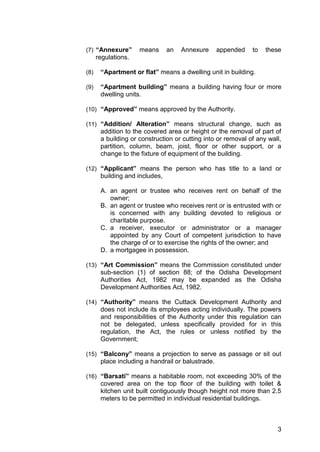
  • 25.
    24 A. Group housing/ apartment buildings B. Commercial buildings having 300 sq.m. or more of floor area. However the applicant shall have the option of paying security deposit in the form of Bank Guarantee. (2) The security deposits shall be refunded within 60 days from the date on which completion certificate is produced, in case of building where there is no deviation in construction. If the construction / development are not as per approved plan, this deposit shall be adjusted towards compounding fees for regularization of deviation & in other cases it shall be forfeited. Forfeited and separate action will be initiated against the builder / developer as per the provisions of the Act. (3) The security deposit will be refunded with 2% interest if the building is constructed / development is carried out as per the approved plan/ lay out. 8. (1)All the plans shall be prepared and duly signed by a registered/empanelled technical person (viz., Architect, Engineer, Structural Engineer, Town Planner, Supervisor) and Builder who shall indicate their names, addresses, registration numbers on the body of the plan and in all other relevant documents. The concerned owner of the land shall also sign the plans. (2) All plans, drawings, statements, design details shall bear the signature of the applicant and shall be duly countersigned by an empanelled Architect/Technical person. All documents and plans related to structural designs shall bear the full name and full signature of a Structural Engineer. Plans and documents related to sanitary arrangements shall bear the full name and full signature of a Public Health Engineer/ Municipal Engineer. Note: 1. The Empanelled Architect who has prepared the plan shall put the empanelment number/Council Of Architecture Registration No. and seal on all plans and documents signed by him and shall also furnish a certificate to the effect that he shall supervise the construction of the building and shall be responsible for any deviation from the approved plan except if the owner/Architect/Technical person intimates that their agreement has been terminated. 2. The Empanelled Structural Engineer, who has prepared the structural design, shall put his seal, and address on all the documents signed by him and shall also furnish a certificate to the effect that he shall supervise the Plans
  • 26.
    25 structural part ofthe construction and shall be responsible for any structural failure except caused by unprecedented natural calamities in Form-VII and except if the owner intimates that his services have been terminated. 3. All aspects related to structural design, building surface, plumbing, electrical installation, sanitary arrangements, fire protection shall adhere to the specification, standards and code of practice recommended in the National Building Code of India, 2005 and any breach thereof shall be deemed to be a breach of the requirements under these Regulations (3) The technical personnel and builder as specified in sub- regulation (1) & (2) above shall have to be registered/ empanelled with the Authority. Their qualifications and competence shall be as per Annexure I. (4) No plans for construction of apartment building, group housing and commercial building shall be entertained unless the builder is registered by the Authority in accordance with the competence as specified in the Annexure I. However for plots less than 500 sq.mtr of area, registration of builder is not mandatory. (5) When it comes to the notice of the Planning Member, Engineer Member, any Member of the Authority, or any other person that a plan signed by technical personnel or builder referred to under sub-regulation (1), & (2) is in violation of the norms of this regulation he shall bring this to the notice of the Authority. (6) The Authority shall issue a notice asking for a show cause within fifteen days as to why such technical personnel or builder shall not be disqualified/ black listed. After receipt of the show cause if any, the matter shall be placed before the Authority for a decision on such disqualification/ black listing. The decision of the Authority on disqualification/black listing shall be published in the notice Board of the Authority and in the Government Website. (7) An appeal against an order under sub-clause (6) above shall lie under section 18 of the Act. 9. (1) No permission shall be required for the works specified in clause-12.4.1, Part-2 of National Building Code –2005 as detailed below and under section-15 of the Act. a) Opening & closing of door, windows or ventilators. b) Providing inter communication door. c) Providing partition. d) Providing sky light Permission
  • 27.
    26 e) Gardening f) Whitewashing g) Painting h) Retiling of reproofing i) Plastering & patch washing j) Re-flooring k) Construction of sunshade around own land (2) All clarifications with respect to deficiency in the plan, documents will be sought for from the applicant within reasonable time. (3) Once the plan has been scrutinized and objections have been pointed out, the applicant shall modify the plan to comply with the objections raised and re-submit it. The Authority shall scrutinize the re-submitted plan and if there will be further objections, the plan shall be rejected. (4) The Authority shall communicate either approval in Form-II or refusal in Form-IX within 60 days from date of receipt of application under Regulation-5. (5) If the Authority, does not communicate its decision either granting or refusing permission to the applicant within 60 days from the date of receipt of the application by the Authority, the applicant shall draw the attention of the Vice-Chairman of the Authority with regard to his application, by registered post in Form-III. The Planning Member shall within the fifteen days from the date of receipt of notice in Form-III place the details of the case before the Vice-Chairman. (6) If, within a further period of one month from the date of receipt of the application drawing such attention as mentioned in sub regulation (5) above, the Authority does not communicate its decision, either granting or refusing permission, such permission shall be deemed to have been granted to the applicant on the date following the date of expiry of the three months period. (7) In case of Apartment Buildings, Group Housing Projects, Integrated Township Projects and non-residential buildings of height stilt+3 and above, permission for construction shall be accorded along with direction to the builder/developer to develop the on-site and off-site infrastructure like connectivity of sewerage, drainage, water supply, road etc. to the main network as per the specification of the concerned public authorities. The builder/developer shall produce no objection certificate from the concerned authorities regarding successful
  • 28.
    27 completion of allinfrastructures while applying for occupancy certificate. After receipt of the NOC from the above authorities, occupancy certificate shall be given by Cuttack Development Authority. 10. A register in Form-IV containing the necessary particulars including information as to the manner in which the Authority has dealt with applications for permission shall be maintained. 11. Every permission granted under these regulations shall remain valid up to three years. However the permission shall have to be revalidated before the expiry of the above period on payment of such fee as may be prescribed under rules and such revalidation shall be valid for three years. However for further revalidation the approval authority is required. 12. (1) If the Authority finds at any stage that the construction is not being carried on according to the sanctioned plan or is in violation of any of the provisions of these regulations, it shall notify the owner and no further construction shall be allowed until necessary corrections in the plan are made and the corrected plan is approved. (2) If the owner fails to comply with the requirements at any stage of construction, the Authority may cancel the building permission issued and shall cause notice of such cancellation to be pasted upon the said construction. If the owner is not traceable at the address given in the notice, pasting of such notice shall be considered as sufficient notification of cancellation to the owner thereof. No further work shall be undertaken or permitted upon such construction until a valid building permission is issued thereafter. (3) The notification under sub-regulation (2) shall also be published in as public notice. (4) The Authority will also be at liberty to forfeit whole or part of the security deposit obtained from the builder/ developer during sanction of the plan. (5) The above-mentioned procedure shall also be followed in case of deviation of the layout. (6) An appeal against an order under sub-regulation (2) & (4) above shall lie under section 18 of the Act. f the Act. eviation during Construction not according to plan Maintenance of Register Duration of Permission
  • 29.
    28 13. (1) Whereastests of any material are made to ensure conformity of the requirements of these regulations, records of the tests data shall be kept available for inspection during the construction of building and for such period thereafter as required by the Authority. (2) The persons to whom a permit is issued during construction shall keep pasted in a conspicuous place on the property in respect of which the permit was issued; A. a copy of the building permit; and B. a copy of approved drawings and specifications 14. (1) As a matter of course all construction or work for which a permit is required shall be subject to inspection by the Authority at all reasonable hours with prior intimation. (2) Inspection, where required, shall be made within seven days following the receipt of notice in Form-V or Form-VIII, after which period the owner will be free to go ahead with the construction according to the approved plan. At the first inspection, the Authority shall determine that the building construction has been taken up in accordance with approved site plans. 15. (1) The Authority shall permit an empanelled Architect/ Engineer to residential building and issue of occupancy certificate for 300 sq. mtrs. The responsibility of compliance with respect to provisions of these regulations shall rest with registered architect/engineer. However, the plans shall be required to be submitted to the Authority for information and record. (2) The owner/concerned empanelled architect/engineers/ structural engi-neer will serve a notice of completion certificate in Form VI(Part I and Part III) to the Authority that the building has been completed in all respects as per the approved plan. The said notice shall be accompanied by the following documents. (a) Three copies of completed building plans. (b) A fee of Rs.1,000/- (c) Record of Rights relating to ownership. (d) Copy of approved plan and approval letter. (3) The deviations shall also be brought to the notice of the Authority (with relevant documents). (4) The team of officials shall visit the site within 30 days and occupancy certificate shall be given. 16. (1) The Planning Member with the approval of the Vice Chairman shall issue a certificate for occupancy, for part of a building during its construction or whole of the building after construction Information at the site of construction Completion of construction Inspection Certificate for occupancy
  • 30.
    29 in Form-X orrefuse occupancy, as the case may be, within 30 days from the date of inspection. (2) Such certificate shall be issued only after all utility services for the entire building are physically provided. (3) The occupancy certificate shall also state the use/type of occupancy of the building. However, the applicant may apply for change of use/occupancy permitted within the purview of the Development Plan/ Zonal Plan/ Zoning Regulations, where so required. (4) In case of multi storied building and other special building like assembly, institutional, industrial, storage and hazardous and mixed occupancies with covered area more than 500 sq. mtr., after completion of the building and obtaining the occupancy certificate, periodic inspection shall be made by the Fire Authority to ensure the fire safety of the building and compliance with the provision of fire and life safety requirements („Fire and Life safety‟, Part-4 of NBC). Periodic occupancy renewal certificate shall be issued by the Authority on the recommendation of the Fire Prevention Officer, which shall also include safe keep of fire fighting installations and equipment for such building. (5) All occupied buildings and buildings covered under sub- regulation (4) above shall also be subject to periodic physical inspection by a team of multi disciplinary professionals of the Authority. The Authority as may be deemed necessary may outsource this work. The team shall report compliance of Regulations, natural lighting, and ventilation, besides structural and electrical safety. If any short comings/deficiencies or violations are noticed during inspection, the occupants shall ensure the compliance of the same within a specified time frame of six months. If not complied with, the building shall be declared unsafe. The period of inspection shall be usually three to five years but in any case not more than five years. (6) An appeal against the decision of the Authority shall lie under section 18 of the Act. 17.(1) Where the building plan accompanying the application seeking permission, requires the clearance of the Art Commission, Odisha, constituted under section 88, the Authority shall grant the permission only after the clearance is given by the said Commission. In all other cases, Architectural Control shall be regulated according to the provisions of these regulations. (2) The Authority, on the recommendation of the Art Commission, may issue public notices, from time to time, prescribing the architectural norms in different zones. Art commission
  • 31.
    30 18. (1) Noconstruction or re-construction of any building, within a radius of 100 meters, or such other higher distance from any archaeological site, as may be decided by the Archaeological Survey of India and Odisha State Archaeology Department from time to time, from the outer boundary of a declared protected monument shall be permitted. (2) (i) No construction above 1st floor and above 7 (seven) meters shall be allowed beyond a radius of 100 meters and within a radius of 300 meters of such monuments. (ii) The construction or reconstruction of any building under sub- regulation (2) shall not be above 7 (Seven) meters of total height. (3) Notwithstanding anything contained in the sub-regulation (1) & (2) above, construction/re-construction/addition/alteration shall be allowed on production of clearance from A.S.I./State Archaeology Department as the case may be. (4) If a building or premises, not covered under The Ancient Monument Preservation Act, 1904, or The Ancient Monuments and Archaeological Sites and Remains Act, 1958, in the opinion of the Authority, is of historical or architectural interest, and is in danger of being demolished or altered or likely to be affected in its character by a development, the Authority shall not grant permission for construction over any land situated near the said building or premises. The matter shall be referred to the Art Commission, whose decision shall be final. (5) These provisions shall apply mutatis mutandis in respect of archae-ological sites notified by the Art Commission. (6) An appeal against the decision under sub-regulation (3) shall lie under section 18 of the Act. 19. No building exceeding 10 meters height shall be permitted within 200 meters radius from the boundary of the Heritage buildings and the Authority may decide such other buildings as from time to time. 20. (1) All unsafe buildings shall be considered to constitute danger to public safety and shall be restored by repairs or demolished or dealt with otherwise as directed by the Authority. (2) The Authority shall examine or cause to be examined every building reported to be unsafe or damaged and shall make a written record of such examination. Construction near protected monuments Construction near important buildings Unsafe building
  • 32.
    31 (3) Whenever theAuthority finds any building or portion thereof to be unsafe, it shall, in accordance with established procedure for legal notice, give to the owner or occupier of such building written notices stating the defects thereof. This notice shall require the owner or the occupier within a stated time either to complete specified repairs or improvements or to demolish and remove the building or portion thereof. (4) The Authority may recording the reasons therefore direct in writing that the building, which in its opinion is dangerous, or has no provision for exit in the event of fire, shall be vacated immediately or within the period specified for the purpose. (5) If any person does not comply with the orders of vacating a building, the Authority may with the help of police remove the person from the building. (6) In case the owner or occupier fails, neglects or refuses to comply with the notice to repair or to demolish the said building or portion thereof, the Authority shall cause the danger to be removed either by demolition or repair of the building or portion thereof or otherwise. (7) In case of emergency, which, in the opinion of the Authority involves imminent danger to human life or health, the decision of the Authority shall be final. The Authority shall forthwith or with such notice as may be possible promptly cause such building or portion thereof to be rendered safe by retrofitting/strengthening to the degree of safety or removed. For this purpose, the Authority may at once enter such structure or land on which it stands, or abutting land or structure, with such assistance and at such cost as may be deemed necessary. The Authority may also get the adjacent structures vacated and protect the public by appropriate fencing or such other means as may be necessary. (8) Costs incurred under sub-regulations (6) & (7) shall be charged to the owner of the premises involved. Such cost shall be charged on the premises in respect of which or for the benefit of which the same have been incurred and shall be recoverable as provided under law. 21. (1) Before a building is demolished, the owner shall notify all utilities having service connections within the building, such as water electricity, gas, sewer and other connections. A permit to demolish a building shall not be issued until a release is obtained from the utilities departments stating that their respective service connections and appurtenant equipment, Demolition of building
  • 33.
    32 such as metersand regulators have been removed or sealed and plugged in a safe manner. (2) The owner shall take all precautionary measures to avoid noise and dust pollution and shall not create any inconvenience to the neighboring plot owners. (3) In case of semidetached building, no objection certificate from the neighbors shall be obtained. 22. (1) Neither granting of the permit nor the approval of the drawing and specifications, nor inspections made by the Authority during erection of the building shall in any way relieve the owner of such building from full responsibility for carrying out the work in accordance with the requirements of NBC 2005 and these Regulations. (2) Every owner/applicant shall: A. Permit the Authority to enter the building or premises, for which the permission has been granted at any reasonable time for purpose of enforcing the regulations; B. Obtain, where applicable, from the competent Authority permissions / clearance required in connection with the proposed work; C. Give written notice to the Authority before commencement of work on building site in Form-V, periodic progress report in Form-VIII, notice of completion in Form-VI and notice in case of termination of services of Technical persons engaged by him and D. Obtain an Occupancy Certificate from the Authority prior to occupation of building in full or part. 23. (1) Approval of plans and acceptance of any statement or document pertaining to such plan shall not exempt the owner or person or persons under whose supervision the building is constructed from their responsibilities imposed under these regulations, or under any other law for the time being in force. (2) Approval of plan would mean granting of permission to construct under these regulations only and shall not mean among other things: A. the title over the land or building ; B. easement rights; C. variation in area from recorded area of a plot or a building; f the Act. eviation during Responsibility of Authority Responsibility and duty of the owner
  • 34.
    33 D. Structural stability; E.Workmanship and soundness of materials used in the construction of the buildings F. Quality of building services and amenities in the construction of the building, G. The site/ area liable to flooding as a result of not taking proper drainage arrangement as per the natural lay of the land, etc. and H. Other requirements or licenses or clearances required for the site / premises or activity under various other laws. (3) The approval or permission shall not bind or render the Authority liable in any way with regard to the` matter specified in sub-regulation (2) (A.) to (H.) above
  • 35.
    34 PART - III ZONINGREGULATIONS 24. (1) In the Development Plan area, various use zones viz. Residential, Retail commercial and Business, Wholesale Commercial, Industrial, Public and Semi-public, Utility and Services, Open Space, Transportation, Agricultural and Forest, Water Bodies, Special Heritage, and Environmentally Sensitive zones having their zonal boundaries as indicated in the development plan shall be regulated as per the Table under Regulation 25. Except as otherwise provided, no structure or land hereinafter shall be used and no structure shall be erected, re-erected or altered unless its use is in conformity with these Regulations. (2) All places of worship, temples, churches, mosques, burial and cremation ground etc. as existing prior to enforcement of these regulations shall be exempted from being treated as non- conforming uses, provided that continuance of such uses are not detrimental to the locality as decided by the Authority from time to time. (3) All non-conforming uses of land and buildings shall be discontinued by the owner and the modified uses shall be made to conform to the land use of the development plan in force within six months of the regulations coming in force. 25. (1) Permission for different uses shall be accorded outright for principal use earmarked in the different zones described in column-(a) of Table no -1. (2) Permission for different uses described in column-(b) of the Table - 1 shall be permitted on special consideration. (3) The purposes specified in column-(c) of the said Table shall not be permitted in the areas reserved for particular uses. (4) Table no.1 mentioned above shall be same as provided in the Comprehensive Development Plan for Cuttack Development Plan Area approved by state government. (5) Residential buildings may be permitted in the open space use zone if the following conditions are satisfied along with other conditions of these regulations. A. the land is a stitiban land and is not a leasehold land; B. the coverage is not more than 40%; Zoning Different use of land
  • 36.
    35 C. the heightis not more than 7.0 (seven) meters and at least 20 percent of land is used for plantation; (6) Mixed land use may be permitted in a particular zone having a plot size of 4000 Sq. mt and above. However, the main use shall cover not less than 2/3rd of the total floor area and the ancillary use shall not exceed 1/3rd of the total area. (7) In addition to the provision contained in the regulation 18 of the regulation, following provisions shall be applicable for all construction in Special Heritage Zone earmarked in CDP. i) The maximum height of the building shall not be exceeds 15 mtr. ii) All the proposal for development over an area of more than 500 Sq. Mt. and/or ten meter height shall only be considered on recommendation of the B.P. Committee with the representation from the Archeological Survey of India & the Odisha state archaeology. (8) For construction of the building in Environmentally Sensitive Zone, the following provisions shall be applicable. i) The minimum size of the plot shall be 4000 Sq. mt. ii) The minimum width of the approach road shall be 12 mt. iii) The maximum coverage shall not exceed 40% iv) The proposal for development shall only be considered on recommendation of the B.P. Committee with the representation from water resources department, Odisha State Pollution Control board & Public Health Engineering department in the above committee. TABLE-1: LAND USES PERMITTED/PROHIBITED IN DIFFERENT USE ZONES Sl. No Use Zone Uses/Activities Permitted Uses/Activities permissible on recommendation of DP & BP Committee Uses/Activitie s Prohibited 1 2 3(a) 3(b) 3(c) 1. Residential Use Zone (R) 1. Residence , plotted (detached , semi detached and row housing) group housing , work-cum- residential. 2. Hostel, Boarding and lodging houses 3. Night shelters, 1. Places of worship 2. Shopping centre 3. Municipal, State and central Government offices 4. Colleges and research 1. Heavy, large and extensive industry, noxious, obnoxious and hazardous
  • 37.
    36 Dharamshala, guest houses 4. Educationalbuildings (nursery, primary, high – school) 5. Neighbourhood level social, cultural and recreational facilities with adequate parking provision. 6. Marriage hall, community hall 7. Convenience shopping, local (retail) shopping 8.Community centres, club, auditoriums 9. Exhibition and art galleries 10. Library, gymnasium 11. Health clinics, yoga centres , dispensaries, nursing home, health centres (20 beds) 12. Public utilities and public buildings except service and storage yards , electrical distribution depots and water pumping stations. 13. Nursery and green houses 14. Services for household s ( salon, parlors, bakeries , sweet shops , dry cleaning , internet kiosks etc. ) 15 . Banks and professional offices not exceeding one floor. 16 .Bus stop, taxi stand/ 3 wheelers / auto stands/ rickshaw stand. 17. Police post and post office 18.Parks and tot – lots institutions 5. Petrol Filling Stations 6. Places of entertainment, Cinema halls, restaurant and hotels 7. Markets for retail goods 8 . IT, IT enabled services 9. Tourism related services 10. Motor vehicle repairing workshop, garages, storage of LPG cylinders 11. Burial – grounds, 12. Printing press employing not more than 10 persons. 13. Godowns /warehousing of non perishables. 14. Bus depots without workshop 15. House hold industries ie the area for which such use does not exceed one floor and there shall be no public display of goods. 16. consulate. industries 2. Warehousin g, storage godowns of perishables, hazardous, inflammable goods , wholesale mandis, junk yards 3. Workshop for buses. 4. Slaughter houses. 5. Hospitals treating contagious diseases 6. Sewerage treatment plant and disposal sites. 7. Water treatment plant, solid waste dumping ground‟ 8. Out door and Indoor games, stadium shooting range. 9. Zoological garden, botanical garden, bird sanctuary 10. International conference centre. 11. District battalion offices, forensic
  • 38.
    37 science laboratory 12. All uses not specifically permittedin column (a) and (b) 2. Retail Commerci al and business use zone (C 1) 1. Retail business, mercantile 2. Commercial centre 3. Banks , financial services and stock exchanges 4. Perishable goods markets. 5. Business and professional offices. 6. Private institutional offices and semi government offices. 7. Shops and shopping malls. 8. Commercial services 9. Restaurant and hotels. 10. Hostels, boarding houses, social and welfare institutions, guest houses. 11. Convenience and / neighborhood shopping centers, local shopping centers, weekly and formal markets, bakeries and confectionaries 12.. Cinema hall theatres, banquet halls, auditoriums 13. Marriage and community hall, night shelter 14. clinic and nursing home. 15. Petrol pumps and filling station. 16. IT and IT enabled services 17. Commercial institutes, Research and training 1. Associated residential uses. 2. Wholesale storages yards. 3. Service garage provided they do not directly abut the main road 4. Printing presses employing not more than 10 persons. 5. 20 bed hospitals not treating contagious diseases and mental patients 6. Weigh bridge 7. College, Polytechnics and higher technical institutes 8. Sports complex and stadium 9. Transient visitor‟s homes 10. Places of entertainment , recreational uses and meseums. 11. Convention centres. 12. Religious places. 13. Public utilities , telephone exchanges 14. Police posts and post offices. 15. Residential flat. 16. Picnic hut. 1. Polluting industries. 2. Heavy extensive ,noxious, obnoxious, hazardous and extractive industrial units. 3. Hospitals/ research laboratories treating contiguous diseases personnel 4. Poultry farms, dairy farms, slaughter houses, 5. Sewerage treatment plants and disposal sites, solid waste treatment plants and dumping ground. 6. Agricultural uses, storage of perishable and inflammable commodities 7. Quarrying of gravel, sand,
  • 39.
    38 institute 18. Parking lots 19.Taxi stands, 3 wheeler/ auto stands, rickshaw stand. clay and stone 8. Zoological garden and botanical gardens, bird sanctuary 9. Sports training centre. 10. District battalion offices 11. Forensic science laboratory and all other activities which may cause nuisance. 12. Courts 13. All uses not specifically permitted in the column (a) and (b) 3. Wholesale commerci al use Zone (C2) 1. Wholesale and retail business. 2. Wholesale and storage buildings 3. Commercial and business offices and work places 4. Petrol pumps and service stations on roads of 12 meter or more ROW. 5. Godowns, covered storage and warehousing 6. Weigh bridge 7. Bus stops, Taxi stands, 3 wheeler/ auto stands, rickshaw stands. 8. Parking space 9. Restaurants 10. Public utilities. 1. Truck terminal, Bus depots and parking. 2. Freight terminal 3. Warehousing/stora ge godowns of perishable, inflammable goods, coal, wood, timber yards 4. service centre , garages, workshops. 5. Non- polluting, non- obnoxious light industries 6. Junk Yard. 7. Gas installation and gas works 8. Railway yards and 1. Polluting Industries 2. Large scale storage of hazardous and other inflammable materials excepting in areas, specifically earmarked for the purpose. 3. All uses not specifically permitted in columns (a) and (b)
  • 40.
    39 11. Police station/posts, post offices stations, road freight stations. 9. Banks and financial services. 10. Associated residential uses. 11. Government and semi Government offices, 12. Water treatment plant. 4. Industrial use zone (I) 1. All kind of non polluting industries 2. IT and ITES 3. SEZs notified by govern-ment of India 4. Loading, unloading spaces 5. . Warehousing, storage and depots of non perishable and non- inflammable commodities. 6. Cold storage and ice Factory. 7. Gas Godowns. 8. Wholesale business establishment. 9. Petrol filling station with garages and service stations 10. Bus terminals and the depots and workshops. 11. Parking, taxi stands, 3 wheeler/ auto stands, rickshaw stands. 12. Residential buildings for essential staff and for watch and ward 13. Public utilities 1. Heavy, extensive and other obnoxious and hazardous industries subject to the approval of the Odisha Pollution Control board. 2. Industrial research institute. 3. Technical education institutions 4. Junk yards, sports/ stadiums/ playgrounds. 5. Sewage disposal works, electric power plants, service stations. 6. Government, semi government, Private business offices 7. Banks, financial institutions and other commercial offices. 8. Agro based industries , dairy and farming. 9. Gas installations and gas works 10. workshops, garages. 11. Hotels and guest houses. 12. Museum. 1. General business unless incidental to and on the same site with industry. 2. Schools and colleges. 3. Hotels, Motels and caravan parks. 4. Recreational spots or centres. 5. Other non industrial related activities. 6. Religious building. 7. Irrigated and sewage farms. 8. Major oil depot and LPG refilling plants 9. Social buildings. 10.All uses not specifically permitted in column (a) and (b)
  • 41.
    40 13. Helipads 14. Hospitalsand medical centers. 5.. Public and Semi- Public Use Zone. (PS) 1. Govt. Offices , central , state, local and Semi- government, Public undertaking offices. 2. Universities and specialized educational institutions, colleges, schools, research and development centre. 3. Social and welfare centres 4. Libraries 5. Hospitals, health centre , dispensaries and clinics. 6. Social and cultural institutes. 7. Religious buildings. 8. Conference halls. 9. Community halls, Kalyan mandap, dharmasala 10. Museums, art galleries exhibition halls, auditoriums 11. Police stations, police lines, jails. 12. Local, state and central govt. offices uses for defence purpose. 13. Educational and research institutions. 14. Social and cultural and religious institutions. 15. Local municipal facilities. 16. Uses incidental to Govt, offices and for their use. 17. Monuments. 1. Residential flats, residential plots for group housing and staff housing 2. IT services 3. Defence quarters. 4. Hostels, transit accommodation 5. Entertainment and recreational complexes 6. Nursery and kindergarten, welfare centre 7. Open air theatre, playground 8. Residential, club, guest house 9. Bus and Truck terminals, Helipads. 10. Parking areas , taxi stands, 3 wheeler/ auto stand, rickshaw stand. 1. Heavy, extensive and other obnoxious, hazardous industries, 2.Slaughterhou ses 3. Junkyard, 4. wholesale mandis 5.Dairy and poultry farms, farmhouses 6.Workshops for servicing and repairs 7. processing and sale of farm products 8. All uses not specifically permitted in column (a) and (b) 6. Utility and Services use (US) 1. Post offices , telegraph offices, Public utilities and buildings 1. Service industry. 2.Warehouse/storage godowns 1. Any building or structure,
  • 42.
    41 2. Water treatmentplant, sewage treatment plant. solid waste treatment plant, solid waste dumping grounds. 3. Radio transmitter and wireless station, telecommunication centre, telephone exchange. 4. Water supply installation. 5. Sewage disposal works 6. Service stations. 7. Cremation grounds and cemeteries/ burial grounds 8. Power plants/ electrical substation 9. Radio and television station. 10. Fire stations 3. Health centre for public and staff or any other use incidental to public utilities and services 4. Information/ payment kiosks 5. Incidental/ ancillary residential use. 6.Truckterminals,Heli pads. 7. Commercial use centre which is not required for uses related to public utilities and activities is not permitted therein. 2. Heavy, extensive and other obnoxious hazardous industries. 3.All uses not specifically permitted in column (a) and (b) 7. Open Space use zone. 1. Specialized parks/ maidens for multipurpose use 2. Regional parks, district parks, playgrounds, children‟s parks 3. Clubs, stadiums, picnic huts, holiday resorts. 4. Shooting range, sports training centre. 5. Swimming pool. 6. Botanical/ zoological garden, bird sanctuary 7. Green belts. 8. Bus and railway passenger terminals, 9. Public utilities and facilities such as police post, fire post, post and telegraph office, health centre for players and staff 10. Animal racing or riding stables. 1. Building and structure ancillary to use permitted in open spaces and parks such as stands for vehicles on hire, taxis and scooters 2. Commercial use of transit nature like cinemas, circus and other shows 3. Public assembly halls 4. Restaurants 5. Parking area, Caravan parks 6. Open air cinemas/ theatre 7. Entertainment and recreational complexes 8. community hall, Library. 9. Open air theatre, theme parks, amphitheatre. 1. Any building or structure, which is not required for open-air recreation, dwelling unit except for watch and ward and uses not specifically permitted therein. 2. All uses not specifically permitted in column (a) and (b)
  • 43.
    42 10. Residential club, guesthouse. 11. Camping sites. 12. Yoga and mediation centres. 13. Fire post, police station, post and telegraph office 14. Commercial use center. 15. Special education areas. 16. Incidental/ ancillary residential use. 8. . Transport ation Use Zone (T) 1. All types of roads. 2. Railway stations and yards 3. Airport. 4. Bus stops and bus and truck terminals. 5. Taxi stands, auto stands, rickshaw stands. 6. Ferry ghats 7. Parking areas. 8. Multi level car parking 9. Filling stations. 10. Transport offices, booking offices. 11. Night shelter, boarding houses. 12. Banks 13. Restaurants 14. Workshops and garages. 15. Automobile spares and services, Godowns. 16. Loading and unloading platforms (with/without cold storage facility), weigh bridges. 17. Ware houses and storages depots. 18. Utility networks (Drainage. Sewage, power telecommunication) 1. Way side shop and restaurants. 2. Authorised. Planned vending areas. 3. Incidental/ ancillary residential use. 4. Emergency health care centre. 5. Tourism related projects. 6. All ancillary (complimentary) uses for above categories (subject to decision of the Authority) 1. Use/activity not specifically related to transport and communication permitted herein. 2. All uses not specifically permitted in column (a) and (b)
  • 44.
    43 9 Agricultur al and forest UseZone (A) 1. Agriculture and horticulture. 2. Dairy and poultry farming, milk chilling centre 3. Storage, processing and sale of farm produce 4. Dwelling for the people engaged in the farm (rural settlement) 5. Farm houses and accessory buildings 6. Afforstation 1. Houses incidental to this use. 2. Parks and other recreational uses 3. Wayside shops and restaurants. 4. Hospital for infectious and contagious disease, mental hospital after clearance from the Authority 5. Agro serving, agro processing, agro business 6. Cottage industries. 7. Burial and cremation grounds. 8. Service industries accessory to obnoxious and hazardous industries 9. Ice factory, cold storage. 10. Godowns and warehouses 11. Soil testing lab. 12. Normal expansion of land uses only in the existing homestead land 13. Solid waste management sites, sewage disposal works. 14. Electric substation. 15. Quarrying of gravel, sand, clay or stone. 16. Building construction over plots cover under town planning scheme and confirming uses. 1. Residential use except those ancillary uses permitted in agricultural use zone 2. Heavy, extensive obnoxious, noxious and hazardous industries 3. Any activity which is creating nuisance and is obnoxious in nature. 4. All uses not specifically permitted in column (a) and (b) 5. For notified forest lands only afforstation is permitted and item no. 18 and 19 from column (b) are permissible by the competent authority.
  • 45.
    44 17. Brick kilnsand extractive areas. 18. Eco tourism, camping sites, eco parks, eco lodges. 19. Special outdoor recreations. 10 . Water bodies Use Zone (W) 1. Rivers, canals. 2. Streams, water spring 3. Ponds, lakes. 4. Wetland, aqua culture pond. 5. Reservoir 6. Water logged/marshy area 1. Fishiries. 2. Boating, water theme parks, water sports lagoons. 3. Water based resort with special by laws 4. Any other use/activity incidental to Water bodies use Zone is permitted. 1. Use/activity not specifically related to Water bodies use not permitted therein. 2. All uses not specifically permitted in column (a) and (b) 11 . Special Heritage Zone (Area shown in the map) (SH) 1. Residential with Special bye laws 2. Public Semi-public with special bye laws. 3. Commercial with special bye laws.. 4. Recreational with special bye laws. 5. Theme parks, Archaeological parks/ gardens with special bye laws. 6. Amphitheatre with special bye laws. 7. Open air museum with special bye laws. 8. Restoration of protected and enlisted monuments and precincts by the concerned authority only(ASI/ State archaeology) 1. Heritage interpretation centre, art galleries and sculpture complex. 2. Educational and research institutions. 3. Social and cultural institutions. 4. Commercial activities. 5. Craft based cottage industries. 6. Hotels, guest houses, lodges, resorts. 7. Group housing apartments. 8. Auditorium. 9. Boating, picnic huts, camping sites, special training campus. 10. Hospitals and health centre. 11. Multi storied parking. 1. Use/activity not specifically related to special heritage use not permitted herein. 2. Multi storied building. 3. Multiplex, shopping mall. 4. Dumping ground. 5. Sewerage treatment. 6. All uses not specifically permitted in Column (a) and (b)
  • 46.
    45 12 . Environm entally sensitive zone (ES) 1. Riverfront developments. 2. Scenic value areas. 3. River side green areas. 4. Existing village settlements 1. Group housing, corporate type housing adopting modern technology with special bye laws. 2. Theme parks, Yoga parks, Sports centers and community recreational areas, international convention centre. 3. Incidental residence. 4. Seven or five star lake resorts, five star hotels, organized commerce with special bye laws. 5. Hospitals and health institution. 6. Art academy media centre, food courts, music pavilions. 7. Parking areas, visitor facilities. 8. Educational technical, research institutes of higher order. 9. Boating picnic huts, camping sites special training; camps. 10. Existing residential or other uses with special bye laws. 11. Resorts, sculpture complex, lagoons and lagoon resort, water sports. 12. Tourist and pilgrim related commercial activities, hotels and lodges. 13. Non Polluting, agro based and 1. Plotted housing 2. Small industries or small institutions 3. Use/Activity not specifically related to environmentall y sensitive use zone not permitted herein. 4. No development of any kind is permitted between the river/stream and the embankment. 5. All uses not specifically permitted in column (a) and (b)
  • 47.
    46 processing industries, storage or godowns for food grains. 14. Water treatment plant, sewage treatment plant solid waste treatment plant solid waste dumping grounds.
  • 48.
    47 PART – IV GENERAL 26.(1) Without prejudice to any other stipulation in these regulations, no permission to construct a building on a site shall be granted: A. in areas of natural waterways or drains, as detailed in the Development Plan, and drainage plan as modified from time to time; B. if the orientation of such building is not in harmony with the surroundings, as may be decided by the Art Commission; C. if the use to which the site is proposed to be put does not conform to the use earmarked in the Development Plan; D. if the building is to be constructed over or under a municipal drain, sewerage line, electrical line, water main, any other government or public land, or public utility services; E. if the foundation of the external wall along a street is located at a distance less than 0.5 meters from the edge of the street or road margin including the drain; F. if all structure plans are not prepared taking into account the structural safety from seismic zone point of view. G. if the plot having kisam as agriculture / jalasaya in ROR. H. if the building is to be constructed over a land where construction is prohibited by Authority with approval of Government. 27. (1) As provided in clause-6.4 of National Building Code-2005 no verandah, balcony or the like shall be allowed to be erected or re-erected or any additions or alterations made to a building within the distances quoted below in accordance with the Indian Electricity Rules between the building and any overhead electric supply line; TABLE –2: MINIMUM DISTANCE FROM THE ELECTRIC LINE Vertical distance in meters Horizontal distance in meters Low and medium voltage lines and service lines 2.5 1.2 High voltage lines up to and including 11,000 Volt 3.7 1.2 High voltage lines above 11,000 volt and up to and including 33,000 Volt 3.7 2.0 Extra high voltage line beyond 33,000 Volt 3.7 (Plus 0.3 meters for every additional 33,000 volts or part thereof) 2.0 (Plus 0.3 meters for every additional 33,000 volts or part thereof) Restriction on permission Distance from Electric lines
  • 49.
    48 28. In everybuilding area, at least 10% of the land shall be covered by plantation, but in case of multi-storied buildings/ Group Housing / Apartment building/ Industrial/ Assembly/ Educational/ Institutional buildings, at least 20% of the land shall be covered by plantation. 29. (1) every building/ plot shall abut on a public/ private means of access like streets /roads of duly formed of width as specified in clause 4, Part-3 of NBC-2005. (2) In no case, development of plots shall be permitted unless it is accessible by a public/private street of width not less than 6 meters. (3) In case of institutional, administrative, assembly, industrial and other non-residential and non-commercial activities, the minimum road width shall be 9 meter. (4) In case of a private road, which gives access to one or more buildings, the owner of the said private road shall develop the road and storm water drain as required by the Local Authority, and transfer the same by way of gift to the Local Authority or handed over to the Registered Residents‟ Welfare Association for maintenance. (5) The Lower minimum width of the road in the basti area, shall be decided by the authority. However in the area other than basti area, the parameters as this regulation are to be followed. 30. The minimum size of plots for different categories of building is given below: TABLE – 3: CATEGORY WISE SIZE OF PLOTS Category Min. road width (m) Min. size of plot in Sq. m. Kalyan Mandaps 12 1000 Cinema, game centers, Multiplex, convention centers 12 2000 Social clubs and amenities 9 1000 Multi storey car parking 9 1000 Office buildings 9 300 Primary/Upper Primary school 9 2000 High School, Residential school 9 6000 +2 College / Junior college 9 4000 Degree College 12 6000 Technical educational institution 12 10000 Petrol pumps / Filling stations 12 500 Restaurant 9 500 LPG storages 9 500 Places of congregation 9 500 Public libraries 9 300 Conference hall 12 1000 Community hall 9 500 Nursing homes/polyclinics 9 300 Means of access Minimum size of plots plot Plantation
  • 50.
    49 Hotel 9 2000 R& D Lab 12 1500 Note: In appropriate cases the Authority may consider revising the minimum size of plot and the minimum road width on the recommendations of the Building Permission Committee. 31.(1) The minimum setbacks of buildings permissible in a given size/plot for residential and commercial building in non high rising category shall be as follows; TABLE – 4: PLOT SIZE WISE PERMISSIBLE SET BACKS A OF BUILDINGS Plot size (in Sq. Mts) Minimum Front setback (in Mts) Abutting road width Minimum setbacks other sides (in Mts) Less than 9 Mts 9 Mts and below 12 Mts 12 Mts and less than 18 Mts 18 Mts and less than 30 Mts. Above 30 Mts. Rear side Other side 1 2(a) 2(b) 2(c) 2(d) 2(e) 3 4 Less than 100 1.0 1.0 2.0 2.0 3.0 -- -- 100 & upto 200 1.5 1.5 2.5 2.5 3.5 1.0 -- Above 200 & upto 300 1.5 1.5 2.5 2.5 3.5 1.5 1.5 Above 300 & upto 400 1.5 1.5 2.5 2.5 3.5 1.5 1.5 Above 400 & upto 500 1.5 2.0 2.5 3.0 3.5 1.5 1.5 Above 500 & upto 750 1.5 2.0 3.0 3.0 4.0 2.0 2.0 Above 750 1.5 2.0 3.0 4.0 4.0 3.0 2.5 (2) In case of group housing/apartment buildings, the minimum distance between two buildings will not be less than 1/3rd of the height of the taller building. However the minimum width of the internal road shall be 6 meter. In all other cases, if any, open space between the buildings is intended to be used for the benefit of more than one building belonging to the same owner, the width of such open space between the buildings shall be the one specified for the tallest building abutting on such open space provided that such open space shall be not less than three meter. (3) The setbacks/open spaces for other occupancies shall be as below; A. Institutional (Educational) buildings – The open spaces around the building shall not be less than 3 meter for plot up to 1000 sq. mt. and 6 mt. for plots with area more than 1000 Sq. mt. of size. Minimum setbacks for non-high rise buildings
  • 51.
    50 B. Assembly buildings– the open space in front shall be not less than 12 meter and the other open spaces around the building shall not be less than 6 meter. C. Commercial & Storage buildings – In case of plots with more than 500 sq.mtr. area, the open spaces around the building shall not be less than 4.5m. D. Industrial buildings - the open spaces around the building shall not be less than 4.5 m for heights up to 15 meter, with an increase of 0.25 meter for every increase of 1 meter or fraction thereof in height. E. Hazardous occupancies - the open spaces around the building shall not be less than 6 m. F. IT, ITES and other Corporate Buildings:- In case of plots up to 750 sqm the minimum set backs around the building shall not be less than 3 mtr. In case of plots above 750 sq.mtr the minimum set backs around the building shall not be less than 4.5 mtr. G. In the case of plots carved out by the Authority in respect of E F & G Category of plot in the scheme area, the planning parameters shall be decided by the Authority from time to time. 32. For high-rise/ multi-storied buildings, the open spaces around the building shall be as given in the Table below; TABLE-5: PROVISION OF EXTERIOR OPEN SPACES AROUND THE BUILDINGS Sl. No. Height of the Building (in metres) Exterior open spaces to be left out on all sides in m. (front rear and sides in each plot) 1 15 and above & up to 18 6 2 More than 18 & up to 21 7 3 More than 21 & up to 24 8 4 More than 24 & up to 27 9 5 More than 27 & up to 30 10 6 More than 30 & up to 35 11 7 More than 35 & up to 40 12 8 More than 40 & up to 45 13 9 More than 45 & up to 55 14 10 More than 55 16 Note: (i)On sides where no habitable rooms face, a minimum space of 9.0 m. shall be left for heights above 27.0 m. Minimum setbacks for high rise buildings
  • 52.
    51 (ii) In caseof multi storied buildings the exterior open space around a building shall be of hard surface capable of taking load of fire engine weighting up to 45 tonnes. 33.(1) The Floor Area Ratio (F.A.R) for residential, commercial, corporate, IT/ITES buildings shall be decided on the basis of the road width on which the plot/site abuts. TABLE – 6: (FAR AS PER ROAD WIDTH). Road width (in metres) FAR for Commercial /Residential building. FAR for /IT /ITES/Corporate buildings Above 1.5 to 3 0.05 ---- Above 3 & less than 6 1.00 --- Above 6 & less than 9 1.50 --- 9 or more & less than 12 1.75 --- 12 or more & less than15 2.00 2.00 15 or more & less than18 2.25 2.25 18 or more & less than30 2.50 2.50 30 & above 2.75 2.75 N B Lower minimum width of the road in the basti area/ High density area within the city and the F A R thereof shall be fixed by the authority. (2) In case of group housing, the maximum permissible FAR shall be 2.75 and maximum permissible ground coverage shall be 40%. However additional FAR equals to the FAR consume for construction of LIG/EWS units shall be allowed, subject to the ceiling of 25% of the permissible FAR. The FAR shall be calculated on the total plot area. (3) In case of Institutional and Assembly building the maximum permissible FAR shall be 1.50 for plots up to 1000 sq. m. and 1.75 for plots above 1000 sq. m. (4) In case of transport related activities such as; railway yards, railway station, bus stands, bus shelters, transport depot, air port, special ware housing, cargo terminals etc. the maximum permissible FAR shall be 1.00. Floor Area Ratio
  • 53.
    52 (5) In caseof Industrial building the maximum FAR shall be 1.00. (6) In case a part of the plot is acquired / donated for public purpose like road, drain, etc., the Authority may allow additional FAR up to 0.25 in the form of TDR (Transferable Development Right) as per the modality approved by the Authority. (7) The Authority may allow premium FAR up to 0.25 on IT/ITES buildings on payment of fees to be decided by the Authority from time to time, on roads of width 30 mt. and above. The Authority may refund the fee proportionate to 0.10 premiums FAR in case of platinum/ gold certified green buildings. (8) The benefit of unutilized FAR in respect of Apartment Buildings/ Group Housing shall be made available to the society and not to the Builder/ Developer. (9) Exclusive multistory parking blocks can be provided within the required setback area without reducing the driveway for the fire tender to the extent of minimum 6 meters. This will not be included in the calculation of coverage and FAR. (10) FAR shall not include A. Basements or cellars and space under a building constructed on stilts and used as a parking space, and air conditioning plant room used as accessory to the principal use; B. Electric cabin or substation, watchman booth of maximum size of 3 sq.m. with minimum width or diameter of 1.732 m., pump house, garbage shaft, space required for location of fire hydrants, electric fittings and water tank, society room of maximum 12 sq.mtr. C. Projections and accessories buildings as specifically exempted from the open space/setback requirement. D. Staircase room and lift rooms above the topmost storey, architectural features, and chimneys and elevated tanks of dimensions as permissible under the NBC; the area of the lift shaft shall be taken only on one floor 34. (1) The height of the building shall be governed by the limitations of Floor Area Ratio, open space (setbacks), and the width of the street facing the plot described as detailed below: A. The maximum height of a building shall in no case exceed 1.5 times X the width of the road on which the plot abuts + Height of a building
  • 54.
    53 minimum required frontsetback. However, higher height on account of premium FAR may be permitted with the approval of the Government. B. If a building abuts on two or more streets of different widths, the building shall be deemed to face upon the street that has the greater width and the height of the building shall be regulated by the width of the street. (2) Notwithstanding anything contained in sub-regulation (1) the height restrictions with respect to approach Funnels and Transitional area of Airport as detailed in Table 7 & 8 shall be adhered to. TABLE – 7: HEIGHT RESTRICTION WITH RESPECT TO APPROACH FUNNELS Distance from nearest runway end (in metres) Maximum Permissible height above the elevation of the nearest runway end (in metres) Up to 360 0 Above 360 to 510 6 Above 510 to 660 9 Above 660 to 810 12 Above 810 to 960 15 Above 960 to 1110 18 Above 1110 to 1260 21 Above 1260 to 1410 24 Above 1410 to 1560 27 More than 1560 30 TABLE – 8: HEIGHT RESTRICTION WITH RESPECT TO TRANSITIONAL AREA Distance of the Inner Boundary of the Transitional Area (Outer Boundary of the Air Port) [Metres] Maximum Permissible height above the elevation of the air port reference point [metres] Up to 21 0 Above 21 to 42 3 Above 42 to 63 6 Above 63 to 84 9 Above 84 to 105 12 Above 105 to 126 15 Above 126 to 147 18
  • 55.
    54 Above 147 to168 21 Above 168 to 189 24 Above 189 to 210 27 More than 210 M 30 (3) Notwithstanding anything contained in the Tables under sub- regulation (1), no Radio Aerial, T.V. Antenna, Cell phone tower or such similar type of installations exceeding 52 metres in height shall be erected without prior permission of the concerned Civil Aviation Authority. (4) No building structure or installation exceeding the height indicated in the said Tables shall be permitted unless the applicant produces a „No-Objection Certificate‟ from the Airport Authority. 35.(1) In all buildings including Apartment buildings/ Group Housing, Hotels, Restaurants and Lodges, business buildings, commercial buildings, Institutional buildings like hospitals, Educational buildings like schools and colleges, multi-storied buildings/complexes etc. and all other non-residential activities provision shall be made for parking spaces as per the following requirements. TALBE – 9: MINIMUM OFF STREET PARKING SPACE FOR DIFFERENT CATEGORIES OF OCCUPANCIES Sl. No . Category of building/ activity Minimum Parking area to be provided as percentage of total built up area (1) (2) (3) 1 Shopping malls, Shopping malls with Multiplexes/ Cinema hall, Retail shopping centre, IT / ITES complexes and hotels. 50 2 Restaurants, Lodges, Other commercial buildings, Assembly buildings, Office complexes. 40 3 Residential apartment buildings, Group Housing, Clinics, Nursing Homes, Hospitals, Institutional and Industrial buildings. 30 N:B: Parking to be provided as percentage of total built up area may be in basement/stilt floor and setback/open spaces at ground level Off Street Parking Space
  • 56.
    55 (i)Basement(s)/ stilt usedexclusively for parking and permissible services shall not be counted towards FAR. Leaving apart the maximum setback space as per the provision of the regulation. (ii)The driveway in the basement shall be excluded in calculation of the parking space. (2) The parking spaces may be provided in (for all schemes) A. basements or cellars B. on stilt floor C. open parking area D. exclusive multi level parking or E. roof top parking in case of commercial/IT/ITES and Corporate building F. a combination of any or all of the above (3) For parking purposes, single basement shall be allowed in case of plot size of 500 square meter or more, and multiple basements shall be allowed in case of plot size of 1000 square meter or more. The roof top parking with car lift shall be allowed only in case of plinth area/roof area of 2000 square meter or more. For other than parking purposes, single basement may be allowed in the plot size of less than 500 Sq. Mt. also subject to a maximum of 50% of the covered area. (4) Off-street parking spaces shall be provided with adequate vehicular access to a street and the area of drives, aisles and such other provisions required for adequate maneuvering of vehicles. (5) If the total off-street parking space required under these regulations is provided by a group of property owners at a place for their mutual benefit, such parking spaces may be construed as meeting the off-street parking requirement, however, subject to the approval of the Authority. The Authority may also decide to develop such parking spaces and charge property owners to bear proportionate cost. (6) Garage with locking facilities shall be included in the calculation of floor space for determining the requirement of parking space, unless this is provided in the basement of a building or under a building constructed on stilts with no external walls. (7) The parking spaces to be provided shall be in addition to the open spaces (setback) required around a building under these regulations. However, parking may be provided in the front
  • 57.
    56 open space andother side open spaces without reducing the clear vehicular access way to less than 6.0 meters. (8) Misuse of the area specified for parking of vehicles for any other use shall be summarily removed / demolished by the Authority. (9) For parking spaces in basements and upper storey of parking floors, at lease two ramps of minimum 3.6 m width or one ramp of minimum 5.4 m width and in maximum 1:10 slope shall be provided. Such ramps may be permitted in the side and rear setbacks after leaving 6 meter space for movement of fire- fighting vehicles. Access to these may also be accomplished through provisions of mechanical lifts. (10) Up to 10% of cellar may be utilized for utilities and non- habitation purpose like A/C plant room, Generator room, Electrical installations, laundry etc. (11) At least 20% of the parking in-group housing, apartment buildings shall be earmarked for visitors. The Visitors parking facility shall be open to all visitors. Visitors Parking can be allowed in the setback space leaving a minimum of 1 mt. Clear setback space. (12) Every building except a residential building having less than four dwelling units will have parking space earmarked for ambulance, fire tender and physically challenged persons. (13) In respect of Apartment Complexes/Building/Block, in sites up to 750 sq m the parking requirement shall be deemed to be met if the entire stilt floor is left for parking. A WC/Toilet facility shall be provided for watch and ward in the stilt floor. (14) Apart from use of Basement for Services/Parking/Storage, it may be used for other activities like library, Study Room, Games Room and Laundry only in case of Residential and Institutional Buildings. 36. (1) At least one side of all the rooms intended for human habitation, if such room does not abut on the front or the rear or the side setbacks, shall abut on an interior open space whose minimum dimension shall be 3 meters x 3 meters in cases of buildings up to a height of 12 meters. In cases where the height of the building is more than 12 meters, the width of the interior open space shall be increased at the rate of one meter for every additional 3 (three) meters height. This provision shall be applicable to all categories of buildings, Interior open space
  • 58.
    57 namely, residential, grouphousing, apartment, commercial, institutional, administrative, assembly. (2) For ventilating the spaces for water closets and bathrooms ventilation shafts shall be provided with size as provided under clause - 8.2.5, part-3 of NBC, 2005. 37. (1) the following appurtenant structures shall not be included in the height of the building. A. Roof tanks and their supports (with support height not exceeding 1 m.) B. Ventilating, air conditioning, lift rooms and similar service equipments C. Stair cover (mumty) not exceeding 3.0 m. in height and D. Chimneys, parapet walls and architectural features not exceeding 1.2 m. in height. E. Height of the ceiling of the upper basement roof not exceeding 1.5 mtr from the average surrounding ground level. 38. (1) Every open space provided either in the interior or exterior in respect of any building shall be kept free from any erection thereon and shall be open to the sky and no cornice, roof, or weather shade of more than 0.75 m. in width shall overhang or project over such open space. (2) A portico of up to 2.5 m. width and 4.6 m. length with a minimum height of 2.1 m. from the plinth level may be permitted within the side setback. A garage is permissible at the rear end of side open space provided no openings are located on the side and rear boundary. Access to the top of the portico/garage should not affect the privacy of the neighboring plot. (3) The portico provided as above should not rest on the boundary wall and should be open to provide through access to the rear. In case the Portico is not a cantilevered one and supported by pillars the area shall be included in the FAR. 39. (1) Basements/cellars shall not be permitted in low-lying area and areas without adequate drainage facilities to ensure drainage from the basement. Exemption in Open space Height exemption of a building Basement / Cellar
  • 59.
    58 (2) Construction ofbasements/cellars may be allowed by the Authority in accordance with the provisions contained in the development plan applicable to the concerned area. (3) The basements/cellars shall only be put to the following uses: A. Storage of household or other non-combustible materials; B. Strong room, bank cellars etc; C. Installation of air-conditioning equipments and other machines used for service and utilities of building; D. Parking places. (4) However basements/cellars may be permitted to be constructed leaving the prescribed set back/ open space applicable to the building. Further, in case of apartment/ group housing/commercial/corporate & IT /ITES buildings, the basements may be allowed to be constructed under the entire plot area leaving 3 meter space from the boundary of the premises subject to the following; (i) In all such cases the owners have to indemnify the Authority against any damage caused by her/him/them to the adjacent property in the format given in Form-XI. (ii) The portion of the basement projecting out of the building line shall flush with the ground. (5) The basements shall be used exclusively for parking/ services/storage. (6) The basement shall fulfill the following requirements: A. Every basement shall be in every part at least 2.5 m. in height from the floor to the soffit of the roof slab or ceiling; B. Adequate ventilation shall be provided for the basement. The standard of ventilation shall be the same as required by the particular occupancy according to regulations. Any deficiency may be met by providing adequate mechanical ventilation in the form of blowers, exhaust fans (one exhaust fan for 50 Sq.m. of basement area), air conditioning system etc; C. The minimum height of the ceiling of upper basement shall be 1.20 m. and the maximum, 1.5 m. above the average surrounding ground level;
  • 60.
    59 D. Adequate arrangementshall be made, so that surface drainage does not enter the basement; E. The walls and floors of the basement shall be water-tight and be so designed that the effect of the surrounding soil and moisture, if any, are taken in to account in design and adequate damp proofing treatment is given; F. The access to the basement shall be separate from the main and alternative staircase providing access and exit from higher floors shall be provided. Where the staircase is continuous in the case of buildings served by more than one staircase, the same shall be of enclosed type serving as a fire separation from the basement floor and higher floor. Open ramps shall be permitted if they are constructed within the building line subject to provision of (D) above. G. The ramp providing access to basement to be used for parking shall have a gradient not steeper than 1:10 and this shall not obstruct the clear vehicular and pedestrian movement around the building including movement of fire tender (6 meter). 40. (1) Lift shall be provided for buildings above 15 m. height and above. (2) Lift shall be provided at the rate of one lift for twenty dwelling units, or part thereof for residential buildings and at the rate of one lift per one thousand Sq.m. or part thereof of built-up area (roof area) per floor for non-residential buildings. Built-up area on ground floor and two upper floors shall be excluded in computing the above requirement. (3) Notwithstanding anything contained in these regulations in case of building with 21 m. or more in height, at least two lifts shall be provided. 41. Mezzanine floor may be permitted above any floor in all types of buildings up to an extent of one-third of the actual covered area of that floor. All Mezzanine floors shall be counted toward FAR calculation, except the mezzanine floor over the ground floor. 42. (i) The Authority may notify the Heritage Zones in consultation with the Archaeological Survey of India, State Department of Archaeology, Cuttack Municipal Corporation. (ii) Conservation of Heritage Buildings, Heritage Precincts and Natural features: Conservation of buildings, artifacts, structures, areas and precincts of historic and /or aesthetic and/or architectural and /or cultural significance (Heritage buildings and heritage precincts) and/or natural features of environmental significance shall be taken up by the Cuttack Heritage Zone Provision of Lift Mezzanine
  • 61.
    60 Municipal Corporation inaccordance with the relevant provisions in-force and those framed from time to time. 43. Barrier free environment is one, which enables people with disabilities to move about safely and freely and to use all facilities within the built environment. The goal of barrier free design is to provide an environment that supports the independent functioning of individuals so that they can get into and participate in all activities without assistance. This regulation is applicable to all Buildings, recreational areas and facilities used by public. (1) Site Planning: 1.1 Level of the roads, access paths and parking areas shall be described in the plan along with specification of the materials. 1.2 Every Buildings should have one access two main entrance/ exit for persons with disabilities which shall be indicated by proper signage. 1.3 The approach to the entrance should be level if possible. Where entrances or exits are not levelled, both stage and ramps should be provided as some disable persons cannot use the ramps upon which wheel chair users depend. 1.4 The ramp should have a landing after every 9 metres run and in front of the lower way. Minimum size of the land shall be 1200mm x 2000 mm. 1.5 The approach should be adequately illuminated after dark. (2) Access Path/ Walk Way: 2.1 Access path from plot entry and surface parking to building entrance shall be minimum of 1800 mm. wide having even surface without any steps. 2.2 Slope, if any, shall not have gradient greater than 5%. 2.3 Kerbs wherever provided should have kerb ramps. Kerbs should be dropped, to be flush with walk way at a gradient no greater than 1:10 on both sides of necessary and convenient crossing points. Width should not be less than 1200 mm. If width is less than 1200 mm, then slopes of the Flared side shall not exceed 1:12. Warning strips to be provided on the Kerb side edge of the slope sop that a person with vision impairment does not accidently walk on to the road. Barrier free access for the physically challenged person
  • 62.
    61 2.4 Street furniture,trees, lighting and dustbins should be located on one side of path ways. 2.5 The surface texture may be changed to indicate the approach to those items. (3) Accessible Parking: 3.1 Parking should be within 30 meters of the main entrance of the building. 3.2 2 accessible parking lots with minimum width of 3600 mmx5000mm should be provided. 3.3 It should have the international signage painted on the ground and also on a signpost/ board put near it. 3.4 The symbol should belarge enough to be easily visible by person looking for the accessible parking, recommended size being 1000mm x 1000mm but not larger than 1500mm x 1500mm. With the preferred colours being white and blue, the sign painted on the floor should contrast in colour and luminosity with the floor colour. 3.5 There should be directional signs guiding people to the accessible parking. (4) Ground and Floor Surfaces. 4.1 Ground and floor surfaces (along accessible routes and in accessible rooms and spaces, including floors, walks, ramps, stairs and curb ramps) should be stable, firm and slip-resistant. 4.2 Vertical level changes up to 6 mm may not need edge treatment. Changes in level between 6 mm and 12 mm should be leveled off with a slope no greater than 1:2. 4.3 If gratings are placed in pathways, they should have spaces no bigger than a wheelchair‟s wheel (e.g. 12 mm). 4.4 Edges of paths can be clearly defined by using different colors and textures. (5) Entrance Doors. Whatever the type of entrance door, it must be wide enough to accommodate pedestrian traffic comfortably. 5.1 The recommended minimum clear opening width of an internal door is 900mm minimum. 5.2 Where doors comprise two leaves (i.e. double doors), each leaf should be 900mm min. wide, so that persons carrying large items and wheelchair users do not have to open both leaves. 5.3 Manual doors should incorporate kick plates 300mm high to withstand impact of wheelchair footrest (this is especially important where doors are glazed).
  • 63.
    62 5.4 Also befitted with vision panels at last between 900mm and 1500mmfrom floor level .be color contrasted with the surrounding wall and should not be heavier than 22N to open Door hardware should be positioned between 900 – 1200mm above floor. Lever handles and push type mechanisms are recommended. When a sliding door is fully open, handles should be usable from both sides. Where revolving doors or turnstiles are used, an alternative wheelchair accessible entrance must also be provided. 5.5 A distance of 400mm should be provided beyond the leading edge of door to enable a wheelchair user to maneuver and to reach the handle. 5.6 Thresholds of doorways should no exceed 12mm. Raised threshold and floor level changes at doorways should be leveled off (beveled) with a slope on each side of a threshold. 5.7 To ensure maximum clarity for persons with vision impairments, the entrance should be easily distinguishable from its surroundings by the effective use of landscaping, signage, color (preferably yellow/orange), tonal contrast and tactile surfacing. 5.8 Revolving doors are particularly difficult to negotiate and their use should be avoided. If fitted, they must be accompanied by adjacent automatic sliding doors or swing to allow easy they must be accompanied by adjacent automatic sliding doors or swing door to allow easy access. 5.9 Glass doors must have a bright, colored motif at eye level. 5.10 Glazed doors and fixed glazed areas should be made visible by use of a clear, colour and tone contrasted warning or decorative feature that is effective from both inside and outside and under any lighting conditions, e.g. a logo of minimum dimensions 150mm by 150mm (though not necessarily square), set at eye level. 5.11 Fixed glazed areas should have a supplementary contrasting kick plate (skirting) across the bottom of the glass panel, preferably 300mm-400mm in height, to withstand the impact of wheelchair footrests. (6) Lobby 6.1 Where both doors open in the same direction, and are manual, lobby dimensions should measure 1500mm (w) x 2000mm (I).
  • 64.
    63 6.2 Where bothsets of doors could open into a lobby 9I.e. doors are mounted on two-way hinges) lobby dimensions should be increased to 1500mm (w) x 2400mm (I). (7) Steps & Stairs 7.1 Steps should be uniform with the tread not less than 300 mm and the risers 150 mm. 7.2 The risers should not be open. 7.3 The steps should have an unobstructed width of at least 1200 mm. 7.4 Have continuous handrails on both sides including the wall (if any) at two levels : upper at 850mm-900mm and lower at 700mm. 7.5 Warning blocks to be placed 300mm at the beginning and at the end of all stairs. 7.6 Nosing to be avoided. 7.7 The staircase should be adequately and uniformly illuminated during day and night (when in use). 7.8 The level of illumination should preferably fall between 150-200 lux. 7.9 Lighting systems in stairwells should be designed to create a slight contrast between treads and risers, while providing a uniform overall level of illumination. 7.10 Where the stair direction must change, a series of landings is recommended. 7.11 Landing should be 1200mm deep, clear of any door swing. 7.12 The rise of a flight between landings must be no more than 1200mm. 7.13 All steps should be fitted with a permanent colour and tone contrasting at the step edge, extending the full width of the step, reaching a minimum depth of 50 mm on both tread and riser. 7.14 If the edges are painted on as a temporary measure, it should be regularly repainted.
  • 65.
    64 7.15 The staircovering and nosing should be slip- resistant, non- reflective, firmly-fixed and easy to maintain. 7.16 Sofit (underside/open area under the stairs) of the stairs should be enclosed or protected. (8) Handrails 8.1 Handrails should be circular in section with a diameter of 40-45 mm. 8.2 At least 45mm clear of the surface to which they are attached. 8.3 Extended by at least 300 mm beyond the head and foot of the flight in the line of travel and grouted in the ground. 8.4 Handrails/grab bars should be in a color that contrasts sharply with the surrounding area. 8.5 The handrail should be positioned at two levels – 700 mm and 850 – 900 mm above the pitch-line of a flight of stairs and must extend horizontally a minimum of 300 mm beyond the top and bottom steps, returning to the wall or floor or rounded off, with a positive end that does not project into the route of travel. 8.6 The handrail should be circular in section, of diameter 40 mm and formed from materials which provide good grip such as timber, nylon or powder coating, matt finish metal finishes. 8.7 The handrail should contrast in color (preferably yellow/orange) with surrounding surfaces and should be supported on brackets which do not obstruct continuous hand contact with the handrail. (9) Ramps 9.1 Ramps should be accompanied by steps for ambulant disabled persons. 9.2 The gradient should ideally be 1 in 20 and no greater than 1 in 12. 9.3 The steeper the gradient, the shorter the length of ramp between landings. 9.4 On long ramps, a horizontal resting space should be provided every 6 metres. 9.5 The required minimum clear unobstructed width of a ramp (i.e. between handrails) is 1200 mm for ramps up to 3.6 metres long. For ramps longer than 3.6 meters and up to 9 meters the minimum width should be 1500 mm. For ramps more that 9 meters long the ramp should be minimally 1800 mm wide. 9.6 Surface materials should be slip-resistant, non-reflective, firmly-fixed and easily maintained. 9.7 The edge of the ramp should have an edge protection with a minimum height of 100 mm. 9.8 Landings every 750 mm of vertical rise.
  • 66.
    65 9.9 A tappingor lower rail should be positioned so that its bottom edge is no higher than 200 mm above ground level. 9.10 Handrails on the ramps should be on both sides at two levels : upper at 850 mm – 900 mm and lower at 700 mm ; both end to be rounded and grouted ; extend 300 mm beyond top and bottom of ramp. (10) Lifts A carefully designed lift makes a huge contribution to the accessibility of a multi-storey building for persons with reduced mobility and disabilities. 13.1 Lift locations should be clearly signposted from the main pedestrian route and recognizable through design and location. 13.2 The colour and tone of the lift doors should contrast with the surrounding wall finish to assist in their location. Lift doors with metallic finishes such a steel grey and silver should be avoided as they are difficult to identify by persons with low vision. 13.3 The lift lobby shall be of an inside measurement of 1800 mm x 2000 mm or more. 13.4 A clear landing area in front of the lift doors of minimum dimensions 1500 mm x 1500 mm should be provided. 13.5 By making the landing area distinguishable by floor surface and contrast, it will aid location and recognition of core areas. This could comprise a change in floor finish from thin carpet to vinyl/PVC, or cement/mosaic floor to carpet. 13.6 Changes in floor finish must be flush. 13.7 The floor level/location should be indicated on the wall adjacent to or just above the call buttons and opposite the lift doors where possible. (14) Lift Dimensioris 14.1 Provisions of at least one lift shall be made for the wheel chair user with the following car dimensions of lift recommended for passenger lift for 13 persons capacity by Bureau of Indian Standard. * Clear internal depth – 1100 mm * Clear internal width – 2000 mm * Entrance door width – 900 mm 14.2 Minimum internal dimensions for passenger lifts of 1500 mm x 1500 mm size should be provided. These dimensions will allow access for one person using a wheelchair allowing them to turn a full circle, or two persons with push chairs. 14.3 The clear opening width of the doors should be a minimum of 900 mm, but 950 mm or wider is preferable. (15) Corridors/Passages 15.1 Corridors should be 1800 mm minimum wide to allow two persons to pass.
  • 67.
    66 15.2 The floorshould be slip-resistant. 15.3 Corridors should be left unobstructed and features such as fire extinguishers and AC recessed. 15.4 If necessary, changes of direction should be at 90 degrees, avoiding curved corridors or oblique angles where possible. 15.5 In long corridors, consideration should be given to the provision of resting places or support rails. 15.6 Seating should be slightly recessed off the main circulation route. 15.7 Directional signage should be repeated in long corridors to prevent disorientation. (16) Windows 16.1 Windows should be designed to avoid the glare which is a particular problem for people with impaired sight. 16.2 Large glass areas close to circulation spaces should be marked a little below eye-level with a coloured band or frame. 16.3 A window should have an unobstructed viewing zone for wheelchair users 600 mm – 1450mm. 16.4 Transoms positioned between 900 mm and 1200 mm should not be incorporated into the design to allow a clear view through a window from a seated position. Windows should be easy to open and close. 16.5 Their controls should be placed in the zone 850 to 1200 mm from the floor (see Fig.35). Lever handles should be used in preference to knobs. 16.6 Windows should contrast visually with their background for the benefit of persons with visual impairments. (17) Washrooms and Toilets 17.1 Accessible public toilets should have the access symbol displayed outside for wheelchair access. (18) WC Compartment Dimensions 18.1 The dimensions of a unisex toilet are critical in ensuring access. The compartment should be at least 1750 mm wide and 2000 mm long. (19) Water Closet (WC) Fittings 19.1 A standard WC unit with pan should be fitted 460mm – 480 mm above finished floor level. 19.2 An unobstructed space 900 mm wide should be provided to one side of the WC for transfer, together with a clear space 1200 mm deep in front of the W/C. 19.3 WC should be centred 500 mm away from the side wall, with the front edge of the pan 750 mm away from the back wall.
  • 68.
    67 19.4 Have aback support. 19.5 L-shape grab bar at the adjacent wall and on the transfer side swing up grab bars shall be provided. 19.6 The cistern should have a lever flush mechanism, located on the most accessible side of the cistern, i.e. on the transfer side and not on the wall side. 19.7 The WC should not incorporate a lid, since this can hinder transfer. 19.8 The seat should be sturdy, but highly contoured seats are not recommended. (20) Accessible Urinal At least one of the urinals should have grab bars to support ambulant persons with disabilities (for example, crutch users). 20.1 A stall-type urinal is recommended. 20.2 Urinals shall be stall-type or wall – hung, with an elongated rim at a maximum of 430 mm above the finish floor. 20.3 Urinal shields (that do not extend beyond the front edge of the urinal rim) may be provided with735 mm clearance between them. 20.4 Grab bars to be installed on each side, and in the front, of the urinal (see Fig.44). 20.5 The front bar is to provide chest support; the sidebars are for the user to hold on to while standing. (21) Emergency Egress 21.1 An accessible environment is one which persons can not only enter and use independently, but also one which they can leave safely in the event of an emergency. (22) Emergency Evacuation Strategy 22.1 The basic principle of an emergency egress strategy is to move persons horizontally to a safe area where, if necessary, they can await assistance or rescue, before traveling vertically to reach the final exist level. 22.2 The egress routes will therefore comprise horizontal escape routes, refuges, stairwells and lifts. 22.3 As well as safe escape routes, ; a fire evacuation strategy must be in place. 22.4 The management procedures identified in the fire evacuation strategy will be influenced by the design of the building, its occupancy and its use. 22.5 There should be procedures to ensure the safe egress of persons who work in the building who may experience difficulties in the event of an emergency. This could include persons with visual or hearing impairments, persons with learning difficulties and persons with mobility difficulties.
  • 69.
    68 22.6 Clear, wellilluminated signage indicating escape routes is essential. (4) Building requirements: The specified facilities for the buildings for handicapped persons shall be as follows:  Approach at plinth level  Corridor connecting the entrance/exit  Stairways  Lift  Toilet  Drinking water A. Approach at plinth level: Every building must have at least one entrance accessible to the handicapped and shall be indicated by proper signage. This entrance shall be approached through a ramp together with stepped entry. B. Ramp Approach: Ramp shall be finished with non-slip material. Minimum width of ramp shall be 1800 mm. with maximum gradient 1:12, length of ramp shall not exceed 9 meter having 800 mm high handrail on both sides extending 300mm beyond top and bottom of the ramp. Minimum gap from the adjacent wall to the handrail shall be 50mm. C. Stepped Approach: For stepped approach width of tread shall not be less than 300 mm. and maximum riser shall be 150 mm. Provision of 800 mm. high hand rail on both sides of the stepped approach similar to the ramp approach shall be made. D. Exit/Entrance Door: Minimum clear opening of the entrance door shall be 900mm and it shall not be provided with a step that obstructs the passage of a wheel chair user. Threshold shall not be raised more than 12 mm. E. Entrance Landing: Entrance landing shall be provided adjacent to ramp with the minimum dimension 1800mmx 2000 mm. The entrance landing that adjoins the top end of a slope shall be provided with floor materials to attract the attention of visually impaired persons (limited to coloured floor material whose colour and brightness is conspicuously different from that of the surrounding floor material or the material that emits different sound to guide visually impaired persons hereinafter referred to as guiding floor material”). Finishes shall have a non-slip surface with a texture traversable by a wheel chair. Curbs wherever provided must blend to a common level. F. Corridor connecting the entrance/exit for the handicapped: The corridor connecting the entrance/exit for handicapped leading directly outdoors to a place where information
  • 70.
    69 concerning the overalluse of the specified building can be provided to visually impaired persons either by a person or by signs, shall be provided as follows: i. Guiding floor materials, shall be provided or devices that emit sound to guide visually impaired persons. ii. The minimum width shall be 1250 mm. iii. In case there is a difference of level, slope ways shall be provided with a slope of 1:12 iv. Handrails shall be provided for ramps/slope ways at a height of 800 mm. (5) Stair ways: One of the stairways near the entrance/exit for the handicapped shall have the following provisions: A. The minimum width shall be 1350 mm. B. Height of the riser shall not be more than 150mm and width of the tread 300mm. The steps shall not have abrupt (square) nosing. C. Maximum number of risers on a flight shall be limited to 12. D. Hand rails shall be provided on both sides and shall extend 30mm on the top and bottom of each flight of steps. (6) Lifts: Wherever lift is required as per bye-laws, provision of at least one lift shall be made for the wheel chair user with the following cage dimensions of lift recommended for passenger lift of 13 persons capacity by Bureau of Indian Standards. Clear internal depth: 1100mm Clear internal width: 2000mm. Entrance door width: 900 mm. A. A handrail not less than 600 mm. long at 1000mm. above floor level shall be fixed adjacent to the control panel. B. The lift lobby shall be of an inside measurement of 1800 mm x 1800 mm or more. C. The time of an automatically closing door shall be minimum 5 seconds and the closing speed should not exceed 0.25 meter/sec. D. The interior of the cage shall be provided with a device that audibly indicates the floor the cage has reached and indicates that the door of the cage for entrance/exit is either open or closed. E. The control panel shall have marking in Braille to help visually impaired. (7) Toilets: One special Water Closet. in a set of toilets shall be provided for the use of handicapped with essential provision of washbasin near the entrance for the handicapped. A. The minimum size shall be 1500 x 1750 mm.
  • 71.
    70 B. Minimum clearopening of the door shall be 900mm and the door shall swing out. C. Suitable arrangement of vertical/horizontal handrails with 50mm clearance from wall shall be made in the toilet. D. The Water Closet seat shall be 50mm from the floor. (8) Drinking Water: Suitable provision of drinking water shall be made for handicapped near the special toilet provided for them. (9) Designing for Children: In a building meant for the predominant use of the children, it is necessary to suitably alter the height of the handrail and other fittings and fixtures. 44. (1) Provision of rainwater harvesting is mandatory for all plots, which are more than 300 Sq.m. in area. The dimension of recharging pits/trenches shall be at least 6 cubic meters for every 100 Sq. m. of roof area. Percolation Pits shall be filled with small pebbles or brick jelly or river sand and covered with perforated concrete slabs. Apart from this, the following requirements are optional and may be provided depending on site conditions. A. Terrace Water Collection: The terrace shall be connected to a sump or the well through a filtering tank by PVC pipe. A valve system shall be incorporated to enable the first part of the rainwater collected to be discharged out or to the soil if it is dirty. A filtering tank measuring 0.36 Sq. m. can be constructed near the sump. A perforated slab can divide the tank and one part should be filled by small pebbles and other by brick jelly. The bottom portion of the tank should have a slope to avoid stagnation of water. B. Open Ground: Where there is open ground, a portion of topsoil shall be removed and replaced with river sand to allow slow percolation of rainwater. Any other method proved to be effective in conservation and harvesting of rainwater may be adopted in each and every construction taken up. 45. (1) Signs and outdoor display structures shall be governed by the relevant provisions of the Odisha Municipal Corporation Act/Odisha Municipal Act. (2)Within the Cuttack Development Plan area where no specific guideline for the above structures is framed, the Authority shall prescribe the guidelines with approval of Government. 46. The standards relating to water and sanitation requirements for various occupancies and uses, fire protection and fire safety requirements and guidelines for installation of solar water heating system shall be referred to as given at Annexure-IV. Reference to Standards Reference to the standards Rainwater harvesting system Signs and outdoor display structures
  • 72.
    71 PART-V 47. (1) Apartmentbuilding shall be permitted on plots more than 500 Sq. mt. but less than 4000 Sq. mt. (2) In apartment building with joint ownership of land the owner / developer shall provide floor space for house owner‟s society Office / assembly at the rate of 1 Sq. m. per flat provided that the minimum area shall not be less than 12 Sq. m. (3) One staircase for every 6 dwelling units or fraction there of in a floor shall be provided. (4) The minimum width of approach road to the plot shall be 9 meters for non high- rise and 12 meters for high-rise buildings. (5) In addition to other requirements, the apartments plans are accompanied with the following. (i) A. Services and Utilities plan as per standards for water supply system, drainage and storm water disposal system, sewerage system, rain water harvesting structures, and for other utilities. B. Landscape plan including rainwater harvesting / water recycling details. C.Parking & internal circulation plan along with Common pool parking area plan, if any. The above shall be drawn on suitable scale with relevant details. (ii) A black topped unhindered public access road of at least 7.5 meter width is to be developed on any one side of the periphery as per suitability and feasibility for the convenience of accessibility of other sites and lands located in the interior. (iii) In case of blocks up to 12 m. heights, access through pathways of 6 m. width would be allowed. All internal roads and pathways shall be developed as per standards. (iv) A minimum of 15% of site area shall be earmarked for organized open space and be utilized as greenery, tot lot or soft landscaping, etc. This space may be in one or more pockets. (6) Common facilities like shopping centre, community hall or centre/club etc. are required to be provided in up to 5% of the built up area and shall be planned and developed in cases where the units are above 50 in number and not to be part of the residential blocks. Apartment
  • 73.
    72 (7) For apartmentbuildings, at least 10% of the covered area (considered for computation of FAR) will be earmarked for construction of housing units for EWS/LIG category. The cost and method of allotment of such houses will be decided by the Authority. The developer has the option of developing the EWS/LIG units at the same site or within a distance of five (05) kilometers from the main project. Provided that in case of Apartment projects taken over an area of up to five (5) acres, the Developer will have the option of contributing an amount equal to Rupees one hundred (100) per square meter of the total built up area to a fund named as “Shelter Fund” to be maintained by the Cuttack Development Authority in lieu of constructing the EWS/LIG houses. The proceeds of this fund will be utilized by the Authority for construction of EWS/LIG houses and slum rehabilitation and development. Provided that additional FAR equals to the FAR consumed for construction of EWS/LIG units shall be allowed, subject to the ceiling of 25% of the permissible FAR. 1) The minimum size of site for group housing shall be 4000 sq.m. 2) In addition to other requirements the group housing schemes shall be accompanied by A. A services and Utilities plan as per standards for water supply system, drainage and storm water disposal system, sewerage system, rain water harvesting structures, and for other utilities. B. A landscape plan including rainwater harvesting / water recycling details. C. Parking & internal circulation plan along with Common pool parking area plan, if any. The above shall be drawn on suitable scale with relevant details. (3) The minimum width of approach road to the plot shall be 9 meters for non high- rise and 12 meters for high-rise buildings. (4) Common facilities like shopping centre, community hall or centre/club etc. are required to be provided in up to 5% of the built up area and shall be planned and developed in cases where the units are above 50 in number and not to be part of the residential blocks. Group housing
  • 74.
    73 (5) A blacktopped unhindered public access road of at least 7.5 meter width is to be developed on any one side of the periphery as per suitability and feasibility for the convenience of accessibility of other sites and lands located in the interior. (6) In case of blocks up to 12 m. heights, access through pathways of 6 m. width would be allowed. All internal roads and pathways shall be developed as per standards. (7) Minimum of 15% of site area shall be earmarked for organized open space and be utilized as greenery, tot lot or soft landscaping, etc. This space may be in one or more pockets. Provided that in case of Apartment projects taken over an area of up to five (5) acres, the Developer will have the option of contributing an amount equal to Rupees one hundred (100) per square meter of the total built up area to a fund named as “Shelter Fund” to be maintained by the Cuttack Development Authority in lieu of constructing the EWS/LIG houses. The proceeds of this fund will be utilized by the Authority for construction of EWS/LIG houses and slum rehabilitation and development. The developer has the option of developing the EWS/LIG units at the same site or within a distance of five (05) kilometers from the main project. Provided that in case of Apartment projects taken over an area of up to five (5) acres, the Developer will have the option of contributing an amount equal to Rupees one hundred (100) per square meter of the total built up area to a fund named as “Shelter Fund” to be maintained by the Cuttack Development Authority in lieu of constructing the EWS/LIG houses. The proceeds of this fund will be utilized by the Authority for construction of EWS/LIG houses and slum rehabilitation and development. Provided that additional FAR equals to the FAR consumed for construction of EWS/LIG units shall be allowed, subject to the ceiling of 25% of the permissible FAR. 49. An outhouse with zero rear and one side set back may be permitted on a plot having an area not less than 150 sq.m., Provided that: (1) The coverage of the outhouse shall not exceed 30 sq.m. and the height shall not exceed 3 m.; (2) The built up area of the outhouse and that of the main building together shall not exceed the permissible FAR for the concerned plot; Outhouse
  • 75.
    74 (3) The outhouseshall not cover more than one third of the width and more than one fourth of depth of the plot and shall not abut any public road; (4) A minimum 1.5 m. strip of land shall be kept open to the sky between the main building and the outhouse; (5) No opening either in the form of windows or doors or ventilators shall be provided to the adjoining properties; (6) Outhouses with sloping roof would only be permitted. In no case permission for outhouses would be granted with reinforced concrete cement flat roof. 50. (1) Construction proposed over all existing buildings which has been divided into parts by partition/sale or otherwise may be permitted (without insisting on front, rear or side setbacks) subject to fulfillment of following provisions: a) Proposed coverage of the upper floor shall not exceed 75% of the plinth area of existing floor for organizing an open terrace to facilitate light and ventilation to habitable rooms & toilets. In case of additional construction over the existing building in the basti area, no setback space at least may be allowed with submission of N O C from that side neighbor.. b) Separate arrangement shall be made for drainage of the storm water. c) Ventilators may be permitted above lintel height on production of no objection certificate from the owners of the adjacent plot to which the ventilators abuts. But no window overlooking others property shall be permitted without obtaining written consent of the owner of the plot to which the window overlooks. (2) For constructions on first and subsequent floors on existing floors in a basti area, constructions with zero setbacks on sides may be permitted. (3) Provided that the construction does not lead to closing down of windows/ ventilators/ skylights of the neighbouring plot which already exist lawfully. (4) While according permissions without providing required setbacks, no-objection certificate from the side neighbour where setback is not provided may be obtained and reasons for the same may be recorded in writing. 51. (1) (a) The Basti areas are to be delineated and notified by the Authority. (2) Requirements of small plots in basti area Addition/alterat ion of existing Building Requirement for Basti Area
  • 76.
    75 (a) Minimum plotsize & frontage: The minimum size and frontage of residential plots shall not be less than 30 square meter and 3.5 metres respectively. (b) Open space: In such plots it shall not be mandatory to leave setback on any side. However front setback may not be less than 1.00 metre. (c) Internal Courtyard: In such plots having zero setback on both sides an internal courtyard of area not less than 6 sq.mtrs in area and not less than 1.5 metre in width shall be provided in such a way that at least one wall of each living room/ toilet shall abut such a courtyard or a verandah opening to the courtyard. (d) For plots with narrow width (7.5metres) zero setbacks may be allowed on one side with a passage of one meter on the other side. (e) The rear setback and front setback shall not be less than 1 m. respectively. 52. (1) Owners of adjacent similar dimension plot abutting a road may be permitted to construct row or semi-detached buildings. (2) The orientation of the row or semi-detached building shall preferably be such that the prevailing south-west summer breeze can be availed by each dwelling unit. (3) For semi-detached buildings over two adjacent plots, the setbacks, the height and the FAR shall be regulated by treating both the plots as one. (4) In case of row housing, the length of a row shall not exceed 30 m. along the road on which such houses abut. In case, the dwelling units in a row are scattered the maximum length of the road shall be 100 m.. (5) For row houses the ground coverage shall not be allowed to exceed 60 % and the FAR more than 1.50. (6) The minimum size of the plot on which a unit of a row housing may be allowed shall be 30 sq. m.. 53. Where plots are allotted in a row for shop-cum-residential purpose the Authority may allow construction of shop-cum-residential building without any side set backs up to a depth of 10 meters from the front exterior wall. Provided that no part of the building up to said depth is used for residential purpose on the ground floor. No building exceeding 11 meters in height shall be allowed to be constructed as a shop-cum-residential plot, unless so permitted Semi- detached and row housing Shop cum residence
  • 77.
    76 under the zonalDevelopment Plan, provided that the shop-cum- residence shall have 2/3rd of the total floor area used for shops. The FAR and other parameters shall conform to that specified for commercial buildings. (ii) This regulation shall supersede the provision made in the brochure formulated by of Cuttack Development Authority earlier in respect of E F & G Category of plot in the scheme area . 54. (1) The relevant provisions of the Odisha Cinemas (Regulations) Rules, 1954 shall apply for planning, designing and construction of Cinema and Theatre buildings (2) No permission for construction of a building to be used as a cinema hall, theatre or auditoria for cultural show shall be granted unless the construction of such buildings conforms to the provisions of the Odisha Cinema (Regulations Act, 1954 and the Odisha Cinematograph Rules, 1939 or any other law in the subject for the time being in force in the State. (3) No permission to construct a cinema hall on a site shall be given unless the Authority has approved such site for the purpose (4) Excepting provision for restaurant and incidental facilities no other use shall be permitted in a cinema building. (5) All cinema, theatre or auditoria buildings shall conform to IS; 4898-1968 and acoustics design of such buildings shall adhere to the requirements of IS; 2526-1963. (6) Exits and fire safety requirements shall be in accordance with Part IV (Fire and life safety) of the National Building Code of India, 2005. 55. (1) Vacant space shall be maintained at all times, with the following distances for storage shed used for the storage of liquefied petroleum gas cylinders between any building, public space, public road or any adjoining property which may be built upon and the said storage shed. TABLE – 10: MINIMUM DISTANCES REQUIRED FOR STORAGE SHED OF LIQUIFIED PETROLIUM GAS CYLINDERS Quantity of Compressed Gas in Cylinders (Kg.) Minimum Clear Distance to be kept (metres.) 0-100 1 Above 100 –1000 3 Above 1000 – 4000 5 Above 4000 – 8000 7 Above 8000 – 12000 9 Above 12000 – 30,000 12 Above 30,000 15 Cinema, Multiplex and Theatre building Liquefied petroleum gas Cylinder Godown
  • 78.
    77 (2) Notwithstanding anythingcontained in the conditions specified above, cylinders containing liquefied petroleum gas exceeding 100 Kilograms but not exceeding 300 Kilograms may be kept in a storage shed forming part of, or attached to building, if it is separated there from by a substantial partition and the only means of access to it is from outside. Such a storage shed shall not be situated under any staircase or near other entrances to or exits from the rest of the building or other buildings. A suitable fence to prevent unauthorised persons from having access to the shed shall surround a shed used for storage of liquefied petroleum gas cylinders. 56. (1) Minimum distance from the road intersections shall be: A. For minor roads having less than 30 m. width - 50 m. B. For major roads having width 30 m. or more - 100 m. (2) The minimum distance of the property line of petrol pump from the centre line of the road shall not be less than 15 meters on roads having less than 30 m width. In case of roads having 30 m or more width, the width of the road shall be protected. (3) Plot size: A. Only for filling stations - 30 m x 17 m B. Filling-cum-service station -36 m x 30 m C. Frontage of the plot shall not be less than 30 m (4) New petrol pump shall not be located on roads having less than 30 m width (5) (A) Other controls i. Ground coverage - 20% ii. FAR - 0.20 iii. Max. height - 7 m iv. Canopy equivalent to permissible ground coverage within setback line. v. Front set back - minimum 6 m (B) Other regulations i. NOC from Explosives/Fire Department ii. License from the District Magistrate iii. Ground coverage will exclude canopy area (C) Compressed Natural Gas (CNG) mother station Petrol Pump
  • 79.
    78 i. Plot size(Max) - 36 m x 30 m ii. Maximum ground coverage - 20% iii. Maximum height - 7 m (single storey) iv. Building component - control room/office/ dispensary, store, pantry and W.C. 57. For construction of Farm House Building in Agriculture and forest Use Zone (1) Minimum size of plot- Minimum size of a plot for farmhouse shall not be less than 1.00 hectare. (2) Maximum coverage and FAR shall be as given in the table below- TABLE – 11: MAXIMUM COVERAGE AND FAR a Maximum permissible ground coverage for all types of activity 15 percent b Maximum permissible FAR 0.25 c Residential accommodation of watch and ward/maintenance staff 100 sq. m. d Maximum height 7 m. e Setbacks Front/side abutting road 15.0 m. and all other sides 9.0 m. (3) Other Provisions: Minimum 50 percent of the total area of the farmhouse shall be under plantation/cultivation. At least 100 trees per hectare shall be planted out of which at least 50 percent shall be evergreen trees. (4) Water supply, Sewerage and drainage: A. In case of a plot for a farmhouse having dwelling units, the owner thereof shall be responsible to make lawful arrangements for potable water. B. The owner shall be responsible to provide drains in the farm house to be used for rain water and in case of dairy farm open or closed sanitary drains to clean sheds, as may be required by the Authority. C. The owner shall be responsible to provide septic tank with necessary disposal trenches for disposal of human and animal waste in the farmhouse within his own premises. (5) Electrification - The owner of a farmhouse shall obtain electric connection directly from the appropriate authority authorized for distribution on such terms and conditions at his own cost as decided by the appropriate Authority from time to time. Farm House
  • 80.
    79 PART- VI INTEGRATED TOWNSHIP 58.(1) Integrated Townships with minimum 10 Ha of land having access from minimum 30 m. R/W road shall be allowed. The road shall have adequate provision for cycle track, footpath, covered drain, plantation, street light and under ground utilities. (2) The integrated Township shall be permitted in Residential / Public and Semi public use Zone (3) Permissible land use within the township (%) A. Residential - 45-50 B. Industrial (Non Polluting) - - 8-10 C. Commercial - 2-3 D. Public and Semi public Zone - 6- 8 E. Recreational - 12-14 (4) Other regulations for approval of Integrated Township A. At least 10% of the total area shall be reserved for parks and open space. It shall be developed and maintained by the developer. B. At least 5% of the site area shall be reserved for public and semi-public use and shall be handed over to the Authority free of cost and the Authority for development either to the developer or others on lease basis shall allot the same. C. The FAR shall be calculated on the total area. D. Road shown in Comprehensive Development Plan shall be incorporated within the plan and shall be handed over to the Local Authority free of cost after development. E. The FAR and coverage shall be 2.75 and 40% respectively. F. At least 10% of the covered area (considered for calculation of FAR) will be earmarked for housing for the EWS/LIG category. The cost and method of allotment of such houses will be decided by the Authority. However additional FAR equals to the FAR consumed for construction of EWS/LIG units shall be allowed, subject to the ceiling of 25% of the permissible FAR. G. At least one of the major interconnecting roads shall be 18 mtr R/W and shall be open ended. Large Projects
  • 81.
    80 PART - VII MULTI-STOREYEDBUILDINGS AND GROUP HOUSING SCHEMES/APARTMENTS: ADDITIONAL REQUIREMENTS 59. (1) The Authority may restrict construction of multistoreyed buildings in any area on the basis of objective assessment of the available infrastructure and planning needs after obtaining due approval of the Government. (2) Before commencement of these regulations, where permission has been granted conditionally, such cases shall be dealt with under corresponding provisions of these Regulations without any major change, or removal of construction, subject to the condition where violation of Heritage Zone conditions has occurred, this relaxation shall not apply. (3) No multi-storied building shall be allowed to be constructed: A. with approach road less than 12 m. width; B. on plot the size less than 2000 sq. m., and 60. Permission for construction of multi-storied building shall be accorded along with direction to the builder/developer to develop the onsite and off site infrastructure like connectivity of sewerage, drainage, water supply, road etc. to the main network as per the specification of the concerned public authorities. The builder/developer shall produce no objection certificate from the above Authorities regarding successful completion of all infrastructures while applying for occupancy certificate, bases on which occupancy certificate shall be issued by Cuttack Development Authority. 61. (1) Every applicant or builder or owner shall submit a notice regarding his intention to commence the foundation work of the proposed multi-storied building to the Authority through authorised technical persons. The said notice shall be accompanied by the approved plan and shall be in Form-V. (2) Soon after the receipt of the notice referred to in sub-clause (1) above, the Authority shall send a team of officers to the proposed building site and the layout for foundation of the proposed multi-storied building shall be made in presence of those officers. The team shall also submit a report to the Authority to the effect that the layout has been made as per the approved plan. Restriction on construction of Multi-storied building Commencement of work
  • 82.
    81 (3) During orsoon after the construction of the foundation work of the multi-storied building, the Vice-chairman of the Authority or his representatives or independent Engineer/ Architect appointed by Authority shall inspect the construction to ensure that the setbacks, coverage, basement if any, and foundation standards are done according to the approved plan. (4) The applicant/builder shall submit periodic progress report after casting of each floor slab in Form-VIII. 62. (1) For defective constructions, the Authority shall sue the owners, builders, architects, and the engineers for both civil and criminal liabilities, besides taking action under these regulations. (2) Without prejudice to the provisions of the Act, the actions to be taken by the Authority shall include stop construction notices, cancellation of permission, and removal of unauthorized constructions, which shall be notified. 63. (1) The main entrance to the premises shall not be less than 5 (five) meters in width in order to allow easy access to fire engine. The gate shall fold back against the compound wall of the premises, thus leaving the exterior access way, within the plot, free for the movement of fire service vehicles. If archway is provided over the main entrances, the height of the archway shall not be less than 5 (five) meters. (2) For multi-storied group housing scheme on one plot, the access way within the premises shall not be less than 7.5 (seven and half) meters in width and between individual building blocks, there shall be an open un-built space of 6 (six) meters. (3) The space set apart for providing access within the premises shall, in no case, be included in the calculation of requirements pertaining to parking spaces and other amenities required to be provided for the building. (4) Every access way shall be properly drained and lit to the satisfaction of the Authority. Manhole covers or any other fittings laid within the right of way of the access way shall be flushed with the finished surface level of it so as not to obstruct safe movement of men and vehicles. (5) Reconstruction or addition or alteration to any multi-storied building shall not be taken in a manner which shall reduce the width of the access way to a level below the minimum prescribed limit under these regulations. Liability of defective construction Maintenance
  • 83.
    82 64. (1) Everymulti-storey building meant for human occupation or assembly shall be provided with exit sufficient to permit safe escape of the occupants in case of fire or other emergencies. (2) An exit may be a doorway, corridor, and passageway to an internal or external staircase or to a verandah or roof or terrace having access to a street. (3) Exits shall be so arranged as to provide continuous means of access to the exterior of a building or exterior open space leading to a street without passing through any occupied unit. (4) Exits shall be so located that the travel distance on the floor shall not exceed twenty meters in case of residential, educational, institutional and hazardous occupancies and thirty metres in the case of assembly, business, mercantile, industrial and storage occupancies. Wherever more than one exit is required for a floor of a building, exits shall be placed at a reasonable distance from each other as possible. All the exits shall be accessible from the entire floor area at all floor levels. (5) There shall be at least two exits serving every floor and at least one of them shall lead to a staircase. (6) The width of every exit shall not be less than one metre and shall be provided as per the following table. TABLE–12 :NUMBER OF OCCUPANTS AS PER TYPE OF OCCUPANCY Sl. No. Type of occupancy Number of occupants per unit exit Stair Case Terrace (1) (2) (3) (4) 1 Residential 25 75 2 Mixed and other uses 50 75 Explanation: A. Lifts and escalators shall not be considered as an exit. B. „Travel distance‟ means the distance from any point in the floor area to any exit measured along the path or egress except that when the floor areas are sub-divided into rooms, used singly or of rooms and served by suite corridors and passage, the travel distance may be measured from the corridor entrance of such rooms or suites to the nearest staircase or verandah having access to the street. Exit
  • 84.
    83 65. Every multistoried building complex shall have provision for Information and Communication Technology (ICT) landing point in the form of a room near the main entrance gate of dimension not less than 3 m x 4 m. and having 3 m. clear height. The room shall have two fire proofs doors of 1.2 m. width opening outwards along with adequate ventilation in the form of windows/ ventilators. Such room shall not be counted in coverage and FAR calculations. 66.(1) Notwithstanding anything contained in these regulations, the Authority reserves the right to debar/ black list the builder/ technical person who has deviated from the professional conduct or has made any fraudulent statement or has misrepresented/suppressed any material facts in his application/ plan or is involved in construction of the building deviating from the approved plan/norms of these regulations. (2) Before taking any action under clause (1) specified above, the Authority shall issue a notice specifying the reasons thereof asking for a show-cause within 15 days as to why such builder/technical person shall not be debarred/black listed. After receipt of the show cause, if any, the same shall be placed before the Authority for a decision on debarring/black listing the technical person/builder. The decision of the Authority in this regard shall be published in the Notice Board of the Authority and the Govt. website. (3) An appeal against an order under sub-clause (2) above shall lie under section 18 of the Act. 67. In addition to the general provisions contained in regulation-16 and partial modification thereof the following provisions shall be followed in case of multi storied buildings, apartments and group housing schemes; (1) No person shall occupy or allow any other person to occupy any part of the multi-storied building for any purpose until such building or any part of it, as the case may be, is granted occupancy certificate by the Authority. (2) On receipt of completion certificate in Form-VI (Part-I & Part-II) the Planning Member with the approval of Vice-Chairman shall issue a provisional occupancy certificate in Form-X to enable the builder/land owner to obtain service connections. The authorities entrusted with the job of providing services like electricity, water supply and sewerage shall not provide such services without provisional occupancy certificate by the Authority. However, temporary service connection may be provided for construction purpose. Occupancy of the building. Builders/ Technical personnel Penal Action against Builders / Technical personnel ICT landing points
  • 85.
    84 (3) The buildershall cause to register an Association of apartment owners as required under the Odisha Apartment Ownership Act, 1982, before occupancy certificate for 50% or more of the floor area is given. (4) The Builder shall submit a copy of the agreement it has entered into with the apartment owners‟ society. This agreement shall contain the terms of maintenance of public utilities. (5) On satisfactory compliance of above & provision of the services the final occupancy certificate shall be issued by the Planning Member with approval of the Vice-Chairman. 68. Every applicant/ owner shall submit a notice in Form-VI (Part-I and Part-II) regarding completion of the construction of multi-storied building, to the Authority through the registered Architect/Structural Engineer, who has supervised the construction. The said notice shall be accompanied with the following documents: A. Three copies of plan of the completed building. B. A fee of Rs.10,000/-. C. Record of Rights (ROR) relating to ownership. D. Evidence to the effect of all public utility services, and in particular, sewerage, drainage, water supply, and electricity have been linked to the main public utility system. E. No Objection Certificate from Fire Prevention Officer 69.(1) The Authority on receipt of the notice of completion, along with all the required documents, shall take a decision to either issue or refuse occupancy certificate in Form-X within 60 days from the date of receipt of such notice which shall be published in the Notice Board of the Authority and in the Govt. website. (2) If the occupancy certificate is not issued by the Authority within sixty days from the receipt of notice, the owner shall draw the attention of the Vice-Chairman of the Authority in this regard in the Form-XIII. If within the further period of two month the authority does not communicate its decision either granting or refusing occupancy certificate, such issue of occupancy certificate shall be deemed to have been granted to the owner on the date following the date of expiry of said two months. (3) Where occupancy certificate is refused by the Authority, reasons recorded thereof shall be communicated to the applicant and the same shall be published. An appeal against such a decision will lie under section 18 of the Act. The Appellate Authority shall be competent to seek the views of, and implead as parties, authorities Completion of construction Issue of occupancy certificate
  • 86.
    85 in charge ofpublic utility services, as provided under the Act, under the Odisha Apartment Ownership Act, 1982, and apartment owners. Where non-provision of public utilities is likely to affect other residents, such residents may also be impleaded as parties. 70. (1) Structural Design: The structural design of foundation, masonry, timber, plain concrete, reinforced concrete, pre-stressed concrete and structural steel shall be carried out in accordance with Part-VI structural design, section-1 loads, section-2 foundation, section-3 wood, section-4 masonry, section-5 concrete and section-6 steel of the National Building Code of India taking into consideration all relevant Indian Standards prescribed by Bureau of Indian Standards including the Indian Standard given in IS-Code 1893-1984, 13920- 1993, 4326-1993, 13828-1993, 13827-1993 and 13935-1993 for structural safety. (2) Quality of Materials and Workmanship: All material and workmanship shall be of good quality conforming generally to the accepted standards of Public Works Department and Indian standard specification and codes as included in Part-V Building Materials and Part-VII Construction practices and safety of National Building Code of India. (3) Alternative Materials, Methods of Design and Construction and Tests: The provisions of these regulations are not intended to prevent the use of any material or method of design or construction not specifically prescribed by these regulations provided any such alternative has been approved. The building materials approved by B.I.S. or any statutory body will form part of the approved building material and technology as part of the regulations. (4) The Committee agreed that the structural design of the building upto 15 mt. shall be submitted by the empanelled structural engineer in Cuttack Development Authority. However for the buildings above 15 mt. the structural stability shall be vetted to Government; departments entrusted with the work of designing of the buildings. It is also viewed by the committee that the procedure for empanelment of engineer/ structural engineer shall be scrutinised thoroughly. (5) Building Services A. The Planning design and installation of electrical installations, air conditioning installation of lifts and escalators can be carried out in accordance with Part-VIII Building Services, section–2 electrical installation, section–3 air conditioning and heating, section-5 installation of lifts and escalators of the National Building Code of India, 2005. Structural Safety Design and other services requirements
  • 87.
    86 B. The requirementsof electric sub-station and the provision of electric sub-station shall also require approval from the concerned Authority. (6) Plumbing Services The planning, design, construction and installation of water supply, drainage and sanitation and gas supply system shall be in accordance with Part-IX, Plumbing Services, section-l water supply; section-2 drainage and sanitation and section-3 gas supply of the National Building Code of India 2005. Part – VIII DEVELOPMENT AND SUB-DIVISION OF LAND REGULATIONS 71.(1) Applications for subdivision of land for utilizing selling, leasing out or otherwise disposing it off as referred to in clause(a) of sub- section(1) of section 16 of the Act shall be made to the Authority in Form-1. (2) The applications for subdivision shall be in addition to the requirements specified in regulation-5(2)(iii) accompanied by- i. a copy of the title deed of the land in question; ii. an affidavit with regard to the right, title and interest of land and such other particulars as the Authority may require; iii. an authenticated copy of the certificate with regard to the payment of development charges, if any, under, Chapter-IX of the Act, provided that submission of such certificate shall not be necessary if the provisions of Chapter-IX of the Act has not been brought into force in the area in which the concerned land is located; iv. an authenticated copy of the receipt towards payment of the scrutiny fee to the Authority as prescribed under Rule-18; v. a no-objection certificate ,from the lessor in case the land is not lease-hold unless the lease deed permits undertaking sub-division as applied for; vi. a site plan traced out of revenue village settlement map in operation indicating therein in red colour the lands to which the application relates and surrounding plots; Application
  • 88.
    87 vii. an indexplan of the site showing adjoining areas within a radius of 150 m. round from the proposed site marking clearly therein the boundaries of the proposed layout in red colour, existing road, structures, burial ground and high tension or low-tension power line passing through the site of the layout plan and the level of the site; viii. a detailed plan to a scale not less than 1:100 showing the proposed layout(sub-division)indicating size of plot width of the proposed road, open space and amenities provided; ix. land use analysis indicating the survey plot number, the bye-plot number, the detailed dimensions of all the plots, the area of each- plot and the use to which they are proposed to be put; x. in case of land originally belonging to any religious endowments, a no-objection certificate from the endowment commissioner or wakf board as the case may be; and (3) Where permission for sub-division of land is granted, such permission shall be communicated to the applicant in Form II within 60 days from the receipt of the application. (4) Where permission for sub-division of land is refused such refusal shall be communicated to the applicant in Form IX. 72.(1) Subdivision of land shall normally be permitted for the purpose for which the concerned land is earmarked in the development plan. Such subdivision may be for residential, commercial industrial, institutional or combination of one or more of this purpose or such other purpose as may be considered conforming to the provisions in the development plan:provided that in every subdivision plan spaces for roads, community facilities and public utilities as specified in this part or such other facilities as the Authority may determine shall be incorporated. (2) After a subdivision plan has been approved the Authority shall not permit construction of a building on any of the plot under section-16 unless the owners have laid down and made street or streets and provided amenities as approved or transferred the land covered by roads, open spaces or other public purposes to the concerned local body. (3) Subdivision of land for residential purpose in green-belt use zone shall not be permitted unless such sub-division in the opinion of the Authority forms a part of the normal expansion of existing human habitation. (4) The sub division shall conform to the proposals of the Comprehensive Development Plan and other development plans. Use in relation to development plan
  • 89.
    88 73. (1) Nosub divided plot will be less than 50sq.m. However the Authority reserves the right to relax in special cases such as EWS housing. The size of the plot shall be according to the relevant sub-division of plot size in the zones. TABLE-16 (A): MINIMUM APPROACH ROAD SHALL BE AS UNDER Sl. No. Area for development in ha. Road width in mtr. 01. Up to 1.0 9 02. 1.0 – 4.0 12 03. 4.0 – 10.0 18 04. Above 10.0 30 TABLE-16: MINIMUM ROAD WIDTHS FOR RESIDENTIAL SUBDIVISION Sl.No. Length of road in (m) Min. width of road 1 Up to 250 9.0 2 Above 250 up to 500 12.0 3 Above 500 to 1000 15.0 N.B. For EWS housing scheme, the minimum road width may be relaxed by the Authority. (2) At least 10% of the plots will be earmarked for of EWS/LIG category. The cost and method of allotment of such plots will be decided by the Authority. Provided that in case of Projects taken over an area decided by the Authority, the Developer may be given the option to the amount to a fund named as “Shelter Fund” to be maintained by the Cuttack Development Authority in lieu of constructing the EWS/LIG houses. The proceeds of this fund will be utilized by the Authority for construction of EWS/LIG houses and slum rehabilitation and development. . 74. Apart from the provision for amenities, open spaces, the area for residential development shall be up to maximum of 50% of the total land area. Size of the plot and road width Area for development
  • 90.
    89 75. Parks andopen spaces shall not be less than 10% of the total land area. This shall be relinquished to the Authority and if required, the Authority may handover area over for maintenance to the residents‟ welfare association or owner or developer. If the site is not utilized for which it is leased out within a prescribed period, it will be resumed back to the Authority. 76. Civic amenities space shall not be less than 5% of the total area. The site shall be relinquished to Authority and leased to the residents‟ welfare association or the developer on payment of necessary nominal fees as prescribed by the Authority from time to time. If the site is not utilized for which it is leased out within a prescribed period, it will be resumed back to the Authority. 77.(1) In case of developable area for residential development is less than 60% by providing for Master Plan roads or any other road or due to statutory reasons, prescribed by the Authority in a layout, the applicant may be exempted from complying with Civic amenities reservation. (2) For layout over 10.0 ha, commercial land uses such as Business offices, shopping complexes and Retail up to 2-3% may be permitted, subject to provision of separate access. (3) For residential development upto 0.30 hectare of land, the requirement of open space may not be insisted on. 78.(1) the applicant shall deposit a refundable non-earning security deposit at the rate of Rs.100/- per Sq. m. of plot area for development of land for a plotted development scheme. (2) The security deposits shall be refunded within 60 days from the date on which completion certificate is produced. If the development is not as per approved plan, this deposit shall be forfeited and the amount will be transferred to the local authority for development of the site. (3) The security deposit will be refunded with 2% interest if the development is carried out as per the approved plan / lay out. (4) The applicant may deposit the security fee in the form of Bank Guarantee. Parks and open spaces Civic amenities Security deposit for sub-division plan Exemptions
  • 91.
    90 PART - IX COMPOUNDING 79.(1)Any deviation pertaining to unauthorized development shall not be compounded: 1 A. Where construction has been undertaken on Government land or land belonging to local body or land not owned by the person undertaking such development. B. Where development has been undertaken unauthorizedly within the prohibited limits of any ancient or archaeological monuments. C. Where development has been undertaken unauthorizedly over the area earmarked /approved for parking; reducing the minimum area of parking requirement. D. Where road or drain whether public or private, whether constructed or natural, has been encroached. (2) Subject to the provisions contained in sub regulation (1), the Authority shall have the power to determine such other circumstances under which compounding may be prohibited. (3) The Authority may, either before or after the institution of the proceedings under the provisions of the Act compound any offence: A. Where development has been undertaken without permission, but within the framework of use restrictions and the provisions of these regulations applicable to the concerned plot; B. The Authority may however compound deviations up to 20% (twenty percent) beyond the permissible norms of these regulations in respect of front, rear and side setbacks and coverage. The maximum deviation allowed in FAR will be ten percent on the permissible FAR, provided the total FAR does not exceed 3.00 excluding the additional FAR allowed for construction of EWS/ LIG. 80. Compounding Rates for various categories shall be as follows : Restriction on Compounding Compounding Rate
  • 92.
    91 TABLE – 17:CATEGORY WISE COMPOUNDING RATES Note: the above rate shall be shall be revised by the Cuttack Development Authority from time to time with the prior approval of the Government. 81. At least 50% of the compounding fee collected shall be utilized for slum rehabilitation and development, development of public utility services and protection of heritage sites and structures. 82. The Authority may allow retention of any unauthorized structure for temporary period on deposit of retention fee. The Authority shall decide the type of structure to be retained, the period of retention and the fees to be deposited from time to time. Sl. No. Situations Compounding fee for sq. metre (in Rs.) Residential/ Institutional State Govt./ Central Govt./ Govt. Undertaking Others 1. Where development has been undertaken without permission, but within the frame work of use restrictions and the provisions of the Regulations applicable to concerned plot 250 25 400 2. Where development has been undertaken in deviation to the approved plan, but within the framework of use, restrictions and the provisions of norms and stipulations of these regulations. 100 10 250 3. Constructions up to 10% beyond the permissible norms of these Regulations with respect to front, side and rear setback and/or the deviation in FAR are within five percent. 1000 100 2000 4. Construction up to 20% beyond the permissible norms of these Regulations with respect to front, side and rear setback and/or the deviation in FAR is more than five percent or but within ten percent, provided it does not exceed 3.00exclduing the additional FAR given for EWS. LIG units. 2000 200 5000 Compounding amount Temporary retention
  • 93.
    92 PART – X SAVINGS/ REPEALS AND INTERPRETATION 83. (1) The Cuttack Development Authority (Planning and Building Standards) Regulations 2001 are hereby repealed. (2) Notwithstanding such repeal, anything done or any action taken under the regulations so repealed shall be deemed to have been done or taken under these regulations;. 84.(1) The Authority may prepare Interim Development Plans (IDP) for newly included development areas including stitiban/ryoti land within a reasonable time frame so that development may not be held up in the name of pendency of Interim Development Plan. Where such IDP has not been prepared, the general provisions of this Regulation shall apply without any zonal restrictions. (2) The Authority shall ensure that resources for land acquisition and cost of land are mobilized or are likely to be mobilized within the time frame projected for implementation of such Interim Development Plans. 85. Where no express provision has been made in respect of any matter connected with planning and building standards by the Act, the Rules, the Development Plan, the Town Planning Schemes, or these Regulations or by any resolution of the Authority, the provisions of the National Building Code of India, 2005 shall mutatis mutandis be applicable. 86.(1) As regards qualification, experience and competence of technical personnel and Builders the references of which are given in annexure-I may be followed (2) The extract of the Odisha Development Authorities Act 1982, Odisha Development Authorities Rules 1983 and relevant provisions of the National Building Code, which are provided in annexure-II, may be referred to. (3) The application for permission under sub section-1 of section 16, order granting permission under sub-section (3) of Section 16, drawing attention of the Vice-Chairman under sub section (7) of section 16, maintenance of registers under sub section (4) of section 16 and (12) of the Act, notice for commencement of work, completion certificate, certificate for execution of work, certificate for structural stability, periodical progress report, of the Act, occupancy certificate Indemnity bond for basement, intimation regarding approval of residential building plan are provided in form I to XII of these regulations. Repeal and Savings Interim Development Plans Schedules and annexures Applicabil ity of National Building Code
  • 94.
    93 91. 87. Incase of any dispute in interpretation of these regulations, the decision of the State Government shall be final. 92. 88. The Authority may recommend to the Government for relaxation /modification of any of the clauses of these Regulations in the general interest of the public pertaining to projects/schemes developed by the Government agencies and the decision of the Government in this regard shall be final. ANNEXURE-I QUALIFICATION, EXPERIENCE & COMPETENCE OF TECHNICAL PERSONNEL AND BUILDER 1. ARCHITECT A) Qualification & Experience The minimum–qualification for an Architect shall be Degree in Architecture/ equivalent, registration with the Council of Architecture and not be in arrears of subscription. B) Competence The Architect shall be competent to carry out the work related to the building permit as given below and shall be entitled to submit: i) All plans and information connected with the building permit except engineering services of multistoried/special buildings given in 12.2.5.1 of NBC, 2005. ii) Certificate of supervision and completion of all buildings pertaining to architectural aspects. iii) Preparation of sub-division/layout plans and related information connected with development permit of area up to 2 hectare. iv) Certificate of supervision for development of land of area up to 2 hectare. C) Duties & Responsabilités i) She/ He shall be responsible for making adequate arrangements to ensure not only that the work is executed as per the approved plans Decision of the Government to be final Relaxation by the Govt.
  • 95.
    94 but also inconformity with the stipulations of the National Building Code, 2005 and the BIS standards for safe and sound construction non-hazardous, functioning of the services incorporated in the building and for making adequate provisions for services and equipment for protection from the fire hazards as per the stipulations of the National Building Code, 2005 in the buildings and shall obtain N.O.C. from the Chief Fire Officer or concerned Authority/ before applying for occupation certificate. ii) He/She shall, on behalf of the owner, apply for the progress certificates completion certificates and the occupancy certificates and obtain the same as required under the regulations. 2. ENGINEER A) Qualification and Experience The minimum qualification for an Engineer shall be Degree in Civil Engineering/ equivalent, registration with the Institution of Engineers, India and not be in arrears of subscription. B) Competence The Licensed Engineers shall be competent to carry out the work related to the building permit as given below and shall be entitled to submit: i) All plans and information connected with building permit. ii) Structural details and calculations of buildings on plot up to 500 square meters and up to five storey excluding basement/stilt or below 15 meter in height. iii)Certificate of supervision and completion for all buildings. iv) Preparation of all service plans and related information. v) Issuing certificate of supervision for development of land for all area. C) Duties & Responsibilities i) She/ He shall be responsible for making adequate provisions as per the approved plans but also is inconformity with the stipulations of the National Building Code 2005 and the BIS standards for safe and sound construction non-hazardous, functioning of the services incorporated in the building and for making adequate provisions for services and equipment for protection from the fire hazards as per the stipulations of the National Building Code of India in the buildings and shall obtain N.O.C. from the Chief Fire Officer or concerned Authority/ before applying for occupation certificate.
  • 96.
    95 ii) She orHe shall, on behalf of the owner, apply for the progress certificates completion certificates and the occupancy certificates and obtain the same as required under the regulations. D) Registration i) The registration fees if any shall be payable as prescribed by the Authority from time to time. ii) If he/she is found negligent in his/her duties and responsibilities. The Authority may black-list an Engineer in case of serious defaults or repeated defaults and shall inform the Institution of Engineers, India to take suitable action against such person. The registration shall be liable to be revoked temporarily or permanently by the Authority in such cases of negligence and default. 3. STRUCTURAL ENGINEER A) Qualification & Experience The minimum qualifications for a structural engineer shall be degree in Civil Engineering/ equivalent, registration with the Institution of Engineers, India and not be in arrears of subscription with minimum 2 years experience in structural engineering practice. Note – The 2 years experience shall be relaxed to one year in the case of Post Graduate degree in Structural Engineering/ higher qualification. B) Competence The licensed structural Engineers shall be competent to submit the structural details and calculations for all buildings and undertake supervision. In case of buildings having special structural features, as decided by the Authority, which are within the horizontal areas and vertical limits specified in chapter A-2.1.1(b), A-2.2.1(b) and A-2.4.1(a) of NBC 2005 they shall be designed only by structural engineers. C) Duties and Responsibilities i) To prepare a report of the structural design. ii) To prepare detailed structural design and to prescribe the method and technique of its execution strictly on the basis of the National Building Code or relevant BIS specifications. iii) To prepare detailed structural drawings and specifications for execution indicating thereon, design live loads, safe soil bearing capacity, specifications of material, assumptions made in design, special precautions to be taken by contractor to suit the design assumptions etc. whatever applicable.
  • 97.
    96 iv) To supplycopies of structural drawings to the site supervisor. v) To inspect the works at all important stages and certify that the work being executed is up to the satisfaction of the Architect. vi) To certify the structural safety and overall structural soundness of the building to the Architect. vii) To advise the Owner/Architect/Engineer for arranging for tests and their reports for soil, building material etc. for his evaluation and design consideration. viii) To prepare the revised calculations & drawings in case of any revision with reference to the earlier submission of drawing and design in a particular case. ix) To submit the certificate of structural safety and over all structural soundness of building to Authority. x) In case of multistoried buildings and buildings of a special nature as identified by the Authority from time to time, the Structural Calculations/ Drawings shall be got vetted by Indian Institute of Technology/National Institute of Technology / Reputed Government Engineering College. D) Registration i) The registration fees if any shall be payable as prescribed by the Authority from time to time. ii) If he/she is found negligent in his/her duties and responsibilities. The Authority may black-list a Structural Engineer in case of serious defaults or repeated defaults and shall inform the Institution of Engineers, India to take suitable action against such person. The registration shall be liable to be revoked temporarily or permanently by the Authority in such cases of negligence and default 4. TOWN PLANNER A) Qualification & Experience The minimum qualification for a town planner shall be recognized Post Graduate Degree/ Diploma in Town Planning/ Undergraduate Degree in Town Planning and registered membership of ITPI and not be in arrears of subscription. B) Competence The licensed town planner shall be entitled to submit: i) All plans and related information connected with development of land of all areas including integrated township. ii) Certificate of supervision for development of land of all areas.
  • 98.
    97 C) Duties andResponsibilities He/Shall be responsible for making adequate arrangements to ensure not only that the work is executed as per the approved plans but also is conformity with the stipulations of the National Building Code, 2005 and the BIS standards for safe and sound construction non-hazardous, functioning of the services incorporated in the building and for making adequate provisions for services and equipment for protection from the fire hazards as per the stipulations of the National Building Code of India 2005. D) Registration i) The registration fee if any shall be payable as prescribed by the Authority from time to time. ii) The Authority may black list a Town Planner in case of serious defaults or repeated defaults and shall inform the Institute of Town planners, India. The registration shall be liable to be revoked temporarily or permanently by the Authority in such case of negligence or default. 5. SUPERVISOR A) Qualification and Experience The minimum qualifications for a supervisor shall be recognized Diploma in Civil Engineering or Architectural Assistantship, plus 5 years experience in building design, construction and supervision. B) Competence The licensed supervisor shall be entitled to submit: i) All plans and related information connected with building permit for residential buildings on plot up to 100 sq. m. and up to two storey. ii) Certificate of supervision for buildings as per (i). C) Duties and Responsibilities i) To adhere strictly to the architectural and structural drawings/ specifications and written instructions of the structural Engineer and Architect/ Engineer. ii) To follow the provisions of NBC, 2005 or BIS specifications as regards materials, components, quality control and the process of construction.
  • 99.
    98 iii) To bringto the notice of the structural Engineer and Architect/Engineer/any situation or circumstances which in his opinion are liable to endanger the safety of structure. iv) To deposit with the Authority one set of working drawings of the works executed along with the progress certificates before proceeding to the next stage of the work. v) He shall be in charge of site and responsible for supervision of the work. vi) He shall ensure that all the works under his charge are carried out in conformity with the approved drawings and as per the details and specifications supplied by the Architect/Engineer. vii) He shall take adequate measures to ensure that no damage is caused to the work under construction and the adjoining properties. viii) He shall also ensure that no undue inconvenience is caused in the course of his work in the people in neighbourhood. D) Registration i) The registration fees if any shall be payable as prescribed by the Authority from time to time. ii) If he/she is found negligent in his/her duties and responsibilities. The Authority may blacklist supervisor in case of serious defaults or repeated defaults. The registration shall be liable to be revoked temporarily or permanently by the Authority in such cases of negligence and default 6. GROUP AGENCY (1) When any Group or Agency comprising of qualified Architect/ Engineer/ Town Planner is practicing, then the qualifications and experience, competence, duties and responsibilities and registration will be the combination of individual qualification and experience, competence, duties & responsibilities and registration as provided in Schedule 1 to 5. (2) The Authority may also empanel public undertakings/agencies engaged in development work for quick execution of Government./Private projects within its jurisdiction. 7. BUILDER A) Qualification and experience i) The person/ firm engaged in construction activities/ building activities in an urban area having proven merit and experience may be considered for registration as a builder. He/ She should have at least five years experience in the line.
  • 100.
    99 ii) A personor group of persons having a qualification of Civil Engineering, Architecture and Town Planning may be registered as builder. iii) The Authority may classify the builders into three classes namely, Class-A, Class-B and Class-C considering their experience, expertise and annual turnover. B) Duties and Responsibilities of Builders i) He/She shall appoint a qualified Architect/ Engineer/ Town Planner to prepare plans, designs, drawings and specifications for execution of the works in accordance with the requirements of these regulations. ii) He shall not cause or allow any deviations from the approved drawings in the course of the execution of the project and shall bear responsibility for any irregularity committed in the use and function of the building or its parts for which the approval has been obtained. iii) He shall not commence the use of building or shall not give the possession to occupy the building to any one before obtaining the occupancy certificate from the Authority. iv) He shall provide adequate safety measures for structural stability and protection against fire hazards likely from installation of services like electrical installation, plumbing, drainage, sanitation, water supply etc. wherever required under the regulations. v) He shall explain the construction / design and its intended use as per approved plan, to the prospective purchaser of the premises under construction. C) REGISTRATION i) The builders shall have to be registered with the Authority on payment of such fees as decided by the Authority from time to time. ii) The Authority may debar or black list the builder as referred to in the Regulations.
  • 101.
    100 ANNEXURE-II EXTRACT FROM ODAACT, 1982 Definitions: I. “Agriculture” includes horticulture, poultry farming, the raising of crops, fruits, vegetables, flowers, grass or trees of any kind breeding of live- stock including cattle, horses, donkeys, mules, pigs, breeding of fish and keeping of bees and the use of land or grazing cattle or for and purpose which is ancillary to the farming of land or for any other agricultural purpose, but does not include the use of land as a garden which is an appendage to a building and the expression “agriculture” shall be construed accordingly; II. “Amenity” includes roads, water and electric supply, open spaces, parks, recreational grounds, cultural centers, natural features, playground, street lighting, drainage, sewerage, city beautification and such other utilities, services and conveniences as the State Government may determine to be an amenity, from time to time, for the purpose of this Act. III. “Area of bad lay-out or obsolete development” means an area consisting of land which is badly laid out or of obsolete development not conforming to the planning or the building regulations framed under this Act together with land contiguous or adjacent thereto and defined as such in the development plan; IV. “Authority” means a Development Authority constituted under sub- section (3) of Section 3 for a development area under this Act.; V. “Building” includes any structure or erection or part of a structure or erection which is intended to be used for residential, commercial, industrial, or other purposes, whether in actual use or not; VI. “Building operations” includes re-building operations, structural alterations of or additions to buildings and other operations normally undertaken in connection with the construction of buildings; VII. “Chairman” means the Chairman of the Authority; VIII. “Commerce” means the carrying on of any trade, business or profession, sale of exchange of goods of any type whatsoever and includes the running of with a view to making profit, hospitals, nursing homes, infirmaries or educational institutions, and also includes the running of sarais, hotels, restaurants and of boarding houses not attached to any educational institution and the word “commerce” shall be construed accordingly; IX. “Commercial use” includes the use of any land or building or any part thereof for purpose of commerce or for storage of goods, or as an office, whether attached to any industry or otherwise; X. “Development” with its grammatical variations means the carrying out or building, engineering, mining or other operations in, on, over or under land or the making of any material change, in any building or land or in the use of any building or land, and includes re-developments and re- constructions and lay-out and sub-division of any land and “to develop” shall be construed accordingly.;
  • 102.
    101 XI. “Development area”means the area or group of areas declared as development area under sub-section(1) of Section 3; XII. “Director” means the person appointed as Director of Town Planning, Odisha under sub section(1) of Section 3 of Odisha Town Planning and Improvement Trust Act, Odisha Act 10 of 1957; XIII. “Engineering Operation” includes the formation or laying out of a street or means of access to a road or the laying out of means of water-supply, drainage, electricity, gas or of; other public utility service; XIV. “Existing land-use” means the predominant purpose for which any land or building was being used on a specified date; XV. “Final plot” means a plot reconstituted from an original plot and allotted in a town planning scheme as a final plot; XVI. “highway” has the same meaning as in Section 4 of the National Highways Act 1956 (Act 48 of 1956); XVII. “Industry” includes the carrying on of any manufacturing process as defined in the Factories Act,1948(Act 63 of 1948) and the word “industrial” shall be construed accordingly; XVIII. “Industrial use” means the use of any land or building or part thereof for purpose of industry; XIX. “Land” includes benefit to arise out of land and things attached to the earth or permanently fastened to anything attached to the earth; XX. “Local Newspaper” means any newspaper printed and published within the State of Odisha; XXI. “Means of access” includes any means of passage whether private or public for vehicles or for pedestrians and includes any street; XXII. “National Highway” means any highway declared to be a national highway under section 2 of the National Highways Act,1956(Act 48 of 1956); XXIII. “Notification” means a notification published in the Gazettee; XXIV. “Occupier” includes- (a) a tenant, (b) an owner in occupation of, or otherwise using his land, (c) a rent-free tenant of any land, (d) a licensee in occupation of any land, and (e) any person who is liable to the owner for consideration including damages for the use and occupation of the land; XXV. “Operational construction” means any construction whether temporary or permanent, which is necessary for the operation, maintenance development or execution of any of the following services namely; (a) railways, (b) national highways (c) national waterways, (d) airways and aerodromes, (e) posts and telegraphs, telephones, ,broadcasting and other like forms of communications, (f) regional grid for electricity, (g) any other service which the State Government may, if it is of opinion that the operation, maintenance, development or execution of such service is essential to the life of the community,
  • 103.
    102 by notification declareto be a service for the purpose of this clause; Explanation- For the removal of doubts, it is hereby declared that the construction of- (i) new residential buildings(other than gate, lodges, quarters, for limited essential operational staff and the like), roads and drains in railway colonies, hotels, clubs, institutes and schools, in the case of railways, and (ii) a new building, new structure or new installation, or any extension thereof, in the case of any other service, shall not be deemed to be operational construction within the meaning of this clause; XXVI. “Owner” includes a mortgagee in possession, a person who for the time being, is receiving or is entitled to receive or has received, the rent or premium or any other consideration for any land whether on his own account or on account of, or on behalf of or for the benefit of any other person or who would so receive the rent or premium or any other consideration or be entitled to receive the rent or premium or any other consideration if the land were let out to a tenant and includes the Head of a Government Department, General Manager of a Railway, the Secretary or other Principal Officer of a vocal authority, statutory authority or company in respect of properties under their respective controls; XXVII. “Private Street” means any street, road, square, court, alley, passage or riding path, which is not a public street but does not include a pathway made by the owner or premises on his own land to secure access to or for the convenient use of such premises; XXVIII. “Public building” means any building to which the public or any class or section of the public are granted access or any building, which is open to the public or any class or section of the public and includes any building used as a (i) school or college or a University or other educational institutions; (ii) hostel, (iii) library, (iv) hospital, nursing home, dispensary, clinic, maternity centre or any other like institution, (v) club, (vi) lodging house, (vii) court, (viii) coffee house, boarding house, hotel or eating house, (b) Ordinarily used by the - (i) Central or any State Government or any local authority or anybody, corporate, owned or controlled by the Central or any State Government, or
  • 104.
    103 (ii) Public orany class or section of the public for religious worship or for religious congregation; XXIX. “Public open space” means any land, whether enclosed or not, belonging to the Central or any State Government or any local authority or anybody corporate owned or controlled by the Central or any State Government on which there is no building or of which not more than one twentieth part is covered with buildings and the whole or remainder of which is used for purpose of recreation or as open space; XXX. “Public place” means any place or building which is open to the use and enjoyment of public whether it is actually used or enjoyed by the public or not, and whether the entry is regulated by any entry fee or not; XXXI. “Public street” means any street, road, square, court, alley, passage or riding path over which the public have a right to way, whether a thoroughfare or not, and includes- (a) the roadway over any public bridge or causeway, (b) the footway attached to any such street, public bridge or causeway, and (c) the drains attached to any such street , public bridge or causeway and the land, whether covered or not by any pavement, verandah or other structure, which lies on either side of the roadway up to the boundaries of the adjacent property whether that property is private property or property belonging to the Central or any State Government; XXXII. “Railway” means a railway defined in the Indian Railway Act,1890 (Act 9 of 1890); XXXIII. “Reconstituted plot” means a plot which is in any way altered by the making of a town planning scheme; Explanation- For the purposes of this clause” altered” includes the alteration of ownership of plot. XXXIV. “Regulation” means a regulation made under section 124 and includes zoning and other regulations made as a part of a development plan; XXXV. “Residence” includes the use for human habitation of any land or building or part thereof including gardens, grounds, garage, stables and out- houses, if any, appurtenant to such building and “residential‟ shall be construed accordingly; XXXVI. “Rule” means a rule made under this Act by the State Government; XXXVII. “Slum area” means any predominantly residential area, where the dwellings which, by reasons of dilapidation, overcrowding, faulty arrangements or design, lack of ventilation, light or sanitary facilities or any combination of these factors, are detrimental to safety and health of the inhabitants or others and which is defined by development plan as a slum area; XXXVIII. “ To correct” in relation to any building includes-
  • 105.
    104 (a) any materialalteration or enlargement of any building, (b) the conversion by structural alteration of place for human habitation of any building not originally constructed for human habitation, (c) the conversion into more than one place for human habitation of a building originally constructed as one such place, (d) the conversion of two or more places of human habitation into a greater number of such places, (e) such alterations of a building as affects an alteration of its drainage or sanitary arrangement or materially affects its security, (f) the addition or any rooms, buildings, houses or other structures to any building, and (g) the construction in a wall adjoining any street or land not belonging to the owner of the wall, or a door opening on to such street or land; XXXIX. “Tribunal” means the Tribunal constituted under section 87; XL. “Unauthorized occupation” in relation to any premises means the occupation by any person of the premises belonging to the Authority , without any authority, for such occupation and includes the continuance of this occupation by any person of the premises after the Authority (whether by way of grant or any other mode of transfer under which he was allowed to occupy the premises) has expired or has been determined for any reasons whatsoever; XLI. “Urban local body” means a Municipal Council or a Notified Area Council constituted under the Odisha Municipal Act, 1950(Odisha Act 23 of 1950) XLII. “Valuation Officer” means the Valuation Officer appointed under section 33 of this Act, XLIII. “Zone” means any one of the divisions into which a development area may be divided for the purpose of development under this Act; XLIV. Words and expressions used in this Act but not defined shall have the same meaning as assigned to them in the Odisha Municipal Act, 1950 (Odisha Act 23 of 1950) as amended from time to time.
  • 106.
    105 ANNEXURE-III EXTRACT FROM ODARULES 1983 (1) Definitions: (i) “Act” means the Odisha Development Authorities Act, 1982, (ii) “Architect Member” means Urban Designer or Architect-member appointed under clause (f) of sub-section (5) of section-3; “Board” means the Board of Enquiry appointed under Rule 13; (iii) “Engineer Member” means the Engineer Member appointed under clause (C) of sub-section (5) of section 3; (iv) “Finance Member” means the Finance and Accounts member appointed under clause (d) of sub-section(5) of section 3; (v) “Form” means a Form appended to these rules; (vi) “Gazette” means the Official Gazette of the State of Odisha; (vii) “Member” means a member of the Authority; (viii) “Planning Member” means the Town and Regional Planning Member appointed under clause (e) of sub-section (5) of section 3; (ix) “Registered Contractor” means a contractor registered under Rule-67; (x) “Section” means a section of the Act; (2) Words and expressions used, but not defined in these rules shall have the same meaning as respectively assigned to them in the Act.
  • 107.
    106 ANNEXURE-IV EXTRACT FROM NATIONALBUILDING CODE OF INDIA, 2005 1. Definitions Accessory use - Any use of the premises subordinate to the principal use and customarily incidental to the principal use Alteration - A change from one type of occupancy to another, or a structural change, such as an addition to the area or height, or the removal of part of a building, or any change to the structure, such as the construction of cutting into or removal of any wall, partition, column, beam, joist, floor or other support, or a change to or closing of any required means of ingress or egress or a change to the fixtures or equipment. Approved - Approved by the Authority having jurisdiction Building Height of - The vertical distance measured, in the case of flat roofs from the average level of the ground around and contiguous to the building or as decided by the Authority to the terrace of last livable floor of the building adjacent to the external walls; and in the case of pitched roofs, upto the point where the external surface of the outer wall intersects the finished surface of the sloping roof, and in the case of gables facing the road, the midpoint between the eaves level and the ridge. Architectural features serving no other function except that of decoration shall be excluded for the purpose of measuring heights. Building line - The line up to which the plinth of a building adjoining a street or an extension of a street or on a future street may lawfully extend. It includes the lines prescribed, if any, in any scheme. The building line may change from time to time as decided by the Authority. Conversion- The change of occupancy or premises to any occupancy or use requiring additional occupancy permit. Drain - A conduit or channel for the carriage or storm water, sewage, waste water or other water-borne wastes in a building drainage system. Drainage - The removal of any liquid by a system constructed for the purpose. Occupancy or use group - The principal occupancy for which a building or a part of a building is used or intended to be used; for the purpose of classification of a building according to occupancy, an occupancy shall be deemed to include the subsidiary occupancies which are contingent upon it. Occupier - Occupier includes any person for the time being, paying or liable to pay rent or any portion of rent of the building in respect of which it is used, or compensation or premium on account of the occupation of such building and also a rent free tenant, but does not include a lodger, and the words „occupy‟ and „occupation‟ do not refer to the lodger. An owner living in or otherwise using his own building shall be deemed to be the occupier thereof. Operational construction/Installation- A construction/ installation put up by Government Departments for operational purposes Owner - Person or body having a legal interest in land and/or building thereon. This includes free holders, leaseholders or those holding a sub-
  • 108.
    107 lease which bothbestows a legal right to occupation and gives rise to liabilities in respect of safety or building condition. In case of lease or sub-lease holders, as far as ownership with respect to the structure is concerned, the structure of a flat or structure on a plot belongs to the allottee/ lessee till the allotment/lease subsists. Permit - A permission or authorization in writing by the Authority to carry out work regulated by the code. Registered Architect, Engineer, Structural Engineer, Supervisor, Town Planner, Landscape Architect, Urban Designer - qualified architect, engineer, structural engineer, supervisor, town planner, landscape architect or urban designer who has been registered by the Authority or by the body governing such profession and constituted under a statute, as may be applicable. The registration requirements of these professionals shall be as given in Annexure – A. Notes - 1. Unless specified otherwise, the word „engineer‟ shall mean „civil engineer‟ or „Architectural Engineer‟ 2. The work „licensing/licensed etc, if used by the Authority in the above context shall be deemed to mean „registration/registered‟ / empanelment etc. 2.15 Road- See 2.25 2.16 Road line- See 2.27 2.17 Room Height - The vertical distance measured from the finished floor surface to the finished ceiling surface. Where a finished ceiling is not provided, the underside of the joists or beams or tie beams shall determine the upper point of measurement for determining the head room. 2.18 Sanctioned plan - The set of plans and specifications submitted in connection with a building or development and duly approved and sanctioned by the Authority. 2.19 Service road - A road/ lane provided at the rear or side of a plot for service purposes. 2.20 Set - back line - A line usually parallel to the plot boundaries and laid down in each case by the Authority, beyond which nothing can be constructed towards the site boundaries. 2.21 Site (plot) - A parcel (piece) of land enclosed by definite boundaries 2.22 Street level or Grade- The officially established elevation or grade of the centre line of the street upon which a plot fronts and if there is no officially established grade, the existing grade of the street at its mid- point 2.23 Street line - The line defining the side limits of a street
  • 109.
    108 2.24 Unsafe -Building- Buildings which are structurally and constructionally unsafe or insanitary or not provided with adequate means of egress or which constitute a fire hazard or are otherwise dangerous to human life or which in relation to existing use constitute a hazard to safety or health or public welfare, by reason of inadequate maintenance, dilapidation or abandonment. 2. Regulations for Ventilation shaft. For ventilating the spaces for water closets and bath rooms if not opening on to front, side, rear and interior open spaces, these shall open on the ventilation shaft, the size of which shall not be less than the values given below; Height of buildings in Meter Size of ventilation shaft in Square Meter Minimum dimension of one side of the shaft in Meter Upto 10 1.2 0.9 Upto 12 2.8 1.2 Upto 18 4.0 1.5 Upto 24 5.4 1.8 Upto 30 8.0 2.4 Above 30 9.0 3.0 3. Regulations for Life Safety Every building shall be so constructed, equipped, maintained and operated as to avoid undue danger to the life and safety of the occupants from fire, smoke, fumes or panic during the time period necessary for escape. For general exit requirements, occupant load ,capacities of exits ,arrangements of exits, number of exits, doorways, corridors and passage ways ,internal stair case, external stair case, horizontal exits, fire towers, ramps, fire lifts, emergency and escape lighting, illumination of means of exit and fire detection and warning, the relevant provisions in clause-4, part-4 or NBC, 2005 shall be referred. 4. Requirements of parts of Building Every parts of the building and other building related activities shall be planned and designed in accordance with the clause-12, part-3 of NBC, 2005. 5. Fire Safety Requirements Building shall be so planned, designed and constructed so as to ensure fire safety and this shall be done in accordance with the part-4, Fire and Life Safety of the National Building Code of India 2005. 6. Structural Design The structural design of any item of masonry, timber, plain and reinforced concrete and steel in a building shall be carried out in accordance with part- 6, Structural Design of NBC.
  • 110.
    109 7. Quality ofMaterial and Workmanship All materials and workmanship shall be of good quality conforming generally to accepted standards of Public Works Department of Odisha, BIS Specifications and codes as included in part-5 Building materials and Part-7 Constructional Practices and Safety of the National Building Code of India, 2005. 8. Building Services The Planning design and installation of electrical installations, air- conditioning and heating work, installation of lifts and escalators in a building shall be carried out in accordance with part-8 (Building Services) of the National Building Code of India 2005. 9. Water supply requirements The requirements of water supply in a building shall be accordance with the provision of the National Building Code, 2005 as amended from time to time. 10. Structural Safety for Natural Hazard Protection For building more than three storeys (including ground floor) or more than 12.0 meter height and important facilities like water works, overhead tank, telephone exchange, bridges and culverts, electric substation, transmission towers, the requirements specified in the BIS Code and Guidelines and other documents shall be observed for structural safety and natural hazards protection of buildings. 11. Civic Amenities In group housing, residential lay-outs and Integrated Townships, the civic amenities shall be provided as specified in clause-5.5., part-3 of the National Building Code of India, 2005.
  • 111.
    110 ANNEXURE – V STANDARDSFOR WATER, SANAITARY AND FIRE SAFETY REQUIRMENTS 1. PER CAPITA WATER REQUIREMENT FOR VARIOUS OCCUPANCIES / USES Table-1 Sl. No. Type of Occupancy Consumption per Capita per day (in lt.) 1 Residential a) In living units b) Hotels with lodging accommodation (per bed) 135 180 2 Educational a) Day schools b) Boarding Schools 45 135 3 Institutional (Medical Hospitals) a) No. of beds not exceeding 100 b) No. of beds exceeding 100 c) Medical quarters and hostels 340 450 135 4 Assembly- Cinema theatres, auditoria, etc. (per seat accommodation) 15 5 Government or semi public business 45 6 Mercantile (Commercial) a) Restaurants (per seat) b) Other business building 70 45 7 Industrial a) Factories where bath-rooms are to be provided b) Factories where bath-rooms are not to be provided 45 30 8 Storage ( including Warehouses ) 30 9 Hazardous 30 10 Intermediate Rail Stations (excluding mail and express stops). 45(25)* 11 Junction Station 70(45)* 12 Terminal Stations 45 13 International and Domestic Airports 70 * The values in parenthesis are for such stations, where bathing facilities are not provided. Note: The number of persons for Sl. No. 10 to 13 shall be determined by the average number of passenger handled by the station daily with due consideration given to the use the facilities.
  • 112.
    111 Table-2 FLUSHING STORAGE CAPACITIES Sl. No. Classificationof Building Storage Capacity 1. For tenements having common conveniences 900 lt. net per w.c. seat 2. For residential premises other than tenements having common conveniences 270l lt. net for one w.c. seat each and 180 lt. for each additional seat. 3. For factories and workshops 900 lt. per w.c. seat and 180 lt. per urinal. 4. For cinemas, public assembly hall, etc. 900 lt. per w.c. seat and 350 lt. per urinal. Table-3 DOMESTIC STORAGE CAPACITIES Sl. No. No. of Floors Storage Capacity Remarks For premise occupied tenements with common conveniences: 1. Ground floor Nil Provided down take fittings are installed 2. Floors 2, 3,4, 5 and upper floors 500 litre per tenement For premises occupied as flats or blocks 1. Ground floor Nil Provided down take fittings are installed 2. Floors 2, 3, 4, 5 and upper floors 500 litre per tenement Note: 1: If the premises are situated at a place higher than the road level in front of the premises, storage at ground level shall be provided on the same lines as on other floors. 2: The above storage may be permitted to be installed provided that the total domestic storage calculated on the above basis is not less than the storage calculated on the number of down take fittings according to scale given below: Down take taps 70 lt. each Showers 135 lt. each Bathtubs 200 lt. each
  • 113.
    112 2. SANITATION REQUIREMENTSFOR VARIOUS OCCUPANCIES. Table-4 SHOPS AND COMMERCIAL OFFICES Sl. No. Sanitary Unit / Fittings For Personnel 1. Water closet One for every 25 persons or part thereof exceeding 15 (including employees and customers). For female personnel 1 for every 15 persons or part thereof exceeding 10. 2. Drinking Water Fountain One for every 100 person with a minimum of one on each floor. 3. Wash Basin One for every 25 persons or part thereof. 4. Urinals Same as Sl. No. 3 of Table 27 5. Cleaners‟ Sink One per floor minimum, preferably in or adjacent to sanitary rooms. Note: Number of customers for the purpose of the above calculation shall be the average number of persons in the premises for a time interval of one hour during the peak period. For male-female calculation a ratio of 1: 1 may be assumed. Table-5 SANITARY REQUIREMENTS FOR HOTELS Sl. No. Sanitary Unit For Residential staff For non residential Staff For male For female 1. Water Closet (W.C.) One per 8 Persons omitting occupants of the attached water closet minimum of 2 if both sexes are lodged 1 for 1-15 persons 2 for 16-35 persons 3 for 36-65 persons 4 for 66-100 persons 1 for 1-12 persons 2 for 13-25 persons 3 for 26-40 persons 4 for 41-57 persons 5 for 58-77 persons 6 for 78-100 persons 2. Ablution Taps One in each W.C One in each W.C One in each W.C. 3. Urinals Nil Nil upto 6 persons 1for 7-20 persons 2 for 21-45 persons 3 for 40-70 persons 4 for 71-100 Nil
  • 114.
    113 persons 4. Wash Basins One per10 persons omitting each basin installed in the room / suite 1 for 15 persons 2 for 16-35 persons 3 for 36-65 persons 4 for 66-100 persons 1 for 1-12 2 for 13-25 3 for 26-40 4 for 41-57 5 for 58-77 6 for 78-100 5. Baths One per 10 persons omitting occupants of room with bath in suite Nil Nil 6. Slop Sinks One per 30 Bed rooms (one per floor minimum) Nil Nil 7. Kitchen Sink One in each Kitchen One in each Kitchen One in each Kitchen Table-6 FOR PUBLIC REST ROOMS Sl. No. Sanitary Unit For Male For Female 1. Water Closet One per 100 persons upto 400 persons; for over 400 add at the rate of one per 250 persons or part thereof. Two for 10 persons upto 200 persons; over 200 add at the rate of one per 100 persons or part thereof. 2. Ablution Taps One in each W.C. One in each W.C. 3. Urinals One for 50 persons or part thereof. Nil, upto 6 persons 1 for 7-20 persons 2 for 21-45 persons 3 for 46-70 persons 4 for 71-100 persons 4. Wash Basins One per W.C. and urinal provided One per W.C. 5. Baths -- -- 6. Slop Sinks -- -- 7. Kitchen Sink One in each Kitchen One in each Kitchen Note: i) It may be assumed that the two-thirds of the number are males and one- third females ii) One water tap with drainage arrangements shall be provided for every 50 persons or part thereof in the vicinity of water closet and urinals.
  • 115.
    114 Table-7 SANITATION REQUIREMENTS FOREDUCATIONAL OCCUPANCY Sl. No. Sanitary Unit Boarding Institution Other Educational Institution For Boys For Girls For Boys For Girls 1. Water Closet (W.C.) One for every 8 pupils or part thereof One for every 6 pupils or part thereof One for 40 pupils or part thereof One for every 25 pupils or part thereof 2. Ablution Taps One in each W.C. One in each W.C. One in each W.C. One in each W.C. 3. Urinals One per every 25 pupils or part thereof -- One per every 20 pupils or part thereof -- 4. Wash Basins One for every 8 pupils or part thereof One for every 6 pupils or part thereof One for every 40 pupils or part thereof One for every 40 pupils or part thereof 5. Baths One for every 8 pupils or part thereof One for every 6 pupils or part thereof One for 40 pupils or part thereof One for every 25 pupils or part thereof 6. Drinking Water Fountains One for every 50 pupils or part thereof One for every 50 pupils or part thereof One for every 50 pupils or part thereof One for every 50 pupils or part thereof 7. Cleaners Sink One per Floor minimum One per Floor minimum One per Floor minimum One per Floor minimum
  • 116.
    115 Table-8 SANITATION REQUIRMENTS FORNURSERY SCHOOLS Sl. No. Sanitary Unit Requirement 1. Water Closet One for every 15 pupils or part thereof 2. Ablution Taps One in each W.C. 3. Urinals -- 4. Wash Basins One for every 15 pupils or part thereof 5. Baths One bath sink per 40 pupils 6. Drinking Water Fountains One for every 50 pupils or part thereof 7. Cleaners Sink -- Note: 1. One water tap with draining arrangements shall be provided for every 50 persons or part thereof, in the vicinity of water closets and urinal. 2. For teaching staff, the schedule of sanitary units to be provided shall be the same as in case of office buildings (Table 27). Table-9 SANITATION REQUIREMENTS FOR INSTITUTIONAL (MEDICAL) OCCUPANCY-HOSPITAL Sl. No. Sanitary Unit Hospitals With indoor Patient Ward Hospitals With outdoor Patient Wards For Males & females For Males For Females 1. Water Closet (W.C.) One for every 6 beds or part thereof One for every 100 persons or part thereof Two for every 100 persons or part thereof 2. Ablution taps One in each W.C. One in each W.C. One in each W.C. 3. Wash Basins Two upto 30 bed; add one for every additional 30 beds; or part thereof One for every 100 persons or part thereof One for every 100 persons or part thereof. 4. Baths with Shower One bath with shower for every 8 beds or part thereof. -- -- 5. Bed pan washing sink One for each ward - --
  • 117.
    116 6. Cleaner‟s Sinks One foreach ward One per floor minimum One per floor minimum 7. Kitchen sinks & dish Washers (where Kitchen is provided) One for each ward -- -- 8. Urinals -- One for every 50 persons or part thereof -- Table-10 SANITATION REQUIREMENTS FOR ADMINISTRATIVE BUILDINGS Sl. No. Sanitary Unit For Males For Females 1. Water Closet (W.C.) One for every 25 persons or part thereof One for every 15 persons or part thereof 2. Ablution Taps One in each W.C. One in each W.C. 3. Wash Basins One for every 25 persons or part thereof One for every 25 persons or part thereof 4. Baths with Shower One on each floor One on each floor 5. Bed pan washing sink -- -- 6. Cleaner‟s Sink One per floor minimum One per floor minimum 7. Kitchen sinks & dish Washers (where Kitchen is provided) One for each floor One for each floor 8. Urinals Nil upto 6 persons 1 for 7-20 persons 2 for 21-45 persons 3 for 46-70 persons 4 for 71-100 persons From 101 to 200 persons add at the rate of 3%; for over 200 persons add at the rate of 2.5%. --
  • 118.
    117 Table-11 SANITATION REQUIREMENTS FORINSTITUTIONAL (MEDICAL) OCCUPANCY(STAFF QUARTERS AND HOSTELS) Sl. No. Sanitary Unit Doctor’s Dormitories Nurses Hostel For Male Staff For female staff 1. Water Closet One for 4 persons One for 4 persons One for 4 persons or part thereof 2. Ablution Taps One in each W.C. One in each W.C. One in each W.C. 3. Wash Basins One for every 8 persons or part thereof One for every 8 persons or part thereof One for every 8 persons or part thereof 4. Bath (with shower) One for every 4 persons or part thereof One for every 4 persons or part thereof One for every 4 persons or part thereof 5. Cleaner‟s Sink One per floor minimum One per floor minimum One per floor minimum Table-12 SANITATION REQUIREMENTS FOR GOVERNMENT AND PUBLIC BUSINESS OCCUPANCY AND OFFICES Sl. No. Sanitary Unit For Male Personnel For female Personnel 1. Water Closet (W.C.) One for 25 persons or part thereof One for 15 persons or part thereof 2. Ablution taps One in each W.C. One in each W.C. 3. Urinals Nil upto 6 persons 1 for 7-20 persons 2 for 21-45 persons 3 for 46-70 persons 4 for 71-100 persons From 101 to 200 add at the rate of 3%; For over 200 persons add at the rate of 2.5%. -- 4. Wash Basins One for every 25 persons or part thereof One for 15 persons or part thereof 5. Drinking water fountains One for every 100 persons with a minimum of one on each floor -- 6. Baths Preferably one on each floor Preferably one on each floor 7. Cleaner‟s Sinks One per floor minimum; preferably in --
  • 119.
    118 Sl. No. SanitaryUnit For Male Personnel For female Personnel or adjacent to sanitary rooms. Note: One water tap with drainage arrangements shall be provided for every 50 persons or part thereof in the vicinity of water closet and urinals. Table-13 SANITATION REQUIREMENTS FOR RESIDENCES Sl. No. Sanitary Unit Dwelling with individual conveniences Dwelling without individual conveniences 1. Bath Room One provided with water tap One for every two tenement 2. Water Closet (W.C.) One One for every two tenement 3. Sink (or Nahani) in the Floor One -- 4. Water Tap One One with drainage arrangement in each tenement One in common bath rooms and common water closet. Note: Where only one water closet is provided in a dwelling, the bath and water closet shall be separately accommodated. Table-14 SANITATION REQUIREMENTS FOR ASSEMBLY OCCUPANCY BUILDINGS (CINEMA, THEATERS, AUDITORIA. ETC.) Sl. No. Sanitary Unit For Public For Staff Male Female Male Female 1 Water Closet One for 100 persons upto 400 persons. For over 400 persons, add at the rate of 1 per 250 persons or part thereof Two per 100 persons upto 200 persons. For over 200 persons add at the rate of 1 per 100 persons or part thereof One for 15 persons. Two for 16-35 persons One for 1-12 persons. Two for 13-25 persons 2 Ablution Taps One in each W.C. One in each W.C. One in each WC One in each WC 3 Urinals One for 50 persons or part _____ Nil upto 6 persons _____
  • 120.
    119 thereof One for7-20 persons Two for 21-45 persons 4 Wash Basins One for every 200 persons or part thereof One for every 200 persons or part thereof One for 1-15 persons Two for 16-35 One for 1-12 persons Two for 13-25 persons 5 Drinking Water Fountain One per 100 persons or part thereof Note: i) One water tap with draining arrangements shall be provided for every 50 persons or part thereof in the vicinity of water closets and urinals. ii) It may be assumed that two thirds of the number are males and one third females.
  • 121.
    120 Table-15 SANITATION REQUIREMENTS FORASSEMBLY OCCUPANCY BUILDINGS (ART, GALLERIES, LIBRARIES AND MUSEUMS) Note: It may be assumed that two thirds of the number are males and one third females. Sl. No. Sanitary Unit For Public For Staff Male Female Male Female 1 Water Closet (W.C.) One for 200 persons upto 400 persons. For over 200 persons, add at the rate of 1 per 250 persons or part thereof One per 100 persons upto 200 persons. For over 200 persons, add at the rate of 1 per 150 persons or part thereof One for 1- 15 persons. Two for 16- 35 persons One for 1-12 persons. Two for 13- 25 persons 2 Ablution Taps One in each W.C. One in each W.C. One in each W.C One in each W.C 3 Urinals One for 50 persons or part thereof -- Nil upto 6 persons One for 7- 20 persons Two for 21- 45 persons -- 4 Wash Basins One for every 200 persons or part thereof. For over 400 persons, add at the rate of 1 per 250 persons or part thereof. One for every 200 persons or part thereof . For over 200 persons, add at the rate of 1 per 150 persons or part thereof One for 1- 15 persons Two for 16- 35 One for 1-12 persons Two for 13- 25 persons 5 Cleaner‟s Sink One per floor, minimum 6 Drinking Water Fountain One per 100 persons or part thereof
  • 122.
    121 Table-16 SANITATION REQUIREMENTS FORRESTAURANT Sl. No. Sanitary Unit For Public For Staff Male Female Male Female 1. Water Closet (W.C.) One per 50 seats upto 200 seats. For over 200 seats, add at the rate of 1 per 100 seats or part thereof One per 50 seats upto 200 seats. For over 200 seats, add at the rate of 1 per 100 seats or part thereof 1 for 15 persons. 2 for 16-35 persons. 3 for 36-65 persons. 4 for 66-100 persons. 1 per 1-12 persons. 2 for 13-25 persons. 3 for 26-40 persons. 4 for 41-57 persons. 5 for 58-77 persons. 6for 78-100. persons. 2. Ablution Taps One in each W.C. One in each W.C. One in each W.C. One in each W.C. 3. Urinals One for 50 persons or part thereof -- Nil upto 6 persons. 1 for 7-20 persons. 2 for 21-45 persons. 3 for 46-70 persons. 4 for 71-100 persons. -- 4. Wash Basins One for every water closet 5. Kitchen Sinks & Dish Washer One per each Kitchen 6. Service Sink One in the restaurant Note: - i) It may be assumed that two thirds of the numbers are males and one- third females. ii) One water tap with draining arrangements shall be provided for every 50 persons or part thereof in the vicinity of water closets and urinal.
  • 123.
    122 Table-17 SANITATION REQUIREMENTS FORFACTORIES Sl. No. Sanitary Unit For Male Personnel For female Personnel 1. Water Closet 1 for 15 persons 2 for 16-35 persons 3 for 36-65 persons. 4 for 66-100 persons. For 101 to 200 persons add at rate of 3%. From over 200 persons, add at the rate of 2.5%. 1 for 1-12 persons 1 for 13-25 persons. 2 for 26-40 persons. 3 for 41-57 persons. 4 for 58-77 persons. 5 for 78-100 persons. For 101 to 200 persons, add at the rate of 5%. From over 200 persons add at the rate of 4%. 2. Ablution Taps One in each W.C One in each W.C. 3. Urinals Nil upto 6 persons 1 for 7-20 persons 2 for 21-45 persons 3 for 46-70 persons 4 for 71-100 persons From 101 to 200 persons add at the rate of 3%; for over 200 persons add at the rate of 2.5%. -- 4. Washing Taps with draining arrangement One for every 25 persons or part thereof 5. Drinking Water Fountains One for every 100 persons with a minimum of one on each floor 6. Baths Preferably Showers As required for particular trade or occupation Note: i) For many trades of a dirty or dangerous character, more extensive provisions are required. ii) One water tap with draining arrangement shall be provided for every 50 persons or part thereof in the vicinity of water closet and urinal iii) Crèches where provided shall be fitted with water closets (One for 10 persons or part thereof), wash basins (1 for 15 persons or part thereof) and drinking water tap with drinking arrangement for every 50 persons or part thereof.
  • 124.
    123 Table-18 SANITARY REQUIREMENTS FORLARGE STATIONS AND AIRPORTS Sl. No. Place W.C. for Males W.C. for Females Urinals for Males only 1. Junction Stations, Intermediate Stations and Substations 3 for first 1000 persons and 1 for subsequen t 1000 persons or part thereof. 4 for first 100 persons and 1 for every additional 1000 persons or part thereof. 4 for every 1000 person and 1 for every additional 1000 persons or part thereof. 2. Terminal Stations and Bus Terminals 4 for first 1000 persons and 1 for every additional 1000 persons or part thereof. 5 for every 1000 person and 1 for every additional 200 persons or part thereof. 6 for every 1000 person and 1 for every additional 1000 persons or part thereof. 3. Domestic Airports Minimum. For 200 persons For 400 persons For 600 persons For 800 persons For 1000 persons 2* 5 9 12 16 18 4* 8 15 20 26 29 2* 6 12 16 20 22 4. Internal Airports For 200 persons For 600 persons For 1000 persons 6 12 18 10 20 29 8 16 22 Note: 1. Provision for wash basins, baths including shower stalls, shall be in accordance with part ix section 2- Drainage and Sanitation of National Building Code of India. * At least one Indian style water closet shall be provided in each toilet. Assume 2/3 males and 1/3 females in any area. Notes for general guidance for water supply arrangements: 1. For new construction: Provision shall be made for under ground tank for the storage of water, having capacity at 200 litres. per person with adequate pumping arrangements to supply water to upper floors. Filtered water connection will
  • 125.
    124 be allowed onlyfor use of drinking and bathing needs. For other purposes i.e. flushing and gardening etc., the individual shall be required to have own arrangements of tube well water within the premises. While according sanction to Layout Plan, the Authority shall make a special mention that provision for space shall be kept for the construction of underground reservoir of adequate capacity along with booster pumping station. 2. Arrangements as given in 1 above shall also be provided in Group Housing Schemes. 3. The plumbing arrangement in case of new constructions shall be made in a way that the potable water shall be used for drinking, cooking & bathing only and for rest of the uses, provision for ground water can be made with dual piping system. 4. Low capacity cistern should preferably be provided instead of normal 12.5 litres capacity. 5. Rain Water Harvesting: Water harvesting through storing of water runoff including rainwater in all new buildings on plots of 300 sq m. and above will be mandatory. The plans submitted to the Authority shall indicate the system of storm water drainage along with points of collection of rain water in surface reservoirs or in recharge wells. 6. All building having a minimum discharge of 10,000 litres and above per day shall incorporate waste water recycling system. The recycled water should be used for horticultural purposes. 3. Installation of Solar Assisted Water Heating System in Buildings: No new building in the following categories in which there is a system of installation for supplying hot water shall be built unless the system of the installation is also having an auxiliary solar assisted water heating system:-  Hospitals and Nursing Home  Hotels, Lodges, and Guest Houses, Group Housing with the plot area of 4000 sq m.  Hostels of Schools, Colleges and Training Centres with more than 100 Students.  Barracks of armed forces, paramilitary forces and police  Individual residential buildings having more than 150 sq m. plinth area  Functional Buildings of Railway Stations and Air Ports like waiting rooms, retiring rooms, rest rooms, inspection bungalows and catering units  Community Centres, Banquet Halls, Barat Ghars, Kalayana Mandaps and buildings for similar use.
  • 126.
    125 A. Definitions i) “SolarAssisted Water Heating System A device to heat water using solar energy as heat source. ii) “Auxiliary back up” Electricity operated or fuel fired boilers/systems to heat water coming out from solar water heating system to meet continuous requirement of hot water. iii) “New Building” Such buildings of above said categories for which construction plans have been submitted to the Authority for clearance. iv) “Existing building” Such buildings, which are licensed to perform their respective business. B. Guidelines for Installation of Solar Water Heating System i. New Buildings: Clearance of plan for the construction of new buildings of the aforesaid categories shall only be given if they have a provision in the building design itself for an insulated pipeline from the rooftop in the building to various distribution points where hot water is required. The building must have a provision for continuous water supply to the solar water heating system. The building should also have open space on the rooftop, which receives direct sun light. The load bearing capacity of the roof should at least be 50 kg. per sq m. All new buildings of above said categories must complete installation of solar water heating systems before obtaining necessary license to commence their business. ii. Existing Buildings: Installation of Solar Assisted Water Heating Systems in the existing building shall be made mandatory at the time of change of use to above said category provided there is a system or installation for supplying hot water. iii. Capacity: The capacity of solar water heating system to be installed on the building of different categories shall be decided in consultation with the local body. The recommended minimum capacity shall not be less than 25 lt. per day for each bathroom and kitchen subject to the condition that maximum of 50% of the total roof area is provided with the system. iv. Specifications: Installation of Solar Assisted Water Heating Systems shall conform to BIS specification IS 12933. The solar collectors used in the system shall have the BIS certification mark. v. Auxiliary System: Wherever hot water requirement is continuous, auxiliary heating arrangement either with electric elements or oil of adequate capacity may be provided.
  • 127.
    126 4. Fire Protectionand Fire Safety Requirements (1) Scope: This part covers the requirements of the fire protection for the multi-storeyed buildings (high rise buildings) and the buildings, which are of 15 m. and above in height and low occupancies of categories such as Assembly, Institutional., Educational (more than two storeyed and built-up area exceeds 500 sq. m.)., Business (where plot area exceeds 500 sq. m.), Mercantile (where aggregate covered area exceeds 750 sq. m.), Hotel, Hospital, Nursing Homes, Underground Complexes, Industrial Storage, Meeting/ Banquet Halls, Hazardous Occupancies. (2) Procedure for Clearance from Fire Service A.The concerned Authority shall refer the building plans to the Chief Fire Officer for obtaining clearance in respect of building identified in clause 8.1 of these 73.1. B.The Authority shall furnish three sets of complete building plans along with prescribed fee to the Chief Fire Officer, after ensuring that the proposals are in line with Master Plan/Zonal Plan of the area. C.The plans shall be clearly marked and indicate the complete fire protection arrangements and the means of access/escape for the proposed building with suitable legend along with standard signs and symbols on the drawings. The same shall be duly signed/certified by a licensed Fire Consultant/Architect. The information regarding fire safety measures shall be furnished. D.The Chief Fire Officer shall examine these plans to ensure that they are in accordance with the provisions of fire safety and means of escape as per these bye- laws and shall forward two sets of plans duly signed for implementation to the building sanctioning Authority. E. After completion of fire fighting installations as approved and duly tested and certified by the licensed Fire Consultant / Architect, the Owner/ Builder of the building shall approach the Chief Fire Officer through the concerned Authority for obtaining clearance from fire safety and means of escape point of view. The concerned Authority shall ensure that clearance from Chief Fire Officer has been obtained for the building identified before granting the completion certificate. F. On receipt of the above request, the Chief Fire Officer shall issue the No Objection Certificate from fire safety and means of escape point of view after satisfying himself that the entire fire protection measures are implemented and functional as per approved plans. G.Any deficiencies observed during the course of inspection shall be communicated to the Authority for rectification and a copy of the same shall be forwarded to the concerned building owner/ builder.
  • 128.
    127 (3) Renewal ofFire Clearance On the basis of undertaking given by the Fire Consultant / Architect, the Chief Fire Officer shall renew the fire clearance in respect of the following buildings on annual basis: A. Public entertainment and assembly B. Hospitals C. Hotels D. Under ground shopping complex E. Such other occupancies as decided by the Authority. (4) Fee For augmentation of fire service facilities for effecting rescue/fire fighting operation in high rise building, fee payable to Chief Fire Officer by the applicant(s) along with sets of plans for obtaining the No Objection Certificate shall be as prescribed by the Cuttack Development Authority. (5) Fire Consultant The Architect of the project will be responsible for making provisions for fire protection and fire fighting measure as provided and for that he may consult an expert in this field, as in case of other professionals for structural, sanitary and others. (6) Terminology All the technical terms shall have the meaning as defined in National Building Code of India, 2005, Part-IV, Fire Protection as amended from time to time but for the terms which are defined otherwise in these Regulations. (7) General The Chief Fire Officer may insist on suitable provisions in the building from fire safety and means of escape point of view depending on the occupancy, height or on account of new developments creating special fire hazard, in addition to the provision of these building Regulations and part IV (Fire Protection) of the National Building Code of India, 2005. (8) Means Of Access The following provisions of means of access shall be applicable. A. Provisions of Exterior Open Spaces around the Building
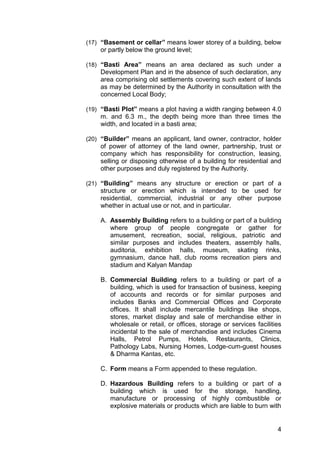
  • 129.
    128 i. The setbacks of the respective building shall be as per Master Plan, detailed Layout Plan, general Development Plan. ii. In case of multi storeyed buildings the exterior open space around a building shall be of hard surface capable of taking load of fire engine weighting upto 45 tonnes. iii. For multi-storied buildings identified the provision of exterior open spaces around the buildings shall be as given in Table. TABLE-19 PROVISION OF EXTERIOR OPEN SPACES AROUND THE BUILDINGS Sl. No. Height of the Building Upto (m.) Exterior open spaces to be left out on all sides in m. (front rear and sides in each plot) 1 10 As per prescribed set backs 2 15 5 3 18 6 4 21 7 5 24 8 6 27 9 7 30 10 8 35 11 9 40 12 10 45 13 11 50 14 12 55 and above 16 Note: On sides where no habitable rooms face, a minimum space of 9.0 m. shall be left for heights above 27.0 m. (9) Exit Requirement A. Type of Exits: i. Exits shall be either horizontal or vertical type. An exit may be doorway, corridor and passage to an internal staircase or external staircase, ramp or a verandah and/ or terraces that have access to the street or to roof of a building. An exit may also include horizontal exit leading to an adjoining building at the same level. ii. Lifts escalators and revolving doors shall not be considered as exits. B. Number of Size of Exits: The requisite number and size of various exits shall be provided, based on the occupants in each room and floor based on the
  • 130.
    129 occupant load, capacityof exits, travel distance and height of buildings as per one above. C. Arrangements of Exits: i. Exits shall be so located so that the travel distance on the floor shall not exceed 22.50 m. for residential, educational, institutional and hazardous occupancies and 30.0 m. for assembly, business, mercantile, industrial and storage occupancies. Whenever more than one exit is required for a floor of a building they shall be placed as remote from each other as possible. All the exits shall be accessible from the entire floor area at all floor levels. ii. The travel distance to an exit from the remote point shall not exceed half the distance as stated above except in the case of institutional occupancy in which case it shall not exceed 6.0 m. D. Capacity of Exit: The capacity of exits (staircase, ramps and doorways) indicating the number of persons which could be safety evacuated through a unit exit width of 50 cm shall be as given below: TABLE-20 OCCUPANTS PER UNIT EXIT WIDTH Sl. No. Group of Occupancy Number of Occupants Stairways Ramps Doors 1 Residential 25 50 75 2 Educational 25 50 75 3 Institutional 25 50 75 4 Assembly 40 50 60 5 Business 50 60 75 6 Mercantile 50 60 75 7 Industrial 50 60 75 8 Storage 50 60 75 9 Hazardous 25 30 40 E. Staircase Requirements: There shall be minimum of two staircases and one of them shall be enclosed stairway and the other shall be on the external walls of building and shall open directly to the exterior, interior open space or to any open place of safety. Single staircase may be accepted for educational, business or apartment buildings where floor area does not exceed 300 sq m. and height of the building does not exceed 24 m. and other requirements of occupant load ,travel distance and width of staircase shall meet the requirement. The single staircase in such case shall be on the outer wall of the building.
  • 131.
    130 F. Minimum WidthProvision for Stairways: The following minimum width provisions shall be made for each stairway i. Residential low rise building 0.9 m. ii. Other residential building e.g. flats, 1.25m iii. hostels, group housing, guest houses, etc 1.25 m. iv. Assembly buildings like Auditorium, theatres and cinemas 2.0 m. v. All other buildings including hotels 1.5 m. vi Institutional building like hospitals 2.0 m. vii Educational building like School, Colleges. 1.5 m. G. Minimum Width Provision for Passageway/Corridors: The following minimum width provisions shall be made for each passage way/corridor. i. Residential buildings, dwelling unit type 1.0 m. ii. Residential buildings, e.g., hostels, etc. 1.25 m. iii. Assembly buildings like auditorium theatres and cinemas 2.0 m. iv. All other buildings including hotels 1.5 m. v. Hospital, Nursing Homes, etc. 2.4 m. H. Doorways: i. Every doorway shall open into an enclosed stairway, a horizontal exit, on a corridor or passageway providing continuous and protected means of egress. ii. No exit doorways shall be less than l m. in width and 1.5 m. in case of hospital and ward block. Doorways shall not be less than 2.10 m. in height. i. Exit doorways shall open outwards, that is away from the room but shall not obstruct the travel along any exit. No door when opened shall reduce the required width of stairway or landing to less than 1m. Overhead or sliding door shall not be installed. ii. Exit door shall not open immediately upon a flight or stairs. A landing equal to at least, the width of the door shall be provided in the stairway at each doorway. Level of landings shall be the same as that of the floor, which it serves. iii. Exit doorways shall be open able from the side, which they serve without the use of a key. iv. Revolving doors shall not be allowed.
  • 132.
    131 I. Stairways: i. Interiorstairs shall be constructed of non-combustible material throughout. ii. Interior stairs shall be constructed as a self-contained unit with at least one side adjacent to an external wall and shall be completely enclosed. iii. A staircase shall not be arranged round a lift shaft for buildings 15.0 m. and above height. The staircase location shall be to the satisfaction of Chief Fire Officer. iv. Hollow combustible construction shall not be permitted. v. The minimum width of treads without nosing shall be 25 cm. for an internal staircase for residential high-rise buildings. In the case of other buildings, the minimum tread shall be 30 cm. The treads shall be constructed and maintained in a manner to prevent slipping. Winders shall be allowed in residential buildings provided they are not at the head of a downward flight. vi. The maximum height of riser shall be 19 cm. in the case of residential high rise buildings and 15 cm in the case of other buildings .These shall be limited to 13 per flight. vii. Handrails shall be provided with a minimum height of 1m. from the center of the tread. viii. The minimum headroom in a passage under the landing of a staircase and under the staircase shall be 2.10 m. ix. For building more than 24 m. in height, access to main staircase shall be through a lobby created by double door of one hour fire rating. One of the doors will be fixed in the wall of the staircase and other after the lobby. x. No living space, store or other fire risk shall open directly into the staircase or staircases. xi. External exit door of staircase enclosure at ground level shall open directly to the open spaces or can be reached without passing through any door other than a door provided to form a draught lobby. xii. The main staircase and fire escape staircase shall be continuous from ground floor to the terrace level. xiii. No electrical shafts/AC ducts or gas pipe etc. shall pass through the staircase. Lift shall not open in staircase landing. xiv. No combustible material shall be used for decoration/wall paneling in the staircase. xv. Beams/columns and other building features shall not reduce the head room/width of the staircase. xvi. The exit sign with arrow indicating the way to the escape route shall be provided at a suitable height from the floor level on the wall and shall be illuminated by electric light connected to corridor circuits. All exit way marking sign should be flush with the wall and so designed that no mechanical damage shall occur to them due to moving of furniture or other heavy equipments. Further all landings of floor shall have floor- indicating boards indicating the number of floor.
  • 133.
    132 xvii. The floorindication board shall be placed on the wall immediately facing the flight of stairs and nearest to the landing. It shall be of size not less than 0.2 m. x 0.5 m. xviii. Individual floors shall be prominently indicated on the wall facing the staircase. xix. In case of single staircase it shall terminate at the ground floor level and the access to the basement shall be by a separate staircase. However, the second staircase may lead to basement levels provided the same is separated at ground level either by ventilated lobby with discharge points at two different ends through enclosures. J. Fire Escapes or External Stairs: i. Fire escape shall not be taken into account while calculating the number of staircases for a building. ii. All fire escapes shall be directly connected to the ground. iii. Entrance to the fire escape shall be separate and remote from internal staircase. iv. The route to fire escape shall be free of obstructions at all times except the doorway leading to the fire escape which shall have the required fire resistance. v. Fire escape shall be constructed of non-combustible materials. vi. Fire escape stairs shall have straight flight not less than 125 cm wide with 25 cm treads and risers not more than 19 cm. vii. Handrails shall be at a height not less than 1m. viii. Fire escape staircase in the mercantile, business, assembly, hotel buildings above 24 m. height shall be a fire tower and in such a case width of the same shall not be less than the width of the main staircase. No combustible material shall be allowed in the fire tower. K. Spiral Stairs i. The use of spiral staircase shall be limited to low occupant load and to a building height 9 m. ii. A spiral stair shall not be less than 1.5 m in diameter and shall be designed to give the adequate headroom. L. Staircase Enclosures i. The external enclosing walls of the staircase shall be of the brick or the R.C.C. construction having fire resistance of not less than two hours. All enclosed staircases shall have access through self-closing door of one-hour fire resistance. These shall be single swing doors opening in the direction of the escape. The door shall be fitted with the check action door closers.
  • 134.
    133 ii. The staircaseenclosures on the external wall of the building shall be ventilated to the atmosphere at each landing. iii. Permanent vent at the top equal to the 5% of the cross sectional area of the enclosure and openable sashes at each floor level with area equal to 1 to 15% of the cross sectional area of the enclosure on external shall be provided. The roof of the shaft shall be at least 1 m. above the surrounding roof. There shall be no glazing or the glass bricks in any internal closing wall of staircase. If the staircase is in the core of the building and cannot be ventilated at each landing, a positive of 5-mm. w.g. by an electrically operated blower/blowers shall be maintained. iv. The mechanism for pressurizing the staircase shaft shall be so installed that the same shall operate automatically on fire alarm system/sprinkler system and be provided with manual operation facilities. M. Ramps i. Ramps of slope of not more than 1 in 10 may be substituted for and shall comply with all the applicable requirements of all required stairways as to enclosure capacity and limiting dimensions. Larger slopes shall be provided for special uses but in no case greater than 1 in 8. For all slopes exceeding 1 in 10 and where the use is such as to involve danger of slipping, the ramp shall be surfaced with approved non- slipping material. ii. The minimum width of the ramps in the Hospitals shall be 2.4 m. and in the basement using car parking shall be 6.0 m. iii. Handrails shall be provided on both sides of the ramp. iv. Ramp shall lead directly to outside open space at ground level or courtyards of safe place. v. For building above 24.0 m. in height, access to ramps from any floor of the building shall be through smoke fire check door. vi. In case of nursing homes, hospitals etc. area exceeding 300 sq m. at each floor one of the exit facility shall be a ramp of not less than 2.4 m. in width. (10) Provision of Lifts A. Provision of the lifts shall be made for all multi-storeyed building having a height of 15.0 m. and above. B. All the floors shall be accessible 24 hrs. by the lift. The lift provided in the buildings shall not be considered as a means of escape in case of emergency. C. Grounding switch at ground floor level to enable the fire service to ground the lift car in case of emergency shall also be provided. D. The lift machine room shall be separate and no other machinery shall be installed in it.
  • 135.
    134 i. LIFT ENCLOSURE/LIFT General requirements shall be as follows a. Walls of lift enclosures shall have a fire rating of two hours. Lift shafts shall have a vent at the top of area not less than 0.2 sq m. b. Lift motor room shall be located preferably on top of the shaft and separated from the shaft by the floor of the room. c. Landing door in lift enclosures shall have a fire resistance of not less than one hour. d. The number of lifts in one lift bank shall not exceed four. A wall of two hours fire rating shall separate individual shafts in a bank. e. Lift car door shall have a fire resistance rating of 1 hour. f. For buildings 15.0 m. and above in height, collapsible gates shall not be permitted for lifts and solid doors with fire resistance of at least one hour shall be provided. g. If the lift shaft and lobby is in the core of the building a positive pressure between 25 and 30 pa shall be maintained in the lobby and a possible pressure of 50 pa shall be maintained in the lift shaft. The mechanism for the pressurization shall act automatically with the fire alarm/sprinkler system and it shall be possible to operate this mechanically also. h. Exit from the lift lobby, if located in the core of the building, shall be through a self-closing fire smoke check door of one-hour fire resistance. i. Lift shall not normally communicate with the basement. If however, lifts are in communication, the lift lobby of the basement shall be pressurized as in (g) with self closing door as in (h). j. Grounding switch (es), at ground floor level shall be provided to enable the fire service to ground the lifts. k. Telephone/talk back communication facilities may be provided in lift cars for communication system and lifts shall be connected to the fire control room of the building. l. Suitable arrangements such as providing slope in the floor of the lift lobby shall be made to prevent water used during fire fighting, etc at any landing from entering the lift shafts. m. A sign shall be posted and maintained on every floor at or near the lift indicating that in case of fire, occupants shall use the stairs unless instructed otherwise. The sign shall also contain a plan for each floor showing the location of the stairways. Floor marking shall be done at each floor on the wall in front of the lift-landing door. n. Alternate power supply shall be provided in all the lifts.
  • 136.
    135 ii. FIRE LIFT Followingrequirements shall apply for a fire lift in addition to above requirements: a. To enable fire service personnel to reach the upper floors with the minimum delay, one or more of the lifts shall be so designed so as to be available for the exclusive use of the fireman in an emergency and be directly accessible to every dwelling/ lettable floor space on each floor. b. The lift shall have a floor area of not less than 1.4 sq.mt. It shall have a loading capacity of not less than 545 kg. (8 persons lift) with automatic closing doors. c. The electric supply shall be on a separate service from electric supply mains in a building and the cables run in a route safe from fire, i.e. within a lift shaft. Lights and fans in the elevator having wooden paneling or sheet steel construction shall be operated on 24-volt supply. d. In case of failure of normal electric supply, it shall automatically switchover to the alternate supply. For apartment houses, this changeover of supply could be done through manually operated changeover switch. Alternatively, the lift should be so wired that in case of power failure, it comes down at the ground level and comes to stand still with door open. e. The operation of a fire lift shall by a single toggle of two- button switch situated in a glass-fronted box adjacent to the lift at the entrance level. When the switch is on landing; call points will become inoperative and the lift will be on car control only or on a priority control device. When the switch is off, the lift will return to normal working. This lift can be used by the occupants in normal times. f. The words 'F1RE LIFT' shall be conspicuously displayed in fluorescent paint on the lift landing doors at each floor level. g. The speed of the fire lift shall be such that it can reach to the top floor from ground level within one minute. (11) Basement As provided in the Regulations. A. Requirements i. The access to the basement shall be either from the main or alternate staircase providing access and exit from higher floors. Where the staircase is continuous the same shall be enclosed type serving as a fire separation from the basement floor and higher floors. Open ramps shall be
  • 137.
    136 permitted if theyare constructed within the building line subject to the provision of the (iv). ii. In case of basement for office, sufficient number of exit ways and access ways shall be provided with a travel distance not more than 15.0 m. The travel distance in case of dead-end shall be 7.5 m. iii. The basement shall be partitioned and in no case compartment shall be more than 500 sq m. and less than 50 sq m. area except parking. Each compartment shall have ventilation standards as laid down in Bye-Laws separately and independently. The partition shall be made in consultation with Chief Fire Officer. iv. The first basement (immediately below ground level) can be used for services/parking/other permissible services. Lower basement, if provided, shall exclusively be used for car parking only. v. Each basement shall be separately ventilated. Vents with cross-sectional area (aggregate) not less than 2.5 percent of the floor area spread evenly round the perimeter of the basement shall be provided in the form of grills or breakable starboard lights or pavement lights or by way of shafts. Alternatively a system of air inlets shall be provided at basement floor level and smoke outlets at basement ceiling level. Inlets and extracts may be terminated at ground level with starboard or pavement lights. Ducts to convey fresh air to the basement floor level are to be laid. Starboard and pavement lights should be in positions easily accessible to the firemen and clearly marked "SMOKE OUTLET" or AIR INLET" with an indication of area served at or near the opening. vi. The staircase of basement shall be of enclosed type having fire resistance of not less than two hours and shall be situated at the periphery of the basement to be entered at ground level only from the open air and in such positions that smoke from any fire in the basement shall not obstruct any exit serving the ground and upper stories of the building and shall communicate with basement through a lobby provided with fire resisting self closing door of one hour rating. In case of basement being used as car parking only, the travel distance shall be 45 m. vii. In multi-storeyed basements, intake duct may serve all basements levels, but each basement and basement compartment shall have separate smoke outlet duct or ducts. Mechanical extractors for smoke venting system from lower basement levels shall also be provided. The system shall be of such design as to operate on actuation of smoke, heat sensitive detectors/sprinklers, if installed, and shall have a considerably superior performance compared to the standard units. It shall also have an arrangement to start manually.
  • 138.
    137 viii. Mechanical extractorsshall have an internal locking arrangement so that extractors shall continue to operate and supply fans shall stop automatically with the actuation of fire detectors. Mechanical extractors shall be designed to permit 30 air changes per hour in case of fire or distress call. However, for normal operation, only 30 air changes or any other convenient factor can be maintained. ix. Mechanical extractors shall have an alternate source of power supply. x. Ventilating ducts shall be integrated with the structure and made out of brick masonry or RCC as far as possible and when this duct crosses the transformer area of electrical switchboard, fire dampers shall be provided. xi. Kitchens working on gas fuel shall not be permitted in basement/sub-basement. xii. If cutouts are provided from basement to the upper floors or to the atmosphere, all side cutout openings in the basements shall be protected by sprinkler heads at closed spacing so as to form a water curtain in the event of a fire. xiii. Dewatering pump shall be provided in all basements. (12) Provision of Helipad All high-rise buildings 60 m. and above shall have provision for a Helipad on the terrace. The same shall be approved by the Authority. (13) Service Ducts/Refuge Chute A. Service duct shall be enclosed by walls and door, if any, of 2 hours fire rating. If ducts are larger than 10 sq m. the floor should seal them, but suitable opening for the pipes to pass through shall be provided with the gaps sealed. B. A vent opening at the top of the service shaft shall be provided between one-fourth and one-half of the area of the shaft. Refuge chutes shall have an outlet at least of wall of non-combustible material with fire resistance of not less than two hours. They shall not be located within the staircase enclosure or service shafts or air-conditioning shafts. Inspection panel and door shall be tight fitting with 1 hour fire resistance; the chutes should be as far away as possible form exits. C. Refuge chutes shall not be provided in staircase walls and A/C shafts etc. (14) Electrical Services Electrical Services shall conform to the following:
  • 139.
    138 A. The electricdistribution cables/wiring shall be laid in a separate duct shall be sealed at every floor with non-combustible material having the same fire resistance as that of the duct. Low and medium voltage wiring running in shaft and in false ceiling shall run in separate conduits. B. Water mains, telephone wires, inter-com lines, gas pipes or any other service lines shall not be laid in ducts for electric cables. C. Separate conduits for water pumps, lifts, staircases and corridor lighting and blowers for pressuring system shall be directly from the main switch panel and these circuits shall be laid in separate conduit pipes, so that fire in one circuit will not affect the others. Master switches controlling essential service circuits shall be clearly labeled. D. The inspection panel doors and any other opening in the shaft shall be provided with airtight fire doors having fire resistance of not less then 1 hour. E. Medium and low voltage wiring running in shafts, and within false ceiling shall run in metal conduits. Any 240 voltage wiring for lighting or other services, above false ceiling should have 660V grade insulation. The false ceiling including all fixtures used for its suspension shall be of non-combustible material. F. An independent and well-ventilated service room shall be provided on the ground floor with direct access from outside or from the corridor for the purpose of termination of electrical supply from the licenses service and alternative supply cables. The doors provided for the service room shall have fire resistance of not less than 1 hour G. MCB and ELCB shall be provided for electrical circuit. (15) Staircase And Corridor Lights The staircase and corridor lighting shall be on separate circuits and shall be independently connected so that it could be operated by one switch installation on the ground floor easily accessible to fire fighting staff at any time irrespective of the position of the individual control of the light points, if any. It should be of miniature circuit breaker type of switch so as to avoid replacement of fuse in case of emergency. A. Staircase and corridor lighting shall also be connected to alternate source of power supply. B. Suitable arrangement shall be made by installing double throw switches to ensure that the lighting installed in the staircase and the corridor does not get connected to two sources of supply simultaneously. Double throw switch shall be installed in the service room for terminating the stand by supply. C. Emergency lights shall be provided in the staircase and corridor. (16) A. Air-Conditioning i. Air- conditioning system should be installed and maintained so as to minimise the danger of spread of fire, smoke or fumes
  • 140.
    139 thereby from onefloor of fire area to another or from outside into any occupied building or structure. ii. Air -Conditioning systems circulating air to more than one floor area should be provided with dampers designed to close automatically in case of fire and thereby prevent spread of fire or smoke. Such a system should also be provided with automatic controls to stop fans in case of fire, unless arranged to remove smoke from a fire, in which case these should be designed to remain in operation. iii. Air- conditioning system serving large places of assembly (over one thousand persons), large departmental stores, or hostels with over 100 rooms in a single block should be provided with effective means for preventing circulation of smoke through the system in the case of fire in air filters or from other sources drawn into the system even though there is insufficient heat to actuate heat smoke sensitive devices controlling fans or dampers. Such means shall consist of approved effective smoke sensitive controls. B. Air- Conditioning Should Conform To The Following: i. Escape routes like staircase, common corridors, lift lobbies; etc should not be used as return air passage. ii. The ducting should be constructed of metal in accordance with BIS 655:1963 iii. Wherever the ducts pass through fire walls or floor, the opening around the ducts should be sealed with fire resisting material of same rating as of walls / floors. iv. Metallic ducts should be used even for the return air instead of space above the false ceiling. v. The material used for insulating the duct system (inside or outside) should be of flame resistant (IS 4355: 1977) and non- conductor of heat. vi. Area more than 750 sq m. on individual floor should be segregated by a firewall and automatic fire dampers for isolation should be provided. vii. In case of more than one floor, arrangement by way of automatic fire dampers for isolating the ducting at every floor from the floor should be made. Where plenums used for return air passage, ceiling and its features and air filters of the air handling units, these should be flame resistant. Inspection panels should be provided in the main trenching. No combustible material should be fixed nearer than 15 cm. to any duct unless such ducting is properly enclosed and protected with flame resistant material. viii. In case of buildings more than 24 m. in height, in non- ventilated lobbies, corridors, smoke extraction shaft should be provided.
  • 141.
    140 C. Fire Dampers i.These shall be located in air ducts and return air ducts/passages at the following points: a. At the fire separation wall. b. Where ducts/passages enter the central vertical shaft. c. Where the ducts pass through floors. d. At the inlet of supply air duct and the return air duct of each compartment on every floor. ii. The dampers shall operate automatically and shall simultaneously switch off the air- handling fans. Manual operation facilities shall also be provided. iii. For blowers, where extraction system and dust accumulators are used, dampers shall be provided. iv. Fire/smoke dampers (for smoke extraction shafts) for buildings more than 24 m. in height. For apartment houses in non-ventilated lobbies /corridor operated by detection system and manual control sprinkler system. For other buildings on operation of smoke/ heat detection system and manual control/sprinkler system. v. Automatic fire dampers shall be so arranged so as to close by gravity in the direction of air movement and to remain tightly closed on operation of a fusible link (17) Boiler Room Provisions of boiler and boiler rooms shall conform to Indian Boiler Act. Further, the following additional aspects may be taken into account in the location of boiler/ boiler room. A. The boiler shall not be allowed in sub-basement, but may be allowed in the basement away from the escape routes. B. The boilers shall be installed in a fire resisting room of 4 hours fire resistance rating, and this room shall be situated on the periphery of the basement. Catch pits shall be provided at the low level. C. Entry to this room shall be provided with a composite door of 2 hours fire resistance. D. The boiler room shall be provided with fresh air inlets and smoke exhaust directly to the atmosphere. E. The furnace oil tank for the boiler if located in the adjoining room shall be separated by fire resisting wall of 4 hours rating. The entrance to this room shall be provided with double composite doors. A curb of suitable height shall be provided at the entrance in order to prevent the flow of oil into boiler room in case of tank rupture. F. Foam inlets shall be provided on the external walls of the building near the ground level to enable the fire services to use foam in case of fire.
  • 142.
    141 (18) Alternate SourceOf Electric Supply A stand by electric generator shall be installed to supply power to staircase and corridor lighting circuits, lifts detection system, fire pumps, pressurization fans and bowlers, P.A system, exit sign, smoke extraction system, in case of failure of normal electric supply. The generator shall be capable of taking starting current of all the machines and circuits stated above simultaneously. If the standby pump is driven by diesel engine, the generator supply need not be connected to the standby pump. The generator shall be automatic in operation. (19) A. Safety Measures In Electric Sub-Station i. Clear independent approach to the sub-station from outside the building shall be made available round the clock ii. The approaches/corridors to the sub-station area shall be kept clear for movement of men and material at all times. iii. The sub-station space is required to be provided with proper internal lighting arrangements. iv. In addition to natural ventilation proper ventilation to the sub- station area is to be provided by grill shutters and exhaust fans at suitable places so as to discharge all smoke from the sub- station without delay in case of fire so that sub-station operations can be carried out expeditiously. v. Cable trenches of 0.6 m. x 0.6 m. dummy floor of 0.6 mt. depth shall be provided to facilitate laying of cable inside the building for connecting to the equipment. vi. Steel shutters of 2.5 m. x 2.5 m with suitable grills shall be provided for transformers and sub-station room. vii. The floor of the sub-station should be capable of carrying 10 tons of transformer weight on wheels. viii. Built up substation space is to be provided free of cost. ix. Sub-station space should be clear from any water, sewer, air conditioning, and gas pipe or telephone services. No other service should pass through the substation space or the cable trenches. x. Proper ramp with suitable slope may be provided for loading and unloading of the equipment and proper approach shall be provided. xi. RCC pipes at suitable places as required shall be provided for the cable entries to the substation space and making suitable arrangement for non-ingress of water through these pipes. xii. The substation space is to be provided in the approved/sanctioned covered area of the building. xiii. Any other alteration /modification required while erection of the equipment will be made by the Owner / builder at site as per requirement.
  • 143.
    142 xiv. Adequate arrangementfor fixing chain pulley block above the fixing be available for load of 15 tons. xv. Provision shall be kept for the sumps so as to accommodate complete volume of transformer oil, which can spillover in the event of explosion of the transformer in the basement of the building. Sufficient arrangement should exist to avoid fire in the sub-station building from spread of the oil from the sumps. xvi. Arrangement shall be made for the provision of fire retardent cables so as to avoid chances of spread of fire in the sub- station building. xvii. Sufficient pumping arrangement should exist for pumping the water out, in case of fire so as to ensure minimum loss to the switchgear and transformer. xviii. No combustible material shall be stacked inside the substation premises or in the vicinity to avoid chances of fire. xix. It should be made mandatory that the promoters of the multi- storeyed building should get substation premises inspected once a year to get their license revalidated for the provision of electric supply from Electricity Board so that suitable action can be taken against the Owner / Builder in case of non- implementation. xx. The sub-station must not be located below the 1st basement and above the ground floor. xxi. The substation space should be totally segregated from the other areas of the basement by fire resisting wall. The ramp should have a slope of 1 : 10 with entry from ground level. The entire Sub-station space including the entrance at ground floor be handed over to the licensee of electricity free of cost and rent. xxii. The sub-station area shall have a clear height of 3.6 m. below beams. Further the Sub-station area will have level above the rest of basement level by 0.60 m. xxiii. It is to be ensured that the Sub-station area is free of seepage / leakage of water. xxiv. The licensee of electricity will have the power to disconnect the supply of the building in case of violation of any of the above points. xxv. Electric sub station enclosure must be completely segregated with 4-hours fire rating wall from remaining part of basement. xxvi. The Sub-station should be located on periphery /sub basement and (not above ground floor). xxvii. Additional exit shall be provided if travel distance from farthest corner to ramp is more than l5 m. xxviii. Perfect independent vent system @ 30 air changes per hour linked with detection as well as automatic high velocity water spray system shall be provided. xxix. All the transformers shall be protected with high velocity water spray system / Nitrogen Injection System Carbon Dioxide total flooding system in case of oil filled transformer. In addition to
  • 144.
    143 this, manual controlof auto high velocity spray system for individual transformers shall be located outside the building at ground floor. xxx. Suitable arrangement for pump house, water storage tanks with main electrical pump and a diesel-operated pump shall be made if no such arrangement is provided in the building. In case the water pumping facilities are existing in the building for sprinkler system, the same should however be utilized for high velocity water spray system. Alternatively automatic CO2 total flooding system shall be provided with manual controls outside the electric sub-station. xxxi. System shall have facility to give an audio alarm in the basement as well as at the control room. xxxii. Fire control room shall be manned round the clock. xxxiii. The electric sub station shall have electric supply from alternate source for operation of vent System lighting arrangements. xxxiv. Cable trenches shall be filled with sand xxxv. Party walls shall be provided between two transformers as per the rules. xxxvi. Electric control panels shall be segregated. xxxvii. Exits from basement electric substation shall have self-closing fire smoke check doors of 2-hours fire rating near entry to ramp. xxxviii. All openings to lower basement or to ground floor shall be sealed properly. xxxix. Yearly inspection shall be carried out by electrical load sanctioning Authority. xl. Ramp to be designed in a manner that in case of fire no smoke should enter the main building. xli. Electric substation transformer shall have clearance on all sides as per BBL/relevant electric rules. xlii. Other facility shall be as per Building Bye-Laws and relevant electric rules. xliii. Rising electrical mains shall consist of metal bus bars suitably protected from safety point of view. xliv. Dry transformer shall be preferred. (20) Fire Protection Requirements Buildings shall be planned, designed and constructed to ensure fire safety and this sha1l be done in accordance with Part-IV Fire and Life Safety of the National Building Code of India, 2005 unless otherwise specified. In the case of identified buildings the building schemes shall also be cleared by the Chief Fire Officer.
  • 145.
    144 A. First Aid/Fixed Fire Fighting /Fire Detection Systems And Other Facilities Provision of fire safety arrangement for different occupancy as indicated below shall be as per NBC code. i. Access ii. Wet Riser iii. Down Comer iv. Hose Reel v. Automatic Sprinkler System vi. Yard Hydrant vii. U.G. Tank with Draw off Connection viii. Terrace Tanks ix. Fire Pump x. Terrace Pump xi. First Aid Fire Fighting Appliances xii. Auto Detection System xiii. Manual operated Electrical Fire Alarm System xiv. P.A System with talk back facility xv. Emergency Light xvi. Auto D.G. Set xvii. Illuminated Exit Sign xviii. Means of Escape xix. Compartimentation xx. MCB /ELCB xxi. Fire Man Switch in Lift xxii. Hose Boxes with Delivery Hoses and Branch xxiii. Pipes Refuge Area NOTE : 1 Where more than one riser is required because of large floor area, the quantity of water and pump capacity recommended should be finalized in consultation with Chief Fire Officer. 2 The above quantities of water shall be exclusively for fire fighting and shall not be utilized for domestic or other use. 3 A facility to boost up water pressure in the riser directly from the mobile pump shall be provided in the wet riser, down comer system with suitable fire service inlets (collecting head) with 2 to 4 numbers of 63 mm inlets for 100-200 mm dia main, with check valve and a gate valve. 4. Internal diameter of rubber hose for reel shall be minimum 20 mm. A shut off branch with nozzle of 5 mm. size shall be provided. 5 Fire pumps shall have positive suctions. The pump house shall be adequately ventilated by using normal/mechanical means. A clear space of 1.0 m. shall be kept in between the pumps and enclosure for easy movement /maintenance. Proper testing facilities and control panel etc. shall be provided.
  • 146.
    145 6 Unless otherwisespecified in Regulations, the fire fighting equipments /installation shall conform to relevant BIS Specifications. 7 In case of mixed occupancy, the fire fighting arrangement shall be made as per the highest class of occupancy. 8 Requirement of water based first aid fire extinguishers shall be reduced to half if hose reel is provided in the Building. (21) Static Water Storage Tank A. A satisfactory supply of water exclusively for the purpose of fire fighting shall always be available in the form of underground static storage tank with specified capacity with arrangements of replenishment by town's main or alternative source of supply @ 1000 liters per minute. The static storage water supply required for the above mentioned purpose should entirely be accessible to the fire tenders of the local fire service. Provision of suitable number of manholes shall be made available for inspection repairs and insertion of suction hose etc. The covering slab shall be able to withstand the vehicular load of 45 tonnes in case of high rise and 22 tonnes in case of low rise buildings. A draw off connection shall be provided. The slab need not strengthened if the static tank is not located in mandatory set-back area. B. To prevent stagnation of water in the static water tank, the suction tank of the domestic water supply shall be fed only through an over flow arrangement to maintain the level therein at the minimum specified capacity. C. The static water storage tank shall be provided with a fire brigade collecting branching with 4 Nos. 63mm dia instantaneous male inlets arranged in a valve box with a suitable fixed pipe not less than 15 cm dia to discharge water into the tank. This arrangement is not required where down comer is provided. (22) Automatic Sprinklers Automatic sprinkler system shall be installed in the following buildings: A. All buildings of 24 m. and above in height, except group housing and 45 m. and above in case of apartment /group housing society building. B. Hotels below l5 m. in height and above 1000 sq m. built up area at each floor and or if basement is existing. C. All hotels, mercantile, and institutional buildings of 15 m. and above. D. Mercantile building having basement more than one floor but below 15 m. (floor area not exceeding 750 sq m.) E. Underground Shopping Complex. F. Underground car / scooter parking /enclosed car parking. G. Basement area 200 sq m. and above.
  • 147.
    146 H. Any specialhazards where the Chief Fire Officer considers it necessary. I. For buildings up to 24 m. in height where automatic sprinkler system is not mandatory as per these Bye-Laws, if provided with sprinkler installation following relaxation may be considered. i. Automatic heat/smoke detection system and M.C.P. need not be insisted upon. ii. The number of Fire Extinguisher required shall be reduced by half. (23) Fixed Carbon Di-Oxide / Foam / DCO Water Spray Extinguishing System Fixed extinguishing installations shall be provided as per the relevant specifications in the premises where use of above extinguishing media is considered necessary by the Chief Fire Officer. (24) Fire Alarm System All buildings of 15 m. and above in height shall be equipped with fire alarm system, and also residential buildings (Dwelling House, Boarding House and Hostels) above 24 m. height. A. All residential buildings like dwelling houses (including flats) boarding houses and hostels shall be equipped with manually operated electrical fire alarm system with one or more call boxes located at each floor. The location of the call boxes shall be decided after taking into consideration their floor area without having to travel more than 22.5 m. B. The call boxes shall be of the break glass type without any moving parts, where the call is transmitted automatically to the control room without any other action on the part of the person operating the call boxes. C. All call boxes shall be wired in a closed circuit to a control panel in a control room, located as per Bye-Laws so that the floor number from where the call box is actuated is clearly indicated on the control panel. The circuit shall also include one or more batteries with a capacity of 48 hours normal working at full load. The battery shall be arranged to be a continuously trickle charged from the electric mains. D. The call boxes shall be arranged to sound one or more sounders so as to ensure that all occupants of the floor shall be warned whenever any call box is actuated. E. The call boxes shall be so installed that they do not obstruct the exit ways and yet their location can easily be noticed from either direction. The base of the call box shall be at a height of 1.5 m. from the floor level. F. All buildings other than as indicated above shall, in addition to the manually operated electrical fire alarm system, be equipped with an automatic fire alarm system.
  • 148.
    147 G. Automatic detectionsystem shall be installed in accordance with the relevant standard specifications. In buildings where automatic sprinkler system is provided, the automatic detection system may not be insisted upon unless decided otherwise by the Chief Fire Officer. Note: Several type of fire detectors are available in the market but the application of each type is limited and has to be carefully considered in relation to the type of risk and the structural features of the building where they are to be installed. (25) Control Room There shall be a control room on the entrance floor of the building with communication system (suitable public address system) for all floors and facilities for receiving the message from different floors. Details of all floor plans along with the details of fire fighting equipment and installation shall be maintained in the Control Room. The Control Room shall also have facility to detect the fire on any floor through indicator boards connecting fire detection and alarm system on all floors. The staff in charge of the Control Room shall be responsible for the maintenance of the various services and fire fighting equipment and installation. The Control Room shall be manned round the clock by trained fire fighting staff. (26) Fire Drills and Fire Orders The guidelines for fire drill and evacuation etc. for high-rise building shall be as per Part-IV of National Building Code. All such building shall prepare the fire orders duly approved by the Chief Fire Officer. (27) A qualified fire officer and trained staff shall be appointed for the following buildings. A. All high rise buildings above 30 m. in height where covered area of one floor exceeds 1000 sq m. except apartments / group housing. B. All hotels, identified under classification three star and above category by Tourism Department and all hotels above 15 m. in height with 150 bed capacity or more without star category. C. All hospital building of 15 m. and above or having number of beds exceeding 100. D. Underground shopping complex where covered area exceeds 1000 sq. m. E. All high hazard industries. F. Any other risk which Chief Fire Officer considers necessary. (28) The lightening protection warning light (red) for high-rise buildings shall be provided in accordance with the relevant standard. The same shall be checked by electrical department.
  • 149.
    148 (29) Material UsedFor Construction Of Building A.Combustible/flammable material shall not be used for partitioning, wall paneling, false ceiling etc. Any material giving out toxic gases/smoke if involved in the fire shall not be used for partitioning of a floor or wall paneling or a false ceiling etc. The surface frames spread of the lining material shall conform to class-I of the standard specification. The framework of the entire false ceiling shall be provided with metallic sections and no wooden framework shall be allowed for paneling/false ceiling. B.Construction features/elements of structures shall conform to National Building Code 2005 and BIS codes (30) LPG The use of LPG shall not be permitted in the high-rise building except residential/hotel/hostel/kitchen/pantry (if any) and shall be located at the periphery of the building on the ground level. (31) House Keeping A high standard of house keeping shall be insisted upon by all concerned. There must be no laxity in this respect. It must be borne in mind that fire safety is dependent to a large extent upon good housekeeping. A. Good House-Keeping includes the following:- i. Maintaining the entire premises in neat and clean condition. ii. Ensuring that rubbish and combustible material are not thrown about or allowed to accumulate, even in small quantity, in any portion of the building. Particular attention must be paid to corners and places hidden from view. iii. Providing metal receptacles/waste paper basket (of non- combustible material) at suitable locations for disposal of waste. Separate receptacles must be provided for disposal of cotton rags/waste, wherever it is generated, these must under no circumstances be left lying around in any portion of the building. iv. Ensuring that receptacles for waste are emptied at regular intervals and the waste removed immediately for safe disposal outside the building. v. Ensuring that all doors/fixtures are maintained in good repairs, particular attention must be paid to self-closing fire smoke check doors and automatic fire/doors/rolling shutters. vi. Ensuring that self-closing fire/smoke check doors close properly and that the doors are not wedged open. vii. Ensuring that the entire structure of the building is maintained in good repairs.
  • 150.
    149 viii. Ensuring thatall electrical and mechanical service equipments are maintained in good working condition at all times. ix. Ensuring that Cars / Scooters etc. are parked systematically in neat rows. It is advisable to mark parking lines on the ground in the parking areas near the building and in the parking area on ground floor and in basement(s); as applicable, inside the building. A parking attendant must ensure that vehicles are parked in an orderly manner and that the vehicles do not encroach upon the open space surrounding the building. B. Smoking Restrictions i. Smoking shall be prohibited throughout the basement(s) and in all areas where there is a profusion of combustible materials. Easily readable "NO SMOKING" signs must be conspicuously posted at locations where they can catch the eye. Each sign must also include a pictograph. The sign may also be illuminated. ii. In all places where smoking is permitted, ashtrays half filled with water, must be placed on each table/at each other suitable locations for safe disposal of spent smoking material. The design of the ashtrays must be such that they cannot easily topple over. If, for any reason, this is not practicable a minimum of one metal bucket or other non-combustible container half filled with water must be provided in each compartment for disposal of spent smoking materials. C. Limiting the Occupant Load in Parking and Other Areas of Basement Where parking facility is provided in the basement(s) no person other than the floor-parking attendant may be allowed to enter and remain in the parking areas except for parking and removal of Cars/Scooters. Regular offices must not be maintained in the storage /parking area in the basement(s). The stores / godowns must be opened for the limited purpose for keeping or removing stores. No person other than those on duty may be permitted in the air- conditioning plant room(s), HL/LT switch room, transformer compartment, control room pump-house, generator room, stores and records etc. (32) Fire Prevention In addition to the measures recommended above, the following fire prevention measures must be implemented when the building is in occupation.
  • 151.
    150 i. Storage offlammable substances, such as diesel oil, gasoline, motor oils, etc must not be allowed anywhere within the building. The only exception to this rule may be: a. Storage of diesel oil in a properly installed tank in a fire- resisting compartment in the generator room; b. Diesel oil, gasoline, motor oil etc, filled in the vehicle tanks. ii. Preparation of tea and warming of food must be prohibited throughout the building. iii. Where heaters are used during winters, the following precautions must be taken. a. All heaters, except convector heaters, must be fitted with guards. b. Heaters must not be placed in direct contact with or too close to any combustible material. c. Heaters must be kept away from curtains to ensure that the latter do not blow over the heater accidentally. d. Heaters must not be left unattended while they are switched on. e. Defective heaters must be immediately removed from service until they have been repaired and tested for satisfactory performance. f. Use of heaters must be prohibited in the entire basement, fire control room and in all weather maker rooms throughout the building. Also in all places where there is profusion of combustible flammable materials. iv. Use of candles or other naked light flame must be forbidden throughout the building, except in the offices (for sealing letters only) and kitchen. When candles/ spirit lamps are used for sealing letters/packets, extreme care must be take to ensure that paper does not come in direct contact with the naked flame and the candle/spirit lamp does not topple over accidentally while still lighted. All candles/spirit lamps kitchen fires must be extinguished when no longer required. v. Fluorescent lights must not be directly above the open file racks in offices/record rooms. Where this is unavoidable, such lights must be switched on only for as long as they are needed. vi. Filling up of old furniture and other combustible materials such as scrap paper, rags, etc. must not be permitted anywhere in the building. These must be promptly removed from the building. vii. More than one portable electrical appliance must not be connected to any single electrical outlet. viii Used stencils, ink smeared combustible materials and empty ink tubes must not be allowed to accumulate in rooms/compartments where cyclostyling is done. These must be removed and disposed off regularly. ix. All shutters/doors of main switch panels and compartments/shafts for electrical cables must be kept locked.
  • 152.
    151 x. Aisles inrecord rooms and stores must have a clear uniform width of not less than 1.0 m. Racks must not be placed directly against the wall/partition. xi. In record rooms, offices and stores, a clear space of not less than 30 cm. must be maintained between the top-most stack of stores/records and the lighting fittings. xii. A similar clearance, and at (xi) above must be maintained from fire detectors. xiii. Fire detectors must not be painted under any circumstances and must also be kept free from lime/distemper. xiv. Records must not be piled/dumped on the floor. xv. Welding or use of blow torch shall not be permitted inside the building, except when it is done under strict supervision and in full conformity with the requirements laid down in IS: 3016- 1966 code of practice for fire precautions in welding and cutting operation. xvi. Printing ink/oil must not be allowed to remain on the floor, the floor must be maintained in a clean condition at all times. (33) Occupancy Restrictions A. The premises leased to any party shall be used strictly for the purpose for which they are leased. B. No dangerous trade/practices (including experimenting with dangerous chemicals) shall be carried on in the leased premises; C. No dangerous goods shall be stored within the leased premises. D. The common/public corridor shall be maintained free of obstructions, and the lessee shall not put up any fixtures that may obstruct the passage in the corridor and/or shall not keep any wares, furniture or other articles in the corridor. E. The penalty for contravention of the condition laid down below must be immediate termination of lease and removal of all offending materials. F. Regular inspection and checks must be carried out at frequent intervals to ensure compliance with conditions above.
  • 153.
    152 FORM - I PART– I BUILDING PLAN APPLICATION FORM Form No.-________________ Authorised Signature APPLICATION FOR PERMISSION FOR DEVELOPMENT OF BUILDING AND SUB-DIVISION OF LAND UNDER SECTION-16 OF THE ODISHA DEVELOPMENT AUTHORITIES ACT, 1982. From: For Office use only Name and Address Regd. No. (in Block letters) Scrutiny Fee Tel No.___________ Mobile No. __________________ To THE VICE-CHAIRMAN, CUTTACK DEVELOPMENT AUTHORITY CUTTACK Madam/Sir I/We hereby apply for permission to undertake development and carry out:- (a) Construction of__________________storied building. (b) Re-construction of an existing building (c) Alteration/addition to the existing building; (d) Revalidation/renewal of plan for construction of all_________ storied building; (e) Sub-division of land (f) ___________(if any other please specify) (g) Demolition (h) ____________(if any other please specify) In respect of Plot No._______ Khata No._________ Village_________ of________ Municipal Corporation/Municipality/ within the Development Plan Area of Cuttack. The said land building shall be used for__________________________ purpose. I/We enclosed herewith the following plans (4 copies in case of privately owned plots/ 8 copies in case of Govt. leased Govt. plots) and specifications duly signed by me and Architect/ Engineer/ Supervisor/ Group agency ____________________________bearing Regd. No.________ Licence/ Empanelment No._________ who has/have prepared the plans, designs etc. and
  • 154.
    153 who will supervisethe developments. The building parameters checklist prepared by the Technical person is enclosed. I/We the owner(s) of every part of the land/building to which this application relates, requests, permission for the above development may kindly be accorded. Documents furnished. 1.Four sets of the building Plan: Yes/No/Not applicable 2.Ownership document: Yes/No/Not applicable 3.Supervision certificate in form-I,Part-II: Yes/No/Not applicable 4.Affidavit for peaceful possession of the land: Yes/No/Not applicable 5.Structural stability certificate: Yes/No/Not applicable 6.NOC from lessee in case of ease hold: Yes/No/Not applicable 7.NOC from Fire Prevention Officer: Yes/No/Not applicable 8.NOC from Airport Authority: Yes/No/Not applicable 9.Environmental clearance: Yes/No/Not applicable 10.Checklist of the proposed building: Yes/No/Not applicable 11.any other certificate/NOC(Please specify): Yes/No/Not applicable. Place: Signature of Owner(s) Date- Name of Owner(s)
  • 155.
    154 PART - II FORMFOR SUPERVISION I hereby certify that the development/erection/re-erection/demolition or material alteration in/of the building in respect of Plot No.___________ Khata No.______ Village/ Mouza______________ of _________________________ Municipal Corporation/ Municipality/ NAC shall be carried out under my supervision and I certify that all the materials (type and grade) and the workmanship of the work shall be generally in accordance with the general and detailed specifications submitted along with and that the work shall be carried out according to the sanctioned plans. Signature of Empanelled Technical Person Name of the Technical Person Address ________________ __________________ __________________ Date: ____________
  • 156.
    155 PART – III CHECKLIST 1. Name of the Applicant: 2. Name of the Owner: 3. Name of the Builder/Developer: 4. Ownership documents: Established/Non established 5. Area as per Document Building Plan Possession Area: 6. Tenancy:- Lease hold/Free hold/Stitiban. If lease hold: (i) Name of Lessor: (ii) Purpose of lease: (iii) Duration of lease: 7. Existing off site Physical Infrastructure: (a) Road (b) Sewerage (c) Drainage (d) Water facility (e) Availability of drain (f) Telephone (g) Electric 8. Nature of Construction: New Construction/Reconstruction/Addition/Alteration 9. (i) Amount of fee deposited (ii) Covered area on all floors 10 Use applied Land use in the comprehensive development plan Whether permissible/not permissible/special consideration 11. (i) Whether first permission/Revised permission/Revalidation________________ (ii) No of floor(s)_______________________
  • 157.
    156 12. Contents ofBuilding Plan: (i) Site Plan (ii) Lay out plan (iii) All floor plan (iv) Elevations-Front/Rear/Right/Left/Cross section (v) Plan of foundation (vi) Septic tank and Soak pit (vii) Recharging pit (viii) Drain Section (ix) Area statement (x) Schedule of doors and windows 13. Approach road:- (i) Nature of road (ii) Width of road:- As per site /key plan Site inspection report (iii) Whether the approach road as shown connected to an existing public road in the site plan_________________ (iv) Whether such connection is available in settlement sheets: Yes/No (v) If private , whether (a) transferred to the Corporation/Municipality: Yes/No (b) indicated in the not final settlement plan: Yes/No (c) mentioned in the ownership document: Yes/No 14. Whether the plot is affected by proposed road/proposed drain/ proposed lake/any other public use______________________________________ 15. Whether the plot is within 100 meter/100-300 meter of state/A.S.I. protected monuments_________________________________________ 16. Building Parameters: Category Requirement as per Regulations Proposal Approved Remarks 1 2 3 4 5 Basement/stilt Ist floor
  • 158.
    157 2nd floor 3rd floor 4th floor Society room Front setback Rear set back Left side set back Right side set back FAR Parking Height No. of dwelling unit Population density No. of staircase No. of lift Recharging pit Scrutiny fee deposited Gates Exemptions (i)height (ii) setback (iii)FAR 17. Provision of proposed on site physical infrastructure (i) Water Supply:- (ii) Sewerage:- (iii) Drainage:- (iv) Electrical Installation:- 18. Clearance/Certificate produced: RS/RNS/NR (i) General Affidavit:- (ii) Structural Stability Certificate:- (iii) Form of Supervision:- (iv) NOC from Fire Prevention Officer:- (v) NOC from PHED:- (vi) Undertakings with regard to quality construction/Water supply/Sewerage/Drainage/Waste disposal/fire fighting (vii) Any other (specify) N:B: (RS: Required and Submitted, RNS: Required not Submitted, NR: Not Required)
  • 159.
    158 19. Involvement ofTechnical Person & Builder: (i) Architect/Engineer :- Name:- C.A.No:- Empanelment No: (ii) Engineer/Structural Engineer:- Name: Empanelment No: (iii) Builder: Name: Empanelment No: (iv) Any other: Signature of Technical Person FORM -II CUTTACK DEVELOPMENT AUTHORITY No._________/CDA., Cuttack, Dated: __________ Permission under sub-section(3) of the Section-16 of the Odisha Development Authorities Act,1982(Odisha Act,1982) is hereby granted in favour of; Smt./ Shri ________________________ for (a) Sub-division of lands (b) Institution of change of the use of land or building (c) Construction of a____________ building (d) Reconstruction of building (e) Alteration of (f) Alteration or additions in the existing building _______________________(Specify)in respect of plot No.__________________, Khata No._____________________________ Village/ Mouza.________________________ of __________________Municipal Corporation/Municipality/NAC within the Development Plan Area of_________________ subject to following additions/ restrictions. (a) The land/ Building shall be used exclusively for__________________________ purpose and the uses shall not be changed to any other use without prior approval of this Authority.
  • 160.
    159 (b) The developmentshall be undertaken strictly according to plans enclosed with necessary permission endorsement (c) Parking space measuring__________ sq. m. as shown in the approved plan shall be kept open and no part of it will be built upon. (d) The land over which construction is proposed is accessable by an approved means of access of________ m. width. (e) The land in question must be in lawful ownership and peaceful possession of the applicant. (f) The applicant shall free gift__________ m. wide strip of land in the_________ Municipal Corporation/Municipality/ NAC for the further widening of the road to the standard width. (g) The permission is valid for period of three years with effect from the date of issue. (h) Permission accorded under the provision of section 16 of ODA Act, cannot be construed as evidence in respect of right title interest of the plot over which the plan is approved. (i) Any dispute arising out of land record or in respect of right/ title/ interest after this approval the plan shall be treated automatically cancelled during the period of dispute. (j) Any other conditions: Planning Member/Authorised Officer Cuttack Development Authority Memo No._________/CDA., Cuttack, Dated_________ Copy along with ________ copies of the approved plans to Smt./ Shri _______________________________________________. Planning Member/Authorised Officer Cuttack Development Authority Memo No._________/ CDA., Cuttack, Dated_________ Copy with a copy approved plan forwarded to the Commissioner, Cuttack Municipal Corporation for information/Executive officer Choudwar Municipality Planning Member/Authorised Officer Cuttack Development Authority
  • 161.
    160 FORM-III APPLICATION FOR DRAWINGOF ATTENTION UNDER SUB-SECTION (7) OF SECTION-16 OF THE ODISHA DEVELOPMENT AUTHORITIES ACT, 1982 From_________________ _________________ _________________ (Name and address of the applicant in block letters) TO THE VICE-CHAIRMAN, CUTTACK DEVELOPMENT AUTHORITY CUTTACK Subject: Statutory Notice under sub-section (7) of Section-16 of the ODA Act, 1982. Madam/ Sir, I/We do bring to your kind notice that I/We had applied for permission to the Cuttack Development Authority on________________ to undertake development with respect to plot No._________ Khata No._______ Village/Mouza__________ of___________ Municipal Corporation/Municipality/ NAC within Development Plan Area of_____________. My/ our application was registered vide No._______ Dated____________. Two months have elapsed since the submission of my/our application and I/we have not received any communication with respect to the said application. Please take notice that if within a further period of one month from the date of receipt of this notice by you no communication either granting or refusing permission is received by me/ us, I/ we shall presume that permission as applied for has been granted in my/ our favour. Yours faithfully, Signature of the applicant(s)
  • 162.
    161 FORM-IV Form of Registeredto be maintained under sub – section(11) AND (12) of Section-16 of the Act (See Regulation-10) Sl. No. Name and address of the applicant Date of receipt Date of permiss- ion with letter No. Date of refusal with letter No. Date of endors- ement to Enforc- ement Branch Date of return from Enforc- ement Branch Date of sending to record room Signat- ure of the dealing Asst. Signa -ture of the S.O.
  • 163.
    162 FORM-V FORM OF NOTICEFOR COMMENCEMENT OF WORK (TO BE FURNISHED BY THE PLOT OWNER(S) AND THE BUILDER/ DEVELOPER) From:__________________________ __________________________ __________________________ (Name and address in Block Letters) TO THE VICE-CHAIRMAN, CUTTACK DEVELOPMENT AUTHORITY CUTTACK. Sir, I/We hereby give notice of the erection of building in respect of plot No.______________ Khata No._______ Village__________ to be commenced on__________ as per the permission given in your letter No. _______ Dated _________ under the supervision C.D.A. empanelled Architect/Engineer/ Structural Engineer__________________________, Regd. No_______ in accordance with the approved plan. Yours faithfully, Signature(s) of the Owner Signature of Builder / Developer.
  • 164.
    163 FORM – VI PART- I COMPLETION CERTIFICATE From:__________________________ __________________________ __________________________ (Name and address in Block Letters) TO THE VICE-CHAIRMAN, CUTTACK DEVELOPMENT AUTHORITY CUTTACK. Sir, I hereby certify that the development, of erection, re-erection or for material alteration in respect of the building on Plot No.____________, Khata No._____________Village/Mouza____________of___________________Municip al Corporation/ Municipality/NAC within the Development Area of__________ has been supervised by me and has been completed on ________ according to the plans sanctioned vide No.________ dated _________.The work has been completed to my best satisfaction, the workmanship and all the materials(type and grade) have been used strictly, in accordance with the general and detailed specifications. No provisions of the code, conditions prescribed or orders issued there under have been transgressed in the course of the work. The land is fit for construction for which it has been developed or re-developed or the building is fit for use for which it has been erected, re-erected or altered, constructed and enlarged. I hereby also enclose the plan of the building completed in all aspects. Signature of Empanelled Technical Person Name of the Technical Person Address ________________ __________________ __________________ Date: ____________
  • 165.
    164 FORM – VI PART- II CERTIFICATE FOR EXECUTION OF WORK AS PER STRUCTURAL SAFETY REQUIREMENTS With respect to the building work of erection, re-erection or for making alteration in the building on Plot No.______________ Khata No.____________ Village/Mouza__________________ of_____________________ Municipal Corporation/ Municipality/NAC within the Development Plan Area of___________________ I certify (a) that the building has been constructed according to the sanctioned plan and structural design( copy of the drawings as executed enclosed),which incorporates the provisions of structural safety norms as specified in Part- 6 (Structural Design) of the National Building Code of India, 2005 and other relevant codes; and (b) that the construction has been done under my supervision and guidance and adheres to the drawings and specifications submitted and records of supervision have been maintained. Any subsequent changes from the completion drawings shall be the responsibility of the owner Signature of owner Signature of the Empanelled Engineer/ With date Structural Engineer with date and Empanelment No. Name: ______________ ___________________________ Address: ______________ ___________________________
  • 166.
    165 FORM - VII CERTIFICATEFOR STRUCTURAL STABILITY With respect to the building work of erection, re-erection or for making alteration in the building on Plot No.______________ Khata No.___________ Village/ Mouza____________ of _________________ Municipal Corporation /Munic-ipality /NAC within the Development Plan Area of Cuttack Development Authority, I certify that the structural plans and details of the building submitted for approval satisfy the structural safety requirements for all situations including natural disasters like cyclone &earth quake etc., as applicable, as stipulated under Part- 6 (Structural Design) of the National Building Code of India, 2005 and other relevant codes; and the information given therein is factually correct to the best of my knowledge. I undertake responsibility with regard to supervision of the work at each stage of construction,(after laying of foundation &after casting of each floor) and submit the report to C.D.A. regularly to effect that the building is being constructed conforming to the approved plan and as per the structural plan prepared by me. I will be responsible and liable for action by C.D.A./Govt. if the plan/design contain misrepresentation or fraudulent information and the construction is made in deviation of approved plan or if there is any structural failure due to wrong /unsafe structural design, use of low quality material and/or poor workmanship endangering the in-mates public. Signature of owner Signature of the Registered With date Engineer/ Structural Engineer with date and registration No. Name: ____________________ ________________________ Address: ____________________ ________________________
  • 167.
    166 FORM-VIII PERIODIC PROGRESS REPORT (Tobe submitted by the Empanelled Structural Engineer/ Architect/Engineer) From: ________________________ ________________________ TO THE PLANNING MEMBER, CUTTACK DEVELOPMENT AUTHOIRITY, CUTTACK. Ref CDA approval letter No._________ Dated ___________ Madam/ Sir, I/We hereby certify that the construction of the building up to foundation, plinth/ground floor/floors of the building plot No._________ Village/Mouza __________ has been supervised by me/us and has been constructed strictly conforming to the sanctioned plan and structural design as per the provision of NBC, 2005. The work has been done to my/our best satisfaction. All the materials used in construction of this building are strictly in accordance with BIS/ISI specifications and norms conforming to the National Building Code, 2005 covering all the safety factors including earthquake and cyclone. I/we will be responsible and liable for action by CDA/Govt. if there is any structural failure and fire endangering the inmates and public. Yours faithfully Signature of the Architect/Engineer Name CDA Empanelment No. Signature of Structural Engineer Name CDA Empanelment No.
  • 168.
    167 FORM-IX CUTTACK DEVELOPMENT AUTHORITY No.__________________/ CDA, CUTTACK Dated __________________ REFUSAL OF PERMISSION UNDER SUB-SECTION (3) OF SECTION 16 OF ODISHA DEVELOPMENT AUTHORITIES ACT-1982 FOR UNDERTAKING DEVELOPMENT OVER PLOT NO. ________________ IN MOUZA ______________ To SMT/SRI ______________________________________________ ______________________________________________________ ______________________________________________________ Your reply to this office letter No. ………………….Dt………….. has not been found satisfactory / You have failed to show any cause in response to this office letter No………………………… Dated ………………… Hence, in exercise of the powers under Sub-Section (3) of section-16 of the Odisha Development Authority Act, 1982, permission to undertake development over plot No……………………………… Mouza……………………. of Cuttack Development Plan area is hereby refused on the following grounds: 1………………………………………………………………………………………………. . 2………………………………………………………………………………………………. . 3………………………………………………………………………………………………. . 4………………………………………………………………………………..……………... Two copies of the plans are retained in this office for record and reference and the rest are returned herewith. PLANNING MEMBER/AUTHORISED OFFICER Memo No……………………./ CDA, CUTTACK, Dated…………………… Copy to Municipal Commissioner, CMC./Executive Officer Choudwar Municipality. PLANNING MEMBER/AUTHORISED OFFICER
  • 169.
    168 FORM - X OCCUPANCYCERTIFICATE The work of erection, re-erection or for material alteration undertaken in respect of Plot No.______________ Village/Mouza _______________________ is completed under the supervision of_______________ Architect (Empanelment No._______________) ________________________Structural Engineer (Empanelment No.__________________) Supervisor_______________________, (Empanelment No.________________) as per the Completion certificate submitted. On inspection it is observed that the erection, re-erection or alteration undertaken with respect to construction over the plot(s) conform/ do not conform to the approved plan and the conditions imposed vide letter No._______ dt_____________. The building is permitted/not permitted for occupation for___________ occupancy subjected to the following: 1. 2. 3. One set of completion plans duly certified is returned herewith. PLANNING MEMBER/AUTHORISED OFFICER CUTTACK DEVELOPMENT AUTHORITY
  • 170.
    169 FORM-XI INDEMNITY BOND FORBASEMENT This Indemnity Bond is executed by Shri/Smt_______________________ son/daughter/wife of Shri/Smt___________________________________ resident of _________________________in favour of Cuttack Development Authority. Whereas the executant/s has submitted to the concerned Authority the plans for, sanction of basement over Plot No.___________ Mouza/Village _____________ under the provisions of the Act and Rules and Building Regulations made there under:- And whereas the concerned Authority has agreed to sanction the aforesaid construction subject to the conditions that the owner shall indemnify the concerned Authority in the event of any loss or damage being cause to the adjoining building on account of the construction of the said basement either at the time of digging of its foundations or in the course of its construction or even thereafter and also against any claim of any concern thereto. And whereas the executant has agreed to execute an indemnity bond to the above affect and also to abide by the terms imposed by the concerned Authority to the grant of sanction for construction of the basement. Now this deed witnesses: 1. That in consideration of the sanction of the plans by CDA for construction of the basement the executant undertakes that he/she shall at all times keep CDA free from any liability, loss or damages/flowing from any injury or damage caused to the adjoining built-up properties or to any person as a consequence of the construction of at the time of digging of its foundations or during the course of its construction or at any time thereafter. 2. The owner agreed and undertakes that in the event of any claim being made by any person or persons against the concerned Authority either in respect of the sanction granted by the concerned Authority to the
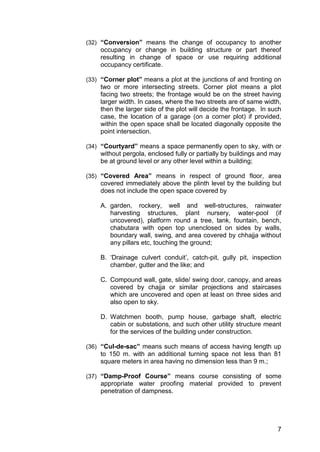
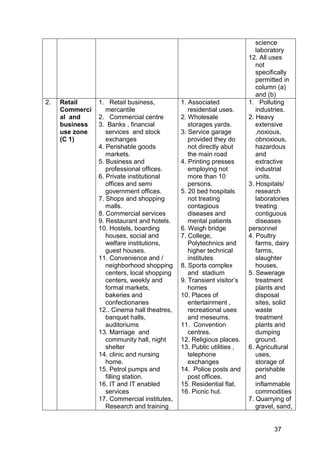
  • 171.
    170 owner for theconstruction of basement or in respect of the construction or manner of construct ion of the basement by the owner of the consequences flowing from the said sanction the executant shall be responsible and liable and not CDA. 3. The executant agrees and undertake to indemnify the concerned Authority fully in respect of any amount which the concerned Authority may be required to pay to any person either by way of compensation or on any other account as a result of any claim or suit or any other proceedings concerning the sanctioning of the construction of the basement of the making thereof and also in respect of the costs and expenses which the concerned Authority may incur on defending any action. 4. Without prejudice to the above undertaking the executant hereby binds itself to pay to CDA to the full extent any amount which CDA may be required to pay to any person in connection with, relating to or concerning the sanctioning of the basement or the making thereof. 5. The owner agrees and undertakes that this bond shall remain in full force and effect till the executants faithfully observes/performs the undertaking herein before contained. In witness whereof the executants above named has signed this bond on this__________ day of___________ at___________________ Indemnifier Witness: (Signatures)_____________________ 1. Name_________________________ Full Address____________________ (Signatures) 2. Name_________________________ Full Address____________________ (Signatures)
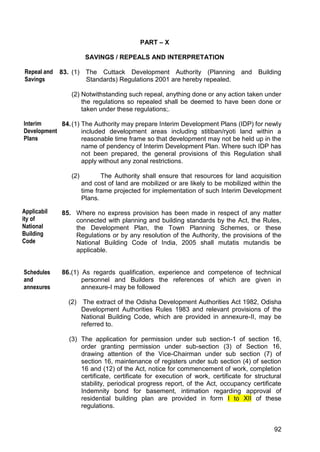
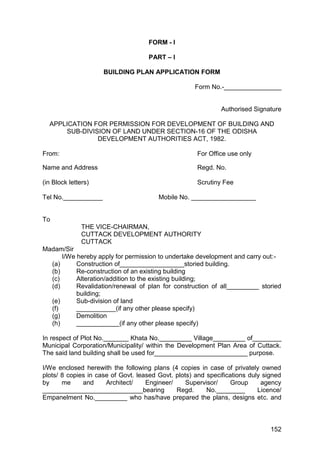
  • 172.
    171 FORM-XII INTIMATION REGARDING APPROVALOF RESIDENTIAL BUILDING PLAN BY TECHNICAL PERSON EMPAANELLED BY THE AUTHORITY IN RESPECT OF PLOTS NOT EXCEEDING 300 SQM IN SIZE {See Regulation-9(8)} From: To THE PLANNING MEMBER, C.D.A., CUTTACK. Ref: Sir/Madam, I Wish to intimate that I have approved the residential building plan of Sri………………………..(address………………..) in respect of plot No………… Mz- ………….. under the provisions of 9(8) C.D.A. (Planning & Building Standard Regulation)-2010 The information in respect of the plan and plot is given below. 1. Name of the Owner:- (i)Present Address: (in Block letters) Village:- Po:- PS:- Dist:- (ii)Permanent address: (in Block letters) Village:- Po:- PS:- Dist:- 2. Name of Mouza: 3. Plot No: 4. Khata No: 5. Kisam of Plot: 6. Area of the plot(in Sqm): 7. No. of floors:
  • 173.
    172 8. Approach road: (a)Width: (b) Public/Private: 9. Details of lay out approved by the Authority (i) Letter No. _________, Date of approval:-__________ (ii) Khata No & Plot No: (iii) Village: (iv) Municipal Corporation/Municipality/NAC: (v) Development plan area: (vi) Name of the applicant/builder/developer:- 10. Details of allotment made by Ravenue Dept./CDA/OSHB (i) Drawing No: (ii) Name of Scheme: (iii) Village: (iv) Municipal Corporation/Municipalaity/NAC: (v) Development Plan area: 11 Use: 12. Floor- 13. Covered area (in Sqm.) Stilt floor: Ground floor: First floor: Second floor: Other floors: 14. Set backs (in Mt) Front set back Rear Set back Left side set back- Right side set back 15. Height of the Building:
  • 174.
    173 16. Source ofwater supply: 17. Proposed drainage: 18. F.A.R. 19. Parking space Yours faithfully, Name & Designation of the Registered Architect /Engineer Empanelment No Signature of plot owner/Developer with present & permanent address:
  • 175.
    174 FORM-XIII APPLICATION FOR DRAWINGOF ATTENTION UNDER REGULATION- 68 From: ___________________ ___________________ To THE VICE-CHAIRMAN CUTTACK DEVELOPMENT AUTHORITY CUTTACK. Subject: Statutory Notice under Regulation-68. Madam/Sir, I/We do bring to your kind notice that the Technical person who had supervised the erection/re-erection of the building had submitted the completion certificate to the Cuttack Development Authority on_________ with respect to plot No.______, Khata No.________ village/ Mouza:_________ of _________ Municipal corporation/ Municipality/ NAC within Development Plan area of___________ for issue of occupancy certificate. Two months have elapsed since the submission of application and I/We have not received any communication with respect to the said application. Please take notice that if within a further period of two months from the date of receipt of this notice by you, no communication either granting or refusing occupancy certificate is received by me/us, I /We shall presume that issue of occupancy certificate as applied for has been granted in my/our favour. Yours faithfully, Signature of the applicant(s) PLANNING MEMBER/AUTHORISED OFFICER Cuttack Development Authority Secretary Cuttack Development Authority CUTTACK