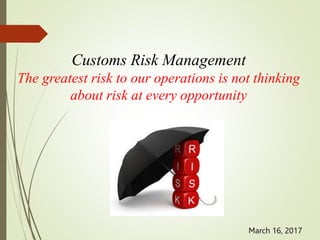
Customs Risk Management
The greatest risk to our operations is not thinking
about risk at every opportunity
March 16, 2017
What is Risk
Risk is the chance of an event occurring,
which may have a negative impact on any
activity or process and may affect the
mandate of Customs.
It can affect compliance with Customs
mandate
What is Risk Management?
Risk Management is logical and
systematic method to identify, analyze,
treat and monitor risks involved in any
activity or process
Risk Management is a methodology that
helps managers make best use of their
available resources
The Idea of Risk Management
How do we translate treaty obligations and
policy decisions into practical ‘on the ground’
changes that enhance revenue, facilitate trade
and create business atmosphere with a level
playing field?
Main Conventions
 The Harmonized System (HS) - 1988
 The WTO General Agreement on Tariffs and
Trade (GATT, 1948)
 The Revised Kyoto Convention (2006)
 The Arusha Declaration (Revised, 2003)
 The WCO Framework of Standards to Secure
and Facilitate Global Trade (SAFE, 2006)
 WTO Bali Trade Facilitation Agreement (2014
Who Uses Risk Management?
Risk Management practices are widely used in
public and the private sectors, covering a wide
range of activities or operations including:
Finance and Investment
Insurance
Health Care
Public Institutions
Governments
Project Management
Risk Management in Customs
Customs primary objectives are to collect and
improve revenue, facilitate trade in the most
secured manner, and effectively control
smuggling without delaying clearance
processes.
Provide facilitation while maintaining control
over legitimate international movement of
goods
RMU assist BCED in matching priorities to
available resources.
Why Risk Management?
 We have limited resources
 We cannot be everywhere at once, we cannot do
everything
 There is a greater volume of international trade –
more than there has ever been in the past
 Customs cannot search everything – they do not
have the people, the skills or the time and money.
Not all taxpayers can be queried or scrutinized. And,
importantly ….
 We should not scrutinize everything – most traders
are honest, we should help them, not hinder them –
to promote compliance
ASYCUDA and Risk
Management
 Declaration process:- Basis of Customs control
 Information can be used for many other control
functions.
 Selectivity:- Stopping declaration or directing it to a
specific section
 Choosing transactions that are perceived to be of more
Customs interest.
Responsibility of RM Team
Research and identify major risks
Analyze risks to determine likelihood,
consequences and levels of perceived risk
Evaluate and prioritize the risks
Take steps to counter the risks, including
creation of selection criteria
Monitor results, review the risks and
update control measures accordingly
Regular reporting to senior management
Components of Risk
Probability – the chance that a loss will
occur
Consequence – the magnitude of the loss
Perception – the significance of the loss as
it relates to the basic objectives of an
organization
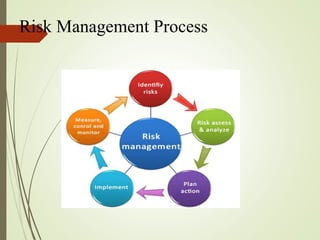
Risk Management Process
Risk Identification
 Defining the type of risk
 Identifying the stakeholders(i.e. who is involved)
 Past events, future development
Analyze the Risks
 How likely is the risk event to happened?
(Probability and frequency?)
 What would be the impact, cost or consequences of that
event occurring?
(Economic, political, social?)
Evaluate The Risks
 Rank the risks according to management priorities, by risk category
and rated by likelihood and possible cost or consequence.
 Some risks are acceptable while others are not
 Avoiding, accepting, reducing, transferring
Risk Matrix
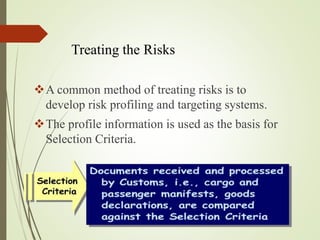
Treating the Risks
A common method of treating risks is to
develop risk profiling and targeting systems.
The profile information is used as the basis for
Selection Criteria.
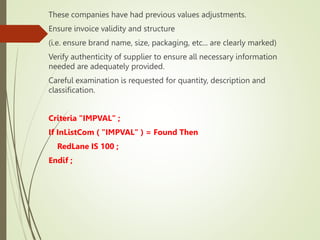
These companies have had previous values adjustments.
Ensure invoice validity and structure
(i.e. ensure brand name, size, packaging, etc... are clearly marked)
Verify authenticity of supplier to ensure all necessary information
needed are adequately provided.
Careful examination is requested for quantity, description and
classification.
Criteria "IMPVAL" ;
If InListCom ( "IMPVAL" ) = Found Then
RedLane IS 100 ;
Endif ;
Processing of Lanes
Red Lane - documentary check and
physical examination
Yellow – Documentary check
Blue – PCA
Green Lane - the declaration is normally
directly assessed
Monitor & Review
measure the effectiveness of risk profiles
and update as necessary
Reliable reporting of examination results
Compliance measurement activities
Feedback from the business community
Reporting of Inspection Results
Accurate inspection reporting
Effective use of the inspection act is essential
for internal audit purposes, (to ensure system
integrity), and for monitor and review of risk
management selections.
The risk management team needs to know if
current selectivity criteria are effective.
This helps by giving information that can be
used to achieve more precise risk targeting.
Sources of information for Risk
Assessments
 Identify commodity or control risks; e.g., high duty rates or quantity
controls (Restricted Goods), the demand for prohibited goods
 Research existing databases and records on commodity and trader histories
(Inspection Act, Intelligence from Post Audit and Enforcement Units).
 Evaluate current procedures to identify potential control weaknesses.
Questions, Comments or
Opinions
Thank You

Customs Risk Management PPT.Presentation

  • 1.
    Customs Risk Management Thegreatest risk to our operations is not thinking about risk at every opportunity March 16, 2017
  • 2.
    What is Risk Riskis the chance of an event occurring, which may have a negative impact on any activity or process and may affect the mandate of Customs. It can affect compliance with Customs mandate
  • 3.
    What is RiskManagement? Risk Management is logical and systematic method to identify, analyze, treat and monitor risks involved in any activity or process Risk Management is a methodology that helps managers make best use of their available resources
  • 4.
    The Idea ofRisk Management How do we translate treaty obligations and policy decisions into practical ‘on the ground’ changes that enhance revenue, facilitate trade and create business atmosphere with a level playing field?
  • 5.
    Main Conventions  TheHarmonized System (HS) - 1988  The WTO General Agreement on Tariffs and Trade (GATT, 1948)  The Revised Kyoto Convention (2006)  The Arusha Declaration (Revised, 2003)  The WCO Framework of Standards to Secure and Facilitate Global Trade (SAFE, 2006)  WTO Bali Trade Facilitation Agreement (2014
  • 6.
    Who Uses RiskManagement? Risk Management practices are widely used in public and the private sectors, covering a wide range of activities or operations including: Finance and Investment Insurance Health Care Public Institutions Governments Project Management
  • 7.
    Risk Management inCustoms Customs primary objectives are to collect and improve revenue, facilitate trade in the most secured manner, and effectively control smuggling without delaying clearance processes. Provide facilitation while maintaining control over legitimate international movement of goods RMU assist BCED in matching priorities to available resources.
  • 8.
    Why Risk Management? We have limited resources  We cannot be everywhere at once, we cannot do everything  There is a greater volume of international trade – more than there has ever been in the past  Customs cannot search everything – they do not have the people, the skills or the time and money. Not all taxpayers can be queried or scrutinized. And, importantly ….  We should not scrutinize everything – most traders are honest, we should help them, not hinder them – to promote compliance
  • 9.
    ASYCUDA and Risk Management Declaration process:- Basis of Customs control  Information can be used for many other control functions.  Selectivity:- Stopping declaration or directing it to a specific section  Choosing transactions that are perceived to be of more Customs interest.
  • 10.
    Responsibility of RMTeam Research and identify major risks Analyze risks to determine likelihood, consequences and levels of perceived risk Evaluate and prioritize the risks Take steps to counter the risks, including creation of selection criteria Monitor results, review the risks and update control measures accordingly Regular reporting to senior management
  • 11.
    Components of Risk Probability– the chance that a loss will occur Consequence – the magnitude of the loss Perception – the significance of the loss as it relates to the basic objectives of an organization
  • 12.
  • 13.
    Risk Identification  Definingthe type of risk  Identifying the stakeholders(i.e. who is involved)  Past events, future development
  • 14.
    Analyze the Risks How likely is the risk event to happened? (Probability and frequency?)  What would be the impact, cost or consequences of that event occurring? (Economic, political, social?)
  • 15.
    Evaluate The Risks Rank the risks according to management priorities, by risk category and rated by likelihood and possible cost or consequence.  Some risks are acceptable while others are not  Avoiding, accepting, reducing, transferring
  • 16.
  • 17.
    Treating the Risks Acommon method of treating risks is to develop risk profiling and targeting systems. The profile information is used as the basis for Selection Criteria.
  • 18.
    These companies havehad previous values adjustments. Ensure invoice validity and structure (i.e. ensure brand name, size, packaging, etc... are clearly marked) Verify authenticity of supplier to ensure all necessary information needed are adequately provided. Careful examination is requested for quantity, description and classification. Criteria "IMPVAL" ; If InListCom ( "IMPVAL" ) = Found Then RedLane IS 100 ; Endif ;
  • 19.
    Processing of Lanes RedLane - documentary check and physical examination Yellow – Documentary check Blue – PCA Green Lane - the declaration is normally directly assessed
  • 20.
    Monitor & Review measurethe effectiveness of risk profiles and update as necessary Reliable reporting of examination results Compliance measurement activities Feedback from the business community
  • 21.
    Reporting of InspectionResults Accurate inspection reporting Effective use of the inspection act is essential for internal audit purposes, (to ensure system integrity), and for monitor and review of risk management selections. The risk management team needs to know if current selectivity criteria are effective. This helps by giving information that can be used to achieve more precise risk targeting.
  • 22.
    Sources of informationfor Risk Assessments  Identify commodity or control risks; e.g., high duty rates or quantity controls (Restricted Goods), the demand for prohibited goods  Research existing databases and records on commodity and trader histories (Inspection Act, Intelligence from Post Audit and Enforcement Units).  Evaluate current procedures to identify potential control weaknesses.
  • 23.
  • 24.