Customer Value
David Williams Jan 2019
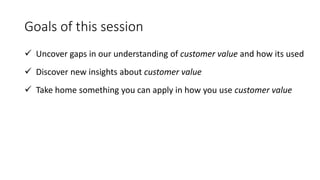
Goals of this session
 Uncover gaps in our understanding of customer value and how its used
 Discover new insights about customer value
 Take home something you can apply in how you use customer value
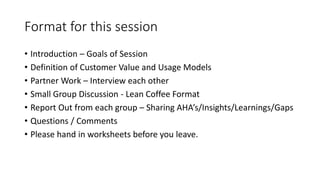
Format for this session
• Introduction – Goals of Session
• Definition of Customer Value and Usage Models
• Partner Work – Interview each other
• Small Group Discussion - Lean Coffee Format
• Report Out from each group – Sharing AHA’s/Insights/Learnings/Gaps
• Questions / Comments
• Please hand in worksheets before you leave.
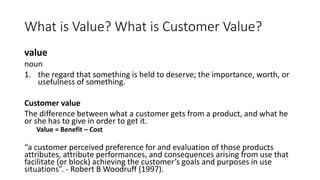
What is Value? What is Customer Value?
value
noun
1. the regard that something is held to deserve; the importance, worth, or
usefulness of something.
Customer value
The difference between what a customer gets from a product, and what he
or she has to give in order to get it.
Value = Benefit – Cost
“a customer perceived preference for and evaluation of those products
attributes, attribute performances, and consequences arising from use that
facilitate (or block) achieving the customer’s goals and purposes in use
situations”. - Robert B Woodruff (1997).
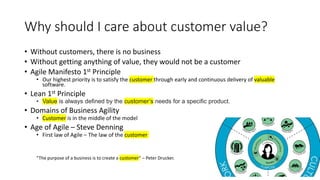
Why should I care about customer value?
• Without customers, there is no business
• Without getting anything of value, they would not be a customer
• Agile Manifesto 1st Principle
• Our highest priority is to satisfy the customer through early and continuous delivery of valuable
software.
• Lean 1st Principle
• Value is always defined by the customer’s needs for a specific product.
• Domains of Business Agility
• Customer is in the middle of the model
• Age of Agile – Steve Denning
• First law of Agile – The law of the customer
“The purpose of a business is to create a customer” – Peter Drucker.
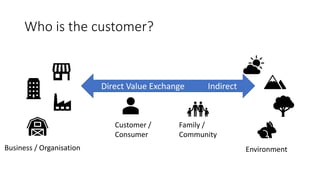
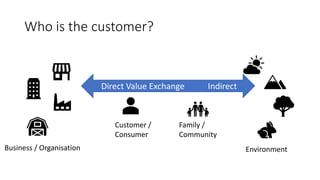
Direct Value Exchange Indirect
Who is the customer?
Business / Organisation
Customer /
Consumer
Family /
Community
Environment
How is value exchanged?
• Trading Customer Value for Business Value
Different ways:
• Your money for product (e.g. buy a car)
• Your time for entertainment inc. ads (e.g. Watching free to air TV)
• Your data for service (e.g. Using social media)
• Any interaction is an exchange of value (of sorts)
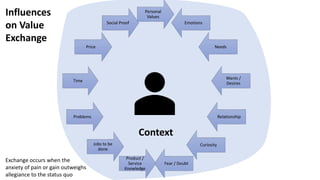
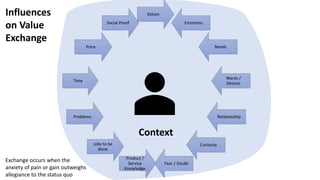
Personal
Values
Emotions
Needs
Wants /
Desires
Relationship
Curiosity
Fear / Doubt
Product /
Service
Knowledge
Jobs to be
done
Problems
Time
Price
Social Proof
Context
Influences
on Value
Exchange
Exchange occurs when the
anxiety of pain or gain outweighs
allegiance to the status quo
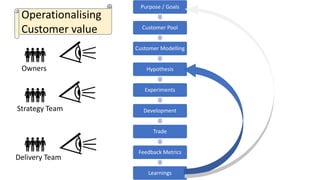
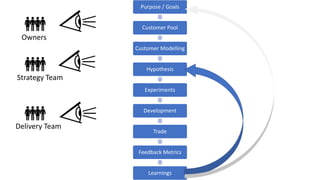
Purpose / Goals
Customer Pool
Customer Modelling
Hypothesis
Experiments
Development
Trade
Feedback Metrics
Learnings
Owners
Delivery Team
Strategy Team
Operationalising
Customer value
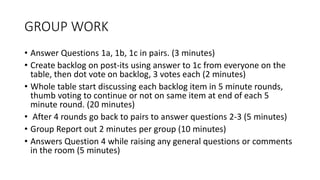
GROUP WORK
• Answer Questions 1a, 1b, 1c in pairs. (3 minutes)
• Create backlog on post-its using answer to 1c from everyone on the
table, then dot vote on backlog, 3 votes each (2 minutes)
• Whole table start discussing each backlog item in 5 minute rounds,
thumb voting to continue or not on same item at end of each 5
minute round. (20 minutes)
• After 4 rounds go back to pairs to answer questions 2-3 (5 minutes)
• Group Report out 2 minutes per group (10 minutes)
• Answers Question 4 while raising any general questions or comments
in the room (5 minutes)
Direct Value Exchange Indirect
Who is the customer?
Business / Organisation
Customer /
Consumer
Family /
Community
Environment
How is value exchanged?
• Trading Customer Value for Business Value
Different ways:
• Your money for product (e.g. buy a car)
• Your time for entertainment inc. ads (e.g. Watching free to air TV)
• Your data for service (e.g. Using social media)
• Any interaction is an exchange of value (of sorts)
Values
Emotions
Needs
Wants /
Desires
Relationship
Curiosity
Fear / Doubt
Product /
Service
Knowledge
Jobs to be
done
Problems
Time
Price
Social Proof
Context
Influences
on Value
Exchange
Exchange occurs when the
anxiety of pain or gain outweighs
allegiance to the status quo
Purpose / Goals
Customer Pool
Customer Modelling
Hypothesis
Experiments
Development
Trade
Feedback Metrics
Learnings
Owners
Delivery Team
Strategy Team
https://commons.wikimedia.org/wiki/File:6990634-panda-hug.jpg
Thank
You
Contact Me
@nowDave
nowDave1@gmail.com
www.linkedin.com/in/david-williams-2b107444/
References
• Book: Age of Agile – Steve Denning
• Domains of Business Agility - Business Agility Institute
• Agile Manifesto
• Definitions of customer value
• Lean principles

Customer value slide deck

  • 1.
  • 2.
    Goals of thissession  Uncover gaps in our understanding of customer value and how its used  Discover new insights about customer value  Take home something you can apply in how you use customer value
  • 3.
    Format for thissession • Introduction – Goals of Session • Definition of Customer Value and Usage Models • Partner Work – Interview each other • Small Group Discussion - Lean Coffee Format • Report Out from each group – Sharing AHA’s/Insights/Learnings/Gaps • Questions / Comments • Please hand in worksheets before you leave.
  • 4.
    What is Value?What is Customer Value? value noun 1. the regard that something is held to deserve; the importance, worth, or usefulness of something. Customer value The difference between what a customer gets from a product, and what he or she has to give in order to get it. Value = Benefit – Cost “a customer perceived preference for and evaluation of those products attributes, attribute performances, and consequences arising from use that facilitate (or block) achieving the customer’s goals and purposes in use situations”. - Robert B Woodruff (1997).
  • 5.
    Why should Icare about customer value? • Without customers, there is no business • Without getting anything of value, they would not be a customer • Agile Manifesto 1st Principle • Our highest priority is to satisfy the customer through early and continuous delivery of valuable software. • Lean 1st Principle • Value is always defined by the customer’s needs for a specific product. • Domains of Business Agility • Customer is in the middle of the model • Age of Agile – Steve Denning • First law of Agile – The law of the customer “The purpose of a business is to create a customer” – Peter Drucker.
  • 6.
    Direct Value ExchangeIndirect Who is the customer? Business / Organisation Customer / Consumer Family / Community Environment
  • 7.
    How is valueexchanged? • Trading Customer Value for Business Value Different ways: • Your money for product (e.g. buy a car) • Your time for entertainment inc. ads (e.g. Watching free to air TV) • Your data for service (e.g. Using social media) • Any interaction is an exchange of value (of sorts)
  • 8.
    Personal Values Emotions Needs Wants / Desires Relationship Curiosity Fear /Doubt Product / Service Knowledge Jobs to be done Problems Time Price Social Proof Context Influences on Value Exchange Exchange occurs when the anxiety of pain or gain outweighs allegiance to the status quo
  • 9.
    Purpose / Goals CustomerPool Customer Modelling Hypothesis Experiments Development Trade Feedback Metrics Learnings Owners Delivery Team Strategy Team Operationalising Customer value
  • 10.
    GROUP WORK • AnswerQuestions 1a, 1b, 1c in pairs. (3 minutes) • Create backlog on post-its using answer to 1c from everyone on the table, then dot vote on backlog, 3 votes each (2 minutes) • Whole table start discussing each backlog item in 5 minute rounds, thumb voting to continue or not on same item at end of each 5 minute round. (20 minutes) • After 4 rounds go back to pairs to answer questions 2-3 (5 minutes) • Group Report out 2 minutes per group (10 minutes) • Answers Question 4 while raising any general questions or comments in the room (5 minutes)
  • 11.
    Direct Value ExchangeIndirect Who is the customer? Business / Organisation Customer / Consumer Family / Community Environment
  • 12.
    How is valueexchanged? • Trading Customer Value for Business Value Different ways: • Your money for product (e.g. buy a car) • Your time for entertainment inc. ads (e.g. Watching free to air TV) • Your data for service (e.g. Using social media) • Any interaction is an exchange of value (of sorts)
  • 13.
    Values Emotions Needs Wants / Desires Relationship Curiosity Fear /Doubt Product / Service Knowledge Jobs to be done Problems Time Price Social Proof Context Influences on Value Exchange Exchange occurs when the anxiety of pain or gain outweighs allegiance to the status quo
  • 14.
    Purpose / Goals CustomerPool Customer Modelling Hypothesis Experiments Development Trade Feedback Metrics Learnings Owners Delivery Team Strategy Team
  • 15.
  • 16.
  • 17.
    References • Book: Ageof Agile – Steve Denning • Domains of Business Agility - Business Agility Institute • Agile Manifesto • Definitions of customer value • Lean principles

Editor's Notes

  • #2 Introduce yourself House Rules (if not done yet) - Toilets, Emergency Evac Procedure, - Get involved, meet new people and have fun. - Safe space, healthy debate, no personal attacks, separate facts and opinions. Make sure everyone has a worksheet Ask them to fill in the first question Share answer with a partner.
  • #3 Please don’t shoot me! These are just some models/thoughts and ideas from my research so far?
  • #4 Timing Plan Fill in worksheet about you before we start (3 min, 3 slides) Intro, goals, format (2 min) Partner with someone you don’t know and share answers to about you (or finish if not yet done) (15 min, 6 slides) definitions and models of customer value (5 min) Question one in pairs – interview and summarise in pairs (20 min) Group discussion Lean Coffee Groups 4-8pax) 3 Votes, 5 minute rounds, 4 rounds (5 min) Question 2-3 in pairs (10 min) Group sharing – 2mins per group – 5 groups (5 min) Questions and comments, fill in question 4. (5 min) Finishing slides and thank you. 70 mins total
  • #5 Here are some definitions of Value and Customer Value. Does this answer all your questions? Are we done? You can go home if you got everything you need!
  • #6 Why am I interested in customer value I was using the term and realised I didn’t really know what it meant Its referred to in the Agile manifesto, Lean, etc. But what does it really mean and how do we use it So I starting researching it…
  • #7 Business can sell to one another – supplier / consumer relationships Customer is the one who exchanges value (e.g buys product or service). The consumer uses the product or service, often the same person, but may not be You might say a fair value exchange occurs when both sides are happy with the exchange Note however, what the customer perceives as good, the family/community or environment may not I would think that considering the family/community and environment will likely lead to longer lasting value (more sustainable value) How does this change over time? VUCA (Volatile, Uncertain, Complex, Ambiguous) – Context is constantly changing
  • #8 Swapping customer value for business value. Business model determines how business value is monetised. Can be direct (paid for product/service), or indirect (receive data which can then be sold). Can be monetised now or in the future. Value exchanged can be positive or negative? Though negative value is not normally willingly exchanged! Value exchange can accumulate overtime, esp relationship component of value. Every interaction between customer and business is an exchange of value.
  • #9 Many influences that cause customer to actually exchange value, or not Price, Problems, Jobs, Product or Service Knowledge, Social Proof, Values, Emotions, Needs, Wants/Desires, Relationship, Curiosity, Fears/Doubt Context is the sum of all these things Context is always changing, some parts fast, some parts more slowly Exchange when anxiety of pain or gain outweighs allegiance to status quo Decision to trade is complex – Applying cynefin model would make sense to run probes to determine how the system will respond. Single Person V Group Modelling customers allows us to find common conditions and characteristics that will likely influence the group. Modelling can use tools such as value propositions, empathy maps, personas, Jobs to be done, VOC, stories, and more (typically domain of product management and designers)
  • #10 Explain each box Purpose/Goals > Customer Pool > Customer Modelling > Hypothesis > Experiment > Development > Trade > Feedback Metrics > Learnings Box above constrains the box below (Purpose constrains customer pool, Customer Modelling constrains Hypothesis, Experiments constrain Development etc.) Feedback loops – More than two Customer Value is defined as part of Customer Modelling and Hypothesis Trade is where you test the hypothesis by attempting a value exchange of your latest development with the customer Feedback metrics: Did the customer exchange value? If not why not? Did they pay for it? Did they use it? Did they view it? NPS is indirect measure of value being delivered Learnings is where we analyse the feedback data and then loopback to and earlier step such as Hypothesis, or purpose or some other step. Which team does what? Which team knows what? Who should now what? Use as a diagnostic tool to check for alignment between stages, detail approach within each stage, involvement and awareness of each stage to all teams.
  • #11 3 min : Work in pairs on questions 1a, 1b, 1c – Swap sheets and interview and summarise answers 2 min : Create backlog - write on post it top answer to Q1c. Looking at all post-its you get three dot votes. After all votes given, re-arrange backlog in priority order. 20 min: Work in small groups – lean coffee format – Start discussing from top of backlog, thumb vote at end of each 5 minutes, someone needs to be group timer (use phone timer, or watch). I will be available for questions/comments – just raise your hand. 5 min : Answer questions 2-3 in pairs, interview and summarise your partners answers on their worksheet. 10 mins : Group report outs 5 minutes : Question 4 and general questions and comments from the room
  • #12 Repeat for easy reference
  • #13 Repeat for easy reference
  • #14 Repeat for easy reference
  • #15 Repeat for easy reference
  • #16 Love your customers, you need them. Thank you
  • #17 Please share your experiences, thoughts and ideas