Customer Recommendation
By Asmi Das
Khushi Singh
Sampriti Chakraborty
Aaliya Sengupta
Soham Deb
Customer and Recommendation
Who is a customer?
A customer is a person who buys
goods and services from the seller
and pays for it to satisfy their needs.
Eg; When parents purchase a
product for their children, the parent
is a customer, and children are the
consumer. They can also be known
as client or buyers.
What is a recommendation?
A recommendation is an artificial
intelligence or AI algorithm usually
associated with machine learning,
that uses big data to suggest or
recommend additional products to
customers.
Eg; If a customer frequently
purchases baby clothes, generative
AI can recommend baby accessories
such as blankets or pacifiers.
About Recommendation System
Recommendation systems involve predicting user preference for
unseen item, such as:-
 Movies
 Songs
 Books
In other word recommendation systems produce a ranked list of items
on which a user might be interested, in the context of his current
choice of an item.
Recommendation systems has mainly two elements, Item and User.
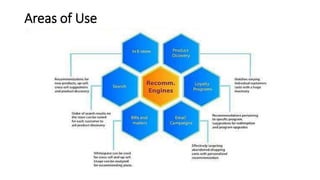
Areas of Use
How does a recommendation system works?
Recommendation systems use specialized algorithms and machine learning
solutions. Driven by the automated configuration, coordination, and
management of machine learning predictive analytics algorithms, the
recommendation system can wisely select which filters to apply to a
particular user's specific situation. It facilitates marketers to maximize
conversions and average order value.
Mainly, a recommendation system processes data through four phases as
follows-
 Collection
 Storing
 Analyzing
 Filtering
Importance of Personalization in Customer
Recommendation:
Personalization in customer recommendation is a crucial
aspect of modern marketing and customer engagement. By
tailoring recommendations to individual preferences,
businesses can significantly enhance customer satisfaction
and loyalty. The ability to personalize recommendations is
made possible through advanced artificial intelligence
algorithms that analyze individual customer behavior and
preferences. This enables businesses to offer relevant and
targeted product or content recommendations, ultimately
leading to improved customer retention and higher sales
conversions.
The Impact of Customer Recommendation on
Engagement and Sales:
Customer recommendation has a substantial impact on both engagement
and sales for businesses. A positive recommendation from a satisfied
customer can significantly boost engagement levels as well as increase
sales. Customer recommendations not only serve as a form of social proof
but also build trust and credibility, leading to higher engagement with the
brand. Furthermore, they often result in increased sales, as potential
customers are more likely to make a purchase based on the positive
experiences of others. It's crucial for businesses to understand the far-
reaching effects of customer recommendations on both engagement and
sales in order to leverage this powerful aspect of consumer behavior to
their advantage.
Hybrid Recommendation Systems:
Hybrid recommendation systems combine two or more
recommendation techniques to overcome the limitations
of individual approaches. By integrating collaborative
filtering, content-based filtering, and other methods,
hybrid systems can provide more accurate and diverse
recommendations to customers. These systems
leverage the strengths of each approach, resulting in
enhanced user experiences and better conversion rates
for businesses.
Importance of Ethical Considerations in
Customer Recommendations:
Ethical considerations play a pivotal role in customer recommendation
processes. When providing recommendations, it's crucial to uphold ethical
standards to maintain trust and integrity. Whether in a professional setting
or a personal capacity, ethical considerations encompass various aspects,
including transparency, privacy, and fairness. Ethical customer
recommendations require a deep understanding of the impact of the
recommendations on the customers, ensuring that their best interests are
prioritized. This involves avoiding conflicts of interest, respecting
confidentiality, and delivering accurate and unbiased guidance. In an age of
social media and instant communication, the importance of ethical
recommendations cannot be overstated.
Types Of Recommendation Systems
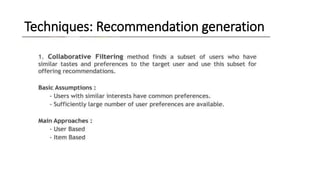
• Collaborative Filtering
The collaborative filtering method is based on gathering and analyzing
data on user’s behavior.
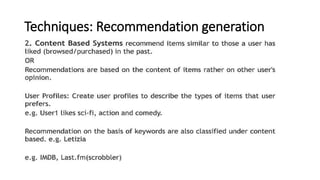
• Content-Based Filtering
Content-based filtering methods are based on the description of a
product and a profile of the user’s preferred choices.
• Hybrid Recommendation Systems
In hybrid recommendation systems, products are recommended using
both content-based and collaborative filtering simultaneously to
suggest a broader range of products to customers.
Techniques: Data Acquisition
• Explicit data
-Customer rating
-Feedback
- Demographics
- Physiographics
- Ephemeral Needs
• Implicit data
-Purchase history
-Click or browse history
• Product Information
-Product Taxonomy
-Product Attributes
-Product descriptions
Techniques: Recommendation generation
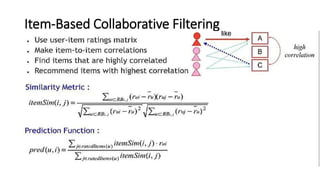
Item-Based Collaborative Filtering
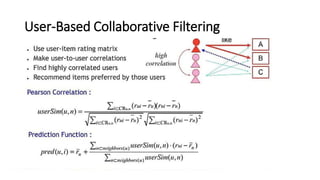
User-Based Collaborative Filtering
Techniques: Recommendation generation
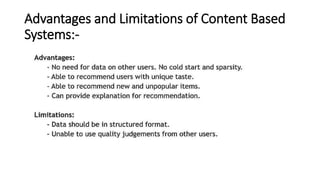
Advantages and Limitations of Content Based
Systems:-
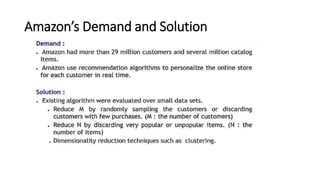
Amazon’s Demand and Solution
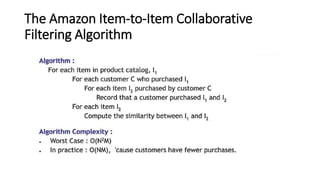
The Amazon Item-to-Item Collaborative
Filtering Algorithm
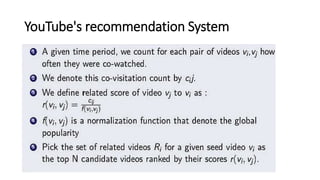
YouTube's recommendation System
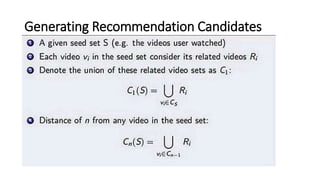
Generating Recommendation Candidates
Bibliography
For successfully completing our presentation. We have taken help from
the following website links:-
https://www.slideshare.net/VikrantArya/recommendation-system-
33379953
https://medium.com/mlearning-ai/what-are-the-types-of-
recommendation-systems-3487cbafa7c9
https://byjus.com/question-answer/who-is-a-consumer/
Customer Recommendation Projecttttt.pptx

Customer Recommendation Projecttttt.pptx

  • 1.
    Customer Recommendation By AsmiDas Khushi Singh Sampriti Chakraborty Aaliya Sengupta Soham Deb
  • 2.
    Customer and Recommendation Whois a customer? A customer is a person who buys goods and services from the seller and pays for it to satisfy their needs. Eg; When parents purchase a product for their children, the parent is a customer, and children are the consumer. They can also be known as client or buyers. What is a recommendation? A recommendation is an artificial intelligence or AI algorithm usually associated with machine learning, that uses big data to suggest or recommend additional products to customers. Eg; If a customer frequently purchases baby clothes, generative AI can recommend baby accessories such as blankets or pacifiers.
  • 3.
    About Recommendation System Recommendationsystems involve predicting user preference for unseen item, such as:-  Movies  Songs  Books In other word recommendation systems produce a ranked list of items on which a user might be interested, in the context of his current choice of an item. Recommendation systems has mainly two elements, Item and User.
  • 4.
  • 5.
    How does arecommendation system works? Recommendation systems use specialized algorithms and machine learning solutions. Driven by the automated configuration, coordination, and management of machine learning predictive analytics algorithms, the recommendation system can wisely select which filters to apply to a particular user's specific situation. It facilitates marketers to maximize conversions and average order value. Mainly, a recommendation system processes data through four phases as follows-  Collection  Storing  Analyzing  Filtering
  • 6.
    Importance of Personalizationin Customer Recommendation: Personalization in customer recommendation is a crucial aspect of modern marketing and customer engagement. By tailoring recommendations to individual preferences, businesses can significantly enhance customer satisfaction and loyalty. The ability to personalize recommendations is made possible through advanced artificial intelligence algorithms that analyze individual customer behavior and preferences. This enables businesses to offer relevant and targeted product or content recommendations, ultimately leading to improved customer retention and higher sales conversions.
  • 7.
    The Impact ofCustomer Recommendation on Engagement and Sales: Customer recommendation has a substantial impact on both engagement and sales for businesses. A positive recommendation from a satisfied customer can significantly boost engagement levels as well as increase sales. Customer recommendations not only serve as a form of social proof but also build trust and credibility, leading to higher engagement with the brand. Furthermore, they often result in increased sales, as potential customers are more likely to make a purchase based on the positive experiences of others. It's crucial for businesses to understand the far- reaching effects of customer recommendations on both engagement and sales in order to leverage this powerful aspect of consumer behavior to their advantage.
  • 8.
    Hybrid Recommendation Systems: Hybridrecommendation systems combine two or more recommendation techniques to overcome the limitations of individual approaches. By integrating collaborative filtering, content-based filtering, and other methods, hybrid systems can provide more accurate and diverse recommendations to customers. These systems leverage the strengths of each approach, resulting in enhanced user experiences and better conversion rates for businesses.
  • 9.
    Importance of EthicalConsiderations in Customer Recommendations: Ethical considerations play a pivotal role in customer recommendation processes. When providing recommendations, it's crucial to uphold ethical standards to maintain trust and integrity. Whether in a professional setting or a personal capacity, ethical considerations encompass various aspects, including transparency, privacy, and fairness. Ethical customer recommendations require a deep understanding of the impact of the recommendations on the customers, ensuring that their best interests are prioritized. This involves avoiding conflicts of interest, respecting confidentiality, and delivering accurate and unbiased guidance. In an age of social media and instant communication, the importance of ethical recommendations cannot be overstated.
  • 10.
    Types Of RecommendationSystems • Collaborative Filtering The collaborative filtering method is based on gathering and analyzing data on user’s behavior. • Content-Based Filtering Content-based filtering methods are based on the description of a product and a profile of the user’s preferred choices. • Hybrid Recommendation Systems In hybrid recommendation systems, products are recommended using both content-based and collaborative filtering simultaneously to suggest a broader range of products to customers.
  • 11.
    Techniques: Data Acquisition •Explicit data -Customer rating -Feedback - Demographics - Physiographics - Ephemeral Needs • Implicit data -Purchase history -Click or browse history • Product Information -Product Taxonomy -Product Attributes -Product descriptions
  • 12.
  • 13.
  • 14.
  • 15.
  • 16.
    Advantages and Limitationsof Content Based Systems:-
  • 17.
  • 18.
    The Amazon Item-to-ItemCollaborative Filtering Algorithm
  • 19.
  • 20.
  • 22.
    Bibliography For successfully completingour presentation. We have taken help from the following website links:- https://www.slideshare.net/VikrantArya/recommendation-system- 33379953 https://medium.com/mlearning-ai/what-are-the-types-of- recommendation-systems-3487cbafa7c9 https://byjus.com/question-answer/who-is-a-consumer/