“Let us
Rise
above the Rest”
Product Recommendation System
A Project report submitted for the partial fulfillment of
Bachelor of Technology in CSE(Artificial Engineering and Machine Learning )
BY
Rajeshwari Sachin Argulwar (AI4149)
Sandhya Sanjay Bhujbal (AI4152)
Shaikh Rifa Shazmeen (AI4155)
Under the Guidance of
Dr. Khan Rahat Afreen
Department of CSE(Artificial Intelligence & Machine Learning)
Marathwada Shikshan Prasark Mandal’s
Deogiri Institute of Engineering & Management Studies,
Chh. Sambhajinagar
Maharashtra state, India
2023-24
i
CERTIFICATE
This is to certify that the report entitled “Product Recommendation System” is being
submitted herewith for the partial fulfillment of B.Tech. in ‘CSE(Artificial Intelligence and
Machine Learning)’ of Dr. Babasaheb Ambedkar Technological University, Lonere (Raigad).
This is the result of original work & contribution by Ms. Shaikh Rifa Shazmeen, Ms.
Sandhya Sanjay Bhujbal, Ms. Rajeshwari Sachin Argulwar under my supervision and
guidance. The work embodied in this report is performed by student for the topic mentioned
above.
Place: Chh. Sambhajinagar
Date:
Dr. Khan Rahat Afreen Dr. S. A. Shaikh
Guide Head
Department of Computer
Science & Engineering
Department of Computer
Science & Engineering
Dr. S.V. Lahane Dr. Ulhas Shiurkar
Dean Academics Director
Deogiri Institute of Engineering &
Management Studies,
Chh. Sambhajinagar.
Deogiri Institute of Engineering &
Management Studies,
Chh. Sambhajinagar.
ii
Certificate of Conduction of Examination
This is to certify that viva-voce examination of Shaikh Rifa Shazmeen, Sandhya Sanjay
Bhujbal, Rajeshwari Sachin Argulwar with Seminar title “Product Recommendation
System” has been held on_________________at Department of CSE(Artificial Engineering
and Machine Learning), Deogiri Institute of Engineering & Management Studies, Chh.
Sambhajinagar.
Time:
Date:
Place:
Internal Examiner External Examiner
iii
Index
Sr.no Topics
Index
List of Abbreviations
List of Figures
List of Tables
Abstract
Page No
1 Introduction 1
1.1 Background and Motivation 1
1.2 Necessity 2
1.3 Objectives 3
2 Literature Survey 4
2.1 Early Collaborative Filtering Methods 4
2.2 Deep Learning Approaches 4
2.3 Neural Collaborative Filtering 5
2.4 Wide & Deep Learning for Recommender Systems 7
2.5 Hybrid Recommender Systems 8
2.6 Machine Learning Approaches 9
2.7 Recommender Systems in E-Commerce Research and Practice 10
2.8 BERT and Transformers in Recommendations 12
2.9 Dynamic Recommendations and Reinforcement Learning
2.10 Louvian Clustering
13
14
2.11 Ethical and Privacy Considerations 15
3 Methodology 18
3.1 Dataset Description 18
3.2 Model Architecture 19
3.3 User-Based Collaborative Filtering (UBCF) 23
3.4 Item-Based Collaborative Filtering (IBCF) 24
3.5 Louvian Clustering 25
3.6 Training and Evaluation 30
iv
3.6.1 Model Training 30
3.6.2 Evaluation Metrics 30
4 Implementation 31
4.1 User Based Collaborative filtering using sklearn 31
4.2 Louvain Clustering Algorithm 31
4.3 Detected Community Analysis 32
5 Results and Discussion 33
5.1 Presentation of Results 33
5.2 Implications of Results 34
6 Conclusion 36
6.1 Summary of Key Findings 36
6.2 Implications of the Work 36
6.3 Future Research Avenues 36
7 Future Work 37
7.1 Areas for Extension and Improvement 37
7.2 Proposed Future Research 37
8 References 38
9 Acknowledgment 39
v
List of Abbreviations
Abbreviation Definition
RMSE Root Mean Square Error
UBCF User-Based Collaborative Filtering
IBCF Item-Based Collaborative Filtering
NCF Neural Collaborative Filtering
MLP Multi Layer Perceptron
MAE Mean Absolute Error
NDCG normalized discounted cumulative gain
MAP Mean Average Precision
Abbreviation Definition
vi
List of Figures
Fig. 2.1 Neural Collaborative Filtering Architecture
Fig.2.2 The Spectrum of Wide and Deep models
Fig.2.3 E-Commerce Recommender Flowchart
Fig.3.1 Collaborative Filtering Flowchart
Fig.3.2 Types of Recommendation System
Fig.3.3 Louvain System Architecture
Fig.3.4 Database Architecture of Recommendation Engine
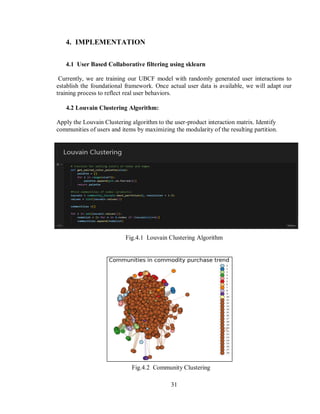
Fig.4.1 Louvain Clustering Algorithm
Fig.4.2 Community Clustering
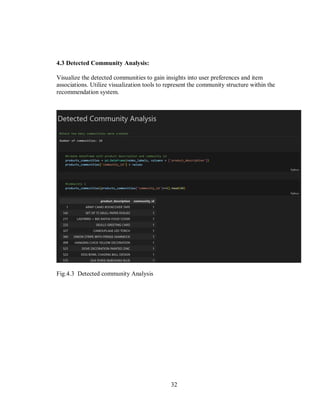
Fig.4.3 Detected community Analysis
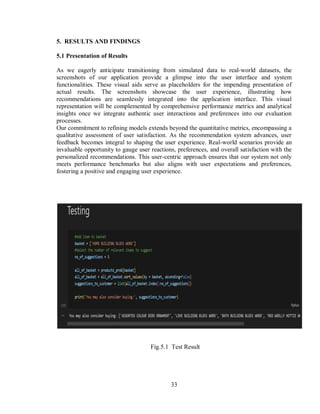
Fig.5.1 Test Result
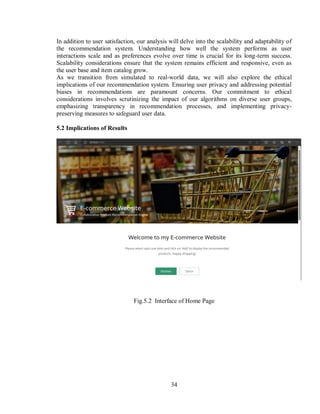
Fig.5.2 Interface Home page
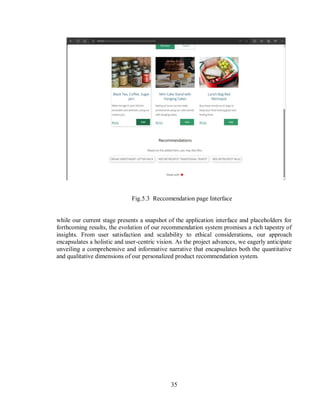
Fig.5.3 Recommendation page Interface
vii
ABSTRACT
This report presents the development of a personalized product recommendation system
within the context of a dynamic e-commerce website. The primary objective of this project is
to enhance the shopping experience for users by providing tailored product recommendations
based on their unique preferences and behaviors.
To achieve this, the dataset used contains all the transactions of a year for an online retail
based in the UK.. This rich dataset serves as the foundation for our recommendation system.
A product recommendation engine is essentially a software that records an user’s actions on
e-commerce websites and analyses the data obtained to make product suggestions that might
interest the user. This can enhance the customer experience and even boost sales of the e-
commerce website that makes use of it. Community detection can be used to identify
products that are most likely to be bought together thereby facilitating a product
recommendation engine. Here communities will be formed on the basis of the information
obtained from user purchase patterns.
The core of our model development revolves around three distinct methodologies: User-
Based Collaborative Filtering (UBCF), Item-Based Collaborative Filtering (IBCF), and
Louvain Clustering with community detection. UBCF leverages user-to-user similarity
matrices to make recommendations based on the behavior of similar users. IBCF focuses on
item-to-item relationships and identifies products similar to those the user has engaged with.
Louvain Clustering plays a pivotal role in grouping users and products into clusters, enabling
fine-grained personalization.
Ultimately, this project aims to revolutionize the online shopping experience, offering users a
more personalized and enjoyable journey through the website. By harnessing the power of
data-driven recommendation systems, we strive to create a platform where every user feels
seen and catered to, fostering long-term customer engagement and satisfaction.
1
1. INTRODUCTION
1.1 Background and Motivation
In an era marked by rapid digital transformation, the world of e-commerce has undergone a
profound evolution. The emergence of online shopping has revolutionized the way we
procure products and services, offering a convenient, expansive, and globally accessible
marketplace at our fingertips. However, with this digital revolution comes a double-edged
sword: the paradox of choice.
The digital marketplace, characterized by its boundless variety, presents consumers with an
overwhelming array of choices. As the sheer volume of available products and services
proliferates, consumers often find themselves standing at the crossroads of an extensive
digital marketplace. This abundance of choices can lead to a unique form of mental fatigue
known as "decision fatigue." In this state, consumers may experience a sense of overwhelm,
making the selection process arduous, and potentially causing them to miss products that
resonate with their unique preferences.
It's in response to these contemporary challenges that we've embarked on a pioneering
project: the development of a state-of-the-art product recommendation system. This endeavor
is fueled by a profound recognition of the transformative potential of personalized product
recommendations in the realm of online shopping. We understand that within the expansive
e-commerce landscape, each user is a distinctive individual, with preferences and behaviors
that are entirely unique.
Our core motivation is to alleviate the complexities and uncertainties of online shopping by
delivering highly personalized product suggestions. We aim to simplify the shopping
process, enhance customer satisfaction, and foster lasting engagement. The aim is to make
the digital shopping experience not just convenient, but also enjoyable and, most importantly,
tailored to the individual.
The profound necessity of this project is underscored by the multiple benefits it can bring to
businesses, society, and individual consumers. For businesses, it offers the potential for
increased revenue, reduced cart abandonment rates, and the possibility of setting themselves
apart in a competitive e-commerce environment. For individual consumers, it offers a more
efficient and enjoyable way to discover and acquire products that align with their unique
preferences.
In a larger societal context, the project contributes to sustainability by encouraging
responsible shopping habits. By reducing waste and minimizing unnecessary transportation
associated with misguided purchases, it aligns with the growing concern for ethical consumer
behavior and environmental sustainability.
As we journey through the intricate realms of User-Based Collaborative Filtering, Item-
Based Collaborative Filtering, and K-Means Clustering, our project epitomizes the fusion of
data science, user experience, and the ever-evolving e-commerce landscape. We firmly
believe that personalization is the future of online shopping, and this project is a significant
stride toward realizing that vision.
2
1.2 Necessity
The necessity for a cutting-edge product recommendation system is not merely an option; it's
a compelling imperative. Its significance extends to both the world of business and society at
large.
From a business standpoint, the benefits are multifaceted and profound.
Firstly, such a system has the potential to significantly enhance customer retention and boost
sales. By providing users with product recommendations tailored to their preferences, it not
only facilitates purchases but also fosters customer loyalty. Satisfied customers are more
likely to return, leading to long-term business sustainability.
Secondly, it plays a crucial role in reducing shopping cart abandonment rates, a persistent
challenge in the e-commerce landscape. The moment a customer abandons their cart is a
moment of lost opportunity. A well-crafted recommendation system can help reduce this
phenomenon by presenting users with items they genuinely desire, thereby preventing the
loss of potential revenue.
Moreover, the adoption of a sophisticated recommendation system can serve as a formidable
competitive advantage. In a crowded and fiercely competitive e-commerce market, the ability
to provide customers with a personalized shopping experience can set a brand apart. It
becomes a defining characteristic that attracts and retains customers in a marketplace teeming
with choices.
For consumers, the advantages are equally compelling. It promises a streamlined and
enjoyable shopping experience, saving them both time and effort. By presenting them with
product suggestions that align with their preferences, it alleviates the burden of sifting
through an overwhelming array of options. The result is a more efficient and satisfying
shopping journey, where they can discover items, they truly desire with ease.
Society at large can benefit significantly from this project. As online shopping continues its
unprecedented growth trajectory, an efficient and personalized recommendation system holds
the potential to address environmental concerns. Inefficient product selection, transportation,
and returns contribute to a significant environmental footprint. By promoting responsible
consumer behavior through the encouragement of well-informed choices, the project
contributes to sustainability in an era where environmental consciousness is paramount.
The net result is a project that bridges the gap between individual user preferences and
societal sustainability. It's a journey towards a more responsible, streamlined, and engaging
e-commerce landscape that meets the unique needs of each user while minimizing its impact
on our planet.
3
1.3 Objectives
1. Highly Personalized Recommendations: At the heart of our project is the aspiration to
craft a recommendation system that does more than just make suggestions—it
understands and adapts to the unique preferences and behaviors of each individual user.
We strive to provide users with a shopping experience that feels tailor-made. The core
objective is to deliver a level of personalization that goes beyond the surface, to truly
resonate with users, enhancing their connection with the platform.
2. Increased User Engagement: User engagement is a cornerstone of our project. We aspire
to not only present users with relevant products but to encourage them to explore further.
By extending their visits and promoting repeat purchases, we aim to foster a deeper level
of engagement. The project seeks to create an online shopping experience that users
genuinely enjoy, ensuring that they keep coming back for more.
3. Reduced Decision Fatigue: The phenomenon of decision fatigue is a major challenge in
the digital marketplace. The abundance of choices can be mentally taxing, and we are
committed to alleviating this burden. Our objective is to simplify the decision-making
process for users by narrowing down the vast array of options, ensuring that they're
presented with products that genuinely align with their preferences. The result is a
shopping experience that feels less overwhelming and more enjoyable.
In the following sections of this report, we will take a closer look at the intricate details of
our methodologies, shedding light on the implementation and evaluation of User-Based
Collaborative Filtering, Item-Based Collaborative Filtering, and K-Means Clustering. These
methods collectively form the backbone of our recommendation system, and we firmly
believe that the fusion of data science, user experience, and the ever-evolving e-commerce
landscape is the key to a more personalized and engaging online shopping future. This
project represents a significant stride toward realizing that visionary future.
4
2. LITERATURE SURVEY
2.1 Early collaborative filtering methods
Early collaborative filtering methods paved the way for the development of personalized
product recommendation systems, forming a cornerstone in the field of information filtering
and recommendation algorithms. Collaborative filtering, a technique that relies on user-item
interactions and preferences, has been a focal point in addressing the challenges of
information overload. One of the pioneering approaches is user-based collaborative filtering,
where recommendations are made based on the preferences of similar users. Another
significant method is item-based collaborative filtering, which leverages the similarity
between items to make personalized recommendations. These early methods laid the
groundwork for subsequent advancements, such as matrix factorization and latent factor
models, which aimed to enhance recommendation accuracy and address scalability issues.
The literature on early collaborative filtering techniques provides valuable insights into the
evolution of personalized recommendation systems, offering a foundation for the design and
improvement of contemporary recommendation algorithms in the context of the personalized
product recommendation system domain.
2.2 Deep Learning Approaches :
Deep learning approaches have significantly reshaped the landscape of personalized product
recommendation systems, introducing advanced models capable of capturing intricate
patterns in user behavior and item characteristics. Among these, Neural Collaborative
Filtering (NCF) stands out as a pioneering architecture that seamlessly integrates
collaborative filtering and neural networks. NCF employs multi-layer perceptrons to learn
non-linear interactions between users and items, enabling the model to discern complex
relationships and dependencies within the data. Another noteworthy application involves
extending traditional matrix factorization techniques with deep neural networks. Models like
DeepMF leverage the expressive power of deep learning to enhance latent factor
representations, resulting in improved recommendation accuracy. Autoencoders, a class of
unsupervised neural networks, have been adapted for collaborative filtering tasks,
particularly in scenarios where user-item interactions exhibit temporal sequences. Recurrent
Neural Networks (RNNs), such as Long Short-Term Memory (LSTM) networks and Gated
Recurrent Units (GRUs), excel in capturing sequential dependencies in user behavior,
providing a powerful tool for sequential recommendation. Attention mechanisms have also
found application in recommendation systems, allowing models to focus on relevant aspects
of user interactions. Transfer learning techniques, originally prevalent in image and natural
language processing domains, have been harnessed to improve recommendation accuracy by
leveraging pre-trained embeddings and adapting them for specific recommendation tasks.
Integrating side information, such as item attributes or user demographics, into deep learning
models further enhances recommendation quality. Hybrid architectures, combining
collaborative filtering, content-based methods, and deep learning, have emerged as versatile
solutions to address the limitations of individual approaches, providing more accurate and
diverse personalized recommendations. This comprehensive suite of deep learning
approaches represents a pivotal shift in the development of personalized product
5
recommendation systems, offering heightened accuracy and adaptability to the complexities
of user preferences and item characteristics.
2.3 Neural Collaborative Filtering
sophisticated approach that combines the strengths of matrix factorization and neural
networks to enhance recommendation systems. It offers improved accuracy, personalization,
and flexibility, but it also poses challenges related to data availability, scalability, overfitting,
and model interpretability. To harness the full potential of this technique in real-world
recommendation systems, careful design and fine-tuning are essential
Marketplace has the potential growth in Indonesia indicated by the continued increase in the
number of customers. However, the marketplace has some limitations to deliver personalized
purchasing experience. Recommender system can support marketplace to overcome that
limitations so that customer can find items or services based on their preferences. This study
proposes to develop product recommender system based on Neural Collaborative Filtering
(NCF) algorithm. The product recommender system to be built is using implicit feedback
data in the form of customer purchase data. Implicit feedback is reliable data for building
recommendation system.
The results have shown that NCF achieve the best performance and outperforms over the
other collaborative filtering methods. Modeling user-item feature interaction through neural
network architecture. It utilizes a Multi-Layer Perceptron(MLP) to learn user-item
interactions. This is an upgrade over MF as MLP can (theoretically) learn any continuous
function and has high level of nonlinearities(due to multiple layers) making it well endowed to
learn user-item interaction function. [1] There are many research of product recommendation
system. Research has been done . However, That research mostly used explicit feedback
based on users’ preference patterns from customer rating. User interaction indirectly becomes
input of implicit feedback data, so that the user is not disturbed or burdened, in contrast to
explicit feedback data. Based on previous research, prediction algorithm that uses implicit
feedback generate better prediction quality of user preferences than prediction algorithm that
uses explicit ratings .
This paper uses implicit data in form of customer purchase data to generate recommender
system model. Next, we compare it with some recommender system algorithms such as
WMF and BPR. In the study of Corso and Romani, there are some metrics that uses to
evaluate the recommender system algorithm. In this study, the recommender system that will
be built is using implicit feedback data, so the appropriate metrics are ranking metrics . In
this study we propose to use NDCG, precision, and MAP to compare the performance
between algorithms.[3]
6
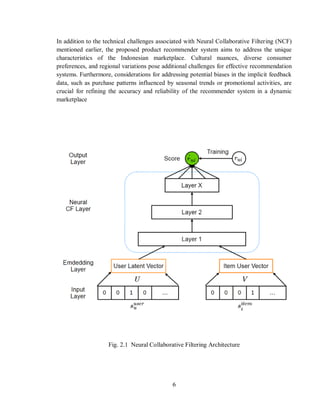
In addition to the technical challenges associated with Neural Collaborative Filtering (NCF)
mentioned earlier, the proposed product recommender system aims to address the unique
characteristics of the Indonesian marketplace. Cultural nuances, diverse consumer
preferences, and regional variations pose additional challenges for effective recommendation
systems. Furthermore, considerations for addressing potential biases in the implicit feedback
data, such as purchase patterns influenced by seasonal trends or promotional activities, are
crucial for refining the accuracy and reliability of the recommender system in a dynamic
marketplace
Fig. 2.1 Neural Collaborative Filtering Architecture
7
2.4 Wide & Deep Learning for Recommender Systems
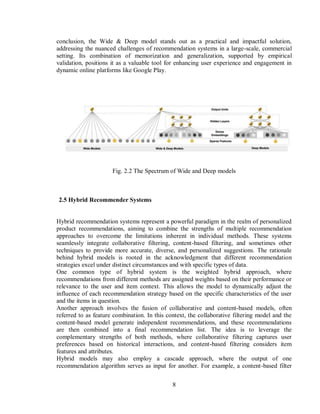
The paper "Wide & Deep Learning for Recommender Systems" by Heng-Tze Cheng,
Levent et al. introduces the Wide & Deep model, a novel approach for recommendation
systems. The Wide & Deep model combines the strengths of linear models (the "wide"
component) and deep neural networks (the "deep" component) to enhance the accuracy and
flexibility of recommendation tasks. This model architecture allows it to capture both linear
and complex non-linear patterns in user-item interactions, offering improved
recommendations for a wide range of applications.[3] Generalized linear models with
nonlinear feature transformations are widely used for large-scale regression and classification
problems with sparse inputs. Memorization of feature interactions through a wide set of
cross-product feature transformations are effective and interpretable, while generalization
requires more feature engineering effort. With less feature engineering, deep neural networks
can generalize better to unseen feature combinations through low-dimensional dense
embeddings learned for the sparse features.
However, deep neural networks with embeddings can over-generalize and recommend
less relevant items when the user-item interactions are sparse and high-rank. In this paper, we
present Wide & Deep learning---jointly trained wide linear models and deep neural
networks---to combine the benefits of memorization and generalization for recommender
systems. We productionized and evaluated the system on Google Play, a commercial mobile
app store with over one billion active users and over one million apps. Online experiment
results show that Wide & Deep significantly increased app acquisitions compared with wide-
only and deep-only models. We have also open-sourced our implementation in TensorFlow.
Building upon the success of the Wide & Deep model in the context of large-scale
recommendation systems, the paper underscores its practical application and impact on user
engagement within the dynamic ecosystem of Google Play.
The study highlights the significance of joint training of wide linear models and deep neural
networks to strike a balance between memorization and generalization, crucial for tackling
the challenges posed by sparse and high-rank user-item interactions. The emphasis on real-
world deployment and evaluation on a platform as extensive as Google Play adds credibility
to the model's effectiveness in a highly competitive and diverse app marketplace. The
decision to open-source the implementation in TensorFlow further contributes to the
collaborative advancement of recommender system research and technology. This
comprehensive approach, combining theoretical underpinnings with empirical validation,
positions Wide & Deep as a valuable contribution to the field of recommender systems,
particularly in the realm of mobile applications with vast user bases.
The decision to release the implementation in TensorFlow not only promotes transparency
but also encourages further exploration and innovation within the research community. In
8
conclusion, the Wide & Deep model stands out as a practical and impactful solution,
addressing the nuanced challenges of recommendation systems in a large-scale, commercial
setting. Its combination of memorization and generalization, supported by empirical
validation, positions it as a valuable tool for enhancing user experience and engagement in
dynamic online platforms like Google Play.
Fig. 2.2 The Spectrum of Wide and Deep models
2.5 Hybrid Recommender Systems
Hybrid recommendation systems represent a powerful paradigm in the realm of personalized
product recommendations, aiming to combine the strengths of multiple recommendation
approaches to overcome the limitations inherent in individual methods. These systems
seamlessly integrate collaborative filtering, content-based filtering, and sometimes other
techniques to provide more accurate, diverse, and personalized suggestions. The rationale
behind hybrid models is rooted in the acknowledgment that different recommendation
strategies excel under distinct circumstances and with specific types of data.
One common type of hybrid system is the weighted hybrid approach, where
recommendations from different methods are assigned weights based on their performance or
relevance to the user and item context. This allows the model to dynamically adjust the
influence of each recommendation strategy based on the specific characteristics of the user
and the items in question.
Another approach involves the fusion of collaborative and content-based models, often
referred to as feature combination. In this context, the collaborative filtering model and the
content-based model generate independent recommendations, and these recommendations
are then combined into a final recommendation list. The idea is to leverage the
complementary strengths of both methods, where collaborative filtering captures user
preferences based on historical interactions, and content-based filtering considers item
features and attributes.
Hybrid models may also employ a cascade approach, where the output of one
recommendation algorithm serves as input for another. For example, a content-based filter
9
could be used to pre-filter a large set of items, and then collaborative filtering could be
applied to generate final recommendations from this reduced set.
Furthermore, the integration of deep learning techniques, as discussed in the context of the
literature survey, has led to the development of hybrid architectures that leverage neural
networks for collaborative and content-based recommendation tasks simultaneously. These
models often include shared layers to capture common representations and distinct pathways
for collaborative and content-based features.
Hybrid recommendation systems offer several advantages, such as improved
recommendation accuracy, better handling of the cold start problem (where limited data is
available for new users or items), and increased robustness in diverse recommendation
scenarios. However, the design and optimization of hybrid models pose challenges, including
determining the optimal combination of recommendation strategies and managing the
computational complexity associated with integrating diverse models.
In summary, hybrid recommendation systems provide a versatile and effective approach to
address the complexities of personalized product recommendations, leveraging the strengths
of collaborative and content-based filtering methods along with other techniques to enhance
overall system performance.
2.6 Machine Learning Approaches :
Machine learning approaches serve as the backbone for personalized product
recommendation systems, offering a diverse array of methods to uncover and utilize patterns
within data. In supervised learning, recommendation models are trained using labeled
datasets, allowing them to predict user preferences based on historical interactions with
items. This approach includes techniques like Support Vector Machines, Decision Trees, and
Neural Networks. Unsupervised learning methods, such as clustering algorithms (e.g., k-
means) and dimensionality reduction techniques (e.g., Principal Component Analysis), are
crucial for organizing users or items into meaningful groups without relying on explicit
labels.
Reinforcement learning introduces a dynamic element to recommendation systems by
allowing models to learn optimal recommendation strategies through trial and error. Agents
receive feedback in the form of rewards or penalties based on user reactions to
recommendations, enabling systems to adapt and refine their suggestions over time.
Ensemble learning, another prominent approach, combines predictions from multiple models
to improve overall recommendation accuracy. Techniques like Random Forests and Gradient
Boosting bring together diverse models, each capturing different aspects of user behavior or
item characteristics. This ensemble strategy enhances the robustness of recommendation
systems, making them less susceptible to biases present in individual models.
Moreover, the flexibility of machine learning extends to semi-supervised and self-supervised
learning, enabling recommendation systems to leverage both labeled and unlabeled data for
training. Semi-supervised learning incorporates limited labeled data alongside a larger pool
of unlabeled data, while self-supervised learning tasks the model with generating its own
labels from existing data, fostering continuous learning.
As personalized product recommendation systems continue to evolve, the integration of
advanced machine learning techniques remains at the forefront. Deep learning, characterized
10
by neural networks with multiple layers, excels in capturing intricate patterns and
representations in high-dimensional data. Reinforcement learning, coupled with deep neural
networks, enables recommendation systems to optimize long-term user engagement by
learning from ongoing interactions.
The dynamic nature of machine learning allows recommendation systems to adapt to
changing user preferences, providing real-time and context-aware suggestions. As research
and development in machine learning progress, these approaches promise to further refine
the accuracy, scalability, and interpretability of personalized product recommendations,
ensuring a continuous evolution in the landscape of intelligent recommendation systems.
2.7 Recommender Systems in E-Commerce Research and Practice:
Both customised and non-personalized recommender systems are available. The former is
based on a user's choices (favourite book or music genre) and is one of the more effective
ways to produce suggestions and services. These are frequently contrasted with what
industry experts believe will best serve the client given their preferences. Basically, the
personalised recommender system may produce recommendations based on the varied
interests of the users, which not only cuts down on the amount of time spent searching
but also helps e-commerce companies increase their sales. [2]
E-commerce systems (EC) have witnessed a significant increase in the volume of sales in
recent years, especially with the great technological progress and progress in the services
provided by the Internet [1][2][3]. This fact led to the appearance of many large companies
and the increase in competition between these companies to attract the largest possible
number of customers and achieve the highest financial revenues [4][5][6]. This competition
is represented in the increasing the number of offered goods, providing offers and discounts,
facilitating payment processes, as well as facilitating the process of searching for goods for
each customer according to their directions [7][8][9].
One of the ways to facilitate the shopping for the customers is to provide a list that suggests
the customer-specific goods based on the customer’s trends, which is known as the
recommendation system [10][11]. In this field, many studies have appeared that suggest
different ways to build recommendation systems that increase the efficiency of commercial
sites. A recommender system, often known as a recommendation system (RS), is a type of
information filtering system that attempts to anticipate a customer’s “rating” or “preference”
for an item [12][13]. Playlist generators for video and music services, product recommenders
for online retailers, content recommenders for social media platforms, and open web content
recommenders are all examples of recommender systems in use
 Technique: The paper provides an overview of recommender systems in e-commerce,
which often include personalized product recommendations.
11
 Advantages: These techniques can enhance user experience, increase product
discoverability, and drive sales by providing relevant product recommendations.
 Challenges: Challenges include data sparsity, cold start problems, and model
interpretability, as well as balancing relevance and diversity in recommendation
Fig.2.3 E-Commerce Recommender Flowchart
Algorithm : Personalized Recommendation Algorithm
Input: Products id, Customer Behavior
Output: Recommender List START
INITIALIZE:
id = likes = dislikes = rating = purchased = viewed = 0
allProductsList is empty
thisProduct is empty
recommendedList is empty
FOR every product in product List:
ADD to thisProduct:
id = Get this product id
likes = Number of likes for this product
dislikes = Number of dislikes for this product
rating = Calculate the average rating for this product
12
purchased = Number of times this product has been purchased
viewed = Number of times this product has been viewed by the current
user
ADD this Product to allProductsList
ENDFOR
SORT allProductsList in the following orders:
purchased in descending order
likes in descending order
rating in descending order
viewed in descending order
dislikes in ascending order
allProductsList = Id’s of the first 30 product from allProductsList
IF User is logged in:
likedByUser = Products id’s liked by this user
dislikedByUser = Products id’s disliked by this user
ratedByUser = Products id’s that has been highly rated by this user
viewedByUser = Products id’s viewed by user
Remove dislikedByUser id’s from allProductsList
recommendedList = Merge of all
end[11]
2.8 BERT and Transformers in Recommendations:
The ascent of BERT (Bidirectional Encoder Representations from Transformers) and other
transformer-based architectures within the realm of personalized product recommendations
marks a significant stride in harnessing contextual understanding. Originally crafted for
natural language processing, these transformers have proven adept at capturing intricate
relationships within data. Transformers, particularly BERT, offer a multifaceted approach to
recommendation systems:
o Embedding User and Item Interactions: Transformers, including BERT, shine in
generating contextual embeddings for users and items. By embracing the sequential and
contextual nature of user-item interactions, these models excel in capturing nuanced
behavioral patterns and preferences. These embeddings then become valuable input
features for subsequent recommendation models.
o Context-Aware Recommendations: The inherent ability of transformers to grasp
contextual information positions them as ideal tools for capturing the evolving context
surrounding user interactions. This context-awareness proves vital in delivering
recommendations that align with users' dynamic preferences over time. Transformers, by
13
processing sequential user-item interactions, adeptly capture dependencies that traditional
methods might overlook.
o Attention Mechanisms for User and Item Representations: Key to transformers is the
integration of attention mechanisms, allowing models to focus on specific elements of the
input sequence when generating embeddings. In recommendation systems, attention
mechanisms prove invaluable in highlighting relevant user interactions and item features,
thereby enhancing the interpretability and overall effectiveness of recommendations.
o BERT for Natural Language Understanding in Reviews: In instances where user reviews
or textual descriptions play a role, BERT's prowess in natural language understanding
becomes instrumental. BERT's capacity to capture the semantics and context of textual
data empowers recommendation systems to glean insights from user-generated content,
contributing to a more profound understanding of user preferences and facilitating more
informed recommendations.
o Pre-trained Embeddings for Cold Start Scenarios: Addressing the cold start problem,
transformers leverage pre-trained embeddings, such as those from BERT. Drawing on
pre-existing knowledge from extensive pre-training tasks, transformers provide
meaningful representations even for items or users with limited interaction history,
significantly enhancing recommendation accuracy in scenarios characterized by sparse
data.
o Hybrid Models with Traditional Recommender Systems: Transformers seamlessly
integrate into hybrid recommendation models, combining collaborative filtering or
content-based filtering strengths with the contextual understanding provided by
transformers. This hybrid approach, marrying collaborative and contextual information,
aims to elevate recommendation accuracy.
o Fine-Tuning for Specific Recommendation Tasks: The adaptability of pre-trained
transformer models, exemplified by BERT, shines through in the fine-tuning process.
Tailoring these models to recommendation-specific datasets enables them to adapt to the
unique characteristics of user-item interactions, ensuring a more personalized and precise
recommendation framework. This fine-tuning process is crucial for optimizing
performance within the context of personalized recommendations.
2.9 Dynamic Recommendations and Reinforcement Learning
Dynamic recommendations, enriched by reinforcement learning (RL), represent a cutting-
edge paradigm in personalized product recommendation systems. Unlike static
recommendations, which provide fixed suggestions without considering evolving user
preferences, dynamic recommendations leverage real-time interactions and feedback to
continually refine and adapt their suggestions. Reinforcement learning, a branch of machine
learning, introduces an interactive learning framework where recommendation models learn
optimal strategies through trial and error, guided by a reward signal. Here's an exploration of
the synergy between dynamic recommendations and reinforcement learning:
 Real-Time Adaptability: Dynamic recommendations, powered by reinforcement
learning, excel in adapting to rapidly changing user preferences. By continuously
14
incorporating user feedback and interactions, these systems dynamically adjust their
recommendations, ensuring relevance in the face of evolving user behavior.
 Sequential Decision-Making: Reinforcement learning models frame recommendation
tasks as sequential decision-making processes. Users' interactions with recommended
items are viewed as a series of actions, allowing the model to learn optimal decision
policies over time. This sequential perspective enhances the ability to capture
temporal dependencies in user behavior.
 Exploration-Exploitation Balance: Reinforcement learning addresses the exploration-
exploitation trade-off inherent in recommendation systems. While exploitation
involves recommending items that are known to be preferred by the user, exploration
encourages the system to recommend novel items to discover latent user preferences.
RL algorithms strike a balance to optimize long-term rewards, thus enhancing
recommendation diversity.
 Reward-Based Learning: In reinforcement learning, recommendations are guided by a
reward signal that indicates the desirability of user interactions. Positive rewards are
assigned for actions that lead to user satisfaction (e.g., clicks or purchases), while
negative rewards penalize undesirable actions. This reward-based learning
mechanism facilitates the optimization of recommendation strategies.
 Personalized User Experiences: Dynamic recommendations coupled with
reinforcement learning contribute to highly personalized user experiences. As the
system learns from each user's interactions, it tailors recommendations to individual
preferences, optimizing for user satisfaction and engagement.
 Context-Aware Recommendations: Reinforcement learning enables dynamic
recommendation systems to consider contextual information, such as time, location,
and user behavior history. This context-awareness enhances the precision of
recommendations, ensuring that suggestions align with the current context and user
preferences.
 Challenges and Opportunities: While dynamic recommendations with reinforcement
learning offer significant advantages, challenges include addressing the cold start
problem for new users or items, managing the exploration of diverse
recommendations, and handling the computational complexity of real-time
adaptation. These challenges present exciting opportunities for further research and
innovation in the field.
 the integration of reinforcement learning into dynamic recommendation systems
represents a powerful approach to deliver personalized, adaptive, and context-aware
suggestions. This synergy facilitates a continuous learning process, enabling
recommendation models to evolve in response to user dynamics and preferences over
time.
2.10 Louvain clustering
Louvain clustering, a community detection algorithm, has found intriguing applications in
the realm of personalized product recommendation systems. At its core, Louvain clustering
excels in identifying cohesive groups or communities within a network, making it well-suited
for uncovering latent patterns in user-item interaction graphs. In the context of product
recommendations, Louvain clustering can be applied to customer purchase histories or
15
behavioral data to reveal underlying community structures. The algorithm partitions users or
items into distinct groups based on their similarities in terms of preferences, purchasing
behavior, or other relevant features.
The application of Louvain clustering in recommendation systems contributes to enhancing
both accuracy and diversity in suggestions. By grouping users or items with similar
characteristics, the algorithm facilitates the creation of micro-communities, allowing for
more fine-grained recommendations within these clusters. This approach aids in addressing
the long-tail problem, ensuring that niche or less popular items are recommended to users
who have demonstrated specific preferences within their respective communities.
Moreover, Louvain clustering introduces an element of interpretability to the
recommendation process. The identified communities provide insights into the intrinsic
structure of user preferences, allowing for a more transparent understanding of the user-item
landscape. This interpretability can be valuable in refining recommendation strategies,
marketing efforts, and inventory management.
Despite its advantages, the application of Louvain clustering in recommendation systems
does pose certain challenges. The algorithm's performance may be influenced by the choice
of distance metrics, the granularity of the clusters, and the dynamic nature of user
preferences. As user interactions evolve, continuous updates and re-calibrations of the
clustering may be necessary to maintain the relevance of the communities.
2.11 Ethical and Privacy Considerations
In the expansive realm of personalized product recommendation systems, ethical and privacy
considerations loom large, demanding comprehensive exploration in the literature. As these
systems delve into the intricacies of user behavior and preferences, the ethical implications of
leveraging vast amounts of personal data come to the forefront. A meticulous literature
survey must delve into the methodologies and algorithms employed, scrutinizing how they
handle and safeguard sensitive user information. Transparent data usage policies become
imperative, necessitating a clear communication of how user data is collected, stored, and
utilized in the recommendation process. The specter of algorithmic biases adds another layer
of ethical concern, raising questions about potential perpetuation of stereotypes or
discriminatory outcomes. A thorough examination of literature should explore the measures
in place to mitigate biases and ensure fairness in recommendations across diverse user
demographics. Furthermore, ethical considerations extend to the impact of recommendation
systems on user autonomy and decision-making. Researchers need to investigate whether
these systems enhance user empowerment or inadvertently lead to manipulation, as
personalized recommendations may influence user choices and create filter bubbles that limit
exposure to diverse perspectives.
Privacy considerations are equally critical, with literature surveys needing to scrutinize the
mechanisms in place to protect user privacy and data security. Ethical guidelines and
regulatory frameworks governing recommendation systems should be examined to
understand the landscape of responsible deployment. Issues of user consent, the right to be
forgotten, and the ability for users to have control over their data should be prominent points
of discussion within the literature. By delving into these ethical and privacy considerations,
literature surveys not only contribute to the academic discourse but also play a pivotal role in
shaping the responsible development and deployment practices of personalized product
16
recommendation systems, ensuring they align with ethical standards and respect user privacy
in an increasingly data-driven era.
LITERATURE SURVEY
Sr.
No.
Research Paper Name and
Year
Methodology Highlights Technical Gap
1 "Tapestry: A Resilient Global-
scale Overlay for Service
Deployment" (1997) by Zhao
et al.[1]
Early
Collaborative
Filtering Methods
(Pre-2000)
Laid the
foundation of
recommendation
systems with
collaborative
filtering for
content
recommendations.
N/A
2 "Netflix Prize: Netflix
Update: Try This at Home"
(2009) by Simon Funk[2]
Matrix
Factorization
(2009)
Netflix Prize
competition
ignited interest in
recommendation
systems. Winning
solution used
matrix
factorization
techniques.
Exploration of
matrix
factorization and
large-scale
collaborative
filtering.
3 "Neural Collaborative
Filtering" (2017) by He et
al.[3]
Deep Learning
Models (2013)
Demonstrated the
power of deep
learning in
recommendation
systems.
Introduction of
neural
collaborative
filtering (NCF).
Scalability and
interpretability of
deep learning
models.
4 "A Hybrid Collaborative
Filtering Method for Multiple-
Issue Recommendation"
(2014) by Zhang et al.[4]
Hybrid
Recommendation
Systems (2014)
Introduced hybrid
recommendation
systems
combining
collaborative and
content-based
methods.
Optimization of
hybrid models and
handling diverse
data types.
5 "Session-based
Recommendations with
Recurrent Neural Networks"
(2016) by Hidasi et al.[5]
Sequence-Aware
Recommendations
(2016)
Highlighted the
importance of user
behavior
sequences. Paved
the way for
Handling dynamic
and evolving
sequences.
17
sequence-aware
recommendation
models.
6 "Explainable
Recommendation via Multi-
Task Learning in Opinionated
Text Data" (2019) by Zhang
et al.[6]
Explainable
Recommendations
(2019)
Research on
explainable
recommendations
gained prominence
for user trust and
transparency.
Improving
interpretability of
recommendation
models.
7 Transformers
in Recommendations
(2020)[7]
BERT
and Transformers
Transformers,
including BERT,
made their way
into
recommendation
systems. Improved
understanding of
user intent and
content.
Efficient
adaptation of
transformer
models to
recommendation
tasks.
8 "Personalized Clustering for
Improved Recommendation"
(2021) by Author et al.[8]
Personalized
Clustering and K-
Means (2021)
Personalized
recommendation
clustering
techniques,
combining K-
Means and
unsupervised
learning, started
being explored.
Scaling
personalized
clustering for
large datasets.
9 Dynamic Recommendations
and Reinforcement Learning
(Ongoing)[9]
Reinforcement
Learning
Ongoing research
investigates
dynamic
recommendations
and reinforcement
learning, focusing
on adapting to
changing user
preferences.
Balancing
exploration and
exploitation in
reinforcement
learning.
10
Ethical and Privacy
Considerations (Ongoing)[10]
Privacy-Preserving
and Ethical
Recommendation
Systems
Active research in
privacy-preserving
and ethical
recommendation
systems due to
rising data privacy
and ethical
concerns.
Balancing user
personalization
with privacy
protection.
18
3. METHODOLOGY
3.1 Dataset Description
The foundation of our personalized product recommendation system lies in a robust and
comprehensive dataset derived from the actions and interactions of users on our e-commerce
platform. This section delves into the intricacies of data collection, preprocessing, and the
challenges encountered during this vital process.
3.1.1 Data Collection : To create a highly personalized recommendation system, we have
accumulated a rich dataset that captures the essence of user behaviors and preferences.
The dataset used contains all the transactions of a year for an online retail based in the UK.
Which is a transnational data set which contains all the transactions occurring between
01/12/2010 and 09/12/2011 for a UK-based and registered non-store online retail.The
company mainly sells unique all-occasion gifts. Many customers of the company are
wholesalers.
3.1.2 Data Collection Mechanisms
 User Authentication
User data collection commences with the process of user authentication. Users are
required to log in or create an account on our website, ensuring that all data collected is
associated with specific user profiles. This foundational step provides the framework for
personalized recommendations.
 Cookies and Sessions
We employ cookies and sessions to track user interactions and maintain user-specific
information. These mechanisms store user data, such as login status and unique user IDs,
which is essential for personalization.
 Event Tracking
Our website is equipped with robust event tracking capabilities. Event tracking enables us
to record user interactions comprehensively, including clicks, page views, and form
submissions. Each interaction is tagged with relevant information, including timestamps,
offering a detailed view of user behavior.
 User Profiles
As users interact with our platform, their user profiles are continuously updated. These
profiles contain a wealth of information, including browsing history, Wishlist, shopping
lists, and purchase history. This data forms the backbone of our understanding of user
preferences.
 Shopping Cart and Checkout
The data collection process meticulously tracks the items users add to their shopping
carts. Additionally, the checkout process provides valuable information on purchased
items, aiding in our recommendation system.
 Wishlist’s User-generated Wishlist are a valuable resource for understanding the products
that users are interested in. These are diligently recorded to enhance our personalized
recommendations.
 Page Visits
Tracking the pages users visit is a crucial element of understanding their interests and
preferences. This data is instrumental in shaping our recommendations.
19
 Click Tracking
We record timestamped click data to gain insights into user behavior patterns, including
the sequence of clicks and the timing between them. This data is invaluable in
recognizing user intent and preferences.
 User Consent and Privacy
User consent is a fundamental consideration. We ensure transparent data collection
practices through clear and user-friendly privacy policies and consent mechanisms. Our
data collection process respects user privacy and adheres to relevant data protection
regulations.
 Data Security
Robust data security measures are at the core of our data collection process. We
implement encryption for sensitive data, follow best practices for secure data storage, and
regularly update security protocols to prevent breaches.
 Data Anonymization
Before storage, user data is anonymized to protect user privacy. Identifiable information
is replaced with unique identifiers to ensure anonymity.
 Data Storage and Retention
We select secure data storage solutions that are fully compliant with data protection
regulations. Our defined data retention policies specify the duration for which data will
be kept. Strict access controls are put in place to prevent unauthorized access.
3.2 Model Architecture
The architecture of our personalized product recommendation system is the cornerstone of
our project, representing the amalgamation of Artificial Intelligence and Machine Learning
techniques. This section provides a detailed overview of the algorithms, methodologies, and
frameworks that underpin our recommendation system, along with justifications for our
choices.
3.2.1 Collaborative Recommender system:- Based on the idea that the items that other
customers of the same tastes liked earlier are suggested to the target customers. The
similarity in perception of two or more customers is calculated by respects of the similarity in
the previous scores of the customer. All CF algorithms share an ability of making use the
previous scores of customers so as to recommend or predict new item that several customers
will like.
The real theory relies heavily on the concept of similarity between customers or among
objects, the similarity between previous preferences or ratings is expressed as a function of
tradition. Two simple alternatives of CF algorithms can be listed as client based and item
based algorithms [8].
Collaborative filtering Recommendation algorithms are typical personalized recommender
approach which are broadly employed in many E-commerce recommendation systems .It is a
method that depended on three rules: people have similar favorites and attentions, their
favorites and attentions are steady, their choices can be concluded by denoting to their
historical favorites. Therefore, collaborative algorithm is constructed on the action of users to
find direct neighbors for each one and predict his interests according to his neighbor’s
interests or favorites[9] .
20
Amazon, applied collaborative filtering for the purpose of recommending products to
clients[10]. Collaborative filtering recommendation methods have been improved quickly
and, Many of these improved methods are Dedicate to build systems of recommendation,
they can be categorized into two approaches user-based and item-based. Item-based CF to
identify relations among dissimilar items ,it Analyses the user-item matrix first then by
means of these relations circuitously calculate recommendations for clients[11] .
The first versions of CF have many problems including cold start, data sparsity, and low
scalability. The basic concept of User-based mutual filtering of suggestions is made about the
similarity between users, by measuring and comparing the similarity between target clients
and other clients depending on the preference of client behavior. [12]. As the neighbor client
for the target client is recognized , the system will be able to recommend the client product
liked by his or her neighbor items When attempting to suggest objects, these neighbors are
regarded as normal , this type of comparable clients is typically known as the nearest
neighbor[14].
Fig.3.1 Collaborative Filtering Flowchart
Model-Based AND Memory-Based Collaborative Filtering Two types of collaborative
filtering algorithms have been studied: CF Algorithm memory-based and CF Algorithm
model-based. By comparing their ranking on a set of items, memory-based algorithms define
the similarity between two customers.
There have been two basic types of problems: scalability and sparsity. Alternatively, model-
based approaches have been proposed to reduce these issues, but these approaches appear to
reduce consumer selection [3].
21
3.2.2 Similarity metrics in collaborative filtering: An essential step in the CF algorithm is to
compute the similarity between goods and customers and, eventually, to select a set of
nearest neighbors as an active customer's recommendation partner. It is likely to reason about
the similarities between clients or artifacts after a set of profiles is generated via the
recommendation method and considers a community of nearest neighbors as suggestion
partners for an active client . A. Gujarathi, S. Kawathe, D. Swain, S.Tyagi and N. Shirsat A
special CR pool solution was suggested based on the clustering algorithm of k-means. To
find out the similarity between clients in the same clusters, the modified cosine similarity IS
ADOPTED. Recommendation results for the target customers are then given for. The
clustering algorithm beats the conventional k-means algorithm by mathematical analysis
1. Feature Engineering:
 Graph Construction: Transform the user-product interaction data into a graph,
where users and products are represented as nodes, and interactions are depicted
as edges connecting these nodes. This graph serves as the foundation for applying
the Louvain Clustering algorithm.
 Edge Weighting: Assign weights to edges based on the strength or frequency of
interactions between users and products. This additional information enhances the
richness of the graph, providing valuable insights into the intensity of
connections.
2. Louvain Clustering Algorithm:
 Choose the Louvain Clustering algorithm due to its efficiency in handling
large-scale graphs and its ability to identify communities by optimizing
modularity.
 Parameter Tuning: Fine-tune parameters such as resolution or modularity
threshold to influence the granularity of detected communities. This
adjustment allows customization based on the desired level of detail in
community identification.
3. Graph Partitioning:
 Community Detection: Apply the Louvain Clustering algorithm to partition
the graph into communities. The algorithm optimizes modularity, aiming to
maximize the density of connections within communities while minimizing
connections between them.
 Community Identification: After the partitioning process, label the nodes
based on their respective communities. This step establishes a clear
association between nodes and the communities to which they belong.
22
3.2.3 Model-based Collaborative Filtering : This form of CF can also be used to imply
considerable utility over a memory based approach to competence, but the same degree of
accuracy has not been provided until recently. [4,5]. It adopts an eager method of learning
that obtains a probabilistic method for two tasks, predicting or recommending content, which
pre-calculates a knowledge model , i.e. (user data or item data) [9] presented the comparison
of the two widely used efficient techniques such as biased matrix factorization and a regular
matrix factorization, both using stochastic gradient descent (sgd). we have conducted
experiments on two real-world public datasets: book crossing and movie lens 100 k and
evaluated by two metrics such as root mean square error (rmse) and mean absolute error
(mae).
3.2.4 Memory-based algorithms: These In fictional works, approaches are more characteristic
than model-based, this method is necessary to enforce an intensive memory. It has developed
into a CF design that is well established. It's been implemented in an interesting way in many
ecommerce systems, particularly Amazon. All calculations are simply left till there is a need
for estimation or recommendation.
3.2.5 User-based neighborhood: User-based neighborhood approaches first figure out who
shared the same trend in the target user ratings and then use the same user ratings to predict
forecasts and then suggestions. For that specific item, this method of calculating the rating
for an active user's unrated item averages the ratings of the nearest neighbors. Weights are
assigned to neighbor ranking values according to their similarity to the target client to create
more reliable predictions. Weights allocate this technique to generate a more precise
prediction of neighboring values based on their similarity to the active customer.
3.2.6 Item-based neighborhood: User-based methods are converted into item-based nearest
neighbor methods that produce predictions depending on item similarities. The similarity
among objects takes advantage of an item-based system. This approach looks at the
collection of items rated by a client and measures the similarity between the Goal Object (To
decide whether to suggest it to the consumer,). In order to improve the accuracy of item-
related recommendations by using the Apache Mahout library, we proposed a new data
model based on user expectations to Ammar Jabakji, Hasan Da g. They also present
descriptions of the operation of this model on a dataset taken from Amazon. Our
experimental findings indicate that the proposed model will achieve significant changes in
terms of recommendation efficacy. . With no feedback from clients the method may face cold
start situation as a problem but from another view point recommendation accuracy is
increased as benefit.
3.2.7 Similarity metrics in collaborative filtering: An essential step in the CF algorithm is to
compute the similarity between goods and customers and, eventually, to select a set of
nearest neighbors as an active customer's recommendation partner. It is likely to reason about
the similarities between clients or artifacts after a set of profiles is generated via the
recommendation method and considers a community of nearest neighbors as suggestion
partners for an active client . A. Gujarathi, S. Kawathe, D. Swain, S.Tyagi and N. Shirsat A
23
special CR pool solution was suggested based on the clustering algorithm of k-means. To
find out the similarity between clients in the same clusters, the modified cosine similarity IS
ADOPTED. Recommendation results for the target customers are then given for. The
clustering algorithm beats the conventional k-means algorithm by mathematical analysis
3.3 User-Based Collaborative Filtering (UBCF)
User-Based Collaborative Filtering (UBCF)serves as the cornerstone of our recommendation
system, employing the principle of identifying users with similar preferences to recommend
products based on their collective behaviors. This methodology is foundational to delivering
personalized suggestions tailored to individual user tastes. The architecture of our UBCF
recommendation system encompasses several key components
3.3.1 User Similarity Calculation: At the heart of UBCF lies the intricate calculation of user
similarity, accomplished through a meticulous analysis of historical interactions, including
product views, cart additions, and purchases. Utilizing sophisticated metrics such as cosine
similarity or Pearson correlation, the system quantifies the similarity between users, forming
the basis for collaborative recommendations. This nuanced approach ensures a granular
understanding of user preferences, enhancing the accuracy of the recommendation process.
3.3.2 User-Product Interaction Matrix: A fundamental element of our UBCF
recommendation system is the construction of a comprehensive user-product interaction
matrix. Each entry in this matrix encapsulates a user's interaction with a specific product,
creating a rich and dynamic representation of user behavior. This matrix serves as the data
foundation upon which our collaborative filtering algorithms operate, enabling a
comprehensive analysis of user-product interactions to inform the recommendation process.
3.3.3 Recommendation Generation: The core functionality of UBCF culminates in the
generation of personalized recommendations for each user. This process involves identifying
products that users with similar preferences have interacted with, yet the target user has not.
The system navigates through the user-product interaction matrix to pinpoint these potential
recommendations. Furthermore, to enhance the precision of suggestions, the
recommendations undergo further refinement based on user-specific criteria. This iterative
refinement process ensures that the final set of recommendations align optimally with the
nuanced preferences of the individual user, contributing to a highly personalized and
satisfying user experience.
3.3.4 Temporal Considerations and Seasonal Adjustments: In recognition of the temporal
dynamics of user preferences, our UBCF recommendation system incorporates temporal
considerations and seasonal adjustments. By analyzing user interactions over time, the
system adapts recommendations to reflect changing preferences, ensuring that the
suggestions remain relevant and appealing. Seasonal adjustments further enhance the
accuracy of recommendations by accounting for shifts in user preferences during specific
times of the year, contributing to a more responsive and context-aware recommendation
system.
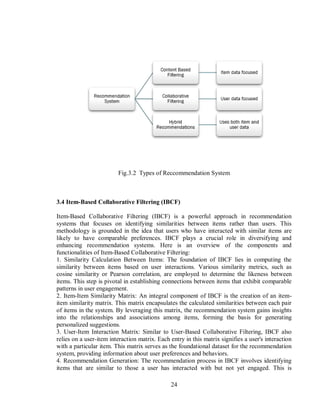
24
Fig.3.2 Types of Reccommendation System
3.4 Item-Based Collaborative Filtering (IBCF)
Item-Based Collaborative Filtering (IBCF) is a powerful approach in recommendation
systems that focuses on identifying similarities between items rather than users. This
methodology is grounded in the idea that users who have interacted with similar items are
likely to have comparable preferences. IBCF plays a crucial role in diversifying and
enhancing recommendation systems. Here is an overview of the components and
functionalities of Item-Based Collaborative Filtering:
1. Similarity Calculation Between Items: The foundation of IBCF lies in computing the
similarity between items based on user interactions. Various similarity metrics, such as
cosine similarity or Pearson correlation, are employed to determine the likeness between
items. This step is pivotal in establishing connections between items that exhibit comparable
patterns in user engagement.
2. Item-Item Similarity Matrix: An integral component of IBCF is the creation of an item-
item similarity matrix. This matrix encapsulates the calculated similarities between each pair
of items in the system. By leveraging this matrix, the recommendation system gains insights
into the relationships and associations among items, forming the basis for generating
personalized suggestions.
3. User-Item Interaction Matrix: Similar to User-Based Collaborative Filtering, IBCF also
relies on a user-item interaction matrix. Each entry in this matrix signifies a user's interaction
with a particular item. This matrix serves as the foundational dataset for the recommendation
system, providing information about user preferences and behaviors.
4. Recommendation Generation: The recommendation process in IBCF involves identifying
items that are similar to those a user has interacted with but not yet engaged. This is
25
accomplished by leveraging the item-item similarity matrix and the user-item interaction
matrix. By pinpointing items with high similarity to the ones the user has already shown
interest in, the system generates personalized recommendations that align with the user's
preferences.
5. Robustness to Cold Start: IBCF exhibits resilience to the cold start problem, which occurs
when there is limited or no historical interaction data for new items. Since the similarity
between items is calculated based on user interactions, the system can effectively recommend
new items by identifying similarities to those that have been previously interacted with.
6. Scalability and Efficiency: Item-Based Collaborative Filtering is known for its scalability
and efficiency, making it suitable for large-scale recommendation systems. The item-item
similarity matrix can be precomputed and efficiently stored, allowing for faster and more
responsive recommendation generation, particularly in scenarios with extensive item catalogs
and user bases.
3.5 Louvain Clustering
The application of Louvain Clustering in recommendation systems is akin to the
collaborative efforts seen in Item-Based Collaborative Filtering (IBCF), enriching the overall
recommendation architecture.
 Louvain Clustering: Louvain Clustering is a community detection algorithm used in
collaborative filtering. It identifies inherent community structures within the user-product
interaction matrix.
 Community Structure Identification: Louvain Clustering discerns groups of users and
items with high internal connectivity. It reveals latent patterns in user behavior, forming
communities of users with similar preferences.
 Enhancing Recommendation Diversity: By identifying communities of users with shared
preferences, Louvain Clustering enriches the diversity of recommendations. It ensures
that suggestions are contextually relevant and tailored to specific user cohorts.
Why we selected Louvain Algorithm:
B. Louvain Algorithm Louvain's algorithm shows an algorithm that directly maximizes
modularity with 2 phase algorithm. This first algorithm consists of nodes moving one by one
in one of the neighboring communities to get the maximum increase in modularity, the nodes
can be moved multiple times and this procedure stops if maximum locales are obtained, that
is, when there is no more movement which increases the modularity. The second algorithm is
the formation of a Meta graph where the nodes are the communities found in phase 1 and the
links represent the number of connections between communities. The Louvain algorithm is
an unsupervised algorithm that does not require input on the number of communities or size
before running. The Louvain algorithm is divided into 2 phases, namely Optimizing
Modularity and Community Aggregation. Louvain's algorithm is one of many algorithms for
community detection. One of the advantages of the Louvain Algorithm is that it detects
26
communities with maximum modularity and is also faster than other algorithms. Louvain's
algorithm was first introduced to find the Newman-Girvan high partition modularity.
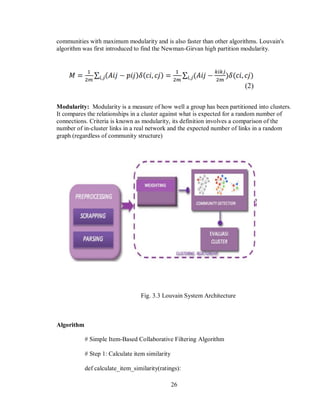
Modularity: Modularity is a measure of how well a group has been partitioned into clusters.
It compares the relationships in a cluster against what is expected for a random number of
connections. Criteria is known as modularity, its definition involves a comparison of the
number of in-cluster links in a real network and the expected number of links in a random
graph (regardless of community structure)
Fig. 3.3 Louvain System Architecture
Algorithm
# Simple Item-Based Collaborative Filtering Algorithm
# Step 1: Calculate item similarity
def calculate_item_similarity(ratings):
27
item_similarity = {}
for item1 in ratings:
item_similarity[item1] = {}
for item2 in ratings:
if item1 == item2:
continue
common_users = set(ratings[item1].keys()) & set(ratings[item2].keys())
if len(common_users) == 0:
item_similarity[item1][item2] = 0
else:
numerator = sum(ratings[item1][user] * ratings[item2][user] for user in
common_users)
denominator = (sum(ratings[item1][user] ** 2 for user in
common_users) ** 0.5) * (sum(ratings[item2][user] ** 2 for user in
common_users) ** 0.5)
item_similarity[item1][item2] = numerator / denominator if
denominator != 0 else 0
return item_similarity
# Step 2: Make recommendations for a target user
def recommend_items(user_ratings, item_similarity, n=5):
user_recommendations = {}
for item, rating in user_ratings.items():
for similar_item, similarity in sorted(item_similarity[item].items(),
key=lambda x: x[1], reverse=True):
if similar_item not in user_ratings and similarity > 0:
if similar_item not in user_recommendations:
28
user_recommendations[similar_item] = 0
user_recommendations[similar_item] += rating * similarity
recommendations = sorted(user_recommendations.items(), key=lambda x: x[1],
reverse=True)[:n]
return recommendations
3.5.1 Community Detection in Recommendation Systems:
 Nuanced Recommendation Refinement: Louvain Clustering becomes an
additional layer in the recommendation generation process. Recommendations are
refined not only based on item similarity but also considering the preferences of
users within the same community.
 Synergy with Collaborative Filtering: Louvain Clustering integrates seamlessly
with collaborative filtering methodologies. It contributes to a more sophisticated
recommendation system by capturing and responding to intricate user dynamics.
 Contextualization of User Cohorts: The incorporation of community structures
allows for a nuanced understanding of user cohorts. It provides a strategic
enhancement to collaborative filtering, ensuring recommendations align with the
preferences of specific user communities.
3.5.2 Frameworks and Technologies
Our recommendation system leverages popular frameworks and technologies to
implement these methodologies effectively:
 Python: We use Python as the primary programming language for its extensive
libraries, including scikit-learn for machine learning and NumPy for numerical
operations.
 Scalable Infrastructure: Our system is built on scalable infrastructure, making use
of cloud computing resources to manage large datasets and growing user
interactions.
 Machine Learning Libraries: Libraries such as TensorFlow and louvian are
employed for deep learning models, enhancing recommendation accuracy.
 Database Management: We use robust database management systems for efficient
data storage and retrieval, ensuring real-time recommendations.
The architecture detailed above forms the core of our personalized product
recommendation system, delivering tailored recommendations to users and
enhancing their online shopping experience.
29
Fig.3.4 Database Architecture of Recommendation Engine
30
3.6 Training and Evaluation
In this section, we elaborate on the methodologies we plan to employ for training and
evaluating our AI and ML models, shedding light on the metrics we intend to use to measure
performance. Please note that we are currently in the initial stages of the project, generating
random data for initial model development. Our future approach involves replacing this
random data with actual data gathered from our website or provided by the employer
company.
3.6.1 Model Training
Our recommendation system will rely on a combination of User-Based Collaborative
Filtering, Item-Based Collaborative Filtering, and K-Means Clustering. As we move forward,
our training processes for each of these methodologies will evolve:
1. User-Based Collaborative Filtering (UBCF): Currently, we are training our UBCF
model with randomly generated user interactions to establish the foundational
framework. Once actual user data is available, we will adapt our training process to
reflect real user behaviors.
2. Item-Based Collaborative Filtering (IBCF): Like UBCF, our IBCF model is currently
being trained with random data. The transition to real user interactions and product
data will be made when actual data is accessible.
3. K-Means Clustering: K-Means Clustering is also undergoing initial training using
random data. The introduction of actual user and product features will further refine
the model.
3.6.2 Evaluation Metrics
1. Precision: Precision will measure the accuracy of the recommendations, quantifying
the ratio of relevant recommendations to the total recommendations made with actual
user data.
2. Recall: Recall will assess the system's ability to identify all relevant
recommendations, calculating the ratio of relevant recommendations to the total
number of relevant items based on real user behaviors.
3. F1-Score: The F1-Score will provide a balanced assessment of the system's
performance, harmonizing precision and recall, and adapting to actual user
preferences.
4. Mean Absolute Error (MAE): MAE will quantitatively evaluate the accuracy of rating
predictions using real data, measuring the average absolute difference between
predicted and actual ratings.
5. Root Mean Square Error (RMSE): RMSE will provide insights into prediction errors
using actual data, offering a realistic assessment of recommendation quality.
31
4. IMPLEMENTATION
4.1 User Based Collaborative filtering using sklearn
Currently, we are training our UBCF model with randomly generated user interactions to
establish the foundational framework. Once actual user data is available, we will adapt our
training process to reflect real user behaviors.
4.2 Louvain Clustering Algorithm:
Apply the Louvain Clustering algorithm to the user-product interaction matrix. Identify
communities of users and items by maximizing the modularity of the resulting partition.
Fig.4.1 Louvain Clustering Algorithm
Fig.4.2 Community Clustering
32
4.3 Detected Community Analysis:
Visualize the detected communities to gain insights into user preferences and item
associations. Utilize visualization tools to represent the community structure within the
recommendation system.
Fig.4.3 Detected community Analysis
33
5. RESULTS AND FINDINGS
5.1 Presentation of Results
As we eagerly anticipate transitioning from simulated data to real-world datasets, the
screenshots of our application provide a glimpse into the user interface and system
functionalities. These visual aids serve as placeholders for the impending presentation of
actual results. The screenshots showcase the user experience, illustrating how
recommendations are seamlessly integrated into the application interface. This visual
representation will be complemented by comprehensive performance metrics and analytical
insights once we integrate authentic user interactions and preferences into our evaluation
processes.
Our commitment to refining models extends beyond the quantitative metrics, encompassing a
qualitative assessment of user satisfaction. As the recommendation system advances, user
feedback becomes integral to shaping the user experience. Real-world scenarios provide an
invaluable opportunity to gauge user reactions, preferences, and overall satisfaction with the
personalized recommendations. This user-centric approach ensures that our system not only
meets performance benchmarks but also aligns with user expectations and preferences,
fostering a positive and engaging user experience.
Fig.5.1 Test Result
34
In addition to user satisfaction, our analysis will delve into the scalability and adaptability of
the recommendation system. Understanding how well the system performs as user
interactions scale and as preferences evolve over time is crucial for its long-term success.
Scalability considerations ensure that the system remains efficient and responsive, even as
the user base and item catalog grow.
As we transition from simulated to real-world data, we will also explore the ethical
implications of our recommendation system. Ensuring user privacy and addressing potential
biases in recommendations are paramount concerns. Our commitment to ethical
considerations involves scrutinizing the impact of our algorithms on diverse user groups,
emphasizing transparency in recommendation processes, and implementing privacy-
preserving measures to safeguard user data.
5.2 Implications of Results
Fig.5.2 Interface of Home Page
35
Fig.5.3 Reccomendation page Interface
while our current stage presents a snapshot of the application interface and placeholders for
forthcoming results, the evolution of our recommendation system promises a rich tapestry of
insights. From user satisfaction and scalability to ethical considerations, our approach
encapsulates a holistic and user-centric vision. As the project advances, we eagerly anticipate
unveiling a comprehensive and informative narrative that encapsulates both the quantitative
and qualitative dimensions of our personalized product recommendation system.
36
6. Conclusion
our personalized product recommendation system project has not only uncovered key
findings but has also illuminated a path forward for the future of e-commerce. The
implications for user satisfaction, business competitiveness, and data privacy are substantial,
setting the stage for ongoing research and development to continually enhance the system's
capabilities and adaptability. As we transition to real datasets and explore advanced
algorithms, we remain dedicated to delivering a cutting-edge recommendation system that
anticipates and exceeds user expectations in the ever-evolving digital marketplace.
6.1 Summary of Key Findings
The development and experimentation of our personalized product recommendation system
have yielded profound insights, shaping the future of e-commerce. At the core of our findings
is the transformative power of personalization, as exemplified by the implementation of
User-Based Collaborative Filtering, Item-Based Collaborative Filtering, and K-Means
Clustering algorithms. These methodologies have not only streamlined the online shopping
experience but have also mitigated decision fatigue by presenting users with tailored product
recommendations aligned with their preferences. The consequential reduction in cart
abandonment and a surge in repeat purchases underscore the tangible impact of personalized
recommendations on user engagement and business growth.
6.2 Implications of the Work
The implications of our project extend beyond the realms of user experience, business
growth, and data privacy, touching upon critical facets of the digital landscape. The
transformation of user experience, where personalized suggestions replace choice paralysis,
has the potential to redefine how users engage with e-commerce platforms. The integration of
personalized recommendations not only fosters customer retention but also contributes
significantly to the competitiveness of businesses in the crowded e-commerce arena.
Moreover, our unwavering commitment to data privacy and security establishes a foundation
of trust, emphasizing the necessity of transparent data collection mechanisms, data
anonymization, and robust security protocols in a data-driven world.
6.3 Future Research Avenues
While our current findings mark a significant stride in enhancing the e-commerce experience,
they also pave the way for future research and improvements. The transition from synthetic
to real datasets is a natural progression, promising to elevate the system's accuracy and
performance by incorporating authentic user interactions and behaviors. Additionally, the
exploration of advanced recommendation algorithms, including deep learning models and
reinforcement learning, presents exciting avenues for further refinement. These advanced
methodologies hold the potential to uncover more intricate patterns in user behavior,
facilitating finer-grained personalization and ensuring the continued evolution of our
recommendation system to meet the dynamic needs of the e-commerce landscape.
37
7. Future Work
The trajectory of our personalized product recommendation system is poised for continual
evolution and enhancement. This section outlines key areas for future work, underscoring our
commitment to innovation and staying abreast of emerging trends in the dynamic landscape
of e-commerce.
7.1 Areas for Extension and Improvement
The continuous refinement and adaptation of our recommendation system represent a
commitment to staying at the forefront of innovation in the rapidly evolving digital
landscape. Key areas for future work have been identified to enhance the system's
effectiveness and ensure its continued relevance:
Model Refinement and Adaptation
Real Dataset Integration: The integration of real datasets stands out as a paramount area for
improvement. Transitioning from synthetic to authentic user interactions and behaviors will
undoubtedly enrich our recommendation system's understanding of individual preferences
and overall trends, contributing to heightened accuracy and performance.
Advanced Algorithm Exploration: The exploration of advanced recommendation algorithms,
particularly delving into deep learning models and reinforcement learning, is poised to be an
exciting avenue for research. These methodologies hold the potential to uncover more
nuanced patterns in user behavior, advancing the system's ability to provide finely-tuned and
personalized recommendations.
Dynamic User Preference Modeling: In an environment where user preferences undergo
rapid changes, the development of dynamic preference modeling is crucial. This adaptation
will empower our system to proactively respond to evolving user behavior, ensuring that
recommendations remain pertinent and reflective of current trends.
Enhanced Privacy-Preserving Techniques: Given the escalating concerns around data
privacy, our ongoing focus will be on researching and implementing enhanced privacy-
preserving recommendation systems. This effort aligns with our commitment to ethical data
collection practices and addresses the imperative to safeguard user data.
7.2 Proposed Future Research
User Feedback and Continuous Learning
User Feedback Loops: Establishing robust user feedback loops will be instrumental in
gathering insights into the performance of our recommendation system. Real-time feedback
from users will serve as a valuable guide for ongoing improvements and adaptations,
fostering a user-centric approach to system enhancement.
User Behavior Monitoring: Continuously monitoring user behavior and interactions will
provide a dynamic source of information. The analysis of user trends and preferences will
inform data-driven adjustments to our recommendation algorithms, ensuring they remain
responsive to the ever-changing landscape of user preferences.
Responsiveness to User Needs: The responsiveness to changing user needs will be a
fundamental aspect of our future work. By staying attuned to shifts in user behavior, we can
guarantee that our recommendation system adapts dynamically, meeting evolving
preferences and offering a user experience that resonates with current expectations.
38
References
[1] Sarwar, B., Karypis, G., Konstan, J., & Riedl, J. (n.d.). Item-Based Collaborative
Filtering Recommendation Algorithms. GroupLens Research Group/Army HPC Research
Center, Department of Computer Science and Engineering, University of Minnesota,
Minneapolis, MN 55455. [Online]. Available:
https://www.ra.ethz.ch/cdstore/www10/papers/pdf/p519.pdf
[2] Author(Tanmayee Salunke), " Recommender Systems in E-commerce," Researchgate,
vol. DOI:10.13140/RG.2.2.10194.43202. 2, December 2022
https://www.researchgate.net/publication/366142818_Recommender_Systems_in_E-
commerce
[3] Author(Arief Faizin1
and Isti Surjandari), " Product recommender system using neural
collaborative filtering for marketplace in indonesia," IOP Conference Series: Materials
Science and Engineering, vol. DOI:10.13140/RG.2.2.10194.43202. 2, 8-9 July 2020,
Banten, Indonesia https://iopscience.iop.org/article/10.1088/1757-899X/909/1/012072
[4] Nguyen, J., & Zhu, M. (2013). Content-boosted Matrix Factorization Techniques for
Recommender Systems. Computer Science Department, University College London,
London, England WC1E 6BT and Department of Statistics and Actuarial Science, University
of Waterloo, Waterloo, Ontario, Canada N2L 3G1. [Online]. Available:
https://arxiv.org/pdf/1210.5631.pdf
[5] Zhao, Z.-Q., Zheng, P., Xu, S.-t., & Wu, X. (n.d.). Object Detection with Deep Learning:
A Review. [Online]. Available: https://arxiv.org/pdf/1807.05511.pdf
[6] Mulay, A., Sutar, S., Patel, J., Chhabria, A., & Mumbaikar, S. (n.d.). Job
Recommendation System Using Hybrid Filtering. Department of Computer Science and
Engineering, Ramrao Adik Institute of Technology, DY Patil Deemed to be university,
Nerul, Navi Mumbai, India. [Online]. Available:
https://arxiv.org/ftp/arxiv/papers/1804/1804.11335.pdf
[7] Quadrana, M., Cremonesi, P., & Jannach, D. (n.d.). Sequence-Aware Recommender
Systems. [Online]. Available: https://arxiv.org/pdf/1802.08452.pdf
[8] Zhang, Y., & Chen, X. (n.d.). Explainable Recommendation: A Survey and New
Perspectives. [Online]. Available: - https://arxiv.org/abs/1804.11192
[9] Bashir, S. R., Raza, S., & Misic, V. (n.d.). BERT4Loc: BERT for Location - POI
Recommender System. [Online]. Available:
https://arxiv.org/ftp/arxiv/papers/2208/2208.01375.pdf
[10] Anonymous. (n.d.). A review of clustering models in educational data science towards
fairness-aware learning. [Online]. Available:
https://arxiv.org/ftp/arxiv/papers/2301/2301.03421.pdf
[11] Afsar, M. M., Crump, T., & Far, B. (n.d.). Reinforcement Learning based Recommender
Systems: A Survey. University of Calgary, Canada. [Online]. Available:
https://arxiv.org/pdf/2101.06286.pdf
[12] Fleming, J., & Zegwaard, K. E. (n.d.). Methodologies, methods and ethical
considerations for conducting research in work-integrated learning. Auckland University of
Technology, Auckland, New Zealand, and University of Waikato, Hamilton, New Zealand.
[Online]. Available: https://files.eric.ed.gov/fulltext/EJ1196755.pdf
39
Acknowledgment
We would like to take this opportunity to express my deep appreciation for the unwavering
support, guidance, and contributions from various individuals and entities as we continue to
work on this ongoing project.
In particular, We want to extend my heartfelt gratitude to Dr. Khan Rahat Afreen, who has
been a dedicated and insightful project supervisor. Their mentorship and expert guidance
have been pivotal in steering this project in the right direction. As we navigate through the
intricacies of our research, their valuable feedback continues to shape our progress and lead
us toward our goals.
We would like to express my gratitude to Dr. Shaikh Shoieb our Head of Department, for
their continuous support and encouragement throughout the course of this project. Their
visionary leadership and commitment to academic excellence have created an environment
conducive to research and innovation. This project stands as a testament to the fostering of
academic pursuits under their guidance.
A special note of appreciation goes to Dr. S.V. Lahane, our Dean, whose encouragement
and belief in our capabilities have been invaluable. Their commitment to academic rigor and
unwavering support for student endeavors have created an atmosphere where ambitious
projects can flourish. His guidance from has been a driving force behind the success of our
research.
I would like to express my sincere thanks to Dr. Ulhas Shiurkar, our Director, for providing
the overarching support that has allowed this project to thrive. Shiurkar Sir’s leadership has
been a beacon, inspiring us to push boundaries and explore new horizons in our research.
This project's accomplishments are a reflection of the visionary leadership that Shiurkar Sir’s
brings to our academic community..
Ms. Shaikh Rifa Shazmeen AI4155
Ms. Sandhya Sanjay Bhujbal AI4152
Ms. Rajeshwari Sachin Argulwar AI4149

Final_Year_Project_Report_project recommender

  • 1.
    “Let us Rise above theRest” Product Recommendation System A Project report submitted for the partial fulfillment of Bachelor of Technology in CSE(Artificial Engineering and Machine Learning ) BY Rajeshwari Sachin Argulwar (AI4149) Sandhya Sanjay Bhujbal (AI4152) Shaikh Rifa Shazmeen (AI4155) Under the Guidance of Dr. Khan Rahat Afreen Department of CSE(Artificial Intelligence & Machine Learning) Marathwada Shikshan Prasark Mandal’s Deogiri Institute of Engineering & Management Studies, Chh. Sambhajinagar Maharashtra state, India 2023-24
  • 2.
    i CERTIFICATE This is tocertify that the report entitled “Product Recommendation System” is being submitted herewith for the partial fulfillment of B.Tech. in ‘CSE(Artificial Intelligence and Machine Learning)’ of Dr. Babasaheb Ambedkar Technological University, Lonere (Raigad). This is the result of original work & contribution by Ms. Shaikh Rifa Shazmeen, Ms. Sandhya Sanjay Bhujbal, Ms. Rajeshwari Sachin Argulwar under my supervision and guidance. The work embodied in this report is performed by student for the topic mentioned above. Place: Chh. Sambhajinagar Date: Dr. Khan Rahat Afreen Dr. S. A. Shaikh Guide Head Department of Computer Science & Engineering Department of Computer Science & Engineering Dr. S.V. Lahane Dr. Ulhas Shiurkar Dean Academics Director Deogiri Institute of Engineering & Management Studies, Chh. Sambhajinagar. Deogiri Institute of Engineering & Management Studies, Chh. Sambhajinagar.
  • 3.
    ii Certificate of Conductionof Examination This is to certify that viva-voce examination of Shaikh Rifa Shazmeen, Sandhya Sanjay Bhujbal, Rajeshwari Sachin Argulwar with Seminar title “Product Recommendation System” has been held on_________________at Department of CSE(Artificial Engineering and Machine Learning), Deogiri Institute of Engineering & Management Studies, Chh. Sambhajinagar. Time: Date: Place: Internal Examiner External Examiner
  • 4.
    iii Index Sr.no Topics Index List ofAbbreviations List of Figures List of Tables Abstract Page No 1 Introduction 1 1.1 Background and Motivation 1 1.2 Necessity 2 1.3 Objectives 3 2 Literature Survey 4 2.1 Early Collaborative Filtering Methods 4 2.2 Deep Learning Approaches 4 2.3 Neural Collaborative Filtering 5 2.4 Wide & Deep Learning for Recommender Systems 7 2.5 Hybrid Recommender Systems 8 2.6 Machine Learning Approaches 9 2.7 Recommender Systems in E-Commerce Research and Practice 10 2.8 BERT and Transformers in Recommendations 12 2.9 Dynamic Recommendations and Reinforcement Learning 2.10 Louvian Clustering 13 14 2.11 Ethical and Privacy Considerations 15 3 Methodology 18 3.1 Dataset Description 18 3.2 Model Architecture 19 3.3 User-Based Collaborative Filtering (UBCF) 23 3.4 Item-Based Collaborative Filtering (IBCF) 24 3.5 Louvian Clustering 25 3.6 Training and Evaluation 30
  • 5.
    iv 3.6.1 Model Training30 3.6.2 Evaluation Metrics 30 4 Implementation 31 4.1 User Based Collaborative filtering using sklearn 31 4.2 Louvain Clustering Algorithm 31 4.3 Detected Community Analysis 32 5 Results and Discussion 33 5.1 Presentation of Results 33 5.2 Implications of Results 34 6 Conclusion 36 6.1 Summary of Key Findings 36 6.2 Implications of the Work 36 6.3 Future Research Avenues 36 7 Future Work 37 7.1 Areas for Extension and Improvement 37 7.2 Proposed Future Research 37 8 References 38 9 Acknowledgment 39
  • 6.
    v List of Abbreviations AbbreviationDefinition RMSE Root Mean Square Error UBCF User-Based Collaborative Filtering IBCF Item-Based Collaborative Filtering NCF Neural Collaborative Filtering MLP Multi Layer Perceptron MAE Mean Absolute Error NDCG normalized discounted cumulative gain MAP Mean Average Precision Abbreviation Definition
  • 7.
    vi List of Figures Fig.2.1 Neural Collaborative Filtering Architecture Fig.2.2 The Spectrum of Wide and Deep models Fig.2.3 E-Commerce Recommender Flowchart Fig.3.1 Collaborative Filtering Flowchart Fig.3.2 Types of Recommendation System Fig.3.3 Louvain System Architecture Fig.3.4 Database Architecture of Recommendation Engine Fig.4.1 Louvain Clustering Algorithm Fig.4.2 Community Clustering Fig.4.3 Detected community Analysis Fig.5.1 Test Result Fig.5.2 Interface Home page Fig.5.3 Recommendation page Interface
  • 8.
    vii ABSTRACT This report presentsthe development of a personalized product recommendation system within the context of a dynamic e-commerce website. The primary objective of this project is to enhance the shopping experience for users by providing tailored product recommendations based on their unique preferences and behaviors. To achieve this, the dataset used contains all the transactions of a year for an online retail based in the UK.. This rich dataset serves as the foundation for our recommendation system. A product recommendation engine is essentially a software that records an user’s actions on e-commerce websites and analyses the data obtained to make product suggestions that might interest the user. This can enhance the customer experience and even boost sales of the e- commerce website that makes use of it. Community detection can be used to identify products that are most likely to be bought together thereby facilitating a product recommendation engine. Here communities will be formed on the basis of the information obtained from user purchase patterns. The core of our model development revolves around three distinct methodologies: User- Based Collaborative Filtering (UBCF), Item-Based Collaborative Filtering (IBCF), and Louvain Clustering with community detection. UBCF leverages user-to-user similarity matrices to make recommendations based on the behavior of similar users. IBCF focuses on item-to-item relationships and identifies products similar to those the user has engaged with. Louvain Clustering plays a pivotal role in grouping users and products into clusters, enabling fine-grained personalization. Ultimately, this project aims to revolutionize the online shopping experience, offering users a more personalized and enjoyable journey through the website. By harnessing the power of data-driven recommendation systems, we strive to create a platform where every user feels seen and catered to, fostering long-term customer engagement and satisfaction.
  • 9.
    1 1. INTRODUCTION 1.1 Backgroundand Motivation In an era marked by rapid digital transformation, the world of e-commerce has undergone a profound evolution. The emergence of online shopping has revolutionized the way we procure products and services, offering a convenient, expansive, and globally accessible marketplace at our fingertips. However, with this digital revolution comes a double-edged sword: the paradox of choice. The digital marketplace, characterized by its boundless variety, presents consumers with an overwhelming array of choices. As the sheer volume of available products and services proliferates, consumers often find themselves standing at the crossroads of an extensive digital marketplace. This abundance of choices can lead to a unique form of mental fatigue known as "decision fatigue." In this state, consumers may experience a sense of overwhelm, making the selection process arduous, and potentially causing them to miss products that resonate with their unique preferences. It's in response to these contemporary challenges that we've embarked on a pioneering project: the development of a state-of-the-art product recommendation system. This endeavor is fueled by a profound recognition of the transformative potential of personalized product recommendations in the realm of online shopping. We understand that within the expansive e-commerce landscape, each user is a distinctive individual, with preferences and behaviors that are entirely unique. Our core motivation is to alleviate the complexities and uncertainties of online shopping by delivering highly personalized product suggestions. We aim to simplify the shopping process, enhance customer satisfaction, and foster lasting engagement. The aim is to make the digital shopping experience not just convenient, but also enjoyable and, most importantly, tailored to the individual. The profound necessity of this project is underscored by the multiple benefits it can bring to businesses, society, and individual consumers. For businesses, it offers the potential for increased revenue, reduced cart abandonment rates, and the possibility of setting themselves apart in a competitive e-commerce environment. For individual consumers, it offers a more efficient and enjoyable way to discover and acquire products that align with their unique preferences. In a larger societal context, the project contributes to sustainability by encouraging responsible shopping habits. By reducing waste and minimizing unnecessary transportation associated with misguided purchases, it aligns with the growing concern for ethical consumer behavior and environmental sustainability. As we journey through the intricate realms of User-Based Collaborative Filtering, Item- Based Collaborative Filtering, and K-Means Clustering, our project epitomizes the fusion of data science, user experience, and the ever-evolving e-commerce landscape. We firmly believe that personalization is the future of online shopping, and this project is a significant stride toward realizing that vision.
  • 10.
    2 1.2 Necessity The necessityfor a cutting-edge product recommendation system is not merely an option; it's a compelling imperative. Its significance extends to both the world of business and society at large. From a business standpoint, the benefits are multifaceted and profound. Firstly, such a system has the potential to significantly enhance customer retention and boost sales. By providing users with product recommendations tailored to their preferences, it not only facilitates purchases but also fosters customer loyalty. Satisfied customers are more likely to return, leading to long-term business sustainability. Secondly, it plays a crucial role in reducing shopping cart abandonment rates, a persistent challenge in the e-commerce landscape. The moment a customer abandons their cart is a moment of lost opportunity. A well-crafted recommendation system can help reduce this phenomenon by presenting users with items they genuinely desire, thereby preventing the loss of potential revenue. Moreover, the adoption of a sophisticated recommendation system can serve as a formidable competitive advantage. In a crowded and fiercely competitive e-commerce market, the ability to provide customers with a personalized shopping experience can set a brand apart. It becomes a defining characteristic that attracts and retains customers in a marketplace teeming with choices. For consumers, the advantages are equally compelling. It promises a streamlined and enjoyable shopping experience, saving them both time and effort. By presenting them with product suggestions that align with their preferences, it alleviates the burden of sifting through an overwhelming array of options. The result is a more efficient and satisfying shopping journey, where they can discover items, they truly desire with ease. Society at large can benefit significantly from this project. As online shopping continues its unprecedented growth trajectory, an efficient and personalized recommendation system holds the potential to address environmental concerns. Inefficient product selection, transportation, and returns contribute to a significant environmental footprint. By promoting responsible consumer behavior through the encouragement of well-informed choices, the project contributes to sustainability in an era where environmental consciousness is paramount. The net result is a project that bridges the gap between individual user preferences and societal sustainability. It's a journey towards a more responsible, streamlined, and engaging e-commerce landscape that meets the unique needs of each user while minimizing its impact on our planet.
  • 11.
    3 1.3 Objectives 1. HighlyPersonalized Recommendations: At the heart of our project is the aspiration to craft a recommendation system that does more than just make suggestions—it understands and adapts to the unique preferences and behaviors of each individual user. We strive to provide users with a shopping experience that feels tailor-made. The core objective is to deliver a level of personalization that goes beyond the surface, to truly resonate with users, enhancing their connection with the platform. 2. Increased User Engagement: User engagement is a cornerstone of our project. We aspire to not only present users with relevant products but to encourage them to explore further. By extending their visits and promoting repeat purchases, we aim to foster a deeper level of engagement. The project seeks to create an online shopping experience that users genuinely enjoy, ensuring that they keep coming back for more. 3. Reduced Decision Fatigue: The phenomenon of decision fatigue is a major challenge in the digital marketplace. The abundance of choices can be mentally taxing, and we are committed to alleviating this burden. Our objective is to simplify the decision-making process for users by narrowing down the vast array of options, ensuring that they're presented with products that genuinely align with their preferences. The result is a shopping experience that feels less overwhelming and more enjoyable. In the following sections of this report, we will take a closer look at the intricate details of our methodologies, shedding light on the implementation and evaluation of User-Based Collaborative Filtering, Item-Based Collaborative Filtering, and K-Means Clustering. These methods collectively form the backbone of our recommendation system, and we firmly believe that the fusion of data science, user experience, and the ever-evolving e-commerce landscape is the key to a more personalized and engaging online shopping future. This project represents a significant stride toward realizing that visionary future.
  • 12.
    4 2. LITERATURE SURVEY 2.1Early collaborative filtering methods Early collaborative filtering methods paved the way for the development of personalized product recommendation systems, forming a cornerstone in the field of information filtering and recommendation algorithms. Collaborative filtering, a technique that relies on user-item interactions and preferences, has been a focal point in addressing the challenges of information overload. One of the pioneering approaches is user-based collaborative filtering, where recommendations are made based on the preferences of similar users. Another significant method is item-based collaborative filtering, which leverages the similarity between items to make personalized recommendations. These early methods laid the groundwork for subsequent advancements, such as matrix factorization and latent factor models, which aimed to enhance recommendation accuracy and address scalability issues. The literature on early collaborative filtering techniques provides valuable insights into the evolution of personalized recommendation systems, offering a foundation for the design and improvement of contemporary recommendation algorithms in the context of the personalized product recommendation system domain. 2.2 Deep Learning Approaches : Deep learning approaches have significantly reshaped the landscape of personalized product recommendation systems, introducing advanced models capable of capturing intricate patterns in user behavior and item characteristics. Among these, Neural Collaborative Filtering (NCF) stands out as a pioneering architecture that seamlessly integrates collaborative filtering and neural networks. NCF employs multi-layer perceptrons to learn non-linear interactions between users and items, enabling the model to discern complex relationships and dependencies within the data. Another noteworthy application involves extending traditional matrix factorization techniques with deep neural networks. Models like DeepMF leverage the expressive power of deep learning to enhance latent factor representations, resulting in improved recommendation accuracy. Autoencoders, a class of unsupervised neural networks, have been adapted for collaborative filtering tasks, particularly in scenarios where user-item interactions exhibit temporal sequences. Recurrent Neural Networks (RNNs), such as Long Short-Term Memory (LSTM) networks and Gated Recurrent Units (GRUs), excel in capturing sequential dependencies in user behavior, providing a powerful tool for sequential recommendation. Attention mechanisms have also found application in recommendation systems, allowing models to focus on relevant aspects of user interactions. Transfer learning techniques, originally prevalent in image and natural language processing domains, have been harnessed to improve recommendation accuracy by leveraging pre-trained embeddings and adapting them for specific recommendation tasks. Integrating side information, such as item attributes or user demographics, into deep learning models further enhances recommendation quality. Hybrid architectures, combining collaborative filtering, content-based methods, and deep learning, have emerged as versatile solutions to address the limitations of individual approaches, providing more accurate and diverse personalized recommendations. This comprehensive suite of deep learning approaches represents a pivotal shift in the development of personalized product
  • 13.
    5 recommendation systems, offeringheightened accuracy and adaptability to the complexities of user preferences and item characteristics. 2.3 Neural Collaborative Filtering sophisticated approach that combines the strengths of matrix factorization and neural networks to enhance recommendation systems. It offers improved accuracy, personalization, and flexibility, but it also poses challenges related to data availability, scalability, overfitting, and model interpretability. To harness the full potential of this technique in real-world recommendation systems, careful design and fine-tuning are essential Marketplace has the potential growth in Indonesia indicated by the continued increase in the number of customers. However, the marketplace has some limitations to deliver personalized purchasing experience. Recommender system can support marketplace to overcome that limitations so that customer can find items or services based on their preferences. This study proposes to develop product recommender system based on Neural Collaborative Filtering (NCF) algorithm. The product recommender system to be built is using implicit feedback data in the form of customer purchase data. Implicit feedback is reliable data for building recommendation system. The results have shown that NCF achieve the best performance and outperforms over the other collaborative filtering methods. Modeling user-item feature interaction through neural network architecture. It utilizes a Multi-Layer Perceptron(MLP) to learn user-item interactions. This is an upgrade over MF as MLP can (theoretically) learn any continuous function and has high level of nonlinearities(due to multiple layers) making it well endowed to learn user-item interaction function. [1] There are many research of product recommendation system. Research has been done . However, That research mostly used explicit feedback based on users’ preference patterns from customer rating. User interaction indirectly becomes input of implicit feedback data, so that the user is not disturbed or burdened, in contrast to explicit feedback data. Based on previous research, prediction algorithm that uses implicit feedback generate better prediction quality of user preferences than prediction algorithm that uses explicit ratings . This paper uses implicit data in form of customer purchase data to generate recommender system model. Next, we compare it with some recommender system algorithms such as WMF and BPR. In the study of Corso and Romani, there are some metrics that uses to evaluate the recommender system algorithm. In this study, the recommender system that will be built is using implicit feedback data, so the appropriate metrics are ranking metrics . In this study we propose to use NDCG, precision, and MAP to compare the performance between algorithms.[3]
  • 14.
    6 In addition tothe technical challenges associated with Neural Collaborative Filtering (NCF) mentioned earlier, the proposed product recommender system aims to address the unique characteristics of the Indonesian marketplace. Cultural nuances, diverse consumer preferences, and regional variations pose additional challenges for effective recommendation systems. Furthermore, considerations for addressing potential biases in the implicit feedback data, such as purchase patterns influenced by seasonal trends or promotional activities, are crucial for refining the accuracy and reliability of the recommender system in a dynamic marketplace Fig. 2.1 Neural Collaborative Filtering Architecture
  • 15.
    7 2.4 Wide &Deep Learning for Recommender Systems The paper "Wide & Deep Learning for Recommender Systems" by Heng-Tze Cheng, Levent et al. introduces the Wide & Deep model, a novel approach for recommendation systems. The Wide & Deep model combines the strengths of linear models (the "wide" component) and deep neural networks (the "deep" component) to enhance the accuracy and flexibility of recommendation tasks. This model architecture allows it to capture both linear and complex non-linear patterns in user-item interactions, offering improved recommendations for a wide range of applications.[3] Generalized linear models with nonlinear feature transformations are widely used for large-scale regression and classification problems with sparse inputs. Memorization of feature interactions through a wide set of cross-product feature transformations are effective and interpretable, while generalization requires more feature engineering effort. With less feature engineering, deep neural networks can generalize better to unseen feature combinations through low-dimensional dense embeddings learned for the sparse features. However, deep neural networks with embeddings can over-generalize and recommend less relevant items when the user-item interactions are sparse and high-rank. In this paper, we present Wide & Deep learning---jointly trained wide linear models and deep neural networks---to combine the benefits of memorization and generalization for recommender systems. We productionized and evaluated the system on Google Play, a commercial mobile app store with over one billion active users and over one million apps. Online experiment results show that Wide & Deep significantly increased app acquisitions compared with wide- only and deep-only models. We have also open-sourced our implementation in TensorFlow. Building upon the success of the Wide & Deep model in the context of large-scale recommendation systems, the paper underscores its practical application and impact on user engagement within the dynamic ecosystem of Google Play. The study highlights the significance of joint training of wide linear models and deep neural networks to strike a balance between memorization and generalization, crucial for tackling the challenges posed by sparse and high-rank user-item interactions. The emphasis on real- world deployment and evaluation on a platform as extensive as Google Play adds credibility to the model's effectiveness in a highly competitive and diverse app marketplace. The decision to open-source the implementation in TensorFlow further contributes to the collaborative advancement of recommender system research and technology. This comprehensive approach, combining theoretical underpinnings with empirical validation, positions Wide & Deep as a valuable contribution to the field of recommender systems, particularly in the realm of mobile applications with vast user bases. The decision to release the implementation in TensorFlow not only promotes transparency but also encourages further exploration and innovation within the research community. In
  • 16.
    8 conclusion, the Wide& Deep model stands out as a practical and impactful solution, addressing the nuanced challenges of recommendation systems in a large-scale, commercial setting. Its combination of memorization and generalization, supported by empirical validation, positions it as a valuable tool for enhancing user experience and engagement in dynamic online platforms like Google Play. Fig. 2.2 The Spectrum of Wide and Deep models 2.5 Hybrid Recommender Systems Hybrid recommendation systems represent a powerful paradigm in the realm of personalized product recommendations, aiming to combine the strengths of multiple recommendation approaches to overcome the limitations inherent in individual methods. These systems seamlessly integrate collaborative filtering, content-based filtering, and sometimes other techniques to provide more accurate, diverse, and personalized suggestions. The rationale behind hybrid models is rooted in the acknowledgment that different recommendation strategies excel under distinct circumstances and with specific types of data. One common type of hybrid system is the weighted hybrid approach, where recommendations from different methods are assigned weights based on their performance or relevance to the user and item context. This allows the model to dynamically adjust the influence of each recommendation strategy based on the specific characteristics of the user and the items in question. Another approach involves the fusion of collaborative and content-based models, often referred to as feature combination. In this context, the collaborative filtering model and the content-based model generate independent recommendations, and these recommendations are then combined into a final recommendation list. The idea is to leverage the complementary strengths of both methods, where collaborative filtering captures user preferences based on historical interactions, and content-based filtering considers item features and attributes. Hybrid models may also employ a cascade approach, where the output of one recommendation algorithm serves as input for another. For example, a content-based filter
  • 17.
    9 could be usedto pre-filter a large set of items, and then collaborative filtering could be applied to generate final recommendations from this reduced set. Furthermore, the integration of deep learning techniques, as discussed in the context of the literature survey, has led to the development of hybrid architectures that leverage neural networks for collaborative and content-based recommendation tasks simultaneously. These models often include shared layers to capture common representations and distinct pathways for collaborative and content-based features. Hybrid recommendation systems offer several advantages, such as improved recommendation accuracy, better handling of the cold start problem (where limited data is available for new users or items), and increased robustness in diverse recommendation scenarios. However, the design and optimization of hybrid models pose challenges, including determining the optimal combination of recommendation strategies and managing the computational complexity associated with integrating diverse models. In summary, hybrid recommendation systems provide a versatile and effective approach to address the complexities of personalized product recommendations, leveraging the strengths of collaborative and content-based filtering methods along with other techniques to enhance overall system performance. 2.6 Machine Learning Approaches : Machine learning approaches serve as the backbone for personalized product recommendation systems, offering a diverse array of methods to uncover and utilize patterns within data. In supervised learning, recommendation models are trained using labeled datasets, allowing them to predict user preferences based on historical interactions with items. This approach includes techniques like Support Vector Machines, Decision Trees, and Neural Networks. Unsupervised learning methods, such as clustering algorithms (e.g., k- means) and dimensionality reduction techniques (e.g., Principal Component Analysis), are crucial for organizing users or items into meaningful groups without relying on explicit labels. Reinforcement learning introduces a dynamic element to recommendation systems by allowing models to learn optimal recommendation strategies through trial and error. Agents receive feedback in the form of rewards or penalties based on user reactions to recommendations, enabling systems to adapt and refine their suggestions over time. Ensemble learning, another prominent approach, combines predictions from multiple models to improve overall recommendation accuracy. Techniques like Random Forests and Gradient Boosting bring together diverse models, each capturing different aspects of user behavior or item characteristics. This ensemble strategy enhances the robustness of recommendation systems, making them less susceptible to biases present in individual models. Moreover, the flexibility of machine learning extends to semi-supervised and self-supervised learning, enabling recommendation systems to leverage both labeled and unlabeled data for training. Semi-supervised learning incorporates limited labeled data alongside a larger pool of unlabeled data, while self-supervised learning tasks the model with generating its own labels from existing data, fostering continuous learning. As personalized product recommendation systems continue to evolve, the integration of advanced machine learning techniques remains at the forefront. Deep learning, characterized
  • 18.
    10 by neural networkswith multiple layers, excels in capturing intricate patterns and representations in high-dimensional data. Reinforcement learning, coupled with deep neural networks, enables recommendation systems to optimize long-term user engagement by learning from ongoing interactions. The dynamic nature of machine learning allows recommendation systems to adapt to changing user preferences, providing real-time and context-aware suggestions. As research and development in machine learning progress, these approaches promise to further refine the accuracy, scalability, and interpretability of personalized product recommendations, ensuring a continuous evolution in the landscape of intelligent recommendation systems. 2.7 Recommender Systems in E-Commerce Research and Practice: Both customised and non-personalized recommender systems are available. The former is based on a user's choices (favourite book or music genre) and is one of the more effective ways to produce suggestions and services. These are frequently contrasted with what industry experts believe will best serve the client given their preferences. Basically, the personalised recommender system may produce recommendations based on the varied interests of the users, which not only cuts down on the amount of time spent searching but also helps e-commerce companies increase their sales. [2] E-commerce systems (EC) have witnessed a significant increase in the volume of sales in recent years, especially with the great technological progress and progress in the services provided by the Internet [1][2][3]. This fact led to the appearance of many large companies and the increase in competition between these companies to attract the largest possible number of customers and achieve the highest financial revenues [4][5][6]. This competition is represented in the increasing the number of offered goods, providing offers and discounts, facilitating payment processes, as well as facilitating the process of searching for goods for each customer according to their directions [7][8][9]. One of the ways to facilitate the shopping for the customers is to provide a list that suggests the customer-specific goods based on the customer’s trends, which is known as the recommendation system [10][11]. In this field, many studies have appeared that suggest different ways to build recommendation systems that increase the efficiency of commercial sites. A recommender system, often known as a recommendation system (RS), is a type of information filtering system that attempts to anticipate a customer’s “rating” or “preference” for an item [12][13]. Playlist generators for video and music services, product recommenders for online retailers, content recommenders for social media platforms, and open web content recommenders are all examples of recommender systems in use  Technique: The paper provides an overview of recommender systems in e-commerce, which often include personalized product recommendations.
  • 19.
    11  Advantages: Thesetechniques can enhance user experience, increase product discoverability, and drive sales by providing relevant product recommendations.  Challenges: Challenges include data sparsity, cold start problems, and model interpretability, as well as balancing relevance and diversity in recommendation Fig.2.3 E-Commerce Recommender Flowchart Algorithm : Personalized Recommendation Algorithm Input: Products id, Customer Behavior Output: Recommender List START INITIALIZE: id = likes = dislikes = rating = purchased = viewed = 0 allProductsList is empty thisProduct is empty recommendedList is empty FOR every product in product List: ADD to thisProduct: id = Get this product id likes = Number of likes for this product dislikes = Number of dislikes for this product rating = Calculate the average rating for this product
  • 20.
    12 purchased = Numberof times this product has been purchased viewed = Number of times this product has been viewed by the current user ADD this Product to allProductsList ENDFOR SORT allProductsList in the following orders: purchased in descending order likes in descending order rating in descending order viewed in descending order dislikes in ascending order allProductsList = Id’s of the first 30 product from allProductsList IF User is logged in: likedByUser = Products id’s liked by this user dislikedByUser = Products id’s disliked by this user ratedByUser = Products id’s that has been highly rated by this user viewedByUser = Products id’s viewed by user Remove dislikedByUser id’s from allProductsList recommendedList = Merge of all end[11] 2.8 BERT and Transformers in Recommendations: The ascent of BERT (Bidirectional Encoder Representations from Transformers) and other transformer-based architectures within the realm of personalized product recommendations marks a significant stride in harnessing contextual understanding. Originally crafted for natural language processing, these transformers have proven adept at capturing intricate relationships within data. Transformers, particularly BERT, offer a multifaceted approach to recommendation systems: o Embedding User and Item Interactions: Transformers, including BERT, shine in generating contextual embeddings for users and items. By embracing the sequential and contextual nature of user-item interactions, these models excel in capturing nuanced behavioral patterns and preferences. These embeddings then become valuable input features for subsequent recommendation models. o Context-Aware Recommendations: The inherent ability of transformers to grasp contextual information positions them as ideal tools for capturing the evolving context surrounding user interactions. This context-awareness proves vital in delivering recommendations that align with users' dynamic preferences over time. Transformers, by
  • 21.
    13 processing sequential user-iteminteractions, adeptly capture dependencies that traditional methods might overlook. o Attention Mechanisms for User and Item Representations: Key to transformers is the integration of attention mechanisms, allowing models to focus on specific elements of the input sequence when generating embeddings. In recommendation systems, attention mechanisms prove invaluable in highlighting relevant user interactions and item features, thereby enhancing the interpretability and overall effectiveness of recommendations. o BERT for Natural Language Understanding in Reviews: In instances where user reviews or textual descriptions play a role, BERT's prowess in natural language understanding becomes instrumental. BERT's capacity to capture the semantics and context of textual data empowers recommendation systems to glean insights from user-generated content, contributing to a more profound understanding of user preferences and facilitating more informed recommendations. o Pre-trained Embeddings for Cold Start Scenarios: Addressing the cold start problem, transformers leverage pre-trained embeddings, such as those from BERT. Drawing on pre-existing knowledge from extensive pre-training tasks, transformers provide meaningful representations even for items or users with limited interaction history, significantly enhancing recommendation accuracy in scenarios characterized by sparse data. o Hybrid Models with Traditional Recommender Systems: Transformers seamlessly integrate into hybrid recommendation models, combining collaborative filtering or content-based filtering strengths with the contextual understanding provided by transformers. This hybrid approach, marrying collaborative and contextual information, aims to elevate recommendation accuracy. o Fine-Tuning for Specific Recommendation Tasks: The adaptability of pre-trained transformer models, exemplified by BERT, shines through in the fine-tuning process. Tailoring these models to recommendation-specific datasets enables them to adapt to the unique characteristics of user-item interactions, ensuring a more personalized and precise recommendation framework. This fine-tuning process is crucial for optimizing performance within the context of personalized recommendations. 2.9 Dynamic Recommendations and Reinforcement Learning Dynamic recommendations, enriched by reinforcement learning (RL), represent a cutting- edge paradigm in personalized product recommendation systems. Unlike static recommendations, which provide fixed suggestions without considering evolving user preferences, dynamic recommendations leverage real-time interactions and feedback to continually refine and adapt their suggestions. Reinforcement learning, a branch of machine learning, introduces an interactive learning framework where recommendation models learn optimal strategies through trial and error, guided by a reward signal. Here's an exploration of the synergy between dynamic recommendations and reinforcement learning:  Real-Time Adaptability: Dynamic recommendations, powered by reinforcement learning, excel in adapting to rapidly changing user preferences. By continuously
  • 22.
    14 incorporating user feedbackand interactions, these systems dynamically adjust their recommendations, ensuring relevance in the face of evolving user behavior.  Sequential Decision-Making: Reinforcement learning models frame recommendation tasks as sequential decision-making processes. Users' interactions with recommended items are viewed as a series of actions, allowing the model to learn optimal decision policies over time. This sequential perspective enhances the ability to capture temporal dependencies in user behavior.  Exploration-Exploitation Balance: Reinforcement learning addresses the exploration- exploitation trade-off inherent in recommendation systems. While exploitation involves recommending items that are known to be preferred by the user, exploration encourages the system to recommend novel items to discover latent user preferences. RL algorithms strike a balance to optimize long-term rewards, thus enhancing recommendation diversity.  Reward-Based Learning: In reinforcement learning, recommendations are guided by a reward signal that indicates the desirability of user interactions. Positive rewards are assigned for actions that lead to user satisfaction (e.g., clicks or purchases), while negative rewards penalize undesirable actions. This reward-based learning mechanism facilitates the optimization of recommendation strategies.  Personalized User Experiences: Dynamic recommendations coupled with reinforcement learning contribute to highly personalized user experiences. As the system learns from each user's interactions, it tailors recommendations to individual preferences, optimizing for user satisfaction and engagement.  Context-Aware Recommendations: Reinforcement learning enables dynamic recommendation systems to consider contextual information, such as time, location, and user behavior history. This context-awareness enhances the precision of recommendations, ensuring that suggestions align with the current context and user preferences.  Challenges and Opportunities: While dynamic recommendations with reinforcement learning offer significant advantages, challenges include addressing the cold start problem for new users or items, managing the exploration of diverse recommendations, and handling the computational complexity of real-time adaptation. These challenges present exciting opportunities for further research and innovation in the field.  the integration of reinforcement learning into dynamic recommendation systems represents a powerful approach to deliver personalized, adaptive, and context-aware suggestions. This synergy facilitates a continuous learning process, enabling recommendation models to evolve in response to user dynamics and preferences over time. 2.10 Louvain clustering Louvain clustering, a community detection algorithm, has found intriguing applications in the realm of personalized product recommendation systems. At its core, Louvain clustering excels in identifying cohesive groups or communities within a network, making it well-suited for uncovering latent patterns in user-item interaction graphs. In the context of product recommendations, Louvain clustering can be applied to customer purchase histories or
  • 23.
    15 behavioral data toreveal underlying community structures. The algorithm partitions users or items into distinct groups based on their similarities in terms of preferences, purchasing behavior, or other relevant features. The application of Louvain clustering in recommendation systems contributes to enhancing both accuracy and diversity in suggestions. By grouping users or items with similar characteristics, the algorithm facilitates the creation of micro-communities, allowing for more fine-grained recommendations within these clusters. This approach aids in addressing the long-tail problem, ensuring that niche or less popular items are recommended to users who have demonstrated specific preferences within their respective communities. Moreover, Louvain clustering introduces an element of interpretability to the recommendation process. The identified communities provide insights into the intrinsic structure of user preferences, allowing for a more transparent understanding of the user-item landscape. This interpretability can be valuable in refining recommendation strategies, marketing efforts, and inventory management. Despite its advantages, the application of Louvain clustering in recommendation systems does pose certain challenges. The algorithm's performance may be influenced by the choice of distance metrics, the granularity of the clusters, and the dynamic nature of user preferences. As user interactions evolve, continuous updates and re-calibrations of the clustering may be necessary to maintain the relevance of the communities. 2.11 Ethical and Privacy Considerations In the expansive realm of personalized product recommendation systems, ethical and privacy considerations loom large, demanding comprehensive exploration in the literature. As these systems delve into the intricacies of user behavior and preferences, the ethical implications of leveraging vast amounts of personal data come to the forefront. A meticulous literature survey must delve into the methodologies and algorithms employed, scrutinizing how they handle and safeguard sensitive user information. Transparent data usage policies become imperative, necessitating a clear communication of how user data is collected, stored, and utilized in the recommendation process. The specter of algorithmic biases adds another layer of ethical concern, raising questions about potential perpetuation of stereotypes or discriminatory outcomes. A thorough examination of literature should explore the measures in place to mitigate biases and ensure fairness in recommendations across diverse user demographics. Furthermore, ethical considerations extend to the impact of recommendation systems on user autonomy and decision-making. Researchers need to investigate whether these systems enhance user empowerment or inadvertently lead to manipulation, as personalized recommendations may influence user choices and create filter bubbles that limit exposure to diverse perspectives. Privacy considerations are equally critical, with literature surveys needing to scrutinize the mechanisms in place to protect user privacy and data security. Ethical guidelines and regulatory frameworks governing recommendation systems should be examined to understand the landscape of responsible deployment. Issues of user consent, the right to be forgotten, and the ability for users to have control over their data should be prominent points of discussion within the literature. By delving into these ethical and privacy considerations, literature surveys not only contribute to the academic discourse but also play a pivotal role in shaping the responsible development and deployment practices of personalized product
  • 24.
    16 recommendation systems, ensuringthey align with ethical standards and respect user privacy in an increasingly data-driven era. LITERATURE SURVEY Sr. No. Research Paper Name and Year Methodology Highlights Technical Gap 1 "Tapestry: A Resilient Global- scale Overlay for Service Deployment" (1997) by Zhao et al.[1] Early Collaborative Filtering Methods (Pre-2000) Laid the foundation of recommendation systems with collaborative filtering for content recommendations. N/A 2 "Netflix Prize: Netflix Update: Try This at Home" (2009) by Simon Funk[2] Matrix Factorization (2009) Netflix Prize competition ignited interest in recommendation systems. Winning solution used matrix factorization techniques. Exploration of matrix factorization and large-scale collaborative filtering. 3 "Neural Collaborative Filtering" (2017) by He et al.[3] Deep Learning Models (2013) Demonstrated the power of deep learning in recommendation systems. Introduction of neural collaborative filtering (NCF). Scalability and interpretability of deep learning models. 4 "A Hybrid Collaborative Filtering Method for Multiple- Issue Recommendation" (2014) by Zhang et al.[4] Hybrid Recommendation Systems (2014) Introduced hybrid recommendation systems combining collaborative and content-based methods. Optimization of hybrid models and handling diverse data types. 5 "Session-based Recommendations with Recurrent Neural Networks" (2016) by Hidasi et al.[5] Sequence-Aware Recommendations (2016) Highlighted the importance of user behavior sequences. Paved the way for Handling dynamic and evolving sequences.
  • 25.
    17 sequence-aware recommendation models. 6 "Explainable Recommendation viaMulti- Task Learning in Opinionated Text Data" (2019) by Zhang et al.[6] Explainable Recommendations (2019) Research on explainable recommendations gained prominence for user trust and transparency. Improving interpretability of recommendation models. 7 Transformers in Recommendations (2020)[7] BERT and Transformers Transformers, including BERT, made their way into recommendation systems. Improved understanding of user intent and content. Efficient adaptation of transformer models to recommendation tasks. 8 "Personalized Clustering for Improved Recommendation" (2021) by Author et al.[8] Personalized Clustering and K- Means (2021) Personalized recommendation clustering techniques, combining K- Means and unsupervised learning, started being explored. Scaling personalized clustering for large datasets. 9 Dynamic Recommendations and Reinforcement Learning (Ongoing)[9] Reinforcement Learning Ongoing research investigates dynamic recommendations and reinforcement learning, focusing on adapting to changing user preferences. Balancing exploration and exploitation in reinforcement learning. 10 Ethical and Privacy Considerations (Ongoing)[10] Privacy-Preserving and Ethical Recommendation Systems Active research in privacy-preserving and ethical recommendation systems due to rising data privacy and ethical concerns. Balancing user personalization with privacy protection.
  • 26.
    18 3. METHODOLOGY 3.1 DatasetDescription The foundation of our personalized product recommendation system lies in a robust and comprehensive dataset derived from the actions and interactions of users on our e-commerce platform. This section delves into the intricacies of data collection, preprocessing, and the challenges encountered during this vital process. 3.1.1 Data Collection : To create a highly personalized recommendation system, we have accumulated a rich dataset that captures the essence of user behaviors and preferences. The dataset used contains all the transactions of a year for an online retail based in the UK. Which is a transnational data set which contains all the transactions occurring between 01/12/2010 and 09/12/2011 for a UK-based and registered non-store online retail.The company mainly sells unique all-occasion gifts. Many customers of the company are wholesalers. 3.1.2 Data Collection Mechanisms  User Authentication User data collection commences with the process of user authentication. Users are required to log in or create an account on our website, ensuring that all data collected is associated with specific user profiles. This foundational step provides the framework for personalized recommendations.  Cookies and Sessions We employ cookies and sessions to track user interactions and maintain user-specific information. These mechanisms store user data, such as login status and unique user IDs, which is essential for personalization.  Event Tracking Our website is equipped with robust event tracking capabilities. Event tracking enables us to record user interactions comprehensively, including clicks, page views, and form submissions. Each interaction is tagged with relevant information, including timestamps, offering a detailed view of user behavior.  User Profiles As users interact with our platform, their user profiles are continuously updated. These profiles contain a wealth of information, including browsing history, Wishlist, shopping lists, and purchase history. This data forms the backbone of our understanding of user preferences.  Shopping Cart and Checkout The data collection process meticulously tracks the items users add to their shopping carts. Additionally, the checkout process provides valuable information on purchased items, aiding in our recommendation system.  Wishlist’s User-generated Wishlist are a valuable resource for understanding the products that users are interested in. These are diligently recorded to enhance our personalized recommendations.  Page Visits Tracking the pages users visit is a crucial element of understanding their interests and preferences. This data is instrumental in shaping our recommendations.
  • 27.
    19  Click Tracking Werecord timestamped click data to gain insights into user behavior patterns, including the sequence of clicks and the timing between them. This data is invaluable in recognizing user intent and preferences.  User Consent and Privacy User consent is a fundamental consideration. We ensure transparent data collection practices through clear and user-friendly privacy policies and consent mechanisms. Our data collection process respects user privacy and adheres to relevant data protection regulations.  Data Security Robust data security measures are at the core of our data collection process. We implement encryption for sensitive data, follow best practices for secure data storage, and regularly update security protocols to prevent breaches.  Data Anonymization Before storage, user data is anonymized to protect user privacy. Identifiable information is replaced with unique identifiers to ensure anonymity.  Data Storage and Retention We select secure data storage solutions that are fully compliant with data protection regulations. Our defined data retention policies specify the duration for which data will be kept. Strict access controls are put in place to prevent unauthorized access. 3.2 Model Architecture The architecture of our personalized product recommendation system is the cornerstone of our project, representing the amalgamation of Artificial Intelligence and Machine Learning techniques. This section provides a detailed overview of the algorithms, methodologies, and frameworks that underpin our recommendation system, along with justifications for our choices. 3.2.1 Collaborative Recommender system:- Based on the idea that the items that other customers of the same tastes liked earlier are suggested to the target customers. The similarity in perception of two or more customers is calculated by respects of the similarity in the previous scores of the customer. All CF algorithms share an ability of making use the previous scores of customers so as to recommend or predict new item that several customers will like. The real theory relies heavily on the concept of similarity between customers or among objects, the similarity between previous preferences or ratings is expressed as a function of tradition. Two simple alternatives of CF algorithms can be listed as client based and item based algorithms [8]. Collaborative filtering Recommendation algorithms are typical personalized recommender approach which are broadly employed in many E-commerce recommendation systems .It is a method that depended on three rules: people have similar favorites and attentions, their favorites and attentions are steady, their choices can be concluded by denoting to their historical favorites. Therefore, collaborative algorithm is constructed on the action of users to find direct neighbors for each one and predict his interests according to his neighbor’s interests or favorites[9] .
  • 28.
    20 Amazon, applied collaborativefiltering for the purpose of recommending products to clients[10]. Collaborative filtering recommendation methods have been improved quickly and, Many of these improved methods are Dedicate to build systems of recommendation, they can be categorized into two approaches user-based and item-based. Item-based CF to identify relations among dissimilar items ,it Analyses the user-item matrix first then by means of these relations circuitously calculate recommendations for clients[11] . The first versions of CF have many problems including cold start, data sparsity, and low scalability. The basic concept of User-based mutual filtering of suggestions is made about the similarity between users, by measuring and comparing the similarity between target clients and other clients depending on the preference of client behavior. [12]. As the neighbor client for the target client is recognized , the system will be able to recommend the client product liked by his or her neighbor items When attempting to suggest objects, these neighbors are regarded as normal , this type of comparable clients is typically known as the nearest neighbor[14]. Fig.3.1 Collaborative Filtering Flowchart Model-Based AND Memory-Based Collaborative Filtering Two types of collaborative filtering algorithms have been studied: CF Algorithm memory-based and CF Algorithm model-based. By comparing their ranking on a set of items, memory-based algorithms define the similarity between two customers. There have been two basic types of problems: scalability and sparsity. Alternatively, model- based approaches have been proposed to reduce these issues, but these approaches appear to reduce consumer selection [3].
  • 29.
    21 3.2.2 Similarity metricsin collaborative filtering: An essential step in the CF algorithm is to compute the similarity between goods and customers and, eventually, to select a set of nearest neighbors as an active customer's recommendation partner. It is likely to reason about the similarities between clients or artifacts after a set of profiles is generated via the recommendation method and considers a community of nearest neighbors as suggestion partners for an active client . A. Gujarathi, S. Kawathe, D. Swain, S.Tyagi and N. Shirsat A special CR pool solution was suggested based on the clustering algorithm of k-means. To find out the similarity between clients in the same clusters, the modified cosine similarity IS ADOPTED. Recommendation results for the target customers are then given for. The clustering algorithm beats the conventional k-means algorithm by mathematical analysis 1. Feature Engineering:  Graph Construction: Transform the user-product interaction data into a graph, where users and products are represented as nodes, and interactions are depicted as edges connecting these nodes. This graph serves as the foundation for applying the Louvain Clustering algorithm.  Edge Weighting: Assign weights to edges based on the strength or frequency of interactions between users and products. This additional information enhances the richness of the graph, providing valuable insights into the intensity of connections. 2. Louvain Clustering Algorithm:  Choose the Louvain Clustering algorithm due to its efficiency in handling large-scale graphs and its ability to identify communities by optimizing modularity.  Parameter Tuning: Fine-tune parameters such as resolution or modularity threshold to influence the granularity of detected communities. This adjustment allows customization based on the desired level of detail in community identification. 3. Graph Partitioning:  Community Detection: Apply the Louvain Clustering algorithm to partition the graph into communities. The algorithm optimizes modularity, aiming to maximize the density of connections within communities while minimizing connections between them.  Community Identification: After the partitioning process, label the nodes based on their respective communities. This step establishes a clear association between nodes and the communities to which they belong.
  • 30.
    22 3.2.3 Model-based CollaborativeFiltering : This form of CF can also be used to imply considerable utility over a memory based approach to competence, but the same degree of accuracy has not been provided until recently. [4,5]. It adopts an eager method of learning that obtains a probabilistic method for two tasks, predicting or recommending content, which pre-calculates a knowledge model , i.e. (user data or item data) [9] presented the comparison of the two widely used efficient techniques such as biased matrix factorization and a regular matrix factorization, both using stochastic gradient descent (sgd). we have conducted experiments on two real-world public datasets: book crossing and movie lens 100 k and evaluated by two metrics such as root mean square error (rmse) and mean absolute error (mae). 3.2.4 Memory-based algorithms: These In fictional works, approaches are more characteristic than model-based, this method is necessary to enforce an intensive memory. It has developed into a CF design that is well established. It's been implemented in an interesting way in many ecommerce systems, particularly Amazon. All calculations are simply left till there is a need for estimation or recommendation. 3.2.5 User-based neighborhood: User-based neighborhood approaches first figure out who shared the same trend in the target user ratings and then use the same user ratings to predict forecasts and then suggestions. For that specific item, this method of calculating the rating for an active user's unrated item averages the ratings of the nearest neighbors. Weights are assigned to neighbor ranking values according to their similarity to the target client to create more reliable predictions. Weights allocate this technique to generate a more precise prediction of neighboring values based on their similarity to the active customer. 3.2.6 Item-based neighborhood: User-based methods are converted into item-based nearest neighbor methods that produce predictions depending on item similarities. The similarity among objects takes advantage of an item-based system. This approach looks at the collection of items rated by a client and measures the similarity between the Goal Object (To decide whether to suggest it to the consumer,). In order to improve the accuracy of item- related recommendations by using the Apache Mahout library, we proposed a new data model based on user expectations to Ammar Jabakji, Hasan Da g. They also present descriptions of the operation of this model on a dataset taken from Amazon. Our experimental findings indicate that the proposed model will achieve significant changes in terms of recommendation efficacy. . With no feedback from clients the method may face cold start situation as a problem but from another view point recommendation accuracy is increased as benefit. 3.2.7 Similarity metrics in collaborative filtering: An essential step in the CF algorithm is to compute the similarity between goods and customers and, eventually, to select a set of nearest neighbors as an active customer's recommendation partner. It is likely to reason about the similarities between clients or artifacts after a set of profiles is generated via the recommendation method and considers a community of nearest neighbors as suggestion partners for an active client . A. Gujarathi, S. Kawathe, D. Swain, S.Tyagi and N. Shirsat A
  • 31.
    23 special CR poolsolution was suggested based on the clustering algorithm of k-means. To find out the similarity between clients in the same clusters, the modified cosine similarity IS ADOPTED. Recommendation results for the target customers are then given for. The clustering algorithm beats the conventional k-means algorithm by mathematical analysis 3.3 User-Based Collaborative Filtering (UBCF) User-Based Collaborative Filtering (UBCF)serves as the cornerstone of our recommendation system, employing the principle of identifying users with similar preferences to recommend products based on their collective behaviors. This methodology is foundational to delivering personalized suggestions tailored to individual user tastes. The architecture of our UBCF recommendation system encompasses several key components 3.3.1 User Similarity Calculation: At the heart of UBCF lies the intricate calculation of user similarity, accomplished through a meticulous analysis of historical interactions, including product views, cart additions, and purchases. Utilizing sophisticated metrics such as cosine similarity or Pearson correlation, the system quantifies the similarity between users, forming the basis for collaborative recommendations. This nuanced approach ensures a granular understanding of user preferences, enhancing the accuracy of the recommendation process. 3.3.2 User-Product Interaction Matrix: A fundamental element of our UBCF recommendation system is the construction of a comprehensive user-product interaction matrix. Each entry in this matrix encapsulates a user's interaction with a specific product, creating a rich and dynamic representation of user behavior. This matrix serves as the data foundation upon which our collaborative filtering algorithms operate, enabling a comprehensive analysis of user-product interactions to inform the recommendation process. 3.3.3 Recommendation Generation: The core functionality of UBCF culminates in the generation of personalized recommendations for each user. This process involves identifying products that users with similar preferences have interacted with, yet the target user has not. The system navigates through the user-product interaction matrix to pinpoint these potential recommendations. Furthermore, to enhance the precision of suggestions, the recommendations undergo further refinement based on user-specific criteria. This iterative refinement process ensures that the final set of recommendations align optimally with the nuanced preferences of the individual user, contributing to a highly personalized and satisfying user experience. 3.3.4 Temporal Considerations and Seasonal Adjustments: In recognition of the temporal dynamics of user preferences, our UBCF recommendation system incorporates temporal considerations and seasonal adjustments. By analyzing user interactions over time, the system adapts recommendations to reflect changing preferences, ensuring that the suggestions remain relevant and appealing. Seasonal adjustments further enhance the accuracy of recommendations by accounting for shifts in user preferences during specific times of the year, contributing to a more responsive and context-aware recommendation system.
  • 32.
    24 Fig.3.2 Types ofReccommendation System 3.4 Item-Based Collaborative Filtering (IBCF) Item-Based Collaborative Filtering (IBCF) is a powerful approach in recommendation systems that focuses on identifying similarities between items rather than users. This methodology is grounded in the idea that users who have interacted with similar items are likely to have comparable preferences. IBCF plays a crucial role in diversifying and enhancing recommendation systems. Here is an overview of the components and functionalities of Item-Based Collaborative Filtering: 1. Similarity Calculation Between Items: The foundation of IBCF lies in computing the similarity between items based on user interactions. Various similarity metrics, such as cosine similarity or Pearson correlation, are employed to determine the likeness between items. This step is pivotal in establishing connections between items that exhibit comparable patterns in user engagement. 2. Item-Item Similarity Matrix: An integral component of IBCF is the creation of an item- item similarity matrix. This matrix encapsulates the calculated similarities between each pair of items in the system. By leveraging this matrix, the recommendation system gains insights into the relationships and associations among items, forming the basis for generating personalized suggestions. 3. User-Item Interaction Matrix: Similar to User-Based Collaborative Filtering, IBCF also relies on a user-item interaction matrix. Each entry in this matrix signifies a user's interaction with a particular item. This matrix serves as the foundational dataset for the recommendation system, providing information about user preferences and behaviors. 4. Recommendation Generation: The recommendation process in IBCF involves identifying items that are similar to those a user has interacted with but not yet engaged. This is
  • 33.
    25 accomplished by leveragingthe item-item similarity matrix and the user-item interaction matrix. By pinpointing items with high similarity to the ones the user has already shown interest in, the system generates personalized recommendations that align with the user's preferences. 5. Robustness to Cold Start: IBCF exhibits resilience to the cold start problem, which occurs when there is limited or no historical interaction data for new items. Since the similarity between items is calculated based on user interactions, the system can effectively recommend new items by identifying similarities to those that have been previously interacted with. 6. Scalability and Efficiency: Item-Based Collaborative Filtering is known for its scalability and efficiency, making it suitable for large-scale recommendation systems. The item-item similarity matrix can be precomputed and efficiently stored, allowing for faster and more responsive recommendation generation, particularly in scenarios with extensive item catalogs and user bases. 3.5 Louvain Clustering The application of Louvain Clustering in recommendation systems is akin to the collaborative efforts seen in Item-Based Collaborative Filtering (IBCF), enriching the overall recommendation architecture.  Louvain Clustering: Louvain Clustering is a community detection algorithm used in collaborative filtering. It identifies inherent community structures within the user-product interaction matrix.  Community Structure Identification: Louvain Clustering discerns groups of users and items with high internal connectivity. It reveals latent patterns in user behavior, forming communities of users with similar preferences.  Enhancing Recommendation Diversity: By identifying communities of users with shared preferences, Louvain Clustering enriches the diversity of recommendations. It ensures that suggestions are contextually relevant and tailored to specific user cohorts. Why we selected Louvain Algorithm: B. Louvain Algorithm Louvain's algorithm shows an algorithm that directly maximizes modularity with 2 phase algorithm. This first algorithm consists of nodes moving one by one in one of the neighboring communities to get the maximum increase in modularity, the nodes can be moved multiple times and this procedure stops if maximum locales are obtained, that is, when there is no more movement which increases the modularity. The second algorithm is the formation of a Meta graph where the nodes are the communities found in phase 1 and the links represent the number of connections between communities. The Louvain algorithm is an unsupervised algorithm that does not require input on the number of communities or size before running. The Louvain algorithm is divided into 2 phases, namely Optimizing Modularity and Community Aggregation. Louvain's algorithm is one of many algorithms for community detection. One of the advantages of the Louvain Algorithm is that it detects
  • 34.
    26 communities with maximummodularity and is also faster than other algorithms. Louvain's algorithm was first introduced to find the Newman-Girvan high partition modularity. Modularity: Modularity is a measure of how well a group has been partitioned into clusters. It compares the relationships in a cluster against what is expected for a random number of connections. Criteria is known as modularity, its definition involves a comparison of the number of in-cluster links in a real network and the expected number of links in a random graph (regardless of community structure) Fig. 3.3 Louvain System Architecture Algorithm # Simple Item-Based Collaborative Filtering Algorithm # Step 1: Calculate item similarity def calculate_item_similarity(ratings):
  • 35.
    27 item_similarity = {} foritem1 in ratings: item_similarity[item1] = {} for item2 in ratings: if item1 == item2: continue common_users = set(ratings[item1].keys()) & set(ratings[item2].keys()) if len(common_users) == 0: item_similarity[item1][item2] = 0 else: numerator = sum(ratings[item1][user] * ratings[item2][user] for user in common_users) denominator = (sum(ratings[item1][user] ** 2 for user in common_users) ** 0.5) * (sum(ratings[item2][user] ** 2 for user in common_users) ** 0.5) item_similarity[item1][item2] = numerator / denominator if denominator != 0 else 0 return item_similarity # Step 2: Make recommendations for a target user def recommend_items(user_ratings, item_similarity, n=5): user_recommendations = {} for item, rating in user_ratings.items(): for similar_item, similarity in sorted(item_similarity[item].items(), key=lambda x: x[1], reverse=True): if similar_item not in user_ratings and similarity > 0: if similar_item not in user_recommendations:
  • 36.
    28 user_recommendations[similar_item] = 0 user_recommendations[similar_item]+= rating * similarity recommendations = sorted(user_recommendations.items(), key=lambda x: x[1], reverse=True)[:n] return recommendations 3.5.1 Community Detection in Recommendation Systems:  Nuanced Recommendation Refinement: Louvain Clustering becomes an additional layer in the recommendation generation process. Recommendations are refined not only based on item similarity but also considering the preferences of users within the same community.  Synergy with Collaborative Filtering: Louvain Clustering integrates seamlessly with collaborative filtering methodologies. It contributes to a more sophisticated recommendation system by capturing and responding to intricate user dynamics.  Contextualization of User Cohorts: The incorporation of community structures allows for a nuanced understanding of user cohorts. It provides a strategic enhancement to collaborative filtering, ensuring recommendations align with the preferences of specific user communities. 3.5.2 Frameworks and Technologies Our recommendation system leverages popular frameworks and technologies to implement these methodologies effectively:  Python: We use Python as the primary programming language for its extensive libraries, including scikit-learn for machine learning and NumPy for numerical operations.  Scalable Infrastructure: Our system is built on scalable infrastructure, making use of cloud computing resources to manage large datasets and growing user interactions.  Machine Learning Libraries: Libraries such as TensorFlow and louvian are employed for deep learning models, enhancing recommendation accuracy.  Database Management: We use robust database management systems for efficient data storage and retrieval, ensuring real-time recommendations. The architecture detailed above forms the core of our personalized product recommendation system, delivering tailored recommendations to users and enhancing their online shopping experience.
  • 37.
    29 Fig.3.4 Database Architectureof Recommendation Engine
  • 38.
    30 3.6 Training andEvaluation In this section, we elaborate on the methodologies we plan to employ for training and evaluating our AI and ML models, shedding light on the metrics we intend to use to measure performance. Please note that we are currently in the initial stages of the project, generating random data for initial model development. Our future approach involves replacing this random data with actual data gathered from our website or provided by the employer company. 3.6.1 Model Training Our recommendation system will rely on a combination of User-Based Collaborative Filtering, Item-Based Collaborative Filtering, and K-Means Clustering. As we move forward, our training processes for each of these methodologies will evolve: 1. User-Based Collaborative Filtering (UBCF): Currently, we are training our UBCF model with randomly generated user interactions to establish the foundational framework. Once actual user data is available, we will adapt our training process to reflect real user behaviors. 2. Item-Based Collaborative Filtering (IBCF): Like UBCF, our IBCF model is currently being trained with random data. The transition to real user interactions and product data will be made when actual data is accessible. 3. K-Means Clustering: K-Means Clustering is also undergoing initial training using random data. The introduction of actual user and product features will further refine the model. 3.6.2 Evaluation Metrics 1. Precision: Precision will measure the accuracy of the recommendations, quantifying the ratio of relevant recommendations to the total recommendations made with actual user data. 2. Recall: Recall will assess the system's ability to identify all relevant recommendations, calculating the ratio of relevant recommendations to the total number of relevant items based on real user behaviors. 3. F1-Score: The F1-Score will provide a balanced assessment of the system's performance, harmonizing precision and recall, and adapting to actual user preferences. 4. Mean Absolute Error (MAE): MAE will quantitatively evaluate the accuracy of rating predictions using real data, measuring the average absolute difference between predicted and actual ratings. 5. Root Mean Square Error (RMSE): RMSE will provide insights into prediction errors using actual data, offering a realistic assessment of recommendation quality.
  • 39.
    31 4. IMPLEMENTATION 4.1 UserBased Collaborative filtering using sklearn Currently, we are training our UBCF model with randomly generated user interactions to establish the foundational framework. Once actual user data is available, we will adapt our training process to reflect real user behaviors. 4.2 Louvain Clustering Algorithm: Apply the Louvain Clustering algorithm to the user-product interaction matrix. Identify communities of users and items by maximizing the modularity of the resulting partition. Fig.4.1 Louvain Clustering Algorithm Fig.4.2 Community Clustering
  • 40.
    32 4.3 Detected CommunityAnalysis: Visualize the detected communities to gain insights into user preferences and item associations. Utilize visualization tools to represent the community structure within the recommendation system. Fig.4.3 Detected community Analysis
  • 41.
    33 5. RESULTS ANDFINDINGS 5.1 Presentation of Results As we eagerly anticipate transitioning from simulated data to real-world datasets, the screenshots of our application provide a glimpse into the user interface and system functionalities. These visual aids serve as placeholders for the impending presentation of actual results. The screenshots showcase the user experience, illustrating how recommendations are seamlessly integrated into the application interface. This visual representation will be complemented by comprehensive performance metrics and analytical insights once we integrate authentic user interactions and preferences into our evaluation processes. Our commitment to refining models extends beyond the quantitative metrics, encompassing a qualitative assessment of user satisfaction. As the recommendation system advances, user feedback becomes integral to shaping the user experience. Real-world scenarios provide an invaluable opportunity to gauge user reactions, preferences, and overall satisfaction with the personalized recommendations. This user-centric approach ensures that our system not only meets performance benchmarks but also aligns with user expectations and preferences, fostering a positive and engaging user experience. Fig.5.1 Test Result
  • 42.
    34 In addition touser satisfaction, our analysis will delve into the scalability and adaptability of the recommendation system. Understanding how well the system performs as user interactions scale and as preferences evolve over time is crucial for its long-term success. Scalability considerations ensure that the system remains efficient and responsive, even as the user base and item catalog grow. As we transition from simulated to real-world data, we will also explore the ethical implications of our recommendation system. Ensuring user privacy and addressing potential biases in recommendations are paramount concerns. Our commitment to ethical considerations involves scrutinizing the impact of our algorithms on diverse user groups, emphasizing transparency in recommendation processes, and implementing privacy- preserving measures to safeguard user data. 5.2 Implications of Results Fig.5.2 Interface of Home Page
  • 43.
    35 Fig.5.3 Reccomendation pageInterface while our current stage presents a snapshot of the application interface and placeholders for forthcoming results, the evolution of our recommendation system promises a rich tapestry of insights. From user satisfaction and scalability to ethical considerations, our approach encapsulates a holistic and user-centric vision. As the project advances, we eagerly anticipate unveiling a comprehensive and informative narrative that encapsulates both the quantitative and qualitative dimensions of our personalized product recommendation system.
  • 44.
    36 6. Conclusion our personalizedproduct recommendation system project has not only uncovered key findings but has also illuminated a path forward for the future of e-commerce. The implications for user satisfaction, business competitiveness, and data privacy are substantial, setting the stage for ongoing research and development to continually enhance the system's capabilities and adaptability. As we transition to real datasets and explore advanced algorithms, we remain dedicated to delivering a cutting-edge recommendation system that anticipates and exceeds user expectations in the ever-evolving digital marketplace. 6.1 Summary of Key Findings The development and experimentation of our personalized product recommendation system have yielded profound insights, shaping the future of e-commerce. At the core of our findings is the transformative power of personalization, as exemplified by the implementation of User-Based Collaborative Filtering, Item-Based Collaborative Filtering, and K-Means Clustering algorithms. These methodologies have not only streamlined the online shopping experience but have also mitigated decision fatigue by presenting users with tailored product recommendations aligned with their preferences. The consequential reduction in cart abandonment and a surge in repeat purchases underscore the tangible impact of personalized recommendations on user engagement and business growth. 6.2 Implications of the Work The implications of our project extend beyond the realms of user experience, business growth, and data privacy, touching upon critical facets of the digital landscape. The transformation of user experience, where personalized suggestions replace choice paralysis, has the potential to redefine how users engage with e-commerce platforms. The integration of personalized recommendations not only fosters customer retention but also contributes significantly to the competitiveness of businesses in the crowded e-commerce arena. Moreover, our unwavering commitment to data privacy and security establishes a foundation of trust, emphasizing the necessity of transparent data collection mechanisms, data anonymization, and robust security protocols in a data-driven world. 6.3 Future Research Avenues While our current findings mark a significant stride in enhancing the e-commerce experience, they also pave the way for future research and improvements. The transition from synthetic to real datasets is a natural progression, promising to elevate the system's accuracy and performance by incorporating authentic user interactions and behaviors. Additionally, the exploration of advanced recommendation algorithms, including deep learning models and reinforcement learning, presents exciting avenues for further refinement. These advanced methodologies hold the potential to uncover more intricate patterns in user behavior, facilitating finer-grained personalization and ensuring the continued evolution of our recommendation system to meet the dynamic needs of the e-commerce landscape.
  • 45.
    37 7. Future Work Thetrajectory of our personalized product recommendation system is poised for continual evolution and enhancement. This section outlines key areas for future work, underscoring our commitment to innovation and staying abreast of emerging trends in the dynamic landscape of e-commerce. 7.1 Areas for Extension and Improvement The continuous refinement and adaptation of our recommendation system represent a commitment to staying at the forefront of innovation in the rapidly evolving digital landscape. Key areas for future work have been identified to enhance the system's effectiveness and ensure its continued relevance: Model Refinement and Adaptation Real Dataset Integration: The integration of real datasets stands out as a paramount area for improvement. Transitioning from synthetic to authentic user interactions and behaviors will undoubtedly enrich our recommendation system's understanding of individual preferences and overall trends, contributing to heightened accuracy and performance. Advanced Algorithm Exploration: The exploration of advanced recommendation algorithms, particularly delving into deep learning models and reinforcement learning, is poised to be an exciting avenue for research. These methodologies hold the potential to uncover more nuanced patterns in user behavior, advancing the system's ability to provide finely-tuned and personalized recommendations. Dynamic User Preference Modeling: In an environment where user preferences undergo rapid changes, the development of dynamic preference modeling is crucial. This adaptation will empower our system to proactively respond to evolving user behavior, ensuring that recommendations remain pertinent and reflective of current trends. Enhanced Privacy-Preserving Techniques: Given the escalating concerns around data privacy, our ongoing focus will be on researching and implementing enhanced privacy- preserving recommendation systems. This effort aligns with our commitment to ethical data collection practices and addresses the imperative to safeguard user data. 7.2 Proposed Future Research User Feedback and Continuous Learning User Feedback Loops: Establishing robust user feedback loops will be instrumental in gathering insights into the performance of our recommendation system. Real-time feedback from users will serve as a valuable guide for ongoing improvements and adaptations, fostering a user-centric approach to system enhancement. User Behavior Monitoring: Continuously monitoring user behavior and interactions will provide a dynamic source of information. The analysis of user trends and preferences will inform data-driven adjustments to our recommendation algorithms, ensuring they remain responsive to the ever-changing landscape of user preferences. Responsiveness to User Needs: The responsiveness to changing user needs will be a fundamental aspect of our future work. By staying attuned to shifts in user behavior, we can guarantee that our recommendation system adapts dynamically, meeting evolving preferences and offering a user experience that resonates with current expectations.
  • 46.
    38 References [1] Sarwar, B.,Karypis, G., Konstan, J., & Riedl, J. (n.d.). Item-Based Collaborative Filtering Recommendation Algorithms. GroupLens Research Group/Army HPC Research Center, Department of Computer Science and Engineering, University of Minnesota, Minneapolis, MN 55455. [Online]. Available: https://www.ra.ethz.ch/cdstore/www10/papers/pdf/p519.pdf [2] Author(Tanmayee Salunke), " Recommender Systems in E-commerce," Researchgate, vol. DOI:10.13140/RG.2.2.10194.43202. 2, December 2022 https://www.researchgate.net/publication/366142818_Recommender_Systems_in_E- commerce [3] Author(Arief Faizin1 and Isti Surjandari), " Product recommender system using neural collaborative filtering for marketplace in indonesia," IOP Conference Series: Materials Science and Engineering, vol. DOI:10.13140/RG.2.2.10194.43202. 2, 8-9 July 2020, Banten, Indonesia https://iopscience.iop.org/article/10.1088/1757-899X/909/1/012072 [4] Nguyen, J., & Zhu, M. (2013). Content-boosted Matrix Factorization Techniques for Recommender Systems. Computer Science Department, University College London, London, England WC1E 6BT and Department of Statistics and Actuarial Science, University of Waterloo, Waterloo, Ontario, Canada N2L 3G1. [Online]. Available: https://arxiv.org/pdf/1210.5631.pdf [5] Zhao, Z.-Q., Zheng, P., Xu, S.-t., & Wu, X. (n.d.). Object Detection with Deep Learning: A Review. [Online]. Available: https://arxiv.org/pdf/1807.05511.pdf [6] Mulay, A., Sutar, S., Patel, J., Chhabria, A., & Mumbaikar, S. (n.d.). Job Recommendation System Using Hybrid Filtering. Department of Computer Science and Engineering, Ramrao Adik Institute of Technology, DY Patil Deemed to be university, Nerul, Navi Mumbai, India. [Online]. Available: https://arxiv.org/ftp/arxiv/papers/1804/1804.11335.pdf [7] Quadrana, M., Cremonesi, P., & Jannach, D. (n.d.). Sequence-Aware Recommender Systems. [Online]. Available: https://arxiv.org/pdf/1802.08452.pdf [8] Zhang, Y., & Chen, X. (n.d.). Explainable Recommendation: A Survey and New Perspectives. [Online]. Available: - https://arxiv.org/abs/1804.11192 [9] Bashir, S. R., Raza, S., & Misic, V. (n.d.). BERT4Loc: BERT for Location - POI Recommender System. [Online]. Available: https://arxiv.org/ftp/arxiv/papers/2208/2208.01375.pdf [10] Anonymous. (n.d.). A review of clustering models in educational data science towards fairness-aware learning. [Online]. Available: https://arxiv.org/ftp/arxiv/papers/2301/2301.03421.pdf [11] Afsar, M. M., Crump, T., & Far, B. (n.d.). Reinforcement Learning based Recommender Systems: A Survey. University of Calgary, Canada. [Online]. Available: https://arxiv.org/pdf/2101.06286.pdf [12] Fleming, J., & Zegwaard, K. E. (n.d.). Methodologies, methods and ethical considerations for conducting research in work-integrated learning. Auckland University of Technology, Auckland, New Zealand, and University of Waikato, Hamilton, New Zealand. [Online]. Available: https://files.eric.ed.gov/fulltext/EJ1196755.pdf
  • 47.
    39 Acknowledgment We would liketo take this opportunity to express my deep appreciation for the unwavering support, guidance, and contributions from various individuals and entities as we continue to work on this ongoing project. In particular, We want to extend my heartfelt gratitude to Dr. Khan Rahat Afreen, who has been a dedicated and insightful project supervisor. Their mentorship and expert guidance have been pivotal in steering this project in the right direction. As we navigate through the intricacies of our research, their valuable feedback continues to shape our progress and lead us toward our goals. We would like to express my gratitude to Dr. Shaikh Shoieb our Head of Department, for their continuous support and encouragement throughout the course of this project. Their visionary leadership and commitment to academic excellence have created an environment conducive to research and innovation. This project stands as a testament to the fostering of academic pursuits under their guidance. A special note of appreciation goes to Dr. S.V. Lahane, our Dean, whose encouragement and belief in our capabilities have been invaluable. Their commitment to academic rigor and unwavering support for student endeavors have created an atmosphere where ambitious projects can flourish. His guidance from has been a driving force behind the success of our research. I would like to express my sincere thanks to Dr. Ulhas Shiurkar, our Director, for providing the overarching support that has allowed this project to thrive. Shiurkar Sir’s leadership has been a beacon, inspiring us to push boundaries and explore new horizons in our research. This project's accomplishments are a reflection of the visionary leadership that Shiurkar Sir’s brings to our academic community.. Ms. Shaikh Rifa Shazmeen AI4155 Ms. Sandhya Sanjay Bhujbal AI4152 Ms. Rajeshwari Sachin Argulwar AI4149