Culture & Personality
Kimberley A. Clow
kclow2@uwo.ca
http://instruct.uwo.ca/psychology/257e-570
Office Hour: Thursdays 2-3pm
Office: S302
Outline
What is Culture
Approaches to Culture
Comparative Approach
Emic vs. Etic
Types of Culture
Evoked
Transmitted
Universal
Summary
How Do We Compare?
 In some ways
 We are like all other people
 We are like some others
 We are like nobody else
 How does culture shape who we are?
What is Culture?
Definitions
Shared system of meaning that provide the
standards for perceiving, believing,
evaluating, communicating, and acting
among those who share a language, a
historic period, and a geographic location
The way people understand their world and
make sense of it through a shared system of
meaning
Why Study Culture?
Reasons
Discover whether concepts of personality
that are prevalent in one culture are also
applicable in other cultures
Discover whether cultures differ in the levels
of particular personality traits
Discover whether the factor structure of
personality traits varies across cultures
Discover whether certain features of
personality are universal
Approaches to Culture
How to handle cultural differences
Denial
Deconstructionism
Comparative Approach
Three Major Types of Cultures
Evoked Culture
Transmitted Culture
Cultural Universals
Culture in Personality Theories
Psychodynamic Approach
Freud’s Theory
Jung’s Archetypes
Learning Approach
Allport
Culture is part of what it means to be a person
Trait Approach
Do factors hold up across cultures?
Comparative Approach
Etic
Universal
Objective
Outsider’s view
Emic
Specific
Subjective
Insider’s view
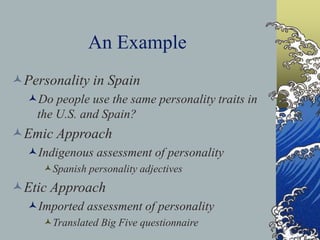
An Example
Personality in Spain
Do people use the same personality traits in
the U.S. and Spain?
Emic Approach
Indigenous assessment of personality
Spanish personality adjectives
Etic Approach
Imported assessment of personality
Translated Big Five questionnaire
Resulting Factors
Amazing 62 Sickening 43
Superior 58 Terrifying 41
Formidable 56 Filthy 41
Resplendent 56 Greasy 39
Not special -35 Cruel 39
Mediocre -40 Wicked 38
CONSCIENTIOUSNESS AGREEABLENESS
Well-balanced 64 Easy-going 54
Moderate 54 Good-natured 49
Reasonable 53 Docile 46
Hasty -42 Stormy -45
Reckless -43 Unreconciling -47
Crazy -49 Unyielding -48
OPENNESS
Bohemian 38
Mystical 40
Quaint 42
Gossiping -36
Disclosing -34
Nosy -30
Nosy -30
PLEASANTNESS
Happy 54
Engergetic 53
Relaxed 48
Stressed –53
Depressed –54
Unhappy –56
Reckless -43 Unreconciling -47
Crazy -49 Unyielding -48
OPENNESS
Bohemian 38
Mystical 40
Quaint 42
Gossiping -36
Disclosing -34
Nosy -30
PLEASANTNESS ENGAGEMENT
Happy 54 Ardent 43
Engergetic 53 Seething 36
Relaxed 48 Intense 35
Stressed –53 Cold -34
Depressed –54 Idle -30
Unhappy –56 Unemotional -37
VE VALENCE NEGATIVE VALENCE
62 Sickening 43
58 Terrifying 41
ble 56 Filthy 41
ent 56 Greasy 39
ial -35 Cruel 39
e -40 Wicked 38
IENTIOUSNESS AGREEABLENESS
anced 64 Easy-going 54
e 54 Good-natured 49
ble 53 Docile 46
-42 Stormy -45
-43 Unreconciling -47
-49 Unyielding -48
ESS
n 38
40
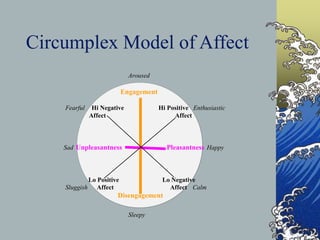
Circumplex Model of Affect
CIRCUMPLEX MODEL OF AFFECT
Aroused
Engagement
Fearful Hi Negative Hi Positive Enthusiastic
Affect Affect
Sad Unpleasantness Pleasantness Happy
Lo Positive Lo Negative
Sluggish Affect Affect Calm
Disengagement
Sleepy
Etic vs. Emic
INDIGENOUS SPANISH BIG 5
IMPORTED BIG 5 Agree Consc Open Pleasant Engage
Agreeableness 71
Conscientious. 60
Openness 22
Extraversion 75 45
Neuroticism -43 40
Evoked Culture
A way of considering culture that
concentrates on phenomena that are
triggered in different ways by different
environmental conditions
A universal underlying mechanism
Environmental differences in activating that
underlying mechanism
Example
Southern Culture of Honor
Southern Culture of Honor
Transmitted Culture
Representations (ideas, values, beliefs,
attitudes) that exist originally in at least
one person's mind that are transmitted to
other minds through observation or
interaction with the original person
Might explain cultural differences in
Morals & Values
Self-Concepts
Etiquette: East vs. West
Displays of
Temper
Tone of Voice
Modesty vs. Pride
Laughing
Compliments
Using First Names
Touching
Disclosures
Offensive Gestures
Agreeing
Formality
Face
The Self
0
2
4
6
8
10
12
14
16
18
psychological
physical
attitudes
interests
activities
goals
Japan
USA
Structural Framework - USA
Historical
Background
Cultural
Practices
Specific
Episodes
Psychological
Tendencies
Religion:
Protestantism:
Personal god
Philosophy
Descartes:
I think, there-
fore I am.
Politics
-Declaration of
Independence
-Bill of Rights
Linguistics:
Decontextua-
lized "I"
Advertisements:
"Just do it",
"Different is
good"
"Have it your
way, right
away"
Legal System:
- Free will
- Reponsibility
Guests told to
"help them-
selves"
Children have
own rooms,
choose their
own clothing
Compliments
to colleagues
"Are you
happy/having
fun?"
- Individual
control and
responsibility
- Consistency
- Positive and
unique self
Structural Framework - Japan
Historical
Background
Cultural
Practices
Specific
Episodes
Psychological
Tendencies
Religion:
- Buddhism
(compassion,
Nirvana)
- Confucianism
(roles, respect
for ancestors)
Linguistics:
Word for "self"
= "my share"
Proverbs:
"a nail that
stands out is
hammered
down"
Legal System:
- duty
- remorse
Host decides
for the guest.
Children eat,
sleep, learn in
groups.
Compliments
are refused.
"Aren't you
ashamed?"
- Focus on
group context
- Self is context
dependent
- Improvement
"Fitting in"
Independent Self
Self
Mother
Friend
Father
Co-Worker
Sibling
Friend
Friend
Interdependent Self
Self
Mother
Friend
Father
Co-Worker
Sibling
Friend
Friend
Individualism vs. Collectivism
Variation Within Cultures
-0.5
-0.3
-0.1
0.1
0.3
0.5
Low High
Identification
America
Indonesia
-0.5
-0.3
-0.1
0.1
0.3
0.5
Low High
Identification
America
Indonesia
Individualism
Collectivism
VERTICAL
HORIZONTAL
INDIVIDUALISTIC
COLLECTIVISTIC
USA
India
Israel? Sweden
Cultural Values
Hofstede studied IBM employees in 50
different countries
Found four cultural value dimensions
Power Distance
Canada vs. India
Uncertainty Avoidance
Japan vs. Hong-Kong
Individualism / Collectivism
US vs. China
Masculinity / Femininity
Brazil vs. Mexico
A Different Take
Trompenaars
Individualism vs. Collectivism
US vs. China
Universalism vs. Particularism
Germany vs. Hong-Kong
Neutral vs. Affective Relationships
Japan vs. Mexico
Specific vs. Diffuse Relationships
Achievement vs. Ascription
UK vs. India
Cultural Universals
Attempt to identify features of personality
that appear to be universal, or present in
most or all cultures
Some Examples
Gender Stereotypes
Emotion
Personality Factors
Emotional Expressions
Universality in Emotional Expressions
Summary
Cultural psychology studies the influence
of cultural factors on people’s personality
Every approach to personality needs to
account for cross-cultural differences
Global cross-cultural differences do not
imply uniformity within each culture
Subcultures do exist!
Individual differences are also present

Culture1.0.ppt

  • 1.
    Culture & Personality KimberleyA. Clow kclow2@uwo.ca http://instruct.uwo.ca/psychology/257e-570 Office Hour: Thursdays 2-3pm Office: S302
  • 2.
    Outline What is Culture Approachesto Culture Comparative Approach Emic vs. Etic Types of Culture Evoked Transmitted Universal Summary
  • 3.
    How Do WeCompare?  In some ways  We are like all other people  We are like some others  We are like nobody else  How does culture shape who we are?
  • 4.
    What is Culture? Definitions Sharedsystem of meaning that provide the standards for perceiving, believing, evaluating, communicating, and acting among those who share a language, a historic period, and a geographic location The way people understand their world and make sense of it through a shared system of meaning
  • 5.
    Why Study Culture? Reasons Discoverwhether concepts of personality that are prevalent in one culture are also applicable in other cultures Discover whether cultures differ in the levels of particular personality traits Discover whether the factor structure of personality traits varies across cultures Discover whether certain features of personality are universal
  • 6.
    Approaches to Culture Howto handle cultural differences Denial Deconstructionism Comparative Approach Three Major Types of Cultures Evoked Culture Transmitted Culture Cultural Universals
  • 7.
    Culture in PersonalityTheories Psychodynamic Approach Freud’s Theory Jung’s Archetypes Learning Approach Allport Culture is part of what it means to be a person Trait Approach Do factors hold up across cultures?
  • 8.
  • 9.
    An Example Personality inSpain Do people use the same personality traits in the U.S. and Spain? Emic Approach Indigenous assessment of personality Spanish personality adjectives Etic Approach Imported assessment of personality Translated Big Five questionnaire
  • 10.
    Resulting Factors Amazing 62Sickening 43 Superior 58 Terrifying 41 Formidable 56 Filthy 41 Resplendent 56 Greasy 39 Not special -35 Cruel 39 Mediocre -40 Wicked 38 CONSCIENTIOUSNESS AGREEABLENESS Well-balanced 64 Easy-going 54 Moderate 54 Good-natured 49 Reasonable 53 Docile 46 Hasty -42 Stormy -45 Reckless -43 Unreconciling -47 Crazy -49 Unyielding -48 OPENNESS Bohemian 38 Mystical 40 Quaint 42 Gossiping -36 Disclosing -34 Nosy -30 Nosy -30 PLEASANTNESS Happy 54 Engergetic 53 Relaxed 48 Stressed –53 Depressed –54 Unhappy –56 Reckless -43 Unreconciling -47 Crazy -49 Unyielding -48 OPENNESS Bohemian 38 Mystical 40 Quaint 42 Gossiping -36 Disclosing -34 Nosy -30 PLEASANTNESS ENGAGEMENT Happy 54 Ardent 43 Engergetic 53 Seething 36 Relaxed 48 Intense 35 Stressed –53 Cold -34 Depressed –54 Idle -30 Unhappy –56 Unemotional -37 VE VALENCE NEGATIVE VALENCE 62 Sickening 43 58 Terrifying 41 ble 56 Filthy 41 ent 56 Greasy 39 ial -35 Cruel 39 e -40 Wicked 38 IENTIOUSNESS AGREEABLENESS anced 64 Easy-going 54 e 54 Good-natured 49 ble 53 Docile 46 -42 Stormy -45 -43 Unreconciling -47 -49 Unyielding -48 ESS n 38 40
  • 11.
    Circumplex Model ofAffect CIRCUMPLEX MODEL OF AFFECT Aroused Engagement Fearful Hi Negative Hi Positive Enthusiastic Affect Affect Sad Unpleasantness Pleasantness Happy Lo Positive Lo Negative Sluggish Affect Affect Calm Disengagement Sleepy
  • 12.
    Etic vs. Emic INDIGENOUSSPANISH BIG 5 IMPORTED BIG 5 Agree Consc Open Pleasant Engage Agreeableness 71 Conscientious. 60 Openness 22 Extraversion 75 45 Neuroticism -43 40
  • 13.
    Evoked Culture A wayof considering culture that concentrates on phenomena that are triggered in different ways by different environmental conditions A universal underlying mechanism Environmental differences in activating that underlying mechanism Example Southern Culture of Honor
  • 14.
  • 15.
    Transmitted Culture Representations (ideas,values, beliefs, attitudes) that exist originally in at least one person's mind that are transmitted to other minds through observation or interaction with the original person Might explain cultural differences in Morals & Values Self-Concepts
  • 16.
    Etiquette: East vs.West Displays of Temper Tone of Voice Modesty vs. Pride Laughing Compliments Using First Names Touching Disclosures Offensive Gestures Agreeing Formality Face
  • 17.
  • 18.
    Structural Framework -USA Historical Background Cultural Practices Specific Episodes Psychological Tendencies Religion: Protestantism: Personal god Philosophy Descartes: I think, there- fore I am. Politics -Declaration of Independence -Bill of Rights Linguistics: Decontextua- lized "I" Advertisements: "Just do it", "Different is good" "Have it your way, right away" Legal System: - Free will - Reponsibility Guests told to "help them- selves" Children have own rooms, choose their own clothing Compliments to colleagues "Are you happy/having fun?" - Individual control and responsibility - Consistency - Positive and unique self
  • 19.
    Structural Framework -Japan Historical Background Cultural Practices Specific Episodes Psychological Tendencies Religion: - Buddhism (compassion, Nirvana) - Confucianism (roles, respect for ancestors) Linguistics: Word for "self" = "my share" Proverbs: "a nail that stands out is hammered down" Legal System: - duty - remorse Host decides for the guest. Children eat, sleep, learn in groups. Compliments are refused. "Aren't you ashamed?" - Focus on group context - Self is context dependent - Improvement "Fitting in"
  • 20.
  • 21.
  • 22.
  • 23.
    Variation Within Cultures -0.5 -0.3 -0.1 0.1 0.3 0.5 LowHigh Identification America Indonesia -0.5 -0.3 -0.1 0.1 0.3 0.5 Low High Identification America Indonesia Individualism Collectivism
  • 24.
  • 25.
    Cultural Values Hofstede studiedIBM employees in 50 different countries Found four cultural value dimensions Power Distance Canada vs. India Uncertainty Avoidance Japan vs. Hong-Kong Individualism / Collectivism US vs. China Masculinity / Femininity Brazil vs. Mexico
  • 26.
    A Different Take Trompenaars Individualismvs. Collectivism US vs. China Universalism vs. Particularism Germany vs. Hong-Kong Neutral vs. Affective Relationships Japan vs. Mexico Specific vs. Diffuse Relationships Achievement vs. Ascription UK vs. India
  • 27.
    Cultural Universals Attempt toidentify features of personality that appear to be universal, or present in most or all cultures Some Examples Gender Stereotypes Emotion Personality Factors
  • 28.
  • 29.
    Summary Cultural psychology studiesthe influence of cultural factors on people’s personality Every approach to personality needs to account for cross-cultural differences Global cross-cultural differences do not imply uniformity within each culture Subcultures do exist! Individual differences are also present