ANURADHA MITRA GHEMAWAT
11 & 15 FEBRUARY 2019
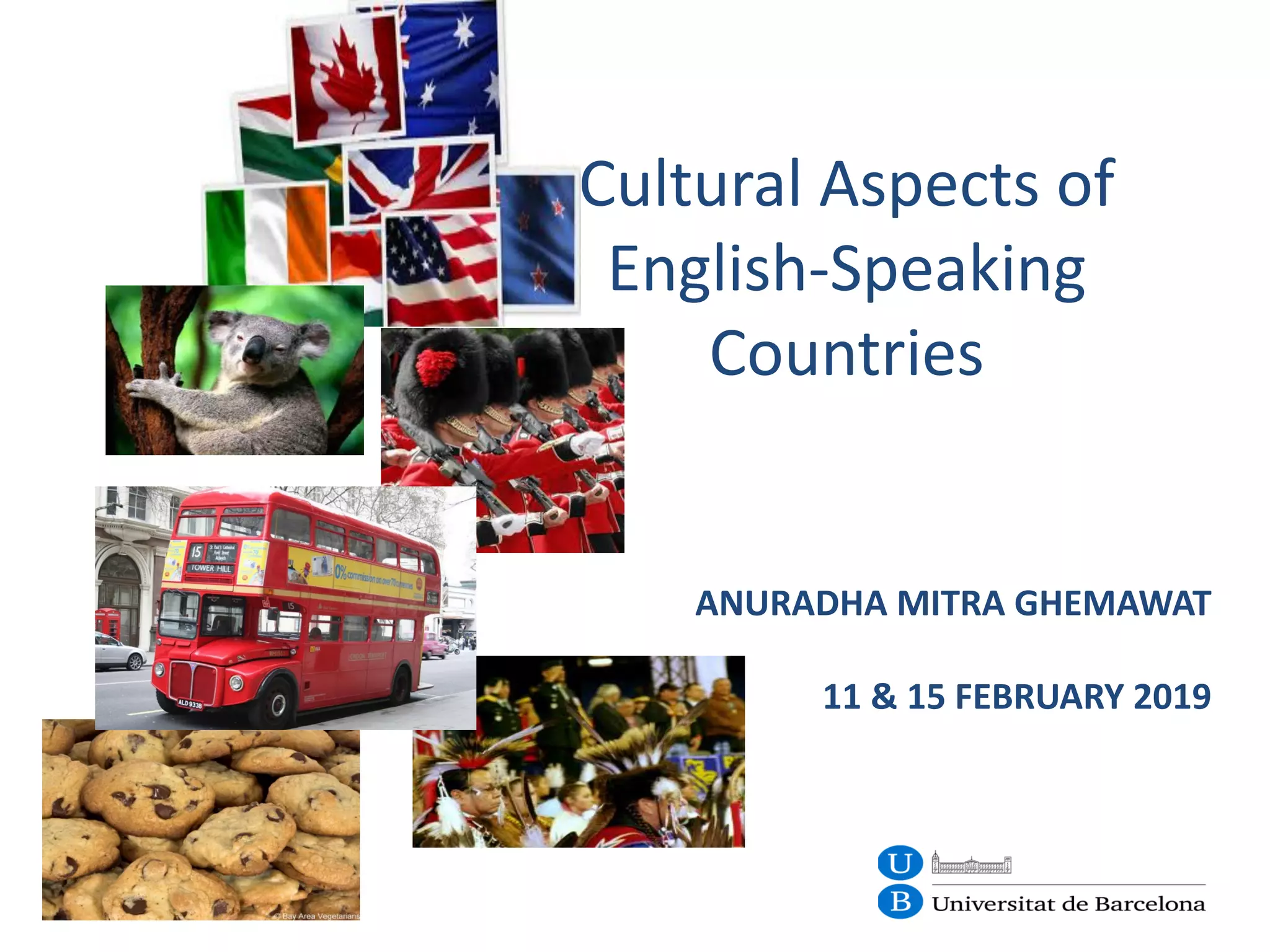
Cultural Aspects of
English-Speaking
Countries
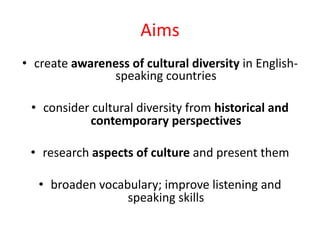
Aims
• create awareness of cultural diversity in English-
speaking countries
• consider cultural diversity from historical and
contemporary perspectives
• research aspects of culture and present them
• broaden vocabulary; improve listening and
speaking skills
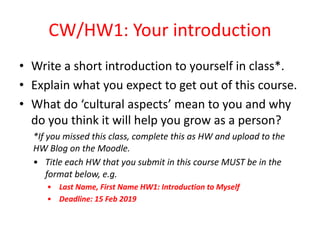
CW/HW1: Your introduction
• Write a short introduction to yourself in class*.
• Explain what you expect to get out of this course.
• What do ‘cultural aspects’ mean to you and why
do you think it will help you grow as a person?
*If you missed this class, complete this as HW and upload to the
HW Blog on the Moodle.
• Title each HW that you submit in this course MUST be in the
format below, e.g.
• Last Name, First Name HW1: Introduction to Myself
• Deadline: 15 Feb 2019
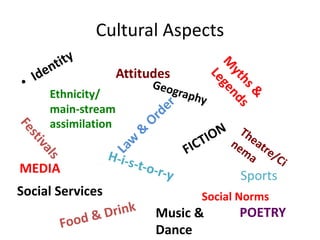
Cultural Aspects
• Identity
Sports
M
yths&
Legends
H-i-s-t-o-r-y
Attitudes
Festivals
Food & Drink
FICTION
POETRY
Law
&
Order
Social Services
Music &
Dance
Theatre/Ci
nema
Geography
MEDIA
Ethnicity/
main-stream
assimilation
Social Norms
Continuous Assessment
• 40% - Group presentation: See Group Presentation Schedule (curriculum)
– Choice of subjects and schedule are on the Moodle.
– You may also choose another cultural aspect (not listed in this course) and elaborate how it is treated
in 1-2 different English-speaking countries, or compare the treatment of this cultural aspect in an
English-speaking country with that in a non-English-speaking country.
– Include audio/ video resources
– Create games or activities to enhance the presentation (optional)
• 30% - In-class written task: Monday, 08 April 2019
• Write a review of a movie or TV series (300 words) in class. You will have seen the movie or 5-6 episodes of
the TV series that you choose at home during the course.
• Choose the movie or TV series (VOSE: English) that deals with a cultural aspect pertaining to an English-
speaking country, e.g.
– Racism, family & inter-personal relationships, gender & identity,
– Integration of recently-immigrants in main-stream society,
– Traditions of a cultural group of people as ‘seen’ by another cultural group
– Humour, educational values, social norms
• 30% - In-class individual oral presentation: The oral presentation date will be within a week after EACH
group presentation.
– Speak for at least 5 min. after developing an aspect of culture from your group presentation that you
would like to elaborate further.
Alternate Assessment
Alternate Assessment (AA) students must attend 3-4 on-on-one tutorials with the
teacher: Mondays between 16:00-17:00 in Room 150, UB Levant building
• 50% - In-class exam: 08 April 2019
– See course curriculum for details
• 30% - Individual oral presentation – (15 min + 10 min Q&A)
• Topic: an aspect of culture to be determined between the student & teacher in the first tutorial hour
of the course: 18 February 2019.
• The topic of the presentation MUST pertain to one of the cultural aspects discussed in class (and
uploaded to the Moodle after each regular class) OR chosen from the list in the curriculum.
– The presentation will be held in front of the teacher at a stipulated tutorial hour in the teacher’s
office. The teacher evaluates the AA student.
– If the AA students wishes to present in the regular class, he/she could do so with prior permission
from the teacher.
• 20% - Individual essay on one aspect of culture of any English-speaking country
– Topic: An aspect of culture discussed in class or in the curriculum.
– The essay (300 words) will be written during a stipulated tutorial hour in the teacher’s
office.
Group Presentations (40%)
(See Group Presentation Schedule)
GROUP Presentation (40%) – 20 min + 10 min Q&A
• Choose a cultural aspect relating to any English-speaking country, e.g.
– Media & TV: U.K.; Storytelling: Kenya; Indigenous peoples: New
Zealand vs. Australia
• You may also choose a cultural aspect that is not listed in this course and
elaborate on how this cultural aspect is treated:
• In 1 or 2 different English-speaking countries, or
• Compare the treatment of this cultural aspect in an English-speaking country
with that in a non-English-speaking country.
– Include audio/ video resources
– Create games or activities to enhance the presentation (optional)
• Each group member will speak for at least 5 min.
• Teacher and Peer Evaluations will be conducted for each group. Rubrics
are uploaded to the Moodle.
• Deadline for group formation: Friday, 15 Feb 2019
GROUP1 presentation: 08 Mar 2019
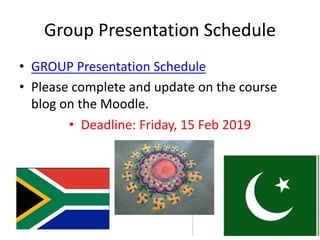
Group Presentation Schedule
• GROUP Presentation Schedule
• Please complete and update on the course
blog on the Moodle.
• Deadline: Friday, 15 Feb 2019
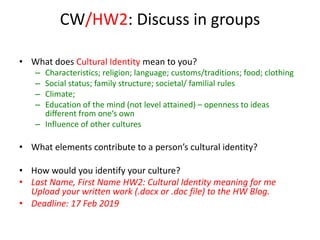
CW/HW2: Discuss in groups
• What does Cultural Identity mean to you?
– Characteristics; religion; language; customs/traditions; food; clothing
– Social status; family structure; societal/ familial rules
– Climate;
– Education of the mind (not level attained) – openness to ideas
different from one’s own
– Influence of other cultures
• What elements contribute to a person’s cultural identity?
• How would you identify your culture?
• Last Name, First Name HW2: Cultural Identity meaning for me
Upload your written work (.docx or .doc file) to the HW Blog.
• Deadline: 17 Feb 2019
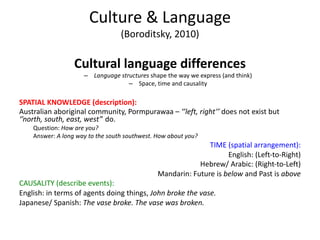
Culture & Language
(Boroditsky, 2010)
Cultural language differences
– Language structures shape the way we express (and think)
– Space, time and causality
SPATIAL KNOWLEDGE (description):
Australian aboriginal community, Pormpurawaa – ‘’left, right’’ does not exist but
‘’north, south, east, west’’ do.
Question: How are you?
Answer: A long way to the south southwest. How about you?
TIME (spatial arrangement):
English: (Left-to-Right)
Hebrew/ Arabic: (Right-to-Left)
Mandarin: Future is below and Past is above
CAUSALITY (describe events):
English: in terms of agents doing things, John broke the vase.
Japanese/ Spanish: The vase broke. The vase was broken.
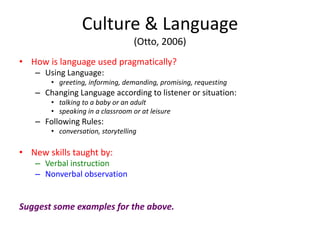
Culture & Language
(Otto, 2006)
• How is language used pragmatically?
– Using Language:
• greeting, informing, demanding, promising, requesting
– Changing Language according to listener or situation:
• talking to a baby or an adult
• speaking in a classroom or at leisure
– Following Rules:
• conversation, storytelling
• New skills taught by:
– Verbal instruction
– Nonverbal observation
Suggest some examples for the above.
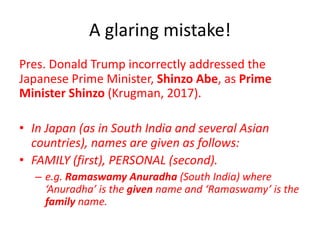
A glaring mistake!
Pres. Donald Trump incorrectly addressed the
Japanese Prime Minister, Shinzo Abe, as Prime
Minister Shinzo (Krugman, 2017).
• In Japan (as in South India and several Asian
countries), names are given as follows:
• FAMILY (first), PERSONAL (second).
– e.g. Ramaswamy Anuradha (South India) where
‘Anuradha’ is the given name and ‘Ramaswamy’ is the
family name.
HW3: due 17 Feb 2019
• Watch the following video: How are Language
and Identity connected?
https://www.youtube.com/watch?v=D5pu47-
iQ8E
• Summarize key points expressed in this video and
upload to the HW Blog on the Moodle.
– Last Name, First Name HW3: Language and Identity
• Bring as a written document if you cannot upload
onto the Moodle.
Further self-study
• Language and Identity
https://www.youtube.com/watch?v=rRt4YoiE-PQ
• English vs. Native Language – How do they
influence each other?
https://www.youtube.com/watch?v=ahS9dxL4xxI
• Why did English become the international
language?
https://www.youtube.com/watch?v=iqDFPU9YeQ
M
REFERENCES
1. Boroditsky, Lera (2010). Lost in Translation. Wall Street Journal, 23 July
2010.
https://www.wsj.com/articles/SB1000142405274870346730457538313
1592767868
2. Krugman, Paul (2017). Ignorance is Strength. International New York
Times, 14 Feb 2017.
https://www.nytimes.com/2017/02/13/opinion/ignorance-is-
strength.html?_r=0
3. Otto, Beverly (2006). Culture and Language. Excerpt from Language
Development in Early Childhood (2006). Pearson Allyn Bacon Prentice
https://www.education.com/reference/article/culture-language/
4. Otto, Beverly (2013). Language Development in Early Childhood
Education. 4th ed. Pearson (2013)
5. American Speech-Language-Hearing Association (1997-2017). Social
Language Use (Pragmatics).
http://www.asha.org/public/speech/development/Pragmatics/

Culture & Language: Univ. BCN class presentation

  • 1.
    ANURADHA MITRA GHEMAWAT 11& 15 FEBRUARY 2019 Cultural Aspects of English-Speaking Countries
  • 2.
    Aims • create awarenessof cultural diversity in English- speaking countries • consider cultural diversity from historical and contemporary perspectives • research aspects of culture and present them • broaden vocabulary; improve listening and speaking skills
  • 3.
    CW/HW1: Your introduction •Write a short introduction to yourself in class*. • Explain what you expect to get out of this course. • What do ‘cultural aspects’ mean to you and why do you think it will help you grow as a person? *If you missed this class, complete this as HW and upload to the HW Blog on the Moodle. • Title each HW that you submit in this course MUST be in the format below, e.g. • Last Name, First Name HW1: Introduction to Myself • Deadline: 15 Feb 2019
  • 4.
    Cultural Aspects • Identity Sports M yths& Legends H-i-s-t-o-r-y Attitudes Festivals Food& Drink FICTION POETRY Law & Order Social Services Music & Dance Theatre/Ci nema Geography MEDIA Ethnicity/ main-stream assimilation Social Norms
  • 5.
    Continuous Assessment • 40%- Group presentation: See Group Presentation Schedule (curriculum) – Choice of subjects and schedule are on the Moodle. – You may also choose another cultural aspect (not listed in this course) and elaborate how it is treated in 1-2 different English-speaking countries, or compare the treatment of this cultural aspect in an English-speaking country with that in a non-English-speaking country. – Include audio/ video resources – Create games or activities to enhance the presentation (optional) • 30% - In-class written task: Monday, 08 April 2019 • Write a review of a movie or TV series (300 words) in class. You will have seen the movie or 5-6 episodes of the TV series that you choose at home during the course. • Choose the movie or TV series (VOSE: English) that deals with a cultural aspect pertaining to an English- speaking country, e.g. – Racism, family & inter-personal relationships, gender & identity, – Integration of recently-immigrants in main-stream society, – Traditions of a cultural group of people as ‘seen’ by another cultural group – Humour, educational values, social norms • 30% - In-class individual oral presentation: The oral presentation date will be within a week after EACH group presentation. – Speak for at least 5 min. after developing an aspect of culture from your group presentation that you would like to elaborate further.
  • 6.
    Alternate Assessment Alternate Assessment(AA) students must attend 3-4 on-on-one tutorials with the teacher: Mondays between 16:00-17:00 in Room 150, UB Levant building • 50% - In-class exam: 08 April 2019 – See course curriculum for details • 30% - Individual oral presentation – (15 min + 10 min Q&A) • Topic: an aspect of culture to be determined between the student & teacher in the first tutorial hour of the course: 18 February 2019. • The topic of the presentation MUST pertain to one of the cultural aspects discussed in class (and uploaded to the Moodle after each regular class) OR chosen from the list in the curriculum. – The presentation will be held in front of the teacher at a stipulated tutorial hour in the teacher’s office. The teacher evaluates the AA student. – If the AA students wishes to present in the regular class, he/she could do so with prior permission from the teacher. • 20% - Individual essay on one aspect of culture of any English-speaking country – Topic: An aspect of culture discussed in class or in the curriculum. – The essay (300 words) will be written during a stipulated tutorial hour in the teacher’s office.
  • 7.
    Group Presentations (40%) (SeeGroup Presentation Schedule) GROUP Presentation (40%) – 20 min + 10 min Q&A • Choose a cultural aspect relating to any English-speaking country, e.g. – Media & TV: U.K.; Storytelling: Kenya; Indigenous peoples: New Zealand vs. Australia • You may also choose a cultural aspect that is not listed in this course and elaborate on how this cultural aspect is treated: • In 1 or 2 different English-speaking countries, or • Compare the treatment of this cultural aspect in an English-speaking country with that in a non-English-speaking country. – Include audio/ video resources – Create games or activities to enhance the presentation (optional) • Each group member will speak for at least 5 min. • Teacher and Peer Evaluations will be conducted for each group. Rubrics are uploaded to the Moodle. • Deadline for group formation: Friday, 15 Feb 2019 GROUP1 presentation: 08 Mar 2019
  • 8.
    Group Presentation Schedule •GROUP Presentation Schedule • Please complete and update on the course blog on the Moodle. • Deadline: Friday, 15 Feb 2019
  • 9.
    CW/HW2: Discuss ingroups • What does Cultural Identity mean to you? – Characteristics; religion; language; customs/traditions; food; clothing – Social status; family structure; societal/ familial rules – Climate; – Education of the mind (not level attained) – openness to ideas different from one’s own – Influence of other cultures • What elements contribute to a person’s cultural identity? • How would you identify your culture? • Last Name, First Name HW2: Cultural Identity meaning for me Upload your written work (.docx or .doc file) to the HW Blog. • Deadline: 17 Feb 2019
  • 10.
    Culture & Language (Boroditsky,2010) Cultural language differences – Language structures shape the way we express (and think) – Space, time and causality SPATIAL KNOWLEDGE (description): Australian aboriginal community, Pormpurawaa – ‘’left, right’’ does not exist but ‘’north, south, east, west’’ do. Question: How are you? Answer: A long way to the south southwest. How about you? TIME (spatial arrangement): English: (Left-to-Right) Hebrew/ Arabic: (Right-to-Left) Mandarin: Future is below and Past is above CAUSALITY (describe events): English: in terms of agents doing things, John broke the vase. Japanese/ Spanish: The vase broke. The vase was broken.
  • 11.
    Culture & Language (Otto,2006) • How is language used pragmatically? – Using Language: • greeting, informing, demanding, promising, requesting – Changing Language according to listener or situation: • talking to a baby or an adult • speaking in a classroom or at leisure – Following Rules: • conversation, storytelling • New skills taught by: – Verbal instruction – Nonverbal observation Suggest some examples for the above.
  • 12.
    A glaring mistake! Pres.Donald Trump incorrectly addressed the Japanese Prime Minister, Shinzo Abe, as Prime Minister Shinzo (Krugman, 2017). • In Japan (as in South India and several Asian countries), names are given as follows: • FAMILY (first), PERSONAL (second). – e.g. Ramaswamy Anuradha (South India) where ‘Anuradha’ is the given name and ‘Ramaswamy’ is the family name.
  • 13.
    HW3: due 17Feb 2019 • Watch the following video: How are Language and Identity connected? https://www.youtube.com/watch?v=D5pu47- iQ8E • Summarize key points expressed in this video and upload to the HW Blog on the Moodle. – Last Name, First Name HW3: Language and Identity • Bring as a written document if you cannot upload onto the Moodle.
  • 14.
    Further self-study • Languageand Identity https://www.youtube.com/watch?v=rRt4YoiE-PQ • English vs. Native Language – How do they influence each other? https://www.youtube.com/watch?v=ahS9dxL4xxI • Why did English become the international language? https://www.youtube.com/watch?v=iqDFPU9YeQ M
  • 15.
    REFERENCES 1. Boroditsky, Lera(2010). Lost in Translation. Wall Street Journal, 23 July 2010. https://www.wsj.com/articles/SB1000142405274870346730457538313 1592767868 2. Krugman, Paul (2017). Ignorance is Strength. International New York Times, 14 Feb 2017. https://www.nytimes.com/2017/02/13/opinion/ignorance-is- strength.html?_r=0 3. Otto, Beverly (2006). Culture and Language. Excerpt from Language Development in Early Childhood (2006). Pearson Allyn Bacon Prentice https://www.education.com/reference/article/culture-language/ 4. Otto, Beverly (2013). Language Development in Early Childhood Education. 4th ed. Pearson (2013) 5. American Speech-Language-Hearing Association (1997-2017). Social Language Use (Pragmatics). http://www.asha.org/public/speech/development/Pragmatics/