


MinneWebCon:
Cultivating a User-Centered Culture
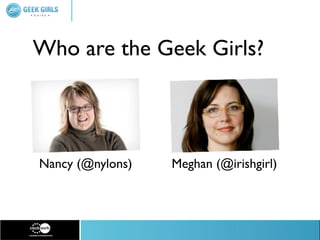
Who are the Geek Girls?


Nancy (@nylons)   Meghan (@irishgirl)
Blog: www.geekgirlsguide.com
Facebook: www.facebook.com/geekgirlsguide
Twitter: @geekgirlsguide
User-centered design is a philosophy
and a process in which the needs, wants,
and limitations of end users of an
interface or document are given extensive
attention at each stage of the design
process.
                               - Wikipedia
A user-centered culture is one in
which the needs, wants, and limitations
of users are given extensive attention
at every level of the organization.
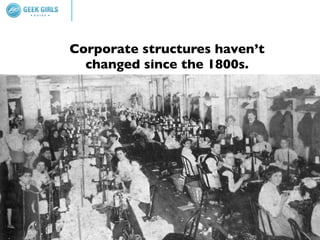
Corporate structures haven’t
  changed since the 1800s.
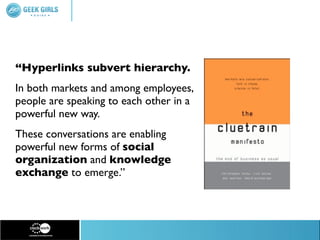
“Hyperlinks subvert hierarchy.
In both markets and among employees,
people are speaking to each other in a
powerful new way.
These conversations are enabling
powerful new forms of social
organization and knowledge
exchange to emerge.”
Agencies haven’t changed (much)
        since the 1950s.
“They need me and my big ideas.”
Old-school creatives
are used to controlling the deliverable.


     Old-school managers
 are used to controlling...everything.
Embracing users means
  embracing chaos.


      It’s not easy.
You (mostly) don’t matter.

         Users do.
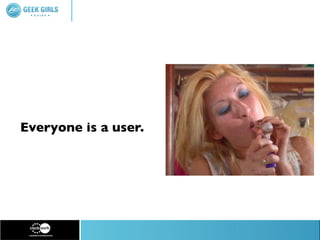
Everyone is a user.
PART I:
Company culture is a product.
 Employees are users.
Happy people do good work.
 It’s not about kegs and foosball.


             Image source: http://www.flickr.com/photos/sharynmorrow/2618698358/
1. Define your values.
It begins with leadership,
  but involves everyone.
2. Align hiring decisions
         with your values.


empathic observant positive analytical
creative curious focused adventurous
steady communicative open respectful
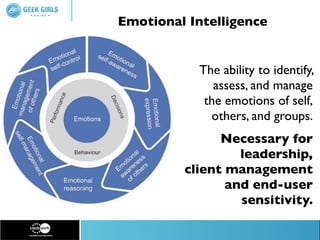
Emotional Intelligence


           The ability to identify,
              assess, and manage
            the emotions of self,
             others, and groups.
               Necessary for
                  leadership,
         client management
                and end-user
                  sensitivity.
3. Communicate openly.


       When resources are scarce,
        the way you communicate
can either inspire panic or collaboration.


      Resources are always scarce.
4. Cultivate a sense of ownership.


    Everybody owns the promises made,
the method of delivery, and the final product.
PART II:

Companies are products.

 Clients are users.
1. Find clients that align
    with your values.


  Don’t be afraid to say no.
2. Communication.


       Speak their language,
don’t expect them to speak yours.
3. Listen.


 Don’t just listen to what they say,
try to understand what they mean.
4. Treat the client
      as the expert.


You’re the idiot in the room.
PART III:

Web apps are products.

 Users are users.
1. Extend your values
    to your end product.


       Be who you say you are
and it will be reflected in your work.
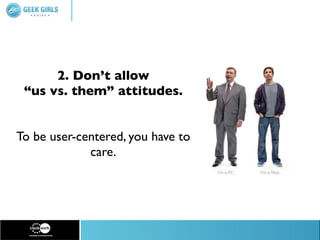
2. Don’t allow
 “us vs. them” attitudes.


To be user-centered, you have to
             care.
3. Listen.


Ask the right questions,
  find the real story.
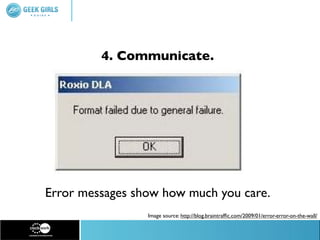
4. Communicate.


Error messages show how much you care.
                 Image source: http://blog.braintraffic.com/2009/01/error-error-on-the-wall/
5. Push your boundaries.


Learn how it feels to be a user.
Recommended Reading

The Cluetrain Manifesto
Drive, Daniel Pink
Happy Hour is From 9 to 5, Alexander Kjerulf
Peak, Chip Conley
Thank you.


     If you hated us, tell us.
If you loved us, tell the Internet.

MinneWebCon: Cultivating a User-Centered Culture

Editor's Notes

  • #3 Why we started geekgirlsguide - Lack of women in our field and at Web 2.0 - A safe place to ask “dumb” questions
  • #4 Why we started geekgirlsguide - Lack of women in our field and at Web 2.0 - A safe place to ask “dumb” questions