CU Athletics
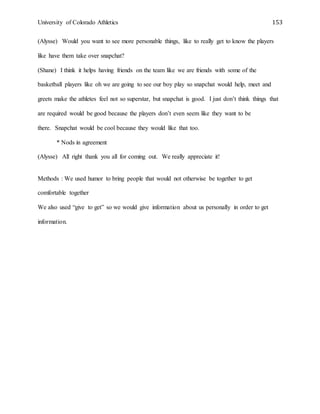
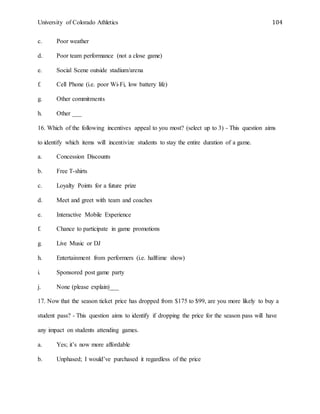
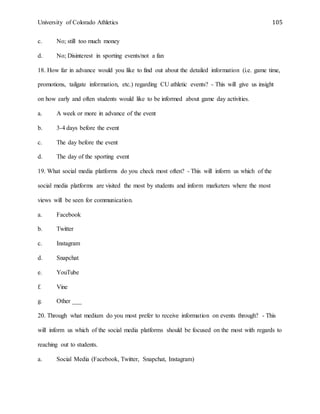
Communication Strategies and Fan Engagement Initiatives
University of Colorado, Boulder
University of Colorado Athletics 2
Executive Summary
The research collected and analyzed for this project is specifically related to
communication strategies and fan engagement initiatives for the University of Colorado’s
athletic department. The University of Colorado identified a steep decrease in attendance during
the past decade as a significant problem. The objective of this research paper is to identify
effective ways to communicate to college students through social media in order to enhance the
gameday experience and increase attendance for the University of Colorado’s athletic teams.
Three studies were conducted to analyze several forms of communication and establish
the criteria of a successful communication strategy. The first study involved contacting
comparable universities to discuss communication strategies. The second study aimed to gather
statistical evidence of the best strategies for communicating with the University of Colorado’s
student body and the reasoning behind attending sporting events through an online Qualtrics
survey. In the final study, a focus group of eight CU students was held with the objective of
gaining students’ perspectives on what factors contribute to attending sporting events and which
forms of communication best resonate with the student body.
Evidence from our research showed students identified Facebook, Twitter, Instagram,
and Snapchat as the best methods of social media communication channels. The social scene of
the game, stadium atmosphere, fan-to-fan interactions, and basking in reflected glory (BIRGing)
are all key components in creating the best gameday experience. Therefore, it is recommended
that CU Athletics implement a student ambassador program to increase student attendance
through an organized student walk to the stadium. Furthermore, a student driven social media
page dedicated to CU Athletics that sends out mass texts to the student body and bridges the gap
between students and athletes through creative social media accounts is recommended.
University of Colorado Athletics 3
Table of Contents
Introduction page 5
Purpose Statement page 6
Research Questions page 7
Literature Review page 8
Effective Ways to Communicate with College Students page 8
Psychology of a college sport consumer page 8
Email effectiveness page 12
Communicating through Social Media page 13
Exposure through social media page 18
Enhancing the Gameday Experience page 19
Fan gameday engagement/experience page 21
Why college students attend sport events page 29
Best Practices page 36
Effective Ways to Communicate with College Students page 36
Communicating through Social Media page 39
Enhancing Game Day Experience page 44
Methods page 45
Student Survey page 45
Phone Interviews page 46
Focus Group page 49
Results page 51
Student Survey page 51
University of Colorado Athletics 4
Phone Interviews page 62
Focus Group page 69
Discussion page 73
Research Question 1 page 73
Research Question 2 page 75
Research Question 3 page 78
Research Question 4 page 79
Recommendations page 81
Student Ambassador Program and “Student Stampede” page 81
Implementing a Social Media Team page 82
Enhancing Student Gameday Experience page 84
Communicating with Students through Mass Texting page 87
Creating Personal Connections between Students and Athletes page 87
Conclusion page 90
References page 92
Appendix page 99
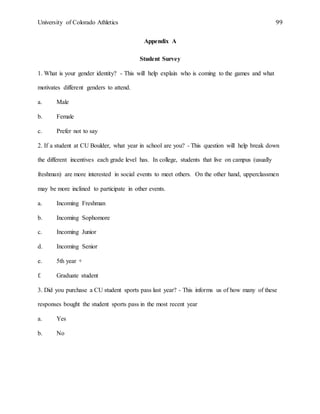
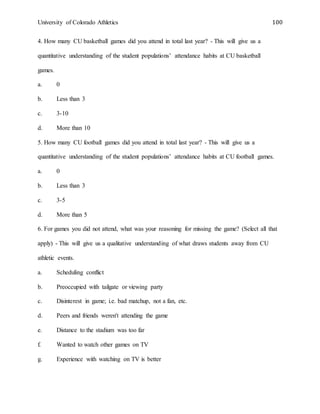
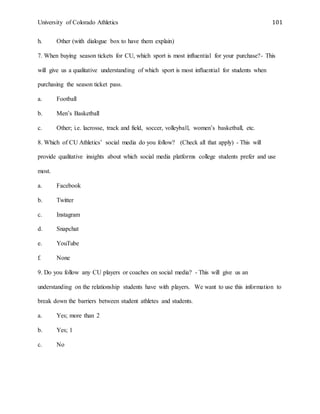
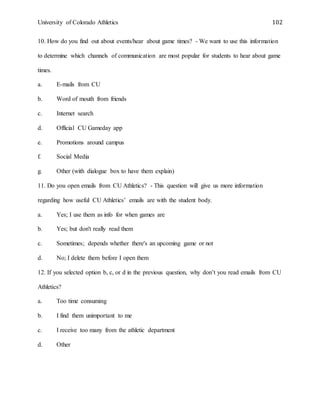
Appendix A: Student Survey page 99
Appendix B: Phone Interviews page 107
Appendix C: Focus Group page 136
University of Colorado Athletics 5
Ticket sales and attendance at major college athletic events have declined at alarming
rates in recent years for college athletic programs. “Average student attendance at college
football games is down 7.1% since 2009, according to an analysis by The Wall Street Journal of
stadium turnstile records from about 50 public colleges with top-division I football teams. The
decline was 5.6% at colleges in the five richest conferences.” (Cohen, 2014, para. 3). Part of the
reason fans love college sports is enjoying the atmosphere of the game. The chants from the
student section after a questionable call, the singing of the fight song after a touchdown; it’s an
experience unlike any other. However, the loss of fandom especially within the student sections
of major universities is reason for concern. This poses a major short-term problem, as the lack of
student attendance hurts revenue, game day experience, school pride, and player
motivation. Poor attendance also poses an even larger potential long term problem, as future
alumni will not have fond memories of college football games they attended as students, which
may prevent them from returning in future years to visit as alumni:
Today's uninterested students, athletic directors worry, could easily become tomorrow's
uninterested alumni. ‘Current students are not that important [to ticket sales], per se,’
Dan Rascher, a sports management professor at the University of San Francisco,
said. ‘But you're trying to turn those current students into former students who are still
fans decades later. You want students, when they become alumni, to have that
attachment and come back for the games, and that's what's concerning athletic
departments.’ (New, 2014, para. 8-9).
The plummeting ticket sales and attendance have become a problem throughout the
nation, but in particular the University of Colorado faces an intensified dilemma as Cohen (2014)
mentions that ticket sales from 2009-2014 declined by 53%. “CU has drawn fewer than 40,000
University of Colorado Athletics 6
fans at Folsom Field four times this year for the first time since 1985. Only six teams in the five
major BCS conferences are averaging fewer fans than CU” (Henderson, 2013, para. 10). To
counteract this poor record and lack of fan engagement, the athletic department has dropped their
student season ticket prices for an all sport pass from $175 to $99, a 40% discounted price. In
comparison to other Division I power five conference teams, this price is an absolute bargain.
According to the University of Oregon Athletic website (“Student Ticket Info”, 2016), season
tickets for students are $367 for football alone.
This brings up the perplexing question of how to effectively communicate with a student
body in order to get them to attend sporting events for their university. The research that follows
concerns the strategies other college athletic programs find effective and seeks to understand
how the top programs communicate with their students successfully. The research includes an
overview of the incentives offered to get students to attend college athletic events as well as a
review of how other athletic programs communicate with their students to encourage them to
attend sporting events.
Purpose Statement
The purpose of this research project is to determine the best communication strategies and
mediums to reach CU college students in an effort to increase ticket sales, fan attendance and
college student engagement with a specific focus on the 2016 University of Colorado football
season. A secondary purpose is to identify amenities and benefits that resonate with students,
and will influence them to attend football games, as well as other CU athletic events. This is an
important and relevant topic to the University of Colorado as student ticket sales and attendance
at sporting events have declined at an alarming rate in the last decade.
University of Colorado Athletics 7
Research Questions
RQ1: What are the most effective ways for CU athletics to communicate with the
University of Colorado student body?
RQ2: What communication strategies and mediums will resonate with college students
and result in an increase in ticket sales for the University of Colorado’s athletic program?
RQ3: What communication strategies and mediums will influence CU students to attend
more University of Colorado football games and athletic events?
RQ4: What will incentivize students to stay the entire duration of each football game?
University of Colorado Athletics 8
Literature Review
Effective Ways to Communicate with College Students
Psychology of a college sports consumer. Attracting people to a sporting event is a
more complicated procedure than one might imagine. Apart from the usual topics of team
success and effective promotions, it is essential to delve into the psychology of the sport
consumer in general before focusing on college students specifically. By doing this, we can
discover what drives a person to support a team and show their support by attending the
games. As a result, the most effective communication strategies will become apparent once we
understand the psychological attributes common among sports fans. Like any other business
sector, consumer behavior is an integral part of tailoring marketing efforts. The sports world is
no different, and by exploring this topic we believe that the right opportunities will present
themselves in terms of drawing more fans to CU sporting events. Rick Grieve, a psychologist at
Western Kentucky University, states the goal very simply:
It is important to take a look at why people attend, not just what kind of people attend.
Aspects of different sports are going to be appealing to different people. If you can
understand what is appealing about your sport, you can market it in a way that people
will be most likely to respond positively to it (cited in King, 2010, para. 29).
It is important to understand what is appealing about the sport of college football and how to
communicate that message to the multitude of students attending the school. Dan Wann,
Professor at Murray State, has studied factors that motivate sports fans for over 20 years. He
came up with eight basic motives that drive people to follow sports, which include the following:
entertainment, escape, economics, aesthetics, family, group affiliation, self-esteem, and eustress
(King, 2010). The first six of these factors are fairly self-explanatory, with self-esteem referring
University of Colorado Athletics 9
to the positive feeling of supporting a winning team while eustress refers to the uncertainty of the
outcome of a game. Wann found group affiliation and family mainly drove college sports fans to
attend games. Fans were more likely to attend an event based on images of others gathered at
the stadium than images of the players. These findings support the notion that the social aspect
of a college football game is the main driving force for attendance. Wann sums up his research
by saying, “Let’s find a few things you think might matter about these people and let’s get on
those” (King, 2010, para. 39).
Merrill Melnick took a slightly different approach to see what draws a consumer to a
sporting event. Melnick (1993) identified the three basic needs of humankind as the following:
community, engagement, and dependency. These are the traits that fans also look for when
attending a game. Melnick goes on to discuss how the draw of casual sociability (stranger to
stranger) entices people to attend a sporting event (1993). This is especially relevant for the
topic of college sports, as the effort and willingness to meet and connect with new people is
important for the student demographic. Furthermore, Melnick talks about how essential
spectators are to the game when addressing the topic of sociability:
They recognize, from the moment they pass through the turnstiles, that they are crucial to
the event. Without their physical presence, there can be no contest. Thus, spectators
share in the collective knowledge that they are vital, important, and integral to the action.
The role behaviors associated with the status/position of "spectator" are also known and
understood. It is expected that spectators will clap, boo, yell, scream, hiss, or "do the
wave," as their moods and passions dictate. (Melnick, 1993, p. 50)
Fans attending a sporting event that are in a similar mindset as other fans are likely to act in the
same manner as the game goes on. It is the aforementioned commonalities between spectators
University of Colorado Athletics 10
that spurs casual sociability. It is essential for a communal atmosphere to be present, brought
about by joint cheers for the team while simultaneously celebrating oneself. A sporting event
creates a party-like atmosphere that demands interaction with like-minded individuals seated
around each other. This differs from non-sport experiences, where the mood is completely
different and neighbors may not share the same love for the team that most fans do. Melnick
cites the ecological setting of a game, the absence of temporal restraints, and a genuine openness
on the part of most fans to interact with each other as the reasons that make a sporting event a
great place to initiate conversations with strangers and satisfy the need for social interaction
(Melnick, 1993). It is much easier and more enjoyable to socially interact at a sporting event.
The architecture of the stadium can also play a major role in attracting fans to a
game. Each of the following contribute to creating a positive experience for spectators:
comfortable seats, air conditioning, good sight lines, non-glare lighting, numerous easily
accessible rest rooms, food and drink concession areas, walk ramps, and exits. This research
strongly suggests that legroom and elbowroom, width of seats, aisle space, and ambient
temperature inside the stadium are essential aspects that an administrator must recognize and act
upon (Melnick, 1993). The Toledo Mud Hens of the International Baseball League implemented
‘blind date night’ as a successful tool to draw fans to the stadium and take advantage of the close
quarters that sporting events offer. On Saturdays, the Mud Hens encourage people to sit next to
others of the opposite sex. The fan response found to be incredibly positive, spurring
management to contemplate enlarging the idea in coming seasons. Melnick suggests several
ideas such as setting aside sections for particular age groups, neighborhoods, widows and
widowers, divorced people, tall people, short people, gays, lesbians (1993).
University of Colorado Athletics 11
In contrast, the tailgating experience is one that often draws fans away from the game
itself. Melnick states that many fans find that “the party inside the stadium is not nearly as fun as
the one outside” (Melnick, 1993, p. 97). Tailgaters often come to a sporting event hours, or even
days before game start time to set up camp, cook food, and partake in activities such as frisbee,
football, watching television, and socializing with other fans. The social scene is an ideal
location for interacting with friends, old and new. Because of this social scene, only a few
tailgaters feel it is necessary to continue on to the game and leave the fun of the tailgate
behind. “It's major league partying, bearing as much resemblance to ordinary picnicking as a
station wagon does to a Winnebago” (Johnson, 1985, p. 4). In order to achieve optimal success,
sport managers must cater to tailgaters by providing amenities, including special sections in the
parking lot for recreational vehicles, paved roads and play areas, picnic benches, restrooms,
shuttle rides to the game, and flexible lengths of stay (Melnick, 1993).
Food and drink is another aspect of the fan experience that heavily influences whether a
potential spectator attends a game. Options at concession stands are expected to be tasty,
attractive, and reasonably priced, served by clean and courteous handlers. This eases one’s
initial skepticism of the stigma attached to typical stadium food. Additionally, well-positioned
television monitors allow for all fans to keep up with the game even if stuck in a long concession
line. Another tactic to provide the best game experience is to change up the menu every two-to-
three weeks to provide variety and keep customers interested and wondering about what new
food choices may be available. As Melnick puts it, “Creative, well-researched additions to the
stadium or arena menu would add an exciting, unexpected dimension to the eating experience,
which may be the major reason for many spectators' attendance” (1993).
University of Colorado Athletics 12
Email effectiveness. Related to the psychological makeup of fans is how teams
communicate most effectively with their fans. Currently, institutions such as the University of
Colorado use a school wide mass email to inform students of game times, news, and promotions
regarding the athletic department. Although this communication strategy reaches out to the
entire target market of Colorado students, whether this is successful or not is unclear. Rubin
(2013) explains how students tend to associate email with school and that relates to boring class
material. “Email has never really been a fun thing to use,” said Ms. Judge, age 19. “It’s always
like, ‘This is something you have to do.’ School is a boring thing. Email is a boring thing. It
goes together.’” (Rubin, 2013, para. 10). Athletic events are fun, exciting, and an escape from
school and work and should not be associated with the word “boring”. This negative perception
of email does not excite and motivate students to attend games as they already have an
unfavorable association between email and academics.
Another con of using email when communicating with college students is the short
amount of time students check and use their email. “Just how little are students using email
these days? Six minutes a day, according to an experiment done earlier this year by Reynol
Junco, an Associate Professor of Library Science at Purdue” (Rubin, 2013, para. 19). With
students using email only six minutes a day on average, there is a high possibility that students
will not see the email for a long period of time. With sports having set game times, the timing
behind informing fans is necessary and important.
Since email is used only six minutes a day by college students, the remaining 23 hours
and 54 minutes of the day is often spent on other forms of technology. Goodrich (2014)
references a study of Baylor University students that revealed on average women spend nearly
ten hours a day on their phone, while men are on their phone for nearly eight hours a day. A
University of Colorado Athletics 13
majority of this time is split between text messaging and social media. This provides an
incredible marketing opportunity for companies. While social media communication continues
to become exponentially more popular, a new trend in communication is mass text messaging
due to the accessibility and simplicity. Rubin (2013) states that a new management system
called Canvas provides users with the option to be informed of news via email, text, Facebook
and Twitter. This can be translated and used by athletic departments to better inform fans of
game times and news in a timely manner.
Communicating Through Social Media
Out of the ten hours women college students spend on their phone a day and the eight
hours male college students spend on their phone, a large amount of that time is spent on social
media. Whether through Facebook, Twitter, Instagram, or Snapchat, people rely on these
interactive applications as sources of news for sports, entertainment, and politics. According to
Urban (2016), nearly 87% of 13-24 year olds use social media to regularly consume sports
related content. That is almost twice as much as those who use mainstream sports media through
websites and applications. With nearly every professional and Division I athletic team having an
official team page or username for all of the four major social media platforms, fans rely on
teams to provide information and entertainment to the public. Andrew Guerra of the University
of Oregon’s Warsaw Sports Marketing Center looked into the impact of social media on student
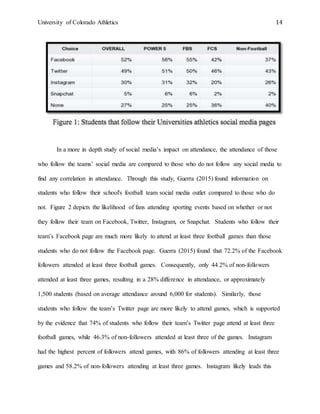
attendance of collegiate sporting events and the impact of social media. As seen in figure 1,
Guerra (2015) states that of the students of college programs within the Power 5 conferences,
56% of college students follow their University athletics’ on Facebook, 51% follow on Twitter,
31% follow on Instagram, 6% follow on Snapchat, and 25% of students don’t follow their
University athletics’ on any social media outlets.
University of Colorado Athletics 14
In a more in depth study of social media’s impact on attendance, the attendance of those
who follow the teams’ social media are compared to those who do not follow any social media to
find any correlation in attendance. Through this study, Guerra (2015) found information on
students who follow their school's football team social media outlet compared to those who do
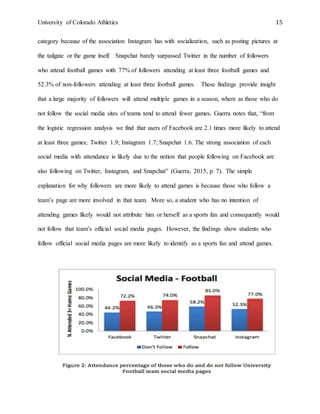
not. Figure 2 depicts the likelihood of fans attending sporting events based on whether or not
they follow their team on Facebook, Twitter, Instagram, or Snapchat. Students who follow their
team’s Facebook page are much more likely to attend at least three football games than those
students who do not follow the Facebook page. Guerra (2015) found that 72.2% of the Facebook
followers attended at least three football games. Consequently, only 44.2% of non-followers
attended at least three games, resulting in a 28% difference in attendance, or approximately
1,500 students (based on average attendance around 6,000 for students). Similarly, those
students who follow the team’s Twitter page are more likely to attend games, which is supported
by the evidence that 74% of students who follow their team’s Twitter page attend at least three
football games, while 46.3% of non-followers attended at least three of the games. Instagram
had the highest percent of followers attend games, with 86% of followers attending at least three
games and 58.2% of non-followers attending at least three games. Instagram likely leads this
University of Colorado Athletics 15
category because of the association Instagram has with socialization, such as posting pictures at
the tailgate or the game itself. Snapchat barely surpassed Twitter in the number of followers
who attend football games with 77% of followers attending at least three football games and
52.3% of non-followers attending at least three football games. These findings provide insight
that a large majority of followers will attend multiple games in a season, where as those who do
not follow the social media sites of teams tend to attend fewer games. Guerra notes that, “from
the logistic regression analysis we find that users of Facebook are 2.1 times more likely to attend
at least three games; Twitter 1.9; Instagram 1.7; Snapchat 1.6. The strong association of each
social media with attendance is likely due to the notion that people following on Facebook are
also following on Twitter, Instagram, and Snapchat” (Guerra, 2015, p. 7). The simple
explanation for why followers are more likely to attend games is because those who follow a
team’s page are more involved in that team. More so, a student who has no intention of
attending games likely would not attribute him or herself as a sports fan and consequently would
not follow that team’s official social media pages. However, the findings show students who
follow official social media pages are more likely to identify as a sports fan and attend games.
University of Colorado Athletics 16
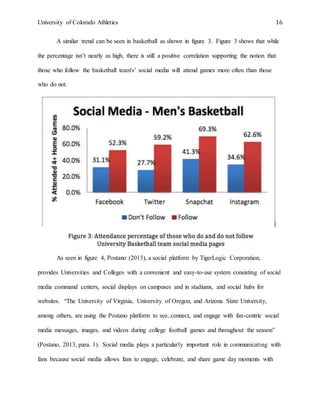
A similar trend can be seen in basketball as shown in figure 3. Figure 3 shows that while
the percentage isn’t nearly as high, there is still a positive correlation supporting the notion that
those who follow the basketball team's’ social media will attend games more often than those
who do not.
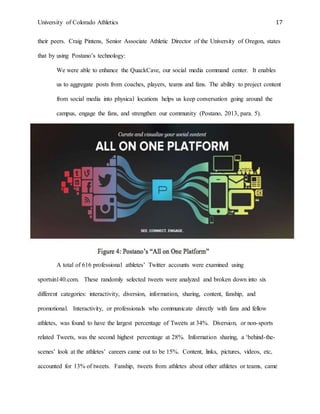
As seen in figure 4, Postano (2013), a social platform by TigerLogic Corporation,
provides Universities and Colleges with a convenient and easy-to-use system consisting of social
media command centers, social displays on campuses and in stadiums, and social hubs for
websites. “The University of Virginia, University of Oregon, and Arizona State University,
among others, are using the Postano platform to see, connect, and engage with fan-centric social
media messages, images, and videos during college football games and throughout the season”
(Postano, 2013, para. 1). Social media plays a particularly important role in communicating with
fans because social media allows fans to engage, celebrate, and share game day moments with
University of Colorado Athletics 17
their peers. Craig Pintens, Senior Associate Athletic Director of the University of Oregon, states
that by using Postano’s technology:
We were able to enhance the QuackCave, our social media command center. It enables
us to aggregate posts from coaches, players, teams and fans. The ability to project content
from social media into physical locations helps us keep conversation going around the
campus, engage the fans, and strengthen our community (Postano, 2013, para. 5).
A total of 616 professional athletes’ Twitter accounts were examined using
sportsin140.com. These randomly selected tweets were analyzed and broken down into six
different categories: interactivity, diversion, information, sharing, content, fanship, and
promotional. Interactivity, or professionals who communicate directly with fans and fellow
athletes, was found to have the largest percentage of Tweets at 34%. Diversion, or non-sports
related Tweets, was the second highest percentage at 28%. Information sharing, a ‘behind-the-
scenes’ look at the athletes’ careers came out to be 15%. Content, links, pictures, videos, etc,
accounted for 13% of tweets. Fanship, tweets from athletes about other athletes or teams, came
University of Colorado Athletics 18
out to be 5%. Lastly, promotional, sponsorships, upcoming games, giveaways, etc., represented
5% of tweets. The findings of this research supports the gratification theory: the more
opportunities fans have to connect with the team, the more likely it is that they will continue to
identify with the team (Hambrick M., Simmons J., Greenhalgh G., Greenwell C., 2010, p. 463).
Exposure through social media. Not only can social media help provide strategies to
communicate with current fans, but social media can also foster a relationship with new fans by
exposing them to a team. In social media platforms such as Instagram and Twitter, acquiring
followers allows users to interact with one another. Fan-to-fan interaction is a great way to
spread awareness of a team and increase a fan base. Ideally, fans post pictures on Instagram or
Twitter and their followers see these pictures and either ‘like’ or comment, leading to a
conversation about the team that helps bridge the gap among sports fans.
Social media is unique in that it can unite fans all across the globe. A successful way to
engage fans is the “follow back” concept. What the “follow back” concept entails is when one
person follows another user first, and after the second user sees that they have been followed,
will pay back the action by following the first user back. The “follow back” concept is effective
in bringing people together because “following back also means that you’re making a new
connection that could benefit you and your work. You are expanding your network and sources
of information; using social media to get your finger on the pulse” (Coley, 2015. para 4). This
connection helps establish a feeling of involvement between fans and athletes. When a student
sees that several football players “follow back” or followed the individual first, it could lead to a
deeper affiliation with not just the team, but individual players, leading to greater fan
involvement and attendance.
University of Colorado Athletics 19
Coley (2015) states that a follower on social media often helps disseminate your content
(ie. retweeting and sharing). This further expands your network and spreads the word to more
viewers than your individual followers. Urban (2016) also states that when respondents watch
sports-related content, respondents have a higher purchase intent for brands that use social
influencers. This context infers that the use of social media may directly influence the revenue
of a sports team whether it be from merchandise, ticket sales, or sponsors.
One of the best ways to achieve the goal of successfully communicating with college
students through social media is to excite students about collegiate sporting events and capitalize
on their passion and school spirit. According to Kirk Wakefield’s study at Baylor University,
“Passion had the strongest influences on social media activity related to the team. Passion
significantly influenced Facebook usage (.535, t = 4.70, p < .001) and Twitter usage (.521, t =
4.35, p < .001) related to the focal team. Social identification also had strong effects on
Facebook (.435, t = 4.62, p < .001) and Twitter (.388, t = 3.67, p < .001)” (Wakefield,
2016). Since the p values are less than .001 and the t values are relatively high, there is good
indication that the relationship between passion and social media usage is statistically significant
and not due to random chance. In fact, according to Wakefield, “[Regarding] the extent to which
individuals reported reading, posting, and exchanging social media content through the team’s
official Facebook or Twitter accounts, passion is the strongest predictor of social media usage
among all variables in the studies” (Wakefield, 2016, p. 7).
Enhancing the Gameday Experience.
The lack of attendance at sporting events not only hurts ticket sales and revenue, but also
greatly impacts the overall game day experience. It is hard enough to get fans to attend the
game, but it is another thing getting them to stay the entire duration of the game. Home field
University of Colorado Athletics 20
advantage is a great asset for sport teams because teams often look to their fans late in games to
give them the needed energy to win the game. As Miami Dolphins owner Stephen Ross said,
“Fans are the most valuable members of our team.” Players feed off of the fans noise, energy,
and engagement and use it to their advantage. If fans leave games early, there is a potential drop
off in morale from the players and the home field advantage is eliminated.
Promotions can also be a valuable strategy to incentivize fans to stay the entirety of the
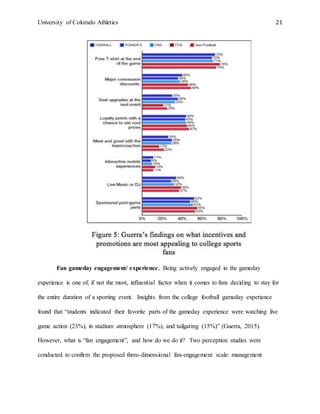
game. As seen in figure 5, Guerra (2015) notes that 70% of Power 5 college student fans will
stay the duration of the game if a free tee shirt is given at the end of the game, 36% of students
will stay for major concession discounts, 36% will stay for a seat upgrade at the next game, 43%
of students will stay for a loyalty point program in order to win prizes, 30% of students will wait
for a chance to meet players and coaches, 9% will stay for mobile interaction experiences, 29%
of students will stay for live music or a DJ, and finally, 48% of students will stay the duration of
a game if there is a sponsored post game party provided. Promotions are particularly effective in
incentivizing students because they enhance the gameday experience. For example, a fan
looking back at their time at the game would likely hold a higher value perception of the game if
they met a player or coach or upgraded their seat for next game. A young child meeting their
favorite player could create a lifelong loyal fan because of the positive affiliation with that
experience. Free t-shirts could spread awareness of the team around the community by students
continuing to wear the shirts outside of the stadium. Promotions are practical, strong incentives
commonly used to capitalize on student attendance.
University of Colorado Athletics 21
Fan gameday engagement/ experience. Being actively engaged in the gameday
experience is one of, if not the most, influential factor when it comes to fans deciding to stay for
the entire duration of a sporting event. Insights from the college football gameday experience
found that “students indicated their favorite parts of the gameday experience were watching live
game action (23%), in stadium atmosphere (17%), and tailgating (15%)” (Guerra, 2015).
However, what is “fan engagement”, and how do we do it? Two perception studies were
conducted to confirm the proposed three-dimensional fan-engagement scale: management
University of Colorado Athletics 22
cooperation, prosocial behavior, and performance tolerance (Masayuki, Y., Gordon, B., Makoto,
N., & Biscaia, R. 2014). Management cooperation was defined as:
A sport consumer’s collaborative, constructive participation in the value creation and
service delivery process at sporting events (e.g., providing constructive feedback to event
personnel to ensure the safety of spectators at the event site, and abiding by the
organization's’ policies regarding ethical fan conduct). (Auh, Bell, McLeod, & Shih,
2007; Bettencourt, 1997)
Additionally, according to Brodie, Hollebeek, & Ilic (2011), prosocial behavior is the act of sport
consumers engaging in network development, such as interpersonal or computer-mediated fan-
to-fan behaviors on behalf of the team. Finally, De Ruyter & Wetzels (2000) describe
performance tolerance as reflecting a sport consumers’ engagement by the display of team-
related products seen during unsuccessful team performance. Customer engagement captures a
variety of non-transactional consumer behaviors (Verhoef, Reinartz, & Krafft, 2010) and can be
useful for explaining how consumers and firms co-create new value propositions in non-
transactional buyer-seller exchanges (Hoyer, Chandy, Dorotic, Krafft, & Singh, 2010). The first
study examined what factors comprise fan engagement and how to validate the fan engagement
three-factor model. The second study judged validity by examining predecessors and
ramifications of fan engagement.
Despite numerous studies conducted, there is still confusion on how to conceptualize
customer engagement. Based on previous research, there are three divergent conceptualizations
apparent: cognitive, behavioral and cognitive/affective/behavioral (Masayuki et al., 2014, p.
400). The behavioral approach to customer engagement is measured on a behavioral-based
model. Engaged consumers’ behavior typically includes a number of non-transactional
University of Colorado Athletics 23
behaviors, such as consumer-to-consumer interactions, blogging, writing reviews,
recommendations, or word-of-mouth activity. Based on these criteria, “customer engagement
reflects a consumer’s non-transactional behavior and is a significant route for creating, building,
and enhancing consumer-firm relationships” (Hoyer, et al., 2010, p. 402). On the contrary,
another view of customer engagement is based on insight and perception. Sprott, Czellar, and
Spangenberg (2009) note that consumers’ tend to incorporate their own favorite brands into the
self-concept of customer engagement.
Three main streams of research are relevant to this study: customer engagement in non-
transactional behaviors, customer engagement in transactional behaviors, and customer
engagement in long-term relationships with a sport team (Masayuki et al., 2014, p. 401). In
regards to sports, engaged consumers’ non-transactional behaviors include:
Self-enhancement by basking in reflected glory and cutting off reflected failure, displays
of sport fandom, social interaction, play and rituals, fan community-related behavior,
performance tolerance, pregame tailgating parties, sharing knowledge of a game/team,
supportive word-of-mouth behavior, basking in spite of reflected failure, cutting off
reflected success, and participating in memorable marketing programs. (Masayuki et al.
2014, p. 401-402)
The second theme was customer engagement in transactional behaviors. Researchers have
focused on transactional behaviors such as, “attending games, watching games on television,
buying team products, purchasing peripheral game-related products, and participating in fantasy
sports” (Masayuki et al. 2014, p. 402). Finally, the third theme discussed states that several
researchers suggest sport consumers often maintain a long-term relationship with a sport team
(James, Kolbe & Trail, 2002). James et al. (2002) suggested that fans form an emotional and
University of Colorado Athletics 24
subjective attachment to sport teams. Additionally, Jowdy and McDonald (2002) mentioned that
sport fans who are highly engaged have a strong desire for long-term relations with their favorite
teams, and often actively participate in building that relationship through fan loyalty programs,
season tickets, and booster memberships. The findings above justify the notion that sport
consumers engage in various behaviors, including “sport-related behaviors (e.g., attend, read,
watch, listen, and purchase), impression-management behaviors, relationship-building behaviors
(e.g., loyalty programs, season tickets, and booster memberships), and non-transactional extra-
role behaviors (e.g., social interaction, word-of-mouth, and participating in marketing
programs)” (Masayuki et al., 2014, p. 403). In the following section, we address how fan
engagement is conceptualized and measured in spectator sport.
“Before we conducted our main study, we first pretested the proposed fan-engagement
instrument with undergraduate students at a private university in Japan” (Masayuki et al., 2014,
p. 404). The main purpose of this pilot study was to create a reference point and a reliable scale
to compare results to. A total of 53 students rated their engagement levels in management
cooperation, prosocial behavior, and performance tolerance on a seven point Likert scale ranging
from 1 (strongly disagree) to 7 (strongly agree).
For the main study, data was collected from a survey that was deployed with spectators at
a professional soccer game in east Japan. Out of the 431 surveys that were deployed to the
spectators, 99.3% were returned (428). An additional 26 surveys were thrown out for being
ineligible. This left a final remainder of 402 good responses, representing 93.3% of the original
431 surveys deployed. The goal of this study was to define and develop a conceptual model of
fan engagement, generate a survey, and determine the validity of the proposed fan engagement
scale with college student and sport consumer samples.
University of Colorado Athletics 25
For the purpose of this study, fan engagement was defined as “a sport consumer’s extra-
role behavior in non-transactional exchanges to benefit his or her favorite sports team, the team’s
management, and other fans” (Masayuki et al., 2014, p. 403). Conceptually, the three-
dimensional model reflects the professional sport context, because professional sporting events
can create an environment in which sport consumers interact with other fans (Oliver, 1999),
create unique experiences (Decrop & Derbaix, 2010), and follow both successful and
unsuccessful teams (Mahony et al., 2000). The emerging customer engagement theory in
marketing, as described by Brodie et al. (2013), is the concept that “the customer is the co-
creator of value,” further proving the point that value is created by the interactive nature between
buyers and sellers. This emerging customer engagement theory is vital in management
cooperation and prosocial behavior, since value needs to be created for an exchange to occur and
for relationships to be made. In addition, performance tolerance is believed to be a captious
factor in fan engagement. The results from study 1 support the multidimensional concept
(cognitive, behavioral and cognitive/affective/behavioral), but additional efforts are necessary to
further prove the three dimensions of fan engagement are distinct.
The main purpose of the second study was to “provide further evidence of construct
validity of the fan-engagement scale and to assess its nomological validity by investigating the
antecedents and consequences of fan engagement” (Masayuki et al., 2014, p. 406). In addition to
the previous study, this study was focused on examining three precursors: team identification,
positive affect, and basking in reflected glory (BIRGing), as well as two ramifications: purchase
intention and referral intention (Masayuki et al., 2014, p. 406). Because of the three fan
engagement dimensions, (management cooperation, prosocial behavior, and performance
tolerance), Masayuki (2014) proposed the following hypotheses:
University of Colorado Athletics 26
Hypothesis 1: (a) Team identification has positive effects on management cooperation,
(b) prosocial behavior, (c) and performance tolerance.
Hypothesis 2: (a) Positive affect has positive effects on management cooperation, (b)
prosocial behavior, (c) and performance tolerance.
Hypothesis 3: (a) BIRGing has positive effects on management cooperation, (b) prosocial
behavior, (c) and performance tolerance.
Hypothesis 4: (a) Management cooperation has positive effects on purchase intention and
(b) referral intention.
Hypothesis 5: (a) Prosocial behavior has positive effects on purchase intention and (b)
referral intention.
Hypothesis 6: (a) Performance tolerance has positive effects on purchase intention and
(b) referral intention.
The methods used in study 1 were directed to study 2. Team identification, positive
affect, purchase intention, and referral intention were all adapted from previous research. Fan
engagement, team identification, positive affect, BIRGing, and purchase intention were
measured on a seven-point Likert scale ranging from 1 (strongly disagree) to 7 (strongly agree).
Referral intention was measured with a single-item scale by asking respondents how many
individuals they intend to invite to future games in the current season (Masayuki et al., 2014).
Similar to study 1, study 2’s data was collected from spectators attending a professional
soccer game in western Japan. Like study 1, study 2 distributed questionnaires in the stands at
the start of the game. Prior to the questionnaires being handed out, 17 surveyors estimated the
percent of each gender and age group among spectators. Out of the 500 questionnaires handed
out, 493 were returned for a response rate of 98.6%. Accounting for the 21 rejected for
University of Colorado Athletics 27
ineligibility, the final remainder of 472 good responses represented 94.4% of the original 500
questionnaires. Regarding the results from study 2, 64% of respondents were male (303) and
the average age was 40.77 years old, with one-third of subjects between ages 40-49, 26.7% 50
years or older, 18.9% 30-39 years old, and 18% 20-29 years old.
The results for H1a, H1b, and H1c indicated that there is a positive correlation between
team identification and management cooperation, prosocial behavior, and performance
tolerance. “Team identification is an important precursor of all the dimensions of fan
engagement” (Masayuki et. al., 2014, p. 409). When fans have a positive identification with
their team, they are more likely to participate in creating value, support their team through fan-
to-fan interactions, and continue to purchase team-related products even during unsuccessful
team performance. H2a, H2b, and H2c show the positive effect was statistically significant in
determining management cooperation and performance tolerance, but prosocial behavior is not
statistically relevant. The results from hypothesis H3a and H3b support the theory that basking
in reflected glory (BIRGing) can be used to predict management cooperation and social behavior
because fans participate in creating value by engaging in network development through
communicating with other fans. H3c, however, was not supported because fans are not likely to
go out and buy a modern day jersey just because that team won the championship fifteen years
ago, similar to how a random sample audience may not enjoy music that was popular a decade
ago. Hypothesis H4a supports the theory that management cooperation is correlated with
purchase intention. When fans intend to purchase products such as jerseys, t-shirts, hats, or
pictures, they increase their constructive participation in creating value at sporting
events. Consequently, the findings for hypothesis H4b did not support the theory that
management cooperation is correlated with referral intention. Hypothesis H5a does not support
University of Colorado Athletics 28
the theory that prosocial behavior is correlated with purchase intention because there is no
evidence that engaging in fan-to-fan interactions leads to greater purchase intention. However,
on the contrary, there is a statistical correlation between prosocial behavior and referral intention
(H5b). This supports the theory that fans are more likely to bring friends and communicate with
people about sports if they are engaging in network development and fan-to-fan online
interactions. Hypothesis 6a supports the theory that performance tolerance leads to greater
purchase intention because the more tolerance a fan has for their respected teams performance,
the more likely that fan will be in continuing to support their teams by purchasing team
merchandise. Similar to hypothesis H4b, hypothesis H6b does not support the theory that
performance tolerance leads to greater referral intention.
This study showed how a “consumer's purchase intention is influenced by the three fan-
engagement dimensions and other predictor variables” (Masayuki et al., 2014, p. 409). Based on
our findings, we can conclude that team identification is correlated with the three dimensions of
fan engagement (management cooperation, prosocial behavior, and performance
tolerance). Masayuki (2014) notes that positive affect is a statistically significant antecedent of
management cooperation and performance tolerance, but not prosocial behavior. Additionally,
there is evidence that basking in reflected glory (BIRGing) can be used to predict management
cooperation and prosocial behavior, but not performance tolerance. In summation, the results
from study 2 show that purchase intention can be correlated with team identification, positive
affect, basking in reflected glory (BIRGing), and the three fan-engagement dimensions, but holds
little significance in determining the effect of referral intention.
University of Colorado Athletics 29
Why college students attend games. Curi, Dart, & Giesemann (2014) discuss what
factors influence students to attend college sporting events in their case study at Northern
Arizona University (NAU) as seen in figure 6. The study raised several questions regarding
what motivates fans to attend college games, as well as examining the legitimacy behind the
common gender stereotype that men are more likely to attend games than women, determine any
correlation between growing up a fan of a team and student attendance at games, validate the
proposed theory that in-state students are more likely to attend games than out-of-state students,
and identify what involvement, if any, the Greek system has in attending sporting events? To go
into further detail, the commonly portrayed University experience in the United States includes
an energetic and passionate community centered around the University's athletics. While many
Universities do have a very involved and engaged community simply because of the relevance of
the University’s sport teams, other communities lack this sport culture. This brings up a very
important question, what motivates fans to engage and support sport teams where the traditional
culture of sports is not prevalent?
To answer this question, “a random
sample of 4,000 (out of 22,670) residential
undergraduate Northern Arizona
University students ages 18 years and
older were invited to participate in an
online survey” (Curi et al., 2014, p.
3). The survey was created using Qualtrics survey software, and was reviewed and approved by
the NAU Institutional Review Board. Students were offered incentives for completing the
University of Colorado Athletics 30
survey, including a chance to win a $100 gift card or free pizza. A total of 544 students
completed the survey, for a response rate of 13.6% and a margin of error of +/- 4.15 percent.
Kim, Trail, and Magnusen (2013) argue that the stronger identity one holds with a sports
team, the more likely they are to attend that teams sporting event. Sport fans that feel a sense of
belonging and a positive attitude towards the sport are more likely to identify with a sports team.
The results from the NAU study show that of the 544 respondents, 75.3% (410) of respondents
reported that they have attended a NAU sporting event at least once, with the average respondent
attending 7.3 events (2 for each semester at NAU). Of the 544 respondents, twenty-nine percent
(158) described themselves as “fans” of NAU Football, while 13.6 percent (74) described
themselves as “fans” of NAU Basketball. Of the approximately 158 students who identify as fans
of Football, seventy-one percent (113) have attended a NAU football game. Similarly, of the
roughly seventy-four students who identify as fans of men’s basketball, 38.6% (29) have
attended a men’s basketball game. The data retrieved from this study was not sufficient to
determine whether the stronger identity one holds with a sports team leads to more games
attended, however Kim, Trail, and Magnusen (2013) argue that the stronger identity one holds
with a sports team, the more likely they are to attend that teams sporting event. Sport fans that
feel a sense of belonging and a positive attitude towards the sport are more likely to identify with
a sports team.
Spaaij and Anderson (2010) describe two major reasons for team identification:
compulsion and sanctions. Many participants feel that they have no choice but to support the
team that they grew up supporting or their family supported. Children, for example, reported
sanctions or negative consequences if they chose to support other teams than their family and
peers. Consequently, teams that participants enjoyed the most were associated with their own
University of Colorado Athletics 31
class status, and area of origin. The NAU research supported Spaaij and Anderson’s theory that
growing up a fan of a specific sports team leads to greater involvement in the team. A positive
correlation was found between growing up a fan of college sports and college sports attendance,
r(540)=.16 p<.001, as well as a negative correlation between not having a relationship to sports
growing up and attendance, r(540)= -.17, p <.001. “Childhood socialization and exposure to
athletics in the family certainly seem to have an impact on sporting event attendance during
college” (Curi et al., 2014, p. 4).
Based on our findings above, it is safe to say that growing up a fan of a particular sports
team leads to greater fan involvement. In addition, the average sports fan could reasonably
believe that in-state students have greater fan engagement with their sports team than out-of-state
students due to growing up near that sports team. However, the findings from NAU did
not support the hypothesis that more in-state students attend sporting events than out-of-state
students. In fact, 87% out-of-state students reported attending at least one NAU sporting event
compared to 70.3% in-state students attending at least one game. Additionally, more out-of-state
students attended more events per semester (2.72) than in-state students (1.70). The most logical
reasoning for these findings were that out-of-state students travel, sacrifice greater amounts, and
often pay more money to attend schools in different states, causing the students to feel “more
inclined to take advantage of all that is part of a traditional college experience” (Curi et al., 2014.
p. 4).
Many people hold the belief that men like sports more than women, and therefore will
attend more games. To dive into this conception, Hall and O’Mahony (2006) studied the
motivations behind attending sporting events for men and women, and found cogent differences.
Primarily, the theory that men value the emotional aspect of the game and a sense of belonging
University of Colorado Athletics 32
related to being a “true fan” is apparent. Meanwhile, women often place a higher threshold on
the social factors that are attributed with sporting events, including spending quality time with
friends and the physical act of attending a large-scale event. However, the study at NAU did not
show any statistical correlation that men are more likely to attend sporting events than
women. In fact, the results showed quite the opposite. Female students (77.2%) were more
likely than male students (72.6%) to have attended a NAU sporting event. Additionally, women
attended more games per semester (2.05) than men (1.92). This relates back to Hall and
O’Mahony’s (2006) idea that women value the social aspect of sporting events and “being with
friends” while men are more interested in “watching the game.” This same attitude towards
sporting events may differ depending on the team, however. For example, the University of
Alabama has always had very strong support from fans, despite the success of the team. This
data is particularly related to teams who are not as successful. Essentially, when teams are not as
skilled or successful, the motivation for attending sports games often switches from attending to
watch and enjoy the game as a fan to a social scene for friends to be able to spend time together
at a common event.
To discuss the point that attending games is a social scene for friends in more detail,
Krohn, Clarke, Preston, McDonald, and Preston (1998) identified several motivating factors for
attending sporting events, including “personal objective (attendance as a symbol of status), the
desire of fans to be included in the overall game atmosphere, and excitement and escape as a
break from everyday monotony” (Curi et al., 2014. p. 5). A strong correlation was found
between having an organizational membership and sport attendance, such as being a member of
a fraternity or sorority [r (541) =.12, p=.004]. Attending games as a large group (such as a
fraternity or sorority) increases the feeling of involvement and connection with friends. Perhaps
University of Colorado Athletics 33
even more of a factor in the correlation between attending games and organizations, is what is
known as FOMO, or “fear of missing out.” NAU reported that 93.3% of the students who have
attended an NAU game have attended the game with their friends. More so, 58.6% of those who
have attended games say the primary reason for enjoying sporting events is because they enjoy
“being with friends”. These findings further support the point that students do not always attend
games for enjoying the sport or team spirit, but instead because of the sense of involvement and
socializing with friends.
After reviewing Northern Arizona University’s case study regarding motivations behind
college students attending college games, it is apparent that there are several reasons behind a
student's’ decision to attend sporting events. While it is important to keep in mind that the
culture around sporting events may differ depending on the university, a number of the findings
can relate directly to both contemporary and traditional universities. Based on our findings, it
would be safe to say that students with a personal history of participating or characterizing
themselves as sports fans while growing up are more likely to attend sporting events. The
findings did not support the hypothesis that in-state students are more likely to attend games than
out-of-state students, and instead showed that out-of-state students are more likely to attend
games due to the distance traveled, money paid and sacrifices given up that leads students to feel
more inclined to attend games. The NAU study debunked a common gender stereotype that men
are more likely to attend games than women, leading us to identify sporting events as a great
social scene for friends to spend time together. It was also noted that students who are involved
in organizations, such as fraternities and sororities, are more likely to attend sporting events
because of the sense of belonging and fear of missing out on memories with friends.
University of Colorado Athletics 34
In summary, the most effective ways to communicate with College students to attend
games involve group affiliation, family, the architecture of the facility, tailgates, food and drinks,
and email. Fans are typically more likely to attend games if there is a group of people to share
the social experience with. Additionally, meeting new people and creating relationships are
important for the student demographic. The relationships created at sporting events contribute to
the atmosphere of the game, including fans cheering or chanting fight songs. Game settings,
weather, and the atmosphere of game are all factors that influence fan-to-fan interactions and
relationships. The architecture of the facility, such as comfortable seats, air conditioning, good
sight lines, non-glare lighting, numerous easily accessible rest rooms, food and drink concession
areas, walk ramps, and exits, can have a significant impact on communication and
attendance. Tailgates are a respectable method to suit the social scene that sports fans demand,
but in truth, doing so can decrease attendance because fans are too engaged in the social scene to
leave. Food and drink inside the venue are useful incentives used to increase fan
attendance. Attending sporting events often consumes an entire day, especially with tailgating
parties beforehand, so fans regularly scavenge the concession stands at half time to quench their
hunger.
Surprisingly, email has proved to be very ineffective when communicating to college
students. This is because students often associate email with school, and find email
“boring”. More so, college students rarely use email for anything beside school, and are only on
email for an average of six hours per day. The most effective ways to communicate to college
students through social media include Facebook, Twitter, Instagram, and Snapchat. Those who
follow the social media pages of teams are more likely to attend games than those who do not
because they typically have greater affiliation with that team. Sport teams who utilize the
University of Colorado Athletics 35
“follow back” method commonly have stronger relationships with followers because it gives the
social media pages a personality rather than throwing facts at followers. The most proven
methods used to enhance the gameday experience consist of promotions, incorporating the social
scene in the stadium, and the need to feel included. Promotions are often useful to get fans to
stay the entire span of the game. Particularly, handing out free t-shirts, chances to meet players
or coaches, or sponsored parties are the most effective strategies. Live game action, stadium
atmosphere, and tailgating are all vital in creating the best gameday experience. There is
significant evidence to prove that many attend sporting events in fear of missing out or not
feeling included. Fans frequently attend games, even if they do not consider themselves a sports
fan, because their friends are going and they want to feel included. Basking in reflected glory
(BIRGing) greatly increases fans affiliation with a team. Notably, there is no statistical evidence
to support the common stereotype that men are more likely to attend games than women. In fact,
a reasonable argument can be made that women are more likely to attend game than men because
women value the social scene of the game greater than the game itself. In conclusion, the most
effective ways to get fans to attend games must include effective communication methods
through social media and creative strategies to enhance the gameday experience.
University of Colorado Athletics 36
Best Practices
Effective Ways to Communicate with College Students
Social Media is an effective platform for communicating to college students and should
be utilized to maximum capacity. According to Mangold & Faulds (2009):
The nine ways that businesses use social media successfully are to; (1) provide
networking platforms, (2) use blogs and other social media tools to engage customers, (3)
use both traditional and Internet-based promotional tools to engage customers, (4)
provide information, (5) be outrageous, (6) provide exclusivity, (7) design products with
talking points and consumers’ desired self-images in mind, (8) supports causes that are
important to consumers, and (9) utilize the power of stories (as cited by Wysocki, 2012,
p. 7).
The University of Colorado has a lot of opportunity in social media use with these nine goals in
mind. YouTube channels centered around collegiate sports are an effective strategy when
communicating with college students. Grand Valley State University is one example of a college
that has successfully implemented this YouTube technique. According to Mike Scott (2011),
“[Grand Valley State University] has an active YouTube channel with more than 300 videos that
have received tens of thousands of views.” Another professional at the Grand Valley State
University, Dave Poortvliet, had this to say about their interactive website and YouTube
channels, ”’It’s part of an effort to get more dynamic content there so others can share the
experiences that people who have been to our campus or know the university had’” (Scott, 2011,
p. 3). YouTube is a unique niche due to the unlimited number of videos and content that can be
created. Specifically related to college sports, YouTube videos bring the social scene and
excitement of sporting events to a computer screen. An effective tactic to build that relationship
University of Colorado Athletics 37
with college sports fans is to share memorable moments from that team, such as the thrill of an
overtime win or a game changing play. Sharing memorable moments on social media carries the
gameday experience throughout the week when there are no games to be played.
Additionally, videos can be used to build up the anticipation of big games. For example,
the Dallas Mavericks have had a history of effective sports marketing videos. The four tactics of
the Mavericks are centered on getting the fans to feel as if they are a part of the action through up
close and personal shots of players and in-game action. The 4 elements of an exciting sports
marketing video (2016) include “putting the viewer in the game.” Fans enjoy feeling as if they
are making a difference for their team, and this fulfillment can be accomplished through a
number of mediums. Not only do sport teams love fans being loud and supportive because it
increases morale for the team, but supportive fans also promote the brand and increases ticket
sales. Examples of how fans can feel that they are “in the game” include being shown on the
jumbotron or are invited to the field, court, or rink. The jumbotron is a useful tool for increasing
fan engagement because jumbotrons are “entertaining, gets lots of reactions from other fans and
breaks up the monotony of the game itself” (4 elements, 2016, para. 4). Inviting fans to the field
is a simple yet efficient method to connect with fans and provide some unique
excitement. Additionally, the Mavericks noted the two groups of fans that are “integrated in the
game experience” (4 elements, 2016. para. 5), the “Mavs ManiACCS” and the “Dallas
Mavericks Drumline”. The “Mavs ManiACCS” are a group of diehard fans who are known for
their extreme energy at games, while the “Dallas Mavericks Drumline” combine “drumming
talent, a unique sense of rhythm, and fanatical dress” (4 elements, 2016, para. 6).
The second element of an exciting marketing video is to “set yourself apart from the
many other types of videos that cover the game” (4 elements, 2016, para 8). The technology and
University of Colorado Athletics 38
video angels’ we have today are no doubt memorizing, but that isn’t “unique”. An aerial shot of
the fans at a football game or a GoPro attached to the chest of a player during warm ups are
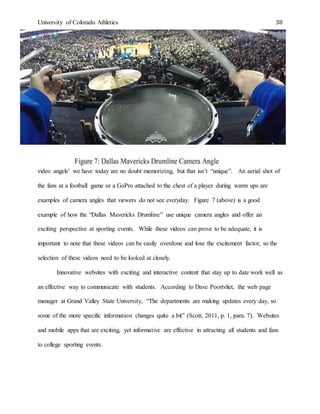
examples of camera angles that viewers do not see everyday. Figure 7 (above) is a good
example of how the “Dallas Mavericks Drumline” use unique camera angles and offer an
exciting perspective at sporting events. While these videos can prove to be adequate, it is
important to note that these videos can be easily overdone and lose the excitement factor, so the
selection of these videos need to be looked at closely.
Innovative websites with exciting and interactive content that stay up to date work well as
an effective way to communicate with students. According to Dave Poortvliet, the web page
manager at Grand Valley State University, “The departments are making updates every day, so
some of the more specific information changes quite a bit” (Scott, 2011, p. 1, para. 7). Websites
and mobile apps that are exciting, yet informative are effective in attracting all students and fans
to college sporting events.
University of Colorado Athletics 39
When attending sporting events, there are often two types of sports fans apparent. The
first type of fan being the professional, proper and executive type, and the second being the wild,
loud, and entertaining type. From a fan perspective, both are equally important. From a video
perspective, those fans that tend to lean towards the loud type are preferred (4 elements, 2016,
para. 10). Simply put, these fans are more entertaining to watch. The elaborate apparel and
lively chants adds passion to the video, and helps fans feel like a family. Look at the common
“wave”, for example. Note that the “wave” typically starts in the nosebleed sections where the
fans are loud and rowdy, not the executives sitting in box seats or courtside. This is because the
fans are more engaged in the game-day experience.
Each sport has a unique personality, and the DJ music choices at these games often
reflect those personalities. In an effective video, there must be an appropriate soundtrack that
reflects the personality of the sport you are portraying. For example, “for an NBA basketball
team, that would be in the genre of Rap, somewhat progressive and current” (4 elements, 2016,
para. 12). European soccer, on the other hand, could be focused around popular sing-a-longs
while the NFL could focus on rock songs.
Communicating Through Social Media
Clavio (2011) conducted study with a group of 18-29 year old millennials and found that
age was a significant factor when discussing usage of social media. Millennials use newspaper,
radio, and the athletic site significantly less than older generations. While all age groups tend to
check email at least once a day, millennials typically use email far less than Facebook or other
social media accounts. Podcasts generally do not see a lot of traffic among all age groups, along
with Twitter. Although YouTube was found to be just shy of Facebook, YouTube is a great
platform to utilize for athletic departments that are pursuing expansion in their connection
University of Colorado Athletics 40
strategies with millennials because of YouTube’s capability for embedding links from third party
sources. This is specifically important with Facebook and Twitter, as users share videos with
their peers and increase fan-to-fan interactions. In fact, Facebook and Twitter users are more
likely to watch the entire length of a video is less than 30 seconds. According to a study
conducted by Chris Savage (2009) of Wistia, a professional video production company, the
average 30-second video was viewed 85% of the way through, while a two-minute video was
viewed only 50% of the way through. This information can be used to load important
information up front to effectively communicate with an audience. Since an overwhelming
number of millennials regularly use Facebook, short videos loaded with information acts as a
very effective way to engage users and create awareness of an event since users often share
videos with their friends.
According to O'Hallarn, Morehead, & Pribesh, (2016), social media allows for an
interactive way to communicate and create a relationship between fans and team
personnel. Athletes often times give news, which makes social media more personable. Now,
athletes can connect with fans more than ever before. The Social Marketing Theory seeks to find
the most “effective, efficient, equitable, and sustainable marketing tactics.” Many institutions
are having a hard time running social media platforms on a day-to-day basis. More often than
not, athletic communication departments are running social media rather than the marketing
departments. A study was conducted at Old Dominion University using the idea of “STEAM” or
steal, team, engagement, analytics, and mavens. Prior to 2014, the coaches and other site
administrators were the only ones involved in using social media at Old Dominion
University. However, during the 2014 year, Old Dominion implemented a team dedicated to
social media and has taken the time to analyze followers and their behavior. An efficient tactic
University of Colorado Athletics 41
they used was stealing ideas from other schools. For example, using a catchy hashtag on twitter
to market the team or similar social media posts.
Snapchat, a form of social media, is on the rise. In a study conducted of 1,600 college
students, by Sumpto, a college-centric marketing company, 77% of these students use Snapchat
daily. As of August 1, 2014, Snapchat was allowed by the NCAA to be used as a recruiting
tool. At the University of Kansas, a junior journalism major runs the account. One of the most
successful means of marketing to the student body is giving students an inside look on athletes
(Axelrod, 2014). This often includes players taking the Snapchat account for a day to show fans
what the day-to-day life of an athlete is like, including attending classes, eating lunch or going to
the gym. This medium works to break down the barrier between students and student athletes.
Enhancing the Gameday Experience
Engagement entails the idea that pictures are worth a thousand words. Fans like to be
engaged with what is going on with the team. Old Dominion University conducted a focus
group of their fans and concluded that fans love when the team interacts with them personally
including “liking” photos or tweets. Some even claimed that they wished the pages had more of
a personality rather than just spitting out information. The researchers suggest that social media
be used to be more “intimate” with fans. Tailgate parties and pre-game activities are great ways
to encourage the student body to attend games, and engage in the inclusive atmosphere
experienced at sporting events. Incentives like these can prove to be extremely successful at
Universities that are not predominantly well known as sports schools, and where team
performance is typically subpar, similar to the current characteristics at the University of
Colorado. According to Jayson Blair, a writer for the New York Times, “Because of the
tailgating parties and other efforts, Kent State, which had the worst attendance in 2001 with only
University of Colorado Athletics 42
6,595 fans per home game, has seen attendance at its Dix Stadium rise 87 percent this season, to
about 11,447 per game” (Blair, 2002, p. 1).
Another attractive incentive that has been proven to increase student attendance is
refunding the price students pay for their student season pass tickets if they attend a certain
number of games. One athletic program that has utilized this strategy well to capitalize on
increasing student attendance is the University of Oklahoma. According to Andrea Cohen and
John Helsley, staff writers for The Oklahoman, “The Sooners will refund students the $130
season ticket cost if they attend 16 or more games. As a result OU has sold more than 1,300 of
its 1,400 student season tickets. That’s more than double what the Sooners sold last season”
(Cohen & Helsley, 2008, p. 1). This strategy went over particularly well with regards to
achieving the objective of attracting college students who are on the fence of purchasing a
student season pass. According to Kyle Hansel, a sophomore student at OU, “I was on the edge
on whether I was going to come to all of the games or not… but the whole, get-your-money-back
thing was definitely a deciding factor in whether I was going to come to all of them and buy
student tickets” (Cohen & Helsley, 2008, p. 1).
The University of Southern California took a large step toward enhancing gameday
experience by partnering with Brand Affinity Technologies, Inc. Brand Affinity is the expert in
engaging, activating, and monetizing fans and already possesses partnerships with over a dozen
marquee NCAA institutions. The FanPhotos activation platform provides an authentic
experience at every home game that captures everything to love about college football. Roving
photographers interact with the crowd throughout the game, allowing fans to view the photos
afterward and customize them with USC logos to be purchased later. Brand Affinity also added
the Fanoramic, a giant multibillion-pixel photograph taken at a selected game that fans can view
University of Colorado Athletics 43
online afterwards and find themselves in the crowd. Apart from college partnerships, teams from
the MLB, NBA, NFL, and NHL also have deals with Brand Affinity (Brand Affinity, 2013).
In summary, YouTube channels centered around collegiate sports are an effective
strategy to communicate to college students. Grand Valley State University is an excellent
example of how a school can connect with their student body through social media. Grand
Valley State University utilizes this tactic by creating a YouTube channel with over 300 videos
uploaded and tens of thousands of views per video that captures and brings the excitement of the
social scene to a computer screen. These videos increase relationships with fans and bring the
community closer together by sharing memorable moments. The Dallas Mavericks have an
exceptional sports marketing strategy, which includes placing the viewer in the game to integrate
the game experience, differentiating content from the countless strains of sports marketing
videos, selling the “true” fan, and incorporating inventive and original DJ content. In 2014, Old
Dominion University implemented a team dedicated to social media to take the time to analyze
followers and their behavior using the “STEAM” (steal teams engagement, analytics, and
mavens) tactic. An effective strategy Old Dominion incorporated using the “STEAM” method
was using catchy hashtags, such as #GoBlue to resonate with fans on social media. The
University of Kansas has integrated a Snapchat account to give followers an inside look at the
lives of athletes. The page is run by a Journalism student, and often shows athletes taking over
the account for a day to post pictures or videos showing what the typical day of an athlete is
like. The University of Oklahoma has shown that refunding student season passes if students
attend a certain number of games contributes to greater attendance. This tactic sold more than
1,300 of the 1,400 student tickets offered, and more than doubled attendance from the previous
year by reaching those students who were unsure about purchasing a season pass or not. The
University of Colorado Athletics 44
University of Southern California partnered with Brand Affinity Technologies to enhance the
gameday experience by providing an authentic experience at every home game. Photographers
interacting with fans throughout the game by taking pictures of them and selling them at the
conclusion of the game or giant multibillion-pixel photograph taken at a selected game that fans
can view online afterwards and find themselves in the crowd are capable examples of enhancing
the gameday experience for fans. In conclusion, YouTube and Snapchat are effective ways to
communicate to fans through social media by fostering stronger relationships with fans. Well
executed sports marketing videos can be used to increase anticipation of big games and
photographers and other social media platforms can be utilized at games to enhance the gameday
experience.
University of Colorado Athletics 45
Methods
The purpose of this study was to seek quantitative and qualitative evidence to support
effective communication strategies with College students, and the objective of increasing
attendance at sporting events. This study looks to identify specific examples of valid
communication strategies by targeting comparable Universities and College students, and
directly communicating with those parties. The following section will include three meaningful
studies used to determine effective communication strategies. The first study targets contacting
similar, complementary Universities to discuss what forms of communication strategies they find
useful for their organization. The second study deployed was a student survey targeted at
University of Colorado students to gain quantitative data about demographics, age, attendance,
and forms of social media. The final study conducted was a focus group of eight students held at
the University of Colorado.
Method 1: Student Survey
Participants. Since all schools differ from one another, we conducted and sent out a
Qualtrics survey to the University of Colorado student body in order to receive quantitative and
qualitative feedback from the student’s perspective. Our target number of participants for this
survey was 200. After the Qualtrics survey was deployed for five days, we exceeded our target
number of respondents by 50, for a total of 250 respondents. Each participant was a volunteer.
Materials and Apparatus. The materials required to conduct this survey include a
computer or mobile device, Qualtrics software, and a set of clear, relevant questions.
University of Colorado Athletics 46
Data Collection Procedure. Through great deliberation and effort, we conducted a
survey and sent it out via social media and text messaging. We used snowball sampling with the
belief that by sending the survey and telling others to spread the word, we would receive a large
amount of responses. In order to avoid the problem of survey abandonment, we eliminated and
conjoined questions to decrease the time it would take to complete the survey. We also provided
an incentive to those taking the survey, which was the possibility of winning University of
Colorado merchandise such as jerseys, hats, shirts, or other memorabilia. We deployed this
survey on June 27th and kept it open for five days until July 1st. The full survey can be found in
Appendix A, where the questions are also followed by the rationale behind asking each
question. Listed below are a few of the more relevant questions asked:
1. For games you did not attend, what was your reasoning for missing the game? (Select all
that apply)
2. How do you find out about events/hear about game times?
3. Do you open emails from CU Athletics? Why or why not?
4. Why do you attend sporting events?
5. When leaving the game early, what is the reasoning?
Method 2: Phone Interviews
Participants. After conducting our literature review, we wanted to see what
communication strategies other athletic programs have utilized to get students to attend games
when they have similar characteristics as the University of Colorado. We chose to contact six
different schools all with specific attributes that are similar to the University of Colorado’s. The
six schools we chose to contact are the University of Tennessee, University of Arizona,
University of Colorado Athletics 47
University of Oregon, University of Washington, Grand Valley State University, and North
Dakota State University.
Materials and Apparatus. To complete the phone interviews, the interviewer must
bring a computer to take notes, a mobile device to communicate, a set of prepared questions, and
a recording device. The interview must take place in a controlled environment. After the
interviews were completed, the conversations will be transcribed onto a computer.
Data Collection Procedures. The first contact to be made was with the University of
Tennessee’s Associate Athletics Director for Sales and Marketing, Jimmy Delaney. We chose to
contact Tennessee because they are in a similar situation as the University of Colorado. In 2008,
the football team went 3-5 in the SEC and fired their head coach. In 2009, the football team
increased their student ticket football price from free to $99 and managed to go 4-4 in the SEC,
but still increase attendance at games. Although Tennessee did not have a winning season and
raised the price of tickets, Tennessee still maintained a good attendance record.
The next three Universities to be contacted were the University of Arizona, the
University of Oregon, and the University of Washington. We chose to contact these universities
because all are similar in size, schedule difficulty, and are in the same conference as the
University of Colorado. We called the Assistant Director of Marketing for Athletics at the
University of Arizona, Ben Chulick. We also contacted the University of Oregon’s Senior
Associate Athletic Director and head of Marketing, Craig Pintens. Lastly, we called the
Assistant Director of Marketing and Executive Director of gameday experience for the
University of Washington, Ryan Madayag. All phone numbers were found on their respective
Universities athletic directories.
University of Colorado Athletics 48
The final two contacts to be made were North Dakota State University and Grand Valley
State University. We chose to contact these two schools because they continue to have great
attendance at sporting events even though they are smaller in student population and city
population. We contacted Justin Swanson, the Assistant Athletic Director and head of Marketing
and Fan Engagement at North Dakota State University. We then contacted Erin Kuester, Grand
Valley State University’s Marketing Promotions Director.
Over the phone we sought insight on each athletic programs tactics by asking the
following questions: (all conversations were recorded and transcribed in the appendices)
1. What communication strategies are most effective in communicating with students
(Facebook, Instagram, Twitter, YouTube, Snapchat)?
2. What is your social media strategy for communicating and engaging college students?
3. Is there one strategy you've found to be more effective with underclassmen especially
freshmen?
4. Is there one strategy you've found to be more effective with upperclassmen?
5. How do you use these methods to communicate with your fans?
6. How do you make them work together?
7. Who runs your social media? (For example is there an intern, team, or department
dedicated to this?)
8. How do you communicate with millennials compared to other age groups?
9. Do you promote the team as a whole or individual players on social media?
10. Do you have any suggestions for the University of Colorado moving forward?
University of Colorado Athletics 49
Method 3: Focus Group
Participants. Our final study conducted was a focus group consisting of eight University
of Colorado students, held at a classroom on campus. These eight students varied from incoming
sophomores to graduate students. We chose these eight students from personal connections with
a base background, including one social female fan, one avid female fan, one female who is not a
fan, two avid male sports fans, two male mediocre sports fans, and one uninterested male sports
fan.
Materials and Apparatus. The materials required to conduct the focus group include a
recording device and a set of clear, relevant questions. This study must be held in a controlled
environment. After the focus group was completed after about 90 minutes, all conversations
were transcribed onto a computer.
Data Collection Procedure. We chose these students because of their different
perspectives on sports to eliminate bias and to get a variety of perspectives. We held this focus
group to further gain more in depth insight on students’ perspectives while giving them the
opportunity to explain their reasoning. The focus group was held in a study room on campus at
University of Colorado’s Leeds School of Business. There, we asked the following questions in
a free response type of manner with structure provided by our group. The questions include but
are not limited to: (all questions were recorded and transcribed in the appendices)
1. What form of communication do you utilize most?
2. What do you use most when it comes to sports?
3. What do you use when it comes to CU Athletics if any?
4. Would you use an app to find out about game information?
University of Colorado Athletics 50
5. What would you want the app look like?
6. How do you hear about news and events at CU?
7. How many football games do you attend?
8. Why do you attend football games?
9. Why do you attend basketball games?
10. Would you be more likely to attend football or basketball games? Why?
11. Do you typically tailgate before football games?
12. What do you do before games? After games? Why?
13. Would you be more willing to go to games if they had sponsored parties/tailgates/events?
14. When you do not attend games what are the reasons?
15. Why do you attend the games?
16. Why do you think CU has poor attendance at games? (Besides team performance)
17. What strategies/ suggestions do you have to help the CU athletics department with
attendance?
18. What strategies/suggestions do you have to help the CU athletics department with
communicating to students/engaging students?
19. How has the experience differed from year to year?
University of Colorado Athletics 51
Results
Student Survey
The first two questions we asked were to obtain the general knowledge necessary to
understand the pool of 250 students who took our survey. Of the 250 students that took our
survey, 59% were men, while 41% were women. As seen in figure 8, 12% of respondents were
incoming sophomores, 42% were incoming juniors, 38% were incoming seniors, and 9% were
either graduates or fifth year students.
University of Colorado Athletics 52
The next three questions asked pertained to the students’ past involvement with CU
athletics. Our third question addressed whether students purchased a season sports pass last year
or not. Of the 250 students, 45% purchased sports passes last year, while 55% did not.
The fourth and fifth questions were how many CU football and men’s basketball games
did people attend last school year. As seen in figure 9, the blue represents football and the red
represents basketball. For football, 21% of students did not attend a single game, 30% attended
less than three games, 22% attended three to five games, and 27% of students attended more than
five football games. For basketball, 37% of students did not attend a single game, 29% attended
less than three games, 21% attended three to ten games, and 13% attended more than ten
basketball games last season.
University of Colorado Athletics 53
Questions six through ten focused on the thought process of students regarding CU
athletic events. Our sixth question asked what sport was most influential when purchasing a
student sports pass. Responses showed that 71% of students buy the sports pass primarily for
football, while 25% said basketball, and another 3% were primarily influenced by other sports
such as women's basketball, volleyball, lacrosse, etc.
The seventh question, regarding why students attend sporting events at the University of
Colorado, provided six options, as well as a dialogue box to describe another scenario that was
not provided. In response, as shown in figure 10, of the 250 participants, only 12% said they do
not attend sporting events, 38% of students attend for the social scene of the game, 4% go to see
Ralphie run, 2% go to support their friends who play on the team, 1% attend for the promotional
giveaways, and 35% attend because they love the game. The final 9% (22 people) answered
“other” and wrote their reasoning. Of responses, a majority attended because they were
obligated to, such as being in the band, working the game, or being a cheerleader. Other
responses contained elements of strong personal connections to CU specifically, such as, “I bleed
black and gold” and “pride and tradition”.
University of Colorado Athletics 54
The next question asked was for games you did not attend, what was your reasoning for
missing the game (allowing them to select all options that apply to them)? The results, as shown
in figure 11, were as followed. 48% of responses said they did not attend games due to
scheduling conflicts, 26% were already preoccupied with a tailgate or viewing party, 32% were
disinterested in the game, 50% did not attend because peers and friends were not attending the
game, 5% said the distance to the stadium was too far, 8% wanted to watch other football games
on television, 4% watched the Buffs game on TV because the experience is better than that in the
stadium, and 14% selected other. Of the open responses for other, the majority were not in town,
whether they were studying abroad or out of town doing things such as snowboarding. Others
said things such as the games were not competitive enough, tickets were too expensive, and other
personal reasons such as poor weather.
University of Colorado Athletics 55
The ninth question we asked was why students leave games early, meaning they attend
the game, but do not stay the entire duration. As seen in figure 12, 24% said they do actually
stay the entire game, 21% leave to beat traffic before it gets too packed later in the game, 22%
left due to bad weather that they did not want to sit in, 62% left because of poor team
performance or a game that was not competitive, 27% said the social scene was better outside of
the stadium so they left, 7% left due to cell phone issues such as bad Wi-Fi or low battery life,
13% left due to other commitments, and 6% chose other.
University of Colorado Athletics 56
The tenth question we asked had to deal with promotional giveaways to see what students
like the best in terms of incentives to attend games. As seen in figure 13, 38% liked concession
discounts the most, 75% wanted a free tee shirt, 21% liked the idea of a possibility of loyalty
points to earn a prize, 15% were interested in a meet and greet with players and coaches, 4%
liked a possible interactive mobile experience, 17% would come for a chance to participate in
game promotions such as a halftime show, 27% said they liked live music or a DJ, 34% enjoy
halftime performances from outside entertainment, 30% were interested in a sponsored post
game party, and 10% said none, with a please explain box, which mostly consisted of responses
regarding better team performance.
University of Colorado Athletics 57
Questions eleven and twelve were asked in order to understand the fans’ use of CU
athletics social media. Question eleven asked which of CU athletics’ official social media
accounts students followed. Of respondents, 77% followed CU athletics Facebook page, 51%
followed Twitter, 55% followed Instagram, 25% followed Snapchat, and 4% followed the
official YouTube account for CU athletics.
Question twelve asked a similar question, but regarding the unofficial accounts, meaning
players and coaches of CU athletics. The question was whether students followed any coaches
or players of the Buffaloes and if so, how many. The results showed that 38% of respondents
followed 2 or more, 9% only followed one athlete of coach, and 53% did not follow any.
Questions thirteen through nineteen asked students how they are informed about games
and events, as well as what platforms work well and which ones do not. These were the most
intriguing questions we asked, as it gave us true insight on how to communicate to
students. Question thirteen asked students how they find out about events or hear about game
times for CU athletics. As seen in figure 14, 47% said emails from the CU athletics department,
64% use the word of mouth from hearing from their friends, 34% said they’ll just internet search
it, 5% use the official gameday app, 34% find out from promotions around campus, and 6% said
other. Of those who answered other, responses varied with answers such as social media of
Twitter and Instagram feed as well as students who were given a small paper schedule before the
season started.
University of Colorado Athletics 58
Question fourteen asked whether students read CU athletics emails or not. This currently
is the number one way students are communicated to for athletic events at CU. The data found
was split very evenly as 25% said yes; I use them as info for when games are, 25% said yes; but I
don’t really read them, 29% said sometimes; depends on whether there’s an upcoming game or
not, and 21% said no; I delete them before I open them.
Question fifteen elaborated off of the prior question, as it asked why people don’t read
them if they answered yes to option two, three, or four on the prior question. The data
found 12% said they’re too time consuming, 50% said they are unimportant to them, 26% said
they receive too many emails from the department, and 12% said other.
The next question asked whether students had the official gameday app for CU athletics
on their phone. Results showed that only 2% had the app and use it all the time, 10% said they
University of Colorado Athletics 59
have the app, but hardly ever use it on their phone, 21% said they don’t have the app because
they have no interest, and a large 68% were unaware there was an official gameday app for CU.
Question seventeen asked students when they would like to be informed of game times
and events. As seen in figure 15, 34% said they’d like to be informed a week before the event,
48% would like to know three to four days before, 14% want to know the day before the event,
and only 5% want to know the day of the event or game.
Question eighteen asked students about what social media platforms they check most
often. This informed us about which social media platform should be focused on the most in
order to effectively communicate to students. As seen in figure 16, 38% said Facebook, 19%
said Twitter, 24% voted Instagram, 17% said Snapchat, no students voted for Vine, and only 1%
said other, which they described was Reddit.
University of Colorado Athletics 60
Question nineteen asked students which medium they’d prefer to receive information on
collegiate sporting events through. In response, a relatively large 52% said social media, 27%
said email, 17% preferred through friends, 2% said apps on phones, and 1% said other.
The survey was wrapped up by asking some qualifying questions. We asked the
question, “now that season ticket prices have dropped from $175 to $99, are you more likely to
buy a student season pass?” As seen in figure 17, 59% of our 250 students said yes; it’s more
affordable now. 23% said they were unphased; I would’ve purchased it regardless of price, 9%
said no; still too much money, and another 9% said no; disinterest in team or sport. Of the 250
survey respondents, 133 did not buy the student sports pass last year, but after hearing the drop
in price, of these 133, 61% now say that they will purchase the pass due to the affordability.
University of Colorado Athletics 61
Question 21 asked students if they have anything else they’d like to share about CU
athletics. There was an opportunity to provide open responses to this question, and we got 199
of the 250 survey takers to give us feedback. Answers varied, but the following particular
responses were found to be important and noteworthy for the marketing team. Some students
said that they would love to attend more games as they did freshman year, but due to the harder
academic curriculum that comes with maturity in school, finding time to attend games becomes
much harder. Another student suggests that students should be able to get into any game for free
like some schools around the nation. One student brings up an intriguing observation that the PA
announcer at Folsom Field needs to be more engaging and energetic, so that fans can feed off the
enthusiasm, creating a better fan experience at the games. The last suggestion given by a student
suggests that the process of purchasing individual game tickets for students who aren’t able to
University of Colorado Athletics 62
make it to every game should be made easier and more convenient. Finally, our last question
was asking for students’ emails in order to give away prizes to students as we used the prizes as
incentives for people to actually take the survey.
Phone Interviews with Universities
After conducting numerous phone interviews with various universities around the
country, our team has developed several valuable insights through analyzing the information
collected during our phone interviews. We were able to get in touch with four out of the six total
universities we attempted to contact. We successfully reached out to the University of
Washington, the University of Arizona, Grand Valley State University, and North Dakota State
University. We compiled a list of key topics and crucial questions that we wanted to be sure to
address in each of our phone calls with these particular universities. Although each university
we spoke with has their own set of unique characteristics that they utilize to accomplish their
marketing and fan engagement objectives, there are common themes that each of these
universities share that can be identified as contributing factors to their success. This section of
the results will address the common themes, primary insights, and main objectives each of these
universities use to achieve success with their marketing and student engagement goals. For more
expansive information on the specific strategies that are unique to each university, see Appendix
B in the Appendices section.
Regarding the social media aspect, one of the most important common themes we
discovered is that designating a team, or even a single person, to be in charge of running the
social media responsibilities is essential in creating and executing successful marketing and
student engagement strategies. Including students and interns within the social media teams has
proved to be essential, due to the inside student perception that the social media team gains. The
University of Colorado Athletics 63
social media teams can then use this information to tailor their strategies towards the specific
wants and needs of the student body. The University of Arizona has created a fully student run,
self-sufficient committee called the Zonazoo that is in charge of running all of the official
University of Arizona social media pages, as a part of their wide range of
responsibilities. According to Ben Chulick, the Assistant Director of Marketing for Athletics at
the University of Arizona:
Zonazoo is what the student group is called and they are pretty much a self-sufficient
organization that is student operated, student run and we are having them put out the
messages and all of the messages come from them so that makes the biggest
difference. And they use social media. They have their own Instagram, Facebook,
Twitter, all those different media channels to communicate. (B. Chulick, personal
communication, July 1, 2016)
The University of Washington has a similar group called the Dog Pack Advisory
Committee. This committee is also made up entirely of students, and runs The University of
Washington’s official social media pages, among other important responsibilities. During our
phone interview with Ryan Madayag, the Assistant Marketing Director and Executive Director
of Gameday Experience at The University of Washington, he said, ”We do have a committee
that runs those,[The University of Washington social media platforms], they are called the Dog
Pack Advisory Committee” (R. Madayag, personal communication, July 1, 2016). These
students run committees have been critical to satisfying the wants and needs of the student body
at these two Universities, which are both in the PAC-12 conference like the University of
Colorado.
University of Colorado Athletics 64
Additionally, Erin Kuester, Director of Marketing and Promotions at Grand Valley State
University, had this to say about their social media team during our phone interview, “I’d say
75% of our social media is run by our social media intern, and she’s actually a graduate assistant,
so she is in grad school right now” (E. Kuester, personal communication, July 1, 2016).
Another key insight that our team discovered during the phone call interview process is
that designated tailgates and other pregame activities that are exclusively available only to the
student body is an extremely effective way to increase student engagement and student
attendance at collegiate sporting events. According to Ben Chulick:
Before every home football game the Zonazoo hosts a tailgate for the students. It’s free
for Zonazoo members to come by and get something to eat while supplies last. That’s
done in the fan fiesta area where our main tailgating area is and we do have a wildcat
walk that students participate in, but is also open to everyone. The students get dropped
off near the stadium and they walk through a manmade tunnel. (B. Chulick, personal
communication, July 1, 2016)
Grand Valley State University is pursuing a fresh approach to their designated student
tailgating efforts this upcoming season. The brand new Tailgate Village will be open to students
for the first time this year, and will allow students to stay close to all of the things the love,
concessions, the stadium, and most importantly, their friends. When we spoke with Grand
Valley State University’s Marketing and Promotions Director, Erin Kuester, this is how she
described the school’s new Tailgate Village approach:
We actually are just launching something this year called the Tailgate Village. It will be
a parking lot designated for students. And so that lot will be closer to the stadium than
where students have previously tailgated. So it will be closer to a lot of the vendors and
University of Colorado Athletics 65
everything, and it will kind of give the students and area to just have to themselves. And
you can buy a season pass, reserve your parking spot, so you can like reserve to be by
your friends. So it’s pretty cool. (E. Kuester, personal communication, July 1, 2016)
The University of Washington also provides designated tailgate and pregame activities
close to the stadium, called The Zone, for students who do not tailgate elsewhere. The Zone is
unique in the fact that it provides tailgating and pregame activities for both students and families,
while also keeping the student and family environments separate from each other. During our
conversation with Ryan Madayag, the Assistant Marketing Director and Executive Director of
Gameday Experience at The University of Washington, he had this to say:
We have this area called The Zone, which is our area for those who do not have an actual
tailgate, they can go to The Zone and there is food and drinks, we have music there with a
live DJ, we have activities for kids. The Zone is fairly close to the stadium. (R. Madayag,
personal communication, July 1, 2016)
As far as the common themes regarding the communication strategies that are most
effective when connecting with college students, face-to-face interaction was a critically huge
piece of the puzzle for all of the schools we spoke with. Ben Chulick from the University of
Arizona further expanded on effective communication strategies by stating, “For us, the most
effective is really in person, getting in front of them and that starts this summer during
orientation. That’s when we get a lot of student sales that come from the orientation” (B.
Chulick, personal communication, July 1, 2016). In particular, the Zonazoo at the University of
Washington does a fantastic job of capitalizing on the excitement of incoming freshman students
and the presence of their parents’ wallets. Ben Chulick noted on their success with freshman
ticket sales during orientation:
University of Colorado Athletics 66
[We] just try to get them and have that one on one conversation or when there is a crowd
talking to the group and get them fired up and we get people signing up on the spot and it
helps that the parents are right there. And parents get all fired up when they’re at
orientation and they want their son or daughter to have the best experience and they get
all wrapped up they want their child to go to football games at a big colleges like
Arizona. (B. Chulick, personal communication, July 1, 2016)
Using face-to-face interaction to create a personal connection is a significantly important
component of Grand Valley State University’s student communication strategy as well. Erin
Kuester, Director of Marketing and Promotions, notes, “We also get out on campus a lot to talk
to students, just whether it’s talking to them face to face, or handing out flyers, posting flyers,
but yeah, getting out there on campus is pretty big for us too” (E. Kuester, personal
communication, July 1, 2016).
North Dakota State University has a unique approach to create a personal connection
with the student body, known as “dorm storming.” North Dakota State University’s Assistant
Athletic Director of Marketing and Fan Engagement, Justin Swanson, had this to say about
creating a personal connection through dorm storming:
Yeah, so dorm storming. We work with the residence halls association, and just go
through the dorms, knock on doors, go through the common areas, and hand out pizza
and flyers about the games to students, and just ‘storm the dorm’, to make that person to
person contact, and invite them to the game. (J. Swanson, personal communication, July
7, 2016)
Establishing a connection with college students through social media communications is
just as important as the personal connection created through fan-to-fan interactions. After
University of Colorado Athletics 67
analyzing our findings from the phone interviews, we were able to determine common themes
and shared insights regarding successful social media communication strategies. Each university
in some form utilized a wide range of social media platforms, including Facebook, Twitter,
Instagram, Snapchat, Vine, and YouTube. Although the utilization among these platforms is
fairly balanced, Facebook and Twitter tend to be more heavily used, due to their success with
communication to college students. Facebook and Twitter are typically associated with
promotions and content, including game times and details, whereas platforms like Instagram and
Snapchat are more often used to generate fan interest and excitement. While explaining North
Dakota State University’s social media communication strategies, Justin Swanson mentions:
We’re similar to a lot of folks, we use Facebook, Twitter, Snapchat, Vine, YouTube,
those are primarily the ones that we stick to. Twitter works pretty well, as far as
communicating the message to students. As far as leading up to the games and what not,
it seems like most of our students respond well to Facebook. (J. Swanson, personal
communication, July 7, 2016)
Grand Valley State University’s social media team uses a unique approach to
communicate to students. Promotional oriented posts conjoined with posts associated with game
content and details were found to be very effective. Erin Kuester discussed Grand Valley State
University’s original social media communication strategy:
If you’re going for the older crowd, Facebook is pretty huge. Twitter reaches a lot of the
students, personally I run their marketing for Twitter, and giveaways are giant. So we’ll
usually do; ‘Hey retweet to win this GVSU basketball shirt. Make sure to wear it to the
game on Saturday at 7 o'clock. So when they’re retweeting it to win it, they’re also
pushing out all the information about the game. So that’s pretty big for us, but I’d say
University of Colorado Athletics 68
Twitter and Facebook and probably our primary sources. (E. Kuester, personal
communication, July 1, 2016)
Although Facebook and Twitter are primarily the most popular social media platforms
regarding communicating with college students, Snapchat takeovers offer a revolutionary way
for college athletic programs to connect with the student fan base. A Snapchat takeover consists
of someone affiliated with the University athletic program, usually an athlete or coach, who is
given control of the University’s official Snapchat account for a certain period of time, usually
24 hours. During this time, the selected affiliate gets to add their personal perception and style to
the posts on the University’s official Snapchat account. Several of the universities we spoke
with have already implemented Snapchat takeovers and have found them to be extremely
successful. Meanwhile, the universities that have not attempted Snapchat takeovers plan to
implement Snapchat takeovers in the near future.
During our phone interview with Ben Chulick, the Assistant Director of Marketing for
Athletics at The University of Arizona, he remarks, “We have done the Snapchat takeover and
they take over the Zonazoo account and I don’t think we have done it with football, but we have
done it with some of our other sports” (B. Chulick, personal communication, July 1,
2016). Additionally, when asked if the Snapchat takeovers have worked well, Ben responded by
saying, “Oh yeah, definitely. Definitely” (B. Chulick, personal communication, July 1, 2016).
North Dakota State University does an exceptional job of utilizing Snapchat takeovers
with their athletes to generate creative, funny, and interesting content that resonates well with
students. During our phone interview with Justin Swanson at North Dakota State University,
Swanson described the Snapchat takeover strategy as:
University of Colorado Athletics 69
Yeah, actually our football team has done that with their Snapchat. They’ve had different
athletes takeover the accounts. So whether it be during fall camp, or at the NCAA
championships, they’ll have a designated guy from the D-line group, or the linebacker
group, or the running back group, take over the account and run it for a day, and we have
really great response with that, and the students just get to see the players in an informal
setting, and they’re really funny and creative, and they know how to use social media, so
that’s been a big hit with our fans. (J. Swanson, personal communication, July 7, 2016)
The question of whether or not email is still an effective communication strategy with
college students was addressed in each of our phone interviews with the Universities. Overall,
the common theme we discovered was that email is still an effective communication strategy
with the collegiate student body, as long as the emails are correctly designed and student
friendly. Designing emails with exciting content, combined with important game information,
while also preventing annoyed students due to bombarding emails is the challenge of developing
a successful email communication approach with the collegiate student body. The University of
Washington’s Ryan Madayag had this to say regarding email communication strategies with
college students, “Email is still very important...We email at least once a week during the school
year to let them know what is going on. Email is very important to us, so we need to make sure
we design it right” (R. Madayag, personal communication, July 1, 2016).
Focus Group
As we sat down with eight students, with a wide range of fan affinity levels, we found
they had more in common than we initially thought. We wanted to make sure we had a variety
of different types of people, so we included three females and five males. Of the students
participating in our focus group, one was in incoming sophomore, three were incoming juniors,
University of Colorado Athletics 70
two were incoming seniors, and one graduate student. We asked the students what type of social
media they use most often and they unanimously claimed that text message was the most
used. One student mentioned that for intramural games, the rec center sends out a text to the
participants reminding them of their games. When students register for intramural sports, they
are asked if they want to be reminded of game times. The participating students determine when
they want to be notified such as a week before, a couple days before, the day before, or the day
of the game. The students claimed that they are more likely to “read an annoying text than an
annoying email.” The issue with email is that it is often times associated with school and
work. As one student said, “there is nothing I really subscribe to that I’m like I’m so happy I got
this email.” Most students claimed to not read CU Athletics’ emails at all and delete them
without reading them because they are “bombarded” with emails.
A common issue mentioned a number of times in the focus group were the lack of
participation and opportunity for engagement on social media. Only two out of the eight
students knew about and had the app, but both students stated that they had deleted the app. The
issue mentioned was that the app was greatly flawed. Students claimed that the app looked like
it was “linked to web pages” and was not “user friendly.” They went on to suggest that the app
should be basic and easy to use. The females in the group declared that instead of having to bring
your buff card, there should be a way to access tickets on the app, that way the app could be
leveraged and a lot more convenient because “women’s pants are not made to hold much.”
We found a big difference between students’ motives to go to basketball games versus
football games. For example, most students go to basketball games because they are not a
daylong event and it’s more “casual.” People often attend basketball games because they are fun
to watch whereas football games are attended primarily because of the social scene. This
University of Colorado Athletics 71
directly correlated with the reason behind why students were not attending football games as
much as basketball games, the social scene at football games are not as great as the social scene
outside of the stadium.
The main reason why students do not go to games is because they are “reiterating what
the older students are doing” which is not going to games after sophomore year. Almost all of
the students agreed that if their friends were going to the games, they would too. As one student
said, “rebuilding the culture is going to be the hardest part.” Just as we suspected, the more
people who are planning on attending games, the better the actual turnout. This is why the
Rocky Mountain Showdown does so well in fan attendance, because students know everyone is
going, even the upperclassmen attend.
One solution the focus group was very supportive of was the idea of having a “stampede”
where all the students gathered on The Hill and walked over to the stadium together where there
could be a student tailgate before games. The only issue was that the students did not want to be
given MIPs. College students are going to drink regardless, and police presence is reasonable
because we all want to be safe. However, the students mentioned that they are much more likely
to attend games where they can socialize before the game. Another issue mentioned is because
of the lack of attendance, college students feel they do not belong in the stadium due to the
“family culture.” When students do not show up, families start to sit in the seats and takes away
from the fan experience. One student noted the family culture makes students feel they “can’t be
rowdy.” Another issue with Boulder is that the stadium is far away from The Hill, which is
where most upperclassmen reside. This distance from the stadium is a contributing factor in CU
students not attending CU sporting events, specifically football games. Students often find that
the tailgate off campus is more fun than the social scene in the stadium. Several students
University of Colorado Athletics 72
mentioned they do not want to walk a long distance to the stadium. To counteract this issue, we
suggested we implement a student ambassador program. These students will invite their friends,
creating a snowball effect. When students see that there is a large crowd of their classmates that
are going to the game, they will feel left out and want to join. The more people, the more likely
students are to attend games in fear of missing out. All participants in the focus group agreed
this would be an effective way to get them and their friends to the game. Students like being
followers, and also like being a part of something bigger. Bringing the “college culture” into the
stadium would break down the existing boundaries.
University of Colorado Athletics 73
Discussion
RQ1: What are the most effective ways for CU athletics to communicate with the University of
Colorado student body?
What we expectedto find. Prior to conducting our research, we expected to find email
does not resonate with students and social media is the primary form of communication used
among millennials. We thought that Instagram and Snapchat would be the primary social media
mediums used and Facebook and Twitter would be less commonly used.
Our findings and interpretations. We found CU’s current use of email to be
irrelevant. Nearly all participants in our focus group claimed they delete all of CU Athletics
emails prior to opening them. However, if CU can successfully implement a redesigned email
approach similar to the strategies the universities we spoke with during our phone interviews
have enacted, email can reassert itself as a successful communication strategy at CU. Feedback
showed that text messaging is the most present form of communication because students are
more likely to read texts they receive, even if they are annoying. All schools, with the exception
of Washington and North Dakota State, no longer use email to communicate with their
students. The University of Washington mentioned using email if they have the right graphics,
and North Dakota State claimed email is effective in order to reach every student and cover their
entire basis. The two other schools we contacted, Grand Valley State University and Arizona
University, claimed to no longer use email as their primary source of communication because
they found that students did not open up the emails.
Snapchat is an original communication method that resonates well with millennials, and
tends to be especially popular with sports teams. As found in our research, 77% of millennials
utilize Snapchat. Students reported feelings of personal connections to athletes by seeing what
University of Colorado Athletics 74
goes on in athletes’ lives when they are not on the court or field. All of the universities we
contacted did a “Snapchat takeover” where athletes get to use the athletic Snapchat account for a
day and show the day in the life of a student athlete. This was a successful tool for all
schools. In our research, we found that this creates a personal connection between athletes and
students. This connection can contribute significantly to increasing ticket sales and attendance
because students will feel more obligated to attend games because it is human nature to help and
support the people we know and care about.
In our survey, we discovered that students prefer to use social media as their medium to
gain insight on news and events. Currently the University of Colorado uses social media, but not
as extensively as other schools. From our primary research, we discovered that Facebook and
Instagram are the most popular social media sites for students with Snapchat and Twitter
following shortly behind. Students check social media more than any other news or media site,
and with students being on their phones ranging from eight to ten hours a day (Goodrich, 2014),
social media is the most effective way to communicate to students.
Limitations. The ability to reach out to students are limited to those who provide a
phone number to the athletic department. Text messages would only be sent out to those who
sign up to receive messages, which could potentially miss a large percentage of the student
population. Similar to text messages, Snapchats are limited to the number of followers the page
has. Those who do not follow the teams Snapchat account or have a Snapchat account would not
benefit. In an era where social media is changing rapidly, it is difficult to keep up on the latest
and greatest platform. Most universities are implementing social media teams in their
communication strategies, but social media teams are a significant time commitment and may
not fit in the budget. Since social media posts directly reflect the athletic department and
University of Colorado Athletics 75
university, there must be limitations to the content posted. Social media teams must hold their
team members in high regards to trust the content will be appropriate. Another complication
with social media regards the follow back method. The follow back method proved to be
effective in gaining followers and spreading the word. However, some students could potentially
believe doing so is a violation of privacy.
RQ2: What communication strategies and mediums will resonate with college students and
result in an increase in ticket sales for the University of Colorado’s athletic program?
What we expectedto find. Prior to conducting our research, we believed promotions
such as handing out free items would be a successful incentive to get a lot of people to the
games. However, when we met with Krista, we were informed that promotions only bring in a
certain amount of people and are often the same people over and over. In addition, we primarily
considered social media as the main form of communication with students.
Our findings and interpretations. Our findings concluded that the larger groups
attending games more heavily influenced students to attend. In other words, the more people
that go, the more tickets get sold and more students that want to be in attendance. We found that
this was a common theme in the focus group we held. More often than not, if one person says
they are not attending the game, others around him or her will not attend either. On the contrary,
if a friend says they are going, others will follow and attend the game too. This is directly
related to the “fear of missing out” or rather, FOMO. FOMO is a sociology term used to explain
the feeling of not being a part of something. To support our initial belief that promotions are
good incentives to attend games, we asked students how they felt about promotions in our focus
group. A number of participants mentioned that they really enjoyed promotions because
giveaways incentivize them to attend games. One student said she knew there were different
University of Colorado Athletics 76
giveaways at each game, and mentioned her favorite giveaway was the University of Colorado
flag. Several other students agreed that giveaways are great promotion strategies and would
continue to attend games if incentives were offered.
Tailgates are popular incentives used to get students to football games all across the
country. Each school we talked to had some sort of designated tailgate. According to University
of Washington’s Ryan Madayag, ‘The Zone’ is an area for those who do not have a tailgate to
attend where they have access to free food and drinks with a live DJ and activities. Something
really interesting about the University of Washington is that they have the ability to “sailgate”
which is tailgating on water. According to Erin Kuester from Grand Valley State, they are
launching an area called the ‘Tailgate Village’ where students can tailgate. This is a place much
closer than other tailgates they had previously. Grand Valley State is considered a “dry
campus”, although they do allow alcohol on campus on gamedays. At the University of Arizona,
anyone who is a member of Zonazoo gets to be a part of the tailgate, and free food is offered
while supplies lasts. Ben Chulick added that there is a “wildcat walk” right before game time
where students get dropped off close to the stadium and walk through a manmade tunnel before
games that ends at the ‘Fan Fiesta’ area where there are a number of tailgates, including the
Zonazoo tailgate. When we asked about a tailgate to the focus group, all of the students were
excited and expressed they would be interested in attending. They were very intrigued by the
idea of having a tailgate close to the stadium and even claimed that it would make them want to
go to the game more. Participants in the focus group stated that a “stampede” from The Hill
where large groups of students meet up and walk over to the tailgate on Franklin Field or Farrand
Field would get more students to the games.
University of Colorado Athletics 77
In our focus group, we quickly realized we overlooked perhaps the most used form of
communication. Everyone in the focus group agreed that text message is used the most often
and connects most with students. Text message is a very intimate medium of communication,
whereas email is in a more professional setting. Students nowadays associate email with work
and school. One student even claimed that if it is not from a professor, they delete it without
reading it.
Dorm storming is a great way for collegiate athletic programs to use face to face
interaction to create a personal connection between athletes and the student body. Dorm
storming entails University athletes and coaches going around campus, through dorms, dining
halls, and other University buildings, handing out free food and athletic gear, and spreading the
word to the student body about game details and information.
Limitations. Limitations include difficulties behind regulating tailgates, especially on
campus. A number of legal and ethical issues are apparent when organizing tailgates. Although
police and regulations are necessary for safety, tailgate environments should be tailored to
college students’ enjoyment while not intervening with families’ experiences at games. The
follower rule is effective as long as students take the initiative to be the first of their friend group
to attend games, but could have little impact on attendance if nobody decides to take that
step. “Dorm storming”, such as athletes or coaches handing out food in dorms is a great way for
athletes and coaches to interact with the student body. However, there are limitations on the
amount athletes and coaches can interact with students per NCAA rules. Athletes and coaches
can also be limited in participating due to their busy schedules.
University of Colorado Athletics 78
RQ3: What communication strategies and mediums will influence CU students to attend more
University of Colorado football games and athletic events?
What we expectedto find. We expected our findings would be very similar to Research
Question 2. We were under the assumption that students often times pay for the season pass, but
do not attend games. Therefore, implementing creative promotions and social media platforms
similar to Research Question 2 to enhance the gameday experience would result in an increase in
attendance.
Our findings/interpretations. We found a strong correlation between factors
contributing to ticket sales and attendance. As expected, the more tickets sold directly influences
attendance at collegiate sporting events. Because of this, the tactics identified in Research
Question 2 are satisfactory and can be used to increase attendance. We identified mass text
messaging as a useful tool when communicating to the student population because text messages
are far more convenient to read than email and can spread the word of games to increase
attendance. In addition, Snapchat is identified as an effective strategy used to create a
relationship between fans and athletes. Similar to Research Question 2, tailgates are often
popular with the student body and can increase attendance by organizing a pre-game tailgate on
Franklin or Farrand Field. Our findings supported our belief that a student ambassador program
could increase attendance at sporting events through an organized “Student Stampede” from
‘The Hill’ to Folsom Field. Enhancing the gameday experience is vital to increasing
attendance. Sharing memories with friends, the stadium atmosphere, fear of missing out, and
connecting the student body through social media are all great tools to enhance the gameday
experience.
University of Colorado Athletics 79
Limitations. Limitations for Research Question 3 are comparable to the limitations of
Research Question 2. Texting and Snapchat are only effective if students are aware and
engaged. The gameday experience can be significantly deteriorated by poor team performance
or lack of friends to share the experience with.
RQ4: What will incentivize students to stay the entire duration of each football game?
What we expectedto find. Originally, we thought the best way to incentivize fans to
stay the entire duration of each football game would include a sponsored “party” hosted after the
game. We also believed that promotional giveaways would not be seen as attractive to students
as they are overused at sporting events. In an age of cellular phones and high use of technology,
we believe that an interactive in game mobile experience would have been interesting and
attractive to students.
Our findings and Interpretations. What we discovered was very different than what
we originally thought. University of Washington mentioned that keeping students at the game
for the entire span of a game is in fact a universal issue at almost all universities. To counteract
this issue, Washington adopted ideas from larger schools in the SEC and began offering
promotions during the fourth quarter.
A common theme we found among numerous schools was interacting with student
athletes made students feel connected with their school and gave them an obligation to stay the
entire duration of the game.
In our survey we asked students which incentives students found most appealing. These
incentives ranged from promotional giveaways, in game and post-game entertainment, and future
incentives for attending games. After analyzing the data, we found that students found
promotional giveaways the most attractive, such as free tee shirts and concession
University of Colorado Athletics 80
discounts. Students also were interested in social and entertainment incentives such as post
game parties, halftime shows, and live music and DJ’s. Students were not interested in a mobile
interactive experience as only 10 students (4%) said they were interested or intrigued with this
idea. From this data, we were able to depict what students find attractive regarding incentives at
sporting events. Through analyzing the data, we discovered students are more likely to attend a
game if they receive a tangible object such as a T-shirt or food followed by entertainment of
music, halftime shows, or sponsored parties.
Limitations. Limitations regarding incentives for athletic events include the ability to
follow through with some of these ideas. Promotional giveaways cost the athletic department
large sums of money and cannot be carried out every week at home games. Because of that, t-
shirts, concessions, or other promotions offered, must be given away at strategic times
throughout the season. Promotions are only offered to a certain amount of students based off a
first come first serve basis. This limits the number of students reached by promotions. The
majority of those who attend the games early enough to earn these promotional giveaways are
students who attend every game and do not need an incentive to attend the game. Entertainments
offered in games are limited to whether students are intrigued or not. It is important to consider
that students have different tastes in music; therefore each student may not enjoy music or
halftime shows. Therefore, some students may not identify entertainment as a reason to go to
games, but rather a reason not to attend. The athletic department will have to deliberate this risk
when deciding whether to schedule performances.
University of Colorado Athletics 81
Recommendations
Recommendation 1: Student Ambassador Program and “Student Stampede”
After analyzing our primary and secondary data, we noticed that there is in fact a trend of
people going to games if their friends are attending the game. Similarly, there is a trend of
people not attending games if their friends are not attending. As shown in our primary research,
123 of the 250 students or 49% said they did not attend games because their friends and peers
were not attending. Using this data as well as the responses from our focus group, we
recommend that the University of Colorado athletic program implement a student ambassador
program. This program will primarily be used for the football season and will consist of ten to
twenty students who attend sporting events regularly. The goal of each ambassador will be to
bring 15 or more students to every sporting event and increase the attendance of students at
games. By using this method, we believe friends of the ambassadors will go to the game and
spark a chain reaction of fans attending the game because their friends are going.
These student ambassadors should be selected based off of their social status within
groups they are affiliated with on campus. By having an ambassador within every major student
group on campus, a wider variety of students will attend games. Groups will vary from Greek
life such as Sororities or Fraternities, student ambassadors, intramural sports teams, residence
halls, academic clubs, and many other student based groups and clubs on and around
campus. Incentives for these ambassadors include potentially a monetary dollar amount for
every game attended based on the amount of people they bring, acquiring leadership skills, and
the ambassador program being a good resume builder.
An example of the duties an ambassador would execute constitutes implementing an
organized group walk down, or the “Student Stampede” to Folsom field. This march to Folsom
University of Colorado Athletics 82
Field consists of any and all students, and begins in front of the Walgreens on ‘The Hill’ 30
minutes prior to kickoff. The large group of students walk through campus to the residence
halls to conjoin with the freshmen and continue on to the stadium, creating a student mob
consisting of hundreds of students varying from all ages. The goal of this Stampede is to
establish school pride and a supportive student fan base as the act of walking down to the
stadium becomes part of the gameday experience.
This group walk will eliminate certain factors for students not attending games such as
not having a friend to walk to the game with. Numerous positive factors for individual students
and the student body are apparent. Individual students gain the ability to meet fellow students
with similar interests, while the student body is positively affected by creating a sense of
community that unites the student section. The walk down will improve the overall game day
experience because over one hundred loud, energetic, and enthusiastic fans in the student section
at kickoff magnifies the game day experience and motivates players to perform. To ensure our
theory that students would be interested in this Stampede, we asked our focus group if they
would attend such an event. All eight respondents claimed they would be present. As we
discovered in the focus group, the more people attending, the more likely an individual is to
attend.
The University of Arizona does a walk much like the one we would like to implement. A
bus drops the students off near the stadium and they walk through a tunnel. At the time of the
drop off, the tailgate begins where students can eat free food while supplies lasts.
Recommendation 2: Implementing a Social Media Team
Our findings proved that social media is a critical component when communicating with
college students. Because of this evidence, we suggest implementing a social media team
University of Colorado Athletics 83
dedicated to CU Athletics as an innovative strategy to connect with college students. With
college students on their phones for an average of eight to ten hours per day (Goodrich, 2014),
social media presents an opportunity to spread the word on game times, news, or
promotions. Social media can be used to create excitement for fans such as posting game
highlights or hype videos during the week leading to the game. Since nearly 52% of survey
respondents said they prefer social media as their medium to receive information, specialized
teams can focus on hitting the student market and entice them to come to games.
Since our student survey results revealed students are on Facebook and Instagram most
often, we suggest the social media teams primarily focus on these two mediums. Data also
showed that students follow CU Athletics on Facebook and Instagram greater than Twitter or
Snapchat. Students reportedly preferred to hear about game times and events three to four days
before the game, so this team should reveal game times and future events within this time scale.
The social media medium that should be leveraged the most by the social media team is
Facebook. 77% of individuals that took our survey claimed they followed CU’s Facebook page
and 38% of students said that they check Facebook the most.
Through the main social media platforms of Facebook and Instagram, we recommend
that the social media team reveal and spread the word of the domain names for the less popular
accounts such as YouTube and Snapchat, which some students may not be aware of. These
pages can also promote the official CU Gameday app since 68% of survey takers were not aware
that there was such a thing. We also recommend this social media team find student of CU
based off of their biographies and other factors such as group affiliations that would prove they
are students and follow them first on their social media pages. As said earlier in our paper, the
concept of following back can help a business as the users are exposed to the sites of the athletic
University of Colorado Athletics 84
teams and will follow back if they are interested in the team and want to hear and see more about
them. This will further engage the fans with the athletic teams at CU and as shown in Guerra’s
2015 study, students who follow their teams social media range from 1.6 to 2.1 times more likely
to attend at least three of teams games.
Recommendation 3: Enhancing Student Gameday Experience through Entertainment and
engagement
Creating an unforgettable game day experience starts with engaging and entertaining the
fans. In order to increase student attendance and ticket sales, students have to be excited enough
to want to attend sporting events. The pregame experience and the in-game experience of a
college sporting event can be quite different, and in order to satisfy the needs and wants of the
students and fans both aspects of the gameday experience must be accounted for. In order to
achieve these goals of enhancing the gameday experience for college students, we recommend
implementing designated areas for student tailgating and pregame activities close to Folsom
Field. These designated student tailgate areas will provide free activities, live music and
entertainment, the ability to purchase food and drink, and the opportunity to experience all of the
pre-game fun with all of your friends at a close distance from the stadium. We found that
designated tailgate and pregame activities provided exclusively for students at collegiate sporting
events is extremely effective with regards to enhancing the gameday experience. Through our
secondary research we discovered that Kent State University increased student ticket sales and
attendance through designated tailgate and pregame activities exclusively for students. Jayson
Blair, a writer for the New York Times, notes, “Because of the tailgating parties and other
efforts, Kent State, which had the worst attendance in 2001 with only 6,595 fans per home game,
has seen attendance at its Dix Stadium rise 87 percent this season, to about 11,447 per game”
University of Colorado Athletics 85
(Blair, 2002, p. 1). Additionally, through our own primary research, we discovered that each of
the universities we contacted for phone interviews practices a designated student tailgate strategy
in order to increase student engagement, enhance students’ gameday experience, and increase
student attendance as well. Erin Kuester, the Marketing and Promotions Director at Grand
Valley State University, mentions:
We actually are just launching something this year called the Tailgate Village. It will be
a parking lot designated for students. And so that lot will be closer to the stadium than
where students have previously tailgated. So it will be closer to a lot of the vendors and
everything, and it will kind of give the students and area to just have to themselves. And
you can buy a season pass, reserve your parking spot, so you can like reserve to be by
your friends. So it’s pretty cool. (E. Kuester, personal communication, July 1, 2016)
All aspects of these designated pregame student tailgates will be controlled by a committee that
will either be entirely or partially associated with our student ambassador and social media
teams.
In order to enhance the gameday experience for students inside the stadium during the
game, we suggest that The University of Colorado create a more party like atmosphere in and
around the student section at sporting events. The first step in achieving this is to ensure that the
student section be kept separate from families and other fans in order to create a party like
atmosphere exclusively for the students. Implementing a new PA system and announcer
completely dedicated to the student section, in addition to the existing PA system and student
announcer, will allow students to enjoy a more fun, college type environment, while also not
disturbing the families and fans who want a more typical, family friendly experience while at the
game. Through our primary research we discovered that The University of Arizona has
University of Colorado Athletics 86
experienced tremendous success through similar strategies. Ben Chulick, the Assistant Director
of Marketing for Athletics at The University of Arizona, remarks:
That is big part of what we do with Zonazoo and we meet with leadership to enhance the
game atmosphere. One of the committees I mentioned is game atmosphere and their
focus is different cheers and chants that can enhance that atmosphere. A couple of years
ago we added speakers at the football stadium specifically for Zonazoo, so if you look at
a picture of the stadium you’ll see these poles in the student section and a speaker at the
top of each pole and we use that as a teaching opportunity so we’ll have a student from
Zonazoo at the games jump on the PA system that is just for students and talk about the
different cheers and chants during the game that are going on and use that like on a third
down and try to get them fired up. (B. Chulick, personal communication, July 1, 2016)
Offering contests, giveaways, and promotions that are centered around the college
lifestyle exclusively to the student sections will engage students during the game and establish a
college culture within the student section, while also maintaining a separation between the
families and other fans. During our phone interview with Ryan Madayag at The University of
Washington, we found that they provide a tailgate and pregame activity area which they call
‘The Zone’. One contributing factor to The Zone’s success is the fact that The Zone provides
tailgating and pregame activities for both students and families, while also maintaining a
separation between the college student and family environments. Ryan Madayag mentions:
We have this area called The Zone, which is our area for those who do not have an actual
tailgate, they can go to The Zone and there is food and drinks, we have music there with a
live DJ, we have activities for kids. The Zone is fairly close to the stadium. (R. Madayag,
personal communication, July 1, 2016)
University of Colorado Athletics 87
Designating areas and activities exclusively for students to enjoy the party-like
atmosphere at college sporting events both prior to, and during the games is a critical component
in enhancing the gameday experience for college students.
Recommendation 4: Communicating with Students Through Mass Texting
Currently CU athletics’ primary form of communication to students is through email but
both our primary research and secondary research showed that this is not as effective as expected
and hoped. As shown within our secondary research, students only spend six minutes a day on
average checking their email. Students also tend to relate email to school work which students
find “boring” and unappealing to social life. In our survey, we asked students if they open and
read emails sent out from the CU athletics department. From that question, we found out that
only 25% of students actually open and read these emails while the remaining 75% either open
them and do not read them thoroughly or delete them before even opening them. In other words,
email is not as popular and effective as it once was.
We recommend sending out a mass text message to inform students of game times and
upcoming events. Texts are much shorter to read and far more convenient than emails and can
reach a much larger audience. A student in our focus group mentioned he enjoyed receiving a
text message from intramural sports as a reminder for game times, and suggested that the same is
done for sport events. Other students in the focus group agreed to this idea, and said they would
enjoy and benefit from mass text messaging.
Recommendation 5: Creating Personal Connections between Students and Athletes
Establishing personal connections between athletes and students is essential with regards
to generating interest and excitement among the student body associated with collegiate sporting
University of Colorado Athletics 88
events. Although social media communication continues to become more and more popular, and
respectively so, face-to-face interaction is still one of, if not the best way to create a personal
connection. Using face-to-face interaction to create a personal connection is a significantly
important element in Grand Valley State University’s communication strategy with
students. Erin Kuester, Director of Marketing and Promotions at Grand Valley State University
notes, “We also get out on campus a lot to talk to students, just whether it’s talking to them face
to face, or handing out flyers, posting flyers, but yeah, getting out there on campus is pretty big
for us too” (E. Kuester, personal communication, July 1, 2016).
In order to capitalize on the personal connection created through face-to-face interaction,
we recommend sending University of Colorado athletes and coaches around campus with free
food and game information. The athletes and coaches will make their way through the dorms,
dining halls, university memorial center, and education buildings handing out free food, team
posters and flyers, and inviting students to come to the upcoming sporting events. This will
accomplish two goals at one time, by communicating game information to students, while also
creating a personal connection between athletes and students through face to face
interaction. North Dakota State University does an excellent job of utilizing strategies similar to
create a personal connection between the athletes and the student body there. North Dakota State
University’s Assistant Athletic Director of Marketing and Fan Engagement, Justin Swanson,
notes:
Yeah, so dorm storming. We work with the residence halls association, and just go
through the dorms, knock on doors, go through the common areas, and hand out pizza
and flyers about the games to students, and just ‘storm the dorm’, to make that person to
University of Colorado Athletics 89
person contact, and invite them to the game. (J. Swanson, personal communication, July
7, 2016)
We recommend that CU pursue the implementation of communication strategies that will
lead to increases in personal connections and face to face interactions between collegiate athletes
and the student body in order to create interconnectedness within collegiate students and athletes
in the CU community.
University of Colorado Athletics 90
Conclusion
The purpose of this research paper was to identify the best communication strategies and
mediums to reach University of Colorado students in an effort to increase ticket sales, fan
attendance, and student engagement with a focus on the 2016 University of Colorado football
season. This is an important and relevant topic to the University of Colorado athletic department
as student ticket sales and attendance at football games and other sporting events have declined
at an alarming rate in the last decade. Furthermore, three studies were conducted to identify
amenities and benefits that best resonate with students. A focus group and student survey were
deployed to determine if the amenities and benefits identified in fact have an influence on
student attendance at football games and other CU athletic events as well as gaining a student
perspective on factors contributing to attendance. The University of Washington, University of
Arizona, Grand Valley State University, and North Dakota State University were contacted to
discuss effective communication tactics used to increase fan interactions through social media
and increase attendance at games. Our findings labeled Facebook, Twitter, Instagram and
Snapchat as the key forms of communication. Creative Snapchat and YouTube accounts can be
used to give teams a personality and form relationships with followers. Several schools have
implemented social media teams dedicated to posting sports related content for their respective
athletics department. The social scene of the game, stadium atmosphere, fan-to-fan interactions,
and basking in reflected glory (BIRGing) are all key components in creating the best gameday
experience. Because of these findings, recommendations include sending a mass text message to
the student body with information on game times and events to increase ticket sales and
attendance. A student ambassador program and “Student Stampede” can considerably influence
student attendance because of sharing memories with friends and the fear of missing out on such
University of Colorado Athletics 91
a large event. Just as we expected, the tactics used to increase ticket sales can also be used to
increase attendance.
University of Colorado Athletics 92
References
4 elements of a sports marketing video. (2015, January 06). 2Surge Marketing. Retrieved from
http://2surge.com/4-elements-exciting-sports-marketing-video/
Auh, S., Bell, S.J., McLeod, C.S., & Shih, E. (2007). Co-production and customer loyalty in
financial services. Journal of Retailing, 83, 359-370.
Axelrod, J. (2014). Universities use Snapchat to recruit, advertise, and engage students. USA
Today College. Retrieved from http://college.usatoday.com/2014/04/09/universities-
using-snapchat-for-recruitment-advertising-and-student-engagement/
Bettencourt, L.A. (1997). Customer voluntary performance: customers as partners in service
delivery. Journal of Retailing, 73, 383-406.
Blair, J. (2002, November 23). College football; attendance requirement leaves colleges
sweating. The New York Times. Retrieved from https://0-
www.lexisnexis.com.libraries.colorado.edu/lnacui2api/results/docview/docview.do?docL
inkInd=true&risb=21_T24239564480&format=GNBFI&sort=RELEVANCE&startDocN
o=1&resultsUrlKey=29_T24239564484&cisb=22_T24239564483&treeMax=true&tree
Width=0&csi=6742&docNo=7
Brand affinity technologies; brand affinity technologies teams up with the University of Southern
California as fan engagement partner for Trojan football games. (2013). Entertainment
Newsweekly. Retrieved from http://0-
search.proquest.com.libraries.colorado.edu/docview/1431425871?accountid=14503
University of Colorado Athletics 93
Clavio, G. (2011). Social media and the college football audience. Journal of Issues in
Intercollegiate Athletics. Pg. 309-325. Retrieved from http://www.csri-
jiia.org/documents/publications/research_articles/2011/JIIA_2011_4_17_309_325_SMC
FA.pdf
Cohen, B. (2014). At college football games, student sections likely to have empty seats. Wall
Street Journal. Retrieved from
http://www.wsj.com/articles/at-college-football-games-student-sections-likely-to-have-e
Pty-seats-1409188244
Cohen, A., & Helsley, J. (2008, November 16). Energizing the base; college basketball; OU,
OSU offer ticket deals to students in an attempt to fill seats. The Oklahoman. Retrieved
from https://0-
www.lexisnexis.com.libraries.colorado.edu/lnacui2api/results/docview/docview.do?docL
inkInd=true&risb=21_T24239564480&format=GNBFI&sort=RELEVANCE&startDocN
o=1&resultsUrlKey=29_T24239564484&cisb=22_T24239564483&treeMax=true&tree
Width=0&csi=158440&docNo=4
Coley, W. (2015, May 13). Why it matters to follow back on social media- and how to do it
right. Epolitics. Retrieved from http://www.epolitics.com/2015/05/13/why-it-matters-to-
follow-back-on-social-media-and-how-to-do-it-right/
Curi, N., Dart, N., & Giesemann, B. (2014). Undergraduate students’ motivations for attending
collegiate sporting events. Skyline - The Big Sky Undergraduate Journal, 2(1), 1-7.
Retrieved from
http://skyline.bigskyconf.com/cgi/viewcontent.cgi?article=1020&context=journal
University of Colorado Athletics 94
Decrop, A., & Derbaiz, C. (2010). Pride in contemporary sport consumption: a marketing
perspective. Journal of the Academy of Marketing Science, 38, 586-603.
De Ruyter, K., & Wetzels, M. (2000). With a little help from my fans: extending models of
prosocial behaviour to explain supporters’ intentions to buy soccer club shares. Journal
of Economic Psychology, 21, 387-409.
Goodrich, T. (2014, August 27). Cellphone addiction is ’an increasingly realistic possibility’,
Baylor study of college student reveals. Baylor University. Retrieved from
https://www.baylor.edu/mediacommunications/news.php?action=story&story=145864
Guerra, A. (2015, June 6). Student attendance at collegiate sporting events. University of
Oregon, Warsaw Sports Marketing Center. Retrieved from
http://grfx.cstv.com/photos/schools/nacda/sports/nacma/auto_pdf/2014-
15/misc_non_event/NACMAResearchInitiative2015.pdf
Hall, J., & O’Mahony, B. (2006). An empirical analysis of gender differences in sports
attendance motives. International Journal of Sports Marketing & Sponsorship, 7(4), 334-
346. Retrieved from
http://skyline.bigskyconf.com/cgi/viewcontent.cgi?article=1020&context=journal
Hambrick M., Simmons J., Greenhalgh G., Greenwell C. (2010). Understanding Professional
athletes’ use of twitter: a content analysis of athlete tweets. International Journal of Sport
Communication. Retrieved from
http://journals.humankinetics.com/AcuCustom/Sitename/Documents/DocumentItem/06%
20Hambrick%20IJSC%203-4%20454-471.pdf
University of Colorado Athletics 95
Henderson, J. (2013). CU, Air Force and CSU football attendance far from standing
room only. The Denver Post. Retrieved from http://www.denverpost.com/2013/11/21/cu-
air-force-and-csu-football-attendance-far-from-standing-room-only/
Hoyer, W.D., Chandy, R., Dorotic, M., Krafft, M., & Singh, A. (2010). Consumer cocreation in
new product development. Journal of Service Research, 13, 283-296.
James, J.D., Kolbe, R.H., & Trail, G.T. (2002). Psychological connection to a new sports team:
building or maintaining the consumer base? Sport Marketing Quarterly, 11, 215-226.
Johnson, R. (1985, October 19). The party in the parking lot. Times-Union, p. 4-6.
Kim, Y.K., Trail, G. T., & Magnusen, M.J. (2013). Transition from motivation to behavior:
examining the moderating role of identification (ID) on the relationships between
motivation and attendance. International Journal of Sports Marketing & Sponsorship,
14(3), 190-211.
King, B. (2010). What makes fans crazy about sports?. Sports Business Daily. Retrieved from
http://www.sportsbusinessdaily.com/Journal/Issues/2010/04/20100419/SBJ-In-
Depth/What-Makes-Fans-Crazy-About-Sports.aspx
Krohn, F.B., Clarke, M., Preston, E., McDonald, M., & Preston, B. (1998). Psychological and
sociological influences on attendance at small college sporting events. College Student
Journal, 32(2), 277-288.
Mahony, D.F., Nakazawa, M., Funk, D.C., James, J.D., & Gladden, J.M. (2002). Motivational
factors influencing the behavior of J. League spectators. Sport Management Review, 5(1),
1-24.
University of Colorado Athletics 96
Masayuki, Y., Gordon, B., Makoto, N., & Biscaia, R. (2014). Conceptualization and
measurement of fan engagement: empirical evidence from a professional sport context.
Journal Of Sport Management, 28(4), 399-417.
Melnick, M. J. (1993). Searching for sociability in the stands: a theory of sports spectating.
Journal of Sport Management, 7(1), 44-60. Retrieved from http://0-
web.a.ebscohost.com.libraries.colorado.edu/ehost/pdfviewer/pdfviewer?sid=1bfb5767-
b7c1-4192-bf42-d81991984ee1%40sessionmgr4001&vid=11&hid=4209
New, J. (2014, September 11). Empty seats now, fewer donors later?. Inside Higher Ed.
Retrieved from https://www.insidehighered.com/news/2014/09/11/colleges-worry-about-
future-football-fans-student-attendance-declines
O'Hallarn, B., Morehead, C. A., & Pribesh, S. L. (2016). Gaining S-T-E-A-M: a general
athletic department social media strategy. Journal of Issues In Intercollegiate Athletics,
939-61. Retrieved from
http://0web.a.ebscohost.com.libraries.colorado.edu/ehost/pdfviewer/pdfviewer?sid=d286
66ca-7ade-4cbd-8850-29c5e7ce62a3%40sessionmgr4005&vid=38&hid=4114
Oliver, R.L. (1999). Whence consumer loyalty? Journal of Marketing, 63(5), 33- 44.
Postano helps college athletic departments drive fan engagement and social media participation
at major college sporting events. (2013, Oct 30). PR Newswire. Retrieved from http://0-
search.proquest.com.libraries.colorado.edu/docview/1446898499?accountid=14503
Rubin, C. (2013, September 27). Technology and the college generation. The New York Times.
Retrieved from http://www.nytimes.com/2013/09/29/fashion/technology-and-the-college-
generation.html?_r=0
University of Colorado Athletics 97
Savage, C. (2009, December 14). Does length matter? It does for videos! Wistia. Retrieved from
https://wistia.com/blog/does-length-matter-it-does-for-video
Scott, M. (2011, June 6). Schools tweak websites for better marketing, use of social media.
Crain’s Detroit Business, 27, 23. Retrieved from http://0-
search.proquest.com.libraries.colorado.edu/abicomplete/docview/875505220/ABAC9D8
62BA14AABPQ/10?accountid=14503
Spaaij, R., & Anderson, A. (2010). Psychosocial influences on children’s identification with
sports teams. Journal of Sociology, 46(3), 299-315.
Sprott, D., Czellar, S., & Spangenberg, E. (2009). The importance of a general measure of brand
engagement on market behavior: development and validation of a scale. JMR, Journal of
Marketing Research, 46,92-104.
Student Ticket Information. (2016). University of Oregon Athletics. Retrieved from
http://www.goducks.com/ViewArticle.dbml?ATCLID=24631
Urban, J. (2016, June 17). Millennial sports fans win: 3 stats that prove social sports is where the
game is. Media Post. Retrieved from
http://www.mediapost.com/publications/article/278343/millennial-sports-fans-win
-3-stats-that-prove-soc.html?utm_source=%23SportsDaily&utm_campaign=2f2
b7e40d-SD_June20_16&utm_medium=email&utm_term=0_3f77fb2fcb-2f24b7
40d-309854109
Verhoef, PC., Reinartz, W.J., & Krafft, M. (2010). Customer engagement as a new perspective in
customer management. Journal of Service Research, 13, 247-252.
University of Colorado Athletics 98
Wakefield, K. (2016). Using fan passion to predict fan attendance, media consumption, and
social media behaviors. Journal of Sport Management, Vol. 30, No. 3. Retrieved from
http://0content.ebscohost.com.libraries.colorado.edu/ContentServer.asp?T=P&P=AN&K
=115853516&S=R&D=s3h&EbscoContent=dGJyMMTo50Sep7U4yOvsOLCmr06ep69S
sqe4SreWxWXS&ContentCustomer=dGJyMPGutk6uqbFQuePfgeyx44Dt6fIA
Wysocki, Mark. (2012, April 30). The role of social media in sports communication. The
Faculty of the Public Communication Graduate Program at American
University. Retrieved
from https://www.american.edu/soc/communication/upload/Capstone-Wysocki.pdf
Appendices
University of Colorado Athletics 99
Appendix A
Student Survey
1. What is your gender identity? - This will help explain who is coming to the games and what
motivates different genders to attend.
a. Male
b. Female
c. Prefer not to say
2. If a student at CU Boulder, what year in school are you? - This question will help break down
the different incentives each grade level has. In college, students that live on campus (usually
freshman) are more interested in social events to meet others. On the other hand, upperclassmen
may be more inclined to participate in other events.
a. Incoming Freshman
b. Incoming Sophomore
c. Incoming Junior
d. Incoming Senior
e. 5th year +
f. Graduate student
3. Did you purchase a CU student sports pass last year? - This informs us of how many of these
responses bought the student sports pass in the most recent year
a. Yes
b. No
University of Colorado Athletics 100
4. How many CU basketball games did you attend in total last year? - This will give us a
quantitative understanding of the student populations’ attendance habits at CU basketball
games.
a. 0
b. Less than 3
c. 3-10
d. More than 10
5. How many CU football games did you attend in total last year? - This will give us a
quantitative understanding of the student populations’ attendance habits at CU football games.
a. 0
b. Less than 3
c. 3-5
d. More than 5
6. For games you did not attend, what was your reasoning for missing the game? (Select all that
apply) - This will give us a qualitative understanding of what draws students away from CU
athletic events.
a. Scheduling conflict
b. Preoccupied with tailgate or viewing party
c. Disinterest in game; i.e. bad matchup, not a fan, etc.
d. Peers and friends weren't attending the game
e. Distance to the stadium was too far
f. Wanted to watch other games on TV
g. Experience with watching on TV is better
University of Colorado Athletics 101
h. Other (with dialogue box to have them explain)
7. When buying season tickets for CU, which sport is most influential for your purchase?- This
will give us a qualitative understanding of which sport is most influential for students when
purchasing the season ticket pass.
a. Football
b. Men’s Basketball
c. Other; i.e. lacrosse, track and field, soccer, volleyball, women’s basketball, etc.
8. Which of CU Athletics’ social media do you follow? (Check all that apply) - This will
provide qualitative insights about which social media platforms college students prefer and use
most.
a. Facebook
b. Twitter
c. Instagram
d. Snapchat
e. YouTube
f. None
9. Do you follow any CU players or coaches on social media? - This will give us an
understanding on the relationship students have with players. We want to use this information to
break down the barriers between student athletes and students.
a. Yes; more than 2
b. Yes; 1
c. No
University of Colorado Athletics 102
10. How do you find out about events/hear about game times? - We want to use this information
to determine which channels of communication are most popular for students to hear about game
times.
a. E-mails from CU
b. Word of mouth from friends
c. Internet search
d. Official CU Gameday app
e. Promotions around campus
f. Social Media
g. Other (with dialogue box to have them explain)
11. Do you open emails from CU Athletics? - This question will give us more information
regarding how useful CU Athletics’ emails are with the student body.
a. Yes; I use them as info for when games are
b. Yes; but don't really read them
c. Sometimes; depends whether there's an upcoming game or not
d. No; I delete them before I open them
12. If you selected option b, c, or d in the previous question, why don’t you read emails from CU
Athletics?
a. Too time consuming
b. I find them unimportant to me
c. I receive too many from the athletic department
d. Other
University of Colorado Athletics 103
13. Do you have the Official CU Gameday app on your phone? - This question aims to identify
how exposed this app is to the population and how it is utilized by students.
a. Yes; use it all the time
b. Yes; but hardly use it
c. No; no interest for me
d. No; I was unaware there was a gameday app
14. Why do you attend sporting events at the University of Colorado? This will provide us with
qualitative insights about what parts of the gameday experience students enjoy most at the
University of Colorado.
a. I don’t attend
b. Social scene
c. To see Ralphie run
d. I know someone that plays
e. Promotional giveaways
f. The love of the game
i. Which sport (box)
1. Football
2. Basketball
3. Other___
15. When leaving a game early, what is the reason? (select all that apply) - This question aims to
identify which items will incentivize students to stay the entire duration of the game.
a. I stay the entire game
b. Beating traffic
University of Colorado Athletics 104
c. Poor weather
d. Poor team performance (not a close game)
e. Social Scene outside stadium/arena
f. Cell Phone (i.e. poor Wi-Fi, low battery life)
g. Other commitments
h. Other ___
16. Which of the following incentives appeal to you most? (select up to 3) - This question aims
to identify which items will incentivize students to stay the entire duration of a game.
a. Concession Discounts
b. Free T-shirts
c. Loyalty Points for a future prize
d. Meet and greet with team and coaches
e. Interactive Mobile Experience
f. Chance to participate in game promotions
g. Live Music or DJ
h. Entertainment from performers (i.e. halftime show)
i. Sponsored post game party
j. None (please explain)___
17. Now that the season ticket price has dropped from $175 to $99, are you more likely to buy a
student pass? - This question aims to identify if dropping the price for the season pass will have
any impact on students attending games.
a. Yes; it’s now more affordable
b. Unphased; I would’ve purchased it regardless of the price
University of Colorado Athletics 105
c. No; still too much money
d. No; Disinterest in sporting events/not a fan
18. How far in advance would you like to find out about the detailed information (i.e. game time,
promotions, tailgate information, etc.) regarding CU athletic events? - This will give us insight
on how early and often students would like to be informed about game day activities.
a. A week or more in advance of the event
b. 3-4 days before the event
c. The day before the event
d. The day of the sporting event
19. What social media platforms do you check most often? - This will inform us which of the
social media platforms are visited the most by students and inform marketers where the most
views will be seen for communication.
a. Facebook
b. Twitter
c. Instagram
d. Snapchat
e. YouTube
f. Vine
g. Other ___
20. Through what medium do you most prefer to receive information on events through? - This
will inform us which of the social media platforms should be focused on the most with regards to
reaching out to students.
a. Social Media (Facebook, Twitter, Snapchat, Instagram)
University of Colorado Athletics 106
b. Friends
c. Email
d. Apps
e. Other___
21. Is there anything else you’d like to share about your experience with CU Athletics?
a. Yes (dialogue box)
b. No
22. If you would like to have the opportunity to win a prize from CU Athletics please provide
your email
a. E-mail (dialogue box)
University of Colorado Athletics 107
Appendix B
Phone Interviews
Figure B1 - University of Washington Phone Call Interview
Ryan Madayag - Assistant Director of Marketing, Executive Director of Game-day Experience
(Matt McAdam) Hi Ryan my name is Matt McAdam, I am a student at the University of
Colorado at Boulder. My colleagues and I are doing a research project on fan engagement and
specifically student attendance at football games, and we were wondering if we could take a
couple minutes of your time to ask you a few questions?
(Ryan Madayag) Yeah sure.
(Matt McAdam) Awesome thank you. Our first question is what communication strategies have
you found to be particularly effective with the student body regarding social media and that
context?
(Ryan Madayag) Okay, we found that Facebook, Twitter, Snapchat, Instagram are the strong
ones. I think our main ones are Instagram, Facebook and Twitter.
(Matt McAdam) Okay so not so much with Snapchat?
(Ryan Madayag) Nope, not yet.
(Matt McAdam) Okay, well with those, do you have any kind of committee or organization that
runs those accounts, and if so are those student run or is there not very much student interaction
there?
(Ryan Madayag) Correct, we do have a committee that runs those, they are called the “dog pack
advisory committee.”
(Matt McAdam) The “dog pack advisory committee?”
(Ryan Madayag) Yes, that is correct.
University of Colorado Athletics 108
(Matt McAdam) Is that mostly made up of students?
(Ryan Madayag) Yes, they are all students.
(Matt McAdam) Okay great.
(Alysse Kimura) Is there anything that does well with the upperclassman over the
lowerclassmen?
(Ryan Madayag) I think freshmen especially, just making sure they are aware of the games. I
mean this is the first time on the University campus, so I think what really goes well with them is
we have a higher ‘open rate’ on our emails because they want to know more of what’s going
on. The upperclassmen have seen this, they know the sports schedule and when things are
happening, so I think we get more attention before school starts when we have fairs and festivals
or orientation or we have a presence with our athletic department and other classman, we get
more communication and collaboration with them at the beginning of the school year.
(Alysse Kimura) Okay, and do you have an app?
(Ryan Madayag) We are launching an app, but it is not necessarily just for students, it is more
for our entire athletics as a whole. We did a soft launch last year, there is more information you
could find online. We also work with ‘Experience’ the experience app, which is basically an
opportunity for fans to purchase additional experiences while they are at the games. An example
is being on the field for photos, or meeting the mascot, or things like that.
(Alysse Kimura) Okay, have you seen that be a big success or has it not really had an effect?
(Ryan Madayag) We found some success; we are looking to promote it more. But we only
launched it last year so it is kinda hard to say exactly the results. We want to do it again. We did
find that people are using it.
University of Colorado Athletics 109
(Matt McAdam) Okay awesome, as far as the gameday experience, one of the biggest
challenges we have here is getting students to stay the entire game, is there anything that you
have found to be super effective with that?
(Ryan Madayag) Yeah we have the same issue here, I think the main thing is really trying to
make the 4th quarter the most exciting part of the game. Hopefully that reflected by the
score. We are looking at doing giveaways in the 4th quarter. That is something other
conferences and schools are doing. Basically we encourage people to be there in the 4th quarter,
and we set the programing up whether it is music or videos to really be the prime time to be in
your seats.
(Matt McAdam) Just off the top of your head, do you know any other schools or conferences
that are doing 4th quarter promotions?
(Ryan Madayag) Washington State Cougars do.
(Matt McAdam) Okay, as far as post game stuff, do you have any sponsored post game parties
or anything like that?
(Ryan Madayag) We do, it is part of the ‘Experience’ app, there is a chance for fans to purchase
the opportunity to do post game field goal kicks.
(Alysse Kimura) As far as tailgating, do you allow that near the stadium at all?
(Ryan Madayag) Yes, tailgating is a big tradition here at Washington.
(Matt McAdam) Do students typically tailgate close to the stadium or are the tailgates typically
a good distance away?
(Ryan Madayag) It is pretty close.
(Alysse Kimura) Is there anything you do before games to get the students together and amp it
up?
University of Colorado Athletics 110
(Ryan Madayag) Yeah, we have this area called ‘the zone’, which is our area for those who do
not have an actual tailgate, they can go to ‘the zone’ and there is food and drinks, we have music
there with a live DJ, we have activities for kids. ‘The zone’ is fairly close to the stadium. Like I
said tailgating is a big tradition so there are lots of places to do that including on the water, we
call it ‘Sailgating’.
(Alysse Kimura) Oh very cool, I wish we had water here that sounds really fun.
(Ryan Madayag) Yeah, it is really fun. We have at least 200 boats out there and almost all of
them have their own tailgate of some sort.
(Matt McAdam) Is that all free to get into and then you pay for food and drink?
(Ryan Madayag) Exactly, it is free.
(Alysse Kimura) Is that more geared towards families? Or is it geared towards freshmen or
upperclassmen?
(Ryan Madayag) It is geared toward families, but there are opportunities for young
adults. There are ton of things to do. But I’d say just because of activities, I mean there is a field
dedicated to activities like throwing the football around or play games, so it is definitely kid
friendly. But there are also places you can go and have a drink and enjoy the pregame.
(Matt McAdam) Do you guys promote individual players or coaches as opposed to just the team
in general?
(Ryan Madayag) Yeah we do. We are going to start promoting our individual
players. Especially our two sophomores that started as freshmen, our quarterback Jake
Browning and running back Myles Gaskin. They broke records last year as freshmen. We also
have a really strong defense, so we are promoting a lot of our defensive players that broke
University of Colorado Athletics 111
records last year and are poised to have a good year. We do promote individual players along
with the entire team.
(Matt McAdam) Is there anything you can say on how you promote those individual players like
a Snapchat takeover or a meet and greet or like a poster of these players?
(Ryan Madayag) Yeah, we are going to do a lot of posters. A lot of pocket schedules with
individual players on them. We just did a Father’s day feature where we had Jake Browning and
a couple other players get interviewed about their fathers and you can see featured stories on our
website. We are really going to try to highlight these players and their accomplishments on and
off the field.
(Alysse Kimura) How do you promote these? Do you put them on Twitter or Facebook?
(Ryan Madayag) Yeah we do all of that. We do social media, we do email marketing, we look
at our digital ads and radio, and we are out here at festivals and community events during the
summer.
(Matt McAdam) You mentioned email, do you still find that as an effective way to communicate
to students or is that falling off?
(Ryan Madayag) It is still effective. We need to do a better job designing it to make sure it is
student friendly and they want to open it up. Email is still very important to our marketing. We
email at least once a week during the school year to let them know what is going on. Email is
very important to us so we need to make sure we design it right.
(Alysse Kimura) Okay, well thank you so much for taking time out of your day to talk to
us! We really appreciate it.
(Matt McAdam) Yeah, thank you.
(Ryan Madayag) No problem guys, take care.
University of Colorado Athletics 112
Figure B2 - Grand Valley State University Phone Call Interview
Erin Kuester - Marketing and Promotions Director
(Matt McAdam) Hi, my name is Matt McAdam. I’m a student at the University of Colorado at
Boulder. I’m doing a research project for CU’s marketing department regarding getting more
student attendance at CU football games, and I was wondering I could speak with Erin Kuester?
(Erin Kuester) This is Erin.
(Matt McAdam) Hey Erin, how are you doing today?
(Erin Kuester) I’m good, how are you?
(Matt McAdam) I’m doing well, thanks. So I’m here with my colleague Alysse, and ya know,
like I said we’re just doing a research project with the CU athletic and marketing department,
trying to figure out what ways we can communicate with the student body better, especially with
football games and stuff like that. So I was wondering if we could just ask you a few
questions?
(Erin Kuester) Yeah, sure.
(Matt McAdam) Okay, awesome. So our first question for you is; we have been doing a lot of
research, and through that we’ve learned that you guys do really well with your interactive
website, particularly with generating interesting among students, and so we’re wondering if that
is the most effective way that you guys communicate with students? Or if you have found other
strategies that are just as, if not more, effective with communicating to students?
(Erin Kuester) I’m not necessarily in charge of our website, but I know that we do a great deal
with focusing on it, and we just actually redesigned our website. The website does get a lot of
our content out there, but I mean we’re really heavy in social media. We have one person in the
department that focuses primarily on social media and pushing out articles and graphics, and
University of Colorado Athletics 113
each department has their own social media, we use that pretty greatly as well. We also get out
on campus a lot to talk to students, just whether it’s talking to them face to face, or handing out
flyers, posting flyers, but yeah, getting out there on campus is pretty big for us too.
(Matt McAdam) Okay, great. So with social media, would you say there’s one particular
platform that works better for you guys? Or is it more balanced? And do you you guys kind of
use all them to work together?
(Erin Kuester) It really depends on who you’re reaching. If you’re going for the older crowd,
Facebook is pretty huge. Twitter reaches a lot of the students, personally I run their marketing
for Twitter, and giveaways are giant. So we’ll usually do; ‘Hey retweet to win this GVSU
basketball shirt. Make sure to wear it to the game on Saturday at 7 o'clock. So when they’re
retweeting it to win it, they’re also pushing out all the information about the game. So that’s
pretty big for us, but I’d say Twitter and Facebook and probably our primary sources.
(Alysse Kimura) How do you use Facebook to reach out? Is it also kind of like a combo
between a promo and the game details?
(Erin Kuester) I mean it depends. We’ll do like, or share, or comment, or whatever to win a pair
of basketball tickets. And so a lot of families like that because some families can’t make it to
games so it’s great because it allows them to take their kids and stuff like that. More so it’s just
to push content. So we just launched a new video board, so that came out through Facebook and
through our website. So Facebook is used for a wide variety of things, but I would probably say
more so for content than promotional stuff.
(Matt McAdam) Okay, awesome. And then we also know that you guys do really well with
your YouTube channel, so we’re wondering what strategies you use to make students aware of
that?
University of Colorado Athletics 114
(Erin Kuester) I honestly cannot answer that question. I know we do live streaming for a lot of
our games. And I know that we’ll tweet it out, put it on Facebook, ‘Make sure you tune in and
livestream the game and such’. But that stuff is handled more by our social media intern and
digital media manager, I’m not really involved with it.
(Matt McAdam) Okay, great. And so is there any student run organizations or any students that
are involved with running the social media? Or is that pretty much handled by employees and
not students?
(Erin Kuester) Actually our social media is completely run, well not completely, but I’d say
75% of our social media is run by our social media intern, and she’s actually a graduate assistant,
so she is in grad school right now. And I mean she rocks it, she does all kind of updates
throughout the game, and she posts articles and graphics, and she just works very hard with
doing that. We also have, I have six interns, seven now I think, and they’ll touch on it. I run the
marketing one, but we have a GVSU Lakers Twitter account that they will run a little bit.
(Alysse Kimura) So basically what do you do, like what exactly are you in charge of?
(Erin Kuester) My job more so entails corporate sponsorship and promotions, so I handle all
corporate sponsorships by seeing them through and being the liaison for all of those partners of
ours, and dealing with the contracts, and getting them signed and actually carrying them out
throughout the season, and getting all of the elements from the companies. And then also I direct
the gameday experience, so whether it starts in tailgating, and then I’m up in the box during the
game, and just like directing how everything is going to go, writing the script, setting up the
game, so a few different things, but mainly I’d say it focuses on game day experience and
everything that leads up to it.
(Alysse Kimura) So do you have like a tailgate specifically for the students anywhere?
University of Colorado Athletics 115
(Erin Kuester) We actually are just launching something this year called the Tailgate Village. It
will be a parking lot designated for students. And so that lot will be closer to the stadium than
where students have previously tailgated. So it will be closer to a lot of the vendors and
everything, and it will kind of give the students and area to just have to themselves. And you can
buy a season pass, reserve your parking spot, so you can like reserve to be by your friends. So
it’s pretty cool, we’re testing it out this year, and I think it’s going to go really well, but we’ll
see.
(Matt McAdam) Yeah, definitely, hopefully that goes well. So with that Tailgate Village, what
do you guys have set up as far like alcohol regulations with those tailgates?
(Erin Kuester) Alcohol is allowed on campus during game day for a certain period of time. So
it’s not all day, but there is no glass that’s allowed. So I mean we are a dry campus, alcohol is
restricted, but during game day tailgating is allowed for a certain period of time, but there’s is no
outside alcohol allowed in the stadium.
(Matt McAdam) Alright, awesome. So the Tailgate Village you were talking about, how close
is that to the stadium exactly? Is that a pretty short walk to the stadium?
(Erin Kuester) Yeah, I mean our campus is large, but not that large. I would say the walk from
the Tailgate Village to the stadium is five minutes max.
(Matt McAdam) Okay, sweet.
(Erin Kuester) Yeah, I mean you can see the stadium from the parking lot where the Tailgate
Village will be.
(Matt McAdam) Okay, awesome. So you said you were in charge of game day experience,
which is one of the big things we’re focusing on. In particular, one of our big challenges is that a
University of Colorado Athletics 116
lot of students tend to leave the football games early. Do you guys also have that problem? And
if you do, have you found anything that’s really successful with, ya know, solving that?
(Erin Kuester) I think everyone has that problem. *Everyone laughs*. We definitely have that
issue. Honestly, you can;t force someone to stay, and it’s one of the hardest things. We’re
working on it, we’re seeing what we can do. Ya know, we do a really good job of getting the
students there, and we pride ourselves in our attendance numbers, but ya know, a lot of students,
it’s Saturday night, game starts at 7 o'clock, they have other plans, as we all know. And ya
know, we just bought this whole new video board, and we’re really hoping it really going to amp
up the game day experience, and make people want to stay and just enjoy the game. We’re
going to try and really build a whole new atmosphere, and just make it more exciting. And
rather than just a football game, it’s really going to be a whole entertainment experience. So we
will see how that goes, I’ll keep you updated.
*Everyone laughs*
(Alysse Kimura) Sounds good. Do you have the contact information for the social media
intern? Or is there a way we can get ahold of her?
(Erin Kuester) She is actually out for the summer. So, I would rather not give you her cell
number…
(Matt McAdam) Yeah, no problem. I mean if we just want a little bit more info about the social
media in particular, is there someone else that would be best for us to contact?
(Erin Kuester) Probably her. I can, I mean, if you give me your contact information, then I can
pass it on to her and see if she can give you a call.
(Matt McAdam) Okay, awesome, let’s do that. Do you have a pen and paper nearby to write
down my info?
University of Colorado Athletics 117
(Erin Kuester) Yes I do, go ahead whenever you’re ready.
(Matt McAdam) Okay, so again, my name is Matt McAdam, and I’m going to be a junior
business student at the University of Colorado at Boulder. Here is my phone number and
email… Thanks for going out of your way to pass that along to her. We definitely appreciate it,
and we will be looking forward to hopefully hearing from her soon.
(Erin Kuester) No problem. Is there any other questions you guys have?
(Matt McAdam) Nope, I think that covers all of the questions we wanted to ask. Thanks for
taking time out of your day to speak with us, we definitely appreciate all of the info and insights
that came out of our conversation with you.
(Erin Kuester) Yeah of course, happy to help. Hope you guys have a good day and enjoy the
weekend!
(Alysse Kimura) Thanks, you too!
University of Colorado Athletics 118
Figure B3 - University of Arizona Phone Call Interview
Ben Chulick - Assistant Director of Marketing for Athletics
(Ben Chulick) Arizona Athletics, this is Ben.
(Matt McAdam) Hey Ben how is it going? My name is Matt McAdam and I am a student at CU
Boulder and I’m conducting some research for a research project here specifically related to
football attendance with students. I was wondering if my colleague, Alysse, and I could just ask
you a few questions about your strategies with students and stuff like that?
(Ben Chulick) Sure.
(Matt McAdam) Okay awesome, yeah, we really appreciate it. We know that you guys have
been pretty good with getting students attendance recently so we wanted to contact you and just
see what you guys do that’s so good. Um so the first question we have is what communication
strategies are the most effective with communicating with your students? as far as social media
versus word of mouth and stuff like that.
(Ben Chulick) Well for us, the most effective is really in person, getting in front of them and
that starts this summer during orientation. That’s when we get a lot of student sales that come
from the orientation and that happens on campus during the summer. There are about 20
different orientations throughout the whole summer so we show a big presence there. Um email
is still popular for us. Zonazoo is what the student group is called and they are pretty much a
self-sufficient organization that is student operated, student run and we are having them put out
the messages and all of the messages come from them so that makes the biggest difference. And
they use social media. They have their own Instagram, Facebook, Twitter, all those different
media channels to communicate.
(Matt McAdam) Cool, what did you say the name of that was again?
University of Colorado Athletics 119
(Ben Chulick) Zonazoo.
(Matt McAdam) How long have you had that around? And how big of a student base is in the
organization?
(Ben Chulick) It started in 2002 and it has grown we were just under twelve thousand members
um it is what you need if you want to attend games. As for the students, we don’t have student
fees so students that want to come to games, they buy a Zonazoo pass that gets them into every
sport that we charge admission for and yeah so there are 12,000 members. For basketball they
have to reserve which games they want to go to. That’s a process and we send them a
notification, and they actually know when reservations are open which is a week before a
game. They go online and it’s kind of a first come first serve.
(Alysse Kimura) And who runs that? Is it student run or…”
(Ben Chulick) It is student run and we supplement their budget with giving them a percentage of
the Zonazoo sales and we handle all of that because we have the ticketing software system to do
that, but the students run everything else. Um they work very closely with us and we have
someone on our staff that is a liaison and communicates with them on a regular basis. They are a
part of the U of A student government, so they have support of the highest level of student
leadership and their mission and what they want to do.
(Alysse Kimura) Okay and you talked a little bit about how it starts at orientation so what do
you do at those orientations exactly?
(Ben Chulick) Nothing too crazy we just have a presence there. We staff it with people we
usually use our own student interns and we just get in front of them and explain how it works
and why it is important and exciting to support the athletics programs and the university of
Arizona. And just try to get them and have that one on one conversation or when there is a
University of Colorado Athletics 120
crowd talking to the group and get them fired up and we get people signing up on the spot and it
helps that the parents are right there. And parents get all fired up when they’re at orientation and
they want their son or daughter to have the best experience and they get all wrapped up they
want their child to go to football games at a big colleges like Arizona.
(Matt McAdam) Awesome! So our next question, is there a particular social media platform
that works well for you guys over the other ones?
(Ben Chulick) Um, I would say probably for us for students is probably Instagram and we are
getting more into Snapchat, but the Zonazoo does a great job with their snapchat account and we
have kind of tailored our messages for snapchat to be more of a recruiting base and kind of let
Zonazoo handle the messages out to students on snapchat.
(Matt McAdam) So is Zonazoo in charge of both the Snapchat and Instagram accounts?
(Ben Chulick) Yeah, they do all of that and we’ll ask them from time to time if we have a big
event going on. We have a special for women’s basketball going on right now and we’ll ask
them, can you guys give it some extra love and they’ll help us out with that and it doesn’t happen
very often but if Zonazoo crosses a line then we have to bring them back a little, but that doesn’t
happen too often.
(Matt McAdam) Gotcha, gotcha. So you said that orientation was particularly successful with
the freshman, is there anything that you found was particularly effective with upperclassmen?
(Ben Chulick) Well what we have done in the past few years is that we have the student wildcat
club, I’m sure you have the buff club or something like that which is a development group in the
athletic department, which is a boosters club basically and we have the wildcat club, but we
started the student wildcat club and the incentive there is to start accumulating points that will
University of Colorado Athletics 121
stay with you for life that will stay with you after graduation as you become a season ticket
holder or a wildcat club member so that’s a target for students in their junior or senior years.
(Matt McAdam) Cool, so it’s kind of like a loyalty program?
(Ben Chulick) Yeah
(Matt McAdam) Okay, cool.
(Alysse Kimura) As a student body what do you do like after the games or maybe is there
wildcat walk that they do before the game?
(Ben Chulick) Yeah so, and again this is pretty cool because it is run by the students from the
Zonazoo leadership group, and its pretty impressive. They have a president and a vice president
and six other board members. And then there is six or seven committees people can sign up for
so they have about 40 people that is a part of the Zonazoo, their leadership group so they put on
what they call bear down Fridays and it is basically a pep rally that we have on our main drag
with bars and business across the street and they organize the band cheerleaders and mascots and
special speakers, and activities and skits and other activities that take place and it’s intended for
students but attended by everybody so that’s kind of their pride and joy. Before every home
football game the Zonazoo hosts a tailgate for the students. It’s free for Zonazoo members to
come by and get something to eat while supplies last. That’s done in the fan fiesta area where
our main tailgating area is and we do have a wildcat walk that students participate in, but is also
open to everyone. The students get dropped off near the stadium and they walk through a
manmade tunnel. As far as post game there’s not really a deal where everybody does something
postgame, that is one of our challenges, is that our games are so late usually because of the heat
and um we have students that are golden at heart are involved in tailgating and start to fade in the
University of Colorado Athletics 122
second half so we are always coming up with ways to get students to stay the whole game until
the game is over, but that is definitely a challenge.
(Matt McAdam) Yeah that is a challenge we are definitely experiencing too. So that Fan Fiesta
area that you designate to the tailgates, how close is that to the stadium?
(Ben Chulick) That is just a couple blocks away yeah from where that Fan Fiesta area is to the
stadium it’ll take you right around less than 5 minutes to the stadium
(Alysse Kimura) How do you regulate alcohol there because I know college students are going
to drink no matter what are there cops there, do they give out MIPs or how does that work?
(Ben Chulick) Yes there are cops there, the Zonazoo tailgate is pretty clean and it is in an area
that alcohol is not permitted, I guess. And that’s a good question, it hasn’t really been an issue.
There’s never really been an issue with people trying to sneak beers or bring alcohol in that area,
so honestly I think that’s where most of the underage Zonazoo members go and the of age are
probably on another part of the tailgating grounds having a good time.
(Alysse Kimura) For the parade, is that more of a student type of thing or do more families
come? Because we have something like that, but basically it is more family oriented and one of
the challenges.
(Ben Chulick) The Wildcat walk ends right as the tailgate opens and our student section is
general admission so we have hundreds of students lined up to get in who want to get the best
just the most dedicated and passionate students about Arizona football are in line and they want
to be at the 50 yard line. Our student section is from end zone to end zone so we have a great
setup for student in terms of seat location and a lot of them want to be right there in that ideal
section on the 50-yard line.
(Matt McAdam) That’s awesome and does that student section usually fill up?
University of Colorado Athletics 123
(Ben Chulick) Yeah it usually does for the majority of games, we had a couple of times last year
where we were over capacity which is a good problem and we have about 8000 seats dedicated
to students and we usually have about 12,000 seats in the stadiums we obviously
oversell. Sometimes we do have those issues where there are more. If we ever keep having a
problem then we’ll probably have to look at some type of reservation system like what we do for
the basketball games. But for the most part that is one thing that is always a curveball for us is
that we are so used to the night games so when we have a day game it hurts our student
attendance, especially when it is warm about 90 degrees and there’s no relief from the sun and
after five hours it takes a toll and a bunch of them probably don’t come back because they know
how uncomfortable it is.
(Matt McAdam) Yeah I could definitely see how that affects attendance for sure.
(Alysse Kimura) Do you market the players or team? Like do you have the players take over
social media for a day or something along those lines?
(Matt McAdam) Or any meet and greets?
(Ben Chulick) Yeah we do we do what we call the Beanie Bowl which is something that Rich
Rodriguez brought when he came here 4 years ago and what he likes to do is a dry run rehearsal
a week before the football opener so the team is used to it so they team knows how they’re
supposed to warm up and run out of the tunnel and they know how to warm up and all of us in
football operations use it as a way to practice day game operations so we have the band all
dressed up in their full uniforms, the cheerleaders, the mascots are all dressed up in their full
uniforms. We want just a whole pregame show with the intro and the tunnel and all that and then
the team goes through a walk through practice and we make that open to not the public, but just
for students just to come by and check it out and Rich Rodriguez will get on the mic and give a
University of Colorado Athletics 124
pep talk and talk about what his expectations are for the season and how important they are and
all that. We worked with people on campus for Welcome Week right when students are coming
back and work with their programming so when they have a dinner it ends as the Beanie Bowl
begins so people just naturally just flow over and gives us a chance to meet the team a little bit
and we have done things in the past like last year where we had multiple 10 different groups of
football players and pick different residence halls to pass out pizza to the students. We have
done the snapchat takeover and they take over the Zonazoo account and I don’t think we have
done it with football, but we have done it with some of our other sports.
(Matt McAdam) Did you think that that worked pretty well?
(Ben Chulick) Oh yeah definitely. Definitely.
(Alysse Kimura) So when you do the Beanie Bowl, is it more for the freshman or do
upperclassmen come too?
(Ben Chulick) Ya know, it’s probably more for the freshman. All are welcome to come, but
probably looking at the faces in the crowd it’s probably more freshman.
(Matt McAdam) And do you see that with the student section too? Do you see an even number
of percentages of classes in the student section or are there more freshmen and sophomores?
(Ben Chulick) Yeah there’s definitely a big drop-off after sophomores.
(Alysse Kimura) Have you found any successful ways to keep the upperclassmen coming to
games?
(Ben Chulick) No not really, we are looking at kind of doing a four year pass where if you
commit to Zonazoo- its has been a year by year deal to sign up for Zonazoo it is an idea that has
been floating around but we haven’t done anything yet where there is a 4 year Zonazoo pass
where you get a little bit of a discount if you sign up for all four years and it’ll be a little bit
University of Colorado Athletics 125
more, but if you go year by year you get a discount and that’s something that we haven’t pushed
forward yet but that’s definitely been an issue we are trying to combat.
(Alysse Kimura) So what does the Zonazoo pass entail?
(Ben Chulick) It’s basically a season ticket to every sporting event and the ability to reserve
tickets to the basketball games and you get a free t-shirt and specific events so there is a Zonazoo
road trip to usually one of the LA schools and they get to participate we also do a rewards app so
they get prizes and rewards at special events and we do the deal, I think you do something
similar too where you earn points to win tickets to basketball tournament in Las Vegas.
(Matt McAdam) So you mentioned a little bit about how there is an app with reward points, so
do you have any way of like when students go to games how do they get in? Is it on the card or
app?
(Ben Chulick) It is on the cat card, their student ID.
(Matt McAdam) One more question I had really quick is, as far as the student body, do you try
to get a 12th man type of environment or does that come as just naturally with the excitement of
the game?
(Ben Chulick) That is big part of what we do with Zonazoo and we meet with leadership to
enhance the game atmosphere. One of the committees I mentioned is game atmosphere and their
focus is different cheers and chants that can enhance that atmosphere. A couple of years ago we
added speakers at the football stadium specifically for Zonazoo, so if you look at a picture of the
stadium you’ll see these poles in the student section and a speaker at the top of each pole and we
use that as a teaching opportunity so we’ll have a student from Zonazoo at the games jump on
the PA system that is just for students and talk about the different cheers and chants during the
game that are going on and use that like on a third down and try to get them fired up.
University of Colorado Athletics 126
(Matt McAdam) Cool, so the students are actually hearing a different PA system than the
families at the stadium?
(Ben Chulick) Well yeah, they’ll hear both, but the one for the students goes directly to the
student section and we’ll actually turn up the music by the students section to hype the
crowd. We can turn the music up a little louder in the student section than in the other sections
of the stadium.
(Alysse Kimura) Well I think that’s it, but thank you so much for your time.
(Matt McAdam) Yeah we really appreciate all the great insight and for you take taking time out
of your day.
(Ben Chulick) Yeah no problem, my pleasure, good luck to you guys!
University of Colorado Athletics 127
Figure B4 - North Dakota State University Phone Call Interview
Justin Swanson - Assistant Athletic Director - Marketing and Fan Engagement
(Justin Swanson) Good afternoon, NDSU athletics.
(Matt McAdam) Hey, my name’s Matt McAdam and I’m a student at the University of
Colorado at Boulder campus, and I was wondering if I could speak with Justin Swanson?
(Justin Swanson) Yeah, this is Justin.
(Matt McAdam) Hey Justin, what’s up? How’s it going today?
(Justin Swanson) Pretty good, yourself?
(Matt McAdam) I’m doing well, thanks. I’m here with my colleague, Alysse, and we’re doing a
research project regarding communication strategies with CU students, and fan engagement with
the students at football games, and we were wondering if you just had a couple minutes to
answer some questions?
(Justin Swanson) Yeah, sure.
(Matt McAdam) Okay, awesome. So our first question is, ya know, what kind of social media
platforms do you use to communicate with your students, and is there one platform that you’ve
found to work better than the others?
(Justin Swanson) We’re similar to a lot of folks, we use Facebook, Twitter, Snapchat, Vine,
YouTube, those are primarily the ones that we stick to. Twitter works pretty well, as far as
communicating the message to students. As far as leading up to the games and what not, it
seems like most of our students respond well to Facebook.
University of Colorado Athletics 128
(Matt McAdam) Okay, awesome. And is there one platform that you guys use more for like
game details and content? And one more for like promotions? Or is pretty balanced between all
of the platforms?
(Justin Swanson) Yeah, pretty balanced I’d say. Maybe Twitter a little more so than the other
ones though.
(Matt McAdam) Okay, great. And then we were wondering, is there anything that you’ve found
to be particularly effective with upper classmen? Because one of the big challenges we have
here is a lot of the freshman and sophomore students attend the games, but the juniors and
seniors, ya know, kind of fall off.
(Justin Swanson) Yeah, for us, I guess it’s been harder to quantify. Just, ya know, not knowing
which of our followers, whether it be Twitter, Facebook, etc., are upperclassmen versus which
ones are underclassmen. So yeah, we haven’t really been able to tell how to quantify that so to
speak, if that makes sense.
(Matt McAdam) Yeah, okay, I gotcha. So we’re also wondering, ya know, a lot of people are
using the social media, but do you guys still use email to communicate with students? And do
you find that to be effective still? Or is that kind of falling off as an effective strategy?
(Justin Swanson) Yeah, ya know, as far as communication, we’re allowed to send two email
blasts to students each week. So we do that, but it’s a mixed bag because some students tell us
they don’t like being bombarded with emails, and other ones tell us to continue sending the
emails. So, we send them emails, two every week, and then students tell us ‘Oh, well I don’t
open them because I get to many’. So we probably don’t see the biggest return on investment
there, it’s just one of those things where we put it in our marketing plan so we can, ya know,
pretty much say that no stones have been left unturned. And, ya know, there could be 100
University of Colorado Athletics 129
students out there that rely on the email method of communication to know when the games are,
so we want to make sure those folks know when the games are so that we can make sure those
folks attend.
(Matt McAdam) Definitely. Okay, awesome, and then as far as getting out on campus, with like
flyers and posters and stuff like that, do you guys do a lot of that? Or not really?
(Justin Swanson) Yeah, we do some. We do some signage that we will put in heavy traffic
areas. So we’re talking like the library, the dining centers, the student union. So we’ll put up
that signage, we’ll staff contact tables at the student memorial union center during home game
weeks. And what we see with that is there’s so many people staffing tables that it’s easy to get
lost in the shuffle a little bit. So in the past we’ve done flatscreen TV’s and advertising panels
around campus, so we use those too. We have sent out flyers, so I mean, we’ve tried everything
before, and we really haven’t found that magic bullet yet, so to speak. We’re always looking for
new and better ways to get the word out to students.
(Matt McAdam) Gotcha, okay cool. And so do you guys have like a designated tailgate for
students? Or ya know, any like postgame parties that are sponsored by certain partners that you
guys have, or anything like that, that you guys offer for students?
(Justin Swanson) Yeah, ya know, we’ve talked about doing that. And the tricky part for us is,
from a football standpoint, we’ll have students that come and wait in line the night before a home
game, and camp out overnight until the early morning, because as soon as they leave their place
in line, they lose their ability to get in early and get those best seats. And, ya know, there could
be anywhere from 2 to 4,000 students there waiting in line. And our student sections seats 4,000
kids, and often times they’re all there just standing in line, so for them to tailgate is a little bit
difficult because they’ll end up sitting near the top of the student sections. So what we see is a
University of Colorado Athletics 130
lot of hardcores that wait in line every game, camp out overnight, and those tend to be a lot of the
younger kids. And a lot of those students that are 21 and older will go and do their own
tailgating thing, and then just come to the games a little later and just sit near the top of the
student section. So they do tailgate, but it’s more on their own, there isn’t like an organized,
or designated party that us, or any of our sponsors, put on for the students. But, ya know, we’ll
occasionally send coaches of some other sports out to that student line to feed the student
doughnuts, and food, other stuff like that to make sure the students get a chance to see and meet
our basketball coach, football coach, volleyball coach, etc.
(Matt McAdam) Gotcha, that’s a pretty cool idea. And yeah, that definitely answers our
question. As far as the student section, where is that actually located within the stadium?
(Justin Swanson) It’s on the sideline. Our field runs North - South. The visiting sideline is on
the West side of the field. So our students are on the West side from approximately the 35 yard
line, all the way to the goal line on the South end. And then they also occupy about 40% of our
South end zone, so all their seats kind of wrap around. So I they have eight sections total I
believe, kind of like an L shape, they have four sections on the sideline and then 3 or 4 in the end
zone.
(Matt McAdam) Okay, gotcha. And do you guys usually fill up your whole student section for
most games?
(Justin Swanson) We do, yeah. What we see is, from the opener up until the homecoming game
it’s pretty packed, and the homecoming game is always packed, but then after homecoming
there‘s a natural drop off. So within the last couple years here, we’ve actually implemented a
policy that if students don’t claim their student tickets by 5:00 pm on Wednesday, we actually
put their tickets on sale to the general public for the general public to buy. Because for us the
University of Colorado Athletics 131
problem is, with the success we’ve had, we cap season tickets, and we sell out of single game
tickets the first day they go on sale, so our only open inventory are those tickets that go unused
by students. So if we have a situation where 500 students don’t show up, in a 20,000 seat
stadium, that leaves a pretty decent gap that’s noticeable, so we’ll sell those to general fans if the
students don’t claim them. The students have to go online, they all have an account, and they
load their student ticket on to their student ID every week, and this is going on the 6th year of it
being done that way. And they can do that starting at Monday at 8:00 am each week. So if
you’re a student, you have to load your student ticket on to your student ID card, then you scan
your ID at the game, and that’s how you get in the game.
(Matt McAdam) Gotcha, and is that free to all students? Or is there a fee that students have to
pay to make that account accessible to them?
(Justin Swanson) We don’t have a strictly just athletics fee for students here, it’s kind of bundled
in. So the student fee gives students access to this group that includes the student union, campus
attractions, campus arts, and athletics. And so athletics does get a percentage of that, but it’s not
a specific certain amount every year.
(Matt McAdam) Okay, awesome. And so with the students kind of doing their own thing as far
as tailgating, do most of the students that come stay for the duration of the game? Or do students
tend to, ya know, come late and leave early?
(Justin Swanson) Yeah, that’s actually one of our bug-a-boos, so to speak. So with all the
success the team has had, there’s many instances where we’re up by double digits, have
significant leads at halftime, so students don’t want to sit there and watch us play a team we’re
beating by 30 points in the 3rd or 4th quarter. So generally what we see is, in the second half, as
the point spread grows larger and larger, more and more students leave.
University of Colorado Athletics 132
(Alysse Kimura) Do you guys have an app for athletics?
(Justin Swanson) An app?
(Alysse Kimura) Yeah.
(Justin Swanson) We do actually, yeah. It’s called the Bison Tracker App, and it’s available in
the Apple app store and the GooglePlay app store. And so we use that for fans to check-in to our
games. And so since we play in a dome, we go lights out for our kickoff, and the Bison Tracker
App has a strobe light, so fans can pull that out and use that, which creates a really unique
environment inside our stadium. And then we are actually launching a student rewards program
this year through Fanmaker Rewards, and that will be just for students, and it will incentive them
to attend all of our sporting events, and that App will be released this fall.
(Matt McAdam) Is there anything specific you guys do with the student section that you don’t
do with the general public in the stadium during the gameday experience?
(Justin Swanson) Occasionally we will have giveaways that are for the student section only. So
if we’re working with a sponsor and they want to target just the student section, we’ve done that
before. Ya know, whether it be handing out beanies, or free food, or having different sign-ups
and contests to keep students engaged, so we’ve done stuff like that before. So that’s one aspect,
and then from a cheering and in game aspect, similar to the yell-leaders at Texas A&M, we have
a yell-leader program here, and so they’ll organize the students in chants and cheers and what
not.
(Matt McAdam) And so it that just like one person? Or is that like a group of students?
(Justin Swanson) So it’s three people that wear bright yellow suits, and they’re actually on field
level, standing on ladders, in front of our students sections.
(Matt McAdam) Okay, and so they’re actually students themselves too?
University of Colorado Athletics 133
(Justin Swanson) Yeah, they go through an addition process every spring for the next year. And
they are anywhere from going into their sophomore to their senior year.
(Matt McAdam) Okay cool, yeah that sounds pretty awesome.
(Alysse Kimura) How many people are there that work in your social media? Is it a group, or
just one person? And are there any student assistants or interns?
(Justin Swanson) That’s a good question. As far as social media is concerned is pretty much us
in the marketing realm working with the athletic communications office here within the
department. So marketing will handle primary Facebook page, the Athletics Twitter account,
and our Snapchat account. And then the athletic communication people will handle the
individual team accounts. Whether you’re talking NDSU football, NDSU basketball, NDSU
volleyball, they handle those accounts and work with the various sport they’re assigned to to
make sure the content is appropriate and up to date.
(Alysse Kimura) Okay, cool. And have you done any athlete takeovers with Snapchat? Or are
there any thing that you do that really get the student body engaged and kind of create that
connection between the student and the athlete?
(Justin Swanson) Yeah, actually our football team has done that with their Snapchat. They’ve
had different athletes takeover the accounts. So whether it be during fall camp, or at the NCAA
championships, they’ll have a designated guy from the D-line group, or the linebacker group, or
the running back group, take over the account and run it for a day, and we have really great
response with that, and the students just get to see the players in an informal setting, and they’re
really funny and creative, and they know how to use social media, so that’s been a big hit with
our fans.
University of Colorado Athletics 134
(Alysse Kimura) Awesome, and then when you’re communicating to students about game times
and where the game are, how do you go about that? Is it more social media? Do you put it on
the website? Like how do the students find out about the games?
(Justin Swanson) With students in particular, we try to cover as many basis as possible. So
whether it’s the outrage in engagement on campus with our yell-leaders, or the dorm storm, or
the run through the union, to make that personal contact. We’ve actually had our team go
through different building, go through the student union, handing out business cards with game
info on them, just handing out things to students. But we’ve been really big as far as social
media, we use Twitter, Facebook, and Snapchat to let folks know. And for us too, we try to be
consistent, so whether it’s all Friday nights the volleyballs starting at 7:00 pm, or men’s
basketball on Saturdays starting at 2:00 pm, we try to make it a consistent enough time frame
where fans and students aren’t having to worry about what time the game is at, so they’re not
guessing in the regard, so that’s been helpful too. And again, ya know, probably not as much
from a basketball standpoint, but all of our games our televised, it’s more so up to us to dictate
the game times rather than TV telling us what time we’re playing.
(Matt McAdam) Okay, great. And so I think you said it was called the dorm storm? What is
that exactly?
(Justin Swanson) Yeah, so dorm storming. We work with the residence halls association, and
just go through the dorms, knock on doors, go through the common areas, and hand out pizza
and flyers about the games to students, and just ‘storm the dorm’, to make that person to person
contact, and invite them to the game. And we’ve had our mascot join the yell-leaders on those as
well, in addition to our athletic marketing interns.
University of Colorado Athletics 135
(Matt McAdam) Okay, cool. And then, yeah, as far as the social media team, is there any like
student committees, or any student interns that work with that? Or is that pretty much all
employees?
(Justin Swanson) Ya know, it’s all employees. And if I ever came across a student that was
savvy enough, and could understand the scope or the impact, I’d hand it over a little bit, but
because it is so visible, and any wrong word or wrong phrase could be sent to a million people,
or go viral so to speak, we’ve really been cognizant to keep that within the full time
employees. Just to not ever put a student in a position to make themselves look bad, or make the
department look bad, because they could be insensitive to a topic that they might not even know
they were insensitive to.
(Matt McAdam) Okay, gotcha. Okay, so I think that answers all of our questions. We really
appreciate you taking time out of your day to, ya know, talk to us for a few minutes and answer
these questions for us.
(Justin Swanson) Yeah, you bet! If you guys have any other questions, or I can help any more,
just shoot me an email. ...and I’d be happy to provide any more help.
(Matt McAdam) Awesome, really appreciate that!
(Alysse Kimura) Thank you!
(Matt McAdam) It was great talking with you, and hope you have a great day!
(Justin Swanson) Yeah, you guys too! And good luck with your project!
(Matt McAdam & Alysse Kimura) Thanks!
University of Colorado Athletics 136
Appendix C
Focus Group
Date: June 30th 2016
Time: 8:00 pm
Location: Koelbel 203
Participants:
Reid Lampert (Tanner) – incoming Senior - 10
Emerson Beery (Bill) – incoming Senior - 8
Winston (Alysse) – incoming Junior - 9
Jesse Brown (Alysse) – incoming Junior - 5
Erika Gutierrez (Alysse) – incoming Junior - 7
Shane Rhodes (Cole) – Grad - 8
Kelsey Martin (Cole) – incoming Sophomore - 8/9
Maggie Sackse (Matt) – incoming Junior - 8
(Cole) So let’s go around and say your name, year of school you are in, and on a scale from 1 to
10 how big of a sports fan are you?
(Reid) I'm Reid. I am an incoming senior and I am a ten.
(Emerson) My name is Emerson. I am an incoming senior too and I'd say I’m an eight.
(Winston) My name is Winston and I am in incoming junior and I am a nine.
(Jesse) My name is Jesse and I am also an incoming junior and ummm maybe a five
(Erika) Hi my name is Erika and I am going to be a junior and I would probably rate myself as a
seven.
(Shane) I’m Shane and I am a graduate and I am an eight
University of Colorado Athletics 137
(Kelsey) Hey I’m Kelsey. I’m an incoming sophomore and I am an eight or nine maybe.
(Maggie) My name is Maggie and I’m going to be a junior next year and I would say an eight.
(Alysse) So our first question is what form of social media do you use most often?
(Shane) What do you mean? Like does text count?
(Reid) Well with intramural sports they text you the day before and that’s really
nice. Sometimes if they text you a few days before the game you read it and forget about it, but
it's nice if they text you the day before so you can make plans around it.
(Alysse) So would you like getting texts from athletics and subscribing to a specific sport?
(Reid) I would as long as I’m not bombarded like we are with emails. So kind of like
intramurals where we can choose if we want to be notified the week before, a few days before,
the day before, or the day of.
(Shane) They also have an app, I think it’s called Game Time and it's like last minute ticket
sales and cheap tickets and tickets change all the time and it guarantees best ticket prices and it's
not just for games it's for concerts and things like that too.
(Alysse) As far as sports, especially for you fans, do you go on social media like because of the
sport, so for example I am a big fan of Ohio State Buckeyes football so I’ll add them on snapchat
and instagram, so what do you use sports related?
(Kelsey) Instagram.
(Shane) Instagram.
(Maggie) Instagram, Snapchat.
(Erika) I use facebook because of game highlights and videos.
(Alysse) What about with CU Athletics. How do you guys get game information? If you use
any at all?
University of Colorado Athletics 138
(Jesse) I don’t use any at all honestly. I ignore those emails and I delete it before I even read it
sometimes.
(Matt) So is there a specific social media medium that you would prefer to use in sport?
(Erika) I mean if it is a sport that I'm really interested in I would look it up.
(Jesse) I wouldn’t mind going back to the whole text idea.
(Shane) Yeah if there are good deals like click this link and you get this deal.
(Maggie) Wouldn’t it be the same as email though?
(Reid) Yeah quick stuff like this is would rather get over text than email especially if it's
happening tomorrow I mean I get 80 plus emails a day. If it's not from a teacher I just instantly
click it and delete it.
(Erika) And text is annoying but I'm more likely to read an annoying text than an annoying
email
(Jesse) I only use email for like work and school.
(Reid) There’s nothing I really subscribe to that I’m like I’m so happy I got this email.
(Alysse) So who has the CU App?
(Shane) I had it for like a week.
(Alysse) So who has it/has had it?
O Only two people (Shane and Erika)
(Alysse) And who was aware of it before I said something?
O Only two people (Shane and Erika)
(Alysse) And how did you find out about the app?
(Shane) My buddy probably, I don’t really remember.
(Alysse) What did you not like about it?
University of Colorado Athletics 139
(Erika) I did not like the design and a lot of stuff didn’t load.
(Shane) It just is not user friendly and it’s really hard to use. It is not simple and something that
we are familiar with using like Instagram.
(Erika) That app is like it just links to web pages so when you click it's not an actual app.
(Alysse) So what do you want the app to look like?
(Shane) I think we should put in money to pay an app developer.
(Erika) Something that is not all web pages.
(Alysse) Would you want it to have different tabs with different sports on it what would make
it easier to navigate?
(Matt) Are there any key features?
(Maggie) I think it would be cool to get tickets on our phones instead of having to bring a buff
one.
(Alysse) Especially for girls because we don’t have pockets.
(Maggie) Yeah and they would be a great way to get students to download the app.
(Erika) Like have you ever had women’s pants?
(Alysse) True. As of right now who goes to football games?
O 4 people football
O 4 basketball
(Kelsey) I pay for them.
(Cole) Did you know they dropped the student pass 45%. Would that make it more enticing to
buy the pass?
(Kelsey) Kind of, even though I didn’t go to any of the games last year.
University of Colorado Athletics 140
(Reid) What did they do for the kids that bought the 3 or 4 year pass last year? I mean, I am
studying abroad so I don’t want to buy a semester's worth of sports that I can’t go to.
(Alysse) Yikes! I’m not sure! So what do you guys use to find out about different sporting
events?
(Reid) I like the posters and I worked at Salvaggio's for a long time so we always had them up
and obviously I knew when the games were because those were the days I did not want to work.
(Maggie) If I am really curious I will google it.
(Shane) I am very OCD about my schedule so at the beginning of the year I’ll put down in my
calendar when all of the games are because the website sucks.
(Winston) Also word of mouth I usually watch my games on TV so they’ll usually let you know
other game times as well.
(Alysse) Where do you see these posters? Do they influence you going to games?
(Jesse) I see a couple of them in the UMC and I look at those a lot.
(Erika) I see a billion posters especially in Math 100, I kind of overlook them now.
(Jesse) I usually find out from friends like hey come over to the game like oh sure I'm down.
(Alysse) How many football games did you attend?
(Kelsey) Two.
(Shane) Three.
(Jesse) I bought the season pass freshman year and I thought this is too expensive. It's more
worth buying single games.
(Reid) I went to all of them and stayed at all of the games for the whole time.
(Shane) That’s impressive.
(Alysse) Those of you who did attend, why did you go?
University of Colorado Athletics 141
(Jesse) Attend last year or in general?
(Alysse) In general like why do you go to the game?
(Shane) Because my friends are going.
(Kelsey) Yeah.
(Jesse) It’s more of a social thing.
(Reid) I go to the football games for the social aspect and I go to basketball games because I like
basketball.
(Kelsey) Or I’ll go because people from home are going to the games, like my parents or family
friends.
(Alysse) Okay so for those of you who didn’t attend, why did you not go?
(Cole) You can say drunk like that’s Shane’s Answer.
(Shane) hahaha.
(Jesse) Last year I didn’t go because I lived in Broomfield and none of my friends really went.
(Maggie) I think weather is a contributing factor too.
(Shane) It gets pretty hot and if you’re wasted, you don’t want to pass out or anything.
(Alysse) Does it have anything to do with the lack of knowledge about game times?
(Shane) If they were pretty sick I think it would help a lot too.
(Reid) Just win some home games, that’s all we care about.
(Jesse) That’s another thing is the score we don’t do so hot.
(Shane) We come really close and then have a disappointing loss.
(Alysse) So for those of you who attend basketball games why do you go?
(Kelsey) I think basketball games has a better environment because we are better. The student
section is better because we are all packed in one area.
University of Colorado Athletics 142
(Shane) And it feels a lot more casual like it's not such a big event to go to like you can just go
and hang out and if you go to a football game it feels like you’re kind of committed at that point
to have a full day of activities.
(Reid) Yeah football games you’re actually committed.
(Shane) Yeah, I’m not that committed.
(Alysse) Would you be more likely to attend more football or basketball games?
(Kelsey) Basketball.
(Shane) Basketball.
(Reid) It’s about the same it is hard to decide.
(Erika) Same.
(Maggie) It kind of depends on the game.
(Jesse) Yeah it depends on how I’m feeling.
(Alysse) So who tailgates before games?
O Eight people
(Erika) Don’t you have to?
(Shane) Yeah, it's like a requirement.
(Alysse) What else do you do before tailgates?
(Shane) Drinking.
(Alysse) What do you do after games?
(Shane) Sleep.
* Most agree and laugh
(Alysse) Would it be cool if... do you guys know that field by Folsom?
(Reid) The one they finally put grass on?
University of Colorado Athletics 143
(Alysse) Yes, would you be down to tailgate over there because it’s closer to the stadium?
Would you be more likely to go to the game if it were over there?
(Shane) Are we allowed to have booze over there?
(Erika) Yeah like will there be cops?
(Shane) Yeah that’s why the majority of students won't tailgate there like other big schools, like
for Ole Miss there is like the Grove where everyone tailgates in the same spot, which is sweet
(Reid) Yeah like will it be covered with cops?
(Kelsey) Yeah like there was tailgating there a couple years ago but it was more so for families
which is fun if you know parents but you can't like bring 40 of your friends so how would they
let student organizations go there or what?
(Cole) And yeah we asked them about that and it's literally $1,000 for a parking spot there but
they are trying to work out opening up the spot for students for a game and hold a
carnival/tailgate thing?
(Alysse) Yeah so part of the issue is is that the Hill is so far from the stadium is that like part of
the reason why you don’t go to games. Would it help if it were closer?
(Shane) It wouldn’t hurt.
(Alysse) Would you want there to be other activities like cornhole?
(Reid) Maybe if they had stuff there already because we aren’t going to drive there and it would
be a hassle to bring all that stuff ourselves. That would be hard.
(Kelsey) There would have to be a strong guarantee of no cops too.
(Matt) So if the cops were not out to get you and were just there to create a safe environment
and not pass out MIPs left and right would that be something you would go to?
(Shane) Hell yeah.
University of Colorado Athletics 144
* All nod yes
(Kelsey) Yeah.
(Reid) That would be awesome.
(Cole) When you do not attend games what are the reasons?
(Shane) We are getting our asses kicked by 1st quarter.
(Tanner) I think I’m more interested in watching it on TV than at the actual game.
(Matt) Also, are you more interested in watching other colleges play than watching CU?
(Erika) Yeah.
(Shane) Yeah probably if it’s a big pac 12 game I'll probably turn on the bigger game.
(Kelsey) I also think that a common thing at tailgating is where you tailgate and go take a nap
and then tailgate and go out again so then you just reiterate what the older people are doing so
now we do that.
(Shane) Yeah.
(Alysse) So if the people older than us we're all going to the games you would all go too?
O Everyone says yes and agrees.
(Reid) Yeah like if all my friends went, I would go it's like a mob mentality like if we are all
tailgating and one person is like ‘I don’t want to go’ then I don’t want to go either.
(Cole) So one idea we had is a student ambassador program. So let’s say the athletic department
picks like 10 people depending on different groups like intramural, student government, and
sororities/fraternities, like any type of people and they had a goal of bringing 20 people per game
do you think that would help?... having one leader having to bring people and having other
people bring people?
(Jesse) Sounds like a chore almost.
University of Colorado Athletics 145
* Laughs and nods in agreement
(Jesse) Like now you’re putting more work into it.
(Cole) So like what if they had a lot of friends so like let's say Shane was one of your friends
would you follow him to a game?
O Everyone says yes.
(Jesse) Yeah like all of my friends are going, I would definitely go.
(Reid) Yeah like for basketball they should do an incentives program like we already have the
incentive of if you go to the last five home games you got this sweet jersey, and like I know
Duke does this thing where if you go to all of the home games, you get a better chance of getting
into the basketball games and I know we don’t have that kind of sports but like you can like –
incentive programs are good.
(Shane) Yeah incentive programs are smart.
(Reid) I just think it would be kind of cool like the first game of the season like if you could do
something to get a ton of people there so it could set an example. Like if we got even half the
stadium packed like the basketball stadium like you said it’s a closer, tight knit group it would
help because when no one goes it doesn’t help. If we get a ton of people there in the beginning,
then people would see how fun it is and people will be more likely to go.
(Shane) Yeah rebuilding the culture is going to be the hardest part because like Kelsey said the
people older than us are already not going to games so when our friends are not going to games
anymore, neither am I. And when the older kids are like ‘I'm not going to the game’ I’m like
okay I guess I’m not going to the games now.
(Erika) There should be a carnival-drinking party at the beginning of the year.
O Multiple people - “Yeah that would be so fun”
University of Colorado Athletics 146
(Shane) Yeah that would be pretty sweet.
(Reid) Yeah like get all the students to the first game.
(Maggie) Yeah the first game that’s not the Rocky Mountain Showdown.
(Reid) Yeah because everyone goes to that and it's at Invesco or Mile High so people just do that
and go there and if they say how that kind of attendance would translate to having it at Folsom it
would be crazy, our football games would be insane and so loud because the sound already
bounces off of the Rockies and our stadium could be the loudest in the country, but nobody goes
so nobody knows.
(Alysse) So what if – because we want to start them as freshman and build that culture – we
would host something every single week that would lead up into going to the games
(Matt) So for example if you were a freshman and they had something on Folsom Field every
week from 6-8 the day before the game and there’s free food and contest where you can win
stuff, would you go to that?
(Reid) It has to be the day of the game.
(Erika) Exactly, like I am not going to go another day, like I already went home and had fun.
(Reid) It is kind of like a snowball where it has to lead up to it.
(Kelsey) I went to more freshman games though just because we were so close. Like I think I
went to every single game freshman year.
(Cole) Do you think proximity has anything to do with not going to the games? And if we were
to somehow – and this is far fetched – if there were a biking transit thing for a few bucks would
you take it?
(Reid) If there were a bus that would be sweet.
(Maggie) Yeah!
University of Colorado Athletics 147
(Kelsey) Yeah it’s not that far, but living in the dorms it was right there like if you can't find
someone to go with you can just go with someone you barely know. Now it is like a 20 minute
walk which is not very long.
(Alysse) Yeah but if you’re drunk it probably feels like a long walk.
* Laughs and nods in agreement
(Reid) And maybe if there was a certain time because some people want to be there before
kickoff and other people don’t care, but it would be cool if everyone met on the hill as a group
thing and you can get there before and at this time 30 minutes before kickoff everyone goes.
(Alysse) Like a stampede!
(Reid) Yeah like a whole mob of people, that would be sweet.
(Kelsey) Yeah!
(Jesse) Yeah that would be cool.
(Alysse) What about Farrand Field? Is that seen as “freshman territory” or would you guys be
okay doing something there?
(Reid) I don’t mind being on Farrand at all.
(Kelsey) Yeah I like Farrand but the other one (Franklin Field) would be better.
(Tanner) So besides team performance, why do you think we have poor attendance?
(Shane) Yeah, you can't buy beers at the game which also kind of sucks, it just doesn’t feel like
a college culture when you’re inside the game it feels like a more family friendly culture and if
you get rowdy is feels like you’re going to be shunned.
(Erika) Yeah it’s like a party, until you get there.
(Alysse) So how could we make it more of a college culture?
(Reid) We just need more people.
University of Colorado Athletics 148
(Erika) Yeah if more people go, I'm going to go.
(Reid) Yeah we have just gotten in the habit of not going, like we watched the team win 5
games in two years so.
(Shane) Yeah if team performance is going up then attendance will naturally go up. I know
there is a want for a boost on top of that before the team gets better.
(Maggie) They keep telling us that if we go, they’ll get better.
(Shane) Yeah I don’t think that’s the way it works.
(Reid) Yeah we’re not getting a scholarship to go to the games, they’re getting a scholarship to
play so when they play, then we'll go watch them.
(Shane) ha-ha that’s a little heavy, but yeah.
(Kelsey) I think also the student section of the games sucks because anyone can sit there so
when people don’t show up families start sitting there and you’re like oh well I'm going to go
and I don’t really even know where the student section is. We should make it smaller then
expand.
(Cole) Yeah it’s like a majority of that stadium.
(Alysse) Do you guys care where the student section is or is it more about getting more people
there? Because it is on the far end.
(Erika) Like I think it’s just that the families sit there. I don’t want to sit next to a baby or a
grandpa.
(Kelsey) We should also be across from the opposing team’s student section because I guess I
thought the student section was midfield because that is where the C-Unit sits, but the opposing
team is all the way on the opposite side and it's not fun because you can't yell at them.
(Tanner) How has your experience differed from year to year, like freshman year vs now?
University of Colorado Athletics 149
(Cole) Yeah there is a steep drop-off after sophomore year.
(Kelsey) Yeah I go less often.
(Jesse) If it stays the same I probably won't go, but if we make all of these changes it would
actually be fun.
(Erika) Yeah now our friends aren’t right across the hall from you so it is like why would I go if
no one else is going?
(Reid) Yeah that is how it was in the dorms you could just get with all of your friends and the
whole dorm would clear out.
(Shane) Like the mini stampede.
(Jesse) Like the freshman stampede.
(Matt) Maybe we can link that with the ambassador thing.
(Reid) You could have the C-Unit lead it and have it start at that Starbucks and have everyone
mob over there.
(Shane) That would be fun.
(Reid) Mob mentality is a great way to get people to do things.
(Tanner) Which influences you more to go to games? The social scene or the love of the game?
O Everyone says social scene.
(Shane) I think at this point it is more social, but if the team did get better then the chances I
would be more likely to go, but I hate watching shitty football games.
(Jesse) It is almost not worth it to pay for the pass if they are just going to lose.
(Shane) I mean there were a bunch of sick games last year, but you just know we’re going to
lose, it just happens.
(Alysse) Yeah we have an issue with following through.
University of Colorado Athletics 150
(Reid) And it gets exhausting watching them lose year after year. That’s why juniors and
seniors don’t go, like why is it going to be any different than last year?
(Alysse) So if they app were more user friendly would you utilize it?
(Erika) I really like the idea of the virtual ticket.
(Jesse) Yeah that’s what they do with concerts now.
(Kelsey) Yeah like they’re so strict about people using other students buff ones, but if they’re
having such a problem then they should be more open to allowing them to email it to a friend
because then at least that’s one more person going and if they’re selling it for only $99 then they
shouldn’t be too concerned about it.
(Maggie) Even at CSU they get all their games for free because they can get student tickets
anytime.
(Jesse) Really?
(Kelsey) Yeah I honestly think they’d do better if our tickets were free because a big thing is the
friend thing, like if my friend doesn’t have a pass, and I do, I’m still not going to go.
(Erika) They should at least be able to do reduced pricing like if they get tickets the day of but
bring a group and give a discount.
(Maggie) Are there even student tickets for single games?
(Alysse) Yeah but they can get pricey.
(Erika) Yeah maybe I don’t want to commit, but I do want to go to one or two.
(Reid) It seems like they are trying to make a lot of money off of the few people that do go and
not try to get more people to go.
(Shane) Yeah, I’m sure they’re trying to pay off their little project they did that went a little over
budget.
University of Colorado Athletics 151
(Alysse) Would you be more incentivized to go if food were cheaper or does that not matter?
How about promotions?
(Kelsey) Well there were actually promotions for every game last year because I actually read
the emails and every game you either got a free shirt or a free flag or a free something.
(Reid) Yeah the free flags I think there were a lot of people there, I thought that was really cool.
(Tanner) Yeah I liked that too.
(Shane) Yeah promotions help a lot. Yesterday I went to a Rockies game for a $1 hotdog and it
was a Wednesday at 1 o’clock and it was packed but there were $1 hot dogs.
(Erika) But I think discounts on tickets really help because it doesn’t matter if I’m getting a
discount on food if I’m not willing to pay that much to get into a game.
(Jesse) Yeah I’m not really thinking about the price of the food, I’m thinking more about the
price of the ticket.
(Reid) I think a discount on Chipotle and getting something at the game to prove you were there
to get a discount would be cool. Or even a free beer.
(Shane) Yeah I think it should be outside and you could just show them your ticket stub as proof
you went to the game and get a buy one get one whatever.
(Reid) Yeah a lot of people drink and go to games and then go out later and if there is a free
beer... There is not much I wouldn’t do for a free beer.
(Tanner) From the perspective of not being a huge sports fan, let's say a lot of your friends are
going to go would you be more likely to go because of the Fear of missing out?
(Shane) Oh yeah, FOMO is real.
(Alysse) Is there anything else? What do you want to see? What do you want to be a part of?
University of Colorado Athletics 152
(Shane) Just a more thriving student body and building more spirit. Because the schools that do
do that are awesome. You see all of these snapchats of friends at big football schools going
insane and looking around our stadium like wow there are 30 people around me, it's kind of sad.
(Cole) If we had a promotion where you get to run with Ralphie, would you do it?
(Reid) That doesn’t sound good.
(Alysse) Would you want to go on tours of the Champions Center and other facilities? And
would that make you want to go to the game more?
(Kelsey) I was just in there and it was really cool, but if someone asked me if I wanted a tour I
would say no thanks, but once you’re in there it would have been really cool and it really did
make me want to go to the games.
(Reid) I have been going to games my whole life because I grew up here and I remember going
to the OU game and sitting with my dad and he would tell me about him being there and going to
games and I’m connected through that, but we need something to connect people to go.
Obviously we aren’t good so we need something else to connect us and bring us to games.
(Kelsey) Yeah like free tickets for our parents like during parents weekend.
(Erika) Or even a buddy pass because everyone would go if they had just one person to go with
(Kelsey) It just doesn’t make sense why a school like CSU can give out free student tickets, but
CU can’t.
(Jesse) I work with program counsel and its really cool because we do this promotion where if
they go to a certain amount of concerts and events you get a “VIP Card” and for the whole year
you get like 15% off at Half Fast Subs and other places on the Hill.
(Shane) That would be sweet. We need places on the Hill because that’s where students are
before and after games.
University of Colorado Athletics 153
(Alysse) Would you want to see more personable things, like to really get to know the players
like have them take over snapchat?
(Shane) I think it helps having friends on the team like we are friends with some of the
basketball players like oh we are going to see our boy play so snapchat would help, meet and
greets make the athletes feel not so superstar, but snapchat is good. I just don’t think things that
are required would be good because the players don’t even seem like they want to be
there. Snapchat would be cool because they would like that too.
* Nods in agreement
(Alysse) All right thank you all for coming out. We really appreciate it!
Methods : We used humor to bring people that would not otherwise be together to get
comfortable together
We also used “give to get” so we would give information about us personally in order to get
information.
University of Colorado Athletics 154

CU Athletics Final Copy-2

  • 1.
    CU Athletics Communication Strategiesand Fan Engagement Initiatives University of Colorado, Boulder
  • 2.
    University of ColoradoAthletics 2 Executive Summary The research collected and analyzed for this project is specifically related to communication strategies and fan engagement initiatives for the University of Colorado’s athletic department. The University of Colorado identified a steep decrease in attendance during the past decade as a significant problem. The objective of this research paper is to identify effective ways to communicate to college students through social media in order to enhance the gameday experience and increase attendance for the University of Colorado’s athletic teams. Three studies were conducted to analyze several forms of communication and establish the criteria of a successful communication strategy. The first study involved contacting comparable universities to discuss communication strategies. The second study aimed to gather statistical evidence of the best strategies for communicating with the University of Colorado’s student body and the reasoning behind attending sporting events through an online Qualtrics survey. In the final study, a focus group of eight CU students was held with the objective of gaining students’ perspectives on what factors contribute to attending sporting events and which forms of communication best resonate with the student body. Evidence from our research showed students identified Facebook, Twitter, Instagram, and Snapchat as the best methods of social media communication channels. The social scene of the game, stadium atmosphere, fan-to-fan interactions, and basking in reflected glory (BIRGing) are all key components in creating the best gameday experience. Therefore, it is recommended that CU Athletics implement a student ambassador program to increase student attendance through an organized student walk to the stadium. Furthermore, a student driven social media page dedicated to CU Athletics that sends out mass texts to the student body and bridges the gap between students and athletes through creative social media accounts is recommended.
  • 3.
    University of ColoradoAthletics 3 Table of Contents Introduction page 5 Purpose Statement page 6 Research Questions page 7 Literature Review page 8 Effective Ways to Communicate with College Students page 8 Psychology of a college sport consumer page 8 Email effectiveness page 12 Communicating through Social Media page 13 Exposure through social media page 18 Enhancing the Gameday Experience page 19 Fan gameday engagement/experience page 21 Why college students attend sport events page 29 Best Practices page 36 Effective Ways to Communicate with College Students page 36 Communicating through Social Media page 39 Enhancing Game Day Experience page 44 Methods page 45 Student Survey page 45 Phone Interviews page 46 Focus Group page 49 Results page 51 Student Survey page 51
  • 4.
    University of ColoradoAthletics 4 Phone Interviews page 62 Focus Group page 69 Discussion page 73 Research Question 1 page 73 Research Question 2 page 75 Research Question 3 page 78 Research Question 4 page 79 Recommendations page 81 Student Ambassador Program and “Student Stampede” page 81 Implementing a Social Media Team page 82 Enhancing Student Gameday Experience page 84 Communicating with Students through Mass Texting page 87 Creating Personal Connections between Students and Athletes page 87 Conclusion page 90 References page 92 Appendix page 99 Appendix A: Student Survey page 99 Appendix B: Phone Interviews page 107 Appendix C: Focus Group page 136
  • 5.
    University of ColoradoAthletics 5 Ticket sales and attendance at major college athletic events have declined at alarming rates in recent years for college athletic programs. “Average student attendance at college football games is down 7.1% since 2009, according to an analysis by The Wall Street Journal of stadium turnstile records from about 50 public colleges with top-division I football teams. The decline was 5.6% at colleges in the five richest conferences.” (Cohen, 2014, para. 3). Part of the reason fans love college sports is enjoying the atmosphere of the game. The chants from the student section after a questionable call, the singing of the fight song after a touchdown; it’s an experience unlike any other. However, the loss of fandom especially within the student sections of major universities is reason for concern. This poses a major short-term problem, as the lack of student attendance hurts revenue, game day experience, school pride, and player motivation. Poor attendance also poses an even larger potential long term problem, as future alumni will not have fond memories of college football games they attended as students, which may prevent them from returning in future years to visit as alumni: Today's uninterested students, athletic directors worry, could easily become tomorrow's uninterested alumni. ‘Current students are not that important [to ticket sales], per se,’ Dan Rascher, a sports management professor at the University of San Francisco, said. ‘But you're trying to turn those current students into former students who are still fans decades later. You want students, when they become alumni, to have that attachment and come back for the games, and that's what's concerning athletic departments.’ (New, 2014, para. 8-9). The plummeting ticket sales and attendance have become a problem throughout the nation, but in particular the University of Colorado faces an intensified dilemma as Cohen (2014) mentions that ticket sales from 2009-2014 declined by 53%. “CU has drawn fewer than 40,000
  • 6.
    University of ColoradoAthletics 6 fans at Folsom Field four times this year for the first time since 1985. Only six teams in the five major BCS conferences are averaging fewer fans than CU” (Henderson, 2013, para. 10). To counteract this poor record and lack of fan engagement, the athletic department has dropped their student season ticket prices for an all sport pass from $175 to $99, a 40% discounted price. In comparison to other Division I power five conference teams, this price is an absolute bargain. According to the University of Oregon Athletic website (“Student Ticket Info”, 2016), season tickets for students are $367 for football alone. This brings up the perplexing question of how to effectively communicate with a student body in order to get them to attend sporting events for their university. The research that follows concerns the strategies other college athletic programs find effective and seeks to understand how the top programs communicate with their students successfully. The research includes an overview of the incentives offered to get students to attend college athletic events as well as a review of how other athletic programs communicate with their students to encourage them to attend sporting events. Purpose Statement The purpose of this research project is to determine the best communication strategies and mediums to reach CU college students in an effort to increase ticket sales, fan attendance and college student engagement with a specific focus on the 2016 University of Colorado football season. A secondary purpose is to identify amenities and benefits that resonate with students, and will influence them to attend football games, as well as other CU athletic events. This is an important and relevant topic to the University of Colorado as student ticket sales and attendance at sporting events have declined at an alarming rate in the last decade.
  • 7.
    University of ColoradoAthletics 7 Research Questions RQ1: What are the most effective ways for CU athletics to communicate with the University of Colorado student body? RQ2: What communication strategies and mediums will resonate with college students and result in an increase in ticket sales for the University of Colorado’s athletic program? RQ3: What communication strategies and mediums will influence CU students to attend more University of Colorado football games and athletic events? RQ4: What will incentivize students to stay the entire duration of each football game?
  • 8.
    University of ColoradoAthletics 8 Literature Review Effective Ways to Communicate with College Students Psychology of a college sports consumer. Attracting people to a sporting event is a more complicated procedure than one might imagine. Apart from the usual topics of team success and effective promotions, it is essential to delve into the psychology of the sport consumer in general before focusing on college students specifically. By doing this, we can discover what drives a person to support a team and show their support by attending the games. As a result, the most effective communication strategies will become apparent once we understand the psychological attributes common among sports fans. Like any other business sector, consumer behavior is an integral part of tailoring marketing efforts. The sports world is no different, and by exploring this topic we believe that the right opportunities will present themselves in terms of drawing more fans to CU sporting events. Rick Grieve, a psychologist at Western Kentucky University, states the goal very simply: It is important to take a look at why people attend, not just what kind of people attend. Aspects of different sports are going to be appealing to different people. If you can understand what is appealing about your sport, you can market it in a way that people will be most likely to respond positively to it (cited in King, 2010, para. 29). It is important to understand what is appealing about the sport of college football and how to communicate that message to the multitude of students attending the school. Dan Wann, Professor at Murray State, has studied factors that motivate sports fans for over 20 years. He came up with eight basic motives that drive people to follow sports, which include the following: entertainment, escape, economics, aesthetics, family, group affiliation, self-esteem, and eustress (King, 2010). The first six of these factors are fairly self-explanatory, with self-esteem referring
  • 9.
    University of ColoradoAthletics 9 to the positive feeling of supporting a winning team while eustress refers to the uncertainty of the outcome of a game. Wann found group affiliation and family mainly drove college sports fans to attend games. Fans were more likely to attend an event based on images of others gathered at the stadium than images of the players. These findings support the notion that the social aspect of a college football game is the main driving force for attendance. Wann sums up his research by saying, “Let’s find a few things you think might matter about these people and let’s get on those” (King, 2010, para. 39). Merrill Melnick took a slightly different approach to see what draws a consumer to a sporting event. Melnick (1993) identified the three basic needs of humankind as the following: community, engagement, and dependency. These are the traits that fans also look for when attending a game. Melnick goes on to discuss how the draw of casual sociability (stranger to stranger) entices people to attend a sporting event (1993). This is especially relevant for the topic of college sports, as the effort and willingness to meet and connect with new people is important for the student demographic. Furthermore, Melnick talks about how essential spectators are to the game when addressing the topic of sociability: They recognize, from the moment they pass through the turnstiles, that they are crucial to the event. Without their physical presence, there can be no contest. Thus, spectators share in the collective knowledge that they are vital, important, and integral to the action. The role behaviors associated with the status/position of "spectator" are also known and understood. It is expected that spectators will clap, boo, yell, scream, hiss, or "do the wave," as their moods and passions dictate. (Melnick, 1993, p. 50) Fans attending a sporting event that are in a similar mindset as other fans are likely to act in the same manner as the game goes on. It is the aforementioned commonalities between spectators
  • 10.
    University of ColoradoAthletics 10 that spurs casual sociability. It is essential for a communal atmosphere to be present, brought about by joint cheers for the team while simultaneously celebrating oneself. A sporting event creates a party-like atmosphere that demands interaction with like-minded individuals seated around each other. This differs from non-sport experiences, where the mood is completely different and neighbors may not share the same love for the team that most fans do. Melnick cites the ecological setting of a game, the absence of temporal restraints, and a genuine openness on the part of most fans to interact with each other as the reasons that make a sporting event a great place to initiate conversations with strangers and satisfy the need for social interaction (Melnick, 1993). It is much easier and more enjoyable to socially interact at a sporting event. The architecture of the stadium can also play a major role in attracting fans to a game. Each of the following contribute to creating a positive experience for spectators: comfortable seats, air conditioning, good sight lines, non-glare lighting, numerous easily accessible rest rooms, food and drink concession areas, walk ramps, and exits. This research strongly suggests that legroom and elbowroom, width of seats, aisle space, and ambient temperature inside the stadium are essential aspects that an administrator must recognize and act upon (Melnick, 1993). The Toledo Mud Hens of the International Baseball League implemented ‘blind date night’ as a successful tool to draw fans to the stadium and take advantage of the close quarters that sporting events offer. On Saturdays, the Mud Hens encourage people to sit next to others of the opposite sex. The fan response found to be incredibly positive, spurring management to contemplate enlarging the idea in coming seasons. Melnick suggests several ideas such as setting aside sections for particular age groups, neighborhoods, widows and widowers, divorced people, tall people, short people, gays, lesbians (1993).
  • 11.
    University of ColoradoAthletics 11 In contrast, the tailgating experience is one that often draws fans away from the game itself. Melnick states that many fans find that “the party inside the stadium is not nearly as fun as the one outside” (Melnick, 1993, p. 97). Tailgaters often come to a sporting event hours, or even days before game start time to set up camp, cook food, and partake in activities such as frisbee, football, watching television, and socializing with other fans. The social scene is an ideal location for interacting with friends, old and new. Because of this social scene, only a few tailgaters feel it is necessary to continue on to the game and leave the fun of the tailgate behind. “It's major league partying, bearing as much resemblance to ordinary picnicking as a station wagon does to a Winnebago” (Johnson, 1985, p. 4). In order to achieve optimal success, sport managers must cater to tailgaters by providing amenities, including special sections in the parking lot for recreational vehicles, paved roads and play areas, picnic benches, restrooms, shuttle rides to the game, and flexible lengths of stay (Melnick, 1993). Food and drink is another aspect of the fan experience that heavily influences whether a potential spectator attends a game. Options at concession stands are expected to be tasty, attractive, and reasonably priced, served by clean and courteous handlers. This eases one’s initial skepticism of the stigma attached to typical stadium food. Additionally, well-positioned television monitors allow for all fans to keep up with the game even if stuck in a long concession line. Another tactic to provide the best game experience is to change up the menu every two-to- three weeks to provide variety and keep customers interested and wondering about what new food choices may be available. As Melnick puts it, “Creative, well-researched additions to the stadium or arena menu would add an exciting, unexpected dimension to the eating experience, which may be the major reason for many spectators' attendance” (1993).
  • 12.
    University of ColoradoAthletics 12 Email effectiveness. Related to the psychological makeup of fans is how teams communicate most effectively with their fans. Currently, institutions such as the University of Colorado use a school wide mass email to inform students of game times, news, and promotions regarding the athletic department. Although this communication strategy reaches out to the entire target market of Colorado students, whether this is successful or not is unclear. Rubin (2013) explains how students tend to associate email with school and that relates to boring class material. “Email has never really been a fun thing to use,” said Ms. Judge, age 19. “It’s always like, ‘This is something you have to do.’ School is a boring thing. Email is a boring thing. It goes together.’” (Rubin, 2013, para. 10). Athletic events are fun, exciting, and an escape from school and work and should not be associated with the word “boring”. This negative perception of email does not excite and motivate students to attend games as they already have an unfavorable association between email and academics. Another con of using email when communicating with college students is the short amount of time students check and use their email. “Just how little are students using email these days? Six minutes a day, according to an experiment done earlier this year by Reynol Junco, an Associate Professor of Library Science at Purdue” (Rubin, 2013, para. 19). With students using email only six minutes a day on average, there is a high possibility that students will not see the email for a long period of time. With sports having set game times, the timing behind informing fans is necessary and important. Since email is used only six minutes a day by college students, the remaining 23 hours and 54 minutes of the day is often spent on other forms of technology. Goodrich (2014) references a study of Baylor University students that revealed on average women spend nearly ten hours a day on their phone, while men are on their phone for nearly eight hours a day. A
  • 13.
    University of ColoradoAthletics 13 majority of this time is split between text messaging and social media. This provides an incredible marketing opportunity for companies. While social media communication continues to become exponentially more popular, a new trend in communication is mass text messaging due to the accessibility and simplicity. Rubin (2013) states that a new management system called Canvas provides users with the option to be informed of news via email, text, Facebook and Twitter. This can be translated and used by athletic departments to better inform fans of game times and news in a timely manner. Communicating Through Social Media Out of the ten hours women college students spend on their phone a day and the eight hours male college students spend on their phone, a large amount of that time is spent on social media. Whether through Facebook, Twitter, Instagram, or Snapchat, people rely on these interactive applications as sources of news for sports, entertainment, and politics. According to Urban (2016), nearly 87% of 13-24 year olds use social media to regularly consume sports related content. That is almost twice as much as those who use mainstream sports media through websites and applications. With nearly every professional and Division I athletic team having an official team page or username for all of the four major social media platforms, fans rely on teams to provide information and entertainment to the public. Andrew Guerra of the University of Oregon’s Warsaw Sports Marketing Center looked into the impact of social media on student attendance of collegiate sporting events and the impact of social media. As seen in figure 1, Guerra (2015) states that of the students of college programs within the Power 5 conferences, 56% of college students follow their University athletics’ on Facebook, 51% follow on Twitter, 31% follow on Instagram, 6% follow on Snapchat, and 25% of students don’t follow their University athletics’ on any social media outlets.
  • 14.
    University of ColoradoAthletics 14 In a more in depth study of social media’s impact on attendance, the attendance of those who follow the teams’ social media are compared to those who do not follow any social media to find any correlation in attendance. Through this study, Guerra (2015) found information on students who follow their school's football team social media outlet compared to those who do not. Figure 2 depicts the likelihood of fans attending sporting events based on whether or not they follow their team on Facebook, Twitter, Instagram, or Snapchat. Students who follow their team’s Facebook page are much more likely to attend at least three football games than those students who do not follow the Facebook page. Guerra (2015) found that 72.2% of the Facebook followers attended at least three football games. Consequently, only 44.2% of non-followers attended at least three games, resulting in a 28% difference in attendance, or approximately 1,500 students (based on average attendance around 6,000 for students). Similarly, those students who follow the team’s Twitter page are more likely to attend games, which is supported by the evidence that 74% of students who follow their team’s Twitter page attend at least three football games, while 46.3% of non-followers attended at least three of the games. Instagram had the highest percent of followers attend games, with 86% of followers attending at least three games and 58.2% of non-followers attending at least three games. Instagram likely leads this
  • 15.
    University of ColoradoAthletics 15 category because of the association Instagram has with socialization, such as posting pictures at the tailgate or the game itself. Snapchat barely surpassed Twitter in the number of followers who attend football games with 77% of followers attending at least three football games and 52.3% of non-followers attending at least three football games. These findings provide insight that a large majority of followers will attend multiple games in a season, where as those who do not follow the social media sites of teams tend to attend fewer games. Guerra notes that, “from the logistic regression analysis we find that users of Facebook are 2.1 times more likely to attend at least three games; Twitter 1.9; Instagram 1.7; Snapchat 1.6. The strong association of each social media with attendance is likely due to the notion that people following on Facebook are also following on Twitter, Instagram, and Snapchat” (Guerra, 2015, p. 7). The simple explanation for why followers are more likely to attend games is because those who follow a team’s page are more involved in that team. More so, a student who has no intention of attending games likely would not attribute him or herself as a sports fan and consequently would not follow that team’s official social media pages. However, the findings show students who follow official social media pages are more likely to identify as a sports fan and attend games.
  • 16.
    University of ColoradoAthletics 16 A similar trend can be seen in basketball as shown in figure 3. Figure 3 shows that while the percentage isn’t nearly as high, there is still a positive correlation supporting the notion that those who follow the basketball team's’ social media will attend games more often than those who do not. As seen in figure 4, Postano (2013), a social platform by TigerLogic Corporation, provides Universities and Colleges with a convenient and easy-to-use system consisting of social media command centers, social displays on campuses and in stadiums, and social hubs for websites. “The University of Virginia, University of Oregon, and Arizona State University, among others, are using the Postano platform to see, connect, and engage with fan-centric social media messages, images, and videos during college football games and throughout the season” (Postano, 2013, para. 1). Social media plays a particularly important role in communicating with fans because social media allows fans to engage, celebrate, and share game day moments with
  • 17.
    University of ColoradoAthletics 17 their peers. Craig Pintens, Senior Associate Athletic Director of the University of Oregon, states that by using Postano’s technology: We were able to enhance the QuackCave, our social media command center. It enables us to aggregate posts from coaches, players, teams and fans. The ability to project content from social media into physical locations helps us keep conversation going around the campus, engage the fans, and strengthen our community (Postano, 2013, para. 5). A total of 616 professional athletes’ Twitter accounts were examined using sportsin140.com. These randomly selected tweets were analyzed and broken down into six different categories: interactivity, diversion, information, sharing, content, fanship, and promotional. Interactivity, or professionals who communicate directly with fans and fellow athletes, was found to have the largest percentage of Tweets at 34%. Diversion, or non-sports related Tweets, was the second highest percentage at 28%. Information sharing, a ‘behind-the- scenes’ look at the athletes’ careers came out to be 15%. Content, links, pictures, videos, etc, accounted for 13% of tweets. Fanship, tweets from athletes about other athletes or teams, came
  • 18.
    University of ColoradoAthletics 18 out to be 5%. Lastly, promotional, sponsorships, upcoming games, giveaways, etc., represented 5% of tweets. The findings of this research supports the gratification theory: the more opportunities fans have to connect with the team, the more likely it is that they will continue to identify with the team (Hambrick M., Simmons J., Greenhalgh G., Greenwell C., 2010, p. 463). Exposure through social media. Not only can social media help provide strategies to communicate with current fans, but social media can also foster a relationship with new fans by exposing them to a team. In social media platforms such as Instagram and Twitter, acquiring followers allows users to interact with one another. Fan-to-fan interaction is a great way to spread awareness of a team and increase a fan base. Ideally, fans post pictures on Instagram or Twitter and their followers see these pictures and either ‘like’ or comment, leading to a conversation about the team that helps bridge the gap among sports fans. Social media is unique in that it can unite fans all across the globe. A successful way to engage fans is the “follow back” concept. What the “follow back” concept entails is when one person follows another user first, and after the second user sees that they have been followed, will pay back the action by following the first user back. The “follow back” concept is effective in bringing people together because “following back also means that you’re making a new connection that could benefit you and your work. You are expanding your network and sources of information; using social media to get your finger on the pulse” (Coley, 2015. para 4). This connection helps establish a feeling of involvement between fans and athletes. When a student sees that several football players “follow back” or followed the individual first, it could lead to a deeper affiliation with not just the team, but individual players, leading to greater fan involvement and attendance.
  • 19.
    University of ColoradoAthletics 19 Coley (2015) states that a follower on social media often helps disseminate your content (ie. retweeting and sharing). This further expands your network and spreads the word to more viewers than your individual followers. Urban (2016) also states that when respondents watch sports-related content, respondents have a higher purchase intent for brands that use social influencers. This context infers that the use of social media may directly influence the revenue of a sports team whether it be from merchandise, ticket sales, or sponsors. One of the best ways to achieve the goal of successfully communicating with college students through social media is to excite students about collegiate sporting events and capitalize on their passion and school spirit. According to Kirk Wakefield’s study at Baylor University, “Passion had the strongest influences on social media activity related to the team. Passion significantly influenced Facebook usage (.535, t = 4.70, p < .001) and Twitter usage (.521, t = 4.35, p < .001) related to the focal team. Social identification also had strong effects on Facebook (.435, t = 4.62, p < .001) and Twitter (.388, t = 3.67, p < .001)” (Wakefield, 2016). Since the p values are less than .001 and the t values are relatively high, there is good indication that the relationship between passion and social media usage is statistically significant and not due to random chance. In fact, according to Wakefield, “[Regarding] the extent to which individuals reported reading, posting, and exchanging social media content through the team’s official Facebook or Twitter accounts, passion is the strongest predictor of social media usage among all variables in the studies” (Wakefield, 2016, p. 7). Enhancing the Gameday Experience. The lack of attendance at sporting events not only hurts ticket sales and revenue, but also greatly impacts the overall game day experience. It is hard enough to get fans to attend the game, but it is another thing getting them to stay the entire duration of the game. Home field
  • 20.
    University of ColoradoAthletics 20 advantage is a great asset for sport teams because teams often look to their fans late in games to give them the needed energy to win the game. As Miami Dolphins owner Stephen Ross said, “Fans are the most valuable members of our team.” Players feed off of the fans noise, energy, and engagement and use it to their advantage. If fans leave games early, there is a potential drop off in morale from the players and the home field advantage is eliminated. Promotions can also be a valuable strategy to incentivize fans to stay the entirety of the game. As seen in figure 5, Guerra (2015) notes that 70% of Power 5 college student fans will stay the duration of the game if a free tee shirt is given at the end of the game, 36% of students will stay for major concession discounts, 36% will stay for a seat upgrade at the next game, 43% of students will stay for a loyalty point program in order to win prizes, 30% of students will wait for a chance to meet players and coaches, 9% will stay for mobile interaction experiences, 29% of students will stay for live music or a DJ, and finally, 48% of students will stay the duration of a game if there is a sponsored post game party provided. Promotions are particularly effective in incentivizing students because they enhance the gameday experience. For example, a fan looking back at their time at the game would likely hold a higher value perception of the game if they met a player or coach or upgraded their seat for next game. A young child meeting their favorite player could create a lifelong loyal fan because of the positive affiliation with that experience. Free t-shirts could spread awareness of the team around the community by students continuing to wear the shirts outside of the stadium. Promotions are practical, strong incentives commonly used to capitalize on student attendance.
  • 21.
    University of ColoradoAthletics 21 Fan gameday engagement/ experience. Being actively engaged in the gameday experience is one of, if not the most, influential factor when it comes to fans deciding to stay for the entire duration of a sporting event. Insights from the college football gameday experience found that “students indicated their favorite parts of the gameday experience were watching live game action (23%), in stadium atmosphere (17%), and tailgating (15%)” (Guerra, 2015). However, what is “fan engagement”, and how do we do it? Two perception studies were conducted to confirm the proposed three-dimensional fan-engagement scale: management
  • 22.
    University of ColoradoAthletics 22 cooperation, prosocial behavior, and performance tolerance (Masayuki, Y., Gordon, B., Makoto, N., & Biscaia, R. 2014). Management cooperation was defined as: A sport consumer’s collaborative, constructive participation in the value creation and service delivery process at sporting events (e.g., providing constructive feedback to event personnel to ensure the safety of spectators at the event site, and abiding by the organization's’ policies regarding ethical fan conduct). (Auh, Bell, McLeod, & Shih, 2007; Bettencourt, 1997) Additionally, according to Brodie, Hollebeek, & Ilic (2011), prosocial behavior is the act of sport consumers engaging in network development, such as interpersonal or computer-mediated fan- to-fan behaviors on behalf of the team. Finally, De Ruyter & Wetzels (2000) describe performance tolerance as reflecting a sport consumers’ engagement by the display of team- related products seen during unsuccessful team performance. Customer engagement captures a variety of non-transactional consumer behaviors (Verhoef, Reinartz, & Krafft, 2010) and can be useful for explaining how consumers and firms co-create new value propositions in non- transactional buyer-seller exchanges (Hoyer, Chandy, Dorotic, Krafft, & Singh, 2010). The first study examined what factors comprise fan engagement and how to validate the fan engagement three-factor model. The second study judged validity by examining predecessors and ramifications of fan engagement. Despite numerous studies conducted, there is still confusion on how to conceptualize customer engagement. Based on previous research, there are three divergent conceptualizations apparent: cognitive, behavioral and cognitive/affective/behavioral (Masayuki et al., 2014, p. 400). The behavioral approach to customer engagement is measured on a behavioral-based model. Engaged consumers’ behavior typically includes a number of non-transactional
  • 23.
    University of ColoradoAthletics 23 behaviors, such as consumer-to-consumer interactions, blogging, writing reviews, recommendations, or word-of-mouth activity. Based on these criteria, “customer engagement reflects a consumer’s non-transactional behavior and is a significant route for creating, building, and enhancing consumer-firm relationships” (Hoyer, et al., 2010, p. 402). On the contrary, another view of customer engagement is based on insight and perception. Sprott, Czellar, and Spangenberg (2009) note that consumers’ tend to incorporate their own favorite brands into the self-concept of customer engagement. Three main streams of research are relevant to this study: customer engagement in non- transactional behaviors, customer engagement in transactional behaviors, and customer engagement in long-term relationships with a sport team (Masayuki et al., 2014, p. 401). In regards to sports, engaged consumers’ non-transactional behaviors include: Self-enhancement by basking in reflected glory and cutting off reflected failure, displays of sport fandom, social interaction, play and rituals, fan community-related behavior, performance tolerance, pregame tailgating parties, sharing knowledge of a game/team, supportive word-of-mouth behavior, basking in spite of reflected failure, cutting off reflected success, and participating in memorable marketing programs. (Masayuki et al. 2014, p. 401-402) The second theme was customer engagement in transactional behaviors. Researchers have focused on transactional behaviors such as, “attending games, watching games on television, buying team products, purchasing peripheral game-related products, and participating in fantasy sports” (Masayuki et al. 2014, p. 402). Finally, the third theme discussed states that several researchers suggest sport consumers often maintain a long-term relationship with a sport team (James, Kolbe & Trail, 2002). James et al. (2002) suggested that fans form an emotional and
  • 24.
    University of ColoradoAthletics 24 subjective attachment to sport teams. Additionally, Jowdy and McDonald (2002) mentioned that sport fans who are highly engaged have a strong desire for long-term relations with their favorite teams, and often actively participate in building that relationship through fan loyalty programs, season tickets, and booster memberships. The findings above justify the notion that sport consumers engage in various behaviors, including “sport-related behaviors (e.g., attend, read, watch, listen, and purchase), impression-management behaviors, relationship-building behaviors (e.g., loyalty programs, season tickets, and booster memberships), and non-transactional extra- role behaviors (e.g., social interaction, word-of-mouth, and participating in marketing programs)” (Masayuki et al., 2014, p. 403). In the following section, we address how fan engagement is conceptualized and measured in spectator sport. “Before we conducted our main study, we first pretested the proposed fan-engagement instrument with undergraduate students at a private university in Japan” (Masayuki et al., 2014, p. 404). The main purpose of this pilot study was to create a reference point and a reliable scale to compare results to. A total of 53 students rated their engagement levels in management cooperation, prosocial behavior, and performance tolerance on a seven point Likert scale ranging from 1 (strongly disagree) to 7 (strongly agree). For the main study, data was collected from a survey that was deployed with spectators at a professional soccer game in east Japan. Out of the 431 surveys that were deployed to the spectators, 99.3% were returned (428). An additional 26 surveys were thrown out for being ineligible. This left a final remainder of 402 good responses, representing 93.3% of the original 431 surveys deployed. The goal of this study was to define and develop a conceptual model of fan engagement, generate a survey, and determine the validity of the proposed fan engagement scale with college student and sport consumer samples.
  • 25.
    University of ColoradoAthletics 25 For the purpose of this study, fan engagement was defined as “a sport consumer’s extra- role behavior in non-transactional exchanges to benefit his or her favorite sports team, the team’s management, and other fans” (Masayuki et al., 2014, p. 403). Conceptually, the three- dimensional model reflects the professional sport context, because professional sporting events can create an environment in which sport consumers interact with other fans (Oliver, 1999), create unique experiences (Decrop & Derbaix, 2010), and follow both successful and unsuccessful teams (Mahony et al., 2000). The emerging customer engagement theory in marketing, as described by Brodie et al. (2013), is the concept that “the customer is the co- creator of value,” further proving the point that value is created by the interactive nature between buyers and sellers. This emerging customer engagement theory is vital in management cooperation and prosocial behavior, since value needs to be created for an exchange to occur and for relationships to be made. In addition, performance tolerance is believed to be a captious factor in fan engagement. The results from study 1 support the multidimensional concept (cognitive, behavioral and cognitive/affective/behavioral), but additional efforts are necessary to further prove the three dimensions of fan engagement are distinct. The main purpose of the second study was to “provide further evidence of construct validity of the fan-engagement scale and to assess its nomological validity by investigating the antecedents and consequences of fan engagement” (Masayuki et al., 2014, p. 406). In addition to the previous study, this study was focused on examining three precursors: team identification, positive affect, and basking in reflected glory (BIRGing), as well as two ramifications: purchase intention and referral intention (Masayuki et al., 2014, p. 406). Because of the three fan engagement dimensions, (management cooperation, prosocial behavior, and performance tolerance), Masayuki (2014) proposed the following hypotheses:
  • 26.
    University of ColoradoAthletics 26 Hypothesis 1: (a) Team identification has positive effects on management cooperation, (b) prosocial behavior, (c) and performance tolerance. Hypothesis 2: (a) Positive affect has positive effects on management cooperation, (b) prosocial behavior, (c) and performance tolerance. Hypothesis 3: (a) BIRGing has positive effects on management cooperation, (b) prosocial behavior, (c) and performance tolerance. Hypothesis 4: (a) Management cooperation has positive effects on purchase intention and (b) referral intention. Hypothesis 5: (a) Prosocial behavior has positive effects on purchase intention and (b) referral intention. Hypothesis 6: (a) Performance tolerance has positive effects on purchase intention and (b) referral intention. The methods used in study 1 were directed to study 2. Team identification, positive affect, purchase intention, and referral intention were all adapted from previous research. Fan engagement, team identification, positive affect, BIRGing, and purchase intention were measured on a seven-point Likert scale ranging from 1 (strongly disagree) to 7 (strongly agree). Referral intention was measured with a single-item scale by asking respondents how many individuals they intend to invite to future games in the current season (Masayuki et al., 2014). Similar to study 1, study 2’s data was collected from spectators attending a professional soccer game in western Japan. Like study 1, study 2 distributed questionnaires in the stands at the start of the game. Prior to the questionnaires being handed out, 17 surveyors estimated the percent of each gender and age group among spectators. Out of the 500 questionnaires handed out, 493 were returned for a response rate of 98.6%. Accounting for the 21 rejected for
  • 27.
    University of ColoradoAthletics 27 ineligibility, the final remainder of 472 good responses represented 94.4% of the original 500 questionnaires. Regarding the results from study 2, 64% of respondents were male (303) and the average age was 40.77 years old, with one-third of subjects between ages 40-49, 26.7% 50 years or older, 18.9% 30-39 years old, and 18% 20-29 years old. The results for H1a, H1b, and H1c indicated that there is a positive correlation between team identification and management cooperation, prosocial behavior, and performance tolerance. “Team identification is an important precursor of all the dimensions of fan engagement” (Masayuki et. al., 2014, p. 409). When fans have a positive identification with their team, they are more likely to participate in creating value, support their team through fan- to-fan interactions, and continue to purchase team-related products even during unsuccessful team performance. H2a, H2b, and H2c show the positive effect was statistically significant in determining management cooperation and performance tolerance, but prosocial behavior is not statistically relevant. The results from hypothesis H3a and H3b support the theory that basking in reflected glory (BIRGing) can be used to predict management cooperation and social behavior because fans participate in creating value by engaging in network development through communicating with other fans. H3c, however, was not supported because fans are not likely to go out and buy a modern day jersey just because that team won the championship fifteen years ago, similar to how a random sample audience may not enjoy music that was popular a decade ago. Hypothesis H4a supports the theory that management cooperation is correlated with purchase intention. When fans intend to purchase products such as jerseys, t-shirts, hats, or pictures, they increase their constructive participation in creating value at sporting events. Consequently, the findings for hypothesis H4b did not support the theory that management cooperation is correlated with referral intention. Hypothesis H5a does not support
  • 28.
    University of ColoradoAthletics 28 the theory that prosocial behavior is correlated with purchase intention because there is no evidence that engaging in fan-to-fan interactions leads to greater purchase intention. However, on the contrary, there is a statistical correlation between prosocial behavior and referral intention (H5b). This supports the theory that fans are more likely to bring friends and communicate with people about sports if they are engaging in network development and fan-to-fan online interactions. Hypothesis 6a supports the theory that performance tolerance leads to greater purchase intention because the more tolerance a fan has for their respected teams performance, the more likely that fan will be in continuing to support their teams by purchasing team merchandise. Similar to hypothesis H4b, hypothesis H6b does not support the theory that performance tolerance leads to greater referral intention. This study showed how a “consumer's purchase intention is influenced by the three fan- engagement dimensions and other predictor variables” (Masayuki et al., 2014, p. 409). Based on our findings, we can conclude that team identification is correlated with the three dimensions of fan engagement (management cooperation, prosocial behavior, and performance tolerance). Masayuki (2014) notes that positive affect is a statistically significant antecedent of management cooperation and performance tolerance, but not prosocial behavior. Additionally, there is evidence that basking in reflected glory (BIRGing) can be used to predict management cooperation and prosocial behavior, but not performance tolerance. In summation, the results from study 2 show that purchase intention can be correlated with team identification, positive affect, basking in reflected glory (BIRGing), and the three fan-engagement dimensions, but holds little significance in determining the effect of referral intention.
  • 29.
    University of ColoradoAthletics 29 Why college students attend games. Curi, Dart, & Giesemann (2014) discuss what factors influence students to attend college sporting events in their case study at Northern Arizona University (NAU) as seen in figure 6. The study raised several questions regarding what motivates fans to attend college games, as well as examining the legitimacy behind the common gender stereotype that men are more likely to attend games than women, determine any correlation between growing up a fan of a team and student attendance at games, validate the proposed theory that in-state students are more likely to attend games than out-of-state students, and identify what involvement, if any, the Greek system has in attending sporting events? To go into further detail, the commonly portrayed University experience in the United States includes an energetic and passionate community centered around the University's athletics. While many Universities do have a very involved and engaged community simply because of the relevance of the University’s sport teams, other communities lack this sport culture. This brings up a very important question, what motivates fans to engage and support sport teams where the traditional culture of sports is not prevalent? To answer this question, “a random sample of 4,000 (out of 22,670) residential undergraduate Northern Arizona University students ages 18 years and older were invited to participate in an online survey” (Curi et al., 2014, p. 3). The survey was created using Qualtrics survey software, and was reviewed and approved by the NAU Institutional Review Board. Students were offered incentives for completing the
  • 30.
    University of ColoradoAthletics 30 survey, including a chance to win a $100 gift card or free pizza. A total of 544 students completed the survey, for a response rate of 13.6% and a margin of error of +/- 4.15 percent. Kim, Trail, and Magnusen (2013) argue that the stronger identity one holds with a sports team, the more likely they are to attend that teams sporting event. Sport fans that feel a sense of belonging and a positive attitude towards the sport are more likely to identify with a sports team. The results from the NAU study show that of the 544 respondents, 75.3% (410) of respondents reported that they have attended a NAU sporting event at least once, with the average respondent attending 7.3 events (2 for each semester at NAU). Of the 544 respondents, twenty-nine percent (158) described themselves as “fans” of NAU Football, while 13.6 percent (74) described themselves as “fans” of NAU Basketball. Of the approximately 158 students who identify as fans of Football, seventy-one percent (113) have attended a NAU football game. Similarly, of the roughly seventy-four students who identify as fans of men’s basketball, 38.6% (29) have attended a men’s basketball game. The data retrieved from this study was not sufficient to determine whether the stronger identity one holds with a sports team leads to more games attended, however Kim, Trail, and Magnusen (2013) argue that the stronger identity one holds with a sports team, the more likely they are to attend that teams sporting event. Sport fans that feel a sense of belonging and a positive attitude towards the sport are more likely to identify with a sports team. Spaaij and Anderson (2010) describe two major reasons for team identification: compulsion and sanctions. Many participants feel that they have no choice but to support the team that they grew up supporting or their family supported. Children, for example, reported sanctions or negative consequences if they chose to support other teams than their family and peers. Consequently, teams that participants enjoyed the most were associated with their own
  • 31.
    University of ColoradoAthletics 31 class status, and area of origin. The NAU research supported Spaaij and Anderson’s theory that growing up a fan of a specific sports team leads to greater involvement in the team. A positive correlation was found between growing up a fan of college sports and college sports attendance, r(540)=.16 p<.001, as well as a negative correlation between not having a relationship to sports growing up and attendance, r(540)= -.17, p <.001. “Childhood socialization and exposure to athletics in the family certainly seem to have an impact on sporting event attendance during college” (Curi et al., 2014, p. 4). Based on our findings above, it is safe to say that growing up a fan of a particular sports team leads to greater fan involvement. In addition, the average sports fan could reasonably believe that in-state students have greater fan engagement with their sports team than out-of-state students due to growing up near that sports team. However, the findings from NAU did not support the hypothesis that more in-state students attend sporting events than out-of-state students. In fact, 87% out-of-state students reported attending at least one NAU sporting event compared to 70.3% in-state students attending at least one game. Additionally, more out-of-state students attended more events per semester (2.72) than in-state students (1.70). The most logical reasoning for these findings were that out-of-state students travel, sacrifice greater amounts, and often pay more money to attend schools in different states, causing the students to feel “more inclined to take advantage of all that is part of a traditional college experience” (Curi et al., 2014. p. 4). Many people hold the belief that men like sports more than women, and therefore will attend more games. To dive into this conception, Hall and O’Mahony (2006) studied the motivations behind attending sporting events for men and women, and found cogent differences. Primarily, the theory that men value the emotional aspect of the game and a sense of belonging
  • 32.
    University of ColoradoAthletics 32 related to being a “true fan” is apparent. Meanwhile, women often place a higher threshold on the social factors that are attributed with sporting events, including spending quality time with friends and the physical act of attending a large-scale event. However, the study at NAU did not show any statistical correlation that men are more likely to attend sporting events than women. In fact, the results showed quite the opposite. Female students (77.2%) were more likely than male students (72.6%) to have attended a NAU sporting event. Additionally, women attended more games per semester (2.05) than men (1.92). This relates back to Hall and O’Mahony’s (2006) idea that women value the social aspect of sporting events and “being with friends” while men are more interested in “watching the game.” This same attitude towards sporting events may differ depending on the team, however. For example, the University of Alabama has always had very strong support from fans, despite the success of the team. This data is particularly related to teams who are not as successful. Essentially, when teams are not as skilled or successful, the motivation for attending sports games often switches from attending to watch and enjoy the game as a fan to a social scene for friends to be able to spend time together at a common event. To discuss the point that attending games is a social scene for friends in more detail, Krohn, Clarke, Preston, McDonald, and Preston (1998) identified several motivating factors for attending sporting events, including “personal objective (attendance as a symbol of status), the desire of fans to be included in the overall game atmosphere, and excitement and escape as a break from everyday monotony” (Curi et al., 2014. p. 5). A strong correlation was found between having an organizational membership and sport attendance, such as being a member of a fraternity or sorority [r (541) =.12, p=.004]. Attending games as a large group (such as a fraternity or sorority) increases the feeling of involvement and connection with friends. Perhaps
  • 33.
    University of ColoradoAthletics 33 even more of a factor in the correlation between attending games and organizations, is what is known as FOMO, or “fear of missing out.” NAU reported that 93.3% of the students who have attended an NAU game have attended the game with their friends. More so, 58.6% of those who have attended games say the primary reason for enjoying sporting events is because they enjoy “being with friends”. These findings further support the point that students do not always attend games for enjoying the sport or team spirit, but instead because of the sense of involvement and socializing with friends. After reviewing Northern Arizona University’s case study regarding motivations behind college students attending college games, it is apparent that there are several reasons behind a student's’ decision to attend sporting events. While it is important to keep in mind that the culture around sporting events may differ depending on the university, a number of the findings can relate directly to both contemporary and traditional universities. Based on our findings, it would be safe to say that students with a personal history of participating or characterizing themselves as sports fans while growing up are more likely to attend sporting events. The findings did not support the hypothesis that in-state students are more likely to attend games than out-of-state students, and instead showed that out-of-state students are more likely to attend games due to the distance traveled, money paid and sacrifices given up that leads students to feel more inclined to attend games. The NAU study debunked a common gender stereotype that men are more likely to attend games than women, leading us to identify sporting events as a great social scene for friends to spend time together. It was also noted that students who are involved in organizations, such as fraternities and sororities, are more likely to attend sporting events because of the sense of belonging and fear of missing out on memories with friends.
  • 34.
    University of ColoradoAthletics 34 In summary, the most effective ways to communicate with College students to attend games involve group affiliation, family, the architecture of the facility, tailgates, food and drinks, and email. Fans are typically more likely to attend games if there is a group of people to share the social experience with. Additionally, meeting new people and creating relationships are important for the student demographic. The relationships created at sporting events contribute to the atmosphere of the game, including fans cheering or chanting fight songs. Game settings, weather, and the atmosphere of game are all factors that influence fan-to-fan interactions and relationships. The architecture of the facility, such as comfortable seats, air conditioning, good sight lines, non-glare lighting, numerous easily accessible rest rooms, food and drink concession areas, walk ramps, and exits, can have a significant impact on communication and attendance. Tailgates are a respectable method to suit the social scene that sports fans demand, but in truth, doing so can decrease attendance because fans are too engaged in the social scene to leave. Food and drink inside the venue are useful incentives used to increase fan attendance. Attending sporting events often consumes an entire day, especially with tailgating parties beforehand, so fans regularly scavenge the concession stands at half time to quench their hunger. Surprisingly, email has proved to be very ineffective when communicating to college students. This is because students often associate email with school, and find email “boring”. More so, college students rarely use email for anything beside school, and are only on email for an average of six hours per day. The most effective ways to communicate to college students through social media include Facebook, Twitter, Instagram, and Snapchat. Those who follow the social media pages of teams are more likely to attend games than those who do not because they typically have greater affiliation with that team. Sport teams who utilize the
  • 35.
    University of ColoradoAthletics 35 “follow back” method commonly have stronger relationships with followers because it gives the social media pages a personality rather than throwing facts at followers. The most proven methods used to enhance the gameday experience consist of promotions, incorporating the social scene in the stadium, and the need to feel included. Promotions are often useful to get fans to stay the entire span of the game. Particularly, handing out free t-shirts, chances to meet players or coaches, or sponsored parties are the most effective strategies. Live game action, stadium atmosphere, and tailgating are all vital in creating the best gameday experience. There is significant evidence to prove that many attend sporting events in fear of missing out or not feeling included. Fans frequently attend games, even if they do not consider themselves a sports fan, because their friends are going and they want to feel included. Basking in reflected glory (BIRGing) greatly increases fans affiliation with a team. Notably, there is no statistical evidence to support the common stereotype that men are more likely to attend games than women. In fact, a reasonable argument can be made that women are more likely to attend game than men because women value the social scene of the game greater than the game itself. In conclusion, the most effective ways to get fans to attend games must include effective communication methods through social media and creative strategies to enhance the gameday experience.
  • 36.
    University of ColoradoAthletics 36 Best Practices Effective Ways to Communicate with College Students Social Media is an effective platform for communicating to college students and should be utilized to maximum capacity. According to Mangold & Faulds (2009): The nine ways that businesses use social media successfully are to; (1) provide networking platforms, (2) use blogs and other social media tools to engage customers, (3) use both traditional and Internet-based promotional tools to engage customers, (4) provide information, (5) be outrageous, (6) provide exclusivity, (7) design products with talking points and consumers’ desired self-images in mind, (8) supports causes that are important to consumers, and (9) utilize the power of stories (as cited by Wysocki, 2012, p. 7). The University of Colorado has a lot of opportunity in social media use with these nine goals in mind. YouTube channels centered around collegiate sports are an effective strategy when communicating with college students. Grand Valley State University is one example of a college that has successfully implemented this YouTube technique. According to Mike Scott (2011), “[Grand Valley State University] has an active YouTube channel with more than 300 videos that have received tens of thousands of views.” Another professional at the Grand Valley State University, Dave Poortvliet, had this to say about their interactive website and YouTube channels, ”’It’s part of an effort to get more dynamic content there so others can share the experiences that people who have been to our campus or know the university had’” (Scott, 2011, p. 3). YouTube is a unique niche due to the unlimited number of videos and content that can be created. Specifically related to college sports, YouTube videos bring the social scene and excitement of sporting events to a computer screen. An effective tactic to build that relationship
  • 37.
    University of ColoradoAthletics 37 with college sports fans is to share memorable moments from that team, such as the thrill of an overtime win or a game changing play. Sharing memorable moments on social media carries the gameday experience throughout the week when there are no games to be played. Additionally, videos can be used to build up the anticipation of big games. For example, the Dallas Mavericks have had a history of effective sports marketing videos. The four tactics of the Mavericks are centered on getting the fans to feel as if they are a part of the action through up close and personal shots of players and in-game action. The 4 elements of an exciting sports marketing video (2016) include “putting the viewer in the game.” Fans enjoy feeling as if they are making a difference for their team, and this fulfillment can be accomplished through a number of mediums. Not only do sport teams love fans being loud and supportive because it increases morale for the team, but supportive fans also promote the brand and increases ticket sales. Examples of how fans can feel that they are “in the game” include being shown on the jumbotron or are invited to the field, court, or rink. The jumbotron is a useful tool for increasing fan engagement because jumbotrons are “entertaining, gets lots of reactions from other fans and breaks up the monotony of the game itself” (4 elements, 2016, para. 4). Inviting fans to the field is a simple yet efficient method to connect with fans and provide some unique excitement. Additionally, the Mavericks noted the two groups of fans that are “integrated in the game experience” (4 elements, 2016. para. 5), the “Mavs ManiACCS” and the “Dallas Mavericks Drumline”. The “Mavs ManiACCS” are a group of diehard fans who are known for their extreme energy at games, while the “Dallas Mavericks Drumline” combine “drumming talent, a unique sense of rhythm, and fanatical dress” (4 elements, 2016, para. 6). The second element of an exciting marketing video is to “set yourself apart from the many other types of videos that cover the game” (4 elements, 2016, para 8). The technology and
  • 38.
    University of ColoradoAthletics 38 video angels’ we have today are no doubt memorizing, but that isn’t “unique”. An aerial shot of the fans at a football game or a GoPro attached to the chest of a player during warm ups are examples of camera angles that viewers do not see everyday. Figure 7 (above) is a good example of how the “Dallas Mavericks Drumline” use unique camera angles and offer an exciting perspective at sporting events. While these videos can prove to be adequate, it is important to note that these videos can be easily overdone and lose the excitement factor, so the selection of these videos need to be looked at closely. Innovative websites with exciting and interactive content that stay up to date work well as an effective way to communicate with students. According to Dave Poortvliet, the web page manager at Grand Valley State University, “The departments are making updates every day, so some of the more specific information changes quite a bit” (Scott, 2011, p. 1, para. 7). Websites and mobile apps that are exciting, yet informative are effective in attracting all students and fans to college sporting events.
  • 39.
    University of ColoradoAthletics 39 When attending sporting events, there are often two types of sports fans apparent. The first type of fan being the professional, proper and executive type, and the second being the wild, loud, and entertaining type. From a fan perspective, both are equally important. From a video perspective, those fans that tend to lean towards the loud type are preferred (4 elements, 2016, para. 10). Simply put, these fans are more entertaining to watch. The elaborate apparel and lively chants adds passion to the video, and helps fans feel like a family. Look at the common “wave”, for example. Note that the “wave” typically starts in the nosebleed sections where the fans are loud and rowdy, not the executives sitting in box seats or courtside. This is because the fans are more engaged in the game-day experience. Each sport has a unique personality, and the DJ music choices at these games often reflect those personalities. In an effective video, there must be an appropriate soundtrack that reflects the personality of the sport you are portraying. For example, “for an NBA basketball team, that would be in the genre of Rap, somewhat progressive and current” (4 elements, 2016, para. 12). European soccer, on the other hand, could be focused around popular sing-a-longs while the NFL could focus on rock songs. Communicating Through Social Media Clavio (2011) conducted study with a group of 18-29 year old millennials and found that age was a significant factor when discussing usage of social media. Millennials use newspaper, radio, and the athletic site significantly less than older generations. While all age groups tend to check email at least once a day, millennials typically use email far less than Facebook or other social media accounts. Podcasts generally do not see a lot of traffic among all age groups, along with Twitter. Although YouTube was found to be just shy of Facebook, YouTube is a great platform to utilize for athletic departments that are pursuing expansion in their connection
  • 40.
    University of ColoradoAthletics 40 strategies with millennials because of YouTube’s capability for embedding links from third party sources. This is specifically important with Facebook and Twitter, as users share videos with their peers and increase fan-to-fan interactions. In fact, Facebook and Twitter users are more likely to watch the entire length of a video is less than 30 seconds. According to a study conducted by Chris Savage (2009) of Wistia, a professional video production company, the average 30-second video was viewed 85% of the way through, while a two-minute video was viewed only 50% of the way through. This information can be used to load important information up front to effectively communicate with an audience. Since an overwhelming number of millennials regularly use Facebook, short videos loaded with information acts as a very effective way to engage users and create awareness of an event since users often share videos with their friends. According to O'Hallarn, Morehead, & Pribesh, (2016), social media allows for an interactive way to communicate and create a relationship between fans and team personnel. Athletes often times give news, which makes social media more personable. Now, athletes can connect with fans more than ever before. The Social Marketing Theory seeks to find the most “effective, efficient, equitable, and sustainable marketing tactics.” Many institutions are having a hard time running social media platforms on a day-to-day basis. More often than not, athletic communication departments are running social media rather than the marketing departments. A study was conducted at Old Dominion University using the idea of “STEAM” or steal, team, engagement, analytics, and mavens. Prior to 2014, the coaches and other site administrators were the only ones involved in using social media at Old Dominion University. However, during the 2014 year, Old Dominion implemented a team dedicated to social media and has taken the time to analyze followers and their behavior. An efficient tactic
  • 41.
    University of ColoradoAthletics 41 they used was stealing ideas from other schools. For example, using a catchy hashtag on twitter to market the team or similar social media posts. Snapchat, a form of social media, is on the rise. In a study conducted of 1,600 college students, by Sumpto, a college-centric marketing company, 77% of these students use Snapchat daily. As of August 1, 2014, Snapchat was allowed by the NCAA to be used as a recruiting tool. At the University of Kansas, a junior journalism major runs the account. One of the most successful means of marketing to the student body is giving students an inside look on athletes (Axelrod, 2014). This often includes players taking the Snapchat account for a day to show fans what the day-to-day life of an athlete is like, including attending classes, eating lunch or going to the gym. This medium works to break down the barrier between students and student athletes. Enhancing the Gameday Experience Engagement entails the idea that pictures are worth a thousand words. Fans like to be engaged with what is going on with the team. Old Dominion University conducted a focus group of their fans and concluded that fans love when the team interacts with them personally including “liking” photos or tweets. Some even claimed that they wished the pages had more of a personality rather than just spitting out information. The researchers suggest that social media be used to be more “intimate” with fans. Tailgate parties and pre-game activities are great ways to encourage the student body to attend games, and engage in the inclusive atmosphere experienced at sporting events. Incentives like these can prove to be extremely successful at Universities that are not predominantly well known as sports schools, and where team performance is typically subpar, similar to the current characteristics at the University of Colorado. According to Jayson Blair, a writer for the New York Times, “Because of the tailgating parties and other efforts, Kent State, which had the worst attendance in 2001 with only
  • 42.
    University of ColoradoAthletics 42 6,595 fans per home game, has seen attendance at its Dix Stadium rise 87 percent this season, to about 11,447 per game” (Blair, 2002, p. 1). Another attractive incentive that has been proven to increase student attendance is refunding the price students pay for their student season pass tickets if they attend a certain number of games. One athletic program that has utilized this strategy well to capitalize on increasing student attendance is the University of Oklahoma. According to Andrea Cohen and John Helsley, staff writers for The Oklahoman, “The Sooners will refund students the $130 season ticket cost if they attend 16 or more games. As a result OU has sold more than 1,300 of its 1,400 student season tickets. That’s more than double what the Sooners sold last season” (Cohen & Helsley, 2008, p. 1). This strategy went over particularly well with regards to achieving the objective of attracting college students who are on the fence of purchasing a student season pass. According to Kyle Hansel, a sophomore student at OU, “I was on the edge on whether I was going to come to all of the games or not… but the whole, get-your-money-back thing was definitely a deciding factor in whether I was going to come to all of them and buy student tickets” (Cohen & Helsley, 2008, p. 1). The University of Southern California took a large step toward enhancing gameday experience by partnering with Brand Affinity Technologies, Inc. Brand Affinity is the expert in engaging, activating, and monetizing fans and already possesses partnerships with over a dozen marquee NCAA institutions. The FanPhotos activation platform provides an authentic experience at every home game that captures everything to love about college football. Roving photographers interact with the crowd throughout the game, allowing fans to view the photos afterward and customize them with USC logos to be purchased later. Brand Affinity also added the Fanoramic, a giant multibillion-pixel photograph taken at a selected game that fans can view
  • 43.
    University of ColoradoAthletics 43 online afterwards and find themselves in the crowd. Apart from college partnerships, teams from the MLB, NBA, NFL, and NHL also have deals with Brand Affinity (Brand Affinity, 2013). In summary, YouTube channels centered around collegiate sports are an effective strategy to communicate to college students. Grand Valley State University is an excellent example of how a school can connect with their student body through social media. Grand Valley State University utilizes this tactic by creating a YouTube channel with over 300 videos uploaded and tens of thousands of views per video that captures and brings the excitement of the social scene to a computer screen. These videos increase relationships with fans and bring the community closer together by sharing memorable moments. The Dallas Mavericks have an exceptional sports marketing strategy, which includes placing the viewer in the game to integrate the game experience, differentiating content from the countless strains of sports marketing videos, selling the “true” fan, and incorporating inventive and original DJ content. In 2014, Old Dominion University implemented a team dedicated to social media to take the time to analyze followers and their behavior using the “STEAM” (steal teams engagement, analytics, and mavens) tactic. An effective strategy Old Dominion incorporated using the “STEAM” method was using catchy hashtags, such as #GoBlue to resonate with fans on social media. The University of Kansas has integrated a Snapchat account to give followers an inside look at the lives of athletes. The page is run by a Journalism student, and often shows athletes taking over the account for a day to post pictures or videos showing what the typical day of an athlete is like. The University of Oklahoma has shown that refunding student season passes if students attend a certain number of games contributes to greater attendance. This tactic sold more than 1,300 of the 1,400 student tickets offered, and more than doubled attendance from the previous year by reaching those students who were unsure about purchasing a season pass or not. The
  • 44.
    University of ColoradoAthletics 44 University of Southern California partnered with Brand Affinity Technologies to enhance the gameday experience by providing an authentic experience at every home game. Photographers interacting with fans throughout the game by taking pictures of them and selling them at the conclusion of the game or giant multibillion-pixel photograph taken at a selected game that fans can view online afterwards and find themselves in the crowd are capable examples of enhancing the gameday experience for fans. In conclusion, YouTube and Snapchat are effective ways to communicate to fans through social media by fostering stronger relationships with fans. Well executed sports marketing videos can be used to increase anticipation of big games and photographers and other social media platforms can be utilized at games to enhance the gameday experience.
  • 45.
    University of ColoradoAthletics 45 Methods The purpose of this study was to seek quantitative and qualitative evidence to support effective communication strategies with College students, and the objective of increasing attendance at sporting events. This study looks to identify specific examples of valid communication strategies by targeting comparable Universities and College students, and directly communicating with those parties. The following section will include three meaningful studies used to determine effective communication strategies. The first study targets contacting similar, complementary Universities to discuss what forms of communication strategies they find useful for their organization. The second study deployed was a student survey targeted at University of Colorado students to gain quantitative data about demographics, age, attendance, and forms of social media. The final study conducted was a focus group of eight students held at the University of Colorado. Method 1: Student Survey Participants. Since all schools differ from one another, we conducted and sent out a Qualtrics survey to the University of Colorado student body in order to receive quantitative and qualitative feedback from the student’s perspective. Our target number of participants for this survey was 200. After the Qualtrics survey was deployed for five days, we exceeded our target number of respondents by 50, for a total of 250 respondents. Each participant was a volunteer. Materials and Apparatus. The materials required to conduct this survey include a computer or mobile device, Qualtrics software, and a set of clear, relevant questions.
  • 46.
    University of ColoradoAthletics 46 Data Collection Procedure. Through great deliberation and effort, we conducted a survey and sent it out via social media and text messaging. We used snowball sampling with the belief that by sending the survey and telling others to spread the word, we would receive a large amount of responses. In order to avoid the problem of survey abandonment, we eliminated and conjoined questions to decrease the time it would take to complete the survey. We also provided an incentive to those taking the survey, which was the possibility of winning University of Colorado merchandise such as jerseys, hats, shirts, or other memorabilia. We deployed this survey on June 27th and kept it open for five days until July 1st. The full survey can be found in Appendix A, where the questions are also followed by the rationale behind asking each question. Listed below are a few of the more relevant questions asked: 1. For games you did not attend, what was your reasoning for missing the game? (Select all that apply) 2. How do you find out about events/hear about game times? 3. Do you open emails from CU Athletics? Why or why not? 4. Why do you attend sporting events? 5. When leaving the game early, what is the reasoning? Method 2: Phone Interviews Participants. After conducting our literature review, we wanted to see what communication strategies other athletic programs have utilized to get students to attend games when they have similar characteristics as the University of Colorado. We chose to contact six different schools all with specific attributes that are similar to the University of Colorado’s. The six schools we chose to contact are the University of Tennessee, University of Arizona,
  • 47.
    University of ColoradoAthletics 47 University of Oregon, University of Washington, Grand Valley State University, and North Dakota State University. Materials and Apparatus. To complete the phone interviews, the interviewer must bring a computer to take notes, a mobile device to communicate, a set of prepared questions, and a recording device. The interview must take place in a controlled environment. After the interviews were completed, the conversations will be transcribed onto a computer. Data Collection Procedures. The first contact to be made was with the University of Tennessee’s Associate Athletics Director for Sales and Marketing, Jimmy Delaney. We chose to contact Tennessee because they are in a similar situation as the University of Colorado. In 2008, the football team went 3-5 in the SEC and fired their head coach. In 2009, the football team increased their student ticket football price from free to $99 and managed to go 4-4 in the SEC, but still increase attendance at games. Although Tennessee did not have a winning season and raised the price of tickets, Tennessee still maintained a good attendance record. The next three Universities to be contacted were the University of Arizona, the University of Oregon, and the University of Washington. We chose to contact these universities because all are similar in size, schedule difficulty, and are in the same conference as the University of Colorado. We called the Assistant Director of Marketing for Athletics at the University of Arizona, Ben Chulick. We also contacted the University of Oregon’s Senior Associate Athletic Director and head of Marketing, Craig Pintens. Lastly, we called the Assistant Director of Marketing and Executive Director of gameday experience for the University of Washington, Ryan Madayag. All phone numbers were found on their respective Universities athletic directories.
  • 48.
    University of ColoradoAthletics 48 The final two contacts to be made were North Dakota State University and Grand Valley State University. We chose to contact these two schools because they continue to have great attendance at sporting events even though they are smaller in student population and city population. We contacted Justin Swanson, the Assistant Athletic Director and head of Marketing and Fan Engagement at North Dakota State University. We then contacted Erin Kuester, Grand Valley State University’s Marketing Promotions Director. Over the phone we sought insight on each athletic programs tactics by asking the following questions: (all conversations were recorded and transcribed in the appendices) 1. What communication strategies are most effective in communicating with students (Facebook, Instagram, Twitter, YouTube, Snapchat)? 2. What is your social media strategy for communicating and engaging college students? 3. Is there one strategy you've found to be more effective with underclassmen especially freshmen? 4. Is there one strategy you've found to be more effective with upperclassmen? 5. How do you use these methods to communicate with your fans? 6. How do you make them work together? 7. Who runs your social media? (For example is there an intern, team, or department dedicated to this?) 8. How do you communicate with millennials compared to other age groups? 9. Do you promote the team as a whole or individual players on social media? 10. Do you have any suggestions for the University of Colorado moving forward?
  • 49.
    University of ColoradoAthletics 49 Method 3: Focus Group Participants. Our final study conducted was a focus group consisting of eight University of Colorado students, held at a classroom on campus. These eight students varied from incoming sophomores to graduate students. We chose these eight students from personal connections with a base background, including one social female fan, one avid female fan, one female who is not a fan, two avid male sports fans, two male mediocre sports fans, and one uninterested male sports fan. Materials and Apparatus. The materials required to conduct the focus group include a recording device and a set of clear, relevant questions. This study must be held in a controlled environment. After the focus group was completed after about 90 minutes, all conversations were transcribed onto a computer. Data Collection Procedure. We chose these students because of their different perspectives on sports to eliminate bias and to get a variety of perspectives. We held this focus group to further gain more in depth insight on students’ perspectives while giving them the opportunity to explain their reasoning. The focus group was held in a study room on campus at University of Colorado’s Leeds School of Business. There, we asked the following questions in a free response type of manner with structure provided by our group. The questions include but are not limited to: (all questions were recorded and transcribed in the appendices) 1. What form of communication do you utilize most? 2. What do you use most when it comes to sports? 3. What do you use when it comes to CU Athletics if any? 4. Would you use an app to find out about game information?
  • 50.
    University of ColoradoAthletics 50 5. What would you want the app look like? 6. How do you hear about news and events at CU? 7. How many football games do you attend? 8. Why do you attend football games? 9. Why do you attend basketball games? 10. Would you be more likely to attend football or basketball games? Why? 11. Do you typically tailgate before football games? 12. What do you do before games? After games? Why? 13. Would you be more willing to go to games if they had sponsored parties/tailgates/events? 14. When you do not attend games what are the reasons? 15. Why do you attend the games? 16. Why do you think CU has poor attendance at games? (Besides team performance) 17. What strategies/ suggestions do you have to help the CU athletics department with attendance? 18. What strategies/suggestions do you have to help the CU athletics department with communicating to students/engaging students? 19. How has the experience differed from year to year?
  • 51.
    University of ColoradoAthletics 51 Results Student Survey The first two questions we asked were to obtain the general knowledge necessary to understand the pool of 250 students who took our survey. Of the 250 students that took our survey, 59% were men, while 41% were women. As seen in figure 8, 12% of respondents were incoming sophomores, 42% were incoming juniors, 38% were incoming seniors, and 9% were either graduates or fifth year students.
  • 52.
    University of ColoradoAthletics 52 The next three questions asked pertained to the students’ past involvement with CU athletics. Our third question addressed whether students purchased a season sports pass last year or not. Of the 250 students, 45% purchased sports passes last year, while 55% did not. The fourth and fifth questions were how many CU football and men’s basketball games did people attend last school year. As seen in figure 9, the blue represents football and the red represents basketball. For football, 21% of students did not attend a single game, 30% attended less than three games, 22% attended three to five games, and 27% of students attended more than five football games. For basketball, 37% of students did not attend a single game, 29% attended less than three games, 21% attended three to ten games, and 13% attended more than ten basketball games last season.
  • 53.
    University of ColoradoAthletics 53 Questions six through ten focused on the thought process of students regarding CU athletic events. Our sixth question asked what sport was most influential when purchasing a student sports pass. Responses showed that 71% of students buy the sports pass primarily for football, while 25% said basketball, and another 3% were primarily influenced by other sports such as women's basketball, volleyball, lacrosse, etc. The seventh question, regarding why students attend sporting events at the University of Colorado, provided six options, as well as a dialogue box to describe another scenario that was not provided. In response, as shown in figure 10, of the 250 participants, only 12% said they do not attend sporting events, 38% of students attend for the social scene of the game, 4% go to see Ralphie run, 2% go to support their friends who play on the team, 1% attend for the promotional giveaways, and 35% attend because they love the game. The final 9% (22 people) answered “other” and wrote their reasoning. Of responses, a majority attended because they were obligated to, such as being in the band, working the game, or being a cheerleader. Other responses contained elements of strong personal connections to CU specifically, such as, “I bleed black and gold” and “pride and tradition”.
  • 54.
    University of ColoradoAthletics 54 The next question asked was for games you did not attend, what was your reasoning for missing the game (allowing them to select all options that apply to them)? The results, as shown in figure 11, were as followed. 48% of responses said they did not attend games due to scheduling conflicts, 26% were already preoccupied with a tailgate or viewing party, 32% were disinterested in the game, 50% did not attend because peers and friends were not attending the game, 5% said the distance to the stadium was too far, 8% wanted to watch other football games on television, 4% watched the Buffs game on TV because the experience is better than that in the stadium, and 14% selected other. Of the open responses for other, the majority were not in town, whether they were studying abroad or out of town doing things such as snowboarding. Others said things such as the games were not competitive enough, tickets were too expensive, and other personal reasons such as poor weather.
  • 55.
    University of ColoradoAthletics 55 The ninth question we asked was why students leave games early, meaning they attend the game, but do not stay the entire duration. As seen in figure 12, 24% said they do actually stay the entire game, 21% leave to beat traffic before it gets too packed later in the game, 22% left due to bad weather that they did not want to sit in, 62% left because of poor team performance or a game that was not competitive, 27% said the social scene was better outside of the stadium so they left, 7% left due to cell phone issues such as bad Wi-Fi or low battery life, 13% left due to other commitments, and 6% chose other.
  • 56.
    University of ColoradoAthletics 56 The tenth question we asked had to deal with promotional giveaways to see what students like the best in terms of incentives to attend games. As seen in figure 13, 38% liked concession discounts the most, 75% wanted a free tee shirt, 21% liked the idea of a possibility of loyalty points to earn a prize, 15% were interested in a meet and greet with players and coaches, 4% liked a possible interactive mobile experience, 17% would come for a chance to participate in game promotions such as a halftime show, 27% said they liked live music or a DJ, 34% enjoy halftime performances from outside entertainment, 30% were interested in a sponsored post game party, and 10% said none, with a please explain box, which mostly consisted of responses regarding better team performance.
  • 57.
    University of ColoradoAthletics 57 Questions eleven and twelve were asked in order to understand the fans’ use of CU athletics social media. Question eleven asked which of CU athletics’ official social media accounts students followed. Of respondents, 77% followed CU athletics Facebook page, 51% followed Twitter, 55% followed Instagram, 25% followed Snapchat, and 4% followed the official YouTube account for CU athletics. Question twelve asked a similar question, but regarding the unofficial accounts, meaning players and coaches of CU athletics. The question was whether students followed any coaches or players of the Buffaloes and if so, how many. The results showed that 38% of respondents followed 2 or more, 9% only followed one athlete of coach, and 53% did not follow any. Questions thirteen through nineteen asked students how they are informed about games and events, as well as what platforms work well and which ones do not. These were the most intriguing questions we asked, as it gave us true insight on how to communicate to students. Question thirteen asked students how they find out about events or hear about game times for CU athletics. As seen in figure 14, 47% said emails from the CU athletics department, 64% use the word of mouth from hearing from their friends, 34% said they’ll just internet search it, 5% use the official gameday app, 34% find out from promotions around campus, and 6% said other. Of those who answered other, responses varied with answers such as social media of Twitter and Instagram feed as well as students who were given a small paper schedule before the season started.
  • 58.
    University of ColoradoAthletics 58 Question fourteen asked whether students read CU athletics emails or not. This currently is the number one way students are communicated to for athletic events at CU. The data found was split very evenly as 25% said yes; I use them as info for when games are, 25% said yes; but I don’t really read them, 29% said sometimes; depends on whether there’s an upcoming game or not, and 21% said no; I delete them before I open them. Question fifteen elaborated off of the prior question, as it asked why people don’t read them if they answered yes to option two, three, or four on the prior question. The data found 12% said they’re too time consuming, 50% said they are unimportant to them, 26% said they receive too many emails from the department, and 12% said other. The next question asked whether students had the official gameday app for CU athletics on their phone. Results showed that only 2% had the app and use it all the time, 10% said they
  • 59.
    University of ColoradoAthletics 59 have the app, but hardly ever use it on their phone, 21% said they don’t have the app because they have no interest, and a large 68% were unaware there was an official gameday app for CU. Question seventeen asked students when they would like to be informed of game times and events. As seen in figure 15, 34% said they’d like to be informed a week before the event, 48% would like to know three to four days before, 14% want to know the day before the event, and only 5% want to know the day of the event or game. Question eighteen asked students about what social media platforms they check most often. This informed us about which social media platform should be focused on the most in order to effectively communicate to students. As seen in figure 16, 38% said Facebook, 19% said Twitter, 24% voted Instagram, 17% said Snapchat, no students voted for Vine, and only 1% said other, which they described was Reddit.
  • 60.
    University of ColoradoAthletics 60 Question nineteen asked students which medium they’d prefer to receive information on collegiate sporting events through. In response, a relatively large 52% said social media, 27% said email, 17% preferred through friends, 2% said apps on phones, and 1% said other. The survey was wrapped up by asking some qualifying questions. We asked the question, “now that season ticket prices have dropped from $175 to $99, are you more likely to buy a student season pass?” As seen in figure 17, 59% of our 250 students said yes; it’s more affordable now. 23% said they were unphased; I would’ve purchased it regardless of price, 9% said no; still too much money, and another 9% said no; disinterest in team or sport. Of the 250 survey respondents, 133 did not buy the student sports pass last year, but after hearing the drop in price, of these 133, 61% now say that they will purchase the pass due to the affordability.
  • 61.
    University of ColoradoAthletics 61 Question 21 asked students if they have anything else they’d like to share about CU athletics. There was an opportunity to provide open responses to this question, and we got 199 of the 250 survey takers to give us feedback. Answers varied, but the following particular responses were found to be important and noteworthy for the marketing team. Some students said that they would love to attend more games as they did freshman year, but due to the harder academic curriculum that comes with maturity in school, finding time to attend games becomes much harder. Another student suggests that students should be able to get into any game for free like some schools around the nation. One student brings up an intriguing observation that the PA announcer at Folsom Field needs to be more engaging and energetic, so that fans can feed off the enthusiasm, creating a better fan experience at the games. The last suggestion given by a student suggests that the process of purchasing individual game tickets for students who aren’t able to
  • 62.
    University of ColoradoAthletics 62 make it to every game should be made easier and more convenient. Finally, our last question was asking for students’ emails in order to give away prizes to students as we used the prizes as incentives for people to actually take the survey. Phone Interviews with Universities After conducting numerous phone interviews with various universities around the country, our team has developed several valuable insights through analyzing the information collected during our phone interviews. We were able to get in touch with four out of the six total universities we attempted to contact. We successfully reached out to the University of Washington, the University of Arizona, Grand Valley State University, and North Dakota State University. We compiled a list of key topics and crucial questions that we wanted to be sure to address in each of our phone calls with these particular universities. Although each university we spoke with has their own set of unique characteristics that they utilize to accomplish their marketing and fan engagement objectives, there are common themes that each of these universities share that can be identified as contributing factors to their success. This section of the results will address the common themes, primary insights, and main objectives each of these universities use to achieve success with their marketing and student engagement goals. For more expansive information on the specific strategies that are unique to each university, see Appendix B in the Appendices section. Regarding the social media aspect, one of the most important common themes we discovered is that designating a team, or even a single person, to be in charge of running the social media responsibilities is essential in creating and executing successful marketing and student engagement strategies. Including students and interns within the social media teams has proved to be essential, due to the inside student perception that the social media team gains. The
  • 63.
    University of ColoradoAthletics 63 social media teams can then use this information to tailor their strategies towards the specific wants and needs of the student body. The University of Arizona has created a fully student run, self-sufficient committee called the Zonazoo that is in charge of running all of the official University of Arizona social media pages, as a part of their wide range of responsibilities. According to Ben Chulick, the Assistant Director of Marketing for Athletics at the University of Arizona: Zonazoo is what the student group is called and they are pretty much a self-sufficient organization that is student operated, student run and we are having them put out the messages and all of the messages come from them so that makes the biggest difference. And they use social media. They have their own Instagram, Facebook, Twitter, all those different media channels to communicate. (B. Chulick, personal communication, July 1, 2016) The University of Washington has a similar group called the Dog Pack Advisory Committee. This committee is also made up entirely of students, and runs The University of Washington’s official social media pages, among other important responsibilities. During our phone interview with Ryan Madayag, the Assistant Marketing Director and Executive Director of Gameday Experience at The University of Washington, he said, ”We do have a committee that runs those,[The University of Washington social media platforms], they are called the Dog Pack Advisory Committee” (R. Madayag, personal communication, July 1, 2016). These students run committees have been critical to satisfying the wants and needs of the student body at these two Universities, which are both in the PAC-12 conference like the University of Colorado.
  • 64.
    University of ColoradoAthletics 64 Additionally, Erin Kuester, Director of Marketing and Promotions at Grand Valley State University, had this to say about their social media team during our phone interview, “I’d say 75% of our social media is run by our social media intern, and she’s actually a graduate assistant, so she is in grad school right now” (E. Kuester, personal communication, July 1, 2016). Another key insight that our team discovered during the phone call interview process is that designated tailgates and other pregame activities that are exclusively available only to the student body is an extremely effective way to increase student engagement and student attendance at collegiate sporting events. According to Ben Chulick: Before every home football game the Zonazoo hosts a tailgate for the students. It’s free for Zonazoo members to come by and get something to eat while supplies last. That’s done in the fan fiesta area where our main tailgating area is and we do have a wildcat walk that students participate in, but is also open to everyone. The students get dropped off near the stadium and they walk through a manmade tunnel. (B. Chulick, personal communication, July 1, 2016) Grand Valley State University is pursuing a fresh approach to their designated student tailgating efforts this upcoming season. The brand new Tailgate Village will be open to students for the first time this year, and will allow students to stay close to all of the things the love, concessions, the stadium, and most importantly, their friends. When we spoke with Grand Valley State University’s Marketing and Promotions Director, Erin Kuester, this is how she described the school’s new Tailgate Village approach: We actually are just launching something this year called the Tailgate Village. It will be a parking lot designated for students. And so that lot will be closer to the stadium than where students have previously tailgated. So it will be closer to a lot of the vendors and
  • 65.
    University of ColoradoAthletics 65 everything, and it will kind of give the students and area to just have to themselves. And you can buy a season pass, reserve your parking spot, so you can like reserve to be by your friends. So it’s pretty cool. (E. Kuester, personal communication, July 1, 2016) The University of Washington also provides designated tailgate and pregame activities close to the stadium, called The Zone, for students who do not tailgate elsewhere. The Zone is unique in the fact that it provides tailgating and pregame activities for both students and families, while also keeping the student and family environments separate from each other. During our conversation with Ryan Madayag, the Assistant Marketing Director and Executive Director of Gameday Experience at The University of Washington, he had this to say: We have this area called The Zone, which is our area for those who do not have an actual tailgate, they can go to The Zone and there is food and drinks, we have music there with a live DJ, we have activities for kids. The Zone is fairly close to the stadium. (R. Madayag, personal communication, July 1, 2016) As far as the common themes regarding the communication strategies that are most effective when connecting with college students, face-to-face interaction was a critically huge piece of the puzzle for all of the schools we spoke with. Ben Chulick from the University of Arizona further expanded on effective communication strategies by stating, “For us, the most effective is really in person, getting in front of them and that starts this summer during orientation. That’s when we get a lot of student sales that come from the orientation” (B. Chulick, personal communication, July 1, 2016). In particular, the Zonazoo at the University of Washington does a fantastic job of capitalizing on the excitement of incoming freshman students and the presence of their parents’ wallets. Ben Chulick noted on their success with freshman ticket sales during orientation:
  • 66.
    University of ColoradoAthletics 66 [We] just try to get them and have that one on one conversation or when there is a crowd talking to the group and get them fired up and we get people signing up on the spot and it helps that the parents are right there. And parents get all fired up when they’re at orientation and they want their son or daughter to have the best experience and they get all wrapped up they want their child to go to football games at a big colleges like Arizona. (B. Chulick, personal communication, July 1, 2016) Using face-to-face interaction to create a personal connection is a significantly important component of Grand Valley State University’s student communication strategy as well. Erin Kuester, Director of Marketing and Promotions, notes, “We also get out on campus a lot to talk to students, just whether it’s talking to them face to face, or handing out flyers, posting flyers, but yeah, getting out there on campus is pretty big for us too” (E. Kuester, personal communication, July 1, 2016). North Dakota State University has a unique approach to create a personal connection with the student body, known as “dorm storming.” North Dakota State University’s Assistant Athletic Director of Marketing and Fan Engagement, Justin Swanson, had this to say about creating a personal connection through dorm storming: Yeah, so dorm storming. We work with the residence halls association, and just go through the dorms, knock on doors, go through the common areas, and hand out pizza and flyers about the games to students, and just ‘storm the dorm’, to make that person to person contact, and invite them to the game. (J. Swanson, personal communication, July 7, 2016) Establishing a connection with college students through social media communications is just as important as the personal connection created through fan-to-fan interactions. After
  • 67.
    University of ColoradoAthletics 67 analyzing our findings from the phone interviews, we were able to determine common themes and shared insights regarding successful social media communication strategies. Each university in some form utilized a wide range of social media platforms, including Facebook, Twitter, Instagram, Snapchat, Vine, and YouTube. Although the utilization among these platforms is fairly balanced, Facebook and Twitter tend to be more heavily used, due to their success with communication to college students. Facebook and Twitter are typically associated with promotions and content, including game times and details, whereas platforms like Instagram and Snapchat are more often used to generate fan interest and excitement. While explaining North Dakota State University’s social media communication strategies, Justin Swanson mentions: We’re similar to a lot of folks, we use Facebook, Twitter, Snapchat, Vine, YouTube, those are primarily the ones that we stick to. Twitter works pretty well, as far as communicating the message to students. As far as leading up to the games and what not, it seems like most of our students respond well to Facebook. (J. Swanson, personal communication, July 7, 2016) Grand Valley State University’s social media team uses a unique approach to communicate to students. Promotional oriented posts conjoined with posts associated with game content and details were found to be very effective. Erin Kuester discussed Grand Valley State University’s original social media communication strategy: If you’re going for the older crowd, Facebook is pretty huge. Twitter reaches a lot of the students, personally I run their marketing for Twitter, and giveaways are giant. So we’ll usually do; ‘Hey retweet to win this GVSU basketball shirt. Make sure to wear it to the game on Saturday at 7 o'clock. So when they’re retweeting it to win it, they’re also pushing out all the information about the game. So that’s pretty big for us, but I’d say
  • 68.
    University of ColoradoAthletics 68 Twitter and Facebook and probably our primary sources. (E. Kuester, personal communication, July 1, 2016) Although Facebook and Twitter are primarily the most popular social media platforms regarding communicating with college students, Snapchat takeovers offer a revolutionary way for college athletic programs to connect with the student fan base. A Snapchat takeover consists of someone affiliated with the University athletic program, usually an athlete or coach, who is given control of the University’s official Snapchat account for a certain period of time, usually 24 hours. During this time, the selected affiliate gets to add their personal perception and style to the posts on the University’s official Snapchat account. Several of the universities we spoke with have already implemented Snapchat takeovers and have found them to be extremely successful. Meanwhile, the universities that have not attempted Snapchat takeovers plan to implement Snapchat takeovers in the near future. During our phone interview with Ben Chulick, the Assistant Director of Marketing for Athletics at The University of Arizona, he remarks, “We have done the Snapchat takeover and they take over the Zonazoo account and I don’t think we have done it with football, but we have done it with some of our other sports” (B. Chulick, personal communication, July 1, 2016). Additionally, when asked if the Snapchat takeovers have worked well, Ben responded by saying, “Oh yeah, definitely. Definitely” (B. Chulick, personal communication, July 1, 2016). North Dakota State University does an exceptional job of utilizing Snapchat takeovers with their athletes to generate creative, funny, and interesting content that resonates well with students. During our phone interview with Justin Swanson at North Dakota State University, Swanson described the Snapchat takeover strategy as:
  • 69.
    University of ColoradoAthletics 69 Yeah, actually our football team has done that with their Snapchat. They’ve had different athletes takeover the accounts. So whether it be during fall camp, or at the NCAA championships, they’ll have a designated guy from the D-line group, or the linebacker group, or the running back group, take over the account and run it for a day, and we have really great response with that, and the students just get to see the players in an informal setting, and they’re really funny and creative, and they know how to use social media, so that’s been a big hit with our fans. (J. Swanson, personal communication, July 7, 2016) The question of whether or not email is still an effective communication strategy with college students was addressed in each of our phone interviews with the Universities. Overall, the common theme we discovered was that email is still an effective communication strategy with the collegiate student body, as long as the emails are correctly designed and student friendly. Designing emails with exciting content, combined with important game information, while also preventing annoyed students due to bombarding emails is the challenge of developing a successful email communication approach with the collegiate student body. The University of Washington’s Ryan Madayag had this to say regarding email communication strategies with college students, “Email is still very important...We email at least once a week during the school year to let them know what is going on. Email is very important to us, so we need to make sure we design it right” (R. Madayag, personal communication, July 1, 2016). Focus Group As we sat down with eight students, with a wide range of fan affinity levels, we found they had more in common than we initially thought. We wanted to make sure we had a variety of different types of people, so we included three females and five males. Of the students participating in our focus group, one was in incoming sophomore, three were incoming juniors,
  • 70.
    University of ColoradoAthletics 70 two were incoming seniors, and one graduate student. We asked the students what type of social media they use most often and they unanimously claimed that text message was the most used. One student mentioned that for intramural games, the rec center sends out a text to the participants reminding them of their games. When students register for intramural sports, they are asked if they want to be reminded of game times. The participating students determine when they want to be notified such as a week before, a couple days before, the day before, or the day of the game. The students claimed that they are more likely to “read an annoying text than an annoying email.” The issue with email is that it is often times associated with school and work. As one student said, “there is nothing I really subscribe to that I’m like I’m so happy I got this email.” Most students claimed to not read CU Athletics’ emails at all and delete them without reading them because they are “bombarded” with emails. A common issue mentioned a number of times in the focus group were the lack of participation and opportunity for engagement on social media. Only two out of the eight students knew about and had the app, but both students stated that they had deleted the app. The issue mentioned was that the app was greatly flawed. Students claimed that the app looked like it was “linked to web pages” and was not “user friendly.” They went on to suggest that the app should be basic and easy to use. The females in the group declared that instead of having to bring your buff card, there should be a way to access tickets on the app, that way the app could be leveraged and a lot more convenient because “women’s pants are not made to hold much.” We found a big difference between students’ motives to go to basketball games versus football games. For example, most students go to basketball games because they are not a daylong event and it’s more “casual.” People often attend basketball games because they are fun to watch whereas football games are attended primarily because of the social scene. This
  • 71.
    University of ColoradoAthletics 71 directly correlated with the reason behind why students were not attending football games as much as basketball games, the social scene at football games are not as great as the social scene outside of the stadium. The main reason why students do not go to games is because they are “reiterating what the older students are doing” which is not going to games after sophomore year. Almost all of the students agreed that if their friends were going to the games, they would too. As one student said, “rebuilding the culture is going to be the hardest part.” Just as we suspected, the more people who are planning on attending games, the better the actual turnout. This is why the Rocky Mountain Showdown does so well in fan attendance, because students know everyone is going, even the upperclassmen attend. One solution the focus group was very supportive of was the idea of having a “stampede” where all the students gathered on The Hill and walked over to the stadium together where there could be a student tailgate before games. The only issue was that the students did not want to be given MIPs. College students are going to drink regardless, and police presence is reasonable because we all want to be safe. However, the students mentioned that they are much more likely to attend games where they can socialize before the game. Another issue mentioned is because of the lack of attendance, college students feel they do not belong in the stadium due to the “family culture.” When students do not show up, families start to sit in the seats and takes away from the fan experience. One student noted the family culture makes students feel they “can’t be rowdy.” Another issue with Boulder is that the stadium is far away from The Hill, which is where most upperclassmen reside. This distance from the stadium is a contributing factor in CU students not attending CU sporting events, specifically football games. Students often find that the tailgate off campus is more fun than the social scene in the stadium. Several students
  • 72.
    University of ColoradoAthletics 72 mentioned they do not want to walk a long distance to the stadium. To counteract this issue, we suggested we implement a student ambassador program. These students will invite their friends, creating a snowball effect. When students see that there is a large crowd of their classmates that are going to the game, they will feel left out and want to join. The more people, the more likely students are to attend games in fear of missing out. All participants in the focus group agreed this would be an effective way to get them and their friends to the game. Students like being followers, and also like being a part of something bigger. Bringing the “college culture” into the stadium would break down the existing boundaries.
  • 73.
    University of ColoradoAthletics 73 Discussion RQ1: What are the most effective ways for CU athletics to communicate with the University of Colorado student body? What we expectedto find. Prior to conducting our research, we expected to find email does not resonate with students and social media is the primary form of communication used among millennials. We thought that Instagram and Snapchat would be the primary social media mediums used and Facebook and Twitter would be less commonly used. Our findings and interpretations. We found CU’s current use of email to be irrelevant. Nearly all participants in our focus group claimed they delete all of CU Athletics emails prior to opening them. However, if CU can successfully implement a redesigned email approach similar to the strategies the universities we spoke with during our phone interviews have enacted, email can reassert itself as a successful communication strategy at CU. Feedback showed that text messaging is the most present form of communication because students are more likely to read texts they receive, even if they are annoying. All schools, with the exception of Washington and North Dakota State, no longer use email to communicate with their students. The University of Washington mentioned using email if they have the right graphics, and North Dakota State claimed email is effective in order to reach every student and cover their entire basis. The two other schools we contacted, Grand Valley State University and Arizona University, claimed to no longer use email as their primary source of communication because they found that students did not open up the emails. Snapchat is an original communication method that resonates well with millennials, and tends to be especially popular with sports teams. As found in our research, 77% of millennials utilize Snapchat. Students reported feelings of personal connections to athletes by seeing what
  • 74.
    University of ColoradoAthletics 74 goes on in athletes’ lives when they are not on the court or field. All of the universities we contacted did a “Snapchat takeover” where athletes get to use the athletic Snapchat account for a day and show the day in the life of a student athlete. This was a successful tool for all schools. In our research, we found that this creates a personal connection between athletes and students. This connection can contribute significantly to increasing ticket sales and attendance because students will feel more obligated to attend games because it is human nature to help and support the people we know and care about. In our survey, we discovered that students prefer to use social media as their medium to gain insight on news and events. Currently the University of Colorado uses social media, but not as extensively as other schools. From our primary research, we discovered that Facebook and Instagram are the most popular social media sites for students with Snapchat and Twitter following shortly behind. Students check social media more than any other news or media site, and with students being on their phones ranging from eight to ten hours a day (Goodrich, 2014), social media is the most effective way to communicate to students. Limitations. The ability to reach out to students are limited to those who provide a phone number to the athletic department. Text messages would only be sent out to those who sign up to receive messages, which could potentially miss a large percentage of the student population. Similar to text messages, Snapchats are limited to the number of followers the page has. Those who do not follow the teams Snapchat account or have a Snapchat account would not benefit. In an era where social media is changing rapidly, it is difficult to keep up on the latest and greatest platform. Most universities are implementing social media teams in their communication strategies, but social media teams are a significant time commitment and may not fit in the budget. Since social media posts directly reflect the athletic department and
  • 75.
    University of ColoradoAthletics 75 university, there must be limitations to the content posted. Social media teams must hold their team members in high regards to trust the content will be appropriate. Another complication with social media regards the follow back method. The follow back method proved to be effective in gaining followers and spreading the word. However, some students could potentially believe doing so is a violation of privacy. RQ2: What communication strategies and mediums will resonate with college students and result in an increase in ticket sales for the University of Colorado’s athletic program? What we expectedto find. Prior to conducting our research, we believed promotions such as handing out free items would be a successful incentive to get a lot of people to the games. However, when we met with Krista, we were informed that promotions only bring in a certain amount of people and are often the same people over and over. In addition, we primarily considered social media as the main form of communication with students. Our findings and interpretations. Our findings concluded that the larger groups attending games more heavily influenced students to attend. In other words, the more people that go, the more tickets get sold and more students that want to be in attendance. We found that this was a common theme in the focus group we held. More often than not, if one person says they are not attending the game, others around him or her will not attend either. On the contrary, if a friend says they are going, others will follow and attend the game too. This is directly related to the “fear of missing out” or rather, FOMO. FOMO is a sociology term used to explain the feeling of not being a part of something. To support our initial belief that promotions are good incentives to attend games, we asked students how they felt about promotions in our focus group. A number of participants mentioned that they really enjoyed promotions because giveaways incentivize them to attend games. One student said she knew there were different
  • 76.
    University of ColoradoAthletics 76 giveaways at each game, and mentioned her favorite giveaway was the University of Colorado flag. Several other students agreed that giveaways are great promotion strategies and would continue to attend games if incentives were offered. Tailgates are popular incentives used to get students to football games all across the country. Each school we talked to had some sort of designated tailgate. According to University of Washington’s Ryan Madayag, ‘The Zone’ is an area for those who do not have a tailgate to attend where they have access to free food and drinks with a live DJ and activities. Something really interesting about the University of Washington is that they have the ability to “sailgate” which is tailgating on water. According to Erin Kuester from Grand Valley State, they are launching an area called the ‘Tailgate Village’ where students can tailgate. This is a place much closer than other tailgates they had previously. Grand Valley State is considered a “dry campus”, although they do allow alcohol on campus on gamedays. At the University of Arizona, anyone who is a member of Zonazoo gets to be a part of the tailgate, and free food is offered while supplies lasts. Ben Chulick added that there is a “wildcat walk” right before game time where students get dropped off close to the stadium and walk through a manmade tunnel before games that ends at the ‘Fan Fiesta’ area where there are a number of tailgates, including the Zonazoo tailgate. When we asked about a tailgate to the focus group, all of the students were excited and expressed they would be interested in attending. They were very intrigued by the idea of having a tailgate close to the stadium and even claimed that it would make them want to go to the game more. Participants in the focus group stated that a “stampede” from The Hill where large groups of students meet up and walk over to the tailgate on Franklin Field or Farrand Field would get more students to the games.
  • 77.
    University of ColoradoAthletics 77 In our focus group, we quickly realized we overlooked perhaps the most used form of communication. Everyone in the focus group agreed that text message is used the most often and connects most with students. Text message is a very intimate medium of communication, whereas email is in a more professional setting. Students nowadays associate email with work and school. One student even claimed that if it is not from a professor, they delete it without reading it. Dorm storming is a great way for collegiate athletic programs to use face to face interaction to create a personal connection between athletes and the student body. Dorm storming entails University athletes and coaches going around campus, through dorms, dining halls, and other University buildings, handing out free food and athletic gear, and spreading the word to the student body about game details and information. Limitations. Limitations include difficulties behind regulating tailgates, especially on campus. A number of legal and ethical issues are apparent when organizing tailgates. Although police and regulations are necessary for safety, tailgate environments should be tailored to college students’ enjoyment while not intervening with families’ experiences at games. The follower rule is effective as long as students take the initiative to be the first of their friend group to attend games, but could have little impact on attendance if nobody decides to take that step. “Dorm storming”, such as athletes or coaches handing out food in dorms is a great way for athletes and coaches to interact with the student body. However, there are limitations on the amount athletes and coaches can interact with students per NCAA rules. Athletes and coaches can also be limited in participating due to their busy schedules.
  • 78.
    University of ColoradoAthletics 78 RQ3: What communication strategies and mediums will influence CU students to attend more University of Colorado football games and athletic events? What we expectedto find. We expected our findings would be very similar to Research Question 2. We were under the assumption that students often times pay for the season pass, but do not attend games. Therefore, implementing creative promotions and social media platforms similar to Research Question 2 to enhance the gameday experience would result in an increase in attendance. Our findings/interpretations. We found a strong correlation between factors contributing to ticket sales and attendance. As expected, the more tickets sold directly influences attendance at collegiate sporting events. Because of this, the tactics identified in Research Question 2 are satisfactory and can be used to increase attendance. We identified mass text messaging as a useful tool when communicating to the student population because text messages are far more convenient to read than email and can spread the word of games to increase attendance. In addition, Snapchat is identified as an effective strategy used to create a relationship between fans and athletes. Similar to Research Question 2, tailgates are often popular with the student body and can increase attendance by organizing a pre-game tailgate on Franklin or Farrand Field. Our findings supported our belief that a student ambassador program could increase attendance at sporting events through an organized “Student Stampede” from ‘The Hill’ to Folsom Field. Enhancing the gameday experience is vital to increasing attendance. Sharing memories with friends, the stadium atmosphere, fear of missing out, and connecting the student body through social media are all great tools to enhance the gameday experience.
  • 79.
    University of ColoradoAthletics 79 Limitations. Limitations for Research Question 3 are comparable to the limitations of Research Question 2. Texting and Snapchat are only effective if students are aware and engaged. The gameday experience can be significantly deteriorated by poor team performance or lack of friends to share the experience with. RQ4: What will incentivize students to stay the entire duration of each football game? What we expectedto find. Originally, we thought the best way to incentivize fans to stay the entire duration of each football game would include a sponsored “party” hosted after the game. We also believed that promotional giveaways would not be seen as attractive to students as they are overused at sporting events. In an age of cellular phones and high use of technology, we believe that an interactive in game mobile experience would have been interesting and attractive to students. Our findings and Interpretations. What we discovered was very different than what we originally thought. University of Washington mentioned that keeping students at the game for the entire span of a game is in fact a universal issue at almost all universities. To counteract this issue, Washington adopted ideas from larger schools in the SEC and began offering promotions during the fourth quarter. A common theme we found among numerous schools was interacting with student athletes made students feel connected with their school and gave them an obligation to stay the entire duration of the game. In our survey we asked students which incentives students found most appealing. These incentives ranged from promotional giveaways, in game and post-game entertainment, and future incentives for attending games. After analyzing the data, we found that students found promotional giveaways the most attractive, such as free tee shirts and concession
  • 80.
    University of ColoradoAthletics 80 discounts. Students also were interested in social and entertainment incentives such as post game parties, halftime shows, and live music and DJ’s. Students were not interested in a mobile interactive experience as only 10 students (4%) said they were interested or intrigued with this idea. From this data, we were able to depict what students find attractive regarding incentives at sporting events. Through analyzing the data, we discovered students are more likely to attend a game if they receive a tangible object such as a T-shirt or food followed by entertainment of music, halftime shows, or sponsored parties. Limitations. Limitations regarding incentives for athletic events include the ability to follow through with some of these ideas. Promotional giveaways cost the athletic department large sums of money and cannot be carried out every week at home games. Because of that, t- shirts, concessions, or other promotions offered, must be given away at strategic times throughout the season. Promotions are only offered to a certain amount of students based off a first come first serve basis. This limits the number of students reached by promotions. The majority of those who attend the games early enough to earn these promotional giveaways are students who attend every game and do not need an incentive to attend the game. Entertainments offered in games are limited to whether students are intrigued or not. It is important to consider that students have different tastes in music; therefore each student may not enjoy music or halftime shows. Therefore, some students may not identify entertainment as a reason to go to games, but rather a reason not to attend. The athletic department will have to deliberate this risk when deciding whether to schedule performances.
  • 81.
    University of ColoradoAthletics 81 Recommendations Recommendation 1: Student Ambassador Program and “Student Stampede” After analyzing our primary and secondary data, we noticed that there is in fact a trend of people going to games if their friends are attending the game. Similarly, there is a trend of people not attending games if their friends are not attending. As shown in our primary research, 123 of the 250 students or 49% said they did not attend games because their friends and peers were not attending. Using this data as well as the responses from our focus group, we recommend that the University of Colorado athletic program implement a student ambassador program. This program will primarily be used for the football season and will consist of ten to twenty students who attend sporting events regularly. The goal of each ambassador will be to bring 15 or more students to every sporting event and increase the attendance of students at games. By using this method, we believe friends of the ambassadors will go to the game and spark a chain reaction of fans attending the game because their friends are going. These student ambassadors should be selected based off of their social status within groups they are affiliated with on campus. By having an ambassador within every major student group on campus, a wider variety of students will attend games. Groups will vary from Greek life such as Sororities or Fraternities, student ambassadors, intramural sports teams, residence halls, academic clubs, and many other student based groups and clubs on and around campus. Incentives for these ambassadors include potentially a monetary dollar amount for every game attended based on the amount of people they bring, acquiring leadership skills, and the ambassador program being a good resume builder. An example of the duties an ambassador would execute constitutes implementing an organized group walk down, or the “Student Stampede” to Folsom field. This march to Folsom
  • 82.
    University of ColoradoAthletics 82 Field consists of any and all students, and begins in front of the Walgreens on ‘The Hill’ 30 minutes prior to kickoff. The large group of students walk through campus to the residence halls to conjoin with the freshmen and continue on to the stadium, creating a student mob consisting of hundreds of students varying from all ages. The goal of this Stampede is to establish school pride and a supportive student fan base as the act of walking down to the stadium becomes part of the gameday experience. This group walk will eliminate certain factors for students not attending games such as not having a friend to walk to the game with. Numerous positive factors for individual students and the student body are apparent. Individual students gain the ability to meet fellow students with similar interests, while the student body is positively affected by creating a sense of community that unites the student section. The walk down will improve the overall game day experience because over one hundred loud, energetic, and enthusiastic fans in the student section at kickoff magnifies the game day experience and motivates players to perform. To ensure our theory that students would be interested in this Stampede, we asked our focus group if they would attend such an event. All eight respondents claimed they would be present. As we discovered in the focus group, the more people attending, the more likely an individual is to attend. The University of Arizona does a walk much like the one we would like to implement. A bus drops the students off near the stadium and they walk through a tunnel. At the time of the drop off, the tailgate begins where students can eat free food while supplies lasts. Recommendation 2: Implementing a Social Media Team Our findings proved that social media is a critical component when communicating with college students. Because of this evidence, we suggest implementing a social media team
  • 83.
    University of ColoradoAthletics 83 dedicated to CU Athletics as an innovative strategy to connect with college students. With college students on their phones for an average of eight to ten hours per day (Goodrich, 2014), social media presents an opportunity to spread the word on game times, news, or promotions. Social media can be used to create excitement for fans such as posting game highlights or hype videos during the week leading to the game. Since nearly 52% of survey respondents said they prefer social media as their medium to receive information, specialized teams can focus on hitting the student market and entice them to come to games. Since our student survey results revealed students are on Facebook and Instagram most often, we suggest the social media teams primarily focus on these two mediums. Data also showed that students follow CU Athletics on Facebook and Instagram greater than Twitter or Snapchat. Students reportedly preferred to hear about game times and events three to four days before the game, so this team should reveal game times and future events within this time scale. The social media medium that should be leveraged the most by the social media team is Facebook. 77% of individuals that took our survey claimed they followed CU’s Facebook page and 38% of students said that they check Facebook the most. Through the main social media platforms of Facebook and Instagram, we recommend that the social media team reveal and spread the word of the domain names for the less popular accounts such as YouTube and Snapchat, which some students may not be aware of. These pages can also promote the official CU Gameday app since 68% of survey takers were not aware that there was such a thing. We also recommend this social media team find student of CU based off of their biographies and other factors such as group affiliations that would prove they are students and follow them first on their social media pages. As said earlier in our paper, the concept of following back can help a business as the users are exposed to the sites of the athletic
  • 84.
    University of ColoradoAthletics 84 teams and will follow back if they are interested in the team and want to hear and see more about them. This will further engage the fans with the athletic teams at CU and as shown in Guerra’s 2015 study, students who follow their teams social media range from 1.6 to 2.1 times more likely to attend at least three of teams games. Recommendation 3: Enhancing Student Gameday Experience through Entertainment and engagement Creating an unforgettable game day experience starts with engaging and entertaining the fans. In order to increase student attendance and ticket sales, students have to be excited enough to want to attend sporting events. The pregame experience and the in-game experience of a college sporting event can be quite different, and in order to satisfy the needs and wants of the students and fans both aspects of the gameday experience must be accounted for. In order to achieve these goals of enhancing the gameday experience for college students, we recommend implementing designated areas for student tailgating and pregame activities close to Folsom Field. These designated student tailgate areas will provide free activities, live music and entertainment, the ability to purchase food and drink, and the opportunity to experience all of the pre-game fun with all of your friends at a close distance from the stadium. We found that designated tailgate and pregame activities provided exclusively for students at collegiate sporting events is extremely effective with regards to enhancing the gameday experience. Through our secondary research we discovered that Kent State University increased student ticket sales and attendance through designated tailgate and pregame activities exclusively for students. Jayson Blair, a writer for the New York Times, notes, “Because of the tailgating parties and other efforts, Kent State, which had the worst attendance in 2001 with only 6,595 fans per home game, has seen attendance at its Dix Stadium rise 87 percent this season, to about 11,447 per game”
  • 85.
    University of ColoradoAthletics 85 (Blair, 2002, p. 1). Additionally, through our own primary research, we discovered that each of the universities we contacted for phone interviews practices a designated student tailgate strategy in order to increase student engagement, enhance students’ gameday experience, and increase student attendance as well. Erin Kuester, the Marketing and Promotions Director at Grand Valley State University, mentions: We actually are just launching something this year called the Tailgate Village. It will be a parking lot designated for students. And so that lot will be closer to the stadium than where students have previously tailgated. So it will be closer to a lot of the vendors and everything, and it will kind of give the students and area to just have to themselves. And you can buy a season pass, reserve your parking spot, so you can like reserve to be by your friends. So it’s pretty cool. (E. Kuester, personal communication, July 1, 2016) All aspects of these designated pregame student tailgates will be controlled by a committee that will either be entirely or partially associated with our student ambassador and social media teams. In order to enhance the gameday experience for students inside the stadium during the game, we suggest that The University of Colorado create a more party like atmosphere in and around the student section at sporting events. The first step in achieving this is to ensure that the student section be kept separate from families and other fans in order to create a party like atmosphere exclusively for the students. Implementing a new PA system and announcer completely dedicated to the student section, in addition to the existing PA system and student announcer, will allow students to enjoy a more fun, college type environment, while also not disturbing the families and fans who want a more typical, family friendly experience while at the game. Through our primary research we discovered that The University of Arizona has
  • 86.
    University of ColoradoAthletics 86 experienced tremendous success through similar strategies. Ben Chulick, the Assistant Director of Marketing for Athletics at The University of Arizona, remarks: That is big part of what we do with Zonazoo and we meet with leadership to enhance the game atmosphere. One of the committees I mentioned is game atmosphere and their focus is different cheers and chants that can enhance that atmosphere. A couple of years ago we added speakers at the football stadium specifically for Zonazoo, so if you look at a picture of the stadium you’ll see these poles in the student section and a speaker at the top of each pole and we use that as a teaching opportunity so we’ll have a student from Zonazoo at the games jump on the PA system that is just for students and talk about the different cheers and chants during the game that are going on and use that like on a third down and try to get them fired up. (B. Chulick, personal communication, July 1, 2016) Offering contests, giveaways, and promotions that are centered around the college lifestyle exclusively to the student sections will engage students during the game and establish a college culture within the student section, while also maintaining a separation between the families and other fans. During our phone interview with Ryan Madayag at The University of Washington, we found that they provide a tailgate and pregame activity area which they call ‘The Zone’. One contributing factor to The Zone’s success is the fact that The Zone provides tailgating and pregame activities for both students and families, while also maintaining a separation between the college student and family environments. Ryan Madayag mentions: We have this area called The Zone, which is our area for those who do not have an actual tailgate, they can go to The Zone and there is food and drinks, we have music there with a live DJ, we have activities for kids. The Zone is fairly close to the stadium. (R. Madayag, personal communication, July 1, 2016)
  • 87.
    University of ColoradoAthletics 87 Designating areas and activities exclusively for students to enjoy the party-like atmosphere at college sporting events both prior to, and during the games is a critical component in enhancing the gameday experience for college students. Recommendation 4: Communicating with Students Through Mass Texting Currently CU athletics’ primary form of communication to students is through email but both our primary research and secondary research showed that this is not as effective as expected and hoped. As shown within our secondary research, students only spend six minutes a day on average checking their email. Students also tend to relate email to school work which students find “boring” and unappealing to social life. In our survey, we asked students if they open and read emails sent out from the CU athletics department. From that question, we found out that only 25% of students actually open and read these emails while the remaining 75% either open them and do not read them thoroughly or delete them before even opening them. In other words, email is not as popular and effective as it once was. We recommend sending out a mass text message to inform students of game times and upcoming events. Texts are much shorter to read and far more convenient than emails and can reach a much larger audience. A student in our focus group mentioned he enjoyed receiving a text message from intramural sports as a reminder for game times, and suggested that the same is done for sport events. Other students in the focus group agreed to this idea, and said they would enjoy and benefit from mass text messaging. Recommendation 5: Creating Personal Connections between Students and Athletes Establishing personal connections between athletes and students is essential with regards to generating interest and excitement among the student body associated with collegiate sporting
  • 88.
    University of ColoradoAthletics 88 events. Although social media communication continues to become more and more popular, and respectively so, face-to-face interaction is still one of, if not the best way to create a personal connection. Using face-to-face interaction to create a personal connection is a significantly important element in Grand Valley State University’s communication strategy with students. Erin Kuester, Director of Marketing and Promotions at Grand Valley State University notes, “We also get out on campus a lot to talk to students, just whether it’s talking to them face to face, or handing out flyers, posting flyers, but yeah, getting out there on campus is pretty big for us too” (E. Kuester, personal communication, July 1, 2016). In order to capitalize on the personal connection created through face-to-face interaction, we recommend sending University of Colorado athletes and coaches around campus with free food and game information. The athletes and coaches will make their way through the dorms, dining halls, university memorial center, and education buildings handing out free food, team posters and flyers, and inviting students to come to the upcoming sporting events. This will accomplish two goals at one time, by communicating game information to students, while also creating a personal connection between athletes and students through face to face interaction. North Dakota State University does an excellent job of utilizing strategies similar to create a personal connection between the athletes and the student body there. North Dakota State University’s Assistant Athletic Director of Marketing and Fan Engagement, Justin Swanson, notes: Yeah, so dorm storming. We work with the residence halls association, and just go through the dorms, knock on doors, go through the common areas, and hand out pizza and flyers about the games to students, and just ‘storm the dorm’, to make that person to
  • 89.
    University of ColoradoAthletics 89 person contact, and invite them to the game. (J. Swanson, personal communication, July 7, 2016) We recommend that CU pursue the implementation of communication strategies that will lead to increases in personal connections and face to face interactions between collegiate athletes and the student body in order to create interconnectedness within collegiate students and athletes in the CU community.
  • 90.
    University of ColoradoAthletics 90 Conclusion The purpose of this research paper was to identify the best communication strategies and mediums to reach University of Colorado students in an effort to increase ticket sales, fan attendance, and student engagement with a focus on the 2016 University of Colorado football season. This is an important and relevant topic to the University of Colorado athletic department as student ticket sales and attendance at football games and other sporting events have declined at an alarming rate in the last decade. Furthermore, three studies were conducted to identify amenities and benefits that best resonate with students. A focus group and student survey were deployed to determine if the amenities and benefits identified in fact have an influence on student attendance at football games and other CU athletic events as well as gaining a student perspective on factors contributing to attendance. The University of Washington, University of Arizona, Grand Valley State University, and North Dakota State University were contacted to discuss effective communication tactics used to increase fan interactions through social media and increase attendance at games. Our findings labeled Facebook, Twitter, Instagram and Snapchat as the key forms of communication. Creative Snapchat and YouTube accounts can be used to give teams a personality and form relationships with followers. Several schools have implemented social media teams dedicated to posting sports related content for their respective athletics department. The social scene of the game, stadium atmosphere, fan-to-fan interactions, and basking in reflected glory (BIRGing) are all key components in creating the best gameday experience. Because of these findings, recommendations include sending a mass text message to the student body with information on game times and events to increase ticket sales and attendance. A student ambassador program and “Student Stampede” can considerably influence student attendance because of sharing memories with friends and the fear of missing out on such
  • 91.
    University of ColoradoAthletics 91 a large event. Just as we expected, the tactics used to increase ticket sales can also be used to increase attendance.
  • 92.
    University of ColoradoAthletics 92 References 4 elements of a sports marketing video. (2015, January 06). 2Surge Marketing. Retrieved from http://2surge.com/4-elements-exciting-sports-marketing-video/ Auh, S., Bell, S.J., McLeod, C.S., & Shih, E. (2007). Co-production and customer loyalty in financial services. Journal of Retailing, 83, 359-370. Axelrod, J. (2014). Universities use Snapchat to recruit, advertise, and engage students. USA Today College. Retrieved from http://college.usatoday.com/2014/04/09/universities- using-snapchat-for-recruitment-advertising-and-student-engagement/ Bettencourt, L.A. (1997). Customer voluntary performance: customers as partners in service delivery. Journal of Retailing, 73, 383-406. Blair, J. (2002, November 23). College football; attendance requirement leaves colleges sweating. The New York Times. Retrieved from https://0- www.lexisnexis.com.libraries.colorado.edu/lnacui2api/results/docview/docview.do?docL inkInd=true&risb=21_T24239564480&format=GNBFI&sort=RELEVANCE&startDocN o=1&resultsUrlKey=29_T24239564484&cisb=22_T24239564483&treeMax=true&tree Width=0&csi=6742&docNo=7 Brand affinity technologies; brand affinity technologies teams up with the University of Southern California as fan engagement partner for Trojan football games. (2013). Entertainment Newsweekly. Retrieved from http://0- search.proquest.com.libraries.colorado.edu/docview/1431425871?accountid=14503
  • 93.
    University of ColoradoAthletics 93 Clavio, G. (2011). Social media and the college football audience. Journal of Issues in Intercollegiate Athletics. Pg. 309-325. Retrieved from http://www.csri- jiia.org/documents/publications/research_articles/2011/JIIA_2011_4_17_309_325_SMC FA.pdf Cohen, B. (2014). At college football games, student sections likely to have empty seats. Wall Street Journal. Retrieved from http://www.wsj.com/articles/at-college-football-games-student-sections-likely-to-have-e Pty-seats-1409188244 Cohen, A., & Helsley, J. (2008, November 16). Energizing the base; college basketball; OU, OSU offer ticket deals to students in an attempt to fill seats. The Oklahoman. Retrieved from https://0- www.lexisnexis.com.libraries.colorado.edu/lnacui2api/results/docview/docview.do?docL inkInd=true&risb=21_T24239564480&format=GNBFI&sort=RELEVANCE&startDocN o=1&resultsUrlKey=29_T24239564484&cisb=22_T24239564483&treeMax=true&tree Width=0&csi=158440&docNo=4 Coley, W. (2015, May 13). Why it matters to follow back on social media- and how to do it right. Epolitics. Retrieved from http://www.epolitics.com/2015/05/13/why-it-matters-to- follow-back-on-social-media-and-how-to-do-it-right/ Curi, N., Dart, N., & Giesemann, B. (2014). Undergraduate students’ motivations for attending collegiate sporting events. Skyline - The Big Sky Undergraduate Journal, 2(1), 1-7. Retrieved from http://skyline.bigskyconf.com/cgi/viewcontent.cgi?article=1020&context=journal
  • 94.
    University of ColoradoAthletics 94 Decrop, A., & Derbaiz, C. (2010). Pride in contemporary sport consumption: a marketing perspective. Journal of the Academy of Marketing Science, 38, 586-603. De Ruyter, K., & Wetzels, M. (2000). With a little help from my fans: extending models of prosocial behaviour to explain supporters’ intentions to buy soccer club shares. Journal of Economic Psychology, 21, 387-409. Goodrich, T. (2014, August 27). Cellphone addiction is ’an increasingly realistic possibility’, Baylor study of college student reveals. Baylor University. Retrieved from https://www.baylor.edu/mediacommunications/news.php?action=story&story=145864 Guerra, A. (2015, June 6). Student attendance at collegiate sporting events. University of Oregon, Warsaw Sports Marketing Center. Retrieved from http://grfx.cstv.com/photos/schools/nacda/sports/nacma/auto_pdf/2014- 15/misc_non_event/NACMAResearchInitiative2015.pdf Hall, J., & O’Mahony, B. (2006). An empirical analysis of gender differences in sports attendance motives. International Journal of Sports Marketing & Sponsorship, 7(4), 334- 346. Retrieved from http://skyline.bigskyconf.com/cgi/viewcontent.cgi?article=1020&context=journal Hambrick M., Simmons J., Greenhalgh G., Greenwell C. (2010). Understanding Professional athletes’ use of twitter: a content analysis of athlete tweets. International Journal of Sport Communication. Retrieved from http://journals.humankinetics.com/AcuCustom/Sitename/Documents/DocumentItem/06% 20Hambrick%20IJSC%203-4%20454-471.pdf
  • 95.
    University of ColoradoAthletics 95 Henderson, J. (2013). CU, Air Force and CSU football attendance far from standing room only. The Denver Post. Retrieved from http://www.denverpost.com/2013/11/21/cu- air-force-and-csu-football-attendance-far-from-standing-room-only/ Hoyer, W.D., Chandy, R., Dorotic, M., Krafft, M., & Singh, A. (2010). Consumer cocreation in new product development. Journal of Service Research, 13, 283-296. James, J.D., Kolbe, R.H., & Trail, G.T. (2002). Psychological connection to a new sports team: building or maintaining the consumer base? Sport Marketing Quarterly, 11, 215-226. Johnson, R. (1985, October 19). The party in the parking lot. Times-Union, p. 4-6. Kim, Y.K., Trail, G. T., & Magnusen, M.J. (2013). Transition from motivation to behavior: examining the moderating role of identification (ID) on the relationships between motivation and attendance. International Journal of Sports Marketing & Sponsorship, 14(3), 190-211. King, B. (2010). What makes fans crazy about sports?. Sports Business Daily. Retrieved from http://www.sportsbusinessdaily.com/Journal/Issues/2010/04/20100419/SBJ-In- Depth/What-Makes-Fans-Crazy-About-Sports.aspx Krohn, F.B., Clarke, M., Preston, E., McDonald, M., & Preston, B. (1998). Psychological and sociological influences on attendance at small college sporting events. College Student Journal, 32(2), 277-288. Mahony, D.F., Nakazawa, M., Funk, D.C., James, J.D., & Gladden, J.M. (2002). Motivational factors influencing the behavior of J. League spectators. Sport Management Review, 5(1), 1-24.
  • 96.
    University of ColoradoAthletics 96 Masayuki, Y., Gordon, B., Makoto, N., & Biscaia, R. (2014). Conceptualization and measurement of fan engagement: empirical evidence from a professional sport context. Journal Of Sport Management, 28(4), 399-417. Melnick, M. J. (1993). Searching for sociability in the stands: a theory of sports spectating. Journal of Sport Management, 7(1), 44-60. Retrieved from http://0- web.a.ebscohost.com.libraries.colorado.edu/ehost/pdfviewer/pdfviewer?sid=1bfb5767- b7c1-4192-bf42-d81991984ee1%40sessionmgr4001&vid=11&hid=4209 New, J. (2014, September 11). Empty seats now, fewer donors later?. Inside Higher Ed. Retrieved from https://www.insidehighered.com/news/2014/09/11/colleges-worry-about- future-football-fans-student-attendance-declines O'Hallarn, B., Morehead, C. A., & Pribesh, S. L. (2016). Gaining S-T-E-A-M: a general athletic department social media strategy. Journal of Issues In Intercollegiate Athletics, 939-61. Retrieved from http://0web.a.ebscohost.com.libraries.colorado.edu/ehost/pdfviewer/pdfviewer?sid=d286 66ca-7ade-4cbd-8850-29c5e7ce62a3%40sessionmgr4005&vid=38&hid=4114 Oliver, R.L. (1999). Whence consumer loyalty? Journal of Marketing, 63(5), 33- 44. Postano helps college athletic departments drive fan engagement and social media participation at major college sporting events. (2013, Oct 30). PR Newswire. Retrieved from http://0- search.proquest.com.libraries.colorado.edu/docview/1446898499?accountid=14503 Rubin, C. (2013, September 27). Technology and the college generation. The New York Times. Retrieved from http://www.nytimes.com/2013/09/29/fashion/technology-and-the-college- generation.html?_r=0
  • 97.
    University of ColoradoAthletics 97 Savage, C. (2009, December 14). Does length matter? It does for videos! Wistia. Retrieved from https://wistia.com/blog/does-length-matter-it-does-for-video Scott, M. (2011, June 6). Schools tweak websites for better marketing, use of social media. Crain’s Detroit Business, 27, 23. Retrieved from http://0- search.proquest.com.libraries.colorado.edu/abicomplete/docview/875505220/ABAC9D8 62BA14AABPQ/10?accountid=14503 Spaaij, R., & Anderson, A. (2010). Psychosocial influences on children’s identification with sports teams. Journal of Sociology, 46(3), 299-315. Sprott, D., Czellar, S., & Spangenberg, E. (2009). The importance of a general measure of brand engagement on market behavior: development and validation of a scale. JMR, Journal of Marketing Research, 46,92-104. Student Ticket Information. (2016). University of Oregon Athletics. Retrieved from http://www.goducks.com/ViewArticle.dbml?ATCLID=24631 Urban, J. (2016, June 17). Millennial sports fans win: 3 stats that prove social sports is where the game is. Media Post. Retrieved from http://www.mediapost.com/publications/article/278343/millennial-sports-fans-win -3-stats-that-prove-soc.html?utm_source=%23SportsDaily&utm_campaign=2f2 b7e40d-SD_June20_16&utm_medium=email&utm_term=0_3f77fb2fcb-2f24b7 40d-309854109 Verhoef, PC., Reinartz, W.J., & Krafft, M. (2010). Customer engagement as a new perspective in customer management. Journal of Service Research, 13, 247-252.
  • 98.
    University of ColoradoAthletics 98 Wakefield, K. (2016). Using fan passion to predict fan attendance, media consumption, and social media behaviors. Journal of Sport Management, Vol. 30, No. 3. Retrieved from http://0content.ebscohost.com.libraries.colorado.edu/ContentServer.asp?T=P&P=AN&K =115853516&S=R&D=s3h&EbscoContent=dGJyMMTo50Sep7U4yOvsOLCmr06ep69S sqe4SreWxWXS&ContentCustomer=dGJyMPGutk6uqbFQuePfgeyx44Dt6fIA Wysocki, Mark. (2012, April 30). The role of social media in sports communication. The Faculty of the Public Communication Graduate Program at American University. Retrieved from https://www.american.edu/soc/communication/upload/Capstone-Wysocki.pdf Appendices
  • 99.
    University of ColoradoAthletics 99 Appendix A Student Survey 1. What is your gender identity? - This will help explain who is coming to the games and what motivates different genders to attend. a. Male b. Female c. Prefer not to say 2. If a student at CU Boulder, what year in school are you? - This question will help break down the different incentives each grade level has. In college, students that live on campus (usually freshman) are more interested in social events to meet others. On the other hand, upperclassmen may be more inclined to participate in other events. a. Incoming Freshman b. Incoming Sophomore c. Incoming Junior d. Incoming Senior e. 5th year + f. Graduate student 3. Did you purchase a CU student sports pass last year? - This informs us of how many of these responses bought the student sports pass in the most recent year a. Yes b. No
  • 100.
    University of ColoradoAthletics 100 4. How many CU basketball games did you attend in total last year? - This will give us a quantitative understanding of the student populations’ attendance habits at CU basketball games. a. 0 b. Less than 3 c. 3-10 d. More than 10 5. How many CU football games did you attend in total last year? - This will give us a quantitative understanding of the student populations’ attendance habits at CU football games. a. 0 b. Less than 3 c. 3-5 d. More than 5 6. For games you did not attend, what was your reasoning for missing the game? (Select all that apply) - This will give us a qualitative understanding of what draws students away from CU athletic events. a. Scheduling conflict b. Preoccupied with tailgate or viewing party c. Disinterest in game; i.e. bad matchup, not a fan, etc. d. Peers and friends weren't attending the game e. Distance to the stadium was too far f. Wanted to watch other games on TV g. Experience with watching on TV is better
  • 101.
    University of ColoradoAthletics 101 h. Other (with dialogue box to have them explain) 7. When buying season tickets for CU, which sport is most influential for your purchase?- This will give us a qualitative understanding of which sport is most influential for students when purchasing the season ticket pass. a. Football b. Men’s Basketball c. Other; i.e. lacrosse, track and field, soccer, volleyball, women’s basketball, etc. 8. Which of CU Athletics’ social media do you follow? (Check all that apply) - This will provide qualitative insights about which social media platforms college students prefer and use most. a. Facebook b. Twitter c. Instagram d. Snapchat e. YouTube f. None 9. Do you follow any CU players or coaches on social media? - This will give us an understanding on the relationship students have with players. We want to use this information to break down the barriers between student athletes and students. a. Yes; more than 2 b. Yes; 1 c. No
  • 102.
    University of ColoradoAthletics 102 10. How do you find out about events/hear about game times? - We want to use this information to determine which channels of communication are most popular for students to hear about game times. a. E-mails from CU b. Word of mouth from friends c. Internet search d. Official CU Gameday app e. Promotions around campus f. Social Media g. Other (with dialogue box to have them explain) 11. Do you open emails from CU Athletics? - This question will give us more information regarding how useful CU Athletics’ emails are with the student body. a. Yes; I use them as info for when games are b. Yes; but don't really read them c. Sometimes; depends whether there's an upcoming game or not d. No; I delete them before I open them 12. If you selected option b, c, or d in the previous question, why don’t you read emails from CU Athletics? a. Too time consuming b. I find them unimportant to me c. I receive too many from the athletic department d. Other
  • 103.
    University of ColoradoAthletics 103 13. Do you have the Official CU Gameday app on your phone? - This question aims to identify how exposed this app is to the population and how it is utilized by students. a. Yes; use it all the time b. Yes; but hardly use it c. No; no interest for me d. No; I was unaware there was a gameday app 14. Why do you attend sporting events at the University of Colorado? This will provide us with qualitative insights about what parts of the gameday experience students enjoy most at the University of Colorado. a. I don’t attend b. Social scene c. To see Ralphie run d. I know someone that plays e. Promotional giveaways f. The love of the game i. Which sport (box) 1. Football 2. Basketball 3. Other___ 15. When leaving a game early, what is the reason? (select all that apply) - This question aims to identify which items will incentivize students to stay the entire duration of the game. a. I stay the entire game b. Beating traffic
  • 104.
    University of ColoradoAthletics 104 c. Poor weather d. Poor team performance (not a close game) e. Social Scene outside stadium/arena f. Cell Phone (i.e. poor Wi-Fi, low battery life) g. Other commitments h. Other ___ 16. Which of the following incentives appeal to you most? (select up to 3) - This question aims to identify which items will incentivize students to stay the entire duration of a game. a. Concession Discounts b. Free T-shirts c. Loyalty Points for a future prize d. Meet and greet with team and coaches e. Interactive Mobile Experience f. Chance to participate in game promotions g. Live Music or DJ h. Entertainment from performers (i.e. halftime show) i. Sponsored post game party j. None (please explain)___ 17. Now that the season ticket price has dropped from $175 to $99, are you more likely to buy a student pass? - This question aims to identify if dropping the price for the season pass will have any impact on students attending games. a. Yes; it’s now more affordable b. Unphased; I would’ve purchased it regardless of the price
  • 105.
    University of ColoradoAthletics 105 c. No; still too much money d. No; Disinterest in sporting events/not a fan 18. How far in advance would you like to find out about the detailed information (i.e. game time, promotions, tailgate information, etc.) regarding CU athletic events? - This will give us insight on how early and often students would like to be informed about game day activities. a. A week or more in advance of the event b. 3-4 days before the event c. The day before the event d. The day of the sporting event 19. What social media platforms do you check most often? - This will inform us which of the social media platforms are visited the most by students and inform marketers where the most views will be seen for communication. a. Facebook b. Twitter c. Instagram d. Snapchat e. YouTube f. Vine g. Other ___ 20. Through what medium do you most prefer to receive information on events through? - This will inform us which of the social media platforms should be focused on the most with regards to reaching out to students. a. Social Media (Facebook, Twitter, Snapchat, Instagram)
  • 106.
    University of ColoradoAthletics 106 b. Friends c. Email d. Apps e. Other___ 21. Is there anything else you’d like to share about your experience with CU Athletics? a. Yes (dialogue box) b. No 22. If you would like to have the opportunity to win a prize from CU Athletics please provide your email a. E-mail (dialogue box)
  • 107.
    University of ColoradoAthletics 107 Appendix B Phone Interviews Figure B1 - University of Washington Phone Call Interview Ryan Madayag - Assistant Director of Marketing, Executive Director of Game-day Experience (Matt McAdam) Hi Ryan my name is Matt McAdam, I am a student at the University of Colorado at Boulder. My colleagues and I are doing a research project on fan engagement and specifically student attendance at football games, and we were wondering if we could take a couple minutes of your time to ask you a few questions? (Ryan Madayag) Yeah sure. (Matt McAdam) Awesome thank you. Our first question is what communication strategies have you found to be particularly effective with the student body regarding social media and that context? (Ryan Madayag) Okay, we found that Facebook, Twitter, Snapchat, Instagram are the strong ones. I think our main ones are Instagram, Facebook and Twitter. (Matt McAdam) Okay so not so much with Snapchat? (Ryan Madayag) Nope, not yet. (Matt McAdam) Okay, well with those, do you have any kind of committee or organization that runs those accounts, and if so are those student run or is there not very much student interaction there? (Ryan Madayag) Correct, we do have a committee that runs those, they are called the “dog pack advisory committee.” (Matt McAdam) The “dog pack advisory committee?” (Ryan Madayag) Yes, that is correct.
  • 108.
    University of ColoradoAthletics 108 (Matt McAdam) Is that mostly made up of students? (Ryan Madayag) Yes, they are all students. (Matt McAdam) Okay great. (Alysse Kimura) Is there anything that does well with the upperclassman over the lowerclassmen? (Ryan Madayag) I think freshmen especially, just making sure they are aware of the games. I mean this is the first time on the University campus, so I think what really goes well with them is we have a higher ‘open rate’ on our emails because they want to know more of what’s going on. The upperclassmen have seen this, they know the sports schedule and when things are happening, so I think we get more attention before school starts when we have fairs and festivals or orientation or we have a presence with our athletic department and other classman, we get more communication and collaboration with them at the beginning of the school year. (Alysse Kimura) Okay, and do you have an app? (Ryan Madayag) We are launching an app, but it is not necessarily just for students, it is more for our entire athletics as a whole. We did a soft launch last year, there is more information you could find online. We also work with ‘Experience’ the experience app, which is basically an opportunity for fans to purchase additional experiences while they are at the games. An example is being on the field for photos, or meeting the mascot, or things like that. (Alysse Kimura) Okay, have you seen that be a big success or has it not really had an effect? (Ryan Madayag) We found some success; we are looking to promote it more. But we only launched it last year so it is kinda hard to say exactly the results. We want to do it again. We did find that people are using it.
  • 109.
    University of ColoradoAthletics 109 (Matt McAdam) Okay awesome, as far as the gameday experience, one of the biggest challenges we have here is getting students to stay the entire game, is there anything that you have found to be super effective with that? (Ryan Madayag) Yeah we have the same issue here, I think the main thing is really trying to make the 4th quarter the most exciting part of the game. Hopefully that reflected by the score. We are looking at doing giveaways in the 4th quarter. That is something other conferences and schools are doing. Basically we encourage people to be there in the 4th quarter, and we set the programing up whether it is music or videos to really be the prime time to be in your seats. (Matt McAdam) Just off the top of your head, do you know any other schools or conferences that are doing 4th quarter promotions? (Ryan Madayag) Washington State Cougars do. (Matt McAdam) Okay, as far as post game stuff, do you have any sponsored post game parties or anything like that? (Ryan Madayag) We do, it is part of the ‘Experience’ app, there is a chance for fans to purchase the opportunity to do post game field goal kicks. (Alysse Kimura) As far as tailgating, do you allow that near the stadium at all? (Ryan Madayag) Yes, tailgating is a big tradition here at Washington. (Matt McAdam) Do students typically tailgate close to the stadium or are the tailgates typically a good distance away? (Ryan Madayag) It is pretty close. (Alysse Kimura) Is there anything you do before games to get the students together and amp it up?
  • 110.
    University of ColoradoAthletics 110 (Ryan Madayag) Yeah, we have this area called ‘the zone’, which is our area for those who do not have an actual tailgate, they can go to ‘the zone’ and there is food and drinks, we have music there with a live DJ, we have activities for kids. ‘The zone’ is fairly close to the stadium. Like I said tailgating is a big tradition so there are lots of places to do that including on the water, we call it ‘Sailgating’. (Alysse Kimura) Oh very cool, I wish we had water here that sounds really fun. (Ryan Madayag) Yeah, it is really fun. We have at least 200 boats out there and almost all of them have their own tailgate of some sort. (Matt McAdam) Is that all free to get into and then you pay for food and drink? (Ryan Madayag) Exactly, it is free. (Alysse Kimura) Is that more geared towards families? Or is it geared towards freshmen or upperclassmen? (Ryan Madayag) It is geared toward families, but there are opportunities for young adults. There are ton of things to do. But I’d say just because of activities, I mean there is a field dedicated to activities like throwing the football around or play games, so it is definitely kid friendly. But there are also places you can go and have a drink and enjoy the pregame. (Matt McAdam) Do you guys promote individual players or coaches as opposed to just the team in general? (Ryan Madayag) Yeah we do. We are going to start promoting our individual players. Especially our two sophomores that started as freshmen, our quarterback Jake Browning and running back Myles Gaskin. They broke records last year as freshmen. We also have a really strong defense, so we are promoting a lot of our defensive players that broke
  • 111.
    University of ColoradoAthletics 111 records last year and are poised to have a good year. We do promote individual players along with the entire team. (Matt McAdam) Is there anything you can say on how you promote those individual players like a Snapchat takeover or a meet and greet or like a poster of these players? (Ryan Madayag) Yeah, we are going to do a lot of posters. A lot of pocket schedules with individual players on them. We just did a Father’s day feature where we had Jake Browning and a couple other players get interviewed about their fathers and you can see featured stories on our website. We are really going to try to highlight these players and their accomplishments on and off the field. (Alysse Kimura) How do you promote these? Do you put them on Twitter or Facebook? (Ryan Madayag) Yeah we do all of that. We do social media, we do email marketing, we look at our digital ads and radio, and we are out here at festivals and community events during the summer. (Matt McAdam) You mentioned email, do you still find that as an effective way to communicate to students or is that falling off? (Ryan Madayag) It is still effective. We need to do a better job designing it to make sure it is student friendly and they want to open it up. Email is still very important to our marketing. We email at least once a week during the school year to let them know what is going on. Email is very important to us so we need to make sure we design it right. (Alysse Kimura) Okay, well thank you so much for taking time out of your day to talk to us! We really appreciate it. (Matt McAdam) Yeah, thank you. (Ryan Madayag) No problem guys, take care.
  • 112.
    University of ColoradoAthletics 112 Figure B2 - Grand Valley State University Phone Call Interview Erin Kuester - Marketing and Promotions Director (Matt McAdam) Hi, my name is Matt McAdam. I’m a student at the University of Colorado at Boulder. I’m doing a research project for CU’s marketing department regarding getting more student attendance at CU football games, and I was wondering I could speak with Erin Kuester? (Erin Kuester) This is Erin. (Matt McAdam) Hey Erin, how are you doing today? (Erin Kuester) I’m good, how are you? (Matt McAdam) I’m doing well, thanks. So I’m here with my colleague Alysse, and ya know, like I said we’re just doing a research project with the CU athletic and marketing department, trying to figure out what ways we can communicate with the student body better, especially with football games and stuff like that. So I was wondering if we could just ask you a few questions? (Erin Kuester) Yeah, sure. (Matt McAdam) Okay, awesome. So our first question for you is; we have been doing a lot of research, and through that we’ve learned that you guys do really well with your interactive website, particularly with generating interesting among students, and so we’re wondering if that is the most effective way that you guys communicate with students? Or if you have found other strategies that are just as, if not more, effective with communicating to students? (Erin Kuester) I’m not necessarily in charge of our website, but I know that we do a great deal with focusing on it, and we just actually redesigned our website. The website does get a lot of our content out there, but I mean we’re really heavy in social media. We have one person in the department that focuses primarily on social media and pushing out articles and graphics, and
  • 113.
    University of ColoradoAthletics 113 each department has their own social media, we use that pretty greatly as well. We also get out on campus a lot to talk to students, just whether it’s talking to them face to face, or handing out flyers, posting flyers, but yeah, getting out there on campus is pretty big for us too. (Matt McAdam) Okay, great. So with social media, would you say there’s one particular platform that works better for you guys? Or is it more balanced? And do you you guys kind of use all them to work together? (Erin Kuester) It really depends on who you’re reaching. If you’re going for the older crowd, Facebook is pretty huge. Twitter reaches a lot of the students, personally I run their marketing for Twitter, and giveaways are giant. So we’ll usually do; ‘Hey retweet to win this GVSU basketball shirt. Make sure to wear it to the game on Saturday at 7 o'clock. So when they’re retweeting it to win it, they’re also pushing out all the information about the game. So that’s pretty big for us, but I’d say Twitter and Facebook and probably our primary sources. (Alysse Kimura) How do you use Facebook to reach out? Is it also kind of like a combo between a promo and the game details? (Erin Kuester) I mean it depends. We’ll do like, or share, or comment, or whatever to win a pair of basketball tickets. And so a lot of families like that because some families can’t make it to games so it’s great because it allows them to take their kids and stuff like that. More so it’s just to push content. So we just launched a new video board, so that came out through Facebook and through our website. So Facebook is used for a wide variety of things, but I would probably say more so for content than promotional stuff. (Matt McAdam) Okay, awesome. And then we also know that you guys do really well with your YouTube channel, so we’re wondering what strategies you use to make students aware of that?
  • 114.
    University of ColoradoAthletics 114 (Erin Kuester) I honestly cannot answer that question. I know we do live streaming for a lot of our games. And I know that we’ll tweet it out, put it on Facebook, ‘Make sure you tune in and livestream the game and such’. But that stuff is handled more by our social media intern and digital media manager, I’m not really involved with it. (Matt McAdam) Okay, great. And so is there any student run organizations or any students that are involved with running the social media? Or is that pretty much handled by employees and not students? (Erin Kuester) Actually our social media is completely run, well not completely, but I’d say 75% of our social media is run by our social media intern, and she’s actually a graduate assistant, so she is in grad school right now. And I mean she rocks it, she does all kind of updates throughout the game, and she posts articles and graphics, and she just works very hard with doing that. We also have, I have six interns, seven now I think, and they’ll touch on it. I run the marketing one, but we have a GVSU Lakers Twitter account that they will run a little bit. (Alysse Kimura) So basically what do you do, like what exactly are you in charge of? (Erin Kuester) My job more so entails corporate sponsorship and promotions, so I handle all corporate sponsorships by seeing them through and being the liaison for all of those partners of ours, and dealing with the contracts, and getting them signed and actually carrying them out throughout the season, and getting all of the elements from the companies. And then also I direct the gameday experience, so whether it starts in tailgating, and then I’m up in the box during the game, and just like directing how everything is going to go, writing the script, setting up the game, so a few different things, but mainly I’d say it focuses on game day experience and everything that leads up to it. (Alysse Kimura) So do you have like a tailgate specifically for the students anywhere?
  • 115.
    University of ColoradoAthletics 115 (Erin Kuester) We actually are just launching something this year called the Tailgate Village. It will be a parking lot designated for students. And so that lot will be closer to the stadium than where students have previously tailgated. So it will be closer to a lot of the vendors and everything, and it will kind of give the students and area to just have to themselves. And you can buy a season pass, reserve your parking spot, so you can like reserve to be by your friends. So it’s pretty cool, we’re testing it out this year, and I think it’s going to go really well, but we’ll see. (Matt McAdam) Yeah, definitely, hopefully that goes well. So with that Tailgate Village, what do you guys have set up as far like alcohol regulations with those tailgates? (Erin Kuester) Alcohol is allowed on campus during game day for a certain period of time. So it’s not all day, but there is no glass that’s allowed. So I mean we are a dry campus, alcohol is restricted, but during game day tailgating is allowed for a certain period of time, but there’s is no outside alcohol allowed in the stadium. (Matt McAdam) Alright, awesome. So the Tailgate Village you were talking about, how close is that to the stadium exactly? Is that a pretty short walk to the stadium? (Erin Kuester) Yeah, I mean our campus is large, but not that large. I would say the walk from the Tailgate Village to the stadium is five minutes max. (Matt McAdam) Okay, sweet. (Erin Kuester) Yeah, I mean you can see the stadium from the parking lot where the Tailgate Village will be. (Matt McAdam) Okay, awesome. So you said you were in charge of game day experience, which is one of the big things we’re focusing on. In particular, one of our big challenges is that a
  • 116.
    University of ColoradoAthletics 116 lot of students tend to leave the football games early. Do you guys also have that problem? And if you do, have you found anything that’s really successful with, ya know, solving that? (Erin Kuester) I think everyone has that problem. *Everyone laughs*. We definitely have that issue. Honestly, you can;t force someone to stay, and it’s one of the hardest things. We’re working on it, we’re seeing what we can do. Ya know, we do a really good job of getting the students there, and we pride ourselves in our attendance numbers, but ya know, a lot of students, it’s Saturday night, game starts at 7 o'clock, they have other plans, as we all know. And ya know, we just bought this whole new video board, and we’re really hoping it really going to amp up the game day experience, and make people want to stay and just enjoy the game. We’re going to try and really build a whole new atmosphere, and just make it more exciting. And rather than just a football game, it’s really going to be a whole entertainment experience. So we will see how that goes, I’ll keep you updated. *Everyone laughs* (Alysse Kimura) Sounds good. Do you have the contact information for the social media intern? Or is there a way we can get ahold of her? (Erin Kuester) She is actually out for the summer. So, I would rather not give you her cell number… (Matt McAdam) Yeah, no problem. I mean if we just want a little bit more info about the social media in particular, is there someone else that would be best for us to contact? (Erin Kuester) Probably her. I can, I mean, if you give me your contact information, then I can pass it on to her and see if she can give you a call. (Matt McAdam) Okay, awesome, let’s do that. Do you have a pen and paper nearby to write down my info?
  • 117.
    University of ColoradoAthletics 117 (Erin Kuester) Yes I do, go ahead whenever you’re ready. (Matt McAdam) Okay, so again, my name is Matt McAdam, and I’m going to be a junior business student at the University of Colorado at Boulder. Here is my phone number and email… Thanks for going out of your way to pass that along to her. We definitely appreciate it, and we will be looking forward to hopefully hearing from her soon. (Erin Kuester) No problem. Is there any other questions you guys have? (Matt McAdam) Nope, I think that covers all of the questions we wanted to ask. Thanks for taking time out of your day to speak with us, we definitely appreciate all of the info and insights that came out of our conversation with you. (Erin Kuester) Yeah of course, happy to help. Hope you guys have a good day and enjoy the weekend! (Alysse Kimura) Thanks, you too!
  • 118.
    University of ColoradoAthletics 118 Figure B3 - University of Arizona Phone Call Interview Ben Chulick - Assistant Director of Marketing for Athletics (Ben Chulick) Arizona Athletics, this is Ben. (Matt McAdam) Hey Ben how is it going? My name is Matt McAdam and I am a student at CU Boulder and I’m conducting some research for a research project here specifically related to football attendance with students. I was wondering if my colleague, Alysse, and I could just ask you a few questions about your strategies with students and stuff like that? (Ben Chulick) Sure. (Matt McAdam) Okay awesome, yeah, we really appreciate it. We know that you guys have been pretty good with getting students attendance recently so we wanted to contact you and just see what you guys do that’s so good. Um so the first question we have is what communication strategies are the most effective with communicating with your students? as far as social media versus word of mouth and stuff like that. (Ben Chulick) Well for us, the most effective is really in person, getting in front of them and that starts this summer during orientation. That’s when we get a lot of student sales that come from the orientation and that happens on campus during the summer. There are about 20 different orientations throughout the whole summer so we show a big presence there. Um email is still popular for us. Zonazoo is what the student group is called and they are pretty much a self-sufficient organization that is student operated, student run and we are having them put out the messages and all of the messages come from them so that makes the biggest difference. And they use social media. They have their own Instagram, Facebook, Twitter, all those different media channels to communicate. (Matt McAdam) Cool, what did you say the name of that was again?
  • 119.
    University of ColoradoAthletics 119 (Ben Chulick) Zonazoo. (Matt McAdam) How long have you had that around? And how big of a student base is in the organization? (Ben Chulick) It started in 2002 and it has grown we were just under twelve thousand members um it is what you need if you want to attend games. As for the students, we don’t have student fees so students that want to come to games, they buy a Zonazoo pass that gets them into every sport that we charge admission for and yeah so there are 12,000 members. For basketball they have to reserve which games they want to go to. That’s a process and we send them a notification, and they actually know when reservations are open which is a week before a game. They go online and it’s kind of a first come first serve. (Alysse Kimura) And who runs that? Is it student run or…” (Ben Chulick) It is student run and we supplement their budget with giving them a percentage of the Zonazoo sales and we handle all of that because we have the ticketing software system to do that, but the students run everything else. Um they work very closely with us and we have someone on our staff that is a liaison and communicates with them on a regular basis. They are a part of the U of A student government, so they have support of the highest level of student leadership and their mission and what they want to do. (Alysse Kimura) Okay and you talked a little bit about how it starts at orientation so what do you do at those orientations exactly? (Ben Chulick) Nothing too crazy we just have a presence there. We staff it with people we usually use our own student interns and we just get in front of them and explain how it works and why it is important and exciting to support the athletics programs and the university of Arizona. And just try to get them and have that one on one conversation or when there is a
  • 120.
    University of ColoradoAthletics 120 crowd talking to the group and get them fired up and we get people signing up on the spot and it helps that the parents are right there. And parents get all fired up when they’re at orientation and they want their son or daughter to have the best experience and they get all wrapped up they want their child to go to football games at a big colleges like Arizona. (Matt McAdam) Awesome! So our next question, is there a particular social media platform that works well for you guys over the other ones? (Ben Chulick) Um, I would say probably for us for students is probably Instagram and we are getting more into Snapchat, but the Zonazoo does a great job with their snapchat account and we have kind of tailored our messages for snapchat to be more of a recruiting base and kind of let Zonazoo handle the messages out to students on snapchat. (Matt McAdam) So is Zonazoo in charge of both the Snapchat and Instagram accounts? (Ben Chulick) Yeah, they do all of that and we’ll ask them from time to time if we have a big event going on. We have a special for women’s basketball going on right now and we’ll ask them, can you guys give it some extra love and they’ll help us out with that and it doesn’t happen very often but if Zonazoo crosses a line then we have to bring them back a little, but that doesn’t happen too often. (Matt McAdam) Gotcha, gotcha. So you said that orientation was particularly successful with the freshman, is there anything that you found was particularly effective with upperclassmen? (Ben Chulick) Well what we have done in the past few years is that we have the student wildcat club, I’m sure you have the buff club or something like that which is a development group in the athletic department, which is a boosters club basically and we have the wildcat club, but we started the student wildcat club and the incentive there is to start accumulating points that will
  • 121.
    University of ColoradoAthletics 121 stay with you for life that will stay with you after graduation as you become a season ticket holder or a wildcat club member so that’s a target for students in their junior or senior years. (Matt McAdam) Cool, so it’s kind of like a loyalty program? (Ben Chulick) Yeah (Matt McAdam) Okay, cool. (Alysse Kimura) As a student body what do you do like after the games or maybe is there wildcat walk that they do before the game? (Ben Chulick) Yeah so, and again this is pretty cool because it is run by the students from the Zonazoo leadership group, and its pretty impressive. They have a president and a vice president and six other board members. And then there is six or seven committees people can sign up for so they have about 40 people that is a part of the Zonazoo, their leadership group so they put on what they call bear down Fridays and it is basically a pep rally that we have on our main drag with bars and business across the street and they organize the band cheerleaders and mascots and special speakers, and activities and skits and other activities that take place and it’s intended for students but attended by everybody so that’s kind of their pride and joy. Before every home football game the Zonazoo hosts a tailgate for the students. It’s free for Zonazoo members to come by and get something to eat while supplies last. That’s done in the fan fiesta area where our main tailgating area is and we do have a wildcat walk that students participate in, but is also open to everyone. The students get dropped off near the stadium and they walk through a manmade tunnel. As far as post game there’s not really a deal where everybody does something postgame, that is one of our challenges, is that our games are so late usually because of the heat and um we have students that are golden at heart are involved in tailgating and start to fade in the
  • 122.
    University of ColoradoAthletics 122 second half so we are always coming up with ways to get students to stay the whole game until the game is over, but that is definitely a challenge. (Matt McAdam) Yeah that is a challenge we are definitely experiencing too. So that Fan Fiesta area that you designate to the tailgates, how close is that to the stadium? (Ben Chulick) That is just a couple blocks away yeah from where that Fan Fiesta area is to the stadium it’ll take you right around less than 5 minutes to the stadium (Alysse Kimura) How do you regulate alcohol there because I know college students are going to drink no matter what are there cops there, do they give out MIPs or how does that work? (Ben Chulick) Yes there are cops there, the Zonazoo tailgate is pretty clean and it is in an area that alcohol is not permitted, I guess. And that’s a good question, it hasn’t really been an issue. There’s never really been an issue with people trying to sneak beers or bring alcohol in that area, so honestly I think that’s where most of the underage Zonazoo members go and the of age are probably on another part of the tailgating grounds having a good time. (Alysse Kimura) For the parade, is that more of a student type of thing or do more families come? Because we have something like that, but basically it is more family oriented and one of the challenges. (Ben Chulick) The Wildcat walk ends right as the tailgate opens and our student section is general admission so we have hundreds of students lined up to get in who want to get the best just the most dedicated and passionate students about Arizona football are in line and they want to be at the 50 yard line. Our student section is from end zone to end zone so we have a great setup for student in terms of seat location and a lot of them want to be right there in that ideal section on the 50-yard line. (Matt McAdam) That’s awesome and does that student section usually fill up?
  • 123.
    University of ColoradoAthletics 123 (Ben Chulick) Yeah it usually does for the majority of games, we had a couple of times last year where we were over capacity which is a good problem and we have about 8000 seats dedicated to students and we usually have about 12,000 seats in the stadiums we obviously oversell. Sometimes we do have those issues where there are more. If we ever keep having a problem then we’ll probably have to look at some type of reservation system like what we do for the basketball games. But for the most part that is one thing that is always a curveball for us is that we are so used to the night games so when we have a day game it hurts our student attendance, especially when it is warm about 90 degrees and there’s no relief from the sun and after five hours it takes a toll and a bunch of them probably don’t come back because they know how uncomfortable it is. (Matt McAdam) Yeah I could definitely see how that affects attendance for sure. (Alysse Kimura) Do you market the players or team? Like do you have the players take over social media for a day or something along those lines? (Matt McAdam) Or any meet and greets? (Ben Chulick) Yeah we do we do what we call the Beanie Bowl which is something that Rich Rodriguez brought when he came here 4 years ago and what he likes to do is a dry run rehearsal a week before the football opener so the team is used to it so they team knows how they’re supposed to warm up and run out of the tunnel and they know how to warm up and all of us in football operations use it as a way to practice day game operations so we have the band all dressed up in their full uniforms, the cheerleaders, the mascots are all dressed up in their full uniforms. We want just a whole pregame show with the intro and the tunnel and all that and then the team goes through a walk through practice and we make that open to not the public, but just for students just to come by and check it out and Rich Rodriguez will get on the mic and give a
  • 124.
    University of ColoradoAthletics 124 pep talk and talk about what his expectations are for the season and how important they are and all that. We worked with people on campus for Welcome Week right when students are coming back and work with their programming so when they have a dinner it ends as the Beanie Bowl begins so people just naturally just flow over and gives us a chance to meet the team a little bit and we have done things in the past like last year where we had multiple 10 different groups of football players and pick different residence halls to pass out pizza to the students. We have done the snapchat takeover and they take over the Zonazoo account and I don’t think we have done it with football, but we have done it with some of our other sports. (Matt McAdam) Did you think that that worked pretty well? (Ben Chulick) Oh yeah definitely. Definitely. (Alysse Kimura) So when you do the Beanie Bowl, is it more for the freshman or do upperclassmen come too? (Ben Chulick) Ya know, it’s probably more for the freshman. All are welcome to come, but probably looking at the faces in the crowd it’s probably more freshman. (Matt McAdam) And do you see that with the student section too? Do you see an even number of percentages of classes in the student section or are there more freshmen and sophomores? (Ben Chulick) Yeah there’s definitely a big drop-off after sophomores. (Alysse Kimura) Have you found any successful ways to keep the upperclassmen coming to games? (Ben Chulick) No not really, we are looking at kind of doing a four year pass where if you commit to Zonazoo- its has been a year by year deal to sign up for Zonazoo it is an idea that has been floating around but we haven’t done anything yet where there is a 4 year Zonazoo pass where you get a little bit of a discount if you sign up for all four years and it’ll be a little bit
  • 125.
    University of ColoradoAthletics 125 more, but if you go year by year you get a discount and that’s something that we haven’t pushed forward yet but that’s definitely been an issue we are trying to combat. (Alysse Kimura) So what does the Zonazoo pass entail? (Ben Chulick) It’s basically a season ticket to every sporting event and the ability to reserve tickets to the basketball games and you get a free t-shirt and specific events so there is a Zonazoo road trip to usually one of the LA schools and they get to participate we also do a rewards app so they get prizes and rewards at special events and we do the deal, I think you do something similar too where you earn points to win tickets to basketball tournament in Las Vegas. (Matt McAdam) So you mentioned a little bit about how there is an app with reward points, so do you have any way of like when students go to games how do they get in? Is it on the card or app? (Ben Chulick) It is on the cat card, their student ID. (Matt McAdam) One more question I had really quick is, as far as the student body, do you try to get a 12th man type of environment or does that come as just naturally with the excitement of the game? (Ben Chulick) That is big part of what we do with Zonazoo and we meet with leadership to enhance the game atmosphere. One of the committees I mentioned is game atmosphere and their focus is different cheers and chants that can enhance that atmosphere. A couple of years ago we added speakers at the football stadium specifically for Zonazoo, so if you look at a picture of the stadium you’ll see these poles in the student section and a speaker at the top of each pole and we use that as a teaching opportunity so we’ll have a student from Zonazoo at the games jump on the PA system that is just for students and talk about the different cheers and chants during the game that are going on and use that like on a third down and try to get them fired up.
  • 126.
    University of ColoradoAthletics 126 (Matt McAdam) Cool, so the students are actually hearing a different PA system than the families at the stadium? (Ben Chulick) Well yeah, they’ll hear both, but the one for the students goes directly to the student section and we’ll actually turn up the music by the students section to hype the crowd. We can turn the music up a little louder in the student section than in the other sections of the stadium. (Alysse Kimura) Well I think that’s it, but thank you so much for your time. (Matt McAdam) Yeah we really appreciate all the great insight and for you take taking time out of your day. (Ben Chulick) Yeah no problem, my pleasure, good luck to you guys!
  • 127.
    University of ColoradoAthletics 127 Figure B4 - North Dakota State University Phone Call Interview Justin Swanson - Assistant Athletic Director - Marketing and Fan Engagement (Justin Swanson) Good afternoon, NDSU athletics. (Matt McAdam) Hey, my name’s Matt McAdam and I’m a student at the University of Colorado at Boulder campus, and I was wondering if I could speak with Justin Swanson? (Justin Swanson) Yeah, this is Justin. (Matt McAdam) Hey Justin, what’s up? How’s it going today? (Justin Swanson) Pretty good, yourself? (Matt McAdam) I’m doing well, thanks. I’m here with my colleague, Alysse, and we’re doing a research project regarding communication strategies with CU students, and fan engagement with the students at football games, and we were wondering if you just had a couple minutes to answer some questions? (Justin Swanson) Yeah, sure. (Matt McAdam) Okay, awesome. So our first question is, ya know, what kind of social media platforms do you use to communicate with your students, and is there one platform that you’ve found to work better than the others? (Justin Swanson) We’re similar to a lot of folks, we use Facebook, Twitter, Snapchat, Vine, YouTube, those are primarily the ones that we stick to. Twitter works pretty well, as far as communicating the message to students. As far as leading up to the games and what not, it seems like most of our students respond well to Facebook.
  • 128.
    University of ColoradoAthletics 128 (Matt McAdam) Okay, awesome. And is there one platform that you guys use more for like game details and content? And one more for like promotions? Or is pretty balanced between all of the platforms? (Justin Swanson) Yeah, pretty balanced I’d say. Maybe Twitter a little more so than the other ones though. (Matt McAdam) Okay, great. And then we were wondering, is there anything that you’ve found to be particularly effective with upper classmen? Because one of the big challenges we have here is a lot of the freshman and sophomore students attend the games, but the juniors and seniors, ya know, kind of fall off. (Justin Swanson) Yeah, for us, I guess it’s been harder to quantify. Just, ya know, not knowing which of our followers, whether it be Twitter, Facebook, etc., are upperclassmen versus which ones are underclassmen. So yeah, we haven’t really been able to tell how to quantify that so to speak, if that makes sense. (Matt McAdam) Yeah, okay, I gotcha. So we’re also wondering, ya know, a lot of people are using the social media, but do you guys still use email to communicate with students? And do you find that to be effective still? Or is that kind of falling off as an effective strategy? (Justin Swanson) Yeah, ya know, as far as communication, we’re allowed to send two email blasts to students each week. So we do that, but it’s a mixed bag because some students tell us they don’t like being bombarded with emails, and other ones tell us to continue sending the emails. So, we send them emails, two every week, and then students tell us ‘Oh, well I don’t open them because I get to many’. So we probably don’t see the biggest return on investment there, it’s just one of those things where we put it in our marketing plan so we can, ya know, pretty much say that no stones have been left unturned. And, ya know, there could be 100
  • 129.
    University of ColoradoAthletics 129 students out there that rely on the email method of communication to know when the games are, so we want to make sure those folks know when the games are so that we can make sure those folks attend. (Matt McAdam) Definitely. Okay, awesome, and then as far as getting out on campus, with like flyers and posters and stuff like that, do you guys do a lot of that? Or not really? (Justin Swanson) Yeah, we do some. We do some signage that we will put in heavy traffic areas. So we’re talking like the library, the dining centers, the student union. So we’ll put up that signage, we’ll staff contact tables at the student memorial union center during home game weeks. And what we see with that is there’s so many people staffing tables that it’s easy to get lost in the shuffle a little bit. So in the past we’ve done flatscreen TV’s and advertising panels around campus, so we use those too. We have sent out flyers, so I mean, we’ve tried everything before, and we really haven’t found that magic bullet yet, so to speak. We’re always looking for new and better ways to get the word out to students. (Matt McAdam) Gotcha, okay cool. And so do you guys have like a designated tailgate for students? Or ya know, any like postgame parties that are sponsored by certain partners that you guys have, or anything like that, that you guys offer for students? (Justin Swanson) Yeah, ya know, we’ve talked about doing that. And the tricky part for us is, from a football standpoint, we’ll have students that come and wait in line the night before a home game, and camp out overnight until the early morning, because as soon as they leave their place in line, they lose their ability to get in early and get those best seats. And, ya know, there could be anywhere from 2 to 4,000 students there waiting in line. And our student sections seats 4,000 kids, and often times they’re all there just standing in line, so for them to tailgate is a little bit difficult because they’ll end up sitting near the top of the student sections. So what we see is a
  • 130.
    University of ColoradoAthletics 130 lot of hardcores that wait in line every game, camp out overnight, and those tend to be a lot of the younger kids. And a lot of those students that are 21 and older will go and do their own tailgating thing, and then just come to the games a little later and just sit near the top of the student section. So they do tailgate, but it’s more on their own, there isn’t like an organized, or designated party that us, or any of our sponsors, put on for the students. But, ya know, we’ll occasionally send coaches of some other sports out to that student line to feed the student doughnuts, and food, other stuff like that to make sure the students get a chance to see and meet our basketball coach, football coach, volleyball coach, etc. (Matt McAdam) Gotcha, that’s a pretty cool idea. And yeah, that definitely answers our question. As far as the student section, where is that actually located within the stadium? (Justin Swanson) It’s on the sideline. Our field runs North - South. The visiting sideline is on the West side of the field. So our students are on the West side from approximately the 35 yard line, all the way to the goal line on the South end. And then they also occupy about 40% of our South end zone, so all their seats kind of wrap around. So I they have eight sections total I believe, kind of like an L shape, they have four sections on the sideline and then 3 or 4 in the end zone. (Matt McAdam) Okay, gotcha. And do you guys usually fill up your whole student section for most games? (Justin Swanson) We do, yeah. What we see is, from the opener up until the homecoming game it’s pretty packed, and the homecoming game is always packed, but then after homecoming there‘s a natural drop off. So within the last couple years here, we’ve actually implemented a policy that if students don’t claim their student tickets by 5:00 pm on Wednesday, we actually put their tickets on sale to the general public for the general public to buy. Because for us the
  • 131.
    University of ColoradoAthletics 131 problem is, with the success we’ve had, we cap season tickets, and we sell out of single game tickets the first day they go on sale, so our only open inventory are those tickets that go unused by students. So if we have a situation where 500 students don’t show up, in a 20,000 seat stadium, that leaves a pretty decent gap that’s noticeable, so we’ll sell those to general fans if the students don’t claim them. The students have to go online, they all have an account, and they load their student ticket on to their student ID every week, and this is going on the 6th year of it being done that way. And they can do that starting at Monday at 8:00 am each week. So if you’re a student, you have to load your student ticket on to your student ID card, then you scan your ID at the game, and that’s how you get in the game. (Matt McAdam) Gotcha, and is that free to all students? Or is there a fee that students have to pay to make that account accessible to them? (Justin Swanson) We don’t have a strictly just athletics fee for students here, it’s kind of bundled in. So the student fee gives students access to this group that includes the student union, campus attractions, campus arts, and athletics. And so athletics does get a percentage of that, but it’s not a specific certain amount every year. (Matt McAdam) Okay, awesome. And so with the students kind of doing their own thing as far as tailgating, do most of the students that come stay for the duration of the game? Or do students tend to, ya know, come late and leave early? (Justin Swanson) Yeah, that’s actually one of our bug-a-boos, so to speak. So with all the success the team has had, there’s many instances where we’re up by double digits, have significant leads at halftime, so students don’t want to sit there and watch us play a team we’re beating by 30 points in the 3rd or 4th quarter. So generally what we see is, in the second half, as the point spread grows larger and larger, more and more students leave.
  • 132.
    University of ColoradoAthletics 132 (Alysse Kimura) Do you guys have an app for athletics? (Justin Swanson) An app? (Alysse Kimura) Yeah. (Justin Swanson) We do actually, yeah. It’s called the Bison Tracker App, and it’s available in the Apple app store and the GooglePlay app store. And so we use that for fans to check-in to our games. And so since we play in a dome, we go lights out for our kickoff, and the Bison Tracker App has a strobe light, so fans can pull that out and use that, which creates a really unique environment inside our stadium. And then we are actually launching a student rewards program this year through Fanmaker Rewards, and that will be just for students, and it will incentive them to attend all of our sporting events, and that App will be released this fall. (Matt McAdam) Is there anything specific you guys do with the student section that you don’t do with the general public in the stadium during the gameday experience? (Justin Swanson) Occasionally we will have giveaways that are for the student section only. So if we’re working with a sponsor and they want to target just the student section, we’ve done that before. Ya know, whether it be handing out beanies, or free food, or having different sign-ups and contests to keep students engaged, so we’ve done stuff like that before. So that’s one aspect, and then from a cheering and in game aspect, similar to the yell-leaders at Texas A&M, we have a yell-leader program here, and so they’ll organize the students in chants and cheers and what not. (Matt McAdam) And so it that just like one person? Or is that like a group of students? (Justin Swanson) So it’s three people that wear bright yellow suits, and they’re actually on field level, standing on ladders, in front of our students sections. (Matt McAdam) Okay, and so they’re actually students themselves too?
  • 133.
    University of ColoradoAthletics 133 (Justin Swanson) Yeah, they go through an addition process every spring for the next year. And they are anywhere from going into their sophomore to their senior year. (Matt McAdam) Okay cool, yeah that sounds pretty awesome. (Alysse Kimura) How many people are there that work in your social media? Is it a group, or just one person? And are there any student assistants or interns? (Justin Swanson) That’s a good question. As far as social media is concerned is pretty much us in the marketing realm working with the athletic communications office here within the department. So marketing will handle primary Facebook page, the Athletics Twitter account, and our Snapchat account. And then the athletic communication people will handle the individual team accounts. Whether you’re talking NDSU football, NDSU basketball, NDSU volleyball, they handle those accounts and work with the various sport they’re assigned to to make sure the content is appropriate and up to date. (Alysse Kimura) Okay, cool. And have you done any athlete takeovers with Snapchat? Or are there any thing that you do that really get the student body engaged and kind of create that connection between the student and the athlete? (Justin Swanson) Yeah, actually our football team has done that with their Snapchat. They’ve had different athletes takeover the accounts. So whether it be during fall camp, or at the NCAA championships, they’ll have a designated guy from the D-line group, or the linebacker group, or the running back group, take over the account and run it for a day, and we have really great response with that, and the students just get to see the players in an informal setting, and they’re really funny and creative, and they know how to use social media, so that’s been a big hit with our fans.
  • 134.
    University of ColoradoAthletics 134 (Alysse Kimura) Awesome, and then when you’re communicating to students about game times and where the game are, how do you go about that? Is it more social media? Do you put it on the website? Like how do the students find out about the games? (Justin Swanson) With students in particular, we try to cover as many basis as possible. So whether it’s the outrage in engagement on campus with our yell-leaders, or the dorm storm, or the run through the union, to make that personal contact. We’ve actually had our team go through different building, go through the student union, handing out business cards with game info on them, just handing out things to students. But we’ve been really big as far as social media, we use Twitter, Facebook, and Snapchat to let folks know. And for us too, we try to be consistent, so whether it’s all Friday nights the volleyballs starting at 7:00 pm, or men’s basketball on Saturdays starting at 2:00 pm, we try to make it a consistent enough time frame where fans and students aren’t having to worry about what time the game is at, so they’re not guessing in the regard, so that’s been helpful too. And again, ya know, probably not as much from a basketball standpoint, but all of our games our televised, it’s more so up to us to dictate the game times rather than TV telling us what time we’re playing. (Matt McAdam) Okay, great. And so I think you said it was called the dorm storm? What is that exactly? (Justin Swanson) Yeah, so dorm storming. We work with the residence halls association, and just go through the dorms, knock on doors, go through the common areas, and hand out pizza and flyers about the games to students, and just ‘storm the dorm’, to make that person to person contact, and invite them to the game. And we’ve had our mascot join the yell-leaders on those as well, in addition to our athletic marketing interns.
  • 135.
    University of ColoradoAthletics 135 (Matt McAdam) Okay, cool. And then, yeah, as far as the social media team, is there any like student committees, or any student interns that work with that? Or is that pretty much all employees? (Justin Swanson) Ya know, it’s all employees. And if I ever came across a student that was savvy enough, and could understand the scope or the impact, I’d hand it over a little bit, but because it is so visible, and any wrong word or wrong phrase could be sent to a million people, or go viral so to speak, we’ve really been cognizant to keep that within the full time employees. Just to not ever put a student in a position to make themselves look bad, or make the department look bad, because they could be insensitive to a topic that they might not even know they were insensitive to. (Matt McAdam) Okay, gotcha. Okay, so I think that answers all of our questions. We really appreciate you taking time out of your day to, ya know, talk to us for a few minutes and answer these questions for us. (Justin Swanson) Yeah, you bet! If you guys have any other questions, or I can help any more, just shoot me an email. ...and I’d be happy to provide any more help. (Matt McAdam) Awesome, really appreciate that! (Alysse Kimura) Thank you! (Matt McAdam) It was great talking with you, and hope you have a great day! (Justin Swanson) Yeah, you guys too! And good luck with your project! (Matt McAdam & Alysse Kimura) Thanks!
  • 136.
    University of ColoradoAthletics 136 Appendix C Focus Group Date: June 30th 2016 Time: 8:00 pm Location: Koelbel 203 Participants: Reid Lampert (Tanner) – incoming Senior - 10 Emerson Beery (Bill) – incoming Senior - 8 Winston (Alysse) – incoming Junior - 9 Jesse Brown (Alysse) – incoming Junior - 5 Erika Gutierrez (Alysse) – incoming Junior - 7 Shane Rhodes (Cole) – Grad - 8 Kelsey Martin (Cole) – incoming Sophomore - 8/9 Maggie Sackse (Matt) – incoming Junior - 8 (Cole) So let’s go around and say your name, year of school you are in, and on a scale from 1 to 10 how big of a sports fan are you? (Reid) I'm Reid. I am an incoming senior and I am a ten. (Emerson) My name is Emerson. I am an incoming senior too and I'd say I’m an eight. (Winston) My name is Winston and I am in incoming junior and I am a nine. (Jesse) My name is Jesse and I am also an incoming junior and ummm maybe a five (Erika) Hi my name is Erika and I am going to be a junior and I would probably rate myself as a seven. (Shane) I’m Shane and I am a graduate and I am an eight
  • 137.
    University of ColoradoAthletics 137 (Kelsey) Hey I’m Kelsey. I’m an incoming sophomore and I am an eight or nine maybe. (Maggie) My name is Maggie and I’m going to be a junior next year and I would say an eight. (Alysse) So our first question is what form of social media do you use most often? (Shane) What do you mean? Like does text count? (Reid) Well with intramural sports they text you the day before and that’s really nice. Sometimes if they text you a few days before the game you read it and forget about it, but it's nice if they text you the day before so you can make plans around it. (Alysse) So would you like getting texts from athletics and subscribing to a specific sport? (Reid) I would as long as I’m not bombarded like we are with emails. So kind of like intramurals where we can choose if we want to be notified the week before, a few days before, the day before, or the day of. (Shane) They also have an app, I think it’s called Game Time and it's like last minute ticket sales and cheap tickets and tickets change all the time and it guarantees best ticket prices and it's not just for games it's for concerts and things like that too. (Alysse) As far as sports, especially for you fans, do you go on social media like because of the sport, so for example I am a big fan of Ohio State Buckeyes football so I’ll add them on snapchat and instagram, so what do you use sports related? (Kelsey) Instagram. (Shane) Instagram. (Maggie) Instagram, Snapchat. (Erika) I use facebook because of game highlights and videos. (Alysse) What about with CU Athletics. How do you guys get game information? If you use any at all?
  • 138.
    University of ColoradoAthletics 138 (Jesse) I don’t use any at all honestly. I ignore those emails and I delete it before I even read it sometimes. (Matt) So is there a specific social media medium that you would prefer to use in sport? (Erika) I mean if it is a sport that I'm really interested in I would look it up. (Jesse) I wouldn’t mind going back to the whole text idea. (Shane) Yeah if there are good deals like click this link and you get this deal. (Maggie) Wouldn’t it be the same as email though? (Reid) Yeah quick stuff like this is would rather get over text than email especially if it's happening tomorrow I mean I get 80 plus emails a day. If it's not from a teacher I just instantly click it and delete it. (Erika) And text is annoying but I'm more likely to read an annoying text than an annoying email (Jesse) I only use email for like work and school. (Reid) There’s nothing I really subscribe to that I’m like I’m so happy I got this email. (Alysse) So who has the CU App? (Shane) I had it for like a week. (Alysse) So who has it/has had it? O Only two people (Shane and Erika) (Alysse) And who was aware of it before I said something? O Only two people (Shane and Erika) (Alysse) And how did you find out about the app? (Shane) My buddy probably, I don’t really remember. (Alysse) What did you not like about it?
  • 139.
    University of ColoradoAthletics 139 (Erika) I did not like the design and a lot of stuff didn’t load. (Shane) It just is not user friendly and it’s really hard to use. It is not simple and something that we are familiar with using like Instagram. (Erika) That app is like it just links to web pages so when you click it's not an actual app. (Alysse) So what do you want the app to look like? (Shane) I think we should put in money to pay an app developer. (Erika) Something that is not all web pages. (Alysse) Would you want it to have different tabs with different sports on it what would make it easier to navigate? (Matt) Are there any key features? (Maggie) I think it would be cool to get tickets on our phones instead of having to bring a buff one. (Alysse) Especially for girls because we don’t have pockets. (Maggie) Yeah and they would be a great way to get students to download the app. (Erika) Like have you ever had women’s pants? (Alysse) True. As of right now who goes to football games? O 4 people football O 4 basketball (Kelsey) I pay for them. (Cole) Did you know they dropped the student pass 45%. Would that make it more enticing to buy the pass? (Kelsey) Kind of, even though I didn’t go to any of the games last year.
  • 140.
    University of ColoradoAthletics 140 (Reid) What did they do for the kids that bought the 3 or 4 year pass last year? I mean, I am studying abroad so I don’t want to buy a semester's worth of sports that I can’t go to. (Alysse) Yikes! I’m not sure! So what do you guys use to find out about different sporting events? (Reid) I like the posters and I worked at Salvaggio's for a long time so we always had them up and obviously I knew when the games were because those were the days I did not want to work. (Maggie) If I am really curious I will google it. (Shane) I am very OCD about my schedule so at the beginning of the year I’ll put down in my calendar when all of the games are because the website sucks. (Winston) Also word of mouth I usually watch my games on TV so they’ll usually let you know other game times as well. (Alysse) Where do you see these posters? Do they influence you going to games? (Jesse) I see a couple of them in the UMC and I look at those a lot. (Erika) I see a billion posters especially in Math 100, I kind of overlook them now. (Jesse) I usually find out from friends like hey come over to the game like oh sure I'm down. (Alysse) How many football games did you attend? (Kelsey) Two. (Shane) Three. (Jesse) I bought the season pass freshman year and I thought this is too expensive. It's more worth buying single games. (Reid) I went to all of them and stayed at all of the games for the whole time. (Shane) That’s impressive. (Alysse) Those of you who did attend, why did you go?
  • 141.
    University of ColoradoAthletics 141 (Jesse) Attend last year or in general? (Alysse) In general like why do you go to the game? (Shane) Because my friends are going. (Kelsey) Yeah. (Jesse) It’s more of a social thing. (Reid) I go to the football games for the social aspect and I go to basketball games because I like basketball. (Kelsey) Or I’ll go because people from home are going to the games, like my parents or family friends. (Alysse) Okay so for those of you who didn’t attend, why did you not go? (Cole) You can say drunk like that’s Shane’s Answer. (Shane) hahaha. (Jesse) Last year I didn’t go because I lived in Broomfield and none of my friends really went. (Maggie) I think weather is a contributing factor too. (Shane) It gets pretty hot and if you’re wasted, you don’t want to pass out or anything. (Alysse) Does it have anything to do with the lack of knowledge about game times? (Shane) If they were pretty sick I think it would help a lot too. (Reid) Just win some home games, that’s all we care about. (Jesse) That’s another thing is the score we don’t do so hot. (Shane) We come really close and then have a disappointing loss. (Alysse) So for those of you who attend basketball games why do you go? (Kelsey) I think basketball games has a better environment because we are better. The student section is better because we are all packed in one area.
  • 142.
    University of ColoradoAthletics 142 (Shane) And it feels a lot more casual like it's not such a big event to go to like you can just go and hang out and if you go to a football game it feels like you’re kind of committed at that point to have a full day of activities. (Reid) Yeah football games you’re actually committed. (Shane) Yeah, I’m not that committed. (Alysse) Would you be more likely to attend more football or basketball games? (Kelsey) Basketball. (Shane) Basketball. (Reid) It’s about the same it is hard to decide. (Erika) Same. (Maggie) It kind of depends on the game. (Jesse) Yeah it depends on how I’m feeling. (Alysse) So who tailgates before games? O Eight people (Erika) Don’t you have to? (Shane) Yeah, it's like a requirement. (Alysse) What else do you do before tailgates? (Shane) Drinking. (Alysse) What do you do after games? (Shane) Sleep. * Most agree and laugh (Alysse) Would it be cool if... do you guys know that field by Folsom? (Reid) The one they finally put grass on?
  • 143.
    University of ColoradoAthletics 143 (Alysse) Yes, would you be down to tailgate over there because it’s closer to the stadium? Would you be more likely to go to the game if it were over there? (Shane) Are we allowed to have booze over there? (Erika) Yeah like will there be cops? (Shane) Yeah that’s why the majority of students won't tailgate there like other big schools, like for Ole Miss there is like the Grove where everyone tailgates in the same spot, which is sweet (Reid) Yeah like will it be covered with cops? (Kelsey) Yeah like there was tailgating there a couple years ago but it was more so for families which is fun if you know parents but you can't like bring 40 of your friends so how would they let student organizations go there or what? (Cole) And yeah we asked them about that and it's literally $1,000 for a parking spot there but they are trying to work out opening up the spot for students for a game and hold a carnival/tailgate thing? (Alysse) Yeah so part of the issue is is that the Hill is so far from the stadium is that like part of the reason why you don’t go to games. Would it help if it were closer? (Shane) It wouldn’t hurt. (Alysse) Would you want there to be other activities like cornhole? (Reid) Maybe if they had stuff there already because we aren’t going to drive there and it would be a hassle to bring all that stuff ourselves. That would be hard. (Kelsey) There would have to be a strong guarantee of no cops too. (Matt) So if the cops were not out to get you and were just there to create a safe environment and not pass out MIPs left and right would that be something you would go to? (Shane) Hell yeah.
  • 144.
    University of ColoradoAthletics 144 * All nod yes (Kelsey) Yeah. (Reid) That would be awesome. (Cole) When you do not attend games what are the reasons? (Shane) We are getting our asses kicked by 1st quarter. (Tanner) I think I’m more interested in watching it on TV than at the actual game. (Matt) Also, are you more interested in watching other colleges play than watching CU? (Erika) Yeah. (Shane) Yeah probably if it’s a big pac 12 game I'll probably turn on the bigger game. (Kelsey) I also think that a common thing at tailgating is where you tailgate and go take a nap and then tailgate and go out again so then you just reiterate what the older people are doing so now we do that. (Shane) Yeah. (Alysse) So if the people older than us we're all going to the games you would all go too? O Everyone says yes and agrees. (Reid) Yeah like if all my friends went, I would go it's like a mob mentality like if we are all tailgating and one person is like ‘I don’t want to go’ then I don’t want to go either. (Cole) So one idea we had is a student ambassador program. So let’s say the athletic department picks like 10 people depending on different groups like intramural, student government, and sororities/fraternities, like any type of people and they had a goal of bringing 20 people per game do you think that would help?... having one leader having to bring people and having other people bring people? (Jesse) Sounds like a chore almost.
  • 145.
    University of ColoradoAthletics 145 * Laughs and nods in agreement (Jesse) Like now you’re putting more work into it. (Cole) So like what if they had a lot of friends so like let's say Shane was one of your friends would you follow him to a game? O Everyone says yes. (Jesse) Yeah like all of my friends are going, I would definitely go. (Reid) Yeah like for basketball they should do an incentives program like we already have the incentive of if you go to the last five home games you got this sweet jersey, and like I know Duke does this thing where if you go to all of the home games, you get a better chance of getting into the basketball games and I know we don’t have that kind of sports but like you can like – incentive programs are good. (Shane) Yeah incentive programs are smart. (Reid) I just think it would be kind of cool like the first game of the season like if you could do something to get a ton of people there so it could set an example. Like if we got even half the stadium packed like the basketball stadium like you said it’s a closer, tight knit group it would help because when no one goes it doesn’t help. If we get a ton of people there in the beginning, then people would see how fun it is and people will be more likely to go. (Shane) Yeah rebuilding the culture is going to be the hardest part because like Kelsey said the people older than us are already not going to games so when our friends are not going to games anymore, neither am I. And when the older kids are like ‘I'm not going to the game’ I’m like okay I guess I’m not going to the games now. (Erika) There should be a carnival-drinking party at the beginning of the year. O Multiple people - “Yeah that would be so fun”
  • 146.
    University of ColoradoAthletics 146 (Shane) Yeah that would be pretty sweet. (Reid) Yeah like get all the students to the first game. (Maggie) Yeah the first game that’s not the Rocky Mountain Showdown. (Reid) Yeah because everyone goes to that and it's at Invesco or Mile High so people just do that and go there and if they say how that kind of attendance would translate to having it at Folsom it would be crazy, our football games would be insane and so loud because the sound already bounces off of the Rockies and our stadium could be the loudest in the country, but nobody goes so nobody knows. (Alysse) So what if – because we want to start them as freshman and build that culture – we would host something every single week that would lead up into going to the games (Matt) So for example if you were a freshman and they had something on Folsom Field every week from 6-8 the day before the game and there’s free food and contest where you can win stuff, would you go to that? (Reid) It has to be the day of the game. (Erika) Exactly, like I am not going to go another day, like I already went home and had fun. (Reid) It is kind of like a snowball where it has to lead up to it. (Kelsey) I went to more freshman games though just because we were so close. Like I think I went to every single game freshman year. (Cole) Do you think proximity has anything to do with not going to the games? And if we were to somehow – and this is far fetched – if there were a biking transit thing for a few bucks would you take it? (Reid) If there were a bus that would be sweet. (Maggie) Yeah!
  • 147.
    University of ColoradoAthletics 147 (Kelsey) Yeah it’s not that far, but living in the dorms it was right there like if you can't find someone to go with you can just go with someone you barely know. Now it is like a 20 minute walk which is not very long. (Alysse) Yeah but if you’re drunk it probably feels like a long walk. * Laughs and nods in agreement (Reid) And maybe if there was a certain time because some people want to be there before kickoff and other people don’t care, but it would be cool if everyone met on the hill as a group thing and you can get there before and at this time 30 minutes before kickoff everyone goes. (Alysse) Like a stampede! (Reid) Yeah like a whole mob of people, that would be sweet. (Kelsey) Yeah! (Jesse) Yeah that would be cool. (Alysse) What about Farrand Field? Is that seen as “freshman territory” or would you guys be okay doing something there? (Reid) I don’t mind being on Farrand at all. (Kelsey) Yeah I like Farrand but the other one (Franklin Field) would be better. (Tanner) So besides team performance, why do you think we have poor attendance? (Shane) Yeah, you can't buy beers at the game which also kind of sucks, it just doesn’t feel like a college culture when you’re inside the game it feels like a more family friendly culture and if you get rowdy is feels like you’re going to be shunned. (Erika) Yeah it’s like a party, until you get there. (Alysse) So how could we make it more of a college culture? (Reid) We just need more people.
  • 148.
    University of ColoradoAthletics 148 (Erika) Yeah if more people go, I'm going to go. (Reid) Yeah we have just gotten in the habit of not going, like we watched the team win 5 games in two years so. (Shane) Yeah if team performance is going up then attendance will naturally go up. I know there is a want for a boost on top of that before the team gets better. (Maggie) They keep telling us that if we go, they’ll get better. (Shane) Yeah I don’t think that’s the way it works. (Reid) Yeah we’re not getting a scholarship to go to the games, they’re getting a scholarship to play so when they play, then we'll go watch them. (Shane) ha-ha that’s a little heavy, but yeah. (Kelsey) I think also the student section of the games sucks because anyone can sit there so when people don’t show up families start sitting there and you’re like oh well I'm going to go and I don’t really even know where the student section is. We should make it smaller then expand. (Cole) Yeah it’s like a majority of that stadium. (Alysse) Do you guys care where the student section is or is it more about getting more people there? Because it is on the far end. (Erika) Like I think it’s just that the families sit there. I don’t want to sit next to a baby or a grandpa. (Kelsey) We should also be across from the opposing team’s student section because I guess I thought the student section was midfield because that is where the C-Unit sits, but the opposing team is all the way on the opposite side and it's not fun because you can't yell at them. (Tanner) How has your experience differed from year to year, like freshman year vs now?
  • 149.
    University of ColoradoAthletics 149 (Cole) Yeah there is a steep drop-off after sophomore year. (Kelsey) Yeah I go less often. (Jesse) If it stays the same I probably won't go, but if we make all of these changes it would actually be fun. (Erika) Yeah now our friends aren’t right across the hall from you so it is like why would I go if no one else is going? (Reid) Yeah that is how it was in the dorms you could just get with all of your friends and the whole dorm would clear out. (Shane) Like the mini stampede. (Jesse) Like the freshman stampede. (Matt) Maybe we can link that with the ambassador thing. (Reid) You could have the C-Unit lead it and have it start at that Starbucks and have everyone mob over there. (Shane) That would be fun. (Reid) Mob mentality is a great way to get people to do things. (Tanner) Which influences you more to go to games? The social scene or the love of the game? O Everyone says social scene. (Shane) I think at this point it is more social, but if the team did get better then the chances I would be more likely to go, but I hate watching shitty football games. (Jesse) It is almost not worth it to pay for the pass if they are just going to lose. (Shane) I mean there were a bunch of sick games last year, but you just know we’re going to lose, it just happens. (Alysse) Yeah we have an issue with following through.
  • 150.
    University of ColoradoAthletics 150 (Reid) And it gets exhausting watching them lose year after year. That’s why juniors and seniors don’t go, like why is it going to be any different than last year? (Alysse) So if they app were more user friendly would you utilize it? (Erika) I really like the idea of the virtual ticket. (Jesse) Yeah that’s what they do with concerts now. (Kelsey) Yeah like they’re so strict about people using other students buff ones, but if they’re having such a problem then they should be more open to allowing them to email it to a friend because then at least that’s one more person going and if they’re selling it for only $99 then they shouldn’t be too concerned about it. (Maggie) Even at CSU they get all their games for free because they can get student tickets anytime. (Jesse) Really? (Kelsey) Yeah I honestly think they’d do better if our tickets were free because a big thing is the friend thing, like if my friend doesn’t have a pass, and I do, I’m still not going to go. (Erika) They should at least be able to do reduced pricing like if they get tickets the day of but bring a group and give a discount. (Maggie) Are there even student tickets for single games? (Alysse) Yeah but they can get pricey. (Erika) Yeah maybe I don’t want to commit, but I do want to go to one or two. (Reid) It seems like they are trying to make a lot of money off of the few people that do go and not try to get more people to go. (Shane) Yeah, I’m sure they’re trying to pay off their little project they did that went a little over budget.
  • 151.
    University of ColoradoAthletics 151 (Alysse) Would you be more incentivized to go if food were cheaper or does that not matter? How about promotions? (Kelsey) Well there were actually promotions for every game last year because I actually read the emails and every game you either got a free shirt or a free flag or a free something. (Reid) Yeah the free flags I think there were a lot of people there, I thought that was really cool. (Tanner) Yeah I liked that too. (Shane) Yeah promotions help a lot. Yesterday I went to a Rockies game for a $1 hotdog and it was a Wednesday at 1 o’clock and it was packed but there were $1 hot dogs. (Erika) But I think discounts on tickets really help because it doesn’t matter if I’m getting a discount on food if I’m not willing to pay that much to get into a game. (Jesse) Yeah I’m not really thinking about the price of the food, I’m thinking more about the price of the ticket. (Reid) I think a discount on Chipotle and getting something at the game to prove you were there to get a discount would be cool. Or even a free beer. (Shane) Yeah I think it should be outside and you could just show them your ticket stub as proof you went to the game and get a buy one get one whatever. (Reid) Yeah a lot of people drink and go to games and then go out later and if there is a free beer... There is not much I wouldn’t do for a free beer. (Tanner) From the perspective of not being a huge sports fan, let's say a lot of your friends are going to go would you be more likely to go because of the Fear of missing out? (Shane) Oh yeah, FOMO is real. (Alysse) Is there anything else? What do you want to see? What do you want to be a part of?
  • 152.
    University of ColoradoAthletics 152 (Shane) Just a more thriving student body and building more spirit. Because the schools that do do that are awesome. You see all of these snapchats of friends at big football schools going insane and looking around our stadium like wow there are 30 people around me, it's kind of sad. (Cole) If we had a promotion where you get to run with Ralphie, would you do it? (Reid) That doesn’t sound good. (Alysse) Would you want to go on tours of the Champions Center and other facilities? And would that make you want to go to the game more? (Kelsey) I was just in there and it was really cool, but if someone asked me if I wanted a tour I would say no thanks, but once you’re in there it would have been really cool and it really did make me want to go to the games. (Reid) I have been going to games my whole life because I grew up here and I remember going to the OU game and sitting with my dad and he would tell me about him being there and going to games and I’m connected through that, but we need something to connect people to go. Obviously we aren’t good so we need something else to connect us and bring us to games. (Kelsey) Yeah like free tickets for our parents like during parents weekend. (Erika) Or even a buddy pass because everyone would go if they had just one person to go with (Kelsey) It just doesn’t make sense why a school like CSU can give out free student tickets, but CU can’t. (Jesse) I work with program counsel and its really cool because we do this promotion where if they go to a certain amount of concerts and events you get a “VIP Card” and for the whole year you get like 15% off at Half Fast Subs and other places on the Hill. (Shane) That would be sweet. We need places on the Hill because that’s where students are before and after games.
  • 153.
    University of ColoradoAthletics 153 (Alysse) Would you want to see more personable things, like to really get to know the players like have them take over snapchat? (Shane) I think it helps having friends on the team like we are friends with some of the basketball players like oh we are going to see our boy play so snapchat would help, meet and greets make the athletes feel not so superstar, but snapchat is good. I just don’t think things that are required would be good because the players don’t even seem like they want to be there. Snapchat would be cool because they would like that too. * Nods in agreement (Alysse) All right thank you all for coming out. We really appreciate it! Methods : We used humor to bring people that would not otherwise be together to get comfortable together We also used “give to get” so we would give information about us personally in order to get information.
  • 154.