Corporate
Social
Responsibility
Presented by
Lakshika Mittal (A1503321121)
Arfa (A1503321112)
Shivani Niwad (A1503321076)
CORPORATE SOCIAL
RESPONSIBILITY AND
SUSTAINABILITY
CSR and Sustainability
For many companies, treating the environment well is important to
business practice and image, and this is reflected in their Corporate Social
Responsibility (CSR) programs. Not only is it socially responsible practice,
it is good business.
Corporate social responsibility and sustainability are important to
corporations for a variety of reasons. Motivations that affect corporate
social responsibility are social power, public image, money and wealth,
and conformity . Other aspects that make these areas important are
values, which give motivations meaning, and stakeholders, who help drive
a CSR program.
Corporate Social Responsibility
Corporate social responsibility (CSR) is a form of international private
business self-regulation which aims to contribute to societal goals of a
philanthropic, activist, or charitable nature by engaging in or supporting
volunteering or ethically oriented practices.
Corporate Social Responsibility is a management concept whereby
companies integrate social and environmental concerns in their business
operations and interactions with their stakeholders. CSR is generally
understood as being the way through which a company achieves a
balance of economic, environmental and social imperatives, while at the
same time addressing the expectations of shareholders and stakeholders.
SUSTAINABILITY
The term "corporate sustainability" describes a new corporate
management model.
Recently, businesses worldwide have started placing a greater emphasis on
sustainability. Companies have all kinds of motivations for these
investments. 33 percent of companies are prioritizing sustainability to
reduce costs and improve operational efficiency. Others invest in
corporate citizenship best practices for a short-lived media boost.
Corporate sustainability emphasizes growth and profitability through
intentional business practices in three areas of society. The goal is to
provide long-term value for stakeholders without compromising people,
the planet, or the economy.
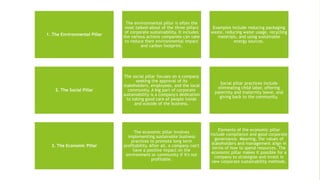
1. The Environmental Pillar
The environmental pillar is often the
most talked-about of the three pillars
of corporate sustainability. It includes
the various actions companies can take
to reduce their environmental impact
and carbon footprint.
Examples include reducing packaging
waste, reducing water usage, recycling
materials, and using sustainable
energy sources.
2. The Social Pillar
The social pillar focuses on a company
seeking the approval of its
stakeholders, employees, and the local
community. A big part of corporate
sustainability is a company's dedication
to taking good care of people inside
and outside of the business.
Social pillar practices include
eliminating child labor, offering
paternity and maternity leave, and
giving back to the community.
3. The Economic Pillar
The economic pillar involves
implementing sustainable business
practices to promote long term
profitability. After all, a company can't
have a positive impact on the
environment or community if it's not
profitable.
Elements of the economic pillar
include compliance and good corporate
governance. Meaning, the values of
stakeholders and management align in
terms of how to spend resources. The
economic pillar makes it possible for a
company to strategize and invest in
new corporate sustainability methods.
Sustainability and Corporate Social Responsibility are as similar as a bun
is to a burger. They belong together yet are they not the same.
 Vision
CSR often looks backward and reflects on what a company has done to contribute to society.
Corporate sustainability looks forward and develops a sustainable strategy for the future.
 Target
The targets of CSR initiatives are often opinion formers (e.g., media, politicians, and pressure groups).
Corporate sustainability looks at the whole value chain (i.e., everyone from end-consumers to
stakeholders).
 Motivation
The motivation and driving force behind CSR initiatives is to protect a company's reputation.
For corporate sustainability, the drive has more to do with creating new opportunities for emerging
markets.
Apple Suppliers & Labour Practices
With its highly coveted line of consumer electronics,
Apple has a cult following among loyal consumers. During
the 2014 holiday season, 74.5 million iPhones were sold.
Demand like this meant that Apple was in line to make
over $52 billion in profits in 2015, the largest annual
profit ever generated from a company’s operations.
Despite its consistent financial performance year over
year, Apple’s robust profit margin hides a more
complicated set of business ethics. Similar to many
products sold in the U.S., Apple does not manufacture
most its goods domestically. Most of the component
sourcing and factory production is done overseas in
conditions that critics have argued are dangerous to
workers and harmful to the environment.
CASE STUDY
 Walmart
The article will focus on conflict situations concerning the social and
environmental CSR practices of the companies. Walmart was caught
using child labour in Bangladesh and has faced gender discrimination
charges. Walmart Supercenters has a full oering of groceries and
general merchandise in a single store. Walmart oers to its customers a
one-stop shopping experience and is the largest private employer in
the US as well as being the world’s largest retailer.
Walmart caught using child labour in Bangladesh. At the end of 2005,
the Radio Canada programme Zone Libre made public the news that
Walmart was using child labour at two factories in Bangladesh.89
Children aged 10-14 years old were found to be working in the
factories for less than $50 a month making products of the Walmart
brand for export to Canada. Referring to Walmart’s policy at that time
consisting of cutting ties with suppliers when violations occurred, the
NGO Maquila Solidarity Network said that ‘cutting and running is the
worst possible response to reports of child labour or other sweatshop
abuses’.91 Critiques said that it only discourages workers from telling
the truth to factory auditors for fear of losing their jobs and
encourages suppliers to hide abuses or to subcontract work to other
factories that will escape inspection.92 Nevertheless, Walmart ceased
business with the two factories immediately.93 Walmart alleges that
despite its eort to inspect all factories, it is dicult to enforce its own
corporate code of conduct with thousands of subcontractors around
the world.

CSR.pptx

  • 1.
    Corporate Social Responsibility Presented by Lakshika Mittal(A1503321121) Arfa (A1503321112) Shivani Niwad (A1503321076)
  • 2.
  • 3.
    CSR and Sustainability Formany companies, treating the environment well is important to business practice and image, and this is reflected in their Corporate Social Responsibility (CSR) programs. Not only is it socially responsible practice, it is good business. Corporate social responsibility and sustainability are important to corporations for a variety of reasons. Motivations that affect corporate social responsibility are social power, public image, money and wealth, and conformity . Other aspects that make these areas important are values, which give motivations meaning, and stakeholders, who help drive a CSR program.
  • 4.
    Corporate Social Responsibility Corporatesocial responsibility (CSR) is a form of international private business self-regulation which aims to contribute to societal goals of a philanthropic, activist, or charitable nature by engaging in or supporting volunteering or ethically oriented practices. Corporate Social Responsibility is a management concept whereby companies integrate social and environmental concerns in their business operations and interactions with their stakeholders. CSR is generally understood as being the way through which a company achieves a balance of economic, environmental and social imperatives, while at the same time addressing the expectations of shareholders and stakeholders.
  • 5.
    SUSTAINABILITY The term "corporatesustainability" describes a new corporate management model. Recently, businesses worldwide have started placing a greater emphasis on sustainability. Companies have all kinds of motivations for these investments. 33 percent of companies are prioritizing sustainability to reduce costs and improve operational efficiency. Others invest in corporate citizenship best practices for a short-lived media boost. Corporate sustainability emphasizes growth and profitability through intentional business practices in three areas of society. The goal is to provide long-term value for stakeholders without compromising people, the planet, or the economy.
  • 6.
    1. The EnvironmentalPillar The environmental pillar is often the most talked-about of the three pillars of corporate sustainability. It includes the various actions companies can take to reduce their environmental impact and carbon footprint. Examples include reducing packaging waste, reducing water usage, recycling materials, and using sustainable energy sources. 2. The Social Pillar The social pillar focuses on a company seeking the approval of its stakeholders, employees, and the local community. A big part of corporate sustainability is a company's dedication to taking good care of people inside and outside of the business. Social pillar practices include eliminating child labor, offering paternity and maternity leave, and giving back to the community. 3. The Economic Pillar The economic pillar involves implementing sustainable business practices to promote long term profitability. After all, a company can't have a positive impact on the environment or community if it's not profitable. Elements of the economic pillar include compliance and good corporate governance. Meaning, the values of stakeholders and management align in terms of how to spend resources. The economic pillar makes it possible for a company to strategize and invest in new corporate sustainability methods.
  • 7.
    Sustainability and CorporateSocial Responsibility are as similar as a bun is to a burger. They belong together yet are they not the same.  Vision CSR often looks backward and reflects on what a company has done to contribute to society. Corporate sustainability looks forward and develops a sustainable strategy for the future.  Target The targets of CSR initiatives are often opinion formers (e.g., media, politicians, and pressure groups). Corporate sustainability looks at the whole value chain (i.e., everyone from end-consumers to stakeholders).  Motivation The motivation and driving force behind CSR initiatives is to protect a company's reputation. For corporate sustainability, the drive has more to do with creating new opportunities for emerging markets.
  • 8.
    Apple Suppliers &Labour Practices With its highly coveted line of consumer electronics, Apple has a cult following among loyal consumers. During the 2014 holiday season, 74.5 million iPhones were sold. Demand like this meant that Apple was in line to make over $52 billion in profits in 2015, the largest annual profit ever generated from a company’s operations. Despite its consistent financial performance year over year, Apple’s robust profit margin hides a more complicated set of business ethics. Similar to many products sold in the U.S., Apple does not manufacture most its goods domestically. Most of the component sourcing and factory production is done overseas in conditions that critics have argued are dangerous to workers and harmful to the environment. CASE STUDY
  • 9.
     Walmart The articlewill focus on conflict situations concerning the social and environmental CSR practices of the companies. Walmart was caught using child labour in Bangladesh and has faced gender discrimination charges. Walmart Supercenters has a full oering of groceries and general merchandise in a single store. Walmart oers to its customers a one-stop shopping experience and is the largest private employer in the US as well as being the world’s largest retailer. Walmart caught using child labour in Bangladesh. At the end of 2005, the Radio Canada programme Zone Libre made public the news that Walmart was using child labour at two factories in Bangladesh.89 Children aged 10-14 years old were found to be working in the factories for less than $50 a month making products of the Walmart brand for export to Canada. Referring to Walmart’s policy at that time consisting of cutting ties with suppliers when violations occurred, the NGO Maquila Solidarity Network said that ‘cutting and running is the worst possible response to reports of child labour or other sweatshop abuses’.91 Critiques said that it only discourages workers from telling the truth to factory auditors for fear of losing their jobs and encourages suppliers to hide abuses or to subcontract work to other factories that will escape inspection.92 Nevertheless, Walmart ceased business with the two factories immediately.93 Walmart alleges that despite its eort to inspect all factories, it is dicult to enforce its own corporate code of conduct with thousands of subcontractors around the world.