C++ Programming: From Problem
Analysis to Program Design,

Fifth Edition

Chapter 1: An Overview of Computers and
Programming Languages

Updated by: SENG Sourng
The Evolution of Programming
Languages (cont'd.)


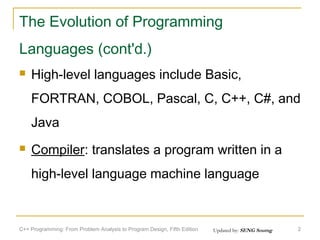
High-level languages include Basic,
FORTRAN, COBOL, Pascal, C, C++, C#, and
Java



Compiler: translates a program written in a
high-level language machine language

C++ Programming: From Problem Analysis to Program Design, Fifth Edition

Updated by: SENG Sourng

2
Processing a C++ Program
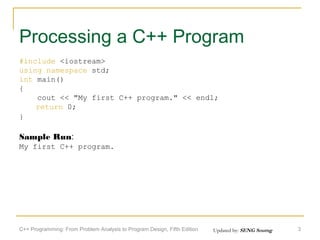
#include <iostream>
using namespace std;
int main()
{
cout << "My first C++ program." << endl;
return 0;
}

Sample Run:
My first C++ program.

C++ Programming: From Problem Analysis to Program Design, Fifth Edition

Updated by: SENG Sourng

3
Processing a C++ Program (cont'd.)


To execute a C++ program:





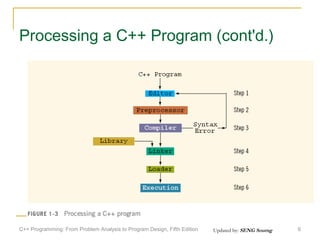
Use an editor to create a source program in C++
Preprocessor directives begin with # and are
processed by a the preprocessor
Use the compiler to:



Check that the program obeys the rules
Translate into machine language (object program)

C++ Programming: From Problem Analysis to Program Design, Fifth Edition

Updated by: SENG Sourng

4
Processing a C++ Program (cont'd.)


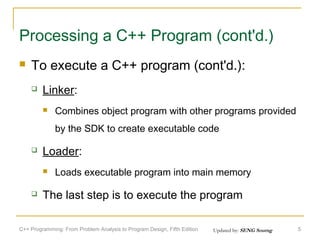
To execute a C++ program (cont'd.):


Linker:


Combines object program with other programs provided
by the SDK to create executable code



Loader:




Loads executable program into main memory

The last step is to execute the program

C++ Programming: From Problem Analysis to Program Design, Fifth Edition

Updated by: SENG Sourng

5
Processing a C++ Program (cont'd.)

C++ Programming: From Problem Analysis to Program Design, Fifth Edition

Updated by: SENG Sourng

6
Programming with the Problem Analysis–Coding–
Execution Cycle


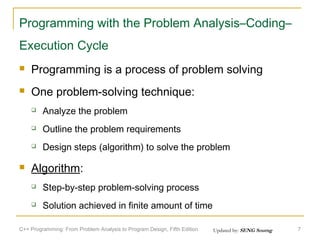
Programming is a process of problem solving



One problem-solving technique:



Outline the problem requirements





Analyze the problem

Design steps (algorithm) to solve the problem

Algorithm:


Step-by-step problem-solving process



Solution achieved in finite amount of time

C++ Programming: From Problem Analysis to Program Design, Fifth Edition

Updated by: SENG Sourng

7
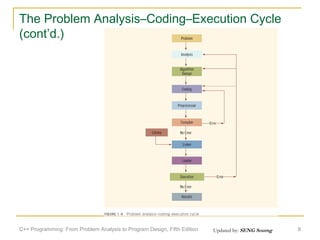
The Problem Analysis–Coding–Execution Cycle
(cont’d.)

C++ Programming: From Problem Analysis to Program Design, Fifth Edition

Updated by: SENG Sourng

8
The Problem Analysis–Coding–Execution Cycle
(cont'd.)



Run code through compiler
If compiler generates errors





If there are no syntax errors




Look at code and remove errors
Run code again through compiler
Compiler generates equivalent machine code

Linker links machine code with system
resources

C++ Programming: From Problem Analysis to Program Design, Fifth Edition

Updated by: SENG Sourng

9
The Problem Analysis–Coding–Execution Cycle
(cont'd.)





Once compiled and linked, loader can place
program into main memory for execution
The final step is to execute the program
Compiler guarantees that the program follows
the rules of the language


Does not guarantee that the program will run
correctly

C++ Programming: From Problem Analysis to Program Design, Fifth Edition

Updated by: SENG Sourng

10
Example 1-1




Design an algorithm to find the perimeter and
area of a rectangle
The perimeter and area of the rectangle are
given by the following formulas:
perimeter = 2 * (length + width)
area = length * width

C++ Programming: From Problem Analysis to Program Design, Fifth Edition

Updated by: SENG Sourng

11
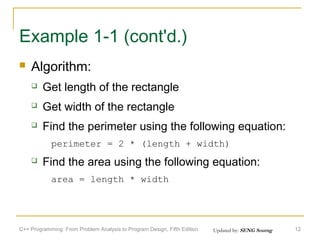
Example 1-1 (cont'd.)


Algorithm:


Get length of the rectangle



Get width of the rectangle



Find the perimeter using the following equation:
perimeter = 2 * (length + width)



Find the area using the following equation:
area = length * width

C++ Programming: From Problem Analysis to Program Design, Fifth Edition

Updated by: SENG Sourng

12

C++ Programming Chapter 01

  • 1.
    C++ Programming: FromProblem Analysis to Program Design, Fifth Edition Chapter 1: An Overview of Computers and Programming Languages Updated by: SENG Sourng
  • 2.
    The Evolution ofProgramming Languages (cont'd.)  High-level languages include Basic, FORTRAN, COBOL, Pascal, C, C++, C#, and Java  Compiler: translates a program written in a high-level language machine language C++ Programming: From Problem Analysis to Program Design, Fifth Edition Updated by: SENG Sourng 2
  • 3.
    Processing a C++Program #include <iostream> using namespace std; int main() { cout << "My first C++ program." << endl; return 0; } Sample Run: My first C++ program. C++ Programming: From Problem Analysis to Program Design, Fifth Edition Updated by: SENG Sourng 3
  • 4.
    Processing a C++Program (cont'd.)  To execute a C++ program:    Use an editor to create a source program in C++ Preprocessor directives begin with # and are processed by a the preprocessor Use the compiler to:   Check that the program obeys the rules Translate into machine language (object program) C++ Programming: From Problem Analysis to Program Design, Fifth Edition Updated by: SENG Sourng 4
  • 5.
    Processing a C++Program (cont'd.)  To execute a C++ program (cont'd.):  Linker:  Combines object program with other programs provided by the SDK to create executable code  Loader:   Loads executable program into main memory The last step is to execute the program C++ Programming: From Problem Analysis to Program Design, Fifth Edition Updated by: SENG Sourng 5
  • 6.
    Processing a C++Program (cont'd.) C++ Programming: From Problem Analysis to Program Design, Fifth Edition Updated by: SENG Sourng 6
  • 7.
    Programming with theProblem Analysis–Coding– Execution Cycle  Programming is a process of problem solving  One problem-solving technique:   Outline the problem requirements   Analyze the problem Design steps (algorithm) to solve the problem Algorithm:  Step-by-step problem-solving process  Solution achieved in finite amount of time C++ Programming: From Problem Analysis to Program Design, Fifth Edition Updated by: SENG Sourng 7
  • 8.
    The Problem Analysis–Coding–ExecutionCycle (cont’d.) C++ Programming: From Problem Analysis to Program Design, Fifth Edition Updated by: SENG Sourng 8
  • 9.
    The Problem Analysis–Coding–ExecutionCycle (cont'd.)   Run code through compiler If compiler generates errors    If there are no syntax errors   Look at code and remove errors Run code again through compiler Compiler generates equivalent machine code Linker links machine code with system resources C++ Programming: From Problem Analysis to Program Design, Fifth Edition Updated by: SENG Sourng 9
  • 10.
    The Problem Analysis–Coding–ExecutionCycle (cont'd.)    Once compiled and linked, loader can place program into main memory for execution The final step is to execute the program Compiler guarantees that the program follows the rules of the language  Does not guarantee that the program will run correctly C++ Programming: From Problem Analysis to Program Design, Fifth Edition Updated by: SENG Sourng 10
  • 11.
    Example 1-1   Design analgorithm to find the perimeter and area of a rectangle The perimeter and area of the rectangle are given by the following formulas: perimeter = 2 * (length + width) area = length * width C++ Programming: From Problem Analysis to Program Design, Fifth Edition Updated by: SENG Sourng 11
  • 12.
    Example 1-1 (cont'd.)  Algorithm:  Getlength of the rectangle  Get width of the rectangle  Find the perimeter using the following equation: perimeter = 2 * (length + width)  Find the area using the following equation: area = length * width C++ Programming: From Problem Analysis to Program Design, Fifth Edition Updated by: SENG Sourng 12