PM SHRI KENDRIYA
VIDYALAYA SANGATHAN
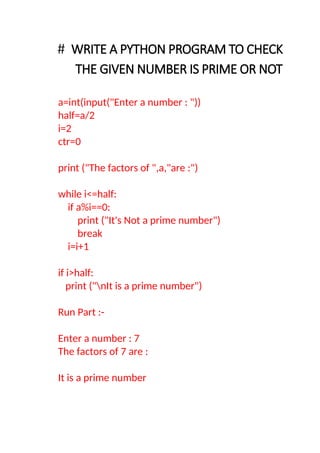
# WRITE A PYTHON PROGRAM TO CHECK
THE GIVEN NUMBER IS PRIME OR NOT
a=int(input("Enter a number : "))
half=a/2
i=2
ctr=0
print ("The factors of ",a,"are :")
while i<=half:
if a%i==0:
print ("It's Not a prime number")
break
i=i+1
if i>half:
print ("nIt is a prime number")
Run Part :-
Enter a number : 7
The factors of 7 are :
It is a prime number
# WRITE A PYTHON PROGRAM TO
COUNT THE OCCURRENCES OF A
WORD (WHOLE WORD) IN A STRING
USING USER defined function.
def countword(string,s):
k = 0
words = f.split()
print(f)
print(words)
for i in words:
if(i==s):
k=k+1
print("Occurrences of the word:")
print(k)
#__main__
f="this is is a book"
search ="is"
countword(f,search)
Run Part:-
this is is a book
['this', 'is', 'is', 'a', 'book']
Occurrences of the word:2
# Write a Python program to show the
frequency of each element in list.
'''
L1=[]
n=int(input("enter the number of elements ="))
for i in range(n):
item = int(input('Enter No. ='))
L1.append(item)
'''
L1=[11,2,2,1,3,11,4]
print("the elementsin List L1",L1)
L2=L1
L2.sort()
print("the elementsin List L2",L2)
d=dict()
for ch in L2:
if ch in d:
d[ch]+=1
else:
d[ch]=1
for i in d:
print (i, d[i])
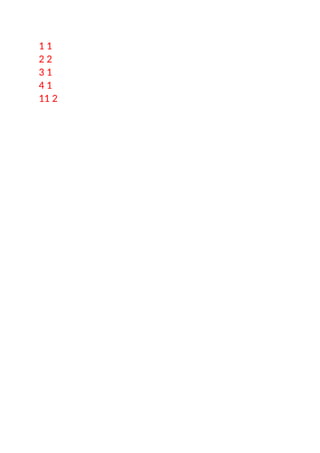
Run Part :-
the elementsin List L1 [11, 2, 2, 1, 3, 11, 4]
the elementsin List L2 [1, 2, 2, 3, 4, 11, 11]
1 1
2 2
3 1
4 1
11 2
# Write a Python program to search
an element in a list and display the
frequency of element present in
list and their location.
'''
L1=[]
n=int(input("enter the number of elements ="))
for i in range(n):
item = int(input('Enter No. ='))
L1.append(item)
'''
L1=[3,11,2,2,1,3,11,3,3]
print("the elements in List L1",L1)
# searched element
x=3
#count the frequency of x
d=dict()
d[x]=0
for ch in L1:
if x==int(ch):
d[x]+=1
print("Frequency of x in list:=",d.values())
v=d[x]
print(v)
#find the location of x in
list.
L2=[]
d=dict()
d[x]=0
count=1
for ch in L1:
if x==int(ch):
L2.append(count)
count+=1
print("Location of x in List :=", L2)
dict1=dict()
dict1.update({x:[v, L2]})
print("Location of x in List :=", dict1)
Run part:-
the elements in List L1 [3, 11, 2, 2, 1, 3, 11, 3, 3]
Frequency of x in list:= dict_values([4])
4
Location of x in List := [1, 6, 8, 9]
Location of x in List := {3: [4, [1, 6, 8, 9]]}
# Write a python program to pass a list to
a function and double the odd values and
half even values of a list and display list
element after changing.
def listprocess(L1):
length=len(L1)
print(length)
for i in range(0,length):
if(i%2==0):
L1[i]=L1[i]*2
else:
L1[i]=L1[i]/2
return(L1)
#__main__
'''
L1=[]
n=int(input("enter the number of elements ="))
for i in range(n):
item = int(input('Enter No. ='))
L1.append(item)
'''
L1=[1,2,3,4,5,6]
print("the elements in List L1",L1)
L=listprocess(L1)
print(L)
Run part:-
the elements in List L1 [1, 2, 3, 4, 5, 6]
6
[2, 1.0, 6, 2.0, 10, 3.0]
# Write a python program to input n
numbers in tuple and pass it to a
function to count how many even
and odd numbers are entered.
def counter(T):
length=len(T)
print("Length of tuple is :-", length)
counteven=0
countodd=0
for i in range(0,length):
if T[i]%2==0:
counteven+=1
else:
countodd+=1
print("nTotal even numbers are :=", counteven)
print("Total odd numbers are :=",countodd)
#__main__
# creation of tuple using list
L1=[]
n=int(input('ENTER THE NUMBER OF ELEMENTS :'))
for i in range(n):
print('Enter ', i+1 , ' element= ',end=' ')
element = int(input())
L1.append(element)
print("The list 1 is : ",L1)
T1=tuple(L1)
# creation of tuple from list
T1=tuple(L1) # ONLY ONE ARGUMENT
print("nThe tuple is : ",T1)
counter(T1)
Run Part:-
ENTER THE NUMBER OF ELEMENTS :5
Enter 1 element= 1
Enter 2 element= 2
Enter 3 element= 3
Enter 4 element= 7
Enter 5 element= 8
The list 1 is : [1, 2, 3, 7, 8]
The tuple is : (1, 2, 3, 7, 8)
Length of tuple is :- 5
Total even numbers are := 2
Total odd numbers are := 3
#Write a python program to create a
function for a dictionary with key & value
and update value of that
key in dictionary entered by user.
def changevalue(sm):
x=int(input("Enter the key:="))
name=input("Enter new name:=")
age= int(input("Enter new age:="))
for k in sm.keys():
if(k==x):
sm.update({k:[name,age]})
print('PRINTING WHOLE DICTIONARY IN
FUNCTIONn',sm)
#__main__
'''
#DECLARATION OF A BLANK DICTIONARY
studentmark= {}
#input in run time
n=int(input('ENTER THE NUMBER OF
ELEMENTSt :'))
for i in range(n):
print('nEnter ', i+1 , ' element=
',end='n')
rollno= int(input("Enter the Rollno
t:"))
name = input('Enter the namet:')
age = input('Enter the aget:')
studentmark[rollno]=[name,age]
'''
studentmark={100:['ram','10'], 200:
['laxman,20']}
# PRINTING WHOLE DICTIONARY
print('PRINTING WHOLE DICTIONARY
n',studentmark)
# find the length using len()
length=len(studentmark)
print('nfind the length using len() =' ,
length)
changevalue(studentmark)
print('PRINTING WHOLE DICTIONARY
n',studentmark)
Run Part:-
PRINTING WHOLE DICTIONARY
{100: ['ram', '10'], 200: ['laxman,20']}
find the length using len() = 2
Enter the key:=200
Enter new name:=vijay
Enter new age:=25
PRINTING WHOLE DICTIONARY IN
FUNCTION
{100: ['ram', '10'], 200: ['vijay', 25]}
PRINTING WHOLE DICTIONARY
{100: ['ram', '10'], 200: ['vijay', 25]}
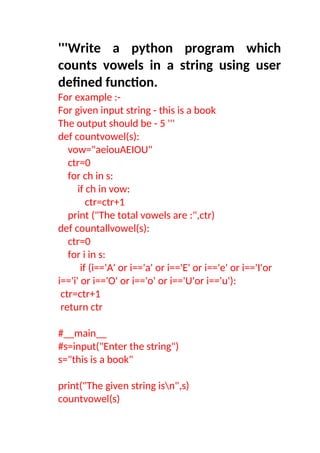
'''Write a python program which
counts vowels in a string using user
defined function.
For example :-
For given input string - this is a book
The output should be - 5 '''
def countvowel(s):
vow="aeiouAEIOU"
ctr=0
for ch in s:
if ch in vow:
ctr=ctr+1
print ("The total vowels are :",ctr)
def countallvowel(s):
ctr=0
for i in s:
if (i=='A' or i=='a' or i=='E' or i=='e' or i=='I'or
i=='i' or i=='O' or i=='o' or i=='U'or i=='u'):
ctr=ctr+1
return ctr
#__main__
#s=input("Enter the string")
s="this is a book"
print("The given string isn",s)
countvowel(s)
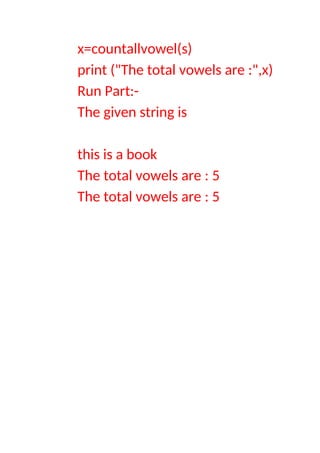
x=countallvowel(s)
print ("The total vowels are :",x)
Run Part:-
The given string is
this is a book
The total vowels are : 5
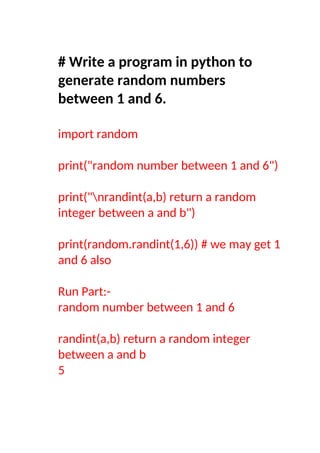
# Write a program in python to
generate random numbers
between 1 and 6.
import random
print("random number between 1 and 6")
print("nrandint(a,b) return a random
integer between a and b")
print(random.randint(1,6)) # we may get 1
and 6 also
Run Part:-
random number between 1 and 6
randint(a,b) return a random integer
between a and b
5
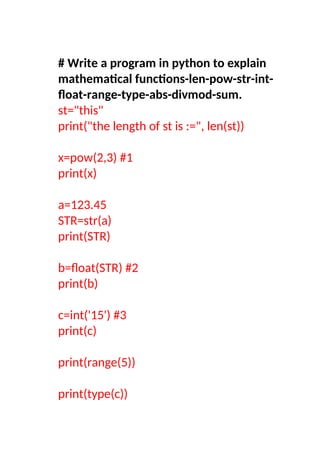
# Write a program in python to explain
mathematical functions-len-pow-str-int-
float-range-type-abs-divmod-sum.
st="this"
print("the length of st is :=", len(st))
x=pow(2,3) #1
print(x)
a=123.45
STR=str(a)
print(STR)
b=float(STR) #2
print(b)
c=int('15') #3
print(c)
print(range(5))
print(type(c))
d=-15
print("absolute value :=", abs(d)) #4
print("quotient and
remainder:=" ,divmod(9,5)) # return
quotient and remainder #5
print(sum([1,2,3]))
print(sum((1,2,3)))
print(sum([1,2,3],5))
Run part:-
the length of st is := 4
8
123.45
123.45
15
range(0, 5)
<class 'int'>
absolute value := 15
quotient and remainder:= (1, 4)
6
6
11
# Write a program in python to
explain mathematical functions-max-
min-oct-hex-round.
print("max")
print(max([5,7,6],[2,3,4])) # match first
element only of both lists
print(max([5,7,6],[7,4,3]))
print(max((5,7,6),(2,3,4))) # match first
element only of both tuples
print("min")
print(min([5,7,6],[2,3,4])) # match first
element only of both lists
print(min([5,7,6],[7,4,3]))
print(min((5,7,6),(2,3,4))) # match first
element only of both tuples
print(oct(10))
print(hex(10))
print(hex(15))
x=7.5550
y=int(x)
print(y)
z=round(x)
print(z)
p=round(x,2)
print(p)
Run part:-
Max
[5, 7, 6]
[7, 4, 3]
(5, 7, 6)
min
[2, 3, 4]
[5, 7, 6]
(2, 3, 4)
0o12
0xa
0xf
7
8
7.55
# Write a program in python to explain
string functions-join-split-replace.
#join only joins strings
st1="#"
print(st1.join("Student")) # joind string
st2="##"
print(st2.join("Student"))
st3="##"
print(st3.join(["good", "morning", "all"])) # join
with list
st4="##"
print(st3.join(("good", "morning"))) # join with
tuple
#st4="##"
#print(st3.join((777, "good", "morning"))) # show
errors- only string allowed in tuple
#split makes list
st5="this is a book"
print(st5.split()) # split at spces in list form
st6="this is a ice-cream"
print(st6.split("i")) # split at 'i'
#replace
st7="this is a book"
print(st7.replace('is','are')) #find and replace
#capitalize
st8="this is a book"
print(st8.capitalize()) # capital first letter of a
string
Run part:-
S#t#u#d#e#n#t
S##t##u##d##e##n##t
good##morning##all
good##morning
['this', 'is', 'a', 'book']
['th', 's ', 's a ', 'ce-cream']
thare are a book
This is a book
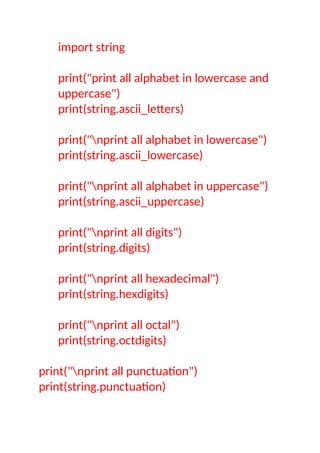
# Write a program in python to
explain string constant function.
import string
print("print all alphabet in lowercase and
uppercase")
print(string.ascii_letters)
print("nprint all alphabet in lowercase")
print(string.ascii_lowercase)
print("nprint all alphabet in uppercase")
print(string.ascii_uppercase)
print("nprint all digits")
print(string.digits)
print("nprint all hexadecimal")
print(string.hexdigits)
print("nprint all octal")
print(string.octdigits)
print("nprint all punctuation")
print(string.punctuation)
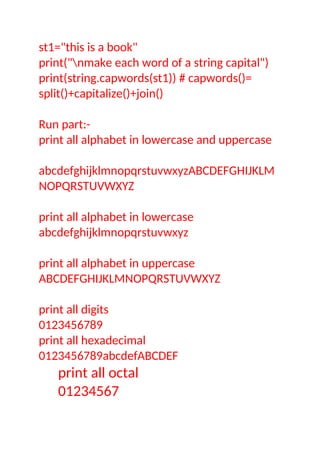
st1="this is a book"
print("nmake each word of a string capital")
print(string.capwords(st1)) # capwords()=
split()+capitalize()+join()
Run part:-
print all alphabet in lowercase and uppercase
abcdefghijklmnopqrstuvwxyzABCDEFGHIJKLM
NOPQRSTUVWXYZ
print all alphabet in lowercase
abcdefghijklmnopqrstuvwxyz
print all alphabet in uppercase
ABCDEFGHIJKLMNOPQRSTUVWXYZ
print all digits
0123456789
print all hexadecimal
0123456789abcdefABCDEF
print all octal
01234567
print all punctuation
!"#$%&'()*+,-./:;<=>?@[]^_`{|}~
make each word of a string capital
This Is A Book
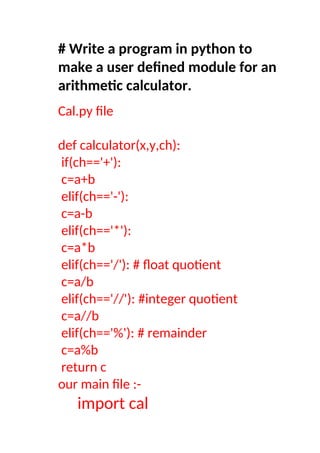
# Write a program in python to
make a user defined module for an
arithmetic calculator.
Cal.py file
def calculator(x,y,ch):
if(ch=='+'):
c=a+b
elif(ch=='-'):
c=a-b
elif(ch=='*'):
c=a*b
elif(ch=='/'): # float quotient
c=a/b
elif(ch=='//'): #integer quotient
c=a//b
elif(ch=='%'): # remainder
c=a%b
return c
our main file :-
import cal
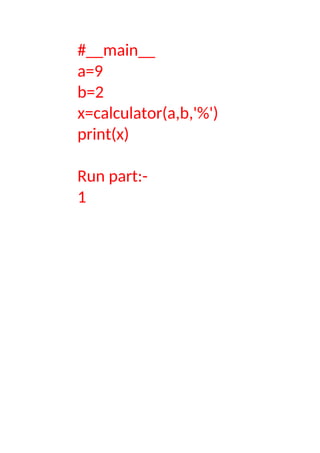
#__main__
a=9
b=2
x=calculator(a,b,'%')
print(x)
Run part:-
1
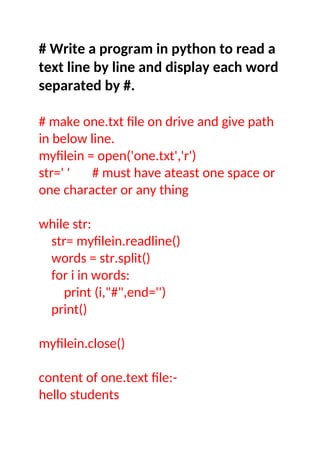
# Write a program in python to read a
text line by line and display each word
separated by #.
# make one.txt file on drive and give path
in below line.
myfilein = open('one.txt','r')
str=' ' # must have ateast one space or
one character or any thing
while str:
str= myfilein.readline()
words = str.split()
for i in words:
print (i,"#",end='')
print()
myfilein.close()
content of one.text file:-
hello students
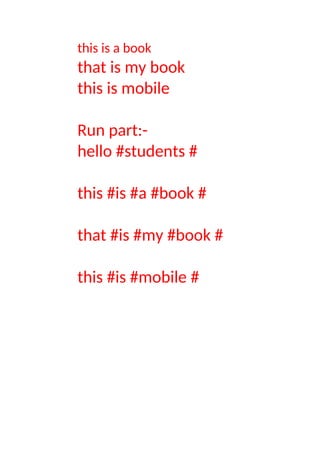
this is a book
that is my book
this is mobile
Run part:-
hello #students #
this #is #a #book #
that #is #my #book #
this #is #mobile #
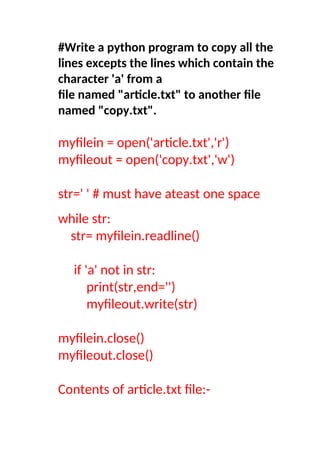
#Write a python program to copy all the
lines excepts the lines which contain the
character 'a' from a
file named "article.txt" to another file
named "copy.txt".
myfilein = open('article.txt','r')
myfileout = open('copy.txt','w')
str=' ' # must have ateast one space
while str:
str= myfilein.readline()
if 'a' not in str:
print(str,end='')
myfileout.write(str)
myfilein.close()
myfileout.close()
Contents of article.txt file:-
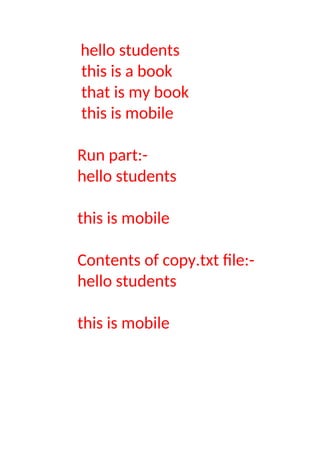
hello students
this is a book
that is my book
this is mobile
Run part:-
hello students
this is mobile
Contents of copy.txt file:-
hello students
this is mobile
# Write a python program to read
characters from keyboard one by one,
then store all lowercase letters
inside a file "LOWER", all uppercase
letters gets inside a file "UPPER" and
other characters inside file
"OTHERS".
myfile1 = open('LOWER.txt','w')
myfile2 = open('UPPER.txt','w')
myfile3 = open('OTHERS.txt','w')
Llower=[] # creation of blank list
Lupper=[]
Lothers=[]
str= input("Enter the contents:=")
for ch in str:
if ch >= 'a' and ch <='z':
Llower.append(ch)
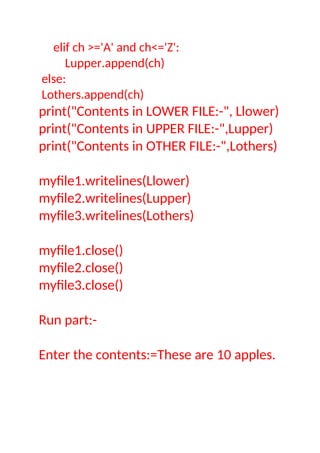
elif ch >='A' and ch<='Z':
Lupper.append(ch)
else:
Lothers.append(ch)
print("Contents in LOWER FILE:-", Llower)
print("Contents in UPPER FILE:-",Lupper)
print("Contents in OTHER FILE:-",Lothers)
myfile1.writelines(Llower)
myfile2.writelines(Lupper)
myfile3.writelines(Lothers)
myfile1.close()
myfile2.close()
myfile3.close()
Run part:-
Enter the contents:=These are 10 apples.
Contents in LOWER FILE:- ['h', 'e', 's',
'e', 'a', 'r', 'e', 'a', 'p', 'p', 'l', 'e', 's']
Contents in UPPER FILE:- ['T']
Contents in OTHER FILE:- [' ', ' ', '1', '0',
' ', '.']
#Write a program in python to create a
binary file with rollno and name. Search
for a given roll number
and display name, if not found display
appropriate message.
import pickle
#class declaration
class student:
def __init__(self, rno = 0 , nm = "" ):
self.rollno=rno
self.name=nm
def getdetails(self):
print("Enter the detailsn")
self.rollno=input("Enter the rollno.:=")
self.name=input("Enter the name:=")
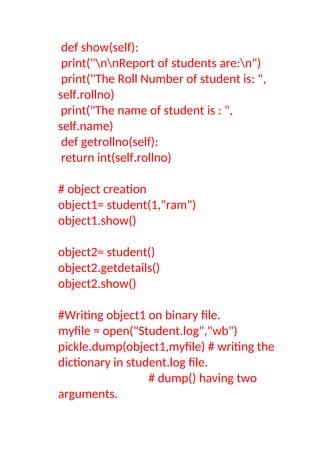
def show(self):
print("nnReport of students are:n")
print("The Roll Number of student is: ",
self.rollno)
print("The name of student is : ",
self.name)
def getrollno(self):
return int(self.rollno)
# object creation
object1= student(1,"ram")
object1.show()
object2= student()
object2.getdetails()
object2.show()
#Writing object1 on binary file.
myfile = open("Student.log","wb")
pickle.dump(object1,myfile) # writing the
dictionary in student.log file.
# dump() having two
arguments.
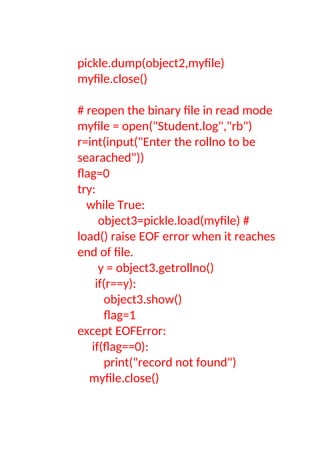
pickle.dump(object2,myfile)
myfile.close()
# reopen the binary file in read mode
myfile = open("Student.log","rb")
r=int(input("Enter the rollno to be
searached"))
flag=0
try:
while True:
object3=pickle.load(myfile) #
load() raise EOF error when it reaches
end of file.
y = object3.getrollno()
if(r==y):
object3.show()
flag=1
except EOFError:
if(flag==0):
print("record not found")
myfile.close()
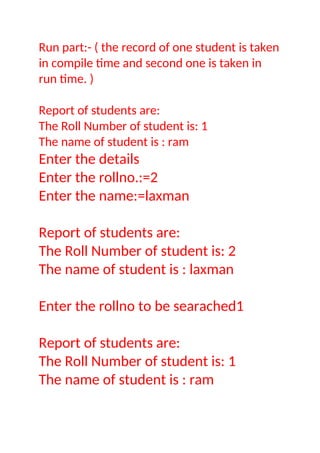
Run part:- ( the record of one student is taken
in compile time and second one is taken in
run time. )
Report of students are:
The Roll Number of student is: 1
The name of student is : ram
Enter the details
Enter the rollno.:=2
Enter the name:=laxman
Report of students are:
The Roll Number of student is: 2
The name of student is : laxman
Enter the rollno to be searached1
Report of students are:
The Roll Number of student is: 1
The name of student is : ram

cs class 12 project computer science .docx

  • 1.
  • 2.
    # WRITE APYTHON PROGRAM TO CHECK THE GIVEN NUMBER IS PRIME OR NOT a=int(input("Enter a number : ")) half=a/2 i=2 ctr=0 print ("The factors of ",a,"are :") while i<=half: if a%i==0: print ("It's Not a prime number") break i=i+1 if i>half: print ("nIt is a prime number") Run Part :- Enter a number : 7 The factors of 7 are : It is a prime number
  • 3.
    # WRITE APYTHON PROGRAM TO COUNT THE OCCURRENCES OF A WORD (WHOLE WORD) IN A STRING USING USER defined function. def countword(string,s): k = 0 words = f.split() print(f) print(words) for i in words: if(i==s): k=k+1 print("Occurrences of the word:") print(k) #__main__ f="this is is a book" search ="is" countword(f,search) Run Part:- this is is a book ['this', 'is', 'is', 'a', 'book'] Occurrences of the word:2
  • 4.
    # Write aPython program to show the frequency of each element in list. ''' L1=[] n=int(input("enter the number of elements =")) for i in range(n): item = int(input('Enter No. =')) L1.append(item) ''' L1=[11,2,2,1,3,11,4] print("the elementsin List L1",L1) L2=L1 L2.sort() print("the elementsin List L2",L2) d=dict() for ch in L2: if ch in d: d[ch]+=1 else: d[ch]=1 for i in d: print (i, d[i]) Run Part :- the elementsin List L1 [11, 2, 2, 1, 3, 11, 4] the elementsin List L2 [1, 2, 2, 3, 4, 11, 11]
  • 5.
    1 1 2 2 31 4 1 11 2
  • 6.
    # Write aPython program to search an element in a list and display the frequency of element present in list and their location. ''' L1=[] n=int(input("enter the number of elements =")) for i in range(n): item = int(input('Enter No. =')) L1.append(item) ''' L1=[3,11,2,2,1,3,11,3,3] print("the elements in List L1",L1) # searched element x=3 #count the frequency of x d=dict() d[x]=0 for ch in L1: if x==int(ch): d[x]+=1 print("Frequency of x in list:=",d.values()) v=d[x] print(v)
  • 7.
    #find the locationof x in list. L2=[] d=dict() d[x]=0 count=1 for ch in L1: if x==int(ch): L2.append(count) count+=1 print("Location of x in List :=", L2) dict1=dict() dict1.update({x:[v, L2]}) print("Location of x in List :=", dict1) Run part:- the elements in List L1 [3, 11, 2, 2, 1, 3, 11, 3, 3] Frequency of x in list:= dict_values([4]) 4 Location of x in List := [1, 6, 8, 9] Location of x in List := {3: [4, [1, 6, 8, 9]]}
  • 8.
    # Write apython program to pass a list to a function and double the odd values and half even values of a list and display list element after changing. def listprocess(L1): length=len(L1) print(length) for i in range(0,length): if(i%2==0): L1[i]=L1[i]*2 else: L1[i]=L1[i]/2 return(L1) #__main__ ''' L1=[] n=int(input("enter the number of elements =")) for i in range(n): item = int(input('Enter No. =')) L1.append(item) ''' L1=[1,2,3,4,5,6] print("the elements in List L1",L1) L=listprocess(L1) print(L)
  • 9.
    Run part:- the elementsin List L1 [1, 2, 3, 4, 5, 6] 6 [2, 1.0, 6, 2.0, 10, 3.0]
  • 10.
    # Write apython program to input n numbers in tuple and pass it to a function to count how many even and odd numbers are entered. def counter(T): length=len(T) print("Length of tuple is :-", length) counteven=0 countodd=0 for i in range(0,length): if T[i]%2==0: counteven+=1 else: countodd+=1 print("nTotal even numbers are :=", counteven) print("Total odd numbers are :=",countodd) #__main__ # creation of tuple using list L1=[] n=int(input('ENTER THE NUMBER OF ELEMENTS :')) for i in range(n): print('Enter ', i+1 , ' element= ',end=' ') element = int(input()) L1.append(element) print("The list 1 is : ",L1)
  • 11.
    T1=tuple(L1) # creation oftuple from list T1=tuple(L1) # ONLY ONE ARGUMENT print("nThe tuple is : ",T1) counter(T1) Run Part:- ENTER THE NUMBER OF ELEMENTS :5 Enter 1 element= 1 Enter 2 element= 2 Enter 3 element= 3 Enter 4 element= 7 Enter 5 element= 8 The list 1 is : [1, 2, 3, 7, 8] The tuple is : (1, 2, 3, 7, 8) Length of tuple is :- 5 Total even numbers are := 2 Total odd numbers are := 3
  • 12.
    #Write a pythonprogram to create a function for a dictionary with key & value and update value of that key in dictionary entered by user. def changevalue(sm): x=int(input("Enter the key:=")) name=input("Enter new name:=") age= int(input("Enter new age:=")) for k in sm.keys(): if(k==x): sm.update({k:[name,age]}) print('PRINTING WHOLE DICTIONARY IN FUNCTIONn',sm) #__main__ ''' #DECLARATION OF A BLANK DICTIONARY studentmark= {} #input in run time n=int(input('ENTER THE NUMBER OF ELEMENTSt :')) for i in range(n):
  • 13.
    print('nEnter ', i+1, ' element= ',end='n') rollno= int(input("Enter the Rollno t:")) name = input('Enter the namet:') age = input('Enter the aget:') studentmark[rollno]=[name,age] ''' studentmark={100:['ram','10'], 200: ['laxman,20']} # PRINTING WHOLE DICTIONARY print('PRINTING WHOLE DICTIONARY n',studentmark)
  • 14.
    # find thelength using len() length=len(studentmark) print('nfind the length using len() =' , length) changevalue(studentmark) print('PRINTING WHOLE DICTIONARY n',studentmark) Run Part:- PRINTING WHOLE DICTIONARY {100: ['ram', '10'], 200: ['laxman,20']} find the length using len() = 2 Enter the key:=200 Enter new name:=vijay Enter new age:=25 PRINTING WHOLE DICTIONARY IN FUNCTION {100: ['ram', '10'], 200: ['vijay', 25]}
  • 15.
    PRINTING WHOLE DICTIONARY {100:['ram', '10'], 200: ['vijay', 25]}
  • 16.
    '''Write a pythonprogram which counts vowels in a string using user defined function. For example :- For given input string - this is a book The output should be - 5 ''' def countvowel(s): vow="aeiouAEIOU" ctr=0 for ch in s: if ch in vow: ctr=ctr+1 print ("The total vowels are :",ctr) def countallvowel(s): ctr=0 for i in s: if (i=='A' or i=='a' or i=='E' or i=='e' or i=='I'or i=='i' or i=='O' or i=='o' or i=='U'or i=='u'): ctr=ctr+1 return ctr #__main__ #s=input("Enter the string") s="this is a book" print("The given string isn",s) countvowel(s)
  • 17.
    x=countallvowel(s) print ("The totalvowels are :",x) Run Part:- The given string is this is a book The total vowels are : 5 The total vowels are : 5
  • 18.
    # Write aprogram in python to generate random numbers between 1 and 6. import random print("random number between 1 and 6") print("nrandint(a,b) return a random integer between a and b") print(random.randint(1,6)) # we may get 1 and 6 also Run Part:- random number between 1 and 6 randint(a,b) return a random integer between a and b 5
  • 19.
    # Write aprogram in python to explain mathematical functions-len-pow-str-int- float-range-type-abs-divmod-sum. st="this" print("the length of st is :=", len(st)) x=pow(2,3) #1 print(x) a=123.45 STR=str(a) print(STR) b=float(STR) #2 print(b) c=int('15') #3 print(c) print(range(5)) print(type(c))
  • 20.
    d=-15 print("absolute value :=",abs(d)) #4 print("quotient and remainder:=" ,divmod(9,5)) # return quotient and remainder #5 print(sum([1,2,3])) print(sum((1,2,3))) print(sum([1,2,3],5)) Run part:- the length of st is := 4 8 123.45 123.45 15 range(0, 5) <class 'int'> absolute value := 15 quotient and remainder:= (1, 4) 6 6
  • 21.
    11 # Write aprogram in python to explain mathematical functions-max- min-oct-hex-round. print("max") print(max([5,7,6],[2,3,4])) # match first element only of both lists print(max([5,7,6],[7,4,3])) print(max((5,7,6),(2,3,4))) # match first element only of both tuples print("min") print(min([5,7,6],[2,3,4])) # match first element only of both lists print(min([5,7,6],[7,4,3])) print(min((5,7,6),(2,3,4))) # match first element only of both tuples print(oct(10)) print(hex(10)) print(hex(15))
  • 22.
    x=7.5550 y=int(x) print(y) z=round(x) print(z) p=round(x,2) print(p) Run part:- Max [5, 7,6] [7, 4, 3] (5, 7, 6) min [2, 3, 4] [5, 7, 6] (2, 3, 4) 0o12 0xa 0xf 7 8 7.55
  • 23.
    # Write aprogram in python to explain string functions-join-split-replace. #join only joins strings st1="#" print(st1.join("Student")) # joind string st2="##" print(st2.join("Student")) st3="##" print(st3.join(["good", "morning", "all"])) # join with list st4="##" print(st3.join(("good", "morning"))) # join with tuple #st4="##" #print(st3.join((777, "good", "morning"))) # show errors- only string allowed in tuple #split makes list st5="this is a book" print(st5.split()) # split at spces in list form
  • 24.
    st6="this is aice-cream" print(st6.split("i")) # split at 'i' #replace st7="this is a book" print(st7.replace('is','are')) #find and replace #capitalize st8="this is a book" print(st8.capitalize()) # capital first letter of a string Run part:- S#t#u#d#e#n#t S##t##u##d##e##n##t good##morning##all good##morning ['this', 'is', 'a', 'book'] ['th', 's ', 's a ', 'ce-cream'] thare are a book This is a book # Write a program in python to explain string constant function.
  • 25.
    import string print("print allalphabet in lowercase and uppercase") print(string.ascii_letters) print("nprint all alphabet in lowercase") print(string.ascii_lowercase) print("nprint all alphabet in uppercase") print(string.ascii_uppercase) print("nprint all digits") print(string.digits) print("nprint all hexadecimal") print(string.hexdigits) print("nprint all octal") print(string.octdigits) print("nprint all punctuation") print(string.punctuation)
  • 26.
    st1="this is abook" print("nmake each word of a string capital") print(string.capwords(st1)) # capwords()= split()+capitalize()+join() Run part:- print all alphabet in lowercase and uppercase abcdefghijklmnopqrstuvwxyzABCDEFGHIJKLM NOPQRSTUVWXYZ print all alphabet in lowercase abcdefghijklmnopqrstuvwxyz print all alphabet in uppercase ABCDEFGHIJKLMNOPQRSTUVWXYZ print all digits 0123456789 print all hexadecimal 0123456789abcdefABCDEF print all octal 01234567
  • 27.
    print all punctuation !"#$%&'()*+,-./:;<=>?@[]^_`{|}~ makeeach word of a string capital This Is A Book
  • 28.
    # Write aprogram in python to make a user defined module for an arithmetic calculator. Cal.py file def calculator(x,y,ch): if(ch=='+'): c=a+b elif(ch=='-'): c=a-b elif(ch=='*'): c=a*b elif(ch=='/'): # float quotient c=a/b elif(ch=='//'): #integer quotient c=a//b elif(ch=='%'): # remainder c=a%b return c our main file :- import cal
  • 29.
  • 30.
    # Write aprogram in python to read a text line by line and display each word separated by #. # make one.txt file on drive and give path in below line. myfilein = open('one.txt','r') str=' ' # must have ateast one space or one character or any thing while str: str= myfilein.readline() words = str.split() for i in words: print (i,"#",end='') print() myfilein.close() content of one.text file:- hello students
  • 31.
    this is abook that is my book this is mobile Run part:- hello #students # this #is #a #book # that #is #my #book # this #is #mobile #
  • 32.
    #Write a pythonprogram to copy all the lines excepts the lines which contain the character 'a' from a file named "article.txt" to another file named "copy.txt". myfilein = open('article.txt','r') myfileout = open('copy.txt','w') str=' ' # must have ateast one space while str: str= myfilein.readline() if 'a' not in str: print(str,end='') myfileout.write(str) myfilein.close() myfileout.close() Contents of article.txt file:-
  • 33.
    hello students this isa book that is my book this is mobile Run part:- hello students this is mobile Contents of copy.txt file:- hello students this is mobile
  • 34.
    # Write apython program to read characters from keyboard one by one, then store all lowercase letters inside a file "LOWER", all uppercase letters gets inside a file "UPPER" and other characters inside file "OTHERS". myfile1 = open('LOWER.txt','w') myfile2 = open('UPPER.txt','w') myfile3 = open('OTHERS.txt','w') Llower=[] # creation of blank list Lupper=[] Lothers=[] str= input("Enter the contents:=") for ch in str: if ch >= 'a' and ch <='z': Llower.append(ch)
  • 35.
    elif ch >='A'and ch<='Z': Lupper.append(ch) else: Lothers.append(ch) print("Contents in LOWER FILE:-", Llower) print("Contents in UPPER FILE:-",Lupper) print("Contents in OTHER FILE:-",Lothers) myfile1.writelines(Llower) myfile2.writelines(Lupper) myfile3.writelines(Lothers) myfile1.close() myfile2.close() myfile3.close() Run part:- Enter the contents:=These are 10 apples.
  • 36.
    Contents in LOWERFILE:- ['h', 'e', 's', 'e', 'a', 'r', 'e', 'a', 'p', 'p', 'l', 'e', 's'] Contents in UPPER FILE:- ['T'] Contents in OTHER FILE:- [' ', ' ', '1', '0', ' ', '.'] #Write a program in python to create a binary file with rollno and name. Search for a given roll number and display name, if not found display appropriate message. import pickle #class declaration class student: def __init__(self, rno = 0 , nm = "" ): self.rollno=rno self.name=nm def getdetails(self): print("Enter the detailsn") self.rollno=input("Enter the rollno.:=") self.name=input("Enter the name:=")
  • 37.
    def show(self): print("nnReport ofstudents are:n") print("The Roll Number of student is: ", self.rollno) print("The name of student is : ", self.name) def getrollno(self): return int(self.rollno) # object creation object1= student(1,"ram") object1.show() object2= student() object2.getdetails() object2.show() #Writing object1 on binary file. myfile = open("Student.log","wb") pickle.dump(object1,myfile) # writing the dictionary in student.log file. # dump() having two arguments.
  • 38.
    pickle.dump(object2,myfile) myfile.close() # reopen thebinary file in read mode myfile = open("Student.log","rb") r=int(input("Enter the rollno to be searached")) flag=0 try: while True: object3=pickle.load(myfile) # load() raise EOF error when it reaches end of file. y = object3.getrollno() if(r==y): object3.show() flag=1 except EOFError: if(flag==0): print("record not found") myfile.close()
  • 39.
    Run part:- (the record of one student is taken in compile time and second one is taken in run time. ) Report of students are: The Roll Number of student is: 1 The name of student is : ram Enter the details Enter the rollno.:=2 Enter the name:=laxman Report of students are: The Roll Number of student is: 2 The name of student is : laxman Enter the rollno to be searached1 Report of students are: The Roll Number of student is: 1 The name of student is : ram