BITCOIN: A SWOT Analysis
Management Consultants
Your Problem. Our Solution.
A SWOT ANALYSIS ON BITCOIN
What is bitcoin?
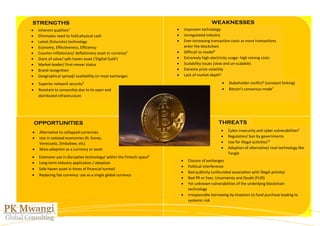
Bitcoin is a digital currency that exists purely in electronic form and that enables instantaneous and borderless peer-to-peer
transactions to take place. It is open-source meaning that the technology’s software has a source code that anyone can inspect,
modify and enhance. In order to take place, transactions in bitcoin require no central authority or banks as the underlying
blockchain technology is both peer-to-peer and autonomous.
Initially billed as a medium of exchange by its founder- Saitoshi Nakamoto, bitcoin has risen exponentially in value- from a low of
$0.17 in December 2010 to a historic high of $19,498.63 in December 2017- a rise of 11.47 million % (not a typo) in 7 years. Due to
this very high valuation, bitcoin has lost any functionality as a medium of exchange (to replace or rival fiat currency) and is
increasingly being viewed instead as a store of value. It has earned the title- ‘digital gold’.
Due to the novelty of blockchain technology, which underlies the functionality of bitcoin, there exists lots of developmental
hurdles that are yet to be overcome not least those surrounding the digital currency’s security vulnerabilities. However, the
revolutionary nature of blockchain technology is beyond doubt and it is destined to change our lives in ways yet unimaginable.
Until developmental and security issues surrounding bitcoin are resolved it remains a highly risky asset or currency (the jury is still out
among academics and industry stakeholders alike as to which of these two it represents) investment and investing in it must be
approached with caution. Investors should be prepared to lose all their investment in bitcoin. However, the potential for
exponential returns remains as is evident from the rise in value over a period of less than a decade.
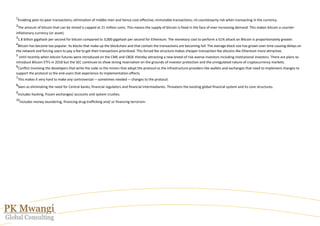
To provide our readers with some insight into the potential and risks associated with bitcoin, PK Mwangi Global Consulting has
prepared a SWOT analysis on bitcoin highlighting key factors to take into account when considering an investment in this novelty
digital currency.
STRENGTHS WEAKNESSES
 Inherent qualities1
 Eliminates need to hold physical cash
 Latest (futuristic) technology
 Economy, Effectiveness, Efficiency
 Counter-inflationary/ deflationary asset or currency2
 Store of value/ safe haven asset (‘Digital Gold’)
 Market-leader/ First-mover status
 Brand recognition
 Geographical spread/ availability on most exchanges
 Superior network security3
 Resistant to censorship due to its open and
distributed infrastructure
 Unproven technology
 Unregulated industry
 Ever-increasing transaction costs as more transactions
enter the blockchain
 Difficult to model4
 Extremely high electricity usage- high mining costs
 Scalability issues (slow and un-scalable)
 Extreme price volatility
 Lack of market depth5
 Stakeholder conflict6
(constant forking)
 Bitcoin’s consensus mode7
OPPORTUNITIES
 Alternative to collapsed currencies
 Use in isolated economies (N. Korea,
Venezuela, Zimbabwe, etc)
 Mass-adoption as a currency or asset
THREATS
 Cyber insecurity and cyber vulnerabilities9
 Regulation/ ban by governments
 Use for illegal activities10
 Adoption of alternative/ rival technology like
Tangle
 Closure of exchanges
 Political interference
 Bad publicity (unfounded association with illegal activity)
 Bad PR or Fear, Uncertainty and Doubt (FUD)
 Yet unknown vulnerabilities of the underlying blockchain
technology
 Irresponsible borrowing by investors to fund purchase leading to
systemic risk
 Extensive use in disruptive technology/ within the Fintech space8
 Long-term industry application / adoption
 Safe haven asset in times of financial turmoil
 Replacing fiat currency: use as a single global currency
1
Enabling peer-to-peer transactions; elimination of middle-men and hence cost-effective; immutable transactions; nil counterparty risk when transacting in the currency.
2
The amount of bitcoin that can be mined is capped at 21 million coins. This means the supply of bitcoin is fixed in the face of ever-increasing demand. This makes bitcoin a counter-
inflationary currency (or asset).
3
1.8 billion gigahash per second for bitcoin compared to 3,000 gigahash per second for Ethereum. The monetary cost to perform a 51% attack on Bitcoin is proportionately greater.
4
Bitcoin has become too popular. Its blocks that make up the blockchain and that contain the transactions are becoming full. The average block size has grown over time causing delays on
the network and forcing users to pay a fee to get their transactions prioritised. This forced fee structure makes cheaper transaction-fee altcoins like Ethereum more attractive.
5
Until recently when bitcoin futures were introduced on the CME and CBOE thereby attracting a new breed of risk-averse investors including institutional investors. There are plans to
introduce Bitcoin ETFs in 2018 but the SEC continues to show strong reservation on the grounds of investor protection and the unregulated nature of cryptocurrency markets.
6
Conflict involving the developers that write the code vs the miners that adopt the protocol vs the infrastructure providers like wallets and exchanges that need to implement changes to
support the protocol vs the end-users that experience its implementation effects.
7
This makes it very hard to make any controversial — sometimes needed — changes to the protocol.
8
Seen as eliminating the need for Central banks, financial regulators and financial intermediaries. Threatens the existing global financial system and its core structures.
9
Includes hacking, frozen exchanges/ accounts and system crushes.
10
Includes money-laundering, financing drug-trafficking and/ or financing terrorism.
DISCLAIMER
This is a promotional document and as such the views expressed do not constitute investment (or any other) advice nor a recommendation to buy, sell or
trade bitcoin. PK Mwangi Global Consulting does not guarantee its accuracy, completeness or timeliness and as such the information is subject to change.
Past performance is not a guide to future performance.
Investing in cryptocurrencies is inherently risky and could lead to huge or even total monetary loss. Investors should, therefore, only invest money which they
can afford to lose.
We accept no liability for any actions taken, or not taken, as a result of the information contained in this material. Reliance upon this information is,
therefore, at the sole discretion of the reader.
Any research in this document has been obtained and may have been acted upon by PK Mwangi Global Consulting for its own purpose.
March 2018
For more information
Contacts
Copyright © 2018 PK Mwangi Global Consulting. All rights reserved.
Website:
www.pkmwangiglobalconsulting.com
Email:
 info@pkmwangiglobalconsulting.com
Mobile:
 +44 (0)75 071 37821

Bitcoin: A SWOT Analysis

  • 1.
    BITCOIN: A SWOTAnalysis Management Consultants Your Problem. Our Solution.
  • 2.
    A SWOT ANALYSISON BITCOIN What is bitcoin? Bitcoin is a digital currency that exists purely in electronic form and that enables instantaneous and borderless peer-to-peer transactions to take place. It is open-source meaning that the technology’s software has a source code that anyone can inspect, modify and enhance. In order to take place, transactions in bitcoin require no central authority or banks as the underlying blockchain technology is both peer-to-peer and autonomous. Initially billed as a medium of exchange by its founder- Saitoshi Nakamoto, bitcoin has risen exponentially in value- from a low of $0.17 in December 2010 to a historic high of $19,498.63 in December 2017- a rise of 11.47 million % (not a typo) in 7 years. Due to this very high valuation, bitcoin has lost any functionality as a medium of exchange (to replace or rival fiat currency) and is increasingly being viewed instead as a store of value. It has earned the title- ‘digital gold’. Due to the novelty of blockchain technology, which underlies the functionality of bitcoin, there exists lots of developmental hurdles that are yet to be overcome not least those surrounding the digital currency’s security vulnerabilities. However, the revolutionary nature of blockchain technology is beyond doubt and it is destined to change our lives in ways yet unimaginable. Until developmental and security issues surrounding bitcoin are resolved it remains a highly risky asset or currency (the jury is still out among academics and industry stakeholders alike as to which of these two it represents) investment and investing in it must be approached with caution. Investors should be prepared to lose all their investment in bitcoin. However, the potential for exponential returns remains as is evident from the rise in value over a period of less than a decade. To provide our readers with some insight into the potential and risks associated with bitcoin, PK Mwangi Global Consulting has prepared a SWOT analysis on bitcoin highlighting key factors to take into account when considering an investment in this novelty digital currency.
  • 3.
    STRENGTHS WEAKNESSES  Inherentqualities1  Eliminates need to hold physical cash  Latest (futuristic) technology  Economy, Effectiveness, Efficiency  Counter-inflationary/ deflationary asset or currency2  Store of value/ safe haven asset (‘Digital Gold’)  Market-leader/ First-mover status  Brand recognition  Geographical spread/ availability on most exchanges  Superior network security3  Resistant to censorship due to its open and distributed infrastructure  Unproven technology  Unregulated industry  Ever-increasing transaction costs as more transactions enter the blockchain  Difficult to model4  Extremely high electricity usage- high mining costs  Scalability issues (slow and un-scalable)  Extreme price volatility  Lack of market depth5  Stakeholder conflict6 (constant forking)  Bitcoin’s consensus mode7 OPPORTUNITIES  Alternative to collapsed currencies  Use in isolated economies (N. Korea, Venezuela, Zimbabwe, etc)  Mass-adoption as a currency or asset THREATS  Cyber insecurity and cyber vulnerabilities9  Regulation/ ban by governments  Use for illegal activities10  Adoption of alternative/ rival technology like Tangle  Closure of exchanges  Political interference  Bad publicity (unfounded association with illegal activity)  Bad PR or Fear, Uncertainty and Doubt (FUD)  Yet unknown vulnerabilities of the underlying blockchain technology  Irresponsible borrowing by investors to fund purchase leading to systemic risk  Extensive use in disruptive technology/ within the Fintech space8  Long-term industry application / adoption  Safe haven asset in times of financial turmoil  Replacing fiat currency: use as a single global currency
  • 4.
    1 Enabling peer-to-peer transactions;elimination of middle-men and hence cost-effective; immutable transactions; nil counterparty risk when transacting in the currency. 2 The amount of bitcoin that can be mined is capped at 21 million coins. This means the supply of bitcoin is fixed in the face of ever-increasing demand. This makes bitcoin a counter- inflationary currency (or asset). 3 1.8 billion gigahash per second for bitcoin compared to 3,000 gigahash per second for Ethereum. The monetary cost to perform a 51% attack on Bitcoin is proportionately greater. 4 Bitcoin has become too popular. Its blocks that make up the blockchain and that contain the transactions are becoming full. The average block size has grown over time causing delays on the network and forcing users to pay a fee to get their transactions prioritised. This forced fee structure makes cheaper transaction-fee altcoins like Ethereum more attractive. 5 Until recently when bitcoin futures were introduced on the CME and CBOE thereby attracting a new breed of risk-averse investors including institutional investors. There are plans to introduce Bitcoin ETFs in 2018 but the SEC continues to show strong reservation on the grounds of investor protection and the unregulated nature of cryptocurrency markets. 6 Conflict involving the developers that write the code vs the miners that adopt the protocol vs the infrastructure providers like wallets and exchanges that need to implement changes to support the protocol vs the end-users that experience its implementation effects. 7 This makes it very hard to make any controversial — sometimes needed — changes to the protocol. 8 Seen as eliminating the need for Central banks, financial regulators and financial intermediaries. Threatens the existing global financial system and its core structures. 9 Includes hacking, frozen exchanges/ accounts and system crushes. 10 Includes money-laundering, financing drug-trafficking and/ or financing terrorism.
  • 5.
    DISCLAIMER This is apromotional document and as such the views expressed do not constitute investment (or any other) advice nor a recommendation to buy, sell or trade bitcoin. PK Mwangi Global Consulting does not guarantee its accuracy, completeness or timeliness and as such the information is subject to change. Past performance is not a guide to future performance. Investing in cryptocurrencies is inherently risky and could lead to huge or even total monetary loss. Investors should, therefore, only invest money which they can afford to lose. We accept no liability for any actions taken, or not taken, as a result of the information contained in this material. Reliance upon this information is, therefore, at the sole discretion of the reader. Any research in this document has been obtained and may have been acted upon by PK Mwangi Global Consulting for its own purpose. March 2018
  • 6.
    For more information Contacts Copyright© 2018 PK Mwangi Global Consulting. All rights reserved. Website: www.pkmwangiglobalconsulting.com Email:  info@pkmwangiglobalconsulting.com Mobile:  +44 (0)75 071 37821