
Cryptocurrencies 101
v3
Brett Colbert
@brett_colbert
History of currencies (1000BC to 500BC)
Standardized metal objects stamped with a standard
value -- were the Chinese bronze spade money, c. 475-
221 BC
Chinese shell money, 1000 BC..The shell most
widely used worldwide as currency was the shell
of Cypraea moneta, the money cowry.
Coins as currency were manufactured in China, India and
Turkey between 700 and 500 BC.
History of currencies (800AD to 1862)
Foreign currency exchange 1700 -
England and Holland
Paper currency 800 AD
1816 Gold as a benchmark of value
in England
1862 United States issues first
paper currency
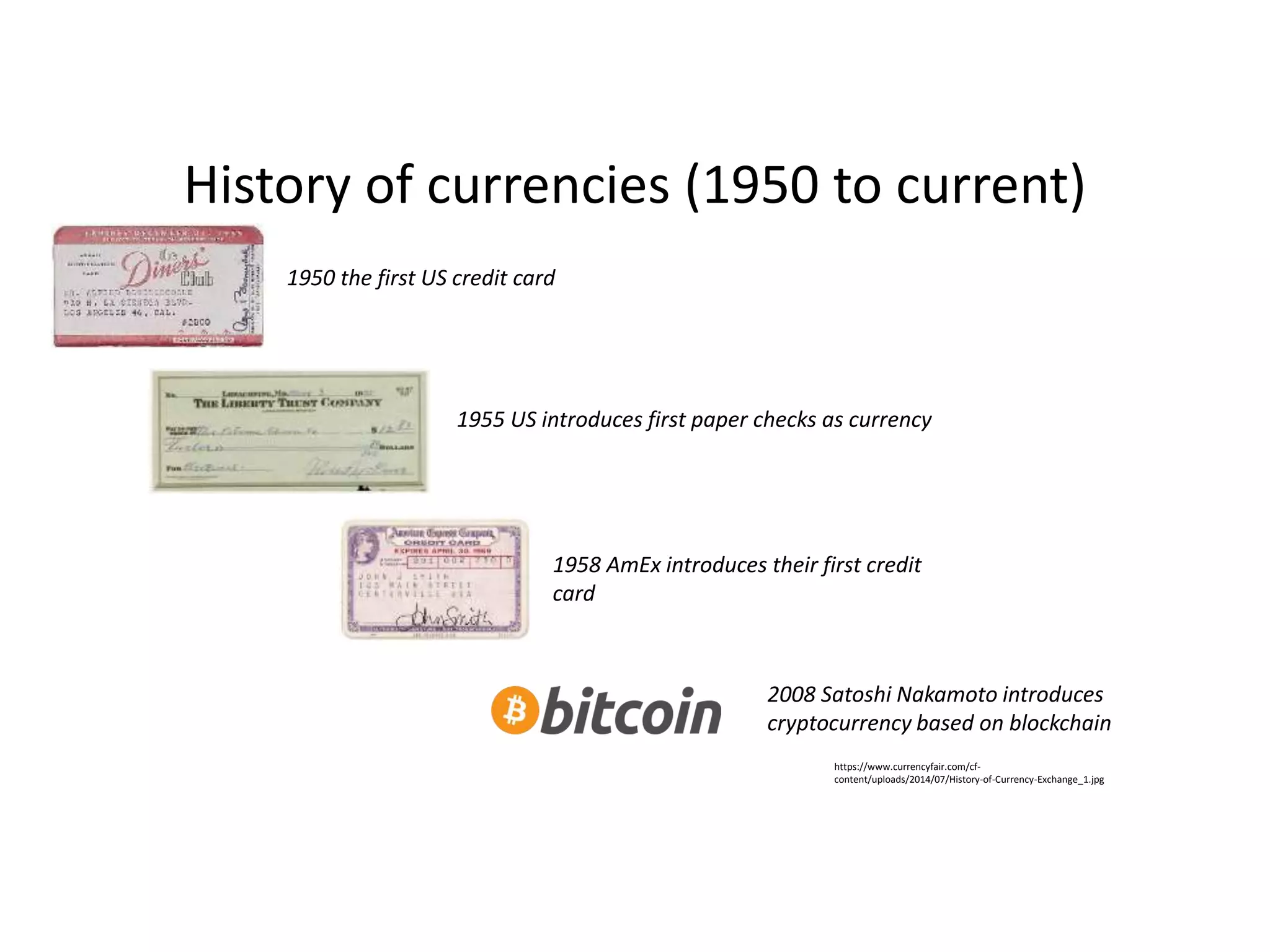
History of currencies (1950 to current)
1955 US introduces first paper checks as currency
1950 the first US credit card
1958 AmEx introduces their first credit
card
https://www.currencyfair.com/cf-
content/uploads/2014/07/History-of-Currency-Exchange_1.jpg
2008 Satoshi Nakamoto introduces
cryptocurrency based on blockchain
https://howmuch.net/articles
/worlds-money-in-perspective
Update - bitcoin has increased
from $41B to $217 B market
cap currently
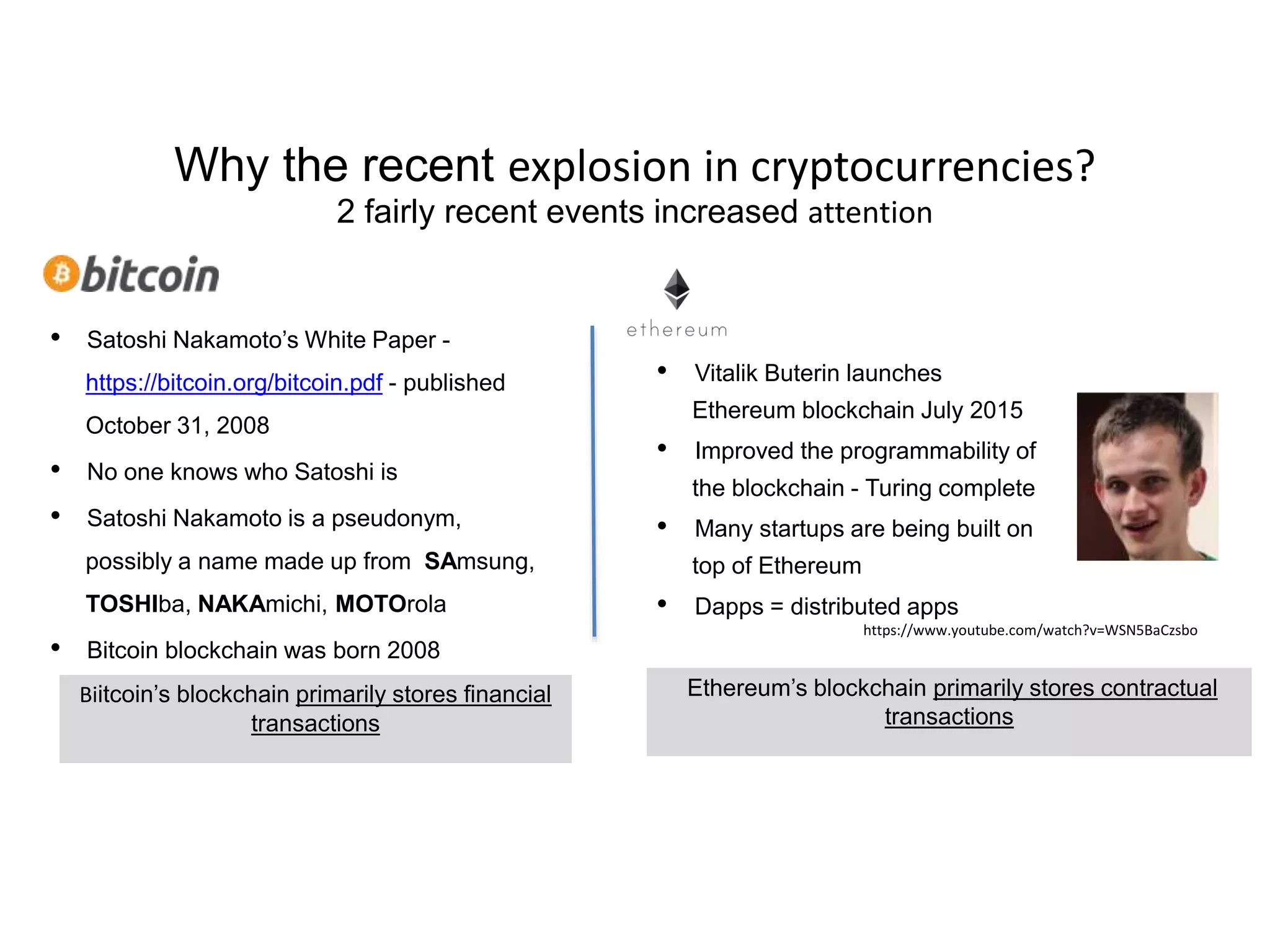
Why the recent explosion in cryptocurrencies?
2 fairly recent events increased attention
• Satoshi Nakamoto’s White Paper -
https://bitcoin.org/bitcoin.pdf - published
October 31, 2008
• No one knows who Satoshi is
• Satoshi Nakamoto is a pseudonym,
possibly a name made up from SAmsung,
TOSHIba, NAKAmichi, MOTOrola
• Bitcoin blockchain was born 2008
• Vitalik Buterin launches
Ethereum blockchain July 2015
• Improved the programmability of
the blockchain - Turing complete
• Many startups are being built on
top of Ethereum
• Dapps = distributed apps
Ethereum’s blockchain primarily stores contractual
transactions
https://www.youtube.com/watch?v=WSN5BaCzsbo
Biitcoin’s blockchain primarily stores financial
transactions
Both bitcoin blockchain and ethereum blockchain DEPEND
on a reward mechanism to function
Bitcoin is integral to the bitcoin blockchain - it’s a critical piece that incents miners to mine.
Ether/Ethereum is integral to the ethereum blockchain - it’s a critical piece that incents miners to mine.
“The currency is in the service of the protocol”
-- Vitalik Buterin
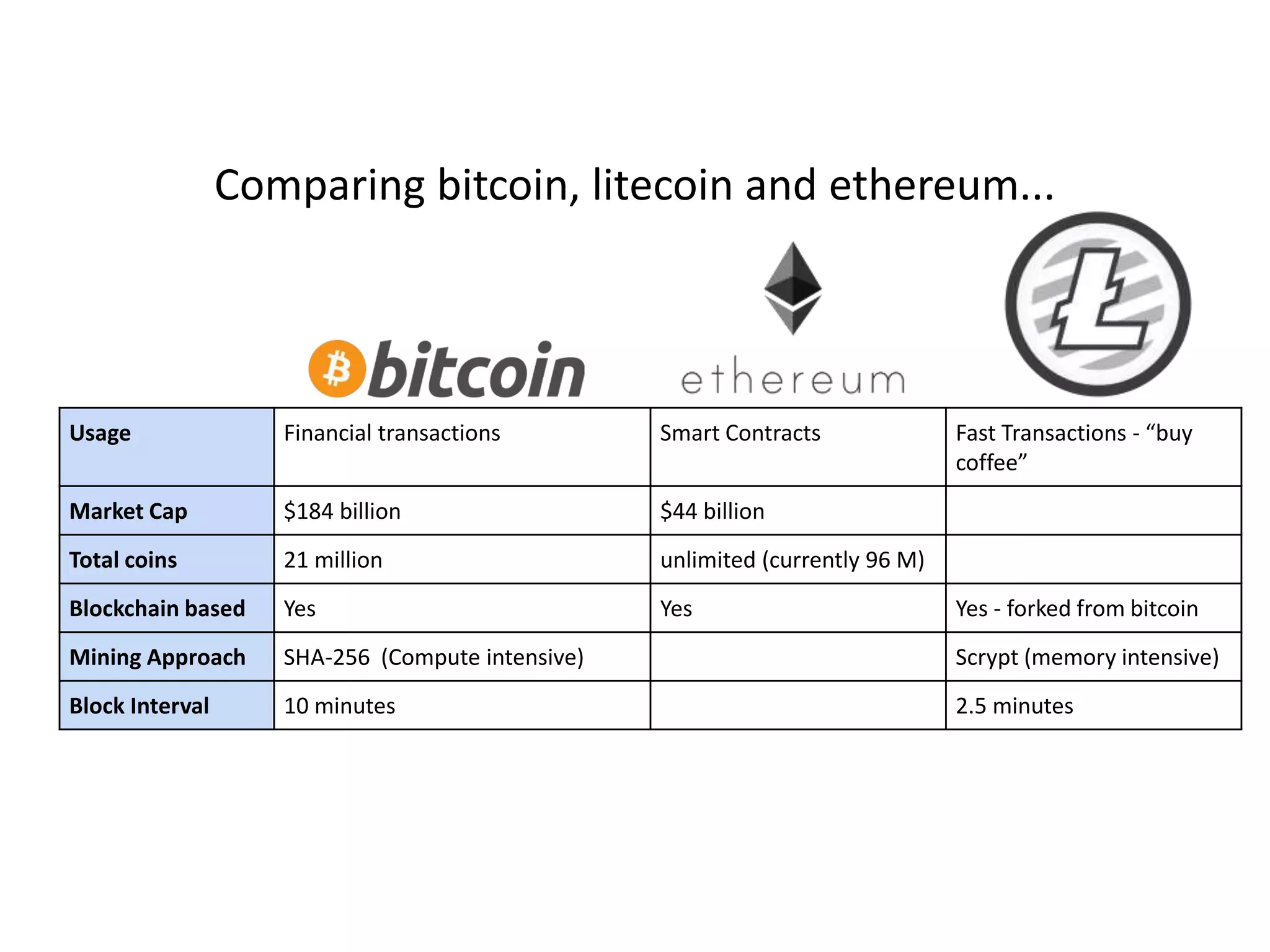
Comparing bitcoin, litecoin and ethereum...
Usage Financial transactions Smart Contracts Fast Transactions - “buy
coffee”
Market Cap $184 billion $44 billion
Total coins 21 million unlimited (currently 96 M)
Blockchain based Yes Yes Yes - forked from bitcoin
Mining Approach SHA-256 (Compute intensive) Scrypt (memory intensive)
Block Interval 10 minutes 2.5 minutes
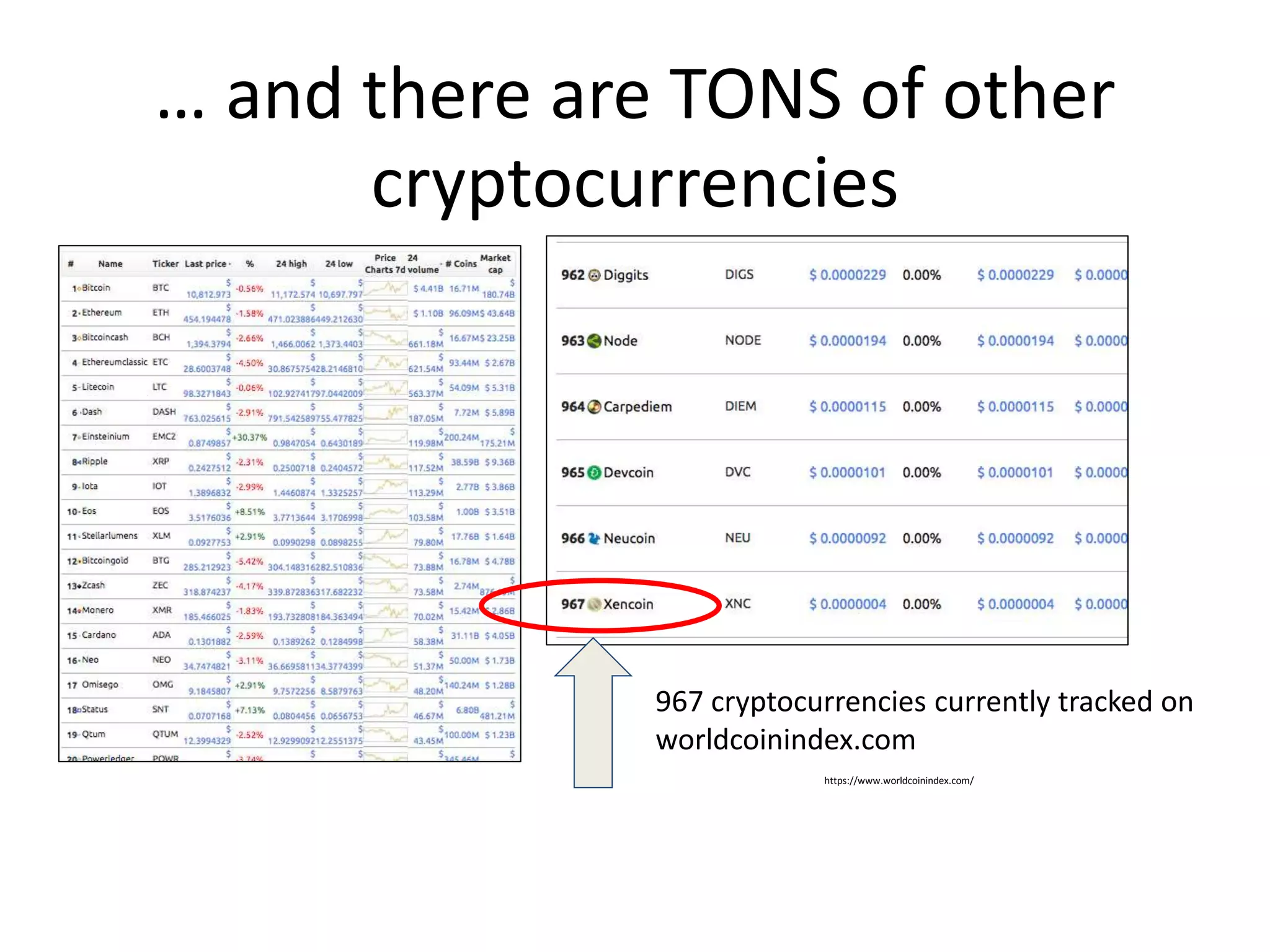
… and there are TONS of other
cryptocurrencies
https://www.worldcoinindex.com/
967 cryptocurrencies currently tracked on
worldcoinindex.com
Where did many of these
cryptocurrencies come from?
The original bitcoin blockchain gave birth to many of the other
cryptocurrencies
Some forked off the original bitcoin
blockchain
https://steemit.com/b
itcoin/@hugobro/wha
t-is-this-bitcoin-hard-
fork-all-about
Another example of soft vs hard forks used to ‘create’ new
cryptocurrencies
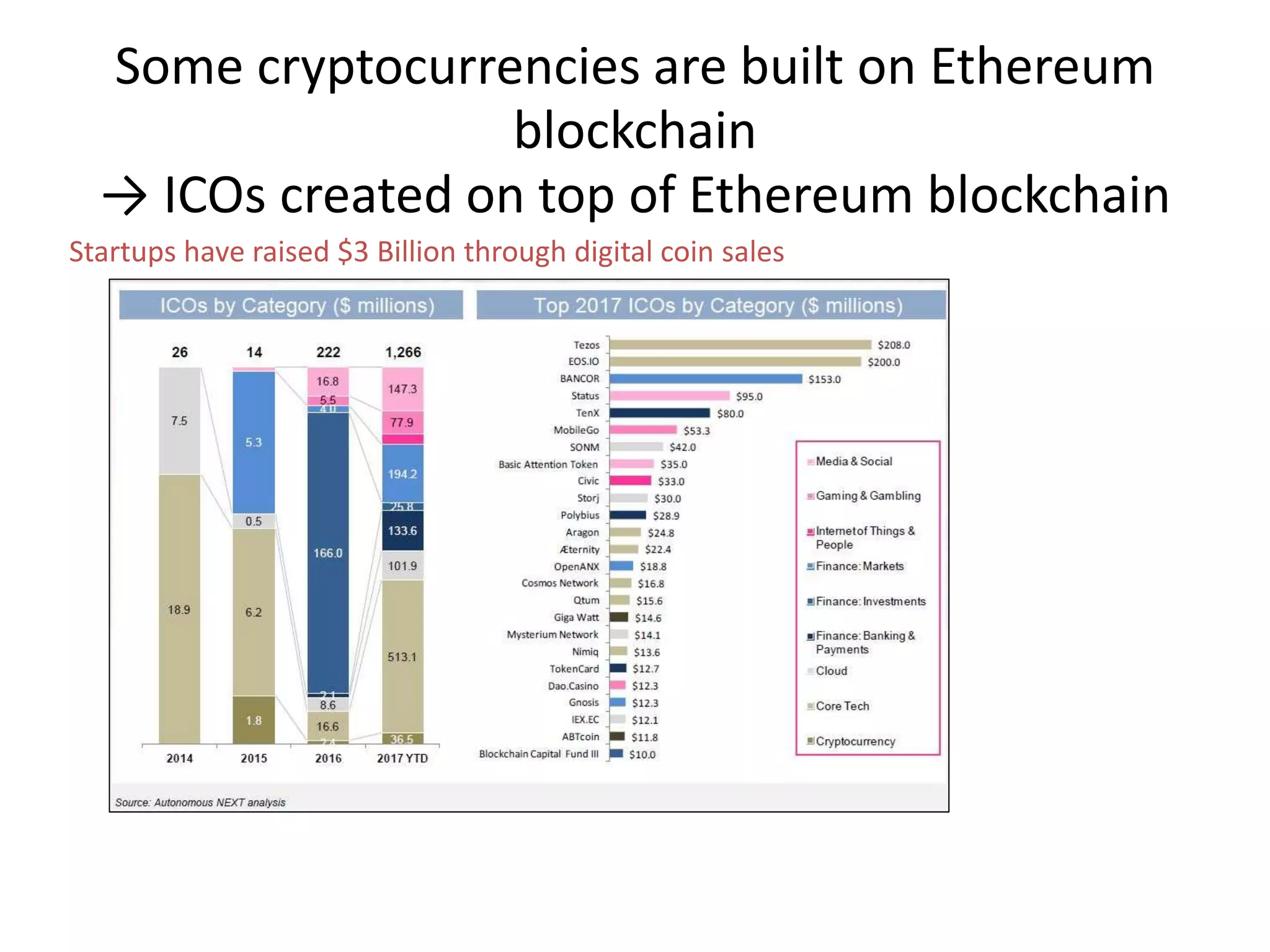
Some cryptocurrencies are built on Ethereum
blockchain
→ ICOs created on top of Ethereum blockchain
Startups have raised $3 Billion through digital coin sales
As people realized the tremendous potential of blockchain, the
respective tokens gained value (eg bitcoin and ethereum).
This has caused investment and speculation.
Anyone can download the open source blockchain code and create
their own coin.
What happened here???? Why the
explosion in cryptocurrencies?
Say what? Anyone can create a
cryptocurrency? YES!
Investment and speculation in cryptocurrency is a personal choice - completely
separate from blockchain.
Public blockchains rely on their respective currencies to reward miners to mine
blocks. Bitcoin and Ethereum are critical to how they work.
Possible personas...
Blockchain Cryptocurrencies
I believe in blockchain but I
would never invest in
cryptocurrencies.
I believe in blockchain and I also
invest in cryptocurrencies.
I think blockchain is a fad and I
would never invest in
cryptocurrencies.
I think blockchain is a fad but I’m
investing in cryptocurrencies.
Socio-Economic Forces Increasing Adoption
of Cryptocurrencies
http://www.paymentscardsan
dmobile.com/mobile-wallets-
global-growth-continues/
Inflation, Lack of Access, Digital Wallets
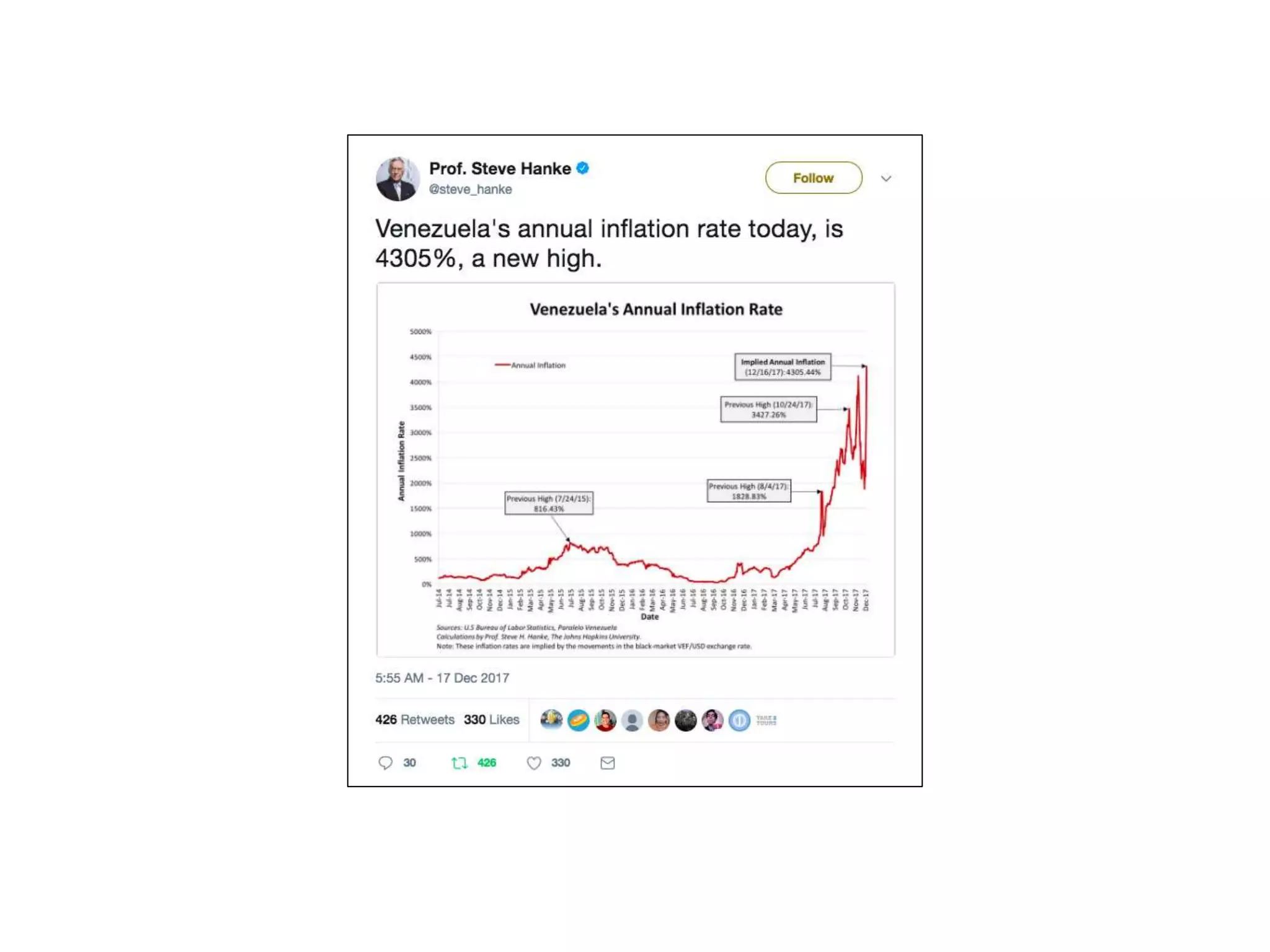
Venezuela - Hyper Inflation
The president of Venezula unvelieved a new 100,000 bolivar
note in November, 2017. The note has a value of $2.50 on
the black market.
Venezuelans, on average, are only allowed to withdraw
about 10k to 20k bolivares a day. 20k bolivars are currently
worth 50 cents.
IMF sees inflation in Venezula soaring to 2200% by 2017.
Venezuelans are turning to bitcoin as an appreciating store
of wealth/currency.
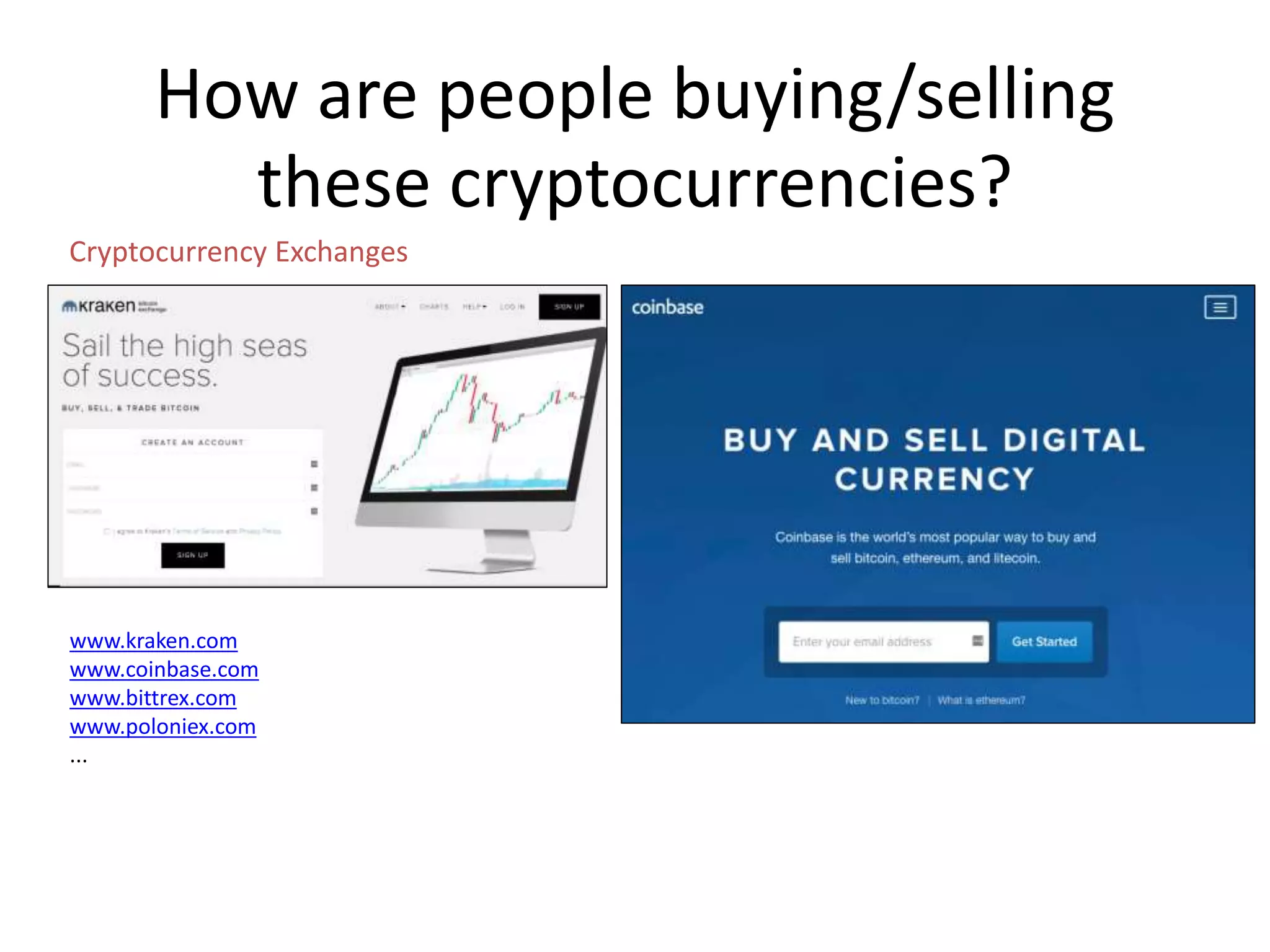
How are people buying/selling
these cryptocurrencies?
Cryptocurrency Exchanges
www.kraken.com
www.coinbase.com
www.bittrex.com
www.poloniex.com
...
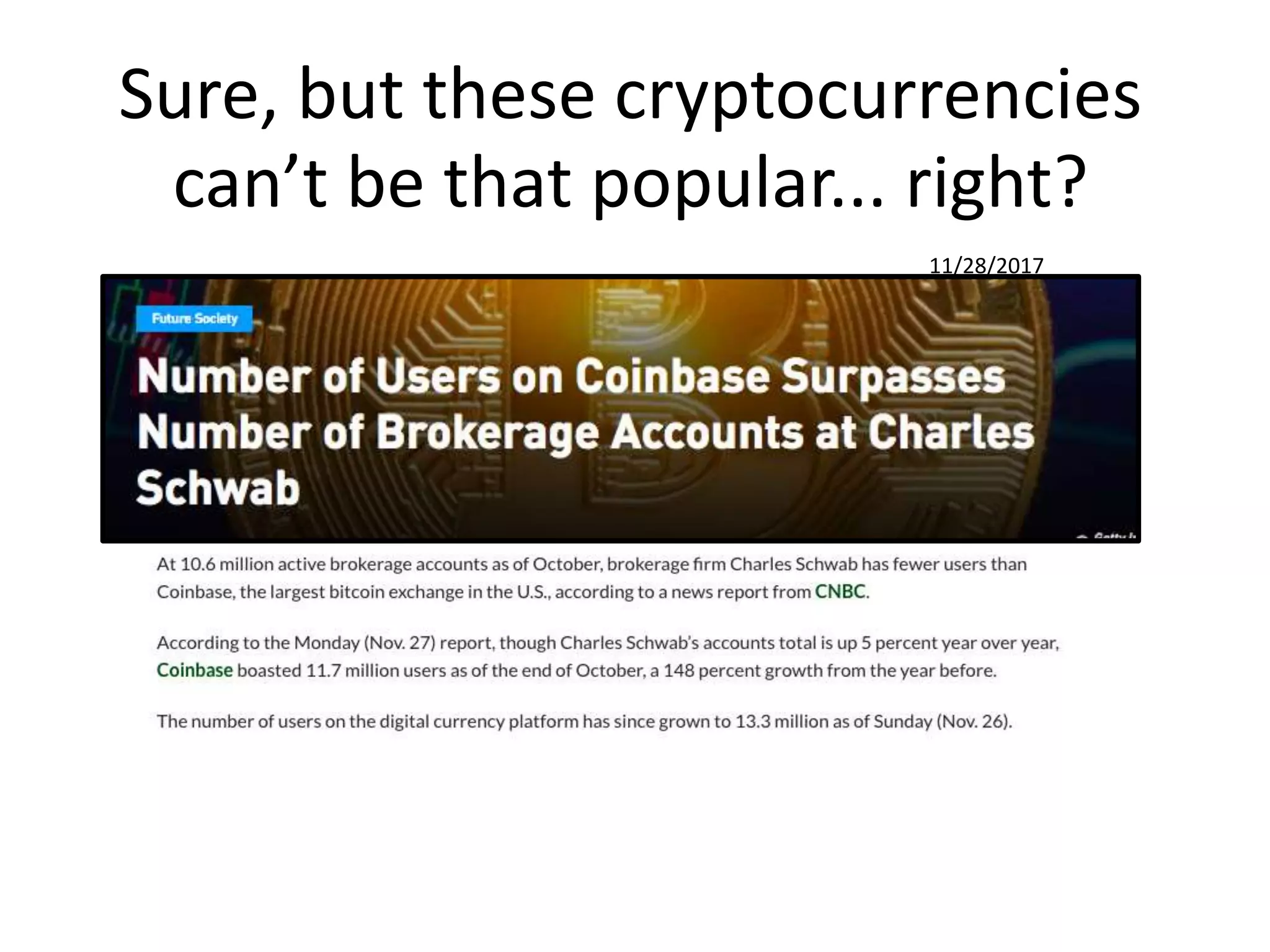
Sure, but these cryptocurrencies
can’t be that popular... right?
11/28/2017
Amazing
Coinbase’s mobile app is now the
#1 app
Bitcoin’s standing in global
currencies
Who actually works on bitcoin?
For free???? URL: bitcoin.team
Who are the developers on the
other coins? New code?
Do your research!
Sometimes very very few.
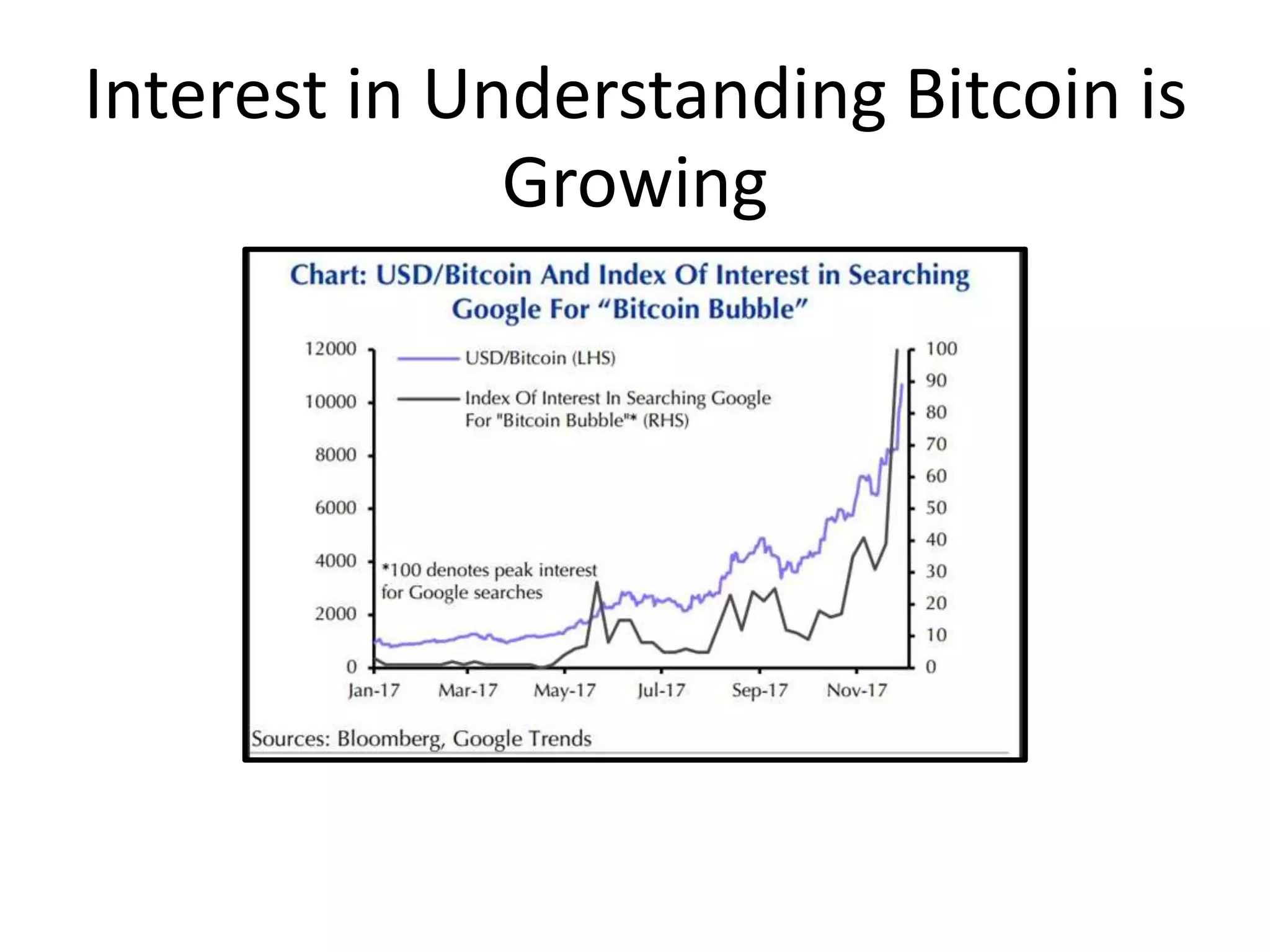
Interest in Understanding Bitcoin is
Growing
Will Bitcoin Go Mainstream?
12/4/2017
Bitcoin’s Market Cap Exceeds Visa
Cryptos are Volatile!
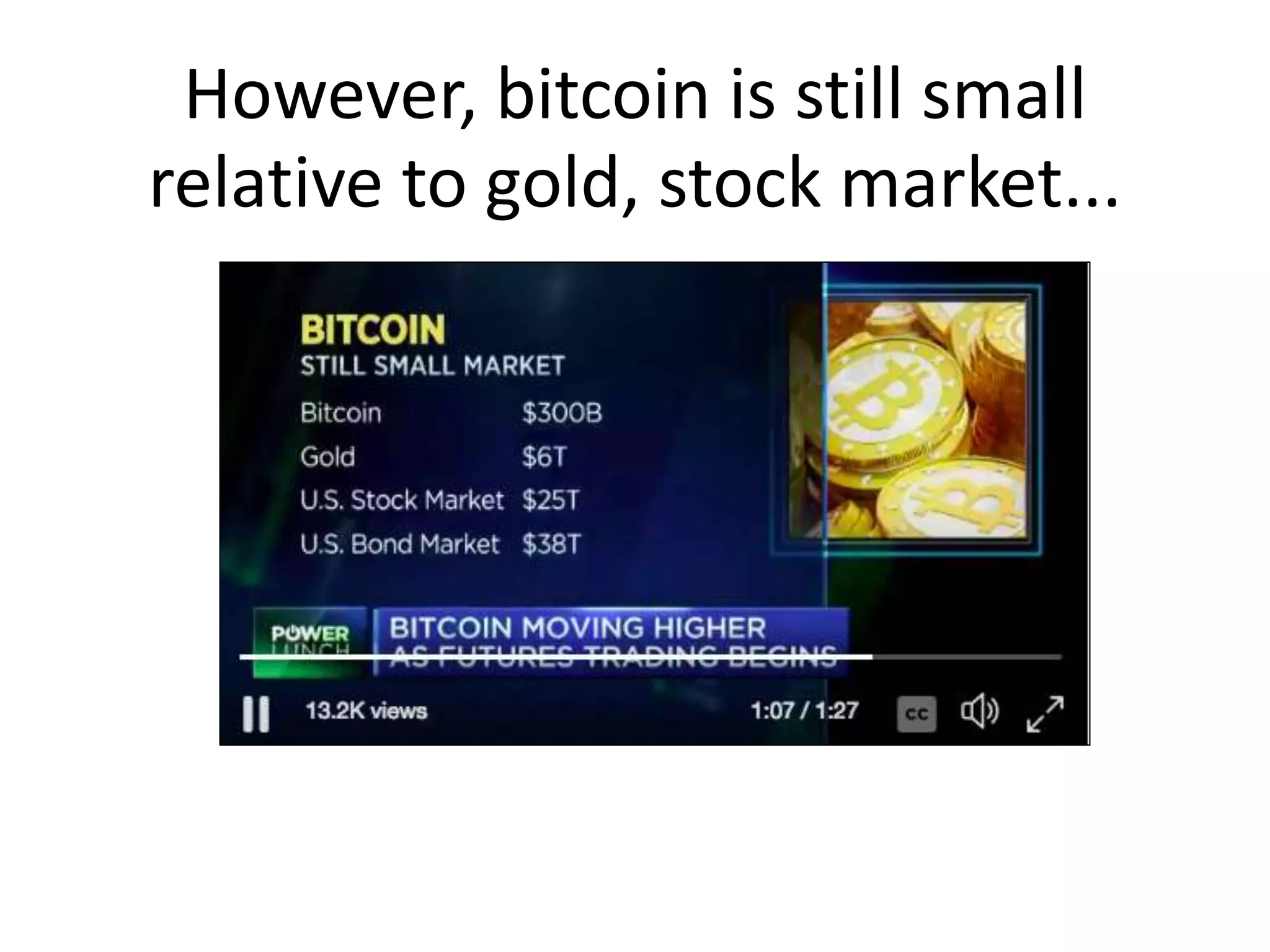
However, bitcoin is still small
relative to gold, stock market...
Brett’s Favorite Bitcoin & Cryptocurrency Tools
• https://tradeblock.com/bitcoin
• http://bitcointicker.co/#
• https://coinmarketcap.com/
• https://bitinfocharts.com/
• https://www.tradingview.com/
• https://www.gdax.com/trade/BTC-USD
Key Projects to Watch - Upcoming
New Capabilities
@ColdcardWallet
@OPENDIME v4
@lightning
@joinmarket
@TREZOR v2
@SegwitOrg
@SamouraiWallet iOS
@ln_zap
#MimbleWimble
Key Messages
● Certain crytocurrencies such as bitcoin and ethereum underpin the reward
mechanism for bitcoin blockchain and ethereum blockchain
● Some people see cryptocurrencies as an investment vehicle
● Cryptocurrencies exist because of lack of access to financial institutions for
$2B people
● Cryptocurrencies exist because of socio-econonic reasons such as high
currency inflation rates
● The interest in cryptocurrencies is growing at an exponential rate
What possible advantages do
cryptocurrencies have?
● Lower transactional cost compared to other financial solutions such as credit cards which currently have a
national average APR of about 15%
● Less expensive than other online payment solutions which have rates such as 2.9% + $.30 per transaction
● With other types of currencies, there are often additional transaction costs to send money between
people in different countries
● Converting non-digital currencies from one currency type to another often carries a transaction fee (eg –
converting US dollar to Euro or Euro to GBP)
● International payments on non-digital currencies often have a significant delay (sometimes a few days) to
send money overseas
● Some emerging countries don’t have a banking system or easy access to a bank or financial institution (eg
Kenya, Uruguay, Panama) … but people have cell phones!
● Merchants pay a fee of between 2% and 3% for some credit card transactions
● “Wiring money home” in some cases costs upwards of 10% of the amount transferred
● Banks can fail – remember the 2007/2008 global financial crisis
Artifacts as Wealth - Storage of
Wealth
The Trust Model for both Bitcoin and Ethereum rely
on mining - miners mine because there is a reward
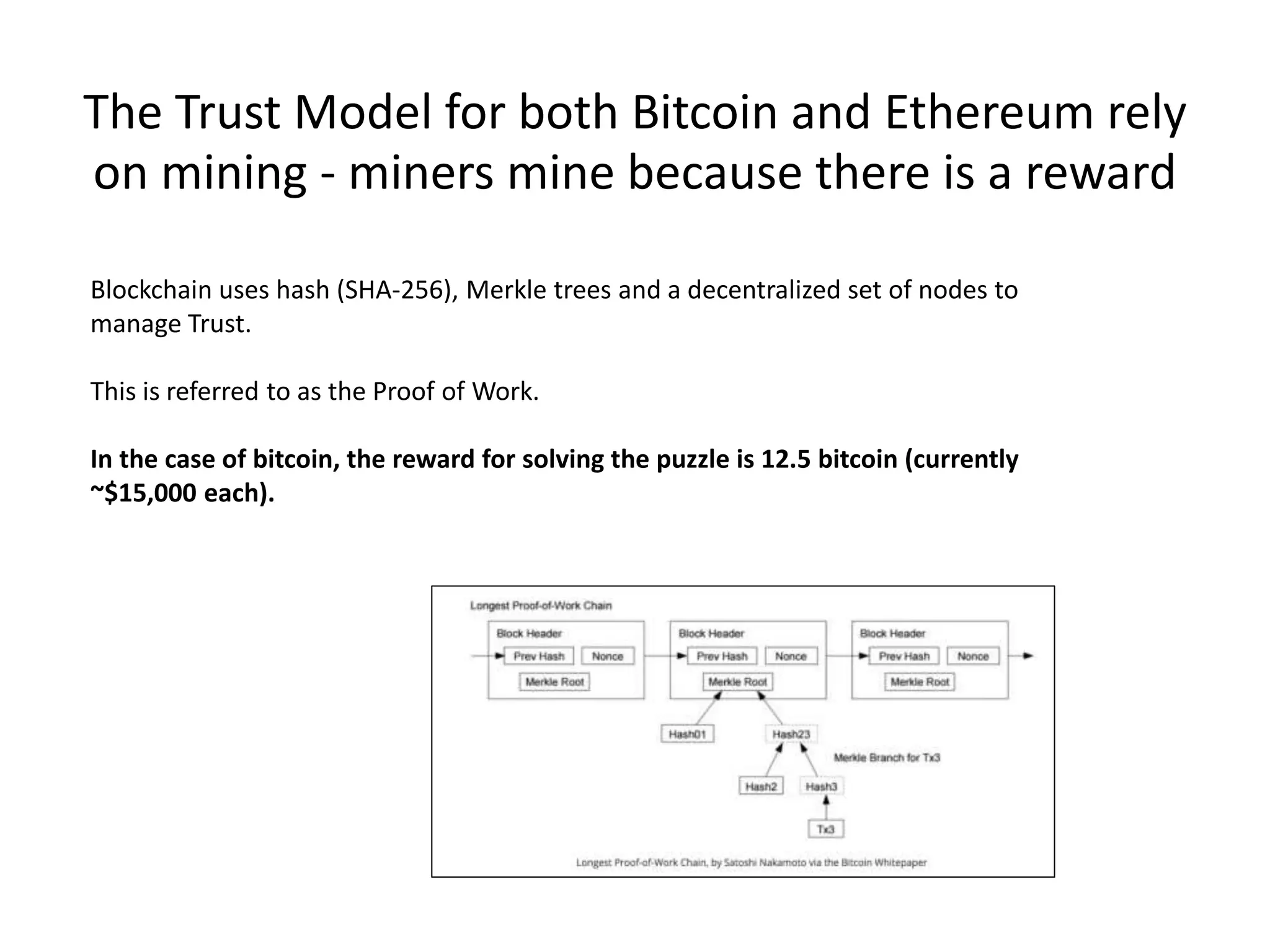
Blockchain uses hash (SHA-256), Merkle trees and a decentralized set of nodes to
manage Trust.
This is referred to as the Proof of Work.
In the case of bitcoin, the reward for solving the puzzle is 12.5 bitcoin (currently
~$15,000 each).
bitcoin = verification reward for the blockchain -
reward cuts in half approx every 4 years
This is
referred to as
the “halving”Nov 28, 2012
http://fortune.com/2017/11/25/lost-bitcoins/
“Just as gold bars are lost at sea or $100 bills can burn, bitcoins can disappear from the
Internet forever. When all 21 million bitcoins are mined by the year 2040, the actual amount
available to trade or spend will be significantly lower.”
Cryptocurrencies 101 v3

Cryptocurrencies 101 v3

  • 1.
  • 3.
    History of currencies(1000BC to 500BC) Standardized metal objects stamped with a standard value -- were the Chinese bronze spade money, c. 475- 221 BC Chinese shell money, 1000 BC..The shell most widely used worldwide as currency was the shell of Cypraea moneta, the money cowry. Coins as currency were manufactured in China, India and Turkey between 700 and 500 BC.
  • 4.
    History of currencies(800AD to 1862) Foreign currency exchange 1700 - England and Holland Paper currency 800 AD 1816 Gold as a benchmark of value in England 1862 United States issues first paper currency
  • 5.
    History of currencies(1950 to current) 1955 US introduces first paper checks as currency 1950 the first US credit card 1958 AmEx introduces their first credit card https://www.currencyfair.com/cf- content/uploads/2014/07/History-of-Currency-Exchange_1.jpg 2008 Satoshi Nakamoto introduces cryptocurrency based on blockchain
  • 6.
    https://howmuch.net/articles /worlds-money-in-perspective Update - bitcoinhas increased from $41B to $217 B market cap currently
  • 7.
    Why the recentexplosion in cryptocurrencies? 2 fairly recent events increased attention • Satoshi Nakamoto’s White Paper - https://bitcoin.org/bitcoin.pdf - published October 31, 2008 • No one knows who Satoshi is • Satoshi Nakamoto is a pseudonym, possibly a name made up from SAmsung, TOSHIba, NAKAmichi, MOTOrola • Bitcoin blockchain was born 2008 • Vitalik Buterin launches Ethereum blockchain July 2015 • Improved the programmability of the blockchain - Turing complete • Many startups are being built on top of Ethereum • Dapps = distributed apps Ethereum’s blockchain primarily stores contractual transactions https://www.youtube.com/watch?v=WSN5BaCzsbo Biitcoin’s blockchain primarily stores financial transactions
  • 8.
    Both bitcoin blockchainand ethereum blockchain DEPEND on a reward mechanism to function Bitcoin is integral to the bitcoin blockchain - it’s a critical piece that incents miners to mine. Ether/Ethereum is integral to the ethereum blockchain - it’s a critical piece that incents miners to mine.
  • 9.
    “The currency isin the service of the protocol” -- Vitalik Buterin
  • 10.
    Comparing bitcoin, litecoinand ethereum... Usage Financial transactions Smart Contracts Fast Transactions - “buy coffee” Market Cap $184 billion $44 billion Total coins 21 million unlimited (currently 96 M) Blockchain based Yes Yes Yes - forked from bitcoin Mining Approach SHA-256 (Compute intensive) Scrypt (memory intensive) Block Interval 10 minutes 2.5 minutes
  • 11.
    … and thereare TONS of other cryptocurrencies https://www.worldcoinindex.com/ 967 cryptocurrencies currently tracked on worldcoinindex.com
  • 12.
    Where did manyof these cryptocurrencies come from?
  • 13.
    The original bitcoinblockchain gave birth to many of the other cryptocurrencies
  • 14.
    Some forked offthe original bitcoin blockchain https://steemit.com/b itcoin/@hugobro/wha t-is-this-bitcoin-hard- fork-all-about
  • 15.
    Another example ofsoft vs hard forks used to ‘create’ new cryptocurrencies
  • 16.
    Some cryptocurrencies arebuilt on Ethereum blockchain → ICOs created on top of Ethereum blockchain Startups have raised $3 Billion through digital coin sales
  • 17.
    As people realizedthe tremendous potential of blockchain, the respective tokens gained value (eg bitcoin and ethereum). This has caused investment and speculation. Anyone can download the open source blockchain code and create their own coin. What happened here???? Why the explosion in cryptocurrencies?
  • 18.
    Say what? Anyonecan create a cryptocurrency? YES!
  • 19.
    Investment and speculationin cryptocurrency is a personal choice - completely separate from blockchain. Public blockchains rely on their respective currencies to reward miners to mine blocks. Bitcoin and Ethereum are critical to how they work. Possible personas... Blockchain Cryptocurrencies I believe in blockchain but I would never invest in cryptocurrencies. I believe in blockchain and I also invest in cryptocurrencies. I think blockchain is a fad and I would never invest in cryptocurrencies. I think blockchain is a fad but I’m investing in cryptocurrencies.
  • 20.
    Socio-Economic Forces IncreasingAdoption of Cryptocurrencies http://www.paymentscardsan dmobile.com/mobile-wallets- global-growth-continues/ Inflation, Lack of Access, Digital Wallets
  • 21.
    Venezuela - HyperInflation The president of Venezula unvelieved a new 100,000 bolivar note in November, 2017. The note has a value of $2.50 on the black market. Venezuelans, on average, are only allowed to withdraw about 10k to 20k bolivares a day. 20k bolivars are currently worth 50 cents. IMF sees inflation in Venezula soaring to 2200% by 2017. Venezuelans are turning to bitcoin as an appreciating store of wealth/currency.
  • 23.
    How are peoplebuying/selling these cryptocurrencies? Cryptocurrency Exchanges www.kraken.com www.coinbase.com www.bittrex.com www.poloniex.com ...
  • 24.
    Sure, but thesecryptocurrencies can’t be that popular... right? 11/28/2017
  • 25.
  • 26.
    Bitcoin’s standing inglobal currencies
  • 27.
    Who actually workson bitcoin? For free???? URL: bitcoin.team
  • 28.
    Who are thedevelopers on the other coins? New code? Do your research! Sometimes very very few.
  • 29.
    Interest in UnderstandingBitcoin is Growing
  • 30.
    Will Bitcoin GoMainstream? 12/4/2017
  • 31.
  • 32.
  • 33.
    However, bitcoin isstill small relative to gold, stock market...
  • 34.
    Brett’s Favorite Bitcoin& Cryptocurrency Tools • https://tradeblock.com/bitcoin • http://bitcointicker.co/# • https://coinmarketcap.com/ • https://bitinfocharts.com/ • https://www.tradingview.com/ • https://www.gdax.com/trade/BTC-USD
  • 35.
    Key Projects toWatch - Upcoming New Capabilities @ColdcardWallet @OPENDIME v4 @lightning @joinmarket @TREZOR v2 @SegwitOrg @SamouraiWallet iOS @ln_zap #MimbleWimble
  • 36.
    Key Messages ● Certaincrytocurrencies such as bitcoin and ethereum underpin the reward mechanism for bitcoin blockchain and ethereum blockchain ● Some people see cryptocurrencies as an investment vehicle ● Cryptocurrencies exist because of lack of access to financial institutions for $2B people ● Cryptocurrencies exist because of socio-econonic reasons such as high currency inflation rates ● The interest in cryptocurrencies is growing at an exponential rate
  • 37.
    What possible advantagesdo cryptocurrencies have? ● Lower transactional cost compared to other financial solutions such as credit cards which currently have a national average APR of about 15% ● Less expensive than other online payment solutions which have rates such as 2.9% + $.30 per transaction ● With other types of currencies, there are often additional transaction costs to send money between people in different countries ● Converting non-digital currencies from one currency type to another often carries a transaction fee (eg – converting US dollar to Euro or Euro to GBP) ● International payments on non-digital currencies often have a significant delay (sometimes a few days) to send money overseas ● Some emerging countries don’t have a banking system or easy access to a bank or financial institution (eg Kenya, Uruguay, Panama) … but people have cell phones! ● Merchants pay a fee of between 2% and 3% for some credit card transactions ● “Wiring money home” in some cases costs upwards of 10% of the amount transferred ● Banks can fail – remember the 2007/2008 global financial crisis
  • 38.
    Artifacts as Wealth- Storage of Wealth
  • 39.
    The Trust Modelfor both Bitcoin and Ethereum rely on mining - miners mine because there is a reward Blockchain uses hash (SHA-256), Merkle trees and a decentralized set of nodes to manage Trust. This is referred to as the Proof of Work. In the case of bitcoin, the reward for solving the puzzle is 12.5 bitcoin (currently ~$15,000 each).
  • 40.
    bitcoin = verificationreward for the blockchain - reward cuts in half approx every 4 years This is referred to as the “halving”Nov 28, 2012
  • 41.
    http://fortune.com/2017/11/25/lost-bitcoins/ “Just as goldbars are lost at sea or $100 bills can burn, bitcoins can disappear from the Internet forever. When all 21 million bitcoins are mined by the year 2040, the actual amount available to trade or spend will be significantly lower.”